New Nonfiction by Karie Fugett: Excerpt from Alive Day
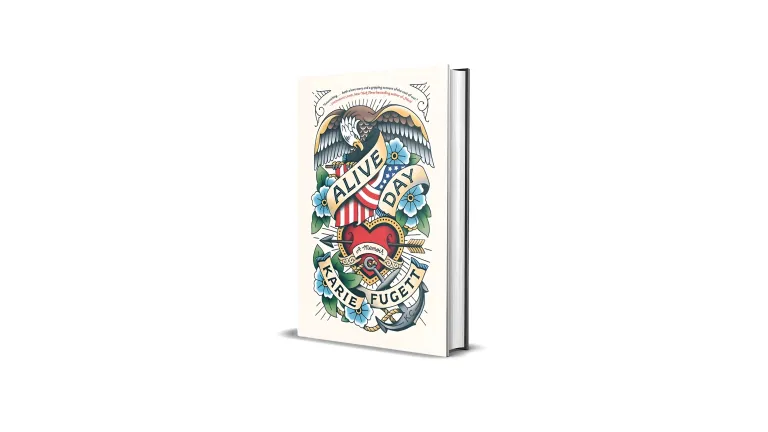 Excerpted from ALIVE DAY. Copyright © 2025 by Karie Fugett. Used with permission of The Dial Press, New York. All rights reserved.
Chapter 5: Alive Day
March 13, 2006
Dillon crawled in circles on the carpet, the TV behind him glowing with reports of destruction and death. Though it had been only days since the boys left, it felt much longer.
“Three people died in Iraq yesterday,” Brittany said as she watched the news and flipped through a People magazine, her gaze switching from page to screen and back. “I wonder how long it takes them to call the families.”
“How can you watch that shit?” I asked as I passed through the room.
“If I don’t know what’s actually happening, my brain just makes stuff up and that’s always worse. Oh no!” Brittany jumped out of her chair and ran to her son. “That’s not for you, baby boy.” She took a picture frame from his hand, then picked him up over her head to sniff his diaper. She kissed him on the cheek and placed him in his playpen.
“You just haven’t found good enough distractions,” I said. Cleve’s unit had been sent to fight the Battle of Ramadi. It was dangerous: fighting in the streets, virtually no law and order. Cleve called it the most hostile place in Iraq. His unit’s job was to secure the city center, and it was very likely that someone would die or be wounded. “Cannon fodder,” I once heard someone call units like Cleve’s. The units that were young. Uneducated. Replaceable. Expendable. The idea that these men were simply pawns, meant only to put a barrier between the enemy and the higher-ranking Marines who were considered more valuable, made me sick. I was starting to wonder if this had been part of our country’s plan all along: let poor people struggle to survive so that when the time comes, they can be lured into the military by the promise of food and healthcare and shelter in exchange for using their bodies to protect the rich and powerful.
Watching the news was like watching the sun set: the result was inevitable. Someone in Cleve’s unit was going to get hurt. Someone would die. The news reported seven service members had died in Iraq since the day our husbands deployed. I knew because Brittany was keeping me updated. Watching all the world’s pain and suffering on a tiny screen from the safety of my home has always been difficult for me, a reminder of how small I am, of how little power I have. There was nothing I could do about any of it. If something was going to happen to Cleve, something was going to happen to Cleve. For my own sanity, I needed to focus on things I could control.
I sat down at the computer Brittany kept in her bedroom and wiggled the mouse. The screen came to life. Firefox still had all the tabs I’d pulled up the day before: Monster.com, Coastal Carolina Community College, a list of things to do in the area. I had even looked up guitar lessons. I’d wanted to learn to play since childhood. Lessons were too expensive, but a girl could dream.
“How are those distractions working out for you?” Brittany asked that night with a smirk on her face. She was sitting across the dining room table from me, eating a bowl of macaroni and cheese. Brittany had tried to avoid thinking about the war during her husband’s first deployment, but it didn’t work. She wasn’t convinced I’d be any more successful at it than she’d been.
“Shut up,” I said. “How long before they can contact us, though, for real?”
“Last time, it was sometime in the second week. They’ll probably have computers. I’m not sure if they’ll have Myspace, but they had AIM last time.”
While I waited, I wrote Cleve letters. I mailed him a letter every day so that once they started arriving, he’d have something each night to cheer him up. I printed off pictures of him and placed them around my room, including one under my pillow. At night, I would pull it out and stare at it, wondering where he was, what he was doing, and if he was okay. Boredom and loneliness have a way of making time stretch. Com- bine the two, and you might be stuck in a single moment forever. This deployment had only just begun, and it already felt unbearable. On the fifth day, he finally called.
“It’s not pretty out here,” he said. “I sure miss those pretty eyes of yours.”
“I miss you, too. Are you okay?” I could hear voices in the background.
There was a long pause before he answered. “Yeah, I’m fine. Y’all doin’ all right?”
“Yeah. I think there’s a lag. Something’s wonky. Our power got turned off a couple days ago, but we—”
“Yeah. It’s always like that,” he interrupted. “Ah. That sucks.”
“What, your power was turned off?” he said.
“The lag is so annoying.” I laughed uncomfortably. “But yeah, the power’s fine now. We figured it out.”
There was another long pause, then Cleve said, “Okay, good. We’ll get paid soon. It’ll be more ’cause I’m deployed. Help Brittany with bills or whatever you need.” He’d given me access to his bank account before he left, and because we chose not to live in on-base housing, he had some extra money from getting married that he insisted I use while he was gone. We’d talk about money again when he got back.
I waited a second until I was sure he was done.
“Thanks, babe. I applied to a bunch of jobs, too. I also applied to the dental hygiene program. Then I’ll be the moneymaker taking care of you.”
Pause. “You goin’ to be my sugar mama?” Pause. “I can be your sugar mama.”
Pause. “Hey. Gotta run,” he said. “I love you. I’ll try to call ev . . .” “Oh, okay. I . . . damn it, this lag. I love you, too.”
Pause. Cleve laughed. “Bye, baby.”
Cleve called every day at first, sometimes multiple times a day, and he always seemed relieved when I answered. I learned to keep my phone on me so I didn’t miss him. When I slept, my cellphone sat next to my pillow with the volume turned all the way up. By the end of the second week, Cleve called less, and when he did, he didn’t say much.
“I’m just busy s’all,” he said when he called for the first time in four days. I’d asked him if anything was wrong. His answer made sense—of course he was busy—but it didn’t explain the shift in tone. There was a heaviness I couldn’t pinpoint. Something was being left unsaid. He’s at war, I told myself. 7is isn’t about you. But I couldn’t help feeling like something else was going on. The way we’d gotten married left me feeling insecure. I’d wondered from the moment he proposed whether he’d felt obligated to do it because I was living in my car. I wondered if he regretted making such a huge decision so hastily. I heard an explosion in the background, but he didn’t react.
“Well, I love you,” I said, and he said it back. “When will you call again?”
“I dunno,” he said, and that was that.
When I told Brittany I was feeling insecure, she was careful but honest.
“You need to take care of you,” she said. We were drinking beers on her bed. We’d just put Dillon to sleep. “I know him, and he’s going to take care of himself.”
When I asked her what she meant, she shrugged and shook her head. “I didn’t expect to be close to both of you. I just want you both to be happy.”
Brittany and I had become inseparable in the few months since we’d met. We did everything together. We did each other’s laundry. We cooked each other food. We cried and laughed together almost every night over bottles of wine. She was the closest friend I’d had in years. But despite our budding relationship, she’d known Cleve longer than me. She was conflicted about who she should be most loyal to.
“I need you to promise me you won’t say anything to him,” Brittany said quietly.
“I won’t,” I promised.
“Well, you aren’t the first girl he’s brought here.” “What do you mean?” My heart was starting to race.
She sighed and took a swig of her beer. “He proposed to his ex like six months before you two got together. She said no and they broke up, or maybe they weren’t even actually together, the story changed a few times, but I’m pretty sure they keep in touch. That’s all I know for sure,” Brittany said. She exhaled. “You okay?”
When I tried to respond, I just cried. Cleve hadn’t mentioned this ex before, even though he’d asked her to marry him not long before he messaged me on Myspace. I was already afraid he’d only wanted to marry me because he felt bad that I was living in my car, and now I wondered if he was looking for any wife at all to get the extra benefits from the military. I wondered if he even loved me. Was I just a rebound? “I know he loves you. It’s not that,” Brittany said. “I don’t know what
it is, really. He’s just . . . Kinsey. You know how guys are.”
I knew how guys were. I thought about the twenty-year-old who took my virginity when I was sixteen; the shadowy figure who molested me when I was six; the Tampa men; the married pilots who were always trying to hook up with the young flight attendants. Now Cleve was keeping secrets from me, possibly even using me as a rebound. What is this game I’m playing? I wondered. Where is the rule book?
“What do I do?” I asked, but I already knew what I would do if I had to.
I could feel the instinct I’d learned from my parents kicking in: I wanted to run. I was already going over escape plans in my mind before Brittany could answer. But I didn’t have a lot of options. Cleve was financially supporting me until I could find a job.
“I don’t know,” she said. “But I’ll help no matter what you decide.” Two days later, the phone rang. When I picked up, silence. “Hellooo?” I said a second time.
“I just don’t know what I’m doin’ in this life anymore,” Cleve said finally.
A knot grew in my chest. It was happening, I thought. He could have been talking about anything, but I knew in my gut he was gearing up to say getting married had been a mistake. He’d been so quiet with me, and now the news about his ex. Something just wasn’t right. Unsure of how to respond, I waited to see if he’d say anything else. When he didn’t, I asked if he was okay.
“Some days I feel like this is it, ya know? Like, maybe I’m not comin’ back this time. This is my destiny or some shit,” he said.
That was not what I’d expected. I’d been so distracted by what Brittany had told me and by how quiet he’d been that I almost forgot where he was. I grappled with asking about the other girl. Who is she? Do you call her, too? I wanted answers, but I decided to wait. He needed me to comfort him.
“Please don’t say that,” I said. “Just get through the next few months. Then you’ll be home with me, and this will be behind you. I’ll take care of you,” I said. “I love you.”
“Thanks,” he said. “I’m just all in my head. It’s fucked-up out here.” “What can I do?” I asked.
“Just somethin’ I have to deal with on my own,” he said. There was a prolonged pause and a deep sigh, and then, “I don’t think I can keep doin’ this relationship.”
There it was. So quiet. A whisper, almost. Infuriatingly quick and straightforward.
“What do you mean?” I asked. “Please don’t say that.”
“We shouldn’t have gotten married, Karie,” he said. “I messed up.”
I begged him to take it back. It was the war, I tried to convince him, something in that hot, foreign place, something temporary that was clouding his judgment.
I pleaded. I begged. All he could say was sorry. I cried into the phone for too long, then heard a sigh and a click. I spent the rest of the day in bed, crying and cursing at pictures of him. What was it about me that made me so easy to leave?
When I woke up the next morning, I decided I wouldn’t let the sadness
keep me from being productive. If there was one thing I’d learned from moving so frequently as a child, it was how to adapt quickly. I pulled myself together and began planning my next move. Brittany said I could live with her no matter what happened with Cleve, and I was grateful. I had some interviews lined up, and to my surprise, I’d been accepted to the dental hygiene program at the local community college. The plan seemed solid. I could breathe now.
“What a mess,” Brittany said one night as we sat on our back porch, drinking wine and smoking cigarettes. “The boys changed in Iraq last time. Who knows what will happen with Nick and me.” Nick was Carson’s first name. Everyone except for spouses called the guys by their last names. Brittany shook her head, rolled her eyes, and took a sip of wine. “He hardly even pays attention to his son. It’s probably because I had him when he was deployed. There’s no connection there. Nick left when I didn’t look pregnant at all, then boom, he comes back to a baby screaming in the back room.”
“I’m sorry,” I said. I’d gotten the sense that she felt stuck. I knew what that was like. I had felt that way for most of my life. “I’m glad we found each other.”
She raised her wineglass. “It’s hard not to be bitter sometimes. I was dragged out here for love, then left in the dust of war.” She took a drag of her cigarette. “You know Nick and I met in high school? He chased me. I kept saying no, but finally I gave in. I fell hard after that. Life is crazy. Now it’s two years later, I have a baby, and I’m the one waiting.” I thought about Brittany—the way her shoulders slumped, the way her hair hung stick-straight at her shoulders, her calming voice, her half
smile. She was only twenty years old and already so tired, so resigned. “You think this is a phase?” I asked. “Maybe they’ll go back to nor-
mal after they get out?”
She shook her head, her hair glowing the color of wheat under the porch light, june bugs winding in the air and slamming their bodies into the sliding glass door as if they’d been drinking, too—clink, clink . . . clink.
“Who knows? The best thing we can do is look out for ourselves and each other and hope they get their shit together.”
I nodded. “Cheers to that.”
Cleve called back, apologizing. He still wouldn’t promise anything about the future of our marriage, but he did say he loved me. There was a lot of silence, then he said, “Burns shot himself in a porta-john yesterday.”
Suddenly the space between us seemed infinite. “My God. Cleve. I’m sorry.” I felt like such an asshole for acting like my own issues were life-or-death when he was across the world fighting a war. “I wish I could hug you.”
“I . . .” he gasped. “I had to clean out his fuckin’ body. I had to put him in a . . . I had to put him in a fuckin’ body bag,” he sobbed.
Helplessly, I listened as Cleve’s sobs turned to wet, heavy breaths, then to silence. And then he had to go.
Cleve was a big dude: six foot three and 225 pounds. I’m not sure I had ever seen a man cry, so it was difficult for me to imagine his eyes producing tears, his large male body heaving as he fought to catch his breath.
Over the next three days, Cleve called at least twice daily, always ending with I love you. This time, I tried not to overanalyze the conversations despite my insecurities. Meanwhile, Brittany and I made care packages for Cleve and Carson. We filled two boxes with snacks, socks, drinks, and anything else we could think of that might cheer them up, including Listerine bottles filled with whiskey.
“Military wives’ trick,” Brittany said. “You don’t think someone’ll notice?” “They didn’t last time . . .”
It was April Fools’ Day when I got a message on Myspace from Cleve’s brother, Nathan. He was the only person in his family who knew Cleve and I had gotten married, but we rarely spoke, so I knew something was up. The message was quick and to the point: Cleve’s hurt. if you don’t know, call me.
The nausea was immediate. I yelled for Brittany to come as I dialed the same number I’d memorized in high school. She pushed the door open with Dillon on her hip.
“What’s going on?”
The phone was still ringing. I put my hand over it and whispered, “Cleve’s hurt.”
“Oh my God! Hurt hurt or is he . . .”
I waved my hand at Brittany and mouthed, Hold on! Hold on! Someone was picking up the phone. It was Nathan, thank God, but he didn’t have much information. The military was looking for me because I hadn’t had an address or phone number to give them when we submitted paperwork for my military ID. Cleve was alive, but his foot was hurt bad enough that he might lose it. A bomb, Nathan thought. While his parents were mostly scared for their son, they were also upset about the marriage. They had only found out about it when the Marine liaison called them trying to find me. They didn’t want to talk to me. I was okay with that.
I stayed up through the night smoking cigarettes and telling stories about Cleve with Brittany as if he’d died. The military liaison officer called me the next day. He didn’t give me much information. He confirmed Cleve was alive and well. An improvised explosive device had hit his Humvee, and his foot was severely injured. He was in Germany, getting ready to be flown to the States. He’d be at Bethesda Naval Hospital in less than twenty-four hours. He gave me an address and a phone number.
“Is there anything else I should know?” I asked. “Sorry, ma’am, that’s all the information I have.” “Will I have a place to stay in Bethesda?”
“Yes, ma’am. Someone will meet you at the hospital with all that information.”
“And I just call that number when I know I’m coming?”
“Yes, ma’am, so they can meet you. We have someone there all hours.”
“Well.” I paused to be certain I had no more questions, biting at my thumb’s cuticle as I thought. I couldn’t think of any. “Okay, then. Thanks so much.”
“Very welcome.”
I closed my phone, tucked it into my back pocket, turned to Brittany, and shrugged. She’d been standing next to me, listening to the phone call.
“That’s it?” she said. “Thaaaat’s it.”
“It’s really just his foot?”
“I guess so? I’m not sure that guy really knew what happened.
Sounded like he was passing on info from a piece of paper.” “Damn. This is crazy town.”
“Right? Cleve was hit by a bomb. At war. After only three weeks. I mean . . .” I shook my head, mouth agape.
“Well, I can drive you so you don’t have to fly,” she said. “I want to see him, anyway.”
“Can I hug you?” I asked.
She looked at me like, Well, obviously, and opened her arms.
Cleve called during our drive to Maryland. It was quick. He’d been flown from Ramadi to Baghdad, then Baghdad to Germany. In Germany, doctors performed surgery on his leg to stabilize him for the flight back to the States. He said he’d be in Maryland a few hours before me.
“I’m okay,” he said. “They got me, but I’m okay. I love you.”
That should have confirmed that he expected and wanted me to come be with him, but I couldn’t shake the words I can’t do this anymore. I wondered whether he felt obligated to call: wounded men are supposed to call their wives. It didn’t matter now. Whether he liked it or not, I was coming. I’m gonna love the shit out of you until you love me back, I thought.
Brittany and I arrived at Bethesda Naval Hospital sometime after midnight. The hospital was asleep except for the liaison officer who waited for us, his office a fluorescent sore in an otherwise low-lit and shadowy space. I was delirious from lack of sleep, too many energy drinks, and the anticipation of seeing Cleve again. The liaison officer— who introduced himself as Addair—was just a little older than me, in his early to mid-twenties. He was tall and thin with piercing hazel eyes, a sarcastic attitude, and a subtle limp. I wondered if he always worked in the middle of the night or if he was only there for me. He handed me a stack of paperwork to fill out. I’d had a headache for hours now, and the brightness of the paper, the tiny words covering each page, made me feel like my head might pop. Brittany sat patiently in the corner, holding Dillon, who’d fallen asleep on the ride over.
“What’s all this for?” I asked, gesturing to the forms.
“Just some red tape,” he said. “Non-medical attendant pay, info we’ll give to the Navy Lodge where you’ll be staying, stuff like that.”
The military would pay one non-medical attendant, or a primary caregiver, just under two thousand dollars a month as long as the patient had to be away from their duty station (in our case, Camp Lejeune) while receiving treatment. I got stuck on the word month. The dental hygiene program started in four months. I wondered for a moment if I’d still be able to go, then shooed the thought away. Cleve. I’ve got to get to Cleve.
When I finished, Addair told us the baby wasn’t allowed in Cleve’s room. Because he’d just gotten back from Iraq, he could be contaminated with who knows what, and it wasn’t safe.
“I don’t mind waiting,” Brittany said. She kissed Dillon on the head. “As long as he’s asleep, I’m fine.”
Though I hadn’t known Brittany long, she’d shown me a kind of friendship—one of kindness, patience, and selflessness—that I hadn’t found in many people before. I put my hand on her shoulder, careful not to wake Dillon. “Thank you. Seriously.”
Addair’s and my footsteps echoed in the hospital lobby as we made our way to the elevator. When we reached Cleve’s room, Addair instructed me to put on a yellow paper gown, a mask, and gloves. I opened the door. A lamp in the far corner draped the room in soft light. Cleve was in the bed closest to the door. At first, I thought he was asleep. I was afraid to walk toward him, afraid of what he would say when he realized I was there. But then, he moved. His eyes opened, and he turned to look at me. For a split second, his face was blank, and I swore he was mad and would tell me to leave. But then, he smiled.
“There she is.” He reached out his good arm—the other had been hit by shrapnel and was being held by a giant piece of foam that looked like Swiss cheese—for a hug, and my uncertainty melted away. “Come here. I missed those freckles of yours.”
I walked over to him and kissed him on the forehead. “What the hell did you let them do to you? I told you to be safe,” I said.
He looked down at his leg. “War takes what it wants, I guess. I was just along for the ride.”
It was apparent he was high on pain meds. His movements were a little too fluid, his words slurred.
“Can I see it?”
“Sure. They got me good,” he said, lifting the sheet from his left leg. It looked like something you might find at a butcher shop, a large chunk of bloody meat wrapped in what looked like cellophane. I gasped.
“They said your foot. That’s your whole damn leg.”
“Oh, yeah. The whole damn thing. They put rods in my thigh before I left Germany. The bottom half ’s goin’ to take a little more time to figure out, but they said I should keep it.”
Addair walked into the room.
“I hate to break this reunion up, but it’s well past curfew, and I need to get you and your friend checked in to your hotel room. Visiting hours start at eight in the morning. You can continue catching up then.” “Aw, come on, Addair. You can’t give a broken man some time with
his wife?” Cleve said.
I smiled.
“Trust me, you’ll have plenty of time together in the next few months,” Addair said. There was that word again. Months.
“Will we be going back at all before then? Are people usually here that long?” I asked.
“It depends on the injury,” he said. He looked at Cleve and made a clicking noise with his tongue. “I’m no doctor, but I’d get comfortable if I were you.”
I sighed. I would have to forget about college, at least for now. “Okay,” I said, nodding. “I’ll get comfortable, then.”
As Addair left the room, he tapped his hand on the wall and said, “Happy Alive Day, man,” over his shoulder. Later, Cleve would tell me that every wounded service member celebrated what they called an alive day. It was the day they almost died at war but survived—the day they were given a second chance. I wondered what Cleve’s alive day meant for me.