New Review by Travis Klempan: Adam Kovac’s The Surge
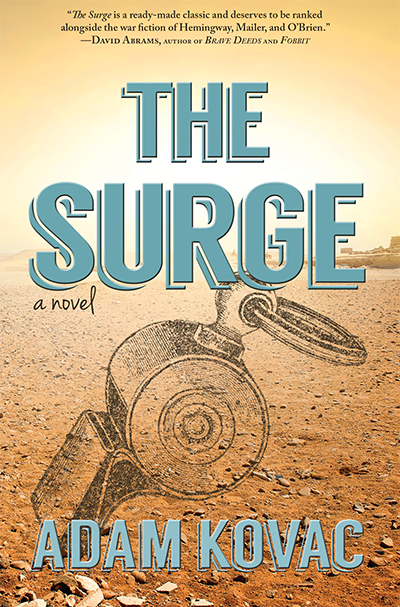
Whether we wanted it or not, America was – up until this very moment, perhaps – truly the indispensable nation. Put another way, from the end of World War II to the point we reelected a man bent on dismantling everything, the United States of America served as a sort of nexus; hardly anything happened in the early part of the 21st century without America exerting influence on it, for good or bad. If that’s the case, then our decision to invade Iraq in the spring of 2003 was the fulcrum on which our credibility balanced. And the pivotal moment (really, a series of moments a year and a half long) of the Iraq War would be the Surge.
The simple name, the complex problem and series of problems it sought to solve, the half-effected solution: the Surge colors everything before and after, just as the war itself inflects pre- and post-2003 America. Books written or set before the Surge prefigure and foreshadow what’s to come; those written and set after exist only in the shadow of what was achieved or what failed to happen.
The Surge was large enough to exert pressure even on a young officer in the Navy. My first deployment on USS Princeton changed overnight, our carrier strike group no longer headed to Palau and Australia but now to the waters off Iraq, the airplanes from the USS Nimitz now tasked with supporting soldiers and Marines on the ground in places like Anbar, Diyala, and Muqdadiyah. My first novel is set in the events of the Surge, the men of a real but deactivated infantry battalion likewise caught up in the vortex that sucked in the past, present, and future.
I lay all this out not to brag, boast, or establish credentials, but to set the scene of Adam Kovac’s The Surge, a novel that, upon reading, I realize is the nexus novel of the nexus event of the nexus war of the nexus country. A republished version of his previous work that caught my attention in 2019, I did not compare this edition to its previous iteration. How could I? For those soldiers and others who deployed to Iraq more than once, how could they compare the first to the second (or third, fourth, ad nauseum)? Instead, I embarked on this reading with the intent to review…which itself changed the way I read it.
How could it not?
Larry Chandler is a veteran of the war in Afghanistan, sent through a series of unfortunate events to lead National Guardsmen in an almost-forgotten corner of the Iraq War. The specifics of the story ring true to someone with vicarious and informed knowledge of what happened, but like any good war story the technical minutiae neither bog down the reader nor distract from the real purpose. The events are told largely chronologically, flashbacks to Afghanistan notwithstanding, but the bigger picture and key details emerge slowly, deliberately, and at times shockingly.
And that’s the real rub. There are enough things in here that caught my attention as I read, jotting down things like “Lemon from The Things They Carried,” “inverted identities,” “Groundhog Day but deadly,” and “catharsis, in a way.” I underlined “the brilliance of another boy’s phony universe,” “the sleep he couldn’t fight,” and this exchange:
“People need their heroes.”
“It’s a sham,” Chandler said.
“It’s a war.”
“Still a sham.”
There are echoes of the Vietnam War and its literature, turns of phrase like “Cool as the other side of the pillow” that would ring as true coming from the mouth of a draftee as it does a Midwestern National Guardsmen. There are echoes of Tim O’Brien and Joseph Heller (“You’d sleep in a dead person’s bed?”), Band of Brothers and Shawshank Redemption, prefigurations of The Militia House from John Milas, and parallels to contemporaneous accounts like Matt Gallagher’s novel Daybreak and the film Warfare.
Indra’s net, as remembered from a summer writing program I attended in 2016 and verified on Wikipedia, is a metaphor illustrating the interconnectedness of all things, a net with a jewel at each vertex that reflects every other jewel. Taking the figurative literally, that reduces complexity to meaninglessness; if everything reflects everything else, so what? Taking the figurative figuratively, though, it’s only in examining the reflections and considering their import that we can start to travel the strands of the net, sussing out the connections without deviating from the paths.
Kovac clearly knows how to conserve and employ words. Nothing is wasted here, everything written to maximize utility and impact. The sentences and context amount to more than what’s on the page often enough that I started looking for meaning and finding it everywhere. A casual mention of the Detroit Red Wings evoked curiosity; was the author seeking to invoke Operation Red Wings, a similarly influential nexus event of the Afghanistan War (sufficient to generate movies, memoirs, and a book about demons haunting survivors)? Chandler’s experience at Michigan State reminded me of another Army vet writer who studied there; the protagonist’s very surname is the same as an Air Force vet poet. The Chuck Norris meme – historic in the year 2025, very much of the moment in 2007 – makes an appearance in a port-a-john, and portable shitters have been memorialized even on the walls of the Pentagon. “Fucking Fobbit” = David Abrams. Camp Victory…that’s where I lived for a year. Al Faw Palace…
“Pathetic monument that won’t stand the test of time.”
I wrote that in the margin. I asked myself in blue ink if any of our camps (Camp Tucson, Camp Cleveland, Camp Atlanta) if any of those names have survived. Alexander conquered worlds and cities named for him still exist, even where he never marched; our names have likely been wiped away already.
But a book like The Surge – that might stand the test of our time, at least, if enough people read it. I want people to read it. They need to read it. How can I make them read it?
I mentioned the movie Warfare, which I haven’t seen and don’t intend to. From all accounts it’s an accurate, blow-by-blow, nearly real-time account of an actual event. Great. So what?
The combat at the end of this novel might not have happened, but it happened all over Iraq, it’s happening in Ukraine, and it could happen here. I hope it doesn’t happen here. If enough people read Kovac’s work, it might not. Who knows.
In addition to Indra’s net, the searing and lingering image left to me after reading The Surge is “cyclical and crescendo,” another scribble in the margin calling forth a widening gyre, a dynamic feedback loop that, for now, is out of control but not all-consuming.
One last quote from Kovac, not from me: “The surge, it changed all the rules.”