Christopher Nolan’s The Odyssey: Dreams of Vengeance, Dreams of Home
After watching Christopher Nolan’s The Odyssey, I talked with my old friend Mike about how the movie impressed me. Mike also enjoyed the film and had seen things in it that I’d missed. One observation he made which I’m sort of borrowing right now is that in ancient times dreams were closer to reality, or maybe even part of reality. This is no longer the case in the civilized West. My wife, who grew up in the USSR, doesn’t let me talk about my dreams. She feels that speaking the dreams will manifest some evil. Most of my dreams are bad. She’s probably right.
Before the events of The Odyssey, or even The Iliad, Hecuba, the wife of Priam, King of Troy, has a dream. She dreams that she will give birth to a flaming torch. Instead, she gives birth to a baby boy. As was the custom in the day, they interpreted the burning torch dream to be a premonition of doom; specifically, the destruction of Troy. Hecuba and Priam reluctantly decided to have the baby killed. Most people agree that they’d go back in time to kill baby Hitler if they could, so we understand the premise. Kill the baby, save the world.
Except the gods have other plans. A prophecy of doom isn’t something to be taken lightly, and Priam and Hecuba made the classic mistake of having someone else do their dirty work for them. The baby survives and makes his way back to Troy as an adult where after several heroic adventures he is ultimately taken back in as Prince Paris. Paris’ brother Hector, a brave and great warrior, hates Paris. There’s the dream, for one thing. For another, there’s the fact that Paris has run off with Helen of Sparta and now a bunch of Greek heroes are encamped outside Troy’s walls. That all happens in The Iliad.
Later, after the vengeful Greeks destroy Troy, killing Hector and Paris in the process, different traditions propose various endings for Hecuba. I prefer the one where she is taken as a slave by Odysseus but turned into a dog by the gods and escapes to Hecate, goddess of the night. Most of the traditions agree that the former Queen of Troy gets polymorphed into a dog. The witch Circe uses a similar trick to turn Odysseus’ men into pigs.
If this seems illogical and confusing, that’s because it is obviously all part of a dream.
Mike and I have conversations when we watch movies like The Odyssey because we woke up in the same dream once, during training in Fort Benning. It was very strange. Everyone else from our training was there, too, in a church. There was a lot of shouting and shooting. The event was a kind of joke or prank gone wrong. Somehow the dream ended up being about sacrilege. Later Mike went to Iraq, and I went to Afghanistan. We share a common frame of reference by which to explore certain types of stories such as those dealing with war, and homecoming, and religion, and of course, the sacrilegious activities we participated in before and during war.
The Odyssey is about all four of those things. Mostly, it’s about how war changes a person. In the film, Odysseus doesn’t want to follow Agamemnon to make war on Troy; it’s not really his war. He wants to remain with Penelope, or to run away with her and start over somewhere else. They have a baby, Telemachus, about whom there are no troubling dreams. Instead, there’s Agamemnon, who kills his daughter for wind to sail against Troy. A bad dream might be a premonition of doom, but the enmity of a vindictive and angry king in the present is definite. Odysseus promptly pulls together a few ships worth of warriors and sets sail.
One thing leads to another. By the time the Trojan war’s over, Odysseus is horrified by the actual sack of Troy, the murder and the rape — again we’re talking about the film here, not the epic on which the film is based — and chafes at having to follow Agamemnon. He seems to regret his Trojan Horse trick and decides, impulsively, to take a different route back home to Ithaca. The other Ithacan troops are skeptical. Maybe they’ve heard that not every island is hospitable. Or maybe they’re just homesick. Odysseus boasts that they’ll be back at Ithaca before Agamemnon has returned to Mycenae. It makes sense in the moment. Probably some soldiers thought the Trojan Horse thing wouldn’t work either. If there are voices against his proposed itinerary they keep quiet.
Well, the islands are a mixed bag. The first is inhabited by regular people, who flee instead of trading with Odysseus’ men, who raid them in punishment. After that is the Island of the Cyclops, which we see killing and eating Odysseus’ men before they put its eye out and escape. Then they visit the Laestrygonians, giant warriors who slaughter the veterans of Troy with ease. It gets worse. Whatever military prowess or bravery the group once had, it has been replaced after their battle with the Cyclops by the latter part of the “fight or flight” instinct. Several minutes of the movie are dedicated to the Ithacans running away and struggling to push their ships away from hostile shores or being battered by waves and various monsters or turned into pigs.
If the trip home is hard, the homecoming is even worse; Odysseus arrives in time to help his son survive an assassination attempt. With great care and effort he seeks to preserve his marriage from the machinations of “dozens” (canonically we know this to be over 100) of suitors trying to claim his throne and the hand of his loyal wife, Penelope. This dream of home is also a dream of vengeance.
In what seems like a kind of double-curse, having lost all of his troops at Troy or during the journey back, Odysseus now finds himself in the unenviable position of having to kill yet more of Ithaca’s sons. Nolan’s version is much less bloody or vicious than Homer’s; Nolan spares the servants who work for the suitors, and about half the suitors. Nolan’s Odysseus has very little help from Telemachus and none from loyal Ithacans — he has to fight the suitors himself. He wins. He and Penelope live happily ever after.
There’s some messiness in the original Greek recounting of Odysseus’ life, and there’s some messiness in Nolan. They come in different places that probably say something about the culture from which the versions emerge. Nolan’s Odysseus returns home wracked with guilt and self-doubt, bitterly ruing the part he played in destroying Troy. The Odysseus of Homer was a suitor himself once — one of Helen’s suitors (Helen of Sparta, Helen of Troy, Helen of Sparta again — that one) who swore an oath to protect and come to the aid of Menelaus if anyone should abduct Helen (in fact, Odysseus cleverly uses this oath as payment for the hand of Penelope, who happens to be Helen’s cousin, and whom Odysseus truly wants to marry) and is therefore responsible for the trick that leads to Troy, and the trick that wrecks the city. Homer’s Odysseus doesn’t seem as broken up about the killing.
Suitors and important women; Odysseus “wins” the hand of Penelope over the objection of her father and over the feats of other suitors. But later, while he’s at Troy and wandering, and she’s waiting for him to return, her legendary chastity and faith in Odysseus must be built on something. Nolan decides that it’s love. Penelope tests that love in the film, and we get the scene with Odysseus’ famous bow, which lives up to the buildup. He “wins” her back, through the aforementioned trial by combat which culminates (rather than starting, as in Homer’s epic) with the killing of Antinous.
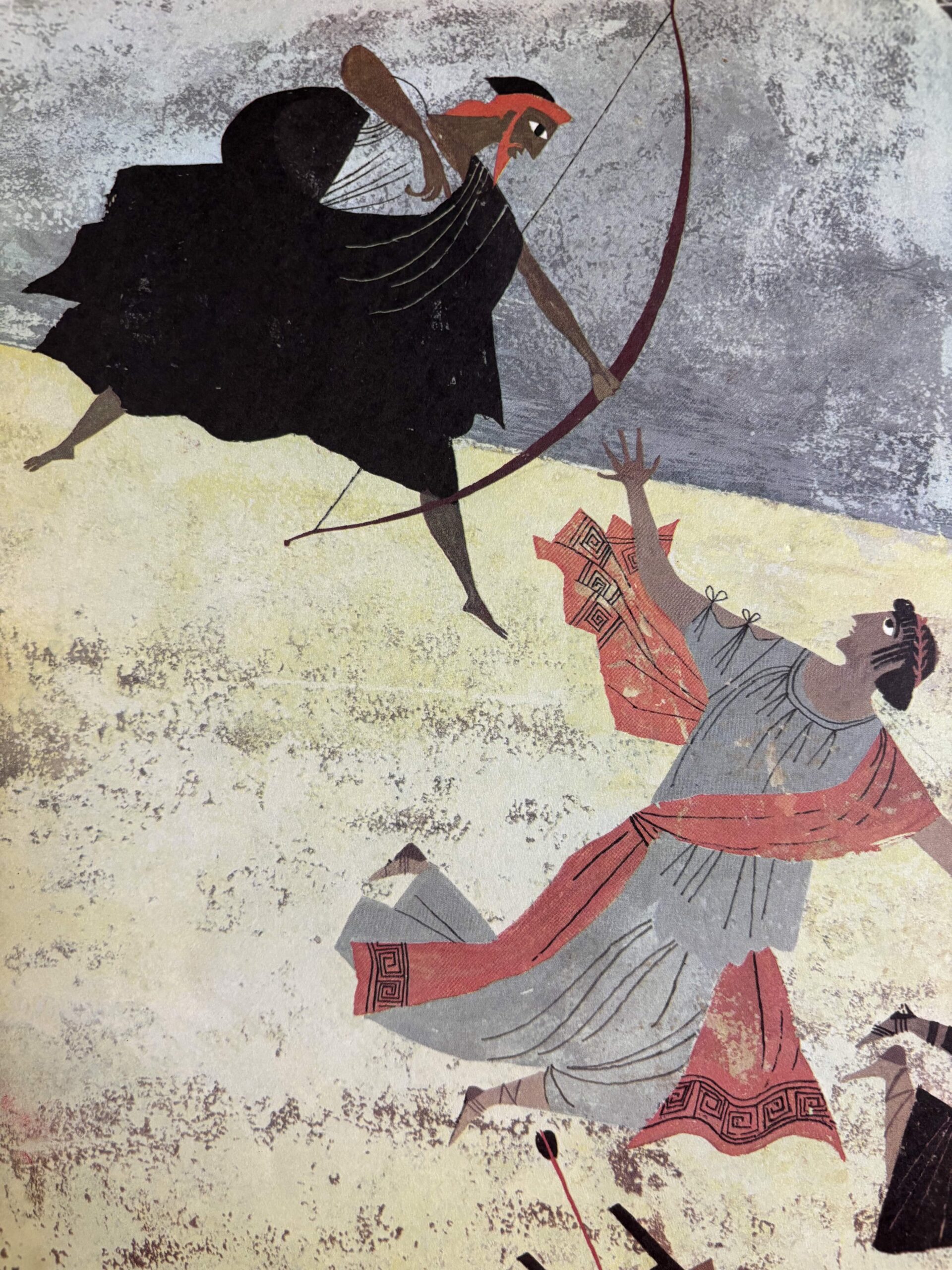
What to say of Antinous? He’s the ringleader in both Nolan and Homer’s versions, the first to die in Homer, the last in Nolan. Nolan humanizes him, gives him a backstory where one could see in him a distorted Odysseus; a man with much craft and guile, but none of the strength or bravery. Too many of the faults and none of the favors, save that he is handsome.
But Antinous is no more the villain of The Odyssey than Odysseus’ bow is the hero; both are devices. Here is where the differing versions converge: on the point of religion. Odysseus cannot get home in either version because in some sense he defies the gods’ desire for him to come home in a certain way. This obstinacy gets him shipwrecked with Calypso, a woman many combat veterans know well — the bewitching and pliable yoga instructor out in Santa Monica who could be 35 but is in reality an ageless 47.
While on Calypso’s island, in the film and in the epic, Odysseus is a kind of prisoner. It is less explicit in the film. There, it is a sort of lobotomized Odysseus who I should mention here is played by Matt Damon who dwells on the island eating lotus leaves and presumably mechanically and absently banging Charlize Theron (Calypso), desperate not to think about his losses (ship, family, soldiers, honor). Zeus instructs Calypso to let him go through two strategically placed peals of thunder, and she weans him off the narcotizing plant, telling Odysseus that only when he puts his faith in the gods will he return to Ithaca.
Both personally and per the plot Odysseus is not ready to return home until he discovers faith. After a storm there he is, washed ashore, preserved by Zeus as though by magic. Athena is beside him. He doesn’t recognize Ithaca, at first. He thinks after all this time that it’s just another island.
There’s a series of myths or legends about Odysseus that are not commonly read or told. In them, he has a son with Circe, named Telegonus (like Telemachus). Telegonus is sent in this myth to find Odysseus, and is shipwrecked on Ithaca, which he does not recognize because he’s never been there. He begins raiding the countryside, and Odysseus and Telemachus respond. Telegonus kills Odysseus, at which point depending on the myth, either he brings Odysseus back to Circe and she revives him, or Telegonus marries Penelope and has a child with her, Italus (for whom Italy is named) while Telemachus marries Circe.
What to make of this, beyond the Greek fathers and sons of antiquity had some serious issues to work out — both with each other and with each other’s respective wives and mothers? Perhaps Odysseus is a reflection of whatever stories gave rise to Oedipus, and to Osirus and Isis, part of that protean prehistorical pre-time when stories about creation got told and retold by different tribes until every tribe could feel confident that they had their own, special creation myth, at which point the story became a religion.
That diversion (or is it?) aside, the idea of not being able to recognize home does resonate for many veterans of war or combat. Nolan’s Odysseus has legitimately been changed by the war he took part in — of which he was a hero. His agony is earned; he has led men to their deaths, and fought, and felt fear, and consorted with the gods (but especially with Calypso).
For all that, he keeps his humanity. He has pride, and in both Nolan’s film and Homer’s epic this gets him into plenty of trouble. But it does not spill over into hubris. His rejection of the gods, to Nolan, is not out of arrogance, but out of desperation, out of a hope that he can salvage something from the ruin of Troy. The gods tell him that he will be lucky to salvage a piece of himself, and his family.
In the end Odysseus takes that deal. Who wouldn’t? It’s great. Nobody’s ever had a better deal. All Odysseus has to do at the end of the film is step down from the throne, leave it to Telemachus, and sail into the sunset with the beautiful Penelope, who loves him. In exchange he must lay down the idea that he doesn’t deserve any of it, or that it was ever him to begin with.
After all, it’s just a dream. What does it matter?