New Nonfiction by Alan Stoskopf: If I Don’t Create, I Don’t Exist
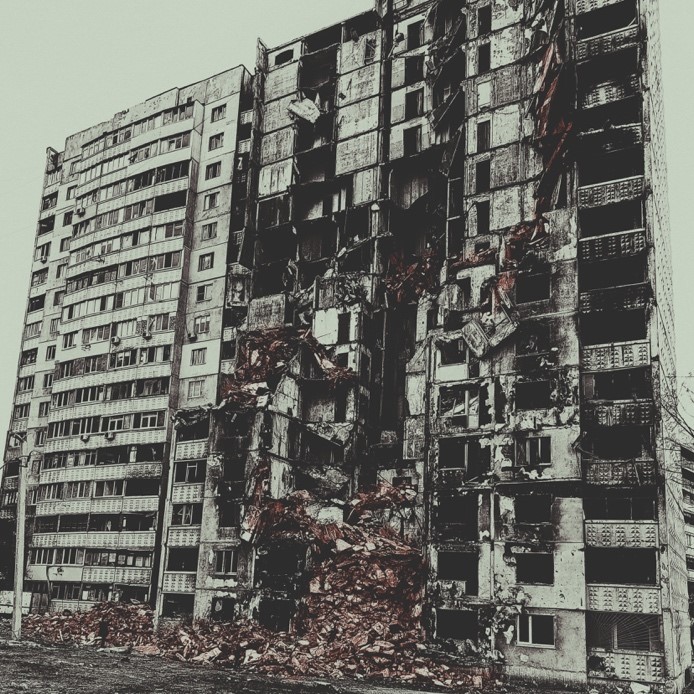
The scars of war are everywhere in Kharkiv. Destroyed or damaged apartment complexes, stores, hospitals, museums, and schools litter its urban landscape. The Russian full-scale invasion of February 2022 has not just killed or injured thousands of the city’s residents it has embedded itself into the psyches of young and old living in Ukraine’s second largest city. Yet, people carry on despite living under the dark shadow of Russia less than 20 miles away.
I asked myself how do they do it? Through interviews and historical research I discovered layers of resistance that have been buried deep within the soul of the city. It is here where the outside world can begin to understand why Putin’s bombs have not been able to kill the cultural identity and spirit of Kharkiv’s residents.
Black Metal for Dark Times
The sounds coming from 32-year-old Vlad Blismuk’s basement studio are loud and scream through the black metal music he creates. Vlad has lived most of his life in Kharkiv and does not plan to leave. Without his music he would have gone crazy. As he explains, “In my songs the main topic is the war in Ukraine. The negative thoughts I have about war go through my being and into the music I create.”
One gets a visceral sense of what Vlad is talking about when listening to songs from his album, Shadows Falling on Dead Cities. “Kaleidoscope of Horrors,” one of the songs on the album, conveys that raw, negative energy.
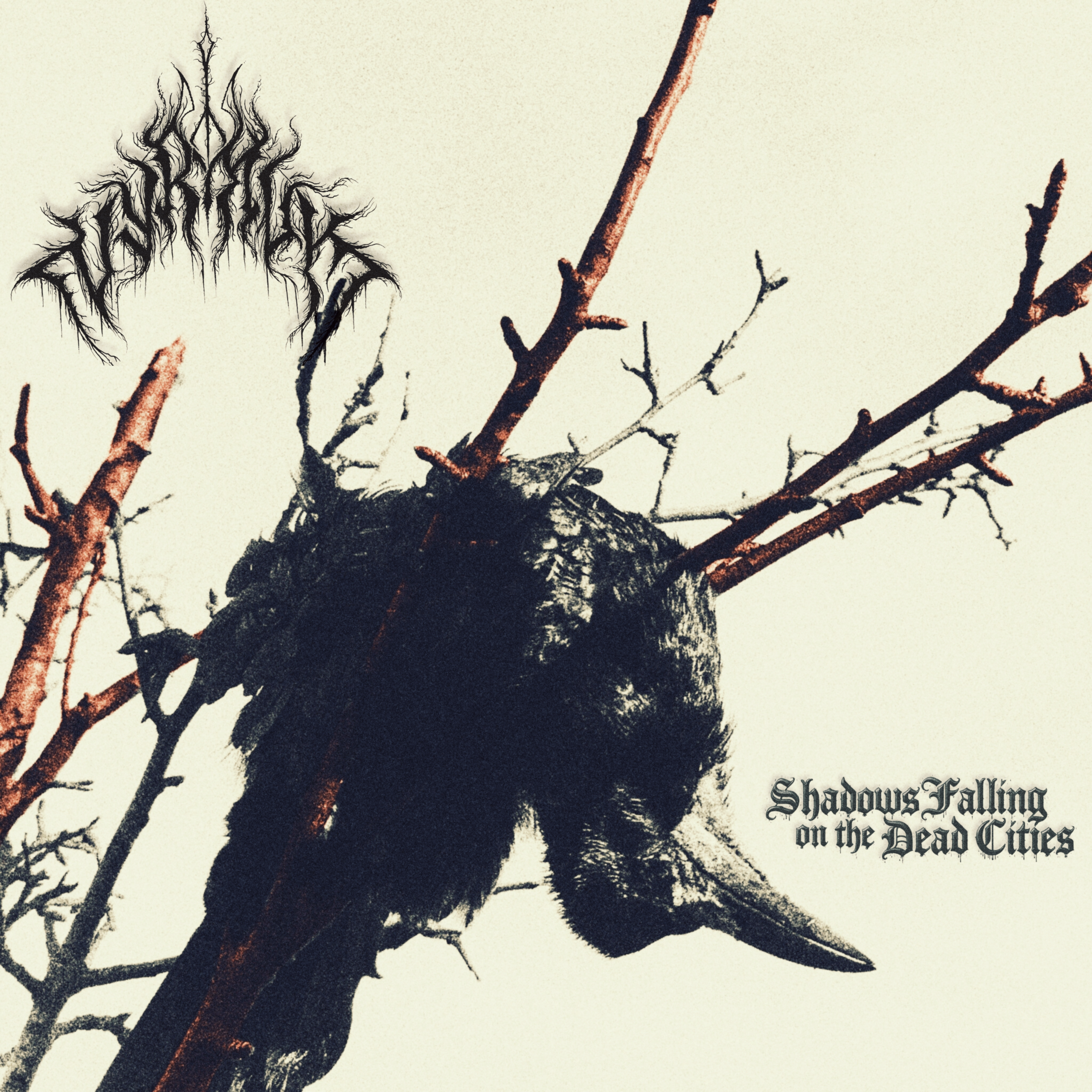
The lyrics, translated from Ukrainian, underscore the horror of the song’s soundscape:
Pain and fear permeate all living things The wind of death carries
ashes on its shoulders The last flesh from the bones will rot.
Horror will freeze inhuman eyes.
Shadows of the dead wander in the darkness The city groans in
agony of pain. Everything here is flooded with rivers of blood.
The music and message might be hard for many to take in, but Vlad told me that it represents a “cry for help to the world; we are suffering. We are here.”
Black metal music emerged among a segment of Ukraine’s younger generation in the early 1990s, shortly after the country’s independence from Russia. On some level its abrasive energy seems to be an angry emotional release from both past and present Russian occupations. Whether it’s the sound of one of Kharkiv’s internationally known bands like Khors or from one of Vlad’s compositions in his home studio, a similar through line of despair and defiance is unmistakable in much of the music.
Something is Happening Here
The city itself pulsates with the thrum of cultural energy. Kharkiv based journalist and researcher, Tetiana Savchenko, noted that “Despite the war the city maintains a vibrant artistic scene, though under different conditions than before the full-scale invasion. It has become more fragmented, intimate, sometimes underground, but no less significant because of it.”
The vibrant artistic scene that Tetiana mentions can be seen in underground musical concerts and literary fairs. The Literary Book Fair in August of 2025 underscores what this something is.
Organized by the writer and musician, Serhiy Zhadan, the fair took place in the basement shelter of the Yermilov Center, Kharkiv’s museum of contemporary art. The three-day event was free for the more than 300 people who attended poetry readings and round table discussions about Kharkiv’s role in publishing Ukrainian authors.
The fair’s name is a homage to the ground breaking Literary Fair Magazine, published in Kharkiv from 1928 to 1930. The magazine’s name might seem to foreigners as an obscure publication from the past. In fact, the magazine was a platform for iconic Ukrainian writers, artists, and literary critics to innovate new forms and styles of cultural expression. It defied the limits of permissible Soviet cultural expression, and the contributors to the magazine ended up sacrificing their careers and/or lives for their creativity. The fate of the magazine and its contributors has become an inspiration for Kharkiv’s cultural community today.
The promoter for the Literary Fair, Olena Pavlova put it this way, “We want to revive a dialogue with it (the magazine), a dialogue between eras that was both ironic and contemporary” (Chytomo, 8/1/25). That connection between past and present echoed throughout the Fair’s events. In the exhibit booth, Poets, “fairgoers heard audio recordings of poems by Ukrainian artists today and restored recordings of from past poets of the Soviet era.
The conference also emphasized the importance of books and reading in the cultural life of Kharkiv. As the publishing capital of Ukraine, its city residents have an insatiable appetite for reading, This is despite the fact that Putin has deliberately targeted Kharkiv’s publishing and printing houses. As Pavlova put it, “ The aim of the festival is to show that despite everyday threats and shelling Kharkiv remains the heart of Ukrainian publishing. This is about resilience, about resistance, and a response to an enemy that wants to wipe this out, targeting printing presses and even shooting at books” (Chytomo, 8/1/25).
But books and reading ripple beyond the literary fair. In cafes, underground shelters, and private homes the citizens of Kharkiv read now more than ever. Ukraine has one of the highest literacy rates in the world and reading physical books, not online or digital text, has exploded in numbers just as Russian glide bombs explode across the city. Reading hard copy books by flash light or candle has become commonplace in Kharkiv due to frequent Internet outages.
Software developer, Andrii Paladichuk, told me how he makes more time to re-discover writers from the Ukrainian past, such as the legendary 19th century poet, Tara Shevchenko, and dissident 20th century poet, Lina Kostenko. He has also become a fan of contemporary feminist poet, Eugenia Kuznetsova, stating how important these past and present day writers were for affirming “our Ukrainian identity while Russia tries to destroy it every day.”
Andri’s passion for reading, especially at this political moment in Ukraine’s history, is symptomatic of the grass roots cultural renaissance percolating throughout the city, not just in formal exhibit spaces or festivals but in the homes and workplaces of everyday Kharkiv residents. The creative art work of 26-year-old Mariia Khrystenko is a case in point.
Books in one way or another have always been part of Mariia’s life. Her father’s printing workshop instilled in her the beauty of classical book composition. At a young age she began to experiment with dry point, lino craft, and collage on her own. However, it wasn’t until the Russian full-scale invasion that her own artistic efforts took on a new meaning.
I was reminded of Vlad’s music when Mariia said, “my collage work fits the chaotic times I am living through. It is full of emotion and for me when I create, it is a little like I am in the eye of a storm. If I don’t create, I don’t exist. My art is like a diary for me.”
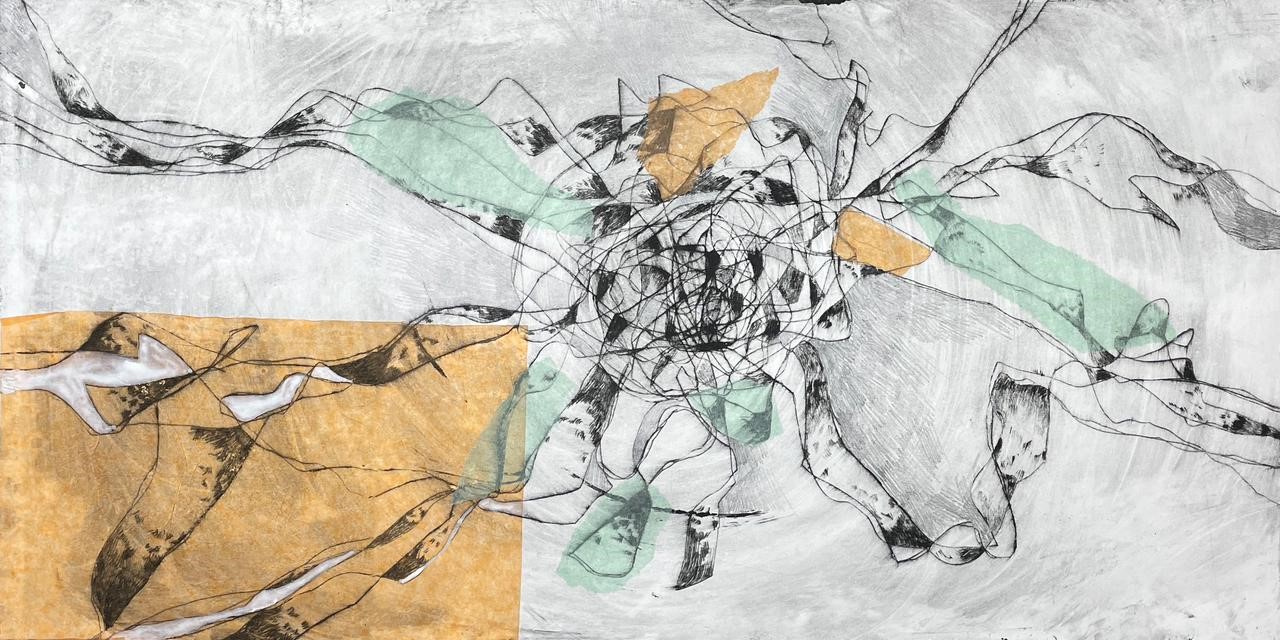
Mariia also makes a point to attend art events across the city, especially those that pop up in the basements of warehouses, as well as the underground shelters of established museums like the Yermilov Center and the Municipal Gallery. She had her own self-exhibit in the Municipal Gallery’s underground shelter. This time she created match book miniature images of her collage creations to the sound of a pulsating beat.
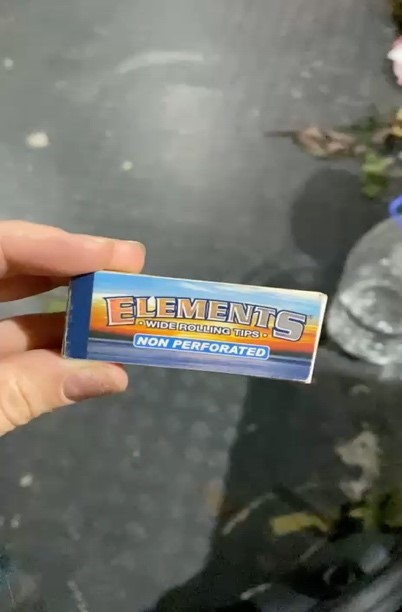
The creation is both whimsical and oddly haunting, much like some of the exhibits at the Kharkiv Literary Fair, where Azra Nizi Maza, a children’s art studio, created a giant mural of a ‘living book’ that depicted artists today and from the past, producing an effect that, like Mariia’s work, was both amusing and haunting. Mariia understood this point, telling me that, “Dark humor is a layer of psychological defense. If we don’t joke, we go insane.”
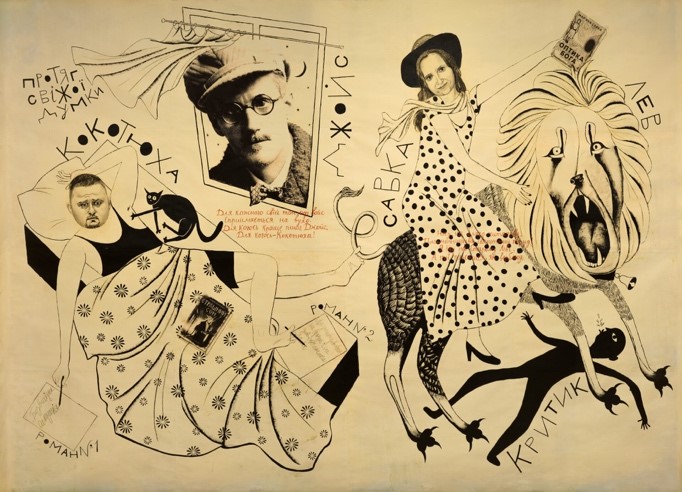
Near the end of our interview Mariia wanted to share a memory about her childhood. She told me she first lived in an apartment complex on Kultury (Culture) St., close to another building named Slovo House.
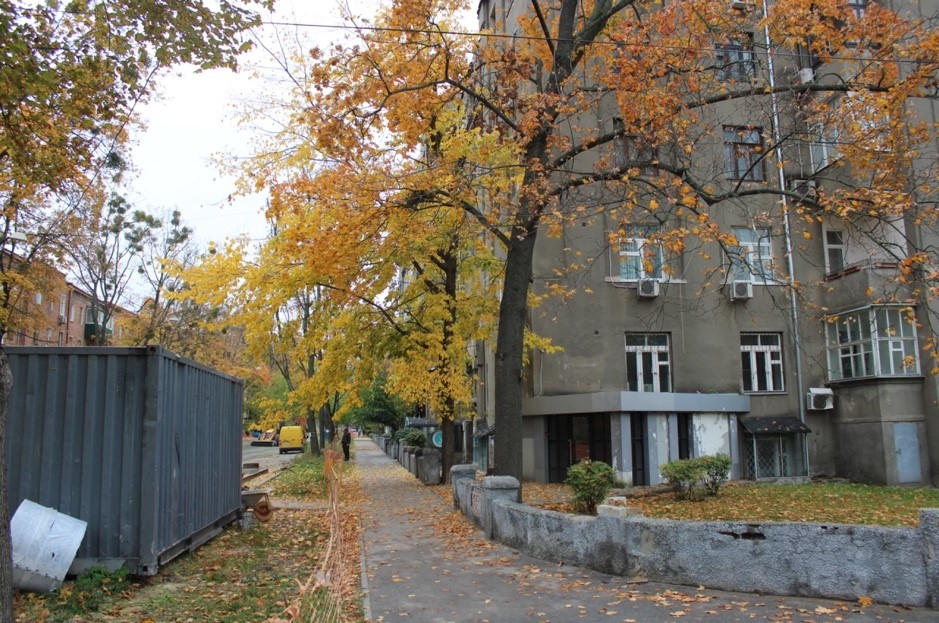
It was one of the many apartment complexes in her neighborhood. In primary school she had learned that the original Slovo House had been an important retreat center for the innovative writers and artists who had been celebrated in the recent Literary Fair Festival. She also learned that the Slovo House became one of the sites for the imprisonment, torture, and murder of many of these same artists. Her parents never learned about this history during the Soviet era. That history had been erased from the school curricula. Mariia said now a new generation of Ukrainians growing up free of Russian censorship want to know more about the cultural contributions and fate of that earlier generation of writers and artists.
The Ghosts of Slovo House
By the late 1920s Kharkiv had become the center of a reawakening for Ukrainian cultural expression in literature, music, and the arts. Up until 1934 the city was the cultural and administrative capital of Soviet ruled Ukraine. It was a time of Stalin’s policy of indigenization, allowing some degree of local cultural expression in Ukraine. The aim was to generate greater fealty to Moscow and to better control the Soviet republics dominated by ethnic minorities. It didn’t work. That local cultural expression opened up the floodgates for new experimentation by Ukrainian writers and artists. They were influenced both by rediscovery of Ukrainian cultural traditions and influences from artistic trends in the West. This was a serious threat to Stalin. By the late 1930s the Great Terror had enveloped Ukraine. A generation of intellectual life was wiped out, known today as The Executed Renaissance.
If there was an epicenter for the terror that swooped down on Ukrainian writers and artists, it was the Slovo House. The building was supposed to be an incubator of creativity when it opened in 1929. Subsidized by the Kremlin more than 60 writers and their families took up residence in the building’s apartments. Legendary figures such as Les Kurbas (founder of the experimental Berezil Theatre), Mykola Kulish (playwright), and Mykola Khvlovy (poet and novelist) were several of the talented Ukrainian writers taking residence there. Little did they know that from the first days of Slovo House’s opening their conversations and meetings were being monitored by the NKVD (Stalin’s secret police).
By the end of 1938 almost all the writers at Slovo House had been either deported to forced labor camps, imprisoned, committed suicide, or murdered. Many of their bodies were dumped in the notorious Sandarmokh forest in the Karelian region of Russia. The area has been the site of pilgrimages and memorials for the hundreds of cultural figures buried there, including Les Kurbas and Mykola Kulish.
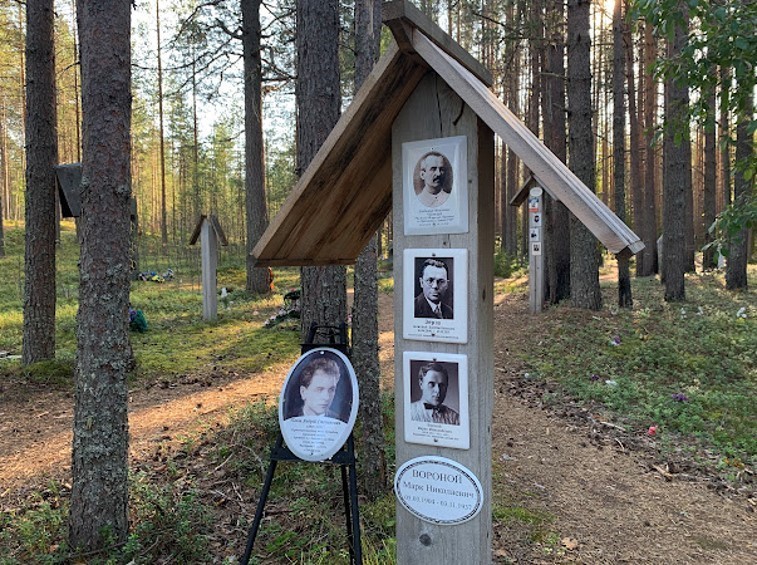
The memories of what happened to residents of Slovo House are front and center in the consciousness of Kharkiv’s citizens today. Since independence in 1992 the attempted Russian erasure of Ukrainian identity, as well as the memory of the Executed Renaissance, continues to roil in the hearts and minds of Kharkiv’s citizens. Russia’s invasions and its targeting of cultural institutions in Kharkiv, such as the Yermilov Center and the Literary Museum, have only accentuated the need by Kharkiv citizens to strengthen their Ukrainian cultural identity.
Mariia is fully aware of what the Slovo House turned into during Stalin’s reign of terror and also what it has become today. Families now live in many of the apartments, and a number of the units are leased by the Kharkiv Literary Museum. The museum sponsors residencies for contemporary writers to work and collaborate together, much like the original mission of the Slovo House. The director of the museum, Tetyana Pylypchuk, explained, “The residency will function the way it did before. It will include cultural programs, home concerts, creative meetings, cultural podcasts, and posts on social media by our residents” (Chytomo, 8/1/25). Mementos, plaques, and restored artifacts from the original writers are still on display for the public, both as an homage to their lives and as an inspiration for forging new pathways in Ukrainian cultural identity. This time no secret police are watching and listening.
The Land Cries Out
Slovo House’s aim to nurture a new generation of writers is an institutional example of a creative sensibility that characterizes Kharkiv today. Both within and outside formal cultural centers, artistic energy never abates. Twenty-five-year-old Emil Mamedov is one of those artists who creates in a variety of locations. He seeks to transforms the horror of the Russian invasion into a meditation on life and death.
Emil believes, “As an artist you have to deal with the war in some way. You have to volunteer or do something insane that you could not have imagined.” For Emil that ‘insane’ thing meant, “I had to learn how to apply tourniquets. I keep my first aid kit with me at all times.”
As for his art, he creates sculptures and art installations literally and metaphorically embedded in the land. He says, “my perfect recipe for art now is telling about war but not directly through the military terms of war.”
I asked him what that meant. He said, “The theme of defending your soil is so crucial for Ukrainians. I create a lot of things in natural environments.” One of those creations was an installation of floating candles on a lake in Kharkiv’s Sarzhyn Yar Park. It was part of a project called, Internally Displaced Landscape, a temporary, performative piece highlighting the fragility of a natural ecosystem during the upheaval of war.
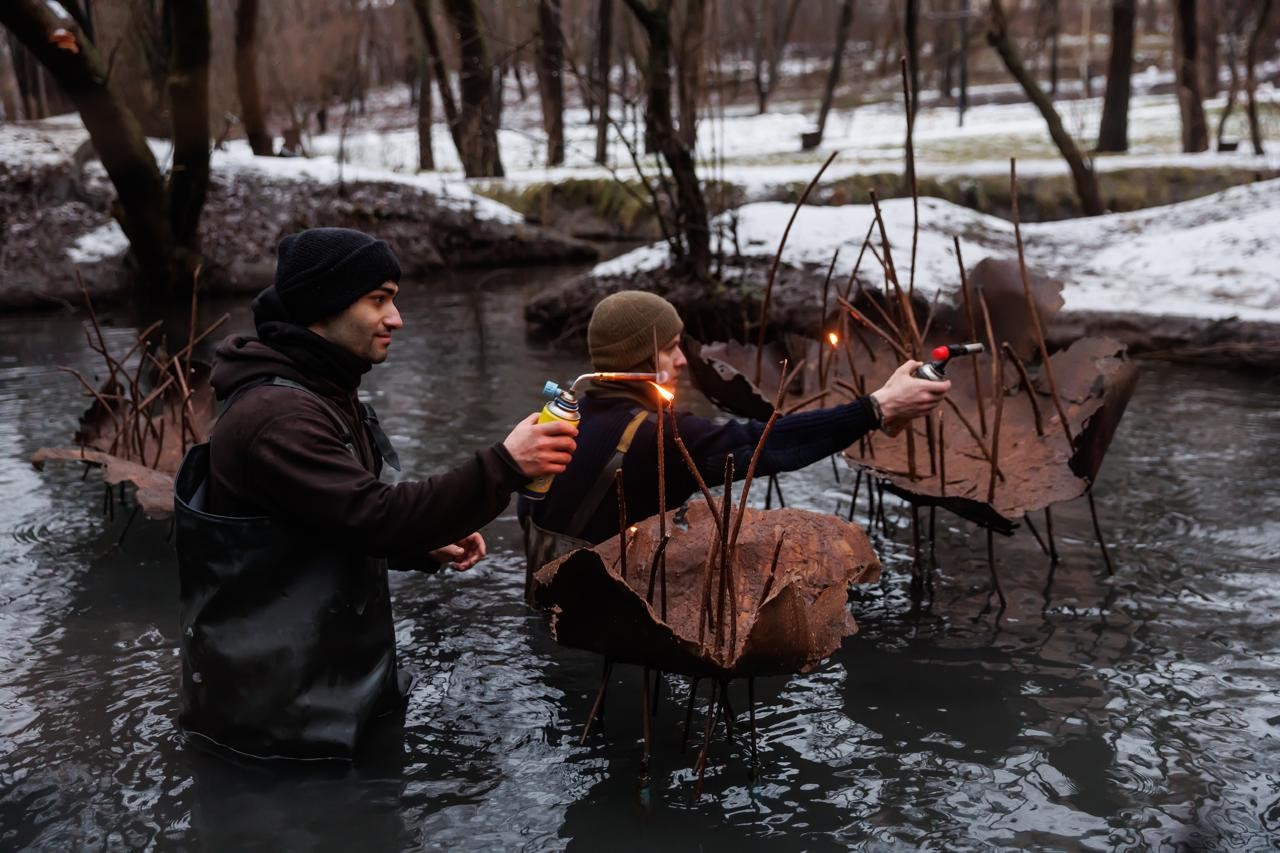
When Email talked about the effects the war has had on Ukraine’s varied ecosystems, I again thought of Vlad’s black metal music. While very different in form and substance, for both Emil and Vlad the earth itself is inextricably linked to the fate of its people.
This notion has both historical and contemporary roots. Ukrainian soil has always been rich in nutrients, yielding bountiful harvests of wheat for its people and the world. It has also been a target for Russian destruction or expropriation of the country’s natural resources, as experienced in Stalin’s manufactured famine during the genocidal years of the Holodomor. In the 1930s, due in part to the disaster of Stalin’s collectivization of small farms and persistent drought, Ukrainian farmers were forced to give away their meager crop surplus and livestock to Communist Party cadres. Most historians believe the number of people killed from starvation, disease, and execution to be close to 4 million people.
More recently the destruction of the Kakhovka Dam in 2023, which flooded more than 600 square kilometers of fertile land and displaced thousands of villagers triggered memories of the Holodomor for many Ukrainians. Today, the ravaging of the countryside through incessant bombardment and the planting of IED explosive devices seems to the artists and residents I interviewed to be an age-old pattern of Russian attempts to erase all traces of an independent Ukrainian identity: its land, its people, and its cultural memory.
A Renaissance in the Shadow of War?
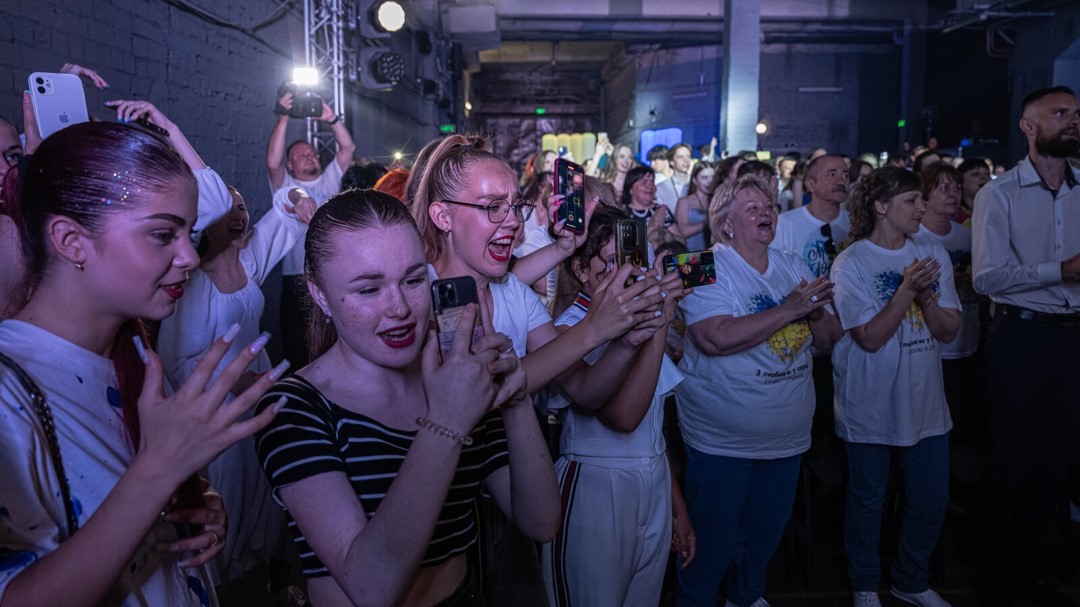
Kharkiv’s proximity to the Russian border creates ‘an all-hands-on deck’ feeling through much of Kharkiv’s population. Virtually every cultural event in Kharkiv raises donations for Ukrainian soldiers. The ranks of the military include a growing number of writers and artists who have enlisted to protect the culture the Russians are trying to destroy. Writer Artem Chapeye, musician Serhii Vasyliuk, and journalist/writer Pavlo Korobchuk are a few of the hundreds of cultural figures putting their lives on the line to defend their country. It is not uncommon to see both civilians and military personnel at Kharkiv’s cultural events, demonstrating a sense of unity between military and cultural resistance against the Russian invasion.
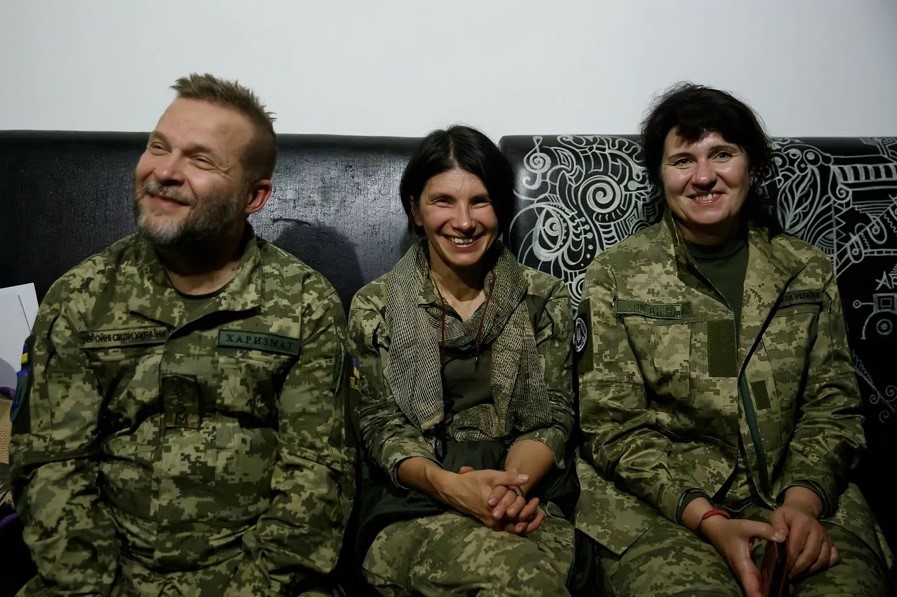
Connor, an American expatriate and retired Air Force veteran who lives in Kharkiv, had his own take on what this resistance meant. He told me “how tenacious the people of Kharkiv are in their defiance of Russian aggression.” He said there “was a sentiment among the people of Kharkiv that if you don’t resist now, there might be death, but that is nothing compared to the mass starvation, deportation, and the destruction of an entire Ukrainian culture if Russia were to succeed. There will be systemic destruction of Ukrainian cultural monuments and the Ukrainian language.”
Like Connor, 38-year-old Oleg Kohtakt emphasized the importance of Ukrainian culture in helping people emotionally survive the Russian onslaught. He is a web developer and has witnessed the first Russian occupations of 2014 and the full-scale invasion of 2024. His comments encapsulated a sense of living history that is part of the consciousness of so many Kharkiv’s citizens. “I try to live my life in the moment. This is despite the fact that from Tsarist times, through the Soviet period, to today Russians have kept trying to kill our culture. That’s why it is a principle for me to support Ukrainian music and all the arts.”
No one I spoke to underestimated the possibility of death at any moment from a glide bomb or drone strike. Identification with Ukrainian history and attending underground concerts or literary events can only do so much. Yet, Mariia Khrystenko said,“ Culture is never your first need, but when you are a little bit safe, it helps you keep your humanity. That’s why we go to concerts and exhibits. We need them.”
Life in the ‘Center of the Circle’
I wonder where the people I interviewed will be a year from now. Will Kharkiv fall to Putin’s unrelenting attacks.? Has a fatalism begun to creep into the psyches of the people? Tetiana Savchenko believes that people are still determined to go on with their lives the best they can. She said, “Most city residents have already gotten used to the shelling and barely react to it anymore.”
This perspective was shared and deepened in a very personal way by Emil Mamedov. He told me about one particular missile attack on the city that gave him a new understanding of life and death. He had been driving back to Kharkiv on that day when the attack occurred. As he approached Kharkiv from a hill top, he recounted, “I could see that everything was burning. I was shocked. I said to myself where am I? I am afraid of the city. What is going on? I feel the pain and death of the city, but then I said wait a minute I live here. Then I realized how we got used to it. We have to see it from the side. If you are in the circle, you do not realize how scary it can be.”
At the same time Emil also said that on another day “there were explosions in the center of the city, and I saw that everybody was laughing and working, replacing windows. I got emotional because you see that, and it motivates you to work. Then life can go on.”
As I write, Emil still continues creating land installations, Vlad keeps producing music, and all the other Kharkiv citizens keep going to underground concerts and reading by candlelight as the bombs fall on the city they love.