New Fiction by Dwight Curtis: Yacht Master
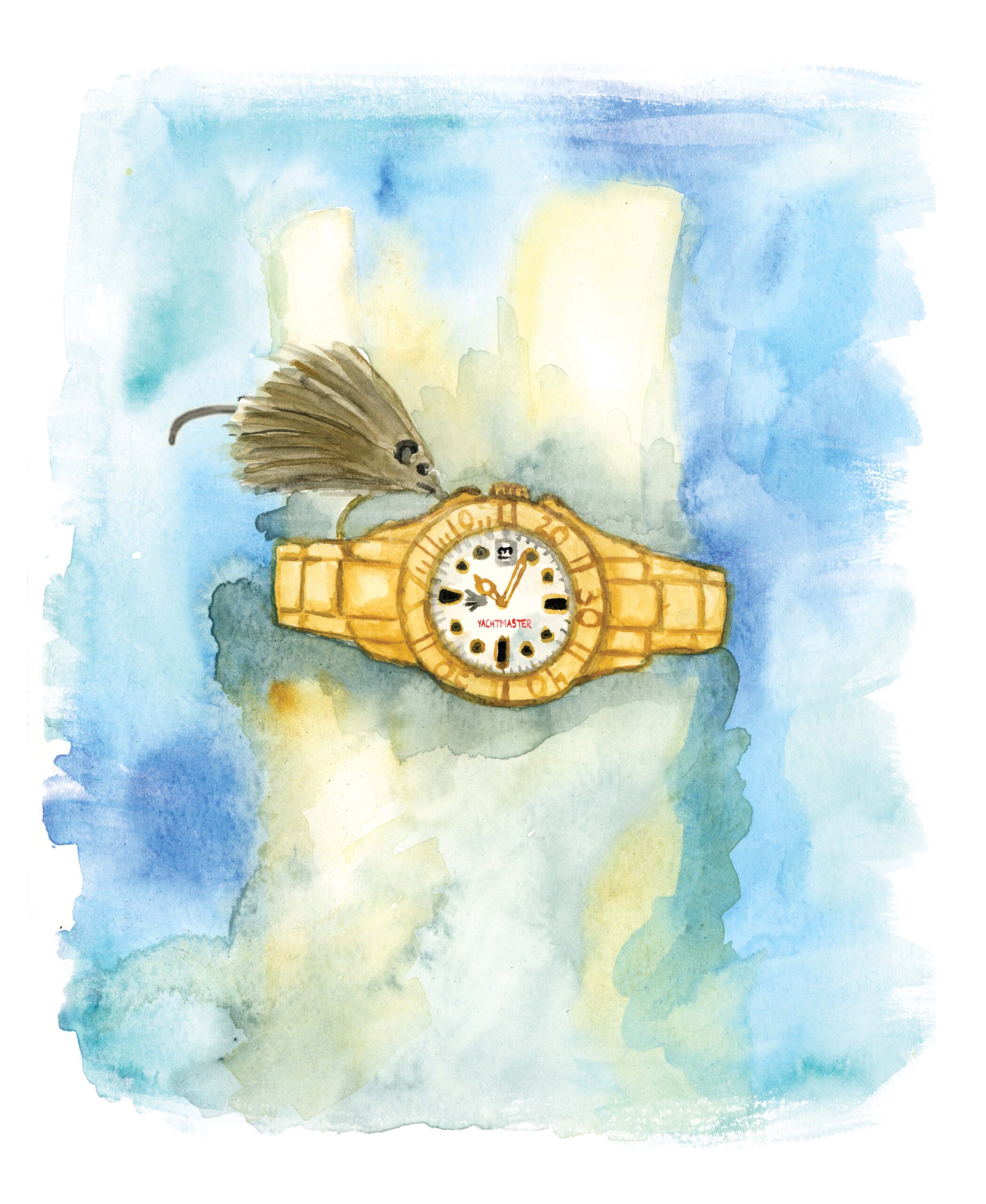
watchI’m all alone, floating down the Clark Fork in the middle of the night.  I have a pepperoni pizza bungeed to the rear seat and the moon is so bright that my oars cast shadows on the water.  The surface of the river is chopped up into white and black.  It feels like I’m in a graphic novel.  I’ve never done this before.

My good friend William was going to come with me but at the last minute decided to get some sleep.  I have a sandwich bag full of eight-dollar mouse patterns that I bought at the Angler this afternoon.  I am floating toward the mouth of a side channel filled with woody debris where an enormous trout lives.

I saw him last week.  I was stripping in a small fish when something uncurled into the sun-streaked water beneath him, rose like a UFO toward the surface, and then, perhaps seeing the shadow of my rod, descended back into the deep shadow and out of sight.  That was all I saw.  I let my hooked fish tire himself out over the deepest part of the pool but nothing else happened.

The main stem feels more powerful at night than it did during the day.  The water is moving around me; I am moving against the bank, above which the stars are moving through thickets of cottonwood branches.  When I backrow to slow the boat, the stars and moon slow down in the branches.  You can’t stop a boat in a river like this, you can just slow down and aim.  The mouth of my side channel is coming up quickly and if I miss it I’m fucked.

I row hard and hear the pizza sliding back and forth in its box.  The river is pushing me left and I want to be right.  I make it into the seam and then into the soft water above the channel mouth and it’s like turning downhill.  The soft water is blacker than the chopped-up current of the main stem.  I’m breathing hard.  This is so dumb and if it works out it will be so cool.

There’s wood as far as the eye can see.  It’s like something from a fairy tale.  Whole trees, with root balls like claws, form the lattice through which smaller wood has been sieved into tighter and tighter knots out of which nothing escapes: a girl’s bicycle, shopping bags, mats of pine needles, deer bones.  The wood soaks up the moonlight, and the water burbles through in blackness.  I try to imagine the honeycomb inside, where silent water flows beneath a few inches of air.  Through it all, goes my educated guess, crawl mice.

Mice are active at night, and therefore so are big trout.

I let out fifteen feet of anchor line and drag my boat up the bank.  To be safe and not sorry I put a slipknot in the other end.  I have brought my headlamp but I don’t need it to see the water.  It’s like spilled ink, and down the middle runs a slender foam line as bumpy as a rash.  The foam curls up against a log and where the log ends the foam turns into the wood and vanishes.  Somewhere below that is where he lives.

It isn’t a technically challenging cast.  I just need to think like a mouse.  I have fallen off a branch into the water.  The splash I made when I hit the water alerted the huge predators beneath to my presence, and the vibrations of my tiny limbs tell them where I’m going.  If there were no moon I might hold still and wait for the current to bring me ashore.  But tonight I am a perfect silhouette.  My only hope is to find the shore, or a bough to cling to.

I get in a “mousy” mood as I sit in the gravel and eat my pizza.  There’s nothing better than a large pepperoni pie all to yourself, and I have brought a six pack of Pineapple IPA to accompany it.  I will only drink one of them right now.  It is a dangerous journey.  People die out here.  Two years ago I found a body.  I called the cops and everything.  It was a homeless person who had washed down from one of the camps, and he was probably dead or half dead when he fell in, but still.  I should have worn a life jacket.  I have three in my boat but they’re too small for me.  I keep them to be in compliance with FWP, and adult ones take up too much room.

I feel certain that I’m going to catch a monster tonight.  Then again, I always feel that way.  If that isn’t your disposition then you probably don’t end up as a fisherman.  But I really don’t think many other people fish this spot, which you can’t get to on foot and which doesn’t look like much from the main channel, and even if other people do know about it I’m certain they aren’t mousing it at night.  I’m the only one smart or dumb enough to try it.  I already feel bad for William for missing it.

The pizza is from Pizza Mouth.  Tonight I wanted something big and greasy and perfectly round, like a pizza from a cartoon.  I open a second beer and in the moonlight I rig up my rod.

I brought my seven-weight with a floating line and a homemade leader that tapers down to fifteen-pound mono.  I don’t think he’s going to be leader-shy.  The most important thing is not to let him run into the wood.

It’s chilly out tonight.  The air and the water are both about 50 degrees.  I paid extra to get my truck shuttled after hours but I brought a tent and sleeping bag just in case.  I did not bring my axe because I couldn’t figure out a way to wrap it up so it wouldn’t pop the raft.  I don’t have a saw either.  I have a pocket knife.  Hopefully there’s nothing big that needs cutting.

It’s time.  I’m greasy and satisfied and I walk over to the other side of the gravel bar to wash my hands.  I rub my face and palms with wet sand to scour the grease.  I walk quietly over the rocks.  Do birds of prey hunt at night?  What, if anything, is this fish scared of?  Maybe a huge owl?  I could drop my fly in the foam and let it dead drift down into the deepest part of the hole, or I could toss it across and twitch it back through the current.  I will endeavor to produce that effect of a mouse falling in from the wood.

The problem is, when I start false-casting, I can’t see my fly, and I have no idea how much line I have out or where it’s going to land.  I could put on the headlamp but that would create shadows and it doesn’t seem in the spirit of the thing.   Instead I will trust my instincts, as Luke does when switches off his targeting computer in Episode IV and uses the Force to destroy the Death Star.

I just go for it.  I take a false cast, feel the weight of the line in the air, focus on the glint of what might be a shredded birthday balloon at the edge of the wood where the foam line terminates, and drop my fly with a splash.  I take a short strip, and another short strip, skittering the mouse across the water.  Help me, help me, help me!  I can see the glint of my mouse’s plastic eyes in the moonlight, and I wiggle my rod tip, dragging him across the foam line, my little tail creating a tiny wake as I flee.  Twitch, twitch, twitch…

Kaboom!

The water explodes.  I nearly drop the rod as I grab at my fly line and it’s like setting the hook on a cinder block.  The water is a boiling crater and I lock my trigger finger and lean back with my whole torso.

I get on the brakes on him as he tries to swim toward the wood and for a second we’re connected by a quivering fly line, my rod bend double, droplets of water catching moonlight as they spring from the knots on my leader, and I think maybe I’ve got him.  Then he comes to his senses.  My rod tips woodpeckers and when it comes back up I’m tight to something but it isn’t the fish.

“Fuck!” I shout into the night.  I’m holding the cork with one hand, my rod curved softly toward the wood, the line wandering in the tug of the current.

I give my rod a halfhearted jerk and then try throwing a roll cast at the black tangle where I’m snagged.  The fly is deep underwater.  I point my rod tip straight so I can feel it.  There’s the slight give of a still-attached branch.  Not that it matters.  Already I’m visualizing the rest of this float for mouseable spots and coming up emptybrained.  But I’d like my eight-dollar fly back.

I let my frustration crest and subside before I try to free the hook.  I’m angry at myself for losing the fish, but, on the other hand: holy shit!  As a proof of concept, it couldn’t have gone better.  You aren’t supposed to land a fish like that every time.  And the mouse worked just like it was supposed to.  My spot had the pot of gold.  I should be happy.  At the very least, I’ve earned another beer.

I give a few sharp tugs, then whip the tip back and forth, and I feel the branch starting to loosen.  I have fifteen pounds to work with.  I point straight at the snag and pull, squeezing the fly line against the cork, and with a feeling like a banana peeling off the bunch the hook comes free.  I strip it in and feel the weight of the branch coming with it.  I dredge it through the inky pool, the rod tip bent, my line making a vee that parts and glistens in the moonlight.  I kneel in the gravel and raise my rod and reach out to grab the leader, and I drag the fly in the rest of the way by hand.  It isn’t a branch.  Maybe a mat of leaves?  It glints through the shallow water.  A piece of balloon?

I follow the fly line with my fingers until I feel the elk-hair bristles of the mouse’s head.  I try to free the hook but it’s jammed into a piece of metal.  As I angle it back and forth my fingers dig into something like wet bread.  The water ripples onto the gravel and I pull the heavy mess up the bank and into the moonlight and gasp and fall back onto my ass.

“What the fuck,” I say.  “Oh, man, what the fuck?”

It’s a gold wristwatch on an arm.

I’m wiping my hand frantically in the gravel, pushing through the rocks to grab a handful of wet sand, and then stumbling backward and dropping my rod.  I scramble like Gollum down the bank and plunge my hand into the water, scrubbing it with sand and gravel, but I can still feel the bread-soft flesh on my fingertips and beneath it the marble touch of bone.

“Goddamnit,” I’m saying under my breath as I scrub my hand.  “Goddamnit, goddamnit, goddamnit.”  I spit into the water, afraid that I’ve inhaled contaminated air.  I blow a snot rocket into the dark, first one nostril and then the other.  I take a few big steps back up the bank and from this vantage point I look again at what I’ve dragged onto the rocks.

It is a decomposing human forearm wearing a gold watch.  My mouse pattern is hooked between the links of the watch and the watch has in turn dug through the flesh on the wrist and is hooped around white bone.  Or, bones.  There are two of them.  The radius and ulna.  The names come to me with great clarity.  The flesh is grey and ragged; under it is a mottling of what I assume in the moonlight to be muscle and fat, and one silvered band of ligament.  The fingers are missing but the thumb is still there.  Everything ends at the elbow.

I sit there for a little while breathing heavily and scrubbing my hand with damp sand.  I think about vomiting, but I’m not nauseous.  I’m just full and grossed out and my hand won’t get clean.  My rod tip is poking into the water and my leader is pigtailed on the surface.  In the low thunder of the main stem I can hear the groans and clicks of large rocks on the river bottom teetering and rolling in the force of the current.

It’s a Rolex.  A Yacht-Master, in fact.  It’s all gold, with a white face.  The time reads 1:17 and the date, under a magnifying lens, is the 13th.  Correct.  The bracelet closes with a satisfying click, and when I hold up my arm the face gleams in the moonlight.


What I learn in the first week of owning a Rolex is that the rest of my wardrobe doesn’t stack up.  My hoodies and fishing pants and camouflage Xtra Tuff boots look schlubby, and I cycle through all my hats without finding one that feels appropriate.  I realize that I haven’t been dressing my age.

I root through the closet until I find a pair of dark blue corduroys.  They’re cuffed at the ankles from the last time I wore them, which must have been at a fishing thing or wedding, and when I uncuff them sand spills out onto the floor.  I put them in the wash and run a quick cycle.  I have a dark green plaid dress shirt that I’ve worn with the corduroys in the past, and a braided leather belt, and an Orvis shooting sweater with a quilted patch on the right shoulder for your gun, although I’m a lefty.  The pants are done in twenty minutes and I put them in the dryer on high.  I haven’t taken off the watch in a while and the band has left an imprint on my skin.  It’s a little snug.

I put my pants on hot from the dryer.  So this is what I was meant to look like.  I admire myself in the mirror from every angle, shooting my cuffs a little bit to reveal the watch, and then, in a stroke of inspiration, I climb up on a chair and reach up into the upper shelf of the closet and pull out the black wool scally cap my uncle gave me for Christmas.  Et voilà.

Desperado’s doesn’t deserve me like this.  Neither does Town & Country or the Union or Pavlov’s.  I type “restaurant” into Google Maps and peruse the list.  Unfortunately my spending power hasn’t changed.  And then, like the beam from a lighthouse: CORK!.  Their late-night happy hour runs ten to close.  I flick my wrist and check my watch for the time.

I used to hate CORK!, and now, for those same reasons, I respect it.  Here is a bar where a reasonable person can have a glass of wine or a Belgian beer from a bottle in a tall glass, surrounded by well-dressed, likeminded 30-somethings, and a pretty big charcuterie board for only twelve dollars, without the distraction of sports on TV.  There is a mirror behind the bar which allows me to follow the tattooed female bartenders with my eyes while barely moving my head.  I should have brought a book or a magazine, though I’m not sure where I would have put it.  There’s barely room at this bar seat for the wide charcuterie board.  To my right is the muscular back of a man in a white dress shirt, his body angled away from me, talking to two women I can’t see.  To my left is the narrow back of a tall man in a lavender dress shirt, who is talking to a group of men and women all taking notes on their phones.  There are four open bottles of wine on the bar beside him, all from the same wine place, and none of the people taking notes are drinking.

There are only so many excuses to check the time.  I’m focused on my charcuterie board, exercising restraint so I don’t run out of onion jam and stoneground mustard before I run out of toast points, when there comes a tap on my shoulder.  I’ve had three glasses of Montepulciano and I swivel with gusto.  The tapper is one of the women from my right, smiling broadly and holding out an iPhone in a glittery blue case.  The man in the white shirt is gone.

“Excuse me,” the woman says.  “Would you mind taking our picture?”

“I wouldn’t mind at all,” I say.  I accept the phone, which is already unlocked and open to the camera.  The women get into formation, arms around each other’s shoulders, lips pursed, and then as if on cue, though I haven’t said anything, one of them sticks out her tongue and the other one looks up at the ceiling in mock surprise.  I’m taking dozens of photos.

“Hold on,” I say, turning the phone horizontal.  The women switch poses: the one looking up now makes a kissy face and then crosses her eyes, and the one with her tongue out raises her eyebrows and pouts her lips as if to say, “I’ve seen it all.”  As I’m snapping photos a text notification drops down from the top of the screen.  It’s from a contact named “John(?)”, and it’s a photo of his dick backdropped against a black-and-white tile floor.

I wait for the notification to recede, taking several more photos, then I hand the phone back to the woman.  As I pass it to her I let my watch peek out of my shirt cuff.  She notices.  I smile.


The problem is that the watch is slightly too small.  I wake up with purple fingers.  I can’t scrub under it in the shower.  So I make inquiries at the mall.  First I try Sloane & Sons, Jewelers.  I am greeted immediately.  I find that in my corduroys and button-down shirt I am noticed in places where I used to be ignored—the tapas bar on Higgins, and the car dealership, though I was only there to use the bathroom, and the Maps Room at the public library, but that I wait longer at places I used to slip into like a warm bath, including Desperado’s, the Silver Slipper, Pizza Mouth, and the Pancake Parlor.  I have become the “other.”  In any case, the woman at Sloane & Sons tells me they don’t work on watches.  She suggests I try another store at the mall called The Jewel Box.

At the Jewel Box I am greeted warmly by a young woman who is too charming, too casually aloof, to actually work here.  She must be the daughter of the owner.  She is college-aged and plump and beautiful and she comes out from behind the circular mirrored display case to inspect whatever it is I am handing her—in this case, the watch from my wrist.

“Ooh,” she says, gently touching my swollen fingers.  And then: “Mm,” as she inspects the watch.  She likes it.  She looks at me out of the corner of her eye with undisguised curiosity.  She may not be a full-time jeweler but she comes from jeweler stock.

“We don’t work on these,” she says.  “You could try The Clock Shop.”  Handing back the watch, she holds on a moment too long.  In another universe we would get married and go to alumni football games together.

I google Clock Shop and see that it’s all the way across Brooks, in the strip mall next to Pita Pit.  I’d rather starve than have lunch at Pita Pit, and according to my watch it’s lunchtime.  I haven’t eaten in the mall in years, so I go and check the big angled Store Directory to see what my options are.  The map is numbered, and the numbers are cross-indexed in a big list, broken down by category.  Here are the jewelers, and would you look at that?  Besides Sloane & Sons and The Jewel Box, there’s a third listing: Joshua.

I find Joshua at the far end of the mall next door to a hollowed-out storefront under active construction.  There’s a curtain of construction plastic hanging over the open façade and behind it is the ghostly silhouette of a scaffolding, which comes into sharp relief each time the plastic billows up against it.  There’s a worker standing on the scaffolding using a nailgun: hiss-pop!  Hiss-pop!  Above the top of the plastic curtain, stained against the beige wall, is the outline of what clearly used to be an Auntie Anne’s Pretzels sign.

Joshua is a fluorescent alcove with a single jewel case dragged out onto the carpet of the mall’s corridor in what I would assume is a violation of mall policy, except I can’t see why anyone would care back here.  This is a terminal point in the layout of the shopping area.  There is no one in the storefront and only when I step around the jewel case and onto the starkly lit tile of the store floor do I realize that, by a trick of architecture and textured paint, there is a hidden doorway behind the register.  In my peripheral vision I see myself entering the store from several angles.  I hear an electronic chime behind the hidden doorway.

A man appears.  He’s at least six-six, in a purple dress shirt and black slacks, with narrow shoulders, a widow’s peak, and a long brown ponytail.

“How can I help you?” he says.  He glances at the security mirror before looking me up and down, and his gaze lingers on my wrist.  I shrug my shoulder, letting the watch slide free of my sleeve.

From the next storefront comes the Hiss-pop! Hiss-pop! of the nailgun.

“That’s a sick watch,” he says.

“Thanks man,” I say.  “Are you Joshua?”

“The same,” he says.  He turns his palm upward and with two fingers extends a business card like a magician.  I recognize this guy but I can’t place him.  I wonder if he goes to the bars.  His card says: Joshua Wineburg, GIA-Trained, Master Jeweler & Goldsmith.

I slide my thumbnail under the clasp of my watch, open the bracelet, and remove it from my wrist.  Joshua has long fingers.  He flips a switch at the base of an articulated lamp on the counter and the light comes on in a ring around a big magnifying lens.  He holds the watch under the light and turns it over several times, inspecting the clasp and the stem and the joints of the bracelet.  From next door the guy in the scaffolding shouts something in Spanish, and another guy laughs.  Joshua gets out a giant set of tweezers from a velvet-lined drawer and for the first time looks up to meet my gaze.

“May I?” he says.

“Go for it,” I say.  Joshua pokes with the pointy ends of the tweezers and the band comes free.

Hiss-pop!  Hiss-pop!

Joshua closes his eyes until the nailgun stops.

“Probably don’t get used to that,” I say.

“Certainly you do not,” Joshua says.  His nails are long and shaped and I wonder if he keeps them like that as tools.  Resourceful, I think.  Then I realize how ridiculous that is.  He has tools.  He’s not a chimpanzee.  Joshua is quick putting the watch back together.  He takes a wet wipe from a packet in the drawer and cleans the watch completely before handing it back to me.  He switches off the lamp comes out from behind the counter.

“So, what do you want to know?” he says.  “It’s real.  You need a resize.”

I flush a little.  My googling scatters like roaches in the fluorescence of Joshua’s knowledge.

“Thanks,” I say.  “I’ve never had one before.  I don’t really know what to do.  Can you resize it?  Should we, like, check the battery?”

I am still holding the watch out toward Joshua, but he will no longer take it.  Some kind of etiquette governs this situation, and the trial period has ended.  He takes a dime out of his slacks pocket and holds it delicately between his thumb and forefinger.

“I can’t resize this watch,” he says.  “I mean, I could.  But, you need a certified Rolex technician.  It’s the right way to do things.  And no, you don’t need a new battery.  This is an automatic watch.  It works on perpetual motion.”  He holds up his own wrist to demonstrate.  He is wearing an enormous silver watch with a black face and he moves his hand back and forth like a pendulum.  “The motion of your hand keeps the spring wound,” he says.

“What if you take it off?” I said.  “Or don’t wear it for a while?”

Hiss-pop-pop-pop!

Joseph closes his eyes pinches the bridge of his nose.  He doesn’t answer me for a while and it seems like he’s fighting an inner pain.  Perhaps a stray nail has entered his skull and affected his personality.  After a few seconds he lowers himself into a chair and takes a pen out of his pocket.  He writes something on the back of the card he handed me earlier and which I’ve left on the glass.

“Try this address tonight,” Joshua says.  “After six PM.  He works out of his house by appointment.  This is the guy, okay?  The guru.  He’ll expect you.”

I take the card.  Beneath the address, in a seventh-grade boy’s knobby cursive, Joshua has written: “Strictly Confidential.”

“Is he a certified Rolex technician?” I ask.

Joshua quits rubbing his temples and glares at me.

“If you take it off it runs until the spring is fully depowered, and then it stops.  This watch has a 55-hour movement.  To start it from a flat reserve, you hand-wind it.  Among collectors who rotate watches…”  He raises his eyebrows at me.  “Some choose to store them in a watch-winding cabinet.  Or,” he says, and smiles to himself.  “You could attach it to your dog’s collar.”

“Six PM,” I say, holding up the card.

Next door a board whines through a saw blade and sawdust sprays like confetti against the inside of the plastic curtain.


At six I pull up to a low-slung house at the top of the Rattlesnake.  All the way up here I was treated to tasteful secluded mansions but this place is small and old.  Back when this was all woods, this house was out in the middle of it.  There’s a purple Mitsubishi Eclipse in the driveway.  I look down at Joshua’s card and double check the address.  The two little fingers on my right hand are asleep and I unclip the watchband for a few seconds, working my hand muscles, before clipping it shut and getting out of the truck.  I re-tuck my plaid shirt, which is starting to wear a little loose, and kneel to brush out my cuffs.

Joshua answers the door in a hoodie, his hair spilling out around his neck.  It comes to me in a flash: he used to play pool at the bar.  He had his own stick in a little leather case.

“Come in,” he says, and he shows me through a door into the attached garage, which has been converted into a workshop.  Along the back wall is a wide tool bench with a pegboard above it, and to my right are two enormous wooden card-catalog cabinets like we had at my elementary school library, with index card labels: Audemars Piguet, Bulova, Cartier.  There’s a piano in the corner with a bunch of framed photos.  Next to the window is a worktable with a big architect’s lamp over it and, mounted above, a huge flat-screen TV.  The TV shows a crisp zoomed-in image of the tabletop.

“It was my parent’s house,” Joshua says.  “May I?”

I hold out my wrist with his long cool fingers he unclips the watch.  The relief is intense.  He sits down at the table and the watch slides into view on the huge overhead screen, magnified enormously.  He turns on the lamp and the whole room brightens.

Joshua is more at ease here.  He positions the watch at the center of a white mat emblazoned with rulers and concentric circles.  I’m watching on the TV, where the face of the watch is the size of my head.  Joshua turns the band vertical and peers down at it and then gets up and retrieves several tools from the pegboard.  He goes over to the card catalogue and opens one of the drawers labeled “Rolex.”  He takes something out, measures it with a set of calipers, and returns to the desk.  He places a pin and a loose bracelet link to the table and they’re mirrored overhead.  They are the same gold as my watch.

I watch on the screen as Joshua uses a tiny screwdriver to remove one of the pins in the band of my watch.  He adds the loose link and puts everything back together.  He holds it up to me, open, and I present my wrist.  He buckles it down.

“Much better,” he says.  He unclips it and returns it to the table.  He plucks a towelette from a dispenser and wipes down the band, the back face, the bezel, the glass, and the little magnifying window over the date.

He switches off the lamp and swivels toward me in his chair.  He is not smiling.

“Where’d you get it?” he says.

I swallow.  I was ready for this.

“I came by it honestly,” I say.

Joshua nods.  “Shall I assume you’re distantly related to the gentleman who previously owned this watch?”

“Distantly,” I say.  “Yes.”

“Okay,” Joshua says finally.  He hands me my watch, clipped shut.  I unclip it and put it on.  It fits perfectly.

“How much do I owe you?” I say.

It’s Joshua’s turn to sigh deeply.  He tents his fingers in front of his face.

“According to the code of the guild, I can’t charge you,” he says.

I nod gravely.  I understand that he has taken a risk.

“But,” Joshua says, holding up his index finger.  “I will grant you one wish.”

I take a deep breath.

He stares at me, waiting.  With the subtlest of glances, I check my watch.  It’s six-fifteen.  The sun has gone behind the ancient Larch and Ponderosa that surround Joshua’s parents’ house, layering the room in golden shadow.

I am ready for this, too.

“I wish to know myself from the inside out,” I say.

Joshua raises his eyebrows.  He blinks.

“Well, alright,” he says.  “People don’t usually fall for that.  It’s sixty-five dollars.”

I pat the pockets of my corduroys.  But I’m past this moment; what’s happening in the room, as I get out my wallet and count the money, is happening in another dimension, to which I am only mechanically connected.  My head, and my thoughts, are hovering in the golden light.

I am shaking hands with Joshua.

“Hey,” he is saying.  “Hey.  Destroy my address, okay?  Hello?”

I will know myself from the inside out.  I don’t know where that came from, but I like it.  Who’s the guru now?  I leave the garage and walk to my truck.  I have my fishing stuff in the back.  I feel like I’ve been given a gift, a clearance, from Joshua and from the universe.  The significance of the gift is not lost on me: a gold watch, for thirty years of loyal service, on the occasion of my retirement.  I am thirty years old.  I don’t know what I’m retiring from, exactly, but I think it’s safe to say: my old life, my old ways.  In this metaphor, the dead guy is my boss.  I will honor him and learn from him.  I will balance courage with caution.  I will spend more time outdoors.

I give two loud honks as I pull away from Joshua’s house, and the trees around me explode with birds.


New Fiction by Dwight Curtis: “The Thirty-Two Fouettes”

Dancer


I wasn’t going to tie flies tonight because I’d been invited to the ballet.  The performance was at the Wilma and it was a formal affair.  I had gone through my drugs, auditioned them each in my imagination, and made my decision.  The invitation came from my new friend Colleen, the Arts & Culture Reporter for the paper.  Colleen had a boyfriend.  He was significantly older and was a wine buyer, or a wine rep.  Something with wine.  He was at a soft opening, which was why Colleen had invited me.  Also attending was the Arts reporter from the Daily Chronicle in Bozeman, who had been Colleen’s college roommate.  All of this was in my texts; I’d avoided replying more than one or two words at a time.  I still found myself playing hard-to-get with Colleen, and I begrudged her for the way I imagined she saw me.  This was not a case of her wanting to be friends and me wanting to sleep with her.  I believed that she saw me as a kind of backup or practice love interest.  Our interactions were flirty, but safe.  She roughhoused with me.  I was more age-appropriate as a partner and I guessed that her relationship with the wine guy was stifling and that she used me to play-act how it would be to date someone in her demographic.  There was no threat of our consummating this phantom relationship, because at the end of the day Colleen was old fashioned.

I folded up a Vicodin into a piece of tinfoil and put it in the coin pocket of my corduroys.  In terms of dress, I had decided on Evening Noir: midnight blue everything with a black cashmere watch cap and my silver watch.  The ballet was as close to a cultural event as we got around here, besides neo-traditional bluegrass and fishing film festivals.  I didn’t know anything about it, except that Colleen’s friend had traveled across the Divide to cover it, and there had been an unusual amount of traffic downtown this morning when I biked past.

According to the marquee above will-call, the performance was sold out.  There were men in tuxedos, and a row of idling black Suburbans in the bus lane.  I cruised the milling crowd and caught sight of the promotional poster.  It featured a black-and-white portrait of a craggy-faced man staring grimly into the camera.  Many of the assembled patrons were wearing dress scarves: silver-haired men and women looking formal and somber, no one smoking.  There would be a long line at the bathroom during intermission.

I was meeting Colleen and her friend at the distillery.  I wished I’d left time for myself to get a drink-before-the-drink somewhere sleazier, but I was going to be exactly on time.  I paused against the brick wall before I reached the plate-glass façade and fished out the foil packet from my pocket.  I bit the pill with my canine and it split into pieces.  I dry swallowed and made a face and then stepped out.

Colleen and her friend were inside with drinks; both women were beautiful.  Colleen is a freckled hippie with a face made up of flat broad angles, all upturned, like they were designed to catch sunlight.  She can do motorcycle mama and she can do flower child.  Tonight she was dressed like an art teacher, in corduroy overalls and a turtleneck, with a paintbrush ponytail.

“You know Jessica,” Colleen said, though I didn’t, and I reached across the table and held out my fist to a ghostlike figure in all black.  She had her arms crossed across her chest and a long thin neck and a pop of red lipstick. With squinted eyes and pursed lips she reached out a slender wrist and gave me a fist bump that sounded like a Pop-Pop going off.

“Wassup,” she said.

I ordered and then waited for my cocktail.  I already knew I’d drink it too fast.  The problem with cocktails here is that they’re too delicious.  It was better to order something hostile, like an aquavit martini, than one of the tasty tiki drinks with a hole in the bottom.  My internal metronome was calibrated to beer.  Then the drink came and it was delicious and I relaxed.  My tablemates were nourishing to look at, and because I’d dressed elegantly and knew that I, too, was nourishing to look at, I felt comfortable drinking them in: everyone wanted to be looked at tonight and the pleasures were all reciprocal.

The girls filled me in on the context of the evening’s performance.

The ballerino, Jugo Lypynsky, was a Ukrainian national who’d trained under Ratmansky.  Among many principal roles, he’d danced Siegfried in the Bolshoi’s Swan Lake.  In his early thirties, as his body began to show the gravity of his age, his work took on an inverse levity: in a solo piece for the radical Un-Bolshoi, he danced both Odette and Odile in a marathon performance that crescendoed with a flawless, turbulent, breathtaking, and utterly masculine interpretation of the famous thirty-two fouettés.  It was the company’s first and only staging of Swan vs. Swan.  To hear Colleen and Jessica tell it, interrupting each other in their excitement, and obviously familiar with the same sources and opinions, Lypynsky was an artist of the highest order, a technician, classically trained but not a hidebound traditionalist, whose attachments to the Bolshoi and the old order more generally, strained already, were severed at the outbreak of the war in Ukraine.  Lypynsky’s talent, his leftist upbringing, and above all his sense of humor and experimentation had already drawn him from the grand halls and theaters of the old school into the thin air of avant-garde dance, and now, as the sun set on his body but (in his words) rose on his soul, he stepped forward into his grand pas: political action on behalf of the Ukrainian people.

It was then that he suffered the attack.  Lypynsky was—

Colleen pursed her lips and glared at me.

“It’s French for ‘whipped’,” Jessica said.  “The past participle of fouetter.  It’s a one-footed spin.”

“Thank you, Jessica,” I said, smiling annoyingly at Colleen.  Our second drinks arrived.  Everyone readjusted themselves and waited for the server to walk away.

It was then that he suffered the attack.  Lypynsky was back home in Odessa, an area thus far spared by the bombings, closing down the black-box theater where for the past three weeks he’d been hosting open-mics, 24-hour plays, poetry readings, one-acts, bake sales, AA meetings, food drives, and every other kind of gathering he or anyone else could think of to keep morale high and to bring high-net-worth civilians into contact with artists and organizers.  At ten PM, after he ushered out the last of the laypersons, he put on a fresh pot of coffee, turned off the house lights (except for the traditional single bare bulb over the stage: he wrestled with the logic of this, and ultimately conceded to superstition), and retired to the basement office, where he waited for his second wave of visitors to trickle in.

For the past few weeks, these had been the members of what used to be a recreational club for building and piloting drones.  They slipped in through the delivery entrance carrying milk crates and cardboard boxes filled with tools and padded cases containing their enormous drones.  These were high-school students, engineers, tinkerers, grandfathers: a group of dorks, in sweatpants and Velcro shoes, with tiny toolkits and headsets with retractable antennae.  They were retrofitting the drones to carry bombs.  Their leader was an obese, straight-edge lesbian with a streak of pure white in her hair.  Lypynsky had requested only that they not bring the bombs themselves inside.  At first, they’d giggled at him, these dorks, who had no access to bombs, but lately he’d sensed a new seriousness in the room, and he believed they’d made contact with someone in the military.  He preferred not to know; his role was as a facilitator, as a host, as a fundraiser, and as a benevolent countryman.

During these sessions, Lypynsky leaned against the kitchenette counter drinking coffee and thinking about the dancers he knew in Russia.  Once upon a time he’d believed that art had a moral value: a rightness conferred by the universe on that which was beautiful to look at.  Then he spent time in ballet companies.  He’d seen what these beautiful people did to each other.  They were backstabbers, they were gluttons, they were wolves.  Now he wondered if, when the circle met back up, it wasn’t beauty and cruelty that touched at the ends.

The members of the drone pilot’s club were not the beautiful people of the world.  But night after night they sat around this table chatting quietly about each other’s lives as they built incredible machines.  It seemed inevitable to Lypynsky that, before long, one of these pilots would be directly responsible for the killing of Russian soldiers.  In all likelihood, it would be the boy Petr, whose robot was the best of all: a bulky and sinister machine with a trapdoor on its belly that could drop a bowling ball onto the floor with the push of a button on Petr’s enormous remote control.  Petr was in high school.  He had a brother with Down’s Syndrome, a condition that made Lypynsky emotional.  He couldn’t pass one of these people in the supermarket or on the street without his chest tightening.  He was the same way with the blind.  If it was an obese person who was blind, or, God forbid, a person with Down’s Syndrome, it affected him extremely.  Or, a person with Down’s Syndrome who had very thick glasses, or a person with glasses who had a lisp.  He wasn’t proud of this.  He was afraid it was a kind of fetishization; he believed it probably had to do with his own beauty and physical robustness.  Nevertheless, he felt it, and when he saw the reporting of his countrymen under attack in the Donbas and elsewhere in the east, and when the victims were, for example, a person with Down’s Syndrome, this was when he felt the pathos of the war most acutely, which was to say, this was when he became the most fiercely defensive of his country, and when he became thirstiest for revenge.

Petr was among the downtrodden.  He wore dirty track pants too short at the ankle and slippers that he clearly borrowed from his mother.  He had government-issue glasses and he flipped his hair off his forehead like a girl.  He had a bird chest and soft shoulders and he bounced on the balls of his feet when he walked.  When he got excited, he shook his hands like he was trying to dry them off.  But he had good teeth and a strong jaw, and Lypynsky would glance over to see the boy leaning into his huge robot, his arms buried in its guts, with a screwdriver and pen light clamped in his mouth, and Lypynsky would swell with pride.  Lydia, and Masha, and Grandpa, and Petr, who would someday kill (someday soon), and the silent black dog with no tail and ears like a fox, and Mama Inna, who ordered a pizza to the basement (Lypynsky could have killed her), a pizza for them all to share: these were soldiers.  These were heroes.  Even Lypynsky himself, a soldier, leaving that bulb on upstairs and sneaking down into the basement on sore feet to put on coffee, and who in his extreme boredom found his muscles twitching into just the suggestion of plié, then relevé, and his arms going through the old progressions, now closing his eyes and feeling his body fill and lift, the muscles firing, though he was only barely moving, more thinking than doing, though the thought of each movement flowed into the next just as the movements would, and his breath matched the thought of each movement as it would the movements themselves, dip, turn, breathe, lift: the old steps, the classical steps.  And then a gasp from the audience as he spun, his buttocks never leaving the counter of the kitchenette, but each muscle of his body responding, preparing on six-seven, his right leg à la seconde, lift to releve, close to passé, his body whirling in place—passé, passé, passé—and he opened his eyes to see everyone in the room staring at him, though he hadn’t moved, hadn’t made a sound.

It was after one in the morning when he locked up, taking out the folded pizza box under one arm.  The alley was empty.  It was a bright night and the horizon shimmered with what he’d come to think of as the glow of war.

To have the alleys of Odessa to himself on these shimmering nights was the small gift of this conflict.

He opened the lid of the dumpster and quietly shoved the pizza box inside.  They were still collecting the garbage, still washing the streets, and still the stoplights changed from yellow to red, and red to green, and the cranes stood over the shipping lanes like huge birds drinking from the sea.  The Sailor’s Wife, his favorite: walking once with Felix and Felix’s son, only a year old, and the child had leaned out of his father’s arms to suckle from the statue’s breast.  Lypynsky grinned at the memory.

There was someone behind him.  A heavy step: Mama Inna, having forgotten her keys again, perhaps.  Lypynsky turned.

“Good evening,” Lypynsky said.

The stranger continued toward him: a man in a ski coat, the kind the slalomers wore, with the collar zipped up to his nose, his hands in his pockets, and the little spider logo glinting back the glow of war.

“Good evening,” Lypynsky said again.

The man pulled a bottle from his pocket.  The aura between them blinked from red to green, and Lypynsky saw that the man was wearing medical gloves.  A drunk, discharged from the hospital.  Or, a doctor, and therefore a patriot.  Lypynsky’s thoughts accordioned together.  He stepped backward to let this man pass.

“Eat shit, swan,” the man said.  He flung the contents of the bottle into Lypynsky’s face.

“Three months in the hospital,” Jessica said, making full-on eye contact with me.  She licked her lips, and glanced sideways at Colleen.  She lowered her voice.

“Sulfuric acid.”

“Full body burns,” Colleen said.

“Liquid fire,” Jessica said.  She took a sip of her drink and puckered her lips as though the drink itself were acid.

“He nearly died,” Colleen said.  “It went through his clothes, all over his face and neck, his hair, everything.”

“It pooled in his underwear,” Jessica whispered.  “You know what that does?”

“Fuck,” I said.

“Like Play-Doh,” Colleen said.

“His eyes melted,” Jessica said.  “Like egg yolks.  He swallowed some of it.”

“You’re a sicko,” I said to her.  She wiggled her eyebrows at me.  I had forgotten Colleen.  Colleen who?  I was now in the thrall of Jessica.

“So, but, wait,” I said.  “This is who we’re seeing?”

“Yes,” Colleen said.  “He hasn’t been seen since the accident.”

“He’s been in the hospital the whole time,” Jessica said.  “They had to reconstruct his face.”

“And his dick,” Colleen said.

“But, so, it’s like a talk?” I said.  “On Ukraine?”

“It’s a performance,” Jessica said.  “Lypynsky dancing, full orchestra.”

“Why here?” I said.

“Dunno,” Colleen said.  “Apparently there are a bunch of world leaders in town, so it kind of makes sense.”

“Why are there world leaders here?” I said.

“To see Lypynsky, probably,” Jessica said.  “And they’re going fishing.  Shouldn’t you know that?”

I blushed.  I did know.  There was a group of VIPs who’d been on the river all week and I wasn’t one of the chosen guides.  From what I heard they were having a blast and catching lots of fish.

“All proceeds go to the war effort,” Colleen said.  “We don’t know what the ballet is.  They won’t say.”

“But—” Jessica said.  She looked to Colleen, who gave her a smile and a small nod.  “We heard a rumor.”

“We heard…” Colleen said.  They both leaned in, their smiles witchlike over the tea candle at the center of our table.

“He’s reprising the fouettés!” they said in unison.

They waited for my reaction, staring at me, barely containing their glee.  Each was beguiling; together, they were an enchantment, like twins from a fairy tale.  It wouldn’t have surprised me if, under the table, they were holding hands.  The Vicodin was working.  I was protected from their power; or, I should say, I shared in their power.  In my smart midnight outfit, in the bloom of my late-season tan, with my rowing muscles and two cocktails and the undivided attention of these extraordinary companions, these ballet experts.  I felt commensurate, I felt up to the implicit challenge.  I felt ready for an evening at the theater.

The fabrics of our outfits interacted with the fabrics of the outfits of the people already seated in our narrow row as we made our way to our seats.  It produced diverse sensations: camelhair on corduroy (sticky), camelhair on cashmere (very sticky), camelhair on puffer coat (frictionless, loud), camelhair on dark wool stockings (so sticky, and so pleasurable, I almost forgot to say sorry: I just grinned like a jack-o-lantern as I peeled myself off the poor seated woman).  We were in the middle, fourth row, very posh for the press.  It was the same theater where I’d attended fishing fundraisers, but transformed: velvet seats, a huge velvet curtain, and a scaffolding of lights the size of five-gallon buckets.  I checked my pockets, smoothed my pants, adjusted my socks, hitched up my belt, folded my coat, and was careful not to spill my drink as I settled into my seat.  I was outside right, leg to leg with Jessica, and I looked at her and acknowledged this leg contact, which was unavoidable and intimate, and she reached down and put three fingers on my leg, briefly, wonderfully, and I quit fussing with my pockets and just sat for a moment soaking in the creature comforts of my velvet seat at the theater.

The people in front of us kept turning around to watch something going on upstairs on the balcony.  I turned to see.  Instead of ushers, there were several large men in suits directing a procession of old people, some in suits, some in stylish and colorful button-up coats or robes, and one guy in military fatigues.

“What’s going on?” I asked the woman in front of me.  She was in her 50s, short hair, turquoise brooch, Prue Leith glasses.

“It’s the delegates,” she said, looking past me.

“The what now?” I said.

“The UN,” she said.

I pivoted and watched a tall man with a short white afro and a carved cane take his seat.  Next to him, already seated, was my friend Dane.  Dane was wearing a collared fishing shirt and sunglasses on croakies around his neck.  He must have guided today.  I tried waving to him.  He and the old man locked hands and came together in a brotherly embrace.  Then Dane lifted his feet and pantomimed like he was falling out of a boat and the two of them cracked up.

“Dane!” I hissed for a second time.  Probably he couldn’t hear me.

The crowd was excited.  Everyone was talking to his or her neighbor, old people were using their outside voices, and there was the swish and crinkle of fall clothing, and the tuning of string instruments from the pit in front of us (it wasn’t a real pit, just an orchestra assembled in folding chairs before the stage), and the whole room surged with activity, except for us: we were silent and still, brimming over with our own private excitement.  Then the lights flickered once, and twice, and it was like water hitting a hot pan.  A player drew his or her bow across his or her instrument.  The velvet curtain shuddered, as though the curtain operator was testing the controls.  For once, I did not have to pee.  Colleen reached into Jessica’s lap and squeezed her hand, and Jessica leaned her shoulder into mine, and I pressed my leg into hers, and she squeezed Colleen’s leg.  The string player bowed another note, this one long and clear, and ended with a flourish.  The lights went down.

They came up on the red curtain; the curtain opened on a plain black stage.  Someone cleared his throat.  Two rows in front of us, a hearing aid blinked, illuminating a woman’s pearl teardrop earring.  The silhouette of the orchestra shifted and resolved against the black stage as the players readied their instruments.

There was a murmur in the room as something appeared stage right: the knees and feet of a person in a wheelchair, pushed by an invisible assistant.  The chair came to a stop and with great effort, haltingly, the figure lifted himself to his feet.  He took a single jerky step forward onto the stage and the wheelchair receded from view.  It was Lypynsky: it couldn’t have been anyone else, though he no longer looked like the man in the poster.  His face was gone.  There was a general din in the room as people whispered and other people shushed them.  I would have been surprised if Lypynsky knew or cared: he had no ears.  He wore a skull cap over his waxy, featureless egg head.  The hat was the same off-white cotton as the rest of his outfit.  He moved across the stage with short staccato steps, favoring his left leg, his ballet shoes scraping the wood as he moved, and when he reached center-stage he turned to face the room.  The skin of his face was a shiny mottled camouflage of skintones but missing key features: no eyebrows, one eye completely gone, covered by what must have been a graft, the other eye hooded and searching.  His nose was two snakelike slits.  Where his upper lip should have been were beautiful tall white teeth that shone under the stage lights.  The scarring continued invisibly into his shirt and down his billowing pants.  One of his hands looked fine, with a halo of light catching the dark hair on his wrist; the other was shiny and clenched.

The first violin struck a plaintive note and the room went silent as though we’d been struck with a magic hammer.  I certainly felt that way: my limbs were floating and I kept glancing down to make sure my arms were still on the armrests.  I counted to five so I wouldn’t keep inhaling forever.  The orchestra began to play, and Lypynsky stood unmoving, or close to it, though when the music began he went from standing still to standing still with purpose.  His bearing shifted.  He was in a dancer’s pose: feet shoulder-width apart, arms at his side, neck taut, his one eye scanning the audience, finding the balcony, and then coming to rest on the stage in front of him.  His shoulders were hunched and his good arm hung lower than the disfigured one.  The strings filled in.  We were very close to the orchestra, and I could feel the vibrations from the bigger instruments.  The music rose, and shadows on Lypynsky’s shirt shifted as he took short shaking labored breaths.  And then the shaking halted and he became perfectly still.  The orchestra paused, leaving one high violin alone.  It trilled and fluttered, searching for a way down, and, finally, fell, and as the other strings swelled to catch it, Lypynsky extended one foot, and began to dance.

He moved slowly and carefully, progressing through what I assumed to be the basic positions of ballet.  He made his feet into an equals sign, with his arms at his hips.  He lifted his arms slightly and separated his feet.  He brought his right foot forward and made a hoop with his arm.  He lifted his arm and extended his foot, which through his ballet shoe looked like a cameltoe.  He began to raise his other arm, and faltered, blinking hard: he couldn’t lift the damaged arm fully over his head.  The music slowed, as though waiting for Lypynsky to recover, and he did, bringing his extended foot back into alignment with his first.  He exhaled and returned to a neutral stance.  The music looped, and Lypynsky moved through his positions again, more surely this time, still unable to get his arm all the way up in Fifth (Jessica whispered the positions now as he advanced through them), and when he finished the progression a third time, he began to move across the floor.  He still looked down at the stage, and as he moved, haltingly, apparently without much strength in his left leg, he seemed to be rehearsing steps in his mind: he stepped across the floor gesturing with his arms and legs, moving his head and neck with the music, though not quite dancing, moving his good fingers as though conducting a ballet in his mind.  He drew into a clumsy pirouette, pivoting on both feet, dipping no more than an inch, moving his jaw with the music, and returned to his mark at center stage.  The music restarted, and he resumed the same sequence, more committed now, though he still paused and faltered before the pirouette.

“He’s rehearsing,” Jessica whispered.

“It’s the White Swan,” Colleen whispered.

Jessica nodded, her eyes never leaving Lypynsky, who was advancing through the steps more fluidly, his fingers suggesting grand movements as he worked in a half-circle around the stage.

“It’s Odette,” she said.  “B-minor.”

Now the music stopped almost completely, except for one oboe, who sounded lost in a dark wood, and continued searchingly as Lypynsky returned to his position at the center of the stage, and, finally, lifted his gaze toward the audience.

“He’s a performing a rehearsal for Swan Lake,” Jessica whispered urgently into my ear.  Her breath was hot and smelled like red wine.  She could have been reciting the alphabet, or serving me court papers.  I nodded in total agreement.  Jessica turned and whispered the same thing to Colleen.

This pause was longer than the others, the oboe still searching, and then the rest of the orchestra began to play.  It was the same theme, but fuller than before.  Lypynsky began his circuit, this time not only gesturing with his good fingers but lifting his arms (the right still higher than the left), and, in a moment that elicited a gasp from the audience, lifting up onto the toes of his right foot.  The right stayed stubbornly down, and something like pain crossed his waxy face.  He lowered to the ground and completed the circuit and, as though he were in a hurry, began again, and the orchestra quickened to keep up.  He reached his mark stage right, lifted his arms, extended his chest, and rose first onto the toes of his right foot and then, with a sound like a seam ripping, onto the toes of his left.

Colleen made a squeaking noise in her throat, and someone behind me said, “Oh, god.”

Lypynsky remained en pointe, arms hooped asymmetrically over his head, and then slowly lowered himself back to the stage.  When his heels touched, he seemed to lose all strength: his arms dropped and he collapsed forward onto his hands and knees.

The orchestra abruptly stopped playing, and the room filled with voices.  Someone in the first row tried to stand and was pulled back down by his sleeve.  The curtain to the left of the stage rippled.  Through the back of Lypynsky’s shirt, drawn tight, I could see his dancer’s muscles.  There was a scratching sound that seemed to come from everywhere, and then I saw the fingernails of his good hand, scraping the wooden stage as his hand clenched and unclenched.

“He’s mic’d up,” Jessica whispered.  “His body’s mic’d up.”

Lypynsky drew himself up, first kneeling, then to his feet.  He held out a finger to the orchestra and gestured for music.  The oboe was the first to play, slowly at first, and he was joined by the strings, and now, with music again, Lypynsky resumed his circuit across the stage.  A dark stain bloomed just above the cuff on the left leg of his pants: blood, and something colorless around it.

Whether it was the adrenaline from his injury, or the new range of motion from whatever had torn, or just the choreography, he now broke from the circuit he’d been following and crossed the stage with long, sweeping steps.  He rose to point and began teetering on his toes back toward the front of the stage.

“Bourrée couru,” Jessica whispered.  “He’s flying.”

Indeed, as he flew, he lifted his arms and began to move them like wings, down at the elbow, the fingers of his good hand pointed, and the effect was like when you jiggled a pencil and it seemed to bend.  He flew past the orchestra, and began to flap harder.

“Oh, don’t do it,” Colleen said.

He did a small jump, extending one leg behind him, landed hard on his heels, made a swimming motion with his arms, and there was another sharp tearing sound.  He fell to his knees.

The orchestra stopped, the room stirred, and again Lypynsky got to his feet.  There was blood and the other wetness now blooming on his shirt from his left shoulder, and the fabric on his pant leg clung to his ankle.  He gestured to the orchestra, and they resumed playing.  He moved to the back of the stage, rose up on point, and again began tittering on his toes toward us, his arms moving in a pantomime of wings, and now he jumped, landed, swam forward, and rose elegantly on one foot with his arms and leg pointing behind him, his chest and chin extended like the figurehead on the prow of a ship.  From the audience came scattered applause.

And now he flapped harder, and jumped, and stumbled and fell.

His shirt clung to his body, dark with blood, and several people in the audience rose in the dark and made their way loudly toward the aisles.  Lypynsky danced, and fell, and the orchestra kept irregular time, slowing as he struggled to get up, and quickening as he flew and spun, leapt, and fell.  The spotlight stayed on him.  He danced more freely now, without some of his skin to stop him, and his smart jumps and spins earned him scattered applause, and then the shushing and scolding of the applauders.  How long had it been—ten minutes?  Not even.  And already the crowd had split into factions.  Even the orchestra seemed conflicted.  Only the spotlight operator remained loyal to Lypynsky, never taking his beam off the dancer, who left a slick of blood and something else—the word that occurred to me was “plasma”— as he danced and stumbled across the stage.  And now the beam operator held his light perfectly still at center stage as Lypynsky, his clothing dark and draped wetly on his body, stood breathing hard, his feet a perfect equals sign below him, and the left arm he’d been fighting with half-bowed above him.  With great effort, he lifted the arm higher, and higher still, and two seats down from me Colleen closed her eyes.  The oboe player, alone again, increased his volume as though trying to protect us, or himself.  And still we heard it, a sound like an inkjet printer, and Lypynsky’s mouth opened silently and his left arm lifted finally into a perfect oval above his head, fingers touching the outstretched fingers of his right.

“Fifth position en hout,” Jessica whispered.

From the orchestra came the sound of vomiting.  There was a pulse of light and low voices behind us: the large men guiding delegates out through the balcony door.

Jessica gripped Colleen’s knee.  “It isn’t Odette!” she whispered urgently.  She hadn’t taken her eyes from the stage.  “Look… listen!”

Colleen didn’t respond.  Her chin was to her chest and her knee was jiggling.  Jessica put her hand on my wrist.  Her palm was sweaty.

“It’s the black swan,” she said.  “He’s dancing Odile!  Listen… Look at his clothing… Oh, my god.”  She squeezed with her nails.  “It’s the fouettés!

Lypynsky had returned to the front of the stage, breathing hard, his shirt hanging darkly from his chest like a wet sail.  The orchestra struck a jaunty melody, led by the symbols and the big strings, and Lypynsky waited, his arms bowed before him, one leg extended behind him.  As he stood, something changed in the music: the sound curdled, dropping from major to minor, oozing down in tempo until the jaunty melody had become a dirge, sticky and dragging, percussive still with the symbols, but staticky, the way a storm might sound from a sewer.  The lights dimmed around the lone spotlight.  Lypynsky drew his rear leg forward, lifted his arms, bent slightly, and whipped his arms into a spin.  He rotated on the toes of his left foot, extending his raised leg, and as he bent the leg into a triangle and drew in his arms he accelerated into a tight spin that took him off balance.  He slipped in his own blood and fell hard to the floor.

The orchestra continued playing.  Lypynsky lay still on the ground, only the toes of his pointe foot curling and uncurling in pain or some electrical misfire.

An audience member rose from his seat and, loudly saying “Excuse me” over and over, moved to the end of his row and marched down the aisle toward the stage.

“I’m a doctor,” he said.  “I’m a doctor.”

He got to the steps at the front of the stage and paused, as though waiting for someone to stop him.  Where were the ushers?  The doctor took an audible breath (the whole stage was mic’d up) and stepped up the short staircase.  When he got to the top, the curtain beside him rippled and the arm and head of a big man in a black shirt emerged and blocked the way.

“I’m a doctor,” the doctor said, and his voice was projected throughout the room.  He startled, and shrank from the stagehand or assistant, whoever he was, and the stagehand beckoned him close.  Lypynsky was still on the ground, and the orchestra was grinding out its heavy dirge.  The stagehand whispered something in the man’s ear, and together they withdrew into the curtain.  It was the last we saw of the doctor.

Lypynsky recovered his strength.  He slid himself over to a dry part of the stage and rose to his knees, then his feet.  His face, smeared with blood, had the exaggerated contours of a Halloween mask.  And he again drew up his arms, and bent at the knees, and whipped himself into a spin, extending his leg, now drawing it into a triangle, accelerating, and then extending his leg and arms again, spattering with fluid the orchestra and the several remaining audience members in the front row.  The music plodded along as though it were coming from somewhere deep underground.  Lypynsky slipped and fell.

The door at the back of the room was passed from hand to hand.  Beside the doorway, a man in a tuxedo, his coat over his arm, chugged a glass of beer as his date pulled on his elbow.  The door opened all the way to let out a wheelchair and I thought I saw the reflected lights of an ambulance.  On stage, Lypynsky got slowly to his feet.  Less than half of the audience remained in their seats.  Colleen stood up and looked down for a moment at Jessica, then me, and turned and walked quickly down our empty row.

“That’s twelve,” Jessica whispered.  She reached out and took my hand.  Hers was hotter than mine.  Lypynsky found a dry patch of stage and drew his arms into an oval.

“Thirteen,” Jessica said.  “Fourteen, fifteen, sixteen…”

A droplet of something hit me in the eye and I lifted my non-Jessica hand to wipe it off.  There was a wet thud, and for a moment we were backlit as the house door opened, let out a body, and closed.

Jessica and I were having sex when Lypynsky died.  We were in my easy chair; he was in an ambulance on his way to the ER.  We’d left in a hurry after the fouettés, when the curtain finally closed, passing with the rest of the thin crowd through propped-open double doors into the lobby where various uniformed medical personnel stood waiting around a stretcher.  Thanks to the Vicodin, I had incredible stamina.  Afterwards she got out her phone and googled Lypynsky.

“Confirmed,” she said, her face ghostly in the light of the screen.  She was sitting in my chair with one leg over the armrest, naked except for white ankle socks and her silver watch.  There were red marks all over her pale body.  I was lying on the carpet, covered in bits of feather and thread and brown chenille.

“Bummer,” I said.  We were in the front room, facing the street.  My window shade was askew and I was convinced we’d been watched.  With the new urban camping ordinance the bike path by my house had become a thoroughfare for tweakers and the homeless.

“Pronounced dead at 11:07 PM,” she said.  She checked her watch.  “Injuries sustained during a ballet performance,” she read off her phone.  She squirmed in the chair and exhaled loudly.  She scrolled with her thumb.  “Dancer suffered…” she closed her eyes for a second, letting her knee fall to the side.  I watched; I couldn’t move.  “…Severe injuries from an attack in 2022,” she said, “when an assailant… Mm, fuck.”  She swirled her middle finger and closed her eyes.  She exhaled through her nose and opened her eyes and had to lift her phone to her face to unlock it.  “Yada, yada, yada,” she said, scrolling fast.  “Mumford & Sons show scheduled for Wednesday night has been postponed and the Wilma closed until further notice.  This reporting is trash.  I’m going to write the fuck out of it.  Do you have any Adderall?”

“I have Ritalin,” I said.  I could feel my voice vibrating in the floorboards.

“Regular or time release?” she said.

“Time release.”

“Yeesh,” she said, checking her watch again.  “Alright.”

I guess she stayed right there, working on her phone.  I don’t know.  She radiated professionalism.  I took a shower and brushed my teeth and then brought her a glass of water and disappeared without saying anything weird.  In the morning she was gone.  I checked the Arts page of the Daily Chronicle but there was nothing posted yet, and anyway it was behind a paywall.