New Interview with Karie Fugett

Karie Fugett

I was first introduced to Karie Fugett through her gorgeous, heart-wrenching 2019 Washington Post article “Love and War,” where she detailed her husband Cleve’s injury in Iraq, which ultimately led to an amputation, addiction to his prescribed painkillers, and multiple overdoses—including one that ended his life. Karie was widowed at age 24. I was taken with her story, her vulnerability in laying her grief bare, and also with her willingness to call out the institutions that failed Cleve as a wounded veteran and her as a full-time caregiver.

After several years spent writing and advocating (and navigating a pandemic and a few other things), Karie published her memoir, Alive Day, this spring with The Dial Press. She was gracious enough to speak with me from the airport on the way to a book event. We chatted about military life, caregiving, writing, parenting, politics, pandemics, the fickle publishing industry, and, of course, her marvelous book.


Lauren Kay Johnson: Congratulations, first of all! Huge accomplishment. It’s been a long time coming for you, right? This has been in the pipeline for quite a while.

Karie Fugett: It has been. I haven’t been writing it, like, every day since I started thinking about it or anything, but I did start thinking about it pretty seriously in like 2012. I didn’t know what I was doing, and at that point I was just kind of trying to record memories and practicing putting memories into scenes and just learning how to do creative writing. And then from there it started to get bigger and bigger.

Lauren Kay Johnson: What was it initially that got you started writing? It sounds like you were doing some blogging during Cleve’s experiences. Did that kind of naturally transition into just writing to process?

Karie Fugett: Yes, I hadn’t really written before that other than, like, moody middle school poetry. Nothing serious. Just emotions. And then when I was in the hospital, I met some other caregivers. A couple of them were writing blogs. We were able to keep in touch that way, and keep tabs with what each of us were going through. So I jumped on that bandwagon and very quickly found that it was a really great outlet for a lot of the things that I was feeling, because being in the hospital was really isolating. And even when I met other caregivers they would be moved to different hospitals, sometimes they’d be sent back home for a while, would be moved to different bases. So it wasn’t like we saw each other every single day, and this was kind of a way for us to keep in touch. And also to just feel like we were being heard, because we were in this weird situation that I had never heard of. All these things I was seeing. I was like, Oh, my God! I didn’t know that people lived like this. This is crazy to me. It kind of helped me blow off some steam. Keep in touch with people. When I didn’t have therapy, it was kind of my therapy.

Lauren Kay Johnson: So was there a moment where you realized—You were kind of writing for yourself, and then there was a shift to Hey, there’s something here beyond me, whether as a means of sharing information or finding human connection, getting your voice out in the world. Was that a cognitive shift for you?

Karie Fugett: When I first started writing it was just kind of a diary-type thing honestly, and the only people who were reading it were other caregivers, people that I knew. But after a few months, it was crazy; I would get up to 10,000 views a day. I was getting all these followers and emails. This was after a year or two. It just kind of blew up. And then there was a military spouses’ website [that] offered to feature my blog on their website along with a few other military wives. And I was like, Oh, people are interested in what’s happening here!

I wasn’t familiar with essays, op-eds, whatever. I just immediately was like, maybe I should write a book about it. But I really didn’t know what I was doing or take it that seriously. [I] just noticed people were paying attention, and that there might be something to the story.

Lauren Kay Johnson: The gestation period for a book is much longer than the gestation period for a baby.

Karie Fugett: For sure. I mean for me, anyway. I feel like I have some friends that are like, “Book idea!” And then a few months later they’re turning in a manuscript. But I’m not like that.

Lauren Kay Johnson: Oh, I hate those people.

Karie Fugett: I do too. I really do.

Lauren Kay Johnson: Mine was 12 years. And same thing: not, like, actively working on it eight hours a day every day, but the thinking about it, and the writing, and the rewriting, and the submitting, and then the rewriting again, and then submitting and rewriting, and then the crying and banging my head against the wall and wondering what I’m doing with my life.

Karie Fugett: Right. There was a lot of existential dread, staring at walls, not doing anything productive. Probably more of that than writing If I’m being honest.

Lauren Kay Johnson: So how does it feel now that it’s out in the world? How is this first—not even a month. It’s still really new for you. How has it been?

Karie Fugett: It feels like a relief at this point. There’s so many unknowns. How are people going to respond? Especially with a memoir—is someone I write about going to recognize themselves, even though I changed all these details, and are they going to be upset? Which did happen once already, but I survived it, and it was fine. So now, a month out, people generally are responding well to it. And even the ones who don’t; it’s fine. We’re continuing on with our lives. It’s really not that big of a deal.

I guess for a long time it was like that was the peak for me. It just felt like this really, really big deal, which also came with a lot of stress. And also I was unsure if I was even going to be able to finish it. There were points where I was like, Nope, not happening. I cannot do this. I’m burning it all. I’m gonna go be a flower farmer and hide in the country somewhere. But I did it! So, I’m proud of myself. I feel relieved.

Right now I’m just kind of giving myself permission to relax for a minute. Because, too, after writing this, it became very clear to me that I haven’t had a lot of time to relax in my life, and part of that, especially recently, is self-imposed. So I’m like, you don’t always have to be productive, Karie! You don’t always have to be proving yourself. I’m taking a lot of naps right now and trying to spend time with my daughter. Thinking about where I want to live, maybe a business that I want to own.

Lauren Kay Johnson: Good for you. You have earned that, absolutely. Not that anyone needs to earn the right to take care of themselves and sleep. You mentioned that there were points where you felt like, Ahhh! And I don’t want to put words in your mouth, but I imagine—I mean, this is such emotionally wrought content that you’re writing about. And living it was such a huge part of your life—physically, mentally, emotionally. And then in writing it, you have to go back there in so many ways. Can you talk a little about what that process was like? You discovered I have this book thing, and then you got into the writing of it. What did that feel like once you actually kind of comprehended what that meant

Karie Fugett: It depended on the chapter or the story that I was writing. Sometimes it was a lot of fun. The parts in the book that are funnier or sillier or weirder I really enjoyed. The moments of joy between me and my husband I enjoyed thinking about in writing, because it felt like there wasn’t that much of it in the story, because all this other stuff was going on. And learning how to write creatively was really cool to me. I love turning memories into scenes and writing characters.

But then there was a lot for me, especially from my childhood and when I was younger, that I realized I was still carrying a lot of shame over. Decisions I made that I blamed myself for; I just really wasn’t letting go of those things. I think it forced me to really look at those things again and think about them in a way that I hadn’t really. I’d been pushing it away and just too afraid to look at it. That was one of the reasons why it took so long, because there were certain parts of my life that I felt very stuck and wasn’t sure how to go there again. Luckily the end result—once I was able to do that, get it on paper and get past it—was actually very healing. I was able to forgive myself. I think I was able to visualize this—the word journey kind of makes me cringe—but in this journey that I went on and have a better understanding of why I made the choices that I made. And also it helped me remember I was a kid. I was so young. I think, as adults, sometimes we remember our past decisions. We hold on to them because that’s still who we are, still a decision we would make, and we carry that shame with us.

Overall I think it’s been good for me. It’s helped me forgive myself, view myself with more compassion, and let go, which has helped a lot with this compounded trauma from over my life.

Lauren Kay Johnson: I always talk about memoir as, like, a really long, in-depth self-therapy session. It’s often not comfortable to go back into those spaces and dig through the skeletons in your closet. But if you can do that effectively, not only does it make for compelling writing, vulnerable writing; it also can have that catharsis. And it sounds like it had that effect on you, too?

Karie Fugett: It did. And what’s funny is that when I went to the MFA program—I think, when nonfiction writers, memoir writers, especially once you’ve been doing it for years, they really want to emphasize the craft of it. And as soon as you start talking about how it can be therapeutic, they get a little weird about that conversation for some reason. But I really think that’s a huge part of the process. Because if you’re going to access what you need to access for it to be a story that connects with people, you’re going to have to dig into some things that otherwise you could have ignored for the rest of your life. And that does something to you. That can change you if you’re honest with yourself and are willing to look at those things square in the face and analyze them and try to figure out what happened and try to understand yourself and the people around you, beyond the action.

And that was the other thing—looking at people in my life that maybe upset me in the past and really sitting down and thinking: Why were they acting the way they were? What was going on in their life that caused them to treat me the way they did.

Lauren Kay Johnson: You mentioned you were so young. You and Cleve both were in your early twenties going through this horrific experience, and an experience that put so much weight on both of your shoulders to just kind of, like the military says, suck it up and deal with it, figure it out. You carried this expectation that it was your job to be a caretaker, and you were doing your duty. You were doing your service to this country in taking care of Cleve, and he was doing his duty fighting, getting injured in the line of duty, and then focusing on recovery. Can you talk more about that that dynamic, and particularly what that meant, being so young and feeling the weight of that, and being in this community where everybody was trying to do this impossible thing?

Karie Fugett: I was 20 when he was wounded. So, I’d only been an adult for a couple of years. And then I find myself in this situation—because of decisions that I made, but in this situation that is still just what I did not expect. And at that point, because I was married to him, it felt less like decisions I was making, and I was just sort of being told what to do. Which in some ways at that age, because I didn’t know what I was doing anyway, was a relief. I’m like, just tell me where to go! I don’t know what I’m doing right now. Then I would end up in these situations, though, because I was just sort of blindly following.

You know how you hear stories about people following a GPS into a lake? How did you not see the lake? That’s how it felt. Like: go right, go left, go backwards. And you’re just trying to please these people that are kind of scary and intimidating and control your paycheck and your housing and everything in your life and just seem way smarter than you. So, why would you ever question what they’re saying? But months go by, and suddenly you’re looking around, and you’re like, something is not right. How did I get here? And not having the brain—literally not having the brain cells—to figure out how to get back out of it. Who to ask, what to ask. Especially when it came down to PTSD, TBI, and addiction. Where does one end and one begin, and how do you fix it? How do you even have time to think about it when you’re worrying about a leg that is infected or being amputated. It was just . . . it was a lot.

I think at the time I was just kind of following my orders. And then, by the time I was thinking something’s wrong, I was so in it that I just kept following. It really took a couple of years before I started getting angry, but at that point it was kind of too late. He was overdosing. At that point I was like, He’s going to die. He almost died. What is going on?

Lauren Kay Johnson: That’s in so many ways representative of the way that the military operates. It’s this “We’re gonna tell you what to do!” You’re joining the community; your life is dictated by us, and there’s not a lot of encouragement of free will. They set it up in this environment and then if you get into uncharted territory—like you were in relatively early in the post-9/11 conflicts—there’s not a manual for how to handle that. There’s resources available, but it requires proactivity to seek them out and advocates to help connect you with the right resources, and that all just sounds like it wasn’t there in any kind of accessible manner for you.

Karie Fugett: I don’t know if it’s still the case, but there was this sort of underlying assumption that if you told them too much was wrong, you could get in trouble, and it was hard to know where the line was. Like, if you say you’re addicted—What kind of details can I give you before you start saying it’s my fault? There was this underlying thing that we kind of knew they were there to help us—mostly. But if we said the wrong thing they could absolutely ruin our lives. So it was scary to really be open and vulnerable and really talk about how bad things felt.

Also, you just want to prove yourself. You want to prove that you’re strong enough, capable. At least that’s how I felt. My husband did, too. He wanted to prove he’s a Marine. He joined the Marine Corps. He can handle it. He’s fine. He wasn’t fine, nor was I, and by the time we realized neither of us were fine it was an absolute chaotic mess.

Lauren Kay Johnson: One of the things I loved about your book is we get all of that raw emotion, and the sense of overwhelm, and also the call to do your duty and to support this person that you love however you can. It’s heavy stuff, but you do have these moments of levity. And a lot of that is based around really beautiful relationships that you’ve had in your life, the kind of transient life that you’ve led through childhood and the military. Not in the traditional military sense; you weren’t moving around from base to base, but you were hospital to hospital, in kind of these micro communities. Can you talk about the role that that friendship has played in your life, particularly your healing process?

Karie Fugett: It was huge. Not just friendships, but mentorship later on. Really, when I think about the moments in my life where I saw a beam of light, hope that I could get out of this darkness that I was in, it always involved someone being in my corner helping me out of it. I don’t think there’s any point where I saved myself on my own. I’m not going to discredit myself and say that I didn’t make decisions and work hard and all of that. But all along the way, I just got so freaking lucky with human beings who were just dropped into my life and were exactly what I needed in that moment. Everything from during the deployment—The wife that I lived with while they were deployed, she was just exactly who I needed to help get my feet wet in this military wife life. Even though it was only a couple of months, all the things that you hear about military wives, how they’ll drop everything for each other, how they bond so quickly—it’s all true, at least with her. As soon as we started connecting, it was like, this is my best friend; we’d do anything for each other. I’m helping raise her baby while our husbands are overseas. It just happened so quickly, and she, without question, packed her baby in the car and drove me to DC [to be with Cleve in the hospital].

I’ve needed to crash on people’s couches because I just could not do the basic things it takes to survive for periods of time. And I just needed someone to take care of me for a little bit. The [military] widows—They came into my life right when I needed them. I needed to feel less alone. I needed to see other people doing things that I was afraid to do. It’s all been relationships.

Even once I got to college, it was the teacher who was the mentor and said that she saw something in my writing. I really just saw myself as a high school dropout. I felt like a wannabe. I wasn’t sure if I had it in me to do this, and I could tell that she was serious. That was huge for me.

Lauren Kay Johnson: Reading the book it felt like, in a lot of ways, where the military in an ideal world was supposed to be there to support you, it was these relationships that were meeting that need. And also you give a big shout out to nonprofits that have historically really filled that gap in care and support, both financially and emotionally.

Karie Fugett: Yes, those nonprofits keep people alive. End of story. There’s a point in the book where I’m talking to someone about moving. And he’s like, “Oh, you might as well just go through the nonprofit because it’s gonna take longer if you go through the military.” I wrote that casually. People bring that up so much now, though; they’re like, “I cannot believe they were like, let’s just dump it on the nonprofit!” But everything did take really long. And a nonprofit, they’d be like, what do you need? Sign your name on this piece of paper, and we’ll process it in a couple of days. They understood that there were real urgencies and they were really quick to respond. They, at least back then, really didn’t ask a lot of questions. They just wanted to help, and it was huge.

Lauren Kay Johnson: Particularly thinking about the moment that we’re in right now, where people are in need of extra support in a lot of ways. If folks read your book and they’re like, “I want to do something!”—What is your call-to-action for them? Is there a nonprofit that you would direct them to? Somewhere where they can get informed and provide support?

Karie Fugett: I actually think that the smaller nonprofits I prefer, the local nonprofits. Especially these days when it feels like there’s so much going on, it feels very big and hard to know how to help. For me, personally, what I’ve realized is when you’re trying to question how you can make a difference, you should look at your own community. There’s veterans everywhere. There’s probably a nonprofit in your community, or a VA, VFW, something like that. Reach out to them and see what they need and start there. None of us can fix everything, but it’s those community-level things that I think individuals can make the biggest difference at. And they’re the ones who really need that help.

Lauren Kay Johnson: I’ve been following you for a while, since the Washington Post piece. One of the things that I connected to on your journey, because it paralleled mine in a lot of ways, is thinking about writing a memoir, writing about your life, when your life is still very much being lived and comes with these big shifts in external things and personal things that inevitably change your perspective—like becoming a parent and going through a global pandemic. All these big things. Did you feel that as you were writing? Since this has been a pretty long haul for you, did you have an experience where you felt like, I want to maintain the original rawness of this, but now I have this older, wiser perspective where I can reflect back. Were there things you changed, things you added?

Karie Fugett: I definitely did probably feel the biggest shift during COVID, partly because of the pandemic, but also because I was pregnant with my first and only child. So those were two sort of monumental things. I was in Oregon. We were isolating. My kid’s dad—we had a farm, I had to stay in an apartment 45 minutes away. We weren’t able to be together a lot. So I literally isolated by myself for days and days and days at times.

It was weird. My baby shower was via zoom. It was all weird. So, I wasn’t writing. I was just sitting around thinking, I’m never going to write this because it felt like my brain was changing. It just felt like there was no way my brain was going to be able to do it ever again. And then I came out the other side, and I was changed, and having to continue writing this thing.

Interestingly enough, though, once I was able to get back to it and I realized, oh, my brain can make sentences again, and I started to get into the groove, it was actually easier. I don’t know if it was that I had been sitting around by myself obsessing over this for two whole years—because at that point I had already sold it, too. I sold it February 25th or something, 2020, and then I went to Kenya March 4th, and then everything started to shut down while I was overseas, and it was terrifying. But then I came back and was talking to movie producers, and everything was this big, cool, exciting thing. Then everything started to shut down, and then I got pregnant, and then I got depressed, and then I was just like, Do you want your money back? Because I’m not going to write this book. There’s no way I can do this. It just felt so impossible.

But my editor was like, No, just take two years off. There’s a pandemic, and the whole industry is completely fucked right now. It’ll be fine. So I did that, and worried the whole time. And then when I came out the other end, it was actually easier to write some of it. What I was saying earlier about how writing it helped me forgive myself in a lot of ways, let go of a lot of shame—I think having a daughter also helped with that. I looked at her, and I was like, Oh, my God! I was a baby once. I started to think about all the mistakes she’s going to make, and all of the things that she’s going to regret at some point. And it was just like, I’m still going to love you unconditionally. Nothing you could do could ever make me stop loving you. And then I realized, why can’t I give myself that? All of us deserve that. So that took some of the weight off and allowed me to write some of the things that felt really hard before that to even just admit and put on paper.

I will say, too, at that point, because I was a mom, I wasn’t overthinking it, either. I was just like, I’m breastfeeding, and I’m writing a book, and there’s a pandemic. Take it or leave it. I sent it to my editor. She ended up loving it, and I was like, Are you sure? So yeah, having a kid will definitely change you. So will a pandemic, apparently.

Lauren Kay Johnson: I feel like we should get a panel together of people who have had a book project interrupted by the pandemic and having kids. That’s two major, epic universal shifts. It’s weird.

Karie Fugett: It is. Even the way it affected my book publication. When it was originally sold, they were like, this is the next Educated. This is the next Wild. They were really blowing it up, and it went to auction with 15 editors. It got a huge advance for what it is. It made no sense to me, but they were really blowing it up. Producers were calling. It felt like this really big thing. The pandemic just squashed the shit out of it. And part of it is because memoir kind of just fell in popularity and was replaced with things like romance, fantasy.

Lauren Kay Johnson: Because life sucks! Nobody wants to read about real life!

Karir Fugett: Right? Who wants to read about my depressing-ass life when they could be reading about fairies having sex? That’s basically what it came down to. And I think, too, TikTok really blew up and that started to shape the industry in a way that nobody expected. So, just that timeline—selling it and then publishing it five years later and seeing how the book industry can morph in a matter of years based on politics and pandemics and social media.

Lauren Kay Johnson: Yes, the political realm is a whole other layer of that too. There’s so much pummeling us all the time. It’s so hard to rise above the noise. There was a bit of a buffer time for you to kind of recalibrate your expectations, and also you had a few other things going on in your life, like raising a small human. Are you happy with how things turned out? Do you wish those producers would call you back?

Karie Fugett: I mean, I do. You know, everybody’s motivated by something. Some people are motivated by money. Some people are motivated by popularity. For me, I think I’m motivated by feeling like I was successful at doing whatever I did. The problem with that, though, is my idea of success is, like, best-of-the-best-of-the-best, which is ridiculous. I’ve never been able to be the best of the best, and to hold myself to that standard is insane. But it’s just hard for me to accept less than that, always, even though it’s easier now that I’m getting older, because I know it’s ridiculous.

But yeah, there was definitely a moment I could see what was happening in the industry. The publishing industry pushes books, right? They choose what’s going to be the next big thing, at least to an extent. They’re going to put all their resources behind certain books and not others. I could tell that mine was being bumped down on the list, and it hurt. I was like, Oh, God, I probably wrote it wrong! I’m a shitty writer. I knew it! I started to beat myself up. I ended up talking to my agent and editor about it, and they helped me understand that the industry is different. And this is just how things are now. Wild and Wrangled, that cowboy romance series—That’s the hot shit at our press now, and that’s fine. That’s what people want.

Lauren Kay Johnson: Is that your next project, in that realm?

Karie Fugett: I’m not saying that I didn’t think about it. I was like, Well, how much money do you all get for that? Sounds really fun. Well, not fun—I would be totally awkward with it. But, like, low stakes. You just write it and have a nice sleep that night. That’s not my experience with the memoir.

I will say, though, after a month or so I am happy with it. I mean, did I expect it to be more successful? Do I get bummed when I go into a bookstore and it’s not there? Sure. However, I have gotten so many messages from people saying how much it meant to them, for all different reasons. And even just saying, like, this is my favorite book this year. What more could I ask for? That’s such a huge deal to me, even if it’s just a couple of people. I’m also trying to remind myself where I came from, and none of this was anything within the realm of possibility for me at one point. Mostly I just feel really lucky.

Lauren Kay Johnson: Is there a particular message or element of your story that you hope people will latch onto or take away from reading your book?

Karie Fugett: I’m thinking about how we might be going war again soon. And the way that there tends to be very specific views on what a soldier is or what a soldier’s wife is, and [people] kind of put them in this box. I hope that the people who read this, especially the ones who have never been in the military, when they think about going to war, that they are now thinking about who is being sent. That it’s a very specific population in our country. And of course that’s not everybody, but it is true that recruiters go into poorer towns. They go into places with military bases. They go into places where they have a higher chance of recruiting people, and you’ll have a higher chance of recruiting people if they need things like healthcare and housing and livable wage, because then they don’t have access to that otherwise.

If we do end up going to war, I just hope people remember that it’s just kids. It’s these kids that often didn’t have other options. And they’re trusting their government to take care of them and then sending them to these bullshit wars. And their only options are to either do it or to say fuck you, and then go back to where they came from, where they didn’t have any options. That’s what I’m thinking about a lot right now. I’m angry about it. I’m sad. I hope that people who read it humanize the people fighting.

Lauren Kay Johnson: One of the lines that that really stuck with me is: “Cleve had to sign up for war to get the things he needed to live.” That just says so much. It was fascinating to me—fascinating in a horrible way. It’s a cyclical thing: You look at people who join the military, and they’re much more likely to join if they have a relative who served as well. Parents and siblings. While you didn’t fit that exact mold, your dad was in the military as well.

Karie Fugett: And my grandfather.

Lauren Kay Johnson: And your grandfather! And part of the motivation was to be able to support a family. But then it also ended up not being compatible with family life. So, there’s this weird push-and-pull dynamic that happens in there too.

Karie Fugett: Yes, there is. And that’s actually something I didn’t even really recognize until I started getting closer to the end of the book and started really probing, like, what am I trying to get across? Because I had a lot of things that I was like, You need to hear this! You need to know this! I need to say this! But then I was trying to distill exactly why I needed people to hear this, and I started doing more research and looking at the history of this war and the history of the military. I didn’t know that there are certain communities where recruiters don’t go. I just thought they went everywhere. They were at my school, so I just assumed they’re in all the schools. It’s not true. Some schools, kids never see a recruiter. It’s just not part of their life. That blew my mind. And then things like the ASVAB [military aptitude test]—certain schools make kids think that they have to take it, even though they don’t. I have a lot of friends who went to schools like that, where they were like, “Everyone, go to the cafeteria and take the ASVAB!” And they thought they just had to.

That’s another example of the major difference between the haves and have-nots—people who have access to all the things they need to survive pretty easily and then people who know growing up their whole life, I’m not going to be able to get that unless I make the right decision. That could lead individuals down paths that they otherwise never would have had to go down. That’s one of the things I learned about myself when I was writing the book, too. I was like, Okay, what decisions could I have made? And I’m thinking of the other decisions, and those very easily could have just ended up down some other crappy path. You’ve got these kids that are like, here’s three options that all suck, pick one.

Lauren Kay Johnson: Or maybe you don’t know the extent of the suck of them. You’re making decisions based on the knowledge that you have at that particular time of your life—which as a 17-year-old is not generally a ton of worldly knowledge. Especially when the story that you’re getting is from a recruiter or from a particular news channel. The value of stories like yours is in presenting another perspective and a rounder picture of what that means. I consider myself fairly informed when it comes to military and veterans’ issues, and I learned a ton from your book. I just want to say how much I appreciate all that you shared, being willing to be vulnerable. It blows my mind some of the things, like having to fight for the disability rating. I knew on some level that is a fight for a lot of people, but Cleve’s in particular. It just seems so asinine that you had to justify that these were service-connected things. I was getting so angry reading it, and I think that’s a good thing. I want people to get angry.

Karie Fugett: Yeah, I do, too. I think one of the best moments that I’ve had since writing it is the first reader who wrote me, like: I don’t know anyone in the military. I have no experience with the military. I’m not connected to the military at all. And I picked this up for XYZ reason, and I wasn’t really even sure if I’d like it. But she was like, I have a whole new perspective on people who serve. I have new respect for them. I didn’t realize how privileged I was to be completely detached from it. That “why” that I was searching for—this is why, so that people like this can have access to this world and have a better understanding of the military industrial complex, the way certain groups of people just kind of get sucked into it. And how, in my opinion, that’s all part of a bigger plan. They know what they’re doing. If everyone had healthcare, if everyone had enough money to live, if everyone had a beautiful home, who the fuck would join the military? Very few people.

Lauren Kay Johnson: We wouldn’t need a warrior class.

Karie Fugett: No, especially not grunts. Cannon fodder, honestly. They know that these are people with no education. Their purpose is to have a gun, be a body on the ground. They need as many of those as possible that aren’t going to ask a lot of questions and are just going to do as they’re told and hopefully even feel excited about it. And proud of it. It takes a certain sort of person from a certain background. That’s depressing. I started to get so depressed the more I researched it. I was so clueless when I was in it.

Lauren Kay Johnson: It is depressing, and it’s kind of one of those unspoken secrets of America. You reveal that in such an emotional—and just human—way. And then also the because the carryover of that into the promises that are made when people make this commitment to be that cannon fodder that are then not always upheld. There’s barriers in the way of getting access to benefits.

Karie Fugett: Fucking take care of them well, without them having to beg for it.

Lauren Kay Johnson: I don’t think that this was explicitly mentioned in your book, or if it was in an article, but you can’t get remarried and maintain your survivor’s benefits. Is that correct?

Karie Fugett: Correct. And now that I have a daughter, too, it just puts me in a weirder position. Because it’s a lot of money. [It’s] one of the things that me and another widow were talking about, how fucked up it is. People have argued with us like, well, why would they keep giving you money if you get remarried? There’s a lot of different reasons I just don’t think that it should depend on whether or not you’ve got another man in your life. It just feels very sexist, because widows are more often than not women. So that’s usually who it’s affecting. But not just that; these are women who very often are widowed so young, and during that time that they were adults, they were focusing their lives around their husband’s work.

I just had military wife, very young, at a reading come up to me, and she was like, “How do you prioritize yourself when you’re a military wife?” I didn’t really have an answer, because I also just feel like that’s something that women in general struggle with, especially once you become a mother and you’ve got all these other things going on and it’s so easy to prioritize literally everything but yourself. So, you have to constantly just choose it, I guess.

But anyway, you’ve got these women who are that young. Their whole life has been about supporting their husband, and then their husband died. Their sense of purpose, everything went with it. And now they are starting from square one. Do they go to school? Do they start a business? Do they, whatever? But how many years does it take for them to do that? And then you add in the grief and any trauma that was involved. Therapy costs money! Even with health insurance, it costs money. And I guess in my opinion, as long as I have to be in therapy for the shit I went through. Y’all can pay me.

Lauren Kay Johnson: I mean, that’s a significant chunk of your life and your soul that was dedicated to the military.

Karie Fugett: And it takes a long time to get back on your feet. I would argue that just now I’m starting to feel normal-ish, or like my own person. I found my own path. But it took so much work to get to this point, to where I feel stable enough. I finally feel like I think I’m gonna be okay.
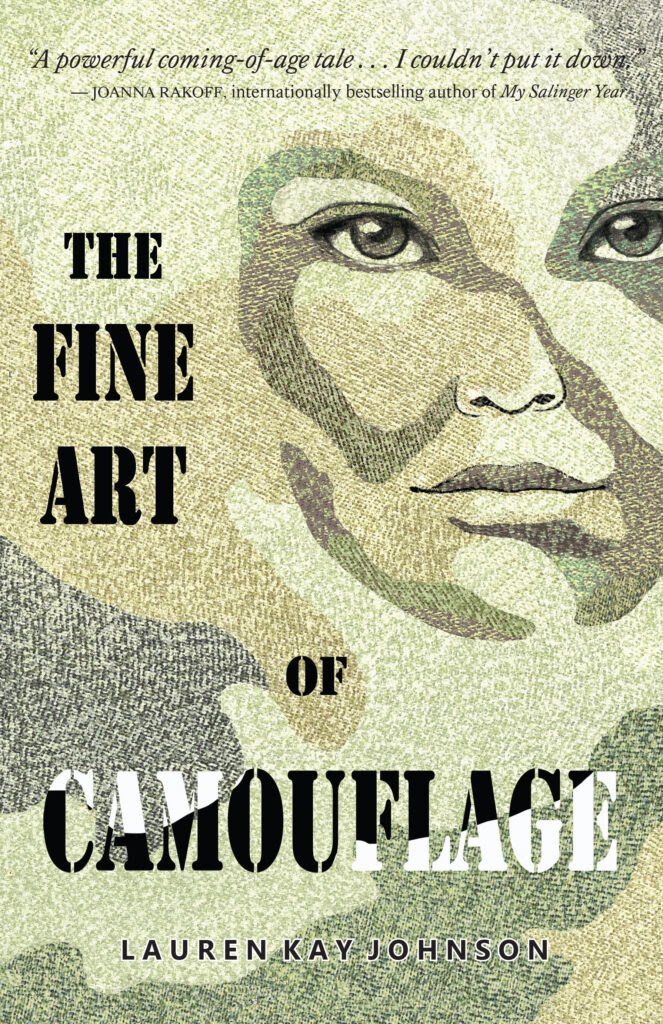
New Nonfiction from Lauren Kay Johnson: “Inheritance of War” an Excerpt from The Fine Art of Camouflage

I swore I would never become a soldier like my mother.

She called it a blip, a few months out of an otherwise enjoyable career with the Army. No one saw the blip coming. Both of my grandfathers served in the military, but their wars stayed cold. My mom’s reserve unit, Seattle’s Fiftieth General Hospital, with 750 personnel, was too big, too expensive deploy, the very reason she’d chosen the unit. Aft er three years as an active-duty Army nurse, she wanted to start a family. The Fiftieth promised stability; for them to deploy, it would take World War III.

On Thanksgiving weekend of 1990, my mom got a phone call. She had been receiving practice calls ever since Saddam Hussein invaded Kuwait, drills to make sure the phone tree was accurate, to keep everyone prepared. This time, the call wasn’t a drill. The unit was put on alert for deployment orders. My sister, brother, and I were asleep, so we didn’t see the white-faced shock when Mom answered the phone. We didn’t watch her crumple into Dad’s arms when she told him or see the shock mirrored in his own face as questions of her safety, the family’s well-being, single parenthood flooded his mind.

Mom and her hospital unit wouldn’t receive orders right away. They would spend Thanksgiving with their families, worrying and hoping—hoping World War III would dissipate with the holiday weekend; hoping their orders would leave them as local backfill for active-duty soldiers who deployed or send them to Germany, the unit’s assigned overseas operating location based on the Cold War model; hoping their orders would be short.

None of these hopes materialized. Mom’s orders were for Riyadh, Saudi Arabia, for an undetermined length of up to two years.


I hardly recall the Army’s presence in our family before Desert Storm. The Army slipped in and out one weekend a month and two weeks a year when Mom put on green clothes and went “camping.” Sometimes we ate hotdogs and pretended to camp too. With that Thanksgiving phone call, though, the Army consumed us. I had just turned seven, my sister, Shavonne, was eight, and my brother, Matt, barely two. Suddenly, we were no longer a regular young family. Mom had always been the center mass around which we all orbited, and now our gravity fi eld had shift ed. In preparation for the deployment, she took frequent trips to the local Army base, sometimes for days at a time. Big green Army bags piled up in the living room where we used to build puzzles and pillow forts. Instead of driving to school with Mom, Shavonne and I went to daycare with Matt early in the morning when Dad left for work. Neighbors stopped by our house to drop off funny-tasting casseroles. They said nice things like, “We’re praying for you,” and “Let us know if you need anything.” I just needed my mom. I was restless in school and gymnastics practice, anxious to get home and hug Mom and hold onto her forever.

Before she left for Saudi Arabia, I told my mom I hated the Army. “Oh sweetie,” she said, “I know it feels like the Army is being mean, but it’s the Army’s job to go help people. A bad man invaded another country, and we need to go help the people there and get him out.” With that, she redirected my hatred to Saddam Hussein. The Army wasn’t taking Mom away; a bad man was making her leave. Shavonne and I even learned a song about that man and how much we all hated him. We sang the song over and over, and Mom laughed the hardest: 

Joy to the world, Saddam is dead!

We barbequed his head!

Don’t worry ‘bout the body

We flushed it down the potty,

And round and round it goes . . .

I don’t remember this, but my parents tell me that before she deployed, I asked Mom if she could die. I imagine myself climbing into her lap. In my mind she’s wearing the soft blue bathrobe she had when I was growing up. I’m clutching it, nuzzling into her brown permed curls. Mom wraps her fuzzy blue arms around me, and I can feel her heartbeat, strong and serious. She gazes out through her thick-framed glasses, her eyes light like mine above the long, sharp nose and freckles inherited by Shavonne. Mom purses her lips. She’s thinking about my question, about my life—all our lives—without her. She’s thinking about the briefings the hospital unit received, the expectations of chemical weapons and massive casualties, the potential for an attack on Israel and an ensuing holy war of nuclear proportions. She’s thinking this might be a suicide mission. Mom pulls me closer and strokes the top of my head, trying to memorize the feel of me. She’s weighing her need to protect her child with a desire for honesty.

She answered my question: “I’m going to do the best I can to come back to you as soon as I can.”

“Don’t tell her that!” my dad said. “Tell her no!” But my mom couldn’t lie.


Just before she left, Mom wove Shavonne’s and my hair into double French braids, like she did when we had soccer or T-ball games, the only thing that would keep my thin hair and Shavonne’s unruly curls in place under helmets and through trips up and down the fi eld. These braids were special, though. They held the memory of Mom’s touch: her gentle fingers brushing across my scalp, the nail of her little finger drawing a part down each side, her soft breath on the back of my neck. I wanted to keep the braids forever. I promised Mom I would. It would be our connection while she was gone, and every time I looked in the mirror I would think of her.

Mom deployed right after Christmas. Christmas has always been my favorite holiday, and the occasion carried extra weight in 1990 because we had Mom with us. The Christmas morning snowfall seemed magical to us kids but made a treacherous drive for our relatives, who commuted several hours for everyone to be together. I don’t know if our house has ever been so full; it’s funny how war brings people together. We had an epic snowball fight with my cousins, opened presents, ate roast beef and mashed potatoes and gravy, and took pictures around the Christmas tree, just like every year.

A few days later, we watched Mom board an Army transport bus. She waved to us through a grimy window until her pale face was lost to camouflage and dust and distance. On the bus she was surrounded by other moms and dads, sons and daughters, brothers and sisters, and a single twenty-something medic. The medic had no family to wave to through the grimy window, but he saw us: a man with red-rimmed eyes standing next to two girls with double French braids. Both girls clung to the man and cried. In the man’s arms was a small boy. The young soldier couldn’t hear it, but the boy repeated, “Where’s Mommy going?” over and over, long after the bus rolled out of sight.

“Looking at your family when we left was my war moment,” the medic later told my mom. “Seeing how heartbroken they were.”


My memories of Mom’s deployment blur into a fuzzy background, punctuated by snapshot images of clarity. I remember cheese quesadillas, “cheese pies” I called them, cooked in the microwave. A neighborhood mom who watched us aft er school served them to us while we waited at her house for Dad to pick us up. One day while there, I got the stomach flu. The neighbor tucked me into a nest of blankets on the couch with Gatorade and a bucket, but I kept getting up. I walked to the hallway and threw up. I threw up in the living room. I kept walking, looking for my mom.

As the days passed, oil slickened my hair and my precious braids started to unwind. I remember an angry fit of protest, and an ultimate compromise. Every few days the gracious neighbor cleaned and re-braided my hair. It looked exactly the same. But it wasn’t.

I cried every night in bed aft er Mom’s tape-recorded voice finished reading a bedtime story. I saw the school counselor for a few weeks. I don’t recall her name or what she looked like or even what we talked about, but I remember staring out her window at the snow-crusted ground. My classmates were at recess, throwing snowballs, having fun. For the first time I did not feel normal.

We were the only local kids who had a parent deployed. Neighbors took turns babysitting and delivering meals. A yellow ribbon hugged the big maple tree in front of our elementary school. When she returned, my mom would cut the ribbon off to a whooping chorus of cheers from our classmates. But while she was gone it hung there, through rain and wind and snow. I saw the ribbon every day, and I hated it.

We lived for weekly calls from Mom, letters, occasional pictures, anything to let us know she was safe. Each trip to the mailbox was its own tiny Christmas, marked by expectation and, too often, when no letters came, disappointment. At one point, Mom sent Shavonne and me matching T-shirts with pictures of camels wearing combat boots and gas masks. I still have that shirt, a child’s size small, buried in the back of a drawer. Dad pointed out Saudi Arabia on our office globe. Mom was there, inside the little star that represented the capital of Riyadh. It didn’t look very far away.

We watched news reports every evening on TV. Headlines that spring covered topics that interest me now as an adult: an escalation of violence in Sudan following the imposition of nationwide Islamic law, an historic meeting between Nelson Mandela and Zulu Chief Mangosuthu Buthelezi, Haiti’s appointment of its first elected president, the controversy over Dr. Jack Kevorkian’s assisted suicides, the Exxon Valdez oil spill. In 1991, I could focus only on the war. My world expanded exponentially when Mom deployed; I wasn’t yet ready to stretch beyond the Middle East. Besides, the Middle East was everywhere, dominating TV, radio, and newspaper reports. In a letter home Mom noted that we were probably getting more news of the war than she was; TV was censored in Saudi Arabia, and she didn’t have free time to watch anyway.

In the States, we witnessed a new era in broadcasting, the first time war received real-time coverage from reporters on the ground. They showed awesome footage of planes taking off from aircraft carriers and terrifying shots of exploding missiles. All around were people in camouflage, but not the green and black my mom wore on Reserve duty. These uniforms were brown like dirt. There was a lot of dirt on the news when they talked about the war. I thought it must be hard for Mom to stay clean. I had never watched the news before. Sitting on the couch, my legs curled beneath me, I got my first exposure to the industry of which one day I would be a part. As a public affairs officer I would be there, against the dusty brown backdrop of war, ushering reporters, directing camera angles, providing talking points to the people in camouflage, filtering conflict for the families back home.

Operations Desert Shield and Desert Storm represented a new era in warfare too. Mom was part of the largest reserve component ever activated in support of an armed conflict, and the first involuntary call requiring reservists to report to active duty since the dissolution of the draft. In total, the government activated more than 227,000 reservists. The Army provided the bulk of personnel, nearly 140,000, with around fourteen percent in medical specialties like Mom’s hospital unit. Mom was also part of the largest contingent of U.S. military women ever to deploy. By war’s end, 40,000 women had served overseas, almost as many as had been on active duty during the height of America’s last large-scale conflict, the Vietnam War. Desert Storm saw two American women held as Prisoners of War, and thirteen killed in action.

Sometimes on the news they talked about people dying. At recess one day I was by myself, as I often was during that time, wandering along the edge of the concrete basketball court, when my class bully sauntered up to me. “Hey, I heard about a lady that got killed in the war,” he chided, “Do you think it was your mom?”

I hadn’t heard about the lady. Had she been on the news the night before? No one had called to tell us something bad had happened. Wouldn’t they call? But what if they had called; what if Dad answered and didn’t want to tell us before school? What if they knocked on our door but no one was home? Maybe the bully had seen a news report that I’d missed? The thought of never seeing my mom again overwhelmed me, and I sat down on the concrete and cried for a long time.


While Mom was gone, we made up games to make time and distance not seem so massive, to trick ourselves into feeling like we might have some sort of control. For “When will Mom come home?” the whole family—my dad, sister, brother, grandparents, and I—scribbled our return date guesses across the calendar. My sister’s prediction, March 12, 1991, was the earliest, three and a half months aft er Mom’s departure. The rest of us hoped but doubted she was close.

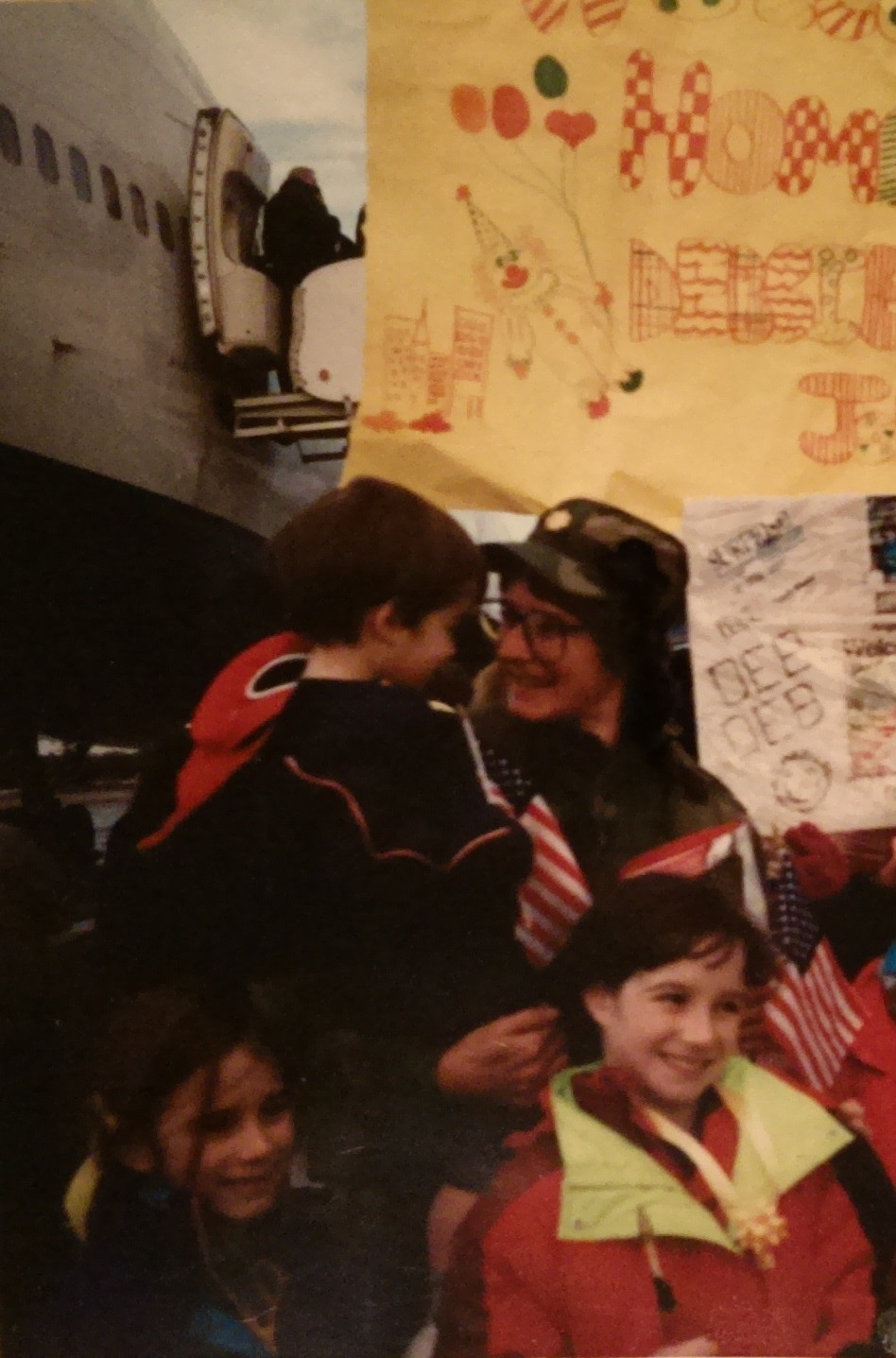
As March arrived, we only got a couple days’ notice that Shavonne’s guess was exactly right. As suddenly as war had swooped into our lives, it ended. We let ourselves be consumed by frenzied preparations for Mom’s homecoming, spending hours tracing letters and gluing glitter onto bright sheets of poster board. There were trips to Party City to buy trunk-loads of yellow ribbons and American flags. We must have alerted the relatives the elementary school, my Girl Scout troop, the whole neighborhood, and Mom’s college roommate, because hordes of them showed up at McChord Air Force Base outside Seattle on the morning of March 12.

Together we stood behind a chain link fence, a crowd of hundreds, watching the empty runway. Shavonne and I held signs and chattered with our classmates. Matt, too young to understand where Mommy had been or why, just knew that this was the day she was coming home. He coiled his tiny hands around the fence and rocked back and forth, back and forth, eyes glued to the tarmac. His expectant little face, framed by a puff y black and red jacket, became a popular clip on local news segments.

I don’t know how long we waited before we heard the drone of an approaching aircraft . The crowd hushed. We twisted our heads frantically and shielded our eyes from the sun. A dark speck emerged on the horizon, and we erupted into a cacophony of cheers. The dark speck got bigger and turned into a place that drift ed slowly across the landscape. As it inched closer, the crowd grew wild. We screamed and shook the fence. My dad scooped up my brother. Someone, a grandparent maybe, grabbed my hand. Reporters yelled into their microphones. We were supposed to stay behind the fence, but when the plane landed and the first camouflaged figure emerged, we stampeded the runway. All I could see was legs: jeans and khakis and sweats, then a trickle of camouflage moving upstream, and then a pair of legs that stopped and dropped a bag and bent and hugged and cried, and then I was in her arms and nuzzling my face into her hair and the world was whole again.


For a while after her deployment, I screamed every time Mom put on her uniform. Then, gradually, the Army faded into the background again, one weekend a month, two weeks a year. The blip, Desert Storm, followed us all like a shadow, not unpleasant, but always there.

We were extra thankful on Thanksgiving when the phone didn’t ring. We got teary-eyed whenever Lee Greenwood’s “God Bless the U.S.A.” came on the radio, an anthem for Mom’s unit. For years, our schools asked Mom to give Veterans’ Day speeches, and Shavonne and I modeled Saudi Arabian clothes she’d brought back as souvenirs: black draping capes and veils that covered everything except a square around our eyes, similar to the burqas I’d see eighteen years later in Afghanistan. I loved being a part of Mom’s experience, if only from under the veil. I liked to twirl and see the fabric billow around me. Mostly I liked watching my mom.

She talked about how difficult life was for women in Saudi Arabia. “They have to cover all their skin, even when it’s really hot outside,” she said. “If they don’t, the police can arrest them! And they aren’t allowed to drive!” Even as an American, Mom said, she couldn’t go certain places because she was a woman. She told our classmates about the armed guards on the hospital buses and around the compound to help keep the doctors and nurses safe. Mom shared that she was afraid at first to take care of Iraqi prisoners, but she learned that they only fought because their families were threatened by Saddam Hussein. I thought how brave she was and how lucky I was to have a mom who was more than just a mom, but also a soldier, a healer, and a hero who helped save people from that mean man. After Mom finished speaking everyone clapped for her, and I beamed under my veil.

I didn’t know how painful those events were for my mom. I didn’t realize she struggled diving back into her roles as wife and mother and everything else we heaped on her. She didn’t discuss her terror at nightly air raids, or her aching loneliness, or her doubts about her ability to handle combat. I didn’t know she carried trauma with her every day, even aft er she returned home. I didn’t understand her earnestness when we made a family pact that no one else would join the military, because one deployment was enough.


New Essay by Lauren Kay Johnson: Things Received

A portion of this essay was originally published in Cobalt Review.

It came by helicopter twice a week, if weather and security were sufficient for air travel. In the shack next to the Helicopter Landing Zone, it was sorted by unit; everything bound for “Provincial Reconstruction Team Paktia” loaded onto the back of a rickety cart, driven by our personnel officer down the gravel walkway to the meeting area outside our military barracks. Sometimes we waited there too. On clear days, we anticipated the announcement before the sergeant’s booming voice crackled over the radio.

“Mail call! Mail call in front of the B-huts!”

There were letters and cards, photos of people we missed and postcards of places we couldn’t be. I taped mine to the plywood wall next to my bed in a patchwork wallpaper of home. Sometimes cards fell down on me while I slept, blanketing me in sentiment:

We’re all thinking of you, Lauren.

Stay Safe!

I love you.

Kick some Taliban butt!

Though America at large may have forgotten, it was clear that elementary schools and church groups remembered we were a nation at war. Students mailed handwritten notes with endearing misspellings, backward letters and stick-figure doodles. Adult influence peppered the messages—too vengeful, too assured—but they succeeded in making us smile. Churches sent crocheted crosses and assured us that God was blessing the brave soldiers and America, though blessing us with what they didn’t specify.

There were favorite snacks. For me, Twizzlers, trail mix with M&Ms, and the Risen chocolates I’d horded as a child from my grandparents’ candy bowls. There were baked goods that had gone stale during transit (we still ate them), chocolates or gummies that melted into one gooey glob (we ate them too). We learned to hunt for the tiny plastic baby inside a New Orleans King Cake and that Italian pizzelles look like crusty waffles but taste like buttered heaven.

There were resupplies: batteries, shampoo, baby wipes, lip balm, my favorite pomegranate body wash; and practical luxuries: alcohol-free hand sanitizer, extra strength moisturizer to combat the dry air and highly-chlorinated water that flaked off our skin in scaly patches. There were indulgences: the stockpile of gourmet coffee that doused the stale office in rotations of chocolate-covered cherry and hazelnut biscotti fumes, Netflix discs that often arrived out of sequence: True Blood Season 2 disc 2, while disc 1 stalled somewhere in southwest Asia. There were iPods to replace those done in by Afghan dust and CDs for an attempt to keep up with pop culture. We ordered books and movies to read and watch, but also to ensure our names would be called in front of the barracks in 2-4 weeks.

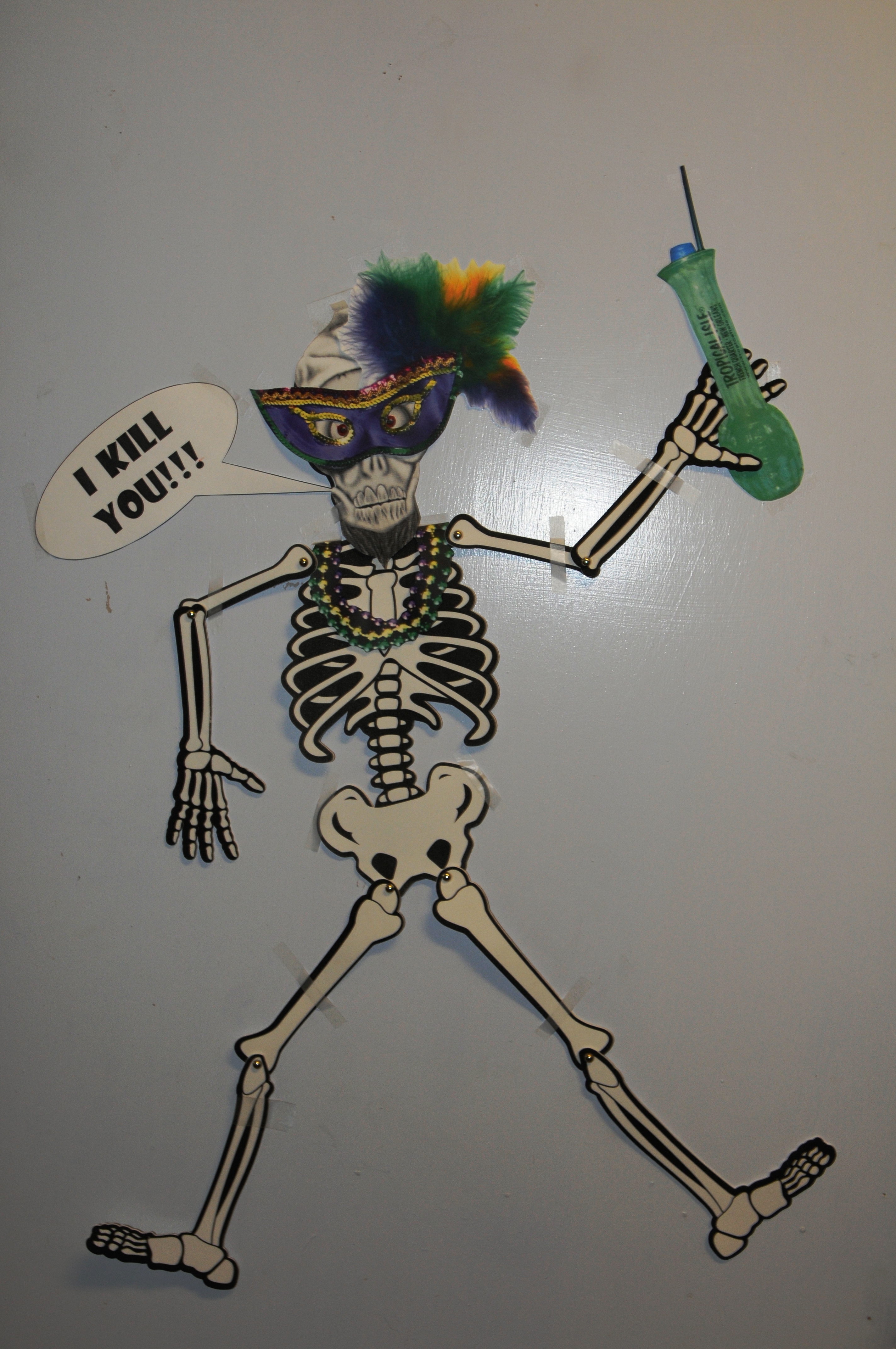
There were holiday treats, which made missing holidays both more tolerable and more obvious, and knickknacks we imbued with greater meaning. A Halloween skeleton decoration from my mom became an office mascot, a meager version of ventriloquist Jeff Dunham’s Achmed the Dead Terrorist: Scull replaced with a printout of Achmed’s turbaned head, “I KILL YOU” scrawled across a speech bubble. He would get new attire to mark each holiday.

Achmed enjoys Mardi Gras

There were what we called “leftovers,” items that had outlived their American usefulness or had been cast off from larger bases: gossip magazines broadcasting celebrity marriages, which by the time we read of them had ended. Cases of Girl Scout cookies, but only the tasteless shortbread variety. (I once heard rumor of a single box of Thin Mints but never saw evidence.) There were packages designated “for any soldier,” usually stuffed with candy; for well-meaning patriotic souls, sugar was a salve for any conflict. Occasionally, a “for any female soldier” made its way to our tiny base on the Pakistan border, and the seven of us gathered to ogle expired Mary Kay lotions, nail polishes and lipsticks we weren’t authorized to wear, and, once, a box of extra-large bras.

There were things that defied categorization, like the shipment of promotional materials for American Idol Season 4 runner-up Bo Bice. There were items designated for Afghan humanitarian aid: hats knitted by a widow in Florida, school supplies, sunscreen and summer sandals, and boxes and boxes of Beanie Babies.

The Beanie Babies came from Indiana, the headquarters of Beanies for Baghdad, an organization that collected the stuffed animals to send to deployed troops in Iraq and Afghanistan for distribution to local children. The PRT Paktia recipient rotated to a new unit volunteer every nine months. For nine months, the Beanies came to me.

I thought it a noble idea, reallocating American surplus in the form of fuzzy, bean-stuffed animals that were fleetingly thought to be a valuable collector’s item. I was no stranger to the toys—I still kept one of the rare nine original Beanies on a bookshelf in my childhood bedroom: Flash the Dolphin, purchased at a swim meet in my pre-teen years—and I was happy to be their Paktia courier. I wasn’t expecting, however, the sheer quantity of Beanie Babies that made their way from American households to Indiana, to cargo space on a commercial airliner; to Germany or Spain for redistribution and refueling; likely to Kuwait or Kyrgyzstan for further sorting; then on military aircraft to the Regional Mail Distribution Center at Bagram Air Base, Afghanistan; then on smaller aircraft to eastern region hubs in Khost or Paktika provinces; then finally by helicopter to Paktia, separated into the PRT pile, loaded onto the back of the gator, driven down the gravel walkway and passed, with growing amusement, into my expectant hands.

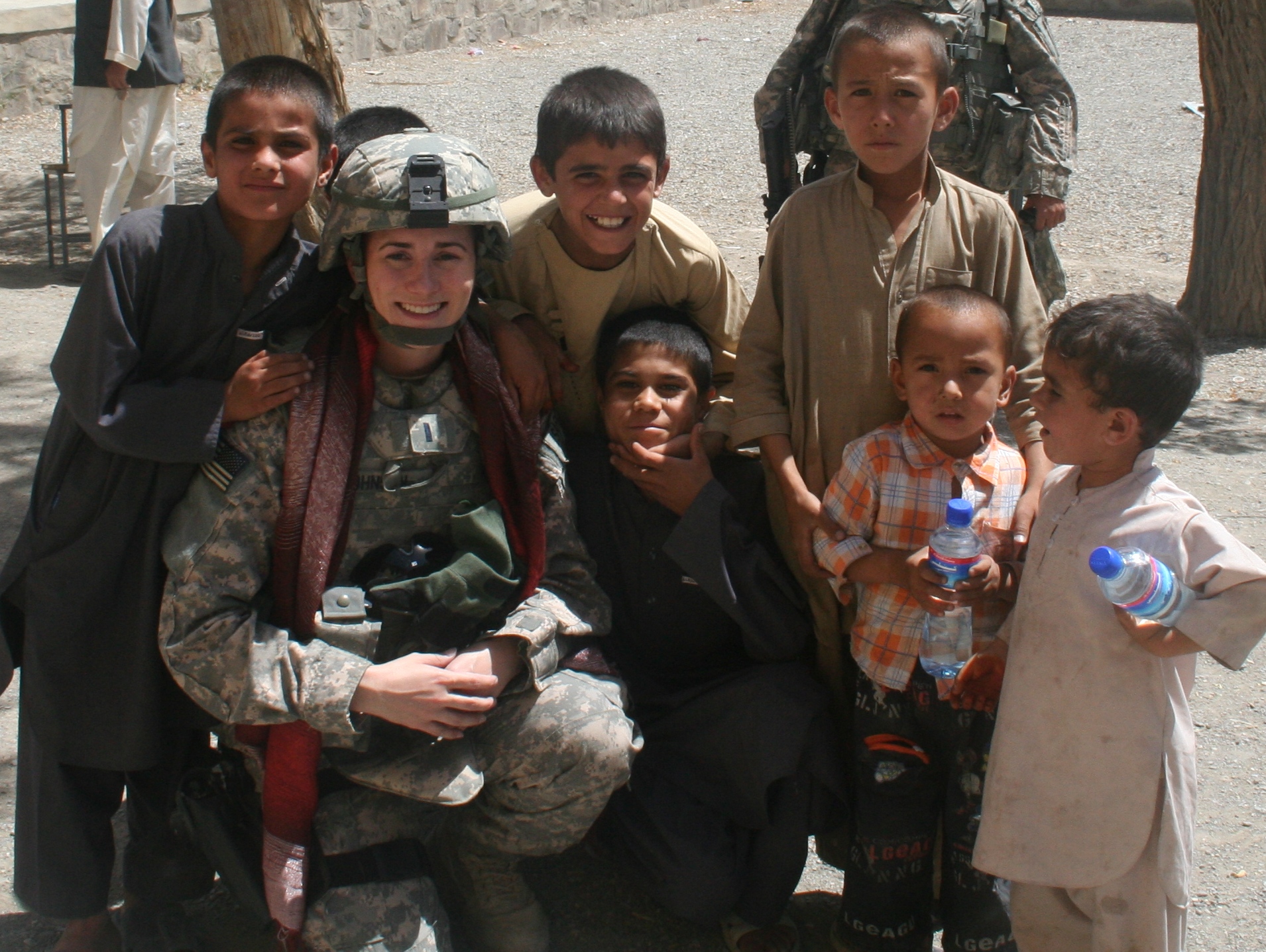
The author out on mission

At first, I opened the boxes alone at my desk, rummaging through layers of bright plush, pulling out any pigs (insulting in Muslim culture), the American flag-emblazoned bears (a bit too overt), and any snacks or novelties buried underneath to be tossed in the office “morale pile” for mass consumption. The remaining Beanies were stacked in the humanitarian aid freight container next to bags of rice and fluffy piles of winter coats. After a while, though, something happened that neither I nor the founder of Beanies for Baghdad could have predicted. Maybe it was the regularity of the packages in a place where nothing seemed regular, or nostalgia to bridge comforts few and far between. Perhaps it served as simply a colorful diversion from the monotonous, dusty brown. Whatever the reason, I suddenly became very popular on mail days.

The coffee maker spewed sweet fumes over a growing crowd while I sliced the packing tape on the familiar boxes. Over the clack of busy keyboards and wind rattling the flimsy outer door, the office rang with cries of, “Oh this one’s so cute! I’m gonna put it on my desk!” A young Airman started a collection of sea creatures; by the time we left, she could have staged a production of The Little Mermaid. We could barely see our head medic behind the community of bears that inhabited her desk. I kept two cats perched next to a picture of my real cats. At Christmastime, a parade of festively-adorned Beanies marched across the conference room table. We discovered a dinosaur that bore uncanny resemblance to the sword-wielding figure on the insignia for the neighboring Army unit, and the unit adopted him, using a sharpie to make color corrections and gluing a plastic knife between his paws. Some, like the gruff Army First Sergeant, feigned annoyance, but a smile twitched across his lips as he cursed the Beanies under his breath.

Even the PRT’s hard-headed, no-nonsense lead engineer who worked next door took a liking to a lemur with large, goofy eyes. One day I threw the lemur over the wall that separated our offices—it had become habit for us to launch care package goodies back and forth, a form of warzone entertainment. On this occasion, though, all that came flying back was a comment about “this one” being “especially ugly.” Big Eyes spent the rest of our tour displayed prominently on the engineer’s desk (watched over by Bo Bice’s shaggy-haired, bare-chested image from a calendar that the engineering team swore they hung ironically).

A few of the Beanie Babies even made it back to the States. Birthday bears were popular to send to loved ones at home, but occasionally another critter grabbed someone’s attention. I remember one afternoon a Security Forces soldier plucked a Beanie from its box and held it out in his burly arm. The soldier’s rifle, slung across his chest, rattled as he bounced excitedly, smiling through a cheek-full of tobacco.

“Hey L-T, mind if I take this one? I want to send it to my daughter. She loves pandas.”

I didn’t think about it then, the irony of these well-traveled Beanies, making their way from their original homes to Indiana and through the 2-4 week odyssey to Paktia, only to be boxed up and sent back in reverse. On both ends, something to fill the gaps between the lines. Something to miss or hope for, something to crave. A distraction—escape from monotony and chaos and uncertainty, and from other topics we’d rather not discuss.


Lauren Johnson Interviews Amy Waldman, Author of ‘A Door in the Earth’

Amy Waldman’s novel, A Door in the Earth, follows Parveen, a young Afghan-American woman who returns to her war-torn homeland after discovering a memoir by humanitarian Gideon Crane. Parveen is not the only American influenced by the book; Mother Afghanistan has become a bible for American counterinsurgency operations  in the country. If part of that story rings familiar, it is: The book-within-a-book was inspired by Three Cups of Tea, Greg Mortenson’s 2006 memoir of building schools in Afghanistan and Pakistan, which was later revealed to be largely fabricated.

I was one of the legions of soldiers who read and fell head over steel-toed boots for Mortenson’s story. Like Waldman’s protagonist, I ultimately found myself in a remote corner of Afghanistan in 2009. As a military information operations officer, I was charged with “winning hearts and minds”—an instrument of the “kind power” advocated by Gideon Crane. I didn’t share Parveen’s Afghan heritage, but I see my younger self in her idealism and naivety. I feel the crushing blow when expectations and reality clash.  

I relate these parallels to Waldman before our interview, and she begins by asking me questions about my experience—curiosity cultivated through a career in journalism, but also desire to learn, to investigate, to understand. Waldman’s first novel, The Submission, explores the aftereffects of  9/11 on American soil, imagining what might happen if a Muslim-American wins a blind competition to design a Ground Zero Memorial. A Door in the Earth is her second novel.

Lauren Johnson: You worked as a reporter for a number of years with the New York Times and covered both ground zero in the aftermath of 9/11 as well as the war overseas for a few years. I’d love to hear you talk a little about what led you to pursue journalism to begin with and how your experiences reporting after 9/11 shaped your perspective as a writer.

Amy Waldman: I finished college and didn’t quite know what I wanted to do. I was interested in writing, film, but it was all fairly vague. And then I ended up moving to South Africa a year after graduation. First, I was volunteering there in a university—teaching and helping in other ways, and then I began doing some freelance reporting. It was 1992, 1993, so apartheid was ending. It was a very exciting time in the country’s history, and so partly I felt like being a reporter gave me a way to go witness all of this, gave me a reason to be going to rallies and protests. I have a strong interest in social justice, so it was a way to write about things I cared about. I sort of felt like I backed into journalism a little bit. But then felt like, Okay, this is what I want to do.

I came back from South Africa, worked at the magazine Washington Monthly, then went to the New York Times and spent five years writing about New York City. And then 9/11. I was in New York for about six weeks afterward covering the aftermath and then was sent overseas . . . I ended up in Afghanistan in November 2001, then went back repeatedly over the next few years. It was, obviously, a much more peaceful time there. There was a lot more freedom of movement. I went to Helmand and places that within a few years it was much more dangerous to go to. So I had, I think, a very personal, visceral sense of what was happening with the war because I had seen this window of optimism and openness, and then watched it closing.

I was actually briefly sent to Iraq after the invasion. And I think that was really informative for me, too—in registering all the ways that diverted resources and attention from Afghanistan, but also the sense of an occupation was much more palpable there. I think Afghanistan did have this identity much more as the ‘good war,’ and our reasons for being there were clearer. And yet, it helped me see certain parallels between Iraq and Afghanistan and our presence in both places. Also just watching things start to sour. In Iraq I felt them start to sour very quickly. I was there maybe two months at the most, and within that time I saw the change. Afghanistan, it was much slower — the disillusionment that built, among Afghans, but also my sense is even within the military, and for reporters as well. Even once I left the region I followed really closely what was happening with the war and our presence there and just felt very confused by it. I guess it’s the simplest way to put it. You know, more and more this sense that there was—and frankly is—no good solution to this, and that we hadn’t thought through where this was going.

I think that’s a very long way of saying that all of my post-9/11 experience fed into the first novel I wrote. The Submission is much more about America and how 9/11 changed us at home. I’m interested in, even in fiction, moral questions and the choices we have to make both as a society and individuals about how to answer these moral questions. The first novel came out of reporting in America and reporting abroad and the ideas of: What did we want to be as a country in the wake of 9/11? What were our values? What should change? What should stay the same? And then for individuals, how did your personal, political, psychological history weigh into how you answer these questions?

I really loved Afghanistan as a country. I always loved going there. I loved the people that I met and people that I worked with. I was good friends with a lot of our interpreters there. I felt anguish about what I saw happening. [A Door in the Earth] is, in a way, another chapter of what I had started with the first novel: who we are at home. Afghanistan was where I wanted to try to understand who and what we are abroad.

I also felt like 9/11 created this whole new set of tropes and ideas and conditions about who we imagined ourselves to be. Three Cups of Tea I think was so popular because it fit into that idea of who we think we are. I was interested in idealism, even going back to when I went to South Africa as a young person. I kind of love that impulse in Americans, to want to go and help abroad. But I also think as I’ve gotten older I question it more and see it as much more complicated, and I don’t have as clear a sense of how to think about it. Fiction for me is a good place to work out things that I don’t know the answers to, or don’t exactly know how to think about. So that all fed into this novel. That was a very long answer.

Lauren Johnson: I appreciate long answers because these are challenging things to think about, and I don’t think there is an easy answer a lot of times. I heard that for The Submission the idea kind of lodged itself in your brain, and you had initially shelved it while you were working as a journalist. Then it wouldn’t stop gnawing at you so you decided to listen to it, and you stopped working for the Times and wrote the novel. Was the seed for A Door in the Earth similar to that? Was it an obsession, for lack of better words?

Amy Waldman: Yeah, it actually was. I had not read Three Cups of Tea, and then Jon Krakauer published Three Cups of Deceit and 60 Minutes did its report, and I became completely obsessed with the entire thing. So I read Three Cups of Tea at that point. I wasn’t even that interested in [Greg Mortenson] as a person or what his motivations were, I was more interested in why did so many people buy into this myth? What did that say about us? I felt like it got at something pretty deep, both in who we are as Americans, but also in the War on Terror, the war in Afghanistan. I couldn’t easily articulate what that was, but I felt like it really went to the heart of something there. And then I also was really interested in what would it feel like to believe in this cause or this person and then find out that in all kinds of ways, it wasn’t what you thought it had been.

I spent a lot of time online reading reactions from people after Three Cups of Tea was exposed. I was interested in the people who were really angry at Krakauer for exposing him—this idea that we need heroes, and it’s wrong to tear them down, even if they’re false heroes. But then I would find, say, a 14 year old girl who would be like, ‘I’m crushed, because I really believed in this and raised money for this.’ What would that feel like to be that young and having this experience? I was trying to make sense of why was it so popular, why did the military latch on to it, and then what would it feel like to find out that basically you’ve hitched your idealism—which is a genuine feeling—to something that’s false. I kept meeting people who said, ‘Oh, I went into education because of that book,’ or ‘My brother went to help in Pakistan because of that book.’ So, if something’s not true but it’s motivating people to help, that’s really interesting as well. So anyway, it just seemed very messy and interesting. I usually feel like when I become obsessed with something, that’s fertile territory for a novel.

Lauren Johnson: And why did you choose 2009 as a time frame in particular?

Amy Waldman: Initially, I think I didn’t have the novel set in any particular year. When I’m writing fiction I’m always torn, especially the kind of fiction I do—at least everything I’ve done so far—which is so obviously spun off reality in some way. I’m always torn about how specific do I want to get? In The Submission, I don’t say it’s 9/11. I left it vague in terms of what the attack in question was. I never use the term 9/11 or September 11 anywhere in the book, because I felt like it just takes you out of a fictional world into one that immediately you’re thinking about all your associations and experiences with 9/11.

In this case, the more I thought about it and started looking at different points in the war, I just felt like it actually does matter to be specific. That year was so interesting to me, for all the reasons I weave into the novel: everything from Obama becoming president and rethinking the whole Afghanistan strategy, to the number of casualties of American soldiers rising, to growing public disenchantment at home. . . It really just felt like that was a pivotal year in the war. And so it seems a good pivot point to set the story when all of this is going on.

Lauren Johnson: And it’s definitely rooted in reality. You mentioned a lot of things that took place that year, including the airstrike in Farah that led to massive civilian casualties, and the attack in Kunduz in November where the British reporter was kidnapped. I appreciated all those little reminders. And I think someone who maybe didn’t have an obsession with that region in 2009-2010 would still pick up on those elements, that it feels very grounded.

Amy Waldman: Yes, but I think, equally though, someone who didn’t know anything—in a way it wouldn’t matter. It’s almost like I’m speaking to you as a reader in one way and another reader in another way. I’m putting all those things in; to me, it’s exciting that you would get them and register them and their significance. But equally, I know there’s a lot of readers who will not have paid any attention to any of those things. I kind of like tucking in reality into fiction. I like that people who get it will get it. But I also feel like, if you don’t, that’s fine, too. It doesn’t matter if you never read the news about Afghanistan, I want it to affect you emotionally. Maybe there’s a way putting it in fiction will do that, even if you turn off the news.

Lauren Johnson: Yeah, absolutely. It grounds it but also has those emotional reverberations, and I think particularly the way that you approach it from a new perspective. That’s one of the things that I really appreciate about the book as a whole is all the different perspectives. You’re not looking at this from the traditional whitewashed American lens that most people are used to viewing war through. You weave in all these different points of view against the backdrop of war that captures a fuller spectrum. There’s Parveen—and I would love to hear more about your choice to make her your protagonist—and then all the colorful characters she interacts with along the way.

Amy Waldman: Originally there was going to be, I think, five different sections, and each would have a different central character. Aziz, the [military] interpreter, and Trotter [the American military commander] were going to have one section, and [Parveen] was going to have another section. But when I started working on it, it just didn’t work. And so I ended up kind of folding everything into her story. And it really to me became about her story, but braided together with all these other people. I wanted someone young, because I feel like that is a point when you are more open to influences, and partly it’s a novel about her wrestling with all these adult figures and mentors and influences, and kind of coming to terms with them.

The idea of a young American going abroad is a very familiar story and has been done in fiction. I decided to make her Afghan-American, partly because I wanted her to have some understanding of the culture and speak the language. I feel like every American in some way has a place that they are connected to—it can be very immediate, it can be very distant—and they’re sort of these ghost places for us where you imagine a strong connection. And then what happens when that’s tested and you have to come face to face with real people? Also, I’m always very interested in people who are kind of caught in between. With her and Aziz, I felt like they were both in that situation. The question of allegiances: even if that’s clear in your own mind, how do other people perceive you?

Lauren Johnson: You cover a really impressive spectrum. With Parveen herself, with the family she’s staying with, Waheed’s family, who are mostly just trying to exist and live their lives in this remote Afghan village, and then Colonel Trotter and these American soldiers who are also inspired by Gideon Crane’s book and the “kind power” notion. And I’m glad you mentioned Aziz, I think he was my favorite character.

Amy Waldman: Oh, that makes me happy!

Lauren Johnson: I think interpreters don’t get a lot of attention for the precarious position that they’re in, straddling these different worlds and competing agendas. I really appreciated that perspective. But again, it’s how you weave everyone all together. Parveen observes at one point that her “sympathies kept tilting back and forth, never finding a perfect place to rest.” I have to say, that’s how I felt throughout the book, not really comfortable aligning myself 100% with any character. And I think that’s in large part because of all these different perspectives that you invite us to consider. Would you say that one of your messages is that there is no comfortable place to rest in war?

Amy Waldman: Yes. Although I’d maybe say there’s no comfortable place to rest in life!

Lauren Johnson: That’s a fair edit!

Amy Waldman: But yes, I think that’s true. When I was younger I was very certain about a lot of things, and I think I’ve become less and less so, which is often frustrating. There are things—and I could go on at great length—where I have a very strong sense of what’s right and what’s wrong, including in war. I mean, there’s a lot happening right now in Afghanistan that I think is egregiously wrong. But that feeling you have is exactly what I wanted. That certainly in that situation there’s nobody’s saintly or perfect, whether that’s because they’re trying to survive or that’s human nature. There shouldn’t be a comfortable place to rest. Certainly in war.

Lauren Johnson: I grew up in the era of chick flicks where in 90 minutes someone falls in love and lives happily ever after; it’s just this clean-cut story line. As I’ve gotten older I realized that’s not the case, basically ever. And that’s part of coming of age. To me, a lot of Parveen’s experience read like a coming of age story also.

Amy Waldman: Yes.

Lauren Johnson: She’s confronted with the fact that life isn’t black and white, that there are shades of gray everywhere, and it’s uncomfortable. Your decisions have ripple effects, and even if you’re making them with good intentions, you can’t count on them having positive outcomes.

Amy Waldman: The more I worked on this novel, that idea became something I thought about more and more. Just what do our actions do? In the name of whatever cause you believe in, how do you affect other people? That’s the beauty of being alive­­­—how interconnected we all are—but also it’s very hard to live without having repercussions in the lives of others, whether you want to or not. And the gap between our ideas of ourselves in the world and our realities in the world interests me too. How do you ever stand far enough outside yourself to even see how you affect others?

Lauren Johnson: Having not been back to the country in so long, you render the landscape so strikingly. And you also invite readers into this very intimate setting of an Afghan home, which is mostly closed off to us here in the West. I would love to hear more about how you were able to capture the spaces and characters authentically.

Amy Waldman: The landscape there made such an impression on me. Some of that just stayed with me, and then I certainly drew on the reporting I had done when I was there. There’s little lines and things people said to me when I was a reporter that I probably wove into the book or gave me the seed for an idea. So I had that base for having spent time there, but it was very difficult not being able to—or, I should say, deciding not to—go back and research. Instagram I love for the visual reminders it provides, and there’s so many photographers doing great work there. I read a lot of books, including Afghan Post [by Wrath-Bearing Tree co-editor Adrian Bonenberger]. There are quite a few documentaries that I watched, and I also did a lot of research on maternal mortality. I read [military blogs] for more logistical detail. Anthropology—there’s not so much that’s super recent just because of conditions, but there’s enough to be really helpful. There’s a lot out there. But it’s not the same as going back.

Lauren Johnson: I’m glad you mentioned maternal mortality. Could you talk about why you chose to focus on that as one of the central issues? [Crane, the humanitarian, witnesses an Afghan woman’s death in childbirth, and in response decides to build a clinic for women in her village]

Amy Waldman: Yes. So once I came up with the idea that, in a way, it’s a book about a book—the influence of this memoir—I was trying to think, who is this person who wrote it? What was he doing in this village? I don’t remember exactly what the spark was for that, but as soon as I thought about it, it totally made sense. I mean, maternal mortality is a huge issue in Afghanistan, and it also was a way to get at one of the complicated things about this war, which is the whole issue of women. Are we there to save them or protect them? Is that a true reason or a pretext? And also the contradictions embedded in that—for example the way we’ve mostly allowed women to be left out of the peace process.

And so I wanted to see how those contradictions in America’s relationship to women in Afghanistan would play out in the story I’d invented. What is PR and what is a legitimate desire to help? What is our obligation? I felt like it was a way for [Parveen] to connect with women in the village as well. And then all the complexities around—and again this came out of my reporting, some of it at least—who can treat women, medically, and how does that work? So, it just seemed like the issue to build the novel around.

Lauren Johnson: And one of the other ways that Parveen ends up connecting with the women in the village is in reading them Crane’s book, which is such an interesting layer. She quickly realizes that events and descriptions in the book don’t line up with the reality of the people who were living it. Aside from that, the moments in those scenes where we get to see the women interacting away from the men and their daily routines was a really powerful image. They take their burqas off and they’re teasing each other, and harping on their husbands, talking about sex; just women being women. I think that’s an important element, too, that gets lost in the politicized discussions of war: just people being people and the connective power of that.

Amy Waldman: I definitely wanted to have that. I would say the war was the thing that propelled the novel into existence, and yet I didn’t want it only to be about that. And I did feel strongly that all the reasons I really loved Afghanistan, I wanted to try to get some of that across. And, you know, people everywhere are just funny and saucy and smart. Someone once said to me that it’s much easier to focus on the differences with people in other cultures than it is the similarities. That was probably in the context of being a reporter, but I think it’s true in fiction too, that it’s very easy to exoticize everything that’s different or extreme in another culture. But the truer portrait is capturing at least some of ways that people are quite similar anywhere: their friendships, their relationships, their desires—all of that.

Lauren Johnson: Were any of the moments that occur in the book echoes of experiences you had in Afghanistan?

Amy Waldman: Good question. Funny, at this point it’s so hard to even sort everything out. There are things that were not experiences, but were taken from the news. [One incident, removed to avoid spoilers] is based on this tiny, one paragraph news item that I found years ago . . . that’s always really haunted me. Frankly, the Konduz incident—the translator who died was someone I was really close to and had worked with, so that never went away for me. I had very strong feelings about it and wanted it not forgotten. And then there would just be little things. Like when Waheed says to Parveen, “You know, I wish my wives could do what you do.” When I was in a Pashtun area reporting, this man said that to me: “I wish my wife could do what you do.” I just never expected to hear that there.

There are little things that in one way or another either are my experience or things I read. [I read a paper] about the relationship between Israel and the Palestinians, the psychology of an occupation, and that fed into my thinking: this idea of, is an old man just an old man or is he dangerous? What does it mean to be an occupying power? As the fear increases, how do you start to interact with the population? I feel like that’s a central tension of our presence there: Supposedly trying to help and win hearts and minds, and yet we’re also terrified and have no idea who to trust. How do those things coexist with each other?

Lauren Johnson: I actually wrote down a line where Parveen wonders: “What did it mean to offer help to people you don’t trust?”

Amy Waldman: Exactly.

Lauren Johnson: That was certainly something on my mind when I was there, and I’m sure many of my compatriots as well. That really complicated mixture of the inherent power that comes with being an American military member, but also the vulnerability that comes with it, and just the pervasive lack of knowledge and understanding, and then the rules that are being dictated by people who aren’t actually on the ground—and you captured that web in really kind of an appropriately discombobulating way.

Amy Waldman: That’s interesting, that idea that you are not making the rules. And also that, in this novel, and it seemed to me there, like the rules were always changing.

Lauren Johnson: Yeah, absolutely.

Amy Waldman: I think for most Americans and Afghans that’s incredibly confusing. Because there’s no consistent relationship. And even as a soldier, you’re still a human being, and you’re told one day to perceive the people in this place a certain way, and the next day you’re told to perceive them in a different way. How are you supposed to reconcile that internally as well as externally in your actions and your reactions?

Lauren Johnson: Right. And how are you supposed to inspire trust in an interaction when you’re going in with body armor and two weapons and ballistic sunglasses and fourteen ton vehicles? So many paradoxes inherent in war.

Amy Waldman: Yes, paradox is the word.

Lauren Johnson: The fact that this war has now been going on for 18 years, I think it’s fitting that this is not a book that wraps up neatly at the end. Parveen has this great line that it is “a war shaggy with loose ends.” Which does not satisfy my idealistic American desire for happy ending, but it’s also very appropriate. Was that a conscious decision?

Amy Waldman: Yes. It was hard for me to imagine a happy ending, to be honest. I think this is a very slow moving, epic tragedy and it’s gotten so much worse—for Afghans, in particular, in the past few years. I just felt like the most honest ending was one that was unresolved . . . It’s more just, we have to think about these things. We can’t just be congratulating ourselves all the time on being the saviors of the world. Not that we really are any more. In some ways I feel like I’m writing about history more than the present.

[I also want to] touch on the role anger, for lack of a better word, played in the writing of A Door in the Earth. So many things about the war that were treated as normal—the lies or withholding of information; the false rhetoric about success or victory in the war; the sending of soldiers on missions or to outposts that made no sense or seemed destined to fail; the loss of life on both sides, of both soldiers and civilians, and the lack of questioning whether those deaths, or lifelong injuries, were a cost worth paying—seemed wrong to me, and the novel was a way to work through that. I think one problem with the civilian-military divide is that civilians don’t think they have the right to ask these kinds of questions, because we’re not serving, when for me that’s the reason we’re obligated to ask them.

Lauren Johnson: These two novels, it seems, very organically fed into each other. Do you think you’ll stay in that zone, about the aftereffects of 9/11? Or is that still to be determined?

Amy Waldman: I think it’s to be determined. I mean, sometimes I think there must be a trilogy. It seems like these things always come in threes, but I don’t know what the third one would be. And I definitely don’t want to force it. Both these books really just came out of, as we talked about, kind of obsessions. And so, I feel like if I don’t have another obsession, I will not write another novel along those lines. I might write another novel, but it would be totally different. And yet, I clearly am consumed by post-9/11 America and the War on Terror. And since it never seems to end, I guess eventually there may be another novel. But I would rather it all ended and then I could write about something else.

Lauren Johnson: Do you ever see yourself going back to journalism?

Amy Waldman: I don’t think I would go back to the kind of journalism I was doing. I could see doing more essay writing. I keep thinking about how to write about what’s going on now . . . The Afghan deaths, both soldiers and civilians, and the numbers—how extreme that has become. And also the number of airstrikes the US is now carrying out there, and how little information there is about that—I think that’s what’s really disturbing, that it almost becoming this secret war where we just have very little sense of what’s going on and who’s doing what. But I don’t want to write a novel about that. It would be more an essay or op-ed. So that’s a long way of saying I don’t know.

Lauren Johnson: Well you can be sure that I will be reading everything you ever write from now on.