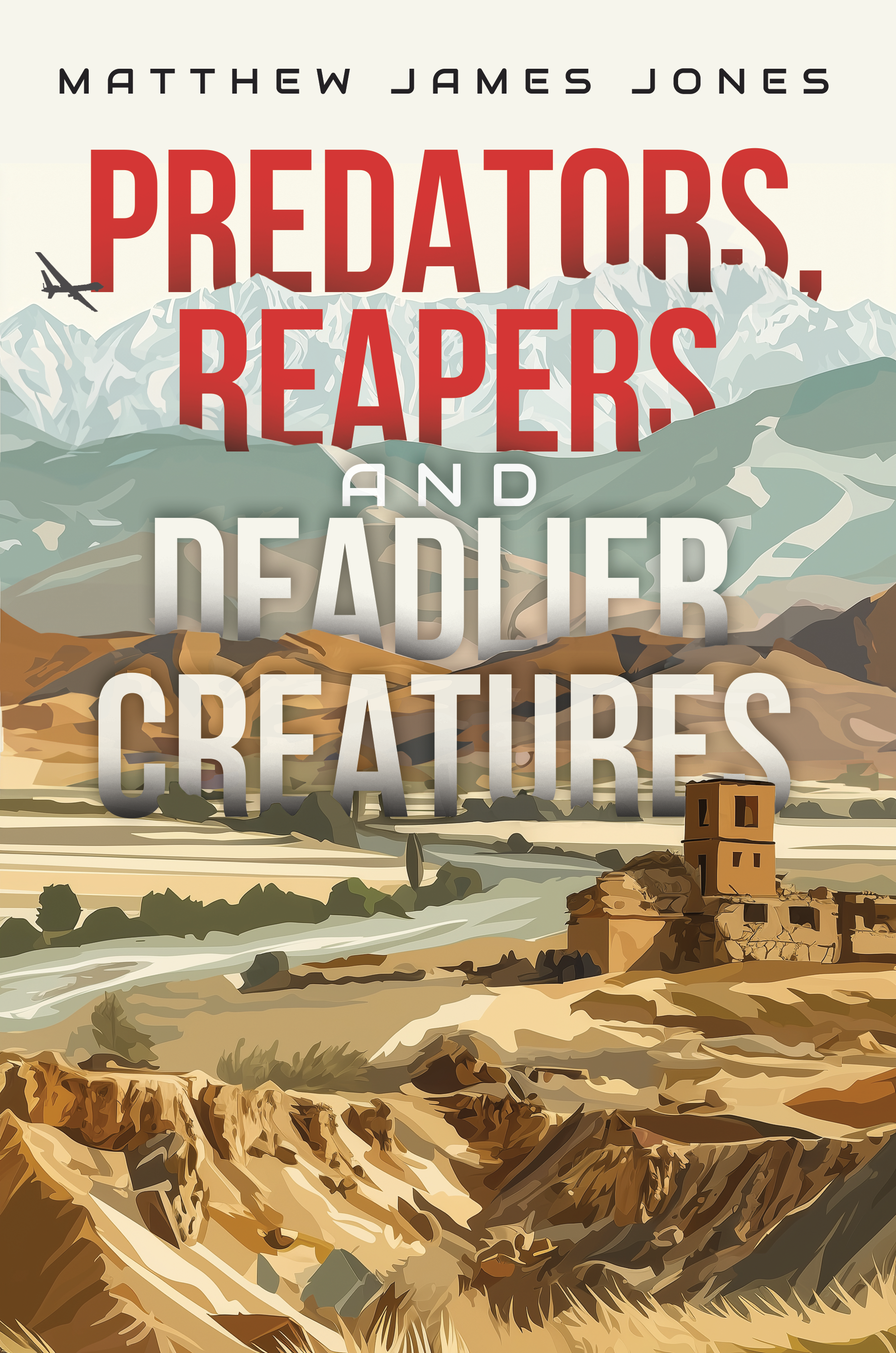
Predators, Reapers and Deadlier Creatures (PR&DC) is unafraid to be funny about serious subjects. Can you tell us some of the books that inspired you to write something as unsettling and wry as PR&DC? Or do you see it as a unique book in the history of military literature? Or is “military literature” even a genre of literature?
The humour of PR&DC has been one of the hardest things to pitch – the cover looks like a conventional war story; the back cover makes it sound like a surrealistic thriller. And it is those things. But it’s also a profoundly satirical book. All of the officer class is lampooned. I’m pretty sure the Colonels merge in a blur of light, transforming into a four-headed snake, which slithers up a vent. The pranks, the teasing, the playful barbs: we had to make war funny to survive it. Naturally, the humour darkens until it feels like violence. Naturally, the laughing makes us ache and feel like grabbing a shower after. Naturally, this was a thing we all needed to undo when we got home, so that sacred things could become sacred again.
One of my inspirations here is Slaughterhouse V, where Vonnegut uses the device of “getting unstuck in time” to undermine the chronology. Once he even erases the war altogether, briefly. This makes perfect sense to me. Our psyches circle traumatic experiences like unflushable turds whirling. You’re figuring out which brand of smoked tofu you prefer when your body decides it’s back in the war, seizes up; everyone’s too close; you can club your way past six or seven civvies easy, using a jug of maple syrup for a mace, leap the checkout and dodge the police by scurrying up a tree. Right there in that hippie organic supermarket, your breathing has gone apeshit and your heart is hammering out of your chest. So yeah, trauma is your very own fucking time machine so why not put one into the story, in the interest of telling the truth?
Naturally, I could point to Catch 22 as the classic military satire, again with its loops and loops. The bureaucracy forever pushing the yardsticks back. There’s one scene in PR&DC, an interrogation, which is basically an homage to Catch 22, though I don’t have the patience to circle around so much as Heller circled, and I inverted the logic: the main character Yossarian doesn’t want to embark on another bombing run since he wants to be free of the fear of death. Jones, in my book, fears death (the rocket attacks, the Taser Rapist, the Shit Beast) but not as much as he fears killing. Both Yossarian and Jones are pulled inexorably into deeper complicity with the war, and so lose their agency to the bureaucratic mechanisms that give the war its shape.
All that to say PR&DC is part of a longer humanist conversation about war, which will and must continue so long as war distorts us. So, forever.
PR&DC is uncannily prescient when it comes to our current fitness moment, to somehow appreciate its outsize role on military installations and Global War on Terror (GWOT) culture. What role do you see physical fitness playing in this novel? How does this connect to your own experiences with mental health?
On one hand there’s the Army conditioning, exemplified by the “Herculean abs” of the General himself, who promotes fitness as the means to better, saner, stronger soldiers, who can work longer hours, with worse food and less sleep. Others train to boost personal power, dominate others, never feel like a victim again. Another lifts because he feels like his head is cracking apart, to numb and exhaust the body, to sleep without dreams. There’s a lot of moving pieces in war – a lot of force flowing. The civilians and soldiers both get swept up into the momentum, become part of the mechanism, or its output. So we train to feel in control of something even if our dominion extends no farther than our grasp. One problem with the War On Terror is we often felt we were fighting shadows. No wonder we needed to lift literal concrete.
Ask my comrades who killed themselves how inextricable fitness is from mental health. It still isn’t enough, naturally, but even the most testosterone-poisoned soldier, girded with fantasies of invincibility, permits himself to train the body. Meanwhile he scoffs imperiously at therapy, believing the mind is the only muscle born strong. Nagging feelings follow after the war – he drinks. To avoid his rages, his wife takes the kids away. Alone, he drinks harder – life becomes a wheel of grinding mirrors. He takes a long long bath and stuffs the shotgun in his mouth.
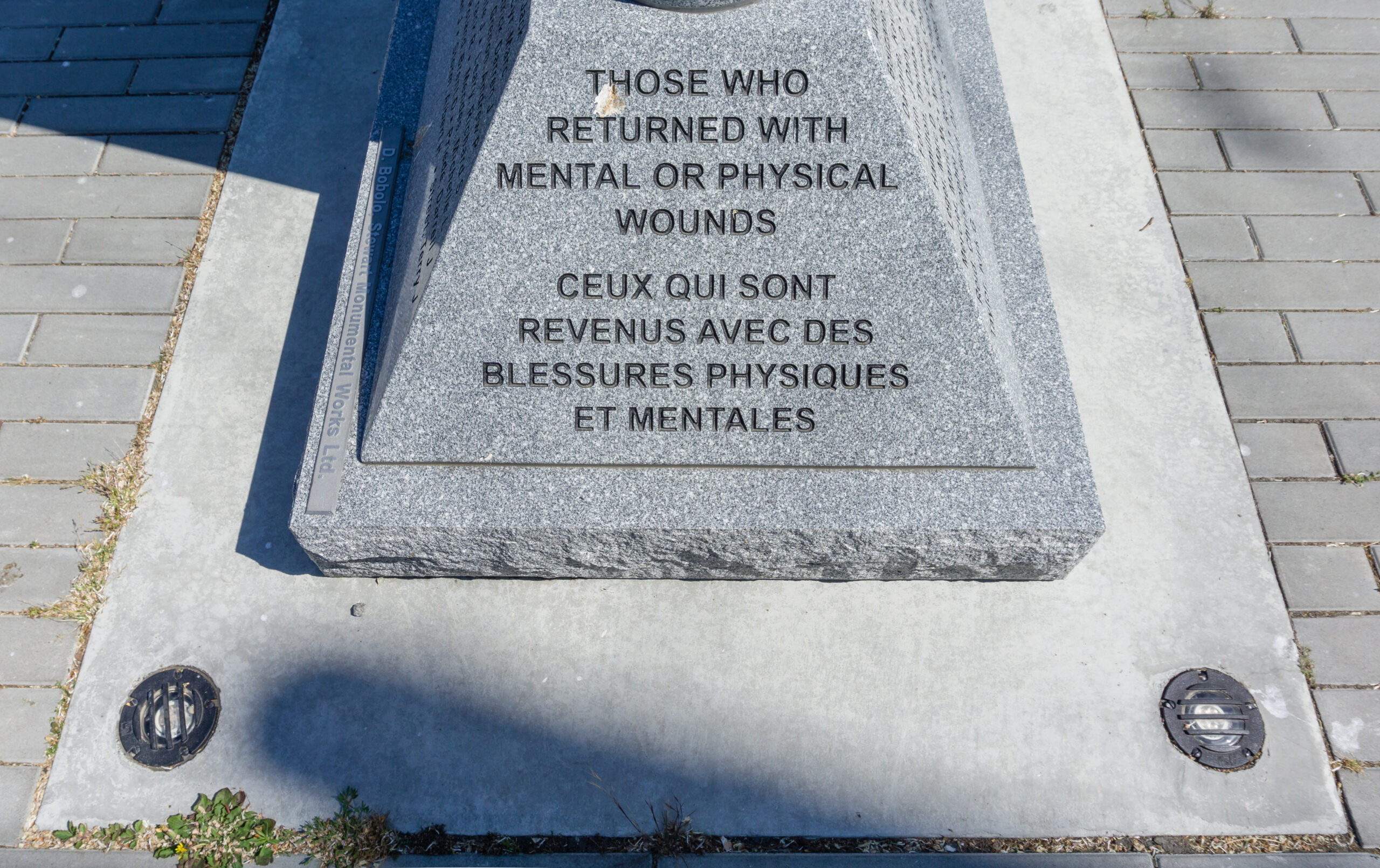
In a distant forest, we hear the recoil of our comrade’s death – birds leap from their branches. So I started to train with the fallen logs. No matter the cascade of bark chips and centipedes. Lunge and circle the maple with a knobby trunk on the shoulder – squat a stump. I lined the logs up side by side like fallen soldiers. Other veterans started to join me on these workouts, and so the log gym was born, a shrine.
Why do you think so much military fiction tends to be strictly realistic or tend toward realism?
Because military service prunes creativity. That explains why my students at the École Militaire are trying to develop it so hard – a necessary skill for high leadership, but scandalous for underlings. If the purpose of art is to create emotions, than who is less qualified than the soldier, whose culture demands swift emotional amputation, often self-administered? They worked hard to make us machines. The problem is it doesn’t always take, or the life force cracks the sidewalk, like a stubborn flower. This is why the war-poet is a rare thing: the soldier who insisted on remaining whole.
I can expand further: you can describe horrors in detail but only the ones who’ve also seen horrors know how it feels. Naturally, in describing the emotions too obviously the writing gets heavy-handed, showing. If you want to tell a story with larger-than-life emotions, than you may have to break the rules. And how boring, anyway, to create a world entirely from your mind, like a book, and bind yourself in the same constraints as our tedious earth. Imagination is for breaking cages. That’s one of the ways we took ourselves out of the war, by living it half in our heads. So, in my book I wanted the reader to be always wondering, “is this the real part or made up?”
You remember that scene in Full Metal Jacket where the soldiers, so callously, dress up (and even name) one of the fallen enemies? Soldiers often engage in this type of macabre puppetry, yet the war-writer wants to work with a bit more respect and self-awareness than this. All this realism makes things feel more solemn, more like Hemingway. But soldiers aren’t solemn.
The current American vice president dismissed the role of other, non-U.S. countries in GWOT. The current American president dismisses Canada as a sovereign nation. How do you see PR&DC as part of this conversation? Or do you?
Once upon a time, America was the light. You intervened all over the world and stood against dictators, mashed democracy down throats because, ironically, freedom mattered. We forgave you that part of the American dream where you all wanted to be idiot billionaires who lived without consequence – there’s always someone else to blame. Now I slap anyone who cracks a 51st state joke. Nobody’s fucking laughing. My people went to war when the planes struck the towers and America called on us. I fought alongside my American brothers in Afghanistan – fully integrated into an international force. I sent helicopters to pick up your wounded.
The news never reached Vance that other countries fought in your wars, despite the fucking Wikipedia article. Or pick up a copy of my book if you want to feel it. Make America Curious Again – you can start by learning who lost legs when those roadside bombs burst. How we lost friends and it cracked our minds like overpriced eggs. How, when we watered the desert with our blood for more than ten years, we killed for you over and over. And we died again and again.
America has suffered history’s greatest con – only the idiot billionaires will escape consequence – the rest will pay the price. The meeting with President Zelensky showed the world that Trump is Putin’s ass-puppet. Only the dimmest refuse to see this. Meanwhile, that great light that once lit the world has guttered.
I know American veterans still cling to honour. The world sorely needs your leadership to overthrow your ludicrous pirate-king, who so gleefully sold your country to Russia. Meanwhile, the idiot-billionaire class divvies the spoils, and, in a climax of irony, calls the working people “parasites.”
Ask any Canadian, particularly the veterans who fought in your wars, how they feel.
It’s quite simple. You betrayed us.
I especially enjoyed how PR&DC captures the sense that we already know what is going to happen in a war story, but knowledge of the event beforehand doesn’t make it any less surprising. It also is stuck on one of the central facts of war: We kill people in them. Why do you think this is difficult for people to get their head around? What does it say about people? Should we celebrate our willful ignorance or condemn it?
Yes, the killing isn’t the surprise. It’s what happens after the killing, when the killed don’t stay properly dead. We developed all these tools so that we wouldn’t feel the grief: they weren’t even humans, just blurry, pixelated blobs. So sure, foreshadow is one of the tricks up the sleeve, but I wanted a proper haunting, rainbow handkerchiefs for miles, a ghost that plagues the story and the point of telling. The killing isn’t the surprise at all. The grief is the surprise.
I remember when I came back from Afghanistan and went back to school for my MA. Many of my colleagues in peaceful Ottawa questioned my service, like there was no way military service of any sort could be honourable, even to aid a then-staunch ally. “What’s the point of having a military?” they wondered. “The US will protect us.” Some bleated that they believed in peace. I shake my head – no one wants peace harder than a soldier.
Now our old protector is gone and Canada eats the bitter pill of its own weakness. I personally don’t believe in war but I went to make tough choices that only a feeling human could navigate, not a killbot. After, I helped create training modules for officers on the ethics of drone war.
Certainly, wars for oil or precious minerals are an abomination of morality. Afghanistan, though? After 9/11, overthrowing the (ruthless, backward) Taliban for sheltering Al-Qaeda was justified. Only after a year or two in the war did things start to get fucked up, when the war became a bizarre act of post-colonial nation-building. We should have left that place long ago. Or stayed forever.
All that to say, keeping your hands clean in life is a tremendous privilege. Everyone who has a problem with my service can go fuck his hat.
We noticed a lot of word play and fascination with naming throughout. Can you expand on the importance of nick names and naming in art and the military? Why did you choose to include boxes that include the definitions of words not usually defined in military manuals?
The book functions as a sort of geometric proof on the theme of dehumanization. So when the narrator meets Noah, the “monster,” the steps towards shared humanity are small: first, gender. Second, name. Third, an exchange of stories. And so forth, in little nibbles, until Jones must accept Noah’s humanity (and indeed, friendship).
The honourable Major, concerned that killing is becoming “too easy,” insists that all “targets” be given human names. At the beginning, the name-game achieves its purpose, with semi-plausible names chosen for the drone-strike victims. But soon these names devolve into the names of famous betrayers, and eventually, in the hyper-sexualized language of the killing, the targets are all given “fuckable” names, like pornstars.
Your pirate king, Putin’s ass-puppet, plays the name-game very well. He knows the power of the cruel, undermining nickname, or the facetious sub-title, savage soundbytes. The bully’s oldest trick: these names plant seeds in people’s minds.
You may also notice the fun I have with my own name. For the last decade, this shitty, ubiquitous name has done me no favours getting traction as a writer. Indeed, it’s hard to compete on Google with Matt Jones, NFL quarterback or Matt Jones, cancer researcher or Matt Jones, homicidal madman. So I had to own it, in the book – my common-ass name becomes a way for me to speak for an experience beyond myself. We are everyone. We are legion.
I enjoyed writing those little flash-fiction boxes, allowing me to unpack complex issues like “rules of engagement” or “escalation of force” for a civilian reader in a way that appeared, visually, bureaucratic, like a military memo. I also appreciate that my readers, like me, have an attention span of twelve seconds so those formal interruptions give the mind a pause, and allow me to dodge a boring info-dump. Finally, this also became a place I could subvert – the boxes, through edits, became wildly poetic spaces, sometimes confessional, meta-narrative critiques, and/or zones of play.
Monsters play a large role in PR&DC, different kinds of monsters, robotic, human, and monster monsters. Where did this interest in the monstrous come from? Do you see it as an allegory or as part of a certain literary tradition? Why Sasquatch?
I think it’s a bit too tidy to reduce my Sasquatch to an allegory or hallucination – Noah needs to be all these things and also more. One of my most enjoyable games I played writing this book was to prolong this debate as long as possible: is he real?
The funny thing is – none of the characters in books are real. I made everyone up; even the Jones character is a composite of better, gentler humans, with a slice of a younger Matt thrown in. I took the Major’s beauty from a friend who killed herself; her drive from a soldier I admired; her ethics from another officer. Literally every character in every novel is a word-puppet dancing on sentence strings, so let’s not get it twisted.
The danger of a non-human character is naturally that it will break the suspension of disbelief and readers will pop out of the book with sour looks on their faces like they smelled a fart. I say, if you want to write a character that doesn’t seem real you have to double, nay triple, your efforts to make them real. Noah has a voice, a history, a mythology, a minutely described body.
And indeed, without him, it would just be a grizzly war story with scene after scene of heartbreaking ultraviolence. It’s not the kind of book I’d like to read and I doubt I would have survived writing it. I wrote Noah to tell the story honestly. I wrote Noah because he’s real.
Hold onto your asses: Jung writes about “the shadow” as the part of our own psyche that we frantically repress. So, as dudes we might repress our weakness or our cowardice or our kinks, or anything else culture said was wrong. Our efforts to hide our terrible qualities backfire; the things we flushed into the poo pond resurface; Guantanamo Bay lurks just over the horizon.
You might say the post-colonial legacy is a shadow of America. You might say Canada’s is a smug, sanctimonious pacifism. You might say the fact they got conned is a shadow of MAGA. Noah takes it one step further – his shadow threatens to overwhelm him constantly, but this is simply life. That is me writing this and you reading this. Individual level but also our nations and institutions.
It’s the denial of the shadow that fucks us up. It’s the successful integration that indicates we’ve grown wise and let me argue this is the challenge of veterans everywhere. Our massive shadows, that deep world-weariness, the cynicism, the black humour, the contempt for softness: it’s nearly impossible to integrate. That’s why coming home is so hard.
The deployment no-fraternization policy plays a large role in PR&DC. So does sex. Why have there been so few military books concerned with sex? Or willing to talk about it in the honest ways that PR&DC does?
“Killing was quotidian, but touch was taboo.” Killing was right and just and true, something that “made a difference.” Meanwhile, even married couples, deployed together, were expected to maintain professional distance, Kevlar chastity belts. Not even allowed to soothe each other.
Science says monkeys fed from bottles dangling from wire frames will always prefer the metal skeleton wrapped in fur over bare steel. History says every time we dam the life-impulse it explodes into something nastier – the chastity of some infamous Catholic priests.
When I wrote PR&DC, it was under the working title “Drones.” On one hand, yeah, I was nodding to Unmanned Aerial Vehicles. On the other, it was to us – the humans – who weren’t actually bees or ants in a hive, not controlled by the hive queen’s megamind. A drone follows orders; a soldier, often, doesn’t. A drone can kill without grief; a soldier, can’t.
Military culture strives to silence those empathy-producing nodes in our minds that inhibit the killing. A human being is more than a bundle of memorized processes that make murder easy. We are more than complex weapons, speaking in a sanitized language, feeling nothing. That’s how lovemaking became a radical act. How it became sacred.
PR&DC makes use of glossaries and helpfully defines military terms throughout, but also seems to be caught on an essential failure to communicate on the part of all the characters, maybe starting with the drones themselves. Everyone often feels very lonely even though they are together all the time. Why? How come many veterans tend to remember deployments as moments when they were not lonely?
Some soldiers can’t get enough of war. They keep running back to it, like a rat to electrified cheese. Perhaps because the civilian world is constantly screaming at soldiers to expose their emotional worlds, and by the time the soldier has a tour or two under his belt there’s a whole iceberg of pain under the surface. But one can continue to incubate in the cocoon of the war, surrounded by other numbed-out dudes, and so feel nothing forever. Or this is the fantasy, until the soldier’s personal life finally intrudes on his working life, the family stands in for the shadow, embodying the repressed parts of self, and spills into the waking world.
Or I’m projecting the loneliness thing. Maybe I was lonely in war because I was an empath who got lost, took the wrong plane, and ended up on Afghanistan by mistake. So naturally, being surrounded by shut-down humans is lonely. Or maybe I was lonely in war because I spent most of my twenties physically enormous and so loneliness is a wound I carry everywhere. Or blame the no-fraternization policy and the way we starved for touch for no reason. The walls they set up between us. Or maybe I worked the night shift, so the day-worker infrastructure didn’t accommodate. Or maybe the most acceptable pastimes – video games, drinking, gambling, porn – are profoundly numbing and disconnecting.
I always feel stupid saying “trigger warning” as I promote this book, since there’s a freakin’ drone on the cover, but there is also non-sacred sex: a brutal predator who preys on men. There’s one character who seems to go willingly into this situation, showing up a certain place and time, Stockholm syndrome. That probably seems impossible until you take a good look at America as the idiot billionaires busily dismantle the protections for the working class. I saw on the news last week they shut down the Department of Education. Because the stupefaction of the people was only mostly complete, so I guess you needed a little shove. The MAGAs are right on the cusp now of realizing they’ve been duped, but look how they cum so obligingly, and beg for a second and then a third round, and shout down anyone who tries to intervene in their ongoing rape.
Did I mention Canada has no interest in joining your idiocracy?
I too have been haunted by the image of blurry bodies running away from our drones on Tactical Operation Centre (TOC) screens. Thank you for having the courage to see through this story of one person on the far side of the screen. It couldn’t have been easy to write something as human and delightfully strange as PR&DC after a deployment experience you yourself describe as “an empty lake with jagged edges where nothing grows.” Do you have any words of advice for any writers just starting out on this journey? Whether back from a war long ago or at the front line (or screen) of one right now?
For veterans who want to write: any new craft takes seven years for mastery – there are no shortcuts. I don’t give two shits if your Commanding Officer praised your Progress Evaluation Reports, or your boss gave you a hundred attaboys for your incisive memos. Attend workshops (mine is monthly, international, by-donation) and read books on craft. Bounce your ideas off other writers and take their feedback. Go back to school. Read every book in your genre. Stop flexing in the mirror and try to look yourself in the eyes. Maybe you keep sliding away from yourself. Maybe along the path you became an emotional cripple, too. Water your withered wit with therapy, meditation, time in nature.
The goal, at some point, is to transition from being a veteran who writes, into a writer who veterans. Somewhere along the path you’ll find that writing, like any form of creativity, is one of the paths to protect and foster your mental health, too. You’ll get so used to working through the knots in your mind that when you finally sack up and sit in front of the therapist, you’ll chunder a spray of trauma, half-digested hotdog, and pure healing. I used that last oxford comma because I’m still pissed off at America.
You don’t go into war with just a grenade, or just a sniper rifle – you want the best tool for the situation. Grammar is the same. Read “Eats Shoots and Leaves” and master the whole grammar toolbox; thank me after. Stab yourself in the leg with a ballpoint pen whenever you stumble into a comma splice, or let a lazy double hyphen replace a dash. When you read a book let a part of your mind hang loose, watching, observing, noting, and carefully stealing twigs. Soon you will discover all of life is a book and a sneaky magpie within builds a nest.
I mentioned Noah, in PR&DC, is the only character who’s real. He’s also one of the main storytellers. Finally, he suffers enough and gives up the craft. He throws a soggy, severed arm at the narrator and growls: “Stories don’t bring people back to life.”
If you’ve lost some friends to war or suicide or whatever else, let me repeat that it doesn’t matter how good you get in craft – those friends are gone. “But I just want to see them one more time,” you say. Fine, do whatever the fuck you want. I know from experience you’ll be lonelier after. Maybe you gotta dig your friend up a few hundred times and bury them over and over to accept they’re gone. Maybe you need to make a shrine like I did.
Don’t let your writing give you an excuse not to heal. Stories don’t bring people back to life.
Predators, Reapers, and Deadlier Creatures is available for purchase on Amazon.