New Nonfiction: Interview with Adam Kovac
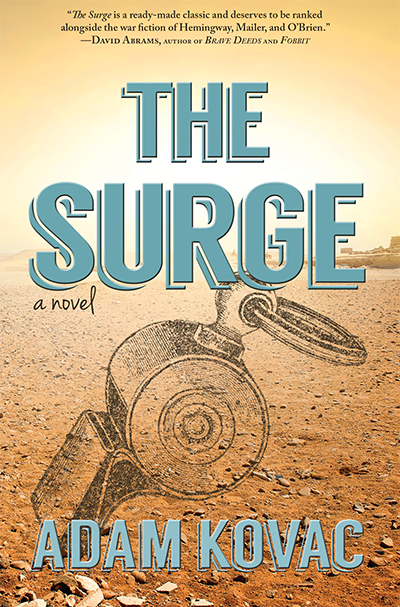
Adam Kovac The Surge

You wrote and published a version of THE SURGE in 2019. I read and enjoyed it, but didn’t go back to reread and compare with the 2025 edition. What was the thought process behind that, and what changes did you make in the intervening years?

Publishing the second edition of THE SURGE happened somewhat by accident. I knew Jerry Brennan, publisher of Tortoise Books, had read the novel not long after it debuted and liked it. Few years back, on Veterans Day, he and I were posting on social media about what I can’t remember and I shot him a DM basically daring him to republish the book. And, to my surprise, he thought that was a great idea and now here we are. I’d reread my novel a few times after first publication, mainly to see if I’d made a mess of it. But did I think about changes, jot down notes about revisions? No. I never imagined it’d ever be republished. Aside from minor, stylistic and editorial tweaks throughout, very little is different from the 2019 edition published by Engine Books. That’s not to say readers shouldn’t check out the reboot, which in my opinion is stronger and more meaningful, largely due to Jerry’s deft editing. I started writing this novel as my MFA thesis at Northwestern University. One of my advisors was John Keene–he’s a real smart guy–and he told me the goal wasn’t to simply write the best book about the Iraq War, but to write the best book about any war, ever. So that’s what I did. I sat down and attempted to write The Great American War Novel. I wouldn’t have sent the manuscript out on submission if I didn’t think I’d come as close as I was able to actually accomplishing that.

In my review I wrote about The Surge (both the book and the campaign) as central events in post-9/11 America. Do you view that year-plus as definitive, impactful, important? Do you think America achieved success due to The Surge? Despite of it? Not at all?

A journalist interviewed me on the day of the so-called fall of Afghanistan and asked a similar question. We almost got into a heated argument before steering the conversation back on topic. Did the surge make a difference? Short term, based on the stated objectives, I think so. Although being a part of it felt batshit crazy and bizarre at the time. I arrived in Iraq in 2007, a few months after the campaign kicked off and soldiers already downrange described the country, insurgent activity, as “quiet.” I also took part in the early months of Afghanistan’s version of the surge in 2008-2009, but can’t speak to whether it had any success. Like OIF, every sector in OEF was different. But, personally, while submerged in those moments, I truly thought we–America–stood a real chance of turning things around in both theaters. For lack of a better word, you could say I believed in the mission. But THE SURGE is simply the title of a work of fiction that happens to be set in a fixed point in time largely because the story needed it to be. This really isn’t a book about the surge offensive, the Iraq War, or even a war novel at all. When trying to decide on a title, I went back and forth between The Listening Post and For a Piece of Colored Ribbon. But my agent, Kevin O’Connor–he’s great–recommended THE SURGE, and I didn’t hate it and also didn’t want him to think his new client was a diva. In hindsight, if I’d titled the novel something like, The Grocery Store Owner’s Foster Son, it might’ve been a bestseller.


In reading THE SURGE, I saw what felt like a lot of allusions and references. Is that me imagining them, or was that deliberate? (One I’m particularly interested in: the scene with Gibson, Vogel, Witkowski, and the Widow Makers having their “party” – felt like something out of PLATOON or APOCALYPSE NOW.)

I’m not sure anyone returns from a deployment without having done, seen or heard about some weird shit, inside or outside the wire. And I feel the wartime experience tends to mirror those preceding it, both in reality and works of art. Example: I know I’m not the only vet who’s heard a wounded soldier say to the medic, “Tell my wife, I love her.” Yup. That’s straight outta the movies. And there’s a logical, psychological explanation for why that phenomenon occurs. But everything in THE SURGE is deliberate. I tried not to have a single scene, line of dialogue, word, or even punctuation mark that wasn’t there for a purpose. It’s one of the reasons the novel has such a short length. Which I feel is a good thing, despite what big publishing thinks. Best I can say is that there’s meaning and intent everywhere in THE SURGE that might not immediately or consciously manifest itself on the page. Another reason why calling it a war novel, to me, feels just a tad inaccurate. Gonna name drop again but I was fortunate enough to take a writing workshop at Northwestern taught by Stuart Dybek. I’m paraphrasing, but I’ll never forget when he said the job of the writer, and the only job of the writer, is to create compelling characters and then navigate those characters through plot points A, B, C and D, until the story reaches a satisfying conclusion for the reader. Everything else: theme, imagery, what the story’s even about? That’s for the English professors.


For me, the strength of war stories comes in large part from the “supporting cast.” Two that stand out to me here: Sergeant Parker and First Sergeant Flowers. They both had depth, added a lot to the story and Chandler’s characterization, and just felt “real” to me. How do you go about populating a story with one main character but lots of others, some of whom we only see briefly?

Absolutely. One of the hallmarks of all great combat novels is the prevalence of what I can only describe as ensemble acting. James Jones was great at it. There’s a whole infantry company populating The Thin Red Line and some characters appear more often or carry more weight than others. There’s those essential to advancing the story and unlucky others bumped off in the early pages. It boils down to making tough choices, which is easier if the writer understands why the character even exists in the story at all. In THE SURGE, everyone’s on the page for a reason. Tricky part, for me, when developing these characters, was to try to push back against or perhaps more deeply examine what it means to be a hero. Of military service. Or even being an American. I used to spend a lot of time in the chow hall, eavesdropping. What fascinated me most were the men and women who’d been previously wounded and still volunteered for another tour. Why? That’s something THE SURGE attempts to explore. I can’t say most service members I encountered were motivated by patriotism–it was like everyone had an agenda. And that’s what I mean when I sometimes say THE SURGE is more accurately a novel about greed. Why the characters are all somewhat loathsome. They’re con artists, bigots, misogynists, fanatics and even child molesters. As for Parker and Flowers? Well, they’re the only two characters into which I intentionally injected aspects of myself.


Also, was Flowers “right” when he said “We’ll never leave. The army might pack it up and roll out in a few years, but America? We’re not going anywhere. Not all the way.”

Shrug emoji.


Do you think literature “from” our wars in Iraq and Afghanistan will ever see the resurgence in interest given to Vietnam War literature?

No. I hope I’m wrong, but I don’t see that happening at all. I’m fairly certain if all the authors who’ve published contemporary war books in the past decade got together and commiserated about our sales numbers, it’d be a pretty sad affair with a massive bar tab. THE SURGE received dozens of rejections. Among them was a note from an editor who said they enjoyed the manuscript but were an imprint of [big publisher] and since they’d already published [awesome book] were unable to acquire similar titles. I also recall one of my pieces being workshopped while working on my MFA and a classmate commenting about how it was difficult to find sympathy for the main character because they were an “invader.” Another didn’t like an early version of THE SURGE because it was “genre fiction,” not literature. And in the past year, I even read a social-media post where [respected-literary author] essentially accused [respected-veteran author] of only writing about the war to sell books and get famous. Look, I’m all about breaching the civilian-military divide. And the last person you’ll ever hear screaming, “Thank me for my service.” But from a publishing standpoint, I detect very little interest among the reading public in our Forever Wars, and the industry clearly knows this, too. And no, I don’t feel the so-called literary establishment has fully accepted veteran writers and poets into the club. Perhaps all that’ll change in later years but for now, I can only quote Hemingway. “Isn’t it pretty to think so.”


What are your other writing endeavors? Anything more in the “war lit” scene? How does working outside of it help you write inside the war?

Despite essentially being told I’ll never publish another book, I’m still at it. Too stubborn and I need an outlet for the goofy stories roaming in my head. I’ve written a crime/mystery novel I’m really proud of–probably better than THE SURGE–that’s been shopped to death and still doesn’t have a home. I also wrote a clever but very short science-fiction/horror novel I truly think would be a great fit for several presses. But both of those markets are tough rackets. Loaded with talent. What’s crazy is I’ve found unexpected success recently writing adventures for science-fiction tabletop role-playing games. I even launched my own publishing imprint: Boondock RPG Adventures. It’s been a lot of fun developing characters, starships and short scenarios that there’s a market for and people seem to enjoy. I’m grateful for all the interest and support. And I still get to use the craft techniques I learned while pursuing my MFA. It’s very similar to writing flash fiction, but imagine combining it with a Choose Your Own Adventure book, with other outcomes influenced by a roll of the dice. Will I ever write another war novel? Highly doubtful. I never intended to write about the Forever War in the first place. I’m even uncomfortable with the term, “veteran author.” After I was wounded, I tried to bury my deployments to Panama, Haiti, Iraq and Afghanistan. But the nightmares make that impossible. So, it’s not that I wanted to write THE SURGE. The story wouldn’t let me walk away.


New Review by Travis Klempan: Adam Kovac’s The Surge

Adam Kovac The Surge

Whether we wanted it or not, America was – up until this very moment, perhaps – truly the indispensable nation. Put another way, from the end of World War II to the point we reelected a man bent on dismantling everything, the United States of America served as a sort of nexus; hardly anything happened in the early part of the 21st century without America exerting influence on it, for good or bad. If that’s the case, then our decision to invade Iraq in the spring of 2003 was the fulcrum on which our credibility balanced. And the pivotal moment (really, a series of moments a year and a half long) of the Iraq War would be the Surge.

The simple name, the complex problem and series of problems it sought to solve, the half-effected solution: the Surge colors everything before and after, just as the war itself inflects pre- and post-2003 America. Books written or set before the Surge prefigure and foreshadow what’s to come; those written and set after exist only in the shadow of what was achieved or what failed to happen.

The Surge was large enough to exert pressure even on a young officer in the Navy. My first deployment on USS Princeton changed overnight, our carrier strike group no longer headed to Palau and Australia but now to the waters off Iraq, the airplanes from the USS Nimitz now tasked with supporting soldiers and Marines on the ground in places like Anbar, Diyala, and Muqdadiyah. My first novel is set in the events of the Surge, the men of a real but deactivated infantry battalion likewise caught up in the vortex that sucked in the past, present, and future.

I lay all this out not to brag, boast, or establish credentials, but to set the scene of Adam Kovac’s The Surge, a novel that, upon reading, I realize is the nexus novel of the nexus event of the nexus war of the nexus country. A republished version of his previous work that caught my attention in 2019, I did not compare this edition to its previous iteration. How could I? For those soldiers and others who deployed to Iraq more than once, how could they compare the first to the second (or third, fourth, ad nauseum)? Instead, I embarked on this reading with the intent to review…which itself changed the way I read it.

How could it not?

Larry Chandler is a veteran of the war in Afghanistan, sent through a series of unfortunate events to lead National Guardsmen in an almost-forgotten corner of the Iraq War. The specifics of the story ring true to someone with vicarious and informed knowledge of what happened, but like any good war story the technical minutiae neither bog down the reader nor distract from the real purpose. The events are told largely chronologically, flashbacks to Afghanistan notwithstanding, but the bigger picture and key details emerge slowly, deliberately, and at times shockingly.

And that’s the real rub. There are enough things in here that caught my attention as I read, jotting down things like “Lemon from The Things They Carried,” “inverted identities,” “Groundhog Day but deadly,” and “catharsis, in a way.” I underlined “the brilliance of another boy’s phony universe,” “the sleep he couldn’t fight,” and this exchange:

“People need their heroes.”

“It’s a sham,” Chandler said.

“It’s a war.”

“Still a sham.”

There are echoes of the Vietnam War and its literature, turns of phrase like “Cool as the other side of the pillow” that would ring as true coming from the mouth of a draftee as it does a Midwestern National Guardsmen. There are echoes of Tim O’Brien and Joseph Heller (“You’d sleep in a dead person’s bed?”), Band of Brothers and Shawshank Redemption, prefigurations of The Militia House from John Milas, and parallels to contemporaneous accounts like Matt Gallagher’s novel Daybreak and the film Warfare.

Indra’s net, as remembered from a summer writing program I attended in 2016 and verified on Wikipedia, is a metaphor illustrating the interconnectedness of all things, a net with a jewel at each vertex that reflects every other jewel. Taking the figurative literally, that reduces complexity to meaninglessness; if everything reflects everything else, so what? Taking the figurative figuratively, though, it’s only in examining the reflections and considering their import that we can start to travel the strands of the net, sussing out the connections without deviating from the paths.

Kovac clearly knows how to conserve and employ words. Nothing is wasted here, everything written to maximize utility and impact. The sentences and context amount to more than what’s on the page often enough that I started looking for meaning and finding it everywhere. A casual mention of the Detroit Red Wings evoked curiosity; was the author seeking to invoke Operation Red Wings, a similarly influential nexus event of the Afghanistan War (sufficient to generate movies, memoirs, and a book about demons haunting survivors)? Chandler’s experience at Michigan State reminded me of another Army vet writer who studied there; the protagonist’s very surname is the same as an Air Force vet poet. The Chuck Norris meme – historic in the year 2025, very much of the moment in 2007 – makes an appearance in a port-a-john, and portable shitters have been memorialized even on the walls of the Pentagon. “Fucking Fobbit” = David Abrams. Camp Victory…that’s where I lived for a year. Al Faw Palace…

“Pathetic monument that won’t stand the test of time.”

I wrote that in the margin. I asked myself in blue ink if any of our camps (Camp Tucson, Camp Cleveland, Camp Atlanta) if any of those names have survived. Alexander conquered worlds and cities named for him still exist, even where he never marched; our names have likely been wiped away already.

But a book like The Surge – that might stand the test of our time, at least, if enough people read it. I want people to read it. They need to read it. How can I make them read it?

I mentioned the movie Warfare, which I haven’t seen and don’t intend to. From all accounts it’s an accurate, blow-by-blow, nearly real-time account of an actual event. Great. So what?

The combat at the end of this novel might not have happened, but it happened all over Iraq, it’s happening in Ukraine, and it could happen here. I hope it doesn’t happen here. If enough people read Kovac’s work, it might not. Who knows.

In addition to Indra’s net, the searing and lingering image left to me after reading The Surge is “cyclical and crescendo,” another scribble in the margin calling forth a widening gyre, a dynamic feedback loop that, for now, is out of control but not all-consuming.

One last quote from Kovac, not from me: “The surge, it changed all the rules.”


New Nonfiction: Review of Christopher Lyke’s “The Chicago East India Company”


Gravitational lensing – as half-remembered from an article I read years ago, as confirmed courtesy of a recent Wikipedia dive – takes advantage of the presence of massive objects to shape the path of light coming from objects on the far side relative to the viewer. A sufficiently large star, for instance, could be used by Earth-bound astronomers to “see” far beyond what they otherwise could by bending rays of light coming from distant bodies. The basic physics behind the principle was known to Newton and Cavendish, and a multinational effort just after World War I confirmed many of Einstein’s theories about gravitational lensing. It may be our best bet for obtaining direct visual evidence of habitable exoplanets in other solar systems.

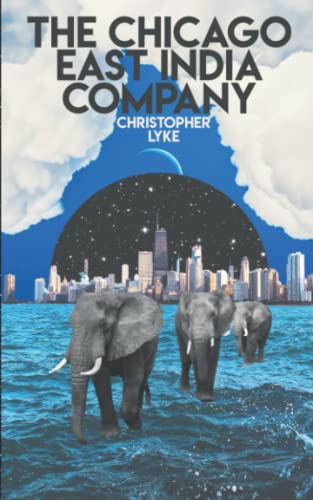
Christopher Lyke’s The Chicago East India Company (Double Dagger Press) is a sufficiently large star. A collection of short stories and vignettes based both on the author’s time in uniform and career as a teacher, the book takes on a refreshing and encouraging role, despite the sometimes-laden and harrowing subject matter of surviving combat and finding purpose in a bureaucratic education system.

I’ll return to the “sufficiently large star” concept in a moment.

The writing throughout TCEIC is, as one would guess, taut and clean, in the sense that there are no wasted words or characters or stories. There’s a physicality that guides the collection, present in spare but efficient vignettes – whether character portraits like “Canton”’ or meditations on events as in “Another Ginger Ale Afternoon” – but on full display in the longer pieces like “Life in the Colonies,” which amplifies the corporeal experiences of a jungle excursion by examining the personal and political context surrounding it. The sensory descriptions also ground what could be otherwise ephemeral introspection, and this balanced duality continues throughout the book.

In “These Are Just Normal Noises” the monotony of a foot patrol drags on for more than four pages but the writing never falters. Not a word is unnecessary in building to the tension of the impending incident. Every description – of the “kohl-lined eyes and dyed-red beards” on the men and women encountered in the village, or the “riverbed…the tall grass that covered the ground…the ditches and small stonewalls” – seems at once familiar and extraordinary. The connection back to the world entices, but endangers:

We pulled them from thoughts of Chicago and the L and the weekend festivals that they were missing. A soldier remembered the way a girl had spoken to him and how she seemed cool and like the river that glided through the valley below him. We pulled them from this and back to the mountain, to a path or a rocky outcrop at which to point a gun.

We know it’s coming, right? The ambush, the firefight, the attack – we’ve seen this before. The description continues, though, hard and unrelenting, and the agony of a withdrawal delayed by wounded vehicles and drivers, another couple hundred words detailing the by-now familiar yet still deadly blow-by-blow, but “It must have been only a minute since the fight began.” We feel that minute stretched over two pages and the exhaustion weighs heavy on us.

A similar burden falls on our shoulders when we read “Solon,” perhaps the most memorable story in the book. An unnamed teacher – though likely the same man whose travails we’ve been following the whole time – ventures from the demanding and unfulfilling classroom to the football field, coaching a team of students unaccustomed to winning and not far removed from the soldiers he once served alongside. Hopes are raised, then tempered; this is no Hollywood story of a team defying all the odds, though the growth and depth of the kids is much more realistic. Dreams are dashed, not by death but by an injury sufficient to upend what would be, in a scene meant to inspire, the rags-to-riches career of the honest and likable young Darnell. The teacher unspools, seeing the players set beside soldiers set against football players from his own suburban youth in Ohio, and spins out of control:

…he knew that the team he was coaching was bad, and that it wasn’t their fault. They were in a system that prevented them from being slightly more than terrible. And if it were a movie maybe an emotional director would have the poor kids win. But in reality, if they played one another his boys would probably get hurt…He didn’t blame the suburban boys, they didn’t hate the city boys, they just knew they’d beat them to death and wanted to, because they wanted to beat everyone down. That’s what they were trained to do, and bred to do, and would do. It wasn’t malice so much as inertia. They’d smile uncynically and help our boys up after cracking their ribs.

I found no morals here, because every time I tried to connect the Ohio players to Afghanistan or the Chicago players to the insurgents or reversed the roles or asked Who would be who in the war zone the futility of that line of questioning stopped me. War is not football, football is not war, but both deserve our attention for their consequences.

The other stories – “No Travel Returns”; “The Gadfly”; and the title piece – contain just as much depth of characterization and breadth of plot, maybe even more so. As readers we recognize the central character – sometimes first-person narrator, sometimes third-person participant, even as a literal bystander in “Western and Armitage,” when he spends less than a page delivering a gut-punch and denouement at the scene of a traffic accident – that Lyke inhabits and uses to bring us along on a journey that doesn’t end. “None of it ended,” he says in protest to the idea that stories need resolution. But compared to many combat or redeployment stories about the hopelessness of such an idea, I feel like there’s something to look forward to here.

TCEIC arrived at an opportune time for me as a writer. Full disclosure: Christopher Lyke founded and runs Line of Advance, a military- and veteran-focused literary website that has hosted much of my work, and even more work from many other writers. LOA sponsors the Col. Darron L. Wright Award for military and military-adjacent writers. They’ve amassed enough groundbreaking and stunning writing to publish Our Best War Stories (Middle West Press), with hopes for a second volume. LOA has been a great and generous home for my own writing, and I was excited to read more of Lyke’s own work, if only to see into the mind behind a mainstay in the vet writing constellation.

Getting civilians to care about “The Troops” has been far easier than getting them to care about veterans. Wave a few flags, drop a few parachutists into a football game or two and they will stand for the anthem and mouth the affirmations they’re expected to. It’s American tradition – dating back to the Newburgh Conspiracy, the Bonus Army, and burn pit legislation – to celebrate war and forget the vet.

The writing in TCEIC embodies an antidote to that malaise, not in building overly optimistic bridges across the civil-military gap, but in reminding those of us in the vet writing communities that this kind of storytelling still matters, and will continue to matter. As major combat deployments to Afghanistan and Iraq fade in the general consciousness – if it were ever really there, short of jarring news announcements – and attention shifts elsewhere, spaces like LOA and books like The Chicago East India Company serve to focus our efforts. The longevity of a website that allows for creative expression gives hope. The straddling of worlds in TCEIC – connecting the experiences and people in a combat zone miles and years away to the experiences and people in contemporary and ongoing America – gives us that sufficiently large star. We can use its presence to bend the light and see habitable planets beyond the terrestrial profusion of “typical” war stories, the kind you see in Hollywood if at all, and imagine literary planets where authors with military memories can explore stories beyond combat, can continue “writing things that aren’t just bang bang stories,” as Lyke puts it in an interview with Phil Halton, and maybe one day bring along a few of those civilians to populate these new worlds.

The Chicago East India Company by Christopher Lyke is available for purchase here.