New Fiction by Michelle R. Brady: Thirty Broken Birds
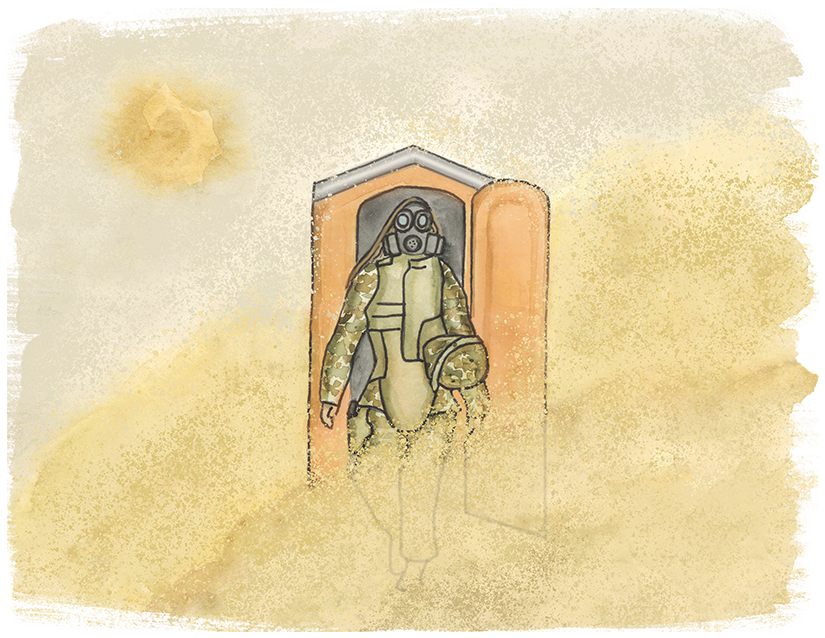
Illustration by Jane Yeager

I. Valley of Quest

Before what happened to Christine, before arriving in Iraq, before even leaving Nebraska, all we knew for sure is that there would be violence and sand. We began by trying to solve the wrong problem. And although wearing our gas masks in sandstorms was almost certainly the most sensible way to avoid breathing difficulty and probably eye damage, the memory of her exiting a port-a-potty in one, sand swirling around her, still chills me. So much can hide in the sand when it’s like that—some things you want to conceal and some you later try desperately to uncover. And I guess some that you’re just not sure about.

I remember lying and sweating on my cot, mask in place outside our tent where I slept to get some privacy, my head hanging over the edge so that she was upside down in the haze walking toward me, her uniform covered in the white ragged circles of salt from her sweat. It was only Christine, but with the fog creeping inward on my mask’s lenses, she seemed like an astronaut on Mars. And in the mask, she looked like the rest of us. Like nothing special at all.

***

She came from another unit, somewhere far away like Maine. I don’t know why she was transferred, but someone said she’d been a stripper there. Her unit wasn’t deploying, and ours was—and in need of military police—so I guess that was it; it definitely didn’t have anything to do with stripping, if that was even true. She didn’t seem like the type.

The rest of us weren’t MPs, the rest of us girls, I mean. I was an admin clerk, but the others were medics and food service. Four of us altogether. Well, five if you counted Christine, but we never really did. She slept in the female tent, but she rarely talked, and, yes, I have to say it, even though no one else did, she was startling. I mean that in the literal sense, that her beauty was so strange it startled you. I won’t describe her; it wouldn’t do her justice. Just picture what you will. Personally, I always thought of her as a bird I’d seen on the cover of National Geographic from one of the donation boxes that came in every week: a grey crowned crane; it has a halo. And dignity, like her.

Her face made her less welcome in our tent, where we sat around, breathing in burn-pit fumes, sweating with IVs in, courtesy of the medics, and watching Sex and the City on scratched and skipping DVDs. And being less welcome in our tent meant being vulnerable. We weren’t the only ones bored, and we were far outnumbered.

We had a plan, and in our defense, we did try to tell her. It was when we were washing our uniforms. We only had two because this was the beginning of the war, what we all later called the Wild West, when units of untrained reservists were handed M16s and sent to do infantry work, regardless of their actual job. All that meant, when it came to uniforms, was that we had to wear one and wash the other in buckets with grey water every so often.

When it came to everything else, it meant innumerable things. Like, we took the plates out of our vests on patrol because it was so hot, they were heavy, and it made more sense to us to carry snacks in there. Like, we took pictures with ammo we found out in the desert and explored old bunkers as if this was summer camp. Like, we didn’t have armored vehicles, so we put sandbags under our feet to slow rolling over if we hit IEDs, and we actually thought it would work.

Nonetheless, uniform-washing provided a good opportunity to talk. And Christine, perfect as she was, still had to wash her uniform. So, pastel wash buckets in a line next to the water truck, we orchestrated a casual intervention, like hyenas luring our crowned crane to the watering hole.

“May I join you ladies?” Peterson asked, but we were prepared for this.

“Hey, we need to chat about something. Would you mind coming back in twenty?” I said, walking him away. “And tell your friends.”

Christine looked up at this. “What’s going on?”

Monica, the only sergeant among us, but still just Monica to us, said “Let’s take our buckets over there.” She pointed to sand far enough from the water truck to avoid overhearing.

“Look,” I said when we’d started washing, water warmed by the sun battling ineffectually against salt stains and dust. “You have to choose someone.”

“What are you talking about?” she asked, but I knew she had to understand.

“You have to pick a guy,” Nikita said. “Anyone want an IV?”

She hooked Jen up, and I said, “I can’t believe we have to explain this, but the reason you are constantly fending off guys is because you haven’t chosen one yet. And it’s not just about you, you know. We don’t want random MPs creeping around the tent all the time.”

“You mean like the dudes you guys are fucking?” she asked. “I’m not into them creeping around either.”

Monica, perhaps due to the emotional escalation, jumped in. Though, the truth was that even though Monica outranked us, she wasn’t really into leadership. “Look, having a boyfriend at home isn’t enough. You need to have someone here who they respect enough to leave you alone,” she said, kind of too quietly, I thought.

“Christine, they will keep hounding you until you pick one of them,” I clarified. “Simple as that.” My hands were getting pruney, but submergence in water was a luxury, and I didn’t want to be done. I watched the bubbles spread to the edges of the bucket and slowly dissipate, and I wanted to put my face in the water and stay there forever.

“I don’t want a boyfriend here. I’m not going to have sex with someone so that you guys feel better. None of this is your business.” Christine wrung out her uniform, dumped her bucket, and walked away.

“Hey, we tried,” Monica said. “Right? Victoria?”

It was shocking how quickly the moisture left your body here. My hands were dry, not a wrinkle on them now. I nodded. “There’s only so much you can do,” I said.

“And you know she was a stripper in Michigan, right? Maybe she knows what she’s getting into,” Jen said.

“Maine,” Nikita said.

“Right. Well, I’m sure they have strippers there, too.” Jen said.

Nikita looked at me, waiting, and I said, “Tell the guys to keep an eye out for her anyway.”

She nodded, satisfied, I guess, and we got up to leave. The trouble was that our guys were not MPs, so our guys were never close enough to keep anyone safe but us.


II. Valley of Love

I had a secret. I was happy on that deployment, really happy. I loved being part of a team, being valued. I hadn’t fit in in high school, mostly because I was too smart for the normal classes and too poor for the gifted ones. But here, my poverty was an asset. I used tenacity and ingenuity to solve problems, the way only someone with a lifetime of training could. I was used to dirt and hard work and sleeping on the ground and eating terrible food or going hungry. I didn’t have to waste time becoming adjusted to our situation or wishing I was somewhere else. When we couldn’t get enough water shipped in, some of the girls wasted what we had washing their hair, but I cut mine off. In Iraq, the guys called me Sunshine. For the first time, I flourished. Obviously, I pretended I hated it, but secretly, it felt like home.

Christine had a secret, too.


III. Valley of Knowledge

I spent the day Christine was raped with the People’s Mujahedeen of Iran—the MEK, eating biscuits made from chickpeas called nan-e nokhodchi and drinking dark orange tea heated with their samovar. I was the only female who worked in the command tent, mostly filling out forms and fending off the Major’s childlike advances, so I got to drive them to the meeting. The MEK was still a terrorist group then, but borderline, in possession of things we needed, and, importantly for me, mostly matriarchal. So, I joined the officers in the Humvee on an adventure outside the wire to represent all American women, though I’m not sure that including one who was so inferior that she was driver, note-taker, and photographer all in one sent the message they thought it did. They were certainly annoyed when the female generals addressed their questions to me and served my tea first.

But that story is always tainted in my memory by the worst sandstorm we saw on that year-long deployment and what happened to Christine when it kept the officers away from camp for so long. It rolled in like waves of a waterless ocean. The tent shook, and the MEK covered their mouths with their hijabs. Less prepared, we pulled our shirts up over our mouths and noses as professionally as we could. But the wind was too strong, and sand stung our faces through and around the tent walls, so one of the MEK soldiers shoved blankets in our direction. I helped cover the officer nearest me, but we’d run out of blankets by then. The youngest general came to me and covered us both. Our faces were side by side, and we smelled like sweat and dirt and tea under the blanket.

I suppose it was obvious I was terrified from my shaking, so she told me a story muffled by the roaring wind, by sand simultaneously pounding and peppering the tent, by her accent, and by her hijab.

It was about birds. The birds didn’t have a leader, so the wise hoopoe thought they should find the most righteous and courageous bird to lead them—the simorgh. She lived in the middle of a sea in a tree that held all the seeds of the world. When she flew away, a thousand branches grew, and when she came back, a thousand branches broke, and the seeds fell into the sea.

To get to her, they had to cross seven valleys, each with its own peril. Along the way some of the birds died from fright or thirst or violence, until only thirty were left. When they reached the tree in the sea, they learned that the simorgh was their reflection, their shadow: si: thirty, and morgh: birds. But not all along; the simorgh was the thirty birds who crossed the seven valleys, not the untested ones that began the journey.

It was dark under the blanket so I couldn’t see much of her face while she told the story, but suddenly, the tent, which had been flapping wildly, partially dislodged, and we were exposed to the storm. The wind beat us down, and my young MEK general—I didn’t remember her name—pushed me to the ground and covered my body with hers. Sand cut into our skin through the blanket, and then I saw something I never expected. Lightning. So bright, I couldn’t mistake it even through tightly woven wool. Lightning without rain, breaking up billowing clouds of sand in brilliant, ragged lines. Although dwarfed in significance by what followed, it is still the most magnificent event I’ve personally witnessed.

***

It was night by the time we could leave. We picked ourselves, and what was left of our military bearing, up less gracefully than our hosts, who were presumably used to such intrusive acts of God, and drove dazed and shaking back to camp. But before we left, they agreed to provide us water and internet, so the Major said all in all, it was a successful journey.


IV. Valley of Detachment

A farmer from a family of Quakers, the Major maintained that attaining water rendered the mission a success, “because, Sunshine, we can’t live without water.” But he didn’t sound as convincing when the doc visited the command tent with news from Christine’s examination. Of course, the other officers didn’t notice I was there, but the Major sent me outside. The thing is that a tent only blocks eyes, not ears.

“There’s considerable damage,” the doc said.

“Definitely forced? Or borderline? What’s she saying?” one of the officers asked.

“I mean, I can’t say for sure, but it looks bad. She’s saying forced.”

“Who was it?” the Major asked.

“That’s not really my department. I think you should ask her.”

I didn’t finish listening because I decided to ask her for him. And for her. Our camp was in shambles from the storm, so almost everyone was helping rebuild it. Returning to their owners personal items scattered across the sand and re-erecting tents in groups of four or so. If I didn’t know better, this could have been the scene from any missionary trip—college kids setting up an area to feed refugees or provide medical aid. Because we were college kids; almost all of us joined the reserves to pay for school and left it to play soldier. Though, I guess, some took it more seriously than the rest of us, testing the line between machismo and misogyny.

I took a deep breath. How much she must hate us to go to the doc alone, to feel safer without the only other females in camp. I knew there was something wrong with us, something damaged. Why else would we have abandoned her? It was the only explanation. We were broken.


V. Valley of Unity

Before I even found Christine, everyone was unified in the narrative. Nothing else we did was particularly efficient or organized, but in the face of a threat, suddenly we were the dream team. Hers was a voice shattering what we wanted to believe in. That we were the good guys, the civilized ones, doing something worthwhile. It was a lie, I could see then, that made it bearable for them. I didn’t need that lie; I just wanted to belong to something, and, at the time, I didn’t think I cared if it was something good.

Christine was behind our tent, on top of a shipping container, staring out into the world beyond the concertina wire. I climbed up, sat down next to her, and handed her my water. From the container to as far as I could see there was nothing but sand. Nothing. “So, everyone knows?” she asked.

“No. Only you know.” 

I was watching the nothingness, not her, so her sob surprised me. She crumpled next to me, and I wrapped my arm around her and pushed her head onto my shoulder. “I’m supposed to be a cop,” she said through tears. “I can’t even protect myself.”

“No. He’s supposed to be a cop. You’re supposed to depend on your battle buddy to watch your back, not assault you. What a piece of shit.”

“I can’t go down there.”

I nodded. “Then I’ll bring you food up here. She hugged me and drank the rest of my water. 

“Are you scared?” I wanted to ask, but I didn’t, and I didn’t say: “You have to turn him in. He can’t be allowed to go around hurting people. Was it Martin? DeMazzo?” I just hugged her back. 

But she was scared, so we stayed on top of the container where she could see anyone who approached. And I could feel the unit holding its breath to see what damage Christine was going to do. What she did was tell me her secret.

“Did you drink with him or was that just something else they made up?” I asked, still not knowing who him referred to.

She shook her head. 

“Do you want me to tell them that?”

She stared at the desert. “No. It doesn’t matter.”

“It might help—” 

“It doesn’t matter, Victoria. People have consensual sex without alcohol every day.”

“I’m just saying that it might make it more likely—”

“Victoria,” she interrupted quietly. “Can I trust you?” 

“Of course,” I said. “Look, if you tell me that you made the whole thing up, I will take it to my grave.”

“What? No. The reason it couldn’t have possibly been consensual is because,” she breathed out. “I’m gay.”

So, I finally understood. “And he knows.”

She nodded. She didn’t have to tell me that it was worse to be gay than raped in the Army in 2003, when “Don’t Ask, Don’t Tell” was still enforced. And she didn’t have to tell me that she could be kicked out and unable to pay for college. “Im so sorry,” I told her.

She looked at me, and I think she understood what I meant. She handed me the hot sauce from her MRE. She hated it, and I loved it, so it worked out well.

I looked at the little glass bottle. It seemed so out of place in an MRE. “You know, I’ve never met a gay person before,” I said, the way only an eighteen-year-old from Nebraska two decades ago could.

She laughed. “I bet you fifty bucks that’s not true.” 

After a day or so, the rest of the girls started taking shifts watching while she tried to sleep, stockpiling MREs, taking her to the latrines. And slowly we all moved up there with her, our cots in a row with her in the middle, and she slept again. Through the whole night. 


VI. Valley of Wonder

The other girls still had to do their jobs, so they left during the day, but the Major strongly implied that my mission was to watch Christine ; whether to keep her safe or to keep them safe, I never asked. So, I brought up binoculars to make her feel like she was contributing to security, and when I returned with more MREs and some magazines from care packages, she said, “Come here.”

She handed me the binoculars and pointed in the direction of the MEK camp. It was still beyond sight, and I didn’t know what I was supposed to see. “Are you at the horizon?” she asked.

“Mmhmm.”

“Okay, down three inches and two to the right.” She waited. “Do you see it?”

“The rock thing?”

“Yes! It’s a fulgurite! From the lightning the day of the storm.”

The thing I was looking at was like a weird coral rock, ragged and crooked and thin. But it was strange because there was nothing else out there at all. “How do you know that? Are you sure?”

“I was a meteorology major. And I guess I could be wrong; it’s pretty far away, but I am pretty sure. It’s glass. Glass formed by lightning hitting the sand. Isn’t that amazing?”

“Like a sculpture,” I said. “Out there, in the middle of nothing.”

“People used to call them fingers of God,” she said.

I looked through the binoculars again. It was pointing toward us. “Let’s go see it,” I said, and she smiled.

Borrowing a Humvee was easy at that point because the officers were terrified of her. When the Major gave me the keys, extra ammo, and a walkie talkie, he just said, “It’s a four-seater, so fill all four seats. And be careful, Sunshine.”

He knew that she would never leave the wire with a man, and I like to think he also knew that she needed this. Still, I had to say, “Could you call me Walters, Sir? Victoria is okay, too.”

He nodded and looked tired. “Be safe, Walters.”


VII. Valley of Death

We all went. There were four seats and five of us. Jen said, “I can’t believe this is happening” from the back between the medics. I drove, and Christine directed. The cool thing about nothingness and an off-road vehicle is that you can drive in a straight line, and it was actually safer than roads there because no one plants IEDs in the open desert. All you had to worry about were landmines from the Gulf War, and most of those were probably too old to blow up.

The fulgurite was about twelve feet long, curved like an elderly finger toward our camp. It felt like hollow rock, and when we were finished touching it and gaping at it, we sat down under its crook. Christine started laughing and couldn’t stop. We exchanged looks that were somewhere between worried and hopeful and waited. When she caught her breath, she looked at us and wiped her eyes. “I told him I wanted to see the lightning, so he came with, and we had to hide in the shipping container when the storm got bad.”

“The container we’ve been living on?” I asked, shocked. I could not believe we moved onto the place she was raped, that she had wanted to stay there.

But she didn’t seem to hear me and said, “And here it is. A fulgurite is petrified lightning. It would have waited for me forever.”

“Yeah,” I said. “But you’d never have known if you weren’t sitting on top of that container with a pair of binoculars.”

She looked at me for a second and ran her index finger across God’s. I looked up at the glass suspended by a force I hadn’t even known about and saw a tiny clear spot that reflected my eye and nose and some of Christine’s face, too.
New Poetry by Nathan Didier: “Hearts and Minds”

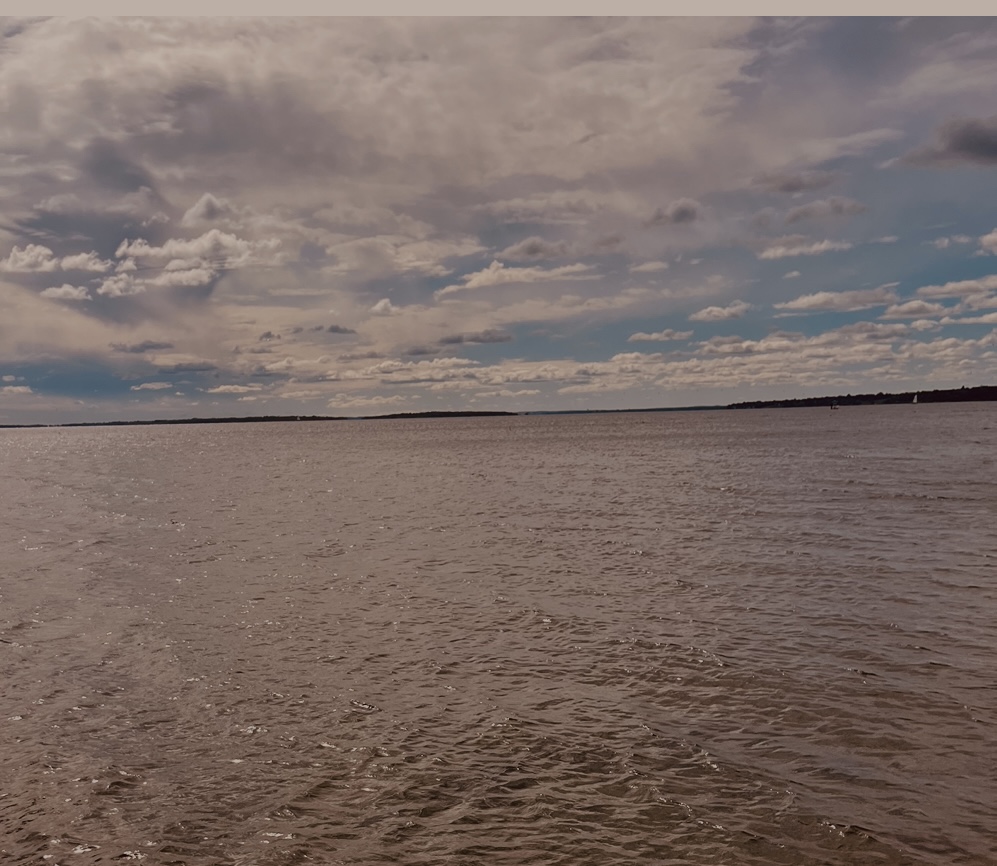
We Came To / image by Amalie Flynn

We came to provide help that you didn’t want.
We came to provide security you didn’t need.
We came to provide schools that you didn’t care about.
We came to provide a government that didn’t work.
We came to provide democracy you didn’t understand.
We came to provide infrastructure you wouldn’t take care of.
We came to provide a better life that you didn’t ask for.
And we kept spilling our blood and couldn’t understand how you could be so ungrateful.


New Poetry by Rachel Rix: “Experimental Simulation of Joint Morphology During Desiccation,” “Second Deployment,” “CO’s Canon”

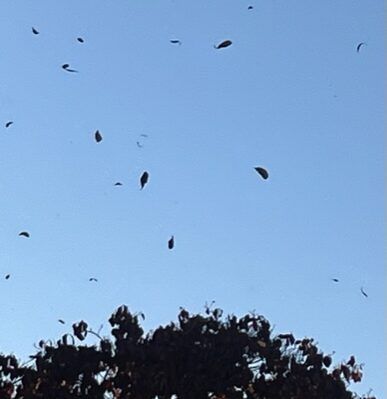
I Weightless Rising / image by Amalie Flynn

Experimental Simulation of Joint Morphology During Desiccation

In the dried-up river bed of the Helmand the body of a husband lies dead on the
hot cracked dirt. The hair of the woman married to the husband hasn’t been
washed in days. Her arms flex and hook the husband’s lower limbs. Dragging
him makes each step the woman takes heavier than the last. Vultures hover her
salt trail. Vast is what they see surround her. The daymoon watches too. Night
never comes only more heat magnified by the hours, searing the thin flesh
between vertebrae C-6 and C-7. The woman knows she’s blistering. Letting go
of her husband is not an option she thinks of.


Second Deployment

Our agreement was
only one. I have
difficulty carrying myself,

I – weightless. Rising
to the crags. Old world vulture
alone I sail for hours in the sky.

I eat my home. A pile of bones.
I’ve learned to crack open
what I cannot swallow,
a lamb’s femus. I am

bone breaker. Soft tissue drinker.

I eat his words.
I’m now dust bather.
Silent blood tracer.

I am a burial maker.
Tossed knuckle
scraper. Someday he’ll find me
by the bed
in a pile.

There will be a hovering
and a hollowing
No welcoming home.

CO’s Canon

If the cadence may be regarded as the cradle of tonality, the ostinato patterns can be
considered the playground in which it grew strong and self-confident.

His green duffel bag
could have carried two of me inside.

Near the opening a faceless angel,
I try: Dearest,

because I’m tumbleweed,
but he never reads me.

There are more important things
to do, shake hands with soldiers

going out on mission,
because when you’re the commander

it’s about survival.

I didn’t need to take
that last glance.

Suddenly tyrannosaurus.
Angel’s sepia teeth baring.


New Review: Michael Carson on Kevin Honold’s Our Lady of Good Voyage

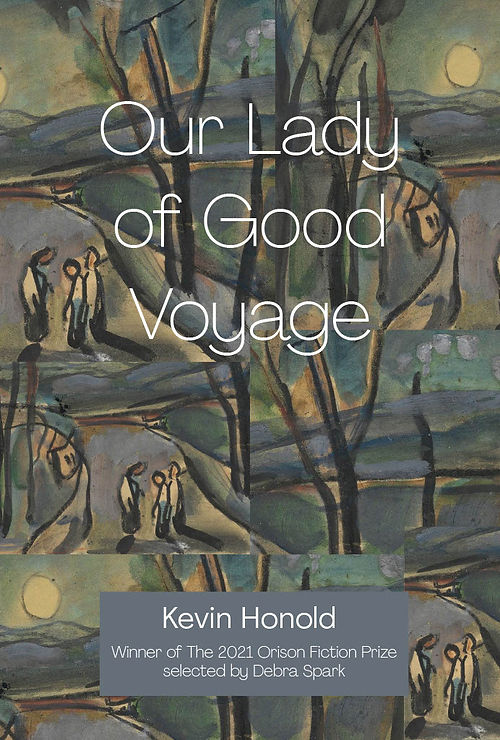
Our Lady of Good Voyage

CROATOAN: A Review of Kevin Honold’s Our Lady of Good Voyage (Orison Books, 2024).

Kevin Honold’s Our Lady of Good Voyage begins in an unnamed Ohio town populated with German ghosts. The Germans, the children and grandchildren of once prosperous immigrants, all elderly now, move through the streets incuriously, “lacking the imagination to move on.” Joe, the novel’s reluctant protagonist, pulls his squad car over and tries to help one of these living ghosts but ends up giving her two dollars and advice to buy some lozenges. As he drives off, he realizes that despite “a common language,” he once again “failed to trade a single piece of worthwhile information.” “I may as well be a god damn ghost,” he thinks.

Joe’s childhood friend does not have time to be a ghost. Kenny believes that Mary, the mother of God, comes to him in dreams with a crown of stars and the moon beneath her feet and wants Kenny to visit her in what the Aztecs called the center of the moon, and what we, today, call Mexico. He believes that the devil is a miracle that has created the illusion of our self-centered world (“lovelier than a thousand Sistine Chapels”) and only the act of a journey, a pilgrimage, can save us from this first miracle with a second.  He believes that the voyages of Captain Cook and Intuit hunting practices are as real and as present as the toilet pipes he and Joe repair after high school. He knows that all is sacred, all always alive, and that we, unlike ghosts, have a choice to see this or not.

But Kenny is gone, and has been for ten years. He haunts the edges of Joe’s muted days, appearing shoeless in crowded city streets, preaching his vision to empty train cars, leaving the final message of the vanished Roanoke settlers (CROATOAN) graffitied in drainage ditches. Joe circles the flickers of this ebbing fire in his squad car, these hints, only sure of one thing: that Kenny, his best friend, failed at everything, but that failure itself somehow legitimized the undertaking. “Anything else was not worth the time.”

The novel’s other chapters take place on the road, in memory. Joe and Kenny make their way down from Ohio toward Mexico. They drink with a man with his head caved in on a bus, hitchhike with a suicidal veteran, violate the Missouri law of being poor (and from Ohio), escape an apocalypse-obsessed family cult in Louisiana, and hop trains with immigrants across Texas. The immigrants smile but nod off at Kenny’s story. They are too exhausted to hear the end, how he and Joe will find Mary outside Mexico City and beg her to reveal the truth, and this truth, her love for them, and their love for her, will make it impossible to deny the sacredness of every living thing. Border Control disappears the immigrants. VA hospitals and jails disappear the drunks. Churches and homes warm the faithful and the righteous and those who never leave home. It is difficult to say who the ghosts are here. Kenny tells us the devil most certainly is not one. We should love the devil, he confides to his fellow inmates in a Missouri prison, for “if we don’t love him too, the work will forever remain unfinished…I see him every day.”

Joe smashes a scorpion during his tour of duty in Somalia that follows their pilgrimage. He uses an oil barrel three times to crush it, and it does nothing spectacular, just stops moving. “Damn, killer,” says another soldier. Joe does not believe in God or that this world can mean anything more than it is. He sees only the humiliated and the humiliation. He signs up for the military because in a world that is all ghost, deployments and war become un-ghostly, a quickening, bloody heart in a waste of gray. They have been raised by exhausted and unhappy men with repressed memories of brutal World War 2 campaigns. But the pride of that rare past, of being someone else once, keeps their uncles and fathers alive to themselves in a world that has moved on. Joe sees this. He is smart enough to know that it is nice to have done something, to go somewhere, to be someone, at least once. And the military pays for school now, they say.

We all have a bit of Joe in us. It’s all sad. It’s all a loop, nonsense, a slow fading away. Don’t be too curious. Don’t look too far outside the electric light. Suck it up. You don’t know what’s out there. Keep your head down by pretending to hold it up. The is is the is. Stay alive. And we do. We survive for so long. Thousands of years. Whole eternities. Look at us! Examine our cities, our “brief golden clusters suspended in the night” and the armies of creatures crossing silently through the fields and trainyards around and within them. “The dead never hurt anybody,” Kenny tells Joe during a training exercise with the moon above them like a spider’s egg in the naked, winter branches. “It’s the other ones we have to worry about.”

Then Kenny almost despairs. He says he can hardly remember Her anymore. He warns Joe that “forgetting is the only death…Evil is everything that dims and obscures and wears away the gift for remembering.” Joe says, no, “Evil is time itself. Time is what takes everything away.” Kenny’s eyes go bright (brighter) with tears and hugs his friend. “You have been listening. Now I know. Thank you.” Joe does listen. We do listen. Even if we pretend that we don’t. Some say that’s all ghosts can really do. Some say that only ghosts believe in time because they are trapped in the idea of it. Others—like me—say that novels as true and wise and joyful as Our Lady of Good Voyage prove Kenny wrong. There will always be people among us who remember, ergo nothing ever dies, and there is no evil, despite the best attempts of the righteous and incurious to make us believe otherwise.

But enough with the ghosts. In the book’s final pages Joe, a child again, runs away from a snapping turtle that a group of boys have stomped to death, back to Kenny, off the path, somewhere in the woods. They spend hours “contriving little ships from bark and twigs, binding the planks and timbers with long green grasses.” They make a fort out of some old logs and beg for food from the local bakery. They work like devils to create a home that is not a home thanks to Kenny’s mom, who provides them somewhere safe to come back to, to return to after their long difficult pilgrimages, in Ohio, and Mexico, and Africa, searching for the mother of God the world over. They complete their project. They look out from their fort with immense human satisfaction. “Neither deadlines nor schedules concerned them, not the world’s troubles, and the long days led away, in gratuitous succession, to the very vanishing point of time, which was inexhaustible as air, and warranted as little concern.”

You can buy Our Lady of Good Voyage at Orison Books.


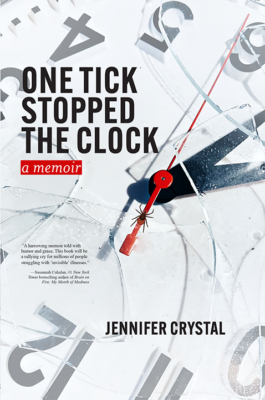
New Nonfiction by Jennifer Crystal: An Excerpt from One Tick Stopped the Clock

One Tick Stopped the Clock

Chapter 12 of One Tick Stopped the Clock

Published by Legacy Book Press

Excerpted from ONE TICK STOPPED THE CLOCK Copyright © 2024 by Jennifer Crystal. Used with permission of Legacy Book Press, Camanche, Iowa. All rights reserved.

Some edits made for context


“Slow down, Mom! I want to get there alive.”

I don’t think my mother heard me. She rolled through a stop sign and swung a hard right at the hospital entrance, swerving as we roared up to the ambulance bay where she slammed the car into park.

“Mom, we can’t park here…”

But she was already out of the car, sprinting through the automatic doors, shouting, “Help! My daughter needs help!”

That September afternoon had started like any other during my multi-year convalescence from Lyme disease and other chronic illness. Too sick to work or take care of myself, I’d had to give up my independent life and, at age twenty-five, move back with my parents. Every afternoon, I left my sickbed and came downstairs when my mom arrived home from teaching. We made snacks as we talked. She had her usual flatbread with margarine, and I mixed banana slices and peanut butter in a bowl. 

“I can’t believe you like that,” my mom said. “Such a sticky mess.”

“Yum!” I put a big glob in my mouth, flipping the spoon over and dragging it across my tongue for affect. “Much better than that cardboard you’re eating.” I scrunched my nose and ate another spoonful. “How was your day?” 

“Long, and it was only the second day of school.”

“Only 178 more to go,” I joked, my mouth full and sticky.

“And to think they already made us have a faculty meeting today.”

Suddenly I felt flushed and shaky, like I sometimes did before my blood sugar crashed, a symptom of the tick-borne illness babesiosis. Beads of sweat formed on my temples.

“The nerve, keeping us so late on the second afternoon—” 

I stood up, feeling lightheaded and dizzy. My blood sugar couldn’t be low; I was in the middle of eating. But I felt like I might faint. “I’m sorry to cut you off Mom, but I have to go lie down. Right now.”

Alarmed, my mother stood up, too. “What is it? What’s wrong?”

“I don’t know, I just suddenly really don’t feel well.”

I stumbled to the edge of the kitchen, holding on to the wall as I took the one step down into the den, then turned to the couch on my right and flung myself over its arm. I was gripped by a searing abdominal pain that made me scream and writhe.

“What? What’s wrong?” My mother reached towards me, but I rolled away.

“Oh my God, Mom, it’s like someone is stabbing me with a jagged chainsaw.”

“What? Where? Is it your stomach?”

I gasped for breath, clutching the right side of my abdomen. “Right…here…below my…rib cage.”

“Maybe it’s your appendix!”

“No, the appendix is lower.” I moved my hand down on my abdomen to show where the appendix is. “This is up here.” I rubbed the area below my rib cage. I felt like my insides were being sliced into little pieces. I threw myself off the couch onto the beige carpet, trying to get away from the pain. “Please Mom, make it stop. Make it stop!”

“Okay, okay. You’re okay. Here, just try to sit up.” My mom crouched over me, trying to pull me upright.

“No! That hurts more!” I thrashed on the floor, kicking my legs from side to side. 

“Let’s call the doctor. What’s the number? Do you know the number?”

Sucking in my breath to hold in the pain, I slowly called out my doctor’s number as my mom dashed into the kitchen to get her phone. She waved her free hand, trying to shush my moaning so she could hear. She walked away into another part of the house for what felt like an unbearably long time, then finally ran back into the den. “They said to take you to the E.R.”

Panting, I tried to pull myself up on the couch, but slid back down in pain.  “Can you go get my purse? It’s on my bedroom floor. We’re going to need my insurance card and medication list.”

My mother ran off, taking the stairs two at a time. She raced back through the den with my bag in hand and flung open the door to the garage. “Oh no. Oh no!”

“What?”

“The car’s not here. Oh my God, I forgot, Elizabeth has the car. She went to Mackenzie’s house.” My sixteen-year-old sister had just gotten her license, and borrowed my mother’s car whenever she could to go to a friend’s house. 

Pain and fear seized me again. I pushed them aside to say, as calmly as I could, “Okay, well Mackenzie only lives five minutes away. Call Elizabeth and tell her to come right home.”

For an excruciating five or maybe even ten minutes, I thrashed and howled while my mother paced in front of me, wringing her hands and peering out the window. “She’ll be here any minute,” she kept saying. 

Finally, we heard the engine in the garage and car doors slam. Elizabeth and Mackenzie tumbled into the house. They both stopped short when they saw me. Mackenzie’s eyes grew wide. She backed away, as if whatever I had might be catching. “Oh my God, Jen.” 

My mom grabbed the keys out of Elizabeth’s hands. “Give Jen your flip flops. Help me get her into the car.”

I screamed as my mother drove. When we got to a crucial turn at the edge of town, she said, “Maybe I should take you to a hospital in Hartford.” If we turned right, we could get on the highway and be there in twenty minutes. But I couldn’t hold out that long.

“No,” I whimpered. “It hurts too much. Just go to the local one.” Another hospital was a few blocks away. It didn’t have as good as a reputation, but this was an emergency. How bad could it really be?

After my mom slammed the car into park in the ambulance bay of the closer hospital, I stumbled after her into the E.R., hunched over at almost a ninety-degree angle.

The triage nurse sat us in office chairs across from her desk, as if we were here to open a bank account or discuss our taxes. I clutched my abdomen as I rocked back and forth on the seat. 

“Insurance card?” 

I reached into my purse and handed the nurse my insurance card, my license, and my medication list. “Here, everything you need is right here. Can I please just see a doctor? I’m in so much pain. My mom can go over all this stuff with you.”

The nurse peered at me over her wire rim glasses, sizing me up. “On a scale of one to ten, how bad is the pain?”

“Eleven!” I hugged myself harder. “Please, can’t you just get a doctor?”

The nurse sighed. “I have to assess the situation first.”

“What’s to assess? I feel like I’m being stabbed in the gut. Look, I have a PICC line in.” I showed her my left arm, where a peripherally inserted catheter ran from my elbow to my heart, pumping antibiotics to kill the Lyme disease bacteria. “I’m afraid it might be related to that.”

“Why do you have a PICC line?”

“Intravenous antibiotics for late-stage neurological Lyme Disease.” 

The nurse raised her eyebrows. I realized this might be one of the hospitals that followed certain protocols that didn’t approve of the use of long-term antibiotics. I did not have it in me to fight about Lyme right now. I needed my acute issue treated, stat.

My mother chimed in, “Look, she’s really in pain. Please can’t we just get her to a doctor?”

The nurse sighed again. “Ma’am, I’m just doing my job.”

Holding my head in my hands, I started sobbing. The nurse gave me an exasperated glare.

I screeched, “It hurts. It hurts. It hurts so much.” Dear God, I am screaming in their faces and still no one hears me. Please help me. I don’t want to die

Finally, I was brought to an exam room, but still there was no doctor in sight. 

“Can’t you give her something for the pain?” My mother pleaded with whoever was in the room, someone in pink scrubs. 

“We can’t give her anything until a doctor sees her.”

“Then, please get a doctor,” my mother cried.

“They’re all busy with other patients,” the woman replied. “There are several people in more serious condition than your daughter.”

I grabbed my mother’s arm. “Oh my God, Mom, I can’t take the pain. Please do something.” It felt like whatever I’d been stabbed with was now stuck in my stomach, cutting deeper each time I moved or breathed.

My mother brushed my hair off my sweaty forehead. “She said they can’t give you anything until the doctor comes.”

“That’s not how it worked on E.R. People came in screaming and Dr. Ross immediately ordered a liter of Lidocaine.” 

The sides of my mother’s mouth twitched in what would have been a smile if this were a different situation. She continued to rub her hand across my forehead. “This isn’t TV. George Clooney isn’t going to walk in here.”

“Believe me, I know. He would never leave me lying here in pain.”

“We should have gone to the other hospital.” 

I knew my mother was right, but I was too distressed for should-haves. I whined, “Just get the pain out of me. Get it out of me!”

The woman in pink scrubs turned around in alarm. “Are you pregnant?” 

“Are you kidding me? No, I’m not pregnant. I’m in pain. My stomach hurts. I don’t know what’s wrong with me, but I’m definitely not pregnant. I meant get the pain out of me. Not a baby.”

“Are you sure? Maybe we should do a urine test.” 

“OH, FOR FUCK’S SAKE!” Instinctively, I sat up, which only made it hurt more. “Look, I’ve been bedridden for almost two years, okay? Two years. Alone. There is no way I am pregnant. Please go get a doctor!”

The woman hurried out of the room, and miraculously, a doctor appeared. 

“What seems to be the problem?” he asked. He was thin and young with cropped dark hair and a few days’ worth of stubble. I wondered how long he’d been awake. 

Holding my stomach, I told him what had happened. He nodded and looked at my chart, but never at me. Then he pressed on my abdomen. I yelped.

“That hurts?”

“Yes, that hurts! All around that area. The pain has not let up.”

“Hmm. Well, let’s get an x-ray. A nurse will come in shortly to take you.”

“Just try to breathe,” my mother soothed as she rubbed my head. “Let’s do some Lamaze.”

I wanted to laugh, but it hurt too much. “Mom, I really am not pregnant.”

“I know. But you’re screaming like you’re in labor. So maybe labor breathing will help.” My mom demonstrated by taking a big inhale and then slowly blowing out her breath in spurts. “Breathe with the pain.”

I sucked in my breath each time the pain gripped me, then tried to blow it out slowly. The technique didn’t seem to do much since my pain was so constant, but by the time a nurse came to wheel me to x-ray, the intensity had lessened.

“Feeling better?” the nurse asked as she positioned me in front of the x-ray machine.

“The pain has decreased.”

“Well, you’re still all clammy,” she said. “Somethin’s definitely cookin’.”


What the doctor decided was cooking turned out to be a huge pile of shit.

“I read your x-ray and I see a lot of…um…stool, in your colon,” he said to my stomach, refusing to meet my eye.

“I’m not constipated. I have a lot of medical issues, but constipation has never been one of them.”

“Well, that’s what this is,” he said matter-of-factly. “I’m going to send you home with a laxative. That should help. You can follow up with your doctor tomorrow.”

“That’s not stool,” my doctor said when I got him on the phone later.  “I’ve got your x-ray in front of me. Those are gallstones.”

“Gallstones? Like in my gallbladder?” 

“Exactly. I don’t know how they missed this,” my doctor continued. “These gallstones are huge. The pain you felt was one of them trying to squeeze through the bile duct. Once it did, the pain stopped. Were you eating something fatty?”

“Yes, peanut butter.”

“Oh, that’ll do it. The gallbladder processes fat. You basically set off an attack.”

Vaguely, I remembered that when my doctor had offered me the option of the PICC line, he’d mentioned the rare risk of the medicine causing gallstones. “Rare” hadn’t seemed a likely scenario, then. I ran my free hand through my hair, twirling it around my finger. “So, what do I do now?”

“I’m going to call in some medication that might shrink the stones. Take that tonight, but then I want you to go see a specialist tomorrow and get an ultrasound. You can’t play around with this.”

The next day I drove to see a specialist at a hospital about an hour away, near my dad and stepmom Janet’s house. During the time that I was sick, I often migrated between my two childhood homes. “These stones are the size of rolls of duct tape. Your gallbladder needs to come out immediately,” the specialist said. He scheduled me for surgery the following morning.

“I’ll come,” my mom offered when I called to update her. 

“It’s okay. Janet can take me.” 

“What about when you wake up from surgery? When you have the shakes and throw up?” My mom had been with me after four eye surgeries as a child, and after knee surgery as a young adult when I’d been a die-hard skier, before being sidelined tick-borne illness. No one knew how to care for me afterwards like she did. Janet would do her best, but my mom was the one who had always held my hand, rubbed my head, and told me it was going to be okay. 

Still, all those surgeries had happened when I was younger. I was twenty-seven years old. I felt like I should be able to get through this on my own. “I can handle it,” I told my mom. “You have school. You can’t take a day off during the first week.”

“Of course I can. I’ll take a personal day.”

I hesitated. I really wanted my mom there. 

“Besides,” my mom cut into my thoughts, “I have Cubby.”

Cubby was a stuffed bear cub that my mom had given me before my first eye surgery. I was only nine years old at the time, so the nurses had let me keep him in the bed with me right up to the operating room doors and had given him back to me when they woke me in recovery. Cubby had been with me for all my surgeries. It started to feel silly bringing a stuffed animal to the hospital as I got older, but he’d become a good luck charm. 

“Gotcha there, don’t I,” my mom said. 

I sighed. “Are you sure?”

“I already put Cubby by the door.”


That night in my room at my dad and Janet’s, I slept on my stomach, which was difficult because of the PICC line. I woke up every few minutes either worried that the port had come loose or that a gallbladder attack was about to happen. I prayed each time I awoke. Someone must have heard me because I made it through the night without incident. 

In the morning I infused my antibiotics, then put on a button-down shirt, knowing from experience that I would be too out of it later to pull a regular shirt over my head. I French braided my hair, which would keep it off my face but still allow it to lie flat under the surgical cap. I had both hands tangled behind my head, halfway through the braid, when Janet called up to me, “Jen, please come downstairs.”

I dropped my hands. My hair tumbled loose as the braid fell apart. I walked down to the kitchen, where Janet greeted me with a somber face. “Your mom just called. She’s been in a car accident. She’s fine, but she’s going to be late. She’ll meet us at the hospital.”

My heart started to race. “Is she really okay? How bad was the accident?” I studied Janet’s stoic face. 

“Just a fender bender. She’s fine.” 

I wanted to believe Janet but wondered if she was just telling me that because I had to focus on the surgery. She didn’t say anything more as we drove to the hospital. Terrible scenarios ran through my head as we checked in, went through pre-op, and waited for the anesthesiologist. The clock on the wall ticked off several hours as we waited, but there was still no sign of my mom. 

“She’s fine,” Janet kept saying. 

My mom was still not there by the time they wheeled me into surgery. 

“I’m nervous,” I told the anesthesiologist.

“That’s normal.” He fiddled with my IV. “This first dose I’m going to give you is like a glass of wine. You’re going to feel great in a few minutes.”

“But it’s not just about the surgery. My mom got in a car accident and she’s not here. I don’t know if she’s going to be okay…”


The next thing I remember, a nurse was calling my name. “Jennifer…Jennifer…” People rarely called me by my full name, and it felt strange to hear it. 

Something else felt different, too. I didn’t feel shaky. I didn’t feel like I was out of control from the medicine coursing through my body. There was a dull ache in my abdomen, but otherwise, I felt completely calm. In my head, a voice softly said, “You’re stronger than you think, Jen Crystal.” Maybe it was my own subconscious. Maybe it was God. Maybe it was George Clooney. Whoever it was, I knew, in that moment, that I’d survived the surgery and I was going to survive whatever else was coming, too.

“My mom,” I said to the nurse. “Is my mom alright? Is she here?”

“I don’t know,” the nurse replied. “I’m not sure who your mom is. But someone gave me this and told me to give it to you as soon as you woke up.” She held out Cubby. 

Only then did I start to cry.