The HYPR Dryver Manual was clear: a Dryver should not, under any circumstances, touch a customer. Simon read and re-read the line on his phone, looking for an exception, something like a loophole that might help him remove the snoring man from his back seat.
They’d arrived at the destination two minutes earlier, but the man’s eyes were still shut tight, his head still leaning against the rear window. “Excuse me,” Simon said from the driver’s seat. He glanced at the phone on the dash to double-check the man’s name. “Thomas?”
The man coughed a few times, sounding like he was working through a winter’s worth of mucus, but never opened his eyes. Drool ran down a gin-blossomed cheek. In the few weeks Simon had spent working as a Dryver, he’d had to deal with drunk people; getting shitfaced was one of the main reasons people called a HYPR. Before Thomas, though, that reality had never been a problem. None of his previous alcoholics had fallen asleep.
Simon considered checking HYPRPPL, the forum he’d been lurking on since starting the job, but he knew it would probably offer little help—its users tended to talk tougher than they acted in real life. If there were an answer, it’d be in the Manual. He tapped “Find in Page,” typed “problem with a passenger,” and watched as his phone jumped to a possible solution: “If you have a problem with a passenger and feel like you are in danger,” it said, “contact the local authorities.” Simon imagined calling the cops, the smirks on their faces as they jotted down his concerns. This fat drunk scares you?
He didn’t need Thomas arrested; he just needed him out of the car. He needed to grab another fare. He needed to stop wasting time. “Thomas,” he said again. “Ride’s over.” The man shook his head and rolled onto the headrest, slathering it with his spit.
Simon returned to the wheel and stared at the crowded city just beyond his windshield, at the 2100 block of Market Street and its towering glass buildings. The people passing by his car were well-dressed. They were moisturized and manicured. They spent their days in cubicles, talking about slide decks and KPIs. He knew they couldn’t relate.
He took a deep breath, closed his eyes, and counted to 10. The day before he’d watched a YouTube video called “Calm Down QUICKLY” that suggested these techniques created positive delusions; even if things were spiraling, the woman in the video had said, controlling your breath would tell your brain all was well.
When he reached 10, though, he didn’t feel any different. Thomas was still passed out and he was still stuck at the corner of 21st and Market. He would have to wait for the man to wake up on his own. He imagined the lame excuses he’d offer: something about a restless newborn at home, an early morning at the gym, a long and trying history of incurable narcolepsy. Simon gripped the steering wheel and took out some of his aggression on the worn gray rubber.
Some passengers left tips as penance for their bad behavior, acknowledgments that Simon’s job was inherently shitty, that having to deal with this many people every day deserved more than what the algorithm paid. He wondered if telling Thomas about all the fares he’d missed out on while the man had been napping might subtly suggest one of these generous tips was in order. He knew that might be too soft, though. Maybe what the situation really called for was a threat. Thomas would be banned from the app—immediately, and permanently—unless he forked over a 50% tip. No, Simon thought, go bigger. It would have to be 60%. 50% sounded like a gamble, but 60% sounded assertive. 65% sounded even better. It would be 65%. The number was more arbitrary and, as a result, more official.
Now he just needed him to wake, then he would begin the blackmail. Unfortunately, he saw himself saying, there’s only one way out. He looked at the man in the rearview. He was still out, but he began shifting in the seat, a move that Simon thought might be the early start of his entry back into the waking world. Instead, he let out a titanic fart.
Simon squeezed the wheel tighter, until his knuckles ached. He stared at the flesh between them, amazed at how his white skin turned even paler than usual.
Then his eye caught the Subaru logo. The horn. Of course.
He pressed hesitantly at first, worried he might startle one of the office workers on their way to lunch. The car let out a soft chirp and Simon eyed the rearview mirror, hoping to see the man’s eyes creak open. It didn’t work. In fact, Thomas looked rather peaceful in his newfound California King.
It would have to be harder. It would require some real force. Simon leaned all his weight into his palm and held it there, determined to get the thing screaming. He began working the horn like a mound of dough, kneading it into an atonal mess. He smiled as people on the sidewalk stopped and stared.
Thomas shot up in a panic, demanding to know where he was.
Simon pulled back from the horn. “2100 Market,” he said. “Your destination.”
“Good,” Thomas said, and took a tin of mints from his breast pocket. He threw a handful in his mouth. Simon could see imprints of the headrest across his face.
“You were out for a while,” Simon said. He was laying the groundwork for the tip. The man would feel guilty, indebted. “It ate a lot of my time.”
The man stared at him for a beat. “And?”
“It cut into my other fares. I lost money.” Simon decided he would go with 40%. It was the more reasonable number.
“That right?”
Simon nodded. “And as a result of your actions—”
“—sounds like a shitty business model,” Thomas said, cutting him off. He left the car without another word, slamming the door behind him.
Simon took a deep breath and started counting to 10. He saw the woman from YouTube encouraging him to find the origin of his breath, to locate it deep within his chest and hold it there.
“Always, always, always place courtesy and hospitality above everything else,” the HYPR Dryver Manual said. He knew he would need to disregard Thomas’s words. He knew he could not afford to be in a bad mood for the next passenger. He would forget the entire experience. He needed to.
Simon’s phone vibrated in its dashboard holster. He assumed it was a notification from HYPR, an offer for a new passenger, an opportunity to make more money. The woman from the YouTube video would’ve told him to ignore this, to tune out the rest of the world until his brain was at peace, but he didn’t need to be Zen, he just needed to be calm. Calm enough. Calm enough to drive without jeopardizing any more fares.
The notification was from HYPR, though there was no mention of a new passenger. “Your Dryver Score has been updated!” the app informed him. For all his efforts with Thomas, he’d been awarded a single star. It had been the confrontation, he knew. If he had kept quiet, if he had just waited for the man to wake up on his own, he wouldn’t be dealing with a tanked average.
He put the phone back in its holster and took another deep breath. This time, he decided, he would count to 100.
Wasi couldn’t sleep. He looked at the wall clock: four in the morning. He rubbed his stiff neck, wincing at a dull, persistent headache. He sat up in the dark, kicked off his blankets, stretched, and looked out the window to guess what the coming day would be like, sunny or cloudy, but he saw only stars, which he thought predicted a cloudless day. He listened to the rising chorus of birdsong as he felt the back of his head. The gauze bandage had come off in his sleep, and he touched a bare patch of warm skin and the tight line of ten stitches with the tips of his fingers. He was conscious of the wound, its need for protection. His naked scalp beneath the gauze, its exposure now with the gauze off. Healing will take time, the doctor had told him.
He walked into the bathroom, chips of paint from the water-stained ceiling sticking to his bare feet. He opened a drawer in the fractured vanity, pulled out a square piece of gauze, covered the stitches, and taped it as the nurse had done. Then he took two ibuprofen. Mindful of the doctor’s warning not to get the stitches wet, he washed his face and body with a washcloth instead of showering. He held a plastic baggie against the gauze with one hand to keep the wound dry while he shampooed and rinsed his hair. Glancing out the bathroom window, he noticed the stars had dimmed. Light frayed the farthest reaches of sky.
Coming into the kitchen, he adjusted the cracked blinds above the sink. He heated water for green tea, and put two slices of bread in the toaster. By the time he finished eating, the sun had risen, revealing a clear blue sky—just as he had thought—and he put on sunglasses and walked out of his apartment, pausing to put a mask over his nose and mouth. Shirts and pants hung over railings above him and he heard the voices of people from Syria and Iraq, who like him were refugees placed in the apartment complex by Interfaith Ministries of San Diego.
He opened a gate to the sidewalk and waited for a garbage truck to pass. It stopped and picked up a black trash bin with a mechanical arm, dumped its contents into the hopper behind the cab, and set it down. The noise bothered him. Wasi pressed a hand against his bandage to make sure it was secure and hurried across the street. A small dog yapped at him from behind a fence and its owner screamed at it, but the dog ignored her and the noise vibrated up Wasi’s spine until he thought he might burst. He clenched and opened his fists. The humid air weighed on him and fallen palm leaves, gray and dry on the sidewalk, broke underfoot and that noise, too, bothered him.
He walked a few blocks into a neighborhood of single-story, ranch-style homes and noticed an elderly man sitting in his kitchen by an open window. The man waved. Wasi hesitated, and then waved back. In Kabul, he had done his best to avoid his neighbors. They would often stop and ask him what sort of work he did that took him from his home for weeks, sometimes months, at a time. Construction, he would answer. A company out of Dubai. It has a big project in Ghazni. He presumed some of his neighbors didn’t believe him, perhaps because they would overhear him speaking English when he received calls from the Americans at Bagram Air Base, and mention their suspicions to the Taliban. How else did the insurgents suspect him of being an interpreter? The pipe bomb he found outside his house one morning had malfunctioned, sparing him. He knew he had been lucky, but he also was certain he had been found out.
I see you every morning, the old man shouted.
I walk before I go to work, Wasi said. I drive for Lyft. It’s good to walk because I’ll be sitting most of the day.
I’m stuck in the house because of COVID.
Are you sick?
No. Just social distancing.
Wasi removed his sunglasses and mask to show his face and not be rude.
I used to have a lot of business at the airport but now it is too slow, he said.
COVID, the old man said.
Yes, Wasi said, COVID.
He knelt to tighten the laces on his left shoe. The old man watched him.
What happened to your head?
Wasi looked up and then returned his attention to his shoe.
I’m sorry but I noticed the bandage.
Accident, Wasi said, standing up.
I see. Something fell on you.
Yes, Wasi said. Something fell on me.
Where are you from?
Why?
The old man shrugged and smiled.
Yours is not a Southern California accent.
Does it matter?
Not at all. I’m sorry if I upset you.
Afghanistan. I was an interpreter for U.S. forces but I had to leave. The Taliban found out about me and it became too dangerous for me.
I am sorry.
I miss my country. In Afghanistan, the Americans paid me seven hundred dollars a month. I thought that was so much money but here it is nothing. Where are you from?
Touché, the old man said and laughed. I’m from here. I’ve lived in San Diego all my life. I’m retired now. My grandparents were Japanese. They emigrated from Japan to Hawaii, where my mother and father were born. When they married, my parents moved here. My grandparents spoke about Japan all the time.
The old man pushed up from his chair and stood.
Do you mind if I walk with you? I can’t stay in the house all day, every day. My wife wants me to, but I can’t just hate sitting here around.
Wasi shrugged. He preferred to be alone but he did not want to be impolite. He waited and put on his sunglasses and mask again. He recalled Kabul’s winters, when he would cover his nose and mouth with his hands to warm his face. He would stand still, watch his breath spread like gray smoke from between his fingers.
After a moment, the old man walked out the front door. He paused on the porch and removed a mask from his pocket. Wasi pressed his bandage. He again felt the bump of stitches beneath the gauze and the warmth of the wound. The old man approached him, stopping a few feet away.
I’m Mark Sato, he said. I’d shake your hand but we aren’t supposed to with the pandemic.
No problem, thank you. Wasi covered his heart with his right hand and bowed. Good morning. I am Wasi Turtughi.
Good morning, Mark said.
He put on his sunglasses and mask.
No one can see our faces, he said. We could be anybody.
Wasi started walking and Mark fell in behind him. Wasi listened to his steps, the steady pace of his shoes striking the pavement, and when he couldn’t take it anymore he stopped and told Mark he would prefer to follow him.
I think you walk faster than me.
I don’t think so.
Please, Wasi said, waving him forward.
From time to time, Wasi and Mark got off the sidewalk to keep their distance from other pedestrians. They said hello, raised their hands, and some of those they met did the same while others hurried past or crossed to the other side of the street.When they reached the end of the street, Mark paused to decide which direction to take. I always go left, Wasi said. They began walking up a hill. A canyon of dry brush stood off to one side. Wasi leaned into the hill and stared into dry, rocky streambeds choked with weeds. Someone had used chalk to write, We Miss Seeing Our Neighbors and Smile This Will Be Over Soon, on the sidewalk. He stopped walking when Mark sat on a guardrail to catch his breath.
Do you always do this hill? Mark asked him. It’s steep.
Every day, Wasi said. It reminds me of Kabul. Just a little. The mountains outside the city and the fields beneath them where we’d fly kites and play fútbol.
Voices rose from the canyon. Three young men sauntered down one of the streambeds. They fanned out in a clearing and began throwing a Frisbee. They did not wear masks. They cursed without concern about who might hear them, mocking one another when one of them missed a catch. Wasi stiffened and felt his heart race. His breath got short and he couldn’t move. Then he stood and told Mark he had to leave. Without waiting for an answer, he began walking back the way they had come.
What is it? Mark asked, hurrying after him.
Wasi didn’t answer. He pulled his mask down to his chin and wiped his face and sucked in air as if he had been holding his breath. He kept walking, finally stopping by a tree. A wrinkled, faded flyer with a picture of a lost cat hung nailed to the rough bark. Black and gray tabby. Whiskers. Call 619-874-2468 if you see her. Reward. Mark wheezed behind him. Leaning forward with his hands on his knees, he sucked in air.
What is it? he gasped.
I recognized those men, Wasi said, their voices.
What about them?
I was walking last week, this walk, Wasi said. No one was around so I took off my mask. I’d gone up and then down the hill. I followed a nice little side street. Then I heard people running behind me. I thought they were joggers. I moved over expecting them to go by and I started putting on my mask. They started shouting, You fucking Arab! and that’s all I remember. I woke up in the hospital. A doctor told me I had been hit in the back of my head with something very hard, maybe a pipe or a bottle. I had a concussion.
Mark stared at his feet. He wanted to say, I’m sorry, an automatic response he knew would mean nothing. But he was sorry, sorry and grateful that these same men had never assaulted him on those rare days when he left the house. They might have. Many people blamed China for the pandemic. They considered—more like accused—every Asian person of being Chinese. They were someone to hate. Mark knew they wouldn’t care that he was born in San Diego. He would be Chinese to them because they would need him to be.
I’m sorry, he said finally, unable to think of anything better to say.
Afghans are not Arabs, Wasi said.
I’m sorry, Mark said again. Do you want to call the police?
No. I spoke to the police in the hospital. They said it would be difficult, too difficult to catch them without a witness because I did not see their faces.
I’m sorry.
I want to go home.
They began walking. It was hard for Mark to believe that such horrible people played Frisbee. Nothing was what it seemed. Poor Wasi. Mark felt bad for him while at the same time he could not escape a sense of relief that so far he had been spared.
When they reached his house, Mark stuck his arm out to shake Wasi’s hand and then stopped.
Sorry, he said. I always forget.
In Afghanistan, if we want something to happen, we say, Inshallah. It means, If God wills. Inshallah, these strange times will pass.
He covered his heart with his right hand, bowed, and said goodbye.
Mark watched him leave. Tomorrow, he would probably see Wasi again taking his daily walk. He would wave and say, Good morning, but he would keep his distance and not ask to join him. He did not want to catch Wasi’s bad luck. There would be no harm in saying hello, however, no harm in being pleasant.
New Poetry by Sara Shea: “Customs”
To U.S. Soil / image by Amalie Flynn
Coming through US Customs from Ecuador
the passport agent asks if I have anything to declare.
I know he doesn’t mean the duty free,
exotic perfume or rare cigars.
He isn’t referring to bitter cacao or
sun-sweetened coffee beans.
Granted, I’ve stashed a few seeds in my pocket. Granadilla seeds, wrapped in foil- that last snack I ate in the courtyard with my grandparents in Guayaquil. This isn’t his concern.
Coming through US Customs from Ecuador, the passport agent asks if I have anything to declare.
I envision my grandparents sipping sangria along El Malecon in the 1940’s, dreaming of a fortune in rice, bananas, oil- running those early tankers through the Panama canal. It was a marvel then! They were betting on a love that would outlast malaria, revolutions, temptations, typhoons.
Coming through the Department of Homeland Security from Ecuador, into Miami International Airport, the passport agent asks if I have anything to declare.
I should declare the apologies. The explanations. The what-if’s. The missing photographs. The heartaches that have haunted my grandparents, their parents, their children.
Coming through customs on to US soil, I could declare that the actions and decisions of one generation stretch exponentially through families for decades to come. Instead, I shrug, knowing seeds easily drift from their roots in winds of change.
The passport agent asks my reason for travel. I reply, “family.” He nods, calls me an American and stamps my passport.
New Poetry by Benjamin Bellet: “What Was It Like?”; “Zero Five Thirty”; “West Point”
Once Again Spreading / image by Amalie Flynn
What Was It Like?
Over-lit airport terminals
or the rifle range at night,
the first tracer
crackling in night vision
over pale green hills. Or—
a group of souls
preparing
to die together,
the plane shuddering
in its evasive bank,
our eyes knowing
for once
each other. Or—
relation based
not on preference
but direst need.
The livid explosion
we invited,
then flinched.
Thousands of miles.
Cadet (West Point, N.Y.)
On restriction to barracks
for dereliction of duty
(otherwise known
as sleeping through classes),
you look beyond
the window.
Clad in gray
Civil War-era uniforms,
a broken succession
of nineteen-year-olds
walk through the snow
at right angles,
flinching at the chill
across their razor-burn,
the wind off the Hudson.
West of the river
atop Battle Monument
stands winged Fame,
her bronze pinions cut
into the overcast.
In your room
sits you.
A bit too warm,
the floor fresh-cleaned
with Mop & Glo,
dry-cleaned wool pants
hanging over
stacked tins
of shoe polish
in the congestion of New York
midwinter air.
You loved back then
to sleep, hovering
in un-location,
absolved until
the dread summed to
the impossibility
of being again
late for formation,
running cold water
then the razor
over that same
old rash—Now, somewhere
down the hallway
the boot-squeak,
hoot and snicker
of men making
their weekend exit
for nearby Newburgh,
the last door-slam,
that triumph
of silence
once again spreading
Zero Five-Thirty (Fort Riley, KS)
From the hilltop down,
the base is rimmed by a crust
of bluish signs
glowing somewhat
appealingly at dawn—
pawn shops, strip clubs,
quick-cash stores.
The fragmented receptacles
for the nightly outflux
of dirty dollar bills,
leftover sand,
hard-ons and sweat.
Flitting between
blackout shades,
the vague milky secretions
of our half-drowned
dull and brightest, now
making their way back up
to formation.
Their bass-notes drift
across endless plains
of identical duplexes
where their families still sleep.
Sunrise comes soft
as a bloody nose.
Groups of men
jog past in squares.
New Review and Interview by Larry Abbott: James Wells’ Because
Vietnam: The War That Keeps on Giving . . . and Taking
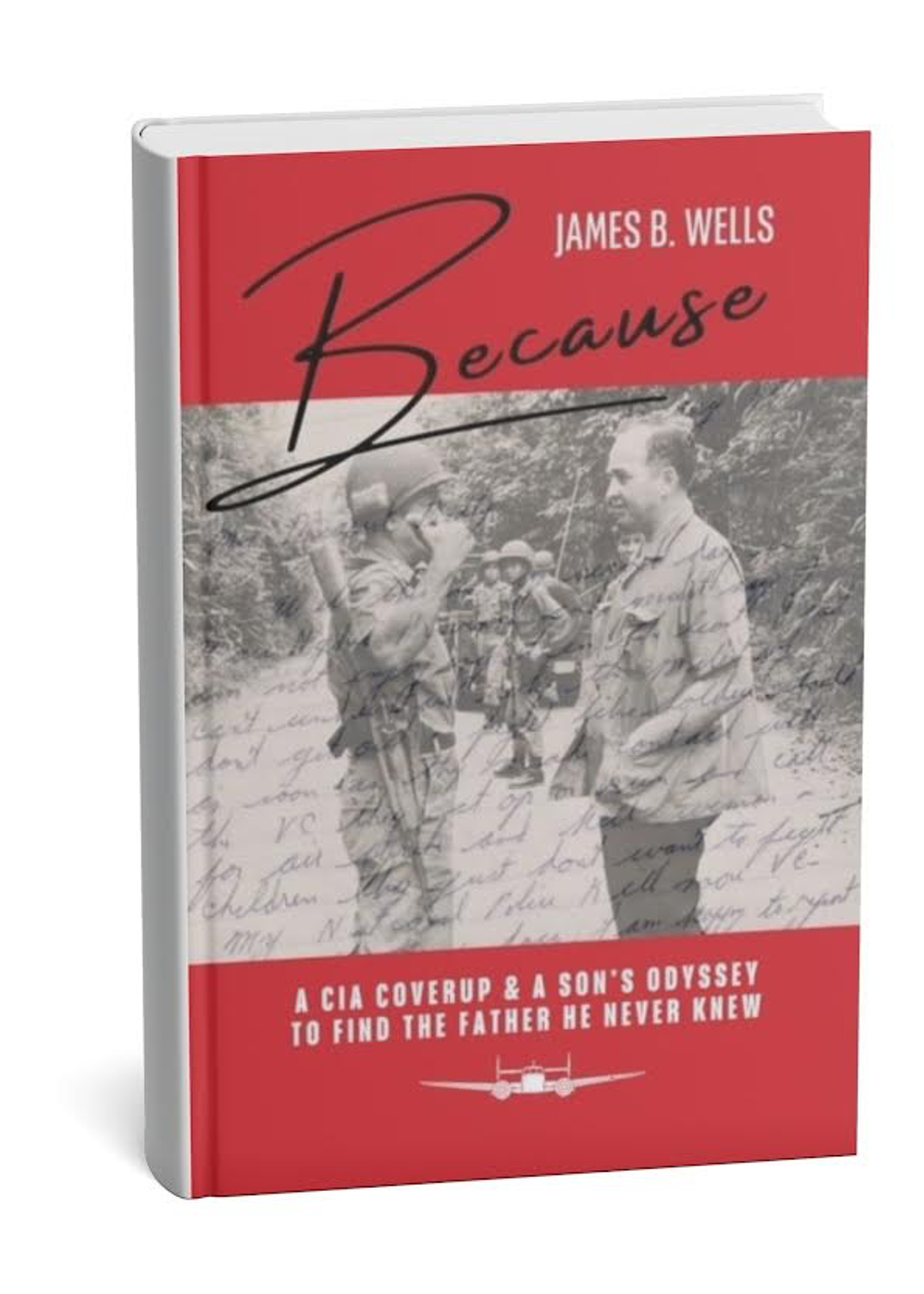
Because: A CIA Coverup and A Son’s Odyssey to Find the Father He Never Knew, by James B. Wells, Milspeak Books, 2025. Hardcover and paperback.
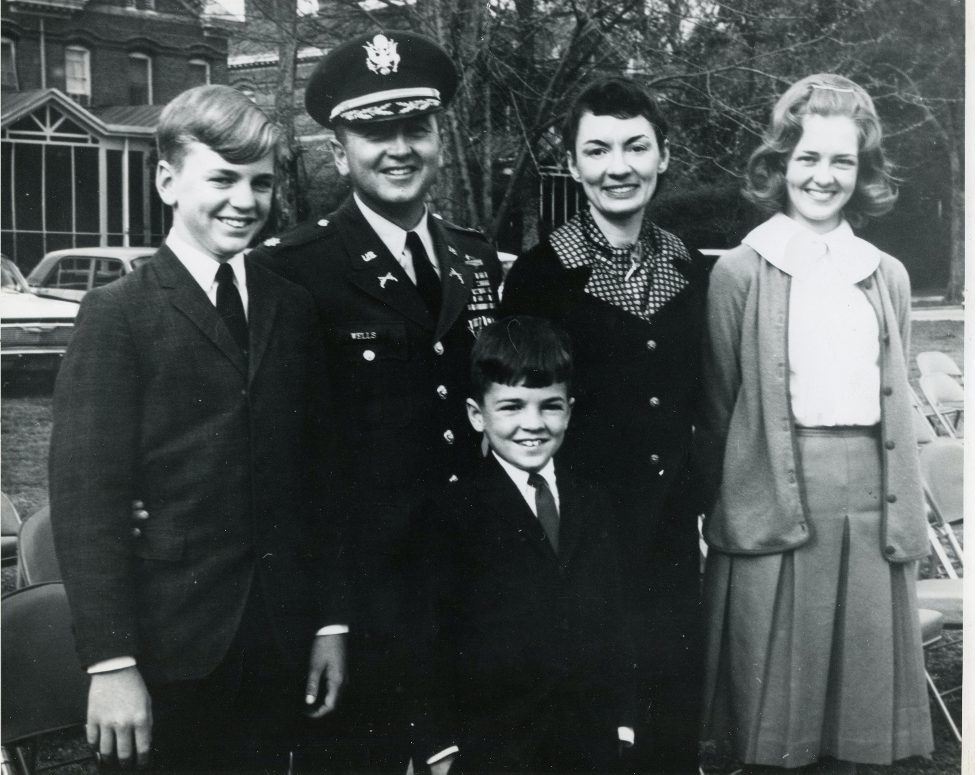
On September 27, 1965, Jack Wells, a World War II Pacific Theatre veteran, Army captain in Vietnam (“MAAG Counter-Insurgency Expert and Battalion Weapons Advisor with the 24th Civil Guard Battalion, III Corps, Vietnam”), and senior advisor in the Public Safety Division of USAID, with two tours in Vietnam in 1962-63 and 1965, was killed in a crash of an Air America twin-engined Beech C-45 as the plane approached a small airstrip in Bao Trai. Wells was on his way to implement a pilot program to “improve security and reduce corruption in the U.S.-funded Refugee Processing Program.” He was 39 years old at the time of his death, and left a wife, Betty and three children, Ora, Kathleen, and the youngest, nine-year old James.
From the outset, there were some details about the crash that didn’t add up. There were supposed to be just two pilots and Wells in the plane, but there is evidence that there were two additional, last-minute passengers. Government officials who arrived at the Wells’ home in Georgia the day after the crash told the family that the plane was shot down by enemy small-arms fire. However, there is proof that the shooting originated inside the plane. Further, it was officially noted that seven South Vietnamese policemen were killed by Viet Cong while trying to help the casualties escape the wreckage. Yet there is no documentation, or recollections from villagers whom Wells interviewed, that anyone was killed on the ground.
The effect of the death on the family, especially Betty, was devastating, but it might have been viewed as just another tragedy in the fog of war, except for James’s discovery in 1991 of some 400 letters from Jack to Betty during his time in Vietnam.
The letters trigger the desire, which became an obsession, to find the truth about his father’s death, and form the centerpiece of the narrative. The book interweaves the personal story of James Wells’s search for the truth of his father’s death and thereby obtain a sense of peace, the family story centered on the life and legacy of Jack Wells, and the national story of the war that seems never ending. James Wells’s desire to uncover the truth leads him to research in seven archives in the U.S. and two in Vietnam and multiple interviews with Jack Wells’s supervisors and colleagues in USAID, CIA operatives, Air America pilots, and Vietnamese on both sides of the conflict. While the archival research discloses “factual” material, Wells also utilizes what he calls “triangulated research” to create “evidence-based imagined scenes . . . so even when an event or conversation is imagined, it is emotionally true.” However, he provides copious notes and sources for these scenes and they read seamlessly. Nothing seems false or forced in his telling.
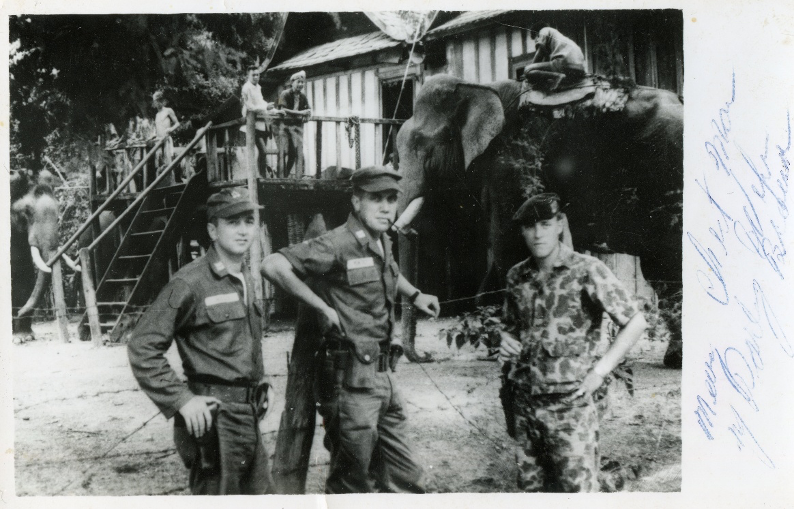
Jack Wells (left) at Bon Don on November 26, 1962; the inscription Reads: “Merry Christmas my Darling Wife, Because.”
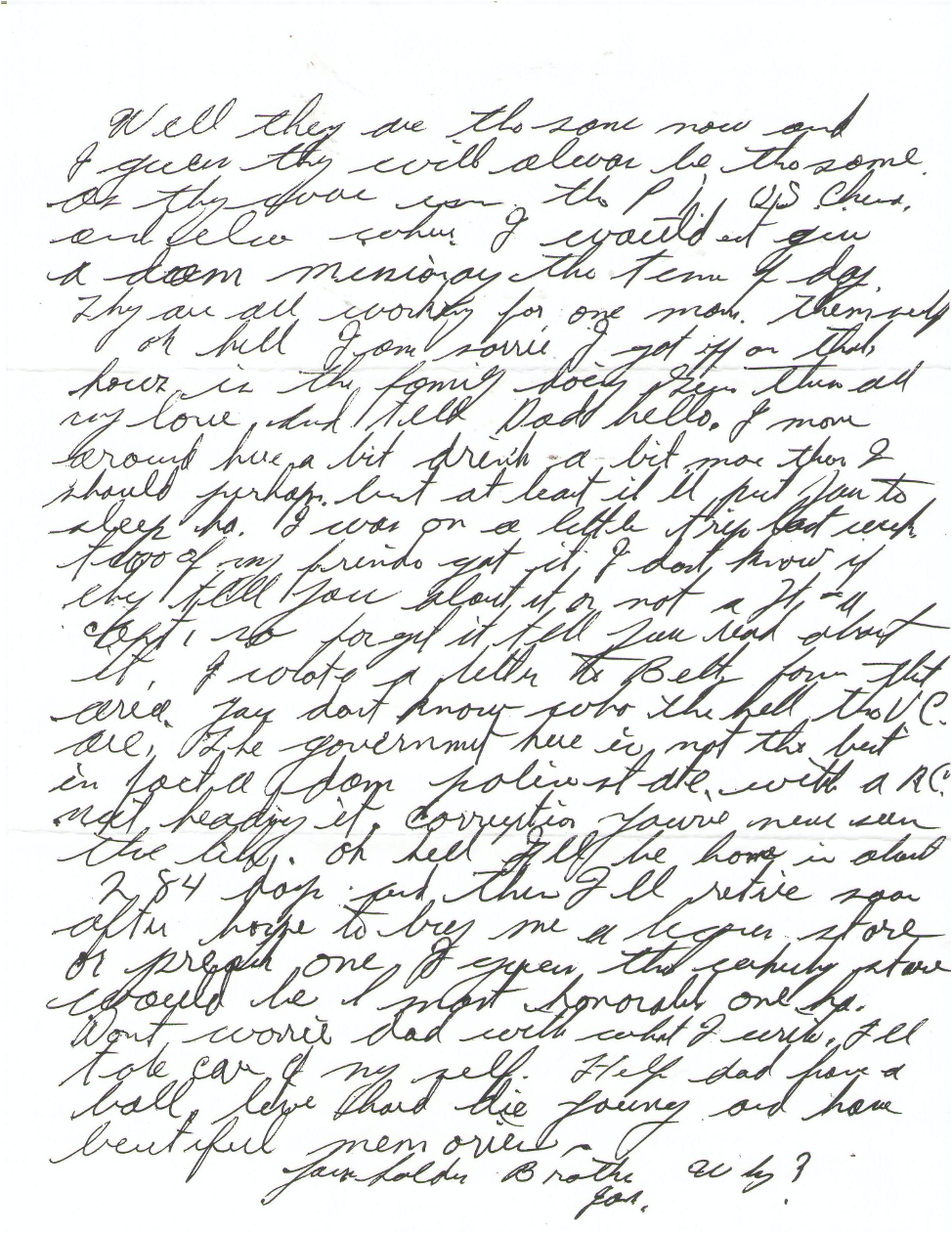
The letters recount such mundane events as lodgings and dinners, Wells’ day-to-day activities and travels in Vietnam, and his interactions with both American officials and Vietnamese allies and villagers, and, understandably, they express the longing to be back home with his wife and family. But the letters are also quite pointed about the corruption he witnesses in his travels. As early as June of 1962, Wells writes, “the government here is not the best in fact a dam police state, with a R.C. . . . heading it, corruption you’ve never seen the half.”
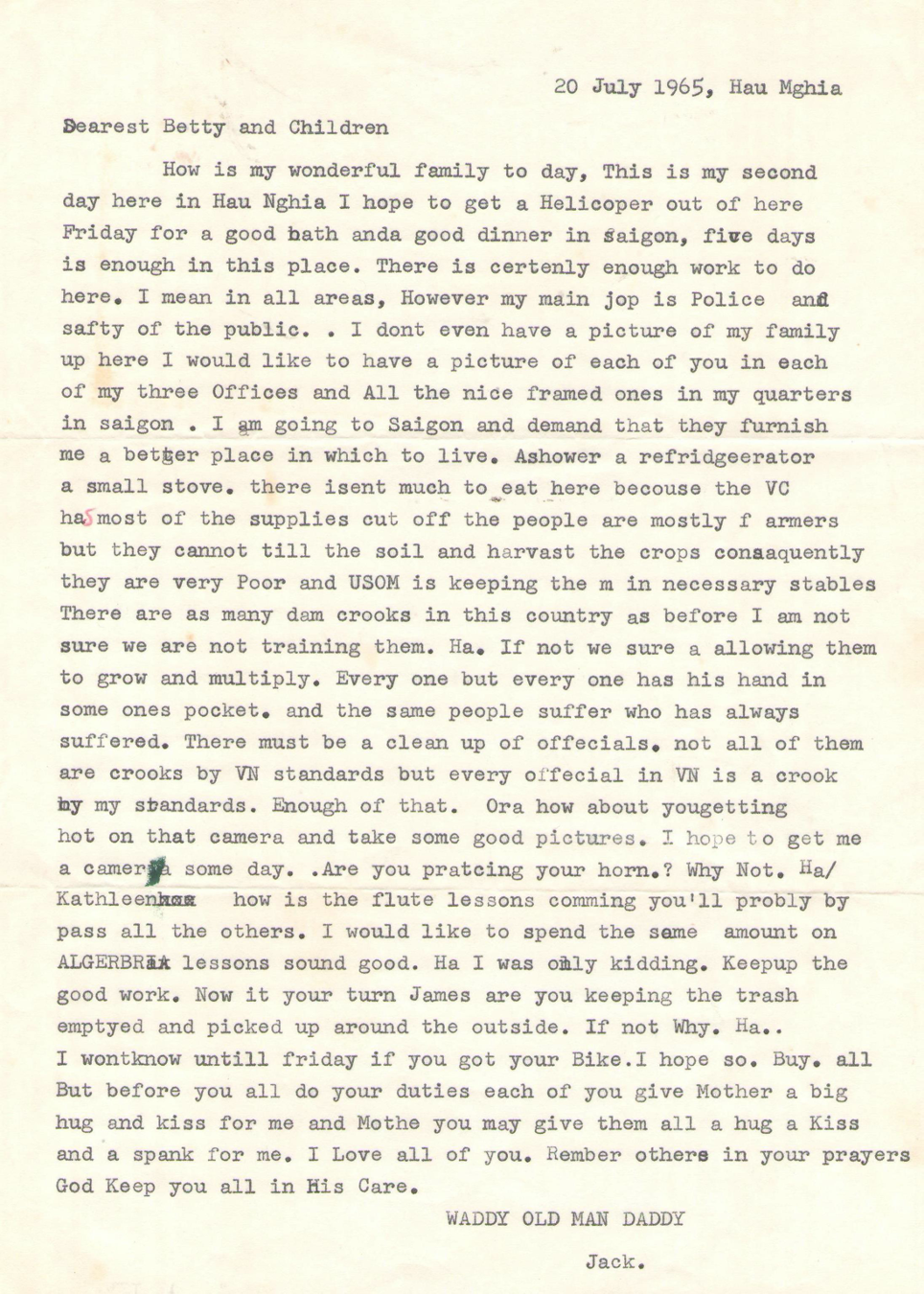
The situation did not change by 1965. In a July letter written from Hau Nghia, about two months before his death, Wells again talks about his daily activities and hopes that when he gets to Saigon he can have a better place to live. He also gently chastises his son James: “Now it is your turn James are you keeping the trash emptied and picked up around the outside. If not Why, Ha.” At the same time there is the concern, and anger, about corruption. He writes, “There are as many dam crooks in this country as before I am not sure we are not training them. Ha. If not we sure a allowing them to grow and multiply. Every one but every one has his hand in some ones pocket . . . ”
In another letter dated August 28, 1965, Wells wrote his wife: “Didn’t accomplish a dam thing. Perhaps another day. Oh Well, try I must, mad I do get however I told an American Lt. Col and a VN Major they weren’t worth a dam and they were giving the VC more service by not doing their job than if they were real VC.”
By all accounts, Wells maintained a high standard of honesty and morality for himself and expected others to follow that standard. His ethical commitment was evident early in his military career. After serving in the Pacific theatre, at 21 years old he acted as a “provost sergeant in charge of a special confinement unit at the war crimes trials in Nuremberg.” In letters written from Germany from 1946 to 1948 he indicates that American soldiers were selling contraband to prisoners. He turned them in. In an episode in Vietnam recounted by James Wells, Jack suspected that an ARVN captain was illegally transporting ammo and C-rations through a checkpoint, most likely for delivery and sale to VC. An armed standoff occurred but was de-escalated; Jack decided that the lives of his policemen were more important than stopping every suspect vehicle at the checkpoint. As a result, however, his father was called in by his supervisor, John Kesler, to discuss some recent reports. The upshot was that Kesler wanted the reports to be rewritten to falsify events and eliminate criticism. Jack’s response was that he would not be silenced.
James Wells’ search for the truth takes him to Vietnam in 2017, over fifty years after his father’s death, with the hope that he will find the site of the 1965 crash. Through a series of coincidences (which may not have been coincidences) he meets a number of Vietnamese people who remember, as children, the day in 1965. He talks with “a top-ranking communist official” at the time of the crash who “contradicted what the U.S. authorities told us. . . . I started to feel vindicated, knowing that a tiny hunch, a slight suspicion my mother had years ago, had grown exponentially into what looked more and more like a coverup and conspiracy.” After some false starts he finds the location of the crash, and on March 6, 2017, James and his siblings have a resurrection service. He connects his personal story to the family story to the national, really international, story of the war: “I thought of all those lost in this war and those that preceded it, who may have suffered and died here, perhaps even near this very spot we were standing in.”
The penultimate chapters take the reader further into the spiritual nature of James’ search for truth and closure, and raise issues that are relevant to anyone seeking a sense of peace after the unresolved death of a loved one. His tentative realization is that “‘Like Odysseus and Telemachus, my father and I have been searching to find each other to complete each other’s lives.’” There are echoes here of Hamlet’s search for the father cut off in the prime of life under circumstances that are purported to be true but are actually false. Hamlet’s quest is to find the truth and thus put his father finally at ease.
In a recent essay, “How Photography from the Vietnam War Changed America,” Damien Cave notes that “Long after wars cease, the happiest ending you can hope for is survival and the continued search for understanding. As Viet Thanh Nguyen, the Vietnamese American author, wrote: “All wars are fought twice, the first time on the battlefield, the second time in memory.’” In James Wells’ decades-long odyssey seeking the truth about his father’s death, and to come to some sort of understanding about both his and his father’s lives, perhaps the best he can hope for is psychological survival with the understanding that there will never be a final absolute truth.
Larry Abbott talks with James Wells
LA: What was the genesis of the book?
JW: The book began when I found approximately 400 of my father’s letters, 26 years after his death, back in 1991. Since I was only nine years old when he was killed, and had been gone on a year-long tour prior to that when I was five, I didn’t know the man, so of course I began to study the letters to learn as any son would want to know about their father.
LA: What was the basic content of the letters?
JW: Incredibly, the letters are a timeline of mid-20th century U.S. history, since the first letters are from a 17-year-old runaway delinquent infatuated with the most intelligent girl in school prior to joining the Army in WWII, and the last letter is from a 39-year-old warrior turned humanitarian the day before he is killed in Vietnam.
17-year-old Jack Wells during basic training
At first, I thought I would just publish the letters since they were so interesting and revealing of my father’s character. Granted, many of the letters are love letters, but what was most telling was that it came across that he was a very moral, righteous, and religious man, obsessed with the truth, and highly critical of those around him who did not perform their roles as they should. As a criminologist and familiar with whistleblowing, I suspected, and later confirmed, that his actions and words did meet the definition of a whistleblower.
In addition to often expressing his love of God, family, and country so eloquently, my father had a unique gift of writing to my mother as if she were sitting across the table from him as he spoke to her. Just like we engage in multiple conversations with our loved ones each day, he would continuously share his thoughts with her throughout the day, starting before breakfast, then at midday, then at night, and sometimes after waking in the middle of the night. Although they were polar opposites, I don’t believe a couple more in love ever existed.
I got caught up in that, feeling like he is communicating with me. The ring I wear—the same ring that belonged to the hand that wrote those letters, and that I scraped the burnt flesh off of when I found it in his personal effects—and whose inscription inside its diameter contains the title of my book, adds to the impact his letters have on me as I read them.
In my book, I describe how, through counseling, I learned how my story parallels Homer’s Odyssey. Like the Odyssey, mine doesn’t begin with the exploits of our fathers; instead, it starts with Odysseus’ son, Telemachus, who, like me, is languishing in pain and grieving for his father’s return. Meanwhile, on the other side of the world, or perhaps in another realm, our fathers are struggling and battling to return home to reconnect with their sons.
I want to remind you and the reading audience that, initially, my siblings and I generally believed what we were told about our father’s death. However, his letters prompted me to question what really happened to him and inspired me to embark on a quest for the truth through archival and field research across two continents, and as a consequence, reveal a CIA coverup. I consider that a miracle.
This wasn’t the only miracle I experienced. While in Vietnam, my siblings and I encountered countless wonders that left us in awe. I write about several of these miraculous events in the book. With respect to what drove me to write and finish the book, what initially drove me was simply wanting to get to know my father. Over time, and after counseling, I came to realize that it was about both of us getting to know each other and finding peace with what we learned and may never know. Keep in mind the CIA sent me a response this past April, eight years after my appeal of their 2017 denial, saying they will continue to withhold information due to national security, foreign policy, and personal privacy concerns. I’ve appealed again, but my siblings are now 75, 73, and I’m 69. We may not even be around when we hear from the CIA again. To tell you the truth, I now suspect it will remain forever classified. I think I’ll eventually be okay with that, since I write in my book about what I believe really happened, and what it will take for my father and I to find peace.
LA: What was the most challenging part of writing this book?
JW: Researching and writing faced many obstacles and challenges. In addition to the countless hours and expense of the research, traveling across the U.S. and Vietnam, the most significant challenge was the toll it took on my family, especially my spouse, Brenda. Ever since finding the letters in 1991, I’ve been obsessed with them. In addition to interpreting, transcribing, digitizing, and uploading them to an archivist website, I’ve spent years studying them to better understand my father’s actions and how they may have led to his death. On top of that, I spent a few years taking private writing classes, and after that, decided to get an MFA in Creative Writing, my fifth university degree. At least once during each of those years, my wife confronted me with that obsession that has taken so much time away from her. It has taken a toll on our marriage; I write about that in the book. For obvious reasons, the book is dedicated to her.
LA: How did you come up with the title?
JW: My father closed and signed many of his letters with simply the word “because.” I found out that it was a popular love and wedding song for much of the 20th century [see https://en.wikipedia.org/wiki/Because_(Guy_d%27Hardelot_and_Edward_Teschemacher_song].
My mother told me it was their song, ever since they were a couple. That, combined with the fact that my father’s wedding band contains the word “because” as part of its inscription, is another reason I discuss in the book. I devote part of a chapter to that discussion, and close it with what I think the word means to them.
In addition to Because being my parent’s song from high school, its single word communicates something much deeper and more revealing than just love. Though difficult to explain, it is a word that attempts to answer whatever questions its recipient might have had, no matter how emotional, sensitive, complex, and difficult they might be. No explanation or reason was needed. It was simply … “because.”
LA: Why do you think the CIA has refused your FOIA requests, especially after appeals and nearly 60 years after your father’s death?
JW: On one hand, I suspect that the CIA may not even know exactly what happened, and they are embarrassed about it, which is why the crash investigation report remains classified. As readers will discover, I confidently confirm that there was a coverup and a false narrative surrounding his death. In some respects, I may know more than they do. Unlike them, I had the opportunity to interview former NLF guerrillas and their leaders, who all insisted they had nothing to do with the plane’s crash. They were just as puzzled as everyone else about why it happened.
In addition, there is substantial evidence indicating that corrupt officials with a history of misconduct, including murder, particularly related to the refugee processing program and its coverup, may have been involved in his death. On the day he was killed, he was actively pursuing his initiative to reduce corruption within that program. We also know that the U.S. military often tolerated corruption because those often involved were competent military commanders who could assist U.S. forces. Ask almost any veteran of the recent wars we’ve been involved in in the Middle East and they will tell you this is a common occurrence with our allies.
As I mention in the preface of my book, I informed the CIA of my research agenda in May 2015 and initiated a Freedom of Information Act (FOIA) request for information related to the crash investigation of the Air America C-45 in which my father died. Nearly two and a half years later, in October 2017, the CIA responded, denying my FOIA request. After appealing the decision in December 2017 and seeking support from five different congressional representatives, I have seen no progress until now.
In fact, just recently, eight years after my appeal and 60 years after my father’s death, I received a final response from the CIA. They stated that information about the crash investigation of the Air America C-45 will continue to be withheld under FOIA exemptions b1, information kept secret in the interest of national defense or foreign policy, b3, protection of information prohibited by laws other than the FOIA, and b6, withholding information that would constitute a clear unwarranted invasion of personal privacy.
Through my study of President Obama’s Executive Order 13526, I learned that classified information over 50 years old should be declassified. However, “extraordinary circumstances” can justify maintaining classification beyond that time frame. My investigative memoir outlines those extraordinary circumstances for the reader.
Believe it or not, I have been anticipating this news from the CIA, which further validates my story.
One appealing aspect of the book is its whodunit nature, which allows readers to formulate their own theories about what might have happened to him and why.
LA: You are quite clear that there has been and continues to be some sort of coverup. Do you think there will be any type of retaliation for writing this book?
JW: Ha! Thats the question I get asked most often. I now joke about it and respond, “Well, if I were found dead one morning with a 22-caliber bullet in the back of the head, that would really increase book sales.” But no, I don’t fear retaliation, especially now since the book is out. The story about me writing it has been public for over a decade, with probably thousands of social media posts by me and reposts by others. I’ve personally notified veterans from all sides of the war, and the U.S. Army, the State Department, the CIA, and even Congress are aware of my actions and desire to write a book. If somebody wanted to retaliate, they would have done it before the book went to press. What would it accomplish now? Nothing!
James Wells has had a prolific career. He’s written or co-written over 65 books, chapters, and essays, and has authored some 150 reports for local, state, and federal agencies. His work has appeared in Military Experience and the Arts, Wrath-Bearing Tree, and Proud to Be: Writing by American Warriors. In addition to his writing, he was a corrections officer in a maximum-security prison and later assisted architects in prison design. He holds an M.S. degree in Criminal Justice, a Ph. D. in Research, and a creative writing M.F.A. He is a retired criminal justice professor at Eastern Kentucky University and currently lives in Lexington, Kentucky. Further information on his career and current activities can found at: jamesbwells.com.
Letters are copyrighted by James Wells and used by permission.
New Interview with Kevin M. Kearney
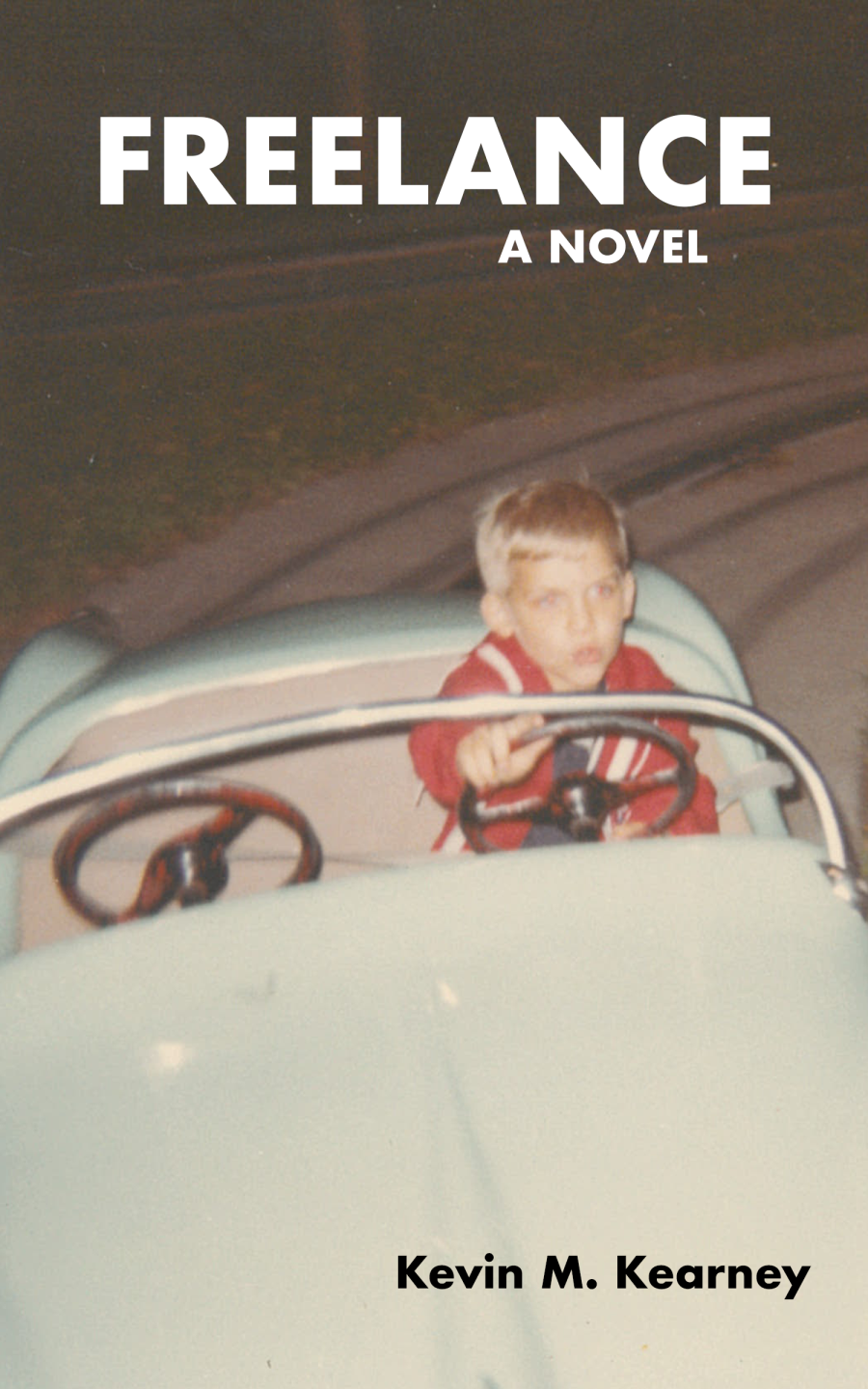
Genre-wise, there’s a lot at play here. I would call it a coming-of-age novel, but also kind of an “anti-bildungsroman,” in that Simon doesn’t so much find himself as quite literally lose himself. There are also science-fiction elements as well as horror ones. How would you break it down? What are some of your inspirations, in this vein? Do you think it’s horror and science-fiction—or is this just our lives at this point?
I’ve described the book as a “speculative Philly noir,” because I think it captures the vibe, sounds intriguing, and people tend to like compact descriptions like that. That being said, I don’t know what it is beyond a novel. To your point, I think writing about technology requires the tools of (at least) science fiction and horror. It helps that I’m drawn to writers who intentionally blur the lines between genres, so it felt natural for me to try to do the same.
Early on in the writing I was leaning into science fiction, reading stuff like Neuromancer and the novelization of 2001: A Space Odyssey. I also read a handful of Raymond Chandler books, like The Big Sleep and The High Window, because I knew that I wanted there to be this simmering tension, a kind of uncertainty about HYPR and its intentions, and Chandler is the master of that. I’m also very cognizant of the reader’s experience—I’m terrified of boring someone—and all of those books are really engaging texts that make you keep turning the page.
I don’t know how much those books are reflected in the text, but I like assigning myself potentially inspirational reading while I’m working on a project because I like to believe the moves of these great works find their way into my brain, even if I’m not totally conscious of it. If nothing else, it’s fun.
Philadelphia seems like a perfect setting. It’s trite to phrase it this way, I know, but the city feels like a “character.” It also feels like a ripe setting for a particular kind of juxtaposition (between old and new, perhaps) you draw in the novel. Why do you think that is? What are some of these tensions? Why is this novel set in Philly and not in, say, New York or Los Angeles?
I lived in Philly as an adult for 12 years, right out of college into my early 30s. I grew up in South Jersey, about 20 minutes outside the city. It was close enough that I went to high school in Philly rather than Jersey.
I started writing the novel almost immediately after moving from Philly to California, back in August 2022. I was pretty homesick, I think, maybe a bit culture-shocked, and found that writing about the city was a good way to process a big life change. So, I think that’s the most immediate answer: I was trying to figure out where I was by exploring the place I’d left behind.
I also just think it’s a beautiful city, despite all its problems. I lived in the house at 8th and Washington where Simon lives and, because I was in my early 20s when I did, I was enamored with the possibility of the city, in spite of the sidewalks being lined with trash and something in the air always smelling like shit. It felt alive, you know? Like you’d sit down on the stoop and it’s mostly just cars passing by, but you still feel like you’re taking in this beautiful scene. I guess maybe that’s a lot of cities, but Philly was my city for so long, so it felt right for me.
But, to your question about bigger cities, Philly is decidedly not New York or Los Angeles. People in Philly don’t want it to be New York or Los Angeles. Unlike other major American cities, it’s still possible for normal people to have respectable lives with modest jobs in Philly. My wife and I were both teachers and were able to buy a house in the city by 31. As far as I can tell, that’s not possible in New York or L.A.
So, I think that aspect made the story feel more realistic: Someone really could make rent doing rideshare in Philly. It wouldn’t be easy, but it could be possible. If FREELANCE were set in New York, Simon would have to live in, like, Newark.
The flow of passengers in Simon’s Subaru (a good alternate title) is a very effective narrative “vehicle.” I notice the voice—his voice—has a particular penchant for classifying customers into “types” and judging them based on certain sociocultural markers. What do you make of this kind of reduction? Is it something a social-media-fueled service economy does to us?
The internet classifies its content as well as its users. Whether you use social media or Google or almost any other popular piece of the modern internet, your keystrokes are being collected and used to frame your experience. Your data is your identity. So, the short of it is: The internet classifies us in the same way Simon classifies his passengers.
I thought of Simon, and a number of other characters in the book, as someone who’s been taught to view the world through data and metadata, because I think we’re all being taught to do the same.
Simultaneously I’m drawn to and repulsed by the Dylan character. He seemed to embody an important symbol, or carry an important frequency. I didn’t find him particularly redeeming; in fact, he seemed to be the target of a good deal of venom. He represented to me a historic truth: that often disaffected privileged people take up the battles of the working class, whether earnestly, symbolically, as a means to virtue, or as some kind of aesthetic or intellectual exercise or game (“Catan” is a symbol of this). In a way, though, he feels like the novel’s villain but also its truth-teller. I’m reminded of his line: “we’re accepting the machine’s warped versions of ourselves!” What is at the heart of that contradiction, that venom? Are we all bourgeois at this point?
Dylan was a fun character to write because I think he’s a very contemporary, very real type-of-guy, at least in certain parts of the country. He is an avowed socialist, yet can’t help talking over working class people. He has read a lot of theory on intersectional solidarity, but is still just a loud know-it-all. He’s interested in labor issues, though he’s never seen working.
I don’t think he’s a villain, necessarily, because as you pointed out, he actually makes some good points about HYPR, technology, and surveillance. He’s not an idiot, even if he’s annoying. And I think almost everyone in their early 20s talking about politics, and I include my 20-something self here, is insufferable.
Overall, though, Dylan’s worst trait is not that different from the American Left’s: he has great ideas but dogshit delivery. So, no, he’s not a villain exactly, but I definitely aimed to make him a foil for Simon. Not that Simon is a hero. Both of them are just younger dudes trying to figure out their place in the world. Their pasts are what cause them to do that in such different ways.
This novel feels particularly interested in thematic concepts of “SEO” and the ambiguity of whether, when algorithms are involved, anything is actually “chance.” I’m thinking of when the algorithm puts Cassie in Simon’s car (a rich allegory for dating apps). I’m drawn to the line on page 74: “It wasn’t that robots were spying on humans; it was that humans were just glorified robots.” What was the inspiration here; how far has it gone; and to what extent do you think it’s true, that we’re essentially pre-programmed for robothood?
I was working for an SEO-focused website when I started writing the book and was amazed at how it changed my perception of the internet. I quickly realized how much of Google’s search results were just shoddy, recycled (often imprecise and sometimes outright incorrect) information tailored to rank high on the page and earn clicks. Once you learned a few things the algorithm was rewarding, you could quickly rejigger a page with some keywords, new-fangled headers, and a few lines of code to make it jump to the top of the results. It didn’t have to be good, it just had to match what Google had deemed “good.”
SEO is now in sort-of a death spiral thanks to AI. But AI is being fed millions of web pages that were written explicitly for SEO—the same pages that were constructed from recycled, shoddy information.
So, the information isn’t any better, but people assume it is because it has the appearance of authority. It’s AI! But that’s just not true. Unfortunately, that might not matter. The more people defer to the internet/AI for answers, the more they begin to see the world in the way the internet/AI sees or wants them to see the world.
Am I rambling? Maybe.
Probably stating the obvious here, but Google (and most popular websites/apps) are collecting massive amounts of data and then using it to spit content back at you. Apple recently paid $95M in a lawsuit related to Siri listening to user conversations. Years ago, people who said their phones were spying on them were seen as paranoid. Now, we’re aware that all these things are happening, but we passively accept them as the cost of having such amazing technology.
But it’s still disappointing, for me at least, when I realize that I can be pinned down so easily. It’s pathetic that I’m such a clean marketing demographic, you know? Not that I’m a particularly unique person, but it’s depressing to know that what I perceive as the complexity of my brain, past experiences, desires, and interests can be categorized so easily by an algorithm.
I take solace in the fact that there’s still a lot of things I do offline. I don’t track my exercise, I listen to a lot of physical media, and I almost never rate things I consume. The YouTube algorithm is mostly serving me live Ween videos, so I think that’s probably a good sign.
I love Simon’s parents. What is it about Gen X parents that begets this kind of depiction—at once kind but something also naïve about them? Can we talk about this?
Thanks for saying that.
I don’t know what it’s like to be a parent, but I can imagine it must be really difficult to watch your child seemingly become someone you don’t recognize. I taught high school for 10 years and got to know lots of parents like Simon’s. Good, decent people trying to get a handle on why their kid was suddenly failing out of school. Earnest, well-meaning parents just trying to get through the work week and feeling frustrated that their teenagers were making that so difficult.
And I think people, parents and non-parents alike, often look for easy answers for complex problems—and the internet is happy to provide those for them.
The image of the unseen damage Cassie is accruing over years of standing next to an X Ray is a particularly affecting image, especially when coupled with that she says software will eventually do it, and all that matters materially is the paycheck. Would you call this novel “anti-work?”
No, I wouldn’t, but that’s mainly because I’m leery of classifications like that. In general, I get uneasy categorizing anything I write as explicitly political. I’m interested in storytelling above all else. I don’t pursue a narrative to execute a theme or an agenda. A lot of times I’m not even concerned with having “a point.” I just want to follow a story and see where it goes.
Of course, some people might say, “Okay, but pursuing that story is really just delving into your unconscious, which is filled with the signs and symbols of your belief system.” (They might say it exactly like that.) And that’s fair. It’d be disingenuous for me to say that the book doesn’t comment on work. It does. It pretty clearly criticizes work that aims to dehumanize people, in ways both overt and subtle. So, I don’t know if it’s “anti-work” but it’s definitely “pro-human.”
There are people in the novel, mostly poor or working class, who are outside of its ire. The bearded man with the capped tooth (until he’s revealed to be a plant from a rival ride-share app) functions as a kind of Diogenes the Cynic. Cassie’s daughter, Maya, seems to get it, when she says, when asked what she wants to do when she grows up, is just “be Maya.” What is the way out, in your opinion, beyond smashing our phones?
I think Simon proves that smashing your phone won’t fix the problem. The boring answer is that the tech industry needs to be regulated. It won’t fix the deeper problems, but it’s a start. And it’s one of the few bipartisan wins in this country.
But on a personal level, I don’t think there is an easy way out. I think the real answer is you need to go the other way—you need to change your mind. If you believe that tech is intentionally trying to rewire your brain, then that should frame everything you read on a device. Why was this fed to me? And what is it trying to make me feel?
I’m glad the scene with Maya resonated with you. That’s kind of the crux of the book, I think. I left teaching after the pandemic and struggled a little with that departure: for so much of my life, I had thought of myself as “a teacher” and assumed that signified things about my values, my identity, and how I treat others. Suddenly, when I no longer had that shorthand (“I’m a teacher!”), I was left wondering…well, am I still someone with values, an identity? Do I still treat others well? Was I ever that person? And I had to try and prove that to myself, outside of a readymade job title. It was difficult but ultimately really healthy; it forced me to confront who I am versus who I say I am.
Around that time, my wife and I were babysitting our nieces, and I helped the older one with her bedtime routine. When she went to brush her teeth, she was so focused on the task at hand. It seemed like there was nothing else floating through her mind—she wasn’t worried about the next day’s tasks or regretting something she’d said earlier. She was fully present for this totally mundane activity in a way that a lot of woo-woo adults wish they could be. And I found that really beautiful. She’s not caught up in her professional identity or even her social one. She’s just there. She’s just herself. It’s something I’m striving for every day.