New Nonfiction by Blake Rondeau: Smile
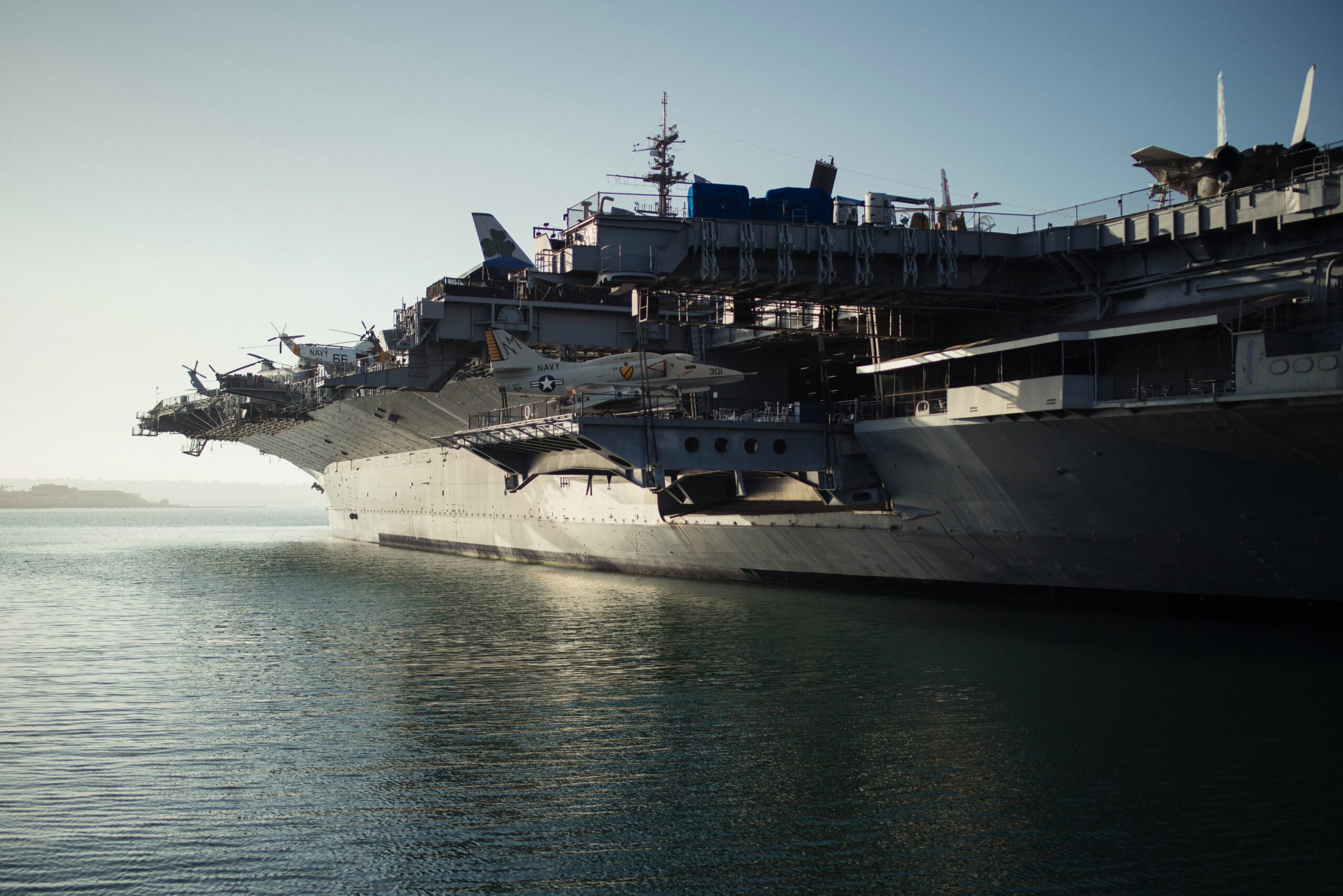
I remember the smell of the plastic blue gym mats under my face as I grappled another Marine in the hanger bay of the USS Boxer. What felt like a youth indoor football field, except grey non-skid instead of turf, two huge accordion sliding doors which opened up to the elevators to take aircraft to the top deck of the ship. In reality, in our day to day the doors just let in all the weather from outside into the bay. Today, the humidity was somewhere between eighty percent and Satan’s asshole and our polyester-blend uniforms did absolutely fuck-all to absorb the sweat—no one even bothered to wear skivvy shirts anymore because all it did was create more laundry.
I was training for my Green Belt in MCMAP (Marine Corps Martial Arts Program). I was a two-year Corporal and had been on leave when our grey belt class was offered, so now I was working back-to-back courses to avoid getting left behind on the Marine Corps standard.
Today, the Staff Sergeant (SSgt) running the program thought it would be funny to pair me with the fat-fuck LCpl. LCpl Cox outweighed me by easily 50 pounds—you were supposed to be partnered with people similar in stature in order to do body weight exercises and carries with your partner. Instead, I had a SSgt with a grudge against me for being the office clerk and not just a “gun bunny” (artilleryman) who decided today was the day he’d screw me over.
We’d been training for about an hour and a half, covered in sweat and face stuck on the mat. My Direct Report came running into the hangar bay and told me that First Sergeant (1stSgt) was looking for me. Having been the Battery Clerk for some time now, this was not an unusual request because my job was to generate reports for him. In fact, I had been training Stueland, my LCpl, to be my replacement, but it seemed he liked spending less time in the Battery Office than I did, and I would frequently get calls from the 1stSgt asking me where the hell his clerks were.
“Did he say what he wanted,” I asked.
Stueland just shook his head and said, “All the Brass are up there though.”
Great. I thought as I walked through the ship. There was nothing like an ass-chewing from everybody. First Sergeant knew I was in MCMAP—he had insisted upon it—so he wouldn’t send for me unless something was wrong.
I walked through the mess hall, down the passageway, up a flight of stairs, and took a right at the exercise bikes. I paused in front of the flimsy, white door of the Battery Office, took a deep breath and entered.
When I opened my mouth to say good morning to 1stSgt, I was eye to eye with Chaps.
Chaps was the Battalion Chaplain, who, in an earlier life was a college football player. He now stood in front of me, large shoulders slumped, fidgeting with his wedding ring as he did when he thought. He looked down and quietly told me to shut the door. A SSgt from beside me slid a chair into the back of my legs.
“Sit, please,” Chaps said. I did. As I sat down it started to dawn on me what was about to happen. It also dawned on me how many men were standing in the smallest company office I’d ever been in.
The Navy provided offices for the Battalion around the ship’s gym. Each infantry company had an office and then all the attachments, like our artillery battery, got the smaller rooms. Inside the small room was my CO, XO, my LT, 1stSgt, my Gunny, Company Gunny, my Platoon Sgt, and HQ Platoon Sgt all off to the sides of the office, and Chaps in front of me on a little metal chair. Ten grown men in a 10×10 room furnished with desks on both sides and two filling cabinets shoving us all into an even smaller, more uncomfortable 8×8 foot space to talk about whatever bad news Chaps was about to lay on me.
That’s when he picked it up off the desk. The red folder. Two things in the military come in red folders: Secret Material and Red Cross messages. Chaps wouldn’t be here to deliver an Intel brief—I may be a Marine, but I’m not a complete fucking moron.
“We received word today that your grandmother passed away.” Chaps said slowly.
“Which one?”
“Uh…” He fumbled the folder open again and looked, “uh…both, I’m afraid.”
“Both.” I repeated. “So, Nancy and Marylynn?”
Chaps looked again, wanting to make sure he got this right.
“Yes, I’m afraid,” he repeated his salve.
“When?”
“Marylynn on the 24th and Nancy…” he checked the record, “The 11th.”
I took it all in for a moment. God love her, but Nancy—my mom’s mom—was kind but in a depressive state for most of my life and we never had much of a relationship.
But Marylynn; she was a third parent. She had my sisters and me over for sleepovers, holiday weekends, and birthdays all the way until we were in our teens. She did all the grandma things: She let us stay up late and watch movies, order pizza, eat too much ice cream, play pool in the basement, and in the winters, would always have my grandpa make a fire for us to roast marshmallows for s’mores.
My sisters and I would read books or magazines, play with new toys, or play Chinese checkers with my grandma in the living room. Grandpa would sit in his chair at the back of the room and Grandma would take her time-outs to have a cigarette and let us continue to play.
She would often tell me I had a beautiful smile. She’d just watch me laugh and play with my sisters, never commenting on if a joke I said was funny or if a story I told was interesting—she had no mind for the substance of our adolescent prattle—but she would stare at us; happy to see our smiles. A form of currency, as a grandparent, to know you’re fostering happy moments in your grandchildren, a confirmation of love.
The last time I can remember her commenting on my smile was when I stopped by my grandparent’s house on my 10-day post bootcamp leave. I had graduated some ten pounds lighter than when I left and, according to her, hadn’t had ten pounds to lose in the first place.
I had worn my uniform to church and then driven over to her house to say hello and check in after being away three months. She smoked her GPCs at the kitchen table and greeted me with a turn of her shoulder and an, “Oooh hiiii,” as I knocked and walked in the door.
“Hi Gram,” I said as though no time passed.
“Look at you! Looking sharp. Say, what a nice uniform.”
“Thanks, Gram.”
“Oh, there you are,” she said as the smile had broken across my face. “So handsome.”
I was hoping the compliments would die down before my grandpa heard and came into the room. He had been in the Army, my dad had been in the Army, they all were in the Army. So, me being in the Marines was a point of needling for my grandpa.
“So those are your dress blues,” he said, entering the kitchen from the living room.
“Yes.”
“Look pretty sharp,” he said with his subtle inflection that let me know he was a little proud.
“But remember,” he changed to a would-be serious tone, “You ain’t shit unless you’re Airborne,” he chuckled.
I laughed and felt at ease knowing I was still just their grandson. I wasn’t a warrior, a devil dog, a hard charger, Jarhead, Killer, Hero, or any other bullshit name given to Marines. I was just a kid.
***
But now I wasn’t at ease. Nor was I laughing or smiling. Nine men avoided eye contact with me. One man, Chaps, who had been like an uncle to me since I moved to this Battalion and started going to church regularly, stumbled through the details, out of love and empathy of course, but nonetheless, there I was sitting like a fool, getting factoids from inside a fishbowl. Alongside men I didn’t want to drink a beer with let alone be completely torn open; none of these men knew me, none of them cared. We’d shared nothing more than pleasantries in two and a half years and now I sat in a cold room, on a metal chair, sweat freezing against my body, as my blood congealed inside me and my mind reeled from the idea that when I do get to finally go home, the woman who had made my family a family was no longer there. No more drawn out “hi’s” when I walked through the door, no more soft hugs, and no more holidays in her house where the petty family squabbles died, because she said so, and we just got to be a family and enjoy the food and decorations she made.
Now, looking up, and seeing them look back at me, that was worse. Everyone looking for me to react, waiting with vacant faces for me to tell them it was okay and that they could go back to their own lives and fuck off about my own issues. My tongue felt fat and heavy in my mouth. My mind was screaming at me to just say something and get out of there.
“Can I… go?” I asked. I felt like a child asking for a snack, but what the hell else was I to say.
“Sure.” Said Chaps, “But before you go…” I felt whatever energy I had that was trying to lift me off my seat, slump back down again.
“Let’s pray quickly”
Fuck. Me. Hard. The thought screaming in my head. Chaps, buddy, as much as I appreciated this gentle gesture, I just needed to leave.
But he prayed. He prayed that they be at peace and other such things. I’m sure it was sweet. He was being so kind. But until he said, Amen, I didn’t hear a word of it. I was biting my lips and repeating, Do. Not. Cry. in my head until he finished.
“Thank you,” I said clumsily after the prayer was over. As I stood up to leave, I finally made real eye contact with my LT and Platoon Sgt who were both nodding their heads slowly in an attempt to be consoling, but only looking stiff and uncomfortable as their weight shifted, brushing against one another. I gave them a nod back and opened the door and closed it with a crack.
I was back into the gym next to the empty exercise bikes, walked forward only a few paces, before my favorite Sgt appeared,
“Did you hear if we were going out tonight?” he said to me.
I didn’t hear him. I didn’t understand the words until later when I was back at my rack with the shades pulled. But at that moment, I reached out to hug him and he hugged me back. And I cried. I cried hard. In total the hug probably lasted 15 seconds. But it felt like an hour. When we separated, he asked me if I was okay. I didn’t respond directly or even to him. I simply straightened up, wiped my tears, and said aloud that I was sorry.
I was sorry I wasn’t with my family. I was sorry for crying on a grown man. I was sorry for getting myself stuck out here in the middle of the ocean, so I couldn’t go home. There was a great deal I was feeling sorry for—not least of which was being there for my grandma. Not holding her hand, sitting in a hospital room, trying to ease the pain by telling her a joke. I have thought many times that, had I been home, maybe I could have made her laugh and maybe even myself laugh, and we would be sharing, “I love you’s,” and making a final memory with laughter.
Or perhaps it could be some other happy cliché I could have on replay inside my memory bank like saying goodnight and turning the lights off for her to pass blissfully in her sleep. But that doesn’t happen in real life. There are no perfect hospital-scene endings. No holding her hand while the music fades and the lights go out. No whispering a final message into her casket.
It’s been fifteen years since then, and I haven’t smiled the same way since. Oh, I can laugh. Some days, I can feel truly happy. But it never seems to feel the same and I find it’s an all-too-common practice to remind myself: Smile. There you are.