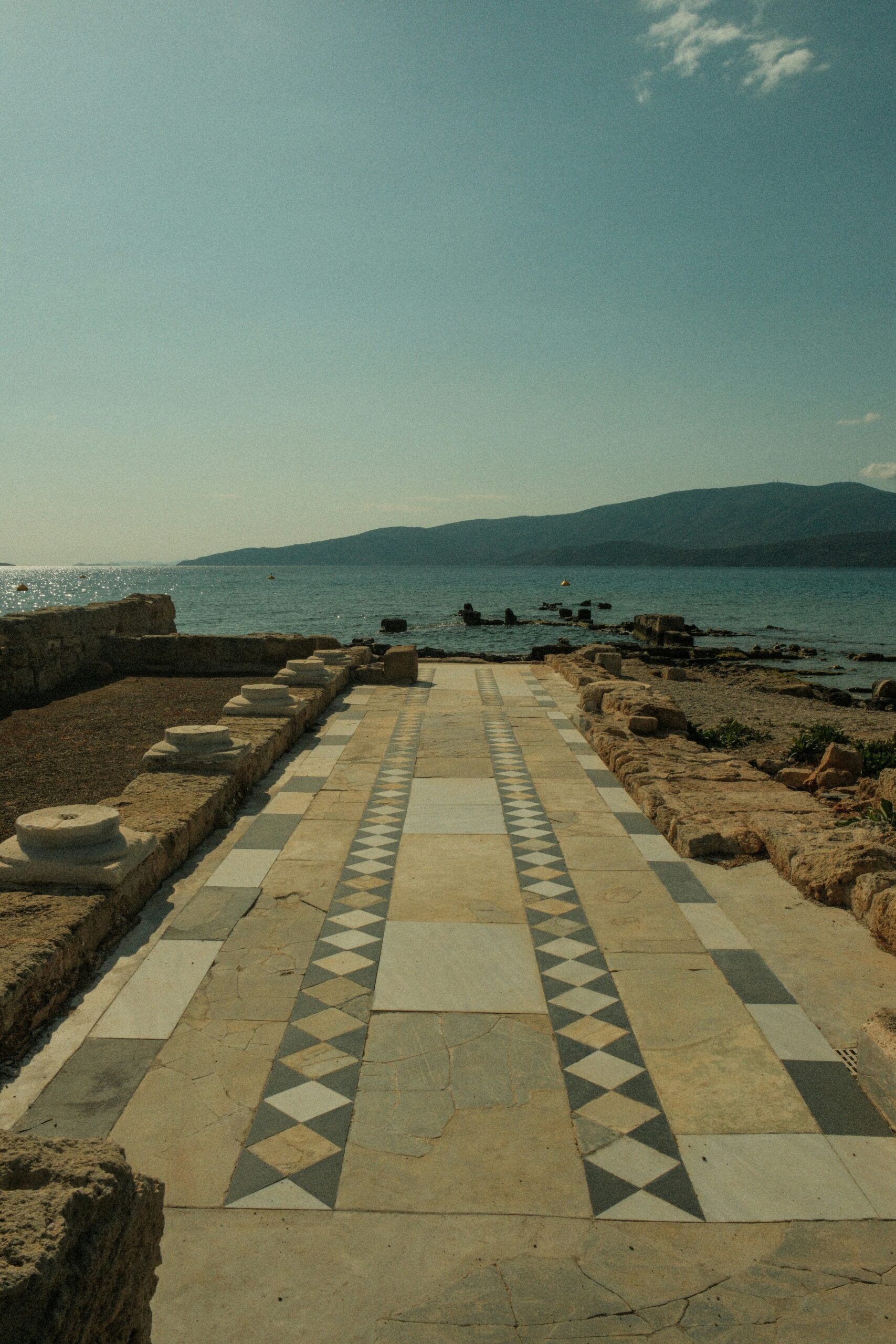
Captain Abibalus was troubled. Walking up the dusty, cypress-lined path from Kyrenia’s harbor, Abibalus’ practiced eye took in the worn marble buildings. Much had changed since the last time he’d been here. A decade go, trade had been harder; less settled, but more profitable for the enterprising trader. It had been the same story in Alexandria. Old associates gone. Dead, driven out of business, or resting easy on the fruits of their labor. Dilapidated warehouses and fields gone to seed. At every corner, some gaudy new shop hawking poorly-made trifles. Rome had seen to it. Its gods were supplanting the old gods, its ways, the old ways.
Maybe he should have stayed in Iberia, Abibalus thought. The weather was worse, but there were more opportunities for a crafty and hardworking merchant like himself. Trade with the surly Gauls, and the taciturn British. Construction in that part of the Empire was booming, which meant an insatiable lust for materials, tools, and skilled labor. It created an energy very different from the one he could see in this aging port town.
Then he thought about dying in a foreign land, buried in the cold, wet soil without funeral rites. He shuddered. No, his people were from this area. He wanted to be mourned by a son or grandson when he passed, not years later, word of his passing carried by Rumor. He’d returned for good reason.
This glum mood couldn’t last long. Even after decades’ worth of journeys, the return to land always impressed Abiblus, whether it was to a faded backwater like this one whose glory days were long past, or to mighty Rome. The urban breeze was not pleasant — burning trash, burning wood from the smithies, burning, burning, burning — and occasionally, a small respite, the breeze carrying along a whiff of those crocuses Abibalus had never seen anywhere else. The sum of all these smells was commerce. For that, Abibalus had a nose like few others.
Meanwhile, strolling along the beaten dirt path he savored the way the solid earth didn’t sway the way his ship deck did while riding the Mediterranean’s waves. His body still felt the swaying; it would for a while to come. There was a time when he’d been able to absorb the transition from land to sea and sea to land effortlessly. Recently he’d noticed that it took longer to adjust. He’d experienced enough of life to understand that even this mild discomfort and disorientation was a kind of blessing. Like drinking too much. Another way for his body to navigate a strange and restless world.
Their journey from Alexandria had been smooth — Rome’s fleets effectively curtailing the activities of pirates. Now, his ship’s disposable cargo was in the process of being hauled out of the hold, to be turned into profit. At this stop it meant unloading ivory he’d taken on in Alexandria that had itself been ferried, carried and dragged from deep in the Egyptian interior. With the proceeds, he’d take on a load of copper before they continued to Syracuse. Later they’d finish at Ostia and unload the grain at the great city for which the Empire was named and on which so much depended. Even though the trade routes weren’t as profitable as they once were, certainly not for a small family outfit like his own, they were much more reliable. Grain shipments to Rome were an unostentatious way for a merchant like Abibalus to guarantee a prosperous journey, while making some deals on the side.
The Egyptian port city named for the great Greek conqueror had left a sour taste in Abibalus’ mouth. Not because of the trade; Abibalus had ferreted out a choice deal, though there were fewer of those than there had been a decade ago and took more effort to track down. No, because the city was so developed. A culture was settling over the Empire, a kind of complacency, expressed in new types of commercial activity. The vibrancy of Rome’s Republic was being replaced by a stultifying certainty. 100% returns on investment had shrunk to steady, stable 10% returns, barely enough to cover expenses unless one dealt in scale. Individual contractors were being replaced by guilds and associations. No more handshakes, no more personality.
And everything was getting cleaner and more expensive, transmuted by the magic of privilege and collective prosperity. Well, Abibalus thought, at least there was still one thing he could depend on, a rock of in an ocean of changeable novelty: Demetrius’ tavern. Each shaking step brought Abibalus closer to the tavern, where he could buy a fresh plate of roast lamb, and a cup of that good, fresh Cypriot wine they served. The tavern’s owner, a monumental figure named Demetrius who had settled down after making good on a lifetime of trades, had connections from the hills and mountains inland, he’d often boasted about it. The stuff the Cypriots didn’t ship abroad. It was dark, sweet, and rich; a flavor unlike anything Abibalus had ever found. It was a treasure in itself. There, with good wine, among other traders, Abibalus would see about prices in the area and get the latest news and rumors.
Although he’d passed away a few years ago, Demetrius left behind a wife and a large family. She and their youngest son ran the establishment. It was a popular gathering place and a convenient fixed point for striking deals or storing goods. A second opportunity to make a deal if for whatever reason, a shipment or agreement fell through. Especially with smaller projects. A few dozen crates of oranges you picked up on spec, a small shipment of olive oil you took a gamble on to maximize your profit. Having secondary markets on which to offload various speculative investments was a key to success — at least, Abibalus found that to be the case. 3% profit here and 7% there added up. And a small loss was better than a disastrous reversal.
Abibalus had sailed with Demetrius decades ago when starting out; the Cypriot had taken Abibalus on as a sailor, and then when he’d demonstrated a capacity for numbers, had helped stake him a share in the growing Roman-Iberian trade. After he’d paid Demetrius back for that investment, Abibalus had gone further, traded near the edge of the Empire. Abibalus had considered the man more than a mentor — he’d been a friend. Demetrius had run a tight ship and taught Abibalus many of the nuances of shipping in this area, as well as the principles of trade. Family was the most important thing in business, but friendship counted for a lot too. Especially a friendship borne of the oaths men swore while steering into a wave taller than their ship’s mast, and praying to the various gods the ship’s crew venerated when a storm blew up unexpectedly in the Aegean. In fact word of Demetrius’ death was one of the reasons Abibalus had returned to this region: he’d left originally when striking out on his own, out of respect for the man and his legacy, and a desire not to compete with him.
As he walked past warehouses and small dwellings, Abibalus thought more about his old comrade. Beyond the pleasant memories of shared sea-battles, Abibalus held Demetrius in high esteem because he’d been charismatic and kind. Some of that magic had rubbed off on his establishment. Abibalus didn’t think much of his erstwhile captain’s wife, or his sons — nothing bad, but nothing good, either, he regarded them much the way he regarded anyone else — but the place endured in part because of the goodwill the man had accumulated over the course of his life, and the many connections that had subsequently been forged at his establishment. If Abibalus had any instinct for settling down, perhaps he’d look more closely at emulating Demetrius. But the sea called to him; a life on land was not in his soul. He had the money to settle many times over, and he was old, but he knew, deep in his bones, that he’d die in a boat, under the benevolent and crafty gaze of Melqart. His goods, his little network, would go to his sons, some of whom would prosper — his eldest, and his third — some of whom would probably squander it. Such was the way of the world.
With these uncharacteristic musings about legacy stirring his thoughts, Abibalus arrived at Demetrius’ tavern. The place had changed; they’d widened the front, and put up a wooden sign outside advertising themselves with a picture of a wine jug and a loaf of bread. Planters of small white and pink roses were placed tastefully on the windowsills, which had been spruced up with new planks of clean pinewood from the island’s mountainous interior. The establishment didn’t look quite so rough as it had under Demetrius. Abibalus scowled instinctively. It was happening here, too, in sleepy Kyrenia — everything was getting nice and clean.
The interior confirmed Abibalus’ fears. Formerly dark and dirty, the tavern had been painted brightly and filled with new wooden furniture: tables and benches, a few of which were occupied by patrons. Rather than the boisterous and rowdy tumult of years past, the conversation was being held at a respectful and quiet murmur more appropriate for diplomatic delegations and scribes than for merchants. The layout had changed, too; the dining area was shortened. Where in the past there had been a long bar over which Demetrius used to lean and shout business and affectionate if insulting nicknames at the various travelers and traders who’d stop in, all of whom he knew by sight, there was now a clay brick wall. A pretty slave lounged behind a wooden stand, twirling her long black hair with cultivated disinterest. When she saw Abibalus enter, she guided him to one of the unoccupied tables and began listing the types of food and wine they offered. This was new, and Abibalus didn’t care for it — he’d been to many establishments like this, and it wasn’t why he’d come to Demetrius’. He could overpay to be served by slaves anywhere.
He resolved to leave. During previous visits to Cyprus he’d missed the island’s other eating options owing to his friend, and then more recently the loyalty he bore to the memory of his friend. Abibalus was just about to thank the slave for her time when he saw a small group of traders from Tyre. He knew this because he’d done business with their captain before, a crafty but trustworthy man named Phelles. He made his way over to their table, where a young man, one of Phelles’ crew, appeared to be holding court.
“Captain Phelles, my good fellow. How goes it?”
Phelles looked up warily, then recognition lit his eyes. “Captain Abibalus! Well met old friend. I didn’t realize you were back in this area. Here to pick up some of our old friend Demetrius’ slack?”
“Precisely right. We’re just in from Alexandria,” Abibalus said. “Stuffed with grain for Rome. But I had a chance to acquire some choice ivory from far up the Nile, and happen to know of a group of blacksmiths who are always eager for copper near Syracuse, so made a quick detour here. The grain will keep. What are you up to?”
Phelles grinned. “Stopped over here on a short hop from Tyre. Heading back with copper and timber from the interior, then who knows.” He waved the slave girl over and ordered her to bring food and wine for Abibalus. “Sit, sit, join us. We were just discussing politics.”
“Politics and religion,” said one of the men sitting next to Phelles.
“My first mate, and son-in-law,” Phelles said. “Kyriakos. He was telling us about some new god he follows.”
The Greek carefully wiped his mouth with a piece of linen he procured from his clothes, then cleaned his hands with the same. “Not some god, the God,” Kyriakos said. “Jesus Christ, son of our lord and father.”
“God the father? The sky God?” Abibalus said.
“No,” Kyriakos said, his brow furrowing. “No, God, Jesus Christ, not a god, or the sky god.”
“Easy friend, I meant no disrespect,” Abibalus said. He’d been in thousands of conversations over the course of his life and could see this one was in danger of heading totally astray. He resented having to diffuse what looked like it might turn into a trying meal, with him shoveling his energy and effort into the maw of this young man and his religious devotion to — to what? Some new god or gods. Meanwhile they were both part of the same old empire. People were losing out on economic opportunity, were missing the prosperity of the previous generations, and it seemed like every month there was some new cult or sect springing up as people invented new spiritual spaces to make up for their lost shot at wealth or social mobility.
On the other hand, all things considered, it never hurt to learn a bit more about a new god. And better to risk a little offence here, where the stakes were low. This way, when Abibalus met a trader who followed the new god he’d know how to avoid putting his foot in his mouth. “Tell me more about this god. Excuse me, God.”
“Hope you enjoy the food,” Phelles said, laughing and elbowing Abibalus in a comradely fashion. “You’ve been away for too long. You’re in for a real story.”
Kyriakos looked at his father-in-law with annoyance, then launched into an improbable tale with the fervor and conviction of a new convert while the other people at the table ate or drank, obviously having heard this many times. Abibalus understood immediately how it was — this was probably the influential eldest son of someone Phelles wanted to be connected to, some Greek, and either had always been fervent or had recently converted. You live long enough you see all sorts of things like this. Abibalus was relieved it hadn’t happened to any of his children, becoming enamored of a god, but there wasn’t anything dishonorable about it. It was just sort of inconvenient — being dogmatic about a religion would certainly make life as a trader difficult.
“Hang on,” Abibalus said when Kyriakos got to one point. “Did you say the crowd released a murderer and crucified the King of the Jews?”
“That’s right,” Kyriakos said. “The Roman governor asked the crowd who to pardon, Jesus Christ or Barabbas, a common murderer, and the crowd elected to release the murderer. The blood of God is on their hands.”
“Jesus Christ is your God? And you say he was crucified?”
“That’s right,” Kyriakos said with conviction. “Then ascended to heaven where he is seated at the right hand of God the father.”
Abibalus looked at Phelles for tacit permission — this was, after all, his son-in-law, his business associate. He didn’t want to injure the man. “You know I was there. I was in Jerusalem when this happened. I guess it was about a decade ago. I saw it all.”
“You saw the crucifixion!?” Kyriakos was astonished.
“Sort of. It didn’t happen the way you said. I’m not saying your man Jesus is a god or not, but it didn’t happen that way. Would you like to hear how the thing transpired?”
Kyriakos was quiet. He looked intensely at Abibalus, and, apparently satisfied that the man was telling the truth, he nodded.
“So I was in Jerusalem on business. Normally I stayed with shipping routes, “do the trade you know,” as they say, but Demetrius was looking for opportunities to expand. I offloaded a shipment of armor and joined a caravan to Jerusalem to deliver them to the Roman garrison. This was a priority shipment and I was to be paid in coin. Good silver. Back then, Tiberius was emperor, and one had to take extra steps to ensure things like that were solid. Demetrius had a contact in Rome, the husband of a very good friend of his wife’s and this was a good deal. So it was decided that I’d travel further inland to see if there was other business to be done, other opportunities.
Well when I got there, of course, there was some kind of festival. And this was a Jewish city, and the Jews are a very devout people about their god, and the Romans had got hold of a man for preaching insurrection against the empire. The man’s name was Jesus, though sometimes he went by Jesus Bar Abbas. Some people claimed he was the Messiah. I can’t say how he saw himself.
I’d dropped off the shipment and was awaiting a meeting with the governor for payment, a man named Pontius Pilate — a quiet man, I can’t say I was impressed by him — when a great crowd gathered to demand the release of this rabble-rouser, whose name was Jesus Barabbas, or that’s how they called him. The crowd prevailed upon Pilate to release the man and Pilate agreed. Pilate said that if the city would take responsibility for him, that Jesus Barabbas would be released to them, but that if Jesus continued to preach insurrection, Rome’s troops would move to detain him again, and there would be bloodshed. This seemed to me quite proper.
So Jesus Barabbas was released to the crowd, and they were happy. The crowd headed off to watch the crucifixion.
Later, when collecting my payment, I asked Pilate about the episode and he said that this sort of thing wasn’t unheard of. The Jewish people would occasionally produce charismatic individuals claiming to be their messiah, their savior, a harbinger of the end-times. He said that he’d talked to this Jesus while the man was in custody, and helped him see reason. Then he did something remarkable to me; he asked if I’d do him, and Rome, a favor.”
The table were all watching Abibalus intently. Nobody had heard this story before, not because he hadn’t told it, but because when he was telling it before nobody had assigned it any significance. Abibalus felt that it was better not to dabble in politics, or in religion, save to make offerings to the sea gods of whatever country he was in. Crossing gods — or God — was terrible for business. Crossing their acolytes was just as bad. But — this is how things had happened and Abibalus felt obligated to see the matter through.
“Pilate asked if I’d take this Jesus of Barabbas out of Jerusalem and bring him where ever he wanted to go. He said, when I paused, that he’d give me a hundred silver pieces on top of what Rome owed me for safe transport. I agreed.”
Kyriakos snorted. “This is outrageous.”
“Easy son, Abibalus isn’t a liar. Finish your tale,” said Phelles.
“That evening, I collected Jesus Barabbas, and his woman, a woman named Mary. She was with child and he was a tall, good-looking man with fair skin, piercing blue eyes and the sort of ruddy brown hair you see sometimes in Ionian Greeks. We brought them with us out of the city. The caravan took two days to reach Jaffa at the coast. We encountered and defeated a small group of bandits along the route, which helped warn me off mixing land with sea trading. Then we prepared to set sail. I asked Jesus where he wanted to be taken and he said Marsillia. Said his father had taken him north of that place, to Britainnia, to trade tin, and that he’d try to get there to start over.”
“We took on oil and cedar at Jaffa and made our way west, stopping at several cities along the way. I found Jesus Barabbas to be a very decent person, a charismatic storyteller, a lousy sailor, and overall a model traveler. He was also good luck; everywhere we landed, prices were a little higher than I expected, and there was something available I knew I could offload at the next port for a profit. It was a good trip, and I was sad to see the man go when we finally reached Marsillia. I gave him and his wife 30 of the 100 silver pieces I’d received to bring him away, and wished him good fortune. And that’s the last I saw of him.”
Phelles nodded. “Quite the tale. Well worth the price of the food and wine I’m treating you to.”
“I don’t believe it,” Kyriakos said. “I know the story of Christ. The Son of God wasn’t some common criminal. And he wasn’t married!!”
“Two thieves were crucified, and some Jewish terrorist who’d cut a Roman Legionnaire’s throat. Jesus Barabbas was not. You can probably meet him, if I had to guess he’d be in his forties by now, with at least one child. Start in Gaul, work your way up toward Britannia.”
“No, the Romans released the murderer, because the crowd demanded”—
“Look,” Abibalus said, interrupting him. “Don’t be ridiculous. The Romans have never released anyone who killed a Roman soldier. Never. If it had happened the way you said, Jerusalem would be in the past tense, now, Tiberius would have ordered the massacre of the entire city, like they did Carthage. I’m not saying your man Jesus isn’t the Messiah, or if he is or isn’t a God. Or the God. Gods walk the earth all the time, and we mortals do what we can to get their favor and avoid their anger. I don’t know what happened to him after I left him, or what significance he has. I’m just telling you what I saw.”
Abibalus felt as though something had broken inside him, some dam that had been holding back a reservoir of anger about the world that people were making, this younger generation with their certainty, their fastidious habits, and their new gods.
“I took that man, Jesus, across the Mediterranean. That’s what happened. Whatever unfortunate they crucified was also a man like any other, just another sad body grabbed by the Roman Empire and put to death. If you want to ground your faith in a lie, that’s up to you, but you can’t tell me what I saw, what I know.”
“And besides, why can’t a murderer be a god? Murders happen every day. Who’s to say it isn’t part of your god’s plan? It must be, if there’s only one of god. Think about it.”
“Now,” Abibalus said collecting himself and turning to Phelles, “what news of Tyre? How’s the harvest looking this year? Rumor is the rainy season lasted a little longer than people expected… I can tell you the grain harvest in Egypt is shaping up to be about what people projected…”
The rest of the meal progressed well. Demetrius’ kitchen was still producing good food, and whatever connection he’d made with the interior in the Troodos Mountains seemed as bountiful as ever — the wine was uniquely delicious. And Phelles was a font of knowledge about the region, as well as the nuances of developing political (and as Abibalus now knew, religious) issues. It seemed that there was a lot more instability under the surface. And instability, of course, meant opportunity.
Finished with his food, Abibalus thanked Phelles for the hospitality, and absented himself from the group. He made his way back down the path toward his ship, where he’d bed down in his quarters. For some reason, he could never sleep soundly on shore.
The ship was nearly done unloading when he returned. The buyer for the ivory was waiting for him; he concluded their negotiation, haggling a little over the final price before settling on a sum a little higher than Abibalus expected. Tomorrow he’d make his way over to the smith district to hunt down name he’d been given in Alexandria and find the smelted copper ingots, hand over the coin, and arrange for its transport to his ship.
Then, off to Syracuse.
Abibalus walked across the deck of his ship to his quarters. Inside the small room, his thoughts drifted back to that strange trip years ago, with Jesus Barabbas and Mary. He’d forgotten all about them, yet here they were, before him again as though it had happened yesterday. Jesus had made an impression. There was no denying it. Was the man a god, like the Greek said? If the priests and prophets were right occasionally gods walked among mortals, descending from their mountains or clouds, or rising from the deep. Perhaps Jesus had been sent by the Sky God, or by the Jewish God. Why not? Abibalus remembered his eyes clearly, the cerulean blue, a blue like he’d never seen before or since, not even in northern lands where that color eye was common. And what a story it made, he thought, stripping off his shoes and clothes before easing down to rest his weary body in bed. Him, humble Abibalus, the ferryman to a great God. Perhaps there were parts of the ship where Jesus had walked… a blanket from where he’d slept with Mary. As he laid his head on a pillow, Abibalus could already see the opportunities opening before him the way they had when he was a young man, and the future was bright and limitless. The sun coming up in the east, over the horizon. The ship creaking, low in the water, its hold full of cargo. In the distance, the approaching port.