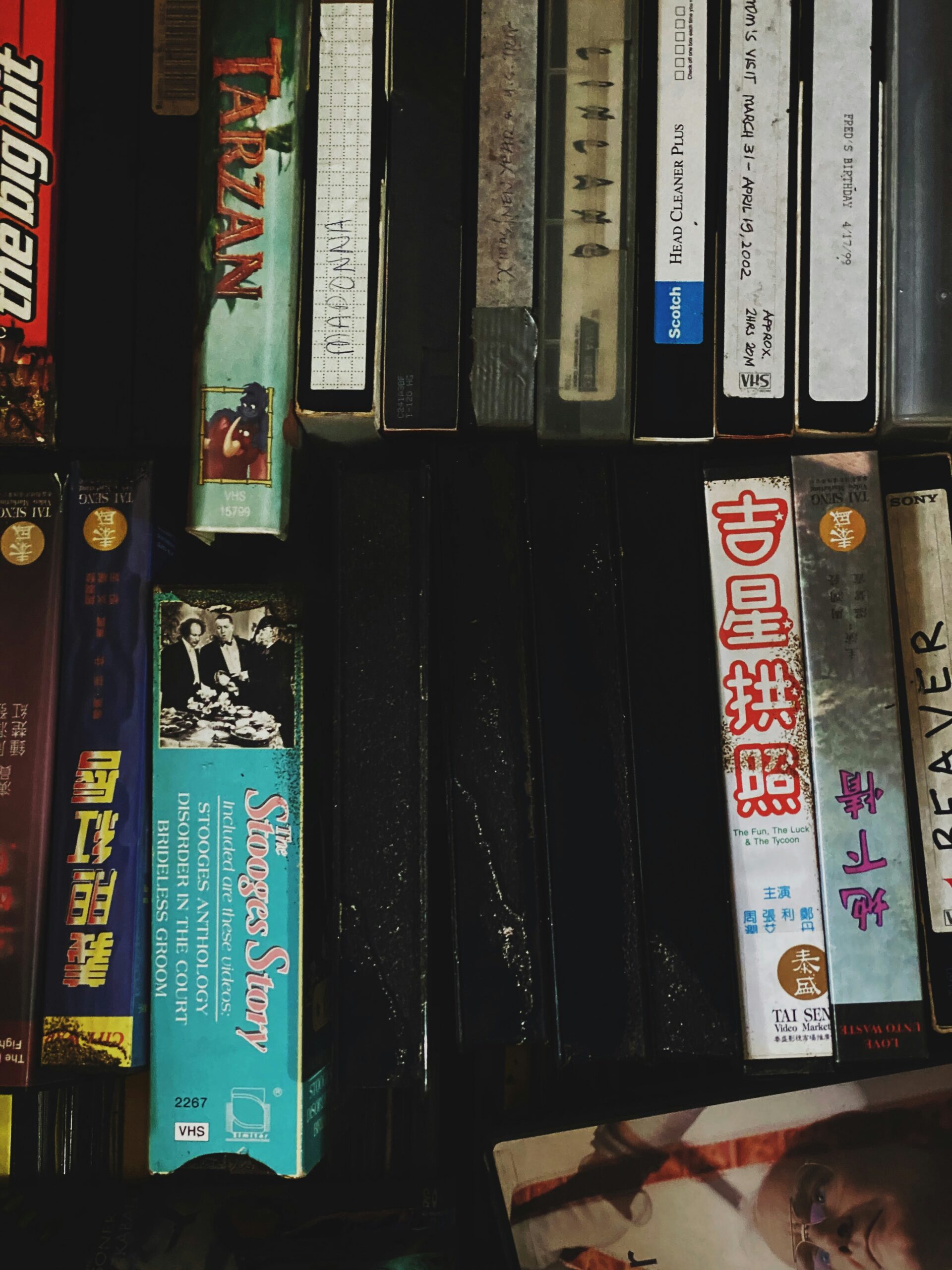
Scott found the videotapes in his garage and brought them into the kitchen. We stacked the VHS in a wine box and the little Hi8 tapes in a gray shoebox for a pair of boots that belonged to his wife Tiffany. The wine box was mine. I’d given him the last three bottles—a syrah, a cabernet, and a red blend. Party gifts I meant to give away to others but didn’t for reason I couldn’t remember.
We could have labeled the boxes “before” and “after.” Before the end of childhood and after. When Doug was around and after he was gone.
I folded the flaps of the wine box one over the other until they made a big plus sign and carried the boxes across the brown front lawn to my car. Then we played Uno in the kitchen, gossiping about a friend we don’t see any more but rarely reach out to either. Call it one of those things.
~
I learned how to digitize videotapes after my dad died. He had bins full of them—Super Bowls, old HBO films, an odd double feature of Full Metal Jacket and The Piano, midnight docs on alien conspiracies and mystery tapes with no labels at all; jarring cuts in the middle of Mad About You to an episode of The X-Files, the artifacts of someone who didn’t want to spend money or time buying a new tape. I bought a VCR and all the cables and software and learned the procedures. I figured saving the media would preserve him in some small way and trashing them just seemed wrong in the moment somehow. I don’t know.
I must have digitized three dozen tapes. It took weeks, but it wasn’t all-consuming. Just put a tape in, start the recording on a laptop connected to the player, and let it work in the background. I’m not sure I would have finished it otherwise. I threw out the tapes afterward but kept the double feature. I remembered the tape from the shelves in the den of his California duplex where I lived before I met Scott and Doug. It’s sitting in my closet unwatched.
~
There were five of us: Scott, Billy, me, David, and Doug. I met Doug in English class at the start of my junior year of high school. He had black hair and mild acne. My memory pulls up a wardrobe of grays and browns over standard-issue jeans, but old pictures show him in white t-shirts or in cheap ball caps. Such is memory. He was fit, but by no means a jock. He liked science fiction and computers and comics, but you’d never know it at first glance. He hid his personality behind taciturn walls—emotionless and rigid, projecting a subtle air of disinterest or even mild annoyance. But sometimes the mortar would crumble and a light would emerge from his eyes as his voice warmed into questions about one thing or another—maybe about Star Wars or an old war film he’d recently watched, or into some casual observation about a girl in class he liked punctuated with meek laughter uttered as a hiss through his teeth, his eyes narrowing and cheeks erupting red as if he just told a secret and had become instantly embarrassed by it.
Doug’s dad was a career soldier who always seemed to be elsewhere. He missed his dad and spoke about him with a kind of pride mixed with subtle despair, as if his absence was causing unsaid wrongs to go on being wrong. He had a brother who lived with an uncle in Pennsylvania. There was a story there somewhere, maybe even a scandal—my guess was always shoplifting—but he never elaborated. He talked to me about his mother only once. She had died in Korea when they were little. He lived with his stepmother when I met him, a woman with dirty-blonde hair who smoked cigarettes from a La-Z-Boy in their living room. She had a daughter from a previous marriage. A popular girl. A cheerleader. I had a crush on her briefly, but I knew better.
I met Scott through Doug one Saturday night in October. Doug invited me to a laser-tag place behind the mall. After we blew our money, he phoned Scott from a payphone for a ride home. I remember a lot of begging, lots of “Come on, man,” his trademark sighs whispered into the black phone handset. Scott pulled up about ten minutes later in his ’88 four-banger Mustang complaining about all the rides he was giving out. He had the double-edged fortune of being the only one of us with a car and Doug had apparently blown through a lot of favors. To his credit, Scott had a hard time saying no.
I called shotgun and was surprised no one complained. I never considered the possibility Doug might have wanted the front seat or was at least owed it by virtue of knowing Scott, who I didn’t know at all. It was a decision made subconsciously. Call it a flex of teenage arrogance, or a lack of manners. But Doug never said a word either. He seemed was resigned to it, or even expected it, the manifestation of a lack of confidence, an unwillingness to take up his own space, embarrassed by the notion.
My friendship with Scott had formed on its own terms by New Years and I found myself with him more often. Call it a polarity shift. I rode to school and back with Scott for the rest of high school, always up front. We didn’t always know how Doug got home. We often stopped to pick him up if we saw him walking home. When we parked in front of his house he’d trudge to the front door with a tense mouth and sad eyes, slipping through the front door to prevent his stepmom’s Pomeranian from bolting into the fresh air from the secondhand smoke of their living room. We joked that the dog was begging us, anyone, to set it free. Sometimes Doug laughed; more often he didn’t. Other times he insisted with a flat voice, the walls up strong, that he wanted to walk home alone.
~
The earliest recording on Scott’s VHS tapes is of a birthday party at a Showbiz Pizza Place, a kitschy arcade and pizza parlor. The camcorder timestamp reads July 6, 1989, but who could ever remember how to set those things? Scott looks to be about ten or eleven. He has the cherubic face of a kid who’d fit perfectly in a spinoff to The Goonies.
The next recording was much later. New Year’s Eve 1996. Our first one. Scott always brought out the camera on New Year’s. For him the holiday seemed like a moment in time when some rare magic in the night might shift our world in grand ways and he wanted to capture it as it happened. I suppose I could say I felt the same. I miss that optimism. I find footage of at least a half-dozen New Year’s Eve parties; I’m in most of them. I haven’t seen the footage in over a decade or more but remember that first one well. I recognize the soft living room of Scott’s mothers’ house in the suburbs. That Christmas tree. Those green couches. His parents were divorced by then, his sister off to college. I see myself on the couch—sixteen and skinny, a narrow chin, a thick mop of dark brown hair, a slouching awkwardness and dark eyes. Billy is there too. Round eyeglasses. Braces. A reedy voice that hadn’t quite broken into adulthood yet. A prep school wardrobe that hid his future in the arts. Billy is the friend we gossiped about later, the one we don’t see much of anymore.
Shawn arrives but doesn’t stay long. A class ahead of us, it always felt like Shawn had a foot aimed at a better party elsewhere. I suppose that’s probably true. Scott and I were stunningly tame teenagers. We had no vices. Shawn would get us banned from the local mall for three months after yelling profanity at the employees of the Disney Store as a prank. Bored suburban cops and mall security surrounded us like we were soldiers of some local gang they’d spun themselves into believing was real. We joke about it now. Some years ago, I called mall security to get the Polaroid mugshots they took of us. The call didn’t last long.
JoAnn and Katie appear in the video a little later. Friends of Scott and Billy, though I think Scott had something more in mind with JoAnn—a crush he was too shy or scared to act on. Their hair was almost identical: blonde, straight, and cut to bobs just above their shoulder. This was the mid-90s, the era of “The Rachel.” Katie was the softer of the two, more thoughtful. JoAnn could be blunt and impetuous, as if it was JoAnn’s world and we were all just living in it. Esotropia canted her left eye toward the bridge of her nose. I was always amazed by how little it seemed to matter to her, though I know now that couldn’t possibly have been true. In the video they sit together and watch some concert for one song while No Doubt’s “Don’t Speak” plays on the stereo. Billy mouths the lyrics from a bean bag chair nearby until JoAnn kills the music to listen to the television. No one has the guts to complain. Their friendship with JoAnn wouldn’t last the summer, dying on some petty teenage vine.
And there’s Doug. See the slightly baggy polo shirt. The striped one with the browns and greens locked in my memory. He seems happy at first, almost manic. He arm-wrestles Billy with one hand while eating a Rice Krispie treat with the other. But he drifts into melancholy sometime later, after we had counted down the last seconds of the year; his eyes aimed at the floor as if caught by some old inner criticism made new. Watching him, I remember the mornings at school where he’d stand waiting for the bell dead center in a mob of kids who were strangers to him, his eyes aimed at the floor in the same way. Scott or I would try to coax him to join us, his friends, but he wouldn’t. Eventually, we rolled our eyes and called it Doug being Doug. We stopped trying.
The tape ends. I put in another.
~
I have to admit this: Sometimes we didn’t stop at all if one of us spotted Doug trudging hopelessly toward home after school. “There’s Doug,” one of us might say. But we would tool past anyway and leave the sentiment lingering unsaid, his eyes unacknowledged in the sideview mirror, his depression unbearable.
~
Scott, David and I had dinner at a bougie burger place the night before I picked up his tapes. David wasn’t in the first video, but he would appear in many others. We called him Spock back then, his high school haircut not far from the Star Trek character. He has long hair and a thick beard and about twenty pounds of added muscle now, but we still call him Spock occasionally.
We don’t get together or even talk as much as we used to. I live in New York; David and Scott live outside Atlanta. Even though they live relatively close to each other, they both have careers and wives and so little time, becoming comfortable with the general home-body inertia of their 40s. It’s probably why we don’t talk to Billy much anymore. Or maybe why he doesn’t talk to us.
Whenever Doug arrives in conversation, which he invariably does, we talk about him as if blowing on the embers of a fading campfire. Twenty-five years have passed since we last saw him, and yet we’re still trying to examine the channels of his life, of what we know and remember of it, of what we were incapable of seeing then. Such is the hold he has. But memory is fickle and time is cruel. Sitting at Bob’s Burger Bar, what we remember about of Doug’s life, the fading impressions of a teenage boy’s troubled inner self, has been attritted by the passage of our own stories. We try to apply the wisdom we didn’t have then to memories we barely retain now.
We speculate that—
He suffered from depression but had no means of identifying or treating it compassionately.
He blamed himself for every perceived rejection.
He treated love as if it was a gift purchased through conformity. I tell them that Doug once told me he wanted to be a doctor, then later a lawyer, two fields he expressed no real interest in. “But that’s what people want,” he said bitterly.
He had no space to learn about himself without judgement.
His stepmother treated him like the unwanted spare child and his father wasn’t around enough to provide a balancing force.
He lived in a house where he felt very alone.
Scott tells us he visited a psychic some years back where he showed her a picture of Doug while offering no context. She looked at the photo a moment and seemed troubled by it.
“This person is very angry,” he said she said. “He keeps saying ‘why did he marry that woman.’”
David and I don’t know what else to say.
~
Along with the tapes, Scott gave me a few dusty albums filled with photos of us from our teens to our early twenties, stopping abruptly around 2002 or so. Wondering why we stopped taking photos, we immediately blamed it on the evolution of digital media superseding the physical. But even then, none of us have folders of photos of us on hard drives anywhere. I explained maybe we stopped seeing our lives as novel and worthy of capturing. I also wonder if maybe a jadedness didn’t take hold, but this feels precious.
In the albums, I find a photo of the last time I saw Doug—New Year’s Eve of 1998. Another party. I was in a Marine private first class by then. Doug was an ROTC cadet at North Georgia College. In the picture, I’m carrying him across my shoulders in a fireman’s carry like I might carry a wounded comrade. I apply special meaning to the photo, a final tribute. But I realize later it’s not the last time I had seen Doug. That had happened at a lake trip the following summer; I find evidence of it in Scott’s albums. I can only dig out vague memories of the trip—a humid weekend where I had managed to flee the Marines for a few days. I can’t remember a thing that was said between us, there aren’t enough photos, but I know it’s in there somewhere. Maybe if I only stare at them hard enough.
~
I bought an old Hi8 camcorder to digitize the second box of tapes. Footage of Doug’s final New Year’s Eve, Y2K, was on one of them. I sifted through lots of birthdays and road trips to Florida and Scott’s college girlfriend Sonja. I was in a lot of it, shy and foul-mouthed in equal measure. It was hard to watch myself.
Doug’s appearance in Scott’s videos diminishes over time. I suppose we could judge ourselves for the distancing, but that only works in the context of what comes. We could not predict the future. We could not see inside Doug’s heart, the perceptions he must have felt of being unworthy of acceptance. Where does our responsibility to a friend begin? Where does it end? I think it’s fair to say we were leaving him behind. Maybe he felt he didn’t know how to keep up.
I find the party footage. I wasn’t there; I spent that night drunk on a pier in Naples, Italy. But Doug is there. I watch him drift around the edges in a white t-shirt and holding a blue Solo cup. He doesn’t interact with anyone, nor does he acknowledge it when Scott lingers on him with the camera. There’s a finality to his expression, but it’s one I recognize only after-the-fact, as if I believe he’s already accepted the ugly narrative within him which none of us are capable or brave enough to challenge.
Later, on the green couch in his mothers’ living room, Scott records a year-in-review with David and his girlfriend Alicia. Silly riffing as nineteen- and twenty-year-olds reached for unearned introspection. Doug’s last recorded words are there, but even then he remained unknowable, uninspired, his voice soft and powerless behind the walls. I had to tilt my head to the speaker to hear him.
Scott: What do you have to say?
Doug: Ninety-nine was… I learned a lot.
Scott: Such as?
Doug: Stuff. 2000… Just another year.
Scott: Expectations for next year?
Doug: Same… It’ll be just the same, really.
He sits back and crosses his arms, finished. Spock asks him if he’s going to finally get his license this year. Even Spock knew of Doug’s endless need for rides. But Doug doesn’t respond and the scene ends. The walls would allow us nothing more.
~
David learned about it first three weeks later. He was a freshman at Georgia Tech. A high school acquaintance attending North Georgia College with Doug reached out by email to say that Doug was dead. David called Scott right away. Scott tells me later that he broke down on the phone.
David emailed me the news. I was at sea, steaming for Crete from Naples. At first I thought it was a dumb prank, but David wasn’t one for jokes. At least none that crass. I printed the email and called David from a bank of phones just off the mess deck.
David doesn’t remember this conversation, which briefly makes me doubt my own memory, but I know it happened. I remember the obnoxious delay in the call where I’d have to pause to let his responses reach me before asking another question, otherwise the call would fall out of sync and we’d step on each other’s sentences.
After the call, I went to the ship’s smoking area, a long ramp that led from the hangar bay to the lower storage bay. The hangar smelled like grease and exhaust. It was night; the ramp was lit with a dim red light. I sat on the rough black ramp with my knees up and my boots out in front of me and smoked myself hoarse. Eventually, I learned Doug had gotten into some hazy minor trouble with the ROTC cadre, then his grades slipped and the National Guard pulled his scholarship. With no means to pay for college, at least any means known to him, he was staring down the prospect of returning to his stepmother’s house and the embarrassment of failure.
On January 12, a college friend asked him to go skeet shooting. On the way, they stopped at a Wal Mart in town and his friend went inside. Doug remained behind with the shotgun. Rejection and helplessness intersected rotten opportunity.
~
I returned home in March just after my twentieth birthday. I rolled into town after sunset and drove straight to Scott’s house, spinning donuts in the cul-de-sac and honking the horn until he came out. There’s no video of it, but I so wish there was. I was happy to be home.
Scott took me to the cemetery near the interstate. He told me he was angry over not being asked to be a pall bearer. “They got a bunch of strangers to do it; they never even bother to ask us. It should have been us. We were his friends.” He said he found his stepsisters’ tears disgusting. Unfair or not, it was how he felt. He’s still angry. “They treated him like shit,” he said over his burger years later.
I went back to the cemetery one sunny day a few days later. Something propelled me that direction. Call it a need to speak unheard. I touched the grass and spoke to the headstone. Confusion and grief converted into shallow anger and disgust and bravado. I called him a coward. “What the fuck are you doing here?” I asked. I’m not sure I like who I was then, but I’m not sure I was wrong either. It’s something I wrestle with even now. Perhaps it was wrong of me to have berated his choice as an act of cowardice, especially considering the cold brutal calculus he made in that moment in a car outside a Wal Mart in winter rural Georgia. I suppose in the moment I figured the cowardice lived in not facing himself directly. I suppose that despite all the rides he bummed, he couldn’t ask for the ride that mattered, the one that offered a way out. Going through Scott’s tapes, though, I’m scared there’s a scene where he asked for it between the lines. I hope I never find it. I’m scared of what it might mean if he had and we were just too cowardly to answer.
~
I finished transferring the tapes about a week after the New Year’s 2025. The tapes run from late 1996 to about 2005 or 2006, maybe a little after, but not by much. I see a lot of bad cuts, the places where Scott had replaced one moment with another, too cheap or broke or just too rushed to buy a new tape. I see an old girlfriend, a lot of dark bars. Before I went through them, I joked that I’d probably find most of it cringy. I wasn’t wrong. I do. Some of it, anyway. Mainly I see myself now in contrast to who I was then. I want to tell myself to be different, but I’m not sure in what way. I’m hard on myself. I want to hide from the flaws I see in the gaps of my clumsy late teens and early twenties. I haven’t watched them since.
I put all the tapes into the wine box and mailed them back. I shared a link to a cloud folder with the files with Scott and David. Scott told me he got them; David didn’t respond, but I wasn’t surprised. He isn’t much for nostalgia, and I’m still not sure anyone wants to see how young we were. I don’t have an email for Billy. I asked Scott, but he didn’t have one either. I thought about finding an email for Doug’s stepmother or stepsister and sending them some of the videos, the ones that matter. I’ve thought about it, but I haven’t done it. I won’t.
I won’t.