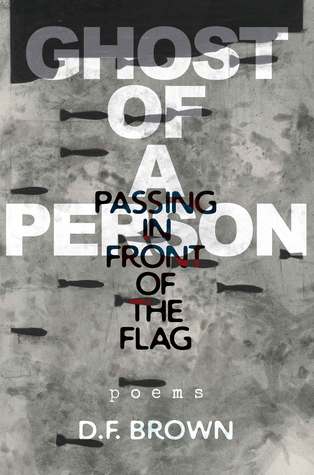
New Poetry by Antonio Addessi

OLD IRONSIDES

she is
most days
a ship armed to the chin
cannons at her sides
her mast a sea of kelp and urchin

melting down my iron sides
for ammunition
she pours me
hot and slick
into molds I want to fit
but cant

what does her
naked belly show to sea’s floor?

I want to see
I rubber my neck to her sides

only to take in salty sick
and the brim of her
matted cap

I pretend I am inside her—
below deck
she aches with barrels of cider
churning into
drink
to feed her crew
I want to be that crew
get paid little to feed her fuel
to work the nights
as the sea works her over
pandering toward open casks of
sea here
inlet there
till we drop anchor

FISH IN THE CREEL

At the end of summer we had a party for you
do you remember why you didn’t show?
You’d been fishing in central park again
with your rod and your tackle box.
You told me you’d use the flies I tied
the ones I made to look like junebugs.
You said they were the most cunning things
you’d seen, that they’d put fish in the creel.
I had no idea what a creel was and I
didn’t care. I just knew we’d be eating
fish for dinner and maybe after we ate
you’d show me your lucky tooth collection.

When you left the apartment I got the neighbors
to come over and made your favorites—lime jello
and ants on a log. I waited about three hours, the sun
had gone and the neighbors left too. That’s when
I heard the phone ring. It was the police. They’d
found you in the Harlem Meer. You’d caught
the big one they said, you’d hooked a willow and
sank thigh deep into the muck. They hung up
when I asked if they’d bring you home.
It was late and I had my rollers in.

I hosed you off in the alley. No fish for dinner
instead we boiled your boot strings. You said
when you were flopping in the Meer you thought
a lot about my recipe for bran muffins and
where I got the hair to tie those flies. I couldn’t
bring myself to tell you that hair was mine
that they may have looked like junebugs but
they were tiny red-eyed me’s destined for
a mouth or three.

ANSWERING MACHINE: APRIL 29th, 1992

for Rodney King

Rodney. Rodney. If you’re there pick up. You haven’t answered my
calls for months. I’m worried. This isn’t like you. You may be in pain
and that pain is very real but we could talk about it. We could get
lunch Rodney. We could go to Joe Jost and get a pickled egg.
It’s on me. I’ll tell my old lady I had to step out, buy some smokes.
Remember that night in Monterey when she came down the street
in her curlers holding that baseball bat? I saw my balls flash before
my eyes and I’d never seen you laugh so hard. She hated you because
you liked the drink. I’m a horrible drunk but I love a good story.
Rodney. If we go to lunch you could tell me about the time you met
Larry David in that carpark in West Hollywood. I wish someone
famous pissed on my door handle. I liked that story and I like you.
Always have. What do you say? Those eggs won’t stay pickled forever.

FAMILY TREE

I come from a long history and as such a lineage entails, it started rather far back into
antiquity. this is important because the past is neither present in this narrative or
relevant. it is somewhat disturbed as soil often is because if it were undisturbed it would
be a fossil waiting in vein for the unearthing.

my death began like any other—with my birth. I was, for lack of a better word or
phrase, entangled prolapse of a hemorrhoidic kind.

for I, my heart was beating and my blood did it’s gyrating as gravity let on to itself and
the core of the earth(made, they say, of ore, of silken iron) pulled me toward it’s
embrace.
this embrace had been stalled for 7 months 8 days and a handful of empty bucket nights.

the hole in mom’s throat. lump. puss. cyst. anchovies. pizza hut.

back seat sister

baby baby amy grant

du-rag

batman shirt

I come from a long line of liars. the kind that look you in the eye and say trust me and
then walk to your house and throw
themselves on the porch, their hair pasted to an awkward side in autumn sneaking out of
their parents house to kiss you on the mouth.

I misread the signs misspell at the spelling bee uttering instead, thinking that I was going
north. I was so far south that the snow had leapt off the pavement, off of the back
window till the skin on my eyes rose a quarter of an inch off my face.

holy hello to you and that
braided mustache halo you wear on a lipshits tone. your mother says that only we can be
spun like this we can only be thawed
on the defrost setting. my freezer burn itches and peels in monochrome white.

daddy found his way into a type of trope a type of makeshift reminder that if I keep up
the tune I might as well be a dumfounded thirty watt light bulb.

lozenges

I come from long lines of card players
I come from a long line of card player
breathing for the tobacco that fills the air, the acid rain that comes washing down and
the inlets that form a secret sharer. Their secrets hide
past loves and the fold of older men
that seem to haunt me or just never leave, always leaving their dentures soaking on the
night stand.

ninja turtle gummies melting on the dashboard

banana boat sun screen

pores so big we soak in them

techno music on the radio

the family home now a car park, sleeps in sediments and the time capsule we planted will
grow a tree with no trunk. a briefcase with no lips. a leaky faucet spits out blueberries.
mother buys frozen orange juice concentrate. an ice core orange grove thawed out as the
tree frogs watch from the window. I step on one as I crouch in the bushes. its lungs push
up and out gasping for air it cannot use.

I come from a long line of lovers. lovers of farmer’s tans and personal pan pizza. if we
can meet in a chatroom we can meet in real life, use the back of our throats as putting
greens or even better sand down the chimney stack and use its remnants for homegrown
tattoos.


Fish photo courtesy U.S. Fish and Wildlife service.


A sickness of the soul: remembering Adam and Tim Davis

Correction submitted by Delta Company paratrooper: five, not four, paratroopers died from the IED. “Matthew Taylor died September 27th, 2007 from wounds suffered from the IED. Rogers was killed along with Davis, Rogers, Johnson, and 1SG Curry in the D11 vehicle.”

Not every man has a positive relationship with his brother. Tim Davis did; he loved his younger brother Adam, and looked up to him. Tim was shy, but Adam was gregarious and outgoing. The two brothers grew up in Idaho, had the same History teacher in high school, and attended the same Basic Training class in 2006. They dreamt of joining the same unit. Things didn’t work out the way they planned, though. And when Adam deployed to Afghanistan in May of 2007 with the 173rd, Tim wasn’t there—he was in Fort Hood, Texas. That July, driving down a dusty road in Sarobi District, Paktika Province, Adam died in an IED blast that killed his First Sergeant and two other soldiers. He was 19 years old.

A part of Tim died, too—a hole opened up in him that he attempted to fill with alcohol to no avail. After being discharged from the Army, he grew suicidal.

“Everything he did from the time he failed Airborne School
was affected by what he perceived as letting Adam down,” said Tim’s father, Tim
Davis, via Facebook. “His job, as far as he was concerned, was to keep Adam
safe.”

Life is filled with connections and causes that seem obscure
at the time. One of the reasons war holds such fascination for its participants
is that causal relationships all become clear in retrospect. A man dies,
another man lives. A brother or son or daughter dies, a brother or sister or
father or mother lives. One can trace grief back to a particular choice, a
moment in time. Grief is knowable. Loss is comprehensible. Guilt is something a
person can carry with them like a boulder, like alcoholism, drug abuse,
despair, and suicide.

This memorial is for Adam Davis, a Charlie Company and then Delta
Company paratrooper and Sky Soldier of the 173rd Airborne Brigade
Combat Team. It is also to his brother Tim Davis, a National Guardsman who
never got over Adam’s death, or the pain of separation that preceded that
death. It’s the story of two men from America’s heartland who wanted to serve
their country together, neither of whom are alive today.

Adam Davis

Adam Davis was born on July 27, 1987 in Twin Falls, Idaho to
Tracy Carrico. His grandfather served in the Navy during WWII. In his obituary,
Adam’s described as a fan of science fiction and fantasy novels. The obituary
describes him as having enjoyed spending time with his horse, hiking, and
listening to music.

Photo of Adam Davis in Vicenza, Italy, taken by his roommate, Phillip A. Massey. Circa 2007.

Jerome, Idaho, the town in which Adam is buried, has been
growing steadily since 2000. Since the census placed the population at 7,780,
it has expanded to over 11,000 people, driven in part by expanded employment
opportunities, and partly by the spillover from those opportunities (15% of the
population lives below the poverty line, a bit above average for the U.S.).
Located a few km northwest of Twin Falls, it’s also a few kilometers north of
the Snake River. The entire area was nicknamed “Magic Valley” at the turn of
last century, when two industrial dams “magically” tamed the Snake River,
transforming previously uninhabitable territory into beautiful land, ideal for
human habitation.

Nearly 12% of Idaho resides in the “Magic Valley,” or about
185,000 people. Adam was the first from the area to be killed during Operation
Enduring Freedom.

Long way home

Adam dropped out of high school, but finished his GED at a
local community college. When he joined the military, he had a plan: qualify
for the GI Bill, go to college, get a degree, and become a professor of
English. When he finished training, he received a piece of unexpected news:
rather than going to the 82nd Airborne with his brother Tim, Adam
was to be sent to the 173rd Airborne, in Italy.

His introduction to the 173rd was rocky, as it
often is with elite units. When assigned to 1-503rd’s Charlie “March
or Die” Company, the first thing he did was walk up to the hardest sergeant in
the unit, Sergeant Berkowski (a mountain of a man and a great non-commissioned
officer to everyone who knew him), wearing a Weezer tee-shirt with his hands in
his pockets and said “I’m supposed to be in Charlie Company.” One of the squad
leaders in first platoon, Adam Alexander, remembered this episode and the
‘smoke session’ (a physical reminder of the importance of discipline) that
followed via email, and described Davis as a competent soldier who “had a lot
of heart.”

Adam’s first roommate at the 173rd was Phil
Massey, a soldier who’d arrived in Charlie Company’s 1st Platoon (to
which Adam was assigned) a week before. Davis was plugged into Weapons Company
as an ammo bearer for the 240B medium machinegun, and stood out among the other
paratroopers for his size (he was shorter than most) and his tenacity (he made
up for his height with his determination never to quit or be last). Massey
developed great affection for his small roommate, writing via email that Davis
“in PT would sometimes take on the task of bigger guys and lead the way… he
would clean his weapon as fast as anyone else in the squad, and was always
there when needed. He was a soldier and a paratrooper, and nothing stopped the
little guy’s spirit.”

Davis’s platoon leader, Matt Svensson, had similar things to
say about the Idaho native’s resolve, discipline and professionalism.

First Platoon’s Platoon Sergeant at the time, then-SSG
promotable Steven Voline, highlighted Adam Davis’s professionalism while
discussing his value as a soldier, and went out of his way to describe why
Davis was ultimately moved from Charlie Company to Delta Company, the mounted
heavy weapons platoon: “Everyone loved having him around because he kept the
mood light and always had a smile,” Voline said. “Even when times were tough
and training was rigorous, he continued to keep a positive outlook.”

Voline described evidence of the young paratrooper’s resolve. “I remember being at a range somewhere in Italy and we were doing CQB (close quarters battle) qualification tables and his magazine changes were too slow. If I’m not mistaken, he stayed awake doing magazine changes through the entire night iteration training for each Platoon. It ended up being an extra 3-4 hours with his Squad Leader (Sergeant Berkowski) just dropping a mag and inserting the follow on.”

As every soldier knows, maintaining a sunny disposition and
positive outlook under those circumstances is trying for the best tempered
soldier. Having a paratrooper like Adam around was a boon for his fellow
soldiers, and Voline said that’s why he sent Davis to another Company when the
tasking came down from higher to send Charlie Co soldiers to Delta Company:
“Adam was the type of soldier who’d succeed anywhere,” wrote his former Platoon
Sergeant.

Delta Company

When Adam moved to Delta Company, he was quick to make
friends there, and developed a reputation as an easygoing, good-natured and
dependable soldier.

“Davis was a lot like me,” wrote Matthew Frye via email.
Then a First Lieutenant, Frye was Delta Company’s Fire Support Officer, and
remembered the last time he saw Adam. “He was a funny kid who kept his platoon
on its toes with his shenanigans.” Days before Davis’s fateful final patrol in
Afghanistan, he was talking with Lieutenant Frye about a soon-to-be-released video
game, Medal of Duty: Airborne.

“Occasionally the officers would square off with the
enlisted in a video game where we could bond with them in a somewhat
professional manner,” wrote Frye. “Some smack talking would be involved and a
few pushups for the losers would be owed at the end. I had ordered the video
game a couple of days prior and told him when he got back from patrol it would
be game time.”

That game time would never arrive.

Tim Davis

Tim Davis died, some say, of heartbreak over the loss of his
younger brother Adam. Things started going badly for him when he went AWOL from
Basic training in order to be closer to Adam—the two believed they had signed
up for an Army program that guaranteed they’d both be assigned to the same
unit. While Adam was assigned to the 173rd, though, Tim came down on
orders for the 82nd Airborne.

“Adam was so happy he came down on orders for Italy until Tim told him that he got Bragg, then everything went sour,” said Anthony Roszell, who went to Basic training with the brothers. Roszell, who ended up in C Company’s first platoon with Adam, described the brothers as especially close, “pretty much attached at the hip,” he wrote via Facebook. They always hung out together, with Tim staying on at Fort Benning to keep his brother company, even though he’d gone AWOL and missed his chance at the 82nd Airborne on Fort Bragg.

We are the product of our backgrounds, and especially so the
network of relationships we build during childhood. Tim and Adam built up a
very powerful bond, so powerful, in fact, that they joined the military
together. When Adam was assigned to the 173rd Airborne in Italy, it
came as a shock and a great disappointment to Tim.

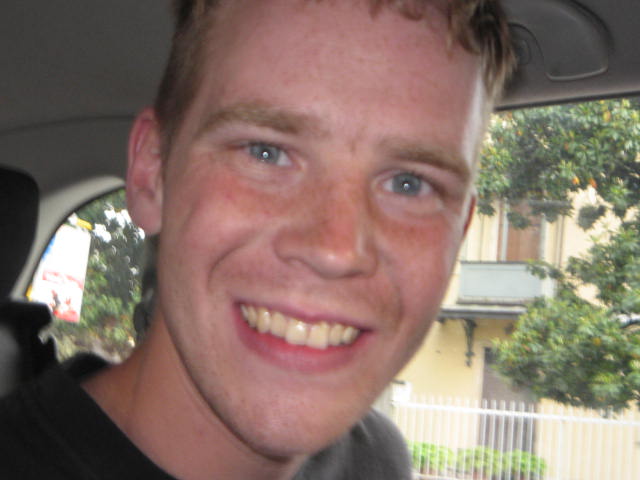
Photo of Tim Davis, Adam's older brother.
Profile picture from Tim Davis’ Facebook page. The photo appears to have been posted in 2012.

The outrage of what Tim saw as the military’s betrayal impacted his performance at Airborne School, and he failed out. He was sent to Fort Hood, where he served with the Army until Adam’s death.  After that, it was a sequence of bad choices or plans that didn’t amount to much. He was never able to reverse the string of disappointments; a successful stint as an Army National Guard recruiter was not enough to permit Tim a combat deployment, as he hoped, in 2010; following that, he was discharged, and worked toward a career in cabinetry. None of that made up for the dashed hopes of serving with his brother. While life had never been easy for Tim, when Adam died, something in Tim’s life stopped, too.

“Tim had a very hard time in life,” said Amber Watson, Tim
and Adam’s sister. “He was always worried about something, or thought something
was wrong.”

A phenomenon of the Social Media age, Tim’s Facebook page is
still active, here.
This means one can read his wall, and see his struggle unfold in real
time—anger with life, struggles with faith, sadness at having lost his brother.
Frustration with a senseless world where relationships and events don’t have meaning, necessarily. Where
things don’t work out. At one point, he mentions running into his high school
crush, who’s named. This person exists on Facebook. From her profile, she’s
married, with children—happily employed.

“I’m sure [Tim] felt like he let Adam down,” wrote their
father, Tim Davis. “He said Adam wanted them to be together. Tim was glad to
return to Fort Hood.”

A mission south

Paktika Province is a sparsely-populated area about 33%
larger than the U.S. state of Delaware that includes desert, mountains, and
intermittently-fertile valleys. Those valleys where rain falls in sufficient
amount to sustain life hold most of the people. The remainder of the areas hold
scattered tribes who make do the best they can in a harsh and uncompromising
climate. The elevation varies from 6,000 to over 9,000 feet on some mountains.

In 2007 the Army was pursuing Counter-Insurgency (or COIN)
Doctrine. The purpose of COIN is to defeat insurgency by refusing the enemy
military or propaganda victories, while allowing the government to provide
people with more and better assistance than the insurgents. The common term for
COIN was “winning hearts and minds.”

At the time, units would “own” battle space—be responsible
for defeating enemy activity there, and also for spreading goodwill among the
populace. Adam’s company, Delta, was a bit smaller than the other units.
Geographically, they were responsible for a larger space than some of the other
units, but in terms of population, their area was the least populated. Afghans
were spread out in villages of some dozens or hundreds of people, depending on
their proximity to water, roads, or the riverbeds (wadis in the local
tongue) that served as roads in many areas.

According to Matthew Frye, Delta Company had been training
Afghan National Police (ANP) in far-flung district centers when the unit
arrived in May of 2007. By July, it had become clear that the distances required
to travel were exposing the unit to risk, and making it more difficult to accomplish
a key tenant of COIN: living with the population one was attempting to protect
or train. When the unit had arrived in theater, there was no obvious place to
quarter an entire unit’s worth of paratroopers, so Delta began evaluating
suitable locations for a permanent Company base as part of their training
missions. On July 23rd, during a mission south from the Battalion
base in Orgun, a Delta convoy struck an IED in Sarobi District. Adam J. Davis,
Michael S. Curry, Jr., and Travon T. Johnson were killed immediately. Jesse S.
Rogers expired later from his wounds.

The IED

Improvised Explosive Devices or “IEDs” were becoming more
sophisticated and prevalent in Afghanistan in 2006-07. For years, the U.S.
military hadn’t needed to worry about roadside bombs in Afghanistan,
encountering ambushes and sometimes large enemy attacks in the mountains,
instead. But trans-national insurgents or terrorists would take successful strategies
from one place—in the case of IEDs, Iraq—and bring them elsewhere. IEDs began
making their way into Afghan roads, and then, became increasingly deadly.

As is often the case with weapons, the Army found itself in
an arms race with the Taliban and Al Qaeda, in which the Army would develop a
way to defeat IEDs, and then the bomb-makers would develop a new method or
procedure to overcome the military’s technological advantage. In the beginning
of the conflict, the most popular type of roadside bomb in Afghanistan had been
pressure-plate or pressure detonated IEDs, where the weight of the vehicle
would set off the bomb, blowing anything above it to pieces. This had the
undesirable (from insurgents’ point of view) effect of killing civilians as
often as it did Americans. By 2006-07, they were relying increasingly on
“remote detonated” IEDs, triggered by someone with a walkie-talkie or cell
phone, who could ensure that the correct target (US forces) were being struck.
As a result, US forces equipped their vehicles with signal-jamming devices that
prevented signal-initiated devices from detonating. Delta Company had such
devices installed in their vehicles.

The IED that struck Adam’s vehicle, on which he was turret
gunner, was a large pressure plate IED. The electronic jamming system was
useless.

A sickness of the soul

The deaths of Adam and the other paratroopers—especially
Michael Curry, who was nearing retirement and had a great reputation among his
peer NCOs—struck Delta Company hard, but also took a toll on the Battalion.
July of 2007 was a difficult month for the 173rd Airborne Brigade,
with Major Tom Bostick of the Brigade’s cavalry unit (another beloved
paratrooper, and former Bravo or “Legion” Company commander in Adam’s
Battalion) dying in combat in Nuristan, and Juan Restrepo of 2nd
Battalion dying in Kunar Province (a documentary named after
an outpost named in Restrepo’s honor is one of the finest of its type to
describe fighting in Afghanistan).

The paratroopers who died that day are still remembered by
the people they served with, and by their families. But the memory of Adam was
too much for Tim.   

“TJ and I became close as we got older,” said Watson, Davis’
sister. “I was the one he’d call when he wanted to talk… the night before
[Adam’s] funeral he went and had the coroner open the casket, and it made him
very unhappy.”

Watson wrote that Tim struggled with suicidal thoughts, and
even attempted to act on those impulses. “I went to see him in rehab a couple
times,” she wrote. On January 18, 2016, he passed away. His
obituary
reads “the most we can tell is that he succumbed to a sickness of
the soul which had been with him since his brother Adam passed away nine years
ago in Afghanistan.”


New Poetry by Aidan Gowland

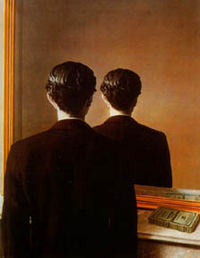
René Magritte, Not to Be Reproduced, 1937


Breathless

If you say “I am not a monster”
Into the mirror and turn around three times
A better version of yourself will start to take root in your heart.

If some nights you cannot make your mouth say the words,
If you cannot make your lips make the sound,
It is okay to say “I am not always a monster”.

If your friend tells you that you need to forgive yourself
Before you are consumed by the weight of your own actions
It is okay to drink until you believe them.

If you have pushed all your friends away and are standing on the edge
of a bridge and a voice in your head says ‘Don’t jump’
That voice is your friend
and it is okay to listen.


To the Woman Who Finds My Ex

You will find him shaking on the couch

With his hair plastered to his forehead

And his body covered in sweat.

He will say

Help me

But he won’t want your help.


You will think of the words

Addiction

      Overdose

      User

But you will stop short of death.


He will glow in the dark.

He will take pleasure in his pain,

Smear it over his life with a spatula

And call it impasto,

Call it progress,

Call it hope.


He’ll say the drug is the only love that he believes in,

The only love that hasn’t let him down.


You will think of the words

      Betrayal

      Ungrateful

      Sacrifice

But you will stop short of leaving.


New Fiction from Ulf Pike: “Title and Price”

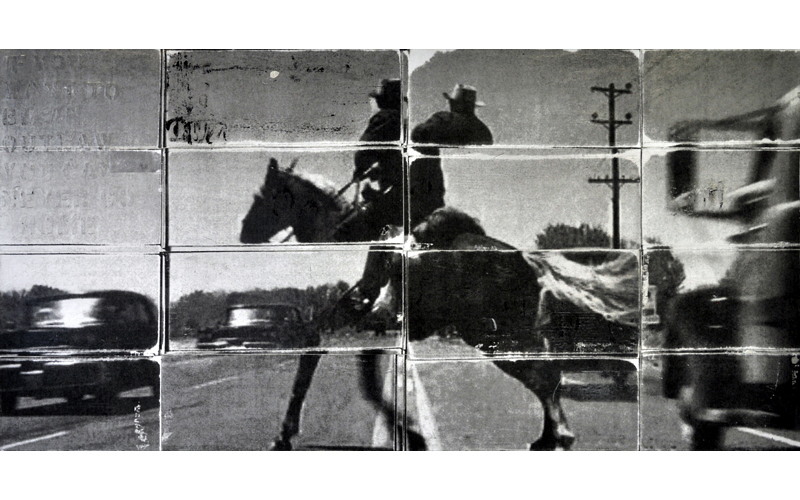
Art by Gordon McConnell. ON THE ROAD, photomontage and acrylic on canvas, 24 x 48 inches


It was not rare to see horses on Main Street when I was growing up in this town. I was spindly and spry then, when distances were calculated by how much jerky and water to pack, when the idea of pocket-sized computers was still the realm of science-fiction, the same stuff as teleportation devices and alien invasions. Around the house an intricate network of deer trails canvased the woods like a sense of smell. I’d run them through the sagebrush and chokecherries, shivering in the shade of dense lodgepole pine stands. Still panting, I’d knock on a neighbor’s door and ask a mother if her child could go to the river.

We’d walk miles in our minds, finely-tuned to the snapping of dry branches in the needle-cast, summoning to our soft skin the possibility of predators emerging with the warmth of a late spring day. The distant sound of swift water rushing over boulders always made us start running.

Rays broke on the surface and scattered as if through a fractured emerald onto the slick stones below, shimmering off the scales of large trout and made hazy where their tails whipped up a cloud of fine silt, spooked by our careless approach. In the deeper pools heated by afternoon sun there was no place for our bodies to know their own boundaries. It was a richer kind of air through which every motion rippled to the bank and returned to us, but slower, expanding.

Where the May and June runoff cut the bank from beneath a large cottonwood its roots reached exposed like tentacles into the water. By mid-summer we could entwine our arms in them and float on the surface cutting the gentled current with our heads as we looked to the bottom and into the shadows, hoping the fish might not mind our company and maybe even glide along the length of our bodies. We would bask on the smooth, day-baked stones, let the sun dry us, scratch the sand from our scalps and feel clean, even a little magical walking home.

In late summer my father would wake me before dawn with his large hand on my shoulder, the smell of coffee drifting in behind him. A quiet blue light through the trees laid our shadows down before us on the trail, fishing poles sprouting from our heads like antennae. Sleep still in my eyes, I imagined being led to the river by some dreamed extension of myself, one who might rather do anything than trick a fish into swallowing a hook just to turn it back to the current, stunned and bleeding. Tearing barbs from their mouths and throats then holding them like trophies while they mouthed the air was a suffering I learned to fold into layers of pride. I’d ask why we didn’t keep them and was told there was no need.

The temperature dropped sharply near the river as soon as it could be heard. My skin raised with the chill and my heart sank to hear my father’s pace quicken. He inhaled the cool morning into his nostrils with pious vigor. Later, looking upstream, he welled with pride to see my pole bowed down to the weight and fight of a large trout. He laughed and shouted, “Fish on!” as he made his way toward me with the net in his hand.

————     

I knew they were Cal’s boots stomping around on the hardwood. His restless energy vibrated through the floor and into my head. I gathered my jacket back into a lumpy pillow and tried to fall asleep again. He opened the front door then stomped back, smacking me on the head as he passed with the rolled up newspaper he had retrieved then trumpeted the first few notes of reveille through it.

Every minute or so, just as I started to doze off, he’d loudly clear his throat, pick up the paper by either side and pop it as if to freshen the news before smoothing it back down on the table. I squinted with one eye and leered at him across the room with all the hungover evil I could conjure. His hair was cow-licked where his head had finally come to rest after the long night of drinking and dancing, embellishing war stories, and doing whatever we thought those stories gave us license to do.

Every couple of weeks it seemed we began making feints into blackout territory, each night a fresh chance to regain the thrill of courting death and going once more unto the breach, as Cal liked to call it. Empty bottles stood gathered together on the table. From my floor’s-eye-view they looked like a city of glass buildings. I remembered Cal upending one then musing woozily to it, “Thank you for your service,” as he added it to the skyline. I remembered dancing wildly to Louis Prima and an almost inhumanly beautiful, dark-haired young woman yelling at me and storming out into the snow—Oh, Marie! Tell me you love me. I let out a long dramatic groan and rolled onto my back.

“Where’d she go, Cal? Where’s the girl of my dreams? The love of my life?”

Even when he wasn’t reading the paper he never really listened to anybody. He ignored me and started reading out loud: “At 3:36 a.m. a woman reported a nude man at Main Street and 3rd Avenue jogging with a hammer and chanting….” In the seven years I’d known him, reading the police blotter had become something of a ritual, one which required coffee to be fully appreciated first thing in the morning. I reminded him of this. He told me to get up and make it myself.

“Wouldn’t go in there barefoot,” he added without looking up from the paper as I pulled myself off the floor.

“Why not?”

He scoffed.

I stepped into a pair of Cal’s beat-up cowboy boots by the door and walked to the kitchen. It looked like a grenade had gone off. Cabinet doors were splintered on the linoleum or dangling from their hinges, the breakfast table and chairs laid upended surrounded by shards of bottles and dishes. In a corner the coffee machine was in pieces, all of it soaking in pools of wine. My eyes rolled over the scene turning up little flashes of memory. My stomach began to turn. I knew what had happened but I asked Cal anyway.

You happened, you crazy bastard. You went dark as the devil.”

I was locked inside my skull again, where Cal’s voice echoed absently like some tired machine switched-on and abandoned. I remembered a dream-like space where time and gravity unfixed themselves and there was nothing to give my body shape but vague, immovable objects where the waves crashed; where I wanted wild and inexplicable things; to catch a rattlesnake, kiss it on the mouth, grip it by the jaws and pull it over my head like a balaclava. I wanted to vibrate. To hum and rattle into pieces.

————

Cal and I would jog from downtown calling cadence like the ghosts of soldiers, released to haunt everyone’s dreams on those snowy, sleeping streets. We would call on the emptiness to recognize us, to embrace us as its own: Mama, mama can’t you see…what the Army’s done to me? We’d wake up and drink coffee and read the paper like we’d aged a hundred years overnight.

Cal said we needed to quit blowing money on hangovers and buy a couple horses already. I could usually count on this train of thought after a night of dragging our drunk bodies around town. “All my old tack’s just gatherin’ dust in my aunt’s barn. Bet she’d probably cut us some slack on a couple geezers. Get us started anyway. Get us outta this shithole and into the wild anyway.” He’d dream us there and try to convince me it was what we were put on earth to do. That one cool morning we’d saddle those horses and disappear like phantoms into some blue shadowland, as if somewhere just beyond the horizon a paradise was waiting to be reclaimed. “We’ll sell everything and just go. What’s the song say? Rob the grave of the setting sun.

He’d pop the paper as if to set it all in motion. I’d go along, too sick and tired to pretend like I had a better idea. Not to say he didn’t have something. Cal had vision. If anyone did, he had the drive to turn back the clock, or if not, at least smash the damn thing and start from scratch. He accused the world of trying to pull one over on him, trying to wash his brain clean of some ancient instinct. He knew better though. He could see it all happening right before his eyes. And he’d be damned if so-called progress was going to catch him sleeping. He’d roll a fat joint and lay on his back on the hardwood floor, blowing clouds of smoke at the ceiling, picturing exactly how he was being screwed out of his destiny.  

————       

In a sterile, over-air-conditioned conference room Cal pictured a three-point-plan written on a dry erase board. He could hear the whisk and thwack of an aluminum pointer striking the whiteboard under each number as a buttoned-down agent eyes one of the many pale faces around the table. “One,” said the agent with detached authority, “Disenfranchise.” Cal saw him swat the board under the next word, scan and lock eyes with a different face. “Two,” he shouted this time, making his victim pucker and quiver, “Romanticize.” Then a thwack and a new face for the third and final pronouncement: “Commodify.”

The room nodded in obedient assent. “It’s that simple, men. If it ain’t broke don’t fix it.” He then led them in a three-count, swatting each word down the list for punctuation and lastly under the slogan written above them all, which they uttered in solemn unison. I heard Cal’s voice before I walked in. He was laying on the floor, chanting at the ceiling: “Kill the Cowboy, save the boots!”

      ————

When Cal came home from areas he often referred to as the “wild west,” he felt everything harassing him, closing in on him, telling him he was too late. “Too many goddamn people on this earth. Zombies,” he’d correct himself, “and their kiss-ass little cyber-lives; big-money buyin’ up the whole goddamn valley, pricin’ out real goddamn people; fuckin’ movie-star wannabes turnin’ working ranches into playthings….” He’d work himself up and have to roll a joint. Though he would never admit it, he was paralyzed with fear. He saw the way of his father and grandfather, his birthright, the way of the cowboy “going the way of the Indian,” as he put it. He laid on the floor throughout the day exhaling thick clouds at the ceiling and rubbing his temples. Images of conspiracy and betrayal loosened and drifted from his mind. Like Judas, he thought, feeling suddenly a new, special kinship with Jesus.

He pictured a resurrected Christ clinching a thin cigarillo between his teeth and squinting through the shadow of a sharp, felt brim. He saw the hand of God drawing the cold, heavy steel from his holster as he considered a man in a business suit kneeling before him, shielding the sun from his eyes. Arrayed in that righteous light, thumbing back the hammer and tenderly touching the muzzle to the man’s impure lips, Jesus smiled—Cal smiled. “Kiss this,” they said.

————

When I came home I burned my uniform with all its ribbons and badges. Made a ceremony of it and everything. Cal considered it an act of treason and shunned me for months. But, for better or worse, I was bound to him. And him to me. Without Cal’s kind of animal sensitivity and callous justice, I might not have made it home at all.

————

We put it behind us, both desperate for an old kind of familiarity, even if a false and decidedly immoderate one. I had developed lofty ideas of self-deconstructionism, that I was somehow dismantling something broken inside my head. And I did truly believe this. But after a couple bottles of wine it became tiresome and all I had was bleary aim at something near pleasure. I could at least hit the present moment, it being a pretty big target. In it I surrendered to a sense of time and gravity backing their screws out of my bones. Every motion seemed fluid, intuitive, rippling out from my body toward some mystical integration, but ultimately retuning a kind of lazy hypnotism—the kind of magic you long to believe but also loathe for the weakness that longing betrays. That was the general, dull ache of it. Things that could never truly be, maybe never were at all. Out of place. Out of time. But we soldiered on through the illusion, allowing the selves we remembered being to manifest friction for traction.

————

It was a Friday night. Every Friday night art galleries on main street opened their doors and offered complimentary wine to anyone who entered so long as they pretended to care about the stuff inside. Cal and I used to make it our duty to impose and make sure that no wine went to waste. We filled and refilled plastic cups as if hydrating for a mission. Once loose enough, we’d liberate bottles from the table and walk around with them, standing in front of Western landscape paintings, probing the air for volatility.

“Me. Oh. My,” Cal would say, adding a little whistle. “A damn sight better than the real thing, you ask me. Who in his right mind would ford that river horseback in real life? You know there’s rattlers in there will swim right in your saddlebag and take a nap, and you never even know it till you reach in there happy as an idiot for the wineskin…then fffft, ffft fft…,” he struck my forearm, shoulder then the side of my neck with his fingers as fangs, “It’s goodnight, Irene, goodnight.”  

I’d hum and turn the price-tag, speaking with a degree of dismay, “How could you live with yourself knowing someone else walked out of here with this beauty?” Then feigning a scan of the gallery for someone to talk to, I’d say, “I must have it.”

The night would go on like that until we reached a kind of critical mass, finally just walking out the door, bottles in hand, whistling, humming, leaning into a kind of warning buzz.  

      ————

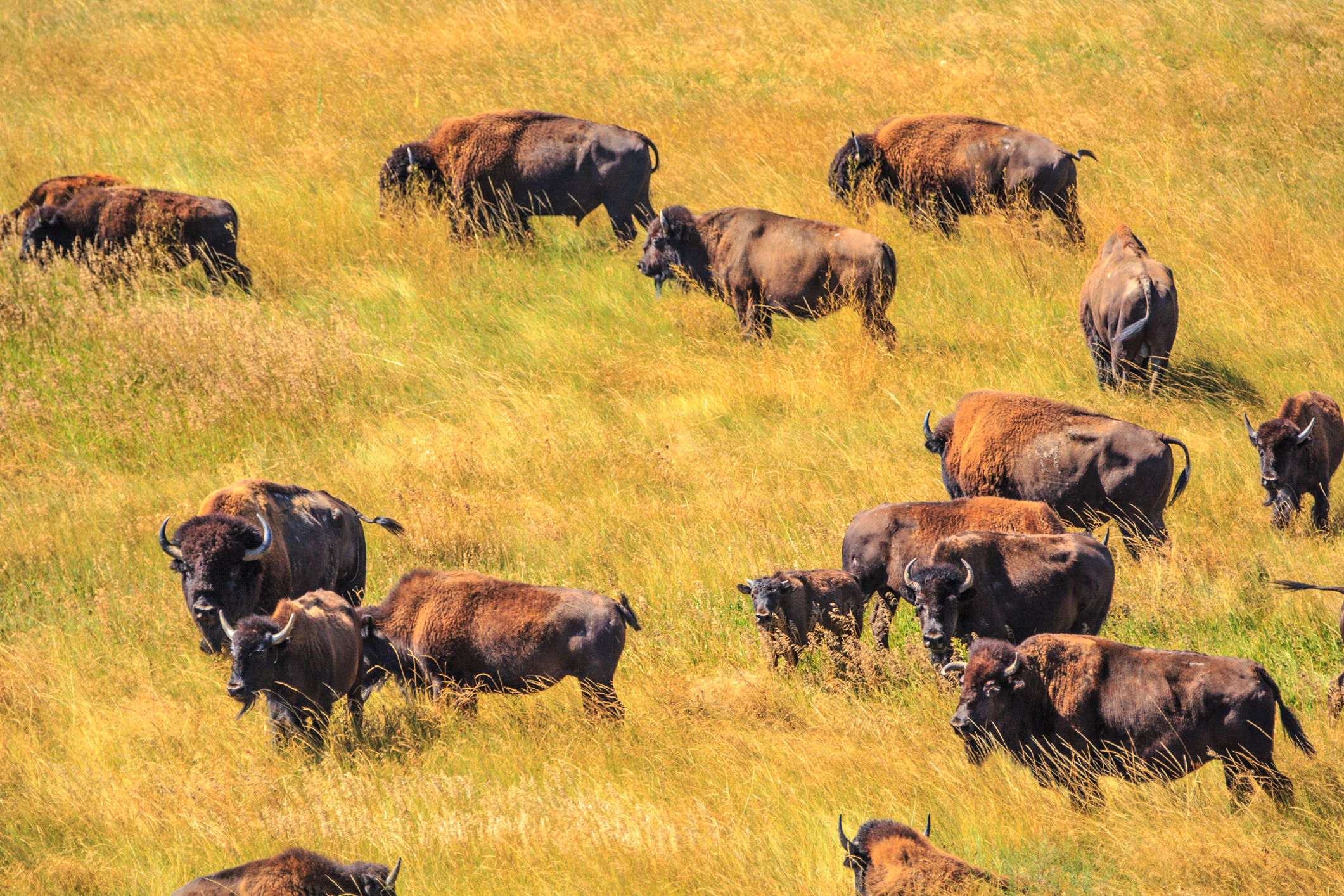
Some mornings after a night of unraveling Cal and I would meet in a coffee shop to spool back into the form of something socially acceptable. We’d read the paper at a corner table and psychically loom. The walls were almost always hung with big glossy photographs of wildlife. Under each photo was a little wooden placard with a title and price. Above Cal’s head was a photo of a herd of bison. Hungover and slightly nauseous, I sipped my coffee and stared at it osmotically.

I looked down at Cal. His head was lowered to the paper. Not moving his eyes from an article he took a sip from his mug and made a sound like he was expelling steam.

“Did exactly what I knew they would,” he said without looking up, after a minute going on, “Abandoned their tanks and guns…our tanks and guns…burned their uniforms and ran away like babies from the boogeyman.” He loudly folded up the paper in disgust and stared off toward the front windows. “You can lead a horse to water,” he said to himself, raising his mug again. “Fucking cowards.”

I looked up at the photo then down at Cal. Nothing mattered all of a sudden. I felt the urge to throw my coffee in his face, walk out and never think twice about anything ever again.

Cal had his visions. I had mine.

The feeling surged then dissolved. I looked back up at the photo and imagined us just out of frame sitting our horses, Cal’s eye laid down the barrel of a rifle. Very near us the photographer stood aiming his camera down the slope. Cal tested the wind then reached to make adjustments to his sights as the photographer made adjustments to his camera. Seasons altered when I blinked. The river valley below flashed white and frozen then vibrant and lush, full of grazing bison, then hazy red as if lit by a smoke-veiled sun.

Cal spun his horse a half-turn then kicked up his legs and spun his body the opposite way. He laid his barrel across the horse’s hindquarter, lowered his body behind it and wrapped his legs around the horse’s neck. Chinning a mocking glance at the photographer then looking down at the heard, he wagered he could shoot more of them. They both squinted with one eye, fingertips poised.

I couldn’t discern the explosion of gunpowder from the snapping of the shutter. They were simultaneous and unmitigated. Cal seemed to levitate above his horse, purring with the recoil and instantly, expertly retracting the bolt with the meat of his palm, extracting each cartridge with a shimmering ting, then racking the bolt forward, slightly adjusting his aim and firing again. His zeal was as lethal and endless as his ammunition. The stampeding herd was swallowed up in a cloak of dust but Cal continued shooting, now indiscriminately, wildly into the cloud until finally spinning on his haunches back riderwise, sheathing his rifle and trotting down the slope.   

Streams of blood merged into pools, gathering momentum through dirt for the river, then dripped viscous over the bank and into the current, carried down-valley, frothing over boulders and swirling into sun-warmed eddies. Our horses emerged on the other side as if dipped up to the withers in rusty oil. We made camp atop the opposite plateau.

I saw our fire spitting embers up at the night. I saw Cal’s face warping through the flames, a mesmerized glimmer there. I saw him get up, walk to his horse and reach into his saddlebag for the wineskin.    

I wanted to tell him he was nothing, tell him to swallow his tongue and get out of my head. But I drank my coffee and agreed. “Fucking cowards.”

————

We rolled cigarettes and sauntered from one art gallery to the next, getting drunker, whistling and humming obnoxiously. Cal hurled a wine bottle like a grenade over his head and didn’t look to see where it shattered. All glass started to pulse with fragility. From the street the galleries looked like snow-globes, I thought. We watched them sip their drinks and attempt to shake their evening into something special. Cal and I joined them. I overheard someone suggest that the price-tag dangling from a bison skull was “irrelevant, really.” I laughed out loud. Everyone seemed to be laughing. I drank deeply from a bottle and laughed again. A laugh I hardly recognized.

From the sidewalk I peered back inside through my reflection in the window, suddenly paralyzed. They swirled their cups. A weird light shifted through the window onto them. I saw a race of aliens discussing a different skull: “This,” one said, cupping it like a wineglass, “this was one of the snow-globe dwellers. They were the first to be eradicated or relocated. They seemed to possess no memory nor useful skill to contribute to the re-cultivation of these once fertile lands.” The alien swirled it and took another drink. “We were baffled, and quite frankly horrified, to see them building their settlements on the richest soil in the valley. Even worse, they hunted large creatures for the size of their crowns, not the yield of their sustenance. They tricked fish into swallowing hooks on strings that they might enjoy the suffering and fear transferred to their hands, just to rip the hook from their flesh and throw them back to repeat the ritual.” Exhaling sharply then making a motion to drink but balking, the being continued, “In fact, we have discovered evidence that their economy relied heavily on these ‘sports,’ as they called them.” They all drank and another chimed in, “Where they got the food they actually consumed is another story entirely.” Their long antennae wobbled as they shook their heads and sipped from their cranial vessels, “Savages, I tell you. Real savages.”

Apparently, there was one more gallery, though I couldn’t really say.

————

The last thing I remember is standing in front of a hundred old machine parts—gears, springs, brackets—all tack-welded into the form of a giant bison skull. Its hollow eye-sockets glowed with electric lights timed to change every few seconds from white to green to red. I looked around and saw everyone taking photos of the sculpture with their phones then bow their heads. Their faces glowed piously, bathed in the light of their screens.

I saw them growing undead, praying as though from that liquid crystal had whispered a promise of immortality. I saw the ghost within it baiting them, desperate for them to vacate their own minds that it might take up residence and power there. I saw them offering their knowledge and memory, their lives as tribute.

I saw horses and a long, cold winter. I saw ribboned stacks of paper bills, photographs, paintings and furniture piled high in the center of a room. I saw fire in the floor, fire licking at the rafters. I saw blood rising to my skin in a vacuum ravenous for it, inhaling me as if for the marrow in my bones, as if to extract from my body that which my dreams had promised it.

I saw white then green then red.

————

The judge gave me my own private cell and some time to think about my life choices, as he put it. Miraculously, the only book I could get my hands on when the library cart rolled by was The Death of Jim Loney by James Welch. Jim Loney is my age, estranged from his community and going “gently insane” on his drunken descent toward “noble, inevitable self-destruction,” as one reviewer suggested. I had to laugh. I read it in one sitting. Then I cried. Simple tears at first as I reluctantly turned the final pages, feeling that the resolution would be far too costly. Then involuntary, spine-binding weeping to the edge of suffocation and back. An hour, maybe two, three before the waves subsided. Rolling over, I mouthed silent, unknown things at the ceiling, staring holes through it. I traced forms of animals on the naked cinder-blocks and wanted to die.

The night before I was released, I dreamed. I stood under bright stars at arms-length from a fire. I reached in with my hand and held it there, entranced by the impossibility of not being burned. There was a metallic clink followed by a voice. “Will is fate,” it said. I turned to see him bent to the ground with a hammer in hand. Around his wrists were manacles attached to a length of chain rooted in stone. He set the hammer to mark his aim then raised it above his head and swung it, sending the sound into the night and a splash of sparks to the ground. Without looking up he said, “Until it breaks,” and marked his aim again. He punctuated himself with the slow but deliberate rhythm of a simple machine made to mark its own rate of function: “Will is fate…” clink… “Until it breaks…” clink…. And on and on, chanting through the night.

I turned back to the fire and felt the memory of stepping into it. There was a vibration each time the hammer struck. The light began to pulse. A step closer brought a roar like waking up at sea in a terrible storm followed by a deeper vibration, a kind of rhythmic thudding and a drone of voices. As I stepped fully into the flames figures appeared to be weaving themselves into each other, their bodies bound up in one form of writhing then another, their desperate faces mouthing the air, their arms and hands hitting me unfeelingly as I pushed my way through. Everything mounted into a violent, unbearable wave of anguish. I was knocked to the ground and began scrambling furiously. The thudding grew in my hands and knees, in my stomach, vibrating everything into one densely concentrated center until it could no longer contain itself. Light flashed from the core of an explosion, consuming everything. Then darkness. Silence. I felt the coolness of night as if directly on skinless muscle.

I woke up and stared at the ceiling, something inching its way from my stomach into my throat and finally over my lips, so delicately that even I could not quite make it out. Though I understood. Kill the soldier, save the man.      

————

Cal picked me up. He rolled around the corner of the jail in my 1986 Land Cruiser. The old leaf spring suspension had long since lost its spring and took all bumps under the tired, squeaking protest of its joints. From a dead stop it coughed up a little cloud of exhaust and could putter up to sixty-five mph given a long enough, flat enough stretch of highway. I smiled to see it parked at the curb.

Cal waited for me to move but I just stood there and stared at him through a fog of breath. His hand went up as if to ask if I was getting in or not. He eventually got the picture, opened his door and circled around front to the passenger side, lunging toward me, shouting “Shotgun!” in my ear as he passed. He didn’t even have a driver’s license.

In fact, I wasn’t sure if Cal existed at all. As far as I knew he had gone completely off the grid. In his mind, veterans of our stripe were all on a secret government watchlist. He believed the state was not so obtuse as to train us to abandon empathy, kill on command, send us to war, and then simply release us back into the world with a pat on the back, an unlimited prescription for drugs and a suicide hotline card without at least keeping an eye on us, see if we could still play the game without getting too wise. Cal had it all worked out. When he smoked he became very lucid, almost telepathic, he claimed. He’d lay on the floor blowing thick clouds at the ceiling and intercept conference calls from the Pentagon between a handful of politicians, a data-storage gate-keeper, and a spooky DoD agent going on about “the imperative to track and, when necessary, guide liabilities as they are released back into the mainstream.” There would be unofficial requests for sensitive information and off-the-books transactions.

Cal would close his eyes, point to both of his temples and see top-secret memos appearing in encrypted email inboxes regarding a surveillance operation to acquire location- and activity-intel on veterans who meet signal criteria. He’d start listing them: “…combat…college…debt-free…single…,” as if straining to receive each word which, according to him, constituted a probability of ideological disillusionment and sedition sufficient to red-flag an individual for life. According to Cal, one of us was on the fast-track to being “disappeared.” He’d relight his joint and blow smoke, occasionally mumbling another paranoid stream of thought: “If credibility is established by credit…and credit is debt….” He’d take a long drag and ash in the big planter pot then keep going: “…and debt is forced labor, and forced labor is the mechanization of humans, and…,” and on and on.

He tapped out a short couple of beats on the dash board. “The Colonel’s looking for guns,” he said to the windshield, waiting to see if I’d respond, then continued, “I told him we’d meet just as soon as I could spring your sorry ass.” What he meant was hired guns. The Colonel was actually a retired Army Colonel who by whatever nebulous network of connections was eager to put together a private security team to head back into high-conflict areas. His types of teams ran defense and often offense for god-knows-who, doing things that made for long redactions in official reports. The one certainty was the money. “A hundred fifty Gs for six-month’s work, boy.” I could tell by his voice Cal was already there. He never really left. “Fuck it,” he said, “I’ll text him right now.”

I don’t know why I didn’t tell him not to. The cold, clean air drafted through the window and I was just glad to be feeling and breathing it. I couldn’t summon the energy to negate anything that was going to happen. He plugged the auxiliary cable into his phone as he read the Colonel’s text. “Sanctuary. One hour.” He cocked his head at me, “There it is. Let’s get a few freedom beers in you, partner.” He scrolled down his screen and selected Oh, Marie by Louis Prima, rolled the volume knob, drummed the dash with his hands and yowled as the cymbals and sax really kicked in, “Once more unto the breach!

————

I righted the table and chairs, found a broom and swept all the glass, mopped the floor and fastened the cabinet doors best I could back on their hinges. Cal sat at the table with the paper, occasionally reading out loud something that twisted up in his mind just right. I finished putting the kitchen back in order, poured myself a glass of water and sat down across from him. Without looking up he said something about meeting the Colonel again to iron out the details, sign some papers for clearance. It hadn’t registered to me that a decision had been made, as though I was simply caught up in some kind of entropic undertow. I didn’t even know how many days I’d been waiting to get spat out and wash ashore. But there I was. He told me I better go warm up the beast.  

On cold mornings, because the cable was broken, I had to pop the hood of the Cruiser and manually wedge the choke closed with a stone that had sat in the console for years and just so happened to be the ideal size, apparently waiting for that very purpose. We cut tracks through a couple inches of fresh snow, hit main street and headed downtown. The sidewalks were empty. We sipped coffee at our usual table in the corner and waited for the Colonel.

Every few feet on the walls were different glossy photos—a silhouetted elk, spotted whitetail, nesting blue herons, rainbow trout. Above Cal’s head was a photo of a single bison, its eyes like polished obsidian squinting against wind-driven snow directly into the lens. Written beneath it on a little wooden placard was the title and the price: Winter Hunt, $290. It was number four of twenty-three prints. I scratched out the math on a napkin and said the amount to myself. Cal asked what it was. Ignoring him I looked around the shop counting the photos with similar placards and did that math. “One hundred thousand, fifty dollars.” I sat there waiting for whatever else was rising to the surface.

Cal sensed a shift and switched to recruiter-mode. “Don’t get weird on me, son. We’ll be out of this sorry shithole by tomorrow. There’s a zero-six-thirty to Seattle, Seattle to Frankfurt, Frankfurt to a nice desert paradise, eighty-five degrees. Masters of our own destiny again.” He kicked my chair to get my eyes off the photo. “Hey, you listening to me? Don’t forget you’re getting paid to get the hell out of this phony-ass town to do some real shit again. It should be the easiest decision you ever made.”

I stared into my coffee and spun the mug a half-circle by the handle and muttered it back to myself. “The easiest decision.”

“The easiest. What’s there to think about?”

“You ever wonder why it’s easy?”

“Christ almighty. Is your head screwed on? I just told you why.”

“I don’t think I need easy. I don’t need a way out of here.” I sort of rolled my eyes around the coffee shop then leveled them across the table. “I need a way out of here,” I said, reaching across the table and tapping Cal’s temple with my finger. He grabbed my wrist and stared at me, then through me as he let go. He wasn’t there anymore. I stood up sharply, knocking my chair over. A couple heads turned to see what was happening. I picked up the chair, gathering myself upright, then pushed it back under the table and inhaled slowly. “Thank you for your service, Cal.” I apologized to no one in particular then turned and walked out the door.

     ————

The Cruiser stuttered faithfully into action. I pointed west and drove until all signs of civilization faded but the road itself and a few old ranch houses. I drove for an hour, then two, in silence except for tires on pavement and crisp air whistling through a crack in the window. I knew where I was going. Soon the road turned to frozen dirt and up ahead cut through the crest of a ridge at the base of a giant V in the earth before descending sharply into the river valley. I could hear the glimmer in my father’s voice telling me I’d better hold onto something as the truck accelerated toward what looked like the edge of the world.

Even though I knew what was coming my stomach would rise into my throat, out of my body it seemed, and stay suspended somewhere above in a moment of perfect weightlessness before rushing back into me like a flood as the wheels received the full weight of the truck again. With a big youthful grin he would gently apply the brakes and, taking in the view, exhale as though to slow down his heart. I let myself believe that was the memory which accompanied him over the edge when his heart finally slowed to a stop.

The width of the valley was marked distinctly by sheer plateau walls like far-reaching bookends. It spanned maybe a mile at most and was never so narrow that you could throw a stone from one side to the other. The road sort of disintegrated into a primitive two-track used occasionally to hay cattle and check fences. But there were no cattle to be seen and all the post-latch gates were laid open. Where the way intersected the river I turned left paralleling it upstream through dormant, snow-dusted grass and sagebrush. In the narrow sections of river the water was frozen solid like frosted glass and I wondered how thick, if it could be driven across without breaking through or getting stuck. A couple of times I passed large stones and nearly stopped to hoist them from the bank down onto the ice but decided to keep going.

Eventually the road curved out into the field and then back toward the river-crossing. I held the wheel at an angle and the slight pull felt like being in a slingshot. Depressing the pedal and bracing either side of the wheel my head hit the roof as I sped over a sharp dip at the bank. Ice shards and water instantly cascaded over the hood and windshield. I instinctively ducked and held my breath, pinning the accelerator to the floor, feeling each stone under the tires claim a little more momentum. And like a beast whipped to the brink, hissing plumes of steam and coughing, the vehicle limped up the bank on the other side. I managed to coax it to the foot of the escarpment, where it sputtered to a halt alongside a small juniper. There was no sense in trying to start it again but I tried anyway, turning the ignition over and over until there was nothing. I opened the door, stepped out and closed it, reluctantly accepting I was stuck there.  

When I was just a boy, standing very near that same place, I’d look up the steep slope to the base of the cliff with dread anticipating the burning in my lungs and thighs, the terrible thirst and having to claw through the crevice at the top. Somehow everything I’d seen since in no way diminished that feeling of dread. I started hiking.

Halfway up I kicked through the snow a bit, more for the memory than anything. In the summer if you dug around in the talus you could sometimes find tooled stones, pieces of spear or arrowheads, even bison remains, bone shards. I was so much smaller then, when the world went on forever yet seemed closer somehow. Peering up to the top of the cliff I would shudder to imagine an entire herd leaping one after the other from the edge and plummeting toward me, the frantic adrenaline in their eyes, the earth heaving under the impact of their massive bodies. Young men would peer panting from the edge down to the bloodied arms of women expertly stripping those bodies of their hides and carving the meat from their bones. They would be all around me as I made my way up the slope to the base of the cliff wall.

The only way to the top was through an opening there wide enough for one person. It led through the stone where water had eroded its way for thousands of years through weaknesses and where very little light penetrated. Acute claustrophobia held each breath just out of reach as I inched my way up and through, relieved only in the assurance that at least in the winter, rattlesnakes lay dormant, brumating in their dens, their hibernacula. In my mind they were coiled tightly together, purring through dreams in the buried warmth of the earth around me. My skin ran flush with a surge of heat then shivered in the last shadow as I pulled myself finally from the hole at the lip of the plateau. Catching my breath, I turned to survey the valley. Behind a thin veil of clouds the sun was soft and low on the horizon. I stepped back from the edge and picked a couple of rocks from beneath the snow. Flinging them underhand I watched them spin silent in the air and tumble down the slope. I threw one half-heartedly at the Cruiser before sitting down and staring out across the valley.

It seemed there was nothing in sight to indicate when I was. It was all time and no time at all. I plucked a sprig of sagebrush, rolled it in my fingers and held it under my nose, inhaling its sweetness, cool like mint in the back of the throat. I scratched up a small handful of icy snow, compressed it in my palm and sucked the moisture from it. Tracing the river upstream I saw sun-baked ground and fine clouds of dust rising along the banks behind horse-drawn travois, the sinew-lashed lodgepole bowed under a winter’s rations. I saw naked young men and women washing blood from their bodies where the current was swift. I felt everything slow and waited for darkness.                     


Book Review by Eric Chandler: IT’S MY COUNTRY, TOO

This happened in the 1980’s. Maybe it was after I joined the military or before, when I was thinking about it. In either case, I was sitting in a cabin in New Gloucester, Maine with my Aunt Helen and my cousin, Kim. Somehow, we got into the topic of women in combat. I made some comment that we needed to decide if that’s really what we wanted as a country. My cousin and my aunt both snorted.

I don’t remember the exact words, but my Aunt Helen said something like, “Who the hell is ‘we’?”

It sticks out in my memory like I got slapped. Even as a self-centered, male teenager, I had to admit they had a point.

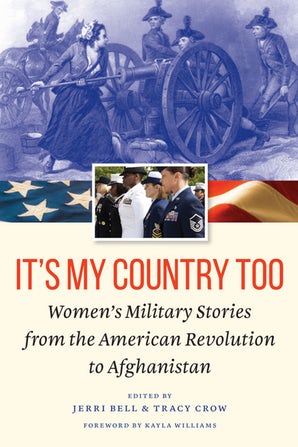
I’m still trying to remove myself from the center of the universe and imagine what life is like from someone else’s perspective. I read a book during Women’s History Month called It’s My Country Too: Women’s Military Stories from the American Revolution to Afghanistan (Potomac Books, 2017). It’s filled with stories that address a question my aunt might have asked, “Why should it be so difficult for a woman to serve her country?”

I served alongside women in uniform from 1985 to 2013. In peacetime and in combat. Officers and enlisted. Pilots and ground personnel. Active Duty and Air National Guard. I went to the Air Force Academy not long after women were first admitted there. When I first joined the Air Force, women weren’t allowed to fly fighters. I eventually served in units where women were flying in formations with me. I’m married to a retired Air Force veteran and Air Force Academy graduate. Her older sister, also a grad, retired as a major general in the Air Force. I should already have a first-hand appreciation for what strides women have made and the challenges they’ve faced in military service. But Jerri Bell and Tracy Crow, the editors of this book, gave me a new perspective on where my three decades fit into the larger scheme of things.

It was a new perspective that I needed, for a couple of reasons. For one, my wife had a positive experience in military service. She’s tough, but quiet. When I push her on the topic, to find some hidden story of struggle or discrimination or mistreatment, she has almost nothing bad to say. Frankly, she seems like an exception. Secondly, I served in the US Air Force. My perspective is limited to my branch of service.

In It’s My Country Too, there are stories about women in all the branches of military service, even disguised as men so they could fight. There’s even a story about a woman who served in the US Lighthouse Service. The breadth and depth of the stories the editors included is remarkable. There are uplifting stories and ones that are ugly. Another thing that makes these stories compelling is that they are first-person accounts. There’s a lot of background provided by the editors, but the stories come from the women themselves. This is a great accomplishment, because, as it says in the book regarding Korean War nurses (but the sentiment is true for women’s stories in general), “None published memoirs.”

The editors mention Louisa May Alcott who wrote Hospital Sketches about her time as a civil war nurse. She served under a woman at the Union Hotel Hospital named Hannah Chandler Ropes, my relative. Ropes is buried in the town where my parents live in Maine, the same town where my aunt schooled me about what “we” means. Her writings were published in Civil War Nurse: The Diary and Letters of Hannah Ropes (The University of Tennessee Press, 1980) edited by John R. Brumgardt. Bell and Crow inspired me to pull this book down off my shelf for another look. I was disappointed to see that my copy, that I read years ago, didn’t have a single dog-eared page. Say what you will about desecrating physical books, but mangled pages are how I leave breadcrumbs. I read it again.

Ropes served as a volunteer nurse in that hospital in Georgetown. She showed up there on June 25, 1862, the day that the Battle of the Seven Days started. Her nephew Charles Peleg Chandler died fighting at Glendale during that battle on June 30, 1862, the same week she arrived. In a July letter, she says she’s worried about both Charles P. and Charles Lyon Chandler, his cousin. I’ve been researching Charles P. and Charles L. Discovering that their aunt wrote a letter wondering whether her nephews were okay was like getting an electric shock. I have Bell and Crow to thank for helping me learn what I should’ve known already. In a strange convergence, it was Charles P. who inadvertently motivated Ropes to become a nurse when, two years before, he sent her a book about nursing written by Florence Nightingale. Sadly, Ropes and her two nephews would never see the end of the war.

At one point as the head matron of the hospital, Ropes was so horrified at the mistreatment of the enlisted men who were patients, she complained to the head surgeon. Getting nowhere, she went in person directly to the Secretary of War, Edwin Stanton. Once Stanton verified what my relative said was true, he threw both the head steward and the head surgeon into prison. Things improved at the hospital. I was a squadron commander once, so it stings a little to read how she went around the chain of command. But she cared more about the treatment of the patients than how she was perceived. She was also a single mother after being abandoned by her husband in the 1840’s. In the 1850’s she moved to Kansas as part of the freesoil, anti-slavery movement to help make it a free state, but that’s another story. The point is that she was well past being bashful or “proper.”

The very last thing that Ropes wrote was a letter to her daughter on Jan 11, 1863 where she let her know that she was ill along with many of the nurses she supervised. She said “Miss Alcott” was “under orders from me not to leave her room.” Both of them had typhoid pneumonia. Hannah Ropes died on January 20, 1863 at the age of 54. My son and I ran by her headstone the last time we were in Maine. Louisa May Alcott pulled through and wrote Little Women. Funny how lives circle around and intersect in the past and the present.

Two stories struck me in It’s My Country Too because they seemed universal to me, regardless of the sex of the author. One was the moving piece by Lori Imsdahl. Maybe it was because it dealt with Afghanistan, where I’ve looked down on scenes like this from the air and yearned to know what it was like on the ground. Or maybe it was because she talks about luck. Or maybe it was simply because I was transported there by her outstanding writing.

I’m a pilot, so another passage that hit me hard was by Cornelia Fort, who dodged enemy aircraft in her plane as the Japanese attacked Pearl Harbor (another incredible story). But this next bit was universal for a pilot, whether you’re a man or a woman:

None of us can put into words why we fly. It is something different for each of us. I can’t say exactly why I fly but I know why as I’ve never known anything in my life.

I knew it when I saw my plane silhouetted against the clouds framed by a circular rainbow. I knew it when I flew up into the extinct volcano Haleakala on the island of Maui and saw the gray-green pineapple fields slope down to the cloud-dappled blueness of the Pacific. But I know it otherwise than in beauty. I know it in dignity and self-sufficiency and in the pride of skill. I know it in the satisfaction of usefulness.

When I read this passage by Fort and the story by Imsdahl, I don’t feel like a man or a woman. I feel like a human being.

Which reminds me of something Hannah Ropes wrote on December 26, 1862. Her hospital was overflowing with injured soldiers from the Battle of Fredericksburg. The dead and the dying and the amputated limbs. She wrote: “The cause is not of either North or South—it is the cause of, and the special work of the nineteenth century, to take the race up into broader vantage ground and on to broader freedom.”

Is she talking about emancipation? She was a vocal abolitionist. Is she talking about the advancement of women? Her writings are clearly feminist. I read all around the quote in that letter and in the book to try to understand what she meant. The editor Brumgardt infers that she means the whole human race. I hope all of those meanings can be true simultaneously.

 It’s My Country Too brought me to broader vantage ground and helped me face my aunt’s question: Who the hell is “we”?


New Poetry from Liam Corley

In Which I Serve as Outside Reader on General Petraeus’s Dissertation

[The current version of the Army’s Field Manual on Counterinsurgency, FM 3-24, originated as a doctoral dissertation written by David Petraeus at Princeton.]

Premise flows from premise like water over the edge
of a waterfall, entrancing those not caught
in the turbid spray, those not lingering in the limestone
chutes that channel the first descent. Dulce et decorum,
those molecules in free fall, powerless to reverse
dictates of gravity, whether they be composed
of dollars or bodies. A theorist must maintain sense of scale,
must view war at an appropriate distance, so that its beauty
may emerge like a cold, perfect moon that draws the restless
from their beds with dreams of space flight. The best way to lie
is to get one big whopper on the table and move on quick
to crystalline truth after truth in a train of plausibility
so compelling we don’t see how down becomes
up, so convinced are we by the quality of our reasoning
that be leads to see and eventually to eff and tee, and the best
first lie aligns with ones we’ve already bought, like how we cheer
Frost’s traveler in the yellow woods longing for the road
not taken, nodding along with his glib boast that non-
conformity explains contingency because we can accept
failures chosen on noble grounds more than unforeseen
leaf-covered ways that erupt when footfalls complete
the circuit of pressure plate IEDs. Mr. Petraeus, your counterinsurgency
tools could only work in countries we didn’t create, republics not birthed
by death from above, and so I regretfully conclude
this dissertation presents the naked assertion of imperial power
as the contribution of a helpful guest, final proof that
intelligence and gulled innocence, in general, betray us.

Double Rainbow at Dawn, 15 North at the 10

The rubberneckers slow down
as they do for other hazards,
brake lights merging into
the penumbra of a double rainbow
due west of the traffic lanes,
while in the East the rising sun
irradiates vapor-soaked air.

We are all late, looking askance
at the fireworks of nature,
wondering how our priorities
match up with this display.

Double, not just one: two arcs
of vibrant color proclaiming
peace on earth if we
don’t kill each other
trying to take it in.


An Interview with Brooke King, author of WAR FLOWER: MY LIFE AFTER IRAQ

Andria Williams: Brooke, thanks so much for taking the time to chat with Wrath-Bearing Tree. We are all excited to feature an excerpt from your debut memoir, War Flower: My Life After Iraq. In a starred review, Kirkus called it “an absolutely compelling war memoir marked by the author’s incredible strength of character and vulnerability.”

How long was this book in the making? How does it feel to finally have it out in the world?

Brooke King: It is a bit nerve-wracking to have it out in the world, but then I remember that it took me four years to get it there, and even longer to try and write the book. I struggled with what people would think of me and what I have been through in my life, and then it dawned on me. The 19-year-old girl I was then doing all those things is not the same person that I am today, and so I gave myself permission, in a sense, to just let the criticism slide away. Yes, there are going to be people that judge what I did or shame me for falling in love with an officer when I was a married woman, but to me, that girl no longer exists. A mother of three no, I don’t even know who that girl is anymore because I am so far removed from who she was and to me, that is what makes it okay to have this book out in the world for all to read.

AW: I have to ask, because my kids (especially my 11-year-old son) are magnetically drawn to the book’s cover: what’s the significance of Boba Fett? Is that your tattoo?

BK: So, it’s funny you should ask. The Fett tattoo is mine. It’s located on the inside of my left forearm. I originally got it because I wanted to get a tattoo that symbolized my nickname, “War Flower.” And because I am a writer and symbolism is everything, the meaning behind it is kind of cool, but also very nerdy. Boba Fett is a bounty hunter form the Star Wars lore. And here is where my nerd shows through…. He ultimately was a war byproduct of his father Jango Fett who was a general for the Clone Army during the Clone Wars. The symbolism behind it is that during his hardships of growing up, he turned away from the traditions of the Mandalorians and chose to follow his own path, and so having him blooming out of a flower seemed to be a perfect metaphor for War Flower. The design staff over at University Nebraska Press asked for what my interpretation of War Flower was and I mentioned that I had it tattooed on me. I sent them over the image of my tattoo along with the meaning behind it and they loved it so much, they decided to use it.

AW: I’m a fan of the Fetts, so I think that’s pretty cool. (I have even dressed as a Mandalorian, but that’s another story.) Anyway, I love your tattoo, and it makes a perfect cover.  

So, the book’s synopsis begins, “Brooke King has been asked over and over what it’s like to be a woman in combat.” I found an intriguing hint of an answer to that in the line, “Here is where a girl is made into a woman and then slowly into a man.” What does that mean, exactly?


BK: It means that there is a time in every female soldier’s service where she is forced to grow up. But for me, as a female soldier who saw a lot of things that normally I wouldn’t have, I was forced to grow up, but then thrown into a situation that normally is reserved for a male soldier sort of forced me to become emotionally and mentally like a male soldier. In a sense, I was forced into survival mode by adapting to what male soldiers would normally go through in the harsh condition of combat.

AW: And yet, even though many women have served in combat over the last decade and more, you share an anecdote about being driven by your grandfather to the local VA upon your return home and encountering not one, but two VA employees who meet your explanation of combat trauma with disbelief and even hostility: “A man comes in, asks me to follow him to the TBI and spinal injury ward. He points to the men inside the room, tells me to think long and hard about lying about combat before I tell him anything more.” 

First of all, what an asshole. But also: How is it possible that such a disconnect can exist, not only between female veterans and the civilian public, but even between women vets and the civilian professionals meant to serve them?

BK: I think it stems from the concern that women are supposed to be the bearers of life, so to think that a woman can be hurt in the same way as a man at war, it makes people uneasy. However, I think the disconnect about female veterans comes from lack of knowledge. Civilians just didn’t know to what extent women were involved in OIF and OEF, and because of that, they have a hard time believing when a woman comes in for help with combat PTSD or combat related injuries. In order for this stigma or misconception to diminish, the government and female veterans really do need to speak up and account for that missing link of information. I know that personally speaking up has helped thousands of other women because I was one of the first women to go through combat PTSD treatment from OIF. I went through a lot of trial and error for years until I was able to find a regimen that worked for me.

AW: War Flower alternates between sections of traditional first-person memoir, and brief chapters of creative nonfiction in which you imagine your way into the minds of other people–a teenage Iraqi girl, a tormented young boy–and even (as in “Dog Tags”) inanimate objects. How and when did the structure of the book become clear to you? Did it begin as a more traditional memoir, or did you always know that you wanted it to be more of a kaleidoscopic view of war and homecoming? 

BK: I began writing the book several years ago and it wasn’t until I ran into a part of the memoir where I couldn’t remember all the details correctly enough that I began to imagine what it would be like to be that person. I am referring to the section “Ghosts” where I imagine what it would be like to be an Iraqi girl on the other side of the war. After I wrote this section, I realized that memories are a jumbled mess of information recollected over time, and someone with combat PTSD has memories that are distorted by their trauma, so when I went back to rethink the structure, I decided that the structure should mimic my memories; fragmented, disjointed, and at times kaleidoscopic.

AW: Your wartime experience appears to have given you an empathy with veterans of former wars, and particularly for Vietnam veterans. In the chapter “Legacy,” you very sensitively craft a sort of plural voice of Vietnam vets: “I am nothing, they would say. I am the fault of my government, my father. I am plagued with nothing but lies. I did what I was told.”

This tone seems matched by one of your early observations about your time in Iraq: “We didn’t know the names of the streets or which roads led to nowhere. When shit hit the fan, sometimes we didn’t know which direction to fire the bullets…In the end the only thing we knew for certain was that we were all soldiers stuck in the same godforsaken country until the military let us leave or we died, whichever came first.”

Do you think there is a particular understanding between veterans of Vietnam and the GWoT?


BK: I think there is a sort of “oneism” that comes from being a combat veteran. There is a silent understanding that even though your war was somewhere different, you can still share that bond of knowing they went through hell as well. So you adopt with it this perspective of empathy towards other combat veterans of foreign wars. You know their struggle because you are silently struggle with the same issue. Though by no means was the homecoming I received the same as the Vietnam veterans, but it is that quiet understanding amongst us that to suffer and see war changes you into someone else, that there is a slow coming back process that each veteran must take. Some get there sooner than others and some never find their way back to the person they were before war.

AW: You mention reading Hemingway’s The Sun Also Rises while in Iraq. I’d love to hear more about your reading (and listening!) life during your military service–boot camp, wartime–because it seems that this kind of inner world is so linked to a person’s state of mind at difficult or transformational moments. (Did you listen to the Grateful Dead in Iraq, for example, or did that just bring back too many memories of your dad?)

BK: When I was deployed I listen all sorts of music. On days when I needed to unburden my soul a bit, I would turn on the Grateful Dead and listen to Jerry’s guitar in “Stella Blue” crying out to me, allowing me to feel the emotions that I needed in order to get through another day. Other days, I would stare at a blank page in my notebook unable to write a single line. Halfway through my deployment, I stopped reading and writing all together. I stopped listening to the Grateful Dead and listened more to heavy metal like Cradle of Filth and Dark Funeral. Some of soldiers around me listened to Slipknot. Sometimes I went days without anything but the sound of mortar rounds exploding and helicopters flying overhead, soldiers laughing and arguing in the smoke area, and sometimes, I just listened to the wrench I was holding while I laid underneath a truck ratcheting a bolt down. The sounds of war and of home coagulate if you let them, so I made it a point to never let the two intermingle for too long because I become either homesick or pissed off that I was still stuck in Iraq.

AW: Metal! Were you a fan before you went to Iraq, or did you start listening to it there?

BK: I listened to Pantera and Slayer, and I think I even listened Iron Maiden, but I really didn’t listen to it too much before. I was a punk rock kid growing up so I listened more to the Ramones, Rancid, Anti-flag, and Bouncing Souls, that sort of stuff. It wasn’t until the guys in the PSD team put on Slipknot and Cradle of Filth that I began to listen to more mainstream metal. And even then, it was only because one day I was smoking a cigarette and I began to really pay attention to the lyrics and was honestly blown away by how poetic Corey Taylor’s lyrics were, and it sort of resonated within my soul how I was feeling at the time and gave me some sort of tragically fucked-up sense of peace to know someone else had a dissonance within themselves they were wrestling with, in a way listening to it made it few as though there weren’t two different women inside of me trying to tear my body in half so that they could both be free. I felt that the war for me was a constant struggle between who I wanted to be as a human being and the person I had to be in order to survive, and for me, music sort of helped calm the tearing apart of my soul.

AW: Well, I think that’s a really powerful explanation of what music does best.

Is there anything you left out of the book that you wish, in retrospect, that you’d included?

BK: I think every writer wishes they had put something in the book that they forgot, but for me, I struggled with whether or not to include more about my late ex-husband. He passed away right after I signed my contract and though he was happy that the book was getting published, I wish I had incorporated more about our marriage, more about how he was the one to save me in Iraq from not only the war, but from myself. He truly was a wonderful man and I wish I had incorporated more of that in there. The next book, however, does pick up where this one left off, so maybe there is time to redeem myself.

AW: I was very sorry to hear of your loss. For what it’s worth, I think the book paints him in a positive light–as a mostly helpful, concerned person for whom life was not particularly easy.

What were the hardest and most effortless parts of the book to write?

You always want to say that the easiest parts of the book are the ones where you talk about your family, but for me, the easiest part to write in the book were the wartime sections. Because I had gone through so much therapy and introspective at myself and war, it became very easy to write it down. To me, the hardest part was writing about my family. I really didn’t want to write about my upbringing. It wasn’t something I wanted to put in the book simply because I couldn’t dedicate enough space to the matter that it needed, and so I ended up summarizing those parts and it really pained me to do that in  particular because I knew I would be leaving huge sections of my life out that needed to be discussed fully. I also feel bad about it because I shed some of my family members in a very negative light, much to their dismay, and I have gotten flack for it by them, but in my defense, I did tell them that the next book was going to discuss more of family and less of war. It also was extremely hard to dissect my marriage that at the time I was writing the book was in steady decline. How was I supposed to write about falling in love with my husband when I knew he was somewhere else with another woman? But I found another reason as to why to tell that love story; my twin boys, who the book is dedicated to. I wanted them to know who their father was when I met him and even more so now that he has passed, so I wrote everything down as though we were still in love and tried to remember those memories instead.

AW: In the Sierra Nevada MFA program, you were able to work with writers who were not just talented at their craft but are also combat veterans. What did this mean for you in developing confidence as a writer? Do you think your MFA experience would have been different if it had not included other veteran-writers?

BK: Being in the SNC MFA wasn’t just about being surrounded by combat veteran writers, it was about being surrounded by talented writers. I found that I was more so inspired to tell my story from the non-veteran writers than I was the faculty that were veterans. Of course, it helped that I had other vets cheering me on in my journey as a writer, but writers like Patricia Smith reading “Siblings.” Gah! It gives me goosebumps just thinking about it now. Colum McCann. Rick Moody. Writers, truly amazing writers inspire and light a fire underneath your ass, and I think the director bringing those writers is what really helped me become the writer I am.

AW: I love hearing that. I had a similar feeling when I went into my MFA program, too–that I was finally joining a creative culture that I felt I’d been seeing from the outside for a long time. And we can all use a creative fire lit under our asses, I suspect. What projects are you working on next?

I have started writing my new book, nonfiction of course. It really does pick up where “War Flower” left off, and traces the roots of my childhood while raising my children, the ups and downs of my marriage to James, my struggle with PTSD, and the death of James which damn near almost broke me. To say that this second book is going to be a hard one to write is an understatement, but I think will be almost like an emotional enema, and will really be interesting for readers who are struggling with PTSD, or the loss of a veteran to suicide, or even being a parent struggling to raise your kids. What made “War Flower” so unique was that I was a woman with combat PTSD, but having PTSD while trying to raise kids is a whole other beast that I really didn’t tackle full on in “War Flower” so the next book is really going to explore transgenerational trauma and female veteran related issues that surround combat PTSD.

AW: Can’t wait to read it. Thanks so much for talking with me, an sharing your work with Wrath-Bearing Tree.


Review of Jon Chopan’s Veterans Crisis Hotline

A few years ago, I had a conversation with a friend named Ted. Ted is a fellow veteran, and classmate of mine from the Air Force Academy who may be forgiven his obsession with Moby Dick. We were pushing our kids across the ice of Westchester Lagoon, a large pond here in Anchorage that the municipality grooms for ice skating, exhaling thoughts on books and writing into the winter air. Phil Klay’s Redeployment had recently been released to critical acclaim, and our talk turned to authenticity in war literature. There was something about this war—this forever war—that we agreed was allowing for a wider interpretation of war. A public affairs officer, and not an infantry type, had written a well-received story collection that felt like it might end up as thebook of our wars. It seemed to signal a paradigm shift.

Jon Chopan’s Veterans Crisis Hotline (2018, University of Massachusetts Press) reinforces the idea that war literature is no longer the sole dominion of those who’ve participated directly in combat. A winner of the Association of Writers and Writing Programs (AWP) 2017 Grace Paley Prize for Short Fiction, the collection joins a growing canon of quality writing about war by authors who lack the first-hand combat experience traditionally associated with war literature.

As the title indicates, Veterans Crisis Hotline focuses on contextualizing war from the individual level. More specifically: how the Forever War affected those who voluntarily participated in it. This connective tissue links each story. With the exception of the first short story, which shares (roughly) the book’s title, each story that follows begins with a title page that includes a partially redacted name, location, tour dates, and call duration that frames the stories as having originated from a call to a veterans crisis hotline. It’s a somewhat effective artifice that allows Chopan to present narratives told, without exception, from a first-person point of view that establishes immediacy and narrative authenticity. I only say “somewhat” because the title story is the sole piece in the collection that relies on a fictional narrative built on interactions between a crisis hotline caller and operator. The crisis hotline itself does not appear in the remainder of the stories, which results tension between the collection’s physical narrative structures. I wasn’t looking for a collection built off transcribed fictional dialogue, but the greatest harmony between structure and narrative in the collection exists within the pages of the first story, titled “Crisis Hotline: Veterans Press 1.” It’s a haunting piece in which the narrator, a veteran named Byrne, works at a crisis hotline center, where he fields calls from not just veterans on the brink.

“[O]ld widowers. Some were lonely bachelors who were looking for dating advice. Others were fine, except they needed an audience to tell a war story to, someone who’d yet to hear it. Reliving it gave them a sort of pleasure, or maybe catharsis. One man who was in his nineties called me every week. Each time he called he asked for me by name, caught me  up on the news from his neighborhood, “current events” he called it. Mostly it was gossip about the young soccer mom next door, the cheating husband. He talked about them so much that I felt like they had become characters in my own life. He was a veteran of the Second World War, but he never talked to me about that.”

Byrne goes on to establish a friendship with an amputee named Eddie who shares a bus with him, and the relationship progresses to an intense level of intimacy that Byrne cannot replicate with his girlfriend, a nurse at the local VA hospital. In one scene, Byrne finds Eddie in his apartment, sick for days and burning with fever. Before Eddie can go to the hospital, he asks Byrne to help him take a bath.

“Later, they would diagnose him with pneumonia, He would recover, of course. He was young and strong and had a great desire to live. I’d learned that much in my time with him. But there, in his dimly lit bathroom, as I scrubbed him and rinsed him clean, as I put shampoo in his hair and gently poured water over his head, he wept and I said nothing knowing, finally, that this was the only comfort he would ever ask of me.”

It’s a gorgeous literary moment that illustrates the bond that can exist between men who’ve shared war, and a stirring rejection of the unique brand of toxic masculinity the military tends to breed. This isn’t to say Chopan shies away from the ugly side of veteran homecomings. There’s the vigilante justice executed in “Men of Principle,” the wanton self-destruction of “Battle Buddy,” and the veteran suicide of “On Leave.” But Jon Chopan goes to great length to ensure Veterans Crisis Hotlinepeels back stereotype in his quest to understand the complex nature of military service.

The book suffers from a couple of little inconsistencies that rang hollow: the mention of a recently closed paper mill in Anchorage for example, when I’ve been unable to find record of a paper mill at any time (I live in Anchorage). But these are mere chips in the facade, and have nothing to do with Jon Chopan’s ability as a civilian to effectively convey the post-9/11 veteran experience. No, the trouble with Veterans Crisis Hotline is the company it keeps. As a short story collection that relies on first-person narration, it belongs on a shelf next to Phil Klay’s Redeployment. Sitting next to a National Book Award Winner, well that’s just tough.

The most audacious of Chopan’s stories, however, does not feature a veteran come home, but the son of a soldier whose father goes missing for some time before being declared dead. Child narrators, even the teenage boy of the story “The Cumulative Effect,” are tricky. Writers must walk a fine line between over-privileging their narrator with sophisticated language that strains authenticity, and infantilization. Nothing about the story’s narrator rang hollow, however, and at all levels, the story is a beautiful heartbreaker.

I’ve long argued that it’s time to replace Stephen Crane’s The Red Badge of Courageas an example of good war literature produced by a civilian. The last time I read through, I found it a hackneyed appropriation of veteran material manipulated to further an individual viewpoint. I firmly believe it doesn’t survive the modern era’s standards for writing outside one’s experience. And frankly, there’s no time like the present—in which a fraction of the American society fights on behalf the rest—for a non-veteran to step into the arena. Jon Chopan has achieved this feat with Veterans Crisis Hotline. With great care, he has written outside what he knows, and in doing so proven willing to grapple with societal norms and uncomfortable issues. Viewed this way, Veterans Crisis Hotline is a welcome addition to my shelves of war literature, neighbors be damned.


New Fiction: Beethoven and the Beggar

A handsome couple strolled arm in arm down Central Park West. The man, tall and athletic with a thick, well-brushed mane, wore a black, fur-trimmed cloak over an Armani smoking jacket. The lady, slim but curvy with lustrous blonde hair done in a complicated braid, wore white mink over a low-cut black Prada gown. Though bedecked in high-heels, the lady adeptly kept up their brisk pace past tourists, joggers, baby-strapped mothers, and other assorted humanity either living in or making their pilgrimage to the world capital of wealth and culture. Curious eavesdroppers would have been able to hear snippets of the couple’s conversation as they passed.

Did you see who Angelica left with last night?

You mean the French gentleman? What’s his background?

Apparently his family owns the Laurent-Perrier champagne house. Why else would she look at him? By the way, what’s on the playbill tonight?

Let’s see, there’s Handel, Ravel, Mussorgsky, and of course Beethoven.

Is that the best Alan could come up with? Which Beethoven are they doing?

The Fifth.

How uninspired! We can’t be staying for the entire show, surely? I’d like to change before Camilla’s soirée. Oh look, is that Dmitri and Sveva over there?

They continued across the piazza, stepping past a beggar at the base of the steps before going up and into the packed lobby of the Lincoln Center.

The beggar’s name was Daryl Jack. He started sleeping in his car two years ago; after it was compounded by the police he began sleeping outside. At first he stayed in North Harlem, then gradually worked his way down Central Park and the Upper West Side—much greener panhandling pastures. The last two months his main turf had been the prime territory around the Lincoln Center, which he worked along with his friend and ally, Mikey McAdams. The two men had met at the Saint Ignatius soup kitchen and hit it off right away. They found that they had been in the same infantry division and had both been to Iraq for the same deployment. They joked about the division Sergeant Major Fat-Ass who had called out Private McAdams more than once for uniform violations—dirty boots, crooked beret, badly shaven face. Private Jack had got to know that senior NCO much more intimately during his second Article 15 hearing when he had been accused of smoking marijuana on the night shift. No one had actually seen him smoking or found any weed, but he had the misfortune of already possessing a disciplinary record—drunk on duty and fighting with a white sergeant in his platoon. The case was sent up to the division commander who quickly recommended Private Jack for a Dishonorable Discharge from the U.S. Army. Three months later he found himself back at the Washington Heights housing projects he grew up in. For a while he didn’t think about work and drank away the little money he had left to his name. By the time he got around to looking for a job he found that nobody was interested in a high school dropout and former infantry grunt with a bad record.

Daryl Jack and Mikey McAdams took shifts pulling alms duty in front of the Center, while the other one set up camp across Broadway near the edge of the Park. Daryl had already developed his go-to gimmick—a big Louie Armstrong grin with bobble-headed nod. He supposed it made people feel safer and happier, which made them more generous on the whole. Somehow, Mikey, a former supply sergeant’s assistant, had recently scored costumes for both of them that brought in even greater returns. A jacket with tails fit for a butler and a tattered top hat for the tall, wiry Daryl; a threadbare tweed jacket and deerstalker for the short, stocky Mikey.

The first day after sporting the new (old) threads they raked in a combined $37.35, an all-time record. That night was an unforgettable bash for the “Baghdad Boys”, as they had taken to calling themselves. They each splurged on burgers and fries at an all-night joint; they chugged their way through a couple bottles of Olde English malt liquor; after midnight Mikey found a local pusher to score a few grams of herb. They parked themselves in some tree-cover a stone’s throw from Tavern on the Green and lit up a sizeable blunt. It was life itself they were celebrating—tonight they felt good, no matter what tomorrow would bring. Around 3 am, they located a prostitute near the pond and spent most of their last earnings on a two-for-one bargain trick. 

The next morning the bright sun was not kind to the two revelers who had camped safely through the night without being spotted by police. Parched mouths and pounding headaches limited their mobility until park security finally zeroed in and sent them packing. Daryl dragged himself vaguely westward, towards the Center. Incredulous passersby looked on when he stopped to lap up a stomach-full of water from a public fountain on the way out of the park. He found a good marble step on the shady side of a Deutsche Bank branch, where he spent the next twelve hours alternately sitting and dozing. He exchanged few smiles and even fewer words for the better part of the otherwise crisp autumn day, his energy still sapped from the previous night’s blow-out. Darkness fell and he peered into his upturned hat set out in front of him; near emptiness is what he saw. A few coins that totaled $3.51. He cursed to himself and then to some of the few walkers in the area, who exited the scene warily glancing over their shoulders. “Food or booze?” he thought to himself. “Let’s go see what Mikey’s got going on.”

Daryl remembered his friend telling him about a new rendezvous point, further up the west side. Apparently there were some new gangs trying to work the area and it was better to stay one step ahead of them. Daryl joked that those suckers would have their hands full if they scrapped with the Baghdad Boys, but Mikey thought avoidance was the best strategy. He had heard those other boys were playing for keeps. Daryl dragged his skinny body up block after block, keeping to the middle of the sidewalk, mostly looking down at his feet. Couples coming from the other direction had to suddenly split up and jump to the side as Daryl ominously and unrelentingly advanced. One man reacted too slowly and got shoulder-bumped, after which he berated Daryl in an angry but ultimately non-threatening manner.

Daryl turned left at 82nd Street and entered a shuttered construction site. As he negotiated a broken chain-link fence he heard the sound of glass and someone screaming inside the building. He continued without speeding up or slowing down through the doorway, where he saw Mikey holding a broken bottle surrounded by three dark figures. 

“What’s going on here?” Daryl asked Mikey. They all looked up at him, while simultaneously a bald man took the opportunity to stick a blade into Mikey’s blind side. Mikey howled.

Daryl watched his friend struggle to stay upright. Daryl felt rage take control of him. He grabbed a length of metal piping that was lying in the rubble around the entrance and ran towards the unknown trio. Two of them split up to handle his onslaught while the knife-man covered Mikey. Daryl swung the pipe at the nearer of the two men. The man tried to dodge but was nonetheless caught offguard by Daryl’s ferocity and sunk to the ground after taking a crunching blow to the shoulder. The second man came from behind trying to stick his own knife into Daryl, who swiftly brought the pipe down on an over-extended arm to a loud cracking sound. 

Meanwhile, Mikey was attempting to fend off the original attacker with his bottle but had proved too slow. He received another quick counter-stab to the upper back and dropped the bottle, after which the bald man immediately pounced with a final thrust to the chest. Daryl witnessed this last action just after dropping the second man to the ground. Mikey’s eyes widened and then rolled back as he buckled and hit the ground. The last man remained relatively calm as Daryl, in full berserker mode, closed in on him. The man narrowly avoided Daryl’s first swing and made a long gash down Daryl’s arm with his blade. Daryl’s second strike connected and knocked the man back. As he stumbled Daryl continued the assault with a wild overhead swing. The man violently lurched upwards with his knife and caught Daryl across the face just as Daryl brought his own weapon solidly down on the bald head of this unknown combatant. Daryl knelt beside his friend while the man twitched unconsciously nearby. The two others had fled the building at some point during the climax of the battle. Daryl reached out for Mikey’s hand, now lifeless on the cold ground.

Daryl awoke in the back of an ambulance, and then later in a hospital ward. After being patched up he was interviewed by a detective. He told the whole story, including the party the night before and his and Mikey’s shared service in Iraq. The detective didn’t say much as he jotted down notes, but the next day a social worker stopped by and offered to help Daryl get his life back together. She spoke of the range of opportunities there were to earn his keep honestly, like helping a construction clean-up crew, for example. Daryl told her to get lost; he wasn’t cleaning up for anybody. The social worker left a card in Daryl’s jacket pocket with her name and number. That night Daryl exited the building and walked back onto the street without anybody noticing or taking account of him. The nasty scar on his face didn’t make it easier to beg, but some people still took pity and gave.

By the night of the concert a week later, Daryl had been pondering his life for the better part of the day. He watched well-dressed people and happy families walking past. Where had he gone wrong? Why hadn’t he been born into money, or happiness? He had never known his father. His stepfather drank and often beat him, until he and Daryl both got too old for that game. Daryl had friends, but never the kind that a mother would have wanted for her son. They always seemed to get into trouble together, with Daryl typically catching the blame. Mikey was the first one he could remember who actually cared about Daryl as a person, who gave back as much as he took. Now he was dead, and Daryl didn’t even know why. He started from his trance by the sound of high-pitched laughter and looked up at a particularly beautiful couple that had just brushed past him. He imagined that the man and woman were mocking his ugliness and squalor as they floated up the steps into the opulent sanctuary above. He looked down at his upturned hat on the sidewalk—total emptiness. “Goddammit all to hell,” he said aloud to himself in a raspy voice. “I’m gonna jump in the river.” 

He struggled to his feet and shuffled around the corner of Amsterdam Avenue and 65th Street towards the dark waters of the Hudson. At the edge of the sidewalk at the end of the block he glanced left and saw two men coming out of a door and jumping into a large white van parked on the curb. The engine started and the van lurched forward onto the road just a few inches from Daryl’s face. He didn’t notice this close call; he was looking intently at the still slightly cracked open door. There was no one else on the sidewalk. He turned back and crossed the threshold. There was no one inside the corridor in which he now found himself. He had entered a rear service entrance of the Lincoln Center, the mysterious palace outside which he had spent so many futile hours manning his post. He never connected the geography or even the purpose of the building itself to his own situation. He walked aimlessly down the corridor, like an escaped zoo animal on a temporary reprieve. He stopped short of a junction ahead and instead tried the handle to a side door, which was unlocked. He entered and found scattered pieces of orchestral and theatrical bric-a-brac: chairs, music stands, a set of kettle drums, unmarked wooden boxes, folding set backdrops, bundles of heavy curtains, a fake marble statue, and an old couch, beside which someone had left a half-empty box of chocolate chip cookies. Daryl made for the box with the quickness of someone who hadn’t eaten all day. Having devouring its contents, he was then content to lie back and take a moment’s rest. He had almost forgotten the comfort of reclining on a soft divan—he closed his eyes and entered a timeless, dreamless sleep.

DA-DA-DA-DUH. Daryl rolled off the couch and jumped to his feet after being awoken by a thunderous sound just above his head, the likes of which he had never before heard. His instinct told him that it couldn’t be human in origin. He squatted at the foot of the sofa, holding his quivering hands to his temples, hounded by incessant horn calls above and all around him. He rocked back and forth, more conscious than usual of his nearly permanent state of headache and hunger. “Is that you, God?” he said aloud looking up at the shaking ceiling. The cacophony continued unabated, seemingly oblivious to his question. Inchoate rage bubbled from his brain and down his spine, eventually taking control of his whole body. It was of a different species altogether from the emotions surrounding the recent murder of his friend. This rage was directed towards the world at large, to the heavens, to his fate, which had never cut him a break and now was pounding him over the head, literally, in mocking, pitiless tones. He gnashed his teeth and pulled at the unwashed curls of his hair and beard. A collage of wordless images and scenes passed through his racing mind, stoking his hatred: his mother, his stepfather, his sanctimonious half-brother, all the white cops who ever harassed him, shopkeepers who watched his every move even when he wasn’t shoplifting, the self-satisfied army recruiter who lied to Daryl and unconcernedly modified records to facilitate his enlistment, the black drill sergeant at basic training who always singled him out for extra duties, the other drill sergeants who laughingly went along with it, his racist squad leader, who in Iraq constantly uttered the phrase “sand nigger” in Daryl’s presence, and escaped punishment while Daryl got busted down and docked one month’s pay for fighting, the fat sergeant major who called Daryl a “worthless piece of shit” to his face during his Article 15 hearing, the baby-faced captain who barely looked at Daryl as he calmly signed chapter papers and said “That’s your problem, sport,” when Daryl asked what he was supposed to do outside the army, the rich bastards and their gold-digging women who never even threw him a dime, the constant hordes of tourists who didn’t know there was more to New York City than lower Manhattan, the gangs that roamed Harlem and further afield, the bald man, who could burn in hell.

Daryl collapsed and bent over double in front of the sofa, not exactly relaxed but at least mollified for the present. Lyric string arpeggios above sounded like chords of despair. The heat of his anger subsided as he realized, unconsciously at first, that the music was now softer and sweeter. He began to weep. Mysteriously, Daryl’s anger at his own fate transformed into a profound sorrow for the fate of all living things. He extended his own feeling of doom to everything else. He had wanted to kill himself tonight, to end the tragic joke of his life. He understood now, instinctively, that everyone else around him and everyone he had ever known would perish just like him, no matter their fortune or station in life. Somehow, though he remained in the same hunched position, a change was happening inside him, unbidden and inexplicable. The time of his tears and anger seemed ephemeral, and now he reentered the flow of time’s stream. Spontaneously, his fingers started tapping to the surrounding rhythm. He started swaying in time to a braying theme that sounded like the hunting horns of some dark deity. An elephantine passage of low strings moved almost imperceptibly slowly upwards, from darkness to light, like leaving the underworld for the solid earth.

Daryl leaped to his feet as a thunderbolt struck and charged him with its primordial energy rather than smiting him. A wall of sound louder than anything he had ever heard—a shrieking fanfare worthy of the gods. The mighty New York Philharmonic was more overpowering than the Chinook helicopters, the tank columns, or the 155mm howitzers that used to buzz, grind, and explode all around his plywood hut in Baghdad. He raised his arms and waved them vigorously as if he were conducting the unseen orchestra. He hummed along to the music as he perceived it, eventually howling as the melody carried him away faster and faster, a runaway train, building to a fire-breathing cadence that left him gasping for air at its triumphant conclusion.

A security guard entered the room after the finale and took a moment to make sense of the dark, wraithlike intruder with bloodshot eyes. Daryl, opening his mouth and speaking to another person for the first time that day, asked, “What was that music?” The guard, looking at him with either pity or indifference, said, “Beethoven.” “BAY-TOV-EN,” Daryl sounded out the vaguely familiar syllables to himself in a hoarse voice. He tried to think when he had heard this name before. After a moment he said, “I thought it was God.” The guard chuckled and said, “Plenty of folks around here probably think they’re one and the same.” He took his arm and gently led him down the corridor towards the exit. When they reached the door, the guard said in a conspiratorial voice, “Listen, I don’t usually do this—I’m supposed to wait for the police, but, to tell you the truth, I think it’d be better off if you just disappeared. Don’t try anything like this again though.” Daryl, looking down at the floor, reacted with neither surprise nor gratitude, but shuffled slowly out of the building towards the road and the river. He felt a small piece of paper deep in his jacket pocket, which he turned over slowly. Suddenly he raised his head, looked the guard in the eyes for the first time, and asked, “Can I use your phone, brother?”


New Nonfiction from Brooke King: “Ghosts” and “The Only Stars I’ve Seen”

Ghosts

The young Iraqi girl stared back at me, her face covered over in black; only her eyes shown out from under the cloth. For years the girl I saw in the marketplace haunted me. I used to wonder what she saw. We were almost the same height, and though I had armor and a weapon, she stood there across the street from me staring at me as though she couldn’t decide if I was a friend she’d once known long ago when she was child. We did not speak to one another, but I often wondered what I would have said to her, what she would have said to me. She stood beside her mother, who was waiting for water and aid from one of the soldiers who was handing out supplies from an LMTV truck bed. The girl’s hands were clasped onto one another, her gaze direct. Her abaya and hijab covered her figure and her hair, only leaving the eyes for me to see. They were restraints from her religion, but they did not seem to bother her. She had lived that way as long as she could remember. She watched her mother carry out the same routine in the morning before she ever left the house: this is how you wrap the hijab around the head to cover the hair, she would say, pin it here underneath the throat and wrap the rest up and over the head. As a girl, she practiced it every day. Now a young adult, the girl had a hijab that was perfect, wrapped tightly and neatly around her head, the black shielding her from me. Her eyes peered at mine, locked in an understanding that this was her home, her street, the marketplace where her father sold spices, and though I was only there to make sure she received water and medical aid, I felt as though I were an intruder. I smiled at her, and it was then that she looked at my rifle. Two days from now the marketplace will be a pile of trash, rubble, and bodies. She will be dead. Her mother will cry out for her, not knowing in the chaos where she is, and the next time I look at her in the eyes, there will be no life in them. But I did not know that now. Right now, she stared back at me, as if to acknowledge that we were both trapped, that at some point one or both of us will die, and that for a short while we must continue living, if only to come to the understanding that the world consists of people waiting to die.


The Only Stars I’ve Seen

The Paladin tanks of First Cavalry, Eight-Second Field Artillery, had been firing shell rounds for an hour, creating a low-lying fog around the base from the barrel smoke of their guns. Their constant firing echoed like thunder and the flash bangs from their turret barrels reflected off the smoke like lightning. The war-generated storm that had engulfed our base reflecting the mirage of a foreign battleground from history’s past. Atop the back wall of our base, our brigade colors flew true in the slight wind that had picked up. It had made the battle sounds of firing guns less persistent, as the artillery unit battled not only the wind but the incoming barrage of mortar rounds that were starting to land inside our concrete barrier–lined base.

It had been a few months since my near-death experience with the mortar round, but I still couldn’t sleep; the residual pain in my healing shin and the noise outside kept me awake. I’d climbed to the top of my tin-roofed hooch, and as darkness fell I sat there thinking about what every soldier far from any familiarity would think about—home. I thought back to Kyle and the last night I spent in his pickup, his hand trying to find a space on my leg—how he finally settled on my knee, firmly holding it with his sweaty palm. I remembered wishing that he had found a place for his hand closer than my knee. I thought back about what I could’ve said in the silence of that cab or what I could’ve done, but I knew only a good fuck and an “I love you” would have made him wait for me. I looked out beyond the concrete walls lined with razor-edged concertina wire and realized how stupid I’d been to leave home and come to this hellhole. All I wanted now was Kyle’s loaded “I love you’s” and the warmth of his suggestive hand on my knee.

The outgoing fire had ceased. The smoke from the barrels was too thick, making vision nearly impossible. From my perch, sitting in the rusted lawn chair I had acquired earlier from the smart-mouthed medic who lived behind me, I watched as the smoke slowly rose into the air. I’d been trying to fall asleep when the outgoing fire started, but I now found myself looking up at the night sky, waiting for the out- going guns to start up again. It was the only sound of war I looked forward to.

Whenever the cannon cockers of Eighty-Second Field Artillery began outgoing fire, it was tradition for Tina and me to watch the outgoing shells. The artillery unit had missions only when the sky was completely clear. Normally it was covered with smog, sandstorms, or clouds. Tina and I missed the clear skies of our homes in California—dark nights full of twinkling stars and crisp, cool night air that could suck the breath out of you if you didn’t wear enough layers. Of course it was dangerous to be outside because of the return fire, but we braved it. It was the closest we could get to seeing the night sky, a taste of home. I had gotten the bright idea one night to sit on top of the roof of our hooch while incoming mortar rounds were whistling into the perimeter of the base, but it only took one time for Tina and me to be sent scrambling from incoming mortar fire for her to say that she was never going up there again. But those nights were few in number. Most times I sat for hours by myself on the roof looking up at the stars. When Tina joined me, I’d sit down on the stoop with her, swapping funny stories or talking about our families, and sometimes we just sat without saying anything, just looking up at the clear night sky, listening to the incoming and outgoing fire.

Tonight Tina had been called into company headquarters for the first shift of radio duty, and so I was left alone to watch the night sky by myself. The military field chair I had acquired from outside of First Sergeant Hawk’s hooch stood beside me empty, as I sat in the white plastic chair I stole from a Charlie Company medic for mouthing off to me in the showers the night before. The smoke was beginning to lift, but I guess not fast enough for the Eight-Second’s gun bunnies because they began to shoot flares up into the night sky, staining it with red streaks of bright light. The flares’ light gave away my position, and Sergeant Lippert, who happened to be passing by, looked up and found me sitting on the roof.

“King,” he shouted up, “just what the fuck do you think you’re doing?”

The sound of his hard voice shouting up to me made me jump. Soldiers were not allowed on their roofs because of safety issues, something Tina and I ignored at least once a week. We had managed thus far not to get caught.

“Hey,” I said, clearing my throat, trying to come up with a bullshit explanation that he knew was going to be a lie. “I just wanted to get a look at the action that’s going on by the back gate.”

He glared at me in disbelief. Normally soldiers didn’t intentionally put themselves in harm’s way, but that didn’t matter much to me anymore. He kept staring up at me. I knew he was contemplating whether or not my excuse for being on the roof warranted his attention. A couple of seconds had gone by before he looked like he’d come to the conclusion that I was up to no good.

He yelled at me and pointed to the ground, “Get the fuck down from there. It’s one in the morning. You don’t need to see anything but the back of your eyelids.”

I leaned forward in my seat and peered down at him. “Not to be a smart-ass or anything,” I said, as I gestured down at him, “but you’re not exactly slamming back zzz either.”

I was still sitting in my seat atop the roof when Sergeant Lippert stomped closer, with a heaviness to his stride like he was putting out a fire with each step. He didn’t looked pissed off, but his stiff and quick gate suggested he was none too thrilled at my remark. In a few seconds he was next to my front door and I was stuck on the roof, cornered. For a couple of seconds he disappeared and then reappeared again.

“Hey, King, how the hell did you get up there?”

I leaned out of my chair, cringing as if he was already within arm’s length of me with his hand stretched out trying to snatch me up. “You’re not going kick my ass or anything, are you?”

“No, now tell me how you got up there or I am going to kick your ass.”

For a split second I contemplated whether or not he was bluffing about kicking my ass, but looking down ten feet at him next to my front door, I realized that either way I was fucked. I sighed and said, “All you do is scale the side of the concrete bunker by sticking your feet in the metal rings on the sides. Then when you’re on top of the bunker, swing a leg up onto the roof.”

He started up, his combat boots slipping on the bunker wall. “It’s easy, once you get the hang of it,” I said, as I watched him struggle up the side. He looked like a dog trying to scale a chain-link fence to get to a cat. It took him three tries before he finally got to the bunker roof, and next thing I knew he was sitting next to me in First Sergeant Hawk’s chair.

“This chair looks familiar.”

“Really?” I said, looking away from Sergeant Lippert, who was inspecting the chair. “It’s Specialist Kennedy’s.”

Trying to shift Sergeant Lippert’s attention from the familiarity of the first sergeant’s lounge chair, I quickly changed the subject.

“So,” I said with a nonchalant smile, “what brings you up here?”

“I wanted to see if your bullshit excuse about being able to see the action was true. But from what I can see, you have a pretty good view of the back gate.”

“Yeah, well,” I paused. “That bit about the artillery wasn’t exactly true.”

We both looked at the back wall; the gun bunnies had reloaded the guns and were getting into position inside the turret. The fog from the guns had started to lift and the night sky was visible again—the stars breaking through the haze in patches.

“I thought so,” Sergeant Lippert said, as he shifted his weight in the chair to look at me. “So what the fuck are you really doing up here?”

“Don’t laugh, okay?”

Private, tell me what the fuck’s going on or I’m going drag you down from here,” he said, pointing to the ground, “and smoke the shit out of you.”

“Okay, okay.” I took a deep breath. I knew he wasn’t going to believe me, but telling him the truth was better than doing pushups until I couldn’t feel my arms. “Specialist Kennedy and I come up here when the artillery is going off because it’s the only time you can see the stars at night.” I pointed up to the sky. “That’s what we do up here.”

As I spoke, he looked up, then back at me, and then back at the sky as if to study if I was fucking with him or not. For a minute I watched him, his head tilted back, quietly looking up.

“You know,” he said, his voice dropping a little, “if you sit on the deck of my parents’ house back in Austin, Texas, you can see a whole sea of stars. So many stars, you can’t even begin to count them.” He leaned back in the chair, arching his neck so he could get a better view. “I used to love sitting out there on summer nights with my kids. I used to point out the constellations. The kids would point at other stars, trying to make them into different things.” He was smiling with his hands on his chest. “Jeanie, my youngest one, she loves horses. She’d swear up and down that Orion’s Belt was really a horse.” He laughed and glanced at me. “You couldn’t tell her anything,” he said, shaking his head, “stubborn, just like you.”

I looked over at him. He didn’t say anything for a minute but sat there quietly squinting up. I could tell he was thinking about the same thing Tina and I thought about when we came up on the roof to look at the stars—home. Though he was probably thinking about more memories of his wife and kids, I was thinking about my dad and where he lived now in Colorado. He always used to tell me about this lake, Turquoise Lake, where he would go camp out underneath the big Colorado sky. I wanted to be there now.

I turned and looked back up at the sky and said, “You know what’s great about the stars?”

“No, but I’m sure you’re going tell me,” he said, as a smirk cracked across his face.

“Constellations never move, only the earth does, so no matter where you are in the world, your loved ones are staring at the same sky as you are right now. It’s like looking up at a little piece of home.”

For a while, Sergeant Lippert sat there staring up at the sky. Then he looked at me and nodded before he got up from the rickety chair and started scaling back down to the ground. “You okay?” I asked, as I watched him move down the side of the bunker and then disappear out of sight.

Below me, the gravel shifted and rustled. I stuck my head out over the edge of the roof to make sure he’d made it down all right. After a moment he reappeared below, brushing off some dirt from his ACU top. He shouted up to me, “King, don’t fucking stay up there all night, you hear me?”

I smirked. “You got it, Sarge.”

I watched him walk down the aisle of hooches. He’d just disappeared around the last hooch on the corner when I heard Tina call to me. I chuckled at Tina’s skinny, gangly legs striding out of sync as she walked toward our hooch, flinging gravel behind her.

I called her name as she got closer to the door. She looked up. I smiled.

“No way in hell.”

“C’mon, I got you a chair.”

Slinging her M16 over her shoulder and scaling up the side of the bunker, she shouted, “We better not get in trouble for this!” I decided not to tell her about Sergeant Lippert or the fact that I had thrown her under the bus a little bit. As she made her way onto the roof of the bunker and then onto the roof of our hooch, I said, “You’ll be fine.”

“Where’d the chairs come from?”

Smiling coyly at her, I said, “You really want to know?”

With one eyebrow raised, Tina said, “Ah, something tells me no. I heard over the radio that the outgoing fire is going to start any minute now.”

“Did you happen to grab any munchies?”

She plopped down in First Sergeant Hawk’s chair, set her m16 next to her, opened both cargo pockets of her ACU pants, and pulled out two bags of Hot Cheetos. She handed me one of the bags.

“Thanks, battle.”

“Anytime,” Tina said, smiling.

Opening our bags of Cheetos, we leaned back in our chairs. We peered up at the clear night sky as we waited for the out- going fire to start up again, both content to sit and gaze at the stars all night. Again my mind wandered home. I missed the routine sounds of familiarity, the slamming of the front door, Grandpa yelling, “Don’t slam the door!” The low chuckle Nana used to make every time I purposely slammed it so I could hear Grandpa holler at me from wherever he was in the house. I missed Dad’s loud music, the crackled sound of the stereo blaring Grateful Dead that echoed in the driveway like an amphitheater. I missed how Dad burst in the door every night, yelling with a crescendo in his greeting, “Hello!” I thought about the last time I’d called home just to hear their voices. I’d only gotten the answering machine, the sound of Nana’s voice, “Hello, you’ve reached the Kings. We’re not home right now, but if you leave a name, number, and a brief message, we’ll get back to you as soon as possible. Thank you and have a beautiful day.”

I closed my eyes, trying to see the faces I knew so well. But the memory was blurred. I clenched my teeth in anger. I needed home right now.

“Do you think it’s too late to call the West Coast?”

Underneath her patrol cap, Tina was trying to figure out the time difference as though it were a calculus equation. Using a Cheeto and an invisible chalkboard, Tina leaned out of her chair, counting the hours with her Cheeto, trying to deduce the correct answer. Nodding her head in agreement at her calculations, she turned in her chair and said, “I think it’s only five in the afternoon in California.”

I lifted up my ACU sleeve and looked at my watch. It was one in the morning. Nana was always my first choice. Counting nine hours back from my time, I realized that it was only four in the afternoon California time.

“Tina, you suck at counting.”

“What?” she said, raising one hand in the air, a Cheeto caught in between her index finger and thumb.

“It’s four in the afternoon, not five.”

Throwing me a cocky look, Tina’s green eyes stared at me, daring me to challenge her again. “No, Brooke, it’s five.”

“No, it’s not,” I said, shaking my head. “You count back nine hours from our time. It’s one in the morning here, which means it’s four in the afternoon in Cali.”

With a furrowed brow, Tina threw a Cheeto at me. “Whatever.”

It bounced off my forearm and onto the tin roof. “Waster,” I said, leaning over and tossing it into my mouth.

I decided to give a phone call a shot, hoping to reach Nana. It was Thursday, which meant that she’d be home from her stint at Saint Therese’s, where she sat in the chapel every Thursday for an hour to pray. As I pulled out my phone—a red Motorola Razor, the only perk of being stationed so close to the Green Zone in Baghdad—I contemplated what to tell Nana. I couldn’t tell her that I was having a hard time being in Iraq and that I was seeing way more combat than I anticipated. You just didn’t say those things to Nana. She was a gentle and sensitive Old Italian grandma who got what she called “worrying stomachaches.” Ever since she’d had her bleeding ulcer two years back, I had tried not to worry her about my army stuff. She was having a hard enough time with the fact that I’d been deployed.

I dialed my home phone number, hoping that Nana would pick up. I let it ring twice but then closed the top of the cell phone and hung up. It felt wrong to call home, but I needed to hear her voice. Her gentle but frail voice always reassured me that everything, no matter how bad, was going to be okay. I opened the phone back up and dialed again. I sat waiting, looking up at the stars, thinking of my bedroom back home. For my seventh birthday I had begged my dad to buy me a packet of plastic stars that I could stick on my ceiling. Grandpa had said no, but Dad ignored him and bought them anyway. The night of my birthday my dad woke me up at midnight to give me my gift: the ceiling above my head covered with stars and even a glow-in-the-dark full moon. He had snuck up to my room and put them up while I was sleeping. Of course Grandpa was mad, but by the time I was in high school I had bought enough stars to cover the whole ceiling, so I had the constellations inside my bedroom. I looked up at the night sky and thought of my room with all the twinkling stars plastered to my blue ceiling as I sat there waiting for someone to pick up the phone at home, but it rang four times before going straight to the answering machine. Nana’s voice—a resonating crackled sound that echoed through the receiver I held to my ear. Tears welled in the corner of my eyes. From the other end I listened to the background noise of the greeting—the living room TV turned on, the sound of someone shuffling past in the kitchen, the distant sound of Molly, my Alaskan malamute, barking at the back door. As the greeting came to an end, Nana’s voice grew louder as she said to have a beautiful day. The usual cadence of silence passed before I was prompted by the answering machine beep to leave my message. In a shaky crackled voice I said, “Hi, Nana. I couldn’t sleep and just wanted to hear the sound of a familiar voice. I guess you’re still at the church, probably praying for me not to die here. I guess I’ll call tomorrow or something. I, ah . . .” I tried to rush the rest of my message before I totally lost it. “I miss you and love you. Talk to you later, bye.”

I slapped the phone shut and shoved it back into my pocket. I was a total wreck. I threw my hands over my face and bent forward, resting my head on my knees.

Looking up from her bag of chips, Tina asked, “You okay?” I turned my head toward Tina, wiped my tears onto my uniform, and said, “Ah, no. I think I successfully just left the worst message a granddaughter, who is at war, could’ve left on the family answering machine.”

Leaned back in the chair with her legs crossed, Tina canted her head toward me, raised her eyebrows, and nodded her head in agreement as she said, “Yeah, that was pretty bad.”

Chuckling, I wiped snot from the back of my hand onto my black pt shorts and said, “Oh gee, thanks, Tina.”

“Eat a Cheeto.” Tina handed me the one in her hand. “It’ll make you feel better.”

Shoving the Cheeto into my mouth, I let the hot flavor of the chip dissolve in my mouth, hoping that it would take away the longing for home that I felt, but it wasn’t making my home-sickness go away fast enough. I started shoving them in one after another until my mouth felt like I had just shoved ten habaneros inside of it, but I still didn’t feel any better. I didn’t feel anything but the need for the normality of home.

“Ease up on the Cheetos, Brooke.” Tina put a hand on my arm, preventing me from putting another Cheeto in my mouth. “You’re throwing those things back like some anorexic chick who hasn’t eaten in days.”

“Fuck you,” I said, spattering half-chewed debris from my full mouth.

Tina just shook her head at me, eased her hand off my arm, pulled another chip from her bag, turned to me, raised one of her Cheetos in the air, and said, “To home.”

I leaned over out of my chair, put my arm on her shoulder, raised a Cheeto, and with my mouth still stuffed full, I echoed her toast, “To home.”

A loud booming sound rippled through the air like a shock wave. The outgoing fire had begun again, but it didn’t bother me. I was thinking of my bedroom, of home.


“Ghosts” and “The Only Stars I’ve Seen” have been excerpted from War Flower: My Life After Iraq by Brooke King (Potomac Books 2019).


Suicide, the Soldier’s Bane

An empty, war-torn three story brick building

Here’s how it happens: you get a text. Or you see a cryptic post about the
importance of friendship and “reaching out” on Facebook. Or an email. Then, the
phone call comes.

“Hey man. Don’t know if you heard, but Jack Smith died.”

And you already know what that really means. Gun, drug overdose, poison, car
exhaust. One of the many ways to undo or interrupt a fragile system.

Last year I totaled up the number of people I knew, personally, who had
committed suicide—people I’d met and hung out with, something more than a quick
“hello.” The number was seven. I knew of three people, personally, who took
their lives when I was a boy or a young man; two boys killed themselves in my
orbit when I was in my teens, and a high school classmate and lacrosse teammate
took his life sometime after college, perhaps in my mid-twenties.

Since that time, at least four soldiers with whom I served or whom I knew,
personally, took their own lives.

Not surprisingly, the event that precipitated this introspection was the
suicide of a captain whom I’d covered while reporting on NATO
maneuvers in Romania for Foreign Policy
.
He was the eighth person I knew, personally, to kill himself. When we’d met, he
was acting as the S3 of an armor battalion as a senior captain (something I’d
only ever seen done by higher-ranking officers), and he was highly respected by
peers, subordinates, and superiors. I heard that he had a wife and kids back
home, in the United States. He’d sat down on train tracks and waited.

But eight doesn’t tell the full story, because those were just the people to
whom I had a direct connection, who decided to send themselves West for reasons
only they know. One Sunday in March, after climbing into bed, I scanned
Facebook a final time (always a mistake) and saw people that I served with
discussing the suicide of someone with whom I’d served, a soldier I didn’t remember.
And that experience—the experience of seeing other veterans process
the untimely death of a friend or loved one that I’d met in passing, someone
with whom I’d stood in military formation, suicide by one degree of separation—is
something I’ve processed more times than I can remember. Fifteen? Twenty?
Thirty? It happens, I’d say, around once every two or three months. Making that
calculation conservatively, at once every three months, for the eight years
I’ve been out of the military, produces the number 32.

That doesn’t count the soldier who shot himself rather than return to
prison, or the soldier who got so blinding drunk out one night that when he
decided to drive home, he forgot to buckle his seatbelt, and ended himself in a
wreck of metal and glass. They’re two of the eight.

It does include the brother of a soldier who died in Afghanistan,
himself a veteran, who died of “soul sickness,” according to the obituary—and
many others whose families and communities would prefer not to characterize the
death as suicide, though it is. It does include a soldier who hung
himself when I was on active duty with the Army. They’re two of the estimated
32.

The most
recent statistics
from the Department of Veterans Affairs says that the
problem of veteran suicide is bad and getting worse. A
story
from The Military Times from September of 2018 headlined
“VA: Suicide rate for younger veterans increased by more than 10 percent” did a
good job of quantifying the problem:

In 2016, the most recent data available, the suicide rate for veterans
was 1.5 times greater than for Americans who never served in the military.
About 20 veterans a day across the country take their own lives, and veterans
accounted for 14 percent of all adult suicide deaths in the U.S. in 2016, even
though only 8 percent of the country’s population has served in the military.

Numerical terms, though, are abstract. You read “twenty a day” and think,
maybe, that can’t be right or it’s horrible, or what about the context or those
poor veterans
or any of the other socially conscientious things a person
might think when confronted with an impersonal tragedy, and it’s still too far,
too distant.

In the coming months and years, as the remaining soldiers and sergeants and
officers I know transition out into their civilian lives, 32 will increase to
33, and then 34, and so on into the uncertain future. At some point—not too far
off from now—I’ll have lost more comrades to suicide than we lost to the
Taliban. The count will continue its irresistible climb.

Suicide is on my mind not only because of the actions of those around me,
but because it is something I have considered in the past.

It crosses my mind occasionally, the vigor of its allure weaker than before,
now more an echo of a masochistic urge that is dismissed as quickly as it
arises. But I used to think about it often. I became accustomed to thinking
about death. I fantasized about dying in battle (gloriously) or by accident (absurdly),
and that fantasy conquered and remains in a compartment of my heart. Each time my
heart contracts, pushing blood through my veins, that compartment whispers—“what
if this were all to stop?” Over time, the thought became habit.

It took a lot to break me of that habit. I had to learn not to covet some
brief control over the terms of my demise. PTSD therapy at the West Haven
Veterans Affairs helped, and finding my wife, and friendships, and work.

But then, many of those soldiers who ended their lives had wives or husbands,
too; they had friends, and children, and jobs. Their Facebook pages were
active. They shared their happy memories of comradeship in times of war—of
exhilaration, and love, and respect. They were not so different. Their hearts,
too, must have asked, “what if?”

That’s what makes it all so maddening. Sometimes a person’s suicide seems
rational—a response to hardship, or the accumulated result of smaller bad
choices and regrets. When one hears about a promising life gone to drugs and
debt, nobody thinks “how could that have happened” (and everyone’s grateful
when it doesn’t), and similarly, something about the experience of being in the
military lends itself to this type of sensible suicide. Then, sometimes, it
makes no sense at all, from a rational perspective, or from the emotional side.
There is simply no accounting for it.

And the lack of an explanation for why
this is happening means we don’t have a good sense of what to do to reduce or
resolve suicide. Perhaps we ought to better fund national institutions and
publicize hotlines, so those desperate people who find themselves at bottom due
to drugs, or alcohol, or gambling, or bad choices can, in spite of it all, find
respite—a bed to sleep in, a job to pay the bills. Currently, $8.38 billion
goes to VA Mental Health services and programs, while there is $186 million
dedicated to Veteran Suicide Prevention and Outreach programs; one can only
imagine how grim things would look were this number cut, though it’s difficult
to imagine things improving substantially were the number much larger. A
scandal that unfolded last year about money
unspent
implies that greater efficiency could contribute to the mental
health of veterans. But on a certain level this isn’t about money, it’s about
despair and solitude, the lack of company. The rich and professionally successful,
too, commit suicide.

Meanwhile, if one views the government with skepticism, and thinks that a
person’s tax dollars ought to go to charities instead, we can prioritize the
expansion of regional and local charities to accomplish the same task. This runs
into the same problem as expanding the VA, which is to say, the problem of
throwing money at a problem human empathy is best equipped to handle.

On that note, on a human level, we can be more available to the veterans in
our lives—not responsively, not reactively, but assertively, checking in with
them, calling, writing occasionally to see how they are doing. But this is the
dearest solution of all: anyone who has wrestled with depression themselves or
in a friend or family member understands that there simply isn’t time enough to
think positively for another human who’s gripped by despair; our own lives are
consumed with the requirements of job, and filial piety, and the duties of the
father, and mother, and husband, and wife. Living our own lives well guards us
against dark impulses, but as every new parent knows, it can be utterly
exhausting to live two lives for even an hour, let alone every waking hour.

A too-obvious fix of not going into war so casually any more, such as was
the case with Iraq and Afghanistan and could be the case in Venezuala or North
Korea, is rarely discussed with any degree of seriousness, though it ought to
be.

Adopting all four of these measures will still not solve the problem of
veterans committing suicide. They will help, and because they will help, we
ought to do them, but veterans will continue taking their own lives. We can’t
save everyone.

This leads to a more troubling thought. If there are people who cannot be
rescued by individual action—who cannot be saved by even the most
technologically advanced and intrusive state—who are be saved neither by
religion, nor by secular charities—what then? We are left with a group of
honorable people who wanted to serve their country, often during times of war,
who subsequently commit themselves to self-slaughter. A group of people who
are, in one regard, the type of sons and daughters we’d like, and on the other
hand, shameful cautionary tales.

Ancient Rome and contemporary Japan viewed suicide as, potentially, an
honorable act. There have been other non-Christian societies whose mythology or
narratives contain room for people who no longer wanted to live; paths of last
resort, obviously, but dignified exits to the next world. If we have confidence
that the life we have created here on earth is more attractive to people than
death (and that, surely, ought to be the most primitive, basic idea animating a
developed society), surely there ought to be an acceptable place for those
folks who can no longer abide here.

Look, we’d all like to help, according to our ability and bandwidth. But the
fact is, when it comes to trauma, the damage to veterans is already done. Many
combat veterans or those victimized by bullies or sexual assault were lost
years ago, and the bill, as they say, is just late coming due. Some of those
veterans could probably be saved by aggressive professional and personal
intervention, but let’s be honest: that’s not going to happen.

Instead, it’s only a matter of time before the next suicide, which will add
itself to the others that came before. And we’ll all be left sitting in our
chairs with the terrible news ringing in our ears, wondering: what happened to Jack?
That young soldier, jumping down off the front hood, his dusty armor slapping after
a long patrol, or seated by a campfire, laughing, full with the power and
confidence of their youth? What happened in the intervening years, what caused
them to make that choice, in that moment? Could I ever do that? What if…?


New Fiction: The Sandbar

The morning of day three, Kelly decided to go out on a jet ski. She’d been resistant at first for all the usual reasons. But the accumulated effect of watching other vacationers roar around on the water, the insanely beautiful tropical backdrop, and listening to Dan complain about her unwillingness to try new things finally broke her. It was for her own good, this trip down to paradise. That’s what everyone said, and what she told herself. Looking out onto the water, however, she’d felt nothing. As though the blast that had ripped open her leg had taken something besides blood.

Dan smiled when she made her wishes known and said, “told you, it’ll be fun.” Then they walked down to the jetty to catch the 11am trip. Kelly wore a one-piece under mesh shorts and a yellow t-shirt, Dan wore a bathing suit and a unit t-shirt from the 82nd. The shirt, which Kelly had bought with some encouragement from her first sergeant, featured a grinning metal skull with wings that said, “Death from Above.”

She’d met Dan at crossfit, and she’d given him the shirt after they started dating. Dan had never served, but the shirt suited him. It brought up bad memories for her, but seeing it on her man made the shirt seem less menacing, more like an affectation.

When Dan had left her at the bar last night to chat with an older gentleman and his younger wife—but mostly the younger wife—Kelly had remembered the shirt, how it hung on his shoulders. To be so hard on the outside, so sculpted, made her feel like she couldn’t trust him. He was undependable inside, soft, but, she thought, that was the point. His violations the errors of a faithful dog kept inside too long, or of a baby, helpless to avoid filling its diapers with the effluvia after a day’s feasting. He had come back to her at the bar when another guy bought her a drink. She’d made sure not to return the new guy’s attention, and Dan’s ego (light as it was) hadn’t even been bruised.

At the beach, a resort employee wearing a blue shirt with “Chris” embroidered in white thread checked the names of guests against a list he had affixed to a clipboard. He was tall and well-built, and for some reason he reminded her of an Eastern European Staff Sergeant from the maintenance platoon. Dan introduced them, shaking Chris’s hand and grabbing his elbow while looking in his eyes. “Got room for two more?” he said.

“Sure,” said Chris. “Which house do you have?”

“We’re in the ‘Prince Eugene,’ up the hill,” said Dan.

Chris scanned the list he held on his clipboard, pausing halfway down the second page. “Dan Fuchs and Kelly Browski. Know how to swim?”

“Practically born with webbed feet,” said Dan, laughing.

Kelly pointed toward the lagoon’s middle. “How deep does it get?”

Chris scratched his head. “Not too bad—maybe twenty feet around the middle? Thirty?” He looked at Dan. “Thinking about diving? It’s much better further out, on the reef.” He saw Kelly’s leg, then looked away quickly. “Wouldn’t recommend going into the water if you have any cuts or scrapes… you know. Can attract the wrong kind of attention. Anyway, you’ll want to catch the dolphins, they should be around here somewhere.”

Dan shook his head, looking down at her with an expression. “Jet skis should be plenty for us today. Maybe I’ll head out to the reef tomorrow.” The “by myself” was implied.

They dragged Kelly’s jet ski into the water, then Dan grabbed his own and pulled while she pushed, wanting to help. Chris and the other guests were already in the water. Dan brought the engine to life with a roar and joined the larger group. Kelly mounted hers gingerly, settled into a comfortable position. She ran her hand down the scar on her right leg, tracing its fresh, raw lines. Without thinking, she itched it, and blood welled up.

“Shit,” she said, wiping the red on her thigh. She debated bailing on the event, then imagined what Dan would say. She fired up the jet ski and sped out after them.

The lagoon was huge. Three hundred feet out from the shore the bottom had already vanished in the blue. Kelly supposed if it was as deep as Chris said, she didn’t want to see the bottom, see the life swarming beneath the waves, looking for a big shadow, graceful serpentine undulation. The logical antipode to her mantra as a paratrooper with the 82nd — “Death from Below.” Ahead of her, someone shouted—Chris was on a jet ski, pointing. A group of dorsal fins broke the surface of the water. They’d spotted the dolphin pod.

She drifted to a stop, admiring the graceful animals, their subtle rhythm. They seemed so carefree and happy. Of course, life outside civilization was more complicated than a video snapshot of photogenic mammals grinning, they were just animals. For them, life was a ruthless competition for food, sex, sleep, and safety. Maybe what looked like fun to her was a chaotic mess of anxiety and barely-contained violence. She’d heard something about infanticide and murder among dolphin pods, but Christ, at least they didn’t attack humans. Who cared what savage acts they committed against each other?

She moved to join the group, then shut down the engine. Ahead of her, Dan was talking with two college-age girls. They were pretty, which, with Kelly’s injury and the secondary effects it had had on the rest of her previously balanced system, meant they were prettier than her. He was sitting up straight on his jet ski, with his chest out, watching one of them talk—the more attractive of the two. She wondered whether he’d explained his military themed shirt—whether he’d told them he didn’t want to talk about it, or told them it belonged to his girlfriend. The attractive girl laughed and pointed at the dolphins. Dan was laughing, too.

Kelly sat still for a moment, gave herself space to feel what to do. If she went over now, she’d arrive clumsily, she’d be jealous. In pulling up to Dan, she’d intrude, or worry about intruding, in that way she had of being intrusive in overcrowded social situations. Things would require an explanation, which Dan would furnish, introducing her as his girlfriend. The girls would greet her perfunctorily, and then stare. She’d feel awkward about her body, her legs, forced by bullshit society and their expectations to feel bad about her greatest source of pride: her service. Dan would make the appropriate qualifications. Kelly realized that she didn’t want to ruin everyone’s good time. She looked out at the sandbar that made the lagoon possible, and headed there instead.

Kelly had grown up in Connecticut, on a typical Long Island Sound beach. During exceptionally low tides, a sandbar connected the beach to a nearby island. This semi-permanent bridge had a little trail of hardened sand at the very middle, a crust of safety above the mud below. Her dad had warned her to stick to the sandy part, and sink up to her ankle or worse. That if she were too heavy she’d break through, and the mud was bottomless. Clams lived in the mud—normal clams, unsafe to eat from decades of chemicals spilled into the water, and razor clams, native to Connecticut. The razor clams were so named due to their resemblance to a nineteenth century barber’s straight-edge. When Kelly was eight, she had walked out to the island during summer and broken through a patch of thin sand into the mud beneath. A razor clam had cut her and she’d bled for an hour. This was one of her most vivid memories from early childhood. Panicking as her parents reacted to the sight of the cut, the red mixed with dark, rotting brown.

Nobody noticed her absence. The dolphins jumped through the water, frolicking and spinning in the hot midday sun. Kelly decided to cruise with the jet ski before succumbing to the inevitable despair of social maneuvering. She revved the engine and headed out toward the sandbar. Forced herself to enjoy the sense of mechanical power, though she knew how many ways that sword cut, forget about it, just try get a sense of the lagoon’s boundaries. Kelly bounced on the waves, hesitantly at first, then with abandon. As she got closer to the sandbar she could see the bottom. It was like the shore, not deep at all. Actually pretty safe. And the sandbar was wide. Unlike the murky water of the Atlantic northeast, with its lurking threats.

Five minutes of this left her soaked with sea-spray, and although her wounds burned and tingled, the pain reminded her of childhood, and life, and her unlived future. She remembered the simple pleasure of tearing around dirt roads on a bicycle, wet from exertion and alone, blissfully independent. Kelly let the engine idle as she drifted up to the sandbar, and slumped forward on the handlebars, watching the sea beneath her. She remembered parts of a dream from last night, and wondered if the other guys in the truck would’ve liked this place. Portmanteau was always talking about the water—from Mobile, Alabama, with a slow, deliberate drawl—he and Rafe, bullshitting about what they’d do when they got out. Get buried, that’s what they did, that was the sum of their human potential, no more youth, no vacation. Barely worth the time it took to remember their names. And here she was, floating in warm, quiet luxury. Two feet of water, maybe less. She could feel the bottom of the craft scraping against the sand.

It was horrifying, the feeling. The lightest of touches on the sand, the machine was no longer floating but almost resting on the ground. Fuck that. Kelly gunned the engine and sped into deeper water. After twenty seconds her panic subsided, and she realized that she’d moved far from the rest of the group. They were 500 meters away, now, just a series of black dots, still following the dolphin pod. She hated the jet ski now, everything about the experience made her skin crawl. She turned her craft toward the group, no longer worried about the consequences of her arrival.

As she turned, the jet ski’s engine sputtered and died. Kelly drifted to a stop near the middle of the lagoon, facing the group. No chance of capsizing, not with this ingenious contraption. She checked the gas meter—still nearly full. She tried starting the engine again. Nothing.

“You’ve gotta be fucking with me,” Kelly muttered, like she was back on deployment. “Cheap goddamn resort piece of shit jet ski…” She beat her fists on the the plastic engine cover. Nothing. The group was so far she couldn’t hear them, which meant it was doubtful whether they’d hear her even if she yelled. She stood up awkwardly and waved her arms. No reaction.

Kelly sat down again and looked around. 500 meters from shore, she’d never make that swim because she’d never leave the jet ski. Exactly why she hated doing this type of shit. Her wound was oozing blood again, dropping her life into the water like a sacrifice to the old ones beneath the waves. Grateful for the one-piece, she took off her shirt and stood up again, waved it in a circle. Maybe a lifeguard would notice or something. After a couple minutes, a commotion among the jet ski group gave Kelly hope that they’d seen her. Three riders sped out from the main group, but cut to her left—heading further out, toward the sandbar. She sat down, quivering with anger. She couldn’t wait to tell those lazy irresponsible bastards a thing or two when they got over here. Oh yeah.

Except, she wouldn’t. It wasn’t really their fault, they were just college kids. Maybe she’d hunt down the mechanics and give them a good razzing. Nothing to do but sit at the moment, she’d try again in a minute or two. Movement out of the corner of her eyes caught her attention, and she looked over the side of the jet ski for the first time since it lost power. The sun was hitting the waves and the tiny objects suspended below, sending shapes and shadows into the depths. Here, the water was deeper, darker—this wasn’t 30 feet, it must be more like 50. She blinked. A deeper shadow among the others swam in the depths, slow, unconcerned. Or maybe it was just a trick of the light. She looked again—no way to be sure. Now it moved, now it didn’t. Should she look again, confirm her worst fears, see the hammerhead or the tiger shark or the bull shark or whatever they had down here in tropical fucking heaven? A goddamn pack of sharks, a hundred of them, the big ones, twenty-footers, ready to explode up from the deep, cresting through the surface, a storm of teeth and hunger, and take her legs, everything this time, right at the torso? Dan was still too far away. He’d left her alone, just like he had at the bar last night, just like fucking Portmanteau and the rest of them had when it counted, marching off to Valhalla and leaving her adrift.

Kelly made herself a part of the jet ski, hung on to it for dear life, melded into it, gasping for breath, squeezing. The jet ski was hot, the waves, warm. She forced herself to look down. Nothing. Just the way sun hit the water at that depth. Why keep living this way, goddamnit. Why pretend that this was any better than just fucking doing it. She looked again. No shark. Come on. Beneath the unhealed wounds on her leg, wounds that would never heal, fully, a deeper hurt stung now, aching, weeping.

Carefully, deliberately, she let go of the small watercraft, and slipped in. At 500 meters it would take her fifteen minutes to swim ashore, and someone would notice way before then. Her legs throbbed like mad as she began to kick toward the beach, and she imagined the tendrils of blood flowing out behind her, searching for whatever destiny awaited.


New Poems by Alex Pitre

Slurry

The bones had been surrounded by years of
suppression, political amnesia,
and walls of loam that contained not much more
than clay. Now laid out in some large building
on the edge of some town, these amalgamated bones or the unidentified relatives

of them know the name. The smell fills up to
the rafters and a summer breeze or none
at all passes through picking up new weight.

If each bone could be perfectly matched
with the density of air, D could just
place it in the current. Thoracic cage.
Mandible. Radius. This equated

metatarsal could remain or leave without genocides or policies guiding the way home.

The smell wrapped around each hair follicle
follows D home into the tile shower.
Maja absorbs it. It stings as it goes,

carrying gravity, leaving impressions
on pillows. The air wilts as it passes:
the difficulty

of finding the definition of a word when its absence creates the shape of its meaning.

Nettle

Iron legs reach, sinuous and long,
to the floor. Down to the floor. So down, below
a bed under the floor and above the room.
Upside, inside, ’round and ’round.
The smell of iron fills my nose, fermented nettle leaves.
I live in the smell of it all.

I’ll take it. All
of you. I’ll braid my fingers through your long
eyelashes. Shake your head and let your leaves
drift down, savoring every second below
the winter moon rising. So round.
We’ve stayed here in this room

with our roots deep in the soil. The sun to light our room,
the walls. If you would have ever asked about all
that I had wanted. The year turning around.
On the beams that hold up your knees I left you such long
messages. Can I write upside if I am below?
And then the sun, it leaves.

I still see your face between the leaves
casting shadows on the dirt brown wall of our room.
Upside, inside, you’ve tried to hide below.
So silly. Below is my hiding spot. All
the things I have hidden under my roots long
for that humus and detritus to surround

each layer of skin. ’round and ’round.
Lying with my chin upward, your leaves
tickle my cheeks. Lean long
iron legs burying into our room.
For all
of our seconds, I’ll remain below.

You know what’s down here, below
with me. We’ve turned around,
spiraling. Twisting all
our leaves and our leaves.
You left me all the room
again, but your arms they are so long.

Below, when I saw you there, I wondered how long
round pupils would last in this room.
All our seconds spent tumbled in leaves.


New Essay: To Honor a Hero by Claudia Hinz


2017 MCAS Miramar Air Show

It’s story time at the base library here at Marine Corps Air Station Miramar, San Diego, home to the 3rd Marine Aircraft Wing (3rd MAW). A girl in a pink dress and sequined sneakers toddles after her mother into the children’s room. They are greeted by the singsong voice of the librarian, who welcomes them into the circle of other children and their parents.

The base library is spic and span. The architecture is ’70s style, with a flat roof and concrete walls. On the display shelves, new hardcovers shine in protective plastic sheathes. The walls of the library are decorated with paintings of Marines: Marines bowing their heads against a sandstorm in Iraq; Marines in an Afghan village, conversing with elders; an Afghani man fingering prayer beads.

Miramar’s Outreach Officer, Second Lieutenant Fredrick D. Walker, leads me into a conference room next to the children’s reading room. Lieutenant Walker is courteous in a way that seems old-fashioned. In one day on base, I will be called “ma’am” more than I ever have in my entire life.

Second Lieutenant Walker has arranged for me to meet with First Lieutenant David Guerin, a pilot with the Marine Heavy Helicopter Squadron (HMH) 465, also known as Warhorse. Lt. Guerin flies the CH-53E, the largest and most powerful helicopter in the world. He was a colleague and good friend of twenty-seven-year-old Captain Samuel Durand Phillips, who was killed along with the entire crew when their helicopter went down in a training exercise in the desert north of Miramar on April 3. Also killed in the crash were Captain Samuel A. Schultz, 28, of Huntington Valley, Pennsylvania; Gunnery Sergeant Derik R. Holley, 33, of Dayton, Ohio; and Lance Corporal Taylor Conrad, 24, of Baton Rouge, Louisiana. A Naval investigation is underway. No one will speak on the specifics of the crash.

Lieutenant Guerin could be out of central casting with his high and tight, his standard green utilities (“cammies”), his dog tags snug in the laces of this boot. He looks to be in his mid-to-late twenties, not much older than my own son. It is a jarring realization: the majority of the Marines at Miramar are men (and a handful of women) in their twenties. A whole base of young people, whose daily training involves risks that I have never once faced in my fifty years.

Lieutenant Guerin does not ask why I’m here. All he knows is that I want to write a story about Captain Samuel Durand Phillips, a man I’ve never met, who grew up in the same small town in Oregon as me and graduated from the same high school my three children attended.

“I really miss Sam a lot,” Lieutenant Guerin says. “He was one of the most gentle people you could ever know.” A civilian employee tiptoes into the room to retrieve boxes. Before she closes the door behind her, I hear the children’s librarian singing in the adjacent room. Lt. Guerin grasps the black bracelet on his wrist. It is a remembrance bracelet engraved with Captain Phillips’ name and those of the three other Marines who were killed in the crash.

Lieutenant Guerin was not scheduled to fly the day Captain Phillips and his crew were killed. Instead, Guerin was back on base; he took the call that reported the CH-53E helicopter had gone down. It was his job to call in fire and rescue teams. His eyes cut away from me. He shakes his head and swallows. “I’d been to that area,” Guerin says. “That area” is the desert near the Naval Air Facility near El Centro, California, where many military training exercises take place—the “austere” conditions mimic the challenging “improvised” landings Marines may be forced to make in combat zones.

I ask Guerin if he hesitated to fly after the crash. He pauses and then says, “No.” I ask if his friend’s death has changed him. “Yes,” he replies, after a pause. “It created a desire in me to be better at my job…it added fuel to the fire.” Guerin tells me Phillips was “a good pilot…smooth on the controls.” He was a relentlessly hard worker, regularly staying late to plan flights,arriving on base early to review flight plans and double-checking every detail. He was also incredibly smart, a quick study of new syllabuses for pilot qualifications. Guerin says Phillips would have made a great instructor because he was “passionate about teaching” and “loved teaching Marines.”

In spite of what I’ve heard about the exhaustive preparations required before every flight, no matter how routine, I am curious whether Lieutenant Guerin will concede to some failure, human or mechanical. “Do you do anything differently now before going up in the air?” I ask him.

“Yes.” He pauses again. “I make sure I leave my family the right way.” He says he can’t discipline his son before he walks out the door. Every time he says goodbye, Guerin tells his family, “I love you and I’ll be home soon.”

He looks away again. “You can’t take for granted the life that you have…you have to have your ducks in order in case something happens to you.”

Two CH-53E Super Stallion helicopters from Helicopter Combat Support Squadron 4 (HC-4) pass over the island during a flight out of United States Naval Air Station.

Like most Marine pilots, Captain Phillips attended Officer Candidate School after college. He graduated from the University of Idaho and commissioned with the Corps. After OCS and flight school, Captain Phillips chose to specialize in the CH-53E and pursued additional training specific to the aircraft. On Miramar’s base are F/A-18 fighter jets, C-130s, enormous carriers which trundle as if in slow motion through the sky; MV-22 Ospreys—a hybridized tilt-rotor aircraft with the versatility of a plane’s fixed wings and the flexibility of a helicopter, able to take off and land on a dime—and, last but not least, the CH-53E. The Super Stallion of the sky.

The hangars housing these aircraft line the southern border of Miramar. The base is much like one sees in movies: a little city unto itself, although not nearly as big as nearby Pendleton, home to 70,000 military and civilian personnel. Military Police guard the entrances to Miramar’s base, and there is a steady stream of cars coming and going. Many are civilians employed by the Department of Defense. There is a commissary for former and active military personnel and their families, retail stores known as the PX or post-exchange; medical clinics; online learning centers for Marines working toward a degree; playgrounds, a sports bar, gyms; Dunkin’ Donuts, a Taco Bell, and a Starbucks under construction. Unlike Pendleton, most Marines of the 3rd MAW and their families live off-base, but there is a small complex of barracks, which, from the outside, resemble college dorms.

Marines in varied uniforms jog on sidewalks outside the flight line, which is wrapped in concertina wire. Today, F/A-18s are parked on the flight line. President Trump stood in front of these fighter jets back in March of 2018 and addressed the troops of Miramar, promising to replace the aging fleet of Super Stallions and introduce new“weaponry that we’ve never had before or seen before.”

Outside the officer’s quarters, a flag with three stars alerts everyone that a three-star general is on base. A Marine’s rank is fundamental to every exchange. Officers are addressed by the enlisted as “sir” or “ma’am” and typically saluted. As Marines approach us, my escort, Second Lieutenant Walker, checks uniforms to identify rank and look for the “shine” of the enlisted service personnel’s stripes.

“Rah, Lance Corporal,” he says when an enlisted Marine passes by. To the more senior Executive Officer of 465, he says, “Ma’am.”

We pass through security check points and enter the building of the HMH-465. The men and one woman, the executive officer, wear green flight suits with the symbol of their squadron, Warhorse, on a badge over their right breasts. When we head out to the hangar, I am instructed not to report how many CH-53Es are associated with the 465 squadron—it’s a matter of operational security—but suffice it to say, there are more than a few.

I had watched videos of the CH-53E on YouTube, but it isn’t until I’m standing next to the Super Stallion that I realize how truly massive it is. It would be more appropriate to call it “The Beast.” It’s hard to imagine how it gets off the ground, let alone lug 32,000 pounds of cargo, fifty-five Marines, artillery, and tanks. The aircraft is one hundred feet long and weighs more than 33,000 pounds on its own. It is designed for combat assault support, which means weapons can be affixed to the rear, but its main purpose is to bring in supplies, artillery, and troops, and to get Marines out. The 3rd MAW did all of these things in 2002, during Operation Iraqi Freedom, in their support of the 1st Marine Division. Crewmembers say the ’53 is “all about the guys on the ground.”

Typically, this helicopter has a crew of four, including two pilots—one commander, one co-pilot—and two additional Marines to scout the ground during flight. The Super Stallion is so large that in spite of its sophisticated instrumentation, Marines must be positioned along the side and rear of the cabin to assist the pilots in eyeballing the terrain from open windows. The enormity and heft of the CH-53E presents a whole host of challenges when it comes to flying the aircraft, to say nothing of what it takes to land one.Every crewmember has to rely 100% on a high level of training. When I asked Lieutenant Guerin why he chose to fly this particular aircraft, he described a “crew mentality”: “you have to trust the people in the back, and the guys in the back have to trust the guys up front.” This dependence on one’s fellow Marines is not so different from other Corps jobs, for which only the most rigorous and grueling training prepares a Marine for war, instilling faith that every Marine has each other’s back. Preparing the ’53 for battle requires rehearsing different flight patterns and training for a variety of landing scenarios. The training is inherently dangerous, and yet, as Guerin notes, it “builds safety” by “mitigating risk in the future.” “If we didn’t train to do this stuff all the time, we wouldn’t be ready.”

The “Ready Room” is where I meet First Lieutenant Jason Burns, who was the schedule writer with Captain Phillips on his last flight. Schedule writers take the flight plan, designed in weekly meetings, and then review every single detail regarding the assigned crew and the aircraft itself. It is an extensive and exhaustive process, from making sure that each person onboard has the proper qualifications for that particular flight’s training exercise, to confirming that every safety feature has been reviewed at least twice. A pilot or crew member who is congested or was up all night with a newborn could be sent home at the last minute, the flight cancelled. Every single precaution is taken, every risk assessed, and yet, as Guerin quotes the Navy, “If safety was the number one priority, no plane would ever leave the ground.” Risk is part of the job, and while it is assiduously assessed and minimized, it is always, always present.

Lieutenant Burns says Phillips was a solid pilot who was fastidious about details. He was tough on himself and would beat himself up if every single aspect of a flight didn’t go perfectly according to plan. And yet, off duty, Phillips was a “light-hearted and easy-going” guy. “Everyone loved him.”

Burns was teaching Phillips to surf, and while they didn’t get much time off, Phillips was really taking to the sport. Mostly, Burns says, they just played around in the white water while Phillips got the hang of standing up on the board. Burns fingers his own black remembrance bracelet. “I had to remind him not to look back at me when he got up on his board,” Burns says, smiling. Phillips was always turning around for approval, always with a huge grin on his face.

Pacific Beach, San Diego

Leaving base elicits a strange feeling. Within 1,000 meters, I am back in the civilian world, but it feels like another country. The vegetation is, of course, the same; rows of palm trees bend in the dim light of low cloud cover. Second Lieutenant Walker takes me to a Denny’s where I’ll wait for my Uber. Walker hurries around his truck to open the door for me and thanks me for my time. A few minutes later, the Uber driver pulls up. Like the taxi driver who picked me up at the airport, this driver has never set foot on base, although he has driven along the perimeter countless times over the years. Like other neighbors of Miramar’s 3rd MAW, he may look up when he hears the F/A-18’s roar or the Super Stallion lumbering off to the desert to practice landings on “unimproved” land like where Captain Phillips and his crew crashed. Civilians live side by side with the servicemen and women of the base, and yet, there is little, if any, intersection between these worlds.

Back in downtown San Diego, the news is all about the NFL’s decision to fine players who kneel during the National Anthem. Sitting down for dinner in the Gaslamp district, I look through my notes of my day on base. Behind me, a noisy table clinks glasses, and I turn around to see them throw back shots. It is happy hour, and I assume that they are colleagues glad to escape the office. They seem to be celebrating. One woman stands and dumps a handful of plastic bracelets in the middle of the table. They are rainbow colored. The other people wiggle their hands through the bracelets, while the gift giver explains why she chose them. “I got one for my son, too.” she says, explaining that there is a blessing that goes along with them: “You are precious. You are loved. You are blessed.” The guy to her left says, “Aw!” before planting a kiss on her cheek. I look out the window in time to see a woman on a scooter crossing the intersection. A giant tote bag printed with the American flag hangs from her wrist.

I am aware of my own hand circling my opposite wrist. Part of me wishes I, too, had a memorial bracelet like those worn by Lieutenant Guerin and Lieutenant Burns, but I’ve never served in the military. No one in my immediate family has served. And I never met Captain Phillips, although I’d like to think that at some point I crossed paths with him in our small town. I have friends who knew and grieve him; coaches, parents, and their grown children, who loved him and remember him as a standout athlete, the ideal teammate, and just the nicest guy. When I learned of Captain Phillip’s death, I tried unsuccessfully to get the flags in our town lowered to half-staff in his honor. I thought there should be some physical reminder of him and who he was, how he chose to live his life, how he was willing to die in service of this country. It’s why I’d like a bracelet, why I’d like everyone in our small town to wear a bracelet with Phillips’ name on it, to remember what we owe him and his crew, what we owe the Marines who at this very minute are going up in the Super Stallion.

When I go onto the 3rd MAW’s Twitter page, I see the photos of troops returning from a six-month deployment in Japan. On the tarmac, Marines in green flight suits squat with arms outstretched as their children race into them. There is a photo of two children holding a poster with small red-and-blue handprints that reads, “These are the hands that prayed for your safe return.”

And for those who do not return safely from deployment, from a war zone or a training exercise in the desert, what are, as Woodrow Wilson once asked in a cemetery in Suresnes, France, “the unspoken mandates of our dead”? What is our part to play, our due to the men and women who risk everything, who put service to their country ahead of their own families, every day? If we choose not to serve, what must we, in turn, do? Insist on improved healthcare and healthcare access for veterans and their families? Protest sending troops to wars we’ll never win? Support organizations that work with combat veterans and their families who are coping with post-traumatic stress? Is any of this enough?

Boarding the plane home, I wait behind a man in sand-colored fatigues. His backpack looks heavy. It is covered in badges naming Helmand Province; one sports the bony jeer of a skull. When the soldier turns a little in my direction, I say, “Thank you for your service.” And without missing a beat he replies, “Thank you for your support.”

While in flight, I think about the mother of the little girl in sequined sneakers back in the library on base. She must have been a wife of a Marine. I wish I had thanked her, although I don’t know what words I might have chosen to acknowledge her sacrifices, her willingness to endure the uncertainty and worry every time her husband goes up in the air. I wonder if she knows the smell of the 53’s cockpit, if she’s seen the rosy glow of hydraulic fluid on the cabin floor, the worn leather on the pilot seats, the stretchers folded up against the side of the cabin. I wonder what she feels every time her husband walks out the door, every time he hugs them goodbye.

Back home, the news continues to roil with debate over the NFL’s policy on players kneeling during the anthem. Twitter is full of thoughtful comments, some from veterans about how they fought to defend our freedom of expression and support athletes’ choices to take a knee to protest police brutality. And yet, I am left wondering if the gestures of professional athletes are insufficient. While their protests may be an important expression of their constitutional rights, they do not presage real or significant action. There are other, more outraged voices on Twitter, but even the most compelling and well-articulated arguments are merely performative, and we scroll ever on.

There is a black and white photo of Captain Phillips in the obituary that ran in our local paper. He looks different to me now. I still don’t know the color of his eyes. Lieutenant Burns told me Phillips didn’t like the cold of the Pacific and wore a wet suit when he surfed. I try to picture him, sleek in his black suit, smiling back at his buddy, the sun reflected in his eyes. I picture him now just above the cloud cover, over the terrain where the Super Stallion lumbers by, rehearsing a mission to help. I think of the bracelets, the Marines’ in metal and the civilians’ in plastic. I wonder if words are ever enough to memorialize the sacrifices of those who step up to serve.


Flash Fiction from Amanda Fields: “Buffalo”

In Badlands National Park…American Bison (Bison bison)

When I was a child, and my father had just begun to be noticeably strange, my mother took me to the zoo. It was July, and hot. The lions were thin, their manes as brittle as straw. Monkeys tumbled in a canopy of ropes, pausing to pick at each other’s hair. They ignored us. The parakeets seemed lifeless, tucked into layered bark. After hours of this, our wrapped sandwiches eaten, our feet sore, my mother suggested that we leave.

“Please, can we stay?” I scuffed my thick shoes on the walkway to slow her down.

Her dress seemed too loose in the cooling wind. “The crickets are tuning up,” she said. Strands of hair dropped on her cheeks.

“Just one more thing, then,” I begged. I was thinking of the meerkats in their artificial desert, a painted sky behind them. I wanted to see them one more time. A sentry always stood at attention on its hind legs, making sure no harm came to the rest.

“The buffalo,” my mother said, touching her rounded stomach.

As we crossed a little bridge over an expanse of land, my mother gave me a nickel, and I slipped it into a metal stand that resembled a parking meter. A pair of enormous binoculars perched on the stand, the lenses opaque without the click of the coin and the tick of the meter. I strained up and felt the crick-crack of my corrective shoes, the ones my parents made me wear so that I wouldn’t walk pigeon-toed.

The lenses blurred until I moved my eyes into just the right place. Then the view through the slits became clear. There were the mighty buffalo, grazing in what appeared to be deadened grasses – what at the time I thought of as prairie, not understanding that the prairie didn’t exist anymore.

I squinted one eye, then the other, watching the buffaloes’ fluffy bent heads in the stalks. Despite the binoculars, the buffalo were distant, as unrealistic as moon craters in a telescope. The sun warming my back seemed a closer friend.

“See the buffalo?” my mother whispered. “They don’t belong here.”

I pulled away from the binoculars and blinked. My mother wiped at the sweat beneath her nose then gripped the railing. I heard the tick-tick and put my eyes back.

But I didn’t get a good look before the minute was spent and my mother held out a white-gloved hand, her forefinger smeared a light pink where it had run against her upper lip.

I twitched my face to indicate that I might cry, turning my left foot inward.

“No more nickels,” she said, glancing at my toes. “No more time.”


New Poetry by Denise Jarrott

Rembrandt’s Susanna and the Elders, pen and brown ink, 1650-1652


manhunt

will I always be poor

always a slowing of small

pittings where roots were

milkweed

meadowsweet

rue or

pink lilies on a backdrop dark, blooming

rather against than next to

themselves vibrating

against the black soil deep as a hole

in the ground and quick to wither, water

swell into a dawn dark, then day

the horizon a series of holes and oaks

the field dressed as deer

as viper

as garden

as the sun red as fish mouths in Iowa

in summer while here I keep my eye to the scope

to the fourth county over

to the fielded to the fallow now

I can scale up a wall now

I am pressing my hair against the sap of a tree I have learned now

I will not be free will I always be with Iowa where I was

exposed grass flat land grazed like a comb through my wet hair

my six years

body folded

up in the towel

of okoboji

where I learned

to fear my god

given ability

to see snakes

dark ropes

in the dark

soil the darkness from

which the honey-gold

the sweet

corn springs tall

springs bright springs

sweet

water

no, I am not

a farmer’s daughter

though my grandmother

was my grandmother

gold and black teeth she

was the child of a farmer

she ate nothing but corn she

thinks not of herself

no I am not my father’s

daughter spring-

loaded the metal somehow

always cold is this

supposed to make me

feel safe colt

number to give me peace the kind

I could

rest in if I

wanted to I wanted

to my father

points a smith

and wesson a remington

at a shape

at a man

at an outline

of a boyfriend

of a starling, of a squirrel

the only way to feel safe is to sleep

with death between your knees between your teeth

with death under

the bed as if in the yellow light of farmhouses

you’d win you’d know

what to do you’d hold

death against their heads you’d keep

death hidden in a closet in a chest

you’d keep it near you’d keep us all

alive

I learned no poisonous snakes live in Iowa no lions no sharks just men

made of leather lubricated laughter killdeer

nested in the rocks at the water

plant was I not always

looking

to be approached by a colt by

a steer, not looking to see a streak of orange move across my line

of vision not looking

to meet god in a grove,

in a field in a cave by a river

Io a white bull with clover

in my fist as defense fed

held out circled in looking out

at a pocked horizon at a land I loved only because it was wounded from whose hand I fed on meat so red it made me cramp my body seized like a fist

I swum out to the middle of the lake I played

a game I spent

my money in another place I placed

a bet my body made

of golden tickets of air heavy as water isn’t there

a place where a body is supposed to end isn’t there

someone I’m supposed to find

a soft wavering, a shimmering

a minnow, a mouth

a how and a why, a wren,

a winnowing, a face,

I could wipe, hair I could brush

I could feed it food and the food would go away

alive even when I wasn’t looking


AUTOMATA

My new job is to exchange one thing for another,
My new job is to install veils between the wealthier members
of the audience and my compatriots. My new job is to balance
a camel on the head of a pin, my new job is to make it dance,
and isn’t it the dance that connects me to the world? Aren’t I lucky
to be here at all, squashing cockroaches that rain down from the ceiling,
aren’t I lucky to support my whole family with my brain in it’s numb
skull? My new job affords me and my family a vacation at the lake two hours
north of the lake on which we live. My new job is to fill my mouth with clear
goo and call it a hot meal. My new job is working toothpaste to the end of the tube
and not leave any toothpaste behind. My new job is to become a screen, bright white,
for everyone to yell at, my job is to be a white sheet to throw tomatoes at. My new job
involves a lot of interface with the public. My new job is to make sure my hatred
doesn’t leak out of the holes in my face. My new job is better than no job.
My new job is dabbing drool off of a wall of stuffed animals. My new job is cleaning
up blood and cum and spit and shit and snot. When my new job is over (for today),
my compatriots and I go out for wine we spill
wine all over each other, we spill blood. We go home and pat
our stomachs which for today are full. We go home but do not
squeeze our hands goodbye. I am in a cab and I hate myself for it,
I pull my smock over my face so that I cannot see the numbers tick and glow,
my new job is beating its fists against my brain. I think I’m growing a new worry
stone in my body, I think my body is full of piss but I do not want to move.
I might piss in the street before I get home, get in bed
alone. How much does this cost, how much?


New Fiction from Jennifer Orth-Veillon: Marche-en-Famenne

The following is an excerpt from Jennifer Orth-Veillon’s work-in-progress, The Storage Room. Here, she intersperses real letters from her grandfather (italicized), an American soldier who fought at the Battle of the Bulge, with her own imagined accounts of the stories behind the letters.

The Battle of the Bulge, which ended 74 years ago on January 25, 1945, was the largest and deadliest battle fought by Americans in WWII and the second-deadliest battle in American history.

All photos provided by the author. – WBT Editors

Three American soldiers in Europe, WWII, taken by the author’s grandfather. Photo courtesy of Jennifer Orth-Veillon.


January 12, 1945

Somewhere in Belgium

My Darling,                                                 

You are probably sore at me as you read this. I’m sorry. I write as often as I can, and even then, Uncle Sam doesn’t handle the mail service over here like he does at home. I admit I laughed at the way you gave me hell in one of your letters. In fact, I read the letter to the boys.

To bring you up to date: we are fighting with the 7th Corps in the north who are using the pincer maneuver. “Pincer” is just like it sounds—a military tactic that actually “pinches,” meaning we flank the enemy on both sides and press in. We pinch them. It works beautifully. We are planning to trap some Jerries in the drive.

I hate missing holidays with you. Did I ever tell you about our Thanksgiving Day in Geronsweiler, Germany? It was Roosevelt’s best T-day yet. Jerry had an artillery observer in the town, and we hit him hard. Still, we took a pounding for the several days we were there. We were stationed in a central building that the Jerries bombed so regularly we timed our trips to the john according to their schedule.

Often, I daydream about you. Sometimes it’s so real that I can almost feel you in my arms. Dreaming of you is one of two things I do other than work. The other is dreaming about good food. Incidentally, the Christmas cookies and peanuts arrived in good shape.

The November wave of muddy battles around the Siegfried Line that carried Brillhart and the Railsplitters, the 84th Infantry, east in December 1944 turned to ice at the Belgian border. They had to blink to keep their eyeballs from freezing, but the cold muted the smell of rotting. A few Christmas lights hung in some little town squares, softening the browns and greys tracks from tanks that stained the new-fallen snow. Frozen mud and dirty snow, brown and brown-grey stains dominated the colors of the Bulge landscape, blurring the contours of quaint villages with pointy church spirals and red clay roofs so they almost looked intact after the intense bombing.

Unfrozen mud could swallow bodies and fill holes, but against the backdrop of snow that spanned the flat fields and streaked the Ardennes, nobody could completely disappear. The cold preserved the dead in seconds, the look of horror or peace seemed almost chiseled on their faces by the precise hands of ice. The bodies reminded Brillhart of sculptures he saw in the Paris Tuileries Gardens and he caught himself studying corpses as the snow dusted their bloodied clothes. Wounds frozen in time. The snow would never stop falling, blanketing the bodies, until spring turned the statues into fertilizer, humus for revitalizing the battle-ravaged soil.

Brillhart and his men shuffle-kicked and stomped their way through the Ardennes forest moonlit snow towards a Belgian farmhouse in the distance. Translucent smoke poured from its great stone chimney. The more the soldiers pounded the ground, the less likely that Brillhart, the battalion surgeon, would have to cut frostbite away from their feet, with amputation the eventual outcome. The thermometer registered thirteen below Celsius. They had to find a warm place for the night or freeze to death by morning.

I am sorry you cried at Christmas. I felt a little low myself. I can imagine the menu and it must have been wonderful. You should see me – I look like a coal miner, judging from the slack in my pants. But don’t worry. It won’t take long to get my figure back once I start eating your cooking.


Snow! When I was a kid, I always loved the snow. It’s nearly a foot thick in the fields here. There’s less in the forests, which are beautiful but show battle scars. Belgium is a beautiful country. The Belgian people are simple and homegrown. They live quiet lives and never seem to be in a hurry. All along the way they gave us delicious apples. You want to fight to help these people. Already, they have been invaded twice by the Boches — we are here to prevent a third.

Over their thick wool uniforms and insulated helmets, Brillhart and the other Railsplitters were still wearing the long white winter underwear to camouflage themselves in the snow. During the past few days of the Bulge, wearing long underwear on the outside of their clothes became protocol. The disguise had helped them win the last yards of the town of Marche-en- Famenne, a three-day fight. The story told through the ranks was that, a few nights prior, the Railsplitters, wearing the outer layer of long, ghostly underwear, spotted two Germans cowering behind leafless trees in the winter forest lit by the full moon. Hunching over in the dark, the GIs first thought they were frightened bears. “Hände hoch!” one of the battalion sergeants had called, apparently mangling the German order with his strong Texan accent. The Krauts must have heard them coming but made no effort to run or fire. They raised their hands without protest as the Railsplitters surrounded them. Both Germans–now prisoners– had officer status. What were they doing alone in the woods in enemy territory? Rumors surmised that Krauts were tired and wanted to get caught by any ally before they had to confront the Russians again— American POW camps were said to be more humane. The two captured Germans had led the entire ghostly American battalion unnoticed away from five enemy squadrons and into the heart of a strategic Belgian village.

The rest of the Krauts didn’t see the GIs coming at them from all sides and were forced to capitulate. Brillhart tried to get the American generals who implemented the rule to honor the insignificant private from his company who came up with the idea, but his superiors refused to admit that a boy who hadn’t been to military school or even college was that smart.

White soldiers on white snow. A small town, big victory. A thousand men lost. The Bulge was far from over.

My birthday, Jan. 6, was spent in a town that I can’t name – but I had French-fried potatoes (with salt!) and fried chicken (with salt!). I also heard a Kay Kiser radio program. What a treat! Kelly – the guy I told you about before – is still a Lieutenant. I found out why he wasn’t promoted to Major: apparently, he hasn’t got the guts, brains, foresight or desire. Personally, I have no respect for Kelly, but I play along to get what I want. Then there’s the translator, Urban – we call him “Burpin Urban”—who asks to be evacuated every time he has some damned minor ailment. The whole regiment will rejoice if he gets really injured and leaves.

We get decent food from time to time, but what we really want is a bath, clean clothes, and a shave. I am glad to hear you are working on a scrapbook of our relationship. I wish I could send you something for it.

Brillhart and his men reached the farmhouse with the chimney. As he prepared to knock at the door, he realized that the orange light of the hearth would illuminate the blood and dirt stains on the white underwear covering their uniforms. They would look like murdered ghosts rather than American saviors. Brillhart instructed the men to shed the outer layer, then knocked. A toothless man with a hollow, dark-stained mouth answered. He uttered something Urban couldn’t understand and slammed the door shut. Brillhart’s stomach squeezed with hunger at the brief blast of heat and glimpse of the stove. He ordered the men to put their frozen C rations on the ground in front of them as a peace offering.

A string of obscenities rose from the men. Goddamn frog. Goddamn Belge.

Goddammit, there was booze in there. Brillhart kicked at the door with his boot.  Urban was a wiry nineteen-year-old with chronic indigestion and a Canadian mother. He tried to talk to the Belgian man when he re-opened the door, but the man shouted, waved his hands in the air, and slammed the door again. Brillhart kicked harder, shoving Urban in front of him. The Belgian opened again and gestured wildly. He held up all ten fingers, made fists, held up two more, and pointed to his crotch. Brillhart looked at Urban, his eyebrows raised. “What in the hell is he saying?”

Urban, useless, shook his head. “I can’t understand this accent, Doc. I get one word out of ten.”

The Belgian man held his hands to his chest in the shape of a woman’s breasts. Still speaking quickly, he pointed to his crotch again and thrust towards the door as if he was taking a woman from behind. Then ten fingers, fists, and two more. More thrusting.

Oh! And I’m glad you like the perfume I bought you at Guerlain. Tell Aunt Bessie she’d better stay away from it, that cow!

The further along you get with the pregnancy, the more I wonder about whether you are taking care of yourself and if you are being careful. I wish I could have seen you at Christmas. We would have had so much fun together—shopping, packing, mailing presents.

Belgium at the present is wrecked with war. I don’t know what kind of Christmas they had, but the people don’t seem to mind. They realize that there must be some destruction in liberation.

“What’s he saying, Doc, that he’s a woman?” shouted Lt. Kelly, the short redhead Irishman from Chicago. “He wants to fuck us? What the hell? Tell him, sure! We’ll make sweet love to him in exchange for a bed and some booze.”

Brillhart turned around and drew his finger across his throat, looking at Kelly and the others. He shoved Urban forward to the door again. “Ask him to speak slowly. And ask it slowly.”

Nous comprenons rien, Monsieur. S’il vous plaît, nous comprenons rien. S’il vous plait, parlez plus lentement. We don’t understand you, Sir. Don’t speak so fast, please.” Urban held up a can of C rations and a pack of cigarettes. He knocked the can against the house’s stone wall to show that it was frozen. The man held up his palm and said slowly “Att-en-dez. Stop.”He pulled the door partly closed but left it open a crack. Brillhart moved closer to the sliver of heat coming from the house.

“Wait, he says wait,” Urban said.

The Belgian man appeared at the door again, offering Brillhart a framed photograph. Twelve somber-eyed children dressed in white stood between a younger version of the man and a plump woman in black. Her lips were pressed so tightly that Brillhart wondered if they could soften into a kiss.

“He has twelve children sir,” Urban said, “Douze enfants, c’est ca, Monsieur? Pas de place, c’est ca?” The man nodded vigorously and smiled, revealing several brown teeth lingering at the back of his mouth.

“Doc, we can’t stay here. He’s got twelve kids. No room. No food.”

“Thank him and let’s move out,” Brillhart said. All twelve were probably sick and undernourished. He had dealt with enough depressing scenes over the last days and couldn’t fathom caring for anyone else without a few hours of sleep.

Brillhart felt his men’s disappointment and reminded them to keep rubbing their hands together to keep blood flowing.

“Son of a bitch.”

Merci, merci Monsieur. Au revoir. Bonne nuit,” Brillhart said, mangling the few French words he learned.

Et merci. Merci à vous, nos sauveurs. Que Dieu soit avec vous jusqu’à la fin,” said the man, bowing his head and then saluting.

The door closed. The emptiness of moonlight in the snow silenced them. Their hunger deepened, but they left the C-rations for the family in front of the house. When you talk about buying diapers for Junior, I wonder about the name we should choose for him when he’s born. I’m at a loss. I have considered every single name in and out of the family, and even some girl names just in case. Belgian names like Colette, Therèse, Jeanne, but I still can’t hit it. I think about cigarettes, too. I’ve got more than a carton left, but I give so many to civilians. They need them more than I do.

Still stomping and kicking at the snow, Brillhart felt the heat at the bottom of his veins dwindling. His blood was slowing. Little knives of cold dug in. He was minutes from frostbite. Nothing could stop the necrology of frozen tissue.

When the Railsplitters first arrived in the region, he found the rolling mountains of the Ardennes comforting. They brought back pleasant memories of snow-covered hills in Kentucky after football practice when he would walk home to the wood stove and hot food. As the star of the team, he ran miles, back and forth on the practice field, crushing himself against other players and smelling dirt as he hit the ground. After practice, he stayed in the hot shower longer than the others, feeling the gentle pull of his muscles recover. He knew that he wanted to spend his whole life studying the body’s power. Back then, all he knew of war were the medals his grandfather won in 1917 from the Meuse-Argonne. His grandfather was strong and quiet although he cried at odd times.

While poor, he was a nobleman in the coal mining town. Everyone respected him. Before the Bulge, it had never crossed Brillhart’s mind that his grandfather saw things like uncoiling intestines.

But within days of the Battle, the Ardennes appeared squat and bulbous under a gray sky that faded or darkened according to the amount of smoke rising from arms fire and shelling. Only at night could Brillhart see a few stars. Now, in leading his freezing men in search of another house, Brillhart decided he wanted to live in an isolated, beautiful place like pre-war Belgium, alone with June and Jr., away from everyone, away from the cities and people. He would build a beautiful Belgian stone house from the rubble.

Since you always ask, I’ll tell you about the old farmhouse in Belgium we stayed in. It was typical of Belgian farmhouses in that the barn and house were located together, but the Belgians are very clean people. It was clear that Jerry had used the house as an aid station a few short hours before we arrived. Fresh piles of dirt indicated that a few dead Jerries were buried outside.

The men almost passed by the next farmhouse. There were no lights, and no smoke rose from the chimney, but it was quiet. Brillhart switched on his flashlight and shone it across the stone walls. Bullet marks dotted the façade, but no other sign of significant structural destruction was visible. He knocked on the door, prepared to wait, but the it swung open. The men stepped inside and swept their flashlights across the rooms.

A Belgian farmhouse during WWII, perhaps the one mentioned in these letters, or another. Photo courtesy of Jennifer Orth-Veillon.

As their eyes grew accustomed to the dimness, they saw soiled gauze, empty morphine ampoules, discarded scalpels, and shards of disinfectant tubes littering the floor. Sofas, chairs, and a piano with missing keys had been pushed towards the wall and the large kitchen table had been dragged into the center of the living room. The top of the table was slick with frozen blood and icy bits of flesh.

“All clear Doc,” called Kelly from the kitchen. “Not even any dead ones lying around. Think they’re all outside already, buried and frozen, so they won’t stink us out. God, I love German efficiency.”

Though it was a hygienic disaster, the house would do for the night. Brillhart and his men decided to light a fire in the stove, eat, sleep a little.

The soldiers found enough logs stacked in the small barn adjoining the house to make fires in the kitchen stove and in the living room fireplace. Slowly, their hands and C rations thawed. A few portraits hung on the wall, but the subdued eyes and high-buttoned collars inspired little empathy from the hungry men, who were more concerned about the unpleasant taste of canned rations. The flames revealed details of their physical condition— all the fat chiseled from their cheeks, chins peppered with dirt and stubble, eyes like dull moons. They looked to Brillhart like the coal miners limping into a diner in Loyall, Kentucky after days underground. Brillhart remembered thinking that no amount of sunlight could erase the miners’ ashen pallor as they drank coffee and ate toast with pork gravy. The color was stain, not dust.

Every meal for Brillhart and the medics had become a guessing game since the labelling disintegrated in the wet snow. Tonight, they opened three cans of meat and potato hash, two meat stew, four meat and beans, and five cellophane-wrapped fudge bars. They added two instant coffees and nine pressed sugar cubes. Except for the chocolate and sugar, all had the same soft, morbid taste of over-salted metal. They had eaten the same range of things for almost two months. It calmed but never vanquished their hunger.

Kelly stubbed his cigarette out in the viscous film of meat hash left in one of the cans. “Well, that was disgusting, as usual. Anyone want to go with me to find the cellar? They’ve always got something stored away in those basements. Maybe even booze.”

Urban followed him. Brillhart stayed upstairs and smoked one of his last cigarettes.

Kelly’s trip to the basement reminded Brillhart of Christmas when he and some other Railsplitters had spent the holiday with a Belgian family in the town of Comblain La Tour. During the meal, Monsieur Colson, the father, recounted the town’s proud history. It was famous for its picturesque houses along the quais of the river Ourthe, and for its steep granite cliffs, called Le Rocher de la Vierge. After dinner, when Brillhart thought he had eaten and drunk everything the family had to offer, Monsieur Colson stood up and announced he was going to the cellar for the rest. He disappeared and then re-emerged with one arm full of dried sausages. In the other, he carried a bucket sloshing over with a thick dark red liquid. “C’est du boudin. C’est du sang. Pour le nouvel an.” He set it in the middle of the kitchen, rolled up his sleeves, and pulled out strings of sausage links. “Blood sausage. For New Year’s.

As he stared into the bucket of blood, Brillhart his eyes swirled. In the messy pail, he saw intestines spilling out of downed men. Blond curls belonging to a private he lost back at the battle at Geilenkirchen in December swirled together with the intestines. His vision blackened and he fainted, falling off of his chair to the floor. He came to as Kelly pinched his cheeks and announced to everyone that Brillhart had never been able to hold his liquor. He hoped that Kelly would come back from the basement in this deserted house with something more appetizing than blood sausage.

In the basement of the house, we found two girls— one around 18 and the other 8 – and a smaller brother who was blind and badly crippled. Jerry had locked them down there. They hadn’t eaten for four days, it was very cold, and upstairs, the parents had been shot dead. The mother and father were still in bed under the covers. We brought the kids upstairs and gave them food and hot coffee and blankets.

“Doc, you’d better get down here,” Kelly called from the top of the basement stairwell, breathless. Urban panted behind him.

The soldiers’ flashlights made a flickering kaleidoscope of yellow dots as they thundered down the stairs, then formed a bright circle around three children, two girls and a boy, propped against the far end of the basement wall. Pale and shivering, tears traced lines down their fear-pinched faces, but they didn’t move. The younger girl whimpered as the men moved closer.

Brillhart pointed to the red cross on his sleeve and then to the sleeves of all the other medics as he approached. He motioned to Urban, who said, “We’re doctors. We’re here to help you. Don’t worry” and then, “Nous sommes médecins. Nous sommes là pour vous aider. Ne vous inquiétez pas.” Despite their tears and dirty faces, he noticed the two girls were beautiful, with heart-shaped faces and thick wavy brown hair. They huddled around the boy. Brillhart elbowed Urban in the back when he fell silent. “Keep talking, Goddammit. They need to know they can trust us.”

Urban jumped and repeated “We’re Americans. We’re allies,” several times.

Finally, the girls unlocked themselves from around the boy and the young girl looked at the men with a faint smile. Nous sommes Américains.

The eldest girl began to get to her feet as if to move toward them, then fainted, her hand sliding down the wall as she hit the floor. The other two children bent over her, screaming, Germaine, Germaine! 

“Sh, shhhh. It’s ok.” Kelly moved forward and gently slid his arms under Germaine, while Brillhart took her feet. Despite the fullness of her face and lips, her body was almost emaciated. She seemed to weigh almost nothing. Together, they made their way up the stairs. Urban stayed with her as she recovered in the kitchen while Brillhart and Kelly went to get the other sister and the boy, who could barely walk.

Brillhart put more C rations on the fire and melted clean snow for drinking water. The children brought the food and water to their mouths in swift, jerky movements, and it was gone in minutes. The men searched their bags for more cans. Brillhart saw a bit of color return to the childrens’ faces and realized they were more beautiful than he thought. With a bit of regained strength, the girls looked tearfully around their devastated house.

Brillhart felt grateful when he learned the boy was blind. At least he couldn’t see the blood and dirt covering his family home, or how the lace curtains had been torn from the windows, probably used for tourniquets.

The younger girl, Colette, sprang up from the table and ran toward the stairs leading to the second floor.

“Non!” Germaine cried. She lunged forward but teetered and gripped the table for balance. “Please, stop her. She’s looking for my parents are up there. She can’t see that.”

Brillhart caught Colette and lifted her up as she kicked her legs in protest. He set her by Germaine, who enveloped her sister with her arms. Colette shuddered and buried her head in Germaine’s shoulder.

Maman, Papa,” she sobbed.

Germaine, who had begun to cry again, dug her lips into Colette’s hair and muttered quick, soft French until she calmed. Brillhart dug in the rations and pulled out all of the pressed sugar cubes that the men used to make the terrible coffee somewhat drinkable.  

“Look,” he said, holding a cube up to Colette’s face. “It’s magic.” He stuck out his tongue and placed one of the white squares. He pulled his tongue back in, scrunched his face for a few seconds, and stuck it back out. The square had transformed into a smaller, rounded lump. He stuck his tongue back in again and repeated the process two more times. Finally, the sugar cube disappeared and his clownishness had drawn a weak giggle from Colette. He offered the box to the girls, who mimicked him. He gave one to the blind brother, Jacques. He had steadied them enough for now. He would give them the chocolate at the next outburst if necessary.

While Jacques and Colette sucked and played with the pressed sugar cubes, the older girl, Germaine, who spoke excellent English, stood in a corner out of earshot of her siblings and quietly told Brillhart the story of the last few days. The Jerries had arrived in the middle of the night, kicking open the front door, waking the whole family, but it was too late for them to hide. The children ran to the room where the parents slept, and they hugged each other in fright as the soldiers climbed the stairs. The soldiers kicked the bedroom door open, ordered the children out, and shot the parents. They made the children take them to the cellar. The Jerries were tired of their own rations too. When they found nothing, they locked the children inside. That was four days ago.

According to Germaine, the cellar had done little to muffle the sounds of battle that raged around them and of the makeshift hospital the Germans had made in their home. Shelling shook the house for hours at a time and the children were sure they would be buried alive when the walls caved in. The screams they heard came in waves, followed by silence. “Either they died, or the morphine kicked in,” Brillhart explained. Germaine had heard someone calling for his mother.

The scene was a tear jerker. Unfortunately, I’ve seen things like it several times.

What can you do? Curse Jerry and carry on. When we left, we notified civilian affairs and made sure the children had some food. And then we looked to our next job.

Brillhart made a bed out of the Army blankets next to the dwindling fire in the stove for the children, who had barely slept while locked in the cellar. Germaine sung to Jacques and Colette until they closed their eyes.

“It’s a miracle,” Germaine said. “I can’t believe they’re sleeping. Thank you.”

“You should sleep too. We’re not going anywhere right now. It’s safe.” Brillhart handed her the blanket he was going to use for his own bed. She wrapped it around her shoulders. Colette whimpered in her sleep. Germain placed her hand on her sisters head to soothe her and then closed her own eyes.

Once the children were all asleep, curled in their blankets next to the stove, Brillhart went upstairs, harboring the stupid hope that the mother and father had somehow suffered only surface wounds, and were still alive. When he found them, he understood why Kelly overlooked the scene. He was surprised to find the parents’ room neat, untouched, except for minimal bloodstains on the floor and the pungent odor of decomposition that they had all gotten used to. Under a pristine white blanket two figures, a set of shadowy lumps dappled with moonlight appeared to sleep.

Once, when his father had rare a day off from the railroad and slept the whole night at home, Brillhart woke before sunrise and tiptoed to watch his parents sleeping. They snored in soft, cacophonous bursts. His mother’s snore was deep and throaty, while his father exhaled shrill, nasal blasts. He watched them hopefully, willing his father to get up and go outside to the pond with him to catch the early-biting fish.

That morning, his mother awoke to her young son standing in the doorway of her bedroom. Instead of shooing him away, she lifted the covers, and Brillhart crawled over her into the warm space between his parents. He pressed his back into his mother and let the snoring lull him back to sleep.

When he pulled back the blankets on the bed in the Belgian farmhouse in Marche- en-Famenne, Brillhart was relieved. The gunshot wounds on their heads were dried. The blood had drained from the backs of their heads into the pillows and mattress. The Germans had made a perfect, thorough shot. Madame and Monsieur Jacques Bourguignon. A mother, a father asleep with the knowledge, Brillhart hoped, that their children had been spared.

It had only taken a few months of combat for Brillhart to understand what he now called German logic. Unlike the French, the Germans were exacting, methodical. When he checked German medical bags left on the field, he found them to be impeccable, well- stocked, with clean instruments. The tanks, the weapons, the burp guns fired precisely. The Germans spared no one, not even animals got in the way of the mission or the order.

Few traces of life sprouted back after their destructive path. The rumor was, though, that they were also tired. Americans were fresh from two decades of peace. It was their main advantage.

Brillhart couldn’t understand why the Jerries had let the children live. This bedroom looked like someone had tucked the parents in. If the parents were trying to protect the children or vice versa, some kind of struggle must have ensued. Sheets on the floor, nightstands knocked over blood and brains everywhere. Someone had taken care to clean up, to recreate a peaceful diorama. Given his take on German behavior, the scene both dumbfounded him and made perfect sense. He placed the covers back over the couple’s head, went downstairs, and ordered Kelly and Urban to take the bodies to the barn outside before the children woke up.

I read your letters over and over to make them last longer. It is darned nice of you to write so often. Mother never writes, but I guess she is busy with her sister and can’t find time. I should be in bed right now, but I wanted to write to the dearest person in my world.

A few hours later, in the kitchen, they were awake, hovering over the stove to keep warm. Jacques plunked away on a piano with a few keys missing. Colette was the only one still sleeping. Brillhart and his men talked intermittently with Germaine.

In 1914, the girls’ father had stopped trusting Germans after losing his entire family to the first World War. As soon as Hitler annexed Austria, the father dug a hole in the basement floor, barred it with a wooden plank, and covered it with dirt. Day after day, he filled it with his hunting rifles, ammunition resistance, yards of dried sausage, pork fat, dried potatoes, jars of apples, bottles of beer, and candles. He was determined to see his family survive the second coming of the Germans. That’s why, at first, the children weren’t worried when the Germans locked them in the cellar. But when they tried to get to the supplies, they found that the ground was hard and frozen. They didn’t have the strength to dig all the way through.

“Why didn’t you tell us when we were serving you that horrible army crap?” Kelly cried.

Germaine shrugged her shoulders and blushed. “It wasn’t that bad.”

In minutes, the GIs were chopping away with axes they found in the barn. Within two hours, pork fat and potatoes sizzled in a heavy pan. Apples bubbled beside them. The soldiers drank the thawed beer and gnawed on the sausages, giddy that they outsmarted the Germans with this treasure trove of food. Thanks to their father, these children would survive on the surplus through the rest of the war. Colette started to cry again and run to the stairs, but Brillhart brought her back and gave her chocolate, which she had never tasted. The novelty quieted her briefly.

For the second time, Brillhart entertained the idea that June, his wife, might give birth to a girl. If so, he would name her Germaine. Jacques felt his way to the piano and played a song resembling Yankee Doodle Dandee on the remaining keys. Blind and crippled, he seemed the least affected by the parents’ death or perhaps he was just used to other people taking care of him so he trusted the soldiers. Brillhart, Kelly, and Urban laughed as the boy sputtered the words to the song. How did he know? they asked. “Papa taught it to him and told him to play it as soon as the Americans got here,” Germaine explained.

“Well, shit,” Ramsey, a medic from Georgia said, “Your Pops had his damn head too far up north. Shove over boy, let me play you the real song.” Ramsey sat next to the boy and pounded out Dixie. Even with the missing keys, Ramsey managed to render an accurate version. After hearing it that one time, Jacques replayed it perfectly.

“He’s a goddamn Mozart,” Ramsey said.

His sisters smiled shyly “He can do it with almost any song,” Germaine said.

The GIs all sang the southern hymn of Dixie together and then returned to the food.

After more apples, potatoes, sausage, beer, and coffee, Brillhart sat down and talked to Germaine again. Germaine told them how Monsieur Bourguignon had put away money for at least one of his children to go away and study something other than farming. Since his only boy was blind and crippled, he decided Germaine would be the best educated of his two girls. The schools nearby didn’t have a spot for her, so instead, she spent six months in Amsterdam studying to become an English teacher, which explained why she hardly needed any translating from Urban. She had a second cousin in Amsterdam, who lodged her in exchange for housecleaning and goods from the farm in Marche-en-Famenne that Monsieur Bourguignon brought once a month.

The mention of the Netherlands made Brillhart remember the package nestled under his coat. He had been carrying a slightly-torn Dutch comic book that he found in another house weeks ago. He understood none of the words – he just knew it wasn’t German – but the pictures of the animal characters made him smile. He ruffled Colette’s hair and pulled it from his leather satchel, spreading the pages out on the newly-clean kitchen table. Colette seemed transfixed by the critters jumping over the pages and giggled when Brillhart snorted like one of the pig characters. When she pointed to a horse, he neighed and stuck his upper teeth out. She giggled again. Germaine leaned over the table, too, smiling at the comics and at her little sister.

Brillhart announced that he would return in a few minutes. Germaine nodded and waved. He heard Jacques still puttering away at Dixie on the piano. He couldn’t see the children’s faces when he said goodbye. Perhaps the first overwhelming stirrings of fatherhood. Germaine, Colette, and the boy almost felt like his children, as if he owned them, as if they owned him. If he could wrap them up and send them to June, he would. They would love America. He envisioned a bustling household full of the adopted French-speaking children and his own. Germaine could be the nanny and go to school. He pictured the crippled boy sitting in the sun by the pool he hoped to build one day. Water exercises would be good for atrophied legs. If he stayed with them any longer, he might stay forever. Brillhart kept walking.

When he reached the main road, he saw the line of surrendered German soldiers, many carrying litters of wounded. They filed past Brillhart as he went to the battalion station in the center of town. Kelly would have yelled obscenities at the prisoners, but Brillhart kept his head down.

That afternoon, the Railsplitters moved on to another town, another battle. A few days later, they came back through Marche-en-Famenne. Brillhart had let civil affairs know about Germaine, the two younger children, and the dead parents. Brillhart walked into the center of Marche-en-Famenne taking photos for June, though few of the buildings rising out of the icy rubble remained intact. The Town Hall with its Romanesque and Gothic facades, the Mosan church and belfry, made of red brick with ornate white trimmings, and the classical columns of what had been a bank, represented Old Europe. This was what June would want to see. This was where she dreamed that Brillhart ate and slept each night. He tried to aim the camera so that it didn’t capture the hungry townspeople or piles of broken homes. Sometimes, without taking pictures, he let the camera linger in front of his face to hide his eyes that searched everywhere for Germaine and the children.

He paused in front of a modest, partially-caved-in church and observed a small cemetery with a group of civilians gathered by tombstones that had been knocked sideways by shelling. A priest crossed his hands over the bodies of the dead before closing their makeshift caskets. Brillhart recognized, among them, Germaine’s mother and father. Next to them was a hole that Brillhart knew had taken hours to dig in the hard ground. He looked into the crowd for the children but still didn’t see them. He hoped they were drinking Red Cross hot chocolate and eating doughnuts under warm blankets.

Today, I saw townspeople burying bodies in a churchyard. Amid the rubble and ruin, a small group surrounded a priest who was quietly conducting the ceremony. Some of our boys helped to dig the graves. The parents from the farmhouse were among the bodies.

There is so much ruin. It’s hard to imagine the Belgian people regaining the quiet lives they once had. And at the same time, it’s easy to see how this destruction feeds all our hatred of the Germans. It makes us want to kill more, and take fewer prisoners, to grind every German deep into the soil. Sometimes I am afraid of how you will react when I return. I hope and pray that you’ll still know me, but that the memory of this ruin will stay vivid enough that we will never let the German or any belligerent nation get a foothold again.

We thoroughly enjoyed the cookies and the Readers Digests you sent, as well as the tuna fish, knackers, sardines, and saltines. Thank you. My darling, I must stop now. I have a big day ahead of me. I will try to write more often, but regardless of how busy I am, I’m never too busy to remember you and the things we’ve done together, to think about our plans for the future. I love you more every day. Brillhart.


Brillhart’s wife upon the birth of their first child, a girl, in April of 1945. Photo courtesy of Jennifer Orth-Veillon.


New Essay by Patrick Medema: Being Acquainted with Violence

I was in junior high the first time my friend was bullied. This was during the late 1990s, before we could maliciously attack someone from our phones or smart devices, when belittling someone took a personal touch, away from keyboard. I wasn’t there but the bully had hit my friend, nothing serious, no broken bones, just a little hurt pride. However, when his father found out, he got in touch with my father and together they agreed that my friend and I needed to learn how to defend ourselves. I wasn’t asked, I was told that I would learn to fight. Thus began my acquaintance with the practice of violence.

I’ve never thought of violence as being “evil.” I was taught that violence is a tool, the same way a gun or a knife is a tool. And while violence isn’t the solution to every problem, the proper application of violence can be a good thing. There are limits though, a time and a place to call it quits before violence begets violence or you find yourself on the wrong side of a jail sentence. That being said, I’ve never understood pacifism, the idea that violence serves no purpose or that civilized society has no need for violence is a joke and a poor one at that. Violence can be a good thing, a necessary thing so long as you understand its proper application. It’s a thin, hazy line at times but a line nonetheless.

After the decision was made, my first acquaintance with violence came in the form of a boxing ring. Boxing, or Pugilism to the sophisticant, is an art. There’s a finesse to it that is lacking in the more popular mixed martial arts. It’s hard to explain to someone that’s never done it but it’s like a dance, a graceful and violent series of motions, second nature to the practitioner but magic to the people watching.

It’s easy throwing a punch but throwing a punch well, that’s the trick, and it’s not all about throwing punches. The secret to being a good fighter is making the other guy miss, going blow for blow with a guy doesn’t mean you know how to fight, all it means is that you can take a beating. Sometimes that’s enough but there’s a difference between a brawler and a fighter. This is the way I was taught to fight, with style and finesse and, most importantly, with my head. But, for all the talk of magic and finesse, boxing is all about the show, it’s a sport. Two equally matched fighters in a ring with a referee and gloves isn’t the same thing as a brawl in the street. In the ring, your title may be on the line but odds are that you’re going to walk away afterwards. There is no such security in the real world, a fight in the street or a brawl in a bar could end up costing you your life, whether that means a cell or a box.

Knowing how to fight in a ring or an octagon doesn’t means you can handle yourself on the streets, where we visit violence upon each other not for sport but for real, where anything can happen and anyone can catch a beating. The man that places all his hopes in his ability to perform is a fool, especially when violence is involved. Just because you can fight, doesn’t mean you should. There are no guarantees in a fight. It doesn’t matter if you’re the greatest fighter in the world; if you go looking for a fight, you’re going to find one, one you might not be able to win.

The thing about violence is that even when it’s justified, it doesn’t mean that your problem will be solved. In life or death situations, violence can save your life. In a combat zone, violence is a daily occurrence and while you are justified in defending your life, or the life of your comrades, there are consequences. The harming of another human being is anathema to our souls. The long-term effects of war and posttraumatic stress disorder are only now being fully realized as so many of our veterans are struggling to overcome the mental and emotional scars of facing and perpetrating violence. Even a simple street fight can have long term repercussions. A fist is a little like a bullet, once it’s been fired, everything else that happens afterwards is on you, the good and the bad.

My father was, and is, an old-school kind of guy. His father, my grandfather, was a cold man, detached and distant from his children, a veteran of the Korean War and a champion fighter. My father grew up in a time when streets and neighborhood were sacred and you defended them at all costs. My father was a good fighter and good fighters earn a reputation. There’s a certain mystique when it comes to neighborhood tough guys, those guys that people cross the street to avoid, the way the room gets quiet when they walk in. It’s intoxicating, the kind of power you can cultivate with the threat of violence. But neighborhoods don’t last and when the neighborhoods went away and he was forced to participate in society, my father brought his reputation with him. And, as a teamster in Chicago during the 80’s and 90’s, a penchant for violence was a good thing.

Thus, a man who thrived on violence, or the threat of violence, and who chose to isolate himself from others raised a son to believe that violence was an easy way of getting what he wanted and that people in general were only useful if they served your needs. If they couldn’t help, then they were discarded. If they could, then they were cultivated. And, if they threatened you, you hurt them. Growing up, it got to a point where it was easier sizing a person up for a fight rather than getting to know them. I’ll be honest, I’m not sure which came first, the ability to commit violence or the ability to isolate, but it’s a symbiotic relationship. Turn yourself off to people and you start to lose interest in their well-being. Once that happens, hurting them isn’t all that difficult. Not when you’re the most important person you know.

When violence is an easy means of dealing with a person, that person’s value as a human is diminished. The amount of time you’re willing to invest in a person is directly proportional to the value you attribute to that person. Why waste the time talking to them, understanding them, empathizing with them, if it’s easier to just shut yourself off? It’s a lot harder learning to live with someone instead of just hurting them when they don’t do what you say or want. It’s a time saver too. It’s much faster to hit someone than it is to sit down and talk with them.

Devaluing a person means deciding that they are not worthy and therefore require minimal effort on my part. This is hubris, believing that I’m better by virtue of who I am and what I’ve accomplished, as if such things hold any real meaning. The funny thing about arrogance, you’re never really as good as you think you are and there is always someone better. Diminishing a person’s status to that of a “thing” is unnatural, it’s a conscious act driven by our selfishness or, if we’re being really honest, our insecurities and fears. This is what relationships are all about, sharing who we are, imperfections and all, and having that vulnerability reciprocated. I dare say that kind of rejection is more painful than a punch to the face.

It wasn’t until years after I’d joined the military that I started seeing people as being meaningful, not just “useful.” So many of my problems with relationships were a result of my belief that people were just “things,” an attitude I had chosen to pursue for so long. It sounds silly to say aloud but people have value, even the ones that you don’t like. And while I still struggle to build and maintain relationships, they are worth the investment. And not only that, what kind of life is that, plotting, manipulating, using people to your own ends? Pop culture wants to glamourize it on T.V. and in movies but like everything else pop culture produces, it’s a bunch of lies. Think about all the craven, sycophants trying to earn their way to the top. Is that how you see yourself? Is that how you want others to see you?

As long as we exist in relationships with each other, violence is a possibility. If we agree that some violence is acceptable, how do we avoid unnecessary violence? Who is our enemy? The guy that talks shit about you behind your back? So what? The guy that cut you off in traffic? So what? Your shitty neighbor down the block? Call the police if you have a problem. What good is violence in any of these situations? It’s satisfying, or it can be, hurting someone. But what does it accomplish? What does it do for you other than cause more problems? In the right situation, violence can save lives. In the wrong situation, it can ruin them. If we value people and want to avoid violence then we must be willing to humble ourselves, to quiet that nagging voice that tells us every slight or perceived insult should be answered with violence. Life cannot be spent sizing people up in preparation for violence. Man was never meant to live that way.

I’m not an expert but it takes someone acquainted with violence, comfortable with violence, to know when it’s appropriate to use it. I feel bad for people that have been sheltered from violence all their life. These people are ill prepared for the reality that violence is an inevitable part of life. I don’t think we need to revel in it but we need to be prepared for it. This isn’t a rally cry for the Second Amendment or a revitalization of the “Affliction” mixed martial arts culture. If anything, it’s an appreciation for those that accept violence as a part of life and are willing to use violence to protect others, our military, and our law enforcement.

But, even amongst our armed forces, what percentage have actually taken part in violence? And of that percentage, how many have the requisite maturity and experience to apply violence in an appropriate manner, enough to save lives but not so much as to appear savage or malicious. Ditto for our law enforcement. We want to believe that those charged with the use of necessary violence are grizzled, battle tested, level-headed men and women but the truth is that most of them are no different from they people they “protect.” An oath of service or a badge doesn’t mean you are exceptionally qualified to use violence. I’d go so far to say that the majority of controversy surrounding excessive force and wrongful deaths is not only a failure of judgment on the part of the individual involved but a lack of preparation on the part of law enforcement in general when it comes to the proper use of and application of violence in a high-risk situation. And I don’t mean to second guess anyone, I won’t play armchair officer, but we owe it to our police, and our military, to prepare them as best we can for a job only a few are willing to undertake.

I think it would be great if we lived in a selfless society dedicated to the preservation and betterment of man, where egos are non-existent and where people are valued as equals rather than treated like “things.” But that just isn’t the case. Ego is a part of who we are. We can fight against our baser instincts but inevitably we all give into selfishness. In “civilized” society, there are times when the need for violence seems so distant but I urge you not to be so naive. The need is real. It’s with an appreciation of this truth that I continue boxing, attempting to perfect the art I started so long ago. The capacity for violence is like a cushion, a safety net designed to protect me and mine from the uncertainties of life. The trick is not losing sight of the fact that there is still a cost even if justified. This is how we keep our humanity while still being acquainted with violence.


Writing about Our Worst Experiences: Reshaping Memories

Max Ernst’s The Stolen Mirror (1941)

As many artists have noted, memory underpins imagination. Creating new artistic and intellectual works depends critically on the reshaping of what has gone before.

—Charles Fernyhough. Pieces of Light

At our recent MFA residency, I gave a workshop on writing about your worst experience, using a number of examples to illustrate how writers confront personal crises like madness, divorce, stillbirth, and the death of an adult child. To emphasize the role of craft in the nature of the telling, I chose two examples for each subject to illustrate possible approaches. The point I hoped to make was that there is no “natural” way to write about a traumatic event, no inevitable way of retelling. Choices and strategies can’t be avoided. Memory is only a starting point, and often not reliable. What results is, in effect, an inevitable reshaping that involves re-imagining and re-detailing.

My choices for stillbirth were passages from two memoirs, Elizabeth McCracken’s An Exact Replica of a Figment of My Imagination and Ariel Levy’s The Rules Do Not Apply. Although McCracken’s embryo had been declared dead, she still had to go through a delivery, in her retelling focusing on what other women had told her about stillbirth and on her concern that she might upset the pregnant woman outside in a waiting room. She doesn’t address her own feelings, at least not directly. Levy, on the other hand, uses a very different strategy. Hers was not a literal stillbirth. The premature baby lived briefly outside the womb. Her telling focuses on precise observation of the visual details of the child in her hands and, to a lesser degree, on her uncertainties about logistics, such as what to do about the umbilical cord.  Contrasting approaches to the same harrowing experience, both avoiding explicit rendering of their emotions.

My choice of the worst experience topic was not merely academic, which is why I used examples about madness. Just a few weeks before, Broad Streetmagazine had published my essay “Commitment,” about the trials of coping with the extreme psychosis of my first wife, Judy. Living through the experience had been a hell. But writing and revising an essay about it had been a process of seeking an opening tactic, choosing and arranging incidents as best I could recall, finding words and images—essentially absorption into the strategies of a creative process, not unlike writing a completely fabricated short story.

Vivian Gornik, in The Situation and the Story: The Art of Personal Narrative, distinguishes the events that are the starting point for the act of writing from the representation that results:

Every work of literature has both a situation and a story. The situation is the context or circumstance, sometimes the plot; the story is the emotional experience that preoccupies the writer: the insight, the wisdom, the thing one has come to say.

But while fiction allows the writer’s persona to exist in the background, memoir places the writer himself or herself in the foreground. Gornik calls it an “unsurrogated” persona and explains the demands on a writer of revelatory nonfiction: “The unsurrogated narrator has the monumental task of transforming low-level self-interest into the kind of detached empathy required of a piece of writing that is to be of value to the disinterested reader.”

The Dilemma of Memoir

That certainly was my dilemma in writing “Commitment.” How would I provide vivid descriptions to convey what I remembered experiencing and turn them into meaningful insights? Ironically, though I was hoping to give the reader an emotional frisson, I—while composing—was compartmentalizing, concentrating on finding effective words rather than reliving the decades-old agonies. Yet reading the magazine’s proof months after completing the essay turned out to be an emotional experience, even though the events had taken place some forty years ago, and I was long remarried. But at this point I was just a reader, not the author.

This wasn’t the first essay I had written about Judy; the earlier, called “Fade Far Away,” was based on the intense presence of F. Scott Fitzgerald’s Tender Is the Nightin our lives. The relationship and the title choice of another phrase from Keats’ “Ode to a Nightingale” had become the basis of my deliberate essay design. (When that work was selected as a “notable” in Best American Essays, I felt an unease about exploiting pain for praise.) With “Commitment,” a title I had long been contemplating before the actual writing, I worked with the ironic dichotomy of commitment to marriage vows and commitment to a mental institution. It became the basis of my strategy.

Living with the nightmare of Judy’s madness had been, by far, the worst experience of my life. Yet, for me, writing about it was inevitable, just as many other writers find themselves drawn to creating poems, essays, stories, and novels about their most distressing times. An old saw among writers is, everything is material. Even, or perhaps especially, trauma. While non-writers often can’t stop replaying the worst in their brains, writers use the page to recreate the awful, much like picking at a scab.  Some have to do it immediately, while it’s still raw, others—like me—decades later or on several occasions over the years.

During our MFA residency, for example, one colleague read the opening section of a book about her husband’s dying at age forty. Another read the beginning of a memoir about being harassed by her graduate school mentor, and her anger at university officials who, unable to deny her evidence, badgered her into silence about it.

Other colleagues in the audience had published essays about topics such as their father’s suicide and their own teenage indiscretions. Students I’ve worked with have also written about the painful deaths of spouses, about the abuse of a dead spouse’s family, about post-traumatic stress from serving in Iraq and Afghanistan, about recovering from addictions. These are only the examples I’m aware of, certain many others exist.

Why Do We Do It?

Why do we dredge up emotional pain? Why do we spend so much time immersed in reliving the most terrible times of our lives, times most people strive to suppress? Why don’t we just cry and scream?

Regarding screaming, I recall what I had been told about a former faculty colleague, a clinical psychologist with a private practice. He was an adherent of Arthur Janov’s primal scream therapy, treating a patient who had dropped her infant from an upper story apartment window. Every visit, she came into his office and just screamed and screamed and screamed.

Although some writers may have screamed their own distress, as I once did, that’s not sufficient for individuals with a commitment to finding words for emotions. Rather than screaming, we seek the language and the craft strategies to present our greatest unhappiness. The process is not simply a matter of writing as therapy, a raw verbal outpouring, even though that might be a help to non-writers desperate for immediate psychic relief. Those writing for therapy are really just pouring feelings onto paper or screen, seeking a release rather than—like the serious writer—seeking to produce a creative work. The writer knows first and foremost that he or she is seeking methods to best convey the core of the experience, and make that core resonate with a reader.

Some writers certainly have deliberately written about worst experiences with a goal of emotional consolation or even healing from a trauma. And some may be unaware that such ends lay behind their creating. Whatever the writer’s goal—relief, healing, or just a crafted memoir—the writing itself cannot avoid revision, embellishing, and reorganizing the materials evoked though acts of memory. While any person who relives a worst experience is involved in a similar process, that person is almost always unaware of the shaping. Writers do it consciously and deliberately as they employ literary techniques to turn life into art.

Remembering as a Creative Act

When we write about our worst experiences, we are, of course, accessing memory; but memory is not a reliable tool. What we retrieve from the dark nights of our souls is some recollection of emotional anguish and some sense of the events behind that anguish. Such recollection is far from an exact replication of what actually took place.

The way we remember—as the psychologist and writer Charles Fernyhough explains in his book, Pieces of Light—belies the common notion of retrieving a literal reproduction stored whole in some mental file cabinet. Each remembering, in fact, is a recreation from the bits and pieces stored in different areas of our brain. Remembering itself is, in essence, a creative act. Fernyhough writes:

The truth is that autobiographical memories are not possessions that you either have or do not have. They are mental constructions, created in the present moment, according to the demands of the present. … Memory is more like a habit, a process of constructing something from its parts, in similar but subtly changing ways each time, whenever the occasion arises. This reconstructive nature of memory can make it unreliable.

Daniel Schacter, a Harvard psychologist, in The Seven Sins of Memory, explains one aspect of this unreliability by noting the impossibility of separating the actual events of the past from all that has happened in one’s life since then. In effect, memory is an interaction of past happenings and ongoing inputs derived from our later happenings:

We extract key elements from our experience rather than retrieve copies of them. Sometimes, in the process of reconstructing we add on feelings, beliefs, or even knowledge we obtained after the experience. In other words, we bias our memories of the past by attributing to them emotions or knowledge we acquired after the event.

In addition to the “intrusion” of new after-the-fact material, even the roots of the original memory are not contained as a whole in some corner of our brains. Instead, they are scattered throughout a number of different cerebral areas, requiring a reassembly that in itself introduces uncertainties.Fernyhough calls them “close collaborations between the medial temporal lobe circuits.”

While Schacter addresses the “bias” that results from subsequent living, Fernyhough adds “distortion” from the workings of the brain. Fundamentally, it’s impossible for anyone to recall past events with anything like photographic accuracy and reliability (excluding the rare memory savants with hyperthymesia, the ability to recall most details of their lives.) But even a photograph from our past, while compete in itself, is seen through the eyes of our present.

While I suspect that few writers who find words to relate and contemplate their worst experience are experts in the psychology or memory and the functioning of the human brain, they know instinctively that their work will only be an approximation of what “really” happened, not unlike a movie that purports to be a retelling of historical events.  But while the screenwriters’ fabrications are conscious choices for dramatic effect, the writer no matter how intent on avoiding falsifications cannot avoid creating something different from the actual events.  Beyond matters of selection and organization, even the choice of a single word to describe an aspect of an experience brings connotations unlike those of a different word, and no “right” word exists.

Certainly, the primal-screaming mother who dropped her baby is accessing a raw, excruciating emotion. If she were forced to put what happened into language, the result would be only the shadow of a retelling, probably different each time she constructed sentences.

How Memoir Writers Remember

The novelist Jack Smith recently interviewed several memoir writers for a 2018 article in The Writer, “Is the Memoir Market Oversaturated?” Two of the writers address the reorganizations and limitations of memory.

Kate Braverman, author of Frantic Transmissions to and from Los Angeles: An Accidental Memoir, states:

Memoirs are not acts of journalism, either. The writer selects from the monumental possibilities, strategizes, omits, truncates, and then surprisingly expands. One examines and revises, denies and exaggerates, and in that active engagement with the page, the unexpected emerges. Memoir writing is about the illusion of truth.

Peter Selgin, author of The Inventors, emphasizes the role of imagination:

Among the memoirist’s greatest challenges is to rescue memory from imagination, and to do so with the understanding that the one can’t survive without the other. The trick in writing memoir as faithfully as possible is to be aware of the role imagination plays in shaping our memories, in making them cohere into scenes.

Both writers emphasize the central role of creative choices and the awareness that what will result is not a literal replication, but rather a shaped imaginative work based upon actual events and people.

At our MFA residency, when questioned about their essays and chapters about a worst experience, the authors all noted a detachment, a compartmentalizing, as they immersed in creative strategies to get a reader to share their distress. And they knew what they were producing was a literary approximation. Because the creation was—inevitably—separate from the actual experiences, the biases and distortions of memory were givens. The inevitable choices of vocabulary, selection, and organization made while writing produce additional alterations.

A New Version of What Happened

Fernyhough goes further in distinguishing memoir from memory. As a conscious art form, memoir is much more detailed and specific, and “vividness does not guarantee authenticity.”

Writing about our worst experiences produces remade memories, which, as Ferryhough and Schacter demonstrate, is true for all remembering, but even more so for the writer aware of consciously manipulating his or her past for literary goals. In a real sense, finding words, images, and relationships results in a new imaginative version of that worst experience.

In light of Schacter’s explanation, any future remembering of that painful event will incorporate the “fabrications” of the written piece as one more influence when trying to reconstruct what has happened since the original. As hard as I tried to capture the “real experience” in my essay “Commitment,” I couldn’t avoid reshaping and, no doubt, recreating. Any of my future attempts to remember those painful long-ago events are now inseparable from the details of my reconstruction.

As much as a writer may strive to recapture the authenticity of how it was, an accurate depiction of awful events, no matter how painful, both the nature of memory and the consequences of craft choices will result in a variation of what actually happened, an echo of experience. The result is not a falsification. Beneath all literary remakings of worst experiences lies the core of something real that shook the writer’s life. When the result is successful literature, the writer has something to say that matters to readers, perhaps not discovered until the process of recreation.


New Essay from Jerad W. Alexander: An Exchange of Fire

I don’t know your name, but we tried to kill each other once.

Do you remember it? It happened on November 5, 2005, on the second day of our big weeklong offensive in Husaybah, Iraq—a dense square of markets, mosques, and homes tucked into the corner where the Euphrates River meets the Syrian border. Nearly 2,000 U.S. Marines, me among them, had stormed into Husaybah before sunrise the previous morning. We had attacked across the trash-hewn desert west of town with our eyes coated with the green electric glow of our night vision goggles. We quickly smashed into the first row of homes and shoved our rifle barrels into the faces of the sleepy men who opened the doors and blew apart the locked doors of homes that had been abandoned. Children startled awake by our voices and our boots shrieked against their mothers in terror. I remember that.

Husaybah had been a violent place for us then. Plenty of our Marines had died there before we came, and our leaders wanted Husaybah mollified once and for all, and so we searched through your homes, sifted through your cupboards and closets, through your unmentionable things with the anger of a raw nerve. We looked for anything that tied the houses and people living inside them to Al Qaeda-in-Iraq forces, or ‘AQI’—just another letter set in the endless greasy sop of military acronyms.

On my second afternoon in Husaybah I stood on a roof and gazed out over the geometric madness of buildings that surrounded me. It was cloudy. Parts of the city crackled with rifle fire. You appeared around a corner of a wall that defined the small compound of a house the same way chain link fences surround our yards. I liked the walled compounds for their dominance and privacy—like fortresses. Gray metal fences are just ugly and noisy. Walls can last forever. You appeared from behind it wearing a dirty gray sweat shirt and pants, like the track suits worn by fat New Jersey mobsters. You already had the launcher on your shoulder. It was made out of white PVC pipe with a cheap wooden handgrip and a battery switch bound with electrical tape. We always laughed at them whenever we captured one. Compared to our shoulder-mounted anti-tank rockets, our wire-guided missiles, and our heat seekers, your homemade bazookas were shoddy and infantile, completely weightless against our intractable technology and sophistication. But we knew they could kill, and if we had found you before you fired it, or just simply found you carrying it, building it, handing it to someone else, or even burying it in your cousin’s backyard in a rage of benevolent rebellion against all war, we would have blown your body to pieces with high explosives that have been tested and refined and improved since the First World War. We would have scattered your atoms in a wide plume with a professional calculus learned and taught and relearned in the way of tradesmen, which is what the American military was and still is today: a profession of arms, trained to execute the final thousand meters of American foreign policy, which in this case was to kill you. We’re good at it. American troops train for battle like athletes and our officers study war like scholars. To us you are dilettantes, a junior varsity team. Many still feel this way.

Yet given all this you pivoted around a corner in a dirty sweat suit and aimed your homemade rocket launcher at my friends and me. As I sit here now I think about the resolve it must have taken to do that, to build this cheap weapon and aim it with the hope and faith against the best weapons in the world created by some of the richest nations in history. Surely you must’ve felt it when you wheeled around corner. Yet it didn’t seem to matter to you, did it? Was it God or money or hatred or maybe just boredom? You are an Arab man. An Iraqi man. A Sunni man, no doubt. Faith has driven plenty to violence. But so have debt, hunger, oppression, and just blind hatred. Did you shoot at me for those things? Can I blame you? There are many Americans, more Americans than I’m comfortable with, who stock their homes with firearms and talk as if an invasion is a real possibility, be it from some outsider or from their own government. But there is little chance of invasion for us. I am from a country that will likely wither and die by its own self-destruction.

But that wasn’t a luxury for you, was it? We were in your country uninvited. You turned from behind a corner to see a real invader. What did we look like to you? I imagine we looked like armored toadstools perched on your roofs with our black weapons held at our chests. I saw you. I saw your eyes. They were wide and filled with terror. Did our sight scare you? Your face was haggard, your hair and beard short and ragged. You looked like you were in your late twenties, perhaps older. It’s hard to say. I only saw you for a few seconds, but looking back and remembering . . . Yes, I’m certain you were maybe twenty-eight, thirty at the latest. You were older than me. I was twenty-five then. Thoughtful, but brash. I could almost hear you chanting your battle cry—Allahu Akbar, Allahu Akbar, Allahu Akbar—over and over and over again, begging your God for victory or maybe just to spare your life, your breaths short and fast as you quickly aimed and fired. Were your palms wet? When the circuit closed on your launcher your body was surrounded with a wispy cloud. I heard the rocket motor fire. A Marine near me yelled “RPG!”

***

Surely you remember the Persian Gulf War. How could you not? I was ten years old. My stepdad was in the U.S. Air Force then. He was sent to the Emirates to fix the American fighter jets we deployed after Saddam Hussein invaded Kuwait. I was in fifth grade then. As I turned and walked up a broad snowy path between a set of houses on my way home from school a cold afternoon in January, I noticed my friend Chris trudging through the deep snow toward me.

“Come on, dude. Something’s going on,” he said. “I think it’s started!”

We waded through the snow and plopped cross-legged in front of the television in his living room. We watched titillated as the special news reports showed grainy night-vision video of your anti-aircraft tracers arching toward our fighter jets high above your capital city. Whenever the screen erupted with the white flash of an exploding bomb we cheered because we knew we had killed some of you. There was nothing gory about it. We didn’t see your blood or your body parts. It was clinical and precise. Even later, when we began to see the fuzzy bomb camera footage aired on the nightly news as 1,000 pound bombs crashed into bridges and factories and aircraft revetments, we saw the thermal signatures of your people—maybe your soldiers, maybe not, but all unlucky unlike us—become engulfed in the smoke and fire of our long-learned ability to destroy the human body.

Soon your whole army fell apart in front of us. When our tanks and armored vehicles crossed the border, you surrendered to us by the thousands, trudging across the desert half-dazed with your hands above your heads, flapping coalition leaflets imploring you to surrender. When you did fight us, it was almost cartoonish. Stories came back to us from the desert, or “The Sandbox” as we called it, of the shells from our main battle tanks punching through two and three of your tanks with a single shot and of bulldozers burying your troops alive right in their trenches. Just over 1,000 of our troops were killed or wounded fighting your country. To die as an American in the Persian Gulf War quickly became the unlucky punchline of a sad joke. We were so good at killing you that within four days of launching the ground offensive we annihilated an estimated 20,000 of you like we annihilate anthills in our backyards or roaches in our cupboards.

Our whole country felt as if we had returned to the heady day’s right after World War II, when America basked in the destruction of two of the ugliest regimes in the history of the planet. We used your body to eradicate the ghosts of our mindless destruction in Vietnam. We felt as if we had returned to glory, that a curse had been broken. Our money had killed the Soviet Union. Our bombs had killed your fellow Iraqis. Our army was confirmed best in the world. We were Americans, natives from the “city upon the hill,” citizens of God’s Country. We sang Lee Greenwood songs at school recitals. Your destruction was our absolution. We felt invincible.

Americans rarely seem to make the connection, but the two wars—the one our fathers fought in and the war where you and I finally meet—are really all part of one big war, at least in a spiritual sense. Our victory over the forces of your dictator gave us carte blanche to press our moralistic notion of empire upon your people through the use of our bolstered military confidence. Because of your indomitable dictator, coupled with a strain of American Exceptionalism, we despised you all collectively. After your generals surrendered at Safwan in March of 1991 we restricted your airspace and suffocated you with the boot heel of economic sanctions. We dangled food before your face in exchange for your precious oil. Sometimes Saddam Hussein took it. Other times he did not.

The terrorist attacks on September 11, 2001 had nothing to do with your dictator, and certainly not your country, but I can’t help but think that many of your citizens saw the smoke and ash of the fallen World Trade Center, the cavity drilled into the side of the Pentagon, and the detritus of Flight 93 scattered across a field in Pennsylvania and realized with a quiet dread that your country, as proxy for your dictator, would inevitably be called to stand tall and answer for crimes real or imagined. If you didn’t, the subsequent rumblings and fist poundings from our punditry would have certainly signaled our brutal intentions. Americans wanted blood for the death of our citizens, and in many ways it was a completely justifiable desire. Our people were killed because of religious extremism, by Bronze Age clerics and zealots who failed to understand the concept of free will, and who harbored just as much sanctimonious moral superiority as the Western governments they claimed to loathe and sought to punish. You had nothing to do with it, but we came and made our demands anyway, and then we dropped more bombs.

I was a Marine by then. In late March of 2003 I watched our “Shock and Awe” air campaign smash Baghdad into rubble on CNN. I watched fire and high explosives rubble the skyscrapers of your capital with clarity of a dumb Michael Bay action flick. None of that grainy bomb camera footage that marked the opening moves in 1991. This was the modern era of the mass media spectacle. The scene felt like a cheap gratuitous facsimile of the first time, like a movie sequel that tried cover up a cheap plot with high-powered special effects.

Our leaders paraded themselves on television like conquering warlords before our troops had even crossed the border from Kuwait, counting the gold their hordes hadn’t even pillaged yet. We never discussed your plight or what you may have wanted for your own futures. You were never even considered. We just shrugged it off. We told the world we were coming to rescue you from the clutches of an evil dictator and that we would be greeted as liberators. It was only by sheer luck that the results of our hubris briefly matched your exuberate expressions of freedom when your fellow Iraqis beat on the statue of Saddam in Firdos Square with fists and the dusty soles of their shoes. But that exuberance didn’t last, did it? That same dumb hubris prompted a U.S. State Department toad named Paul Bremer to fire your entire defense industry, a move which put hundreds of thousands of trained Iraqi security personnel—men who wanted to rebuild your country, perhaps even you—right out of work and single-handedly created an insurgency (up to and including ISIS) that locked us into a quagmire for the rest of the decade. A hubris that killed and wounded so many of us and exacted a still-untold cost on you. It was the same hubris that put you and me at odds with each other.

***

And so here we are, back to the moment you closed the circuit on your homemade rocket launcher and tried to kill me. I might say you were brainwashed by psychopaths who arrived in the chaos of our occupation and who used the intellectual shackles of religion to make you a willing participant in my death. There is also the hard possibility these same psychopaths dangled a few hundred American dollars before your impoverished eyes, or maybe just pressed the hot blade of threats against the lives of your family in order to accomplish their bidding, which in this case was to kill Americans with a rocket propelled grenade.

Before I could seek cover behind the wall that surrounded the roof, your rocket exploded with a sharp crack against a building nearby. My veins were flooded with adrenaline and terror. My eyes had widened and my mouth drooped slightly. The sound reverberated across the madness of Husaybah for a number of seconds before it blended into the chatter of distant firefights. My joints felt stiff. I breathed slowly and began to unravel a knot of fear in my gut.

None of the others said much of anything. I suspect we were all ingesting just how lucky we had been. Had you raised the tube a few more inches your rocket might have carved a path right to the wall that surrounded the roof we commandeered, right to where we stood, and exploded with the same flash, spraying hot slivers of metal that might have pierced our bodies and punched frothy little holes into our livers and lungs. The sudden overpressure under our Kevlar helmets might have burst our eardrums and detuned our synapses. You might have killed us. But you were nervous and afraid, so you didn’t.

You appeared again a few seconds later. I saw you in a gap between two buildings as you ran. I knew immediately it was you who had fired the rocket because you looked back over your shoulder at us with wide eyes and a face that seemed to me as if grayed by terror. The emotions that arose in me in a millisecond I can only really describe as a crossbreed of disgust and atavistic rage, backed by the same glaze of self-righteousness that put us in your country to begin with. I was a member of the most skilled military on the face of the planet with the largest reach of any dominion since the British Empire. You were a terrorist from a broken nation. I raised my rifle.

Though it happened too fast to do so then, as I brought my rifle to my shoulder I could trace a trajectory of wanton caveman stupidity from your body to my barrel, through my rifle, and into my shoulder and beyond, all as a dark timeline of American foreign policy misadventures and the stone-crushing hubris of empire that created them. I could trace a hard red line back to the elected officials—thereby including many of us—who had read just enough glorified history to think America was somehow anointed with the right to interfere and manipulate the fates of other nations, as if your wishes, hopes, and aspirations for the future of your country seemed to be of little worth if they didn’t match our own. I can’t help but believe that to be true. We found nothing in your country. No weapons of mass destruction. No nuclear program. No terrorists but for those we ultimately brought with us, in part because of opportunistic religious thuggery, but also because of our ham-fisted American bombasticism.

For many years after 9/11, the United States, in many ways, became Captain Ahab from Moby Dick, chasing the White Whale of our national security through the “War on Terror” to all corners of the world. Like Ahab, we’re a nation with a wounded soul. A whole subset of our population refuses to allow itself to heal. Many of our people gnash their teeth with blood-thirsty indignation and rage, shaking their fists at lands they’ve never seen or even understand. Every anniversary of 9/11, we beat against our sores with old reels of doom and loss. Civic leaders, campaigning politicians, and even sitting statespersons routinely trumpet the call to arms with the fear of your hordes running through our streets with zealotry in your heart and a bomb strapped to your chest. They bang their gavels and shovel money and citizenry into the black maw of war to kill you, hoping that one more body—more than 200,000 civilian casualties in Iraq, so far—will pack that festering wound and finally bring peace. They do this in spite of the understanding that coming into your country was just a few short semantics away from being an outright war crime. But every time we lash out with drones, precision bombers, and surveillance measures the thin vindication that follows clouds a realization that every single bomb we drop, every bullet we fire, and every person we kill in the name of security only chips away at our overall safety. We will simply never be able to kill enough to bring about peace. But we’ll certainly try.

***

And so, with my rifle in my shoulder, I fired three shots.

My bullets struck out with the same thick vitriol that left my mouth when I saw you running away. I don’t remember what I said, but it was undoubtedly profane. My eyes were wide and white with controlled, but crystalline rage. The brass shell casings jingled against the concrete roof and settled. I clicked the rifle safety and let it rest against my body armor. I lit a cigarette. All that bile settled inside me and my heart rate slowed. The rage and indignation was suddenly replaced by a hollow sense of futility.

What am I doing on this roof with a rifle trying to kill you? I wondered. The thought left as quickly as it came; there was no sense in asking. But the hollowness remained and later grew, fueled with similar experiences. For many years after there was a small part of me that grew angry when I thought about you trying to kill me with a rocket propelled grenade. RPG’s are serious business, and you tried to kill me and my friends with one. Over the next few years I would think about you with the same self-righteousness that carried us to your country. Slowly, though, after I put away my rifle and left the service, the self-righteousness morphed into emotionlessness, then finally retrospection.

Regardless of my feelings, I’ve always wondered if you are still alive, and I have to recognize the odds are not in your favor. If we did not kill you before we left Iraq in 2011, then perhaps you died in Syria. Or maybe you were forced into ISIS—the monster that filled the vacuum once we finally left—and the threadbare Iraqi military cut you down, or perhaps we finished what we started and bombed you with our own airpower in our campaigning. Maybe you were killed by Kurds, or by pro-Syrian forces, or Syrian rebels, or perhaps by Russians. Or maybe you’re still out there, lost to the blinding winds of the Forever War, trapped by the flippant whimsy of our commitments.

I’ll understand if you don’t wish to hear any of this. Many things I write here are for you; some of them are for me. I cannot expect either of us to forgive the other for our intentions, nor can we reasonably ask for it. We intended to kill each other for reasons that were both out of our control.

Sometimes I daydream that perhaps the same futility that flooded me after I shot at you also filled your veins, and that you fled the war. I like to think you have a family, maybe a business, and you’re living in peace somewhere. Sometimes I wonder if there is ever a chance when you and I might walk through Husaybah and marvel at the stupidity of our insignificant little battlefield. I wonder if one day I will be able to talk with you, to explain to you how the world I lived in brought me to the world you lived in to destroy your life and finish ruining the lives of those who might have loved you. I want to explain to you what it looked like to see you in your town as I stood on its rooftops with the weight of an empire pressing me toward you. I want to show you the world we lived in when I came with my friends to kill you and others in the name of security for my people. We call it freedom and liberty, but what we really mean is security. I want to show you all the neuroses that fueled the tanks we sent rumbling across your streets and sent high explosives blasting into your home and the homes of thousands of others, neuroses that loaded the bombs onto our jets and dropped them from the clouds and turned to rubble the bones of so many of those you may have known. I want to show you how afraid of the world we had become and in many ways still are today. I want to show you the worth of all the tin gold trying to kill you has earned me, has earned us all. Unfortunately, that will have to wait; I’m still trying to tally its value.

But all these thoughts are nonsense and so I cashier them, yet I know they’ll return at bored moments while I am driving to work on a cloudy Tuesday morning. They’ll show up when I’m jogging, reading a book that I’ve grown bored with, or walking home from a bad date. But no matter how often I think of these things, whenever I think about those three bullets I shot at you and the fear and rage and blinding national stupidity that fueled them I’m always glad about one thing:

I’m glad I missed.

In war, it is not difficult to illuminate the darkness. Understanding is harder to come by. Photo by Jerad Alexander


Mr. Tolkien’s War: A Review of Peter Jackson’s ‘They Shall Not Grow Old,’ by Rob Bokkon

Anyone who knows me at all well can tell you that I don’t really have a personality, per se: what I have instead is a gigantic amalgamation of obsessions. Fandoms. Things like the life and work of Prince Rogers Nelson. Hungarian cuisine. The history of Jim Jones and Peoples Temple.  The films of Peter Jackson. The Great War.

So, obviously, when word came through that those last two things were colliding, in the form of a documentary commissioned by the Imperial War Museums, I was nearly beside myself. If anyone could capture the horror and the bravery of the Great War, it’s the guy who gave us the Pellenor Fields and the Battle of Five Armies on the big screen. I counted the days until the release date. I jabbered about it to all three people I know who love WWI as much as I do. I was, to put it mildly, stoked.

Which remained my default state right up until I sat down in the theater to absorb what I truly hoped would be a modern masterpiece. The truth, as always, was rather more complicated.

The version we saw was bookended by both an introduction, and making-of featurette, from Mr Jackson himself. It is my current understanding that the greater theatrical release of the film will not include these, which is a pity, as the film loses much of its impact when one is unaware of the sheer labor of love involved in the restoration of the old footage. And, of course, consider yourselves warned that SPOILERS ABOUND, both for the film and for the works of J.R.R. Tolkien.

The theater was almost three-quarters full, which surprised us; the crowd was fairly diverse, but included a high proportion of fit middle-aged guys in outdoor-pursuits gear, who by their conversation seemed mostly to be veterans. We live in a university town, so the history dorks (us) were also well-represented. The former dean of the college of arts and letters was there. Enthusiasm was high.

And then we fucking sat there for thirty solid minutes. Not thirty minutes of previews, mind you, but some “edutainment” compiled by Fathom Features that consisted of an “interactive” quiz, six multiple-choice questions about the Great War–“Did the Great War take place in A: 1914-1918, B: 1861-1865, C: Never, D: Last Week” and “Was Baron Von Richtoven, aka the ‘Red Baron’, a A: toilet cleaner in Bournemouth, B: your mom, C: a famous WWI flying ace with 80 confirmed kills or D: the inventor of owls?”–designed for people who have never heard of the Great War.

But when the film finally began, and the rowdy high-schoolers three rows back finally shut up, absolutely everyone in the room was transfixed.

Because this movie is stunning.

It begins and ends with images of the war with which we are familiar, in shades of silver and black and white, complete with the sound effect of an antique projector. The voice-overs are the voices of old men, disconnected from their source, joined to past time and image only by association. Jackson’s decision to jettison traditional narration in favor of archival recordings from Great War veterans is meant to grant immediacy to the film by immersing the viewer in direct experience rather than received history.

The question that must be asked is, “Does this work?” And the answer is, yes and no. While my socialist soul champions the decision to represent the War exclusively from the perspective of the people who actually fought the damn thing, the narrative feels tailored nonetheless. Blame it perhaps on the source material, as the archival audio was taken from something like 600 hours of interviews done in the ‘50s and ‘60s by the Imperial War Museums, who clearly have their own version of the War they wish to promote. A version of the war where the sun still has not set on the British Empire, George V regards us all favorably from the wall of every post office, the tea is hot and everyone knows their place.

Still from Peter Jackson’s ‘They Shall Not Grow Old.’

There are moments—a few—in the voice-overs where a note of fatalism or horror or even protest will arise. Mild moments, expressed with little fervor, which seem to be included only to evoke veracity. At the end, we get a series of voices reminding us that war is useless, pointless, a waste. A series of voices that feels tacked-on, as though we as an audience of modern sensibilities expect to hear this condemnation. Overall, throughout the film we hear the stories of Tommies who were happy to be there, who’d “go over again,” who missed it when they left, who saw it as “a job of work that had to be done.” Is this the overarching experience of the average British soldier in the war?

My reading has told me otherwise. Robert Graves’ Good-Bye to All That certainly seems to indicate otherwise. Siegfried Sassoon would undoubtedly curl his lovely aristocratic lip at the very notion. Is it worthwhile to hear these voices, these stories? Absolutely. Is it honest? This I cannot answer, but I have doubts.

But never mind that. You’ll forget all your criticism, all your doubt, if just for a moment, when that color footage hits the screen.

Jackson has always directed with a cinematographer’s eye, and this film is no exception. The first few shots of Tommies arriving in France, clad in khaki (a very authentic shade of khaki, as it turns out; Jackson spent weeks getting the color exactly right from uniforms in his private collection, since Peter Jackson is the world’s biggest World War I geek), baring their very British smiles for the camera: these are enough to make you forget that this footage ever existed in another form. The color used is not the bright and hyper-real shading of a modern film. The tones are very much those of a color photograph from 1914, which just serves to make the images seem more immediate and real.

The soundtrack at this point becomes a thing of pure artifice, but what artifice—Jackson’s otaku devotion to detail has never been showcased to greater effect. As revealed in the making-of featurette at the end, lip-readers were employed to pore over the footage and to reconstruct all possible dialogue. Then, by identifying uniforms or cap-badges, Jackson was able to place the regiments, and based on their origins (Royal Welch, Lancashire, &c.) actually found actors from the appropriate locales and hired them to do the voice-overs.  Further, every boot hitting the mud, every rustle of a rucksack, every clank of a helmet being thrown to the ground is there.

My jaw stayed on the floor for a long while. It is beautiful, there’s no denying that. It is a labor of love. And in true Peter Jackson style, the camaraderie of camp life, the minor inconveniences and sanitary arrangements, or rather the lack thereof, the cheerful bitching about the cheap beer and wretched cigarettes lasts only a little while, to be replaced by the screaming terror of battle and its stomach-turning consequences. Jackson has never pulled his punches when it comes to revolting images (if you’ve ever seen Dead Alive or Meet the Feebles you’ll know what I’m talking about) and this film is no exception. Popcorn went untouched when the images of trench foot, bloated corpses, maggots and rats swarm across the screen.

And yet, it is here that the film reaches its greatest artistic heights. Again and again I was reminded of the works of Otto Dix. For those who don’t know him, Dix was an enthusiastic volunteer for the German army in 1914, whose drawings from the front remain a poignant and disturbing testament to the aesthetic impact of conflict. His true fame came during Weimar Berlin, which earned him the enmity of the Nazis, who denounced him as a “degenerate artist.”

In They Shall Not Grow Old, a shot of a disemboweled cavalry horse strongly recalled Dix’s Horse Cadaver, the animal’s ruined body a testament to the service of all the animals who aided in the war effort.

Otto Dix, “Horse Cadaver from the War.”

Many times Jackson shows bodies dangling, untended and ignored, from barbed wire, akin to those from the War Triptych or the obviously named but no less striking Corpse on Barbed Wire.

Otto Dix, “Near Langemarck (February 1918).”

Otto Dix, “Corpse on Barbed Wire.”

A group of Tommies, exhausted, huddled together in their trench, are positioned almost exactly like Dix’s Resting Company, the only difference their uniforms. The parallels were too obvious to ignore; Jackson, in his years of searching through the footage provided by the War Museums, had clearly searched for and found footage that matched the works of Dix. Otto Dix, perhaps more than any other artist, truly captured the soul-killing dread and visceral, bleak reality of this war. Jackson, in his deep and thorough understanding of his subject, chose images echoic of Dix’s in order to evoke in the viewer that same sense of despair, of resignation, of trauma. This conscious homage is my favorite takeaway from Jackson’s film.

Whether conscious or not, however, Jackson’s most prominent homage, and ultimately the film’s downfall, lies in its obvious parallels to his most famous subject matter: the works of Tolkien.

J.R.R. Tolkien served in the Lancashire Fusilliers, as a signal-officer. He saw action at the Somme and lost two of his closest school friends to the War.

The narrative structure of They Shall Not Grow Old is, almost exactly, that of Lord of the Rings. A group of brave, innocent Englishmen/hobbits, inadvertently forced away from the comforts of hearth and home, reluctantly but bravely sally forth to do their duty in the face of certain destruction. Along the way, their innocence is lost. They confront unimaginable evil and emerge scarred, only to return home to a land unwelcoming, hostile, entirely changed from the one they left.

Of course, Jackson cannot be blamed for telling the truths of the War; this narrative, though romanticized and muddled, parallels the experience of many Englishmen during the War. It was certainly Tolkien’s narrative. It is the very Englishness of the narrative that presents us with the film’s biggest problem, one Andria Williams (of the Military Spouse Book Review, and a Wrath-Bearing Tree editor) also covered extensively in her review, which is that of representation.

To the casual viewer, seeing They Shall Not Grow Old leaves one with the clear impression that the entire Great War was fought by the British infantry and artillery, more or less single-handed.  The French of course are mentioned, and even seen in a few shots, but overall the collection of images on the screen is of British, Welsh, Scots and Irish troops, every face a white face. The British West Indies Reserves are never seen. The film is innocent of a single Sepoy, there are no Gurkhas, no Malays.

In the featurette at the end of the film, Jackson addresses these concerns with a literal wave of the hand and a dismissive remark about the focus of the picture and the material available to him, while the screen actually shows unused footage of black troops, giving the lie to his explanation even as he offers it. What really pissed off your humble reviewer was the sentence Jackson used to cap this segment of the featurette: “This is a film by a non-scholar, for non-scholars.”

Wow. OK. Certainly it’s not an academic film, but to suggest that giving representation only to white British troops on-screen is in some way justifiable because the film is “by a non-scholar” rubbed me the wrong way. Mr Jackson, you’re going to tell us that you, the man who owns a closetful of original WWI uniforms—the man who literally minutes before was showing off his collection of actual Great War artillery pieces—the man who admitted to owning every issue of The War Illustrated magazine—you, of all people, would offer this lame excuse?

I think the issue here is not an actual dishonesty on Jackson’s part, however. I believe that his inability to see his own biases stems from a long association with the works of Tolkien, in which the War of the Ring is fought and won by the Men of the West, the people of Gondor and Rohan. (Although as noted by other viewers of this film, even Tolkien’s coalition was more diverse than the one shown in They Shall Not Grow Old—at least the Fellowship included elves and dwarves).

The issue of Tolkien’s source material, and whether or not it is actively or casually racist, is one that encompasses far too great a scope for this review. Certainly Tolkien did not think himself a racist, and was a vocal opponent of Nazi racialist theories, even going so far as to send a series of nasty letters to a German publisher who wanted to reprint The Hobbit in the late ‘30s but only after confirming if Tolkien was “arisch”—that is, Aryan. He also hated apartheid, having been born in South Africa, and was similarly vocal in his condemnation of the practice.

J.R.R. Tolkien in WWI uniform.

Yet there are Tolkien’s own works, which reflect the unthinking cultural biases of a man born in the Victorian era who came of age in the Edwardian. The nations of the East (Rhun, Harad, &c.) are all populated by dark-skinned Men who are under the thrall of Sauron.  Tolkien’s own remarks about the appearance of Orcs (found in his letters) include a distressing description of them as like “the unlovliest of the Mongol-types,” and he explicitly stated that the gold-loving Dwarves were based on the Jewish people, for whom he nurtured a public admiration his whole life, but the association is an uncomfortable one to modern thought.

In conclusion: should you see this film? Absolutely. Should you see it with caveats and reservations? Clearly. Beautiful but flawed, They Shall Not Grow Old is a necessary film, but an incomplete one.


New Poetry from Shana Youngdahl

After the Maine Tin Min Company Prospectus, 1880

The earth has veins we can
open with our hammers.
Follow the cassiterite crystals
down where the iron dark
is picked by the swings
of men who name minerals
by the feel of them on damp
fingers, the bands of elvan
quartzite like the rough
footprints of mythical
man, or the smooth track
Of native silver, or gold
Ore floating in the salty
Rubbish of St. Just. Imagine
Fellow capitalists, what
Enterprise can find
Rose colored mica, purple
Fluor spar, tourmaline,
And a thin river of
Tin Ore imbedded among
calc spar crystals, follow
that river, I say, crack
the vein open.


To Find the Center of a Circle from a Part of the Circumference

Which is all I am really after, the path to the midpoint

and how to get there from this little arch

of my hand I’m told to span the dividers any distance

and with one foot on the circumference

describe the semi-circumferences: today pollen and blue sky,

book bound in navy cloth and draped with black

velvet. The ache in my wrist, throat and head dull

like the birdsong we stop hearing weeks ago.


I’m trying to find the center: the point I can cut from.

I pencil out two indefinite lines and lean

under this dome into the illuminated center.

Someone a very long time ago, told me to call point P.

There is comfort in such specifics, but still I feel

like all the unwound clocks that fill old buildings;

there is something I am supposed to do, but

in the fog I am unfocused, turn my head

to another arch and am led away.


1.

First or only?


My child is three—
wakes three times

a night
has no room

I would know. Wouldn’t I?

Piling her piss-soaked
blankets on the wood floor
I leave them to fume,

wait for the calendar or the swelling.


8.

I know
and don’t. I’m half-open
hungry, two days
from late.

I dreamt my name wrong.
I dreamt a boy laughing,
my girl pulling his

baby boots on, spelling
her own name that I
could read by water.


37.


Find                                                          a stone to fit the palm,

our last iris, photographs of daughter’s wet curls,  half-burned

and broken candles, recall when sister

believed the rainbow alive.

Collect your pebbles.


38.

I leak
dying larkspur and the strain
of mileage.

It’s a glass night,
with clean towel,
and midwives in
the basement room
where spills won’t
wet spines and this damp
brings the cool harness
of crying.


39.

We set out walking
the child grabs a stick
points at clicking marmots
shakes the trees and piñon
bleeds into her fingers
she twists it into her hair.
She is pitched
and dust rises like fire
billowing between sisters.


New Essay from Claudia Hinz: The War at Home

Michael Florez felt called to the Marines. “No greater love than dying for your brother,” the 42-year-old Oregon resident says. In 2004, Florez was deployed to Ar Ramadi, Iraq, with the 2nd Battalion, 5th Marines. He was the point man, the first guy in to clear buildings of Al Qaeda, Taliban and foreign jihadists. These missions scared the hell out of him because he worried about who would be shot; he wanted that bullet if it meant saving his brothers. He’d been warned that the first deaths in combat would be Marines he didn’t know well, but that each successive death would hit closer. “It was always up close and personal for me,” Florez says. At the end of his first deployment, he came home and locked himself in his house. Every day he stared at the walls, his brain replaying the scenes of fellow Marines dying. His wife would come home to find him curled up on the couch crying. 

Fourteen years and two more deployments later, Florez says every day feels like Groundhog Day. Small things, like hearing his children cry, can trigger a flashback, putting him right back in Iraq, lifting wounded Marines into the Humvee. Today, Florez still looks every inch an active duty Marine, clean-cut and shaven. In the past month he’s lost nearly twenty-five pounds. Eating makes him sick. There’s blood in his urine, and he’s worried about a recurrence of bladder cancer (he’s been in remission for more than a year). But it’s the depression that paralyzes him. There are weeks when he doesn’t leave the house, plagued by thoughts of what he might have done to save a fellow Marine and wracked with a physical pain so intense he’s thought about ending his life. 

Veteran Volunteer Kyle Storbokken and COVR Greenhouse Manager Orion Carriger

“You come home,” Florez says, “and you’re fighting a whole other war with PTSD.” He lost fifteen comrades in combat, half of them right in front of him. Since returning from Iraq, eight of his buddies have committed suicide, one in the past month. The numbness Florez experiences is its own kind of hurt: “I love my kids, but the numbness keeps you from the love you should be able to feel, but you can’t because the pain’s too bad.” When Florez physically lashed out a family member, his wife turned to the Central Oregon Veterans Ranch.

Central Oregon Veterans Ranch (COVR), a nineteen-acre working ranch north of the city of Bend, opened in 2015. The Ranch is home to chickens, llamas, a productive greenhouse, and the Honor Quarters, a fully accredited Adult Foster Home that provides specialized end-of-life care to veterans. It is estimated that there are around 20,000 veterans in the tri-county area of Central Oregon—as of 2018, the Ranchhas served nearly one hundred of them. Many veterans find their way to COVR through family members, including Mike Florez’s, who are desperate for help. 

The Ranch is Executive Director Alison Perry’s life’s work. In 2007, Perry, a licensed professional counselor, was working at VA clinics in Bend and Portland and beginning to despair. She saw combat veterans of Iraq and Afghanistan being shuffled through a system that pushed pills and sent them home to families who felt helpless. Many of these veterans were abusing drugs and alcohol; they talked about suicide. In the meantime, Perry’s own brother, a pilot in the Army, was in Iraq, and she worried about him every day. Caring for veterans was a personal and urgent mission, and she felt like she was failing them. She remembers saying offhandedly to a colleague in Portland, “I wish we had a sheep ranch out east where we could send these guys when they got home…where they could work the land, sleep under the stars, and be in a community of other vets.”

During this time, Perry was also counseling combat veterans of Vietnam and Korea and noticing a common theme in their conversations about dying. Time and time again, older veterans spoke to her about their wish to die alone, away from family and friends. These men were afraid of losing autonomy and becoming a burden to their families. Perry’s vision of a refuge and place of healing began to take shape. How could she provide a safe environment for veterans to commune and heal, and, ultimately, to die?

COVR Founder Alison Perry with Warm Springs Vietnam Veteran Larsen Kalama after a Sacred Fire Ritual at the Ranch 

Perry, 46, is an energetic woman whose reverence respect and concern for veterans is palpable. When she refers to the veterans at the Ranch as “my guys,” she touches her heart. In developing the unique model of COVR, Perry considered two of the biggest risk factors for suicide: the lack of a sense of belonging, and feeling like a burden. If the property was going to facilitate healing and nurture a sense of self-worth, it had to be more than just a gathering place for veterans; there had to be opportunities for meaningful work and purpose, and ways for veterans to develop a new sense of identity and self-worth. Since opening the Ranch, Perry has witnessed firsthand the “regenerative energy” of caring for animals and working the land.

The Honor Quarters look out to the snow-capped peaks of the Cascade Range. In the entry way, a sign reads, “Heroes Don’t Wear Capes. They Wear Dog Tags.” The Quarters feel like an inviting family home in the modern farmhouse style. A couch and chairs are drawn in close around the fireplace, which is covered in a distressed wood rendering of the American flag. The dining table is decorated with military challenge coins displaying the seals of different units in the Armed Forces. Each bedroom bears cozy, personal touches, like quilts donated by the local chapter of the Daughters of the American Revolution, and a throw pillow with the word “Dream.” The Ranch is still awaiting grants and additional funding before it can house full-time residents, and as Perry leads me through the empty bedrooms, she expresses both grief and frustration that there are veterans who would benefit from being here right now. 

COVR grows greens, micro greens, and other seasonal produce for sale in local markets

Ed Ford, a veteran of Desert Storm and Iraq, is a familiar face at the Ranch, and one of many veterans who are indispensable to COVR, according to Perry. Ford comes out at least twice a week to cut lettuce in the greenhouse or dig out irrigation ditches. He speaks with a strong Boston accent seldom heard in this small town in the high Oregon desert. At 53, he’s still a burly guy. He wears a tee shirt from a local multi-sport racing event. A tattoo of the Grim Reaper shadows his left bicep. Like all veterans at the Ranch, he is exceedingly courteous. Ford served twenty years in the Marines—he retired in 2004 and then spent the next eight years working for a private contractor doing security detail in Iraq and Afghanistan. In 2011, he was the Director of Operations when the lead vehicle in a convoy returning to Kabul was destroyed by an IED. Five men were killed, among them Ford’s close friend, Ness. “Looking at him there on the slab, confirming his remains, I knew it could be me next.” Ford finished the job and got out.

These days, Ford tries to stay busy. He holds down two jobs but gets out to the Ranch every chance he gets. Working on the property provides“a good workout” and “burns out a day.” He says it is a relief to be around “like minded individuals” who understand what he’s gone through: “No one’s gonna judge you.” And he knows if he needs to talk, the veterans at the Ranch will be there.

Hanging out with the guys at the Ranch is one of the only things that brings Mike Florez some relief. The first time he went out to COVR, he was introduced to Vietnam vets and immediately recognized the look in their eyes: “the thousand-yard stare…they’d been suffering in silence too. It never leaves you.” Florez says it struck him that the older veterans had been struggling for more than 40 years, but they were still there, getting out of the house, and coming to work on the Ranch. 

“Maybe they can show me something that helps,” Florez says, smiling for the first time. “And maybe I can help the younger fighters getting out. They have no idea what they’re coming home to.” 

Contact the Ranch at [email protected] or COVRanch.org


HOMEBOY: New Fiction from Mark Galarrita

I went home to Jersey only once since the enlistment. I had to see my Ma. Back in the summer of 2011 I finished Basic and Advanced Individual Training for Cav Scouts and thought I’d officially become a real patriot now. The son of Filipino immigrants transformed into a proud, government-paid U.S. Soldier. A real Soldier, though, I was not. Drill sergeant said that me and the rest of my squad back at A.I.T wouldn’t experience anything too bad in Iraq or Afghanistan by the time we got in it. The War was almost up. When we deployed overseas, it would be like a vacation to Thailand, too easy. “Y’all are the lucky ones,” she said. “You’ll never see anyone die violently in your lives. You can thank Obama for that.” Joke’s on her, though. By the time I was thirteen, I’d already seen a few dead people in my life. My Pops for example. I don’t need to speak on that, though.

I showed up to Newark airport looking like a civilian, not in my ACU’s or my shiny class A’s like the Budweiser commercials have you believe we all come home looking like. Only pogues wear their uniform at the airport. Nah, I wore a grey fitted tee that felt snug and showed off my brown, ripped arms, and some boot cut jeans I picked up at the Fort Benning PX that were too baggy. It was like I was stuck in the early 2000s. Still, I had this image that Ma was going to be real proud of this new look on me. What I expected was love and admiration for the work I accomplished, the money I made, and the simple truth that I did it all on my own. Grown man now, no Pops needed, no bullshit. But when she saw me at the pickup gate with my assault pack and my Class A’s in a garment bag, she stayed in her ’93 ruby-colored Corolla as if she were a goddamn cab.

Woman who popped me out almost twenty-one years ago wouldn’t even get out of her car. She unlocked the passenger door to let me in and only glanced at me once before she drove off. Ma was about five inches shorter than me, a light-skinned woman with black hair that stopped at the back of her neck. She always wore light turquoise blouses, even when it was shy of being cold as hell. In the winter she’d switch between three turquoise hoodies all the time and never anything else, even if the heat was on blast. Two cars in front of us, this college-aged Latino boy was coming out the gate with his mother, girlfriend, and whole extended family in tow like a Pharaoh had just arrived. I wondered about that dude for half of the ride until Ma spoke up.

“Have you eaten anything, Jason?” First thing she said to me.

“Pretzels–”

“What?”

“I had pretzels on the plane. They gave me that and a Sprite.”

“Sugar they put in those sodas will kill you. Do you want to have your heart burst so young like your father?”

I had no answer for that. The main thing on my mind at the time was this: Big Jason Zobel was back in town, looking the part of a Cav Scout. There was a time when I did the whole college thing for a stint—even tried ROTC once—but enlisting turned out to be the smartest thing I ever did. When I completed Basic I went on Facebook and posted my graduation photo. My Facebook Likes lit up (104 to be exact) from a mix of people I never talked to before: high school people, Ma’s side of the family, and even this one girl, Rebecca, who I crushed on all of my junior year but who never gave me a second glance in the hallways of Saint Barnaby High. Rebecca didn’t just like my pic–she commented. She did more than just say, Congrats! She added: “You look so handsome, Jason.” You best believe I saw that shit and sent her a message. I asked if she wanted to chill at Flannigan’s Pub the day I got back to Jersey. Rebecca messaged back, “sure, let’s hang,” and yo, who am I to turn her down?

“You have to eat, Jason,” Ma said. “I’ll cook adobo for you at home.”

I tried to turn the radio on, but she told me not to touch the dial or the air con. She claimed it would kill the battery. I tried to explain that that wasn’t how cars worked.

“Those crooked mechanics changed my oil, and now half of the things don’t work,” she said.

“This is an eighteen-year-old car, Ma. That’s what happens when things get old.”

Ma immigrated to the Land of The Free in the middle of the Philippine dictatorship: President Marcos, military crackdowns on dissidents, drug violence in Manila—all kinds of shit. When I was about seven, she told me about a dude who owed this other dude a bunch of pesos and was straight up shot on the street. Not to say my family’s blood country is Apocalypse Right-The-Fuck-Now but I’d trade Jersey smog over getting gunned down for bad debt. I’m fifty grand in the hole since I dropped out of undergrad and I ain’t paying shit because Uncle Sam said he’d wash it all away if I went off to War in some place he felt like sending me to. Some men have the option to get their slates cleaned after pushing enough paperwork; others have the option to run away from it and never look back. I chose to give myself up to a cause—if you could call it that—and if I get lucky I’ll never even deploy. If I did, I’d deserve what I signed up for. Right?

When we got home, Ma ordered me to pick up groceries since there were no chicken thighs and vinegar in the apartment for the adobo she promised me. I would’ve said sure and gone off, but I got distracted by the horde of boxes stacked throughout the living room. They stretched from the front door all the way to her shrine of the Virgin Mary facing the parking lot. It was a warehouse. One side near the living room couch was stacked with cardboard boxes labeled by QVC, Amazon, and a bunch of stores I’ve never even heard of before. Cases loaded with questionably-made jewelry cushioned by styrofoam packing peanuts; old hardcovers from libraries across the country that rotted at the spine; vinyl discs from bygone musicians I didn’t even know. A brown maze of receiving and no shipping.

Before Benning, Ma had checked out a bunch of books from the library on entrepreneurship and reselling crap on Amazon to turn a profit. She got really into it, first time I’d seen her happy in years. I didn’t stop her. Her ‘business’ had gone on for so long, I almost felt guilty whenever she told me to just wait until “the money comes in.” But we’re both still waiting.

“Where did you get all of this stuff?” I said.

It had been a little over six months since I drove a civilian car, so instead of going to the Wal-Mart five minutes down the road, I plotted for the Target in Lawrenceville, a good half hour away. Some alone time was in order. First, I went to the Wawa for gas, a hoagie, tall can of Monster, and a pack of Marlboro Reds; wouldn’t be a trip home without the essentials. Pops used to smoke a pack of Reds a day, they turned his heart black. Course he never knew about it until it was too late to quit. Unlike some fathers who change and give it up the day their child is born. I figure if Pops could live until the end of his days with tobacco and bad diets, why shouldn’t I?

All him and Ma used to talk about was me being independent and successful one day because they were hard-working immigrants, but what did that mean? When I dropped out of college and told Ma I wanted to enlist, she pretended like she didn’t hear. Instead she avoided me by praying to Momma Mary’s statue plus her whole holy gang. Sometimes she’d leave me for hours at a time: lost in prayer or driving to different churches throughout the county as she never stayed at one parish for too long. I’m amazed I got through high school without asking for her help—like SAT prep, or which college I should go to, or how to interview for a job. That kind of small shit that adds up to big shit after a while. Sure, physically she was there, and she signed checks and authorized payments on bills (sometimes with my money), but on life advice or what I should be doing—she was a ghost.

As I drove, I tuned the radio until I landed on a public station. Two British women were in the middle of a discussion about troop drawdowns in Iraq and what that meant for Afghanistan. I tuned it up to a sound that was slightly short of max. They spoke in gentle voices about the history of The War on Terror. They sounded as if they were reviewing a television show, and not their topic: the wedding massacre in Mukaradeeb by coalition forces. One of them asked, What happens to our children during a time of War? out of nowhere. The other lady paused for a bit and that’s when my fingers turned the knob left, right, and back again before I tuned it off. I struggled to pull one of the Reds out of the box, but I yanked it out and smoked it until it was a brown stub.

When I got back with fifteen or so bags of groceries wrapped around my fingers, Ma was still on her laptop. As I stocked the groceries, she called me out.

“What took you so long? You’re putting miles on my car.” She clicked away without looking up. “Took your uniform out. So dusty! I cleaned it up a bit.”

My blue Army Service Uniform was unpacked, hung up on the frame of her bedroom. She wanted me to explain it all to her. Last time I’d worn it was for the AIT graduation party.

Ma stood by me and touched the uniform’s lapel. I explained what every trinket stood for: the name tape, the rank, the flimsy ribbons I sort of earned just for being a living soldier. Ma’s head shook once. Twice, maybe? There was a semblance of recognition I needed—balance, I guess. Part of her eyes got really big then super small, staring at the cross and silver on my upper left chest. When I told her it was a marksmanship badge, meaning I was a good with a rifle—the badge that I’m proud of the most, being a small town Jersey boy with no history of handling a gun, let alone an assault rifle—there was no wow or pause to congratulate me. She asked: How did I pay for this (out of my government stipend) and when do I wear it (things graduation, weddings, or military funerals.) Ma wasn’t too pleased with that last statement. She went straight to bed. I put the ASU back and took her car keys.

“I’m going out, Ma,” I called.

“What did you say?”

“I’m going out. See what’s changed around town for a bit.”

“Do not destroy my car.”

I arrived at Flannigan’s off 295 in Ewing shortly after 1800. By the time I got there, happy hour had started, an hour before Rebecca would show up.

Flannigan’s was a remnant of a New Jersey bar that once was—a replica of what could’ve been a local’s hub straight from a television sitcom, but the idea was scrapped after years of just trying to get by. Bartender didn’t even look at me when I sat in a corner section, far from the Rolling Rock lights and the empty crimson red booths cushions that sunk and tore where your ass was supposed to be. Last time I came around, I was just shy of finishing off high school at eighteen. They didn’t have a guard at the front checking ID’s, it was up to the bartender, but everyone in school knew that no one checked; it made ‘em more money that way. Now the staff changed, the only person still around was one of the regulars: a crusty-looking bald dude with blue eyes and dry skin. Didn’t recognize me though. I ordered a High Life on draft and finished half of it before five minutes passed. The bar’s floor hatch opened from below, and a white boy about my age with a short blonde crew cut emerged. He wore a fitted black tee with the pub’s logo on the front and back.

“Kowalski, can you go back and bring up two more Miller kegs,” the bartender said as he changed the channels from ESPN to Fox News, “they’re tapped out.”

The barback didn’t say a word as he marched back down. I tried to listen to his voice to make sure it was him; but when he came back around to face the door, we stared one another down. Ben Kowalski was a junior when I was a freshman and he used to harass me and other kids in school for the fun of it. We were on the wrestling team together but never got along as I was the most out of shape in the group, chugging behind while he led the team in sprints, suicides, and up-downs. Outside of the sport, he’d pick me out in the cafeteria and chide me, asking if I needed any food today or he’d say something to his group in the hallways whenever I’d pass by, something that made them laugh when my back was turned. It went on for a few months until he got a DUI one semester and he couldn’t act a fool anymore, he’d become one.

At the bar we scanned each other for signs of life’s wear and tear. The Marine was three years older than me, but looked twenty more.

“No shit,” Ben said as he leaned against the bar. “Hey sir, I thought you were trying to be an LT? Least that’s what Facebook said.”

“And I thought you were in jail for selling pills,” I said.

“Murray’s dad helped me out on that one. The Corps a hand in it too.”

“Good for you.”

The two of us slapped hands and hugged, like all that past didn’t make a difference. Ben had developed into a sturdy, wood-colored deck of a man, polished with pink along the edges you can expect—the neck, the ears, and the side of arms. Once he got that DUI, he spent his senior year brawling with people over his ex-fiancé and doing pills with a couple of other oxygen thieves who were either in AA, in jail, or on house arrest now. Sometime after he signed up for the Corps and deployed a few months later.

Ben was getting off work in a few, so I told him I’d wait around. Rebecca was late anyway, I figured she was stuck in traffic or something. I thought about texting her or sending her a Snap, but I didn’t. On the TV, a Fox News reporter in Manhattan said that a former Marine fractured his skull at a California Occupy Wall Street Protest and when I finished my third High Life, the bartender shut it off and called them all a bunch of communists who got what they deserved.

It was Ben’s war anniversary, and also around the time he got out of the Corps, so he was thrilled to tell someone about it. After four years and two deployments on him, he got out so he could work a second shift job at Flannigan’s and third shift at the Buffalo Wild Wings on Route 1, slinging boneless fried chicken and watery beer.

“What about your G.I. bill?”

“What about it? Who needs college?” Ben said.

In the Marines, his role was in signal operations between the various services. He claimed to be a master of the phonetic alphabet, and when I called bullshit, he bought three shots of whiskey and drank them in a row—waited five minutes for it to settle—and proceed to utter each letter backward and forwards, twice. It was like putting together Legos for him.

I was so impressed I offered to pay for the shots, but he kept saying no, no. “It’s OK, brother,” Ben said. “Too fucking easy. It feels like tricks like that are the only thing I’m good at anymore.”

I bought us a round of Miller Lights and he talked about Afghanistan, his last deployment. “We dropped so many rounds on the enemy, but I never got to see any of it up close. Pissed me off. They’d relay back to command how many targets they supposedly took out, or the LT’s on the ground would radio back if they could engage a fucker, and I was pretty much the link between the green light and the action and—” Ben stopped to take out a Marlboro Red and offered me one too. “It was all indirect, never up front, you couldn’t see them. I know I got ’em because I’d hear the report on the comms or watch the video a few days later. Every shot hit home. One minute a dude is running for his life in a poppy field and then out of nowhere…his remains are painted all over the flowers. Yeah. Yeah. It was fun. Hey man that’s sick you went enlisted man, you’ll fucking love it and then hate it a few days later. What did you sign up for in the Army?”

I told him about the cavalry.

“You went Cav? Cav? Why the fuck would you sign up to be a bullet sponge, homeboy? You should re-class and go M.I. They got the hottest chicks in the Army. Bar none.”

I offered to drive Ben home but he said, “I’m Good to Fucking Go.”

He got in his green Jeep and swerved out of the parking lot while I waited past twenty-three hundred for Rebecca to show up, except she didn’t. She didn’t text or nothing. About an hour in, ex classmates from high school came into the pub and passed me by—they looked at me, squinted, and walked away. Few people remembered me, can’t blame ‘em. I only had about two hundred or so friends on Facebook, perhaps eighty percent or more of them I didn’t even talk to. It could’ve also been the beer and Ben’s shots that must’ve given me some kind of funk for people to keep their distance, but by midnight the buzz went away, and I started sipping on another light beer minding my own until this brunette approached me to say hi and she called me Eduardo, and when I said I wasn’t him, she apologized, turned, and went to her friends by the pool tables. I finished another pint and drove to Ma’s with the windows down. The night’s chill pressed against my face and tickled my scalp. A Statey followed my ass on Route I-195 from Trenton to Robbinsville until it zoomed around me to pull over a speeding Camaro. An ambulance roared by in the other direction. Where it went, God knows.

I got home a quarter past one. Five thick red candles flickered along the apartment’s window sill. The Venetian blinds swung in a lazy, steady motion, guided by the wind. I unlocked Ma’s the front door and listened to the soft murmurs of prayer in a mix of Tagalog and English. She was in a nightgown, her knees pressed against the carpet, praying to the Virgin statue; tiny candles lit around Mary’s ceramic feet like beggar children. Her eyes remained closed as her index fingers clutched the red rosary beads, her lips lost in the movement of The Lord’s Prayer. She didn’t stop or look over until I locked the door.

“You took my car without permission,” she said.

“You said I could take it.”

“No. I asked where you were going,” she took a deep breath and turned back to the statue. “Come here. Pray with me, Jason.”

My walk must’ve been awkward, gaited even, but I got on my knees next to her. It must’ve been the smell of candles that had me all fucked up still. It had been a while since I’d done this. I tried to recall how to pray and what to pray about; Hail Mary, or Our Father, or The Apostle’s Creed. They all sound the same. Ma tapped my closed fist. “Pray,” she said.

Prayer is an eerie and intimate feeling with another person next to you. When Pops was still around, we went to Saint Barn’s as a whole family. We knelt in the rows at the front, not too far off from big Jesus himself looking down upon us. We recited the rosary, bead for bead. When it was done, Ma went up to the rows of candles and lit one up for her sister, another for her home in Manila, and another for Pops. Come up, Ma said to me, and I lit one up for my future, whatever that looked like. Another for Ma. Another for Pops. The light glowed in front of me as if it were a power that only I could hold; a thing that I could control.

After extinguishing the candles, I helped her to the bedroom. Her body felt grainy against my shoulders, light in weight but uneven and hard. I laid her down upon the mattress, stacking the pile of self-help magazines and business textbooks on her bed to the floor. As I tucked her in, she grabbed my wrist.

“When are you leaving me, Jason?”

“Soon. Back to Texas. Army life. Afterwards, maybe I’ll deploy. I don’t know.”

She rubbed my wrist. “You’ve always had dry skin problems,” she said, “you need to put on some lotion. My boy. God, you’re my only boy. My only boy is going away.” Her hand flowed down onto the bed in a slow, fluid, motion like a fat droplet of Georgia rain water off an up-armored Humvee’s roof. I closed her bedroom door with my body upright, my neck tight and my eyes salty with sweat from the whiskey or the candles or I don’t know. In the darkness of her warehouse, I sat on the couch and wrapped my left hand around the straps of my assault pack and tapped my fingernails against my knee with the other.


New Poem by Eric Chandler: “The Path Through Security”

my family lived there before it was Maine
before this was a even a country

they still live there so we visit
we fly in and out of the Jetport

we place our shoes in a tray
empty our pockets on the way home out west

the guy asked which one of us was Grace
I pointed to the infant perched on my arm

she was selected for
enhanced security screening


it’s possible that happened in the same tunnel of air
the hijackers passed through

the imaginary tube
the human-shaped ribbon through time

the permanent trace of their movement through space
I could see it all at once

we have repeatedly walked in
the steps of those men

the hotel manager where they stayed
had a nervous breakdown

I flew over the Pentagon and Manhattan
one year afterward

other deployments far away
that all blend together

we drove by that hotel again
as we left Maine this summer

we take off our shoes
in a new part of the terminal

and our departure gate is always next
to the old closed security line

little kids run around under a big toy airplane
that hangs over that spot now

a child-sized control tower and terminal building
instead of x-ray machines

we wait to go home
and I always look over

at the playground
in the path of destruction


New Fiction from Patrick Mondaca: “The Ministry of Information”

Too often your mind wanders back to those places where God has turned his face away. For example: the prison your platoon guarded in Baghdad in the early months of the war. Displaced Iraqi families were making new homes under the comforting shadows of your machine guns and you kicked soccer balls around the dusty yard with delighted Arab children like you would have had they been your own nieces and nephews.

But they were not your nieces and nephews, and at the end of the day they would sleep in jail cells stained and streaked with the blood of their countrymen, tortured and executed by now-deposed Saddam Hussein and his two crazy sons. When you walk down the narrow hallways, peering through iron cages, you marvel at the claw marks in the walls, made by human claws, and at the shoestrings and bootlaces and belts, broken and frayed, tied to the window grates where the doomed had tried to hang themselves, where desperate people would now be grateful for the shelter.

As you lounge on the roof of the prison, baking within the overwatch position on the roof—which is just a makeshift tent rigged from ponchos encased in sandbags with cheap folding camping chairs you’ve purchased at the PX back in Kuwait—smoking shisha from a hookah in the heat of the afternoon sun, you begin to better understand why you are there.

Marwan, the Iraqi kid from across the way who’s been acting as an unofficial translator, tells you more of what you’ve heard on CNN and Fox News and read in the New York Times and Stars and Stripes. The torture and the death. The rape and pillaging. The opulent wealth and endless greed.

One late afternoon, after you’ve been in place for a few days and the locals start wandering over to barter, or look on curiously, a couple of girls come to visit. They look to be in their late teens and they don’t have their heads covered. They come asking for cigarettes, or Pepsi, or something of which you wouldn’t have thought that’s the thing they’d be looking for after having been invaded just a few weeks earlier, but they do and they stick around to chat in their limited English. One is blonde, probably dyed, and they are unafraid to talk to American soldiers, they ignore your weapons and body armor, and they ask things that every girl would ask a soldier, about your wife or girlfriend and if you have children, that kind of thing.

Marwan has seen this before. Maybe with the Marines in the weeks prior. “Turkish,” he says, and makes a face. “Prostitutes, I think.” They invite you for tea in their apartment, on the tenth floor across from the prison. That’s high up. You have an image of yourself spiraling face first to meet your death from blunt cardiac trauma while Turkish whores rifle through your wallet, your squad leader gingerly rolling over your smashed head with a gloved hand and wondering where your BDU pants are.  What his after-action report would sound like. You think that this is not a good idea.

“Come on, man,” says the PFC most enamored with the girls. “We’ll go and come back before anyone knows.” The girls follow the debate with hopeful expressions. For tea, they insist. Yeah, right.

You do think about it. The logistics of it. One up, one down. Cover me while I cover you, that kind of thing. What the hell, right? You could all be dead by morning. You don’t even know what you’re doing here besides babysitting an empty prison rapidly filling up with displaced Iraqis.

But the Turkish girls go home, much to the disappointment of the PFC.


The shift is over, but because there is nothing else to do but sleep, this is where you stay. The next team takes up positions in another spot, eating the good parts of their MREs and tossing the remainder to the kids below. You smoke hookah until the sun goes down, Marwan heads back to his apartment, and eventually you drift in and out of a fitful sleep on a poncho liner underneath the stars for a couple hours before waking up to drink water and rinse the dust off your face and out of your mouth and eyes again. Some of the guys are sleeping in the trucks still, but you and your team will sleep on the roof because it’s both easier and minimally more comfortable, at least at night when it’s about thirty degrees cooler.

This is a strange place for a prison, you decide: behind a government complex and smack in the middle of a residential street. You suppose Saddam Hussein had them everywhere, so probably people just forgot they were there. Until the invasion when he gave the order to empty the prisons and release all the prisoners, and the inevitable chaos that followed such a directive when criminals, psychopaths, dissidents, and whoever else were now back out in the street. You wonder what condition these prisoners were in. Did they just stagger out, the ones that could, blink into the sunlight and fall back down onto their knees into the sand in despair? Did they dash from their cells and out the prison gate into the apartment complexes and beg passersby for a bite to eat, some money for a taxi, or a cellphone to call their loved ones? Did they just run outside and murder the cellmate they hated, or track down the guy sleeping with their wife and kill him amidst the chaos of the American invasion or join in on the citywide looting sprees with their countrymen? You wonder these things for a while, smoking cigarettes on occasion to pass the time.


You stare at the now vacant Ministry of Information building, hulking, towering above the prison yard. What kind of government information ministry has an onsite prison? You think it would be like if the Voice of America office in Washington D.C. had its own prison behind it for anyone accused of crimes against it. Voice of America dissenters all locked up and forced to listen to Armed Forces Radio deejays and shitty Brittany Spears pop music on a loop twenty-four hours a day. The horrors, you think. What if, though? What a weird fucking place, you answer your own question. That’s the only answer.

You think about “Baghdad Bob,” Saddam Hussein’s comically misinformed Information Minister Mohammed Saeed al-Sahhaf, who spent the last days of the war broadcasting that the American infidels were committing suicide outside the city gates while American tanks rolled down Baghdad’s streets. What’d Bob do in his off time? Stroll casually through the backyard prison kicking at the cell doors of prisoners and late-for-work newscasters, calling them imperialist dogs and commies and stopping occasionally to administer the usual electric shock or to rip off a fingernail or two? Where’s old Bob now? Where is that crazy fucker?

What’s Baghdad Bob going to do with himself now that there’s no war to rattle on about? You picture him hosting Iraqi Jeopardy in his retirement, some sultry Iraqi swimsuit model flipping clues on the game board. “Weapons of Mass Destruction for $200,” he announces to the audience, his signature black beret still plastered to his head.

You wonder if Baghdad Bob had a fancy office, all gold and gaudy and plastic-treed, with ornate massive chairs like at Uday’s palace where the platoon first was camped out. You think maybe you’d like to go look for that office, kick your boots up on his desk, take a picture with his favorite beret on or something. Maybe tomorrow.


“Where you wanna go?” asked your buddy Jay from home, another sergeant who’s come up the ranks just a couple years before you.

“I’m just going to go to see what kind of cool shit’s left behind that the Marines didn’t get,” you tell him. “You know, like flags and uniforms and bayonets and shit. Stuff to send home.”

“Yeah, let’s do it then.”

And so the two of you go in the morning. You stack your rifles in the overwatch lean-to—bringing pistols only; you want to be light and unencumbered–and tell the specialist on watch you’ll be back in a bit.

This is how soldiers die, you decide. Boredom, the age-old killer. Boredom and curiosity and kleptomania combined. You’re still going to go in, though.


When you step inside the exterior door to what must have been the basement loading dock, all you first see is what looks to be an abandoned storage room, desks and furniture tipped over, papers scattered everywhere, nothing too exciting. Because it is dark and there are few windows on this floor, the two of you alternate using your high-powered Surefire flashlights as you sweep the corners of the room, peering into the shadows, stepping gingerly over spilled boxes of binders, files, gas masks, breathing canisters for gasmasks, and piles of other stuff you can’t quite make out.

“This is pretty fucking stupid, man,” you whisper to Jay who grins and whispers back, “So, fucking go back out, then,” nodding in the direction you just came. But you don’t. And you know neither of you will. The two of you are going to the top of this thing, and you both know it, stupid or not. And so, you sweep left to right, right to left, Surefire flashlights in your left hands and Beretta 9mm pistols in your right, wrists and backs of your hands together in the traditional police “ice pick” grip, and the two of you move slowly shoulder to shoulder, back to back, toe to heel, trying not to make a sound.

There are definitely people still in there, though. Or close by. You can hear other voices somewhere else around the building, muffled, but human nonetheless. Considering the population of displaced persons now living in the prison cells next store, you wonder if there are displaced persons doing the same thing you are, looking for cool shit to steal, or maybe food.

Yeah, you think if they’re displaced persons, then they’re probably looking for things they can live off of, food and water, things to sell maybe.

Unless they’re Fedayeen hiding out still, or wounded Ba’ath Party Ministry officials biding their time, waiting for the right moment to escape. You feel the hair tingle on the back of your neck and the muscles in your forearms tighten and the flexor tendon connecting that muscle to your trigger finger twitch. If someone comes around that corner screaming “Allāhu akbar!” you’ll be prepared to double-tap that motherfucker and hope for the best. You flick the safety off the Beretta and look at that little reassuring orange dot that says it’s ready to do its job, and you hope that this is one of the days when it doesn’t jam.

Jay does the same and you say “Shhh…” with your pistol barrel to your lips instead of an index finger, but it comes out as more of a nervous “Shhh…” giggle and he suppresses his own nervous laugh.

“We’re fucking assholes,” you say under your breath.

“Yeah we are,” he smirks.

It occurs to you briefly that any one of the boxes or drawers or corrugated metal filing cabinets that you’ve just kicked open might have exploded in your faces, and you might be nothing more than a pink mist clinging to the thick morning air right now if you kicked the wrong box, and then you see it and any thoughts of tactical awareness evaporate the second you glimpse that red, white, green, and black fabric wedged between the box of photographs and flipped over desks.

You will have no thought whatsoever that those photos of men women and children are most likely of prisoners who have been tortured or killed while you’re hurriedly pushing aside the only evidence of their existence with the hopes that you will get your greedy little dirty mitts on the discarded colors that represent their homeland.

But you don’t give a shit about that. You want your souvenir. You kick that box of Iraqi humanity right the fuck out of your way, and you pull that Iraq flag out from under all that shit and hold it up. “Jackpot. Look at this thing,” you say and it’s intact other than the line of successive holes singed around the edges where it appears that a Marine or some other fucker went full auto with a small caliber rifle.

“Damn, son,” Jay shakes his head, “Fucking jackpot.”

“Don’t worry, man,” you say, “We’ll get another one.” And so, the two of you clear all twelve floors left to right, right to left, ceiling to floor, floor to ceiling—looking not for enemy fighters, or hidden caches of weapons and evidence of the Saddam Hussein’s regime of tyranny, but because you are looking for garbage quality mementos like flags and unit insignia and bayonets that the Republican Guard has discarded to send home to your colleagues in suburban Connecticut.

When you get to the top, the sun is blinding, the blue skies are clear, there are only a few burning buildings in the distance, and the effect is surreal. You have a butt pack fall of Iraqi flags, Republican guard insignia, and other Iraq military paraphernalia in your U.S. Navy-issued Kevlar vest under your Connecticut National Guard-issued flack vest and you’re not dead.

It’s a beautiful day in Baghdad, you think. “Good morning Baghdad!” you scream into the wind doing your best Robin Williams in Vietnam impression. Jay laughs and points to an abandoned anti-aircraft gun emplacement at one of the corners of the rooftop, and the two of you gleefully climb into the gunners’ seats completely forgetting to check the thing for booby traps. You get up to set the timer on the camera that you brought with you and the two of you take celebratory photos sitting in Baghdad Bob’s anti-aircraft gun on the top of his wrecked and looted and bombed-out office building. Just a couple of buck sergeants hanging out on the roof like fucking tourists.

“Let’s get the fuck out of here, man,” Jay says, and so the two of you descend the twelve stories in a much less guarded fashion than you climbed it.


Years later when you are home again and you have dragged that same Iraqi military shit around since that day in the Ministry of Information building well over a decade ago, you will wonder why you still have it. Why you still schlep it from place to place, apartment to apartment, state to state, and country to country so many years later. You will want to know what it means, what value it has, this box of war tokens still smelling of smoke and dust and fear and stupidity a decade and a half later.

But you won’t know why you hold onto it, of all things. The footlocker that holds those things that you took so long ago is the only thing that you would never part with of all your earthly possessions. You think that these are the things that should be buried with you when you finally go. That this should be the rule: whatever remains of any war ought to be buried with whoever has been a part of it. That maybe this is your final penance, to be buried with your stolen Iraq War paraphernalia. Your dinars and your insignia and your bayonets and your flags. Bury it with you, and you with it; and bury the war, and forget you and it and your part in stealing it. Forget your part in a dirty war.


New Poetry from Frank Blake

Poet Frank Blake during his Army service.

We came home

And had nothing to do and nowhere to go and too much freedom and money and space and women and cars and booze.

No more mission

Like a marathon runner collapsed at the end of a race and across the finish line and not really sure how to stop running or what to do next.

We missed each other

These other humans didn’t get it and had never been in that place where it was not fun but we had fun anyway because we had the love of combat brothers

We were bored

Because no matter what, nothing we would do in a week back home was even close to being the team with unlimited government funding using state of the art weapon technology

And none of us yearn for combat

But we do wish we could go back to a time where our actions mattered and our friends were nearby and we all had a great goddamn adventure ahead of us.

And now we know

That “in our youth our hearts were touched with fire” and that everything that comes next will probably suck in comparison because life needs us to be paying cable bills and walking dogs

And it’s hard

To find meaning in things of little consequence when we learned so early on that the world is big and scary and violent and can be filled with acts of valor and sacrifice and hate and love.

So our only option

Is to live such a great and full life of found meaning in meaningless tasks as to make the sacrifices of those who didn’t come home and don’t get to walk the dog all worth it.

So we try

To draw as much life out of life and to execute a new mission of a great and purposeful existence

Because not all of us can

Because some didn’t make it back.


Tracer

There is one round among many
Painted with that iridescent color of night time illumination
Designed to mark the path
Of bullets flight in jet black fear fueled midnight battles

Zips towards the enemy
A laser of lead and anger

Ricochet path betrayed by a bright glow

The rule is

That for every one you see

There are many more you don’t

Just like the veterans suffering back home years later
We can see one every so often
Glowing in pain

Tracing the path of alcohol fueled rage and family splits and no jobs and hard times fitting in

But we all know
For the one we see
There are lots more

Descent

On the escalator at the airport

I saw a young man headed down as I was moving up

He wore that same familiar ripstop nylon rucksack that I knew all too well

It had patches from his units and friends and adventures

It had the same contents as mine

He carried in it lots of sadness for the friends he had lost

And guilt that he had made it back

And fear for what to do next

And memories of things he should not have done

And dreams of little girls dying

And lessons about leadership

And instincts to make his bed

And tears from current day family strife

And resumes to find new jobs

And drinks for when times get hard

And pills from the doctors

But it wasn’t his rucksack that made me know he was a combat veteran

It was the knowing dead look in his eyes that gazed right past me and through me at the same time in that one brief moment where our missions intersected.


The Iliad: A Poem of Force and Pity

Every fall I read the first stanza of the Iliad out loud to my students: “Sing, Goddess, the Anger of Peleus’ son Achilles / and its devastation…” (Iliad I:1-2)[1]. I ask them what the poem is about and eventually someone states the obvious: Achilles’ anger. Then I ask how the poem ends. Someone says with a horse. He’s wrong. In fact, most the memorable cultural highlights from the Trojan war—the abduction of Helen, the Trojan Horse, the Death of Achilles—never show up in the Iliad. Even more discouraging, no glorious gains. King Arthur gets Camelot, Beowulf saves Heorot hall, Aeneas gets Rome. What does Achilles get? He gets angry, mourns his dead friend, and then brutally kills a lot of Trojans. As far as a war story goes, the Iliad is a killjoy.

What makes the Iliad a great war epic then? Why is it folklore that Alexander the Great, one of the greatest military conquerors of the Western world, slept with the Iliad (in scroll form, mind you) under his pillow so that he might fight as the reincarnation of Achilles? Why is Achilles remembered as the great warrior who won glory at Troy? To me, the gainless brutality and relentless sorrow written about in the Iliad doesn’t reaffirm the glory gained in war but squashes it. And this is, as far as I can tell, what we get from the first great war epic: the demystification of the glories of war and the tragic delusion of Force.

In her famous essay The Iliad, or, The Poem of Force, Simone Weil says the true hero of the Iliad is Force. By Force she means, “It is the x that turns anybody who is subject to it, into a thing…Somebody was here, now nobody is here at all.” The Force on display in the Iliad is not the mechanized and industrialized warfare we know. Instead, it is spears and swords ripping and puncturing flesh, vividly. Here is an example:

“Hippolochos sprang away, but Agamemnon killed him dismounted,
cutting away his arms with a sword-stroke, free of the shoulder,
and sent him spinning, like a log, down the battle.” (Iliad XI: 145-147)

The Iliad is chalk full of gruesome descriptions of bronze cutting limbs and shattering bone. This stuff may just be an example of something like a Tarantino e.g., Kill Bill or Django fascination with graphic human carnage. Or a Mel Gibson war movie interested in giving the most brutal war examples on record. Gahw! Look at all that blood! In some ways, I think Homer is interested in the gruesome spectacle of Bronze Age combat. But, unlike Tarantino and Gibson, Homeric death scenes are especially visceral for the audience because the warrior getting gutted is a man with a name, a lineage, and a history. He’s not just an anonymous human body—or whole group of bodies—exhibited to bleed and die. There are no anonymous deaths in the Iliad. Every death is particular. Although the individual warriors may reduce each other to objects, Homer refuses. Here he tells of a pair of brothers, one of whom will shortly die:

“There was a man of the Trojans, Dares, blameless and bountiful,
a priest consecrated to Hephaistos, and he had two sons,
Phegus and Idaios, well skilled both in fighting.
These two breaking from the ranks of the others charged against Diomedes”

(Iliad V: 9-12)

These young men enter under the contract of Force, and Phegus dies in the dust only a few lines after we learn who he is. Someone has become nothing. Although the Force of combat destroys young men, Homer resists the Force by reminding us of a man’s identity before he is slain. Still, Force in war takes individuals and turns them into dust. There is only death, and this is most clearly seen in the waring rage of Achilles, the incarnation of war.

Achilles is the ultimate weapon. As one of my students said, he is like a nuclear weapon released on the Trojans. He kills without pity or discrimination. Here is Homer’s description:

“As inhuman fire sweeps on in fury through the deep angles
of a drywood mountain and sets ablaze the depth of the timber
and the blustering wind lashes the flame along, so Achilles
swept everywhere with his spear like something more than a mortal
harrying them as they died, and the black earth ran blood.” (XX: 490-494)

As you read about Achilles’ exploits, you can hear Oppenheimer saying, “I am become death, destroyer of worlds.” As an incarnation of war, Achilles demands ultimate, sweeping annihilation. Three chapters of killing culminate in the death of Hector, the prince and protector of Troy. Achilles attaches Hector’s limp body to the back of his chariot and drags the body around the walls of Troy for his family to witness.

“A cloud of dust rose where Hektor was dragged, his dark hair was falling
about him, and all that head that was once so handsome was tumbled
in the dust; since by this time Zeus had given him over
to his enemies, to be defiled in the land of his fathers.
So all his head was dragged in the dust; and now his mother
tore out her hair…and his father beloved groaned pitifully.” (XXII 401-407)

This iconic disgracing of Hektor’s body intentionally furthers the sorrow of Hector’s surviving family members. It does little for Achilles. After all the Force Achilles brings against the Trojans, he is still angry. This destruction has brought him no respite, and he cannot fill the void in his heart that was caused by the death of his friend, Patroklos. As Weil writes: “Force is as pitiless to the man who possesses it, or thinks he does, as it is to its victims: the second it crushes, the first it intoxicates.” Achilles subjugates a slew of Trojans to the equation of Force, and in doing so he loses all sense of pity for other human beings. Ironically, pity turns out to be the one thing Homer thinks can lessen a small portion of Achilles’ suffering.

This is the truth that Achilles swallows at the end of the poem. Force only brings more sorrow, and this does nothing to quell his own sorrow. Force exacerbates sorrow and can never end it. The Iliad is not an anti-war story as we might conceive it with a clear moral lesson about the sorrows of war. I don’t think Homer thought he could end war, just like he couldn’t stop floods or forest fires. But, by putting violence and sorrow on display in the way Homer does, he saps war of its glorious claim and forces the reader of the poem to witness a mother and father in despair.

Life in war is suffering, Achilles tells Priam at the end of the poem. Weil, in a terrible historical predicament herself (born Jewish and living in Nazi occupied France) also echoes Achilles’ sad realization. “Perhaps all men, by the very act of being born, are destined to suffer violence; yet this is a truth to which circumstance shuts men’s eyes. The strong are never absolutely strong and the weak are never absolutely weak, but neither is aware of this. They have in common a refusal to believe that they belong to the same species.” Perhaps humans can’t end violence, but they can transcend the dictates of Force and be godlike in lessening this sorrow. This is the change Achilles bears witness to at the end of the poem. When Priam enters Achilles’ tent to ask for Hector’s body back, Priam grabs Achilles’ knees and begins his plea:

“‘Achilles like the gods, remember your father, one who
is of years like mine, and on the door-sill of sorrowful old age…’ (XXIV: 486-7)

Confronted by Priam, Achilles then sees his own lonely father in Priam’s face, and returns the body of Hector to the Trojans. Achilles forgives his enemy and discovers pity.

The more I read the Iliad, the more I am convinced that the poem does not glorify war in any meaningful way. Instead, the poem exposes us to gratuitous pain, destruction, and suffering. The poem is not epically cool; it is epically sad. In this, the Iliad sets a precedent by telling a war story with all the gore but no glory. It points out the sadness and vanity of the endeavor. This precedent of overwhelming sadness continues in many of the other great war novels of Western literature. Books like Red Badge of Courage, All Quiet on the Western Front, and The Things They Carried are common in our high schools and challenge the idea of glory in war. Glory and military virtue are not the main subject of many of the war novels we, as a culture (or at least high school teachers), consider great. Is a great war novel primarily an anti-war book then? Not necessarily. For me, what makes the Iliad a war-epic is that it can help us rediscover, or even reimagine, a part of our humanity. This is what we see in Achilles at the end of the poem.

Achilles learns through his own sadness how to become a human that extends pity even to his enemy. In doing so, he rejects his god-given power that subjugates those weaker than him to Force. I see this as heroic. Achilles shows moral imagination by going beyond the glory of his warrior culture, relieving the sorrows of war, rather than exacerbating them. By the end, Achilles understands the limits of Force and moves beyond those limits by practicing an empathetic kindness toward his enemy, Priam. Achilles only understands the limits and delusions of Force by living them out. Perhaps only a powerful man like Achilles can show us this because he has the full control of Force at his fingertips. In the end, Homer has Achilles use his power to heal a wound he created, and in doing so, he shows us what is meaningful about being part of the human species.

[1] All quotes are from Lattimore’s translation of The Iliad


The Hundred-Year Itch, or Remembering The Great War

Here are some facts about

The Great War. It started in 1913.

We know that from books.

and the scarred nobles

grandma met in the deli

off 23rd and 8th,

Ich hätte gerne eine Bratwurst

they’d say, eyes scared red.


It was my fault; I must admit,

quanta exist in different places and

in different times;

some have been in my brain,

and also in Hitler’s old brain

the war’s most famous vet.

Not quite Afghanistan; still, his war

and my war was the same,

A vicious trick,

Russian saboteur

made disasters, it’s true,

walk with me here:

the Soviets invade in 1979.

Great Britain joins France

as the Marne collapses,

a wet snowdrift, over-heavy

in 1914. Add the numbers.

We surround ourselves with stories,

these fluid lines always converge.


Remember that line, the human

marching through town, shrive-faced,

boots laced tight, cap perched on his

kiss-me forehead, rifle shouldered,

we’re gonna beat the Hun—

there’s another line, now, 451AD,

Attila plundering across the plain,

stopped by whom? The Roman? No—

Aetius heads a motley crew of Frank

and Gaul, Suebi, Goth and Visigoth,

and Saxon! Yes, the Germans saved

the West from Hunnic rule!

Until—it always comes around to this,

that boy marched home again

some years after the great siege,

at Verdun, Ypres, or Somme;

really it doesn’t matter.

Siege used to mean sit, but he won’t;

not without his boots and cap,

all that chipper stuff gone,

he’s been unseated, the siege lifted

his mien took on a leaner slant,

suspicious eyes for prying words

could not prepare a waiting world

for what came next.

Plenty! Champagne avec vous

on all the quays and ways

of Venice, Paris, Bruges;

Sur la table, Monsieur?

If you weren’t there, you can’t know,

and he wasn’t. All there.

***

When will war weary of me. Woeful wight,

wailing across the width of destiny,

I sprawl comfortless in a rancid hole,

a thick cloth great-coat stiff with sweat and grist

my second skin, then, for a skull, some tin

riddle: helmet, brain-pan, will you sit still?

The unfrozen mud’s alive, the stench, strong,

rat I’d say, someone’s let them in. Writhing,

muse for a Rosenberg, a whole den’s worth:

and that’s a good day, without bullets, bombs,

or the whistling artillery storm—

the rain of steel shrapnel, cutting like wind

across Europe’s newly irreligious plain—

flesh, it seems, has a its breaking point, splits wide

the human spirit spills, squandered, betrayed

amid the great gulf between my chilled hand

and the quiet, marble hand of German kin;

or British, or French—what odd clay. The flesh

grieves, parted by that vast, pitted waste,

unshrivened the filthy flesh yearns to be

whole again; compartmented, sufficient,

Unified. one man, one nation—one God.

***

A great civilizing wind stirs on the plains.

Leaves cast off the towns, like trees,

the Supple young men march in step

all balled fists, full of boasting oaths

they stride, ennobled by a promise

of liberation, plunder, and rape.

The best of the land! This lot’s the best!

But someone’s pulled a cruel prank.

At the front, the sergeant calls time

with a note pinned to his back. It reads:

“Take my wife, she’s free.”

Below, a crude sketch.


***


On a computer or smartphone,

an educated citizen

has just checked the market. It’s up,

cause for optimism, and sun,

and a feast fit for all the hounds

who prowl our sordid memory,

just looking for some sad excuse

to get me back out in the fury

Three machinegunners cower in fear during fighting in a hellscape
Heroes fighting heroically during the battle for the Meuse-Argonne, which as everyone knows guaranteed peace for generations of Europeans and was a useful investment of human life and energy. Via US Army Europe Public Affairs

.


Great WWI-era Austrian Writers: Musil, Zweig, Roth

During this ongoing centenary of the First World War, I became more interested in the details of the Italian front in that war, a campaign not generally well-known to Anglophones like me. It did not take me long to realize that I was also quite ignorant, historically speaking, of their opponent—the Austrian-Hungarian empire. A friend recommended Robert Musil’s The Man Without Qualities as a very philosophical novel that I would appreciate. From there I discovered Joseph Roth’s Radetzky March and other novels, and Stefan Zweig’s varied fiction and his memoir, The World of Yesterday.

All three writers, Musil (1880-1942), Zweig (1881-1942), and Roth (1894-1939), share many similarities. The first thing is that they were all exact contemporaries. They were all born and came of age at the height of fin de siècle Viennese culture. They were all outsiders in that society to some extent. Zweig and Roth were both secular Jews, and Musil’s wife was Jewish. All three had books burned, and were ultimately destroyed themselves by the Nazis. Like almost everyone, they were affected by the First World War, and dedicated most of their authorial attention to describing Austrian society before and after the war. All three were preoccupied by suicide, a prevelant theme in Viennese culture then. They were dedicated to literature and the arts, and despite different styles, I believe them to be among the greatest writers of the first half of the century in any language.

When I realized that Musil’s magnum opus The Man Without Qualities was over 1000 pages, I decided to approach him via a more accessible route. His early novel The Confusions of Young Törless is also critically acclaimed, and I immediately understood why. Published in 1906, Törless is a Bildungsroman about young boys in an all-male military boarding school, mirroring Musil’s own early experience. It is both disturbing and fascinating how Musil probes the psychology and motivations of the three main characters in forming a sort of triumvirate of power over the other boys in the class. This early novel also vaguely foreshadows the latent cruelty and bigotry combined with Germanic militarism that would devolve into the future Nazi state.

The Man Without Qualities (Der Mann ohne Eigenschaften) was Musil’s ongoing project from the early 1920s until his death in 1942. It is very openly a “novel of ideas,” somewhere between The Brothers Karamozov and The Magic Mountain. It is easily one of the greatest works of high Modernist fiction, somewhere between Ulysses and In Search of Lost Time. Though unfinished, its three volumes run to over 1700 pages in some editions, and around 1100 for the English translation. The unusual title refers to the protagonist Ulrich, a young mathematician who is searching for something like a meaning and morality to combat his seeming indifference to life and his place in bourgeois society. There are several other unforgettable main characters: especially Diotima, a cultural muse for Viennese society who held philosophical salons, and her would-be lover Arnheim, a wealthy Prussian businessman who also writes popular books of essays and rivals Ulrich’s intelligence. A character named Moosbrugger, a hulking laborer who murders a prostitute, provides an ongoing digression and topic of moral and legal interest for Ulrich. 

As Musil had already demonstrated in an earlier volume of tales called Five Women, he had a particular talent for creating rich and interesting female characters, especially compared to other male writers from his time. In addition to Diotima, there is Clarisse, a more intellectual Holly Golightly-type, Bonadea, Ulrich’s bored housewife lover, and Agathe, his mysterious sister that appears only in the last part of the novel.

It seems like Musil’s ambition and his intellect were almost too much to be contained in this single sweeping novel. As a novelist, he seems too big for his time. The Man Without Qualities, written in the 1930s during the slow buildup to a bigger war, is set in the period just before the First World War. The main plot deals with the so-called Parallel Campaign, a military-like campaign to plan and execute a national celebration for the 70th year (!) of Emperor Franz Joseph’s reign which would occur in 1918 (the reader knows this never occurred, as he died in the middle of the war). There were never any specific proposals drawn up, but it was to be a earth-shaking event of cultural and political importance that would remind the world of the centrality of the Austrian nation. It would also, by definition, compete against and surpass the simultaneous Prussian celebration of Kaiser Wilhelm’s 30th year of rule. Ulrich was named as the secretary to the Parallel Campaign’s director, and all the meetings were held in Diotima’s salon. The fact that this event was founded in such a cultural and philosophical milieu is at odds with the real history of the upcoming war that Musil, and the reader, are all too aware of. The best way to describe The Man Without Qualities would be combining a satire of Austrian pre-war society with lyrical philosophical musings.

The novel itself is modernist in the sense that it is ironically self-aware and metafictional. It has chapter titles like Chapter One: “From which, remarkably enough, nothing develops.” While the strength of the characters and the ideas are enough to propel the narrative for quite a while, it is true that the main plot increasingly feels bogged down by inertia as the pages multiply. At the same time, this fact itself, even considering that the book remained unfinished at Musil’s death, feels almost intended. One gets the sense that this novel contains Musil’s expression of despair over the First World War and all that was lost as well as a sense of the coming disaster of the next war. It feels as if this novel is Musil’s alternate reality for an Austria and Europe that never fell into destructive war, while also satirizing the petty faults of the society that vanished in that war to be replaced by greater crimes and less humanity.

The last part of the novel is also the most inchoate and dreamlike, wherein Ulrich rediscovers his alienated younger sister in their family house away from Vienna. The pair regress into some sort of fantasy world while most of the plot and the world around them seems to gradually disappear. Even with its faults and difficulties, The Man Without Qualities is and will remain a book for serious readers and thinkers for all time.

Joseph Roth’s masterpiece is the 1932 novel Radetsky March, which follows the gradual decline of the Austrian Empire from 1859 until World War One. If Musil’s work is comparable to modernist writers like Proust, Roth’s novel is nothing less than a shorter and more ironic version of War and Peace. It follows three generations of the von Trotta family from the disastrous Battle of Solferino, which forced Austria to give up much of its Italian territory, to the middle of the Great War. It follows various characters, from servants to the Emperor himself, who is depicted with an empty brain and a constantly dripping nose. At the aforementioned battle, the founder of the von Trotta “dynasty” was a Slovenian lieutenant who stepped in front of an Italian bullet destined to kill the the young Franz Joseph. He survived and was ennobled by the grateful emperor, who thereafter followed his savior’s career closely. The event became enshrined in legend and magnified in children’s schoolbooks, so that the elder von Trotta became the famous “Hero of Solferino.” This hero was so uncomfortable that he prohibited his own son from entering the military, and eventually called upon the Emperor himself to denounce the embellished version of the event.

The Battle of Solferino, though little known today, was one of the biggest and most important battles in Europe in the century between Napoleon and WWI. It was the last battle in history where the armies were all under the command of their respective monarchs (Napoleon III, Vittorio Emmanuele II, and Franz Joseph). It was so bloody that it led directly to the founding of the Red Cross and the establishment of the Geneva Conventions for armed conflicts. It was a disaster for Austria, which was forced to give up its richest Italian province, Lombardy. It was the first big loss for Austria in a series of setbacks that continued unabated until the Empire was disbanded following WWI, just after the end of Franz Joseph’s 66-year reign. The symbolism of starting the novel with the Battle of Solferino is thus appropriate foreshadowing of the bigger tragedies to come, written as it was a over a decade after WWI of hardship and poverty for the new rump state of Austria. 

The opening lines of the novel set a powerful and elegiac tone for the lost past and lost future of Austria and Europe, as seen from the early thirties: 

“BACK THEN, BEFORE the Great War, when the incidents reported on these pages took place, it was not yet a matter of indifference whether a person lived or died. If a life was snuffed out from the host of the living, another life did not instantly replace it and make people forget the deceased. Instead, a gap remained where he had been, and both the near and distant witnesses of his demise fell silent whenever they saw this gap. If a fire devoured a house in a row of houses in a street, the charred site remained empty for a long time. For the bricklayers worked slowly and leisurely, and when the closest neighbors as well as casual passersby looked at the empty lot, they remembered the shape and the walls of the vanished house. That was how things were back then. Anything that grew took its time growing, and anything that perished took a long time to be forgotten. But everything that had once existed left its traces, and people lived on memories just as they now live on the ability to forget quickly and emphatically.”

Roth wrote a sequel to Radetsky March called The Emperor’s Tomb in 1938, the year before his death. It is curiously different in tone and style from the earlier novel; the high realism and irony is replaced with a more comical cynicism and looser narrative structure. It follows a character from another branch of the von Trotta family, and a Polish character related to a wealthy count in the earlier novel; otherwise there is no internal reference or connection between the two novels. The Emperor’s Tomb is set in Vienna after the end of the war, where inflation, depression, and growing extremism now reign in place of the defunct emperor.

Roth’s first novel was 1924’s Hotel Savoy, set in the real and still existing namesake hotel in Łódź, Poland. The hotel serves as a way point and meeting place for soldiers making their way home from the eastern front after the war, along with a variety of other richly drawn character types. It is an almost journalistic account of the broken dreams but still abundant hope people had after the recent war. Here is a taste of the type of muscular melancholic prose Roth employs in this early novel: 

“Things were going badly with these people. They prepared their own destiny and yet believed that it came from God. They were prisoners of tradition, their hearts hung by a thousand threads and the threads were spun by their own hands. Along all the ways of their lives stood the thou shalt not of their god, their police, their kings, their position. In this direction they could go no further, and in that place they could stay no longer. And so, after a couple of decades during which they had struggled, made mistakes and not known which way to turn, they died in their beds and bequeathed their wretchedness to their descendants.”

Roth cranked out many short novels very quickly in order to make a living during his unhappy years of exile and alcoholism. None of these reach the greatness of Radetsky March, but the best of them is, I think, Job. It is a sort of morality tale of the Galician Shtetl Jewish community that Roth grew up, in which a desperately poor family reclaims a lost son in America. He deals with his Jewish roots in other books such as Leviathan, The Silent Prophet, and The Wandering Jews. The Antichrist is a sort of novelistic cri de coeur against the wave of violence and anti-Semitism in his native land, where his books went up in flames. He drank himself to death in Paris the year after the Anschluss, and a few months before the beginning of the new war he had long seen coming.

Stefan Zweig was a prolific writer and cultural figure in the three decades leading up to his death in 1942. His books were popular and best-selling throughout the 1920s and early 30s not only in the German world, but in Europe and the Americas. He grew up in a wealthy, non-religious Jewish family in Vienna. He wanted to be a writer since childhood, and published continuously in a variety of genres from age 19 to his death at 60. His fiction mostly consists of short stories and novellas, and only two full-length novels (one of which, The Post-Office Girl, was unfinished and published posthumously). He also wrote popular biographical and historical works, many of which celebrate his literary idols and influences, such as Balzac, Dickens, Dostoevsky, Rolland, Verlaine, and Nietzsche. Others include figures such as Marie Antoinette, Mary Stuart, Erasmus, and Magellan. He also wrote a few plays, plenty of journalistic articles, and a well-known autobiography, The World of Yesterday.

Zweig was a good friend and admirer of Freud, and that influence shows up constantly in his work. His fiction, but also his biography, is very focused on the psychological motivations of the characters. In a great number of his stories and novellas, the main events turn upon the obsessive and sometimes destructive personal and sexual relationships between characters. This was something not commonly found in literature of the time; Zweig, like Musil, was thus on the cutting edge of psychological writing of the 20th century. His works are the most accessible and entertaining of the three writers I have discussed. His style was fast-paced and full of surprise developments. His novel Beward of Pity, for example, is a real page-turner. Most of Zweig’s work is so short because his editing style was to cut as much as possible until only what he considered essential to moving the story forward remained (something that could have served Musil well). In addition, his stories are particularly rich in complicated frame narratives in the form of second-hand narrators, discovered letters, etc., which is an old literary technique that is difficult to pull off convincingly and often outgrows its welcome; nevertheless, Zweig somehow seems to enrich his fiction each time he uses this technique.

One of Zweig’s best stories, in my opinion, is “Mendel the Bibliophile”. It tells of an old Jewish book merchant who sits in the same cafe all day everyday and has a flawless encyclopedic memory of every page of every edition of every book, or at least every book that has moved through Vienna or Central Europe. He is taken away to a concentration camp when WWI starts, and when he returns years later, everything is changed and hostile. It is a rich and sad tale that, like much of Zweig’s work, is evocative of the rich cultural and intellectual life of pre-war Vienna, and laments the destruction of that world by the war. The title and theme of the book also prefigure later stories by Jorge Luis Borges, who had no doubt read Zweig (who was one of the main delegates at the 1936 PEN conference in Borges’ home of Buenos Aires).

Another of my favorites is the 1941 novella Chess Story, the last fictional work Zweig finished and published before his death. It tells of two incredible and highly unconventional chess masters who meet on a transatlantic ocean liner en route to South America. It is revealed that one of the men was imprisoned and psychologically tortured by the Nazi regime, but was eventually able to steal a small book from a guard’s coat that turned out to be a chess manual. Like most of Zweig’s work, it is insightful and sensitive to the vicissitudes of human suffering and success. In his novel Beware of Pity, the narrator says something which I think applies to the author himself: “Once you have gained some understanding of human nature, further understanding of it seems to grow mysteriously, and when you are able to feel genuine sympathy for a single form of earthly suffering, the magic of that lesson enables you to understand all others, however strange and apparently absurd they may be.”

Zweig is well-known also for his memoirs The World of Yesterday. The writer, typically focused on minor transformative episodes in his character’s lives rather than big political issues, revealed the depth of pain he felt by the senseless violence of the First World War which shattered the Viennese culture he knew and loved as well as his vision of a unified, cosmopolitan, peaceful pan-European culture. This book is a must-read for anyone interested in learning more about pre- and post-war Austrian society, but it is also one of the most distinctive memoirs I have read in general. After he sent it to his publisher, Stefan Zweig and his wife killed themselves in their new home in Brazil, in despair of the seemingly unstoppable Nazi advance and what it would bring.

All three of these writers were, as I have said, hugely important writers in Austrian culture, but were also enemies of the culture and society that developed between the two wars. In addition to the millions slaughtered in vain in that infinite human folly known as World War One, these three writers were among the tens of millions who were gradually broken by the suffering brought about due to the first war and leading up to the next war. Although Austrians, and, from the Allied perspective, on the “enemy” side, these three writers, like all artists, transcended their national birthright by means of the universal and timeless art they produced. I have profited and enjoying reading all of them much more than any mere history of the wars they abhorred.

Extra author postscript: Gregor von Rezzori, born in 1914 and therefore of a different generation entirely, wrote some books which provide an fascinating commentary on and supplement to the works I have mentioned above. His provocatively titled Memoirs of an Anti-Semite is not actually his memoirs but a novel, even if closely based on the circumstances of the author’s life. It recounts various minor episodes showing the paradoxes and inconsistencies within the antisemitic family and society the main character was raised in. His actual memoirs, The Snows of Yesteryear, is reminiscent in tone and title to Zweig’s memoirs. He tells of his life growing up in an old Austrian noble family that found itself outcast and culturally stateless in the eastern mountains of a newly independent Romania. The prose is rich and evocative of the same lost world recounted by Zweig, but it also reminds me of the Central European milieu Patrick Fermor encountered and described in A Time of Gifts. Rezzori spent the entirety of World War Two living as a civilian in Germany; though he was a military-aged male, his Romanian citizenship prevented him from being sent to the front, luckily for him and for us. He is well-worth reading for those looking for more writers from the extinct land of the Habsburg emperors, like Musil, Roth, and Zweig.


New Fiction by Matthew J. Hefti: “Jean, not Jean”

Jean, Not Jean by Matthew J. Hefti
Illustration by Matthew J. Hefti

Jean, not Jean

by Matthew J. Hefti


When I look in the mirror, I think I look stupid. Otherwise, I don’t even think of how I look. But when I do look in the mirror, it’s like I can’t look away. Also when I do, I pick a lot. Today is especially bad.

My mom said once that it’s anxiety from stress.

My dad said, he’s thirteen. What’s he got to be stressed about?


I’m pretty torqued on the way to school. I don’t really know why. I think it’s because I missed the bus. I missed the bus because I couldn’t stop picking at myself, and I think it’s because I can feel everything—like how tight my socks are and how my feet are already a little moist and my socks aren’t doing anything about it, and my shirt’s a little tight in the armpits and it’s pulling at my armpit hairs, and one of the hairs in my eyebrows is curled or something and it’s really annoying me, and I think maybe I have a hair growing in my ear. I’m not sure.

My mom asks what she can do to put me in a better mood.

I tell her that she doesn’t have to do anything.

She says my happiness is important.

It’s important to you, I tell her.


Jean isn’t at school today. He’s probably my best friend. He had an allergic reaction yesterday. He’s allergic to pretty much everything.

Mr. Rogers is subbing again because Mrs. Neumann is sick. Mr. Rogers hates when we call him that and tells us to call him anything but that. We called him all kinds of things for a while, like Mr. Fluffy Head and Poo Poo Bear, but it got boring because he really meant what he said about being able to call him anything. He didn’t care.

You wouldn’t guess it by his name, but Mr. Rogers is this tough looking dude that used to be in the military. He still has a flat top.

Mr. Rogers calls Jean’s name three times, pausing for infinity each time as if it’s not completely obvious there’s an empty desk and no one is responding. But he says it like Jean, like something you wear or like he’s a girl, but his name is Jean, like Victor Hugo’s hero. It rhymes with Shawn. You’d think he’d know that by now.


I’ve never read anything by Victor Hugo, but that’s what Jean’s mother always says when someone says it wrong: It’s Jean, she says. Like the greatest hero in western literature, drawn in full by Victor Hugo. Except she says litra-ture. And then if people say, who’s that, she won’t answer. She just snorts a little like they’re stupid.

I asked his mom once if I could see the picture of the Jean in the book. She said, What do you mean? I said, the one drawn by Victor Hugo. She snorted. I guess she thinks I’m stupid.


Jean told me that his mom named him that because the Jean in the book is like a kind of Christ.

I asked him what that was supposed to mean since there’s only one God.

He said, he’s not Christ. He’s a type of Christ.

I said, you can’t be a type of something if there’s only one of that thing.

He said he asked his dad about it once and his dad said that the only thing he’s the hero of is the miserable ones.

Who? I said. Jean or Christ?

Jean shrugged. Both I guess.


I used to call him Jean too. Even though it’s Jean, not Jean. Everyone did. He’s small and kind of nerdy looking. Plus he’s sick a lot, and saying Jean made us feel stuck up. But now most of us have gotten used to it. It’s just his name.


I didn’t call him Jean because he was nerdy. I called him that because he was my arch nemesis. He stole my job as milk monitor last year, when we were in sixth grade. Each of us had a class duty, and I had the best one.

It wasn’t the best because counting the orders and getting the milks at lunch was so great or anything. But the milk monitor for the fifth and sixth grade classroom had to go with the milk monitor for the seventh and eighth grade classroom. And Heather Saint James was the milk monitor for the seventh and eighth graders. Heather Saint James didn’t have the prettiest face—that was Jennifer Gohrman—but she did have the biggest boobs in the school.


The way it worked was, the older kid would bring the milk crate and wait by our door. That was like the signal to Mrs. Neumann that she needed to wrap it up. Then she’d say, raise your hand if you want chocolate. Then, raise your hand if you want white. You’d count the hands and then go to the gym closet with the older kid to get the milks, and then you’d bring them back.

Heather Saint James would put the milk crate on the ground to slide open the big fridge door to get the milks and put them into the crate.

I could see right down her shirt where those big heavy things were hanging. While she waited for me to stammer the count for our class, she would stay bent over like that with her hand on the bottom shelf. Like she didn’t even realize they were there.


To get to the gym closet, you had to walk through the whole school and then finally the principal’s office. You could go through the gym instead of the principal’s office, but we weren’t allowed to go that way.

When I was in fifth grade and David Pfeiffer was the milk monitor, I thought they made them go through the office because they were afraid the milk monitors would start playing in the gym on the way there. That was before Jean even went to our school.

But then when I got older, I realized that didn’t make any sense because all the balls and toys and stuff were stored in the gym closet, which is where you had to go to get the milks anyway.

After I had spent some time as the milk monitor myself, I realized they made you go through the principal’s office because they were probably afraid that if you went through the gym, you’d probably goof off in other ways. I never did though.

Jean says I chickened out and had plenty of chances, but that’s not what happened. What happened is that he stole my job.


One day while I was doing the sweater stare—it was fall by then—I had forgotten the count when Heather Saint James asked me the numbers. I thought fast and gave her two numbers that added up to eleven. That’s how many students we had in our class after all.

But Jean doesn’t drink milk. He’s allergic. According to his mom, deathly allergic. So the real number was supposed to add up to ten.

I should have guessed that anyway because that’s how many kids had been in my class my whole life until Jean showed up. But I remembered the new kid made us eleven.


It wasn’t the first time I had gotten the numbers wrong. It wasn’t even the first time I made the mistake of bringing back eleven milks. But the first time I did it doesn’t count. I just did it that time because I thought that Mrs. Neumann would let me have the extra chocolate instead of taking it back.

She didn’t like that.

I told her I couldn’t take it back because Heather Saint James already went back to her classroom.

She told me that she was sure I would find my way. She was always saying that, even when it didn’t make sense in context.


The time I forgot the numbers on accident, she asked why I brought back the wrong number of chocolate milks again.

I told her it was because I forgot Jean was allergic to milk.

She said, you know who won’t forget that Jean is allergic to milk?

No, I told her.

Jean. That’s who.

So she made Jean the milk monitor.

When I told my dad what happened, he laughed and said, Well, there’s dramatic irony for you.


I was pretty mean to Jean for a while. Then one day he asked why I cared about being milk monitor so much, and I told him it was obvious.

He said it wasn’t obvious to him.

I mentioned Heather Saint James.

He said, that’s it? Then he claimed he didn’t care about that because he could look at all the boobs he wanted because they had the internet at home. I think he just wanted me to like him.

He offered to stick his finger in one of the milk cartons so I could get the job back. I think he wanted to be liked so badly that he would have really done it, but I told him not to because they might give the job to anyone. And if someone else got the job, he’d just be risking his life for nothing.

It made me feel bad that he was so obsessed with being liked that he would risk his life to get a friend and also give up the chance to sneak peeks down the shirt of Heather Saint James.

So I said sorry for being so mean and that I wouldn’t view him as my arch nemesis anymore.


After me and Jean became friends, I asked him why he came to our school.

Jean said the public school told him he missed too many days. He didn’t want to be stuck in fifth grade.

So I asked him why he could be in sixth grade in our school when everyone said it was harder than the public school.

He said the state couldn’t tell our school what to do. Then he said our school was just as easy as public school. But going to any school is a waste of time, he said.

He had a point there.

When I asked him why he didn’t just get home schooled, he said his mom told him that all home school kids are weird.

He had a point there too.

But why our school? I asked. You’re not even Christian.

Yes I am, he said.

But you don’t go to our church, I pointed out.

Are you stupid or just brainwashed? he asked.

I told him he could use some milk of human kindness.

We both had a good laugh at that one.


It was milk that gave Jean the reaction yesterday, but it could have been anything considering practically half the normal foods in the world are like phosgene or mustard gas to him. I learned about phosgene and mustard gas yesterday in history class, not from Mr. Rogers, but from Jean.

When history class started, Mr. Rogers asked what we were learning about from Mrs. Neumann.

Jean told him World War One.

Tabby Gardner raised her hand and said, why do we always have to learn about wars in history class?

Mr. Rogers told her it was because wars were like the epicenter of an earthquake in a country’s timeline with seismic waves moving out in every direction. If you wanted to, he said, you could pick any given war and study the whole country’s history just by studying that war. You could ask yourself what led to the war and then what were the consequences of the war. By asking what led to the war, you could go as far back into history as you wanted. By asking what the consequences of the war were, you could study all the history from the war until the present and then as far into the future as infinity if you wanted.

Tabby Gardner told him we’d already been studying World War One for infinity.

I have to admit, I was pretty bored myself.

Well, Mr. Rogers said, if a war is like an earthquake in a country’s timeline, then wouldn’t a World War be like an earthquake in the entire world’s timeline? So doesn’t it make sense to spend time studying it?

Okay, Tabby Gardner said, but we already know everything about it.

Then tell me what you know about the war, Mr. Rogers said.

Jean raised his hand, like always.

Mr. Rogers said, I want to hear from Tabby. But then she didn’t say anything for a long time, and Mr. Rogers called on Jean, like always.

Did you know, Jean said, that in World War One, they used phosgene and mustard gasses? Also, did you know that the Germans would hit troops with gasses that could get through the gas masks? It would hurt their eyes and nose and stuff so bad that they would take off their masks, even though that could kill them. Then after taking off their masks, they’d inhale the phosgene and mustard and stuff like that. Their lungs would start to blister and their eyes would bleed or they’d start coughing so bad they could puke up their stomachs and all sorts of stuff.

Tabby Gardner raised her hand.

Mr. Rogers called on her.

Real prissy she said, can we please not talk about blistered lungs and puked up stomachs?

You could tell Mr. Rogers was thinking about it because he didn’t say anything for a while.

Then he said, so like I was saying before about the earthquakes, I actually know a guy who got messed up really bad—big red oozing blisters all over his body—after he put a mustard round in his truck thinking it was a regular old projo.

Then he told us all about IEDs made with chlorine tanks, stock piles of mustard rounds, troops that got gassed that couldn’t get benefits once they got home, and how the whole reason we were there was because some General convinced the UN that there were WMDs there.

Jean ate it up. He loved that kind of stuff.


But what happened with the milk yesterday was, after history class we had lunch. I was reading the joke on my milk carton, and I said, I don’t get it.

The jokes were like numbered in a series. Everyone with a number five, for example, would have the same stupid joke. An example would be, Why was the cow jumping up and down? Because it wanted a milkshake. But that wasn’t the actual joke yesterday.

Mr. Rogers was at his desk eating his lunch and drinking his milks—he always ordered two chocolates. He asked me what number I had.

Twelve, I told him.

Me too, he said. It’s a pun.

But I don’t get it, I told him.

He said, you know back when I was in school, milk cartons didn’t have jokes. They had pictures of missing kids.

But these have jokes, and I don’t get this one.

Instead of jokes, we’d have to look at pictures of these kids who were abducted, he said.

Jean asked what the joke was.

Mr. Rogers said, it’s not a joke. It’s a pun.

Then Jean said, well then read me the pun.

Mr. Rogers said, you wouldn’t get a pun like this if I told it to you. You have to read it.

I can’t read it myself, Jean said. I’m allergic to milk.

When I was a kid, Mr. Rogers said, we didn’t have all these allergies either. All this helicopter parenting. Kids are too sheltered these days. Protected from everything so they can’t handle anything.

I think Jean didn’t want to look weak in front of Mr. Rogers. He grabbed my milk carton to look at it for himself. And I guess a little spilled on him or something because it wasn’t long before he started turning red and wheezing and everything.

It’s a good thing Mr. Rogers was subbing that day, because Mrs. Neumann probably would have freaked out. She’s the nervous type, but Mr. Rogers has all that war training.

Mr. Rogers acted all calm like it was no big deal. He asked Jean if he had an EpiPen and where it was. It was in his desk, so Mr. Rogers grabbed it in no time and gave him the shot. Then he pointed at someone and said, you, go down the hall and have the secretary call 911. Then he pointed at me and said, you, go in the top pocket of my backpack by the right side of my desk. There’s an EpiPen in there. Bring it to me.

In pretty much no time, the ambulance had come to take Jean to the hospital.

Mr. Rogers said it was just a precaution.


Jean loves Mr. Rogers. Every time he subs, Jean spends all recess talking to him, and Mr. Rogers doesn’t seem to mind.

But today at morning recess, Mr. Rogers just stands at the corner of the soccer field with his hands in his pockets. He swings his foot back and forth like he’s kicking apart an ant hill or something, but he does it the whole time. He never looks up at the kids to make sure we’re not fighting or anything.

Mr. Rogers looks pretty lonely without Jean there. But before recess is over, the principal comes out and says something to him. Mr. Rogers doesn’t say anything back. He just goes inside early and the principal follows after him.


I asked Jean once why he wanted to waste all his recess time talking to the teacher about boring stuff like history.

He said we had to study history because those who don’t study history will be doomed to repeat it.

Sounds like the opposite would make more sense. If you don’t know about it, it would be pretty random to repeat it, which makes repeating it seem pretty unlikely.

I told him so, and he said we should ask Mr. Rogers what he thought.

I told Jean I’d just take his word for it.


But I guess Mr. Rogers is pretty lousy at the whole not repeating history thing. What I mean by that is, Mr. Rogers isn’t in the classroom when we get back inside from recess. While we’re all just waiting around, I hear Paisley Schmitt say they fired him because he was talking about bleeding eyeballs and coughed up stomachs during history class yesterday.

That makes sense coming from her.

I say that because the first time Mr. Rogers subbed for us, he told us not to ask if he killed anyone unless we wanted him to kill us. Then the principal made him apologize to the whole class after Paisley Schmidt narced on him to her mom.

And it’s doubly believable because Mrs. Neumann shows back up, even though she still looks sick and sounds like she’s going to cough up her stomach.


I don’t think Mr. Rogers is as great as Jean does, but I think he’s okay. He says bad words sometimes when he’s telling stories, and you don’t often get to hear a teacher say swear words. It’s easy to distract him and his stories are pretty good. Better than Mrs. Neumann’s anyway.

But that’s kind of just how he is. He’ll talk to you like you’re on the same level.

Like when he started his apology speech after Paisley Schmitt narced on him. He said, apparently, you’re not supposed to talk about killing with middle schoolers. You could tell he thought the whole thing was stupid by the way he said apparently.

Me and Jean had a good laugh at that too.


New Poetry by Amalie Flynn for the WWI Centennial

Zone Rouge

(for the centennial)

photo by Amalie Flynn

1.
When the land was.

2.
Full of bodies dead. And twisted.

3.
When the fighting was.

4.
Sustained.

5.
With bodies. Dead. Twisted on a riverbank.

6.
Wrist bent. Hand hovers. Over water.

7.
Dead bodies with fingers. Like feathers.

8.
Stretched feathers or the calamus.

9.
Attaching to bird skin.

10.
These are bodies. Bodies of war.

11.
Dead with. Feathered fingers.

12.
Wing of a bird.

13.
300 days of shelling.

14.
The shells were 240 mm. Full of shrapnel.

15.
Mustard gas.

16.
Hitting men and hitting ground.

17.
Making holes. Upon impact.

18.
Shrapnel bursting.

19.
Bloom and rip.

20.
Ripping through dirt and faces.

21.
Ripped skin. Ripping off tissue.

22.
A nose.

23.
Hole in the center of an ear.

24.
Exposing canal and bone.

25.
Missing teeth. One lower jaw is.

26.
Gone. A set of lips.

27.
The chunk of a chin.

28.
And the shells. Shells from Verdun.

29.
Are still there.

30.
Unexploded ordnance. Sunk.

31.
Into dirt pockets. Like seeds.

32.
This blooming. Metal war.

33.
Shrapnel that looks like rocks or.

34.
Smooth egg of a bird.

35.
Soil made of mud and men and metal.

36.
How. Metal leaches and clings.

37.
This soil of war.

38.
Chlorine and lead and mercury and arsenic.

39.
Where every tree and every plant and every animal.

40.
Each blade of grass.

41.
Where 99% of everything died.

42.
Ground stripped raw.

43.
Stripped earth tissue or how this is.

44.
What war also.

45.
Also does.

46.
Damage to properties: 100% 

47.
Damage to agriculture: 100%

48.
Impossible to clean.

49.
Human life impossible.

50.
The government declared it uninhabitable. 

51.
A no-go zone.

52.
Broken skeletons of villages.

53.
And the craters that bombs make.

54.
Deep and round holes.

55.
How the bomb craters filled with water.

56.
Making. War ponds.

57.
This is a place.

58.
Where almost everything died.

59.
But the land.

60.
The land was still alive.

61.
Grass stretching again and.

62.
Grafting itself over the bone.

63.
Bone of what happened.

64.
Stretching over trenches and scars.

65.
Like new skin.

66.
And plants and trees and vines.

67.
Rodents and snails and voles and mice.

68.
Deer. Wildcats with metal stomachs.

69.
Still living I say. To my husband.

70.
Who went to war.

71.
War that he did not want.

72.
Afghanistan.

73.
How he came home with hands and feet.

74.
Covered in blisters. Lesions the doctor said.

75.
Skin burning. Waking up to him crouched.

76.
On the floor and scratching. Saying I don’t know.

77.
And I know.

78.
That this is how war is.

79.
Or later. I will lay in the darkness.

80.
And think about burn pits in Iraq.

81.
Black smoke and jet fuel and fumes.

82.
About Vietnam sprayed. The bare mudflats after.

83.
Defoliation of trees. And birds. Missing mangroves.

84.
How dioxin poisons wind. Sleeps. In a river or sediment.

85.
The fatty tissue of a fish. Atomic blasts in Hiroshima and.

86.
Nagasaki. The incineration of bodies and land.

87.
Tearing skin off people. Tearing trees out of ground.

88.
Tearing everything.

89.
Away.

90.
How black rain fell. Radioactive bomb debris.

91.
Into mouths. Of people and rivers.

92.
How radiation lives. In grass and soil. The intestine of a cow.

93.
About the GWOT. Blood soaked years and streets and.

94.
How many miles of land. Where we left bombs.

95.
Unexploded or forever.

96.
I will think about Zone Rouge.

97.
Trenches like scars.

98.
My husband gardening. The tendons in his arms.

99.
Moving like trees.

100.
Or how war never goes away.


                                                                Amalie Flynn

                                                                October 2018


An Interview with Jennifer Orth-Veillon, Curator of the WWI Centennial Blog, by Andria Williams

Andria Wiliams: Jennifer, thank you so much for taking the time to talk with Wrath-Bearing Tree.

We are all huge fans of the WWrite blog, which features posts from writers investigating a variety of aspects of the events and legacy of the First World War. Since 2016, you’ve had close to 100 contributions on topics such as the portrayal and care of wounded veterans and their rehabilitation; German battlefield cemeteries; writer-soldiers of the War; and more. It’s truly a feat and, taken as a whole, a remarkably intelligent way to explore the effects of WWI on art, literature, citizens, and the public imagination.

How did you get the idea to start the WWrite blog, and how did you go about it?

Jennifer Orth-Veillon: Over a glass of Beaujolais wine. Seriously. In 2015, for family medical reasons, I packed up my life in the US and moved with my French husband and small daughter to a small village, Cogny, in the wine-making region of the Beaujolais, located in southeastern France not far from Lyon. Prior to the move, I held a 3-year-long postdoctoral fellowship in communication and literature at the Georgia Institute of Technology in Atlanta where I initiated the first student veteran writing group.

Jennifer Orth-Veillon

During these three years, I also taught a class on war literature and veteran memoirs. The students began by studying the literature of WWI as it was  one of the first major conflicts that happened on foreign soil. For the returning soldiers, this meant an even greater gap to forge between the civilian community and their war experience. WWI also marked a break with traditional war narratives. Before WWI, these acceptable narratives communicated a sense of patriotism, triumph, and noble sacrifice. The strong soldier fought bravely and didn’t complain. The weak soldier was a coward and a criminal. While patriotism, triumph, and heroic sacrifice are certainly important aspects of the combat experience, they do not paint a complete portrait of the long-lasting effects of war on soldiers, on families, and on the community. It could be said that WWI writing, for the first time in history, was responsible for exposing the severity, variety, and complexity of war wounds to the public.  Hemingway’s sparse prose and Wilfred Owen’s grotesque images and irony did something revolutionary.

And why did it take WWI to do this? It inevitably had to do with the unprecedented elements this war introduced to an unsuspecting world—the unbreakable nationalistic alliances formed by powerful empires, the misery of inch-by-inch trench warfare, masses of soldiers suffering deep psychological damage (“shell shock”), new weapon technology that disfigured the human body beyond recognition and razed entire cities in seconds, entire populations wiped out not only by war, but also by the Spanish flu epidemic that swept the continents. In combat, Russia, France, the British Empire, Germany, and Austria lost close to a million soldiers each and their wounded nearly doubled that number. America officially entered only in 1917 but lost around 53,000 soldiers in combat during just seven months in 1918. The Vietnam War serves as an interesting point of comparison—this conflict lasted fourteen years and the combat dead totaled around 47,000. In addition, WWI-era’s Spanish flu epidemic cost Americans another lost 63,000 lives by Armistice.

My class at Georgia Tech also read memoirs and war literature through the Iraq and Afghanistan Wars, including works by Seth Brady Tucker, Kayla Williams, Brian Castner, and Brian Turner. I was fortunate that these authors were so accessible – Seth Brady Tucker and Brian Castner both had Skype sessions with my class, which was fantastic! And, after we finished the reading, the class, for their final project, had to write a multimedia memoir on a veteran from Georgia Tech or from the Atlanta community. When the students asked Tucker and Castner about their writing influences, both immediately mentioned the writing of WWI for many of the reasons I discussed above. Seth Brady Tucker went as far to say that, while studying Wilfred Owen in an Iraqi foxhole, he learned to both read and write poetry (Incidentally, his post for WWrite is entitled “Discovering WWI Poetry in an Iraqi Foxhole”). In addition, many of the contemporary veterans who became subjects for my students’ memoirs cited WWI literature in their interviews.

I left the US, but I knew I couldn’t leave my work there entirely behind. I know that living in a golden-stone medieval village in the middle of French vineyards sound like a dream to any American, but the reality was that moving to France was professionally and personally a new start for me. And I wasn’t in Paris. It’s one thing for people living in this beautiful, rural region to encounter tourists. It’s altogether another matter if someone from the outside wants to come in and be part of the community. The Beaujolais is full of families who have lived there for generations and finding ways to integrate was an isolating challenge. Yet I did find traces of my previous life. I would spend many days driving from village to village looking for work and writer/artistic communities. I didn’t find either. However, each village’s, each town’s center features a monument to the WWI dead.

Beaujolais war monument in the village of Saint Julien, with the names of the dead on the side. Photo by Jennifer Orth-Veillon.

What I learned was that, even if the monument was small, the place’s loss was enormous. I would often get out of my car and count the number of dead and then go to the village municipality to see what the population count was in 1914-1918.  One village lost 9% of its population. Another lost almost all of its young men. November 11th isn’t Veteran’s Day but Armistice Day – a national holiday for commemorating WWI only.

WWI monument in the village of Sainte Paule in the Beaujolais. Photo by Jennifer Orth-Veillon.

Once, after a car accident, I had to go to the police station to finish filing the report. While waiting, someone called to report they had found an unexploded WWI shell while digging a pool in their back yard. After the police officer said he would send someone over and hung up, he looked at me and said “happens all the time.” It’s worth mentioning that no WWI battle took place in the Beaujolais region. This anecdote illustrates how central the Great War is in the French memory and imagination.

Which is why what I discovered over my glass of Beaujolais was so startling. I was in the town of Vaux-en-Beaujolais, otherwise known as Clochemerle, the setting for a famous French satirical film written by Gabriel Chevallier. Each village in the Beaujolais makes its own wine and has a central wine bar/cellar for tasting it.

A painting of Vaux-en-Beaujolais by Gabriel Chevallier. Photo by Jennifer Orth-Veillon.

I was chatting with the barman pouring me the wine about possible translation work for the town’s tourist brochure when he asked me about my work in the US. I started to tell him about the veteran class [at Georgia Tech], thinking that it would have no relevance to his world and that he would listen because he felt sorry for my loneliness. However, he went to the door of the bar and asked me to follow him. Glass in hand, we went next door, which turned out to be a Gabriel Chevallier museum.

The entrance to the Chevallier museum in Vaux-en-Beaujolais, France. Photo by Jennifer Orth-Veillon.

A part of the small museum was dedicated to the famous Clochemerle, but a larger section featured Chevallier’s WWI experience and his novel, La Peur, translated as Fear. As I learned through the collections of drawing Chevallier did during the war and the pages from the manuscript, Fear was nothing like the satirical Clochemerle. It has nothing to do with winemaking, socioeconomic class, or religion; it was a book that spared nothing as it described the ghastly details of the ways men were killed and maimed during Trench warfare. It was published in 1930, but like many works of art that criticized the Great War in France and elsewhere, it was censored. Today, Fear represents all that we know well about WWI found in books like All Quiet on the Western Front and Guns of Steel- it was a senseless, barbaric massacre.

As it was the only thing that resembled my literary work in the US, I visited the village, the museum, and the bar several times after that. No one was ever looking at Gabriel Chevallier and that’s when I realized that, in the middle of a huge national narrative about WWI, holes existed and were ignored. Amidst the monuments, the parades, and the days off, a real discussion of the Great War and the damage it did to France was missing. Everyone knows about the monuments. No one knows that Gabriel Chevallier wrote anything other than Clochemerle.

Self-portrait of Chevallier. Photo by Jennifer Orth-Veillon.

This was the theme I found in so much of the war literature I studied with my classes. Veterans from every past or present war we studied – the celebrated icons of war– felt neglected by the public narrative. This did not stop with WWI. In fact, these same veterans, including contemporary ones like Tucker and Castner, had even expressed that this phenomenon was first brought to our attention by WWI writers like Owen and Hemingway. I realized that today’s war writers owed something like a debt to WWI writing and, with the imminent Centennial, I wanted to explore that idea. I contact the United States World War One Centennial Commission with my ideas. At the time, they had no substantive information about WWI literature although I found such sites elsewhere. Looking not just at WWI literature, but at how WWI can continue to shape literature, writing, and thought today seemed original. They accepted my proposal and I started work in April of 2016. The first blog post went in January 2017. And it’s been going ever since.

AW: Where did your personal interest in WWI begin?

JOV: WWI has always been both a personal and professional interest for me. I realized WWI had more importance than the few pages about alliances in my history textbook when I started working on my first novel, which is based on a lifelong friendship between my grandfather, a WWII battalion surgeon, and a concentration camp prisoner he liberated, a Dutch artist. I read the 1,000+ letters my grandparents wrote each while he was gone and one struck me as very important. It was a letter from August 1945, a few months after VE day in Europe. With his war over, he finally had the space to digest the horrible scenes from combat and he had terrible crying spells and nightmares. That’s when he told my grandmother that he finally understood why one of his close relatives, who had served in WWI, was always “crying at nothing.” Before that, he had considered this relative weak and unmanly.  I knew that to understand WWII, I need to better understand WWI. That’s why I jumped at the chance to be TA for a study abroad summer class on WWI and literature taught by James Madison University English professor Mark Facknitz, my former mentor. I was living in Paris at the time working on a Master’s Degree at the French University on WWII and Holocaust literature. Concentrated on Paris and the Nazi Occupation, I had never explored WWI in a deep way. With Mark and about 15 students and other TAs, we traveled in vans across the WWI battlefields and memorials in France, Belgium, and England. We read literature and essays and then applied the ideas about cultural memory and war narratives to the different public memory sites – the American cemetery at Belleauwood, the French ossuary at Douaumont in Verdun, Kathe Kollowtiz’s famous statue “The Grieving Parents” in a German cemetery in Flanders. I did this for two summers and came to realize that WWI was present everywhere. It’s end was one of the reasons for the turmoil in the Middle East today, it advanced feminist movements,  shed new light on racial issues, and shaped many US federal programs today. I believe that to grasp any geopolitical issue today, you have to dial back to WWI to fully understand it.

AW: I know that no one can pick favorites, but I’m curious which contributions or posts surprised you the most, gave you new information or made you see something from a wholly new angle.

JOV: That’s like asking which child you love most! I have valued, loved, and learned so much from every single blog post and its author.  That’s what’s so great about the blog –  not only the variety of different kinds of posts, but the incredible quality of the writing. I have never been disappointed by a post and each time I get a new one, I feel so lucky to have discovered this author and their work. I guess that before the blog, I felt like a fair amount of knowledge about trench warfare, the events of combat, the major battles, the perils of nationalism, the poetry, the literature, the culture of commemoration. However, I knew much less about the role women, African Americans, Native Americans, and immigrants played. And, sadly, I came to learn how much they had been forgotten. Chag Lowry’s post on his graphic novel about Native Americans, Soldiers Unknown, Tracy Crow’s post about female Marine Sergeant Leila Lebrand, Peter Molin on Aline Kilmer, Joyce Kilmer’s wife, Keith Gandal on the treatment of African Americans after the war, and Lorie Vanchena’s post about German immigrant poetry provide a few examples. I also have a new perspective about WWI in other countries, even in enemy countries through Ruth Edgett’s short story about Canada, “Hill 145,” , Andria Williams’ (your!) post on the British “Black Poppies”, Michael Carson on Victor Shklovsky and the Russian Revolution, Mark Facknitz on German POWs in Japan, and Benjamin Busch’s post about finding a British WWI cemetery in Iraq. From an ideological perspective, I was struck by Elliot Ackerman’s post on Ernst Junger’s Storm of Steel. Through Junger, Ackerman argues that we live in society that pushes us to thrive on violence rather than mourn war and hate death. But again, these just come to mind at the moment. If I had space and time, I would list every post as one of my favorites. Every post has given me new information and angles.

AW: What has been the biggest challenge in curating the WWrite blog?

JOV: I’ve had two major challenges. The first is the technical side of the blog and issues of design. I’m not a coding expert and I have to make everything fit the platform requirements of the WWICC site. I think it is much more sophisticated than I am. Formatting takes an incredibly long time. I’ve spent an hour on getting a picture inserted, margins adjusted, etc. But, I think this is an issue that many artists have to confront today. The digital medium is necessary but requires extra training and patience. The second is convincing writers that they are, in fact, influenced by WWI even if they don’t think they are. Sometimes I’ll contact a writer and, even if they are interested by the project, they say no because they don’t know anything about WWI. I beg to differ! Everyone is touched by this war in some way. It just takes a little digging. For example, I met and actor/writer in Atlanta named Darryl Dillard. We talked about the project and he basically said, good luck! But later he came back to me because he realized that African American WWI soldiers faced horrible racism, similar to what they faced on stage at the time.

AW: Woodrow Wilson famously (after H.G. Wells) called WWI “the war to end all wars.” How do you find the study of this war significant in our modern approach to conflict? Are there any particular lessons you think humanity stands to learn, or does WWI paint only a bleak picture in terms of the way history repeats itself?

JOV: I don’t know if history is repeating itself or it’s just the present asserting itself against things that haven’t changed but should have throughout history – like nationalism, economic inequality, class inequality, gender oppression, emasculation, misogyny, racial oppression, using technology to kill masses of people – these things at the heart of WWI’s tragedy haven’t gone away. They are still present and still cause harm. So, yes, it’s a very bleak picture.

However, I do believe that’s it’s not irreparable as long as we can take action by engaging in a fight to make these issues better. Remembering and commemorating war is not enough. As the French say, we need engagement.

AW: What is your favorite piece of art or literature to have come out of World War One?

JOV: Once again, picking favorites is hard. I think the work that has stood out for me most  recently is Mary Borden’s The Forbidden Zone, which was, of course, censored because it was considered too ghastly and graphic.  As a nurse, she wrote this surreal memoir about the war during a period when most war memoirs were written as conventional autobiographies.


Using images and other aesthetic strategies, she seems to show that conventional language wasn’t enough to capture WWI combat. Conventional autobiography cannot push the limits of human experience the way war can. I admire her battle to challenge us with language, to show that there are parts of war that are unimaginable, that don’t fit into proper punctuation or sentence structure. The work is indeed ghastly, but it is so much more that I come up against my own limits of expression when I try to describe it to anyone. And, it’s in that incapacity to describe that I know her writing comes from where no one can go and survive intact – no man’s land, the space between the trenches. She uses language to take on that space. It’s a battle.


WWrite Blog contributions by Wrath-Bearing Tree editors:

Adrian Bonenberger: Brest-Litovsk: Eastern Europe’s Forgotten Father

Michael Carson, “The October Revolution, Russian Occupation of Persia: WWI Soldier Viktor Shklovsky’s Sentimental Memoirs”

Rachel Kambury, “War Without Allegory: WWI, Tolkien, and The Lord of the Rings”

Andria Williams, “Black Poppies: Writing About Britain’s Black Servicemen”


Election Special: To Hell With Civility by Rob Bokkon

I’m so tired of re-writing this article.

The drafts kept piling up and piling up and piling up, one after the other. I’d think I was done, and then—here comes the goddamn news again.

Shock. Anger. Horror.
And again.
And again.
And again, but way worse this time.

I’m beginning to feel like a character in a Borges story, or a Lev Grossman novel. A chronicler fated to write the same story over and over again, only to find that he has to begin it all over, once more, as soon as he reaches the end.

Because the atrocities just will not stop.

As of this writing, bombs are still traveling through the mail to “the enemy of the people,” the media. You know, like the headquarters of CNN. Those are words, you may recall, said by the sitting President of the United States. You probably forgot that quote, given the torrent of appalling things he says daily. This most recent bomb came on the heels of many other potentially deadly packages sent to the leaders of the Democratic Party, including two former Presidents.

Poster found on Purdue campus this past week. Photo: Patrick Johanns.

As of this writing, two black grandparents are dead in my home state of Kentucky, shot down in the produce section of a Kroger by an avowed white supremacist who was heard telling another person of his race, “whites don’t kill whites.” The shooter was a white supremacist who had attempted to gain access to an African-American church just minutes before shooting up the grocery store.

As of this writing, a synagogue in Pittsburgh has lost eleven of its congregation. They were shot, by a Nazi, in the United States of America, in the year 2018.

The worst thing is: by now you’re almost OK with it.

Stop. I don’t mean you condone it. I don’t even mean you accept it. But I do mean that you’re becoming, more and more each day, used to it.

The nature of fascist violence, fascist politics, fascist ideology, is not insidious. It is not subtle. It is not clever.

Fascism is brassy. Loud. Bombastic.

Overwhelming.

Eventually, you start to tune it out. Whether from compassion fatigue or a sincere desire to protect your own mental health or just sheer exhaustion, you start to push it aside. Ignore it. Convince yourself that someone else is doing something about it, just so you can focus on the important stuff like getting dinner ready or taking out the garbage or your kid’s grades.

Which is, unfortunately, exactly what fascists want.

They are counting on you to be overwhelmed. They are counting on you to change the channel. They are counting on you to see so much hateful rhetoric, so much ethnic violence, so much anti-LGBT+ legislation that you just can’t anymore.

And so this, gentle reader, is where we are. We have actual Nazis marching the streets. We have a government that refuses to do anything about it, that is known to cultivate them for votes and political support, that only makes the most terse and backhanded of statements “condemning” them.

We have a Supreme Court likely to deliver the death knell to the last vestiges of a woman’s right to choose, in the United States of America.

We have an executive branch making determined and deliberate assaults on LGBT+ rights on a scale literally never before seen. The rabble-rousing polemics of the George W. Bush administration, the casual hatred of Reagan: these are nothing compared to the systemic offenses committed by Trump, Pence and their evangelical cronies. The transgender military ban, the attacks on title IX, the effort to ban the same-sex spouses of diplomats from entering the USA—all a product of Trump’s America.

See? You’re tired already. You’ve heard it all, or if you haven’t, you’re not surprised.

There are worse things than being tired, though.

Actively encouraging this stuff, for example. Those people, though—the ones who still support Trump, the ones who think his plan to end birthright citizenship (and with it the Fourteenth Amendment) is a great idea, the ones who believed the Democrats actually mailed bombs to themselves—those people are lost to any rational appeal. We can’t count on them anymore. They’ve been given the opportunity to regret their decision, to show some basic decency, and they’re not going to do it.

And yet, we have among us those who are, to my mind, even worse than the Trumpites. That would be the legions of people standing around wringing their hands and wondering aloud why we can’t all get along. The people yelling about “the discourse.” The people who inevitably seem to lecture the left on something called “civility” while utterly ignoring the actual fascists marching in the streets.

These would be that lofty political class known as “the moderates.” I say “lofty” because every single last one of them will tell you, at some length, about their moral superiority to “extremists.” They “don’t vote party, they vote for candidates.” They “refuse to condemn someone over something as trivial as politics.” They “remember when there was a spirit of bipartisanship in this country.” And what’s more, they will tell you in no uncertain terms why you’re what’s wrong with this nation, and how it doesn’t help to call Nazis what they are, and…I’m making myself sick writing this.

I just don’t understand. Twenty or thirty years ago, maybe, I could see that sort of thinking. Back when the GOP wasn’t entirely composed of homophobes and plutocrats. Back when the Democratic Party still nurtured a few nasty Dixiecrat types. Back when neither party much cared about LGBT rights. Back when the GOP still believed in the social safety net. But now?

Now, in this day and age, you’re telling me “you vote candidate over party” when the party platform of the GOP is explicitly anti-LGBT? You’re telling me that you’re sometimes OK with taking away a woman’s right to choose? You’re telling me that you’re sometimes OK with dismantling the entirety of the New Deal and the Great Society? You’re telling me that you’re sometimes OK with a brutal and xenophobic, to say nothing of racist, immigration policy?

You’re sometimes OK with the guy who was endorsed by Nazis?

Fuck that. And fuck the calls for “civility” from these very same, amoral people. These people will tie themselves in knots over Mitch McConnell getting his dinner interrupted, but then blithely ignore the fact that he is actively seeking to remove health care from millions upon millions of aged and poor people. They get upset when people shout at Sarah Sanders, but ignore the fact that she lies for, and repeats the lies of, a man who is actively placing children in cages because their parents had the audacity to seek asylum in the United States of America.

When they say “civility” they don’t even know what they mean by it. They think they’re calling for politeness. They think they’re calling for decorum. But you cannot be polite to someone who is actively seeking to disenfranchise, dehumanize or otherwise harm you through the apparatus of the state. You cannot afford common social graces to people who, through their hateful rhetoric, inspire acts of terror against marginalized groups. You cannot extend greater consideration for those who would oppress you than they would extend to you.

Because to do so is to cede power. To do so is to say, “You are deserving of better treatment than I am.” To do so is to prop up the very power structures that are currently aimed at us like weapons, to be complicit in our own ruin.

Martin Luther King did not sit down with the leaders of the KKK. Gandhi did not concede that the British Raj “had some ideas worth considering”. And Marsha P. Johnson was not worried about respect, or civility, or decorum when she threw the first brick at the NYPD during the Stonewall riots. She was worried about her survival. Her right to exist. Her right to be a fully recognized human being.

So no, I won’t be civil to these fascists. Not now. Not ever. And you shouldn’t either.


The Long Road of History Impacts Today

More than one hundred years ago, nine thousand acres of fruit trees and farm land in Maryland were converted to one of 16 cantonments established in preparation for America’s entry into WWI. Laws establishing Camp Meade were signed in April of 1917. By September of that same year, the first recruits arrived, moving into wood barracks so hastily erected the men walked through clouds of sawdust as they entered.

In five months, 1200 wood barracks were built on Camp Meade in the first phase of construction to hold troops preparing for WWI.

Throughout its 100 years, Fort Meade was the home to a great many firsts, many of which were a direct result of WWI. Troops at Camp Meade were the first to receive new Browning automatic rifles, including the M1917 Browning .30 caliber machine gun.

The first women in uniform, known as the “Hello Girls,” operated telephone trunk lines at Camp Meade which connected the states to the battlefields in France. Some of the women deployed with the troops and worked from bunkers near the front lines.

After the war, having realized that poor food and sanitation can greatly impact a soldier’s ability to fight, the first school for military cooks and bakers would be established at Camp Meade.

Also after the war, U.S. tank crews trained and equipped in France, would return to Camp Meade to establish the first Tank Crops. Among them were seasoned tank operators who had engaged in the deadliest WWI battle, the Meuse-Argonne Offensive. Under the command of Lt. Col. George Patton, 165 French Renault FT tanks from the 304th Tank Brigade, attacked fortified German positions along a 20-mile front. As leaders in the first Tank Corps, Patton, and Dwight D. Eisenhower would write the book on battlefield tank tactics, and they would practice those tactics at Camp Meade.

Eisenhower with a Renault FT-17 Tank

Today, Fort Meade is home to the nation’s newest combatant command –U.S. Cyber Command, where 24/7 service members of all branches engage in conflict and competition in the firth dimension of warfare.

Despite all of these Fort Meade firsts, there had never been a definitive book written about the installation’s history, until now.

A free PDF version of the book is at www.ftmeade.army.mil. Hardcover versions are at Amazon.com.
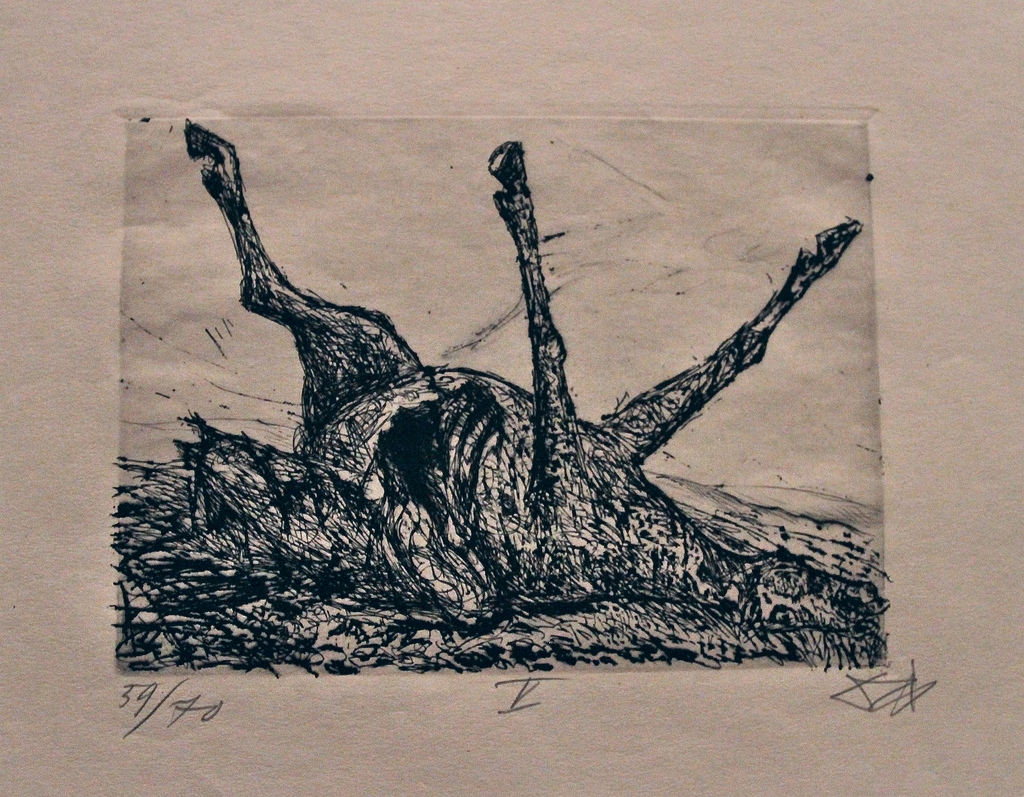
Fort George G. Meade, The First 100 Years is a more than 300 page book, a majority of which concentrates on WWI and the rapid construction, first arrivals, training and deployment of hundreds of thousands of men and women from Camp Meade. The pages are filled with historic photography, poetry, letters, essays and personal memories of people connected to the installation. The following is just one of more than 100 essays that trace the installations role in conflicts from the trenches of France, to the terror threats of Iraq and Afghanistan and into the current conflict platform, cyberspace.

Paving the way for the Interstate

Excerpt from Fort George G. Meade: The First 100 Years

By all measure, the most notable person to have served at Fort Meade so far in its 100 year history is Dwight D. Eisenhower who came to Meade as a young officer of the first Tank Corps and went on to be President of the United States.

While stationed at Meade, Eisenhower was sent on a mission which later would inspire him to literally change the landscape of America.

In notes he wrote describing the mission, Eisenhower said, “I was detailed for duty as an observer on Trans-Continental Motor Truck Trip on the day that the train left its initial point, being impossible to join the train before the evening of that date, nothing is known by me of the preliminary arrangements and plans for the trip, nor of the start from Washington.”

Printed in Fort George G. Meade; The First 100 Years, courtesy of the Eisenhower Presidential Library.

What follows is a sober recounting of what was the first attempt to move 81 vehicles, including trucks; heavy and light; cars, motorcycles, ambulances, tractors and trailers from Washington D.C., to their final destination in San Francisco, more than 3,251 miles away. According to the final report of the endeavor, making the trip were 24 expeditionary officers, 258 enlisted men and 15 War Department staff observation officers. Due to his late addition, it would seem Eisenhower’s orders were to serve as part of the War Department staff.

The convoy began on July 7, in Washington D.C., and spent the first overnight stop on of the trip in Fredrick, Maryland, a drive that, on a good day, might take just more than an hour today. In 1919, it took the convoy an entire day. A slow start to what turned out to be a herculean task.

Eisenhower joined the convoy in Fredrick and remained with it throughout the 62 days it took to complete the trip facing untold challenges along the route.

While many roads in the Eastern and Western states could handle vehicle traffic to a degree, the roads in the middle of the country were often impassable dirt roads, mountain trails and alkali flats. The insufficient roads were littered with bridges incapable of supporting the heavy trucks and equipment or overpasses with clearance too low to allow the convoy to pass through.

The roads were only part of the problem. The vehicles were capable of vastly differing speeds making it difficult to keep them in a convoy formation and frequent stops due to breakdowns harassed the drivers. All along the way, Eisenhower assessed the performance of each vehicle and made recommendations for how they should or shouldn’t be deployed in the future. “Motorcycles had much trouble after getting in the sandy districts. Except for scouting purposes, it is believed a small Ford Roadster would be better suited to convoy work than motorcycle and side car.”

Photo courtesy of Eisenhower Presidential Library

Living and work conditions throughout the trip were described as “hardship,” with constant sanitation problems, and difficulties in finding food, shelter and even suitable drinking water. Extreme rain and wind storms, punishing heat and persistent challenges due to terrain resulted in an average travel speed of six miles on hour or just under 60 miles a day.

The convoy experienced 230 vehicle accidents. The official report of the convoy recounted, “The most arduous and heroic effort in rescuing the entire convoy from impending disaster on the quicksands of the Salt Lake Desert in Utah and the Fallow Sink Region in Nevada. In these emergencies, the entire personnel, regardless of rank, engaged in rescue and salvage operations.”

Prior to this convoy, the longest military vehicle march recorded went 900 miles. It is reported that, over the thousands of miles the Trans-Continental Motor Truck Trip traveled, “thru various casualties en route,” 21 men lost their lives.

The experience of the trip traveling along the Lincoln Highway became something that stuck with Eisenhower throughout his life. After WWII and his experience driving on Hitler’s Autobahn, the importance of a functioning highway system and the role it might play in the defense of the nation hit home. Once he became president, Eisenhower made developing an interstate highway system one of the major goals of his administration.

100 Years of Fort George G. Meade is available in PDF format on the Fort Meade website at www.ftmeade.army.mil. A hardcover version is available at Amazon.com.
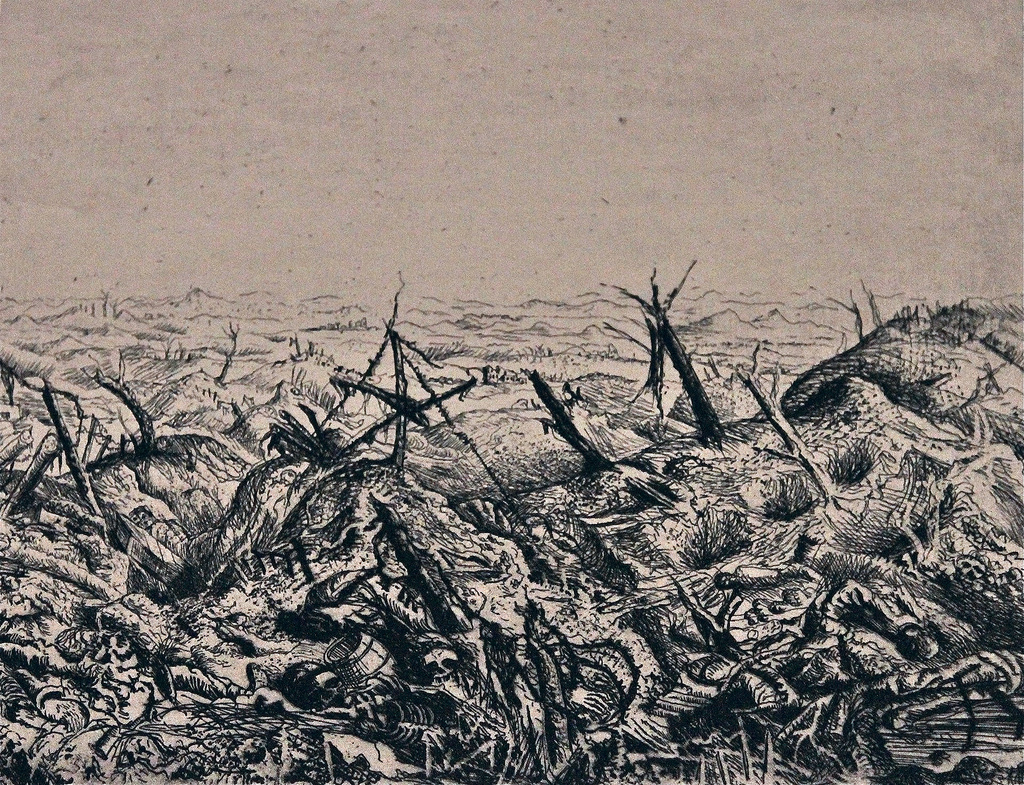
 

M.L. Doyle has served in the US Army at home and abroad for more than three decades as both a soldier and civilian. She calls on those experiences in her award-winning Master Sergeant Harper mystery series, her Desert Goddess urban fantasy series, erotic romance and coauthored memoirs which all feature women who wear combat boots. M.L. Doyle serves as an editor for The Wrath-Bearingtree.com


No, Nazis were Not Leftists: Or, How to Debunk Right-Wing Propaganda

It is generally considered good practice not to “feed the trolls”— that is, not to engage in commentary with strangers on the internet who thrive on aggressive verbal hate and cruelty. But when the president himself is little more than a troll and the entire right-wing media apparatus increasingly relies on weaponized trolling (as well as the overwhelming spread of misinformation) as a primary means of producing propaganda, it becomes necessary to occasionally step up and defend ideas and history from the perversion of alternate realities. 

That brings us to the inspiration for this piece: a recent article in the right-wing website The Federalist titled “Read a Pile of Top Nazis Talking about How they Love Leftist Marxism” by Paul Jossey. The subtitle is “From the moment they enter the political fray, young right-wingers are told, ‘You own the Nazis.’ Much of the historical record says exactly the opposite.” The article begins with this in-your-face provocation: “The Nazis were leftists.” I hope that most of our readers will instantly recognize the absurdity of the article from those few lines, but it warrants examining in closer detail to understand exactly what the author is trying to do and why.

First of all, what is The Federalist? It is clearly a right-wing website whose main driving force is to oppose gay marriage and whose main contributors are connected to those ubiquitous right-wing plutocrats, The Koch Brothers. The website itself strangely provides no information or mission statement in the form of an “About” page, but they do use this uncredited line as a footer: “Be lovers of freedom and anxious for the fray,”a quote that apparently comes from a 1918 speech by Calvin Coolidge, of all people. The Nazi article in question is categorized as “History,” and the author’s past publications all seem to be revolve around fake free speech grievances. 

The introduction concludes by stating “But evidence Adolf Hitler’s gang were men of the left, while debatable, is compelling.” It is interesting to note that the author does not go so far as to apologize directly for the Nazis, or to explain why they “weren’t really so bad.” Let’s stop for a moment and at least recognize and praise this author for not supporting or praising the Nazis. The fact that this has to be emphasized says something revealing about the toxic state of political discourse in this country.

Everything else the author does in his article, however, is part of a cynical ploy to rewrite history by cherry-picking isolated facts and fitting them into a false context. The author claims that his thesis, that the Nazis were actually Leftists, is debatable, but compelling. It is actually neither. No actual historian or political scientist maintains has gone on the record to claim that Nazis were Leftists. Accordingly, there is no citation given of any such person in the article because they don’t exist. This means that the author’s thesis is not actually debatable. It is settled history. I am not personally an academic specialist in the Nazi party, but I am an amateur historian with two history degrees who has read and thought much about World War Two over the course of my life. A very quick bit of research has led me to conclude with a high degree of certainty that there is basically universal consensus by scholars that the Nazis occupied territory on the far-right of the political spectrum. The few skeptics to the “far-right-wing Nazi consensus” seem to place more emphasis on the sui generis nature of the Nazi political beast by charaterizing it as neither right nor left, but a unique populist syncretic movement. Even such a rare opinion does not go so far as to characterize the Nazis as unequivocal members of “the Left”. That is because it is by definition an absurd and offensive statement. That is like saying that Nazis were secretly communists because of a short-lived and cynical peace treaty with Josef Stalin (Actually, the author does make that ridiculous point in the article). There is no new history to be written on the main, big picture history of World War Two and the Nazi party. There is no hitherto secret knowledge or conspiracy that the author has just revealed despite decades of settled history determining what everyone knew at the time and until now: the Nazis were a far-right party—as far right as a party could conceivably be on the political spectrum. Everything else in the article is merely lies and propaganda (which are usually the same thing) to further his own right-wing views.

It is not hard to imagine why one wouldn’t want to share ideological real estate with the Nazis, and once again I do in fact applaud the author for not wanting to admit such. The fact remains though, that they were a hyper-right-wing party, and he is an ideologue in the far-right-wing American conservative movement. That is why he attempts to portray the Nazis as a Leftist party—to make himself and his likeminded peers feel better about themselves while simultaneously making the other guys look bad. He might as well just wave his arms and shout at the top of his lungs “I’m not a Nazi! You’re the Nazi!” This playground tactic is actually a well-known and useful tool of propaganda called “transference” or “projection.” It is one of the many techniques of propaganda I mentioned in my article of the same name (The Techniques of Propaganda). The current president famously does it nearly everytime he speaks, most famously in a debate with Hillary Clinton when he screamed “No Puppet! No Puppet! You’re the puppet!” The fact that he is, in fact, a puppet is secondary to the strategy of constantly maintaining a consistently aggressive and mendacious stance towards political foes in an attempt to smear them with your own crimes and faults. This is also a type of “whataboutism” which has long been used by Trump’s mentor, Putin. It’s like saying “Yeah, the Nazis were bad, but what about Stalin and Mao?! (or Native American genocide or slavery?!)” It shouldn’t be too hard to understand that such statements are intentionally intellectually dishonest distractions from the point, but the fact remains that for a lot of people, especially ones primed to follow right-wing talking points and emotionally based arguments, such propaganda is often quite effective.

The second paragraph of the article continues by citing the infamous right-wing polemicist and fake historian Dinesh D’Souza as one of the sources of recent alternative histories. The author then claims that “the vitriol and lack of candor [such “alternative histories] produces from supposedly fact-driven academics and media is disturbing, if unsurprising. They stifle dissent on touchy subjects to maintain their narrative and enforce cultural hegemony.” Lots of big words and academic-sounding language here, all in an effort to say “why do experts call us out when we make shit up?” D’Souza is a convicted felon, provocateur, and far-right hack who is popular with theocratic crowds for writing a ton of “history” books that completely make shit up and basically blame “liberals” for everything from slavery to 9/11. The fact that D’Souza is the only person cited in the article regarding such “alternative histories” is telling. He even appears to have written a trashy “history” book in 2017 called The Big Lie claiming contrary to all evidence that Hitler and his coterie were “secret leftists,” a dog-eared copy of which is no doubt on the author’s shelf. For real historians, fact-checking D’Souza is like playing Super Mario Brothers with the cheat codes on, and luckily for us there is a tireless history professor named Kevin Kruse who has taken up this challenge.

The author continues by saying that “alternative views of the Third Reich exist and were written by the finest minds of their time,” and claims that such opinions “perhaps carry more weight because they are unburdened by the aftermath of the uniquely heinous Nazi crimes.” Once again, props to the author for having the courage to admit that Nazi crimes were heinous, something becoming more difficult by the day for many of his fellow travelers. Even the president, famously even-minded and hesitant to draw hasty conclusions, wouldn’t want to go so far because there were probably many “good people” on the Nazi side. Anyway, the only “finest mind” that the author cites in the entire article is a certain Austrian economist, F.A. Hayek. Hayek does have the benefit of having actually rejected and fled the Nazi regime in real-time, which not every German-speaking intellectual could claim (looking at you, Martin Heidegger). He was also a life-long friend of liberal philosopher Karl Popper despite their many political differences, which reflects well on Hayek in my book (Popper’s The Open Society and its Enemies was written in 1944, the same year as Hayek’s The Road to Serfdom was published. Here is my article on Popper explaining why I find him more convincing than Hayek). He has also been basically the main, and the only, inspiration for that always dubious and now-extinct animal known as the “reasonable, principled right-wing intellectual.” 

If we are to be generous and fair to Hayek, we must admit that he was apparently a relatively honorable person with some nuanced and well-considered positions on politics and economics. For the purposes of right-wing politicians, it has long been enough to cite him as the simplified intellectual basis for their dogma that free markets must always be unfettered and wealth must never be distributed by the government (by which they mean of course that it should never be distributed downwards; they have always been happy to distribute it upwards). This was the dogma of the Thatcher-Reagan axis, but it could have just as easily been Ayn Rand rather than Hayek providing the “philosophy.” In any case, the author here has used a few throwaway, out-of-context phrases from early Hayek to make his entire case that the Nazis were leftists. In addition, Hayek loved dictators and somehow made the case that authoritarianism (which he supported!) was different than totalitarianism (which he was against). He personally supported and sometimes collaborated and befriended right-wing dictators and war criminals like Pinochet (he claimed that Allende was totalitarian!) and Salazar (maybe let’s reconsider that thing I said about his being “honorable”). So that is a summary of the most intellectually important right-wing thinker of the century.

The official name of the Nazis was the National Socialist German Workers’ Party. They didn’t like to be called Nazis. If you look carefully, you will even find the word “Socialist” (not to mention “Workers”) in the name of party. This must mean they were Socialist, and, tout court, Leftist. Case closed. I guess all this actually proves is that political parties choose names that do not always signify their actual ideology. This is more common outside of America, with the Polish Law and Justice party, the Brazilian Social Liberal Party, the French Socialist party, and the Australian Liberal party coming immediately to mind (not to mention the Russian United Russia party). The author goes on to give example after cherry-picked example of actual Nazis making quotes that make them appear friendly to what we think of as Socialism, or of denigrating the “western capitalists” of the time. He says, for example, “Hayek describes Nazism as a ‘genuine socialist movement’ and thus left-wing by modern American standards.” That’s a pretty big red herring, oversimplification, and non sequitur all in one short phrase (three techniques of propaganda! Go read my previous essay and learn them all by name). He goes on to say, “British elites regarded Nazism as a virulent capitalist reaction against enlightened socialism–a view that persists today.” Yeah, it persists because it’s the historical truth. By the way, that’s actually being far too gentle with Nazism—calling it a “virulent capitalist reaction” is probably the most unsuperlative thing you could truthfully say about it—and “British elites” (many of whom actually supported Hitler up to and, in some cases, during the war).

As the article continues, the author gives some ad hoc definitions of “right” and “left”, and their sloppiness illuminates the ways he probably thinks his is a logically sound argument. He says the “right” consists of “free-market capitalists, who think the individual is the primary political unit, believes in property rights, and are generally distrustful of government by unaccountable agencies and government solutions to social problems. They view family and civil institutions, such as church, as needed checks on state power.” He says the “left” consists of people who “distrust the excesses and inequality capitalism produces. They give primacy to group rights and identity. They believe factors like race, ethnicity, and sex compose the primary political unit. They don’t believe in strong property rights…They believe the free market has failed to solve issues like campaign finance, income inequality, minimum wage, access to health care, and righting past injustices. These people talk about ‘democracy’—the method of collective decisions.” He then claims that these definitions prove somehow that the Nazis were Leftists.

The only thing he didn’t say about the “left” is that they have a penchant for human sacrifice and cannibalism. If you think there is something just a bit made up, just a bit Fox-Newsy about his definitions, you are not wrong. Obviously it is not easy to portray all the nuance of the variagated “right-left” political spectrum with such facile definitions, especially considering the disconnect between economic and cultural perspectives. There is a convincing case to be made that from the “right” perspective, everything that they think is wrong with the world is de facto part of the “left.” If you define everything not you as bad, and everything bad as “left,” Nazis will by necessity become leftists. Much of today’s “right” also thinks of the “left” exclusively in terms of identity, as opposed to other political ideology. Thus, anything in history that used identity in bad, or deviant ways was therefore part of a leftist plot or conspiracy. It would be easier to list the key words and ideas generally associated with each camp. In political science, it is generally accepted that the “left” tends to emphasize ideas like freedom (!), equality, fraternity, rights, progress, reform, and internationalism, while the “right” tends to emphasize ideas like authority (!), hierarchy, order, duty, tradition, reaction, and nationalism. Any disputes here? I didn’t think so.

You might have noticed those key words of freedom, and authority. Despite the American right-wing appropriation of the word, they misunderstand and detest real freedom and always tend towards authority over liberty. Usually what they mean when they talk about freedom is that they support the freedom to think and act just like they do, which is obviously no kind of freedom at all. The centrality of sexual and religious politics in American right-wing ideology is enough to illustrate their primacy of authority over freedom. Some theorists maintain that there is a natural authoritarianism and oppression of the lower orders in conservatism in general; Corey Robin in The Reactionary Mind says that “Though it is often claimed that the left stands for equality while the right stands for freedom, this notion misstates the actual disagreement between right and left. Historically, the conservative has favored liberty for the higher orders and constraint for the lower orders. What the conservative sees and dislikes in equality, in other words, is not a threat to freedom but its extension. For in that extension, he sees a loss of his own freedom.” Authority is the main hallmark of not only authoritarian (obviously) and totalitarian systems, but also conservatism writ large. Jeffrey Herf in his book Reactionary Modernism: Technology, Culture, and Politics in Weimar and the Third Reich, argues that the Nazis mixed enthusiam for technology with a total rejection of Enlightenment values as a radical alternative to liberal and socialist visions of modernity. Umberto Eco’s tour de force essay “Ur-Fascism” gives 14 characteristics of Wittgensteinian “family resemblance” that can be found in all forms of fascism. Nowhere in this exhaustive list can you find anything remotely “leftist.” Basically, the Nazi regime was reptilian, terroristic, totalitarian, and extremely right-wing.
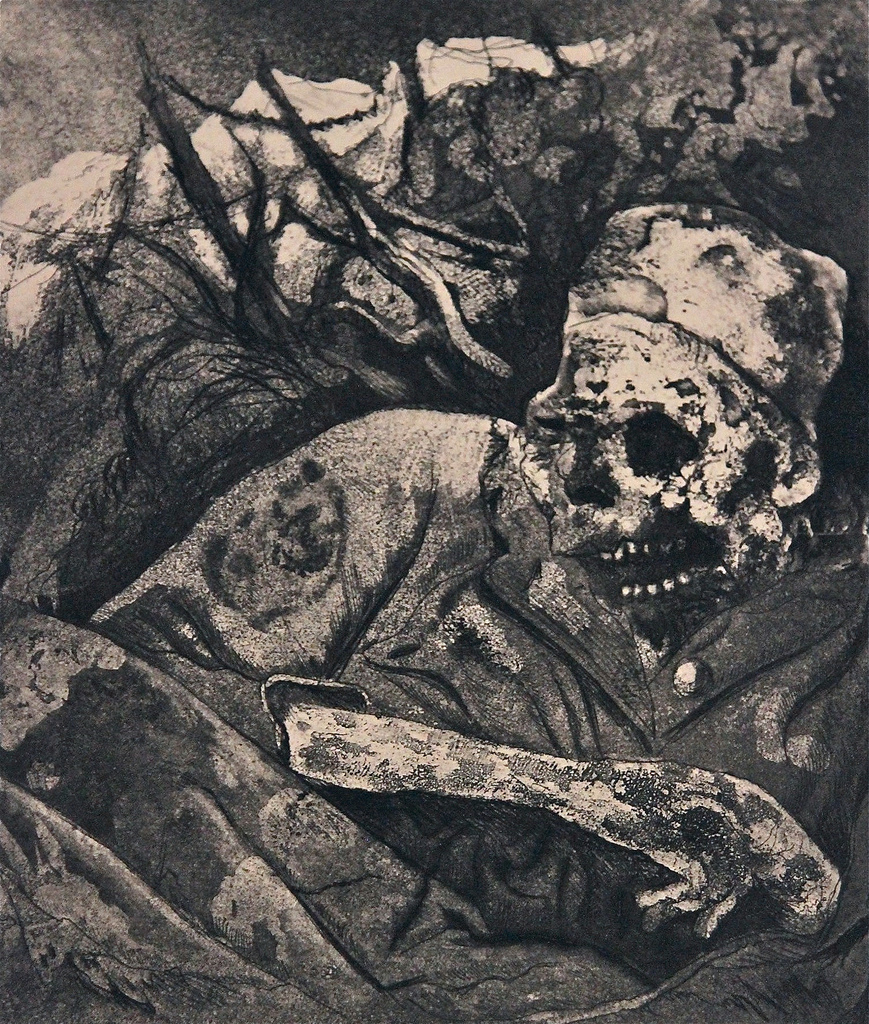

For those who shout “What about Stalin?!”, the answer is that the Soviet Union, especially under Stalin, was also a right-wing terroristic totalitarian regime, despite the supposed “leftism” of Communist ideology that could be traced back to said Enlightenment values. The Soviet Union was never really Communist in anything but name, but from the beginning governed as just another kleptocratic oligarachy much more authoritarian than any Tsar ever dreamed of. Vladimir Nabokov, in his memoirs, calls the Bolsheviks (who assassinated his father, by the way) “fascists.” So the answer is that the Nazis weren’t “leftist,” but that the Soviet Union was actually “rightist.” You might ask if I’m being serious here or just engaging in my own propagandistic sophistry, a la the author of that hideous article. Reader, do you own research and make up your own mind. Don’t believe anything you read on the internet. Especially on websites like The Federalist. Read history.


New Fiction from Andria Wiliams: “Polecat”

Camp TUTO, Greenland
1960

When Paul, a nuclear operator, had arrived in Greenland, the reactor at Camp Century was still not fully assembled, so he and a dozen other men were being held temporarily at another camp a hundred miles south. Everything he could see on the edge of the polar ice cap was white and brown like some kind of visual trick: dirt, and snow, and snowy dirt, and snowy air, and sometimes blowing dirt. The snow and dirt were constantly changing places.

He was in the mess hall when Master Sergeant Whitmore appeared at his elbow. Paul hopped to his feet, and Whitmore asked, with no preamble, “You ever drive a D8 Cat?” Whitmore had buggy, vein-scraggled blue eyes that seemed to intensify anything he said, giving any question he asked an oddly moral implication.

Paul hesitated. “Not yet.”

“Well, you’re gonna have to fill in,” Whitmore said. “It’s just like driving a tractor, except it’s a giant one. You’ve driven a tractor, right?”

Paul had not.

Whitmore forged on. “You’ll be towing a fuel canister. All you got to do is stay behind me and follow the bamboo markers. Do not fall asleep and drive into a crevasse. We drive six hours on, six hours off. It’ll take about a week.”

Paul was relieved enough to simply get on the road, so he nodded, and when Whitmore left, his friend Mayberry appeared beside him.

“King of the road!” Mayberry said, grinning at Paul. Mayberry was the camp geologist, and this was his fifth tour in Greenland. Tall and thin, with a scientist’s buzzing mind, he worked in an underground lab below the base, surrounded by rows of ice samples stored in what looked like oversized poster tubes. Because he spent his working hours alone, he seemed perpetually delighted to encounter other people. He said that Camp Century was a dream compared to his first base in Greenland, which had been called Fistclench.

“How bad will it be?” Paul asked.

But Mayberry was watching Whitmore, who stood across the room talking to the camp cook. Cookie, as they called him, had been in Greenland for who knew how long. He was as thin as a Confederate zealot, and while the men ate he stood smoking in his stained apron, watching them as if it gave him either grim pleasure or unabated pain.

“Good!” Mayberry said. “We get to bring Cookie.”

“Should make for great conversation,” said Paul.

“Oh, he talks,” Mayberry promised. “You’ll see.”


The Polecat was idling next to several others just outside the camp’s garage. They rumbled in concert, swathed in plumes of steam and exhaust. Paul identified his by the orange fuel canister attached to the rear and mounted on skis. The Polecats were Swiss innovations, specially adapted vehicles with huge track frames – Paul guessed twenty feet – and wide track pads that could traverse uneven ice without tipping or breaking through.

There would be three other Polecats like his, carrying various types of freight in the middle of the caravan. Whitmore’s D9 led the line, with a blade attached, to help clear a path. Then there was the Command Train, a huge tractor that pulled the cook shack, radio shack, and three refurbished old boxcars on skis called wanigans, where the soldiers relaxed or slept. Finally, there was the last boxcar on the whole train: the latrine, that foul caboose, following them like a bad thought. What an absurdly human predicament, Paul thought, having to cross the polar ice cap lugging literal shit behind you.

Whitmore strode up and slapped Paul on the back. “Good luck,” he said. “Don’t drive into a crevasse.” This was becoming a common theme with the master sergeant, and Paul was beginning to suspect he wasn’t kidding. To Mayberry, Whitmore said, “Quit smoking by the fuel rig. Here’re your keys.”

Everyone climbed into their tractors. Slowly, Whitmore pulled his D9 out into the lead. At this rate, Paul thought, we will never get anywhere. Then he pulled his own tractor in line and found it moved even slower than the boss’s.

It seemed unbelievable they’d travel at this snail’s pace for an entire week. Paul tried not to think about it. He wondered when he would break down and allow himself a cigarette. He wondered what his wife, Nat, back in Idaho was doing. He thought quite a lot about what they would do if they were together. Meanwhile he squinted to keep track of the pointed tops of the bamboo poles they followed, many almost buried beneath the moving glacier. Sometimes the poles would be so hard to see that an impossibly-bundled man would have to walk ahead, locate them, and then wave in the direction the trucks should go. Paul’s Army career had started in petroleum supply, and stunts like this were one reason he’d left that field. Lugging massive canisters and a shitter across the ice felt like some Neanderthal gig, the work of people without bright ideas.

photo by Ray Hansen

Between their shifts, the drivers sat in the rocking but well-heated wanigan, paging through month-old newspapers someone had brought from Fort Andrews. There they were joined by Cookie, who had never stopped smoking, his legs crossed and one foot jittering up and down. Cookie would wait until the men around him began to engage in any kind of interesting conversation—about sports back home, their previous tours of duty, anything—and then he’d suddenly interject his own litany of complaints against the Army and life in general, as if that had been the topic of discussion in the first place. “I wasn’t meant to be here,” he’d say, sucking on one cheek, his small eyes blazing. “I’m from Mississippi. No way was I meant to be here.” He alternated this thought with its close cousin, “I wasn’t meant to be in the Army” (he had initially attempted to get into the Navy) and also, “I was never meant to be a cook” (he had hoped to be a machinist, but failed some critical aptitude test). Cookie and his quibble with destiny had rapidly become tiresome, and it was impossible for the other men not to occasionally respond with wiseacre remarks.

I was meant to be here,” Mayberry said as he flipped the pages of the classifieds. It was the only section everyone had not yet read multiple times. “This, here, is the point in life I was born for.” The wanigan gave a lurch and someone in a bunk cursed.

Cookie ignored him and continued, “I was a runner in high school. I ran cross-country. I wasn’t meant to stand in one place, flippin’ burgers.”

Mayberry was reading the classifieds aloud. “Here’s an ad for a home dental care system. It says, ‘Polish Your Teeth on Your Own Time.’”

“That’s what I’ve always wanted to do with my own time,” said Benson from a folding chair across the room.

“We could let Cookie drill our cavities,” said Mayberry. “Maybe he was meant for that.”

“I had three ladies back in Mississippi,” said Cookie. “Three of ‘em, who loved me. They cooked for me.”

“Hmm,” said Mayberry, in a placating way.

“I had five women,” said Benson. “They polished my teeth for me.”

Cookie snapped to attention. “You did not,” he said. “That’s stupid.” Then he lapsed back into thought.

The wanigan hit a deep groove, and the men steadied themselves. “Jesus,” said Benson. “And people think they get seasick in the Navy.”

“I was meant to be in the Navy!” Cookie said, with sudden interest. Then he stood from his chair and looked at the boxcar door with a focused expression, his hands on his hips, knobby elbows sticking out from white shirtsleeves. “Forget this shit,” he said. “I’m going home.”

Mayberry rattled his newspaper so it wouldn’t slump. “Great,” he said, without looking up. “Tell your three ladies we said hi.”

“Forget you,” said Cookie, very loudly, leaning over Mayberry who looked over the top of the paper in surprise. “Forget you, all you stupid food-eaters, who just sit around eating my food. Complainin’ and complainin’. I am a man! I was not meant for this shit job!” He stepped back and glanced around with flashing eyes, muttering, “Maybe you should cook for your damn selves is what.”

“Geez, I’m sorry,” Mayberry began, but Cookie strode to the boxcar door, unlatched it, and heaved it open. The air that entered the room felt as cold as rubbing alcohol.

“Whoa,” said Mayberry, getting to his feet also. And then the cook, in only his short-sleeved white uniform, jumped right out.

For a moment everyone stood and the room was silent. Paul looked around, as if this had just been some optical illusion, and Cookie would actually be sitting back in his chair where he’d been a moment before. But the chair was empty. The wanigan door creaked slowly toward closing.

“Holy shit,” Mayberry cried, and he and Paul scrambled. They reached the door at the same time and yanked it open. Mayberry leaped out first, and Paul followed. The force of the cold nearly spun him around, and it took him a second to gather his wits and begin running. He heard Benson hit the ground a few beats behind him. Cookie had taken off across the ice, surprisingly fast, heading for the white horizon.

“He’s a runner,” called Mayberry as they sprinted after the cook. “He ran cross-country.”

“He’s gonna die,” Paul cried. Any second he expected Cookie to slip from sight into the narrow cradle of an unseen crevasse.

The ice was hard and slick, and their feet slipped every few steps. Cookie, on the other hand, appeared to have magic shoes. He was loping ahead at a steady pace, his body a slim, efficient machine.

“Go back, Benson,” Mayberry said over his shoulder.

Paul could hear Benson’s heavy breath like a zipper being yanked up and down. “Someone will radio the boss,” he shouted encouragingly.

“That someone should be you!” Mayberry said.

This is ridiculous, Paul thought. He knew he had to give the chase all he could. He focused on pumping his arms and legs as fast as possible. He narrowed his vision on Cookie and raced all-out, his lungs burning with an intense pain.


photo by Ray Hansen

Cookie might have actually gotten away, run off to the top of the world, if he hadn’t hit a ripple on the ice and stumbled. He caught himself and straightened, limping slightly, and Paul, feeling delirious and oxygen-deprived, gave his last burst of speed. The gap between himself and the cook narrowed. Paul took several long strides and flung himself against the cook’s lower back, pulling the two of them down onto the ice with a painful slap.

The second Cookie hit the ice he began yowling. He fought like a wildcat. He kneed Paul in the gut and smashed the flat of his hand against Paul’s nose. Paul realized that his only advantage was his greater size, so he fell forward onto Cookie and clung to the wiry man for dear life. It was like wrestling a greased snake. All he could see was Cookie’s white-shirted abdomen, into which his face was pressed, the muscles twisting and bucking against his cheek. He gritted his teeth and waited desperately for Mayberry to reach them.

A moment later Mayberry sprinted up and fell on top of them both, and from a distance it must have looked like some ecstatic reunion, or the winning touchdown in a football game. “Sit on his arms,” Mayberry grunted, and Paul, dazedly obedient, tried to find one to sit on. He crawled up Cookie’s body and fought to pin down the cook’s skinny, flopping limb, which jumped over and over again just out of Paul’s reach like a fish on land. Finally, Paul pegged the arm and sat on it, and Mayberry sat on the other, and then there they were, gasping for breath, the cook writhing and screaming on his back beneath them.

Benson finally jogged up, looking ill, and in the distance they could see Whitmore’s D9 turn slowly, slowly, to come and get them. This seemed absurd; they could walk faster than it drove.

“I’m sorry, Cookie,” Mayberry was saying. “We’ll show you we care. We’ll bake you a cake.”

“We need to stand up,” Paul said. “We’ll freeze.” He was concerned about Cookie’s bare elbows on the ice.

They waited for Benson to catch his breath, and then they all grabbed onto an available part of the cook and lifted him to his feet. Cookie screamed; Paul winced to see the two lines of blood on the ice where his arms had begun to freeze to the ground. “Sorry,” Paul said to the cook, and “Start walking,” to the others. With mincing, difficult steps they made their way toward the line of tractors.

Sergeant Whitmore leaped down from his idling vehicle, waving his arms and shouting, “What the hay, Cookie?” for he was a man who did not curse. “What did you think you were doing?” Cookie stared at him defiantly, and Whitmore made a sound of disgust. “Tie him up,” he said, “tie him to a bunk til we get to Century. We’ll decide what to do with him there.”

On the count of three, Paul, Mayberry, and Benson heaved the slender cook up into the wanigan and over to a bunk. Whitmore fetched a coil of rope. “Don’t you tie me,” Cookie began to shout, “don’t you dare tie me!,” but they did anyway, binding him to the bunk in a seated position with his arms behind his back. From there, he yelled half-sensible platitudes at them for hours. “You can’t keep a man where he don’t want to be,” he said, and “This is my life, not yours, you rat bastards,” and, cryptically, “You’re just like all them, you know what.” He hollered until he wore himself out, and then he stared at them despondently from where he sat.

That night, after a dinner of cream of wheat and tinned milk, Paul tried to sleep, but every time he opened his eyes he could see Cookie’s own, glittering back at him. Paul rolled onto his side to face the wall. Cookie’s gaze crawled up his back. He yanked his wool blanket to his shoulders. “Cut it out, Cookie,” he said.

Cookie’s voice came across the room, plaintive, almost mewling. “I ain’t doing nothin’,” he said. “I’m just sittin’ here like a good boy.” A moment later he hissed, “Come on, untie me. I won’t go nowhere. I’ll sit just like this.”

“Can’t do that,” Paul muttered.

Cookie’s voice was hoarse. “My Leroy’s itchin’.”

“Sorry.”

“Untie me, please,” Cookie begged. “Come on now, you’re the only nice one of them in here. You’re the nice guy. The best one.” A minute later he said, “Never mind, you’re the worst one. You a priss is what you is. You prissy!”

Paul had never been called this before and felt actually startled.

“A man’s body is his own,” Cookie said. “It’s the only thing he really got. You know, someday the rules are gonna be here for you when you don’t want them, either.”

Paul screwed shut his eyes. The wanigan lurched and groaned, and a coffee cup slid off a table, hit the ground with a thud, and rolled hollowly across the floor. Outside, the pitch of the wind rose and fell, a sound both strange and familiar: a waning alarm, distant machinery, blood roaring in the ear.


*

photos by Ray Hansen


New Poetry from Randy Brown

victory conditions

My father taught me
to say I love you
every time
you stood in the door

left for school
went to work
flew off to war

it became a habit
a good one
like checking the tires
or clicking your seat belt

but now
every conversation feels
like a movement to contact

we took the same vows
we swore the same oaths
we wore the same uniform
we see the same news

I raise my kids
like he did his
and have the same hopes for them

How is it that we now live
in two countries?


three more tanka from Des Moines, Iowa

1.

The leafblower drone
buzzes into consciousness—
fast cicada hum.
I wave to the new police,
before I close the window.

2.

Yellow Little Bird
hovers near high-voltage lines
conducting repairs
outside my bedroom window,
but I am miles away.

3.

Thunder and popcorn;
a remembered joke about
the “sound of freedom.”
In rain, I stand listening
as rifles prepare for war.


a future space force marine writes haiku

1.

This drop won’t kill you—
terminal velocity
varies by planet.

2.

We spiral dirt-ward,
samaras in early fall,
sowing destruction.

3.

Reconnaissance drones
orbit our squad’s position:
Expanding beachhead.

4.

“Almost” only counts
in horseshoes and hand grenades.
Go toss them a nuke.

5.

If war is still hell,
at least my bounding mech suit
is air-conditioned.

“An American pineapple, of the kind the Axis finds hard to digest, is ready to leave the hand of an infantryman in training at Fort Belvoir, Va, 1944. American soldiers make good grenade throwers.”

This is just to Say All Again After …

after William Carlos Williams’ “This is Just to Say”

I have expended
the “pineapples”
that were in
the ammo box

and which
you were probably
saving
for final protective fires

Forgive me
they were explosive
so frag
and so bold


Most Likely /
Most Dangerous Enemy Courses of Action

what most
threatens my children

social media /
unending war

the rat race /
the daily grind

half-baked policies /
global warming

a lack of hope /
a lack of justice

my constant distraction /
my constant distraction


the stand

if you can’t stand injustice
take a knee

if you pray for others
take a knee

if you believe in freedom, not fabric
let others see

you practice
what you preach


New Nonfiction from Kiley Bense: Tell Me About My Boy

Here’s an empty grave, where a body that had been a boy became bones beneath a wooden cross. They buried him with one set of dog tags hanging against his bloodied chest.

He bled in a field hospital bed not far from here, shrapnel buried in his skin. Is that what killed him—hot metal melting flesh, an unseen severing? Or was his body tossed limply from a jeep seat as it crossed the desert, the crush of cargo snapping ribs, a crackle of tinder at dusk?  “Morale is very high,” the morning reports said, on the day the boy disappeared into the horizon. The next day he’d be dreaming under several feet of sand. They couldn’t have known. They couldn’t have. They couldn’t.

When he died, the boy was twenty-three and dark-haired, all shoulder and grin: my grandmother’s little brother. It’s one thing to consider his photograph on a mantelpiece, a charming kid wearing a tilted cap; another to imagine him becoming broken, hollows purpling beneath his eyes and a bloody bandage wrapped around one thumb where a cactus thorn was entombed in the soft pad of his finger. One thing to read “artillery fire” on a typewritten government medical form (death requires paperwork); another to watch a German gun spitting shells, coughing up sounds that rattle across time and sky. How fragile is a human body in the path of such certainty.

Here is that body: one-hundred-sixty-two-pounds, down from one-hundred-and-seventy since he’d filled out his draft card in an office in Philadelphia one year before. Seventy-five inches tall. Gray-blue eyes, like his father’s. Freckles across the top of his nose blotted out by five months of sunburn and grime. One thumb now scarred. One uniform crusted with sweat, salt, blood and smoke, one rosary and an American flag stuffed in the pockets. Feet stiff, callused and blistered. Lean jaw and face, angles cut sharper by sleeplessness and fear. Shrapnel lacerations unfurled like tattered red-black lace over his left arm and chest. This is the body they buried in Tebessa with a gunshot salute and a chaplain’s murmured blessing.

Bury him at Gettysburg, his father said, when the government wanted to know where to leave his son’s bones for good. There’s no room in Gettysburg, came the reply, that meadow’s already crammed with dead American boys. Choose another tomb.

Here is a letter about nothing: “Dear Sir,” it begins. “Will you kindly change my address on your records? My son, Private Richard H. Halvey, 331356641, Headquarters Co. 18th Infantry, 1st Division, was killed in action in North Africa, March 21st, 1943, and I am anxious to have your records correct so that I may receive future correspondence regarding the returning of his body. Thanking you for your attention, I am, Very truly yours.” Signed, Brendan H. Halvey, my great-grandfather. Here is pain, laid out on one creased sheet of paper.

He bled for us. But he will not rise. Here in Algeria the air is still, the night is silent. There is no weeping. The only cross at his grave was the slatted thing they stuck in the dirt above his head, one set of dog tags looped around its arms. He hated those dog tags. The cord bit at his neck, a reminder that the Army was trying, every day, to convert him from a person into a number. It took all of one day for him to die. Then he was inked into a serial code in some forgotten notebook. 331356641. 331356641. 331356641. Repeated till it stays.

Across the ocean from the skeleton his son had become, his father wondered where to bury what was left. Here is what the government said: We can’t tell you much about your boy, other than that he isn’t coming back. They took his blood and his body, and all that’s left is bone.

Maybe Brendan asked for Gettysburg because the government was bold enough to parrot Lincoln in the pamphlet it mailed to stricken fathers. “Tell Me About My Boy,” the pamphlet was titled, though really it told nothing. The dead were valiant and heroic, said the pamphlet, they “gave the last full measure of devotion.” There was no mention of Lincoln’s next line: “We here highly resolve that these dead shall not have died in vain.”

Arlington, Brendan decided, finally, in 1947. So they shipped Dick Halvey’s body (which was jumbled bones and dog tags) to Virginia, where the Army shrouded him in stripes and etched a cross on marble above his name. Not blood-soaked Gettysburg but Arlington, everything green and white except the roses laid on headstones. Here, across the river from the capital, we buried our boys in neat rows. “Our boys,” they said back then, pleading with o-mouths at news reels for a glimmer of truth. Our boys aren’t coming back the same.

Note: Tebessa, Algeria was the site of a temporary American cemetery during World War II. Starting in 1947, soldiers’ remains were moved from Tebessa either to the American cemetery in Tunisia or brought back to the United States, according to the family’s wishes.


New Fiction from Patrick Hicks: Into the Tunnel

Editor’s Note: “Into the Tunnel” is the first chapter of Patrick Hicks’s new novel, ECLIPSE.

“The rocket will free man from his remaining chains, the chains of gravity which still tie him to this planet. It will open to him the gates of heaven.” 

Wernher von Braun

He was tired and cold when they arrived from Auschwitz. The moon hung above him, battered and beaten, as he trudged down a long concrete road with thousands of other men. The train that had carried him across Germany huffed in the night. A whistle pierced the frosty air—it was a single note, strangled into silence. The huffing engine took on water and he licked his dry lips. He tried to swallow. Searchlights paced the dark as dogs strained against their leashes, their front paws wheeling the air. Guards stood along the road and yelled at the prisoners to move faster, faster. Behind him, bodies were tossed out of the railcars. They hit the pebbly ground in sickening thuds. Stones skittered away.

Eli Hessel glanced at the moon. It looked like it had been pistol whipped, wounded.

“Move it, you pieces of shit!”

Another voice chimed in. “March in unison! Your left . . . left . . . left.”

He had no idea where he was or where he was going. The shadowy bulk of a hill was on his right and, in the moonlight, he could see that a haze of pine trees lined its ridge. To his left were strange metal cylinders with nozzles on them. They were stacked on flatbed rail cars.

The men kept moving, trudging, schlepping. Their wooden clogs clacked against the concrete road. Dogs continued to snap and bark. There was the smell of wet fur. And there was something else too, a smell he couldn’t quite place at first. It was a mixture of oil and creosote. There was also—he breathed deeply—there was also the smell of decaying bodies. It was the stink of rotting meat and grapefruit. That’s what a corpse smelled like. During the past few months he had plenty of time to familiarize himself with it.

But where was he?

The journey from Auschwitz had been hard. They’d been stuffed into wooden cattle cars and, as they rocked and clattered over hundreds of miles of tracks, these men, who had been crammed in cheek by jowl, had to relieve themselves where they stood. The weakest slipped to the floor. Many of them never got up again.

Eli stumbled. He was woozy. His lips were chapped and his tongue was leathery. It hurt to swallow. He couldn’t make spit. On his lower back, at that place where the spine meets the pelvic girdle, he had a perfect bruise. A hobnail boot had kicked him into the cattle car a few days ago when he left Auschwitz, and although he couldn’t see it, he knew it must look like a horseshoe with studded dots. Whenever he twisted his waist, a sharp firework of pain sizzled up his spine. He worried that his vertebra was shattered but there was nothing he could do about it. He had to walk faster. He hobbled. He tried to stay at the front of the line because prisoners were being beaten with metal rods behind him. The road beneath his clogs was splashed with oil. Or maybe it was blood? It was hard to tell at night.

“In unison, you pieces of shit! Left . . . left . . . left.”

He ignored the nipping pain in his stomach and watched his feet move on their own. The blue and white stripes of his trouser legs swung in and out of view beneath him. He wondered if they were being taken to a gas chamber. He’d seen it happen at Auschwitz many times before. He’d seen whole families walk down a gravel path to a gas chamber and he’d seen the black tar of their bodies rumble up from a crematorium at night. Flames shot out from the chimney and the whole sky above Auschwitz was stained a dull orange. The heat from thousands of bodies made the moon shimmer.

He focused on his swinging legs and didn’t think about his mother or father, his younger brother, or his grandparents. They were gone. They’d been turned into ash long ago. And yet, against all odds, he was somehow still alive.

“Faster, you sons of bitches!” a guard yelled. “We don’t have all night.”

Maybe he could run away? Maybe he could slip into the night?

Barbed wire was on either side of him—he could see that—and there was the shadow of a wooden guard tower illuminated beneath a searchlight up ahead. No doubt the fence was electrified. To run would mean—what, exactly? All of Germany was a concentration camp.

“Move it you useless eaters, you pieces of SHIT!”

The guard was from Berlin. Eli could tell from his accent. How could he be so angry, so full of venom? And while he was thinking about this, something surprising and alarming appeared up ahead.

The rail tracks curved into a mountain. There was a tunnel. A huge one. Two massive sodium lights sparkled overhead like twin stars and they cast long shadows on the ground. A cloud of moths jittered in the lights and, for a long moment, he wondered what they might taste like. Dusty, he thought.

When it became obvious they were going into the tunnel, Eli looked around in wild terror for a chimney or a vent. Were gas chambers in there? Underground? His muscles tensed and he almost stopped walking. He had to force his legs to keep on moving even though he was shakingly afraid of what he would find up ahead.

Calm down, he told himself. It didn’t make sense to ship them halfway across Germany only to kill them. The Nazis could have done that at Auschwitz.

“It’s okay,” he whispered to himself. “Yes, all is well.”

But the claws of fear continued to scratch at the inside of his skull. His asshole tightened and his eyes darted to the left and right. If this was a work camp, where were the other prisoners?

The moon was swallowed by a cloud and this made the dark beyond the searchlights absolute. The moon had been snuffed out, choked. Two enormous iron gates on either side of the tunnel were wide open, and camouflage netting was strung above the entrance like an awning. A white wooden sign was suspended from the ceiling and someone had taken the time to get the calligraphy just right.

Alles für den Krieg
Alles für den Sieg

Eli looked around. It was understood by everyone that German was the only language that mattered in the Reich. If a prisoner was confused or didn’t understand something that was shouted at him, well then, he would learn soon enough.

When they entered the tunnel, a sudden dampness fell over his skin. It felt like a heavy wet cloak had been placed over his shoulders. He began to shiver. And somewhere up ahead, metal banged against metal—it was deep and rhythmic—double-syllabled—bah-wungbah-wungbah-wung. There was also the low hum of a generator to his right. Floodlights cast grotesque shadows on the wall. He looked around and realized that everything he could see must have been hewn out of the rock by hand. The floor. The walls. The curved ceiling. How many prisoners had died making this place, this cave?

Modern-day view of the tunnels where the V-2s were made. Photo by Patrick Hicks.

They passed a cluster of SS guards who stood around laughing at some joke. They smoked and paid no attention to the column of prisoners that shuffled past them. Bright balls of orange glowed at the ends of their cigarettes. They pushed each other playfully and talked about roasting a wild boar. For a moment, Eli allowed himself to imagine what it might taste like. The fibrous meat, the juices, the sucking of the marrow from bone.

“Keep moving!” someone shouted from the rear. Surprisingly, it was a French accent.

Steel pipes were bolted to the walls and he wondered what they were for. When he looked up at the high rounded ceiling he felt claustrophobia run though his chest like spiders. For several long moments he had to fight a wild urge to run. What if the ceiling collapsed? How many thousands of tons of rock were above him? Eli looked for support beams but couldn’t see any. The air around him was thick and oppressive and cold. It crowded his lungs. His nose was chilly.

He focused on his wooden clogs. They were badly stained from the mud of Auschwitz and he counted his steps as a way to control his fear.

One . . . two . . . three . . . four . . .

All is well, he told himself. Yes, all is well.

When he looked up, he saw a winch and two dangling chains. The rhythmic banging got louder. Bah-WUNG. Bah-WUNG. Bah-WUNG. There were hundreds of prisoners working in the tunnel up ahead. They were dressed in blue and white striped uniforms like him. The light was weak and this made the underground world feel sunken and submerged. What were they doing? Mining for gold?

As he got closer, he realized they were hunched over tables and assembling something that looked like gearboxes. Others worked on metal tanks.  Down a side tunnel, a group of prisoners carried a huge nozzle. It was the size of a church bell.

“Drop it and you get twenty lashes!” a voice roared.

It was a kapo. This man was given extra food if he agreed to do the dirty work of the Nazis. In exchange for beating his fellow prisoners, he was given a good night of sleep and a full belly. The nozzle suddenly teetered sideways, the metal cone slipped against the wall, and when it bounced onto the ground—sending out a low ringing sound—the kapo immediately began hammering a prisoner with a stick. The blows rained down. Bloody stains formed on the man’s back.

“Be gentle with that!” the kapo shouted. “Gentle! Gentle! Gentle!”

An SS officer watched all of this with bored curiosity. Cigarette smoke vented from his nose. Eli studied this man’s clean face, his manicured hands, and he couldn’t help but notice the high polish of the man’s jackboots. They twinkled in a perfection of night. Eli turned away when the guard looked at the parade of arriving prisoners. He knew better than to look the SS in the eye. Surely the rules of Auschwitz must apply in this place too.

“Fresh rags,” the SS guard yelled out. He took a long drag on his cigarette. “Welcome!”

As they marched deeper into the tunnel, Eli saw that many of the prisoners didn’t have shoes. Their feet were bloody and caked with grime. He also became aware of the overpowering smells around him: diesel, the sulfurous burn of arc welding, and there was something else too. He recognized it from that factory at Auschwitz. His teeth tasted of iron. There were pools of water on the floor and he wondered if he could bend down and cup some into his hands. A kapo, however, was marching next to him. The man twirled a metal rod.

All around him were the scrapping of spades against wet rubble. The floodlights of the tunnel gave way to carbide lamps. Soon everything flickered and it was hard to see. He stumbled over a thick cable and nearly fell. Others were having trouble too.

When they rounded a corner, he decided to chance it. Eli bent down for a handful of water. It was beautiful and wet and primal against his skin, but when it passed over the dry seal of his lips he spit it out. It tasted of urine.

A moment later, they came to a halt.

The sound of hundreds of clogs coming to a stop filled up the tunnel. It was like horses clattering to a standstill.

At first, Eli couldn’t tell what was before him. He squinted and waited for his eyes to adjust. A skirt of light fanned onto—he wasn’t sure what, exactly. There, in a long line, were giant metal tubes that looked something like torpedoes. Maybe they were for a secret submarine? Maybe they were for a massive U-Boat and they’d be sent across the Atlantic to attack New York or Boston?

A high-pitched voice came from the edge of the light.

Mützenab!”

Eli and the others immediately took off their caps and slapped them against the seam of their trousers. They stood at stiff attention.

There was a long pause and, during this silence, Eli felt a sneeze coming on. He wriggled his nose in the hopes he could fight it off. In Auschwitz, he once saw a prisoner get hit in the face with a crowbar for sneezing. It killed the man. He fell to the ground like a sack of wheat. The tingling continued deep in his nasal cavity, so he held his breath.

A man in a business suit stood before them. He wore a white smock and, even from this distance, Eli could see the sparkle of a Nazi pin on his lapel. Lurking in the distance were SS officers. They stood back, smoking.

“You’re in the heart of it now,” a kapo yelled. He extended both arms as if he were a magician. “Welcome to Takt Strasse.”

Eli had grown up in Berlin and he knew that a takt was a baton used by an orchestra conductor.

The kapo, who had the green triangle of a criminal stitched onto his striped uniform, pulled out a wooden club from behind a metal cabinet. He paced back and forth before adding, “On Takt Strasse, I keep time on your heads if you don’t move quickly enough. Do you understand, my assholes?”

He brought the club down onto an imaginary head.

“In this place we build rockets.” There was a deliberate pause. A knowing smile. “Yes, my assholes, we create machines the Americans and the British cannot even imagine. Our technology is going to win this war. You’re standing in the future.”

Eli looked at the torpedoes and nodded. Ah, he understood now. They weren’t designed to fly through the water. They were designed to fly through air and come crashing down onto cities. His eyes opened in the horrible realization of what was around him. Each one of these rockets could kill…how many?

“You are enemies of the Reich and in this kingdom beneath the mountain you will work to destroy your own countries. Do you understand me?” There was another wide smile. “In this place you will build wonder weapons the likes of which the world has never seen.”

He held the club and moved it like a scythe. “This is your last home, my assholes. The only way out of this camp is through the chimney.” He opened is arms. His voice was suddenly bright and friendly. “Welcome to Dora!”

Eli didn’t know what any of this meant, but he had a good idea. In Auschwitz, after his family had been sent into the sky, he had come to understand such speeches. In this place called Dora, death was a way of life. There would be death in the morning. Death in the afternoon. Death in the evening. Death would be everywhere, like oxygen. Death. Death. Death.

“Listen up,” came another voice. It was deeper and darker. “Approach the table in groups of five. We need to process you.”

And so it was that hundreds of starving men entered the most secret concentration camp in the Nazi empire. When it was Eli’s turn, he held his cap in both hands. He decided this made him look like a beggar, so he stood at attention. He stiffened his back.

“Age?”

“20.”

“Do you speak German?”

“Yes, of course.”

“Occupation?”

He needed to make himself useful because the Nazis believed one simple and ironclad rule: only valuable workers stayed among the living. Everyone else was wheeled into the darkness.

“I’m…an electrician,” he lied.

The prisoner behind the desk stamped a green work order and handed it to Eli without looking up. There was a number with an inky swastika punched over it. 41199.

Eli Hessel, a Jew from Berlin who hoped that many decades of life still lay ahead of him, turned from thoughts of the dead and let his mind focus on clear, clean water. Yes, he thought, he’d love a tall glass. There would be ice cubes, big ones, big enough to sting your upper lip when you took in the cool wetness. It would flow down his throat, wet and pure.

And with this image hovering on his tongue, he stepped into a sub-tunnel.

He went to work.

*    *

The official name of the camp was KZ Dora-Mittelbau. The KZ stood for Konzentrationslager and work began on the tunnels on August 28, 1943 when a hundred prisoners from nearby Buchenwald were ordered to dig into the hardened rock of an abandoned gypsum mine. By the end of 1943, some 11,000 prisoners were hammering and blasting their way through a stubby mountain called the Kohnstein.

“Mountain” is too grand of a term, though. It was a ridge that lifted up from lush farmland, jack pines sprouted up from its hump, and it was home to a rich variety of wildlife. Beneath the soil was a tough rock called anhydrite. It was so hard, in fact, that tunnels didn’t need supporting beams, which is precisely why the Nazis decided to create a factory deep inside its heart. Huge internal spaces could be chiseled into the center of this mountain and, as a result, no American plane would ever spy the assembly line of V-2 rockets hidden inside. The Nazis knew the enemy would fly on, seeing nothing, suspecting nothing, and even if they found out what was happening in the cool depths of the earth, no bomb could ever punch its way down to the factory floor. It was a natural fortress. It was bomb proof. The war could never touch it.

In the early days of the camp’s existence, the growing cavity of rock was a place of constant noise and dust. Emaciated prisoners blasted holes into anhydrite around the clock. They hunched against walls before each deafening explosion—they pinched their eyes shut and held their breath—and as they crouched there with their hearts racing they must have wondered if the ceiling would collapse. Would the tonnage of rock suspended above continue to hold?

While they imagined a waterfall of rocks tumbling down onto their bodies, that’s when the cracking detonation of TNT happened up ahead. A huge cloud of rolling white covered them, it submerged them. Dust particles filled up their lungs. Whenever they spit, their saliva became like paste.

Once the dust settled they were ordered to clear away the largest chunks of rock. The prisoners were ghosts that tossed huge jagged pieces into rail cars called grubenhunten and then, by sheer force of will, these men muscled the carts down a track and out into the sunlight. There, they tipped out their load, turned around, and went back into the tunnel for more.

These withered men with burst eardrums slept inside the mountain. And because there was no plumbing, this meant sanitary conditions were beyond disgusting. Men relieved themselves into barrels of diarrhea, they walked across streams of excrement, and they were given hardly any drinking water. As a result, disease spread at a fearsome rate and prisoners fell to the ground in unrelenting numbers. Still, the work continued. It went on day and night.

For the Nazis, they didn’t care who lived and who died. It was slave labor. The bodies of these men were the property of the Reich. Even now, we’re not entirely sure how many prisoners perished from all the blasting and hauling but the numbers are thought to be in the thousands. We do know that the dead were hauled away to Buchenwald where they were burnt in a crematorium. The SS at Dora-Mittelbau felt this was too inefficient—all those trucks traveling back and forth, wasting gasoline—so they requested their own oven for burning the dead. This wish was granted.

By early 1944, Tunnel A and Tunnel B were finished, along with rail tracks that led out from their gaping mouths. Some 35 million cubic feet of space was now available for rocket assembly. If we think of Tunnel A and Tunnel B running parallel to each other—with a slight S curve to both—there were forty-six smaller tunnels that connected them. In this way, seven and a half miles of space had been chiseled into the Kohnstein. The world’s largest underground factory was finally ready for use and, if everything went according to plan, the Nazis would soon rain warheads down onto cities in a way the world had never seen before.

One thing was certain: the idea of a rocket was about to move from the realm of science fiction into the realm of science fact. What would soon rise up from blueprints would not only change the course of the twentieth-century, it would rumble down through the years to come. It influences us still. It threatens us still.

*    *

Eli knew none of this when he arrived because the prisoners who built the tunnels were all dead by the summer of 1944. However, even if he did know how Dora-Mittelbau had been created, would it really matter? Not to Eli. He only cared about the narrow road to survival. This was part of the literal and figurative tunnel vision that existed in the underground camp. All living prisoners felt this way. The present and the future were all that mattered. The past? The past didn’t matter. It was a place of pain and loss. The past held images of happier times and of family members who had all been murdered. And so, Eli didn’t think of the past. It ceased to exist. It was a weight that threatened to drag him down.

He was housed in Barrack 118 along with 400 other men. It was a clapboard shack with thin windows and a dirt floor. It was one of many barracks that had been set up outside the tunnels and the whole outdoor complex was surrounded by electrified wire. Searchlights roamed the night. In the distance, dogs barked and he could hear classical music drifting out from the SS camp. Occasionally, laughter sliced the night air and, once or twice, he heard the sound of gunfire. The SS at Dora consisted almost entirely of men who had long careers at other concentration camps. They knew what they were doing. They were stone faced professionals.

Triple layered bunks had been shoved into Barrack 118 and it was here that shivering men nuzzled into each other for warmth. As the curfew siren wailed out, Eli searched for sleep. After sixteen hours of work—during which time he’d seen five men collapse from hunger and another beaten to death—getting a good night of sleep took on existential importance. A night of sleep might repair the damage that had been done to his joints and ligaments, it might help clot wounds, and it might allow his back to heal.

His uniform was infested with lice and, whenever he tried to slip into the syrupy void of rest, he could feel little mouths walking across the landscape of his body, nibbling here, nibbling there. If he thought about it too much it seemed like his skin was on fire, like he had already been shoved into the crematorium.

He scratched his eyebrow and felt a white speck moving beneath his fingernail. The man next to him twitched in sleep. His breath stank and, gauging from the smell of shit that was on the man, he obviously had dysentery and hadn’t made it to the barrel in time. While the man snored, Eli studied his skeletal face, how the eyes darted back and forth beneath papery lids. Maybe this man, this stranger with a homosexual’s pink triangle on his uniform, would magic into a corpse in the next few hours? Such things happened. Just yesterday the kapos woke up Barrack 118 for morning roll call and seven men had died during the night. One of them had hanged himself.

Eli glanced out the window. The moon was pock-marked and brilliant. He saw that it was bleached white, just like the walls of the tunnels of Dora. In the drowsy chambers of his imagination, he wondered if the moon and the tunnels were made from the same rock. He saw himself quarrying into the moon, digging down, down, down, deep into its belly where he could sleep in peaceful glowing warmth. Sleep, he thought. To drift away…

A gust of wind rattled the window.

He adjusted his wooden clogs beneath his head. They hurt the base of his skull but that was far better than waking up to find that someone had stolen them during the night. Imagine walking into the tunnels with bare feet, he thought. He could almost feel the cold against his toes.

When he was kid, he loved feeling grass beneath his feet. July sunshine trickled down through oak leaves and the warmth was delicious. He imagined stopping at a café for a slice of chocolate gateaux. Maybe he’d sink a finely polished fork into frosting and lift the crumbling goodness to his lips where—

He opened his eyes and felt a hundred mouths on his body. Stop, he counseled himself. Go to sleep. Go to sleep so that you may live.

And with that, he drifted into the abyss.

The lice, meanwhile, continued to feed.

*    *

Unlike other camps in the Nazi system, Dora didn’t have a grand gatehouse that prisoners marched through on their way to forced labor. In places like Auschwitz, Sachsenhausen, and Dachau, the phrase Arbeit Macht Frei was emblazoned over a main gate. By contrast, the gate at Dora was simple, artless, and had no such phrase. There was, however, an unofficial slogan in the camp that everyone knew. It hung silently in the air. Sometimes the SS even said this phrase during roll call. “Vernichtung durch arbeit.” Extermination through work.

This was the essential element of Dora and we should note that between the years 1943 and 1945, one in three prisoners died there. Work camps like Dora realized they didn’t need a gas chamber: they simply had to work prisoners to death and, by doing so, they could extract as much useful labor as possible.

In his first week there, Eli came to know Dora well. There were the tunnels, of course, where he and thousands of others were forced to work. This underground area of camp was called Mittelbau, and this is where the world’s first rocket was built. In the years to come, the designer of the V-2, Wernher von Braun, would shed his Nazi past and go on to create the thunderous Saturn V for NASA, which lifted American astronauts to the moon. The bargain for the United States was simple: ignore von Braun’s past and in return he would deliver the most powerful rocket the world had ever seen. Whenever questions about Dora-Mittelbau did come up in later life, von Braun would simply smile and talk about Apollo, and Tranquility Base, and the bright pull of the future.

To the west of the tunnel entrance was the SS camp. This was off limits to the prisoners and yet, whenever they marched past, they could see fine homes, a fancy pub, dog kennels, and vegetable gardens. Just to the south of the SS camp was the rail yard where the V-2s were loaded onto trains and sent to launching pads across Germany. Further to the west was the gatehouse of the prison camp. Aside from a horrible stench lifting into the air—a stench that stung the eyes—the first thing a visitor might notice would be the guard towers, the searchlights, and the barbed-wire. The prisoners were woken at four in the morning by kapos. They entered the barracks with rubber truncheons and flayed away until everyone was assembled for roll call. Thousands of striped uniforms had to stand at attention while the SS strolled among them, roaring out commands. Dogs strained at leashes. Men in guard towers yawned and smoked cigarettes. They lifted their machine guns and took aim while a swastika on a flagpole snapped and rippled in the shadowy blue of sunrise.

Roll call lasted for hours. The prisoners stood at attention with their caps off while a kapo read off their numbers in German. Eli listened for his new name as a soft breeze moved through his uniform. He was no longer Eli Hessel. He was 41199.

The numbers were always shouted out.

“VIER EINS EINS NEUN NEUN!”

Jawohl!”

He raised his hand and was counted among the living.

As the count went on, crows circled overhead. They wheeled around and landed on barrack rooftops. They cawed and hopped. Sometimes, if the wind was right, Eli could hear church bells bonging in the valley below. Wisps of smoke lifted up from unseen chimneys. He wondered what they were eating for breakfast. Eggs? He liked to imagine eggs. Boiled. Poached. Fried. Scrambled. Thick with butter.

When they were dismissed, everyone rushed for rutabaga soup, a slice of moldy bread, and coffee that tasted of acorns. When Eli drank the soup for the first time, he noticed that it tasted of petroleum. Blobs of oil floated on top. The soup arrived in fifty gallon drums—they probably held fuel once—but he didn’t care about this. He poured the soup into his mouth and tore at the green bread. The coffee too disappeared. When it was all over, he looked at his dirty hands and ached for more. Many of the prisoners went over to the empty metal drums and began to lick them clean with their tongues. One of the cooks, a burly man with thick forearms, hit them with a ladle.

“Stand back. That’s all for today!”

Some prisoners ate lice off their shirt. Others ate snails off fence posts. Others tried to eat leaves or tufts of grass. Eli watched all of this and wondered if he, too, might do the same thing in a few weeks. Yes, concluded. Yes.

An announcement crackled out from the camp loudspeaker. “Attention . . .” There was a shriek of feedback. “Return to the roll call square. Return to the roll call square immediately.”

They moved back and lined up. A brass band started to play and, in this way, thousands of men marched out of Dora for the tunnels of Mittelbau. The work day had begun.

As they moved for the tunnels, and the rockets, and all that the future might bring, Eli glanced at the guard towers. The wind picked up and the trees began to rustle. Birds soared overhead, riding the currents into quieter valleys. Behind the prisoners, the crematorium rumbled softly. The tall chimney looked like an inverted rocket. It belched up tarry exhaust, staining the bright blue sky with the fuel of flesh and bone.

His arms were heavy and he shuffled carefully to keep his clogs from falling off.

They turned for the tunnel. It was a gigantic black opening, a wide mouth. Soon, the long column of starving men were swallowed by the mountain. Eaten.

Eli focused on what lay ahead. No matter what happened, he told himself, he must not give up. He must fight to the death to live.


Our Personal Community by Curtis J. Graham

It was in the news. On a bright summer day in Helmand Province, Lance Corporal Wickie did his duty and killed an insurgent. A suicide bomber drove a truck loaded with explosives into the berm of Outpost Shir Ghazay. Wickie returned fire, then applied a tourniquet to someone’s wounded leg. He earned a Combat Action Ribbon, a Commendation Medal, and a Valor Device. He was promoted to Corporal, then Sergeant, and he reenlisted.

Before we deployed, Wickie told me he was getting out as soon as possible, that his contract couldn’t expire fast enough. He would eat the apple, and fuck the Corps.


I first met Wickie at Camp Lejeune, North Carolina. I was a Private First Class with a single chevron on my shoulder. I had orders to report to an office inside a warehouse, and the Corporals told Wickie to show me around. Wickie was small, with a round head and big brown eyes, like someone’s kid brother. He brought me to a wall locker covered in dents and bootprints. He opened the door and pulled out a plastic cowboy hat. “Check out this bad boy,” he said. He dusted it off affectionately and rapped it with his knuckles. “OSHA approved.”

Outside, Wickie led me to the far corner of the lot, where rusty forklifts were parked in a row. He began to tell me about his dad. “Yeah, he was Secret Service for a while, before he got contracted for Blackwater. You know, spec ops. Assassin shit.” He pulled out a camouflage wallet and opened it with a rip. He handed me a black business card with a longhorn skull in the center. It said, Robert P. Wickie, Blackwater Operative, with a phone and fax number.

“There’s no address,” I said. “And why is there a fax number?” The card felt like printer paper.

“Obviously, ain’t no address,” he said, and took the card from me. He stuffed it into his wallet. “Works where he wants, when he wants, my old man.”

“How much does he make, doing that?” I said.

He took a while to answer, like he was making something up. Then he told me twenty thousand a week. “Bull crap,” I said.

Wickie sucked his finger and felt the wind. The sun was setting. “’Bout that time,” he said. We walked to the formation for dismissal, and Wickie realized he’d left his blouse out back. He was wearing a green t-shirt with a toothpaste stain shaped like a lollipop. The Corporals made him stand in his own formation for a while, facing a brick wall.


I’d been in Afghanistan three months, on an outpost called Shukvani. The base was situated in a depression surrounded by hilltops. The day Wickie arrived, he threw rocks at the windshield of the forklift I was driving and shattered it in three places. The Sergeant Major sent him away, to Outpost Shir Ghazay.

In the early months, I photographed things. I had a mattress in a metal bunk frame, a luxury, and I took a picture of it. The previous occupants had left us a mini fridge, a black loveseat filled with knife punctures, and a small TV. I took a picture of the sun setting behind an abutment, helicopters landing at night. A frozen steak grilling on wire mesh over burnt wood scraps. I uploaded the images to my Facebook profile.

One night, a short burst of gunfire woke me up. The noise echoed around the base, then stopped. Everything was quiet. I climbed out of bed and pulled on my flak jacket and helmet. The radio crackled with chatter. “Everyone to the berm, now,” said the voice of the Sergeant Major.

Outside, dust blew in the breeze. The ground was pale blue with moonlight. We sprinted across the packed gravel of the helicopter pads. I imagined I might shoot and kill someone tonight, then I stopped imagining. I racked my bolt while I ran, chambering a round. I reached the berm and lay against the baked earth. I caught my breath. Nearby, I heard a radio. Someone spoke.

They told us that a small convoy operated by the Afghan National Army, our allies, had parked just outside the base. They were on their way to another part of the desert and needed to pass through. They had no radios, so they fired their AK-47s into the air to get our attention. We were not in danger.

I walked alone across the crushed stone, back to the tent. I lay awake on my mattress, and felt nauseated from unspent adrenaline. I listened to mice as they ran around the tent, invisible, chewing holes in things and attacking one another over food scraps. Their tiny screams. I awoke when the sun shone through a rip in the canvas by my eye. The next day, I went to the computer tent and logged into Facebook. I checked my album titled Afghan 2013 for likes. People had commented on my pictures of our small television, the mattress, the single steak. Someone wrote, “Wow, really roughing it over there.” I deleted each of the pictures, then the album entirely.

A month passed before the big explosion happened. It felt nearby and sudden. It was like a punch of breeze, a gentle concussion. Across the desert, at this moment, Wickie was becoming a hero.

When the deployment came to an end, we kicked the sand from our boots and flew home in cargo planes. They searched every other bag for rocks and vials of moon dust. “Leave the country how you found it,” they told us.

Back at Camp Lejeune, I found Wickie sitting in a pickup truck outside the warehouse. He’d used his deployment cash to buy a black Chevy with four rear tires. We got talking about Shir Ghazay. “No one believes me, man.” He reached up and slammed the truck door.

I’d read the official report on the Division website, and I’d heard from others who were there. Private Cody talked about how Wickie just shucked a bunch of rounds from his magazine so that later, it would look like he’d returned fire. Rucker said he saw Wickie crouching beneath a truck, covering his ears during the firefight. Wickie stood in front of me and twisted his toe in the dirt. He told me that, last week, he’d been eating a sandwich at Chick-Fil-A when someone dropped a tray of dishes. He ducked beneath the table and barricaded himself with chairs. People laughed at him, he said.


I’d been out of the Marines for six months. I grew my hair long and wore flannel shirts. I was in college studying literature, and I’d recently signed up for a course in war poetry. On my way to classes, I walked past the campus veteran’s lounge. It was an oversized closet with a computer desk and a silver mini-fridge with Capri Suns for the veterans to drink. The students inside laughed often. I never went inside. I didn’t feel like one of them. Most of them wore combat boots with blue jeans, t-shirts from the infantry units they’d been in. Their hoodies were smattered with graphics of skulls smoking cigarettes. Aces of spades, fanged dogs. They probably had good stories, and I couldn’t think of any of my own.

In the poetry classroom, students took turns reading stanzas from Brian Turner’s “At Lowe’s Home Improvement Center.” The poem was about a veteran walking through aisles and seeing weaponry in household items. The students sat in a circle, reading aloud. They were careful to pause when appropriate, to read with continuity from one line to the next. In the poem, a box tips over, and nails trickle out like shell casings from a machine gun. Paint spills and expands like a puddle of blood.

A student with a combover read a stanza about dead soldiers lying on the conveyor belt at the cash register. I listened to the description of the body. A year ago, I had been standing in a medical tent watching an Afghan civilian dying. He had fainted from blood loss. He was naked, with a catheter inserted. His toes were all crossed over themselves, and he had gashes that peeled and showed the muscle beneath. I watched the Navy Corpsmen bustle around, wearing tied-on paper scrubs over their cammies. At the far end of the tent, a little girl lay on a plywood table. She would soon have her legs removed. She would live. On the wall were x-rays of her femurs and pelvis. I saw the faint gray silhouette of her flesh on the outside, cracked white bone on the inside. She had stepped on a doormat bomb the day before. The man in the bed would die after amputation. The next day, I would drive a forklift and carry a cardboard box containing his legs, and those of the little girl, to the pit where they would be burned. I’d drop them off, and I’d smell them burning as I drove away.

In the poem, none of the shoppers see what the narrator sees. I set my photocopied page on the table because my hand was shaking. I looked around the room and was conscious of my heart beating in my ears. The students kept reading and reading. I grabbed my bag and left the classroom before it was my turn.

I walked down the hallway, touching the wall at intervals. It was cool beneath my fingertips. Billboard flyers fluttered as I walked past them, promoting frisbee tournaments and drag concerts. In the bathroom, I dry heaved. I flushed the toilet with my foot and waited in the hallway for the hour to end.

My next class was American Education. I arrived early. There were two veterans in this class, and they always came in together. The guy was bald and in his late thirties. He wore cargo pants and brown shoes. The girl wore a pink sweater that looked like shag. They didn’t fit in with anyone but each other. They seemed to like it that way.

Today, we were giving presentations about our Personal Community. The guy went first, and he talked about the Army. He had a deep, loud voice. He shook a little, being at the front of the classroom. He spoke in short bursts, like a Sergeant addressing a group of young soldiers. He had to project confidence, because of his rank. He clicked through a slideshow of himself in various states of undress, posing with weaponry outside plywood buildings. The class clapped for him when he finished talking about the camaraderie he knew in Iraq.

The class was mostly queer and transgender students studying music education. The next person to speak was Skye with the green and black hair, the pierced lower lip. She spoke about her friend who leapt to his death from a parking garage. Another friend had opened the passenger door of Skye’s car and rolled onto the freeway while she was driving. The people who understand Skye’s post-traumatic stress, she said, are her Personal Community. Someone turned on the lights, and the classroom erupted with applause.

I stood next. I kept mine generic—my family, my friends. There was no camouflage in my slideshow pictures. I clicked through the photos as I talked. A camping trip. My uncle’s ’78 Nova. I imagined it wouldn’t take much to make them think I was someone, a person of valor. I’d just have to show the right pictures, ones with sand and smoke in them. I could tell them the story of how Wickie became a hero. I could talk about the sound and the blood, and the way it felt afterwards. I could be anybody. I could be Wickie. It wouldn’t have mattered what I told them, really. They would still applaud for me. They might even call me a hero.

I walked down the hall after class and passed the lounge. Someone had just told a joke, and there was an explosion of laughter. I thought about leaning in and knocking on the door. I thought about stepping over the threshold, pulling up a chair. Maybe they’d tell the joke again. Maybe I could hear it, too.


Shining Light on the Darkness: An Interview with Patrick Hicks

Andria Williams: Patrick, thank you so much for taking the time to talk with me. I’ve just finished reading “Into the Tunnel,” the first chapter of your new novel, Eclipse. I was struck as always by what an immersive, detailed world you create, the tension you achieve, and the beauty and specificity of your language.

As the novel opens, we’re accompanying Eli Hessel as he arrives from Auschwitz — where his whole family was lost — to a vast, mysterious Nazi project deep in a mountain. The change does not bring relief. As he’s led into the dark, underground tunnel, observing the familiar cruelty of SS officers and the smells and tastes of punishment and broken bodies and death, he tries to piece together exactly what this horrible and mysterious project is and what it will require him to do.

We are learning along with Eli just what the deal is with this place, and that approach creates not only tension in the story, but an empathetic dread as we cringe along with each new shade of understanding. Did you always know that you wanted to open the novel this way, with the reader learning Eli’s situation along with him, almost in real-time?

Author Patrick Hicks

Patrick Hicks: The beginning came to me very quickly, thankfully. I could see it all in my head: the arrival at night, the huffing train in the background, the gaping mouth of the tunnel, the guard towers. I think there’s something deep inside us as a species that recoils at the thought of going underground, and I wanted to tap into that. Many of our legends and myths revolve around a fear of caves, and the underworld, and buried rivers. That natural dread of journeying beneath the soil must have been amplified a thousand fold for the prisoners of Dora-Mittelbau. Being underground? During the Holocaust? Can you imagine?

AW: No, I cannot imagine.

PH: It must have been a unique horror to be in that concentration camp. Imagine entering that warren of tunnels as slave labor and seeing the high technology of these new things called “rockets”, and now imagine knowing that you could shot or beaten or hanged at any moment. I wanted the reader to feel that sense of horrified amazement.

It also seemed like a good way to get at what I call “the moment of crisis”. That’s what drives all stories—a moment of crisis. It’s that moment in a character’s life when everything could change, the stakes are high, and the outcome is anything but certain. If a writer can find that moment, the tension will naturally follow. I wanted the opening chapter to unfold in real time, as you say, to make everything feel immediate and dangerous. It also makes the reader feel closer to Eli. He’s a likable man. We want him to live.

AW: Yes, from the very first line of Eclipse, the stakes feel incredibly high. My investment in Eli’s safety only grows as I read on.

Partway through the chapter, however–without at all diminishing the momentum–the reader’s granted a small measure of relief from in-the-moment dread when Eli’s narration is briefly replaced by a more authoritative narrator, who explains some of the history of the project inside Dora-Mittelbau. (That relief is short-lived as the nature of the project becomes known.)

“One thing was certain: the idea of a rocket was about to move from the realm of science fiction into the realm of science fact. What would soon rise up from blueprints would not only change the course of the twentieth-century, it would rumble down through the years to come. It influences us still. It threatens us still.”

Can you explain the project at Dora-Mittelbau, and the influence it still has? I’d be interested to hear more.

PH: We forget about it now, but the Third Reich had very sophisticated technology. The Allies had good reason to worry that they were quite literally being outgunned. The Nazis were developing an atomic bomb, they built the first jet plane, they had stockpiles of chemical weapons the likes of which the world had never seen before, and they also created the world’s first mass produced rocket—the V-2. Wernher von Braun, who would later move to America and build the Saturn V that got us to the moon, was the mastermind behind the V-2. He tested his prototypes at a military base called Peenemünde. The Allies bombed this site in 1943—we totally destroyed it—and this led von Braun and others to realize that a secret underground concentration camp was needed, it would be an underground factory that would churn out V-2s at a dependable rate. Hitler hoped it would change the course of the war.

Tunnels where the V-2s were made. Photo by Patrick Hicks.

And so, deep in the Harz Mountains, prisoners had to blast tunnels into the earth to create this factory. Thousands of lives were lost and, today, no one really knows about Dora-Mittelbau because what was built there—the rockets—were top secret when America discovered the camp. It was hidden from the press. We didn’t want the world to know much about the V-2s, so the horrors of this camp weren’t put in the public eye the way that Dachau, Auschwitz, Buchenwald, and Bergen-Belsen were. Even today, the name “Dora-Mittlebau” means very little to most people.

I wanted to change that. I wanted to show that this place created the blueprint of the latter half of the twentieth-century.

Those rockets became the ICBMs that exist today. They were built by German scientists who would go on to work for NASA—they’d get Apollo 11 to the moon—and in return we cast a blind eye on their crimes against humanity. That’s why the novel is called Eclipse. It’s about darkness and light. The horror of the Holocaust is directly tied to the wonderment of the Apollo program, and my main character, Eli Hessel, is involved in both events. While everyone is cheering for a successful moon landing in 1969, Eli Hessel is thinking about what happened in Dora. What would it be like to see your tormentors holding positions of high rank at NASA?

One reason some people think the Holocaust and the moon landings are hoaxes comes down to one irrefutable emotion: they both seem impossible. And yet, they both happened. We as a species did both of these things. There is ash at Auschwitz and there are bootprints on the moon. For me, they represent what we are capable of doing to each other, and they also represent what we are capable of doing with each other. Eli wrestles with all of this, and I’ve rooted everything in strong historical research.

AW: I’d love to hear about your approach to research. Both in this novel and The Commandant of Lubizec, I’ve been amazed by the absolute grounding in place and time you achieve, the attention to specific terms and images (carbide lamps, sodium lights, gypsum, kapo, Tranquility Base). What sort of reading and travel does your research involve?

PH: I really appreciate this question and I’m so pleased you felt that sense of grounding. As you know yourself with The Longest Night, all fiction is rooted in a particular time period, and it was important for me to make the reader feel they were in Nazi Germany. I wanted them to feel this in their bones, but I can only achieve this if I do a lot of research. So, in the case of Eclipse, I went to Dora-Mittelbau on two separate occasions and I spent many hours wandering around the camp, talking with curators, and getting into the ruined tunnels with a guide. I read eyewitness accounts of being at Dora, I did research on von Braun, the V-2s, and the Apollo program. This meant visiting the Kennedy Space Center, the Johnson Space Center in Houston, and the Marshall Space Flight Center in Alabama where von Braun developed the Saturn V. Did you know they have a V-2 on display at Marshall but there isn’t a plaque or really anything that explains the crimes committed at Dora? Those who were murdered have essentially been erased from the story. Seeing that—or really not seeing that—made me want to write about this all the more.

I did the same type of thing for my first novel, The Commandant of Lubizec, which is about a fictitious Nazi death camp in Poland. I did three separate research trips to the real life camps of Treblinka, Sobibór, and Bełżec. I spent over 30 hours in Auschwitz. I interviewed survivors. I have strong feelings that if I’m going to write about the Holocaust, I have to get the history correct. I mean, I just have to. It would be an insult to the survivors and the dead if I didn’t get it right.

AW: What, then, do you think is the relationship between politics and art?

PH: They’re braided together very tightly. Art isn’t created in a vacuum and artists have opinions which invariably come out. If you’re going to write or paint or make music, it’s because you have something to say, and that “something” will be a statement on the world around you. We may not see the politics embedded in Shakespeare today, but they’re there. He was a man of his era and he wrote about the world he saw.

One of my jobs as a literary artist is to shine light into the darkness. If I can illuminate new ideas and nudge readers to consider new things, then I’ve done something that goes beyond just entertainment. Good writing provokes us to think differently. It challenges us to care and it forces us to see the world through the eyeballs of another human being. The act of doing that is immediately political because you have to take in the world from someone else’s perspective, and biases, and joys, and fears. I love how literature forces me to consider the world anew.

AW: Alexander Chee has said that “writing fiction is an exercise in giving a shit—an exercise in finding out what you really care about.” With several books under your belt, have you figured out, or distilled, what you really care about?

PH: Oh, wow, what a great question. A complicated one, too. Writers tend to orbit around the same issues and approach them from different angles in different books. I’m deeply interested in how the forces of hatred and racism can turn into violence, and I feel a responsibility to help readers understand the Holocaust better. How we remember the past matters to me and I’m drawn to the idea that previous generations aren’t that much different from us. I care about cheating time and hauling the past into the present so that we might understand a particular era better, and maybe placing it into dialogue with our own concerns and values. That idea of “giving a shit”…if the writer cares, the reader will probably care too. We tell beginning writers to “find their voice” and while that’s important, it’s equally necessary to find out what you care about. Intellectual passion matters in writing. It’s the energy that propels narrative.

AW: One of the most moving passages in your previous novel, The Commandant of Lubizec, comes right before a group of prisoners decide to attempt escape.

“…As much as the guards wanted these prisoners to be faceless and anonymous, the very opposite was true. The prisoners were all individuals. Some had freckles. Others had crooked teeth…Many of the prisoners had ghostly pink indents on their fingers where a wedding ring once sat. Such a thing proved that they were beloved, once…At some point in time, the hot words of love had been whispered into their ears, and once, long ago, in what seemed like another life, they had all been the center of someone else’s universe. They were the sun. They were the stars and light. They were the molecules of God himself.”

In much of your work, fictional characters are given all the careful specificity and individuality of real people, until we feel that we know them. Why do you undertake this painstaking work, and why do you think it’s important?

PH: In order to write about a death camp, I knew that hundreds of minor characters would vanish into the gas chamber and never be seen again. But of course, they weren’t minor characters in their own lives. These were people just like you and me. During these scenes of mass murder, I wanted the reader to feel wounded that they were being taken from us. I wanted the reader to gasp at the monumental injustice of it all and see these people as fully realized lives. That’s the thing about genocide: it’s often viewed just as statistics, and I didn’t want that for The Commandant of Lubizec. I think that’s one reason why it’s made such a connection with readers. They see people dying in my novel—not numbers—people.

There’s a chapter called “Numbers” in The Commandant where all of these innocent souls are being forced to run towards the gas chamber and, in each case, I wrote pages of notes on who was in that crowd. My feeling was that if I didn’t care about these characters, than how would the reader care about them? In nearly every case, I had more information on these individuals than I put into the novel. I needed to see each of them, and I refused to make them faceless. That’s what the Nazis did. I wanted to see people—mothers, wives, fathers, uncles, piano players, poets, plumbers, book store owners, rabbis, children. They all had lives. And those lives were stolen from them.

Present-day site of the crematorium at Dora-Mittelbau, where over 20,000 souls were lost. Photo by Patrick Hicks.

AW: How do you maintain perspective, and avoid slipping into despair — if that is possible — when writing about and studying the Holocaust?

(I keep thinking of the way Eli tells himself, “All is well. Yes, all is well,” to cope with the constant threat and strain. Has such an intense working relationship with one of the darkest parts of human history ever felt like too much?)

PH: I’ve done research at ten camps now and…sometimes I feel too close to the Holocaust. When this happens, I back up and focus on the goodness around me. It’s always there though, hanging darkly in my imagination. For example, whenever I see the Yankees play baseball on television, their striped uniforms remind me of the prisoners at Auschwitz. Or whenever I see freight trains clattering across the prairie, I think of Poland. The same goes for smokestacks or crowds shuffling in the same direction. I teach at Augustana University, which is abbreviated on t-shirts as AU. That’s what Auschwitz was abbreviated to. AU. Konzentrationslager Auschwitz. KZ AU. If you go to Auschwitz today, you can see that stamped onto certain items. I don’t know…the Holocaust flits through my brain all the time. At least I’m removed from it by the safety of several decades. How on earth do survivors cope with what they saw? How?

AW: Oh, wow – I never thought that about the Yankees uniforms, and I don’t know enough about the Holocaust to have picked up on the AU reference — but if I had studied it as much as you have, I can see how it might permeate all my perceptions. Like you, I have no idea how survivors are or were able to cope with what they have seen.

Which leads me to my next question, in the hope that we have learned from history: A common refrain, under the current presidential administration, is that many of its messages smack of fascism, or sound eerily authoritarian, or seem to endorse white supremacy. As a scholar of one of the worst eras of white supremacy and genocide human history has known, do these claims ring true for you?

PH: The Trump Administration is one of the most corrupt and reprehensible in our nation’s history. He is certainly a damaged human being who is a racist, a misogynist, and his narcissism—not to mention his unmoored relationship to the truth—all make him an ideal candidate for dictatorial aspirations. This is a man who does not like criticism and demands absolute loyalty. I have no doubt he will go down in American history as a thug and villain to our democracy. After studying white supremacy and fascism for so long, Donald Trump’s language has disturbing echoes with what happened in the Third Reich for sure. These comparisons can only be taken so far, though. Trump’s political savvy and acumen is thankfully well below Hitler’s own rise to power, and I take comfort in the fact that, unlike Hitler, Trump does not have a private army like the SA or SS at his command.

While I’m concerned about the state of our republic, the majority of Americans reject Trump’s toxic viewpoints. We also don’t yet have widespread political violence in the streets with men chanting his name and beating up bystanders. If that happens—if something like Charlottesville happens regularly and routinely—that’s when the claims of Trump being like Hitler take on a more ominous and deadly tone. Nazism was forged in the furnace of post-Great War Europe. Germany wanted a strong leader in the 1930s. Americans? Our nation was founded on rebellion. Sooner or later Trump will be tossed aside. Until that happens, it’s good to study how one man came to power in Germany and what his dark charisma unleashed. One of my favorite quotes is from John Fowles’s novel, The Magus. In it, he says that the tragedy of the Third Reich is “not that one man had the courage to be evil. But that millions had not the courage to be good.”

It’s necessary to keep such things in mind. Raise your voice. Get out there. Demonstrate. Vote. Our nation is greater than one man.

AW: Finally: I am a huge fan of your collection of poetry, Adoptable, about the building of your family: your wife and your sweet son Sean, adopted from South Korea. Each of these poems is so tender, so lovingly observant. You talk about your son’s arrival, as a toddler, and his initial terror; his mastery of the English language; and you imagine very movingly the birth mother who surrendered him mere hours into his life.

You write:

“what catches my eye is the gap

between when he burrowed into this world,
and when he was given to an orphanage.

In these missing hours, I imagine his birth mother
cupping the grapefruit softness of his head.

She breathes in his scent,
kisses his nose, memorizes

the topography of his face.
And then, reluctantly,

she lets him go.”

You’re able to turn your remarkable empathy and gift of language to almost anyone you choose. Can you talk a little about your journey to fatherhood and how it has influenced your writing and your art?

PH: I’m so happy we’re ending on this note, a note of love. I also want to thank you for these thoughtful questions, Andria. It’s been a fun conversation.

I wrote Adoptable at the same time that I wrote The Commandant of Lubizec, and although I didn’t realize it back then, I really needed to do this. I couldn’t write about the Holocaust without occasionally turning away to focus on the good things in my life. Adoption is complicated and beautiful and messy and confusing. My son will have plenty of questions about his birth country and his birth family—I won’t be able to answer these questions—but I’m looking forward to walking next to him as he searches. Aside from all the normal things a father worries about, I’m also thinking about racial issues, and belonging, and what it means to be an American. Since becoming a dad, I’ve realized all those clichés about being a parent are true. They exist for a reason. The toughest job you’ll ever love. Being a parent changes you forever. You don’t know love until you have a kid. They’re all true, at least for me.

I sometime wonder what my son will make of my writing when he’s older. One of the reasons I wrote Adoptable is because I wanted to capture the forgettable moments of his childhood—the day to day stuff. He already has huge missing pieces about background, so the least I could do was write about things he did as a toddler and try to explain how much we love him.

Being a parent has changed me as a writer for sure. I’m now totally aware that my need to write means that I’m not spending time with him. When you’re single it’s okay to be selfish and lock yourself in an office but, when you’ve got a child, that compulsion to get ideas onto the page takes on a new dimension. I’m a more focused writer now. I don’t flaff around like I used to. My writing time is more intense and disciplined. And when I do write about the Holocaust, I now see all of my characters as someone else’s child. I see the timeline of a single life more sharply. Maybe it helps me to remember how fleeting our time on this planet really is. And, when I think about how temporary our bodies really are, it makes the crime of genocide all the more monstrous, all the more important to write about.


“All. art. is. political:” An interview with Roy G. Guzmán and Miguel M. Morales

Our two featured poems for the month are selections from Roy G. Guzmán and Miguel M. Morales’s anthology, Pulse/Pulso: In Remembrance of Orlando. Here, WBT editor Andria Williams interviews the two editors about this unique, gorgeous, and necessary passion project. As Morales describes,

The pieces in Pulse/Pulso came from the initial days and months after the shooting. We needed to hold and sanctify those moments so we could have each moment that followed. So we could feel love and pride again. That is the passion I had and still have for this project.

ANDRIA WILLIAMS:  Roy, one entry point into this discussion might be to start with your 2016 poem, “Restored Mural for Orlando.” The poem is beautiful and gutting. You have a masterful way of building the emotional investment with each turn, opening with the shooting itself, and then moving into a fond, pragmatic, and even tenderly humorous portrait of your family on vacation in Orlando. On that trip, you reflect that Orlando is where kids go to “fantasize about the childhood [they] didn’t have;” you’re surprised by the sight of your mother on a rollercoaster (“because she’s always been ashamed of her weight”), and note somewhat humorously that your parents ended up “buying a timeshare by mistake/ not really by mistake….”

As a non-poet but a fiction writer, I was simply impressed by the way you allow the “character” of yourself to guide us through the poem, which somehow, almost counter-intuitively, increases the intensity.

Can you talk a little more about the myth of Orlando for you, as a child, and how this mythos worked its way into your thoughts about the tragedy?

ROY G. GUZMÁN: First of all, thank you for your generous reading of my poem and, as a fiction writer, for noticing these rich aspects about the poem. I think one of the most important things I had to negotiate during the writing this poem was my position in all of this. I kept returning to that image of the club, to the colors, to what the victims and survivors might have been wearing, to the sounds. Those sensory details invited me into that space, but I had to figure out what I’d be doing in the reimagining of that space. I had to turn the gaze on myself. That is when a lot of these autobiographical details suddenly became important to my approach to the poem. I had to honor the victims and I had to be as clear as possible about my relationship to Orlando. As someone who grew up in Florida, I was affected in so many ways.

Pulse/Pulso editor and poet, Roy G. Guzmán.

The mythos of Orlando was important for me to talk about. I can’t remember how many times my friends and I would just drive up from Miami and stay in a hotel and do all kinds of stupid things. Most of us were teenagers. I probably went to Orlando a few times before I even set foot in Disney World. The timeshare event affected my family and me greatly. I’d just gotten my first job out of college and I wanted to treat my parents to something meaningful. I remember being in the info session for that timeshare and running all kinds of figures in my head to possibly work out this possibility. Obviously, I was naive and the people running the info session took advantage of that with false promises. Till this day my mom tells my stepdad and me that she never wanted to sign that contract, that we pushed her to. And she’s right.

2) AW:

In “Restored Mural for Orlando,” you write:

“I am afraid of attending places
that celebrate our bodies because that’s also where our bodies
have been cancelled / when you’re brown & gay you’re always dying
twice”

What was the particular importance to you of publishing an anthology — specifically of Latinx and LGBTQ+ writers — about the shooting?

In their poem “straight partner of ten years and anyone else,” Nicole Oquendo writes,

“do not erase my grief. there is a galaxy of this
spreading out inside my chest.”

Did you feel that the stories, the grief, of members of your community were not being heard in the aftermath of the shooting?

RG:  We were totally not being heard. We still aren’t. It’s appalling how that’s always the case when tragedies affect marginalized communities. Again and again we see scholars and researchers build careers out of Black and brown pain, and whatever money they make hardly ever makes it back to our communities. This year, for instance, marked the second anniversary of the massacre. Instead of promoting queer and trans voices of color that responded with care and tact, most of the writing community decided to promote another cis white writer and what they’ve written about others’ pain or how they want to make the world a better place. I’m tired of this pattern. It’s enough to make me feel cynical. But we’re told to shut up and be grateful we’re still alive. That’s what the writers in this anthology are trying to resist.

MIGUEL M. MORALES: Pulse affected us all in ways we’ll be discovering for years to come. QTPOC weren’t being heard before the shooting, in the aftermath,or even today. But just because we aren’t being heard doesn’t mean our voices aren’t out there.

QTPOC communities across the country immediately felt connected to the shooting because so many times we’ve been relegated to the occasional “Latin Night” and even then, those spaces are filled with others trying to excoticize or fetishize us. No matter how comfortable we try to make those spaces, we are still being policed, attacked, and victimized. But through it all, we always — always — have each other. Honestly, it hurt to see so many commemorations of Pulse exclude our voices but we did what we always do, we buried our dead and made our own space. That’s what we wanted to convey with Pulse/Pulso, we have each other.

3) AW: Miguel, I know that you grew up in Texas and worked as a migrant farmworker beginning quite early in your childhood, that you lead writing workshops for farmworkers in Missouri and Kansas, and that you’re also an accomplished poet and fiction writer. Can you talk about how you initially connected with Roy to work on the Pulse/Pulso anthology, and about your own passion for the project?)

Pulse/Pulso editor and poet, Miguel M. Morales.

MM: I followed Roy on social media, but we didn’t interact much. Not long after the Pulse shooting, my friend and poetry sister, Sarah A. Chavez, asked if I knew Roy because he had a piece about Pulse that was going viral on the internet. It was “Restored Mural for Orlando” and I didn’t even finish reading it before I sent him a message thanking him for the piece. We began chatting and I shared with him how I wished someone would put together an anthology of brown queer voices responding to Pulse. That’s when he said a press approached him about doing that very thing. He said he was wary because he wasn’t sure how much he could commit to it because he was in school. But, like me, he wanted something to happen. I’m not sure who brought up the collaboration first but it was obvious that we were meant to work on this together.

Many of us endured sustained losses of loved ones during the AIDS crisis of the ’90s. Some of us have never come to terms with those losses. I didn’t want that to happen with Pulse. All I could think about in those first hours and days after the shooting were of the names of the victims. I wasn’t prepared for how similar they would look and sound to the names of people I loved. I had to do something even if it was simply to encourage/nag/beg action from more accomplished Latinx writers. As with most forms of activism and leadership, it didn’t come down to big names. It came down to us.

Everyone in this book stepped up when presented with the opportunity to honor the victims. Each of us relied on family, friends, and strangers for help. The enduring legacy of Pulse and of the lives lost is not of grief but of gratitude for the communities that sprung up across the country in the aftermath. The pieces in Pulse/Pulso came from the initial days and months after the shooting. We needed to hold and sanctify those moments so we could have each moment that followed. So we could feel love and pride again. That is the passion I had and still have for this project.

 4) AW: I love the variety of the poems in Pulse/Pulso; some are quiet and sad; others, like Maya Chinchilla’s “Church at Night,” has moments that I would love to hear performed out loud (“Queerly beloved, we are gathered here today to get through this thing called life….”)  How did you decide how and where to place the pieces? Did an order reveal itself as you were editing, or was it more like fitting puzzle pieces together at the end?

RG: The organization of the anthology felt very natural in how it came together. As we accepted pieces, we’d add them to a file. I remember mixing a lot of these pieces and not thinking much about order. What was interesting is when Miguel and I came back to the document, months later, and found that somehow the order we’d put the work in worked. We came up with a lot of reasons for why Chinchilla’s “Church at Night” would go where it ended up and, for instance, why Chen’s work appears where it does. I’d like to believe something greater than us helped us with that order.

MM:I don’t remember us officially having to plan out the order, much less have a disagreement on the pieces we selected. It’s easy for editing teams to agree on which pieces make it into a collection. What really tests the team is when they come to pieces on which they disagree. I was waiting for us to have that disagreement but it didn’t happen. I think that’s because we stayed focused on honoring Pulse and while there are some pieces I wish had made it into the collection, I’m extremely happy with what we curated.

From the beginning, Roy and I worked to have our submissions include new, emerging, and established QTPOC voices. We worked even harder to make sure those voices filled the anthology. Of course we had to examine those terms because someone like Joe Jimenez is seen as emerging but many of us in the community know Joe as an established voice. And since we put out the call in 2016, some of the people who submitted have since become important and emerging voices. We also included writers who have never submitted work anywhere. Including them was essential to the tone of what we wanted to reflect. I’m so proud of everyone who submitted work whether it made it into the anthology or not. They all helped shape Pulse/Pulso into what it is.

5) AW: Julia Leslie Guarch’s poem, “Shh. Shh. Be Quiet” uses the last text messages of victim Eddie Jamoldroy Justice, sent to his mother as he hid from the shooter in a bathroom. (“Mommy I love you./ He’s coming. Im going to die.”) The effect is brutal. But such messages have also become familiar, as one public shooting after another rocks the US. How do you think Orlando fits into the larger discussion of gun violence in this country?

MM: It is clear that so many of us, especially QTPOC, are not safe living our lives, telling our stories, dancing in clubs, shopping, walking, driving, standing, sitting, praying, laughing, or breathing. Gun violence is the focus of so many these days due to the immediate and imminent threat of death that it poses, and it should be. We have to shut that shit down. Gun violence is violence.

The Pulse shooting is just another example, though a rare and extreme one, of the violence queer people, especially queer/trans people of color, face daily. Violence against us is dismissed by the authorities and eventually even by ourselves. Trans women are being slaughtered. Our vulnerable queer youth and queer elderly face violence and threats by those who are supposed to take care of them. We are targeted for sexual violence and other forms of sexual assault that go unreported, unacknowledged, and unrecognized.

In some places queer people are not legally safe in our workplaces or walking down the street or using a public restroom or in our homes. And even in the places where we are legally protected, we’re still not safe.

I am not attempting to dismiss the loss of the 49 lives and the injuries of the 53 others that happened on June 12, 2016. I’m saying that our survival is much larger than gun violence. If we only focus on bullets, we ignore the beatings, the bashings, the bullying, and hundreds of other ways the blood of LGBTQIA+ people is spilled every moment of everyday. Ignoring these forms of “everyday” violence gave permission to perpetrate the violence that happened at Pulse.

6) AW: Roy, in an interview in Hayden’s Ferry Review, you have said, “[Intersections of identity] are something that unfortunately in the U.S. [do] not get to exist simultaneously. Either people want you to wave the immigrant flag and that’s it, or wave the student flag, or wave the poet flag, and a lot of institutions prevent people from having all these different identities coexist. And for me it’s like, because I exist, I exist already within all these different identities.”

Can you speak a little more about this? Do you have any insights into how this problem might have developed, and whether any progress is on the horizon?

RG: Thank you for bringing me back to what I said in that interview–for which I remain grateful. I just got back from a research trip in Honduras, so a lot of what I experienced there is going to speak to how I respond to these particular questions. I find that a system built on colonization, classification, surveillance, torture, and power is going to want to control and stratify identity. Although I noticed these problems in Honduras, in a place like the United States, where people care so much about individuality and wealth, you can’t have layers of gray. Complexity isn’t valued because American society wants the world to speak only American English. Privilege isn’t recognized when people obfuscate different levels of hardship. Something that gives me lots of joy is seeing Black women, for instance, run their own successful businesses. But immigrants, at least those from Central America, are still treated like disposables. Our laws continue to see us as barbaric, social leeches, and unable to govern ourselves. The progress I want to see happen has truly yet to come.

7) AW: Miguel, you had a fantastic poem, “This is a Migrant Poem,” a couple of years back in Vol. 29 of The Green Mountains Review.

“This poem is a gift of a strong back, of sturdy legs,
of silence, of patience.

And a never-ending work ethic
a never ending work ethic
a never ending work of ethics.”


We are, as a nation, failing to deal ethically with people trying to enter this country, and now are being led by an administration that seems obsessed with and increasingly hostile to immigrants altogether. Can you talk a little about your understanding of the “zero-tolerance” policy, the effects you’ve seen? Has it been hard to keep writing and making art in a national climate that’s this openly hostile, or do you feel that the hostility has always been there and it’s only the openness that has changed?

MM: I grew up in Texas but I live in Kansas. While the first is a border state, the second acts like it is. They are remarkably similar in their geography and in their approach to immigration and to those they regard as “others.” Kansas is one of the states receiving migrant children forcibly separated from their parents at the southern U.S. border. Like any other community we are doing our best to keep eyes and ears on these children, hold each other up, and push back against those who advocate for this monstrous policy and shame the cowards who keep silent.

Because hate and hostility have always been there, and will always be there, the Latinx community has learned to pick and choose its battles. Though now we’re facing what we thought was far behind us — emboldened, willful, vile ignorance and an increase in extreme anti-brown violence. As an artist, it’s hard to find the moments to create in this environment. But I came of age in the AIDS activism of the 90s and that oppressive, destructive, and deadly time gave us some of the most powerful and creative moments in queer history. That’s the challenge Latinx artists, and all artists, face in these exponential series of crises. We’re also learning to embrace our anger and our rage. We’re channeling it into something positive.

8) AW: Miguel, in a 2014 blog post, after the Ferguson riots in St. Louis, you wrote

“…. there is… beauty in pain. We … have a gift and sometimes that gift requires sitting in our pain, processing it, and putting it through the artist’s lens.

It means taking what’s inside our hearts, inside our heads and on our tongues and putting it in words, on canvas, or in clay — that’s our ability, our gift. It’s our super power. In doing so, we can help others process their feelings. We can stand as examples to young people on creative ways to deal with these difficult emotions that make so many turn to, and live in, rage or to simply shut down.”


I’d like to close with [both of] your thoughts on what it means to write with a political consciousness. What does political art achieve when it is doing what it does best?

MM: All. art. is. political.

People who say otherwise speak from a place of invested privilege where their politics are so deeply inherent that their positions are seen as default and apolitical. Those individuals are deluding themselves and desperately want to conscript you into any and all efforts sanctioning that delusion.

For me, art has the most impact when it meets and merges with activism. As artists, we are tasked with holding a mirror up to society. We reflect its darkness as well as its beauty. Right now, in this moment, we have an abundance of both. Every artist strives for the apex of creativity. We are there. We are standing in a vulnerable sacred space that comes along once in a generation. We just have to be bold.

RG: I’ve been writing poetry consistently for about 6-7 years, though I’ve been reading it for much longer than that. Most of my first poems primarily came from restlessness and a need to heal. I’m not sure how much has changed for me since. I think the best art operates between imminence, urgency, and compassion, as the works in this anthology claim. However, I strongly believe that any kind of embodiment must begin away from the page. If you are not doing the work your words claim you do, then it’s hard for that work to connect with readers. It’s hard for you to even connect with what you’re talking about. I’m not implying that fiction writers engage in fiction because they themselves can’t do the work urged by their words; on the contrary, the best fiction does not come from the “best gaze” but from the best embodiment of those words. You can’t claim community if you’ve never provided community for others. If we are saying that all art is political, what we are also saying is that our words carry all kinds of responsibilities and possibilities.

One time I met with author Jeanette Winterson and she said that anything she writes, regardless of the genre, is an extension of herself, a preoccupation she wants to unpack, the self wanting to grow and learn.

I think about that often. How do we want to grow? What are we consuming? When will you be ready to give back?


New Poetry from Nicole Oquendo and James A.H. White

The following poems are reprinted with permission from the anthology Pulse/Pulso: In
Remembrance of Orlando (Damaged Goods Press 2018), edited by Roy G. Guzmán and Miguel M. Morales.


to be born

by Nicole Oquendo

my spine is queer, curved enough
to hold me up while the news bends
and sways us. every day we die, and
one day it will be me, though statistically,
according to these headlines,
it’s more likely to happen soon.

but there’s new life to look forward to.
last year, my family taught me how
to press my chest and sculpt my own form.
i make love now by giving and taking in equal measure.
my brothers and sisters and those in between
see me standing next to them, signing all of my names.


Stained Glass

by James A.H. White

Fifty–the number of years my mother has lived. The number of paper clips currently
interlocked in a small tin bucket on my work desk. According to motivational speaker
Gail Blanke, the number of physical and emotional ties you should throw out of your
life in order to find it again.

Some say many of them knew each other. It’s often like that in our community. It’s
often like that in a nightclub. We recognize each other. There’s no darkness dark enough
to interrupt that.

The Orange County Medical Examiner’s Office, with assistance from Florida
Emergency Mortuary Operations Response System, identified, notified, autopsied (if
needed) and released all bodies to next of kin within 72 hours of the incident. That
is, all but one victim, whose father wouldn’t claim his gay son.

Phonesthesia is the term for sound symbolism, or, relating shapes to sounds. I see shame
played like tetherball, see it shaped like the tennis ball as it flies, bound, around
that metal pole, hear it on the slap of the child’s open hand or deeper-chorused fist. I see
shame falling on that victim’s burial like the kind of rainstorm written into movie
scripts–dark and heavy. I think of it registering unfairly on the faces of the closeted’s
families when they saw their loved one’s body and recognized it for the first time.

An installation at Chicago’s Contemporary Art Museum featured a row of bodies lined
across a gallery and blanketed by white sheets that peaked at the noses and toes hidden
but assumed molded beneath. A girl nearby says it all makes her sleepy before she falls
to the floor and pretends to sleep–like the dead. On the morning of the shooting, I
think of my brothers and sisters inside, not lined but scattered, sleep I imagine made
clearer to the young as something much nearer, perhaps much whiter.

I break down hearing about the group that hid in the bathroom but were found then
fired on, a couple in a stall injured not only by bullets but shrapnel from the wall and
door. Suppose the bathroom stall like a closet. Do you remember huddling? How about
holding onto yourself beneath a traditional Jibarro straw hat or flower bonnet? How
long did you wait before the car horn outside announced it had come to take you out
dancing?


New Poetry from D.F. Brown

So, Who Wants to Walk Slack?

Because we have no home in language
We keep memories there
As if the past were true
And grinning in a grainy b/w
Teenagers posing johnwayned
Twisted into facts
Jungle-wise who knows
What grows there deep
All night knotted in your heart
Form mangles with content
Hear clouds scrape dark
Clutch the claymore clacker like
Life depends on blasting 1000 pellets
Across the muddy path below
Meaning in its meat
As if out there
Our ass sad little war
Had not ended
Is never ever over and
Because it’s history we hold on
And keep sending our children.


Every Meal is a Happy Meal

Let us see the evening as raw meat
Finest Grade A Prime
Spitted ready for the burning

Charred and bloody rare
Leaking on the platter white
As we find our way into this scene

A table offered up with places
And take our portions of the gore
With salt and wines and candle flicker

Let us eat these products
Over faces of the hungry
From the heart range of this continent

The cowboy bounty of hard work
Slice and savor the marbled meats
And rub our full bellies round

And sense ourselves deserving
These cuts and servings
As if it were duty to an economy

That can no longer afford our appetites


Floating Jack’s Fork of the Current River,

Shannon County, Missouri, August 2010

I try to pretend but the wind

gets in my way, night enters and
shadows crawl along the gravel shoals

into the tree line across the water.
At any other campfire they would be
memories called up and spat
into the flames, sizzle for a second
and rise as smoke unto the stars.
But in this dark they crawl

over old sandbags to my heart—
great slobbering ghosts from Viet Nam,
and set their altars

dig out dog tags, cartridges,
belt buckle, buttons
canteen and rations—

ashes, ashes, old bones of heat.

Houston/2018

To read more from D.F. Brown buy Ghost of a Person: Passing in Front of the Flag at Bloomsday Literary.


Fiction from Sara Nović: After the Attack

Well, nothing at first, not right after. In those initial moments panic is still optional.

At the grocery store, the one across from your building on Frederick Douglass, or farther up on Ft. Washington near your boyfriend’s place, depending—a shrill, unfamiliar tone piercing the Muzak. It startles awake a sudden bond between you and other shoppers, people with whom you’d so far avoided eye contact, mumbling a continuous apology for bumping into one another. Now there is camaraderie in the unison groping of pockets, the rifling for phones among purses and reusable totes.

Across the river on Atlantic Avenue, in the urgent care waiting room, you and the receptionist both jump. The emergency alert system, this is not only a test.

Or on your couch at home, your phone dead from the night before, you receive no alert. You won’t see the special report ticker tape because you are watching Netflix. At the moment, it doesn’t much matter. At first, there are only unconfirmed reports.

It can, as it has before, happen at any time, and therein is the bulk of its power. But city mornings offer certain opportunities—more people on the street, on subways, concentrated in office buildings. People running late, or still bleary-eyed, unseeing, unsaying. See 9/11, 8:46 AM; see Oklahoma City, 9:02 AM.

The West Fourth Street station is bombed in the morning. In your Columbus Circle office tower, a splay of technological gadgets laid out before you on the conference table sound unanimous alarms. The first alert does not contain the word “attack”; it only says “explosion.” So you and your colleagues ignore it. Because the meeting is about to start.

Because New York is a big city, and old, and badly-kempt. Because, though you have watched your share of terror unfold live and on screens, it is still possible that this is not that. Possible is all you need, and in New York possibilities are myriad—gas line break, signal malfunction, flood, or trash fire. You’ve read the posters; the MTA boasts hundreds every year.

Nothing more will happen for a while. You get in line to pay for your groceries.

The receptionist will turn on the television just as you are ushered to the exam room, and you’ll scroll through Twitter in your paper gown, seeking a hashtag.

Or you’ll lie on your couch with your feet atop the armrest and let your eyes glaze hard against the electro-glow, allowing one episode to flow into the next. It is, after all, your day off.

When, that morning, about halfway through the meeting you remember it is a Tuesday, you pull your phone beneath the table and text your wife. She would’ve passed through West Fourth on her way to class. U ok? Saw the alert, you write, then put the phone back on the table, designating half an eye to the task of monitoring the indicator light that might signal her response. A moment later you see the graphic designer making a similar move. The meeting facilitator, who flew in from LA, does not notice.

The second alert changes things. It goes off mid-walk-up, echoing through the stairwell, and you abandon your grocery bags on the kitchen floor and turn on the television. There has been another explosion; cops are in pursuit of a suspect; there is speculation about his race and religion.

You shiver in your paper gown while your doctor, a Pakistani man from Jackson Heights, wishes for the attacker’s whiteness, laments the hate crimes his neighborhood will be in for otherwise. Why, when there is an attack, must they always suffer twice? As he talks you reach for your phone to text your roommate.

Or you fall asleep there on the couch before the computer, waking only when Netflix stops its auto-play, seeking validation that you are, in fact, still here.

After the second alert, you step out of the meeting to call her. She doesn’t answer. It doesn’t even ring. Maybe, you think, she has made it to class and is mid-lecture. Maybe she is stuck underground, train traffic bottled up beneath you. Maybe, you think, New York should get its shit together and get some goddamn phone service in the subway like every other city in the goddamn world. Some Russian oligarch is probably dragging his feet, trying to figure out how to wring more money from it first. Fuckers, you think, aware that in your glass skyscraper on the Circle, many have thought the same of you. You call her again—no dice. You see Adrian—your partner on the project—in the hallway. He is on the phone, and you nod at each other as you pass.

An inactive group text once made to plan a reunion dinner (failed due to irreconcilable schedules), is reanimated as friends check-in. Quickly, most everyone says they are fine—stay safe—and you wait for the stragglers to respond.

You ball up the paper gown and jab at your phone with one hand, pull your clothes on in brusque, awkward bursts with the other. You hop on one leg as you yank at the backs of your shoes. You hear from your roommate, or you still haven’t heard from your roommate.

You finally plug in your phone and the missed calls from your mother, seven in total, are how you find out something is wrong. You try to piece together the story from her news jumble. No, you rarely go to the place where it happened, but this is cold comfort, and you do not attempt to detail the reality of city living for her. You wake up your computer while you listen to her relief set in. Of course you take the subway, everyone does, but you’re home now. You remember a guy you’d had a crush on at your last job and wonder if he is okay, then if it is creepy to seek him out online and ask. You refresh Facebook to see if he surfaces.

The attacker’s manifesto has surfaced, though what it says doesn’t matter much. Whatever the angle it serves as fuel for someone else’s vitriol. Already the feeds have been coopted by trolls of diverse hatreds, practically gleeful in how the dead people are indisputable proof of their political stances, casualty numbers collected and laid out as evidence like a good hand of poker. As if in defiance, the body count fluctuates all afternoon. NBC volleys between 30 and 33 while CNN holds steady at “dozens.” A reporter reads snippets from the document, lines they have also turned into an infographic, to be shared and repeated in and out of context in the weeks to come.

Around the table, you and your colleagues are each engaged in your own ceaseless scroll, searching for a live newsfeed online. But the streams are jammed, or they are an erratic, pixelated froth—frozen in one moment, blurred and jerky the next, altogether unwatchable. Adrian drags a TV cart into the conference room, the kind the gym teacher used to pull out of the closet when it was time for the Sex Ed videos. Aptly, someone has drawn a penis in the dust on the screen. Once the TV is on you can no longer see it, but while the news flashes grainy Chopper 7 footage of fire belching up the subway stairwell, you still wish someone had wiped it off. You send another text as you watch the FDNY charge the flames. The hose water does not look like water; it looks solid, a length of rope lowered into the chasm, its impact on the flames  inconsequential.

You want to go home, but with the subway down and traffic gridlocked, you are told to remain in a safe place as the police sweep the city for IEDs. Despite being forced to stay in the office, you are wholly unproductive. The guy from LA, trying to be kind, passes in and out of the room intermittently. At a borrowed desk he calls his home office, where the day is still new and unmarred.

The feeling when her message comes through: relief pushing up your chest with such force it is almost nauseating. Like eating something so sweet it burns your tongue, makes your stomach jump.

I’m good. stuck on train for a while. class canceled so headed home. love u.

You yelp when you read it, a weird, strangled sound, and you aren’t even embarrassed. “She’s okay,” you announce. And they are happy for you.

Politicians from all over the country call in to news shows to offer thoughts&prayers, having less to do with either endeavor than with being on record as having said the phrase.

You are out of the way and grateful to be so, way uptown in a place no one has yet thought to blow up.

You leave the doctor’s office and try to decipher the map of bus routes that might get you back to your place.

Or, when you hang up with your mother, you remember you were supposed to meet a date tonight. You text him to ask whether you are still on.

You cut out at 4:30, a rarity for you, but you weren’t getting anything done anyway, and you want to see your wife. You try to call, but it goes to voicemail. You’re grateful you had some contact, you feel lucky. On your way, you notice the receptionist has been crying, but you don’t stop to ask. Outside it is Sesame Street weather, such sharp contrast to the smoke screened footage of downtown, it feels as if it had all happened much farther away. Your phone rings but you don’t recognize the number, so you ignore it and contemplate the nerve of telemarketers these days. You walk home, thirty blocks, and think it really is a nice commute on foot, that you should do it more often.

The doorman greets you, searches your face and, finding no distress, looks reassured.

“Good to see you, sir.”

“You, too. All okay in your family?”

“Yes sir. And the missus?”

“She’s fine. She’s upstairs, actually.”

He gives you a look that suggests he is trying figure out what he might say next. You register the question in your arched eyebrows.

“It’s just—I’ve been here all day, sir. The other doorman couldn’t make it in, because of the trains.”

And you remember him bidding you goodbye early that morning. You excuse yourself and get in the lift and rush to your door, though you know before you open it—she isn’t there. You call and call on the landline but it goes straight to voicemail like the battery is dead. A while passes before you remember the unknown caller.

You never hear the whole message. You hang up as soon as you realize it is the police, call the number back. They are uncharacteristically polite as they cast you around the circuit board.

Finally, an officer says your name, your wife’s. Apologizes. Asks if you could come down to make an ID.

“There must be a mistake,” you say. “I heard from her after the attack. She said she was okay.”

“You spoke with her?”

“She texted.”

“Sir, we’d still appreciate if you came down.” He gives you directions to Washington Square Park as if you are an alien, and in that moment you feel like one.

You call your boyfriend and tell him to come over for dinner, you have been grocery shopping today and can make a nice stir fry; you can catch up on that show you’ve DVR’d.

You get a phone call from your roommate sounding groggy, saying yes, he is fine, but they’re taking him to the hospital—somewhere nearby, maybe Brooklyn Heights. Or you hear nothing and lament your morning quarrel over toast crumbs, or hear nothing and invent grand schematics for his escape from peril—perhaps he is still deep underground, inching along the wall of the tunnel, making his way home.

Or you flat iron your hair and put on extra mascara and things go back to normal. You feel guilty about it or you don’t. You take a cab in a wide arc around the affected blocks and look away when you see caution tape. You arrive at the restaurant right on time.

You take a cab, get out after ten minutes, feeling sick, remind yourself that nothing is for certain. You run twenty blocks buoyed by that hope, hail another cab. At the scene it is not yet night, the NYPD’s neatly ordered mobile generator streetlamps muted by a fuchsia sunset so striking it makes you want to punch something. The police have cordoned off the park, one corner swathed with tarps where the EMTs swarm. You know this is where you are supposed to go before anyone tells you; the policeman at the gate who checks your ID confirms.

In the makeshift tent: ferric scent of blood and antiseptic-as-cologne. A policewoman leads you down the row to a stretcher tagged with your last name. On the ground beneath it is your wife’s purse.

“I don’t understand. She messaged,” you say when the cop pulls back the sheet.

“It’s possible the message was sent with a delay, after extraction,” she says. “As they’re brought above ground and reconnect to the grid—the phones—it’s been causing some confusion.”

You stare at the cop as if she is speaking another language. She expresses her condolences, tells you to take your time and then return to the front table for the paperwork.

Beneath the sheet you take her hand, except she doesn’t feel like your wife anymore—fingers cool and taut—so you settle for stroking her hair, soot and shrapnel flecked through like glitter. You cry until you think your ribs might crack; you sign your forms and push your way out of the tent into the twilight. You stand there on the grass, holding your wife’s purse and wondering what the point of that goddamn arch is anyway, wondering what the hell you are supposed to do next. Once, when you were fourteen, you and your best friend skipped school and got high in this park, but you have never been as dazed as you are now, generator stars boring through your eyes and into your skull, no hope of an exit wound.


“After the Attack” originally appeared in BOMB, June 16, 2017. 


New Essay: How does Politics affect Writing, and Vice Versa?

Politics and WritingI recently attended the 15th International Conference on the Short Story in Lisbon, where I met many interesting writers, read from my own work, and participated in a panel that discussed the question in the title. I would like to thank my fellow panelists, all wonderful people and writers: Garry Craig Powell, Sandra Jensen, Rebekah Clarkson, and Robin McLean. In this essay I will expand on some thoughts from before and during the discussion.

What is considered ‘political’ in fiction writing, and how far can the definition be stretched? Is it merely engagé works dealing with topics war, oppression, instability, or injustice? Or is it also anything regarding social identity and issues like race, gender, and economic class? Likewise, creating feelings of empathy is often cited as one of the greatest roles or benefits of reading fiction: is this itself a political end, for example is belief that empathy is good or that there is such a thing as shared humanity a political belief? What about writers and readers who appear to fall short of that ideal? Is it true that reading, especially of the “great books”, is educative and character—and society—improving? I always wonder about Stalin, for example—a voracious reader of literature and history, and a loving family man to boot, who was still one of modern history’s biggest monsters.

Is there a duty (or responsibility) of writers (and all artists) to take a stand against injustice or make political statements in their work? If so, does this risk the work becoming too didactic or heavy-handed, possibly subtracting from its aesthetic appeal? If not, does the writer risk accusations of withdrawal, ignorance, or cowardice, especially if they should somehow ‘know better’ based on their time and place (something akin to a writer’s version of the ‘Good German’)? 

Is a writer’s attempt to avoid anything remotely related to politics itself a privilege?

Or, in times of political danger or instability (which is really all the time), is there value in creating fiction that allows the writer and her readers an escape from this reality, however brief or superficial? Is all fiction therefore escapist in some sense, or is that modifier appropriate only to popular “genre” fiction?

Regarding so-called “genre” fiction, is it possible to read mystery, romance, thriller, or fantasy novels as apolitical? It is possible, but it would be missing the point that the stories that a writer chooses to tell or not to tell is itself a political expression. For example, the paradigmatic version of the romance is often an affirmation of the status quo, and thus on the side of the patriarchy or other oppressors.

Is it fair to say that the “best” works of fiction combine a sense of personal, individual, or particular aesthetic quality with something “bigger” than the particular story—a sense of collective, universal human solidarity, or a longing for justice, for example?

How important is the author’s identity itself in how she is read? And how important is the reader’s identity in how she interprets a work? How does this dynamic change in the case of pseudonymous or unknown writers? For example, the Torah is considered an archetypal text of patriarchy, but Harold Bloom reimagined it in The Book of J as a highly subversive and satirical work of a female courtesan in the Solomonic court.

Accordingly, how does the reader’s knowledge of (or assumptions about) a writer’s identity and biography either facilitate or preempt charges of cultural appropriation? Is such a charge only accessible to various minorities, or only against, for example, the typical Western (especially Anglo-American) white male who has long dominated our politics and cultural output? If there is some truth to this, how careful does a white male need to be when making characters and plots? Are there stories, characters, and words that can be used by one writer to great power, but used by a different writer to great insensitivity?

I have myself never been to Southeast Asia, and am ignorant of much of the literature and culture of that part of the world. As it stands, I would never even attempt to write characters or plots that involve, say, Vietnam, without the relevant knowledge and experience; to do so would be doomed to failure and rightly prompt accusations of cultural appropriation. There are many white male American writers who have written about Vietnam very powerfully and convincingly, however; veterans Tim O’Brien (The Things They Carried) and Robert Olen Butler (A Good Scent from a Strange Mountain), for example, or David Joiner (Lotusland), an American who lived in Vietnam for years. Even such examples must be compared with someone like Viet Thanh Nguyen (The Sympathizer), a Vietnamese-American writer who is obviously even more well-placed to write about his own country than the knowledgeable outsiders listed above. I think that charges of cultural appropriation can fairly easily be avoided by a sensitive writer carefully choosing only things that she can write about from experience or extensive knowledge.

Cynthia Ozick, an American writer most famous for The Shawl, has been primarily a writer of the Holocaust and its aftermath. She appears to refute Theodor Adorno’s famous (and probably misunderstood) quote that “to write a poem after Auschwitz is barbaric.” In Quarrel and Quandary, there are several essays that deal directly with the issue of politics and fiction. In fact, just quoting some of her lines would be much more effective than anything I could come up with. For example:

George Orwell, in “Why I Write,” asserts that “the opinion that art should have nothing to do with politics is itself a political attitude.” There are times when one is tempted to agree with him… Yet inserting politics into literature has, as we have seen, led to the extremist (or absurdist) notion that Jane Austen, for instance, is tainted with colonialism and slave-holding because Sir Thomas Bertram in Mansfield Park owns plantations in eighteenth-century Antigua.

As would be supposed, she holds that not only do politics and writing mix, but it is necessary that they do so. All of the writers I heard from at the conference would readily agree. Despite this, the apolitical writer is not a mere straw man. At one point she also mentions a speech E.M. Forster gave in 1941 arguing for “Art for Art’s Sake”, even at a time when evil was spreading across the continent. Here is the crux of Ozick’s essay:

Art may well be the most worthy of all human enterprises; that is why it needs to be defended; and in crisis, in a barbarous time, even the artists must be visible among the defending spear-carriers. Art at its crux—certainly the “Antigone”!—doesn’t fastidiously separate itself from the human roil; neither should artists. I like to imagine a conversation between Forster and Isaac Babel—let us say in 1939, the year Babel was arrested and tortured, or early in 1940, when he was sentenced to death at a mock trial. History isn’t only what we inherit, safe and sound and after the fact; it is also what we are ourselves obliged to endure…

There are those—human beings both like and unlike ourselves—who relish evil joy, and pursue it, and make it their cause; who despise compromise, reason, negotiation; who, in Forster’s words, do evil that evil may come—and then the possibility of aesthetic order fails to answer. It stands only as a beautiful thought, and it is not sufficient to have beautiful thoughts while the barbarians rage on. The best ideal then becomes the worst ideal, and the worst ideal, however comely, is that there are no barbarians; or that the barbarians will be so impressed by your beautiful thoughts that they too will begin thinking beautiful thoughts; or that in actuality the barbarians are no different from you and me, with our beautiful thoughts; and that therefore loyalty belongs to the barbarians’ cause as much as it belongs to our own…

The responsibility of intellectuals includes also the recognition that we cannot live above or apart from our own time and what it imposes on us; that willy-nilly we breathe inside the cage of our generation, and must perform within it. Thinkers—whether they count as public intellectuals or the more reticent and less visible sort—are obliged above all to make distinctions, particularly in an age of mindlessly spreading moral equivalence.

She mentions how Forster ends his speech with Shelley’s well-known quote that “Poets are the unacknowledged legislators of the world”, and notes the irony that Forster took this as a dictum from Mt. Olympus even while Panzers were running roughshod over Europe and the camps were already operating. I like the quote myself, but I would certainly not interpret it to mean that poets (or all writers) should withdraw from the world in the hope that the aesthetic beauty of their work alone is enough to improve the world. Ozick’s comments above demonstrate why that will never be realistic.

Richard Rorty in Contingency, Irony, and Solidarity rejected the possibility that there was a single “aim of the writer” or “nature of literature”. He compared writers who pursued private, aesthetic perfection, like Proust and Nabokov, with those seeking human liberty, like Dickens and Orwell. He says “There is no point in trying to grade these different pursuits on a single scale by setting up factitious kinds called “literature” or “art” or “writing”; nor is there any point in trying to synthesize them.” In response to this, I have heard it said that even aesthetic pleasure is political. If this is true than all the admirers of Lolita will surely perceive the political foundation underlying that aesthetically pleasing novel, even if not overtly present in the plot.

J.M. Coetzee is a white South African who was opposed to the Apartheid regime, but chose to avoid overt politics or write about it obliquely, almost in the form of Platonic ideas. Here is his quote explaining his method:

In times of intense ideological pressure like the present when the space in which the novel and history normally coexist like two cows on the same pasture, each minding its own business, is squeezed to almost nothing, the novel, it seems to me, has only two options: supplementarity or rivalry.

On the other hand, Nadine Gordimer, another white South African writer and life-long opponent of Apartheid, chose to deal head-on with political issues, or to supplement history, in her works. They both won the Nobel Prize, and both showed how writing about politics can still be done in many and various ways, including supplementing it, à la Gordimer, or rivaling it, à la Coetzee.

Social reform has been a goal of certain types of literature (and art) at least since the 19th century. Dickens comes to mind as one example among many. It has always been hard to pinpoint concrete effects literature may have had on politics, beyond vaguely influencing readers to feel empathy for people unlike them. One notable exception is the much-anthologized short story “The Yellow Wallpaper” by Charlotte Perkins Gilman. The story tells of a woman oppressed and driven mad by her doctor husband’s “rest cure”, a real-life treatment popularized by a doctor named Weir Mitchell. After the story was published, Mitchell read it and actually retracted this psychologically destructive treatment method. Other real-world political effects came from Harriet Beecher Stowe’s Uncle Tom’s Cabin, and the muck-rakers, including Upton Sinclair’s The Jungle, to name two more examples.

Could Kafka be considered a political writer? Is there a spectrum of how political aa writer is, or how political certain literary themes are? For example, alienation and outsiderness play a big part in Kafka’s work, but is this because of his identity as a hated minority living among another group of oppressed minorities, or because he held views against the imperial and royal Hapsburg authorities? On the other hand, is there anything political that could be found in Borges’ stories? He seems to stick rigorously to theme of intellectual escapism in the form of his unique literary metaphysics. What about Chekhov, whose incredibly deft, character-driven portraits seem, on the surface, to be apolitical? Or Zweig, who tried to be apolitical in all his fiction even while he was working to build a more cultured and cosmopolitan Europe in real-life (and who killed himself in Nazi-induced despair in 1942)? The answer is that, obviously, all these writers were/are very political.

And all art, including fiction, is political. That holds true even if the author herself denies it or tries to avoid it. We have been told to never trust the writer but to trust the work; this seems a bit of academic sophistry, but in the case of a politics—denying writer we may do well to keep it in mind. The fact is that art production can only happen when the artist is free. Freedom of speech is central to the artist just as it is for the survival of a free society. There is no escape from politics for a writer or for anybody. We are all bound to the systems of power and human behavior that surround us. To not see or to deny this only reveals one’s privilege.

My own biographical information, if relevant: I was an officer in the US Army for over four years and spent two years in Afghanistan. This has obviously had a big effect on my character and political development, but in the 10 years since I have been out of the army, I have mostly had no desire to write or create fiction dealing with military themes. The exception so far is my story in The Road Ahead, a 2017 anthology featuring writers who are all veterans of the American wars. My other stories and the novel I’m working on were not apparently motivated by any explicit political stance and are more like historical fiction. After this panel, however, I have realized that I was rather naive and that all of my fiction and ideas are very clearly based on political realities.

Recently, like many Americans, I feel that the gravity of the political situation demands of all of us to do more. I know other American writers who have told me that they are not able to work lately because of the weight of the 24/7 news cycle. I know others who are trying to produce art or poetry specifically engaging political issues (like gun violence, for example). As a white male from the global hegemonic power, who has participated personally, if incidentally, in the ongoing state-sponsored violence, do I now have a duty to anyone other than myself, to fight for justice or against oppression? Would it be considered insensitive or even unethical of me to write only for myself? There are probably no absolute answers to any of these questions, but most of their utility comes from their very formulation and expression. In the end, there is probably no absolute duty of a writer to bring politics into their works, but it will still always be a good idea, and probably the best thing we can do.


New Fiction from Ulf Pike: “Welcome Home, Brother”

My arm burned red resting out the window in the summer sun as I drove east out of the mountains. I passed through the shade of centuries-deep bluffs carved by the Yellowstone River, then curved south into open, tall-grass prairies.

A road sign for Little Bighorn Battlefield flashed by with its mileage—more than once a “stop along the way” during road trips when I was young. A few cars passed with the vanity license plate of General Custer staring across the plains at Sitting Bull. I tried to picture the battle, as I always had, hear the rifle-fire and war cries. I tried to picture my great-great grandmother, speaking no English, boarding a passenger train with her children en route to a new life in Montana. What might she have been picturing? What did she hope for and fear, studying the strange landscape into the West, into Indian Country, news of Custer’s defeat no older than her youngest daughter?

Being a fifth-generation Montanan had always nurtured in me a special kind of pride and ownership. But nothing felt that way anymore, not since I got back.

My brother-in-law’s penciled directions read end of the world gas station – L. I turned the wheel as I took in the derelict old building, scrawled with graffiti, a sunken canopy over absent pumps, pointed shards left in the windows. The truck bumped a few more miles through open range where sparse groups of horses pondered the ground and swatted flies with their tails. One tan and bony mare ambled along the shoulder of the road, unfazed by my passing.

As I drove through town past pairs of following eyes, I had to reassure myself that I’d been invited. Feral dogs with taut stomachs trotted through alleyways, cowed as if under an invisible raised hand. In a dirt lot a girl of maybe three sat alone on a swing, pumping her legs and grinning vibrantly. I caught her eyes and smiled. Behind her, two shirtless teenage boys with long braided hair played basketball under a netless hoop.

Turning onto a dusty two-track, I saw the first sign and slipped the directions into my shirt pocket. Through sagebrush up the hill, spray painted in safety-orange on scraps of plywood with arrows at the turns, they guided me to the Other Medicine Sun Dance.

————

I woke in the bed of my truck to the first rays of light and the sound of drumming, rhythmic and steady, above which men’s voices sang in solemn unison, one occasionally leaping from the rest, a piercing wail which made my blood rush. The first of the four-day ceremony had begun and the many family and friends who’d come to support the dancers and offer prayers gathered around the lodge, which was constructed of numerous tree trunks stripped and re-planted in a large circle around a much taller center-tree, all of them linked with draping boughs and long strips of thin fabric which wavered in the gentle morning breeze. I stood a distance away and waited. No one regarded me with scorn, nor did they encourage me to come closer, until a man in a wheelchair rolled up from behind me and told me they didn’t bite, “…most of them anyway.”

I followed close behind him and stopped at his side in the shade just outside the lodge. He wore a black hat with “Iraq War Veteran” embroidered in yellow around a Purple Heart. His face was puffy and badly scarred. Both of his legs were missing above the knee. When he turned his head to look up at me he seemed to smiled and spoke so as not to be heard over the singing: “An Offering Song.”

I nodded.

He extended his massive calloused hand and said even softer, “No Mud.

I took his hand and told him my name.

“So,” he went on, keeping his grip, “how many years did they get out of you?” At my hesitation he explained, “I saw your vet plates last night when you drove in.”

“Oh, right. Just three. One deployment.”

His dark eyes were watery. He seemed to be looking vaguely beyond me. I asked him the same question.

He applied more pressure and pulled me closer as if to tell me a secret and breathed warm into the side of my face, “They took years I ain’t even lived, little brother.” He loosened his grip and disarmed his voice, adding a quick, “Hey!” before dropping my hand as if forgetting why he was holding it. A couple people glanced back with looks of restrained concern then sent their eyes in search of someone else.

A tall woman approached No Mud, crouched and put her arm around his shoulder, lowered her face to the side of his and said something softly in another language. He appeared to weep momentarily but quickly composed himself and kissed her on the cheek. She squeezed his shoulder as she stood up and then the back of his neck, glanced a courteous smile at me and returned to what she had been doing. We waited in silence until there was a change in drumming and the singers began a new song.

Four men emerged from a small tent behind the lodge and filed toward the center tree. They wore only red and white cloth around their waists and a whistle-like piece of bone with a feather at the end around their necks. No Mud nudged my leg and leaned towards me: “Eagle Dancers,” he said. I didn’t tell him one of them was my brother-in-law, but I figured it was obvious enough. Seeing him made me blush with the heat of a hundred eyes.

Each dancer stood his turn before the center tree as a long-haired elder wearing aviator sunglasses and latex gloves, used a surgical scalpel to make two inch-long incisions down each of their pectorals. Then like a lace through a stiff leather boot-tongue he pushed the sharpened end of two three-inch sections of deer antler under each bleeding loop of flesh. Four ropes hung from the top of the center pole, each split at the end like a Y. He attached these ends to either side of both antler tips thus marrying each Eagle Dancer to the tree. For the next four days they would go without food and be called upon to dance when the drumming and singing began, their sacrifice shared and elevated by the presence and prayers of their family and friends.

————       

My brother-in-law had ridden bulls in a semi-pro rodeo circuit for a few years until finally giving in to the doctor’s insistence that his body wasn’t going to last another eight seconds up there, let alone under hoof and horn. He moved to Montana to cowboy with a vision in his head he gathered from accounts like Yellowtail: Crow Medicine Man and Sundance Chief, a book he would later present to me as a gift. The author spent months with the Crow leader recording everything he was told. He was adopted by the Yellowtail family and in time participated in their Sun Dance. For my brother-in-law it was more than a romantic notion, it was a calling from a time he felt he was meant for, but by some tragic cosmic glitch had ended up fair-skinned and red-bearded in a world of credit cards and cell-phones.

He hunted elk, deer and antelope with both rifle and bow in the valleys and eastern plains of Montana and alone deep in the Tobacco Root, Beartooth and Crazy Mountains. Each time was a spiritual attempt, he insisted, to dislocate his self from his body and reintegrate with the universe. Though I barely knew him then, he would send letters to Iraq, to the brother he never had, a brother fighting in a war, also in pursuit of something beyond his sense of self. I received envelopes with return addresses of Deep in the Crazies and The teeth of a Chinook. I imagined him crouched behind a boulder high above the timberline gripping the paper and pencil, jotting down a few words between gusts. He was almost mythical to me, as I would learn I was also to him.

I read of his friends, the sweat lodges, feasts and the Sun Dance. The new-old way. I allowed myself to escape through his descriptions of rituals and celebration, of the eternal hunt and finding his forever eyes. Under stars after a night patrol through open desert, where there was no thing nor body, where officers would call for fire from artillery to explode in the emptiness, I’d relieve myself of armor and ammo, light a cigarette and try to imagine myself stalking elk in knee-deep snow through the mountains or crawling naked into a sweat lodge, into the womb of the universe, as he said it was called. I tried to imagine it and hoped to dream of it when I fell asleep—though dreams were rarely anything but fevered scenes of some repetitive task like cleaning a combat-load of bullets one-by-one after a sand storm.

People ask how hot it was over there and I tell them many nights failed to sink below triple digits and we patrolled often in a hundred-and-thirty degrees during the day. They raise their eyebrows and I don’t tell them of the eighty-plus-pounds of body armor, weapon, ammo, food and water. I don’t tell them how unnatural it all felt. And I don’t tell them how our suffering seemed almost absurd reflected in the stare of a shepherd, a shop keeper, a mother standing in the doorway of her home as we passed, assuming the worst of them. Theirs was an ancient suffering most of us could only wear like a costume. Whenever I locked eyes with them I found it nearly impossible to pretend they weren’t beyond us somehow, seeing us not as we imagined ourselves but as we truly were. They were willing us away.

Official U.S. Navy photo by Photographer’s Mate 1st Class Arlo K. Abrahamson.

Every day I wanted to leave more. And every day it was less from fear of dying. It was a feeling that slithered around inside. The best you could do was try and shake it loose and hope it coiled up in a different part of your body.

————

A stern wind carried dust from the road and drove it through the lodge. Thin strips of fabric tied to the tips of each tree thrashed at nothing from their knots. The drummer’s song fled out over the sage brush and a distancing presence was felt. New resolve seemed to rise in the dancers against the assaulting air, each of them tasting the ground in it with dry tongues, reassured of their purpose in the sting of splitting lips.

No sacrifice can be made if doubt is not confronted. No Mud assured me of this. I saw it in the dancers when they closed their eyes and gathered themselves against visible inner friction, lifting and dropping their bare feet as if to draw the song back from the squall driving it away. I imagined myself an Eagle Dancer, the person enduring suffering that it might be undone, though vanity banished the vision like a swirl of fine earth to some unseen end. The wind tore at us in gusts and No Mud secured his hat on his head with one hand.

————

As a boy I rode a dreamed horse through desert washes, open plains and timbered mountains with a carved tree branch for a rifle. I imagined ambushes and firing lead into swift animals, into enemies as they rose from behind boulders and thickets with bows drawn. I’d mouth the explosions of my rifle and fall from my saddle with an arrow sunk deep in the muscle. Invoking the movie scenes which most haunted my sleep, I’d break off the fletched end, clinch it in my teeth and push the tooled stone out the other side and pull it free, wincing with great drama at the tragedy of my own blood. I’d pack the entry and exit wounds with gunpowder and taste the bitter chokecherry wood as I brought the flame to each wound and my eyes would roll back in my head with the pain and smell of carbon and seared flesh and I would fall into sand, into pine needles, and follow the merging and dispersions of clouds.

After carrying my rifle for almost a year through the desert, the day finally came when I switched it off of safe and squeezed the trigger. It was not an ambush, not a battle, not movie material. It was a serene afternoon in late October. We were patrolling outside a rural village when someone spotted a tunnel entrance dug into the side of a canal. Ordered to recon by fire I prayed my bullets would find a meaning there. For months I tried to convince myself I was disappointed that the only thing I ever shot while at war was a hole in the ground.

“Come to the Sun Dance,” my brother-in-law wrote in his last letter. “As a warrior you are invited to help cut down the center tree for the lodge.” Even though most people I met seemed obliged to convince me, or at least themselves, that I was a warrior or some kind of hero, I had stopped trying to convince myself. When anyone shook my hand and thanked me for my service, or worse, for their freedom, I became vaguely nauseous as if shallowly buried beneath our feet was a decaying corpse we both pretended not to smell.

————

By the third day the Eagle Dancers seemed to have transcended the failure of their bodies and rose each time from the grass to pledge their feet to the drums and move in toward the center tree then back, breathing rhythmically through the eagle-bone whistles between their teeth with the drummer’s voices urging them in song to dance “for their heart’s deepest wound,” No Mud told me, “and pray for healing.”

The sun was high behind us and burned the back of my neck. I drank guiltily from my water and watched my brother-in-law. His skin was badly burned, as if bruised by exposure and peeling from his forehead and shoulders. His lips were visibly cracked and bleeding, the loops of skin in his chest stretched and raw from being pulled taut repeatedly by the weight of his body as he danced away from the center pole to the full extent of his rope, sometimes leaning back, his points of flesh pulling skyward as he sunk into the pain.

A breeze occasionally wafted smoke by, giving the air a burnt sweetness. Anyone entering the inner portion of the lodge received the attention of an elderly woman holding a bundle of smoking sage, which she would pass over and around the individual’s body in a motion that reminded me of an airport security guard scanning someone with a handheld metal detector, which she performed with similar practical efficiency. I followed No Mud’s gaze to a line of women approaching the lodge. Each stood before the elderly woman as she drew the smoke over their heads with a cupped hand and under each of their feet, indicating when she was finished with a hand extended in the direction of their next steps toward the long-haired elder wearing latex gloves.

“The women will make flesh offerings,” No Mud said to me leaning closer but not turning his head. Then looking at me askance and patting his stumps he said, “I already made mine,” managing an upside-down grin. His eyes returned to the elder who was pushing the root of a feather through the incisions he had made in a woman’s shoulder. “That’s my sister,” he said, “the tall, pretty one.” She waited her turn behind two other women. I remembered her measured smile and feeling politely tolerated. The elder held both ends of the feather and made a quick jerking motion breaking the loop of skin holding it in place. “I made her a promise,” No Mud continued. “I’m here to honor that promise.”

————

The Eagle Dancers laid in the cool grass under the first stars blinking into sight. A drumless song was being sung almost like a lullaby by two elderly men, both with long braided hair and wearing pearl-snap western shirts. No Mud invited me to eat with him. We filed through the tent and filled small bowls with elk heart stew and a piece of fry bread. Crickets seemed to sigh with relief in the cool stillness as we made our way across the matted grass of the field turned parking lot. I lowered my tailgate like a table and waited for No Mud to finish before asking him what had been bothering me ever since I decided to come to the Sun Dance. He laughed to himself and told me other tribes have made declarations of war against non-Native participation in their Sun Dances, calling it a desecration of their sacred ceremony. “Some people don’t think your brother should be here,” he told me plainly, “or you.” Feeling the blood run from my face I asked him what he thought about it.

He looked away past the lodge up a darkening hillside, tilted his head back slightly and spoke from a different place, “My grandfather says some people have blind sorrow, and they abuse us with it. They make themselves feel better by honoring us like ghosts. But they honor their own guilt.” Then leveling his eyes after considering this he continued, “Sometimes I wish I was a ghost.” He was quiet again and seemed to be listening to the men singing, who could be heard faintly. “If people tell you what you are for long enough then that’s what you can become in your own mind if you’re not careful…. But I think your brother has a good heart. Maybe he wants to assimilate to our ways for the sins of his people. Your people.” He laughed again, hitting my leg with the back of his hand. “Maybe it’s a sin for my people to let him think he can.”

Late in the sun of the final day the singers struck the drum with a tempered fury and dug for their most naked voices. The long-haired elder approached my brother-in-law, standing as if in a lucid dream, and removed the tether-loops from the antler ends letting the rope swing back to the center tree as he pulled out his scalpel and stepped around to face his back. Of the same size and depth as the chest incisions he calmly made six, three down the right, three down the left side of his back, pushing then the sharpened antler tips through each and attaching to them the six split ends of another rope which hung slack like a tail on the ground behind him.

A man from the far side of the lodge labored slowly toward them, his fists around a rope at his chest and slung over his shoulder pulling behind him six horned buffalo skulls linked and dragging the well-danced ground by their teeth, dust rising around them in the dry heat. This man collected the rope from the ground and tied them together so the chain of skulls lay only a few feet behind my brother-in-law. A third man draped a buffalo hide over his shoulders like a blanket and gave him a tall staff.

His first attempt to move forward summoned a kind of impossible acceptance to his eyes as the rope pulled taut and he planted the end of the staff, clutching it with both hands and leveraged himself forward, each step holding that acceptance as if too close to a flame. Sharp, deliberate breaths left his mouth as he pulled the skulls around the center tree, eyes cast to the ground, blood staining the white of his cloth and running in thin streams down the backs of his legs. The singers sent their drum sticks into the stretched hide as if to drive it into the ground and the high, clean voice of a young child sprang from among them singing with un-lived years. I heard the murmuring pleasure of proud parents.

My brother-in-law made his way around the inner lodge and soon he was near me and he lifted his eyes from the ground as he approached and held mine as if to pull himself closer. I shuddered to be recognized and though I wished to shield my heart from the piercing eyes I imagined all around me I could not. Righting himself before me, seeing me from some burning emptiness, he extended the staff to touch my shoulder, and spoke his only words in four days as if speaking them made our bodies present and visible again. Standing next to No Mud, who did not so much as shift his weight, my skin flushed to be so spectacularly recognized.

As the skulls were drug out of the inner lodge my brother-in-law was reattached to the center tree. Before the pounding of my heart could subside I was asked to participate in a final ceremony where a sacred pipe would be passed between anyone with a prayer before being given to an Eagle Dancer that he might finish his dance with those prayers in his guard. No Mud urged me to do it.

The elderly woman drew sage smoke over my head and under my feet and I again tried and failed to shield my heart. We lined facing one another as the lit pipe was passed down the line alternately, each individual placing it to their lips briefly and inhaling. At the mouth of the line where the pipe would be handed to a dancer, my brother-in-law stood waiting.

The final dance is a rite by which each dancer prepares their heart to break free from their rope by moving methodically, prayerfully into the center tree then back, gathering the strength and resolve needed to honor their sacrifice before sprinting backwards from the tree with enough force to break the loops of flesh, as foreshadowed by the women’s offerings. Each dancer in their own time did this, the sound of their separation a visceral snap in the dry air.

As the pipe-bearer, he went last. With it cradled in his arm he moved in toward the tree, his bloody legs tensing then gaining speed until meeting the full purchase of his rope. But instead of breaking free, his body bucked forward, sending its extended length past parallel with the ground and six feet above it then down on his chest with a dusty thud. Returning to his feet and immediately back to the center tree he danced without noticing half of the pipe lay broken behind him. A second time running back and he met the end of his rope as if being shot in the shoulder, one loop breaking sending that half of his body in a violent twist hinged off the other. On his third attempt, he broke free and stood panting for a moment before looking finally at the pipe.

His eyes searched back to where he had first impacted the ground. Kneeling there as if to make himself as small as possible he retrieved the other half. I looked at No Mud and knew nothing would be said. The collective silence was static like that of dry lightning and followed me back down the dusty two-track onto the highway, through the tall-grass prairies along the Yellowstone River, into the low sun.

————

We all crawled naked into the lodge, No Mud using his fists like feet, the rest of us on our hands and knees, shoulders and thighs pressing together as we formed a tight circle inside. The elder shoveled stones from the fire outside and placed them in the pit between us. Once full he crawled in and closed the flap behind him, sealing the lodge in darkness. At his side was a pile of beargrass bundles which he passed around one-by-one. “It opens your pores,” my brother-in-law whispered as he handed me one. Into a bucket of water at his side the elder dipped a cup and poured it over the rocks which hissed and steamed and he began to sing.

The heat was instantly unbearable, the vapor burning the back of my throat, searing my skin. I clinched my eyes shut and rocked back and forth begging myself to endure it. Everyone sang, their voices moving through my head with a submerged, burning singularity and I felt myself sinking into the ground. They soon began using the beargrass like whips over their legs, stomachs, shoulders and backs. I bent to the dirt in search of cooler air. Finding none I sat up desperate for breath. I gripped the beargrass and whipped my face reflexively then my chest and shoulders. I whipped my back repeatedly as if the thin clean sting of it might drive the deeper burning away. This went on until it seemed there was no time nor space and I was certain my muscle shone exposed beneath the skin.

The singing eventually ceased and the flap was peeled open, flooding the lodge with light and cool air. Relieved and suddenly proud, I watched for the men near the entrance to begin crawling out. But they remained seated with their eyes closed, inhaling sharply through their nostrils then letting the air out slowly, silently. No Mud clutched the beargrass between his legs. His chest rose and fell, glistening, spotted with the scars of many Sun Dances. I looked to the entrance and saw the elder watching me. He turned, reached up behind him and pulled the flap closed, sealing the lodge in darkness. There was only breathing until my skin became warm with it. I heard the cup emerge from the bucket and the thin, seething hiss of the stones.          


New Movie Review: In “The Interpreters,” Home Is No Place At All

“The Interpreters,” a new documentary film by directors Sofian Khan and Andres Caballero, is a raw, emotionally vigorous, and, only too often, devastating look into the lives of Iraqi and Afghan interpreters and their efforts to flee home for the United States.

When it comes to narratives of the Forever Wars, interpreters consistently rate as some of the most important people working on the ground, frequently appearing in the novels and nonfiction works coming out of these conflicts, darting the intricately woven fabric of U.S.-focused narratives as charismatic, generous, and occasionally suspect men of two worlds. Very rarely, if ever, do they get to speak for themselves. This film gives them that opportunity.

“The American forces…call us interpreters, not translators,” a resonant voice narrates over opening frames of desert sand, Americans on patrol, soldiers and villagers deep in conversation. “The translator, he will just translate the word, exactly. We are interpreters. We interpret what they say to our soldiers, and what the soldiers say to our people.”

According to the documentary, over 50,000 local nationals have served with U.S. military and coalition forces since the beginning of the wars in Iraq and Afghanistan. But these so-called invaluable assets have found themselves flung forcibly from one fire into another, having been labeled traitors by their home countries for aiding outside forces, only to find themselves unable to acquire the necessary visa to enter and resettle in the United States.

Khan and Caballero make three such men the narrative focus of “The Interpreters,” which debuted at Telluride Mountainfilm Festival during Memorial Day weekend, 2018. “Philip Morris,” a quick-witted chain-smoker from Iraq; “Mujtaba,” a protective and desperate father of three from Afghanistan; and “Malik,” an Afghan interpreter still serving with the U.S. Air Force, whose striking features are half-concealed by a keffiyeh throughout the film. They are men who, were it not for the efforts of the filmmakers who sought them out, would otherwise be names on bureaucratic paper, anonymous victims of the machinations of the U.S. government.

Phillip Morris, Mujtaba, and Malik are three representatives of a significantly larger whole, men who were promised Special Immigrant Visas (SIV) by the U.S. government in exchange for their work as interpreters. They did this work at risk to their lives and the lives of their families. “When I started working with the U.S. Army, I was trying to help them to help us,” says Phillip Morris. “We spent our lives suffering because of Saddam’s regime.” With the outside support and aid of his best friend, Minnesota National Guard veteran Lt. Paul Braun, Morris’s SIV application moves through the doldrums of Washington bureaucracy and—after some tense back-and-forth traveling between the U.S. and Iraq—eventually sees Morris and his family safely relocated to Minnesota. According to the documentary, by law, the application and approval process should take no more than nine months. Morris’s takes four years.

Were it in Hollywood’s Midas hands, “The Interpreters” would be made as a kind of filmic victory lap with Morris as the only subject, a golden testimonial to the U.S. military’s presence in Afghanistan and Iraq and the generosity extended to interpreters by our government. Of the three subjects in the film, Phillip Morris is the resounding success story, and certainly carries the bulk of the narrative. But what Khan and Caballero have done—smartly, and well—is avoid the gilded trap almost entirely. They choose not to rest on the laurels of Phillip Morris’s story alone, and instead show a range of experiences that are far more indicative of what it means to be an interpreter marked for death while waiting, interminably, for a promise made by a foreign government to be upheld.

In Mujtaba’s case, the waiting becomes impossible, and he flees the country with his wife and children. After arriving in Turkey, Mujtaba seeks out a smuggler who can take him and his family to Greece. In their desperate attempt to cross the Aegean Sea, the small smugglers’ boat capsizes, and Mujtaba’s wife and two of their three young children drown.

Following their rescue at sea, Mujtaba and his son are returned to Turkey. Now refugees, they are forced to try and negotiate the SIV application process while simultaneously avoiding deportation. Mujtaba is adamant in his belief that his wife and two children are still alive, and enlists the help of a volunteer from a refugee organization to look for them. It’s a painful thing to watch, knowing what Mujtaba is risking by living in denial and extending his time in Turkey because of it. The longer he stays behind to look for his family, the less tenable his refugee status becomes, and if his SIV is not approved, Mujtaba and his young son will be forced to return to Afghanistan.

It is a life lived between impossible choices, every one of which is likely to end in some degree of tragedy. Mujtaba eventually receives approval from the State Department to continue with the SIV application process. The approval, unfortunately, comes two months after his wife and two children drowned in the Aegean. He continues to refuse to go anywhere without them.

Throughout the film, American voices—both military and civilian—maintain what is (or should be) abundantly clear to anyone watching the film: Iraqi and Afghan interpreters are service members of U.S. and coalition forces, and they are being abandoned. It is an ongoing injustice, an ugly stain not only on the U.S. military, but the government that sent those Americans into Iraq and Afghanistan in the first place.

Journalist George Packer, who appears in the film, authored one of the most significant contributions to the conversation surrounding interpreters, SIVs, and America’s responsibility toward the people it enlisted to help fight its endless wars in 2007. Packer’s New Yorker piece, Betrayed, drew back the curtain on what was already a messy issue at the time. Reading it eleven years later, one can easily imagine seeing Malik, Mujtaba, and Phillip Morris’s names in place of those like Othman, Laith, and Ali, given how similar their stories are, the events and struggles of earlier years repeating themselves ad infinitum with each generation of interpreters looking for a way out. It could just as easily be Malik on camera in Afghanistan telling us what Laith told Packer in Iraq so many years ago: “Sometimes, I feel like we’re standing in line for a ticket, waiting to die.”[1]

In the film, Packer—who reinforces the importance of interpreters in these ongoing conflicts—attempts to draw a line between past and present by referencing the unofficial evacuations from Saigon at the end of the Vietnam War and the interpreters being left behind in Iraq and Afghanistan today: “For some Americans, their finest hour in Vietnam was at the very end, and I wondered if something like that was happening in Iraq—were people organizing some kind of exodus for their Iraqi contacts? It wasn’t as clear-cut a situation. But if you’re an Iraqi who’s gotten a death threat, it doesn’t matter.”

When the Americans began their own gradual exodus in 2011, Morris knew he faced an uncertain future. “I told [Lt. Paul] Braun, I told him, ‘When you leave, what’s going to happen to me?’”

In the case of Malik, another Afghan interpreter and the third subject of the film, that abandonment is a very real life-or-death issue. A marked man (his sixteen-year-old brother was beaten for information regarding Malik’s whereabouts), Malik is forced to move his family from house to house and never shows his face out of doors. The film follows him as he continues to serve as an interpreter while he waits on a response to his SIV application.

Malik holds to his belief in America’s mission in Afghanistan despite knowing that he cannot stay to help rebuild his country when and if we leave. He works diligently under the pall that is the outstanding threat on his life: “As I go to my work location,” he says, “I won’t take the same taxi, the same bus, and I won’t take the same gate every day. Daesh, Talibs, Al Qaeda…if they find out that I’m still presently working with the U.S. Air Force in Kabul, they may get me, and they’ll kill me.”

The SIV program for Iraqi interpreters was enacted in 2008, but stopped accepting new applications in September 2014, leaving tens of thousands of people—interpreters and their families—in the lurch and forcing them to go through the U.S. Refugee Admissions Program for resettlement, to little to no success.[2] The same SIV program was extended to Afghan interpreters in 2009 (the Afghan Allies Protection Act) and is still active, but the number of applicants accepted dwindles with every passing year. According to Human Rights First: “As of July 2017, over 11,000 Afghan principal applicants and 13,000 of their family members are still waiting at some point in the application phase.”[3]

In the end, too many people are being forced to fight over too few visas—for those principle applicants and their families, for example, a grand total of 3,500 SIVs have been allocated for fiscal year 2018.

“The Interpreters” is a visually striking and narratively incisive investigation into a human rights issue that is as long and convoluted as the Global War on Terror itself. Interspersed with cell phone camera footage throughout, it is very much a documentary of the moment, immediate and jarring, and the stakes are all too real. Any faults are few and far between, a roughness in the editing that does little to take away from the effectiveness of the whole.

In a film full of emotionally resonant scenes, the one that arguably strikes the strongest chord is also the most subdued, the most well-earned: late in the film, having just watched Phillip Morris reunite with his family only to hear Trump extoll the virtues of the Muslim Ban seconds later, one feels braced for the worst. It’s impossible to forget, after all, that while throngs of protesters outside John F. Kennedy Airport chant “No hate, no fear, refugees are welcome here,” that Mujtaba’s wife and children remain lost to the sea.

But then we see Malik, in 2017. A long white line at the bottom of the screen illustrates the amount of time it took the U.S. government to grant him his SIV. It is a freedom moment, a cause for joy, as much as it is a long pause that carries the weight of six long years of mortal uncertainty. We see Malik, and his quiet reveal reminds those of us on the outside looking in that a face is just a face, except when it is a target.

Malik and his family arrive in America in early 2017, just under the wire of Trump’s initial ban. His success is nothing short of a statistical miracle: between January and April 2018, only thirty-six Iraqi interpreters and their families were admitted into the United States.[4]

Khan and Caballero have made a landmark documentary, a film that is by turns devastating, uplifting, enraging, and only too timely: as of this writing, the Supreme Court of the United States has voted to uphold Trump’s Muslim ban, sparking renewed outrage among American citizens and recalling the most inhumane of Supreme Court decisions past. Having watched “The Interpreters,” I can only wonder what thoughts are on Phillip Morris’s mind. Is Malik at risk of being deported? How is Mujtaba—still a refugee in Turkey at risk of being deported back to Afghanistan—contending with this latest in a long series of setbacks?

Because of the Supreme Court’s decision, it stands to reason that by this time next year, thirty-six Special Immigrant Visas will seem like a lofty goal.

Early in the film, Malik says, “I hope that they won’t forget what I do for them.” Facing away from the camera, he looks out across the American base in Kabul, his body silhouetted between an aircraft hangar and a broad swath of dusty blue sky, tracking a single C-130 as it flies up and over the sun-bleached mountains in the distance. In that moment, Malik could be any one of the thousands of interpreters left behind in Iraq and Afghanistan—men still biding their borrowed time behind threadbare keffiyehs in the hot sun, waiting for a piece of paper to decide their fate.


[1] https://www.newyorker.com/magazine/2007/03/26/betrayed-2

[2] https://www.stripes.com/news/us/special-visas-dwindle-for-afghan-iraqi-interpreters-1.524194

[3] https://www.humanrightsfirst.org/resource/afghan-special-immigrant-visa-program

[4] https://www.stripes.com/news/us/special-visas-dwindle-for-afghan-iraqi-interpreters-1.524194


New Memoir: Call Me American by Abdi Nor Iftin

CALL ME AMERICAN / Abdi Nor Iftin

Excerpted from Chapter Five: Arabic to English

By December of 1992, the world could no longer sit back and watch the starvation in Somalia. Humanitarian aid had been coming in for months but the warlords grabbed all the food and medicine for themselves and gave none to the people. The situation got worse until finally the United Nations decided to take action. Led by the U.S., twenty-eight countries organized a military task force called Operation Restore Hope. The goal was to supervise the distribution of food and supplies.

In Somalia we call Americans Mareekan. When I heard these Mareekan were coming to Mogadishu, I asked my mom who they were. I didn’t know the people in the action movies were Mareekan. “They are huge, strong, white people,” she said. “They eat pork, drink wine, and have dogs in their houses.”

This sounded like the people I had seen in the movies. Whoever they were, the militias looked worried about their arrival. Many rebels started burying their guns; some fled Mogadishu. There was confusion and tension everywhere. I couldn’t wait to see Mareekans land in Mogadishu! Hopefully they would look like actors in the movies and would spray bullets all over the militias.

And so at midnight on December 9, the thunderous roar of Cobra helicopters and AC-130 gunships filled the air. From the ocean came the buzz of hovercrafts, unloading tanks and Marines onto the beach. Our house was close to the airport and the sea, so all these sounds woke me up right away. Through the bullet holes in our roof I could see the gleaming lights of the planes, accompanied by the roar of tanks along the roads. My mother, Hassan and Khadija were all up, even Nima.

I was eager to see the troops and the helicopters in the morning. At dawn Hassan and I, holding hands, walked down to the airport past streets that used to have sniper nests. There were lots of Somalis in the street, all of them headed the same way, towards the airport. As we got closer, the sounds of the Cobra attack helicopters became deafening. We joined a group of other excited Somalis, some standing on the walls, others on top of roofs, watching as big Chinook heavy-lift copters took off and landed. We could see warships in the distance on the blue ocean; everywhere around the airport, Marines in camouflage were taking positions and setting up gun posts.

Someone said the Mareekans had rounded up the rebels who were controlling the airport and seaport. The crowd got bigger and bigger, we shouted, laughed and cheered in excitement. Security perimeters had already set up, blocking entrances to the airport. The Mareekan flag was waving, stars and stripes. That’s when it hit me: I had seen that flag in movies! These Mareekans were the movie people, and this was a real movie happening in front of us!

Commando must be here, I thought. This is it. This is the moment I had been waiting for, to meet Commando and watch him blow away all the militias! Helicopters dropped a shower of leaflets with photos and information about the troops. I picked up several of them. “United Nations forces are here to assist in the international relief effort for the Somali people,” it said in Somali. “We are prepared to use force to protect the relief operation and our soldiers. We will not allow interference with food distribution or with our activities. We are here to help you.” Because not so many Somalis could read, the leaflets also showed an illustration like a comic book of a U.S. soldier shaking hands with a Somali man under a palm tree, as a helicopter flew past. I couldn’t wait to shake hands with Commando.

Everything was moving so quickly—the tanks, the soldiers, the planes. We jostled for positions to watch the movie that was happening in front of us. Except there was no gunfire. I kept waiting for the battle to start, I wanted the Chinooks and Cobras to blast away at the rebels. But everything was peaceful. Then I remembered it’s always like this in the movies. First you see all the heavy machines and helicopters gearing up for action, then the battle comes later. I wanted to see the militias face these troops, but the rebels I had known since we returned to Mogadishu were now walking around unarmed, acting like regular people. They didn’t dare to face Commando.

I watched all day as the Marines took positions, more and more of them coming. Two men in uniform waved to let us cross the airport runway up to the sand dunes, so we could watch as the hovercrafts brought more and more Marines from the sea. Humvees and tanks roamed noisily but never fired a shot. I was getting impatient for the battle to start. We watched as the troops pulled out their stuck Humvees from the sand dunes. Hassan and I grew bolder and edged close to the troops. I stood there with my mouth open, watching them drink from a water bottle and smile at us. I made a sign asking for water, and the white guy in uniform went into the Humvee and handed me a plastic bottle. Then we made eating signs with our hands to our mouths, and they handed us tasty marmalade, bread and butter. The Commando lookalikes even spoke to us in Somali, but all they could say was “Somali Siko!” Somali move back!

One of the Marines threw a chocolate candy to me. I grabbed it and swallowed the whole thing. When I got home and told Mom, she gave me a hard slap.

“You must not eat pork!” she said.

I told her I didn’t think it was pork, it was sweet, but she didn’t believe me. How would she know what pork tastes like?

Night came again, and Mogadishu was noisier than I had ever heard it. But for the first time in two years, there was no sound of explosions and gunfire. We were surprised how the Marines lit up the airport. Lights came from everywhere, helicopters, tents, cars. It looked like daytime in the middle of the night. We were not allowed to get too close to the airport at night—“Somali Siko!” the Marines yelled over and over. But for the first time my friends, my brother and I could go out on the dusty streets after dark and play games, laugh and talk. We counted the helicopters as they flew over, and the big gunships that circled over the city. Falis’s movie theater could now stay open at night, but we did not go. For the first time in years, outside was even more exciting than the movies.

***

The year had changed to 1993, my ninth year of life. The U.S. troops and the star-spangled banner were now accompanied by blue UN helmets and flags of countries from all over Asia, Africa and Europe. Many non-military people also came to the city to help. We would see them jogging, and swimming in the green waters off the beach. One woman, some kind of aid worker, jogged every morning near our house. She was white, had long hair, and she smiled and remembered my name. I made sure to get up every morning and say hi to her when she passed. I watched her listening to music on her headphones and stretching. Sometimes she would sit and play games with me, my brother and Nima. She always brought us snacks like peanuts, candies and cookies, and she also brought painkillers, antibiotics and other medicine. We had never seen pills, so she explained what they were for, and how to take them. I think I fell in love with this woman; it wasn’t romantic but I just wanted to stay close to her. If I knew her name today, maybe I could find her in America, but I only called her what we called all non-Muslims, gaalo or infidel. One day she came to the madrassa, just to visit and say hi. Macalin Basbaas refused to shake her hand. Then one day we stopped seeing her. Soon we realized no one was jogging anymore.

The warlords were getting restless, they wanted the city back. Aidid had a radio station and was telling Somalis on the air that they should fight the “occupation” of Mogadishu. On June 5, UN forces went to the radio station to seize weapons. Aidid thought they were trying to shut down the broadcasts and he ambushed the troops, killing twenty-four Pakistani soldiers. That’s when things got bad. On July 12 the Americans sent Cobras over a house in Mogadishu where they thought Aidid was hiding and blasted it into rubble. He wasn’t there, but dozens of other people were killed. Aidid claimed the Americans had killed women and children, and he started to whip up Somalis against the infidel “invaders.” The Americans said only Aidid’s soldiers had been in the house, but the seed of resentment against the foreigners had been planted. Aidid wasted no time, planting roadside bombs in August that killed four American soldiers and wounded seven others. The Battle of Mogadishu had begun.

I had been waiting so long for this moment! I wanted to see the American troops in action and how they fight. Hassan and I were so excited for war, we ran toward whatever corner of the city we heard explosions or gunshots. Soon Cobras and Black Hawks were swooping down everywhere, hovering over buildings where militias were hiding. I looked up and cheered whenever the helicopters shot at a building, to me it seemed like the greatest movie. I stood on the streets and watched militias yell at each other, jumping from house to house and hiding in narrow alleys. We watched them take positions as helicopters hovered over them.

I thought the airplanes and helicopters would scare the militias away, but instead the huge, strong American men of the movies were being chased by Somali rebels on the streets. It was not what I expected. Soon everything had changed. We were no longer welcome near the Marines, there were no more candies or cookies. For the first time the Marines were aiming their guns at Somalis and pushing them around, even us kids. They looked nervous.

It is hard to explain why so many Mogadishans turned against the Marines and cheered the militias. The rebels had been killing us for four years, stealing our food and shitting in our houses. The Americans had been so kind. For sure it was partly the U.S. attack on the house that killed so many civilians. And at this point we were so familiar with death and destruction that this new battle seemed like a basketball game or a soccer match, it wasn’t even real life. People filled the streets, rooting for their home team. I too fell in with the crowd. I yelled out to the militias to let them know which side the helicopter was coming from. I threw rocks at helicopters. I ran with the crowd, repeating their cheers: “Up with Aidid! Down with America!”

The battle continued for weeks. The foreign troops slowly withdrew to the airport. Militias loyal to Aidid ruled the ground, but the foreign troops ruled the skies with their helicopters. At night it was hard for the Somali militias to see, but the helicopters with their infrared lasers were able to fire at their targets. Every night from our house I watched militias changing positions, shooting at helicopters. For a few minutes it would be dead quiet, then the helicopter would swoop down again and fire back. I believed my mother’s prayers saved us from the helicopter cannons but now I think it was the pilots’ precision.

On Sunday October 3, Aidid’s forces shot down two Black Hawk helicopters with Russian RPG bazookas. I heard the booming explosions and columns of smoke rising about a mile from our house. Naturally, I ran as fast as I could to watch this new action unfold. Everything was so dusty I could not see much or get very close. A crowd was dragging the bodies of dead Americans, and people said others were still alive, trapped. The rescue operation lasted until the next day. Sixteen Americans died and more than three hundred Somalis. A few days later I was playing hide and seek in the remains of one of the Black Hawks.

Five months later the Americans left Mogadishu. It was March 1994, my tenth year. The skinny rebels with their ugly brown teeth had beaten back the movie-star Marines. The Americans and the UN troops left so fast they didn’t even take their stuff. They left behind malfunctioning helicopters and vehicles, boots and uniforms. I joined a crowd that went to the same spot where the Mareekans had first invited us to watch them land on the beach in hovercrafts. This time we were looting the stuff they left behind, even the boxes of medicines, tablets, discarded syringes. We stuck the syringes into our hands for fun. We ate the tablets. Was it looting if they just left it?

The same militias whom we had cheered against the foreigners would soon turn on us again—stealing our food and shooting at us for sport. I felt shame that I had cheered against the Americans, the people who came to help us from the country of my dreams. But I now realize that I was lost—a nine-year-old boy caught between the teachings of Macalin Basbaas, my mother and her view on infidels, the American troops and their kindness and food, my love for my brave father and the glorious Somali basketball team, and the American movies I loved.

I stood on the beach, picking through the discarded camouflage uniforms with the American names sewn above the pockets. I held them up, hoping one would fit my skinny little body. My friends Mohammed, Bashi and Bocow laughed. I looked at them and scowled.

“I’m not Somali,” I said. “I am Mareekan. I was left behind by the Marines. And they will come for me soon.”

Excerpted from Call Me American by Abdi Nor Iftin (Knopf, 2018). Copyright © 2018 by Abdi Nor Iftin. All rights reserved. No part of this excerpt may be reproduced or reprinted without permission in writing from the publisher.