New Interview of Author Hassan Blasim, by Peter Molin

Hassan Blasim’s 2014 short-story collection The Corpse Exhibition captured American readers with its harrowing portrait of an Iraq wrecked by authoritarian rule, oppressive Islamic custom, American invasion, and sectarian in-fighting. The stories in The Corpse Exhibition were Poe-like in their ability to combine story-telling prowess—often humorous–with unexpected and sensationally graphic violence. Especially for readers familiar with the growing body of works written by American veterans of Iraq, The Corpse Exhibition aptly portrayed the nightmare of recent Iraq history from the other side, while confirming the sense that however bad Iraq might have been for American fighting men and women, it was infinitely worse for Iraqis caught in the melee. Now comes Blasim’s God 99, a genre-defying text from which signature-style Blasim short-stories emerge organically from a textual seedbed composed of memoir, auto-fiction, and transcribed emails. The narrator is “Hassan Owl,” an Iraqi exile now living in Finland, who begins a blog titled God 99 to document the experience of other Iraqi refugees living in Europe, but that conceit is only the start-point for a wide-ranging set of story-lines and thematic concerns. Roughly categorized, these include descriptions of Hassan Owl’s early life in Iraq, where the dream of a peaceful life full of artistic creativity are blasted by political and religious persecution and violence, the many-year exodus that follows as Hassan Owl makes his way out of Iraq to Finland, the texture of everyday life in Finland in which quote-unquote normal existence is elusive for Arab refugees still touched by enduring conflict in the Middle East, and, finally, Hassan Owl’s attempt to reconnect with a beloved family member now said to be living somewhere in the Middle East.

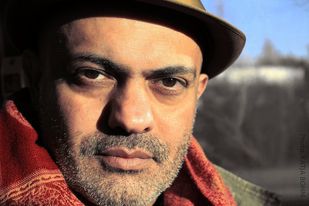
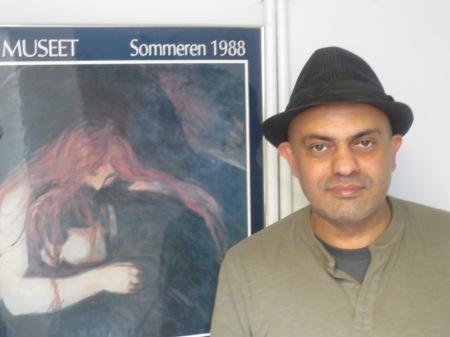
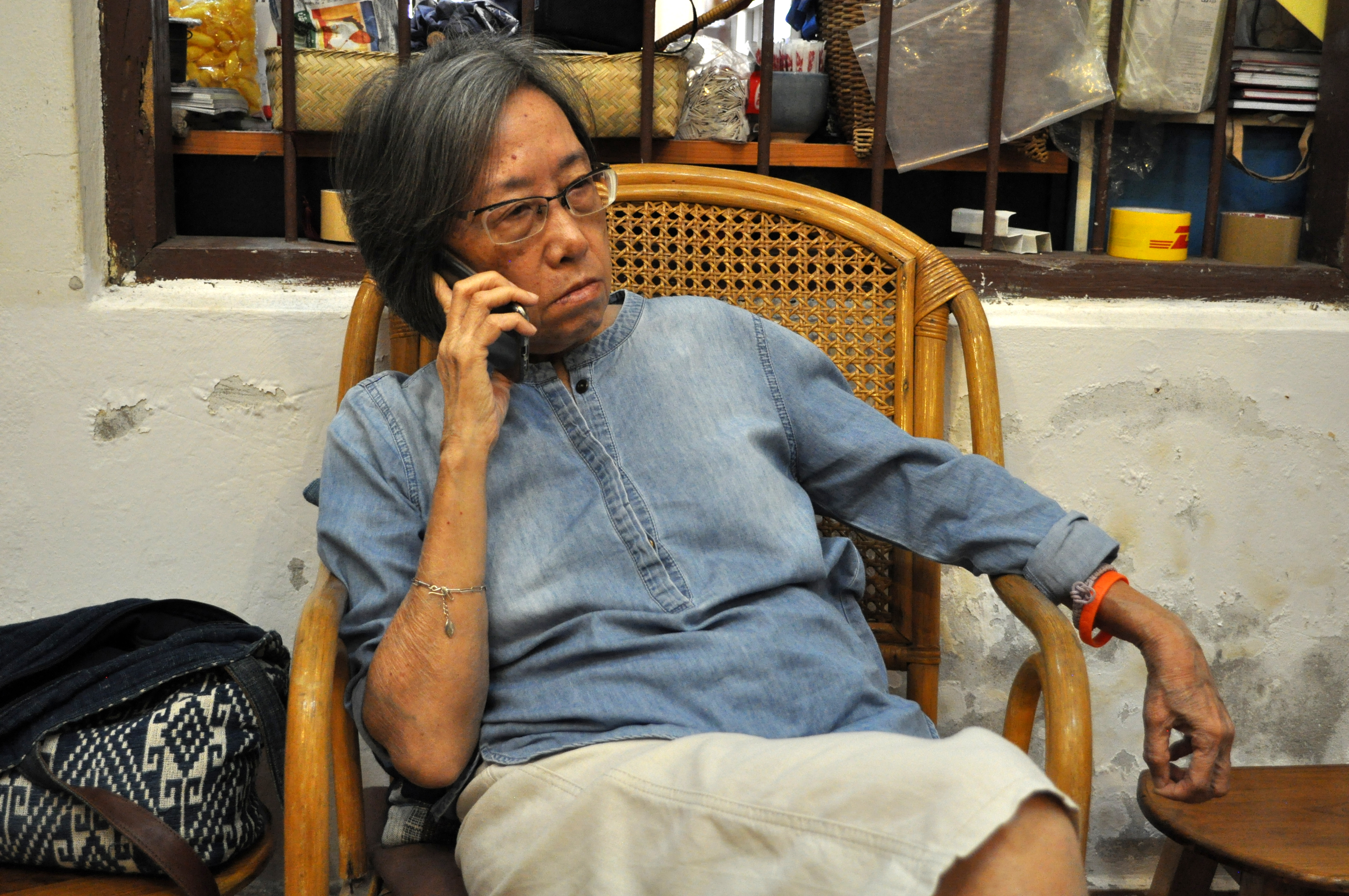
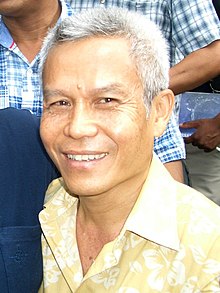
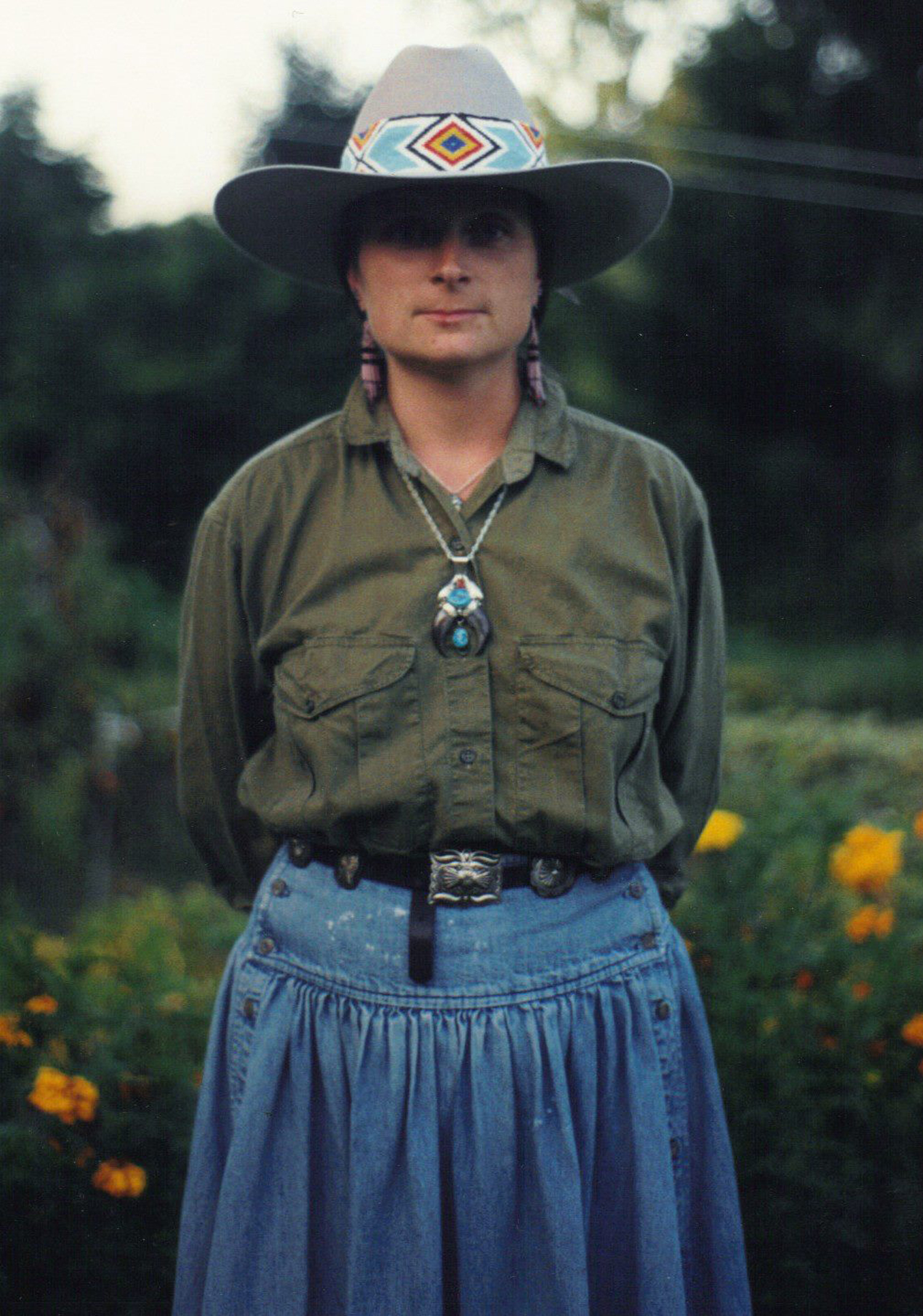
Author Hassan Blasim. Photo by Katja Bohm.

That’s a lot, and adding spice to it all are short interludes between chapters excerpted from a long email thread between Hassan Owl and a mentor, a fellow Iraqi émigré named in the novel Alia Mardan, who is based on the Iraqi expatriate writer Adnam al-Mubarek. Potentially intimidating, the hybrid mix is unified by Blasim’s dazzling prose voice, which inflects descriptions of even mundane occurrences with funny and/or startling story-turns and moments of imaginative insight. God 99 offers a profound sense of the connectedness of war in Iraq and contemporary European life, and, even more so, a superb self-portrait of an artist in exile—a 21st version of James Joyce, Henry Miller, and the other revered expatriate authors of 20th-century literature. 

I had a chance to speak with Blasim about God 99 and his current life in Finland. We spoke in English via Zoom, and I have condensed and clarified his answers.

Molin: Do you have a particular audience or ideal reader in mind when you write?

Blasim: I never imagine that someone’s looking over my shoulder while I write. But because I write in Arabic, I do consciously try to play with classical Arabic style, mostly by incorporating street language, to make an Arab reader feel the uniqueness of what I’m trying to do. Mostly though the fight is with myself, and I don’t consider what any reader might think—there’s just not time or space for that. When I send the book to the publisher, it’s pretty much finished—to include the design for the cover and the lay-out of the text. That’s very important to me. The publisher may suggest changes, but I’m not usually very receptive. Some readers and reviewers haven’t understood God 99; I think they expected or wanted more short-stories since my previous book—a collection of short-stories—had been successful. I had more short-stories, but to publish them as stand-alone tales in a collection to me was boring. I wanted to incorporate the stories into a larger and more complex structure, which a novel allowed me to do.

Molin: How would you describe your reception in America and in Europe?

Blasim: I don’t think world literature is popular in general in America, which means people aren’t used to looking for Arabic books and probably don’t understand real Arabic culture apart from what they get in the movies or the news, both of which are full of cliches. I especially don’t understand the publishing market and the intellectual climate. When I first published in America, I was happy like any author would be. But you need someone with energy to promote you to readers and newspapers and critics, and I didn’t know how that works. Unfortunately, my first trip to America was not enjoyable. It was a huge problem getting permission to enter the country, both in terms of obtaining a visa and then going through customs, which made me feel like a criminal. And without going into detail, some of the readings and writing events were unpleasant, too. I’m not in a hurry to repeat any of that. In Europe it’s better for me because I’ve learned a lot over the years and become more recognized by readers and book people. My books are translated into many languages, they’ve been adapted to theater often, and every month there are one or two book festivals somewhere where I’m asked to read.

Molin: How about in Iraq and the Arab world?

Blasim: When I first began writing stories in Arabic after arriving in Finland, I sent them to many publications in Iraq and other Arabic-speaking countries. But no one was willing to publish them because they said they broke too many taboos and the language was too coarse. So my first publications were online and then later in print in Europe. Only after I was translated into six languages in Europe did anyone in an Arab country publish me, even though I was already popular among young people who could read me online. But now with God 99, it’s the same thing again. It’s currently banned either officially or publishers won’t touch it. I still feel my real work should be back in Iraq and helping Iraq understand itself better, but I’m not permitted to do that. It would be dangerous for me and my family still in Iraq to even try. It’s still very easy to get shot by someone for expressing unpopular views.

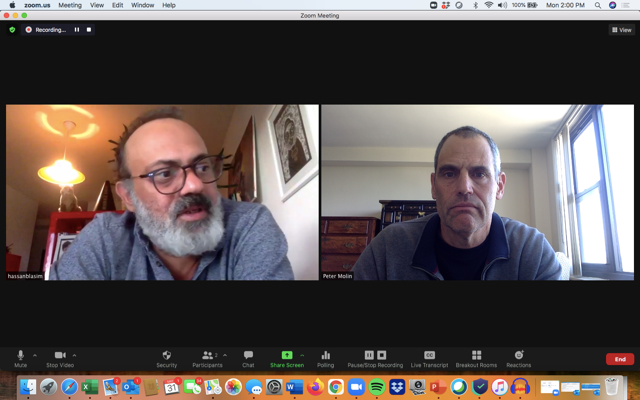
Hassan Blasim and Peter Molin in one of the three Zoom interviews conducted for this story. Screen capture by Peter Molin.


Molin: What about fiction attracts you?

Blasim: It’s important for English and American readers to know that I don’t only write fiction, I write poetry, criticism, plays, and essays, too, that haven’t yet been translated into English. I also write a lot in support of refugees, gay rights, and Iraq and the Middle East. But as for fiction, it’s what I have loved most all my life, from the time I was a boy. I always liked the way stories could contain extremes and opposites, such as how a story could be both a love story and a horror story, a funny story and a sad story, both tender and violent. Fiction is serious for me, but it’s also play and pleasure. In my writing, I enjoy trying to make all these parts come together. A lot of my sense of how to write fiction comes from my love of movies, from which early on I was impressed by how easily they switched between different types of scenes and moods. In my stories I want that same effect, something unexpected happening, something changing all the time. That’s how I try to write, too, I don’t plan anything ahead of time, I just enjoy the rhythm of writing and the chance to play. I open my laptop and I type….

Molin: God 99 pays tribute to many writers and movie-makers who have inspired you, both Arabic and Western. As a youth in Iraq, what attracted you to European and American art, film, and literature?

Blasim: When I was growing up, my friends and I loved European and American movies, art, music, and books, me probably most of all. It seemed so free—there were no taboos and everything was possible. A lot of it was easily available. Even after the first Gulf War, for example, in the early 90s, we were still reading Raymond Carver and Richard Ford stories. When economic sanctions were put in place by the US that limited imports and forced us to restrict the use of electricity, we would still gather in apartments and have parties while watching Oliver Stone movies. We loved Arab writers and artists, too–we celebrated all art and artists, especially contemporary ones—they were heroes to us.

Molin:  One writer referenced frequently in God 99 is the Italian author Italo Calvino. What do you like about Calvino?

Blasim: Calvino is very popular in Arab countries generally. For me, I love him because he is my opposite. I’m very loud in my writing, like an Oliver Stone or Quentin Tarantino. But Calvino is so cool, and you can tell he’s a slow and deep thinker, in a good way. I’m jealous of people who can sit and consider things without getting excited, because that’s not me, nor is it like Iraq, which is so passionate and excitable, like heavy-metal music. The part in God 99 where I describe fleeing Iraq and traveling through Europe making my way to Finland with only book, Calvino’s Mr. Palomar, is true.

Molin: That’s important–the book you carry with you when you are fleeing from one country to another! Another writer you mention is Henry Miller. How is Miller important to you?

Blasim: I discovered Henry Miller in the 1990s and read six of his books, all of which was a big shock for me growing up in a society where so much was restricted. He’s a great fighter and he’s honest.

Molin: When did your admiration for American and Western art become complicated by politics and war?

Blasim: From the beginning. As a teenager reading Western books and watching Western films, I learned many ideas about freedom–individual, cultural, religious, and political. My friends and I wanted to change culture and society as much as we wanted to be rid of Saddam, and we didn’t like the restrictions of Islam either. Mostly we just wanted to do what we wanted, such as drink, which I started to do as a teenager. I quickly learned that books could be transgressive, too—many were censored and you could get in trouble if you read them. So in the beginning, my love of Western art placed me in opposition to the dominant attitudes in Iraq.

That continued in college where I studied film. From classroom discussions and making short films, I learned that it was dangerous to complain about the government, so I kept quiet about politics, but I still got into trouble. After I made a documentary about poverty in Iraq, for example, I was visited by Baathist officials who questioned my motives. My teachers always complimented my ideas and work, but it was clear that they were also warning me about being too radical and too outspoken. Within the college there were lots of rumors about spies, and one of my teachers warned me that if I didn’t keep silent, the police would send for me after sunset, which was an idiom for being executed, being sent “into the dark”—we knew many people were being shot in those days. Meanwhile, members of my family were also in trouble with the government, which was constantly watching us. This is when I knew that I would eventually get into trouble if I stayed in Iraq and it was important to find somewhere freer and safer.

After the American invasion in 2003, the problem for me changed. By 2004 I was in Finland, but I was hearing horrible reports from friends and family in Iraq and I could see things were going to get very bad. The sectarian civil war was breaking out, and the danger and violence were worse than ever. So now I began to speak out and write against the Americans and the religious violence the invasion unleashed.

So, my attitude toward America is complicated, like a crazy mystery. In terms of the culture and people, I don’t know many Americans, but my Iraqi friends in America encourage me to visit again or think about moving there. They tell me the people are friendly and the living is easy, more so than in Europe. That wasn’t exactly my experience on my first short visit, as I mentioned above, but the diversity of people, the literature, and the music all are appealing. The politics and the capitalism are not.

Molin: During the period you were trying to flee Iraq and then settling in Finland (2000-2004), how did you keep alive the dream of being a writer and artist?

Blasim: In high school I wanted write and make films, and I studied film in college. I was always writing, but then my life was unsettled for a long time, but when I got to Finland I began to write again, and I had some small jobs that allowed me to write and translate, but it was boring and not creative. But fiction and public writing happened after I finished work and was sitting at home. After I discovered the Internet everything changed for me. The Internet gave me an outlet and allowed me to build an audience, and then led to the print publication of my books.

Molin: You must get asked about identity a lot—have you come to think of yourself as Finnish?

Blasim: It’s funny because I’m a Finnish citizen, but I’m not considered a true Finnish writer because I don’t write in Finnish and so am not eligible for Finnish literary prizes. Still, I now have a lot of good memories from living in Finland for many years, and when I travel around Europe, it feels good to return to Finland, where I am comfortable. But I also still feel like an exile, which doesn’t make me sad. Exile can be a gift for a writer, or for any human being. When you think about it, reading is a form of exile—when you read a book about New York or Tokyo, you go into a temporary form of exile that takes you out of the boring daily life of your own country and allows you to see things differently. I’ve learned not to be become too attached to one place, so I treat any location I’m in like a hotel—one room is in Baghdad, another is in Helsinki, etc. That’s also how I’ve come to think about my identity.

Molin: In God 99, it’s written that Finns are very conservative except when they’re in the sauna or at the bar. As someone who is one-quarter Finnish, I like the part about the saunas and the bars.

Blasim: Yes yes, I like it here a lot. The country is peaceful and the people respect free speech. That’s good, very good.

Molin: In God 99, the chapters recounted by the narrator are interspersed with short interludes transcribing email conversations with a woman named Alia Mardan. In an Author’s Note you explain that the emails with Alia Mardan are based on actual emails you exchanged with Iraqi writer Adnan al-Mubarak, who lived for many years in Denmark before dying in 2017. Why is al-Mubarak important to you and how did you devise this form for the novel?

Blasim: As I began to write God 99, I had a lot of stories but no structure. I was also depressed about the death of al-Mubarak, who was my friend and mentor. When I was on the move from Iraq to Finland from 2000-2004, he would write me long emails full of talk about great artists, classical Arabian folklore, and philosophy. I didn’t have any books or much time to read, and I was very desperate, so he was my best friend and teacher, an angel really. Those emails meant so much to me even when I arrived in Finland and was working in restaurants and was even homeless for a while. We often talked about writing a book together, but never got the chance while he was still alive. When after his death I was lost emotionally and thinking about how to bring the pieces of God 99 together, it occurred to me to use our email dialogue to frame the stories I had written. It might make things difficult for the reader at first, but it works for me personally and I think for the book, too. The emails in God 99 are all real, though I cut them up and made a collage of the thousands of emails we’ve exchanged.

Molin: You change the gender of your interlocutor from a man to woman. Why?

Blasim: That’s my ode to Scheherazade—the inspiration for a thousand stories!

Molin: Alia Mardan is interested in the 20th-century French-Romanian essayist Emil Cioran and writes frequently about her ongoing project to translate Cioran into Arabic, which seems to amuse the narrator. How is Cioran important for God 99?

Blasim: Cioran is not popular in Europe now, in part because he had a brief association with the Nazis, [an association he renounced and regretted]. Maybe he is just too dark for Europe, but he is widely loved in Arab countries. They love him so much it’s crazy. It’s his pessimism, his bleakness, his nihilism, his black humor. But I haven’t read all his books, mostly I like his quips, many of which I got from al-Mubarak.

Molin: All right. Let’s end with some bigger questions.

Blasim: Smaller questions are good, too. Just normal is best.

Molin [laughs]: OK, then, how about last thoughts?

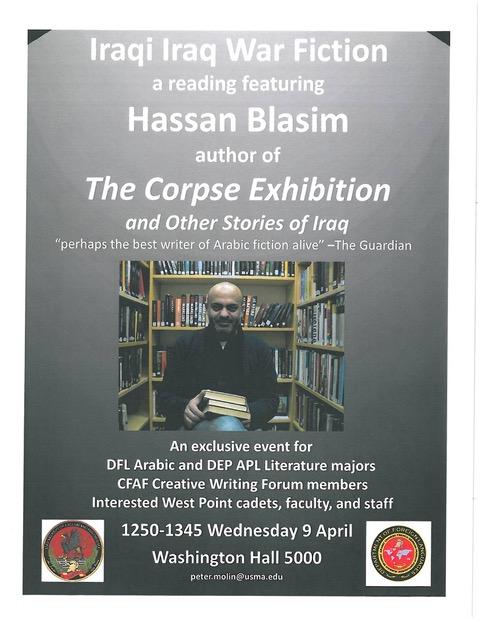
Blasim: I wonder what your memories are of my visit to the United States Military Academy at West Point, where you were my host. Did you often invite artists and writers?

Poster made by Peter Molin for Hassan Blasim’s visit to West Point.

Molin: Yes we did, at least while I was there, and before and after, too, I think. We brought in mostly Americans, and not all military writers, a lot of civilian writers, poets and filmmakers, too, including Oliver Stone. I would say you were pretty far out there compared to others in terms of your background, but you were a trooper—you gave a great reading and talk and were pleasant with everyone, even though it must have seemed a strange thing for you, after the way war has wrecked Iraq. But you gave us our money’s worth, and we all—faculty and cadets, including several international cadets from Arab countries–enjoyed hanging out with you.

Blasim: Some of my friends are surprised to learn I visited there, but I was encouraged to do so by my hosts in New York City, who knew West Point had a tradition of inviting writers such as Orhan Pamuk to visit. I just thought it was an interesting opportunity and was just taking things as they came.

Hassan Blasim at West Point. Photo by Peter Molin.

Molin: Well, I’m sure I was pretty inconsiderate about what it all meant for you—it couldn’t have been easy. Maybe I was hoping for you to learn that we aren’t all monsters or stupid idiots, at least not all the time. I mostly wish I could have given you a funner memory, like we might have gotten drunk in the barracks or something like that. You haven’t written the visit into a story yet, for which I think I’m glad.

Blasim: No, no, that wasn’t a bad day. Still, I hope that we can meet again sometime with that military stuff far behind us.
*

Hassan Blasim, God 99. Translated from Arabic by Jonathan Wright. First published in Arabic by al-Mutawassit, Milan, 2018. Published in Great Britain by Comma Press, 2020.


New Review from Matthew Komatsu: Adin Dobkin’s ‘Sprinting Through No-Man’s Land’

I cannot separate my early memories of war from those of cycling. I’d just begun to cycle competitively — as a lieutenant and duathlete stationed in San Antonio — when I deployed to Afghanistan in the summer of 2002. And in the short several months I was stateside before deploying to Iraq 2003-2004, I spent much of my time in the saddle. In fact, I was run over by a San Antonio driver and violently ejected from my bike the week before I boarded my plane to Iraq. On the flip side of  Iraq, I put in over 200 miles a week on the bike. As much as ten hours a week, post-war, often spent alone and silent. That’s a lot of time to think.

*

I thought a lot about those days as I followed Adin Dobkin’s nonfiction narrative along the 1919 Tour de France in his debut Sprinting Through No Man’s Land. It was hard not fill the minds of the cyclists, many of whom fought in WWI, with thoughts of my own. But while I the cyclists of Sprinting Through No Man’s Land spent close to half the race along a course that was altered because towns that had once been stage starts or finishes either no longer existed, or were so devastated that they could not support the logistical needs of the race and its competitors.

The book begins, fittingly, in Paris in the Fall of 1918, mere days after the end of WWI. At the desk of Henri Desgrange, the editor of the sporting newspaper l’Auto and founder of the Tour de France, we witness his decision to resume the Tour de France even as Armistice celebrations are erupting in the streets. From there, we’re off to the races, if you’ll forgive the turn of phrase, following a cast of characters as the Tour makes its way around the periphery of France.

To call Adin’s cast “colorful” falls short. There’s Desgrange — positioned as a kind of rigid omnipotent. The ll-seeing, all-knowing, and ultimately all-powerful race director and mouthpiece of the race through l’Auto.. The racers: brothers Henri and Francis Pelissier, both veterans of WWI. The former, an underdog by his age; the latter, the younger brother still in his elder brother’s shadow. Eugene Cristophe, older than even Henri Pelissier. French veteran. Firmin Lambot, the Belgian who weathered WWI under German occupation. And others, of course.

The research that went into the writing of this book is exhaustive, and Adin takes great pains to show the reader the sourcing and methodology he used to develop the writing itself. He does a marvelous job of world-building, layering context in a chaptered structure that roughly matches the 15 stages (and gobsmacking 6,500km/4,000 miles covered during the 1919 Tour). He even went the extra mile, including three interesting vignettes regarding under-represented narratives that are connected geographically with where the reader is in the race at the time. In other words, I learned a great deal about WWI-era France.

Which leads me to my only quibble with the book, which has more to do with the baggage I brought to the reading than Adin’s intentions for the book: this isn’t your average armchair sports enthusiast paperback. Those books are predictable: event-driven, illustrated by flashes of character background, and largely high-velocity pacing. Sprinting Through No Man’s Land is a careful book, slow and methodical, that takes great pains (as alluded to in Adin’s afterword in which he addresses the pitfalls of narrative building) to paint  as full an understanding of the race as possible. In Adin’s world, it would appear he’s more concerned with telling the story of a time, than of a particular race and its characters. To do so, he spends a great deal of time providing the reader the story of the land in order for us to experience the race. So, don’t come expecting chaptered race standings and attrition lists (the number of racers who quit before the race’s end is breathtaking) because that’s not Adin’s story. And that’s just fine because it’s impossible to separate the 1919 Tour from WWI. The landscape, the racers, the people: WWI had changed everything. Countryside towns along the front had been reduced to rubble and roads thrashed by the years worth of passage of men and machine. Three previous victors had died in WWI. And the people themselves had been traumatized by the wartime experience, many of them displaced and grieving. So really, Adin’s book is as complete a story of that time as he could make it.

As a former competitive cyclist, I found Adin’s technical details refreshing. The Tour of today inherited the spirit of those Tours — the grueling distances, staged structure, and general classification scoring methodology and accompanying yellow jersey primary among them — but I doubt Desgrange or the Pelissier brothers, if popped into a time machine to see what their race would become in a century’s time, would find much in common with today’s Tour. Unlike today’s professional cycling team structure, the teams then rallied under similar kinds of corporate banners, and remained amateur in nature. The teams of today serve to protect one most talented member of the team and his chances of winning the overall race. Domestiques — typically junior members — sole purpose in life is to create advantages for their captain, often find themselves breaking the headwinds for their captain, fetching water bottles and sustenance from the team’s chase vehicle, and even giving up their bicycle should the captain’s fail. In 1919, each rider was an island in Desgrange’s amateur storm. If your bike broke, you had to stop and fix it yourself in, say, a local blacksmith shop. And I do mean yourself. No spoilers, but there’s a nail-biter of a scene in a late chapter that will have you counting seconds as a rider repairs his bike fork while the blacksmith simply observes. If a rider fell behind, other riders on his team were forbidden from falling back and pulling him forward lest they all risk time penalties from the ever-present eyes of Desgrange’s armada of  l’Auto journalists/race observers. Today’s bicycles are technological marvels to the point that several years ago, professional cycling implemented minimum bicycle weights, and specified wheel types and bike frame geometries to reduce aerodynamic advantages. The bikes you see in the Tour today are a far cry from what Adin exposes us to: thick-tubed steel framed bikes with one-gear wheels that required a racer to dismount and manually change out to change gears. They were tanks to today’s sports cars. And the clothing — my god — ask yourself how you’d feel about cycling 4,000 miles in wool, minus the luxury of padding under your ass.

*

Sprinting Through No Man’s Land is a triumph of nonfiction storytelling, and it will be a welcome addition for the bookshelves of cycling fans and war literature aficionados alike (I’m both if you can’t tell). Every page is a delight, unified by Adin’s excellent prose and editorial choices, from the exit from and return to Paris, and it brought me back to my own post-war cycling in ways unexpected and refreshing. My recommendation: turn on this year’s Tour. Read a chapter at the end of every stage, and let Adin build that world for you in ways that simply watching it never could.

Allez!

*

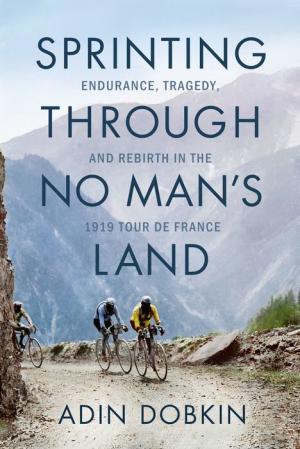
Dobkin, Adin. Sprinting Through No-Man’s Land: Endurance, Tragedy, and Rebirth in the 1919 Tour de France.


New Poetry from G.H. Mosson: “Warrior With Shield”

                                                                                                after Henry Moore

AN X STILL / image by Amalie Flynn

Blasted, broken to frag-
ments, left arm won’t—
both legs blown &
absent, the spaces abuzz
w/ anger—but I edge
forward, shield up
as leg-stumps toe
for foothold. My mouth
is an X. Still-
ness. Yet I see. 
I’ve been left. 

Moonlight empties
onto my chest,
rivulets down
in a branching sheen
& I swell w/ a hunch
I’ll make it
as if an old tune
warms the heart,
as if I too
might sing
again to Shelly.

I’ve been        
PUT CHARAsome-              
PUT_CHARACTERS_HEREone     
else
PUT_CHARAonce 
PUT_CHARACTERS_HEREsome- 
body   
PUT_CHARAother:
PUT_CHARACTERS_HEREa child.
Dandelion
PUT_CHARApods
PUT_CHARACTERS_HEREtumble
past my
PUT_CHARAopen
PUT_CHARACTERS_HEREpalms.


New Poetry from Barbara Tramonte: “Tailored To Fit In”

I WAS GATHERED / image by Amalie Flynn

Somebody sewed me with a string
On the bias
I was gathered
And about to pop

This has been a pattern all my life

They hemmed me in with notions
Each stitch bringing me
To a false whole

(I longed to slit my wrist)

I jolted with a shock of recognition
To see that I had drifted to the wrong side


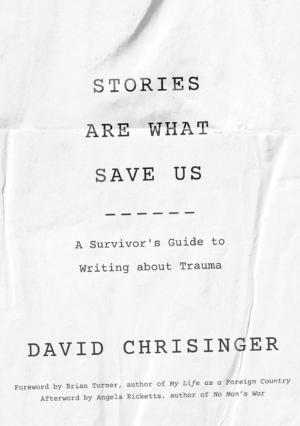
New Nonfiction by David Chrisinger: “Stories Are What Save Us: A Survivor’s Guide to Writing about Trauma”

The following is an excerpt from David Chrisinger’s new book, Stories Are What Save Us: A Survivor’s Guide to Writing About Trauma (Johns Hopkins University Press, July 2021). In this section, Chrisinger has embarked on a canoe trip with author, veteran, and EOD specialist Brian Castner, author of The Long Walk, All the Ways We Kill and Die, Disappointment River, and Stampede!: Gold Fever and Disaster in the Klondike.

Brian’s goal for day four was to snake through a series of small islands to where the Mackenzie River widened into Mills Lake. According to the guidebook, it wasn’t uncommon for canoeists to get stranded on Mills Lake for a day or two. The lake is so shallow that when the wind picks up just a little, whitecaps can whip up and make it impossible to keep going.

Much to our surprise and delight, the water in Mills Lake was flat and calm, not a whitecap to be seen. The sky was a brilliant blue, so blue in fact that could I have dipped my hand into it, my gloved fingers would have come back wet with paint. I’m not much of a churchgoer, but the landscape that day stirred something spiritual in me. To the north there no longer seemed to be any sort of horizon. There was only a majestic blue panorama of sky and water, a near-perfect mirror that reflected all that was beautiful and calming about this place. Instead of stopping for the day as Brian had originally planned, we skirted the southern shore without any trouble from wind or waves, feeling fortunate for the first time all week. From the back of the canoe, I steered us from point to point along the shore, careful not to get too far from land.

Brian’s back was starting to bother him, he said, and his shoulders were stiff and sore from all the paddling. Each time he pinched his shoulder blades together or arched the small of his back, I could hear the pops and groans of his battered body. I was then suddenly aware of Brian’s intense need for dedicated quiet, a quiet I don’t think I’ve ever experienced with another human being. I became self-conscious of all the questions I had been asking him about writing and being an author and whatever else my curiosity suggested.

For the first time all week, I went nearly an hour in the canoe without saying a word. Before too long, the pent-up anxiety, now released, paired with general exhaustion, the rhythmic nature of my paddle stroke, and the sound of the canoe cutting through the water all resulted in a meditative calm that eventually ended with my head slumping forward and then suddenly jerking back. Not wanting to fall fast asleep and go over the side of the canoe, I did the only thing I thought would keep me awake: I talked. Because Brian had cut me off the last time I brought it up, I started with my trip to Okinawa, not caring if Brian was listening or not. Simply saying my thoughts out loud, I convinced myself, would help me make sense of them. If Brian added his two cents, that would simply be icing on the cake. I talked about what a strange place Okinawa was and how commercial and developed it had become. Brian said he was surprised I had brought Ashley with me. He said that he’d never thought to include his wife on a research or writing trip but that she would probably be overjoyed to be asked. “My wife’s love language is quality time,” I said, citing the insights of The Five Love Languages. “Mine, too,” Brian said in a soft, contemplative tone.

As though I had rehearsed what I would say if finally given the opportunity to speak, I found a nice, unstrained rhythm of play-by-play recounting. The highlight of the trip, I told Brian, was the second-to- last day, when Ashley and I met up with American expat Jack Letscher, who worked in his spare time as a battlefield historian. The morning we met him at our hotel, he handed me a short stack of photocopied topographical maps that were divided into neat grids and further divided into smaller squares. Certain squares on each page were highlighted, and he explained that he’d taken records of my grandfather’s company and traced the routes the men had taken and the places they had fought onto the copies of the battlefield maps I now held in my hand. For the next eight hours or so, he took us along the same routes in the same order that my grandfather’s company had once traversed. Brian listened without interrupting or asking questions. Then I told him about my father and what a difficult relationship I had with him and how my journey to uncover the truth and write a book about his father was a sort of pilgrimage I had created for myself to bring my father some peace.

“Like Field of Dreams,” Brian said.

“Yeah, I guess. I never thought about it like that,” I said, thinking of the 1989 movie starring Kevin Costner in which a farmer in Iowa builds a baseball field at the edge of his cornfield to ease his long-dead father’s pain.

“You know, though,” Brian continued, “it wasn’t his father who needed peace. It was Costner.”

“That’s true.”

“Do you want some advice?” he asked, as if he had finally realized that is all I wanted all along. “You need to figure out what peace you were looking for,” he said.

“Okay,” I said and thought for a moment. “I guess I don’t know exactly.”

“Figure that out, and you’ll have yourself a book,” Brian said with a candid authority for which I held a respectful appreciation.

Finally I was getting what I wanted, what I had been waiting for. Yes, I’d sat on a plane for two days and flew 4,000 miles from home to the Arctic to escape some of the drama of my life and recharge whatever batteries I had left, and, yes, I’d thought I would be able to help a hero of mine in a time of need, but really what I was looking for was his advice.

I thought for a moment about what peace I was looking for. Then Brian interjected another thought: “Unless you know what you, as the writer and as one of the main characters, actually wants, all you’re going to have is a bunch of pages where a bunch of stuff happens, but none of it matters because that’s all it is—just a bunch of stuff a reader has no particular reason to care about.”

Then he asked me something I hadn’t anticipated: “Why do you want to be a full-time author anyway? You’ve put out a couple books already. Clearly your job isn’t so demanding that you don’t have the time or energy to work on stuff that’s important to you. Plus, I bet your pay and benefits are good.”

“And I have a pension,” I added.

“Shit,” he said, adjusting the brim of his hat between paddle strokes. “If I had flexibility and time and a salary and benefits and a pension, I wouldn’t be out here for 40 days—away from my wife and kids—trying to scrape up enough material to fill a book no one’s going to remember after I’m dead and gone.”

“How can you say that?” I asked incredulously.

“Tell me this,” he continued, ignoring my question. “Why do you really want to write this book? You writing a book isn’t going to bring your father any peace; you could just tell him what you found if that’s all you want.”

“I suppose it’s like what Twain said. If you want to be remembered, you either have to write a book or do something worth writing a book about.”

“Unless your last name is Washington or Lincoln,” Brian replied, “no one’s going to remember you a generation or two after you’re gone. No book is going to change that.” He continued, “This life ain’t all it’s cracked up to be. Believe me.”

“Well,” I said, “if you think what I have is so great, you should apply. We’re trying to fill like six of my positions.”

Later that day, over peanut butter and honey wraps and fruit, Brian confided in me that his first book had sold for big money. He said that he was almost embarrassed by how much and that he was never going to make back the advance he received. His second book, however, was rejected by the publisher who had bought his first one. The editor he worked with on The Long Walk told Brian that maybe he had only one book in him. “He said that Michael Herr only wrote one book too— Dispatches—and that I shouldn’t be too hard on myself,” Brian said.

“Man, what a dick,” I replied with a mouth full of food.

“Yeah, but then that same guy is my editor for this book, so . . .” To sell his second book, Brian had completely restructured it.

Twice. I started to wonder whether Brian’s experience with his second book was making him a better teacher of writing and whether he was practicing his chops on me. I’ve learned through my dealings in the writing world that good writers aren’t always good teachers. Often the opposite is true because most people are better at teaching something they’ve learned through experience, through trial and error, than they are at teaching something they somehow innately know. When someone like Brian knows in his bones how to tell an intimate, vulnerable personal story, it can be easy to assume anyone can do the same. The person just has to want it badly enough. Write a better book. It’s that simple. The cognitive unconscious of natural writers has a knack for offering up beautiful prose in story form, affording them the rare ability to write automatically—so automatically that it’s easy to believe that’s the nature of writing itself, rather than simply their nature.

Natural storytellers aren’t normally equipped with the tools to deconstruct what they’ve done or to pinpoint what it is that a reader will respond to—not until they get knocked on their ass and are forced to figure it out for themselves. Their debut books are beautiful and haunting and stick with you for days after you finish them. But because they can’t put their finger on what made it so captivating, their second books can oftentimes fall flat in comparison.

The next available campsite was another 8 or 10 miles down the river, on the northern shore. There we found a perfect camping spot with plenty of breeze and very few mosquitos. The shore was sandy and full of seashells. Seagulls chatted in the background. The scenery reminded me of pictures I have seen of Alaska, the wide and long valleys that were carved out by glaciers and are now dotted with rocks and low bushes, a land teeming with wildlife. To the north of us, dark purple clouds fluffed by. An occasional lighting strike diverted my attention from the camp chores. They were close enough to see but far enough away not to worry about. To the west, the sun kissed the tops of the distant trees. Brian sat on a flat rock with his legs crossed, jotting notes in his journal as I pitched the tent and filled up our water bottles.


New Nonfiction from Kristina Usaite: “Against a Cruel Society, I Came Out to Myself”

When I was losing myself, the only thing that saved me was immigrating to America. Only then, with great effort and sacrifice, I was able to come out to  myself and do what we all have to do for ourselves – to be who we are. Condemnation, fear, physical injury, loss, death – these are the first words in response to the question of how L.G.B.T.Q.+ people survive in post-Soviet countries. Many of us have been  beaten or killed in one form or another. Where I’m from, Ukraine, fear lives in every vein. When you are a woman who loves another woman or a man who loves another man, this is included in the category of things people don’t talk about. I grew up where the words lesbian or gay were not spoken, but other words were said  I would not dare to say aloud. The traditional family was the only concept I grew up with, even though I can’t connect myself to this concept. From an early age, I realized I had unusual feelings towards women, which I couldn’t find a name for. The L.G.B.T.Q.+ topic was out of reach; I didn’t know what questions to ask to understand who I am. I didn’t know such  questions could be asked.

In high school, others found me different. The stereotype that girls should wear skirts didn’t leave  my classmates, but it never took root in me. I was often asked when I’d look like a girl. I didn’t know  how to answer this question because I didn’t understand it. I was already a girl. In my student years, the concept of my love was becoming clearer. But that didn’t mean I could afford it. All my girlfriends lost their virginity, and I couldn’t allow myself to be looked at differently. Even a bottle of vodka didn’t help me to undress and go to bed with a man. After every unsuccessful attempt I had to lie to my friends. I had to carry condoms in my bag and show them with obvious visibility,  so that no one had doubts creeping in. The fear that friends would start to despise me has always hung over me. There is a certain mentality of concepts and stereotypes that make you think that you  should do the same as everyone else. In Ukraine, it is easy to surrender to society and miss the opportunity to discover who you really are.

In my second year at university, I had my first relationship with a girl. We hid in dark corners where we could finally breathe. We could only hug briefly when meeting in public. Our hands met in places where there were no eyes. We often had to run away, to go to other cities where nobody knew us. Where we could look at each other and hold our gaze, not  arousing too much attention with the smiles we exchanged. We loved loving each other, but we could only love in lies. We even lied to ourselves, saying these feelings have no life. I wanted to believe it was not so. But she couldn’t help succumbing to society. She continued to love me,  but at a distance with another man. I was sure this was the future that awaited me every time. There  was no one who could tell me otherwise. No one who could talk to me at all.

At the time I met my second girlfriend, she was engaged to a man. Our relationship began soon after and a month later she had to get married. The fate of our relationship took the same turn as my previous one. We kissed behind the trees. We spoke words of love through messages and then immediately deleted them. We sent her fiancé to the store to find a moment alone, hugging each other, touching our hands. She wanted to leave him, but her attempts were unsuccessful. She said, “What am I going to tell my  family? What will they think of me? I love you, but I have to marry him.” I was maid of honor at her wedding. Kissing him, she kissed me too. Everything happened only because we believed these feelings had no place in this world.

Nobody knew I was a lesbian, including myself. I often denied my feelings and inclinations, and questioned if I was normal. Suddenly people began to understand who I was before I knew it. By deception, I was met in the courtyard where I was met by a few men to show me their strength in opinion. After regaining consciousness from beatings behind garages, I quickly came to the conclusion this was not my place to be. It was useless to go to the police, knowing  they were not involved in such matters. They would’ve shaken the hands of those who beat me for who I am. I had no one to expect help from. I no longer wanted to wake up behind garages. I  decided to immigrate to America.

I had to study everything again after immigrating. I learned to speak openly. I learned to feel openly. I learned not to be afraid to feel. But it took a long time. I saw L.G.B.T.Q.+ communities in America and, at first, rejected them because fear lived deeper and stronger and didn’t allow me  to be touched by who I was. At my first job, an employee asked me if I was a lesbian. I immediately blurted out “no.” It was the first time the word lesbian was applied to me in a  positive form. For the first time, I heard in my head “I think I’m a lesbian.” Later I found out half of our staff was gay. I didn’t deny myself anymore.

My mother didn’t know what I was struggling with. I couldn’t lose her. In America I met many people from different countries, mainly Russia, who were disowned and abandoned by their parents. The pain the loss inflicted was unbearable. For a very long time I prepared to tell my mother who I was.  She and I were very close, and in the absence of such large and significant information about me I didn’t feel complete. On the phone, a year after I moved to America, the conversation happened. Having said I have a girlfriend, my mother’s first question was, “Is everything good between you?”

No, you can’t be silent. You can’t give in, giving yourself up to people. You can’t play by the rules and be convenient for others. I’m glad I’m on my side. It feels good to say – I am a lesbian. What is finally more important to me is that I feel. It took a large part of my life, and chasing a new one, to finally come out to myself.


New Poetry from Alita Pirkopf: “Roadkill,” “Sounds of the Past,” “Spring,” and “Unhealthy”

BLOOD IN BUCKETS / image by Amalie Flynn

ROADKILL

I bring you blood in buckets,
a heart that I hear, a palsied hand.
It has been eight, ten
years, my issue.
The same as twenty years ago
when your father felt
about me as you do now.
I felt the world shrink
but I thought something,
not necessarily the world,
would end. I had not thought
the world lay flat, as Renaissance
cartographers mapped it.
But now, like an automobile tire
not only flapping, flattening,
parts of it, or me, lie on the shoulder
of my road with dead things and dirt.

SOUNDS OF THE PAST

She thought she had found
soft music and warm dialect,
a sunny sort of near-Italian soul,

But surfaces surprise.
She found out. She found
that underneath pounded
a martial drumbeat
vibrating still

from Vienna’s center,
his childhood years
under the Third Reich,
a father fighting
occupying Yugoslavia
with others
missing
the village polkas,
his son.

A burst of marches,
explosions, still resounding.
All of us hearing
pounding steps and hearts.

SPRING

Shreds remain—
unraveled weavings
of brown grasses and mud—
in branches a bird eyed
for her family tree.

The rest, the nest,
that we had watched
through last week’s window,
fell.

The dog found
blue broken eggs
in the grass.

Families, all of us
consider seriously.
Upsetting winds
come to nests.
It is spring
and windows
open views
and dooryards fill
with the ambiguity
of lilacs.

UNHEALTHY

I loved my doctors
until one
played sick games,
touching and taunting,
and knowing of rules
I didn’t know.
Telling jokes
I didn’t understand.
Dismissing me
for my naivete—
stupidity.

The years passed,
and he operated
on me appropriately,
savingly. Later he
mentioned dining
together or going out
for coffee, but didn’t ask,
and got angry for reasons
I didn’t know, saying
I hadn’t said I’d go.


New Nonfiction from James Warren Boyd: “The Ecstasy of Sister Bernadette”

In seventh grade my Catholic elementary school received a new principal, Sister Bernadette, who strode onto the blacktop that first day like Darth Vader walking down the ramp of an Imperial shuttle. Her determined expression and alert eyes matched her gait, punctuated with her stylish yet sensible thick-heeled, closed-toe pumps. She wore what I would come to know as her signature look: a midnight-blue, knee length, A-line dress trimmed with an immaculate white collar and matching slightly flared cuffs. The fact that she voluntarily chose to wear the now-optional veil long after all but the most senior nuns had abandoned them read radically ­conservative.

My experience as a child of the ‘70s in Southern California was that you could tell a nun’s temperament by what she wore. Younger nuns (and some of their older allies) in our parish wore breezy blue polyester separates, tried fervently to be groovy and relevant, and were admirably committed to social justice. Older nuns who wore THE VEIL with matching black or dark blue habits were often mean and more than occasionally violent; they generally, as I saw it, dwelled in the dark recesses of the convent and emerged to discipline and punish.

But it was these same veiled authoritarians who provided the protection I needed as an obviously queer child. In my first weeks after beginning the third grade as a new student, the boy that would become my nemesis, David, stole my thick tortoiseshell glasses, wearing them in the back pockets of his blue corduroy uniform pants, and taunting “Yeah, try to catch me, butt-face.” I was an easy mark; in part because I started 1st grade a year early, I was always the youngest and frequently the shortest in my class. Most damningly, though, I was nelly: one of those little boys with neither the ability nor the inclination to butch it up to avoid ridicule. My parents—my mother, consumed by guilt for the queer son she thought she was responsible for creating, and my father emotionally checked out and gone a good part of the year for business—weren’t much help. As a family, we seemed to be universally ashamed rather than outraged about my being bullied, convinced somehow that I or we had brought this social embarrassment upon ourselves.

Sr. Bernadette, fortunately for me, ignored and missed nothing. As we filed back to class after early-morning assembly, she witnessed one of the boys in David’s posse hit another student on the back of the head simply because he was standing in front of him. Sr. Bernadette pulled both boys out of line, got our attention, and shouted in exasperation, “This boy,” pointing at the attacker, “just HIT this boy,” pointing at the victim, “for no reason. What is WRONG with you people??!!”

My admiration and respect for Sr. Bernadette deepened in her duties as the English instructor for the advanced class of our grade. While other students complained about grammar drills, essay revision, and impromptu verbal quizzes on irregular verb tenses, I savored them. I relished the diagramming of sentences, especially ones that had incredibly long phrases and clauses of Sr. Bernadette’s own creation with their compound subjects, transitive verbs, overly-modified nouns, appositives, and riots of prepositional phrases. I found those graphic organizers with their sideways houses and attached ladders beautiful landscapes of thought and syntax.

I think my enthusiasm for writing and grammar put me in Sr. Bernadette’s good graces, which was a blessing since she proved immune to my usual sycophantic ploys. Fortunately, she seemed to dislike David and his clan of bullies as much or more than I did—if this were possible. Plus, although clearly a bit of a jock herself, who unlike me seemed as comfortable on an athletic field as in the classroom, she didn’t seem overly impressed by David’s athletic abilities. She was actually helpful to students like me who needed a bit of coaching (since our school had no PE teachers), and sometimes spontaneously joined us on the field and blacktop to participate and instruct.

On one such occasion she offered to be the pitcher for our kickball game. I think she enjoyed expertly fulfilling the variety of polite pitching requests from the kickers (e.g. “slow giant bouncies, please” or “fast baby bouncies. please”). Sr. Mary Bernadette even did some fielding in her dress, veil, and pumps, deftly catching fly balls and scooping up grounders while she pitched for both teams. When it was David’s turn, a tense hush fell over players on and off the field; we all knew that mortal enemies were facing off. David took his time getting to the plate, trying to unnerve Sr. Mary Bernadette with his swaggering, lackadaisical lope. Despite this, her, face—framed by a few wisps of hair which has escaped the side her veil—remained unchanged; in fact, her polite half-smile may have increased slightly at the corners like a Grinch grin. Her thick dark eyebrows remained neutral, her forehead unfurrowed. Her body was still, save the slow rotation of her neck which allowed her gaze to follow David to the plate; her steely stare focused on David like a panther stalking prey. When he finally arrived at the plate and looked up from the dirt at her with a smirk, the corners of her half smile quivered ever so slightly.

“How would you like your pitch?” Sr. Bernadette asked evenly. She took a breath, and rolled the ball as requested with perfect accuracy. David watched the incoming pitch: as it neared, he rocked back on a crepe heel of his brown suede Wallabee knockoffs before taking a few leaning stutter steps toward the red rubber ball and kicking it with all his might using the inside of his foot. His kick bulleted on the ground toward Sr. Bernadette. Despite its great speed and a weird, high bounce, she caught the ball confidently above her head with a resounding, “thwap.” We held our breath as she lowered her arms, the ball now firmly gripped in a single hand, and looked at a gaping David. She arched one eyebrow and waited for him to run. David trotted towards first, haltingly, eyes locked with hers; then he broke their gaze and sprinted. Sr. Bernadette cocked her arm with the ball back slowly, seemingly wanted to draw out David’s cringing as he ran, and when David caught her eye directly across from her, she launched the ball like a trebuchet, hitting David so hard he stumbled with its impact.

Amidst the cheers from those outside of David’s retinue, Sr. Bernadette walked back to the mound with a laugh we had never heard. Her subtle, sardonic chuckle was familiar, but this was an unbridled, throaty laugh from deep within. She lifted her face sightly to the sun in elation for a brief moment, her veil tipping back, punctuating her ecstasy. When she arrived at the mound she had regained her composure, and she turned toward David who had returned to the sidelines and asked, “Are you hurt?”

“I’m fine,” David groused, rubbing his shoulder.

Sr. Bernadette nodded at him, and then scanned the field to see who had the ball. She made a beckoning motion to the student, and caught the throw in the air solidly with one hand.

She smiled and scanned David’s team, “Who’s next?”

****

Years later I went to visit Sr. Bernadette at the motherhouse on a trip to see family and friends in Southern California. I waited in the quiet, immaculate, oddly corporate-feeling lobby, until she strode around the corner, and exclaimed brightly, “James Boyd!” She seemed only a bit older, and I realized at that point how young she must have been when she became our principal. Gone was her signature habit-esque dress replaced with business casual separates.  Gone too was the veil; she had combed-back salt and pepper hair in a short, flattering style. We exchanged hellos (my recollection is that we shook hands) and she invited me to sit with her. I asked her if she remembered our class, and she said, diplomatically, we were “a difficult class but at least we had energy.” The classes who came after us, she said, were “hard to get to do anything.”

As she reminisced, I looked into her eyes—framed now with soft wrinkles—still marked with a fierce intelligence, eyes that never missed a bully’s blacktop trick. But gone was the sternness I surmise was necessary as a school administrator who valued order and fairness. What was in abundance now was the once rarely seen glint of approval she gave students when a verb was conjugated or a sentence diagrammed correctly. And in the corner of her eyes as we sat evaluating each other anew was something I hadn’t seen or noticed as a child: a playful glint.

She asked about me. I told her I had moved to San Francisco and was pursuing a master’s degree in English. I told her that one of the reasons for my visit was to thank her for being the person who first got me to love the subject.

“I’m happy to hear that,” she replied with a smile, “You know, I’m not teaching anymore.”

“Really? Why not?” I think my expression might have revealed how unfathomable I thought this was, since in my mind she was the English teacher.

“A few years ago, the order needed someone to be the accountant and I stepped up to do it.”

“Do you like it?” I asked.

She shrugged, “One of us needed to do it.”

After a few more moments of conversation, she stood up and extended her hand again. “Well, good luck to you, James,” she said, shaking my hand, “and good luck with your studies.”

“Thank you,” I said. “Nice to see you.”

Sr. Bernadette squeezed my shoulder maternally and gave me a warm, genuine half smile before she turned and walked out of the reception area without looking back, her footsteps echoing in emptiness and deafening quiet.

I stood still for a moment in the vestibule—not wanting to move or make a noise, not wanting that pause after to end—before exiting the motherhouse to my car. As I walked, I wondered what she thought of these periodic visits of the adult specters of children past. What must it be like to meet her historic fan base, surely the former students most motivated to visit? I regret that I didn’t ask her if she, too, remembered that sunny afternoon on the kickball field when she transformed into a superhero.


New Poetry from Jesse Frewerd: “Symphony”

OUR TARGETED HEADS / image by Amalie Flynn

Ballistic medleys project ambition, while
dancing tones find their pitch. There is
unexpected buoyancy in our youth. March,
advance, train, drill, prepare, disseminate.
It’s the 4am ensemble, time to crescendo
awake for guard duty. Report to post, front
gate, alert and ready. Hours, minutes,
seconds, tempo depends on the action.
The symphony begins with an RPG flying
over our targeted heads. Return fire.
Bullets staccato the enemy location.
A cappella commands over the comms.
Write the counterpoint, execute. Threat
neutralized, they retreated. Though my
heart is playing allegro, via adrenaline.
Dynamics decrescendo the scene, bringing
it to normalcy. I return to my life as it is,
my new normal cadence amid syncopated
pop-shots, RPG’s, mortar rounds, and IED’s.


New Fiction from David P. Ervin: “Currents”

Grant crouched on the sandstone and leaned on his fishing pole. The sun warmed his shoulders as he stared through the clear, green water of the Sand Fork River. Shadows of particles on the water’s surface glided across the submerged, algae-covered rocks. A dragonfly buzzed over the water. There were no fish in the pool. His boots gritted against the rock as he stood. He took a deep breath.

He looked down the narrow valley as the hot breeze buffeted him. The green walls of the gorge hemmed the river into a space barely a hundred yards wide. Hemlock and sycamore branches shaded the whitish-tan rocks that formed its jagged banks. The water meandered around the boulders for two hundred yards before it dropped below the horizon into a rapid he could only hear.

He liked the river best when he was alone. There was only what he brought with him – no bustle, no people and their motives. No one trying to show off. No one trying to scare anyone. There was just the river and its own cacophony.

He listened to all the layers of sound. The river’s whoosh echoed off the sides of the gorge. The water lapped in a steady rhythm against the rock on which he was standing. It gurgled and tinkled around an exposed log a few feet away. Further down it poured between two rocks in a sloshing sound heavier than the gurgle. Then there was a steady thundering down at the rapids that reminded him that the river could change.

***

“This next one’s a bit crazier than the last one, man, but you’re doing good so far. Just keep it up,” said Brandon.

Grant looked behind him. Brandon’s tall frame was perched on the back edge of the three-man raft, eyes intent on the rapids ahead. His freckles were conspicuous on his fair skin. The swollen, muddy river stretched along the valley behind him. Spring had so far brought only rain. The valley was dead except for the evergreens and the beginnings of red and green buds on the other trees. They glided down a calm stretch between two rapids.

“Yeah. Right,” said Grant. He wedged his left foot tighter between the floor of the raft and its side. The roar almost a hundred yards ahead of them grew as they drifted toward it. “Man, are you sure we shouldn’t just walk the raft around this one? There’s nobody else out here if we tip over.”

“Nah, man. We’ll be totally fine. This one’s intense but it’s fuckin’ epic. Trust me,” said Brandon. He sat down and jammed his foot under the side. He nodded at Grant with a faint smile, then locked his eyes downriver. Grant said nothing and turned around. He gritted his teeth and shivered, wishing the clouds would break. He cinched the chinstrap on his plastic helmet.

He wondered how the hell he’d gotten here.

He’d run into Brandon on the campus of the state university. They’d graduated high school together, and he was a familiar face even though they’d run in different circles then. It was the second day of classes, the second day as a new college student just a few days removed from four years in the Army infantry and a tour in Iraq. The second day of bewilderment in a sea change. They got together on weekends through the spring semester, and Brandon took him the most laid-back bars, showed him the best grocery stores and hiking spots. They talked and bonded.

When Grant spoke of Iraq and a little of combat, Brandon spoke of being a whitewater rafting guide. It was a lot like war, Brandon had said once. He’d read a lot about it, World War II mainly. You had to keep it together to survive. That took balls. This would, too. The river was like that. He’d invited him to take him rafting before the season opened, just them and the river. It’d be epic, Brandon had said.

It sounded like it could be fun. Brandon had showed him a lot so far that was. Maybe it would be like the cool parts of the Army, the air assaults and live-fire exercises. The adrenaline.

“You sure you’ve gone down this one when it was this high?” said Grant. The booming rapid had grown louder. “You’re not bullshitting me, are you?”

“We’ll be fine, man,” said Brandon. “If you get thrown out, just curl up in a ball. You won’t get stuck under a rock that way. The current will just push you downriver.”

The image flashed through Grant’s mind of being pinned against a rock by the force of the river and his mouth went dry. Brandon stood in the raft behind him. The rubber squeaked and the raft rocked. Grant turned around. Brandon was mumbling to himself and scanning the rapid ahead, eyes wide.

“Yeah,” said Grant and faced front again. He pushed out a breath. The look on Brandon’s face had tensed him up. It was always worse when the guy in charge was scared. His limbs felt warm despite the chilled water that hadn’t yet dried from the last rapid.

Brandon dropped to his seat and the water sloshed underneath. “Okay, man. Comin’ up! You ready?! We’re hitting it from the left.”

Grant rolled his shoulders and gripped the tee handle of the paddle. He jammed his foot further into the crevice until it pinched his toes.

“Got it,” he said, adding force to the words. He couldn’t see the course of the rapids, only a drop twenty-five yards ahead and a scattering of worn boulders. The whoosh had grown into a thundering. He crouched low. “Yeah I’m ready.”

His heart thumped in his chest. He heard Brandon behind him taking deep, deliberate breaths.

“You fuckin’ nervous, man?” said Grant. “Shit.”

“Huh-uh, nah. Remember, dig with that paddle. Push hard,” said Brandon. “Okay, let’s go two left!”

Grant put his paddle in the water on the left side, ensuring the entire paddle head was submerged, and pulled. They veered to the right, pointing at a narrow passage between two boulders. He dipped the paddle in the water and pulled once more.

“Okay, rest…Let’s do it, man!” shouted Brandon over the intensified roar in front of them Grant stared straight ahead. He heard Brandon’s paddle hit the water, then the current sucked them into the rapid.

“Left! Dig!” Brandon screamed over the din of the crashing water. “Now right!” Grant switched hands on the paddle and hunkered low as he dug the paddle into the water on the right of the raft.

They shot through the crevice. The front of the boat dropped and Grant felt weightless for an instant before it smacked the surface of the water. He stopped breathing when water came in the boat, dousing him, and then a gasp filled his lungs with air that smelled of mud. Boulders jutted out of the water and swirled all around them.

“Left, left!” said Brandon.

A wall of water to his left rose several feet above his head. His paddle was horizontal.

“Right! Right!” He flipped his hands around and leaned over the right side of the boat to get the paddle in the water. His left foot came loose. A wave underneath the boat bounced him out of the rubber seat. He scrambled to shove his foot back into the side and righted himself as the boat shot down the rapid. A wave threw the raft to the left and into a rock, stopping it and tilting them at an obscene angle.

This was it, thought Grant, and his heart fluttered.

“Back left, back left! Oh fuck back left!” said Brandon. Grant plunged the paddle in the water and pushed backward and his arms burned. The bottom of the boat hit rock then broke loose and bounced against another boulder. It sent them hurtling down the river to the left.

“Two right and two left!”

Grant caught a glimpse of calmer water further ahead as he paddled. A wave crashed against the left side of the boat and drenched him. He blinked the cold water out of his eyes.

“Two right, two left again,” said Brandon with a voice that had evened. He took a breath and paddled. The raft bobbed in the waves, and Grant heard the sucking sound underneath as it passed over them.

The raft slid down the remaining rapids, mere bumps, and reached the calm. Brandon whooped behind him.

“Holy shit, man!” he said. “We made it! Was that not awesome?!” Grant turned around in the boat. Brandon was taking off his helmet. Water streamed from his face and through his short, red hair.

Grant looked at the rapid behind him, growing quieter as they drifted, and traced the path they’d taken with his eyes. His stomach churned at the sight of the water pounding the sides of the boulder against which they’d bumped and the tremble began.

“Okay dude, you see that rock over to the right? Let’s take a little break there,” said Brandon, pointing to a long, flat rock that jutted into the water. Grant nodded and paddled.

The raft scraped against the rock as they approached it, then made an abrupt stop. Grant still felt the motion of the waves rocking him. He propped the paddle against the wall of the raft and unsnapped the chin strap. He lifted the light helmet off and ran a hand through his wet hair. Brandon got out splashed past Grant. He tossed his lifejacket onto the rock and put his hands on his hips, regarding the rapid behind them. His chest rose and fell with deep breaths.

When Grant climbed out of the boat his legs were wobbly. He sat back down on the edge of the raft and fished his water bottle out of the dry bag.

“That, my friend, is some fucking whitewater rafting,” said Brandon with a satisfied smile. “You okay man? Looking a little pale over there.”

“I’m fine,” said Grant. He tensed his jaw. He took the life vest off and his sodden shoes squished as he stood. “Man, fuck. Is that it?” He took short, shallow breaths.

“Yeah that’s the last big one. The rest of them are babies, nothing like that. Just an hour’s worth or so until the takeout.”

Grant nodded. “I almost came out of the goddamn raft,” he said.

The old fear had returned in earnest, the gut-churning sense of doom like passing a pile of trash on an Iraqi road and wondering if it would explode and kill you or nail your best friend’s Humvee behind you.

“Ha! Yeah. Glad you didn’t,” said Brandon. “We’d have been screwed.”

“Yeah, especially with no fucking medevac,” said Grant. He wanted to scream at him for subjecting him to some kind of cruel, pointless trick, a measuring contest he’d never entered into. “At least in the Army we were smart about shit.”

He stared at Brandon, whose smile ebbed.

“Well, I didn’t know it’d be this high, but still, rocks doesn’t it? Figured you could handle it.”

Grant shook his head, feeling the blood rushing to his face and his back stiffening. “I sure fucking can. What are you trying to prove, man?”

“What?” said Brandon. His eyebrows shot up. “Nothing, dude. This is just fun. We beat the river, you know?”

Grant glared at him. Brandon shook his head, and then walked over to the raft and dug in his bag for a Power Bar that he ate in silence.

Just fun, thought Grant. Exactly. The war wasn’t just fun. It had a point. He’d gone because people had flown planes into towers his senior year, and someone had to step up and do hard things. It wasn’t about fun at all. All that fear – on the roads of Iraq, the raids, the incoming – it was about serving something other than ego.

“You hear that?” said Brandon with his mouth full. He nodded towards the rapid they’d just come through. “Listen close. That real low rumbling.”

Grant cocked his ear toward the rapid. He homed in on the deep booming of the water. His eyes narrowed as he focused on the sound.

“I hear it.”

“Know what that is?”

“No,” mumbled Grant. It was unmistakable now, a low, rolling knock beneath the higher pitched sounds of the rapid.

“Those are rocks moving along the bottom. That’s how powerful that current is. I forget the numbers on the volume of water the Sand Fork pushes, but yeah, it’s that powerful.”

“Rocks? Really?”

“Yeah man. This river’s no joke,” said Brandon.

Grant listened to the deep booms under the surface.

***

That was almost the last time he’d seen Brandon. He’d taken up his invitation for a celebratory drunk at McNally’s pub the night after the trip. Grant thought it could smooth things over. Maybe he’d overreacted, misread things when his blood was up.

The Sam Adams had gone down nicely. Easy conversation flowed. And they’d noticed a couple of attractive, seemingly single girls. This could be epic, too, Brandon had said. They sidled up to them at the long wooden bar and offered them shots. They accepted, but that was all. At the first sign of their disinterest, Brandon had regaled them with tales of the river, at how they’d nearly been killed if not for his expertise and calm. Should have seen how scared Grant was, he’d said. They weren’t impressed. And neither was Grant.

He’d avoided him since. He needed no measuring contests. He needed peace.

Grant picked up his fishing pole. He listened for the rumbling of the rocks along the river bottom but did not hear them now. He unhooked the lure from the pole and flipped it into the water. The ripples dissipated as they were carried downstream.


New Review: Mike Carson on Kevin Honold’s “The Rock Cycle: Essays”

Kevin Honold’s new essay collection, The Rock Cycle, begins in the Arabian Desert. It is 1991. U.S. forces have just invaded Kuwait to push Saddam Hussein’s armies back into Iraq. Honold’s unit is lost. They stumble upon a Bedouin camp. His Lieutenant asks the Bedouins if they have seen other soldiers, tugging at his uniform, then pointing at Honold and the others in Honold’s unit. The Bedouins do not help them. The U.S. soldiers drive on. Honold says the Lieutenant was a decent man. He didn’t want any trouble.

A little later in the same essay, Honold talks about Euripides’ play, The Bacchae. He calls it a strange tale. In it, the unbeliever as well as the believer are horribly punished. I find that confusing, he says. I don’t. I have long found The Bacchae to be relatively straightforward. What I find confusing is Honold’s Rock Cycle. There is much punishment, but no punishing. It is a painstaking record of human failure that is also an improbable document of human freedom. It’s about integrity and decency and generosity in a world where believer and unbeliever alike are horribly punished.

I know. It’s insane. Batshit crazy.

But that’s the point.

In “Light Discipline,” Honold’s second essay, the author tells us that in the desert, “notions of order and disorder are irrelevant.”

He then quotes Benedicta Ward’s translation of The Desert Fathers:

“Macarius the Great said to the brothers in Scetis after a service in church, ‘Flee, my brothers.’ One of the brothers said to him, ‘Abba, where can we flee when we are already in the desert?’ He put his finger upon his lips and said: ‘I tell you, you must flee this.’ Then he went into his cell, shut the door, and remained alone.”

You just went into your room, Abba.

There’s nothing in there, Abba.

Abba?

But I tell you, Honold insists (you reading this, you who thinks that you know, you who thinks that you are sad and wise, you who think you are not sad and wise, you who thinks you are anything at all), you must flee this.

Flee what?

After Honold’s Army unit leaves the Bedouin camp, they find the enemy. American planes and tanks then destroy the enemy. The enemy is no more. They are dispatched. Disappeared. Smashed. Smushed. They have been burned and shot and exploded. The Berlin Wall has fallen. The Iraqis are history. We are history. History is history.

Honold tells us he hid in his tent while the other U.S. soldiers cleaned up the bodies. He read Herman Hesse. Like all young boys do when we hide in our tents.

In the same essay he reflects that “there must be few things more shameful than to be held cheap by the dead.”

This will strike some people as silly. They were the bad guys, Kevin. You didn’t even kill them, Kevin. The war in Iraq started in 2003. People die all the time. And so on.

But this emotional cheapness, to Honold, is precisely the problem. This book is filled with the deliberations of thinkers who refused to be held cheap and hold cheap. Their imagination took them over the edge of History into something else, something that is history and is not history, where fidelity to the givenness of things does not become an idolatry of the necessary.  And Honold (somehow) weaves these ancient imaginations into preternatural essays of his own, strange alchemies of syntactical discipline, reckless curiosity, and impetuous generosity.

He admires thinkers who give without reason. Who hold nothing cheap, neither the dead or the living or the birds that watch over both. He also admires the worldview of entire peoples, like the Huron of the Ohio Valley, who believed stinginess the one unforgivable sin.

In “A Brief History of the Huron,” Honold tells of how the Huron welcomed the Jesuits when they arrived in their forests, armed with nothing but a fanatical eloquence and memories of their own martyrdom. The Hurons admired the Jesuits’ courage. Still, being un-stingy people, they wanted nothing to do with their heaven, that desperate either/or, this maniacal righteousness. It must have struck them as unimaginative. A little sad even. All this wealth and technology and History and this is the best you can do?

Some death bed scenes:

“Which will you choose,’ demanded the priest to a dying woman, ‘Heaven or Hell?’” ‘Hell if my children are there,’ returned the mother.”

“’Heaven is a good place for Frenchmen,’ said another, ‘but the French will give me nothing to eat when I get there.’”

It saddens Honold too. Not just the death-bed Jesuits, but all of us basically decent people who think the way out of the desert involves condemning others to tepid moralisms. He seldom gets angry, Honold, and then only at the fact that we, Jesuits and Hurons both, are not alive to how good we actually are, how good we want to be, and how this goodness is never, ever transactional and mercenary.

Here he is in a much later essay, as he cycles the Mojave in 2013 and is tended to by stranger after stranger in the fantastical and impossible union of disparate peoples that is the U.S.A:

“It’s a fact that most people are on the lookout for someone to be kind to. This might be in answer to some unconscious suspicion that existence is justified, in some small ways, by acts of selflessness. But much faith is required to accept the proposition that goodness is instinctive. The world belies that notion every day, in a million ways, and mocks it endlessly. To confess that sort of faith is to invite derision; to act on it is seditious, if not plain batty. Still, the fact remains.”

Plain batty. You said it, Kevin.

At the end of the “Brief History of the Huron,” Honold tells us the Jesuits strung fireflies to the trees when nuns arrived in Quebec. This too is a fact. Just like the women and men who reach out to Honold on his bicycle are facts. Just like the hysterical laughter of young Honold staring into the Persian Gulf is a fact. The book is filled with many facts: batty, seditious, insane facts. Reading this book is much like arriving at the end of the trail in Zanskar, India, stumbling, as Honold does, upon “a sheer flight of stone where the sky had been,” so close you “can smell the melting ice that streamed from its face at a hundred points.”

Still, the original question. The problem at hand. We are in our tents in middle of the desert. Bodies are piling up outside and have been piling up for 4 billion years and we are listening to a pop song. Reading Hesse and playing cards. Yet we are the killers. We are the ones doing the killing. We are the killers and the forgetters. But we are also the rememberers. We are the ones on the lookout for someone to be kind to. We are also the ones reading Honold’s book.

It doesn’t make any sense. We don’t make any sense.

In “A Natural History of New Mexico,” Honold discusses how Western education has taught us to mistrust our imagination. He tells us that he has spent his whole life unlearning this, learning instead that “one event can bear multiple truths.”

Here’s a multiple truth: Yes, remembering everything would, as Honold points out, annihilate the world in an instant. Thank god for the fact we do forget. We live in a semi-comatose oblivion and this allows us to survive, to wake up in the morning, to move forward from unnecessary wars and failed relationships and the things we didn’t say and the things we did. But then there’s the opposite truth, as Honold says, “if we fail to bring the past with us into the future, we will arrive less than human. A rootless and death-forgetting people have no one to forgive them and nothing to forgive. They have no need of atonement, and therefore seek no absolution. For such a people, blameless in their own eyes, compassion and mercy become difficult.”

This is true too. We have two truths. Here’s a third truth, perhaps even harder than the other two (but no less true):

“But this forgiveness, for oneself and for the world, must proceed from a broken heart; a broken heart is the alembic in which compassion is quickened. That is why, in the old story, a man of sorrows came looking for other men and women of sorrows, and forgave precisely those who love too much. Brokenheartedness is a discipline learned in shame, in failure, and in years. Forgiveness is, in a sense, a homely art, self taught for the most part. It has a power to destroy power, and to make free. Human freedom is precipitated by this strange alchemy. I’ve read about it in books, I’ve seen it practiced. This is the truth that sets free. But the truth is beyond me, every day.”

The power to destroy power. What an idea! How wonderful! Actual freedom! Not the pretense of the thing, not the posture of it, but a memory of the past that is not a forgetting of the past. A way to have integrity without having to take away another’s integrity. To cast them into hell. To damn them with stinginess. But isn’t this morbid? Brokenheartedness? How can you be forgiving and morbid at the same time?

Our imagination often fails us. Another fact. Not the last fact, but a fact nonetheless.

In “The Rock Cycle,” the essay that gives the collection its title, Honold comments on how early modern thinkers tried to explain away the fish fossils on mountain tops by calling them sports of nature, lusus naturae, God’s jokes. Nature’s comedy. Figure this one out, scientists, they laughed.

They did figure it out. Scientists are an imaginative and patient bunch. The most famous of them, James Hutton, watched the Scottish earth for twenty-five years. He concluded: “solid parts of the present land appear in general, to have been composed of the productions of the sea.”

Rocks move. They go up and down like blood pumping through geological arteries.

Deep Time. We live in deep time. Wait long enough and nothing stays still. Not even mountains. (“What you look hard at seems to look hard at you,” says Gerard Manley Hopkins in Honold’s first essay.)

But Deep Time only points the problem with a giant clown finger. Nothing stays still. An inferno of corpses is heaped outside our tent while we feverishly read and play and sing. We have not buried a single one of them. We don’t know where to begin. Our imagination flails. It strains and bucks and begs for mercy or calcifies into ignorance and pride and History.

Honold doesn’t have an answer. All he has are these essays. Essays are truer than answers, and more difficult, more dangerous. Instead of punishing because we have been punished, they give because we have been given. They flee the timid transactions of selfhood and self-aggrandizement for the terrifying dislocations of our innate selflessness. They are—if we are being perfectly honest—insane. You should never sit alone in the desert, finger to your lips, listening to the rocks move and people forgive. Who knows what Deep Time might say to you? Who knows what our history might become?

*

Kevin Honold’s The Rock Cycle: Essays was the winner of the 2019 River Teeth Literary Nonfiction Book Prize. You can purchase it here.


New Poetry from Ron Riekki: “my”

WET ASPHALT / image by Amalie Flynn

            my

brain was left back in the war, the burial
of civilian-normality, how my amygdala
kicks out the ladders in my head, falling
decades, erasing exes, fought for my nation
and now, hibernation, isolation, chairs
stacked in front of my bedroom door when
I don’t sleep at night, the end of the world
in my head, the tingling headaches in my
head, my head in my head, the dead that
lullaby me every night, stormed around
my bed, the hole in my head, how I smell
corpse and I’m medical now, delved into
Detroit, elated when the night is slow,
the moon is shrunk, smoking out in
the parking lot, a doe tiptoeing across
the wet asphalt, a northern red oak’s
branches waltzing behind it, and how
oak is so often used for caskets, how
beautiful they look only when empty.


New Fiction from Logan Hoffman-Smith: “Hunger”

There were sixteen of us before the storm hit: truants and runaways and young offenders, girls in insulated yellow snowsuits, left to the dark Montana cold. We marched like ants across the tree line. We were terrifying and tiny and gone. Above us, icicles swayed from conifers, threatening to crush us alongside the mountain passage’s unstable walls of rock and snow. Only the counselors had radios. We had no say in where we’d go. The state had sent us to Bitterroot Wilderness Reform after we’d called our mothers bitches and spray painted tits onto bridges and robbed Safeways with unloaded guns, said we could choose to hike and talk about our feelings or go to juvie. We chose the mouths and crags of mountains, chose six weeks of litter-clearing and cold. We signed a form that swore if we died, Montana wasn’t liable, that we weren’t the kinds of girls anyone would come looking for. When the line of turkeys cut in front of us and a few girls jostled to look at them, one of our counselors, Candy, got bumped and slipped on an ice patch. The sound her head made against the ground was like a melon smashed against a brick. Wen reeled back and raised her hands to assert her innocence while I shielded my face and shouted “Wait!,” but by the time we’d lowered our mittens, the fourteen girls in front of us were gone.

Ivan Shishkin, “In the Wild North,” 1891. Museum of Russian Art, Kiev.

We could’ve run after them, but we had consciences. Maybe ulterior motives. We wouldn’t leave someone to die. Snow scraped our reddened faces as the line of birds scrambled toward the nearby cave for cover, and the two of us huddled together until Wen separated and bent down in front of Candy, her knees vanishing under the snow.

———

We’d been paired into twos when we first got here, asked to look out for and rely on another delinquent. For six weeks, we’d distribute supply weight between our shoulders, go to the bathroom when the other had to, match each other’s footfalls step for step. Through our closeness, our scents would intermingle and become a new scent. Ideally, we would become indistinguishable from each other. Our counselors had linked Wen and me together due to the order of our last names, merged us as if under one skin. It was easier for them to keep track of us if we were accounted for together as if we were numbers instead of people, but Candy was different. We felt she wanted to know us. We wanted to know her.

When we first met Candy, she told us her real name was Candice but to call her Candy instead. Candy like sugar. Candy like something sweet. She greeted us on the roadside after we piled out of the van, and we shied away from her ringed fingers, from every white woman who’d hurt us before. The thing about sweetness was it was good in moderation but in excess, it rotted your teeth. The thing about white women was the kindness they promised was always too good to be true. I thought about the news story about the mother who’d adopted four children from China and shot them all in her basement. The mother who’d driven her eight adopted kids over a cliff. How, inexplicably, a woman who promised to care for you could turn on you, and how I didn’t even care if I was murdered, so long as someone took me in, and, when the barrel was held to my forehead, promised this was a way I was loved.

———

Wen thought Candy could care about her because she didn’t scowl at her like she was a hairy caterpillar under a magnifying glass or something. One of those pipe-cleaner-haired creatures that conjured the same feeling as an uncle’s pesto-filled mustache on your family’s annual trip to Olive Garden: crusty and externally-organed but somehow alive. How amidst our wide berths and arctic glances, she, too, felt like a fuzzy thing under a magnifying glass, a too-large and duplicitous moth. She listened with the rest of us as our driver into the wilderness gave us our first lesson on nature and its relation to our humanity: a lecture on prey fowl and predatory birds.

“It’s in the eyes, see,” he said, a wad of jerky wedged between his teeth. “In the ratio of white to pupil. It’s in the way they look at you, keen—there’s a shine that non-raptors don’t have. Big birds, always predators. Small ones, you’ve gotta check their beaks and eyes. Predators have mouths like hooks. Mouths for tearing. Mouths for skin.” He paused as we passed an Avalanche Warning sign. Wen looked down at her hands, their breadth like loaves, knobbed and callused to garlic knots, and ran a finger over the cracks in her lips. Big birds, always predators. Big girls, hungry and dangerous too.

———

“Okay, stand back. I, uh, saw this in a movie,” Wen said. She cupped Candy’s chin like a baby rabbit’s, raised it carefully, then pressed gently with her arm against Candy’s chest. Two pushes. Three. Nothing happened.

“Can you check her pulse?” I asked.

Wen pressed the back of her glove against Candy’s neck, then shook her head. “I don’t feel anything.”

“Take your glove off.”

Wen peeled her glove back and concentrated, her mouth screwing up as if she’d eaten a slice of sour grapefruit.

“A flutter?”

Alive, alive.

———

We paced around Candy’s body for a while, unsure of what to do or where to go. All week, we’d had people to yell at us or shepherd us into motion or prod us back into our line. Back home there was always at least someone to tell us to move faster or we’d be left behind. We stood alone and motionless for the first time, watched the snowfall as if we were infants trying to comprehend the moons of our mother’s faces. We heard the turkeys cackle from the cave but we made no sound. On the ground, where our feet once swam in evergreen needles, a coat of white gathered and hid signs of life. If we were normal girls, we might’ve taken handfuls of the new snow or stuck our tongues out to taste it. We might have marveled at how it tasted blue as mountains, tasted of fir trees and clear glass sky. If we’d been born better or less afraid, we might even have packed it in our hands and hurled it at each other like tickets from hometown arcade machines, but the truth was we didn’t know how. So instead, we stood motionless for a few minutes, then moved on.

———

The wind picked up, sending fragments of rock and ice from the formations above us and scraping red lines against our cheeks. Candy once said frostbite was most dangerous when you didn’t notice it, after you’d been outside too long and became numb. She told us this on one of the first nights when I woke up from a terror about being trapped under the snow. One of the program’s worst rules was weren’t allowed physical contact with each other outside of necessity, but Candy rubbed my shoulder, gave me the mercy of a caring touch. One night, she gave Wen her mushroom soup after she spilled hers, all the kindness we’d never known except for now.

We thought of Candy’s warning as snow gathered inside the crevices of our snowsuits, gathering in small piles on our shoulders before blowing to the ground. The cold began to soak through our clothes and so we, like the turkeys, retreated to the little cave. We carried Candy with us to a dry spot and slid her drenched coat off her shoulders. We bundled her up in a sleeping bag. We kept her warm. We cleaned the gash on her forehead and pressed it with snow. We sat on a damp stone and counted the food we had between us: four sachets of Uncle Ben’s ready rice (Tex Mex flavor: tomato, garlic, and puke), six blocks of shattered Maruchan chicken ramen, a carton of cashew-heavy trail mix, two packets of off-brand, likely expired Walmart fruit snacks, and an instant cup of mashed potatoes with a swollen lid. We tried to think of what to make and what the components of an actual meal were supposed to be. Candy looked so tiny in the sleeping bag, all nestled and motionless like a just-bathed sparrow shrunk to one-fourth its size. We thought of the way she carried a bag of popsicle stick jokes to share with us and walked beside us while we straggled, of how she only ever had praise for us and how she promised she’d never leave us behind. We thought of how stupid and corny she was when she talked about the importance of trees, and how we knew nothing about her but wanted so badly for her love.

———

“If one of you chickenshits lost the mac and cheese, I’m going to literally have an aneurysm,” I remembered someone saying a couple of days ago. Wen had looked downward and I’d shaken my head. Under a tarp the night before, the two of us had caught each other staving our hunger on raw macaroni beneath the cover of night. Each of us had watched each other in the darkness, our tongues blue and eyes wide as searchlights. Our breaths circled each other. In the cave, we put our pot up above the fire and filled it with snow. The water came to a boil, and we poured in a packet of puke-tomato-rice. We listened for the sound of bubbles, waited for that warm, gas station smell. We thought of how quickly a figment of warmth could become a vessel for all our hungers, for heat our bodies didn’t have. We wondered: What would become of us in the morning? If we made it out of the wilderness? Where would we go? Under masks of shadow and firelight, we hid our pitiful thoughts from each other, wore the learned disguises of predatory birds. Or maybe we hadn’t adopted curved beaks and claws as survival mechanisms but were instead born defective, and maybe our glimmers of innocence were merely tricks of the light.

———

There were things you learned when you didn’t have anybody: how to float in a neighbor’s bathtub and pretend it was the wide, cold ocean. How to fend for yourself and your siblings or you alone. What type of footsteps meant “bad” and what type of footsteps meant “good” and how to prepare yourself for either. How on the right morning on the right day of November you could convince yourself you were actually worth something and still be so stupid you got arrested for shoplifting the same day. How to bandage and cradle yourself after scraping your own knees against asphalt. How it was your own monstrousness that got you here and nobody else’s. How if you used the right voice for the right story and fabricated exactly the right details, everyone would believe you. How if you broke yourself down into something perfect no one would know. How you could do everything, yes, everything, alone and be prepared for a heart attack or a tornado or a Montana blizzard, and how your aloneness made you immortal. How there was only one spot between the shelves of canned food in the Safeway the security cameras couldn’t catch, and how if you ran every day you’d become faster than anyone, how you’d run fast enough to find a spot under the sun where you could lick a stolen ice cream cone for a few minutes, and nobody would come to run over you or your prize.

———

We waited for Candy to wake up, to move or make a noise or do anything. Without her, we were afraid and so lonely. We imagined ribboning our elbows against cave walls and crying just to feel her hands on our shoulders, for her to run circles against our backs, smooth and even. We wanted to curl into ourselves and become infants again — back before we’d done anything wrong, when a womb was an ocean and we only had to be passengers. Back when our lungs didn’t work and we slept when our mothers slept and we fed ourselves through the gristled tripe of her stomach. Back when the sun didn’t exist unless she saw it. We wanted to ask what we’d done wrong and what we’d done to deserve this. We wanted to ask: why is the sun warm and why does it burn? We wanted to know why there was no “d” in “refrigerator” but there was in “fridge,” why there was salt in both the ocean and the blackheads lodged in our noses. We wanted to know where the world came from: its burnt archipelagos, snow and sky. We wanted to know why continents were ridged but not planets and what the deal was with white people and farmers’ markets. We wanted to know why our mothers didn’t love us and because they didn’t, if she could. “Tell us a story,” we wanted to ask, so we could curl into her voice like a pillow fort and stay there forever. So we could hold on forever and not let go.

———

Wen and I took our sleeping bags, zipped ourselves together, and crawled inside. We held each other like sea otters through the cold. After Wen fell asleep, I worried about how something precious could always be taken from us in an instant. If Candy died, she’d kill the girls we’d whittled so carefully from our own bodies for her, the girls she believed us to be, the girls she wanted to hold. If she woke up different or changed her mind about our goodness, I knew we’d morph into something monstrous, who we’d been and who we’d always be. In the silence, I crept towards Candy’s motionless body. I checked her pulse, alive, alive, alive. Wen made a frightened sound in her sleep and I crawled back under the sleeping bag, and we became us again, and we hoped she’d die or wouldn’t die there, and in the morning, we sifted for something to eat.


New Poetry from Hannah Jane Weber: “My Childhood Smelled Like,” “Surprise Dawn”

FROSTED WITH MOONLIGHT / image by Amalie Flynn

MY CHILDHOOD SMELLED LIKE

cabbage, salted tomatoes, and cracklings.
the flume of dust I awakened when my fingers
untangled the shag carpet’s red mane.

crayons I melted against the wood stove,
our terrier’s feet, with that same scent of fire.

night crawlers, shad, algae, and lake,
blanketing our boat after a morning of fishing.

Dad’s scrapyard, fragrant with hot tar
and smoke from his brown cigarettes,
acres of rust and grease, a twisting maze
leading to one abandoned refrigerator after another,
each filled with jars and jars of ancient rot.

fireworks and muddy gravel roads,
leadplant, elderberries, horsemint.

Grandma’s lilac bushes,
reeking of booze from the bar next door,
their purple bunches lighting up the dark
with neon liquor perfume.

SURPRISE DAWN

rows of cedars push through slats of slain brothers
dense boughs gushing berries
frosted with moonlight

my bike light skims twilight from creamy sidewalks
a premature dawn blaring from the flashing bulb
illuminating the wind’s fabric
in rustling leaves

I lean far from the sweep of branches
but my jacket catches the emerald froth
and propels me into the flustered chatter of birds awakened
and tossed about by my helmet’s pillage of their feathered hearth


New Nonfiction by James Wells: “Signs”

June 27, 2008

I count between my mother’s breaths: one-thousand one, one-thousand two.

Thirty minutes ago, her breaths were one second apart, and an hour ago, they were less than half a second apart. In the next few minutes, I know the interval between her breaths will become even longer, and soon, they will cease altogether.

My mother’s big, beautiful, brown eyes are now glazed over, her eyelids almost closed. Her mouth is half-open, and her teeth, teeth that had been pearly white for nearly her entire life, have yellowed, most likely because the care staff at the nursing home had not brushed them as often as she once had herself. My brown eyes, which many have said remind them of my mother’s, stay fixated on her mouth and chest as I watch the gap between her shallow breaths grow longer.

As I put my face closer to my mother’s and kiss her forehead, I recognize her smell. It’s Pond’s Moisturizing Cream, mixed with the scent of her hair and skin. The only sounds in the hospital room are my mother’s shallow breathing, the clicking of the I.V. machine pumping antibiotics into her bloodstream, and the occasional whispered conversation between myself and our oldest daughter, Millicent, who was able to meet me here about a half-hour ago.

My mother lived a remarkable yet tragic life. Today is no different.

Despite the attentive care of a nurse and the monitoring of all of the medical equipment, I knew my mother gave up her struggle fifteen minutes before any machine or medical professional did. I was able to detect the very slight change in her breathing before the monitors or staff. As soon as I noticed the difference from what I felt were struggled breaths to more relaxed breaths, I called the nurse. After checking my mother and the monitors, she told me there was nothing different about my mother’s condition. To me, the change in her breathing occurred as clearly as the transfer in sound and rhythm of a muscle car shifting from a lower gear into overdrive. Her breathing, which seems more relaxed now, tells me that she has resigned herself to her death and is coasting on overdrive to eternity.

But this wasn’t the first strange thing to happen today. About five hours ago, I was at a Delta Airlines gate at Bluegrass Airport in Lexington, Kentucky, waiting to board a flight to Fort Lauderdale, Florida. I planned to meet my wife, Brenda, who was at a conference near there, and for us to embark on a thirtieth wedding anniversary cruise. We’d already canceled our trip once before when Brenda’s mother became very ill, and this was our second try.

As I watched the first passengers move toward the gate to board, I received a call from my mother’s nursing home in Versailles, Kentucky. One of the staff there told me, “We think your mother’s bronchitis has flared up again, and to be on the safe side, we’ve admitted her to the hospital for tests.” She suspected that my mother would be fine and back in her room at the nursing home in a few hours. Despite her reassurance and my eagerness to get on the plane, I still didn’t feel right about it. My mother was treated at the same hospital the year before for pneumonia, so I called the hospital and asked for more information. My call was transferred from Reception, to Emergency, and then to my mother’s ward. I was reassured when the nurse informed me she knew my mother from her previous visits. She told me my mother might have pneumonia and that a round of antibiotics should knock it out of her, just as it did the year before. When I told her my predicament and pressed her for more information, she informed me that the worst-case scenario was probably an overnight stay in the hospital, and given my mother’s present condition, I should not cancel my plans to go out of town.  But I still felt uncomfortable about the idea of getting on that plane. I called my daughters Millicent and Emily. I also called my older sister, Kathleen, and my brother, Ora, neither of whom live in the state, and briefed them about the changes with Mother. They all said, “Get on the plane.” I even called our Episcopal priest, Father Allen, who visited my mother at the nursing home. He told me the same thing. “Get on the plane. Do the badly needed, over-due cruise with Brenda.” I called my wife, waiting in Orlando. Only she recommended forgetting the cruise and be with my mom.

I can’t explain it, but as I was about to board the plane after I heard the last call to board, I changed my mind, convinced the Delta agents to get my already checked luggage off the plane, and rushed to the hospital, only twenty minutes away.

Just a few hours later, I am cradling my mother in my arms and watching her die.  I hate to think how I would have felt if I had gotten on that plane and my mother died alone. If that was God’s miracle, I know that it was intended more for me than it was for my mother.

One-thousand one, one-thousand two, one-thousand three.

Mother was a very bright woman, the smartest in her high school class, and graduated first in her nursing school class during World War II. Fifty years later, when my siblings and I admitted her against her will to an alcohol detox facility, the mental health professionals there measured her I.Q. to be very high. The medical and mental health staff there could never convince her that she had an alcohol problem. Sometimes I wonder whether she really did, too.

We never heard my mother slur a word, never saw a stagger or stumble. However, the mountains of empty, opaque green and brown sherry and wine bottles in her basement made us wonder. I suspect the alcohol helped numb the pain of her overwhelming grief. Today, when I see the large trashcans full of empty beer and bourbon bottles and crushed beer cans in my garage, I wonder whether the same demons that haunted her might now haunt me.

She was an introvert, an avid reader, and in the last decades of her life, a hoarder and a recluse. She and my father were polar opposites. She was studious. He was not. She was a good writer and speller. He had to struggle with every word and sentence he wrote. She was always calm. He had a bad temper. She took her time and often made him late. He always had a lot of energy and wanted to get things done right away. They were so opposite that my father often wrote about how he felt he did not deserve to be married to my mother.

My mother was a widow at the age of thirty-eight. After my father’s death in Vietnam, she never dated, went out, or even spoke to or about another man. For years after his death, my siblings and I would wake up in the middle of the night and hear her not crying—but wailing like a wounded animal, for my father. I never thought about the difference between crying and wailing, but those nights, I learned. Her crying and shedding tears in silence could have been a private communication to my father that she had not accepted his fate. But the prolonged, high-pitch scream of her wail was a mournful plea designed to convince the heavens to let my father come back from the dead. We would all eventually fall back asleep, wake in the morning, and pretend that everything was normal.

Despite the yoke of grief she could never escape from, my sister, brother, and I agree that she couldn’t have done a better job raising us. After my father’s death, her only job, her sole motivation in life, was to take the very best care of us and give us the best possible educations. With my father’s life insurance funds, she put us in some of the finest private college prep schools in the South. She helped us with our English, French, Spanish, German, algebra, calculus, and trigonometry lessons. She drove us to band, dance, swimming, wrestling, football, and soccer. She put all of her energy and resources into raising us and did nothing for herself. For example, in the forty-three years separating her death from my father’s, she only bought three cars, the last one in 1972.  By the time my siblings and I all finished college and got our M.A.’s, M.S.’s, M.D.s, and Ph.D.’s, she knew she had accomplished her mission. Left only to the company of her grief, without us being there, she started to go downhill a little faster. My father’s death broke her heart and destroyed her mind; she just kept it all together until we finished our education and started our own families.

We were kids, and awareness of mental illness was not as prevalent as it is today—and so we never recognized our mother’s depression since our father’s death. Had we known what we know today, had we been a little bit older, a little more informed, we would have encouraged her to seek help.  The years of depression eventually led to her self-medicating with alcohol, which years later probably led to her dementia.

A few years ago, we had to put my mother in a nursing home after the assisted living community’s management kept complaining about her behavior. She began acting as if my father was still alive and would do odd things, such as set an extra plate at the dining table and insist it was for Jack. The last straw for the management was when she packed her small suitcase, went down to the lobby, and told everyone she was waiting for Jack to pick her up in his car.

One of the toughest and most memorable days for me occurred when I took her for an eye doctor’s visit. She was holding onto my arm as I helped her up some steps. As she lovingly looked at me with her big, brown eyes, she said, “I’m so fortunate to have a husband as good as you.” I faked a smile back at her and said to myself, “Shit, she now thinks I’m Dad.” My heart broke as I realized that the primary foundation for her existence for over forty years was now cracked and crumbling away right in front of me. After being faithful to his memory, she had forgotten his death and the sacrifices the two of them have made. To this day, I have not made up my mind whether that statement from her was a blessing or a curse, for her, as well as for me.

One-thousand one, one-thousand two, one-thousand three, one-thousand four.

My mother’s death did not begin this afternoon. It started in 1965. I knew what killed her and what haunted her for decades. In addition to her grief and depression, it was not knowing why my father felt he had to do the things he did, as well as the mysterious circumstances behind his death.

It won’t be long. It won’t be long before my mother and father are together again. After being apart for over four decades, within minutes, she will be with him. And in a few days, her casket will be placed directly on top of his in a national military cemetery.

One-thousand one, one-thousand two, one-thousand three, one-thousand four, one-thousand five.

How is she still holding on? Why doesn’t she let go? As my daughter and I hold her and stroke her face, and with tears streaming down both of our faces, we whisper for to her to “Go to Jack, go to Jack.”

One-thousand one, one-thousand two, one-thousand three, one-thousand four, one-thousand five, one-thousand six, one thousand sev….

And still no breath. My daughter calls for the nurse. The nurse comes in, bends over, and places her stethoscope on my mother’s chest. She says that Mother’s heart is still beating. We wait…ten seconds, twenty seconds, thirty seconds. The nurse removes her stethoscope and stands up. Her actions tell us everything.  No words are necessary. My mother is gone.

§

Three days after leaving my mother’s hospital bed, while going through her box of “important papers,” I come across a note she had left among her financial records and insurance policies. There is no date on it, but knowing she wrote it on the back of a mimeographed assignment for a class I have not taught in twenty years, I suspect its date was around 1990. At that time, we lived within a half-mile of each other, and she would often babysit our youngest daughter at our house. I suspect she removed the assignment from the trash can in my home office. She would often leave notes on little scraps of paper all over the house when her memory started to fail.

The note reads:

Jack had written about how furious a certain Vietnamese colonel was at whatever Jack had said to him. I couldn’t help but wonder at the time, when Jack was shot down, if that colonel might have had something to do with it; might have had connections with the V.C. — or somehow been involved — yet of course, perhaps not.

I think again of that moment at the eye doctor’s visit. I now believe that she was telling me that day to assume my father’s role and investigate his death’s actual cause, as he would have, being a career military police officer and criminal investigator. The downing of the CIA plane my father was a passenger in may have been a random act by the enemy. It may have been an assassination order by someone in the National Liberation Front, the South Vietnamese government, or God forbid, the U.S. government.

Signs pointing to what really happened could be anywhere.

I thought of the alcohol bottles in the basement. The screaming at night, when she thought we were all asleep. I thought of the mysterious force that told me not to board that plane, to be with Mother, and not go on vacation with my spouse. I thought of my own future, my own children, the way the past does not go away, and how the crimes and sins of the past persist, and haunt the present.

Right there, holding my mother’s note, the clue she left hidden in the tragic wreckage of our past, I make a promise to myself that I will do everything I can to uncover the truth. I will learn the truth about what killed my father, and that killed my mother—before it kills me, before it kills my family.   


New Nonfiction from John Vrolyk: “Black Bracelets”

In 2011, two years before I show up to Officer Candidate School, the Marine Corps changes its uniform order to allow black memorial bracelets in uniform.  ‘Acknowledging the close personal nature of our 10 years at war and the strong bonds of fidelity that Marines have for one another, especially for those fellow Marines who we have lost,’ the Commandant says, the bracelets will now be allowed.

The officialese disguises a change of mind by our senior leadership – not something they like doing.  But like it or not, after ten years of war it’s finally gotten too hard to keep yelling at young Marines for commemorating their dead friends.

By the time I arrive at an infantry battalion as a new Lieutenant in 2014, the bracelets are everywhere.  For the older guys who are veterans of Iraq and Afghanistan, sometimes many times over, the engraved names are talismans of violent and brutal memories.  The scars are fresh, real, in the open.

Yet for the younger guys – the vast majority of an infantry battalion – their meaning has shifted over time.  The experience of combat is at best second-hand.  The infantry still deploys but it’s no longer to war.  Everybody withdrew from Iraq in 2011 and only special operations regularly go to Afghanistan.  The infantry goes aboard ship, to Australia, to the Black Sea.  Nobody shoots at us, we don’t get to shoot back, nobody gets a combat action ribbon, nobody loses friends, nobody gets a good explanation for wearing a black bracelet.

My platoon sergeant and section leaders are the only ones who’ve been to combat.  My platoon sergeant’s been four times.  He doesn’t wear a bracelet.  I never ask, but he’d probably tell me he doesn’t need a bracelet to remember the guys who didn’t come home.  But half of our salty lance corporals – veterans only of a six-month peacetime rotation to Australia – wear the memorial bracelets.  Most of their bracelets are inscribed with the name of a corporal.

***

He dies on a warm Sunday night in the spring of 2016.  That night I’m at a beach bar in sleepy San Clemente, drinking cheap Mexican beer and watching the sun sink into the ocean.  I would have been on base for all-night duty, but a buddy switched with me the night before.

My buddy on duty is the one who finds the corporal’s body against the wall of his barracks room shower.  He’s used the detachable shower head’s tubing to strangle himself.

I find out Monday morning at 0630 at morning formation.  The battalion don’t give us any details – just that he’s dead.  My buddy doesn’t want to talk about it.  I don’t blame him.

As far as I know, they never find out for sure why the coporal killed himself.  He’d deployed to Afghanistan the year before with a different battalion.  Maybe he brought demons home and couldn’t shake them.  Maybe it wasn’t related to the military at all.  Across the United States, suicide is the second-leading cause of death for the fifteen-to-twenty-four cohort.

His death hits close to home for me.  I knew him – not well, but we were in Charlie Company together for about eighteen months.  He was attached to my platoon for a month-long exercise.  Two days before we went to the field, I was walking through the squad bay late one night, checking on the guys.  He and his buddies were about to start a movie – Pitch Perfect – on his laptop.  He invited me to join them.  I sat down.  He told me he wanted to go to college when he got out on the G.I. Bill.  He asked me if college was just like Pitch Perfect but stopped me before I could answer.  “Don’t tell me, sir.  I don’t want you to burst my bubble if it’s not.”

I don’t put his name on my wrist after his death, though.  In retrospect, I probably would have if he’d died in a firefight, been blown up by an IED, maybe even gone down in a helo crash.  But as it happened, somehow it didn’t quite feel like I should.  I don’t buy into the Sergeant Major’s old-school pontification about how suicide is somehow an ‘easy way out’ or selfish.  There’s nothing about killing yourself that sounds easy or selfish to me.  It just seems like dying by suicide is different than dying in combat.

Yet within days his name circles a lot of wrists.  The three other guys in his fire team – they’re a given.  Pretty sure that the ten others in his squad get them too.  Most of the rest of his platoon.  A good portion of the rest of the company.  More than a few others throughout the battalion.  Some of those guys knew him well and are pretty broken up.  Some of them just want to be part of something.

Other guys, especially boots who join the battalion after his death, wear bracelets for guys from their hometowns, or the town over, or the town past that.  If you ask them point blank, most will tell you that they never knew the guy personally.  They’ll choke out something about ‘honoring sacrifice’ and ‘continuing the legacy’ and ‘community.’  Mostly they squirm, like they’ve been caught listening to Justin Bieber or they know you overhead their Mom on the phone, using their childhood nickname.  Some of them wear generic bracelets with just the number ’22’ on them, honoring the not-quite-accurate number of vets who kill themselves every day.

***

A few months later we’re in the field.  We’re getting ready to deploy, this time to the Middle East via ship.  We’ll steam across the Pacific courtesy of the Navy, to serve as the offshore ‘theater reserve.’  It sounds grand and noble, but it actually means being crammed aboard a too-small ship, cutting endless kilometer circles in the trackless ocean, working out, waiting for something to happen, knowing it probably won’t.

It’s the last day of the exercise when my platoon gets tasked with assaulting an objective way up in the mountains on the eastern edge of Camp Pendleton.  There is only one road in – a washed-out dirt road that switch-backs up the side of a cliff face, an eight-hundred foot drop off just past the road’s crumbling edge.  Talega Canyon Road.

My platoon rates eight up-armored HMMWVs.  The HMMWV was a great all-purpose utility vehicle back in the eighties, before someone up-armored them against IEDs with twelve-thousand pounds of extra steel.  It turned out that strapping armor to the sides doesn’t help much against IEDs because the IEDs are usually buried in the road.  Mostly the armor does a real number on the suspension, the transmission, the brakes, everything.

At this point in the exercise only six of my vics are still running.  ‘Running’ is charitable.  One burns a quart of transmission fluid an hour.  Another overheats at random, pouring steam and boiling coolant out of the pressure-release valve.  Another has a broken door latch – which sounds trivial, but it means we’ve rigged a cat’s cradle of 550 cord across the interior to stop the five-hundred-pound armored door from swinging wildly on its hinges as we drive.  Another has a frayed throttle body cable which will fail halfway to the objective, though we don’t know that yet.

I think the assault is a terrible idea.  As it is, the trucks are barely running – if we go, we’ll definitely break at least one, maybe two of them.  Going up a 40% grade on a washed-out road with no place to turn around – let alone going back down the same road – is asking for trouble.  If the brakes fail and the truck goes over the edge, everyone inside the vic is dead for sure.  There’s a lot that can go wrong and not much margin for error.

I tell this to my company commander, then the operations officer, then the executive officer.  They each agree, nod in turn, encourage me to bring it up with the battalion commander.  It’s showing I’m a responsible officer, they say.

At the brief, I lay out my concern to the battalion commander.  ‘…at this point, sir, I just don’t think the juice of the additional training value is worth the squeeze of the risks involved.’  He listens without making eye-contact.  He pauses.  He tells me that we’re going anyway.  All he says about the risk, about my concern, the only thing he offers by way of explanation at all is ‘that’s what makes it special to be a Marine.’  I stumble out a ‘yes sir’ and go brief my platoon.

On that day, I’m proved right about the risks we run.  We break two vehicles – one on the road in, the other on the objective itself.  We get lucky – nobody gets hurt.  Allegedly victorious, we limp home towing the broken vehicles behind us, tasting burning brakes all the way.

It was never a surprise that my battalion commander – a combat veteran from a couple Iraq deployments – didn’t wear a bracelet.  Not his style, not even a little bit.  But he was also right that day, about what makes it special to be a Marine.  It’s unbending fealty to an order of priorities: mission first, troop welfare (i.e., living through the mission) second.  It’s doing your job with the understanding the cost might be wearing – or ending up engraved on – a thin black strip of metal.

***

Being a Marine is more than just having a strict order of priorities, though.  Having strictly ordered priorities isn’t terribly uncommon.  Most parents claim the same (kid first, themselves second).  What makes Marines special, though, is that actually we want to follow through.

It’s both almost universally true and almost universally unacknowledged that infantrymen become infantrymen because we want to go to war.  Outside the infantry, this probably seems paradoxical, maybe even pathological.  Inside, it’s so patently obvious that it’s hardly worth mentioning.

We want to go to war knowing full well that combat is casualties, pain and trauma.  Our training makes that obvious, right from the first day.  We spend too much time too close to the ugliness to put much faith in the lies society tells itself about war – neither the highfalutin language of glory and triumphs nor the clinical language of ‘surgical strikes’ and ‘precision operations.  We know full well that combat is a living nightmare.

It’s just that avoiding our particular nightmare doesn’t leave us feeling lucky.  It leaves us feeling purposeless and cheated.

Officers and senior enlisted try to gloss this discomfiting truth with nuance.  We’ll tell you that we hope – broadly – that the country never calls anyone to go overseas and kill people and maybe die, but if our country needs to call someone, we want to be the ones to go.  It’s a way to see your choice of an uncomfortable and uncompromising life for yourself and your family as selfless and honorable.  It’s a feel-good explanation for the military, one you can say out loud in polite civilian company without raising too many eyebrows.  It’s also at least partially a lie.

The junior guys – the ones who do the majority of the killing and dying – are more straightforward.  They’ll tell you they joined the infantry to go to combat.  They know that means killing people.  They know that means risking dying.  They know that means losing friends.  They are on the whole neither stupid nor blind.  They’ve probably thought about it more seriously, more up-close-and-personally, than you have.

When they speak to these junior guys, senior enlisted types – the gunnies, the master sergeants, and some of the sergeant majors – will tell them all they have to do is stick around.  The United States averages a new war every ten years.  If you want to go, stay in, don’t get out, you’ll get your chance.  If the speaker truncates the cover-your-ass part of his ‘safety brief’ and has a chest lined with combat action ribbons and valor awards, you’d swear you can hear the machinegunners in the formation salivate.

***

We turn out to be among the lucky few – we won’t have to wait ten years.  It’s early 2017 when we deploy to Syria to combat – at least a combat zone.  It isn’t Hue City, the Invasion, Fallujah, Ramadi, Haditha, Sangin, or Marjah – or even much like the combat deployments that span the gaps between the history book names.  My platoon – actually, our entire battalion – fires exactly one shot in anger.

It isn’t even really in anger.  It’s a warning shot, on our first night forward, at an unknown van that ignores the signs and the barbed wire and the flares and gets way too close.  We find out the next day that it was our local partners, coming to link up with us.

That’s as close as we come to a fire fight.  For most of the next sixty-seven days, we’re just shot at.  It’s all ‘indirect’ fire – quite a few Soviet or Iranian Katyusha rockets, I think a mortar two or three times, and once an old but terrifyingly accurate piece of Soviet artillery.  Most of it isn’t close – a thousand meters to the left or right, way short, a bit deep.

Sometimes it is close.  One afternoon, that old piece of Soviet artillery drops three rounds in fifteen seconds within our inner wire.  One round lands where a bulldozer was, at most fifteen seconds prior.  The driver swan-dives ten feet into the dirt of an anti-tank ditch.  A piece of diamond-cut rocket frag bounces off the dog-handler’s helmet.  No one is hurt.

None of us ever directly see the enemy.  We wear our body armor, dig holes, fill sandbags (two hundred sandbags per man, per day), protect the daily supply convoys for building material and artillery ammunition, improve our position, go on patrol, and take cover when we hear the incoming call.

Initially, the aircraft overhead shoot back on our behalf.  We send them the coordinates and a few minutes later the point of origin disappears into a grey cloud that rises from the horizon into the crisp blue sky.  A few seconds after we see the smoke rise, we hear the sound of the bomb.  We all cheer.  Revenge.

Later our own artillery – the reason we’re in country – arrives.  They fire all day and all night into the city south of us.  When we get hit, they race the aircraft to be the first to shoot back.  Battalion tells us over the radio that our artillery is shooting back at the point of origin.  Otherwise we wouldn’t know – we have no idea where the rounds go after they pass over our heads.  South, somewhere.  Raqqa.  Sure.  When we know we’re shooting back, the guys cheer under the rounds passing right overhead, trailing the tearing sound of their sonic booms.

Most of the targets are at close to max range, requiring the maximum propellant to reach them – five hotel.  When the cannon goes off, the concussion shakes the all the dust out of the gunner’s clothes at once.  It looks like a ghost leaping fully formed from their body.

The regulation says gunners should only fire twelve rounds a day at five hotel, even in combat.  At that charge, the gunners get a minor concussion from overpressure every time the cannon fires.  On the big days they shoot more than one hundred.  They MacGyver extensions to the firing lanyards out of 550 cord to get away from the guns.  It doesn’t make much difference.  Dust cakes in the blood which trickles from their nose and ears.

The rounds from the cannons pass directly over my platoon’s holes.  At night we lie on our backs and feel the concussion through the earth.  The blast from the cannons firing comes through the ground before you hear it.  It moves faster in solids than in air.  Thirty seconds later you feel the dull thump when the round explodes downrange.

On the opening night of the ‘big push,’ the ground rumbles all night.  The aircraft drop bombs in waves.  Our artillery shoots steadily, hour after hour.  The Rangers to our north light off with HIMARS – big truck mounted rockets that leave red streaks across the dark sky.  The horizon is a sea of flashes.

The next morning everything is quiet.  A couple days later, we take our last incoming – fourteen rockets that all land within a couple minutes.  A week later, we are relieved.  We brief our relieving battalion on the situation, our procedures, what we’re worried about, what we’ve left undone.  Our artillery has fired more than five thousand rounds while we’re there.  By the time ISIS is out of Raqqa and the Marines leave Syria, those four cannons will have fired more than fourteen thousand – more rounds the U.S. forces fired in total in preparation for the 2003 invasion of Iraq.  They’ll literally have burned out the chrome lining of one of the barrels.

But that’s all yet to come.  We’re just relieved to give them our positions, sign away our ammunition and special weapons, and hear them say they have the fight.  We go home.

***

We go to combat.  We do our jobs.  Everyone comes home safe.  That’s a happy ending.  We should be proud.

But are we, really?  No one comes home with a good reason to put on a black bracelet.  None of us ever even fires our rifle.  We don’t earn the combat action ribbon.  The lance corporal rumor is that the battalion commander submitted it too early, and his boss’ boss – the division CG – said ‘fuck no, not now, and now not ever.’  He’s seen too many people get ribbons for being on the other side of a hundred square mile airbase in Iraq that took one mortar round.  We don’t get a CAR for taking a few incoming rounds – not on his watch.  The CAR is a big deal in the infantry.  Napoleon said armies fight on their stomachs and for little pieces of colored fabric and he wasn’t wrong.  It’s important to make sure the symbols you’re willing to die for actually mean something.

Everyone knows you rate a CAR if you’re shot at and you – like, you personally – shoot back.  The order says you rate if you have ‘rendered satisfactory performance under enemy fire while actively participating in a ground or surface engagement.’  But what is ‘satisfactory performance’?

‘Satisfactory performance’ could have meant extreme heroism under fire if our mission was, say, clearing ISIS out of Raqqa.  For lance corporals, it would have meant unflinchingly taking point, house after house, room after room, when behind any door, every door, might be a homemade bomb, a burst of AK fire, disfigurement, death.  For their leaders – me – it would have meant sending the guys I love into those rooms – to die, lose limbs, come out with scars nothing can ever really heal.

The lance corporals spend their days wanting that mission.  But especially in the military, just wanting something – no matter how sincerely or desperately – doesn’t make it happen.  For us, ‘satisfactory performance’ will remain mundane.

So all the the lance corporals can do is talk endlessly about what could have been, what might yet be.  They talk about it on post, staring at the empty desert.  They complain about it in the bunker, passing time over endless games of spades. Sometimes late at night, when they can hide their faces behind thick darkness, they’ll wonder aloud how they’d measure up, worry that they won’t really be tested, worry that means they’ll never really know.

***

Three months after we get home, I am on a long run with my now-former platoon sergeant.  He’s getting ready to retire and I’m behind a desk as the assistant operations officer, counting down towards getting out and going to grad school.  It’s just the two of us now, no platoon.  As we turn back towards Camp Horno, we see a medevac helicopter landing on the battalion parade deck.

Lance Corporal Haley was on a run with his platoon that morning.  His platoon commander – the best staff sergeant I’ll ever meet, then and still – was out with his guys, taking advantage of the last days they have together before they all go their separate ways.  They were a good platoon and proud to be one of the few chosen for Syria.  That morning PT session was part of their extended goodbye to each other, part of how they remembered who they were and what they did together.

Haley stepped off the trail with his squad to pick up a log.  A branch from an old and rotting oak tree chose that moment to give way and fall.  It landed on Haley, amputating his arm and killing him.

A week later, I am off work early, sitting at home.  I drive back on base and put on my uniform.  At 1800, I walk out of the command post and stand facing Basilone Road.  Most of the battalion is already there.  We’re in no particular order or formation on the sidewalk, ranks and companies all mixed together.  As the hearse winds its way through Horno, our salutes rise and fall in a languid wave as Haley’s body heads back to his parents.

After the procession has passed, I get back into my car and drive home.  The drive takes me north, tracing Haley’s route.  On every overpass above I-5 the local fire departments stand on top of their trucks, holding up American flags, holding their hands over their hearts.  I miss my exit, keep driving north, eyes blurring, flag after flag, all the way to LAX, all the way to the plane which will take Haley home.

***

I’m sure a lot of guys from my battalion put Haley’s name on their wrists.  I separate from active duty shortly after his death and leave Camp Pendleton for good, having never worn a black bracelet.  It always felt like I’d be appropriating something solemn and slightly holy without having paid the full measure of its terrible price.

But I get why salty lance corporals want to wear them.  I may be an officer but I’m still a grunt.  I get that you want to feel like your performance, no matter how satisfactory, entailed more than filling sandbags.  It never felt like quite enough to have volunteered, to have said pick me, I want to go, I will kill for my country and live with what that does to me, I will carry with me forever the names of dead teenagers I was responsible for keeping alive, I am ready to pay that price.  I feel like it matters – like it matters a whole lot – whether someone took me up on my offer.

You’ll be tempted to say that we don’t know what we’re asking for.  Sure, that’s fair – we don’t.  But if you’re saying that, you don’t either.  The guy who really knows?  He’s the Gunny who stuck around, deploying over and over again, trying to keep his salty lance corporals alive long enough to earn being sad,  jaded, jumpy around loud noises.  He knows why they want black bracelets.  He wishes he could help them see that volunteering was enough, share the names he carries, pass them the memories, call it a day.  He knows it doesn’t work that way.  So he tells them a war comes every ten years, stay awhile, you’ll get your chance.


New Fiction from David Blome: “Bodies”

On a bright December morning, the lieutenant told me the news. An insurgent group in Latifiyah had executed about twenty Iraqi Shiites. Their unburied bodies were still rotting in the desert. We had to do something. We had to help. That’s what he said.

“What kind of fucked up bullshit do you have us doing now?” I said.

The lieutenant crossed his arms. “We’re helpin’ out, Doc. That’s why we’re here.”

“Sir, you can’t be serious. After six months, after everything we’ve been through, we’re gonna go risk our lives to clean up a bunch of dead Iraqis?”

“That’s right, we’re gonna go do our job.”

“Pfft.”

“Hey, Doc, you just do what you’re told.” The lieutenant loved that line.

“Roger that.” I turned and headed toward the tent looking for Logan. On my way I passed Talal, our Iraqi interpreter.

“Good morning, sir,” Talal said.

“Where’s Logan?”

“Inside, sir.” Talal pointed to the tent. “He is sleeping.”

I nodded, entered the tent, and walked straight to Logan’s cot. He was lying facedown underneath a poncho liner. I sat by his feet.

“Guess you heard,” he said, rolling over. I shook my head. Logan put his arms behind his head and grinned. “You don’t look excited. At least it’s something new.”

I closed my eyes and sighed. “Doesn’t matter.”

“Why?”

“Because I don’t give a shit anymore.”

*

Three hours later we loaded up the Humvees, did radio checks, and headed toward the gate. As usual Logan and I sat in the back of the trail vehicle. He was smoking. I was staring at the casings lodged between the benches. Some of them were only a few days old. We stopped outside the medical facility on our way off the FOB where a young corpsman was waiting with a stack of body bags. He handed them to Logan then tossed me a box of latex gloves.

From there we drove at full speed toward our destination: a bombed-out munitions facility near Latifiyah. Right as the town came into view we veered off the asphalt and turned onto a dirt road. I kept my head down until Logan nudged my shoulder. “You gotta see this,” he said. I stood up and followed his gaze. He pointed to a gnarled mass of rebar and concrete the size of an SUV. It looked like a gigantic insect.

“Must’ve been a bunker,” I said, pointing to a few more in the distance. We passed piles of rubble, the wreckage of various structures, a palm tree, and two burned-out vehicles. Tire tracks cut across expanses of dirt and brush. Not a soul in sight. “Hey,” Logan said, “this would be a great place to dump some bodies, wouldn’t it?” I nodded and sat back down. Then the lieutenant’s voice came over the radio.

“The road’s about to fork. Gunny, take your element south. I’m gonna head north.” Without slowing the lieutenant’s element bore right. We made a left and patrolled for another fifteen minutes until Gunny stopped the trucks. “I think we got something,” he said over the radio.

Logan, still standing, pressed his push-to-talk. “What do you see?”

“Don’t see anything, can smell it.”

I leaned forward to look through the windshield. Gunny stepped out of the lead vehicle, walked a few steps off the road, and stood still for a moment. He looked around then walked back to the truck. We started moving again. I stood up and took a deep breath. A sour stench filled my mouth and lungs. I shuttered. Logan wiped his nose.

“Can’t be too far away,” he said.

They weren’t.

“All right, stop the vehicles,” Gunny said. “About fifty meters to the right. Doc, Logan, go see what we got.”

Movement gave them away. Two mangy dogs circling a dark heap. We climbed out of the truck and they trotted off.

“I’m gonna shoot those dirty fuckers if this is what I think it is,” Logan said.

“Bro, I think we both know what this is.” I was breathing through my mouth to avoid the stench, a trick my mother taught me.

“Check it out,” Logan said, pointing with his boot.

An ulna or radius bone. Casings. I looked at Logan. Then at the heap of clothes, shoes, and decomposing flesh. I could see hair, blackened hands, and a few heads. The faces had rotted away.

“I guess we got our bodies,” I said, swallowing hard.

Logan shook his head and spit. “Seriously, man, how do we get stuck doing this shit?” He raised his M-4 and shot one of the dogs. The other ran off.

I reached for my push-to-talk. “Lieutenant, this is Doc, over.”

“Send it, Doc.”

“We have about five to ten bodies here in an advanced stage of decay.”

“Roger, you said advanced stage of decay?”

“Yeah, advanced.”

“Mark the location and keep looking.”

Logan and I exchanged looks. “Keep looking, sir? We found bodies.”

“Doc, we’re looking for a group killed in the last few weeks. Shouldn’t be seeing that much decay.”

Logan laughed. “Apparently the lieutenant’s a fucking coroner now.”

“You should tell him that,” I said. Then I pressed my push-to-talk. “Roger, sir, we’ll keep looking. What about the bodies we found?”

“Just mark the location.”

“I got the location,” Gunny said, cutting in. “You guys head back to the trucks.”

Logan turned and left. I grabbed a handful of dirt and tossed it over the bodies. When I returned to the trail vehicle, Logan was lighting a cigarette. I sat down, still breathing through my mouth, feeling a little sick. The lieutenant’s voice came over the radio again.

“Gunny, need you to move to us, I think we got ‘em.”

I located the box of latex gloves. As we bounced down the road I shoved a handful into my drop pouch. About ten minutes later the other element came into view. They had stopped next to a circular brick building. Its roof had collapsed, the entrance lacked a door, and parts of the walls were crumbling.

The lieutenant was standing at the entrance, waving. Our truck stopped, and without a word, Logan and I made our way to the entrance. “They in there?” I said to the lieutenant. He nodded and we stepped inside.

Loose rubble covered the floor. A cloudless sky had replaced the roof. Against the bare walls leaned eighteen bodies, shoulder to shoulder. All men. Each shot in the head, some more than once. Powder burns speckled their swollen and disfigured faces. The casings said AK-47. All wore button-up shirts tucked neatly into dress pants. Their hands were unbound. One had a note lying near his feet.

We just stared until Logan said, “What do you think, sir, been dead a few weeks?”

“Yeah, Logan, I’d say so. Doc, would you agree?”

I leaned down and picked up the note.

“Doc, would you agree?”

“With what?”

“That they’ve been dead two weeks.”

“Sir, I’m a combat medic. I have no idea.” I held out the note. “Should we give this to Talal?”

“Why don’t you give it to him?”

“Be happy to.” I pressed my push-to-talk and walked toward the entrance. “Somebody send Talal into the building.” Talal came running. I handed him the note. He took it with both hands and started reading. “What’s it say?” I said.

Talal started nodding. “It say who did this.”

“Go show the lieutenant.”

“Ok, sir.”

I stepped out of the entrance, let Talal pass, and walked toward Gunny’s truck. He opened the door as I approached.

“We don’t have enough body bags,” I said.

“Don’t worry about that. We’re not cleaning this up.”

“You gonna tell the lieutenant that?”

Gunny stared at me for a moment. “Yeah, I’m gonna tell him that.”

I felt relieved. Then Logan and the lieutenant started shouting. We turned to see them sprint out of the building. They slowed to a trot, stopped, and looked back. Both eyed the building as they made their way to us.

“What the fuck was that all about?” Gunny said.

“Something started beeping,” Logan said between breaths. He pointed toward the building. Talal was leaning out of the entrance, motioning for us to join him. Logan shook his head. Talal motioned again.

I looked at Logan. “The place gonna blow?”

Logan smiled. “Maybe,” he said. “C’mon.”

We walked toward the building. Talal stepped out of the entrance, picking at his moustache. I faked a smile. “What happened, Talal?”

“Telephone, sir.”

“What?”

“Telephone.” Talal held a fist to his ear.

We stepped into the building. Talal took my arm and guided me to one of the bodies.

“Sir, this one. Here.” Talal pointed.

I leaned forward to look. Talal backed away. Sure enough, I saw a rectangular bulge in the dead man’s front pocket. I reached into my drop pouch and took out a pair of latex gloves.

“What are you doing?” Logan said from the entrance.

“What’s it look like?” I donned the first glove.

“Dude, seriously.”

I donned the other glove, stepped between the dead man’s legs, and tried to angle my hand into his pocket.

“Goddamnit,” I said.

“What’s the matter?”

I looked back at Logan. His face was wrinkled with disgust. “It’s not gonna work,” I said, “not with him sitting up.” I stood and surveyed the bodies. “Logan, you think these guys are boobytrapped?”

“No.”

“You sure?”

“Yeah, I’m sure. You need a pressure-release fuze to do that. Would’ve blown by now.”

“Okay.”

“Why?”

I leaned over, grabbed the dead man by his ankles, and pulled the body away from the wall. My efforts left a trail of gore and wormlike creatures writhing on the floor. Talal gasped. I held my breath and went right to work. Using my thumb and index finger, I wiggled my hand into the guy’s pocket, pulled out the phone, then turned away and exhaled.

I pressed zero on the pink Nokia and the screen lit up. The Arabic meant nothing to me but the battery icon was about a quarter full. I tried to hand Talal the phone but he backed away with his hands up, shaking his head.

“What’s the matter?” I said. “You want gloves?”

Talal looked at his hands. “Yes, gloves.”

“Let’s go then.” We walked back to the truck. The lieutenant, still holding the note, was talking to Gunny but stopped when he saw the phone in my hand. “Where did you get that?”

“Out of a dead guy’s pocket.”

“You’re serious?”

“What do you think was beeping?”

The lieutenant just stared at the phone. Gunny shifted in his seat and said, “You took it out of his pocket?”

I nodded and dug another pair of gloves out of my drop pouch. “Talal, here, put these on.” Talal didn’t move. “Hurry up,” I said. “Put ‘em on.” Talal took the gloves but started fumbling with them.

“I said hurry up!”

That got him moving. He donned the gloves, cupped his hands, and I handed him the phone.

“Hey, Doc,” the lieutenant said, looking at my face, “you okay?”

I tore the gloves off my hands and dropped them in the dirt.

The lieutenant took a step back and said, “Why don’t you go to the truck? We got it.”

“You wanna hear my suggestion first?” I said.

The lieutenant looked at the building. About five seconds passed. “Sure, what’s your suggestion?”

“Let Talal return that call. He can tell whoever it was where to find the bodies. We’ll leave the body bags and gloves. They can bury their own.”

“You know, Doc, before we left, you were ready to let these guys rot in the desert. I’m glad to see you still care.”

“I’m not sayin’ I care, I just wanna be done with this. Let Talal call that guy.”

“Let me handle this.”

I locked eyes with the lieutenant.

“You wanna handle it?”

“Yeah, let me handle it.”

My fists clenched. “All right, I’ll let you handle it.” I turned and almost walked away. Almost.

“You know what, sir?” I faced the lieutenant. “I’ll do better than that. I’ll let you take the body bags out of my truck and you do what you want with ’em.” I took a breath, ready to continue, but Gunny lunged between me and the lieutenant and gripped my arm. Hard. “Let’s go,” he said in a low voice.

We started walking. “I could kill him,” I said.

“You could, but what you’re gonna do is go sit down until we leave.”

Logan walked with me to the truck and we climbed into the back together. I sat down, leaned back, and shut my eyes. That stench filled my mouth and lungs.

“Logan?”

“Yeah.”

“Can I ask you something?”

“Sure.”

“Who do you think called that guy?”

Logan chuckled. “I was just thinking the same thing.”

I sat up and opened my eyes. “Who do you think it was?”

“No idea,” Logan said, shaking his head, “but somebody’s still looking for him. Kinda sad when you think about it.”

“I know, I’m trying not to.” I leaned back again. “Can I ask you something else?”

“What?”

“How many more you think are out here?”

Logan sat down next to me. “Bodies?” He took out his cigarettes. “Honestly, bro, nothing would surprise me. Could be hundreds. Thousands.” He looked at me and smiled. “Tell you one thing though. Long as mine ain’t one of ‘em, I’m not gonna worry about it too much.”

He had a point. “What do we got,” I said, “two weeks left over here?”

“Sixteen days.”

I nodded and shut my eyes. “I just hope Talal calls that guy.”


New Review from Adrian Bonenberger: Brian Castner’s “‘Stampede’: Disaster and Gold Fever in the Klondike”

My earliest exposure to the literature of 19th century Alaska came in the form of Jack London’s Call of the Wild. An adventure to match the dreams of idealistic youth, Call of the Wild carried me away, and may have been my first book-length encounter with anthropomorphism. Its characterization of good and evil—of right and wrong, justice, and injustice—has stayed with me to this day.

Even before reading London’s works, though, I’ve a deeper memory—one of Charlie Chaplin’s “The Gold Rush,” an ostensibly humorous look at the Klondike rush. The film, a smash at the time, came out in 1925, nearly thirty years after the rush to Yukon (in 2021 terms, that would be analogous to someone releasing a movie today about The Gulf War, or perhaps the early Clinton years). Each summer during an annual community bbq, my parents would screen it on an old projector, using actual cylinders of film. We kids would watch the line of prospectors crawling up the mountain in the movie’s beginning, what looked like an endless snake in the snow, simultaneously huge, and also tiny when presented against the backdrop of looming snow-filled mountains—a serious prologue to Chaplin’s The Tramp’s later absurd and treacherous wanderings. Chaplin’s choice to begin the comedy on such a realistic and somber note is telling; he can’t resist the urge to remind viewers of the vast human suffering that exists as a foundation for his tale.

This is all background on why and how I was prepared to rip through Brian Castner’s Stampede: Gold Fever and Disaster in the Klondike. I grew up on myths, and anyone else who spent some part of their childhood fantasizing about or watching movies about The Wild West will love Stampede, too. For readers who enjoyed the HBO series Deadwood and watched Unforgiven more than once (by choice), and of course anyone who’s read Jack London’s White Fang, The Sea-Wolf, and Call of the Wild will have difficulty closing the book’s cover once opened, and, as I did, find themselves making excuses to their spouse about lunch and chores, and carrying it around the house flipping pages, while stumbling over various impediments.

The book follows people who were integral to discovering and sensationalizing the gold that sparked the stampede for which it’s named, as well as profiting from it. Its characters include many prominent figures, including a young Jack London. Of particular interest is the way in which Castner disentangles myth and legend from fact, aligning historical misconceptions that were spread far and wide at a time when it was difficult to correct a narrative once it appeared in a newspaper. In reading Stampede, one has the feeling that one is reading as close to the final word on what happened, and how it happened, in the voices of the people who lived the events.

There are so many surprising and extraordinary details woven into the narrative, hardly a page goes by without some new and unexpected turn. London’s story was particularly gripping; in addition to being interesting on account of his later writing career, London seems to have been a capable outdoorsman. He survives a winter along with some other comrades, and, before that, helps pilot improvised boats through a section of rapids. One gets a sense that London is able to write so capably about high stakes survival against the odds because he was skillful enough to recognize what success took—and how fickle a thing fortune was, how narrow the line between disaster and wealth. Reading Stampede, one understands how London could have come by this understanding as a young adult, and how that influenced his writing.

Readers may also appreciate that Castner—no slouch when it comes to trekking himself—hiked the trail many took from Skagway to the site of the strike. His experience and memory of the terrain helps animate the book, bringing it to life with accounts of the physical landscape.

Stampede doesn’t shy away from the uglier parts of history, either. In many ways, the most important and interesting element of Stampede is the way it highlights how exploitation of First Nations people was integral to the first strike’s discovery. Widespread racism and hostility toward First Nations people occurred during the rush, and afterwards, in their erasure from a narrative that focused on the luck and ingenuity of white prospectors—when the success enjoyed by American and Canadian prospectors depended on First Nations labor and resources. Take away either group, and there is no “Stampede” at all.

Another detail that may interest American audiences is the presence of Donald Trump’s grandfather—a Bavarian immigrant named Fredrich Trump, who made his first fortune running a restaurant and brothel (and thereby provided seed money for the Trump family real estate business). For all the gold that was pulled out of the Klondike, and the fortunes made therefrom, far more was made by catering to the appetites of the people flowing into the area. Unscrupulous purveyors of less-than-fine merchandise gladly equipped countless doomed missions with substandard inventory, or took their money in exchange for creature comforts. Some merchants ran a scheme by which they sold equipment to groups that seemed unlikely to succeed, then had agents waiting further down the trail to buy the equipment back at a fraction of the cost once the gullible rubes had a taste of the trail and found it not to their liking.

Those groups of prospectors who turned around, and who paid for their avarice or foolhardy curiosity with their health and thousands or tens of thousands of dollars in today’s terms, were the lucky ones. The unlucky or unwise fell victim to the various hazards one could encounter on the 400-mile long trail to the strikes: banditry, disease, avalanche, freezing temperatures, starvation, wild animals, falls, and drowning, to name some of them. Castner captures this exhilarating story in all of its tragic scope—both from the well-known American perspective, and that of a lesser-known and failed Canadian attempt to reach the site of the strike overland.

At the end of Chaplin’s “The Gold Rush,” The Tramp and his partner are on a ship sailing back to the mainland US. They’ve become “multi-millionares” from having struck it rich largely through luck, having stumbled upon a “mountain of gold,” according to the movie—an apocryphal  cultural memory of how wealth was built. A more accurate ending would have them heading back with a small pile—some tens or hundreds of thousands wrested out of the earth, if they were among a handful of hardworking groups who got to the strikes early. Either that, or they’d have made their money through less legitimate means. In either case, the odds were against them holding onto the money in any meaningful way. The Trumps invested in cheap NYC real estate, eventually the fortune that Donald Trump inherited. Another family of prospecters, a husband-and-wife couple, turned their fortune into more and greater mining operations, dominating a sector of the oil industry in California, a business that was recently sold for over $4 billion. And the man Castner and history ultimately conclude was responsible for striking “gold” in 1896—a First Nations man nicknamed “Skookum Jim”—spent some of his fortune on easy living, but also willed upon his death that the remainder be placed in a substantial trust dedicated to the welfare of his people—a trust that endures to this day.

Different visions for what wealth can accomplish—corporate organization, personal wealth and celebrity, the elevation of a community—reflecting the personalities and priorities of the people who made their fortunes in the Klondike.

The timing couldn’t be better for Stampede, as modern-day prospectors spend tens or hundreds of thousands of dollars on data processors to “mine” bitcoin hoping to satisfy what amounts to an atavistic urge for something the modern world, the civilized world, cannot provide. As with the original Klondike gold rush, the people who are truly striking it rich are those who are building and selling the hardware—building and maintaining the servers and exchanges—creating the framework by which individuals can gamble in a system that almost guarantees they’ll fail or lose. As much as anything else, Stampede is a cautionary tale—well-researched history books always are. Maybe that’s why there’s so few of them, and even fewer written with the skill and power of a page-turner. I greatly enjoyed reading this book, and ended up coming away smarter and wiser for it. If you’re thinking about investing in cryptocurrency, remember all those people who trudged up the Chilkoot and never came back, and buy this book instead. It’s cheaper, and will be of more use to you!


New Poetry from Kevin Honold: “Elegy for the Emperor Frederick II”

HERE AND GONE / image by Amalie Flynn

i.
view from Emigrant, Death Valley

The snowy Amargosas kneel
beside the salt flats stained
with the blue shadows of clouds and the fading
paths of walking rain.

The bitter dust comes back to life.
Dervishes of gypsum and borax
spin across the basin, divine conjurations here and gone,
celestial legerdemain.

The winds entice them, no prayers detain them.
Beloved of heaven but a moment,
then drown themselves
in salt and distance.

ii.
Mesquite Flats

They say the dunes of the basin
pace a vast circle on the desert floor, inch
by inch, a millennial march about the perimeter
of their colossal stone corral until they arrive
back where they began.

Not a grain of sand, they say, escapes this valley,
but each is buried in its turn a thousand years
until disinterred by a chosen wind
that carries the grain to the next dune,
there to be buried once again.

                                            Centuries pass
in this manner: a wild leap then a long
long wait, an elemental orbit
to nowhere—not at all like us or
maybe not.

iii.
Your Majesty had so many questions.
Where is Purgatory, where the Pit?
Below ground? above the clouds?
++++++What strange things to ask when the very
seas and mountains were counted
among the treasures of state!

iv.
Certain winds prevent departure,
wrote a Jin poet during the difficult
months after the Mongols sacked Kaifeng, observing
how breezes compose
abandonment in dead leaves and in memories

of friends no longer with us.
But little troubled was the old master
in his cups, seated on a stool
beside the door to his mountain hut, knowing
          the costly scent of haw blossoms
               will vanish at a touch of breeze.

Such grace in the face
of hardship and change
is rare, and always has been.

v.
traces of old wildfires in the Panamints

The tangled cries of unseen coyotes echo from hillsides arrayed with the black skeletons
of junipers torched by the fires
that crossed these hills
ten years ago.
                  A howling so
joyously unreal, a purling

bright as the waters of Shilohs,
Hiddekels, Pisons,
and many other streams
I’ll never walk beside.

vi.
That the intellect would expire
of inanition except it find nourishment
in the world of things, was current wisdom in Frederick’s day.
The mysteries of faith were for slaves to proclaim, and so
he called Christ and Moses
arch-deceivers.

Ill-advised citizens who disdained the imperial corvées
inevitably emerged from their beleaguered
towns with their swords hanging from their necks
in token of submission. Anyhow,
he hanged them in the royal forests where
they ripened, split, and fell
like fruit in its proper season.

Stupor mundi he called himself, Wonder of the World,                                              no longer with us.
Truly, not all his ships, not all the slaves,
                              not convoys of painted
oxcarts creaking with treasure, nor all the blood
and all the pain will be forgotten
till the last jewel is pawned
for the last war.

vii.
death of Frederick

At the limits of knowledge stand the sentinel
oaks of curiosity and desire, and there he paused,
dispirited and syphilitic.
The contention that those who possess
great power are more terrified
of death than common folk

is probably true. With his own hand he drew the white cowl
over his brow, took the bread of Christ on his tongue
and died on the feast of Saint Lucia.

A period of silence lasting seven nights
was periodically broken, the chronicles say,
by the mournful cries of gibbons trapped in narrow silver
cages in the imperial menagerie.

To this day, Frederick’s
Science of Hunting with Birds remains
the final word on falconry.

viii.
The great wheel of stars
turns above the Chloride Cliffs,
            shedding peace and ancient light.

                      The stars are pinholes in the night’s
blue brocade, so the royal stargazers affirmed,
through which the ethereal fire
                        or the Holy Spirit burns.

In the high pastures, the Herdboy leads the moon by a rope
up and over the Providence Mountains.
The stars—so many silver bells
each of which I must
dust and name before I sleep—

keep company with honest
Orion, who hath no place
to lay his head, who rests
a bony jewel-encrusted
hand upon a crook,
lamenting his meager
flock through the wee hours.


New Poetry from Alise Versella: “Parallels,” “Red-Breasted Sparrows,” “I Wonder If History’s Men Knew They Would Be Great,” “A Fierce Sense of Resolve”

TRENCHES OF MY LUNGS / image by Amalie Flynn

PARALLELS

The birds with conviction
Tap out their lyrics in the snow
And their chatter descends upon the mountains
Look how the flowers still struggle to grow
Like lungs filling with air
The soft despair
      of endings
           of so much life lived
It must be written
And then it must be sung
Like the chorus of a sun after a lightning storm
The bees like oboe players thrum
The morning sky an afterbirth of blood
This is how we love
It’s also how hate seeds in the veins
But mostly
Morning’s birthing is how the stars are made
Occasionally
The stars burn out
Like flames in church hall candles
Their ashes floating on the wind
But for centuries death is how time begins
Infinite explosions and black holes
All the songs the Earth sings that we don’t know
The words to
Like psalms in a foreign language
But they have always been my favorites
Like autumn’s blood-red season
Her heavy soil and decay
I love how a little death choreographs
The sycamores in a grand ballet

RED-BREASTED SPARROW

There’s one red-breasted sparrow and he speaks
To me of grief, how snow diseased emerald
Spring, the morning worm dying in his beak
All alone he’ll sleep between twigs nestled

As I am nestled warmly into bed
Goldenrod spears through plants on windowsills
That know not of sickness in heart or head
Mourn not, for there’s glory in winter rose

The map of my veins runs wild with blood
I breathe to fill my lungs unconsciously
Outside the beehive with sweet honey hums
Hexagonal cities, combs built between

These milk bones of mine like geometry
Have faith in the calculations a body sings

I WONDER IF HISTORY’S MEN KNEW THEY WOULD BE GREAT

In case you were wondering
                If at all you do wonder
I mean stare off into the space collecting dust particles in the sun
Wonder
I hope you wander forward

Do not get stuck in the loop of reliving
All the conversations you wish you held
                Isn’t it funny how we always think of the right remark after the arrow has left the quiver?
Sailed on like great fleets on uncharted seas
Circling around unknown America thinking it was the West Indies
                We all just want to discover something

Like a cure for the aching
I hope your daydreams lead you to rejoicing
In the architecture of your body
++++++A city skyline rising
++++++How it glimmers like those dust particles in the sun
I hope you wonder about the things you could become
                Not what you have done
I hope you never ruminate on anything you think you missed

That it isn’t here anymore only means there is room on the gallery walls for new art

Do you understand what I am telling you?

Your mouth is a paint brush; I want the acrylic to speak to me a new language
Teach me a new word for matrimony
That colors and my empty sighs could wed
And the canvas and I

Would bleed a glorious red
                The beautiful ruin of the withering day
How you empty it out for its worth because no gold can stay

In case you were wondering
I dream about the galaxy, turn my mind to stargazing
Believe in little green men terrorizing craters like two-year-old boys ransack the waiting room
We are all waiting for something to begin

Daydream about what that is

I know it to be breathing under water; I am waiting for my gills to appear
I want to swim, Pinocchio in the mouth of the whale

Don’t you see?
Movement is the way the lake ripples, breathing
The sky is a wave cresting
And you could be as great
As history’s greatest men
                If only you believed the way they did.

A FIERCE SENSE OF RESOLVE

Resolutions require revolution
And I have been at battle with the nation of my body since puberty
I have gone to war with my heart as it broke
And broke
And broke
Reinforced the battalions to hold the pieces up
And the bullets ricocheted off the trenches of my lungs
And I swore the fires pillaging the village of my stomach would wipe out the living

I am living like a militia razing the fields of foreign countries
I am burning the boundaries
Rewriting the policies
I am done policing this body

I am done living like I am a war-torn country
A refugee seeking refuge from my own self-pity
I am finished doubting the ability to achieve my dreams
Just because they haven’t happened yet

Civilization was not built easily
There was death in battle and conquerors invading
Trespassers trying to take away
All that I made
Of myself

How dare I
Monarch and sovereign body
Forget that I am royalty
A king
A rajah in the Bhagavad
How dare I lose faith in the ruby red of my blood
Propelling the turbines of this heart

I have resolved to tap this vein
And inundate the land
The great flood once again
Ready your ark and corral your lambs

The fox is on the hunt
I am cunning enough
To see through the lies I tell myself

A kitsune never deceives herself
Never traps herself in the hunter’s snare
She will own the year
And the forest
And the air
Breathe the freedom she pulled from his rib.


New Review from Michael Carson: “Cherry” by Nico Walker

Early on in Nico Walker’s Cherry, the narrator, working a dead-end shoe store job to pay for drugs while his parents pay for his college, says that he has a well cultivated sense of shame. This is true. He does. Many people do not. Many people are shameless. They do not care how they degrade themselves as long as society says it’s okay to degrade themselves in this way. Or they are full of shame in an uncultivated way. It just spills out here and there, at rare moments, when they let their guard down. It makes you wonder if they even care about their shame. If they too are shameless as those that are shameless.

That would make everyone shameless except for Nico Walker. I think this might very well be true. I think only Nico Walker feels shame. He is the only writer from the recent wars that I’ve read who has taken his shame and cultivated it to such a degree that it is impossible not to be ashamed of the Iraq War (or whatever the journalists and historians are calling it now).

He makes you ashamed of your country. He makes you ashamed of yourself. He makes you ashamed of being alive.

It’s glorious. Cherry is an absolute delight. I have not had this much fun reading a book in a very long time.

Maybe it’s because Nico Walker robbed a bunch of banks. Maybe it’s because Nico Walker was a bad soldier. Maybe it is because Walker had a “bad” war (whatever that means). Maybe it is because Walker was a junkie. Maybe it is because Walker is actually funny. Maybe it is because Walker can write. Or maybe it’s all these bound into one. Maybe the urge to make it about one or another is to miss the point. It shows a terribly uncoordinated sense of shame. It is maybe, even, a little shameless.

So I kind of love this book. Walker’s narrator doesn’t play fuck fuck games (as they used to say in Ranger school, one of those schools that train us to kill better, to play roles better, to take pride in shamelessness). He gets straight to the point. He knows the ending. Death, indignity, compromise. The ending, as he says, is fucked.

Here he is talking about Emily, the woman that provides a strange and mysterious through-line in the novel, which feels, at times, to be more of a fantasy than anything else, the idea of a woman we might imagine for ourselves but also, miraculously, a woman who insists on being herself:

“The day I met her we went for a walk after class and we ended up in her dorm room. We talked for a while there and then for whatever reason I got to crying, like really bawling-my-fucking-eyes-out crying. I’d already seen everything that was going to happen and it was a nightmare. Something like that. And she was really sweet to me. I don’t think there was ever anyone who felt more compassion for weak motherfuckers.”

Whoever Emily is, whatever her fictional or physical reality, I love her too. I love this compassion. I love the fact that she disappears and then reappears mysteriously under sewer grates. That she follows the narrator through the war and then into drugs and his life of crime and that she puts ice on his crotch before his final robbery that sends him (and Nico himself) to eight years in jail. That she is always cursing. That she is fucked up, that she sees that it is fucked up, all of it, yet somehow, she still has compassion for a man who says (idiotically, perversely, criminally), “I take all the beautiful things to heart and they fuck my heart until I about die from it.”

She is an ending that is not an ending. She is the possibility of a person. He tries to be good for her. Not jerk off to anyone but her. Not sleep around. Keep her high. He tries to be decent in a world that is not, that cannot be, that does not care about beauty, that does not want to die from beauty so dies all the time, forever and ever.

Mid-deployment, between one succession of pointless deaths and mutilations and murders and the next succession of pointless deaths and mutilations and murders, the narrator and other soldiers watch pornography and see that the “unsuspecting” woman wears a wedding ring and that the reality TV pornography is not reality TV pornography.

The narrator says:

“And we know then that life was just a murderous fuckgame and that we had been dumb enough to fall for some bullshit.”

If we don’t have compassion for the weak, for those who don’t have a choice and those who make bad choices, we have nothing.

Or not nothing. Not exactly. We still have Staff Sergeant North.

North looks like Morrisey. North is from Idaho. North is a killer. He grows to hate the narrator for being incompetent. For being, deep down, a faker. Not a soldier. North disappears from the narrative. But we are told that he survives the war unscathed, that he goes on to bigger and better things. Killers often do.

The narrator is not a killer. It kills him.

He’s a medic, though. A bad one. Here’s the narrator trying and failing to save an Iraqi that his squad accidentally murdered for leaving his own house at night.

“I should have packed the haji full of gauze, I should have kept packing the wound til I couldn’t pack it anymore, til it was packed tight. But I didn’t. I should have had him lie on the side he was wounded on. But I forgot. I said I was going to prop the haji’s feet on my helmet because he could go into shock if his feet weren’t propped up that way.  And even though this was true I was only saying it just to say things because there was no exit wound and I didn’t know what to do. The haji’s eyes rolled up in his head and then came back, focused again, rolled up again. I said I was going to give him morphine to keep him from going into shock.

North said, ‘Do what you have to do, doc. You don’t have to tell us.’

I gave the haji morphine, so I could look like I was doing something right. I stuck him on his right thigh and went back to working on a line. His arm was thin. I couldn’t get a flash. Then I got a flash, but he moved and I lost it.

I said, ‘Keep still, you fuck! I’m trying to help you.’

North said, ‘Be quiet, doc.'”

The narrator does not listen to North. The narrator is not a professional. He cries. He yells. He makes jokes. He commits crimes. He goes crazy. He counts his failures one by one, lovingly, like someone with a well cultivated sense of shame. Like Jerry in Edward Albee’s play “The Zoo Story” (which provides the epigraph to one of Walker’s sections), the narrator won’t shut up, won’t not fall on his own knife. He is going North from the zoo. To tell his zoo story. Our story. That life is very often a murderous fuck game and that we are almost always dumb enough to fall for some bullshit.

So. This being a fact. What do we do with this? Where do we go from here?

We might laugh at flying babies. Before deployment, the narrator is put in charge of a recruitment “rockwall” in Ohio somewhere. Parents hand him babies and the babies don’t weigh enough for the pullies, so they just fly up to the top of the rockwall. The narrator doesn’t know what to do but the parents keep on handing him babies. He straps them up and away they go.

We could also, perhaps, be crushed by the beauty of it all, as the narrator often is. This, remember, is what makes him a weak motherfucker in the first place.

Here is Emily and the narrator getting fake married for real extra benefits. She’s wearing some kind of gas station attendant uniform and his nose is swollen from a friend’s headbutt:

“And we knew at that moment we were the two most beautiful things in the world. How long it lasted, I don’t know, but it was true for at least a few minutes. Six billion people in the world and no one had it on us.”

Vonnegut once said that there are billions of people in this world and that he supposes they all want dignity.

They do. They do. And sometimes they even get it.

Vonnegut also said remember the nice moments.

Here’s a nice moment from Iraq:

“One time the prisoners all sang together and you could hear them outside the jail and it was very beautiful and it made you feel like an asshole.”

I feel like an asshole after reading this book.

It’s okay. Sometimes it is good to feel like an asshole. Sometimes we need to remember we are assholes. How else could we ever stop being one?

There’s been a lot of controversy lately about the book and the movie and instagram photos. Some say that Walker didn’t write it. Or he doesn’t deserve this after what he did or didn’t do. Blah blah blah. The internet keeps on handing us babies. Away the babies go.

The question is this: Do we want a hero? Or do you want a novelist? I for one have had enough of heroes. Bring on more Nico Walkers. If only because Nico Walker cares about how he degrades himself. He is sensitive to his degradation and the different ways that each one of us degrade ourselves on a daily basis. He lives it, understands it. I would not recommend this way of being to anyone else but Nico Walker. I wouldn’t even recommend it to Nico Walker (not all the time anyway). But I’m glad we got this book out of it. Because that war was fucked. And we should be ashamed.


New Film Review from Larry Abbott: “This is Not a War Story”

Timothy Reyes (Danny Ramirez), a young Marine Lance Corporal veteran, spends his days riding subway trains throughout New York City.  As he travels he pops more and more pills, surrounded by uncaring strangers oblivious to his plight. Eventually he is found in a deserted subway car, dead from an overdose. Dave Van Ronk’s song “Luang Prabang” provides an ironic counterpoint to Reyes’ suicide.

This sequence opens Talia Lugacy’s new film This Is Not a War Story. The four-year project, a collaboration which she calls a hybrid narrative, stars Lugacy and Sam Adegoke, and features veterans from the Vietnam, Afghanistan, and Iraq wars who have found that the arts, music, poetry, and especially paper-making, prints, and handmade books, offer a chance to reconnect to others and to the broader society. Paper-making is a collaborative process with a tangible result, a transformation of experience, often traumatic, into art.

Lugacy plays Isabelle Casale, a Marine MP who, newly returned to the States from Iraq, cannot regain her footing. Her relationship with her brother is tentative, and her mother has rejected her, telling her before her deployment that “I don’t want to know nothing about you. You’re not mine anymore.” Incidents she observes on the street lead to flashbacks about her experiences in Iraq.

Lugacy is not a veteran, but she prepared for the role by immersing herself, she says “twenty-five hours a day, eight days a week” in the company of veterans at Frontline Paper. She continues: “I found the Frontline artwork online, and I was very moved by it. I got in touch with them and chased after them until they agreed to be in the movie. The genesis of the film goes back to when I was writing a script that was contending with suicidal ideation and trauma. I had characters that were dealing with those issues. I gravitated to personal accounts by veterans and realized there was a lot of cross-over in their experience and mine so I thought I’d dig into that.”

In a search for some sense of community, Isabelle reluctantly joins a veterans’ paper-making workshop. In the workshop old military uniforms are cut up into small sections and become the base material out of which paper is created. Eli Wright, a former Army medic, one of the paper-makers, tells Isabelle that the vets “make handmade paper from military uniforms. We want vets to tell their own story in their own words and images.” She admits that she “needs to be around people,” and gradually becomes more involved in the workshop activities but hesitates at first to cut up her old uniform. Although it represents the pain and suffering she and others feel, the uniform is also a connection to a definitive part of her past. She leaves the workshop, non-committal.

Another participant in the workshop, Will LaRue (played by Sam Adegoke) is a three-tour veteran of Iraq and Afghanistan. He too has returned home unsettled.  In order to regain a sense of meaning he became a peer-to-peer mentor for Timothy Reyes. Will feels intense guilt over Reyes’ suicide, thinking he should have prevented it. Even though Will’s peer-to-peer mentor, a Vietnam vet, tells Will that Tim’s death “ain’t on you,” this doesn’t absolve his guilt. The remorse interferes with his ability to maintain personal relationships.

The stories of Isabelle and Will intersect when he becomes her teacher in the workshop. On her second visit she ambivalently cuts up her old uniform and adds the shreds to the slurry, and Will tells her “everything goes into the vat . . . blood, Somalia, Iraq, Afghanistan, South Carolina, sweat, Panama . . . ” All of these elements of individual and national military experience are incorporated into the final product, embedded in the paper, a visable record of war and its aftermath.

She looks to Will as a type of savior who will help her learn how to live again. Lugacy notes that “the confrontations and the bond between Will and Isabelle propel them into a deeper questioning of themselves, and into what it means, finally, to want to live.” Lugacy was deliberate in casting Adegoke, and indeed herself, in lead roles. She believes that it was essential to have a Black man portraying a more humanized vet than usually seen on screen. “The fact that our lead is a person of color representing the veteran experience makes the film extremely rare – almost all American films about veterans feature a white male protagonist and deal with the war through this lens.” She also felt it was important that the character of Isabelle not suffer from Military Sexual Trauma. She wanted her character not be defined by MST but to reveal how women “suffer, hurt, fight, and feel remorse and guilt for actions in war, no less than men do.”

Isabelle gradually opens up to Will and the other vets.  She tells of her confusion at checkpoints when her CO said that the “only way to tell the good guys from the bad guys . . . the bad guys don’t stop.” But she realized that the good guys, fearful of imprisonment, might not stop either. She also talks about her interaction with detainees that she had to deal with in Iraq, and the guilt she feels for putting sandbags over their heads and confining them for questioning. In a poem she reads to the group of vets, “Detainee” (written by Kevin Basl), she says “I felt the black hole open . . . now they’re ghosts in my thoughts.”

Midway through the film she arrives announced at Sam’s rural home in upstate New York, still seeking his help. “Show me how to fucking live,” she asks him, “I don’t want to be dead.” He is unable to be the guide she hopes for, but they do become closer and tenuously break down the barriers of guilt and confusion. Before she leaves, they inscribe Timothy’s name on luminaria and set them afloat at dusk on Seneca Lake, commemorating his life and in a way letting him go.

After she returns to the city she tries again to re-establish a relationship with her mother. In an emotionally-wrenching scene, her mother barely acknowledges her, more concerned with her makeup than her daughter.  Isabelle leaves, distraught, and walks the streets of Brooklyn while a voice-over by Vietnam vet Everett Cox talks about his PTSD and thoughts of suicide (“I could not cross a high bridge without thinking of stopping and jumping. I must have spent a thousand hours on the George Washington Bridge”). As Isabelle wrestles with her psychological turmoil there is a parallel-action shot to Eli Wright cutting off Cox’s uniform for the next round of paper-making, what Wright calls “a rite of passage,” a virtual ceremony signaling a transition from the military world to the civilian world. He adds, “while cutting Everett’s uniform off in the film, I said something about how we must expose the wounds in order to treat them. I approach the cutting of a uniform with care and compassion, just as I was trained to do as a combat medic.”

Isabelle’s stops on a bridge, staring down. Is she pondering a jump? The final shot of the film is her return to the workshop, choosing life, however painful, over death. There are no perfect resolutions.

*

Lugacy has said of her film that “a person who views it will have their heart stirred awake and their mind charged with thoughts and questions. The film isn’t telling you how to feel or what to think. It’s capturing an experience of trauma, and an experience of people trying to deal with trauma. The viewer goes through the emotional experience rather than being told what to think or believe.” A few lines from Jan Barry’s poem “The Longest War” could be a coda to the film:  “The longest nightmare/Never seems to/Ever/Quite come/To/An end.”

*

Lugacy was born and raised in New York City, and started watching movies seriously in her early teens. She worked in various positions in film production in her mid-teens, from production assistant to assistant director to writer, actress, editor, producer, and director. She graduated from high school a year early and received her degree in film from the Tisch School of the Arts at New York University. Along the way, she was influenced by such directors as Andrei Tarkovsky, Stanley Kubrick, Ingmar Bergman, Robert Altman, Roman Polanski, and David Lynch.

Lugacy is currently Assistant Professor of Screen Studies at Eugene Lang College of the New School. She made her “breakthrough” film in 2007, Descent, starring Rosario Dawson. This Is Not a War Story is featured at the San Francisco IndieFest until February 21 and can be screened virtually. (https://sfindiefest2021.eventive.org/films/5fd0240a140bcb0075ea380e).

Cast Interviews:

Jan Barry, a Vietnam vet from “the class of ’63,” is a writer, editor, and activist.  He is the co-editor of two seminal anthologies of Vietnam veterans’ poetry, Winning Hearts and Minds (1972) and Demilitarized Zones (1976).  In 1981 he edited Peace Is Our Profession, in which artists and writers confront the threat of nuclear war.  More recent work includes Life After War (2012), Art Work in Progress (2015) and Hudson River Views (2015).

Kevin Basl served is the Army as a Mobile Radio Operator with deployments to Iraq in 2005 and 2007-08.   He co-edited the 2014 Warrior Writers anthology, and co-wrote Warrior Writers Guide:  How to Facilitate Writing Workshops for Veterans (2018), and is the author of numerous essays about veterans.  He curated “Rendezvous with Death:  A Century of War Poetry by Veterans” for the 2019 National Veterans Art Museum Triennial.  Basl received his MFA in fiction writing from Temple University.

Eli Wright was deployed to Ramadi, Iraq in 2003-04 with the 1st Infantry Division and served as a combat medic.  His poetry appeared in the 2008 and 2014Warrior Writers anthologies.   As a social justice activist he worked as a medic at Standing Rock in 2016 as part of a contingent of veterans.  He now teaches paper-making to vets.

*

Larry Abbott: Can you describe the collaboration process for writing the script?

Kevin Basl: Talia approached us a few years ago, interested in including a papermaking workshop in a film she was writing. Over a couple years, she regularly visited our art groups in New Jersey and Ithaca, NY.  We would simply talk, make paper–just do what we usually do. She brought drafts of her script and we would give her feedback. In some instances, she asked us to create new work for the film. For example, Nathan and Eli made a couple silkscreen prints–one was a memorial to a friend who had died by his own hand during the writing of the film. I wrote two poems for Isabelle’s character, “The Detainee” and “The World You Once Loved.” I also wrote the song “The Wound That Will Not Heal.” So the process was fruitful for all involved. Incidentally, most of the dialogue between the veterans in the film is improvised. We’re just being ourselves. It’s all very personal.

Eli Wright: Talia consulted extensively with me and the other vets involved in the film to develop improvisational dialogue with very loose guidelines, and then allowed us to just be ourselves when the camera was recording. The dialogue represented our typical conversations when hanging around the studio space and doing work together. The bulk of the script was written primarily for the two main characters Will and Isabelle, which she wrote and revised for nearly two years before shooting.

Larry Abbott: What is the importance of the film to Vietnam vets?  Current vets? Civilians?

Jan Barry: It provides a window into the anguish of PTSD and survivor guilt and some creative ways of coping in collaboration with other vets and allies.

Kevin Basl: The film, hopefully, challenges a lot of cliches about veterans. Our attitudes toward military service are layered, nuanced. Many of us are not proud of what we did in the military. Hopefully the film will serve as a history lesson of sorts, too. I’m continually shocked by how little American citizens know about the post-9/11 wars–like the fact that we’re still fighting them.

Eli Wright: I think the importance of this film for both veterans and civilians is that it portrays an often unrecognized or under-represented story— that many of us carry home a deep sense of betrayal and moral injury related to our combat experiences which has rarely been honestly or accurately portrayed in the polished patriotic propaganda that Hollywood has given us over the years. This film finally challenges that convention by casting real veterans to tell our own stories, instead of exclusively casting actors to tell our stories for us.

Larry Abbott: Do you see similarities between Vietnam vets and today’s vets? In the film there seemed to be a feeling of camaraderie between the generations.

Jan Barry: Yes, there was a lot of camaraderie in this process of making art together. In many cases, vets of current wars are sons/daughters of Vietnam vets.

Kevin Basl: Many Vietnam War veterans have been mentors to us post-9/11 veterans, especially in anti-war activist circles and artist communities, precisely what’s represented in This Is Not a War Story. I’ve learned a lot from Jan and Walt [Nygard], the Vietnam veterans in the workshop in the film. We’ve sat in many writing workshops together, protested together, turned a lot of uniforms into paper together. What you’re seeing on film are natural conversations we had while the camera rolled, totally impromptu. It’s exactly the sort of conversations you’d hear if you stopped in at a papermaking workshop on any given Sunday.

Eli Wright: The camaraderie between generations that you see in this film is authentic because the elder veterans understood the anger and confusion that so many of us were struggling with when we first came home. We consider them as wise uncles and mentors who have helped guide us back to “the world” and divert us away from some of the self-destructive habits which were so rampant among their generation. They have taught us how to survive the biggest threat we face: ourselves.

Larry Abbot: In the film, paper-making is a path toward healing, transforming experience into art, finding new meaning. Jan, you’ve done some music with Darden Smith. What is the importance of the arts to the “healing process”?

Jan Barry: In making paper together from combat uniforms, vets often are triggered by an experience, which they may share with the group. The discussion then focuses on how to tell that story–visually, in writing, some combination. And work is done on it collaboratively. This is very different from vets getting together in a bar and feeling one has to top each other’s war stories. Making art suggests there are creative ways to deal with life’s current problems.

Kevin Basl: Art encourages people to see the world afresh, to transform things, to learn, to teach, to collaborate, to survive. In this sense, the process of traditional hand-papermaking is not only a great metaphor, but is literally all of those things happening simultaneously.  In my experience, art, writing and music especially, have allowed me to explore my memories, my conscience, my dreams, and my political convictions in a way I’ve not been able to elsewhere. I often write and make art with friends, but it’s also a private, daily practice for me, like meditation. And like meditation, it can be as frustrating as it is rewarding. But it always keeps my mind working, always keeps me moving forward, and often takes me to interesting places. It reminds me that life is worth living.

I’ve been a musician since I was a child. I played hand bells in church, then later drums in the school marching band and guitar in jazz band. I also played in a rock band with friends in high school and college before the Army—playing bars, festivals, parties. I always had a guitar with me in the Army.

I started writing as a teenager, but didn’t start taking it seriously until after the Army. What’s important about the Army and deploying to Iraq in my artistic development is that my military experience actually gave me something to say. I learned a lot about myself and my country in that five years’ time. After I got out of the Army and finished my MFA in writing, I got connected with a lot of veterans through Iraq Veterans Against the War and Warrior Writers who were using art to express themselves and build their own community and culture. It was a natural fit for me, and I got completely immersed in that world for about five years. I’m still deeply involved, but during those years that work is all I really did. Perhaps most importantly, I made a lot of great friends during that time.

Eli Wright:  The work we do has always blurred the lines between art and craft. I’ve always seen papermaking as an important bridge between worlds. Through the craft of papermaking, we learn to build connections between communities, between individuals, between cultures, and also between past, present, and future. Through the art we create on our paper, we’ve learned ways to make meaning out of complicated and difficult experiences. We’ve learned how to express through images that which cannot be said in words. Many of us tend to shy away from portraying this as a “healing” process, because it doesn’t necessarily serve that purpose to everyone who engages with it. But for me, it has been incredibly helpful in processing trauma and grief, learning the value of mindfulness through a simple and repetitive creative process, and teaching me the value of solidarity within a community of fellow survivors. I’ve never claimed this work will save anyone’s life, but it certainly saved mine.

Larry Abbott:  Any final thoughts?

Kevin Basl:  I sing “The Wound That Will Not Heal” in a bitter sort of voice–a voice often found in the poetry of veterans of unpopular wars. It’s meant to be a confrontational song. It’s meant to haunt the listener. The song is my answer to the question: why are so many veterans killing themselves? My answer–perhaps an unpopular one–has to do with the shame of participating in an unnecessary, costly war and then having the society that sent you want to simply move on as if nothing happened. No lessons learned, no change of course. Such circumstances can create a profound dissonance, warping a veteran’s sense of justice, sense of virtue, sense of purpose. It can lead to self-loathing, and can really make a person feel like an outsider unless they get connected with a group of like-minded people who can help a person understand and give voice to such sentiments in a healthy way.

Eli Wright:  I would like to point out something that I think is relevant about the recent storming of the U.S. Capitol. In the film, I tell a true story of how a large formation of vets, myself included, peacefully faced down an angry mob of riot cops at the 2008 DNC protests, without any injuries or arrests. So far, approximately 25% of those arrested for storming the Capitol are veterans. For far too long, many of us have been fighting against the stereotype that we’re all a bunch of crazy right-wingers who love violence. If you compare footage of our standoff in 2008 versus what recently happened in D.C., it’s clear that we are not the same. This Is Not a War Story shows the world that veterans are not a monolith, we are complex and unique individuals just like anyone else. Many of us who’ve been to war and experienced the worst of humanity have been fighting like hell to make peace in the world through the disciplined practice of non-violence. I hope this film can show the world that we exist, we’ve always been here, and, sadly, we’re not going away.


New Review from Adrian Bonenberger: “‘The Hardest Place’: Wes Morgan’s Post-Mortem on Americans in Afghanistan’s Pech Valley”

If I were to write a morality tale about America’s counterinsurgency efforts in Afghanistan—something in line with Edmund Spenser’s The Faerie Queene or John Bunyan’s The Pilgrim’s Progress, I’d make heavy use of allegory. That’s what people did in the 16th and 17th century, they named monsters for the seven deadly sins, and great heroes and ladies for the seven optimal virtues. So using that principle, I’d probably make a valley in some hard-to-reach location, and place a village of strategic necessity there, and name it Want. And the Americans would fall all over themselves trying to take and hold Want, and they wouldn’t be able to, because Want is, as everyone knows, simply the state of desiring a thing or a state or a person—it can never be fulfilled.

Well, I suppose if this were a true morality tale, the way out of Want would be Faith, or Chastity, depending on the context. That’s how those books were written back in the day.

Wesley Morgan is a journalist. His debut book, The Hardest Place: The American Military Adrift in Afghanistan’s Pech Valley is not a morality tale, and there’s no need for the type of heavy-handed writing or obvious analogies popular a few centuries ago. Morgan simply writes what he sees in interviews, documents, and research, as well as what he observed during reporting trips to the Pech, which he covered as a conflict journalist about a decade ago.

As it turns out, there is a valley, and the valley does have a village of great importance to the Americans, and the village’s name is Want (the Americans transliterate its name from an old Soviet map to “Wanat” which could also be styled “why not?”) and sure enough, filling the village with soldiers does not satisfy anyone’s objectives or ambitions. Want—the place, the village—is a kind of bottomless pit, and, essentially, an allegory for itself.

Everyone, and I mean everyone who deployed to Afghanistan on a combat mission and observed the purposeless and absurd nature of the war should read this book. There are Americans and Afghans who are thoughtful, and optimistic, and earnestly try to make things better, and Americans and Afghans and other foreigners who are cynical and egotistical and through their busy, careless actions make things exponentially worse. There aren’t heroes or villains.

The Hardest Place is exhaustively researched, pulling on hundreds of interviews and many more sources and documents to paint a comprehensive portrait of the area—a hard to reach place in the northeast of Afghanistan, on the border of Pakistan. The soldiers and officers who are quoted and described offer vivid portraits of typical American servicemembers presented with a harsh and unusual challenge. Morgan doesn’t limit his scope to the American or Afghan side of things—he talks wherever possible with Afghans, and Taliban, and other local residents of the area. It is often during these discussions that some crucial fact or perspective missing to Americans clicks into place, such as the significance of the lumber trade and the various families engaged in that pursuit in the Pech river valley. Morgan’s familiar with the Soviet experience of the place, and he relays his own experiences, too, that cannot be fully put into words, but may be described as a mixture of awe and dread.

Reading The Hardest Place was hard to do and people with PTSD ought to be warned. One will see one’s officer leadership in its pages—one will see one’s units—one will see successes and failures, noble and wise visions to improve the place, and naked, disgraceful ambition. Morgan looks at the actions and events plainly, and without judgement. He writes about significant actions and results and the evolving context of the place.

Careful readers will note that there were places and schemas where it seemed like progress was being made, and that progress could be made. Those of us with multiple combat tours to Afghanistan under our belt know this phenomenon well; one sees or experiences a failure of a deployment where everything becomes worse, and decides to turn things around during a subsequent deployment, to learn from the mistakes of the past. An empathetic battalion commander and a visionary brigade commander make progress in a place for a year or two. Eventually, inevitably, a dumb guy wants to see action, wants to see combat, and jumps in and shoots the place up, and everything goes to hell.

Morgan lays bare a couple of illusions: first, that the good officers or good plans would work without the bad officers and cruel plans, and second, that the military is capable of selecting good officers to do good planning—as often as not, these people seem to leave the military, and the ones who remain are (as often as not) the dumb and cruel ones.

Even those officers who are neither dumb nor cruel, like Stanley McChrystal, come in for criticism. McChrystal’s impulse to do something rather than nothing when faced with doubt contributed to unnecessary catastrophes in the Kunar Province of which the Pech is a part. An entire mindset that has begun permeating the corporate world, depending on ideas like “data-driven” and “metrics-driven” and which earlier generations would have described as “results-driven,” led to avoidable blunders and worse. Americans, it seems, murdered in the name of progress. This type of behavior and mentality could be seen everywhere in Afghanistan, and plays out here in the United States.

A morality tale might have worked out differently for the people described in The Hardest Place. Some veterans of the Pech leave the military, others are promoted to greater levels of responsibility. The U.S. was drawing down from Afghanistan under President Trump; it seems that drawdown has been placed on hold under President Biden. In a morality tale, there would be some clear lesson to be learned. The lesson—that America’s business in Afghanistan concluded years ago and that we ought not to be there today—is present, but Americans seem incapable of learning it.

But The Hardest Place isn’t a morality tale; its protagonist is not named Christian, and nobody is trudging slowly toward the Celestial City. The book is long-form journalism at its best. Reading about America’s sad and doomed involvement in the Pech, one feels that the valley acts as a kind of mirror, reflecting the essence of the people and units that enter. What those units encounter, ultimately, is themselves—bravery under fire, civilian casualties, idealistic dreams of a peaceful Afghanistan, Medals of Honor, victory, defeat. The place eventually resists every attempt to change it, defeats efforts to shift how America’s enemies use it. What does that say about American culture? That America actually hoped to succeed, patrolling in a place named Want?

Morgan, Wes. The Hardest Place (Random House, 2021).

You can purchase ‘The Hardest Placehere or anywhere books are sold.


New Fiction from Susan Taylor Chehak: “With a Whimper”

This isn’t the first time that man has visited this cemetery, and he supposes it isn’t going to be the last. As a child he was one of the pack of kids from the neighboring sprawl of houses who came here, against all warnings, to scare themselves silly with games of Ghost or Hide-and-Seek or Sardine. They gathered near the hedges where the black angel spreads her wings, looking down on anyone who dares look up. Her expression might be a face of horror or sorrow or rage, depending on the moon and how dark the night. Later, when he and his friends were older, they crept around in pairs and fell against each other, desperate to become one.

Now he stands alone here, a grimy shadow in his khaki pants and his brown shirt and his black shoes. His wife would have told him to change the shirt, at least. Put on something cheerful, such as the pale-pink one she bought him, but he didn’t care for it and only wore it that one time, to please her.

The grave is new. Dirt. Waiting for rain. Waiting for sod to cover it over green. A motor grumbles in the distance. He looks up. It’s the big, yellow backhoe trundling down the lane toward him. There was a time when a shovel was all you’d need. He lets fall the roses he’s brought and turns away.

*

This is a young woman over here, but you might not know that just by looking at her. Just by looking at her you’d have to make a guess because of how she has her hair cropped so close to her skull. That’s how the kids do now—just shave it off and forget about it. Also she’s hidden her body inside baggy jeans and an old sweatshirt—pitch black except where it’s faded and fraying at the cuffs—so you can’t tell by that either. Her face is youthful, though, exposed and shining in the morning light. Pretty little thing. She’s got her mask pulled down under her chin, so you can’t see the dancing skeletons on it, a wry design created by her younger sister, who is dark and depressed and, for the last few months, eager for the world to just come to its end already, the way the prophets have been promising her all her life it will. “Soon,” this sister whispers, gazing into her own eyes. She’s had enough, she says to anybody willing to listen. This girl here isn’t like that, though. She’s always been known by family and friends as the sunny one—no matter what else might be going on, she’s always able to find something to make her feel fine. Right now that’s a job to be done and a lollypop burrowed into one cheek while she does it. Banana Dumdum, her favorite flavor, though she didn’t choose it, just left it to chance and got lucky, and so it goes.

She’s moving along house by house—through a gate, up a walk, up the steps, and then back down to the street again—going door to door in this neighborhood that looks like it’s deserted, but how or why is none of her business to wonder. She’ll leave a census form and a Dumdum in a plastic bag inside the door or in the box or just there on the porch planks of every house she comes to on her assigned route. That’s the job, plain and simple.

Who is this girl? She’s not a kid and not a teenager either. You might guess her to be in her twenties. Early twenties, anyway. A college student, maybe? Had to drop out because of the plague, when classes shut down or went on-line and she had no computer of her own, or she had to drop out and move back home to live with her mother and that gloomy younger sister, who have the old house to themselves now since Dad died of alcoholism or jumped out a window or has been institutionalized somewhere. Whatever. It’s enough to know he’s not around anymore, so the sisters have gone from riches to rags. And the mom? She suffers from anxiety, depression, agoraphobia, OCD, she’s a hoarder who hasn’t left her house for years and now, with the plague going around, won’t ever leave it again, not even the backyard, such as it is. So this girl…this young woman, that is…she’s not a girl, she doesn’t like being called a girl…this young woman is doing the best she can under the circumstances.

She throws her head back and breathes deep, so now you can see the blot of a bruise on her neck, just there, below her chin, along the course of her jugular vein. A hickey is what it is. She was at a plague party last night is what, and the guy in whose arms she ended up was moaning as his mouth found her throat and branded it with his mark. She won’t tell her mother this or her sister either. She thinks she doesn’t care if she gets sick and dies, but she also doesn’t believe she’s going get sick, and she definitely doesn’t believe she’s going to die. Not anytime soon, anyway. She knows people who have been going around spreading the plague on purpose. Taking their chances with a single round, spin the cylinder, nuzzle the muzzle, pull the trigger, and…click?

The younger sister has a room in the basement of the mother’s house, and that’s where she makes the masks. If you put your ear to the grate, you can hear the clatter and whir of the old sewing machine at all hours of the night. But this girl took the attic because it’s least cluttered with her mother’s growing accumulation of all that she thinks she needs and must save. Because the mother can’t get up there is the only reason why. The folding stairs are stuck and have been stuck for years, so this girl, ever resourceful as well as cheerful, comes and goes through the small dormer window on the side where the old oak has grown up taller than the house. She can shinny a rope to the tree’s lower reaches, then climb on up the branches to the roof or vice versa on back down to the ground.

You might notice now that she’s also wearing gloves on her hands, the floppy rubber kind made for cleaning toilets and scrubbing floors. She found them in the kitchen of the abandoned house where she woke up in the dark only a few hours ago. Where she woke up and rolled away from the guy whose mark she bears. Where she crept downstairs to scrounge in the cupboards with a hope of finding something to eat. Or drink. But there wasn’t much there. Cans of soup and something floating in brine in the pantry. Sponges and disinfectants, bleach and scouring powder and the gloves under the sink. The others were all fast asleep by that time, but this girl has long been in the habit of rising with the sun. Or maybe it was just she’s the only one who has a job.

*

That man is at home now. He’s right over there, in the house on the corner. The yellow one with the white fence and all the flowers. He’s sitting at his desk, where he’s been writing a letter to the editor of the local paper. He has something to say about the situation. His situation. The world situation.

“There is a virus,” he writes, “and it’s going to kill us all.” But everybody knows that. This isn’t news. Whether you want to believe it or not, which his son does not. The boy called last night. Not a boy, another man, but he will always be a boy to his father. The boy had been drinking. Or something. He wasn’t in his right mind, whatever that means. He seems to have some ideas that he picked up somewhere. Crazy talk about a hoax, is that it? The Pandemic. The Plague. The Plan-demic. Here to control us. Here to keep us locked down and desperate. But he can’t stick it out. He doesn’t have enough food to last the months it’s going to take before we’re free again. “Do you, Dad? Do you?”

“Dear Editor,” that man writes. “Can you tell me what’s happening? Do you know what’s real and what isn’t? My son says this and my son says that, but it all sounds like something somebody made up to entertain us or to scare us or to cause us to…what? Do you know? Because I’m afraid I can’t say I know anything for sure anymore.”

But that’s a lie. He does know one thing for sure. He has firsthand knowledge, that’s what he has. And his wife is dead, that’s what he knows. She was in a home, her brain already scrambled. He never wanted that for her, but it just got so bad that he had no choice. The children insisted. The boy and his sister. He couldn’t care for her properly. That’s something else he knows.

He didn’t get to see her in the end but it doesn’t matter, she wouldn’t have recognized him anyway, and all she’d have to show him would be that quizzical look she’d get at the sight of his face, stabbing him with its emptiness. Her gnarled fingers at her lips, all twisted like twigs from some ancient tree, and her whisper nothing more than a whistle, “Who?”

He hadn’t bothered to answer the last time. Just raised a hand and waggled his own fingers, which made her smile, before he turned around again and walked away.

So you see, she was already gone before she got sick, before she died, so he’s not really in mourning for her now. More like he’s in mourning for himself. She was cremated and then buried over there in the cemetery, in one of the plots they bought for each other a long time ago, when they were young, knowing but not really believing that that would be where they ended up. In the long run. Or the short, depending. He assumed he’d be the one to go first. All of us did. But what do we know? Nothing.

So now he walks over there every morning, before it gets too hot and when no one else is up and about, while it’s still safe.

Yours truly? No.

Sincerely yours? No.

Always? No.

Ever? Almost.

As ever, then. Followed by the trembling scribble of his name.

He folds the letter once, twice, three times. His hands are clumsy. His fingertips are numb. He licks the envelope, seals it, then opens it again. Unfolds the paper, crumples it in his fist, smooths it on the desktop, folds it once more. His head throbs and his pulse stutters in his ears. He doesn’t want to lick the envelope, so he staples it shut, then hammers on the staples with his fist to flatten them, which causes the small frame at the edge of the desk to tip over and fall to the floor, leaving the glass shattered and her face in pieces behind it.

*

Over there, at the end of the block, this girl has paused. She might as well be the only person left alive on earth, one last girl standing there, sucking on a banana-flavored Dumdum with a satchel of official questionnaires slung over her shoulder, in these precious last moments we have left before the end.

Soon she’ll turn the corner onto another street, and then she’ll be out of sight, and after that there won’t be anything left to disturb the frightful stillness that’s settling in all around us now, acting for all the world like it might never go away.

While the flowers in the gardens nod their heavy heads, docile and dreamy, with nowhere to go and nothing to do but bloom and die and bloom again. Like that.


New Fiction from Gregory Johnsen: “Odds Are”

1. Heads

Years later, long after the bodies had been pieced back together, after they’d been bagged and buried, after the lawyers got involved and Code Pink rallied, after the stacks of cash and the nightmares that finally ended, he would still want that one simple thing. The same thing he’d been after that first night. Back when everyone was screaming and crying and looking to him for answers. Back when all he had was a single phone number, a string of digits read out by a voice on the phone. The number, like so much of what was to come, wasn’t really for him. It was a stranger’s dissent, a single act of absolution from an anonymous man. But he didn’t know that yet. All he knew was the number, and that night Faisal al-Lawjari dialed it again and again.

*

Salem had always been stubborn. Faisal knew that going in. Outsiders saw the preacher’s big-bellied ease and the gentle way he joked with the kids he mentored and thought him soft. But his family knew different. Salem didn’t bend. He just smiled and stood firm. And that’s why, after listening to his sermon, Salem’s father had asked for help.

Faisal was the obvious choice. He was Salem’s brother-in-law and one of his closest friends. People respected him and his quiet counsel. Part of it was the way he spoke, soft and slow like a story before bed. A 58-year-old electrical engineer with a pressed and polished taste in clothes and eyeglasses that never quite sat straight, Faisal would know what to say. Half a generation older than Salem, Faisal had a lot in common with his brother-in-law. Both of them had made it out of Baraqish, the dusty pinprick of a village in Yemen’s eastern desert, where everyone was related and nothing ever changed.

They knew what life was like on the outside. But they also understood the obligations of family and tribe. And that one simple truth of life in Yemen: no one ever truly escapes where they’re from. Home is always there, a fixed point, anchoring those who might stray too far and a buoy for everyone else. Faisal and Salem each sent money back to Baraqish, remitting salaries and returning themselves for holidays and special occasions. This time it was for Faisal’s eldest son, Majid, who was about to get married.

But first Faisal wanted to talk with his brother-in-law. Salem’s sermon three days earlier had been a mistake. Like most of the men in the village, Faisal had been in attendance, as Salem walked to the front and started to speak. He was going to preach on “killing outside the law,” he announced from the raised platform near the front of the mosque. Salem was characteristically calm throughout the thirty-minute sermon, patiently walking the congregation through each of his points. But soft words couldn’t disguise what he was doing. From where he was sitting on the mosque’s thick, red carpet, Faisal could see that Salem was crossing a line. His brother-in-law was attacking al-Qaeda, and he was doing it from the pulpit.

Looking out over the crowd of men, Salem asked a simple question: How can al-Qaeda carry out attacks in Yemen that kill Muslims and then claim that they are defending Islam? This is a group, he continued into the microphone, that likes to dress terrorism up as theology. “That’s not jihad,” he said. “That’s murder.”

This wasn’t a US-sponsored program or a government preacher arguing against a terrorist group, this was a single man – a 43-year-old, father of five – in the heart of one of al-Qaeda’s most fertile recruiting grounds standing up and saying what he believed: al-Qaeda operated outside the laws of God and man. The longer Salem talked, citing examples and quoting verses, the more uncomfortable the crowd became. Most of the men in attendance that morning were members of Salem’s clan, but there were always a few strangers around. And no one wanted any trouble. “I challenge al-Qaeda to show me one piece of evidence in Islam that says such killing is justified,” Salem said as he finished his sermon.

Three days later, in a parked car out in the desert, Faisal asked him about the challenge. Salem listened politely as the gentle man next to him voiced the family’s concerns, and worried over his safety.

“Will I die if I continue?” Salem asked as he stared out the window.

Faisal paused, considering the question. “Yes,” he said a moment later, nodding his head as he answered. “They will kill you. You know they will.”

“What if I don’t continue?” Salem asked. “How long will I live?”

Faisal looked over at his brother-in-law and friend. “Only God knows your appointed hour.”

Salem nodded. “Then while I am alive I will seek justice on this earth.”

There was nothing left to say. The two sat there a while longer, the air conditioner ticking in the morning heat, but Salem wasn’t going to change his mind and there were things to do before the wedding.

The next day, Salem danced for hours holding Majid’s right hand in his left as the circle of men moved back-and-forth across a teal tarp laid down on the sand. Faisal spent most of the day watching from the sidelines, but late in the evening two of his son’s friends tried to pull him onto the dance tarp. Slight and self-conscious, Faisal resisted for a moment, but his smile gave him away. Finding the center of the circle, he started to bounce and move, slowly at first and then a bit faster as he found the rhythm of the music, his white hair flashing under the floodlights.

****

Three men, a trio of strangers, trailing drones after them like an invisible tail. Who they were and why someone half-a-world away had marked them for death were mysteries, two more things Faisal would never know.

Shortly after evening prayers on March 13, as Salem walked back to his house, the strangers dispatched a village boy to ask the burly preacher if he had a few minutes to talk. Salem hesitated. It was already dark and he was tired from the wedding the night before. But his cousin, Waleed, one of the village’s two police officers, said he’d go with him to make sure nothing happened. “Don’t worry,” Waleed told him. “I’ll be with you.”

The men walked just outside the village, stopping under some palm trees near a sign that read: “Baraqish Welcomes You.” None of the villagers, who had followed them to watch, could hear what the men were saying. But everyone heard the explosion. A giant flash that tore up the ground and spewed body parts. Three more followed in quick succession. Four missiles, five bodies.

This is what the far side of a drone strike looks like: scorched sand, twisted metal, and fragments of flesh. Sometimes there’s blood, sometimes barely any. Sometimes the fire burns for hours, other times it sputters out within minutes. There are shell casings and shattered limbs, bits of bone, and lots of black. Everything is black after a strike: the ground, the car, and whatever’s left of the bodies. Oftentimes the dead are terrorists; sometimes they’re not. That night in Yemen they were both.

Standing under the palm trees less than an hour after the strike, Faisal couldn’t tell where one body ended and another began. He was in a slaughterhouse. What the US military called the “kill zone,” he called home. He’d been born a few hundred yards away. He’d played under these trees as a boy and walked here as a man. And now nothing was recognizable. Everything smelled and all the pieces looked the same: flesh made meat. One of the men sifting through the sand with a plastic toy pail and shovel, collecting pieces for burial, pointed at a flap of skin near his feet. Faisal stared at it for a few moments before he realized what he was seeing. It was a mustache, part of a cheek and a section of lip. Waleed.

A few hours later, Faisal’s cell phone rang. The man on the other end of the line knew exactly what had happened. “Salem and Waleed were not the targets,” he said. Faisal listened, but the man wouldn’t say much. He didn’t have any answers. But he did have a phone number. “This is who you want,” the voice on the phone explained.

Faisal dialed the number three times that night. He wanted to explain that there had been a mistake. Salem never should have been killed. He wasn’t a terrorist, he preached against al-Qaeda. As Faisal punched the keys on his phone, redialing the entire number each time just to make sure he hadn’t made a mistake, he felt himself getting angrier and angrier. Al-Qaeda hadn’t done this. The US and Yemen had. They were the ones responsible. They were the ones who had murdered his brother-in-law and cousin. In his hand, the phone rang and rang.

2. Tails

I stomped hard on mushy brakes, and the embassy’s ancient ‘87 Land Cruiser shuddered, slowed, and rattled to an unsteady stop inches from the lowered tailgate of a battered Hilux. Sanaa’s night traffic had wound itself into the usual knots, twisted and tangled as four-pound test line. Taxi drivers held glowing cigarettes out open windows with one hand and adjusted the volume of dueling Lebanese pop songs with the other. Late model Mercedes jockeyed for space and pole position against an unruly mob of medieval mule carts, past-their-prime Peugeots, and assorted European castoffs. “Yemenis are the world’s nicest assholes,” my predecessor as chief of station had warned me during our handoff meeting. “They’ll stuff your face with their last piece of bread even as they sink that curved dagger of theirs into your back. Watch how they drive. That’ll tell you everything you need to know about this sweltering hellhole.” He wasn’t wrong. After qat, Yemenis flock to the roads like escaped djinn out of a sorcerer’s lamp, gleefully cutting each other off and delighting in the vehicular chaos of smashed mirrors and busted bumpers they leave in their wake.

In the back of the Hilux, two pre-teens cradled collapsible AK-47s and stared Sphinx-like at my white face, three-day beard, and Padres cap. I knew what they were thinking, and for once they were right. But so what? This was my job, and I was good at it: 47 years old and chief of one of the hottest stations on the planet. 24 confirmed kills in just over seven months in country. Not quite a record, but not bad for my first time at the controls. I stared straight back at the boys until they blinked and looked down. Part of me wondered if I’d ever see their faces in a targeting deck? God, I hoped not.

My mind caught, skipping thousands of miles, multiple time zones, and one enormous ocean. I looked at my watch. 8:13 in Sanaa meant 1:13 in Falls Church. I ran through the schedule Diana had e-mailed me at the start of the semester. If Adam was where he was supposed to be – no guarantee – he’d be sitting in tenth grade English. Katherine would be in place and on time, which thanks to the oddities of a middle school block schedule I still didn’t quite understand, meant an end-of-the-day lunch she’d calorie count and chuck untouched in the trash. And Jonathan? How did a seven-year-old boy with a serious Lego addiction spend his school days? Diana had sounded worried during our weekly phone call. She said he was slipping into our bed at night again, curling up on my side and refusing to budge.

“He’ll be fine,” I’d assured her. “Don’t worry. It’s just a stage.” But what did I know. I’d missed three of his last four birthdays.

This wasn’t the life I’d promised my wife. ‘Twenty and out,’ that’s what I’d told her. Pick up the pension, pay off the mortgage, ease into the cushy life of a 9-to-5 contractor, and send the kids waltzing off to college debt-free. But that was before the attacks and this one big war, which turned out to be a million tiny ones, happening everywhere and all at once, and somehow my 20 years had turned into 23 and counting. Still, if Sanaa went well I could hit SIS-level and the land of golden pensions.

“Rationalize it however you want,” Diana said the last time we discussed my perpetually postponed retirement. “But I know who you are, Julian Fisher. You complain about the work but deep down you love it. You love the mission, and you’re petrified of what will happen if you’re not there to do it. Just remember,” her fingernails tapped a warning on my chest, “when you’re there, you can’t be here.”

I shook my head and recited my half of the argument. Of course, I liked the work, but what mattered is that I was trained, experienced. If I didn’t do the job, someone else would. Someone a little less trained, a little less experienced, and a little less skilled. That made things less safe and how – in this world – could you justify making something even a little less safe?

I pounded the dash, bouncing a few coins and some scattered cassette tapes. It was impossible to have these conversations with civilians, even well meaning ones. Even ones you shared a bed with. No one knew what it was like. Not really, not unless you’d been there. Crunched through broken glass and chalky debris, smelled the acid smoke and nitroglycerin that lingered for hours after a blast, tasted the grit and grime in the air knowing you were inhaling the dead, and then tried to puzzle-piece broken bodies back together again into something suitable for burial.

Terrorist attacks only felt random. In reality, they were plotted and planned by individuals, people who made mistakes and left a trail, people who could – and should – be stopped before they started. That’s what I do, I explained in the colorless briefing voice I knew she hated. I reduce the odds, play the angles, work my sources, and use every last trick the lawyers bless. And even then I still don’t know if I’ve done enough.

Enough. I blew out my lips and resisted a pre-meeting cigarette. To calm myself, I recited all 15 verses of Psalm 91, said a quick prayer asking the Lord to protect my family when I couldn’t, and told myself to focus.

Somewhere up ahead, tucked into the Sanaa shadows, back pressed against a rough stone wall, crouched my pick-up, Ghalib al-Qamish: counterpart, agent, and, more recently, friend.

Ghalib was an officer in Yemeni intelligence, which meant he wasn’t a unilateral. Officially, Yemen’s Political Security Organization was an ally in the war on terror. But in practice the organization was about as loyal as Art Modell. Ghalib was our insurance, a mole buried deep in the PSO. Unlike most of his jihadi-leaning colleagues, he actually knew the US. He’d been a student at the University of Arizona on September 11, and the unlikely trifecta of that day, its disorientating aftermath, and the unflinching kindness of a host family had, more than a decade on, paid off in the form of an excellent reporting agent. Ghalib said he owed the United States a blood-debt for 9/11, which he paid down by handing over raw intelligence on al-Qaeda and making sure we were well-informed on the inner-workings of the PSO. “It’s tribal,” he’d told me once in an aborted attempt to explain his motivation and Yemen’s code of ‘urf.

“You mean like collective responsibility?” I’d asked, remembering a pre-country briefing. “The actions of the one implicate the whole.”

Ghalib masked his smile behind a heavy blast of cigarette smoke. Kamaran lights, I noticed. “Something like that,” he’d said, and politely changed the subject.

That had been seven months earlier at our first meeting. The meeting when I told him my first and, to date, only lie. The relationship between Ghalib and my predecessor,redacted , had been fraying for weeks, missed meetings and the usual domestic squabbles of an officer and agent who’d been together too long. redacted didn’t smoke and Ghalib did. Sometimes it’s that simple. Running an agent is half first date flattery and half the bedrock trust of ‘till death do us part’. Neglect either side of the equation, and the whole charade collapses faster than the Phillies in a pennant race.

redacted suggested he make the introductions and then disappear, while I bonded with Sanaa Station’s most valuable asset. To kick-start the process, I tweaked my bio, trading out a football scholarship to Chadron State for a political science degree at the University of Arizona. “Wildcats unite,” I told Ghalib over a bottle of diplomatic pouch Lagavulin, explaining we’d graduated 14 years apart, “like brothers.”

He smiled and held his glass up to the light. “Bear Down.”

We toasted the memory of John Button Salmon, sang an off-key rendition of a fight song I’d memorized the night before, and talked about our daughters. I showed him cell phone pics of pre-teen Katherine, and he produced one of look-alike five and three-year-olds in matching red dresses with white bows. Sama‘a and Nour, Sky and Light. When I asked about the names, Ghalib blushed and swirled his scotch. “Daughters lift your eyes. They force you to look up and out. Plus,” his grin was unguarded, “they’re always laughing.”

We agreed to meet every other Thursday for a quick check-and-chat. Ghalib would brief me on the latest from Political Security; I’d ask my questions and hand over a Ziploc bag, taped down and stuffed with twenties. He hadn’t wanted to take the money at first. But redacted had insisted. Motivations matter on the seventh floor. Cash was acceptable,‘urf was not.

Ghalib’s preferred spot was the Sailah, the sunken stoneway that separates Sanaa’s crumbling old city from its just as crumbling new one. He’d squat along the edge of the road in ratty robes, I’d swing by in a clean car, and he’d crawl inside. We called it a drive-by and on that Thursday we executed it perfectly.

Ghalib came out of his bedouin crouch slowly, like Piazza that last year in San Diego, eased open the unarmored door, and slipped into the passenger seat. He tucked a plastic Rothmans bag between his feet. I’d switched the dome light off an hour earlier, a precaution like the Toyota’s civilian plates and Ghalib’s stained street robes. I doubted anyone was watching, but we were in Indian country and you could never be too careful. “Mistakes in the field,” an instructor once warned me, “are a lot like marriages: the wrong one can ruin you for life.”

I flashed my lights twice at an oncoming taxi with purple running lights and cut behind him up the ramp toward Tahrir. Outside my window, white-haired men sat at metal tables on the steps of the Mahdi al-Abbas mosque, clicking prayer beads and sipping at milky cups of tea. Across the street, their younger selves, teenage grandsons and boys younger than Jonathan, kicked a lopsided soccer ball against a wall and waited their turn at a brightly flashing video game. SEALs v. Terrorists, probably. I wondered what the boys thought as they played at American soldiers gunning down bad guys who looked strikingly like their fathers, uncles, and brothers.

A dented minibus blocked the narrow street ahead of us, leaking Thursday night shoppers into the gold market. An angry horn sounded three cars up, and the bus lurched back into sluggish motion. Ghalib leaned forward in his seat, eyes locked on the side mirror, scanning for tails. Two more turns and we were on Abd al-Moghni Street headed south toward Haddah.

He made the call first. “Clear.”

I waited another thirty seconds, until we passed the Taj Sheba Hotel, to second his assessment.

Ghalib pulled two cigarettes out of his pack of Kamarans, lighting both and handing one over, as I pushed Neil Young’s “Cinnamon Girl” into the tape deck for noise cover.

“So,” he smiled, looking younger than his 33 years. “We got him.”

“Yeah?” I slowed to let a white-and-yellow taxi with no fender dart in front.

Ghalib blew a line of smoke out the open window and pointed to the Rothmans bag. “It’s all there. The source delivered.”

The source, whom I’d codenamed “Greenmantle,” had appeared three months earlier, just after Christmas, claiming to be Samir al-Zayadi’s brother-in-law and second-cousin.

Ghalib debriefed him for four hours in a PSO safe house that first week. “I think’s he’s legit,” Ghalib told me after their initial meeting.

Greenmantle was close to his younger sister who, in the tangled thicket of tribal bloodlines, had married their second cousin, fellow tribesman, and local al-Qaeda commander: Samir al-Zayadi. For the first year all was bliss. The sister was happy, soon pregnant, and Greenmantle found work as his brother-in-law’s driver, chauffeuring Samir back-and-forth to al-Qaeda meetings. But one night Samir got slap happy and the sister miscarried. Greenmantle didn’t confront his terrorist brother-in-law – who would? – but it was clear his sister wanted out. Equally clear was the fact that Samir wasn’t going to grant her a divorce. Ghalib made an executioner’s chop with his hand. “This is his solution.”

Together we worked out a deal: Ghalib would run Greenmantle and I’d run Ghalib, sort of. Neither the source nor Ghalib’s superiors at PSO would know he was talking to us, but the station would have full visibility.

For weeks there had been nothing. Samir hid in his spider-hole and Greenmantle refused to hand over his location for fear his sister might get hurt. “Wait ‘til the bastard’s traveling,” he messaged Ghalib.

And now he was. “Tuesday’s the day,” Ghalib said, as Young and Whitten rasped about “chasin’ the moonlight.”

I nodded. “Anything else?”

Ghalib pulled a transcript sheet out of the Rothmans bag. “Greenmantle will receive a courier at some point on Tuesday,” he translated. “The courier will take him to collect al-Zayadi. He doesn’t know where he’s going or who al-Zayadi will be meeting, only that’s its someone important.” Ghalib looked up from the paper. “Remember, Greenmantle will be driving the car. You have to wait until they’ve cleared the vehicle to fire.”

“When were you guys going to give this to us?”

Ghalib offered a sheepish smile. “Tuesday morning. General Ali is going to rush over to the embassy with an ‘urgent’ tip.”

“Not really enough time to get an eye in the sky.”

“No, not really.” Ghalib hesitated. “Be convincing, Julian. It’s my neck that’s on the line. But” – he flicked his cigarette through the cracked window – “this is your shot. Don’t miss.”

*

“Sir,” the marine guard on the phone sounded jumpy for 11 am. Too many Rip Its, most likely. The marines drank them by the case, crushed the empties, and stacked the carcasses beneath their desk like Genghis Khan piling bodies. “Sir, there is a General Ali Muhammad here.” The lance corporal lowered his voice. “He says it’s highly urgent.”

I nodded into the phone. Game time. “Escort him back, please.”

General Ali Muhammad: fifty-seven, fat, and one of the last holdovers from the old regime. I remembered how redacted had described the man: “As dangerous as a swaying cobra and with the same hooded eyes.”

I double-checked the recording equipment in my desk and waited for the Marine’s knock.

“Sir.” The lance corporal escorted our visitor into my windowless office, before stepping back outside.

I poured steaming tea into hourglass tumblers, and offered him one. “General.”

Ali Muhammad took a careful sip, wiped his mustache, and got straight to business. “This morning, we received information about the location of the Mr. Samir al-Zayadi.”

“That’s excellent,” I interrupted half-standing, overselling for effect.

The general grimaced slightly at my display and rested his hands on his belly as if it might bounce away. “Yes, of course, excellent. I wanted you to know as soon as possible.”

“Do you have the location?”

General Ali slid a torn scrap of paper with handwritten coordinates across the desk to me. “Unfortunately our information says he’ll be moving soon, likely within the hour.” He blew out a theatrical sigh. “I do not think that is enough time to get a drone from your base in Djibouti into the sky, no?” The General shook his head at the unending cruelties of this world.

I leaned back in my chair, savoring the next few minutes Ghalib had gifted me. “Care for a cigar, General?”

He nodded, warily.

I clipped a pair of Padrón Anniversaries and leaned across the desk to light his. “Just between us,” I said, my voice conspiratorially low.

Ali Muhammad’s eyes flickered hungrily beneath their hood, and I thought of reading Jonathan Rikki-Tikki-Tavi the last time I was home. The General gave a slight “go ahead” nod.

Somewhere in my desk was a memo instructing Ambassador Rees to brief Yemen’s new president on everything I was about to reveal. The ambassador wouldn’t like it, but there was no real harm in jumping the gun by a few days. I blew out a mouthful of Nicaraguan smoke. “To tell you the truth, we have just completed transforming an old Saudi airstrip – airfield 30 – into a new drone base.” I tapped the torn edge of paper with Samir’s coordinates. “It will be close, but I think, thanks to your help, we can do this.”

The General coughed slightly as he exhaled, but made no comment.

I stood quickly. “Thank you, General. But as I’m sure you understand time is tight. The lance corporal will escort you out.”

*

I dropped General Ali’s scrap of scrawled coordinates in the trash, and walked up two flights of metal stairs, through three sets of cipher locked doors, and into the Box. Exact same smell anywhere in the world: stale air and unwashed bodies. Strip away the burnt coffee odor and the stress, and I could be walking into Adam’s 16-year-old bedroom back home.

Two of my targeters, Alyssa and Doug, sat at a conference table, staring silently into a row of screens, surrounded by $250 million of machines that hummed, clicked, and whirred like an insect army.

“Anything?”

Alyssa’s eyes didn’t move, but her 28-year-old ponytail swished back and forth, carving an arc in the dead air. “Nothing yet. But we’ve got two Reapers stacked on top of the site.”

Alyssa had been a senior in high school on 9/11. A decade later, and five years into her Agency career, she’d already been on the ground in Pakistan and Iraq and was on her second tour through Yemen. She was short, Asian, and one of the best. Doug talked less, but beneath his blue light glasses and acne-flaked exterior was just as good. He’d been part of the al-Awlaki strike team the year before, earning a medal he’d touched once at a private ceremony before surrendering it back to the director and a sunless life in the Agency vault.

I sat in a swivel chair in the back and clicked open a screen to catch up on cable traffic. Greenmantle’s information would either be right or it wouldn’t. Either way, I’d have to call Peter, my boss at the Counterterrorism Center. But – I checked my watch – 4:13 am DC time was early, even for Peter the Wolf.

I knew his reputation: a workaholic obsessive – like Angelton only worse – who’d converted to Islam to understand his enemy better. But Peter also knew what it was like to operate in the field. Shortly after I arrived in Sanaa, he’d axed the dreaded “triple trigger,” which required the ambassador, the station chief, and the head of CTC to all sign off on a strike. Now it was just the two of us, completely in-house, a much more efficient process.

“Boss.” Alyssa’s voice was higher than usual. “One man entering the house.”

I walked over to where she was pointing. On the screen things looked the same: a dusty brown building in a dusty brown desert. But Doug confirmed her spot.

Twenty minutes later two men walked out of the house and climbed into a white Toyota Hilux with an orange racing stripe. I had Greenmantle as the stocky driver and the courier as the taller passenger, but without sound it was impossible to be certain.

Alyssa and Doug tensed like a pair of birddogs. I kept my voice steady. “These are our guys. Put both eyes on the car.”

Alyssa relayed my directions to the pilots at an off-site facility in Virginia, and the twin 66-foot Reapers climbed a few thousand feet, steadied, and locked onto their prey. Barring a technological mishap, cloud cover or, God forbid, a sand storm the drones could follow the vehicle for the next 18 hours.

The Hilux bounced over a barely discernible track for several minutes, sprouting a rooster tail of dust that splashed a grainy white on the screen. At 1:45 pm local time Greenmantle stopped outside what, from 17,000 feet, looked like the world’s saddest roadside restaurant: a tattered canvas sunshade, cracked once-white plastic tables, and no customers. The courier got out, walked inside and, a few minutes later, three different men exited the restaurant and climbed into the Hilux.

“Ok,” I told the room. “That’s Greenmantle, Samir al-Zayadi, and two likely AQ members. Remember Greenmantle is red, everyone else is righteous.” Time to call Peter.

Two hours of slow driving later, the Hilux stopped outside a cluster of mud-brick huts. Everyone walked inside and no one came out. “Nap time,” a voice from Virginia joked.

Qat time,” Alyssa snapped back, popping her gum.

An hour later, one of the men walked out on the flat roof and stared straight up into the sky, shielding his eyes with a brown hand.

“Can he hear us?” I asked.

“Not a chance,” Doug said.

“Well, give us a 30,000 foot floor to make sure.” Alyssa’s fingers tapped at the keys, and the image on the screen blurred, dropped out of focus, and reappeared at ¾ size.

Shortly after 6 pm local time, the men walked out of the house, climbed into the car, and started driving northeast across a hard, flat plain. They stopped after 27 minutes just outside a village.

“Where are we?”

Alyssa clicked twice. “Baraqish.”

The village wasn’t familiar. “Do we have anything on it?”

“Nope.” Her voice sounded tight. “It’s clean.”

“What do you think?” I asked Peter.

“Let’s watch them, see what happens.”

On screen, the passenger door opened and three figures in robes piled out. “Greenmantle’s staying with the car,” Alyssa said.

“I see it.”

Peter broke in from Langley. “Who are they talking to?”

Doug pointed at the screen. “Some kid.”

“Ok.” I took a deep breath. “We wait.”

A minute later the boy’s pixelated body scampered away, just as a low-altitude cloud drifted beneath the drones, blocking the camera. When it cleared the three men had drawn off by themselves, about 100 yards outside the village on the road into town.

“They’re clear,” Alyssa said from her seat.

“Not yet,” I said. “They’re supposed to be meeting someone.”

Fifteen sets of eyes, in Yemen and Northern Virginia, watched Samir al-Zayadi and his two companions walk slowly toward a cluster of date palms. They looked animated and in good spirits, waving their arms and kicking off bright heat signatures on the infrared monitor. One of the men broke off from the group, ducked behind a tree, and knelt to piss. A few minutes later, two men walked out of the village and joined them.

“Is this the meeting?” I asked Peter.

Silence on the line, as Peter contemplated scenarios. “Male, military age,” his voice was a croaky whisper. “But your source, your call.”

I hesitated. On screen the five men were greeting one another, cheek kisses and shoulder hugs. One minute stretched to two. Alyssa’s gum popped.

“Julian?” Peter’s voice chimed in my ear. “Window’s closing.”

I thought of my first buck. Eight years old, breath fogging the frozen October air, my father’s hand on my back, reassuring me. I nodded. “Go.”

In front of me the screen flashed, then flashed again.


New Poetry from Tyler Vaughn Hayes: “They even pipe it into the bookstore,” “His first time: flight by ropes,” “The edict,” “Rappel annuel”

WAX-LADEN DAY / image by Amalie Flynn

They even pipe it into the bookstore

It’s never quite silent, though
there’s no lowing, not from God
nor his glutted blind bovine. Only

the thudding of shuffling ungues
on stereos hemmed, hidden
in the high grass—muzak

piercing through, prodding each
tagged ear. Far better this way—
now they needn’t contemplate

the cacophony in BARN 8, the strain
of strings tucked tight to necks, jammed
trumpets jutting through guts, and

the flutes flushed fast with blood.
No, much better this way.
Bow, hark, try not to think.

His first time: flight by ropes
(for Corbin Vaughn)

it’s fleeting
the rebuff
of a flutter
fleecing
the sway
in his wee
depleted eyes

exhausted
the college
girls of August
ferry a whole
life on the neck
heaving TVs
sleeping late
they flit
from mom
then return

we can’t split
a pendulum
a heavy head
tightened white
like a fading grip
on the tethers
just out of reach

give it up already.

The edict

There is, without question,
a tendency to beg for
those things we have
already.

For instance, I once
commanded God: turn me
into a poet, else I’ll pretend to
be a walrus.

Brugghhllff!

Rappel Annuel

I
(for one and once)
intend to celebrate
a soothing din
the cleansing mess
fresh from the wet
wax-laden day.
Hip hip


New Nonfiction from J. Malcolm Garcia: “The Forced Disappearance of Sombath Somphone”

Ng Shui Meng speaks of her husband Sombath Somphone in the present tense, with a firm matter-of-fact tone about his disappearance, a way, I presume, for her to maintain control in a situation where she has none and knows nothing but heartbreak. Yet I hear the deep sentiment behind the words. To her, Sombath is much more than the internationally acclaimed, award-winning development worker who vanished one night years ago. He is her partner, companion and mentor, a man with a quiet presence whom she relies on even in his absence. Although short and thin, he stood out in a crowd partly because of his shock of silver white hair. Most older Lao men dye their hair, she explains. Government officials all have black hair but Sombath has this head of white hair, and he always wears a cotton peasant jacket and yet there is something about him that makes everyone feel deferential toward him. That may have been a contributing factor to his disappearance, Shui Meng muses, this deference, the tranquil influence he has. He would never call himself an activist. He is not confrontational. Sombath believes in cooperation and works with Lao officials. In private he can be critical of the government but never in public. He’s a pragmatist and strategic about what he does. Although he is not political, he inspires people. Perhaps that is what led to his undoing.

Sombath Somphone’s wife, Ng Shui Meng. Photo: J. Malcolm Garcia.

On December 15, 2012, Somphone was stopped at a police checkpoint in Vientiane, the capital of Laos, and was never seen or heard from again. Lao officials denied any involvement. Officials with human rights organizations believe Somphone was the victim of a forced disappearance by the government. Then-U.S. Secretary of State Hillary Clinton demanded answers and the European Parliament expressed its concern but to no avail. The Lao government insisted it knew nothing. Almost nine years later, his fate and his whereabouts remain a mystery. His friends can only speculate on why he was taken.

The police checkpoint where Somphone was stopped. Photo: J. Malcolm Garcia.

“There’s an expression I first learned from Shui Meng,” one of Somphone’s colleagues told me. “You cut off the head of the chicken to scare the monkeys. It means you make an example of somebody. This is how the Lao government operates. They find an example and hit it hard to give it publicity and shut everybody up, and they did that with Sombath, and its consequences are still in effect.” 

Laos is not alone in its use of forced disappearance. Phil Robertson, the deputy director of Human Rights Watch’s Asia Division in Bangkok, Thailand, told me its use remains common throughout Southeast Asia. Thailand has abducted people over the years but less frequently than outright assaults and assassinations. Vietnam insists on taking people through a kangaroo court. The Philippines and Indonesia also use abductions to crack down on dissent. Some governments are quicker to use it than others. Laos is very quick. Robertson estimates about 22 Lao people have disappeared in recent years.

The night before he and I spoke, two Khmer-speaking men tried to drag prominent Cambodian dissident Chamroeun Suon into a van outside a 7-Eleven in Bangkok. “The boss needs to catch you, to arrest you, you have to come with us to the van,” one of the men told him. They tased Suon but he escaped, running back into the store. The attackers tased him so many times that their batteries ran out. Robertson presumed, with a hint of detached humor, that they had not used a very good taser. The two attackers may have operated without the authority of the Thai government, he said, but they certainly felt emboldened to try to grab him in a public place.

Sombath Somphone, who disappeared in 2012. Photo: Wikipedia.

“There’s a lot of these cases in the region. A prominent Lao activist disappeared recently,” Robertson said, referring to the 2019 abduction of Od Sayavong in Thailand. He is affiliated with Free Lao, a group of Lao migrant workers and activists who advocate for human rights and democracy in Laos.

“We don’t know if there was Thai cooperation or not. The Thais have gone after their own dissidents in Laos so there very much could have a quid pro quo: You guys have targets, you go after them, and we’ll go after our guys.”

Robertson described the use of forced disappearance as one of the cruelest practices used against dissidents. 

“Groups like Human Rights Watch, we raise the issue with governments but don’t get a reply,” he said. “When diplomats get involved they will get this sort of, ‘We’re investigating, yes. We’re concerned; we don’t know what happened. Isn’t it horrible?’ That sort of thing. ‘We don’t have any information. We heard he had a mistress and he ran off.’ Or they’ll say some other scurrilous excuse and accuse us of being naive to think something happened.”

Robertson did not know Somphone, but he has worked with Shui Meng, who continues to demand answers about her husband’s disappearance. At first, she was confident he was alive and being held, but Robertson thinks her attitude over time has changed. For an advocate like Robertson, questions about what happened to Somphone become sensitive. He has his opinion but it’s not for him to impose his thoughts on the family. That, he said, was Shui Meng’s call. 

The more I read and heard about Somphone the more disturbed I became. The idea that someone so accomplished could be abducted without consequences other than rote international condemnation struck me as terribly wrong. I know that sounds naive, but some things are just not complicated. You don’t rip someone from their family for no reason other than a skewed notion of social control. To dismiss with a cavalier Well, these things happen didn’t sit well with me. During my research into Somphone’s disappearance, unidentified federal agents began arresting Black Lives Matter protesters at the urging of then-President Donald Trump. It seemed my own country was becoming less and less removed from totalitarian impulses. I became determined to write about Somphone, and to, in a small way, join the diminished but still vocal chorus of human rights advocates demanding answers, because one day, I thought, I might be insisting on similar answers for the disappeared here.

“I don’t want fear to grip my life,” Shui Meng told me before I flew to Laos. “If they want to target you, they can. That is the factor of uncertainty. Nothing is normal. Since Sombath disappeared, I don’t know what normal is.”

*

Sombath Somphone was born in 1952 and grew up in Done Khio, rural southern Laos, the eldest of eight brothers and sisters. He was curious and innovative even as a child. Shui Meng recalled one story when as a boy he decided it would be easier to raise frogs than catch them to sell in the market. At that time no one in his village bred frogs, but Somphone did and they multiplied. They also escaped because he did not have containers big enough to hold them. Still he tried. He was always experimenting.

At sixteen, Somphone enrolled at a French lycée in the town of Savannakhet, boarding with relatives in exchange for doing chores. An American teacher, Sylvester Morris, became his mentor and enrolled him in night classes at a local American school. 

“He was in one of my English courses,” Morris recalled from his home outside Kansas City, Missouri. “He looked like he was 12. He was a very nice kid, very humble, respectful. He was not boisterous. The other kids looked up to him. He wanted to learn as much as possible.”

Morris helped recruit students for the American Field Service U.S. exchange program and in 1969 Somphone was accepted and spent a year with the family of Oscar and Phyllis Bardon in Wisconsin, where he attended Elkhart Lake-Glenbeulah High School. 

“We called him Sam,” one of the Bardon children, David, told me. “He was so easy to talk to. He did his chores and fit right in. I can remember him laughing and always having a good time. We loved him to death. It was a sad day when we took him to the airport to return to Laos. We all cried. We had gotten very close.”

Somphone was impressed by the things many Americans take for granted, especially food. He saw stacks and stacks of packaged chicken and meat in supermarkets. He had never eaten steak before he went to Wisconsin, he told Shui Meng. Boys and girls played sports. Somphone’s only sport had been physical labor. Children yelled at their parents, shocking him. No Lao child would shout at their mother and father. He wondered how to take the good aspects of American culture back to Laos, especially technology. He was in awe of technology.

In 1971, Somphone studied agriculture and economy at the University of Hawaii. After he graduated in 1974, he returned to Laos but then traveled back to Hawaii and earned a master’s degree in agronomy. He also met Shui Meng there in 1978. A Singaporean, she was working toward her doctorate in sociology.  They married in 1983. Shui Meng became a senior research fellow at the Institute of Southeast Asian Studies in Singapore and then worked for UNICEF in East Timor and China. In 1986, she joined Somphone in Laos.

Shui Meng recalled that he was always clear he wanted to return home. His intentions were modest: to be with his mother and father and siblings and use his skills and education in agriculture to improve the lives of farmers. He believed that the life of a Lao farmer is rich despite its typical poverty. Farmers have everything they need, he said: food, fish, water. They grow enough rice to sustain themselves for a year. He thought that there was much wealth in this kind of simplicity. A farmer lived with very little and was quite content to pick fruit, gather mushrooms, swim in the river. Many of them did not have running water or electricity yet they seemed happy. Somphone was always curious about nature and the relations between different plants. Shui Meng was a city girl. She couldn’t recognize one mushroom from the next, one animal from another, but Somphone taught her to value the diversity of a forest and what it provided. He wanted to improve the lives of farmers without violating their attachment to the land.

“I adjusted,” Shui Meng told me. “I was also curious about Laos. It was very different from anything I’d known. When I first came I saw that farmers had very little, but they had a contentment that I admired.”

Throughout the 1980s, Somphone struggled to secure Lao government approval for projects promoting community-based sustainable agricultural development. He offered to work with the department of agriculture on the use of organic fertilizers. However, officials did not know what to make of his ideas and were suspicious: Why had he returned to Laos when so many others wanted to leave? Abandoned to his own devices, Somphone used his family’s farm to implement his ideas. He experimented with azolla, a water fern that can be used as an organic fertilizer. He also encouraged the use of rice-based farming systems, in which rice is the major but not sole crop. Farmers diversified by planting vegetables, beans and fruits. They also began raising fish and fowl rather than catching them in the wild. In addition, Somphone introduced the use of fuel-saving stoves and  rice mills, and large clay pots to collect rainwater for the dry seasons. He developed a recycling center in Vientiane.

In 1996, with the permission of the Lao Ministry of Education, Somphone founded the Participatory Development Training Center, better known as PADETC, to promote education, leadership skills and sustainable development buttressed by Buddhist principles. He trained young volunteers and local officials in community-based development, including sanitation, recycling and agricultural production. PADETC became perhaps the best-known civil society organization in Laos.

A woman who worked with Somphone at the center in the early 2000s, and who spoke to me on condition of anonymity, remembered him as zen-like. He was always smiling. The co-worker enjoyed watching Somphone and Shui Meng together. They teased each other. Shui Meng would tell funny stories about the two of them. They just looked happy together. She was the one who was more outgoing. He was calm, composed, thoughtful, and reflective, but he didn’t drone on. He could make people laugh when he wanted.

Much of Somphone’s work, the co-worker said, had to do with changing school curricula to better represent Lao culture. He was very focused on getting children involved with local customs. True happiness, he told them, was founded on one’s culture and the environment in which they lived. Cooperation with the government and the education of young people, he believed, would bring progressive change to Laos.

Somphone retired from the center in June 2012 to spend more time with his family, meditating and writing. Six months later, he disappeared.

*

Before I departed for Laos and between calls to Shui Meng, I spoke with a number of Somphone’s associates. Like his PADETC colleague, most refused to let me use their names. No, don’t print that, they would tell me. Even without my name, the Lao authorities will know you’re quoting me. As one man told me, the mystery of a disappearance is what makes it so effective. “It’s a strategy of repression through fear,” he said. “As long as there is no information about Sombath it will have this chilling effect. No one will talk to you because no one wants to be next. If they can take him, they can take me.” 

Everyone I interviewed remembered how Somphone loved driving around in an old army jeep and how he enjoyed relaxing on a log, drinking beer and eating sticky rice and grilled fish. He cooked little pizzas in a toaster oven and told stories. He was very centered except when he played ping-pong. He was mad about ping-pong and would play for an hour or longer. He insisted it was good exercise.

His friends told me that Somphone often spoke about the use of communication technologies to empower communities. He believed in developing people and then letting them create their own organizations. He could be quite forthright about his opinions but he wasn’t an alpha male, as one friend put it. He didn’t raise his voice to be heard. He spoke softly when he offered a different point of view yet he didn’t mince his words. The considerate way he made his point impressed his colleagues. He was unassuming––his presence felt through his humility. 

In the years before his disappearance, Somphone had been concerned about families losing their farms to government land seizures for industrial projects. After years of political and economic isolation, the Lao government began soliciting international investment in the 1990s. It agreed to hydropower dams along the Mekong River financed by the Thai government and to a high-speed railway connecting Vientiane and Kunming, the capital and transportation hub of China’s southern Yunnan province. Somphone talked often about these developments to friends but he didn’t make public statements. He never slammed the government. He wouldn’t do that, was always careful, but he knew he was walking a fine line. But the line always shifted. Who knew where the line was? Who knew when it was crossed?

There was one friend of Somphone’s whose recollections may offer a window into his disappearance. The friend had been involved with a weekly talk radio program. Listeners called and raised concerns about government corruption and other issues affecting their lives. In 2011, farmers spoke on the program. They opposed government confiscation of their land for commercial development. The show’s producer opened the lines and callers made strong statements in support of the farmers. After the show aired, the deputy director of the state-run Lao National Radio called the producer and told him his show had been canceled effective immediately. Somphone unsuccessfully appealed to the government to restore the program.

Arout this time, a sympathetic, low-level official warned Somphone’s friend that he and Somphone, among others, were on a government blacklist. None of them thought they would be disappeared. Perhaps imprisoned for a short time but nothing more. And given the official’s minor status, the blacklist might be nothing more than a rumor. But the official insisted. Somphone, he said, was the first one on the list, but no one believed him.

*

I flew to Vientiane in February 2020 expecting to enter the grim urban decay of a totalitarian state, something out of a dystopian movie. Instead, I found a city that despite its population of 683,000 people felt very much like a small town. Men and women paused at vendor stalls picking through fruit and the aroma of bread rose from French bakeries and Buddhist monks in orange robes strolled past parked tap-taps whose drivers slept sprawled across the front seat. Barefoot farmers watered crops near roads that meandered through parks where women sold flowers. Travel bureaus promoted tours to other cities. 

“There are a lot of tourists,” Somphone’s PADETC colleague told me, “and you kind of forget the regime. The totalitarian aspect is not overt. It’s smartly managed. You don’t feel the regime.”

The day after my arrival, I met with Shui Meng at Common Grounds, a coffee shop on a posh narrow street that included restaurants and stores filled with overpriced wood carvings and supposed antiques. After spending months talking to people who had asked me not to name them, I felt nervous, their paranoia becoming mine.

“Don’t keep looking over your shoulder, otherwise you’ll be more suspicious,” Shui Meng scolded. “Nobody is listening to you. If they want to target you they can and you wouldn’t know you are a target. Nobody tells you anything.” 

That did not make me feel better, but the stern look she gave me through her wide glasses kept me focused. Her dark hair, streaked with gray, came down almost to her shoulders and she leaned back in her chair, legs crossed, as if nothing was amiss. She pointed across the street to TaiBaan, a shop she and Sombath founded a year before he disappeared. It sells handcrafts made by hundreds of Lao women across the country. The women receive all the profits from their work. 

Shui Meng described Laos as living in a fishbowl. Everybody knows everybody and everybody sees everybody. It is not necessary to use the power of the state. It’s just knowing you’re being observed. Maybe you’re not, but you think you might be.

“I really do believe that 95 percent of the time and 95 percent of the people are not being watched because the state does not have the resources,” Shui Meng said. “It’s that five percent chance that keeps everyone guessing.”

We left Common Grounds and drove to the police checkpoint where Somphone was last seen. The crowded roads teemed with cars and tap-taps and a few wagons loaded with vegetables. Storefronts on both sides of the two-lane highway appeared to be doing a brisk business and I saw half a dozen signs offering dental services. Nothing remotely suggested a police state. In fact, I did not see any police officers.

“Because it can be so easily controlled, the oppression does not need to be very overt,” Shui Meng explained. “You don’t see police because you don’t need to. Everyone monitors himself.”

After about 15 minutes we reached the police station on Thadeua Road, in Vientiane’s Sisattanak district not far from downtown. We stopped at the intersection and I snapped a photo. There was not much to shoot. The sidewalk had crumbled into a dirt path and ran past the station, which was little more than a hut. When the light changed, Shui Meng told me to put down my camera and we passed the station immersed in the flow of traffic. Shui Meng continued for about five minutes so as not to draw attention before she turned around. We drove back the way we had come and again passed the station, which appeared vacant. 

“Sombath’s disappearance is an invisible wound,” Shui Meng said as she took me to my hotel. “It’s not like a cut where I can stop the bleeding. There’s no recourse for justice. The police say they don’t know. The government says it doesn’t know. How do you make a case against a state system that has all the power to lie and there’s no independent press or judicial system? Where do you go? Nowhere.”

In 2012 Laos was chosen to host the Asia-Europe Meeting, an annual gathering of leaders to discuss the relationship between Asia and Europe. From October 16 to October 19, the ministry of foreign affairs asked Somphone to co-chair the ninth Asia-Europe People’s Forum, a parallel three-day convention of grassroots activists and nongovernmental organizations, or NGOs, to discuss matters affecting their communities such as land and water rights, religious freedom and other issues. About 1,000 participants attended, the biggest civil society event ever held in Laos.

The cultural hall where the forum took place. Photo: J. Malcolm Garcia.

The popularity of the event scared more conservative elements of the government. Plainclothes security police took notes and photographs, intimidating many of the participants. A statement by Somphone, about promoting understanding, was translated into Lao and English, but not released. Somphone would never be critical. He was encouraging and inclusive but never confrontational. However, the Lao authorities thought differently. Despite his good relationships with various ministers, there were others within the government who always viewed him with suspicion because of his U.S. education and his close working relationships with international NGOs. 

Tensions between the authorities and the forum’s organizers soon emerged. The government had no experience dealing with such a sizable number of people descending on Laos from Europe and Asia, some of whom were activists within social movements. People were speaking openly about life in Laos. The ministry of interior and the public security forces had planted minders everywhere. Anger over little things spilled over. The security people might say, You can’t sit here. Why not? an organizer would demand. We can sit wherever we want. These small clashes became problematic because the authorities were not used to people arguing with them. As co-chair, Somphone had to sooth irate officials. What he may not have understood was what a facade the government had put up pretending the forum would be a safe place to speak freely.  

Security people confronted one woman for raising concerns about land and housing rights in her village in southern Laos. The police intimidated her family. According to one source, the woman complained to Somphone, who became upset. He had given participants his word that they could say what they thought, based on the government’s assurances to him if he agreed to be help chair the forum. He felt responsible, this source said. Somphone asked participants to compile a list of those who were being harassed. No one knows if the list was made. If it had been, knowing Somphone, the source said, he would have spoken to the Ministry of Foreign Affairs. Not in an in-your-face manner, but in his quiet way.

“Maybe this made him seem like a threat to the government,” the source told me.

Another friend of Somphone’s recalled that he was not looking forward to the forum. I’m ready to tend my garden and not deal with this, he said. He complained it was going to be a big headache. Somphone didn’t anticipate how big a headache it could be until an NGO administrator, Anne-Sophie Gindroz, was thrown out of the country.

Gindroz had been the country director of Helvetas Swiss Intercooperation in Laos, an international NGO that works on agricultural development and land issues, from 2009 until her expulsion. She and Somphone worked together to organize the forum. They were in constant negotiation with the government about what they could and could not do. Still, she believed they had made progress. But she now believes the government took advantage of their trust and used the forum to observe the most outspoken participants, something neither she nor Somphone had expected. 

In preparation for the forum, Somphone led a survey to measure happiness throughout Laos with the cooperation of local authorities. The findings of this consultation were incorporated into a video, “The Lao People’s Vision,” promoting an alternative development model based on consultation with rural communities. It was not a critical discussion about policy, but many issues came up, including the use of land and how development was conducted, as well as government corruption. People were very vocal. In a country where denunciation of the government is not tolerated, such an exchange of ideas would have been perceived as dangerous.

During the forum, the authorities would not allow “The Lao People’s Vision” to be distributed. Some officials realized the potential consequences of people openly discussing their concerns. It was as if an alarm had gone off, Gindroz said, a wake-up for conservative elements of the government. They didn’t want this in their country. 

Gindroz described herself as very outspoken and along with Somphone had expressed concern for the harassment of forum participants with the Lao government even after the forum had concluded. On November 21, 2012, she submitted a letter to international NGOs and donors critical of the government’s interference with the forum and the repercussions people had suffered. About two weeks later, on December 7, she was called into the Ministry of Foreign Affairs for a meeting she thought was about partnering her agency with local aid organizations. The meeting, she recalled, actually began with a discussion about her work, and at times she thought she had a good relationship with the ministry. But then an official said, You know, I’ve had a very bad night. I couldn’t sleep. What happened? Gindroz asked, and then the official handed her a letter notifying her that she had to leave Laos within 24 hours. Her husband and children, the woman said, could stay if they chose.

“Of course, I will go,” Gindroz said, adding, “I think it’s a pity. What you are doing now is proving what I was saying was right. You are putting restrictions on freedom of speech.”

The official gave her a pained look.

“That was it,” Gindroz told me. “I left. I was thrown out.”

This was eight days before Somphone disappeared.

On Saturday, December 15, 2012, Somphone and Shui Meng left his office at 5:30 p.m. He got in his jeep and drove behind her. She last saw him as she passed the police station about a half hour later. When he did not come home for dinner, Shui Meng became concerned and called his phone but received no answer. Then she contacted friends to ask if they had seen him, but no one had. She drove on the road leading to their house to see if his jeep had broken down. She went to hospitals. Nothing. The local police said it was late and no one worked on Sundays. Come by on Monday.

Friends of Somphone called everyone they knew to ask if he had been seen. People were worried because he had worked closely with Gindroz and she had just been banished. Paranoia set in. Sombath, they took Sombath! Be careful, save yourself, his friends told one another. Many of them hunkered down in their homes. One man told me that he would tell his family and friends where he was going and when he would be back. He advised his wife: If I do not return, go to the nearest embassy and ask for asylum. Or cross the Mekong River and flee to Thailand.

Friends had to decide: Would they be afraid and not help Shui Meng or would they stand with her? For Lao people it was very hard, and in the following days Shui Meng lost many friends who did not want to be seen with her. 

On Monday, December 17, Shui Meng reported Somphone missing to the police. She had noticed security cameras around the police station where Somphone was last seen and put in a request to view the footage. To her surprise, the police agreed without hesitation and allowed her to copy it to her phone. The footage showed a jeep slowing to a stop at the police station shortly after six p.m. Somphone stepped out and appeared to speak with an officer. No other vehicles were stopped, and traffic on the road continued unhindered. A few minutes later, an unknown motorcyclist stopped, got in Somphone’s jeep and drove away, leaving his motorcycle behind. A short time later, Somphone and at least two other men, in the presence of police officers, got in a truck and drove away.

Shui Meng was stunned. Surely, she thought, it had to be a mistake. Why would the police stop Sombath? She asked various government administrators but no one admitted knowledge of the event. Then she showed the security camera footage at the Ministry of Foreign Affairs and officials there appeared shocked but claimed ignorance. Still, Shui Meng remained hopeful Somphone’s detention was a mistake. They’ll ask Sombath a few questions and then he’ll be home with his quiet smile. I was held up, he’ll tell her. They let me out. Don’t worry.

On December 19, the Ministry of Foreign Affairs announced it had begun an investigation but about a week or two after Somphone’s disappearance, Shui Meng noticed that government officials avoided her and replied with hostility to her questions. She soon became convinced that Somphone’s arrest was more serious than she had realized.

About two weeks after Somphone disappeared, three members of the Asian Parliamentarians for Human Rights met with Lao officials about Somphone. Walden Bello, one of the parliamentarians, told me the officials denied knowing what had happened and refused to even confirm he was missing. They insisted their investigation had revealed nothing.

Bello told me that he believes the Lao government made a cost-benefit analysis: Shall we silence this guy and risk reactions from the world or let him go and allow his voice to get louder and louder? In Bello’s opinion they chose to silence him and take the heat. Bello feels sure the decision was made by senior government officials. He doubts too many people outside the ruling party knew about it.

Almost a month after he disappeared, Lao police issued a statement that the activity at the police station the night of his disappearance had been routine without any reported disturbances or detentions. Police insisted Somphone had not been taken. They suggested, without evidence, that he may have been involved in a personal dispute. No information, the police concluded, had been discovered to suggest what happened to him. The government-backed Vientiane Times English language newspaper published the police findings on February 4, 2013.
           

There is a risk of mythologizing Somphone given the circumstances of his disappearance, Somphone’s PADETC colleague told me. He lived by principles we can all aspire to. She continues to work with farmers and thinks he would be happy about that. She feels confident that people involved in development work still remember him. When she is alone with a colleague she’ll talk about him––his work and philosophy. Sometimes she meets with adults who had been involved with him as children, pleased they mention him. She has no doubt she is watched and trusts only a small group of people. Every time she attends church she prays for Somphone and for the truth to be told. She once thought he’d be found; he was just so kind, a gentle soul. Surely, he’d talk his way out. His decency would prevail. Despite everything in some ways she believes it has.

These days, Shui Meng sees herself as the voice of remembrance for Sombath. His memory persists, partially because the government’s own security cameras filmed his abduction. The new technology can be a double-edged sword. The state surveils people, but people can also surveil it. The government certainly didn’t expect that. The audacity of taking him without turning off the cameras angers her almost as much as his abduction. The arrogance.

She knows people believe Sombath is dead, but she has stopped being disturbed by what others think, their pity. She can’t control the feelings of other people and won’t lose energy over it. Sombath remains very present for her. Friends say, What a shame, a man like that who had so much to offer to have been disappeared. How can Shui Meng respond? She can’t, other than to agree. Every minute of every day she worries about him.

“I miss Sombath,” she told me on the last day of my trip. We were sitting in a back room at TaiBaan surrounded by colorful tapestries. Her voice quivered for the first time in our many conversations. Shui Meng still hopes Sombath will return to her but uncertainty has become her shadow, an unwanted escort. Sometimes she sees him in a dream. Come back, she tells him. I can’t, he says. I’m leaving now. And she wakes up. Come back, she says again in the emptiness of their bedroom.

But by then he’s gone.


New Photo Essay by Arin Yoon: “Standing Up for Change”

Joana Scholtz wears her VOTE necklace on September 25, 2020 in Leavenworth, Kansas.  
Joana Scholtz sets up the “open” flag at the Democratic party’s headquarters on September 24, 2020 in Leavenworth, Kansas, in preparation for an evening of phone banking by an all volunteer staff.
L: Joana Scholtz points out the political leanings in different neighborhoods of District 40, outlined in red, on a map that shows how the borders have been gerrymandered, on September 22, 2020 at campaign headquarters in Leavenworth, Kansas. 

R: Joana Scholtz discusses her next steps in a Zoom meeting with her staff which she refers to as her “Kitchen Cabinet” on September 22, 2020 at campaign headquarters in Leavenworth, Kansas.

My first encounter with Joana Scholtz was as I ran after her (and her husband, Rik Jackson) as they were exiting campaign headquarters and about to enter their car. I was on assignment photographing football fans on the first day of the NFL season and I was on the lookout for people decked out in the red and yellow Kansas City Ch**fs gear. Rik graciously obliged to be photographed and as we got to talking, Joana said she was running for the Kansas House of Representatives in District 40. I was excited to meet a political candidate and was surprised at how down to earth she was. I had always felt like politicians were out of reach, but with Joana, I felt like we could talk for hours.

I called her up not long after that chance meeting and asked her if I could document her campaign for a photojournalism workshop and to my surprise, she agreed and opened up her life to me. In that week, I learned a lot about local politics, what it means when a district is so clearly gerrymandered, and what a grassroots campaign looks and feels like. We recently caught up via Zoom and talked about her career in the military and foray into politics and her personal experiences as a Black officer in the Army in the 1980s.

Joana at the age of five in 1962 in Chicago, Illinois. Courtesy of Joana Scholtz.

Born in Mississippi, granddaughter of sharecroppers, at the age of four, Joana moved with her siblings and mom to Chicago with the Second Great Migration. Joana recalls, “When I was in college, I was going to be an Education major then I found out at the end of first semester that when you graduated and actually got a job that the salary was so low that you qualified for food stamps. And, you know, after my mother and my stepfather got divorced, we were living on welfare in the projects, getting food stamps and I was always embarrassed by that. So there is no way I was going to get a college education and wind up back on food stamps.”

So, in 1979, as a sophomore at Knox College, she joined the ROTC and was commissioned as an intelligence officer because she knew that the military was one of the few professions where men and women were paid the same amount. That sealed the deal.  

Joana Scholtz on ROTC maneuvers exercise at Knox College in 1979 in Galesburg, Illinois. Courtesy of Joana Scholtz.
Joana Scholtz and her best friend Lenore Ivy at their Captain promotion ceremony while attending the Officer Advanced Course at the Military Intelligence Center and School in July 1983 at Fort Huachuca, Arizona. Courtesy of Joana Scholtz.

Joana found community and mentorship with other Black officers. “I think as a general rule, people do seek their own just for the comfort and the support of somebody who understands your journey.” She soon realized that many of her Black peers were being “recycled” through the Officer Basic Course and saw it as a systemic problem. “Military intelligence was a really segregated branch. They were not necessarily welcoming to Black officers. There was a lot of fear of failure from the Black officers. And there was a lot of frustration because there wasn’t a lot of feedback. Although Jim Crow was over and the military was integrated, people’s minds weren’t necessarily integrated.” Being a woman in the military also brought about its own challenges. “You dealt with a lot of sexual harassment. In 1979, there were no sexual harassment laws. And when a woman complained, it was often blamed on the woman. And she was either blackballed or sent to another unit. The consequences were for women because you were in a male environment.” 

Joana Scholtz with her Combined Arms Services and Staff School group in 1996 at Fort Leavenworth, Kansas. Courtesy of Joana Scholtz.

When asked about her greatest accomplishment while in the military, she says, “You know a lot of people would look at awards as a greatest achievement. But for me, my greatest achievement was getting beyond the self, getting beyond my own struggle, getting beyond looking at what I needed to achieve to realize that leadership is about taking care of people. For me, that was my biggest growth and my biggest achievement- to realize that my soldiers really did come first. As an officer, you gotta be successful. You gotta meet all of these criteria and goals and standards and whatnot. That’s just part of being an officer, but really understanding that it’s the people you lead, whether it’s wartime or in peacetime, it’s how you accomplish the mission as a group. And how people feel when they finish accomplishing the mission. If I have a soldier who works for me and he or she is no better off after working for me, then I haven’t done my job.”

Joana and Steven Scholtz on their wedding day on December 19, 1985 in Lyngby, Germany. Courtesy of Joana Scholtz.

In 1983, Joana met Steven Scholtz, who was her sponsor when she arrived in Germany. “From the moment we met, we knew each other. We started hanging out on the weekends and we would always talk about who we were going to date and then we kind of realized we weren’t dating anybody but each other. We got married in 1985. Back then there were very few couples where the woman was Black and the man was White. And I remember the first time we walked into a Hail and Farewell, the whole room hushed. Other times, people who would be talking to us and they would be like, ‘Where’s your wife? Where’s your husband?’ They were more uneasy than we were.” 

L: Joana Scholtz speaks with women at a luncheon with the Leavenworth-Lansing Chamber of Commerce Women’s Division on September 22, 2020 at the Community Center in Leavenworth, Kansas. 

R: Joana Scholtz reaches out and briefly squeezes the hand of one of her constituents during the luncheon with the Leavenworth-Lansing Chamber of Commerce Women’s Division on September 22, 2020 at the Community Center in Leavenworth, Kansas.

Joana became pregnant with her son Alex in 1987. “Steven and I had made a pact before we got married, that if we had a child while we were on active duty, one of us would get out. I assumed it would be him. I had no idea he assumed it would be me. And so when we actually had the conversation when I was about five or six months pregnant and he said, ‘Well, when are you going to let them know you’re resigning your Commission?’ and I thought, ‘What do you mean? I was waiting for you.’ And so we flipped the coin. I mean, I totally trusted him and he totally trusted me. So we had to have a tiebreaker. We often had to go to the flip of the coin. I couldn’t believe I lost the toss. But, if you lose the toss, you’ve got to honor it. Maternity leave was six weeks. And the military really wasn’t equipped. I don’t think the military had thought through the consequences of having women, in their prime childbearing ages, and the effect on mission readiness.” Joana got out on December 31, 1987 and eventually went on to work in education in 1998, as a teacher and then as an instructional facilitator. Steven passed away in 2016 only 17 months after being diagnosed with terminal brain cancer. 

Joana Scholtz waves at a neighbor while crossing the street with her yard sign, on September 25, 2020 in Leavenworth, Kansas.

A year later, Joana retired. She realized that her community desperately needed change. She reopened the Leavenworth NAACP chapter. Not long after, she decided to run for the Kansas House of Representatives seat in District 40 because no one in the Democratic party was challenging the incumbent. “I had no idea that campaign would be so vicious.” At a voter registration event with Buffalo Soldiers on Fort Leavenworth, a military installation which forbids all political and partisan campaigning under the Hatch Act, a candidate from the Republican party arrived with his campaign team dressed in campaign gear. Someone told him that he would have to leave and come back after he changed. Joana was shocked when the next day, a story circulated on Facebook that the angry Ms. Scholtz had something to do with it. She couldn’t believe that he was trying to exploit the angry Black woman narrative to justify his overstepping the rules. 

Joana Scholtz wears her “Stand with Joana Scholtz” mask while canvassing on September 23, 2020 in Lansing, Kansas. She speaks for a long time with a swing voter and her husband, a Republican. “How do you feel about second amendment rights?” is the first question asked. The couple agrees to hold on to a yard sign while they research her platform. They will return the sign if they decide not to put it in their yard.

 She realized then that “there was no requirement for truth in campaigning. And when you’re in a district like mine, which is basically white middle class Republican, they’re drinking the Kool-Aid. And it’s really hard to overcome that group think.” As I followed her on the campaign trail, I met her campaign manager, Rebecca Hollister, a college student at Georgetown University who was voted Young Dem of the Year in Leavenworth. Despite the generational difference, they were a perfect match, united in their desire to make positive changes in their community. Joana lost the election by a small margin, but it didn’t stop her from continuing her work to stand up for change on a community level. Speaking about Rebecca, Joana says, “She’s just a hard worker and I felt so bad when we lost. I felt worse for her than for myself because she fought so hard for me.”

L: Joana Scholtz embraces her campaign manager, Rebecca Hollister, after hearing the election night results on November 3, 2020 in Lansing, Kansas.

R: Table centerpiece at Joana Scholtz’s election watch party on November 3, 2020 in Lansing, Kansas. 

Joana is now the Chairperson of the Leavenworth Democratic Committee and is working to  increase voter registration. “We didn’t register as many people in disenfranchised areas as we would have liked to because a lot of them don’t want to use technology to register, but they don’t want to use paper because you have to write down your license. There’s a greater amount of suspicion about the government in lower economic areas. And that’s just something that you have to just keep going and overcoming and get people to realize that their voices count.” 

Joana Scholtz calls registered Democrats who have not yet voted up until the polls close at the Leavenworth Demcratic Party Headquarters on November 3, 2020 in Leavenworth, Kansas.

“My biggest focus with the NAACP right now is getting our youth up and going, but as a chapter, we really want to focus on economic development and economic wellness in our community because people talk about jobs, but if you work all your life and you have no savings at the end of it or you’re always in debt and struggling, then you never experience that sense of wellness. And so we want people to understand that, regardless of your income, the goal is to reach a sense of wellness where you’re paying your bills and you’re putting a little bit aside. And also really starting to look at what jobs are in the community and where there is systemic racism in employment in our community. And being able to have those difficult conversations with people that make them aware of the need to make changes and then persistently helping them make those changes.” 

Joana Scholtz checks her messages on her watch as she gets her hair done before a Zoom fundraiser on September 23, 2020 in Leavenworth, Kansas.

“The other thing is introducing a culturally sensitive curriculum to our school systems. Right now, it’s what’s easy. Like if a teacher has a curriculum for To Kill a Mockingbird, they’re perfectly comfortable using that during Black History Month to demonstrate the struggles of Black people not realizing that that particular movie or book is extremely traumatic for Black students who are sitting in the class hearing the word n***er over, over, over, over throughout the book. And the theme of the violence against Black people and the expectation that it has no meaning. You know, it’s more comfortable for that teacher to dust off that curriculum every year and use it, than find something more relevant.” Reflecting back on this past year with the Black Lives Matter movement, the murders of George Floyd and Vanessa Guillen, and the recent storming of the Capitol, she says, “I think the world is starting to figure it out. They’re having to see what’s always been there but it’s always been kind of behind a thin veil. But that veil of civility has been ripped apart. It’s really evident.”   

L: Joana Scholtz checks herself in her rear view mirror before heading out to go door to door and on September 23, 2020 in Leavenworth, Kansas.

R: Joana Scholtz celebrates the 22nd birthday of her granddaughter Jasmine Moody, with husband Rik Jackson, daughter Jacquanette Moody, and granddaughter’s boyfriend Harrison Horton at her home in Leavenworth, Kansas on September 24, 2020. Her son Alex Scholtz and son-in-law Justin Moody join in via Facetime. She says, “you know what kind of life you lead by who’s at your table.” 


A Tale of Two Coups

Forty years ago, I was living in Madrid working on a grant from the Thomas J. Watson Foundation to learn how Spanish theater had changed since Francisco Franco’s death. While there I was detained twice–once by the national Civil Guard and a second time by the Madrid police. I hadn’t done anything wrong. I was simply singled out, once in a park, once walking the streets of Madrid, and put in a van for questioning.

When on February 23, 1981, the Civil Guard stormed the Parliament in Madrid with their machine guns, I wasn’t all that surprised. The rumblings of an impending coup attempt that had been floating for months, combined with my own experience with Spanish law enforcement–baseless detainments–were ominous signs. At 4:23 in the afternoon, during a meeting of the Spanish Parliament to elect a new prime minister, armed members of the Civil Guard burst through the doors of the Congress of Deputies. The leader of the insurrection, Lieutenant-Colonel Antonio Tejero, stormed to the podium, fired bullets into the ceiling, and ordered everyone to the floor. Adolfo Suárez, the former Prime Minister, refused to obey. Calmly, he crossed his arms and remained seated. It is the greatest single act of courage I have ever known. He was not harmed.

By evening, there were tanks in the streets of Valencia. King Juan Carlos announced that he would address the nation at midnight. I assumed his intention was to urge calm, but some of the young men living in my boarding house said otherwise. Juan Carlos was somewhat of a protégé of Franco, they said. Franco had been dead for only a little over five years.  Juan Carlos could just as easily side with the Fascist insurgents as the democratically-elected parliament.

My friends were wrong. When the King appeared on TV in full military regalia, he told the nation, “The Crown, symbol of the nation’s permanence and unity, will not tolerate, in any way whatsoever, the actions or behavior of anyone attempting, through use of force, to interrupt the democratic process of the Constitution.” Without Juan Carlos’ support, the insurgents had no choice but to back down. Although history has suggested that Juan Carlos might not have arrived at his decision by absolute moral clarity, what he said that night stopped a country from returning to a dictatorship from which it had only recently extricated itself.

I thought I had experienced the only coup attempt in my lifetime, but the recent attack on the Capitol Building proved me wrong. The similarities between the two coup attempts are striking: both took place in a divided country with record-high unemployment, both took place during what was supposed to be a peaceful transfer of power, and, sadly, neither was surprising. Unlike what happened in Spain, our national leader did not go on television to save democracy. Instead, he urged his followers on, until they were standing at the podium, ransacking the people’s house in an attempt to overturn the people’s will.

It would be easy to look at what happened in Spain as a real coup attempt. After all, it was the military that tried to usurp power. That’s what we’re used to seeing in other countries. This would never, we’ve heard over and over, happen in the United States. Yet if a coup is a sudden action to illegally seize power from a government, I’m hard pressed to see the difference. I’m certainly hard pressed to distinguish between the fear and heartbreak I felt on February 23, 1981 and January 6, 2021. 

If you enter the Congress of Deputies today and look at the ceiling, you’ll see the bullet holes from the machine guns of the coup attempt. When deciding to repair the building, the Spanish government left that damage intact, always visible to lawmakers, a reminder of how fragile democracy really is. They are scars that will forever hover over that body. As the United States slowly returns to some sense of normality, I hope we choose not to gloss over the damage Trump and his supporters have caused. Like the Spaniards, we need to be reminded of what happened here. We must always see the scars.


New Fiction from Kyle Seibel: “Lovebirds”

So Senior Reyes, the new night shift sup. I see him and the new airman walking around the hangar bay. Just talking. Honestly, I thought they were working and I’ve got my binder with me so I come up behind them and go, hey Senior, can you sign off my qual? He whips around and goes NOT NOW. I’m thinking I might get my ass chewed, but then I see the airman, I think it’s Haley, Airman Haley. I look at her and she’s all flushed. Now I’m thinking what did I interrupt? I look back at Senior and he puts together what I’m putting together. Changes his tune. SORRY SHIPMATE, he says. WHAT DID YOU WANT?

Nothing, Senior, I tell him. No worries.

C’MON, he says. C’MON, YOU WANT A SIGNATURE?

Yeah, I go. And he takes my qual book. Signs off a couple sections, looks up at me and signs off a couple more sections. THERE YOU GO, he says. Airman Haley slinks away.

I tell him thanks and Senior just stands in front of me. DON’T MENTION IT, he says. TO ANYONE.

*

Okay, so Senior Reyes. He takes over the maintenance meeting. Guess who he brings to take notes? Fuckin Airman Haley. They go down the list of which bird is up, who’s got budget, whatever. End of the meeting and Senior is walking away and Haley takes the big green logbook and whacks it across his butt. I mean like WHOMP. Senior spins around, sees it’s her—starts laughing. I shit you not. We’re just watching them, the lovebirds. It couldn’t have been more obvious if we walked in on them fucking.

The rest of us don’t know what to do.

CMC clears his throat. Kinda sweet you ask me, he says.

I’m looking around like what the fuck? Everyone breaks out after the meeting and I catch up to the CMC.

Kinda sweet? I say. What the fuck?

And he goes, okay, what’s your problem?

Well, I say, it’s against the regulations.

CMC goes, okay, what should I do?

I go, I don’t know, I’m not the command master chief.

CMC raises his eyebrows and pokes me in the chest.

Okay, let’s say you’re me, he says. And here’s your shipmate, your brother. Married to the Navy. Just about to retire. Now he meets the kind of girl he should’ve met twenty years ago and that’s his fault? Oh, and she likes him too? You’re going to tell him to knock it off?

I guess not, I say.

You guess not, CMC says.

Fuck, I say, shaking my head.

My thoughts exactly, CMC says.

*

Couple months go by and I start dating the corpsman, right? I’m over at her place and I mention Senior Reyes and she goes, OH MAN. She starts to say something before she stops herself. And so now I’m like, you gotta tell me and she says, I’ll get it so much trouble. But I keep on her about it and I can tell that she wants to spill it.

She says Haley was part of the maintenance crew that was doing touch and gos on the Vinson a couple of weeks ago and it was Haley’s first time on the boat and she thought it was just motion sickness but eventually she went to get a pregnancy test and yep you guessed it.

No shit, I say and she says yes shit. What’s gonna happen now, I say.

Well, I think they’re gonna keep it, she says.

It, I say.

Her, she says.

Her, I say.

Well, they’re hoping, she says.

Hoping, I say.

For a girl, she says.

Back at the squadron, they’re not even acting like it’s a secret. Haley waits for Senior by his car at the end of the day and they drive off together.

art by Kyle Seibel

They’re gonna make it official and everyone thinks good for them. Sure, there’s an age gap but consenting adults and all that. One of them will have to transfer. There are protocols to follow. This has happened before. An old story.

*

On the news they call it a microburst. An isolated weather event. They say it comes out of nowhere. They say it took the little fishing boat that Senior and Airman Haley were on and sucked them out to sea.

The funeral makes the front page of the base paper. They invite the whole squadron.

Day after, I’m sitting in my car outside the flightline before work. Just staring at the dashboard. Someone knocks on my window and it’s the CMC so I roll down the window. He asks me if I wanna tell him I told him so.

Will it make me feel better? I ask him. Would it have mattered?

Probably not, he says.

What’s the lesson here? I ask him.

CMC says oh, you wanna learn something? Go to college.

I get out of the car and we’re walking together to the turnstiles when WHOMP two birds fly into the briefing room window. We watch them drop to the ground. I start going over to where they fell and CMC says what’re you doing but I go over to them anyway. I crouch down and can feel him standing behind me. I’m just trying to figure it out, you know? Tiny crushed beaks and twitchy little feet. I need it to make sense. I’m down there for a while and CMC says, c’mon shipmate so I stand up. We’re looking at these fuckin birds when the base 1MC starts playing colors. So we turn towards the flag and salute the national fucking anthem and when we look down again I shit you not the birds are gone. They’re just gone. And I’m looking at the CMC like what the fuck and he’s just looking at me with this little smile.

Kinda sweet, you ask me, he says.

****

You can watch the author read an illustrated version of this story, below:


New Poetry from Andy Conner: “Apples,” “Untouchable,” “Remanded In Custody”

YOU MEAN NOTHING / image by Amalie Flynn

Apples
‘The landmines are just like apples’
Khmer Rouge survivor

Apples can peel your skin
Like it isn’t there

But more often than not
The cruellest fruit
Sucks the rusty blade

And leaves threads

Dripping

Threads of skin
Threads of your life
Dripping
Seeds onto barren ground

You mean nothing to the apples
You mean nothing

Their anaesthetic minds
Hold no sense of time
No sense of pain
No sense
No sense of what remains

And if you
Are one of the hand-picked
Who escape in a step-right-on-it flash
Give thanks for this windfall

Which leaves survivors
Green
To the core

As they crawl
With the worms
With the worms
And the decay

Praying
To scrump a handout
With no hands
For the crumb
Which may or may not come

As they sit
In their own shit
Begging
On their stumps
For a friendly worm
To turn
Up
And eat it

Untouchable

On my recent trip
to Gujarat

I took
numerous
pretty photographs

of Modhera
Palitana
Dwarka
The White Desert

and other pretty places

but

the image
I can’t delete
from my heart

my hard drive

is of a ragged street child
at Vastrapur Lake
who stepped out
from the promenading crowd

raised
his left
index finger
into the stifling
late afternoon

air

and drew
a rectangle
to take
an imaginary selfie

with me

Remanded In Custody

How can you talk
Of an even split
When you’re parents
Of three kids

How can you ask
For understanding
When you won’t say
What you did

How can you demand
We keep calm
When all you do
Is shout

And scream
It’s your own business
When we’re what
The fight’s about

How can you plead
You need your freedom
When you’ve built
Our jail

Whose four sad walls
Have heard it all
Every selfish
Last detail

How can you think
We’re stupid
’Cos we don’t know
What it means

To move on and
Make a new start
When we’re not yet
In our teens

If you two
Are so clever
And know what
Life’s about

Why must it
Take forever
To sort
Your problems out

You’ve no thought
For our feelings
Or respect for
What we think

While you resent
That we need feeding
When you don’t have
Cash for drink

You complain
We’re far too young
To understand
Your trials

Well in this case
It’s not the children
Who’re acting
Like a child

You both believe
That you’re the victim
Of the other’s
Poisoned mind

But if your eyes
Can still open
You might see
The only crime’s

Neglect of
Your own kids
All three
Ripped apart

By being used
As silent weapons
Against your
Other half

How dare you
Claim us as conscripts
To fight
Your filthy war

When the offence
That we committed
Was only
Being born

You’d never think
You’re guilty
But if you’d any
Common sense

You’d see the last thing
Left in common
Is we’ve all got
No defence


New Fiction: Three Flash Fiction Pieces from William Alton

Three Pieces of Flash Fiction

  1. Things That Stood Out

There was a boy in Izard. A brave boy. Everyone knew him. Ricky Dunkle. The Dunkles were quiet people. They lived across from the school in a little blue house. The kind of blue house that made people shake their heads and mutter. Mrs. Dunkle raised sunflowers. They rose tall and spindly. They grew in knots throughout the yard. Mrs. Dunkle loved her sunflowers. She walked amongst them every day, caressing the petals, smelling them. She lifted their faces to her own, kissing their dark centers. Mrs. Dunkle always wore the same housecoat. A ratty, purple and orange thing. She wore slippers. Even in the yard. Even in the rain. Sometimes, she talked to herself.

Her husband worked out at the water treatment plant. A gnomish man, he stopped at the Squirrel’s Hole every night and got the same thing. A burger for Ricky. Fish and Chips for Mrs. Dunkle. Mrs. Dunkle didn’t cook. At night, he sat in his backyard with a telescope looking for things in the sky. Stars. Planets. Meteors rushing toward us. They were an off bunch, the Dunkles. People talked. That’s what people in Izard did. They talked. But they talked sideways.

Every morning, Ricky walked from his folks’ house to work. He owned the Dragons’ Stop. A pool hall on the corner opposite the Post Office. The Dragons’ Stop was a place for people to go. It was loud and dark and filled with cigarette smoke. Sometimes, on the weekends, they had dances. It was the hangout for high school kids and people who didn’t go to the bars. It was also where folks went to get weed and pills.

Ricky wore purple boots and black, satin pants tight as a condom. He wore pink rodeo shirts and a belt buckle the size of a salad plate. He dressed like an Easter egg. Black hair rose in a wave from a wide forehead. Rhinestones glittered from his fingers and collar.

People like Ricky Dunkle didn’t fit in places like Izard. In Izard, people liked things simple and quiet. Things that stood out stood out. In Izard, everything had a place. Not Ricky Dunkle. Ricky Dunkle made his own place. He knew people. Men who wore leather and rode Harleys. Men who carried guns and knives and a history of using them. Not that it mattered. Ricky was braver than all of us.

“Look at him,” Uncle Mike said. “Asking for trouble.”

“He’s helpless,” Mom said. If I could have, I would have turned to ash. I would have crumbled and disappeared.

“I saw him at the school the other say,” Uncle Mike said.

“What’re you afraid of?”

“Afraid?”

I went to my room. I closed the door and hid. Silent. Ashamed. They talked through the walls. Their glasses clinked against their teeth. I was the faggot in the corner wishing I had the guts to wear purple boots.


2. Civilized Behavior

In my family, we killed things. We hunted and trapped. Fathers taught sons and sons taught their sons. The women waited at home, preparing for the slaughter. They knew how to cut the carcasses into pleasing pieces. They knew how to wrap the meat in white paper and how to stack it just right in the freezer, oldest on top. In my family, killing was providing. Men provided. Women prepared and preserved. I was not yet ten but Grandpa was determined. “A man,” he said. “A man does what’s necessary.”

It seems spilling blood was necessary.

*

We lived in the crotch of a small valley. All around fields and pastures. Barns and sheds. An old outhouse slumped in the backyard, unused and emptied. Chickens searched for seeds. At the edge of things, a forest rose and scratched at the sky, a mix of oak and hemlock, spruce, pine and fir. Brambles lined the floor. Mast softened it all. The woods were always wet, except in the final weeks of summer when the sun shined hard enough and long enough to pull the moisture from the thick soil.

Grandpa and the uncles carried flashlights and they kept the beams on the ground. A narrow path cut through the meadow. Dew painted the weedy pasture a bit silver in the moonlight. Goody, the milk cow, lay in a patch of tall grass slowly chewing her cud.

The path ran rough and knotted under ancient limbs. I stumbled but didn’t fall. Grandpa was a massive shadow in the dim morning. I was cold and tired. But I was scared too. Grandpa had something in mind and he didn’t like questions.

We walked without words. We found the first trap. Empty. And the second. It held a raccoon. Grandpa shot it with his revolver. He skinned the carcass, gutted it and cut its head off. We moved the trap down the trail.

“This,” Grandpa said. “This is how we live.”

*

I learned young how to cope with violence, or the promise of violence. I was a small kid, scrawny and lean. I was often a target. People seemed to think I wouldn’t fight back. “If you’re going to fight,” Mom said,“fight dirty. If you’re going to fight, make sure someone goes to the hospital.”

*

Becket Smite was a square headed boy and mean. Tall and thin, his eyes sat too far apart and his lips were thin as worms. His big hands made big fists. Everyone was afraid. I was afraid. He came to me in the lunch line. He came and cut between me and Lotti. Mostly, at school, no one bothered me. I was a Neel. But Becket liked a challenge.

“Are you tough?” he asked.

“What?”

“Do you think you can take me?”

He put his hand in the center of my chest and pinned me to the wall. I told him to stop. My voice was stronger than I felt.

“Or what?”

“Just go away.”

Becket smiled.

“You sound tough,” he said. “Are you tough?”

I grabbed his wrist. He looked at me. This was it. This was how it was going to work. This was a fight I wasn’t going to get out of. I swallowed. I swung the lunch tray. The crack was too loud. His nose broke. Becket dropped and howled. Blood. Things got thin and sharp. He held his face. But then got up and it was on. We punched and kicked. I lost track of my fingers. I lost track of everything.

*

Mr. Sawyer lectured us on civilized behavior. He called our folks. Mom came. Tired and bent. Unhappy. Days were her nights. She asked if I was hurt.

“I’m fine.”

“Is he?”

I remembered the crunch of bone and the blood. The whole thing left me sour and tangled. “I hope so.”

“Really?”

“Yeah.”

“Good.”

That’s how it worked in my family. Violence and regret. Shame kept just under the skin.


3. Back Then and Back There

There was this girl. Back when I was a kid. Rudeen. Only, no one called her Rudeen. Except her mom. We called her Ding Ding. Silly but back then and back there, silliness wasn’t always silly. Ding Ding lived across the road. Her people’s land bordered mine. Somewhere back in time, we were cousins. Generations removed. One of her greats married one of mine.

She was in my class at school. A pretty girl. Blond and small. She painted her nails blue and gold. Boys fluttered about her like crows. They flapped about and brought her shiny things. Bright things. They told her jokes that fell like stones to the floor and rolled about but she smiled because she was a good girl and, back then, back there, good girls smiled when boys told them jokes.

Terry Shaw, with his high and tight haircut and quarterback hands, knew how to talk to her. He knew how to get her to look at him. Terry Shaw sat with her every day at lunch. He lived in town. His dad was a banker or something. They were perfect. I hated him. I was a poor boy in hand me downs and re-soled boots. I was skinny, long haired and shy. I was not like the others. I preferred books to people. I preferred the library to the football field.

We had a deal. Back then and back there, good girls didn’t walk alone in public. Ding Ding was a good girl. Her mom talked to my mom. Because I was a good boy and back then, back there, good boys did what their moms said, I walked Ding Ding to and from the bus stop. A mile. Maybe a little more. It was faster to cut through the fields, but there were snakes in the fields and gophers and traps. If you knew what you were doing, the fields were safe but our moms didn’t like the fields and back then, back there, we didn’t do things our moms didn’t like.

But there were rules. We didn’t talk. Ding Ding only talked to boys like Terry Shaw. We focused on walking. After school, we had chores and then there was dinner and then there was homework. She walked ahead of me, all pretty and bright in the sunlight. The road stretched on and on. Dirty and rutted. I counted my steps. One hundred. Two hundred. Three.

At our driveway, I stopped and watched her walk to the twin willows marking hers. She took her time. Ding Ding’s home was loud sometimes. Her dad was known for meanness and drink. Saturday nights, he sat in the bar with my grandpa. They told stories and bought each other whiskeys. They stayed up too late and slept through Sunday mornings. She stopped that day, under the willows. She looked at me and nodded. Ding Ding never looked at me. She never nodded. I was a shadow. I followed her around but I didn’t mean anything. We weren’t friends. I stood there until I heard her screen door slam.

Later, when the sheriff came with the fire trucks and the county ambulance, no one knew what was what. People ran here and there. Mom stood on the porch with Grandma. Grandpa came from across the way in his jeans and sweat stained undershirt, one arm around Ding Ding. She wore a thin, green blanket. “Gas,” he said. “Pilot light.” Back then and back there, some folks cooked with gas. Sometimes, the pilot light went out. Sometimes, gas filled the house. Sometimes, people died.

The funeral was long and solemn. Mom made me wear a suit and tie. She made me polish my shoes and wear socks. Pastor talked about valleys of death and shepherds. Ding Ding wore a black dress and black sneakers. She sat up front with her grandparents. Stone faced and pale. No tears though. Back then and back there, crying in public just wasn’t done. Later, they shook hands and they tried to eat with rest of us. They thanked everyone face to face. I sat with Ding Ding for a bit. There were no words. We were thirteen. Back then and back there, we knew about death. We hunted and we raised our meat. But this was new. This was something all together different.

Her grandma came, a big woman with big hips and too many chins. “Rudeen,” she said. “It’s time.” I blinked up at her. Rudeen? It seemed right. Yesterday, Ding Ding. Today, Rudeen. We knew when to leave things behind.


New Nonfiction from Sarah Haak: “Assimilation”

My
husband has downloaded a sleep cycle app for his phone. Every evening he tucks
the phone into bed with him, under the sheets so it can measure how many times
he moves during the night, and when he enters deep sleep. In the morning, the
app displays a dark graph full of his various sleep-cycle transformations.
Except, since we’ve started sleeping together again after more than a year
spent apart—he in boot camp and then a Special Operations nine-month training
program; me in different places but always waiting—he isn’t sure the app is
calibrating to his cycle alone anymore, and he begins to worry it is including
my movements with his.

Photo by Arthur Debat – Getty Images

Every night the sleep cycle app dictates when we get into bed, and every morning it shows whether we did the right things the day before. Every curve on the graph tells a tale. The little ones in the beginning, tiny dips through an otherwise straight line, tell my husband he waited too long to get into bed. If only we had eaten dinner earlier, or maybe if we had not had chocolate for dessert, he might have made a shorter line, might have descended into sleep, and then deep sleep, faster or better. If only the bed we’re sleeping in were bigger so we didn’t touch, but the extended-stay hotel where we live awaiting our orders doesn’t have any other rooms.

The larger curves are more troubling to him, though—I can tell by the way he studies his phone in the mornings with a frown—the peaks that rise and carry him awake. Those occur between the hours of 1:00 and 3:00 am. During those times, the graph usually shows a vast mountain of consciousness, my husband sometimes cresting ever so slowly upward, and other times shooting straight up into awake. Before he left for training, when I could feel him restlessly fidget in his sleep, I would reach out and touch his face, or maybe even pull him to me and comb my fingers through his hair. But now his hair is buzzed regulation-short. Now he dreams of gunshots and being chased, and he thrashes and shouts in his sleep and moves away from me when I touch him, curling into himself on the other side of the bed. Now he is full of heat at 2:00 am, so warm I have to peel the blankets back from my skin, which always wakes him. In the mornings, he looks at me earnestly and asks what he can do to help me sleep better.

When the graph shows 95% sleep quality, things are good for the day. When the graph shows 45%, things are not. He decides we need to drink less wine and shut off all screens an hour before bed. No more funny shows to take some of the tension away. We need to exercise before 10:00 am and eat three meals a day. We need routine and consistency. We need to resolve difficulties earlier in the evening or maybe not at all.


New Fiction from Adrian Bonenberger: “Wonder Woman”

In Atlanta at the Ritz Carlton we stopped at the bar by the lobby on our way upstairs. Fred saw Newt Gingrich who was dressed neat casual wearing loafers (I don’t know what a loafer is but that’s what he was wearing). His wife, Callista, was in the corner talking on a razor cell phone.  Fred got up and introduced himself to Newt, and pulled me over. Newt said he hadn’t been in the Army but that his dad served at Fort Benning.

When I turned around, Sam was talking with a tall, statuesque woman
in a red-white-and-blue bikini. Wonder Woman.

She was not the kind of woman you could ignore, equal parts power and beauty. But Sam, I could tell, wasn’t interested.

“I’m gonna put my lasso around you, figure out what you’re about,”
Wonder Woman was saying, leaning in towards Sam.

“We uh need to go upstairs to the room, now, right? Sorry Newt
Gingrich, my friends and I need to stow our stuff. Yeah, totally we’ll see you
later,” Sam said to Wonder Woman. “Definitely.”

Frank said we ought to wear our Class-A’s for cocktails. But when
he walked in the business lounge in uniform he was the only one.

“What the fuck, guys,” he said. Sam and I were wearing khaki
slacks and polo shirts. “Way to blue falcon me, now I look like an asshole.”

An older man wearing a white cowboy hat and a bolo tie thanked him for his service as Sam grabbed a round of Heinekens. I noticed three women sitting in the corner, looking over at Frank. They were about our age, maybe a little older. We gallantly introduced ourselves. After some pleasant bantered and flirtation, I started to make moves.

“We’re married,” said the tall brunette. 

“All three of you?” 

“Well, what happens in Atlanta, stays in Atlanta,” Sam said. The blond
laughed and exchanged some kind of glance with the third woman. They were
housewives. I guessed in the South at that moment, it was still possible. To be
a housewife and still get to go out on one’s own in the city, talk with strange
young men. Fred excused himself to change out of his uniform.

Somehow or other we didn’t end up meeting back up with the three
married women after all. The one I liked had been pregnant, anyway. 
Instead we crossed the street and found an upscale steak joint. Fred, who got
lost the night before at Fort Benning during training and had to retake his
“land navigation” test, almost faceplanted into his mashed potatoes he was so
beat. He prepared to excuse himself when a party of Atlanta Hawks cheerleaders
sat down across from us at a table for six.

“Could’ve used your class-A’s for this one, buddy,” Sam hissed.
Fred tried to rally. I gave him my Red Bull and ordered him a coffee.

“Go outside and smoke a cigarette.”

But I knew that look on his face, Fred wasn’t coming back. He
waved goodbye to us from the door. The cheerleaders laughed and chatted with
each other while tables like ours stared. One aging woman at the next table
said to another, “they comin’ or what?”

“They paid for us, they’ll be here,” her friend said. She gave me
a sardonic smile. “What are you looking at, sugar?”

I was noticing that Wonder Woman had just entered the restaurant.
She seemed to be looking for someone.

“Sam, buddy,” I said.

“What, you see Newt Gingrich again?”

“No. We gotta leave.”

When I got a text from Fred it was nearly 1130pm. I called him back, which I knew he hated, but not as badly as he needed a boost. “Come out, dude,” I yelled over the club’s music. Sam was getting drinks, some kind of Irish beer he liked. Sam was Scottish or part Scottish. Irish beer somehow factored into that identity. He’d visited Ireland in college. Maybe he was part Irish, too. But then, he wore a kilt and played the bagpipes. That night he kept craning his long neck, trying to chat up different girls. Whatever energy we had with the married women had fizzled out, all the conversations ran dry. So we lied and told Fred it was worth it. “It’s great here,” I yelled into the phone.

*

A few years later Fred and Sam came to my wedding. It was Texas hill country, in the middle of summer. The water in the river behind my wife’s parents’ house was low. The heat was dry but intense. Fred brought this Italian girl I liked, and Sam was with a special needs teacher he’d met near his base. We were all sitting on top of a hill drinking wine, and Sam said “remember our last trip to Atlanta?”

“How could I forget,” Fred said. He was getting out of the Army by
then, and he’d stopped smoking cigarettes. “The gay pride parade. The
cheerleaders. The accident.”

“That was the same trip?” I couldn’t believe it. 

“Don’t forget about that other thing,” Sam said. The group fell silent just before my fiancée retrieved me for some rehearsal task. None of us wanted to say it. Wonder Woman, the X factor, the uncertain variable.

*

Back in Atlanta, Fred had arrived at the club, and wouldn’t you know it, a short blond woman struck up conversation with him almost immediately. She was cute, so Sam and I tried to do what we could to break them up. Fred wasn’t there more than a half hour before she pulled him away and drove off with him in a Mustang GT. He looked so sleepy, holding a whisky in his hand and swaying to the music, like he never fully woke up from his nap. How could any single lady resist.

The next morning when I woke Fred was in bed, too. Sam slept like
a rock, and I didn’t remember Fred coming in. He’d stripped down to his boxers,
a plaid pattern. There was barely enough room in bed for the three of us so I
rolled out and showered.

When I finished, Fred was already up pacing back and forth
impatiently.

“I’m meeting back up with Penelope,” he said.

“Oh, yeah?”

“Yeah I need to take a quick shower. We’re grabbing brunch.”

Sam rolled over to take up the whole bed, now that it was vacant.
“Will you two shut up already. My head’s killing me.”

I waved Fred into the bathroom. “I’m done, knock yourself out. Just remember, we need to check out by 1pm.”

“Yeah I’ll be back by then,” Fred said, hurrying into the steam.

Sam and I made our way back up to the business lounge having
packed our bags. It was empty, so the two of us took seats with bloody mary’s
and looked out over the city.

I unfolded a copy of the Journal-Constitution and reclined.

“Is that a parade?” Sam said. Sure enough, there was a massive line of and people snaking down a main boulevard several streets to the east of the hotel.

“Gay pride parade,” I said, pointing to the front page story in
the newspaper.

“Well, now we know where Fred hurried off to,” Sam said.

“Yeah, why did he bother making up a name, ‘Penelope,’ as though
he needed to lie to us.”

Sam laughed and took a drink. The sun was hidden behind a cloud
and a shadow fell across the room. It occurred to me that these moments of ours
were being measured out as though by a spoon—that one day, we’d all go our
separate ways to build families and careers, but here, at this moment, we were
all happily engaged in the pursuits that suited us, freed by friendship to
enjoy ourselves unconstrained by want or need.

Twenty minutes passed in this manner. Clouds hurried across the
sky, and we passed through their shadows below. I read about the baseball
season’s progress and what novel scheme the Bush administration had to
immiserate us. The World Cup was in full swing, Italy was a contender to win.
Sam called his sister and was speaking softly. I couldn’t hear about what.

The door burst open. It was Fred.

“Time to leave, guys.”

“What’s the rush,” I said, looking up.

“Wonder Woman. I saw her in the lobby. She’s waiting for us and
now her outfit’s purple and gold.”

Sam said “I have to go,” then hung up. “What do you mean? Also,
were you just at the gay pride parade?”

Fred shook his head impatiently, he didn’t have time for crude jokes, and motioned to us to make haste. His backpack was slung over one burly shoulder, which lent his urgency an air of credibility.

“All right,” I said, “all right, we’re coming.”

*

A half hour later we were congratulating ourselves on having escaped Atlanta without further incident. Racing down the highway south toward Fort Benning, what had been a beautiful summer day turned gray, ominous. Before long it was raining.

“Man, this Georgia weather’s ridiculous,” Sam said. “Can’t wait to
get out of here. I’m never coming back.”

Fred didn’t think it was supposed to rain much. Just enough to make the coming week’s training uncomfortable.

I was driving. “The paper said it’d be showers, nothing too bad.”

Just then the rain picked up. It was like God turned up the dial
from a one to a ten. It was coming down in buckets.

“What the hell,” Fred said in the back seat. “Holy shit! What the
hell?”

“Look out,” Sam said.

The car in front of me had slammed on its brakes. I swerved around it into the fast lane, slowing abruptly as the antilock brakes pumped and my truck fishtailed crazily. Off to the left, a minivan, one of the older models, a Chrysler, had been following too closely and lurched off into the grass median. It skidded to a stop.

We nearly hit the car in front of us but it accelerated just in
time, and I avoided the crash.

“Oh my God,” Fred said. “Guys.”

Behind us, cars smashed into one another. One car flipped into the
air, spinning, and I could see the driver turning the wheel as though to
influence his vehicle’s flight.

“Drive, man, drive,” Fred said. Glancing in the rear view mirror I
watched as a tractor-trailer fell to its side and slid toward the pile behind
us. Then, through the heavy rain, I saw a figure leaping over the
wreckage—Wonder Woman!—had she been involved, somehow? Her golden lasso
shining, a beacon through the chaos, she caught the car and set it down gently
as we drove further into the storm.


New Poetry from Lauren Davis: “The Flowers You Brought Back From Italy”

FACES TUMBLING DOWNWARD / image by Amalie Flynn

Each time I open my notebook the pages stick.
Because I’ve forgotten.

And onto the ground
they fall:
royal purple flowers fall
out,
emerald stemmed, blue veined,
life
from the coast of Italy.

You pulled them from the earth,
pinched their feet
with your fingertips,

you breathed into the sea

and thought of the way my hair
swayed between my shoulders,
while you once walked behind me
near an American riverside,
flowers sway in the field
the same way.

You placed the poppies then
into the spine of your bible
you pressed it,
punched the face
and rubbed the back
onto the ground
to release water
into sacred words
you pressed,
wanting me there
and you breathed into the sea.

Yesterday, you stood in the kitchen
of your new house
while the songbirds in the yard
called good morning,
you opened your bible
and pulled the flowers up
by the end of their stems
like tails,
their faces
tumbling downward

and I opened myself / my notebook
and tossed the flowers into
my spine / my book’s spine

and there
I closed it
and pressed it into the granite
underneath
to press
wanting to stay there with you
out.

You asked me:
when again do you leave?
Two weeks.

Now,
one-thousand miles away
the pages stick
each time I open my notebook

and onto the ground they
fall,

and I remember how
you must have looked
collecting purple poppies
by the sea of Italy.

Our modern lives,
so set apart,
both
by miles
and unsteadiness.


New Poetry from Scott Janssen: “Bottle Tree”

VIETNAM DID I / image by Amalie Flynn

On my first visit I asked
A stock question about
Whether you’d been in the military.

Marines, nineteen sixty-six, you said,
A hint of menace in your eyes.
I never talk about it.

On my way out the door
I asked your wife about a
Tree in the front yard,

Its branches capped with
Blue and green and pink
Bottles made of glass.

It’s a bottle tree, she said.
Pointing at a cobalt blue bottle
Glinting with sunlight,

She told me it had
Special power to lure in
Ghosts and lurking spirits.

They get trapped in there, she said.
Then sunlight burns them up
So they can’t haunt us anymore.

Eight months later
You could no longer walk.
I rolled your wheelchair

Onto the warbled porch
Where we sat and talked
About how rough life is.

I never told you about
Vietnam, did I? You whispered.
I shook my head.

As you spoke,
Your eyes averted,
I looked at that cobalt blue bottle

And imagined it slowly filling
With blood and shrieks
And grief and the sound of

Rotor blades and the smell
Of burning flesh and the
Taste of splattered gore

And the sensation of
Adrenaline pulsing and
Memories of home and

Buddies who were killed
And of fear and rage and
betrayal and weeping

That lodge in your throat
Before you swallow
It all down

Into your belly.
Don’t ever tell anyone
About this, you said,

Your hands trembling,
Jaw shivering.
I asked if there was

Anything else.
You started to say something
But stopped yourself.

No, you said.


New Fiction from Matt Gallagher: “The Biggest Little City”

“Been to Las Vegas? Clean. Corporate. Sleek, serious suit. We’re that guy’s kid brother selling Adderall in the parking lot.”

That’s a line I use at cocktail parties and readings and the like. Book people – literary people, apologies – tend not to be New York natives (quibble away, literary people) so a natural social lubricant is the Where Are You From fancy dance. There are good answers: Georgetown, Paris, Hong Kong. There are bad answers: Tampa, “near” Chicago, Long Island.

And then there are strange answers, answers like Reno, which is my answer.

Home lingers in us all. Mine just happens to smell of sagebrush while sounding like slots.

Really, truly: that’s the first thing anyone notices at the airport. The cheery singsong of slot machines doling out quarters and dimes. (It used to smell like cigarette smoke, too, dense as blubber. Then bin Laden came along and something, something, travelers of the sky can only drink while they gamble. I don’t know. I don’t pretend to understand the world anymore.)

So, Reno. Born in it, raised in it. Mixed feelings galore. Left at 18 with the grace of a startled dog, been gone for about a decade. Back this evening, for reasons I’ll get to. Now, though, I’m waiting for this dear and precious Mormon family of twelve to unload themselves and their matching ash blonde hair from the airplane. They, and I, are the only passengers who remain. All this for a rear window seat.

“So sorry,” the dad says, loud fluoride shine rushing out like sword blades. “Don’t ever have kids.” He pulls down stroller number four and backpack number eight from the overhead bin. Mormons are breeding for the end of the world, and winning at it. People out east don’t know that but they should.

“It’s no problem,” I say, because I am a fake person.

He keeps talking with affection about the rigors of family life, and while I nod and smile, I don’t respond. It’s not that I mind his friendliness, aggressive though it may be, or even that I distrust it. It’s more that it’s draining. Besides, I think, I came home to reckon with the silence of the past. Nothing else.

Mercy eventually intervenes, and we empty the plane. Ascending the jetway, my ears search for the familiar jingles of the shakedown. “Hail, Hail, Hail,” they will ring. “Our hometown boy done good.” I step into the terminal. Other than the Mormons, it’s deserted and dumbstruck. The sound of a faraway vacuum cleaner fills the space between.

In my head, I say, “Hello, Reno,” like a slurring British rock star. Some horde cheers in response, made up of fuzzy yearbook faces from yesteryear. In reality, I just nod at the Mormon dad, who’s on a knee strapping in his brood. Then I follow the signs for baggage claim.

*

I pass the vacant slots. I pass a stuffed brown bear that’s been an airport staple since the eighties. I pass a Kaepernick display with photo prints and a signed football encased in glass. He was a college quarterback here, a local legend before he became a national third rail. Some rube attacked the display with scissors last year. Hence the glass.

Near the escalators are neon signs pushing second-rate casino buffets and third-rate lawyers. I recognize one of the lawyers as a high school classmate. MARCO LO DUCA, the sign reads. THE ZUMBA LAWYER. An image of Marco Lo Duca in bright fitness gear dancing in a courtroom grins down as I descend the escalator. Marco Lo Duca must be a better lover than he is attorney – the gossip cables hath informed that he’s dating Sasha Caughlin.

Which is bullshit for a host of reasons, chief among them that I never dated Sasha Caughlin.

I retrieve my luggage and step outside and take a big, sloppy breath of mountain air. That, at least, is as sweet as remembered. Tonic for the body, balm for the soul. The downtown casino lights wash celestial against the dark well of vast sky. Bliss, I think. No wonder those silver miners and pioneers stayed way back when. I’ve long held that if it weren’t for other people, my hometown would be utopia.

“Thrope!” I turn to the call of my teenage nickname. It’s Ali, waving from an idling white Suburban parked illegally across a handicap spot. “You goofy bitch, over here.” She’s shouting four decibels louder than necessary because that’s how people like Ali speak. I toss my bags into the back and get into the passenger seat.

“Greetings,” she says. “Hello Ali,” I say. We exchange a half-hug and she peels out for the freeway like a racecar fiend. Ali is my oldest friend (since sixth grade, we bonded over Magic: The Gathering cards and the discovery of sarcasm) and the bestower of my nickname: Thrope, short for misanthrope, earned after one too many ignored video-game invitations. It spread through the suburban hills like wildfire. The jocks called me Thrope. The druggies called me Thrope. My sophomore-year girlfriend called me Thrope. So did my senior-year almost-girlfriend. My own sister took to it.

Ali asks if I’m game for some beers. I tell her it’s been a long day. We drive to Malarkey’s, a pub in the old south. Confusingly, the district has been rebranded by the Chamber of Commerce as midtown. Many locals view it as cynical ploy to attract hipsters from the Bay Area. Perhaps that’s true. If so, it’s working. Buildings I knew as seedy gas stations and porn shops are now trendy restaurants and art galleries.

“The hell is happening?” I ask.

“There is no remedy,” Ali says, faux-wisdom coating her words. “If we stopped putting out all carbon, this very instant, the oceans will continue to acidify to the point that coral and shellfish can no longer exist, kicking out the legs of the food chain. Everything. Is. Fucked.”

Ali’s become a doom prophet in our old age. She sends occasional texts to our group chat about the coming fate of the anthropocene. (I didn’t even know that word a year ago and I’m the writer.) Ali’s not an environmentalist, mind you – I’m not sure she even recycles.

“Dude. I meant the gentrification.”

She laughs, then points to the center console. A worn copy of my book sits there, wedged between the gear shift and a cupholder. “Gonna need to sign that.” I nod. I’m not sure how Ali feels about her character’s depiction. She’s never brought it up, which I appreciate. She’s probably pissed. Most are.

We take a corner table. Malarkey’s has that chic warehouse aesthetic going on, complete with chalkboard menus. Novelty beer tap handles line the bar like sentries, little guitars and wolf heads denoting different craft brews. A mural of Kaepernick kneeling against the American flag covers the far wall, framed by an angular silhouette of Nevada. I don’t know art but it seems like good art. It’s also quite the political statement for a local business to make. As with the nation as a whole, Kap’s anthem protests have divided our hometown.

The only other people in the pub are an old man in all denim and a cowboy hat and a group of white, bearded twenty-somethings staring into their phones. “It’s Sunday,” Ali explains. “Band night on the other side of midtown.”

I don’t know what any of that means so I order the most commercial beer I see.

The thing I want to talk about, the thing I’m back in Reno for, seems like the kind of thing to ease into. Instead I ask Ali about Marco Lo Duca, Zumba lawyer. This is the right string to pull; a holy crusade of expletives forms across the table. Ali’s a lawyer, too, and from what I can tell, a good one – an assistant district attorney who has served as our group’s legal counsel for years, from our friend in tech selling his start-up for beaucoup coin to advising our aid-worker friend through her divorce. Ali can’t stand lawyers who advertise, like Marco Lo Duca. Ali can’t stand lawyers with reputations for swindling lower-income clients, like Marco Lo Duca. Ali can’t stand lawyers who went to shit law schools, like Marco Lo Duca, yet who still have become citizens of local renown, like Marco Lo Duca.

“And now he’s fucking Sasha Caughlin!” Ali shouts this five decibels louder than necessary, causing the bartender and the man in the denim to look over in irritation. That’s it, though, as Ali is 6’2 and rugby thick. “The world’s a cruel and unjust place, Thrope. Beyond salvaging.”

“And how’s Paula?” I ask.

“That’s Doctor to you, son,” Ali says, raising her fingers for another beer. Paula is Ali’s wife and an anesthesia resident at Saint Mary’s Hospital. They’re bona fide, a true power couple as these things go. Not elites – this part of the west doesn’t have those, at least not in the eastern sense of the word – but still, known. Moneyed. Both families have been in the area for generations; Ali’s dad is a regional supermarket baron while Paula comes from a venerated Basque clan that owns cattle ranches and produces a senator every forty years or so. Perhaps most significantly, Paula’s uncle was the head football coach of the 2001 Hidden Valley Indians, the last northern Nevada team to win state in the big-school division. (Vegas high schools dominate everything now, much to the consternation of the various has-beens and never-weres among the Reno dad population.)

Belatedly, Ali recognizes the intent behind my question. “She’s fine. We’re going to try again in the spring, we think.” After a strained beat she adds, “She’s over that business being in the book. You wouldn’t be staying with us, otherwise.”

“It’s a novel,” I say. “Fiction. Borrowing from life, it’s the job.”

“Mmm.” Ali does something with her mouth that conveys both skepticism and acceptance. I wonder what she thinks about my use of their personal tragedy. It’s maybe my second biggest regret from the book. Before I muster up the courage to ask in a roundabout way, she asks if I’m dating anyone in New York.

“Here and there,” I say, which is true.

“Poor bitches. Communicating their feelings to you must be like trying to negotiate with a vending machine.”

We drink two more rounds then call it a night. I ask if Ali’s good to drive, she laughs and flashes her ADA badge. I stare at her, hard, until she rolls her eyes. “Seriously? Four beers on a full stomach. Wasn’t that long ago I spent my Saturday nights out-chugging Kap’s o-line. Get in the car, princess.”

She may not be feeling the drink but I am. We roll smooth through the streets of Reno on a magic carpet of SUV might. I’d forgotten how quiet everything is here, the kind of quiet that chews up human folly and human triumph and spits it back out into the high desert like little bones. The Bonanza Casino shoots a searchlight from its roof, casting the strip of fast food restaurants across from it in half-shadows. The east coast doesn’t have good fast food, I think. No Jack in the Box. No In-N-Out. Carl’s Jr. goes by some charlatan name which stales the cheeseburgers, somehow.

The Bonanza searchlight sweeps across the intersection to our front. We went to school with the Bonanza kids, the Rouhanis, who came and went in stretch limos. My mom likes to say that people in the casino industry don’t understand The Godfather films are a critique and not a celebration, and then lo and behold, the Rouhani parents got arrested for federal tax evasion. I believe the kids run the casino now, which, hey, I think, good for them. As long as they’re paying their taxes. Uncle Sam always gets his. Why don’t the libertarians out here grasp that? Fever cowboy logic leftover from the old days.

All of this will be Great Basin fossil someday, I realize. The Jack in the Box. The libertarianism. The Bonanza limos. All like that ancient dinosaur fish whose name no one can spell. I unroll the window hoping to hear something. The churn of the river. A siren. Maybe a distant coyote howl. Instead there’s only more annihilating silence.

“Good of you to come,” Ali finally says. “Leaving after the memorial?”

“That evening.” I pause, swallowing to wet my throat. “True he collapsed directing traffic?”

Ali nods. “Morning drop-off. Died as he lived. Yelling at idiots.”

We share a laugh. Mr. Flores had indeed enjoyed yelling at idiots, something our high school provided ample opportunity for.

Ali and Paula live on a sleepy cul-de-sac in a bungalow near the river, in a neighborhood we used to call “near the river.” Who knows what nonsense it goes by now. A few blocks out, we drive parallel to Lake Street and the old city arch. “Reno,” it reads in clean steel lettering. “The Biggest Little City in the World.”

“A good title, really. The Biggest Little City.” There’s not a drop of inflection in Ali’s voice. “Gets at the duality of it all.” She’s talking about my book. Nevada literary legends tend to use broad, mawkish titles like The City of Trembling Leaves and Sweet Promised Land for their testaments to our home. I stole mine from the fucking arch.

“Yeah,” I say through a yawn. “I got that much right.”

*

Saint Ignatius was, and remains, the only private high school in Reno. Can’t speak to the current student population, though I’d guess the makeup’s about the same: 150-ish students per grade. One-third of those from old Reno, good Catholics baptized in the church who tithe and confess with regularity. These folks form the bedrock of northern Nevada, hard middle-class and proud Republicans since the days of Ike. Their kids skew toward nice and interesting enough, though no one’s meaner than a Reno Catholic teen set on it. These select jackwagons become Saint I’s linebackers and social merchants, year after year, decade after decade, rinse and repeat.

Another third of students come from new Reno, everything from lapsed Catholics to [insert prim Protestant sect here] to Jewish. (Yes, Reno does have Chosen People.) These kids come from both coin and fast crowds, so their parents determine that sending them to Saint I’s will cure their little darlings of their drug/alcohol/sex habits. Problem is, other parents with the exact same issue settle on the exact same solution. It’s like sending a bunch of angry young terrorists to an island prison and letting them further radicalize each other. (That’s a great line, I know. Used it in my novel.) This is why Saint I’s has a reputation as a party school.

The last third of students go to Saint Ignatius for academic and/or small-classroom reasons: a gray-haired band of geriatric college professors teach the honors courses. That’s why I went, that’s why Ali went, that’s why most of our friends went. There’s overlap and exceptions in that sweeping overview, of course, because life is always more complex and layered than memory allows for. But human minds must dissect and categorize, if not for order, at least for the guise of it.

Anyhow. That’s the ecosystem in which we all met Mr. Flores, and where he became my mentor. He was the first teacher in my life to tell me to read widely and write free. He was the first teacher in my life to say that I possessed a gift. He believed in me, as few ever had, as few have since.

I repaid all that by making him the antagonist of my novel, severe and draconian in ways he only feigned at in real life. He never forgave me for it. Then he collapsed dead in the Saint Ignatius parking lot directing morning traffic, yelling at idiots.

*

I wake in the guestroom of the bungalow, unsure where I am. Awareness comes as I sit up and look out the sliding glass door to a narrow garden patio. The door is cracked, a low October bite nipping through it. A pile of golden-brown leaves sits in a corner of the patio, waiting to be picked up like a dutiful child after school. I close my eyes and take in a sloppy breath of clean morning air.

I’d stay here forever, I think, but for this dash of hangover lurking about my skull.

Ali has already left for work but Paula sits in their kitchen, sipping from a mug of coffee. She asks if I want one and I join her at the kitchen counter. We small-talk so we both can inform Ali later we did so.

I tap the most obvious vein first, doctoring. She hadn’t gone to medical school thinking about anesthesia, she begins, and we’re off. She’s lopped her hair, I notice, into something like a bob. It’s a striking change. Years before, a dark scarlet sheen fell from her head like a waterfall. I’d probably have fallen in unrequited love if I hadn’t found something about Paula so deeply unknowable. Then I’d thought it an elusive dreaminess, the result of talking to too many horses on her family’s Washoe Valley ranch. With time, I realized it was just apathy. She didn’t share Ali’s (and my) appreciation for whimsy and bullshit. She didn’t have time for people who weren’t going to help her achieve her goals. I’d admire it if I hadn’t been assessed disposable.

“And your family?” she asks, bringing me back. My mind had drifted from the conversation. “How are they?”

“Same ole’,” I say. My parents filed for divorce the day after my little sister left for college and both were gone themselves within the year. My mother retired after twenty-two years as a paralegal at the local power firm Donner Douglass & Hagen, moving home to Virginia, while my father – the last Porsche executive still in Reno after the headquarters fled in 1997 – finally joined his comrades in Atlanta. A beat late, I remember Paula was one of my few friends to visit with my mother during that long year.

“My mom sends her love, of course,” I manage.

“She’s great. I know you know that.” Paula liking my mother more than she likes me is one of those unknowable things I was going on about. “So. Gonna see the big sights? Saint I’s? Maple’s? Rattlesnake Mountain?”

These are oblique references to my book. Paula thinks Saint I’s is full of “privileged mediocrity.” (Did she actually say that or is it something her character said? I can’t tell the difference anymore.) My first summer job was at Maple’s Casino, where the valet overlords judged me tender because I couldn’t yet drive stick. I became a health club attendant instead, and occasionally, older gay men would hit on me while I collected towels in the locker room. This experience served as the crux of Chapter 3. Rattlesnake Mountain (a lonely, dusty hill in the old southeast) was where a young maiden claimed my innocence, a historic moment forever dignified in the final pages of Chapter 6.

“Getting lunch with Robert Bonilla, actually.”

This makes Paula smile. Everyone likes Robert. Thinking her intimations an opening, I begin to stammer out an apology. She cuts in after eight words.

“I’m glad you’re here. Say hi to Robert for me.”

With that, coffee with Paula is over.

I shower and shave and think about the nature of forgiveness, who should seek it, who gets to issue it. I lock the front door, as instructed. The day smells of pine needle and kerosene. To the near east, saws of black smoke mark what’s left of industrial Reno – most everything that can afford it has moved to rural Storey County, where Tesla’s built a gigafactory. To the hard west, the snow-tipped Sierras shoot from a meadow of sun-browned tumbleweeds, giant earth castles shaped by a manic god. Today’s sky is big, I observe, even by the standards of the west. On the sidewalk across from the bungalow someone has spray-painted a note in money green. “ARE YOU HELPING,” the sidewalk asks. “ARE YOU HURTING.”

Walking north, it doesn’t take long to hear the crawl of languid water. The Truckee is more creek than river, but I don’t tell that to the ducks paddling about its reedy banks. They’re nostalgic holdouts, I decide, clinging to a summer that’s never returning. I make a mental note to walk back this way with bread. A noon bell tolls, but from where I’m at, I don’t know if it comes from a church or casino.

I find Robert on a bench in front of the old Riverside Hotel. The city was founded in this very spot in 1859 by an entrepreneur who built a log bridge over the river and began charging mining prospectors for its use. The hustle endures. A sign promoting an upcoming poker tournament at Maple’s rises from a pole next to the bench, everyone in the photograph smiling with big carnivore teeth, winners and losers alike. This strikes me as off. The summer I worked at the health club, a state assemblyman shot dead a Chinese high roller in the VIP poker room. I wanted to see the body but security wouldn’t let me in.

Robert’s wearing new cowboy boots, faded hipster jeans, and a striped button-up open at the collar to let flow his chest hair. Dark, carefully-cultivated stubble swathes his face. He looks up as I approach and I see a pale reflection of myself in his metallic sunglasses.

“Thrope.” He puts out his hand and I help him up. “I bring bad tidings.”

“Oh?”

“Sasha Caughlin. Marco Lo Duca. It’s a belligerent act.”

“Good for them?” I try. Robert shakes his head. “The world’s beyond salvaging,” I offer next. He nods at that.

Robert’s our friend who got rich, the one who sold his tech start-up with Ali’s help. He splits his time between San Francisco and Tahoe, an amateur angel investor and ski junkie. Ali’s taken to calling him “The Baja Globetrotter” because of a predilection for the foreign-born. Like all professional romancers, Robert plays bashful when pressed on it, smiling distantly before changing the subject. He’s come a long way from the boy who flew his desk around science class pretending it was the Starship Enterprise.

The ground floor of the old Riverside is now a grill known as Comstock Willy’s. We decide to eat there, taking an outdoor patio table. Ska punk pumps from unseen speakers, a form of music you don’t hear in New York, I think. Too jumpy.

An old woman in an electric scooter rolls by, a large plastic cup of coins primed for the slots wedged into a front basket. She’s attached to a portable oxygen tank and a miniature American flag flies from the scooter on an antenna. I can’t help but notice the message on the woman’s outsized tee shirt: “SHUT UP AND STAND UP,” it reads. “KAEPER-DICK.”

“There’s no place like Reno,” Robert says, a mystical sort of irony splashing his words. “For all the mortal delights.”

This is a line from my book. I cribbed it from Didion, but the overlap of readers between her and me is limited to my mom’s book club. Robert didn’t mind his fictional rendering, unlike most, though he still insists I exaggerated his libertine persona. Which I may have. Fact and interpretation blurred a long time ago, of both place and people.

We get beers and sandwiches and catch up in a breezy, tranquil way. Some old friendships fray, some adapt, some remain fixed and exact through time and rigor. This is how it is with Robert and I am glad for it. It’s nice to pretend at being aimless again.

“I feel like we know them.” I follow Robert’s eyes into the grill, where a father, mother and three small children have taken nest. It takes a few seconds but I place the parents.

“Jason and Amanda Jankowski,” I say. “Class ahead of us. Dated all through Saint I’s.”

“Ah. They look – ” he shrugs. “Like each other.”

“That can happen,” I say. “Marriage is a face blender.”

The Jankowskis’ food arrives from the kitchen and they clasp hands and begin to pray.

“Stop, Thrope,” Robert says. I haven’t done or said a thing.

“What.”

“I see the gears moving up there.” He shakes his head. “Big-city writer, can’t go home again.”

I hadn’t thought that or anything about the praying family. My mind, really, truly, had been on the river ducks, and the graffiti message on the sidewalk. I tell Robert this, and say that I admire the conviction and sincerity in an act like public prayer. Hell, I say, I could use more of both.

He just shakes his head again. He doesn’t believe me.

We finish our sandwiches and get another round. Robert leans back in his chair and crosses his legs, his cowboy boots catching a glint of peeking sun.

“Flores, dead and gone.” I tilt my head. “You guys ever … ” He trails off, not finishing his sentence. Whatever word he intended, my answer remains no.

“Too bad,” he says.

“Yeah,” I say.

“All because you made him a fake villain who shuts down a pretend student newspaper.” Robert and I have had this conversation before, almost word for word, but I still appreciate his going through the motions. “So weird.”

“He was a prideful man.” I pause. “Though ‘Mr. Flowers’ as a stand-in for Flores could’ve been more subtle.”

Robert shrugs. For him, the book is someone else’s lark, someone else’s ball and chain. He’s like I was before, free of the burden of others’ lives. It’s ignorance, perhaps, though without that ignorance I’d never have been able to see it through. Maybe Ali’s right about everything being fucked. Robert asks if I want to go to a party in Basque Creek that evening. “Some fancy folk will be there. Good material for your next bestseller! Text Ali, the power couple should come, too.”

I don’t want to go to a party with fancy folk in Basque Creek. I came here to brood and remember, not to find and enjoy. But Robert’s easy swagger has infected the best of us over the years.

“Why not,” I say.

*

Here’s the thing about the book: it did fine. People in publishing would call it a nice debut. Solid. Which means: middling. Ordinary. Meh. Which really means: On to the next one.

Did The Times review it? Reader, it did not. Did The Post? It did not. A Sinclair Lewis scholar reviewed it for The New Republic (online only) and found it “engaging in a belabored, post-ironic kind of way … perhaps this tale of youthful blundering could’ve charmed if only its author had recognized the characters’ complete lack of stakes.” I have reason to suspect that half the hardcovers sold reside in my dad’s basement.

A novel about growing up in Sante Fe came out a month after and sold eight times as many copies. It made every award short-list ever coveted. I met the author in New York at a reading. He didn’t even do me the courtesy of being an asshole.

So. Middling. Meh. On to the next one.

But! The Biggest Little City did generate some interest in pockets of its namesake. The Reno Gazette-Journal ran an author profile, positive enough. The Sparks Citizen didn’t hate it, despite the truly terrible things I wrote about Sparks. (“Reno’s crusty sock,” for one.) The alt weekly sketched out a map showing “my” Reno, buoyed by short interviews with people who knew me when, to include one Eugene Flores, honors English teacher at Saint Ignatius High School.

“He always kept an active imagination,” is the entirety of his statement. The weapon of restraint can strike so clean by those who know how to wield it.

Was my intention to malign? It was not. (With the exception of a couple minor characters from the baseball team.) I’ve just always needed to tell things as I see them, straight and clear and bemused, the way an addict needs a fix, the way Chambers of Commerce need hipster midtowns. I’m not saying it’s right. I’m not saying it’s healthy. I’m only saying it is. I’d have done the same to the moon had I been reared there.

But I wasn’t. I’m from Reno. So I wrote about it. Straight. Clear. And so very bemused, not by place, or people, but by the strange and bitter magic of life.

(Yes, I cribbed that line, too.)

*

Reno is a place of constant change, which means to survive, it must also be a place of constant reinvention. Robert reminds me of this as we drive out to Basque Creek. When an industry dies, new ones must be found. The old mines and timber mills became marriage chapels and railroads. The prewar shine of heavyweight title bouts and a divorce courthouse fit for Hollywood couldn’t be golden age forever. Corporate gaming came, inevitably, for the self-made casino pioneers. Companies from Lear Jet to Helms Construction to Porsche, all local saviors of their time, all empty tombs, now. But hear the old refrain, once more: Reno’s back, baby.

“Gigafactory’s changed everything,” Robert says through gulps of open convertible wind. “Panasonic’s leasing space there, making battery cells. Google just bought a shit-ton of land down the road for a data center. Those are the direct jobs. Who’s building out that road? A local company. Who feeds all those employees? Local companies. Economic impact’s in the billions, easy. That’s why tonight’s happening. Birthday party for a Tesla exec, sure. But it’s also a statement. Of what we are, what we’re becoming.”

I ask again about an open bar.

We’re well past the city limits I once knew. My Reno ended with the waterpark off the freeway. The waterpark marked the edge of civilization. Now, the wilderness beyond has become subdivision after subdivision, sprawled across the valley in a blanket of stucco houses. It smells like drought out here.

“Might as well be Vegas,” I say. Robert laughs.

We keep driving. Robert’s red Miata begins to crawl up sun-scorched hills like a bug on a picnic table. We keep driving. The orange sun of the high desert fades behind us, slowly. We come to green manicured lawns and little thumbprint ponds and keep driving. Then comes a marble statue of a bighorn sheep and a sign etched from stone: Basque Creek Golf & Country Club.

I make a joke about the sprinkler bill but Robert doesn’t hear me anymore. He’s running his tongue over his teeth and checking his nostrils for loose hairs in the rearview mirror, making himself fancy for the fancy folk. I do the same.

We leave his convertible with college-age valets covered in tattoos and furry goatees who possess that young aimlessness I miss so much – they just shrug when Robert tells them to take care of his beloved. He hands over a twenty-dollar bill. They call him sir and say yes, no problem.

We’re directed toward a dim ballroom. Hundreds of bodies mill about, the low roar of boozy chitchat ubiquitous. There’s an honest to Christ ice sculpture of the gigafactory in the center of the room. Robert wiggles an eyebrow and says he needs to go glad-hand with other techies. He disappears into the throng.

Jeans and cowboy boots surround me like hostiles on an open plain. I’m wearing the only nice clothes I brought, my black funeral suit with no tie and scuffed wingtips, and have never felt so New York in my life. Someone asks if I’m the Adderall guy. I go to the nearest bar and order a local Great Basin beer to show the others that I’m one of them. Then I park myself against a column and crowd-watch, because, well. I am also Thrope.

For the many people I don’t know or recognize, there are some I do. The old mayor who lived near us, which meant our neighborhood always got plowed first after a snowfall. The fourth wife of a mafioso who inherited all that Tahoe waterfront and turned it into an environmental research center. A tax lawyer from Saint Ignatius who’s gone bald. Another Saint Ignatius grad I could’ve sworn died of a meth overdose. The hot middle school counselor who’s still got it. Channel 2’s evangelical meteorologist. The trans snowboarder who brought home Olympic bronze. The libertarian radio host who went on hunger strike during a land rights dispute. Donner (Junior) of Donner Douglass & Hagen. The desert explorer who works with special needs children. And others.

It’s a real cross-section of the community.

A club employee in a polo shirt finds me at the appetizer table. “So sorry, sir,” he says. “The others are already in the back.”

“What?” I say.

The employee’s eyes splinter. “Google marketing exec, right?”

It’s because I’m the only person around wearing a suit, both youngish and disheveled enough to maybe be from Silicon Valley. Before I set the kid straight, I think, what the hell. Some dead writer advised that still-living writers need to take chances. So I tilt my head and say, “What do you think?”

This makes the employee apologize again, and we’re off, striding across the ballroom through all the high ceremony Reno can muster. He leads us to a room behind a code. This room feeds to an escalator that takes us to another room behind a code. This room snaps with the brittle chill of too much air conditioning. That’s the first thing I notice. The second is that it’s filled with some of the most important people of northern Nevada, movers and shakers I’ve never spoken with but know from reputation and news interviews.

There are about two dozen, mostly men, mostly white, mostly thick, either in the shoulders or the gut. There are the Maple brothers, of Maple’s Casino, one smart and one drunk, though no one can tell them apart until happy hour. There’s Donner (Senior) of Donner Douglass & Hagen, who’s made his name and fortune lobbying for tobacco and liquor. There’s a man in a white stetson whose name I can’t summon but know is a big land developer all over the state. (Of places like the Basque Creek master-planned community.)

I spot the Governor (Saint Ignatius Class of 1980) in a far circle near a muted big-screen turned to football. He’s wearing a western dress shirt and talking with Tesla suits and an air guard general. The Governor’s teeth are dentist-commercial white and I want to ask how he does it. All in this room seem very pleased with themselves, and with one another. I wonder if anyone here has read my book. It seems unlikely. I look again at Donner (Senior), recalling a story my mom told of him in a heated negotiation, reminding the other attorneys he was descended from Donner Party cannibals, and that some things were just in a man’s blood.

She’d told the story with respect, proud of her firm’s chieftain because he’d won. In the room above the ballroom, I feel a pang of dark regret, sudden and forceful. It’s for Mr. Flores. There are so many more deserving villains, I think, than a lifelong educator who devoted himself to literature and good order.

“Mister Google.” It’s the man in the white stetson, pointing to me with a stubby thumb. “Enjoying the native spoils?”

He means the Great Basin beer in my hand. It occurs me that if I’m to play this role of new prospector I should do it well.

“Drink local, think global,” I say. This earns some chuckles and entrance to the near circle of important men.

They’re discussing Kaepernick. “Of course you have a right to kneel during the anthem,” Donner (Senior) says, with all the understanding of a wall. I’m not surprised he doesn’t recognize me – it’s a giant firm – but bothered, perhaps. My mom worked there twenty-two years. “It’s still the wrong thing to do.”

He looks across the circle, straight at me. “Imagine Silicon Valley thinks different?”

“All depends,” I say, because I imagine it does.

Talk turns to the future of the city. The gigafactory’s changing everything, they agree, which means the possibilities are endless. Another youngish, disheveled man I figure to be from one of the tech companies asks about the arch. It seems outdated, he says.

“It’s an icon.” The man in the white stetson speaks with volume, the gobbler under his chin shaking with authority. “A reminder, in its way. Now, a new city slogan? Some of us have been looking at that.”

“I still like ‘Reno Rising,’” one of the Maple brothers says. Most everyone else groans.

The man in the white stetson squares himself toward me. It remains cold in the room but his eyes probe colder. He’s short but broad and full like a shovel head and it’s easy to understand, in this brief nugget of time under his stare, how he’s attained power. “You tech kids are good at this,” he says, speaking in a slow monotone packed with old Nevada cunning. “Any flatlander ideas?”

For a few seconds, I realize, I have the rapt attention of men who affect change. This is no insignificant thing. Their techniques might not always be clean and their intent might not always be pure, but hey, I think, that’s life in the wild west. I want, desperately, to provide what they seek: something good and true for our city.

It comes like genius lightning.

“How about,” I say, “Reno: for all the mortal delights.”

A long, strained moment passes, then another, and then all the important men laugh, at once and together, at one of the most beautiful lines ever written about their home.

*

Mr. Flores –

Hope this finds you thriving at Saint I’s and otherwise. All good here – New York’s a beast of a city, but I’m learning to navigate it. Through much trial and error, I’ve taught myself how to sear pork chops and vegetables. A welcome break from Chinese takeout.

I’ve emailed you a couple times with no response. Did my book offend? I’m truly sorry if it did. It just kind of tumbled out that way, and I thought I’d have plenty of time to edit and revise and change things. Then it found a publisher, and things happened so fast … the newspaper thing was unfair to you (well, Mr. Flowers). For what it’s worth, you weren’t like that at all as a teacher. You were judicious and thoughtful. If the character wasn’t nuanced enough, the fault is mine. Like you used to tell us in class, “Be better next time.” That’s my aim now.

Be well, Mr. Flores.

He never replied to that message, either. So I stopped trying. What’s a man to do? Mr. Flores wasn’t the only one trying to reconcile hidden pride with someone else’s memories.

*

I escape the air-conditioned room before the important men grasp who I am not. Talk had turned to zoning laws and Donner (Senior) seemed to be sorting my face through his memory annals. Besides, I’d gotten what I needed.

Flatlander, I think. Hurtful! But also: a great insult.

The next book will get much use from it.

My mind’s whirring with plot ideas as I return to the ballroom. I look for the club employee to ask for a pen and bar napkins. So many villain options, I think. The challenge will be deciding who to emphasize. The man in the white stetson seems an obvious frontrunner.

It’ll need to be third person, of course, to prove I have the range …

“Thrope!” It’s Ali, four decibels louder than necessary, standing near the ice sculpture. She’s doing something with her face that conveys both amusement and alarm but it’s not until I’m steps away that I realize why: the stranger she’s talking with isn’t a stranger at all, but Sasha Caughlin.

I remember to breathe, smile and hug, in that order.

“Hey, Thrope,” Sasha Caughlin says. “Been a while.”

She looks up with big, dark eyes and a coy smile, too, and glory be, those tender, pretend hopes of the far past can be realized by the abrupt present. One only needs will it to be.

“Where are you now?” she asks.

“Went east a few years ago,” I say, hoping for the effect Yale grads have when they tell people they went to school in New Haven. “How are things here?”

“Freaking Ali! Freaking Thrope!” It’s Marco Lo Duca, predictably ruining everything. He slaps my back and Sasha Caughlin settles into his shoulder like a Lego piece. I wonder if anyone else in the history of the world has known personal tragedy such as this.

Marco Lo Duca compliments Ali on a recent case she won before turning his charms on me. “Great to see you, man.” He sounds eager, even genuine. “Your book – what an accomplishment. Wow!”

“You wrote a book?” Sasha Caughlin sounds confused and I want to scream into the abyss. “I’d no idea.”

“Yeah, babe! A novel. We have a copy at home, in the den somewhere. Funny stuff.”

“He was always funny,” Sasha Caughlin says. “Weren’t you, Thrope?”

I only nod in agreement and stand there, open-mouthed and dead-souled, as Marco Lo Duca explains my own creative offering to the girl I spent much of my youth daydreaming about. He even gets some of it right, in a straightforward, literal-thinking, Marco Lo Duca sort of way.

“Sad that Mr. Flores took it to heart the way he did.” Marco Lo Duca purses his thin, stupid lips and then finishes the question no one else has. “You two ever talk it out?”

I shake my head. “Student newspaper thing really upset him.”

“Well. That wasn’t quite it.” Marco Lo Duca grits his teeth and sighs, in that showy way showy people will do, and launches into his tale. He and Mr. Flores hadn’t been close in high school, he says, but they bonded later when the older man helped him with law school essays. Had this been around the time The Biggest Little City was published? Marco Lo Duca thinks it must’ve been. He remembers Mr. Flores being excited for me, then confused by what I was trying to say in the book. About Reno, about Saint Ignatius, about him.

“The bit about his character no longer speaking with his grown daughter.” Marco Lo Duca’s voice is so knowing, so certain, I want to shatter it. “Too much, maybe.”

Marco Lo Duca keeps talking, but I’m no longer listening. My novel did contain a sentence about Mr. Flowers’ strained relationship with a grown daughter. A short line, a quick line, a throwaway line I’d never thought twice about. Had I taken that from the real teacher, the real man? I must have, I realize, far too late and far too away to do a damn thing about it. Ali’s looking at me from the corners of her eyes with a sharpness I’ve never before seen directed my way.

I wish Robert was here. Or my parents. They like the book for what it is. They never expected it to be anything else. They never expected it to be anything but a book.

Ali’s glare remains fixed on me. It holds and it holds and it holds. Forgiveness isn’t a thing or even an aim, I think, too late, always too late. It’s a process. A process without end.

Desperate to change the subject, I ask about them. Sasha Caughlin talks about her business development job at one of the casinos. Marco Lo Duca goes into detail about the rigors of Zumba lawyering. Then they say that they’re calling it an early night but it was great to see us, and we’ll talk again at tomorrow’s memorial.

Left with nothing else, I smell Sasha Caughlin’s hair as they turn to leave.

I look at Ali. She looks at me. Shame burns through me and I want nothing more than to be under a blanket somewhere, hiding from the world. Ali hails a waiter with a tray of beers. Great Basins, of course.

“Paula’s not here?” I ask.

“She’s not,” Ali says.

“Because of me,” I say.

“Because of you,” she says.

I close my eyes. Ali’s my oldest friend and I’ve hurt her deeply. The others I’ll get over. This one matters, though. She deserves more. She deserved better. I begin to stammer out an apology. She cuts in after four words.

“Another time,” she says. “The fuck were you?”

So I tell her: about the air-conditioned room, and the Governor’s teeth, and the man in the white stetson, and the conversation about the arch and flatlanders from Silicon Valley.

“Sounds crazy, I know,” I say. “But I almost sold that Didion line.”

Ali considers that, then points to the ice sculpture of the gigafactory. “Might help to think about the rising oceans and humanity’s goliath carbon footprint. Little to no chance we’ll slow either enough in the coming decades to keep society from total collapse. This? It’s the End.”

We clink our bottles together in a wordless toast.

*

Before the memorial the next morning, I borrow Ali’s Suburban and drive into the foothills of southwest Reno to see my childhood home.

In the mid-eighties, this was the fringe of town, the new master-planned community where all the white-collar casino families and hotshot Porsche execs were supposed to live. My mom wanted a house in old Reno, near the river, a big Colonial Revival along California Avenue. My dad came from a humbler background and besides, the suburbs were the future. The possibilities, well. They were endless.

It’s a shadow blue home at the top of a hill, with a front yard of honeysuckle my mom planted herself and a rolling side yard perfect for summer slip ‘n slides and winter sledding. I never thought much of it as a physical space for the eighteen years I lived in it, it was just there. Where I ate, grew, dreamed. But now, here, I find myself thinking about things like its bright, open dining room and the way the bathroom faucet water felt in my palms and the peculiar cranny in the garage where my mom found an angry rattlesnake and then killed it by driving our Volvo station wagon over its head forty times.

I park in the cul-de-sac across the street and leave the engine running. The honeysuckle garden remains, though it’s more feral than we ever let it grow. There’s a strange weathervane on the roof – a black zit on a face of shingles, looking out of place in the way only reality infringing upon memory can. My sister used to rollerblade every day in this cul-de-sac, I remember, until some sixth-grade mean girl told her you can’t be pretty if you rollerblade.

The return ticket to New York sits in my back pocket. I know already how today’s memorial will go: there will be Catholic pomp. The Saint Ignatius community will turn out in force. There will be scriptural readings but no personal eulogies, no way Mr. Flores would allow indulgence like that. At some point I’ll tear up because I’m sensitive, and people around me will think it’s because of what happened with the book, but it won’t be about that at all, it’ll probably be because of something random like the sidewalk graffiti that demanded to know if I’m HELPING or HURTING. Then there will be hugging, much physical hugging, and maybe I’ll get to smell Sasha Caughlin’s hair again.

I realize my old home must be inhabited by a young family. There are play-patches in the grass and the top of a basketball hoop peaks out from the backyard. This is right, I think. Maybe it’s the Mormons from the flight here. Or the Jankowskis. I’d like that.

I consider ringing the doorbell, asking whoever answers if I can look around. But I don’t. This way, my old home remains boundless.
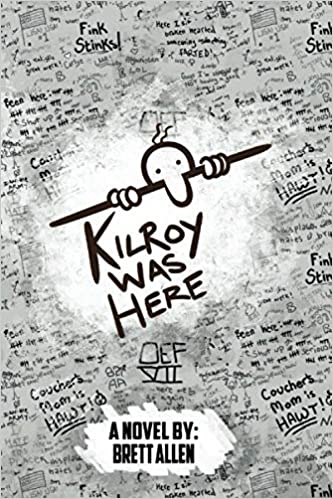
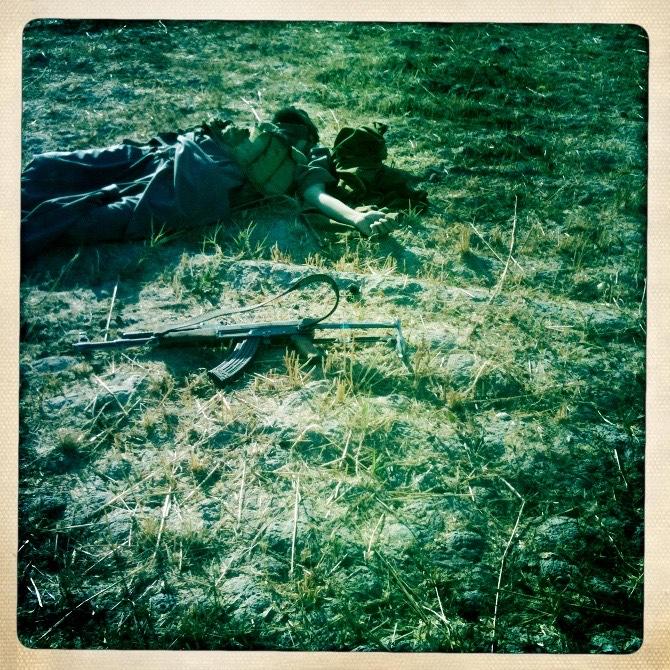
New Nonfiction from Erin Carpenter: “Fully Involved: A Trauma-Informed Approach to Date Night”

Part 1: The Healing Shed

In 2016, my husband burned our guesthouse to the ground. He left a t-shirt over a lightbulb while painting the eaves, and the fire inspector said the motion detector probably kept turning the light on in the wind, eventually causing a spark. Kent works meticulously and always cleans up; I think there was some moonshine involved in this oversight. But it was the year of the Gatlinburg wildfires, and by fall we would be seeing the worst inferno the East Coast had experienced in the better part of a century. Even in April, fires burned in the Big Cove, Yellowhill and Birdtown communities of Cherokee, enough to delay school due to smoke. So like so many things in our life together, he probably doesn’t deserve all the blame.

photo: Brian Lary

I woke up bathed in orange light feeling so cozy that it was hard to get out of bed. If it weren’t for his service dog’s persistent whimpering, I don’t think I would have budged. I stepped out onto the back porch and opened the screen door. The fire marshal would write a report using the words “fully involved” to describe the blaze—there was no stopping it, the best we could do was contain it. I got Kent out of bed and he stood still for long enough to yell fuck, fuck, fuck until something in his truck exploded and we started moving again. I gathered our dogs and our daughter Katie and drove to the bottom of the mountain to flag down the firefighters. The first volunteer arrived within seven minutes of the 911 call – he told me later he found Kent up on the roof with a garden hose, wetting down the siding and the deck.

For over a month, we let the pile burn, and salvaged what we could. A page from my thesis director’s first novel survived. Our neighbor Jim, a Vietnam vet with a steel plate in his head, asked for the metal hand tools, planning to hammer them back into shape somehow, or sell them for scrap metal. But everything Kent had saved from his infantry years with the 10th Mountain Division went up in flames. His BCUs and his dress blues were still back in Idaho at his parents’, but he lost the kinds of things that Tim O’Brien might have mentioned.

It took about two years to re-build. We upgraded to a 500 square foot barn-style shed with a deluxe porch package. Half of the space would be used for his workshop and the other half would be shared by me and Katie to host guests, hang out, and have more privacy than the two-bedroom main house could provide. I chose colors from Sherwin Williams’ American Heritage collection to appeal to Kent’s patriotism—I was still all about pleasing him then. Fireweed red for the exterior, Salty Dog blue in the bathroom. I had him install cedar fence pickets in a shiplap pattern on the walls and he reclaimed wood from the fire to use as a countertop in the breakfast nook. It had rustic charm. I loved it. What I didn’t know was that he would soon be living in it.

In February, he was sent home on administrative leave from his position on the road crew of the Great Smoky Mountains National Park because a co-worker blew the whistle on him for carrying a personal firearm in his lunchbox. I had questioned him about this choice over the years, but he had his reasons. The most obvious is he’s been shot at, a lot. And although he was not in an urban environment like Mogadishu, he worked in remote locations where people often went to disappear. It can take an hour for law enforcement rangers to respond to a call, and they work alone. In Kent’s view, he was protecting himself and his crew. The gun never came out of the lunchbox until it was confiscated, which happened just a few days after the shooting at Marjory Stoneman Douglass High School in Parkland, Florida.

I don’t like to make excuses for Kent, and as a schoolteacher, I am as concerned about gun violence as anyone else, but just a month or so earlier, he had finally approached his supervisor and asked to bring his service dog to work. The request had been denied. His claim for a service-connected disability rating with the VA had been denied numerous times over the years as well. His relationship with his boss was strained, and his irritability was high. This would be true for me as well if I had finally come to terms with the severity of my condition and found the courage to speak out and ask for help, only to be denied accommodations or even acknowledgment that my experience was valid. So although I always disliked the fact that he carried a weapon in his lunchbox, I believe he was resorting to the only coping mechanism he was capable of at the time. But unfortunately, his indiscretion cost him his career in federal service.

When the National Park Service finally asked for his resignation, he turned to a twelve pack of high-octane beer for solace. I found him lying in the loft of the shed surrounded by storage bins and staring at the ceiling, conscious but unwilling to talk. An hour later, I heard yelling and crashing noises. I had just started watching The Greatest Showman with Katie. (The soundtrack would make me cry for a year afterwards.) I went out to find him ripping open and overturning anything that was not nailed down: motorcycles, tool chests that were more like wardrobes, a rack of winter clothes that he had moved out of our bedroom so I could have a closet.

“I’m taking your guns,” I said.

“Take them!” he yelled, and I grabbed his Glock off the only upright surface left in the room and left.

I called my therapist who told me to call the police. “He can’t act like that. You have a child.” I was afraid for his safety, not mine. I was afraid for my daughter’s emotional well-being, though she only complained that I was on the phone too long and wouldn’t sit to watch the movie. Having him removed from the property seemed tragic, but so did finding him dead in the shop, so I called the VA-suicide hotline and tried to make him talk to them. He just mumbled about how he was “done.” They patched me through to the police.

“Does he have any firearms?” they asked.

“Yes. He has a Glock pistol and a semi-automatic rifle. But I locked them in my trunk and hid the keys and cartridges.”

“That’s all?”

“Yes.” His other Glock, the one in the lunchbox, was supposed to have been destroyed by the authorities after he was found guilty of the misdemeanor of carrying without a permit, but it would be returned a couple weeks later at the federal courthouse in Asheville after the judge decided he had no legal basis for keeping his weapon from him. “Good luck to you, sir,” the man had said to Kent. I thought he should be talking to me.

“How does he feel about law enforcement?” asked the police officer.

“He doesn’t like them, to be honest.”

“And why is that?”

“I guess it’s because they’re always around when he gets in trouble.”

“What about dogs?”

“A rottweiler, a doberman mix, and a mountain cur.”

“Are you sure he doesn’t have any other weapons? Like a secret stash?”

“Not that I’m aware of.”

“My wife doesn’t know about half of my guns,” he said.

The officer’s confession felt much to casual, too conversational for the crisis I was facing in my mind. More than anything, I was afraid for what this incident meant for my life and Katie’s, and I knew at that moment that the men on the phone wouldn’t be fixing my dilemma. I had never wanted to leave Kent, but had often wondered whether I should, and I was already negotiating with myself on how I could justify staying with a violent man. He would have to stop drinking. He would have to go back to therapy. Maybe he could move into the guesthouse until he was stable.

The officers arrived and strolled over to the outbuilding, but by that time, Kent had apparently climbed out the window (since all of the doors were blocked by the demolition) and wandered off into the woods. I directed them to our neighbor Jim’s house, where they found Kent and brought him to the hospital. Knowing he was under someone else’s care that night brought a profound sense of relief. I heard myself saying, “I need help. I can’t do this alone anymore.”

He passed their test. He was not a threat to himself or others, so he was free to leave the next morning. I asked Jim to take him down to the VA in Asheville and let them do a full psychiatric evaluation. I set up the appointment. But Kent was hungry and didn’t have his wallet, and so Jim brought him home. I presented my demands. I told him I’d be giving his guns to a friend in law enforcement for safekeeping.

“Fine, but you have to stop drinking too,” he said.

I knew I couldn’t continue drinking. For thirteen years of marriage, and for many years before, the wine had guaranteed that I could find happiness and some form of companionship at the end of the day. Kent has never been much of a talker, but a beer or two, or sometimes three or four, would always help open him up. Now the stakes had gotten too high for even my moderate dependency. My husband was going downhill fast. I had watched him destroy things he needed, even loved, out of anger, and thought he might take the rage out on himself. Was I okay being married to someone who could do that? How would this affect my daughter? I didn’t know the answer, but I knew drinking made me complacent. I have been sober since that day.

He moved into the shed. Two weeks later, he said he was stable and wanted his guns back. “If you don’t give them back, next time I might not be so trusting,” he said. He had been sober and attending his mental health appointments. He was either comatose, or irritable, but the bulk of his anger seemed to have turned inward, so mustering all the trust I could find, I met my friend on the side of the freeway, and she loaded his guns into my trunk. I turned them over and invited him to move back to the house.

“I’m good,” he said.

Over the next several months, Kent took Katie to school and picked her up from dance. Beyond that, he was a ghost. I’d go out to ask him to eat with us, to come watch a movie, to give me a hug. On a good day, he would turn his face from the TV to say no. Most of the time, he wouldn’t even look at me.

“What can I do to help?” I asked.

“Leave me alone,” he replied.

“Really? That’s really all you want?”

“I’m just trying to stay alive,” he said.

So I went back to my living room, where I binge watched Parks and Recreation with Katie, and let her sleep in our King sized bed for the first time in her life. From time to time, I’d try to talk to him, and fail, or try to seduce him, and succeed. Either way, such a lack of affection was evident that before long the effort became more painful than the loneliness. I thought there was another woman. I knew he wasn’t the type, but I couldn’t understand it any other way. If it were me, and I was treating him this way, it could only be that someone else was providing some of that lost connection.

“This has nothing to do with you,” was how he saw it, and in a way he was right. But I was being told “no” all the time. I would give him his space for as long as I could stand it, and then I would go out again to check on him, to let him know I was still there. I knew he was suicidal, and there was not a damn thing I could do about it except stand by. One day, he went out with his rifle into the woods. I hoped he was with Jim, but of course he hadn’t told me anything. I prayed he would come home alive.

He was drinking again—I found bottles in a wheelbarrow under the shed and soon saw him drinking when I popped in to visit. But by then I was going to 12 step meetings. I had a sponsor and a group where I could come undone and re-focus my attention onto myself. I didn’t get to decide whether or not he drank. I got to decide whether or not I stayed. That decision alone required all my strength. I had spent six months trying to help heal him with words, but words mean little to those who have lost trust in people, and for a man whose only need or want is to be left alone, my choices dwindled down to one. I finally had the strength to accept that our marriage was over.

I thanked God that I had taken a full-time teaching job to help us pay for the fire, and I would have my permanent license by the end of the upcoming school year. I began to prepare for a different future. I separated our bank accounts. I took him off the credit cards. I told him I wanted to be married to him, but I wouldn’t look back on 25 years with someone who didn’t want to be with me.

I remember telling Katie on the way home from school that his recliner had shown back up in the living room. She seemed interested if not particularly impressed. I remember him standing in the doorway of my bedroom saying, “Don’t give up on me,” and coming over to kiss me while I was reading in bed. I remember resisting the urge to get close to him in bed those first few nights, trying to let him settle in, just happy to listen to him breathe.

*

Part 2: The Date Dilemma

About a year and a half later, I rolled over one Sunday morning and asked Kent what he wanted to do that day. To my delight, he wanted to take us on a full moon paddle that evening. But while we were eating the croissants I had bought for my French class, a text arrived inviting Katie to the haunted corn maze in Asheville.

“What does everyone want to do?” I asked. No one spoke.

“I want us all to go. That was the plan,” Kent said, as if this had been on the calendar for days and not just an hour. Katie stared down at her plate, and I fought the urge to cover up the silence. Maybe I should make her come. But some time alone with him would be wonderful.

“I win either way,” I said. “I’ll get a date with my husband or a family kayak trip.”

Kent waited through another long pause and left the table. I let the fear of losing him to the TV subside and then turned to Katie.

“It seems like you don’t want to disappoint your dad,” I said.

“Yeah, because he’ll yell at me.”

I’m sure mother guilt is one of the strongest emotions at work in America. If believing we can’t be enough for our children weren’t insidious enough, infecting ourselves with baby daddy guilt—the sense that you should have done better in choosing a mate—that she deserves better, that you deserve better—is one of the biggest threats to my serenity. It does nothing to clarify my vision and only makes me feel like an idiot.

“Talk to him. It’s okay. Nobody’s going to get hurt.”

Her scowl turned the volume up on the voices in my head. Are you sure? I am aware of how his anger can be frightening, and I want to protect her from it, but after years of walking on eggshells, which only ever fuels anger and resentment on both sides, I have learned to trust them to their own devices. I explained how my fear likes to tell me stories; stories I’ve learned to ignore. “What stories are you telling yourself?” I asked her.

I was expecting all of them but one.

“I don’t want to make dad go kayaking without me. He doesn’t seem that into going with just you. I’m not trying to be mean, but he seems really awkward.”

Her words confirmed my fear that my husband didn’t want to date me, but I ignored myself. I had heard it time and time again; this was not about me.

“It’s okay. Go tell your dad what you want to do today.” And she went off to the corn maze with her friends.

*

Part Three: Power to Win

Kent pulled our kayaks off the truck while there was still some muted color behind the mountains. Our three-legged Rottweiler climbed into my boat, while the mountain cur tucked in with Kent and his pole, whimpering that she didn’t get to go with me. The Doberman had died in August.

“Don’t cut in too close,” he said as we left the shore. “I’ve got a line out.”  He moved into the dark shadows created by stacked ledges of slate rock, trying to hook a fish without the effort of casting. They call it trolling. I had to smile, thinking what a great metaphor for my marriage. But then I paddled out into the moonlight and watched it improvise on the water, happy to sit alone with my thoughts.

“Erin, where ya at?” he called out from the edge. “Come to the left.”

He knew where I was, and he wanted me closer. He was keeping an eye on me and it felt like love.

“It’s too dark to fish,” he called.

“How come? You can’t see what you caught?”

“I think I hit something.”

“Like a log?” I asked.

“Like Jaws.” He laughed. It sounded like those seagulls that pass through here on migration. Perfectly natural and totally out of place.

We moved out into the center of the lake. The occasional campfire flared, and drunken shouts and laughter could be heard. We rounded a piece of shoreline with a pine tree clinging to a ragged slope like it was the last bit of land the Earth had to offer. I felt something undermining my rhythm, forcing my body to struggle a bit more with each stroke. I looked back to the trusting eyes of my tired old dog for encouragement.

“Is it me or has it gotten very hard to paddle?” I asked Kent.

“Upstream,” he said.

We had come to that part of Fontana Lake that is also a river. By travelling for over a hundred miles to be impounded by a 480-foot wall, the Little Tennessee river held enough energy to produce the atomic bomb. What power there is in purpose. I wish I knew with such certainty where I was headed.

When Kent was at his worst, his father came from Idaho to visit and we took him to the dam’s release. It would be the only day we spent together during that whole difficult time. The spillway was open, and the spray was so massive that it appeared to form two cumulus clouds. I have a picture of Katie and I leaning against a railing looking like off-duty angels posing before the gates.

I’m not an angel—not that I haven’t tried. But commitment to my veteran has taught me this: love is a powerful force, but it does not flow unimpeded, it does not exist to carry me along to my next destination, and its fluctuations are often outside my control. At times we are forced to sit in its backwater, looking closely at how we contain ourselves and where else we can find sources of hope, until enough energy has built up to push us forward.


New Poetry from Nestor Walters: “Homecoming”

FLATTEN TO BREATHLESSNESS / image by Amalie Flynn

Only the dead have seen the end of war –Plato

he lies down, finally to rest.
grey light bands his closed door
with no silver at the edges. They said he left
one foot in the sand. wait, a head
no, a hand. the pale orange bottle, only
dust at the bottom, slips from his
fingers. one missed his mouth
small, white, and round, it
shines from the dark floor like
a little moon. In the space
between shadows and dreaming
his way to death, he smoothes a dressing on
the hole in Seth’s neck, he wraps
a scarf on Nick’s face, still
burning with chemical fire, he
lowers Jeremy’s hand, still gloved,
into a black trash bag. His
pupils sharpen to pinpoints, his
chants flatten to breathlessness, these,
his friends’ names, hammered into
cold steel necklaces
Jeremy, Seth, Nick
beckoning
from darkness

won’t someone tell him
you’re not crazy
you should want to go home but
stay a while
stay and be here with me


“Art-Making is My Light:” An Interview with Poet Suzanne S. Rancourt

As Suzanne Rancourt notes, her work is a bridge between disparate worlds, attempting to make connections between these worlds, whether they be the Indigenous and Anglo worlds, or the worlds of the veteran and the civilian. Her poetry (but not only her poetry) reflects a healing process that involves artistic creation as a method of “finding our way back home.” 

Her first book of poems, Billboard in the Clouds (2004), evokes the prevalent themes in her work: the continuity of the past and its impact on the present, the interaction of childhood and adulthood, Nature, the enduring strength of family and heritage, relationships, and cultural loss.

For example, in the poem “Even When the Sky Was Clear,” she recalls childhood experiences of observing her father’s connection to and understanding of Nature: “I would watch him/through my mother’s kaleidoscopic den windows,/ . . . I would watch my father/stand in the center of the dooryard appropriately round/ . . . Even in the summer/he’d look to the clouds, to the sky/at dawn, at dusk.” Her father was able to read Nature for knowledge of snow, rain, and wind. As an adult she stands “in a circle” and sings “to the clouds/in the language/my father/taught me.” In this way both the family and the broader cultural heritage are remembered.

The idea of the continuity of memory is also shown in “Thunderbeings.” In this poem Rancourt recalls her “Parisienne farm woman” grandmother, Dorothy, whom she called Memere. Memere, killed in a freak lightning strike in 1942 (before Rancourt’s birth) while touching a post of a brass bed, was an artist who “painted in oils/the light and dark of all things— . . . .”  Rancourt recalls that as a child she would trace the brushstrokes on the paintings, “wondering where these ships were sailing/in my Memere’s head.”  Then, forty years later, the adult Rancourt discovers the bed and polishes the “spokes and posters,” with the bed transformed into a “brass lamp” which “illuminated images of a woman/I never knew.” As the poem ends Rancourt writes: “For years I slept in this bed,/and often heard her/still humming in the brass.” Rancourt creates unexpected connections through visual imagery and forges a link between the grandmother she never knew and her adult self, between past and present.  

That the link endures is also shown in “Haunting Fullblood.” Memere represented Rancourt’s European heritage, while in “Haunting Fullblood” Rispah is the Native “Grandmother to grandmothers” who embodies her Huron/Abenaki heritage and speaks to her “through the generations/ . . . Were you anything more than a photograph ?/Oh, yes, Rispah, Grandmother, my subtle bridge/over flooding time—shhh—/I am breathing proof.”  

Her second book, murmurs at the gate (2019), extends and develops the themes in the first. In “Harvesting the Spring” she reflects on past springs and recalls how frozen ground would thaw so that she could “sink my feet into” the mud and how spring would blend into summer and the longed-for wild strawberries. She ponders the familiar memories, the certainties, of childhood, that often stand in contrast to the confusions and losses of adulthood. The poem concludes:  “I long for wild strawberries/and the little girl/who used to pick them.”    

There are also meditations on Nature in such poems as “Along the Shore—Five Miles,” “Grace” (“Gazing across the valley, across the Sacandaga, across the surface/ . . . drinking the self/drinking the Universe”), and “Swimming in the Eagle’s Eye.” In this poem she sits by a “secret” pond in quiet observation. She would lose herself in the “reflections of backward worlds” and, echoing Thoreau, “I recognized something/in this Eagle’s eye/this everything and/nothing/striking calm.”

However, she is more explicit in murmurs about the violence of war and her military experience. “When We Were Close” details a lover’s PTSD.  “The Execution” uses “the photograph I grew up with,” Eddie Adams’ photo of the execution of the Viet Cong prisoner on the streets of Saigon, to ask about this incident, which is metonymic of the brutality of war, “You will remember, won’t you? Won’t you?” “Iron Umbrella” notes that “The burden of war is strapped to the backs of the survivors.” Other poems address her MST, as in “Against All Enemies—Foreign and Domestic.”  The anger at her violation is palpable:  “I wanted to kill you/assailant/because you violated my home—my body.” The story “The Bear That Stands” discusses in more detail her rape and its aftermath.

Rancourt also utilizes music to express her experiences. “Sisters Turning,” (co-written with Anni Clark, who also did the music), is based, as the liner notes indicate, on the “testimony and writings of Army and Marine Corps veteran Suzanne Rancourt.” In the song she recounts her military sexual trauma (MST) as a “naïve Marine” at the hands of a Navy man. This is her first betrayal. She tells another woman what happened, but is initially not believed. This, she writes, is her second betrayal. The song suggests that healing from MST can be facilitated by women trusting in the truth of the others’ experience: “Where do we turn/if not to each other . . . If we lose each other/we’ll never get home.”  

Rancourt utilizes music, dance, photography, writing and other modalities to help others heal from various types of trauma, substance abuse, domestic violence, and Traumatic Brain Injury. Using her education, life experience, and training as a photojournalist and information specialist in the Marine Corps she created an integrated Expressive Arts program that promotes healing.  She lives in rural New York State and works locally with veterans in a peer to peer program but also travels internationally to work with others to help them regain a sense of home.

*

The novelist Henry James wrote that “A writer is someone on whom nothing is lost.”  If I expand James’ aphorism to include any creative artist, then Suzanne Rancourt is that artist “on whom nothing is lost.” Through memory, emotion, and observation Rancourt reveals the truths of her experience in all its dimensions.

LA: Let’s start with discussing your new book of poems.  How does it continue or differ from previous work?

SR: My third book of poems, Old Stones, New Roads, has been picked up by Main Street Rag Book Publishing and is scheduled for release in Spring of 2021. Old Stones, New Roads differs from previous work in that I am further down the road in age and healing. The continuation aspect is seen in the things that simply remain the same, my spirit, temperament, how and where I was raised, my culture, and various trauma events. All of these factors propel my continued self-exploration, figuratively and literally. For example, this book is dedicated to my father’s mother, Alice Pearl, who collected stones. I clearly remember, as a child, sitting beside my grandmother in front of the stone hearth at the Porter Lake camp. I was incredibly young. I recall Grammie pointing to each stone and telling me where it came from and who brought it to her. Each stone had a story, a life, a history. Since a small child I have also collected stones. 

I come from independent people who enjoyed travel. Mobility was supported at young ages: hiking, bicycling, driving, travel in a variety of vehicles, learning, exploring something about resonance of place and how some places “feel” more than others. I was encouraged to observe, ask questions, take note of how people lived, to respect differences and similarities and to figure things out. It is interesting to me, and hopefully readers, how where we come from is always brighter the further we travel from it. Part of this phenomenon helps me take a look at what is identity narrative and what is trauma narrative. Post-traumatic growth, for me, is being able, first, to recognize what is a trauma “story” and accept that that trauma “story” is not my identity, and then to ask, how do I transpose the trauma stories, tones, and images into syntactic stones, and new discoveries?

LA: Various themes emerge in your work: relationships, family/history, Nature, Indigenous heritage, impact of the past on the present, loss.

SR: The themes that emerge in my work are simply the themes of life that everyone has in various intensities and manifestations. It is in our commonalities, our collective consciousness, and shared experiences,that metaphor can rise up into our forebrains. Sometimes this happens subtly and sometimes not. Part of traveling to ancient and sacred sites strikes me as collective resonance. Maybe this is a type of empathy?

Perhaps there is something about dowsing. As you may know, I come from a family of dowsers and was taught to sit quietly in the woods, to be attentive. This clearly supported my multi-modal sensory development and still does. Some folks may refer to this as situational awareness, or Zanshin, or synesthesia or being present. Either way, it isn’t by living in the past that I explore the past. Au contraire. I must be firmly in the present to view the past, present and future. This is why stacking wood is one of my favorite meditations; I’m in constant movement while fully conscious of the past, present and future. I am willing to step into all the memories to find the beauty, the strength, and yes, grief and rage, and then emerge. I don’t heal or get stronger by denial, or by pretending that something never happened, or that I wasn’t involved in something. I am but a part of the natural world and the natural world is a part of me. No more, no less. Perhaps this is a way of annealing the Soul. 
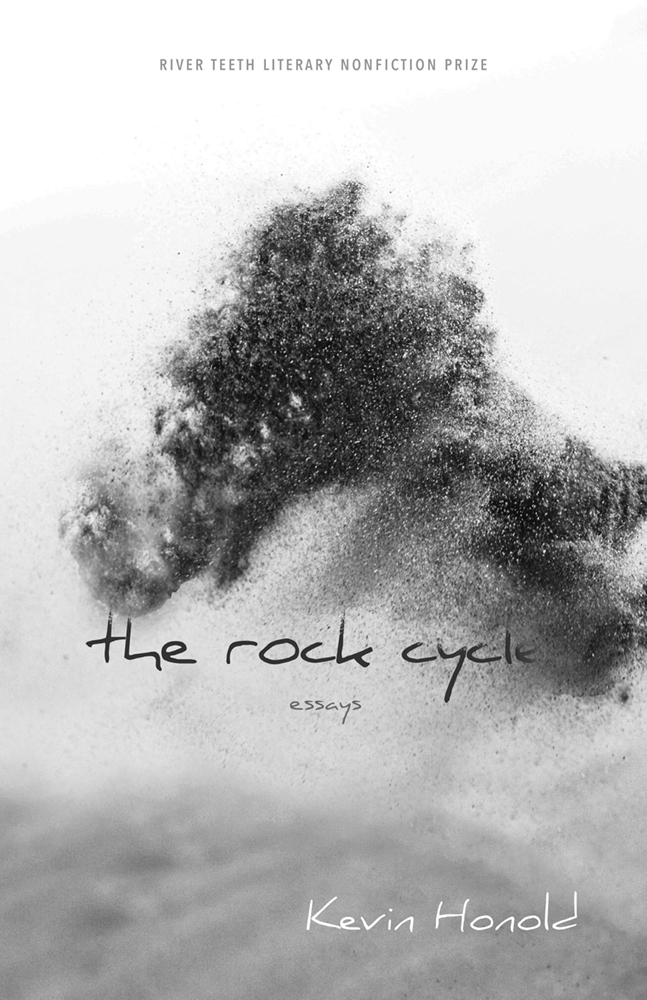
Furthermore, life isn’t linear. That is a Eurocentric perspective. Life is circular, non-linear. Some people experience life as an upward rising spiral, as opposed to Dante’s Inferno; we traverse through levels and layers of increased awareness that each experience offers in support of our progression. What stays the same? What changes? My writing is always a journey, an exploration, always something to learn, and yes, things can get pretty dark. One of the most profound lines of poetry I carry hails from a fortune cookie: “It is better to light one small candle than to curse the darkness.” Art- making is my light.

LA:  Part II of murmurs at the gate seems to be more about military experience with reflections of the Vietnam War, like in “The Hunt,” “Iron Umbrella,” “Tsunami Conflict,” and “Ba Boom.” In “Throwing Stars” a “hyper-olfactory” stimulus sets off a memory of a traumatic event.

SR:  murmurs at the gate is a deep exploration of events, memories, incidents, character development that ultimately reflects decades of exposure to war trauma in some variant form. Part II indeed dove into war and conflict experiences. All things in the physical realm change molecularly, atomically, when under pressure, and the intensity of fire. Elders always taught “that all truth is found in nature” if we know how to simply see that which is before us, no matter what the environment. My concreteness of a metaphor’s abstraction is always the natural world and/or my current environment.  For example, when I taught creative writing at Clinton Correctional, the windows still had that old blue glass with the bubbles in it and it had the same thickness and blue hue as my Grandmother’s old Ball canning jars, the ones that had a rubber seal and a latch to hold the glass lid. The lessons of seeing what is before me, the environment, whatever that environment may be, offers an endless vocabulary for metaphor, similes, tension, meaning. Images and lessons from nature fuel my questioning that hopefully inspires others to question, wonder, consider.

As a writer, I distinctly recall being extremely young, fully open, and experiencing with all my senses, the outdoors. I had the good fortune of no video games and incredibly limited TV. For some reason, Western society attempts to lead us into a false belief that there is a magic this or that to eliminate memories and residuals of trauma. From my individual trauma survivor perspective, my experiences are what bring depth to my humanness. My poem “The Execution” is a true event, both the execution and my seeing the corner of the photo as a writing prompt. 1  I was trained in the Marine Corps as a photo journalist/journalist/public relations person. This training has made me keenly aware of how words and photos can spin propaganda, politics, and deliberately mislead the masses. That’s what this poem is about and when I read this poem at events, I read it once through without commentary. Then, I ask how many people recognize the photo I described.  I follow that up with questions about the two main people in the photo. I follow that up with the truth about the individuals, the complete story to properly place the image in its true context. We have to look at the era, what type of film and photo equipment existed, and how point of view and images out of proper context can be manipulated to mean the exact opposite. The poem is a warning as much as anything. I end the brief discussion with a re-reading of the poem and note the measurable change in the audience. Think about it.  

I believe the artist is a witness. This is my mission and perhaps this has been the mission all along right up to this specific moment for you to ask these questions and to whoever is reading this word literally, right now. I want people to ask questions. Many of the poems you have mentioned are true word for word. Some poems hold a person, image, of event that is nonfiction and then I enter into it and allow the narrator to question, answer, apply the “what ifs” without editing, just the freedom to express.  This is where the surprises can emerge in the movement. Telling our stories is a bridge. Telling our stories is an action that connects generations, human to human. This is healing, this is “medicine.”  
LA:  How much does your military experience figure in poems like “The Hunt,” “Iron Umbrella,” “Tsunami,” “Throwing Stars,” and “Ba Boom”? You were in both the Marines and Army.

SR: My most recent time served was from ’05 – ’08 in MEDCOM. In “The Hunt,” for example, one place I was working at was an Airlift Wing where I had to pass through a hanger of Black Hawks. They seemed so docile cycled down and their prop blades really did remind me of the long ears of hunting hounds I grew up around as a kid, “their hound dog props pick up to attention/at the sound of clips, bolts, boots.” Also, worth noting, I know the difference between a clip and a magazine. Clip refers to snaffle-type or carabiner-type clip. Everyone was always on alert, always training, training that triggered rapid response. Sounds, smells, heart rate, respiration, everything in response to a hunt. A hound dog sound asleep only has to hear a minute sound and they’re by the door and fully alert. “Iron Umbrella” was inspired by a black and white photo prompt of an indigenous father and son clearly in a tropical country that, of course, was in the throes of violent conflict. I gave myself permission to ask questions of those characters and let my narrator respond freely. I allowed my military experiences and being a parent to inform and fuel my narrator. In this way, the tone remains authentic, the story plausible and real. The poem “Tsunami Conflict” is what I call truth-inspired because the shell is a gift that a Viet Nam era vet gave me decades ago. It was something that he acquired when on leave and carried in his A.L.I.C.E. [All-Purpose Lightweight Individual Carrying Equipment]. I still have the shell. It is on my desk and I can reach out and touch it even as I write this. I hold the shell, sometimes. It brings comfort, simply brings comfort. “Throwing Stars” is a true account. Smells. “Twenty years later when I’m at the park at Saratoga,/You’d hardly notice that I knew anything./And if it weren’t for my hyper-olfactory,I would have forgotten you.” Some smells one can never scrub clean of. “BA BOOM” is a tone poem that is driven by the adrenalized beating of one’s heart – hard, strong, the type of beating you hear from the inside of your body, the type where it feels like your heart will explode violently through your chest. The title, in bold capital letters, when spoken is one’s heartbeat, you know, that onomatopoeia thing, while also exploding. There is a tension of hypervigilance in this poem that hopefully helps people who have never felt such things, to feel with their bodies via the vagal system, primitive brain, not the forebrain.

All of my experiences get transposed into an “experiential” vocabulary for my art- making. A metaphor requires two parts: a bass line and a melody, concrete and abstract. Our bodies are naturally wired to remember sights, sounds, smells, air tension displacement and much more than we are even consciously aware of, like the situational awareness/hyper-vigilance combat and other threatening situations require. How could I not draw from my military experiences? Or any of my life’s data? Writing as craft is the skill of shaping, forming and transposing these stories into a form that people can receive.  

My military time is what they refer to as broken time, meaning I was in, out, in again. When I first went into the Marine Corps, the times were way different. I am an MST survivor, veteran, and have been the spouse and partner of combat and non-combat veterans. Thus, my military experience is multi-faceted. 

My MST happened while in the Marine Corps attending my photo journalist/ Public Affairs/Information Specialist training. Things went downhill rather quickly after that. My next stint was in the Army because back then I would have had to give complete custody of my child over to someone else. I declined. My second MOS was a Medic. I fulfilled my commitment and moved on after also working as a Chaplain’s Assistant. My most recent time in was from 2005 – 2008. By then a whole lotta shit was catching up with me that I had never addressed. That’s when I connected, for the first time ever, with Travis Martin’s organization Military Experience and the Arts, now headed up by David Ervin. My life changed significantly and for the better. I’m still in contact with many of the folks from that first MEA 2012 Symposium. murmurs at the gate is what I refer to as my heuristically-inspired “poetic dissertation.” It was the first time in my life that I could safely acknowledge how much the military was, and still is, who I am. The word is validation.  

LA: In Native Voices the editors note that ‘Fabric’ and ‘The Smell of Blood’ are fine examples of her ability to intertwine personal experience and communal history.”  2  Is this what you try to do in your work?  What is your creative process?

SR:  Ahh, my poem “Fabric,” so much love and loss in that poem. Better to have had some good love than none. I wrote the first version literally decades ago and was told by an academic that it was garbage. I did not throw the piece out as suggested. I trusted something deep inside me that said no, that it was a strong poem and I held onto it. I held on to myself. In 2015 I was invited to write a piece for a special women veteran’s issue of Combat Stress magazine 3 [released January 2016] entitled, “Women Veterans and Multi Modal Post-Traumatic Growth: Making the Tree Whole Again.”  By then I had experienced several failed marriages, lost so many people that I had truly loved, been retraumatized in a variety of ways linked to unresolved military experiences, that I rediscovered the poem.  I renamed it “Fabric.” As a result of new connections with the military community, I had finally been receiving the help I needed to make sense of things and recognize unhealthy patterns and beliefs. And, I was always writing. I tweaked the poem and added the last two lines about  accepting life, love, and loss. I am a human being and so are my readers. The causes of our specific experiences, i.e. love, loss, violation, may be vastly different, however, our humanness connects us. By diving below the surface of self, into the currents of hurt and love, I give myself permission to validate with words and images. And this, I feel, lets others know that they are not alone in their existence. We see each other. Indigenously, if I say, “I see you,” it means that I see ALL of you and it has really nothing to do with your occupation or your wealth or poverty. I see who you are. I see you. We see each other. Sometimes it is but a flicker in one’s eye or a microexpression, but the soul is there. This reflects my work experiences with people in comas, or people who are quadriplegic – this skill of seeing isn’t really about using my eyes to visually see. Recognition is something far deeper than that.

Because of the types of trauma that I have experienced, coupled with a rich memory base of the powerful smells from the natural world, and also my quirkiness, I have always had a strong sense of smell. Bears can be like that. I did not sit down with the intention to write “The Smell of Blood.” It could have been something as subtle as passing a person in a store who wafts a certain odor or literally a restroom with old trash. I used my writing to release the reaction that became a list poem of sorts. When I do the first write of a piece I just let ‘er rip. Patterns, rhythms, meter – all that reveals itself in the rereading and editing process. I am an honest writer, meaning, I just say it. This poem offers an opportunity for people who have not experienced trauma to feel on a cellular level anxiety, a triggering event, run-away thoughts. As a writer I had to be responsible of the climactic curve and tempo. This poem had to have that final line to allow for breathing, release, resettling. When a person’s PTSD is triggered, it doesn’t make sense to most folks. This poem lets people know that I hear them.  It offers validation. We are not alone here, in the in-between “…in the lives outside of reasoning.” 

LA:  You mentioned that you were influenced by Robbe-Grillet, Samuel Beckett, and Eugene Ionesco, among others.  What impact did they have on you?  

SR:   My mother used to sing that Cinderella song to me, the one that goes “In my own little corner…I can be whatever I want to be.”  As a young child this is possible.  However, one hits a certain age in child development and realizes the outer world can be quite cruel. That’s when creativity gets shut down and injured on so many levels and in so many ways. Much later in life I reignited my creative self. This rebirth, if you will, was definitely fanned by the freedom that Robbe-Grillet, Beckett, and Ionesco said yes to. Trauma, especially when it occurs to children, can close us up.  The innocence of being open is no longer safe. As I matured intellectually, spiritually, physically, I discovered healthier ways to be open and safe. Some folks may refer to this as “self-regulation.” To finally have the go-ahead from significant creatives to ask questions, explore and discover through art-making, I was finally able to feel comfortable in my own essence as writer and human being. Just think of me as an example of the 100th Monkey, the one that breaks the pattern, walks point, changes the outcome, someone has to do “it” first.

LA:  What do you mean by “I Am My Own Evidence”?

SR:  I am my own evidence. Yes. And my evidence and experiences are as valid and, in some cases, more so than any individual in any hall of academe or therapeutic field. My experiences as a kid, my theories, came from very physical experiences, often pain- related, like profound migraines, for example. Only within the last decade has neuroscience been able to offer data that I frequently wrote about in various fields in the 80’s, ‘90’s, and early 2000’s. I am multi-modal, which is no different than cross-fit training. I am making sense of my world through the senses and art-making modalities available to me and that includes what is culturally specific, whatever those cultures may be. Be authentic. Be yourself. Let your narrators tell the story because there is absolutely no way your own experiences will not find their way through your narrator. For people who would like to research this more, look into Heurism as research method. A fantastic text is Clark Moustakas’s book, Heuristic Research:  Design, Methodology, and Applications. 4  This understanding and method is one reason why I refer to murmurs at the gate as my poetic dissertation. 

LA:  You work in various modalities:  poetry, song, photography, dance, drum-making. How do these all connect? 

SR:  The various modalities that I express and create through connect within myself as a human being and also as a living, neurological organism. Each modality has a predominant or primary sense that it requires for expression. For example, dance for me is physical and relates to all that movement requires, singing actively engages my auditory mechanisms including self-soothing, photography fires up my visual cortex and all that that requires, and so forth. Writing is like the piano for me in that to learn the piano one learns all the keys and therefore can read music for all instruments. Writing is my primary modality where I can use all sensory mechanisms to better engage the reader and/or listener. This is my cross-fit training and I do include actual physical fitness! The connection is the whole person that is me. It has taken time for me to get here and I certainly didn’t get here on my own. I had to ask for help and thankfully there have been and still are really good people who are there for me. This is called Community, with a capital C.  

LA:  You did some songs with Songwriting with Soldiers: “Running Out of Flags” and “Just This Side of Freedom.” How did these come about?

SR:  It took me a long time to get up the courage to apply and attend the Songwriting with Soldiers retreat in New York. Those two songs were written in 2015 and I had just finished up about a year and a half of seriously intense work with the MST doc at the local VA. I was still pretty squirrely. An Air Force woman vet and I were teamed up with James House to write “Running Out of Flags.” Again, I brought what I know to the table. I am the recipient of two of our nation’s casket flags. I know what it’s like to have people in dress blues show up. I know intimately that grief that I still carry. I lived through the Vietnam War. I remember the Kennedy assassinations, MLK assassination, Civil Rights movements, war, violence, more war, more violence … what are we creating? How many generations will forever be scarred by our actions? 

Oh oh they’re running out of flags
How many more are they gonna have to make
Another one flies in the cold at half-mast
Take a thousand years to call out all the names

Just This Side of Freedom” is a song that came forth when I was paired up with Darden Smith.  5  There are two versions of this song. I brought to the table my original version to which Darden applied his professional songwriting skills to create the second, Songwriting with Soldiers version. The first version I titled “Sacred Light” and it emerged from one of my lowest life points. I gave myself permission to let the weight of my plight flow. I wasn’t in a good place. I was on the verge of being homeless. No job. Life was bottoming out and shitloads of unresolved trauma – decades worth – was all bearing down on me. I have had trauma events where I was dead, without life, and had to be brought back. Western medicine doesn’t talk much about this type of death experience phenomena with trauma survivors or even acknowledge it. So, one aspect of the song was to give voice to that in-between place and to validate my fellow in-betweeners. Western medicine will call us crazy when, in fact, what we’ve experienced is most real. The “Sacred Light” version speaks of a clear memory of one of my experiences. My Indigenous ceremonies that I participate in and conduct are what bring comprehension to my experiences that I offer up for others’ validation:  you’re not crazy; when the Soul, spirit, life force – whatever you want to call it – leaves the body, it is a type of self-preservation; and, I’m still here because you need to hear what I am telling you, we can get through this too. You are not alone.

After I wrote the song, I would listen to it from the inside out. I felt the chords, the incredibly slow tempo, the tone. I was too close to an edge. This song is when I realized I must get help. When I play this song out in public, I always pay attention to the people who respond to it and have even stated generally to the audience my story and that we are not alone on this journey.  There is help right here. Right now. There will always be wars. There will always be warriors. There will always be warriors, both men and women, coming home and therefore there will always be a need for an empathetic Community to welcome them home, validate their experiences, be present in the Coming Home process, which for some of us has taken decades if not lifetimes. 

I have also had the great experience of working with Jason Moon’s program, Warrior Songs, where I teamed up with Anni Clarke for Women at War Warrior Songs Vol. 2, “Sisters Turning.”  6   Ironically, Jason didn’t know that I was from Maine when he paired me with Anni Clarke who  attended U.M.F. [University of Maine at Farmington] at the same time I did.  Synchronicity…is it?

LA:  Can you talk about Expressive Arts Therapy? How does art help “find your way back home?” How does art lead to healing?

SR:  Expressive Arts Therapy  7  is a relatively new field for Western/colonized societies. 

Positive psychology, I have found, focuses so intently on keeping all things positive that it negates and fails to validate the trauma experience of the trauma survivor. Granted, this method creates a bubble-pack buffer zone around the therapist/counselor that better protects the therapist/counselor from client trauma transference; however, from a military trauma survivor perspective, especially military sexual trauma, this active practice of only perpetuating the positive exacerbates the “same ol’ shit” of non-validation wielded stringently when attempting to report rape in the military system. I mention this to better clarify that Expressive Arts Therapy draws more from the Phenomenological and Heuristic philosophy schools where we use a variety of art-making modalities in safe, respectful settings that support the natural emergence of experiences via the art modality in action. There is indeed a sound paradigm from which methods of application are skillfully employed. The process remains fluid within a frame designed to support the modality being used, the participant(s), and the experience as a whole.  Healing is usually an uncomfortable and sometimes painful experience. Just because we deny its existence, doesn’t mean it isn’t constantly working in the back ground like some software worm.  murmurs at the gate is what emerged when I delved into those hurtful places.  There are also poems of profound beauty and sensuality in murmurs at the gate that emerged from the darkness of trauma. Neurologically, the brain is a fascinating mystery that Expressive Arts Therapy is accessing when application practices are comprehended. I was way ahead of my time with multi-modal practices and the more I worked with adult survivors of Traumatic Brain Injuries, the more I realized I had to keep learning. Hence, this learning led to numerous degrees, certifications, cultural immersion, and a reclaiming of identity, because back then there simply wasn’t anything close to Expressive Arts Therapy. My entire life is the validation of existence and all my experiences that have brought me to this point and wherever I travel to next. A friend in the Army, a very long time ago, called me “Pathfinder.”

LA:  In your essay for Combat Stress, you mention your 1978 MST.  How does trauma and the experience of the military and war come out in your work?

 SR:  I’m more of a Wilfred Owen fan because he describes the in-between weirdness of PTSD along with what we now refer to as moral injury. No fanfare. His work offers what he sees and what he feels, not what he interprets…Holding on to the concrete is a way to remain “in body,” so to speak, to remain present in the unreality of trauma events swirling about you. When brain chemicals are released en masse and tsunami into your physical body…shit happens…sometimes literally. This neurochemical wash of neurotransmitters can be akin to dropping acid. There are specific things that happen that only another who has experienced may recognize.  I recognize this in Owen’s work. I also recognize this in Rod Serling’s The Twilight Zone.  When I’ve read and watched documentaries of J.D. Salinger, I also recognize behaviors that reflect experiences, perhaps, from his WWII trauma, and I wonder if Salinger wasn’t attempting to deliberately trigger this neurochemical dump to comprehend or re-create a tone or a sensory experiences. Neuroscience has indicated that trauma can change our DNA.  Perhaps that’s where my idea for a PTSD equation emerged from. [(trauma event over intensity) x (duration over frequency)] x by length of time, i.e. 1 week, 3 mos., 18 mos. 2 yrs., 20 yrs. 

I’m finally at an age where all of my experiences are a part of me and I’m O.K. about that. Therefore, to quote another one of my favorite writers, “How not?”

LA:  How has your work evolved over the last 20-30 years?

 SR:  My work has evolved because I have evolved as a human being. I never give up. Giving up is never an option. It’s just who I am, it’s my temperament. In this process I have become more informed in my professional fields and more accepting of who I have been, am now, and becoming. Outward Bound winter survival when I was sixteen. Wow. Then Parris Island. Again, I am alive because somehow my upbringing and who I am was able to transpose events into strength. I still do Aikido and Iaido. This quarantine is profoundly difficult for many and I miss my Dojo.  Ceremonies have helped me make peace with being solo. The natural world, my land, I remain in relationship with. Self-discipline is crucial. Being in recovery essential. The last 20-30 years I have gathered tools.  

I have had, and continue to have, some amazing elders, mentors, editors, and my family who have painstakingly kept me going. I will always have profound gratitude for my family and the future of my family. Being able to ask for help and then being willing to receive help is key not just in my survival, but in my thriving. As a writer my craft is strengthening and changing. I love it. I never know what will emerge, what new relations will I meet and make, and where will this next thread take me. The wind, you see, it’s always in the wind.   8

1   The poem appears on pp. 50-51 of murmurs at the gate and refers to Eddie Adams’ famous photo.  See, for example, https://www.nytimes.com/2018/02/01/world/asia/vietnam-execution-photo.html

2    Native Voices:  Indigenous American Poetry, Craft and Conversations, ed. by Marie Fuhrman and Dean Rader, North Adams, MA:  Tupelo Press, 2019, pp. 270-279.

  1. Combat Stress, Vol. 5, No. 1, January 2016, https://stress.org/wp-content/themes/Avada-child/lib/3d-flip-book/3d-flip-book/?mag_id=16192, pp. 72-86.
  2. Clark Moustakas, Heuristic Research:  Design, Methodology, and Applications, Sage Publications, 1990, Moustakas, Clark. Heuristic Research: Design, Methodology, and Applications. United Kingdom, SAGE Publications, 1990.
  3. See Songwriting With: Soldiers video:  https://www.pbs.org/video/klru-tv-their-words-songwriting-soldiers-episode/;  web site:  https://www.songwritingwithsoldiers.org/
  4.   Women at War:  Warrior Songs Vol. 2, available through warriorsongs.org
  5.   See https://www.ieata.org/
  6. Suzanne Rancourt website:  https://www.expressive-arts.com/index.html; books:  Billboard in the Clouds (2004), Curbstone Press, https://nupress.northwestern.edu/content/curbstone-books; murmurs at the gate (2019), Unsolicited Press, http://www.unsolicitedpress.com/; Old Stones, New Roads (forthcoming, 2021), https://www.mainstreetrag.com/


New Poetry from Sheila Bonenberger: “They Gave Their Lives”

UNDERGROUND FORGETTING / image by Amalie Flynn

The brass buttons are piled in a bowl
that sits on the shop counter
beside the cash register,
so I buy one,
watch as the clerk drops it
into a paper bag, gently
folding the open end over
so the button doesn’t fall out. 

Such are the tender considerations
we resort to when it comes
to Union buttons mined
from Marye’s Heights, the field
blood transformed into a massive
trauma center, and those many
soldiers, hastily tipped into graves
scratched higgeldy-piggeldy in the earth
and quickly left, without markers,
abandoned to the underground,
earth’s crowded room,
to work its magic on the soldiers
and their uniforms under
the same gibbous moon
shining down on life going on,
so that one day a treasure hunter
turns the detector’s sensitivity
to high, reaching well past
unreadable trash,
finally capturing a deeper
signal to shovel through grass,
past stones and worms, into dreams
of wealth or glory, pulling up
a solitary, now verdegris button
bent slightly as the soldier
fell hard perhaps against a rock
that would sleep unchanged beside him
until the treasure hunter conspired
to craft a stranglehold on history
proclaiming that this discovery
announced an end of sorts to the story
of a fallen soldier,
one that can be labeled,
one you can put a price on,
but the truth is that buttons
cannot be counted on
to hold a jacket snug, can even
loose their hold on the fabric
of dignity, on the fable
of victory, if what they hold
has been released to flourish
underground forgetting
that perfection is elusive
and we are not perfect
though we hurl ourselves at it
again and again.


New Fiction from Brian Castner: The Troll

John Gurdenson’s legs weren’t what they used to be, and though the veteran charged hard on the forecheck, he was slow, too heavy and slow, and all of us in the arena groaned as the puck slipped down the ice away from him again.

The opposing defenseman took control, easily stepped away, beat Gurdenson along the wall, and made a crisp first pass. The rush headed back the other way. Gurdenson swung his stick at the legs of the Pittsburgh defenseman, gave him the look and the head nod—we knew the signal and a few of us started to clap in anticipation—but the other player ignored him and skated away. Gurdenson drifted back to the bench for a change.

First line out. Tailor hopped over the boards and sprinted into the offensive zone. We all stood, every time Tailor hit the ice. His skates churned the surface with each step, as if he was grabbing great fistfuls of ice and pulling himself along, climbing a rope with his strength alone. It was beautiful to watch. Tailor was just a rookie who had found his spot in the lineup halfway through the season, after Gurdenson broke his ribs. . We loved to watch him fly, plus he had a nose for the net, and was tough and squirrelly and just a bit of a pest, the kind of guy you definitely want on your team and not theirs, which made us cheer all the more.

Gurdenson waited on the bench. Another change, and another. Third line, second line, first line, goal. Amirov, from Tailor, off a cagey steal in the offensive zone. A pretty play, the announcer said, muscle to finesse and a big finish.

We threw our hats on the ice in a shower of New Year’s confetti. The home crowd, the sound we made, it was the din of starving men gorging at the master’s table. We were up 4-1. We wanted five. We wanted ten. We wanted to feast until we puked. After years of losing, we couldn’t get enough.

“Gurdsy, Renault, Scotty, you’re up,” the assistant coach yelled, calling the line.

Off the faceoff, the puck skipped past Gurdenson, his feet always stuck in cold oatmeal, but then, behind the action, an opportunity. The young defenseman never saw the thick tree trunk fall. Gurdenson’s check caught him on the hip and shoulder, flipped him sideways, all legs and outstretched arms so he spun to the ice like an unbuckled passenger tossed from a moving car. The noise in the arena hadn’t dimmed since the goal, but now we found a new octave. We stood up as one, pounded our seats and our fellow fans because we knew what was coming. The Troll had been our champion for a decade.

Gurdenson skated backwards away from the fallen man. A dancing partner from the other corner approached. They shook off their gloves and each grabbed a hunk of sweater and turned on the two piston engine. We were incensed. The fighters traded right hands.

A spectacle at center ice, and all eyes on Gurdenson.

Our man absorbed three fists to the side of the head before his helmet went flying. His challenger’s helmet stayed on though, and good thing too, the announcer would say. Gurdenson bloodied the lip of his younger opponent with a right and the kid went woozy and his knees buckled. Gurdenson shifted his weight, leaned back, kept the boy upright with the left hand, didn’t let him fall, and then delivered another right to the mouth. Teeth flew. Gurdenson’s hand split between the knuckles and his grip with his left started to falter. The kid was all limp dead weight, lights out, but Gurdenson didn’t hesitate, swung and connected twice more before the unconscious boy finally slipped free, his helmeted head bouncing off the ice when he landed.

Gurdenson stood over him for a moment, and then skated away even before the referees approached.

Nineteen thousand of us chanted “Troll! Troll! Troll! Troll!” As many cell phone cameras flashed. Gurdenson pointed a finger at the Pittsburgh bench, picked his next victim, gave a “see-you-in-the-playoffs” nod, and we roared even louder. Two minutes for roughing, five for fighting, and a game misconduct. Gurdenson’s night was over. He skated to the door, shuffled back to the dressing room, and waited for the rest of the team. The third period would end soon.

Gurdenson sat in front of his stall. He was the only one in the room. He gingerly removed his jersey, stretched a shoulder, checked a bruise, shook out his right hand and stuffed it in a bag of ice that quickly turned pink.

He sat and waited for his team, and it was there, alone, helmet and shoulder pads off, towel over his neck, that it happened.

The general manager walked in from the side door that led to the executive offices. A tie and cologne and a red face and slicked back hair. It was just the two of them.

“You’ve been traded, Gurdsy.”

Gurdenson looked up at him, a moment, and then back down between his skates.

“You’re headed to the Island, effective immediately.”

Silence.

“You can get dressed.” Pause. “Thanks for everything you’ve meant to this organization.”

The general manager walked out. Gurdenson’s deliberate breath and the creak of his tightly laced skates and our dull rumble muffled all until the double-swinging locker room door burst open and crisp sticks and shouts and clatters from the team and the crowded arena behind.

The game was over. Gurdenson didn’t move. The coach gave a speech and the team congratulated young Amirov on his first hat trick and slapped Tailor’s back and Gurdenson sat and stared a hole in the plush carpet. Water bottles and the showers and sticks checked and re-taped. Then slowly, at a level below the operational clamor of full professional locker room, restrained voices passed the news from player to player. They glanced over. Gurdenson met no eyes.

The others gathered their gear and put on their suits and ties, but as they left the room, one-by-one each man walked up to Gurdenson where he still sat with his skates on, tapped him with the blade of their stick, under their breath:

“Tough one, Gurdsy.”

“Good luck, Gurdsy.”

“See you around, Gurdsy.”

The coach put a hand on his shoulder. Gurdenson couldn’t see him shake his head.

“It’s a tough deal, Gurdsy. It’s a business now, eh, but it’s a tough deal. You take care of yourself.”

The coach was the last to leave. Gurdenson again sat alone in the empty dressing room. He sat there for a long time. Then he got up, put on his suit without showering, and left out the back door of the arena where no one was waiting for him.

*****

OCTOBER 1996, SAULT STE MARIE, ONTARIO, SOO GREYHOUNDS RADIO BROADCAST:

Knights recover the puck, slip it along the halfwall, lose control, now they have it back, and dump it into the Soo zone.

Robert with the puck, finds his man, Soo coming away, long pass to Paquet and OH MY Ballard just stepped into Paquet at the Soo bench.

Paquet had his head down and Ballard just freight-trained him!

Paquet never saw it and he’s hurt. Paquet is down.

Play continues, puck slides into London’s end but now there’s some chirping going on and it looks like Gurdenson is challenging Ballard.

Gurdenson, in his first game here with the Soo, he isn’t wasting any time and they throw down the gloves and here they go!

Gurdenson and Ballard!

Gurdenson grabs on and starts throwing rights in there!

Ballard can’t get his head up, Gurdenson’s pummeling him with the right!

Ballard hasn’t even swung yet but now he does and both men are swinging away. Ballard and Gurdenson!

Ballard connects on a right and another one but WOW Gurdenson just caught him square on the nose. Gurdenson KO’d Ballard and he’s stunned. That nose has gotta be broken, Gurdenson dropped him like a sack of potatoes.

But now here comes McCarthy. You knew he was going to get involved.

And Gurdenson has got to be exhausted. He’s got to be just spent, after the tilt with Ballard and Ballard is one tough customer but he is still down on the ice and you can see the blood now pooling at his knees.

They need to get in there. The officials need to get in there and stop this. Gurdenson just fought and he’s got to be spent but the linesmen are distracted with Paquet and Ballard and the scrum in front of the Soo bench.

Well, McCarthy has taken exception and Gurdenson isn’t backing down and so here they go.

Gurdenson and McCarthy!

Gurdenson is giving up twenty pounds easy and McCarthy has his grip with the left and here he comes with the right, over the top.

And Gurdenson is still trying to get a hold and McCarthy comes in with another right and another.

He’s firing the right and Gurdenson can’t get his grip and he still hasn’t swung and OHHHHH McCarthy popped him right on the button! He caught him square with a right!

But Gurdenson is still on his feet somehow and now he comes back with a right. And another!

Both men just firing the punches in there and now Gurdenson frees his left hand and switches sides and starts going overtop with the left.

He surprised McCarthy and he caught him with a beauty and McCarthy looks dazed.

Gurdenson has McCarthy’s jersey up over his head and now the left and an uppercut and another, Gurdenson is working the side of the head and down to the ice they go!

WOW!

Gurdenson, the young kid from Detroit, a troll from below the Mackinac Bridge, makes his mark in the Soo!

He’s fighting like a troll out there.

Ballard still hasn’t gotten up yet and the trainer has come out and I can’t see his face but it has got to be a mess. McCarthy has gone straight to the dressing room with a huge cut over his eye and that’s gunna need stitches.

And this crowd is on their feet here in Sault Ste Marie as Gurdenson is still squawking at the Knights bench.

Welcome to the league, Troll!

*****

“You know, Bobby, I can’t even believe I need to make this phone call.”

“Oh lay off the bullshit, Tom. I’m not buying, you can stop selling. You and John both knew this was coming. Or you should have.”

“My client’s been with you twelve years. That should count for something.”

“It does. It means we’ve paid him a lot of money and he should be grateful for it.”

“He was with you in thick and thin, Bobby, and there was a lot of thin. And this is how you treat him?”

“For fuck’s sake, we’re making a run. You can see that. I have to do what’s best for the team.”

“John Gurdenson is best for your team. He’s given his body and soul to this team and this city and now, on your best shot at the cup in thirty years, this is when you move him?” Silence. “This game used to be about loyalty, Bobby. What happened to loyalty? What happened to veteran leadership?”

“It’s a different game, Tommy. I need goals.”

“You need leadership and toughness.”

“I need goals and toughness. You can’t have one or the other anymore. Did you see what Tailor did last night?”

“What’s that got to do with it?”

“He destroyed his check and then set up Amo. I never saw John make a play like that, never. That Tailor kid can fight but he can also hit and pass and …”

“And he’s only played what, fifteen games for you?”

“Yes, and so he makes fucking half what Gurdenson does! Fifteen games, four goals, five assists. For half! We needed the cap room. This is our year, Tommy, this is it.”

“The fans love him.”

“The fans love winning. The fans love the cup.”

“True, but not like John. He’s old time. He does things the old way. He’d do anything for the cup and you know it. You’ve seen it. The things he’s endured for this team. This is like, like….” He searched for the word. “… a banishment or something. You can’t do this to him.”

“Listen, Tommy, I like you. I like John. It would have been nice to keep him. If it was like a couple years ago, you know, he used to be able to chip in a couple goals a year. He had what, ten, in ‘08? Those days are long gone, Tommy, you know it. Tailor has nine points in fifteen games. John hasn’t had a point in the last twenty, at least. And he’s not nearly as tough or durable as he thinks he is. With the injury troubles too, John should consider this a hint.”

“A hint for what?”

“I wish him all the best. Tailor is our man now. Tell Gurdsy good luck.”

*****

Gurdenson read the rule book six times, but there was no loophole or caveat or mercy clause to find. The league was explicit and direct. To get your name on the cup, you had to be in the series final or play forty one games that season.

Gurdenson looked at the schedule. Sixty two games so far, but he missed two with a hip strain, seven with a busted hand that was still broken when he came back. And then the ribs, cracked in practice when Tailor hit him on a non-contact drill. Over-excited or deliberate or what, didn’t matter, Gurdenson went out five games, Tailor went in, earned a spot in the lineup. After that, the worst, the coup de grace, ten games as a healthy scratch. Ten games gone so Tailor could play.

Gurdenson did the math. Sixty two minus twenty four was thirty eight. Thirty eight games. Three short.

Three short, no cup.

They’d win it this year, everyone knew it. Three short. No cup.

Tailor would only have thirty six, but he’d be in the cup final for sure.

Gurdenson took another drink.

The ribs. Tailor. Three short, no cup.

He checked the schedule again, noted every game left for his old team, saw that the Island wasn’t on it, and then he picked up the phone and called his agent.

*****

The closest we came to the Stanley Cup was the year before. We made it to the conference finals, the last step before playing for it all. We hadn’t made the playoffs in five years, hadn’t won a series in twice that. But now we had a young and up-and-coming team, a bench full of draft picks still in their diapers; only Gurdenson had endured the previous long years of toiling in fallow fields.

The first two rounds were a breeze, but in the third round the team encountered an older and tougher squad. We were hesitant and unsure, exposed as pretenders merely playing dress-up in our father’s clothes. We lost that series in only five games, but no true fan among us would forget that our team’s tender spines only bent and did not break, that our will was not permanently dashed, because of the actions of John Gurdenson in game three.

Our boys had been out-muscled in the corners, out-bruised in the paint, stripped and pushed off the puck, knocked about and we boo’d them hard until, as a final humiliation, our goaltender was sent sprawling, a blind hit from behind. Somehow his mask hit the pipe on the way down. He didn’t move for several minutes. The shame was not that he went to the hospital for a brain scan, but rather that every man on ice watched it happen and did nothing.

The coach was planted behind the bench as an unvented furnace. He grew red and silent. No more shouts and mocks and cajoles of the line of smooth faces before him. He put out Gurdenson. We all knew the reason why, for the Troll but to do and…well, you know the rest.

When the puck was dropped Gurdenson ignored it. He skated directly to the opposing bench, discarding his gloves as he went.  We knew what was coming, we started our chant for the Troll. His target knew as well, and was half out of his seat when Gurdenson arrived and grabbed his sweater by the outside of the shoulders and pulled him over the boards and onto the ice. The man hit awkwardly but was up quickly. He had bent over goaltenders before, and knew how to stand tall to answer for the taking of liberties.

We always loved Gurdenson because he fought like he had nothing to lose, like he wouldn’t earn his supper if he didn’t take his licks. The newspaper said he fought like a bareknuckle boxer in the hidden back room of a speakeasy, betting the rent money on himself. That he fought to win, not to prolong a show until a referee might step in. Fans knew that a Gurdenson fight meant blood and broken orbitals.

That night, when Gurdenson got to that bench, eleven years of losing poured on the head of his opponent. He pummeled the man and discarded him, but then a second contender approached, and a third. More hands reached out from the bench, grabbed Gurdenson’s elbows and collar. His left arm was pinned. He lost his grasp on the other man’s jersey. A fist swung.

There was a time, not that many years before perhaps, when John Gurdenson would have ducked his head, broken free, twisted away at the last second. But no more. The years hung from him as invisible weights on his ankles and wrists. The right hand hit him in the temple, providence fled, and then surely nothing but a few dim stars amidst the void.

Gurdenson staggered. The rest of his team watched as he was pulled into the opposing bench and gang tackled. Two men pinned his lower half, many more on top. Gurdenson never said what happened to him at the bottom of the pile; it was hidden behind the boards, away from the cameras, never appeared on a highlight reel or replay. It took several minutes for the referees to pull everyone off, and all anyone ever saw was the result.

When Gurdenson emerged he was unrecognizable. He head and face were lumpy, like a thawed Thanksgiving turkey just taken out of the packaging. Blood pooled in unnatural places behind tight skin. His eyes were swollen to blindness. His left arm hung. We were quiet. No Troll calls in the arena. He was guided to the locker room to be treated by the doctors, and would spend two days in the hospital.

The coach stalked behind the bench, slammed a heavy palm against the glass behind him, and finally opened the coke oven door:

“Now you sons of bitches will believe we’re in a war!” he roared.

*****

“You know Tommy, we could have talked on the phone,” said Tampa’s general manager, a round balding man with a stubbly goatee. “Why not that? Why fly down?”

The waitress came over and filled the two water glasses. She spilled a few drops perilously close to the big man’s lap and he looked up and gave her a face but she didn’t notice.

“And they don’t even offer sparkling instead,” he mumbled to himself. And then, louder, “Tommy, why are we here?”

“Maybe I just missed seeing your face?” Tom said, and took a sip.

“The trade deadline is tomorrow and I have work to do. Why did you come down here?” he asked again.

Tom closed the menu.

“We’re here because you record your calls. I’d rather not have a transcript of this business when we’re done,” Tom said.

“Well, spit it out then. You have my attention,” the other man said, and closed his menu as well and placed it on the stained linen.

“I need you to trade for John Gurdenson,” Tom said.

“He just went to the Island.”

“The Island isn’t going to work for us.”

“Why would they trade him to me?”

“We’ve already worked that out.”

“Well, what if I don’t want him? He’s a has-been.”

“We’ll make it worth your while.”

“We? Who’s we? The Island is trying to put fans in the seats, they need a small time showman. I, on the other hand, am trying to win hockey games here. Your man’s got nothing left in the tank. My team’s trying to make the playoffs. You can’t make it worth our while.”

“I said we would make it worth your while.”

Everything went quiet.

“Tommy, what are you doing?”

Tom looked down and smoothed the table cloth with his large hands. His wrinkled fingers looked like overboiled sausages left out too long on the plate.

“I’d rather not say,” Tom said finally.

“How many other GMs have you approached?”

“Three.”

“Did they all tell you to piss off?”

“Basically.”

“And you haven’t given up yet?”

“I read in the paper about Melissa’s latest court filing, and I thought I’d give it one more shot.”

Silence again. Tom took a drink of water.

“It’s a shame about Melissa and the kids,” Tom said. “I’m sorry. I never thought it would get so ugly with you two. I can only imagine the legal fees.”

The man sat and stared at his empty plate a long time before answering.

“Will the Island play ball?”

“Sixth round pick. You won’t even miss it next year. And my client is in the line-up the rest of the season.”

*****

CHICAGO SPORTSRADIO 720 POST-GAME SHOW:

PARKER: I think he planned it.

WHITE: Oh, you can’t be serious.

PARKER: He went into tonight with the idea. Two games left in the season. We’re the top seed. They’re going nowhere. He’s going nowhere. This didn’t just randomly happen in the heat of the moment.

WHITE: You don’t think the booing got to him.

PARKER: Everyone gets booed when they come back to play a game in their old building against their old team. Even after twelve years, it happens. No, that can’t be it.

WHITE: Well, this is a big charge, planning to do it. What’s your proof?

PARKER: Go back and look at the replays of his shifts. He’s completely distracted, oblivious. He’s not   involved in the play, he’s not chasing down pucks…

WHITE: He hasn’t been a scoring threat in years. How can you tell the difference?

PARKER: …he’s not doing anything except waiting for that Tailor line to get on the ice. In the first period he stretched his shifts, and when that didn’t work, I think he iced it on purpose. To lure them out.

WHITE: Well, I’ll say this, and they showed it on the broadcast, he had no one around him when he finally recovered the puck at the end of that long stretch in their own zone. He could have skated it out, to get his line off, but he didn’t, he iced it   instead. And the announcers questioned that decision at the time.

PARKER: Of course they did. It was a bad play. But it meant he was stuck out there, and that we were going to put out the top    line in the offensive zone, which is exactly what he wanted. That was the first time all game that he and Tailor were on the ice at    the same time.

WHITE: Is that right? Can we check that?

PARKER: This is what I’m saying: John Gurdenson meant to do it. These guys, and especially him, we saw this last year, they will do anything for the cup. But now he’s gone, traded. What does the code say?

WHITE: The code says you handle it on the ice, but this went way beyond the hockey code.

PARKER: Well, code or not, he handled it on the ice alright. And someone, the league, the police, someone, is going to ask him. Did you plan to do this? Was this the plan all along? And I’m telling you, the answer is going to be yes.

*****

And then there stood Tailor, on the side of the scrum, against the boards, back turned.

Gurdenson skated alone from center ice, eyes on his target only, skating more quickly now, silently gathering momentum as a pendulum released. At the last moment he pushed off, left his feet, and raised his elbow. Tailor’s back was still turned. Gurdenson caught him at full speed, full body, along his left shoulder and hip, Gurdenson’s elbow on the young man’s left temple. Tailor’s face hit the glass, he momentarily went unconscious, and in that second, fell to the ice like a butchered cattle carcass let off the hook.

In the arena, we shouted and jeered. Tailor was our man now, and we pointed at the officials to intervene and yelled for our boys to step in. Gurdenson shook off the hit. Hands clutched at him but he jerked loosean elbow and swung at his restrainer behind him and dropped the shocked and unprepared referee. Every other player was paired off with an opponent, locked in entanglements of gear and jerseys and arms and legs, wrestling or recovering.

Gurdenson was alone, free. He loomed over Tailor, who was still face down, groaning and only slowly moving to his hands and knees.

Gurdenson raised his stick and then swung it like an axe down on the back of Tailor’s head. The stick shattered and Tailor’s helmet flew and he dropped to the ice again. Gurdenson carefully took off his gloves and picked the kid up by the sweater and spun him so they were face to face. Tailor was in and out. He tried to get his hands up but he was too limp to fight back and he fell at Gurdenson’s first blow. So the big man rolled the kid over and sat on Tailor’s chest and began to beat the boy’s unconscious face with his bare scarred hands. Tailor came to and started to twitch but he was pinned. Sweat and spit and snot and then nothing but blood, a wet slap with every impact. Gurdenson threw rights until he felt the bones in Tailor’s face yield to gritty mush. He didn’t stop, not even when the nose tore, revealing a cavern, and boiling blood erupted everywhere.

Tailor screamed.

Gurdenson never slowed. He swung again and again and again and his jersey dripped gore. We stared in silence. Tailor’s cries rang in the rafters and then faded to a gurgle, and his red hot blood melted the ice beneath his sprawled body. The benches emptied, and security ran on the ice, but not in time. The Troll leaned over and whispered into what was left of Tailor’s ear.

“No cups for us.”


New Nonfiction by Abena Ntoso: Memorial Day

There are four ways of telling what happened.

1. Just tell the truth. Some stories are told just once; others are told over and over again, like myths and legends. We remember such stories not because they are memorable, but because they have been told. Like the well-crafted, witty, searing, suspenseful story of Odysseus and the Cyclops … “Nobody’s killing me now by fraud and not by force!” Such a story of human suffering. “Nobody’s ruining my life!” We grow breathless and sweaty, gasp for words and air, just trying to explain things. It’s happening, it’s real, and yet no one can really see it or feel it but you. And, let’s face it, you certainly aren’t doing a great job of explaining it to anyone else.

2. When we think, speak, and behave, we do so while mixing up the past, present, future, imagination, dreams, and paranoia. Our personal concept of “reality” is more warped than we realize.

3. We may decide to editorialize what we think we know.

4. Or, I decide I have to tell the stories, but I can’t beach my existence on the shores of the past or along the jagged coastline of paranoia. I invite you to subtly explore and question your truths, but you must remember that everything I say is a tale. I’m spinning fictions and poems to entertain us both, and to hopefully provide catharsis. It’s also best if I tell you this up front, so that you can voyage with me and not worry that we may end up stuck in one place. I am a mental wanderer; and you are also free to wander wherever you please. I have enclosed a map for your convenience.

*           *           *

I have a daughter, and I have a son. I have bags that are always empty, and bags that are heavy and full. Books, binders, cellphone chargers, laptops, dishes, Tupperware, blankets, pillows, paint brushes, colored pencils, lavender-scented trash bags for the trash can with the lid that closes. I have usernames and passwords. Lots of them. I have hair and skin. All over. These things make me a lot like other people .

I tried to write a book in grade school; I wrote a 40-page chapter book in a black and white marbled composition notebook. A good piece of fiction, but I don’t remember what it was about. Someone in the house threw it away. Perhaps it was me.

In high school in the 1990s, I wrote poems on a Smith-Corona word processor, and then on a Packard Bell computer. I wrote my deepest secrets and my mundane musings in a large purple hardcover journal that went everywhere with me, except for school. We didn’t write in school, except for half-heartedly scribbling hasty essays to no one in particular about this or that novel or historical event.  In college I did slam poetry, and I wrote my poems in several hardcover spiral-bound writing journals that I ended up throwing away when it was time to “grow up.” Writing was not part of waking up and being a real adult.

Twenty years later, a writing workshop for military veterans shook me awake and reminded me to write, and write again and again. Every day now, I’ve been waking up on Earth and filling notebooks.

It’s 2020; in my imagination Earth is a drunk bowling ball, rolling around on the rocky edge of the highest cliff, constantly shifting in precarious circles, nauseous and peering unsteadily, unable to comprehend whatever is below or beyond the precipice of history. I am watching this spectacle, and I’m writing this book.

How can one possibly chronicle the various permutations of a redesigned relationship with reality? A disease ravaging human physiological and societal structures has written so many people deeper and deeper into distinct forms of suffering that can swallow a person whole—hunger, illness, isolation, unemployment, martyrdom, the sudden and lonely deaths of loved ones … and yet there is also an awakening, an introspection, a forced freedom to wonder how we will revise our lives in an apocalyptic invitation to survive today and the remainder of this century. Acutely mindful of the present, we draft new possibilities for our future. Left with few options, we explore everything. 

The kids build a multi-blanket fort in the living room, and the youngest introduces a brilliant piece of legislation, using magic marker to draft a sign which alerts potential visitors of the new law: “No farting in the fort.”

Representative Ocasio-Cortez from New York eloquently demonstrates that misogyny and verbal abuse are pervasive and very real. Other very real things that are often minimized: poverty, homelessness, systemic racism, domestic abuse, sexual harassment, violence, rape. 

Standing on the concrete balcony before sunrise, I count 10 stars to the east, and let’s just say that I am not telling you everything because it’s simply just too much. I walk back inside, turn on the silver lamp and sit down at the dining table to write.

*           *           *

My mental explorations lead to interesting observations and dialectics about the nature and meaning of anything and everything. I am acutely aware that exploration is a luxury, although I maintain the belief that all human beings should be able to enjoy enough personal safety and security to be able to explore, whether physically or mentally. In that sense, I don’t think of travel—physical or intellectual—as a luxury, but as a requisite for opening one’s mind.

I sit down not knowing where to begin. Mental travel is not a pragmatic endeavor; it is disheveled and eclectic, authentic and impure, sagacious, sobering and silly. My thoughts, ideas and observations wander throughout the universe, and my daily writing is an incomplete account of these creative and intellectual escapades.

I grasp at words and attempt to say ideas and emotions that cannot be said. Language is a chunky and viscous medium for the flow of an authentic existence. 

I pen an ode to customer service:

The joy and peace you bring is underrated

underappreciated,

like Jesus, a savior I can’t see,

except you start off every conversation

with “My name is ____. How can I help you?”

and I am usually not down on my knees,

my eyes are not closed,

in fact, I may be multitasking, or staring

at the equipment or correspondence that

seems to be the source of a particular kind

of problem today,

problems that are usually solved by the end of our

discussion; you may have just performed a minor

miracle. If only prayers worked that way.

But then again if they did, we would probably take

God for granted too.

You deserve a raise,

or at least, more praise.

The streaming recollections of my most vivid dreams are usually written down without interpretation. In one dream, “I was invited to fly an old-school Amelia Earhart-type plane with another young woman and two men, and it was unclear whether we should wear shorts or a cover up over our bottoms and legs, and the bathroom where we were changing was semi-outdoors and had dirt floors so it was muddy, and I was holding my breath, and sometimes I had sandals and sometimes I did not.”

At times it is difficult to write creatively, especially when I am inundated with the more mundane or administrative aspects of life. During such weeks or months, I struggle with “maintaining my dimension of creativity, curiosity, playfulness, self-expression, and observation despite the pull of other dimensions.” I make a commitment to re-establishing balance, and sometimes I feel like a rebel when I write needy and nonsensical poetry, release an incessant flow of thoughts and emotions, or paint pictures that look like masterpieces by a 3-year-old. After much deliberating about the nature of work, I decide that this too is worthy of my time. Perhaps this is evidence of a quotidian brand of nonconformity.

I feel overloaded with responsibilities, and I escape to the park to find mental energy. Seated cross-legged in the gondola I write, “I feel like I’m seeing through a different person’s eyes, a depressed person’s eyes. I am in a depressed person’s mind, walking in their sad, sad shoes, and there’s the woosh of cars along the road and birds calling in the various ways they all do (a hooting, a squeaking, a trill, multiple voices and languages), but somehow I don’t see with wonder and delight, it’s like my brain is tired and that part has been clubbed and is lying unconscious in a ditch and everything else that is walking, sitting, staring, yelling, crying–all of it can’t find the missing part that has been beaten and left for dead.”

Some aspects of quotidian life do become quite amazing. On one occasion I marvel at the habit of taking a shower. “Mostly an everyday experience except for those occasional days when you don’t take a shower, you skip a shower for one reason or another, and it gets to the end of the day and you just give up on showering. Does the frequency of this say anything about you? Something about your personal motivation or lack thereof? Your ability to end on a high note? Your nonchalance? Your personal commitment to conserving water? Your blasé approach to personal hygiene? Your work ethic, coupled with your level of exhaustion?”

I think about what freedoms I can explore as a poet; I try capitalizing the first letter of every single word I write, “Just So You Would All Know That All Of My Words Stand For Something, None Of Them Are Extra Words Or Filler Words, They Are All The Point, They All Introduce And Elucidate, And I Am Not Complacent When I Write.”

I write about dirty words. Violence. Abuse. I sip coffee and attempt to process trauma and the human response to it. Sexual harassment: why do we collectively mumble excuses and ignore it? Verbal abuse: why do we simply shrug our shoulders, an outward sign that we simultaneously condemn and condone? Child abuse, domestic abuse: why are we afraid to say that all people should feel safe in their homes? Why are we afraid to name a source of pain that comes at the hands of someone who is supposed to love and protect? What would it be like if we stopped ignoring violence and abuse in the home, if we started addressing it as a serious public health and safety concern? Would this also make us better at preventing it in our public institutions and in the street?

I write about the word pilgrimage. I write about the abbreviation “IRL.” I find it interesting that there is even an abbreviation for the phrase “in real life” … is this something that we now find ourselves saying so often that we have to abbreviate it? I paint, experimenting with mixing colors for a variety of flesh tones.

I do not know that on Memorial Day a man will be choked to death in front of a crowd. I sing happy birthday to my mother, and I hug my children. It is days later when I first hear about what happened to George Floyd. It is almost a week before I finally take a deep breath and listen to The New York Times news report.

Over the next few weeks I write pages and pages about my frustrations with humanity, racism, sexism and violence. I wonder what my mother’s birthday will be like in subsequent years. Next year I am going to write a poem for my mother and have it framed.

In poetry, just as happens constantly in our own minds, the biggest kinds of thoughts about life and the world can shift with ease into very personal and intimate ones, and back again.”

—Matthew Zapruder

I scribble words. Paradoxes. Parables. Panegyrics. Bona fide and exigent matters for consideration. What does it mean to love and be loved? Why was this woman scorned? Why was this child slammed? Why was this man murdered in the street? How do we right this? How do I write this pain? How do I spell it out?

I read and re-read Rumi first thing every morning, prepare to open up my heart for human business. I savor words and language. I copy quotes that make me pause and think. I pull out my oil colors—yellow ochre, cadmium red, ultramarine, viridian—paint my mother with a newborn baby in her arms, wrapped in a blanket of Adinkra symbols for strength, humility, knowledge, and learning.

I write about dreams before I forget. The river in this one is iridescent, blue, turquoise, bright green, glowing. We are floating down this river with magical properties to heal a deadly and infectious skin disease; the river was full of people, and at first I had a full army-issued diving suit with a mask like the gas masks, and I was underwater, but then I came up and there was an African guy, in his 40s and bald, and he took off his mask and we were all crying because we knew he would get infected, and we were all floating down the river and it was nighttime, and when we got to the end of the river there were lots of people whose skin was raw, exposed subdermis, and we were crying and screaming; Dawn was there, and we were afraid of the people and for them, we thought they were infected and dying, and we floated around and were on our way back, and the river was crowded and we were trying to avoid the infected people with exposed skin, and then we felt our own faces and realized that we were like that too, our skin was raw, everyone, everyone; we were screaming and scared and continued floating back, and when we got back to the shore at the other end of the river we were suddenly healed, and there was a tree in the river that had flowers on it, and we were so happy and grateful that we survived and were healed, and Dawn and her daughter were already at the shore, and we picked the delicate flowers for our hair, and the water was iridescent, blue, turquoise, bright green, glowing. The river was supposed to heal us, and it did.

There is a current and a past; for most of us, it is difficult not to confuse the two. So it is with writing fiction; the flow between the imagination and reality is as natural as a dream.

*           *           *

“Caminante, no hay camino, se hace camino al andar.” 

Traveler, there is no road; you make your own path as you walk.

–Antonio Machado

If life is a frighteningly intricate tangle of experiences, how do we cope? How do we find our way amid a complexity and vastness that we cannot even begin to comprehend? At any given moment, we are busy splitting atoms, mapping the DNA of viruses, and calculating distances between galaxies in the universe. Or maybe we are making a bologna sandwich while arguing with our mate. It is quite possible that we remember attending our sister’s college graduation and watching our children play in the water fountains on campus with their cousins; maybe we heard about what happened several days ago on a street corner in Minneapolis, Minnesota; perhaps we have also studied the various conquests and movements that have transpired over the past few centuries or millennia. We might dream of a hot pink crape myrtle tree blooming and tossing confetti petals; imagine the star-spangled fabric of a nation ripping into two; think about what it must be like for our mothers to watch us leave over and over again. There is a chance we are fretting over the possibility of being robbed of our possessions, or considering drastic measures to protect ourselves amid the fear of losing much more. Maybe we plan for our upcoming vacation; maybe we don’t see retirement as a viable option, and maybe we predict that we will all be working tirelessly to save our planet or inhabit a new one.

In real life, we flow through our thoughts and actions so rapidly that we rarely take the time to think about where they are taking us. Most conversations and nonfiction writings often reflect our valiant attempts to convince ourselves and others of what we refer to as “truth.” Few of us realize, let alone care to admit, that our stories and language float in an ocean that is always everywhere all at once. What an adventure it can be to acknowledge this and embark on a mental journey!

This ability to wander and explore is the reason why I write poetry and fiction. I write to ponder humanity and nature; I write to probe paradoxes and dilemmas; I write to peek into the universe. I write poetry to expand my thinking, to find wisdom and authenticity; I write poetry to record the beats of a moment or thought, and then to question the music. I like to be mindful of the infinite ocean of natural thinking, and so I write fiction because it is how I allow my mind to play.

Freedom to play with words and language, to traverse past, present and future, to intersect these with dreams and imagination, to clothe our worries in questions, and to don multiple perspectives … this is the freedom we experience when we read and write poetry and fiction. Perhaps in tumultuous times it would be especially wise to consider that this freedom of thought is a blessing that we should not forget about or squander. To appreciate poetry and fiction is to sense that, as Rumi puts it:

“Love is the reality,

and poetry is the drum

that calls us to that.”

Writing poetry and fiction is a way in which we can consciously alter the amount of influence that each mind state has on our psyche or our social and political interactions at any given moment. With these two literary forms, when we write, we can usually be incredibly honest with ourselves about what is real and what is made up, what is past, what is present, what is imagined, and what was in our dreams. If asked to parse our own literary work, we would be able to literally drop words and phrases into each of these mind-state categories as they relate to the story that we are attempting to tell or the experience we are trying to create.

Furthermore, when people read poetry or fiction they know it’s just that … there is no expectation of needing to believe something, agree with something, or debate its validity. We are aware that the author has made all of this up for our entertainment, and we can comfortably take the stance that we are allowed to decide what we think.

*           *           *

In her mind, a civil war is brewing, but no one wants to call it a war.  There is a paranoid anguish in watching America implode, an anguish of wanting everything to be alright, but knowing that it isn’t, and not having any idea how to make it so. The nightmare of polarization mixes with the immense pressure that the past exerts on the present—both personally and politically. The impotence of watching the present reminds her of a child’s innocence, the struggle to make sense of the world when she wants to fix it but realizes that she can’t—that this world is simultaneously larger and more minute than she can possibly comprehend. 

And so begins the memorial story,

this meandering tale of vainglorious battles

in which the author takes up sundry pens and portable devices

with lofty hopes of celebrating peace among the paradoxical parties

of humankind, the protests and propaganda

littering the sometimes crowded, sometimes deserted streets

of a weaponized post-war people.

This wayward wordsmith awkwardly commences her wandering

while seated at a small and sturdy dining table from Ashley Furniture,

aided by the glowing filamentous light

of a brushed nickel folding lamp she used in graduate school,

along with a generous mug of coffee chased

with a copious amount of caramel mocha coffee creamer,

an international delight indeed. Two score and one year have passed

since life first illuminated her adventurous spirit,

and yet amnesia eclipses the first few years that followed birth,

that event which was likely quite traumatic—for what ripened babe

and exhausted mother do not grow somewhat at odds

with one another and the gods, so much so that the mother has little choice

but to force the ready human from her loins? And yet

this miraculously celebratory disagreement which triggered

her adventures in vitality seems to have little bearing

on the psyche with which she now attends to her craft.

Her own dogmatic approach is the dreamy and desperately futuristic optimism of thinking, “we can do better than this.” Until violence hits closer and closer to home … then perspectives, mind states and time periods don’t even matter … She just wants to protect, and she’s stuck thinking “this shouldn’t be.”  Small details from her life catch her attention; she imagines being held down and injected with something; she imagines a leather belt raining down on her daughter as she cries out cowering in a couch; she imagines her son’s thick hair and dark skin on a grown man who is running. She would run too. She has run—several times—and she would probably do it again.


New Poetry from Mack Freeman: “Death Row Butterflies”

DEATH ROW BUTTERFLIES / image by Amalie Flynn

Gossamer wings glint
Razor wire gleams in sunlight
Death row butterflies


New Poetry from Ben Weakley: “Checkpoint,” “There are 4 Ways to Die in an Explosion,” “Good Friday,”

PRAY FOR THE BLAST / image by Amalie Flynn

Checkpoint                                                                                      

The car came from nowhere, it came
from everywhere –

white blur and tire squall,
a four-door payload
of heat and pressure and steel.

When it is over, there is just
the tinkle of falling brass and a man
slumped
in a pool of broken glass
and coolant on hot asphalt,
calm as a corpse.

Doc cuts his shirt.
His face is weathered by years
of this. Layers
of skin and yellow fat pucker
from his open side.

He breathes.

In the trunk of the rusted-out sedan,
where the bomb
should be,

there are only two tanks,
an oxygen mask, and a box
filled with apricots and dates.

There are Four Ways to Die in an Explosion                                  

First the blast rips limbs
from the torso. Throws tender bodies
against concrete walls. Pulverizes
bones against pavement. Those closest
to the bomb are never found
whole.

Then the fragmentation.
Little pieces of metal debris,
like the one that punched
an acorn-sized hole through the back
of Sergeant Gardner’s skull.

Heat from the explosion starts fires.
Vehicles Burn. Ammunition
burns. People burn,
alive. When a driver is trapped inside
white-hot steel, prayers
must be said silently for the smoke
to take him first.

Pressure collapses
lungs and bowels. The bleeding
happens on the inside.
It can be hours
before the skin turns pale
and the bulk of a person
drops.

None of the anatomy is safe,

so when the time comes, pray for the blast
or fragmentation. Pray for the heat that vaporizes.
Pray for the kind of pressure
that makes the world dark and silent
before the bitter taste of iron
and cold panic.

Good Friday, Udairi Range Complex, Kuwait                                 

The first time I saw the sun
rise over the desert
it was 4 a.m.

Across miles of sand
and rusted hulks, the throbbing
of heavy guns echoed.

Over the horizon,
where the beginning and the end
meet and disappear, Friday arrived.

We saw the jeering crowds, the scourge
and spear-tip, the crown of thorns
and the crucifix, waiting.

What could we have known about atonement?
What did we know, then, of judging
the quick against the dead?


The Splintering Effect

Time is much longer when you’re sober, moments like molecules dragging into pixelated detail with nothing to dull the sharp edges. I sit quietly on the beach this morning melting into day. The river of time passes through me here. I’m new to this island and I’ve just learned of its ley lines. Some things are beginning to make sense now. It is late summer, the scorching off-season. Too hot for most, but still there is a small flock of sunlovers scattered over the shoreline. Languid in the heat, I am without my habitual bottled accompaniment. I’m learning to just be. Soft moments float by, the salt mist collecting in droplets on my skin, over the slick layer of tropical tanning oil. My heels burrow into the sand, pushing up little hills for my toes to rest. As I let go, the current of thought swirls around me, lazy carefree beach day thoughts. The moods of strangers drift through me as I allow myself to be unshielded.

Near me two women sit on a beach blanket, eating grapes and watching their small children play in the surf. A boy and two girls, they go to the same school.  Their mothers chat about upcoming homework and soccer practices, the new school year to start in a few short weeks. I smile at them and they return it easily. We are warm with sun and the lightness of this moment. See there, I can do it; I can be with other people. It’s even nice sometimes. Then it happens; involuntarily part of me goes on alert. There is a hitch in the breeze. I feel a nearby lurking, a crawling gaze. Bristling, I scan to find its source.

A man sits in the sand, leaning back against the brick wall of the fort perimeter on the edge of the beach. He is about 15 feet from the moms on the blanket, they are his one o’clock. In one hand he holds a cell phone. His eyes flick back and forth from the people on the beach to his phone screen. He mutters erratically, as though he wants it to appear that he’s on a call. His other hand is down his pants, moving.

The old sensation comes to me, the air sucking out of the atmosphere, popping my ears the way it does right before a mortar hits. I’m in the channel again, not really me anymore. My eyes zoom in on the man; I would like my second glance to prove false. I want to be wrong. Show me that I’m wrong.

As his lips move, so does his hand in his pants. I dissect his sightline. The moms in bathing suits?  No, it is not them he is watching. His eyes are on the children. The little boy is jumping in the surf and his trunks are half a size too big. They slide down slightly whenever a wave hits, exposing the curved bridge of tanned to pale skin. Up down. Up down. The man’s hand jerks in time.

Where before my blood would have roiled now it is frigid, coagulated. I am so tired. But this cannot be allowed to pass. Vaguely I sense the splintering of my consciousness.  That other part of me will take over now, the part born in sand on the other side of the world. She does what’s necessary. Always. My real self recedes, watching but not in control.

Quickly and quietly I walk in front of the man and drop down to his level. I let the everydayness fall away from my face. Behind my eyes the reckoning thrashes, and beyond that a numb abyss devoid of remorse. He flinches and recoils, his hand snaking out of his pants. He tries to squirm away, but he is caught between me and the wall.

All around me are the instruments of an end. Do you see that bit of broken glass at your
feet in the sand? It could slip so easily into an artery. This beach will absorb a river of blood, just as the desert did. And I will feel nothing.

Feet finally finding desperate purchase in the sand, he skitters away. I let him go. He flees, but not off the beach, only further down it. I walk back to the blanket and tell the moms, in case he returns. Horrified and irate, they call the police. The beach patrol officers arrive quickly. I provide a detailed description: Male. Age 30-50. Average height and build. I should have done more. Olive skin. Short dark hair. Clean shaven, possible 5 o’clock shadow. Why didn’t I do more? Cutoff shorts, possible khaki or bleached denim. Red sleeveless tank. Flipflops.  There must have been something else I could have done. The spiked pit of revulsion is a lump I swallow down. It lodges in my stomach where it will stay to leach acid. I have never been able to master that physical reaction.

I watch the officers move down the beach in their uniforms, hunting over sand… Before starting their pursuit they asked me several times if the man had exposed himself. I told them no, but it was very obvious what he was doing. As I say this I watch them look at each other, these two cops. I know the silent language that passes between them. It says they won’t be able to do much from a law enforcement standpoint if the man wasn’t actually exposing himself on the public beach.

I trudge to my car. There is nothing left for me to do here. Rage and depression compete for me. Ancient memories slither up from my gut’s acid well, burning my throat on their way into my brain. My own and those I was made to see through the eyes of other soldiers on other sands. Bacha bazi… My people are tainted by the sins we were made to witness, in their seeing and their telling. Now I can’t stop seeing. My radar was long embedded but their stories strengthened its signal reception. I fear the condition is permanent. I don’t want to be the one who must notice these things. Over There I could shove a shiv into the cretin’s neck and dump his body in the Tigris. One predator down, no one the wiser and that village a safer place. No, that is a lie. I could do no such thing there or anywhere else. Still, the vigilante cravings come. Rage says burn them alive in a mass pit. Bleakness reminds me even if I could, there are always more of these unnatural beasts with eyes set forward. They prey on children, our doe-like innocents. And they exist in every country the world over. Why? What is their point of origin? How can their source be eliminated? Will our species ever fix this? If only enough of us could try… But I cannot be a sin eater anymore. I keep forgetting to remember that I gave up my uniform.


Soldier

An homage to Jamaica Kincaid’s “Girl” (The New Yorker, June 1978).

Recruits with India Company, 3rd Recruit Training Battalion, repeat back commands during a Marine Corps Martial Arts Program training session. (U.S. Marine Corps/Tyler Hlavac)

Wake up at oh-my-god-o’clock on Monday and run six miles; run another six miles at the same time Tuesday through Friday; to get night vision, keep one eye closed in a well-lit area and then open it in darkness; always field strip a MRE (meal, ready-to-eat), trade the veggie omelet but never the ChiliMac; when buying your dress blues, be sure to buy two sets in two different sizes, that way you can look sharp even if you lose ten pounds after coming back from deployment; Is it true that you desecrated corpses?; always have two designated marksmen for over-watch, especially when you eat; on Sundays let your subordinates rest, don’t wake them up early to watch beheading videos; don’t urinate on the enemy corpses; you mustn’t video record firefights, not even for your family; don’t feed the pack of wild dogs – they will follow you; but I never pissed on dead bodies and wouldn’t think to; this is how you perform an emergency tracheotomy; this is how you cut the trachea through the second and fourth ring then quickly shove the tube through it; this is how you call for a MEDEVAC and prevent yourself from pissing on a dead body like you’re so hell-bent on doing; this is how you disassemble your weapon; this is how you clean your weapon; this is how you lube your weapon, but not so much that it attracts sand and grit; this is how you construct a Burn-Out Latrine – far from where we eat and sleep, because human waste harbors diseases; when you are conducting your daily burn out, make sure to use plenty of diesel fuel to incinerate the fecal matter; this is how you clear a room; this is how you clear a whole house; this is how you clear a village; this is how to interrogate a subordinate; this is how to interrogate a detainee; this is how to interrogate a terrorist; this is how you ask for tea in Arabic; this is how you ask for tea in Dari and Pashtu; this is how to behave in the presence of tribal elders or sheikhs who don’t know you very well, and this way they won’t recognize immediately the corpse-urinater you were warned against becoming; be sure to do hygiene every day, even if it is with baby-wipes; have a plan to kill everyone in the room – you’re a warrior, you know; don’t drive over or step on fresh asphalt – you might trigger a buried IED; don’t throw stones at IEDs, because it might not be an IED at all; this is how to call for fire; this is how to win hearts and minds; this is how to conduct an ambush; this is how to conduct a raid; this is how to kill a child before it even becomes a terrorist; this is how to conduct peacekeeping missions; this is how to stage a scene, and plant evidence and get away with it; this is how to snatch and grab; this is how to torture a terrorist; this is how you torture yourself; this is how to water-board someone, and if this doesn’t work there are other ways to make them say what you want, and if that doesn’t work you haven’t improvised enough; always accomplish the mission; but what if I can’t accomplish the mission; you mean to say after all this indoctrination, you are really going to be the kind of soldier who let their country down?


Artist Profile: Larry Abbott Interviews Musician Vince Gabriel

INTRO: Vince Gabriel has been making music since his high school days in New Jersey.  Born in South Amboy on September 16, 1947, he learned the guitar after his father brought one home. Influenced by the rock music of the early and mid-1960’s, The Rolling Stones in particular, Gabriel played in rock bands in and after graduating high school. He was drafted in 1967, completed basic training, and deployed as an infantry man, 11 Bravo Vietnam, in January 1968, arriving just before the start of the Tet Offensive. He soon found himself in the jungle, engaging in his first firefight after only a few weeks in country. He bought a beat-up guitar, and a photo from 1968 shows him in his helmet, cradling it, M60 style. He notes, though, that he never took the guitar on patrol but that it traveled with him to base camps, where he would play with some other guitarists when he was out of the bush.

Gabriel kept playing music when he returned stateside in 1969. He lived for a time in Connecticut, California, and Massachusetts, playing in clubs, working with “name” artists, and becoming more serious about his music. After moving permanently to Maine in the 1990’s he rejuvenated his Blind Albert persona and formed the Blind Albert Band.

In 2000, he released the CD 11 Bravo Vietnam, which chronicles his war and post-war experiences. Liner notes dedicate the CD to his brothers in arms Howard Spitzer, Richard Gibson (“Spitzer and The Winemaker”) 1, Nicholas Saunders, Robert Caplan  and “all those who gave the ultimate sacrifice and to all veterans who served.” The album served as the foundation for a documentary he created a few years later, 11 Bravo Vietnam—A Soldier’s Story, which he calls “’a virtual scrapbook of one young man’s experience in combat from the day he receives word of his induction to his homecoming.’”  2   The song “Draft Card” is emblematic of his irrevocable life change, happening virtually overnight, from playing music in California after high school to receiving his induction notice and going to basic and infantry training. “Spitzer and the Winemaker” is a first-person recounting of an episode in which Gabriel is rotated off point with Spitzer taking the lead with Gibson. As the patrol moves out, with Spitzer and Gibson a hundred or so yards ahead, they hear an explosion. They learn that Spitzer and Gibson walked into a minefield, with Spitzer killed and Gibson wounded. “Homeward Flight” is an instrumental; words aren’t needed to express the relief of riding home on the “freedom bird.” The album concludes with the plaintive feel of “Beneath the Shelter” and the relentless bass line of “Shellshock—PTSD” (included on CD 13 of  . . . Next Stop is Vietnam). In the former, Gabriel takes on the persona of a homeless vet telling his story. He says that “I died inside but kept on living.”  He realizes that there will be “no more parades with ticker tape or marching bands” and that in society’s eyes “I’m just a wino.” In the latter Gabriel describes the personal effects of the war: his divorce, the inner demons, the reliance on “weed and whiskey” in order to get through the day. He sings in the refrain that “the war never ends for the soldier, you come home and it all just begins.”

In 2002 he released an eight-cut CD entitled Boyish Man (playing off Muddy Waters’ 1955 song “Mannish Boy”), on which he played guitar, harmonica, and percussion, as well as doing the back-up vocals. The album is more straight-ahead rock and blues with no ostensible references to his military service. Gabriel, at 72, continues to write songs, and perform solo and with his band. He has his own recording studio with which he produces the albums of other musicians.

Larry Abbott:  In We Gotta Get Out of This Place, Bradley and Werner write, “music is a path to healing. Music can help heal psychological wounds.”  1 Does your music have a therapeutic or a healing dimension?

Vince Gabriel: Well, my music was written about my experiences in Vietnam, so I don’t know how therapeutic that would be. The concept for the CD (11 Bravo Vietnam) was to give someone an idea of what it was like without actually being there. I mean, that was the only way I could pass that information along. When I give someone the CD, I say, “You don’t want to play that at a party, if you’re trying to get the party going.” [laughs] Because it’s not party music. It’s about being in combat, and it’s basically about from the time I got my draft card until the time I came home. Each song is attached to whatever I was going through at the time.  I do believe that music is a soothing method of dealing with stuff, but I wouldn’t consider this soothing. It’s more of an audio documentary, I would say. You can put it that way.

LA: Your songs tell stories, as you mentioned. Do you consider yourself a storyteller?

VG: In this regard, I do. I’ve written a lot of songs from experiences, not only Vietnam, but just life experiences. Some would tell a story, but I’m basically writing about feelings, and I don’t know that that tells a story or not, you know? But the Vietnam CD is definitely a story. A true story.

LA: One thread or dimension in your songs is social commentary, like “Land of Dreams,” “The Common People,” and “Hey, You,” which seem to reference more of what’s happening in the world today, like global warming or government lies.

VG: Yeah, I guess I could call them protest songs, about what was going on at that particular time, the early 90’s. It’s just my way of putting out how I feel without actually getting on Facebook and ranting and raving. [laughs] ‘Cause that doesn’t work sometimes. I would say I’ve got five or six songs that are similar to that.

LA: How did those songs come about?

VG: There was a period of time I was writing when I wrote those types of songs because I figured, I got to get some stuff out because it’s really bugging the hell out of me. They were just a commentary on what was going on at the time. “One Way Street” took in a couple of subjects: veterans, the oil, fighting for oil. Every one of those, my protest songs, came from a need to get those feelings out. The best way I know how to do that is to write a song about it. That’s how that stuff came about. I don’t know if anybody liked what they heard, or how many people listened, but it was important that I put it out. If somebody got something from it, then that’s good.

LA: In some of those songs you have a female chorus, “We need hope . . . we need the promise that things will change.”

VG: Well, actually, the female chorus was me. [laughs] I just sang in a really high falsetto voice. I didn’t have time to go looking for a female singer. I don’t think I knew too many at the time, so I figured well, I’ll just do it. And so, it’s kind of a joke because I go by the name of Blind Albert. I call them the Blindettes. That’s my backup singing group.

LA: On that note, how did Blind Albert come about?

VG: Well, this isn’t a really long story, which is good. I used to live in Cape Cod before I moved up here and I had a studio in my apartment. I was working on a blues project. I was writing blues songs, and I needed to come up with a fictitious blues name for it. My middle name’s Albert and I needed something in front of that. I didn’t want to be Deaf Albert or Fat Albert, or any of these others. I figured Blind Albert. That sounds like a blues guy. I used it for that project, but then I didn’t use it anymore.

Not too long after that, in ’89, I moved up to Maine because a good buddy of mine who I had played with back in the ’70s was living up here. I moved out to Islesboro, and kind of aired out for about a year ’cause I had just gotten a divorce, and I needed to regroup.

I didn’t play music for about a year. I didn’t play in clubs for that year. I started to gradually book stuff, and realized I couldn’t stay on the island anymore ’cause I was off the island more than I was on the island, playing. I put a band together and needed a name for it. Blind Albert was in mothballs and I figured, hmm, Blind Albert. I had already come up with that. I might as well use it.

And so I started to use that. And the funny thing about it is, because of the name, everybody pegged me as a blues artist. That’s still the case now. But I do play some blues, but I wasn’t originally a blues artist; I was a rock guitar player and singer, which I still am.

LA: I think you’re known more as Blind Albert than Vince Gabriel.

VG: Oh, that’s true, because I’ll be talking with people and mention that I play in a band. And they’ll say, “What band do you play with?” I’ll say, “Blind Albert.” “Oh, I saw you guys in Bar Harbor a couple of years ago, yeah.” And if I told them my real name, they wouldn’t know who the hell I was. So, I’m kind of stuck with it. I’ve been stuck with it for 25 or 30 years now.

LA: What led you to making the 11 Bravo Vietnam documentary? You intersperse your songs with narration and images.

VG: I was actually asked by a friend of mine, who was in college at the time, if I would mind if she interviewed me about playing music in Maine. I said sure, ’cause this was a project for her and I figured I could help her out.  During the course of the interview, the subject matter turned to Vietnam, and it was eventually called “Vietnam Blues.” I didn’t really give it much thought. She told me that she had sent the interview to a couple of radio stations. I just said, okay.

And then, about two weeks later, she contacted me and said that there was a public radio station in Idaho or somewhere that wanted to broadcast it, and I said well, that’s good.  I still didn’t take it seriously. Then about a week later, she said, “We hit the motherlode.” I said, “What do you mean?” “NPR picked it up on the Sound Print program. It will be broadcast all over the United States.” And that’s when I started taking it seriously.

I began to get emails from people I didn’t even know about that piece. I was overwhelmed by the response. I just thought, this is her college project, no big deal. But because of the broadcast I put a live performance together based on the songs on the Vietnam CD and then I decided to put together a documentary

The band rehearsed, I don’t know, for two or three months. A buddy of mine who’s a drama teacher took snippets of notes that I had written about everything I could remember about Vietnam. I had notebooks full of notes. I didn’t know what I was going to do with it, I just wrote it. I just kept writing until I couldn’t remember anything else.

When I started to put this performance together, I figured, well, now I know what I’m going to do with all that stuff I wrote. I’ll take parts of what I wrote that are kind of connected to the songs and we’ll get a narrator and have him narrate each portion. They were only about three or four minutes long, and we’ll play the songs that are related to the narration. Then we’d go onto the next song and he narrates that. The performance continued through all of the songs.

So, I booked the theater in Waldoboro [Maine] and told them I got this thing that I want to do. I don’t know how it’ll turn out or if anybody will even care. We did some advertising and while we were at the theater getting ready, I’m thinking nobody’s showing up ’cause it’s about Vietnam. I said, who’s gonna care? And before I knew it, the whole place was full of people. [laughs] So, I said man, there’s like a lot of people here. I hope we don’t screw it up.

We went out and played. It went off pretty good. I got such an overwhelming response from the audience that it was like an emotional moment. I had thought, nobody’s really going to give a shit about this. As it turned out I had veterans coming up to me who were in the audience who said you got to keep telling this story.

So I thought, okay. I don’t know how long it was after that, I got this brainstorm about bringing the show into the high schools. But because the performance was so long, it was over an hour and a half, the live performance didn’t really work in that setting. What I decided to do was shorten it and make a documentary that was about an hour long.

I started to contact some high schools, and wound up going into four or five.  I went to a school in Thorndike [Maine] like five years in a row and showed the documentary, and then I would open it up to questions.  I said, you guys can ask me anything you want about Vietnam, I don’t care what it is. You want to ask me about the drugs, I’ll tell you about the drugs. I said, there’s nothing that you can’t ask me. That was the best part of the whole thing because we were all interacting with the story. It was great. I loved it.

So that’s how the documentary came about, the DVD version. I did the live version maybe four or five other times in different places. After I put the documentary together, I kind of slackened off with the live performance.  I might still do one, but right now I’m not. But I do have the documentary. The documentary is still available to do something with.  2

And that’s how it all came about. It’s kind of a roundabout story.

LA: It was a long story short, or a short long story.

VG:  Yeah. A long story long, or something. [laughs] But, yeah.

LA: In “Spitzer and the Winemaker,” you ask, “Why am I here and his name is on the wall?”

VG: Right.

LA: And you pose some reasons: luck, skill, karma, God. But then say, “nah.” Have you answered that question, or is that an unanswerable question?

VG: I guess it was all of those. I don’t know. I mean, it could have been any one of the guys or all of them but I still don’t know. Usually I tell people I’m just happy to be here.

That’s how I answer the question because I’m just happy to be here, man. ‘Cause I could not be here. A split second could make a difference, you know? I think it must have been all of those reasons ’cause I don’t think just one of them would have got me back home. I guess something was working for me. And I don’t know what it was, but I’m glad that it did. I’m glad to be here.

LA: You see that frequently not only in the writing of the Vietnam era but also today’s wars, the idea of randomness, pure chance. You step here and you’re okay, but your buddy steps there and he gets blown up.

VG: Yeah. I guess that’s why I ask the question why I’m here and he’s not? There you go back to the luck thing ’cause it had nothing to do really with skill. Well, some of it. A little bit of skill was involved because the guys who were there longer than I was would tell you, for example, don’t walk on the path. You want to listen to what the hell they’re telling you.

A small amount of skill and a large amount of luck, because my buddy, Spitzer, was killed when he was walking point. There were occasions when I also walked point, but not that day. You question why, why that happened. I don’t know why that happened. It’s just the way it worked out. It’s a matter of stepping in one spot or not stepping in another spot. Or being told to walk point that day but not being told to walk point another day.

I don’t know what you call that. That’s a random act, I guess, or happening, event, or something. But you’re going to stop and wonder why it was Spitzer and it wasn’t you, you know what I mean? That’s just the way it was.

LA: Do you see your songs as having relevance or connection to vets returning today?

VG: The wars are different, but I think all the veterans and those involved in the wars now are going through the same thing. You might be fighting house to house, like they do in Iraq. When we were fighting, we were in the jungle, going through hooches. It was different but it was the same. You still didn’t know if you were going to get injured or if you were going to get killed from one second to the next.  You were still in combat. It doesn’t matter the place; it was combat. You play it, no matter how you look at it.

And the other thing is the problems that you suffered after you came home were the same. PTSD, suicides from PTSD, whatever. If you compare everything, they’re pretty similar.

The wars were different, but I think some of the things that occurred to each veteran who was in these different wars were really the same thing.  A bullet can still kill you. That isn’t any different.

LA: To me, one of your most moving songs is “Beneath the Shelter.” It seems to be more generalized about homeless vets, but you sing from the “I” point of view. And one of your lines is, “Yes, I am a veteran. I died inside, but I kept on living.” In the documentary you connect the song to the art of Derek Gundy. Can you talk about that connection and how that song came about?

VG: Well, that had to do with the homeless veteran situation, and it was a while back when I wrote that song. The situation is still going on today. I mean, it’s a major problem. I’ve never really been homeless. There were some times when I didn’t have a place to live for a little while, but basically I was trying to put the information out that there are veterans who are homeless, that don’t have a place. It’s a long-lasting problem. I wanted to put that information out in a song. Maybe it will have more impact than just presenting statistics.

And Derek, who is a great artist, asked me if he could do a visual rendering of the song and I said, yeah, you can do that. He did a great job.

I didn’t have any statistics when I wrote the song. But I knew there were homeless veterans out there. I placed the song in a scene, under a bridge. There are all kinds of reasons for people to be homeless. And they’re not all alcoholics.

The plight of homeless vets was something that bothered me and I decided to write about it. I guess that’s what it boils down to.

LA: What’s your general process of writing a song? Do you have a rough idea and then keep honing it until you get to a finished product?

VG: Well, for me, I need to write the music first. Some people write lyrics and then put music to it, but I can’t do it that way. I need to come up with an emotional connection with the music. The music is what connects me to song.

Even before the lyrics, I need to come up with the music. Then, I’ll write how I feel. I need to feel the emotion first and it’s the music that I get that from.

LA: Another song that I thought was one of your best had a bit of a reggae beat, “A Camera and A Curious Mind,” where you write, “Once Vietnam gets in your soul, it keeps you coming back for more. The sounds you hear, the smell of death, the images you can recall.” And you retrace the steps in your mind, and toward the end of the song, there is the sound of a helicopter.

VG: A gentleman asked me if I could write a song for this short documentary that somebody did about him. He was a Vietnam vet and a photographer. I watched the video and took it from there. I wrote the music first and then I wrote the words.

It’s something that, after you write it, you’re not really sure how you came up with it. That’s always a mystery to me how that happens. I don’t know where it comes from. He liked the song. I wrote it and recorded it in one day, and I gave it back to him.

He asked me, “How long did it take you to write this?”  “It took me a day.” And he says, “You’re kidding me?” I said, “No, it took me a day.” I said, “There’s the song. Do you like it or not?” [laughs] And he did.  I did it to see if I could do it.  That’s how that song came about.

 LA: You have a song, “Shellshock – PTSD,” with the idea of the war lasts forever. Could you talk about how that one came about?

VG: I think what triggered that was not necessarily my experiences, but the experiences of the veterans who were in Iraq and Afghanistan. It definitely has to do with Vietnam, too.

It was probably the last song I wrote for the CD.  It came a long time after I got back from Vietnam. Having PTSD, but not suffering as much as some Vietnam vets do, I mean, mine was bad enough, and it’s still bad enough ’cause I’m taking medication for it, but it was a subject that I had to write about because I hadn’t written about it.

I needed to write something, I needed to write my feelings about that subject because I hadn’t done that. Until I had, the CD really wasn’t complete.

Before I wrote this song, I thought, oh, it’s missing one thing. It’s missing the residuals that come from war and that we’re all, you know, all of us who were in combat, are going through right now. The residuals are part of the whole tour.

A buddy of mine made a comment, “We had no idea that our tour was gonna last a lifetime.” And I said, “Yeah,” and asked him, “Can I use that?” [laughs] And he said, “Sure.” So I did. It opens the documentary.

But it’s true. There’s the coming home part which, believe me, I was overwhelmed and overjoyed to be back alive. But then, there’s all the other stuff that starts coming up after you’ve been home.

And you deal with it every day, and that’s like still being on tour. You’re not getting shot at or anything, but mentally you have a lot to deal with. You’ve been affected by it. You know, we’re all taking medication for it. Some have it worse than others. Some of them have committed suicide because of it.

So it’s really an ongoing tour, mentally, and maybe even physically, too. Not in the true sense of being over in a combat situation, but you’re fighting, you’re fighting this stuff every day.

LA: One of the other threads I see seems to be about relationships and love/lust. “There’s Always Someone Out There,” “You Started Something,” or “Four Alarm Fire.”

VG: What’s really funny about that is, I don’t know what happened. My voice somehow changed. I have no idea what caused it. Well, I might have an idea about what caused it. I might have been smoking weed at the time. I don’t know if I should say that, but, uh, that’s what happened. And it changed my voice.

All of a sudden, I could start hitting these higher notes that I couldn’t before.  That’s where that group of songs came from. And I can’t duplicate the vocals on them now because I don’t smoke weed anymore. My voice is back to where it should be.

It was just a period of time where I used that voice change and took advantage of it, and wrote some songs that I could sing in that way. It was the weirdest thing. I don’t know where that came from, but I can’t duplicate it anymore. [laughs]

I don’t know that those songs were written about anything I had been through, but they were just, you know, thoughts.

I put those thoughts to music.  I don’t even know where this stuff comes from, you know? It’s better not to try and come up with an answer to that. [laughs]


New Poem from Nazli Karabiyikoglu: “Hymn: A Coffin at the Gates of Topkapi”

COLD SONGS / image by Amalie Flynn


The head, decapitated,
it sits on a shore, at some corner of the world.
Desperation is what they feel as blood gushes out from the half-neck.
Death, however, has always been there,
nothing new, an enslaving event.
The name of the deal was predefined –
“flight”. It has been around since the Order of Assassins.
Part of us see the beauty in all this, even when the tortures last
till the moon starts to shine over us.
Sir!
There you lie, your frail length almost pours out from the bed.
And here I am, by your side, barren inside,
yet my mind replays a moment with you,
where you feed me freshly-picked strawberries.
My worst nightmare is finding a way into my life,
into you, through your flesh and bones
yet my heart replays a moment with you,
where you dress me with freshly-picked strawberries.
Sir!
Many calls for prayer have been sung.
And here I am, can’t look away.
My devotion may be in vein, but what I’m losing now is transcendental.
You missed most of it, as they held a mirror to your nose
and checked if you still breathed. So beautifully you lay there.
Before this fate, I was as effective as a human shield.
Here I am, bitter as rock, by the frilled duvets,
thinking how we must keep you alive
and not sickly-yellow and quiet like this.
See? I’m here by the frilled duvets, ice cold,
thinking how I crave to coil up next to you.
Sir!

We finally made peace with death. First our eyes watched the floors, then our fists beat our chests. Distances reached, horizons obtained, flasks of scarce water and worn sheaths. Almost everyone lost their sons to this war. Our sons. Our people. They believed in the protection of their shields and wanted to go as far as it got them, is that why we say our hymns for our sons, on and on for days? Is this our fate?

I decided I’ll surpass fate and kismet and luck or whatever. So here I am, standing before that reckless hope. I grabbed it by the chin, pushed it against a wall and I let anger take control. I asked it, and I was quite sincere about it too, “How is it that death gets in?”

The way you put your head on my head,
lifeless, breathless, heavy.
Your word is my law, and I stand by its chime.
With largest oceans behind my back,
you were my creation, and I gave you away.
Your first steps, your first words, have been my challenge.
And the way you put your shoulders on my legs.
Sir!
Greatest storms whirled inside me, and, oh, I prayed
to the Almighty; to His holiness, I presented all of my organs,
but they pulled out my womb, or what’s left of it,
and even then, all that mattered was you, sir.

Something penetrates, once, twice, my spleen watches it happen, smells pleasant, like linden, my favorite, something to go for a child is being created, from the char of my liver, my flesh puffs, my flesh grows fat,
count those things that penetrate me, arms maybe, one, two and three,
stop there, stop at the second syllable of my name, I did not do this to
me, I did not choose to carry this burden

Beings must produce, yet I’m barren inside.
Your look is my law, and I stand by its tingle.
With vastest moors behind me
you were my darling, and I gave you away.
Your first words, my sultan, your highness, have been my challenge.
Beings must produce, yet I’m barren inside, and you’re lovely inside.
That’s what you said

All this glory and all these gifts, what use do they serve, I pondered for
a long time and I could not find the answer. I knit for a long time, laces
and wools too, wore them in the cold maroon rooms of this palace, in
the cold of my own body, cold, songs were cold, my violin was warm,
only to me. They took me right away, and no surprise there, I was
pretty, I stayed quiet when they split my legs, but I’m known for
kicking quite hard. How funny, the way things change so much so fast,
we were a thousand and now I’m just one, do the winds always bring injustice with them or does it travel in the pockets of soldiers?

Crying my lungs out, biting my tongue, fires scorching my stomach,do these all go together for me now?
Or have I just comprehended death and broken apart while at it?
If we can’t breathe where the dead go,
tears can flood, for the duration of the earth’s age even,
quail with rice or grape compost.
He found his place in the history books
as did I.
It takes courage to stand before a dagger; I did,
I stood still as a brick and I shed tears.
If it wasn’t for your shadow, I’d call you my child,
my life, my signature, the one that makes me get lost in those oceans.
Don’t be hurt, because I’m ordinary, I think you’ll outlive me.
You’ll have no idea though how we managed to get that life out of you.
I bit my tongue, held back at every chance, and saved the pain along my spine.
My womb dried off and shrunk, they pulled it out, but I
will not give up on your scent.
I yearn for your chest to rise up to the highest,
for you to take one deep breath.
If it wasn’t for your soul, I’d call you my child,
my flesh, my bone, the one that makes a prisoner out of me.
Don’t be hurt, because I’m ordinary, you’ll outlive me.
I think I see the blue of your eyes again, yes.
You’ll have no idea though, what getting that life out of you cost us.
I bit every part of me within my reach, saved the pain deep in me.
The nightingale dried off and shrunk, they pulled it out of me,
but I will not give up on you.
How hard it was to bring you to life!
If it wasn’t for your soul, I’d call you my child.

Sign off my sentence, my tears are my sin.
Tightly tie the rope around my neck
and tightly tie a knot to the rope that goes nowhere.

Translator’s Note: The story, although fiction, sits in actual history, and gives us some pointers towards having an understanding of era and geography. Topkapi Palace is in modern day Turkey, and was mostly used as the emperor’s residency during the Ottoman Empire’s rule between 13th and early 20th century. The Order of Asssasins, Ḥashashiyan or Ḥashīshiyya, was a radical Nizari Isma’ili sect that assasined Muslim and Christian leaders before that time period. The ordeal of flight, as in the work towards enabling humans to fly by any means, caused controversy in the Muslim world in the past, since it is simply unnatural for humans to fly, but attempts are encountered in Ottoman history. The story, too, is likely placed in a time period where such attempts stir political balances.


Praying at America’s Altar: A Review of Phil Klay’s MISSIONARIES, by Adrian Bonenberger

One of the first books I read was given to me by my father, who got it from his father—a children’s version of the Iliad and the Odyssey. Opening the tome in the garret that was our home, I’d be transported to the vastness of Homer’s Aegean. A giant tome that has fit awkwardly on my bookshelf since, the book’s pages demanded effort and dexterity from my young arms, each revealing some new story or chapter in the war between Greece and Troy, and, later, Odysseus’ long and tortured return to Ithaca.

Beautifully illustrated by Alice and Martin Provensen, the book has a distinctive look that was clearly intended to evoke black-figure and red-figure paintings found on pottery from Greece’s Classical period and earlier. Illustrations often take up more than one page, with action swirling from left to right, and back again, a chorus between the characters, achieving an effect on the viewer not unlike that produced when walking around the urns and amphorae that unfurl stories of Achilles, Hector, and clever Odysseus in museums today.

The Greeks and Trojans
Greek heroes and their divine allies disembark from ships on the lefthand page and make their way toward Troy, populated by its heroes and overwatched by the gods who favor Troy.

A two-page spread early on in the book introduces the characters together, more or less in context. The pro-Greek gods are arrayed on the left, above the Greek ships, while Greek heroes form a single-file line walking rightward across the page and onto the next, where they encounter the Trojan heroes and other significant Trojan characters in a stylized building. Above that building float the gods who support Troy.

It is a childish device, to introduce all of the characters immediately, and in their context, but this is a children’s book. On those two pages, which almost serve as a glossary, I spent much time—either flipping back to cross-reference my understanding of a particular event, or simply to understand who fit in where with which story. With all of the love and care that went into building this book for children, it is not surprising that a war or wars that occurred nearly three thousand years ago remain entrenched within cultural memory. Indeed, they have come to form a great part of the literary basis of western civilization, and helped shape my own development.

***

Phil Klay’s Missionaries does not introduce its characters all at once, in part because Mr. Klay assumes that his readers are not children who lack object permanence and are capable of holding thoughts in their heads for longer than a minute. Instead, Missionaries offers a sophisticated narrative template, the shape of which organizes further chapters, and accomplishes the goal of stitching disparate storylines and characters together. The point of this device is to bind the journey of its characters together thematically—to create a plot driven by ethical choices rather than linear, temporal accident.

In this sense, Missionaries occupies a place in western literature most sensible to readers 100 years ago. It is a modernist book: things happen for reasons, and rewards are organized around a central ethical framework. It is a moral book: the bad come to bad ends or are thwarted from achieving their plans, and the good are afforded some measure of satisfaction through their choices.

The first character readers meet is a Colombian child growing up in the rural south. He’s devastated by war, a kind of avatar of victimization, losing his parents and home before being rescued from the streets by a Christian missionary. The story moves back and forth between this child’s evolution into a criminal during the 1980s and 1990s and the life of a female conflict journalist covering Afghanistan in 2015.

Klay focuses on these two characters’ arcs in the book’s first section. Later, the story expands to include others—most significantly a special operations soldier who goes into the intelligence sphere, a former U.S. soldier who becomes a mercenary, a paramilitary leader turned drug lord, and a well-bred Colombian officer from a military family and his wife and daughter.

The final section of Missionaries, its denouement, is satisfying in a way that many modernist books are not. Klay avoids the impulse to “get cute” with the story—each of the characters is treated with dignity and respect, even the characters who make bad and selfish choices with their lives, and each one of their endings feels earned. When the journalist is presented with an opportunity to sleep with the mercenary—the two had been in some sort of romantic relationship in the past—what happens between them is both natural and surprising. The Colombian child turned criminal discovers an opportunity to atone for his choices, and how he takes advantage of it is perfectly in keeping with his trajectory.

***

Missionaries carefully avoids endorsing a particular perspective or world-view, which is refreshing given the contemporary moment—characters are rarely driven by politics, nationalism, or philosophy. Perhaps it can be said that Missionaries is not anti-religion. The moments when many characters are at their most empathetic—moments that cannot be discarded later when characters behave selfishly or with cruelty toward others—often involve grace. The hidden hand of God is often seen deflecting or guiding bullets, presenting paths toward redemption, and, ultimately, offering mercy. Not every character takes the redemptive path, not every character accepts the mercy that’s offered. That is part of life, and Klay has represented that sad, tender part of the human experience well. Any adult, looking back over the scope of their lives, will easily find some regretted words or choices, a chance at grace missed. Klay’s characters, too, are beholden to but not quite fully owned by previous choices to a greater or lesser degree that’s magnified as successive generations within a family make choices that accumulate as the years pass.

This is most conspicuously true of the Colombian officer’s family. The officer, an ambitious, cultured lieutenant colonel, has himself been affected by the political and military choices of his father, a disgraced general accused of war crimes carried out by soldiers under his command. This is explained as part of the country’s fight against the FARC, a far-left communist insurgency group aligned with and inspired partly by Che Guevara. The effects of this longtime war are already known to readers, having been described in the book’s first chapter, when the Colombian boy loses his family and village to fighting between the left and right, and the confusing criminal violence that arises in between. By the time the Colombian officer has a daughter of his own, Che has become a popular figure in the capital, a counter-cultural icon, a symbol of South American independence. His daughter has become enamored of a worldview in which the Colombian military is at best a handmaiden of American imperialism, and the FARC a kind of quixotic rebellion against that foreign (to Colombia) influence.

The hard work of the lieutenant colonel’s father to do what seems right at the time—to battle the FARC—has become politically embarrassing, a liability during a time when political leaders are attempting to negotiate peace. The lieutenant colonel’s own work training special operations to American standards in the war on drugs similarly comes to no spiritually uplifting end. But it is impossible to see what either man could have done differently in their lives.

Klay weaves his characters’ arcs together slowly and imperceptibly, or reveals that they have been interwoven all along until all that is left are imperatives to act one way or another, selected out of expediency or faith. Those selected out of the former tend to elevate characters professionally, while further ensnaring them in some greater, obscure plan—one operated or funded by the United States. Those selected out of the latter receive some sort of completion or absolution, and depart from the story.

***

Here is the essence of Klay’s project. Using fiction, he has sketched out an investigative piece no less important than the Pulitzer-Prize winning “Panama Papers.” The contours of the book outline a series of behaviors and practices that, collectively, both define and circumscribe human action—what might, in previous centuries, have been understood as “fate.” The characters inhabit those patterns, unconsciously, living out their lives and loves as best they can. Religion factors into this equation, as does class, ethnicity, sex, nationality, and gender. But the patterns run deeper, and are not accessible to the characters. Envisioned, felt, like some transcendent explanation to which none have access, the truth is exposed only to readers, like a divine boon. The name of that truth is “The United States of America.”

Eventually, everything in Missionaries returns to the U.S. In mysterious ways, everyone gets drawn into America’s orbit of wars and machinations—the War on Drugs, the War on Terror, the various named and unnamed contingency operations sprawling from sea to shining sea. A story that begins in Colombia ends, improbably enough, in an air-conditioned tactical operations center in Yemen. The role of some is to cover the wars, to write about them. Others create the wars, participating in their function as soldiers or officers on one side or another. Others yet fund them, or support them from afar. In this sense every American is a “missionary,” and everyone who ends up taking a side, participating in the great global competition for influence, whether by birth or by choice, is a convert. America is its own God, its own religion, at least when it comes to the everyday, the mundane. America is the context in which violence occurs, America is the bad end of the deal that gets offered to you at gunpoint in some destitute village; America is a romantic liaison in a hotel room with a trusted confidante; America is the family waiting patiently in Pennsylvania or Washington, D.C. America can get you into trouble, but it will get you out of trouble, too, if you suit America’s obscure purposes. America is not grace—America is the novel itself, the entire complicated project. This is not political, it’s not “anti-American” as some might say; it is, as Klay has presented it, a simple and unarguable fact at the center of everything happening in the world today as we know it.

***

My grandfather was a diffident socialist. Largely apolitical, anti-war, having served in WWII, his socialism was the quiet, humanistic sort that started with certain fundamental assumptions and extrapolated from them ways of behaving toward and around others. The only time I recall him being worked up about a particular issue in a political way was to oppose my applying to West Point, threatening to disown me if I attended (who’s to say I would have gotten in? I didn’t apply).

Reading Missionaries, I realized that attending Yale was no different from attending West Point, on a certain level—or Dartmouth, where Klay went, or USC, from which my grandfather graduated thanks to the GI Bill. These places are, essentially, the same, in the way that Iraq, Afghanistan, Colombia, Yemen, Venezuela, China, and America are the same, aspects of a megalithic overarching schema. Socialist, capitalist, communist, religious, atheist, opportunist, everyone inhabits some niche that feeds back into the center. You make choices—attending Yale or West Point or neither—and you live by them. You end up in a war zone, writing about it or fighting in it. Or you pay taxes, run numbers, open a small business, and your tax dollars are spent chasing the traumatized products of war from farmhouse to untenanted farmhouse. Missionaries is about the wars, yes, but because the wars have come to define so much of what is and what we are, whether we like to talk about that or not, Missionaries is us, it’s a 21st century Middlemarch, a 21st century Iliad.

Having spoken with my grandfather at great length while I was in university, and talked with him about his military experiences once I joined the Army, I feel confident that he would have loved this book, and seen in it as much value as the Iliad and Odyssey that he gave to my father. I enthusiastically recommend this to my grandfather, although he passed away thirteen years ago—his aesthetics led him to prefer nonfiction, but he would occasionally make exceptions—and I enthusiastically recommend it to anyone who has seen value in culture and civilization, who wants to better understand the world we live in today, and who values human life regardless of the choices that human makes. For although the structure of our world is not pleasant to many, and most of its poorest inhabitants, if there is any hope, it is that people from different backgrounds and cultural contexts can be kind to one another—that the logic of cynicism is not, after all, the only determinative mode of behavior possible on America’s earth.

Klay, Phil. Missionaries (Penguin, 2020).