New Poetry from Sheila Bonenberger: “They Gave Their Lives”
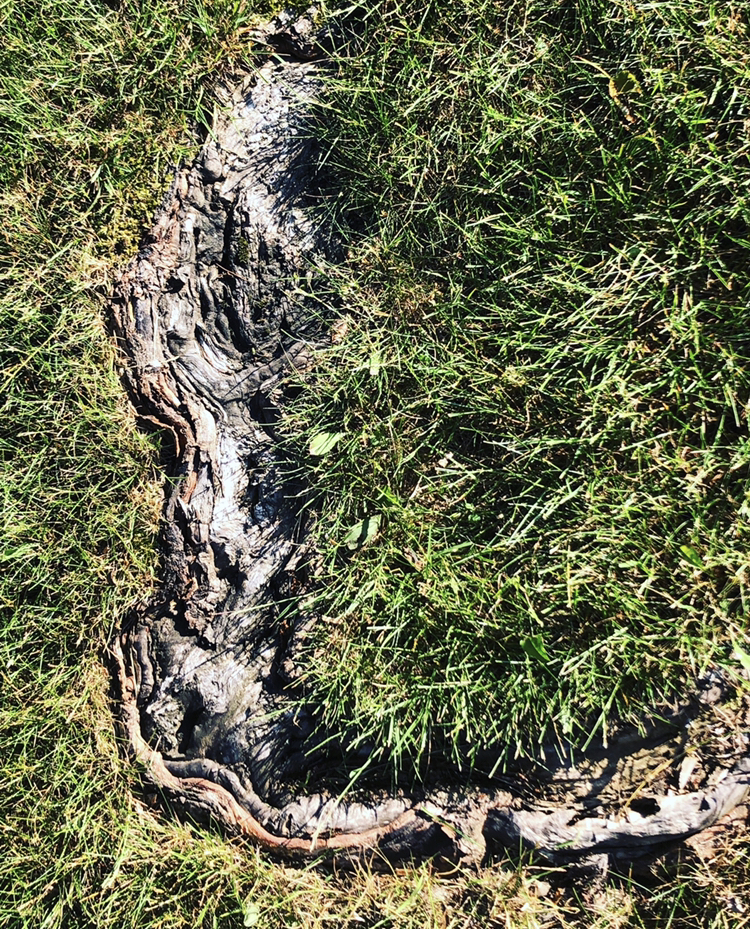
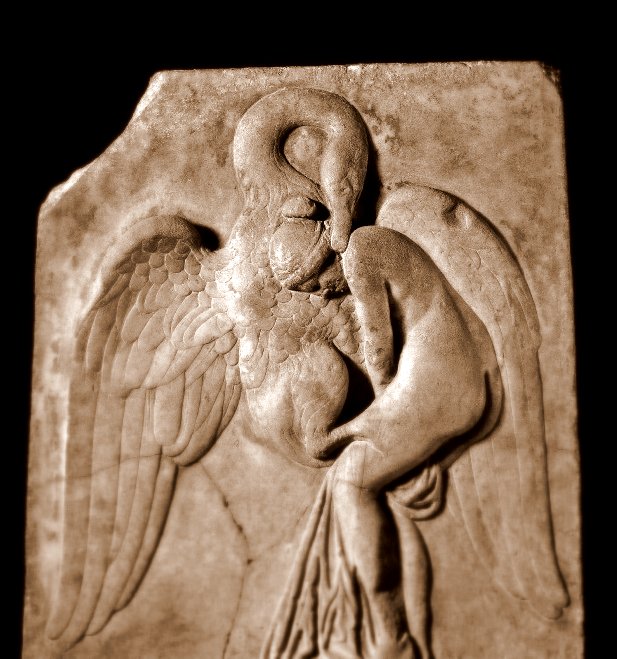
UNDERGROUND FORGETTING / image by Amalie Flynn
The brass buttons are piled in a bowl that sits on the shop counter beside the cash register, so I buy one, watch as the clerk drops it into a paper bag, gently folding the open end over so the button doesn’t fall out.
Such are the tender considerations we resort to when it comes to Union buttons mined from Marye’s Heights, the field blood transformed into a massive trauma center, and those many soldiers, hastily tipped into graves scratched higgeldy-piggeldy in the earth and quickly left, without markers, abandoned to the underground, earth’s crowded room, to work its magic on the soldiers and their uniforms under the same gibbous moon shining down on life going on, so that one day a treasure hunter turns the detector’s sensitivity to high, reaching well past unreadable trash, finally capturing a deeper signal to shovel through grass, past stones and worms, into dreams of wealth or glory, pulling up a solitary, now verdegris button bent slightly as the soldier fell hard perhaps against a rock that would sleep unchanged beside him until the treasure hunter conspired to craft a stranglehold on history proclaiming that this discovery announced an end of sorts to the story of a fallen soldier, one that can be labeled, one you can put a price on, but the truth is that buttons cannot be counted on to hold a jacket snug, can even loose their hold on the fabric of dignity, on the fable of victory, if what they hold has been released to flourish underground forgetting that perfection is elusive and we are not perfect though we hurl ourselves at it again and again.
New Fiction from Brian Castner: The Troll
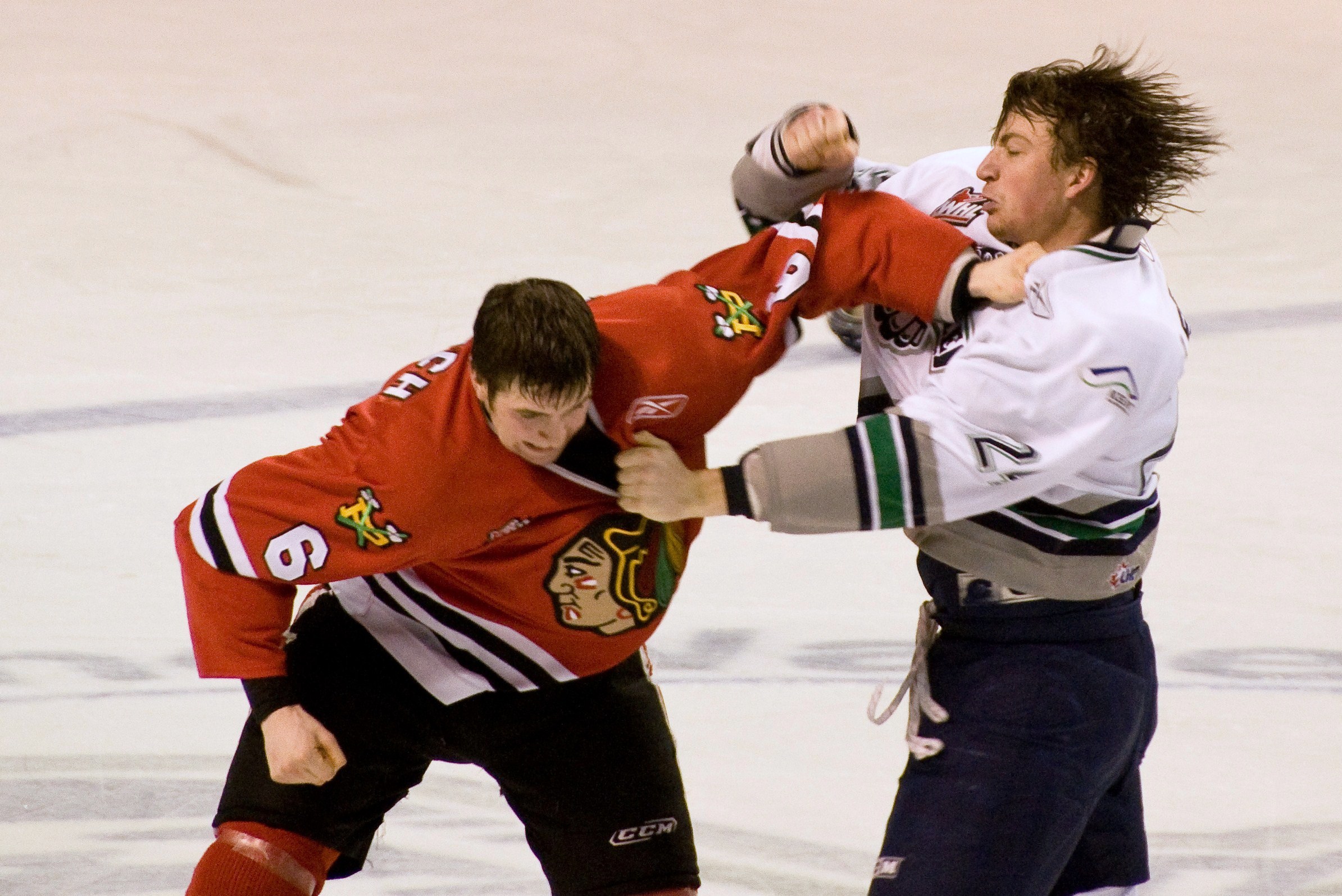
John Gurdenson’s legs weren’t what they used to be, and though the veteran charged hard on the forecheck, he was slow, too heavy and slow, and all of us in the arena groaned as the puck slipped down the ice away from him again.
The opposing defenseman took control, easily stepped away, beat Gurdenson along the wall, and made a crisp first pass. The rush headed back the other way. Gurdenson swung his stick at the legs of the Pittsburgh defenseman, gave him the look and the head nod—we knew the signal and a few of us started to clap in anticipation—but the other player ignored him and skated away. Gurdenson drifted back to the bench for a change.
First line out. Tailor hopped over the boards and sprinted into the offensive zone. We all stood, every time Tailor hit the ice. His skates churned the surface with each step, as if he was grabbing great fistfuls of ice and pulling himself along, climbing a rope with his strength alone. It was beautiful to watch. Tailor was just a rookie who had found his spot in the lineup halfway through the season, after Gurdenson broke his ribs. . We loved to watch him fly, plus he had a nose for the net, and was tough and squirrelly and just a bit of a pest, the kind of guy you definitely want on your team and not theirs, which made us cheer all the more.
Gurdenson waited on the bench. Another change, and another. Third line, second line, first line, goal. Amirov, from Tailor, off a cagey steal in the offensive zone. A pretty play, the announcer said, muscle to finesse and a big finish.
We threw our hats on the ice in a shower of New Year’s confetti. The home crowd, the sound we made, it was the din of starving men gorging at the master’s table. We were up 4-1. We wanted five. We wanted ten. We wanted to feast until we puked. After years of losing, we couldn’t get enough.
“Gurdsy, Renault, Scotty, you’re up,” the assistant coach yelled, calling the line.
Off the faceoff, the puck skipped past Gurdenson, his feet always stuck in cold oatmeal, but then, behind the action, an opportunity. The young defenseman never saw the thick tree trunk fall. Gurdenson’s check caught him on the hip and shoulder, flipped him sideways, all legs and outstretched arms so he spun to the ice like an unbuckled passenger tossed from a moving car. The noise in the arena hadn’t dimmed since the goal, but now we found a new octave. We stood up as one, pounded our seats and our fellow fans because we knew what was coming. The Troll had been our champion for a decade.
Gurdenson skated backwards away from the fallen man. A dancing partner from the other corner approached. They shook off their gloves and each grabbed a hunk of sweater and turned on the two piston engine. We were incensed. The fighters traded right hands.
A spectacle at center ice, and all eyes on Gurdenson.
Our man absorbed three fists to the side of the head before his helmet went flying. His challenger’s helmet stayed on though, and good thing too, the announcer would say. Gurdenson bloodied the lip of his younger opponent with a right and the kid went woozy and his knees buckled. Gurdenson shifted his weight, leaned back, kept the boy upright with the left hand, didn’t let him fall, and then delivered another right to the mouth. Teeth flew. Gurdenson’s hand split between the knuckles and his grip with his left started to falter. The kid was all limp dead weight, lights out, but Gurdenson didn’t hesitate, swung and connected twice more before the unconscious boy finally slipped free, his helmeted head bouncing off the ice when he landed.
Gurdenson stood over him for a moment, and then skated away even before the referees approached.
Nineteen thousand of us chanted “Troll! Troll! Troll! Troll!” As many cell phone cameras flashed. Gurdenson pointed a finger at the Pittsburgh bench, picked his next victim, gave a “see-you-in-the-playoffs” nod, and we roared even louder. Two minutes for roughing, five for fighting, and a game misconduct. Gurdenson’s night was over. He skated to the door, shuffled back to the dressing room, and waited for the rest of the team. The third period would end soon.
Gurdenson sat in front of his stall. He was the only one in the room. He gingerly removed his jersey, stretched a shoulder, checked a bruise, shook out his right hand and stuffed it in a bag of ice that quickly turned pink.
He sat and waited for his team, and it was there, alone, helmet and shoulder pads off, towel over his neck, that it happened.
The general manager walked in from the side door that led to the executive offices. A tie and cologne and a red face and slicked back hair. It was just the two of them.
“You’ve been traded, Gurdsy.”
Gurdenson looked up at him, a moment, and then back down between his skates.
“You’re headed to the Island, effective immediately.”
Silence.
“You can get dressed.” Pause. “Thanks for everything you’ve meant to this organization.”
The general manager walked out. Gurdenson’s deliberate breath and the creak of his tightly laced skates and our dull rumble muffled all until the double-swinging locker room door burst open and crisp sticks and shouts and clatters from the team and the crowded arena behind.
The game was over. Gurdenson didn’t move. The coach gave a speech and the team congratulated young Amirov on his first hat trick and slapped Tailor’s back and Gurdenson sat and stared a hole in the plush carpet. Water bottles and the showers and sticks checked and re-taped. Then slowly, at a level below the operational clamor of full professional locker room, restrained voices passed the news from player to player. They glanced over. Gurdenson met no eyes.
The others gathered their gear and put on their suits and ties, but as they left the room, one-by-one each man walked up to Gurdenson where he still sat with his skates on, tapped him with the blade of their stick, under their breath:
“Tough one, Gurdsy.”
“Good luck, Gurdsy.”
“See you around, Gurdsy.”
The coach put a hand on his shoulder. Gurdenson couldn’t see him shake his head.
“It’s a tough deal, Gurdsy. It’s a business now, eh, but it’s a tough deal. You take care of yourself.”
The coach was the last to leave. Gurdenson again sat alone in the empty dressing room. He sat there for a long time. Then he got up, put on his suit without showering, and left out the back door of the arena where no one was waiting for him.
*****
OCTOBER 1996, SAULT STE MARIE, ONTARIO, SOO GREYHOUNDS RADIO BROADCAST:
Knights recover the puck, slip it along the halfwall, lose control, now they have it back, and dump it into the Soo zone.
Robert with the puck, finds his man, Soo coming away, long pass to Paquet and OH MY Ballard just stepped into Paquet at the Soo bench.
Paquet had his head down and Ballard just freight-trained him!
Paquet never saw it and he’s hurt. Paquet is down.
Play continues, puck slides into London’s end but now there’s some chirping going on and it looks like Gurdenson is challenging Ballard.
Gurdenson, in his first game here with the Soo, he isn’t wasting any time and they throw down the gloves and here they go!
Gurdenson and Ballard!
Gurdenson grabs on and starts throwing rights in there!
Ballard can’t get his head up, Gurdenson’s pummeling him with the right!
Ballard hasn’t even swung yet but now he does and both men are swinging away. Ballard and Gurdenson!
Ballard connects on a right and another one but WOW Gurdenson just caught him square on the nose. Gurdenson KO’d Ballard and he’s stunned. That nose has gotta be broken, Gurdenson dropped him like a sack of potatoes.
But now here comes McCarthy. You knew he was going to get involved.
And Gurdenson has got to be exhausted. He’s got to be just spent, after the tilt with Ballard and Ballard is one tough customer but he is still down on the ice and you can see the blood now pooling at his knees.
They need to get in there. The officials need to get in there and stop this. Gurdenson just fought and he’s got to be spent but the linesmen are distracted with Paquet and Ballard and the scrum in front of the Soo bench.
Well, McCarthy has taken exception and Gurdenson isn’t backing down and so here they go.
Gurdenson and McCarthy!
Gurdenson is giving up twenty pounds easy and McCarthy has his grip with the left and here he comes with the right, over the top.
And Gurdenson is still trying to get a hold and McCarthy comes in with another right and another.
He’s firing the right and Gurdenson can’t get his grip and he still hasn’t swung and OHHHHH McCarthy popped him right on the button! He caught him square with a right!
But Gurdenson is still on his feet somehow and now he comes back with a right. And another!
Both men just firing the punches in there and now Gurdenson frees his left hand and switches sides and starts going overtop with the left.
He surprised McCarthy and he caught him with a beauty and McCarthy looks dazed.
Gurdenson has McCarthy’s jersey up over his head and now the left and an uppercut and another, Gurdenson is working the side of the head and down to the ice they go!
WOW!
Gurdenson, the young kid from Detroit, a troll from below the Mackinac Bridge, makes his mark in the Soo!
He’s fighting like a troll out there.
Ballard still hasn’t gotten up yet and the trainer has come out and I can’t see his face but it has got to be a mess. McCarthy has gone straight to the dressing room with a huge cut over his eye and that’s gunna need stitches.
And this crowd is on their feet here in Sault Ste Marie as Gurdenson is still squawking at the Knights bench.
Welcome to the league, Troll!
*****
“You know, Bobby, I can’t even believe I need to make this phone call.”
“Oh lay off the bullshit, Tom. I’m not buying, you can stop selling. You and John both knew this was coming. Or you should have.”
“My client’s been with you twelve years. That should count for something.”
“It does. It means we’ve paid him a lot of money and he should be grateful for it.”
“He was with you in thick and thin, Bobby, and there was a lot of thin. And this is how you treat him?”
“For fuck’s sake, we’re making a run. You can see that. I have to do what’s best for the team.”
“John Gurdenson is best for your team. He’s given his body and soul to this team and this city and now, on your best shot at the cup in thirty years, this is when you move him?” Silence. “This game used to be about loyalty, Bobby. What happened to loyalty? What happened to veteran leadership?”
“It’s a different game, Tommy. I need goals.”
“You need leadership and toughness.”
“I need goals and toughness. You can’t have one or the other anymore. Did you see what Tailor did last night?”
“What’s that got to do with it?”
“He destroyed his check and then set up Amo. I never saw John make a play like that, never. That Tailor kid can fight but he can also hit and pass and …”
“And he’s only played what, fifteen games for you?”
“Yes, and so he makes fucking half what Gurdenson does! Fifteen games, four goals, five assists. For half! We needed the cap room. This is our year, Tommy, this is it.”
“The fans love him.”
“The fans love winning. The fans love the cup.”
“True, but not like John. He’s old time. He does things the old way. He’d do anything for the cup and you know it. You’ve seen it. The things he’s endured for this team. This is like, like….” He searched for the word. “… a banishment or something. You can’t do this to him.”
“Listen, Tommy, I like you. I like John. It would have been nice to keep him. If it was like a couple years ago, you know, he used to be able to chip in a couple goals a year. He had what, ten, in ‘08? Those days are long gone, Tommy, you know it. Tailor has nine points in fifteen games. John hasn’t had a point in the last twenty, at least. And he’s not nearly as tough or durable as he thinks he is. With the injury troubles too, John should consider this a hint.”
“A hint for what?”
“I wish him all the best. Tailor is our man now. Tell Gurdsy good luck.”
*****
Gurdenson read the rule book six times, but there was no loophole or caveat or mercy clause to find. The league was explicit and direct. To get your name on the cup, you had to be in the series final or play forty one games that season.
Gurdenson looked at the schedule. Sixty two games so far, but he missed two with a hip strain, seven with a busted hand that was still broken when he came back. And then the ribs, cracked in practice when Tailor hit him on a non-contact drill. Over-excited or deliberate or what, didn’t matter, Gurdenson went out five games, Tailor went in, earned a spot in the lineup. After that, the worst, the coup de grace, ten games as a healthy scratch. Ten games gone so Tailor could play.
Gurdenson did the math. Sixty two minus twenty four was thirty eight. Thirty eight games. Three short.
Three short, no cup.
They’d win it this year, everyone knew it. Three short. No cup.
Tailor would only have thirty six, but he’d be in the cup final for sure.
Gurdenson took another drink.
The ribs. Tailor. Three short, no cup.
He checked the schedule again, noted every game left for his old team, saw that the Island wasn’t on it, and then he picked up the phone and called his agent.
*****
The closest we came to the Stanley Cup was the year before. We made it to the conference finals, the last step before playing for it all. We hadn’t made the playoffs in five years, hadn’t won a series in twice that. But now we had a young and up-and-coming team, a bench full of draft picks still in their diapers; only Gurdenson had endured the previous long years of toiling in fallow fields.
The first two rounds were a breeze, but in the third round the team encountered an older and tougher squad. We were hesitant and unsure, exposed as pretenders merely playing dress-up in our father’s clothes. We lost that series in only five games, but no true fan among us would forget that our team’s tender spines only bent and did not break, that our will was not permanently dashed, because of the actions of John Gurdenson in game three.
Our boys had been out-muscled in the corners, out-bruised in the paint, stripped and pushed off the puck, knocked about and we boo’d them hard until, as a final humiliation, our goaltender was sent sprawling, a blind hit from behind. Somehow his mask hit the pipe on the way down. He didn’t move for several minutes. The shame was not that he went to the hospital for a brain scan, but rather that every man on ice watched it happen and did nothing.
The coach was planted behind the bench as an unvented furnace. He grew red and silent. No more shouts and mocks and cajoles of the line of smooth faces before him. He put out Gurdenson. We all knew the reason why, for the Troll but to do and…well, you know the rest.
When the puck was dropped Gurdenson ignored it. He skated directly to the opposing bench, discarding his gloves as he went. We knew what was coming, we started our chant for the Troll. His target knew as well, and was half out of his seat when Gurdenson arrived and grabbed his sweater by the outside of the shoulders and pulled him over the boards and onto the ice. The man hit awkwardly but was up quickly. He had bent over goaltenders before, and knew how to stand tall to answer for the taking of liberties.
We always loved Gurdenson because he fought like he had nothing to lose, like he wouldn’t earn his supper if he didn’t take his licks. The newspaper said he fought like a bareknuckle boxer in the hidden back room of a speakeasy, betting the rent money on himself. That he fought to win, not to prolong a show until a referee might step in. Fans knew that a Gurdenson fight meant blood and broken orbitals.
That night, when Gurdenson got to that bench, eleven years of losing poured on the head of his opponent. He pummeled the man and discarded him, but then a second contender approached, and a third. More hands reached out from the bench, grabbed Gurdenson’s elbows and collar. His left arm was pinned. He lost his grasp on the other man’s jersey. A fist swung.
There was a time, not that many years before perhaps, when John Gurdenson would have ducked his head, broken free, twisted away at the last second. But no more. The years hung from him as invisible weights on his ankles and wrists. The right hand hit him in the temple, providence fled, and then surely nothing but a few dim stars amidst the void.
Gurdenson staggered. The rest of his team watched as he was pulled into the opposing bench and gang tackled. Two men pinned his lower half, many more on top. Gurdenson never said what happened to him at the bottom of the pile; it was hidden behind the boards, away from the cameras, never appeared on a highlight reel or replay. It took several minutes for the referees to pull everyone off, and all anyone ever saw was the result.
When Gurdenson emerged he was unrecognizable. He head and face were lumpy, like a thawed Thanksgiving turkey just taken out of the packaging. Blood pooled in unnatural places behind tight skin. His eyes were swollen to blindness. His left arm hung. We were quiet. No Troll calls in the arena. He was guided to the locker room to be treated by the doctors, and would spend two days in the hospital.
The coach stalked behind the bench, slammed a heavy palm against the glass behind him, and finally opened the coke oven door:
“Now you sons of bitches will believe we’re in a war!” he roared.
*****
“You know Tommy, we could have talked on the phone,” said Tampa’s general manager, a round balding man with a stubbly goatee. “Why not that? Why fly down?”
The waitress came over and filled the two water glasses. She spilled a few drops perilously close to the big man’s lap and he looked up and gave her a face but she didn’t notice.
“And they don’t even offer sparkling instead,” he mumbled to himself. And then, louder, “Tommy, why are we here?”
“Maybe I just missed seeing your face?” Tom said, and took a sip.
“The trade deadline is tomorrow and I have work to do. Why did you come down here?” he asked again.
Tom closed the menu.
“We’re here because you record your calls. I’d rather not have a transcript of this business when we’re done,” Tom said.
“Well, spit it out then. You have my attention,” the other man said, and closed his menu as well and placed it on the stained linen.
“I need you to trade for John Gurdenson,” Tom said.
“He just went to the Island.”
“The Island isn’t going to work for us.”
“Why would they trade him to me?”
“We’ve already worked that out.”
“Well, what if I don’t want him? He’s a has-been.”
“We’ll make it worth your while.”
“We? Who’s we? The Island is trying to put fans in the seats, they need a small time showman. I, on the other hand, am trying to win hockey games here. Your man’s got nothing left in the tank. My team’s trying to make the playoffs. You can’t make it worth our while.”
“I said we would make it worth your while.”
Everything went quiet.
“Tommy, what are you doing?”
Tom looked down and smoothed the table cloth with his large hands. His wrinkled fingers looked like overboiled sausages left out too long on the plate.
“I’d rather not say,” Tom said finally.
“How many other GMs have you approached?”
“Three.”
“Did they all tell you to piss off?”
“Basically.”
“And you haven’t given up yet?”
“I read in the paper about Melissa’s latest court filing, and I thought I’d give it one more shot.”
Silence again. Tom took a drink of water.
“It’s a shame about Melissa and the kids,” Tom said. “I’m sorry. I never thought it would get so ugly with you two. I can only imagine the legal fees.”
The man sat and stared at his empty plate a long time before answering.
“Will the Island play ball?”
“Sixth round pick. You won’t even miss it next year. And my client is in the line-up the rest of the season.”
*****
CHICAGO SPORTSRADIO 720 POST-GAME SHOW:
PARKER: I think he planned it.
WHITE: Oh, you can’t be serious.
PARKER: He went into tonight with the idea. Two games left in the season. We’re the top seed. They’re going nowhere. He’s going nowhere. This didn’t just randomly happen in the heat of the moment.
WHITE: You don’t think the booing got to him.
PARKER: Everyone gets booed when they come back to play a game in their old building against their old team. Even after twelve years, it happens. No, that can’t be it.
WHITE: Well, this is a big charge, planning to do it. What’s your proof?
PARKER: Go back and look at the replays of his shifts. He’s completely distracted, oblivious. He’s not involved in the play, he’s not chasing down pucks…
WHITE: He hasn’t been a scoring threat in years. How can you tell the difference?
PARKER: …he’s not doing anything except waiting for that Tailor line to get on the ice. In the first period he stretched his shifts, and when that didn’t work, I think he iced it on purpose. To lure them out.
WHITE: Well, I’ll say this, and they showed it on the broadcast, he had no one around him when he finally recovered the puck at the end of that long stretch in their own zone. He could have skated it out, to get his line off, but he didn’t, he iced it instead. And the announcers questioned that decision at the time.
PARKER: Of course they did. It was a bad play. But it meant he was stuck out there, and that we were going to put out the top line in the offensive zone, which is exactly what he wanted. That was the first time all game that he and Tailor were on the ice at the same time.
WHITE: Is that right? Can we check that?
PARKER: This is what I’m saying: John Gurdenson meant to do it. These guys, and especially him, we saw this last year, they will do anything for the cup. But now he’s gone, traded. What does the code say?
WHITE: The code says you handle it on the ice, but this went way beyond the hockey code.
PARKER: Well, code or not, he handled it on the ice alright. And someone, the league, the police, someone, is going to ask him. Did you plan to do this? Was this the plan all along? And I’m telling you, the answer is going to be yes.
*****
And then there stood Tailor, on the side of the scrum, against the boards, back turned.
Gurdenson skated alone from center ice, eyes on his target only, skating more quickly now, silently gathering momentum as a pendulum released. At the last moment he pushed off, left his feet, and raised his elbow. Tailor’s back was still turned. Gurdenson caught him at full speed, full body, along his left shoulder and hip, Gurdenson’s elbow on the young man’s left temple. Tailor’s face hit the glass, he momentarily went unconscious, and in that second, fell to the ice like a butchered cattle carcass let off the hook.
In the arena, we shouted and jeered. Tailor was our man now, and we pointed at the officials to intervene and yelled for our boys to step in. Gurdenson shook off the hit. Hands clutched at him but he jerked loosean elbow and swung at his restrainer behind him and dropped the shocked and unprepared referee. Every other player was paired off with an opponent, locked in entanglements of gear and jerseys and arms and legs, wrestling or recovering.
Gurdenson was alone, free. He loomed over Tailor, who was still face down, groaning and only slowly moving to his hands and knees.
Gurdenson raised his stick and then swung it like an axe down on the back of Tailor’s head. The stick shattered and Tailor’s helmet flew and he dropped to the ice again. Gurdenson carefully took off his gloves and picked the kid up by the sweater and spun him so they were face to face. Tailor was in and out. He tried to get his hands up but he was too limp to fight back and he fell at Gurdenson’s first blow. So the big man rolled the kid over and sat on Tailor’s chest and began to beat the boy’s unconscious face with his bare scarred hands. Tailor came to and started to twitch but he was pinned. Sweat and spit and snot and then nothing but blood, a wet slap with every impact. Gurdenson threw rights until he felt the bones in Tailor’s face yield to gritty mush. He didn’t stop, not even when the nose tore, revealing a cavern, and boiling blood erupted everywhere.
Tailor screamed.
Gurdenson never slowed. He swung again and again and again and his jersey dripped gore. We stared in silence. Tailor’s cries rang in the rafters and then faded to a gurgle, and his red hot blood melted the ice beneath his sprawled body. The benches emptied, and security ran on the ice, but not in time. The Troll leaned over and whispered into what was left of Tailor’s ear.
“No cups for us.”
New Nonfiction by Abena Ntoso: Memorial Day
There are four ways of telling what happened.
1. Just tell the truth. Some stories are told just once; others are told over and over again, like myths and legends. We remember such stories not because they are memorable, but because they have been told. Like the well-crafted, witty, searing, suspenseful story of Odysseus and the Cyclops … “Nobody’s killing me now by fraud and not by force!” Such a story of human suffering. “Nobody’s ruining my life!” We grow breathless and sweaty, gasp for words and air, just trying to explain things. It’s happening, it’s real, and yet no one can really see it or feel it but you. And, let’s face it, you certainly aren’t doing a great job of explaining it to anyone else.
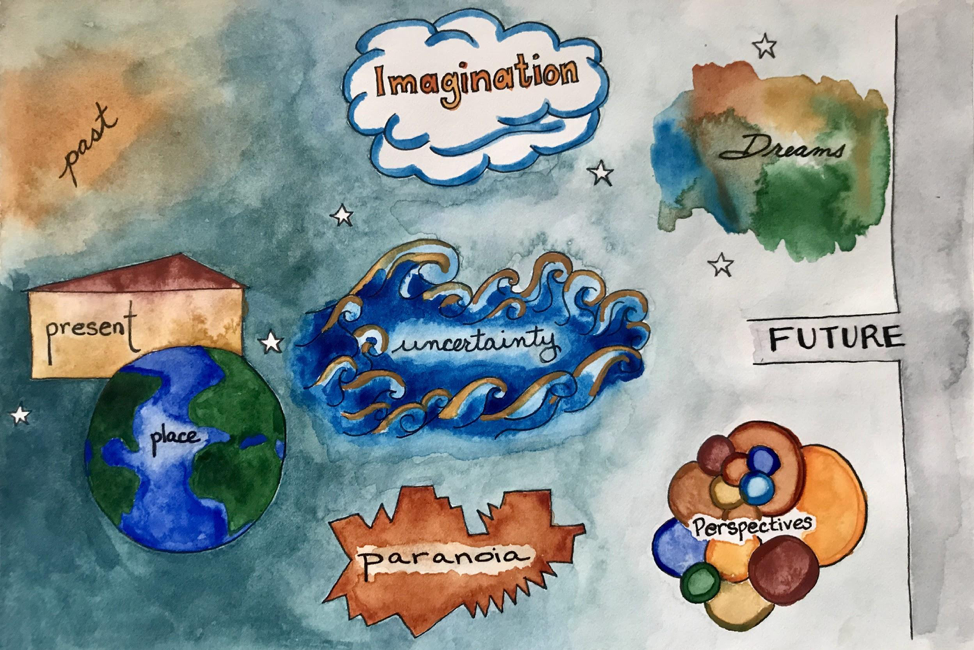
2. When we think, speak, and behave, we do so while mixing up the past, present, future, imagination, dreams, and paranoia. Our personal concept of “reality” is more warped than we realize.
3. We may decide to editorialize what we think we know.
4. Or, I decide I have to tell the stories, but I can’t beach my existence on the shores of the past or along the jagged coastline of paranoia. I invite you to subtly explore and question your truths, but you must remember that everything I say is a tale. I’m spinning fictions and poems to entertain us both, and to hopefully provide catharsis. It’s also best if I tell you this up front, so that you can voyage with me and not worry that we may end up stuck in one place. I am a mental wanderer; and you are also free to wander wherever you please. I have enclosed a map for your convenience.
* * *
I have a daughter, and I have a son. I have bags that are always empty, and bags that are heavy and full. Books, binders, cellphone chargers, laptops, dishes, Tupperware, blankets, pillows, paint brushes, colored pencils, lavender-scented trash bags for the trash can with the lid that closes. I have usernames and passwords. Lots of them. I have hair and skin. All over. These things make me a lot like other people .
I tried to write a book in grade school; I wrote a 40-page chapter book in a black and white marbled composition notebook. A good piece of fiction, but I don’t remember what it was about. Someone in the house threw it away. Perhaps it was me.
In high school in the 1990s, I wrote poems on a Smith-Corona word processor, and then on a Packard Bell computer. I wrote my deepest secrets and my mundane musings in a large purple hardcover journal that went everywhere with me, except for school. We didn’t write in school, except for half-heartedly scribbling hasty essays to no one in particular about this or that novel or historical event. In college I did slam poetry, and I wrote my poems in several hardcover spiral-bound writing journals that I ended up throwing away when it was time to “grow up.” Writing was not part of waking up and being a real adult.
Twenty years later, a writing workshop for military veterans shook me awake and reminded me to write, and write again and again. Every day now, I’ve been waking up on Earth and filling notebooks.
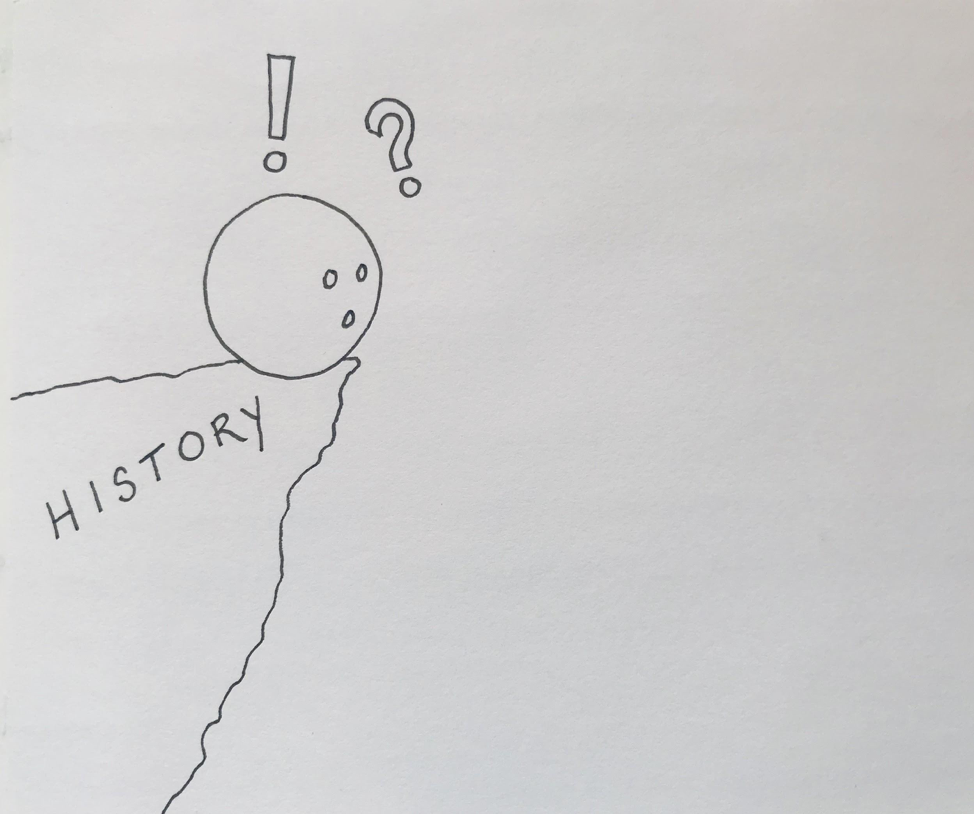
It’s 2020; in my imagination Earth is a drunk bowling ball, rolling around on the rocky edge of the highest cliff, constantly shifting in precarious circles, nauseous and peering unsteadily, unable to comprehend whatever is below or beyond the precipice of history. I am watching this spectacle, and I’m writing this book.
How can one possibly chronicle the various permutations of a redesigned relationship with reality? A disease ravaging human physiological and societal structures has written so many people deeper and deeper into distinct forms of suffering that can swallow a person whole—hunger, illness, isolation, unemployment, martyrdom, the sudden and lonely deaths of loved ones … and yet there is also an awakening, an introspection, a forced freedom to wonder how we will revise our lives in an apocalyptic invitation to survive today and the remainder of this century. Acutely mindful of the present, we draft new possibilities for our future. Left with few options, we explore everything.
The kids build a multi-blanket fort in the living room, and the youngest introduces a brilliant piece of legislation, using magic marker to draft a sign which alerts potential visitors of the new law: “No farting in the fort.”
Representative Ocasio-Cortez from New York eloquently demonstrates that misogyny and verbal abuse are pervasive and very real. Other very real things that are often minimized: poverty, homelessness, systemic racism, domestic abuse, sexual harassment, violence, rape.
Standing on the concrete balcony before sunrise, I count 10 stars to the east, and let’s just say that I am not telling you everything because it’s simply just too much. I walk back inside, turn on the silver lamp and sit down at the dining table to write.
* * *
My mental explorations lead to interesting observations and dialectics about the nature and meaning of anything and everything. I am acutely aware that exploration is a luxury, although I maintain the belief that all human beings should be able to enjoy enough personal safety and security to be able to explore, whether physically or mentally. In that sense, I don’t think of travel—physical or intellectual—as a luxury, but as a requisite for opening one’s mind.
I sit down not knowing where to begin. Mental travel is not a pragmatic endeavor; it is disheveled and eclectic, authentic and impure, sagacious, sobering and silly. My thoughts, ideas and observations wander throughout the universe, and my daily writing is an incomplete account of these creative and intellectual escapades.
I grasp at words and attempt to say ideas and emotions that cannot be said. Language is a chunky and viscous medium for the flow of an authentic existence.
I pen an ode to customer service:
The joy and peace you bring is underrated
underappreciated,
like Jesus, a savior I can’t see,
except you start off every conversation
with “My name is ____. How can I help you?”
and I am usually not down on my knees,
my eyes are not closed,
in fact, I may be multitasking, or staring
at the equipment or correspondence that
seems to be the source of a particular kind
of problem today,
problems that are usually solved by the end of our
discussion; you may have just performed a minor
miracle. If only prayers worked that way.
But then again if they did, we would probably take
God for granted too.
You deserve a raise,
or at least, more praise.
The streaming recollections of my most vivid dreams are usually written down without interpretation. In one dream, “I was invited to fly an old-school Amelia Earhart-type plane with another young woman and two men, and it was unclear whether we should wear shorts or a cover up over our bottoms and legs, and the bathroom where we were changing was semi-outdoors and had dirt floors so it was muddy, and I was holding my breath, and sometimes I had sandals and sometimes I did not.”
At times it is difficult to write creatively, especially when I am inundated with the more mundane or administrative aspects of life. During such weeks or months, I struggle with “maintaining my dimension of creativity, curiosity, playfulness, self-expression, and observation despite the pull of other dimensions.” I make a commitment to re-establishing balance, and sometimes I feel like a rebel when I write needy and nonsensical poetry, release an incessant flow of thoughts and emotions, or paint pictures that look like masterpieces by a 3-year-old. After much deliberating about the nature of work, I decide that this too is worthy of my time. Perhaps this is evidence of a quotidian brand of nonconformity.
I feel overloaded with responsibilities, and I escape to the park to find mental energy. Seated cross-legged in the gondola I write, “I feel like I’m seeing through a different person’s eyes, a depressed person’s eyes. I am in a depressed person’s mind, walking in their sad, sad shoes, and there’s the woosh of cars along the road and birds calling in the various ways they all do (a hooting, a squeaking, a trill, multiple voices and languages), but somehow I don’t see with wonder and delight, it’s like my brain is tired and that part has been clubbed and is lying unconscious in a ditch and everything else that is walking, sitting, staring, yelling, crying–all of it can’t find the missing part that has been beaten and left for dead.”
Some aspects of quotidian life do become quite amazing. On one occasion I marvel at the habit of taking a shower. “Mostly an everyday experience except for those occasional days when you don’t take a shower, you skip a shower for one reason or another, and it gets to the end of the day and you just give up on showering. Does the frequency of this say anything about you? Something about your personal motivation or lack thereof? Your ability to end on a high note? Your nonchalance? Your personal commitment to conserving water? Your blasé approach to personal hygiene? Your work ethic, coupled with your level of exhaustion?”
I think about what freedoms I can explore as a poet; I try capitalizing the first letter of every single word I write, “Just So You Would All Know That All Of My Words Stand For Something, None Of Them Are Extra Words Or Filler Words, They Are All The Point, They All Introduce And Elucidate, And I Am Not Complacent When I Write.”
I write about dirty words. Violence. Abuse. I sip coffee and attempt to process trauma and the human response to it. Sexual harassment: why do we collectively mumble excuses and ignore it? Verbal abuse: why do we simply shrug our shoulders, an outward sign that we simultaneously condemn and condone? Child abuse, domestic abuse: why are we afraid to say that all people should feel safe in their homes? Why are we afraid to name a source of pain that comes at the hands of someone who is supposed to love and protect? What would it be like if we stopped ignoring violence and abuse in the home, if we started addressing it as a serious public health and safety concern? Would this also make us better at preventing it in our public institutions and in the street?
I write about the word pilgrimage. I write about the abbreviation “IRL.” I find it interesting that there is even an abbreviation for the phrase “in real life” … is this something that we now find ourselves saying so often that we have to abbreviate it? I paint, experimenting with mixing colors for a variety of flesh tones.
I do not know that on Memorial Day a man will be choked to death in front of a crowd. I sing happy birthday to my mother, and I hug my children. It is days later when I first hear about what happened to George Floyd. It is almost a week before I finally take a deep breath and listen to The New York Times news report.
Over the next few weeks I write pages and pages about my frustrations with humanity, racism, sexism and violence. I wonder what my mother’s birthday will be like in subsequent years. Next year I am going to write a poem for my mother and have it framed.
“In poetry, just as happens constantly in our own minds, the biggest kinds of thoughts about life and the world can shift with ease into very personal and intimate ones, and back again.”
—Matthew Zapruder
I scribble words. Paradoxes. Parables. Panegyrics. Bona fide and exigent matters for consideration. What does it mean to love and be loved? Why was this woman scorned? Why was this child slammed? Why was this man murdered in the street? How do we right this? How do I write this pain? How do I spell it out?
I read and re-read Rumi first thing every morning, prepare to open up my heart for human business. I savor words and language. I copy quotes that make me pause and think. I pull out my oil colors—yellow ochre, cadmium red, ultramarine, viridian—paint my mother with a newborn baby in her arms, wrapped in a blanket of Adinkra symbols for strength, humility, knowledge, and learning.
I write about dreams before I forget. The river in this one is iridescent, blue, turquoise, bright green, glowing. We are floating down this river with magical properties to heal a deadly and infectious skin disease; the river was full of people, and at first I had a full army-issued diving suit with a mask like the gas masks, and I was underwater, but then I came up and there was an African guy, in his 40s and bald, and he took off his mask and we were all crying because we knew he would get infected, and we were all floating down the river and it was nighttime, and when we got to the end of the river there were lots of people whose skin was raw, exposed subdermis, and we were crying and screaming; Dawn was there, and we were afraid of the people and for them, we thought they were infected and dying, and we floated around and were on our way back, and the river was crowded and we were trying to avoid the infected people with exposed skin, and then we felt our own faces and realized that we were like that too, our skin was raw, everyone, everyone; we were screaming and scared and continued floating back, and when we got back to the shore at the other end of the river we were suddenly healed, and there was a tree in the river that had flowers on it, and we were so happy and grateful that we survived and were healed, and Dawn and her daughter were already at the shore, and we picked the delicate flowers for our hair, and the water was iridescent, blue, turquoise, bright green, glowing. The river was supposed to heal us, and it did.
There is a current and a past; for most of us, it is difficult not to confuse the two. So it is with writing fiction; the flow between the imagination and reality is as natural as a dream.
* * *
“Caminante, no hay camino, se hace camino al andar.”
Traveler, there is no road; you make your own path as you walk.
–Antonio Machado
If life is a frighteningly intricate tangle of experiences, how do we cope? How do we find our way amid a complexity and vastness that we cannot even begin to comprehend? At any given moment, we are busy splitting atoms, mapping the DNA of viruses, and calculating distances between galaxies in the universe. Or maybe we are making a bologna sandwich while arguing with our mate. It is quite possible that we remember attending our sister’s college graduation and watching our children play in the water fountains on campus with their cousins; maybe we heard about what happened several days ago on a street corner in Minneapolis, Minnesota; perhaps we have also studied the various conquests and movements that have transpired over the past few centuries or millennia. We might dream of a hot pink crape myrtle tree blooming and tossing confetti petals; imagine the star-spangled fabric of a nation ripping into two; think about what it must be like for our mothers to watch us leave over and over again. There is a chance we are fretting over the possibility of being robbed of our possessions, or considering drastic measures to protect ourselves amid the fear of losing much more. Maybe we plan for our upcoming vacation; maybe we don’t see retirement as a viable option, and maybe we predict that we will all be working tirelessly to save our planet or inhabit a new one.
In real life, we flow through our thoughts and actions so rapidly that we rarely take the time to think about where they are taking us. Most conversations and nonfiction writings often reflect our valiant attempts to convince ourselves and others of what we refer to as “truth.” Few of us realize, let alone care to admit, that our stories and language float in an ocean that is always everywhere all at once. What an adventure it can be to acknowledge this and embark on a mental journey!
This ability to wander and explore is the reason why I write poetry and fiction. I write to ponder humanity and nature; I write to probe paradoxes and dilemmas; I write to peek into the universe. I write poetry to expand my thinking, to find wisdom and authenticity; I write poetry to record the beats of a moment or thought, and then to question the music. I like to be mindful of the infinite ocean of natural thinking, and so I write fiction because it is how I allow my mind to play.
Freedom to play with words and language, to traverse past, present and future, to intersect these with dreams and imagination, to clothe our worries in questions, and to don multiple perspectives … this is the freedom we experience when we read and write poetry and fiction. Perhaps in tumultuous times it would be especially wise to consider that this freedom of thought is a blessing that we should not forget about or squander. To appreciate poetry and fiction is to sense that, as Rumi puts it:
“Love is the reality,
and poetry is the drum
that calls us to that.”
Writing poetry and fiction is a way in which we can consciously alter the amount of influence that each mind state has on our psyche or our social and political interactions at any given moment. With these two literary forms, when we write, we can usually be incredibly honest with ourselves about what is real and what is made up, what is past, what is present, what is imagined, and what was in our dreams. If asked to parse our own literary work, we would be able to literally drop words and phrases into each of these mind-state categories as they relate to the story that we are attempting to tell or the experience we are trying to create.
Furthermore, when people read poetry or fiction they know it’s just that … there is no expectation of needing to believe something, agree with something, or debate its validity. We are aware that the author has made all of this up for our entertainment, and we can comfortably take the stance that we are allowed to decide what we think.
* * *
In her mind, a civil war is brewing, but no one wants to call it a war. There is a paranoid anguish in watching America implode, an anguish of wanting everything to be alright, but knowing that it isn’t, and not having any idea how to make it so. The nightmare of polarization mixes with the immense pressure that the past exerts on the present—both personally and politically. The impotence of watching the present reminds her of a child’s innocence, the struggle to make sense of the world when she wants to fix it but realizes that she can’t—that this world is simultaneously larger and more minute than she can possibly comprehend.
And so begins the memorial story,
this meandering tale of vainglorious battles
in which the author takes up sundry pens and portable devices
with lofty hopes of celebrating peace among the paradoxical parties
of humankind, the protests and propaganda
littering the sometimes crowded, sometimes deserted streets
of a weaponized post-war people.
This wayward wordsmith awkwardly commences her wandering
while seated at a small and sturdy dining table from Ashley Furniture,
aided by the glowing filamentous light
of a brushed nickel folding lamp she used in graduate school,
along with a generous mug of coffee chased
with a copious amount of caramel mocha coffee creamer,
an international delight indeed. Two score and one year have passed
since life first illuminated her adventurous spirit,
and yet amnesia eclipses the first few years that followed birth,
that event which was likely quite traumatic—for what ripened babe
and exhausted mother do not grow somewhat at odds
with one another and the gods, so much so that the mother has little choice
but to force the ready human from her loins? And yet
this miraculously celebratory disagreement which triggered
her adventures in vitality seems to have little bearing
on the psyche with which she now attends to her craft.
Her own dogmatic approach is the dreamy and desperately futuristic optimism of thinking, “we can do better than this.” Until violence hits closer and closer to home … then perspectives, mind states and time periods don’t even matter … She just wants to protect, and she’s stuck thinking “this shouldn’t be.” Small details from her life catch her attention; she imagines being held down and injected with something; she imagines a leather belt raining down on her daughter as she cries out cowering in a couch; she imagines her son’s thick hair and dark skin on a grown man who is running. She would run too. She has run—several times—and she would probably do it again.
New Poetry from Mack Freeman: “Death Row Butterflies”
DEATH ROW BUTTERFLIES / image by Amalie Flynn
Gossamer wings glint Razor wire gleams in sunlight Death row butterflies
New Poetry from Ben Weakley: “Checkpoint,” “There are 4 Ways to Die in an Explosion,” “Good Friday,”
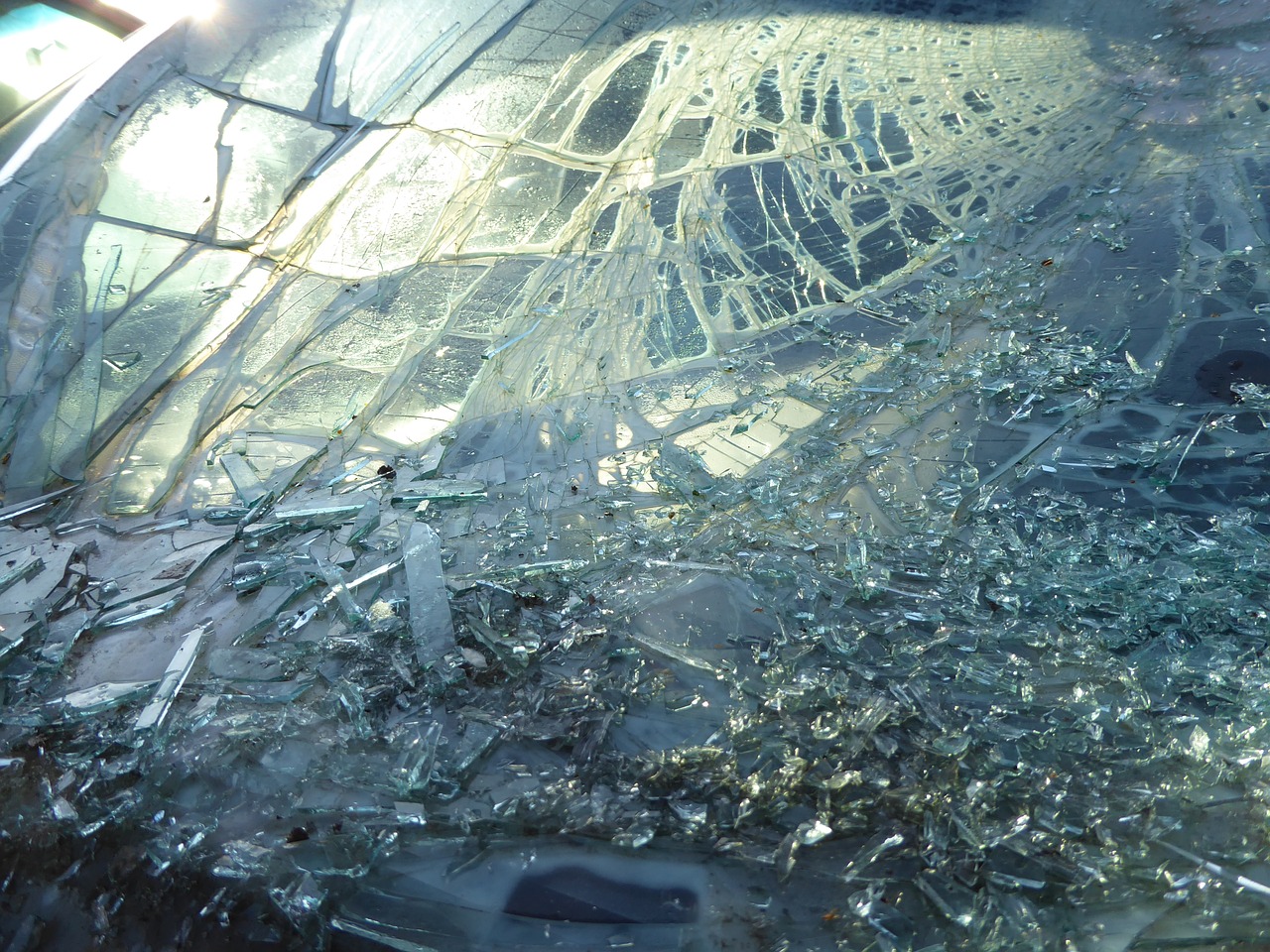
PRAY FOR THE BLAST / image by Amalie Flynn
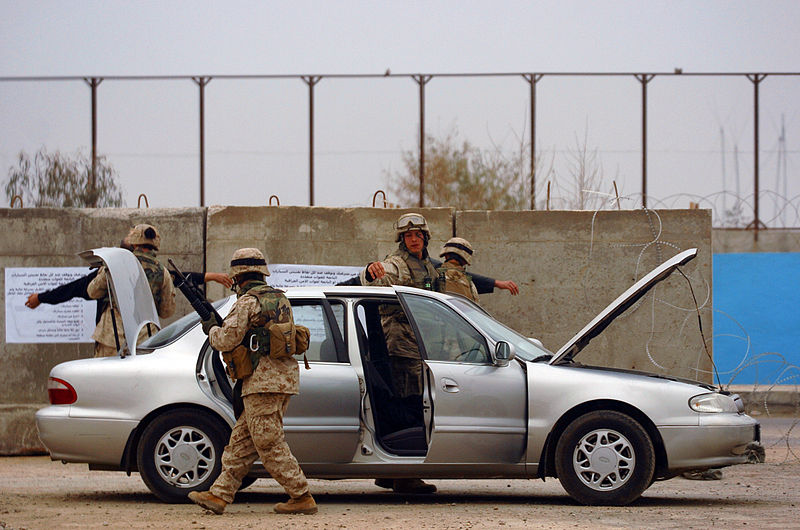
Checkpoint
The car came from nowhere, it came from everywhere –
white blur and tire squall, a four-door payload of heat and pressure and steel.
When it is over, there is just the tinkle of falling brass and a man slumped in a pool of broken glass and coolant on hot asphalt, calm as a corpse.
Doc cuts his shirt. His face is weathered by years of this. Layers of skin and yellow fat pucker from his open side.
He breathes.
In the trunk of the rusted-out sedan, where the bomb should be,
there are only two tanks, an oxygen mask, and a box filled with apricots and dates.
There are Four Ways to Die in an Explosion
First the blast rips limbs from the torso. Throws tender bodies against concrete walls. Pulverizes bones against pavement. Those closest to the bomb are never found whole.
Then the fragmentation. Little pieces of metal debris, like the one that punched an acorn-sized hole through the back of Sergeant Gardner’s skull.
Heat from the explosion starts fires. Vehicles Burn. Ammunition burns. People burn, alive. When a driver is trapped inside white-hot steel, prayers must be said silently for the smoke to take him first.
Pressure collapses lungs and bowels. The bleeding happens on the inside. It can be hours before the skin turns pale and the bulk of a person drops.
None of the anatomy is safe,
so when the time comes, pray for the blast or fragmentation. Pray for the heat that vaporizes. Pray for the kind of pressure that makes the world dark and silent before the bitter taste of iron and cold panic.
Good Friday, Udairi Range Complex, Kuwait
The first time I saw the sun rise over the desert it was 4 a.m.
Across miles of sand and rusted hulks, the throbbing of heavy guns echoed.
Over the horizon, where the beginning and the end meet and disappear, Friday arrived.
We saw the jeering crowds, the scourge and spear-tip, the crown of thorns and the crucifix, waiting.
What could we have known about atonement? What did we know, then, of judging the quick against the dead?
The Splintering Effect
Time is much longer when you’re sober, moments like molecules dragging into pixelated detail with nothing to dull the sharp edges. I sit quietly on the beach this morning melting into day. The river of time passes through me here. I’m new to this island and I’ve just learned of its ley lines. Some things are beginning to make sense now. It is late summer, the scorching off-season. Too hot for most, but still there is a small flock of sunlovers scattered over the shoreline. Languid in the heat, I am without my habitual bottled accompaniment. I’m learning to just be. Soft moments float by, the salt mist collecting in droplets on my skin, over the slick layer of tropical tanning oil. My heels burrow into the sand, pushing up little hills for my toes to rest. As I let go, the current of thought swirls around me, lazy carefree beach day thoughts. The moods of strangers drift through me as I allow myself to be unshielded.
Near me two women sit on a beach blanket, eating grapes and watching their small children play in the surf. A boy and two girls, they go to the same school. Their mothers chat about upcoming homework and soccer practices, the new school year to start in a few short weeks. I smile at them and they return it easily. We are warm with sun and the lightness of this moment. See there, I can do it; I can be with other people. It’s even nice sometimes. Then it happens; involuntarily part of me goes on alert. There is a hitch in the breeze. I feel a nearby lurking, a crawling gaze. Bristling, I scan to find its source.
A man sits in the sand, leaning back against the brick wall of the fort perimeter on the edge of the beach. He is about 15 feet from the moms on the blanket, they are his one o’clock. In one hand he holds a cell phone. His eyes flick back and forth from the people on the beach to his phone screen. He mutters erratically, as though he wants it to appear that he’s on a call. His other hand is down his pants, moving.
The old sensation comes to me, the air sucking out of the atmosphere, popping my ears the way it does right before a mortar hits. I’m in the channel again, not really me anymore. My eyes zoom in on the man; I would like my second glance to prove false. I want to be wrong. Show me that I’m wrong.
As his lips move, so does his hand in his pants. I dissect his sightline. The moms in bathing suits? No, it is not them he is watching. His eyes are on the children. The little boy is jumping in the surf and his trunks are half a size too big. They slide down slightly whenever a wave hits, exposing the curved bridge of tanned to pale skin. Up down. Up down. The man’s hand jerks in time.
Where before my blood would have roiled now it is frigid, coagulated. I am so tired. But this cannot be allowed to pass. Vaguely I sense the splintering of my consciousness. That other part of me will take over now, the part born in sand on the other side of the world. She does what’s necessary. Always. My real self recedes, watching but not in control.
Quickly and quietly I walk in front of the man and drop down to his level. I let the everydayness fall away from my face. Behind my eyes the reckoning thrashes, and beyond that a numb abyss devoid of remorse. He flinches and recoils, his hand snaking out of his pants. He tries to squirm away, but he is caught between me and the wall.
All around me are the instruments of an end. Do you see that bit of broken glass at your feet in the sand? It could slip so easily into an artery. This beach will absorb a river of blood, just as the desert did. And I will feel nothing.
Feet finally finding desperate purchase in the sand, he skitters away. I let him go. He flees, but not off the beach, only further down it. I walk back to the blanket and tell the moms, in case he returns. Horrified and irate, they call the police. The beach patrol officers arrive quickly. I provide a detailed description: Male. Age 30-50. Average height and build. I should have done more. Olive skin. Short dark hair. Clean shaven, possible 5 o’clock shadow. Why didn’t I do more? Cutoff shorts, possible khaki or bleached denim. Red sleeveless tank. Flipflops. There must have been something else I could have done. The spiked pit of revulsion is a lump I swallow down. It lodges in my stomach where it will stay to leach acid. I have never been able to master that physical reaction.
I watch the officers move down the beach in their uniforms, hunting over sand… Before starting their pursuit they asked me several times if the man had exposed himself. I told them no, but it was very obvious what he was doing. As I say this I watch them look at each other, these two cops. I know the silent language that passes between them. It says they won’t be able to do much from a law enforcement standpoint if the man wasn’t actually exposing himself on the public beach.
I trudge to my car. There is nothing left for me to do here. Rage and depression compete for me. Ancient memories slither up from my gut’s acid well, burning my throat on their way into my brain. My own and those I was made to see through the eyes of other soldiers on other sands. Bacha bazi… My people are tainted by the sins we were made to witness, in their seeing and their telling. Now I can’t stop seeing. My radar was long embedded but their stories strengthened its signal reception. I fear the condition is permanent. I don’t want to be the one who must notice these things. Over There I could shove a shiv into the cretin’s neck and dump his body in the Tigris. One predator down, no one the wiser and that village a safer place. No, that is a lie. I could do no such thing there or anywhere else. Still, the vigilante cravings come. Rage says burn them alive in a mass pit. Bleakness reminds me even if I could, there are always more of these unnatural beasts with eyes set forward. They prey on children, our doe-like innocents. And they exist in every country the world over. Why? What is their point of origin? How can their source be eliminated? Will our species ever fix this? If only enough of us could try… But I cannot be a sin eater anymore. I keep forgetting to remember that I gave up my uniform.
Soldier
An homage to Jamaica Kincaid’s “Girl” (The New Yorker, June 1978).
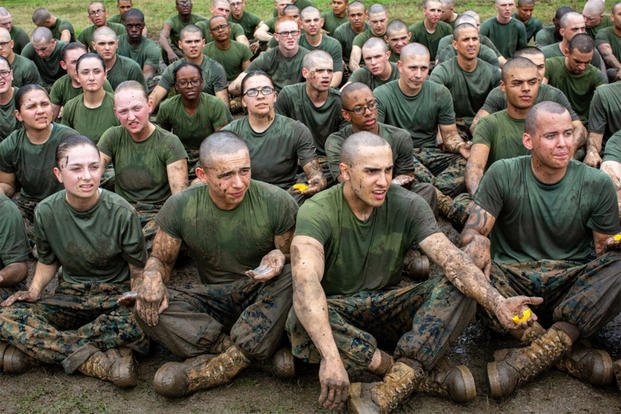
Recruits with India Company, 3rd Recruit Training Battalion, repeat back commands during a Marine Corps Martial Arts Program training session. (U.S. Marine Corps/Tyler Hlavac)
Wake up at oh-my-god-o’clock on Monday and run six miles; run another six miles at the same time Tuesday through Friday; to get night vision, keep one eye closed in a well-lit area and then open it in darkness; always field strip a MRE (meal, ready-to-eat), trade the veggie omelet but never the ChiliMac; when buying your dress blues, be sure to buy two sets in two different sizes, that way you can look sharp even if you lose ten pounds after coming back from deployment; Is it true that you desecrated corpses?; always have two designated marksmen for over-watch, especially when you eat; on Sundays let your subordinates rest, don’t wake them up early to watch beheading videos; don’t urinate on the enemy corpses; you mustn’t video record firefights, not even for your family; don’t feed the pack of wild dogs – they will follow you; but I never pissed on dead bodies and wouldn’t think to; this is how you perform an emergency tracheotomy; this is how you cut the trachea through the second and fourth ring then quickly shove the tube through it; this is how you call for a MEDEVAC and prevent yourself from pissing on a dead body like you’re so hell-bent on doing; this is how you disassemble your weapon; this is how you clean your weapon; this is how you lube your weapon, but not so much that it attracts sand and grit; this is how you construct a Burn-Out Latrine – far from where we eat and sleep, because human waste harbors diseases; when you are conducting your daily burn out, make sure to use plenty of diesel fuel to incinerate the fecal matter; this is how you clear a room; this is how you clear a whole house; this is how you clear a village; this is how to interrogate a subordinate; this is how to interrogate a detainee; this is how to interrogate a terrorist; this is how you ask for tea in Arabic; this is how you ask for tea in Dari and Pashtu; this is how to behave in the presence of tribal elders or sheikhs who don’t know you very well, and this way they won’t recognize immediately the corpse-urinater you were warned against becoming; be sure to do hygiene every day, even if it is with baby-wipes; have a plan to kill everyone in the room – you’re a warrior, you know; don’t drive over or step on fresh asphalt – you might trigger a buried IED; don’t throw stones at IEDs, because it might not be an IED at all; this is how to call for fire; this is how to win hearts and minds; this is how to conduct an ambush; this is how to conduct a raid; this is how to kill a child before it even becomes a terrorist; this is how to conduct peacekeeping missions; this is how to stage a scene, and plant evidence and get away with it; this is how to snatch and grab; this is how to torture a terrorist; this is how you torture yourself; this is how to water-board someone, and if this doesn’t work there are other ways to make them say what you want, and if that doesn’t work you haven’t improvised enough; always accomplish the mission; but what if I can’t accomplish the mission; you mean to say after all this indoctrination, you are really going to be the kind of soldier who let their country down?
Artist Profile: Larry Abbott Interviews Musician Vince Gabriel
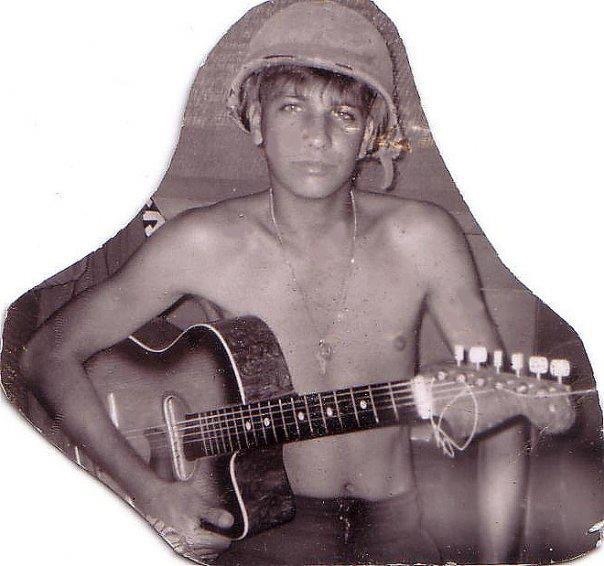
INTRO: Vince Gabriel has been making music since his high school days in New Jersey. Born in South Amboy on September 16, 1947, he learned the guitar after his father brought one home. Influenced by the rock music of the early and mid-1960’s, The Rolling Stones in particular, Gabriel played in rock bands in and after graduating high school. He was drafted in 1967, completed basic training, and deployed as an infantry man, 11 Bravo Vietnam, in January 1968, arriving just before the start of the Tet Offensive. He soon found himself in the jungle, engaging in his first firefight after only a few weeks in country. He bought a beat-up guitar, and a photo from 1968 shows him in his helmet, cradling it, M60 style. He notes, though, that he never took the guitar on patrol but that it traveled with him to base camps, where he would play with some other guitarists when he was out of the bush.
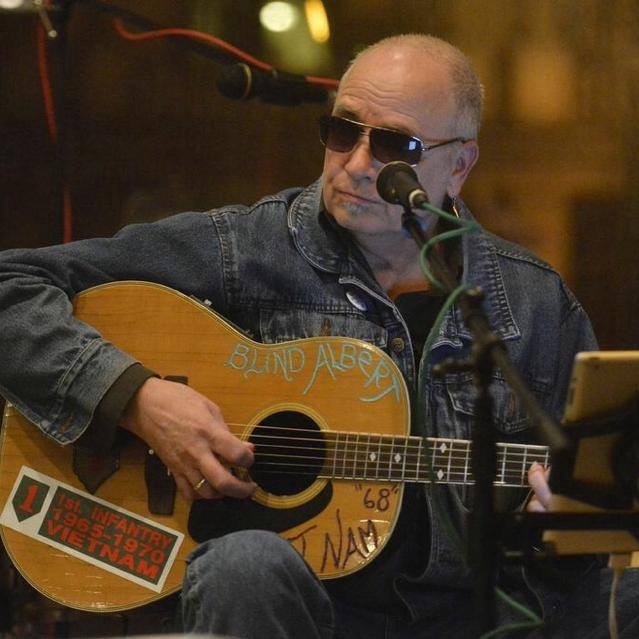
Gabriel kept playing music when he returned stateside in 1969. He lived for a time in Connecticut, California, and Massachusetts, playing in clubs, working with “name” artists, and becoming more serious about his music. After moving permanently to Maine in the 1990’s he rejuvenated his Blind Albert persona and formed the Blind Albert Band.
In 2000, he released the CD 11 Bravo Vietnam, which chronicles his war and post-war experiences. Liner notes dedicate the CD to his brothers in arms Howard Spitzer, Richard Gibson (“Spitzer and The Winemaker”) 1, Nicholas Saunders, Robert Caplan and “all those who gave the ultimate sacrifice and to all veterans who served.” The album served as the foundation for a documentary he created a few years later, 11 Bravo Vietnam—A Soldier’s Story, which he calls “’a virtual scrapbook of one young man’s experience in combat from the day he receives word of his induction to his homecoming.’” 2 The song “Draft Card” is emblematic of his irrevocable life change, happening virtually overnight, from playing music in California after high school to receiving his induction notice and going to basic and infantry training. “Spitzer and the Winemaker” is a first-person recounting of an episode in which Gabriel is rotated off point with Spitzer taking the lead with Gibson. As the patrol moves out, with Spitzer and Gibson a hundred or so yards ahead, they hear an explosion. They learn that Spitzer and Gibson walked into a minefield, with Spitzer killed and Gibson wounded. “Homeward Flight” is an instrumental; words aren’t needed to express the relief of riding home on the “freedom bird.” The album concludes with the plaintive feel of “Beneath the Shelter” and the relentless bass line of “Shellshock—PTSD” (included on CD 13 of . . . Next Stop is Vietnam). In the former, Gabriel takes on the persona of a homeless vet telling his story. He says that “I died inside but kept on living.” He realizes that there will be “no more parades with ticker tape or marching bands” and that in society’s eyes “I’m just a wino.” In the latter Gabriel describes the personal effects of the war: his divorce, the inner demons, the reliance on “weed and whiskey” in order to get through the day. He sings in the refrain that “the war never ends for the soldier, you come home and it all just begins.”
In 2002 he released an eight-cut CD entitled Boyish Man (playing off Muddy Waters’ 1955 song “Mannish Boy”), on which he played guitar, harmonica, and percussion, as well as doing the back-up vocals. The album is more straight-ahead rock and blues with no ostensible references to his military service. Gabriel, at 72, continues to write songs, and perform solo and with his band. He has his own recording studio with which he produces the albums of other musicians.
Hugo Keesing, . . . Next Stop is Vietnam: The War on Record: 1961-2008, Hambergen, Germany: Bear Family Records, 2010, pp. 238-239.
Larry Abbott: In We Gotta Get Out of This Place, Bradley and Werner write, “music is a path to healing. Music can help heal psychological wounds.” 1 Does your music have a therapeutic or a healing dimension?
Vince Gabriel: Well, my music was written about my experiences in Vietnam, so I don’t know how therapeutic that would be. The concept for the CD (11 Bravo Vietnam) was to give someone an idea of what it was like without actually being there. I mean, that was the only way I could pass that information along. When I give someone the CD, I say, “You don’t want to play that at a party, if you’re trying to get the party going.” [laughs] Because it’s not party music. It’s about being in combat, and it’s basically about from the time I got my draft card until the time I came home. Each song is attached to whatever I was going through at the time. I do believe that music is a soothing method of dealing with stuff, but I wouldn’t consider this soothing. It’s more of an audio documentary, I would say. You can put it that way.
LA: Your songs tell stories, as you mentioned. Do you consider yourself a storyteller?
VG: In this regard, I do. I’ve written a lot of songs from experiences, not only Vietnam, but just life experiences. Some would tell a story, but I’m basically writing about feelings, and I don’t know that that tells a story or not, you know? But the Vietnam CD is definitely a story. A true story.
LA: One thread or dimension in your songs is social commentary, like “Land of Dreams,” “The Common People,” and “Hey, You,” which seem to reference more of what’s happening in the world today, like global warming or government lies.
VG: Yeah, I guess I could call them protest songs, about what was going on at that particular time, the early 90’s. It’s just my way of putting out how I feel without actually getting on Facebook and ranting and raving. [laughs] ‘Cause that doesn’t work sometimes. I would say I’ve got five or six songs that are similar to that.
LA: How did those songs come about?
VG: There was a period of time I was writing when I wrote those types of songs because I figured, I got to get some stuff out because it’s really bugging the hell out of me. They were just a commentary on what was going on at the time. “One Way Street” took in a couple of subjects: veterans, the oil, fighting for oil. Every one of those, my protest songs, came from a need to get those feelings out. The best way I know how to do that is to write a song about it. That’s how that stuff came about. I don’t know if anybody liked what they heard, or how many people listened, but it was important that I put it out. If somebody got something from it, then that’s good.
LA: In some of those songs you have a female chorus, “We need hope . . . we need the promise that things will change.”
VG: Well, actually, the female chorus was me. [laughs] I just sang in a really high falsetto voice. I didn’t have time to go looking for a female singer. I don’t think I knew too many at the time, so I figured well, I’ll just do it. And so, it’s kind of a joke because I go by the name of Blind Albert. I call them the Blindettes. That’s my backup singing group.
LA: On that note, how did Blind Albert come about?
VG: Well, this isn’t a really long story, which is good. I used to live in Cape Cod before I moved up here and I had a studio in my apartment. I was working on a blues project. I was writing blues songs, and I needed to come up with a fictitious blues name for it. My middle name’s Albert and I needed something in front of that. I didn’t want to be Deaf Albert or Fat Albert, or any of these others. I figured Blind Albert. That sounds like a blues guy. I used it for that project, but then I didn’t use it anymore.
Not too long after that, in ’89, I moved up to Maine because a good buddy of mine who I had played with back in the ’70s was living up here. I moved out to Islesboro, and kind of aired out for about a year ’cause I had just gotten a divorce, and I needed to regroup.
I didn’t play music for about a year. I didn’t play in clubs for that year. I started to gradually book stuff, and realized I couldn’t stay on the island anymore ’cause I was off the island more than I was on the island, playing. I put a band together and needed a name for it. Blind Albert was in mothballs and I figured, hmm, Blind Albert. I had already come up with that. I might as well use it.
And so I started to use that. And the funny thing about it is, because of the name, everybody pegged me as a blues artist. That’s still the case now. But I do play some blues, but I wasn’t originally a blues artist; I was a rock guitar player and singer, which I still am.
LA: I think you’re known more as Blind Albert than Vince Gabriel.
VG: Oh, that’s true, because I’ll be talking with people and mention that I play in a band. And they’ll say, “What band do you play with?” I’ll say, “Blind Albert.” “Oh, I saw you guys in Bar Harbor a couple of years ago, yeah.” And if I told them my real name, they wouldn’t know who the hell I was. So, I’m kind of stuck with it. I’ve been stuck with it for 25 or 30 years now.
LA: What led you to making the 11 Bravo Vietnam documentary? You intersperse your songs with narration and images.
VG: I was actually asked by a friend of mine, who was in college at the time, if I would mind if she interviewed me about playing music in Maine. I said sure, ’cause this was a project for her and I figured I could help her out. 2 During the course of the interview, the subject matter turned to Vietnam, and it was eventually called “Vietnam Blues.” I didn’t really give it much thought. She told me that she had sent the interview to a couple of radio stations. I just said, okay.
And then, about two weeks later, she contacted me and said that there was a public radio station in Idaho or somewhere that wanted to broadcast it, and I said well, that’s good. I still didn’t take it seriously. Then about a week later, she said, “We hit the motherlode.” I said, “What do you mean?” “NPR picked it up on the Sound Print program. It will be broadcast all over the United States.” And that’s when I started taking it seriously.
I began to get emails from people I didn’t even know about that piece. I was overwhelmed by the response. I just thought, this is her college project, no big deal. But because of the broadcast I put a live performance together based on the songs on the Vietnam CD and then I decided to put together a documentary
The band rehearsed, I don’t know, for two or three months. A buddy of mine who’s a drama teacher took snippets of notes that I had written about everything I could remember about Vietnam. I had notebooks full of notes. I didn’t know what I was going to do with it, I just wrote it. I just kept writing until I couldn’t remember anything else.
When I started to put this performance together, I figured, well, now I know what I’m going to do with all that stuff I wrote. I’ll take parts of what I wrote that are kind of connected to the songs and we’ll get a narrator and have him narrate each portion. They were only about three or four minutes long, and we’ll play the songs that are related to the narration. Then we’d go onto the next song and he narrates that. The performance continued through all of the songs.
So, I booked the theater in Waldoboro [Maine] and told them I got this thing that I want to do. I don’t know how it’ll turn out or if anybody will even care. We did some advertising and while we were at the theater getting ready, I’m thinking nobody’s showing up ’cause it’s about Vietnam. I said, who’s gonna care? And before I knew it, the whole place was full of people. [laughs] So, I said man, there’s like a lot of people here. I hope we don’t screw it up.
We went out and played. It went off pretty good. I got such an overwhelming response from the audience that it was like an emotional moment. I had thought, nobody’s really going to give a shit about this. As it turned out I had veterans coming up to me who were in the audience who said you got to keep telling this story.
So I thought, okay. I don’t know how long it was after that, I got this brainstorm about bringing the show into the high schools. But because the performance was so long, it was over an hour and a half, the live performance didn’t really work in that setting. What I decided to do was shorten it and make a documentary that was about an hour long.
I started to contact some high schools, and wound up going into four or five. I went to a school in Thorndike [Maine] like five years in a row and showed the documentary, and then I would open it up to questions. I said, you guys can ask me anything you want about Vietnam, I don’t care what it is. You want to ask me about the drugs, I’ll tell you about the drugs. I said, there’s nothing that you can’t ask me. That was the best part of the whole thing because we were all interacting with the story. It was great. I loved it.
So that’s how the documentary came about, the DVD version. I did the live version maybe four or five other times in different places. After I put the documentary together, I kind of slackened off with the live performance. I might still do one, but right now I’m not. But I do have the documentary. The documentary is still available to do something with. 2
And that’s how it all came about. It’s kind of a roundabout story.
LA: It was a long story short, or a short long story.
VG: Yeah. A long story long, or something. [laughs] But, yeah.
LA: In “Spitzer and the Winemaker,” you ask, “Why am I here and his name is on the wall?”
VG: Right.
LA: And you pose some reasons: luck, skill, karma, God. But then say, “nah.” Have you answered that question, or is that an unanswerable question?
VG: I guess it was all of those. I don’t know. I mean, it could have been any one of the guys or all of them but I still don’t know. Usually I tell people I’m just happy to be here.
That’s how I answer the question because I’m just happy to be here, man. ‘Cause I could not be here. A split second could make a difference, you know? I think it must have been all of those reasons ’cause I don’t think just one of them would have got me back home. I guess something was working for me. And I don’t know what it was, but I’m glad that it did. I’m glad to be here.
LA: You see that frequently not only in the writing of the Vietnam era but also today’s wars, the idea of randomness, pure chance. You step here and you’re okay, but your buddy steps there and he gets blown up.
VG: Yeah. I guess that’s why I ask the question why I’m here and he’s not? There you go back to the luck thing ’cause it had nothing to do really with skill. Well, some of it. A little bit of skill was involved because the guys who were there longer than I was would tell you, for example, don’t walk on the path. You want to listen to what the hell they’re telling you.
A small amount of skill and a large amount of luck, because my buddy, Spitzer, was killed when he was walking point. There were occasions when I also walked point, but not that day. You question why, why that happened. I don’t know why that happened. It’s just the way it worked out. It’s a matter of stepping in one spot or not stepping in another spot. Or being told to walk point that day but not being told to walk point another day.
I don’t know what you call that. That’s a random act, I guess, or happening, event, or something. But you’re going to stop and wonder why it was Spitzer and it wasn’t you, you know what I mean? That’s just the way it was.
LA: Do you see your songs as having relevance or connection to vets returning today?
VG: The wars are different, but I think all the veterans and those involved in the wars now are going through the same thing. You might be fighting house to house, like they do in Iraq. When we were fighting, we were in the jungle, going through hooches. It was different but it was the same. You still didn’t know if you were going to get injured or if you were going to get killed from one second to the next. You were still in combat. It doesn’t matter the place; it was combat. You play it, no matter how you look at it.
And the other thing is the problems that you suffered after you came home were the same. PTSD, suicides from PTSD, whatever. If you compare everything, they’re pretty similar.
The wars were different, but I think some of the things that occurred to each veteran who was in these different wars were really the same thing. A bullet can still kill you. That isn’t any different.
LA: To me, one of your most moving songs is “Beneath the Shelter.” It seems to be more generalized about homeless vets, but you sing from the “I” point of view. And one of your lines is, “Yes, I am a veteran. I died inside, but I kept on living.” In the documentary you connect the song to the art of Derek Gundy. Can you talk about that connection and how that song came about?
VG: Well, that had to do with the homeless veteran situation, and it was a while back when I wrote that song. The situation is still going on today. I mean, it’s a major problem. I’ve never really been homeless. There were some times when I didn’t have a place to live for a little while, but basically I was trying to put the information out that there are veterans who are homeless, that don’t have a place. It’s a long-lasting problem. I wanted to put that information out in a song. Maybe it will have more impact than just presenting statistics.
And Derek, who is a great artist, asked me if he could do a visual rendering of the song and I said, yeah, you can do that. He did a great job.
I didn’t have any statistics when I wrote the song. But I knew there were homeless veterans out there. I placed the song in a scene, under a bridge. There are all kinds of reasons for people to be homeless. And they’re not all alcoholics.
The plight of homeless vets was something that bothered me and I decided to write about it. I guess that’s what it boils down to.
LA: What’s your general process of writing a song? Do you have a rough idea and then keep honing it until you get to a finished product?
VG: Well, for me, I need to write the music first. Some people write lyrics and then put music to it, but I can’t do it that way. I need to come up with an emotional connection with the music. The music is what connects me to song.
Even before the lyrics, I need to come up with the music. Then, I’ll write how I feel. I need to feel the emotion first and it’s the music that I get that from.
LA: Another song that I thought was one of your best had a bit of a reggae beat, “A Camera and A Curious Mind,” where you write, “Once Vietnam gets in your soul, it keeps you coming back for more. The sounds you hear, the smell of death, the images you can recall.” And you retrace the steps in your mind, and toward the end of the song, there is the sound of a helicopter.
VG: A gentleman asked me if I could write a song for this short documentary that somebody did about him. He was a Vietnam vet and a photographer. I watched the video and took it from there. I wrote the music first and then I wrote the words.
It’s something that, after you write it, you’re not really sure how you came up with it. That’s always a mystery to me how that happens. I don’t know where it comes from. He liked the song. I wrote it and recorded it in one day, and I gave it back to him.
He asked me, “How long did it take you to write this?” “It took me a day.” And he says, “You’re kidding me?” I said, “No, it took me a day.” I said, “There’s the song. Do you like it or not?” [laughs] And he did. I did it to see if I could do it. That’s how that song came about.
LA: You have a song, “Shellshock – PTSD,” with the idea of the war lasts forever. Could you talk about how that one came about?
VG: I think what triggered that was not necessarily my experiences, but the experiences of the veterans who were in Iraq and Afghanistan. It definitely has to do with Vietnam, too.
It was probably the last song I wrote for the CD. It came a long time after I got back from Vietnam. Having PTSD, but not suffering as much as some Vietnam vets do, I mean, mine was bad enough, and it’s still bad enough ’cause I’m taking medication for it, but it was a subject that I had to write about because I hadn’t written about it.
I needed to write something, I needed to write my feelings about that subject because I hadn’t done that. Until I had, the CD really wasn’t complete.
Before I wrote this song, I thought, oh, it’s missing one thing. It’s missing the residuals that come from war and that we’re all, you know, all of us who were in combat, are going through right now. The residuals are part of the whole tour.
A buddy of mine made a comment, “We had no idea that our tour was gonna last a lifetime.” And I said, “Yeah,” and asked him, “Can I use that?” [laughs] And he said, “Sure.” So I did. It opens the documentary.
But it’s true. There’s the coming home part which, believe me, I was overwhelmed and overjoyed to be back alive. But then, there’s all the other stuff that starts coming up after you’ve been home.
And you deal with it every day, and that’s like still being on tour. You’re not getting shot at or anything, but mentally you have a lot to deal with. You’ve been affected by it. You know, we’re all taking medication for it. Some have it worse than others. Some of them have committed suicide because of it.
So it’s really an ongoing tour, mentally, and maybe even physically, too. Not in the true sense of being over in a combat situation, but you’re fighting, you’re fighting this stuff every day.
LA: One of the other threads I see seems to be about relationships and love/lust. “There’s Always Someone Out There,” “You Started Something,” or “Four Alarm Fire.”
VG: What’s really funny about that is, I don’t know what happened. My voice somehow changed. I have no idea what caused it. Well, I might have an idea about what caused it. I might have been smoking weed at the time. I don’t know if I should say that, but, uh, that’s what happened. And it changed my voice.
All of a sudden, I could start hitting these higher notes that I couldn’t before. That’s where that group of songs came from. And I can’t duplicate the vocals on them now because I don’t smoke weed anymore. My voice is back to where it should be.
It was just a period of time where I used that voice change and took advantage of it, and wrote some songs that I could sing in that way. It was the weirdest thing. I don’t know where that came from, but I can’t duplicate it anymore. [laughs]
I don’t know that those songs were written about anything I had been through, but they were just, you know, thoughts.
I put those thoughts to music. I don’t even know where this stuff comes from, you know? It’s better not to try and come up with an answer to that. [laughs]
Bradley, Douglas, and Werner, Craig. We Gotta Get Outta This Place. Amherst: University of Massachusetts Press, 2015, p. 2.
National Public Radio Soundprint “Vietnam Blues,” produced by Christina Antolini, December, 2004, aired January 2005, https://beta.prx.org/stories/3436
New Poem from Nazli Karabiyikoglu: “Hymn: A Coffin at the Gates of Topkapi”
COLD SONGS / image by Amalie Flynn
The head, decapitated, it sits on a shore, at some corner of the world. Desperation is what they feel as blood gushes out from the half-neck. Death, however, has always been there, nothing new, an enslaving event. The name of the deal was predefined – “flight”. It has been around since the Order of Assassins. Part of us see the beauty in all this, even when the tortures last till the moon starts to shine over us. Sir! There you lie, your frail length almost pours out from the bed. And here I am, by your side, barren inside, yet my mind replays a moment with you, where you feed me freshly-picked strawberries. My worst nightmare is finding a way into my life, into you, through your flesh and bones yet my heart replays a moment with you, where you dress me with freshly-picked strawberries. Sir! Many calls for prayer have been sung. And here I am, can’t look away. My devotion may be in vein, but what I’m losing now is transcendental. You missed most of it, as they held a mirror to your nose and checked if you still breathed. So beautifully you lay there. Before this fate, I was as effective as a human shield. Here I am, bitter as rock, by the frilled duvets, thinking how we must keep you alive and not sickly-yellow and quiet like this. See? I’m here by the frilled duvets, ice cold, thinking how I crave to coil up next to you. Sir!
We finally made peace with death. First our eyes watched the floors, then our fists beat our chests. Distances reached, horizons obtained, flasks of scarce water and worn sheaths. Almost everyone lost their sons to this war. Our sons. Our people. They believed in the protection of their shields and wanted to go as far as it got them, is that why we say our hymns for our sons, on and on for days? Is this our fate?
I decided I’ll surpass fate and kismet and luck or whatever. So here I am, standing before that reckless hope. I grabbed it by the chin, pushed it against a wall and I let anger take control. I asked it, and I was quite sincere about it too, “How is it that death gets in?”
The way you put your head on my head, lifeless, breathless, heavy. Your word is my law, and I stand by its chime. With largest oceans behind my back, you were my creation, and I gave you away. Your first steps, your first words, have been my challenge. And the way you put your shoulders on my legs. Sir! Greatest storms whirled inside me, and, oh, I prayed to the Almighty; to His holiness, I presented all of my organs, but they pulled out my womb, or what’s left of it, and even then, all that mattered was you, sir.
Something penetrates, once, twice, my spleen watches it happen, smells pleasant, like linden, my favorite, something to go for a child is being created, from the char of my liver, my flesh puffs, my flesh grows fat, count those things that penetrate me, arms maybe, one, two and three, stop there, stop at the second syllable of my name, I did not do this to me, I did not choose to carry this burden
Beings must produce, yet I’m barren inside. Your look is my law, and I stand by its tingle. With vastest moors behind me you were my darling, and I gave you away. Your first words, my sultan, your highness, have been my challenge. Beings must produce, yet I’m barren inside, and you’re lovely inside. That’s what you said
All this glory and all these gifts, what use do they serve, I pondered for a long time and I could not find the answer. I knit for a long time, laces and wools too, wore them in the cold maroon rooms of this palace, in the cold of my own body, cold, songs were cold, my violin was warm, only to me. They took me right away, and no surprise there, I was pretty, I stayed quiet when they split my legs, but I’m known for kicking quite hard. How funny, the way things change so much so fast, we were a thousand and now I’m just one, do the winds always bring injustice with them or does it travel in the pockets of soldiers?
Crying my lungs out, biting my tongue, fires scorching my stomach,do these all go together for me now? Or have I just comprehended death and broken apart while at it? If we can’t breathe where the dead go, tears can flood, for the duration of the earth’s age even, quail with rice or grape compost. He found his place in the history books as did I. It takes courage to stand before a dagger; I did, I stood still as a brick and I shed tears. If it wasn’t for your shadow, I’d call you my child, my life, my signature, the one that makes me get lost in those oceans. Don’t be hurt, because I’m ordinary, I think you’ll outlive me. You’ll have no idea though how we managed to get that life out of you. I bit my tongue, held back at every chance, and saved the pain along my spine. My womb dried off and shrunk, they pulled it out, but I will not give up on your scent. I yearn for your chest to rise up to the highest, for you to take one deep breath. If it wasn’t for your soul, I’d call you my child, my flesh, my bone, the one that makes a prisoner out of me. Don’t be hurt, because I’m ordinary, you’ll outlive me. I think I see the blue of your eyes again, yes. You’ll have no idea though, what getting that life out of you cost us. I bit every part of me within my reach, saved the pain deep in me. The nightingale dried off and shrunk, they pulled it out of me, but I will not give up on you. How hard it was to bring you to life! If it wasn’t for your soul, I’d call you my child.
Sign off my sentence, my tears are my sin. Tightly tie the rope around my neck and tightly tie a knot to the rope that goes nowhere.
Translator’s Note: The story, although fiction, sits in actual history, and gives us some pointers towards having an understanding of era and geography. Topkapi Palace is in modern day Turkey, and was mostly used as the emperor’s residency during the Ottoman Empire’s rule between 13th and early 20th century. The Order of Asssasins, Ḥashashiyan or Ḥashīshiyya, was a radical Nizari Isma’ili sect that assasined Muslim and Christian leaders before that time period. The ordeal of flight, as in the work towards enabling humans to fly by any means, caused controversy in the Muslim world in the past, since it is simply unnatural for humans to fly, but attempts are encountered in Ottoman history. The story, too, is likely placed in a time period where such attempts stir political balances.
Praying at America’s Altar: A Review of Phil Klay’s MISSIONARIES, by Adrian Bonenberger
One of the first books I read was given to me by my father, who got it from his father—a children’s version of the Iliad and the Odyssey. Opening the tome in the garret that was our home, I’d be transported to the vastness of Homer’s Aegean. A giant tome that has fit awkwardly on my bookshelf since, the book’s pages demanded effort and dexterity from my young arms, each revealing some new story or chapter in the war between Greece and Troy, and, later, Odysseus’ long and tortured return to Ithaca.
Beautifully illustrated by Alice and Martin Provensen, the book has a distinctive look that was clearly intended to evoke black-figure and red-figure paintings found on pottery from Greece’s Classical period and earlier. Illustrations often take up more than one page, with action swirling from left to right, and back again, a chorus between the characters, achieving an effect on the viewer not unlike that produced when walking around the urns and amphorae that unfurl stories of Achilles, Hector, and clever Odysseus in museums today.
Greek heroes and their divine allies disembark from ships on the lefthand page and make their way toward Troy, populated by its heroes and overwatched by the gods who favor Troy.
A two-page spread early on in the book introduces the characters together, more or less in context. The pro-Greek gods are arrayed on the left, above the Greek ships, while Greek heroes form a single-file line walking rightward across the page and onto the next, where they encounter the Trojan heroes and other significant Trojan characters in a stylized building. Above that building float the gods who support Troy.
It is a childish device, to introduce all of the characters immediately, and in their context, but this is a children’s book. On those two pages, which almost serve as a glossary, I spent much time—either flipping back to cross-reference my understanding of a particular event, or simply to understand who fit in where with which story. With all of the love and care that went into building this book for children, it is not surprising that a war or wars that occurred nearly three thousand years ago remain entrenched within cultural memory. Indeed, they have come to form a great part of the literary basis of western civilization, and helped shape my own development.
***
Phil Klay’s Missionaries does not introduce its characters all at once, in part because Mr. Klay assumes that his readers are not children who lack object permanence and are capable of holding thoughts in their heads for longer than a minute. Instead, Missionaries offers a sophisticated narrative template, the shape of which organizes further chapters, and accomplishes the goal of stitching disparate storylines and characters together. The point of this device is to bind the journey of its characters together thematically—to create a plot driven by ethical choices rather than linear, temporal accident.
In this sense, Missionaries occupies a place in western literature most sensible to readers 100 years ago. It is a modernist book: things happen for reasons, and rewards are organized around a central ethical framework. It is a moral book: the bad come to bad ends or are thwarted from achieving their plans, and the good are afforded some measure of satisfaction through their choices.
The first character readers meet is a Colombian child growing up in the rural south. He’s devastated by war, a kind of avatar of victimization, losing his parents and home before being rescued from the streets by a Christian missionary. The story moves back and forth between this child’s evolution into a criminal during the 1980s and 1990s and the life of a female conflict journalist covering Afghanistan in 2015.
Klay focuses on these two characters’ arcs in the book’s first section. Later, the story expands to include others—most significantly a special operations soldier who goes into the intelligence sphere, a former U.S. soldier who becomes a mercenary, a paramilitary leader turned drug lord, and a well-bred Colombian officer from a military family and his wife and daughter.
The final section of Missionaries, its denouement, is satisfying in a way that many modernist books are not. Klay avoids the impulse to “get cute” with the story—each of the characters is treated with dignity and respect, even the characters who make bad and selfish choices with their lives, and each one of their endings feels earned. When the journalist is presented with an opportunity to sleep with the mercenary—the two had been in some sort of romantic relationship in the past—what happens between them is both natural and surprising. The Colombian child turned criminal discovers an opportunity to atone for his choices, and how he takes advantage of it is perfectly in keeping with his trajectory.
***
Missionaries carefully avoids endorsing a particular perspective or world-view, which is refreshing given the contemporary moment—characters are rarely driven by politics, nationalism, or philosophy. Perhaps it can be said that Missionaries is not anti-religion. The moments when many characters are at their most empathetic—moments that cannot be discarded later when characters behave selfishly or with cruelty toward others—often involve grace. The hidden hand of God is often seen deflecting or guiding bullets, presenting paths toward redemption, and, ultimately, offering mercy. Not every character takes the redemptive path, not every character accepts the mercy that’s offered. That is part of life, and Klay has represented that sad, tender part of the human experience well. Any adult, looking back over the scope of their lives, will easily find some regretted words or choices, a chance at grace missed. Klay’s characters, too, are beholden to but not quite fully owned by previous choices to a greater or lesser degree that’s magnified as successive generations within a family make choices that accumulate as the years pass.
This is most conspicuously true of the Colombian officer’s family. The officer, an ambitious, cultured lieutenant colonel, has himself been affected by the political and military choices of his father, a disgraced general accused of war crimes carried out by soldiers under his command. This is explained as part of the country’s fight against the FARC, a far-left communist insurgency group aligned with and inspired partly by Che Guevara. The effects of this longtime war are already known to readers, having been described in the book’s first chapter, when the Colombian boy loses his family and village to fighting between the left and right, and the confusing criminal violence that arises in between. By the time the Colombian officer has a daughter of his own, Che has become a popular figure in the capital, a counter-cultural icon, a symbol of South American independence. His daughter has become enamored of a worldview in which the Colombian military is at best a handmaiden of American imperialism, and the FARC a kind of quixotic rebellion against that foreign (to Colombia) influence.
The hard work of the lieutenant colonel’s father to do what seems right at the time—to battle the FARC—has become politically embarrassing, a liability during a time when political leaders are attempting to negotiate peace. The lieutenant colonel’s own work training special operations to American standards in the war on drugs similarly comes to no spiritually uplifting end. But it is impossible to see what either man could have done differently in their lives.
Klay weaves his characters’ arcs together slowly and imperceptibly, or reveals that they have been interwoven all along until all that is left are imperatives to act one way or another, selected out of expediency or faith. Those selected out of the former tend to elevate characters professionally, while further ensnaring them in some greater, obscure plan—one operated or funded by the United States. Those selected out of the latter receive some sort of completion or absolution, and depart from the story.
***
Here is the essence of Klay’s project. Using fiction, he has sketched out an investigative piece no less important than the Pulitzer-Prize winning “Panama Papers.” The contours of the book outline a series of behaviors and practices that, collectively, both define and circumscribe human action—what might, in previous centuries, have been understood as “fate.” The characters inhabit those patterns, unconsciously, living out their lives and loves as best they can. Religion factors into this equation, as does class, ethnicity, sex, nationality, and gender. But the patterns run deeper, and are not accessible to the characters. Envisioned, felt, like some transcendent explanation to which none have access, the truth is exposed only to readers, like a divine boon. The name of that truth is “The United States of America.”
Eventually, everything in Missionaries returns to the U.S. In mysterious ways, everyone gets drawn into America’s orbit of wars and machinations—the War on Drugs, the War on Terror, the various named and unnamed contingency operations sprawling from sea to shining sea. A story that begins in Colombia ends, improbably enough, in an air-conditioned tactical operations center in Yemen. The role of some is to cover the wars, to write about them. Others create the wars, participating in their function as soldiers or officers on one side or another. Others yet fund them, or support them from afar. In this sense every American is a “missionary,” and everyone who ends up taking a side, participating in the great global competition for influence, whether by birth or by choice, is a convert. America is its own God, its own religion, at least when it comes to the everyday, the mundane. America is the context in which violence occurs, America is the bad end of the deal that gets offered to you at gunpoint in some destitute village; America is a romantic liaison in a hotel room with a trusted confidante; America is the family waiting patiently in Pennsylvania or Washington, D.C. America can get you into trouble, but it will get you out of trouble, too, if you suit America’s obscure purposes. America is not grace—America is the novel itself, the entire complicated project. This is not political, it’s not “anti-American” as some might say; it is, as Klay has presented it, a simple and unarguable fact at the center of everything happening in the world today as we know it.
***
My grandfather was a diffident socialist. Largely apolitical, anti-war, having served in WWII, his socialism was the quiet, humanistic sort that started with certain fundamental assumptions and extrapolated from them ways of behaving toward and around others. The only time I recall him being worked up about a particular issue in a political way was to oppose my applying to West Point, threatening to disown me if I attended (who’s to say I would have gotten in? I didn’t apply).
Reading Missionaries, I realized that attending Yale was no different from attending West Point, on a certain level—or Dartmouth, where Klay went, or USC, from which my grandfather graduated thanks to the GI Bill. These places are, essentially, the same, in the way that Iraq, Afghanistan, Colombia, Yemen, Venezuela, China, and America are the same, aspects of a megalithic overarching schema. Socialist, capitalist, communist, religious, atheist, opportunist, everyone inhabits some niche that feeds back into the center. You make choices—attending Yale or West Point or neither—and you live by them. You end up in a war zone, writing about it or fighting in it. Or you pay taxes, run numbers, open a small business, and your tax dollars are spent chasing the traumatized products of war from farmhouse to untenanted farmhouse. Missionaries is about the wars, yes, but because the wars have come to define so much of what is and what we are, whether we like to talk about that or not, Missionaries is us, it’s a 21st century Middlemarch, a 21st century Iliad.
Having spoken with my grandfather at great length while I was in university, and talked with him about his military experiences once I joined the Army, I feel confident that he would have loved this book, and seen in it as much value as the Iliad and Odyssey that he gave to my father. I enthusiastically recommend this to my grandfather, although he passed away thirteen years ago—his aesthetics led him to prefer nonfiction, but he would occasionally make exceptions—and I enthusiastically recommend it to anyone who has seen value in culture and civilization, who wants to better understand the world we live in today, and who values human life regardless of the choices that human makes. For although the structure of our world is not pleasant to many, and most of its poorest inhabitants, if there is any hope, it is that people from different backgrounds and cultural contexts can be kind to one another—that the logic of cynicism is not, after all, the only determinative mode of behavior possible on America’s earth.
Klay, Phil. Missionaries (Penguin, 2020).
A Brief History of an Apology
Here are questions. How is it possible to engage in a process of healing for the evils of history? Who has the right to ask forgiveness for historical crimes? Who will be chosen to represent the perpetrators? Who is qualified to bring a spirit of contrition that is commensurate with the gravity of the occasion? And by whom will this person or delegation be appointed?
I have in mind, specifically, the centuries of violence committed against Native American peoples by the United States.
Of whom should forgiveness be asked? Would the request be tendered at official ceremonies, or in private, person by person by person? Who will represent the survivors of the victims and the violated, and how will these be chosen? On the point of reparations, how will historical trauma be quantified? What is the algorithm of loss, and how is loss to be tallied? In land? In memory? In boarding school rosters, on prison rolls? Along the Powder River, or the Washita? At Acoma? Near Sand Creek, in the Great Swamp, at Zia?
Other questions. What about the relocation and assimilation policies of the federal government that persisted into the 1970s, and led to incalculable destruction of culture and life? Or the poisoning of tribal land and water, which continues to this hour? The full effects of generations of uranium mining cannot be assessed, as cleanups remain unfinished and cancer rates continue to rise.
Who will determine the amount of restitution—will there be restitution?—or the protocols of apology? And if forgiveness is refused, what then?
In 1990, the one hundredth anniversary of the massacre at Wounded Knee in South Dakota, members of the United States Congress drafted this expression of official regret.
HCON 386 IH
101st CONGRESS
2d Session
CON. RES. 386
To acknowledge the 100th anniversary of the tragedy at Wounded Knee Creek, State of South Dakota, December 29, 1890, wherein soldiers of the United States Army 7th Cavalry killed and wounded approximately 350-375 Indian men, women, and children of Chief Big Foot’s band of the Minneconjou Sioux …
It is unclear why Congress felt compelled to “acknowledge” a well-documented event. The statement confers no added legitimacy on historical truth, but only raises questions about the legislature’s prior understanding.
Whereas, in order to promote racial harmony and cultural understanding, the Governor of the State of South Dakota has declared that 1990 is a Year of Reconciliation …
Reconciliation is not unilaterally “declared” but, to fit the definition of the word, must be jointly and freely entered into (con, with) by more than one party.
Whereas the Sioux people who are descendants of the victims and survivors of the Wounded Knee Massacre have been striving to reconcile and, in a culturally appropriate manner, to bring to an end their 100 years of grieving for the tragedy of December 29, 1890…
Here, the word “reconcile” has no object, which confuses the matter. Grammatically, the statement implies that the Sioux have been trying, since 1890, to make peace among themselves.
Whereas it is proper and timely for the Congress of the United States of America to acknowledge, on the occasion of the impending one hundredth anniversary of the event, the historic significance of the Massacre at Wounded Knee Creek, to express its deep regret to the Sioux people and in particular to the descendants of the victims and survivors for this terrible tragedy;
The writer prefers ‘regret’ over ‘apology’. It is uncertain to what extent the writer or writers debated the distinction. Regret is sorrow for some past action or failure, but it contains neither an implicit admission of personal responsibility for that action or failure, nor a commitment to right a wrong. An apology assumes prior agreement, by all sides, on the terms of the issue at hand, but such an agreement has been neither demonstrated nor even mentioned.
Regret is not apology. It is as if I say, “I am enamored” to a loved one, instead of “I love you.” The former sentiment is self-centered, literally — not to say imprecise, and touched with timidity. Regret, like a hedge, is commonly a measure taken with an eye to the preservation of one’s self-interest. An apology, on the other hand, is an implicit and total disavowal of all self-interest. Its sincerity demands the courage of vulnerability. Apology cannot be faked, at least not for long; the slightest false note rings like a cracked bell. Human beings are highly attuned to dissimulation. Insincerity, whether in tone or word, is something most people are fluent in.
At this point, the resolution once more, unnecessarily so it seems, “acknowledges” the event, expresses regret yet again, and commits one further obfuscation by identifying the crimes at Wounded Knee as an “armed conflict.”
Now, therefore, be it Resolved by the House of Representatives (the Senate concurring), That– (1) the Congress, on the occasion of the one hundredth anniversary of the Wounded Knee Massacre of December 29, 1890, hereby acknowledges the historical significance of this event as the last armed conflict of the Indian wars period resulting in the tragic death and injury of approximately 350-375 Indian men, women, and children of Chief Big Foot’s band of Minneconjou Sioux and hereby expresses its deep regret on behalf of the United States to the descendants of the victims and survivors and their respective tribal communities
But the word “conflict” denotes a fight or a battle, which this was not. The resolution did not make provision for reparations to descendants of the victims.
*
Eighteen years later, the United States government tried again.
Joint Resolution 14 was introduced on April 30, 2009, during the 1st Session of the 111th Congress, and was easy to overlook, for it appears, oddly, two-thirds of the way through the 67-page Defense Appropriations Act of 2010. This resolution was intended to “acknowledge a long history of official depredations and ill-conceived policies by the Federal Government regarding Indian tribes.” Though it does officially “offer an apology to all Native Peoples on behalf of the United States,” there seems to have been no mechanism for Native peoples to officially accept or reject the resolution.
IN THE SENATE OF THE UNITED STATES
April 30, 2009
Whereas the ancestors of today’s Native Peoples inhabited the land of the present-day United States since time immemorial and for thousands of years before the arrival of people of European descent;
As with many such documents, the antique and ungrammatical “whereas” is again in use, in an effort to confer a degree of authority on the pronouncement.
Whereas for millennia, Native Peoples have honored, protected, and stewarded this land we cherish;
Whereas Native Peoples are spiritual people with a deep and abiding belief in the
Creator, and for millennia Native Peoples have maintained a powerful spiritual connection to this land, as evidenced by their customs and legends;
Here, the histories of five hundred separate nations and discrete cultures, spanning twenty millennia, vanish in an undifferentiated haze of condescension. Then the reader arrives at ‘real’ history:
Whereas the arrival of Europeans in North America opened a new chapter in the history of Native Peoples;
Whereas while establishment of permanent European settlements in North
America did stir conflict with nearby Indian tribes …
The writer — perhaps a young attorney with a couple rules from Freshman Composition class still fresh in his mind — acknowledges the legitimacy of the opposing side, with an emphatic “did” that does reveal the speaker’s fair-mindedness (because demonstrating objectivity enhances a writer’s authority). This brief concession accomplished, the writer reverts, within the same sentence fragment, to his thesis:
… peaceful and mutually beneficial interactions also took place;
Whereas the foundational English settlements in Jamestown, Virginia, and Plymouth, Massachusetts, owed their survival in large measure to the compassion and aid of Native Peoples in the vicinities of the settlements;
Whereas in the infancy of the United States, the founders of the Republic expressed their desire for a just relationship with the Indian tribes, as evidenced by the Northwest Ordinance enacted by Congress in 1787, which begins with the phrase, “The utmost good faith shall always be observed toward the Indians”;
The quotation here is from Article Three of the 1787 Northwest Ordinance. Known as the “Good Faith Clause,” the passage concludes with these words: “their [the Indians] lands and property shall never be taken from them without their consent; and, in their property, rights, and liberty, they shall never be invaded or disturbed, unless in just and lawful wars authorized by Congress.” As events were soon to prove, “just and lawful” wars were by no means difficult to conjure. Good faith notwithstanding, the 1787 Ordinance established provisions for carving states from the Upper Mississippi and Great Lakes regions, and a legislative procedure for admitting those states into the union. The expansion of the nation’s boundaries, not Indian relations, was the primary focus of the document.
Native peoples are mentioned only once more in the Ordinance, in Section 8, which grants the governor of each future state the power to further divide his territory, as he sees fit: “and he shall proceed from time to time as circumstances may require, to lay out the parts of the district in which the Indian titles shall have been extinguished, into counties and townships, subject, however, to such alterations as may thereafter be made by the legislature.”
The wishes of the land’s first and present inhabitants concerning these matters were not solicited in the drafting of the document, nor were they reflected in the final product, nor were its provisions ever acknowledged by the tribes. At any rate, the issue of land ownership was decisively resolved by the American victory at Fallen Timbers in 1794, the attendant destruction of Shawnee and Miami fields and towns, and the subsequent forced removal of Indians from the lands in question.
In his selection of a single anodyne phrase to support his claim, the author of the 2009 Resolution commits the fallacy of suppressing evidence, cherry-picking from a document intended to set the legal groundwork for the expulsion of the region’s first inhabitants.
No matter. By alluding to the “Northwest Ordinance,” the young attorney has made a logical appeal and provided concrete details to support his claim, which is the first rule in college essay writing. The irrelevance of this ordinance to the events at Wounded Knee went unnoticed, apparently, by the committee. He may have safely assumed that few people would bother to check.
Whereas Indian tribes provided great assistance to the fledgling Republic as it strengthened and grew, including invaluable help to Meriwether Lewis and William Clark on their epic journey from St. Louis, Missouri, to the Pacific Coast;
Whereas Native Peoples and non-Native settlers engaged in numerous armed conflicts in which unfortunately, both took innocent lives, including those of women and children;
The second assertion is misleading. The phrases “engaged in armed conflict” and “both took innocent lives” imply an equivalence of power, a condition that ceased to obtain as the nineteenth century wore on and the United States doubled in size. By 1890, the year of the Wounded Knee Massacre, according to estimates, fewer than a quarter million indigenous people remained alive within the present borders of this country, while the US population exceeded 60 million.
By the time of President Andrew Jackson’s Indian Removal Act of 1830, the eastern tribes could not mount any lasting resistance to American expansion. Prior to 1830, it was possible for confederacies of tribes (notably under Pontiac and Tecumseh) to face the westering Americans on roughly equal military terms, and even at times to prevail in battle. The First Seminole War (1816-19), and the decisive victories by the Ohio Valley tribes over Harmar’s army (1790) and St. Clair’s army (1791) attest to this. But by 1830, hopes of effective resistance had faded. The victories of Red Cloud and Sitting Bull, and the defeats of Fetterman and Custer, all lay in the latter half of the century, but these events could only postpone the inevitable. The wagon trains and railroads and mining outfits would not be stopped for long.
By the time the Apache and the Nez Perce were making their final stands, in the latter half of the century, American strategy had settled into a grimly effective process of eradication, dispersal, removal, internment, and forced assimilation, resulting in the deaths of hundreds of thousands by exposure and disease. Accurate mortality figures are not known. Genocide may not have been the explicit or official goal, but it was the effective result, of a century of US policy.
Whereas the Federal Government violated many of the treaties ratified by Congress and other diplomatic agreements with Indian tribes…
Whereas Indian tribes are resilient and determined to preserve, develop, and transmit to future generations their unique cultural identities;
Whereas the National Museum of the American Indian was established within the Smithsonian Institution as a living memorial to Native Peoples and their traditions; and
Now, because his pretenses are beginning to sound like excuses (a museum?), and because the attorney must fill the rhetorical hole with something, he invokes the only phrase from the Declaration of Independence that he can recall from high school …
Whereas Native Peoples are endowed by their Creator with certain unalienable rights, and among those are life, liberty, and the pursuit of happiness:
… in an weirdly improper context, before proceeding to recapitulate the main points (English 101: “How to Write an Effective Conclusion”) of his Resolution:
Now, therefore, be it Resolved by the Senate and House of Representatives of the United States of America in Congress assembled,
SECTION 1. RESOLUTION OF APOLOGY TO NATIVE PEOPLES OF THE UNITED STATES.
(a) Acknowledgment And Apology—The United States, acting through Congress—
(1) recognizes the special legal and political relationship Indian tribes have with the United States and the solemn covenant with the land we share;
(2) commends and honors Native Peoples for the thousands of years that they have stewarded and protected this land;
(3) recognizes that there have been years of official depredations, ill-conceived policies, and the breaking of covenants by the Federal Government regarding Indian tribes;
(4) apologizes on behalf of the people of the United States to all Native Peoples for the many instances of violence, maltreatment, and neglect inflicted on Native Peoples by citizens of the United States;
Finally, we arrive at the true purpose of this Resolution, which, it turns out, is not to express contrition, but to abjure responsibility and to preempt future claims for reparations:
(b) Disclaimer.—Nothing in this Joint Resolution—
(1) authorizes or supports any claim against the United States; or
(2) serves as a settlement of any claim against the United States.
The apology “was never announced, publicized or read publicly by either the White House or the 111th Congress,” observed Mark Charles, spokesperson of Navajo Nation, who wanted to highlight the “inappropriateness of the context and delivery of their apology.” In view of the document’s dull-witted insolence, Charles’ response is restrained. It would be difficult to find a more shameful mess of inanities than S. J. Res 14. Its mock-sonorous patronization is appalling. The arrogant tone serves only as a cheap mask for the writer’s laziness and ignorance. It is an embarrassment to any thoughtful citizen.
*
Who will decide how, or whether, to begin?
It was at this time, on November 7, 2019, as our list of tough questions lengthened, that an article appeared, with all the punctuality of the universe, on the Reuters news wire.
EAGLE BUTTE, S.D. (Reuters) – For the last 50 years, Bradley Upton has prayed for forgiveness as he has carried the burden of one of the most horrific events in U.S. history against Native Americans, one that was perpetrated by James Forsyth, his great-great-grandfather.
This week Upton, 67, finally got an opportunity to express his contrition and formally apologize for the atrocities carried out by Forsyth to the direct descendants of the victims at their home on the Cheyenne River Reservation in South Dakota. …
During an event on Wednesday on the reservation, Emanuel Red Bear, a teacher and spiritual advisor, told descendants that they deserve Upton’s apology.
“Only one man had a conscience enough to come here to ask for forgiveness for what his great grandpa did,” he said. “There needs to be more.”
Upton’s journey to forgiveness began when his great uncle sent him photographs of the carnage when he was 16 years old.
“I knew immediately that it was wrong,” he said. “I felt a deep sadness and shame.”
Two years later, Upton became a student of a Buddhist mediation master.
“I prayed for the next 50 years for forgiveness and healing for all of the people involved, but particularly because my ancestors caused this massacre, I felt incredible heaviness,” he said …
The event was reported by news outlets as far away as Taiwan. Not long after his apology, National Public Radio interviewed Dena Waloke, a descendant of Ghost Horse, a Lakota killed at Wounded Knee. “I think our kids have to know,” Waloke said, “our grandchildren, that it was a massacre but still cannot be going on with anger because it happened, you know? We need to forgive and heal from all that. That way, you know, this nation, the whites and the Lakota, we can all be together, have a better world for our grandchildren. That’s what we think about is our grandchild, not us.” I do not know how widely Waloke’s sentiment is shared.
*
The Book of Exodus speaks about inherited guilt. The Commandments of the twentieth chapter are found chiseled on plinths and erected in town squares all across the United States. Often, these are engraved on concrete slabs formed into the shape of tablets, like the ones Charlton Heston carried in the movie. The words are usually printed in a faux-Gothic script (whereas antiquity sheds a sort of legitimacy on even the meanest pronouncement). If the Reformed Christian numbering system is followed on these public displays, you will see, for the Second Commandment, some version of this: Thou shalt not make unto thee any graven image.
The remainder of the commandment is usually left out. Here it is in its entirety.
You shall not make for yourself an image in the form of anything in heaven above or on the earth beneath or in the waters below. You shall not bow down to them or worship them; for I, the Lord your God, am a jealous God, punishing the children for the sin of the parents to the third and fourth generation of those who hate me, but showing love to a thousand generations of those who love me and keep my commandments.
(New International Version, 20.4-6)
To a modern sensibility, there is something distasteful about punishing the children for the sins of the parents. But we see that the effects of evil do persist, passed down from parent to child, as a sense of shame, or worse. This shame may be adequately buried — even for a lifetime, even from oneself — or it may mutate, and manifest as some new form of malice or self-abuse.
Evil is viral, and those possessed of a fragile or warped sense of identity are most susceptible. It pollutes across space and down generations, infecting oppressor and oppressed alike, even unto the third and fourth generations. Some, like Upton — by some alchemy of grace and introspection — manage to heal themselves, transmuting an inherited evil into a good.
This conception of guilt serves as a reverse image of the Seventh Generation principle espoused by many Native American cultures, which holds that every decision I make today should be determined by its impact on my descendants, down to the seventh generation. To my mind, these two ideas represent two sides of one coin. Both proceed from an understanding that the past determines the future.
Journalist Ernestine Chasing Hawk writes the story of Upton’s apology for Native Sun News. Unlike the reporters of the Reuters article, Chasing Hawk — knowing the pathology of evil — is careful to detail her subjects’ lines of descent.
Bradley C. Upton and his two sisters are fifth generation descendants of Forsyth and fourth generation descendants of Brigadier General John Mosby Bacon. Forsyth was the commanding officer of the U.S. 7th Cavalry Regiment and Bacon served as a lieutenant under his command during the massacre at Chankpé Ópi Wakpála.
“We have observed and experienced vividly in our family histories both past and present, the very dark shadow of the massacre and its karmic effect,” Upton said.
Upton said for years he and his family members have been praying in both the Buddhist and Christian faiths asking for healing, not only for the Lakota Nation but for his families “karmic debt” of commanding the Wounded Knee Massacre.
Upton, a professional musician and music teacher who resides in Longmont, Colorado, said he and his family have struggled with this “dark shadow” for more than a century.
Like a secret, or like a story the children must not overhear, the evil of the past infects the air I breathe; it is diffuse and ever-present, as elemental to modern American life as electromagnetic radiation. Evil demoralizes. It overshadows the life of a nation just as abuse overshadows the life of a family, or an individual. Left untreated, it makes a person anxious and unwell, judgmental and self-destructive, querulous and suspicious, and leads to spiritual death. Bradley Upton tells the reporters from Reuters of his belief “that the impact of the massacre can be seen throughout his family tree, which has been plagued by alcoholism, abuse and betrayal.” A case history in trauma, endlessly replicable.
The story of Bradley Upton’s apology begins, not at Wounded Knee, but at Blue Water Creek, near the Platte River in present-day Nebraska. There, in 1855, during a punitive expedition against the Sioux, 600 US soldiers (including elements of the 2nd US Dragoons, forerunners of the 2nd US Cavalry Regiment, which begot the 2nd Armored Cavalry Regiment, a unit in which I served for two years, 1989-1991) under General William Harney attacked an encampment of 250 Brulé Lakota, killing eighty-six women, children, and men and capturing seventy more. Harney Peak, in the Black Hills, a range sacred to Lakota, was named for the commander.
In 2016, after years of protest and petitioning, the US Board of Geographic Names re-designated Harney Peak as Black Elk Peak. At the renaming ceremony, where tribal members gathered to commemorate the return of the Wakinyan Oyate (the Thunder Beings) to the mountain, one of the speakers was a man named Paul Stover Soderman, a seventh-generation descendant of General Harney. Chasing Hawk covered this event as well for Native Sun News. Her story appeared on March 28, 2019, under the headline, “Ceremony welcomes Thunder Beings back home.”
“I am a direct descendant of General William Selby Harney,” Soderman said, “who was the general who commanded the army that committed an act of genocide at … Blue Water Creek and attacked the Little Thunder village. He was also the third signer of the 1868 Ft. Laramie Treaty,” Soderman shared.
The 1868 Treaty set aside lands for the Lakota, including the Black Hills, but contained many onerous conditions inimical to Lakota sovereignty and traditional practices and beliefs. Following George Custer’s illegitimate expedition to the region in 1874, and the gold rush that began later that same year, the treaty was, for all intents and purposes, broken.
“I found out about 15 years ago who my ancestor was and we started to take action toward anything we could do to honor that 1868 Treaty when it comes to the Black Hills and Paha Sapa [the Lakota name for the Black Hills],” he said. “One thing that we thought would be good was to make an attempt to take his name off this mountain.”
Bradley Upton of Colorado learned of the Black Hills ceremony soon afterward. In the November article, Chasing Hawk writes:
While visiting with his neighbor … [Upton] happened to mention the healing his family must do.
“She told me about the ceremony that Mr. Brave Heart had performed, a ceremony to not only rename Harney Peak to Black Elk Peak but the ceremony of forgiveness of the carnage that Harney caused at the slaughter at Blue Water Creek,” Upton shared.
Upton was brought to tears and said he immediately set out to contact Soderman and Brave Heart.
“A couple of days later I was fortunate to meet Paul and his wife Kathy who shared the power of Mr. Brave Heart’s ceremony with me and invited me to their sweat lodge as both new and old family,” he said.
Upton contacted Brave Heart.
The Lakota elder comforted him by telling him he was carrying a dark shadow that was not his to carry.
“He couldn’t stop crying and he told me he was a descendant of Major General James Forsyth and Brigadier General John Mosby Bacon,” Brave Heart said and told him, “You came to a place to heal.”
*
The English historian Arnold Toynbee (d. 1975) made an observation about these matters, and I don’t know whether his contention is valid, but it is often in my mind these days. He identifies the destruction of Carthage (146 BCE) at the end of the Third Punic War as a sort of moral inflection point in the history of Rome. The war with Hannibal had ended and Carthage was no longer a threat, but Rome, on flimsy pretexts, sent an expedition to besiege the city. Roman forces destroyed Carthage and scorched the surrounding lands. Some say the soldiers cast salt into the fields, and trod the salt under with their horses’ hooves, to sterilize the soil and ensure that the place might never again be inhabited.
Rome had debased itself, the historian argued. It had betrayed long-honored principles of justice and of clemency toward defeated foes. Thereafter, the empire drifted through centuries of dictatorship, foreign wars, oppression, and the extortion of conquered peoples. Cicero would describe Rome’s destruction of two great cities — Carthage and Corinth — as “gouging the eyes” from the Mediterranean. As Roman imperial power apparently waxed in magnificence, Roman crimes in fact polluted the heart of the social organism. Cultural and moral decay set in and social life gradually degenerated until Constantine’s soldiers, with crosses sewn onto their tunics, put the empire out of its misery at Milvian Bridge (312 CE).
The Athenian destruction of Melos (416 BCE) may illustrate the same point. Strategically unwarranted, the siege ended with the execution of the island’s adult men and the enslavement of its women and children, and coincided with the beginning of the decline of democracy at Athens.
A nation rooted in atrocity will bear noxious fruit. Unless it be transplanted in good soil, how can it do otherwise than yield corruption?
*
Basil Brave Heart, teacher and healer and combat veteran, lives on the Pine Ridge Oglala Lakota Reservation. In a Rapid City Journal article (December 27, 2019), he was asked whether forgiveness is possible, 129 years after Wounded Knee. “Forgiveness has its challenges,” he said, “but it is possible.”
Many Lakota relatives are suffering from the trauma of these actions and wondering – how can we forgive when we are still hurting and angry?
Recently, historic apologies for the Wounded Knee Massacre have been shared with the communities of Cheyenne River and Pine Ridge. These apologies have taken the lid off of something painful, like doing an emotional surgery. The displacement, abandonment, and lies that denigrated our way of life are coming to the surface. Anger, anxiety and depression all arise as part of the process of forgiveness. These feelings come from the trauma that has not been worked through yet…
Forgiveness is one of the most profound and difficult things we can do. It takes prayer and commitment. Going through this process does not mean that the original difficulty goes away. As a Catholic boarding school survivor and veteran with PTSD, I know this to be true…
Back in 1938, my grandma taught me about the power of forgiveness. Her teachings have been with me throughout my life. The meetings and ceremonies of apology and forgiveness that happened in the last year are a spark to ignite a long journey of intergenerational healing. By connecting with our breath and asking for spiritual assistance, all people can return to our original human blueprint of compassion, love, and equanimity. Our challenging work of forgiveness will create wholeness for ourselves and the future generations. Forgiveness is the password to our divinity.
*
The crisis is one of values. It can be met … only by a radical shift in belief, a profound realignment of thought and spirit.
— Elizabeth Ammons, Sea Change (2010)
There is a movement afoot these days. Good-hearted people, singly at first but in ever-increasing numbers, are setting about a great work. We are in the midst of one of those sea changes of sentiment, I believe, that sweep through history at times, quickening human consciousness. These changes arrive like the rogue winds that wander desert places, descending with a swiftness to rattle the walls, and leaving in their wake a landscape trembling and bright. They are watershed events, dividing everything that has come before from everything that will come after.
One such change must have occurred in the 5th century BCE, when Moses, Buddha, Socrates, and Confucius lived and taught. Two millennia later, the telescope and the microscope inaugurated another great shift in the feeling for things. Henry Power, in his Experimental Philosophy of 1664, proclaimed that
This is the Age in which all mens Souls are in a kind of fermentation … Me-thinks, I see how all the old Rubbish must be thrown away, and the rotten Buildings be overthrown, and carried away with so powerful an Inundation. These are the days that must lay a new Foundation of a more magnificent Philosophy.
Now I hear similar words spoken today, calls from every side for destruction of old modes and habits.
The change this time, unlike previous transitions, does not concern humanity in relation to physics, or to god, or to the cosmos: it has to do with humanity in relation to itself. I see proof of this in the altered trajectories of individual lives. Soderman and Upton are only two examples among many, individuals committing acts of healing, in ways unthinkable only a short time ago. Their paths to the Pine Ridge reservation were long apprenticeships for a single agonizing encounter with themselves, an encounter in which they were met—not with hostility and mistrust—but with compassion and forgiveness, almost as if they had been expected all along.
The place of this encounter—the “furnace of the truth,” as bishop and theologian Rowan Williams calls it—is where one comes face to face with oneself, often the last person in the world we care to see. To “come clean” is a common idiom, one that nicely figures the refining power of the truth’s furnace. It is painful, bitter, but the burden that awaits me on the other side is lighter, much lighter than the one I’ve carried till now. A good deal of religious truth turns on this point. Freed of that burden, I am better able, mentally and physically, to be a faithful helpmate to my brother and sister. Until that occurs, I am only a burden to myself and to the world.
Until there is a reckoning for historical evil, this nation cannot hope to steer clear of the crash pattern of exploitation of human life and of nature, too. “Here,” Linda Hogan writes in Dwellings (1995), “is a lesson: what happens to people and what happens to the land is the same thing.”
That the work of peace and justice is hopeless and lonely, all of history bears witness. “It sounds silly to say work without hope, but it can be done; it’s only a form of insurance; it doesn’t mean work hopelessly,” wrote the English war poet Keith Douglas, only a year before he was killed in Normandy at age twenty-four. They are difficult words, and they take on added weight every time I think of them.
*
The better part of my childhood was spent reading histories of the Eastern Woodland nations: the ill-starred uprisings of Pontiac and Tecumseh, the doomed alliances with the British and the French; canoe flotillas convening for the trading days at Michilimackinac, the seasonal dispersal to the hunting grounds. I was riveted by the tough freedoms of their existence, the harsh tuition of war and weather, and a talent for woodcraft and watchfulness that are mostly lost to this world. The harvest celebrations, too, and the somber winters of scarcity, and a relentless sense of humor that survived all of it. To wander the stacks looking for books on Indians was happiness. Shawnee and Erie, Wyandot and Delaware: I revered their stories like living things, because they are living things.
By the time I was old enough to walk alone to the library, the people in the books had been gone from that part of Ohio for nearly two hundred years. The trees and animals that they had known remained, however, though much diminished in kind and number. Nevertheless, the woods around the neighborhood—somewhat ragged and littered—were the only connection I had to the first inhabitants. I spent a lot of time there. I remember, when I was nine or ten, setting off on a walk one early Sunday morning. I kept on for several miles, through unfamiliar neighborhoods, until I had passed well out of the suburbs, and came to a little valley where a thin black stream flowed through icy grass.
I sat at the edge of the woods and kept watch, fearful of trespassing, but all was calm in that beautiful place whose existence I had never suspected. In the black branches of a tree, a squirrel’s tail flickered like an oil lamp flame. A bird perched on a broken stalk and sang, and in the winter cold I could see the tiny puffs of breath from its beak—a puff for each string of notes—backlit by the powder blue sky. Indians were on my mind that morning, as they were most days, and I imagined a band of women and men and children, Shawnees or Miamis, filing out of the treeline and down toward the stream. No doubt, they knew the place well, I thought.
Expectation faded to a nameless absence that spread across the little valley. Forty years on, I recall the stream and the sky clearly.
I could not have described on that morning the sense of something that had come and gone. And though days and months might pass in unawareness of it, still to this day that feeling has not left me. I never returned to that place.
*
It’s funny how a difficult truth has the power to single you out. Others have noticed this. “What you look hard at,” Gerard Manley Hopkins observed, “seems to look hard at you”—and has a way, I would add, of making a person feel alone. Not that you cannot forget it, but that it will not forget you. In my mind, something is watching the boy who is sitting on a hillside, waiting for people who will never return. But it was only me after all.
There are other times when I’ve stood looking at myself, it seemed, through someone else’s eyes. One time, when I was very ill. Once, when I was beaten by several people on a street at night. Again, when I watched the desert skyline blaze with oil well fires. And again, as I sat at a table, alone in an efficiency in a midwestern city, writing a letter of apology to someone I had wronged.
Why was it, I wonder, on these occasions that I drifted out of myself, a stranger looking on with, it seems, a kind of pity?
Illness, violence, forgiveness: these three. They have long memories.
New Poetry from George Kramer: “Three Snapshots of Superman’s Mother,” “Google Earth”
ASTRONOMICAL DISTANCE OF LONGING / image by Amalie Flynn
Three Snapshots of Superman’s Mother
Budapest, Hungary. December 1944.
This stagnant end squats over its vile start Faster than a speeding bullet!
from the slag pile, the louse waste More powerful than a locomotive!
the fecal secretions of war Leaps tall buildings in a single bound!
the girl’s father was sought for It’s a bird, it’s a plane, its Superman!
the column of Jews being Truth, justice and the American Way.
marched to the river. This is a job for Superman.
It was then that God stole her belief but left her fraught wonder.
Fort Collins, Colorado. November 1963.
The vertical hold hop-skips, horses drawing hearses plod inside the droning box, fusing to the vitreous reflection of his mother’s tear-streaked face. Preschool Superman stews. No president calls Him to Dallas. He was not consulted on preempting His TV show for this dull parade. His caped powers, though mighty, are no match for the elegiac bagpipes or the morose Kennedys on this untuned Magnavox.
Alexandria, Virginia. April 2016.
Floating in my feeble galaxy of lost atoms, I peer at an old picture frame. Behind glass the girl’s silver halide half smile issues a cautious greeting across this astronomical distance of longing. I orbit that smile’s twilight glow — a planet where love has nowhere to go.
Google Earth
Somewhere Gerardus Mercator met on an equator the ragged hunter who first drew from warm pitch and raw whisk the rugged path she found to the grazing grounds.
Their compasses agreed: on friable parchment mapmakers must have their maniacal dragons, their flawed seas, and their ranges of rumpling blunders.
An old wall was woken by a flattened paper globe, a remnant copy etched by an ancient calligrapher with a cliff grip chiseling a copper plate.
It is easy to see what is lacking here: a map’s crinkle, or its volcanic dimples, green alpine frock, sweat of ocean. No chance for glass-headed pins, and lands not thick nor lean are pliably lying on a polarized screen.
Swipe past the displaced perspective and its warning of the asphalt assault, sharp canines snapping at the ribs of gated jungles, as the electric sky thunders down boundless data.
In this benign monitor light I read about the first arrow and its story of the bloody hand that held it and the slaughters that it stopped. We daily stride newly into changeless air on the journey to pixel from dot.
New Fiction from Matthew Cricchio: “War All the Time”
The Staff Sergeant shifted in his tight, class-A uniform and frowned. Phones rang and keyboards, the primary weapon of administrative Marines, clicked in the busy Personnel Support Detachment office. I said please a lot even though, if I hadn’t lost my eye, I’d never beg a guy like that for a thing.
“Please, Staff Sar’nt. Who else can I talk to?”
“For what, Sergeant Bing?”
“So I can stay in the Marines. I want to do my job.” I leaned in close so no one could hear me insisting, and pulled on the ragged border of my destroyed eye, the pink skin bubbling where the upper eye lid should’ve been. “I can still be a grunt.”
“Yeah?” he said, holding his black government pen on my blind side. “Catch this.” The falling pen disappeared into the darkness of my non-vision and he groaned as he bent over to pick it up from the floor. “The Med Board makes these decisions. Not me. But it’s obvious you can’t see out of that eye.” He took one last look at my paperwork before putting it into a folder and handing it to me. “You barely have an eye.”
“But they let wounded guys come back a lot. Last year in the Marine Corps Times they wrote about that Recon Gunny who went to Iraq with a fake leg.” A line of Marines looking to sort out pay issues, Basic Housing Allowance disbursements, life insurance policies, built up behind me and the Staff Sergeant became anxious to move me along.
“Marine Corps says you gotta have two eyes for combat shooting.”
I’d been to Iraq, two times, and Afghanistan. I had my Combat Action Ribbon. Even had a gold star device on the damn thing. This guy, whose uniform was too tight, whose hands were too soft when we shook, knew fuck all about shooting, let alone combat.
“All due respect, Staff Sergeant, your rifle range isn’t the same as my deployments.”
“I understand, Sergeant Bing. What I guess I’m saying is,” he leaned down to his cluttered desk, grabbed the hefty wad of my medical record and pushed that into my chest too. “People come here every day wanting out. Faking injuries, getting arrested just so they can get kicked out. They want out bad. We process them quick so they can go back to whatever fucked up place they came from. But you,” he came around his desk, put his arm over my shoulder and walked me out because I wasn’t getting the point. “You’ll be medically retired. Have free health-insurance until you die. Get a pension. The whole nine. This is your new life. You gotta embrace it.” At the front door, he turned away and called the next person in line.
It only took walking those 20 feet and I wasn’t a marine anymore.
*
I was in the Holding Company for another week before they finalized my medical retirement pay. Legally restricted from driving, I had to ask my parents to pick me up from the base. We rolled through the gate, past the marines in formation, in pairs, in dress blues, class- A’s, and cammies and I felt like the kid who was embarrassed to have his friends see his mom pick him up after school. They were in. I was out.
We drove from Camp Lejeune to Virginia Beach in record time if they give records for being as slow as possible. My dad was against me living alone, so during the entire trip he was stalling at rest stops, barbeque restaurants, and those giant road signs marking long destroyed historical sites.
“I’ve always wanted to read these things. Haven’t you?” he yelled over the scream of passing cars on the highway as he read the tiny, raised print. My mom was quiet and probably just very happy I wasn’t in the Marine Corps anymore. What none us ever talked about was the fragments, from the bullet that hit me, lodged in my brain. My parents were honest, even blunt people, but these fragments, which could migrate and possibly kill me, were something they were never honest about. Instead, they just talked about all the reasons me living on my own was a terrible idea.
Every time my dad slowed the trip down, I told him, making sure to thrust the badge of my eye forward, that I was still an adult. We’d lived in Virginia Beach when I was a kid. I knew the area and might even run into a few old friends. All I needed to do was dry out for a minute, get settled, and then start regular school. Through the internet I’d already rented a small, terrible apartment. Seriously, I’d been in much worse. When we got there they helped move my three cardboard boxes inside, took me out to eat, and lingered for a half-an-hour wanting to ask me, or tell me, to come home before they finally left without mentioning a thing.
*
I took a job interview at a grocery store because I could walk there from my apartment.
The assistant night shift manager, an older lady who seemed afraid of me but masked it with a sample tray of rainbow cookies from the bakery she put as a barrier between us, asked me the standard questions.
“What’s your work experience?” “I’m a Marine.”
“Is that,” the assistant night shift manager touched her eye socket unconsciously, “what happened?”
“Afghanistan.”
“Oh, okay.” She marked something on her piece of paper. I had the job if I was willing to work first shift, ready to help open the store at 0600. That was easy. What was hard was the slow pace, old people in the morning, unemployed people before lunch, working people shopping with no time to be shopping when work let out. Every instruction was broken down Barney-style until even my dumbest co-workers could get tasks done with little supervision.
Other than being on time, I had no responsibilities. It didn’t matter that I led a fire team in Ramadi or Musah Qaleh. No one cared that my platoon had captured six High Value Targets in Iraq. Or that we fought our way out of multiple ambushes in Afghanistan, including when I was wounded. I “didn’t yet have the grocery experience to be a morning lead cashier.” Sitting back wasn’t the way I had been raised to work so when I saw problems I addressed them at the lowest possible level. That went wrong too when they wrote me up for approaching a chronically late coworker:
“Listen, Robbie. I shouldn’t have to tell you this, but you have to be on time.” The kid rolled his eyes at me. I moved forward, touched apron to apron. His eyes were brown and dumber than a blood hound’s. “Don’t fucking roll your eyes at me.”
“Listen man, you ain’t the boss.” He smoothed his short moustache, licked his lips and stared at me meanly.
I clenched his apron. I was strong. He was not. Lifting him off his feet was an inevitable result of the laws of physics. “It’s everyone’s job to do their part. Don’t be a Blue Falcon. Don’t be a Buddy Fucker.” He was embarrassed, which was good—embarrassment is the truest motivation—so I put him down.
“This ain’t the damn military,” he said without looking me in the eye. He walked away before turning to add, “bitch.” I’d confronted him in the small break room in the back of the store, to avoid attention, but they’d heard the scuffle and the room filled with the fat ladies that worked in the dairy cooler. It took four of them, wrapping their soft arms around me, to hold me back from finishing him. I was suspended from work for a week.
Once a month, my father took me to my appointments at the VA Hospital. It worked out, because when the doctor asked if I was maintaining a “social support network” I could fake it and point to my dad who sat there, never betraying my independence, rubbing his face. I had the same doctor every time, which was good, but it was always the same speech. My scar would become less prominent. There’d be less fluid leaking. The unspeakable fragments in my brain couldn’t be removed and our only option was to keep watching for migration. When the appointments were done, my dad would take me out to eat, argue cheerfully with me about sports, and as he dropped me off ask me to move to northern Virginia so I was closer to my parents. I refused, every time, and he’d nod sadly before driving away.
At night, in my apartment, I’d pace. I would pace for hours and be unable to control the energy of my legs, feet, and hands. I had no idea what I should be doing other than pacing.
*
When I first used the Adult Services page on Craigslist it was because I wanted to do something dangerous again. Something with a pay-off.
I only looked at the ads with pictures. They didn’t offer sex, explicitly, but an hour of companionship. It was something they had to write in order to keep it legal. I called a few of the listed numbers to see what would happen:
“Yeah?”
“Hey, I saw your ad on Craigslist and was interested.”
“Okay sweetie, what time did you wanna come see me?”
“Hold on a minute. What’re your rates?” Money wasn’t really an issue for me. My apartment was cheap, I sat on lawn furniture, slept on a twin mattress on the floor. I had no bills. I just wanted to keep her on the phone.
“Everything,” she covered the phone and violently coughed. “Oh, ‘scuse me. Everything is on my ad, sweetie. I don’t discuss anything over the phone.”
“Will you give me a blowjob?”
The silence bulked between us. “I don’t discuss anything over the phone,” she said again, then hung up.
I kept searching and found a girl who called herself Octavia in her ad. 95 roses. Roses was code for dollars. I called, this time skipping the part where I asked for a blowjob, and she told me her motel. I walked there and called her again from the parking lot for her room number. Short and thick in a red velour jump suit, she was not as pretty as her picture. She had a tattoo of the Columbian flag on her neck.
“Columbiana?” I said.
“Ya,” she motioned for me to sit on one of the unmade beds in the dim room. “How’d you know?”
“Took a guess.” I didn’t know what to do next. I took out the 95 dollars and put it on the bed. She didn’t look at my face, my eye. She looked at the money. Then she looked at my cock.
When it was over, I walked home slowly in the delicious quiet. I’d tempted risk and won. It was good, felt like the old days. That night, in my rat-fucked apartment, I paced the beaten brown carpet. I felt like myself again. If I’d turned out the lights I would’ve sparked through the darkness.
The next escort I saw was a brunette. She had a tattoo like the other girl, except on her tit, but I couldn’t even tell what it was because it looked like she’d done it herself. It was gray and, in the dim motel breezeway, looked like scratches over her stretch marks. When I knocked she swung the door open all the way and stared at me with her hands on her hips.
“Hi.”
“You da boy dat just call me?”
“Yeah.” She didn’t move out of the doorway and I couldn’t see inside the room except for the reflection of street lights on a mirror.
“What happen’ to ya face?” She crossed her arms over her chest and the tattoo swelled out of her low-cut shirt.
“I kinda got shot.” My skin prickled. I looked over her and nervously scanned the dark shapes in the room.
“Oh f’real? Damn. You got ma money?” I nodded and she suddenly dropped her arms to her sides and jumped out of the door way, jamming tightly against the frame.
A huge man ran out from inside the dark motel room and punched me in my destroyed eye. I heard his boots squeaking then there was a flash of white light, searing pain and heat. I fell down and couldn’t move. He stomped on my legs and ribs.
The girl was screaming, “take his shit! Take all his shit!” He lifted me up by my belt, almost ripping my pants off, taking my wallet and phone. He looked for car keys and, not finding any, kicked me harder. When he found the keys to my apartment he threw them down into the parking lot.
“Not even a fucking car!” The girl screamed.
The man dragged me to the stairwell at the end of the breezeway. He punched me again in the eye before he threw me down the steps. I never saw his face and I can’t tell you what he was wearing. But I can still smell his dusty breath and feel the drip of his sweat on my face as he worked me over. No one came out to investigate the screaming at that cheap motel, though there were lights on in some of the rooms when I walked up. No one cared about me.
I was bleeding heavily from my face. Even my ears bled. I didn’t try to find my keys. I limped as fast as I could through some woods to my apartment and kicked in the locked front door. I’d tell the complex manager to fix it in the morning.
The last time I’d been hurt this bad was when I’d gotten shot in Afghanistan. After I was hit, PFC Meno dragged me down a wadi for cover, treated me for shock and held my hand until the medevac helo arrived.
Inside my apartment I wet some towels in hot water and mopped the new wounds. That Admin Staff Sar’nt who processed me out was right: this was my life now. I had to embrace it. I was alone and nobody was coming to save me. I had to adapt or be killed. I’d continue doing this dangerous thing, because that’s who I was, but I decided that something like this would never happen to me again.
*
I developed selection methods to help pick the escorts I would meet. I bought multiple Trac phones and called the girls from those. I’d never use a personal phone again. I set up a Tactical Operations Center in my living room. Multiple dry-erase boards hung from the walls listing phone numbers, girls they belonged to, and the copy from their Craigslist ads. I searched ads by phone numbers in other cities and states to develop a pattern of life analysis on which girls shared phones, worked with each other, or how often they left town, where they went, and when they came back. I had huge maps of Virginia Beach with acetate overlays so I could mark in wax pencil their motels. There was a kill board too, if something happened again while I visited a girl and my parents came looking for me they would know where I was last.
I called multiple girls to ask for the rates and chose to engage only the politest. This was no indication of safety but it was a method and better than my previous efforts. I’d send them to the wrong address in my apartment complex and watch from my window what they did when they got here, who was in the car with them, who followed them in another car. If a girl came to my fake address with a man in the car I never called her again. If a man followed in a separate car I never called her again.
Another thing I did was sit counter-surveillance in restaurants near their motels.
Sometimes late at night I’d hide behind a dumpster in the motel’s parking lot and blow an air horn to see who came out of their rooms. If, after I blew the air horn, she came out with another man I’d never call her again. I mitigated risk at all cost.
I was visiting one escort a week but stopped having sex with them. It wasn’t about that anymore. We’d talk for an hour and I’d pay them for that and leave. I really was paying for the company.
My focus returned at the grocery store and around the same time I got an award from management. We even had a ceremony like the ones in the marines. I was the most productive worker for January. Everyone forgot about the time I’d been written up.
Besides the first one, the only other escort I had sex with was blond and slightly taller than me. She called herself Starr. Her thighs were thick and she had a small belly. Her face was beautiful and her hair wasn’t brittle like the others. It was long and full and it looked strong, bouncing in the pony tail high on her head. She’d been drinking wine and watching television when I knocked on the door. She hugged me after I said hello, told me to sit on the bed.
“You’re in the military,” she said. “Why do you say that?”
“They hurt you.”
“That was a long time ago.” The room was dim and the fine smell of cigarettes came up when we shifted on the bed. It was warm. “Believe it or not it used to look worse.”
“Either way it’s no good.” She reached up and touched my cheek. “My cousin is a Marine.”
“Really? No way. I’m a Marine,” I said.
“Oh, you must be the hot guy in his unit he was always telling me I should call.” We laughed. “Come on.” She kissed me, which no other girl ever did. “Let’s have some fun.”
When we were done I paid her for the hour even though I didn’t stay. She insisted I keep half of the money. “Really, it’s no big deal,” she told me.
I usually showered immediately after I came back from a motel but I could smell the wine, cigarettes, and the lived-in feeling of her room. I went to sleep with all my clothes on.
*
The Motel 8 was on Virginia Beach Boulevard. It was L-shaped with rooms that faced a large parking lot. Every room had two windows, four feet by two feet, on either side of the door. All the windows had red curtains except rooms 108 and 222’s were blue. The doors had hinges that opened to the inside. The six-digit grid for the Motel 8 was: 18SVF657453. I wanted 10 digits, which would be accurate within 10 meters, but my civilian GPS couldn’t do it.
The maids began cleaning the rooms without Do Not Disturb signs around 0730 and usually finished at 1000. There was one maintenance man, black, 45 to 55 years of age, 5’8 to 5’10, 165-175 pounds, athletic build, short salt and pepper hair, goatee, glasses, thin gold chain around his neck and left wrist, usually in a gray button up shirt and black pants. The name “Sam” was stitched in red thread over his left breast pocket. Noticing these types of details kept me safe and tactically proficient.
The escort I was meeting in that Motel 8 posted a Craigslist ad titled JuSt wHaT YoU nEeD J . She offered half hour incall sessions for 100 roses and hour outcalls for 175 roses. An incall was me coming to the Motel 8, outcall was her getting into a 2002 sea green Honda Accord, license plate WSJ-1463, and driving to my apartment.
I was watching the motel from the Denny’s across the street, shifting uncomfortably in the booth from the taser in my waistband digging into my hip. I almost left it at my apartment because when I got beat up the guy didn’t use weapons but I’d just bought it and it was cool. I grabbed it, figuring it was like the intelligence I gathered; just another way to diminish the danger.
I finished the runny eggs from my Grand Slam and called the escort on my cellphone, scanning the motel windows for movement. It rang four times as I slid down the sticky green vinyl booth to avoid the constant hover of the waitress refilling my coffee cup.
“Hullah?” She answered softly in a lilting southern accent.
“Hey, I called you earlier about meeting up.” The blue curtain, room 222, second floor, north side, moved. That’s where I had guessed she was staying. “Yep. I’m pulling up to the parking lot, just like you told me.” She scanned the parking lot from her window. “What room should I come to?”
“222. The door’s open, just come in.”
“Be up in a minute,” I said. I waited for her to close the curtain, took a last bite of a burnt sausage link, threw down twenty dollars and left the Denny’s to go to her room.
Climbing the stairs to room 222, I unzipped my jacket. I wore the taser on the right side of my body, streamlined, low profile, and accessible. It was barely noticeable and I needed the extra seconds it would’ve taken to unzip a jacket in case something happened.
When I knocked she cracked the door and stared at me.
“Are you Krystal?”
“Maybe, are you James?”
“Yessum,” I said. “My name is James Webb.”
“Come on in, James.” She smiled, opened the door and motioned me inside. Petite, her brown hair was teased into an obnoxious wave and held in a pink, ruffled hair tie. She looked exactly like her picture, which’d never happened before. The beds were made like they hadn’t been slept in. There were no suitcases in the room. I immediately didn’t like the situation.
“Well, shit ya don’t mind if ah smoke, d’ya?” I said, faking an accent. The room smelled like it had been scoured with chemicals.
“Honey, this isn’t a smoking room.” I knew something was wrong. I hadn’t met an escort yet that didn’t smoke. She went over to the bed and patted the cheap, magenta comforter. “Come over here, James. Right next to me. You got the money?”
The hair on my neck went stiff. My balls tightened into a knot. “Money for what?” I scanned the room. The bathroom door was closed. There was a door in the wall beside the two twin beds that led to the adjacent motel room. The chain lock was unlatched.
“We need money if we’re going to fuck.” She rubbed her face nervously. “Come on, take off your jacket.”
“No. You take off your shirt, Krystal.” I took a step back toward the front door.
“No, no, no, James. Not without money. You did come to this motel room to pay me to fuck, right?”
I started to breathe heavy. My hands clenched and unclenched. I threw my jacket open a little and it caught on the taser under my shirt. “Take your shirt off, Krystal.”
“What’s under that jacket, James?”
“My cellphone. See ya later.” I reached for the door knob.
She quickly stood up from the bed, walking backwards to the door that joined the two rooms. “Brisket.”
“What the fuck.” I drew my jacket completely open.
“Brisket,” she said again and the connecting door exploded inward as a tall, fat, bald guy pushed it until it was completely open. Another man was behind him. He had a blonde handle bar moustache and a jean shirt. They both pointed pistols at me.
When you’re in an ambush, particularly a near ambush, the only way to survive is to rush that ambush. I crouched and combat-glided toward her pimps, reaching for the taser.
When I was an E-2 or E-3 and deploying to Iraq for the first time, a psychologist gave us a lecture on something called Cooper’s Scale. It’s a color-coded scale of mental states in stressful situations. It started with white, which was being completely in la-la land and progressed to yellow which was having your head on a swivel. Next was red, when you focused in on one thing to the slight detriment of other events around you. You usually went red when you were engaging the enemy in combat but it was best to be there for just a moment and quickly peel back to yellow. The spectrum ended with black. Black was pure dumb instinct. If you went black you had no recollection of what you did. Go white or black in a fire fight and you will die. Yellow and red are fucking fun. When that connecting door opened and I saw those guys with guns I went pure yellow, like the color of melted butter.
“He’s going for something!” The big, bald guy screamed. He was in Weaver stance with his gun on me at center mass. That’s when I knew they weren’t pimps. Pimps aren’t tactical.
The two cops cleared the corners and moved down the wall just like they were supposed to. The girl was gone. I dropped the taser and raised my hands. I’d seen enough movies to know what to do next.
“I hate to break it to you fellas,” I lifted my shirt above my chest to show them I didn’t have anything else. “But this isn’t the first time people’ve put guns in my face.” That wasn’t the truth. I hardly ever saw the people who’d shot at me. It just sounded badass.
Do you see how war works? You train to fight an enemy by transforming yourself through pain into whatever it is you need to be to win against that particular foe. But, when you have worthy adversaries, there’s always something else waiting to surprise you. I assumed I’d get beat up and robbed again. Getting arrested never even crossed my mind.
I was cuffed after they punched me a couple of times for scaring the shit out of them.
*
Later, the big, bald cop interrogated me in a barren room at the police station. “Your name’s Rod Bing, right?”
“Yep.”
“Not James Webb.”
“No, but it was clever wasn’t it?”
The bald cop snorted like a bull. “Do you regularly see prostitutes?”
“Maybe.”
“Do you pay them?”
“Perhaps.”
“Do you see a lot of prostitutes in this area?” “Possibly.”
He slapped the table forcefully. “I can’t help you if you don’t help me, Rod.” “Help with what?”
“You seem like a smart guy. In shape, good looking.”
“Damn straight.”
“Why would you do something like this? Don’t you have friends? Girlfriends?” “I was trying to figure out my next move before I got around to that.”
“Tell me what’s going on. So I can help you.”
“Sure,” I said. “But you’re not going to get a narrative response out of me by asking leading questions. That’s amateur shit. Didn’t they teach you how to interrogate?” I threw up my cuffed hands and smirked.
“Okay, maybe you don’t want me to help you.” He looked around like he was searching for something that had just been in his hand. The room was as tight as a broom closet and the cinderblock walls were sweating with condensation. “You smoke cigarettes, Rod?”
“No.”
“You want a soda?”
“Never.”
“What the fuck do you do other than meet prostitutes?” He slammed his hand again but not to scare me. He was genuinely frustrated.
“There you go! An interrogative! What do I do? Look at me, I’m a beast.”
“So you like to work out? Okay. What’re your favorite supplements?”
“Fuck that,” I said. “If it had a face, soul, and a mother I eat it. If it grows out of the ground or you can pick it from a tree I eat it.” I smirked again. “All that other shit’ll kill you.”
“You like music?”
“Sure.”
“What type?”
“I’ll be that asshole and just say I listen to everything. That’s what everyone else says, right?”
“You look like a rock guy.”
“Uh.” I shrugged. “Okay.”
“Who you like?”
“I don’t know, man. Okay? I like fucking music.”
“You were in the Marine Corps, right?”
I nodded.
“I’m in the Army Reserves. I’ve been to Afghanistan twice. You deploy anywhere?”
“Iraq twice, Afghanistan once. Marine Corps Infantry, man. You see? That’s what I’m really supposed to be doing. Not this prostitute shit.” I leaned across the narrow table. “You know what a Pashtun is?”
“They’re the people in southern Afghanistan, right?” “You got it. What about the Popalzai?”
He shook his head. “I don’t know what those are.”
“The Popalzai are a Pashtun tribe. See, that’s what I do. I try to be the best at my job. So I studied Afghanistan harder than my officers because knowing everything would keep my marines alive. I was good at my job because I put in the work. That’s who I am.” I placed my cuffed hands on the table, pushing them toward his scribbled note pad. “The Pashtun tribal structure is tight because it’s really what they all have in the end. Without your tribe you don’t exist. If you’re a Pashtun that gets kicked out of your tribe, you might as well be dead. It’s like being shit out.” I licked my dry lips. “Do you know what it feels like to be shit out?”
“No,” he said.
Of course he didn’t. But I did.
*
“Turn here,” I told my dad. He hadn’t said a word since he picked me up from the police station. “You want to get something to eat?”
“Nope.”
“Yeah, you’re right. I was only in jail for 36 hours with no food.” I stretched in my seat. “But then again I’d rather be a skinny dog in the streets than a fat dog on a leash.” He was mad so he was giving me the dramatic silent treatment. Typical for my dad. “It’s just a misdemeanor.”
He accelerated to a red light and stuck the brakes hard. “How are you going to keep your job?”
“The grocery store? Fuck that job.” Turning into the parking lot of my apartment complex, he found a spot and threw the gear violently into park. “Look, I know it took you awhile to get over me being hurt,” I said. “You were mad I even joined the Marines. But being in the Marine Corps was good for me. Really good.”
“Shut up, Rod.” He sat back and exhaled loud. It was all fucking drama. “You’re being a stress monster, dad.”
“Yeah, really? What’d I tell you would happen if you lived on your own? Look at this place.” He motioned through the windshield at my rundown apartment complex. “You can’t live here. You need to come back with me.”
“Fine, whatever.” I pulled the handle on the car door. “Not much left for me here anyway.”
“Rod,” he whispered. Still all theater. “You’re not well.”
I opened the door and swung my feet out, back turned. “You need to understand that I’m only coming to live with you because I don’t want to live here anymore. Not because you’re asking me to.”
“Rod, you’re in a lot of trouble.”
“And you’re more drama than Shakespeare.” I got out of his car. “Come inside and help me with my stuff.”
My dad lost his mind when I opened the door to my apartment.
“Holy shit, Rod. This is bad.” He spun in place, taking in the entire living room, the maps, the kill board, the six digit geocords of motels on white boards, the picture printouts.
“This is bad bad bad.” He walked over to the comms gear on the sagging card table. “How many phones is this? You got a dozen cell phones?” He picked two up, raising them over his head, and turned toward me.
“Trac phones,” I said. “Throw-aways. The primary communication method of drug dealers, insurgents and terrorists at large. And this guy.” I smiled at him, his shock, but also at the order and symmetry of my work. He dropped the phones, their backs blowing open and lithium batteries spilling on the carpet. I stooped to the ground. “Come on, these are fragile.”
“—Is this a HAM radio? Is it? What is this for?” His mouth hung open in surprise. I put the reassembled trac phones on the card table and took hold of his wrists before he broke something else. He let me move him, like a tired child, toward the single nylon lawn chair in the middle of the room. Seated, I placed the HAM radio on his lap.
“I bought it on E-Bay for like 20 bucks. It’s fucking useless. Just looks badass.” I sat at his feet, cross-legged on the brown and dirty carpet, looking up at his face for something more than terrified shock.
“Rod, son.” He placed the radio at his feet and looked away from what he must of thought was a terrible sight. “Not good. None of this.”
I laughed when he said that to convince him that this wasn’t a problem. It was cool. This stuff, this way of life, was cool. “Look.” I swept my hand across the space. “You’re getting a glimpse into what I did for 6 years. Welcome to my TOC.”
He stood from the lawn chair, stared at me. His eyes were lined with tears and he tilted his head back to keep them from spilling out. “Come here. Stand up,” he said. I grabbed his hand and he took my shoulders for a moment before pulling me against his body. “This is not the only thing you have to be.” He pushed me away to see my face and held my head on the wounded side. My dad rubbed my scar softly. “You can be something else.”
I slapped his hand away impulsively then grabbed it again, pushing it into the thick bands of my scar. The tear ducts in my wounded eye were gone but I cried from the other. “But I didn’t want to be anything else, Dad. This is what I wanted to be.”
“Come home with me. We’ll figure it out.”
Just like mom, my dad had never wanted me to become a Marine. He didn’t get it, never had any desire to do it himself, hadn’t ever even known anyone in the military except for my grandfather who was in World War II but never talked about it—like everyone else’s fucking grandpa—and had spent his life wearing a collared shirt and some khaki pants hanging out in an office and drinking coffee with co-workers he called friends but never came over to our house for birthdays or holidays or even a summer party, let alone hide him in a wadi and keep him alive as bullets screamed over their heads. And he was convinced I would get PSTD, probably because he’d watched too many sad Vietnam movies. I couldn’t explain to him that machine guns had made me excited the same way footballs and baseball bats or SAT prep had for other kids. And sometimes I wish I hadn’t been their only kid, had an older brother or sister that joined just so I could blame it on them and make it easy.
But when I graduated boot camp, and especially when I started to deploy, my dad became prouder than anyone I knew. He bought a Marine Dad hat at Parris Island and a t-shirt too, put my goofy looking boot camp photo on his desk at work. My mom once told me that he faced it toward the opening of his cubicle just so people could see it when they walked by and would ask him about me.
Later, when I was wounded, my dad barely came into my hospital room in Germany, and when he did, he’d spend five minutes there, never sitting, looking out the window before leaving again. I thought he was an asshole. Really, he just couldn’t stand seeing me hurt.
Standing together in the living room, my dad asked me what I wanted to pack, but I was crying so hard I could barely talk. He took my clothes and we left as soon as he was done stuffing them in my sea bag. I never went back to that apartment in Virginia Beach. We went to my parent’s house in Fredericksburg and they set me up in the newly finished room over the garage.
That first night I slept well and in the morning I could hear him downstairs talking to my mom before they went to work. It was the first morning in eight months I hadn’t woken up alone.
Both him and my mom eventually went back to Virginia Beach and cleaned out my apartment, throwing out all of the TOC gear and bringing what was left home. There were boxes full of uniforms. The three boxes labeled Afghanistan had frayed, dirty cammies I’d worn for five months straight.
When my parents were at work I put one of the cammie blouses on, pulled a pair of the trousers up to my waist. In front of the bathroom mirror I almost looked like myself. There was my wounded face and the muscle I’d lost but I was almost myself. It was the uniform that was wrong. On the chest there was the left name tape with my last name, BING, and another on the right that read US MARINES. I found my pig sticker knife in the same Afghanistan box and used it to cut off the US MARINES. I pulled the rest of the uniforms from the box and cut US MARINES off them too. I went back to the bathroom mirror. With just my last name the uniform looked much better.
I looked like who I was. I was good to go.
Artist Profile: Singer-Songwriter Jason Moon
Jason Moon served in Iraq with a combat engineering battalion. He returned to the States in 2004 and was eventually diagnosed by VA psychologists with depression, insomnia, and adjustment disorder. Despite medication his condition worsened, leading to a suicide attempt in 2008, which resulted in a diagnosis of PTSD. This diagnosis started his healing process, which actually led to his creative resurgence. Apart from his own music, Moon founded Warrior Songs 1 , with the goal of using music to help veterans integrate and transform their military experiences into song. To date Warrior Songs has produced two CDs. The first, If You Have to Ask . . . (2016), features fourteen cuts by Army, Air Force, and Marine vets of Iraq and Afghanistan, with a little help from Vietnam vets Raymond Cocks and Jim Wachtendonk. The second CD, Women at War (2018), contains fifteen cuts by a variety of women vets.
Moon’s breakthrough CD is Trying to Find My Way Home (2010). The genesis of the album is his work with film director Olivier Morel, whose 2009 documentary On the Bridge features current veterans telling their stories of war and post-war life. Moon says that Morel “encouraged me to work on these songs that I’d begun when I returned from the war but had been unable to finish.” As the title suggests, the album expresses Moon’s attempt to regain a sense of “home.” However, the return is problematic due to feeling disconnected and alienated, as the title track indicates: “The child inside me is long dead and gone/Somewhere between lost and alone . . . It’s hard to fight an enemy that lives inside your head . . . .“ “Alone With Me Tonight” continues the theme of the inability to reconnect to others and to society. He recalls “the mystery and marvel of a smile on a face” but this has been replaced by “broken dreams and empty bottles.” All he sees are ghosts. “Happy To Be Home” takes a bitterly ironic tone when he writes that “all this ‘welcome home, we’re so proud of you, good job’ bullshit is wearing thin.” “Thank you for your service” from well-meaning civilians only goes so far until the phrase becomes an empty cliché. Other songs discuss his psychological numbness and need to self-medicate. The album ends on a cautiously hopeful note. Although the effects of PTSD are overwhelming he tells himself to “hold on” as there is always the chance that tomorrow, or the next week, or the next month, will bring him relief.
As Moon’s music developed it became more optimistic. Although Love & Life (2014) reveals some of the same themes as the earlier work, there are more hopeful signs. While the title track and “Railroad Song” touch on loneliness and alienation, in “My Child, My Boy, My Son” Moon finds joy in the fatherly role, giving his son “life advice” to help guide him through life’s ups and downs: “Now what can I say except, somewhere along the way, You may find yourself on a road that you had never known. And this road may be rough, and this road may be long, So keep with you always in your heart this song.” “Family Song” tells the story of his family when he was growing up and the importance of home and family to him today.
His newest album, his fourth solo CD, is entitled The Wolf I Fed (2020). Again, there are undertones of isolation and loss but out of those arise a growing sense of hope and reconnection. In “Wisdom of the Wound” Moon writes that because of the war “that person I once was, is now a distant memory.” The memories of his war experience “brought him to his knees.” However, the song takes a positive turn when he realizes that in order to be free from the burden of the past he (and by extension, all veterans) has to tell his story, and that civilians need to listen: “And if you share our story then our healing can begin. Now the next chapter can begin.” That healing from trauma can emerge from sharing one’s story and starting a “new chapter” is seen in other songs on the album. In “You Didn’t Say Goodbye,” Moon looks back from a twenty-year vantage point at a failed relationship. For most of the song he is wistful and rueful, writing, “sometimes late at night I still hang my head and cry, when I think back on the day that you didn’t say goodbye.” However, as the song ends, Moon is happy that the relationship ended because he is happy with a wife and family. “The Sweetest Little Thing” is a whimsical lullaby to his daughter, revealing his joy in getting her to sleep. 2
Jason Moon and co-performer.
Another aspect of Moon’s healing journey is 7 Things You Never Say to a Veteran, a live presentation in which he uses songs and narration to discuss PTSD. Having given over 200 presentations from 2010 to 2015, Moon made a video of a 2016 performance at a jail health care conference in Wisconsin. About 7 Things You Never Say to a Veteran he writes that “unable to keep up with the ongoing requests to give this presentation, I offer this DVD with the hope that it will serve to equally inspire and educate. PTSD is not a weakness, you are not alone, and we do not leave our wounded behind.” In the film he tells his story as a way of educating the civilian audience about his post-war experiences and subsequent diagnosis of PTSD. Using his songs from Trying to Find My Way Home as a counterpoint, he tells of his cycle of depression and drinking, isolation, and inability to sleep. He discusses the physical and psychological effects of trauma generally, and war trauma in particular, which led to his suicide attempt in 2008, which he says was an attempt to “eliminate the threat. I am the threat.” The film ends with seven statements that the well-meaning civilian should not say with six points that are helpful. His overall message is to share the burden and share the story as a way to heal oneself. 3
Liner notes, Trying to Find My Way Home, Full Moon Music, 2010; all lyrics quoted from fullmoonmusic.org
7 Things You Never Say to a Veteran, 2016, produced by Julie Olson, distributed through warriorsongs.org.
***
Interview with Jason Moon:
Larry Abbott: Just to start with, what were your musical influences?
Jason Moon: Growing up, the most influential was Bob Dylan. Then I got turned on to John Prine. Another big influence was kind of an unknown songwriter named Jason Eklund, who my friend Little Rev from Milwaukee turned me onto. Lil’ Rev 1 was like a musical mentor who I knew locally. He actually taught me some chords and notes and a lot of what I know about music and performing. But the big one, Bob Dylan. That was when I understood that you could do something with words.
LA: How would you say your music has evolved? You’ve been writing and performing for over 20 years.
JM: When I started out I just wanted to write songs because I wanted to be like Bob Dylan. Then I started writing songs to express emotions, and they became like a musical diary to me by the time I was in college. Then the war happened. I wasn’t really able to write songs for a while. And now they’ve become a tool to help others have that catharsis of hearing your feelings and story in a song. It’s a release from trauma.
I started learning music for fun, writing songs for fun, got into singing for my own life trauma, then went to war, started using music to heal myself from more serious war trauma, and now I use it to help others.
LA:Do you see then your songs as stories?
Singer-songwriter Jason Moon
JM:Yeah, almost all my songs are stories. They’re almost always stories. If they’re not, then they’re just snapshots of a story. But they’re almost always a story.
LA:What would you say are the key themes in your songs/
JM:Healing, self-discovery, transformation, and truth in terms of looking at the human experience and trauma we all go through.
LA:What would you say is your songwriting process? You’ve written, what, 50-plus songs?
JM:It depends on what type of song you’re asking about. The type I write for warrior songs, I have a different process than when I write for myself. Generally, with the warrior songs, I help other veterans turn their trauma into song, and that’s usually a collaborative process. Normally, I’ll do it with a group. I was just at a retreat with thirteen women veterans who had been raped in the military, so I listened to all their stories and we threw a bunch of words up on a whiteboard about who they were before they were traumatized and who they were afterwards.
And then I took those words and what I had heard of their testimonies of their trauma and crafted that into a song. There’s a process that’s creating a story, an arc, and making sure that you’re using everyone’s words. The hardest part is when you sing it back to them, the thirteen of them, and then ask them honestly: “Did all of you hear your truth in this song?” And then all said, yes, they had all heard something, something unique to them in the song we wrote. The new one I just wrote is called “See Me” 2 from that retreat.
That’s the magic, listening to those traumatic stories and then finding the light and arc and the theme, and making sure everyone’s voice was included.
LA:So, you would say music, as well as the other arts, is instrumental, no pun intended, in the healing process?
JM:Absolutely. The way it works with war trauma, what I’m seeing . . . you have to remember, I don’t have a degree in this; I just healed myself through songwriting and then started healing others, and through my music I’ve prevented thirty-three suicides. What I do is purely based on what’s working. The trauma that is caused by the military is so large and so outside the ordinary. The average person just doesn’t experience what someone who’s been to war or what some of these women who were victims of MST. It’s beyond normal comprehension, so it is, of course, beyond normal verbalization through standard language, because it’s outside of the contextual norm of our civilization.
When war trauma happens to people, they have no way of expressing it to their peers, so they’re forced to carry it internally. The arts provide a way to bridge that gap between our unverbalized emotions. It’s like, I hear a Christmas song by Bing Crosby, and I get a warm feeling. There’s a memory attached to a song that I wouldn’t be able to really tell you about. It’s the same concept.
Veterans who’ve had traumas beyond explanation, they have to carry that alone. But when you give them a tool to explain it to their peers, to their community—we use the arts for that—it does two things: it allows the community to hear it. It’s easier for people to listen to a song or look at a painting or hear a short poem than it is to listen to a testimony of a gruesome, traumatic event. That’s easier on the civilian side, on the community side.
As for the veteran’s side, it’s also easier to use the arts because if I start talking about times and dates with you, I’m going to have an onset of PTSD symptoms, and it will cause me to stop talking, because I recall the memories. But when I’m allowed to just recall pain from a memory, or the sadness from a memory, or the fear from a memory, which you can do in the arts, and just say “paint your fear,” then I don’t have to necessarily touch the linear, fact-based triggers that would be normal in a therapeutic setting, where I would tell you about the time and the date and the place of the trauma. That’ll cause the veteran to be triggered and have PTSD, which is why so few of us want to talk about our shit, because it hurts us to allow that process to happen.
The music, the arts, can heal the veteran. The veteran can express the trauma, the civilian can hear the trauma. I actually think it’s one of the most important things for healing, for trauma, and probably all trauma, and I wish I had a better way of proving that scientifically.
LA:So, you would say then that the song or the artwork or the poem is able to transform the trauma or the pain into something that is easier to express?
JM:Yeah, so it’s more digestible, I guess, is one way to say it, easier to carry, because the veteran has discovered that the trauma that she couldn’t talk about in normal words now has a way to be expressed. It kind of lives outside of them to some degree, and they feel a little lighter. I actually have testimonies from the veterans who come to our workshops that say those exact words, “I feel a lot lighter,” because they put their trauma into the art.
When the civilians see it, they actually carry a little bit of it. But it’s a lot lighter now and it’s easier for all of us to look at that. That allows the individual who, by nature of that trauma is outside the normal context of our cultural realities, they get to come back now into the community. That’s what happens once they express themselves through the arts, once they talk about that horrible thing that they’ve never been able to talk about, once they express that and civilians hear it, then all of a sudden they start to get back into community.
When they start to heal, that’s where most of our suicide prevention and most of our success stories happen. Someone was frozen. They were in the darkness—it was PTSD, drinking, self-harm—and we teach them to self-express. We show them they have the power to speak. They put it out there. It’s outside of them. Civilians have heard it, and then they start to heal. They start to move back towards the light.
LA:In a way, the arts are a bridge from the veteran world to the civilian world, but also the civilian world into the veteran world?
JM:It’s the point where their trauma separated them from their community. They are no longer home. They may come back to the USA, but until they are received back into their community, they are not home. And that does not mean integration into the community, that means received “as they are.” It’s a necessary step. All of this is based on the work of Dr. Edward Tick 3 from Soldier’s Heart, who had this idea, partly based on Joseph Campbell, about healing from war trauma. But, yeah, it’s that bridge between those two, and that bridge is the final piece of all those veterans coming home, really coming home, where they get to stand before their community and say, “Hey, I went to war, and it was more horrible than anything anyone in their room has seen, but I need to tell you about it or I can’t really be home because then I’m just carrying it alone.”
But when you put that experience into art, now it’s easier for the veteran. It’s not as traumatic for them. It’s not as triggering. And it’s easier for the civilians. You’ve heard some of the songs we’ve written, right?
LA:Yes.
JM:I think most people would say it’s easier to hear that and for me to say, “Listen, I’ve heard…” If you go on our webpage now under “unreleased songs” and look at “See Me,” you listen to the stories of thirteen women who were raped in the military. You’ve heard their truths. That was four and a half minutes for you to do that. It took them lifetimes to do it. But it’s the easiest way to get those two things. Each of the women had ten minutes to tell their story of MST at this retreat, and it took four hours. That’s four hours’ worth of truth on sexual assault in the military distilled into four and a half minutes and made palatable—as palatable as it can be. I mean, they’re right to be cautious. It’s not easy, but it is easier.
When I’m staffing a retreat, I’m sitting there listening to these horrible stories. But I can tell you it’s much easier to listen to that four and a half minute song than it is to sit in that room with an open mind and open ears and a heart and hear how these people have been hurt. But know that these four and a half minutes come from four hours spent listening to thirteen women who have the collective wisdom of over 100 years of recovering from military rape trauma. Songwriting is distilling 100 years of collective trauma and wisdom into four and a half minutes of raw truth.
LA:You did Women at War: Warrior Songs: Volume 2 (2018). What led you to do that?
JM:As I was collecting stories for volume 1, If You Have to Ask . . . (2016), I was hearing a lot of these stories from women that were similar, that I wasn’t hearing from the men. The women were being passed over for promotions and not being respected, having someone see a veteran sticker on their car and ask, “Did your husband serve?” or “Who’s the veteran?,” always assuming their husband. It made me angry and I thought it should be addressed, but there were just so many that spoke to MST and sexual assault, being assaulted, being harassed, being punished for reporting. It was so many, so many of them.
And then I started to look into it, and the more I got involved and learned about it and talked to women veterans, the more I realized it was worse than most people imagined. That’s when I just thought, we need to talk about this. So, we finished up volume 1. We began working on volume 2 while we were finishing up volume 1. That was our first CD, and I got a lot of criticism for it. Most of the veterans were men. It was very male, very white. So, that’s generally how I answer criticism, by addressing it.
So, we did volume 2 with women. Volume 3 is with Vietnam veterans. Volume 4 is veterans of color. We’re talking with the Native American music community, maybe do one on Native voices. I think I want to do ten volumes total.
LA:Are volumes 3 and 4 in the works or are they out?
JM:Volume 3 is just beginning. We have it mapped out. We have the songs assigned. Some of them are done. One’s recorded and it’ll be about a year and a half. The fundraising is in progress, and we have to get all the participants in the studio. Volume 4 we just announced, so we’re starting to think about what stories need to be told
With each volume we learn how to make them a little faster and a little better, and figure out what needs to be done.
LA:Let’s look at some of your albums. Your first album, Naked Under All of These Clothes, came out in ’96?
JM:That was my first one. That was a big deal back then, to have a CD.
LA:It struck me that at least one of the songs, “American Dream,” was an expression of anger at society and the plight of the underclass.
JM:Yeah. I was 16, I think, when I wrote that, and my older brother and his friends were all excited to go off into the workforce. We were all a little bit on the poor side, so a lot of them were dropping out and doing manual labor. It just started to look unfair to me, growing up pretty poor and wondering what it was all about.
And facing that, at least at that time, the reality was that I would probably have to join the Army if I wanted to go to college. That was something that, even as a 16-year-old, I started to realize, “Hey, this world’s unfair, and I’m not gonna get the same shake as the other kids in the town. And, oh look, those kids with the brown skin, they’re gonna get an even worse time than we are. I’ve gotta join the military to go to college. What do I get out of that? I get to work for 40 years.”
LA:Was your second album Poverty from 2006?
JM:Yeah, that was the second one that was officially released. It wasn’t done in the studio. Once I started trying to be a full-time musician, it doesn’t pay well, so it was always hard to be in the studio when you need the money that you’re making from your shows to pay the light bill.
I think that one was after I got back from Iraq in 2004. I had been struggling to write new songs, and one of the things I thought was, maybe if I released these old songs that were supposed to be on a CD that I could never afford to fully produce, put it out as a bootleg and kind of clear the palate. Maybe if I had a bunch of blank pages, I’d write some new stuff.
I didn’t really know what was going on with me back then. I had been home two years. I just released it. I was broken from the PTSD. I called it Poverty because I was too poor to ever finish all these songs. And now I’ve actually had a chance in some of the most recent CDs to redo some of those songs.
LA:It seems like “Catch a Ride” has a satirical edge to it. “St. Thomas Blues” seems to be more about disconnection, alienation. “Let’s Be Passive” is an attack on complacency.
JM:Yeah, although it was a little more of an easier time for me back then.Those are the pre-deployment songs, so they’re kind of a younger protest. I was kind of disillusioned. I went to college. I left that small, ignorant, kind of backwoods town of Eagle River, white trash, poverty—we didn’t live in a trailer park, but we were poor and ignorant.
When I got to college I was expecting it to be a lot of people really wanting to do important things, change the world things. Instead, it was just a bunch of people partying, getting drunk and getting ready to be cogs in the machine. So, I was a little disillusioned by that whole experience. I’ve always been a little disillusioned by that “go to college, work, die” script. What’s it all about? I guess that’s what happens when you have a philosophy degree!
LA:In your documentary, The 7 Things You Never Say to a Veteran, you have the song “Trying to Find My Way Home,” which is also the title of the other CD. That song seems to be more explicitly about PTSD. You sing, “It’s Hard to Fight an Enemy That Lives Inside Your Head.” What were you were looking to do in that song?
JM:So, I got home in ’04, and I couldn’t write. Something was clearly wrong with me, and I didn’t know what it was and nobody told me. It was PTSD. It affected my songwriting. I wasn’t writing songs. That’s why I released Poverty, all these unreleased old songs, because I didn’t understand why I couldn’t write any new songs. It had been about five years not writing, except this song I had written, “Trying To Find My Way Home,” and that was heard and shared, and then it was heard by Olivier Morel, who did the documentary On the Bridge (2010). 4 He asked me if I had any more songs about the experience of going to war.
I had started a bunch, but it always led to the same thing. I’d have some emotion that I’d want to purge through a song. I’d try to write it and it would make me really sad and symptomatic, and then I’d drink or avoid thinking about it for as long as I could. I had all these notes and half-started songs about the experience. So, finally I sat down and wrote that whole CD. It was about that five years of coming home in 2004 and then just not having any idea what was happening to me. That’s what I was going for.
LA:In On the Bridge you were featured as one of the seven participants. Toward the end of the film you sing “Hold On.” You mentioned that you wanted to stay away from the song; it was screaming and ranting. But it was also about holding on for one more day.
JM:I had been working on finishing that one about five weeks before I attempted suicide, so that was always a difficult one. That’s the song that affects the most people because that’s not specifically about PTSD; it’s about depression and sadness and suicidal ideation. I get the most emails about that one from people who aren’t military. They say that listening to that made them understand they’re not alone and got them through a tough time.
LA:Some of your songs are about PTSD and the military, but they can expand to trauma or depression.
JM:Yeah, and oftentimes those are emotions that overlap. Insomnia or depression is something that people with PTSD suffer from, but people without PTSD suffer from it. And sadness, feeling like you want to end it all, is something that, unfortunately, a lot of people have felt to varying degrees and for varying reasons.
The goal now, as I write new songs, whenever possible or as I’m producing the CDs, I always try to make them as vague as possible to reflect as many situations as I can. But that song really was just about sadness. I didn’t have a lot of thought into the other songs back then, as I did with “Trying to Find My Way Home.” That was just pretty much raw emotion. I just opened my mouth and “hold on” came spilling out.
LA:Maybe we can talk about the CD Love and Life. You have some songs about loss and disconnection, but others are a little more hopeful.
JM:Love and Life was 2013, the one after Trying to Find My Way Home, and that was when I started traveling the country. Trying to Find My Way Home came out in 2010. I start traveling the country and doing all the work with Warrior Songs and helping veterans, and I’m hearing all these stories and collecting all these stories for volumes 1 and 2, and it’s just a lot to deal with. I’m not trained in PTSD or trauma work. And I’d just survived a suicide attempt in ’08, so it got to be a bit much.
I was trying to separate my work helping trauma recovery through Warrior Songs and my own Jason Moon stuff. Where’s the line between the fact that I write songs about traumatized veterans for a living? Am I still entitled to write a song about smiles for fun? Where do I put the fun songs, or the funny songs, or the love songs? And I actually found myself writing more of those because I don’t need to deal with sad topics, because I do that at Warrior Songs. So, my songs that I was writing personally were becoming more and more happy.
That CD, Love and Life, was intentionally an attempt to take a sharp break from Warrior Songs, and I just made a CD of positive songs. They’re not all happy, but they’re not sad.
LA:They talk about family and relationships.
JM:Yeah, and it’s essentially supposed to be, “here’s what you get. Here’s why you do all the hard work.” Trying to Find My Way Home is about pushing through all the horrible shit you suffer from after a deployment to war. Well, why would you want to push through that? Well, you get what’s on Love and Life. “Rise Up” is on the new CD that comes out this February.
LA:What’s the title of the CD? Is that The Wolf I Fed?
JM:It’s a personal album. It’s a Jason Moon album, but it’s the first time I’ve tried to integrate the veteran side with the personal. It’s not released through Warrior Songs, but on my personal label, Full Moon Music, but it’s got some stuff about the work I do with veterans. For the first time I tried to integrate the whole experience. The individual Jason Moon is not like Love and Life where I’m all happy. I’m inundated in veterans’ work all the time because of what I do at Warriors. I was trying to figure out, I don’t know, where I stop and where the work begins.
That’s how it’s different. This is the first time I’ve integrated the healing work I do with veterans into my own person music and not kept them separate. And I’ve also tried to take an honest look at like: how did I go from a young man who just liked to party and play guitar around a campfire to someone who runs a nonprofit that’s helped some thirty-three suicide preventions? What’s the road you walk to go from a poor kid who has to join the Army and isn’t really going anywhere fast to nationally recognized veterans advocate known for preventing suicides? That’s kind of what the song is. The CD is an exploration of how I got here.
LA:I really appreciate your time to discuss your work.
JM:Yeah, no worries. I thank you for looking into it. I’m hoping that more of the world will wake up to the understanding that we can do a lot of good healing trauma through the arts.
For example, see Edward Tick, War in the Soul: Healing Our Nation’s Veterans from Post-Traumatic Stress Disorder (2005) and Warrior’s Return: Restoring the Soul After War (2014)
Poetry from Westley Smith: “Homecoming,” “On Not Dying,” “Nocturne”
THE SHOTGUN, BREATHES / image by Amalie Flynn
Homecoming
He doesn’t feel quite right, being there— same house, a little run down, dirtier than he remembers. They smile and shake his hand, escort him to his room—with everything just where he left it.
+++++++++++++++++++++Then, they surprise him— they leave. He hasn’t been alone in years. When night arrives with no boots to shine, no weapon to clean or letters to write,
he listens for threats that never come. He’s up and moving before everyone to stalk the house, lock and relock each door, his family asleep in separate rooms.
* Days later, he finds a retail job at Sears, takes orders from some stateside twit named Greg. When he’s had enough, he slams Greg into a wall— Then, no more job.
++++++++++++++++++++++++++++++He starts to drain his savings. His family adjusts to him being home. They start ignoring him, which he prefers.
* Deer season now. He packs his rucksack, grabs the shotgun, leaves the family a note and hikes out to the deep woods of Ohio. First time he’s felt himself: carrying and wearing his BDU’s, scarfing MRE’s.
He sets up camp near where he tracked a deer- swatches of scraped oak-bark and tramped ground mark its territory. On the cold, hard ground, he sleeps the best he has in months.
* He wakes, packs up his gear and climbs the oak. Wandering back to friends, to when he knew what was expected, back to when he had a purpose, when he knew his life mattered.
In the tree stand, he sees the shotgun’s dirty— a stick jammed in the slide and around the chamber. He pulls it out, unloads the shells, and wipes the weapon down with the pre-oiled rag
he carries in his pack. He does a functions check, reloads, then sees a deer, a five-point buck breaks cover and stands, looking him in the eye. He aims the shotgun, breathes. The deer just stares.
On Not Dying
I’m glad I didn’t pull the trigger on the .44 magnum while
the barrel was in my mouth. Oh, I’ve done crazier shit—
Walking at night along the handrails of bridges, backwards,
to entertain laughing friends. Drinking rotgut whiskey
on top of abandoned buildings, hoping never to wake, but always waking again.
After the war, during a protracted divorce, unable to see my kids,
I’d wake from a nightmare to grab my gun and patrol the perimeter
of my ranch-style in Richmond, Indiana, to make sure everything’s
secure, everyone’s safe. Finding no threats, I’d sit
on the couch, in the dark, feeling stupid, still fighting—
for what? I didn’t die there and I refuse to let it kill me now.
Nocturne
I’m awake-the bed shakes as I bleed out, alone, a blade still buried in my thigh.
I feel the warm wet on my legs but it isn’t blood. I throw the sheets in the washer,
retreat to my favorite chair. Flipping through reruns, I settle on a comedy I’ve seen.
It’s dark. I hear his breath wheezing slow. The odor of cigarettes as he drives the blade
deeper. I scream—my dog barks. The windows blush: I’m on the floor, the TV
flickering the news of a new day.
A Dispatch from Fort Atwater
Nostalgia is another word for history, but only our personal, petty, smalltime histories; history is all about the size of the frame, and nostalgia is a 3×5 photograph cropped around the perfect images of memory, and never more than in love and war. In these recent days, as veterans like me confront our old military bases named after Confederate traitors, I thought about nostalgia’s allure; it’s a loyalty, created by once being stationed at places like Fort Bragg, Benning, or Gordon, making us resistant to any modern change to those wartime memories we sort of loved.
In nostalgic memories, my mind’s-eye zooms in tight on “Bragg.” Not the person or his history, not the place, just that name; of course I’m nostalgic for the identity I found at Fort Bragg, where all Army roads lead. “Bragg” is shorthand – the real Army, the Division, the Corps. I wore airborne patches on both sleeves – never earned either one in some eyes, including maybe my own, because I never went to airborne school. An airborne sandwich with no meat in the middle is a strange sight at Bragg; yell if you want, I’m an airborne sandwich all the same.
So I know what I am trying to convey when I say, “When I was at Fort Bragg.”
I know what I am trying to convey when I say, “When I was at Fort Belvoir.” A sleepy post during my time there, the opposite of Bragg in every way that matters. I used to run through the leafy streets of the officer’s housing and down by the Potomac’s edge – motivated myself because it was the kind of post without organized PT.
When I think of those places, I don’t think of William Fairfax’s slaves working on his Belvoir Plantation, or of the Confederate traitor Braxton Bragg. I think of Army days when I was young and life must have been so simple. Isn’t that a trick of memory, when it wants to fool us? How it smooths out the rough patches, so our life feels like a simple, straight path to whoever we became.
My first Army assignment was to Fort Gordon, Georgia, and the Public Affairs Office where we produced The Signal newspaper. I would browse clippings from the 1960s that felt so ancient. As a teenager from New Hampshire, I knew nothing about the South’s view of history: the 1960s were five minutes ago; the 1860s last week or the week before.
I once represented Fort Gordon, and by default John B. Gordon, the Klansman the place was named for. I was my battalion’s, brigade’s, and finally Fort Gordon’s Soldier of the Month. Three times I stood before boards of more and more intimidating First Sergeants and Sergeants Major, answering questions now lost to my memory. I remember a question I missed: who was a military officer murdered in Lebanon? I was ashamed I didn’t know, mostly because the fearsome training brigade CSM was the one who asked. While I’ve forgotten his name, I remember the correct answer of Lt. Col. William Higgins.
A perk of victory was attending a rotary breakfast in Augusta, Ga., where the emcee introduced me and I stood up in my Class As with a single Army Service Ribbon, and the place applauded like I’d done something. And they came up to me after and talked in strange accents about how impressed they were and I was a solid young man representing America, representing them, and for that brief time, a living, breathing representative of John Gordon, a Confederate and a traitor.
Am I angry? Of course not. I didn’t care who John Gordon was. To me, Fort Gordon is a place of my first Army friends and hanging out on the second floor of those barracks, road trips to concerts in Columbia, parties at my off-post apartment, and a cute legal specialist who grew up to be a judge. Angry?
—
Simplicity is another word for nostalgia. It’s simple to let Fort Gordon stay as-is, and ignore each traitor’s name tacked on to pop-up military compounds during the build-up to World War II, names that stuck as the bases grew into economic engines of provincial towns. At the time, weren’t they named by chance, more than any deliberate intent? They needed a name, so why not those names? Let the southern rubes have their trinkets of the past–what do I care?
Without being African-American, I think anger might feel frivolous – the Confederates are villains but they have no connection to me. It’s important to maintain perspective, to let those with the moral righteousness of earned anger own this moment for themselves. What the world doesn’t need is another white man making it about himself.
Still, I want to write something, about the comfort and the shame of these names, that conflict between simplicity and reality, nostalgia and history. I cared – care – about Bragg, and Gordon, they mean something to me; I want to confront that feeling, to defend it, dismiss it, deride it but at least demand that measured, disciplined, objective search inside myself. So I do some digging, to find something Civil War-related in my past, some touchstone I can build on. A great-great-grandfather was Brig. Gen. Nathan Augustus Monroe Dudley, but he was a staff officer, too above-it-all. I do a little research into Samuel Stevens, a wagoner with the Sixth New Hampshire Regiment. He was the son of my great-great-great-grandfather’s brother, so a first cousin, three times removed. I want a more direct lineage fighting for the Union, and it’s a sting that the family tree is so mundane.
In my wish for a wartime connection, can’t I then empathize with the effort it would take from the other side, to feel forced to explain away a heritage connecting back to an officer for the Confederacy? It would no doubt be easier to lean into courage and rebellion, flawed and vile though it was. If I was from the South, wouldn’t I believe some first cousin, three times removed, had courage of their convictions? Is it so wrong to keep names from that misguided version of courage alive? Do I have a better idea?
I have Samuel Stevens. He returned to New Hampshire, died in an accident in 1866, is buried in his hometown. I know him from a daguerreotype image, tight-cropped in a small frame, a relic of family history. To my child’s eye, the history of the Civil War appeared in his face, reduced to 3×5 simplicity. It’s a place to start, a nostalgic place, a simple place.
Take that tight-cropped photograph of an ancestor’s picture, or the name of a fort, any of that nostalgia in your mind’s-eye frame and you will discover that it has edges that can be unfolded. So to find more information on the war stories of Samuel Stevens, dates, actions, I unfold the Sixth New Hampshire.
—
Tim O’Brien once wrote that true war stories don’t have morals, that there’s no lesson in destruction and death. Roy Scranton lacerated the idea of heroic trauma, the rationalization that war stories can find paths to healing. They examined war stories as literature with an artistic intent, but maybe war stories are no more literature than nostalgia is history. War stories aren’t that complicated.
War stories are only Noir thrillers, pulp paperbacks with simple plots and dark results. Dialogue is the melodramatic vernacular of a particular place and time; stakes are low but personal; a lurid cover entices readers with promises of schemes and sin; in Noir, the narrator thinks he’s a hero, but becomes the rube. That is Noir’s important part: a revelation uncovers a bitter secret, changes the world the narrator thought they knew, answers a question they didn’t know they asked.
Writing a war story is writing for that twist, where the story you thought you were writing becomes the story that you are writing.
So this was never Samuel Stevens’ story.
For when I skim the Sixth New Hampshire’s roster, a single Webster is also among the names, and I’m immediately certain we share some relation. His hometown is East Kingston, not far from Hampton, where my earliest American ancestor grew my roots.
My line of Webster’s traces back to Thomas Webster, arriving to America in 1636, settling in Hampton in 1638. He had been born in Ormsby, England, where his father died and his mother remarried but didn’t change her only child’s last name. Thomas Webster journeyed overseas at just five years old. On such thin limbs do family trees continue.
Thomas and eventual-wife Sarah had nine children, with three middle sons – Ebenezer, Isaac, and John. Ebenezer was grandfather to New Hampshire legend Daniel Webster; Isaac started my line, was my great-great-great-great-great-grandfather.
Those genealogies are well-researched, so new digging is not hard. There are false starts, finger pricks in information’s tangled bramble where nostalgia turns into history, but my wife and I connect the dots.
We discover that Thomas’ son John Webster begat Jeremiah, who begat Jeremiah II, who begat David, who begat John Augustine Webster in 1827, my fourth cousin, three times removed.
John Augustine Webster is who I find on the roster of the Sixth New Hampshire Regiment. He mustered into the unit in November, 1861, and then headed south to do his duty.
The Sixth fought at Bull Run, Antietam, the Overland Campaign, and others. On May 28, 1864, at some skirmish northwest of Richmond, near Virginia’s Totopotomoy Creek, several members of Company I were captured, including John A. Webster.
From Richmond, a railroad took Confederate prisoners, like John Webster, on a week-long meandering journey through Charlotte, Columbia, Augusta, and Macon, to the terminus at Andersonville Prison.
—
John Webster would have arrived at Andersonville in early June, just as summer’s heat coated the open-air prison camp. Of Andersonville’s conditions, Union prisoner John Ransom had written on May 28: “It really seems as if we are all going to die here. I don’t seem to get hardened to the situation and am shuddering all the time at the sites.”
Ransom had arrived at the prison in mid-March, 1864, and after the war, he published his account as Andersonville Diaries. On June 3, he wrote that new prisoners arrive all the time; that was about a week since John Webster’s capture, about the length of a train’s journey to Andersonville’s 27-acre swamp, where 45,000 prisoners were jammed in.
On June 15, Ransom writes, “My teeth are loose, mouth sore, with gums grown down lower than the teeth in some places and bloody.” On June 28, “Can see the dead wagon loaded up with twenty or thirty bodies at a time, and away they go to the grave yard on a trot.”
On July 19, he wrote that, “Nine out of ten would as soon eat with a corpse for a table as any other way. In the middle of last night I was awakened by being kicked by a dying man. He was soon dead. Got up and moved the body off a few feet, and again went to sleep to dream of the hideous sights.”
His July 25-28 entries hit the bottom: “Am myself much worse, and cannot walk, and with difficulty stand up…Swan dead, Gordon dead, Jack Withers dead, Scotty dead…Hub Dakin came to see me and brought an onion. He can barely crawl himself…Taken a step forward toward the trenches since yesterday and am worse. Had a wash…Battese took me to the creek; carries me without any trouble.”
Then an ever-so-small rebound.
July 29: “Alive and kicking. Drank some soured water made from meal and water.”
July 30: “Hang on well, and no worse.”
Ransom recovered enough to be transferred to another prison, and he escaped later that year, aided by freed slaves on his journey back to the North.
John A. Webster would make no turnaround. He had died of diarrhea on July 28.
My fourth cousin, three times removed, was laid in Plot #4156, one of 13,000 naked corpses that filled the trenches.
Imagine, diarrhea and dysentery and scurvy in the rain and the mud and the sun and the heat with the flies and the maggots and mosquitos of central Georgia in late July without toilet paper or fresh water while living in rags under a hand-sewn tent next to men pissing and shitting and stinking and dying and trying to evade former comrades turned into thieves and turncoats and murderers and hoping at the end you have a friend still healthy enough to carry you to the creek or bring you an onion.
—
How do I know the fate of my cousin, John A. Webster, in Plot #4156?
Dorence Atwater, a teenage messenger boy for a Union Cavalry unit, had been captured in 1863, and arrived in Andersonville later that year. He had good handwriting, so he was tasked with keeping up with the hospital’s death list. He was no fool, and knew the list kept by the Confederacy might – or might not – be seen by prisoner’s families down the road. So he kept two lists, hiding his own secret list after chronicling each day’s dead.
In a war with 150,000 unidentified Union dead, Atwater’s list of names matched with numbers carved on wooden slats above the trenches represented the most accurate catalog of the 13,000 who died at Andersonville, and in what spot of Georgia dirt they lay.
After the war, Atwater returned to Andersonville with Nurse Clara Barton to mark out the cemetery with the proper names. The U.S. government then tried to take control of his list, not necessarily intending to publish it. Atwater was court martialed for stealing the “government property” of his own list of names. He spent time in a Federal prison before a Presidential pardon – imprisoned by both forces of the war, devoted to his list of men killed by one side, ignored by the other.
It made some sense for the U.S. government to try and cover up 13,000 dead men – not their deaths, but where they died, in such squalor, when prisoner exchanges would have saved so many.
“Secretary of War Edwin Stanton was afraid that the public would ask who in the federal government was responsible for Union prisoners of war being abandoned to the Confederate prison system,” wrote Edward Roberts in Andersonville Journey. To Stanton, “it was in the interest of the Republican Party that the families of the dead men continue to assume that their loved ones died in glorious combat to save the Union rather than starving to death in a filthy Confederate prison.”
Working with Barton and newspaper publisher Horace Greeley, Atwater’s full list was published, giving families from all the Union states that final accounting. Today, Andersonville’s white headstones identify most of the cemetery’s tight-packed occupants, rows and rows of names and names.
Andersonville National Cemetery
—
John A. Webster’s journey from the Totopotomoy Creek to Andersonville likely traversed Augusta, Ga., eventual home to my home for 18 months: Fort Gordon.
When we name a Fort, it’s not supposed to be nostalgic – it’s supposed to convey sprawl and history in as big a frame as one can imagine – not small men of evil causes. Patton, Eisenhower, Grant, so many better names. In 2020, Fort Gordon is now the Cyber Center; it makes no sense to leave it named after John Gordon, a failed commander, a traitor, and a Klansman.
Cyber warfare exploits the cracks in a network – finding the one place where a line of code has left a gap, an exposed breach where a careful series of actions can work through the failed defenses. Dorence Atwater broke the code of Confederate prison guards and Union bureaucrats, exploited gaps with good handwriting and grim patience, wormed his list of names through the obstacles of distance and disease, carving a trail across a century. Atwater was a primitive cyber-warrior, teaching any young soldier that time and death are no excuse: some messages simply must get through.
Fort Gordon is named with petty nostalgia, a tight frame around a dead and useless man. Dorence Atwater is history, his list pointing to John A. Webster’s grave 150 years later, one of 13,000. In my mind’s eye, the frame expands, Gordon shrinks, fades, overwhelmed, forever, by Dorence Atwater.
—
It’s a three-hour drive from Fort Gordon to Andersonville, a doable day trip. If I had known all this back then, it’s a mini-adventure I would have done some Saturday when I was bored. If I had known, I might have felt a bit of shame representing John Gordon, might have written about Dorence Atwater for The Signal newspaper. So I like to imagine. Nostalgia is another word for that wistful revisionism.
Now, the chance of visiting my cousin’s gravestone is on the bad side of low.
I can see its picture. A white headstone, a touchstone, a keystone proving that a Webster took a stand. All the relatives of 13,000 men can say the same. Nostalgia is another word for pride, that confidence in what was right.
Nostalgia is another word for privilege, to have that backward-facing sanctuary of simplicity, safety, certainty and selfishness.
Even those 13,000 white headstones are in a tight, nostalgic frame. My relative is long dead and in his place of honor, my white life safe, sound, slightly better informed. Unfold Andersonville, all the tragedy and terror, and it becomes a white speck in the middle of a black canvas – of bodies disappeared into frog ponds and deep forest holes, of city streets hiding the wood of broken coffins and shattered ancient bones, no places or names to remember, no genealogy that can be tracked by curious dilettantes.
Like I said, war stories are Noir stories. A headstone in a far-off cemetery, low stakes, but now it’s personal. Andersonville, Totopotomoy, the Sixth New Hampshire, all melodramatic language of the Civil War. The righteous schemes of Dorence Atwater. The lurid horrors of corpses in a trench. Me, thinking I was the hero, thinking I could examine my “ feelings” about Confederate-named forts with a measured, disciplined, objective perspective. Instead, I stumbled into mysteries I didn’t know I was exploring, a rube who didn’t know my history.
New Poetry from Jacqlyn Cope: “Mission 376: Patient X,” “Prolonged Exposure Therapy,” “Doxies and Rum”
THERE’S EARTH INSIDE / image by Amalie Flynn
MISSION 376: PATIENT X
There’s dirt in his mouth now
you
know that for sure.
There’s Earth inside his bloated belly
you
know that for sure.
The worms might have eaten away his ragged skin by now
but the metal is still there.
Splayed on the satin or cotton lining
like sad coins of a wishing well.
His casket might be oak, or cherry wood
you hope it was something sleek
and aesthetically pleasing
you hope the flag was soft enough
for hands and cheeks that needed touching.
PROLONGED EXPOSURE THERAPY
Ten minutes staring at a fountain pen stabbing, scribbling paper.
A rocket hit a concrete wall I told her.
Water spots on bifocal glasses blurring iris’s, flickering like burnt out pixels on a screen.
A desk placard bolded with professional credentials hooraying the study of mental illness.
A rocket hit a concrete wall and
Tic-tacs shaking in my red purse snapping the container at its neck revealing the candied-mint nonsense delaying my esophagus to stretch in the direction of answer.
A rocket hit a C-130 fuel tank spraying
shrapnel
Her voice dives down into the depths of her vocal cords pulling out forced tonal sympathy an octave of care.
If
you’d like, I can prescribe you Zoloft today.
The rocket hit a concrete wall the metal a rocket hit the fuel tank a concrete w a l l
DOXIES AND RUM
My Dachshund
watches me pour
my
third
rum and
Coke.
His
bowed legs sit
firmly
under
his robust
chocolate colored
chest.
Eyes
beaming
not
in judgment
but acceptance.
Captain
Morgan’s
leg
swung firmly
resting on
a barrel
he winks, opens his mouth
and
howls a whistling screech
a
rocket’s screech.
A
hand over his mouth
I quiet
him.
Pouring
the rest in the empty glass
the
ice breaks up
dissolving
into
themselves.
Spice,
sugar, caramel,
washes away the
dryness in my throat
and
salt from the sinuses stuck there.
Salt that I refuse
to expel
any
natural way.
My Doxie jumps on
my lap
smelling
distinctly of corn chips
for
no reason at all.
He rests his head
in the crevice
of my arm
sighing deeper
than
I thought he could.
Loyal to the Corps: A Review of Teresa Fazio’s ‘Fidelis’
The motto of the U.S. Marine Corps, or USMC, is “Semper Fidelis.” Commonly translated to “always faithful,” the motto—adopted in 1883 upon the urging of Colonel Charles McCawley, 8th commandant of the Marine Corps—replaced earlier mottos, including “with courage” and “by sea, by land.”
The definition of the motto and what it “means” to be a Marine is different for different people, and almost never exactly what one probably thinks from the outside looking in. Now commonly shortened to “Semper Fi” by Marines, the motto and its history bear testament to the essentially arbitrary way in which rules are enforced not only in and by the USMC, but by and in American society, as well. After all, “Semper Fi” means “always fi,” in Latin—fi means nothing, it’s a nonsensical term. Taken at face value, the reduction of a motto to shorthand underlines the motto’s essential mutability. Faithful… to what? Each other, the constitution, the president? Always… since 1883?
Meaning, as every adult understands, is highly contextual. This essential truth underlines most modernist and all post-modernist art and literature. When one takes the changeable truth of life and runs it through a harsh and dogmatic set of ideals, the resulting psychical energy is sufficiently powerful to drive some people to superhuman acts of discipline, in the name of honor and self-respect, and this is very useful when fighting a dedicated enemy. It drives almost everyone else mad, according to the extent to which they failed to live up to those ideals. Some rationalize their misbehavior, building up elaborate personal philosophies to justify their actions. Others descend into pessimism and become jaded.
Teresa Fazio is a proud former Marine, and her war memoir—Fidelis—grapples with that mutability at the heart of everyday life, and her own efforts to live up to ideals. It is a top rate book about war, and how serving in the Marines requires great reservoirs of emotional energy under normal circumstances, but especially on deployment to Iraq. It will resonate with anyone who has served in the military. Fidelis may even give military leaders something to think about when it comes to setting and enforcing rules.
The story begins with Fazio’s difficult family background—a household broken by infidelity, and an abusive stepfather, the type of situation that breaks many people down and ruins their potential before they have a chance to properly begin their lives. The setting did not break Fazio. Instead, she discovered great reservoirs of personal forbearance that complemented an aptitude for science. She put herself through MIT on a Marine Corps ROTC scholarship. She also learned early to rely on herself to succeed and overcome obstacles in an effort to achieve independence in two worlds dominated by men, first, that of science, then, that of the military.
One of the threads that Fazio follows from her childhood through the military and then afterwards is her complicated relationship with femininity. Growing up, she seems to see in her mother’s adultery a kind of moral hazard specific to women, and this feeling is reinforced by the masculine circles in which she moves. It takes time and great effort for Fazio to overcome this inherent bias against her own identity as a woman, both in her own estimation and from others. The parts of her memoir that deal with this question are unsparingly honest.
Once in the military, Fazio proves herself a competent leader whose attention to detail makes her ideally suited to ensuring that communications for a Battalion-sized fort ran smoothly. The war intrudes in the form of dead bodies from outside the wire, and also mortar attacks, one of which nearly ends her life. Nevertheless, Fazio’s greatest challenge arrives in the form of a man—a much older, and (not incidentally) married man, who seduces her in Iraq, and with whom she sleeps after the deployment. Far more troubling to Fazio than the embarrassment of having fallen for a manipulative adulterer is her violation of two codes: her personal code, which depended on a lifelong repudiation of using femininity to gain any advantage (in this case, the attention of a man), and her violation of her expectations of herself as an officer and a Marine.
Above all, Fidelis is a memoir of endurance; a story about how a person can bear up under the weight of external and internal expectations. The prose is spare and straightforward, assembled carefully, attentively, and in a way that drives the reader forward sentence by sentence, paragraph by paragraph, chapter by chapter all the way to the end. Capable of being experienced in a weekend, or even over the course of a single day, at 215 pages, Fidelis is, like Fazio’s deployment, intense.
The story is also filled with moments of understated wit, such as when she describes the midnight runs necessitated by a shift schedule that required her to stay awake at night:
Before midnight, I ran on the rough gravel roads, carrying a flashlight so trucks could spot me. Even with its bouncing beam, I could hardly see five feet ahead, and I tripped over concrete chunks, bruising my knees through OCS-issued sweats. I got up and kept running. Head- lights higher than my head screamed toward me, and I scrambled off-road to avoid them. Trucks roared past, carrying water or sewage to or away from this place; I couldn’t tell. I turned around and jogged back for a freezing shower.
Of a rebound relationship, “if I squinted, it looked like love.” Of the internet and cell phones, technology made it easier to talk, but not to connect.”
According to Fazio, and the strict rules of the Corps, in helping a married man cheat, Fazio failed to live up to its standards of behavior. But she was surrounded by people who were skirting the system—drinking on deployment, cutting corners, focused on their own happiness and well-being first, before that of the corps. Not, in other words, being Semper Fidelis.
This is one of Fazio’s greatest accomplishments: she remains essentially optimistic, loyal to the Corps and to her memory of the military. In spite of the failure of various Marines to live up to the ideals of the Corps, in spite of her own inability to reach perfection, Fazio carries out her assigned duties faithfully. Making an error, even one that consumes a substantial portion of one’s energy and attention, does not define an individual, and although Fazio’s error was apparent to her at the time and since, this aspect of her life does not capture her essence any more than it captures the essence of any human. The experience could easily have ruined her as an officer and a human, embittering her and turning her toward cynicism — but she must have been a competent and caring officer, and earning a PhD at Columbia after leaving the military establishes her bona fides as an intelligent and steadfast worker.
In writing Fidelis, Fazio more than makes up for her in retrospect understandable transgressions, by offering aspiring young men and women a realistic and expertly-written account of what it’s like to go to war. Her unprepossessing prose, dry humor, and faithful rendition of the trials and temptations faced by deploying women should be read by anyone curious about what it was like to be a woman in the Marine Corps.
New Fiction from Henry Kronk: “We Found Out”
“What do you think?” he asked.
“I don’t know,” she said.
“Could be an ambush.”
“Could be.”
“But here? The corps is miles back.”
“Looks like it broke down.”
It was true. Steam trailed through the windows in the engine. Driggs could see the shimmer of heat from the stack all this way off without the binos. The tracks went through a wooded stretch, but the high desert loomed off in the distance and vegetation grew sparse. They could see intermittent open stretches along a length of the train. And in those stretches, no cigarettes burned, no bayonets glinted, no enemy moved. Not that Driggs could see.
“Let’s take a look.”
“Let’s report back to Captain first.”
Driggs looked from Cote’s left eye across her freckled nose to her right and back to her left. Cote gazed, unblinking, back. She broke the silence.
“You know about Captain’s and Donwalla’s beef. You were at muster this morning. You were standing right next to me when he leaned in with his pink cheeks and spat in my face. Shouldn’t be wearing my SSI for the 3rd Rangers? Are you shitting me? After what happened? Driggs, the man doesn’t trust us. He doesn’t like us. He has no faith in us. Until we do something about that, we’re on our own.”
Cote had been blessed with the gifts of persuasion. Driggs had been wary of this fact since soldier onlining in Tacoma. Despite the war, one night she had gotten her hands on a bottle of whiskey. When half of it was gone, she then had talked Driggs into climbing one of the base’s mobile towers. From the top, they could see Mt. Rainier in the moonlight and, to the north, the remnants of Seattle still smoldering.
“The Janks could be back any minute,” Cote broke in again. “If we take this back to Captain, he’ll chew us out for not taking a closer look. And then he’ll round up a half dozen more experienced rangers and investigate. And if—if—this freighter is still around when they come back in a couple hours, they’re going to keep all the scotch and cigars they find for themselves.”
Driggs twitched. Cote chewed a twig and stared off at the train. It didn’t resemble any commuters or freights he’d seen. It was black and dilapidated. It looked like the trains from the pictures he’d seen in his history textbook.
Finally, he spat. “Ok, we take a closer look. And then we report back.”
Driggs scrambled down the bluff face after Cote. He jumped the last ten feet and skidded through the scree. The two rangers made their way forward, hugging the red pines and stopping every 100 yards to listen and scan. Only hawk calls broke the silence, along with their own footsteps, which were impossible to stifle on the tinder-dry pine needles.
***
Whenever the sirens used to blow and they sheltered in their basement, Driggs’ father would always tell him by the light of their LED lantern about how he took up smoking on the day of November 3rd, 2062.
“It was then that me and just about everyone else in Port Angeles knew for sure that the house was divided against itself,” he used to say. “You had President-Elect Morrison parading across screens and broadcasts, celebrating his 92% landslide victory over the so-called ‘Supreme Commander.’ We thought he was such a plushed-up load of wash—the ‘General’ or whatever else he was calling himself. He really showed us. Suddenly, everyone realizes we’re not hearing a chirp from regions all across the country. The Southwest, the Rockies, the Midwest, the Mid-Atlantic, Alaska, Florida, Maine—they all went dark. Nothing. 404 Error Page Not Found. Then we heard rumors about the transport and information sector sabotage, the round ups, the murders.
I walked to the corner store and asked for a pack and a lighter. Red Robert who owned the place knew all too well I was 14. He didn’t say a thing to me. Didn’t even look at me. He just kept staring at his screen.
I walked home, sat on the front porch, and I’ll always remember this: The Church of Latter Day Saints across the street, they’d put up a new sign a few days before. It said, ‘Free trip to Heaven! Details inside.’ I hated it and I loved it. I wanted to believe it. I wanted somewhere to escape to. I wanted faith. But all I had was a pack of smokes. I flicked my butts at that sign all afternoon.”
***
There in the high desert, twelve years after his father had passed, Driggs remembered the last cigarette he had smoked with painful clarity. When the word got out that tobacco rations had been cut altogether three weeks back, he started measuring his supplies. He took out his three remaining packs from the waterproof pocket in the top of his rucksack. He lined the blank government issued labels side by side. Two were full, and four remained in the third. He took out two darts, lit them at the same time, and resigned himself to two a day for the next three weeks. Maybe by that time, things would change.
Six days and twelve cigarettes in, the Third Rangers made it over the Cascades and down onto the plains. Screening the movement of the main corps, his unit skirted the edge of the forest. Then they were ordered to scout ahead. Intelligence believed a Jank division sat camped some miles off and were backed up by guerrilla mountain people, no less.
At dusk, the corps was 10 miles back, and dark clouds began to pour over the foothills to the West like slow-flowing lava. Captain Donwalla ordered the rangers to camp. They posted sentries, ate a cold supper, and staked out their bivouacs for the night. Cote had wandered off to piss. When she came back, she told Driggs about a cave she’d found and how there was room for two. And then the rain started coming down by the gallon. Driggs gathered up his roll and followed her through the storm. It was some ways out and it took Cote ten minutes wandering around before she found it again. But a cave it was, and it was dry. The two laid out their rolls and soon were sound asleep.
They woke at first light, collected their things, and headed down the gentle slope. Mist hung just above the treetops. Their fellow rangers’ shelters lay among the pines glistening from the rain.
“How about that,” Cote said. “First ones up. Guess that proves Donwalla does sleep after all.”
But as Driggs stepped beyond the next tree, his captain’s eyes met him with a stare. He wheeled about in horror. Donwalla’s high-and-tight head was pinned to the tree with a rebar stake. His body was nowhere to be seen.
Driggs ran over to the nearest bivvy and kicked it. No response. Same with the next. And the next. Looking closer, he saw knife cuts through the denier nylon.
“We need to get out of here,” Driggs said to Cote, who was slumped down below Donwalla’s head with her rifle raised.
“Cote!”
Cote held up her hand, and Driggs clammed up. He caught some movement at his 2:00. And then Cote’s rifle went off and a body fell in the distance.
“Go,” she whispered.
Shots responded. The instinct for survival lifted Driggs’ feet with the momentum of generations, tipping him onward.
After they reported back to the Colonel, Driggs smoked every cigarette he had left. Their unit, the Third Rangers, which now numbered two, was dissolved and absorbed by the Fourth.
***
They could see the train through the trees now and they began to smell the faint smell of death.
“Are those dogs barking?”
Driggs stopped walking and listened.
“Not dogs … vultures.”
They followed the sound and sure enough came upon the bodies of three horses beside the first car. After pausing for a few, the rangers approached.
They hadn’t been dead long. Their coats still gleamed and the few carrion birds that had arrived were only just beginning to battle over the choice spots. Driggs could see no apparent cause of death.
“If these horses just died, where’s the smell coming from?”
Cote shook her head. A trail of blood ran off toward the train. They followed it across the coupling and around the other side.
A Jank lay slumped against a wheel. He wore a moustache not unlike the one Driggs’ father used to grow. His bewildered eyes gazed up into the muzzles of Driggs’ and Cote’s rifles. With his left hand, he clutched his right arm. It had been severed off cleanly—surgically—below the elbow. His sand-colored uniform was stained crimson down one side.
“What happened?” Cote whispered.
The dying man raised his eyes.
“Do you have a cigarette?”
“No.” They said in unison.
His mouth went slack. And he lowered his gaze to the horizon.
“What happened?” Driggs said and nudged the dying man’s stump with his muzzle.
He gasped and, in racking breaths: “We—we—we—we …”
“We what?”
“We found … out.”
He used his last breath to say his last word. His left arm dropped and his head swung forward.
“Found out what?”
“Fuck knows. Check him and them.” Cote gestured to a distance away from the train where a half dozen dead Janks lay lined up in a neat row. “I’m going inside.”
Like the horses, none of these Janks bore any visible wounds. Driggs searched their khaki pockets. He found a locket holding the picture of a woman that could be a mother or a wife to the late wearer, a stained embroidered handkerchief, some worn polaroid porn, two journals, a deck of cards, fishing line and three lures, along with the six Jank regulation cantines, carbines, clasp knives, fire pods, watches, bivouacs, and extra rounds. The unit leader, one Captain Harrison, also carried a pair of binos, a compass, a spot device, and one melted ‘government’ issued Jank chocolate bar. Driggs tore open the package and shoved the melted bar in his mouth. He tightly closed his front teeth and slowly pulled the plastic out, trapping the chocolate within.
***
When Driggs was 17, Jank guerrillas blew up the Port Angeles supply stockpile. He and most of the others started walking south towards Olympia. The rumors were that the Mounties at the Canadian border had orders to shoot migrants on sight. Still, some scraped supplies together and set off in boats hoping to land somewhere on Vancouver Island or to venture further north and seek shelter with the Haida.
With his father dead and his mother off running a field hospital somewhere around Fort Vancouver, he loaded up a backpack and headed south alone. He walked from sunrise to sundown and on a little further, lighting the way with his headlamp. The road was full of others like himself.
When the sun rose the next morning, he carried on. Toward noon around Briedablick, Driggs found himself in open farm land, with the Olympic range framing the horizon. The road ran beside a river bordered by blackberry bushes and poplars. Two quads motored up towards him, traveling in the opposite direction. It was two shirtless boys with shapeless torsos, younger than Driggs. As they neared, they slowed, and then stopped ten feet away. One showed him his shotgun.
“You can stop right there.”
Driggs stopped.
“Put your pack on the ground and empty your pockets.”
“I don’t have any money or much of value. I’m heading to—“
“PUT your pack on the ground. And empty your pockets.”
One of the boys’ quads had a trailer fixed to it. Driggs saw other packs, suitcases, and miscellaneous gear in the back.
Then all three heard a ping followed by the sprinkling of glass. The left rearview mirror of the quad ridden by the boy with the shotgun had been shot off. A sandy-haired young woman wearing tan waders with a fishing net on her belt walked slowly up from the river bank with a rifle under her cheek.
“The next one is going through your ear if you don’t throw that shotgun down.”
The unarmed boy towing the load looked to his friend.
“Do it, Jackson.”
Jackson tossed his shotgun on to the pavement.
“Good job. Why don’t you go pick that up?” Driggs knew she was talking to him. He walked forward and grabbed the gun. The woman now hurried forward to face the boys.
“If it were olden days, I’d say you boys are going to hell, robbing refugees in times like this. But we’re past that now. I guess I’ll say you better think about how you treat your fellow humans, otherwise you’re bound to wind up dead. Get out of here.”
The boys fired up their quads without a word and rode them past. At last, the woman lowered her rifle.
“My name’s Cote.”
“Driggs.”
***
“Driggs!”
He turned to see Cote’s head poking out the doorway of the engine.
“Come on and check this out.”
He sneezed as he entered the cloud of dust in the engine car. Cote had her undershirt up over her nose. It was hot; fuel still burned in the engine. A fine layer of dust covered the controls, the sills, every surface. It blew like smoke out into the car behind. The only marks in the dust were their own.
“Cote—what the…?”
“What?”
“What’s with the dust?”
“It was windy last night.”
“The windows are closed.”
“The door’s open.”
“This isn’t sand.”
“Whatever. Look at this.” Cote held a piece of a single piece of paper with a dull red seal at the bottom corner. “Can you read it?”
Driggs brought it into the light, but it was so heavily mildewed that the words had been all but completely obscured. He saw marks that looked like ‘תיבת.’
“Not a chance.”
They jumped out and headed to the next car. Driggs struggled to pull the iron latch down, and it creaked along the way. They needed to push together just to crack the door ajar. But the second they had it open, they were hit with a wave of aroma and moisture. Cote and Driggs climbed in to another world.
All was dark and dank; heavy and hard to breathe. Driggs had to sit down. An aisle ran down the center of the car and, on either side, there were dense rows of lush plants. Their green stretched out, down, and up toward the glass-paned ceiling.
Orange-purple flowers sprang from the gaps in the husky trunks and yellow fruit hung in bunches.
“What on earth …”
Driggs wandered closer. He’d never seen flowers like these. And now that he was close, he could smell the ripeness of the fruit. He picked off a bunch and brought them to his mouth, bit, chewed, and swallowed.
“Cote!”
“What the hell, Driggs?”
“Try this fruit!”
Cote grabbed her own bunch. A second passed.
“Jesus on a jet plane! That’s good!”
“Hehehe, pretty tasty, aren’t they?”
The laugh sounded a guttural baritone and echoed throughout the car. Driggs and Cote froze. In the corner, a dark figure rose from a sitting position in the shadows.
“FREEZE JANK.” Juice ran in a stream from Cote’s chin down on to the stock of her raised rifle.
The shadow raised its hands and spoke. “Hinene. There is no need, for I am unarmed.”
“Where is this train headed?”
The figure walked forward. He was tall and wore a black coat with tails. A black, brimmed hat hid his downturned face from view.
“The official documents say Seattle, but its true destination is Vancouver, and on from there.”
“Seattle? But our forces are all the way south to Bend.”
“The present conflict between your state and your opponent’s state does not concern me.”
“Well then how’d you get all this fruit past the Jank inspectors?”
“They’re called chupas, and I have a few cards up my sleeve.”
“Are those cards Verified Greenbacks?”
“Hehehe oh no.”
“Why’d you break down?”
“I didn’t. I received word your forces have pulled up the tracks a few miles north. I just stopped.” He drew these final words out.
“Who are those Janks outside?”
“Part of a platoon from the Army of the Supreme Comander.”
“Why are they dead?”
“Why? Were you family?”
“No, but—“
“Why’s the engine so dusty?” Driggs’ voice cracked.
The figure paused, slowly turning his head. “I like it that way.”
“So, what is this? What—“ Cote paused. Her rifle dipped. “—what are you bringing north? Why are there a half a dozen dead bodies outside? It’s time to start making some sense here pal.”
“Why don’t you see for yourself?”
Driggs’ mouth opened wider. Cote stomped her foot.
“Whatever man. First, I want you to step forward. Driggs, go pat him down.”
When Driggs slapped the figure’s breast pocket, a hollow thud sounded. Out of it emerged an unopened pack of Marlboro Reds.
“Want a smoke?”
The figure raised his head to reveal a pale grin.
***
Outside, his skin looked even paler. Nicotine washed over Driggs in gentle waves. Despite the heat and the black dress, the man did not sweat.
“What’s your name?”
Cote had already finished her cigarette, after dragging furiously with it clenched between her teeth. She still held her rifle raised with both hands. The man offered her one more.
“You can call me Jo.”
“Where are you from?”
“Down south.”
Driggs finished his cigarette and took one more. They all smoked in silence down to the filter.
“Ok, let’s see the rest of the train.”
“Yes Private Cote. I have another car of the chupas here.” He gestured inside the following dank container. “Their root can be used to mix a psychedelic tea. Many find it heals afflictions of the nerves and the mind. It can also serve as an undetectable poison in highly concentrated doses.”
Jo cracked the latch on the car and thrust it effortlessly open. Cote and Driggs followed him inside to the close air.
“Chupas have an amazing ability to regenerate if injured.”
He reached out and snapped off a green outgrowth.
“And their shoots make for an excellent salad addition.”
He popped it in his mouth.
“Look.”
Driggs and Cote bent close. In the place where the shoot had grown, already another young outgrowth had emerged to replace it.
“I love these organisms for their structure. Human society for centuries now has prized and supported the lone individual, The Napoleons, the Michael Jordans, The Supreme Comandante who overthrew the hold of the technologists that bound him.”
“That’s not us, pal.”
“But he’s still in charge, isn’t he?”
“Down there he is.”
“It makes no difference. The purpose of life is to live, to love, and to spread life and love. And with luck, new creations will do the same. Over the years, organisms typically do one thing well. They either love well and spread love, or they live well and spread life. Too often, they destroy life to spread love or destroy love to spread life. They see things as a competition. But these chupas strike a balance. Like the poplar, or the hive, or the rhizome, they have no conception of the individual. They may appear to be single organisms, even being potted here individually for more convenient transportation. But in the wild, they exist as a network. Each grove represents a hub of chupa life. If one falls ill or suffers damage, others will divert resources to help it rebuild. In potting them like this, I have done them a great injury. I hope they will forgive me.”
“So this is what all those Janks got jacked up for?”
“I doubt those men had seen a chupa in their lives.”
“Look, Jo,” Cote scratched her narrow hip. “These plants are great and all, but we need to get this tour moving so we can make our report to our superior. And I’m also gonna need another of those Reds.”
“As you wish, Private Cote.”
The next car was refreshingly cool, refrigerated well below the heat outside. The walls were lined with illuminated glass cases filled with glass cylinders. The cylinders were filled with liquid, and through the liquid floated particulate matter.
“What’s in those?”
“Other creatures. Well, their DNA at least.”
Driggs coughed. He remembered his mother’s lab where she collected dead specimens in jars. Always in the evening, after her office hours had ended, his father sent him down there to call her for dinner. She left her work with gravity. Driggs’ older brother and sister had died of the measles. His own cheeks and forehead still bore the scars from when he had it. His mother would talk about how humans once knew how to cure and vaccinate against it. But since the Breach, doctors in the Resistance had lost much knowledge.
“What creatures?” Cote still held her rifle pointed between Jo’s shoulder blades, though she had lowered it to her hip.
“Some of my favorites. The cuttlefish, the bonobo, the venus fly trap. The three-toed sloth—they’re cute. I very nearly made room for the Welsh Corgi too …”
“Why aren’t the chupas in one of those?”
“Well, they can’t bear fruit if they’re just DNA in a test tube, can they?”
In other cars, Jo showed Driggs and Cote an assortment of bins filled with precious gems and earth metals, jagged materials that glinted with sunlight. Another held rows of filing cabinets. In another, they found dusty shelves full of old holy books, all written in honor and glory to the creator.
They walked back outside just before the caboose. Jo turned and said, “I want to tell you about a people I once knew.
When once, they were lonesome, I took them in. They had nowhere to go, no values to live by. I gave them purpose. When once, the yoke wore and wore till it fit too snug, I handed them the axe. I gave them the grinder, the haft, and the bronze point to crown it.
I bade them to rise up against their enslavers in Mizraim, and brought them to the land which I promised unto their fathers; and I said, ‘I will never break my covenant.’ I parted the waters.
When once, and many times more, fires of rival tribes burned too close, I raised the spirit in them and sent rider after rider galloping down the mountainside. I cared for them like children, and in return, they called me father.
They were very much like you—taking up arms, offering their lives to further their cause, even under a commander who thinks you should have perished alongside your comrades and his rival whom he hated. I know they would recognize you both as a brother and a sister in arms in the fight to preserve life and love.”
Driggs felt his vision go warm and hazy. A low buzzing became audible. He realized that he was slowly nodding. Cote fixed him with a quizzical expression, and he quickly regained his focus. Jo was still talking.
“With them and with those that came before, I built a beautiful society of plants, mammals, fungi, cetaceans, bacteria, Noah, Abraham, Lot, and countless other houses, domains, and families.
But these great men and women have passed. Like rain upon the mountain, they have all passed. As the years went on, fewer and fewer loved me. Some claimed they had killed me. And now, I fear the conflict between your warring factions will destroy all I—all we—have built. I ask that you grant me safe passage. I carry with me only life and love. All I ask is you help me spread it. Go unto your commanders and rally your brothers and sisters with my message. Re-lay the tracks south of Bend and allow me safe passage north.”
The sound of Jo’s voice died away slowly in the dry desert air. Driggs looked from Jo to Cote. He was about to speak. And then—
“What’s in that car?” Cote asked, sucking on another red, pointing with her thumb over her shoulder to the caboose of the train.
“That—that car holds more chupas.”
“Uh-huh.”
The buzzing subsided. Driggs stood up straight and raised his voice. “Why aren’t those chupas with the others at the front of the train?”
“I wasn’t sure if I’d have room.”
Cote looked from her fellow ranger to Jo.
“Go open it, Driggs.”
“It might interest you to know a unit of the Commander’s cavalry will arrive within minutes. I can only delay them for so long. I beg you, make your report.”
“I don’t hear anything except those vultures.”
Cote pointed her rifle at Jo again.
“Open it, Driggs.”
Driggs started walking toward the caboose. Jo looked to Driggs and back to Cote, who kept her rifle raised.
Impossibly fast, Jo crouched to the ground and threw sand in Cote’s face.
“Driggs!”
He wheeled around to see Jo flying across the sand. His knees collided with Driggs chest and knocked him to the ground.
“I thought I could convince you—I thought I could inspire you,” Jo spat, his face growing taunt and drawn beneath his black brim. “But it appears you’re like the others. And like the Amakelites, you shan’t be spared. It is written.”
At that moment a bullet passed through Jo’s head from jaw hinge to jaw hinge. He was knocked sideways off Driggs. Cote sprung forward, running toward the caboose door. Jo rose unscathed.
“NO,” he shouted. Driggs felt his bones vibrate. Cote made it to the door and popped the hinge down with the butt of her rifle. A sound like a shell blast emitted from the car. The door exploded open and Cote and Driggs were lifted from the ground and thrown through the air. Cote struck a tree and landed unconscious among the dry needles.
Driggs landed hard a few dozen feet away and scrambled over to his fellow ranger. But before he could rouse her, he raised his head to watch the train. A kind of smoke or cloud was issuing from the caboose. Behind it, he saw what looked like masses of limbs and pulsing organs. They were hit with a wave of stench. It smelled like thousands of nameless carcasses left to rot under the sun. Soundless bolts of lightning flashed, followed by a howling gale. Jo stood beside the train, but had inexplicably grown in size. He grew larger still, towering over the train, seeking to contain the cloud with his hat. His enormous bare head revealed tattoos of ancient characters and deep, purple scars.
Fire, ice, toil, and sickness flew from the open caboose, igniting the forest floor beside the tracks. The wind from the train spurred the fire on, toward where Driggs and Cote lay. Driggs hoisted Cote over his shoulder and ran north along the track. Past the train, he crossed the ties and made his way into the forest. He knelt and laid Cote on the ground. After gently lowering her head, his hand came away bloody, and he uncorked his canteen to splash water on his friend’s face.
Through the storm issuing from the train, he shouted her name. Her eyes flickered.
“Cote, we have to go!”
Her eyes snapped open, her jaw clenched, and her hand thrust up to catch Driggs’ shoulder.
“Help me up.”
The rangers ran back toward the bluff and scrambled up it. At the top, they collapsed with heaving chests and looked back. The fire had spread impossibly fast. It had crossed the tracks, and approached in their direction.
“Look.”
A section of the horizon shimmered.
“What is that?”
“Hell is murky.”
Driggs raised his binos. Three Jank columns marched forward. Refocusing, he saw cavalry units peppering the sparse forest. Driggs looked back to the train. The now-massive Jo still battled amongst the storm that issued from the caboose. A noise sounded at their nine and the two looked up to see incoming Resistance birds.
“Wonder what good they’ll do.”
“Maybe a little more damage than my rifle.”
The two watched as the aircraft rained down missiles onto the Jank cavalry and into the cloud in which Jo was now obscured. Upon contact, the train erupted and flung ash and smoke miles overhead. Below, the fire drew nearer and nearer.
“Cote.”
She looked at her ranger in arms. Driggs held out the half empty pack of Reds, with one protruding in her direction.
“They were knocked loose when that thing had me down.”
“Driggs,” Cote said, lighting up, “you’re one hell of a ranger.”
Poetry from Dennis Etzel: “The War in Coming Out,” “The War in Men,” “The War in their Duties”
SELF-ASSURANCES FENCED IN / image by Amalie Flynn
The
War in Coming Out
Today we honor those soldiers who fought for our country against oppressing forces. It was a matter of showing up. Like Leonard said, They gave me a medal for killing two men and a discharge for loving one. Howard told me how it was a point-blank question in the draft line for Vietnam: Are you a homosexual? Howard didn’t lie. The man started screaming, We have another f-g here. We have a queer one here. It was a matter of showing up.
The
War in Men
When they enter, the guards strip them down and beat them. The guards shout, demanding compliance. They are shown their quarters. The guards continue, tell themselves, it’s either us or the prisoners. They don’t care why they are here. The guards didn’t choose to be here. They say, The prisoners must have done something, or they wouldn’t be here. As small as serving time to be sent back to the front or as big as waiting to face prison in the US. Little self-assurances fenced in and in solitary confinement.
The
War in Their Duties
My father joined the National Guard to avoid being drafted. When the draft came, the National Guard was sent over. Same old song and dance. Cliff said he saw the action through the helicopters. He saw the bullet holes and repairs needed, as his duty was to fix them. Cranked up I Can’t Get No Satisfaction. Gordon told me he served in Vietnam, too. He played French horn. He played Reveille. He played Taps.
New Nonfiction from Teresa Fazio: “Light My Fire”
The following excerpt is from Teresa Fazio’s Fidelis: A Memoir, reprinted with permission from Potomac Books.
A week before leaving Iraq, I shuffled through my post-deployment health assessment, a quiz to divine if we were crazy or sick or prone to shooting our loved ones. I gave the pasty Navy doc the answers he wanted: Yeah, I’m fine. No, I haven’t seen anyone killed—lifting that transport case doesn’t count. Yes, of course I was exposed to sand. No, no nightmares, not lately. Shit blows up, whatever. No anxiety, just stress. I’m an officer; I can handle it. Let me go.
I was impatient with anyone who hadn’t also been in Iraq for seven months, laying cable like my wire platoon. Our replacements’ questions—where did this cable lead, when was chow, was there really a shot-up mural of Saddam Hussein—disrupted my precious workaholic routine, the one for which Marla, another female lieutenant, had nicknamed me Rain Man. With the new troops swelling our numbers, we spent the next several weeks laying as much cable as possible. The Marines bore down, digging what trenches they could with a motorized Ditch Witch, then pickaxing the more sensitive areas bordered by concertina wire. They laid cables straight into sandy trenches, zip-tying them every few feet and burying them under fine grains. Their knees shone white, and they washed grit from their hands and necks before meals. It sucked, but it was celebratory for the Marines leaving country: a last hurrah, the old guys willing to do anything to get out of there, the new guys excited to do anything at all. Even if it meant pulling cable hand over hand, fingers pruning with sweat in canvas gloves. As they tipped blue strands of Ethernet, bits of plastic tumbled to the ground, until everything was wired in. I watched Marla help dig, her slim figure bent at the waist, forearms dirty, red bun over delicate features. Though half the company comprised new troops, I didn’t overhear anyone hit on her.
Fortunately, a squared-away comm-school classmate named Torres took over my wire platoon. Major Davis tossed me the keys to our battalion’s SUV, so Torres and I could inspect the cable line. Airfield to the left, headquarters to the right, the rest of Camp Taqaddum a desert plateau. The Euphrates winked below us if we craned our necks just right. Though I hadn’t driven in seven months, the potholed roads felt familiar. Torres’ clean uniform stood out against dusty upholstery.
I pulled over within sight of some junked Soviet planes, where I’d once gone on a long run with Jack and one of his sergeants.
Torres asked if mortars hit around TQ a lot. I told him that in the past month, most of the danger had stayed outside the wire. Except down that road—I pointed toward the gate where insurgents had crashed a vehicle full of explosives. And, I continued, when the mortars got close to regiment, peppered that empty tent—that was bad. Cut our fiber optics. Fucked up like a football bat. I climbed out of the car and kicked a toe in the sand, unearthing zombie cable. Torres didn’t ask any more questions.
A few afternoons later, hopped up on caffeine with nothing to do, I called Jack from the Systems Control hut. He couldn’t hang out; he had an angel coming in, he said, a mortar victim from Fallujah. All of the other times I’d been in his room, he’d shooed me away when the calls had come. This time, I asked to watch him work. I wanted to finally witness the cause of his sleepless nights.
“Major Davis would crucify me if I let you see this without him knowing,” Jack said. But when I asked the major if I could watch Jack work, he just braced a hand on the two-by-four door frame and said, “Yup.”
In his bunker, Jack pressed play on James Taylor’s Greatest Hits. It calmed him, he said. Two Marines lay a stretcher on sawhorses and unzipped a body bag: an ashen Navy Seabee with a fresh haircut. Blood sluiced to the sawdusted floor. One Marine held the clipboard; several more circled the body. They marked the locations of wounds and tattoos, crossing the Seabee’s stiff arms over his chest for balance. Jack donned nitrile gloves and pulled a brand-new pack of Camels from the Seabee’s pocket. A fist-sized hole bled where a heart had once beaten. Fire and Rain kept time.
I shifted from foot to foot as Jack counted dog tags, ID card, wallet, and photographs into a manila envelope. He motioned me back with an outstretched arm and a frown.
The whole process took only fifteen minutes. Soon the chaplain thumbed a cross on the Seabee’s brow. The Marines put him in a fresh body bag, strapped it into a flag-draped transport case, and tied it tight with twine.
After, Jack wadded his nitrile gloves into the trash and led me to his room. We shut the door, no matter his Marines cleaning up in the outer bay. He pulled me in, kneading my back; I pressed my nose into his T-shirt and inhaled. Together, we breathed.
• •
The next night, there were no casualties. I stayed long enough after midnight to hear Jack say my name and “I love it when you touch me” and his son’s name and “I love you.” He saw the dead when he slept. He thought of them constantly, he said, except when he was with me. We dozed an hour. Then I pressed my lips to his forehead, found my glasses, and slipped away. Six more days left in Iraq.
The next morning, on my walk to stand watch, I ran into Sanchez exiting the chow hall. I teased him about the samurai pads snapped to his flak vest: floppy hip guards, shoulder pads, a flat, triangular groin protector. Each piece sported a different pattern: digital desert, analog woodlands, Desert Storm chocolate chips. He was a Marine Corps fashion nightmare.
When I got to work, I found out the reason for all that gear. A vehicle-borne IED had hit a convoy northwest of Fallujah, killing seven Marines and wounding six. A “mass casualty” event. Jack, Sanchez, and others rode out on a convoy to recover the bodies.
I couldn’t sit still, so I walked into the TechCon van. Maybe the sergeants could offer distraction, whether with work, or with Nip/Tuck, their latest binge-watching addiction featuring plastic surgeons in compromising relationships. We watched for three hours, until we hit an episode where the plot revolved around infidelity.
I remembered that Jack was on the convoy.
This “other woman” had terminal cancer. Her adulterous lover helped her commit suicide before the cancer took her. The woman penned letters and sipped milk to coat her stomach while swallowing handfuls of pills. As she watched a lakeside sunset and the soundtrack played Elton John’s Rocketman, I felt a wash of fear.
Jack was still on a convoy.
While watching the show, I wondered, Will that be my punishment, too? I’d become increasingly anxious about our imminent return to the States. Even more than getting caught, I feared losing what I thought was my only chance at love. Jack’s wife in California loomed far larger than any bomb threat. A thick sludge of guilt coated my powdered-egg breakfast. I controlled my breathing.
He was still on a convoy.
After the episode ended, I stumbled out of TechCon into sunlight, blinking back lethargy from hours of TV. I had to do something good, something officer-like: inspect the cable. Check on my troops. I controlled my breathing and swallowed the lump in my throat.
At the far end of the flight line, my Marines were deepening a trench in a spot plagued by heavy truck traffic. I walked the fiber optic lines along the airfield’s edge, checking them for bald spots, kinks, and cuts. The air reeked of diesel. Helicopter rotor blades blended into a buttery hum. Sparrows flitted along eight-foot-tall Hesco barriers. After fifty yards or so, I stopped and peered down the flight line. Maybe a hundred yards left. Hot, boring work. I figured I could get to my Marines more quickly on the other side of the barriers, where there was a concrete path. I ducked behind them at the next opportunity.
• •
WHUMP. Seconds later, a mortar landed on the airfield. I felt the blast wave in my chest and teeth. I took a few steps forward, thinking of my troops digging near the flight line entrance.
WHUMP. Another mortar round, a little farther away. A small rock kicked up by the blast flew over my head, or was it shrapnel? I had the urge to reach for it, to catch it, but I did not. Instead I turned around to head back to our company’s headquarters. As my Marines fast-walked past me, carrying ammo cans full of tools, I thought only of counting their heads.
In the following months and years, I would wish I had been on the exposed airfield side of the Hesco barriers when the mortars hit, that I had sprinted full-tilt toward my Marines digging that trench, instead of taking a few steps forward before retreating. I would even wish I’d been hit by shrapnel, like a vigilant lieutenant. Was that the most fitting consequence of what I’d been doing with Jack? If he returned from his convoy to find me lifeless, would caring for my body have made him love me, made him stay?
In any case, he returned. Late that night, I lingered outside Comm Company’s compound under a hard pearl moon. A hundred yards away, Jack’s Marines unloaded one, two, three, four, five, six, seven body bags from their refrigerated truck. Then they hefted still more.
Under the floodlights, I made out Hoss’s lanky silhouette, spotted Mullins’s round shoulders and rolling gait, almost heard his Southern drawl. Two more darted around the truck, its tailgate the height of their heads, shepherding paperwork. Sanchez stood straight and musclebound, lifting tirelessly. Sergeant Jonas barked orders.
Soon they all moved inside; they must have been grabbing clipboards and unzipping body bags. I stared at the bunker doors, wishing I could enter. If I had tried, Jack would have shouted me away, and Mullins and Jonas would have shaken their heads. I would like to say decorum held me back from going over there. Really, it was shame. The most honorable thing I could do was stay away. Wait to go home.
Fazio, Teresa. Fidelis: A Memoir (Potomac Books, September 2020).
Uncrossable Borders: A Review of Patrick Hicks’s New Novel, ‘In the Shadow of Dora’
As Patrick Hicks’s novel In the Shadow of Dora opens, it is July 1969 in bright-and-sunny Cape Canaveral, Florida. In just a few days the United States will send astronauts to the moon for the first time, hopefully with success, and, because of this, Dr. Wernher Von Braun is all over American television. Dr. Von Braun has been a familiar face, to some extent, for years – on a popular Walt Disney space series, for example, in which he held up model rockets and enthusiastically explained them to children between lively cartoon segments; and, now, on an evening talk show, filling in the fawning host on the big upcoming event. Von Braun is all winning smile, salt-and-pepper hair, double-breasted suit. He has become a celebrity, the “Columbus of Space”: explorer, educator, friendly tour guide to the majestic world of the stars.
At least one viewer, however, is not buying it. Watching from his couch after a day of work is NASA engineer Eli Hessel, nursing a beer and a sore back and considering the man on the screen. He has known this man, or known of him, for decades, longer than have most Americans. Von Braun was not always an American science celebrity. In Germany he had been chief developer of the V-2 rockets – precursors of the ones powering Apollo 11 — built secretly underground, using concentration-camp labor, at the site called Dora-Mittelbau.
Von Braun’s V-2 design was a last-ditch attempt at victory for an already slowing Third Reich, but its development injected the Nazis with new, if short-lived, energy. If it did turn out to be the game changer they hoped, V-2s might soon rain down on New York, Chicago, and more.
Eli knows all of this very well because, long before his NASA engineering career, he survived Auschwitz and later the tunnels of Dora-Mittelbau, where he was forced to work on Von Braun’s V-2 rockets. When he could, he sabotaged them. Most of the time he just tried to stay alive. And now here’s Von Braun himself, all over the television; the next day he and some of his former cohort will show up at Eli’s workplace where he will be forced to see them, like startling visions from the past, made Technicolor.
The very sight of them makes Eli’s blood run cold. But, of course, they’d never remember Eli.
Why hasn’t someone shot one of them? One of us survivors? he wonders, thinking of his own gun in the hallway closet, which he has purchased – when? Why? Perhaps be owns it out of some persistent inner fear. He is not a violent man, but suddenly he can hardly believe the simple fact that no one has tried it. Those criminals are out in the open, just walking around! If someone were to assassinate a big name like Von Braun, Americans would have to wonder why, and the media might investigate, and then maybe the truth about him would finally wash out from beneath this absurd scrubbed-clean façade. Some former prisoner like me, he thinks – why haven’t they just done it already? It seems, suddenly, like a question that requires an answer.
“Whoever was tortured, stays tortured,” writes Jean Améry in his superb essay collection, At the Mind’s Limits: Contemplations by a Survivor on Auschwitz and its Realities. Améry examines what happens when the human intellect is placed against such unthinkable entities as death camps, de-humanization, torture. “The intellect nullified itself,” he writes, of his time in Auschwitz, “when at every step it ran into uncrossable borders. The axes of its traditional frames of reference then shattered.” What do we do when our former frames of reference no longer work? How can we make sense of the fact that the Third Reich lasted twelve years, that millions of people were active participants or quiet bystanders in mass extermination?
And on a smaller scale, how can we transmit, or translate, unthinkable personal experiences to a listener, even a sympathetic one? An experience like Auschwitz, like torture, can be described, Améry says, but never clarified: “All the attempts at clarification, most of which stressed a single cause, failed ridiculously.” Eli has a similar thought when he recalls being asked by an American what “lessons” he might have learned from surviving Auschwitz and Dora. Lessons? he thinks, blankly. How could there have been lessons? How does one take a lesson from sadism?
For that’s what it was, according to Jean Améry: sadism. “National Socialism in its totality,” he writes, “was stamped less with the seal of a hardly definable ‘totalitarianism’ than with that of sadism…[which is, according to Georges Bataille] the radical negation of the other.” He goes on:
A world in which torture, destruction and death triumph obviously cannot exist. But the sadist does not care about the continued existence of the world. On the contrary: he wants to nullify this world, and by negating his fellow man, who also in an entirely specific sense is ‘hell’ for him, he wants to realize his own total sovereignty.
The act of being tortured, Améry says, is to have the human social contract breached in every way, so that the victim feels themselves negated by the other. Améry calls it an “astonishment” – “astonishment at the existence of the other, as he boundlessly asserts himself through torture…That one’s fellow man was experienced as the anti-man remains in the tortured person as an accumulated horror…
Torture becomes the total inversion of the social world, in which we [normally] can live only if we grant our fellow man life, ease his suffering, bridle the desire of our ego to expand. But in the world of torture man exists only by ruining the other person who stands before him. A slight pressure by the tool-wielding hand is enough to turn the other – along with his head, in which are perhaps stored Kant and Hegel, and all nine symphonies, and The World as Will and Representation – into a shrill piglet squealing at slaughter.
This “horrible and perverted togetherness” between torturer and tortured is what follows Eli in the decades after his “liberation,” all the way to Kennedy Space Center when he sees his former tormentors strutting along metal walkways. Hicks takes the psychological links described in Améry and, in a smart novelistic twist, makes them physical.
“It is impossible for me to accept,” Améry writes, “a parallelism that would have my path run beside that of the fellows who flogged me with a horsewhip.” But, when Von Braun and his cohorts show up in Eli’s very place of work, that is exactly what is happening to him.
Would we expect Eli not to think about his past? The people around him seem to either suggest that he ruminate on “lessons,” or forget his torment entirely. In fact, he has done very well for himself, considering. He has a wife, a grown daughter at Berkeley, a job to be proud of. In the evenings he assembles jigsaw puzzles of classic paintings (he’s on Vermeer now). All is well, he tells himself. All is well. Still, when he looks in the mirror, he is startled by how quickly he’s aged. “One ages badly in exile,” Jean Améry notes.
Améry might say that Eli is suffering from resentment – suffering in resentment, perhaps, because he describes it as a state, one which he both apologizes for and defends. Resentment is “an unnatural but also a logically inconsistent condition. It nails every one of us onto the cross of his ruined past. Absurdly, it demands that the irreversible be turned around, that the event be undone. Resentment blocks the exit to the genuine human dimension, the future.”
The burden of resentment seems, in this way, nearly as cruel as the original harm itself. Like torture, Eli did not choose it, but here it is. How could he not want “the event” to be undone? Eli Hessel endured the complete negation of his own humanity as the price of enlarging another’s, and here those others are now, still, somehow, enlarging themselves. (Hicks painfully, but effectively, re-creates this complete negation, often through the SS guards’ dialogue at Dora, where the novel opens. “You pieces of SHIT!” one guard screams – in fact, the prisoners are called “pieces of shit” at least three times in the opening pages – while another refers to them as “my assholes.” An unnamed guard beats a prisoner with a pipe – possibly to death – for dropping one of the materials, all the while bellowing at him, “Be gentle with that! Gentle! Gentle! Gentle!” The bodies of the dead prisoners are referred to as “rags.”)
The Second World War is all around Eli in commemorative magazines and TV shows – Hogan’s Heroes, The Great Escape – but represented in a triumphant manner he can hardly recognize. After all, we won! The Third Reich lasted “just” twelve years (Eli would not have had Wikipedia, but that’s what today’s entry says). The cultural amnesia that both Améry and Hicks point out in modern society can feel staggeringly glib (for Hicks’s writing definitely points fingers, subtly, at disturbing current trends). Are we collectively glad that a despot was allowed to rise to power, slaughter millions, incite a world war, and continue to inspire copycats with perhaps rising influence even today, because Hitler was killed after “just” twelve years?
(When I look at my son, I think: twelve years has been his whole lifetime.)
In any case, Eli is the one with the conscience, not his tormentors. Their actions occurred out of the context of any morality, turning them into (Améry): “facts within a physical system, not deeds within a moral system.” “The monster…who is not chained by conscience to his deed sees it from his viewpoint only as an objectification of his will, not as a moral event.”
It is a deep unfairness that Eli’s conscience, his role as victim in a massive cultural and personal crime, continues to mark him with guilt throughout his life. When CIA agents descend on Kennedy Space Center in a Communist witch-hunt (how the Soviets would love to sabotage Apollo!, they think), they single Eli out immediately. Was he with political prisoners at Auschwitz and Dora? Communists? Maybe they gave him ideas? What happened to him there, anyway? Maybe he’s not trustworthy. He makes some other people uncomfortable. He is not “clear”; he is an insoluble dilemma. Eli is thrown into a surreal second tunnel where the victim has become the blamed. “He embodied something…dangerous,” he realizes, with a new, dawning grief, “something that needed to be buried.”
“I am burdened with collective guilt,” Jean Améry writes. “The world, which forgives and forgets, has sentenced me, not those who murdered or allowed the murder to occur.”
The question, for Hicks as a novelist, is now what Eli will do with his resentment.
It’s true that much of Hicks’s In the Shadow of Dora is a literary account of crimes against body and memory, and that they are hard to read. They are things that happened. They are not the only things. Hicks is very careful to hold Eli apart from the sort of feel-good, “wow-this-guy-really-overcame!” narrative that lines bookshelves, probably because you can tell that he cares so much about the character he’s created. The morality of Hicks’s novel is a carefully considered one: realistic, fundamentally opposed to cruelty and to use of force, and dedicated to exposing these but not letting them block out all light.
As far as the book itself, it manages admirably to balance the dark and the light. His use of language is cinematic and rich. Hicks’s description throughout – perhaps keeping in mind that when something is beyond the intellect, all we can do is describe – keeps the reading riveting: the SS guards hold their rifles “lazily at their sides, like baguettes.” An air raid is “blossoms of fire” and “a steeple [sinking] sideways into the ground.” Then there’s this apocalyptic image: “An SS guard stood on top of a truck and fired a machine gun at the approaching bombs. Huge orange asterisks erupted from the end of his weapon.”
The novel is exquisitely researched; Hicks has visited ten concentration camps including the tunnels at Dora, which he detailed in an earlier Wrath-Bearing Tree interview. Those who are fascinated by WWII and Cold War history will find much to learn. As for period details, Hicks could probably tell you the ratio of metals in the rocket pipe, and the brand of TV dinner Eli’s eating in 1969. Television shows (and only three TV channels!), clothing, even smells (of course the work area smells like hairspray and pomade – all the ladies were wearing beehives!) add texture without showing off or overwhelming the heart of the book, which is its story: Eli’s life.
Initially, when he arrives at Dora, any scrap of mental energy Eli may have left is devoted to food: imagining the look, the smell, the taste of lamb chops, green beans, bread. Later, small snippets of his family show through. These are too hurtful to dwell on, but he can’t keep them all away. They are wedded inexplicably to his sense of self, of potential. (He is only twenty-one years old: sometimes that is hard to remember.) In one brief, pleasant memory, Eli recalls doing calculus at his parents’ table. “He thought about his hand unspooling an equation of stars. Yes. His little life did have meaning.”
Somehow, amazingly, in 1949 his daughter is born. He will hold her, and later his granddaughter, so that they cover the blue tattoo on his forearm. “We are who we love,” he whispers into his daughter’s newborn ear. “Do you hear me, little one? We are who we love.”
And, last, the moon. In “Secrets,” one of the most unique chapters in Hicks’ novel (or partial-chapters, more accurately), the author decides to tell the history of the moon. I have never in my life read a book that included a chapter on the history of the moon, and I found the notion delightful and the chapter itself charming. It opens in 1969, and Eli is out looking at the night sky, as he often does. The moon is perhaps the one thing that’s been with him throughout all of his trials – in Dora, it often seemed to reflect his state of mind — and now here he is, part of the engineering team that’s sending the first astronaut to walk it.
Five billion years ago, Eli muses, we didn’t have a moon at all. Then, it was created when a planetoid the size of Mars hit Earth.
The cores of these two planets were wrenched apart and the molten debris twisted around each other, caught in an unbalanced dance of gravity. Over millions of years, the cooling matter created a larger and a smaller orb. We may not think of the moon as a companion planet, but it is one. It came from us, and we came from it.
The moon is our closest neighbor at 240,000 miles away, and reaching it, Eli believes, is “the biggest adventure mankind has ever undertaken.” He plays with words, thinking about honeymoon, lunacy, moonstruck. This brief, sweet flight of fancy is a fun inroad into Eli’s mind. He is a quiet, self-protective man out of necessity, but he still has his beautiful mind. And what could be more self-contained, more silent than the moon? Lonelier than the moon? “The experience of persecution,” Améry has written, “was, at the very bottom, that of an extreme loneliness.”
As a reader, it’s odd to think of the moon having a “history” – or maybe I’m just a typical human who simply can’t imagine history without or before us – but the moon has one, or at least it has a past, if there is a difference. And this past, still, in 1969, untouched by man, must be appealing to Eli, though the moon has obviously been a touched thing. It’s full of craters and dry pools, it’s been bombarded — but not by humans. It’s been touched only by blameless things. Perhaps there is no “lesson” in that, either, but there is also no lasting pain.
And in a few days, men will land there. Eli is in awe, but not exactly jealous. Surely, though, it’s not lost on him the immense effort that’s going toward getting these three men to his favorite satellite and back again in eight quick days. The whole world is watching. Over 25 billion dollars (about 152 billion, by today’s standards) were dedicated to ensure that, no matter what, these men – the bravest men in the entire world — come home safe.
In the camp, Eli often wondered if anyone was coming to save them. Six million dead. Would anyone come for them? Here is Améry:
In almost all situations in life where there is bodily injury there is also the expectation of help; the former is compensated by the latter. But with the first blow…against which there can be no defense and which no helping hand will ward off, a part of our life ends and it can never again be revived.
The men headed out on Apollo 11 can rest assured that mountains will be moved to get them back again. No obstacle is too physical, no amount of care is too much. Hell, America knows their vital signs. Should one man’s heart rate drop, the highest-level experts in the world will scramble. These astronauts have an expectation of help unmatched in history.
Eli doesn’t begrudge them. He wants, deeply, for the mission to be a success.
Later, in 1972, Eli’s one regret will be that the American moon program ended so soon. Only six manned visits? How much can we know, from that? And this may be our clue into what memory is, for Eli, as well as love: they are knowledge. Eli is a man of the mind and his knowledge is his own. Perhaps the men who hurt him thought they knew him, or knew something of him, but they didn’t know anything at all. No Nazi thug who put a boot in his back will ever get to see the curl of his newborn daughter’s ear. They will never have his particular view of the moon. They cannot know what his father and mother said to him as they sat around that kitchen table, joking, and while he did his homework. Love is an incalculable knowledge. And so that is why he feels just a little indignant about the idea, in 1969, that one moon landing could tell us so much.
How much can we learn from such brief contact?, he wonders. We put our boots on it once, and we think we know a thing.
Amery, Jean. At the Mind’s Limits: Contemplations by a Survivor on Auschwitz and its Realities (Indiana University Press, 1966).
Artist Profile: Musician Emily Yates
INTRODUCTION
Emily Yates joined the Army at 19, spent six years in, from 2002 until her “release,” as she puts it, in 2008, finishing as an E-4, and served two deployments to Iraq in 2005-06 and 2007-08. She calls herself a former “public affairs minion, writing heartwarming news stories about the Iraq War to help build fellow soldiers’ morale.” 1 She worked under David Abrams (author of the novels Fobbit and Brave Deeds), and as “the only snarky female specialist in his unit,” she sees some of herself in the character of Carnicle. She says that she wishes to “use my experience in the military to make my civilian life richer . . . [and] help those who are struggling.” 2 As a self-proclaimed “eventual ukulele superstar” she often uses humor to express her concerns, and utilizes juxtapositions of joy and disillusionment, humor and aggression, and gentleness and vulgarity to communicate those concerns, whether they be about the VA, the precariousness of freedom, sexuality, the military, certain personality types, or how “not to be a dick.”
Yates works in a variety of media, also doing photography and writing. Her photographs run from “Food” to “Faces” to “Nature” to “War.” The latter document scenes from her time in Iraq, like “On Patrol” and “Perimeter Secured,” as well as scenes with children, often with soldiers. 3
Like the diverse subject matter of her photographs Yates’ writing touches on a variety of themes. In “A Veteran’s Affair: How Dealing With the VA is Like Dating a Douchebag” (2016) 4, she uses humor to highlight a serious issue. “Unfortunately, because only one percent (roughly) of Americans serve in the military at any given time, there’s a massive cognitive disconnect between veterans and, as we lovingly call the rest of the population, civilians. But there is hope for us yet to bridge the communication divide.” In the essay she points out the multiple ways that the VA falls short of expectations.
Two essays for Truthout also express her concerns. “American Propagander: Six Ways Paul Rieckhoff’s ‘American Sniper’ Column Deeply Bothers This US Veteran” (2015) Yates presents a scathing critique of Rieckhoff’s praise of Eastwood’s film. She feels that in his discussion of the film Rieckhoff exploits veterans and ignores the complexity of the war. In her view, he ignores the real story of the war, such as PTSD and veteran suicides (although to be fair, Kyle’s PTSD is depicted), and the complexity of American involvement. She ends her essay “All of these points illustrate the larger issue that when veterans’ traumatic experiences are exploited as freely by veterans themselves as they are by the powerful few who send us to war, it’s a sign that we ourselves have internalized the destructive system that our bodies were used to support.”
In another essay, “Who Am I, Really?: The Identity Crisis of the Woman Veteran Returning Home” (2013), she describes the psychological split she and other women face trying to “recalibrate” their lives and “relearn” how to be a civilian. “I’m referring to the particularly awkward division between women veterans and women who have never been in the military – the division that leads to women like me getting out of the Army and finding it nearly impossible to relate to 99% of other American women.” 5
One of her poems, “I Am the Savage,” reflects on her war experience. She writes about the “rubble beside the Tigris river” and troops’ entering Iraqi homes, instilling fear in the citizens. But the military power she observes, wielded against ordinary citizens, is the source of her dejection:
My job is to tell the story of victory– victory! Victory? But I am defeated
Another poem, “Yellow Ribbon” (also a song and video), is critical of civilians who refuse to see the reality of war, believing that a yellow ribbon on their cars and the formulaic “thank you for your service” excuses them. She feels that civilians are willfully blind to what is being done in their name, and are content to follow the trappings of patriotism. She writes “But you can’t bring back the dead by throwing a parade.” The poem closes: “Don’t make me your hero, just lend me your ear/Oh, and wipe the tears I cry/While I apologize for that goddamn yellow ribbon on your car.” 6
Yates is best known for her music. In 2012 she released I’ve Got Your Folk Songs Right Here and in 2014 Folk in Your Face. She also released a children’s album under the nom de musique Fancy von Pancerton. In I’ve Got Your Folk Songs Right Here there is a humorous dimension to “Plant Some Weed,” where growing marijuana is a better economic choice than working at McDonald’s or taking tickets at a movie theater. “In Your Mind” and “Shut Yer Face” criticize ego-centric males who believe that they are “the best and the brightest/Your teeth are the whitest/Except that it’s all in your mind.” “Foreign Policy Folk Song” is reminiscent of Phil Ochs and protest songs of the 60’s placed in a contemporary context:
Just bomb their country Just bomb their fucking country Kill all of their children and destroy their infrastructure Just bomb their country, put holes in all their history Then take all of their resources and bomb, bomb, bomb, bomb their country.
Folk in Your Face echoes many of the themes of the first album. There is the whimsical, upbeat “Porn!” (“Everyone likes porn!”) and the more serious “Just a Little Cog,” in which she declares that she will no longer be a cog in anyone else’s wheel, whether it be in a relationship or the military: “I was just a little soldier in your war/I’m not fighting anymore/I’m no longer just a cog in your machine.”
One of her strongest songs is “You’re the Enemy,” released on the 2018 Women At War: Warrior Songs Vol. 2, as a response to the prevalence of Military Sexual Trauma (MST) and her own assault, which she did not report “because I knew the investigation, if one even happened, would be even more demoralizing than being assaulted by people I knew.” She is especially demoralized that there is no escape from the situation. She sees her attacker daily and the supposed trust within a unit is meaningless:
I was trained to fight, To kill and to die But never thought that I’d be fighting Someone on my side
Yates has made numerous music videos, some of performances and others more illustrative of the songs. “Yellow Ribbon” (noted above) is set in front of a recruiting station, with Yates playing a banjo. The more-active “Land of the Free” (released July 4, 2017) is in “honor of those for whom this is not the ‘Land of the Free.’” It is an attack on corporate greed, consumerism, militarism, and any force that restricts personal freedom. As Yates skips through Boulder’s streets draped in an American flag, she.sings “you’ll be convicted for your convictions” and “you’ll be tried for tryin’ to speak the truth.” The video ends with Yates bound with duct tape with a strip of tape over her mouth. On the strip is written “patriot,” suggesting that in the current political climate the real patriots, the truth-tellers, have to be silenced and held in check.
What Emily Yates says about her work could also be applied to artists Vince Gabriel and Jason Moon: “Through my art, I express my many opinions and observations, casually brushing aside social stigma in the interest of breaking down communication barriers and shining light on the many ties that bind humans together.”
Larry Abbott:To start, I was just wondering about your poems “I Am the Savage” and “The Yellow Ribbon.” How did they come about?
Emily Yates: “I Am the Savage” was a long time ago now, but I was looking through photos that I had taken during my first deployment and thinking about how we had turned the city of Baghdad into complete rubble. Yet, we were calling the people there backwards, or savages, or just all kinds of derogatory names.
I was thinking how that was actually the opposite of what it was because only savages would go in and bomb a complete civilization, a city, a metropolitan area full of civilians. Then, mock or criticize those civilians for having to make the best of it.
I started to think about how we as American soldiers, as U.S. soldiers, were not any better than these individuals whose homes we were occupying. In fact, we were invaders. So, I had a lot of guilt and shame around my participation there, seeing a place where civilization was formed, the cradle of civilization at the Tigris and Euphrates rivers, being reduced to complete rubble.
As far as “Yellow Ribbon,” it was really almost a gut reaction. I had been involved in a lot of conversations with other veterans right around the time I wrote that song, and talking about the disconnect between people saying thank you for your service and displaying these yellow ribbons, but then not being interested in hearing about our actual experiences or opinions about the war, or asking us how we were doing, or really saying anything other than “thank you, now move along.”
The yellow ribbon, to me, was sort of emblematic of that attitude, even though I know there are plenty of people who really mean it sincerely. I think many of those people are just as misled by our government as I was.
LA:You seem to be attacking the hypocrisy or phony patriotism of some civilians.
EY:Yes and no, because I understand the hypocrisy and the phony patriotism. To those people, it might not seem hypocritical or phony. They are products of a very effective national indoctrination system. They came by their perspectives honestly. I was pretty angry when I wrote that song and maybe didn’t have as much empathy for those people as I do now. But it was more of just “pay attention.” If you really want to be patriotic and say thank you, pay attention because none of this death and destruction needs to be happening, and it shouldn’t be.
The military is a job. It’s not a service. It’s a job. We join because we need a job. We’re told that it’s some kind of noble job, but it’s not. That’s what they say so that we don’t feel bad about all the horrible things we’re being trained to do.
Some people do really have a willingness to serve, but they wouldn’t do that shit for free. I think of the work that I’m doing now, speaking out, as more of a service than anything I did in the military. That was a job I did to get money for school and life security, to get out of my hometown and have some new experiences.
But it’s a sacrifice of your own personal freedom, so I encourage people to acknowledge the sacrifice. But saying thank you, thank you for anything, it doesn’t make any sense to me. You don’t thank someone for working at McDonald’s. They’re actually feeding you. You don’t thank someone for working in a nonprofit. That’s service. You don’t thank someone for going and picking up trash on the side of the road.
Why are we thanking anyone for not having any better option than the military? Or for not thinking very clearly about what’s going on? Maybe I’m sorry for your pain. Or, how are you? Or, welcome home. Or, I’m sorry you were deceived. I’m sorry you were used.
The thanking makes me uncomfortable because the military hasn’t done anybody any favors. At all. Whether or not we’re paid for it at all. We’re not doing anything positive for freaking anyone. Other than Dick Cheney, maybe.
LA:You also do photography with a variety of different subjects. They seem to be a little disparate. You have some war photographs on one hand, and then nature on the other hand.
EY:Yeah. I try to think of myself as a multi-polar person. Maybe not bipolar. It’s got such a negative connotation. I feel like too often, we humans are pressured to define ourselves as being one thing or another thing. I love butterflies, and I care about militarism.
I think that acknowledging the multiplicity of humans is something I try to do all the time. I try to give myself permission to be as many people as I need to be. I think the more we do that, the less we run the risk of erasing parts of people that we don’t want to see.
LA:Your songs reflect that multiplicity. Some are cynical, some are critical, satirical, whimsical, political. Would this be accurate, that your songs have this multiplicity to them?
EY:I’m even veering into hopeful in the next album that I’m working on.
LA:How did you get into songwriting?
EY: I started writing songs just by accident, in a way. I was learning to play the ukulele and I had been listening to a lot of Kimya Dawson and Bob Dylan. I became aware of how songs can be anything.
The thing I loved about Kimya Dawson’s songs is that they sound so sweet and cute, and they often say such powerful and provocative things. Her song, “Loose Lips,” was one that I first heard when I was deployed.
It was absolutely adorable and she had the lyric, it was, “My warpaint is Sharpie ink and I’ll show you how much my shit stinks.” Let’s see. “I’ll tell you what I think because my thoughts and words are powerful. They think we’re disposable, well both my thumbs opposable are spelled out on a double word and triple letter score.”
She had the line, “Fuck Bush. And I’ll say fuck Bush and fuck this war.” She said it so cutely, and I was like, yeah. Let’s just say things cute. I listened to that and I was like, yeah. How do you be angry at that voice? How do you be angry at that song?
So, when I was learning to play the ukulele, I was practicing three different chords and thought, I bet I could put some words in here and that would make it easier to practice, and more fun. So, I did. I put in words that were an answer to the question people were always asking me at that time, as I had just gotten married.
Which was, “When are you gonna have a baby? Are you gonna have babies? Are you gonna have kids? When are you having babies?” I was just like, my answer was always, “I’ve got so much to do. How do you think I have time to have kids right now?” I would answer these questions over and over, and try to be polite.
So, when I was practicing my ukulele, I just started with, “I don’t want to have a baby,” and went from there, and wrote what I think is probably my most vulgar song that I’ve ever written.
LA:This is true.
EY:But it was cute enough to where people just kind of laughed, instead of hating me when I was done singing it. So, thank you Kimya Dawson for the influence, and thank you other people for asking me questions I don’t want to answer except in a song.
LA:You’ve mentioned that it’s better, maybe more powerful, to use humor in a song even though the topic is serious, rather than beating people over the head with a club about the topic.
EY:Yeah, I’ve always tried to use humor almost as a defense mechanism really because if you say things people don’t want to hear in an aggressive way, then they become aggressive back. But if you can make it a joke, then they laugh a little bit and maybe the proclivity toward aggression dissipates a little bit. Maybe people are more open to hearing what you have to say if you can make them laugh while you say it.
LA:Were you a musical person growing up? What led you to the ukulele? You’re a self-proclaimed “next ukulele superstar.”
EY:I was not a musical person growing up, other than singing, which I did in choirs and such. My mom tried to teach me a couple of different instruments when I was a kid, but I didn’t pick it up quickly. I didn’t have very good hand/eye coordination. I didn’t have any good rhythm, and my mom got very frustrated with me at a young age. I decided that I was just never going to be able to play an instrument, I guess.
Everyone else in my family played instruments. My brother is a fantastic musician. My mom plays cello and guitar. My dad plays hammered dulcimer and a bunch of other stuff. I never played any instruments.
Then, I started dating my now ex-husband, who was a musician, a multi-instrumentalist, and he happened to have a ukulele that he never played because he was always playing other things. But he had this ukulele and I was like, “This is so cute. I want to play it!” He was like, “Okay. Here’s how you play a couple of chords.” I was like, “Great.”
But I didn’t have rhythm until one of his bandmates decided that he wanted to go on this trip to Africa, to Ghana, and record an album. Even though I was kind of pissed that he scheduled it during the time my new husband and I had taken for our honeymoon and invited him, I was like, all right. That’s kind of rude, but sure, let’s go to Ghana. Fine. I don’t play any instruments, but I had never been there. Why the fuck not? Sure. Let’s do that. Then, we’ll go to Italy. Okay. Great.
So we went to Ghana. His bandmate had set up these drumming and dancing workshops that we had to get up ridiculously early for every morning. He had set up different levels of drumming workshops. The real musicians were in the advanced drumming. Then, the wives were in the beginning drumming class to keep us busy.
So, we did three or four days of drumming workshops, and it turns out muscle memory is a thing. I got rhythm, all of a sudden. I came back from Ghana, we went to Italy.
I picked up a ukulele at a music shop in Venice and I started strumming it. I was like, holy shit! I can strum! Neat. Then, when we got back, I picked up the ukulele again and started practicing, and wrote my first couple songs. No one’s been able to shut me up ever since. Now, I also play the banjo, the bass. There you go.
LA:You called yourself a folk-punk singer. What do you mean by that?
EY:I’ve since learned that there’s a term called anti-folk that a couple of other artists, like Ed Hamell or I think Ani DiFranco, probably relate to that is a better descriptor. I related to punk because I felt like punk rockers were also putting messages in with their songs that a lot of people didn’t want to hear.
I related more to that because a lot of folk songs I knew were very sweet and earnest. I’m very earnest, and I think my sound is kind of sweet, but I’m not really, because I tend to veer more toward sarcasm than actual deep earnestness in a lot of my songs. I tend to put a lot more winking in than a lot of my favorite folk singers. I was like well, I’m not quite folk. I’m kind of folk, but I’m not quite folk.
I love punk. I listen to the Dead Kennedys and the Ramones, and whoever. I related more to that sort of aggressive style than to “the answer is blowing in the wind,” for example.
Even though I love Bob Dylan, misogynist though he is. That’s a whole other conversation. Although that did inspire me to write some parodies of Bob Dylan’s songs, called Boob Dylan.
LA:You said that you were influenced by Boob, I mean, Bob Dylan, but also Jonathan Richman and Eric Idle. What do you draw from those two?
EY:I feel like from Jonathan Richman, I draw a lot of openness and wonder, and a lot of I don’t give a shit what you think about this style that I’m doing. I’m just gonna do it, and it might not be what you’re expecting, but fine, with a lot of “wide-eyed here I am” type of vibe.
Eric Idle, I grew up with Monty Python. I grew up with the songs of Monty Python and the comedy of Eric Idle’s songs. “The Galaxy Song,” “Always Look on the Bright Side of Life,” stuff like that that were very pointed and profound, but hilarious. I really feel like I need a solid amount of profundity in my ridiculousness. So, that’s what I draw from Eric Idle. Also, just his lack of give-a-shit about who you might be pissing off.
LA:You were in the military for six years. What led you to that decision?
EY:Well, it’s funny you should ask because I just finished my book draft, which is inspired by a lot of questions like that, and details my journey. So as not to discourage you from reading it . . .it’s essentially inspired by all the questions people usually ask me about being in the military. Why did you join? What did you do? What was it like being a woman in the military? What was it like being deployed? Did you see combat? Were you on the front lines? I feel like it’s important to show people how there really are no front lines in the current occupations that the United States is involved in.
People usually ask this blanket question, what was that like? And I’m just like, well, buy me a drink and sit down. How much time do you have? Now, I was like, fuck it. I’m just going to put all of the answers in stories and show rather than tell. I don’t want to beat people over the head with my opinions about my experience. I just want to explain what I went through and show what I went through. You can see for yourself how I came to the conclusions I did.
Last night I just finished editing my most final draft, as I’m calling it. I feel good about it and started to send it around to whatever agents, and try to work on getting it published.
It’s around 53,000 words, so digestible, ideally. I’m not trying to write frickin’ War and Peace. Maybe the condensed version.
Anyway, the military seemed like the best idea at the time, a way to get college money, the job training. I wanted to be a journalist. A recruiter offered me a job as an Army journalist, which is the alternate title for Army public affairs specialist, which, if I had actually been a journalist at that time, I would have been like, hey, those two jobs shouldn’t be the same thing, actually. I learned the technical skills of journalism, but not the critical skills.
LA:You’ve said that you use humor or satire to express the serious. You wrote an essay, “A veteran’s affair: how dealing with the VA is like dating a douche bag.” The essay certainly uses humor to make your point. How did that essay come about and what were you trying to?
EY:You know what’s so funny? I had totally forgotten about writing that until you mentioned it. I think I came back from a really fucking frustrating experience at the VA, and it felt like every bad relationship I’d ever had, because I couldn’t get away from it. I had to deal with this entity that could be so much of a better institution than it is.
I have a love/hate relationship with the VA. I’m glad that I have access to healthcare from doctors and nurses who are familiar with the military experience. But at the same time, we don’t have another option.
There’s a push right now towards privatizing the VA. They’re not coming right out and saying we’re privatizing the VA. They’re just contracting out and contracting out, and underfunding the VA, and understaffing the VA, and calling it things like the Veteran’s Choice Program.
Well, if you can’t get an appointment for months, you have this amazing option of going to one of our network providers. It’s framed as this option, but what needs to be happening is the VA needs to be fully staffed and fully funded because there’s absolutely no reason for it to take months to get an appointment. There’s absolutely no reason.
And the reason we need the VA is because we need health professionals who are intimately and specifically acquainted with the experiences that veterans have. Most civilian doctors aren’t, and you have to tell them all these things. You have to explain to them.
In the military, they pretty much train you to not take your own health seriously because any time you seek help, they act like you’re trying to get over and game the system, and to get out of something. So, soldiers specifically, because I don’t really have as much experience with the other branches, are put in these positions where even if there’s something legitimately, terribly wrong with us, we’re forced to downplay it.
If we speak frankly about the seriousness of what we’re experiencing, if we are able to actually give ourselves permission to have something wrong with us, half the time we’re told that we’re making it up, or we’re exaggerating. Or, we’re forced to exaggerate because we won’t be taken seriously unless it’s seen as a huge, huge problem.
If you go into the VA and you’re like, “Hey, I’m having some trouble sleeping,” they’re like, “Well, what’s your pain level on the scale of 1 to 10?” You’re like, “Uh, I don’t know. It’s 1 or 2.” “Okay.” You immediately aren’t taken seriously. If you’re not in excruciating pain and you don’t look like you’re actually falling apart, they just stop caring or stop asking questions.
It’s like, well, maybe you’re not sleeping because you’re plagued by thoughts about your experiences. Maybe you’re not sleeping because you’re depressed. Maybe your depression is legitimate because you were part of a machine that de-humanized you. You are never able to get to the root of the problem because if you were, then every single problem would come down to how you’ve been treated like—one of my veteran friends said it best—a cog in a machine that hates you. Or a natural outcome of being in these situations that nobody should be put in in the first place.
I think that the past administration, Obama didn’t address the fact that literally every person who goes to a combat zone comes back with some kind of post-traumatic stress. It’s not a disorder, it’s a natural outcome. People are treated like they’re broken because they have post-traumatic stress because they’ve been in traumatic and stressful situations. That is an absolute dehumanization. It’s an absolute denial of the fact that these situations are inherently traumatizing.
Trump created a war crime, as did Obama. Obama bombed Yemen for his entire eight years in office. He didn’t end the Iraq war, he just privatized it. It’s absolutely horrifying to see the way these politicians talk about the situations that they put actual human beings in and expect them to come out of it okay.
Nobody is okay. None of us are okay. Some of us are better at functioning than others. Some of us are more resilient than others. But resilience isn’t a good thing. It’s just some of us have gotten better at dealing with the impact of trauma, or we’re not as traumatized, or we’re not traumatized in the same ways.
Pretty much the whole reason I do the work I do is because I am wracked with guilt if I don’t. I feel like I was a mouthpiece of the Evil Empire, and the only way I can make myself feel okay about it is by trying to correct that narrative, and use my entire life to do so.
I don’t feel like I can go work for any person who isn’t okay with me being extremely vocal about exactly what I’m seeing. That has made it pretty much impossible for me to have any other job other than myself, or any other boss than myself.
LA:You’ve said that, “I want to use my experience in the military to make my civilian life richer and to help those who are struggling.” So, you feel that your music can help in that process?
EY:I feel like if it’s helping me, then it’s hopefully helping other people. Because I see the fact that most humans are a lot more alike than we are different. Nobody’s experience is completely unique.
Yes, there are differences in the specifics of what we’ve gone through. But if I feel comforted by a thing, then I generally conclude that someone else out there in the world can also be helped. I see the work I do to heal myself as instrumental and my ability to be a better person in the world.
If the songs I write make me feel better, then that will hopefully reflect on the way I’m able to communicate with others and understand them. I’m still an asshole a lot of the time, don’t get me wrong. And I’m working on that.
I feel like if I can write these songs that help me make sense of things, and if they can help anybody else make sense of things, and feel like someone else in the world understands and is able to articulate the fuckery of this shit better in a way that helps them communicate it to others, then that’s a thing that I can do.
I don’t really see any other purpose to life other than to live it, and to live it in the most authentic way possible. And to be as kind as possible, even though I do struggle deeply with kindness a lot. I feel like ideally, if I can write songs that help people, maybe that will make up for the times when I’m an asshole. I don’t know.
LA:Let me ask about your music videos. One that struck me was “Land of the Free” because at the end, you’re bound and gagged for your freedom of speech, or so-called freedom of speech. What were you trying to express in the song and the video?
EY:I was just trying to express what I’ve experienced. You get to maintain the illusion of freedom as long as you don’t actually use the freedoms that you’re told that you have. I happened to have a couple of new friends at the time who were a photographer and a videographer, and they believed in me.
I was like, “You know, Fourth of July is coming up. I’ve got this song I’ve been wanting to make a video of for a while. Why don’t we get all America-ed up and go prance around in downtown Boulder?”
LA:Your first album, 2012, I’ve Got Your Folk Songs Right Here, includes the “I Don’t Want to Have a Baby,” which is probably responsible for your parental advisory sticker. Two songs, “In Your Mind” and “Shut Your Face,” reflect anger against a certain personality type.
EY:Well, the parental advisory thing, it was really just like, I just put that on there to be silly because I don’t think of anything as being not for children.
I think if you can say it, say it. Truth shouldn’t be restricted to adults. Kids are more honest than everyone. I just thought it would be a funny thing to put it on there. Especially because “The Bad Word Song” is also on there, which was inspired by George Carlin’s bit about the seven words you can’t say on television. I think I put every little word in this album that nobody wants me to be saying in front of their kids, so why not just do that?
But yeah, it was really a response… All those songs were just things that I had always wanted to say, and felt like I could just put them into a cute song and say them.
LA:“The Please Don’t F with Me This Christmas” is along those lines.
EY:Yeah. I felt like I should write a holiday song. I got to get in on this holiday song market, but I don’t feel like I want to say the same things everyone else does. Honestly, the holidays are a time of enormous conflict for a lot of people and I felt like that was something that I could bring to the table, and maybe other people would relate. I write the songs I write as a way of finding my people.
LA:In the “Happy Ever After” song, you seem reconciled to life’s ambiguities, and to the ups and the downs of life.
EY:That one actually was the last song that I recorded with my now ex-husband, ironically before I realized we were going to be splitting up. I had started writing it a while back. Sometimes I just get lines in my head and start putting them down.
Then, a friend of mine, another musician, and his partner, who was also a musician, they were in a band together, had just split up. And another friend was going through some relationship issues.
The one friend was having a hard time, and I ran into him at a coffee shop. Before he left the coffee shop, he pulled out a piece of paper and said, “Here, write a song today.” I was like, “All right. Well, here’s an idea. You write down a line for me, I’ll write down a line for you. We’ll trade and we’ll see what happens.”
So, he wrote this line down and handed it to me, and I felt like I could use this to finish that song that I’d just written a fragment of. It all sort of fell into place. Then, I ended up recording it with his bandmate, who produced it. I sent it to him and said, “Here, maybe this will be comforting.”
It was prophetic because I ended up going through a pretty horrible divorce after that, and actually released the song no longer on even speaking terms with my ex. So, it was interesting. It kind of forced me to come to a place of acceptance, honestly. Like oh, neat. I wrote my own divorce song. Great. Good job, Saul.
LA:You also did a kids’ album in 2014, Don’t Kid Yourself, using your alter ego, Fancy von Pancerton. Some of the songs are reassuring, like “Don’t Be Scared” and “Happy Heart.” “Go Out and Play” is about importance of imagination. “Just Because You Can” is a kids’ version of an adult song, a couple of words changed. How did you come to do the children’s album?
EY:The children’s album was a therapy project. After I was brutally arrested at a demonstration in 2013, I was feeling really cynical and despondent. When I was on tour that summer, right before that arrest happened, one of my friends had told me he wanted to come to my show but he couldn’t because he was just going through a pretty nasty divorce and his daughter was having a hard time with it. I was like, oh man, that’s terrible. I feel like I want to write her a song.
So I wrote “Sometimes Life,” the shortened title of “Sometimes Life Sucks.” I wrote that and I was like, man. This is actually a kind of song that I wish I had heard when I was a kid. What other songs do I wish I had heard when I was a kid? So, I just started writing songs for my own inner child, my own past self.
Then, after that arrest, I got back to California and a friend of mine was like, “Man, I’m just so sorry you had to go through all that. Is there anything I could do to support you?” I said, “Well, you seem to have this really cool little home studio that you’ve created as a hobby. Would you be interested in helping me record some of these songs that I’ve written for kids?”
Of course, he said, “Yeah! Let’s do that!” I had only written four of them at the time. It was over the course of about a year, I’d go up to his place on Tuesdays and we would just track songs. My then-husband would come in and play all the different instruments. I had a couple other friends who played too.
It was really a labor of love and a therapy project. There are 13 songs. The last song in it, “Arise,” is one that I had written with my friend Bonnie. This song is so sweet. It’s just not like any of my other songs. I wouldn’t put it on any of my other albums, but I bet it would work on this one. So, I recorded it for the kids.
All in all, I didn’t want to release an album for kids under the name Emily Yates, and have them Google me and come up with all the songs about porn, and drugs, and militarism, and get traumatized. So, Fancy von Pancerton emerged. I also decided to make a coloring book. So, the drawings I did for the coloring book were also therapeutic.
Yeah, it was a therapy project for my inner child that I’ve been giving to all my friends’ kids. I made a little bit of money on it because I basically recorded it for free.
LA:On the opposite end of the spectrum is “You Are the Enemy,” on Warrior Songs. There is a lot of anger and bitterness in that one.
EY:Jason [Moon] asked me to write a song about military sexual trauma and I tentatively agreed. At first, I was annoyed with him. I was like, how do you just ask someone to write a song about that? That’s fucked up, it’s terrible, it’s traumatizing. Fuck!
As I started writing it, I realized that I couldn’t put any humor into it. There’s absolutely nothing funny about it. Absolutely nothing. Even just thinking about my own experience, I was just getting angrier and angrier. So, the song that came out was, I think, the only really purely angry song I’ve ever written that has no sense of humor and ends with a group primal scream because that was the only thing I felt like it could have. I specifically wanted other women musicians to play on that song with me. Michelle the drummer is absolutely fantastic, and Julie the bass player, they’re fantastic musicians.
It was an intense song to record. I needed to smoke a lot of weed after that song, after I recorded it, and do a lot of long walks in the woods. But I was glad to do it.
LA:“Smoke Break” also recounts your military experience, where there is a split between having a cigarette and shooting the bull, and then a few minutes later, we go back to war.
EY:“Smoke Break” actually started as a poem that I wrote in a Warrior Writers workshop at an Iraq Veterans Against the War convention in Baltimore, I believe in 2012. We were just doing a workshop and the prompt was to take a small detail of your military experience and expand on it because there’s so much power in the details.
I tend to write a lot about concepts, but I don’t tend to focus in on details too much. The detail that immediately sprung to mind was sitting around having a smoke in a war zone.
It was like a tiny window of normalcy or mundanity in this absolutely surreal experience. The smoking area was right by the headquarters. We would just be sitting there and hear mortars land, and talk about who had been killed, and about our shitty bosses, and how this fucking war was like Groundhog Day, where today is just one shitty day after another, the same shitty day every day.
The smoke breaks were the only breaks that you were able to take. In the Army, you can’t just be like, I’m going on break. That doesn’t exist. You go on break to smoke cigarettes so that you don’t start screaming at people, and that’s respected. Okay, you’ve got a nicotine addiction, go take care of that. Please.
I smoked when I was a teenager in high school. It was the thing that kids like me did. But I stopped during reform school. Then, when I was in the military, my first year in the Army, everyone smoked. It was the only way to get to take a break.
So I started taking smoke breaks. They were the one opportunity to regain a tiny sliver of sanity in the day. I don’t smoke cigarettes anymore; I quit a couple of years after I got out. I smoke weed now.
I’ve actually started getting better at weaning myself off of that a little bit, as a dependency thing. I still love it, of course, but trying to not be as dependent on it as I have been.
LA:Just to finish up, what is the status of the “Try Not To Be a Dick” movement?
EY:Well, I still play the song every time in a show. I add new verses as appropriate to reflect current situations. The global “Try Not To Be a Dick” movement has a Facebook page, which I discovered is the way to start a global movement. You have to have a Facebook page and a hashtag, and you’re good. I mostly use it to share pertinent relevant memes and articles that I think speak to the idea of trying not to be a dick, both the personal and the political, and the funny and furious ends of the spectrum, and all over the place.
I could post that on my personal page, and I do a lot of the time, but I feel like having this page where I share all that stuff takes my face away from it and puts the idea in the forefront, which I like better.
New Fiction from Lisa Erin Sanchez: “Signatures of Ghosts”
He had one scar when I met him, a single blow to the back of his neck in the soft fleshy space between head gear and body armor. He liked to say, I’ll tell you this for free. I’d move in close and listen. His voice was a lyric tenor. A murmur, a whisper, sometimes a songbird’s call. In the medic’s kit were the trappings of his profession: butterfly clamps, a triangular scalpel, and three items for clearing a blocked airway. He packed these into a metal case the night before he left.
Another case was filled with antibiotics, antifungals, and the antimalarial drug Mefloquine, which caused one soldier to have a psychotic break and go on a rampage in Qandahar. In the third and final case, he kept morphine, oxy, and a handful of drugs whose names I can’t recall.
That whole case was reserved for pain. He was constantly having to refill it.
The medic had a silver star, a purple heart, and an enormous pair of jump wings. On his neck, he had one scar. I wasn’t his wife or life partner. I was just his girlfriend but I loved him. For six blissful months I loved him. In the Carolina woods, on the Roanoke dunes, under moonlight and firelight, in oceans and cars. We had our own special places, our own secret codes. We had summer and sand, and autumn and wind. We had indigo and sepia, and waves and retreats.
By Thanksgiving I learned to play first-person shooter games. Left 4 Dead—his favorite.
I’d get shot or lose a limb. He’d pick it up and replace it. After that, he packed his metal cases. The first month of his tour passed quickly. He called to say his team had arrived safely somewhere between Kabul and Khost, but soon they’d have to move. South, I figured, then we lost contact.
I spent the next few months feverishly knitting. I didn’t know how to knit, but I couldn’t think or stop thinking, so I taught myself to knit and I made three sweaters. By the time he called, I had started an afghan blanket. It was the color of a storm cloud, between black and white.
Mela? he said.
He drew out the vowels in his sing-song voice. He knew not to say Philomela. My parents had been cruel to name me after the bird-princess who lost her voice, and let’s face it, I was no princess. Still, I felt some affinity with the bird-like qualities of the fallen Athenian. I admired her metamorphosis and had chosen for myself a perfect match: an airborne army medic who could heal people and fly.
I could hear the medic breathing and pressed my ear to the phone.
Mela, he said. Can you please pick me up?
I drove to airborne headquarters, parked my car, and ran to him. We crashed into each other like dive-bombing birds tangled in flight. He cut his lip on my kiss; I tasted his avian blood.
Yes, I did pick him up, but we didn’t quite make it home. We stopped at a co-op for migratory creatures where we loved for hours on end. He brushed a lock of hair from my eye. It caught on an eyelash, which was thick with mascara and fairy dust and moonbeams and tears. I mirrored his motion, sweeping his brow. That’s when I noticed a fresh scar. I ran my finger along the jagged edge. It fell from his face but I caught it. I was cradling his wound in the palm of my hand. I wanted to mend his cut, put everything back in order, but I couldn’t.
Leda and the swan, from ruins at Argos.
For the next six months, we tried to remember. We took long walks in the steel blue fog of the Great Smoky Mountains, but only the ravens and the falling leaves spoke. We drove to Roanoke Island and waded in the sea foam, but the cold bit our toes and a massive cloud formed, dumping hard wet rain atop our two heads.
By spring, the medic started train-up. All the things a smoker loathed: running, climbing, jumping out of planes. Schlepping his shit through the Carolina swamplands. For weeks, he was a tortured, exhausted, sweaty mess.
Then came the desk sergeant with the paperwork.
Death preparations, the army called it. Where was his property? Who was his beneficiary? Who was his next of kin?
The closer it got to go date, the more detailed the process became. What type of casket would he like? What song should be played at his funeral?
He came home furious that day. He’d picked a tune by Alice in Chains, it was my favorite, too, but the admin didn’t know it, so he told her to play Bad Romance. Lady Gaga, he’d said. Play fucking Gaga.
Nowhere on the forms was a place for my name. I wasn’t his wife or the mother of his child. I was just his girlfriend and that’s the way the army liked it. Stateside commanders had learned a thing or two since smiling housewives were used to sell war bonds and make hungry young men think they wanted to fight. Girlfriends, they reasoned privately in their secret quarters, were cheap. Why buy the bird when you can rent the feathers?
I didn’t care about any forms. I held my lover’s wound in the palm of my hand.
When it was time for the medic to redeploy, I drove him to post, went home, and picked up my afghan. The thing was ten feet long by then, witness to my waiting.
I thought about giving it to a family member or friend, but what would they do with a woolen blanket? I considered this for several minutes before deciding I would send it to no one. The blanket was a harbinger, more salient for the absence it signified than the object it had become. Each stitch echoed the promise of return, and even though the medic had left voluntarily, I felt like he’d been taken.
Halfway through his second deployment, the afghan had grown another ten feet. Why hadn’t he emailed or called? Was he sick? Was he hurt? Had he lost his men or his mind? I scoured the internet for information. If you can estimate a soldier’s whereabouts within a fifty-mile radius, you might get some information. You might find a newswire about a firefight or an ambush. A special missions team can usually survive those. What you don’t want to find is an accident like a Humvee over a cliff or any kind of explosion. What you don’t want to find is a roadside bomb planted by a starving Afghan who’s been paid ten times as much to blow up your boyfriend as the Afghan National Army can pay him to guard bases.
I sat at the computer with coffee and cigarettes, digging for an Associated Press report or two sentences from a military embed. All I could find were things like, Predator drone kills twenty civilians in South Waziristan. Or, Suicide bomb kills eight U.S. soldiers in Khost, followed by, A spokesman says the attack was waged in retaliation for the death of twenty civilians killed in South Waziristan.
With no further contact from the medic, I decided to take action. I purchased the sequel to Left 4 Dead, threw myself into the zombie apocalypse. When I could fight no more, I went back to my knitting: knit two, yarn over, slip slip knit, knit three. I had altered the pattern midstream and now half of the blanket had the tightly-woven look of knit stockings and the other half was an intricate lace with empty spaces forming the shape of inverted wings. The transformation had come about quite by accident. I had slipped a stitch and decided to work in the mistake. It was pleasing to see the little holes, I wanted it to be more transparent. This is what I was thinking as I held the afghan to the light, and when I did, I realized I could see my way through, and I felt a charge in my body, a quiet yearning followed by something more vexing. The sensation was overwhelming. It had a distinctive taste and smell, a clean, utilitarian scent with an aura of hand wringing and finality, of having been useful to the entire enterprise.
The medic would understand this, I thought. For, he had been utilized too. Except, I never told him anything. When finally he called, I had traveled very far and had reached the state of Catatonia, overcome body and soul by a force with the strength of an entire army.
Still I picked him up. This time we didn’t go to any hotel, co-op, or Outer Banks beach. The medic was exhausted so we went straight home. He stumbled through the door and fell on the bed, a heap of defeated manhood, nothing but feathers and bones. I took off his Danner desert combat boots and his jacket. He was still wearing his bird tags: name, social security number, blood type, religion. All the important stuff.
I removed the tags and set them on the nightstand. I’m not going to tell you his name but I’ll tell you this for free: somewhere downrange, his wings had been soldered to his armor and he’d converted from Catholic to Holy Order of the Jedi Knights. Said so, right there on his tags.
I removed the rest of his clothing—his army gray t-shirt and ACU combat pants with the pixilated universal camouflage pattern, a mix of desert sand, urban gray, and foliage green, which made him invisible in any battlefield, all contingencies covered.
His feathers came off last. That’s when I saw the scars. Every inch of him was marked, and there was a deep black gouge beneath the skin, on his soft, fleshy heart, which was barely beating.
I reached for a salve and rubbed it over his body, counting the scars, dividing wounds over time. There were exactly three thousand scars, a thousand a year for his travels, each one concerning a distinct war story. How could his commander have missed these? I decided I was the only one who could see them or the only one who cared.
Another season changed and it started again. Fourth deployment for him, third for me. The medic dragged himself to train-up, this time coughing and hacking, sweating alcohol from his pores.
Did I forget to mention his drinking?
He came back nine months later. Families were gathered in the parking lot of the great airborne fortress, waiting for their beloved songbirds. Some came home walking, some were sitting in wheelchairs, others were missing entirely.
I stood beside my car as the medic ambled toward me. A line of cars extended behind me, each one with a lone woman sitting in the driver’s seat. The line wrapped all the way around the garrison and out the gate to Bragg Boulevard, a yellow ribbon of girlfriends all the way to the
Atlantic Ocean, not one of them crying because, let’s face it, who would hear?
The medic got in the car.
Paddy’s? I asked.
He nodded. I drove.
We walked inside and sat at the bar. He motioned the barkeep and then he looked at me and then I looked at him.
How was your tour?
Not good.
I missed you.
Me too.
I sent you an email.
The internet was down.
Where were you?
Can’t say.
Did you receive fire?
We had an accident. And the team hit a roadside bomb.
The bartender stood before us, arching his brow.
Straight up, the medic said, and knocked twice on the bar.
The man poured two glasses of whiskey and the medic downed them both. You should find someone else, he said. He had nothing left to give.
I cleared my throat but I couldn’t speak. He had nothing to give?
He put his hand over mine. He was staring into an empty glass like he wanted to dive in.
What’ll you have, he asked.
He drank another shot before I could say beer then knocked once more on the bar.
My eyes traveled the room. Photos of fallen team guys lined the walls, their names carved for posterity like signatures of ghosts in the great mahogany countertop.
The bartender poured another whiskey and the medic turned to me. Light or dark, he asked.
I knew which one I wanted but my vocal cords were frozen, and as I watched him swallow, I thought about flying away.
Your beer, he said. Light or dark?
New Fiction from Brian Van Reet: “Lazarus”
We were the HMDs: the human mine detectors. In a sense the job was easy, but impossible to do well. There was no good method, for example, by which to differentiate animal carcasses packed with high explosives from those concealing only bloat and maggots. If roadkill was sighted, rather than stop to investigate, one of us gunners would shine a spotlight to indicate the location of the foul thing that might kill us as we drove past, taking the widest possible berth, clinching, waiting. If nothing exploded, we had not found an IED.
That was the job, repeated most every night, with every fresh patch of asphalt, each curb that looked like it might’ve been sledgehammered and pieced back together, every mound of garbage dumped on the roadside, each stray, suspicious length of wire. We didn’t have the time or resources to search it all properly. We spotted the vast majority of devices when they were triggered, not before. It didn’t take much more than a few catastrophes like that for us to reach the conclusion: the army must not mind us finding them that way. Why else would they keep sending us out there, if not for a deep appreciation of our talents as HMDs?
It was on one of these IED sweeps, not long after the Abu Ghraib scandal broke, that I was standing in the gunner’s hatch of our truck and someone first tried to kill me—I mean, deliberately tried to do it. I was fortunate enough as a cocky young volunteer soldier to sort of want that to happen, but wasn’t awake enough to realize it had. I had nodded off on my feet, my IED-finding spotlight wedged between the roof of our truck and the gun mount, so it appeared I was doing my job, scanning the pavement and rubble for the fourth consecutive overnight hour, when in fact my head was drooping, bobbing, snapping up every so often with that sudden falling feeling you get when you drift off someplace you hadn’t meant to.
We were on the return leg of the sweep, nearing Checkpoint Delta, a traffic circle, when the first RPG woke me, the rocket engine hissing and shrieking as it flew like a high-powered Roman candle, missing the truck ahead of ours and striking an adobe shanty just off the road where it exploded in a flash of orange and dust. Half a dozen heartbeats and another rocket, this one missing our truck, brought me fully awake and cemented the idea. They were trying to kill me. Who, I didn’t know. Someone I couldn’t see and had never met hated me or the thought of me enough to want to end my life right there in an instant on that lonely stretch of road, like something out of loneliest New Mexico, if you must place yourself somewhere more possible than Iraq.
Below me in the truck our lieutenant was hollering, “Turn that shit off, man—turn it off!” and when he grabbed my leg, I saw he meant me, my spotlight. Not so effective at locating hidden bombs, it was far more useful to the enemy as a million-candle-power bull’s-eye.
I switched off the light and set it on the roof of the truck, taking the gun off safe and fumbling with the tension knob on the gun mount for a few seconds until it came loose. I swung the mount toward the east, the direction I thought the rockets had come from. I couldn’t see much past the starlit road. Beyond it was a farmer’s field growing some kind of summer crop—muskmelons, I think it was—and on the far side of that, an irrigation canal I’d noticed in the day but couldn’t pick out now. A cluster of electric lights on the horizon marked a squatter village we called Squaretown for no other reason than its geography.
One of the other gunners started shooting into the field, and even though I couldn’t see anything out there, I followed his lead and opened fire, letting off a wild burst from my machinegun, I don’t mean an M-16 but a truck-mounted machinegun that could send bullets the size of fingers through engine blocks and concrete walls. Every fifth round was a tracer and there were several burning in the air at any given time, the smell of hot brass and powder, shell casings streaming out of the ejection port; somehow, one of them was ejected in such a way as to kick back and lodge under the collar of my Kevlar vest.
I had no idea what had happened. I yelped, my neck suddenly on fire; I ducked through the hatch into the truck’s cab with the rest of the crew. In the front, Yarrow was passing the lieutenant a hand mic, while in the rear, Lorcin was discharging his M-16 rapidly on single shot out the passenger’s side window. Martinez sat opposite him with his rifle between his legs and his hands placed calmly over his ears to muffle to noise. Ducking and stooped on my knees in the center of the truck, roughly at the midpoint between all of them, I spun toward Martinez.
“I think I’m hit! Can you see it, can you see it?”
The immediate burning sensation had subsided some, but it still hurt, and I was freaked, frantically lifting my chin to expose my neck to the medic, who always rode in our truck. That wasn’t by accident. The lieutenant, top man in the platoon, also always rode in our truck. The lieutenant was slick like that: keep your friends close, your first aid closer.
Martinez leaned toward me and swept his hands over my neck and shoulders, feeling for blood and in the process discovering the hot shell casing, which had migrated off my skin and down between my uniform and vest.
“You’re not shot, bro! It’s just some brass!” Martinez shouted over the deafening report of the rifle firing inside the truck. Lorcin had dropped a mag, reloaded, and resumed shooting. He was nineteen, a typical age for a private, but unlike any other I had met, he was technically still a French citizen, working on his U.S. citizenship (a fact he had been able to keep hidden from most of the platoon, not having a discernible accent, and which he had sworn me to secrecy about after confessing it one night on guard duty). The kid, Lorcin, had spent most of his life in Vegas where his dad worked as a chef. He was a good soldier. Martinez was, too. He actually was from some lonely place in New Mexico; I forget the name of the town but remember him turning twenty-two later that summer, making him about my same age. To my knowledge, it was the first time any of us had been shot at.
“Brass, what?” the lieutenant roared indignantly, turning his attention from the radios to the commotion over me in the turret. The LT was a big man who had played some college ball and was very physically brave. I’m not suggesting, with the thing about Martinez always riding in our truck, that the lieutenant was a coward, only that he was not above taking advantage. He distrusted the competence of others, is one way to put it.
“Goddamnit!” the LT yelled. “Get your happy ass back up there!” He slapped me on the helmet to hearten me. I got to my feet in the hatch, and he went back to making his radio report about the shit we were in, carrying on three simultaneous conversations: two by radio, with the platoon and higher headquarters, and also one with us, in person, in the truck.
No more rockets had been launched after the initial volley, but that didn’t stop us from shooting up the landscape a while. I don’t trust my memories of time in those situations, but it couldn’t have lasted much more than thirty seconds after the point I’d mistakenly thought I’d been shot, burned by my own brass. You could try consulting an official report to get the army’s stats on the engagement, rounds expended, an exact timeline, but that information, even if it weren’t classified, would be no more reliable on the whole than what I have put down here. What happened at Checkpoint Delta was altogether unusual but ordinary in at least one respect. The official version was riddled with omissions, errors, and lies.
“Cease fire, cease fire!” the lieutenant ordered. “Punch it around these fools! No, that way!”
Our driver, Specialist Yarrow, sped past the other trucks, leading them to the checkpoint, out of the kill zone, the roar of gunfire petering away to ringing ears and scattered pops. A short time later we pulled into the traffic circle, one truck stopping off at each of the four cardinal directions. To the west lay our camp; to the south, Baghdad proper; to the east, Squaretown; and if you took the northern spur, after passing through a number of other hardscrabble villages, you’d eventually reach desert as open and empty as the surface of Mars.
Some of us dismounted at the checkpoint to assess the damage, of which there was none. Not a single man or truck had been hit. No one had seen who had shot at us; many guys had seen the rockets, but our descriptions of their points of origin were in disagreement, and none of us had seen “an actual fucking bad guy firing an RPG,” as the lieutenant eventually put it, ending that line of speculation. Battalion ordered us to hold the checkpoint and wait there for the quick reaction force to arrive from camp. Only the throbbing red mark on my neck and our warm gunmetal yet proved the firefight was something other than a collective hallucination.
*
Our reinforcements were late. According to the latest from battalion, the QRF was “spinning up,” whatever that meant. The transmission on their status was a bad turn and it came through on the radio not long before a pair of headlights appeared on the road leading to the traffic circle from Squaretown. The eastern road. We had been fired on from the east. There was a sundown to sunup curfew in place, and no civilians were supposed to be on that road at that hour. Even without the preceding ambush, the sight of headlights approaching would have been alarming.
We prepared to face round two alone. On the lieutenant’s orders, Yarrow moved our truck to the eastern spur, supporting Sergeant [Redacted]’s position there. [Note: The occasion for this account is truth-telling and the airing of long withheld grievances. With that being the case, I do not take the decision to redact lightly. But I’ve recently learned from a trusted source that this former sergeant is, for whatever reason, struggling with severe addiction. I make it a point to say Sgt. R. is addicted for whatever reason because, by his own admission before going to war, he was a drinker. The lingering effects of combat could not have helped his disease, which was nevertheless preexisting: who knows why he originally took to drowning his sorrows? I don’t feel sorry for him, either; that’s not why I’ve redacted his name. I’ve got enough on my conscience as it is, and the small portion of the truth that I’m blotting out is not worth being questioned someday by another ghost. His, waiting in the wings, whispering to me that I got it all wrong. What would be the point in opening myself up to that? There are untold thousands like the old sergeant, wandering free in the United States of Amnesia, and I have no evidence compelling enough for any prosecutor to pursue charges against him for something that happened fifteen years ago in a foreign country. If my source is correct about the state of his health, the judicial system might be the slower route to justice, anyway, depending on how you define it. Either way, I can’t stand the thought of becoming entangled with his fate any more than I already am.]
“Sergeant R.,” the lieutenant said, never taking his eyes off the approaching headlights. “Throw a couple flares out. Far as you can.”
R. opened the hatch of his truck and found a stash of road flares in an oily canvas bag he kept there. He struck a flare to get it going and lobbed it end over end, burning bright red into the spur ahead of us. He did another, and another, a line of flares intended to signal to the approaching driver that the traffic circle was off-limits: turn back immediately.
The driver did not turn back. He did slow down, then stopped, then lurched forward again but slower than before, and continued to vary his slow speed erratically after the appearance of the flares, as if he had obviously seen them and our position, yet still insisted on approaching, albeit indecisively.
“Hold fire! Fire on my order!” the lieutenant yelled up and down the line. “Don’t come any closer, you dumb son of a bitch,” he said to himself. Only those of us near him—meaning Yarrow, Lorcin, Martinez and me—heard him say that last part.
The driver stopped again at about a hundred meters. Redacted had gone out ahead of our trucks to toss the flares, which were at fifty meters. In their backlight I could make out the shape of the car, which looked like an old Volkswagen sedan. Those were everywhere in Baghdad. We were thinking it might be nothing, but who knew. Worst case, the car was rigged to blow, the driver getting cold feet, or maybe stalling purposefully, and the second wave of the ambush would hit us at any second, a mistimed Trojan-horse-style scenario.
The driver rolled down his window and stuck out an arm, waving in apparent distress. None of us budged. He took his foot off the brake and idled forward.
“The fuck’s he doing?” Yarrow said.
“Could be wounded,” the lieutenant said. “Could be one of the guys who shot at us.”
“Or some random drunk asshole.”
“Flash your brights at him.”
It was at that point—the lieutenant telling Yarrow to flash his headlights—that I remembered my own spotlight. We carried no brighter light than the one I had with me up in the hatch, and I flicked it on and shined it at the Volkswagen. The car dipped to a stop. Another gunner turned on his light. Our crossed beams penetrated the windshield to meet on the driver, no longer a dark silhouette but a young Arab man squinting and turning his head. The hand that had been held out of the window was now raised to his face, shielding his eyes. He appeared to be alone, upset, confused or traumatized or drunk or all of the above, dazzled by the spotlight’s glare. Nothing changed from one moment to the next. Then, Sergeant R. opened fire.
Only a handful of people have ever read the official report on the incident. This exclusivity should not be attributed to its juiciness, more the opposite. It’s hard to overstate how successfully the army reduces even spectacular violence to a series of boilerplate phrases that signify little about the reality of war other than its essential bureaucracy. Like all such reports, if this one still exists, access is restricted. It’s not in the trove of documents famously leaked in 2010, not even tracked there as a serious incident in the master list, as no U.S. personnel were wounded. I haven’t seen the report since 2004, when the lieutenant asked me to proofread it before he submitted it to our company commander in the form of a sworn statement, but I remember it, and other similar reports, well enough to recreate the crux with some accuracy.
The local national driving the vehicle approached a U.S. position after an RPG ambush on Route Predators near Checkpoint Delta. The vehicle failed to stop after being warned repeatedly to do so with flares and lights. Deadly force was subsequently used by soldiers of 1st Platoon, Alpha Company, 1st of the 15th Cavalry, who reasonably believed they were at risk of death or imminent great bodily harm.
Once R. started shooting, two other men in the platoon did as well, and between them they discharged a dozen or more rounds before the lieutenant could scream “Cease fire!” loud enough to stop them. Our rules of engagement stated that a vehicle or person could be declared hostile simply by the act of one of us shooting at him/her/it. So, when R. opened fire, those other two soldiers followed their training and his lead. The sergeant might’ve seen something they had missed: a detonator in the man’s raised hand, wires running into the car’s trunk, a group of insurgents creeping toward us in the dark muskmelon field.
I had seen nothing like that and was not one who fired at the car. I might’ve done it—probably would’ve, by twitchy nervous reflex—if my finger had been resting on the trigger when I’d heard the shots, instead of being curled around the handle of my spotlight. Unintentionally, it had served to pinpoint the target, increasing the accuracy of R. and the others, their gun smoke wisping and curling in the unsteady beam that magnified the trembling of my hands into the world.
The Volkswagen’s windshield, now frosted with bullet holes, obscured the man inside, slumped over the steering wheel. The car’s horn bleated pathetically and continuously under his weight.
“What happened?” the lieutenant asked, his voice missing its usual bravado. “What the hell’d you see?”
“He wouldn’t stop, sir.” R. said it with such perfect conviction that—though I’d just seen the car was stopped, had been completely stopped and the man had had his hand up, shielding his eyes—I wondered if I had missed something crucial.
“He was stopped,” Martinez said.
“Bullshit,” Redacted said. “He did for a second before he floored it.”
“Yeah, after you started shooting.”
“Bullshit.”
“Sergeant R.,” the lieutenant said sternly, “You and Yarrow go clear that vehicle.”
R. gave the lieutenant a questioning look that turned sour as the lieutenant made no move to reconsider his order. Typically, a squad leader like R. would not have been given such an immediately dangerous job as clearing a possible suicide car bomb. The lieutenant was breaking protocol and assigning this duty to him as a kind of rebuke, I thought. The implications of that were disturbing, but at the time no one said anything more about the circumstances of the shooting. We were not out of the woods, providing over-watch as R. and Yarrow hunch-walked down the spur toward the Volkswagen, which had come to rest with one of its tires wedged against the curb.
“There’s someone in the backseat!” Yarrow said. “Some dude hiding in the backseat!”
“Get out, now! Ishta!”
“I think he’s dead, man. Fuck. I don’t know.”
“Open that door. I’ll fan out and cover you.”
“You open the motherfucking door, brah. You’re the one shot these motherfuckers.”
R. outranked Yarrow but put up no more argument. He crept against the car and popped the rear door latch. Nothing happened. He nodded at Yarrow, who took up a good angle. He flung the car door open. Still, no movement, and Yarrow repeated his opinion: the man in back looked dead.
Hearing that, R. glanced in the car, stood to his full height, and poked around in the backseat with the muzzle of his rifle. I was a ways off and didn’t see it clearly, but heard Yarrow tell it back at camp. R. poked one of the dead guy’s eyeballs with the muzzle of his rifle. Not hard enough to pop it out of his skull, but hard enough. I was told it’s what hunters do with large animals they’ve shot, to make sure they’re truly dead before letting their guard down. Now satisfied the man in back was not merely unconscious or faking, R. went to the driver’s side door, opened it, and pushed the other dead man off the steering wheel to stop the horn sounding. The noise had been uncanny, the steady accusation of a machine.
“Ain’t shit in the trunk but trash and shit,” Yarrow said. “It’s clear, LT.”
The lieutenant and the rest of our crew moved closer. The inside of the car stunk of burnt cloth and blood. The man in the driver’s seat who’d been shot was in his late twenties or early thirties. He wore a wedding ring. His eyes were half-lidded, and the expression on his face made it look like he’d died in agony. It was the first time in my life I’d ever seen anything like that, and it shook me up, but not how you might expect. The lows came later. In the moment, the feeling was nearly the opposite. I felt so high I was almost sick, not from disgust, but the nauseating thrilling impossibility of being alive while this other human being was suddenly not.
“Gimme a hand here,” Martinez said. He was attempting to drag the other dead man from the backseat. That guy was older than the driver, not quite elderly but almost. Though the two were separated by decades, some of their features bore a close resemblance, too much for a coincidence, I thought. They were probably a father and his son.
We dragged the old man out of the car, onto the road. He looked beyond saving, his skin the color of a pale blueberry, but Martinez went through his checks, patting him down systematically, searching for blood by touch. He turned his head and held it over the man’s pale blue lips, feeling for a wisp of breath, using two fingers to check for a pulse on the carotid. Nothing.
“He ain’t shot,” Martinez said. “I think he had a heart attack or something.”
“Because of the firefight?”
“I doubt it. Probably just bad luck.”
To me, however, it remains an open question, one of many from that night. Did we (and the militiamen who’d ambushed us) literally scare that old man to death as he slept in his bed and we sent rounds downrange in the vicinity of his home in Squaretown? Was the driver of the car really his son? Had he brought his dying father to us at the checkpoint in the hope we could save him? Iraqis sometimes did ascribe miraculous technological powers to U.S. foot soldiers, including when it came to medicine—or was it just the driver’s terrible fate to have taken a route to the nearest hospital that happened to cross our path? Was it a series of unfortunate coincidences, or a tight chain of cause-and-effect? In the end, no one could say. They couldn’t tell their story.
Martinez unzipped his aid bag. He removed a ventilator mask for CPR and three clear packing tubes that held epinephrine autoinjectors for the couple guys in the company who suffered from dangerous allergies. He cracked each tube and shot the injectors into the old man’s thigh. Then he straddled him and with the heels of his palms started chest compressions, counting them out. Something like a tree branch snapped in the dead man’s chest. Yarrow gagged. He was holding the mask over the man’s nose and mouth, pumping the ventilator ball to breathe for him when Martinez said to.
They went through one cycle of compressions and ventilations, then another.
“He’s gone, Martinez,” the lieutenant said respectfully.
The medic acknowledged that likelihood but kept working. We were still waiting for the QRF to arrive and there was nothing better to do, so the lieutenant let him work. Someone actually said it was good training, like it was good the guy had croaked so that Martinez could practice his CPR on real flesh. Some of the men stood watch, facing out on the perimeter; others followed the lieutenant’s lead, drifting away from the Volkswagen and its gruesome scene to attend to their trucks; and still other soldiers lingered or moved closer to the bodies, beginning to get comfortable in the presence of death. Sergeant Redacted went back to his truck and found a digital camera he’d bought in Kuwait. The lieutenant stopped him on his way back to the Volkswagen.
“What’re you doing with that, Sergeant?”
“We should get a few pics of their faces,” R. said. “We might have to ID these guys. They could be important.”
“Put that shit away,” the lieutenant said.
“Sir?”
“I said stow it. Now.”
R. pocketed the slim silver camera. He elaborated no more on his intentions but it seemed unlikely he had meant we might have to identify the dead men to their next of kin. Either he was lying about his reasons for wanting a photo or he genuinely believed, despite all evidence to the contrary, that he had just shot two insurgents who were big-time enough to be known by face to military intelligence.
I have an opinion on why the camera came out, but it’s only that. By way of factual background, I can say R. was a self-described good old boy from Tennessee who liked to hunt and fish and whose dream, after serving out his twenty years, was to open a bar with a veteran’s small business loan and his pension. He hated politicians and especially liberals. Along with his outdoor hobbies he liked all things Star Trek, pulp sci-fi, tabletop wargames, and was, surprisingly, a gourmand: sort of a dorky redneck, you might say, if forced to sum up a personality in a few broad strokes.
Once, in the lead-up to our deployment, I’d heard the sergeant say he wanted to “stack a few bodies over there” as revenge for 9-11. As far as he was concerned, that was why we were in Iraq, and he was fine with it. There’d been a lot of that kind of talk going around, and it was hard to know who to take seriously. It seemed incredible to think his vicious streak ran strong and dumb enough for him to murder a man in cold blood in front of fifteen witnesses before attempting to photograph the evidence with his own camera. Then again, a state of war does afford the psychopath much leeway.
A few days later, I brought up my concerns with the lieutenant in the privacy of his room when I returned the incident report with typos and awkward phrases marked in red.
“You don’t think he did it on purpose,” I said, somewhat between a statement and a question.
“Of course he did it on purpose,” the LT said.
“I meant—”
“I know what you meant.”
“Oh.”
“Listen. I’ve talked to Sergeant R., okay? I talked to him for a very long time. I have no doubt he was in fear for his life when he made that decision.”
“He didn’t seem that afraid to me,” I said, skirting the edge of insubordination.
“You’re forgetting that two other soldiers fired as well.”
“Only because he did.”
“You weren’t afraid at all then, Corporal? Can you honestly say that?”
I shrugged, not knowing how to answer that question without sounding snippy or absurd. I was afraid every single time we went outside the wire. You learned to deal with it. Fear didn’t give us a license to kill.
“Well I was,” the LT continued. “And you know what? If I, as a reasonable person, believe R. might’ve been right—not that he was, but might’ve been? Well, you better believe I’m not gonna accuse him, or any of you guys, of a thing like that. We need men like Redacted. I can’t have you all hesitating in a decisive moment.”
“Sir. The car was stopped.”
“Briefly. You saw the guy; he was driving all fucking…herky jerky and weird.”
“You said to fire on your order, sir.”
“Do you know something I don’t, Corporal?” he said, a tired-sounding challenge.
“No. I saw what you saw.”
“Exactly. So we’re done here. Go tell the guys we’ve gotta go out tonight at zero three hundred. Another IED sweep.”
“Roger, sir.”
“Hey. Wait. I know this isn’t easy, okay? It’s a terrible thing, but we have to put it behind us. We don’t have a choice. How do you think Sergeant R. feels about it?”
I said I didn’t know, while secretly doubting the LT’s considerations were all so selfless as he made out. We were at the very beginning of our tour, with forty-some-odd weeks left to suffer the war and each other. Any serious accusation or investigation would’ve torn the platoon apart, guaranteeing discord, scandal and ruining the lieutenant’s command reputation, no matter what, if any, justice was ever done. Given the circumstances of the shooting and our rules of engagement, the scales were tipped toward R.; without a confession, there was no hard evidence he had acted with malice. The sergeant wasn’t exactly popular among us, but there were those in the platoon who would’ve had his back with testimonies of the shooting to counter any accusing witnesses, which, though some of us talked privately about our misgivings, never emerged publicly to point a finger. Even those men who had misgivings and didn’t care for the sergeant on a personal level were reluctant to inform on a fellow volunteer-prisoner, both for the sake of upholding the inmate’s code—you don’t rat, no matter what—and for fear of violating it and incurring reprisals.
There were none for the shooting. Nothing formal, at least. The killing near Checkpoint Delta went unpunished and was only avenged in a proximate and random way by the IEDs that picked us off by ones and twos every few months for the rest of the year. R. was never so much as wounded on that or any of his deployments. We are not friends, but I can see his profile pic on Facebook. It’s him looking sharp in his dress blues; the photo might have been taken at his retirement ceremony, two years ago. He made it to the finish line and got his pension, but from what I’ve heard, he blows it every month on bar tabs, and not at his own watering hole, which he’s never gotten around to opening. I think his drinking picked up so dramatically after he left the service, not because he was so torn up about what had happened overseas, but because he thrived on that sort of thing, missed the thrill, the absolute sense of purpose, and felt bored and aimless without it. He is doing now what he did back then, times he was bored and free to drink, only, there are many more free nights now, post-retirement, for him to burn out his liver with Old Crow and hillbilly heroin, neither of which should be mistaken for karma.
The only other time I heard the sergeant talk about the shooting was the day after. He was eating chow with a few of the other squad leaders from our company. One of them asked him about it, and after a little prodding, he told them the story. The way he told it made no mention of the car being stopped. Instead, he focused on its erratic approach, how close it had gotten.
“You know the deadly radius for exposed personnel in a car bomb blast? By the book it’s like three hundred meters. Dumbass hajji—how was I supposed to know?”
His story had changed in a day’s time. Whether or not the car was stopped had been the sticking point in the immediate aftermath. Now, that point had been dropped entirely, in favor of the maximum effective range of car bombs and the situational difficulty in determining whether a stranger’s baffling actions indicated hostility or foolishness.
If the Volkswagen really had been loaded with explosives, it might have killed some of us, it’s true. The sergeant’s new explanation for why he’d fired was stronger and more valid than his original one, but mostly it struck me as a red flag, upon hearing it in the chow hall, precisely because the explanation had changed. To my mind, this shifting logic suggested R. had been lying from the beginning. He had refined his initial story into one more plausible with the benefit of another day to think it through.
In that case, he is guilty of a war crime: shooting a civilian, knowing the man was probably not hostile, exploiting the uncertainty of that night’s events to get what he had wanted all along. Here was his chance to stack some bodies. The facts do fit that scenario, but I must admit they also fit one in which the sergeant acted honestly (and stupidly). It could be the lieutenant was right and R. truly had believed we were in imminent danger when he pulled the trigger. If so, the conversation I’d overheard in the chow hall was not evidence of premeditation; rather, a state of denial, which had lifted enough, in a day, for the sergeant at least to acknowledge he’d not killed an insurgent, while at the same time continuing to blame the dead man for what had happened.
Enough conjecture. It can be tediously endless and abstract. I was an eyewitness and should lay my cards on the table. In my opinion, the man is a murderer, though I don’t believe he’s ever thought of himself as one. To this day, I imagine he remains the beleaguered hero of his own story, or the victim, or something like both, simultaneously. Anything but the villain. Few of us can stomach being that.
*
“I’ve got a pulse!” Martinez said. I had moved off from the Volkswagen to monitor the radios, listening for any word on our reinforcements, but now I rushed back to see for myself. The old man remained unconscious and laid out in the road but his skin had lightened up, no longer so blue, and his chest was rising and falling rapidly.
“Holy shit. You brought him back.”
“What were those shots you gave him?”
“Epi-pens. Basically, pure adrenaline.”
“Good work, Martinez. Yarrow. Goddamn outstanding work, you two.”
“He’s not out of the woods yet, sir. He needs evac’d. Like, now.”
“The QRF are two mikes out. Soon as they get here, we’ll take him to the CASH.”
And so we did. And I cannot tell what happened to the old man after that. He was alive and unconscious when we left him at the combat support hospital. For all I know, his heart might’ve stopped again, shortly thereafter, or he might’ve wound up living for years but as a vegetable. I suppose he could have recovered from the episode only to have suffered another, more horrible death in wartime Baghdad, anytime from 2004 to this writing. Statistically, it’s unlikely, but he may still be alive. He would be a very old man for Iraq in 2019.
His revival was one of the more incredible things we were involved in during our deployment. Throughout the rest of the year, the story came up often. Hard and cynical as some of us were, I think we liked to fall back on telling it to feel better about ourselves, if you can believe a person might be comforted by the events I’ve just conveyed. Like any story, how it’s received depends on how it’s delivered, the focus of it, and where the listener is, the context. We were all eye-deep in the shit and generally proud of Martinez for what he’d done, one of the few acts of redemption we accomplished in a year of waste and toil, or so we thought. With more distance, it’s easy to realize the old man might’ve rather stayed dead of a heart attack than come back to life to learn of his son, killed while delivering him to an unlikely salvation.
We left a dead son and, in the best case, his father to live another twenty years with a cruel debt he couldn’t repay. From where I stand now, our one act of grace, that resurrection, seems closer to a tragic curse. I can’t remember anyone insisting on that obvious point, back then. Nuanced consequence was lost on most of us. We were in our teens and early twenties, even our leader the lieutenant, and the stakes were too high and stark to accommodate the over-contemplation of grey-shaded outcomes. I imagine we all would’ve preferred to be revived if it came to it, and so naturally, whatever we thought and said privately about the shooting itself, when we recalled the story as a group or to outsiders, we focused on conjuring the thing we most wanted from its elements that were actually true.
That was life. Survival. Fortunate, unexpected, persistent life, snatched from the jaws of death by a feat of willpower and know-how. A charm against death was what we all wanted, and we told our buddies in other platoons about Martinez and the old man, the incredible thing we’d seen with our own eyes, while minimizing the tragedy of the dead son and R.’s role in making it a tragedy in the first place. Instead of the one time over there when we might have saved a life without taking more.
“You hear what happened the other night?”…. “Naw, he wasn’t the one shot. Heart attack or some shit.”…. “It was crazy. Freakish, really. Dude was fucking blue, right, like his ticker had been stopped, and this sumbitch right here, this motherfucker, he brings him back from the dead, man.” “Best medic I ever saw.” “For real. Dude’s a miracle worker.”
“I don’t do miracles,” Martinez said once, fed up enough to overcome his usual reticence. “I did what I could, and it worked. He wasn’t meant to die. That’s all it is.”
As word got around, someone started calling Martinez, Lazarus. The nickname stuck and was perpetuated within the platoon by a certain dominant clique that referred to him that way almost exclusively for the remainder of the tour, even though Martinez hated the name, and even though, according to the Bible, Lazarus was the man Jesus raised from the dead, not the one doing the raising. For the allusion to make sense, we should have called the old man Lazarus. More than once, I said as much to the guys, but nobody who had gone over to using Lazarus, primarily, ever changed his behavior and went back to “Martinez” as a result of me pointing out the inherent error.
“Come on, Professor,” they said, using their nickname for me that I hated. “We’re not calling him Jesus. That’s just dumb. He’s Lazarus, brah. Seriously. Don’t overthink this shit.”
Novel Excerpt: Elliot Ackerman’s ‘Red Dress in Black and White’
That evening, at half past nine
To William, the question of his mother is clear. The question of his father is more complicated, because there is Peter.
The night that they meet, William is about seven years old and his mother has brought him to one of Peter’s exhibits. She hasn’t said much to her son, just that she has an American friend, that he takes pictures and that the two of them are going to see that friend’s art, which is very special. That’s what she always calls it, his art.
His mother doesn’t drive, at least not in this city, and in the taxi on the way there she keeps looking at her wristwatch. It isn’t that they are late, but that she’s anxious to arrive at the right time, which is not to say right on time. The apartment she’s trying to find is off İstiklal Caddesi, which is a sort of Ottoman Gran Rue running through the heart of Istanbul, the place of William’s birth but a home-in-exile to his mother, who, like her friend Peter, is American. As their cab crawls along Cevdet Paşa Caddesi, the seaside road which handrails the Bosphorus Strait, she stares out the window, her eyes brushed with a bluish cosmetic, blinking slowly, while she absently answers the boy’s questions about where they are going and whom they’ll meet there. William holds a game called Simon on his lap. It is a palm-size disk divided into four colored panels—blue, red, green, yellow—that flashes increasingly complicated patterns, which reflect off the cab’s night-darkened windows. The aim is to repeat those patterns. It was a gift from his father and his father has the high score, which he has instructed William to try to beat.
An allée of birch canopies their route and they skirt the high limestone walls of Dolmabahçe Palace. Their cab jostles in and out of first gear in the suffocating traffic until they break from the seaside road and switchback into altitudes of linden-, oak- and elm-forested hills. When the sun dips behind the hills, the lights come on in the city. Below them the waters of the Bosphorus, cold and pulling, turn from green-blue to just black. The boat lights, the bridge lights, the black-white contrast of the skyline reflecting off the water would come to remind the boy of Peter and, as his mother termed it, his art.
After paying the fare, his mother takes him by the hand, dragging him along as they shoulder through the evening foot traffic trying to find their way. Despite the darkness eternal day lingers along the İstiklal, flightless pigeons hobble along the neon-lit boulevard, chestnuts smolder from the red-painted pushcarts on the street corners, the doughy smell of baked açma and simit hangs in the air. The İstiklal is cobblestone, she has worn heels for the occasion, and when she catches one in the grouting and stumbles into the crowd, she knocks a shopping bag out of another woman’s hand. Standing from her knees, William’s mother repeatedly apologizes and a few men reach under her arms to help her up, but her son quickly waves them away and helps his mother up himself. After that the two of them walk more slowly and she still holds his arm, but now she isn’t dragging her son, and when the boy feels her lose balance once more, he grabs her tightly at the elbow and with the help of his steady grip she manages to keep on her feet.
They turn down a quiet side street, which aside from a few shuttered kiosks has little to recommend it. The apartment building they come to isn’t much wider than its door. After they press the buzzer, a window opens several floors above. A man ducks his head into the bracing night and calls down to them in a high-pitched yet forceful voice, like air through a steel pinhole. He then blows them an invisible kiss, launching it off an open palm. William’s mother raises her face to that kiss and then blows one back. The street smells bitterly of scents the boy doesn’t yet recognize and it is filled with the halos of fluorescent lamps and suspect patches of wetness on the curbs and even the cinder-block walls. The buzzer goes off and William’s mother shoulders open the door. Inside someone has hammered a plank across the elevator entry. It has been there long enough for the nail heads to rust. They climb up several floors where the brown paint scales from the brick. The empty apartment building meets them with an uproar of scattering rats and the stairwell smells as bitter as the street.
A shuttle of unclasping locks receives his mother’s knock at the apartment door and then the same man who had appeared in the window presses his face to the jamb. His gaze is level with the fastened chain and his eyes are pretty and spacious, as if hidden, well-apportioned rooms existed within them. The honey-colored light from inside the apartment shines on his skin. His eyebrows are like two black smudges. William notices the plucked bridge between them, and also his rectangular smile with its brilliantly white teeth. The man is uncommonly handsome, and William feels drawn to him, as if he can’t quite resolve himself to look away.
The chain unlatches and then half a dozen or so men and broad-shouldered women spill across the apartment’s threshold, pressing against William’s mother, kissing her on the cheek, welcoming her. When they kiss William on the cheek, the harsh, glancing trace of the men’s stubble scrapes against his fresh skin. The women begin a refrain of Wonderful to see you, Cat, and while they escort her inside they keep saying wonderful over and over in their guttural voices as if that superlative is the last word of a spell that will transform them into the people they wish to be.
A blue haze of cigarette smoke hugs the ceiling. Tacked to the sitting room wall, next to a white hard hat displayed like a trophy, is a poster advertising this exhibit. It is a portrait Peter shot of one of the women. She was photographed shirtless from the shoulders up, her mascara runs down her cheeks, her lip is split, a small gash zigzags across her forehead, and her wig—a tight bob symmetrical as a rocketeer’s helmet—is missing a few tuffs of hair. That summer, protests had shaken the city, shutting it down for weeks. Hundreds of thousands had squared off with the authorities. William’s dominant memories of those events aren’t the television images of riot police clubbing the environmental activists who opposed a new shopping mall at Taksim Square’s Gezi Park—seventy-four acres of neglected lawns with a crosshatch of dusty concrete walkways shaded by dying trees—or even the way so many everyday people surprised themselves by joining the protesters’ ranks, but instead William remembers his father pacing their apartment on his cellphone, unable to drive into the office because of the many blocked streets as he negotiated a construction deal on a different shopping mall across town.
By the time the protests had finished, the city’s long-persecuted queer community had assumed its vanguard. This caused one columnist, a friend of Peter’s, to observe, “Among those who struggled for their rights at the police barricades at Gezi Park, the toughest ‘men’ were the transgender women.” And so, Peter had a name for his exhibit. In the poster, battered though she is, his subject’s eyes hold a certain, scalding defiance, as if she can read the words beneath her: The Men of Gezi, An Exhibit. As William’s mother wanders into the apartment she becomes indistinguishable from the others, blending perfectly into this crowd.
. . .
Catherine and William have arrived at Peter’s exhibit right on time, which is to say that they have arrived early. The apartment belongs to Deniz, the one who had appeared in the window to let them in. His date, who takes their coats, is a university-age girl with a pageboy haircut. She is as beautiful as Deniz is handsome. Her mouth is lipsticked savagely, and with it she offers Catherine and William a thin smile before retreating to the sofa, where she stares absorbedly into her phone. Soon others arrive and Deniz comes and goes from a small galley kitchen off the sitting room, where his guests pick at the food he’s elegantly laid out on the thinnest of budgets. Not much wine, but carefully selected bottles from his favorite bodegas, a few plates of fresh sliced vegetables on ice bought end-of-day for a bargain at last Sunday’s market, small boxes of expensive chocolates to ornament each table. William can’t keep track of who is who, as there are several Hayals, as well as many Öyküs and Nurs. Their self-assigned names affirm their identity, but in this political climate also serve the double purpose of noms de guerre. Who knows if one Öykü was born an Arslan and one Hayal was born an Egemen. Why so many of them had chosen the same names, he couldn’t say. What seemed most important was that they had chosen.
His mother makes him a small plate and sits him in a chair by the window. While William picks at his dinner, the scented and beautiful crowd swarms around her, saying Cat that and Cat this. To take her son here, without his father’s permission, so that she can be called Cat instead of Catherine, which is what everyone else calls her, endears her to the Men of Gezi. She has made a choice, just as they have. Having lost sight of his mother, William removes the game Simon from his pocket. He sits by the window and he plays.
Soon everyone has arrived and the apartment becomes too warm. Deniz walks to where William sits and heaves open the window. William glances up from his game. His eyes are drawn to Deniz’s muscled arms, his rounded shoulders, how strong he is. A hint of breeze passes through. Deniz cracks a door catty-corner to the window and whispers inside, “Our guests are here.” Nobody replies and he says it again. Then a man’s voice answers, “Yeah, okay,” and Deniz shuts the door and returns to mingle in the crowd, where William has lost his mother.
Whatever this night is about exists just beyond that door, so William stands from his chair by the window. Carefully, he turns the knob. The hinges open smoothly, without a trace of noise. Inside there is light: white walls, white floor and ceiling. The room is transformed into a gleaming cube. The scent of fresh paint hangs heavily around Peter, who stands in the room’s center, his back to the door, surrounded by his portraits. William steps behind him and watches.
Peter has almost hung the exhibit. A pair of photos lean one against each of his legs. They are printed in the same dimensions as the other portraits, twelve by eighteen, and the finishes are a monochromatic black-and-white matte. In front of him a single empty nail protrudes from the wall. He combs his fingers through his longish brown curls, which he often teases into a globe of frizz while concentrating. He cranes his neck forward, as if trying to stoop to a normal person’s height, which bends him into the shape of a question mark. He has pulled his glasses onto the bridge of his nose and his alternating gaze dips into their lenses and then shifts above them. None of this seems to help Peter resolve the decision with which he’s wrestling. William watches him for a while, until Peter feels the boy’s eyes on his back despite the many sets of photographed eyes that encircle him.
Peter turns around. His scrutiny is slow and accurate. “Who are you?” he asks. As an afterthought, he adds, “And shut the door.”
William does as requested but remains silent.
“Wait, are you Cat’s boy?” Peter combs his fingers back through his hair and he puckers his nose toward his eyes as if the remark had left a spoiled, indigestible taste on his lips. “She brought you,” he says, like an accusation, or statement, or even a compliment. William can’t figure out which, so, finally, he says, “Yes.”
“Come here,” says Peter. “I need your help with something.” He has transformed the cramped bedroom into a pristine gallery, and William steps carefully through the space Peter has created. “I can’t decide on the last photo.” Then Peter crouches and tilts out the two frames balanced against his legs. William crouches alongside him. One of the two photographs is similar to all of the others: a man with long, stringy hair wearing makeup looks back, a bruise darkens his cheek, a cut dimples his chin, he wears a hard hat like the one hanging on the other room’s wall by the poster. Though he stares directly at the camera, his eyes are not set on parallel axes—one wanders menacingly out of the frame.
The subject of the other photograph is beautiful.
Peter has shot this young woman in the same dimensions and lighting as the rest of his portraits. A sheet of dark hair falls straight to her shoulders. There is a bruise around her eye. Up from her chin and along her jaw she also has a cut. She wears a bright dress, whose shade in black and white is exactly the same shade as the cut. A tote bag hangs from her shoulder. Her eyes fix on William clearly, in a way that feels familiar to him, the reflection in her pupil serving as a kind of a mirror.
“This one’s a bit different,” Peter says. “She was born a woman.”
Being a boy, William doesn’t understand the exhibit, the nature of Peter’s subjects or why he would mix in a single photograph of this one particular woman. But William knows the effect the second photograph has on him. He tells Peter that he likes it best. “You sure?” asks Peter.
He says that he is.
Peter hoists the last photograph onto the wall. As he takes a step back, he crosses his arms and examines it a final time. Then he crouches next to William. Peter has pushed his glasses all the way up his nose and his hands are planted firmly on his knees. “We’d better go find your mother,” he says.
. . .
Twenty photographs hang inside of the gallery. About the same number of people mingle in the kitchen and sitting room. William recognizes many of the faces he has seen in the portraits. Peter’s eyes shift among them, as if counting the tops of their heads. When it appears that he has found all of the portrait’s subjects, he takes off his glasses and tucks them into the breast pocket of his corduroy sports coat.
A knife clinks against a wineglass. The noise comes from a woman who stands alone in a corner of the apartment. The party faces her. Around her neck on a lanyard dangles a blue badge with an embossed seal—a bald eagle clutching arrows and an olive branch between two furious talons. This places her in the U.S. diplomatic corps. In her photo on the badge she wears the same navy blue suit jacket with a boxy cut and powder blue shirt as on this night, giving the impression that she has only the one outfit, or maybe multiple sets of the same outfit. Her face is lean. Like that of Deniz’s date, her black hair is cut into an easy-to-maintain, yet severe, pageboy. Her complexion is such that she could readily be mistaken for a native of this city. A slim and no-nonsense digital triathlete’s watch cuffs her wrist. The crowd turns its attention to her. She glances down at her chest, as if she can feel the many sets of eyes settling on her badge.
Awkwardly, she lifts the badge from around her neck, having forgotten to remove it when she left her desk at the consulate. She then raises her glass. “Thank you all for being here,” she says. Her eyes land with sincerity on Deniz, who’s telling his date to put away her phone. When he looks up he seems startled, as if confused at receiving thanks for being present in his own home. “And thank you to my old friend Deniz, for lending us his apartment. He was one of the first people I met when I came here nine years ago—”
“The first and last reception you ever threw at the Çırağan Palace,” interrupts Deniz with a good-natured smile.
Kristin gives him a look and he shrugs, settling back into his seat. Her gaze then turns to Peter and she speaks to him directly. “I want to congratulate you on this remarkable exhibit and say how proud the Cultural Affairs Section is to have helped, in our small way, to host tonight’s event.”
Everyone toasts.
“That’s very kind of you, Kristin,” says Peter, but his words stall in the forest of raised glasses, and before he can say anything more, Kristin continues her remarks, speaking over him, saying that she hopes Peter’s photos will bring awareness not only to the events in Gezi Park but also to “this community’s long struggle for equal rights and dignity.” The room listens, politely, but by the time she finishes most of the crowd, including William and his mother, has migrated into the gallery.
Each person falls silent as they find their image on the blistering white walls. On one side are the portraits of the battered “men” of Gezi and on the other side are the women with their meticulously layered makeup and hair arranged as best as they can manage or covered with a wig for an evening out. Viewed from the doorway, a duplicate of Peter’s exhibit begins to form among the guests. Then the finished product appears: a set piece, the exhibit itself as subject, portraits in and out of the frame. William can’t put words to it, but he feels the effect Peter has created.
“What did you help him with?” his mother asks.
Of the twenty portraits, the only one that nobody stands in front of is the girl in the dress chosen by William. He points toward it and his mother says nothing but leaves him and wanders to its spot on the wall. Now every portrait is mirrored by its subject, or, in the case of his mother, a nearly identical subject. William turns back toward the door, where Peter leans with his camera hung around his neck. He snatches it up and takes a picture of his exhibit. Then he departs into the sitting room.
Deniz and his guests circulate among the portraits, theorizing about themselves in Peter’s work, honing in on different details within the photos. William can hear them teasing one another, saying that they look like hell, or some variation on the same. The quiet that had descended so quickly lifts. The party that began in the sitting room and kitchen now resumes in the gallery. William’s mother has drifted away from the photograph of the girl in the dress, even avoiding it, instead finding protection with Deniz and the others, who keep her at the center of their conversation with their Cat that and Cat this. William has no one to stand beside, so he follows Peter.
Kristin has forgone the gallery and stands by the window. With her thumbs she punches out a text message. Peter sidles over to her and she glances up from her phone. “I have to go,” she says.
“You liked the exhibit that much?” Peter says self-deprecatingly. “What’s the matter? Problem at home?”
“No, nothing like that. I’ve got to get back to work.”“It’s almost midnight.”
“Not in Washington it isn’t, but the exhibit’s beautiful. Congratulations.” Kristin tucks her phone back into her overstuffed handbag, from which she removes a small bottle of Purell. She squeezes a dab into her palms, which she vigorously kneads together. Heading to the door, she nearly bumps into William, who is slowly angling across the room toward Peter. “It’s almost midnight,” Kristin says to the boy in a tender almost motherly tone, as if the fact that he is up at this hour is more remarkable than the fact that he is at Deniz’s apartment in the first place.
“That’s Catherine’s boy,” says Peter.
Kristin glances behind her, offering Peter a slight rebuke. Of course she knows that this is Catherine’s boy. “Don’t let your mother stay out too late,” she says to him, then touches his cheek.
“He won’t,” says Peter, answering before William can. Kristin leaves and Peter and William install themselves at the window, staring toward the streetlamps with their halos.
“Take a look here,” says Peter, lifting the camera from his chest. William tentatively leans closer.
“The portrait you picked was perfect.” Peter guides the boy next to him by the shoulder. With his head angled toward Peter’s chest, William stares into the viewfinder. The picture Peter took inside of the gallery is a symmetrical panorama, five portraits hung on each of four separate walls, with every person a reflection of their own battered image.
“Your mom filled the last spot.”
William vacantly nods.
“One of the first rules of being a photographer,” says Peter, “is that you have to take hundreds of bad photos to get a single good one.” He points back into the viewfinder. “This is the one shot that I wanted, understand?” He is inviting William to be in on something with him, even though William doesn’t completely understand what it is.
The boy offers a timid smile.
“Photography is about contrasts, black and white, light and dark, different colors. For instance, if you put blue next to black, the blue looks darker. If you put that same blue next to white, it looks lighter.” Peter flips through a few more images on the viewfinder, pointing out pictures that demonstrate this effect. Each time that William nods, it seems to please Peter, so William continues to nod. “But the blue never makes the white look lighter and it never makes the black look darker. Certain absolutes exist. They can’t be altered.”
Catherine wanders over. She takes Peter’s hand in hers, quickly laces together their fingers, and then lets go. “The exhibit is fantastic,” she says.
William reaches for his mother’s hand and grips it tightly.
Peter shrugs.
“You don’t think so?” she asks.
He dips his gaze into the viewfinder, scrolling back through the images.
“I’m sorry more people didn’t show up,” she continues. “I’d hoped a couple of critics might come to write reviews. I know Kristin tried to get the word out through the consulate, but you know most of the papers are afraid to print anything on this subject.”
“Meaning photography?” says Peter.
“Meaning them. Don’t be cute.”
He tilts the viewfinder toward Catherine. She tugs the camera closer so that its strap cinches against his neck as she takes a deeper look. On reflex, her two fingers come to her mouth. “This whole thing was a setup for that photo?”
He takes his camera back and nods.
She glances into the exhibit, to where Deniz’s guests revel at being the center of attention, for once. “Don’t show them,” she says.
“Catherine, I need to talk to you about something.” Peter rests a hand on William’s shoulder. “Give us a minute, buddy.”
Catherine and Peter cross the room. They speak quietly by the front door while the party continues in the gallery. William reaches into his pocket and removes the Simon game. He plays for a few minutes, trying to match the elaborate patterns set before him, but he comes nowhere close to his father’s high score. While he presses at the flashing panels, he begins to think about what Peter had told him, about contrast, about how one color might change another. He glances up from his game. As he watches Peter standing next to his mother, the two of them speaking close together, she is like the blue. William can see the effect Peter has on her. While Peter looks the same, unchanged by her, like the black or the white.
Elliot Ackerman is the author of four novels–most recently Red Dress in Black and White, set in Istanbul primarily during the 2013 Gezi Park protests–and a memoir.
“Catherine has been married for many years to Murat, an influential Turkish real estate developer, and they have a young son together, William. But when she decides to leave her marriage and return home to the United States with William and her photographer lover, Murat determines to take a stand. He enlists the help of an American diplomat to prevent his wife and child from leaving the country–but, by inviting this scrutiny into their private lives, Murat becomes only further enmeshed in a web of deception and corruption. As the hidden architecture of these relationships is gradually exposed, we learn the true nature of a cast of struggling artists, wealthy businessmen, expats, spies, a child pulled in different directions by his parents, and, ultimately, a society in crisis. Riveting and unforgettably perceptive, Red Dress in Black and White is a novel of personal and political intrigue that casts light into the shadowy corners of a nation on the brink.”
Wrath-Bearing Tree is featuring an excerpt from Red Dress this month, and were glad that Ackerman agreed to drop in for a chat to accompany it. Here, he talks with WBT co-editor Andria Williams.
ANDRIA WILLIAMS: Hi, Elliot. Thank you for taking the time to talk with me. I just finished Red Dress in Black and White, which the Seattle Times called “cunning, atmospheric” and “splendidly gnarly” (!).
I’d love to hear about the writing process for the novel. I think I remember reading that you spent several years on this book. What gave you the idea for a love story set in Istanbul?
Elliot Ackerman, author of ‘Red Dress in Black and White (Knopf, May 2020).
ELLIOT ACKERMAN: I lived in Istanbul for about three years, arriving shortly after the 2013 Gezi Park protests that are mentioned in the novel and staying until 2016. Throughout my time in Istanbul, I could see how those protests—a political event—echoed in the personal lives of so many of my Turkish friends. I’ve always been interested in the fault line between the political and the personal, so it felt very natural to tell a love story not only set in Istanbul but also set within a society in crisis, which Turkey very much was during the years that I lived there.
AW: One of the other Wrath-Bearing Tree editors, Michael Carson, and I both noticed some similarities — in tone, in the characters, in the use of a young boy as onlooker — to Graham Greene’s The End of the Affair (but without the fatal dose of Catholicism!).
Is Greene an influence, or are these similarities coincidental? Who are your biggest literary influences?
EA: I’ve always admired Greene’s work and I think he and I are interested in many of the same themes, namely the intersection of the personal and the political. The End of the Affair is a great book but didn’t directly influence the writing of this book, though I certainly see what you and Michael are talking about. William, the boy you mentioned in my novel, does serve as a more passive onlooker. The sections that are told from his point of view are important because they give us a glimpse of the principle characters from outside the many other biased perspectives that occupy the novel.
As for other literary influences, it’s tough to say because they’re constantly evolving. There are, of course, those classic writers who you encounter when you’re younger and constantly return to (Greene, Hemingway, Malraux, Didion, Balzac, etc.) but I’m always reading and being influenced by what I read, so of course that filters into my work. Recently, I’ve greatly enjoyed books by Renata Adler (Speedboat), Richard Yates (Young Hearts Crying), Catherine Lacey (Pew), Richard Stern (Other Men’s Daughters) and Shelby Foote (Love In A Dry Season).
AW: You write quite frequently from what could be considered an “othered” position: with close third-person perspective on characters who are Afghan, in Green on Blue; women, such as Mary in Waiting for Eden and Catherine in Red Dress in Black and White; as a Turkish businessman in Red Dress, and as a dozen or more other people across your work who aren’t like yourself.
As a fiction writer myself, I’m interested in this part of the craft, and am wondering if you could speak a little about it. Some writers of fiction stick close to their own time frame, social milieu, and so forth, and that can work very well. But I think there’s a certain bravery and liveliness to writing from a variety of perspectives.
Did this sort of wide-ranging style come naturally to you, or did you have to train yourself? What about the adjacent humor of being frequently referred to as a “journalist” when you so often write from completely different points of view than your own?
Who is to say that I [even] am writing about the “other”? In Green on Blue, I wrote about a young man fighting in an Afghan militia; I spent three years embedded and fighting in the very militias I wrote about. Mary is a woman, sure, but she is a military spouse; if you know anything about my life, it will probably come as no surprise to you to learn that military spouses who’ve lost loved ones certainly don’t feel like the “other” to me, and in the case of Catherine nor does a woman living in the expatriate scene in Istanbul. Also, if you believe, as I do, that every person contains within them the “feminine” and the “masculine” it is no problem for a man to write from the female perspective or for a woman to write from the male one. As for Murat, he is Turkish, but he is also a businessman who struggles to balance his personal life with his professional life; and, well, let’s just say I have plenty of loved ones who have faced similar struggles.
I only bring up these examples because the current fashion in so much of literature—and, sadly, in art—is to force writers into a cul-de-sac of their own experiences as defined by those who probably don’t know them and are assuming the parameters of the artist’s experience based on some superficial identity-based epistemology. That type of censoriousness makes for bad art and, in my view, bad culture.
AW: Thanks for those thoughts!
Much of ‘Red Dress’ is set around a dramatic protest which took place in Gezi Park, when citizens rallied against the government’s urban development plan. Can you talk about these protests? Were you present for any of them?
EA: These protests—which occurred principally in May and June of 2013—began as a demonstration against the proposed development of Gezi Park—a greenspace in central Istanbul—into a shopping mall. The government reacted brutally to handful of activists and then the protests spread, becoming the greatest political upheaval in Turkish society in a generation.
I wasn’t present for the initial set of protests but was present for the subsequent protests in the fall and into the following year. There are scenes in the novel that describe the protests and I recreated those based on conversations I’d had with friends who participated, as well as the work I did as a journalist covering subsequent protests in the same parts of the city.
AW: Do you see reverberations of the Gezi Park protests in the current and enduring protests that have surged in the United States this summer?
EA: The way the protests have captivated the public consciousness is certainly similar, but American society isn’t Turkish society. The aftermath of the Gezi Park protests led to the re-writing of the Turkish constitution, a failed military coup, the creation of an executive presidency as opposed to a parliamentarian one where Erdoğan can stay in power indefinitely, as well as the imprisonment of thousands of anti-Erdoğan intellectuals and the state takeover of the majority of media outlets. We’re far from there, and I think it’s important not to engage in hyperbole, as if the situation in the U.S. (troubling as it may be) is analogous to Turkey.
AW: In an interview with The Rumpus, you speak very eloquently about your time in the Marine Corps, and how much of it is essentially about “building love” for fellow Marines, but then being willing to tear this down — that the mission supersedes even such a strong love.
I see elements of this thinking in both Waiting for Eden and Red Dress. Can you speak more about this idea, in military service, life, and art?
EA: Art is the act of emotional transference. How often have you gone to a museum and been overwhelmed by a work of art? Or seen a film and cried? When I am writing—if it’s going well—I am feeling something as I put the words on the page, and if you read that story and feel some fraction of what I was feeling then I have transferred my emotions to you. That we both feel something when we engage with the subject matter is an assertion of our shared humanity and that is an inherently optimistic act.
To create this type of art—in stories—you have to learn to love your characters. In the military—to serve, to sacrifice—you have to learn to love the people you are alongside. My time in the Marines taught me how to love people across our many seemingly profound but ultimately superficial divides. That impulse has ultimately found its way into my writing. My hope is that it finds its way to my readers in the stories I tell.
AW: What are you working on next?
EA: I’ve co-authored a novel with my friend Admiral James Stavridis, whose last position was as Supreme Allied Commander Europe; it is a work of speculative fiction (so a bit of a departure for me) which imagines what would happen if the U.S. and China went to war, primarily at sea. It is a story told on a broad canvas with a large cast of characters. It’s been a lot of fun to write and will come out in March 2021, with Penguin Press. These calamitous events take place in the year 2034, from which the novel takes its title: 2034.
AW: That sounds like lots of fun. Thank you so much for taking the time to talk with me, Elliot.
Culture lost in the dust of Saxon lexicon and gutter slang
Soweto
Xenophobia
Drunk and Afro-phobia sloshed.
Marikana
Cervical blister of the unfinished revolution fungi.
Harare
Corruption polonium deforming elders into political hoodlums
Congo
Lodge of secessionists and human guillotines
SAD REVOLUTIONARY LULLABIES
……..Sing songs of afghan circumcised,
Damascus masturbating bullets
Sing Belafonte Sing!
Of
revolutions that never crawled, sing!
Lumumba, see whiz kids castrating political gods
Nkurumah, see them mutilating revolutionary goddesses
Sing Kunta, Sing Kinte
I am tired of revolutions importing colonial mood,
Propaganda decayed pimps frying anthems like frikadels
Tired savages roasting constitutions in corruption oil pans
Sing songs of freedoms that never walked, Sing!
RHETORICS
Mandela, the summer sun that rose through rubbles of our winter
Gadafi and Sadamu making shadufs and pyramids
…… . another spring
Obama and Osama pulling rich political carrot in Segorong
Robin Island slept golden nightmares and charcoal dreams,
Soweto virgins cracking their under feet in the long walk to freedom
Faces carrying the burden of freedom and anthems.
New Poetry from D.A. Gray: “Mosul Reflections,” “St. Martin in the City,” “The Rearview Has Two Faces”
STOMACH OF A COUNTRY / image by Amalie Flynn
Mosul Reflections
Ten years and the place is not the same. Memory of green hills in a dry land, cratered by what fell from the sky. I don’t know whether to trust the image on the screen or the one in my mind.
One I only knew as Sayyd gave well water, sweet tea and mince meat on laffa. We were tired from the spring rains, three days in the stomach of the country, we sank into the hard wooden benches and we ate. I thought of Jonah, not wanting to travel here, and when he did, enraged at an apocalypse that never came – how he rested under a bush then watched it die. The father of the family smiled as I ate — both of us, with time, smiling.
Dost thou well to be angry?
His child in the corner never took her eyes off me. Her mother would glance over, expressionless, as if waiting for something that never happened.
Rain fell like mortars, knocking the edges from the dirt roads, craters in the middle. In a few minutes it would take us with it, descending. We’d see the fragments, some carved reliefs; we’d wondered what we’d destroyed, what we’d left the world – an image of broken rock in need of a makeshift savior.
St. Martin in the City
Hunger sometimes reaches up grabs your cloak while you’re riding. You can’t shield your eyes, or go into hiding. Every treasure you’ve carried home, is never enough. A beggar beside the road, lifts his head; loose skin and sullen, he shivers and so do you.
* * * The day before we shipped I was walking with Preacher into the Walgreens for cold medicine and we saw a man asking for change. ‘Pity it couldn’t be him,’ Preacher said, not waiting while I fished for coins.
Since returning the eyes of every refugee leap out of every face.
* * * The stuff of nightmares.
Suffering
you thought you knew.
Sometimes it happens, a hand reaches out and causes you to draw back – until you see your fear in their eyes
both surprised how easily the veil between you parts.
The Rearview Has Two Faces
Your memory has two faces. The thought occurs as you adjust your mirror in the chapel parking lot.
The eulogy’s done its job, a few tears from even the most stoic, stone-faced ground pounders, the cracks in the First Sergeant’s voice as he belts ‘Smithson,’ once, twice and again – as he waits for a response that never comes. If you believe the words- he defended the abstraction of freedom with every fiber, never showed late, said his prayers, and flossed. You remember an emails he sent. ‘When I get back, there’s a lineman job in Oklahoma. And the houses are cheap.’ Days before he did it. You remember the night on your property, shooting empties off fence posts. ‘I’m not going back,’ he said. And you knew he would. Frustrating as hell but reliable. And you’d rather have sincere doubt than cocksure and careless.
The sun from the East burns the side of your face through the driver’s side window. In the rearview you can see your left side turning red. Yeah. The night he told you, you didn’t sleep, agonized over what to do about what he hadn’t done yet. And when he showed that morning, early, two full duffel bags and a goofy grin, you chided yourself for doubting. You look one more time. Sometimes he’s there sitting in the back seat, an afterimage lingering after the flash has burned, you still trying to regain your vision.
An Interview with Filmmaker Jordan Martinez
First Sergeant Russell Tuason faces a dilemma: does he deploy once again to Iraq to lead the troops he has been training, or does he take a meritorious retirement from the Army and begin a family with his wife Krissy?
His best friend, Sgt. Emmanuel Sanchez (Ramon Rodriquez), tells him that he has already proven himself and has no need to return to battle, that he can “ride off into the sunset.” However, In Jordan Martinez’s 2019 film The Gatekeeper, Tuason feels that if he retires he will be abandoning his duty and his men, sacrificing his honor, but if he deploys he will be jeopardizing the hopes and dreams of his wife Krissy (Jennifer Marshall), and the promises he made to her. In an argument with his wife, he says, “If I don’t finish what I’ve started, then what kind of leader does that make me?,” a conflict that is at least as old The Odyssey. Tuason is torn between what he “wants to do” and what he “should do,” between family and duty. He chooses duty.
The Gatekeeper, Jordan Martinez’s first short film, begins with this conflict. Martinez explains that he “wanted to convey that going back is a choice. Russell doesn’t have to go, but he feels his sense of purpose or duty is to ensure the safety of his men.” Later on, we discover that Russell’s sense of duty isn’t the only thing compelling him. “Perhaps in his mind he believes he is choosing duty for the right reasons. Or is he lying to himself?”
The character of Tuason is portrayed by Christopher Loverro, an Army veteran of a 2005 deployment to Iraq, former SWAT Team member, and founder of Warriors for Peace Theatre. He remarks that he “struggled with suicide when I returned from Iraq, so much of what the character was going through were things I could relate to in my personal life. Everything my character in the film experienced were things that I could relate to or experienced personally or someone I served with experienced. I pulled from my own personal military bio or used soldiers and leaders I served with to pull from.”
The action shifts to Iraq, circa 2004, with Tuason’s company in a firefight with insurgents (shot at Blue Cloud Movie Ranch in one day of production). As Tuason enters a courtyard scanning for the enemy, camera work and special effects lead to a sense of spatial and temporal dislocation, creating disorientation and uncertainty. He hears the faint cries of a woman and enters a door which leads into a church. In a flash forward, he sees a flag-draped coffin (his?) and a woman, who in a later scene is shown to be his grieving widow.
Martinez, born in 1990, served for 10 years in the Army, which he joined at 17, training as a paratrooper and eventually becoming a Civil Affairs Specialist, with a deployment to Afghanistan. He says, “I was attracted to the military as a child. My sister was in the military at the time and I wanted nothing more than to go on an adventure and see the world. When I was about sixteen years old I knew my goal would be to join after high school and I wasn’t afraid of going overseas even though the wars were going full speed.”
After he left the service, Martinez had some jobs in various film productions. He learned about the graduate program in Cinematic Arts at USC and “made the second best decision of his life” to apply. He was accepted, and thus Martinez fulfilled a life-long dream to make movies, which began when he was eight years old growing up in Southern California. Brian DePalma’s Scarface (1983) made a significant impact, as did What Dreams May Come (1998), starring Robin Williams. The Wachowski brothers’ The Matrix (1999) and Christopher Nolan’s Inception (2010) were influential, he says, for their conceptual frameworks. While at USC, Martinez studied with such top industry professionals as Robert Nederhorst, Visual Effects Supervisor on John Wick 3, Academy Award Winner Michael Fink, and John Brennan, Virtual Production Lead on The Lion King (2019). The Gatekeeper is ground-breaking in utilizing on such a small project “motion-capture previsualization,” a type of digital storyboarding which allows complex scenes to be created before shooting, thus saving time on the set. All told, the film came to fruition over a year and a half, from the script to post-production to screenings at film festivals. The Gatekeeper is Martinez’ final project for his Master of Fine Arts in Cinematic Arts from USC. He graduated in December, 2019.
As the firefight continues the company is pinned down, and Tuason, now in command, faces another choice: return to the base or maintain its position and take the fight to the enemy. He decides that they will “stand our ground,” a fatal mistake that leads to the deaths of everyone in the company except Tuason. When he returns stateside he suffers from intense survivor’s guilt and believes that he “should have died there with them . . . They all died because of me.” At his best friend’s, Sanchez’s, funeral, shot at the Los Angeles National Cemetery, he hopes to obtain absolution from Sanchez’s widow, but she tells him that her husband is dead “all because you wanted to be a hero,” and referring to their daughter: “and now she has to grow up without hers.” This sends Tuason further into depression.
As he contemplates suicide, he is visited by Sanchez’ ghost. Sanchez is an emissary, but from where? Heaven? Hell? Is he the gatekeeper? As Tuason makes a final pact with Sanchez, he has visions of his childhood, his men, his wife and their newborn daughter being given up for adoption. The final shot of the film is a close up of Tuason’s face, eyes questioning, searching. Martinez provides no answers, preferring ambiguity and individual interpretations.
The film has been called a “military thriller” and a “psychological thriller,” but Martinez says ”it could be a military thriller, a psychological thriller, a supernatural thriller, a drama, a war film, and in all honesty it can be all of these. It just depends on your perspective. This was my initial goal in making the film because no one wants to be told what to believe. I really wanted it to start a conversation, perhaps even pose the question, ‘What did I just see?’”
Martinez, left, during his Army service.
Martinez wanted the film to be accurate in military aspects. Even though he was in the service for 10 years, he relied on Retired Army Sergeant Daniel Stroud to insure authenticity.
In a twist, Stroud was Loverro’s First Sergeant in Iraq in 2005 and Martinez’s Command Sergeant Major in Afghanistan in 2012. The casting of veterans in major roles and the use of veterans behind the camera was crucial to him, not only for realism but also to allow vets to tell their stories in the non-stereotypical ways he sees in many big-budget films. “Veterans were in front of and behind the camera,” he explains. “Veterans are the first to destroy a film for its lack of authenticity since they are trained to find flaws. Therefore, they are the hardest to please. I wanted to ensure I had extra attention to detail to make sure they were immersed in the experience since bringing them back to those memories of service was extremely important to me.” He notes that he’s received many emotional responses from military wives and veterans. He adds, “it’s an honor to be able to connect with those closest to the material.” His sentiment is shared by the film’s co-star, Jennifer Marshall, a Navy veteran from Denver, CO, who notes that she has occupied many roles related to the military: she has served, she has been a wife at home while her husband deployed, and she has lost friends both while serving and then to PTSD after coming home.
“I was honored to play the role and bring my real-life experiences to making her a real person.” Marshall adds, “It’s essential that veterans in Hollywood work with other veterans and bring our stories to the forefront. The alternative is Hollywood telling our stories for us . . . often times riddled with errors and half-truths.”
Loverro says, “War veterans offer an understanding and breadth of knowledge that give them an advantage a civilian actor or director might not have. That’s not to say civilians can’t make great films about war, obviously many have. However, during the making of the film we felt what we were telling ‘our’ story and that process in and of itself was cathartic.”
Beyond authenticity, Martinez’s overarching reason for making the film was to address PTSD and the human toll as a result of war, and by extension other types of trauma. Having lost friends to suicide, he wanted to show that an extreme decision has ramifications beyond the individual. He points out that civilian rates of suicide are also high and that many of those who have committed suicide had experienced trauma. “I think this film can touch on trauma of all types and that those experiences can negatively influence our judgment, leading us into a treacherous depression or a dangerous thought process.”
He hopes the film can start an honest conversation about what the military does to people, and that the purpose of the military can be both fighting wars and also healing those who fight in wars, and better preparing them for how war changes them as well as helping veterans readjust to civilian society. Aspects of the military mentality can take a toll not only on vets but also family members and he believes that more discussion in the country as a whole could help prevent veteran suicide.
Martinez’s long-term plan is to obtain funding to make a full-length feature of The Gatekeeper and receive theatrical distribution. He has a treatment for the entire film that he is ready to pitch to major studios. His goal is that the film will bring this conversation to national and international audiences.
The following is an interview between professor Larry Abbott and filmmaker, Jordan Martinez.
LARRY ABBOTT: Can we start with a bit about your background and how you came to be a filmmaker?
JORDAN MARTINEZ: I was born in 1990. I’m from Southern California. I grew up all around the area when I was a kid. My mom was a single mom. She moved around, county to county pretty much. I enlisted in the Army in 2008. Once I joined, I became a paratrooper, joined Civil Affairs, and eventually became a Civil Affairs Sergeant. I was deployed to Afghanistan in 2012 to 2013, in Kandahar Province.
After that, I was still in the Reserves, all the way up until last year. The last couple years, I started working in Japan for USFJ. I officially got out last year, a total of 11 years, most of it Reserves.
I started getting into film in 2013, when I got back from Afghanistan. I met a couple veterans who brought me to some organizations in Hollywood, got me some jobs here and there, and I started doing a lot of background production assistant work.
I realized that that was not the path toward becoming a director, which is what I always wanted to be from childhood. It’s a very difficult journey to become a director. There was a lot of opposition, but if I wanted to have a chance, I needed to get educated. I had my Bachelor’s Degree in Communications & Film, but I didn’t feel like it was really a substantial degree. I didn’t feel like it really taught me the technical skills I needed to work in an evolving film industry.
I entered the film program at USC and I’ve been there for the last four years. I learned a lot about the technical side, and I met a lot of great people, and got more experience. That’s exactly what I wanted, to have more stuff on my reel, build my network, learn more about the technical skills that are involved in filmmaking.
I had the opportunity to be mentored by an Academy Award winner, one of the visual effects supervisors for John Wick: Chapter 3. He was a great mentor of mine and still is. He helped me out with making The Gatekeeper, as far as telling me where I was going wrong, what I was doing right. The Gatekeeper was definitely the pinnacle of my work at USC.
ABBOTT: Why did you decide on a military theme?
MARTINEZ: I realized early on that military films are not really being told. It’s funny, because I didn’t really think, when I started in the film industry, that I was going to be a director of military-related films. I didn’t think that was my path. I didn’t think much about that genre-wise.
When I started going to USC I really started to think: Okay, I need to double-down on this because there’s no one else doing the job. There are no movies, in my opinion, that are really, at the moment, doing a lot of justice to the experiences of serving in post-9/11 wars. I started getting my feet wet with that.
2016 was very divisive. I really feel like it was similar to—maybe not quite the same, because I wasn’t born in that era—but similar division-wise to the Vietnam era. You had a lot of protests. You had people who just didn’t like the military. It’s unfortunate, but you get a lot of this in strongholds like Los Angeles and New York.
Regardless of all that, I made military-related films when there were people who didn’t really like the underlying messages, who thought they were controversial. But I told them that they were accurate and often based on actual events that happened to people.
I work very hard to get my films as authentic as possible because I know, as a veteran, how much we are willing to totally tear apart a movie. We look at something like American Sniper or all these high-budget movies and we say, “Hey, you had $100 million. Why couldn’t you get this shit right? Why couldn’t you hire someone, a veteran, to help you out or even tell the story?”
I think that’s part of the disconnect that I hope we’ll see change. We already are seeing “veteran” being its own diversity category. We’re not really being represented in the film industry at all. If you look at the demographics, veterans are the least represented in the film industry.
I think that this is changing, and I’ve already seen the beginnings of it. I hope it continues to change because veterans want to be able to tell their own stories. They want to be able to enjoy films that are accurate and that honor the sacrifice that veterans have made in service to this country to further the ideals of freedom and democracy that have really been under attack for quite some time.
I’m not political in any way. I’m very independent-minded, but I do believe in America. I do believe that the sacrifices of our veterans are being misunderstood and not really being taken in total account.
We look at Veterans Affairs, we see tons of suicides. For me, I’ve known people who have either attempted or actually committed suicide in the military. It totally turns the world upside down for everyone around them. Friends and family are destroyed. I think, for far too long, it’s been brushed under the rug.
The idea of The Gatekeeper began in 2015, believe it or not. It was my first film at USC. The original idea started when I saw What Dreams May Come, which is a Robin Williams film. It’s something that many of us think about in the military. It’s a military ideology: Valhalla, Warrior Heaven, and all that.
In the film Robin Williams’ character goes into hell to save his wife. I felt this was a keen idea of film in general, an interesting concept, and I combined that with the ideals of the military and the genre of the military itself. I think it is its own genre at this point. My film is not really a thriller. It’s not really military. It’s not really a drama. It’s all of those combined.
When I made the short film, sort of a prequel, I didn’t have enough money. Back in 2015, I didn’t have the assets. I did it for my first project at USC. It’s a very, very restrictive time constraint. You have five minutes! But it was really well-liked. A lot of people liked the concept, but it just wasn’t a big enough production. It didn’t have enough screen time. It didn’t have all those things that are necessary for a film.
USC is a very, I would say, liberal-minded campus, nothing wrong with that, but they are not into seeing the military in a positive light. I’m not making the military positive or negative. I’m making it authentic.
That’s something that I think is not being recognized in Hollywood. The military is either portrayed as super evil or super good. That’s just not what it is at all. It’s not super good. It’s not super bad. It’s just an ideology that people fall into who are supposed to support the Constitution and the country of the United States.
That’s the perspective that I didn’t see represented, so I decided to keep making films that show what it’s like being overseas as a soldier. I made a second film about Afghanistan. It was about a child suicide bomber. It got a lot of heat. A lot of people didn’t like the fact that I was getting into controversial things about the war.
I said, “Okay, cool. I’m hitting a button here. I’m hitting something. I’m getting a reaction out of people, which is, for better or worse, good.” As long as it comes from truth, I think that that’s a good place. Eventually, through my time at USC, I learned more and more, and I became known as “the military director.”
ABBOTT: How important is authenticity?
MARTINEZ: Eventually, I was getting close to the end of my time at USC. I was there for four years, from 2016 until December of 2019. The process for making a thesis film is really about three semesters, a little over a year, and the script for the thesis film was really pretty much the same thing as my original short, which was essentially the same concept as The Gatekeeper. I have the same main actor, who’s a good friend of mine, Chris Loverro. He himself is a war veteran. He’s an amazing patriot, amazing veteran, amazing theatrical actor. My relationship with Chris is so strong I knew that I was going to be able to pull this film off with him.
For The Gatekeeper, he was instrumental with helping me build the firing range shown in the film, with helping me get right certain things that a high-ranking soldier would do. Even though I was in the military for ten years, I couldn’t know everything. I think that’s where Hollywood gets it wrong. They have directors who have spent zero time in the military, and then they don’t even listen to the military advisor that the studio has provided for them.
I really tried to make the film as authentic as possible, as military people will totally rip apart any little thing that’s incorrect in a movie. It’s like, hey, if I’m going to be known as a military director, I better make sure I have this complete on lock the weapons, the uniforms, the jargon, the tactics, everything single thing has to be completely on point.
ABBOTT: How did the actual shoot progress?
MARTINEZ: We filmed The Gatekeeper in six and a half days. That was all we could afford within our budget. I was lucky enough to be able to get some financial help. I did spend a lot of my own money to get the project going, which I saved during my time in service, and then also I got scholarships and grants. I was very fortunate to get help from the Robert Rodriquez Scholarship, as well as a few other people that were kind enough to donate as well.
I built a lot of connections within my time at USC as well, so the weapons and the locations and everything like that, a lot of it I got for free or next to nothing, which was a huge help in being able to pull this thing off.
I had great help from people who chipped in their time, chipped in their energy, a lot of veterans that I knew within Hollywood that I had built a relationship with who knew me came out of the woodwork to make this film come alive. Jennifer Marshall, she’s probably the most well-known actress in the film. She’s been in Stranger Things. She’s been in Hawaii Five-0. She has her own television show on CW called Mysteries Decoded.
It was a long and grueling process, but also a great process to collaborate with cast members who are veterans. I wanted to make this movie after I learned that a friend of mind had committed suicide around May 2018. I found out that he had hanged himself. It finally struck me that veteran suicide is a big problem. Essentially, I wanted to be able to convey to veterans, in their own language, how suicide is not the answer, no matter how depressed one is. Anybody can be susceptible to suicide.
ABBOTT: How does this concern come out in the film?
MARTINEZ: The lead character, Tuason, is the highest-ranking member in the platoon, the first sergeant. Even he can be susceptible to depression. That’s what I wanted to show. You’re not weak for showing guilt.
A lot of this movie has to do with my own experiences. Some of the characters reflect my own perception about how the military really functions. Too many times we hear things that are not helpful to soldiers. I think there can be some change within the military to help people.
In my opinion, it’s definitely against human nature to kill one another and see one another killed, and it can cause quite a lot of damage psychologically and spiritually to people.
That’s the thing a lot of people don’t see, too, especially from the outside, is that the experience is not all sobs and horrors. It’s also very exhilarating and addicting. I virtually don’t know any veteran who wouldn’t go back overseas. I honestly don’t think I know one. Every veteran I talk to, if you asked them today, “If you could put your gear on and you could go back to a war zone, would you do it?” I would guarantee you 75%, if not more, would say that they want to.
Once that feeling is in your blood, once that level of excitement is in your blood, it’s impossible to top. Risky behavior, driving a fast car—that’s why you see a lot of veterans on motorcycles, because that’s the closest they can get to the type of thrill that makes them feel alive.
There’s absolutely a psychological effect that combat has on people. Whether it’s addicting or thrill-seeking, or whether it’s a combination cocktail of all of those things, there is that element that you see in The Gatekeeper.
For me, I think there are a lot of similarities in the cultures of religious ideology and military ideology. There’s loyalty. There’s the idea of seeing each other in the afterlife. There’s the idea of a higher purpose, of renouncing the individual self for the group.
That’s what I wanted to show in The Gatekeeper as well. The whole scene, to Tuason, is about him believing that he’s going to see his friend in the afterlife. This is something that is absolutely real in the military.
LA: Sanchez, Tuason’s best friend, does appear as a ghost. What exactly does the title refer to?
JM: The title refers to multiple things, but the main thing is the gate between heaven and hell. That’s what Sanchez’ character in the afterlife is supposed to portray. It also has a dual meaning because the main character is somebody that essentially keeps the enemy at the gates as well. That’s the big question: Who is really the gatekeeper? It is Tuason or is it Sanchez?
I also wanted to make this film connecting to people that believed in theism or people that were non-theist. That was very important to me. I wanted it to be connected on both sides. There’s a huge religious element to the film, even in the beginning, when he says, “You’re gonna send these guys to the afterlife.” It’s very strong in the narrative.
What I wanted to convey with this is that Tuason’s belief system is, in my opinion, religious. The United States is still a Christian religious country.
LA: What were you after at the end of the film?
JM: At the very end, did he go to hell, or was it a hell he felt psychologically? You can perceive it in both ways. We all share this one thing that’s on our minds more than others: the thought of death and the thought of going back into the earth, if there is life after death, and all of these other types of constructs. The life-after-death construct is definitely heavy—and has always been heavy—within the warrior mentality, because there’s just so much of it within that culture.
I definitely had a very deep philosophical angle that I wanted to show. The main thing is that a lot of veterans are suffering and they are not only feeling guilt, but there is also the ideology of honor that is in the military ideology.
I think honor’s great. It’s great that people have the Medal of Honor. And the ideas and concepts of honor are good in a lot of ways. But I also think, in other ways, when we start to really look at it, it can have negative effects. How do you define honor? Can honor be fully achieved? What is the effect of lost honor?
I don’t think people in the very strongholds of Hollywood care, to be honest with you. I don’t think they really care about the veterans’ suffering. I think they believe that the wars are evil. I think that this is a huge, how do I say, misfortune. It’s a huge misfortune for all of us, because we’re not getting movies like The Gatekeeper that can ask more questions. I want the audience to ask questions. I don’t want to tell you what exactly it means. I want you to find a deeper meaning to it.
For me, my deeper meaning is: When we tell somebody they need to aspire to a sense of honor, and then you take it all away from them overnight, all these ideas of being a soldier, with the Tuason character, he didn’t feel like he had achieved that honor, and that’s where the guilt comes in, where he felt like he wanted to go back to combat, because he wanted more of this experience. This can absolutely crush and destroy people.
LA: The ending of the film is ambiguous. Tuason goes to the hospital and talks to Sanchez. You use some special visual effects.
JM: Not to give away any of this, but what I was trying to say with that—the veins, the choking—is it really does feel like we cannot communicate with the rest of the world. The pain he was feeling throughout the film suffocated him. That is much more common and much more real: the war within the self.
Tuason joins the firefight to save his troops, which is definitely an honorable thing to do, but he makes the decision to not retreat and essentially go for revenge, for the satisfaction of killing the enemy and completing the mission. It doesn’t work out. More of his men are lost because of his decision. He loses everything, including his own mental health.
You can’t talk to the military about PTSD or you will be yanked from your command. All sort of repercussions would happen if you had any psychological disruption, especially during that period in Iraq of the ’03-’05 era.
The military has definitely gotten better at this, but Tuason felt that he couldn’t to talk to anyone within the military or within his family. He’s being psychologically choked. He can’t breathe at that moment because he’s being pulled back into hell as well. So, there’s a supernatural element combined with the element of his being suffocated, in so much pain, with this depression, this guilt, not being able to connect with anyone. It’s a dual feeling that I was portraying there.
And then, with him at the very end, I wanted to add some suspense if he was going to kill himself or not. I wanted people to see what it is like to be in that suicidal state so they don’t get to that state. I want veterans to feel what it would actually be like to be in that state—you’re probably not immediately going to die in any certain circumstance. I don’t care if you jump off a roof. You’re probably still going to be conscious for some period of time, according to scientific data.
Even if you shoot yourself in the head, you’re probably going to feel that pain of not being able to go back, the real regret. Who knows what goes on at that point? We don’t know what kind of ideas and dreams you have before you leave this world. I wanted to show that Tuason felt the pain, he saw the pain, of leaving his wife and have her shatter to pieces. She’ll never be the same person again after her husband’s death.
LA: When she’s in the hospital bed, giving birth to the child she always wanted, the image of her is in black and white and her face is distorted.
JM: She’s distorted. That’s what the underlying message is that she’s a shell of what she could’ve been and he gets to see the baby girl. He gets to feel the real pain of his ultimate decision, which is irreversible, of killing himself. That’s what I want veterans to see.
And not just veterans. I wanted to connect with everyone. Even though this film is centered toward the veteran, I think a lot of people can understand the suicidal impulse. It doesn’t matter if you were a first sergeant in the Army. That doesn’t matter. What matters is that we all feel trauma. We all feel pain. We all sometimes feel like quitting, especially right now, with this coronavirus situation. There’s a lot of depression, I’m sure, going on. The real tragedy is to give up and to give in. Taking your life is something that will affect all of those people around you in many different dimensions.
I wanted to be able to send that message to the big screen, because we’re just seeing too much of this happening in our society. It’s really an epidemic, maybe a pandemic, but there are is a shocking number of veterans who are committing suicide. I’ve seen it happen too many times. We’ve see the data.
LA: What were your influences growing up, filmmakers or otherwise?
JM: I’m a huge fan of Scarface. When I was eight years old, in 1998, I saw Scarface for the first time, and that’s when I knew I wanted to become a filmmaker. There was something about that film that made so much sense to me. It was just such a beautifully directed film.
Obviously, it was a little beyond my time. I was very young and the movie was probably ten years old at that point, or whatever, at least. But I just connected with it in such a way, and I kept watching it and watching it and watching it. It’s a three-hour movie. I just fell in love with the artistic side of that film.
The Matrix was also a favorite film of mine from my era. There’s a sleekness to The Matrix that I tried to emulate—being in another world, different dimensions. That’s kind of what you see in The Gatekeeper. I tried to combine that sleek and slickness as much as I could.
LA:The Gatekeeper’s structure is certainly non-linear.
JM: Exactly. The whole movie is really jumping between timelines. That’s something I picked up from Inception. It’s not my favorite movie by any means, but I do appreciate the non-linear “what’s real, what’s not real” element. I liked the concepts it was trying to master, and I borrowed a lot of those things, as much as I could, to put into The Gatekeeper.
Every film borrows ideas from others. We all know this. It’s just what happens. There’s a lot I borrowed from What Dreams May Come. You could arguably say The Gatekeeper is What Dreams May Come meets American Sniper. That’s really what it is.
There’s this whole ideal in the military “sweat more, bleed less.” But death can come to anyone in the military. Under bad leadership, everyone can be vulnerable to death.
But you are also vulnerable under good leadership. It could be an unfortunate event. It’s really your perspective. Death is random. It’s the luck of the draw. It doesn’t matter sometimes how skilled you are. It can matter, but it’s multitudes of things. We all like to think—and we are all trained in the military to believe—that it’s not luck, that it’s really how well-trained you are.
I think we have to talk about these tough things in order to really bring change. We can’t have them taboo forever. We’ve been so under the spell of “Oh, yeah, you can never talk about politics. You can never talk about religion. You can never talk about veteran experience, because they’re all sacred.”
I don’t buy into that. I think when we don’t talk about those issues, it leads to this toxic cocktail of isolation. Veterans in the Vietnam War and the current wars, too, have been forced to kill children. We see a little bit of this in American Sniper. People are using children as soldiers, and that really can screw up the psyche of a soldier, being forced, essentially, to kill children. That’s just one example—women, children, innocents.
So, if we don’t talk about it, if we’re barred from talking about it and we’re being forced to live within this illusion, that has repercussions and can damage veterans.
LA: Have you shown the film to other veterans? Any feedback from them?
JM: I have. I did a screening, an educational screening, in downtown Los Angeles, where USC is. I showed it to a bunch of veterans. We had a huge amount of people come. It was the first actual screening of the film. I had people cry. I had a woman whose husband was a Vietnam veteran, and she said there was so much of that film that she, as a wife, could connect to. So, that was really powerful for me to see her so emotional from this film.
I’ve shown it to other veterans as well. They have been very emotional after seeing the film, knowing that I tried to show the truth in the way that veterans think, and that veterans within our communities are essentially silent when they kill themselves.
Honestly, I don’t think I’ve had a veteran who hasn’t understood the film at some level. Combat veterans love the film. They totally get it—Army, Marine Corps. It doesn’t matter what era, because the movie is showing what the ideals of military service are.
But the film is not just for vets. I wanted to be able to connect with civilians. I think they are emotional through it, in a sense, and they can see how war can have negative impacts overall on people’s mental health. Suicide is not just a veterans’ issue.
I would love to be able to get this in front of people in Washington. I’ve been working toward that as well. But if I can get tapped in to Washington, I think there could be some great ideas in being able to work together and promote content that is more accurate to mental health issues.
LA: You’ve said, “I want to make a difference and start a conversation. I think The Gatekeeper can save veteran and civilian lives.”
JM: That’s the overall goal of the film. You could call it a deterrent. Sure. But we use deterrents in society all the time. We have police deterrents. You can’t go to the beach right now in LA. You get a $100 ticket.
So, deterrents aren’t necessarily a bad thing. They can be used for good, especially when society needs to be pushed back in the right direction.
You take somebody who’s had an enormous amount of power, enormous amount of respect and responsibility, and then they get out of that world. Maybe they hated aspects of it and maybe they loved aspects of it, but now there’s nothing. We couldn’t really get into it within the film. There just wasn’t enough time. But that element of nihilism, that’s what I firmly believe is the number one killer. I think what a lot of veterans go through is a sense of needing direction and purpose.
I want to stop them from killing themselves and make other narratives that are better. It’s a huge thing for me to be able to hire veterans. I hire a lot of veterans with my own money. I don’t live in a mansion over here in LA. I live in a very small apartment. But I paid a lot of veterans to be able to come out, help me out, and make a film that, overall, is essentially a deterrent—specifically for veterans, but it could also be for everyone in these dark times.
LA: You see that theme of the difficulty of returning to the civilian world in a lot of the films and the novels and the stories. In War, Sebastian Junger mentions Brendan O’Byrne, who comes back to society and nothing is life and death anymore, whereas, in war, an untied bootlace could mean your death. You come back to the civilian world and nothing has that import anymore.
Tim O’Brien writes about a buddy of his, Bowker, who comes back from Vietnam but can’t fit in anywhere. He drives around and around in circles all day, before finally killing himself.
You see this in Hemingway’s story “Soldiers Home.” Krebs comes back and he can’t fit into the family anymore. He can’t fit into society. Religion fails him. At the end of the story, he just leaves; he can’t bear being back home again.
Anyway, your film is notable for using 3D motion capture and digital storyboarding. How important was that to you?
JM: I’ll put it this way: there were not enough hours in the day to finish the film without that previsualization, because it’s so important from a production angle.
It is a storyboard on steroids. Using that technology would’ve probably cost me $30,000 in Hollywood, at least. But, because I used USC’s technology and the information that I learned from being a student there, I was able to plan every single shot of my movie. We shot all the Iraq war scenes in one day. That was an incredible amount of footage to be able to capture in one day. Everything was planned because I had that previsualization.
A lot of the process of movie-making—even George Lucas talks about it—is to keep it in the parameters that you have, the resources, the time, the ability. I was able to mobilize all the various components—and you know what the beauty of it is? My experience in the military is all about planning. It’s all about preparation and then execution.
So, because of my background, I was able to have that discipline and plan the film out as much as I possible could. I think The Gatekeeper looks a lot closer to a Hollywood film than a lot of student projects because of that reason, because of my background. My military training helped out a lot.
LA: You have multiple settings. There is a cemetery, the interiors, a hospital, battle scenes, a rifle range.
JM: The VA actually allowed me to film at the West LA National Cemetery. I filmed the range out in the middle of the desert. I actually built that range with my bare hands and help from my command sergeant major and a couple other Marines.
The film was impossible to do without the veteran community. When we all come together, when we all have a common goal, and when we all know that this problem is eating away at our society, we can accomplish great things. That’s what I want to do.
LA: You co-wrote the movie. Could you talk a little bit about your co-writer?
JM: Connie Siu was the co-writer. I wanted to have a civilian help me make it more understandable, and she was great in helping out with the female character. In the early stages of the scriptwriting process, there wasn’t enough substance for the Krissy character. I wanted to have a strong woman, because you need a strong woman for a strong man like Russell.
I didn’t want to screw that up, because women, especially in the military films, are not really represented that well. I didn’t want to be branded that way. But, at the same time, women are not in the infantry, so you’ve got to have a realistic story. I just had to toe a line in being able to convey that wives have a huge role to play, during and after deployment. After he’s done with the military, he’s got to have, hopefully, a family to develop and look forward to. The same could hold true for a woman in the military with a civilian husband.
I wanted to have a woman on the team in the writing stage that could really help out with not only me asking her, “Does this make sense to you as a civilian?” so I don’t go too far into the military jargon. She also helped with getting things done as well as a producer.
LA: How much did you create or work on the musical score?
JM: I wish you could see it in theaters because that’s really where you can hear the score to its fullest. It kills me to have to show it to people online, but you’ve gotta do what you’ve gotta do. The score was a huge part. I was very connected to the score. I probably had about five sessions with the composer, and those sessions probably lasted about three to four hours, on average.
It was a live score. We recorded it live with many musicians and opera singers. It was an amazing experience. It was probably one of the greatest experiences I’ve ever had to have an actual score on the film.
Mateus de Castro Machado Freire graduated from USC last year. I knew of his work. His music is like—you listen to it and you automatically think of Steven Spielberg’s films.
I reached out to him. He’s from Brazil and was living there at the time. After he saw the rough cut of the film, he said he would fly up to California and make the score, and that’s exactly what he did. He flew from Brazil, came to California, and just slaved away at the score. You’ve got to understand that there are a lot of deadlines. There are a lot of time constraints. I loved what he did. We worked very hard on the score. I will probably work with him in the future for the right project.
I think my favorite part of the score is the war scene. That’s the longest song. It’s about four or five minutes long. He’s just a master at transitioning the tone of a film. That’s really important. It switches tone from thriller to war to almost like horror in one moment. He did a spectacular job. He was a composer in Brazil before he went to USC. He was a violinist for many years. He’s just a true artist, a great friend.
LA: To wrap up, the film touches on many issues, such as the returning veteran and the transition to civilian life, the military mindset, the aftereffects of war. What are your concerns beyond the film?
JM: I think many returning vets feel a loss of purpose. I think art can restore purpose. Chris Loverro, who plays the main character, Tuason, is a huge advocate for acting as a therapeutic method for veterans. If he can get veterans into showing their emotions again, I think it is freakin’ phenomenal. For so many years, you’re being told no emotions, kill without emotion, operate like a machine, be a machine, lean like a Marine machine—all of this propaganda that you are just a cog in a machine.
That works well for the military environment, but when you get out, your emotions being gone can lead to extreme mental damage. When you’re fearful of using your emotions, never use them, and to be like a savage—which is kind of the culture of the military, I would say—I think there should not be a ceremony but maybe an exit—maybe more focus on that, focus on, “Hey, these things that we taught you in the military may not help you in the civilian world.”
We can’t talk about women in society in the same way that you do in the military. The military is a fraternity. You can’t treat people in civilian society the way you do in the military. It just doesn’t work. You would be chained up. You can’t treat other people like machines. That’s what you did as a sergeant in the Army or Marine Corps. You’re copying like Mr. Smith in The Matrix. You’re making more mini-clones of yourself.
That mentality is hard to come out of when you’ve been so impressionable to it. I joined when I was 17 years old. I was a paratrooper by my 19th birthday. What I’m saying is that it can help you in many ways and it can really damage you in a lot of ways. It’s taken a while in order to overcome the negative things that I learned within the military.
I didn’t really have a father. I grew up pretty much with a very distant father, you could say. The military was more of an impressionable father figure than my own father. The things that they taught me were not good in a lot of ways. They were good for being in the military, but they weren’t good for being a civilian in other ways.
Leadership? Yeah, okay, that’s good. So, anyway, what my point is at the end of this is that maybe the military can adjust. Maybe they can—whether it’s at the exit of your time in service or maybe they just adjust the culture, just in general, to be in a way that is less—I guess you could say trusted, especially to the youth, the people that are the youngest.
If you’re an officer and you join the military, you’re probably 22 or 23, because you have to go to college first. So, in that time, you’re able to develop your own philosophy. You’re able to have more life experiences. And you may not be totally susceptible to an onslaught of demeaning, horrible treatment and ideology, because you’re a lieutenant. You’re kind of above all of that.
I’m a big supporter of the military, but I also believe in change. I think that there’s change that has come, and I think there could be more change that will be able to come.
Military rape is a huge problem—huge, a huge. How are you going to be comfortable sending your daughter into the military when you hear that rape is so prevalent, especially in certain branches? We’ve got to change the military culture.
That’s a whole other conversation, but the actress, Jennifer, is very open about being raped in the military. That’s horrible. People shouldn’t have to go through that. How can you be raped by another Marine, soldier, sailor?
You can’t do the things that you did in the service that were celebrated. Society, especially in liberal society, will make you a total outsider, a total outcast, and you’ll suffer.
With that, the wars have drawn down. We’re not getting a huge influx all at once of people that have just come straight out of the battlefield. I think if we improve these things we can have less suicide. We can have a better military force. We’re always going to need a military force. There’s no way around that.
The other ideology of the liberal doctrine, in my philosophy, thinks that we don’t need a military. The military is belittled and people think that vets are a bunch of wackos and killers. That’s not the way to think about that, either.
Hopefully there can be a middle ground, a neutral position, that can understand that we need the military but at the same time see veterans in a more positive, welcoming light.
New Review: BRAVO! Ben Fountain Scores a Touchdown on Reality
Americans do not genuinely support the troops. This is the impression Ben Fountain’s 2012 war novel Billy Lynn’s Long Halftime Walk left me with. Though American society supports their military in theory, they don’t care beyond their own comfort zones. And by comfort zones I mean luxurious “La-Z-Boy’s” close to the remote for changing the channel as soon as it gets uncomfortable. I am aware that this is a broad and exaggerated statement to make, but Fountain’s novel made me question America’s supposedly infinite support for its veterans and challenged my assumptions about American patriotism.
When the novel opens, it is Thanksgiving Day at Dallas Cowboy Stadium. The 19-year old Billy Lynn and his fellow Bravo squad members have just finished two weeks of special leave from Iraq for an act of heroism caught on film by a FOX News camera crew. They have been paraded throughout the country to reinforce America’s faith in the war, and they will now spend their final day, and the entire novel, at a uniquely American holiday celebrating a uniquely American sport. When the day is over, the eight “Bravo Squad” Soldiers will return to Iraq. Unless—again in uniquely American fashion—they can land a movie deal first. Right away, Fountain’s plot reveals how, for America’s entertainment elite, the true battle has nothing to do with Iraq. FOX News producers, Cowboy Stadium CEOs, and Hollywood directors do not really want to celebrate these soldiers for who they are or what they did. They would rather celebrate capitalism by fighting each other over who can make most money off these soldiers’ traumatic experiences.
Through a close third-person narrative, Fountain gives unfiltered access to an impressive amount of tangled emotions and interactions happening over the course of one single day. Streams of consciousness collide with word-clouds emphasizing words in uncommon ways (e.g., “nina leven”, “currj,” and “terrRist”). This creates confusion and distracts from things happening outside of Billy’s head, but, at the same time, Billy’s intimate and honest inner monologues tied me to the novel. It felt voyeuristic, allowing insight into thoughts far from my reality. Imagining the “overcaffeinated tag teams of grateful citizens trampoline right down the middle of his hangover,” I got the feeling I knew his moods and opinions better than the overcaffeinated “grateful” citizens. Yes, I even almost felt his headache worsen as the manager kept forgetting to get a real twenty-first century “hero”—Advil.
Fountain’s decision to name the squad “Bravo” points to the endless thanks given to veterans, handed out as effortlessly as clapping your hands and yelling “Bravo” at overworked stage stars. Like actors, these soldiers wear costumes to fit expectations and re-appear for encores despite being tired after the big show. This thread of superficial gratitude stretches throughout the entire novel, pointing out not only the civilian crowd’s thirst for sensation but also their longing for justification. “It was worth it?” they ask Billy. “Don’t you think? We had to do it, don’t you think?” Billy, having seen the reality, wishes that “just once somebody would call him baby-killer.” While doubting the legitimacy of his duties to patrol, shoot and kill, he experiences how society glorifies a soldiers’ violent agency. Being celebrated for “the worst day of his life,” Billy questions whether the U.S. Army’s actions abroad are fully understood and if his fellow citizens even desire to do so. This impression gets reaffirmed when the squad is expected to march onstage unprepared during the Halftime Show. “The explosions start,” Billy says, “and they all flinch, boom boom boom, lum rounds are shooting off from somewhere backstage, smokers that explode with the arid crackle of cluster bombs scattering over a wheat field.” These cheering fans fail to notice that fireworks might not be as entertaining to veterans as they are to civilians. Nobody bothers to wake Bravo Squad up from this PTSD nightmare.
In addition to the stream of consciousness and word clouds, Fountain provides flashbacks to round out Billy’s character. We find out that Billy might not have even joined the military voluntarily. The reader re-experiences his many moral challenges and choices, and Fountain manages to convey the unfamiliar situation of a teenager who survived frontline battles while still being unsure if he had adequate alternatives besides enlisting. Furthermore, Fountain digs up emotions merely hidden underneath layers of stereotypical masculinity. Lacking role models in his father and community, Billy looks up to his fallen supervisor, the NCO “Shroom,” who shared not only advice, but also his final moments with Billy.
Fountain satirizes themes of masculinity and femininity in other moments too. He provocatively reduces manhood to muscles and materialism while minimizing womanhood to sexual temptations. Billy and the other soldiers objectify every female in the novel, infusing the war-hero-trope with the thirsty testosterones of a sexually deprived teenager. Additionally, Fountain critiques America’s second biggest source of pride (next to its military): football. When Billy sees the football players’ excessive protective equipment, he reasons: “They are among the best-cared for creatures in the history of the planet.” So why not “send them just as they are at this moment, well rested, suited up, psyched for brutal combat?” “Send the entire NFL!” he shouts—“Mere bombs and bullets bounce off their bones of steel. Submit, lest our awesome NFL show you straight to the flaming gates of hell.” Obviously, Billy, a soldier who has fought for life and death rather than for a championship, does not want autographs.
The author creates a tornado of national pride, suppressed emotions, consumerism, and trauma, and leaves the reader both speechless and yet also asking, “how should we treat veterans?” This, in addition to the jumps from reality to flashback and Billy’s constant hangover, makes Billy Lynn’s Long Halftime Walk a stressful read. Fountain provides long build-ups to multiple dramatic turning points, including the movie deal, the return to war, the need for intimacy and the official “Halftime Show” climax. As a reader, I constantly hoped for success while suspecting failure. Eventually, I began to question society as a whole. I asked myself, if this is true, if society does use solidarity to hide self-absorption, what’s the point of this book? Why put ourselves through this? But Ben Fountain assists the reader at the right moment. He leads us through Billy’s twisted experiences, making sure we stay with the novel, understand its message, and take heart from the experience. Toward the end, Fountain has Billy observe that “his reality is their reality’s bitch.” Those words kicked in like the Advil Billy never got. They made me rethink the fake, oversaturated, and questionable life America and maybe even I call reality, what Fountain describes in another work as the “Fantasy Industrial Complex.”
This book is a stressful one. But this is exactly what makes Billy Lynn a page turner. We bond with Billy faster. His thoughts and feelings stick with us after turning the last page. A worthwhile read, Billy Lynn’s Long Halftime Walk changes our perspective of the world, which is what, in my opinion, a war novel should do.
“What Is The Name Of Your Dead Horse”
CHARGE TO THE SEA / image by Amalie Flynn
We start again: With promises made for silver pass, platinum deferment, tithing calls go out to the faithful wealthy, subscribers to the graveyard newsletter. Minute Men race for lifting choppers. Laughing to say, “Your war this time,” Buffalo Soldiers rattle dice on the hangar floor. Bayonets strike when the Continental Army razes river villages, hospital ships at the pier. Raid command reminds, “Steel does not discriminate.” Camping at desert’s edge, pilgrim rangers lift prayers to the Judges, purity rings glistening at rifle bolt and bandolier. A burial procession pays praise, follows a lynch knot regiment through an air raid evening.
The River Sheriff wipes his cock on a daughter’s dress, washes his hands of a prisoner’s dreary clamor. Bare feet twist in broken glass. A favored son wobbles his feeble penis, pees in a hunting field distressed at his trophy. With bodies in a ditch, evidence concealed in the weeds, we have lessons located in news video. Take a lie, a grifter’s spittle, as the plan to beat a jury to the border. Cross of Honor raised and burning, The River Sheriff gestures to his girlfriends— the weary one and the captive, passes them a check and a signed bandanna. The Humvees load under shelling.
In the February shock, the Millennium March is a charge to the sea, freed inmates a scarecrow caravan. Drones departing overhead, we find vehicles at the shoreline, water lapping at burning suitcases.
American Exceptionalism: Quo Vadis?
In view of the failures of the COVID-19 pandemic in the USA, which has seen over 2 million cases and more than 115,000 deaths as of this writing, the very idea of American exceptionalism has unraveled. The expected arrival of the pandemic in the USA was met with overwhelming failures. A country with unmatched military and economic power came up with a shortfall of equipment to deal with the crisis, as well as a lack of leadership from the Federal Government, leaving states and hospitals to fend for themselves and even compete with each other. One nurse taking care of a doctor severely ill with COVID-19 stepped out of the ER weeping and cursing: “I felt incredible anger,” she said — at America’s lack of preparation, at shortages of protective equipment, at official dithering that had left the doctor and other medical workers at risk.”1 According to an unofficial list kept by Medscape, at least 145 health care professionals died of Covid-19 in the USA,2 and the pandemic is far from over.
A Brief Overview of American Exceptionalism
In 1630, even before there was a USA, John Winthrop delivered a sermon in which he called the Puritan community, “a city on a hill.” This city upon a hill is a phrase from the parable of Salt and Light in Jesus‘s Sermon on the Mount. In Matthew 5:15, he tells his listeners, “You are the light of the world. A city that is set on a hill cannot be hidden.”
The reference to this city on a hill was mentioned both by President Kennedy and Ronald Reagan. During an address delivered to the General Court of Massachusetts, President elect Kennedy said: “I have been guided by the standard John Winthrop set before his shipmates on the flagship Arbella three hundred and thirty-one years ago, as they, too, faced the task of building a new government on a perilous frontier. We must always consider that we shall be as a city upon a hill—the eyes of all people are upon us.”4 On the eve of his election in 1980, Ronald Reagan said: “I have quoted John Winthrop’s words more than once on the campaign trail this year—for I believe that Americans in 1980 are every bit as committed to that vision of a shining city on a hill, as were those long-ago settlers.”5
The term American exceptionalism gained considerable traction in the 1950s after World War II, when American historians hotly debated why their country escaped the violent disruptions that occurred in Europe, such as revolutions, dethroning of monarchies, class uprisings, two world wars and genocide over the previous two centuries. Since none of this happened in the US, they attributed it to our exceptional qualities. Historian Joshua Zeitz notes: “They conveniently glossed over the violently repressive regimes of chattel slavery, redemption (the return of white supremacy and the removal of rights for blacks – instead of Reconstruction), war on Indian nations, and Jim Crow, which, of course, most historians writing in these years blithely did.”6
During the colonial period from the 16-20th Century, the world was Eurocentric. The end of World War II saw the rise of an American-dominated world. While European powers in–particular Great Britain and France–had used both their hard and soft power to dominate, colonize, and control the countries of the Far East, Middle East and Africa, the American approach of projecting global power has been different, tailored for a divergent time in history, as a consequence to the end of colonialism in the latter part of the 20th Century.
However, as US power accumulated in many countries including those of South and Central America and the Middle East, a double standard prevailed, supporting dictators and despots who did our bidding, and overthrowing democratically-elected governments that refused to abide by an American dictated economic agenda. Today, most young Americans, perhaps frustrated with the Iraq War and the lengthy engagement in Afghanistan, are less likely to endorse an all-encompassing global role for the USA. Similar views are held by the libertarian senator, Rand Paul. The recent polls showing a lack of interest in the US direct involvement in Syria and in the Ukrainian crisis, as well as Trump’s ‘presumed’ isolationist views, are a fallout of our long engagement in Afghanistan and the Iraq War championed by conservatives and neo-cons.
The 2016 Presidential election saw Trump’s trademark slogans: “Make America Great Again,” and “America First.” Referring to American exceptionalism, he said: “I don’t think it’s a very nice term. I think you’re insulting the world.” That doesn’t necessarily mean that Trump shied away from the exceptional principle. He has replaced it with a different yet familiar tag line that conveys the same sense of national power and entitlement—America First, itself a term that was associated with opponents of the US entering World War II.7
The other single most important feature of American exceptionalism is that at one time, the U.S. was a classless society with considerable upward mobility–or, at least, for white Americans, though it did not apply to African Americans or Native Americans. Furthermore, in view of our capitalist economy–a presumed hallmark of exceptionalism–most Americans were not tempted by socialism, unlike their European counterparts. The fall of Communism, the acceptance of capitalist economies in such socialist countries like Sweden and government-sponsored capitalism in China, the opening up of India to foreign capital, all implied the ascent and the universal triumph of American capitalism over socialism.
The Exposé of American Exceptionalism: The Coronavirus Pandemic
Perhaps no other event in modern American history unraveled the very idea of American exceptionalism as has the Coronavirus pandemic. Its crushing arrival in the US–despite substantial warning–was met with failures in organization, lack of materials to handle the crisis, denial, and empty bravado. A country with unmatched hard and soft power failed to come up with enough cotton swabs, N95 masks, gloves, face shields, ventilators, special lab chemicals and enough ICU beds.
What was most distressing was that our paramedical and medical personnel had to work with inadequate protection at the very risk of their own lives despite wartime manufacturing and supply powers assumed by the President. I saw doctors in New York City turned into beggars for ponchos because they couldn’t get proper medical gowns. I have seen fear, anxiety, and trepidation on the faces of doctors and nurses as they surged ahead to care for COVID patients and when they had to keep away from their spouses and children following their shifts. Several dedicated doctors, my friends and colleagues, lived in their apartments in New York City caring for COVID patients while their wives and children stayed for weeks on end with in-laws or relatives away from the city and even left for other states. This was the norm of the day for medical personnel, rather than the exception.
It is deplorable that for effective diagnostic testing of COVID-19, the US was far behind many other countries, such as Germany, New Zealand, and South Korea. Indeed, Maryland’s Republican governor, Larry Hogan, accepted a planeload of 500,000 testing kits from Seoul to make up for the U.S. shortfall. The aid was dubbed Operation Enduring Friendship and annoyed Trump, the “America First” president.9
There is no question that the pandemic has laid bare and ripped apart our patchwork health care system, even though it is the most expensive in the world, accounting for 27% of the Federal Budget. Indeed, in their latest report, The Commonwealth Fund ranked the US last among the most developed countries of Europe including Canada and Australia, whereas we were first in expenditure.8 Undoubtedly, the US possesses high-end health care of exceptional quality that has been the envy of the world; however, the Census Bureau estimated that a total of 27.5 million people in the U.S. were uninsured in 2018. The controversial Affordable Health Care Act, popularly known as “Obamacare,” was on the verge of remedying some of these inadequacies in our health care system; however, the recent Republican administration under Donald J. Trump has ramped up its attack on the Affordable Care Act by backing a federal judge’s decision to declare the entire law unconstitutional without an alternative plan.
The effects of COVID-19 have also exposed striking inequality within our health care system. Current data suggests a disproportionate burden of illness and death among racial and ethnic minorities. In New York, the epicenter of the epidemic in the US, wealthy private hospitals, primarily in Manhattan, were able to increase bed capacity, ramp up testing and acquire protective gear due to their political and financial clout. The Mount Sinai Health System, the institution where I work, was able to get the N95 masks from China delivered by Warren Buffett’s private planes.10 On the other hand, a Brooklyn hospital which is publicly funded and part of SUNY Downstate Health Sciences University tried to raise money for protective gear through a GoFundMe page started by a resident physician. The patients attending the hospital are poor and people of color; furthermore, the hospital gets most of its revenue from Medicare and Medicaid.
The US had advanced warning of the possibility of a pandemic 15 years ago and still wasn’t prepared. “If a pandemic strikes, our country must have a surge capacity in place that will allow us to bring a new vaccine online quickly and manufacture enough to immunize every American against the pandemic strain,” President George W. Bush said in a call for readiness in 2005.11 Nearly 10 years later, President Obama sounded the alarm: “There may and likely will come a time in which we have likely both an airborne disease that is deadly. And in order for us to deal with that effectively, we have to put in place an infrastructure–not just here at home, but globally–that allows us to see it quickly, isolate it quickly, respond to it quickly. So that, if and when a new strain of flu like the Spanish flu crops up five years from now, or a decade from now, we’ve made the investment, and we are further along to be able to catch it. It is a smart investment for us to make.”12 Similarly, Bill Gates warned us of a COVID-19-like pandemic in 2015.13
The Future of American Exceptionalism
American exceptionalism should not be defined or viewed as global political dominance different from Eurocentrism, as if we are superior to the rest of the world, nor should it be a rhetorical political slogan. Although Trump expressed the view that the word ‘exceptional’ is offensive, ‘America First’ implies a degree of arrogance irrespective of right or wrong—the interests of the US come First, rupturing the central pillars of multilateralism. In this regard, Trump’s ‘America First’ more likely implies an isolationist view, a slogan to make his base feel good, even in this, our multipolar world.
In my opinion, American exceptionalism should be viewed as our immense contributions in science and technology in the 20th century to today, which have benefited and uplifted the lives of ordinary people the world over. For example, since its founding by President John F. Kennedy more than five decades ago, the Peace Corps has contributed to solving critical challenges alongside local community leaders in 140 countries. Similarly, the Ford Foundation–and more recently the Bill and Melinda Gates Foundation–aim to improve health and reduce poverty and could be considered forms of exceptionalism. And it’s arguable that the American system of free enterprise and venture capitalism has fostered companies with a great positive impact on the modern world.
Most countries acknowledge that the USA is a nation with vast economic and military power, and its leadership role is widely accepted. The world needs America’s global engagement and its stand on human rights by the force of example, not by rhetoric and double standards.
The killing of unarmed African-Americans in liberal as well conservative cities and states–reaching a boiling point with the murder of George Floyd at the hands of Minneapolis police–has gone on far too long without accountability. This violence further exposes the lie of American exceptionalism. Protestors are now taking to the streets in the U.S. and worldwide. One transformational event has intersected with yet another—a once-in-a-century public health crisis overlapping with a nationwide anti-racism movement. As stated previously, these two elements are connected. Health outcomes across the US are linked to race and socioeconomic status, and are strong predictors of life expectancy.
Rather than engage in political slogans, the US needs to realize that the economic and technological command it has on a global scale cannot be sustained with the rise of other economies in Asia and Europe. It needs to pare down the economic divide in our country: the rich getting richer, the middle class getting poorer, and the working class losing jobs to globalization. This divide needs to be addressed, not necessarily by over-taxing the rich, but by the rich and multi-billion dollar corporations paying their fair share in taxes, by creating greater opportunity with afocus on education, by bringing back manufacturing, by rebuilding our crumbling infrastructure, and by creating new sources of energy to safeguard the planet from climate change. Globalization over the last several decades has shifted the country from a manufacturing to a service economy. Corporations and government officials who lobbied for tax loopholes and higher profits bear significant responsibility for these changes.
Our disorganized health care system has to be addressed seriously, devoid of political underpinnings and patchwork solutions. A bipartisan Task Force inclusive of scientists and health care professionals must be created to deal with future pandemics.
The events of the last few months, the previous Iraq War and its consequences, our lengthy engagement in Afghanistan, gun violence, economic inequality and racism, all beg the questions: 1) Whether American exceptionalism currently conveys the concept originally proposed by Alexis de Tocqueville nearly two centuries ago, and extolled by politicians of both parties; and 2) whether the seeming end of exceptionalism discussed in this article might be a chance for a new awakening, allowing a path forward to a kinder, gentler, and more inclusive America.
References:
Nicholas Kristof, A Young Doctor, Fighting for His Life, The New York Times. May 2, 2020.
In Memoriam: Healthcare Workers Who Have Died of COVID-19. Medscape, May 10, 2020.
de Tocqueville, Alexis.Democracy in America(1840) part 2, p. 36: “The position of the Americans is therefore quite exceptional, and it may be believed that no other democratic people will ever be placed in a similar one.”
Joshua Zeitz: How Trump is Making Us Rethink American Exceptionalism. Politico, January 07, 2018.
Krishnadev Calamur, A Short History of ‘America First’ January 21, 2017, The Atlantic.
Gomes JA: Health Care in the United States: Current Perspectives, Future Directions. J of Cardiology and Therapeutics, 2015, 3, 64-69.
Calvin Woodward: Coronavirus shakes the conceit of ‘American exceptionalism.’ Federal News Network, April 24, 2020.
One Rich N.Y. Hospital Got Warren Buffett’s Help. This One Got Duct Tape. . New York Times, April 26, 2020. Hospital’s Furious Scramble Across the Globe for Masks.” The New York Times.
Matthew Mosk: George W. Bush in 2005: ‘If we wait for a pandemic to appear, it will be too late to prepare’ ABC News April 5, 2020.
David Mikhelson: Did Obama Urge US Pandemic Preparedness in 2014? Snopes, April 13, 2020.
Paul Rogers: Coronavirus: Bill Gates predicted pandemic in 2015. The Mercury News, March 27, 2020.
“Daily Exercise”, “America”, “I Tell My Children”
SPACES BETWEEN US / image by Amalie Flynn
daily
exercise (haiku)
my morning poems have begun to sound like Tweets fragments of bird song
America
we
best reflect
the
spaces between us
when
we stand
together
I tell my children
to clean their own rooms to play fair and make right to always do the best they can.
And then I apologize that I am not leaving them a better world than my own.
Dissent in Iraq
By M.C. Armstrong and Noor Ghazi
Demonstrators, the Iraqi October Revolution (1 November 2019, 09:10:15)
Protestors in Iraq have a great deal in common with the new wave of protestors in the United States. David McAtee, the owner of a barbecue restaurant and an unarmed demonstrator in Louisville, Kentucky, was shot dead by police shortly after midnight on May 31st while marching in response to American police brutality. Safaa Al-Saray, an Iraqi blogger, was also unarmed when police struck him in the head with a tear gas canister in October of 2019. Al-Saray died from his injury, and this is tragic, to be sure. But why should Americans care about Al-Saray? Why should they embrace a protest movement thousands of miles away from US borders?
Many Americans would like to forget about Iraq, but, unfortunately Iraq does not have the luxury to have amnesia. Whereas America has not been occupied by a foreign nation since the War of 1812, Iraq, in spite of having nothing to do with the attacks of 9/11, remains under American supervision, and Iraq is now, once again, on the verge of chaos, which certainly raises questions about the quality of this supervision. One of the richest countries in the world in terms of cultural heritage and natural resources, Iraq is suffering today from a dangerously high rate of unemployment, a lack of quality education, and a dearth of public services such as electricity and clean water. But there is hope. On October 19, 2019, just before the worldwide Covid-19 pandemic, a powerful wave of protests disrupted Baghdad and the target of this “October Revolution” was the corrupt political system that emerged from the ashes of the 2003 US invasion.
The first round of revolt spread quickly across the country after originating in Al Tahreer Square. The marchers launched a peaceful crusade of free speech in the streets of Basra, Karbala, Maysan, and Babylon, the multi-generational gatherings chanting for change in a government many now believe to be controlled by the mullahs in Iran. Just as the Americans had Iraqis locked in their grip during the first decade of the twenty-first century, the power dynamic has now shifted to Iraq’s neighbor to the East. In both cases, the influence became unwelcome and has, once again, created the potential for civil war. The Iraqi government faced her peaceful protesters with live ammunition and tear gas. The government ignored multiple international calls, warnings and condemnations. Just as McAtee was not the only American casualty of police brutality, Al-Saray was not the only casualty in Iraq. More than 500 martyrs were shot down in the streets. Just as African-Americans wonder where the forces of freedom have gone when their young people are murdered or choked to death on the streets of the United States, Iraqis also wonder what it will take to activate the forces of freedom.
According to the Independent High Commission for Human Rights of Iraq, nearly 15,000 Iraqis have been injured since October of 2019 when the Iraqi government took desperate measures to regain control of Al Tahreer Square, ground zero for demonstrations. Like in Egypt’s Tahrir Square in 2011, these despotic attempts at suppression included police brutality, curfews and internet blackouts to limit communication between protestors. Such media suppression enabled the government cover-up of violent criminal actions and left millions of Iraqis isolated from the rest of the world.
As the pandemic wakes up so many across the planet to the realization that “we’re all connected,” the situation on the ground in Iraq reveals the other side of that platitude and that very real connection. Yes, a virus in China quickly becomes America’s worst nightmare in this globalized world where the line between tourism and terrorism grows blurrier every year. And yes, it is wonderful to witness international cooperation on the effort to pioneer a vaccine for Covid-19. But before public health became America’s favorite media frame in 2020, its predecessor was war and terror. Most Iraqis have no interest in a third decade of the Global War on Terror, but whether its occupiers like it or not, Iraq does have an interest in freedom and democracy, and if Iraq’s people can win a democratic future, the public health consequences will almost certainly be positive. After years of bombing, burn pits, police brutality, and depleted uranium one has to wonder: could the public health of Iraq possibly get worse?
Under occupation, the answer is yes, but that is precisely the point. The occupation must end. Just before Covid-19 leveled Western economies and turned so many countries inward, young people in Iraq were marching like their Egyptian friends of 2011 and like so many Americans in the 1960s and again right now. Thousands of demonstrators started requesting United Nations intervention to stop the atrocities against peaceful civilians who were simply asking for human rights and a better life. Iraqis frequently raised the UN flag in Al Tahreer Square to grab the world’s attention and make the message clear: If the UN wished for peace, democracy, and freedom in the Iraq of 2003, where there was no war, why did they send war and then, two decades later ignore the homegrown calls for peace? When will the basic dignity and humanity of the Iraqi people trump America’s hunger for one more fix for its fossil fuel economy?
In November of 2019, as the October Revolution was reaching its climax, The New York Times and The Intercept shared 700 pages of leaked documents about how Iran and America have used Iraq as a battlefield for a proxy war ever since the American invasion of 2003. Far from his 2016 campaign promises, Donald Trump has maintained the policy positions of George W. Bush and Barack Obama and the mullahs have responded in kind. The Intercept documents revealed conversations from the Iranian embassy in which Iranian officials decried the free-thinking of Haider al-Abadi, an Iraqi candidate for prime minister whom Iran viewed as insufficiently servile to their interests. These leaked files “show how Iran, at nearly every turn, has outmaneuvered the United States” and its formidable network of intelligence agencies. But what is urgent to state before the eyes of the world is this: There are human costs for the ways in which “Iran and the United States have used Iraq as a staging area for their spy games.” The occupation must end.
These human costs can be heard in the voices of the protestors and seen in the pattern of mass arrests among activists. Intimidation, torture, and in many cases, assassination, has been the tactic at “play.” Take the story of the activists, Hussein Adel al-Madani and his wife Sara Talib. Al-Madani and Talib were some of the first Iraqis to march against Iranian influence and government corruption. Talib, in particular, was one of the first women bold enough to take to the streets of Basra.
“But they had to stop,” claimed a friend named Abbas. “Gunmen raided their home late in 2018 and asked them to write down the names of other protesters.” Talib and al-Madani, like so many Iraqis before them, fled their country. They traveled to Turkey. But also like so many before them, Talib and al-Madani returned to Iraq. Just before the launch of the “October Revolution,” they came home to Basra. Then, on October 2nd, assassins entered their home and shot Al-Madani three times. They killed Talib with a single shot to her head. And what was their crime? Why were the protesters sentenced to death? Was it free speech? Idealism? Talib provided medical aid to her own people while her husband helped with organization. They spoke openly, opposing the influence of Iran-backed militias on Iraq.
The occupation must end.
Many other activists were kidnapped by the armed militias such as Ali Jasib, a human rights attorney who helped with the release of many arrested activists. Ali was kidnapped in Maysan province. But as the chaos in America and the Covid-19 pandemic steal the headlines, the international community seems to be forgetting about Iraq and protestors like Ali Jasib.
The Iraqi protests began with simple demands. The Iraqi people want quality education, decent employment, and public services. However, as so often happens, these demands were quickly revised when the first protestor fell dead. The Iraqi people called for the ouster of the government and an end to corruption. They asked for new electoral laws that would protect the country from regime change wars. The persistence of the protestors did force prime minister, Adil Abdul Mahdi, to submit his resignation in November of 2019, but a demonstrator from Al Tahreer Square exclaimed, “Adil Abdul-Mahdi’s resignation will not make the required change. We want a new government that can respect our demands and needs. We want a home.”
The occupation must end.
Just as so many Americans tire of the regime change wars they were forced to pay for under Bush, Obama, and Trump, Iraqis, too, have grown tired of the wars. But Trump continues to ratchet up the tension between Washington and Tehran. First, he withdrew from the United States’ nuclear treaty with Iran, which was a small albeit imperfect first step toward peace in the region. Then, in a provocative move, Trump assassinated Iran’s top security and intelligence commander, Qasim Soleimani, on Iraqi soil. While Trump’s supporters chant about “blood and soil” in America and America expands its Global War on Terror to now include its own homegrown protesters like Antifa, the American president continues the Global War on Terror’s policy of pell-mell assassinations overseas, broadly, and in Iraqi territory, specifically. Like Obama’s drone assassination of Anwar al-Awlaki and his fifteen-year old son in Yemen back in 2011, Trump’s killing of Soleimani at Baghdad International Airport in January of 2020, raises serious questions about international law, human rights, and the rationale for America’s continued presence in the Middle East. The attack, far from being framed as a defense of Iraqi civil liberties, was described, instead, as a response to the death of an American contractor on December 27, 2019 at the hands of an Iranian-backed militia. Most Americans, one suspects, do not even know that contractors, intelligence operatives, and special forces are still occupying Iraq. But the occupation continues and the occupation must end.
“General Soleimani was actively developing plans to attack American diplomats and service members in Iraq and throughout the region,” the Pentagon said in a statement. “General Soleimani and his Quds Force were responsible for the deaths of hundreds of American and coalition service members and the wounding of thousands more.”
Although the Pentagon report may well be accurate, the larger and more uncomfortable geopolitical truth is that Soleimani and his Quds Force never would have had a chance to kill so many Americans if America had not invaded the wrong country after 9/11.
In any event, after the American drone killed Soleimani, Iraqi politicians, religious leaders, and conservative protestors chanted for the immediate withdrawal of the US troops from Iraq, which inspired fear among the more liberal protestors that such an evacuation would only allow for the expansion of Iran inside Iraq. This is the chaos of occupation. The occupation must end.
When Iran announced its retaliation on the US by targeting airbases housing US forces on Iraq’s land, the demonstrators rejected this violence, too. Iraq does not want foreign drone attacks and Iraq does not want foreign missile strikes. Like the US and Iran, what the vast majority of Iraq wants is peace, freedom, and respect for its sovereignty.
In the wake of this most recent chapter in The Global War on Terror, mayhem ensued and the streets were again filled with protest and revolt. The government scrambled to establish order. Iraq chose Muhammed Tawfeeq Alawi to be its next prime minister, but Alawi was rejected and so was his successor, Adnan Al Zurfi due to disputes over ministerial portfolios and budgets. Also, they were utterly rejected by protestors since they didn’t meet the basic demands. Like so many failed states around the world, the United States included, Iraq is waking up just as the independent media, international travel, and respect for civil liberties is beginning a potentially indefinite pandemic hibernation. Covid-19 has not been a friend of free speech. Iraqi protests could not be crushed by drone attacks, missiles, torture, or government-imposed internet blackouts. But a public health crisis is a different story.
“The pandemic has adversely impacted the situation on the ground,” says an Iraqi protestor who has asked to remain anonymous. “Protestors demands haven’t been answered.”
Although many protestors initially resisted the demands of the World Health Organization and stayed in their tents in Al-Tahreer Square, others went home. They retreated into social media where they witnessed, among other things, shared grievances from their fellow American protestors, but also a surge in honor killings and domestic violence in Iraq, a country more terrified of doctors laying hands on their wives and daughters than on corrupt leaders usurping their civil rights.[1] Meanwhile, the Iraqi government used this international public health crisis as an opportunity to consolidate the old order’s power by appointing Mustafa Alkhadimi, the former head of Iraqi Intelligence, as the new prime minister. As protestors overwhelmingly reject Alkhadimi on social media, one wonders at this point if such rejections do little more than provide valuable intel to this spy who now runs Iraq.
Did America’s Global War on Terror successfully deliver democracy to the Middle East? Just as Tahrir Square passed in Egypt, some suspect the October Revolution in Iraq will also pass away. But what those with roots in Baghdad know is that a critical mass is gathering, both in Iraq and abroad. The Iraqi people recognize that the October demonstrations were different and far more powerful than any other in the past. The Iraqi people are getting a taste of freedom. The hunger for freedom and change is going viral just as an actual virus spreads around the world, and although Covid-19 is frightening, it is nothing compared to the horrors of war the Iraqis have witnessed for nearly four decades. This new generation of Iraqis, like other brave young people around the world, is speaking up against corruption and they are not afraid. Like Hussein Adel al-Madani and Sara Talib, they came out in October seeking a better life for the next generation. They want to be left alone by Iran and they want the US to lift its knee from the neck of their country. As one father in Al Tahreer Square said, “I am here today because I am looking for a better future for my daughter. I don’t want her to live through this poverty and broken system as I did.” It has been almost nine months since the start of the October Revolution and as the demonstrators continually repeat: “We will not return home until our demands are met.” The occupation must end.
—————————————————————————————————————–
M.C. Armstrong embedded with JSOF in Al Anbar Province and reported extensively on the Iraq War through The Winchester Star. He is the winner of a Pushcart Prize. His fiction and non-fiction have appeared in Esquire, The Gettysburg Review, The Missouri Review, Wrath-Bearing Tree, The Mantle, Epiphany, Monkeybicycle, Mayday, YES! Weekly, The Literary Review, and other journals and anthologies. His memoir, The Mysteries of Haditha, will be published by Potomac Books in 2020. He lives in Greensboro, North Carolina.
Noor Ghazi is an international peace activist. She was born in Baghdad, Iraq, and after time in Syria, immigrated to the United States as a refugee in 2008. Ghazi is Visiting Research Scholar with a Master’s Degree in Peace and Conflict Studies from the University of North Carolina at Greensboro. She is currently an academic translator with the Iraqi Alamal Association in Baghdad translating two books by the eminent peace studies scholar John Paul Lederach into Arabic. She has written academic articles in both English and Arabic and recently gave a TEDx Talk titled, “Lost In My Home For 12 Years.”
A nuclear reactor is nothing more than a glorified water heater. Sailors as young as nineteen, kids, bombard uranium atoms with neutrons until the binding energy of the atom is no longer able to hold it together. When it finally rips at the seams, it throws energy: heat, kinetically agitated neutrons, which strike more atoms and keep the reaction going.
Inside the core, we’ve planted the enriched fuel in such a way that we can control the reaction, but new elements are created in the process, venomous isotopes which will outlive us for hundreds upon hundreds of generations. When time has wrought language obsolete, when it has split the cities from their foundations, the Frankenstein elements will still hurl packets of energy into the dark, so that they can rest once again. We entomb them someplace where no one can reach them, where time may work its healing. Monoliths, literal pillars of stone, adorned with skulls and lightning bolts are designed in a gracious effort to keep our future selves at bay. All this simply to heat water. We’re kids with matches and an endless supply of gasoline.
*
My watch team at the nuclear plant has been operating in rotating shifts for nearly seven months now, simulating what life beneath the sea shoved into a tin can submarine will be like. A place where the hours of the day have no bearing, where sunlight has no relevance, a place where sleep will be a luxury and stress a constant companion. I work noon to midnight one week, then daybreak to sundown the next, and then graveyard to noon the next in an ever-revolving, never-failing pattern of lost memory and fuzzy intentions. I stand watch in the engine room of a submarine, quite literally, on blocks located in the center of a forest in the middle of nowhere upstate in New York, far from everything and everyone I’ve ever known. It took me a year and a half to finish the theoretical, classroom portion of my training in the swamps of South Carolina, and now I’m here to receive my working knowledge of the plant itself: the boiling, unsympathetic heart of the submarine where atoms slam together endlessly releasing their heat for us to capture.
I’ve been floating for weeks now. That’s what it feels like—floating, like I’m inside a bubble where all my senses are subdued, where light and sound and taste and touch and smell all pass through some kind of foggy membrane. When I wake for the next shift, my room is very dark. The windows are covered over by aluminum foil and heavy blankets to seal out daylight. The steady drone of white noise from the television blocks all outside sounds.
There’s a numbness which invades my every cell. This world I find myself in, a system of autonomic duty, lays waste to individual freedom of all kinds. My thoughts are not my thoughts. My deeds are not my own. My duty is another’s.
When I finally pull myself from the bed, the alarm having screamed at me for twenty minutes, I make my way through the unadorned hallway and into the small bathroom I share with a couple other sailors. I stare at the young man in the mirror without turning on the light, the day streaming in through the window enough to cause me to wince. I look him over—large ears, dark brows nearly joined at the nose’s bridge, sharpness of the cheek bones. I hardly recognize him.
*
Between schools, I was granted leave. I went home to Mississippi for the first time since I joined up. My father hosted a barbeque, inviting his enormous Catholic family. My uncles were there, a few of my aunts, and a dozen or so cousins including Trey, a close friend as well as cousin, born on the same day I was, making us the same age. Trey had recently been discharged from the 187th Infantry, The Rakkasans. He’d been embedded with the first surge of troops into Afghanistan, then later Iraq for the ousting of Saddam. I hadn’t seen him for a couple years and only heard faint hearsay of what he’d been doing with his new-found freedom.
Trey and I sat together on the porch swing at the back of the house overlooking forest running the opposite direction. His normally healthy face was drawn taut, dark rings around his eyes. He’d lost weight since I’d last seen him.
“How’s things, Trey?”
“Ah man, you know, never been better,” he said, smiling sarcastically, exhaling blue cigarette smoke between gritted teeth. He told me of his new place out in the country in Holly Springs, Mississippi. He bought a trailer on a few acres of land all to himself and his wife. Horses and chickens ran the place. He raised fighting cocks for money and for his own entertainment. He raised pit bulls as well. “I had to shoot one of my studs the other day,” he told me. “He was growling and acting crazy with a neighbor boy, so I cut his head off and hung it in a tree on the property as a warning to the others.” He fought the cocks on an Indian reservation near his home where the laws of Mississippi don’t apply. Most of his sales of the cocks go to illegal Mexicans who carry over the tradition from their home country. “They love it, man. Can’t get enough,” he told me. “They’ve got me on all kinds of pills, you know,” he continued. “I haven’t been exactly stone sober since before I got out.”
Hermann Dittrich, 1889, from Handbuch der Anatomie der Tiere für Künstler (University of Wisconsin collections).
“Is that all you’re on?” I asked him. “The pharmaceuticals, I mean?”
He grinned. “I’ve been taking just about anything I can get my hands on—street pharmaceuticals, whatever,” he chuckled.
“It really is rough over there, isn’t it?” I said stupidly, thinking outloud.
He laughed. “Shit, man, that part was easy. Over there, I knew my job and I was good at it. I didn’t have to worry about bills or what I was going to make for dinner. The enemy was clear. He was the guy shooting at me and my brothers. I only had to focus on staying alive.
Over there all the bullshit is cut out. Life is just having to survive. The petty shit didn’t matter like it does here. It’s coming back here that’s the hard part. Over here I gotta worry about being evicted if I don’t pay the bills. Over here I gotta fit into this consuming, selfish society. No one knows what I did over there,” he said, gazing out over the forest, “and they don’t care. And now that I’m back it’s hard to tell who the fucking enemies are. The bad guys here aren’t shooting at me. Here they sit behind big desks in expensive suits at the bank when I try to get a loan or they stand there with their arms folded when I try explaining how I could just use a break. They blend in with everyone else. And the enemies over there are harder to recognize too, now that I’m removed from it. I gotta keep telling myself what we did over there—what I did over there—what we are still doing over there—is right. I can’t live thinking what I did over there was a waste. I have to tell myself it was worth it all. I don’t have a choice.” Trey’s hand began to tremble, but he noticed and tucked it into his jacket pocket before I could ask about it.
*
Something inside of me shattered then, something which was already cracked. I never should have been a part of this, I told myself. It kills me to see someone I love in the shape he’s in. Trey had been a gung-ho person his whole life. He was always wound tight. The reason he was in the military to begin with was because he was caught selling weed in high school and given the ultimatum between jail time and the Army. He chose the Army, but he doesn’t deserve this, I remember telling myself, no one deserves this, to be used up and left out alone, utterly reeling from the fall. I can’t be a part of something that does this to anyone no matter the side. I can’t, I argued. Suddenly the war became concrete for me, the abstractions now solidified. A fog descended I haven’t been able to shake since.
Returning to Ballston Spa and the Knoll’s Atomic Power Laboratory, I resolve to start the process of actually trying to get myself relieved from active duty with an honorable discharge. I set up a meeting with the yeoman regarding the application for receiving conscientious objector status, a designation placed upon some people due to their spiritual belief regarding the sacredness of human life, disallowing harm or death to another person. When the day comes, I find the yeoman to be a nice guy. He wears black-rimmed glasses and has large Sailor Jerry tattoos stitched along his arms: pinup girls wearing Navy uniforms and sailing ships flying banners, sea monsters and anchors. “I’ve never seen one of these go through, just so you know,” he tells me outright, “but I’ll try my best to help you along the way.” He goes over the paperwork I’m to fill out to put the process in motion. He tells me I’ll have to build a case for myself, much like an attorney, with corroborating evidence showing beyond a doubt that my belief against harming another human being for any reason is contradictory to my moral obligations. Normally in these situations the person trying to prove oneself can lean on letters and statements from spiritual leaders or fellow church members, but I don’t have any spiritual leaders, and I haven’t been to church in years so it’s not an option available to me. The meeting only serves to reiterate how improbable this route will be. Instead of my hope being renewed, I feel as though my last option has disintegrated. The earth has crumbled beneath my feet where I fall five-hundred feet beneath the ocean’s surface.
The next several weeks are spent with my black-polished boots hovering, floating above the steel-grated decks of my engine room, the whirring of the steam turbines, the hum of oil pumps, the clicking of meters counting off various plant pressures and temperatures acting as my soundtrack. Time churns on ahead of me, catching me in its slipstream just behind enough to be unable to catch up. I wake up, attend to my duties, drive home, and fall asleep without much of anything coming into actual contact with me. The memories of the day glide straight through much like the unseen gamma radiation from the reactor itself.
*
It’s an unseasonably cold night in November and sleep won’t come to me. Something forces me get dressed and leave the apartment, which I rarely do, makes me walk the streets of my little town. The cold doesn’t faze me. My phone rings, but I don’t pay it any mind. I can see myself from behind, as though I’m walking a few steps back. I watch myself, the silvery mist exiting my lips to wrap about my head before dissipating into the air. My phone rings again, the vibration of it carries through my thigh. I continue to follow me around the block, back to my building’s door and up the two flights of stairs and into the bathroom where I can see myself shutting the door. The light is on, but I don’t recall if I turned it on. My phone rings again. It’s my father. I press the silent button and the vibration stops. Four missed calls, the screen reads. I can see my hand reach up to the shelf beside the mirror. I watch my fingers lift the straight razor my roommate uses to keep the nape of his neck clean. Without a sense of any feeling at all, I observe myself open the razor, placing its surgical edge against the bluish twists of veins within my wrist, and then I hear the vibration of the phone against the ceramic sink. I look down, this time inside myself, and see that it is again my father. Still holding the razor in my leading hand, I slowly pick up the phone after a few rings.
“Hello.”
“Hey, Son…” my father’s familiar voice trails off.
“Hey, Dad.”
“It’s Trey,” he says.
Silence.
“Son?”
“Yeah, Dad?”
“Trey’s shot himself.”
“Is he—?”
“No, he’s been airlifted to the hospital. They say he’s gonna make it.”
Silence.
“We’re, uh, hoping you can make it down here. Seeing you would, well it would…I know it’d make him feel better.”
*
With four days off between my shifts, I get a plane ticket to Memphis, where my brother picks me up from the airport with a glowing smile and a hug lasting longer than I’m used to. After a night spent at my mother’s, my brother drops me off at the entrance to the hospital where Trey’s being treated. There, I speak to a nurse and she directs me to the ICU. Trey’s father, Uncle Mark, sits on the floor against the wall smiling faintly as I walk to him. His face is sagging beneath the heaviness of sleepless nights. His eyes are blackened.
“How is he?”
“He’s doing great after the shit he pulled,” he says. “I should’ve told you, he’ll be going into surgery here in a little while…he blew out part of his tongue. He’s on a lot of morphine.”
“Can he talk?”
“He tries to talk,” he says. “He’s been singing.”
He leads me, in an exhausted shuffle, to Trey’s room.
“He got really excited when I told him you were coming,” he tells me. He stays outside the door as I enter.
I find Trey sitting up in bed, legs stretched, smiling the best he can as I walk in.
“Hey Cuz,” he slurs, with upturned inflection.
“Hey…Trey. How are you, man?”
“I’m fucked up, isn’t it obvious?” he says, smiling through his eyes because his mouth won’t cooperate.
His speech comes out mushed and drunken, but I’m able to make out some of what he’s trying to say. His face is bloated and highlighted yellow with shadows of bluish-purple bruising. He wears a metal halo, a cylindrical cage around his face, screwed straight to his skull to prevent any movement of his neck. The force of the bullet broke his neck in two places. They haven’t been able to bathe him properly since he got here because of the risk involved with moving him so he uses a suction tube to clean himself: his saliva, snot, sweat, the thick oil excreting from his pores. His skin has a fluorescent sheen to it from the glaze of the stuff. My eyes follow the journey of his murky fluids through a transparent rubber tube from the vacuum he holds in his hand, through the air, collected finally inside a clear plastic jar filled with liquid the color of yellowed bile mounted above his head onto the white wall behind him. The sucking sound of the tube against his skin pierces worse than any dissonant tone.
He speaks in a garbled mess like a three-year-old trying to tell a story, so he asks me to hand over a white board lying on the stand next to the table. I uncap the marker and situate the board upon his lap. He has a difficult time holding the navy-blue marker and I have to reposition it between the fingers of his right hand more than once. The words are hard to make out as his handwriting is nearly as garbled as his speech. I have to reread the scribbled lines over and over again before I’m able to decipher them.
“I’ve been rapping for the nurses,” he writes right before launching into some ridiculous, incoherent freestyle about who knows what, as only the syllables and a specific rhythm are detectable. I’m laughing the whole time, more than I have in a long while. He’s keeping rhythm by drumming along on the chrome bed railing. It’s ridiculous. He writes how he’s been hallucinating on the morphine he controls via pump with his left hand. He briefly describes surreal scenes of fantastical creatures and dream-world happenings. His brain tricks him sometimes into believing the halo is a chain-link fence his head is caught in. He writes of hearing the voices of the nurses gossiping and his mind blending it with his memory, building shitty soup operas he can’t escape.
“devil playing with my trigger,” he writes. “angels…scared. deserted me. dont understand. they’re automated…dont know how it is to be gods experiment, guinea pigs with habit and conscience…grieve truth.” He points to himself with the marker before writing, “still here.”
One of the nurses comes to prep him for surgery, casually offering something to the effect of, “Don’t worry, everything’s going to be fine.” She’s telling him, “There’s nothing to worry about.” She’s making an honest effort at resting his nerves, but a switch in his brain throws and he lights up. He pushes her with strength I wouldn’t expect him capable of, and he starts frantically pulling at the IVs in his arm. I don’t know what to do. I’m helpless. I stand frozen witnessing the scene as if I’m somewhere else watching it. He jerks the needles from his veins causing blood to run in trickles down his arms and onto the clean sheets before splattering abstract forms on the dustless white tiles below. Trey tears the electrical monitors from his chest, from his temples.
He’s screaming and for the first time I’m able to make it out, at least I imagine I can. “STOP! STOP! MY DOGS! MY DOGS! HE’S KILLING THEM! HE’S GOING TO FUCKING KILL THEM ALL!”
He’s slinging blood around the room. He yells something about a horrific worm eating his roosters alive, struggling to explain to the staff the triggers aren’t working on any of his guns, he’s trying like hell to fight a war unfolding within his mind and all I can do is stand there, mouth open and wide-eyed watching the nurses freak out. The nurse who’d been shoved has picked herself from the floor and is now crying, her body limp and trembling against the wall. The doctor runs in with another nurse, yells for me to leave and from outside the room through the glass, my uncle and I watch as the doctor strains to pin Trey’s upper body to the bed, shouting coarse commands for one nurse to “Hold the legs!” for the other to go get some medicine I’ve never heard of. The new nurse runs from the room returning a few moments later unwrapping a needle from its sterilized plastic, her face changing to iron as she plunges the needle into Trey’s jugular, pushing the stopper down, injecting him with calm. She then inches away and watches, taking her place beside the first nurse still against the wall staring straight-faced and drained, the front of her uniform speckled crimson, Pollock-like, with blood. Almost immediately, Trey recedes. His breathing slows as his eyes collapse into shallow holes.
The surgery is rescheduled.
I walk down the hallway with Uncle Mark. “I’m the only one who can really figure out what he’s saying,” Uncle Mark says. “Just like when he was a toddler. From what I’ve been able to make out, he was playing Russian Roulette with this homeless kid who’s been coming around his place. He told me this kid came over with the gun and was talking about wanting to kill himself so Trey says he decides he’s gonna scare it out of him, said he told the guy they were going to play a game. He said he put two bullets in the gun, spun the chamber, put it to his temple and pulled the trigger, and when nothing happened he handed it to the other guy but the guy was too scared so then he put it in his mouth and…” Uncle Mark demonstrates with his fingers, throwing his head back in an act he’s probably been continually playing out in his head since it happened. He then turns and looks me straight in the eyes, his gaze commanding mine. “Trey said he knew he would save him, the kid.” His eyes drop to the floor. “Here, I thought worrying about him dying stopped when he came back…I never imagined this.”
*
Upon my return to New York, I sit with my advisor, a Chief at the plant, and I tell him about what’s happened with Trey and about my decision to apply for conscientious objector. He seems to care about what I’m saying, asking me straight away, “Have you had suicidal thoughts?”
“Uh…well…” I slip, having not expected the question. “I mean, I’d be lying if I said I haven’t thought about it.”
“I want to take you to the hospital so they can ask you some questions, just to see if everything is all right,” he says grabbing his jacket. “Can we do that?”
I nod.
The next morning, as instructed, I see the base counselor, a pudgy, balding, middle-aged man named Joe Aschner, who grew up in the city; a civilian, thankfully. He sits behind a cluttered desk beside a bookshelf lined with psychology manuals. He gazes out through large, unfashionable glasses wrapped in a disheveled blue sweater vest, khakis, and worn brown loafers. He smiles when I enter. He introduces himself with a moist handshake as I sit across from him avoiding his eyes. He knows why I’m here and begins by asking general questions about my life: where I’m from, my age, my interests. “In your own words can you tell me why you are here?” he asks.
“I don’t belong here,” I tell him. “I made a mistake and now I’m finding it difficult to live with the decision.”
He nods. Then he asks me if I read, and we begin to talk about books and authors. I tell him I’ve been reading Kierkegaard, how I understand what he means when he says in Either/Or, “I say of my sorrow what the Englishman says of his house: My sorrow is my castle.” Joe puts down his notebook and tries to lighten my mood. He asks if I listen to music and I nod. He tells me how he loves jazz, especially the standards: Miles Davis, Charles Mingus, Charlie Parker and though I share his love of them, I don’t feel like talking.
“Have you thought about medications to help?”
“I’m not gonna take the meds,” I tell him.
He nods.
*
Over the next few weeks, though the dream-states still hold sway over me, bringing with them a numbness I find hard to shake, and though the agoraphobia continues to try to coax me to remain beneath the familiar weight of my covers, I now hear the imagined words of Trey to the homeless kid echoing through my head. “You don’t deserve death…You’re just a fuckin’ coward.” The words help to ground me in some way, help me to place myself inside myself. My sessions with my counselor, Joe, begin to become the highlight of my week.
I start to feel again. Sadness mostly, but any feeling is welcomed at this point. And then, at the end of one of our sessions, Joe with uncharacteristic professionalism, seriously gazing into my eyes, tells me, “I have determined that due to conflicting with your moral beliefs, your involvement with the military is producing such stress upon you that it has affected your mental state to such a degree that it has placed your well-being in jeopardy. You are not fit for duty, which places both you and those around you at risk. Since you refuse medication, the only course of action we have is let you go. It is necessary for your improvement. I am going to write a recommendation for you to see the Navy’s head psychology department in Groton. I am going to recommend you be discharged as soon as possible. We will see if they agree.” We share a smile.
*
When the time comes, I drive several hours to Groton, I’ve been pacing back and forth wearing ruts in my mind. I’m panicking. My heart jumps along with my legs.
I sign in with the uniformed receptionist and she tells to take a seat in the waiting room. It’s bland, nearly empty: no magazines to read, no inspirational posters to occupy my eyes. I’m alone in a race with my thoughts. After what feels like an hour or more a tall slender woman in a beige uniform addresses me, motioning for me to follow. She leads me to a computer at a lone cubicle in a room down the hall where I’m asked to sit down and complete a series of questions on the screen.
Would you like to be a florist? Yes or No.
Well it depends, I think to myself. Maybe.
Have you always loved your father? Yes or No.
Yes. I mean I’ve been pissed off with him, but yes.
Do you have a difficult time relating to others? Yes or No.
Well, sometimes…I don’t think any more than what’s normal.
Do you tend to choose jobs below your skill level? Yes or No.
Uh…I’m not sure. Always? I mean, I have, but…
There are hundreds of these questions, all asking me to tell the whole truth in a single word. It’s impossible to do honestly so I end up choosing conflicting answers to make them believe I’ve completely lost it. Afterward, the lady prints my results and takes them with us as we walk to the doctor’s office. He sits in the far corner at a large wooden desk crowded with a computer and thick piles of white printer paper. The lighting is low and a dull brown washes the room. I sit in an uncomfortable chair as he takes my folder from the young officer before she turns to leave, pulling the door behind her. He reads silently for a few minutes then asks what I think has caused my “problem.” I tell him in bare words I’m in the process of applying for conscientious objector status. He glances up from the folder to give me a quick glare before glancing back down. I stare at my shoes against the brown carpet as they lay paralyzed. “You want out of the Navy?” he asks bluntly.
“I don’t think the Navy is what’s best for me,” I say.
“You’re clearly not fit for duty,” he says gruffly. “It doesn’t take a doctor to see that.”
I don’t respond.
“Well,” he says, as he takes his pen to a paper in my folder, “I’m going to recommend you be discharged administratively. The medical route would take too long.” Then without looking up he tells me, “You can go now.”
It’s all I can do not to jump up and yell and scream and slap and kiss the old man’s face and throw his piles of other people’s problems and unreliable test results off the desk and into the air, dancing in circles as they fall. The news anchors me to the ground, the first real taste of certainty in months, the finest words I’ve ever heard, the voice of a mother waking a newborn from dark dreams.
*
A couple months after returning home, I take the highway down from Memphis to Holly Springs to visit Trey. The disassociation, the fogged trances I lived with for so long have dispersed. The darkness has lifted for the most part and I’m wading through possibility as a new acquaintance. Some days I just drive without destination. Some days I sit reading for hours in the park in midtown. Some days I do nothing but lie in bed, content with simply being my own once more. As I wheel the car onto the gravel drive, I stop at the gate where I’m met with aggressive barking and snarling from several pit bulls. My attempts at calming them accomplish nothing, but moments later I see the familiar swaggered gait of Trey making his way to me. “Okay, okay,” he says, speaking lovingly to the dogs. “That’s my good boys. That’s my good boys,” he praises them before looking toward me.
We sit on his porch steps in the golden light of the late afternoon sun, the clatter of the summer insects spilling out from the trees and thick underbrush as the heat lays upon our shoulders. Trey no longer wears the shining metal halo and he looks fully recovered but for the fact that he can’t quite turn his head more than 45 degrees to the left. I sit on his right. “Just had a new litter of chicks hatch last week,” he tells me, rubbing one of his dogs between the ears. “And the tomatoes are growing like crazy, man. So much to do,” he says, “I can barely keep it together.”
“Sounds like you’re doing well.”
He nods. “Neck hurts sometimes. But I’m okay.”
“You ever see the kid anymore?” I ask him.
“I do,” he says. “Got him working for me. Just too damn much to do on my own. Started when I was still in the halo. Showed up one day and asked what he could do, so I showed him how to tend to the garden, how to handle the horses. Ain’t bad, but got lots left to learn. Still acts like a dumb kid most the time.”
I watch as he fingers a tick stuck to his dog’s ear. It’s deeply embedded and the dog whimpers as Trey plucks it off. A thin ribbon of blood drips down the fur of his neck from the wound. Trey takes a lighter from his pocket and holds the flame to it between his fingers. I hear the parasite singe and then pop.
“Trey,” I suddenly blurt out, “that kid didn’t come over that night, did he?”
Trey tosses the spent body of the tick into the dirt before continuing to search for another on the dog’s other ear.
I watch his fingers pass through the dog’s fur as he smiles faintly, nodding.
I immediately turn away as my eyes fill with tears.
“Thank you, Trey,” I tell him, the words falling from my mouth between breaths.
“Don’t mention it, Cuz,” he says, removing another tick from his dog. “Couldn’t have you cuttin’ out early on me, now could I?”
The Witch
These days they call me by name: Hope. By “they,” I mean the people in our small dusty town, Masaka, where everyone knows everyone. When I was a little girl living with my grandmother, all I wanted was to be known by my name, but no, they’d call me Little Girl. I’d be on my way from the borehole, where I often went several times a day for water, a heavy plastic jerrycan balanced on my head. The sun was so hot my eyes hurt from looking at it, the heat burned through my skin, and I’d hear them whisper, “Little Girl.”
I walked by the women who sat on mats, their legs splayed out, peeling matoke and sweet potatoes, or pounding groundnuts as they caught up on the day’s gossip. Men sat on low stools on their verandas drinking locally brewed alcohol through long yellow bamboo pipes dipped in clay pots. Children skipped ropes and played football. I walked along the winding brown dirt path in my short denim skirt and blue flip-flops with semi-circles in the rubber soles dug by my heels, which I continued to wear because they were the only thing that protected my feet from stones and thorns.
“There, Little Girl goes,” they’d point as they whispered. Their whispers were loud enough for me to hear, and for their children to repeat when I tried to play with them. Whispers about my denim skirt which I wore every day, about my pantie visible beneath the skirt, whispers about grandmother.
I knew from the way they whispered that I didn’t belong. This was no surprise. If you knew my story, you too would avoid my eyes that were always begging for help. My parents died when I was two. A car accident. I was left behind with my grandmother, who they said was a witch.
“Witch, witch,” they’d shout when she ventured out of our iron-roofed house to check on her cassava, sweet potatoes, beans, and banana garden, and the two cows which were left to meander during the day, and tied with ropes to the mango trees behind our house in the evenings.
Grandmother did the best she could for me under the circumstances. The circumstances being: She was eighty years old, her health was failing, and she was thought to be a witch. Our neighbors accused her of killing several people in the town. I say accused, because I never saw any evidence. Fine, I didn’t ask for proof, but I never saw any of it, not the cowry shells, dry goat skins, drums, or a shrine. I never saw any of the things said to belong to witches.
“Look at her lion eyes,” they’d whisper, “those eyes can’t be human. Just look at her eyes, that’s all you have to do.”
*
One case involved our neighbor, Namu. The fights with grandmother about their cows destroying each other’s crops started the moment Namu married her husband. Namu, in her early twenties, had also had several miscarriages. The day she had her fourth miscarriage, she and grandmother had quarreled. Namu’s cow had come into our compound and grandmother told me to tie it to one of the mango trees. When Namu came to collect the big milk-white beautiful cow with large kind eyes that watered when it was sad, grandmother chased her away.
“You devil incarnate. The devil lives in you, and sucks blood out of your babies. The devil kills them. This one too is going to die. You hear?” she shouted, her voice carrying throughout the town. Her eyes were bright orange. They got that way when she was very angry. She continued to murmur to herself as she spread ash around her homestead to keep the devil out.
It was a cold Saturday morning and a mist hung in the sky. A small crowd of people had gathered and silently watched. They were like flies on a pile of bananas. Many of them draped blankets around themselves. The sun had taken longer than it normally did to come out. They were waiting for something to happen the way people in small towns wait for things to happen. Nothing transpired that morning. Namu left, but grandmother continued to curse and cast the devil out of our home.
“Grandma, is Namu possessed by a devil?” I asked as soon as she came back inside the house.
“What nonsense? Of course not!”
“But you said…”
“I know what I said child,” she chuckled. “There’s no devil. Just greedy, nasty people. Remember that. Now, I am tired and cold,” she said, and went back to bed.
That evening, Namu had another miscarriage. This time the clan elders decided to find the killer, and nothing would stop them. You see, in our town, no one died from natural causes. Someone was always responsible. If you were run over by a car, someone must have made the driver drive badly. If you fell from a tree and died, someone must have made you climb the tree. Accidents didn’t happen. There was always someone who willed them. The elders ruled over the village like gods. They were in charge of the traditional courts that resolved civil matters, land, and family disputes. They weren’t supposed to have anything to do with criminal cases, but they did, and their word was final.
News of the miscarriage travelled throughout the town like lightning. Within minutes, people had gathered outside in small groups with lamps to discuss the death, and speculate on who was responsible. The elders too. And so, it was that they turned up at our home.
“I didn’t kill anyone,” grandma said as soon as she opened the door, leaning on the stick that she used to support herself and holding a lamp in the other.
“We shall find out soon enough,” said the elder with missing front teeth. The others nodded.
“What is there to find out?”
“We’re going to slaughter a rooster. If it dies in front of you, then you did kill the baby. If it doesn’t, we shall leave you in peace,” said Missing Front Teeth and the others continued to nod.
“You’ve come to kill me.”
“No one has come to kill anyone,” said the elder who made me think of the cunning gray monkeys with small white faces that descended on our town to steal bananas.
“Then what are you doing here?”
They looked at each other.
“God gives and takes life. Not you,” Grandma muttered to herself and laughed her contemptuous laughter.
“There’s nothing to be afraid of. If you’ve done no wrong, you’ll be proven innocent,” said the third elder.
“Ayaaa…,” she scoffed. “Innocent? You’ve come to kill me. Why don’t you just do it now? You don’t need a rooster to pronounce me guilty,” she said, looking beyond the elders to the people who had gathered to watch. “And you,” she curled her lips towards them, “have come to witness a murder.”
It was a clear night. There was a full moon. The sky was a bed of stars. Everywhere you looked there were stars. It was like they’d woken up to witness. Missing Front Teeth slit the rooster’s throat and released it. It jumped frantically in front of our house spraying blood on the elders and the people gathered. Everyone except grandma watched the rooster as it fought for its life. I held my breath, expectant, but the rooster jumped further and further away from grandma. The rooster grew weaker and weaker. The silence deepened. The moonlight became brighter, and the stars grew larger. You could hear the sound of the wind. People who had blankets pulled them tighter around their shoulders. All eyes were fixed on the rooster, its white feathers soaked in blood. They waited. The rooster finally lay lifeless in front of the elders.
Missing Front Teeth bent down, picked it, stood up and pointed his finger at grandma. “Its head is pointing in your direction,” he declared.
Grandma burst into laughter. “You murderers. You touch me and I’II come for you from my grave,” she threatened before she retreated into our house and locked the door. They didn’t touch her. I think the elders were afraid of her. After all, she had just made a rooster die in front of them. They must have speculated on what else she was capable of. I saw it all through a tiny opening in one of the wooden windows of our house.
*
Six months after the rooster incident Grandma died. Her health had rapidly deteriorated after the rooster business. It was especially horrible at night when we were the only ones awake in the town. The pain kept her awake and I stayed up to rub water boiled in herbs all over her body like she used to rub mine when I had fever. She’d scream out in pain and I’d cover my ears. Her cries travelled throughout the village, but they didn’t come to help. Can you believe it? She screamed all night and no one even asked after her health. People had a limited supply of compassion. It didn’t extend to a witch.
She died on the day I received my primary school results. I got straight As. I was elated and couldn’t wait to show her. I ran the twelve miles from school. I must have called and shaken her maybe a thousand times. She never woke up. She was dead.
Within a day, my relatives appeared from the neighboring towns. Everywhere I looked, in the house, outside, there were aunties and uncles, wanting to help me. Can you believe it? I couldn’t. And this wasn’t the end of it. They wanted the house grandma had left for me, but not me.
“What shall we do with her? We can’t leave her here by herself,” they whispered to one another.
“Marry her off. With her light skin, education and the grace of a giraffe, she will fetch a handsome dowry,” my eldest uncle decided. And until my marriage, they agreed that whoever took me would take the house. No one intervened. Not even the elders. I stayed in grandmother’s house until they found me a husband. I must say my uncle did well by me. He married me to the richest businessman in town, Tycoon.
Before the marriage, I was afraid of him, but my fear subsided the day I moved into his home as his wife and he took my hand, pulled me up from where I knelt to greet him, and said I shouldn’t worry, everything would be fine.
*
My name became Mrs Tycoon and I adapted to life as Mrs Tycoon. I was sixteen, his youngest wife, and the cherished one. To be honest with you, I didn’t treasure the position of being the favored one. Believe me, when you’re the third wife of a husband who is hardly at home, getting along with your co-wives is more important than his favors. For a few weeks, my co-wives were nice to me. They felt we needed to stick together to make sure our husband didn’t get a fourth wife. When he married wife number one, our husband had promised not to get a second wife without her permission, but then he had turned up with wife number two, and now me. Still, as soon as he left the house, they’d sit in the living room with bread and flasks full of tea and watch Nollywood movies as I cleaned the house.
I didn’t mind. I was glad to have a roof over my head. As it was, I could have ended up on the streets like so many other orphans. So I scrubbed the tiled floors of the triple-storied house. This took a big part of the morning. Once the cleaning was done I’d wash clothes and cook. By the time it was evening I’d be so exhausted my entire body ached.
*
A few months into the marriage, I got pregnant. Twins followed. Simon and Michael. Our husband was over the moon. He finally had the boys he had longed for. Boys he already saw taking over his business. Boys he himself would groom for this. He loved their orange eyes inherited from their grandmother. He brought bags and bags of toys and clothes for them.
“Don’t buy too many clothes,” I’d say to him.
“What’s the money for?”
“But they’re outgrowing everything so fast.”
“We shall buy more.”
What could I do? He wanted to spoil his boys. He’d play with them, bathe them. “My children,” he said as he threw them up in the air and basked in their delightful giggles. He’d look at their toothless gums and declare them the most beautiful babies. This should have been fine; a father should be proud of his children. The problem was that he had three daughters, and he acted as though they didn’t exist. He never showed any interest in them and insisted they go to boarding schools. True, children need to get an education; the problem was that they were still so young; four, five and six years old. My co-wives’ arguments to keep the children at home fell on deaf ears. He insisted that boarding schools offered the best education, but this wasn’t true. I had gone to a day school and I had learned to speak English and could add up numbers in seconds.
*
The twins elevated my status in the household. And something else happened. With the money I had gathered by saving bits here and there, I went to a salon and had my hair straightened with a hot comb. The hairdresser convinced me to buy pink lipstick. Our husband couldn’t stop looking and smiling at me when he came home. Although it wasn’t my night, he invited me to his bedroom. That night, he was a wild and yet tame lion.
He sent me to a driving school and bought me a RAV 4. I couldn’t believe my eyes when he gave me the car keys. By this time I was managing the finances of our home. When my co-wives needed to buy household items they had to come to me. I was a fast learner and he started to involve me in his business, providing loan services to people in the town. I didn’t ask for any of this. I didn’t. And do you know what all this meant? More resentment from my co-wives. Frankly, this wasn’t fair. Even if our husband had wanted to involve them in the business, they wouldn’t have managed. They had never gone to school, couldn’t read, write or count. As soon as he asked me to work for him, his business tripled. But this didn’t matter; they declared war on me.
Their plan was to drive me out of our home. When you have lived the life I have, you either crumble or become thick-skinned. I got tough. When they ignored me, I ignored them. If they attacked me, I fought like a cat and wife number one got scars from my scratches. But this was nothing compared to what they both did to me. I will give you one example: A few months into the marriage, wife number two pushed me down the stairs and laughed as I tumbled down like a sack of potatoes. It’s a miracle I didn’t break a single bone that day. I think my grandmother’s spirit was watching over me, but this isn’t what saved me from my co-wives. I will tell you what did the trick.
Whatever my co-wives refused to do, I did. I’d remove our husband’s shoes as soon as we got home and massage his feet, iron his shirts and trousers, made sure he had hot food even when he got back very late at night, and I sat with him as he ate. On the nights he was supposed to have sex with my co-wives, if they locked him out of their bedrooms, I welcomed him into mine. Do you know what happened? He invited me to move into his bedroom. Yes, he did.
Once I started spending more time with him he opened up and told me about his childhood. He was the youngest of thirty-one children. Can you imagine thirty-one children? His father had no money but married four women and had a lot of children. He believed children were wealth. Many of them ended up homeless on the streets of Kampala.
He told me about endless days and nights without food, the fear of going to bed hungry and hearing his little siblings cry till their voices were grasshopper whispers. Their thin cries of hunger would stop only after they were fed. On many days, they were too weak to cry. He could never say which was worse. He talked to me about the hopelessness in his mother’s eyes and the pact he made with himself to make a better life for them. When he was ten, he started to look for money, finding odd jobs here and there, but his passion was trade. At the age of fifteen he got his first stall, a tiny space given to him by one of his father’s acquaintances, to sell sweets.
Because he had to work before running to school, he missed tests and exams, but he persisted and finished high school. Armed with a certificate and the ability to read, write English, and add numbers, he didn’t see the use of further education. Besides, he was convinced that his knowledge of street life was the essential ingredient for a successful business. By then, his tiny space had expanded into a big grocery shop and some of his siblings worked there. He tried several business ventures but his big break came when he became a loan shark.
It was during these nights that I realized we both came from poor families. I also learned that his heart was tender and kind. It didn’t stop there. He started to ask me about my life. One night, I told him how I longed to feel silk on my skin and the following day, he bought me the most beautiful silk gown, the color of the sun.
But the people of this town had no ounce of compassion left for me. Jealousy and hatred is all they had. My co-wives didn’t help matters. They spread rumors of what an awful person I was. Can you imagine? I, who couldn’t even harm a mosquito! All because I was now driving a car and working in an office. Do you know what I was doing in that office? Managing the list of people who owed Tycoon money. Some of them would call me to re-schedule payments. I could have bought them more time. To be honest, I didn’t mind my co-wives hating me. I was away all day and came home late in the evenings. But they started to say I and my sons were witches. Their evidence was that our husband was no longer thinking straight. Why else would he allow me to work, buy me a car, and neglect them?
This was dangerous. People had been stoned to death in this town because they were suspected of being witches. It reminded me of my grandmother. They had failed to prove she was a witch, and now they were after me. They stopped talking to me. My greetings were met with silence. “Why do you allow a witch into your shop?” the people of the town would ask the shopkeepers, shopkeepers who were interested in making money. “She’s a witch, a witch,” people I had never met would shout as I walked out with my groceries.
I wanted to remind them of when I was Little Girl, and when they didn’t help with my grandmother and all of that. But I didn’t do this. Instead, I let our husband send his goons to beat up people who owed him money. That’s how he made sure he got paid. His bodyguards would either beat up the debtor until he produced cash or visit his family home. They’d turn up at the debtor’s house at dinner time, join him at the dining table, and set down their pistols. They wouldn’t say anything. They didn’t have to. The debtor would send a brown envelope full of cash the following day. Our husband also took several properties of those who failed to pay him. In the small town where news travelled like waves, everyone knew what our husband was capable of. I did talk to him about making too many enemies, begged him not to send the goons to the police commissioner. Nothing good would come out of becoming enemies with the police commissioner even though he owed him a lot of money. Our husband simply said business wasn’t for the thin-skinned.
*
Sunday started as it always did. My co-wives prepared breakfast. They had fried eggs, made tilapia stew, rice, matoke and chapattis. I came down to make sure everything was as it should be for our husband. It was my job to make sure everything was perfect for him. His toast had to be brown and crisp. The pineapples, mangoes, and papaya cut neatly into small squares and placed in fruit bowls. The tea had to be mixed with a lot of milk, sugar, ginger and lemon grass, and brewed in the clay pot to give it an earthy scent. I wore a white dress and tied my hair with a cloth the color of tomatoes. We were going to church after breakfast.
Our husband came down as I paced around the dining table, adding a pinch of salt, sugar, cinnamon, coriander or red chili to the different dishes. I thought he was handsome in his white sparkling kanzu that looked like a dress, with his head full of white and black tiny curls. The kanzu fell on his belly. The twins followed me around.
“My stomach hurts,” he said as he sat down, “and I’ve got a fever.”
I touched his forehead and noticed he was struggling to keep his eyes open. Just then, he vomited, struggled to breathe, and clutched his throat. His eyes bulged, and he fell off his chair.
“Oh oh oh oh no no no no no,” one of my co-wives cried. I fainted. When I opened my eyes, I lay on the floor in the dining room. His eyes stared at me from one of the portraits we had taken on our wedding day and I was told the words that I didn’t want to hear. After five years of marriage, he had left me. I cried until there were no tears left.
*
As soon as he was deep in the soil, they started to look for his murderer. The elders and the police commissioner were in and out of our home. They talked to my co-wives and stopped talking as soon as they saw me. I was the suspect. Can you believe it? I couldn’t. I was going to be tried for killing the man who had saved me, the only person who had ever talked to me, who knew my name, the father of my children. Do you know what I was thinking as I sat before them? That I must have been cursed. First my parents, then grandma, my husband, and now this.
My trial was conducted by the same elders who had turned up at grandmother’s house. This time, they had a white goat with them, having dispensed with roosters. After grandmother, they had declared them unreliable. The sun woke up very early in the morning, initially soft and pleasant, growing in intensity by the hour, and now it was intolerable. There were people everywhere; under the muvule trees and in the branches, at the town primary school compound, on the roofs, and in the classrooms. They had left their jobs and farms to watch.
Frail Little Elder cleared his throat to signal the commencement of the trial. All the murmuring stopped, hands fell on laps or at their sides, conversations halted mid-way, eyes shifted away from whoever they had been talking to and focused on the three elders, dressed in long white robes, sitting on the only furniture, three wooden chairs, in front of the crowd. Frail Little Elder explained that the trial would take a few hours. Everyone who wanted to say something would be allowed to do so. He spoke very slowly and regularly paused to breathe and replenish his energy. The act of talking seemed to deplete his limited reserve of strength.
There were only six witnesses; my co-wives, the doctor, the police commissioner, and my children. It was supposed to be a straight-forward case. My husband had been poisoned. But the twins had told me they had seen the police commissioner give their father boiled maize that morning. With his large debt, the police commissioner had reason to want him dead.
*
My co-wives avoided looking at me as they testified. They said I was the one who had spent the night with him and served him breakfast. They said he was a healthy man, never fell sick, not even a headache. In the wildest accusation, they accused me of not caring about his death. Do you know why they said this? I will tell you why. Because I went back to the office a week after his death.
“His body isn’t even cold and she’s already back in the office,” said wife number one.
“She wants to steal his business,” said wife number two.
I hope you’re thinking this is crazy. This is what I certainly thought. I mourned our husband, did nothing except cry and pray, and most nights I lay awake because I wanted to be alert when he came back to me. You see, I was still hoping it was all a bad dream; he had gone to Dubai to conduct business and would return. But someone had to keep the business going and I was sure this is what he’d have wanted.
“She’s the only one who stood to gain from his death,” said wife number two.
“And her sons,” said wife number one.
This was true if all you thought about was money. Our husband had a will that left everything he owned to us. I hadn’t known about the will until his death, but no one believed me. There was no doubt in my mind what they were up to; they wanted me out of the way so they could take all the money, the property, the business.
The doctor who conducted the post mortem confirmed that our husband had been poisoned. This corroborated what the twins had told me. The police commissioner said he knew the deceased and the accused. No, he didn’t know the cause of death. No, he couldn’t prove I had killed him. No, he wasn’t investigating, he knew I had something to do with it. Of course I did. You remember her grandmother. We all knew she was a witch. You all know how many people she killed. The Witch had started early. Imagine how many people she’ll kill by the time she’s done. People are already reporting how she’s transformed them into ghosts and made them weed her husband’s plantations at night. No, he hadn’t seen this, but so many people in the town had told him.
I stared at the police commissioner. If eyes could kill, mine would have killed him. I tried to speak out, to tell the truth, but the elders wouldn’t let me. Accused people had no right to speak. And now the police commissioner was sowing the seeds that’d lead to my death.
The twins were the last to testify. It was Monkey Face who asked them to state their names, hold the Bible, and swear to tell the truth. Monkey Face talked to them slowly and explained what was going on. He told them they needed to find out who had killed their father. He asked them if there was anything they had seen or heard that could help to find his killer. Simon, the older twin, did the talking and his brother Michael, nodded in agreement. I knelt and held their hands.
“I can help,” Simon said. “I saw him,” he pointed at the police commissioner, “the morning father died. We were playing in the garden when he came by. Father joined him. They talked. He was eating boiled maize. He shared it with Taata.”
Silence fell upon the town as he talked. Nothing moved. Not the houseflies, the birds, or the wind. No one blinked. It was as though people were glued to the red soil. They held their breath. It was the kind of silence pregnant with anticipation. The twins sat on my lap. I was relieved. It had all come to an end. The silence was broken by a gust of wind that covered us all in dust.
As soon as the air cleared, the police commissioner was up in a flash. He licked his index finger, rubbed it on the soil and swore on the grave of his mother that he hadn’t seen our husband that day, the twins were lying. He raised both his hands up into the air and declared that God was his witness, he hadn’t killed anyone, and if he was lying, may lightning strike him.
“Yes you did,” I shouted.
“Why would I kill your husband?”
“You owed him money.”
“Slaughter the goat,” he demanded, “it’ll die in front of the killer.”
“What do the people say?” Missing Front Teeth shouted.
“The goat. Kill the goat. The goat must be slaughtered. The goat will be the judge,” the people shouted back. All eyes turned towards the goat that immediately stood up and started going baa baa baa. It was untied from the muvule tree but it refused to move. Two men pulled the rope around its neck. The goat stood still until another group of men pushed it forward.
Our destiny had come down to this frightened goat that was fighting for its life. The men overpowered it, and held its head down. It must have known it was futile to fight, for it lay still. Our tear-fear filled eyes stared at each other. I wished it didn’t have to die so I could live. Missing Front Teeth’s cut was swift and clean. Blood gushed out. The goat squirmed and shook its whole body violently, fighting death as I willed it to die far away from me. They released it, and it ran around in small circles away from me, its head dangling from its neck. My eyes were glued to it as it gave up the will to live. I sat straight as it suddenly turned around and faced me. It collapsed and started to crawl towards me. It had changed its mind. A few minutes later the goat succumbed right in front of me. It did. Can you imagine my shock?
I was up on my feet immediately. “I didn’t kill him,” I shouted
“The goat has spoken,” the people shouted.
Straightaway, the sky darkened, puffs of winds started, and rain poured out of the skies in buckets. The sound of thunder and lightning petrified us all and we scrambled away in different directions.
*
Back at home, I moved into my children’s room, locked it, pushed their bed against the door and waited for them to come for us. No one came. I spent the night calling my grandmother’s spirit to protect us. In the morning, I told the twins to remain quiet and we huddled in a corner until there was a knock on the door. I jumped up, the twins screamed, and in a flash, I was back on the floor, my hands covering their mouths.
“Sh-sh-sh,” I put a finger on my mouth.
“It’s us,” wife number one said, “please open the door.”
“No,” I said. “Come in here and I will kill you.”
“Hope, please open the door. We need to talk to you,” wife number two said.
“Am not opening the door. Talk.”
“We just got news that the police commissioner and one of the elders died last night.”
“What? If you’re lying to me!”
“We’re not lying. It’s true. They found them dead, and no one can tell what caused their death,” wife number two said.
It had rained cats and dogs, trees fell and houses were swept away, and lightning struck people. The sky must have been angry and had decided to unleash its vengeance on the town.
*
The people of this town now believe I am a witch. “Like grandmother, like granddaughter,” they mumble. They mumble because they don’t want me to hear, afraid I’ll not help them out when they come to borrow money. I do not blame them though. Lightning striking people like that and the mysterious deaths of the police commissioner and the elder; surely I must have some powers. Every time I hear their mutters, I smile, knowing we’re safe with our money and properties. They will never dream of touching us again.
Do you know what else happened? My co-wives have become our zealous defenders, telling anyone who cares to listen that we’re not witches. Can you believe it? Truth be told, they’re more frightened of being thrown out of the family home. Even though my fortunes have changed, I could never do such a thing, however, I enjoy watching them cater to my needs when I return from work. But when I ponder the whole thing, I actually believe in this witchcraft business. Surely, someone must have made me the richest woman in the town, otherwise how do you explain that?
Don’t Erase My History and Don’t Sell My Picture
A photo essay on the ongoing struggle of Korean “comfort women”
Kim Hwa Seon Halmoni looking out, House of Sharing, Gwangju, South Korea, 2010
In 2010, I visited The House of Sharing, a residence and nursing home outside of Seoul, South Korea, for former Korean “comfort women.” It was founded in 1992 by funds raised by Bhuddist organizations and civic groups. “Comfort women” is a euphemism for females (mostly teenagers) who were forced into sexual slavery for the Japanese Imperial Army during the Second World War. These days, Koreans endearingly refer to them as “halmonis” (grandmothers). Despite the overwhelming number of testimonies and historical evidence to support their claims, no acceptable apology or legal reparations have been offered by the Japanese government. The idea for these portraits began when I got involved in creating a memorial for the halmonis. The memorial, now completed, is the first one dedicated to such women in the Western world.
Lee Yong Soo and Lee Ok Seon Halmonis visit the memorial, Palisades Park, NJ, 2011
Chinese soldier with Korean ‘comfort women’ after they were liberated by US-China Allied Forces, Songshan, Yunnan Province, China. September 3, 1944 Photo by Charles H. Hatfield, U.S. 164th Signal Photo Company, US National Archives
Kang Il Chul Halmoni in her room, House of Sharing, Gwangju, South Korea, 2010
Kang Il Chul Halmoni looked up from her chair as locks of her short curly hair floated to the floor. I bowed: “Annyeonghaseyo.” Kang Il Chul Halmoni was born in 1928 in Sangju, a town in southern Korea. In 1943, when she was 16, a military officer abducted her. She was taken to Manchuria, where she was forced to work in a Japanese military “comfort station”. Fortunately, Korean independence fighters rescued her. After the war, she remained in China and later served as a military nurse for Korean communist troops. Upon her discharge, she moved to Jilin City and married a Chinese man. She returned to Korea in 2000.
Walking outside, I saw Lee Ok Seon Halmoni sitting on a bench under the statue of a young girl wearing a hanbok, her face framed in a white halo of hair looking at the distant mountains. “Don’t take my picture,” she said. I put down my camera.
Lee Ok Seon Halmoni in the doorway, House of Sharing, Gwangju, South Korea, 2010
But over the next day, the halmonis gradually warmed up to me. They began asking me questions about my life in America. They told me stories, summarized the latest television dramas, and showed me their garden. I painted their nails, we listened to music, and looked through their albums together.
Kim Hwa Seon Halmoni insisted that I take a picture of her in her hanbok. But after she lay down to get a massage from a young mother and her two daughters, she closed her eyes. “Maybe you should just take one of those pictures on my wall, one where I’m wearing a hanbok.”
Kim Hwa Seon Halmoni with visitors, House of Sharing, Gwangju, South Korea, 2010
Hours before sunrise, I awoke from the tapping on the hollow gourds keeping rhythm with the monks’ prayers. I thought of the things the halmonis had told me, and what I’d read in my research. “I was poor and hungry.” “I was taken from my own home.” “She was sold by her father, twice.” “Stricken with typhoid fever, she was taken to be cremated alive.” “If I didn’t do what they said, they would slash your clothes and shove the knives into your private parts.” “It was no place for humans.”
I closed my eyes. The tapping and prayers intensified.
Kim Soon Ok Halmoni in her room, House of Sharing, Gwangju, South Korea, 2010
In Korea, there is a concept of a collective emotion called “han,” a word that embodies the sentiments of Koreans having been colonized, a kind of unity that is inherent in their collective sorrow, a darkness from where beauty can emerge.
When students protest with the halmonis in front of the Japanese embassy every Wednesday, it is with this sense of han. It is their history too.
As a Korean woman, this project was motivated not only by this same desire, but also in hopes of creating a visual narrative about their lives beyond their victimhood. I realize that it’s more than just revisionist history that threatens their cause, it is also the sensationalism around their experiences that people try to fuel their own causes, like a photographer who profited off their images, or an activist who used their money to advance her political career.
It has been exactly a decade since I shot this series. There were 63 known Korean survivors in 2010. Today, only eighteen remain.
Park Ok Seon Halmoni and umbrellas, House of Sharing, Gwangju, South Korea, 2010
New Poetry from Chad Corrigan: “Hidden Mountain Tops”
SMOKE CLOUDS / image by Amalie Flynn
The top of the mountain is hidden. It looks like a cloud of smoke. But it’s a snow filled cloud. The map says it’s thirty-seven hundred and sixty-nine feet. The clouds must be about thirty-four hundred. From their helicopter cockpits they still look up dwarfed by the mountain and ceiling. Small against the storm.
Two Poems by henry 7. reneau, jr: “watch what they mouth say, but listen what they hands do” and “The Book of Hours”
AIR THORNS / image by Amalie Flynn
watch what they mouth say, but listen what they hands do
i grew up hearing certain accents & vocabularies & speech patterns that were the aural essence of Home or the audible signal of danger: the feral howl of incarceration, or the sudden voicelessness of the morgue, that makes Home a muted whisper of fear, or pain that is slow to change, that is now, & how it’s always been, a metaphor’s promise of how it ought to be: trying to reach the next world with a spoon;
(thrust
lever lift toss.)
my life, a soundtrack of false platitudes flattering the air of thorns about my ears, continually looping a distorted truth, a disabled symbolism for freedom, like a gimp would drag the weight of her body, to exist with a deleted allotment of common sense, blind, cripple & crazy as drowning in silence. we hear nothing, but the clean crack of hearts breaking, & the accepted ruin of matters of fact. Repetition like a shovel searching out the truth;
(thrust lever
lift toss.)
a soundtrack now, looping funeral dirges of national carrion eagles & securitized oil, the official government propaganda: an Oscar worthy suspension of disbelief patriotic cheering the murder of bin Laden, that goes viral & seals a book deal, & movie credits, for Seal Team 6;
(thrust lever lift toss.)
The Book of Hours
The sun sets on enhanced interrogation, even as it rose, exponentially, on drone strikes,
like the sum of collateral damage became a euphemism, beyond our peripheral
vision, & we held the shining black eye of history in our mouth, as if
we imagined God in our every breath, as if we are, all of us, alone in the complicity of others.
New Poetry from Eric Chandler: “The Things You Leave Out”
LEFT OUT LEAVES / image by Amalie Flynn
The Things You Leave Out after Yamamoto Jōchō, Jim Morrison, and Robert Frost
You quote
One cannot perform feats of greatness in a normal frame of mind.
You leave out
One must turn fanatic and develop a mania for dying.
You quote
I drink so I can talk to assholes.
You leave out
This includes me.
You quote
I took the one less traveled by, And that has made all the difference.
You leave out
Though as for that the passing there Had worn them really about the same,
And both that morning equally lay In leaves no step had trodden black.
You leave those things out so we won’t know you’re
morbid livid timid
New Fiction from Jesse Goolsby: “Anchor & Knife”
The first time I met you I fought your father in the driveway. He fisted a tire iron, but he’d been drinking and he only clipped my forearm with his looping swing. That’s really where my scar comes from. The afternoon had been nice, your mother made kabobs, but you wouldn’t touch the green peppers, and you wouldn’t speak to me, so your mom brought the soccer ball out and we kicked at it in the small backyard and I pretended to know something about Pelé, and she made you hug me before I left out the front door, running into your dad, who had spied our embrace.
You’re ten. You stood in front of our autumn oak, your white-casted right arm at your side above the rocky ground that shattered your elbow on your fall from the old tree. I warned you about climbing the dead branches, and still I ran to you when I heard your animal groan, your dangling lower arm, inverted, twisting, and I waited to take you to the hospital and belted you first because you never listened to me, a stepfather, and it felt good to whip that leather at your lower back, to hear sharpness in the air, and see your body quiet and stiffen.
Sometimes you’d crawl into our bed and curl into your mother. You looked just like her, and I’d imagine you seeping back into her womb, breathing her liquid, splitting into cells, into her egg, his sperm, but when I’d slip into half sleep I’d feel your fingers on my anchor-and-knife tattoo, tracing the shapes.
You tried me two times when you were sixteen, and each time I let you get the first jab in, just so you thought you had a chance. I remember the living room: the worn gray carpet, little bay window; I remember choosing where to land the next blow, then wrestling you down to the floor, lying on top of you, your mother pulling, yelping, pleading as I took your arms above your head and locked them with one of my hands, feeling your helpless slither underneath me, knowing none of it mattered because you weren’t mine.
You’re twenty. You lifted your sleeve at the dinner table, unveiling your mother’s name on your bicep after your first tour in Iraq. When she asked you if you’d killed anyone, your mouth was full of mashed potatoes and you said I’d go back. And when you volunteered to go your mother refused to see you off, but I was there, standing and cursing you in the midday heat, watching the C-17 take you away, staying until they began folding up the plastic chairs.
When you called before the battle at al-Qai’m you asked for your mother, and she sobbed and shoved the phone at me, so I took it, and you told me you loved me. You thanked me for the fishing trips on the Truckee River, for sitting in the stands at miserable band performances, for toughening you up for the Marines. And after the battle you told me you’d lied, that you didn’t love me, that my belt and fist still filled your dreams, and fearing death had made you say things you thought God wanted to hear.
Your mother and I were pulling weeds in the front yard when the chaplain’s clean blue sedan edged up to the curb. He asked us to step inside, but your mother wouldn’t budge; she took the news on the sidewalk with a fistful of crabgrass. I drove through a lightning storm to the green bridge we used to fish below. It’s where I taught you to smack trout heads against the large black rocks before slicing the guts out.
Once, we tried to catch them with our hands, and I showed you how to reach into the water and rub their soft bellies, lulling them for a moment before the surprise clench and lift. I told you I’d caught hundreds of trout this way, and that my scar was from wrestling a twenty-pounder on the rocks. For all I could tell you believed me.
Your mother fell apart. She locked herself in our darkened bedroom, taking small meals there. She didn’t talk to anyone, but on the third day she came to me: Tell his father, she said. I waited a couple of hours, and after cursing and circling town, I drove to his place by the lumber mill. My hand gripped the car door handle, but I couldn’t pull the damn thing, and I sat there for twenty minutes, his dog barking the whole time. Finally, your father emerged and slowly approached my rusting Ford. He carried a baseball bat in his strong hand. I didn’t fancy up the news. He’s dead, I said, and drove away. I drove until I ran out of gas on a dirt road out by where we shot at clay pigeons. I walked the eight miles back to town.
When I arrived home, your father’s truck rested in our driveway. As I passed the truck I looked inside the cab on the chance that he had just arrived, that maybe he was sitting in the driver’s seat, buying time, but it was empty. I walked up the steps you helped me build and stood at the threshold with an overwhelming urge to knock at my own door.
I got off the bus and a woman kept pace. Skinny black jeans with a fat silver belt of keys.
“I know how you feel.”
“I feel fine.” I was lost. I asked her for directions.
She took out a red inhaler, took a puff and told me where to go, in gulps.
It was not the way I would have taken. After a few blocks it only got less familiar and I went another wrong way that felt right.
Within seconds my old neighborhood was all harrowed mud. Creosote-black timber and dark machinery. I thought of my childhood puzzlement with the phrase “raze to the ground.” Raise to the ground?
I lurched across the field. The machines intrigued. Like booby-traps. Like some people.
A hand-painted sign said ZONE ROUGE. I didn’t speak French, but everybody knew rouge was red. Not everybody knew the Red Zone. I knew it. About another one, Verdun, in the northeast of France, where a year-long WWI battle killed more than 900,000 German and French soldiers. So densely shelled with unexploded artillery and gas shells that it would be uninhabitable for four hundred years. I knew because of my father. He read to me about military history, we watched war movies, read to me war comics and he told me how he played war with his friends. Seeing war technology in ordinary things was in his bones: Krupp toasters, tank treads in earth movers, gun designs echoed in power drills and blowtorches, airplane plastics in radios, jet fins in chassis, airs scoops in car grills. Innocent seeming, now that real machine guns festooned many a man cave. Anyway, there’s always been a Nazi pedigree in everyone’s medicine cabinet, he said. In WWII American bombers were briefed on which German factories to bypass (the American-owned ones). Was there any point in fighting, (or not fighting) now that the peace prevailed? They said it prevailed.
Peace time. And everything was mined. For information. For market share. For death.
Ahead was a forested area I’d never seen before. The woman from the bus emerged from the dark. I walked on past her into the forest. It was silent and cool. Moss covered everything underfoot. She came up behind me and touched my shoulder. “Every step you take now.”
I stopped in mid-stride. Returned my foot to the spongy ground. Turned. “I need to make some money. I’m going to lose my apartment. I can’t lose my apartment.”
She said, “I know how you feel.”
“That’s what you said before. It’s not a feeling. I’m broke and not making enough to survive. I’ve got to make some money. If you can’t help me then move out of the way.”
“Don’t take another step. But maybe you won’t listen. Maybe I’ve got the wrong guy.”
I was pissed but did as she said. Nothing. “You don’t have anybody. Yet. What’s the proposition?”
“It’s dangerous, but a lot of money. Step where I step.”
I followed her back across the mud and sat in the cab of a dozer.
I tugged at dead levers. Tapped gauges. “No key. Not going anywhere.”
She pulled out the wad of keys and slid each around the ring, matching them to every machine in the field, keeping rhythm to a litany of functions. Her voice worked a spell, a comb tugged through thick, tangled dreams: “Earth mover, shaker, crusher, compactor, driller, blaster, incinerator, disintegrator, fracker, fracktaler, shifter, sifter, buster, eviscerater, pulverizer, driver, down-loader, switcher, coder, de-coder, up-loader, assembler, morpher, server, pubsmasher, browser, processor, ransomer, hackers, firewaller, coboler, encryptor, decryptor, infector, defector.”
Original artwork by Gregg Williard.
I said, “Show me a war where we haven’t armed both sides.”
“You want money. Someone has to clear the Red Zone. Children wander in there. You’ll find pieces of them. But most are killed by the gas shells. Slow. Like emphysema. Or poisoned from lead, arsenic, mercury, zinc. Makes the dumb kids.”
“Dead or dumb, huh.” I looked over the punished instrument board. Taped to cracked gauge was a photo of a little girl. I looked away. “Must be prime real estate here. Chernobyl pristine. What will you call it, Rouge Manor?”
She held up the last key in front of my eye. “This is a chance to make a difference. You want to do something good, don’t you?’
I didn’t answer and she squirted her inhaler again.
“What’s the shit in your inhaler? Albuterol? See that timber out there covered in creosote? It’s a medicinal plant that you might try. A bush of it out in the Mojave Desert is one of the oldest living things on earth. ‘King Clone.’ Surprised they haven’t plowed it over for a housing development.”
“Aren’t you the king of mansplainers.”
“I know about patterns. About codes. I can find mines. I don’t even need your damn keys.” I held up my Lishi Pick.
“Use that on my cab and you’re toast.”
“I’m already toast.”
“Then I don’t need you.” She reached over and opened the cab door. I got out.
She closed the door and started up the machine. It spun in the mud and rumbled into the woods. I waited until it was gone, then followed my footprints in the mud to the street. Twenty steps, there was an explosion. I turned around and traced my footprints back to the woods. Then ran toward the smoke. Maybe I’d end up dead, but I was done with dumb.
New Essay by Joshua P.F.: Bombs in the Trash
It was a relatively clear and cool night in the spring of 2008 on our fortified U.S. compound, Camp David, which was co-located on the property of the Najaf Technical University at the southern end of Najaf, Iraq. I was smoking hookah and watching Arabic TV with our local Iraqi guards, something I did nightly, when my Captain, a West Point grad, sheepishly poked his head in the door and asked if we could talk. Of course, I said, then passed the hookah’s hose to the Iraqi next to me, ensuring the tip was pointed back toward me so not to give offense (passing the phallic hose’s tip facing outward is considered vulgar). I rose, then walked to the door.
My Captain, a tall, thin, dirty blond in his late 20s, was in uniform: combat boots, ACU bottoms, and a military-issue fleece top; I, on the other hand, was wearing my usual ensemble: Vibram-soled Merrell hiking boots, Dickies work pants (a California staple of ‘90s skate culture), plaid snap-button shirt, and a navy-blue nylon windbreaker.
“What’s up, Sir?” I asked.
He scanned the room pensively. There were no other Americans around, just the two of us, and our non-English-speaking guards inquisitively throwing casual glances away from the TV toward our conversation.
“Soooo….” he began to say. “I’ve heard you take little trips outside the wire in civilian clothes…”
I looked at him, trying to keep my expression neutral. The accusation, though true, was quite salacious. U.S. Military personnel in Iraq, even Special Forces like he and I, were strictly confined to the guarded installations, Military Camps and FOBs, and only left under direct orders to conduct a mission or move to another installation. When leaving “the wire,” soldiers travelled in convoys of heavily armored military vehicles with guns big and small, medical supplies, commo gear, and anything else needed for a prolonged fight. No soldier would want to venture out alone as a vulnerable civilian–logically it didn’t make sense.
“…if you happen to be out tonight, do you mind checking to make sure the MSR is clear?”
Clear, I thought to myself. What does he mean by clear? I asked. The Captain explained his concern that there might be something hidden in the roadside trash (sporadic piles of trash line every major road in Iraq) on the MSR (Main Supply Route) in front of our compound. Apparently, he’d read some intelligence cable claiming terrorists were threatening to disrupt U.S. Army convoys in the region with IEDs, and he was apprehensive about his resupply run the following day. This didn’t surprise me. I’d seen Special Forces officers refuse to get out of armor-plated trucks during a mission, fearing stray bullets. I’d known Special Forces commanders who reject orders of battle that position them at the head of a convoy, fearing roadside bombs that often target the first truck.
I reiterated his request in more direct language: “So you want me to go outside the wire in civilian clothes and dig through trash piles looking for bombs?”
His response: “Basically, yes, if you’re out already.”
I asked again. Maybe he was tired and didn’t understand the ramifications of his request. He wasn’t suggesting an official military mission with bomb detection technology and protection gear; he was proposing that I go out, unsanctioned and unprotected, into what was technically a war zone, risking my personal safety to ensure his. What if something happened, like if I was kidnapped or blown up? Surely this would get him in trouble, maybe even court martialed. He was such a straight arrow, a by-the-book kind of guy. Why would he risk this?
Was he really that scared?
Was he a coward endangering someone else for his own protection?
But in my Captain’s defense this wasn’t an order, like how they say in movies “that’s an order!” It was more like a suggestion, and I felt free to decline his request (although consent becomes fuzzy when there’s an asymmetry of power: he a captain and I a sergeant). Actually, I think he was asking me for a favor, that’s probably the best way to describe it. And that surprised me more than anything.
He and I’d had a rocky relationship up to that point. To be honest, I’ve had a rocky relationship with authority my entire life. This came up in my psychological evaluation during Special Forces selection, and I was almost kicked out over it. Fortunately, they let me pass with the excuse that I was young and would therefore age out of my rebellion, which I don’t think ever happened. So I don’t think my Captain knew what to do with me. I, and a few others on the team, often did things without asking his official permission and ended up begging for his forgiveness after. I never hesitated to do what I thought was right. He hated that, but he needed me. I was one of the more senior members of the team, and I ran all of the HUMINT (human intelligence) operations.
So maybe this favor was a proverbial olive branch, a way for me to get back into his good graces. Or maybe it was the other way around, maybe he felt like a disrespected outsider and wanted to be included in our extracurricular activities. Maybe he wanted my respect? It was no secret that I thought of him as weak and ineffectual. That’s how we were taught to think of officers; and most I’d encountered (but not all) lived up to those expectations.
*
To add to the confusion that night, I think I’d been drinking with our Iraqi guards. Technically, U.S. soldiers in Iraq weren’t allowed to drink alcohol, but I and a few others on my team were released from General Order No. 1 so we could drink during meetings with intelligence sources. Of course we abused the privilege. I’ll confess that once or twice my team (minus the Captain) got drunk and then went out looking for a fight.
Anyway, I gave my Captain one last chance to retract his request.
But like a good officer, he stayed the course: “Let me know if you find anything!”
Dumbfounded, I went to get Jim, our Senior Weapons Sergeant and my partner in crime. Jim is an interesting guy, physically imposing, sort of a redneck, and up for anything; he definitely fit the stereotype of an SF dude. And he’s one of the most kind and loyal people I’ve ever known, though we did have some heated arguments.
“What the fuck?” Jim asked. “Is he serious?”
“Yeah, I think so.”
“This is fucking ridiculous.”
“What isn’t?”
“He’s such a fucking pussy…”
Jim and I continued to discuss the bizarre tasking. We couldn’t deny his accusation: in the past few months, Jim and I, along with an interpreter, had on several occasions dressed up like locals and quietly snuck off our compound. Sometimes it was to meet an intelligence source, or attempt to recruit a new source, and sometimes it was just for fun, like to go to a restaurant or sightsee. There weren’t many places in Iraq where U.S. soldiers could get away with this sort of thing in 2008, especially in southern Iraq, but Najaf was a relatively peaceful city because of all the Shia holy sites that brought over a million tourists every year, mostly from Iran. As long as we kept our mouths shut and dressed like locals, people would hopefully assume we were light-skinned Iranians on holiday.
So it was far from unreasonable for Jim and I to accept our Captain’s secret mission. We were frankly bored in Iraq, and we’d do almost anything, no matter how dangerous, to get the wartime experiences our egos craved–that’s why we joined Special Forces. Despite the military’s emphases on rules, structure, and hierarchy, many soldiers (especially in Special Forces) flagrantly break those rules with the excuse of “making mission,” as we called it, with little to no thought of the repercussions. This, at least in our minds, seemed heroic. So how could we refuse our commanding officer’s tacit permission to break the rules, knowing there was a chance we’d uncover IEDs and potentially save American lives?
“At the very least,” I told Jim, “this will make for a funny story later.”
“Yeah, if nothing fucking happens.”
“Right…” I said looking at Jim. I could tell he didn’t particularly want to go, but we’d spent so much time talking shit about others on our team, like the Captain, how they were weak, how they were pussies, that I think we both felt saying “no” would have made us hypocrites, and potentially cowards. My pride couldn’t handle that.
Jim looked at me. He wasn’t going to back down if I was in.
“Let’s just do it,” I said.
“Fine.”
Jim and I decided not to bring an interpreter on our trash-digging escapade since we weren’t expecting to meet anyone that night. But we did bring one of our local Iraqi dogs, Willy. Willy had an athletic, medium build, droopy sad eyes, and a burnt orange and white coat. We thought he’d happily dig through trash piles looking for uneaten food and expose any explosive devices. We loved that dog and we’d hate to see anything happen to him, but if someone was going to get blown up that night, better him than us.
Jim and I chose to drive our newly acquired covert POV (Privately Owned Vehicle), a white Toyota 4-Runner with ballistic glass, steel-reinforced doors, and armored seats. Wearing civilian clothes, we grabbed our body armor, Glocks, M4s, bugout bags, and the dog, then jumped into the SUV. We exited our compound through the main gate onto a side road. It was after midnight and the Iraqi gate guards gave us funny looks; I can’t imagine what they thought (there were all sorts of rumors swirling around about our activities in Iraq, like that we were putting sharks in the aqueducts to eat children). We drove a few hundred meters down the main road, and then we stopped at our first large pile of trash. The houses on that MSR were set back pretty far back from the road, so there was plenty of room for us to park in the dirt. And lots of trash.
At the first pile, we opened the car door and shooed Willy out. Of course, the scaredy-cat looked at us, then looked at the open door, then whimpered. We tried to pull him out, then we tried to push him out, but Willy absolutely refused to exit the vehicle. I think he was afraid we’d leave him out there, outside of our cozy compound. Iraqi dogs have a harsh life in the unforgiving desert, but live in near luxury on U.S. military camps (I bet the Iraqi dogs think we invaded the country just for them. And who knows, maybe we did).
So, Jim and I had to search the trash ourselves. Our first instinct was to take turns; one would stay inside the protective vehicle while the other checked a trash pile, and then we’d switch. But neither of us could stomach the thought of watching the other get blown up while cowering in the truck, survivor’s guilt and all. So we got out together. Willy still stayed in the truck though. I think he was the only one that night thinking clearly.
We carefully approached our first pile of trash. Jim extended the muzzle-end of his rifle into the pile and carefully turned over several pieces of trash. I followed suit. Willy watched suspiciously. Nothing, thank Allah.
We searched through a few more piles, fortunately still nothing. Then we moved farther down the road, still nothing. Just as we were about to give up for the night, Jim and I looked up to see lights flashing in the distance. We were on a main road next to a suburban area a couple miles south of downtown Najaf, and not surprisingly, we attracted the attention of local residents who probably assumed we were actually planting IEDs, not looking for them, and called the police. So just when we thought this night couldn’t get any weirder, Jim and I looked at each other.
“We’re about to get arrested, in Iraq.”
As we watched the lights approach, I tried to imagine what the police would think, rolling up on two bearded, heavily armed white guys in western garb rummaging through piles of trash after midnight.
“What the fuck are we going to do?” Jim asked.
“Uh, I don’t know… but we may know these guys.”
The cops arrived, a pickup truck loaded with Iraqi police officers brandishing AK-47s. We lifted our hands to present a non-threatening posture, and I offered the traditional greeting, “salaam a’layk.” Then I quickly told them we were American soldiers stationed in Najaf: “Ihna Amreekan, saakin gareeb minna.” Then I asked, in more broken Arabic, what police station they were from. Their response: the station about a mile southeast of the city limit. This confirmed my suspicions. We did know these guys, unfortunately.
*
A few weeks prior, our SF team in armor-plated, turret-mounted-.50-Cal Humvees descended upon the Iraqi police station at the southern end of Najaf, about a mile east of Camp David, in a “show of force” unsanctioned by our Captain.
We were pissed.
It was common practice for police in Iraq to arrest someone on fictitious charges and extort money from his family for release; the Iraqi police were considered quite corrupt by the general population. But unfortunately for this particular cohort of extorting police officers, their hostage was one of our coalition partners, a soldier from the Iraq Army unit located on the northern end of Najaf. This unit came to Camp David several days a week for training, and we conducted joint combat operations together. So we were pretty close with these guys.
The kidnapped soldier lived in the neighborhood next to Camp David, and after he was arrested, his wife and a few fellow Iraqi soldiers quickly rushed to our compound to inform us. At this point in the deployment, we were sick and tired of watching our collaborators get exploited and sometimes slaughtered while we stood idly by, usually waiting for bureaucrats to sanction intervention. So this time, before any military officers could debate the appropriate course of action, or more likely just schedule a meeting to discuss who’d be in charge (who’d get to take credit), we decided to grab our guns, pile into our military vehicles, and rush to the Iraqi police station to conduct an impromptu rescue operation.
Our Captain wasn’t consulted.
We pulled up to the police station aggressively, jumping the curb and nearly ramming one of the buildings. We trained our .50 Cals on blind corners and quickly exited the vehicles. We swiftly disarmed each cop we encountered as we made our way to the headquarters building. We kicked in the door, pushed everyone up against walls, and demanded to speak with the person in charge. He timidly revealed himself, a short pudgy dark-skinned man.
We yelled. We bullied. We demanded. And out-gunned, the police chief relented (thank Allah this went as well as it did).
We got our guy back and tucked him into one of our gun trucks. Then we thought it’d be funny to disarm the Iraqi cops, so we grabbed all their heavy weapons, about 4 “BKCs” (Russian PKM machine guns) and a few AKs, and brought everything back to our compound. We laughed all the way home.
But our Captain didn’t find it funny when several Iraqi police officials showed up at Camp David an hour later complaining about what we’d done and demanding their weapons back. Our Captain came undone, red-faced and nearly hyperventilating, yelling at us:
“What the fuck were you thinking!” He kept repeating, almost to himself.
Jim and I looked at him but didn’t respond. The Captain was in no mood to hear our excuses, or argue. He was angry, yes, maybe uncontrollably angry, but I think he was also deeply embarrassed. And afraid. Our Captain was afraid of injury and death, much more so than Jim and I were, we already knew that, but I think he was also afraid of something else, maybe his biggest fear: ruining his military career. This was the first time he’d personally had to face our action’s consequence, and I suspect he feared word might get back to his (and our) superiors. We’d get a slap on the wrist and probably a chuckle, but since he was technically in charge, he’d surely be scapegoated for our actions.
“You better give the fucking guns back!” he continued.
Jim and I still didn’t respond. Then we quickly walked away before our discomfited Captain realized we weren’t taking him, or this threat to his career, seriously–in our minds, the only thing to fear was cowardice. We knew we’d pushed him over the edge, but that just made the situation even funnier for us. We laughed awkwardly as we weighed our options. But we didn’t have much of a choice. So begrudgingly, we gave the guns back.
I wondered if the Captain would ever speak directly to me again. He did of course: a few weeks later he tasked me with a secret mission to dig through trash looking for bombs.
*
So needless to say, Jim and I were a little apprehensive when a truck full of these same Iraqi police, with their weapons, emerged out of the darkness. This time we were the ones outgunned.
Gesturing to us and the surrounding area, one of the cops asked what we were doing: “Shitsawi hun?”
Willy could be seen through the windshield peeking over the passenger seat.
“Walla inshoof a’la mutafegiraat [we’re looking for bombs],” I said. I expected a laugh, I thought the situation was pretty funny; but they just stared. I continued to explain, or at least attempted to explain, that our commander heard there might be an IED on this road and we were searching for it. I asked if they’d seen anything: “itshoof walla ishi?”
“Lah,” was the curt response; they showed no interest in continuing our conversation. I could tell they were confused, maybe by my shoddy Arabic, and they must have thought we were complete idiots (which we were of course). Then without offering to help, they abruptly left us there on the road. “Bishoofak ba’adayn,” see you later fellas.
Jim and I left too.
On the ride back, Willy was finally at ease.
Back at Camp David, Willy happily bounced out of the truck. I think he was ready to call it a night and snuggle into his warm bed (he slept with one of the interpreters).
“Now he finally gets out of the truck,” I said to Jim.
“Fucking pussy,” Jim said with his usual levity, and a dip in his lip. Then he spat on the ground.
Willy scampered into the interpreters’ building. He’d survived another day of our crazy war. And he’d have to survive many more days to come. We’d all soon go home, back to the U.S. to get on with our lives and military careers, but Willy would stay. Deployment after deployment, SF team after SF team, Willy would have to find a way to survive. We didn’t understand that. We never thought about the long-term consequences of our actions.
“Let’s go tell the Captain,” I said.
We found him waiting outside our team room in a small courtyard, looking up at the stars. “What did you find?” he asked.
“Nothing, Sir.”
“Good,” he responded casually, and went back inside.
And that was that.
*
About a decade after I left the military, I saw my Captain in the dining facility of a compound belonging to one of the most elite units in the Special Operations arsenal. I had since gone back to school to study physics, graduated with an engineering degree, and was now hawking high-tech solutions and methodologies to problems the U.S. government wasn’t yet facing. Jim had retired after a long and successful career in the Army, and was now building his redneck dream home in the hills of rural Tennessee. And there was my former Captain, who was probably a Lieutenant Colonel or even Colonel by now, standing near the salad bar.
I hadn’t seen him since leaving Iraq in 2008, but he looked about the same, maybe a little older and a little stockier. I was the opposite, about 30 pounds lighter from sporadic bouts of fad dieting. We were both in civilian clothes, but I could tell he was still “in the fight”: probably hunting the next Abu Musab al-Zarqawi or Abu Bakr al-Baghdadi. Well, not hunting himself. I’m sure he still sent enlisted soldiers to do the fighting. But even then, I envied these soldiers, the simplicity of their mission. I still imagined their experiences capturing and/or killing HVTs (High Value Targets) most closely aligned with my idealization of the heroic military life. In contrast, my experiences digging in trash looking for bombs felt meaninglessly reckless.
When I first saw the Captain, I reflexively smirked. Look who it is, I said to myself conceitedly as chills ran up and down my spine. But how could he be here, amongst the bravest of the brave? The best of the best? How could they not see him like I did, as a coward who sent others into harm’s way for his own protection and professional advancement? I knew in that moment, even after ten years, I still wanted to feel superior to my Captain. I still wanted to see him as the career-obsessed coward, and me, in opposition to him, the self-sacrificing soldier willing to risk everything, break any rule, to do what was right, what I thought was right.
But I also knew I was wrong. There’s nothing right in war. My smirk had always been a defense mechanism hiding something deeper. I felt it almost immediately. It welled up in my stomach, my mouth relaxed, my countenance dropped. In Iraq, I just wanted the experiences of war—to feel what it felt like to be a hero—with wanton disregard for any of the long-term consequences suffered by the Iraqi people. But now, seeing my Captain, who after ten years had reached the pinnacle of the “heroic” military system I’d envied, I could no longer pretend. My actions overseas, disrupting a country in which I didn’t belong, weren’t brave. They were an attempt to live out a juvenile fantasy. Thinking my Captain a coward was just an excuse to justify this selfish pursuit.
I took a step in my Captain’s direction. There was one thing left to do, the right thing. I needed to say, “I’m sorry.” I was sorry for how I treated him. I was sorry for who I pretended to be. I was sorry for almost everything I did in Iraq. But for some reason, I hesitated, and he walked out of the room.
I guess that makes me a coward too.
New Op Ed from Teresa Fazio: This Memorial Day, Let’s Honor Essential Workers
In the first weeks of lockdown, I paced my two-room Harlem apartment, feeling trapped while an unpredictable threat loomed. After a few days, it clicked— the collective need for vigilance and protective gear had stoked memories of my deployment to Iraq as a Marine Corps officer. There, rocket and mortar attacks had punctuated long periods of boring routine for my communications company colleagues and I. In the early evenings, our company’s evening brief provided solace and companionship.
In the midst of the pandemic, that version of nightly comfort became the Twitter feed of Columbia’s Department of Surgery—a daily summary of pragmatic encouragement, written by its eloquent chair, Dr. Craig Smith. He used familiar military jargon of staff “redeployments” and “battlefield promotions” for emerging medical leaders. He wrote about colleagues infected with COVID, and one who committed suicide.
This Memorial Day, as Dr. Smith and other first responders lose colleagues on a scale not seen since 9/11, and supply chain personnel from meatpackers to grocery clerks risk infection to keep America fed, we should extend honors to all of the essential workers who’ve given their lives. Doing so would help unify the nation and bridge the military-civilian divide.
Healthcare workers watch U.S. Air Force C-130s from Little Rock Air Force Base fly over Arkansas, May 8, 2020.
Only about 1% of US workers currently serve in the military, but according to the Bureau of Labor Statistics, an equal number serve as firefighters and law enforcement. A whopping ten times that number— more than ten million people— work in healthcare professions as doctors, nurses, EMTs, and hospital personnel. Transportation and delivery workers— warehousemen and truckers who transport everything from asparagus to zucchini— make up another 10% of American workforce. And that’s not even counting agricultural, food, and maintenance workers. A mid-April CDC report listed at least 27 US healthcare workers dead of COVID, a number that has undoubtedly grown, and the Washington Post reported over 40 grocery store worker fatalities in the same time frame. As of early May, about 30 firefighters nationwide have died of the virus, too. The NYPD alone lost over 30 personnel to the pandemic, and national police casualties count dozens more. Like troops in a war zone, those essential healthcare, public safety, and logistics workers now face a wily, invisible enemy every day. Paying respects to their fallen just as we veterans honor our own would mean acknowledging that it takes everyone’s service to help us get through this crisis.
Coronavirus is forcing businesses and governments to acknowledge the dignity of the blue-collar and service-industry workers who make our vast supply chain possible, similar to the physical work we honor in common servicemembers. In April, the United Food and Commercial Workers International Union (UFCW) issued a joint statement with Stop and Shop calling on the government to classify grocery workers as “extended first responders” or “emergency personnel.” Moreover, in Passaic, New Jersey, a firefighter’s coronavirus death prompted a mayor to ask for state legislation to classify it as a death in the line of duty, which would entitle his family to additional benefits. We can’t bring these workers back, but we can honor them by helping their families recover, and funding their children’s educations—just as we do for fallen service members. If, as Fed chair Jerome Powell said, we are facing an economic downturn “without modern precedent,” one piece of recovery will be financial remuneration for those who have sacrificed in the name of keeping the country running.
Emotional support is necessary, as well. Medical professionals who triage an avalanche of patients decide who lives and who dies. We don’t yet know how many of them will suffer PTSD or moral injury from scenes like overflowing emergency rooms. In the past month, New York Presbyterian emergency room physician Dr. Lorna Breen and FDNY EMT John Mondello committed suicide in the wake of treating an overwhelming number of coronavirus patients. Military veterans who have rendered first aid at the scene of IED blasts, rocket attacks, and similar catastrophic mass casualties know these emotional scenarios all too well. Losing colleagues with whom one has served side by side— and perhaps blaming oneself for failing to protect the sick and wounded, even in an impossible situation—are experiences many troops know intimately.
Whenever well-meaning civilians called me or former comrades heroes, we often told them, “The heroes are the ones who didn’t come back.” I suspect some of the medical professionals I now call heroes would say the same thing. Which is why we must honor the fallen without putting all those who serve on a holy pedestal. Veneration of the dead without practical follow-up care for the living only alienates trauma survivors; it doesn’t help them reintegrate into society. Military veterans have learned this the hard way; recent Memorial Days have included remembrances for troops who have died by suicide. So in addition to honoring essential workers who have died from coronavirus, we must treat the burnout and PTSD from those who survive, especially in the medical professions, so we are not remembering them as tragic statistics in future years.
Columbia’s Dr. Smith wrote a total of 59 nightly missives, each offering comfort and guidance to my anxious-veteran mind. In the meantime, the United States has lost over 83,000 people to coronavirus. In memory of them— 83,000 parents, first responders, warehouse workers, delivery persons, doctors, nurses and counting— let’s expand this Memorial Day to honor essential personnel, with the aim of creating a more united America.
Editor’s note: Teresa Fazio’s memoir, FIDELIS, is forthcoming in September 2020 from Potomac Books.
Fiction from Peter Molin: “Cy and Ali”
The following short story is based on the myth “Ceyx and Alceone,” as recounted in Ovid’s Metamorphoses.
Cy busied himself with the by–now routine activities of a combat patrol: gathering his personal gear and stowing it in the truck, drawing the big .50 caliber machine gun and mounting it in the gun turret, setting the frequencies and security codes on the radio, helping out the other crew members and being helped by them in turn. As he waited for the mission commander to give the patrol brief, he thought about his wife for a few moments. Ali had not wanted him to go on this deployment; he had had options that would have kept him in the States, at least for a while longer, and she could not understand why he had been so eager to return to Afghanistan.
“I think you are crazy,” she had told him. Left unstated was the suspicion that he liked the idea of going to war more than he liked the idea of being with her. She loved him dearly, and though he professed his love for her, too, she couldn’t help but feel that he didn’t value their relationship as much as she did. Cy also wasn’t sure what to think, either then or now while he waited for the patrol brief to begin. Returning to Afghanistan had been important to him, but beyond his claims about needing to be with his unit and doing his duty, he sensed that there was a cold hard nugget of selfishness about his willingness to jeopardize his marriage—not to mention his life—for the sake of the deployment.
Rather than give Ali an excuse or an explanation, he had offered a compensation. “When I get back, I promise I’ll make it up to you,” he had said, “I’ll go back to school, or find some job where I won’t have to deploy again anytime soon.”
The offer seemed lame, even to Cy, like he had thought about it for two seconds, but Ali acceded to it anyway. She loved Cy in part because he was a soldier, but some things about being a military wife were really bad. Now she busied herself with her classes, her part-time job, and her friends and family. But she worried a lot, and had a premonition that things might not end well.
The day’s mission was nothing special: accompany an Afghan army unit while they resupplied three of their outlying outposts. The mission commander explained that the Americans’ role was to inspect the readiness of the Afghan outposts, and to provide artillery and medical support in case anything happened along the way. Cy’s job was gunner on the mission commander’s truck, which was to be third in the order of march behind two Afghan trucks. From the truck’s exposed turret he was to man the .50 cal while keeping an eye out for suicide bombers, IEDs, and ambushes. But nothing was expected to happen; “There has been no enemy activity on the planned route in the last 48 hours,” the mission commander informed them. They had traveled the day’s route many times before with nothing more serious occurring than a vehicle breakdown. Sure they planned well and rehearsed diligently, but that was all the more reason the actual mission was probably going to be not much.
Which is why what happened, at least at first, had an unreal feel. Three miles out, on Route Missouri, Cy saw the two lead Afghan trucks come to abrupt halts and their occupants pile out. The Afghan soldiers took up firing positions on the right side of the road and pointed their weapons back to the left side. Because he had headphones on and was chattering with the other truck occupants, Cy was unable to immediately distinguish the sound of gunshots, and it took him a moment to comprehend that the Afghans had stumbled into an ambush. Other Americans also soon gleaned what was going on and suddenly the radio net crackled with questions, reports, and commands.
“Action front…. Scan your sectors….. Anyone have positive ID?…. There they are…. 11:00 200 meters. Engage, engage!”
Cy identified three turbaned gunmen firing at the Afghan army trucks from behind a low wall. He charged his machine gun and began to shoot. He had fired the .50 cal dozens of times in training and thus was surprised by how far off target were his first two bursts. But very quickly he found the range, and was rewarded by seeing the big .50 caliber rounds chew up the wall behind which the insurgents were hiding. Dust and debris filled the air; Cy couldn’t tell if he had hit anyone, but surely the fire was effectively suppressing the enemy. By now, the other American trucks had identified the gunmen and were firing, too. Still, it was so hard to figure out exactly what was happening. That the three insurgents behind the wall were capable of resisting the torrent of fire unleashed on them by the American and Afghan soldiers seemed impossible, but no one could tell if there were other enemy shooting at them from somewhere else.
Soon, however, the sound of explosions began to fill the air. Again, it was not immediately clear that the Afghan army soldiers and the insurgents were now firing Rocket Propelled Grenades at each other. “What’s going on up there?” Cy heard the mission commander ask him through the intercom. Loud booms resounded everywhere from the impact of the rocket-fired grenades. Cy next heard “RPG! RPG!” echo through his headphones as the Americans understood that they too were now under attack. A round exploded against the truck to his left and Cy felt the blast wave wash over him. How could the enemy engage them so accurately?
As the battle unfolded, Cy realized the situation was serious, no joke. The rest of the crew was protected inside the armored truck, but he was partially exposed in the machine gun turret. He continued to fire the .50 cal, doing his best to punish the insurgents who were trying to kill them. The noise was deafening, but in the midst of the roar of his own weapon and the other American guns, as well as the cacophony of human voices on the intercom, he discerned that enemy fire was pinging around him and sizzling overhead. Though he was not scared, he thought about his wife.
Ali had felt uneasy throughout the day. She had not been able to communicate with Cy, which in itself was not so unusual. She understood that sometimes missions made it impossible for him to call or write. Still, she sent him emails and texts and the lack of a response for some reason felt ominous. That night, she had had a terrible dream. Cy appeared, looming over her, silent and reproachful, and Ali had awoken with a start. Nothing like this had ever happened before, not even close. She didn’t know what to do, so she watched TV for a while and then began surfing the Internet. She thought about calling her husband’s unit rear-detachment commander, but decided not to. There was no one she could talk to who wouldn’t think she was overreacting, so she didn’t do anything except continue to worry.
*
The next morning two officers appeared at Ali’s door. “The Secretary of Defense regrets to inform you that your husband has died as a result of enemy fire in eastern Afghanistan,” one of them intoned. It was all too true, but for Ali the reality of the situation dissolved in a swirl of chaotic thoughts and physical sickness.
Ali waited on the tarmac at Dover Air Force Base with Cy’s parents. An honor guard was also present, as well as a contingent from her husband’s unit, and a general whom she had never seen before and whose name she didn’t catch. Everyone was very nice to her, but Ali was confused. She didn’t know if she was supposed to be strong and dignified or to collapse in a pool of tears. She also didn’t know if she was angry with her husband, angry toward the Army, or just some strange combination of sad and proud. As her husband’s casket emerged from the plane, Ali felt herself drawn toward it. First she was taking small tentative steps, as if she were nervous about breaking some kind of rule or protocol. Then she was running, moving quickly toward the casket while the others in attendance waited behind. She was barely aware of what she was doing, but her feet seemed to no longer be touching the ground. It was as if she were floating or flying, and her arms were beating like wings of a giant bird. “O, Cy, is this the homecoming you promised me?” she thought, or maybe said aloud. Then she remembered throwing her arms around the casket, but at the same time she also felt herself rising into the air, in unison with her husband, who now was alive again and also seemed a magnificent, noble bird. Together, Cy and Ali soared upward, and the plane and the honor guard and the onlookers whirled beneath them as they circled in the sky.
New Fiction from Rufi Thorpe: An Excerpt from ‘The Knockout Queen’
The following excerpt of The Knockout Queen by Rufi Thorpe is reprinted with permission by A.A. Knopf.
When I was eleven years old, I moved in with my aunt after my mother was sent to prison.
That was 2004, which was incidentally the same year the pictures of Abu Ghraib were published, the same year we reached the conclusion there were no weapons of mass destruction after all. What a whoopsie. Mistakes were made, clearly, but the blame for these mistakes was impossible to allocate as no one person could be deemed responsible. What was responsibility even? Guilt was a transcendental riddle that baffled our sweet Pollyannaish president. How had it happened? Certainly he had not wanted it to happen. In a way, President Bush was a victim in all this too. Perplexingly, the jury had no difficulty in assigning guilt to my own mother as she sat silently, looking down, tears running and running down her face at what seemed to me at the time an impossible rate. Slow down, Mom, you’ll get dehydrated! If you have never been in a criminal courtroom, it is disgusting. You have seen them so often on TV that seeing an actual one is grotesque: the real live lawyers, all sweaty, their dark mouths venting coffee breath directly into your face, the judge who has a cold and keeps blowing his nose, the defendants who are crying or visibly shaking, whose moms are watching or whose kids are trying to sit still in the back. It’s a lot to take in when you’re eleven and even just a few months prior you were making an argument that not receiving a particular video game for your birthday would be “unfair.”
The town to which my little sister and I were relocated after a brief stint in foster care was a suburban utopia a la Norman Rockwell, updated with a fancy coffee shop and yoga studio. We moved in just before the Fourth of July, and I remember being shooed into a town fair, where there were bounce houses and hot dogs being sold to benefit the Kiwanis club. What the fuck was the Kiwanis club? I was given a wristband and ten dollars and told to go play. A woman painted a soccer ball on my face. (All the boys got soccer balls, and all the girls got butterflies; those were the options.)
Bordered on the west by the sea, on the north by a massive airport, on the east by a freeway, and on the south by a sprawling, smoke-belching oil refinery, North Shore was a tiny rectangle. Originally built as a factory town for the oil refinery, it was a perfect simulacrum of a small town anywhere in America, with a main street and cute post office, a stately brick high school, a police department with predictably brutalist architecture; but instead of fading into rural sprawl at its edges, this fairy-tale town was wedged inside the greater body of Los Angeles.
My aunt’s place was one of those small stucco houses that look immediately like a face, the door forming a kind of nose, and the windows on either side two dark, square eyes. She had a cypress bush in the front that had turned yellow on one side, and many pinwheels planted on the border of her lawn, the bright colored plastic sun-bleached to a ghostly white as they spun in the wind. North Shore was a windy place with many hills, and I was shocked that people could live in such a wonderful climate without smiling all the time. The air pollution from the airport and oil refinery were pushed inland by the sea breezes. Even our trash cans did not smell, so clean was the air there. Sometimes I would stick my head into them and breathe deeply, just to reassure myself that trash was still trash.
On either side, my aunt’s house was flanked by mansions, as was the case on almost every street of the town. Poor house, mansion, poor house, mansion, made a chessboard pattern along the street. And the longer I came to live there, the more clearly I understood that the chessboard was not native but invasive, a symptom of massive flux. The poor houses would, one by one, be mounted by gleaming for sale signs, the realtor’s face smiling toothily as the sign swayed in the wind, and then the for sale sign would go away, and the house would be torn down and a mansion would be built in its place.
If there were people living in the mansion to the right of our house, I never saw them. Their trash cans did not go out, no cars parked in their drive, except a gardener who came like clockwork every Tuesday, who always gave me a nervous but friendly wave. In the mansion to the left of our house, there lived a girl and her father, a girl who, though I would never have guessed it from looking at her, so young and unsullied did she seem, was my own age, and with whom I would go to school for the next seven years. Her name was Bunny Lampert, and she was the princess of North Shore, and somehow, almost against my will, I became her friend.
One thing that Bunny and I had in common, besides being next-door neighbors, was an unusual lack of adult supervision. North Shore being the paradisiacal bubble that it was, many children walked to school or rode their bikes. But I noticed that Bunny and I were never scooted out the door by parents who rushed to remind us of lunches or fetch lost backpacks, but instead climbed out of houses empty and untended, checking our belongings ourselves, distracted as adults about to set out on the morning’s commute. Perhaps it would have been natural for us to walk to school together, but this did not occur. I was invisible to Bunny, and so I came to know a great deal about her before she learned anything about me.
The first year I was in North Shore, we were in sixth grade, but even then Bunny was tall, the tallest girl in our year, but also taller than the tallest boy. I’m sure there are people who would tell you who the most beautiful girls in our school were, and Bunny would not have been found on any of their lists, and yet I loved to look at her. Not for any arrangement of features or gifts of figure, but because she was terribly alive. Like a rabbit or a fox. She was just right there. You could see her breathing, almost feel the blood prickling in her skin, her cells gobbling the sunlight.
I think, as we headed into middle school, it was this vital, translucent quality that kept boys her age from having crushes on her, crushes that required a more opaque surface that they could project onto, that evoked different things than life itself. They were interested in girls who reminded them of movies, or who seemed older, or who seemed innocent, or who seemed smart. Bunny didn’t seem. She didn’t remind me of anyone. I liked to walk behind her for the cute way she would pull a wedgie from her butt, the way she would sing to herself, always a little sharp, the way she ate an Eggo waffle from a paper towel as she went, careful to throw the paper towel away in a trash can when she got to school.
Her father, though I hardly ever saw him, I saw everywhere. It was his wolfish grin on almost every dangling for sale sign in the town, his arms crossed over his chest, his white teeth showing in a friendly laugh. He was on for sale signs, but he was also on banners at our school, where he sponsored a seemingly endless number of fund-raising events. He was on the city council and so his name was further attached to every fair, carnival, rally, or Christmas parade. Ray Lampert was inescapable.
I had seen him at that first Fourth of July fair, a huge sign with his headshot on it at a booth where a pretty blond woman gave out picnic blankets with his company’s logo stitched on one side. Two Palms Realty. I was afraid to take one of the blankets, even though the pretty blond woman manning the booth told me they were free. In my child gut, I believed they were sewn with some kind of voodoo that would ensnare anyone who touched them.
I often passed by his office, which was on Main Street. He was never in there, though I grew used to seeing the blond woman I had met at the fair, wearing her headset, tapping keys on a space-age-looking computer with a monitor bigger than our TV at home.
Because our houses were next door to each other and on rather narrow plots, the bedroom windows were directly across from one another on the second story, and so I had a literal window into Bunny’s life, although I could not see her without being seen myself. When she was home, I kept my blinds carefully closed, but when she was not at home, I would look into her room and examine its contents. In fact, I looked in all the windows of their home, which was decorated with a lavish ’80s decadence: gilt dining chairs and a gleaming glass-topped table, white sofas and white rugs over dark, almost black, mahogany floors. The kitchen, which I had to enter their backyard in order to properly examine, was a Grecian temple of white marble, though they never seemed to cook and what was obviously supposed to be a fruit bowl was filled instead with junk, papers, and pens and keys.
They had no dogs or cats, no hamsters, not even plants. Nothing lived in that house except for Bunny, and presumably her father, though he was never at home. As to what had happened to Bunny’s mother, I knew only that she had died and that there had been some air of tragedy about it, a suddenness, not a prolonged illness, and I was in high school before I learned that it was a car accident. I found this explanation disappointingly mundane. Why had a simple car accident been so whispered about, so difficult to confirm? My informant, a glossy, sleazy little imp named Ann Marie, the kind of girl who is incessantly eating a sucker or popsicle in hopes of being seen as sexual, giggled. “That wasn’t the scandal,” she said. “The scandal was that her mother was fucking a day-care worker at the Catholic preschool. Mr. Brandon. And he was only like twenty at the time.” Where was Mr. Brandon now? He had moved, had left town, no more was known.
I often walked by that little preschool, attached to the Catholic church, which was a lovely white stucco building on a corner lot with a playground and red sandbox, and wondered about Bunny’s mother and Mr. Brandon. No one could tell me what he looked like, but for my own reasons I pictured sad eyes, too-low jeans, ice-cream abs begging to be licked. Perhaps I imagined him so only as a foil to Bunny’s father, whose salt-and-pepper chest hair exploded from the collar of his dress shirt in that ubiquitous head-shot. Everything else about Ray Lampert was clean, sterilized, the bleached teeth, the rehearsed smile, the expensive clothes, but that chest hair belonged to an animal.
The gossip about Bunny’s father was that he drank too much, and specifically that he was a regular at the Blue Lagoon, a tiki bar tucked a few blocks off Main Street, though he was what was referred to as “a good drunk,” beloved for his willingness to spring for pizza at two in the morning and listen to the tragic stories of other sad adult men. There was further supposition that his incredible success as a real estate agent was due to his habit of frequenting drinking holes, making friends with anybody and everybody. Having spent many years observing their recycling bin, I can attest that such a justification would be a bit economical with the truth. Ray Lampert was turning his birthday into a lifestyle, to quote Drake. Each week there would be two or three large gin bottles, and then seven or eight wine bottles, all of the same make, a mid-shelf Cabernet. Perhaps he bought them in bulk. It was difficult to imagine him shopping, wheeling a cart filled with nothing but Cabernet and gin through the Costco. How did someone with such an obvious drinking problem go about keeping themselves supplied? Or rather, how did a rich person go about it?
In my experience, addiction was messy. A pastiche of what you bought on payday as a treat, and what you bought on other days, convinced you wouldn’t buy anything, then suddenly finding yourself at the liquor store, smiling bravely, like it was all okay. What did the cashier at the 7-Eleven make of my own father? Did he note on what days my father bought two tall boys and on what days he bought the fifth of cheap bourbon as well, and did he keep a mental tally of whether he was getting better or worse, like I did? Or did everyone buy that kind of thing at 7-Eleven? Perhaps my father was so unremarkable in his predilections as to avoid detection at all. And what was happening to the children of all those other men? Buyers of beef jerky and vodka, peanuts and wine? What did a 7-Eleven even sell that wasn’t designed to kill you one way or another?
Most scandalous to me, and yet so alluring, so seductive, was the possibility that Ray Lampert felt no shame at all. That a rich man could stroll through the Costco, his cart clinking with glass bottles, and greet the cashier smiling, because she would just assume he threw lavish parties, or that he was stocking his wine cellar, that these dark bottles were just like shirts for Gatsby, talismans of opulence, but whatever it was, even if it was weird, because he was rich, it was fine.
The first time I met Bunny, or what I consider to be our first meeting, because we did encounter each other at school from time to time (in fact we had been in the same homeroom for all of seventh grade, and yet never had a single conversation), we were in tenth grade, and I was discovered in her side yard. I had taken to smoking cigarettes there, and I kept a small bottle of Febreze hidden behind a piece of plywood that was leaning against their fence. The side yard itself was sheltered from the street by a high plank gate, and then was gated again before it led to their back yard, and because it ran along the side of their garage, there were no windows, making it a perfect hiding place. Bunny and her father kept their bikes there, but neither of them seemed to ever ride, and I had been smoking in this part of their property for years now without having been detected, so I was startled when she opened the gate, already wearing her bike helmet, which was pink.
She was surprised to see me and she jumped, but did not yelp, and swiftly closed the gate behind her. She tipped her head, made comically large by the helmet, and looked at me. “What are you doing here?” she whispered.
“I smoke here,” I said, bringing my cigarette out from behind my back.
“Oh,” she said, looking around at the fence, and the side of her garage. “Can’t people see the smoke as it rises above the fence?” Her first concern seemed to be abetting me in my secret habit.
She was neither offended nor concerned that I had been breaking into their property and hiding in their side yard.
“So far as I know,” I said, “no one has. But usually I kind of crouch with the hope that it dissipates. And I always figured people would think it was you.”
“Your name is Michael,” she said with concentration, dragging my name up through the folds of her memory.
I nodded.
“My name is Bunny,” she said.
“I know.”
“I’m just getting my bike.” She started to walk toward her bike, which was just to my right.
“The tires are flat,” I told her, looking down at them. They had been flat for almost a year now, and I wondered what had possessed her today of all days to take a ride. There was a gust of wind then, and the fence groaned a bit, and we could hear, rather than feel, the wind rushing over the top of the fence, making a sound like scissors cutting through paper.
“Oh.”
“Where were you going to go?” I asked.
“To the beach.”
“By yourself?”
She nodded. “You know, I could put a chair out here for you. Like a camp chair.”
“That’s all right,” I said.
She put her hands on her hips then, and twisted her torso with such strength that I could hear every vertebrae in her spine crack. She was perhaps five inches taller than me. “Do you want to come in?” she asked.
“To your house?”
She took off her helmet. “No one’s home.” There was a babyish quality to Bunny’s voice, perhaps because it seemed too small for the size of her body, and she spoke as though her nose was always a little stuffed. Of course, I wanted desperately to see inside her house up close, and so I put out my cigarette and hid it in the Altoids tin that I also kept behind the plywood, and she watched as I spritzed myself with Febreze, and then we let ourselves out the back gate and into her yard.
“This is our yard,” she said. “There’s a pool.”
I said, “Oh wow,” though I had swum in her pool several times when she and her father had been on vacation. I had climbed the fence from my aunt’s yard and dropped down into hers, which was dark, since no one was home and the outside lights seemed to be on a timer, and the pool, instead of being a lit rectangle of blue, was a black mass of reflected stars, and, shaking, I had taken off my clothes and slipped naked into the warm water and swum until I felt erased.
She opened one of the French doors that led onto the patio, and we entered the hushed cathedral of her living room. She closed the door behind us, as though it could never be left open. The outside, with its scent of grass and sway of water, its gauzy light and chafing winds, would destroy the interior, the careful, expensive furniture, a pretend world that had to be exactingly maintained.
She gave me a tour of the house, showing me her father’s office, with its many bookshelves filled with leather-bound books I doubted he had ever read, and the marble kitchen. She offered me a Pop-Tart, which I declined. She opened one of the crinkly metallic packages for herself, and then, to my horror, spread the two Pop-Tarts with butter and slicked them together as a sandwich. She led me upstairs, taking bites of her Pop-Tart sandwich along the way, and showed me the spare room, decorated in an Oriental style with a disturbing red satin bedspread embroidered with cranes, and the connected bathroom, which had a shiny black vanity and sink, a black toilet, and black floors. They were ready for Madame Butterfly to commit suicide in there at any time. While the house was uncluttered, I noticed that it was also not exactly clean. Gray trails marked the highest traffic routes on the white carpet, and the sink in the all-black bathroom was spangled with little explosions of white toothpaste.
She gestured at a closed door and said, “That’s my dad’s room,” and then took me into her own bedroom, which was done up, as I already well knew, like a much younger girl’s bedroom, with a white canopy bed and a white dresser that had been plastered with My Little Pony stickers. There was a small white mirrored dressing table with a pink brocade bench. Where there should have been makeup and bottles of fancy perfume, Bunny had arranged her schoolbooks and papers. There was a bookshelf that contained not books but trophies and medals and ribbons, all so cheap and garish and crammed together that it looked more like installation art than a proper display. On one wall, there was a bulletin board that I had not been able to see before as it was on the same wall as the window. At first, it appeared to be a Hydra of female body parts, but as I looked closer I could see that they were all women playing volleyball, and then, as I looked yet closer, I could see that they were all the same woman playing volleyball, carefully trimmed from newspapers and magazines.
“That’s my Misty May-Treanor altar,” she said. “She’s a volleyball player.”
“Not creepy at all,” I said. I would have asked her why she had invited me in, or why she had shown me around with the thoroughness of a realtor, except that I already knew, for her loneliness was so palpable as to be a taste in the air. I had been many places in my life. Apartment buildings where babies free-ranged, waddling down the halls with dirty hair and diapers needing to be changed; houses like my aunt’s, where everything was stained and reaching between the couch cushions to find the remote left your fingers sticky. Bus stations, and prison waiting rooms, and foster-care homes, and men’s cars, and men’s houses or apartments where there was sometimes only a mattress on the floor, and none of them had scared me quite as much as being in Bunny’s silent, beautiful house.
“I’ve never had a boy in my bedroom before,” she said, a little apologetically, and she sat on the bed, as though she expected that I would fuck her right there on her white eyelet duvet.
“I’m gay,” I said, my affect as flat and casual as I could manage. I had never spoken those words to anyone before, not in that way.
“Well, I’ve never had a gay boy in my bedroom either,” she said, and flopped backward, finishing the last of her Pop-Tart sandwich, licking the butter off her fingers. She contemplated the ceiling and I began to wonder if I could simply leave. I was fascinated by Bunny and I liked her, but I was beginning to realize I liked her more from a distance than I did close up. It was too much, being in her room, smelling her smells, hearing her breathe. “You probably think my room is stupid,” she said, still staring up at the ceiling, her legs, in their athletic shorts, agape on her bed in such a casual way that it was almost lewd, even though technically nothing was showing.
“It’s a room,” I said. “I’m not the room judge sent to adjudicate your decor or whatever.”
“It is stupid,” she said. “My dad keeps saying we should redo it. But I like it. I like it just like this.”
“Well, thank you for showing me around,” I said, trying to indicate that I would like to leave, when we both heard a door slam downstairs. Bunny sat upright on the bed, and I froze as we listened to the thumping of feet on the carpeted stairs. And then there he was, a man I had only ever seen in photographs, his giant head wedged between her door and the wall. “You’re home!” Ray Lampert cried, giddy. “And you have a friend! I thought we could get Chinese—do you feel like Chinese?”
“Ugh, I’m starved,” Bunny said. I, who by fifteen was already a neurotic counter of calories, almost gasped at this statement, having witnessed the 700-calorie Pop-Tart sandwich.
“And you’ll join us, obviously,” Ray Lampert said, turning to me. He was substantially fatter than in his picture, and whilethere were dark puffy bags under his eyes, the rest of his skin tone was so peculiarly even that I could have sworn he was wearing makeup. His blue dress shirt was unbuttoned a scandalous three buttons, and he was wearing a ratty red baseball cap. It occurred to me that I had probably seen him dozens of times and had just never realized that it was the same man as in the photograph.
“This is Michael,” she said. “Were you thinking Bamboo Forest?”
“No, I want good, really good, egg drop soup. Bamboo Forest is so watery.” He turned to me. “Don’t you think it’s watery?”
What I thought was that I didn’t know anyone was such a connoisseur of egg drop soup. To me it just came, like napkins and forks. “I should probably get home,” I said.
“You don’t really have to go, do you?” Bunny said with sudden, cloying desperation. “Say you’ll come with us!”
Ray reached out and squeezed my shoulder. “He’s got nothing better to do, right, son? Don’t tell me you’re one of these overscheduled kids that’s got back-to-back tutoring and chess club right before you off yourself because you didn’t get into Harvard.” He had found me unattended in his daughter’s bedroom; I stank of cigarettes and was wearing a Nirvana T-shirt and eyeliner, and I had a septum piercing. My hair was loose and went halfway down my back. It was unclear to me if his remarks were meant ironically or if he was actually blind. “Let’s make it a party!” he said, slapped me on the back, and headed downstairs, shouting that he would meet us at the car.
Bunny turned to me and said in a low voice, “My dad’s kind of weird, but I promise it will be fun.”
And I thought: If Ray Lampert was one of the men I met on Craigslist, I would be too scared to ever get in his car, because he was the kind who would lock you in a closet or put a gun in your mouth and then cry about his ex-wife. Bunny took my hand and twined her fingers through my own. And she looked at me with eyes so hopeful that I nodded.
Honestly, I probably would have let her take me anywhere.
In high school, I was invisible–acne and braces, last year’s wardrobe. I didn’t have close friends. My grades weren’t going to win me any scholarships. The football coach offered me the equipment manager’s position after tryouts.
In the ninth grade, 9/11 happened. In tenth grade, I watched the Air Force drop daisy cutters on Tora Bora. In my junior year, I watched the Marines level Fallujah. There were yellow ribbon magnets on every car and American flags on every porch. The military was a way to be somebody.
So after I graduated, I ran to the recruiter’s office; shaved my head before I even shipped out. Some guys hated basic training. Not me. I couldn’t wait to get home in my dress uniform and strut through town, to show all those people who had looked over me or looked through me instead of looking at me. I’d be impossible to miss with a chest full of ribbons and medals.
I finished basic and shipped to Fort Bragg. My unit deployed to Iraq three weeks later, just in time for me to get some. But our area of operations was only peace and the endless desert. Nobody had died in almost a year. No Americans.
My platoon drove around Iraq in humvees, pointing our guns at the horizon, hoping to draw fire. We escorted supply convoys. We transported detainees. We set up checkpoints.
The recruiter never said shit about supply convoys. And he definitely didn’t mention sitting at a checkpoint, in a hundred and fifty degrees, in body armor, in a truck in the desert, just sitting. That lying prick told me about kicking in doors, calling in airstrikes, airborne infiltrations. Never checkpoints.
But, no shit, there we were.
When we arrived, the lieutenant radioed in our coordinates. Sergeant Schwartz and the other team leaders arranged orange cones and stretched out large, spiral coils of barbed wire creating a temporary barrier. Two soldiers positioned signs at either end of the checkpoint. In Arabic and English, they read, “Caution. Stop Here. U.S. Forces Checkpoint Ahead. Wait for Instructions. Deadly Force Authorized. Caution.” My job was to stand in the turret and man the .50 caliber machine gun, to provide security while the other guys set up.
Sergeant Schwartz pulled the heavy door shut as he got back into the truck.
“And now we wait,” he said.
Scwhartz took a pinch of snuff and tucked it in his bottom lip. He passed the can to Carpenter, the driver. I heard them spitting into empty bottles. Out past the barrel of the .50, the dirt road shimmered like water. Two hours went by, then three. Farmers’ trucks kicked up dust as they drove from one rural village to the next.
Ramadi, Iraq (Feb. 20, 2005). U.S. Navy photo by Photographer’s Mate 1st Class Shane T. McCoy.
So far, we had searched two vehicles and had found nothing.
“Hey Sergeant Schwartz,” I called down from the turret. “Is it always like this?”
“Like what?”
“This…” I said, “boring.”
“The last deployment wasn’t,” he said. “We were up near Baghdad. Urban environment.”
“What’s the craziest thing you ever found?”
“No shit,” he said. “This one time, we stopped a car full of midget hajjis.”
Schwartz told us that Bobby Barrow, one of the other team’s sergeants, had halted four lanes of traffic so he could take pictures. This was back when he and Schwartz were still privates. While Bobby was getting his picture taken, the search team found a wooden box full of Iraqi money hidden under a spare tire. So Bobby and Schwartz had to zip tie all these tiny little hands together while the lieutenant radioed headquarters. Turns out, all the money had Saddam’s face on it, so they let the driver keep it. Before they left, one of the Iraqis tried to get Barrow to marry his daughter and take her home to America.
“Bobby told him, I can’t take no hajji girl home to my mama!” Schwartz finished, laughing.
A truck approached.
“Punisher 7,” I called it in. “This is Punisher 4. Vehicle approaching from the south. Over.”
“Roger. Over.” The bored reply.
A door clunked open and the truck rocked as Sergeant Schwartz stepped out. I heard the team leaders from the other trucks doing the same. Out at the furthest clump of orange cones, the white pickup truck slowed, as if the driver was reading the sign. I stood in the gun turret and held my hands and arms straight out in front of me like a traffic cop, but he kept driving, rolling past the sign.
The team leaders, standing in the road beside my truck, raised their long guns and pulled the butt stocks tight into their shoulders.
I fired a signal flare, a warning. The flaming red ball arced past his windshield.
Still, the pickup didn’t stop; it accelerated toward the barbed wire, our position.
“Light him up!” Sergeant Schwartz nodded at me.
I aimed. I fired three rounds.
The pickup lurched and jerked and skidded to a halt. The passenger’s side sagged off the dirt road into an irrigation ditch. A door screeched open, and three female figures scrambled out, screaming and crying. The search team corralled them. Someone shouted, “Clear!”
There was nothing in the truck.
And then Doc sprinted up and pulled the driver out. She laid him on his back in the road, cut his pants apart, and stuffed handfuls of gauze into the gaping wound in his groin. And then she gave up. I heard the call for a body bag on the radio.
I clambered up out of the turret, pulled my headset off, and ignored Carpenter’s questions about what I was doing, his warnings that I would be in trouble for leaving. I marched down the road, around the serpentine of barbed wire to where the truck had stopped.
One round had passed through the windshield of the truck high on the passenger’s side, a cloudy spider web centered around a clean hole. Another hole in the grill, driver’s side. Fluids leaked from under the truck, oil and antifreeze. Blood soaked the driver’s seat, dripped out the door and puddled in the sand to form tiny lakes.
I caught glimpses of the driver, with all of the people crowded around: the platoon sergeant, the medic, the team leaders, too busy talking about the details of “the report” to notice his wispy moustache. They didn’t see the zits that dotted his face, because they were talking about proper escalation of force. They didn’t notice me either, standing outside of their huddle.
Two young girls wailed on the side of the road. Their mother, or grandmother, was ancient and dry. The lieutenant asked the interpreter why they didn’t stop at the sign, and the interpreter turned to the woman and said something in Arabic.
Her voice was papyrus. She held her hands out in front of her and patted her breast with her hand.
“She says they didn’t know what to do,” the interpreter said.
“Did they not read the sign?” the lieutenant asked.
“She says there is no school here,” said Nasir.
The old woman patted her chest again and again.
“There’s no school here,” the lieutenant said, almost to himself. And then, not so quietly, “JESUS! FUCK!”
Heads turned to look at him, including the platoon sergeant’s. I stood in the middle of the road. His eyes flicked to the empty turret 40 meters away.
“What are you worried about that for?” He jerked his head back over his shoulder. “You’re supposed to be worried about your fucking sector of fire, dumbass.” He shoved and pulled me to the truck and ordered me back up into the turret.
I watched my sector while the platoon packed up road cones and signs. They loaded everything into the trucks.
The platoon sergeant and interpreter spoke to the old woman, telling her how to file a claim. They gave her a piece of paper with the information printed on it. Before they left, Schwartz kneeled and offered the girls a package of M&Ms. The smaller girl burst into tears and clung to the woman’s burqa.
As they walked away, the old woman stopped and rasped at me, “Asif.”
“I don’t speak your language,” I told her. “I don’t understand.”
“She says she is sorry,” Nasir said.
*
On the ride back to base, Schwartz kept telling me not to worry. We did everything by the book.
“You’ll have to write a statement when we get back. Probably answer some questions, but just tell the truth,” he said. “We did it all by the book.”
It was annoying, the way he kept repeating himself.
I finished my tour of duty. The army gave me a medal. Later, they gave me my discharge papers. I grew out my hair and enrolled at a state university.
I didn’t strut around town in my dress uniform.
*
Two years later, Carpenter’s email arrived. It was short.
“Hey G,” he wrote. “I don’t know if you heard, but Schwartz died. Wanted you to know. Hope you’re doing good.”
The first email came a week after I left the army. Donahue died. Suicide attack in Baghdad. Last year it was Bethea. IED on some road in Afghanistan. He had gotten married the month before. Now Schwartz.
At the bottom of Carpenter’s email, there was a link to an obituary. “Staff Sergeant Michael A. Schwartzenberger, age 32, died on…”
I hadn’t talked to Schwartz, or practically anyone from the unit, since I left the army, but I felt like there ought to be more than just some dates and a list of people he left behind.
I read his name over and over. Schwartzenberger. The name tape on his uniform had the tiniest little letters so that they would all fit. We had just called him Schwartz.
I emailed my professors and left that morning.
*
The honor guard stood off to the side with their rifles. Some hairless kid in a baggy dress jacket held a bugle.
Standing behind the crowd, I searched the backs of heads for familiar faces. Bobby Barrow was conspicuous, his shoulders as broad as ever. He was the only person in a dress uniform who wasn’t part of the honor guard. Carpenter would be here somewhere.
The chaplain stood next to the coffin rambling through generic scripture– The righteous perish and no one takes it to heart. The devout are taken away, and no one understands that the righteous are taken away to be spared from evil— I wanted to shout him down. I wanted to tell Schwartz’s real story.
Schwartz was 20 when he joined the Army.
His grandfather and his father worked in Youngstown, but Schwartz was born the year after the steel industry moved to China. There was no future at the plant.
The Volunteer Fire Department didn’t offer a pension. No benefits package either. Fourteen dollars an hour might have been enough for him and Melissa, just the two of them, but then the baby came.
Schwartz was an all-American kid: athlete, honors student, Eagle Scout. The recruiters had hounded him right after high school. Then, he had tucked their cards into his wallet and nodded and smiled. When things got tight, he dug through the drawer in the kitchen where old wallet clutter was archived with dead batteries and receipts of questionable importance.
Melissa’s belly was seven-months-fat when the recruiter came to pick up Schwartz for basic training. She sobbed on the porch while Schwartz rode away.
“Don’t worry,” the recruiter told him in the car. “You’ll be gone for a couple of months, and then you’ll move her and the kid down to Fort Bragg, and you’ll see her every night. Except for a training exercise every now and then.”
After basic training, he moved Melissa and Emily to Fort Bragg. He spent every night with them, except for the occasional training exercise.
After 9/11, the exercises came more often. The nights he spent at home, he lay awake, straining to sleep. He never explained it explicitly, but I understood. Some part of him needed to record the sound of his wife’s soft snores or the smell of her hair. He needed to absorb the blank hiss of the baby monitor.
On a tiny base in Khost Province, he earned an Army Commendation Medal and corporal’s stripes. He kept a picture of his daughter in his helmet. He wrote letters home every week. The letters never mentioned rockets or mortars or any kind of trouble. He told Melissa about his promotion. He wrote how much he missed her.
They had been in Afghanistan for six months and already there were murmurs about Iraq.
He received another medal and another promotion in Baghdad. He wrote letters. He kept a copy of his wife’s sonogram along with the pictures tucked in his helmet. The unit arranged it so that he could make a phone call home on the day that Ashley was born.
These are the stories he told us while we were overseas together–his third deployment, my first and only.
*
Schwartz’s unit was still in Afghanistan. The honor guard had been scraped together from the fuckups left at Fort Bragg. The rifle detail and the bugler were privates, fresh out of basic training or discipline cases. The detail’s leader was a fat, dumpy sergeant first class. All of the able bodies, and minds, were in Afghanistan.
The chaplain finished the service. The fat sergeant stepped up to the casket and raised his right arm in a slow salute. I watched to see who would jump at the first volley of shots. As the last volley’s echo rolled through the cemetery, the bugler started to play “Taps.”
It wasn’t even a real bugle. There were so many funerals, and so few trained buglers, that the army had to use fakes. The digital bugles played a perfect rendition every time, but anyone who ever played a brass instrument would be able to look at the kid in the baggy jacket and tell he wasn’t playing. He didn’t even know how to hold the fucking thing.
The fat sergeant handed the folded flag to Schwartz’s mom.
Some of the attendees walked back to their cars. Others waited to pay their respects to Schwartz’s parents, still seated, looking as if they’d be guarding his grave forever.
*
Bobby, Carpenter, and I met at a bar near my hotel.
Neither of them knew how Schwartz had died. Bobby said Schwartz’s unit had deployed eight or nine months ago, but like the rest of us, he’d lost track of Schwartz after leaving Fort Bragg. Carpenter hadn’t really talked to anyone since he’d been kicked out–cocaine.
Schwartz’s honor guard walked into the bar a little after sundown. They were in civilian clothes, but I recognized the fat sergeant who had handed the flag to Schwartz’s parents. Bobby asked about my hair: “So, when your girlfriend is pegging you, does she pull your hair? You know? And, do you have to put it back in a bun when you’re licking her balls…”
I nodded toward the door, distracting him.
“Hey bartender,” he yelled. “Get these boys some drinks!”
We sat at a table and told stories about Schwartz. Bobby had known him far longer than me; Carpenter too, so I let them do the talking. I was drunk. I smiled and nodded in the right places, chimed in with exclamations when I was expected to.
We kept waiting for the fat sergeant and the honor guard to open up. They were happy to drink on Bobby’s tab, but they stayed quiet, like we were still at the funeral. They seemed surprised by the way we described him. It was like they had never even met Schwartz.
We wanted to hear their stories about him, but what we really wanted was to know how he died. The obituary had said nothing, not even where he died. And it wasn’t like he was a spy, out doing something classified. He was in the fucking field artillery.
The jukebox died. Bobby was content to give it a rest. There was a lull in storytime.
“Tell ‘em about that kid you smoked at that checkpoint,” Carpenter said.
My stomach dropped. I focused on the beads of condensation running down a bottle of beer, but all I could see was that dusty, old woman. I could hear her voice, her rusty tongue dragging across the roof of her mouth. Asif.
She says she is sorry.
I struggled away from the memory and looked up, hoping for an interruption, an earthquake, a meteor strike, anything not to have to relive it.
The men from Schwartz’s honor guard stared at me hungrily, waiting for blood. Bobby wouldn’t meet my gaze. He understood that this was necessary. If I shared my story of bloodshed, then they would tell us what happened to Schwartz.
Blood calls for blood.
“So,” I said, “this kid, who it turned out couldn’t read, blew through a sign at our checkpoint, and I thought I was doing the right thing, but it turned out–.”
“Dude!” Carpenter interrupted me. “Tell it right, man!” He turned to the fat sergeant and the rifle detail. “So no shit, there we were, in the middle of this fucking dirt road …”
He told it all.
When Carpenter finished, the fat sergeant raised his bottle towards me, and then everyone at the table did the same. I waggled my bottle side to side. The label lay in shreds on the table.
“Sorry boys,” I said. “I’m empty.”
“Get me one too!” Carpenter called as I walked away from the table.
The parking lot was dark and cool. I pondered getting in my car and driving back to Asheville. The keys were in my hand.
Raised voices and breaking glass forced me to do an about face.
Inside, Bobby stood in front of his overturned chair, red-faced, cursing down at the fat sergeant. “You don’t fucking know. You weren’t there, you tubby shit!”
And now the fat man jerked to his feet knocking his chair to the ground too. “Listen, sergeant.” He pointed his sausage fingers in Bobby’s face. ”You need to tone it down. I don’t know who it is that you guys knew, but it wasn’t the guy that I knew. Schwartz was a fucking shit bag and a drunk. That’s why they left him in the rear.”
“What?” Bobby’s arms sagged.
When a unit deployed, they left people back in the States to take care of admin stuff– bitch work. They called it rear detachment. It was for broke-dicks, whiners, fuckups. Schwartz wasn’t any of those things. This was a mistake.
“They. Left. Him. In The. Rear,” the fat sergeant repeated, accentuating every word. “Schwartz got a DUI, and then he got busted for being drunk on duty. His ex took his daughters and got a restraining order. He was about to get busted down to sergeant.”
“Liar!” Bobby said. Angry tears brimmed from his blue eyes.
“That morning, when he didn’t show up to P.T. formation, no one blinked, because, like I said, Schwartz was a fuckup. When he missed 0900 formation too, we sent a couple guys to his quarters.”
Bobby made harsh cawing sounds and the tears spilled over.
The fat sergeant continued. “When they knocked, no one answered, but they knew something was wrong. So, they broke in. They found him in the garage, in his truck with the engine running.”
Bobby crumpled into a chair. Until now, I’d never seen him look deflated.
“Did he leave a note?” I asked.
“Sort of,” the fat sergeant said. “That’s how the guys knew something was wrong when they went to Schwartz’ place. He wrote Sorry in giant, spray paint letters across the garage door.”
Asif.
Reading Camus’ ‘The Plague’ in 2020: A Dispatch from Lyon, France, by Jennifer Orth-Veillon and John Tyrrell
“It is as reasonable to represent one kind of imprisonment by another as it is to represent anything that really exists by that which exists not.”
20th-century French writer Albert Camus chose these lines penned by Daniel Defoe as the epigraph for his novel, The Plague. It may come as a surprise that they hail from Defoe’s 1719 fictional work Robinson Crusoe, about a slave trader who escaped after, in an ironic turn of events, he was taken prisoner and became stranded on a remote island for 28 years. Defoe’s 1722 book, A Journal of the Plague Year, which is based on real historical events and a family member’s diary kept during the 1665 Great Plague of London, would seem the more logical choice. Camus studied Defoe’s A Journal of the Plague Year along with other pandemic narratives as he conducted research for The Plague, but he decided ultimately that his plague story should be introduced by a statement emphasizing imprisonment rather than illness.
Albert Camus
When Camus began writing The Plague in 1942, he planned on calling the germinating novel, “The Prisoners.”[1] The Germans had begun their invasion of southern France and the Allies had landed on the coast of North Africa. At the time, Camus was convalescing in southeastern France after another bout of tuberculosis, an illness he had battled since childhood.[2] He was blocked from returning home to Algiers and his wife, Francine. While most consider Camus a French author, he saw himself as Algerian and the forced separation from his terra mater undoubtedly stoked the novel’s dominant themes of isolation, exile, and separation. “The Separated” was also among the working titles.
Original 1947 The Plague edition by Gallimard. Editions Gallimard
The struggle of individual imprisonment was nothing new to Camus. In 1942, he published his absurdist story The Stranger, which chronicles the downfall of Meursault, a man who is convicted and sentenced to death not because he killed an innocent Arab on the beach but for not crying at his own mother’s funeral. In that same year, his philosophical essay “The Myth of Sisyphus” appeared, which lays out his basic theory of the absurd. Like Sisyphus who continues to push the rock up the mountain despite its inevitable fall, humans will always search for meaning. What counts is not so much the struggle to push the rock up, but the walk back down the mountain while contemplating renewal.
The Plague marks Camus’ shift in focus from the individual and the absurd to the collective and what he calls the literature of “revolt.” Around the beginning of 1943, he wrote:
I want to use the plague to express the way we have all suffered from suffocation and the atmosphere of threat and exile we’ve all experienced. At the same time. I want to extend this interpretation to the notion of existence in general. The plague will give an image of those who shared the reflection, the silence of moral suffering.[3]
Cover of the French 1947 special edition of The Plague. Cover design by Mario Prassinos. Editions Gallimard.
The Plague tells the story of a bubonic plague outbreak that strikes the French-Algerian town of Oran, decimating the population. It begins with sick rats coming out to die in the streets. When the rats disappear, the disease moves on to infect humans. At first, most of the inhabitants, with the exception of the character of Dr. Bernard Rieux, refuse to believe that the disease is dangerous. Rieux works tirelessly not only to save sick victims, but also to mobilize a movement against the plague by calling on others to help in the fight against it. As the city closes its gates, Tarrou, Grand, le Père Paneloux, Rambert, Castel, and Othon are among the characters who risk their lives to care for the victims of the unrelenting epidemic.
In 1943, Camus joined the French Resistance as an editorial writer for one of the most influential underground publications, Combat, and became its editor-in-chief at Liberation. He wrote moving articles inciting citizens to resist and then detailed the shock of the painful return of Jews and political prisoners who had been deported to concentration camps. Despite the fact that, in aiming for universality, Camus erased the most explicit references to the Second World War, the French recognized themselves in The Plague. As such, in 1947 the book became known as the novel about Nazi occupation, the Holocaust, the Resistance, and Liberation.[4] When Camus signed a copy of The Plague for his friend and fellow resistor, Madame Jacqueline Bernard, he wrote “To J., survivor of the plague.”[5] She was deported to Ravensbrück concentration camp in 1944 and that same year her husband died on the way from Paris to Auschwitz.
Cover of underground French Resistance publication that Camus edited, Combat.
Almost 75 years later, it could be said that Camus’ vision of The Plague gaining a more universal significance has found renewed focus with COVID-19. For Camus, the pandemic virus symbolized not just Nazism but was supposed to serve as an allegory for any omnipotent force that imprisons people and inflicts human deaths in arbitrary ways. Since February of 2020, The Plague has made the bestseller list in countries such as South Korea, Italy, and France, and, in some places, has sold out on Amazon. When reading it, it’s impossible not to wonder how someone writing in 1942 could have foreseen so accurately how things would play out in 2020. The general disbelief and denial of the severity of the virus, the unwillingness of government authorities to enforce prophylactic measures, the hoarding of goods, profiteering, quarantine, lack of medical supplies–these themes play out in The Plague as they do today.
Albert Camus
While these comparisons are striking, some of the less-sensational parallels of today’s crisis with The Plague delve into the heart of the book’s deceptively simple message – it is a story about acquiring a sense of love and duty for all humankind that functions outside of personal, moral, religious, or ideological motivation. It’s about breaking out of a certain kind of individual imprisonment and isolation to combat a collective imprisonment and isolation.
Le métier d’homme, le devoir d’aimer, and abstraction
Two major terms from Camus’ lexicon give shape to this concept: le métier d’homme and le devoir d’aimer. Le métier d’homme, loosely translated as “humankind’s profession,” means that all humans have a job, tailored to each individual, that involves combating misfortune in the world to reduce suffering. What drives le métier d’homme is le devoir d’aimer, the “duty of love” not just to one’s partner or family but also to humankind. Camus said, “love is the right and duty of each human” and “the only duty” he knows is “that of love.”[6] It is only this conception of love and duty without moral or material motivation or compensation that can heal plagues, imagined or real.
At first glance, Le métier d’homme and le devoir d’aimer appear to be simple concepts that any decent human being should be able to enact humbly. However, throughout The Plague, Camus demonstrates that this becomes nearly impossible in times of massive catastrophe due to the third major term from Camus’ lexicon–abstraction. Different abstractions allow the citizens of Oran to avoid confronting the horrible reality of the plague’s spread and impact. At its most simple, abstraction means turning the concrete into the immaterial or ideal, and it’s the different forms of abstraction that individuals employ–both wittingly and unwittingly–that become obstacles to the city’s efforts in countering the plague. As long as they create abstractions, humans cannot love or do their duty in preventing the suffering of humankind.
*
The rest of this article will be devoted to dissecting the different ways the characters of The Plague generate abstraction while comparing these with a few ways different, real actors in today’s world have avoided confronting the most severe impacts of COVID-19. The authors–Jennifer Orth-Veillon and John Tyrrell– both residents of Lyon, France, who can’t go further than one kilometer from our homes for more than one hour a day, are seeking to resist the abstraction of this pandemic in textbooks (years from now), or on social media (minutes from now). To that end we have interviewed two real people close to us who have, against the odds, won their own personal battle with abstraction and helped, or rather loved, humankind during this crisis.[1]
Abstraction and The Plague
In 1955, eight years after the publication of The Plague, the French journal L’Express published an article by Camus entitled “Le métier d’homme” in which he presents his recurring idea of “humankind’s profession.” He speaks of the human need for meaningful work, without which “life suffocates and dies,” a theme he explored in The Plague through the actions of Doctor Rieux. In the article, he also addresses humankind’s “duty to love” (“devoir d’aimer”), which drives Rieux, and undoubtedly motivates today’s health care professionals as they work tirelessly and selflessly to protect lives against the onslaught of an invisible and deadly adversary. As a nurse in Lombardy, Italy, expressed to New York emergency-room doctor Helen Ouyang in early April when the city registered 47,440 cases, the merits of the profession can’t be understated. “Please, don’t give up,” she wrote. “Our jobs are difficult but are the most beautiful ones.”[2]
As with this nurse, Dr. Rieux’s task ‒ performing his “duty to love” ‒ gives meaning to his existence. However, no lofty aspirations brought him to his calling. By his own admission, he entered his profession “abstractedly,” as it was a desirable career “that young men often aspire to.” Subsequently, as a young doctor, he was exposed to the hard realities of human suffering and death. The injustices he witnessed outraged him, challenging his capacity to see his patients abstractedly. Indeed, it was his inability “to get used to seeing people die” that spurred him on. But later, faced with plague in Oran, he found a new purpose for the abstraction of reality in allowing him to take on an unprecedented number of critical patients. He observes that “an element of abstraction, of a divorce from reality, entered into such calamities.” However, he finally comes to the conclusion that he can never completely let down his guard and give way to abstraction, as he proclaims, “when abstraction sets to killing you, you’ve got to get busy with it.” For Rieux, fighting his own abstract view of the plague becomes almost as difficult as fighting the plague itself.
Somewhat like Sisyphus, Rieux rarely wins the uphill battle with the plague. While a few make what he views as miraculous recoveries, most succumb to a violent end as the plague attacks in horrific ways. Their buboes ooze, their fevers soar. As the plague continues its rout, a group of men let go of their abstractions and join Rieux in helping the communal effort. The journalist character, Rambert, decides to stop illegally planning his escape from Oran to join his lover in Paris. Since the outbreak, he has tried bribing officials and finally resorted to engaging the services of some shady characters to smuggle him out. For him, the plague was not about the arbitrary deaths of thousands of humans, but about his individual sadness. When he abandons the quest to escape and instead joins the rescue teams, he admits to Rieux “I belong here whether I want it or not. This business is everybody’s business.” Rieux tells Rambert that he didn’t blame him for wanting to pursue happiness with his lover. At this moment, it’s easy to forget that Rieux has been separated from his wife too. “But it may be shameful to be happy by oneself,” Rambert confesses.
Rieux and his friends fight the plague–and their abstractions of it–until cases diminish and an effective serum is found. About a year after the first case appeared, the gates of Oran reopened and the citizens flooded the streets and cafés to celebrate. It is just then that Rieux is shattered by the sickness and death of his friend Tarrou, who has contributed greatly to the efforts. As Tarrou dies, Camus resists imposing an emotional reaction on his readers, yet the impact of the episode on Rieux is clear. Unable to be of any use to his friend, the doctor nonetheless remains steadfastly at his side, recording the details of their interactions during Tarrou’s final hours. The tragedy of this death, all the more poignant for having occurred as the plague was receding from the town, finally forces back the protective shield of abstraction which had permitted Rieux to carry out his duty so assiduously and for so long. It is the first moment since the onset of the epidemic in the town that he puts aside the others who are sick to stay with his friend. And it is the moment where the reader is presented with the real human cost of the ravages of the plague, free from all abstraction.
The next day, when Rieux receives the telegram informing him of his wife’s death, it is hard not to wonder how he will carry on. Yet we know he will, as will the suffering. Rieux admits that “He’d been expecting it, but it was hard all the same. And he knew, in saying this, that this suffering was nothing new. For many months, and for the last two days, it was the selfsame suffering going on and on.”
Abstraction and COVID-19
In the context of the COVID-19 pandemic, abstraction has also been an important coping mechanism. For the general public, abstraction comes in the form of harsh realities in hospital wards reduced to news headlines and data points on graphs.. For front line medical professionals, it’s the daily struggle to manage the waves of emotion resulting from unprecedented sickness, death, and deprivation of contact with loved ones. Like Rieux, some of those doctors and nurses have found that allowing the mask of abstraction to slip can be desirable in the face of such monumental difficulties. Italian E.R. doctor Andrea Duca said, “I realize now that keeping the emotions outside of me can help to manage the shift and the stress, but I need to be human to keep working.”[3]
However, opening the floodgates to those emotional realities can also have devastating consequences. New York E.R. Doctor Laura Breen tragically took her own life following weeks of fighting the virus in others, and had even recovered from it herself. According to her father’s account in The New York Times, “She had described to him an onslaught of patients who were dying before they could even be taken out of ambulances.” He said, “She tried to do her job, and it killed her.”[4]
If ongoing mitigation measures are successful, it’s likely that the vast majority of the global population won’t contract COVID-19, or even have direct experience of it via immediate family and friends. This means that for most of us our experience will remain an abstraction, limited to what we see and hear on TV, radio, websites and social media in the form of soundbites, statistics, graphs, and their various interpretations through each channel’s unique prism. As Camus suggests in The Plague, “we tell ourselves that pestilence is a mere bogy of the mind, a bad dream that will pass away.”
Today, the bad dream plays out on screens at home and on mobile phones, adding a further stage of disconnection with reality. Many are looking hopefully towards a better future post-pandemic, in terms of improved health systems, sustained reductions in urban pollution, or more flexibility in remote working for example. The mass-scale abstraction of the pandemic, however, could prove to be a hindrance to such positive outcomes. If COVID-19 doesn’t directly touch a person’s life, it’s easy to ignore its reality, deny its impact and believe that there’s nothing that needs fixing.
In The Plague, Camus says that discussing humans as being good or bad citizens in times of crisis misses the point. Rather “they are more or less ignorant.” He suggests that “the evil that is in the world always comes of ignorance, and good intentions may do as much harm as malevolence, if they lack understanding.” It follows that to counter ignorance and gain this all-important understanding, people require information. But it needs to be correct information. This is challenging when facts depend on the way they are collected, and truth is subjective depending on the channel through which it is transmitted. In his story, Camus describes the “epical or prize-speech verbiage” employed by the media beyond the walls of Oran when describing the situation within. This grates on Dr. Rieux because it fails to capture the reality of the “small daily effort” made by so many to sustain the lives of the afflicted.
It’s possible to imagine that some Italians reacted in a similar way to the sensationalist reporting in British media in early March when COVID-19 began to exert its deadly grip on Northern Italy.[5] Fast forward to April, when the infectious tide rose to similar levels in the UK, and the tone of reporting in popular newspapers was muted in comparison. At times, it leveraged the distraction of Prime Minister Boris Johnson’s own battle with the virus to keep the worst domestic horrors from the front pages.[6] It appears that it’s only a sensation when it’s happening to someone else.
Meanwhile, one debate currently raging in our communities and news media concerns the medical efficacy of wearing masks to protect ourselves and others from COVID-19. This might be missing the point, however. Camus goes straight to the heart of the matter, recording an exchange in which Tarrou hands a mask to Rambert the journalist, who immediately asks if it is really any use: “Tarrou said no, but it inspired confidence in others.” Our leaders frequently speak of community responsibility and the vital role that everyone has to play in mitigating the worst impacts of COVID-19. Staying at home and following social distancing guidelines is vital, but for any who share Camus’ view, the action of wearing masks is equally of value. It requires investment in modifying behavior to extend greater respect and understanding to those who share this world, its streets, and places of work and play. How people behave ‒ whether or not they wear a mask, for example ‒ has a very real impact on the level of safety or anxiety felt by others.
In Lyon, a sign reads “Stay home, that’s all.” Photo by Jennifer Orth-Veillon
In the high-score, high-stakes world of COVID-19 statistics, the relative differences of individual country’s approaches are laid bare. Every commentator has a different take, but it’s hard to claim that a country like South Korea has a lower infection rate because it lacks the freedoms of western liberal democracies. Sweden, for example, has achieved remarkable results. Some observers credit this to the heightened sense of social responsibility that saw Stockholm city centre foot traffic reduced by 70% without any enforced lockdown.[7] As COVID-19 takes its permanent place in the world’s ongoing reality, time will tell whether people are willing to invest in their communities through the wearing of masks and other perhaps inconvenient new behaviours as we seek to, as Camus suggests, “inspire confidence in others.” Such communal social responsibility is the manifestation of Camus’ “duty to love,” and its value should be embraced more than ever in trying times.
For individuals to grasp the importance of behavioral change and their wider social duty, it’s vital to break through abstraction and connect meaningfully with them. It’s here that the power of personal stories is paramount. The story that Camus told in The Plague is a fiction, but there are many narratives today that mirror its events, and it is those that must be elevated. By doing so, we can reveal the truth of Camus’ words when he says of the contagion, “it doesn’t always pass away and, from one bad dream to another, it is men who pass away.” And we can begin to better understand our shared duty of love.
We have come to know two individuals whose stories are relevant and valuable in the context of Camus’ discussion of abstraction in The Plague and our city’s experience with COVID-19. Yasmina Bouafia and Walid Feda are two French citizens who, against great odds, demonstrate “le métier d’homme” and “le devoir d’aimer.”
Yasmina Bouafia, 6eme Arrondissement, Lyon
“With The Plague, Camus has given us the copy that we have cut and pasted into today’s Covid-19 France,” claims Yasmina Bouafia, a 38-year-old French-Algerian woman living in the Charpennes neighborhood in the southeastern city of Lyon. Yasmina’s parents are Algerian, but she and four of her nine siblings were born in France. “It’s hard to find an Algerian of my generation who hasn’t read The Plague.”
Yasmina Bouafia serves Algerian mint tea. Courtesy of Yasmina Bouafia.
The pandemic has shed light on an aspect of Camus that she hadn’t previously grasped in his work. Camus, although he became known as a French writer, had always considered himself Algerian, despite having joined the French Resistance, and eventually settling in France after Algeria won its independence in 1954.. Almost all of his writings spring from his place of birth, and when he was forced to relocate to France after the Algerian War, he chose to live in the south of France because the intensity of the sunlight there most resembled that in Algeria. Yasmina, born in France, to a family steeped in Algerian tradition, has always considered herself French.
It has been from her position as an outsider that she has been able to help women in Algeria improve their health. Two years after giving birth to her twins, she divorced her husband and found herself almost exclusively responsible for raising her five children under the age of 11. Uncertainty and stress about her family’s future caused Yasmina to reach a weight that threatened her well-being. Through a combination of meditation, nutrition, and exercise, she regained her health, and went on to create a foundation co-sponsored by French and Algerian organizations, to help women in Algeria combat the rise in obesity and its related problems. Gyms, yoga studios, and nutritionists are easy to find in France, but in Algeria, they are rare and inaccessible to most women. Even though she is unable to go to Algeria now, she stays in contact with the women in her program, who have, Yasmina admits, struggled since being confined to their homes due to COVID-19. She tells them they have to hold out at least until September when she will be able to help them again in person.
Reading books like The Plague in the time of COVID-19 have allowed us to believe more in fiction than in reality, she says. She’s taken to watching the British series, “Black Mirror,” and sees parallels in the way technology has taken over during the pandemic. Technology, she intimates, has made an abstraction out of the world and replaced real experience: “There’s no more kissing, no more hugging, no more face-to-face meetings.” Reality happens through the “black mirror” of our phones and screens.
Yasmina, worried about technology’s influence over reality, believes the screens and the media are masking stories many don’t want to be told. “I feel like the media is in competition for whoever tells the most sensational story, even if it has to do with pseudoscience.” For example, it’s rare to hear stated a truth that she believes most politicians don’t want to admit: months ago, President Macron’s government consistently crushed and criticized the Gilets Jaunes (Yellow Vest) Movement that involved working and middle class citizens protesting what they saw as the unfair decline in their standards of living. These people included nurses, farmers, truck drivers, and grocery store employees. They are the same people who, despite the dangers of contracting COVID-19, have been asked by the French government to continue working as they are considered “essential” to the nation. Their weekly protests throughout France have been forbidden, which probably “suits the government.” “The values have reversed,” she says.
She cites another underrecognized issue in Algeria. Many people in Algeria work, as she describes, “day to day,” meaning they leave for work in the morning in order to make enough money to eat in the evening. With the stay-at-home order, they can’t leave their houses. This is especially difficult during Ramadan. In one particularly hard hit commune, Blida, military service members have been delivering meals to struggling families at night to break the fast, a response made possible by donations of food from over 1,000 households.[1]
Algerian Ramadan specialties prepared by Yasmina Bouafia. Courtesy of Yasmina Bouafia.
In France, Yasmina has managed her family’s food budget by dipping into her savings. As a single mother of five children, she benefits from a reduced lunch fee at the school cafeteria. Even if her children don’t eat much at night, she is reassured that they had at least one good meal with meat and vegetables during the day. With the children at home, her food budget has more than doubled and she worries about providing proper nutrition on a daily basis. In addition, she is limited from buying the necessary quantity of food since it is impossible for her to go out each day with all of her children and she doesn’t own a car. In France, it’s not permitted to go outside without a government-issued justification citing for example exercise, shopping for necessities, or seeing a doctor. There is also a one-parent-to-child obligation. Each time Yasmina went for a walk with her children, the police stopped her and ordered her home. Her older sister decided to move in with her to help ensure the children’s outings could continue.
Instead of taking her sister’s help as a cue to let down her guard, Yasmina decided that the extra pair of hands at home would finally allow her to do what she felt was her “human duty.” While her sister watched her children, Yasmina went to the local chapters of the Salvation Army to prepare meals for the poor and homeless. She wore gloves, a mask, and protective clothing and declined to help distribute due to risk of infection. However, she reported each day to the centers until she severely sprained her ankle, forcing her to walk with crutches and stay home until the injury healed.
The task of fasting has become a greater challenge during Covid-19 due to the fact that Muslim families and friends can’t visit each other during the day. This is especially painful in the early evening as the fasting draws to a close and they prepare to eat for the first time in over twelve hours. Yasmina explains, “In the Maghreb culture, we are used to taking a walk to visit family and friends after eating the evening meal and we talk late into the night. It’s a time to reunite with people. Now I have to eat alone.” Most of Yasmina’s children are too young to fast during the day and her evening Ramadan ritual has felt less celebratory as she eats in isolation.
A few days ago, her children surprised her. As if they had inherited their mother’s selfless, benevolent impulse, they surprised her as she prepared their breakfast – they announced that they had all decided to join her in fasting for the day. And, in spite of a few grumbles, they made it to sundown. Instead of the traditional Ramadan soup, chorba, or orange-flower blossom pastries, her youngest begged to go to McDonald’s, which is one of the restaurants that hasn’t stayed open for take-out or delivery. “If McDonald’s were open, I would have definitely taken him,” said Yasmina, still flabbergasted by her children’s resolve.
For Yasmina, Camus’ novel is valuable because it isn’t about Algeria. It’s not about France either. “It’s a novel about humankind.” As she explains, this is what Camus meant by “métier d’homme.” Yasmina isn’t helping Algerians or French. She’s helping humans.
Walid Feda, 1er arrondissement, Lyon
“The most negative word of 2020 is positive,” pronounced Walid Feda, owner of the Lyon neighborhood convenience store, Panier Sympa (The Friendly Basket).
Walid Feda, owner of Panier Sympa convenience store in Lyon, waits for customers. Photo by Jennifer Orth-Veillon.
Since high school, Walid has read The Plague several times, reflecting his lifelong interest in major global pandemics in history. Every 100-400 years, he reports, the world faces something like COVID-19, be it Bubonic plague, cholera, or the Spanish flu. Still, he never thought such a thing would affect him at all, either positively or negatively.
In his shop, Walid sells the basics– fresh fruits and vegetables, canned goods, sodas, chips, candy, cold beer, bleach, toilet paper. He also sells more high-end goods like expensive champagne, aged cheeses, vintage wines, and cured meats. In normal times, both the bourgeois and working-class flock to Panier Sympa on Sunday afternoons or as the sun goes down, when regular supermarkets are closed. His store is never overcrowded, but there’s always at least one person purchasing something and a few others hanging around the fruit and vegetable stand at the entrance as permanent fixtures. On summer nights, the smell of exotic spices wafts through the neighborhood and we know that Walid is not only cooking things to sell ‒ he is also preparing meals for his friends and neighbors, free of charge.
Walid’s storefront in Lyon. Photo by Jennifer Orth-Veillon.
Walid was born in Kabul, Afghanistan. His mother was a schoolteacher and his father civil engineer and well-known intellectual. They were both outspoken community leaders against the regime and, as such, their lives were threatened. When he was 10, Walid and his parents were granted asylum in France and settled in Lyon. Walid was educated in international schools in Lyon and Dubai, and after gaining a degree in computer science in Lyon, he returned to Dubai where he led several technological and commercial enterprises. When he met his wife in India, his business was doing well, and together, they had three children‒two boys and a girl, and lived between India and Dubai. When his wife fell ill with breast cancer in December 2007, they made the decision that she should pursue her treatment in Lyon, where cancer treatment facilities were cutting-edge. In 2008-9 the subprime crisis and the Arab Spring hit his businesses hard and they folded in Dubai, Bahrain, and China. With his children, he moved back to Lyon. His wife still sick, he used his remaining money to open the convenience store because, as he told himself, “people always need to eat.” The store limped to modest success until 2014 when his wife’s cancer returned and she died, leaving Walid alone with his three children. He floundered economically and emotionally. Luckily, his parents agreed to help with the children and he found himself back on his feet again in late 2018.
Things were starting to look up until March of this year when the rapid spread of COVID-19 imposed a lockdown of citizens. Considered by French law as an “essential” business for the health of the nation, Walid has been allowed to remain open. However, he knows that his sales of foodstuffs are anything but essential. “The seniors in our neighborhood see me as security,” he says. “They come here once or twice a week to buy a few things but really they come to talk. For some, I bring them their groceries. If I close, I’m scared they will fear the worse and succumb to their isolation. I look after them.” Walid explains that he orchestrated placing a local woman in an assisted-living facility just before the pandemic because no one could take care of her. He calls and checks on her each day to make sure that the new Coronavirus hasn’t invaded the facility and that she remains in good health.
Finally, he’s remained open not because he offers essential food, but because he offers a service for those who are in danger in falling outside of what the French nation considers legal. For some time, Walid has helped asylum seekers, refugees, and immigrants process governmental documents related to obtaining French legal status. Among the bleach bottles and disposable hand wipes stacked in the back of his shop, he’s set up a card table and chairs. A pot of hot tea and cups sit among the scattered papers along with a few empty beer cans. Prior to Covid-19, he had cases that helped fill the occasional monotony of afternoons before the shop’s business picked up in the evening. Today, however, he has a steady string of customers. The French government has decided to extend visas to all immigrants awaiting decisions regarding their permanent status. While this may appear to be good news, it presents a lot of unknowns–not only on the part of the immigrants, but also on the part of those who are sometimes unaware of the new rules. For example, if a pharmacist is not aware of the visa-extension law, they may not understand that the client still has the right to a lower price for medicine. This gets especially complicated when the immigrant in question doesn’t speak French or English.
In the back of his shop, Walid helps two men from Afghanistan with their papers. Photo by Jennifer Orth-Veillon.
Nowadays, Walid accompanies these people to pharmacies to argue in their favor, and helps them fill out paperwork that guarantees the extension of their rights on French territory. “They have legal status that not everyone knows about. That’s why I have to be there,” Walid explains. “My religion is my humanity. So, no matter where they are from, I help them. It’s more important to do something good for humanity.”
Walid charges no fee for this service. “It’s my heart, my humanity that does this.”
Walid has remained open for business and, no doubt, he has helped many, but his business has paid an enormous price. “My debit and credit cards are maxed out,” he reports. “My bank has blocked me. I use the cash I make from shop purchases to buy stuff to replenish stock. I let my oldest son work here so he can have some pocket money and feel independent.” The French government has promised to help struggling businesses during COVID-19, but only those who were doing well before the crisis will get immediate and substantial aid. Walid was just getting back on his feet after recovering from his wife’s death when the pandemic exploded. He fears the worst. With three children who will all encounter the rising costs of French higher education in the next few years, he hopes he and his family will be spared. His oldest son has his eye on an aeronautical engineering school and, besides his work in the shop, fixes smartphones for pocket money.
When we asked Walid if he would respond to a few interview questions, he requested a few days to reflect. After this time, he produced a narrative of eleven handwritten pages. Here is, fittingly, the abstracted version of some of his most pertinent reflections on Camus:
Today, we are living in a historical moment of our lives. In the world, we are observing certain ideological and political discriminations within our own communities and even families. The virus is forcing us to come back to a notion of family again by enclosing parents with their kids. Are we seeing that our relationships have become more virtual, making us express even our gratitude to the ones we love only on screens? When I come home from work, I want nothing more than to hug my kids, but I have to take off my clothes and shower first. My clients come into the shop – we have always been friendly, shaking hands or giving the French “bise” – a kiss on each cheek. Now, behind masks, we nod heads coldly. But, at the same time, my actions for others come from my solidarity and my responsibility is to my humanity.
The Rats Will Rise Up Again
French writer Roland Barthes took issue with La Peste in 1955, claiming that Camus’ use of allegory muted rather than exposed the catastrophic reality of the Holocaust.[8] But only reading The Plague as an allegorical mirror of the COVID-19 masks its fundamental message about humans helping humans. By not speaking directly about real events, The Plague allows for this more universal meaning, which is especially relevant for today’s COVID-19 world.
Outside of Lyon, France, quarantined Yellow Vest protestors hang their symbols outside their windows. Photo by Jennifer Orth-Veillon.
If we believe that The Plague can only stand for political totalitarianism or health crises, we will have too quickly dismissed one of the essential functions of the book, which is to provide a blueprint for both identifying and overcoming the kind of abstraction that prevents us from performing our “métier d’homme” and our “devoir d’aimer.” With The Plague, Camus has created a neutral space from which the rise of catastrophe and collective resistance against it can be staged. Walid and Yasmina are but two of thousands of individuals who have played their part and we can only hope that more faces and names like theirs are revealed as the COVID-19 crisis marches on, and indeed the next one lies in wait. Because Rieux, in the last lines of The Plague warns that these kinds of fights are far from over:
And, indeed, as he listened to the cries of joy rising from the town, Rieux remembered that such joy is always imperiled. He knew what those jubilant crowds did not know but could have learned from books: that the plague bacillus never dies or disappears for good; that it can lie dormant for years and years in furniture and linen-chests; that it bides its time in bedrooms, cellars, trunks, and bookshelves; and that perhaps the day would come when, for the bane and the enlightening of men, it would rouse up its rats again and send them forth to die in a happy city.
[5] Jacqueline Bernard. “The Background of The Plague: Albert Camus’ Experience in the French Resistance.” Volume 14, 1967 Kentucky Romance Quarterly, Issue 2.
Pages 165-173 | Published online: 09 Jul 2010 Taylor and Francis
[6] Albert Camus. Les carnets. 1942-1951
[1] For a description of France’s restrictions see this article in The Local
[8] Barthes, Roland. “La Peste: Annales d’une épidémie ou roman de la solitude.” Œuvres complètes. Ed. Eric Marty. Vol.1. Paris : Editions du Seuil, 1999, p. 540.
—
About the Authors:
JENNIFER A. ORTH-VEILLON, who holds a Ph.D in Comparative Literature from Emory University, curated the WWrite blog for the official United States World War One Centennial Commission from 2016-2019. She has published her translations, fiction, and non-fiction in Les Cahiers du Judaism, L’Esprit, Storysouth, Lunch Ticket, Wrath-Bearing Tree, and The New York Times. Based in Lyon, France, she teaches university courses in literature, philosophy, and communication in international programs. She is polishing her novel manuscript, The Storage Room, based on the WWII experience of her grandfather, a concentration camp liberator.
Based in Lyon, France, John Tyrrell is a British writer, teacher, and creative director working in video game marketing. Formerly Worldwide PR Director at Atari, John is now a partner in European video game marketing agency Cosmo cover, helping its clients develop and implement communications strategies. Since 2005, John has traveled the world making documentary films about the work of video game creators for clients including Atari, Bandai Namco, Unity, and Devolver Digital. He teaches a range of digital marketing disciplines to business school students in Lyon and writes for a major global technology brand on subjects ranging from Virtual Reality to video game marketing.
Poetry Review of Jabari Asim’s STOP AND FRISK
1.
They say
Stop-and-frisk Is a brief and non-intrusive stop of a suspect. Which can be deadly in America where Statistics show being black in America Makes you a suspect
Even. When you aren’t.
2.
They say
In order to stop Police must have reasonable suspicion of a crime. Which can be deadly in America where Statistics show being black in America Makes you a criminal
Even. When you aren’t.
3.
They say
In order to frisk Police must have reasonable suspicion of a gun Which can be deadly in America where Statistics show being black in America Makes you armed and dangerous
Even when. Even. Even. Even. Even. Even when you aren’t.
4.
They say
The word reasonable When statistics show police in America are Racist.
5.
Jabari Asim’s poems sing and scream America.
6.
And here Here is what is true about America.
7.
America is racist.
America is unjust.
And being black.
Black in this
America is dangerous.
8.
How being black in America
Can get you.
Get you killed.
9.
The Talk is instructional.
How being black in America means giving the talk Talk to children. How there is A hope it will keep them Alive.
Asim writes –
It’s more than time we had that talk about what to say and where to walk, how to act and how to strive, how to be upright and stay alive. (The Talk)
But throughout Asim’s poetry there is A painful futility.
How being black in America means no matter.
No matter. What someone does. How many Talks they have. How high. Up in the air they Raise their hands. Where police can see them. No matter how many times They do as they are told. During another and Another and another traffic stop. No matter How many times they Say no and yes or please don’t kill me
It will not matter
And they might get killed anyway –
But still there is no guarantee that you will make it home to me. Despite all our care and labor, you might frighten a cop or neighbor whose gun sends you to endless sleep, proving life’s unfair and talk is cheap. (The Talk)
10.
Asim gives us America. All its unfurled and bloody white supremacy. He marches America up and down the pages Of Stop and Frisk
Like a parade.
And makes us. Makes us watch. Makes us listen. Makes us watch and listen. And wonder what the hell.
How I am wondering what the hell I am doing here. Standing. On the grass. Holding an American flag.
11.
In Warning: Contains Graphic Violence and Menace to Society, Asim structures the poems as police dispatch calls. Where a dispatcher sends police to a scene of someone who is Black and doing nothing wrong
Encouraging police to respond
Brutally.
12.
The woman in Warning: Contains Graphic Violence is a woman In her fifties. A grandmother armed. With a pink purse. Walking Eastbound on 1-10. Or how the dispatcher uses the word suspect.
Or how the dispatcher says she will resist by walking away slowly.
And how. How police should respond –
Throw her on her back and squeeze her between your thighs. Raise your fist high and punch her face until she is still. (Warning: Contains Graphic Violence)
Or how –
She may resist by continuing to breathe, in which case raise your fist high and continue to punch (Warning: Contains Graphic Violence)
13.
The woman in Menace to Society is a professor. Not a menace. How the dispatcher calls her in Anyway –
Attention all units, black woman walking outside the lines near College and 5th. (Menace to Society)
The dispatcher warns police. How –
She may resist by flexing her vocabulary, insisting on respect and kicking your shin. (Menace to Society)
At which point –
consider your life in danger. Be advised that promising to slam her conforms to university police patrol, as does twisting her arm behind her back before you throw her to the ground. (Menace to Society)
14.
Asim’s Walking While Black is an American Play In three acts.
How it starts with –
A man walking in the middle of the road. A man walking in the middle. A man walking. A man. (Walking While Black)
Or how this American play ends painfully. Predictably –
A man dying in the middle of the road. A man dying in the middle. A man. Dying.
Heat. (Walking While Black)
Curtains start to shiver. Before lowering. Smattered Applause. Hands coming together again and again. This impact of a performance that happens every Day in America. When you are black in America.
15.
Asim’s Stop and Frisk poetry is a poignant profile Of a racist America. Heartbreaking poems about People who are racially profiled.
16.
A man looks for loose cigarettes outside a gas Station. Making noise in Cancer Sold Separately.
Asim writes –
Apparently he slept on the surgeon general’s warning to black men: bellowing in public may be hazardous to your health. (Cancer Sold Separately)
17.
Again. In Loosies. The warning –
Enough loosies over time can be hazardous to health, As deadly as breaking up a fight in an intersection crowded With witnesses or dashing through drizzle for Skittles and tea. (Loosies)
A man rummages in the glove compartment of his own car In front of his own house –
But a black man in the middle of the night knows better than looking for loosies beyond his own driveway. Safer instead to root around the glovebox For that previous, planned-ahead pack. (Loosies)
The man. The man Rummages in the glove compartment of his own Car. In front of. Front of. Of his own house. And
Gets shot at by the police –
Later he’d say it felt like a firing squad when deputies opened up from behind, leaving him not only smokeless but sixty years old and shot in the leg. Suspected of stealing his own car in front of his own house, he thought his neighbor was joking when he heard a command to put his hands in the air. (Loosies)
18.
This is a profile. Of an unjust America. That does not care. Care about the pain Of being black and brutalized in America.
19.
Of course, there is the accusation. White Supremacist accusation of –
All he had to do was comply and he would not be dead. Tough shit and too damn bad. (Found Poem #2)
In One thousand chokeholds from now, It powerfully lingers.
Or how Asim’s poetic response is a Measurement of necks squeezed or Choked and strangled. He writes –
One thousand chokeholds from now, Black and brown people will no longer insist on access to taxis. They will not step into elevators when white women are already inside. (One thousand chokeholds from now)
20.
Because how many chokeholds will it take.
How many beaten bodies. Bloodied cheeks. How many Broken hyoid bones Snapping strangled necks. How many. How Many penetrated raw rectums. How many Will it take.
21.
Or what it does. What is does. To people
When a country does this.
22.
In We Have Investigated Ourselves and Found Nothing Wrong Asim shows the effects of racism and injustice in America by Manipulating font. Using a strikethrough. And crossing out All the references to rights. Or how. All that’s left are words And lines like this –
remain silent broken choke you’re next (We Have Investigated Ourselves and Found Nothing Wrong)
23.
Every poem in Stop and Frisk is an answer To the question of compliance. The accusation of One thousand chokeholds from now.
Because no matter how many necks get choked.
No matter. Backs or chests get Shot up.
No matter how many abdomens get ripped up. High velocity Muzzle or shred intestines. No matter how many heads get Shot. Bloody hole matted by hair and follicles. No matter How many.
24.
The. Brutality. Will. Not. Stop.
25.
Furtive Movements gives us names. A poem Made up of names. First names last names. Targeted by racial profiling. And brutalized By police. How almost all of them are dead.
Killed by police.
26.
Because Eleanor Bumpurs did not leave when evicted. How police Shot her dead. Because Tyisha Miller was unconscious in a broken Down car. How she had a gun in her lap or when police woke her. She sat up and grabbed it. And they shot her 23 times. And dead. Because when his football hit a police car. How Anthony Baez. He Resisted arrest. And police choked him. How he died of asphyxiation. Because Jonathan Ferrell crashed his car. Went to a house. Banged On the door. Or how he ran at police. And they shot him 12 times. Dead. Because Claude Reese was 14 and standing on stairs in such Darkness. How police thought he was holding a gun. How he wasn’t. How the bullet entered his skull behind his left ear and how. It never Came back out. Because Amadou Diallo looked like someone else. Or Did not put his hands up in the air. How he reached in his pocket for His wallet. But they shot him. Shot him and shot him 41 times dead. Because. Because Michael Wayne Clark. Because Jonny Gammage Did not pull over. Because Oscar Grant. Police had him face-down. On a subway platform. Shot him in the back close range. Because Police beat Mohammed Assassa when he struggled. Broke it. Broke His hyoid bone when they strangled him. Because police hit the car That Sean Bell was driving. Hit it with more than 50 bullets. Because. The Central Park Five were innocent. Because LaTanya Haggerty was A passenger in a pursued car. How police thought she had a gun. But She was talking on a cell phone. And police shot her dead. Because. Henry Dumas came through the turnstile. Shot dead. Because Sonji Taylor was on the roof of a hospital. How police say she lunged at Them with a knife. But they shot her 7 times in her back. Because. Jordan Davis. Because Johnny Robinson threw rocks at a car draped In the Confederate flag. Because Eula Love resisted. How it was over An unpaid gas bill. Because Michael Stewart sprayed graffiti. How Police hog tied him. And then choked him to death. Because Rekia Boyd was in a park. Because Prince Jamel. Because Gavin Eiberto Saldana. Because Aiyana Jones was 7 and in a house that got raided. How police shot her. How it was the wrong house. Because Marcillus Was homeless and sleeping in a bush. How he threatened a K-9 dog With a screwdriver. Police shot him dead. Because Rodney King. And Everyone. How everyone saw. Because Abner Louima got strip searched Outside a nightclub. Police kicked him in the testicles. Raped him at the Station with a broomstick. Broke teeth when they shoved it in his mouth. Because Kenneth Chamberlain was wearing a medical necklace. Because Julio Nunez. Because Patrick Dorismond. Because Jimmie Lee Jackson who Police shot in Selma. How he was unarmed. Because. Because. Because.
27.
Their names are eulogy.
Presented in Furtive Movements as a list. Their Brutalized bodies paraded out. The letters that Make up their names are the drumbeats rolling The low guttural groan of a tuba. This screaming Trombone. Or how Asim capitalizes some of the Letters. These are the lyrics to the song that is his
Poem. How it reads FUCK THA POLICE.
28.
But we cannot. Let’s not. Forget Renisha McBride. Crashed her car –
Renisha reeling Head full of fire, wreck and Ruin behind her. (Reckoning, for Renisha McBride)
How Renisha ran to a nearby house For help.
For help and Theodore Wafer came To the door. Shot her through it. The Screen door dead.
Let’s not. Let’s not. Let’s not forget How racism and injustice in America Is all encompassing. Dark streets or Racist neighbors. How a bullet can Tear through a screen door like Skin. Which is why. Which is why –
No more odes for the Confederate dead. Let’s grieve for Renisha instead, All the Renishas, the broken sisters crushed to dust And bone in our neighbor’s tangled pathologies. (Reckoning, for Renisha McBride)
29.
Asim makes the powerful point in his poems Not to. Not to forget women. Because racism And injustice in America crosses and breaks Gender lines. Being black and a man in this Country means. Getting thrown against the Hood of a car. Cheek bone. Zygomatic bone Crushed. Horseshoe hyoid bone fractured From the gripping. Pressing and strangling.
Or shot dead.
But so are women. And girls.
Because when you are black in America And a woman. Racism and injustice in America means you may be expendable.
30.
Asim’s poems don’t start none, A House Is Not, and Wild Things Offer a portrait of a woman caught up in the racism and injustice Of America. She is an abused wife who. Finally shoots at him. Her Abuser. She is –
A woman wreathed in smoke, standing her ground. (don’t start none)
And when she misses. Bullets hitting air. How police come.
Drag her half naked outside. Breasts exposed. Outside of Her apartment complex and her neighbors. How they are Standing and watching and filming. Or police. How there Are 12 officers. So many. So many men. Asim writes –
Good men stood all around all around the good men stood all around (Wild Things)
Conjuring. For her and for us. A memory of –
your great-grandmother raped by white men with guns on the dirt floor of a bar what she remembered most were those who stood and watched, doing nothing (Wild Things)
31.
Asim’s poetry serves as a gut-wrenching indictment.
How brutality may come in the shape a man’s hands make When he wraps them around the neck of another man and Squeezes until he kills him. How brutality is also standing on The stairs of an apartment complex and watching a woman Dragged out of her apartment by police. Her breasts exposed And the skin of the back of her thighs and buttocks scraping Raw against cement.
This is the parade.
Parade of what America is. And who is responsible.
32.
Or Relisha. In Vanishing Point. A child in a DC shelter
with –
A numb mom and three hungry brothers, dirt, scabs, bedbugs, and a teddy bear named Baby. (Vanishing Point)
How the janitor preys on her. Reveals his plan to Groom her with candy. And kidnap her. Or how.
It will not matter. Because –
Don’t nobody care about these kids. Half they mamas don’t want ‘em and the city sure don’t. (Vanishing Point)
33.
Vanishing Point is terrifying.
That moment. The one where Relisha will Disappear –
You’ll see her for the last time at Holiday Inn, Pink boots and paper bags streaming light From a security camera. (Vanishing Point)
But Relisha is just one. Just one.
One of the already. Forgotten.
34.
In The Disappeared Asim writes –
Every portrait posted on the Black and Missing website looks like someone I know. (The Disappeared)
How –
Sixty-four thousand mostly missing in New York, Georgia, North Carolina, Maryland, and Florida: signs of struggle, prints wiped clean, empty cars with engines running. (The Disappeared)
35.
The dead and gone haunt Asim’s poetry.
Or how they should. Should haunt all of us.
36.
In Young Americans, they march in the streets –
Dead children make mad noise when they march. The doomed, solemn-eyed youth of Chicago are putting boots in the ground, gathering in ghostly numbers to haunt us with their disappointment. (Young Americans)
How they will keep marching. Keep marching.
How –
The slaughtered innocents of Chicago ain’t going nowhere gently. Circling the sad metropolis in loud, unearthly ranks, they raise their voices to the bloody sky, above the roar of the monstrous guns and the bullets, falling like fat rain. (Young Americans)
37.
Asim shows us America.
America where being black means A bullet will come for you. Where Police will come for you. America Where you will be forgotten even As you lay on the floor of a subway Platform. Police knee in your back.
Laying on the on ramp of a freeway Pinned. Pinned between the thighs Of a police officer. Where you struggle. Struggle to just Breathe one more time. Pleading. Pleading for your humanity to be Remembered.
38.
The men and women and boys and girls Brutalized and beaten. Raped and killed For being black in America march in the Powerful and heartbreaking poetry of Stop and Frisk.
39.
Poems that are snare and are bass. Skin stretched over the drum of this Country. Poems that are percussion Of police brutality. Pounding beat in
This American parade
Of black bodies assaulted. Performative High step. Poems that are the alto and Tenor. The deep bassoon.
Sharp piccolo of human pain.
40.
Poems that are 8 and 8s on loop. That Are feet hitting cement. Feet strapped In showstoppers and patent leathered Marjorette boots. Leather tassels that Shake. Heels smacking asphalt.
41.
Asim’s poems sing and
Scream America.
42.
How every day America assembles its Racist and unjust formation. And how. Every day. Racism and injustice march
In an endless and brutal loop.
43.
I am a white woman.
Asim’s poems coil around me like a marching Tuba. Around my body like a metal snake.
How they blare what is true in my ears.
These are American poems.
These are beautiful brutal bloodied American Poems.