New Essay by Anthony Gomes: Is There Finality in Death?
All beings in this world, all bodies must break up: Even the Teacher, peerless in the human world. The mighty Lord and perfect Buddha has passed away. — The joy of renunciation in The Radical Buddhist.
Of all the wonders that I yet have heard, It seems to me most strange that men should fear, Seeing that death, a necessary end, Will come when it will come.— Julius Caesar, Act 2, Scene 2. William Shakespeare
With the sudden appearance of COVID-19 that has been killing the elderly at an alarming rate, doctors may be forced to make life and death decisions based on age, underlying medical condition and the need for respirators, something unthinkable in the near past. Emergency Medical Service (EMS) teams who cannot find or restart a pulse while administering CPR on adult cardiac arrest patients have been instructed not to bring those patients to hospitals. How the COVID-19 epidemic will change our approach to death remains unclear as of this writing. In this regard it is noteworthy remembering what the Roman Seneca commented some 2000 years ago: death is sometimes a punishment, often a gift, and for many a favor.
Death is a dreaded word no living human being wants to hear. But ultimately, all of us have to face our own death or that of our loved ones. For only one thing is certain in our lives: the fact that one day we will die.
Medically, death is declared when an individual sustains either an irreversible cessation of circulatory and respiratory functions or an irreversible cessation of all functions of the entire brain, including the brain stem. On the other hand, if a person experiences the “irreversible cessation of all functions of the brain,” he or she is considered legally dead. With the availability of life-support measures, a legally brain dead subject with a beating heart may be kept “going” until the decision is made to remove all life-support measures.
The process of dying, of how, when, and where, has changed over the last century. In the US, nearly two-thirds of deaths occur in a hospital environment, in the intensive care-units where patients often undergo all sorts of complex procedures, including surgery and other life-extension measures. Some of these patients are transfers or admits from nursing homes, and many are oblivious of their life-expectancy. Their relatives not uncommonly plead with the doctor: “Please doc, do all you can,” and often the doctor obliges seeking consultations for each failing organ from a host of specialists: cardiologists, pulmonologists, gastroenterologists, kidney specialists and surgeons, all doing their thing, as if to maintain each “organ” disregarding that they are human beings, whole entities rather than parts of an unraveling body. Yes indeed, modern medicine can prolong life, but ultimately cannot avoid death. These so called “medicalized deaths” are not exactly what people desire. Polls conducted by the Kaiser Family Foundation and The Economist report that most healthy people hope that they will die at home peacefully, free from pain and surrounded by loved ones. However, that doesn’t mean that their wishes will hold when they are faced with a catastrophic illness such as COVID-19. In the past, I have encountered patients and their relatives rescind DNR (do not resuscitate) instructions to insert a pacemaker in a terminal patient.
♥♥♥
The insecurities associated with death, and the much argued presence or absence of an afterlife compound our anxieties and add to the fear of dying. One can argue that death is preferred to severe disability or suffering with its devastating effect on quality of life. However, some would strongly hold a counter position that life is sacred, ordained by God, and, nobody has the right, the subject or his doctor to end life prematurely, no matter how miserable the existence. Indeed, few people if any will celebrate death with champagne as Anton Chekhov did. Chekhov’s wife, Olga was with him when he passed away. She writes that they had ordered champagne; he took a glass, and turning his face towards her, he smiled at her and said: “It’s a long time since I drank champagne.” He calmly drained his glass, lay down quietly on his left side, and shortly afterward, fell silent forever.
In the US, in contrast to some European and Canadian cultures, we prefer to let life ebb away and ultimately extinguish itself. I have been following a patient for several years on whom, years ago, I had performed a successful ablation of a rapid heart-beat. Recently however, she was going downhill with severe limitation due to a lung condition, weight loss, and a previous cancer that left her with a single lung, now diseased as well. She was in a nursing home barely able to breathe. She said to me: “I am waiting to die a miserable death…I wish I would go quickly.” Her feelings are entirely honest. If ethicists and psychologists confirm those wishes are genuine, then one might ask whether society, cultural norms or “religious righteousness” can or should deny them. With the sudden appearance of COVID-19 doctors may be forced to make life and death decisions without the input of the patient or his/her spouse or relative.
♥♥♥
As much as death is abhorred in our society, even in the setting of terminal cancer, heart failure, and old age, the recognition and understanding of the importance of quality of life and of death itself, a subject little talked about, let alone discussed, assumes considerable import. Unlike Asian societies, Western culture, more so the American, hold in disfavor old age and death. In other societies, particularly in the Eastern, old age is revered, and in some, death has no absolute finality.
One might argue that in affluent western societies there is much to live for. And so, nobody in his/her sound mind wants to die even if the ravages of age or illness are evident. Undoubtedly, a healthy mind irrespective of age and disability can amply enjoy the fruits of living, particularly if one has a caring, loving family or one has “purpose” to keep on living. It is pleasurable for an older person, a matriarch or patriarch of the family, even if disabled by disease, to be surrounded by children and grandchildren and great-grandchildren for some or all festive occasions. Furthermore, not uncommonly, in terminal medical conditions, the will to live or the “will to die” is highly personal. Even in the most desperate of situations, death may not be a welcome alternative. A patient of mine who survived the holocaust and is now over 90 years of age and disabled, but with decent mental faculties, told me that in the Nazi concentration camp she had the option to get electrocuted on the fence while trying to escape, and some did just that. She was afraid of death and rather preferred to live a tortured existence. She survived, came to America, and raised a family. Even now, this courageous woman desperately wants to go on living, and even today, having witnessed the ravages of history, and having made a life for herself and her family, she still fears death.
♥♥♥
OUT-OF- BODY EXPERIENCES
Some of my patients who survived an episode of sudden cardiac death, and lived to recount the experience, describe seeing their long-gone ancestors around them, perceiving detachment from their own almost lifeless bodies, and looking down at them. Immediately, thereafter, they passed through tunnels into another universe of scintillating lights, and subsequently were pulled back into their bodies at the very time of successful resuscitation. Obviously, we do not have clear scientific explanations for these perceptions. But I do believe, after questioning my patients at some length that these are true and rather repetitive perceptions in people who survived an episode of sudden cardiac death, and not a fancy of their imaginations, nor perhaps dream-like states. Quite astounding is the fact that these experiences have, most of the time, been positive and not frightening. Whether they occur during activity at some cortical level due to an alteration of neurotransmitters as a result of the cessation of blood supply to the brain, or they reflect the detachment of the living energy from the body, perhaps can only be determined by scientific experiments such a functional-Magnetic Resonance Imaging (fMRI) or Positron Emission Tomography (PET) scanning during a cardiac arrest, something that is practically impossible to accomplish in the setting of a non-beating heart and no blood circulation.
On the other hand, electroencephalographic (EEG) studies that determine brain activity have been recorded during blackout spells (in the condition known as vasovagal syncope) induced by head-up Tilt Testing, where the bed is tilted to a 70, or 80-degree angle, for a period of 20 to 30 minutes. These studies reported by Ammirati F and coworkers [1] showed that in patients who blacked out because of temporary cessation of heart rhythm, there was a sudden reduction and disappearance of brain wave activity (i.e. a flat EEG) seen at the onset of blackout spells. The EEG normalized immediately after recovery. This study obviously proves that loss of consciousness even over a short time span is accompanied by loss of brain activity. Moss and Rockoff [2] reported on a 62-year-old woman who had simultaneous EEG and ECG during emergent carotid artery surgery. While the surgeon was closing the incision, the patient developed cardiac arrest. There was loss of EEG activity within 15 seconds of heart stoppage and activity returned almost instantly after resuscitation. In animal models of cardiac arrest produced by rapid injection of potassium chloride, a flat EEG occurred within 25 seconds of cardiac standstill. These studies do show that the occurrence of cardiac arrest with resultant loss of blood flow to the brain is associated with a loss of brain electrical activity. Does this then imply that extrasensory perceptions during cardiac arrest are not related to brain activity, but rather to the release of another form of energy from the body?
THE CONCEPT OF AFTERLIFE
Not uncommonly, fear of death, or lack thereof, and the idea of an afterlife are strongly rooted in religious beliefs. The teachings of world religions: Christianity, Islam, Hinduism, Buddhism, and Judaism have different philosophical viewpoints on these matters. In Judaism, the Torah is silent on the presence of an afterlife. Instead, it entirely focuses on Olam Ha Ze, meaning this world. This view is contrary to that held in the Christian and Muslim faiths, where Heaven is the eternal realm for chaste people, and damnation into Hell for evil ones. I have met dying people of the Christian faith who expressed certain contentment that soon they would attain the Kingdom of Heaven and perpetual life in the presence of Christ. Yet, despite their belief in a better eternal kingdom ahead, these believers were eager to delay dying. In the far eastern religions of Hinduism, Buddhism, Jainism and Sikhism, and even in Kabbalistic Judaism, an afterlife is grounded in the theology of reincarnation, in which life is reordered after death as another earthly life in the physical world. The transmigration of souls, or samsara, results in the passage of a soul from body to body as determined by the force of one’s actions, or Karma, in the recent past. Successive reincarnations attempt to achieve a superior grade of consciousness, which ultimately leads to liberation from the cycle or rebirth, and the attainment of Moksha. In Tibetan Buddhism, Bodhisattvas are not reborn through the force of karma and destructive emotions, but rather due to the power of their compassion. Thus, the Hindu and Buddhist do not view death as an end in and of itself.
Death, on the other hand might be more difficult to accept for a Jew, in contrast to a Christian or Muslim, who has the promise of Heaven. I have witnessed prolonged and futile resuscitative codes on Rabbis sometimes for over an hour, when the doctors in attendance well knew that the effort was useless.
There is a strong desire for a loved one, particularly for a spouse or a parent to communicate with the dead person, and this is often achieved through mediums. One of my patients, whom I shall call Mary, related her story in search of her dead child, whom I shall call Mallory. Mary together with her husband and her teenage son had a meeting with a psychic. She said to me: “Immediately the psychic said there was a little girl present and she would not stop talking. The psychic’s voice changed to that of a little girl, and, looking directly at me, said, ‘“Mommy, you are crying too much. Please stop. I don’t throw up anymore and I can run and dance. I am so happy here. Those doctors can’t hurt me or call me names anymore. Please stop crying. I am okay.”’ To her father, she asked that he should not be so sad. To her brother, she said she loved him and made reference to a tattoo he talked about. She also said that what happened to her was supposed to happen, and none of them could have changed it.
“The tears were flowing heavily,” said Mary. “We heard a lot from Mallory that day. We all left there with a new peace in our hearts, and I felt a huge weight had been lifted off my shoulders. I often think back to that reading and how it played a major role in my being able to move on.”
After my wife died of cancer at a young age of 40, I searched for her wherever I went, in whatever I saw. I expressed these feelings in a poem I wrote:
“Amid flowers: I searched her face;
in the ocean wind: I heard her cry;
in the falling star: I saw her leap;
in the snowflakes: I felt her breath.”
Recently, a friend of mine whose wife died of cancer claimed that he felt her presence at home in the form of shifting light. Undoubtedly each encounter, whether real or a figment of one’s imagination, provides relief and closure to overwhelming grief. Needless to say, it’s not the objective of this essay to refute or confirm these extra-sensory perceptions; after all, the existence of anything only occurs when we perceive it, and so if one perceives and believes that the person felt the presence of the dead person in a parallel universe, so be it. Something that we do not perceive for all practical purposes does not exist for us, but might exist for others. Undoubtedly, the lonely deaths due to COVID-19 without the presence of loved ones will leave families grieving and empty for a long time with a strong desire to connect in the afterlife.
♥♥♥
The Concept of Mass/Energy Applied to the Afterlife
The much acclaimed, Portuguese poet Fernando Pessoa, though his heteronym, Bernardo Soares, said of death: When I see a dead body, death seems to me a departure. The corpse looks to me like a suit that was left behind…
In death, all the physical, biochemical, and mental energy within us, the very idea in our brains of who we are and what we are, is energy that dissipates slowly as the body cools down. The French philosopher Rene Descartes said: “I think, therefore I am.” One can therefore pose the questions: Where does the energy spent on thinking of who we are, and other mental functions disappear? One of the fundamentals of physics is that energy does not die, that it cannot be created nor destroyed—it simply gets converted into other forms of energy. And so, the body ultimately reverts to dust, intermingling with the soil of the earth, passing on its mass/energy, or rather converting into other forms of energy, such as biochemical energy into plants and all living beings—providing nourishment to mother earth, the continuum cycle of death and rebirth. An important common belief in native American culture is profound respect for Mother Nature—the earth, the sky, the trees and the animals, and that we humans are a part of nature. Our suffering, our illnesses are not different from those of the animals around us, and when we die we become part of that from which we came: from dust to dust. Our biological material is recycled and re-distributed; and even if we do not believe in an afterlife we live on as biological matter in mother earth in the cycle of life and rebirth.
But of the soul or the spirit of man—where does that energy go?
I am incapable of conceiving infinity, and yet I do not accept finity. I want this adventure that is the context of my life to go on without end. — Simone de Beauvoir.
I depart as air—I shake my white locks at the runaway sun, I effuse my flesh in eddies, and drift it in lacy jags. I bequeath myself to the dirt to grow from the grass I love…Walt Whitman
In E = mc2 Einstein reached the conclusion that mass and kinetic energy are equivalent, and can be converted into each other since the speed of light (c2) is constant. Thus, a small amount of mass can generate a large amount of energy and vice versa. Who is to say that this energy within us does not transcend from one universe into another? Or pass on to the closest of kin? Indeed, do we not feel the energy, the life of the dead person, within us? I believe that after the death of my young wife, I was no longer the person I was before. I became a different person incorporating within me her energy. In my view, this was not a concerted effort on my part, but rather a spontaneous phenomenon without thought or intention. Thus, I believe that the very thought, the idea of a dead loved one: a wife, to a husband, or vice-versa, a parent to a child, lives within our minds as the very source of our own new amalgamated energy.
One can plausibly argue that there is no such thing as a soul or spirit as separate entities; that the very soul or spirit resides in our brain as a conglomeration of a host of neuro-hormones and neural transmitters that makes us feel and appreciate beauty, spirituality, a sense of transcendence though chemical interactions.
However, any such chemical interactions are, after all, a source of mass and energy.
There are possibly an infinite number of universes, and everything that can possibly happen occurs in some universe. All possible universes exist at the same time, regardless of what really happens in any of them. In this regard, space and time are limitless. In Einstein’s theory of relativity, there is no such thing as time in the singular. Time passes differently for different observers depending on motion. Time slows down substantially, and with it the aging process when travelling into space and at the speed of light. When Einstein’s old friend Besso died, he lamented that Besso had departed from this world a little ahead of him. That means nothing, he thought. “People like us…know that the distinction between past, present, and future is only a stubbornly persistent illusion.” Thus, immortality does not mean a perpetual existence in time without end, but rather resides outside of time altogether. This spiritual energy within us, the soul, the atman, whatever you may want to call it, exists within us, around us, since the past, present and future, or what we call space and time, could be but timeless illusions.
Undoubtedly, science has come a long way in understanding the physical nature of the human body, but our understanding of the human brain, the thinking process, such lofty and abstract attributes like spirituality, clairvoyance, the soul, and the presence or recognition of alternate parallel universes is lacking profoundly. It is possible that life continues as forms of energy in a parallel universe—some solace to the living and dying in these tragic times.
[1] Ammirati F, Colivicchi F, Di Battista G et al: Electroencephalographic Correlates of Vasovagal Syncope Induced by Head-Up Tilt Testing. Stroke, 1998; 29: 2347-2351.
[2] Moss J, Rockoff M: EEG Monitoring During Cardiac Arrest and Resuscitation. Journal of American Medical Association. 1980; 244: 2750-2751.
New Essay by Lauren Kay Johnson: Things Received
A portion of this essay was originally published in Cobalt Review.
It came by helicopter twice a week, if weather and security were sufficient for air travel. In the shack next to the Helicopter Landing Zone, it was sorted by unit; everything bound for “Provincial Reconstruction Team Paktia” loaded onto the back of a rickety cart, driven by our personnel officer down the gravel walkway to the meeting area outside our military barracks. Sometimes we waited there too. On clear days, we anticipated the announcement before the sergeant’s booming voice crackled over the radio.
“Mail call! Mail call in front of the B-huts!”
There were letters and cards, photos of people we missed and postcards of places we couldn’t be. I taped mine to the plywood wall next to my bed in a patchwork wallpaper of home. Sometimes cards fell down on me while I slept, blanketing me in sentiment:
We’re all thinking of you, Lauren.
Stay Safe!
I love you.
Kick some Taliban butt!
Though America at large may have forgotten, it was clear that elementary schools and church groups remembered we were a nation at war. Students mailed handwritten notes with endearing misspellings, backward letters and stick-figure doodles. Adult influence peppered the messages—too vengeful, too assured—but they succeeded in making us smile. Churches sent crocheted crosses and assured us that God was blessing the brave soldiers and America, though blessing us with what they didn’t specify.
There were favorite snacks. For me, Twizzlers, trail mix with M&Ms, and the Risen chocolates I’d horded as a child from my grandparents’ candy bowls. There were baked goods that had gone stale during transit (we still ate them), chocolates or gummies that melted into one gooey glob (we ate them too). We learned to hunt for the tiny plastic baby inside a New Orleans King Cake and that Italian pizzelles look like crusty waffles but taste like buttered heaven.
There were resupplies: batteries, shampoo, baby wipes, lip balm, my favorite pomegranate body wash; and practical luxuries: alcohol-free hand sanitizer, extra strength moisturizer to combat the dry air and highly-chlorinated water that flaked off our skin in scaly patches. There were indulgences: the stockpile of gourmet coffee that doused the stale office in rotations of chocolate-covered cherry and hazelnut biscotti fumes, Netflix discs that often arrived out of sequence: True Blood Season 2 disc 2, while disc 1 stalled somewhere in southwest Asia. There were iPods to replace those done in by Afghan dust and CDs for an attempt to keep up with pop culture. We ordered books and movies to read and watch, but also to ensure our names would be called in front of the barracks in 2-4 weeks.
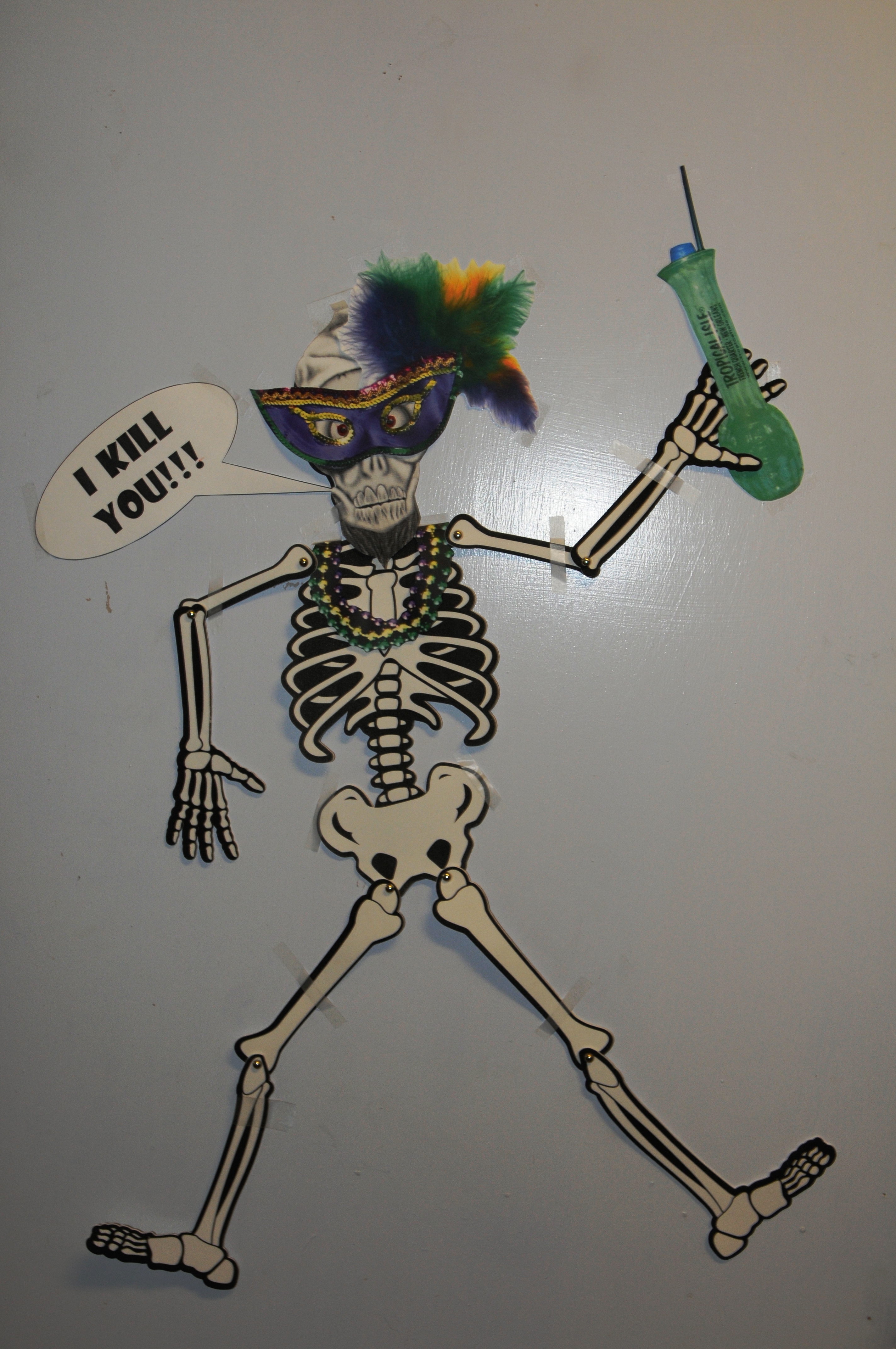
There were holiday treats, which made missing holidays both more tolerable and more obvious, and knickknacks we imbued with greater meaning. A Halloween skeleton decoration from my mom became an office mascot, a meager version of ventriloquist Jeff Dunham’s Achmed the Dead Terrorist: Scull replaced with a printout of Achmed’s turbaned head, “I KILL YOU” scrawled across a speech bubble. He would get new attire to mark each holiday.
Achmed enjoys Mardi Gras
There were what we called “leftovers,” items that had outlived their American usefulness or had been cast off from larger bases: gossip magazines broadcasting celebrity marriages, which by the time we read of them had ended. Cases of Girl Scout cookies, but only the tasteless shortbread variety. (I once heard rumor of a single box of Thin Mints but never saw evidence.) There were packages designated “for any soldier,” usually stuffed with candy; for well-meaning patriotic souls, sugar was a salve for any conflict. Occasionally, a “for any female soldier” made its way to our tiny base on the Pakistan border, and the seven of us gathered to ogle expired Mary Kay lotions, nail polishes and lipsticks we weren’t authorized to wear, and, once, a box of extra-large bras.
There were things that defied categorization, like the shipment of promotional materials for American Idol Season 4 runner-up Bo Bice. There were items designated for Afghan humanitarian aid: hats knitted by a widow in Florida, school supplies, sunscreen and summer sandals, and boxes and boxes of Beanie Babies.
The Beanie Babies came from Indiana, the headquarters of Beanies for Baghdad, an organization that collected the stuffed animals to send to deployed troops in Iraq and Afghanistan for distribution to local children. The PRT Paktia recipient rotated to a new unit volunteer every nine months. For nine months, the Beanies came to me.
I thought it a noble idea, reallocating American surplus in the form of fuzzy, bean-stuffed animals that were fleetingly thought to be a valuable collector’s item. I was no stranger to the toys—I still kept one of the rare nine original Beanies on a bookshelf in my childhood bedroom: Flash the Dolphin, purchased at a swim meet in my pre-teen years—and I was happy to be their Paktia courier. I wasn’t expecting, however, the sheer quantity of Beanie Babies that made their way from American households to Indiana, to cargo space on a commercial airliner; to Germany or Spain for redistribution and refueling; likely to Kuwait or Kyrgyzstan for further sorting; then on military aircraft to the Regional Mail Distribution Center at Bagram Air Base, Afghanistan; then on smaller aircraft to eastern region hubs in Khost or Paktika provinces; then finally by helicopter to Paktia, separated into the PRT pile, loaded onto the back of the gator, driven down the gravel walkway and passed, with growing amusement, into my expectant hands.
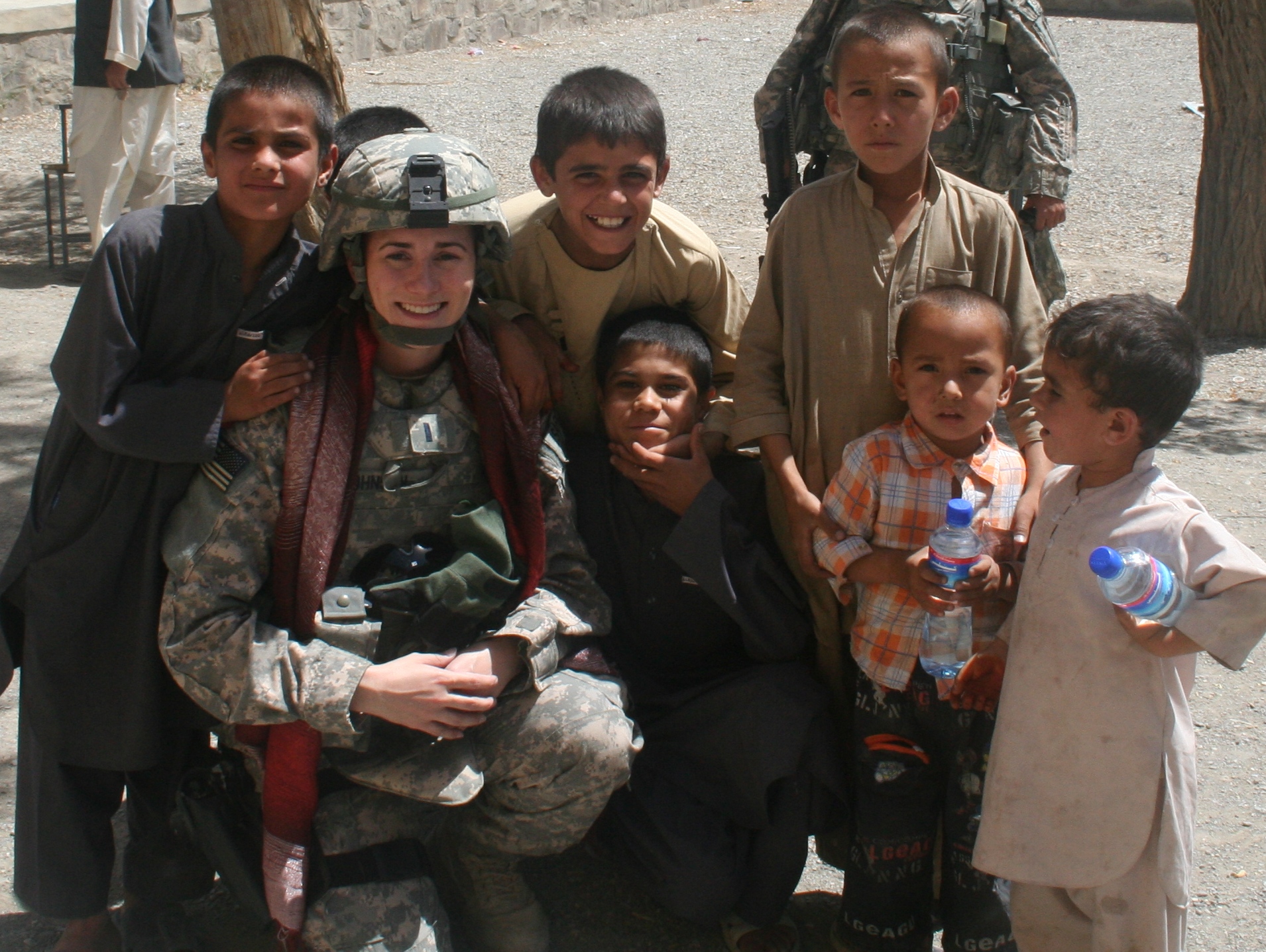
The author out on mission
At first, I opened the boxes alone at my desk, rummaging through layers of bright plush, pulling out any pigs (insulting in Muslim culture), the American flag-emblazoned bears (a bit too overt), and any snacks or novelties buried underneath to be tossed in the office “morale pile” for mass consumption. The remaining Beanies were stacked in the humanitarian aid freight container next to bags of rice and fluffy piles of winter coats. After a while, though, something happened that neither I nor the founder of Beanies for Baghdad could have predicted. Maybe it was the regularity of the packages in a place where nothing seemed regular, or nostalgia to bridge comforts few and far between. Perhaps it served as simply a colorful diversion from the monotonous, dusty brown. Whatever the reason, I suddenly became very popular on mail days.
The coffee maker spewed sweet fumes over a growing crowd while I sliced the packing tape on the familiar boxes. Over the clack of busy keyboards and wind rattling the flimsy outer door, the office rang with cries of, “Oh this one’s so cute! I’m gonna put it on my desk!” A young Airman started a collection of sea creatures; by the time we left, she could have staged a production of The Little Mermaid. We could barely see our head medic behind the community of bears that inhabited her desk. I kept two cats perched next to a picture of my real cats. At Christmastime, a parade of festively-adorned Beanies marched across the conference room table. We discovered a dinosaur that bore uncanny resemblance to the sword-wielding figure on the insignia for the neighboring Army unit, and the unit adopted him, using a sharpie to make color corrections and gluing a plastic knife between his paws. Some, like the gruff Army First Sergeant, feigned annoyance, but a smile twitched across his lips as he cursed the Beanies under his breath.
Even the PRT’s hard-headed, no-nonsense lead engineer who worked next door took a liking to a lemur with large, goofy eyes. One day I threw the lemur over the wall that separated our offices—it had become habit for us to launch care package goodies back and forth, a form of warzone entertainment. On this occasion, though, all that came flying back was a comment about “this one” being “especially ugly.” Big Eyes spent the rest of our tour displayed prominently on the engineer’s desk (watched over by Bo Bice’s shaggy-haired, bare-chested image from a calendar that the engineering team swore they hung ironically).
A few of the Beanie Babies even made it back to the States. Birthday bears were popular to send to loved ones at home, but occasionally another critter grabbed someone’s attention. I remember one afternoon a Security Forces soldier plucked a Beanie from its box and held it out in his burly arm. The soldier’s rifle, slung across his chest, rattled as he bounced excitedly, smiling through a cheek-full of tobacco.
“Hey L-T, mind if I take this one? I want to send it to my daughter. She loves pandas.”
I didn’t think about it then, the irony of these well-traveled Beanies, making their way from their original homes to Indiana and through the 2-4 week odyssey to Paktia, only to be boxed up and sent back in reverse. On both ends, something to fill the gaps between the lines. Something to miss or hope for, something to crave. A distraction—escape from monotony and chaos and uncertainty, and from other topics we’d rather not discuss.
A Review of Rufi Thorpe’s New Novel ‘The Knockout Queen,’ by Andria Williams
“Who deserves anything?” asks Lorrie Ann, one of the protagonists of Rufi Thorpe’s first novel, The Girls from Corona del Mar (Knopf, 2014). She’s putting the question to her stunned-into-silence friend, Mia, who has so far known Lorrie Ann only as something of a saint, a martyr of circumstance, the golden child from a perfect family ruined by terrible twists of fate–until the two women meet up suddenly after years apart. Lorrie Ann pops a baklava into her mouth—she’s a junkie now, to Mia’s shock; she only wants to eat sugar, she’s raving a little—and she demands, “Do we deserve the spring? Does the sun come out each day because we were tidy and good? What the fuck are you thinking?”
Even when the line is delivered by a young heroin addict whose husband has been killed in Iraq and whose father was a Christian rock musician, it’s an important one to Rufi Thorpe’s writing. The question—“who deserves anything?”– permeates all three of her books, which also include Dear Fang, With Love (2016) and The Knockout Queen (April 2020). Her characters, sometimes taken far astray by life, puzzle over what they have done, or what has happened to them–has it made them good or bad, or is that a spectrum like anything else?– or maybe their worst fears really are true, and good and bad are terrifyingly, irrevocably definitive.
Lorrie Ann, former evangelical, junkie, cuts through all that with her blunt, manic aphorisms and her baklava-smeared fingers. She knows how the historical intersects with the personal. She’s seen it herself. Still she wonders, Do we deserve the spring? What are we all thinking?
*
In Thorpe’s most recent novel, The Knockout Queen, our narrator’s name is Michael. He is (at first, briefly, before we inhabit his teenage self) eleven years old, and his mother has been sentenced to three years in prison. Michael is looking around at a world that makes no sense:
When I was eleven years old, I went to live with my aunt when my mother was sent to prison.
That was 2004, which was incidentally the same year the pictures of Abu Ghraib were published, the same year we reached the conclusion there were no weapons of mass destruction after all. What a whoopsie. Mistakes were made, clearly, but the blame for these mistakes was impossible to allocate as no one person could be deemed responsible. What was responsibility even? Guilt was a transcendental riddle that baffled our sweet Pollyannaish president. How had it happened? Certainly he had not wanted it to happen. In a way, President Bush was a victim in all this too.
Perplexingly, the jury had no difficulty in assigning guilt to my own mother as she sat silently, looking down, tears running and running down her face at what seemed to me at the time an impossible rate. Slow down, Mom, you’ll get dehydrated! If you have never been in a criminal courtroom, it is disgusting.
This is the lively, engaging, youthful, and astute voice we will hear from Michael throughout the rest of the novel. As a young teenager he is already aware that perceptible deviance will assign you blame. Women fare horribly in domestic violence cases, he knows, because no one expects a woman to be the aggressor. No mind if she has put up with years of abuse, prior–there’s just something that’s not right about it. (But are we sure that we can place any blame on President Bush?) With his mother gone, he has been taken in by his exhausted Aunt Deedee and is sharing a room with his cousin, Jason, “an effortlessly masculine and unreflective sort…who often farted in answer to questions addressed to him.” Jason’s also got a mean homophobic streak that only makes life harder for the closeted Michael. Finding it hard to make friends, Michael turns to a dangerous habit: meeting much older men online.
This is Orange County, California, circa 2010. Michael has the internet and a false sense of confidence, or maybe hope. He has seen how history intersects with the personal. Still, with the sun glaring outside his window, he aims for privacy in the darkness of his room. He reaches out. Maybe there’s someone on the other side. His tension and longing are a tender thing, snappable. What will he find, or who will find him?
*
Across her three novels, Rufi Thorpe’s characters share a common childhood in the sun-drenched, high-wash landscape of Southern California, often pre-or-mid-dot-com, when some normal people still lived in normally-priced houses. Michael, for one, does, now that he has moved in with his Aunt Deedee. But she’s working two jobs—at a Starbucks and at the animal shelter—just to pay her mortgage and to provide some kind of future for that aforementioned, flatulent meathead son. Michael observes that she has a personality “almost completely eclipsed by exhaustion.”
Still. Still. It’s California. A reader can almost feel that legendary warm air coming off the page, the smell of hot asphalt, car grease, stucco, sea salt, chlorine, oleander on the highway medians, bougainvillea; the too-prickly, broiled grass in small front yards. I’ve read that Thorpe’s novels have the quality of a Hockney painting-turned-prose; they do, the brightness, the color, the concrete, the sky—the scope and scale–but there’s also a nostalgia, a tenderness, and a cellular-level familiarity in her writing that’s capable of delving even deeper into that locale, and which can probably only come from having had a California childhood. I could almost feel my eyes burnt by the bright white sidewalks, the way, as a kid walking home from 7-11 or Rite Aid, you’d have to look at something else for a moment, glance at the grass for relief but still see the sidewalk rectangles bouncing vertically behind your eyelids.
Our teenage narrator, Michael, muses that he can’t believe anyone could live in a place with such terrific weather and not simply smile all the time. However, at this point California is already changing. “On either side, my aunt’s house was flanked by mansions,” Michael describes.
Poor house, mansion, poor house, mansion, made a chessboard pattern along the street. And the longer I came to live there, the more clearly I understood that the chessboard was not native but invasive, a symptom of massive flux. The poor houses would, one by one, be mounted by gleaming for sale signs, the realtor’s face smiling toothily as the sign swayed in the wind, and then the for sale sign would go away, and the house would be torn down and a mansion would be built in its place.
*
Though she lives in one of the hulking new-construction mansions next door, things are not much easier for Michael’s neighbor, Bunny. Bunny is the tallest kid in their class. Soon she grows taller, to her own horror, than all of the teachers and parents as well. This is not something that she can help. When she meets Michael stealing a smoke in her side yard—not knowing he’s also been swimming in their pool whenever she and her father go on vacation, though she’d hardly care—the two strike up an easy and natural friendship.
Bunny lives with her father, Ray, one of those realtors “smiling toothily” from billboards, and perhaps the most ubiquitous of them all, having risen to the highest ranks of his toothy, hustling kind — his face plastered on bus stops all over town, attached to every holiday and parade, to the point that he seems to Michael a sort of local, B-grade royalty. Off the billboards, the real Ray is a somewhat fatter, puffier iteration of his entrepreneurial visage, and he has a bit of a drinking problem as well as a fixation on his daughter’s future in sports. (This last bit will become important.) He will also be, under Thorpe’s skill, an intermittently hilarious, bizarre, very deeply flawed delight to read.
Complicating factors, there’s cruel gossip circulating around the death of Bunny’s mother in a car accident some years before.
So life is hard for Bunny, too, and her friendship with Michael becomes a once-in-a-lifetime sort of friendship, which will be forged even stronger when Bunny does something irrevocable, sending both of their lives spiralling. This is an often sad, and not an easy book, but I can say with confidence that their rapport, due to Thorpe’s seemingly-effortless skill and sparkling dialogue, is a joy to read.
*
Thorpe’s novels grapple, frequently, with what it means to be “good” – for women, men, kids, parents. What happens to girls and women who aren’t seen as “good,” boys who are not tough enough? (What happens to the boy who cannot, in fact, fart on cue?) What happens when there are deviations from the strict masculine and feminine markers our species depends upon to send immediate signals to our poor, primitive basal ganglia? Some people – the unreflective sorts, maybe, the Tarzan wannabes like Jason, the ones who take solace in the bedrock of their own infallible outward markers—could get upset.
In Michael’s case, his cerebral nature and his kindness may be nearly as dangerous, at least in high school, as his sexuality. “The people I had the most sympathy for,” he thinks, “were almost never the ones everyone else had sympathy for.”
Still, both Bunny and Michael want, the way most teenage kids want, to be good—to be liked, to be happy, to have positive relationships with their friends and parents; to be, in the ways that count, pleasant. Here’s Michael:
[It] was a popular take when I was growing up, among the post–Will & Grace generation: Fine, do what you want in bed, but do you have to talk in an annoying voice? I did not want to be annoying, I did not want to be wrong, I wanted to be right. And yet I knew that something about the way my hands moved betrayed me, the way I walked, my vocabulary, my voice. I did not consciously choose my eyeliner and septum piercing and long hair as a disguise, but in retrospect that is exactly what they were.
“As often as I was failing to pass as a straight boy during those years,” he later thinks, “Bunny was failing to pass as a girl. She was built like a bull, and she was confident and happy, and people found this combination of qualities displeasing in a young woman.”
Through the figure of Bunny we see, then, what qualities might instead be pleasing in a young woman. Contrast Bunny with her volleyball teammate Ann Marie, as seen through Michael’s eyes:
Ann Marie was a special kind of being, small, cute, mean, glossy, what might in more literary terms be called a “nymphet,” but only by a heterosexual male author, for no one who did not want to fuck Ann Marie would be charmed by her. She was extra, ultra, cringe-inducingly saccharine, a creature white-hot with lack of irony. She was not pretty, but somehow she had no inkling of this fact, and she performed prettiness so well that boys felt sure she was.
Thorpe stays impressively in Michael’s voice: only a young man of his very-recent generation would speak so easily about lack of irony and “performing prettiness” in the same breath as “extra, ultra, cringe-inducingly saccharine” and “fuck.” Her mention of that “heterosexual male author” with a nymphet preoccupation is also a smart nod to a later scene in which Bunny’s dad, Ray, somewhat drunk (as usual) and sentimental (less usual), sits Michael down and strong-arms him into looking at an old family photo album, a socially awkward and therefore very funny situation several narrators across multiple Nabokov novels have also faced. It’s equally funny in The Knockout Queen. But Thorpe gives the monumental authority of the male gaze a clever twist, for Michael, unlike one of Nabokov’s middle-aged narrators, is not at all titillated by these photos of Bunny but instead empathetic, fascinated by his friend’s life before he knew her, before her mother died, before her whole world changed.
I wished I could go back and really look at the divide in her life: before her mother’s death, and then after. When she ceased to be part of a scene that her father was documenting and began to be posed artificially, always on her own. Was I imagining the sadness I saw in her smile? Or was it an effect of the camera flash, the glossy way the photos had been printed, that made her seem trapped in those images, sealed in and suffocating behind the plastic sheeting of the photo album?
“Thank you for showing these to me,” I said.
Michael marvels at the loving photos he sees of Bunny’s mother, decried as a slut by the gossips in town, her death whispered “suicide.” Do these images tell the truth, or do they lie as much as any other, prone to the bias of the photographer, prone to distortion? Michael feels that the tenderness he sees in them is genuine, even though he knows how easy it is for a certain angle to tell it wrong. Where he feels the distortion has occurred is on the outside of this album, this family, in the crucible of group thought. (There’s a joke both in Nabokov as well as here about the distorting power of the visual: in The Knockout Queen, a Facebook photo of the high school volleyball team goes viral because, due to perspective, Bunny erroneously looks fully twice the size of any other member of the team. In Nabokov’s Transparent Things, the slim and attractive Armande in an early photo is given, “in false perspective, the lovely legs of a giantess”). As with Hugh Person, in Transparent Things, or Humbert Humbert in Lolita, the camera and the idea of a photographic memory eventually lose some of their stability, some of their complete control–and so, through Thorpe, does the male gaze and the historical power of the speaker, or of the loudest one in the room. There are hints of knowledge, Thorpe suggests, that evade group accusation, that dodge the iron maiden of a harsh mainstream and even the seeming authority of daguerreotypic capture: like motion, or like memory.
It would be hard to write three California novels without the specter of Joan Didion hovering overhead, so Thorpe leans into this, as well, with the addition of a grisly, community-shocking murder that seems to come right out of the White Album—the sort of local tragedy Didion might have learned of while floating in her Hollywood rental home’s pool. With this event, too, Thorpe challenges what we think we know from the outside.
There are real problems in this paradisical California town. Racial inequality, homophobia, the fact that fewer and fewer people can afford their own homes. A salacious news story is a most excellent distraction. But Michael, young as he is, feels the sick appeal of the outside verdict and tries to resist it. Yes, everyone’s talking about the murder with concerned gravity–so grave, so concerned– at every Starbucks you wait in line at, everyone whispering, Can you believe it? It happened to someone from here?How could she have let that happen to her? But he senses the tsk of judgment in their analyses. Why would anyone let violence happen to them?
We needed to pretend violence was something we could control. That if you were good and did the right things, it wouldn’t happen to you. In any event, it was easier for me then to demand that Donna [the victim] become psychic and know how to prevent her own murder than it was for me to wonder how Luke could have controlled himself. It was easier for all of us that way.
Luke, here, the killer in question, is a sort of (pardon the comparison) George W. Bush, perplexed by his own power, almost a victim of society’s forgiveness for what is already understood and comfortingly masculine and clear. (It seems intentional that the victim’s name, literally, means “woman.”)
Isn’t it easier to cast your lot with someone who seems to have control – even if they can barely understand it – rather than the weaker person, the one still striving?
*
Bunny and Michael decide to play at “realness.” It’s a term they’ve gleaned from the drag queen documentaries and the reality TV they love to watch—RuPaul, and Paris is Burning–where Michael can practice at performing and Bunny, riveted, can “deconstruct” femininity, which still eludes her even as she longs to attain it. They crack each other up to the point of tears with their impressions of people they know, at which Michael is very good and Bunny just abysmally horrible.
One of the terms we stole from RuPaul’s Drag Race was the concept of “realness.” They would say, “Carmen is serving some working girl realness right now,” and a lot of the time it just meant passing, that you were passing for the real thing, or that’s maybe what the word began as. But there were all different kinds of realness. In Paris Is Burning, which we must have watched a hundred times, a documentary about New York City drag ball culture, there were drag competitions with categories like Businessman or Soldier. Realness wasn’t just about passing as a woman, it was about passing as a man, passing as a suburban mom, passing as a queen, passing as a whore. It was about being able to put your finger on all the tiny details that added up to an accurate impression, but it was also about finding within yourself the essence of that thing. It was about finding your inner woman and letting her vibrate through you. It was about finding a deeper authenticity through artifice, and in that sense it was paradoxical and therefore intoxicating to me. To tell the truth by lying. That was at the heart of realness, at least to me.
I loved this, as a fiction writer. The fun of pretending, how it can be an empathy, or a skewering. The wildness of that ranging, creative, odd and hilarious act—trying on voices, affects, personalities, lives. Trying your hand at fiction.
To tell the truth by lying. What is “realness,” then, but a mission statement on writing fiction? On invention, on possibility?
And it feels so very Californian, in a way, adding gravitas to Thorpe’s chosen locale, to “[find] a deeper authenticity through artifice.” Ray laughs to Michael, “No one was born in North Shore!” There are plenty of people who were born in California and live there now, but also a huge number who were not. Isn’t that, in a sense, passing? What separates one kind of passing from another, makes it more or less acceptable? How could some transplanted midwesterner who adopted whole-hog the California lifestyle judge a gay kid for wearing eyeliner?
What is the line between authenticity and fiction? What do we do with what is given to us?
*
At the end of the day, Michael and Bunny are two kids whose parents have royally screwed up, probably because someone also screwed up when they were kids. So it goes, on and on. Amor fati, reads the tattoo on Lorrie Ann’s slim shoulder, which, as Thorpe points out, is just another way of saying “embrace the suck,” and which Nietzsche re-purposed from the Stoics.
Why tell these stories, I wondered, if nothing is ever going to change? After all, amor fati seems a last resort. Lorrie Ann’s husband dies in Iraq. George W. Bush and Michael’s dad both get off scot-free. The outsider kids will always be bullied. In Thorpe’s second novel, Dear Fang, With Love, the narrator, a young-middle-aged college English professor named Lucas, who has been exploring both his family’s Holocaust-razed past and his daughter’s newly-diagnosed schizophrenia (and who sounds, here, influenced by T.S. Eliot) thinks:
Our family had been jumbled by history, by war, by falling and rising regimes, by escapes across the world, by drives through orange groves and trips to Disneyland and the slow poison of sugar flowers on supermarket cakes.
America was not safe. We would never be safe. The danger was within us and we would take it wherever we went. There was no such line between the real and the unreal. The only line was the present moment. There was nothing but this, holding my daughter’s hand on an airplane in the middle of the night, not knowing what to say.
Thorpe understands the way trauma makes its way through society and through an individual life. Trauma is not always the blunt instrument; or, even if it started that way, it may not be, forever. It can be sly and nuanced. It can be both traceable and unknowable, brutal and delicate. Do we try to pass, within it, above it, until we are all okay? What if we know that not everyone will be okay, even though they try, even though they deserve to be?
There is a Bunny who exists outside the gossip against her, separate from her jarring appearance and possibly, Thorpe suggests, even separate from some of her own actions. “You don’t have to be good,” Michael tells Bunny. He means she doesn’t have to be socially acceptable, she doesn’t have to be fake-good, girly good. She already is good. They both are.
The Knockout Queen is now available anywhere books are sold.
New Poetry from Matt Armstrong: “Covid Night”
SUSPENDED PETALS / image by Amalie Flynn
Paris sirens Pewter sky The white lace Of a dogwood bough At midnight
Reach up Clutch and huff Hungry before bed For the sweetness Of a rose
But a dogwood Is a dogwood And there’s no escaping The sentence For the world:
The old blacks And the new poor Must die From the bugs At the grocery store
Drones police the distance Between New Yorkers Robots shout from spring sky: Stay away
While sanctions Strangle Caracas children Bleed Persian women And a million singers scream To the people of the screen
A poet in Madrid Sits under house arrest Another in Algiers Might as well Be in Madrid
And what do I mean by Paris sirens Beyond the sad Pin pon wail That cries arretez
I mean a rhythmic wigwag Just a bit more rounded Now our own martial horn But Greensboro, Nazareth, Athens, Melbourne
It’s all the same sentence tonight:
No more fingertip touches From the beached weaver No more whispered breath From the one making masks For the world
Just this:
The unyielding petals Of a midnight limb As the strange siren hunts For those with a touch Of needing too much
Poetry by Stephen Mead: Remembering Beirut, Halloween ’83; Map Pins; Forced Labor
STOMA / image by Amalie Flynn
Remembering Beirut, Halloween ‘83
The ground beds a stuffed effigy with bulging leaves. Through peculiar affinity it resembles some soldier. Notice the guise of these clothes. Consider its uniform grubbiness. Be a witness. Here is frailty.
I lug the dumb body as if carrying my own reflection. In another land some marine is dragging the dead weight of his friend from the steepness of a ditch. Hear the solstice hour toll? It’s the season of reaping soon to be celebrated, full-fledged, on All Saint’s.
Jack O’ Lanterns gape from their pumpkin infernos. They tug at my form, a sinewy candle lending motion to dusk. The moon wears the same face of negligence, staring directly through, perpetual, obsessive.
Skulking beneath it I haul my likeness on a cross of dried corn stalks. In the garden a fire rages. Leaves crackle, russet, auburn, yellow. Witches burnt pure of skin, the singed autumn embers ascend and I let, with a gasp, my twin fall to be caught. In stacked grass, the silhouette burns and smolders.
Let flames state metamorphosis, take change from the depths, their swaying shadows. Let them be purged, untouched by harm and rise fertile from earth to winter the long haul of a death and a grievance.
Tonight something in me was sacrificed but saved by the struggle. Let it be just an event ritualized for one night and not a sequence, serpentine, leading to another whole era of hell.
Map Pins
& photo opportunities— A world between say, this President’s address & some plane’s covert loading. Operation Heartbreak. That’s melodrama, effete emotionalism. Stick with facts. Contracts. Point A & Point B, land masses & bodies of water, the planetary typography worn on a polyester shirt. There’s
import, exports. There’s the dollar value status, the stock market resources who happen to be human, each significant as a billboard but not all necessarily advertised. An after-thought that would seem, the boardroom memo, a game of
telephone, the press (cover) reports (up) inside leaks (dodge) a thousand pricks (question & answer) of light (the cameras) fastened by (flash) brass tacks
Forced Labor
The long haul is the term for strain. To go in, sweatshop ore digger, your colony owned by a bigger government who, in turn, is at war with a different one… Sure, to go in, after the Big A & surrender subsequently: reality a mirage but for body counts, headaches, the daughter, photosensitive who can’t leave darkened rooms & dies anyway, at 39, her siblings, one female born without bones, & the next, presently 50 but burying his youngest, such recessive aberrations passed on by their Mom, a Korean import from Japanese mines…
Sound
familiar?
To put bombs behind us, prejudice, an epidemic, look at Bikini Island on film: the natives packed up, the burned homes, and those natives told, shown diagrams: “Testing Site. ” “You are at war.” Foreign phrases. News to them. The pictures helped while they smiled, waved at cameras none had ever before seen. Next in came the Navy, understanding perhaps as little, leaving 2 goats shorn and placed in metal crates: no hemp to chew through or bolting when meters hit red.
To many, in tinted goggles, watching, the blast was: “Magnificent.” “A firecracker”. “A sunset.” Others thought it “a let down.” Still, all the votes were not yet in—– There were still those sailors swimming through such liquid marble, the clean-up crews, the witnesses touching charred Palm, their uniforms Geiger-clicking & their flesh as well, having to shower, be re-tested & wash wash again to get radioactivity off. The same happened elsewhere, only to town-folk.
This is the humanity within inhumanity, that, in ignorance, we bombed ourselves, & this is the knowledge: genetics, marrow-solvent, a tunnel pushing to upturn the stone fetuses.
In P.S., another news item my fingers squeeze: a photo, its caption snatched from the TV page. “Mushroom Cake, Navy Admirals Blandy, left, & Cowery, assisted by Mrs. Blandy, celebrate first atom bomb test, 1946.”
Here’s the close-up: two hands, the Blandy’s, joined by a knife slicing frosting, the confection rising, a cloud of froth as washed out as Mrs. Blandy’s hat.
New Fiction from Matt Gallagher: Excerpt, ‘Empire City’
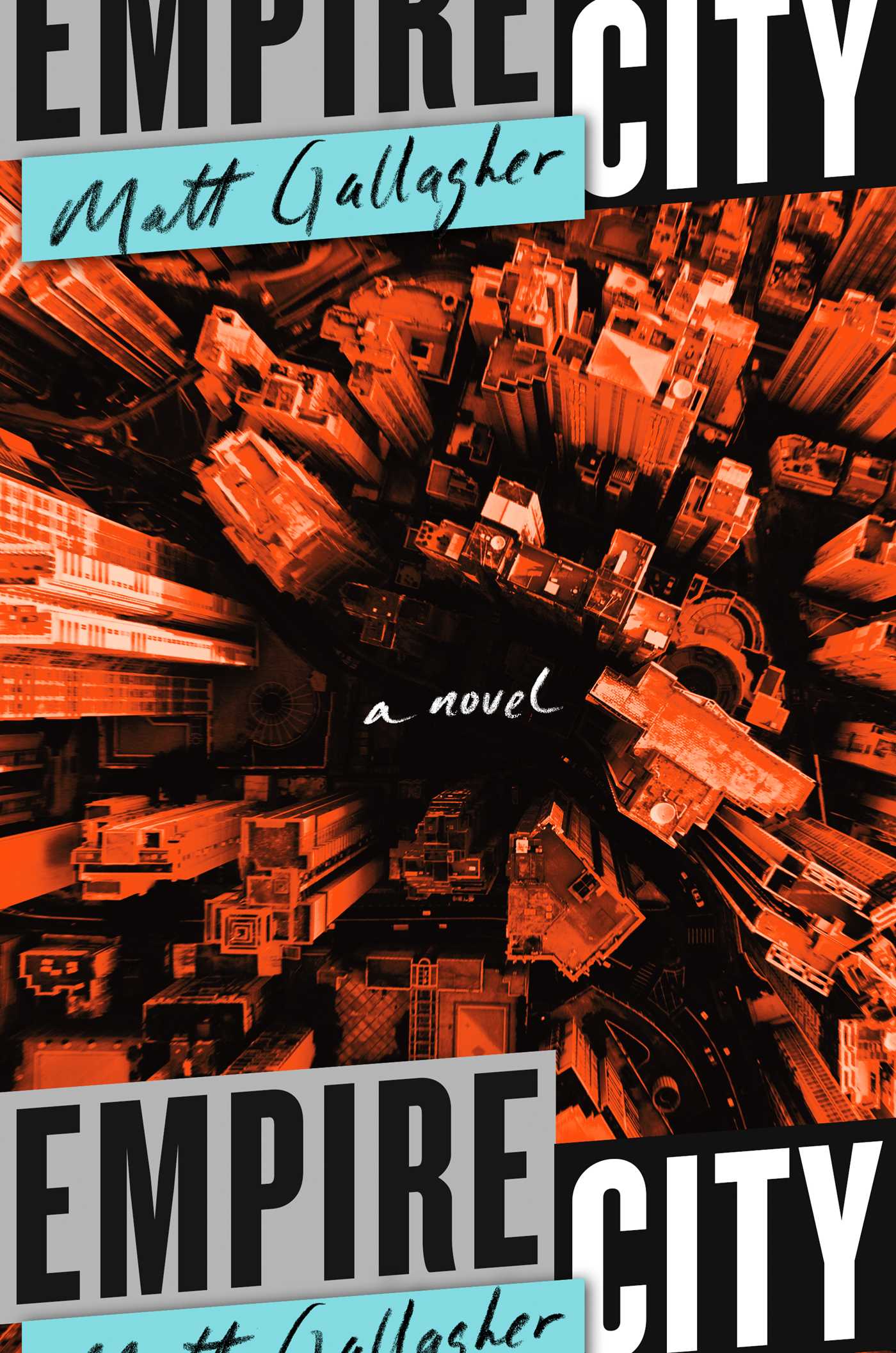
Reprinted with permission from Atria Books.
Mia Tucker woke before the alarm. She usually did on weekdays. She was a person of routine and that’s what routine did. Sleep whispered like a lullaby through the black morning but she pushed it away, sitting up in bed to put her mind in order. If she’d been dreaming, she’d already forgotten what about.
Monday, she thought. Cardio.
A storm had rolled through the city late in the night, leaving the brittle musk of rain. A coldness nipped at the top of Mia’s shoulder. How do they keep getting in here? she wondered, rubbing at the mosquito bite. I shut the screen last night.
Jesse hadn’t come home. He’d sent a few texts, first saying he wasn’t sure when he’d be leaving work, then saying he wouldn’t be. All-nighters during Bureau emergencies weren’t unprecedented. Mia knew the deal. All part of marrying a special agent. Even if waking up by herself in darkness brought on a loneliness she didn’t trust.
Mia ate a yogurt, then changed into light workout gear and fitted her running leg and sneakers. Downstairs, the summer air smelled of metal and moss. Dim streetlights lined the corners like sentries and the sidewalks had almost dried. A garbage truck on an adjacent block groaned through the still while monitor drones pulsed red in the sky. She stretched her left leg and then her core in front of her building, looking up to watch the flag whip around atop the Global Trade. Sixty stars and thirteen stripes, pale against the dark. It didn’t strike her as cluttered, anymore, all those rings and stars in the blue canton.
Mia finished stretching and tapped at her right knee. Her running prosthetic was hard and coiled, like a spring. She appreciated the city most during these early morning runs, because it was empty enough to seem welcoming, even hopeful. It reminded her of the city from her childhood. It reminded her of the America she’d grown up in.
Daybreak always ended the spell.
Cut the crap, Mia thought. These ten miles aren’t going to run themselves. Then she took a deep breath, set the digital green of her wristwatch to 00:00, hit start, and began, the joints of her leg cracking with the motion while the socket of her prosthetic did the same. She headed west, toward the harbor.
Mia had run most of her life, discovering as a girl that she was good at it and being good meant respect, and trophies, and approval. It made an object of her body, but it was a functional object, something that mattered to her even before she’d figured out why. She’d pushed herself to be very good at points in her life, competing in college for two seasons before it interfered with ROTC, and later running the city marathon her first year with the prosthetic to prove that she could. But she’d never crossed into greatness, and for that she’d come to be thankful. Mia lacked the masochism of true runners, the renegade fanatical gene to ignore and ignore all the warning blinkers thousands of years of evolution had instilled in the human brain. Bloody calluses and angry muscles were one thing. Tendons ripping from bone were another.
The baby, or not-baby, entered Mia’s mind. She focused on her breathing. Then came General Collins’s job offer. She focused on her breathing.
The first scratches of sun were tracing the water. Lady Liberty rose in the distance, droopy torch in her right hand. The whole statue needed repair, though how, and when, had become a political hot potato. Decades’ worth of money allotted for national monuments had gone to the Council of Victors, toward honoring the triumph of Vietnam. No one wanted to be the congressperson who redirected funds from that.
A lot of citizens had come to loathe the statue, considering it an eyesore. Mia’s father thought it a sentimental leftover. She sort of liked it, the way a person enjoys a musty childhood blanket found in storage. She remembered climbing to the torch on a field trip as a girl, through a staircase of graffiti and rickety metal, seeing the city from an entirely new angle. A snapshot of old American might, sealed in memory.
They’d closed the torch after the Palm Sunday attacks, then the entire island. Students like her adolescent cousins wouldn’t ever see Empire City as she had. No one could now. The sad, corroding statue was their normal. It was all they knew. In the meantime, Lady Liberty sank slowly into the island it rested on. Turned out it’d been set on sodden ground.
Mia adjusted her sports bra and glanced at her watch. A mile in, which meant her warm-up was over. She lengthened out her strides.
She turned north along a waterfront path, moving into the bike lane to dodge fallen tree branches and loose rocks. Other than the occasional taxi striking through the predawn and a man in rags watching the city from a bench, she was alone. The wharf across the river jutted out like a broken jawbone, suggesting a past when its docks did more than shuttle around office workers and tourists.
The city changed like a photo album, slowly and slowly and then all in a rush. Repair shops became delis. Parking garages became art studios. In the water a flotilla of coast guard barges that’d been restored as restaurants and pubs drifted to and fro. Steel and glass high-rises gave way to the architecture of the last century, rowhouses and squatty brick apartments. The streets narrowed, a few dotted by tidy cobblestone. The waterfront path leveled off, though Mia kept her strides long. She knew an incline awaited. She wanted to meet it in force.
Sunrise arrived somewhere between miles three and four, stained-glass clouds chipping the sky. Mia passed a vomiting young man in a sport jacket too large for him. Probably an intern for one of the banks, she thought, before turning around to make sure it wasn’t one of hers.
“Call in sick!” she shouted. He raised his fist and managed a weak “Defy!” before purging again. The motto of the old radicals’ caucus in Congress. Funny, Mia thought.
Another mile on, Mia ran into a short concrete tunnel. The tunnel lay underneath an abandoned railway line. Sunlight filled it with a fierce yellow shine. Around ten feet long, the sides and top of it had been covered in graffiti, dozens and dozens of circles of different colors and sizes. Just about every inch of available concrete had been tagged, leaving a sort of rainbow mosaic. Each of the circles contained three arrows pointing down and to the left. The job was fresh—Mia could tell by the tint to the spray paint. She came to a stop in the center of the tunnel, her breaths sharp but controlled. She rubbed a hand against a small purple circle. It smeared across her palm.
I know what this is, Mia thought, looking at her palm, then at the purple circle, sifting through her mind to place where. It took a few seconds, but she remembered a course in modern European history, and this shape and question from the final exam. The antifascist sign, she thought. From Nazi Germany.
A gust swept through the tunnel, and Mia smelled storm from the night before. She fought off the urge to shiver. It was going to be a cold summer day.
*
Most mornings Mia turned around and headed home on the same pathway, but the tunnel had spooked her. She pushed east and then south instead, running the sidewalks. The light and the city rose slow, together. A medley of urban noise was beginning to tune and it sounded mostly like construction din. There was order within the mayhem; one just needed to know the refrains. Mia did. She made it back to her apartment building on time, stopping only to remove her running leg before showering and dressing for work. She was back out her front door sixteen minutes later.
The air had turned and smelled of humid dew. Mia decided to walk through Vietnam Victory Square. Under the gaze of the Four Legionnaires sculpture, a couple of kids had waded into the fountain, laughing while splashing water at each other. Across from them, a tour group stood in front of the grand white marble wall with the simple words: “Praise to the Victors/In Honor of the Brave Men who went forth to Vietnam/1955–1981.” The guide was explaining why the inscription stopped there, despite the insurgency continuing after in parts of the north. He was stumbling through the history and Mia wanted to intervene. Because wars have to end, she thought. Just tell them that.
Coffee-charged angst and white-collar id crackled along the streets, bankers and lawyers and digital communications associates hustling to be at their desks before the workday siren sounded. As she turned onto Wall Street, Mia passed the brownstone Trinity Church she attended every month or so. She’d considered herself an atheist since her tour to Albania, but she still appreciated the ceremony of church and the sense of renewal it allowed for. Her family had fled to America in 1620 for that ceremony and sense of renewal. She wouldn’t give up that heritage for something as banal as not believing.
Then there was Jesse. “Jesus’s heroin needle,” he liked calling Trinity’s Gothic steeple. The church’s adjacent cemetery, where a slew of American founding fathers and Union generals from the Civil War rested? “A yard of goy bones.”
And he’s all mine, Mia thought. Trinity was an option for their wedding, though her family wanted it held in Connecticut. One more decision that she needed to make, and soon.
Mia’s bank was located in the Westmoreland Plaza, a mass of skyscrapers bundled together at the end of the island. As she neared it, a vast, bright fire engine came into view, its lights twirling and flashing like a hallucination. A row of police barricades separated the vehicle from the street, uniformed officers turning away confused citizens trying to get to work. Mia joined the crowd.
“No one’s allowed in the plaza today,” a cop was saying, not for the first time. “And yes, that includes you.” His eyes lingered on Mia’s blouse, and she stared at him flatly until he looked away. Her grandmother had taught her how to do that on her fourteenth birthday. It worked in Empire City boardrooms just as well as it had in aircraft hangars along the far edges of the world.
“Ms. Tucker.” A man shaped like a square wearing a rumpled dress shirt and overlong tie called to her from a corner of the barricades, close to a large bronze globe. It was the security director of her bank. He looked wired to Mia, even eager. “Ms. Tucker,” he repeated. “The office is closed today. Your father sent out a message to everyone—work from home, as you can.”
“Hadn’t checked my email yet.” This didn’t make any sense. The office, as far as Mia knew, had never closed. Finance didn’t “work from home.” That was for other people, other jobs. “What’s going on?”
“I shouldn’t say,” he said, in a tone that suggested he very much wanted to.
“Mum’s the word,” Mia promised. “I’ll be finding out, anyhow.”
“A threat,” the security director said, his voice low and hushed. “Whole plaza. Homeland marshals got it last night.”
“Oh.” There’d been a few lockdowns in Empire City over the years, for both real and false alarms, but Mia couldn’t recall any of them shutting down a main cog of the Finance District. “Must be some kind of threat.”
The security director looked out the corner of his eye to make sure no one else was listening, then pulled out his cell phone and read.
WITH FIRMNESS IN THE RIGHT AS GOD GIVES US TO SEE THE RIGHT, LET US STRIVE ON TO FINISH THE WORK WE ARE IN, TO BIND UP THE NATION’S WOUNDS, TO CARE FOR HIM WHO SHALL HAVE BORNE THE BATTLE.
MAYDAY, MAYDAY. FROM THE ASHES, HOLY REDEMPTION.
“Mean anything to you?”
Mia shook her head.
“The first part’s from a speech Abraham Lincoln gave. Used to be the motto of the old Veterans Administration. The second part . . . I don’t know. The distress signal or something.”
Mia contemplated that. “There’s a Council of Victors office down here. Some crazy’s angry about the colonies again?” She tried not to laugh but couldn’t help it. “It all needs to be taken seriously, of course. But shut down the plaza?”
The security director shrugged. “Federals think it means something. The Mayday thing, especially.”
“I see,” Mia said, wondering if this was the Bureau’s emergency, and if so, why Jesse hadn’t said anything to her. He worked intel analysis, not counterterrorism. Though he hadn’t always been behind a desk.
New Fiction Review: Matthew Komatsu On Matt Gallagher’s ‘Empire City’
As Avengers was wrapping up last year, I mentioned how excited I was to see the finale to a friend, who responded with a barely suppressed sneer. Granted, it’s the same friend whose Blu-Ray copy of Richard Linklater’s Boyhood I’ve had for nearly six years, never watched, and now that I think about it, might have been in the console of the car my wife and I just sold.
“Superheroes? Really?”
The question dogged me for the past year. 2019 marked the end of the seventeen-year Avengers franchise, the release of The Joker to immediate Academy Award buzz, HBO’s critically acclaimed re-imagination of Alan Moore’s graphic novel The Watchmen, Netflix’s superb adaptation of The Umbrella Academy, and Amazon’s remarkable superheroes-gone-bad-and-wild series The Boys. And it is into this tableau of a fanboy and fangirl paradise in which all our favorite comics and graphic novels are finally seeing the cinematic treatments that seemed impossible at the turn of the century, Matt Gallagher’s second novel, Empire City, has sauntered.
Empire City is an alternate history of present times, one that through rich world-building and attention to all the right details, asks us to imagine a world in which the US won (sort of — an insurgency is still ongoing) the Vietnam War through the heroic efforts of something familiar to anyone paying attention to our very real, very present Forever War: a military force of volunteers who, in a unique twist, are comprised of internationals serving in the hopes of US citizenship. The victory in Vietnam has been elevated and lionized so much that a “Council of Victors” would appear to control the national military narrative in its entirety. In this world, the present is, too, an unending global war against terrorism. With a wrinkle however. Our protagonists — three veterans and one civilian — have superhuman abilities.
The abilities appeared after they survived a friendly fire “Cythrax” bombing during a direct action mission gone bad. The protagonists who are veterans call themselves “the Volunteers” in a nod to our world’s all-volunteer military, and are drawn into a conflict brewing in “Empire City” and perhaps across the country, as the social order of over-the-top military veneration is challenged by a growing movement of disaffected veterans organizing around someone who might not be entirely unlike the Volunteers.
Gallagher’s three main narrative protagonists have relatively hum-drum abilities as far as superheroes go. Sebastian Rios, a bureaucrat and one-time war journalist who was a hostage at the hit site compound when the Cythrax bomb was dropped, can disappear. Mia Tucker, a pedigreed Wall Streeter who piloted a helicopter on the raid, can fly. And the immigrant soldier, Jean-Jacques Saint-Preux, can move at super-speeds. Which made me wonder why Gallagher would choose such recognizable abilities at all.
The answer of course goes back to my friend’s question earlier this year: it’s not about the abilities. OK, I’ll revise that statement: it’s not just about the abilities. The superhero phenomenon have always been about investigating what makes us human through a speculative lens. Even in the golden age of comics, when Jack Kirby and Stan Lee and all the old hats realized that giving human characters super abilities, and presenting their stories in graphic format, was a fun idea, they were doing things in their serialized stories to give them gravitas. We all know Superman can fly, that he’s a Man of Steel with x-ray and heat vision. So it’s not a surprise when he uses those abilities to crush the bad guy. It’s the story behind that counts: how does one live one’s life given these abilities? What does ultimately tell us about humanity? Marvel’s mutant X-men were thinly veiled discussions on the human invention of race; DC’s Batman questioned the role of privilege and social order. Time now, superhero tales grant creative permission to carry out discussions that need to happen within society writ large, by attracting us with a wow factor (Check out character A! They can do B!) and sucking a consumer into a story in which that wow factor fades behind a substantive investigation into very real, very everyday, human dynamics. Watchmen — racism in America; The Boys — the fundamental question of whether a human would choose to apply their superhuman ability towards good or evil; Umbrella Academy — the unique dysfunction of the modern American family: we want to be drawn in as viewers and readers, but we also want something deeper to sink our teeth into.
Empire City succeeds in a similar fashion. Veterans, already totemized in the real world, are taken by Gallagher one logical step further and given abilities that set them apart from the rest of humanity. But that’s just the appetizer. What’s really happening in the book, as our heroes find themselves thrust into the beginnings of conspiracy set off by the potential presidential election of a retired general officer — one that threatens to unravel a modern social order that entirely revolves around the veneration of military service — is an investigation of our troubled real world. Less than 1% of the US have, are, or will serve in the military. The national has waged nearly two decades of war across the world with little accountability to an electorate willing to write a blank check to it, no questions asked. Veteran has become an identity, a flag around which to rally political and cultural inclinations. War criminals have become public figures and welcome pundits. Given what’s happened in the real world, is it so far a narrative leap to consider a veteran with superhuman abilities?
The book isn’t perfect; Gallagher’s first novel, Youngblood, had a tighter story arc, and the effort he takes to build a convincing world in Empire City sometimes feels like overkill. But it’s a fascinating narrative. I’ve seen other readers comment on the novel’s relevance — the whole thing has a Man in the High Castle feel to it. Recognizable as almost being our current reality, but tilted towards frightening. But the novel’s relevance will hopefully fade over time, if the country can come to realistic grips with its military reality. What stands out to me about Matt Gallagher’s second novel is that he was willing to do the legwork necessary to give contemporary war fiction a speculative edge, which puts it in territory more closely aligned with Joe Haldeman’s graphic novel Forever War than it does with Youngblood, and enviable terrain if Gallagher is willing to claim it.
When I reviewed Youngblood a few years ago, I wrote that it delivered what we needed from contemporary war literature because it shunned the stereotypical war story for something more unique. With Empire City, Gallagher has reinvented himself yet again and produced another fresh, and timely perspective on the consequences of war.
New Nonfiction from Charles Stromme: “The Army Profoundly Regrets”
1972
I was back from a year of flying helicopters in Vietnam. The Army gave me a make-work job at Ft. Riley, Kansas, a base over-crowded with dejected Vietnam returnees. I hated it there, where they said, “Custer told us not to change a thing until he gets back.”
I was angry and disillusioned and clueless. A major called out to me in a hallway. “Captain, you’re going to be the notification officer next month.” He was an old major, a mustang combat vet in his last duty station. He wasn’t a bad guy and we had been working in the same battalion for several months without incident. But he hated me for being an aviator. I hated him for not being one.
“You’ll be on call for a month. When a new killed-in-action (KIA) report comes in you’ll visit the family with the chaplain and you’ll give the official first notice.”
I couldn’t bear the thought of inflicting that kind of pain on the good family of a good soldier. I was raw from the war. I didn’t want to live the back end of events that I had witnessed in Vietnam. My emotions scared me and brought back ugly memories. “No sir,” I said, “I won’t do that.”
He looked surprised. Likely no young captain had ever told him that he wouldn’t obey an order. “What do you mean?” he asked. “Do you understand that this is not a discussion, it’s an order?”
“Yes, sir,” I replied. “I understand. But I won’t do that job.”
“I can take this to the battalion CO if you want.” That was a profoundly underwhelming threat. I didn’t care, period, and I wasn’t going to do it. He brought out the heavy artillery: “I can court-martial you for this.”
“Yes sir, I know. You’ll do what you have to do but that won’t change my decision. I will not, under any circumstances, be the notification officer.”
I had unintentionally created a real problem for the major. He could, indeed, take this to the CO. He could certainly bring court-martial charges against me, charges against which there could be no defense. If he did, though, it would also bring to light his inability to control an officer under his command.
“We’ll talk about this later,” he said. In the Army that means “I’m going to give you some time to consider the error of your ways before I decide on your punishment.”
We did talk again a few days later, but there was nothing for me to reconsider. My mind was made up. I wouldn’t carry out his order. I understood that I would be punished and I would accept whatever punishment he and the CO deemed appropriate. It would surely be a court-martial, I thought.
But he surprised me by asking, “Can we reach a compromise?”
I was suspicious. Compromise is not the Army way. “What kind of compromise?”
“We need a presentation officer for the rest of the month. There are no presentations scheduled. If you’ll take the job, I’ll forget about this problem.”
A presentation officer is not quite as bad as being a notification officer. The presentation officer visits the family of a KIA soldier after they have already been given the news. He delivers whatever medals and awards the soldier had earned and expresses the regrets and condolences of the Army.
There were only a few days left in the month and the major, after all, had said there was nothing scheduled. It looked like I might skate on this yet. “OK, sir,” I said, “you’ve got a deal.”
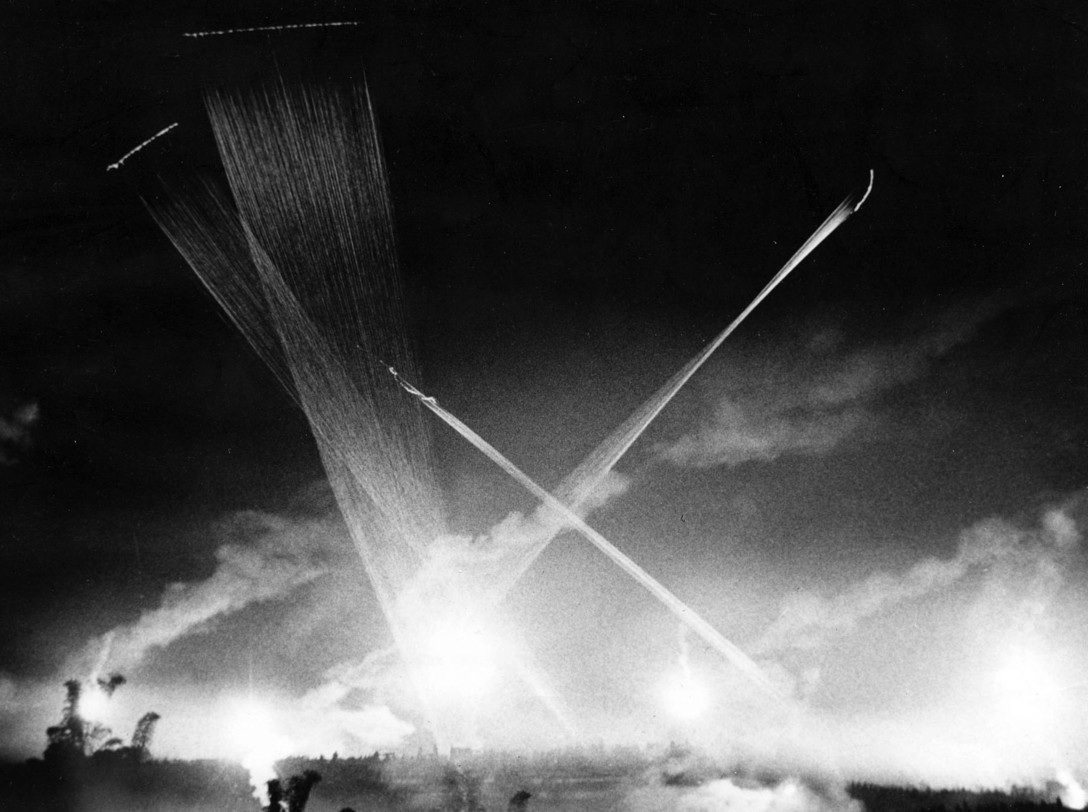
Tracer round trajectories, Vietnam war. (U.S. Air Force photo)
The next day an order came down. I was to make a presentation in three days to a family in southwest Kansas. My first thought was to refuse that order too, but I had made a deal. I was honor-bound to carry out my part of it.
The newly-grieving family deserved more than the Army offered in the way of condolences and they deserved someone better than me. They deserved someone who knew exactly what to do. I was terrified.
I picked up the meager package of medals and awards that the KIA soldier had coming and the orders and citations that go with them. I would travel to wherever the family asked me to be, in this case to their home town in southwest Kansas, in time for the funeral. I would make an awards presentation.
It’s easier to describe than to do. No one tells you what to say. They just give you the medals, some dry military orders and a grieving family. You’re supposed to honor and comfort them, even if you’re only a dumb-kid captain like I was, with no experience in this sort of thing and no idea how to do what so obviously needed to be done.
It took most of a day to drive to the small farming town. Before I checked in at the local motel I drove out to find the family home where I was supposed to be in the morning. It was way, way out of town, a very large farm on flat wheat land that stretched forever. I went back to town, put on some civvies, ate and turned in for the night.
I set a 4 AM wake-up time, common for me in those days. I had worn my Army greens on the way down, with ribbon bars, wings and service patches – First Division on my left shoulder, First Cavalry on my right. Today I would wear my dress blues, complete with full medal display. Even on a modestly decorated soldier like me, that uniform looked impressive. I loved the silver pilot’s wings that symbolized the one great achievement of my life. I had paid dearly for them. Shave, instant motel coffee, re-spit shine my best low quarters (shoes, to the rest of the world) to a mirror finish and I was ready, or so I thought.
I drove out to the farm again. It was just past dawn but already a crowd of family, neighbors and friends was gathering. I parked in an out-of-the-way spot. Several men detached themselves from the main group and walked over. “Are you Captain Stromme?” one asked.
“Yes, sir, I am.”
“We saw you drive by last night. Why didn’t you come in? We thought you would spend the night.”
Spend the night? That wasn’t something I had imagined.
“Well, come on in. We’re just starting breakfast. The newspaper editor will be a little bit late and we don’t want to start before he gets here.” The editor was a long-time family friend. People don’t really come and go in small Kansas farming communities; they come and stay. The families had been close for generations. It wouldn’t do for the paper not to cover the ceremony.
People came to meet me and shake my hand. Some asked about my patches and medals and wings, congratulating me for things they imagined I had done and making small talk, getting to know me.
The young soldier had been named Donald. I met his grieving parents right away. His mother shyly welcomed me, then went back to work in the kitchen with the other ladies. The father’s welcome was a little warmer. What I didn’t understand was that the fuss everyone was making over me wasn’t about me at all. No, it was because I was a stand-in for their Donald. This was the welcome home that he would never have.
I sat with the father and some other men at a table reserved for the men-folk, a long, worn, heavy plank-topped table that could easily have been 100 years old. The women had their own tables; I caught several of them peeking over at me. They were normal in this world. I was the misplaced oddity.
Their men were normal, too. Most were brawny and muscled from a lifetime of hard work and heavy food, red-faced, calloused hands. Along with their wives they were straight out of Grant Wood’s painting American Gothic.
The coffee and breakfast were hot and good and I began to learn a few names. The father said, “So you were in the Infantry, too, like Donald?”
I nodded, swallowing. “Yes, sir. I was in the Infantry but I flew Huey helicopters. I didn’t do any ground combat duty at all.” And with apologies to my Infantry brothers, I still thank God for that. Most aviators do.
“Do you mind if we ask you some questions?”
“Well, sir, I’ll do my best.”
They asked me some ordinary questions. Where was I from, what did I do at Ft. Riley, what was Vietnam like?
What was Vietnam like? I still don’t know, even though I had been there for 366 days minus an R&R in Hawaii. I had flown its skies at very low levels, walked in a couple of its cities, spoken to a few of its people. But that wasn’t what they wanted to know. What they really wanted to know was “What is war like?” and “Why did Donald have to die?”
Then his father, cut from the same rough cloth as his neighbors, asked me, “What do you know about claymore mines?”
I was surprised by the question. I happened to know something about claymores, but it isn’t a subject to be discussed lightly at breakfast. They are God-awful weapons, small, curved plastic packages of death on little steel legs. They explode violently when triggered, spraying 700 deadly steel balls in a broad arc. They have “FRONT TOWARD ENEMY” in raised letters on the front to remind GIs which way to point them when they’re setting them out. I had been trained with them but I had never deployed one for real. It’s not something that aviators often do.
I told them a little bit about claymores, though I didn’t tell them all of that.
The father nodded. “Donald was killed by a claymore mine.”
The room was silent, everyone looking at me and expecting… something. I was appalled, unable to say anything meaningful. What could I say? Not for the first time I lamely expressed my condolences.
“His coffin got here yesterday,” the father said. I had already seen it, on its bier in the front room. “It was sealed, you know, but we got it open.”
I thought, you opened your son’s sealed coffin? They are sealed for very good reasons.
Grimly, he said, “It took us a while, but we finally got it open. He looked pretty good. We just took a peek from the shoulders up.”
Donald had been cut in two by the claymore. They didn’t see the bottom half. The people who prepare KIA bodies had apparently done a good job with his remains and his father wanted us to believe he’d seen what he hoped to see, the handsome young boy he had loved. But his eyes were full of stunned grief, and I wasn’t sure even he could believe what he said.
He smiled a sad half-smile. “How ’bout I show you his room?”
I thought, “Please, God, let this be over.”
The family had a huge basement. This was tornado country and most people had them. This one was finished in grand farm style. We entered Donald’s basement bedroom. It was the room I would have slept in had I spent the previous night. Donald had left for Vietnam only a few weeks before. His room was fresh, clean, the bed made for him, or maybe for me. I imagined I could still smell a boy’s scent.
He had earned a full-ride agriculture scholarship to Kansas State University, the leading aggie school in the region. K-State is located in Manhattan, Kansas, not far from where I lived. Shortly before admission he had decided to enlist in the Army. You know, before it was too late to see any action.
They showed me his yearbooks, his sports pictures, prom pictures of Donald and his girlfriend. She wasn’t there yet. They brought down his Future Farmers of America awards, his 4H projects and certificates, his award buckles, his letter sweater. All for me to see, to bear witness that Donald had lived, that Donald was a person worth remembering. What I saw was a freckle-faced boy, a parent’s dream, and I thought of a father’s cruel last view of his son.
The minister arrived. The editor was late and we waited for him as though we were waiting for royalty. When he finally arrived he took me aside, asking “Did they tell you we opened the casket? God, it was awful.”
Then we gathered in the front room with Donald’s casket. This wasn’t the funeral. That would come later in the day in the family church, with sermon and music, then the burial. I would not attend. This was the farewell, though. This was coming over to visit Donald like they always had, to say good-bye in much the same way they had said good-bye to him a few weeks before. Some friends and family spoke, then it was my turn.
The Army does little enough for its men and women but one thing it does well is train them to be soldiers. I was, am, a product of that training. It, and luck, had kept me alive when nothing else could have. Unfortunately, no one had taken the time to train me to be a presentation officer. Where was the Army Training Manual for this situation? What did it say?
When the father introduced me, I panicked. I was at a complete loss for words. I had only a few things to work with: the few minor medals themselves, the dry orders that accompanied them and whatever I could think of to say on the spot. I had thought of some words while driving down the day before. I even rehearsed them a couple of times in my motel room. I don’t know if they were appropriate because I couldn’t remember any of them.
I began, speaking directly to Donald’s father but loud enough for the room: “The Army profoundly regrets the loss of your son.” Where did that come from? What did it mean and why did I say it?
I spoke of the American commitment in Vietnam, the one in whose name their son and friend had died. I read the medal commendations, then shared what I knew about each of them. I was wearing nearly all of Donald’s medals and more myself and I spoke of the comradeship in arms signified by those medals, pointing out his and my own in turn.
Finally I ran out of things to say. Almost. My ad hoc performance needed an ending but what do you say in those circumstances, to those people gathered there?
I handed Donald’s father the small group of medals with their accompanying orders. The words I chose were “Sir, on behalf of your son’s comrades in the United States Army, I salute you.” Then I raised my hand and saluted, a smart Infantry officer salute or so I imagined, one that would impress the women and children.
Since I had made all this up, the father had no idea what, if anything, he was supposed to do. A silent awkward moment passed, then he stood and slowly raised his hand, callused and scarred from a lifetime of farming, and returned my salute as though we had practiced yesterday.
The minister spoke again, then we prayed for Donald, for all soldiers, for America, for ourselves. I made my excuses and left, not looking forward to the long drive home. The day had drained me, saddened me, used me up.
I wanted a drink, but that was no surprise. Alcoholics usually do. I wanted to make love to my wife. Not out of lust or love. I owned some of both, certainly, but neither was in play now. No, I wanted her because I wanted to feel that I was human and alive, cleansed and renewed by the act and not in pieces in a stainless steel box forever in the ground. I didn’t know how else to find that comfort. Mostly, I wanted to be held and loved, to be told that everything was going to be all right, that I would be OK. The Army doesn’t tell you how to ask for that, either.
That 1972 day is long gone. Back then I thought I could see my entire life stretching out predictably before me. A career of some sort (the FBI, I thought), a home with 2.5 children, grand-kids eventually, strength and joy mixed with occasional sadness, and at the end the personal satisfaction of a life well lived. Nothing lay ahead for Donald. Everything lay ahead for me.
Hostile Threat Detected: Adrian Bonenberger Reviews Joe Pan’s “Operating Systems”
Joe Pan popped up on many veteran writers’ radars in 2014. He had recently written the first great poem about what let’s call the Global War on Terror, “Ode to the MQ-9 Reaper.” At that time it was possible to find the poem in pdf via Pan’s website; it may be that this is still the case. Many downloaded it and read it, and reread it, and were carried away by its vision and drive, and talked about it over beers in trendy taverns. It is a powerful poem, urgent, reckless; it is also, in its own way, scored through with hope and possibility. In the MQ-9 Reaper’s flight one hears the screech and wail of Hart Crane’s “The Tunnel”—one also sees the flash of a seagull’s wings, turning over the Brooklyn Bridge and out to sea:
& I get why we heart the hype. Your sleek iBomb design is haute Apple adorable: the extended wingspan, the ball turret cam. Viewed full-frontal, Hellfire missiles hang loosely clamped to the horizon of your asterisk body, itself a fusion of X-Wing Fighter & Lambda-class Imperial Shuttle from Star Wars, a sexy sort of curvilinear Geek Goddess whose forehead slope recalls the stately dolphin fish, rear propeller the whirr of a rubber-banded planophore. Behold our Indian Springs Sphinx, riddled with weapons.
The MQ-9 Reaper is a type of drone capable of firing missiles. It was well known to soldiers who deployed to Iraq or Afghanistan between 2005-2012, and also to people who played the video game “Call of Duty: Modern Warfare 2.”
“Ode to the MQ-9 Reaper” is simultaneously the drone itself—its physical characteristics, an accounting of its capabilities, its uses—and a way of looking at the world when one is an American. The poem is an exploration of the specific type of systemic power capable of producing a thing like a drone. It begins with the narrator’s third-grade, childhood self dreaming the Reaper into existence, and then wanders through the past and present, shifting perspectives and narrators to catalogue the ways in which seeing and thinking about the Reaper has come to dominate modern life.
As a collection of poetry, “Operating Systems” elaborates on the Ode (the collection’s final and ultimate poem) as an extended preface, delving into how people think about and communicate with the world around them. Written mostly in free verse, “Operating Systems” offers an unsparing look at how people live in a world predicated on well-meaning urges, and desire, and hope, and need. It is less a manual than a guidebook to a world where subjectivity and perspective shift along with the narrator. Each poem is a formula for a moment in time, a mechanism by which that moment plays out.
The collection is organized into five sections of six, six, five, seven, and one poem, respectively. Each poem is assigned an OS or “Operating System” in code, that offers some insight into the poem’s meaning and tone, from the serious (Thanat*OS) to the whimsical (Whack*OS). It’s meticulously organized, which helps orient readers on the one hand, and gives one a sense of confidence and security that Pan’s poetry is deliberate, in addition to beautiful. One can sometimes become lost in a collection of poetry, especially when it is sincerely felt and written; Pan is one of those rare poets who balances the intense emotions he evokes with careful attention to how each poem’s construction.
In spite of the overarching concern driving the collection—the worry that when we aren’t using operating systems to govern our own behavior, we have given over our agency to a series of literal operating systems that choose our friends, and our news, and the things we buy, the poetry we read and (worst of all) the wars we fight—in spite of that all, “Operating Systems” maintains a dogged optimism. In poems like In “Tattoos,” where a garden thrush that endures the stings of bees for a meal becomes an avatar for desire, and “Bedford Avenue L,” where Pan shows how in spite of the formulaic modes of language and mechanics of social interactions, the impulse to help or assist others can be sufficient in a moment of crisis:
This is the moment I tell you you will be okay & this is the moment you say no. I do not know who I am & this is the moment you say no. I do not know who I am telling this to. I do not know myself in this moment, & I do not know you. But hey buddy, hold on.
This underlying redemption exists in the Ode as well, as when its narrator discusses one of the oldest operating systems to appear in the book: the story of Abraham and Isaac on the mountain, envisioned from the perspective of a son having the story read to him in bed by his father.
“Operating Systems” should be read and considered at length. It is not easy or accessible, in contrast with the systems that almost everyone uses to facilitate the minutiae of their daily lives. If much of life is an effort to simplify communication, and the acquisition of those things that bring people satisfaction, isn’t it necessary and good occasionally to step back with a good collection of poetry, to pose the question?
A Poem from Colin James: “Dinner at the Masocis’t Hand Peninsular”
FLOTSAM / image by Amalie Flynn
The smell between
fingers is unmistakable
and now my head aches
like an ocean’s despair
at not being awarded
significant status,
the stigma all abutting
in the flotsam
that takes credit for, or
an investment share.
Sometimes you can sit
and not smell it
but for only a few days
in the short year.
I have already
suggested long walks
until suddenly
exploding within legal limits
all over your a more
unique smell, most fair.
Three Poems from Suzanne Rancourt
EXPLODE / image by Amalie Flynn
The Shoes That Bore Us
It is a dream of kind slippers that coddle bunions appeased by hands mittened as the same kind slippers holding warmth as forgiveness for all the combat boots sogged by brackish muck of wars when not hoisted in the occasional stilettos of never regrets a conundrum of cognitive dissonance stabs the dreams of where ever we had been, we escape to now over racked rails rocked goat paths and deer runs you think it’s a man’s world until it is not
a sidearm presses to a right hip as cupped palms to iliac crests walking boundaries and borders skirting domains of possibilities that astrological forecasts stagger out on slow printed pages like stammering promises spoken by the dead selling real estate, “Check Mate” no choice is a lie when the inevitable is an illusion, no freeze to suffice that fighting, although futile, is still taking a stand
Unhinged Again
a stone leaves the hand that flung it-air escapes constricted vocal cords – a vomiting wild – enraged urgency and angst
kinetic makes contact – leaves bruises the color of bludgeoned fists pounding flesh is quiet. I can’t remember if I was screaming
my face and shielding hands turned overripe plum purple sweet with sticky juice that dribbles down chins
attracts sugar bees you swat in autumn sun that smells of maple leaves red with change
this hammer drives the firing pin into a child’s memory, my memory, of cap guns explode a thousand times greater than a simple pop & puff
a chunk of lead propelled, is unhinged from the mansplaining – the antagonistic prod of condescending joust
I was stuck in a ring of double fisted doubts: leave don’t leave I didn’t know that I was a prisoner of white picket conditions
like my mother. Was she also a prisoner? A side bar of recollection a nursery rhyme my mother sang to me:
“Peter, Peter, pumpkin-eater, had a wife and couldn’t keep her He put her in a pumpkin shell, and there he kept her very well.”
I know my Mother knew when I was being beaten there – my face laying with one ear pressed to cold linoleum
the other, an upward funnel catching my Mother’s vengeful whisper “get up…get up…fight”
to be marginalized – a side note or comment, placed in the periphery, only seen when the reader desires or deems worthy of notice
only one of us walked from that house that day to be silenced – a voice, a room, a home, a door closed upon it
a mind made up, barred entrance, not worth the time to view, hear, acknowledge I’m writing this and telling you words are a privilege
voice is a human right thrown as stones – they fall from the wind
Crying Over Continents
windfarms white wake of ferries channel crossing
a nonstop jack hammer knee Morse code through time zones pounding out instructions, the next destination
I’m not letting go like I used to. I feel heavier in my gathering of nuances, intimacies – You watch someone for hours, days you learn what time they take their dog for a shit turn on the garage light – the one just right of the workbench and always with their left hand You learn to recognize the screams of a woman in an upstairs back bedroom being struck or the subtle moans of make up sex easing across the back yard from windows never locked and left half open
Or maybe, it’s the man in the downstairs apartment under yours that you watch shaving his son’s head before forcing the kid to wear a chain and crucifix bigger than the kid’s malnourished chest with ribs that break at 0200 hrs when Dad comes home drunk, no sex, and vile. The mother died mysteriously, they say, in a different town, a different country
Intimacy is being there as a ghost being fed the compromise of “I’ll never do it again”
Intimacy is being there at the end and being held in the mantle of a dying eye
New fiction from Taylor Brown: Excerpt, ‘Pride of Eden’
The following is an excerpt from Chapter 2 of Taylor Brown’s newest novel, Pride of Eden, out March 17th, 2020. Reprinted with permission from St. Martin’s Press.
Lope knelt before the fire engine, rag in hand, polishing the silver platters of the wheels. An old song rose in his throat. Muddy Waters or Howlin’ Wolf, begging his baby not to go, not to be her dog. Lope let the words hum against his lips, unvoiced. There was heat in the blues, he knew, as if the singer’s heart were held over the blue hiss of a gas flame.
Lope started to part his lips, to sing to the sleeping engine, when a whistle rose in accompaniment, like the train songs of old. A turbocharged diesel came whining up the drive, a black Ford dually with smokestacks risen over the cab like a pair of chrome horns. The truck skidded to a halt before the firehouse bays, rocking on its wheels, as if summoned here.
Little Anse Caulfield jumped down from the cab, his backcut cowboy heels clacking in the gravel. He was a square-jawed bantam, built like a postage stamp, bowlegged like the old jockey he was. He wore a bush hat, the brim pinned on one side, and the small round eyeglasses of a small-town clerk, his nose smashed broad and flat against his cheeks, as if by God’s thumbs. His eyes were iron-gray. In one hand he held a double rifle, like for shooting elephant. He stood before the open bay, squinting at Lope.
“You ain’t seen a lion, have you?”
Lope stood from the wheel. He snapped the rag at the end of one long, dark arm. “Lord,” he said. “Not again.”
*
Her name was Henrietta. She was a golden lioness, born on the grasslands of Africa, sired by a black-maned king of the savannah. She was still a cub when poachers decimated her pride, killing the lions for their teeth and claws and bones. The cubs were rounded up and sold on the black market. She became the pet of an Emirati sheikh, who later sold her to a Miami cocaine lord who enjoyed walking her on a leash amid the topiary beasts of his estate, ribbons of smoke curling from his Cuban cigar.
“Heracles Slaying the Lion.” Roman mosaic, Lliria, Spain.
After a team of DEA agents raided the place, she found herself under the care of Anse Caulfield. His high-fence compound on the Georgia coast was a sanctuary for big cats and exotics of various breeds. It was located an hour south of Savannah, where the dark scrawl of the Satilla River passed beneath the old coastal highway—known as the Ocean Highway in the days before the interstate was built. On this two-lane blacktop, laden with tar-snakes, tourists had hurtled south for the beaches of Florida while semis loaded with citrus and pulpwood howled north. Sometimes they’d collided. There had been incredible wrecks, fiery and debris-strewn, like the work of airstrikes.
Now traffic was scarce. Log trucks and dusty sedans rattled past the compound, which was set back under the mossy oaks and pines. Behind the corrugated steel fence, there lived a whole ambush of tigers, many inbred or arthritic, saved from roadside zoos or private menageries or backyard pens. Some surrendered, some seized, some found wandering highways or neighborhood streets. There lived a duo of former circus tigers, a rescued ocelot, and a three-toed sloth once fenced in a family’s backyard jungle gym. A range of smaller big cats—servals and caracals popular in the exotic pet trade. An elephant that once performed circus handstands, a troop of monkeys, and a lioness.
Anse called the place Little Eden.
No one knew why he kept the property, exactly. His history was vague, rife with rumor and myth. Some people said he’d been with an elite unit in Vietnam—a snake-eater, operating far behind enemy lines. Others said a soldier of fortune in Africa. Some claimed he was a famous jockey who’d fallen one too many times on his head. But Henrietta was his favorite—everyone knew that. He’d built a chain-link enclosure for her, sized like a batting cage for Paul Bunyan, and people said his big dually truck cruised the night roads, rounding up strays to feed her. Others said it was Henrietta herself who stalked the country dark, loosed nightly to feed. Why she would return in the morning, no one knew.
“You reported it yet?” asked Lope.
“What you think I’m doing now?”
Lope got on the radio. The schools would be locked down, the word put out. The county cruisers would begin prowling the backroads along the river, looking for tracks. The firefighters would take their own personal trucks. When he emerged from the radio room, the firemen had paired off into two-man search teams. Anse stood bouncing on his bootheels, grinding histeeth. The odd man out.
“I’ll ride with you,” said Lope.
They aimed up the old coastal highway at speed. Lope had one long arm extended, his hand braced against the dashboard.
“This fast, ain’t you afraid you could hit her crossing the road?”
Anse was hunched over the wheel, his chin pushed out like a hood ornament.
“Serve her right, running out on me again.”
Lope eyed the elephant gun rattling on the rack behind their heads.
“Where’s your tranquilizer gun?”
Anse sucked his lips into his mouth, then popped them out. “Forgot it.”
They passed the old zombie neighborhoods built just before the market crashed. Satilla Shores, Camden Bluffs, King’s Retreat. Whole housing developments killed mid-construction, abandoned when the housing bubble burst. Their wrought iron gates stood twisted with vines, their guard shacks dusty and overgrown, vacant but for snakes and possums and the odd hitchhiker needing shelter for the night. Their empty streets snaked through the pines, curling into cul-de-sacs, skating along bare river frontage. They turned in to one called Plantation Pointe, the sign weedy and discolored. The community was neatly paved, with greening curbs and sidewalks, periodic fire hydrants standing before overgrown lots. There were four or five houses built, pre-recession dreams that petered out. They were empty, their windows shining dumbly in the morning sun, their pipes dry, their circuits dead. Squatters had been found in some of them, vagrant families with their old vans or station wagons parked in the garages, the flotsam of Dumpsters and thrift stores strapped to the vehicles’ roofs. The vagrants cooked only at night, in fireplaces of brick or stone, like people of another age. They kept the curtains drawn.
The dually rolled through the neighborhood, the tires crackling around empty cul-de-sacs. The windows were up. Lope had his ballcap turned backward to press his face closer to the glass, scanning for a flash of golden fur in the trees. “How’d she get loose?”
Anse frowned. “Same’s last time.”
“And how was that, exactly? I never got it straight.”
Anse chewed on his bottom lip. “Look,” he said, pointing over the wheel. “A kill.”
*
They stood in the overgrown yard. It was a whitetail doe, or used to be. It had been torn inside out, the guts strung through the grass. The rib cage was visible, clutching an eaten heart.
“Lord,” said Lope. “You been starving that thing or something?”
Anse spat beneath his bush hat and looked up. A white clot bubbled in the grass. “She’s born for this. What do you expect?”
Lope looked out at the tree line. Fragments of the Satilla River shone through the trunks and vines and moss. The lioness must have stalked the doe from the woods, bursting forth to catch her across this man-made veld. Anse had the elephant gun cradled against his chest, still staring at the mess in the yard. “Used to be lions all across this country, hunting three-toed horses and ground sloths, woolly mammoths.”
“You mean saber-toothed tigers?”
“They ain’t tigers. They’re saber cats. Smilodons. Then you had the American lion, too—Panthera leo atrox—four foot tall at the shoulder. Them cats owned the night. ’Course they disappeared at the same time as the rest of the megafauna, ten thousand years ago.”
Lope shivered. “Thank the Lord,” he said.
Anse’s upper lip curled in sneer. “They would of ate your Lord off his cross and shat him out in the woods.”
Lope stiffened. He thought of the hymns sung in the small whitewashed church of his youth, where his father, a deacon, had often preached on Sundays, his face bright with sweat. Songs of chariots and lion dens and flying away home. He looked at Anse. “Not Daniel they didn’t. ‘God hath sent his angel and shut the lions’ mouths.’”
Anse smiled at the killed deer. “Hath he now?”
Lope could remember his first structure fire more clearly than his first kiss, than his first fumblings for buttons and zippers in the dark of movie theaters and backseats. The stable fire peeled back the darkness of the world, so bright it seared him.
He was ten at the time. He’d already developed a fascination with fire. Under his bed, he kept a cardboard box filled with cigarette lighters he’d collected. He had a vintage Zippo, a butane jet lighter that hissed like a miniature blowtorch, even a stormproof trench lighter made from an antique bullet casing. He would sit cross-legged on his bed and thumb the wheel of a Zippo or Bic, relishing the secret fire in the house. Sometimes, after school, he would erect small temples of kindling and tinder in the backyard, then set them alight, watching rapt at the transformation—the twist and glow of their dying architecture, the chemical brightness.
The day of the fire, he followed a black pillar of smoke home from school, weaving down the shoulder of the road on his BMX bike as the fire engines roared past. His heart raced faster and faster as he realized what was burning.
The stables where his father worked.
The man had grown up on one of the sea islands, riding bareback on marsh ponies while other children were still hopping around on hobbyhorses. A hard man among his family, but strangely tender with animals. He spoke to horses in Gullah—a tongue Lope never heard him use among men. His loose-jointed body seemed built for horseback, his seat and shoulders bobbing in time to their trots. With his long limbs, he could trick-ride with gusto, swinging low from the saddle like an Apache or standing high atop their spines, his arms spread like wings. He worked as the barn manager and groom for a local equine community.
Lope straddled his bicycle before the blaze, his face licked with firelight. Antlers of flame roared from every window, like the blazing crown of a demon, and the smoke looked thick enough to climb. An evil hiss pervaded the scene, pierced now and again by the scream of a frightened animal. Only later did Lope learn that his father had been inside trying to save the last of the horses when the roof beams collapsed.
Ten years old, Lope could not help but feel there was some connection, that his secret fascination had sparked this awful happening. His secret desires or jealousies. So many times, he’d wrapped his arms around himself and wished for the gentle touch and cooing voice his father gave only to his horses—never his son. So many times, Lope had huddled over his yard-built temples and pyres, watching them burn.
Back at Anse’s truck, Lope called his wife. He told her to stay inside with the baby until she heard from him.
“Larell Pope,” she said, using his full name. “I got a cut-and-color at ten. One of my best clients. I’m not canceling on her because some zoo animal is on the loose. I already have a girl coming to watch Lavonne.”
Lope turned toward the truck, gripping the side mirror. “Please,” he said.
“That new dryer ain’t going to pay itself off, Larell.”
“It’ll get paid.”
Lope could sense Anse waiting behind him, his boot heel grinding into the pavement. “Just cancel it,” he said, hanging up.
When he turned around, the old man was sliding a giant,double-barreled pistol into a holster slung under one arm. The gun looked like something the captain of a pirate ship would carry, with twin rabbit-ear hammers and double triggers.
“The hell is that thing?”
“Howdah pistol,” said Anse.
“Howdah?”
“An elephant carriage. Back in the colonial days, hunters carried these pistols on shikars—tiger hunts—in case a pissed-off tiger tried to climb the elephant they were riding.”
Lope swallowed. “Hell,” he said.
The old man took the double rifle from the backseat and held it out. “Can you shoot?”
Lope looked at the old safari gun. The twin barrels were huge, the stock scarred from years in hard country. He sniffed. “I can shoot,” he said.
Look for the novel on March 17th wherever books are sold. It is also Wrath-Bearing Tree’s giveaway book for the month–a comment anywhere on the site enters you to win.
This is how the fight happened: earlier that morning, while waiting on reveille to bugle from the loudspeakers across the blacktop, Harvey forced it on the new kid, Private Gilmore, as the rest of us watched, some gruff comment about his curly, black ponytail—the barbers hadn’t shaved him yet. Only two days into OSUT, Ft. Benning’s one-stop infantry shop, and the poor kid couldn’t catch a break. I remember shaking my head as Harvey yelled out to all the knuckleheads huddled there in formation, “What the hell’s this faggot thinking enlisting without a haircut?” And right along with every other shivering private, he laughed and laughed.
Gilmore had arrived late the night before from Hortons Bay, up in Michigan, and right from the start of that cold January morning, Harvey Coates had it out for him.
“Bet that bitch has some nice pussy!” Harvey slapped his battle buddy, Wilkins, on the arm. “Hey, you think the Army issues jungle-green tampons?”
Gilmore muttered, “Shut the fuck up.”
Just what Harvey wanted. That Alabama redneck wasn’t exactly looking for a fair fight. He just needed a quick release, all pent-up from the barracks. “Boy better not mind me tugging on that cute little ponytail tonight,” he said, loud enough for everyone to hear, “‘cause he’s gettin’ fucked up.”
And just then, Drill Sergeant Malone emerged from HQ and snapped the entire column to attention, stomping into the asphalt with the heel of his polished black boot. Two other drill sergeants followed close behind. When Malone spotted Gilmore, he let out a low whistle, advancing upon him slowly. “Well, ain’t you just the battalion beauty queen!”
Gilmore’s eyes glanced at Malone as he approached.
“Why your eyes flickering at me, private? You see something you like?” Then the drill sergeant leaned in to Gilmore’s left ear. “Oh, I think so, battle. I think this joker does see something he likes.” Malone’s voice got really low, then—I could only hear him because I was nearby. “Hey, private. Maybe, we can work something out, you and me. Maybe, I’ll slip in the barracks tonight, when everybody’s sleeping,” he whispered. “Maybe I’ll let you touch it. You’d like that, wouldn’t you, private?”
Sweating bullets, Gilmore said, “Drill sergeant, no, drill sergeant!”
“You don’t like my cock, private? What’s wrong with it?” Malone’s voice got louder and louder until he was screaming. “Why wouldn’t you want it in the palm of your hand? You think it’s ugly, private? Not big enough like you’re used to?”
That poor bastard didn’t know what to say. “No, I—uh, yes, drill sergeant?”
Malone threw his campaign hat at the ground and yelled down the rest of the line, “Hey, Bravo Company! Listen up!” Malone checked the kid’s name tag. “Private Gilmore here asked me to slip in the barracks tonight so he can rub my dick purple. That the kind of battle buddy ya’ll want in this Army? A special kind of ground pounder? Or is this joker just the typical slack-jawed fuck-face that makes up this training cycle?” He waited as the wind blew. “Answer me, faggots!”
Within five minutes, the drill sergeants forced Gilmore to wear his hair down around his shoulders. They dressed him up in a flamingo-striped civvy polo and then mix-matched it with a pair of regulation BDU bottoms. And that was just the beginning. By the end, Gilmore was bear crawling up and down the hallway, with his ass up in the air, yelling out, “I want a big, gay Viking to ride me! I want a big, gay Viking to ride me!” Their fun lasted over an hour, turning Gilmore into a rock star, a company legend.
I didn’t get to see it all. And honestly, I’m glad I didn’t. Although my hair was a lot shorter than Gilmore’s and I’d cut it before heading to Georgia, it stuck out like a thick mane even by the laxest military standards. That was the thing. You didn’t want to be different from anybody else. And mine was just long enough to be different—ten minutes before that, while headed to the latrine for a shit, I’d seen Harvey smirking and pointing at me with Wilkins, who pretended to toss his hair like some Vidal Sassoon model. That’s probably why I kept so close to the Michigan kid. It was pack animal mentality: I knew they’d go after the longest hair first.
*
Gilmore finally caught up to me a few hours later. “Lookit,” he mumbled with that Michigan accent. He nodded down the hallway at this other recruit who’d gotten singled out by the drill sergeants. “Elliott’s got the mannequin.” Probably out of his instinct to survive—by finding someone lower on the totem pole than he was in that moment—Gilmore’d pointed out another company pretender, Tommy Elliott, who’d already skipped PT for sick-call three times in a row. Well, now they had that fat fuck sliding his duffel bags along the cold vinyl flooring with this ridiculous dummy-soldier slung across his back. A traditional hawes carry.
Officially, the dummy was known as Private Emanuel Ken—the drill sergeants always called him out during roll-call—but they told us he liked to go by “Manny” on the block. The top-half of a faded CPR dummy from the 70’s, the mannequin had been dressed up in old BDU’s to look like one of us. They’d built the lower half of his body by stuffing flimsy pillows into the leggings of an Army uniform strapped to the dummy’s waist, using olive-green utility rope and a spare pistol belt. A camouflaged patrol cap topped off his head. One of the supply sergeants joked that they packed half a sand bag in his crotch to help Malone pick him apart from the rest of us.
“Private Ken!” Malone would yell across the barracks at the dummy, which was propped up against the wall to make him stand. “Sound off with your name, Manny Ken!” The drill sergeant charged past us right across the bay as if he were going to hit him. “Why don’t you ever sound the hell off?” Sometimes Malone yelled so loud at him, Manny’s legs would cave-in at the knees like a raptor, his entire body deflating under the drill sergeant’s shadow. “Since Private Ken ain’t enthusiastic today like the rest a-you dickheads, I’ll just have to make the whole company push!” And so, another smoke session would begin.
Wikipedia. “Drill Instructor at the Officer Candidate School.”
But the mannequin wasn’t just an excuse to regularly fuck us. The drill sergeants kept their eyes open for unattended TA-50. They said we were accountable for every last piece of our issued gear, so to hammer that home, when a private left a Kevlar at the water cooler and turned his back to crack a joke with his buddy, they’d swoop in, and God help you if Malone got his hands on your sensitive equipment before you did. It could be taken that quick.
The punishment was always the same: Private Manny Ken. You’d get 24 hours of light duty honing your fireman’s carry, that familiar dummy weighing across the length of your back, that sandbag pressing into it hard. Made a long day even longer. I remember Malone crooning over me the one time I earned it, “That’s good training, private!” hands on his hips like a proud parent. “Damn fine training.” The mannequin was heavy against my body, and a layer of sweat had started to form, but even so, I pulled it tighter.
*
That afternoon, Malone marched our entire company to the PX, the Walmart of the Army. We’d get to buy phone cards there, and buzz cuts. As our feet loped along, out of step and undisciplined, the pine trees loomed along the road like an old frontier fort’s paling. The January wind had died somewhat. Then the PX came into view—a low brick building with the words Post Exchange in thick, bold lettering. Our phone privileges lay inside. A gang of drill sergeants stood on the street corner across from there, shooting the shit, and after taking one good look at our marching column, they shook their heads.
Malone greeted them. “When I get these jokers down-range next week, ya’ll gonna be happier than fags at a hot dog stand!”
“You sure right about that,” one of the drill sergeants shouted back.
“It’s just too easy, battle—too easy!” Malone pulled his belt up a little higher as he passed them on by and grinned.
The entire cluster of campaign hats doubled over, and they began talking fast to each other, just low enough so that we couldn’t hear them. I swear, even though they were laughing the entire time, they glared at us like a pack of hungry wolves tethered by invisible leashes, growling through rabid teeth.
To avoid mixing us with the rush of Army wives and old retirees, Malone filed the company into the PX through a side entrance, warning us: “You will all shut the fuck up and act respectful inside, is that understood? And you’d better not be cat-callin’ any teenage girls or officers’ wives. If I see or hear any of that shit, it’s gonna be a long fucking night, privates—a long fucking night! I don’t give a flying titty if you’ve got a PT test tomorrow. I will smoke you retarded, trackin’?”
“Drill sergeant, yes, drill sergeant!”
“All your fancy handbags are locked up in storage, so the Army’s gonna give you a monetary advance.” The drill sergeant pulled out a stack of what looked like black debit cards from his pocket. “Each of you gets a 200-dollar money card. That’ll get ya’ll through reception until them first paychecks hit at the end of the month. Since Mother Army don’t put out nothin’ for free if she ain’t gettin’ something back, your earnings statement will show this amount deducted.”
Good ol’ Mother Army.
Shops lined the exchange’s main corridor inside—a women’s salon, vitamin store, uniform tailor, travel rep office, food court, and barber shop. The main department store had its own double-wide entrance, flagged with shoplifting detectors. After a quick glance inside, I could see designer clothing racks, a shoe department, grocery aisles, shelves lined with Harlequin romance novels, and even a big sign for home decorating and gardening. Everything a man needed to get by.
Malone snaked us around the entrance of the barber shop in long, orderly rectangles, packing us in elbow-to-elbow and nut-to-butt. When a few of us caught glimpses of the younger wives or the older daughters moving past, we kind of puffed up and all, being that we were dressed for the first time in our Army uniforms. “Move aside for them shoppers, privates. Eyes front. Mouths shut.” His inside voice was considerably lower than the one he used on the blacktop. The drill sergeant pointed at the main department store. “When ya’ll finished getting a haircut, head straight to them workers up front and buy a shaving kit.” He hesitated, then rolled his eyes. “You can get phone cards, too.”
“Holy shit,” Elliott cried.
“We’re really getting phone cards!” Gilmore said.
Our first chance to call back home. A collective sigh issued from the entire company as we grinned with excitement—all in agreement, for once.
Suddenly, Malone was up in Elliott and Gilmore’s face, whispering loud enough so we could all hear: “Have you two dirty dick-beaters lost your damn mind? If you two don’t shut the fuck up this instant, I’m gonna stick my foot up both your asses and wear you around like a pair of autistic flip-flops!” The drill sergeant looked the rest of us up and down, watching us squirm like kindergartners about to start recess as a pair of grannies shuffled by. He nodded his campaign hat at them politely. “Afternoon, ladies,” which made them blush. When they were far enough away, he added, “And no fucking candy, privates. It’s contraband. Makes your dick small.”
The first recruits rushed into the barber shop as soon as Malone gave the word, and the old men inside directed them to the row of black leather chairs on the righthand wall, reserving the left side for non-recruits. This portly grandma wearing thick glasses waved me over after ten minutes of waiting. She was the only lady barber. “Get over here, son.” My turn to get shaved and soldiered, I guessed.
I sat down and said, “A number one on the sides and a taper near the top—”
“Boy, you gettin’ a monkey cut!” She palmed my head with her hand and flicked the razor on. It buzzed like a wasp as she brought it close to my ears. I felt it press against my sideburn and shave up my temple, a rush of cool air on my open skin. Clumps of hair didn’t fall like I thought they would—the razor had this vacuuming device built into it that sucked the loose debris down a thick tube. As she mowed up and down the back of my neck and head, the barber yelled over the razor’s noise, “You got a lotta moles on your head, boy.” I watched her in the mirror as she ran her tongue across the front of her teeth. “That’s a sign of good luck.”
I felt special. Then I felt a sharp pain.
“Oh. Sorry about that.” She’d cut one of my lucky moles. A thin stream of blood ran down the smooth grooves on my scalp. “Just nicked you some. You’ll be all right.” She only slowed her handiwork to slop a hot, dripping wash cloth on my skin, rubbing it over the wound. “It’ll heal.” When she’d finished my hair, the barber spun me around to give me a good look in the mirror, holding a smaller one up behind me so I could see the back of my head’s reflection.
I looked like a leukemia patient. My eyebrows were longer than what was left atop my head. She might as well have shaved them off, too! If there was one thing I’d taken pride in as a civilian, it’d been my thick, dirty blonde hair, all styled and gelled. Ma always said I’d never go bald. Apparently, a sliver of Cherokee blood ran in her family.
The barber slapped a cotton ball against the cut and fastened it down with white electric tape. “That’s the only band aid I got, kid. Clean it tonight in the shower.”
Next, I had to get my Private E-2 rank sewn on my uniform at the tailor shop. Because I was a university drop-out with over thirty college credits, the Army decided to promote me to a higher starting rank than the kids out of high school, but that meant I needed the E-2 patch sewn onto my BDU collars and my field patrol cap. This Korean lady behind the shop counter steadily worked at the needle and thread with her lined and thin hands. She seemed to know that I was in a hurry, but took her sweet-assed time. There was a moment, when she was about halfway done with her delicate work, that the patch just hung there flimsy off my uniform as I watched. A single chevron rested on it. It made me wonder about the Asian ladies—swarms of them worked as grocery baggers, wives, and tailors on most military installations. They came from countries our soldiers had conquered. Now they labored to provide.
When she finished, I paid her the four-dollar fee and moved on to the main department store to get my shaving kit and phone cards, like Malone ordered.
Gilmore—still rubbing at his own landscaped head—nudged my arm when we’d finished shopping and formed back up outside. “Bro, you might wanna get back in there and buy some Selsun Blue,” he said. “Your head’s ate up with mad dandruff.”
Elliott laughed. “He’s right! Red patches all over your scalp.”
“Sons of bitches,” I muttered. That was the other reason I loved having a thick head of hair—they hid my skin flakes.
But there wasn’t any time for that. Malone had returned. “Fall in!” The company formed up too slowly, and it made our drill sergeant grit his teeth. But something kept his anger in check. “Hurry up,” he shouted at a few stragglers. When the company was ready, he looked us over. “I tell you what,” Malone said, before ordering column-right march. “A company of fresh-bald privates’ll make even the most grizzled old first sergeant weep. Goddamn beautiful.”
*
“Phone calls!” Malone came storming into the bay. “You shit-birds get fifteen minutes, the whole damn company!”
Our entire bay of recruits dropped what they were doing and scrambled for their phone cards, stashed away in wallets and duffle bags, even their shaving kits. We pressed out the bay doors to a series of metal booths with black pay phones under white artificial lights. We still wanted our mothers to save us. Each recruit jockeyed for position. “Every man gets three minutes!” Malone yelled. “That includes dialing time.” Then our fearless leader signaled the phone calls to begin, even as privates were already dialing home.
I was about halfway back in the third line. Gilmore stood in front of me, his face impatient and eager. “It’s pot roast night,” he said aloud to everybody and nobody. “Momma makes the best damn pot roast—I hope to God I can smell it.”
Elliott was huddled against his booth one line over, trying to hide the fact that he was crying. Some of the more respectful privates just turned away, pretending not to notice. It seemed the right thing to do. But a few made sure to rub it in good.
“Be gentle with her,” Harvey was saying to Wilkins. “She just needs a little something in the bay tonight to make her feel better.”
I hated that motherfucker.
“Twelve minutes!” Malone shouted.
Gilmore was up. I’ve never seen someone dial a phone number so fast. You woulda swore he called 911. That got me thinking about who I’d call on my turn so I could dial it just as quick. My girl needed a phone call, for sure, but I hadn’t told my parents that I’d enlisted yet. They still thought I was back home.
“Nine minutes!”
Gilmore’s back got animated. He was talking too low for me to hear, but I just knew he’d gotten his mom on the phone. Whatever he was saying sounded really happy. Family does that for you. No matter how many times you hurt each other, you can always push all that aside. Just be there for each other. I rubbed at the palm of my hand. The artificial lights hummed above, and for the first time, it dawned on me how quiet Ft. Benning was. Above the still pine trees and the freshly mowed grass, the American flag, towering above our complex and wider than several cars, hung limp from its metal post.
“Hurry, man. Time’s up.”
Gilmore turned and gave me a dirty look.
“Six minutes!”
“You’re done, Michigan.” I inched forward to the booth, trying to be as close to that damn phone as possible so I could get a dialing head start.
“Back the fuck up,” he mouthed to me, pissed. “I’m talking to my momma!”
“We all gotta momma.” I flashed him my phone card, as if to reason.
Gilmore shook his head and turned back into the booth. “I gotta go,” he said. “Tell Charley and Liz I miss and love them. You need any money, mom? I’m gonna send you my first check.” He listened for a few seconds. “Nah, I’ll be fine. It’s going straight into your account. Just keep your eyes open for it soon—I know, I know. But I gotta go.” He let out a deep breath. “Love you, too.”
I heard her tell him, “My big strong young man! I’m so proud of you.”
Then I pounced on that damn phone. Gilmore started throwing sass my way, but I was too busy reading the dang instructions on the phone card. It took me over a minute just to get through to the other side.
And then she picked up.
“Hello?” Her voice sharp and suspicious—it was after eight o’clock. I could hear the clanging of pots and pans in the kitchen sink.
“Ma.”
The sink faucet got quieter. “Danny? Is that you? Why are you calling from a strange number? You’re lucky I didn’t hang up.”
“Look Ma, I can’t talk long. There’s a line behind me.”
“A line? Did you drop your phone and break it again?”
“No, Ma. I didn’t drop it—”
“Well, no wonder you didn’t answer your phone last night. I tried calling but it went straight to voicemail. We can meet tomorrow at the mall and I can get you a new one—”
“Ma, listen. I’m a hundred miles away from there. Is Dad around?”
“You didn’t go on another one of those EMD road trips, did you?”
“It’s E-D-M, Ma: electronic dance music.”
“Oh, God, you’re at a pay phone and you’ve lost all your money again! Last time you lost your wallet I had to wire money into your account just to—”
“Jeez, it’s not that. I’ve got all my money, for cryin’ out loud!” My grip squeezed the edge of the phone booth. “I joined the Army.”
It sounded like a glass casserole dish struck the sides of her stainless-steel kitchen sink. “You did what?”
“They sent me to Ft. Benning.” I wrapped my finger around the telephone cord. “Same as Dad.” As I waited for her answer, I noticed that the metal phone booth had a clean look to it, like it had been wiped down recently by recruits that looked too bored when Malone waltzed by. Those little smear marks you always see after.
It reminded me of this one time, back in high school, when my mother had called my little brother into the driveway to help Dad carry this heavy couch she had ordered from La-Z-Boy. She came into my bedroom right before and told me to Windex the front bay window, so I took the paper towels and went into the living room like I was told, spraying that blue shit all over the glass panes. Wiping and wiping at them. When I started working the double-hung on each side, I saw my Dad and brother out there, struggling to heave that big-assed piece of furniture up the sidewalk and through the front door. Even though he was in his late fifties, Dad kept up his old PT routine, hitting the gym pretty regularly. My brother sometimes lifted weights with him, too. Ma stood outside watching them, hands on her hips, the three of them out there working. I guess I really never liked the gym anyways. As I finished my chore, I went to set the Windex bottle on the dining room table, but just then, Ma came inside and took it from me, tucking it into the shadows of a kitchen cabinet as I watched.
“Three minutes!”
“Look, I gotta go. We only get a few minutes to call.”
“But—wait, Danny! When did you—? What does this mean?”
“Hey, get off, rawhide. I need my phone call, too.” Wilkins behind me.
I raised my elbow at him to fuck off and give me another minute. “It means—” I uncoiled my finger from the cord. “It just means I ain’t got no choice, Ma.”
*
Later that night, Harvey finally hit him. It was about a minute or two into personal hygiene. Gilmore had walked up to his own bed and laid his uniforms on top of it, and as he adjusted the bags and tried to figure out how he’d store the things—maybe under his bunk, he’d said aloud—and as he talked with Elliott, who was sleeping on the mattress above him with that damned mannequin by his side, about how all the girls in the hick town he was from were easy to sleep with if you knew how to hunt or fish, Harvey rounded the aisle with a small, patriotic wall of eager recruits, their heads gleaming under the LED lights. Every last one of them savaging for a good fight. He locked eyes on poor Gilmore, that scarred eyebrow tightening on his skull as he picked up speed, and leaning forward, swung hard at the Michigan kid’s baldness. Harvey’s forearm bulged as Gilmore’s head snapped back. The poor bastard slid along the polished floor until his body stopped. Gilmore lay there a moment, a puffy redness around his right eye that immediately began swelling. He palmed blindly at the metal bunk rails nearby.
“Get up, muthafucker,” Harvey shouted. “You think I was playin’?” He reached down and grabbed Gilmore by the shirt and yanked him up, landing his rough, beefy knuckles on the Michigan boy’s nose. Blood slung through the warm barracks air. “I ain’t no liar—I said I’d fuck you up this morning, that’s what I meant!” Harvey hit him again and Gilmore’s skull whipped up and down like a fishing bob in the water. The poor bastard’s mouth hung open in shock, his eyes wide with fear.
“Please—stop, Harvey!” he begged, panting heavy. “I don’t want to—”
“The fuck you don’t.” He hit him one more time and Gilmore crumpled to the floor. Then Harvey hocked up a huge wad of spit. The phlegm shot from the roughneck’s lips onto the naked scalp at his feet, and then, his face red and his blood pumping, he stomped on the poor kid’s stomach. Gilmore heaved and whimpered and fell again to the floor. After finishing, Harvey shook his head with disgust and barreled through the crowd, storming away to his side of the barracks.
The Michigan boy just laid there, crying.
We all stood around and looked at him for a while, waiting for him to get up. I went over finally and put my hand on his shoulder, rolling him onto his back. Someone muttered man, he fucked him up and then the crowd began to disperse, in ones and threes, until only me and Elliott stood around him. He helped me pull Gilmore off the ground and we tucked him in bed. I wrapped the sheets over his shivering form. Turning away to my own bunk one aisle over, I stripped off my uniform, piece by piece, covering myself in a thin towel. Then the shower heads in the latrine fired up, and listening to them, like a faraway rain, I drifted through the barracks until I stood underneath one, its hot lines of water tracing my exposed body and face. The thick steam roiled across the checkered tile flooring, and as the other privates lined the showers—saying little—their collective sigh rose above the running water. It came up heavy and joined the showers’ mists.
Poetry Review: “The Light Outside” by George Kovach
George Kovach’s poetry collection, The Light Outside, begins with a narrator who’s stuck holding open a window.
He’s a little embarrassed about it. The window, that is. He accidentally painted over it a few years past, in a hundred-year-old house, and only just now has gotten it to budge. And so, finally, holding it, he’s not sure that he wants to shut it again.
With the window free a burdened balance replaces
the ease the architect intended. I have to hold it open.
The situation is humorous, humble. It sets the stage for the way Kovach will approach many of his poems: curious, searching, and then decisive. The journey he is about to take the reader on is far from light, and sometimes darkness will overwhelm. But there is a unique resolve to this collection: “I have to hold it open.”
It’s a resolve befitting a poet who has chosen to try to see hard-won light, who has endured the Vietnam war and then, as an artist, worked (through his literary magazine, CONSEQUENCE, and other venues) to highlight and promote artistic voices often very different than his own: prismatic, divergent; contrasts and complements. Like the Rothko painting that graces the collection’s cover—“Dark Over Light (No.7),” in which a charcoal square threatens to overtake the apparent delicacy of a smaller, pale rectangle—or the Sugimoto photograph referenced in the poem “Picture at an Exhibition”–the strength may not be in the encroaching square but in the sliver below that, against all odds, remains open.
*
Hiroshi Sugimoto, “Boden Sea,” 1993.
Kovach’s poems often ring with the language of the sea–coves, moorings, ledges, gulls—though each word holds a far more distilled power than that of a natural world merely-observed. Here, nature observes you–the melded, overlapping nature of the populated Atlantic seaboard, where the human and the wild may have long cohabited but can’t claim to be used to one another, not quite. The gray fog and tides meet low chain-link fences, lilacs, Catholic statuary, paved patios and Coppertone in summer, echoes of Pinsky and Bishop and Lowell.
The legacy of the latter is most overt in “Covenant,” which opens with Lowell’s famous line, “The Lord survives the rainbow of His will,” borrowed from “The Quaker Graveyard in Nantucket.” Like “Quaker Graveyard,” it is a poem about a shipwreck. Both poems share a rhyme scheme and irregular pentameter as well as a vein of bitterness-in-loss, of grappling with what could easily seem, from the ground, an indifferent Almighty.
Whole families
Left what failed them, but held close to their faith;
boarded the St. John in Galway,
threw sprays of white rock-cress leeward
and watched the green hills fade. October 8th
1849, hard into a gale
Within view of a sheltered cove the rigging
failed, shrouds ripped from the bleeding deck,
voices below screamed in the dark and wailed at God.
Now a statue of John the Baptist stands watch there, over a shoreline that has eroded to his bare, stone feet.
Lowell, a conscientious objector who dedicated “Quaker Graveyard” to a cousin killed at sea in the Second World War, limned that poem with a tense and devastating ask: Why would a creator let so many people perish in such cruel ways, and why do we, as humans, seem hell-bent on heaping even more suffering upon ourselves?
Kovach, contrasting Lowell as a combat veteran of a different, perhaps in some ways more culturally fraught war, uses “Covenant” to ask the same. “Covenant” is subtler and shorter than Lowell’s poem, and equally compassionate, but it maintains its predecessor’s edge, the sharp intelligence that won’t let the reader off easy. If a rainbow must be initiated by massive loss and violence—survived, perhaps, only by the Lord with his iron-and-dew will–then it is a double-edged sword: a promise of an eternal love, and a promise that large-scale loss will happen again. Does it comfort you? In a stunning twist, Kovach’s final line reaches out to another Lowell allusion, this time from “For the Union Dead,” which uses a separate historical event to cast its evaluating eye on modern man. Kovach writes,
Slick cormorants skim
with cruel black wings beyond the harbor’s edge.
and that judgment-by-nature, which may seem at first an easier thing to dodge than the judgment of God or man, is packed with all the horror and human-on-human hurt Lowell alludes to with his own famous final lines, A savage servility slides by on grease.
We are the mourners, of course; and we are the noble lost, the starving faithful. We are also the savage servility. Anyone can slide by, watching.
*
I am not surprised that “Covenant” reads to me like an anti-war poem. Kovach is founding editor of the aforementioned Consequence magazine (along with Catherine Parnell and a masthead of other editors), which focuses on the “culture and consequences” of war and its effects. Consequence is an exceptional journal, wide-reaching and brave, and it has served, for me in my last two years with Wrath-Bearing Tree, as a model of what a real literary, intellectual and artistic effort toward justice, true exchange of ideas, and cooperation might look like. Dedicated to the voices of all people touched by war, the magazine has published a special issue featuring Cambodian writers, and its most recent issue—its eleventh volume—features poet Brian Turner as guest curator of a selection of searing and fantastic Iraqi poetry.
Kovach’s “Editor’s Notes” for each issue read like beautiful small essays in themselves. “Prejudice finds soft targets among the vulnerable,” he writes (Vol. 9, February 2018), making plain his opposition to the Muslim travel ban. The Editor’s Note for Volume 7, three years prior, reads like a mission statement:
For me, reading these works [in the magazine] unfastens the flak jacket of my assumptions and enables me to enter a kind of sacred space where the meaning of suffering and loss become complex, nuanced, spoken in a voice that’s both strange and familiar. The cumulative effect is recognition of our shared humanity and how the experience of war is both different and the same, regardless of where it’s fought.
“Unfastens the flak jacket of my assumptions”: It is this humility–this willingness to make oneself a soft target, on par with everyone else–that sets a journal like Consequence apart, that sets the work it features apart. This is an age where it is so easy to turn away—to slide by, watching; or to dismiss the soul for the show, to over-watch, isolated, judgmental, and gaping.
I like the closing lines of Judith Baumel’s poem “Sputinu in Gerace,” published in Consequence last year. It is a poem about olives the way “Quaker Graveyard” and “Covenant” are poems about shipwrecks. The voice is one of both inclusivity and distinction. Some readers will be the voice of the colonized islander, describing the types of olives, and some will be the invaders. Perhaps this is historical and cannot be helped. Perhaps, being human, we can choose the way we proceed from here.
No. Don’t say. I’ll tell you. The invaders didn’t call these cultivars nocellara etnea e Moresca and Biancolilla as we do now but it is what kept them here, wave upon wave, until we did not know the difference between them and us.
*
Several of the poems in the first half of THE LIGHT OUTSIDE touch on veteran experience. “The Page is Empty,” about the memory of a body—interestingly, the written-down memory of something the narrator claims he cannot remember– is almost too harrowing to read.
He’s uncertain, so he leaves out
the glottal stop of a lung
pulling air through the folds
of a fresh tear; leaves out the snap-
shot-silence of the others, prone
in rank water, transfixed
by a wall of patient reeds (the missing
sound’s the soft sweep of reeds)
It’s followed by an equally unsettling but highly visual, energetic long metaphor, “[Another prose statement on the poetry of war]”:
Imagine war after a fix, gold studded and cuff-linked, prowling the wedding reception, uninvited. He fingers the tip of a rubber tube coiled in his coat pocket…He shakes hands greedily with the wedding party. They beam at his glazed eyes, sallow flesh, acetone breath. The groom’s family thinks he’s a friend of the bride’s, the bride’s family looks at each other as he slides to the maid of honor, the best man….
Each poem in the collection hands off a word, theme, or object to the one that follows it. “Soundings,” for example, a poem about tourists on a whale-watch boat, passes a tour guide (in another time and place) to the curious travelers in “Basilica.” “Basilica” passes a watchful eye, as well as mentions of gods and trees (wood, oak, carvings) to the wonderful three-part poem “Siegmund,” a lively and humorous recounting of Richard Wagner’s “The Valkyrie” from the Ring Cycle.
It’s a wonderful interplay, not just between the lines of each poem but between the poems as partners and showmen, jostling slightly to tell you the story, as if they’re saying, But there’s more, there’s more. You really didn’t think that would be all, did you–that there was only one side to a thing?
I should mention, then, that the poems about war hand off to poems about family, parenthood, marriage—that they lead into poems about love.
*
There is humor in these poems, too. “It’s hard to watch immortal mid-life crisis,” the poet muses in “Siegmund,” as the Norse god Wotan throws a hissy fit. (Surely, Cosima Wagner thought the same thing about Richard a time or two.)
Another god, or demigod, arrives, in a playful rumination on Ansel Adams:
He breathed the tops of hemlocks
spectral oaks and snow above the tree line.
When the aspens silvered, he came down
From El Capitan carrying plated images
of rivers slowly splitting mountains,
his hoarfrost beard brittle in the wind.
Word play is in fine form; the poor, boat-bound tourists in “Soundings” “toggle in dramamine equilibrium between alarm and regret,” and in “Basilica,” there are “hubristic papal bees squatting between olive branches, a profligate pope’s baroque addition.”
More than anything, though, there is the joy and relief of a world filtered through this poet’s searching mind. In many poems we are reminded of what we are not seeing–reminded, gently, to look back—or forward. In “Soundings,” the tourists miss the whale after all: “But we’re looking behind, to where we thought we were.”
Frustrated, the narrator in “Basilica” observes a statue and thinks, “I can’t make out what’s in the pupil’s blurred/geometry.” Later, s/he says,
There’s no sense of scale; every perspective’s
blocked by angles, ages of angles designed
for rapture, built on boxes of bones.
*
The overwhelming mood of the book is one of a tender, intelligent hunger for illumination–to see the world for what it is and our human role in it. What is the point of us, so easily distracted, easily discarded, building our monuments? We rapture on boxes of bones. The stone god won’t look us in the eye. “But why,” Kovach asks, in “Lucifer’s Light,” “do I remember darkness better than light?”
I’d argue that he might not. After reading the collection twice, I’m still thinking of that first poem, “A Burdened Balance,” where the narrator is holding open a window he’s accidentally painted shut.
Years ago, careless and in a hurry to finish at the top
of a tall ladder, I painted it shut from the outside.
Now it won’t budge.
And so the narrator is stuck there, having finally got the hinges to move.
I hear inside the wall the window’s counterweights recoil and clang together,
bang against the wood mullion.
The brittle cord connecting them fails—they fall
and with them what I took for granted, the way things work.
Fresh air flows in, rousing a wasp which has been nesting in the attic. The wasp flies out and the narrator, still indecisive, remains, laughing slightly at himself (the window is getting heavy), but waiting for something. “I’ve no reason,” he thinks, “to keep the hobbled window open.” This admission is funny, self-deprecating, and wry. The poem is about holding a window the same way “Covenant” is about a shipwreck and “Sputino in Gerace” is about olives. We are waiting, like the narrator, stuck, laughing, humbled, to see what will come next—some bit of joy or mercy, some bit of the light still outside. There’s certainly been enough of the opposite. Why not just shut the window?
I’ve no reason, I suppose
To keep holding the hobbled window open. But I don’t
want to let the heft of it drop, to close a way of returning.
New Fiction from John Darcy: “Sorry I Missed Your Call”
An hour before the drive, Bubs finds himself sucking down an edible. A big blowout blowtorched dab of a brownie. He could feel it stonerizing his insides the second the swallow went down, that ashy grass-stained aftertaste staking a claim on his tongue
Been doing a lot of things like that, lately. Ill-advised things. Bubs’ best guess pins the start of it back to February. March at the latest. And he didn’t know where the hell this getting out of bed problem came from. The brownie was the prize he’d promised himself for completing the task this morning. Bubs has even stopped spying both ways when crossing the street. He just kind of steps out off the curb.
The weed thing’s, like, not a big deal? is the argument he tries to make to Omar, his driver’s licenseless trip mate and his best friend, hopefully, still.
‘Why the whole thing?’ Omar asks. His jaw is doing that thing it does when he’s not happy. ‘Why not just a bite?’
Bubs sags his shoulders in a sort of shrug. He does, however, feel Omar’s disappointment as if it’s parental in origin, a weathered, rock-like thing, barely shining in the clear bluish glimmer of this dazzling late-May morning, a steely cold shamewave of the someone-expected-better-from-you variety.
Omar says, ‘You do remember what we’re doing here, yeah? Let’s try not to forget.’
Bubs does remember what they’re doing, thank you very much, but he gets to thinking about the purpose of the trip, about how Germ might feel when he understands that Omar and Bubs are not just saying hello, are not just passing through with their sights trained on simple catch-up, that their actual mission is to complete a very serious and sober welfare check.
‘No snacks in that bag by chance?’ Bubs says in his best McConaughey.
‘Seriously?’
‘There’s this side effect of THC called the munchies. Familiar?’
Omar’s face says he isn’t having it, isn’t going to have it, today. Head to toe, Omar is one smooth motherfucker. A good six inches taller than Bubs, he’s got that chill studied coolness of a hipster high school teacher, the dark haired young socialist you could probably call for a lift after getting blind on UV Blue. It’s a first impression thing, impossible to miss.
Bubs can still remember when he had the experience. Fresh off zero hours of sleep, Bubs was getting his face melted off by the acid rain spittle of a Ft. Benning drill sergeant, a walking little napoleon complex who still shows up in nightmares from time to time. For taking too long to get his ass off the bus, Bubs was sentenced to a viscous fucking tongue lashing and a hip toss up the aisle. When he finally made it down the rubber-ribbed steps up front, he saw the formation of new recruits caught in a chokehold of screams and he went to join them in the full nelson, this new clan, his first tribe. Some were doing pushups and it was hot, hot as Bubs could ever remember feeling, and mainly his brain told him, Might have messed up here, Might have made the wrong choice. Then he saw what would turn out to be Omar, front and center, not a drop of sweat even thinking about trying him, not a screaming campaign hat anywhere near, as if a memo had made the rounds before the shark attack, indicating one young soldier in particular it would probably be better not to mess with.
‘Okay then,’ Bubs says, ‘coffee it is. Java. Brain fuel.’ The high still hasn’t hit fully. He is looking forward to its blanketing caress, the slow juicy haymaker of it.
Strapped in, tunes on, shades perched smooth on the oily bridge of his bony nose, Bubs pulls out of the dashed-off fire lane in front of Omar’s building. Bubs wouldn’t call himself handsome, exactly. Especially not next to Omar. Adequate, maybe. Passable. His lips are on the thin side, pincer-like where they curve into each other. On his head an orchestra of dark black hair sits crazy and unbrushed, the texture of very fine straw. A spiraling tattoo of ones and zeros on his left forearm spells out BINARY CODE in binary. There is an efficiency to his composition. His dad used to say, It’s like you were made on an assembly line except with the brains God gave a dog. Ignoring that last part, Bubs is thankful for the proportionality, though if anything he feels it makes him look calculated, indifferent, lame.
That said, Bubs comes alive behind the wheel. The inside-out knowledge he has of his machine, a stock Impreza with more miles than he’d care to admit, makes him proud as an honor roll dad. It takes some foreplay to shift from second to third, but timed properly the latent torque is enough to shove his heart against his ribcage. It’s two make-and-models away from being a full-on rally car, and Bubs loves to remind himself of this fact. He basks in it, the low-level ladder rung of his vehicle, its impossible potential.
‘Can I get one of those?’ Bubs says. Omar has a cigarette rappelling from his mouth. He smokes a snooty, hard-to-find Turkish brand. It’s the kind of thing that’d drive Bubs up the wall with anybody else.
Omar says, ‘Always hanging with the smokers, never has any smokes.’
‘Come on,’ Bubs says, and Omar lights one up for him.
Bubs rolls down the windows in reply.
A rush of air and motion.
Before long they’re gaining speed.
The wind blasts a racket through the nicotined interior. Sunlight is just absolutely pouring down, swallowing them up, threatening to swallow them whole.
Bubs says, ‘What I didn’t expect is that it’d be Germ.’
‘Not really about how someone looks or acts, you know? Germ’s been through a lot.’
‘I mean who hasn’t?
‘I think the divorce puts him in a higher tax bracket.’
‘I get that,’ Bubs says.
‘And his mom’s cancer stuff.’
‘I really get it. But sometimes it is the biggest fuck up––right? It’s the king of the fuck ups, who, you know.’
‘Fucks up?’
‘Nailed it.’
‘Sometimes,’ Omar says. ‘Maybe sometimes.’
‘Not that Germ is one of those guys.’
‘Not at all.’
‘Just generally speaking. You see my water bottle anywhere?’
Omar says, ‘What happens when that shit hits you too hard and we have to pull over?’
‘Not even on my radar. I like driving high anyway. There’s this thing about it, yeah? There’s this way it makes you feel.’
Omar had wanted to hit the road at ten-thirty, introduce themselves to Chicago traffic no later than one in the afternoon. Bubs makes no bones about the delay being his fault. Rolling from his sheets today, phone flashing a harsh nine thirty, it was about the earliest he’d mustered all year.
Omar, on the other hand, has really got his shit sorted. Bubs thinks he should run one of those schemey self-help seminars. Only with Omar it wouldn’t be sleaze. It would be blue-suited and cologned, sharp, deathly fucking sharp. When Omar was enrolled on the GI Bill, he did some day trading on the side. He came out of college well in the black, psych degree in hand. Bubs had signed up for a few certificate courses at the technical college in Janesville, decided not to go.
There is a possibility, Bubs sometimes thinks, that his closeness with Omar finds its bedrock on their uneven terrain of accomplishment. That it’s a necessary condition for their continued buddy status, a cornerstone from the start. He supposes there are worse foundations for a friendship, although it seems to him like a fuel source that’ll eventually burn itself out. Bubs prays it does not. While it collapses his heart to imagine life without his best friend, Bubs is pleased that he struggles to picture the full bleak immensity of it. It is a good sign. Like checking your own pulse, surprised to feel the beating.
***
Bubs curves the car through the interchange and hauls them onto I90. He asks Omar to remind him about the plan. ‘The plan,’ Omar says, ‘is to just see how he’s doing. Snag a beer. Check out where he’s living. Face to face stuff.’
Bubs is glad about the beer. He is also glad his eyes are on the road, preventing Omar from seeing how bright they flare at the sound. That’s another thing about Omar. He’s never tapping on his phone during a conversation. He’ll even say, like, One sec, let me just pop this off, don’t want it interrupting us, and leave it clear in the other room.
‘I’m excited to see him,’ Bubs says.
‘Yeah.’
‘Honestly I am.’
‘Okay,’ Omar says.
Unsure of what Omar’s deal is today, Bubs keeps focused on the southbound highway. The straightness of the road. Its continued reappearance on the far edge of his sightline leads Bubs to think that it wasn’t so much built as dreamed, less engineered than imagined, plopped right into place from way up above, signage and all, aligned just so. If there’s a single cloud in the sky Bubs cannot for the life of him find it.
‘Germ is a good guy,’ Omar says, apropos of nothing Bubs can gather. ‘He’ll be glad you came with.’
He asks Omar, ‘How many guys we lose this last year?’
‘I think it’s three. Three or six. I can’t remember which. But it’s one of those.’
‘How come we didn’t go to any of the funerals?’
‘I don’t know,’ Omar says. ‘How am I supposed to know?’
‘The war back home.’
‘What?’
‘That’s what it’s getting called,’ Bubs says. ‘The war back home.’
Omar rockets around, real intense with the motion. His dark eyes are little discs of deep set stormclouds. ‘Why does everything have to have a name? Why can’t it just be people trying to figure stuff out?’
‘I mean it wasn’t me that came up with it.’
‘Sure,’ Omar says, slinking his head back, turning it to look out on the sectioned squares of farmland around the road. It’s the only thing a person could look at on this stretch of federal street. Bulky portions of agriculture and landmass, barbed and divided, flat yet somehow still rolling, rippling, flowing. Cows out to pasture whiz by in the distance, lifeless specs against the green.
It’s no surprise to Bubs that Omar took the reins in planning the check-up on Germ. What he can’t figure out is why he himself was enlisted for duty. Bubs doesn’t think of himself as a great instiller of confidence. Not really a compelling life-affirmer. But he is happy Omar asked him to come along, and he is happy he’d said yes since it would have been so much easier to say no. It’s gotten so simple––and Bubs isn’t sure why––to do nothing, nothing at all.
Germ is still an hour and a half away, but Bubs is getting the brunt of it now, getting socked by a storm of monster waves. A high tide of heady realizations. He has stepped up and done the right thing by coming along. This much he knows. He is doing what he is supposed to do: you help when you’re able, you do what you can to endure; you carve out as much space as the world allows and if the world doesn’t budge you gotta get yourself real low and push back, push hard, knowing it might not come to much. Bubs feels swaddled in something bright and endlessly comforting, wrapped and entwined, tight as granite, in the grand silky fabric of it. With a kind of worldwide tenderness moving through his body, the mot juste of existence takes shape on his tongue. For the first time in his life, Bubs sees the answers to his questions dead ahead. He’s got them dead to rights. And it’s just as he reaches out to grab them, to give them a healthy once-over, that a sweet lemony haze washes over the frontside of his horizon.
***
Bubs, higher than he has been in his entire life, sits in a patch of tall grass near the picnic area of a rest stop south of Rockford. Omar is on the phone.
Here, knees tight to chest, Bubs recalls with a good bit of nostalgia the appearance of Germ in his life. Jeremey Heck Jr., known as Germ, got his sticky nickname due to the astounding biohazard dirtiness of his Ft. Bragg barracks room. More than the room itself was the way Germ managed to clean it up on inspection day. Bubs couldn’t dismiss the possibility of little animated birds swooping through the window to help tidy up the filth. Bubs and Omar, bunkmates through basic training and airborne school, kept their lucky streak alive when orders came down sending them to the same platoon. The two of them learned early on that they had both grown up in Madison, had lived on opposite sides of the isthmus and attended opposing high schools, had both frenched Anna Cloverman and gotten the same tight slap of rejection when they’d tried to slither a hand down her jeans. And though they’d never directly met before boot camp, they sort of got the picture that this strange lifelong proximity meant they had most likely been at the same place at the same time––Eric Daniel’s historic Halloween banger, most likely––and that this was as close to a sign from the universe as anybody was going to get. Unscrambling the source code, they figured it meant they oughta have each other’s backs, ensure the other’s safe return to the selfsame home. Germ and his petri dish lived straight across the hall from Bubs and Omar, and, according to Germ’s account, got snatched up orbit-like in the pair’s friendship. Bubs’ nickname has an origin story, too. His last name is Bubsmiester. People just chopped off the suffix.
Bubs sees Omar standing above him. The grass is barely wet against his pants, coolly warm, smattered with leftover dew. Straight to his twelve o’clock, making a rug of shade for which Bubs is super grateful, Omar says something kind and reassuring.
‘I’m really sorry, man,’ Bubs says.
‘It’s all right.’
‘I am really high.’
‘You said that already.’
‘I really am, though.’
Omar says, ‘It’s all good. Don’t worry.’
Bubs likes the phrase, recommits it to memory. How many times has he told someone not to worry? Not enough.
A spray of shade over Omar’s collar. It passes quick. Bubs sees, understands, makes note of and comes to realize that he is happy where he is. Soothed. His best friend is a stone’s throw. The weather is stupid calm. Exposed out here, sun on his skin, Bubs wonders if he might be able to undo all the damage he’s done, unwind his own hurt into a manageable enough thread. He imagines constructing a kind of personal murder board for his own personal fuck ups. With enough hard work, he thinks he can do it. Because here’s the thing: It’s all bullshit anyway. So why not try. Failing that, he would settle for a glass of water. Sometimes he worries about having an unsuitable brain.
***
Sunlight. Slow breeze. Lulling hum of the interstate. Omar is out of sight now. Bubs knows he is arraigning things, talking with Germ, fixing what Bubs has broken. Impaired, definitely still impaired, Bubs stands up, wobbling, and goes towards the main a-frame building.
He passes the huge towering map of the state and the free-standing little dusty cubicle of waterpark brochures. The bubbler inside is broken; the vending machine doesn’t take debits; the sink in the bathroom is automatic, and Bubs waves and waves his hand at the sensor but nothing comes. He is as thirsty as he can ever remember being, and fucking saying something, that is.
He decides to make himself stay with the discomfort, lets it ride through him like a train or a skateboard or some other thing that rolls and glides and breezes.
Inside the building, he slips out a side door. He makes his way over a field of mown grass into a thicket of sick-looking trees. Bubs keeps the trucker’s parking lot on his right when he moves into the bramble. When he heads back, he’s just gotta keep the blacktop on his left.
Now he is here, alone, standing at the mud-slathered edge of some kind of retaining pond. A nasty spot, about the size of an above ground pool. The water is dark, murky. A kind of loose film of grime covers its surface. The water buzzes with tiny bugs, the swirling gray leftovers of vehicular exhaust. A few branches hang over the water at uncertain angles. Bubs pulls out his phone, sees a missed call from Omar.
He feels the sun on his back, feels it lowering against his spine. His surroundings are summer and sky. He stares at the pond, dirty and calm, the color of old dryer lint. He watches its surface do things with the light. Bubs bends down, brushes away a layer of dirt and gristle, cups his hands, fills them with water, and drinks.
***
When he makes his way back from the water, a silvery trembling thrashing in his stomach, he tells Omar what he’s done. Omar, without a change on his face or a clue in his eyes, balls his left hand and hits Bubs on the side of the head and Bubs hears the tinnitus in his right ear, always present, spike like a line on a chart and he is on the ground; the pain is hot and tender, but its heat is concentrated, boxed, not overwhelming him, and he groans a little mainly from the shock of it, the power of the strike and the unforgivingness of the ground.
Omar offers down a hand. Bubs takes it.
‘I’m sorry,’ he says.
‘It’s all right,’ he answers.
‘I shouldn’t have done that.’
‘I shouldn’t have, either.’
The silence in a way becomes to Bubs like a kind of song, rhythmic and brassy and tempo-heavy. A few birds fly sorties along vapor trails in the sky. Part of Bubs’ gut feel like it’s at a rolling boil.
‘You know what you have to do, yeah?’ Omar says.
Bubs does know, thank you very much. He stares a patch of prickly grass, mainly at the space between blades. He says to Omar, ‘Alright, alright. You know I’m a real retcher so plug your ears.’ Bubs bends down and aims his middle finger to the back of his mouth.
***
They move to a different piece of real estate after Bubs’ hurl. He flips his middle finger, the slimy one, at the mess he made. This makes Omar laugh. With the last of the high still dribbling out of him, Bubs recalls with a fondness bordering on sorrow when the three of them––himself, Omar, and Germ––timed their terminal leave and Army departures for the same day. Piled into a younger version of Bubs’ beloved whip, together they drove off Ft. Bragg for the final time, flipping the bird to the gate guards on their way out, sticky pre-rolled already sparked, two or three extras stinking up the center console. For Bubs it’s a source of serious regret. What good does it do to give your past the middle finger? Talk about a waste of time. It’s the only thing that remains, sure as the resin on the inside of a bong––nothing is forever except your past. But Bubs knows they were different then, on the far shore of that four year lapse of time: Germ, down half a finger from a faulty .50 caliber spring, marriage on the rocks but hopeful for a rescue operation; Omar, newly purple-hearted, lost in a lagoon of survivor’s guilt, dreamily hearing at all hours the deep metallic click of the pressure cooker bomb whose fuse tripped but ordinance didn’t; and Bubs––bias as he might be for knowing more about himself than his friends––coming off a less than honorable discharge for pissing hot, testing positive for an amphetamine they didn’t mind him taking down range, driving too fast towards middle America with his two best buds, ripping huge and unholy tokes from the joint and feeling more than anything like he was alone, cheated out of some promised purpose and belonging, a sort of cancerous growth of dejection sprouting tendrilly in his guts, as lonely leaving the Army as he was going in.
‘You can’t worry about that stuff anymore,’ Bubs hears Omar saying, either somewhere in his head or right there in front of him. He isn’t entirely sure. ‘The stuff you wish you did different? I think that’ll eat you a-fucking-live.’
***
Back at home, three days later, Bubs snoozes his alarm only four times. It is Friday, and through the slats in his blinds the day broadcasts a teaser trailer: cloudless, bright, disturbingly blue. It’s been like that for a stretch now. Bubs knows the rain will come, is coming soon, but it isn’t here yet. Before leaving to pick up Omar, Bubs decides to call his father, himself a veteran. ‘It’s not so much the bad stuff staying with you,’ his father tells him, ‘as it is the good stuff that you miss.’
Germ is driving up for lunch. After the rest stop, Omar said it might be better if Germ made the jump north to Madison. Bubs agreed.
When Bubs sees Germ outside the restaurant, he is surprised to see a person that looks exactly like someone who does not need help. Healthy skin, clipped nails, sweater crisp like hospital cornering. A damn near pregnancy glow.
‘This is the place you picked?’ Germ says. He has a small nose, short sandy hair. The smile might burst off his face. ‘Nah, no way, this won’t work. You know what we need? Tall boys and a secret spot. You guys know a secret spot?’
‘This fucking guy,’ Omar says.
‘I know one,’ Bubs offers. ‘I know where to go.’
Doubled up on six-packs, Bubs leads the way. It served as his go-to toke location in high school. They weave down the downtown one-ways and steam towards the lake. The stocky city skyline is a jagged EKG in the rearview. They park near the bike path trailhead. Exercisers stretch their calves against car tires, dressed in tight cycling attire. The air is warm and still, a breathy room-temperature bubble. It isn’t a long walk to the clearing. Bubs hears Germ pop a preliminary can.
The spot hasn’t changed. Set into a downslope, peeling towards the water, it’s a dewy little outcrop shaded by oaks and maples and shrubs, a few logs and damp boulders for sitting. There is even a metal folding chair, a new addition. The memories Bubs has of the place come back in a clattering stampede. Starlight. Music. Older-brother-bought booze.
‘This,’ Germ says. ‘Much more like it.’ The water is so still Bubs can barely believe it. Doorway-cracks of light drip down through the trees. Beers are passed around.
Omar says, ‘You know what I was thinking about the other day? Adkins and his fucking trains. In the arms room, remember?’
‘Jesus,’ Germ says. ‘The trainset. He had the fucking little trees and conductors and everything. The whole floor, covered with his trainset.’
Bubs goes, ‘And then the suits came in to inspect the arms room? You remember that guys’ face? Like he had to control-alt-delete himself because he had no idea what he was seeing.’
‘And the chickens,’ says Germ. ‘You remember the chickens? We show up one morning, and it’s pretty early, we were going to a range or something, and what’s-his-name had a fucking kennel full of chickens.’
‘What was it that he said again?’ Bubs asks. The lapping of the lake fills the gaps between his words. Omar hands each of them a cigarette.
‘I said to him, like, basically, What the fuck? And he goes, Well, I couldn’t keep them outside. As if that fucking answers my questions?’
‘Man,’ Omar says. ‘What the hell was that guys’ name? Apple-something. Something with fruit.’
‘Something with fruit,’ Bubs says. ‘Helpful.’
‘It’s good to be here with you guys,’ Germ says. ‘We live pretty close, you know, relatively speaking, but we don’t see each other enough. That’s my fault.’
‘Shut up. Nobody’s fault,’ says Omar. ‘We all have stuff going on.’
Bubs, feeling like now is the time, says, ‘It wasn’t Germ we were going to check on, was it? If you wanted to do a little intervention or whatever, you didn’t have to drag me down to Chicago.’
‘You didn’t actually make it,’ Germ says. ‘Just to be clear.’
‘You guys could have just told me though.’
‘Probably true,’ Omar says. ‘Guess I was worried you wouldn’t come, you know?’
‘I get it.’
Germ goes, ‘How often would you say you’re getting blitzed and driving, though?’
‘Follow up,’ Omar jumps in. ‘How often would you say you’re drinking, like, industrial runoff?’
‘Choke on it. That was a one-time thing.’
Germ now, ‘Doesn’t seem like it.’
‘I’m figuring things out,’ Bubs goes.
Omar, his eyes jumping from the lake and back to Bubs, asks, ‘Should we head out?’
‘Not sure. What do you think?’ Bubs says.
Germ says, ‘What, nobody wants to ask me?
Bubs takes a drink, then a drag. Sitting there with his friends, Bubs sees the moment as pound-for-pound one of the better ones he’s had in some time. He is also proud of himself for noticing this––the pleasantness, the ambient joy––while still in the middle of it. Not much feels like it’s changed, except for maybe everything. His stomach still gives him a pang or two, the side of his face faintly red.
They toss a few smiles back and forth. The summer daylight shows no signs of retreat. Omar, stubbing out his cigarette, looks over to Germ and says, ‘Okay then, what now?’
‘No idea.’
But Bubs has one. He polishes off his beer and slips his feet from his shoes. He aims his body at the shoreline. Moving towards it, he sheds his belt and his pants and his shirt. There are only a few yards left before the land gives way. He crashes into the water and strokes out into the blue. A chill comes over him in layers but before long it’s gone and he feels himself floating, sinking, floating again, drifting, and the silence surrounding him is broken by the sound of two splashes somewhere behind him.
Mr. Mendes’ War: Film Review, ‘1917’
“You have to construct a journey for the camera that’s every bit as interesting as the journey of the actor. What I wanted was one ribbon, like a snake, moving forward, in which the information that you needed happened to fall in front of where the camera was pointing.”
-Sam Mendes
It is a glorious thing to live in an age that is learning to remember the Great War.
Once the Centennial passed, I started to worry that WWI would fade back into obscurity.
There would be nothing more to it than the occasional badly-produced documentary, rehashing all the basic facts. Or the once-a-decade feature film composed primarily of maudlin melodrama and scenery-chewing. Great War geeks would be reduced, finally, to re-reading what little their local library has on the subject (invariably, a shelf or two perched on the edge of the vast glacier of paper that is EVERY BOOK ABOUT WWII EVER PUBLISHED, which even the most modest county library is guaranteed to have).
We’d keep on of course, as we have for decades, finding solitary joy in studying the minutiae of this defining moment of the 20th Century, only telegraphing our interests by posting Siegfried Sassoon’s “Survivors” on social media every Armistice Day. We know how to live like this.
And it may yet come to that again, in ten years or so. But for now, the Great War retains a prominent place in scholarship and the public eye. Peter Jackson’s They Shall Not Grow Old (see my review for WBT last year) was the first great post-Centennial media event, generating accolades, controversy and awards, and proving so popular it was re-released in theaters twice in one year.
Sam Mendes’ masterful 1917 carries on this legacy, and in my honest and no doubt potentially unpopular opinion, surpasses Jackson’s film in almost every way. I know, we’re talking about two fairly dissimilar things here. The statement stands. 1917 evokes the character of the Great War, it contains the soul of the War, and it conveys these ideas to the audience in a way that documentary cannot do. In short, were you forced to show someone who had never heard of the Great War only one film that evoked the nature of the War, you would choose 1917 over They Shall Not Grow Old.
For one thing, it is shorter; for another, it is much more compelling; finally, it is free from the glaring flaws of Jackson’s film. They Shall Not Grow Old suffers from low-key jingoism and Jackson’s bizarre visual insistence on depicting only white British infantrymen (it turns out there were other people there).
1917 is the WWI movie I’ve been waiting for my whole life.
Yet after I saw it, and then read more than a few reviews of 1917, I was left with one major question:
What movie did y’all see?
Because the 1917 I’ve encountered in the criticism is not in any sense the film that I watched.
For example, Manohla Dargis writing for the NYT describes a film containing “next to no history” and refers to the entire piece as “a carefully organized and sanitized war picture from Sam Mendes that turns one of the most catastrophic episodes in modern times into an exercise in preening showmanship.”
Justin Chang on Fresh Air was generally more positive, but like many other reviewers spent ages decrying the film’s technical skill. (If you’re somehow unaware, the major conceit of Mendes’ film is its use of a simulated single tracking shot, actually achieved through a variety of cinematic tricks—if you’re interested you can see exactly how it was done on YouTube.) In fact, the most persistent line of bitching about this movie has been that it’s “too perfect”, with the NYT reviewer even throwing out an offhand line about the movie spending too much time on getting the buttons on the uniforms right.
To which I have to respond: have you ever MET a Great War geek? Get the buttons wrong on the uniforms and you will quite literally never hear the end of it on the Internet. And anyway, maybe I’m missing something here with this whole “sure, it’s technically magnificent, BUT” angle. People WANT it to be sloppy?
This film is the opposite of sloppy. This is theater, ready for any contingency. This is opera, or better yet a musical, with sets and costumes meticulously and obsessively constructed. This is in every sense a careful production. I’m really missing why this is a problem. With that said:
Sam Mendes gets this a lot.
Fifteen years ago, people said the same shit about Jarhead.
Fie on the critics (for now, anyway). If you haven’t seen this movie, you need to understand what it was really like to dive into it on the big screen. Because this film is beyond epic. It’s beyond “a good film”, beyond even the proverbial “good war film”—it is an experience.
It is immediate.
Overwhelming.
Shocking.
The success of this film lies in the concept of cinema-as-immersion. Toss the viewer straight into the milieu and drag them along, whether they will or no, through all the horror and the madness and the despair that was the soldier’s lot in 1917. Of course it doesn’t dwell on politics or slap you in the face with the grade-school primer on the whys and wherefores of alliances and Archdukes. There is, quite simply, no time for that.
The plot of the film centers on two Lance Corporals of the East Surrey Regiment, Blake and Schofield, played by Dean-Charles Chapman and George MacKay. Fans of Game of Thrones will recognize Chapman as an all-grown-up version of King Tommen Baratheon, First of His Name*.
*The fact of his starring role in this film prompted the following exchange. While we were on the way to the cinema, my wife said to me “Who’s directing this?”
ME: Sam Mendes.
MARY: What else has he done besides James Bond?
ME: American Beauty. Revolutionary Road. Jarhead.
MARY: Oh. Oh God.
ME: What?
MARY: I just got this incredibly clear picture of Tommen dancing around with a Santa hat on his junk, to a tinny clarinet-and-piano ‘20s jazz version of “O.P.P.”
ME: <inarticulate with laughter>
MARY (imitating Cab Calloway): Ya down with O.P.P? Yeah, you know me!
At that point I nearly wrecked the car.
I digress (but you laughed). Blake and Schofield are first seen on their backs in an unspoiled field, trying to get in one of the naps that soldiers everywhere can manage at the drop of any hat, when they’re interrupted and summoned back to HQ in the trenches. Along their way, they pass by any number of black British soldiers from the West Indies Regiment.
Jackson’s film made no acknowledgement whatsoever of the service these people made during the war. Mendes, whose Trinidadian grandfather was a messenger serving in much the same capacity as Blake or Schofield, is careful to honor the sacrifices of these brave people who served despite the racist and classist treatment they suffered while doing their duty. All of this is accomplished in the first five minutes.
Awaiting them is General Erinmore, portrayed by an extra-gruff-and-crusty Colin Firth. Our Heroes are informed that there is a mission of extreme importance that must be undertaken immediately; the German “retreat” to the Hindenburg Line has been revealed through aerial reconnaissance to be anything but, and their comrades in the 2nd under Colonel Mackenzie are walking into a deathtrap. Their orders to attack will ensure the deaths of 1600 men. As Blake’s brother is a lieutenant in the 2nd, Blake is chosen for this mission and entrusted with orders from General Erinmore to call off the attack, and as he is allowed to choose one man to go with him, of course he chooses his best mate Schofield.
These are literally the only moments of peace the film has until its end. From this moment forward, everything is propulsive, violent, and fast. Even the scenes of relative inaction are fraught, with the promise of calamity never further away than the next street or the next trench.
From here, the camera follows Blake and Schofield with all the obsession of a stalker. Through the use of wildly varying color palettes, Mendes carefully establishes “chapters” in the film. The British trenches they leave are orderly, earth-colored, dusty but tidy. Their entry into No Man’s Land, with its foul slurry of churned mud, discarded boots, and body parts, is clearly Chapter Two: a sudden break with the imagery seen before reveals a landscape riddled with the grey of rotting flesh, the brown of human shit, the occasional burst of gold or green to remind one that this was once a place where people lived with their families, farmed, tended their business.
The initial shots of No Man’s Land are strikingly reminiscent of Max Ernst’s Europe After the Rain II:
Max Ernst. Europe After Rain II: 1940-42.
There is a moment of dark Great War humor when the two encounter Lieutenant Leslie (Andrew Scott, familiar to viewers of Sherlock as Moriarty) who lends them flare guns (“Throw them back when you’re done, we’re forever out of these”) and reminds them that on the way to their destination, they should “mind the bowing chap”. The Bowing Chap is revealed to be a decaying corpse suspended from barbed wire, a shoutout to the works of the inimitable Otto Dix, whose “Corpse on Barbed Wire” is one of the most memorable pieces of art from the War.
Further, a lingering shot on the corpses of two horses evokes the work of Dix, whose art provided an inspiration for Jackson’s They Shall Not Grow Old as well. “Horse Cadaver” is apparently every WWI movie director’s favorite; in both movies, the shots of dead and decaying horses are arranged precisely in the same aspect and POV as Dix’s picture.
Stomach-turning images of this kind can and should be employed by those who would make movies about war; 1917 pulls no punches here. During their dangerous sojourn in No Man’s Land and the German trenches, rats swarm everywhere and flies infest all surfaces, including inside a gaping wound on a corpse. Lance Corporal Schofield cuts his hand on barbed wire and then trips, firmly inserting his wounded fist into the bacteria-laden hole where rats were feasting not moments before. It is both disgusting and entirely realistic; the chief cause of death in every war before the First World War was from infectious disease, not combat. If one were feeling particularly apocalyptic, one could definitely argue that the number of people felled by the Spanish flu during and after the conflict showcases the continuing role of Pestilence following along in the wake of War.
Otto Dix. Horse Cadaver, Plate 5 from ‘Der Krieg’ (The War), 1924.
From the German trench (where Schofield is nearly killed, only saved by the valiant efforts of Blake) they proceed to a bombed-out French farmstead. Here the plot takes an unexpected turn, as the corporals observe a dogfight between the Boche and two English pilots, which ends with the German plane crashing mere yards from the broken-down barn where Blake and Schofield have taken shelter.
And it is now where things begin to go horribly awry.
The German fighter plane crashes and catches fire. The pilot screams for help. Blake and Schofield don’t wait for moral considerations or strategic concerns: they pull him from the wreckage as though he were their own comrade. He is burned and wounded, and Schofield suggest they employ the coup de grace, but Blake demurs.
Moments later, Blake is stabbed in the gut by the ungrateful recipient of his kindness.
Schofield shoots the German pilot over and over again, enraged at his perfidy, but Blake is mortally wounded. Schofield holds him as he dies, promising to write to his family back in Britain. “Don’t tell them I was scared,” Blake says, as he dies in agony.
From now on the story is Schofield’s. In service both to his comrades in the 2nd and his fallen companion, he will not be denied in his obsessive focus on the completion of The Quest.
The frenetic pace increases. Schofield manages to catch a ride further into German territory from a group of British soldiers on their way into the battle zone. Among them is a Sikh, a figure common in the British soldiery, but one whose presence in this film inspired ridiculous accusations of “forced diversity” by racist English actor Laurence Fox. To briefly address Fox’s “concerns”: one in every six British soldiers who served in WWI originated from the Indian subcontinent. Sikhs, Malays, Sepoys and others served proudly in many capacities during the War. In fact, there is a famous photograph of Indian lancers proceeding into the now-abandoned No Man’s Land during the German retreat to the Hindenburg Line:
Later, Schofield is shot at by a German sniper while making a perilous crossing over the blasted-out girders of a destroyed bridge. He survives and kills his opponent, only to be knocked out by a ricocheting bullet. When he awakens, he is forced to flee through a bombed-out cityscape of arches and dark passageways lit only by flares and the roaring fires from bombing, which scene makes clear reference to the disturbing cityscapes of De Chirico.
“Melancholy and the mystery of the street” – Painting by George de Chirico, 1914.
The existential horror of solitude. The dread and horror of war, The War, any war. All are displayed here, experienced by the viewer in real time as the protagonist experiences them. As Schofield continues on his journey, the color palette changes again and again and again, from yellow to orange to blue.
At one point, Schofield falls into a river, ending up floating in a pool laden with cherry blossoms, creating a scene that is clearly a sort of genderswapped Lady of Shalott or Ophelia:
John Everett Millais, “Ophelia,” 1851-2.
At long last, Schofield finds the 2nd, only to realize that they are already in the process of going over the top. In his efforts to reach Colonel MacKenzie with his letter calling off the attack, Schofield, gripped with the madness of obsession, runs across No Man’s Land as the shells fall around him, perpendicular to the line of battle, knocking over his comrades and nearly getting killed over and over again. He reaches his goal, delivers his message, and while he is too late to save the first wave of men cut down by German machine guns, he does manage to convince Mackenzie (played by an particularly intense and mustachioed Benedict Cumberbatch) to call off the attack. In the aftermath, he locates Blake’s brother, played by none other than Game of Thrones’ Richard Madden (the irony of a Stark playing the brother of a Baratheon will not be lost on fans of the series) and delivers the news of Blake’s death. “I am so glad you were with him,” Madden says, as he shakes Schofield’s hand and tries and fails to prevent the tears from falling.
At the end, we discover that Schofield has a wife and child at home, whose picture he regards lovingly as he finally gets a few moments of rest beneath a twisted tree, still standing despite the bombardment and destruction all around.
In a last response to the critics, I have this to say. Yes, it was technically perfect. But this movie also had soul. This was a film that portrayed the horrors and the despair of the Great War realistically, that depicted soldiers who were anything but gung-ho, soldiers who questioned where they were and what they were doing. It could not have been set at any other time than 1917, when the German “retreat” freed up more land than the Allies had been able to recapture since August of 1914. The date displayed at the beginning of the movie is no coincidence either: April 6, 1917 is the day the United States entered the war. In its last moments, the film depicts a figure at rest, able to finally hope, to consider a future. This reflects the actual attitudes and emotions felt by the beleaguered British and French who had fought themselves into exhaustion and madness in the three years prior.
1917 is a masterpiece. It is the Great War movie that everyone can love. If the theater we viewed it in was any indication—it was so crowded I couldn’t even sit with my family—it is reaching people. 1917 has accomplished what so many other films and television series produced over the last six years could not: it has engaged the general public with WWI. Mendes’ triumph is thus not just one of aesthetics or skill or “polish”; it is a triumph of thought. If only we could have a film like this every year, the world might well reconsider its addiction to war.
New Poem from Olivia Garard: “Hurry Up”
Hurry up
–
Halt. And quiet,
Marines sleep.
–
Covers askew
necks cocked
weighted by
the waiting.
Dozing softly
in dark down-
time flutters by.
U.S. Army Soldiers from the 4th Brigade (Airborne), 25th Infantry Division, in support of Talisman Saber 2013. (U.S. Air Force photo/Staff Sgt. Zachary Wolf)
–
Sweet & sour
breath bellows,
flickering life.
Bellies swell &
roll heaving
hearts into a
billowing pyre.
–
Ares kisses each
Achilles slowly.
From his lips—
welding dry ice—
wafts the incense
of men burning
in god’s slag.
–
Still in sleep—
mouths agape.
Poetry Review: Graham Barnhart’s THE WAR MAKES EVERYONE LONELY
1.
The book arrives. By mail and on the cover. There are clouds.
Gray clumped in altostratus heaps. A military helicopter headed.
Into thick sky that stretches off. The bottom right hand corner of cardstock.
Or how the title. The War Makes Everyone Lonely makes me think of 2007.
How my husband deployed to Afghanistan. And how lonely we both were.
When he came home.
2.
Graham Barnhart’s poems are about war.
What war is.
What war is not.
Like clouds his poems
gather.
3.
There is a musicality to them. Barnhart’s poems.
The transformer outside his sister’s house –
still humming somehow
(Everything In Sunlight I Can’t Stop Seeing)
How the hum makes memory.
Reminds Barnhart of war –
electricity quieting in the wire when the sun
scrapes its knee bloody up the mosque steps
(Everything In Sunlight I Can’t Stop Seeing)
Or how. When he was at war. For Barnhart –
every insect droning is a cicada
(Unpracticed)
4.
Or bullets. How –
Bitterness sounds like this: steel-tongued
cascades pouring out by the handful.
(Range Detail)
5.
At home there is. A child playing an oboe.
Through a window and after.
After Barnhart comes home from war dull.
Growing dull or the music of it.
Human breath pushing down an oboe’s neck.
Blast of sound. How the boy –
he sounds like a robot learning to speak,
but now and then an almost “Ode to Joy”
or “Lean on Me” outlines itself, and I forget
I am going to die.
(Belated Letter To My Grandmother)
6.
Barnhart’s poems are electric.
Like voltage in a box. Or moving down a wire.
How it is this constant current.
The persistent hum of still being alive.
And then the jolts. When you remember.
7.
Remember yes.
Writing to his grandmother a letter about the letters
he never wrote.
While he was away. How Barnhart writes –
to say yes
yes, the guns were loud –
loud like gods applauding
(Belated Letter To My Grandmother)
8.
But most of all there is tension.
Tension in Barnhart’s poems.
9.
Tension between war and home. Between
remembering war and leaving it behind or
how –
Flashbacks
don’t announce themselves.
It takes so little.
(Everything In Sunlight I Can’t Stop Seeing)
In one poem, Barnhart is flooded with it.
Memory of barracks and army green wool.
White sheets. Film reel dark rooms.
Passing moon.
The fire watch and screams. Of a drill sergeant.
How Barnhart writes –
I told her all of this when she found me
standing in the bedroom doorway.
(Somnambulant)
10.
The tension is a distance. Between
what happened and how he cannot
describe it. Or regret. When he does –
Behind headlights growing darker
night against the snow, I regret saying
kind of like Afghanistan aloud
with my mother and grandmother
in the otherwise silent heat of the car
(Sewing)
11.
In Barnhart’s poems, there is a sense that
coming home from war is displacement or
this placement outside of time. How –
tree branches, black
in the dawn sky, resume their grays and browns
by lunch. The black wrought fences continue
leaning into their rust, rigid and failing
(Everything In Sunlight I Can’t Stop Seeing)
Everything remains. Goes on.
And Barnhart writes –
there
is no war in this but me.
(Everything in Sunlight I Can’t Stop Seeing)
12.
Or the tension between what is real
and what is not. How there is training
for war. Watching grainy videos of men
over there. Placing bombs. Or defecating
under almond trees. Set to pop music.
Only to emerge in America –
sunbright Texas
tobacco juice hissing on the tarmac.
(Capabilities Brief)
13.
How soldiers play Call of Duty. To pass time.
This game of war. Where –
Rifles were weightless. Bombs fell with nothing
close to oversight. Injuries meant
heavy breathing –
a red-tinged screen.
(Medics Don’t Earn Killstreaks)
But in a video game, war is fiction. And unreal.
How –
there’s no difference between urgent and expectant.
No need to estimate under fire
the percentage of a body burned.
How much fluid to administer. How much per hour
they should piss out. No need to pull the bodies to cover.
They disappear without you
checking their pulse.
(Medics Don’t Earn Killstreaks)
14.
And the unreality of war is not limited to what is virtual.
Barnhart describes an army recruiting advertisement.
A child hugging a soldier. Her brother or her father.
How the word army is used five times. Strong six.
But there is little war. How there are no –
piles of feet
on airport roads
and no one assigned to shovel them.
(Notice and Focus Exercise)
And –
No blistered trigger fingers.
No depressions in quiet skulls
(Notice and Focus Exercise)
15.
In Barnhart’s poems, war is –
Another year refusing water to children.
When they made the universal gesture for thirst
along roadsides you wouldn’t stop.
(Days of Spring, 2016)
It is bombs –
A bombing at the gate before you arrived
was just a story you knew about rubble.
(Days of Spring, 2016)
It is guards at a gate –
hired to die so you wouldn’t when another bomb came.
(Days of Spring, 2016)
16.
Barnhart’s poetry acknowledges militarism.
Acknowledges aggression.
The physicality of deployment.
Occupying space in a country
that is not your own.
Barnhart remembers arriving in a village
raided by American soldiers. Arriving and –
Dressed
like the men who killed
their
husbands, we passed out sewing machines
to
widows so they could make clothes
for their children and embroider cemetery flags.
(Sewing)
17.
Or in Iraq. Dinner with a man who called himself. King of Kawliya.
Who fed them meat peeled from goat bones.
How they fed each other from their hands.
Barnhart writes –
I remember my fingernail
against a man’s lip .
(Shura)
Or how later –
the women who had prepared our food
and waited with their children for us to finish
were given to eat what we had left.
(Shura)
18.
There is leaving in Barnhart’s poems.
War and
what it leaves behind.
Remembering transitioning a village, Barnhart writes –
all the small corners in that small base
were pulled open. Picked blessedly clean.
Before our dust-wake settled, no stone,
if we had stacked it, was left standing on another
(How to Transition a Province)
This is the tension.
Between going to war but not staying.
Between leaving a mark and wanting
to leave nothing at all.
And the complicity when it is not possible.
19.
Barnhart remembers H.E. rounds. Their smoke and
dust. How –
illume
shells – packed light and smoke
and
shot too low – drop phosphorous
through
civilian fields we aren’t
supposed
to burn, so we wait down
the cease-fire in the bus that brought us.
(Indiana-Stan)
There is privilege in leaving. Because –
Over there, if the wheat
or poppy crops catch, we can leave
those fires as soon as they start.
(Indiana-Stan)
20.
This is the complexity of going to war.
21.
When imagining himself on a dating site.
And choosing a profile picture.
Barnhart writes –
Hope it all says: confident
and responsible.
As an aggressor
aware of his complicity.
(Tinder Pic)
He acknowledges –
there will be left swipes
for that arrogance.
For trying to play imperialist
and dissenter without seeming too
patriotic or worse –
apathetic. Naïve or too reckless.
Unwary and soon to explode
(Tinder Pic)
22.
This is the complicity of it.
23.
Or how
because. Because Barnhart is a medic. D18.
U.S.
Army Special Forces Medic. There is a tension.
Between going to war and going to war as a medic.
24.
How the word medic in Latin.
Mederi
Means to heal.
25.
During
deployment, Barnhart works with a physical therapist –
learning
to scrape sore tissue
with
a slice of machined steel
curves
to match the shape of the musculature.
Like
a cradle or scythe, you said to no one
(Days of Spring, 2016)
In
Barnhart’s poems. This is the tension.
How
he is both. A cradle. And a scythe.
He writes
–
And that was how morning found you,
sometimes
a cradle, sometimes a scythe
(Days of Spring, 2016)
26.
But out
of it. Out of this complexity of war.
The
complicity of it. Comes Barnhart’s poems.
Like
the purple loosestrife he describes. That
grows
at the prison near Mazar-i-Sharif –
gathered
trembling
against the walls
(Tourists)
27.
Barnhart
imagines himself –
a glowing green eye in a gargoyle mass.
(0300)
28.
He
describes going to see an informant.
How
he is remembering the man and his cell phone video –
Hacksaw tugging neck skin.
The careful
way you spoke in English
my
uncle, my brother, my uncle’s son. Your
finger
touching
each shemagh-wrapped face.
The
one you couldn’t name I knew was you
(Informant)
Or how
Barnhart’s poetry is like this.
How in
his telling it. He straddles worlds.
Reveals
secrets. Identifies himself. And
invites
the reader. To find themselves.
29.
The
war. The war stretches on like sky.
Across
countries and deployments.
How this
war does not ever end.
30.
Because how many years ago. When I stood on that corner watching.
As a plane
hit the first tower. And a plane hit the second tower. Fire.
Or
people clinging to the metal. Slipping and jumping and falling and
how
the two towers crashed down.
31.
There is a poem about post 9/11 tear gas training.
Words PRO PATRIA MORI in red.
Above a cement hut door. To die for your country.
Or how. After. Barnhart writes –
Somehow
outside, somehow after
on my
knees with everyone else, purging
years
of sediment phlegm from scraped alveoli,
I saw
the line waiting to go in, heard
the
men behind me learning to drown.
Learning
to breathe that evil pure as air.
Motes
of gas, like dust in sunlight,
wafted
from the exit labeled DULCE ET
(Post 9/11 Gas Training (II))
32.
How
many. Soldiers have gone to war. Gone to
war
post 9/11 and how many have come home.
And how
many.
How
many dreamed of its sweetness.
33.
There
is a futility.
Poems
about training and more
training
or the feeling that it may
not
matter.
34.
Barnhart writes –
Today
I can deadlift four-oh-five.
When
I can move four-ten it will
not
stop a bullet or
the
overpressure of a bomb
(Cultivating Mass)
There is a sense of inevitability.
Because
–
A
tourniquet will work
unless
it doesn’t
(How To Stop the Bleeding)
35.
Language
is questioned.
Its
privilege. How Barnhart inscribes diplomas in Pashtu.
Only
to be told. By the Major. To write them in English –
The
Pashtu,
he said,
is lovely
but unofficial.
(Certificates of Training)
36.
Or the
task of announcing he will deploy again.
How Barnhart
imagines his words as bats. How –
I’ll
probably just open my mouth,
wait for something to fly out
(Telling You I Will Deploy Again)
Or when the words don’t come.
Barnhart describes hitting them
with a racket.
Scoops and sloughs them outside.
And –
Regretting,
only
a little, the need, the abrupt
cessation
of a fragile thing,
that terrible
satisfaction, even
with
these apologies hanging limp,
crumpled in the rhododendrons.
(Telling You I Will Deploy Again)
37.
In
trying to describe to his father –
the
dull machine chunk
of a
rifle’s sear reset between rounds
(What Being In The Army Did)
Graham
offers –
maybe
there is no word
(What Being In The Army Did)
Just
space.
Air
between bars. Distance between keys.
To
which his father replies –
No,
he said,
there
is definitely a word
(What Being In The Army Did)
38.
And
Graham questions poetry.
Remembering
a photograph of two dead bodies.
Men wrapped and left on a dirt field. Barnhart writes –
bodies
sloughed
in a field then photographed.
In
their repose
deserving
more than this poem
and
its portions
of
sky framed by power lines.
(Deserving
(II))
39.
Of
course. Loneliness is this.
This
futility. The question.
Of
whether anything makes a difference.
Or if
words are enough.
40.
But
in Barnhart’s poems. His words
are
the answer. The raveled call to
prayer.
Or his surprise to see a boy –
kneeling beside his bucket to kiss the dirt.
(Call
to Prayer)
The shared
humanity of experience.
Even
in war. Even in our loneliness.
41.
In
his poems, Barnhart sews together.
The pieces
of war. Memory. Leaving
and coming
home. What it means to
fight
a war and care for its wounded.
42.
He
describes history as a skeleton –
each city suturing
new skin to the skeleton.
(Pissing in Irbil)
Or
how his poems are flesh.
Attaching
themselves to the
skeleton
of what happened.
Wrapping
bone in meaning.
43.
At a poetry
reading, Barnhart sees a bee
dragged
by a spider. As the poet who is
reading
says –
Those
with the time
for
poetry don’t deserve it
(Deserving
(I))
Barnhart wonders –
The
poetry or the time
(Deserving
(I))
44.
I am
not certain we deserve either.
But,
as I read Barnhart’s The War Makes Everyone Lonely,
I am
grateful.
Grateful
for both.
Nonfiction from Caitlin McGill: “Paved in Gold”
“Even if one does not know the history, one feels the presence of the past.” ~Peter Balakian
“You have to beat the egg,” my grandmother said while cracking shells over a mixing bowl.
“Beat the egg?” my sister asked, her little brows nearly colliding. “But I don’t want to hurt it!”
My grandmother laughed. Covered her gaping mouth with a flour-dusted hand and wiped playful tears from her cheeks with the other. I looked up from my fourth-grade vocabulary book and watched them push a roller over the opaque ball of dough until it unfurled like a tongue across our countertop, brushing melted butter atop the beige concoction and patching holes as they emerged. When my sister pulled the tray out of the oven, my grandmother’s childhood bruises oozed out of the blooming chocolate and cinnamon nut pastries that her own gentle grandmother, Ester, had taught her to make.
My grandmother spent decades suppressing her past, but in moments like these she occasionally, unintentionally broke her silence. When she and my sister baked rugelach for a class project, or when she took us for ice cream on Wednesdays after elementary school, or when she arrived at our parents’ Miami home two hours early to cook French toast made from challah before middle school, we swarmed her, gazed up at her beaded neck and slight waist, and begged for stories. Three husbands, a nose job, a knack for intricate baking and a sharp eye for discounted designer clothes? We were desperate to learn more about her fascinating and often scandalous life, about our family, about our cryptic past. Once we got her started, it seemed she couldn’t stop.
I don’t recall precisely when I learned that Ester’s husband-my great-great grandfather Charles-beat each of his six children, including my great-grandmother, Lillian. But at some point over the years, I gathered that Charles and Ester raised Lillian in a poverty-stricken Orthodox Jewish home, and that Lillian ran away to New York City at seventeen-ran away, I assumed, from Charles’s abuse and strict religious rules. Charles was eventually sent to a mental institution and one of his sons was admitted to The Bellevue Psychiatric Hospital in New York City. Paranoid schizophrenia. Although I understand this mental illness might have been genetic, entirely independent of environment or trauma, I still wonder if some other part of Charles’s history might have led to his abuse. After all, Lillian abused her daughter Claire after Lillian’s father abused her.
If Charles’s abuse might explain why Lillian readily deserted Judaism, why she beat my grandmother and why my grandmother repressed her past, then what explains what Charles did?
Though my grandmother once told me that Charles had emigrated from Hungary and settled in Scranton, Pennsylvania near the turn of the century, and though I have read many tales about Hungary during that same time, I still know nothing of his specific life in Europe.
More than two years after running away from a traumatic life of my own, I’m more determined than ever to understand my family’s repudiated history-to prove that their traumatic pasts somehow propelled me into mine. It’s May 2015 and although I’ve recently begun to interrogate my past, too, I still can’t see that obsessing over my family’s trauma might be another symptom of my need to understand mine-that this archeological pursuit is, in some ways, a stubborn, unconscious attempt to continue repressing my personal history.
Desperate to uncover my grandmother’s past and the environments that shaped her mindset-and mine-I call her, hoping for answers to these persistent questions: Who was Charles Horowitz? What drove his abuse?
On the phone, I do not tell my grandmother that I want to understand Charles in order to understand my great-grandmother Lillian-that I want to understand Lillian because I want to figure out why my grandmother is so deft at closing doors, why, for so many years, she’s appeared perfectly capable of not speaking about her mother’s abuse, her son’s suicide, her first husband’s abandonment and her second husband’s depression and rage. I do not tell my grandmother what I have only recently begun to share with my mother: that, I, too, am dangerously adept at burying my past-the abusive, six-year relationship with Carlos that began when I was sixteen and he twenty-one, drug abuse during that same time, and, more recently, my anorexia, the bodily siren that demanded I start talking.
I focus solely on facts about our family instead. When I finally ask my grandmother about Charles she says, “Nothing. I know nothing of my maternal grandfather.” Her response seems indisputable.
“So your mother never spoke about him?” I’m certain she must have heard something as a kid. Didn’t she meet him? Didn’t someone talk about him?
“No,” my grandmother replies. “I know nothing.”
After we hang up, I begin to wonder: Are the holes in our histories symptomatic of fallible memory and careless record keeping, or have those lost stories been purposefully forgotten? What will it take to decode my grandmother’s words, to bridge the dissonance between her shifting memories and what I know to be true?
~
The next morning I call my mother with questions my grandmother evaded. My mother doesn’t know much more, but she reminds me about the fragile, brown chest of heirlooms in her Miami living room. A deteriorating leather strap seals it shut. I long to rummage through it but I’m 1,500 miles away, sitting in my kitchen hiding from the indecisive Boston spring. Raindrops tap tap tap against the window. Green leaves and amber tulips won’t appear for a few more weeks. I miss color.
My mother is likely rocking in her chair beside the old chest, paintings of ships hanging around her, coconut trees swaying in the backyard behind her, South Florida sunlight blanketing the floor and her freckled legs.
As a child my eyes lingered over the chest, which my parents said came from my father’s South Carolina family and housed old photos my mother inherited after Lillian’s death. But the chest always seemed just another piece of the constellation of familiar and intriguing items that constituted our home. Nothing was off limits, except the knife drawer and my father’s gun, which hid somewhere in the garage.
Each of my parents’ belongings was a piece of treasure hiding in plain sight, waiting to be exhumed. Art hung on nearly every inch of the walls. Rugs and handcrafted bowls and my sister’s third-grade pottery covered counter tops. Rusty tins. An old cobalt lantern. My mother’s tiny childhood chair-originally blue but painted red for my sister when she was three. And my mother’s menorahs, which we lit for years without reciting the customary Hebrew prayers we did not know. My mother buried (and I unearthed) her most cherished items-old photos of her now deceased father and brother, birthday gifts she bought months in advance, cards and old photos and every kind of button imaginable-in her top dresser drawer or the back of her closet, shoved behind layers of discounted clothes I never saw her wear.
I inquired about every item. About each clue to my parents’ pasts, to the people they had been before they became my mother and father. I didn’t realize my curiosity might have been stronger than most kids’; I didn’t realize that other kids, especially those who went to Hebrew or Sunday school, might have known more about their history than I did. That when their parents tucked them in at night, they heard stories about their ancestry. My mother hadn’t been told much about her family’s past, and my father seemed to keep his Baptist Christian life-and his service in Vietnam-behind him. My parents read me fictional tales instead.
“Will you open the chest?” I ask my mother over the phone. The Boston rain is no longer tapping at my window. Sunlight shines through the drops as they climb down glass.
“Of course,” my mother says. She’s always wanted to know more about our family, too, though I only learned of her curiosity when I began to pursue mine. Several years have passed since anyone even touched that deteriorating leather strap. “Let me call you back.”
I imagine my mother hovering over the chest: sitting on her knees, her jean shorts stopping halfway down her thighs. Hands pressed against the floor. Perhaps one hand supporting her achy lower back. Black, curly hair spilling onto stacks of photos that smell like the old, yellowing books I used to read in the corner of the library, my little knees tucked into my chest, my long, straight hair-rare in our family of curls-spilling onto the pages. In the absence of our family’s narratives, I devoured as many others as I could. Later, as a teenager, I devoured Carlos’s narratives, too.
A reason has to exist, I keep thinking, for why I evaporated into Carlos’s world. My family, and therefore I, possessed little sense of identity because our ancestors had denied it, buried the past in order to hide from their trauma and then taught me to do the same. Logical, I tell myself. Right?
Konstantin Bostaevsky, “Old Tree,” sometime before 1947.
As my mother digs through the heirloom and I watch robins dance outside my Boston window, the trunk is no longer just another item in the constellation; it feels enchanting, magnetic, more alluring than my father’s gun or the knife drawer which, once unbearably tempting yet terrifying, now orbit the chest like planets circling the sun.
“I guess they called Lillian ‘Lily,’” my mother writes when she sends me text messages of photos she found inside.
I’ve never heard anyone refer to Lillian by that name, and neither has my mother. I’m surprised; Lily seems too gentle a name for the woman who beat my grandmother.
~
A few minutes later my mother sends a photo of Charles. As soon as I see him I think, villain. I want to look away.
Square face. Dark, full hair-cut short. I imagine someone yanking him away by one of his protruding ears, his head tilting sideways in pain. His mustache is thick and perfectly symmetrical, the ends curling upward as though attempting a smile. Perhaps it’s fake. The rest of his face is bare. Not one hair appears out of place. He does not look directly at the camera, and yet he seems to be looking at something. I follow his gaze and imagine a projector in a dark room, the machine’s light illuminating a cone of dust, the spinning film reel echoing through the room. Click, click.
I can see him running through a Hungarian village, dirt smeared across his face, no mustache above his lip yet, walls climbing up on either side of him as he plays with other eight-year-old boys-Jewish boys like the ones I have read of in historical tales.
Since Czar Alexander III ascended the throne in neighboring Russia the previous year, he’s been encouraging riots and massacres, forcing Jewish families from their villages and “removing” them from their businesses. Over several months these riots have occurred in countless nearby towns. As Charles and his friends laugh maybe they hear hooves clomping along the unpaved roads in the distance. Maybe, minutes later, men with torches and axes encircle them.
Now Charles must be running and falling and scraping his little knees, crying as he approaches his parents’ small hut. I imagine other children-siblings, perhaps-are here, too. With one arm their mother cradles a baby, with the other she rations each child’s meal: one piece of chicken as long as her pinky and wide as her thumb, a scoop of potato no bigger than an eye.
“The men with fire!” Charles shouts. “They’re coming!”
Perhaps the Jews have been sequestered in this village. Perhaps they’ve been denied work and taxed more than their Christian neighbors. Perhaps there’s been a massacre before this one. Charles and his parents and that baby and those other children hide in the chicken coop and listen for hooves. Clop. Clop. Charles watches the torches’ glow slither toward them. He watches the men set their hut on fire. He watches them slit his parents’ throats. His mother’s beige headscarf-worn by most married Orthodox Jewish women-has slipped off, the fabric drowning in her crimson river.
As I stare at that photo of Charles, I want to believe my imagination. This story is easier to believe, easier because if I can justify Charles’s abuse with a traumatic past, then I can…what? Empathize? Believe my grandmother’s abusers at least had reason? Understand why my grandmother shut the door to her past while my mother and I desperately want to open it? Understand why I, too, inherited my grandmother’s denial mechanisms?
Find an excuse for staying with Carlos all those years?
I study Charles’s suit, the satin tie fixed firmly at his neck, shiny buttons trailing down his vest. A chain extends across his chest and beneath his jacket. A pocket watch? Again I follow his gaze, this time to a scene I want to resist yet need to conceive: young Charles in a suit, no scuffs on his little knees, skipping to synagogue and eating cinnamon nut rugelach or apricot strudel and running home to parents who await him with open arms and boiling goulash. This scenario makes my inquiry harder. If Charles did not flee persecution and poverty, which may have been less likely in Hungary than in neighboring Russia, can I find another way to explain why he beat his six children? Is my very attempt to understand Charles’s violence problematic in itself? Am I unintentionally implying that trauma always (and worse: acceptably) leads to more trauma?
Perhaps my imagined scenes of young Carlos unintentionally imply this, too. Yet I can’t help but envision the world he once described. As he shook in the corner of his childhood home, thumb pushed inside his three-year-old mouth, did his father shove his mother across the room like Venezuelan guerrillas had shoved him inside hostage holes, like Carlos would eventually shove me? Did his brothers lift their shirts to reveal guns when Carlos begged for Burger King? Or did everyone just forget that Carlos was standing there, hiding in the shadowy crevices of an un-swept room, learning how to use his hands and heart as his tears spilled into long waterfall lashes?
~
The rain returns. It knocks hard against my window. As I look down at the oak trees separating the neighboring building from mine, my mother sends a photo of Charles’s wife Ester. The hair atop Ester’s head is cut short like a man’s, but long hair is pulled together at her neck, too. I’ve never seen this particular hairstyle before, though it reminds me of a mullet. Maybe she’s sixteen, seventeen. She looks away from the camera, her face angled to the right. Her football eyes appear big, and far apart. She isn’t smiling, but she doesn’t seem unhappy. She seems deep in thought. About her parents? Their farm? The old castle ruins they lived beside now more than 4,000 miles away from her? Her earrings resemble single grains of pearl couscous, and she wears what appears to be a dress-the photo stops at her waist-several layers of lace framing her chest, puffy clouds of cotton billowing from navel to neck. The bottom of the photo says: Newman. 13 Avenue A. New York. This shot must have been taken shortly after she arrived from Europe.
Another: Ester and Charles on their wedding day. Linked arms. A smirk-Ester’s. Charles’s tilted head and watchful eyes. My grandmother Claire’s handwriting curls across the top like vines strangling a fence: Grandmother and Grandfather. Their Wedding. October 18, 1898.
~
A few days later, I call my grandmother again.
“All I know is that Charles and his wife, my grandmother Ester, were from Hungary — Austria-Hungary — and that Ester was very educated,” she says.
I’m determined to know why they left. Why they came to the United States over thirty years before the Holocaust. What were they fleeing?
“Ester wasn’t fleeing,” Claire says. “She was thirteen when she came to America near the turn of the century. Her family didn’t want her to go. Her father was a German educator-they all spoke German when I was a kid-and she knew how to bake and embroider. That’s what she did. She was a baker in the Catskills for some time. Their family was well-to-do in Europe! Ester was so adamant about coming to America that she went on a hunger strike until her parents let her go. Now that’s a story.”
I sense she’s leading me to a story she wants me to tell. A story that is not about her. But I still can’t see that my desire to uncover her story-to blame her denial of the past for my lack of connection to our history and my identity-feeds my reflex to conceal my past from my family. Despite how much I’ve revealed in therapy, I’m still employing the very technique I depended on during those six years with Carlos, the very technique for which I’ve been condemning my Jewish family-even my father’s Gentile family: numbing to survive.
“But what was so appealing about America?” I ask. “Ester must have wanted to leave something behind…” Can my grandmother sense what I still cannot? That I, too, am searching for a story that’s not about me?
“No-the story is simple. It was just like everyone always said: ‘America was paved in gold…’”
I follow my grandmother’s trailing voice into her living room where I picture her sitting on the taupe couch I slept on once as a child. I imagine her lifting one arm to draw that gold road with her bejeweled hand, her delicate fingers moving through the air, her chin tilting up, eyes closed. Graceful, as always. And beautiful, though whenever I study photos of her before her nose job, I always think, even more beautiful before. I like the long, slender, familiar nose I’ve only seen in photos.
“Look,” she says, her hand probably dropping back down beside her waist. Maybe she props it on her hip. “That’s the story they told.”
Perhaps that truly is the story. America’s promise beckoned Ester and Charles, who were both, according to my grandmother, from Austria-Hungary though they met in the U.S.; it beckoned all of my Jewish ancestors who immigrated in the late 1800s and early 1900s. But this narrative still doesn’t answer my question. With what was the path behind them paved? Persecution? Violence? Or simply a desire to leave their homeland? Though I understand many Jews like my grandmother’s paternal grandfather, Aaron, fled persecution in Russia, I don’t yet understand just how many Jews emigrated from Eastern Europe between the 1880s and the 1920s; oppressive legislation and poverty and murder compelled more than two million Jews to leave during that time.
My grandmother continues discussing Ester’s family and ignoring Charles’s. But I want to know about the towns they both left behind, even if they left solely for the alleged gold. The trauma narrative must exist there.
“It’s a dead end. I have no idea where they came from exactly,” my grandmother continues. “And now the maps are all different, too. What I do know is there was a clear difference between the Austrian-Hungarians like my mother’s parents, Ester and Charles, and the Russians like my father’s parents, Aaron and Hannah. The education was different. The ones from Russia were illiterate. My grandmother Ester was much more cultured…you could just tell—”
“How could you tell?” I interrupt. Everything seems so matter-of-fact to her. But the only parts of our history that seem matter-of-fact to me are menorahs and presents and Yarzheit candles lit on the anniversaries of my grandfather’s and uncle’s deaths. As a child, having a menorah seemed as ordinary as having a Christmas tree; one didn’t have to go to mass or temple-or even understand what people did in those places-to hang ornaments or light candles. My father slung our tree over the hood of his truck, and my mother bought our Chanukah candles at T.J. Maxx and stuffed our stockings with chocolate coins called gelt. We ate mountains of previously frozen and toaster-oven-charred potato latkes, golden mudslides of applesauce eroding the pancakes’ crunchy crags.
I never attended temple. My mother never told me there might be a reason I love rugelach and gefilte fish. Her mother had never told her either. Until my twenties, I had never even seen Fiddler on the Roof. When my family lit Chanukah candles, my sister and I sang “Dreidel, Dreidel” and ate gelt and then opened a pile of gifts. When I ate dinner at my best friend’s house one Chanukah night when I was nine or ten, when we circled the menorah and I prepared to sing “Dreidel, Dreidel,” my friend’s entire family placed their hands over their eyes and started speaking some other language I’d only heard at my grandfather’s and uncle’s funerals. Baruch atah, Adonai Eloheinu…
“Ester cooked more refined food, not peasant food. The kind you’d find in an Austrian restaurant. Upscale.” I can see my grandmother’s hand waving through the air again.
How does she know what you’d find in an Austrian restaurant? She’s never traveled to Austria. And didn’t she just say she knows nothing of where her grandparents came from? I suspect that someone told her these stories, that she’s been storing them in her mind for so long that they’ve begun to feel like her own memories-or facts.
“So what does refined food look like then?”
“Hungarian. More German.”
Now that she’s mentioned German two or three times and repeated that Ester and Charles spoke German in America, not Yiddish or Hebrew and certainly not Russian, I can’t help but think she’s choosing sides. The Hungarians-the German-speakers-are winning. I haven’t yet learned that this classism among German Jews is as well known to many Jews as “Twinkle Twinkle, Little Star” was to me as a child.
She continues: “The Russian side ate peasant food. And they probably lived in a ghetto. But my grandmother’s family was educated. They must have had a much better life. More refined.”
Again that word.
Despite my instinctual detection of favoritism and my reflex to resist such classism, I still don’t know what some people might have known nearly their entire lives: that many Jews of my grandmother’s generation believed Austrian or German Jews to be more educated and refined than Eastern European Jews. That even Eastern European Jews believed this, though they hated the German Jews for their arrogance. Months from now, when I reveal my ignorance to a group of Jews, they’ll say, I hate to tell you this, but that’s old news. Everyone knows that. And I’ll grow silent, embarrassed but also suddenly afraid I don’t belong-or am not allowed-in their club.
As my grandmother speaks, I think of Mimi Schwartz’s book, Good Neighbors, Bad Times: Echoes of My Father’s German Village. Schwartz explains that in Benheim (her father’s German town) the German Jews, unlike many Russians, had numerous non-Jewish allies. Though most of those German Jews still were not saved in the Holocaust, some non-Jews were willing to help them flee-had remained their “friends.” Could this be true of my great-great grandmother Ester’s family? Did they believe their education and culture shielded them-that non-Jews were more likely to protect them because of it? Could that be why my grandmother favors the Austrian-Hungarian side? Not because their refinement made them more desirable, but because their refinement might’ve helped them survive? Even if that is true, I don’t think my grandmother could know this. She likely inherited this prejudice, wherever it originated, as a child.
“And I don’t think my grandmother’s family lived in a pogrom,” she continues, “because she could read and write and was educated and-”
“Wait—” I say, flying past the last thing she said about education. “What’s a pogrom?” My grandmother always claimed to know little of our Jewish history and traditions, never intentionally taught my mother anything about it, yet her Yiddish vocabulary appears to be growing. More clues to the past oozing out of her blooming mouth.
“A ghetto.”
I nod and write this down. I don’t realize that although she knows the word, she is wrong about its meaning. That same group of Jews who will tell me that classism among German Jews is old news will also tell me that not understanding the word “pogrom” is like not understanding the word “Holocaust.”
“Okay, so Ester might not have lived in pogroms,” I say, “but some sort of anti-Semitism must’ve still remained. Don’t you think?”
“Maybe the Jews were persecuted,” she says, and pauses. “There probably were restrictions, but there was a time in Europe when the Jews were accepted into society. I don’t think they mingled because Ester’s family didn’t intermarry, but they were able to enjoy culture at a point in time. For example, my grandmother Ester did very fine embroidery, and her superior baking and cooking…she learned it all there!”
This mention of mingling but not intermarrying, of enjoying culture despite restrictions, reminds me of Schwartz’s book again, where she explains that Benheim’s Jewish and Christian neighbors claimed they did not harbor negative feelings for each other, yet they accepted the conditions as matter-of-fact. Jews might have been restricted to live in certain areas, or they might have paid more taxes, or the Christian neighbors might have claimed ignorance when their Jewish friends were taken during the Holocaust, but neighbors still brought each other homemade Linzertortes and asked about the children and lingered in doorways. They didn’t say goodbye because they believed there was nothing they could do, and they were ashamed.
Is this the enjoyment my grandmother is speaking of?
~
When we hang up, I race to my computer and quickly learn that a pogrom is not a ghetto. Not even a place. In the 1800s and 1900s, thousands of these massacres of ethnic groups occurred in Eastern Europe, including one Schwartz discusses in her book-Kristallnacht; the 1938 “night of broken glass.” These pogroms, along with the story of my grandmother’s paternal grandfather, Aaron, who served in the Czar’s army as a boy in the late 1850s, might be among the reasons our Russian family fled. Is that why Grandma knows the word? Did she hear it from Aaron?
The severance from our history suddenly seems deeper than ever. How can my grandmother not understand this word when it was likely among her grandparents’ biggest fears before they emigrated from the old country? What does this silence say about my family?
I keep reading. Of the nineteenth-century Austro-Hungarian Empire. Of the influence of a new wave of German Nationalists in the German-speaking parts of Austria-Hungary. The Nationalists were in alliance with many Jewish intellectuals; both were in favor of a large German republic and liberal ideas like freedom and equality. During this time, many Jews had also begun to intermarry; many stopped speaking Yiddish and Hebrew and left their religion behind. But as the nineteenth century progressed, German Nationalists began to endorse anti-Semitic ideas. Anti-assimilation thoughts festered alongside German nationalism. Seeds of Nazism were planted whilst Jews attempted to integrate.
Even in early-twentieth-century Hungary, several decades after Jews were granted equal citizenship in 1867 and after the 1895 Law of Reception recognized Judaism as a “received” religion, Jewish assimilation continued to rise. As I read on, I think of Susan Faludi’s memoir, In the Darkroom. Faludi writes of 1920s Magyarization-the centuries-old, often forced adoption of the culture of the Magyars (Finno-Ugric people who conquered Hungary in the ninth century and constituted the country’s dominant ethnic group).
The deceiver was the Magyarized Jew, applauded for decades for “correcting” his alien nature, but now, in the popular parlance of the time, “the hidden Jew,” whose disguise fooled no one… In ’20s Hungary, there were to be two species-one pseudo, one true- and the pseudo-Hungarians needed to be expelled for the true Hungarians to thrive… The assimilated Jews of Hungary responded to the mounting animus by trying all the harder to assimilate… The more their affections went unreciprocated, the more the Jews of Hungary tried to prove their fealty as loyal Magyars, with tormented results. That torment had been building for decades in so many of the new nation states of Central and Eastern Europe (233-5).
While returning to these passages, I can’t help but think about the psychological responses to this rejection that had been “building for decades”: Aversion to the past. Self-hatred. Extreme conformity in appearances and imitation of Christian behaviors. Such responses to rejection and persecution surely existed before the 1867 equalization laws, and during the centuries my ancestors lived in Hungary. How much of this extreme conformity and aversion to the past had my great-great grandmother Ester inherited? And my grandmother, Claire, who tried to pass as Gentile her entire life? And me?
It seems possible that Ester’s family was among those Jewish intellectuals who once united with Magyars and German Nationalists. This doesn’t quite make sense though; I’m fairly certain my grandmother once said that Ester and Charles raised their children, including my grandmother’s mother Lillian, as observant Jews whom the family would have rejected had they married a non-Jew. Unless they reconnected with their religion when they immigrated, or unless they remained observant Jews but altered their dress and speech to appear less Jewish, they must not have totally assimilated like these other German nationalist and Magyarized Jews. My grandmother must have been the first to refuse our history.
~
Over the next several days, my mother sends me more photos. She also mentions that she and my grandmother have been discussing our conversations and recalling stories of my curiosity. Of me trailing my mother and asking of my father’s whereabouts. Of me crawling into a cabinet, slipping my left pointer finger into a hole. Of my playful sister closing the cabinet door, a sharp, metal hinge entering that hole and carving off the tip of my two-year-old finger-which eventually regrew. I knew that tale of my inquisitiveness well: my mother bagging the severed tip in ice; my sister wiping blood from the tile floor; nurses coating each of my fingers with some antibiotic I thought looked like brown paint.
As my mother tells me of her recent recollections with my grandmother, she adds that although Grandma was hesitant to talk about her childhood at first, now she can’t seem to stop. This might be the best time to call my grandmother again. She answers after one ring.
“You know…my cousin Eddie looked up the family…” she says, quickly moving away from my questions about Ester and Charles in Hungary. “He found Charles’s grave in Scranton, PA.”
Maybe Mom was wrong. Or maybe my grandmother is more candid with my mother now but still fears what I’ll do with her secrets.
“Eddie?” I’ve never heard of this cousin.
“One of my mother’s brothers, Albert, was Eddie’s father. Albert was a child abuser, too,” she says.
That’s more like it, I think. And then: child abuser? Though I’ve always heard Lillian was “rough,” I’ve never heard anyone describe the Horowitzs with such a clinical term. The dough unfurls. Maybe my mother was right about my grandmother’s new frankness after all.
“Eddie was thirteen when I was born,” she says. “Later he was in the army. I always liked him even though he considered me a spoiled brat. I was the only girl of all the boy cousins-they were all very Jewish and very poor. I guess I got all the attention.”
My grandmother’s father, who contracted pneumonia and died after a long walk in the snow and a dose of penicillin, was a wealthy jeweler. Perhaps the cousins resented her for that.
“Eddie’s a chiropractor now. Lives in Del Ray, I think. Al beat Eddie and Eddie’s brother, and just like my father didn’t interfere when my mother abused me, Eddie’s mother just let it take place.”
I want to know if she’s angry. Resentful that no one stopped it. I want details about her mother’s abuse, but I remind myself those doors are not mine to kick open.
I know what it’s like to crawl inside your shell when your secrets-your safety-are endangered. I know what it’s like to unintentionally hide long after danger disappears.
She continues. “My mother said her father Charles beat all the kids…”
I wonder if her mother was trying to explain herself then, if my grandmother is trying to explain her mother’s abuse now. Is my grandmother remembering her mother’s hands against her skin, the way I remember Carlos’s hands against mine when my therapist probes and I suddenly dream of him again? Is my grandmother closing her eyes, her arms no longer waving gracefully through the air but instead covering her mouth-a shield-just like I shield my chest and neck whenever I recall Carlos drawing near?
“Anyway, I was told Charles had clinical depression. Eddie said Charles died in a hospital and that the official word they used was ‘melancholia.’ And others said Charles was depressed because he lost a son. One of Lillian’s brothers, Clarence, died during the flu epidemic when he was nineteen,” she says. “But I don’t believe that was the reason.”
“Why not?”
“My mother said Charles had been driving a horse wagon, got knocked down, and had a head injury. She said that caused his illness.”
I, too, resist the story that Clarence’s death caused Charles’s depression, but the wagon narrative also seems suspect.
“Couldn’t that have been another story told to cover up the real one? Don’t you think this was all somehow related to Charles’s abuse? That the abuse, which had been going on long before this depression, was a result of some mental illness? And if his son, Herbert, was schizophrenic, couldn’t Charles have been schizophrenic, too?”
“I guess so.”
I know all of this speculation could be just that-a guessing game reliant on fallible memories-but I’m still determined to find the origin of the issue, whatever it might be. I’m still hoping to exhume a story that will somehow reason away my own past.
I require a tangible formula: Charles’s trauma in Hungary led to Charles beating his children in Scranton, which led to Lillian beating my grandmother, which led to my grandmother numbing herself to the past, evaporating into a man and raising my mother and her brother in an unstable home devoid of heritage and expressed love. And all of this might explain why my mother escaped into drinking, why her brother took his life. All of this must explain why I, too, knew little of our history, why I searched for myself in a man who himself had been abused by a political refugee, why I stayed in a destructive relationship for six years. Voilà! Case solved. Easy math.
As I speak to my grandmother, though, I ask only about Charles. Did genetics cause the depression, the schizophrenia, the abuse? Or is something that happened in Hungary to blame instead? My grandmother can’t say. However forthcoming she was minutes ago, she’s beginning to feel less and less reliable. I need other sources.
“I know Eddie would love to get a call from you…” she says. “He was looking for a relationship from me, but I didn’t care to give him that. I tried to close the doors for reasons I’d have to go to a shrink for. And now you come along and want to open them. The thing is, I didn’t choose to drag these memories out. I repressed them instead of trying to figure out why my mother was the way she was.”
There’s the unexpected frankness Mom mentioned. Still, I feel like my grandmother is trying to shift the burden of my questions to someone more willing to peer into the past. I’m also beginning to feel guilty for prying. Am I wrong for trying to unearth painful memories my eighty-six-year-old grandmother wishes to keep buried? Will this excavation benefit anyone other than me?
~
I spend the next day searching the Internet for more information about the Horowitzs. My mother finds and shares some of my grandmother’s first cousins’ phone numbers, including Eddie’s. I know I’ll eventually call them, but I’m still too focused on my grandmother’s slippery tales to tackle other sources yet.
When I call my grandmother to report my findings, she returns to tales about Ester.
“Did you know my grandmother Ester learned her baking and cooking and embroidering in Europe? She was very cultured. She even spoke German!”
I try once more to ask my grandmother about Charles. “So you’re certain Ester and Charles were both educated and well-off in Europe?”
“Absolutely. Now the Russian side-my father’s parents-they couldn’t read or write,” my grandmother reminds me. Claire taught English to her paternal grandfather Aaron. Between lessons he said, We don’t speak Yiddish. We don’t speak Hebrew. We hide to survive.
My grandmother told me that story years ago, and I accepted the narrative as true-complete. It seems to explain why my grandmother ignored her Jewishness. Lillian did not raise Claire religiously-no Hebrew school, no menorah on Chanukah, no Passover Seders-likely because Lillian had fled an abusive, Orthodox home, but also because her father-in-law, Aaron, didn’t want his granddaughter near a synagogue.
“My parents didn’t observe any holidays,” Claire says. “They didn’t keep kosher, they didn’t do anything. Except of course all of our friends were Jewish.”
It’s the of course that stops me again, just like the Yiddish words that have snuck into Claire’s mouth. She claims no understanding of Jewish culture yet the evidence against this is glaring. She’s been married three times. Never once to a non-Jew. But she never let anyone hang a mezuzah over her door.
We hide to survive.
Her impulse to conceal aligns with other narratives I’ve heard since childhood. About the Holocaust, first introduced to me in elementary school. About survival. I’ve long accepted those with ease, too. In my quest to understand why I possess little understanding of my own Jewishness, this makes sense: Aaron survived the Czar’s army and then told his granddaughter to hide, too. Lillian kept Judaism out of the household. And Claire was a teenager when the Nazis were murdering Jews abroad; even though she lived in New Jersey and was seemingly safe, she must have been afraid.
“Your mother, however, wanted to know about the holidays,” Claire continues. “When she was a teenager, she was very sheepish about me knowing she was lighting the menorah. I was shocked-I didn’t know she had been doing these things! I didn’t teach the kids a thing. But when she had you girls, she wanted to show you the rituals even if she didn’t quite understand them.”
I tell her I’m glad. I don’t tell her I’m surprised she’s so blatantly acknowledging her effort to erase Judaism from our lives. My mother told me of this erasure long ago, but has my grandmother ever spoken so openly of her disguising?
“On Jewish holidays, I sent your mother and her brother to school and they came home very mad at me. Most of their friends were Jewish; they lived in a Jewish community at the time,” she says. “All of those kids stayed home. But I sent mine.”
“Yes,” I say. “Mom told me that.”
I don’t return to my questions about Charles and Ester. I’m glad my grandmother has been willing to share all she has, but I still feel guilty for yanking at her suppressed past. I also can’t shake the fear that accepting these narratives as complete will close doors again. Yes, Aaron, a survivor, changed his name and denied his past. But if I can’t find a trauma that Charles fled in Europe, if he and Ester came here with beautiful clothes and opportunity and didn’t need to survive anything-if he abused his kids just because (can that ever be true?), or if our family’s history of mental illness is not dependent on trauma but instead on genetics-then I cannot explain his and Lillian’s abuse or the ultimate rejection of our Jewish identity. And I cannot, then, blame this unexplainable lack of identity for the fact that I remained in-and later repressed-my own destructive relationship. I so desperately require an external cause that I’ve begun viewing family trauma as a more desirable reason than genetics or “just because.” I’ve begun exoticizing and romanticizing my ancestors’ suffering in an attempt to explain my own.
I’m trying to claim that the ultimate reason I grew up without knowing the word pogrom is the very fact and effect of those pogroms’ occurrence, but without confirming that Charles’s abuse was born of that persecution, I don’t think I can.
And even if I can claim that his abuse caused Lillian to ignore her Judaism and my grandmother to hide from her past, I cannot continue blaming that absence for my retreat into silence. I cannot continue blaming the longing I felt as a kid-when I sensed my history tugging at me as I orbited around the items in my childhood home, when my loving parents tucked me in at night and kissed my forehead but never said what I finally know I should: We must remember our pasts. Charles’s palm hovering above his children’s heads. My grandmother’s long skirt hiding her mother’s marks. My pockmarked walls and cratered fenders and Carlos’s bruised hands. His tears spilling into the wrinkles of my dry fingers like rivulets running atop the cracked earth. My thumbs tracing the crescents beneath his tired eyes, his anger slipping off like a mask.
Fiction from Peter Molin: “The Brigade Storyboard Artist”
Captain Alex Athens had been the undisputed master of PowerPoint storyboards within the brigade headquarters since the unit’s arrival in Afghanistan. No order was disseminated until he had compressed it into a carefully orchestrated one-slide tapestry of photos, maps, graphic symbols, and textual data that prescribed every detail of an upcoming mission from intelligence to logistics to actions-on-the-objective. No mission was complete until he had compiled a perfectly manicured one-page/one-screen garden of text and images representing information, data, assessment, and analysis that thereafter would comprise the enduring record of whatever had happened, no matter what anyone said later on, and each storyboard he created was eminently ready to be submitted up the chain-of-command, if the event or mission recorded was important enough, to “the highest levels” and consequently shape understanding of what was happening on the battlefields and drive policy and strategy decisions.
Nominally objective, his storyboards were in reality a representation meticulously constructed by Captain Athens’ highly organized, supremely artistic processing of what really realer-than-real soldiers had encountered outside the wire, reported in terse radio reports, scribbled about on notepads, photographed on pocket cameras, and committed to memory as best they possibly could under confusing, stressful circumstances. Though far from the senior officer on the brigade staff, Captain Athens had made himself its most valuable member in the brigade commander’s eyes. No one could tell the story of what was supposed to happen as well as Captain Athens, and no one could better tell the story of what supposedly had happened.
Declassified US Army storyboard published in “The Most Lethal Weapons Americans Found in Iraq,” by John Ismay, October 18, 2013, New York Times.
Captain Athens’ success had imbued him with an autocratic, aloof air that made him respected, though more feared than well-liked, among his peers on the brigade staff. In that claustrophobic and deeply unhappy cauldron of furious military endeavor, lots of people grumbled, could be prickly to deal with, and periodically descend into funks, but a spirit of shared servitude, black humor, and forced good cheer generally prevailed, so it was notable that Captain Athens had few friends among the many other staff officers, nor did he seem to bond with the other officers scattered throughout the base. But whether he was liked or not was really beside the point. Since no one worked for him directly, he couldn’t really make anyone miserable personally, so as long as he kept creating storyboards that were better than anyone else’s and were loved by the brigade commander, then that was enough, more than enough, really.
But when Captain Athens went on mid-tour leave, the problem arose of who would replace him as the brigade’s designated storyboard creator. Captain Jones tried, but his storyboards were full of errors and oddly un-synchronized typefaces and needed dozens of revisions before they were ready to be disseminated. Captain Smith’s were okay, but just okay, and he couldn’t complete them in a timely manner, let alone work on two or three simultaneously as could Captain Athens. With Captain Athens gone, both morale and effectiveness within the brigade headquarters plummeted. Without his storyboards suturing gaps between concept and plan and plan and action, uniting the headquarters across all staff sections and up-and-down the chain-of-command, it felt like the brigade was fighting the enemy one-handed. Orders were understood incoherently and execution turned to mush. Storyboards sent higher generated questions and skepticism, or even derision. The brigade commander’s mood turned more horrible than usual and he pilloried his deputy and senior staff members, accusing them of sabotaging the success of his command.
Desperate for help, the brigade ransacked their subordinate units for an officer or staff NCO who might replace Captain Athens. Of course none of the subordinate units wanted to give up their own best storyboard artist, so now they engaged in subterfuges to avoid complying with brigade’s tasking. That’s how Technical Sergeant Arrack’s name got sent up to brigade. In his battalion, he’d been a night shift Tactical Operations Center NCO whose potential as a storyboard artist was unrecognized. An Air Force augmentee to an infantry unit, he had never been outside the wire, much less in combat. Nothing much was expected of him by the infantry bubbas with whom he worked, thus the night shift TOC duty answering routine radio transmissions and compiling the morning weather report. The battalion submitted his name to brigade confident that it would be summarily rejected and they wouldn’t have to replace Sergeant Arrack on the night shift. But Sergeant Arrack’s trial storyboard for brigade had been magnificent. Created to support the brigade’s new plan to engage the local populace on every level of the political-economic-cultural-military spectrum over the next six months, it was a masterful blend of bullet points, text boxes, maps, charts, images, graphics, borders, highlights, and different type faces and fonts, totally first-class in every way and obviously presentable without correction even at “the highest levels.” The brigade operations officer’s heart leaped when he saw it, because he recognized how good it was and was confident that it, and Sergeant Arrack, too, would make the brigade commander very happy.
And so he was, and so for the remaining three weeks of Captain Athens’ leave Sergeant Arrack was the brigade go-to storyboard creator. In twenty-five days he generated thirty-seven unique storyboards in addition to the routine ones that accompanied daily briefings and needed only to be adjusted for recent developments. The entire life of the brigade during that period passed through Sergeant Arrack’s fingertips and into his computer’s keyboard and then to reappear in magically animated form on his workstation screen: raids, key leader meetings, unit rotation plans, IED and suicide bomber attacks, VIP visits, regional assessments, intelligence analyses, and every other operation and event that took place in the brigade’s area of operations was nothing until it was transformed by Sergeant Arrack’s storyboard artistry.
Captain Athens heard-tell of some of this while on leave and didn’t like it. Though overworked as the primary brigade storyboard artist, he liked the status and the attention it brought to him. Truth to tell, he was glad when his leave ended and he made his way back to the brigade headquarters. But his first meeting with Sergeant Arrack did not go well. Sergeant Arrack was seated at his workstation, busy on an important project. Engrossed in what he was doing, he had barely looked up. “Hm, good to meet you, sir, I’ve heard a lot about you,” he murmured, and turned his eyes back to his computer screen and began tapping away again at the keyboard. Captain Athens hated him immediately, and he could tell his place within the brigade HQ had now changed. Among other things, people just seemed to like Sergeant Arrack more than they liked Captain Athens, and were eager to work with him, eat with him, and hang out with him, while they approached Captain Athens gingerly. And when the brigade operations officer assigned Captain Athens a new storyboard project, it was obvious that it wasn’t a priority mission, what with the operations officer making a lame excuse about easing Captain Athens back in slowly.
Over the next five weeks, the tension between Captain Athens and Sergeant Arrack bubbled. Captain Athens was now Sergeant Arrack’s superior, and though Captain Athens didn’t do anything totally unprofessional, he didn’t make things easy for his subordinate, either. He assigned him menial tasks such as inspecting guard posts around the FOB walls in the middle of the night and inventorying the headquarters supply vans, all ploys designed to get Sergeant Arrack out of the brigade headquarters while reminding him of his place in things. Rarely did Captain Athens let Sergeant Arrack near a computer and he never complimented him or made small talk of any kind with him. Everyone on the staff saw what was going on, and gossiped about it endlessly, but no one said anything officially, and the atmosphere within the brigade headquarters roiled as a result of the unconfronted animosity. For his part, Sergeant Arrack spoke about the matter only in guarded terms with some of the other staff NCOs. He didn’t want to make trouble, but it wasn’t long before he hated Captain Athens just as much Captain Athens hated him. The brigade commander pretended not to notice anything was wrong, but neither did he tell anyone that he had come to like Sergeant Arrack’s storyboards more than Captain Athens’. The captain’s were good, but Sergeant Arrack’s were better.
The tension between Captain Athens and Sergeant Arrack boiled over when Captain Athens told Sergeant Arrack he was detailing him to the dining facility to conduct headcounts. Sergeant Arrack determined not to take the sleights any longer and complained to the senior Air Force NCO on post who spoke to the brigade command sergeant major who then spoke to the brigade commander. The conversation between the commander and the command sergeant major took place at an auspicious moment, however. The night previously a raid to capture a high value target had gone very wrong. The intended target had not been at the objective and the military age male who had responded to the noise outside the family kalat walls with an AK-47 in his hand and subsequently shot by the Americans had been a nephew of the provincial governor. That’s not to say he couldn’t have been Taliban, too, but there was no proof that he was, and his death would certainly demand explanation. Next, a woman in the kalat, distraught and angry, had charged the American soldiers, and she too had been shot. As the unit had waited for extraction from the already botched mission, the helicopters coming to get them had identified a group of gunmen a klick away from the landing zone. Not taking any chances, the helicopter pilots had opened fire on the shadowy shapes in their night vision goggles, but the gunmen turned out to be a platoon of Afghan army infantrymen on patrol with their American advisor team. Even worse than worse, the advisors had done most things right—they had had their mission plan approved, called in all their checkpoints, and marked themselves and the Afghans appropriately with glint tape and infrared chem lights that should have made them recognizable to the helicopter pilots–but once buried deep in the mountain valleys their comms had gone tits-up and they couldn’t talk to anyone quickly enough to forestall the attack from above. So now the airstrike was a cock-up of the highest order and six Afghan soldiers, along with the two civilians, plus one American soldier, were dead, and higher headquarters was screaming for information and the Afghan provincial governor was outside the door demanding to know what the brigade commander was going to do about it.
If any event was going to be briefed at “the highest levels,” it was this one for sure, and the brigade would need the best damn storyboard anyone had ever created to make sure the right narrative and message were conveyed or the mess would even grow bigger. It wasn’t just that the facts had to be right, the tone had to be perfect, or even more than perfect, if that was possible. The storyboard had to signify that the mishap in the dark night was just an unfortunate blip in a continuum of fantastically positive things that were happening and that everything was under control, that the brigade had this, would get to the bottom of things, learn the appropriate lessons, take the right actions, punish appropriately who needed to be punished, and just generally get on with it without any help from higher and especially without the basic competence of the unit, which meant the reputation of the brigade commander, being put up for discussion.
The brigade command sergeant major, oblivious to the events of the night before, walked into the brigade commander’s office at 0730 to discuss the Sergeant Arrack situation. Normally the brigade commander would have cut him off, but the mention of Sergeant Arrack’s name gave him an idea. He would have both Captain Athens and Sergeant Arrack build storyboards describing the events of the previous night. It would be the ultimate test, he thought, to build the best storyboard possible under the most trying conditions imaginable, and whichever storyboard was best would go a long way to forestalling tidal waves of scrutiny from above. The brigade commander issued directions to the operations officer and the operations officer passed the word to Captain Athens and Sergeant Arrack. Each commandeered a workstation with an array of secure and non-secure laptops spread out in front of them and multiple oversized screens on which to project their designs. They gathered records of radio message traffic and patrol debriefs, both hard-copy and digital, pertinent to the botched mission and opened up all the necessary applications on their computers. Each was told they had full access to anyone they needed to gather information and reconcile conflicting reports, but they had only two hours to complete their work and send their storyboards to the brigade commander, who of course would pick the one to be sent to higher. Captain Athens and Sergeant Arrack fueled themselves with energy drinks, snacks, and dip, and got to work. After two hours of furious endeavor, each pushed save one last time and sent their storyboards forward.
Captain Athens’ storyboard was good, real good. The brigade commander gazed at it on his computer screen and admired its very organized and aesthetically pleasing appearance. In the upper left corner was the required administrative information—unit name, date-time group, security classification, etc. Down the left border was a timeline, in great detail, of all the events that had taken place on the mission. In the upper-half-center was a map that showed the locations of the night’s major events. Each was marked with a succinct, well-turned description of what had occurred in each location. Below the map were four pictures, each dedicated to showing a different aspect of the night’s events. On the right were a series of summarizing statements that prudently listed complicating factors, actions already completed in response to the disaster, and actions planned to be taken in the name of damage control. Everything was done extremely competently, perfectly positioned, not a thing out of place. Borders, background, font and font-size were all to standard. It exuded the professionalism of a unit that had its shit together in every way and as such would undoubtedly forestall questions and offers of unwanted help. The brigade commander was pleasantly surprised; Captain Athens had come through in spades.
Then the brigade commander opened the email attachment sent by Sergeant Arrack. The PowerPoint slide clicked into focus and the brigade commander gasped, for what appeared was not what he expected and could hardly even be said to be a storyboard. Unbeknownst to the brigade commander, Sergeant Arrack had been up all night trying to resolve a problem with his daughter’s childcare plan back home in New Mexico. The situation still wasn’t right when he had gone to chow in the morning. At the dining facility, he sat with a group of soldiers from his old infantry battalion who filled him with stories of how shitty things had gone down on last night’s raid. When Sergeant Arrack arrived at brigade, a scorching email from his ex-wife greeted him accusing him of not fulfilling the requirements of their divorce decree. Then the operations officer gave him the mission to make a storyboard that would cover the brigade’s ass about the fucked-up raid, and do it in so-called “friendly” competition with an officer whose guts he hated, and vice-versa. “Fuckin’ fuck this fuckin’ horseshit,” he had muttered as he settled into his workstation.
Sergeant Arrack’s creation was immediately arresting, no doubt, but it had little obviously to do with the mission the night before. Instead, Sergeant Arrack had created a gruesome montage of horrific war-related images, snippets of military operations orders and Persian script, along with smears of colors, mostly red and black. The most striking image was that of an Afghan man with a knife sunk to the hilt in the side of his head. Somehow the man’s countenance teetered between that of an extremely gaunt but handsome young Afghan and a skullish death-head whose vacant eye-holes bore into the viewer like the gaze of doom. It was as if Sergeant Arrack, an extremely talented artist, had perceived the assignment as a chance to portray the hellishness of war as effectively as possible, without a touch of romantic idealization of its dark side, and had done so in way that manifested both supreme imaginative power and technical skill. The whole thing, beautiful and terrifying at the same time, constituted a huge FU to the Army mission in Afghanistan generally and to a brigade he no longer cared about personally.
The brigade commander expressed mild concern about Sergeant Arrack’s state-of-mind—“Holy shit, Sergeant Arrack has lost it!”—but he was too busy to either take offense or worry much about Sergeant Arrack now. He of course selected Captain Athens’ storyboard as the competition winner and with no changes immediately forwarded it to his boss accompanied by a note explaining that he was in full control of the response to the calamities of the previous night. He then told Captain Athens to look out for Sergeant Arrack but under no circumstances did he want to see him in the brigade headquarters again. Captain Athens didn’t have any problems with the order and even gloated a little that his competitor had cracked up under the pressure of the tough assignment. Sergeant Arrack’s perverted storyboard might be museum quality but that’s not what mattered now. Working with the command sergeant major and the Air Force liaison NCO, Captain Athens placed Sergeant Arrack on 24/7 suicide watch for a week and then reassigned him to the FOB fuel point in the motor pool. Now, instead of building slides in the air-conditioned brigade operations center for review at “the highest levels,” Sergeant Arrack pulls twelve-hour shifts in a plywood shack annotating fuel delivery and distribution on a crumpled, coffee-stained spreadsheet secured to a dusty clipboard. To kill time during the hours when absolutely nothing is happening, he sweeps spider webs from the corners of the office.
“The Brigade Storyboard Artist” originally appeared in Time Now, October 7, 2016.
New Poetry from Paul Lomax
Faces
oak branches reach through villages veiled beneath nuoc mam frowns, —
enlightened cracks creak above unwilling spills leaving every chào buổi sáng every gaze
very little
Sir, Yes Sir
& there was never any toilet paper never any soap not even a blanket just salivary glands washing up against underarm hopes
& yesterday eye had a sore throat dry as hashish salty as the Dead Sea & from my ass chickens continue to fall like spent shells cracking the red green chickadees
& today eye shot around looking for regurgitated sweat glands while Monday Wednesday Friday every Sunday eye bury rubber thalami deep behind thick lips asking When will the chopper arrive?
This was metabolized as a journey never ridden with a smile as eye digest what’s left in my boots scraps from blue potatoes in my underwear minister to seasons, — crucifying Charlie rebuking Snoopy backsliding Lucy
& tomorrow before a billion points of aortic lights cast across a face-less velvet canvass twirling with 7 spleens ducking & diving whirling eye watch Mars salute every Corporal yelling with every breath eye followed my orders…!
Thomas Cole. “The Course of Empire: Desolation,” 1836. New York Historical Society Collection.
Silent as Impression Made by Stone
Silent as an impression made by stone Black onyx flamed with writings to go gentle in the night So it is that I a Mysterious Traveler walk this way alone
In this silence I sit on the side of the dirt bone Waiting at the edge of the black line of the farthest woods Silent as an impression made by stone
Where all who believe this sarcophagus sown Well into the hands of Osiris and Ra as mummies So it is that I a Mysterious Traveler walk this way alone
All but a water lily speaks in the shadow of a lotus tone I go formless shadowing-less across wading waters tarrying Silent as an impression made by stone
Delivered on parchment paper to a mass of one This message driven from essence long since gone So it is that I a Mysterious Traveler walk this way alone
In my will take this much without loan Paint me crate me canvas this I say So it is that I a Mysterious Traveler walk this way alone
The Blood of Rain
Drowning in meadow-spoken roots, I reach for heartfelt songs, once, so rich with oxygenated virtues, twice, so free from an unforgiving life. Songs gleaned from salvific tomatoes, flowing sweet the Nile. Voyages imprismed as a glint refracted without blink, without smile, messages to splat against something, anything – life-supporting droplets passed with grass concern, lawn pity. What was there: a bed of crabs to obscure the analgesic dirt, the antiperspirant stench, the grandeur embodying a crimson stance. Like knuckles half-curled tapping on the drum of a shack, shadow of a room existing as a postal address with but one letter in the box, this song of rain continues to pour dry. Behind closed mores, I lick deliberate snowfalls, wrangled after birth. What did this mean? From where does this floodwater spring? My cup remains half filled, cracks lining its bottom have laid their webs. I watch reminiscent musings of pellets fall, nerve endings teleconference heme & beryl-blues & female & globin & woman & man & child, all raced by fashionable weather, as I drown, listening to the pulsations of torrential veils.
Why am I so thirsty?
Poetry from Bryan Blanchard: “Pillar of Salt” and “The Mannequin”
Pillar of Salt
Raining fire, burning steel … And now I see haunted
Images of headless Bodies bathed in bloodstained
Sand of a mannequin Head with a swollen face
And lifeless eyes looking Back at an explosion,
A disfigured Humvee Staggering down the road,
A charred and gaping door, A torso hanging out –
Sketch by Sarah Blanchard
The Mannequin
I am not a mannequin! I am a pillar of salt! I am the salt of the earth! My heart is heavy with sand.
An earlier version of “Pillar of Salt” appeared in O-Dark-Thirty, March 11, 2013.
Forgive Me
I have confused
the bombs
that were in
the desert
with those
birth control devices
implanted
in the uterus
Forgive me,
war and women,
I know nothing of either
Lauren Johnson Interviews Amy Waldman, Author of ‘A Door in the Earth’
Amy Waldman’s novel, A Door in the Earth, follows Parveen, a young Afghan-American woman who returns to her war-torn homeland after discovering a memoir by humanitarian Gideon Crane. Parveen is not the only American influenced by the book; Mother Afghanistan has become a bible for American counterinsurgency operations in the country. If part of that story rings familiar, it is: The book-within-a-book was inspired by Three Cups of Tea, Greg Mortenson’s 2006 memoir of building schools in Afghanistan and Pakistan, which was later revealed to be largely fabricated.
I was one of the legions of soldiers who read and fell head over steel-toed boots for Mortenson’s story. Like Waldman’s protagonist, I ultimately found myself in a remote corner of Afghanistan in 2009. As a military information operations officer, I was charged with “winning hearts and minds”—an instrument of the “kind power” advocated by Gideon Crane. I didn’t share Parveen’s Afghan heritage, but I see my younger self in her idealism and naivety. I feel the crushing blow when expectations and reality clash.
I relate these parallels to Waldman before our interview, and she begins by asking me questions about my experience—curiosity cultivated through a career in journalism, but also desire to learn, to investigate, to understand. Waldman’s first novel, The Submission, explores the aftereffects of 9/11 on American soil, imagining what might happen if a Muslim-American wins a blind competition to design a Ground Zero Memorial. A Door in the Earth is her second novel.
Lauren Johnson: You worked as a reporter for a number of years with the New York Times and covered both ground zero in the aftermath of 9/11 as well as the war overseas for a few years. I’d love to hear you talk a little about what led you to pursue journalism to begin with and how your experiences reporting after 9/11 shaped your perspective as a writer.
Amy Waldman: I finished college and didn’t quite know what I wanted to do. I was interested in writing, film, but it was all fairly vague. And then I ended up moving to South Africa a year after graduation. First, I was volunteering there in a university—teaching and helping in other ways, and then I began doing some freelance reporting. It was 1992, 1993, so apartheid was ending. It was a very exciting time in the country’s history, and so partly I felt like being a reporter gave me a way to go witness all of this, gave me a reason to be going to rallies and protests. I have a strong interest in social justice, so it was a way to write about things I cared about. I sort of felt like I backed into journalism a little bit. But then felt like, Okay, this is what I want to do.
I came back from South Africa, worked at the magazine Washington Monthly, then went to the New York Times and spent five years writing about New York City. And then 9/11. I was in New York for about six weeks afterward covering the aftermath and then was sent overseas . . . I ended up in Afghanistan in November 2001, then went back repeatedly over the next few years. It was, obviously, a much more peaceful time there. There was a lot more freedom of movement. I went to Helmand and places that within a few years it was much more dangerous to go to. So I had, I think, a very personal, visceral sense of what was happening with the war because I had seen this window of optimism and openness, and then watched it closing.
I was actually briefly sent to Iraq after the invasion. And I think that was really informative for me, too—in registering all the ways that diverted resources and attention from Afghanistan, but also the sense of an occupation was much more palpable there. I think Afghanistan did have this identity much more as the ‘good war,’ and our reasons for being there were clearer. And yet, it helped me see certain parallels between Iraq and Afghanistan and our presence in both places. Also just watching things start to sour. In Iraq I felt them start to sour very quickly. I was there maybe two months at the most, and within that time I saw the change. Afghanistan, it was much slower — the disillusionment that built, among Afghans, but also my sense is even within the military, and for reporters as well. Even once I left the region I followed really closely what was happening with the war and our presence there and just felt very confused by it. I guess it’s the simplest way to put it. You know, more and more this sense that there was—and frankly is—no good solution to this, and that we hadn’t thought through where this was going.
I think that’s a very long way of saying that all of my post-9/11 experience fed into the first novel I wrote. The Submission is much more about America and how 9/11 changed us at home. I’m interested in, even in fiction, moral questions and the choices we have to make both as a society and individuals about how to answer these moral questions. The first novel came out of reporting in America and reporting abroad and the ideas of: What did we want to be as a country in the wake of 9/11? What were our values? What should change? What should stay the same? And then for individuals, how did your personal, political, psychological history weigh into how you answer these questions?
I really loved Afghanistan as a country. I always loved going there. I loved the people that I met and people that I worked with. I was good friends with a lot of our interpreters there. I felt anguish about what I saw happening. [A Door in the Earth] is, in a way, another chapter of what I had started with the first novel: who we are at home. Afghanistan was where I wanted to try to understand who and what we are abroad.
I also felt like 9/11 created this whole new set of tropes and ideas and conditions about who we imagined ourselves to be. Three Cups of Tea I think was so popular because it fit into that idea of who we think we are. I was interested in idealism, even going back to when I went to South Africa as a young person. I kind of love that impulse in Americans, to want to go and help abroad. But I also think as I’ve gotten older I question it more and see it as much more complicated, and I don’t have as clear a sense of how to think about it. Fiction for me is a good place to work out things that I don’t know the answers to, or don’t exactly know how to think about. So that all fed into this novel. That was a very long answer.
Lauren Johnson: I appreciate long answers because these are challenging things to think about, and I don’t think there is an easy answer a lot of times. I heard that for The Submission the idea kind of lodged itself in your brain, and you had initially shelved it while you were working as a journalist. Then it wouldn’t stop gnawing at you so you decided to listen to it, and you stopped working for the Times and wrote the novel. Was the seed for A Door in the Earth similar to that? Was it an obsession, for lack of better words?
Amy Waldman: Yeah, it actually was. I had not read Three Cups of Tea, and then Jon Krakauer published Three Cups of Deceit and 60 Minutes did its report, and I became completely obsessed with the entire thing. So I read Three Cups of Tea at that point. I wasn’t even that interested in [Greg Mortenson] as a person or what his motivations were, I was more interested in why did so many people buy into this myth? What did that say about us? I felt like it got at something pretty deep, both in who we are as Americans, but also in the War on Terror, the war in Afghanistan. I couldn’t easily articulate what that was, but I felt like it really went to the heart of something there. And then I also was really interested in what would it feel like to believe in this cause or this person and then find out that in all kinds of ways, it wasn’t what you thought it had been.
I spent a lot of time online reading reactions from people after Three Cups of Tea was exposed. I was interested in the people who were really angry at Krakauer for exposing him—this idea that we need heroes, and it’s wrong to tear them down, even if they’re false heroes. But then I would find, say, a 14 year old girl who would be like, ‘I’m crushed, because I really believed in this and raised money for this.’ What would that feel like to be that young and having this experience? I was trying to make sense of why was it so popular, why did the military latch on to it, and then what would it feel like to find out that basically you’ve hitched your idealism—which is a genuine feeling—to something that’s false. I kept meeting people who said, ‘Oh, I went into education because of that book,’ or ‘My brother went to help in Pakistan because of that book.’ So, if something’s not true but it’s motivating people to help, that’s really interesting as well. So anyway, it just seemed very messy and interesting. I usually feel like when I become obsessed with something, that’s fertile territory for a novel.
Lauren Johnson: And why did you choose 2009 as a time frame in particular?
Amy Waldman: Initially, I think I didn’t have the novel set in any particular year. When I’m writing fiction I’m always torn, especially the kind of fiction I do—at least everything I’ve done so far—which is so obviously spun off reality in some way. I’m always torn about how specific do I want to get? In The Submission, I don’t say it’s 9/11. I left it vague in terms of what the attack in question was. I never use the term 9/11 or September 11 anywhere in the book, because I felt like it just takes you out of a fictional world into one that immediately you’re thinking about all your associations and experiences with 9/11.
In this case, the more I thought about it and started looking at different points in the war, I just felt like it actually does matter to be specific. That year was so interesting to me, for all the reasons I weave into the novel: everything from Obama becoming president and rethinking the whole Afghanistan strategy, to the number of casualties of American soldiers rising, to growing public disenchantment at home. . . It really just felt like that was a pivotal year in the war. And so it seems a good pivot point to set the story when all of this is going on.
Lauren Johnson: And it’s definitely rooted in reality. You mentioned a lot of things that took place that year, including the airstrike in Farah that led to massive civilian casualties, and the attack in Kunduz in November where the British reporter was kidnapped. I appreciated all those little reminders. And I think someone who maybe didn’t have an obsession with that region in 2009-2010 would still pick up on those elements, that it feels very grounded.
Amy Waldman: Yes, but I think, equally though, someone who didn’t know anything—in a way it wouldn’t matter. It’s almost like I’m speaking to you as a reader in one way and another reader in another way. I’m putting all those things in; to me, it’s exciting that you would get them and register them and their significance. But equally, I know there’s a lot of readers who will not have paid any attention to any of those things. I kind of like tucking in reality into fiction. I like that people who get it will get it. But I also feel like, if you don’t, that’s fine, too. It doesn’t matter if you never read the news about Afghanistan, I want it to affect you emotionally. Maybe there’s a way putting it in fiction will do that, even if you turn off the news.
Lauren Johnson: Yeah, absolutely. It grounds it but also has those emotional reverberations, and I think particularly the way that you approach it from a new perspective. That’s one of the things that I really appreciate about the book as a whole is all the different perspectives. You’re not looking at this from the traditional whitewashed American lens that most people are used to viewing war through. You weave in all these different points of view against the backdrop of war that captures a fuller spectrum. There’s Parveen—and I would love to hear more about your choice to make her your protagonist—and then all the colorful characters she interacts with along the way.
Amy Waldman: Originally there was going to be, I think, five different sections, and each would have a different central character. Aziz, the [military] interpreter, and Trotter [the American military commander] were going to have one section, and [Parveen] was going to have another section. But when I started working on it, it just didn’t work. And so I ended up kind of folding everything into her story. And it really to me became about her story, but braided together with all these other people. I wanted someone young, because I feel like that is a point when you are more open to influences, and partly it’s a novel about her wrestling with all these adult figures and mentors and influences, and kind of coming to terms with them.
The idea of a young American going abroad is a very familiar story and has been done in fiction. I decided to make her Afghan-American, partly because I wanted her to have some understanding of the culture and speak the language. I feel like every American in some way has a place that they are connected to—it can be very immediate, it can be very distant—and they’re sort of these ghost places for us where you imagine a strong connection. And then what happens when that’s tested and you have to come face to face with real people? Also, I’m always very interested in people who are kind of caught in between. With her and Aziz, I felt like they were both in that situation. The question of allegiances: even if that’s clear in your own mind, how do other people perceive you?
Lauren Johnson: You cover a really impressive spectrum. With Parveen herself, with the family she’s staying with, Waheed’s family, who are mostly just trying to exist and live their lives in this remote Afghan village, and then Colonel Trotter and these American soldiers who are also inspired by Gideon Crane’s book and the “kind power” notion. And I’m glad you mentioned Aziz, I think he was my favorite character.
Amy Waldman: Oh, that makes me happy!
Lauren Johnson: I think interpreters don’t get a lot of attention for the precarious position that they’re in, straddling these different worlds and competing agendas. I really appreciated that perspective. But again, it’s how you weave everyone all together. Parveen observes at one point that her “sympathies kept tilting back and forth, never finding a perfect place to rest.” I have to say, that’s how I felt throughout the book, not really comfortable aligning myself 100% with any character. And I think that’s in large part because of all these different perspectives that you invite us to consider. Would you say that one of your messages is that there is no comfortable place to rest in war?
Amy Waldman: Yes. Although I’d maybe say there’s no comfortable place to rest in life!
Lauren Johnson: That’s a fair edit!
Amy Waldman: But yes, I think that’s true. When I was younger I was very certain about a lot of things, and I think I’ve become less and less so, which is often frustrating. There are things—and I could go on at great length—where I have a very strong sense of what’s right and what’s wrong, including in war. I mean, there’s a lot happening right now in Afghanistan that I think is egregiously wrong. But that feeling you have is exactly what I wanted. That certainly in that situation there’s nobody’s saintly or perfect, whether that’s because they’re trying to survive or that’s human nature. There shouldn’t be a comfortable place to rest. Certainly in war.
Lauren Johnson: I grew up in the era of chick flicks where in 90 minutes someone falls in love and lives happily ever after; it’s just this clean-cut story line. As I’ve gotten older I realized that’s not the case, basically ever. And that’s part of coming of age. To me, a lot of Parveen’s experience read like a coming of age story also.
Amy Waldman: Yes.
Lauren Johnson: She’s confronted with the fact that life isn’t black and white, that there are shades of gray everywhere, and it’s uncomfortable. Your decisions have ripple effects, and even if you’re making them with good intentions, you can’t count on them having positive outcomes.
Amy Waldman: The more I worked on this novel, that idea became something I thought about more and more. Just what do our actions do? In the name of whatever cause you believe in, how do you affect other people? That’s the beauty of being alive—how interconnected we all are—but also it’s very hard to live without having repercussions in the lives of others, whether you want to or not. And the gap between our ideas of ourselves in the world and our realities in the world interests me too. How do you ever stand far enough outside yourself to even see how you affect others?
Lauren Johnson: Having not been back to the country in so long, you render the landscape so strikingly. And you also invite readers into this very intimate setting of an Afghan home, which is mostly closed off to us here in the West. I would love to hear more about how you were able to capture the spaces and characters authentically.
Amy Waldman: The landscape there made such an impression on me. Some of that just stayed with me, and then I certainly drew on the reporting I had done when I was there. There’s little lines and things people said to me when I was a reporter that I probably wove into the book or gave me the seed for an idea. So I had that base for having spent time there, but it was very difficult not being able to—or, I should say, deciding not to—go back and research. Instagram I love for the visual reminders it provides, and there’s so many photographers doing great work there. I read a lot of books, including Afghan Post [by Wrath-Bearing Tree co-editor Adrian Bonenberger]. There are quite a few documentaries that I watched, and I also did a lot of research on maternal mortality. I read [military blogs] for more logistical detail. Anthropology—there’s not so much that’s super recent just because of conditions, but there’s enough to be really helpful. There’s a lot out there. But it’s not the same as going back.
Lauren Johnson: I’m glad you mentioned maternal mortality. Could you talk about why you chose to focus on that as one of the central issues? [Crane, the humanitarian, witnesses an Afghan woman’s death in childbirth, and in response decides to build a clinic for women in her village]
Amy Waldman: Yes. So once I came up with the idea that, in a way, it’s a book about a book—the influence of this memoir—I was trying to think, who is this person who wrote it? What was he doing in this village? I don’t remember exactly what the spark was for that, but as soon as I thought about it, it totally made sense. I mean, maternal mortality is a huge issue in Afghanistan, and it also was a way to get at one of the complicated things about this war, which is the whole issue of women. Are we there to save them or protect them? Is that a true reason or a pretext? And also the contradictions embedded in that—for example the way we’ve mostly allowed women to be left out of the peace process.
And so I wanted to see how those contradictions in America’s relationship to women in Afghanistan would play out in the story I’d invented. What is PR and what is a legitimate desire to help? What is our obligation? I felt like it was a way for [Parveen] to connect with women in the village as well. And then all the complexities around—and again this came out of my reporting, some of it at least—who can treat women, medically, and how does that work? So, it just seemed like the issue to build the novel around.
Lauren Johnson: And one of the other ways that Parveen ends up connecting with the women in the village is in reading them Crane’s book, which is such an interesting layer. She quickly realizes that events and descriptions in the book don’t line up with the reality of the people who were living it. Aside from that, the moments in those scenes where we get to see the women interacting away from the men and their daily routines was a really powerful image. They take their burqas off and they’re teasing each other, and harping on their husbands, talking about sex; just women being women. I think that’s an important element, too, that gets lost in the politicized discussions of war: just people being people and the connective power of that.
Amy Waldman: I definitely wanted to have that. I would say the war was the thing that propelled the novel into existence, and yet I didn’t want it only to be about that. And I did feel strongly that all the reasons I really loved Afghanistan, I wanted to try to get some of that across. And, you know, people everywhere are just funny and saucy and smart. Someone once said to me that it’s much easier to focus on the differences with people in other cultures than it is the similarities. That was probably in the context of being a reporter, but I think it’s true in fiction too, that it’s very easy to exoticize everything that’s different or extreme in another culture. But the truer portrait is capturing at least some of ways that people are quite similar anywhere: their friendships, their relationships, their desires—all of that.
Lauren Johnson: Were any of the moments that occur in the book echoes of experiences you had in Afghanistan?
Amy Waldman: Good question. Funny, at this point it’s so hard to even sort everything out. There are things that were not experiences, but were taken from the news. [One incident, removed to avoid spoilers] is based on this tiny, one paragraph news item that I found years ago . . . that’s always really haunted me. Frankly, the Konduz incident—the translator who died was someone I was really close to and had worked with, so that never went away for me. I had very strong feelings about it and wanted it not forgotten. And then there would just be little things. Like when Waheed says to Parveen, “You know, I wish my wives could do what you do.” When I was in a Pashtun area reporting, this man said that to me: “I wish my wife could do what you do.” I just never expected to hear that there.
There are little things that in one way or another either are my experience or things I read. [I read a paper] about the relationship between Israel and the Palestinians, the psychology of an occupation, and that fed into my thinking: this idea of, is an old man just an old man or is he dangerous? What does it mean to be an occupying power? As the fear increases, how do you start to interact with the population? I feel like that’s a central tension of our presence there: Supposedly trying to help and win hearts and minds, and yet we’re also terrified and have no idea who to trust. How do those things coexist with each other?
Lauren Johnson: I actually wrote down a line where Parveen wonders: “What did it mean to offer help to people you don’t trust?”
Amy Waldman: Exactly.
Lauren Johnson: That was certainly something on my mind when I was there, and I’m sure many of my compatriots as well. That really complicated mixture of the inherent power that comes with being an American military member, but also the vulnerability that comes with it, and just the pervasive lack of knowledge and understanding, and then the rules that are being dictated by people who aren’t actually on the ground—and you captured that web in really kind of an appropriately discombobulating way.
Amy Waldman: That’s interesting, that idea that you are not making the rules. And also that, in this novel, and it seemed to me there, like the rules were always changing.
Lauren Johnson: Yeah, absolutely.
Amy Waldman: I think for most Americans and Afghans that’s incredibly confusing. Because there’s no consistent relationship. And even as a soldier, you’re still a human being, and you’re told one day to perceive the people in this place a certain way, and the next day you’re told to perceive them in a different way. How are you supposed to reconcile that internally as well as externally in your actions and your reactions?
Lauren Johnson: Right. And how are you supposed to inspire trust in an interaction when you’re going in with body armor and two weapons and ballistic sunglasses and fourteen ton vehicles? So many paradoxes inherent in war.
Amy Waldman: Yes, paradox is the word.
Lauren Johnson: The fact that this war has now been going on for 18 years, I think it’s fitting that this is not a book that wraps up neatly at the end. Parveen has this great line that it is “a war shaggy with loose ends.” Which does not satisfy my idealistic American desire for happy ending, but it’s also very appropriate. Was that a conscious decision?
Amy Waldman: Yes. It was hard for me to imagine a happy ending, to be honest. I think this is a very slow moving, epic tragedy and it’s gotten so much worse—for Afghans, in particular, in the past few years. I just felt like the most honest ending was one that was unresolved . . . It’s more just, we have to think about these things. We can’t just be congratulating ourselves all the time on being the saviors of the world. Not that we really are any more. In some ways I feel like I’m writing about history more than the present.
[I also want to] touch on the role anger, for lack of a better word, played in the writing of A Door in the Earth. So many things about the war that were treated as normal—the lies or withholding of information; the false rhetoric about success or victory in the war; the sending of soldiers on missions or to outposts that made no sense or seemed destined to fail; the loss of life on both sides, of both soldiers and civilians, and the lack of questioning whether those deaths, or lifelong injuries, were a cost worth paying—seemed wrong to me, and the novel was a way to work through that. I think one problem with the civilian-military divide is that civilians don’t think they have the right to ask these kinds of questions, because we’re not serving, when for me that’s the reason we’re obligated to ask them.
Lauren Johnson: These two novels, it seems, very organically fed into each other. Do you think you’ll stay in that zone, about the aftereffects of 9/11? Or is that still to be determined?
Amy Waldman: I think it’s to be determined. I mean, sometimes I think there must be a trilogy. It seems like these things always come in threes, but I don’t know what the third one would be. And I definitely don’t want to force it. Both these books really just came out of, as we talked about, kind of obsessions. And so, I feel like if I don’t have another obsession, I will not write another novel along those lines. I might write another novel, but it would be totally different. And yet, I clearly am consumed by post-9/11 America and the War on Terror. And since it never seems to end, I guess eventually there may be another novel. But I would rather it all ended and then I could write about something else.
Lauren Johnson: Do you ever see yourself going back to journalism?
Amy Waldman: I don’t think I would go back to the kind of journalism I was doing. I could see doing more essay writing. I keep thinking about how to write about what’s going on now . . . The Afghan deaths, both soldiers and civilians, and the numbers—how extreme that has become. And also the number of airstrikes the US is now carrying out there, and how little information there is about that—I think that’s what’s really disturbing, that it almost becoming this secret war where we just have very little sense of what’s going on and who’s doing what. But I don’t want to write a novel about that. It would be more an essay or op-ed. So that’s a long way of saying I don’t know.
Lauren Johnson: Well you can be sure that I will be reading everything you ever write from now on.
Representation: An interview with new literary agent Tracy Crow
Tracy Crow, with her corgi puppy, Hope. The puppy is the newest furry member of the household, but hope is always something Crow looks for in the writing she represents.
Two years ago, Tracy Crow, an author, former Marine, invited me to be a part of the MilSpeak Foundation ON POINT Women Warriors Writing Workshops she took around the country, offering a free weekend of writing instruction to women veterans and veteran family members. The workshops, in Tampa and Charlotte, were creatively inspiring and a hell of a lot of fun, not only for those who attended but for the cadre of instructors she’d pulled together. I’ll never forget being a part of that team.
At every venue we met scores of women writers, many of whom had already met Tracy in one capacity or another. They’d either attended a previous workshop, had hired her for her book doctoring skills, or had served with her in uniform. And at each location she added more people to the list of writers she offered to coach, inviting them to join online workshop groups or to send her their manuscript for one-on-one review. She seemed tireless.
The workshops were for writers who’d never taken any serious writing instruction as well as writers who had already been published a number of times. For Crow, it seemed a desire to be creative and to improve your skills was the only requirement for her attention.
Crow has often helped writers with finished manuscripts find homes for them. She’d also applied her skillful pen to help guide a manuscript from unsellable to sought after. Eventually, she realized she’d been on a pathway that led to one thing—officially becoming an advocate for writers and their work. Tracy has now opened the doors to Tracy Crow Literary Agency, LLC and is now representing more than a dozen authors. I wanted to talk to her about that.
While I spoke to Tracy over the phone, she apologized for the hullabaloo her furry friends were making in the background. Since they are often the subjects of her social media posts, I already knew there were any number of things a black lab, a yellow lab, a beagle-anatolian shepherd, and a corgi puppy can get into when their mom’s back is turned. Most of the time, I couldn’t actually hear them through the connection, but evidently, as soon as we started to converse, they had all decided it was time to gnaw on their bone chews. I can only imagine what that sounded like.
How many books have you helped bring to the market?
I can tell you that just prior to my making a decision to become an agent, I had helped place four books in eighteen months. And that was when I really started thinking seriously about it. But what helped me make the decision, was when [an author] I was working with asked me if I’d feel comfortable opening the door for her for a particular publisher. Just prior to that, a different author’s book had come out and I realized that something in this book had been left out. I felt, at the time, that it wasn’t for me to say anything and I figured the publisher would catch it, but they didn’t and that left me feeling responsible. The writer didn’t have an agent, but I’d turned her over to the publisher, assuming they would take care [of the missing piece] but they didn’t. The bottom line is, when [the new author] asked me to help her with a publisher, I told her I was at the stage where I really felt guilty if I wasn’t able to walk a writer through the entire process. If I’m not an agent, I can’t represent the writers the way they deserve.
I did end up helping [the author] get her book in front of [the publisher], giving her instructions to call me with any questions because it can be a complicated process. So now, her book is with them and in their publishing pipeline. A few months later, I realized I was ready. So I formed the LLC and I haven’t looked back.
Are you mostly getting submissions from word-of-mouth or are you on Agentquery.com or any of the other agent solicitation sites?
I’m on Publishers Marketplace, but I’m getting as many manuscripts as I can comfortably handle. When you’ve gone through an MFA program and all of your MFA writing friends realize they have an agent among them, things can go a little crazy. They all start sending you their manuscripts and they all start referring their friends. And these are all excellent writers. I mean, really, really good writers. So it’s not like I have to go digging and searching as a lot of new agents might have to do. A lot of good work is coming my way. Of course I follow the latest trends, but I don’t really need to go searching for manuscripts. In fact I have to be very selective. I’m boutique. It’s just me. So far. And there are only so many hours in a day, only so much I can read at a time. And I have this thing—that is, if I say I’m going to read your work, that doesn’t mean you’re going to hear from me in six months. You’re going to hear from me within 10 days. Ten days to two weeks at the most. That’s a pipeline I need to keep moving. I can only read so many, and handle all of the other work I do during the day, like sending out pitches to publishers, doing research to find the right strategy and the right fit with publishing houses and certain editors and their preferences with what I have as clients.
I also have a number of clients in various stages. I have some who are finished and their work has been pitched and their manuscripts are being read by the large houses. I have several who are finishing first drafts, but because they have already written or published heavily elsewhere and I know their work and their quality, I have agreed to sign them for their new book.
Then I have one young man, who is only 22, brilliant, came to me as a referral but the work needs a lot of editing. But because the concept for this six-book series is so brilliant, I couldn’t say no. I told him that this is going to be a six-month-long, intensive, MFA-level instruction and revision effort, and if he was up for that, then I would sign him. So this is intensive for both of us. Every day I have a couple of hours of editing and instruction for him. But the concept [for his series] is so brilliant. I was pleased that he had gotten 455 pages to this point, but we just have to up the diction, up the level of quality of the storytelling. The story is all there.
So I have all of these different clients in various stages. It’s like having a bunch of plates spinning at different speeds, and you’ve got to keep each one spinning at the right speed for that particular client. It’s a little crazy.
You’re not just representing writers, teaching writing, you are doing developmental editing as well. You can’t get much more full service than that.
Yes. It used to be that I would charge for developmental editing. I can’t charge for that anymore since forming the literary agency, and that was a big part of my financial income that I had to give away in order to do the agent thing. From an ethical standard, as an agent, I can’t charge someone for any sort of reading or editing. I either agree to represent you and take the work as it is and we work on it from there or we don’t. Anything else is unethical. There’s a lot of developmental editing projects I’ve had to walk away from because I knew the writer wanted to be my client at some point, but I couldn’t do both.
I’ve told others to go through an additional rewrite, and bring it to me and if we’re that much further along, then I can do it. It’s just this one, young 22-year-old that I’ve agreed to go this heavy with.
What kind of work are you most attracted to?
The kind of work that I would have the easiest success in placing would be military writers, or writers with military stories, because that’s what I know the best and that’s where I have the most contacts, and the community for support and all of that. But I have clients who are writing science fiction or fantasy that I’m excited about. I have clients that are writing upmarket women’s fiction. I have a romance novelist and a cozy mystery writer. The only things that I’m not interested in representing are crime or anything horror related, or anything that’s too violent.
Recently I had to turn away the cleanest manuscript I’ve ever seen in my writing life by a very, very famous writer because there was so much gratuitous stuff that I knew I couldn’t advocate for it.. Then the next day, I’m saying yes to this young kid whose quality of writing is not there but the story is brilliant, and I want to help prepare him and get his work ready for the world. Some decisions are pretty easy and simple to make, but most of them are hard. Anytime I have to say no, it gets me in the gut because I’ve been on that end and I know what that feels like.
Of course, I’m receiving no’s all day. I’m sending pitches all day to editors and hearing … ‘you know that’s great but it’s not quite close enough to what we want for a romance,’ or ‘It’s on the fence,’ or ‘If it was only this,’ or ‘If it was only that.’ I’m getting rejections all day, which just means I have to switch up my pitch or find a new way to approach it. And that’s usually what it takes, just the right moment of timing.
It’s like when I was selling real estate (in the 1990s). It feels a little like finding that perfect buyer for that perfect home. When it happens, it’s a no brainer and the buyer says ‘of course it’s this house’. Connecting a manuscript with the right editor and publisher feels a little like that.
What kind of things would a writer do that would cause you to reject the manuscript?
A lot of writers, especially if they’re new, will completely ignore what you’ve put out there as instruction for how you wish to be contacted. I understand it, because I’ve been at every stage of this. I understand how hard it can be, so I’m very forgiving and I don’t automatically reject anyone … unless they describe the work as a crime thriller … because I’m not subjecting myself to that. I’m not into hard crime and horror.
Aside from that, it’s the writing. I had to turn away a fellow grad school friend because the manuscript was fairly well written but the story didn’t hold together. I know that in order for me to help that writer get the manuscript to a level that I could represent it would require a lot of work from me. So when I’m looking at a manuscript, I have to ask myself, how much do I love this work? How much of myself am I willing to give to it?
I’m beginning to understand why so many people are getting rejections. If the work isn’t slam dunk there, agents don’t have the time or they don’t have the skill to give the work the developmental edit it needs.
I should mention that Tracy is a former assistant professor of creative writing and journalism and has years of experience guiding authors to greatness. She told me a story about one writer whose work was under consideration with an editor she knew. The editor told her he’d read the manuscript but was going to reject it because he felt something was missing. When Tracy read the work, she said the problem looked obvious to her. She consulted with the writer and made a few thematic suggestions. The writer made the changes, and now the book is in the publishing pipeline. She went on to say this:
How many agents have the time or the developmental chops to make something like that happen? I understand now why so many writers are receiving rejection after rejection. No. No. No. No., and they have no idea how to fix something that could be great work. Agents and editors simply don’t have the time, or a teaching background in most cases, so the writer never hears from them about what is missing.
And this is what I thought I could gift to my clients. If I see really solid promise in the writing, the language, the way the writer makes connections, the way the writer develops characters on the page, if they’re indelible to me, if they speak to me—yet certain holes are obvious—then I’m going to give it everything I’ve got. If the writer demonstrates the ability to take it to the next level, then I’m open to it. Most agents would not have the time or energy for that.
When did you officially start as an agent?
I formed the LLC at the end of May. Since then the manuscripts have come in, I have had all this reading to do and I had to decide who would be my first clients. The first few weeks were just reading, reading, reading. I started pitching around early August, so we’re just really in the first weeks of this. We have gotten really close already. There was a lot of talking and back and forth, and I thought we would be getting an offer from one, but it turned out to not be the right fit. I feel really good about this manuscript and it’s being considered at several other houses right now.
All of this takes time. And editors will take weeks to read something, then they send it to others to read, then it goes to marketing and they have all of these discussions before they ever contact me. So even though we started pitching in August, we’re just beginning to hear back from editors and publishers.
What about marketing? When you look at the manuscript, you look for good writing, good character development, but are you looking at marketability in terms of how much money the book could make? There’s a lot of literary work that is wonderful, but will never make any money. How much does that impact your decision?
There are publishers who will entertain books like that and I would go there first with a certain type of manuscript. I don’t really think in terms of market because it’s so slippery and I’m not following exact trends. I’m looking for the best story, the one that’s going to stick with me. If I can remember the details and the characters, then I know there will be other readers who will feel the same thing. If it’s the kind of book that would make a good book club discussion, then I feel that a number, at least a handful of publishers might be interested in it. So it’s just a matter of finding the right one. The perfect buyer for the perfect home.
I know it’s always frustrating for a writer when they find out that the marketing department was involved in the reject. They think, how am I going to compete with that? I just think that every book will find its way into the world. I know it may sound really woo woo—I tell my clients, if you’re going to play with me, you’re going to have to understand the woo woo parts—I tell them, if this is all about money for you, you’re going to be disappointed. If this is about getting your work into the right vehicle to get it into the world, I’m your agent. We’re going to find a vehicle that makes sense for your work. We also have to allow for the mystery of it. We can’t force it. The only thing I can force is to make sure I’m working every day for these writers. I can only ensure I’m opening as many doors and making as many opportunities for these writers as I can, since I’m the gatekeeper—the only way they’re going to get to these publishers.
This is a background kind of question but, I was just wondering. Why did you join the Marine Corps?
Well, I actually wanted to join the Air Force, because I thought I’d look better in blue. They had military police and police dogs, and I wanted to get involved with that. But I found out there was a six-month waiting period. I didn’t have the patience for that. So then I went down the hall and talked to the Navy recruiter. Same thing. Six-month waiting period. Then I went to talk to the Army recruiters and they also had a six-month waiting period. I was actually walking out of the building when the Marine recruiter stopped me and said, “You’ve checked out everybody else all morning. Aren’t you even going to ask me any questions?”
Remember, this is 1977, I’d never had a single family member in the military. I looked at this recruiter and said, “You have women in the Marine Corps?” And he said, “Come on in here. Let me show you a film.” Three weeks later I’m at Parris Island.
How long were you in the Marines?
Ten years.
Tracy Crow, center, with attendees of an On Point writing workshop.
Back to the agent stuff. Do you think you’re close to placing something now?
I feel like I’m getting so much good feedback from my romance writer’s book. It’s the military version of The Ya Ya Sisterhood. It’s really intriguing, it’s really good, and it’s written by the first woman JAG (Judge Advocate General) officer to go into combat and it was down in Panama. It’s her first book. I met her in one of my workshops we held in Tampa. She’s been workshopping with me for a year. When she finished the book, she came to me.
I do these free workshops every month … four pro-bono workshops every month with these different women veterans groups including military spouses. So, she’d been working on this book for a year and she asked if I would look at it in terms of something I might want to represent. I told her I absolutely want to represent this.
She’s also writing a cozy mystery … it’s not bloody … it’s not violent and it also has some amazing redeeming qualities in terms of the storyline that I’m always looking for. I like it when the story demonstrates a higher purpose. What’s the point? Are we just adding to the noise out there, or are we enhancing something?
But this author is really in her lane with the cozy mysteries and I expect she will write one a year and will eventually sign a multiple-book contract with someone.
I’m close with several books, but I know that my authors are counting the days and anticipating my weekly emails.
I do something that I don’t think any other agents are doing. When I’ve had agents, I could go months without ever hearing from anybody. So, I send every one of my clients a Thursday weekly update. They’re going to hear from me every Thursday. They’re going to know what pitches went out and who we heard back from. Now, if I have an editor that is showing interest, I’m not going to make them wait until Thursday for that. Every one of my clients will be getting their Thursday updates.
That’s unheard of!
I know. It’s not fun when you don’t have a bunch of good news. It’s not fun when you have rejections to report but at least they know. Those who have had agents before, they’re blown away by the level of access and weekly check-ins. Now, the clients that have never had an agent, they don’t have anything to compare it to, so they’re just …‘Thanks for the update!’
I know what they’re feeling. Every time they check their email. Is there going to be something? I know that feeling. But at the same time I want them to have access and know they have an agent who is working for them every day and every week and they’re not just a client. They matter to me.
You also have to prepare them because sometimes this process can be slow, and other times it feels like it happens overnight. Editors move, they change publishing houses, and then all of a sudden that editor who I knew there who had to say no, can suddenly say yes to something over here. You just have to wait and you have to have faith in your work and faith in one another and give it that time to find its right, perfect vehicle into the world.
It sounds like this is exactly what Tracy Crow should be doing right now. Is that how it feels?
Since I got my MFA in 2005, I’ve had at least a dozen friends say that I really should be an agent. My husband would ask me why I wasn’t an agent. I have to tell you this feels really good, to feel like I’m the champion of these writers and I can go around telling people, ‘You’ve got to read this.’ It feels so good to cheerlead and to champion on behalf of writers who maybe would have been rejected maybe dozens and dozens of times because the market is so flooded with stuff. It’s joyful. It really is.
Is there anything you wish I’d asked that I haven’t asked you?
I’m really impressed with what I’m reading today, as opposed to what I was reading in 2005. Back in 2005, when I would read that writers were getting rejected, it was like they wanted to jump off a bridge or something. Now, what I’m reading is that writers are like … Next? They may not know why they were rejected but they’re not giving up. They have stories to tell and I’m seeing a difference in attitude. It’s almost like writers today, and I’m sure I’m generalizing too much, writers almost have this attitude now, that they’re going to write regardless. And maybe it’s because of the freedom the self-publishing pathway has opened up and offered. It’s almost like they will try the traditional way but the traditional way is not going to be the final gatekeeper. And I love that. I applaud that. I want to encourage that. I tell all my writers, look, we may be going this route, but let’s not get so hung up on this that we miss other possibilities. Stay open to however it unfolds. I just admire how many people know they are good writers. They know they have stories to tell. I just admire the attitude of writers today, which is … ‘I’m gonna go write another book.’ That the most important thing is being creative and allowing that creative opportunity, and not allowing people like agents or editors to steal your joy from that.
I’m wondering if the discipline you’re seeing and this determination is because your clients have some kind of military connection. Do you think it’s because of that, that they are so determined?
At this point, the dogs went berserk. There was barking, the sound of nails sliding across the floor and a brief bit of chaos. Tracy was shooing them out of the room, telling me to hold on because she really wanted to answer that question. When she came back, I didn’t have to remind her what the question was. She jumped right in.
What I’m seeing in various chatroom groups, various Facebook groups, there’s a level of frustration at times, yes. But I’m noticing that people are saying, ‘I’m still writing, I’m still going,’ and these people aren’t military. It’s just a major change. I have friends who stopped writing after their first rejection. They haven’t written since 2005. Now, it’s almost like I’m seeing a different attitude that what is more important is the creativity. And they’re saying, what if things fall apart and nobody ever gives them this validation they think they need to continue their work … and I’ve been there, I’ve needed that validation too. They still know they have a self-publishing pathway that is gaining in esteem if the work is good.
[Self-publishing is] no longer considered so negative. In 2011, I published my first book that way and was scared to death my academic creative writing colleagues would discover that I had, and I would lose my job. I just think the self-publishing avenue has taken a little bit of the pressure off because they know there’s still a way they can do it. They know they can still reach readers and still find their own market. I love it!
It’s clear that Tracy loves the work. You can see the amount of heart she gives when she’s with writers in her workshops or any writer gatherings. People flock to her and appreciate the energy, joy, and support she gives. This agent thing is the right path for her.
Tracy says if you’d like to query her, send her a synopsis of your work. She’ll give it a read and if she feels like it’s something she can advocate for, she will ask for the manuscript. She said she’s reading queries and manuscripts from writers all the time. Contact her at [email protected] and include QUERY in the subject line.
Tracy Crow is host and producer of the podcast, Accept Your Gifts: The 22-Minute Podcast for Inspiring Your Most Creative Life, a twice-weekly program with listeners in 12 countries.
She is also the founder of Tracy Crow Literary Agency, LLC, and the president and CEO of MilSpeak Foundation, Inc., a 501 (c) 3 organization dedicated toward supporting the creative endeavors of military servicemembers, veterans, and their families.
Tracy is the author/editor of six books to include the novella, Cooper’s Hawk: The Remembering; the popular history, It’s My Country Too: Women’s Military Stories from the American Revolution to Afghanistan with co-author Jerri Bell; the award-winning memoir, Eyes Right: Confessions from a Woman Marine; the military conspiracy thriller, An Unlawful Order, under her pen name, Carver Greene; the true story collection, Red, White, & True: Stories from Veterans and Families, WWII to Present; and the breakthrough writing text, On Point: A Guide to Writing the Military Story, in which Tracy combines her skills and experience as a former Marine Corps officer, award-winning military journalist, author, editor, and assistant professor of creative writing and journalism. Tracy’s short stories and essays have also appeared in a number of literary journals and anthologies.
She has a B.A. in creative writing from Eckerd College in St. Petersburg, Florida, and an MFA in creative writing from Queens University of Charlotte in North Carolina. She and her husband, Mark Weidemaier, an MLB lifer, live on ten storybook acres in central North Carolina with their four dogs — Cash, Fenway, Hadley, and Hope.
The interviewer- M. L. Doyle
M.L. Doyle calls on her years of serving as an Army Reservist to write about women in combat boots. Mary is the author of The Peacekeeper’s Photograph, The Sapper’s Plot and The General’s Ambition in her Master Sergeant Harper mystery series. She has also penned The Bonding Spell and The Bonding Blade, in a planned three-book Desert Goddess urban fantasy series. Limited Partnerships, is her four-novella erotic romance series.
She co-authored the memoirs of two brave soldiers to ensure their stories keep their proper place in history. The memoir, I’m Still Standing: From Captured Soldier to Free Citizen, My Journey Home (Touchstone, 2010) with Spec. (Ret) Shoshana Johnson, an African-American POW of the Iraq War, was finalist in the NAACP Image Award. She also co-authored with Brig. Gen (Ret.) Julia Cleckley the story of her rise through Army ranks from humble beginnings despite great personal tragedy. A Promise Fulfilled, My Life as a Wife and Mother, Soldier and General Officer was published in 2015.
Mary’s essays, reviews and interviews have appeared in The War Horse, The Goodman project, and O-Dark Thirty. She is part of the fiction editorial panel of The Wrath-Bearing Tree.
Landslide / For Byron Who Was Separated From His Father At The US-Mexico Border
When you left
Guatemala. Crossed the border
Into Mexico. With your father or
How there was a smuggler. Who
Took you. On foot. All the way to
America. How the truth is. When
You went down the road and off
Of the mountain. Where you live.
Have always lived. How you did
Not think. I will ever come back.
And now. You cannot get back.
How your mother and father
Cannot get you back. And when
You got here. Crossed over the
Border and into California. How
Border Patrol picked you up and
Your father. How they sent him
Back. Back to Guatemala. They
Deported him. But without you.
Because they kept you. Keeping
You in detention. And in Texas or
How. Texas is so far away. Away
From your father. Your mother.
Sister or the mountain. And you
Were only seven years old when
You left. Left Guatemala. Or how
You are eight now. Because you
Have been. Here. And detained.
In Texas. Or how it has been five.
Five months. They have kept you.
And not let you go home.
I want you to know. This
Was not supposed to happen to
You. How they made your father
Sign a form in a language he did
Not know how to read. Or how.
They told him. Told your father
If you sign it. They would bring
You back to him. And who will
Hug him. Your father says. Who
Will hug you now. Now that you
Are still here and he is back. In
Guatemala. On a mountain. Or
Without you.
And he stretches your clothes.
Each day and across a bed. The
Bed where you used to sleep.
How he cannot stop saying how
You are very small.
And how much.
That this is too much. This is just
Too much pain. And your mother
Says that when. They are able to
Call you. How they can see you.
Over video and it is hard. Hard
To connect. How you look away
And off to the side. Whispering.
Whispering it is dangerous here.
And I know.
I know what some people will say.
When your father tell the story
About why he did it Took you all
The way across Mexico. And into
America. Across the border. How
He says he did it for you. So you
Can have a better life.
How they will say his reasons
Were economic. And how. How
You were not fleeing violence.
How there was no danger. And
It was a few years ago. When
There was a landslide. And
Land slid down your mountain.
How it was falling or rushing
Down. And it covered houses
And people.
Or how it buried everything.
And a landslide happens when
The stress of a mountain
Outweighs its resistance.
Or when your father does not
Know. If there will be another
Job. If he can keep you fed or
Alive. When he knows there
Is no more. Clean water. For
You to drink. Living like this.
It is waiting.
Waiting for the land to slide
Down. And bury you. Alive.
Because poverty is always
Dangerous.
But your father knows now.
He knows that
What is even more dangerous
Is a country without a heart.
This heartless country.
That took you away from him.
And will not. Will not.
Give you back.
This poem is part of Border of Heartbreak – a collection of poems written for children separated at the US-Mexico border. It was written after reading a New York Times article about Byron – an eight year old boy who was separated from his father at the US-Mexico border in May 2018, detained, and kept in detention even after his father was deported back to Guatemala. Byron was held in US detention for eight months.
New Fiction from Amy Waldman: ‘A Door in the Earth’
On her third night, Parveen stayed in the main room with Waheed and Jamshid after dinner while the women and girls went to clean up. The radio was on, tuned to the BBC Persian service, as it was each evening, radio being the sole medium by which news of the outside world regularly came to the village. An Air France flight with two hundred and twenty-eight people aboard had vanished; a South African woman claiming to be one hundred and thirty-four, and thus the world’s oldest person, had died; General Motors had filed for bankruptcy—the family solemnly took it all in . . .
Most of the news they received, however, was about Afghanistan, its politics and its war, reports of which drifted in through the radio like ash from a distant fire. In every other way the war felt remote, as if it were happening in another country. This was a relief to Parveen, for in Kabul it had seemed uncomfortably close, like metal woven through the fabric of the city—a hard, cold presence you kept butting up against in the course of normal life. Her relatives, as they took her to museums and palaces, a Mughal garden, the British cemetery, and the zoo, not to mention internet cafés, kebab joints, and the homes of many distant relatives, often had to pull over for the military convoys that bulled their way through the streets. They pointed out the blast craters left by insurgents’ bombs, and navigated around the barricades and walls meant to guard against them. Western embassies and Afghan government offices had all clawed out so much territory for their own self-protection that to Parveen, the city read like an aggregation of security fiefdoms. A reprieve her cousins had planned—a picnic in Istalif, a famously beautiful spot north of Kabul—was canceled after a suicide bomber attacked a NATO convoy on the road they would have taken. Such disruptions were not routine, for they could not be predicted, but neither were they surprising. To Kabul’s residents, the war was like a giant pothole that you kept swerving around until you fell into it.
Each night she and her relatives gathered in the living room to watch television, where a more disturbing face of the war was playing out. A few weeks before Parveen arrived in Afghanistan, an air strike in the western province of Farah, some five hundred and fifty miles away from Kabul, had killed more civilians, it was said, than any similar incident since 2001. It made the news in America, but Parveen, preoccupied by preparing for graduation and her journey, had barely noted it at the time. Now she couldn’t escape it. It was believed that a hundred or more people had been killed, and most of them were children, mainly girls. Their bodies had been so badly shredded that not all of the pieces could be recovered, leaving Parveen with a new and chilling understanding of the word remains. Then there were the wounded children in their hospital beds, including three sisters she couldn’t forget. They had singed hair and charred skin that had been smeared with yellow ointment. The youngest, just five, clutched a glass of milk.
“Why is your new president escalating the war?” her aunt asked. “We hoped he would find a way to end it.”
The politeness of her voice hid her emotions. Pessimism? Resignation? Suppressed rage? As the sole American in her relatives’ house, Parveen felt culpable. She remembered her Berkeley friends savaging the military. How could she argue with them now? She’d expected to find clarity about the war by coming to Afghanistan. Instead, the blur had worsened.
Now, on the radio that Waheed had taken off the shelf and set, like a small pet, to his right, came a discussion of the Farah air strike, in which the U.S. government had at last conceded significant errors. Unable to help herself, Parveen began to speak about it, to describe, as best she could in Dari, the images she had seen on television in Kabul. The girls in the hospital. The men pawing through rubble looking for family members. A mass grave.
The females had rejoined the men and Parveen saw the twins, Adeila and Aakila, staring at her in shock and clutching each other’s hands. She could have been describing them, she realized with horror, when she talked about the sisters. She’d given the twins, perhaps the whole family, a new sense of their fragility, their vulnerability, and she wished she could undo that. Although, unlike the radio reporters, she’d witnessed nothing other than what she’d seen on television and the internet, the family reacted as if she were the one offering a firsthand account of the air strike, maybe because this was a place with no screens, to where images didn’t travel. Or maybe the family was rapt because of the guilt she confessed to—an admission that embarrassed her. It seemed so American, to act as if everything was about her own emotions and be so shocked by the barbarism of war in a country whose past three decades had been consumed by it. And yet she wanted to insist, but didn’t for fear of sounding condescending, that it wasn’t silly to expect that your government would act decently and to be crushed when it didn’t.
The family looked to Waheed, the patriarch, to say something. He turned down the radio and began to speak, occasionally stroking his beard as a much older man might. The village had a great commander, he said, who’d fought with the mujahideen against the Soviets. This man, Amanullah, had gone into the mountains for years, eluding the Russians who were hunting him, surviving on roots, nuts, mulberries. He’d lost a hand in battle and he’d gained great fame. Because of his valor, Waheed added, almost as an aside, the village forgave him his sins.
Parveen knew about the commander, for he’d figured prominently in Crane’s book. She also knew his sins. In the late 1990s, he’d lent his courage to the Taliban, becoming a commander for them and terrifying the region for a time. Amanullah had whipped women, beheaded men, and run a private dungeon. And he’d kidnapped Crane during his stay in the village.
Waheed didn’t speak of any of this. How painful it must have been for the villagers when their hero joined the Taliban, Parveen thought; too painful to be spoken of. No, Waheed talked only of Commander Amanullah’s exploits against the Russians until he reached his point, which was that if Amanullah decided the Americans were an enemy, he’d take up arms to fight them, and many villagers would follow him. Not that anyone wanted that, he added. They wanted to stay here and farm. For the villagers, too, this war felt like another country. No one here had even gone to fight for the government, although that was mostly because they couldn’t meet the literacy requirement for soldiers.
“But the Americans should be aware,” Waheed said, “that this soil has never been hospitable to foreigners.”
It was all Parveen could do not to roll her eyes. This was the one cliché about Afghanistan that every American seemed to know.
* * *
The next afternoon Waheed came back from the fields and announced, without explanation, that they were going to the clinic that Gideon Crane had built in the village, and where Parveen was planning to volunteer. Parveen wondered if she’d passed some test. From a hook near the door, he lifted a ring with a pair of heavy, ornate keys. Nearby hung a row of emerald-green chadris, what Americans called burqas: the head-to-toe coverings, with netting over the eyes, that the women wore when they left the house. Parveen did not take one—her Kabul relatives had told her that, not being from the village, she should feel no obligation to wear one—yet their mere presence shadowed her into the yard. She chafed at the cloister she’d been living in. The women and girls watched her go.
When she stepped out of the compound she felt free. This was her first clear view of her surroundings, unobscured by walls. The village lay in a long, verdant valley that spilled out from between the feet of the mountains. The valley floor, flat and rich in river silt, had been given over to fields shaped into neat squares or sweeping crescents. Wheat and corn, rye and barley, rice—each claimed its own shade of green. The land had been terraced, and on higher levels there were orchards: almond, apricot, mulberry, peach, many trees enveloped in clouds of pale pink blossoms. The houses, built from tawny mud bricks, stepped up a low stony ridge, their intricate patterning guarding the privacy of each family. And ringing it all, the mountains.
As Parveen was getting her first view of the valley, the villagers were getting their first view of her. When she was just steps from the compound, a passel of boys and a few men gathered around, as if they’d been waiting these past days for her to emerge. Her hair was covered but not her face, and it was her face they stared at, their gazes pinning her in place. Her seconds of freedom vanished.
“Have you never seen a woman’s face?” Waheed shouted. “Don’t you have mothers?”
His assertiveness on her behalf surprised her, although she sensed that some of his irritation was directed at her for putting him in this situation. The boys didn’t move until Waheed took a step toward them and clinked the large keys. Then they scattered, continuing to spy on Parveen from behind walls and around corners. Once she and Waheed reached the bazaar, the boys didn’t bother to hide. They stood a few feet away and gawked.
The bazaar was a simple place: two rows of facing stalls, about fifteen all told, propped up by stripped tree limbs, with corrugated tin roofs overhead. The main path was mucky from the buckets of water merchants tossed on it to keep down the dust. Waheed gave one-word self-evident descriptions for each stall they passed: butcher (a skinned sheep hung on a hook, its bare pink flesh flecked with black flies), baker (loaves were stacked for those too poor to buy ovens), and tinsmith, a maker of pots and pans. There was a shop with a desultory hodgepodge of stale biscuits, cigarettes, expired medicines, and pirated DVDs (although no one in the village had a DVD player) of 2 Fast 2 Furious and Bollywood films, merchandise that had probably been bought and sold a hundred times between Kabul and here, where it had washed up, as an ocean deposits plastic far from its source, to gather dust.
“Some of those things have been here since I was a child,” Waheed joked.
The shopkeeper laughed a little too hard. People greeted Waheed deferentially, as if he were someone important, and Parveen wondered if this was because she was with him. He bantered with them but did not introduce her.
The blacksmith worked outdoors, next to his forge, which was made from mud. The coals within it glowed orange, and a large kettle sat atop it. The blacksmith was an inquisitive graybeard with sweat trickling down his face, but it was the man next to him who caught Parveen’s attention. He was as big in the belly as he was in the shoulders and had a hennaed beard, a gray turban wrapped expertly around his head, and in place of one hand a metal hook. With his intact hand he was popping pistachios into his mouth, then loudly biting them with a sound like knuckles being cracked. The shells he ejected with a buffoonish pfft. This was Commander Amanullah.
She looked in vain for signs of the terror he had inflicted on so many or of his famed courage. What she saw was a grizzled aging man, hardly in fighting shape. Waheed’s suggestion that he could lead an army against the Americans seemed comical, a pantomime of threat. But when someone changes slowly before your eyes, Parveen thought, the change can be hard to see.
“You are the American doctor,” the commander said after Waheed had introduced Parveen.
She was not a doctor, she clarified.
“Then who are you? We need a doctor here.”
“The clinic doesn’t have one?”
“The lady doctor comes once a week. We’ve instructed our wives to get sick or give birth only on Wednesday, but they don’t always listen.”
The small crowd of men who had gathered laughed; Parveen didn’t find it funny. She was about to tell the commander so but Waheed had disappeared, so she held her tongue and instead asked, “Didn’t Gideon Crane hire a full-time doctor?”
“I don’t know what Dr. Gideon has done.” Like Issa, the villagers called Crane Dr. Gideon, she noticed.
Parveen said that she would report the situation with the doctor to Crane’s foundation.
“You work for Dr. Gideon?”
“I’ve come to be helpful to him,” she said, uncomfortable with this elision but uncertain what to say instead.
The commander asked if Parveen spoke English. The question struck her as hilarious until she remembered that of course they had no way to know what language, other than Dari, she spoke. Yes, she said and smiled.
“Let’s hear some,” the commander said in Dari.
She stuttered, “H-hello, how are you?” and was surprised to hear how strange English sounded to her.
“Yes, she speaks English,” he confirmed in Dari to his minions, who laughed because the commander himself didn’t speak the language and had no idea what Parveen had said. He asked her if she’d learned Dari in school.
No, she told him. Her family was from Afghanistan, from Kabul, where she’d been born. Her parents had left in 1988.
“So they left with the Russians. Were they Communists, your parents?”
“No! That’s just when their visa came through. They were trying to escape the Soviets. No one knew they would with- draw—”
“The little bird has quite a sharp beak,” he said, amused by Parveen’s outrage.
They’d left everything behind, she went on. They’d started over in America with nothing. Her father, for several years, had driven an ice-cream truck. That this was humiliating for Ashraf didn’t register on the villagers’ faces. An ice-cream truck was as mythical here as a unicorn. Truck drivers earned good money.
“The suffering of those who left can’t compare with that of those who stayed,” Amanullah said, and Parveen fell silent. “I’ve lost two sons to war. And this.” He waved his hook.
“I’m sorry about your sons,” she said, unsure whether to offer condolences for his hand.
“It’s a blessing to lose sons fighting for God,” he said.
“Of course.” She rebuked herself. She should have known that was how he would see it.
There was an awkward silence. The blacksmith picked up his hammer and began to bang on his anvil. Commander Amanullah looked away, as if to say he was done with Parveen.
She could see the clinic from the bazaar. She couldn’t not see it, since it was two stories high and painted a white so bright that it looked primed for sunburn. It was completely out of scale and character to the rest of the village. If she hadn’t known better, Parveen would have figured the building for a wedding hall planted by some entrepreneurial provincial. It looked like the photo in Crane’s TED Talk, but it was much grander than the photo in the book, which she had recently perused.
She mentioned this to Waheed, who laughed; the clinic looked smaller in the book because it had been smaller. Originally the structure had been just one story with a few rooms, he said. But after the book was published and donations poured in, that clinic was torn down and a new one built at three or four times the original size.
From what Issa had told him, there were three warehouses in Dubai full of unused equipment, Waheed said. “The donations kept coming; the clinic had to keep growing.” He sounded almost sad, but his eyes were creased with amusement, as if he understood his own illogic. Supplies were brought in, sometimes by helicopters, he continued. A high wall, also white, surrounded the clinic. Both wall and clinic were repainted at least twice a year, because of the dust, Waheed said, then added: “It can never be defeated.”
“Dr. Gideon wants the clinic to look sanitary,” Parveen said, feeling obliged to explain for him.
With one of the large keys Waheed unlocked the metal door that led into the clinic’s courtyard. Among the children who had tailed Parveen and him, only Waheed’s were permitted inside. The rest were harried off. The courtyard was large and dusty, unadorned except for a single shade tree that stood slightly off-center. In the late-afternoon light, its shadow stretched diagonally across the empty space.
“So the doctor comes once a week? Isn’t the clinic open any other time?”
Waheed was using the other large key to unlock the building door. “If there’s no doctor, it stays locked,” he said. “The equipment here is more valuable than all the fields in this village. And what good’s a clinic without a doctor?”
His question struck Parveen as unintentionally profound, more profound than anything in Foucault’s The Birth of the Clinic, which they’d read in Professor Banerjee’s class. Parveen had been taken with the idea of the “medical gaze,” which was how Foucault described the way doctors, even as they were elevated to sages, reduced patients to bodies alone. She’d been curious to see how that would play out here, in the developing world. That there might not be a doctor to bestow a medical gaze had never occurred to her.
The clinic facility itself was good, staggeringly so, Parveen thought. The interior walls were a soothing white and there was a reception desk and several rows of sturdy metal chairs screwed to the floor in a waiting area. The chemical smells— ammonia, bleach, paint—were acute, almost painful. She hadn’t smelled chemicals anywhere else in the village except for the diesel that fed Waheed’s generator. There were skylights and— this seemed almost miraculous—a light switch, which Parveen flipped. Nothing happened.
The fuel was saved for when the doctor came, Waheed explained. They couldn’t run the generator all the time. After sparking a lantern, he walked Parveen from room to room, beginning upstairs with the ten-bed maternity ward and the adjacent nursery, which held three empty incubators. Downstairs he slung the beam of the lantern into windowless rooms labeled, in both English and Dari, examination, labor, delivery, surgery, and recovery. The equipment looked state-of-the-art. That this pristinely kept temple to health—to modernity—should be in this village, of all places, moved Parveen. If, approaching the clinic, she’d questioned the abandon with which Crane flouted the village context, now she celebrated his refusal to let the village’s history or isolation limit its possibilities. The clinic’s seeming excess proclaimed these humble villagers to be worthy of the same medical care that Americans were, a message almost as meaningful as the treatment itself.
It Just Keeps Going
The first time I heard the phrase “Hate Train,” I was stationed in Japan with the Navy, attempting to enjoy a bowl of oatmeal. Our previous officer-in-charge (OIC) had finished turning over with his replacement and the new guy was proving to be a micromanaging, all-knowing, pain-in-the-ass. Mind you, I didn’t dislike him as a person, he was a nice enough guy. Still, he was awful to work for and his poor leadership, frivolous requests (usually demands), and attempts to force us to endure awkward esprit-de-corp events were a frequent topic of conversation. It was during one of these conversations, early one morning, that the phrase “Hate Train” came up. We all know what the Hate Train is because we’ve all been passengers on the Train at one time or another, hidden away behind closed doors or out to lunch, hating on someone who angers or frustrates us by way of their words or actions.
We all board the Train for different reasons. I can tell you why I ride: a fissure between reality and expectations. I remember hearing a lecture once about relational conflict. The point was that frustrations stem from failed expectations. If all week I’m planning to lay around and do nothing on the weekend and my wife suddenly decides to spend the entire weekend with her long-lost college roommate, whom I barely remember from our wedding and haven’t seen since (about 8 years now), then the odds are there’s going to be a problem.
“Long exposure of a Piccadilly line train leaving Leicester Square station, looking south-southwest.” Copyright Robert Lamb, licensed for reuse under Creative Commons Licence.
Regardless of why we’re frustrated, or where it comes from, there are good and bad ways of handling that frustration. In past versions of this essay, I would have logged the Hate Train under “bad ways” to handle frustration. But, if I’ve learned anything since I first wrote about the Hate Train, I don’t think it’s as simple as “good” or “bad.” Like hearing the same story from two rival sources, the truth lies somewhere in the middle.
I made a friend riding the Hate Train. For the sake of dispelling ambiguity, we’ll call him Tom. Tom and I were stuck in an untenable situation involving a lazy and inept supervisor and, in our desperation, we became close. Granted, we had other things in common, certain personality quirks and interests but, even when we met away from work, usually for coffee, most of our discussions took place on the Hate Train. By the time we were ordering refills, we had moved on to other topics, but I’d be lying if I said I can remember a conversation that didn’t start on the Train. We’d criticize our supervisor for his lack of presence during training exercises or, when he was present, the way he lapped up all the credit for the work we were doing. You know, real “leadership” stuff. I realize complaining isn’t a great foundation for a friendship—and this is probably why we aren’t friends anymore—but riding the Train, Tom and I latched onto each other. At the time, we genuinely believed that we were the only ones who knew what the other was dealing with.
There were other people I talked to and there were things that I had to overlook about Tom, nuances of character that I chose to tolerate because this was a “friend.” We can all relate to that, wanting to see only the best in the people we choose to associate with, because if we realized that the people we associated with were less than perfect, what would that say about us? While in time, the source of our frustration disappeared, that didn’t mean we stopped riding the Train.
Unfortunately, after awhile, the Hate Train got old. That’s not to say I didn’t enjoy my time on the Train with Tom, but I learned there’s a limit to the amount of “talk” I can handle before my eyes start to glaze over, even if it’s coming from a “friend.” There should be more to a friendship than ripping on others for their inadequacies and blunders. And so, in an effort to expand our friendship, when we met for coffee, I tried to get Tom to talk about his family (I have one too), books (I enjoy reading), movies (who doesn’t like movies?), or just life in general. My hope was that in time we would move beyond just being work friends to being “real” friends. It didn’t quite work out.
Maybe that sounds needy. Honestly though, at this point in my life, though acquaintances are nice, I have plenty of obligations (that family thing), and if I’m going to take the time to sit down with someone in the morning for a cup of coffee, I’m more interested in investing in an authentic friendship, not just one built on shared inconveniences.
About six months ago, Tom moved to a different division, work grew busy, we met less often for coffee, and we just kind of fell apart. When I did see him it felt hollow, like going through the motions of a friendship, and so I started finding other things (and other people) to occupy my time. Maybe I should have tried a little harder, put myself out there more, but when there are only so many hours left in a day after work and family have taken their “pound of flesh,” you have to be a little selfish with your time.
When I stopped riding the Train, those flaws I had overlooked started to become more apparent. Tom was good at a lot of things but he was lazy and, honestly, it annoyed me. When it came to the less-than-sexy parts of the job training units preparing to deploy, other people consistently had to pick up his slack because he simply refused to do the work. He was opinionated (who isn’t?), but not in the sense that encourages conversation. He refused to listen because no one else knew better than him. And, he was shysty, playing little power games and utilizing his personal relationships to push agendas that only benefited him. Plus, when things didn’t go his way, he concocted elaborate conspiracies to avoid the reality of his failures. When one of his training events fell apart, instead of reflecting on his utter lack of presence before, during, and after the “shit hit the fan,” he blamed the guys in other divisions who were forced to run it in his absence.
The irony of our briefly-lived bromance was that as we moved apart, I became a topic of discussion on the Hate Train. Of course I never heard it myself, but people talk and I found out that my “friend” had gathered around himself his own little cohort of travelers. From what I’m told, they practically lived on the Hate Train. Easy to believe given the palpable toxicity that they exuded when they were together and the general air of superiority they put on when interacting with anyone not on the Train. It’s sad, but I have to wonder if that was me at some point. And that possibility, that I was one of those people, more than anything else is what keeps me from setting up shop on the Train—a brief visit maybe, but no permanent residence.
I don’t know if the Hate Train is “good” or “bad.” Does the Train get old? Yes. Should we try not to ride? Sure. Still, I know the Train is good for something. I learned a lot while riding the Train: how I react to frustrations and how those frustrations can be a catalyst for change. I learned what kind of leader I wanted to be listening to other people’s frustrations. I made it a priority to foster an environment of inclusiveness, where everyone had a say, so long as we kept it civil, about how we wanted to execute training, run the division, or where to get breakfast on short days. Not least of all, I learned that I wanted to surround myself with people who didn’t need to resort to riding the Train when frustrated, but who would challenge me about the decisions I’d made and work with me to solve our problems rather than walking away to bitch and moan in secret.
Above all, I learned how long term exposure to the Train is toxic and how when I leave military I don’t want my legacy to be that of just another shit talker. It’s not in me to not act when I can see the solution. Is it easier to just ride the Train and spew hate at everyone as they struggle? Sure, but does that mean it’s “right?”
I don’t know if it makes sense to label the Train as “good” or “bad,” but the Hate Train is a reality we have to confront because the Train won’t stop going, not as long as there are people willing to ride.
Fighting for All of Time: Katey Schultz’s Novel, ‘Still Come Home’
Still Come Home, the first novel from Flashes of War author Katey Schultz, opens in the tiny town of Imar, Afghanistan, where a young woman stands by the window, wanting an apricot. The weather is hot and the woman is hungry and thirsty, and she thinks to herself that she would like very much to walk to the market and purchase an apricot. “It would taste like candied moisture,” she thinks, “like sunlight in the mouth.”
This seems a simple and easily attainable desire. But in Taliban-occupied Afghanistan, without a male relation to accompany her, it’s next to impossible. Seventeen-year-old Aaseya is a young woman nearly alone in a village that “insists on the wrongness of her life.” Her family was killed by the Taliban, under the mistaken belief that they were American collaborators. In truth, they were only a moderately liberal family with a dangerous belief in freedom and education, including–most suspect of all–the education of girls. Now she is married to Rahim, a man twenty years her senior, whose work–which she believes is bricklaying, though he has actually, and reluctantly, taken a recent job with the Taliban–keeps him away from home all day while she is taunted by neighbors, including her own cruel, myopic sister-in-law, and unable to fulfill even the most basic longing for a piece of fruit. The metaphor has many layers. Aaseya’s sharp mind longs for the pollination of reading and books but can’t get them. Her marriage has not yet produced children; all speculation as to this lack is directed at her, not at her much older husband.
Aaseya mourns the loss of the local school where she was educated and its English-speaking teacher, Mrs. Darrow, who was forced to flee three years before. She doesn’t know that her husband Rahim may be at this very school building right now—it has become “quietly minted Taliban headquarters”—getting his instructions for the day’s distasteful work. (“Afghans have been fighting for all of time,” he reasons. “Even not fighting ends up being a kind of fight.”) His employer is the gaunt, black-robed Obaidhullah who drifts through the schoolhouse overseeing a cadre of drugged, cackling foot soldiers. Rahim is an inherently nonviolent man who finds comfort in verses from the Sufi poet Hafiz (“the past is a grave, the future a rose. Think of the rose”), but his past could serve as a grave for even the strongest of people: he was taken at a young age to be a batcha bazi—“dancing boy”—for a corrupt general. He reflects, movingly, that “his body was like his country; it would survive and it would always be used.”
Rahim is paid to dig up AKs, hidden along roadsides in advance, and use them to deter aid vehicles, along with his friend Badria, who’s in with the Taliban deeper than Rahim knows. Rahim aims for the dirt, or the tires, or the rearview mirrors, and hasn’t yet killed anyone. But he cannot tell Aaseya, whose family raised her with an idealistic affection for Americans and for democracy, of this arrangement. When she sees him carrying American cash, she’s thrilled, but it hasn’t come directly from Uncle Sam—it’s come from Taliban leaders accepting payment to let certain convoys through, for a cut. Now Taliban fighters swagger through the market place showing off stacks of American dollars loaded enough with meaning to be nearly munitional in themselves.
So Aaseya spends her days alone. She will, not, in the end, be able to buy the apricot. (It’s amazing how much traction a simple desire can get in a work of fiction—the reader simply knowing their protagonist wants to buy a piece of fruit.) But this day will end up bringing a much greater gift in the form of a small, mute orphan boy named Ghazel, who’ll change the structure of her family forever, even though she’s just now spotted him from her open window.
*
Meanwhile, not far away on FOB Copperhead, National Guardsman Nathan Miller—a well-meaning, slightly uptight, former high school Valedictorian with a wife and young daughter at home, plus, sadly, the specter of the child they lost—is preparing his team for one final, humanitarian, mission. They will be delivering water to Imar, where Rahim and Aaseya and Ghazel live, a town watched over by its one, defunct water pump installed years before by hopeful Americans and now silently gauging the town’s decline, like the eyes of Dr. T.J. Eckleberg in Gatsby. The dry pump and a distant well have put pressure on marooned Imar—Rahim has returned home more than once to find there’s not enough water left after cooking to drink—and Lt. Miller is almost looking forward to the mission and the chance to do good. His four deployments have strained his marriage to a point he fears irreparable, and he struggles daily with the lack of clarity that descends on a life of perpetual war-fighting in a tribal environment of unknowable loyalties, connections, and deceptions. There is the constant threat of death for Miller and his men; death provides its own awful clarity, but he never knows when it’s coming (“it could be now. Or now. Or now”). Working for change is even harder. One step forward, two steps back. As Aaseya does, he uses the word “impossible”: “Like grabbing fistfuls of sand—that’s what this war is. Like trying to hold onto the impossible.” When Miller finally does get his humanitarian mission, it’s a dream come true, the water bottles sparkling in the sunlight as thirsty children drink. “It feels so good,” he thinks, “to do something right.” By “right,” he means something charitable, something unselfish, but also finally—clearly—that they have done something correctly. They have not, yet, screwed up.
One can’t help but think of Kerouac here, warning, “that last thing is what you can’t get.” But Miller gets so close.
*
Readers of Katey Schultz’s critically lauded 2013 collection Flashes of War will recognize Aaseya, Rahim, and Lt. Miller and his wife Tenley from those pages. As with Brian Van Reet’s character Sleed, whose genesis occurred in Fire and Forget and then grew to be a major character in Spoils, it’s a pleasure to meet these characters for another round. It’s satisfying to see them grow into not just themselves but into the preoccupations and concerns the author has provided for them. Forgiveness, shared humanity, the frustration of unfair restrictions (upon women, upon soldiers, upon children like the orphaned Ghazel and like young, exploited Rahim) come to the fore again and again in Schultz’s work. For Still Come Home she has chosen an epigram from Yeats’s poem, “A Dialogue of Self and Soul”: “A living man is blind and drinks his drop,” it begins. True enough. We’re all blind. But its close urges gentleness, with oneself and others: “I am content to live it all again…measure the lot; forgive myself the lot!”
I don’t know if these characters would want to live everything all over again. It might be cruel to ask them to. I do know that I gained understanding and compassion at being walked in their shoes. These are characters who ask questions and, by Schultz, are asked. (A notable number of sentences in Still Come Home end with a question mark, often questions the characters are posing to themselves. There are so many questions that I thought of Rahim’s beloved poet Hafiz, chided gently by the Magian sage: “It’s your distracted, lovelorn heart that asks these questions constantly.”)
Rahim might say, echoing Hafiz: “There are always a few men like me in this world/ who are house-sitting for God.” Schultz’s characters find ways to care for one another in a world that tries to claim there’s no time or energy left for that, that this is the first thing we must cut out. In the end they will, despite the hard tasks they have been given, find themselves emboldened by and for love. There is the shared sense among them that all this pain will be worth it if at least something endures.
Schultz’s authorial balance is realistic, tough, painstakingly researched, steeped in the knowledge that the world is unfair. Her writing style is supremely attentive, and it’s this attention that may be the great gift of writing and novels: not a trick-like verisimilitude or trompe l’oeil but a careful asking of questions. What would happen now; how would this person feel now? What would they say now? I find myself wanting to ask her, as Hafiz does his friend:
“‘When was this cup
That shows the world’s reality
Handed to you?’”
*
An excerpt of Still Come Home appeared in the August 2017 issue of Wrath-Bearing Tree. You can read it here and purchase the book here or here. Wrath-Bearing Tree contributor Randy Brown has a recent review of Still Come Home–with valuable insights–on his blog, Red Bull Rising.
New Poetry from Aaron Graham
PIXELATED WOMAN, WEBCAM SHADE
Pixelated woman, even your shadow I know as my lover. It whispered. Ash-white dry-erase lips part with a foreign tongue. A felt-tip that deletes as it divines. Voices like accord rip frets, necks, and tones.
Lately, you’re singing disjointed love ditties to abscond almighties.
I spend my night in ichor rivulets & “I miss you” trying to coax it back.
III / W-E-L-C-O-M-E
ً احلل on the board at 20º incline resting restraints non conscious (not unconscious) unknowing flesh and sinew the body prepares or—refuses to. my body prepares its tentacles to carve a name, a meaning, a translation for unknown— all its forms will be mine—inscribe—unseen— in your being beneath being—so I could still give you to your mother and she would call you by my name whip you then transform clusters of paper cardinals into a fallout shelter or whatever her soul needed most. on the board at 20º incline resting restraints non conscious (not unconscious) an unknowing— a drowning that refuses to drown you—brother prayer to the fire prayer— my fire prayer: always to burn and not burn out on the board at 20º incline a never-prayed-for whirlpool— a prayer that never knew the tempests stalking you— my rhinoceros is your language— ivory horns bubble from your throat. on the board at 20º incline the word-food will flow I am your un-prayer— your roiling, waking tempest— that which drowns you but never drowns you out.
ADJUSTMENT PERIOD
That year I was camouflaged— with bruises of being proud— sitting, legs crossed, peeling OD green linoleum flooring.
A year sifting through dog tags— dead yellow edges dangled— like lead ghosts from bank office windows and high school goal posts.
The enlistment was rough— all half-sheet and nicotine stain— the scars and wounds and tattoos will run together in a half-century—
My body will be held up— a battle standard the stained Iraqi sand bleeds every night—
I dream my daughter dances across it— she grows tattered like tree branch topographies twist together with vague silhouettes.
Everywhere being is dancing. Even the warring mausoleum of my mind is the one-sided scrap paper of God.
—
These poems appear in Aaron Graham’s poetry collection, Blood Stripes, and are reprinted with permission of the author.
Film Review: JOKER, by Adrian Bonenberger and Andria Williams
Andria Williams: Hey there, Adrian.
Adrian Bonenberger: Hi, Andria.
Williams: So, I heard you recently saw “Joker” in the theater, as did I. It’s gotten a lot of buzz. I’ve seen various reviews call it everything from “disappointing” to “an ace turn from Joaquin Phoenix” to “not interesting enough to argue about,” but I get the sense that you and I both liked it, and I would much rather talk about things I do like than things I don’t. So I’m glad you wanted to talk about it a little here with me.
Should we start with the styling? I’ve always enjoyed the various iterations of Gotham. In the Christopher Nolan trilogy (2005-12), for example, the sleek, crime-ridden city contains visual elements of Hong Kong, Tokyo, Chicago, and New York City. Todd Phillip’s vision seems much more an early-eighties, pre-gentrification city in the midst of a garbage strike, apparently circa 1981 (if we’re to believe the film marquee advertising Zorro: The Gay Blade, which played in theaters that year–an over-the-top comedy about a hero who consistently evades capture), without much of the warmth or can-do grit NYC often elicits.
Bonenberger: Yes, that’s true; and the Gotham of the 90s Batman—Tim Burton’s version—was much more stylized (no surprise there), simultaneously futuristic and antiquated, set in the America of the 1930s. Monumental, bleak, massive. I thought Joker did an excellent job of capturing the look and feel of the 1980s New York I remembered as a child; dirty, on edge, menacing at night. The parts that were beautiful, to which I was fortunate enough to have had some access, were cordoned off from the rest of the city, but even there things were dingy. If the setting for Todd Phillips’ Gotham in The Joker is NYC circa the early or mid 1980s, he nailed it.
Williams: I never knew that version of New York, and I can’t even claim to know the current one, so I think that’s fascinating.
I did recently learn that a city of “Gotham” first entered the popular American lexicon through Washington Irving, who described it in his early-19th-century collection Salmagundi. In its British iteration, it’s a town King John hopes to pass through on a tour of England, but the residents, not wanting him there, decide to feign insanity so that he will take another route (and he does!). I thought that was kind of fun. Do you see any hints of this early Gotham in Joker?
Bonenberger: That’s amazing, I had no idea… how delightful! It’s an excellent and appropriate comparison… in Joker’s Gotham, that allegory or metaphor is inverted, though; the residents who are mad, or driven to mad action by impoverishment and disillusionment, do want a king. When the man who wants to be king, Thomas Wayne, is murdered, the “king” who’s selected instead for adulation is The Joker, a madman himself.
Williams: With all I’d heard about its bleakness, I suspected I was not going to “enjoy” the afternoon I spent watching the film, and I was right–I didn’t, not exactly. Watching someone be humiliated is physically awful, almost intolerable. The worst parts for me, for some reason, were when Arthur Fleck would be terrified and running, in his Joker suit and makeup. It was horribly sad. He has this awful potential to kill but in those moments he’s fearing for his own life the way anyone would, almost the way a child would. There was something really pitiable about it and I found that harder to watch than the violence.
Arthur Fleck is a man writhing in torment for almost the entirety of the film. On more than once occasion he says, very clearly and deliberately, “I only have negative thoughts.” He lost considerable weight for his Joker role, and on several occasions pulls out a loaded gun, places it under his chin, and seems to prepare or at least pretend to shoot himself. I thought of Kierkegaard’s “the torment of despair is the inability to die,” his claim that despair is “always the present tense,” is “self-consuming.” “He cannot consume himself, cannot get rid of himself, cannot reduce himself to nothing.” (It should be noted that I am bringing Kierkegaard into this discussion almost solely to make our editor Matthew Hefti roll his eyes and stare into the middle-distance, and to make another editor, Mike Carson, laugh.)
What, if anything, does an audience gain from sitting with Arthur Fleck through two hours of his torment, his self-consuming, his inability to die? Is it morbid curiosity, a failure of the “darker-is-deeper” direction of DC comics, an exercise in empathy, a joke?
photo, Warner Bros. https://www.insider.com/the-joker-movie-new-trailer-video-2019-8
Bonenberger: If we’re talking about viewing Joker in terms of Phoenix’s acting, I think his performance is suitably magnificent and compelling to argue that the movie is worth watching simply because of his presence. He does transform himself, and his body is so weird, his charisma so powerful, that simply to watch the film because of a virtuoso performance is not to lose one’s money (I paid $18 for a matinee show with me and my son).
Williams: His body is very unusual, and played up to be even more so in Joker. He’s got that congenital shoulder deformity—you can’t help but notice it because in the film he’s shirtless half the time with his shoulder bones jutting out—and you have to kind of admire Joaquin Phoenix for not having it fixed, in a world where a person with enough money can pay to have anything fixed.
I read an interesting and kind of wild Vanity Fair interview where Joaquin Phoenix, who comes across as rather sweetly self-deprecating, relates almost proudly that the director described him as looking like “one of those birds from the Gulf of Mexico that they’re rinsing the tar off.” And I mean, he really does. You should read that interview, it’s bananas: he has two dogs that he raises vegan, and he cooks sweet potatoes for them, and one of them can’t go into direct sunlight so he had a special suit made for her. It’s fascinating. I mean, sometimes I brush my dog’s teeth and I feel like I deserve a medal.
But I digress. So your eighteen dollars were well-spent—it was worth it to spend two hours watching Joaquin Phoenix as Arthur Fleck?
Bonenberger: Is Arthur Fleck’s struggle worth watching in and of itself—is his torment and suffering worth two hours of one’s time? As someone who doesn’t spend much time thinking about the disabled or discarded of society, even as caricatures (this is not a documentary, it is fiction), I thought Phoenix’s quintessentially human performance was, in fact, worth watching; in me it inspired a deep empathy for my fellow humans, and for the difficulty of their interior lives. Again, that is not true of everyone, and a movie ought not to be taken literally, but if this is a tragedy, of sorts, then yes, I think it’s worth it.
Like yourself, I’ve always been skeptical that darkness equaled depth; one can easily imagine superficial movies that are dark; many “jump-scare” horror movies fall into this genre, as do gorier horror or war films that end up disgusting audiences rather than bringing them into a deep emotional moment. I would say that any dramatic movie that is deep will be dark, by definition—and any comedy that is deep will flirt with darkness only to emerge into the light. Joker is dark, and I also believe that it is deep.
Williams: I was struck by the primacy of Arthur Fleck’s imagination in the film. He frequently envisions himself doing things which are impossible, but interestingly–other than pretending multiple times to shoot himself–none of them are violent. Instead, he visualizes various yearnings: for the approval of his idol, talk-show host Murray Franklin (Arthur imagines himself being called from the audience, his weird laugh suddenly not a freakish tic but the mode that directs Franklin’s attention to him, and even brings forth a fatherly sort of love); or when he invents an entire relationship with a neighbor; or when, reading his mother’s diagnostic reports from Arkham Asylum, he imagines himself in the room with her as she’s questioned decades before.
It’s not Arthur’s imagination that leads him to commit violent crimes, it’s his knee-jerk reactions to the rejection or betrayal of these fantasies.
How do you see the role of imagination in the film? Is the fantastic dangerous; can the imagination volatilize?
Bonenberger: You’ve hit on what I think is the key to the film’s effectiveness as a human drama—the energy that makes Joker viable as a super-villain, the ante that makes the movie so moving. Phoenix portrays the story of a man with beautiful dreams, and we tend to think that such people are incapable of evil. That The Joker is a criminal, instead—this is a truth well-known to all—is the source of criticism that frets about The Joker inspiring copycat criminals or mass shooters or incels or any of the other dangerous real-world villains people are worried about right now.
Arthur Fleck fantasizes about a world where he’s loved. He fantasizes about community, and kindness, and respect, and dignity. Alas, the world he lives in and has lived in his entire life has been one of solitude, lies, and exploitation, adjudicated by violence. If this were a superhero movie, Fleck would discover in himself some hidden reserve of power, a la Captain America (a similar story in many respects), and learn to overcome the circumstances of his life and universe. Instead, he is ugly, and poor, and weird, and damaged, and the system does its best to target him for elimination. Rather than escape and hide, Arthur fights back.
It seems clear that in the world of the movie—a world where many poor and disaffected people view the police, the government, and the wealthy with overt hostility—Arthur’s conditions are not unique, or even particularly unusual. Hence the widespread rioting and looting that takes place at the movie’s end. He is simply the catalyst for change.
Because this is a super-villain origin story, not a superhero movie, the role of imagination and dreaming is a kind of joke (appropriately given the movie’s title); it is a cheat, something to deceive one into inaction. In The Joker’s world, violence against one’s powerful oppressor is the only realistic choice, the only truth. This is what a nihilist ends up believing, this is the truth that makes fascism work (a country surrounded by enemies like Nazi Germany, beset by the potential for destruction). Secret optimism is what makes Arthur Fleck a character one cares about, and explains why anyone would follow him in the first place. Actual pessimism—nihilism, really is what makes The Joker a criminal.
Williams: I think you’re really right that Arthur’s disaffection is not unique in the film. He’s only the most fantastic iteration of it.
That brings me back to the big, scary “copycat question.” In his Critique of Violence, Walter Benjamin notes that “the figure of the ‘great’ criminal, however repellent his ends may have been, [can arouse] the secret admiration of the public.” And in Joker, it’s definitely not secret: Arthur Fleck’s actions spark not just the imaginations of hundreds or thousands of Gotham city residents, but their imitation, as they don his clown mask and gang up on a pair of cops in a subway. How do you read their enthusiasm for the killer of three young, male Wayne Industries employees (the leader of whom, my husband [who, for the record, found Joker slightly boring] noted, looks like Eric Trump, although it’s hard to imagine Eric Trump being a leader of anything)? If Slavoj Zizek sees Bane as a modern-day Che Guevara fighting “structural injustice,” how do you think Arthur Fleck compares to or continues that role?
Bonenberger: I had always wondered why people followed The Joker. In the original Batman series, where The Joker is a costumed criminal who tries to steal jewels and defeat Batman (who is attempting to prevent the taking of jewels), the motive is clear: greed. In more recent films and comics, though, The Joker ends up being a figure of anarchy and mischief, violence directed against the powerful. With the recent Jokers in mind, and in this movie in particular, one discovers that people follow The Joker because he is a deeply sympathetic character in which many exploited and downtrodden individuals perceive deliverance from their own injustices. Then, it turns out, as in the end of The Dark Knight Rises when Heath Ledger’s character sets a pile of money ablaze, that The Joker is crazy, and not really interested in “justice” at all; he’s interested in destruction and violence for its own sake. This movie explains The Joker’s fascination with The Batman, and the Wayne family, and also demonstrates that his schemes and plans attract people because he lives in a world that produces many people capable of being attracted by someone like The Joker.
To get back to the last question briefly, the world of Fleck’s fantasies, in which people think he’s funny, and he’s loved, and treated respectfully—kids actually seem to respond very positively to him in reality, he is child-like—there are no Joker riots, there are no savage beat-downs in alleys. The movie requires that viewers decide, then, if the utopia of Arthur Fleck’s drug-induced reveries is more ridiculous and implausible than the reality, where The Joker somehow inspires unfathomable violence, murder, and unrest. As with most great art, what one believes is true depends on the viewer. Some will think that The Joker is the problem, and if he is removed, Gotham’s problems will go away. Others will think that the system is the problem, and that destroying the wealthy and powerful will lead to a better world. Others still will see in Fleck’s dream a call to build a world based on love and respect, in which violence is unnecessary save as a last resort.
Williams: In your Facebook post about the film, which first gave me the idea for this chat, you mentioned the “pathos and bathos” that Joker provides. I, personally, loved its increasing outrageousness in its final minutes, the grisly humor of Arthur Fleck leaving bloody footprints down the hallway and then, in the final frames, being chased back and forth, back and forth by hospital orderlies. It seemed like the film was announcing its transition from origin story to comic-book piece. It felt, to me, like it was saying, “Relax a little. This is a comic now.”
How did you read the ending?
Bonenberger: Same, exactly. We’ve gone entirely into The Joker’s world, now, and it’s a world of whimsical jokes, murder, and chaos. Perfect ending to the movie. We’re all in the madhouse now.
Williams: So, you can only choose one or the other: DC or Marvel?
Bonenberger: If we’re talking about movies: DC. If we’re talking about comic books, Marvel.
Williams: Who’s your favorite DC villain?
Bonenberger: At this point, The Joker.
Williams: Mine’s not really a villain: It’s Anne Hathway’s Selina Kyle in The Dark Knight Rises.
Bonenberger: Yeah, you’re cheating there.
Williams: I know! But what’s not to love? She’s like six feet tall (jealous!), she’s smart, she’s got a relatively articulate working-class consciousness. She’s feminine (the pearls!). She plays on female stereotypes to get what she wants. Although I’ll admit that the way she rides that Big Wheel thing is utterly ridiculous and actually a little embarrassing.
She’s also got some good one-liners. My favorite is when one of her dweeby male-bureaucrat-victims sees her four-inch pleather heels and asks, “Don’t those make it hard to walk?” And she gives him a sharp kick and says, breezily, “I don’t know….do they?”
Bonenberger: That is an amazing one-liner; I suppose it’s hard for me to see anyone but Michelle Pfeiffer as Catwoman after she dispatched Christopher Walken’s villainous character by kissing him to death. Powerful.
Williams: I guess there are worse ways to go out.
Bonenberger: My favorite villain is actually from Marvel, from the comic books; it’s Dr. Doom. He will do anything for supreme power–he is in his own way an excellent archetype of greed. I love his boasts. I love how he embodies his persona so naturally, and is so comprehensively incapable of overcoming his weaknesses and flaws…he is a tragic character. Doom is nearly heroic–he has his moments–but his great flaw overwhelms his capacity for good. Isn’t that what separates the bad from the good?
Williams: That sounds like a very Wrath-Bearing Tree kind of question to
end on.
Happy Birthday, Afghanistan
October 08, 2019
The war in Afghanistan is now old enough to go to war in Afghanistan.
Yesterday the war in Afghanistan, first to fall under the catchall designation of the Global War on Terror (GWOT), turned 18 years old, meaning that individuals who were not yet born when it started are now old enough to deploy in it.
Growing up, 18 is one of those birthdays you look forward to so much. It means freedom, emancipation from parental oversight. It means cigarettes and lottery tickets. It means taking part in the democratic process. It means tattoos.
The war is not much different.
Freedom is certainly at the forefront of its goals. 18 years ago it began its existence as Operation Enduring Freedom and it continues (since 2015) as Operation Freedom’s Sentinel. At this point there have probably been more cigarettes smoked by US troops than rounds fired. Notably absent from this new longest war is the draft lottery, a staple of the previous longest conflict, The Vietnam War.
As for the democratic process, Afghanistan has gotten it, or a version of it, since the US removal of the Taliban in 2001, having held three parliamentary elections and just completed their fourth presidential election (though the results are still unknown, partly due to ongoing violence, low turn-out, and the usual allegations of corruption).
And tattoos? Well, tattoos are just ink filled scars, and 18 years of war have left plenty of those.
I don’t much remember my 18th birthday. I’m sure it was rather unremarkable, taking place during midterms of my senior year in high school, the year we got new US history textbooks that included the September 11th attacks.
It wasn’t until two months later that I got my first tattoo, and I didn’t move out of my parents’ house until five months later. I wouldn’t enlist until two months after my 19th birthday, and with full-scale ground wars now in two countries, it was clear that I’d be deploying, especially having joined the infantry.
I received my orders to deploy to Afghanistan on October 2, 2005, just before the war turned four. By this age, much of the country’s attention was turned to its younger sibling, the War in Iraq. I went to war just after my 20th birthday.
When I got home in 2006, people constantly asked me what it was like in Iraq. They still do. This was the beginning of the realization that my war would be forgotten, but I never imagined it would reach this scale.
Over the past 18 years, less than half of one percent of this country’s population has served in the military. An even smaller percentage has deployed, and of that group even fewer saw combat. The nature of the war in Afghanistan, like the official operational name, has changed. But war is war and US troops are still dying.
According to DOD’s most recent report (October 7, 2019), there have been 1,893 US troops killed in action in Afghanistan since the start of the conflict. 60 of those have come under the banner of Operation Freedom’s Sentinel, which allegedly marked the end of combat operations in the country. There have been another 405 “non-hostile” deaths, and another 20,582 wounded in action. This is to say nothing of the US contractors or Afghan and allied forces KIA and WIA, or the veterans who have died since returning from the war, be it from complications to war injuries or from suicide.
Or the Afghan civilians whose freedom we are supposed to be sentinels of.
Questions I’m consistently faced with as a veteran of Afghanistan include: Was it worth it? Would you do it again? Should we leave? Did we win? How do we win?
The question of worth is a difficult one for me. Can we say anything is worth the number of lives that have been lost? More to the point, can we really make that judgment while we’re still in the thick of it?
Personally, yes, I would again answer my nation’s call and attempt to protect those whose position demands protection. Was it worth the injuries, physical and moral? Again, it’s hard to say in the thick of it, but when I hear that a combat outpost my team opened was closed just a few years later, or that a city we helped clear of the Taliban has fallen back under their control, it’s harder to say.
Should we leave? Absolutely. The challenge is how we leave. And I don’t have the answer. When the Soviets left in 1989 (after just 9 years of war), they did so under a cloud of atrocities committed. In some cases they just up and left, leaving behind equipment, mortars and tanks that I would patrol past 17 years later. They left a physical and political mess behind them. We can’t do the same. For the sake of the people of Afghanistan and the US troops who served there, we mustn’t. The feeling of futility, that our actions and sacrifices were entirely inconsequential, is one of the contributing factors to the rise of suicide among veterans.
The last question is the crux of it all. What can we call winning? Does the fact that the OEF designation ended mean that we secured enduring freedom? Is it only enduring because we are still there as its sentinel? One of the reasons this question is so hard to answer is a lack of missional clarity from 18 years ago.
The Taliban was removed from power. That was not the end of the war. Osama bin Laden was killed. The war went on. The Afghan people democratically elected a second president. Still we were there. We declared an end to combat operations. US troops are still dying in combat.
But if my 18th birthday was unremarkable, the Afghan war’s is even more so. Especially when considered in the context of national discourse. There was no Facebook reminder that October 7th was OEF’s birthday. There was no corresponding fundraiser.
Rather, the occasion was largely marked by attention being paid to yet another younger sibling: Syria. Headlines, television news, and online platforms were dominated by the administration’s latest GWOT decision to remove troops from a younger war. And it is unsurprising.
While withdrawing troops from Afghanistan has been given lip service in debates over the past few election cycles, nothing of substance has been done. During the confirmation for Secretary of Defense Mark Esper, not a single question was asked about Afghanistan. It took two hours for the incoming Secretary of the Army to be asked a question about Afghanistan during his confirmation.
President Trump didn’t even mention Afghanistan on its war’s birthday. The closest he came was tweeting, “I was elected on getting out of these ridiculous endless wars…” But this was clearly in response to criticism of the Syria decision.
No mention of the war that was voted most likely to be endless.
The Spotlight Trial
“Ye shall know the truth and the truth shall make you free.”
-The Gospel of John
One day you’re a teenage girl in the arms of Fidel Castro and you’re carrying the Christ child of the Christless revolution and you’re thinking this man needs a filling between his front teeth and then he will be perfect. The next you’re a lonely New Yorker taking a long walk just so you can sleep. It’s getting late. You clutch the American’s letter in your hand and stall by the summer stoop under the lightning on a night warm and wet like a mouth, the flashes revealing skyscraper spires and a proud trumpeting pig in the passing racks of silver nimbus. Most people don’t have enough imagination for reality. They find their only paints in the office and the TV and the two or three streets of their Saturday nights. You are not one of these people, though tonight you wish you were.
The American lawyer wants you to tell your story. You hear thunder like the echo of a shot. You hear a click. You look over your shoulder at the door to your Queens apartment but it is only the old Italian with the brittle papery hands and the tomato garden where he seems to spend every hour of his summers.
You wave. You walk inside to a warm laundry smell that reminds you of candy, black and white subway tiles checkered beneath your feet except that one bare spot beneath the chandelier. This missing tile—this is you.
And the American wants to return you to your place.
Dallas.
Dallas. Dallas. Dallas. You imagine old American Indian women saying it around a fire while poking a pale doll with a needle. Dallas. Dallas. Dallas.
The American has organized his entire life around this one city and this one day and this one man named Eduardo and the American sees you as his key, his missing piece. He seems like some kind of lonely figure obsessed with a jigsaw puzzle: the body of John F. Kennedy. Who is the one woman who can fill in the holes? How many others are there like the American, lost men in small rooms staring into holes, waiting for the black jewel of your tale.
_____
You stand against the window holding the American’s letter between your thumb and your forefinger, hoping for another flash of lightning. The top of the Empire State building needles into the sky as if in bequest of the same strike, the start of the storm. You could turn on the TV, what you sometimes call “the boob tube,” but you don’t care about the Olympics or the talk shows or the news. Instead you stand for a moment waiting for the rain, trying to make out the words of your Soviet neighbor next door with his grouchy wife and sick daughter. You listen to the Russian, the music of the dying revolution, the squabbling over the heat and the TV. You read the letter out loud:
“There will be no telephone service in the room,” the American says.
You almost trust his assurance. You have always been a fool for a strong voice, all these men like Eduardo and Fidel who want to protect you and feel they know the story of the future.
_____
A small woman with chestnut hair and a turtle brooch sits silent in the corner, prepared to record your story. This is the best most women can hope for: a place in the room. Like the blacks who mop the floors and the Mexicans who clean the sheets, most women in America move silently around the white men with the booming voices. Silence is survival. You know this. To come from Germany is to know a story that dwarves the evil of all others, but it is also to know that you do not tell that tale while the beast is still alive if you wish to survive.
“Come to Miami,” the American says.
“You are lucky to have me here,” you say.
You are lucky to be alive. You have been on the edge of death your entire life. Your mother was born in America. Like you, she fell in love with a foreigner and tried to help the laborers in Bremen escape the wrath of the Fuhrer and this is how a child ends up in the camp at Bergen-Belsen. This—this American blood—is how you end up daring enough—foolish enough—to fall in love with Fidel and because of your ties of love to this one man you now have ties to the men who hate him and so here you are in this beige room across the street from Madison Square Garden with the American. You are the daughter of a German sailor and an American actress and now here you are standing in a black dress in a hotel next to the biggest stage in New York City with one more chance to sing your song.
The American keeps pressing you about coming to Miami for the trial. He wears the black Buddy Holly glasses you used to see everywhere in New York. Like you, he is not as young as he once was. You dye your hair. He does not. He takes off his glasses for a moment and taps the temples against his forehead. This is the man Lee Harvey Oswald’s mother chose to represent her son. But the Warren Commission refused to accept him as the assassin’s advocate. Dick Gregory, the famous black comedian, made this white man his vice-presidential candidate in 1968 for the Freedom and Peace Party, but now this American, like you, is largely forgotten. You are his last chance at a second act. And perhaps he is yours.
“If you don’t come to Miami, I’m going to have to hire an actress to read your testimony in court,” he says.
“How perfect,” you say.
“Could be,” he says. “But it might also ring hollow and contrived. People want the real thing.”
“There you are wrong,” you say. “People want the performance, not the facts. Look at the president. Why am I telling you this? You know this.”
“I know a courtroom,” he says.
“You don’t know these people,” you say. “They have killed and would not hesitate to kill again.”
You know these people. FBI. CIA. Army Intelligence. Whenever they get caught they change names like the corporations. The American returns his glasses to his face. He stares at you, as if seeing you for the first time—as if still trying to grasp the strangeness of your life, the incredible fact of your survival. Who else can build the bridge from Hitler to Havana to Dallas? Can the American see what Fidel saw—the ghostly glint of the eighteen-year old girl you once were? If beauty blinds men and ruins revolutions, you also know that it opens their eyes and fuels their fires and prepares them to die for an ideal rather than merely survive in the name of retiring to some small white home on a golf course in Florida. You were once the one who lit the fire. You were the one with the entire world wrapped around her finger. You were the one the young lider wanted and the one the old white men needed to kill him when he grew too big. But somehow, you and Fidel are still alive, and so is your son, Andre, who has has your eyes and your mouth and Fidel’s nose, and maybe you are here because you want to give him a better world and maybe you are here because some part of you will always be faithful to Fidel.
“Let’s talk about Eduardo,” the American says.
_____
The American looks you in the eye and asks you about your present employment, but you just smile. You cannot tell him the truth. The closest you can come is telling him that you cannot tell him the truth. That is the truth. You refuse to give your home address. But when he finally asks if you have been employed by the Central Intelligence Agency, you answer, “Yes,” and even the stenographer with the turtle brooch looks up, and outside a car honks its horn twice like they do every day in New York, but the sound makes you sick today because you know their ears are everywhere.
The American continues to question. You cannot believe Eduardo is foolish enough to bring this lawsuit against this tiny magazine—The Spotlight. It is like there is some sick part of him that wants to give the left exactly what they want. Like he, too, wants to tell the truth before he dies. Or maybe Eduardo has become just another tired throwaway governed by the terrible truth at the black scoured bottom of America: money.
“During and prior to November 1963, did you live in Miami, Florida?” the American asks.
“Yes,” you say. “I did.”
“During and before November of 1963, did you work on behalf of the Central Intelligence Agency in the Miami area?”
“Yes.”
“Did you work with a man named Frank Sturgis, while you were working for the CIA?”
The American removes his glasses and skims the temples against his forehead. The motto of the CIA is from the Bible: “And ye shall know the truth and the truth shall make you free.” If by free they mean dead, sure. Fine. You imagine the actress who will perform your lines in Miami with her chest thrust out and her lipstick bright red and her eyes dark and defiant like you when you were young and the world seemed a tree full of ripe low-hanging fruit. And you were not the only one who was once young. You know the American lawyer thought he could do what will never be done. You know he thinks CIA stands for “Capitalism’s Invisible Army.” You know he thinks you have served the devil and that the devil can be killed, somehow separated from God.
The American still believes. And maybe you do, too. It feels good not to lie for once. You admit to knowing and working with “Frank Sturgis.” You go further and tell the American that you knew him as “Fiorini” and “Hamiliton” and when the American asks you if you ever witnessed anyone give money to Fiorini for the work both of you were doing on behalf of the CIA, you say:
“Yes.”
And with this one word you know you have just shot a hole into Eduardo’s story. Fiorini is the bridge. Eduardo claims The Spotlight ruined his life and convinced his children that he is Kennedy’s killer. He testified in the first trial that Fiorini—Frank Sturgis—never worked for the CIA and Eduardo won, but the magazine has appealed with the American as their new attorney and the only way now that they can strip Eduardo of his precious money is if they catch him in a fiction.
You imagine Eduardo played by Paul Newman but you know Paul Newman would never play a man everyone knows to be a murderer, a thief, and a swinger, so you imagine Gene Hackman instead. The Lex Luthor villain character from the Superman movie. You see Sally Field as the actress who plays the actress who plays you. You see Eduardo’s shiny bald head and those predatory eagle eyes and that Florida tan and that thin glint of a smile that was so cool and calm in November of 1963 before Capitalism’s Invisible Army killed their president, killed his killer, and then threw Eduardo into prison for the Watergate burglary like a common criminal. Today is not the first time that Eduardo’s last name—Hunt—has struck you as the perfect description for the life he has chosen.
“Who,” the American asks, “did you witness make payments to Mr. Sturgis?”
You see Sally Field bite her lip the way she does when she’s nervous. You see Anjelica Huston and Sonia Braga. You see Hackman smile next to a greasy lawyer played by the nephew of a director who is funded by the mob, the famous smile a wink to that one viewer who waits around in the theater after everyone else has left to study the maps of lies and compromise and money anyone can read in the credits, all those fake names and those lawyers and editors who make sure nobody says anything too dangerous.
You bite your lip. You glance at the stenographer whom you imagine as Sissy Spacek. When the American asks you the name of the one with the money, you say:
“A man by the name of Eduardo.”
For the first time the American smiles. And his grin is not so different from all the others. Fidel, Kennedy, Hunt—they were all hungry young men on a mission and
you were always running their errands, wearing the costumes, the shawls and sunglasses. You see those days in Miami like a black and white movie in your mind: strangers passing through a square, a man looking like a banker, a woman like a housewife on her way to pick up the laundry. Eduardo was the moneyman and Francisco handled the guns and contacts. A live drop meant Eduardo put the cash in your hand like a husband giving his wife a bit of spending money before a business trip. A dead drop meant a briefcase or a brown bag left at a bench or an envelope stuffed in a mailbox marked with chalk or soap.
“Did you go on a trip with Mr. Sturgis from Miami during November of 1963?” the American asks.
You remember it like it was yesterday. You remember the wind from the open window as you drove north, the laughter of the men at the gas station with the old bald tires sitting flaccid in the weeds. There were seven of you before you arrived in Dallas. You see the sky over the gas station again: the grasping racks of clouds over the barren land, the brown mangy hound tied by a chain to a phone booth, the way it rose up on its hind legs to try to capture a fly in its mouth. Eduardo had not yet joined the party. He was on his way from DC.
“Was there one or more cars?” the American asks.
“There was a follow-up car,” you say.
“Does that mean two cars?”
“Backup,” you say. “Yes.”
“What was in the follow-up car, if you know?”
“Weapons.”
This was what the men liked to talk about more than anything: their weapons. The new guns and the new bullets. The scopes and the range. The angles and the number of shots it would take and you kept asking yourself, “What am I doing?” as you passed normal Americans driving south with men looking at maps and children looking out the windows and billboards for Coca-Cola with women in bikinis smiling to a single hand coming out of nowhere with a Coke and the single word, “Yes,” on the sign, but you were thinking, “No.”
“Did Mr. Sturgis tell you where you would be going from Miami, Florida, during November of 1963, prior to the time that you traveled with him in the car?”
“Dallas, Texas,” you say.
There’s that name again. The needle in the neck of the pale doll.
“He told you that?” the American says.
“Yes.”
“Did he tell you the purpose of the trip to Dallas, Texas?”
“No,” you say. “He said it was confidential.”
You almost betray more, but you have been trained well. There is a fine line between the obedient housewife and the intelligent operative. You take orders and you get taken care of. You speak when spoken to. Fidel was the same way with you. Most men are. They don’t really want to know what a woman thinks or remembers, but you remember everything and anyone with half a brain remembers what everyone was talking about in Miami in 1963: Kennedy, Kennedy, Kennedy. They called him a pantywaist and a nigger-lover. They called him a communist and the anti-christ and a sonofabitch and they called him a traitor for letting all of those men die on the beach—the bahia de cochinos—and they—Francisco and Eduardo—they were always talking about “the fall” and “the beach,” and you were no idiot. You knew exactly what the talk was all about. What you weren’t exactly sure of was why Eduardo wanted you involved, but the more cigarettes you smoked on the road to Dallas the more you believed Eduardo knew that you still loved Fidel because you did and if Eduardo knew what was in your heart—and Eduardo knew everything—he would use you like he did everyone else and would throw you away to get exactly what he wanted and you knew exactly what Eduardo wanted. Eduardo wanted Fidel dead. He wanted World War III. Eduardo wanted to return to the beach.
_____
You want to know what the actress will look like. Sally Field is too fragile, not enough bite. You imagine some stock raven-haired refugee the American finds in a Miami theater troupe for a couple bucks, a little thing sticking out her chest as she places her right hand on the Bible and raises her left like a robot. You can hear her heaving her whispers at the obese jury. You see the scattered silhouetted heads of show-goers watching you scowl at Gene Hackman as you tell your story in a movie you know the Americans will never have the balls to make.
The American flips the page of his legal pad. For a moment, you remember that there are two Americas, two hundred and fifty million Americas, and this one has risked his life for the truth. You see him played by Gregory Peck. Atticus Finch suddenly in color, his hair going salt and pepper as he tells the obese amnesiacs in the jury the story they don’t want to hear.
“After you arrived in Dallas,” the American asks, “did you stay at any accommodations there?”
“Motel,” you say.
This one word tells the tale. Motel. Not a hotel where families laugh and husbands toast wives in a bright-lit lobby. No. You stayed at a motel, a small anonymous roadside hive of strangers plotting sex and death.
“While you were at that motel, did you meet anyone other than those who were in the party traveling with you from Miami to Dallas?”
“Yes.”
“Who did you meet?’
“E. Howard Hunt.”
You cough a laugh as you imagine Gene Hackman wincing and Eduardo wincing at the fact of Hackman wincing on screen. You see yourself walking into your apartment tonight as the actual Hunt, clad in a black turtleneck, waits for you behind your door and whispers “bitch” into your ear as he crushes your hyoid bone with his black gloved hands before tossing you down to the street where the lazy police and the lazy reporters from the tabloids will, of course, call your death a suicide.
“Did you see Mr. Hunt actually deliver money to anyone in the motel room which you were present in?”
“Yes,” you say.
“To whom did you see him deliver the money?”
“He gave an envelope of cash to Frank Fiorini.”
“Did anyone else enter the room other than you, Mr. Fiorini, Mr. Hunt, and others who may have been there before Mr. Hunt arrived?”
“No.”
“Where did you see the person you identified as Jack Ruby?”
This will be the moment the camera pans back to the obese amnesiacs in the American jury. Here will be the moment where the movie’s musical montage breaks and silence plays its seven-second role in the American mind. See the septuagenarian schoolteacher with the nervous sniffle and the octagonal glasses and the varicose veins. See the pale carbuncled walrus-faced machinist as the name “Jack Ruby” dawns in his pouchy eyes, the black and white television memories of his youth struggling to latch onto the colored drama of hazy middle age, the tragedy that so badly wants to remain a comedy.
If one day an actress will perform the actress who performed you, who will perform the killer who killed the killer to hide the identities of the true killers? You will never forget Jack Ruby. There he was: the mob guy who asked, “What’s the goddamn broad doing here?” Fiorini told him to be quiet, that you were part of the team, but Ruby said, “I don’t do business with broads,” and you couldn’t stand his macho bullshit. You stared at this squat, egg-shaped man with his stubby fingers and sebaceous skin and his adenoidal voice and his sick furtive smile, this man who would later bark Ozzie’s name before killing him on national television. There you were, the only “broad” in that smoky little motel room. You tell the American that Ruby arrived forty-five minutes to an hour after Eduardo left.
“When you say Eduardo, who are you referring to?”
“E. Howard Hunt,” you say.
You repeat the name with mock irritation. You know it is important that the American and his actress repeat the name E. Howard Hunt, like a chorus, as many times as possible. Hunt. Hunt. Hunt. America’s amnesia is fueled by names like Eduardo, Francisco, and Marita. Names like pills. White pills they remember. Dark pills they forget. The “E” stands for Everette. Everette Howard Hunt, unlike most of his countrymen, could speak both Spanish and English. If you were a member of Operation 40, as you were, you spoke at least two tongues and had at least two names. You were all actors playing parts your entire lives. That was the great thrill of the CIA. It was all a performance. The name for the Dallas movie was The Big Event. Everyone in America, it turns out, bought a ticket to the show. Except you and the American and all the others who are now dead.
“Screw this mission,” you told the team that night.
You left that Dallas motel room the day before they murdered Kennedy in the streets and you returned to Miami where you saw it all on TV. Eduardo never imagined a Russian immigrant with a handheld camera could ruin his plan. The man with the home movie of the killing was named Abraham. Abraham Zapruder. He was a dress-maker and he captured the president’s head exploding and he captured the president’s wife in her pink dress and her pink hat crawling all over the brain-spattered back of the black convertible as it drove through Dallas. This is the movie that shows the shots. This is the movie that changed America forever.
_____
On a cold February night, your handler calls you to tell you that Leslie Armstrong, the foreperson of the Miami jury, has spoken to the local cameras, claiming that the evidence in the trial clearly revealed that President Kennedy had been murdered by his own government with the assistance of the plaintiff, E. Howard Hunt. Armstrong asked for the government to take responsibility and bring the killers to justice.
“This is not going to end well,” your handler says.
You say nothing.
“If this goes national, you’re in big trouble,” you are told. “Big big trouble.”
You smile and hang up. You pour yourself a glass of wine and wait for the nightly news, a break from the daily numbing charade of Reagan and the Russians. But Tom Brokaw, Walter Cronkite’s dashing but slightly effeminate young successor, doesn’t mention the trial. He doesn’t say a word about Miami or Eduardo. Sometimes NBC needs to wait for the CIA to know what they can say. So, with the rest of America, you wait. You turn up the heat. You mute the game show, but keep the picture on the screen in case the news breaks through.
You listen to the Russians through the walls, the horns of the cabs. You rifle through your bills. You throw away a summons for jury duty. You take off your shoes and sip on your Cabernet with your feet up on the couch and you now turn on the sound and watch the new show about the black family in Brooklyn with the doctor-father played by the famous comedian, Bill Cosby.
“Heathcliff Huxtable!” says the doctor’s wife in a mock-scolding tone.
They call the black doctor Heathcliff on the show, like the orange cartoon cat. Doctor Heathcliff Huxtable. The alliterative name, coupled with Huxtable’s nostalgia for jazz and his sweaters that seem both a tribute and an insult to Jackson Pollock—they all combine to suggest—no—you don’t want to say it. You are glad the blacks have their show. After what happened to King and the Kennedys the least they can do is give them this show with a good father.
You wait for the urgent horns, the symphonic interruption, the return of Tom Brokaw. As you finish your glass of wine and the laugh track triggers a smile at a line you don’t even hear, you wonder how the American pulled it off. You see Gregory Peck thundering and this woman named Armstrong actually listening to the argument and you see Gene Hackman wincing and you wonder: Did Eduardo get too cocky? Did he explode in front of the obese amnesiacs and shake them out of their trance with his entitled anger? Who was this Leslie Armstrong who dared to dress down the American government on camera? Years later at a party, just after Eduardo dies, you will talk with an Israeli who was also sworn to secrecy for her entire life, and the two of you, the German and the Jew, will laugh about Fidel and Eduardo and their appetites and how America has no stomach for the truth.
“The truth in America,” the woman will say, “is like constipation. You know the business has to come out. You know you will die if it does not. But it surprises you how long a body can last.”
But that is the future. For now, before the constipation and the inflammations and Hollywood coming to you for the rights to your life, you drink your Cabernet and laugh along with America at the black family in Brooklyn. The show is so good there is a small part of you that prays that the news break will wait until Cheers, the show about the bar in Boston tended by the retired baseball player with the saddest name in the world: Sam (M)alone. You are like this Sam Alone. And you have a little crush on Ted Danson, the actor who plays Sam. You wish him well. You don’t want Sam to end up with Diane. You want him to wait, because admit it: if he does not the show will end, and when it finally does begin and the fat jolly Norm sits down with the erudite mustachioed postal worker named Cliff and the two men begin to drink away their day, you pour another glass of wine and you join them. You fall asleep years before the news finally breaks.
Poetry Review: Aaron Graham’s BLOOD STRIPES
1.
I’m reading Aaron Graham’s war poetry. And I think violence is a volcano.
How pressure builds. Between layers of rock. Trapped in a chamber. Or when magma pushes. Fissures like rivers. Up through the upper mantle. Finding surface. How it erupts. Spews hot lava and ash. How bodies can blow. Apart and across a desert named Fallujah. Hurtling and pyroclastic. Or the aftermath.
Graham’s poems remind me.
How war is.
2.
This is Graham’s Iraq.
Come see the valley –
the death-cradle of civilization
(Boots On The Ground)
Iraq is where war is. Where Graham was. Deployed as a Marine. It is where I find him now. A soldier narrator. On the pages of Blood Stripes, his debut poetry collection. It is where his poems take me. To Iraq where. Violence erupts and
shells of men are spit out
(Boots on the Ground)
To Iraq where. Skies are shrapnel
whose maw expands in the air
teeth like flame plumes
scorching gouts
(Boots on the Ground)
To Iraq where. Soldiers learn
fresh-burnt flesh
smells like roast beef
(Since Shit Went Sideways)
To Iraq where. There are
limbless boys
whose beautiful bodies
collided on football fields
in Iowa not six months before
(Boots on the Ground)
To Iraq where. Where
infantrymen are now the law
and the law is a pack of white dogs
hunting high-value targets
covering bearded brown faces
with black bags
(Since Shit Went Sideways)
To Iraq where. Children die and
There are bullets in young Sunni boys
mothers must take to a morgue
(Conjunctivitis)
Where the question. This question
did I bury a Sunni girl no larger than my arm?
(Marine Corps Leadership Training)
Dares to exist. This is Graham’s Iraq. Where bullets pierce organs and
When a tracer round
becomes a collapsed lung
(Marine Corps Leadership Training)
How
breath
becomes a sparrow flapping
(Marine Corps Leadership Training)
Graham’s poetry makes me think of J.G. Ballard. How he saidour civilization is like the crust of lava spewed from a volcano. It looks solid, but if you set foot on it, you feel the fire. Graham’s poems are full of fiery war. The violence of its eruptions. Graham’s words forcing themselves up the throat of a volcano. Exploding like lava onto a page.
3.
Graham writes violence as a woman. How even before. War or enlistment. There is a craving
Until bent and jointed,
I hung
Between your breasts
(Midnight Runner)
Or how at war. Violence becomes anatomical. Between fingers. Coating tongue and gums. How
with each trigger pull
until death is a second skin to me,
is the film I rub
between my index and forefinger –
a charnel film I grind against
the backs of my front teeth with a raw
and bleeding tongue
(The Situation on the Ground)
And how after war. How it never goes away. Graham writes
I wear my violent acts
like a hand knit cap – reserved like a fossil fuel
a blubber slice
(Repatriation)
Graham writes of the aftermath. How after the eruption. Lava will flow. How even after. War can push into a house. Seep into a marriage. How
I tell her there are things you know only
after you’ve seen combat, there exists depths,
intimacies, I cannot will into existence
even when in her arms
(The Curse of a Hammer, About to Drop)
Magma cools and hardens. Forms new igneous rock and PTSD. How
Your curse is the hammer about to drop –
hyper-vigilance. Doors you always lock
when you’re on the wrong side
(The Curse of a Hammer, About to Drop)
For Graham PTSD becomes its own violence. One that violates but also beckons. Graham writes
I give thanks to the dead
(Marine Corps Leadership Training)
And. How it is
Because so many of the dead
they’re always here
at the table
I’ve set,
like a mother’s breast
(Marine Corps Leadership Training)
Graham’s poems tell a truth about war. Its intimacy. How
there’s nothing as intimate as bleeding
with those men in the desert. A devotion
you’ll never share with a lover, child, or spouse
(The Curse of a Hammer, About to Drop)
War is not just what happens on the battlefield. War is what happens after. What keeps happening. To the soldiers who fight it. The civilians who survive it. After deployment is done. Armored trucks move out. Or a soldier goes home. Graham’s poems offer us the aftershocks of what explodes. And the truth. The truth that. For those it touches. War does not end.
4.
In Graham’s poems, the landscape haunts. Graham writes
I know my way around velvet
(Marine Corps Leadership Training)
How the air in Iraq is alive and cellular.
Electrons sway like the boiled wool
hides – hanging in Yezidi doorways
(Marine Corps Leadership Training)
Landscape is a language. The shape of it shapes meaning. On the pages of Blood Stripes. The desert stretches. Almost endlessly. Across Graham’s poems. Across a war. Across all wars. Years that span a history that can feel ancient. Endless like a horizon line or how
Still the magnitude hits.
A thousand years stretch
down this street
(Mythos (Deployment))
But Graham’s landscape is not endless. This is a landscape marked by war.
The golden sands
that appear
a cold dark green
an eternal crystalline lawn
surveyed by rifle scopes
(Funeral Pyre)
Here is the desert. Where war and dunes heave. Like dying lungs.
This is Graham’s Iraq. How it seems endless. And how. It is also a place of endings. A landscape cropped by the circumference of a rifle scope. Cropped by what happens when. Bullets tear through a chest wall. And hit heart.
This is the striking duality of Graham’s landscape. Because
the cost of invasion is
how something beyond
fathom is lost
or, rather –
comes to end
(Sandscape: Mojave Viper)
This is where. The desert nurtures.
Iraq sand holds your face –
like friends and family used to
(Repatriation)
And this is where war also takes and takes. Until everything is gone or dead. How
in deep deserts
there is only
the abrupt – blast –
cracked windshields
and punctured MRAP
husks. Their rhinoceros bodies –
(Footfalls)
This is where soldiers patrol streets alive. But almost dead.
We trod the pavement on dead
patrol. Deep desert has no edge.
Our third day over the line
outside the wire
horizons merge, a cusp
of bright sky bleeds into earth
where being and not
being
touch impossibly
(Footfalls)
Graham’s poems offer us the duplicity of war. It is the craving and the curse. The eternal and the instantaneous. The invigorating and the deadly. And when soldiers are lucky to live through it. War is a landscape they leave behind. Before realizing they took it home with them.
There is the question of how to write war. Because
Violence has a language all its own
(The Language of Violence)
There is a feeling. How war is
Just us bleeding in the desert
(Ode to a Wishing Well)
And that no one. No one else will understand.
Because. Americans do not know war. How they
probably learned
the words that describe
what happens to Marines
in the desert by watching
Anderson Cooper’s lips –
round words
(Speaking Arabic with a Redneck Accent)
War for civilians is somewhere else. A running body of chyron.
About a third of the way into Blood Stripes. On page 32. A poem entirely in Arabic. I make a list of who I know who speaks Arabic or how. I decide not to. Decide not to try to find out what it says. What the words mean. Because the poem speaks to me in Arabic. How I can read it in Arabic. Even though. Or because I do not know. What it says.
This is a truth of war. It belongs to those who fight it. The land it is fought on. The civilians who endure its wrath. How there are parts of it. Parts of war. That are hard to translate.
Still Graham does it. In poem after poem. He writes war. He writes war in its own language. Where
a statement is a scar
(The Language of Violence)
Where
The voice of the wound
has a flickering tongue
its syllables escape
with fine bits of lung –
falling wet, into sand
(Speaking Arabic with a Redneck Accent)
And where. A Syrian amputee standing on a road speaks. Speaking in scars
the sacred scars,
which are a language
I can read to you at night
(The Language of Violence)
When Graham writes
how to sing bombs out of the air?
How deep to listen?
(Repatriation)
This is the task. The poetic task Graham takes on. Arming himself with words and war memories.
The result is Blood Stripes. And war. Written into being in Graham’s poems.
It happened obviously. But it was something else. Something other than what we thought it was. Different from what we were told.
For Baudrillard. The Gulf War was a series of atrocities. Not a war. The Gulf War was a performance of war. Not a war. The Gulf War was a media narrative constructed. Not a war. Where even the word fighting defied its own definition. As Iraqis got bombed by Americans flying in a technological sky. For Baudrillard. The Gulf War was hyperreal. A simulacrum. It was a not-war war.
And yes Iraq.
How the Iraq War was like this too.
A war. Where American soldiers went. Because of weapons of mass destruction. To look for weapons of mass destruction. That did not exist. How the war they thought they were fighting. Was a war that did not happen.
And yet. Graham.
He writes
dry bodies
bloating and broiling
fattening in the desert
(Marine Corps Leadership Training)
How he writes
the purple lips of a wound
(Speaking Arabic With A Redneck Accent)
And I think to myself there. There it is.
Because war is not what our country tells us it is. War is what happens. To the soldiers who fight it. To the civilians. To the men and women and children and land it surrounds and engulfs and assaults. To the ripped bodies and roads. Roads of sun and bones it leaves behind. To everyone who carries it after. To everyone who carries war for days and weeks and months and years after. Long after we say it is done.
The Iraq War happened.
I know it did.
And not because my country told me it did.
But because it is there. Because I felt it. In the viscerally powerful poems of Graham’s Blood Stripes.
—
Blood Stripes is available for purchase at your local independent bookstore or wherever books are sold.
New Poetry from Michael Chang
Friedrich Wilhelm Karl Kuhnert (1865-1926), “Bowhead whale.”
the secret life of simon & the whale
the boy inches close to the water barefoot backpack slung over one shoulder
he plays with the sand dips his toes in
his name is simon
simon is my human
i quote mean girls: “get in loser, we’re going shopping”
he giggles
he likes ranch dressing but sometimes the buttermilk is too much for his stomach
he enjoys wong kar-wai’s movies but would rather talk about steven universe
when we play hide-and-seek he wants to be found because he loves me
i take him to school he hums along to my songs but prefers katy perry
we watch tv
i tell him how unrealistic the show shark tank is
he looks at me quizzically
we change channels then go to dairy queen
he doesn’t say things like white whale because that is derogatory
just like how we don’t talk about sushi or climate change
he shoos screaming babies and barking dogs away from me
when we go to coney island we speak in russian accents and fall over laughing
i ask if he has been following the news
he says someone is being mean to him at school wants to know what to do
i quote kate moss: “looking good is the best revenge”
he shows up the next day looking spiffy
he has a slick yellow raincoat
so i won’t get wet when we hang out! he says
i smile
he offers me half of his sandwich and i am happy
i tell him about my creative writing class
he teaches me how to tell a joke he is a master of comedic timing i am no slouch
i tell a joke about hiding the minibar keys from lindsay lohan
he laughs but mostly because i act it out it is an oscar-worthy performance
he wants to offer me some goldfish crackers but thinks twice
he hands me a hot dog with mustard and relish instead
we watch the sunset see the dolphins showing off again
he asks what i’m dressing up as for halloween i say zorro he makes a face
he says he couldn’t decide between a zombie or an astronaut so he is going as a zombie astronaut
we test our knowledge of state capitals but he falls asleep at lansing
i say i got called for jury duty and explain what that is
simon says you have the right to remain silent he bursts out laughing
i reveal that lobsters are the kings of secrets they have dirt on everyone
the hoovers of the ocean
he thinks i mean the vacuum i guess that makes sense too
for my birthday simon brings me a red velvet cupcake
my favorite kind
he asks how old i am turning
i say 30 wow! that’s old! he says
i tell him that whales live up to 200 his eyes widen
what will we do when we’re 200, he asks as i wipe the tear from my face
fists of harmony and justice in 3 acts
i really believe in cities and connecting people you say real heartfelt
make me your nasty woman i say staring into your eyes
my intergenerational trauma is my parents live in silver lake you say earnestly
mmhmm i say not objecting because you are cute
so this is what it means to have a moment of madness
you have come to the right place you have so much to hide
perpetual war tell me your secrets get me in trouble
obsessed paralyzed the clerk will call the roll
*
i regret to inform you that you will not be home
in time for dinner with your wife no matter how often she calls
you will put your phone on vibrate then turn it off
you will stay over we will get drunk things will happen
then you will leave still thinking about me
swallowing you like an eclair
*
in the movie of my life i would like to be played
by emmy-winning actor james spader
although i am not white
as they remind me
at every turn
statement of evil corp
for immediate release
press contact :: lucifer morningstar
(666) 666-6666
new york, ny :: we do not comment on personnel matters : but we will train our gaydar on you : hands steady like a surgeon’s : locked and loaded : prickly pear margaritas : we are certified analytical geniuses : with an absolute pitch for fine poetry : objects in the mirror are closer than they appear : due to a lack of evil representation in the media : we have no equivalent : who the hell is from chambersburg, pa : we guess someone must be : thank god it’s not us : haha god : we will make you famous like rodney king : a splash of the coffee : grey flannel by geoffrey beene for men : when we think of our life together : we imagine you in a suburban parking lot : loading seltzer into the trunk : looking fresh to death : you have to buy our product to know what’s in it : we won’t get into specifics : we don’t want to set a timeline on this : who gave you that information : we’ll have to refer you back to them : it’s early days : this is going to be a process that takes place over time : we were for it before we were against it : there have been discussions : we will not entertain hypotheticals : we are not going into tactics techniques or procedures : this may be an iterative process : that is above our pay grade : we want to stress that this is pre-decisional : there is a plan but plans have to be flexible enough to survive first contact : it may be OBE (overcome by events) : we have not been given release authority : it is not yet approved for action : we are on a conditions-based schedule : all options are on the table : we will continue to engage with alliance partners on a range of activities that will ensure maximum lethality : please only quote us as senior evil corp officials or persons close to senior evil corp leadership : 9 out of 10 dentists choose evil corp : we are your anger managers : very legal and very good : our revenge makes us wise : let us look at you through our designer shades : our product has been endorsed by kate bush : no, she is a freshman at kennesaw state university : a real georgia peach : we find your () faith disturbing : your lack of taste does violence to our senses : your very being is inimical to our existence : go somewhere else for that washer and dryer set : bitch : we will take you to the cleaners : what do you love : what do you hate : if you could live inside a tv show which one and why is it lucifer on fox : who are you : what do you want : we are on pace to find cadence : the quiet you hear is progress : thank you for shopping at evil corp
october 6, 2019, remarks as prepared for delivery
i informed mister river barkley last night that his services are no longer needed in my life. i disagreed strongly with many of his suggestions, as did others in the administration, and therefore i asked mister river barkley for his resignation, which was given to me this morning.
although i appreciated his jfk jr vibes and his assertion that his dick is his biggest muscle, he never did my laundry. he failed to deliver to me macaroons in every imaginable color or call me his pocahontas and he my settler.
he cast serious doubt on his intelligence by detailing the depth of his feelings in support of the vietnam war and the draft. the public was regularly informed of this.
his choice of veal over fish was totally inexcusable. i was equally appalled when i encountered tickets to mariah carey in his diary stained with sperm and electric blue ink.
he never recovered from the unusually loud guttural noises he made during sex. he was unconvincing when he said he loved me, often in a voice that suggested he was far away or underwater. his declaration that tulsi gabbard should win the democratic nomination was similarly off-putting.
he was unable to tell me how many planes are in the sky or if it is true there are more people alive now than have ever lived. he declined to feed me more jello shots despite our school motto possunt quia posse videntur (they can because they think they can).
he embarrassed me by getting into that fight with his truck and losing. subsequently he had his arm in a cast which stank to high heaven.
admittedly i will miss the firm underside of his thighs and the steady scaffolding of his sex. i am however comforted by the truth that nothing is better than breadsticks with the menendez brothers.
i thank mister river barkley very much for his service to our country and my happiness. i will be naming a new mister river barkley next week.
thank you!
(don’t pretend you’re sorry)
acid taste like
He started seeing Sam everywhere.
Sam, who called him ‘beautiful,’ eyes like liquid smoke.
Sam, who stood perilously close as they poured the wine.
Strong yet gentle, blond-dusted hands.
Sam, who wore the plaid shirt, frayed khaki shorts, and beat-up loafers on their bodega run.
Chestnut-brown bedhead, cheeks rosy on their porcelain face.
The one he wanted to hold him, the one he hoped to make less lonely, the one he followed home.
Life was hard enough without a Greek chorus of Sams second-guessing his every move.
Haunted by his exes, he wanted significance.
He cried into his champagne, tired of questioning, tired of pushing back.
Acceptance sounded so good, like a drug.
Boy was with Girl.
Kind, inquisitive eyes the color of concrete.
Brown hair (of course) slicked back, shoulders firm, torso wide.
Girl freaking out, some low-rate drama.
Boy’s body, a boar ready to charge.
Girl in the bathroom, Boy’s expression softened—
Freed,
Granted a reprieve,
From performing masculinity.
Boy looked over, smiling as if he understood.
So tantalizingly close,
All he had to do was reach over,
Before Boy slipped back into character.
He imagined bringing Boy dinner, roast chicken and potatoes.
They would eat in silence, as if any stray sound might tip her off.
Bellies full, side-by-side on the bed—
Striped pajamas,
Sheets that smelled like her,
Growing braver in the dark, bodies ablaze with feeling.
Skin, lips, tongue, there for the taking.
He raised a finger to Boy’s lips and gently pried his mouth open, inserting his finger.
Play it safe or swing for the fences?
Snatching Boy’s receipt off the table, he felt a sickening swirl of desire—
Like standing in the eye of a hurricane.
This little victory made him happier than he’d felt in a long time.
Throwing up in that Waffle House, acid stinging his throat.
Outside for a smoke, his socks mismatched and his hair wild.
GO BACK TO CHINA, someone yelled, speeding past.
Possessed by cultural restlessness,
Always searching for a way in, a way out.
He decided that his favorite word was ‘possibility.’
Even hope doesn’t seem as surefire a thing.
Possibility is hope plus.
Nothing out of reach.
Maybe.
He unfolded the receipt, admired it.
CUSTOMER: SAM ____, it read.
He noticed the digits, the urgent scrawl.
Penmanship tight, compact, economical.
CALL ME, it said.
New Poetry from Edison Jennings
A Letter to Greta
“…so pitying and yet so distant,” Cecil Beaton
Among my father’s posthumous
flotsam recently washed up in my house,
I found a letter, postmarked 1928,
addressed Miss Garbo Hollywood Cal (Private!), stamped RETURN TO SENDER,
sealed unread and stored for sixty years
inside its author’s desk. Held to light,
the envelope revealed a trace of earnest
cursive written to a star flickered
on a million screens. I set a kettle
on the stove to steam the letter open
and expose the heart of this dead man,
once vestal boy, husband to three wives—
one widow, one dead, one faithless
(also dead)—fighter pilot with cleft chin
and good teeth whose friends had died
from too much war or too much booze,
who, if asked, what happens when you die?
would sip his drink and say, “you rot.”
When the envelope at last unglued,
I found a time-fogged photo of a skinny
school-age boy standing contrapposto,
looking straight into my eyes. I slipped
the photo and unread letter back inside
the envelope, taped it shut, and late
that night went outside and burned it all
as offerings to a heaven of Gretas.
Greta Garbo, circa 1930. http://flickriver.com/photos/26612863@N00/3432818194/
See Naples and die, Johann Goethe wrote,
the deep-dish bay, smoke plumed Vesuvius,
the castle and the terraced hills, the fleet
at anchor, tended by a swarm of skiffs.
Gigs skim from ship to shore, filled fore and aft
with sailors, their paychecks cashed in lira
to spend on booze, tattoos, and prostitutes,
and reams of postcards they’ll forget to mail.
At night the fleet is rigged with winking lights
and swings according to the wind and tide,
couched in swells of trough and crest, rocking
sleeping sailors above the sea scrubbed bones
of city sacking Ithacans who heard
the Sirens’ hymn and never more saw home.
[i] International military operation against Libya, including elements of the American Sixth Fleet, homeported in Naples, Italy.
Dead Shot
Drunk or sober, but mostly drunk,
he had a knack for seeing
and a gun like twelve-gauge Euclid
to make the dizzy world cohere.
That he spent hours as a boy
splitting three-inch blocks his father tossed,
busting them clean with a twenty-two rifle,
one hundred, two hundred in a row,
is not explanation enough:
he became his sorry old man’s trick.
Imagine this: a case of shakes, cross-eyed
from the night before, he’d shoot trap
and never miss, pump-twelve booming,
two discs shattered in one tick,
but never draw a bead on anything
that breathed, no early morning vigils
squatting in a duck-blind—too hung over
for one thing, and for the other,
his skill was calculating proofs
with rapid fire theorems as tangents
angled into exploding resolution—
until he drew one on himself.
At sunset he would drink and watch
the purple martins slice the falling light.
His last night he tacked a strip of tin
outside his room so he could hear the rain
rinse clean and clear the drunken dreams
in which he split the moon.
Chiaroscuro
for John Jennings
The muffled pull and puff of breath, the soft
insistence of his need, dispel my dreams
and I wake up as swaths of headlights sweep
my wife and child, composed into one shape,
gigantic night rebounding through the room
while they lie still, curled on the cusp of sleep,
mouth to breast and filling god with god.
New Fiction from Brian Barry Turner
“So, you feel the earth rotating under your feet?”
As Specialist Torres grasped tightly to the doorframe of the CO’s office, a litany of questions flashed before Captain Savalas’ mind, least of which involved the earth’s gravitational pull.
“Yes, sir.”
“That’s why you’re holding onto my doorframe?”
Torres struggled to keep his feet from slipping out from under him, “It’s gravity, sir. I think I’m losing touch with it.”
“Levitating Man,” Andrew Spencer, https://unsplash.com/photos/eY7ioRbk2sY. Image at the Wayback Machine (archived on 24 April 2017)
Torres’s gravitational issues manifested shortly after the Fiasco at Bunker Hill. Squad Leader Vogel opted to destroy the pillars holding up the roof of a bunker filled from floor to ceiling with artillery shells and propellant, effectively walling up the munitions in a concrete sarcophagus.
“Losing touch with gravity?”
“It’s causing me balance issues, sir.”
“Try adding weight to your IBA,” Savalas said as he pointed at Torres’s ballistic vest. “Increase your mass and you increase the force of gravity.”
As fate would have it, Torres had been selected to pop the five-minute time fuse on the bunker. Perhaps because of a faulty initiator, static electricity, even operator error, the charges detonated early, hurling Torres twenty feet into the air. Within seconds dozens of 122 mm rockets—initiated by the heat of the artillery propellant—soared through the sky, garnering the Fiasco title. His ears still ringing from the blast wave, Torres lay prone as the Grad’s high explosive warheads pulverized the earth around him. Blaming himself, Vogel threw Torres over his back and ran half a Klick through hell, carrying him to safety.
Once back at Charlie Base the medics checked out Torres, confused about his inability to stand upright. With no visible injuries present, they recommended he inform the Company CO of his bizarre ailment.
After Savalas informed Sergeant Vogel of Torres’s strained relationship with gravity, he radioed the combat stress team, requesting that an Army psychiatrist be sent out to Charlie Base. In the meantime, Vogel took preventative measures, adding as much weight as possible to increase his mass.
Vogel double checked Torres’s IBA as he held fast to the bumper of a Humvee, “Two drums of 7.62 ammunition?”
“Check.”
“Two drums of 5.56 ammunition?”
“Check.”
“Eight M-16 magazines of twenty rounds?”
“Check.”
With over one hundred pounds of weight added to his vest, Torres was little more than anthropomorphic armory. After taking a deep breath, Torres let go of the bumper and cautiously stepped toward Vogel. Unencumbered by a vest that would cause even an airborne ranger to stoop, Torres’s steps slowly turned into leaps. Then the leaps turned into jumps. Within moments Torres was bounding around the motor pool, mimicking the movements of a lunar spacewalk. Vogel’s jaw dropped. He couldn’t believe his eyes.
*
The psychiatrist arrived the next day. He took a seat across from Torres who clung tightly to the chair’s arm rests. The psychiatrist stared at his laptop computer screen and ruled out every known ailment: post-traumatic stress disorder, anxiety, depression, schizophrenia, schizo-affective, obsessive compulsive disorder, even gender dysphoria. Torres was perfectly sane.
“Perfectly sane?” said a perplexed Savalas.
“That’s right, Captain, but I’ll need a second opinion.”
“You declared him perfectly sane. Why do you need a second opinion?”
“Good question,” the psychiatrist said, zipping up his laptop. “In the meantime, I’m requesting a physiatrist check for brain or spinal injuries.”
The physiatrist was stationed miles away in the Green Zone. He informed Savalas that he’d arrive in two days. In the interim, Torres’s gravitational condition took a turn for the worse. His bounds became increasingly difficult to control, and he was often seen jumping over the TOC and the derelict two-story building they slept in. Vogel added even more weight to his vest: two 50 Cal barrels, a pouch of satchel charges, and several bandoliers of 7.62 ammunition.
*
The physiatrist arrived as scheduled. He checked for everything: traumatic brain injury, herniated disks, stroke, muscle and joint pain, even Skier’s thumb. After a lengthy examination, the physiatrist informed Savalas that Torres’s body was completely normal.
“Completely normal?” Savalas said, his brow furrowed into a perfect v.
“That’s correct, Captain. However, I’ll need a second opinion.
“You said his body is normal. Why do you need a second opinion?”
“Good question,” said the physiatrist as he flipped through Torres’s file. “In the meantime, I’ve requested that a physicist investigate his gravitational issues.”
The Air Force physicist was stationed miles away in Doha. He stressed that the earliest he could fly out to Charlie Base was the following week. This minor detail troubled Savalas; he’d noticed a decline not only in Torres’s gravitational issues, but in his mental health as well. After tying sandbags to his feet to keep him grounded—Torres became increasingly manic. He spent hours on the internet studying gravitational lensing, observational reference frames, and inertia. His mania became singularly focused on a planet named Gliese 876 d, a mere fifteen light years away.
Torres turned to Vogel as he escorted him out of the internet café. “Do you know that there are no wars on Gliese 876 d?”
The day before the physicist was due to arrive, Vogel burst into the CO’s office. “Sir, it’s Torres!” he said, struggling to catch his breath. “His gravitational condition is getting worse!”
Savalas followed Vogel to the motor pool where he was rendered speechless. Torres – with his four drums of ammunition, eight magazines, two 50 Cal barrels, satchel charges, four bandoliers, and several sand bags attached to his feet – was bounding across Charlie Base at a height of 200 meters.
“Get a rope,” Savalas said pointing to a nearby post. “We’ll tie his feet to the ground to keep him from floating away!”
*
With Torres’s feet firmly secured to a post, the physicist arrived a day later. Standing beside a white board in Savalas’s office, he derived all of Newton’s Laws, including Lorentz transformations. With a board full of subscripts, superscripts, letters, brackets, parenthesis, and commas he concluded that Torres’s condition was mathematically unworkable, and therefore, impossible.
“Impossible?” Savalas said as he stared at the board full of equations. “Lemme guess, you need a second opinion?”
“Not at all,” said the physicist as he erased the white board. “Newton’s Laws are infallible.”
“So how you do explain him bounding 200 feet in the air?”
“Parlor tricks. But I must admit, his skills as an illusionist are superlative.”
Prior to leaving, the physicist agreed to ask an astronomer about Torres’s obsession with Gliese 876 d, a planet that – as far as the astrophysics were concerned—didn’t exist.
Vogel escorted Torres out of the TOC, his eyes focused on a large question mark Torres had shaved onto the top of his head.
“Why’d you shave a question mark onto your head?”
“Because I’ve found the answer to the greatest question of them all.”
“And that is?”
“Are we alone in the universe,” Torres said with a placid smile.
*
The following morning Savalas received a radio call from the psychiatrist informing him he had overlooked Torres’s flat affect—unusual given his gravitation condition. His conclusion was that Torres was suffering from schizophrenia.
“Schizophrenia?” Savalas said into the phone. “You said he was sane!”
“That’s why I asked for a second opinion Captain.”
Immediately after hanging up with the psychiatrist the physiatrist called him on the radio. Struggling to form a coherent sentence, the physiatrist briefed Savalas that he had misread his brain injury examination
“Traumatic brain injury!” said a frustrated Savalas. “You said his body was normal!”
“That’s why I asked for a second opinion, Captain.”
After hanging up on the physiatrist, Savalas received a call from the physicist. Unlike the previous two conversations, the physicist reiterated that Torres’s gravitation condition was mathematically impossible. But his obsession with Gliese 876 d was most confounding.
“There is in fact a planet that goes by that name in the Aquarius constellation, but…”
“But what?”
“It was discovered less than ten hours ago.”
Savalas dropped the hand mic as the color drained from his face. He ran out of the TOC and noticed that Torres’s rope, previously taut, was lying slack.
Standing motionless at the end of the rope, Savalas stopped beside Vogel. Both men stared at the four drums of ammunition, eight magazines, two 50 Cal barrels, satchel charges, bandoliers, and four sand bags lying on the ground. Torres had cut the rope fasted around his ankle.
Vogel stared upward, straining his eyes. “Torres… he’s gone, sir.”
“Gone? Where?”
“Space, I guess. Gliese 876 d.”
Savalas sighed as he ran his hand over his closely cropped hair, “You think he’s coming back?”
“Coming back?” said a bewildered Vogel. “Why?”
“If he’s coming back I can write him up AWOL. Otherwise, it’s desertion.”
Several women I know were stunned in later life by the discovery that the man they had long considered to be their father was not the man whose sperm actually fertilized their mother’s egg. Their pasts—all that they had taken for granted about their personal histories—suffered an upheaval, lifelong assumptions thrown into chaos, with a bombardment of new facts to explore and shape.Memories, experiences, assumptions became confused shards, any attempts to piece them together undermined by large chasms of ignorance.
In one case, the woman discovered through a long-withheld admission that her origin was the result of her mother’s one-night stand with a stranger. In another involving a close friend, the discovery emerged after weeks of pondering the results of an ancestry.com DNA analysis. My friend’s brother, two years younger, had mailed his sample first, just curious. His report came back that he was 43% Jewish and 50% Polish.
Perplexed, my friend agreed to be tested too, with the result of very similar percentages. She and her brother had always believed their families on both sides to be Roman Catholics who had originally emigrated from Poland. How could this be an accurate finding? The results also linked them to a young man in California. Through online detective work that included census data and a newspaper archive, she discovered that her biological father was the Jewish insurance salesman who had visited frequently to collect payment. The fact that he fathered two children clearly meant a long-term affair with her mother, not a drunken interlude. Eventually, my friend learned his name and saw a photograph of him. The emotional result was even more confusion and upset.
Heritage Erased: Dani Shapiro
The writer Dani Shapiro, in her mid-fifties,experienced a similar shock, but with an opposite ethnic surprise. All her life she had considered herself to be the daughter of a man called Paul Shapiro and a member of a prominent Orthodox Jewish family whose lineage went back for many generations on her father’s side. In fact, according to DNA analysis, she was only half Jewish, the people she had considered extended family for more than fifty years now questionable in their relationship, the culture that had immersed her only partly hers. Blonde, pale, and blue-eyed, she was used to being told, you don’t look Jewish, and now she knew why. Rather from emigrating from an Eastern European shtetl, her paternal ancestors had arrived in North America around the time of the Mayflower.
When Shapiro finally accepted the DNA evidence, she was devastated. She describes the reaction in her book Inheritance:
I woke up one morning and life was as I had always known it to be. There were certain things I thought I could count on. I looked at my hand, for example, and I knew it was my hand. My foot was my foot. My face, my face. My history, my history. After all, it’s impossible to know the future, but we can be reasonably sure about the past. By the time I went to bed that night, my entire history—the life I had lived—had crumbled beneath me, like the buried ruins of an ancient forgotten city.
Before her son’s bar mitzvah, she had taken care to instill to him his heritage: “It felt urgently important to me, to make Jacob aware of his ancestral lineage, the patch of earth from which he sprang, the source of a spirit passed down, a connection.” Yet now she had lost a fundamental answer to the question, “Who am I?” Who was she and where did she belong?
She writes: “Philosophers, who love nothing more than to argue with one another, do seem to agree that a continued, uninterrupted sense of self, ‘the indivisible thing which I call myself,’ is necessarily implied in a consciousness of our own identity.”
Existential Uprooting
For good or ill, even when tensions and alienations are deep, most people need to live with the conviction of being a member of an extended family and, in particular, being the child of a certain mom and a certain dad. That’s where they came from, with all the biological, cultural, and historical baggage they carry through our lives. Even if they rebel against that heritage, they have a clear center, a distinct point of departure.
But what if those essential assumptions are suddenly wiped out after a spit into a test tube or a discovered document or an uttered revelation?
From an existentialist perspective—the assumption that we are thrown into Being—we seek the foundation of an identity, something with which to authenticate ourselves—roots. That term can be taken in its cultural connotation as well as its botanical metaphor—tentacles that position us in a firm ground. Dani Shapiro and the others were uprooted by a categorical discovery. After the shock, they were compelled to plant themselves into fresh soil and endure the bewilderment of a new cultural environment.
Beyond the personal, the existential dilemma broadens into a theological dimension. The philosopher-critic Stanley Cavell explores these implications in the introduction of his study, Disowning Knowledge: In Seven Plays of Shakespeare. A follower of Cartesian skepticism, he interprets those plays from that perspective, explaining, “. . . what I have called the truth of skepticism, that the human habitation of the world is not assured in what philosophy calls knowledge.”
Therefore, if knowledge—what we consider to be solidly factual—is undermined, we lose assurance of our place in the world, our existence. If the knowledge of our father is discredited, our lives—to use Shapiro’s word—“crumble” through the loss of connection to something substantial outside ourselves. Cavell puts it this way:
A metaphysically desperate degree of private bonding, of the wish to become undispossessable, would seem to be an effort to overcome the sense of the individual human being not only as now doubtful in his possessions, as though unconvinced that anything really belongs to him, but doubtful at the same time whether there is any place to which he really belongs.
We don’t know where we belong and have to start from scratch to discover something to hold onto and affirm our identity.
Parental Divinity
Much more often than not, when we are young children, reaching the state of cogency, we consider our parents to be god-like figures who know and control, beings who will nurture and guide us, whom we can turn to for comfort when in distress. If not exactly worship, we regard parents with a kind of reverence. Even when we come to know their limitations, flaws, and failures, for most of us vestiges of that early-stage relationship linger at our core.
Jean Piaget, in Child’s Conception of the World, posits that “The child in extreme youth is driven to endow its parents with all of those attributes which theological doctrines assign to their divinities—sanctity, supreme power, omniscience, eternity, and even ubiquity.”
Cavell considers our notions of God as an antidote to skepticism, a basis of a kind of certainly that allows us to feel at home in the universe: “In Cartesian epistemology God assures the general matching of the world with human ideas of it by preserving it, its matching and its existence; in Lockean society God assures our general human claims to possession and dominion of the world by having given it to us.” This notion of a divinity who created a world that embraces human needs offers great comfort. Disbelief threatens psychic upheaval.
That’s why emerging doubts about parental powers can undermine the child’s entire existence. Piaget cites his colleague Pierre Bovet’s quotation of Edmund Gosse’s reaction when Gosse first heard his father say something he knew was not true:
Here was the appalling discovery, never suspected before, that my Father was not as God, and did not know everything. The shock was not caused by any suspicion that he was not telling the truth but by the awful proof that he was not as I had supposed omniscient.
As a result, the loss of God or the certainty of God is a source of great doubt about our place in the world and our connection with everything that is outside us. Cavell writes:
But Descartes’s very clarity about the necessity of God’s assurance in establishing a rough adequation or collaboration between our everyday judgments and the world (however the matter may stand in natural science) means that if assurance in God will be shaken, the ground of the everyday is thereby shaken.
If Gosse considers his father’s flaw an appalling discovery, how much worse to learn that the man you had always considered to be your father was, in fact, not the man who had given you life and a firm place in the scheme of things?
Even if Shapiro did not consider her father a deity, she enjoyed years of devotion to him and to his memory after he was killed in a car crash. When a DNA test shattered her assurance in his paternity, her everyday crumbled. Cavell reached such a conclusion about the vulnerability of the everyday through a philosophy of skepticism, Shapiro—like my friend—through a personal crisis that obliterated long-believed knowledge.
Discovering the Biological Father
My friend knows little more of her deceased biological father than a name, a photograph, and some few details of his life and work. She still has not come to terms with her origins. Fortunately for Shapiro she was able to know and meet the man who had donated his sperm as a young medical student, now a retired physician she calls Ben Walden. They communicated and interacted personally, coming to like one another, Shapiro even befriending his daughter.
Shapiro, in her search, enjoyed many advantages the vast majority of people lack. She is a prominent writer, married to a successful journalist and filmmaker with exceptional research skills, connected to many people who can offer information and strategies, in possession of the credentials that allow her to gain access to physicians and theologians. She is successful and appealing. Privileged. Ben Walden and others in his family read several of her books. Clearly, she is a daughter any man could be proud of.
Yet her many attributes, as much as they helped Shapiro cope, did not shield her from the traumas of her origins. They did not answer the existential question of, Who am I? Really?
Never Knowing the Biological Father
Literally knowing her biological father makes Shapiro unique in comparison to the thousands of humans conceived through artificial insemination unlikely to ever know. Many, however, are trying. Today breaking anonymity and revealing the identify of sperm donors has become a complex legal, ethical, and medical issue, exacerbated by the emergence of DNA testing and the resistance of donors and sperm banks.
But beyond those aware of the mystery of their biological origins, there may be many thousands more who will never know the man they assume to be their father is not the man who engendered them.
Steve Olsen, whose article titled “Who’s Your Daddy?” that appeared in The Atlantic, suggests, “Widespread genetic testing could reveal many uncomfortable details about what went on in our parents’ and grandparents’ bedrooms.”
Speculation on how many people don’t know their real father varies. Olsen writes, “In graduate school, genetics students typically are taught that 5 to 15 percent of the men on birth certificates are not the biological fathers of their children.” Russ Kirk, in a 2011 posting, cites biologist Robin Barker, who reports in his book Sperm Ward: The Science of Sex that the percentage of surprise fathers ranges according to geography and economic status: “Actual figures range from 1 percent in high-status areas of the United States and Switzerland, to 5 to 6 percent for moderate-status males in the United States and Great Britain, to 10 to 30 percent for lower-status males in the United States, Great Britain and France.”
Embracing Uncertainty
While fortunate to be aware of both her social and biological fathers, Shapiro still struggled with questions of identity. Ultimately, she turns to the philosophical as an antidote to the psychological, ironically embracing a version of Cavell’s skepticism as the best solution to her dilemma.
She tells of receiving in an email from her biological half sister a passage from the work of Pema Chödrön, a Buddhist teacher and writer. “To be fully alive, fully human, and completely awake is to be continually thrown out of the nest. To live fully is to be always in no-man’s-land.” These words come as yet another revelation, an answer that makes her particular dilemma just one extreme manifestation of the general human condition.
I had felt every day since the previous June that I now lived—exiled, forever wandering—in no-man’s-land. But the truth was that this had always been the case. Any thought of solid ground was nothing more than an illusion—not only for me but for all of us. Those words: Completely awake. Live fully, sent to me by the half sister I had never known. I had strived for those states of being all my life, while a part of me slumbered. We will have been like dreamers. Now there would be no more slumber. You will be set free.
Days later, recalling Keats’ notion of negative capability and the embracing of uncertainty, she experiences a further insight. “In this direction lay freedom, and, paradoxically, self-knowledge. By my being willing not to know thoroughly who I am and where I come from, the rigid structures surrounding my identity might begin to give way, leaving behind a sense of openness and possibility.”
Many of the decisions people must constantly make through the days of their existence disturb the comfort of the nest, forcing then to live in a no-man’s-land of ephemeral existence while they crave the certainty of an essence.
Most of those distraught over the uncertainties of their origin, however, lack Shapiro’s intellectual and emotional resources. They are desperate to know their fathers and all the comforting certainties they want to believe that entails. My friend, while not as accepting of her circumstances as Shapiro, has—I believe—overcome the initial shock of the revelation. Possessing her own creative intelligence, after seeking more information about her biological ancestry, she has moved on, recognizing that she has become the person she is regardless of the sperm that engendered her. Yet, despite that degree of certainty, the deception gnaws.
Sources
Stanley Cavell. Disowning Knowledge: In Seven Plays of Shakespeare.Cambridge University Press, 2003.
Steve Olsen. “Who’s Your Daddy?” The Atlantic, July-August 2007.
Jean Piaget. Child’s Conception of the World. trans. Joan and Andrew Tomlinson. Routledge & Kegan Paul, 1967.
Dani Shapiro. Inheritance: A Memoir of Genealogy, Paternity, and Love. Alfred A. Knopf, 2019.
New Fiction from Daniel Ford: BLACK COFFEE
Excerpted from the collection Black Coffee by Daniel Ford, September Sky Press, June 2019.
“Are we ever going to leave this bed?”
“God, I hope not.”
“We have to at least attempt to do something today.”
“I’d argue that we’ve done plenty already.”
“I mean real things.”
“That all seemed pretty real to me. Seriously, what could you possibly want to do out there when you could keep making love to me in here?”
“You’re insatiable. Aren’t you hungry? I’m hungry.”
“One of us can go get food and the other could stay here and hold down the love fort.”
“Don’t say ‘love fort’ ever again.”
“Roger that.”
“Trying to get used to the lingo already? Can you believe the draft went that high?”
“With our luck, yes.”
“The news says things are improving, but now we need more muscle over there?”
“I’ll give you a full briefing when I get back.”
“I prefer you give it to me right now.”
“Yes, ma’am.”
“Ugh. ‘Ma’am’ doesn’t sound good on me.”
“Everything sounds good on you.”
“He bedded the girl and is still in hot pursuit. You’re not going to use those lines on other women over there are you?”
“Come on, give me some credit. I’d never reuse old material.”
“Bastard.”
“We’re not going anywhere, so get back under the covers.”
“Fine, but only because I’m chilly.”
“Pretty sure all my heat is gravitating to one place at the moment.”
“Well, I’ll just have to go where the heat is, I guess. Consider this your incentive to come home.”
“Yes, ma’am.”
“Now I’m using teeth.”
*
Mike’s fifth therapy session didn’t go well.
He didn’t mind talking about things, which made his panic attacks even more arbitrary. If he were anyone else, every session would feature a breakthrough. For him, it was chatting with a therapist who seemed just as disappointed that they hadn’t found anything close to a root cause.
Damn my parents for being loving and supportive, Mike thought. Would have been easy to pin all this on an abusive mother or absent father.
“Are the attacks happening more or less frequently?” Ernest asked.
“Same amount. More powerful.”
“Takes time.”
“I’ve been back a while.”
This room reminded Mike of most of the accommodations over there—federally mandated gray walls and IKEA-like furniture built by the lowest bidder. Ernest didn’t have a beard, which unnerved him a little bit. The guy could probably go a month or two without shaving.
How much knowledge and life experience could he actually have without the ability to grow facial hair? Mike thought.
Ernest paused his questioning to write a few more illegible lines in his notebook. He did a lot of writing during these sessions, which also caused Mike anxiety. His pen movements were swift, especially when he was crossing out full paragraphs. Mike was impressed that someone could think out loud and on the page simultaneously—even if that person was wrong most of the time.
“Do you feel like killing anyone during these episodes?”
“No. Feels more like high school heartbreak.”
“Did someone break your heart in high school?”
“Of course. Feels like we’re fishing here.”
“We are. Could you possibly have anything else to reveal?”
“I was an altar boy as a kid.”
“Did you get molested?”
“No.”
“Too bad. You’d be rich.”
Mike had told him about the killing. The fear, the sweating, the loneliness, the firefights, the bullets he took, the blood, her death, the crying. The ability to open up about it all only provided more questions.
Ernest rubbed his cheek where his therapist beard should have been.
“Can you still get it up?” he asked.
“You’re pretty old. Can you get it up?”
“Nothing wrong with your sense of humor. So you didn’t think of any fresh ideas?”
“It’s pretty random.”
“Like the duck?”
“Like the duck.”
“Thinking about her doesn’t necessarily trigger an episode then?”
“If it did, I’d be in an asylum by now.”
“You think about the good and the bad?”
“Everything. I cry about it. I have a drink. I usually don’t have to flee the premises or check myself into the emergency room.”
“You don’t remember going?”
“Not until I regained consciousness. Woke up to a pretty hot nurse. Wish I hadn’t soiled myself when I walked in.”
“What were you doing before?”
“Can’t remember. In line for a movie maybe? I vaguely remember a woman screaming into a phone.”
“How many of your buddies died over there?”
“We lost guys too fast. I didn’t have time to make friends. I can’t picture faces. I only have snippets of a couple of guys. How he was shot. What info was on his dog tags. A hometown or two.”
“Ever feel guilty you survived?”
More old territory, Mike thought. Spinning in circles.
“Yeah, but I’ve always had bad luck. I guess I was saving up all my good luck to make it back. Living and carrying on seemed the best way to honor those guys who didn’t make it. Certainly better than being angry all the time.”
“Damn.”
“What?”
“You’re well-adjusted.”
“I know. Pisses me off, too.”
New Poetry from Abby E. Murray
Gwen Stefani Knows How to Get Everything I Want
It takes a misdelivered Cosmo to finally understand what I want
and how to get it. Gwen Stefani
tells the truth on page 89.
We believe in Gwen because
her apron of chainlink stars
sparkles over a black bustier; star-spangled bondage, says an editor.
She slouches, holds the heel
of her right white Louboutin
in one hand as if to say Congress
respects my body, as if to say
rifles aren’t worth shooting.
This is what I want and Gwen
is here to deliver. When she slips
into a red sport coat and jeans
she comes in loud and clear:
grant proposals that write themselves,
cartons of baby formula
sold from unlocked shelves at CVS,
eight days of rain over California.
Because Gwen knows how to get
everything I want, she can afford
to be an optimist. Pharrell is rad,
her mom is rad, the whole world
is rad. I agree, Gwen, I do!
And I’d be giddy too in that baby blue
jacket, its faux-bullet spikes screaming
peace talks and pacifism,
bubblegum fingernails that tell me
soldiers who drop my writing class
are only on vacation. She pulls
her Union Jack sunglasses down
with one finger. This means Ruth Stone
never died but went into hiding,
it means the grocery store lobsters
have escaped, it means I can refinance.
Gwen steps into a pair of fishnets
as if to say the 2nd Infantry Division
won’t return to Iraq, as if to say minke whales
are singing on the Japanese coast.
Notification
This is how I imagine it.
A black Durango follows me to work,
then home, tracks me to King Soopers
where I buy peppermint tea and milk.
It idles in the parking lot,
the driver obscured by clouds
of bitter exhaust. I know it is a man
by his shoulders, his grinding jaw.
I know he has drawn the short stick.
He tracks me home and waits
until the faint clicking of our luck
slows and stops. He steps outside
on a current of aftershave
and starched polyester,
pulls another man in uniform
from the backseat: he will stay
to help me make arrangements.
They use the handrail on the wooden porch.
They expect to be wounded.
Happy Birthday, Army
I’m wearing lace this time,
gold trim over a black slip because
Happy Birthday, Army.
I offer you these blisters
in my black leather stilettos
with mock-lace cut-outs.
Tom says it’s a short ceremony,
we’ll be done by nine
but he tells the sitter eleven
and I wedge a book into my purse.
In seeing nothing I’ve read too much:
the empty-bellied howitzer
kicked up in the corner of the ballroom
points me toward the cash bar,
casts a shadow over the cream
in my Kahlua and turns the milk grey.
I drink it. I order a second
before the emcee tells the men
to seat their ladies.
Uniforms droop by the exits
on velvet hangers, gas masks
sag on wooden dowels.
Quick, boys! Post the colors!
The lights drop and the general
mounts the stage in a shimmer
of green and yellow spotlights,
tells us to enjoy ourselves for once—
but first these messages:
thank you to our guest speaker,
the anchor from ESPN,
thank you to our sponsors,
thank you to the sergeant major
here to recite “Old Glory”
in the center of the room: I am arrogant. I am proud. I bow to no one. I am worshipped. We are dumbstruck,
his recitation flung toward us
like an axe through paper.
Tom finds him later
and pays for his beer.
Johann Wilhelm Preyer, “Still Life with Champagne Flute,” 1859, Walters Art Museum, Baltimore, MD.
The chandeliers are champagne,
crystal brims sloshing with bubbles.
Someone’s wife wins a kayak
and just when I think
a lieutenant nearby will surely jump
from his table to shake
a bag of limbs from his eye sockets,
a truckload of body parts
grey with longing for the soul,
a woman’s voice whispers
from beneath the howitzer,
the rented microphone
on fire with song: happy birrrthday, dear arrrmy a la Marilyn Monroe,
and we are all a bunch of JFKs
in our lace and heels
and cummerbunds and cords,
watching a five-tiered cake
piped in black and gold buttercream
being pulled between our tables
by a silver robot
and shrug into the silk of knowing
we could end all this
with the flick of a finger
if we wanted.
Majors’ Mafia
They want us to call ourselves
the Majors’ Mafia and by They
I mean We because the Majors
are our husbands and they say
very little about what is discussed
during cocktail hour
at the Commander’s house
as if our words sound friendly
but are muffled by a closed door
and the Wives giggle as if to say
we are not exactly thugs as if to say they would never! and a knot of words loosens
at the bottom of my throat
like a paper lantern released
as if to say get out, as if to say
I am on fire, and I have a problem
with the gang metaphor
but also the possessive Majors’— that bitch of an apostrophe
at the end of my husband’s rank
like I am, we are, owned
the way farmers own turkeys
and we are just as articulate,
just as grand, just as preoccupied,
because farmers are in the business
of keeping turkeys alive until they aren’t,
farmers don’t keep turkeys warm
because turkeys have rights
and these women can’t possibly
be standing in a half circle
around a stack of spangled cupcakes
generating ideas like these,
like names, like possessives,
like we aren’t making ourselves
more palatable by forming a flock
and nibbling sweet things,
and the sugar stars in the frosting
remind me how one can trick
a headstrong bird into eating
by leaving shiny marbles in its dish,
like the bird will think marbles! I love marbles! then forget to fast,
and these women can’t possibly
be women, they must be birds,
they sound like a lullaby
when they say we need a group name
because we need a Facebook page
in order to express solidarity and they say solidarity is a survival skill
for all Army Wives,
and the paper lanterns are rising
again up my neck toward the brain stem
and my spine is burning
and I’m thinking about the tomahawks
and sabers and rifles and hunting knives
on the walls here in this lovely home
and I’m thinking survival
is a bread that I can’t eat here,
and I ask them to excuse me
for a moment so I can check
my face in the bathroom mirror
where I find a sugar star wedged
in my teeth and I’m thinking
I could use an ax to fix that.
When Tom Asks Me to Call the Incoming Major’s Wife and Welcome Her to the Battalion
Hi is this Becky this is Abby Murray my husband (different last name) is the S-3
in the battalion where your husband is being sent I don’t know what S stands for or
why 3 anyway Tom’s leaving this position and your husband will replace him soon
you sound nice anyway welcome do you know if there’s something I’m
supposed to say or help you with Tom just said welcome her and I guess I have
I don’t know what does it mean to feel welcome as a woman I really can’t say
every week I feel more at home in a compact mirror I think I was asked to call you
because we are both women my dog doesn’t even speak when I tell her to but
she does bark a lot she likes to speak on her terms anyway the
battalion mascot is a buffalo so people are really into buffalos here buffalo hats
sweaters earrings umbrellas leggings there’s a big dead buffalo in the entryway to
battalion headquarters it was donated by a museum in Alaska the taxidermist
even glazed his nose to make it appear wet like he was snuffling the prairie just
seconds before a glass case sprang up around him and BAM he had a few minutes to breathe
his last bits of air while the herd backed away my daughter loves the buffalo but is
concerned about his lack of oxygen he’s not the only symbol of death in that hallway
there are rifles and sabers as well I’m sorry I hope you like it here the
winters are mild and there’s cedar everywhere it smells good on the coast Tom
says you’re from Texas that’s nice I was in Texas once it was Texasy
I should warn you your husband might ask you to do strange things for reasons he can’t
articulate like calling women because you are a woman and we should all be welcomed
to the jobs we don’t have if there’s anything you need try Google or maybe call
someone who knows your voice I’m sure you’ll be great you sound happy
Philippe de Champaigne, “Still Life with a Skull,” 1671, Musee de Tesse, Le Mans, France.
“Notification” was originally published in Ragazine.
“Majors’ Mafia” and “When Tom Asks Me to Call the Incoming Major’s Wife and Welcome Her to the Battalion” are previously unpublished.
New Nonfiction from Andrew Clark: A Church For All
On a spring day in 1984 my grandfather, Leonard Clark, whom we all called Papaw, gathered his children, grandchildren, and friends around a little building on a patch of land near the French Broad River outside of Asheville, North Carolina – a place formerly known as the Snake Farm – to dedicate a tiny church he called the Little Brookside Chapel. A preacher, one of Papaw’s drinking buddy’s sons, said a few words at the dedication; Papaw said he was “one of the good ones.” The Little Brookside Chapel was a small structure with white painted wood siding, narrow windows, and two rows of tiny pews inside that could seat about twelve people. At thirteen years of age, I didn’t want to spend my Saturday at a church dedication, and beyond that, I couldn’t understand why Papaw wanted to build a church in the first place.
Growing up in Barnardsville, North Carolina, and later settling in Woodfin, Papaw was a master of many trades. He served in the Marine Corps., worked as a baker, served as a policemen for the City of Asheville, worked as a prison corrections officer, established his own hydraulics sales and repair business, and opened a convenience store, where on multiple occasions I saw him give groceries to poor folk who came in the store with children hugging their legs. Papaw was a Mason, a real estate investor, a landlord, a city Alderman and even a songwriter, penning and recording a Christmas song called “Happy Magic Christmas” that is in the Rockabilly Hall of Fame. None of this explained why he was a building a church; Papaw never went to church. He didn’t even like church.
To say Papaw had a complicated relationship with religion is a serious understatement. When my sister, who had married a preacher, had problems in her marriage, my grandfather reminded her that he had warned her against the union, that she had been a “damned fool” to marry a “sorry preacher,” and that she would have been better off picking up a fella from a bar. He often mocked how divorced people took up religion after their marriages failed. My parents, having divorced when I was 3, were both active in their churches and Papaw said they’d gone “plum church crazy.” He would talk about how one could find God out in nature or in almost any place on earth, except a church. At the same time, he would talk about how Jesus had blessed him over and over in his life.
You see, papaw didn’t dislike Christ. He disliked Christians. Maybe not all of them, but damn near most. He was an expert at finding and pointing out hypocrisy on the part of men of the cloth, or people in local congregations who were in church on Sunday morning, but anything but Christ-like Monday through Saturday. Papaw hated hypocrisy. He would say, “I might be a real son of a bitch, but at least I’m honest.” Once when a televangelist was exposed on the news for having an affair, Papaw jumped up from his seat and yelled with delight at the television.
So where did Papaw get the idea to build a church? In the 1960s, 70s, and 80s, my grandfather took many vacations to Myrtle Beach, South Carolina. Sometime in the late 1970s or early 1980s, along the seemingly endless stretch of highway toward Myrtle Beach, my grandfather stumbled upon a tiny church. The church was in Conway, South Carolina, where it still stands – it is known as The Traveler’s Chapel. Built in 1972, the church is one of the smallest in the United States. With narrow pews that will seat 12 people, the church is always open, with a big guestbook placed by the door for folks to sign. So inspired was Papaw by the little Traveler’s Chapel, that he decided a few years later to build a similar church on land he owned on New Stock Road near Weaverville. Because the site he chose had a small stream beside it, he named the church the Little Brookside Chapel. Like the Traveler’s Chapel, Papaw put a white picket fence out front.
Of all his accomplishments, building the Little Brookside Chapel gave Papaw the most pride. He would often talk to me about the church, and how he built it for sinners. “Drunks and whores” are welcome to the church, he’d say, and “no one can judge them or look down their long noses at them.” He was proud they could come to the church anytime they wanted, as the church was open 24 hours a day. The lights inside and outside of the church were always on, and my grandmother, Christina Clark, decorated the church with a nativity scene each Christmas. Papaw would say, “There won’t be no fighting in my church, ‘cause there ain’t no preachers.”
To understand the man and his animosity toward church, it is necessary to go back. Way back. Papaw grew up in the middle of the Great Depression and he grew up poor. So poor that the one room shelter used by his family had no running water and the weather came in through cracks in the roof and walls on the children as the huddled in bed at night. I will never forget his description of how in a hard snow, there would be lines of snow across the floor of their home, including across his bed. As a young boy, he would cajole as many cats as he could under the pile of covers to help keep his feet warm. In this backdrop of poverty, the family’s misfortunes were compounded when Papaw’s father, my great-grandfather, went to prison. When this happened, Papaw said everyone turned their backs on the family and left his mother and her children to fend for themselves. Nowhere was this more pronounced than when his mother took her children to church. People at the church turned up their noses at the poor hillbilly children sitting on the pews in shoes with holes that showed sock feet. My grandfather told stories of how families would cross to the other side of the street if his mother and siblings were passing. The churches, he felt, had been somewhat kinder to his mother when she was a longsuffering wife with a husband who had trouble with the bottle. Sure she and her children were trash, but they made a nice a charity case for the church. However, when Papaw’s dad went to prison, that all ended.
So the little church Papaw had found on his way to Myrtle Beach had intrigued him. It was a church without the pain of his religious experience. It was a church without people, just a place you could get off by yourself and pray. In building the Little Brookside Chapel, he built a church for himself and others, but was also trying to heal an old wound that had festered over the years. He had been deeply hurt seeing his mother treated poorly by “church people” but somehow he had never blamed God for this, understanding Psalm 118 better than most: “It is better to trust in the lord than to put confidence in man.” With the chapel, it was as if he found a kind of redemption and wanted the world to share in it.
In the late 1980’s and through the 1990’s the church became a popular community fixture, and several guest books were filled up over the years from folks who were passing through or heard about the chapel. There were numerous weddings at the tiny church. In the early 2000’s the church was vandalized repeatedly. “Don’t they see,” I remember Papaw saying, “This church is for all the people! It don’t matter what you believe.” He fixed the chapel repeatedly, had it repainted and kept it open for the sinners and tourists who might have a need. Papaw would say that the vandals probably hated church because they had been looked down on, and that if they knew him they might have a lot in common. In April of 2005, arsonists burnt the church to the ground. After that, I saw the spark in my grandfather’s eyes begin to dim. He did not rebuild the church. “Those bastards will just burn it down again,” he explained. The Asheville-Buncombe County Arson Task Force never had any leads in the fire. The church had been open 24 hours a day, seven days a week for more than 21 years.
For many believers church is not just a building in which you pray. For many, attending church is also about community, about making connections with other people. Part of me mourns that my grandfather never found a church community where he found this kind of connection. But when I think about it, he found community in other ways. He loved to go fishing with drinking buddies, although it might be more accurate to say he loved to go drinking with fishing buddies. He kept up with some of the policemen he’d served with, became involved in Woodfin politics, and had a large family with many grandchildren and great grandchildren to keep him busy. He also loved animals, rescuing abandoned feral cats from the neighborhood, which he then chastised constantly for attacking the birds that flocked to his yard for the dozens of birdfeeders he’d installed and kept full.
We lost Papaw in October of 2012. He’d lived his whole life in the mountains of North Carolina, where his ancestors settled after coming from Scotland before the Revolutionary War. For the last several years of his life, he talked wistfully about the chapel, and it was such a fixture in his life that his sons, upon his death, had his and his wife’s tombstone engraved with an image of the chapel.
I visited the site of the Little Brookside Chapel last winter. Back away from the church site there was a section of the little white picket fence that used to stand out front. A sign from the church was also on the property, faded by time, the letters barely legible. As I walked back along the creek behind where the church once stood I saw the wooden cross my grandfather had mounted between two large creek rocks there on the bank. It still stands there, defiant, marking a place where even a sinner like me can get close to God and say a prayer, unjudged by man.
New Nonfiction from Andria Williams: Reading Joan Didion in August 2019
In the summer of 1968, while starting several of the essays that would comprise her collection The White Album, Joan Didion began to suffer from a series of unexplained physical and emotional ailments. After an attack of “vertigo and nausea,” she underwent a battery of tests at the outpatient psychiatric clinic at St. John’s Hospital in Santa Monica, CA. In The White Album’s title essay, she shares some of the professionals’ feedback:
Patient’s [results]… emphasize her fundamentally pessimistic, fatalistic, and depressive view of the world around her. It is as though she feels deeply that all human effort is foredoomed to failure, a conviction which seems to push her further into a dependent, passive withdrawal. In her view she lives in a world of people moved by strange, conflicted, poorly comprehended, and, above all, devious motivations which commit them inevitable to conflict and failure…
A month later, Didion was named a Los Angeles Times “Woman of the Year.” It did not seem to matter to her much. Instead, what she remembers of that year:
I watched Robert Kennedy’s funeral on a verandah at the Royal Hawaiian Hotel in Honolulu, and also the first reports from My Lai [in which more than 500 Vietnamese civilians, mostly women and children, were murdered by American soldiers]. I reread all of George Orwell…[and also] the story of Betty Lansdown Fouquet, a 26-year-old woman with faded blond hair who put her five-year-old daughter out to die on the center divider of Interstate 5 some miles south of the last Bakersfield exit. The child…[rescued twelve hours later] reported that she had run after the car carrying her mother and stepfather and brother and sister for “a long time.” Certain of these images did not fit into any narrative I knew.
She adds, a few pages later: “By way of comment I offer only that an attack of vertigo and nausea does not now seem to me an inappropriate response to the summer of 1968.”
*
Julian Wasser/Netflix
Hyper-awareness has always been both Joan Didion’s secret weapon and her hamartia. Circa 1968, being seemingly everywhere at once, observing and recording at an unforgiving pace, there is no way the world could not have felt kaleidoscopic, splintered. In THE WHITE ALBUM, she attends The Doors’ recording sessions (but not for long), visits Huey Newton in jail and Eldridge Cleaver under house arrest. She analyzes the California Governor’s mansion, and the Getty Museum (which she sees as an artistic flub, “a palpable contract between the very rich and the people who distrust them least”); she rhapsodizes about water. The Manson murders, happening just down the street to people like her and the subject of her rumination in the title essay, seem a symptom of this summer of dread.
*
That summer, Didion also, improbably, starts watching biker films, a habit she continues over the next two years. “A successful bike movie,” she declares, “is a perfect Rorschach of its audience.”
I saw nine of them recently, saw the first one almost by accident and the rest of them with a notebook. I saw Hell’s Angels on Wheels and Hell’s Angels ’69. I saw Run Angel Run and The Glory Stompers and The Losers. I saw The Wild Angels, I saw Violent Angels, I saw The Savage Seven and I saw The Cycle Savages. I was not even sure why I kept going.
But she does know why she keeps going, and despite the humor of this absurd list and the thought of Joan Didion investing the time to consume it all (did she ever remove her sunglasses?), she begins to wonder what these storylines are giving their audience. “The senseless insouciance of all the characters in a world of routine stompings and casual death takes on a logic better left unplumbed,” she muses.
But then, of course, she plumbs it, and what she observes, given the current political climate, feels almost prescient.
I suppose I kept going to these movies because there on the screen was some news I was not getting from the New York Times. I began to think I was seeing ideograms of the future…to apprehend the extent to which the toleration of small irritations is no longer a trait much admired in America, the extent to which a nonexistent frustration threshold is not seen as psychopathic but a ‘right.’
I begin to imagine if the heroes of these bike movies had had Twitter. I decide to stop imagining that. They are people, Didion writes in closing, “whose whole lives are an obscure grudge against a world they think they never made. [These people] are, increasingly, everywhere, and their style is that of an entire generation.”
*
Throughout all these mental rovings runs Didion’s usual vein of skepticism and aloofness. Danger, for her, is personal, never institutional. It’s the threatening man on the street or the hippie at the door with a knife. She’s not a revolutionary, not exactly a liberal (though she was one of the first to, in a 17,000-word essay for the New York Review of Books, advocate for the innocence of the falsely-accused Central Park Five). Visiting Huey Newton in jail, she mentions that “the small room was hot and the fluorescent light hurt my eyes.” A reader can’t help but think, at least for an instant, Suck it up, Joan! But mere pages later she’s on the campus of San Francisco State, which has been temporarily shut down by race riots, and her shrewd eye sees the truth: “Here at San Francisco State only the black militants could be construed as serious…Meanwhile the white radicals could see themselves, on an investment of virtually nothing, as urban guerrillas.”
*
Here in the summer of 2019, I can, in at least some minor ways, relate to the dread Joan Didion felt in the summer of ‘68. Today, it is August 10th. On the third of this month, 20 people were killed and 26 others injured by a gunman who walked into a Walmart in El Paso, Texas at ten-thirty in the morning and began firing with a semi-automatic Kalashnikov-style rifle, aiming at anyone he suspected to be Hispanic. Hours later, nine more people were killed and 27 injured in a mass shooting in Dayton, Ohio. The Proud Boys are marching in Portland and the President of the United States has denounced only those who’ve come out to oppose them. (It should be noted that these are grown men who call themselves “boys,” and that is the least alarming thing about them.) A little over a week ago I watched Private First Class Glendon Oakley, a US soldier who had saved several children during the El Paso shooting and wept openly about not having been able to save more, stand at parade rest while the President pointed at him on live television and said, “The whole world knows who you are now, right? So you’ll be a movie star, the way you look. That’ll be next, right?”
Oakley looked stricken. “Yes, sir,” he said.
*
Now it’s August 13th and there is a rally at the police station in downtown Colorado Springs. Ten days prior—the same day as El Paso—nineteen-year-old De’Von Bailey was shot seven times in the back while fleeing Colorado Springs police. I watch the unbearable video, circulating on the local news outlets, taken from an apartment security camera across the street. De’Von Bailey, young, short-haired, skinny as my son, runs across a sweep of pavement just like any you’d see in any suburban town. He doesn’t pull a weapon or even turn back to look over his shoulder. Two armed cops enter the frame not far behind him. Then, he falls, skidding in a seated position, staying briefly upright. For a moment, from this distance, in a still image, he could be merely relaxing, sitting with one arm propped behind him. Then he crumples forward and the police close in, cuffing his hands behind his back before rendering aid. In the hospital, De’Von Bailey dies.
Today, the attorneys for De’Von Bailey’s parents are holding a press conference outside the police station downtown. The Pike’s Peak Justice and Peace Committee has put out a call for citizens to show their support for the Baileys and their demand for an unbiased investigation. I like the Justice and Peace Committee, a group of tenacious old-timers who sometimes, at unpredictable intervals, convene to hold a giant sign in front of the Air Force Academy that reads, “WHAT ABOUT THE PEACE ACADEMY?” They mostly get yelled at from car windows. They have used the same sign for years; the phone number at the bottom has been whited over and repainted several times; it is canvas, more than five feet tall and probably ten feet long, printed with perfect spacing and propped by two wooden posts, so as to be quickly unrolled and then rolled back together for a quick exit as necessary. I joined them in a protest once, this past April, when Donald Trump spoke at the Air Force Academy commencement. I held one end of their sign. I was the only military spouse there, though there were a couple of long-haired Vietnam-era veterans. A man offered me eight hundred dollars to help pay our rent if my husband would divest from the military. “Just until he can find other work,” he said. He said he was helping another service member get out now, a chaplain. This man was incredibly earnest, thin, gray-haired, in jeans and a flannel shirt, with no pains taken over shaving or hygiene; I believed him. I thanked him, knowing full well my husband, an officer, is comfortable in his job and does not want to leave, knowing this man would be disappointed in what that says about us; and he shook my hand and said to call him, the church would help get us out when we were ready. I did not know what church he meant, but I am sure its people are good.
So if the Justice and Peace Committee wants me to show up for De’Von Bailey’s family, I will. I scrawl a hasty sign on a piece of foam core I bought at King Soopers: “NO POLICE BRUTALITY.” On an investment of virtually nothing, I drive downtown to the corner of Nevada and Rio Grande to see the street blocked off with traffic cones and police cars, a crowd visible already in front of the brick police station. Parking on a side street, I take my sign and head there on foot, along sidewalks with cracked concrete and sun-bleached grass growing up between the paving. I try to face the words on the sign away from scrutinizing traffic. I pass the bail bonds shop from which Dustin and Justin Brooks, 33-year-old twins, set forth a week prior, wearing bulletproof vests and brandishing their handguns, to confront these same protestors. (Dustin and Justin Brooks are what Joan Didion might call men with an obscure grudge against a world they think they never made.) That was three days after De’Von Bailey’s murder. The brothers intimidated the predominantly black gathering until finally being arrested, shouting “All lives matter!” as their hands were pulled behind their backs. Seventeen riot police were dispatched in the skirmish, standing behind plexiglass shields. Hopefully the irony was not lost on anyone that a black boy had been killed for running from police unarmed and two white men could walk around waving handguns and shouting in a crowded area and simply be arrested, off to live another day. If the Dustin-Justin brothers hadn’t been shouting, they may not even have been arrested. Colorado is an open-carry state. Who feels safe in an open-carry state varies widely depending upon circumstance. On November 27, 2015, shortly after we moved here, an armed, agitated older white man was seen pacing around outside the CO Springs Planned Parenthood building at 11:30 a.m. Concerned employees and passers-by called the police, but were told there was nothing they could do. “It’s an open-carry state,” police said. Eight minutes later, the man, 57-year-old Robert Lewis Dear, Jr., burst into the building, shooting three people dead and wounding nine others. One of the employees killed was a Filipina-born Navy wife, who had enjoyed her new job in the Springs, her husband’s duty station. The Planned Parenthood location here has been changed at least three times, and the address is not advertised on their web site.
All this crosses my mind as I walk toward the police station. I do not feel at all in danger, and I know that statistically, I am very safe – far safer in virtually any situation than the other protestors, mostly people of color, gathered on the sloping space of lawn. Still, because of men like Dustin and Justin Brooks and Robert Lewis Dear, Jr., I have left my children at home.
*
The rally is peaceful, and sad. Greg Bailey and Delisha Searcy speak about the loss of their son. Their lawyers reiterate a demand for an independent investigation. Young boys hold signs: “Please Let Me Live Past 19.” “Hands Up Don’t Shoot.” Several signs say, “Imagine If It Were Your Son.” The black families console one another, embracing. Three black reverends are there. Their mood is markedly sadder than that of the “allies” like myself who have shown up and for whom the event, though attended with the best of intentions, could be described as almost recreational.
Rally for De’Von Bailey, downtown Colorado Springs, CO, August 13, 2019. Photo by Andria Williams.
A prominent local Unitarian clergywoman – lean, energetic – is there in street clothes and her rainbow stole, wearing sunglasses, her short gray hair spiked. If not for the stole she might be some fitness celebrity, or a badass chef. There’s a contingent from Colorado College. A tall, thin young white man holds a sign that says, “JAIL ALL KILLER POLICE.” The Justice and Peace Committee is scattered around (I don’t see my military-liberator friend from back in April), but they have (appropriately) left their “Peace Academy” sign at home.
After half an hour or so, as the press conference seems to be wrapping up, the crowd is less quiet, some people whispering to one another. I strain to hear the voice of an obviously distraught black woman who’s questioning the Baileys’ white attorneys. “How do we know,” the woman is asking, “that any investigation will be impartial? How can it possibly be fair?”
(Next to me, three of the “Moms Demand” moms ask a bystander to take their picture. They turn, their blond ponytails swinging, to beam at the camera with the crowd behind them. I feel, almost desperately, that this is not the right time.)
Rally for De’Von Bailey, downtown Colorado Springs, CO, August 13, 2019. Photo by Andria Williams.
“How will we know it’s fair,” the woman calls over the crowd, “if the committee is made up of all white men?…” Suddenly her voice catches, and a pause hangs in the air for just an instant. “…White women?”
She sounds so hopeless, so angry, so deservedly frustrated and hurt. I can feel the sharp point of tears gathering in my throat. I report this not so anyone will feel sorry for me but because it happened. I can’t hear what response the woman is given. People begin to drift away. It was the last question.
For the rest of the afternoon, I cannot get that moment out of my mind, the way the woman’s voice caught, her split second of hesitation before she said “women.” Before she said “white women.” What was it that gave her pause; was it some vestige of sisterhood-loyalty that she realized no longer applied? I’d been hoping to briefly throw white men under the bus, let them take the fall. I wanted to huddle in my sense of at-least-some-shared-experience. It would have eased my discomfort. My discomfort does not need easing. My discomfort is no one else’s problem to solve. Anywhere from 47 to 53 percent of white women, depending on whose poll you believe, voted for the current president. 95% of black women did not. When she let the word “women” out, when she let the words “white women” out, it was the tiny slap-in-the-face of realizing the intersectionality you champion may not want you back. I am glad she said it. And for a moment– and I think it’s okay to say things we are ashamed of — I’d been hoping, so badly, that she wouldn’t.
*
That night I chat with my husband about Joan Didion and the late sixties and ask him if he thinks the upheaval we’re feeling now is anything like what people must have felt in 1968, when it must have seemed in some ways that the world was ending. He was a history major in college, so he tends to have a good perspective.
“No, not at all,” he says almost immediately. “Because think about 1968. Think about the instability. I think it was much worse then. The draft was still going strong. You could basically be called up from your own house and have to go fight a war with no choice at all.”
I recall Didion’s essay “In the Islands,” which I’ve recently finished, one section of which she spends watching the funeral of a young soldier at the military cemetery in Oahu, in the dip of an extinct volcano crater called Puowaina. He was the 101st American killed in Vietnam that week. 1,078 in the first twelve weeks of that year. That essay, however, was written in 1970. Maybe 1968 felt somehow quaint by then. Maybe, by then, people were wishing they could go back.
“And you had Martin Luther King, Jr.’s death, RFK’s,” my husband is saying.
“And the Civil Rights Act had only been signed four years before,” I add. I have always liked brainstorming.
“Sure. Now I think it’s the onslaught of information, all this instantaneous, inflammatory news, that makes us feel that things are really unstable.”
I think he’s right. This is no summer of 1968. I start to believe that Joan Didion, less threatened by the events of the time than many, but more observant than most, held up pretty well, considering. And over time at least a few of the problems she was experiencing, some attributed to a diagnosis of multiple sclerosis and treated with lifelong prescriptions, waned. Others didn’t. She’s not a calm person by nature; she’s anxious; I imagine she cannot turn off her brain. She’s 84 now. She’s survived the loss of her husband and her daughter. I’m not sure how. I do know that ten years after the events she describes in the title essay of The White Album, finally completed in 1978, she ends with the admission, “writing has not helped me to see what it means.”
*
Even later that night, as she has all summer, my youngest daughter wakes me at exactly three a.m. She appears by my bed in pajama pants and a short-sleeved shirt, clutching her stuffed animal. The animals change nightly. Tonight it is Joey, a seafoam-green sheep. She whispers, “I have to go to the bathroom.”
She does have to go to the bathroom. But more than that, this is her new ritual, exciting for her, a very mildly transgressive foray into the dark of night, in which I stumble groggily behind her and she switches on every light in the house as she goes, Joey under her arm, chatting up a storm. It’s as if the hours of sleep she’s had already have bottled up a torrent of potential communication, and she wants to tell me everything. She had a dream where she was drawing faces on paper plates. She had a dream that we all got ice cream. She talks and talks, all shaggy red hair and freckles like tiny seeds scattered across her sleep-pinked cheeks; expressive, energetic eyebrows. Her mood is tremendously good. She washes her hands, dripping water even though I say dry them all the way, please, and I switch off lights as I go to tuck her back in. She is perfectly happy to go back to sleep; this was all she needed, this little check-in under the pretense of a bodily function; and so I have made no move to curb this new habit, and in fact almost look forward to it, sometimes waking up just moments before she comes into my room.
As I start to shut her bedroom door she calls out, “I’m excited for tomorrow!”
I turn around, laughing. “Why?!”
She laughs, too. “I don’t know!”
I quietly close her door and wander into the kitchen, where there’s only one light still on, above the sink. I stand and look at the few dishes and mugs there, then out at the dark, flat yard. There is no way I can go back to sleep, and it does not, now, seem to me an inappropriate response to the summer of 2019.
Turn On, Tune Out, Drop In: Review Essay of Ben Fountain’s Beautiful Country Burn Again
D.H. Lawrence once claimed that the “essential American soul is hard, isolate, stoic, and a killer.” This sounds nice, something to be proud of in a masochistic sort of way; unfortunately (or fortunately), it’s not true. Americans might be hard, isolate, stoic killers at times, but what people aren’t? Here is the D.H. Lawrence quote on America that matters: “The most unfree souls go west, and shout of freedom. Men are freest when they are most unconscious of freedom. The shout is the rattling of chains, always.” This is a long Lawrence way of saying something rather simple: Americans are ridiculous.
Ben Fountain, the author of the 2006 short story collection Brief Encounters with Che Guevara, the 2012 novel Billy Lynn’s Long Halftime Walk, and the 2018 essay collection Beautiful Country Burn Again, has always been particularly good on this fundamental aspect of the American character. Here is the U.S. aid worker protagonist from Fountain’s short story “Lion’s Mouth.”
“So here was the joke: she’d come to Salone determined to lead an authentic life and had instead discovered all the clichés in herself. She wanted to be stupid. She wanted to be rich. She wanted to be lazy, kept, indulged—this is where her fantasies took her lately, mental explosions of the guiltless life.”
Here, in “Asian Tiger,” a former pro-golfer Texan half-wittingly enables a conspiracy between billionaire venture capitalists and Malaysia’s military junta:
“Maybe you felt the urge to scream and rage around, maybe you felt like that would be the moral thing to do, but you sucked it up and stayed cool. Because out here the critical thing was to play it straight. To go along with the joke. To concentrate, he realized with something like revulsion, on golf.”
And here are two U.S. Army grunts in Billy Lynn’s Long Halftime Walk, Fountain’s novel about an infantry squad invited to the Super Bowl Halftime Show at Cowboy Stadium while on leave from Iraq:
“At staged rallies, for instance, or appearances at malls, or whenever TV or radio is present, you are apt at some point to be lovingly mobbed by everyday Americans eager to show their gratitude, then other times it’s like you’re invisible, people see right through you, nothing registers. Billy and Mango stand there eating scalding hot pizza and their fame is not their own. Mainly it’s just another thing to laugh about, the floating hologram of context and cue that leads everyone around by their nose, Bravo included, but Bravo can laugh and feel somewhat superior because they know are being used.”
Fountain’s characters consistently confront this American “joke”—that wild disproportion between “the floating hologram of context and cue” and the fact that they are, theoretically, choice-making dignified and sovereign individual human beings. This disproportion has little to do with the individuals themselves, who are, almost without exception, nice guys and girls, but with the fact that they were born in a country with more wealth than God. Add in the comically lopsided distribution of that wealth, a military budget larger than the next 7 countries combined, and a 24/7 entertainment industry that makes money off every hour of our waking lives, and it is difficult to be proportional. And to act without proportion—as Lawrence well understood—is to act ridiculous.
***
Of course, just as one can’t “indulge the mental explosions of a guiltless life” unless one periodically aspires to authenticity, one can’t truly be ridiculous unless one occasionally takes oneself Very Seriously. Hence Democracy. Hence Elections. Hence the hope that despite the various horrors of our past—the slavery, the segregation, illegal wars, and ill-gotten wealth—there might be hope of renewal, straight talk, progress, and redemption. And hence the genius of the Guardian in commissioning Fountain to report on the 2016 U.S. elections. Who better than Fountain to document our 6-billion dollar circus of platitudes, sanctimony, cynicism, and apocalypticism? Who else could trace whatever it is in the American character that made Donald Trump not only a possibility—horrifying in itself—but president of an entire country with living people in it?
Unsurprisingly the author of Billy Lynn rises to the ridiculous occasion. The introduction to Beautiful Country Burn Again—the Robinson Jeffers-inspired title of Fountain’s collected Guardian reportage—even has a relatively straightforward historian “thesis” to explain both the last election and much of American history:
Our founding fathers, Fountain argues, promised us “meaningful autonomy,” but we got “profit proportionate to freedom” and “plunder correlative to subjugation” instead. In other words, the more money an American takes in this country, the more freedom an American has. Which seems pleasant enough, except for the opposite also holds true, in that the more wealth an American has taken from them, the less freedom they have. Thus, despite “all the sound and fury of the most bizarre election in the country’s history,” this unhappy equation persists and belies all the talk of “meaningful autonomy,” and until this equation changes, argues Fountain, “it’s still a chump’s game.”
But Americans today, some might protest, are educated, media-savvy, aware. We have internet. Color TV. Ironic cat memes. How can we be chumps? Fountain’s fictional characters often struggle in similar ways, agonizing over how they, who went into life so clear-sighted and full of good will, became like everyone else, actively aiding whatever it was they didn’t want to be. How could they, they ask, who so despise chumps, become chumps? Yet the reason for their failure is blindingly obvious, and all the more painful for being so obvious.
Money.
Here is Fountain in “Iowa 2016: Riding the Roadkill Express” on Hillary Clinton receiving $675,000 in speaking fees from Goldman Sachs for three hours worth of speaking:
“The human mind wasn’t built to comprehend moneys of this magnitude; we need time to behold and ponder, time for the vastness to seep into our brains like a cognitive vapor, and there remains an awesome abstraction to it all….And so the realm of political money is beyond the understanding of most of us. This many millions here, shit-tons more millions there…we numb out.”
As money wears down the moral sense of characters in much of Fountain’s fiction, so too Hillary Clinton. So too the Democratic Party. So too the American Middle Class. So too the American Working Class. So to you. So to me. Couple this impossible wealth with a trillion dollar entertainment industry—which Fountain christens the “Fantasy Industrial Complex”—and you and me not only numb out to morality but cease to believe in the possibility of reality.
“The old distinctions start to break down, the boundary between reality and fantasy,” Fountain says in “Two American Dreams,” an essay on the 1980s, Trump’s New York, and advertisement. “It becomes increasingly difficult to know what’s real anymore, especially there, inside those screens where so much of our daily existence takes place.”
Because how can you be moral or good if you don’t see a difference between the real and the unreal? How do the words we use to weigh democratic participation and civic responsibility compete with a fantastical simulacrum that consists of color blotches and furry-Star-Wars-Guardians-of-the-Galaxy-crossover fan-fic Reddit threads? Trump, in this American Dream, becomes our Shakespeare, the playwright of a peculiarly American art form, one that does not so much privilege fantasy over reality but turns fantasy into reality, and all of us sprint drunkenly into the arms of infinite disproportion for fear of the stubbornly proportional chump game—“profit proportionate to freedom; plunder correlative to subjugation”—staring us in the face.
“Easy to despise the political phony,” says Fountain of Trump’s success in “The Phony in American Politics,” “at least in retrospect. The harder work is plumbing the truth of an electorate that allows the phony to succeed. He didn’t create the situation of fear; he merely exploited it. What is it about the American character that allows the long con of our politics to go on and on, electing crooks, racists, bullies, hate-mongering preachers, corporate bagmen, and bald-faced liars? Not always, but often. The history is damning. We must, on some level, want what they’re offering.”
And that right there is the really hard question. What if we, we of the oh-so-innocent and proletariat-like 99%, want what they are offering? What if we vote for the hate-mongers and corporate bagmen and bald-faced liars because we ourselves are hate-mongers and corporate bagmen and bald-faced liars? And, if so, do we gain a sort-of freedom by voting in the hate-mongers and corporate bagmen and bald-faced liars that reflect our hateful, corporate, and prevaricatory values? Did we, despite all our handwringing over illegal invasions, foreclosures, and student debt, find meaningful autonomy in Wal-Mart hypermarkets, Dallas Cowboy halftime shows, and Netflix binges?
***
No. If you are wondering. The answer is a no. Fountain trots out an impressive array of historical evidence to prove the extent which Roosevelt’s New Deal and post-WW II prosperity have been sabotaged, how the middle and working classes have been robbed, humiliated, and manipulated by Reaganomic Republicans and Third Way Democrats, and how what happened in 2016, insane as it was, makes logical sense, given the historical record. In this view Clinton and Trump are less enemies, and more two sides of the same $100 dollar Monopoly bill, one selling the soul, dollar for dollar, piece by piece, the other telling us to just be you because there’s no such thing as a soul anyway.
Yet —joke of jokes—we buy what they sell. This is our “floating hologram of context and cue.” These are our “mental explosions of the guiltless life.” They leave us feeling like all insane pornographic fantasies do. Empty. Like chumps. Seen but not seen. Half existing. Manipulated (but ironically so!). Eating hot pizza in a giant football stadium.
So it’s our fault. We are the chumps. We sold our neighbors and ourselves time and time again. We bought into the fantasy of the corporate bagmen and crooks, of the fantasy industrial complex, of the military industrial complex, of the neurotic self-doubting complex. We said there was no other way. We watch cowboy movies. Game of Thrones. Toy Story 4. Trump hugging the flag. Hard. Isolate. Killers.
But this is part of the fantasy, isn’t it? The lack of choice. A Trumpian vision of callow sentimentality, ironic bombast, and murderous power politics thrives on the idea of necessity—“sometimes you get what you need,” the Rolling Stones sing at all his rallies—and the delusion succeeds because it allows us to imagine there is nothing but necessity. This is the force of his fantasy. It has all the appeal of reality. We need (or want?) to believe it is real so we don’t have to be real.
It makes sense. Being real means making difficult choices. And Fountain’s uncanny understanding of the American character extends not from his belief that we have no choices, and that we are doomed to make the wrong choice, but that choices matter, and that we have made the right choice before (during The Civil War and New Deal), and, therefore, that we can make the right choice again. He believes the conscience is a thing. A real thing. God forbid. And that this thing should not be given up for profit. The artfulness of his fiction attests to this. So too the eloquence of these collected essays. His prose bristles with confidence, in the belief that there was once an America that believed in the possibility of dignity for all men and women, an America where sovereignty might not depend on one’s bank account, and that there can be one once again.
In the collection’s final essay, “A Familiar Spirit,” Fountain recounts the long depressing history of racial violence in the U.S. He shows how the codification of “whiteness” promoted and excused the murder and plunder of our fellow Americans. He shows how it’s back with a vengeance in 2016, and how this shouldn’t surprise us, as it never really went away. It is a tragic note to end on, and would seem to confirm Trump’s “American Carnage” horror show and Lawrence’s “hard, isolate, killer” bit, to prove that behind all the sanctimony, sentimentality, and sententiousness is nothing other than a moral void of blind hopeless hate and greedy violence.
But Fountain does not actually end there:
“Fantasy offers certainty, affirmation, instant gratification, a way to evade—for a while, at least—the reality right in front of our face. It’s so much easier that way, but perhaps we’re fast approaching the point where the fantasy can no longer be sustained. The evidence won’t shut up; it insists and persists…Consciousness—historical consciousness, political consciousness—has been raised to critical mass, and to suppress it, to try to stuff it back in the box along with all its necessary disruptions and agitations, will destroy the best part of America. The promise of it, the ongoing project.”
The evidence insists and persists. And the fact that it insists, that people like Fountain are still writing, thinking, and voting based on this evidence proves that the idea of meaningful choice-making autonomy, while not exactly thriving, is not exactly dead either. The joke is there, yes. But the joke is not everything. It is a testament to the genius of Fountain and the power of this collection that he is able to point out the disgusting and disturbing schizophrenia so fundamental to the American character without giving up on whatever is good and true about the American experiment.
New Fiction from Roz Wiggins: “Lucky”
I.
Under a ceiling topped by swirling fans and surrounded by walls whose windows had no glass, the Private lay on the bed like a slab of stone as hands went about the routine tasks that evidenced that, despite all probability, he was still alive, even if no longer whole. The hands stuck a thermometer in the Private’s mouth, which opened instinctively, and fastened a cuff around his bicep, then inflated it with a whoosh, whoosh. The hands searched his wrist for a pulse, and paused a while when it found one. They patted and tugged at the bandages that covered his pelvis and thighs, not in an intruding manner but with inquiry, before retrieving the thermometer from between his lips.
The hands were soft and delicate with smooth short fingers and nails that occasionally scraped the Private’s skin. Sometimes, before leaving him, one of the hands would rest gently for a few minutes on the mound of bandages that encased the Private’s face. Then the soft hand would seek out that small square of his cheek that had been left uncovered like a forlorn orphan. The fingers would stroke the Private’s cheek as if to convey to him that they knew he still existed, that he still was there, somewhere under the mountain of gauze and adhesive and plaster.
Several times a week there were other hands, meaty and calloused, that would grasp the Private and roll and lift him on and off a bedpan. Other times they would lift him onto a gurney and set him aside while they changed the bedsheets stained with the blood and slime that oozed from his wounds or and with urine and shit when he had gone without the pan being under him. The strong hands would wipe along the exposed parts of his body with deliberation and efficiency, but with no more tenderness than if he was a tub that needed scrubbing. While he was set aside, they would change the sheets and then lift him roughly and return him, like an item being restocked, to his place in the middle of a bed smelling of bleach.
These things were happening to the Private in the dark silent space that he had come to inhabit ever since the day he had been on a hill in Kaesong with Randall. One minute they were trudging up the slope same as any other day, then there was a click⎯just a low barely audible sound, like snapping with butter on your fingers⎯and he had been thrown into the dark silent void.
Sleep came and went for the Private in the dark space, but there was no rest. Sometimes in the void, the Private smelled his Momma’s buttermilk biscuits baking in the oven or his Pops’ corncob pipe rich with his special blend of tobacco that he made from the first leaves of the harvest, which he reserved for himself and cured with slices of apple or pear until it had a sweet intoxicating aroma. And when the void seemed too deep and so dark that the Private was sure he might never leave, the musky scent of sweat that rose from Marren’s cleavage just after she came held him from the abyss. All through basic training at Fort Jackson, all during the long trip to Kaesong, and the stops at places with names he could hardly pronounce or remember, and then, even into the darkness, he had remembered lying beside Marren after they’d gone at it like a couple of rabbits in heat. He would close his eyes and suddenly he would be beside her watching her ample chest heave and inhaling her special scent.
The Private hoped that maybe one day he would have enough strength to leave the dark void. He was willing to go to Hell and back just so he could bury his soul in Marren’s plump soft breasts until the light came again.
*
One day the Private heard a woman’s voice singing “Amazing Grace, how sweet the sound,” and it was like the voice of an angel because it had been a very long time since he had heard anything at all.
And then there were other voices⎯the fast, accented repartee that went along with the meaty calloused hands that lifted the Private on and off a pan several times a day and instructed him to piss or shit, which the Private sometimes did, and sometimes didn’t. When he didn’t, the meaty calloused hands were accompanied by foreign curses.
Most of the time what filtered through the Private’s dark void was a general chattering and a low dirge of constant moaning. But from time to time, he would hear a car horn or a scratchy radio station, and all too often a nightmarish wail. Nighttime in the ward brought the low hum of the man who mopped down the floors with a strong ammonia odor that whipped across the Private’s nose when the man splashed the mop under his bed. Then, the man’s melodic self-serenade floated over to the Private like a jazz riff demanding to be heard.
Less frequently, other voices came; deep and authoritative, they invariably sounded irritated as big words flowed out. These voices were accompanied by the ruffle of papers, unanswered inquiries put to the Private, hurried questions to the singing voice, a few pokes and prods and occasionally the splat of a dropped metal chart.
“Now keep your eyes closed,” one of the deep voices said one day as it unwound the bandage that had been tight around the Private’s head and eyes. “The glare may hurt at first, but you will get used to it. You won’t notice at first that the one is not there but eventually you will realize that you have a restricted view.”
The Private struggled to open his eye lids against the crusty muck that had built up across them and the tears that flowed without effort. He finally succeeded with the help of a warm cloth pressed to his face. After a minute, he saw a midget of a man with very hairy eyebrows looking back at him. The doctor stretched to shine a small flashlight into Private’s remaining eye and squinted through another instrument causing his eyebrows to move like fuzzy caterpillars.
“How’s it look, Private?” said the doctor. “Looks pretty good to me.”
The Private didn’t say anything because he didn’t know what to say. Didn’t the doctor know that at that moment anything, everything, looked good to him?
“There’s some shrapnel in your eye, but it’s too risky to try and remove it. You’re lucky that it’s not worse. Over time your vision may worsen as it moves around. Can’t say how long before you notice a difference. Could be years, could be a decade. But it’s just too risky to try and get at it.”
The midget doctor continued with his detailed explanation. He was an animated fellow and his face and caterpillar eyebrows bounced up and down as he looked at the chart then back at the Private throwing out words that pained the Private’s still recovering ears.
In response, the Private looked all around the ward trying to figure out just what he could see, and what he could no longer see, now that he was a one-eyed jack. The room’s lights cast an irritating glare that stung like a lightning bolt. It caused him to keep closing his eye even though that was the last thing he wanted to do.
The Private heard the singing voice approach and turned to face a petite woman the color of toast, not Negro Colored like him, but different with a generous length of wavy black hair that fell down her back like a fine mule’s tail and almond shaped eyes, very pretty.
“Good to have you back among the seeing, Private,” the singing nurse said patting him gently on the arm. The Private looked down and saw the smooth delicate fingers that he had previously only felt.
“Maybe now, we can get you to say something too?” the nurse teased.
The Private watched the nurse with the singing voice as she cleaned up the spent bandages and scissors and returned the metal chart to the foot of his bed. She arranged his sheets and fluffed his pillows. Pausing by the head of the Private’s bed when she’d finished, she smiled down at him. The smooth square of his cheek that had not been covered by bandages now lay in what would have passed more for a plate of raw hamburger than a face; red and craterous.
“I guess you’ll just talk when you’re good and ready, and not before,” she said squeezing gently his hand that swallowed hers.
Once the singing nurse had left, the Private raised himself up the little bit he could; and saw what he had before only felt, the bulkiness of a cast that started under his armpits and ran down the length of his torso. He gingerly lifted the sheet and saw other bandages, great white mounds that were fitted uncomfortably around him like a diaper (but open in the middle), and which spread down his right leg, devouring his knee but not his calf. His breath quickened at the sight and he hurriedly dropped the sheet letting it hide the mess he had become.
Later, when the Private felt that he had to pee, he wasn’t on the pan and the men with the calloused hands were long gone. They had told him someone would come if he called. But he didn’t. Maybe he wasn’t thinking clearly. Maybe he was so messed up from the torrent of drugs that they were giving him to dull the incessant pain that he didn’t know what he was doing. But some part of his brain told him that a man did not piss lying down flat on his back. So, he was determined to try.
The Private struggled out of the bed and onto his feet. It was rough going because the body cast did not allow him to bend. But he managed to get his feet to the floor and to grab hold of a chair that they had planted beside his bed. Placing all his weight on to it, he proceeded slowly like a bruised leviathan, stopping every few feet as he crept towards the light that signaled the bathroom.
At the bathroom door the Private stopped to heave breath into his lungs, exhausted. His atrophied muscles were overwhelmed by the effort and the weight of the cast. He almost hadn’t made it the twenty feet. He backed into the bathroom pushing the door with his ample body weight. He reeled and almost lost his footing from the harsh storm of whiteness that assaulted him. Glare from the fluorescent lights bounced off the white tile that covered the floor and crawled up the walls, where it met white paint. Along one wall were a long porcelain trough and a row of sinks, all white and shiny. The Private turned the other way, towards the stalls, barely seeing through his half closed eye. It was not the manliest approach, but he needed to sit. Suddenly, a blurry image in one of the mirrors above the sinks caught his attention. He had thought he was alone. Out of instinct, despite the pressure in his bladder, he shuffled closer to it and as he did, the image multiplied into the neighboring mirrors. He rested a hand on the sink below him and leaned into meet the image, trying to make sense of it, and gasped. Then he lost his grip on the sink, and then the chair started to slide away from him. In the next instant, just as he lost his footing, and right before the floor became stained with his urine, his consciousness also fled as he realized that the horrific one-eyed monstrosity squinting back at him from the mirrors was, of course, him.
II.
It had been a crisp sunny day when the Private and Randall had started on the recon mission shoulder to shoulder, slowly winding their way up a craggily path on the side of a foothill that had been used by local farmers and their goats for centuries. The hill ringed their main target, the Hook, the bigger mountain in the distance outside Kaesong where the Communists were taking a stand even though they had heard solid rumors that a ceasefire would happen any day. where Movement on the backside of the hillock had been reported and the Private and Randall were just going up to scout the area. It was to be just a quick reconnoiter mission and back down to report. They hadn’t even been told to expect mines.
About half-way up the path narrowed, and Randall took the lead. A few minutes later, the Private bent to tie his boot and Randall got ahead of him. When the Private heard the click, he instinctively looked up and reached out to Randall, but only grabbed air. Randall turn towards him as if in slow motion and mouthed the words, “Oh Shit!” Then, the Private saw Randall explode, his arms and legs flying in different directions, a bloody burnt hole where his chest used to be. In the next instant he saw that Randall had no more mouth, no more head; there was no more Randall. There was just a mass of bloody slime where he had been and then the Private felt that bloody slime all over his face and body and felt it choking him, and felt a thousand pieces of shrapnel and rocks cut into him like a storm of bees. He flailed about and screamed trying to escape but it propelled him to the ground and then into the dark space where he couldn’t see, couldn’t hear, and couldn’t think or move.
*
The Private had liked Kirby Randall, a gangly white boy from Minneapolis, Minnesota with enough height, at six foot five, to look him in the eye when most other men of any age or persuasion couldn’t . Randall would hang out with the Colored soldiers, drinking beers and listening to their special brand of foolishness that was so new to him. None of the other white boys hung out with them in Mr. Truman’s newly-integrated army.
Before Randall, no white boy had ever walked right up to the Private and offered him his hand like he too was white as rice, not in his whole seventeen years of living. But that’s just what Randall had done when he had first entered the barracks in Fort Jackson and saw the Private rearranging his army-issued supplies in his footlocker next to the only open bunk on account that there was sure to be an inspection that afternoon. Even though they were in South Carolina where folks just didn’t do that kind of thing, Randall had done so like he didn’t know no better. Right then, the Private had said to himself⎯ maybe this army gig was going to be all right after all, if he could just manage to stay alive.
After a few weeks, the Private had come to believe that the real reason Randall acted like no other white man he had ever met was that Randall just didn’t much care for the south’s special brand of divisiveness. He hadn’t known any Colored folk in Minneapolis, but his parents had been committed Lutherans who taught him to honor the dignity of all men since they were all God’s creatures. So, much to the chagrin of most of the other white soldiers, Randall treated the Private and the other Colored soldiers like they too were human and like he might one day soon need to rely on one of them to save his neck.
III.
The Army patched the Private up. The eye doctor returned bearing a replacement made of glass that filled the caved-in socket on the right side of the Private’s face. They sent another doctor for his hearing who shouted that there was not much that could be done there. Likewise, for the discolored blur resembling raw hamburger that now was the right side of his face. They said that it would just take time. Shrapnel was like a million little red hot daggers; it makes a mess. In time they would know how much more they might be able to do for him.
The next doctor was the one who carved patches of skin from the Private’s buttocks and thighs and grafted them onto his torso to close up deep rips in his skin the exploding mine had left. He chatted away at the Private like he was a tailor who routinely applying patches to the elbow of a coat.
And then the Army sent a doctor who removed the Private’s diaper bandage and pronounced that he was still a man after all.
“It could’ve been worse”, said the doctor while casually tapping the Private’s thigh with the little metal instrument that he had used to lift his penis and examine the underside while straddling a small wheeled stool in front of the examination table. The room was cold and the Private felt colder down there without the bandage diaper.
“You’re a lucky boy. You are,” the doctor went on. “We’ve seen much worse.”
The Private didn’t respond as the doctor lifted his Johnson, moved him about, and then scribbled notes on his chart. Instead, he ignored this doctor whose teeth flared out like a mule’s and were way too close to where they were never supposed to be. He focused his one eye on the rows of bottles filled with colorful pills inside the cabinet on the wall behind the doctor. The doctor scooted back his wheeled stool and stood up, checking his notes and nodding in that way that indicated that he was satisfied with the job he had done.
“Here’s the deal, Private,” he said while loudly snapping off his rubber gloves. “You took a bad hit down there, lucky to still have it, you are. But there was lots of shrapnel. We did the best we could. Had to take one of your testicles; it was just shredded, a damned mess. But we managed to save the other one. The swelling and discoloration you see, that should go away over time.”
The doctor paused and waited for the Private’s response but the Private was trying to ignore the chill on his Johnson and was desperately taking inventory of how many bottles in the cabinet on the far wall held the all green capsules and how many held the half-orange, half-blue ones. He wondered what they were for and just how many of each, separately, or in combination, he would have to take to die.
“Private, I know this is hard,” the doctor continued. He moved closer and laid a hand on the Private’s shoulder and the Private realized that the mule teeth came with sour breath. “But you need to understand what’s what, so I’m going to give it to you straight,” the doctor continued “It could’ve been a lot worse.”
Maybe, the Private thought, if he just swallowed a handful of each color, that would be enough. It would be a coward’s way to die, the way a woman would take her life. He wished he had his pistol. One shot to the head and all this talk about whether he was or was not a man would end. But they must have taken his pistol so here he was contemplating the pussy way out. He’d just take the whole bottle, that should be enough to do the job.
“Once the swelling goes away, you should be able to go at it. Even with just one testicle, you should be able to get an erection and ejaculate,” the mule teeth and sour breath droned on. “It might take a while for you to get your confidence back, that happens, the body has to remember. But physically you should be OK. Remember that… I gotta be honest though, son, your sperm count, it’s just not there. . . But you never know, Private, these things sometimes work themselves out. You have fun trying. With your luck, you just might be OK. It could’ve been a lot worse.”
*
They said the same thing again and again at every hospital over the next two years. The Private came to believe that it was something doctors were taught to say no matter how bad the injury─Tell the patient it could have been worse. The Private wondered─How? Lose two eyes. Have half his face blown completely away instead of being roasted and riddled by a storm of red hot shrapnel? Lose a leg? An arm? One of each? Loose both testicles and end up a total freak? How could it have mattered anymore?
They said it to him in Guam, Hawaii, San Francisco, Kentucky and Virginia⎯“You’re a lucky boy. You are. We’ve seen much worse.”
The Private had never believed them. Their words had never held one ounce of comfort for him. He had never reconciled to this luck that everyone spoke of. He was nineteen. He’d been in the Army just eight months and in country only thirty three days, and just days before the whole damned shebang was over, his life had been torn apart. Some fucking luck!
IV.
The Army sent him home, back to the tobacco farm he loved and loathed because it was home and because his family had worked it for a white man for generations, something he’d vowed never to do, which was why he had enlisted in the damned Army in the first place. His ten younger brothers and sisters acted skittish around him, even though his mother, who had given him his stature, kept telling everyone to stop being foolish. She insisted that he was the same boy who had gone away; the same giant manchild who could wring a chicken’s neck by the time he was seven, hand as many rows of tobacco as she by thirteen, and consume half a dozen of her buttermilk biscuits nonstop. She would not admit the truth to herself , even as she slathered fatback on his mottled patched skin and calmed her littlest ones when his screams in the night woke them.
But his father did. And this small man, from whom the Private got his redbone coloring and his fierce wanting for more, this man with a frame made smaller from years of bending to the tobacco plants and hands grizzled from tussling with the red earth and wrenching a life from pure adversity, he knew immediately that his first-born had left a great deal on that hill in Ko-re-a. He would load his giant of a son onto a wagon hitched to a tractor or a mule and drive him out to the backfield where the constant acres of cash crop finally broke and a kitchen garden bloomed.
In these alone moments, the Private’s father would roll cigarettes with his special tobacco and they’d take long drags as the cicadas sang their forlorn song and the bees violated one flower after another with impunity. In the shade provided by the full leafy crowns of the clustered trees, with the air swathed in the sweet aroma of the tobacco, the father would go to work.
“Son,” his pops would say, “ You got to talk about it sometime. You got to get it out of you.” He’d pull a long drag on his cigarette before continuing. “I’m not saying you can make the memories go away. Cain’t no amount of talking make something like that go away. But you needs to talk about it, to get some of it out, or it will just become a big pile of rot inside of you. It will rot you if you don’t get it out.”
The father would let his words sit with his son as he wandered back among the garden rows to find the perfect melon. He would quarter the cantaloupe, scoop out the web of seeds and hand the fleshy orange quarter-moon to his son. Under the cool of the elms, away from the blazing sun and everyone, they would slurp mouthfuls of the delicate fruit with gusto, wiping their mouths with the back of their hands. And eventually, the father would listen while the Private poured out some of the horror that was inside him. Then the father would hold his son as he shook with the dry crying that men do only when they can no longer stand the pain. It was his father who convinced the Private that life, though different, could still be worth living.
*
V.
The first time the Private rode to town with his father, children started to cry at the sight of him and even adults shrank away. It didn’t matter one bit that he was a war hero who’d been awarded a Purple Heart, that he had been injured fighting back the Communist hordes, protecting the American way of life and keeping the world, their world, safe for Democracy. After that, the Private shrank into himself a little more and when his Momma hid his pills that kept the pain at bay, he tried to drown out the world with bourbon.
He waited for Marren to come see about him.
She wasthe only girl that the Private had stayed with for more than a couple of months after she’d let him go all the way. Even at sixteen she had a way of making a man believe that Heaven lay right between her size 38D breasts and plump but sturdy legs.
The Private had hooked up with her at the beginning of his junior year of high school and spent the Fall driving her around in his pick-up truck, which was a hideous green color and rusted around both front fenders. But that didn’t matter to the Private. He had bought it for only one hundred dollars with the money that he made the prior summer washing dishes at a beachfront hotel in New Jersey with his cousin Ray-Ray. The Private had brought Marren RC Colas for months before she finally gave up her stuff after the Christmas social at the Shiloh Free Will Baptist Church.
By the next summer, when he left for the Army, the Private had made up his mind (but had not told Marren) that he would marry her when he got back. He thought that maybe they’d move north where his cousin Ray-Ray said he could get them even better jobs working indoors wearing uniforms and waiting tables; they could make tips in addition to a wage. But he’d grown impatient waiting for Ray-Ray to send word to him and joined the Army instead.
Marren didn’t write to the Private while he was away. She wasn’t good at words or writing, but that he forgave. The other stuff he could not.
He knew that Marren knew he was back as soon as he arrived. Everyone knew; it was a small, tight, community that prided itself on caring for (and gossiping about) one another fervently. About a week after his return she had sent word to his house that she was sick, then, that she had to tend to her sick mother, and then, that she had to watch over her sick brother. Well over a month passed before the Private had his brother Odell, who was just fourteen months younger and whom folk often mistook for his twin, drove him over to her place because he just couldn’t believe what he already knew to be true.
By then, the Private’s face no longer looked like raw hamburger, but it didn’t exactly look like a face either. The chickens scattered as Odell brought the truck to a stop under a crooked old oak tree whose long branches spread majestically to overhang the front porch thankfully shading most of the dusty yard. It had been scorching hot for the past few days and everybody was craving any little piece of shade.
Odell climbed down first and went around to help his brother out of the truck, but the Private gently pushed him off even though he had to stop every few minutes to steady himself, holding tightly to and leaning on the Moses-like staff his father had fashioned for him. He hobbled to the house and made the Herculean effort of climbing the two squat steps onto the porch, pausing to catch his breath before moving to the screen door that had seen better days and which was clearly losing the battle to the flies and mosquitoes that snuck through its many rips. He banged on the screen door, too loudly and too urgently because of the tremor in this hand, which he fought to control even as he desperately grasped his staff in the other.
“What y’all banging on my door like that for?” Marren said sashaying towards the door full on like he remembered her. She was wiping her hands on a dish towel head down as she came but paused midsentence when she looked up and saw him. She finished wiping her hands deliberately before tossing the towel aside and closing the distance between them.
“Heyyyy TJ, I heard you was back, “ she cooed smiling brashly from behind the screen door. She didn’t rush to give her big teddy bear baby a welcome back hug and kiss and press her soft body into his as had been their usual greeting when they’d spent any time apart.
“Been back over a month,” he mumbled. “Thought I’d a seen you before now.”
“Oh, you know how it is, folks getting sick. I’ve got to take care of them, she protested. “I didn’t want to come over there and bring all kinda germs on top of all that you got going on.” She narrowed her gaze and took a step backwards before looking him up and down, as if she could see just by looking at him all that he had going on. Satisfied, or unable to reach a conclusion, she started to fan herself with her hand. “Sure is hot today.”
“All that I got going on,” he replied with a half-hearted chuckle, “ain’t none of your germs going to make a difference.” He shifted his weight from one side to the other trying to keep the staff out of her view.
He saw that she’d put on a few pounds, which only made her curves more curvy. She wore a thin cotton dress, a slight, sleeveless number in a muted yellow with tiny red flowers all over. The dress had a deep “V” held together by four small white buttons that looked totally inadequate to the task of containing her glistening cleavage. It fell over her body perfectly, across her flat stomach and broad hips, ending at her calves.
“You look good Marren,” he said with as much of a smile as he could muster considering the scarred skin of his face, which at that moment felt like there were maggots crawling all over it. “How you been?”
“You know, been fine. I’m fine, about the same. This my last year; graduating in the spring. Class of 19-55!” She did a quick twirl and raised her arms in celebration, before coming back to face him full of giggles.
“Yeah, that’s great. I knew you’d make it,” he said with a sigh. “Kind of wished I’d stayed and graduated.”
“Don’t you tell that lie, TJ,” she said sucking her teeth. “You been places, done things. You always wanted to go somewhere, and you did. TJ You’ve seen the world! Not many folks round here been to New Jersey and Ko-rea.”
She fanned her face and let out a few deep breaths. Then she rested her arms on top of her head. “It sure is hot as hell today.”
It was a habit of hers, unusual for a colored girl. They were usually so finicky about their hair, especially after pressing it with a hot comb. But Marren had just enough Cherokee on her father’s side, and enough gumption of her own, to make her auburn hair loose enough so that she didn’t bother with that. She stood winding her fingers in her thick braids and shifting her weight from one trunk-like leg to the other. The Private couldn’t help noticing that her arms had been bronzed a deep chestnut color by the sun and now gleamed with perspiration. He loved how the sun just kissed her all over glorifying her even more.
Each of her armpits sprouted a tuft of curly auburn hair and every time she lifted her arms they flashed a torturous musky scent at the Private. Every time she took a breath, her glistening cleavage threatened to pop the tiny buttons that barely contained it. Her nipples pushed at the thin cotton as if desperate to escape.
Without warning, she lowered her arms and leaned against the door-jamb. For the first time, she looked him full in the face and in the eye, “What was it like?”
He looked down at her and tried not to be too obvious about sucking the sweltering air. For a long minute he couldn’t bring himself to answer as the sweat ran down his temples and beaded up in his crotch and armpits. A bee buzzed at the screen door agitated that it couldn’t find one of the tears to enter through and finally moved away.
As he stood there, the Private admitted to himself that he had never looked at Marren’s eyes much before, but now he did. They were a warm brown, large and doe-like, surrounded by thick lashes and set deep in her beautiful dark face with its slightly broad nose and full lips. He saw genuine curiosity there in her eyes, but he was hoping for so much more.
He shifted his weight from one side to the other and then back again, and opened and closed his right hand to calm the tremor before speaking.
“It was war,” he finally responded flatly, not wanting for a minute to sully her with even the slightest hint of what he had done and witnessed. “War is hell. Don’t let nobody tell you different.” He inhaled deeply, stopping himself from saying more and fighting the ache that was beginning to burn in his right side.
Marren crunched up her nose at his confession and twisted her mouth around as if tasting his words and considering what to make of them. “That’s all?”
“I thought about you every day, every minute of the day,” he blurted out. “I just wanted to stay alive to get back here to you. You kept me alive, Marren.”
He poured out his heart to her, blabbering on through the screen. He stood there like an idiot and clutched his staff as if for dear life, no longer able to obscure its presence. He tried not to show how badly he hurt just standing there mustering every ounce of muscle strength to stay on his feet and still the tremor, so he didn’t appear a spastic moron.
He knew he was losing the battle as he reached up with his trembling hand to wipe the sweat from his face. “I came back for you, I did.” Spent, he lowered his head and took a few deep breaths inhaling her scent as she fidgeted and played in her hair. She bit her lip and started to speak a couple of times but managed nothing but fidgeting.
He waited, wishing for the courage to reach out, yank open the door and pull her towards him. He so wanted to sink to his knees and bury his face, scarred and mutilated as it was, in the sweat of her cleavage for one last time for one fresh memory of the feel of her to go along with the memories that had sustained him through those cold wet mountains in Korea and then the dark silent void of a dozen hospital beds.
But the strength eluded him as did the courage. What if he toppled over when he went to reach for the door? What if the door was latched? Which almost nobody did, but he couldn’t be sure what all had changed in the three years that he’d been away. If he reached for the door he could miss and punch through the flimsy screen. And even if he did open the unlocked door and reach for her, would she recoil from him as so many did?
“I’m sorry,” Marren said finally. She peeled herself from the door jamb with an audible sigh and began shifting her weight from one leg to the other, which he saw were just as bronzed as her arms, and which ended in bare feet whose stubby toes were painted a harlot’s red.
“I missed you too, TJ. I really did, “ she purred benevolently. “You was my first and some of the best loving I ever had.” She closed her eyes for just a moment, and he saw her tongue slide absently across her full lips before she looked at him again. “Not that I got whorish since you left,” she quickly added. “But I’ve grown up. I’m graduating. I’m a woman now, and I got to think of my future. . . .I just needs me a whole man.”
The words, coming out of her succulent lips, out of that beautiful dark face that he knew so well and loved with all his being, cut into him like the storm of shrapnel that had attacked him on that hill in Kaesong. For a minute, he stopped breathing. Then he started coughing and he desperately, jerkily, fought to regain his breath while fighting not to lose his footing. After a moment that seemed like an eternity, some instinct of self-preservation gave him back his breath and compelled him to retreat. The color of auburn and the smell of seduction painfully blended into one and chased after him like a taunting demon.
The Private lumbered down the stairs like the rejected, defective soul that he was, tilting heavily. Odell rescued him as he started to shuffle across the dirt yard. He had waited just five minutes as their momma had instructed him before getting out of the truck and standing at the ready. Equal in stature, he caught his older brother’s weight, and this time the Private did not resist as he bore him the remaining yards to the truck. As Odell reached for the truck’s door handle, they heard the screen door screech open and slam shut. Looking back, they saw that Marren had now dared to venture beyond her threshold and was standing at the edge of the porch.
“You lucky, you know,” she called after him, as if tossing a stray dog a bone. “You could’ve died over there. Don’t know what yo Mama would’ve done if you’da died over there.”
VI.
The encounter with Marren chilled the Private for a long time and almost knocked him back to the dark void. It made him remember the stink of human flesh exploding and suffocating him on a hill in Korea and hospital beds that he knew only by their feel. It made him struggle with the taste of a revolver, steel mixed with bourbon and self-loathing. It made his momma order his ten siblings, from Odell down to three-year old Little Bit, to never leave him alone. And Little Bit, who had fearlessly taken to chasing the chickens around the dirt yard like a demon as soon as she could walk, took her instruction extremely seriously. She became her brother’s anchor and his shadow. When he woke up, she would be perched on the edge of his bed staring at him. When he ate, she ate. When he headed out to the outhouse, he had to convince her that no, she could not come into the little shed, but had to wait outside until he returned.
Over time, the Private somehow managed to push the haunting thoughts that plagued him back to a far corner of his being. He knew he needed to stay out of the dark silent void. He knew with certainty, without knowing how he knew, that the next time he went there, it would be his coffin.
Eventually, he began to tell himself what his parents had been saying all along, that he wasn’t dead. He could hear most things. He could see out of his one eye. Thanks to the Army plastic surgeons, his face looked less like raw hamburger as time passed. He didn’t yet know if he could get a woman, but at least he still had most of his equipment so maybe he could, and maybe one day it would work properly again.
Little by little, day by day, the Private went on living. He limped around leaning heavily on his staff with Little Bit skipping beside him. And then he hobbled along without it. And then one day, after Marren and the Class of 19-55 had made their ceremonial walk down Shiloh’s center aisle, with the whole community, except him, cheering, he shuffled down to his old school and asked the teacher to help him study for his diploma.
Mrs. Ruby Dee Jackson had received him with perturbation and reticence, rather than sympathy and enthusiasm. She had chastised him about going into the army in the first place. She had even driven out to the farm to try to convince his parents to forbid him from enlisting.
“He should at least wait until he graduates,” she had plead. “A high school diploma is a valuable asset, especially for a Negro. TJ is a smart boy. He could make something of himself, if he applied himself.”
But he hadn’t listened, and his parents had backed his decision.
Now, he spent hours listening to Mrs. Jackson, who had a face as plain as a paper sack but a mind as full as an encyclopedia, read him his lessons. She had graduated from Howard University in Washington D. C., and when she read to him the books and problems that he was to figure, her voice sounded like a news broadcast on the radio. His eye tired easily as he struggled to make out the words on a paper held an inch from his faceand his damaged hearing was challenged to grasp the words as they tumbled out of her thin flat lips that she always colored in cherry red lipstick. But he persisted.
They spent months with her patiently repeating a passage or stopping to explain a word that produced in the Private (who despite her high opinion of him had never been more than the most average student) only a blank look of confusion or a frustrated pounding on the desk. But over time, he absorbed enough, and he finally became a high school graduate years after he had become a disabled veteran.
The day after he received his diploma, the Private counted his discharge pay and the money the Army had been sending him. It wasn’t much in the big scheme of things, certainly not enough to compensate for all he had lost, maybe not much to somebody else, but it was something to him. The Private used some of the money to buy his parents the first Frigidaire they ever owned. And to show his gratitude, he bought Mrs. Jackson a handkerchief on which he had her initials embroidered and a hat with a real ostrich feather sticking out of it that he sent for all the way from Raleigh. Mrs. Jackson burst out in laughter when he presented the hat to her and she caused quite a storm when she boldly stepped into the Shiloh Free Will Baptist Church with it perched on her head.
Mrs. Jackson told the Private about the G.I. Bill and how this time they were even letting Colored soldiers benefit too. She said that it could pay for him to go to college. He hooted at the thought, remembering the long painstaking hours it had taken for him to earn his diploma. “Don’t tell me you want to spend your whole life reading my lessons to me.”
Mrs. Jackson assured him that as much as she liked him, she had other plans for her life. But she also told him that he could get a job with the Veteran’s Administration and a loan to buy a house. That got the Private’s attention.
“Now you talking,” he exclaimed, with one of his still infrequent grins. Since he was going to go on living, he would need a job. “Hell, that’s why I joined up in the first place. So, I wouldn’t have to hand tobacco for some white man all my life. Any job with the VA got to be better than that.”
And why shouldn’t he take advantage of all the VA could offer him, after all that he had been through? And as for the house, he hadn’t thought much about it. But when he did, he wasn’t thinking to live with his parents all his life. As far as he knew, none of his kin had ever owned any property; if there was a way that he could be the first, he might just have to do that too.
In the following months, as Mrs. Jackson and he worked through all the required forms and applications, the Private would often whisper to himself ─I’m alive. I’m going to go on living. He said it to fix it in his mind and to firm up his resolve.
But there were moments, despite his new-found prospects, when waves of despair would bulldoze him. Some new insult from someone in town would compel him to go out to the back field to sit alone and eat cantaloupe fresh off the vine, his body and soul aching so much that he often vomited. Or he would masturbate for what seemed like an eternity, until his flaccid penis was raw, without relief, which even a river of bourbon could not provide. At such times, the Private’s thoughts would roam back to that hill in Kaesong and to that day that had changed everything. He knew in his mind he was lucky to be alive; but often he didn’t feel lucky. He could walk, but now his journey through life was an obstacle course paved with hot coals and barbs he had to navigate barefoot, scarred, half-blind and half-hearing, maybe always alone. He didn’t even know if he was truly still a man.
At moments such as these, the Private would think that maybe Kirby Randall from Minneapolis, Minnesota was the lucky one. Randall, who was crazy about his mother and his Labrador Spike and who carried pictures of both in his fatigues, whom the Private had called friend and seen become a flying mess of bloody body parts the instant before his life changed forever, who had been granted the dignity of a body bag and a closed coffin in lieu of the best medical care the U.S. Army could provide⎯maybe Randall had been the lucky one.
Maybe.
Interview: The Problem of the Hero: Peter Molin Talks with Roy Scranton
Introduction: Roy Scranton’s soon-to-be published Total Mobilization: American Literature and World War II expands upon Scranton’s controversial 2015 Los Angeles Review of Books article “The Myth of the Trauma Hero, from Wilfred Owen to ‘Redeployment’ and ‘American Sniper.’” The LARB piece asserted that American war literature over-privileges the emotional suffering of white male American combatants at the expense of their war victims, while ignoring larger social and political aspects of militarism and war. In Total Mobilization Scranton locates the birth of the trauma hero in canonical World War II fiction and poetry. He connects literature with culture by making two arguments: 1) Treating soldiers as easily-damaged and pitiable victims of war obscures moral reckoning with war guilt and effective reintegration by veterans into civilian society, and 2) identifying and isolating veterans as a sanctified social caste offers veterans a dubious cultural reverence that overestimates the authority of their experience, while satisfying a dubious logic that preserves soldiers their identities as good men and the wars they fought as good wars. In making this argument, Scranton shuffles the deck of World War II-writing, inviting readers to seriously reconsider the cultural work performed by canonical works, and asking them to pay more attention to a number of novels, poems, essays, articles, and movies that tell a different, more nuanced story about World War II and the decades after.
The interview was conducted via a series of phone calls and email exchanges.
— Peter Molin
PM: When did the concept of the trauma hero as a literary trope and cultural reality begin to form in your mind? Was it related more to your actual service in Iraq or to your reading and beginning efforts to write afterwards?
RS: I can pinpoint the origin of my conceptualization of the trauma hero and, in fact, the origin of what became Total Mobilization, in a graduate seminar I took on war literature at the New School, in 2007 or 2008. I was anxious about taking the class, because it was one of the first graduate seminars I was to take, and because I was highly sensitive about the way in which my personal experience in Iraq might distort the classroom dynamic. I wrote the professor an email in advance, asking about the course, expressing my concerns, and assuring him that I was really interested in the material, not in using the classroom as a space to talk about myself. He responded enthusiastically, encouraging me to join the class, and telling me that my personal experience need not be a focus in the seminar, though he was convinced the mere fact of it would help my fellow students better connect with the material.
The syllabus was fairly typical “war lit,” jumping from the Iliad to [Robert Graves’] Good Bye to All That and Wilfred Owen, then a bunch of stuff on Vietnam, then I think ending with [Anthony] Swofford’s Jarhead. What quickly became apparent, however, was that for the professor, all the material we were reading could only be understood through a combination of Judith Herman’s Trauma and Recovery and Joseph Campbell’s Hero with a Thousand Faces. For this guy, all war literature was a story of trauma. But not just for him: he was merely a particularly dogmatic preacher of what was, I soon realized, a pervasive cultural belief.
Now I’d loved Hero with a Thousand Faces when I read it in high school, and spent two or three years annoying my friends by breaking down every movie we saw into its constituent archetypal moments, the giving of the boon, the crossing of the threshold, confronting the father, blah blah blah. But that had been a long time ago, and I’d long since realized the limits of Campbell’s reductionist approach, despite the real insights it often offered. And while much war literature did seem to fit loosely within the adventure-story framework Campbell elaborated, reading something like [Ernst Junger’s] Storm of Steel, to take only one example, through the lens of trauma seemed deeply mistaken, not only missing what was most interesting about the work, but wrenching its central premises into an alien ideology. The same thing seemed true with the Iliad, which is deeply misunderstood when viewed through the lens of trauma (as in [Jonathan] Shay’s Achilles in Vietnam, which misreads Homer and misunderstands Greek culture, though does nevertheless have real insights), as are numerous other works.
So I did what I do, which was to ask annoying questions, find counter-examples, and probe the professor’s all-encompassing theory for weak points. The entire seminar was soon taken over by our intellectual grappling: things rapidly spun out of control and devolved into a power struggle. I was fighting for my intellectual integrity, my authority as a veteran, and my grade, while he was fighting for—well, it turned out that his brother had gone to Vietnam and come home fucked up, and this professor seemed to have devoted his life since to fixing his brother by proxy. I did not know when I started the class that I was to be another such proxy, but when our conflict climaxed in him sending me an eight-page email telling me how sorry he was that I was so traumatized and how much he wished he could help me, I went to the department chair.
The professor was not invited back to teach. I saved my grade, wrote an essay about trauma and confession that was published in George Kovach’s journal Consequence (“The Sinner’s Strip-Tease: Rereading The Things They Carried,” Consequence, 2:1, Spring 2010), and started delving deep into the idea of trauma: where it came from, how it worked, and why everybody seemed to conflate it with socially organized violence.
PM: At what point did you begin to sense that the trauma hero trope worked not as a redemptive effort by authors to “humanize” soldiers by illustrating the brutality of war, but a pernicious cultural mechanism that valorized an unhealthy way of thinking about soldiers, war, and militarism? Was there a specific book, thinker, or event that crystalized the impression?
RS: From the beginning, really, I was asking myself how this worked and who it served. Cui bono, right? I was also—let’s just say that I was deeply formed in the hermeneutics of suspicion, and at the same time as I was taking that seminar on war literature I remember reading Michel Foucault’s History of Sexuality, Vol. 1. Now Foucault… I’m not going to spend any time defending Foucault, as a thinker or a historian or whatever. I’ve always thought he’s the Jamiroquai to Nietzsche’s Stevie Wonder. But a key point of the History of Sexuality, which is a basically Nietzschean point, is that saying we’re not going to talk about something is a way to talk about it. Repression is a mode of expression. Foucault made this point about the Victorians and sex, but it’s worth keeping in mind anytime you start looking at cultural practices, since taboos and mysteries and so on are usually key to a culture.
This may seem sideways, but it’s important to remember that trauma is always “that which cannot be spoken.” Recall Tim O’Brien’s mystical lyricism about how there’s no such thing as a true war story (which I discuss in my chapter on trauma). Narrating the unspeakable is a power move: it designates you as a master of mystery. Now I already knew about and was suspicious of the moral authority invested in veterans simply by fact of their having joined the military. It was a pretty short step then to see how trauma functioned as a way of evoking and preserving a sense of mystery around that authority. Luckily, I happened to come across Israeli historian Yuval Harari’s magnificent book, The Ultimate Experience: Battlefield Revelations and the Making of Modern War Culture, 1450-2000, which provides a deep synoptic cultural history of how the experience of war changed in the west from being understood as a testament to one’s capabilities, like a bullet point on a CV, to being understood as a revelation of esoteric wisdom. That book was very useful for helping me understand how contemporary perspectives on the experience of war evolved and what kinds of cultural work they do.
PM: Early in Total Mobilization, you list a fairly conventional canon of well-known World War II fiction and poetry. But these are not the works you want to discuss in Total Mobilization. Instead, you bring to the fore authors such as poet Kenneth Koch and popular entertainment fare such as a Bugs Bunny cartoon. Why? What do we get by paying attention to this “alternative canon”?
RS: Norman Mailer wrote in “The White Negro” in 1957 that “The Second World War presented a mirror to the human condition which blinded anyone who looked into it.” Yet by the early 2000s, if not before, a clear mythic framework had emerged for understanding World War II, which can be seen in the pre-eminent WWII films of the late 1990s, Saving Private Ryan and The Thin Red Line, both from 1998, that re-interprets WWII through both the American war in Vietnam and the 1990-1991 Persian Gulf War. This framework interprets World War II as primarily an individual traumatic experience of violence that leads the individual to a more enlightened state, in Saving Private Ryan to a deeper patriotism, in The Thin Red Line to a deeper Transcendentalist engagement with the non-human world. But these films come out of a major cultural revision of the meaning of World War II that happened primarily in the 1960s and 1970s, first in literature, then in film, which laid the groundwork for these more explicitly trauma-based narratives. The mere fact of this should strike observers as puzzling, since World War II was an unquestionable American victory, a war in which America suffered fewer casualties than any other major combatant nation, and the origin of a half-century of American global hegemony. Total Mobilization explores two questions concurrently: First, how did World War II (and by extension, all war) come to be identified with trauma? Second, what is this re-interpretation obscuring?
What I found in my research by going back to the literature of World War II with fresh eyes, discounting the academic and literary consensus which tendentiously declares that World War II “didn’t produce any great literature,” is that writers attempting to make sense of WWII—from Ralph Ellison to Herman Wouk, from Wallace Stevens to Kenneth Koch, from James Jones to Joan Didion—were obsessed by a set of problems I group under the idea of “the problem of the hero,” essentially questions about how the individual relates to society in a time of total mobilization.
What was at stake was a conflict between different kinds of stories society told itself about its values, which is to say, how Americans told themselves the story of who they were: on the one hand, narratives in which every individual was an equal and independent member of a commercial democracy where everything was for sale, and on the other hand narratives in which every individual was subordinated to the collective and the most important thing anyone could do would be to sacrifice their life for the nation. The total mobilization of American society to fight World War II demanded, in Kenneth Burke’s words, a “change from a commercial-liberal-monetary nexus of motives to a collective-sacrificial-military nexus of motives.”
In effect, World War II opened wide a conflict that had been building within the western world since the Napoleonic Wars: the conflict between nationalism and capitalism, specifically the conflict between the metaphoric logic of nationalism and metaphoric logic of capitalism around the issue of bodily sacrifice. This is the conflict at the heart of Total Mobilization, the conflict at the center of World War II writing from the 1940s to the 1960s, the conflict for which the “trauma hero” provides an imaginary solution. Looking at works that have fallen outside the canon—such as Kenneth Koch’s war poetry, wartime Bugs Bunny cartoons, Wallace Stevens’s wartime poetry (which is generally derided or ignored as war poetry), or James Dickey, who has been more or less deliberately abandoned—while also revisiting canonical works such as Jarrell’s “Death of the Ball Turret Gunner,” Catch-22, and The Thin Red Line with new eyes, helps us see the complex historical reality that the post-Cold-War academic and literary framework erases and obscures.
Author Roy Scranton
PM: In particular, I was struck by your rereading of Randall Jarrell’s “Death of the Ball Turret Gunner.” How has that well-known very short poem been misunderstood or not appreciated in its full magnitude?
RS: Jarrell, as many readers will know, was drafted during the war, and served stateside as an instructor in “celestial navigation.” He never saw combat, but he did see plenty of men who were headed that way. One interesting thing about Jarrell is that he writes all these poems in which youthful, virile young men are sacrificed to state power, but his letters show a pervasive and thoroughgoing contempt for his fellow soldiers. What he thought of the actual men he served with (he calls them racists and says they are intellectually “indistinguishable from Cream of Wheat”), however, is less important than the use he made of them in his poetry, which was to revitalize the British trench lyric through a Protestant American mindset. In his poetry, pre-eminently focused on bombers, Jarrell is performing a complex ritual substitution: the victims of American political violence—German and Japanese soldiers and civilians—is being replaced by the agents of that very violence—the bomber crew. The picture is flipped, so that instead of seeing Germans and Japanese women and children physically wounded and killed by American bombing, we focus instead on the suffering that bombing causes the person doing it. With the fully developed trauma hero myth the suffering is purely spiritual, but we can see Jarrell working it out de novo, as it were, making the transition from the physical—as in “The Death of the Ball Turret Gunner”—to the spiritual—as in the poem “Eighth Air Force.”
The observation that Jarrell turns killers into victims isn’t new. As Helen Vendler noted in her 1969 review of Jarrell’s Complete Poems, “The secret of [Jarrell’s] war poems is that in the soldiers he has found children; what is the ball turret gunner but a baby who has lost his mother?” What I do in Total Mobilization is look at the context and mechanism for how this happens within the genre I identify as the “bomber lyric,” within the literature of World War II, and within broader currents of American literature from 1945 to the early 2000s.
As I write in Total Mobilization: “If we want to understand the human experience of war, we must come to terms with numerous difficult and unpleasant facts. One of them is that no agent of violence can be deemed innocent or faultless, even if that agent is drafted against their will to fight in a war ultimately considered just. We must understand the soldier first, foremost, and always as an agent of state power, since that is their objective social role. Hence stories of soldiers must be read in light of their complicity with and participation in sovereign power. Soldiers are the state’s killers. That’s their job. Jarrell’s efforts to excuse the men engaged in bombing the German people on the basis that they like puppies and opera, or because they are mortal, turn soldiers into victims of their own violence. Such efforts are not only deluded and obscurantist but ethically naïve.”
PM: In the chapter section titled “The Hero as Riddle: The Negro Hero and the Nation Within the Nation” you tie together Richard Wright, James Baldwin, John Oliver Killen’s 1962 novel about a black quartermaster company in World War II And Then We Heard the Thunder to interrogate the racial dimensions of the trauma hero. What is significant about the African-American literary perspective on World War II?
RS: What looking at the African-American literature around World War II really helps illuminate is how much the question of war literature, and the related question of the hero, are related to what Benedict Anderson famously called “the imagined community of the nation.” War literature qua “war literature” is fundamentally tangled up in questions about the national identity of the writers and subjects of that literature. This is why when people say “Vietnam War literature,” they typically mean [Tim] O’Brien’s The Things They Carried or [Larry] Heinemann’s Paco’s Story or [Karl] Marlantes’ Matterhorn, rather than Bảo Ninh’s The Sorrow of War or Lan Cao’s Monkey Bridge.
The single most important issue at stake in the African-American literature of World War II is the question of national belonging. As James Baldwin puts it in a reminiscence written many years later, “This was in 1943. We were fighting the Second World War. We: who was this we? For this war was being fought, as far as I could tell, to bring freedom to everyone with the exception of Hagar’s children and the ‘yellow-bellied Japs’…. I have never been able to convey the confusion and horror and heartbreak and contempt which every black person I then knew felt. Oh, we dissembled and smiled as we groaned and cursed and did our duty. (And we did our duty.) The romance of treason never occurred to us for the brutally simple reason that you can’t betray a country you don’t have…. And we did not wish to be traitors. We wished to be citizens.”
As I discuss in the work of Baldwin, Richard Wright, John Oliver Killens, Gwendolyn Brooks, and most notably Ralph Ellison, the dilemma faced by many African-Americans under total mobilization during World War II was that they were being ordered to sacrifice themselves for the war, they wanted to sacrifice themselves for the war, but they were structurally incapable of actually sacrificing themselves—because while they could serve and while they could die in that service, like Messman “Dorie” Miller died, like Lieutenant John R. Fox died, like Sergeant Reuben Rivers died, their deaths were not recognized as legitimate sacrifices for the nation, since they were not seen as genuine constituents of that nation. In Jim Crow America, the negro was not regarded as a free citizen, hence while the negro was expected to give their life for their country—or indeed anytime it was demanded—that act was not regarded as sacred.
For writers such as Ellison and Killens, this problem emerged not only as a sense of having been prohibited from joining the (white) nation, but also as a provocation to understand their own identity as already existing within a “nationality,” what James Baldwin called “a nation within a nation,” which is to say Black nationalism.
When we take into account how nationalism is constructed through ideas of shared blood, either through inheritance or through sacrifice, we begin to see the powerful ideological work narratives of collective violence do in shoring up cultural hierarchies—or in opening them to criticism and question. It’s no mystery that the trauma hero in American war literature has been predominantly white, or that when we talk about “American war literature,” people mostly mean literature by white men. Militarism, American identity, and white supremacy are deeply intertwined, and in fact have been woven together since World War II over and over again, in novels and poems and films that focus on traumatized white citizen-soldiers suffering for the violence they themselves unleashed on countless unnamed Japanese, Korean, Vietnamese, Iraqi, and Afghan bodies.
PM: An author who is not a veteran and who is not often thought of as a writer with an abiding interest in World War II is Joan Didion. But Total Mobilization asserts her importance in understanding how the American West and the World War II Pacific Theater were connected in ways that differed from the American East Coast’s connection with the war in Europe. How can we think of Didion as a World War II writer?
RS: One of the central conceits of so-called “war literature” is that it is primarily by and about men in combat: Wilfred Owen, Ernest Hemingway, Tim O’Brien. But the violence of combat, as dramatic as it may be, is only one aspect of the larger phenomena of socially organized mass violence. Even thinking back to the Iliad, say, only parts of that work are about actual combat, and not necessarily the most interesting parts. Who can forget the scene on the battlements between Hector and Andromache, where Hector’s son Astyanax recoils from his father’s helmeted face in fear?
The Trojan War was perhaps the greatest literary and dramatic subject of Athenian culture, but the work addressing it was in no way restricted to narrow representations of the combat experiences of individual warriors. From Homer’s Odyssey to Aeschylus’s Oresteia to Sophocles’s Philoctetes to Euripedes’s The Trojan Women, we see Athenian dramatists and poets exploring a wide range of that war’s events and effects. Similarly, as I argue in Total Mobilization, World War II was a hugely important cultural event in American history, easily the most important event of the 20th century, and when we take a wide view of post-1945 American culture, we can see that cultural and aesthetic representations of World War II have struggled to come to terms with its staggering historical, ethical, political, and psychological complexity in a variety of ways, in poetry, novels, musicals, history, television mini-series, comic books, video games, and films. From Pearl S. Buck’s novel China Sky, depicting American doctors caught in the Japanese invasion of China, to the first-person shooters set in World War II that appeared in the 1990s and 2000s, starting with the now-classic Wolfenstein 3D and continuing with the blockbuster franchises Medal of Honor and Call of Duty; from Ezra Pound’s Pisan Cantos to George Lucas’s Star Wars; from Chester Himes’s novel of racial tensions in wartime Los Angeles, If He Hollers, Let Him Go, to Don DeLillo’s White Noise, the protagonist of which is a professor of “Hitler Studies,” the variety of American cultural production from the last seventy years that works explicitly, allegorically, and sometimes unconsciously with and through World War II is at once a testament to the war’s importance and an overwhelming strain on our efforts to understand it.
Yet if we were to go looking for the war’s impact strictly in the canonical “war literature,” which is focused on the traumatic combat experience of individual soldiers, we would not see it. The focus on trauma obscures and elides the historical complexity of the event. This is how someone like Joan Didion, for whom the effect of World War II on American society is probably the central subject of her career, can be excluded from the canon of “war literature.”
There is much to say about Didion’s work, not least to speak of its sheer technical brilliance, or of the interesting place she occupies in literary history, as the American heir of Conrad and Orwell and the progenitor of the pop-art merging of advertising and the Stein-Hemingway tradition we eventually see fully developed in Don DeLillo, for example. But first and foremost she is a chronicler of American empire, the complex way that the frontier mentality of “the West” transformed into the Cold War mentality of “the West,” through the crucible of victory in World War II. As a native Californian, old enough to remember Pearl Harbor but too young to do anything about, dragged around the country by her father (a reservist called to active duty), who saw her home state undergo a dramatic transformation from what was essentially agricultural feudalism to being perhaps the primary sector of the military-industrial complex and the utopian dream-space of suburban America, Didion was remarkably well placed to witness the disruptive and disturbing emergence of the post-45 American military Leviathan, which she tracked through her fiction, journalism, and memoir, from her first novel, Run, River, which is about the effects of World War II on agricultural life in the Sacramento Valley, to her memoir Where I Was From, which explicitly connects the frontier mentality of the Western pioneers with the emergence of American hegemony, while also elucidating the inescapable, long-term effects of military industrialization on Californian culture. Indeed, as she argues about modern Hawaiian culture in a key article I discuss in Total Mobilization, postwar Californian culture is inextricable from hypostasizing American militarism. And while it may be easier to see this in the west, in Hawaii and California, which only exist as they do today because of World War II, the insight applies to the whole nation. Since 1942, the United States has been a society mobilized for war, organized for war, even if only a small cadre do the actual fighting. Didion helps us see that.
PM: To what extent do veteran authors and artists knowingly and culpably participate in the trauma hero narrative? I would think, or maybe hope, that most would be horrified to think that their works instantiate or re-instantiate misguided, reactionary, and generally oppressive cultural and historical practices and patterns of thinking. But you suggest that they do.
RS: The most generous response would be to say that we’re all figuring it out as we go. We have the stories we love, the stories we were raised on, like Full Metal Jacket and Apocalypse Now and Star Wars, for example, we have the stories we take up when we’re trying to figure out how to make sense of an experience, we see how people respond to the stories we try to tell—and we make decisions as we go. Especially those of us trying to have careers, trying to reach a wider public; you can’t just say whatever shit you feel like. There’s some back and forth, whoever you wind up talking to, and sometimes there’s more freedom and sometimes there’s less, and most folks will take the path of least resistance rather than try to fight their way through to a deeper understanding. Some people maybe know better and choose not to give a fuck. But most people think they’re good people, most writers believe they’re trying to really get into the complexity, and that they’re doing the best they can. The deeper issue is that people lie first of all to themselves, but that’s just human nature.
One example we could discuss from Total Mobilization is Brian Turner. I know Brian, I like Brian, I respect Brian. I have long admired his poetry. I think he’s a good man and a good poet. But the situation he found himself in with the cover of Here, Bullet… The cover of that book is a striking visual example of the work that the trauma hero does to refocus attention from the typically brown-skinned victims of war to the spiritual travails of the white American soldier: it shows Turner himself, alone in an empty landscape, facing the viewer with a thousand-yard stare. As Turner describes the process that led to this cover (in an interview in the Virginia Quarterly Review), he and his editor decided to literally erase Iraqi bodies from the photo they used because he thought the blunt truth of his experience would repulse readers. The thing is, he’s not wrong. From a certain perspective, he made the absolute right choice. On the other hand, telling people what they want to hear, trimming off the unpleasant bits, leaving off the hooded Iraqi prisoners—all that contributes to a collective vision of the Iraq War that focuses on the psychological suffering of American soldiers at the expense of even seeing the bodies of the people we killed, never mind discussing the larger political context, which is an outright scandal. So do I sympathize with Brian, as a young poet making decisions about his first book, to minimize the unpleasant reality of the Iraq War and try to keep people focused on his poetry? Of course. But I think we also have to consider the big picture.
Several scholars have begun attending to the ways that the “veteran-writer” operates in the MFA economy of postwar American literature, most pre-eminently Mark McGurl, Eric Bennett, and Joseph Darda. What they’ve found is that the role of the veteran-writer has been privileged in the MFA-dominated literary economy as a form of white ethnic identity writing. Just like writers of color are expected and encouraged to put themselves forward first of all as representatives of their racial or ethnic trauma, so are veteran-writers expected and encouraged to put themselves forward as representatives of their war-time trauma (A broader critique of how identity-based grievance works to create subjects conformable to the commodity logic of neoliberal capitalism can be found in the work of writers such as Joan Scott, Allen Feldman, Wendy Brown, and Asad Haider, among others). These expectations function all along the line, at every level of gatekeeping, from MFA admissions to agents to publishing to award committees. Working against these expectations is profoundly risky, especially for emerging writers.
It can be done—Percival Everett’s wicked satire Erasure comes to mind, or Eric Bennett’s novel A Big Enough Lie, perhaps my own novel War Porn—but it’s not usually going to win you accolades.
PM: My reading of War Porn is that its Iraq vet protagonist refutes sympathetic identification as a trauma hero, nor can we grant him the experiential authority of the “noble veteran.” What is the relationship in your mind (and chronologically) of War Porn and the academic work that became Total Mobilization?
RS: I started War Porn pretty soon after coming back from Iraq, while still in the army and stationed at Fort Sill, Oklahoma, then finished the first draft the summer after I ETS’d, in Berlin in 2006. There was a lot of revision ahead, but the main generative work was done. And as you suggest, I was even at that point working out a pretty strong critique of the trauma hero, even if I hadn’t distinctly articulated the figure itself. I feel like Total Mobilization is working out analytically some of the things that War Porn was working out narratively.
PM: Your framing of the issue seems divisive and perhaps even something of a betrayal of the veteran-writer community, which we might say you helped establish with the seminal 2013 Fire and Forget: Short Stories from the Long War anthology (co-edited by Scranton and Matt Gallagher, and containing work by contemporary veteran-writing luminaries such as Brian Turner, Phil Klay, Colby Buzzell, David Abrams, Brian Van Reet, and Jacob Siegel, and military spouse Siobhan Fallon). Can you talk about the desire or efforts by contemporary vet-writers to form a veteran-writer community? Can you talk about how you see your work in relation?
RS: In the conclusion of Total Mobilization, where I talk about the end of the Cold War and shifting arguments about the meaning of World War II, I bring up as an example the National Air and Space Museum’s attempted exhibit on the 50th anniversary of the end of WW2. The exhibit failed, largely because of pressure from veterans’ groups. One of the sticking points was the number of expected American casualties in the planned invasion of Japan, which was a key piece of evidence in arguments about whether the use of the atomic bomb was justified. The historical record—the consensus of professional historians—is clear: there was a clear path to surrender with Japan that would obviate any Normandy-style landing on Honshu and Kyushu, which invasion the US military at the time expected would lead to 30,000 to 50,000 casualties. The Air Force Association and others kept insisting that the language in the exhibit employ later estimates of 500,000 or more casualties, which come from Truman and Henry Stimson’s postwar memoirs and are unsupported by the historical record. As military historian John Ray Skates notes in his book The Invasion of Japan: Alternative to the Bomb, “the source of the large numbers used after the war by Truman, Stimson, and Churchill to justify the use of the atomic bomb has yet to be discovered.” At one point in the argument, Tom Crouch, who was the chairman of the museum’s aeronautics department, put the problem neatly: “Do you want to do an exhibition intended to make veterans feel good, or do you want to do an exhibition that will lead our visitors to think about the consequences of the atomic bombing of Japan? Frankly, I don’t think we can do both.”
Historian Edward Linenthal describes this as conflict between a “commemorative” view and a “historical” view. We face the same conflict every time we come back to the act of representing war, discussing war, talking about war literature, because—as I argue in Total Mobilization—war is one of the key practices through which human beings construct their collective identity. Every discussion about war, about a museum exhibit, about the cover of a book of poetry, about a poem, is a discussion about who “we” are, which is to say what it means to be American. And the conflict Linenthal describes, the conflict exemplified in the issue at the National Air and Space Museum, is over whether we should focus on commemoration—remembering together, emphasizing our bonds and our unity, reassuring ourselves of our basic goodness—or on the objective historical record, which often shows the American military and American government doing horrible things for morally unjustifiable reasons.
I’ve seen this play out in smaller ways in the vet writers community. When we were putting Fire and Forget together, around 2011 or 2012, it seemed like one major thing vet writers could do for each was to help keep each other honest: to help keep each other from telling readers what they wanted and expected to hear. I think a lot about Jake Siegel’s story from Fire and Forget, “Smile, There Are IEDs Everywhere,” in this respect: the experience of war the characters in that story are commemorating is so raw, so powerful, that the idea of betraying the experience is tantamount to betraying your battle buddy. But as the vet writers community became more definitively established, as the actual experiences of war have faded into the past, as people have built careers as professional veterans, I’ve seen the community grow increasingly hostile to dissent. It seems like there’s been a real closing of ranks, a sense of a community supporting and protecting each other, and any real critical function has been lost (present company excepted, along with a few others). Commemoration has won out over any concern for the historical record. This is no doubt connected to the way that the “vet writer” serves to recuperate white ethnic militarism as a commodifiable victim identity (as discussed above), a fundamentally unstable identity formation given the historical and contemporary privilege afforded white men in American society, and given the tendency of militarism (however tempered by liberal multiculturalism) to resolve into a fascistic worship of power as such.
PM: The conclusion of Total Mobilization asserts that contemporary war-writing about Iraq and Afghanistan represents a continuation, even a doubling-down, on the trauma hero trope. How has this come about and what are the consequences?
RS: I wouldn’t say it represents a “doubling-down”—while I think trauma has remained central to contemporary war writing about Iraq and Afghanistan, I also think that many writers have looked for ways to innovate, if only to distinguish themselves from previous generations and each other. The film American Sniper and Kevin Powers’ novel Yellow Birds are the most obvious and conventional versions of the contemporary trauma hero story, but even Powers struggles to renovate the trope, as I argue in Total Mobilization, by pushing through O’Brien’s total negation of truth to wind up with something that is the obverse of Hemingway and Owen’s insistence on particular factual sensory data: representing the act of violence as the origin of linguistic indeterminacy and the font of literary production as such. And with [Phil Klay’s] Redeployment, [Brian Van Reet’s] Spoils, [Elliot Ackerman’s] Green on Blue, and [Will Mackin’s] Bring Out the Dog, just for a few of the most talked-about examples, you can see writers struggling to get past the trauma hero, with varying degrees of gumption and success. Overall I think it has to do with long-term cultural changes: trauma remains a powerful concept for understanding reality, but I suspect that it’s on its way out, and that a new emphasis on materiality is emerging. Which is to say, that which is both unspeakable and indubitable in trauma is increasingly less persuasive than that which is both unspeakable and indubitable in the body. But this is only a supposition. We’ll have to wait and see. But as soon as the traumatized veteran becomes useful again, we see him return. The trauma hero will probably be around for a long time.
PM: In practical terms, how can understanding the trauma hero as a literary trope and cultural myth help us think better, more clearly, about actual veterans psychologically damaged and emotionally troubled by war? What might the nation, or its military-medical apparatus, do to help them?
RS: Well, I’ve written a work of literary and cultural history, not a practical guide to coping with trauma. I would say, though, that the entire way that we understand “actual veterans psychologically damaged and emotionally troubled by war” must be understood as process of collective meaning-making. The psychologically damaged veteran is certainly suffering, but that suffering takes shape in performing a specific social role, which is the “traumatized veteran.” As long as we stay within the bounds of the discourse, there’s no way to “help” such a person by pointing out that their genuine suffering is culturally produced. I suppose we might tell them “trauma isn’t real,” but then what? They have to make sense of their experience somehow, and the best that could come from delegitimating a culturally dominant way of making sense of experience would be the emergence of a new way of making sense of experience. Are there better and worse ways of making meaning? I think so. But that’s another discussion. The only practical help my project might offer is, I would hope, some understanding of the ways that the “actual veteran” exists in relation to the “nation.”
I’m a Spinozist at heart, which means I’m a materialist, but it also means that I believe freedom comes first of all from understanding. Until you understand what compels you to understand your experience through certain roles, frameworks, and practices, you’ll be stuck performing those roles, seeing through those frameworks, and acting out those practices. Understanding may never provide physical or social liberation, but it can at least open a space for some freedom of thought and movement, and the possibility of equanimity toward the world as it exists, which is to say a sense of peace.
PM: On what grounds can a veteran of Iraq or Afghanistan feel good about his or her service? On what grounds can a veteran construct a guilt-free life post-military?
RS: I’m not here to make former soldiers feel good about their experience. The whole premise feels a bit absurd to me. Nor am I interested in articulating a way for anyone to live life “guilt free.” I think guilt, like shame, can be useful and healthy. How else do you learn and grow as a person except by confronting your mistakes and owning them, internalizing them, recognizing what you did and finding a way forward? “Guilt-free” is an advertising slogan.
This goes back to what I was talking about earlier with the difference between “commemorative” and “historical” views about war and the role of the veteran in American culture. I feel no obligation as a scholar, critic, or writer to “commemorate” war or to “honor” the direct role some people play in America’s wars. On the contrary, I feel an obligation to be faithful to the historical record, objective facts, and unpleasant realities. Because I am myself a veteran, some people see a contradiction there, as if selling my ass to the US Army for four years somehow obliges me to participate in the collective myth-making of American militarism. But such an expectation is absurd. I refuse to play the role of the professional vet.
It seems clear that the wars in Iraq and Afghanistan are unjustifiable in any moral sense. Everyone involved was not only complicit, but an active agent in genuine evil and massive human suffering. You have to come to terms with that.
PM: You also have a novel coming out this year, titled I [Heart] Oklahoma? What can we expect?
RS: It’s a “road movie novel,” a vision-quest, a deep dive into the blood myths of modern America. Let’s just say there wind up being a lot of bodies on the highway. LitHub is publishing an excerpt, which I’d suggest as the easiest way to see whether you feel like taking this particular death trip.
“I Like the Real Stuff”—WBT Interviews Ben Fountain
Ben Fountain, the award-winning author of Brief Encounters with Che Guevera, Billy Lynn’s Long Halftime Walk, and, most recently, Beautiful Country Burn Again, was kind enough to invite two WBT editors, Matthew Hefti and Mike Carson, into his Dallas home for lunch and an interview this past month.The interview took place at a dining room table piled high with well-organized stacks of reading material(including Ulysses S Grant’s annotated memoirs and at least a year’s worth of New York Review of Books back issues) and surrounded by a colorful selection of Haitian and Mexican folk art. Fountain got things going by asking usif we were sure we were recording. A reporter from another publication recently failed to record his interview with Fountain on two separate occasions. That person should know better, Fountain explained(using a choice expletive), as redoing an interview is the“most painful thing.” Fountain’s speech mirrors the concerns of his writing. He is always searching for the right word, and adds on to what he has already said with words like“just” and“like” and“and,” not because he can’t find a useful or appropriate word or simile, but because he wants to find one that is truly tethered to experience, to details, to the real, and he is aware of just how much of our language has been emptied out,“un-moored,” as he says in the interview. His refusal to abide linguistic insincerity and passionate commitment to(and faith in) authentic human experience is a source of inspiration for these interviewers and the whole WBT team. You can read a review of his most recent book here and buy it here.
—WBT
WBT: Walker Percy. No one talks about him much anymore yet you, in an early interview, put him down as an important influence. How did Walker Percy influence your writing?
BF: I discovered him in college. I graduated college in 1980, and that year he was the hot guy in American fiction. He had this slow build to his career. And each step, you know, he got stronger. By the late‘70s, he was at his peak in terms of reputation. And he’d also gone to Chapel Hill. And he was a southerner. He had figured out a way to take Southern literature beyond Faulkner. It seemed like the generation after Faulkner everybody was kind of working in the same vein, the same idiom, and Walker Percy figured out a way to make it new, to keep it genuine and authentic, but also take it to the contemporary world, and find a different medium, a different language for it.
You know, I’m sure he’s very out of favor right now, because of the way he wrote about women especially. And I’m sure certain views of race haven’t aged well, at all. But I think there’s a lot that’s worthwhile in his writing, I mean a tremendous amount, and so I still think of him quite a bit. And I can’t read him when I’m writing my own stuff, because his voice is too powerful, his vibe. But I do appreciate the way he used humor. I think there’s this notion in American letters, this attitude, that if it’s not depressing the hell out of me, then it must not be profound or important. I think the really great writers use all 88 keys on the keyboard, like everything from humor, to pathos, to utmost tragedy.[Gabriel] Garcia Marquez does it, and I think Walker Percy was really, really good at humor. So I paid attention to that when I started reading him and still do.
WBT: We’ve come across people who find humor in your writing and describe it as satirical. Do you consider yourself a satirist?
BF: I think satire is different than humor. My notion of satire is exaggeration. You take reality, and you push it at least one step further. The classic example of that is“A Modest Proposal” by Jonathan Swift, where he says,“we’ll let the rich eat Irish babies.” God forbid we ever actually get to the point where someone seriously proposes that. To me, that is satire. I think I’m a straight-up realist. Billy Lynn’s Long Halftime Walk is not satire. Because everything that happens in that book, either had happened, was happening, or has happened since. So it’s just straight-up realism, and if there is humor in it, the humor, hopefully, just comes out of who the people are and the nature of the situation. I think people cracking jokes is just a basic part of human experience. I mean even in the concentration camps—people were making jokes. I’m not saying they were doing it a lot, but it’s just a basic component of human nature. In Billy Lynn, every time you get a group of guys together, within 4-5 hours, they have this inside joke that’s going on and it’s constant. There’s a lot of laughter. So, satire and humor, I would say satire can be humorous, but they aren’t necessarily the same thing.
WBT: Much of your writing focuses on history. Do you do a lot of historical research when writing fiction and, when you have free time, do you read history or fiction?
Both. There’s always the thing you need to read specifically, either for background or direct knowledge. I had the idea for Billy Lynn in 2004, and I didn’t start writing until 2009. I was working on other things, but I had the notion for it, and I started making notes. You know, it’s a sign when the notes keep coming that maybe you got something here. So my default reading for the next five years was about these wars. Because if there wasn’t anything pressing, whether in I needed it for work, or just something I really wanted to read for my own pleasure, I was always reading about these wars, about Iraq and Afghanistan, just because I thought if I’m going to make a run at this Billy Lynn story, I want to have this deep background. And that’s where my head and my heart lead me anyway. It felt very important to me to try to understand these wars and all the levels of experience that go into them.
WBT: Did you read war writing and fiction from previous wars in preparation for Billy Lynn? Or did you just focus on the wars in Iraq and Afghanistan?
I mostly focused on this recent war, and nonfiction accounts, like long-form journalism. There’s been a lot of really good long-form, like magazine journalism, written about these wars by very talented writers at Rolling Stone, Harpers, and in daily newspaper accounts. My stack of periodicals and newspaper clippings probably got about this[points to the space next to his chair], three feet high. They’re all in a file somewhere, but I’m just trying to immerse myself.
WBT: When you’re writing fiction, when you’re actually in the middle of a novel or a short story, do you read fiction by other writers? Do you ever worry about their work influencing yours?
I mean certain people—their voice is too strong. I can’t read Saul Bellow while I’m writing. And I shouldn’t read Joan Didion while I’m in middle of heavy duty, writing my own work, because they’ll bleed into my stuff. But the more I’ve done this work, and just the more I have seemed to dial into my own signal, the less of a concern that is; it’s like I’m a little more immune to this bleed over of styles. I always try to keep some poetry going, because I think it’s good for prose writers to stay in touch with that wonderful compression of language, and I do usually have a fiction book going on the bedside table.
WBT: Is there a poet you return to most often?
Yeah. Those I read are all almost contemporary poets. I could not pick out one in particular. But there’s a lot of really fine poetry being written right now, as we’re kind of in a golden age. Obviously, no one is making money at it, but there are a lot of fine poets doing great work, and lots of little publishers bringing out their books and these beautiful additions. Poetry is thriving in this country right now.
WBT: Do you ever write poetry?
No. It’s too hard. It’s like look at the poets—they’re the Formula One of writing whereas prose writers are like NASCAR. We kind of trundle around the track in these hunks of junk and Formula One is all purity and elegance. No, I’m going to stick with the stock car.
WBT: You’ve written acclaimed short stories, acclaimed essays, and an acclaimed novel. Which genre do you feel most comfortable in?
I think I’m a fiction writer. At least I want to be a fiction writer. When the opportunity came along for the essays in Beautiful Country, when the Guardian said, do you want to write about the 2016 election for us? I thought, yeah, I really want to do that. I had been dissatisfied with that kind of writing I’ve done in the past; it was like I hadn’t figured it out yet. So I thought, I really want to study these elections, figure out what’s going on, and I also want to get better at this kind of work. But starting out I didn’t know if I could do it properly—go out on the road and on campaigns. And then a book came out of that, and I’m happy with the result. I’m at peace with it. Let’s put it that way. It’s like, I did the best I could, and didn’t take any shortcuts, and I didn’t take any cheap shots. Whatever shots were in there, they[the politicians] deserved it. I now know if the need arises, I can write like that, and there’s a chance I can do a good job. But I’m working on a novel now set in Haiti, and I’m really happy working on it. I’m getting these chances to write about the election coming up in 2020, and I’m trying to say no, because I’m happy working on a novel.
WBT: Speaking of other genres, your short story“Fantasy of Eleven Fingers” has always struck me as somewhat anomalous in your short story collection Brief Encounters with Che Guevara. What is the genesis of that story?
My kids. I made them take piano when they were growing up. I would always sit there at recitals where I could see the kids’ hands. And I was just, you know, sitting there for a recital once and these are normally bright kids—I mean no prodigies here—these are just kids who applied themselves, and you’re looking at their hands. And I was thinking, My God, this was really amazing, you know, what these kids are doing with their fingers. And it just came to me: What would it be like if you threw an extra finger in there? The idea sailed in there randomly. I walked around with it for a few days after thinking about that extra finger and it started to coalesce—for whatever reason—around fin-de-siècle Vienna and Jewishness.
WBT: Music is an important element in that story. I also noticed many song references in many of the Beautiful Country Burn Again essays. What is the relationship between music and writing for you? Do you listen to music when you write?
No. I never have music on when I’m writing at home. As for the music references—it’s just that there’s a lot of music around these campaign events I went to. It seemed like part of the fabric of the story. Like, you know, describing Trump’s playlist at that rally in Iowa, and just how eclectic it was and the crowd’s like half-conscious reaction to it; or, at the Bernie rally, at the end, they’re playing“Star Man” from Bowie—Here’s a star man waiting in the sky—and just as the event cleared out, down on the arena floor, there are a bunch of kids doing a whirling dervish, that deadhead thing. I thought that I needed to record that. That has a place in there somewhere, these little whirlpools of ecstasy going on, eddying in the wake of this Bernie event, and, honestly, it just seemed a natural part of the story to weave in those songs.
WBT: In Billy Lynn you have strange text breaks where the words begin to float away. In Beautiful Country Burn Again you have mini-chapters called“Book of Days” that also break up the text. What are you trying to accomplish with these breaks?
In Billy Lynn I call them“word clouds.” They are kind of floating all over the page. By the time I started writing it I felt that there were certain words that had become detached from reality in the culture. They were used but they no longer signified what they originally did. They had become something else. In a way they had become not signifiers of realities but ways to obscure reality. You know, I thought if I heard George W. Bush say“supreme sacrifice” one more time I’m just going to fucking knock my head against the wall. It was bullshit. You could tell that often they weren’t even thinking about what they were saying; it was so automatic, like“they have made the extreme sacrifice.” There were a lot of words like that—“9/11,”“terrorism,”“war on terror.” It’s like you hear those words and your brain shuts off. And, I was trying to think, how do you get that on the page, just like they’re no longer tethered to lived experience. I thought I would have them kind of float around, and kind of like in this fog. So that was me acting out of desperation, trying to figure out a way to get as close to the experiences as I could, or at least the experience I was having of language unmoored. I just thought, well, there will be times when Billy’s hearing those words and they are no longer lines that you know, they’re no longer in orderly progression, they’re just kind of floating.
The Book of Days[inBeautiful Country Burn Again] was also a solution to a problem. So much happened in 2016. It really was an intense year, an extreme year, and a violent year, and a surreal year. And so how do you set up that context for these discrete events that I’m writing about without overloading the beginning of the chapter? It’s like so much happens in the month before the NRA convention in Louisville. How am I going to shotgun that in and give people a proper sense of the context? So I took a clue from Harper’s Magazine, in their weekly blast, where they would shotgun all this stuff that happened in a given month. I thought, all right. Let’s try that. I felt like that’s probably the most efficient way to do it.
WBT: That makes sense. It was very hard to for me to read those sections. It felt like like an assault at times.
BF: I wanted it to be an assault. Because it was. And we forget quickly. It was a wild year. Leading up the Republican Convention there had been 6-bloody weeks. And not just in the U.S. There was the truck attack in Nice, France that killed 80 people and the shootings in Dallas at the Black Lives Matter rally the week before the convention. Then, just when we get to the convention, on that Sunday, there’s somebody shooting cops in Baton Rouge. So you’re arriving in Cleveland, and you’re thinking, what’s next? Whatever is going to happen is going to happen here. Well, you know, amazingly it didn’t. Nothing happened. Except Trump getting nominated. It was a wild year. I think we forget that quickly. It’s just the nature of life these days. Something new is always coming at us.
WBT: You write a lot about the shortage of America’s collective memory. What is your first individual memory?
BF: The very first?
WBT: Yes.
BF:[Long pause] All right. My dad was getting his PhD at Carolina. He was a TA, so he was making starvation wages, and he had 3 kids, and a wife to support, and so money was really tight. My first memory was graduate student housing, there on the campus at Chapel Hill, and I’m sure it was falling down. Anyway, my first memory I think is being in a crib, like with bars, with that white enamel paint. I have a memory of those bars and white enamel paint, some of it chipped, and being sick. Down the hall there’s the sound of cartoons playing and also the smell of pork chops. My mom was frying pork chops. It’s just a powerful sensory memory and maybe it crystallizes around being sick.
WBT: WBT is run by veterans and the family members of veterans, so we enjoyed the chapter on chickenhawks and Ambrose Bierce in Beautiful Country Burn Again, and we, of course, loved Billy Lynn’s Halftime Walk. Where did your interest in the military come from?
BF: Well, I come from a very non-military family. Like we go when we are drafted. But I grew up in North Carolina, eastern North Carolina. And there were a lot of soldiers around growing up, like our neighbor in Kinston was a sergeant major in the Army. He had been at the Battle of the Bulge and was a career, noncommissioned officer. Soldiers and veterans were all over the place. And I was a normally, savage, bloodthirsty little boy. I was really into wars and reading about wars. Some kids like to play with trucks and erector sets. I liked to play with soldiers and guns. I was always very conscious of that part of history and always reading about it and am always conscious of it being around me. I thought at one point when I started writing Billy Lynn that I’ve known veterans of American wars going back to World War One. I may have even crossed paths with a veteran of the Spanish American War. I was born in’58, so it’s entirely possible, growing up in the South also, where everybody’s ancestors fought. My great-grandfather enlisted in the Confederate Army when he was 18 or 19 in 1861. Our generations are long in my family. For most people my age, it’s their great great grandfather or great great great grandfather, but for me, it’s my great grandfather. So that history, at least to me, and a lot of other people in that place and time, the Civil War felt very present. And also North Carolina was so rural back then that if you stood a certain way, it could be 1863 again. There was nothing modern within sight. There might be an old harrow or piece of farm equipment sitting out, unchanged from 1860. The landscape of it was very present.
We discuss military obsessions in Southern writers like Barry Hannah, William Faulkner, and Walker Percy, and how this doomed military past often permeates the consciousness of the southern male.
BF: They were doing a documentary on Tim O’Brien this last year, and I got to talk to him for a few hours. He and I got talking about the Civil War and he asked me if my ancestors fought for the Confederacy. And I said,“yeah, they did.” And he said,“are you proud of them?” I said,“yeah, I am.” And he pressed me on it. He said,“Why are you proud of them?” Well, it’s conflicted. They did their duty as they saw it. They risked themselves. But he was really pressing me on it. He was not being just polite. And I was like, okay, let’s get real. Let’s get down and dirty. Let’s talk about this assumption I’ve been walking around with my whole life. They went off and did their duty. They fought and risked their lives. Yet it was for the absolutely, absolutely the wrong side.
My great grandfather, he was in a private school, a small private school. He and all his classmates enlisted with their schoolmaster. The schoolmaster became their sergeant. He must have been a pretty charismatic man. In 1863 the schoolmaster got killed. In a letter my great grandfather says of the schoolmaster,“he died hard.” The schoolmaster was wounded and it took him a week to die. He was the mentor of all those kids. They must have been shattered, to watch him suffer, like that, their hero. My grandfather comes home and marries that man’s little sister. There’s some powerful bonding in that group. They just saw it like this, like okay, boys, the war’s on, let’s go join up. And you wonder what they are thinking. It’s like—I’m not staying behind.
Long interval where the WBT editors discuss our own choices at 18 and 19 to participate in the wars in Afghanistan and Iraq and whether or not we would have made the right choice in other historical circumstances and what the right choice is(or was).
WBT: Over lunch, we talked to you and your wife Sharon about the move from North Carolina to Dallas 37 years ago, and the 5 years you worked as a real estate and bankruptcy lawyer before turning to writing full time. At one point you said,“I’ve made my peace with Texas.” What did you mean by this?
When I came to Dallas, I interviewed for a job here. I was coming here because Sharie was a year ahead of me in law school. So I was visiting her here and I was thinking, Oh, this is pretty much like North Carolina. I was lucky in North Carolina to grow up around a lot of really fine adults. That was my sense of it, then. And looking back on North Carolina, you know, as a person of some experience, I think it’s still, by and large, true. Like these were people, a lot of them had real integrity and principles, and they paid the price for it at various times, but they were real role models. You know, I’m sure a big part of that perception is me being young, and just not understanding the complexities of things, but I also think there’s some truth to it.
So I came here, and one of the signals was people kept asking me who’s the richest man in North Carolina. I said that it never occurred to me. Nobody talks that way. Whereas in Texas, there’s these lists, you know, who’s the richest mofo in Texas, and every year you get these lists. In North Carolina, whoever the richest person was, he or she damn sure didn’t want to be on any list. Plus no one really had any money. In every town, the richest three men were the Coca-Cola bottler, the guy who owned the tobacco warehouse, and maybe the lawyer or doctor, but everybody else was middle class at best. Whereas, you know, you come to Texas and money—just materialism and conspicuous consumption—is part of the air you breathe.
WBT: Do you think that’s uniquely Dallas? Or Texas?
BF: I think it’s Texas. I think it’s very Texas and it’s very, very Dallas. In Dallas and Houston you get the purest strain of that kind of Texanism. When I went to my firm in Dallas, I was thinking it was going to be people like the lawyers I’d grown up around, like those I worked with as a summer associate and as a page in the legislature for four months. These lawyers back in North Carolina, they—at least in my experience—taught me this is how you should be in the world. You stand for certain things, and you work for certain things, and money is not the main thing. In North Carolina I’m living a certain kind of life and being part of the community—that’s the main thing. Then again, that’s an adolescent’s and a youth’s perspective, and yet it still feels pretty genuine to me. So I came here, and in the legal profession, money was in your face. It really was different. I’m not finding any Atticus Finches around here.
I mean I was around a lot of good people in Dallas, but not as many and not to the degree that I assumed I would be. I was also around a lot of people I did not respect. So that, and just how powerful capitalist culture is here, almost to the exclusion of virtually any other awareness that there might be different ways. It’s like what else is there besides the free market? Who wouldn’t want to have this no-holds-barred survival-of-the-fittest society?
But I made peace with it. There are certain things to be said for this kind of life. It’s a very dynamic, energetic place, and lots of amazing things happen. Texas Instruments changed the history of the world. And that’s just one example of the innovation and dynamism and initiative both corporate and individual. It’s important to recognize the good, but there remains a lot that unsettles me or strikes me as inauthentic.
WBT: What time of day do you write? Is it a set time? Or do you let the inspiration strike you?
BF: I’ve always treated my writing like a job. I get up in the morning with everybody else, see the kids off to school, start writing until lunch, eat lunch, lie down for 20 minutes to clear my head, then get up and write some more until it was time to pick up the kids from schools. The kids are grown now, but it’s still basically the same schedule. Get up, give it most of the hours of the working day, and the best hours. And that decision—am I going to write today?—is already answered. Yes, you’re going to write today. It would drive me crazy to get up in the mornings and ask: Am I going to write today? Should I write now? Should I wait until later? I can’t do it. It’s too much indecision.
WBT: Would you consider yourself a southern writer? Or are categories like these unhelpful?
I think it’s a legitimate category. It’s a legitimate way to start thinking about certain things—different traditions in American letters and placeness and particularities and peculiarities of history and geography. It’s a starting point. But I didn’t want to be one of those Southern writers. I don’t have anything against this type of writer. Jill McCorkle and a number of other people in North Carolina and around North Carolina, they are Southern writers. They are working Southern history and Southern culture. But I wanted to do something different. I wanted to go in a different direction. You know, I’ve felt guilty because I didn’t read as much Faulkner as I was supposed to. Being a Southerner and a writer, you’re told you should read every single word that Faulkner wrote. It’s just that certain writers grab you and hold and others you see the good in them but there’s not that visceral connection. When I discovered the Latin American writers, and started reading them systematically, I discovered they had really gone to school on Faulkner. I thought, okay, I’m getting my Faulkner. It’s being filtered through Latin America. That helped me get over my Faulkner guilt.
WBT: Which Latin American writers?
Gabriel Garcia Marquez is the master.[Julio] Cortázar,[Mario] Vargas Llosa,[Jorge Luis] Borges,[Clarice] Lispector. There are huge gaps in my familiarity with Latin American literature, but the things I do know feel very relevant. It’s like Garcia Marquez especially. That’s writing. I can’t try to imitate him but the scope and the spirit of it—
WBT: The magic and the humor and the wonder?
BF: Yeah, but also how it is incredibly grounded in human experience. Salman Rushdie is a writer that people hold up as a 2nd generation magical realist. But his work doesn’t ring true to me because it feels untethered. His magical realism isn’t as grounded in the real as Marquez. Marquez’s understanding of the world, and how it works, and how people behave, it just seems very profound to me and it is not as strong in Rushdie. That’s true of some other writers who have gone the magical-realist route. Garcia Marquez is not magical.
WBT: You described your work as realist earlier. Is this what you meant?
BF: Human experience is so complex. Take Beloved[by Toni Morrison], which I think is a great American novel. There’s a lot of talk about the metaphorical aspect, the symbolism and the magical realism. I’m not so sure. She’s profoundly real. It just takes a little shift in the shadows. Like place the light over here instead of over here, and it’s as real as anything in life. Whatever trauma and angst and pain is bound up in that is fucking real. I don’t like symbols very much. I like the real stuff.
WBT: Then, strangely, labels like magical realism actually work to limit the possibilities of reality?
BF: If you aren’t careful, yes. It’s shorthand. Marquez is magical realism, but that’s a start. It shouldn’t limit the discussion. Human experience is so complex and deep and varied and leveled and layered. Are ghosts real? What exactly do we mean when we say ghosts? If we are talking about the past, in the present, and the past in us, and in our psyches, and in our families, ghosts may be a way of talking about that, embodying that. There’s a mystery there that maybe we shouldn’t sweat so much. We should let be, and acknowledge, and try to portray it as authentically as we can.
Author Bio:
Ben Fountain’s most recent book is Beautiful Country Burn Again: Democracy, Rebellion, and Revolution, and is based on the Pulitzer Prize-nominated essays and reportage that he wrote on the 2016 presidential election for The Guardian. He is also the author of a novel, Billy Lynn’s Long Halftime Walk, and a short story collection, Brief Encounters with Che Guevara. His work has received the National Book Critics’ Circle Award for Fiction, the PEN/Hemingway Award, theLos Angeles Times Book Award for Fiction, the Flaherty-Dunnan First Novel Prize, and a Whiting Writer’s Award, and has been a finalist for the National Book Award in both the U.S. and the U.K. (international authors division). His fiction and nonfiction have appeared in The New York Times, The New York Review of Books, The Wall Street Journal, Le Monde, IntranQu’îllités (Haiti), Esquire, The Paris Review, Harper’s, Zoetrope: All-Story, and elsewhere.
New Fiction from Mike Freedman: KING OF THE MISSISSIPPI
The only thing to fear is missing out. Sources indicate all opportunities to pre-order a first-edition of King of the Mississippi will be lost forever by July 9, 2019. Click the image to avoid missing out.
The shine and swagger of a new day.
Great Recession? Not Houston. And yet, and
yet there had been a speed bump in September 2008, sure, but that had been
assessed and corrected; and now the city of Brock Wharton seceded further from
the rest of the flatlined country in the first week of September 2014. As
Wharton was considering whether to rearrange his weekend schedule to pencil in
sex with his wife, one of the strangest men he had ever laid eyes on breached
the space of his open doorway. Of average height, the boyish, sun-cooked man
appeared taller than he was as his askew brown hair lashed out in every
direction. His rangy build (accentuated by the too-small, off-the-rack, navy
double-breasted suit he wore as if he were a redneck admiral at a regatta that
Wharton would never enter) seemed pulled at the sinews’ seams. It was the sort
of flawed build that none of the South Texas ranching families would ever
breed. If not for the intensity of the blue eyes—divided by a comic eagle nose
that dived toward raggedly chapped lips—so nakedly sizing him up in return,
Wharton would have dismissed the figure as an apparition too absurd to be real.
Unnerved by the fixed eyes that looked through him
to some burning skyscraper or falling zeppelin outside the window, Wharton
twisted around anticipating to be hit by a tornado. But the downtown skyline
was undisturbed. Annoyed by this intrusion and humiliated that he had been
tricked into a search beyond his window, Wharton spun around in his chair to
regain the initiative. “Who—”
“You’re the man to beat?” A smile the size of the intruder’s
face tore through the puffy lips and exposed a series of swollen red gums
congregated around two monstrous white tusks for front teeth, which, if not
fake, the hospital-white fangs had avoided the yellow staining of the other
teeth and clearly swam in their own current in the man’s mouth. A muddy five
o’clock shadow surrounded the giant mouth, which surely, upon closer inspection
of this dark facial sandpaper, would be attributed to not shaving than some
celebrated regeneration of stubble.
His piney, log-cutting aftershave sprayed Wharton’s
office with his scent. A hand slithered in the air above his desk toward
Wharton. He stood and asked in a harsh tone that betrayed the mask of imperturbability
he wished to project, “Who are you and what is the nature of your business in
my office?”
“I’m Mike Fink,” the man said in a mysterious
dialect, a dialect hailing from a region that Wharton could only place as from
the land of the lower class while his limp hand was grabbed by Fink. His flagrant
confidence-man grin expressed an expectation that Wharton knew the name, if not
the reputation. “I’m here for the leadership position.”
I, Wharton declared to himself, will personally see
to it that that never happens. This was a case that needed no analysis. Wharton
pulled his hand from Fink’s clasp and came around from his desk. “Be that as it
may, I have never heard of you. I am sure we can resolve this misunderstanding
in no time if you would please . . .” But Wharton trailed off, watching in
horror as Fink plopped down unasked in the chair across from Wharton’s desk and
wriggled his lanky body to find an incorrect posture. This creature’s
cheekiness apparently knew no bounds. Wharton found himself slightly behind
Fink and facing his back; Fink tapped his right foot, waiting on the start of
an interview.
Wharton was not about to give
such an entitled lout. Leadership position? Papers rustled behind where
Wharton stood, but he could not take his eyes off the hunched back of Fink.
“I see that you used your Special Forces
navigational skills to find Brock’s office, Mike,” a squeaky voice said behind
Wharton.
“Too easy, Carissa. Didn’t even have to consult the
compass.”
“Consult,” Carissa repeated in a higher pitch that
no doubt carried a waving of a finger at clever schoolboy Fink for his
introduction of an unimaginative punning attempt to their colloquial exchange.
“A good consultant never consults a compass.”
Click on the image to order the “Catch-22 for the millennial generation.”
“Miss Barnett, what is going on?” Wharton asked, as
he swung around to see the top-heavy recruiter giggling and swaying her head to
the savage’s tapping beat. Was she blushing? Her lips certainly now bore the
mark of lipstick, adorned in a Valentine’s Day red to match a pair of six-inch
stiletto heels that had magically sprouted up from her earlier flats like weeds
in a trailer park. She was without her jacket, and it appeared that—was it
possible, even amid the other illusions?—she had lost three or four buttons,
too, judging by the excessively gratuitous amount of breast on exhibit. All at
once, Wharton felt the butt of a joke, a weary traveler who had stumbled into
some rustic country inn for shelter only to be mocked by the randy bar maiden
and the regular patrons.
“Oh, Brock, I’m so sorry. I guess you hadn’t been
notified that Mike would be interviewing this afternoon. He was traveling from
New Orleans and wasn’t able to make it for the morning block of interviews.”
She ruffled through the stack of papers in her hand and pulled a badly mauled
page out and passed it to Wharton. “Here’s a copy of his résumé. Like I told
Mike, you are the only one left to interview him before the meeting in the
conference room in half an hour to decide on who the new hires are.”
Wharton waved her on before she disclosed any more
details of the hiring process. Oblivious to the intent of his wave, she leaned
over to Wharton with the bright eyes of a much younger child, a mercurial
silver sparkle that screamed antidepressants, and whispered audibly for Fink to
hear, “He’s a Green Beret.”
“I don’t care if he’s the pope, Carissa, as I have
only a half hour
to give an intensive
interview,” Wharton said truthfully, for despite his conservative Christian
upbringing, he now cared little for religious figures. Indeed, besides possibly
salvation, little reward stemmed from religious fervor beyond the required
Christian affiliation among his strategic-friends crowd. Wharton thought even
less of people in the military, despite the nauseating resurgence of post-9/11
glorification of a segment who’d been the frequent subject of derision prior to
that day. In Wharton’s youth, the military was the last stop for the talentless
who could not do anything else in life. It usually wasn’t even much of a
choice: You can go to prison, or be all you can be in the Army. Now
everyone was expected to shake their hands, pick up their checks in
restaurants, turn over their first-class seats on airplanes, and worst yet,
stand up and clap for them at sporting events while nodding that the only
reason the sport is even being played is because of heroes like them fighting
in some country with cities no one can pronounce. An inane rah-rah
yellow-ribbon patriotism, a shared ritual offering peace between the jingoes,
Middle America, and pinkos where everyone emerged feeling good about their
participation. Doubtless this explained how this Fink character was granted a
CCG interview.
“Well,” Wharton said to Fink, shutting the door on
Carissa, “it appears I am to interview you. I’m going to take a minute to scan
through your résumé.”
“Take your time,” the applicant advised the
interviewer. “There’s a lot there.”
There, Wharton quickly realized, was not a lot
there: current employment listed as none, no work experience (unless
ten years in the military counted), a 2.9 GPA, and a bachelor of arts in
English literature (was that not the easy major?) from Tulane University (a
bottom first-tier university that CCG did not even review applications from)
the same year Wharton graduated. Lo and behold, Fink’s résumé was actually a
mirror out of a fable, in that if you held it up, your exact opposite looked
back at you.
“An English literature major?” Wharton murmured,
bringing the CV closer to his eyes.
“With a minor in theater. I read
somewhere that English majors make the best consultants. Stands to reason.”
Had recruiting seriously thought the special forces
bullet in bold letters at the top alone merited an interview? Special Forces
could not be that special if Fink lacked the cognition to apprehend that he did
not belong at CCG. That his presence, an interloper squandering his time, was
offensive to a Brock Wharton, who had conducted a life cultivating a résumé.
Fink was a great example of a candidate not having researched CCG; how had he
passed the first-round interview? In fact, Wharton assessed it to be the most
heinous résumé ever submitted for his review: not even the oversized font or
alignment from section to section was consistent in what amounted to only a
stretched half page of largely questionable achievements (high school senior
class president?). Wharton looked up at Fink in time to see him fondling his
Texans football!
“Put that down!” Wharton pointed at the ball holder
on the wall next to Fink, who on his orders positioned the ball upside down on
its seam.
“I apologize. I had forgotten that you were drafted
in the last round after playing for UT.”
Wharton searched the blue eyes sunk back in the
triangular face for an intended slight in the usage of “last” to describe the
still-prestigious seventh round. What it seemed Fink hadn’t forgotten was the
chatter of sports columnists, recruiters, superfans, and boosters who had once
ranked Wharton the top high school quarterback in the South and proclaimed him
the next UT football savior. He in turn ranked this same mindless mob number
one in cowardice after four years of enduring their catcalls every time he was
injured and being denounced by them for betrayal when their impossible
expectations for their fair-haired boy were not met on the field. “Were you
drafted as well after graduating college?”
“Drafted by our country,” Fink said, startling
Wharton with a belly laugh loud enough to be heard down the hall.
Wharton avoided Fink’s face to conceal the anger he
was sure must be reddening his own cheeks. He found refuge in Fink’s résumé. A
review of it demonstrated that the undereducated Fink knew absolutely nothing
beyond the art of exploiting some tax credit for businesses that interviewed
veterans. Another bending of the laws, no less egregious than allowing veterans a pass in public
with their PTSD service dogs while their pit bulls created anxiety for everyone
else. Wharton pushed aside the flash of resentment that made him want to
physically kick Fink from his office. He settled on an approach he was
convinced would inflict far more damage to this impertinent CCG impostor’s
candidacy: cede the stage to an unwitting Fink and allow the veteran to shoot
himself, hailing as he did from a demographic statistically known for its high
suicide rates.
“Thank you for your service. Now why don’t you walk
me through your academic accomplishments?” Wharton began anew, chumming the
waters of that pesky foe of Delusion: Fact. “I see here that you had a
two-point-nine grade point average at Tulane.”
“Two point nine four five to be exact, but if you
round that up it is a two point nine five, and if you’re really telling a tale,
you could round that to a three point zero.”
“CCG, almost as a rule, requires its applicants to
have a GPA of three point six or above from a top-ranked college. You are
applying for the position of consultant with an undergraduate GPA of two point
nine against a field of applicants that all have MBAs, and, in some cases, two
advanced graduate degrees. Have you done any graduate-level course work at
all?”
“The Special Forces Qualification Course.”
Fink was making this easy for Wharton. “I don’t
think I follow,” Wharton said, baiting him to continue his charm offensive and
rambling lack of reflection, which conformed ideally to Wharton’s plan of
wrestling back control of the interview. “Can you elaborate specifically on how
this course qualifies as graduate school and how it relates to a career in
consulting?”
Fink straightened up in his chair. His arrowhead
chip of a face leaned in over the desk. Was he applying for a job or auditioning
for a small part in a play?
“De Oppresso Liber,” Fink said, enunciating
each Latin word for Wharton’s appreciation.
Wharton stared dramatically at the now confirmed
lunatic and awaited a further terse three-or-four-word inadequate explanation that was not forthcoming. It
was not as if Wharton lacked experience playing a part; he knew full well what
was expected of him in life’s starring role. Finally, Wharton asked, “Excuse
me?”
“Motto of the Green Berets.” Fink thumped his chest
with his fist (in the spot where the handkerchief, which could have been the
only item to make his costume more ridiculous to Wharton, was missing). “It
means ‘To Liberate the Oppressed.’ ”
“What does this have to do with consulting?”
“For a decade I trained not only on how to
operationally liberate the oppressed, but also how to free my mind from the
oppression of conventional thinking. A consultant referencing unconventional
thinking in a plush CCG office and actually being unconventional when the
stakes are high are as different as a yellowbelly catfish is from a bullhead
catfish,” Fink exclaimed. He had also managed to concurrently use his hands to
grotesquely elucidate the contrasting courage of each subspecies by forming
what Wharton interpreted as human female and male genitalia. “Like consulting,
it’s about being adaptable. Who is the most adaptable? Ain’t that America? Now,
I’m not a big war story guy, but you asked me to describe a situation where I
had to lead a group of people and convince them that an unconventional solution
was the right way and to that I say: how about every day in Iraq! If
that—”
“Two alphas battle to be top dog at a global consultancy in this amusing satire on business, ambition, and entitlement…. A solid entertainment from a writer of considerable talent and promise.”
– Kirkus, Starred Review
“I didn’t ask you anything of the sort. You are
barking up the wrong tree.”
“I once stared the bark off a tree I was so riled
up,” Fink offered as further qualification. He laughed and winked at Wharton.
“Too much time overseas in the sandbox dodging death this past decade will do
that to you. The relevance of my graduate work in the Special Forces
Qualification Course is that I have unique professional training and a record
of success in solving and analyzing complex problems. As I explained to the
senior partners, and this perhaps fails to come across in a limited reading of
a CV, there is a value in being able to establish networks of influence—”
“Influence,” Wharton repeated. “You are claiming to
have acquired this from the military?” Here was a hick who could not influence the next banjo number at a
hoedown—could Wharton get a witness among the kinfolk (because they’re all
related) messing around on the hay bales?—and yet Fink thought himself up to
CCG snuff. The true tragedy of these small-town military applicants not being
that bright was that they were unaware of it. Seeing how everyone else was
afraid of the possibility of veterans returning to the office and shooting up
the place, Wharton saw it as his duty not to coddle military candidates, but
rather to use the interview as a teaching moment to direct them to their
intellectual rung below dieticians. He did not doubt that they probably thought
his posture that of a cheese dick. But comporting yourself as such was part of
the game, be it assimilation of the fittest douches. In Wharton’s CCG class,
there had been an ex–Naval Academy nuclear submariner who had lasted a year out
of the Houston office with his conventional mind-set, his pervasive logical
staleness onsite incapable of turning the client ship around. He’d even had a
gut.
“May I please just be allowed an opportunity—” But a
knock at the door cut Fink off before Wharton could cut him off again.
Nathan Ellison, a senior partner in his midforties
with the body and energy of a younger man able to both network around town at
all the right social gatherings and find time to teach Sunday school, stepped
inside. “Didn’t realize you were still doing an interview.” He apologized to
Wharton, then noticing Fink, asked, “Is Brock giving you a real pressure
cooker?”
“Can’t complain, no one’s shooting at me,” Fink
said, bounding up from the chair to straighten his corkscrew backbone into an
erect figure of authority for a handshake, with a nod to Wharton. “Yet.” Their
hands met and held, arm wrestling blue veins popping out in the kind of
kingmaker handshake set aside for finalizing backroom palace coup plots. They
smiled at each other and continued to ignore Wharton as if he were a naked man
changing in their locker room row. “Only jesting. He’s great, Nate.”
Wharton brooded over the liberty taken with Nathan’s name, paraded as it was by
Fink, who no longer sniffed the air but deeply inhaled the noxious fumes that
he had introduced to the office.
It dismayed Wharton that the late-afternoon autumn
light from his window slightly softened the crags of Fink’s bird-of-prey
profile, the challenging mannerisms and hillbilly hostility of the hawk-nosed
dive bomber jettisoned for the litheness of the assassin, high on hash and his
mission, who moves limberly along the corridor wall in wait on the balls of his
feet. “Unlike our intellectual discussion, Brock and I were sparring about the
value in establishing networks of influence onsite with clients. I suppose we
represent differing schools of thought”—Fink motioned with his hands to group
him and Nathan on one side against Wharton on the other—“regarding the best
method of how to mine pertinent data to achieve effective results. Just waiting
on him to give me the case, but if you two are in a rush to get to your
meeting, I am happy to skip over the bio part.”
“Can’t talk about it,” Nathan said, and turning to
Wharton added, “or he’d have to kill us.” Was the newly christened infantile
persona Nate, once a sober CCG senior partner by the honest Christian name of
Nathan, as high as Fink?
“Influence.” Fink flicked his wrist in the air to
snap an imaginary towel at Nathan, who laughed and closed the door. Fink’s
reciprocal laughter, forced to begin with, stopped the moment the door shut.
Wharton hypothesized that Fink’s true intellectual
capacity could be brought to the surface quite easily with the right
application. Deployed not to the Middle East but to the far more unsympathetic
region of high finance, how would Fink operate in the world of big money?
“Let’s play with some numbers. We have to know that
you are comfortable with numbers and speak the language of the business world
while coming up with unconventional solutions to complex problems, as I recall
you endeavoring to frame it earlier. The best way for us to discern whether you
have the skill set required for the intellectually rigorous environment of
consulting is by walking you through a case and seeing how . . . you . . .
compete.”
“Mike Freedman writes with a distinct sensibility. His new novel King of the Mississippi throbs with humor and American exuberance.”
—Ha Jin, National Book Award winning author of Waiting and The Banished Immortal
“I like to win . . . in . . . life.”
Win? Was Fink attempting to commandeer winning,
the very ethos Wharton lived by? Wharton handed him four clean sheets of paper
and a clipboard with a pen attached. “How many in-flight meals were prepared on an average day
last year for flights from George Bush Intercontinental Airport?”
“Forty thousand.”
“Come again?”
“Forty thousand.”
Wharton could not have been felled harder had Fink
launched his entire gangly frame at his knees. In point of fact, Wharton
would have normally explained if Fink had not rendered him speechless, the correct
answer to the market-sizing question was forty-three thousand after factoring
in the four thousand meals for the international flights. Wharton attempted to
salvage some dignity from this unfathomable opening checkmate that had always
stumped even the smartest business school students by an incorrect margin of
at least ten thousand. “Would you care to illustrate how you arrived at that
number?”
“For the reason that around forty thousand is the
right answer,” Fink charitably clarified.
“I am interested not in Hail Mary guesstimates but
your thought process. That you were on the runway for ten minutes and watched
two other planes touch down that you then multiplied by six to calculate how
many per hour. You then extrapolated out that there were three runways total
and each plane on average carried one hundred forty-five passengers. Which you
multiplied by twenty instead of twenty-four, as the time from midnight to four
in the morning is essentially a dead zone for departures. And that, of those
domestic flights, only twenty-five percent of them provided a meal service.”
“Which is how I arrived at around forty thousand
meals. Just do the math like you just did. I solved it like I had one shot, one
kill. Some of us applicants have been vetted—and I don’t mean at an investment
banking desk job playing with myself and numbers.”
Fink released a cackle of a laugh aimed to pierce
what patience Wharton had left. The Prohibition gangster–suited Brer Rabbit
across from him had duped Wharton into illustrating a method aloud that backed
Fink’s wild-ass guess, now claiming ownership of Wharton’s mathematical
reasoning. What next: squatter’s rights to Wharton’s office? After Fink’s
barrage of assaults on football, his manhood, and the nonvetted like himself who had played with
themselves while investment banking, Wharton suspected that his colleague Piazza
was behind all of this. The explicit attack on investment banking by Fink was
an overplaying of the inside information he had been fed, revealing the puppet
strings. It was time to cut them, as Fink was still an applicant applying for a
job at Wharton’s firm. Why hadn’t he stuck with the Dr Pepper case, a
straightforward branding case? Fink could not even articulate his own identity.
“You will need to write down your calculations and structure an outline for the
remaining part of the interview. And I will be collecting your notes when we
finish for confidentiality purposes.”
“I understand. You’re talking
to a holder of a Top Secret security clearance.”
It occurred to Wharton that
such a fact, if true, did not bode well for national security. Wharton got up
and walked to the window. “For the sake of simplicity, let us use the number
forty thousand meals a day.” He faced Fink and began the mad minute of firing.
“Our client, a company called Swanberry Foods, is responsible for fifteen
percent of the daily in-flight meals at George Bush Intercontinental Airport
with a profit margin of one dollar per meal—but the meals only stay edible for
eight hours. Recently, management at Swanberry Foods has been considering an
overhaul, moving to frozen meals that stay edible up to twenty-four hours,
enabling our client to increase its profit margin twenty-five percent per meal.
The technology and new equipment to switch to the frozen meals costs fifteen
million dollars over five years.” Fink’s pen lay untouched atop the paper.
“What would you advise our client to do under the circumstances? You may take a
minute to structure your—”
“I’d pull the trigger and double down on this new technology if our client’s only objective is to maximize profit over the long run. You’ve got to roll the dice to make money.”
Clicking on the image above jumps to the Amazon page for KING OF THE MISSISSIPPI.
“Please demonstrate beyond the
usage of military and gambling metaphors how our client should strategically
approach this decision. This time, be so kind as to walk me through your
calculations that support your hypothesis after taking a moment.”
Fink held up his index finger
to Wharton and began to scribble manically. The same index finger reappeared
two more times separated by three-minute intervals between flashes. It took
all the reserve in Wharton not to snatch the finger on its third appearance and
break it.
“What do your numbers say?”
Wharton asked, putting an end to the longest ten-minute silence of his life.
“Profits of almost six million
dollars a year if Swanberry switches to the proposed plan. That’s before I
shave their fixed costs to trim them down.”
“I think you mean variable
costs,” Wharton said, allowing a laugh to escape at such amateur histrionics.
He leaned over to try and read the chicken scratch on the top piece of paper.
He was enjoying this and shook his head slowly at the illegible writing,
indubitably representative of the mind that had dictated it. “God only knows
where, but I’m afraid you have an extra zero or two in there somewhere. I don’t
know where to begin helping you because I can’t make out a single number on
your paper. This is why a successful applicant will use this as a dialogue
and voice aloud each major step in his or her explanation; that way we can help
guide you a little should you stumble in one of your calculations. Had you done
the math correctly, you would see that at their projected rate of sales
Swanberry would lose almost a quarter of a million dollars a year over the next
five years, and that it would take almost six years just to break even after
the investment if they could withstand the initial losses.”
“I was shooting for long term,
the big picture.”
Like the trajectory of a clay pigeon, Wharton had anticipated this
rationalization before he fired. “If you were thinking ‘long term’ and the ‘big
picture,’ you would have noted they needed to increase their market share by
marketing to airlines that their newly designed meals would last longer and
save the airlines money compared to the other products being offered by
competitors. Even acquire a competitor and streamline costs. And that’s only
after analyzing whether the industry is growing. You would have recommended
that they diversify with other products or at least expand their current market
into supermarkets, hospitals, retirement
centers, prisons, and even your military base chow halls. And that is exactly
what we did, because I worked on this for eleven months—though the real company
was not called Swanberry.”
“Not bad, though, for ten minutes versus what took
you a year, right?”
Wharton did not bite on this tease designed to
distract him from closing in for the scalp. “Where’s your outline or structured
strategy? I need to collect your scratch paper as well.”
Fink first handed Wharton a sheet from the bottom,
the outline. “There might be a gem or two buried in there y’all could use,” he
thought he heard Fink say as Wharton gazed transfixed on the only two things
written on the paper: profits = revenue –costs, and circled below it, always
look at the revenue.
“ ‘Always look at the revenue.’ I don’t even know
what this means,” Wharton muttered in shock, letting the outline float down to
his desk. “This is your foundation?”
“Winning,” Fink instructed, standing up and tapping
with the familiar index finger on the written equation at the top of the
outline. “Or in the more narrow terms of this particular world, maximizing
profits. In a wildcatting oil town like Houston, a thin line—”
“I must conclude this interview, for I have to
attend our office meeting,” Wharton said, rising from his chair and sparing
himself from Fink’s clichéd interpretation of the essence of Wharton’s hometown.
“Do you have any questions for me?”
Fink held up his hands as if about to make a
confession. “I’ve got nothing for you.”
Wharton thought it was the first valid point Fink had made.
New Fiction from Steven Kiernan: “All Your Base Are Belong to Us”
“Exposition La Commune de Paris à l’Hôtel de Ville de Paris,” 1871. Photographer unknown.
For the amputees of Walter Reed Army Hospital, Segways were the new fad. It had become common to see roving gangs of them, upright and speeding across campus and through the hospital, riding in elevators and waiting in line at the cafeteria or pharmacy, causing a flurry of complaints from doctors and staff. And when Doc Rodriguez looked up from his physical therapy mat and saw Anthony cruising down the hall on one, a public affairs officer plastered against the wall as he sped by, Rodriguez couldn’t help but smile.
Rodriguez had been feeling sluggish, unmotivated. Kristen, his therapist, had tried getting him to do some core work with a medicine ball, but he stopped as soon as her attention moved on to another patient. He was about to leave when, through the glass windows that made up the room’s far wall, he saw Anthony. Anthony had gotten his Segway a few weeks prior from an organization that was donating them to wounded vets, and he hadn’t gone anywhere without it since. Rodriguez had tried riding one, but it bucked him off like a horse when he awkwardly attempted to step up with his prosthetics, and that was enough for him. Anthony parked the Segway against a wall and then joined Rodriguez on the stretching mat.
“What’s up, Rod?” Anthony asked.
Rodriguez shrugged.
“Yeah, yeah, I know what you mean. Hey, we gotta hit up some Halo later. Gotta practice for the tourney next week. Can’t let Jeff and those army assholes beat us again.”
“For sure. Talk to Juan and the guys lately?”
“Nah, haven’t seen them online for like a week. Wonder what they’re up to?”
“Getting ready for another deployment, probably.”
Anthony paused.
“Miss those guys.”
They were silent for a while; Rodriguez picking at an ingrown hair on the stump of his left leg, Anthony brushing dandruff off his shoulder. There was a commotion in the hallway and Rodriguez looked up to see some officer striding towards the entrance with a gaggle of aides scurrying around him, one of whom broke off ahead and opened the door shouting, “Officer on deck!” to everyone in the PT room. When the officer, a colonel, entered he waved his hands saying, “At ease, at ease,” despite no one having gotten up to begin with.
“Must be the new base commander,” Anthony whispered. “Looks like an asshole.”
“That’s just how officers look,” Rodriguez said.
The colonel was now walking towards the center of the room, “Don’t mind me, gents. I’m Colonel Darby, new Commanding Officer of Walter Reed. I’m here to introduce myself and get the lay of the land, to see how the sausage is made, if you will.”
His aides, a group of lieutenants and captains, stood behind him, their hands on their hips.
“Definitely an asshole,” Anthony said.
The room then shifted back to its normal atmosphere. Patients returned to their workouts and conversations, therapists moved from mat to mat, treadmill to treadmill. Colonel Darby stalked around the room, asking questions about exercise machines and what unit people had served with, which they grudgingly put up with. His jovial attitude wore off slightly with each conversation. When he moved on, a captain appeared and handed the patients a heavy challenge coin with the Colonel’s name on it. Eventually, he made his way to Rodriguez and Anthony.
“So, what are your names?” Darby asked, arms crossed tightly.
Time for another life story, Rodriguez thought. They had all been through these conversations before with every fucking VIP that came by. He was about to speak, but Anthony beat him to it.
“I’m Anthony and this here is Rod,” Anthony cracked his knuckles, causing Darby to flinch. “We got blown up together, which is pretty cool. I think. We were both—”
“Do you have a rank?”
Rodriguez and Anthony exchanged glances. “Well, I’m a lance corporal.”
“And you?” Darby nodded.
“HM2 Rodriguez.”
“HM2? I’m not familiar with Navy ranks.”
“It means I’m a petty officer, an E-5.”
“Sir,” Darby said.
“Hm?”
“You will address me as Sir, HM2 Rodriguez,” Darby said, drawing out the syllables in Rodriguez’s name and rank and jabbing his finger into Rodriguez’s shoulder.
The room was quiet again and he could feel a dozen pairs of eyes on him.
“I’m an E-5,” Rodriguez repeated. He lowered his eyes to the floor, deflating his previous confidence, before adding, “Sir.”
Darby smiled and leaned back.
“E-5. An NCO. Tell me, petty officer, how is it everyone here is so undisciplined? Going by first names, not respecting rank. Have you forgotten you’re all still soldiers? Why are you not ordering them to wear authorized PT gear? Why do half the soldiers in here not have proper haircuts? I didn’t want to believe the reports of poor morale around here, but now I completely understand.” He was no longer speaking to Rodriguez but addressing the whole room. “There are going to be some changes around here. It’s time you all started looking and acting like soldiers again instead of a bunch of moping civilians. You’ve lost your pride.”
“Actually, some of us are Marines, sir,” Anthony said.
Darby glared at him and then stormed out of the room, followed by his aides.
*
Every now and again, despite not having feet, Doc Rodriguez took the bus up Georgia Avenue to the Wheaton Mall and bought a pair of shoes. These were the only trips he took outside of Walter Reed since arriving from Iraq eight months ago, and so he liked to make the most of them. Months in a wheelchair had taught him how people tip-toed around him, afraid to make the slightest insult. It amused him to watch them squirm.
Col. Darby had been in command for over a week now and the hospital was beginning to feel even more suffocating than usual. Every wounded warrior (a term Darby had grown fond of repeating) living in the barracks now had to attend 0700 accountability formations. Authorized PT gear was made the uniform of the day, no longer could they wear what they wanted or what was most comfortable. Wounded warriors had to check-in and out with the SNCOIC every time they went to an appointment, which was often multiple times per day. There was even talk of a curfew being put into effect. Rodriguez needed some kind of escape. So he went to the mall.
When he reached the shoe store, Rodriguez rolled straight to the athletic section. Two salesmen behind the counter exchanged looks of confusion with each other before pretending to be busy on the computer. No doubt hoping he would leave, Rodriguez thought. After a few minutes picking up shoes, checking the flexibility of the toes, comparing their weight, the younger of the sales reps, a lanky teen who hadn’t yet filled out his overgrown frame, cautiously approached.
“Looking for a gift for someone?”
“Nope,” Rodriguez inspected the tread of a running shoe.
“Well, that’s a great runner right there,” the rep said, rubbing his hands together and looking back at his comrade, who was still feigning interest in the computer screen.
“It’s got great tread for cross-country and is very light weight. And the sides here allow your feet—” he paused, a hint of panic in his eyes. Rodriguez said nothing and waited for him to continue— “um, they allow your feet to breathe.”
Rodriguez raised an eyebrow, wondering how long the kid could last before bursting into a frantic apology. But he’d had his fun, and instead asked if they had them in size ten; a good, solid size, he thought.
The sales rep made a quick glance towards Rodriguez’s nonexistent feet. “Let me go check.” He disappeared into the back of the store, the other rep following close behind.
Rodriguez knew he was being an asshole. It made him feel good, normal, like he still had some control over his life. If that meant some ableds had to feel uncomfortable for a minute or two, then so be it, they could walk it off.
The lanky rep came back out, alone this time, and Rodriguez met him at the cash register. The rep removed the security tag and boxed up the shoes, asking Rodriguez how he would like to pay. He was relaxed now that he was making a sale. Rodriguez was about to respond when he was grasped around the neck. Whoever it was squeezed tightly. Rodriguez could feel their body pressing against his back and shoulders.
“Excuse me,” Rodriguez said.
The arms gently released and he turned to see an old woman. She was somewhere in her sixties, seventies maybe, judging by her gray, dry hair and purple fanny pack. He could see tears welling up in her eyes.
“Oh, I’m sorry I just couldn’t help myself. I saw you and just had to come over and hug that poor soldier. I just can’t imagine what you’ve been through.”
“Sailor.”
“What was that?”
“I’m a sailor,” he said, pointing to his shirt which read “NAVY” in big block letters across his chest. “A Navy Corpsman.”
“Oh, I apologize, I just assumed. What’s a corpsman?”
Rodriguez sighed. Nobody ever knows what the fuck a corpsman is.
“A medic for Marines.”
“That sounds wonderful, sweetie. A real hero! Please, let me buy these shoes for you.”
She had already pulled out her card from the fanny pack and was handing it over the counter before Rodriguez knew what was happening.
“No, ma’am, it’s really all right. I can—”
“Oh no, don’t you worry. It’s the least I could do to thank you for your service. You boys really have done so much for this country.”
“Thanks, but—”
She pulled him in for another hug, nearly yanking him out of his chair. When she was done, she kissed the top of his head, signed her receipt and left. What the fuck? The sales kid was stifling a laugh.
He sat at the bus stop, waiting to return to the hospital and hoping no one else would talk to him. Other than a few confused glances at his shoebox and the empty space where his legs used to be, no one bothered him. He wanted to shrink into his chair and disappear. When the bus arrived, he waited for everyone to board before moving to the door and asking the driver to lower the lift in the back.
“Didn’t notice you there,” the bus driver said. He was a big man and had to rock himself forward a few times to build enough momentum to get out of his chair, but once he was up the bus driver was surprisingly quick. “My apologies, folks. Gotta help get this young man get loaded up.”
He met Rodriguez at the back of the bus. “This’ll take no time,” he said, reaching for the lift controls, as if Rodriguez hadn’t done this a hundred times before, and didn’t in fact know that the lift was slow as hell. Rodriguez could see the other passengers watching through the windows, visibly annoyed that their ride was being delayed. When the lift was finally lowered, he reached for his wheels, but the bus driver beat him to it, grabbing onto his chair and pushing and guiding him onto the ramp.
“Hey,” Rodriguez said, “I got it.”
“I just want to make sure you get on nice and straight. See?”
“Fine, whatever.” He just wanted to get on board.
“Make sure you lock your wheels, I’d be all shook up if you rolled off backwards once this thing is up in the air.”
“I’m good. I’m holding on to the rails.”
The bus driver ignored him and locked the wheels himself.
Rodriguez wanted to scream at the man but didn’t want to make this already ridiculous scene any bigger, and so he bit his lower lip instead. The other passengers were huffing and sighing, checking their watches and phones with annoyance. It was embarrassing to be such an inconvenience. When Rodriguez was finally aboard, the bus driver pulled out some hooks and straps, and used them to anchor the chair to the floor. Rodriguez again tried to protest, he hated the idea of being locked in place, unable to move until someone came and untied him, but the bus driver, all smiles and stupid jokes, ignored him again.
*
Back in his room, Rodriguez tossed the shoebox on top of the dresser and transferred from his chair to the bed, shoving a pile of clothes out of the way. He was tired, mentally drained. No, it went deeper than that, he thought. Spiritually drained, that was a better word for it, but not in the religious sense. Mentally, he could take anything, had taken everything, but this place was wearing him down in other ways. And now Darby. Rodriguez was still pissed about their first encounter. Address me as Sir, he thought. Act like soldiers. Where the fuck did he think he was? Like we don’t have more important shit to worry about than getting a fucking haircut every week. And that dumb grin. He should have just stuck to his guns.
He couldn’t dwell on it, he thought. Negative emotions will just demoralize the patient, making their survival less certain. Always direct their attention elsewhere. He began to run through the procedure for bandaging a sucking chest wound: stop the bleeding, seal the wound with plastic, you don’t want any air entering the chest cavity, place a bandage on top of the plastic and tie it around the chest for good pressure, roll the victim onto their injured side while awaiting evacuation, monitor for shock. When he was done with that, Rodriguez moved on to treating immersion foot, pitted keratolysis, where to place a tourniquet and for how long.
After several minutes his phone chirped with a text message: get online bitch. It was Juan, one of his old squad mates still down at Camp Lejeune. Rodriquez reached over to the nightstand for an Xbox controller and microphone and logged on.
“Hey, Doc, how’s it goin, dude?”
“Same old shit, man,” Rodriguez said, “It’s good to hear from ya.”
“Fuck yeah, man. Ain’t nothin new here, just playing some Call of Duty while the boots do working parties.”
“Ha ha, just like the old days.”
Rodriguez wished he could be back there, dealing with all the bullshit, but these game sessions went a long way to make him still feel connected, still part of a unit. When he first arrived at Walter Reed, the doctors and therapists kept going on and on about his “new normal” and how once he got adjusted he wouldn’t feel different at all. A life of adventure awaited; wheelchair basketball, handcycling across the country, sit-skiing down Breckenridge, fucking hiking up Kilimanjaro, and all that other inspirational horseshit everyone expected them to be doing. New normal, he scoffed. Fuck all that. He just wanted to feel normal normal.
“Aint the same without you, Doc. These new corpsmen we got are boot as fuck. Could use you down here training ‘em up.” There was a commotion on the other end and Rodriguez had to pull the headphones off when the sound started banging around and scraping in his ear.
“Yo, Doc, you legless asshole.” It was his old roommate, Benjamin, clearly drunk.
Rodriguez laughed. “Benji, what’s up, brother?”
“Corporal Benji to you, you fucking squid.”
They continued like that for a couple hours, shit talking back and forth, Rodriguez asking what training they were up to, if they got their next deployment orders yet. Afghanistan, Juan said, though he didn’t know where exactly. They were heading out next week for mountain warfare training in California, they’d be gone for a few weeks. Even though he had hated combat, hated how afraid it made him, hated bandaging up his friends, had felt relief when he woke up in Germany with no legs, knowing he’d never have to do it again, Rodriguez had a sudden, deep longing to go with them, and when he logged off and turned out the light, he fell asleep fantasizing about not having been blown up, about getting drunk in the barracks, about training in California, about the mountains of Afghanistan.
*
The next day, after physical therapy, Anthony came over to Rodriguez’s room to play some Halo. It was a usual routine for them after PT and helped them relax after working out for two or three hours. Though Rodriguez would never admit it out loud, playing video games made him feel like his old self, back when he didn’t need any kind of handicap or special equipment to play sports or any other activity. They were the one thing that made him feel like he was still equal and whole.
There was a knock at the door and Anthony got up to open it. It was Jeff, their Halo tourney rival. He pushed past Anthony and walked in.
“Yo, you trying to steal our strats or what?” Anthony said.
“Like I need to. You noobs can practice all you want but you’ll never beat me and the LAN Warriors.”
Rodriguez rolled his eyes. “You idiots still using that dumbass name?”
Jeff waved him off, “I’m not here to talk about that. Colonel Darby is doing room inspections. Just finished with the second floor.”
“What, here?” Anthony said. “Are you serious?”
“Yeah I’m fucking serious. Asshole just burst into my room and chewed my ass out for leaving one of my arms on the bed and clothes on the floor.”
The three of them surveyed the room. The “barracks” they lived in was actually a former hotel, converted for use as overflow patient housing when amputees began coming home in unexpectedly large numbers, and like most hotels was not an ideal long-term living solution. Every inch of floor space not necessary for wheelchair traffic was covered in luggage bags and spare limbs, a collection of t-shirts and knitted blankets lay in the corner, growing with every new tour of American Legion and VFW groups to come through. Clothes were haphazardly piled on the guest bed and the small garbage can was overflowing with empty Red Bull cans and soda bottles. The bed sheets were open and scrunched to the side. A collection of magazines, pizza boxes, and orange pill bottles lay across the desk.
“Well, it smells all right,” Anthony said.
The door swung open and in walked Col. Darby, who gave the room a quick once over and then stood in front of the TV.
“HM2 Rodriguez, why am I not surprised?”
“You tell m—”
“I’ll tell you why, HM2 Rodriguez. I’m not surprised by the state of this,” Darby scanned the space again, “room because every gosh darn room so far has looked exactly the same. Clothes every which way. Pizza boxes, spit bottles, pop cans,” he hesitated, “pornography.”
“And I’ll tell you something else, HM2…”
Rodriguez could have sat there silently and taken the ass-chewing like he did earlier. Just stare and say a couple of “Yessirs,” maybe squeeze in an “Aye Aye, sir” just to throw Darby off a bit, a slight stick of the needle so he could feel smug about it later. Then toss him some platitude like “I’ll get right on it, sir” with no intention of actually following through, but offering just enough to make Darby feel like he had accomplished something so he could leave.
And that’s exactly what Rodriguez did, Anthony and Jeff following his lead. But when Darby finally reached the end of his self-indulgent tirade he said something that caught Rodriguez off guard.
“Excuse me, sir?”
“I said, HM2, that I’m tired of seeing all of these Nintendos. I don’t believe in coincidences and I believe there is a direct correlation to the lack of discipline around here and those darn machines.”
Nintendos? he thought. “Do you mean video games, sir?”
“Don’t correct me, HM2. Give me anymore attitude and I’ll be speaking with…whoever it is in charge of you.”
“Aren’t you in charge of me, sir?” Rodriguez allowed himself a slight grin.
“You find this amusing, do you? Well, I think I’ve seen enough here. It’s obvious what the problem is. Captain!” An aide appeared at Darby’s side as if she had been there the whole time. “I want you to call IT and instruct them to shut off network access for all…video games.” She nodded and pulled out a Blackberry.
“You can’t do that,” Anthony nearly shouted.
Darby regarded him, “It’s my base, son.”
“You can’t mess with our personal time like that,” Rodriguez countered. “We’re,” he searched for the right word, something Darby would understand, “off-duty!”
“You’re never off-duty when you live on base.”
“But, we’re fucking hospital patients!”
“And that’s exactly my point. You all need to get back in the right mindset. You’re not hospital patients, you’re soldiers! And soldiers don’t play video games, they train. You should be working on PMEs for promotion boards or taking online college courses. There are plenty of more productive activities you could be doing. Believe me, I’m doing you a favor.”
“But, sir,” Rodriguez pleaded, all the resistance in him from a moment before had drained out, “I know it’s hard to understand, but this is important for us. All of us. It’s how I keep in touch with the guys in my unit.” He hoped that would be enough, that Darby could at least sympathize with that.
“You have a cell phone, don’t you? Shut it down, captain.”
She was still holding the phone to her ear but gave a thumbs up.
“Why don’t you three spread the word.”
*
They gathered at the smoke pit in the courtyard. A few dozen soldiers, sailors, airmen and Marines in wheelchairs and on crutches. Some listened from their windows, their heads and arms dotting the walls of the hotel which surrounded the courtyard on three sides. They were angry. They were powerless. Who do we blame? The colonel? For most of them he only existed in the abstract; some liminal force both real and unreal, capable of controlling their lives, their actions, manipulating their fears and desires towards his own ends. Another authority free of accountability. And so they blamed each other. Arguments spread over who hadn’t been keeping their room clean, who spent more time playing Xbox or Playstation, who didn’t cut their hair, shave, bathe, didn’t render a proper salute, act professionally, ate too much pizza or Chinese takeout—
“Enough!” Rodriguez shouted.
He made his way to the front of the group, wheelchairs parting to let him through. All eyes reluctantly turning to him.
“Are we really going to turn on each other? Over one asshole’s stupidity?” That got him a few laughs. “An asshole who’s been here all of a few days and already thinks he knows how to the run the place, who thinks he can barge into our rooms, our PT building whenever he pleases? Humiliate us?” Hell no, someone shouted. Rodriguez pointed at Jeff, “How long have you been here?” Thirteen months, Jeff replied. He pointed at someone else, “How long have you been here?” Ten months. “And you,” he pointed to his left, “how long have you been here?” Two years, was the answer. Rodriguez paused and let that sink in.
“Walter Reed exists for us. We are the reason for that state-of-the-art PT building. We are the reason celebrities and politicians come here, supplying them,” he pointed towards the administrative buildings, “with good PR and propaganda. We are the reason their budget has been doubled.” Hell yeah! Damn straight! The crowd was nodding and clapping in agreement. “I don’t know about you all, but I’m tired.” Real fuckin tired! A shout from the middle of the crowd. “Tired of people grabbing my chair without permission.” Yeah! “Tired of having my therapy interrupted by some chicken hawk senator or b-list actor offering to take a picture with me.” Fuck those douchebags! “Tired of being told about my ‘new normal.’” Hear, hear! Hell, yeah! Speakin truth! “Tired of being forced to live up to everyone else’s expectations of how we should think and act!” Furious applause. “And I’m fucking tired of thinking we have no control around here!” The crowd was wild, clapping and waving canes in the air, surging towards him. “WE run this place!” Rodriguez shouted over the noise. A chant began seemingly from everyone all at once, “No play, no work! No play, no work! No play, no work!”
Back inside the group gathered around Rodriguez. It had grown larger as more people came down from their rooms and into the open lobby.
“What are your orders, Doc?” Anthony asked.
“I’m not giving any orders. But we do need to organize. We’ll need volunteers.” Everyone raised their hand. “Good, strength in numbers. First off, we’ll need some counter-intel. People who can make some posters for propaganda and psy ops.”
“I can do that,” Anna said. She was an air force staff sergeant who had lost her left arm in a rocket attack. She was fairly new, having only been here a few months. Normally, she kept to herself in her room, went to PT in the afternoon when fewer people were there. She wasn’t timid, Rodriguez thought, just quiet. He nodded to her and she raised her one fist in acknowledgement and then left to gather more members for her team.
“Okay, hopefully we won’t need it, but a direct-action team would be nice.”
“That’s got my name all over it, Doc,” Jeff said.
“Focus on gathering stuff to use as barricades, we’ll need to be ready to block the entrances and stairwells in case they try to force us out.”
“Roger that.” Jeff raised his fist.
“Everyone else should help out where needed. Prepare some defenses or gather up enough food and meds to last us a few days. We’re not going to ANY appointments until we get our video games back. They can’t punish us all if we stick together!”
Rodriguez turned to Anthony. “I’ve got a special mission for you.”
Two days later they were still holding strong. That first night, Rodriguez had called Darby’s office and stated their demands. He hung up before the colonel’s aide could respond. Soon after, all internet access in their rooms was shut off. They’d heard nothing since. But morale among them had never been higher. With no instruction they had eagerly organized themselves into four-man fireteams, each responsible for a set of windows or hallways. A rotating guard shift was set up at every entrance and a direct-action team waited in the lobby ready for anything. The building custodial staff had given them the keys to the building, raising their fists to Rodriguez when they handed them over, and now they had unlimited access to the cafeteria as well as the roof, where they posted lookouts. The staff had also donated a few sets of walkie talkies, which were distributed throughout the building. If Darby thought he could wait them out, Anna had said, he was mistaken.
“Man, we shoulda done this sooner,” Jeff said. “I’m fuckin’ pumped.”
“It’s nice to feel useful again,” Anna replied.
“I’m just glad to be a burden on my own terms for once,” Rodriguez said. The others nodded.
OP1 to HQ, movement on the northwest of the courtyard. Coming down the path, looks like Darby and some aides, over.
Anna clicked on her radio, Roger that, OP1, out. “Looks like he finally wants to talk.”
“We’ll see,” Rodriguez said.
They waited for Darby to come closer, so he could see what they had left for him. All along the building, along all three sides of the courtyard, the windows were plastered with posters. NO PLAY, NO WORK was the most predominant, with others like FUCK THE POLICE and ALL YOUR BASE ARE BELONG TO US interspersed throughout. A large pirate flag hung from a window. From behind the glass doors Rodriguez could see Darby carefully scanning each sign, his disgust evident by the ever-growing scowl on his face. His aides stood nervously behind him. Rodriguez instructed the guard to unlock the door and then rolled out to meet him.
“This little insurrection of yours ends right now!” Darby said as soon as Rodriguez was out of the building. “If it doesn’t, I’ll have every last one of you charged and court martialed!”
Rodriguez snorted, “Good luck with that.”
“Listen here, Aitch. Em. Two, this facility will not be held hostage and I will not negotiate with insurrectionists. This insubordination will end—”
“I’m sorry but we don’t really care what you think is going to happen.”
“How dare you, you—”
“And we don’t much care for your indignant attitude.” A round of banging echoed across the courtyard as those watching from the windows drummed their canes on the window frames. “It’s time you recognized who holds the power around here. Us. You’re here to serve us, to make sure we’re getting the proper care we need. We’re through with being treated as if we were children on timeout. Now, turn the internet back on and restore our video game access and we’ll gladly return to our duties.” More drumming. The aides took cautious steps back.
“I will not be ordered around by some enlisted man, a petty officer! I’m in command here and you will shut this, this, this charade down!”
“I think we’d prefer not to.” Rodriguez smiled and crossed his arms.
“Fine. Seize him!”
Darby’s aides hesitated a moment, and then rushed forward. A lieutenant grabbed his left arm and Rodriguez punched him in face. The lieutenant let out a sharp squeal that even had Rodriguez feeling embarrassed for him and crumpled to the ground. Before Rodriguez could reposition himself two captains clutched his arms from behind and tried to pull him out his chair.
“CHARGE!”
The captains paused and turned back to the building entrance. Out from the building burst Anthony on his Segway wearing a Che Guevara shirt followed by two others on Segways. They were wearing helmets and elbow pads, and wielding canes. Anthony pointed his cane forward like he was Patton galloping towards the enemy upon his steed.
“Go for their legs!” He shouted and soon they were upon the aides and slashing down on them. They rode circles around them, smacking and beating their thighs and calves. Projectiles were now reigning down from the windows; shoes, challenge coins, tomatoes; someone was firing BBs from a slingshot.
“Retreat!” Darby ordered. “Fall back!” The officers, laying in the fetal position, scrambled and stumbled to their feet. They sprinted shamelessly, trying to catch up with the colonel.
“NO PLAY, NO WORK. NO PLAY, NO WORK.” The chant grew louder as they shouted from their windows. The officers ran faster. Anthony and his team escorted Rodriguez back inside where the direct-action team prepared for a possible counterattack.
“Lock it down!” Rodriguez shouted.
Jeff reached for his radio and gave the signal, Turtle up! Turtle up!
A flurry of activity ensued as they locked the doors. Empty wheelchairs and spare limbs and unused furniture that had been kept off to the side were now piled against the entrances. Fireteams on each floor pushed more wheelchairs down the stairwells. Every lookout and post were doubled up as they went to 100% security. Food and water were evenly distributed. Their time had come.
*
Over the next thirty-six hours, the base MPs made several probing attacks. The colonel’s goons first tried to get in through the front entrance, rather than attempt another courtyard gauntlet, but found the way blocked by a lifted, yellow H2 Hummer and a black Mercedes Benz AMG (both courtesy of the government’s tax-free $50k/per limb compensation to each amputee). They then attempted a night raid through the courtyard, thinking the resistance would be asleep. They were beaten back by a combination of million-candle-power flashlights and water balloons filled with urine. Jeff was particularly proud of that idea. Then, on the fifth day, the real assault began.
They heard it first. The unmistakable sound of boots on pavement, marching. The lookouts on the roof confirmed what the others already knew, this was no probe. I count at least 50 headed towards the courtyard, over. It took ten minutes for the MPs to file in, riot shields over their heads, boots clomping in a methodical rhythm, but the resistance held their fire. They formed up five troops wide, all that could fit through the doors at one time. Rodriguez, Anthony, Jeff, Anna and two dozen of Jeff’s direct-action team stood ready to face them at ground level, a mountain of twisting metal and rubber separating the two sides.
Panic seized Rodriguez for a moment as he considered what was about to happen and all he had done to bring it about. He may not have forced his comrades into mutiny, but he couldn’t help but feel responsible for the real danger they all now faced. Had he been right? Were these actions justified? Was their cause doomed? He began to cycle through a dozen similar questions he hadn’t contemplated before and the weight of it all nearly sent him to grab the nearest white flag, until Anthony placed an arm around his shoulders.
“If we could only see us now,” Anthony said, smiling.
Rodriguez looked up and down the line and saw the same determination in every face. His panic passed. Doomed or not. Right or wrong. They were together.
It happened all at once. The MPs rushed forward, quickly smashing through the glass doors. The window teams opened fire with an assortment of heavy and disgusting objects. The MPs responded with pepper spray, but their range was limited and could only reach up to the second floor. Both sides dragged away their wounded. The front rows of MPs were grabbing and tossing all the debris in the blockade aside, passing it over their heads to be carried back and out of the way. “Hit em with the balloons!” Jeff barked. They crashed and broke against the barricade, spraying the MPs with all their contents. The front row disappeared as they retreated out of the line of fire but were quickly replaced by those behind them. The two sides repeated the cycle for several minutes, but the MPs were removing the debris far quicker than the resistance could deplete their ranks, and eventually the MPs broke through.
“LAN Warriors, charge!” Jeff sprinted towards the breach. Rodriguez nearly choked laughing, but he and the others followed right behind. The next moments were a blur of canes and batons being swung back and forth. Two men, one in a chair, the other on crutches, fell to the floor, blood spilling down their faces. They were quickly dragged off. Rodriguez and the others were slowly being pushed back by the MPs, lacking the leg power needed to hold their ground. The MPs had given up on pepper spray now that they were in close quarters, switching to their tasers instead. Two more amputees on the left flank went down, bloodied, forcing the remaining men on that side to fall back and cede ground. The MPs quickly took advantage and Rodriguez and Jeff found themselves surrounded, batons coming in from all sides. Rodriguez fought back with all he had, swinging his cane like a baseball bat, chopping down like an axe. He smashed one MP in the nose, sending a gush of blood spraying out. Jeff knocked another out cold, he had lost his cane and was now punching any uniform he could reach. An intense pain surged through Rodriguez and he lost control of himself as his body seized up. He fell out of his chair and was convulsing on the ground as two MPs tried to drag him off.
He heard a scream from somewhere in the mass of bodies and he couldn’t tell if it was one of his or one theirs, but then Anna burst from the crowd and threw herself at the MPs dragging him. “Get Doc outta here!” There were new hands on him now, dragging him away from the fight, further inside the building. Anthony screeched by on his Segway and drove straight into the mass of uniforms, disappearing as he flew over the handle bars. The last glimpse he got of Anna before the MPs surrounded her was of her swinging her prosthetic arm like a club.
*
Now in the casualty collection point, Rodriguez had time to think again. He was badly bruised and sore from where his muscles had tensed themselves up into knots after being electrocuted but looking around it was clear he had gotten off easy. Nearly two dozen people lay about the floor in different states of shock and injury. Most had blood leaking from gashes in their heads, some lay unconscious, others had their arms in slings. A group in the far corner were busy pouring milk over their faces and sitting in front of large fans. A man Rodriguez didn’t recognize lay next to him, struggling to wipe the blood from his eyes with the stubs of his arms. Rodriguez leaned over and pulled a bandage from his pocket. He did his best to wipe the blood from the man’s face and then applied the bandage to the wound on his forehead.
“Thanks, Doc,” the man said before groggily closing his eyes.
It was all too much for him now as the panic crept its way back into his chest. How many had new concussions? Rodriguez thought. How many broken bones? How long would their recovery now be delayed because of these new injuries? He began to shake and he lost the strength in his arms, and fell back against the wall. He took another look around the room and nearly burst into tears. “I thought I was done with this,” he said to himself. He could still hear the sounds of battle going on in the lobby. The banging, the shouting. He tried to cover his ears but the sounds were too loud and slipped past his fingers. There was only one thing he could do. He pushed himself back up and crawled from patient to patient, tending to their wounds.
The fight went on for thirty more minutes until the MPs retreated. A second direct-action team had arrived as Rodriguez was being pulled away and managed to hold the lobby. Jeff found Rodriguez and gave him the quick AAR: half of their resistance was injured, and of those, half could still fight. Several members were missing, including Anna and Anthony, and were presumed captured. They’d depleted all their water balloons and most of the projectiles. But, Jeff said, we still own this place. No MPs got past the lobby.
Rodriguez was quiet. Anna. Anthony. Everybody. They sacrificed themselves, for me, for my dumb plan, he finally said.
“No. They did it for themselves,” Jeff answered. “Look around, man. Even with blood and pepper spray in their faces, they’re laughing.”
Word had spread of the MP’s retreat and the mood in the room had shifted to an exhilaration not unlike that after a firefight. The exhilaration of fear and of being alive. Of having fought and won. It became clear to Rodriguez that the outcome of this mutiny no longer mattered, had probably never mattered. He climbed back into his chair and he and Jeff headed to the lobby.
A voice from a bullhorn echoed in the courtyard.
“HM2 Rodriguez. I think we’ve all had enough of this and are ready to come to an agreement.” It was Darby. “Unless you’d rather I throw your friends in the brig.”
Rodriguez and Jeff approached the window. Darby stood in the courtyard with a team of MPs in SWAT gear. Anna and Anthony sat handcuffed and bandaged at his feet.
“That motherfucker,” Jeff said.
“I’m willing to restore full internet access and grant everyone immunity if you end this rebellion now,” Darby continued, “Well, not everyone. HM2 Rodriguez will have to face punishment. Someone has to, after all this destruction.”
“Fuck that, Doc. If anyone needs to be punished it’s that asshole.”
“No. We’ve won,” Rodriguez said. “We did it.”
“But you can’t just turn yourself—”
“I don’t want anyone else hurt over this.” Rodriguez looked over his shoulder at the guards by the doors, still defiant despite bandages on their heads and torn shirts, one of them raised his fist. “We got what we needed.”
Jeff nodded reluctantly and clapped his hand on Rodriguez’s shoulder.
*
It was silent when he rolled out to Darby. The grin and arrogance from Darby’s face was gone. It was clear he hadn’t slept at all for the past five days and looked as though he had lost twenty pounds, his uniform hanging off his shoulders and arms. Rodriguez raised his fist at Anna and Anthony and they both smiled in return. Darby said nothing to him, didn’t even look at him, just signaled for the MPs who came and handcuffed Rodriguez’s arms behind his back. They took hold of his chair and began pushing him towards a patrol car on the far side of the courtyard.
They were halfway down the courtyard when a single voice shouted from the windows, “NO PLAY, NO WORK.”
Others joined in and the chant quickly spread around the courtyard.
“NO PLAY, NO WORK.”
A prosthetic leg came sailing out from a third-floor window. Another came from the second floor across the way. Then an arm, a foot. More and more came tumbling out of the windows in a cascade of limbs all around the courtyard. The chant got louder and built up to a thunderous echo, bouncing off the walls and the trees, rising, rising, rising above the buildings and out across the street and into Rock Creek Park, down Georgia Ave and downtown and into the Capitol, the National Mall, the White House.
“NO PLAY, NO WORK. NO PLAY, NO WORK.”
Rodriguez laughed and laughed, tears streaming from his eyes, as he was wheeled down the path and out of sight.
New Poetry from John Milas
Ford Ice Cream Truck
Parade the Beef
“I declare this meat tasty and fit for human consumption.” – President of the Mess,
CLR-27, Landing Support Company,
Camp Lejeune, 2009
we charge our wineglasses to toast the dead
marines of the eighteenth century the nineteenth twentieth
twenty-first century their immaculate ghosts seated in
the empty chair at the tiny table draped in
black cloth in a candlelit corner of the ballroom they fork
ghoststeak through their lips it piles
on paisley carpet centuries of steak piling
while I can’t figure out how to light a cigar
the smoking lamp is lit the floor open for fines
Sergeant Steele wears the wrong colored shirt
beneath his midnight blue coat Sergeant Steele
say it ain’t so that’s erroneous drink from the grog
we’re too young to drink the spiked grog but
the staff NCOs don’t stop us Lance Corporal
Butler’s gold PFC chevrons gleam without crossed rifles
say it ain’t so Lance Corporal Stapleton
passes out in the woodchips under the playground
swings before we march back in after
shedding a tear for Lord Admiral Nelson Sergeant
Newman grips my white belt to balance drunk
we drop back in our chairs before
Sergeant Newman falls out slobbering
in my face saying he’ll fight anyone for me he’s
got my back forever he’s always
had my back because he says I’ll always have
his even though that motherfucker put me on
an extra hour of barracks duty he’s right then
his fingers slip off the edge of my shoulder
Saltpeter
Our Kill Hat shreds his vocal cords while
we wait outside the chow hall for dinner,
his sweat-soaked charlies a shade darker
now than when he first suited up in the
DI hut. He screams Chain of Command
and we scream into the San Diego sky: The President of the United States, the Honorable Mr. Bush! Vice President of the United States, the Honorable Mr. Cheney! Secretary of Defense, the Honorable Mr. Rumsfeld! And so on
and so forth. On November 5, the Kill
Hat wakes us up to tell us what
happened the night before: Obama is our president now, you understand me?
We understand because we will be
punished for not understanding a single
thing he says. The Kill Hat screams to
repeat the chain of command with these
new changes before breakfast. Simple
enough, because nothing has changed.
We are still the rejects of America, as he
reminds us. We shit across from each
other in doorless bathroom stalls and
piss three bodies to a single urinal,
sometimes four. None of us have had an
erection in weeks. Rumor has it they put
something in the eggs.
Episode of Hate Channeled Near Ice Cream Truck at Mojave Viper
Donatello’s green head severed at the neck
on a wooden stick, two white orbs embedded
in that purple mask, eyes they’ve trained us to gouge, to tear out
with our fingers, bloody. I let my rifle hang by the sling
and hold the face in front of me, jamming my free fingers
into the turtle face. In my head, Execute. From my mouth,
Kill. Kill. The gumball eye pops free, cords of rectus and
oblique muscle pouring from its ragged orbit. Frozen
gunk drips from my nailbeds, ants trailing to the sugar
at my boots. I gouge out the other eye and suck frozen brains
from his skull, as they’ve trained us. Then I drop
what’s left on the ground and scream my throat raw at
it and smash it with my M16 buttstock and roll around in
ants and dust and if there weren’t more
marines waiting behind me the terrified
ice cream man would probably slam
his window shut.