The first time I met you I fought your father in the driveway. He fisted a tire iron, but he’d been drinking and he only clipped my forearm with his looping swing. That’s really where my scar comes from. The afternoon had been nice, your mother made kabobs, but you wouldn’t touch the green peppers, and you wouldn’t speak to me, so your mom brought the soccer ball out and we kicked at it in the small backyard and I pretended to know something about Pelé, and she made you hug me before I left out the front door, running into your dad, who had spied our embrace.
You’re ten. You stood in front of our autumn oak, your white-casted right arm at your side above the rocky ground that shattered your elbow on your fall from the old tree. I warned you about climbing the dead branches, and still I ran to you when I heard your animal groan, your dangling lower arm, inverted, twisting, and I waited to take you to the hospital and belted you first because you never listened to me, a stepfather, and it felt good to whip that leather at your lower back, to hear sharpness in the air, and see your body quiet and stiffen.
Sometimes you’d crawl into our bed and curl into your mother. You looked just like her, and I’d imagine you seeping back into her womb, breathing her liquid, splitting into cells, into her egg, his sperm, but when I’d slip into half sleep I’d feel your fingers on my anchor-and-knife tattoo, tracing the shapes.
You tried me two times when you were sixteen, and each time I let you get the first jab in, just so you thought you had a chance. I remember the living room: the worn gray carpet, little bay window; I remember choosing where to land the next blow, then wrestling you down to the floor, lying on top of you, your mother pulling, yelping, pleading as I took your arms above your head and locked them with one of my hands, feeling your helpless slither underneath me, knowing none of it mattered because you weren’t mine.
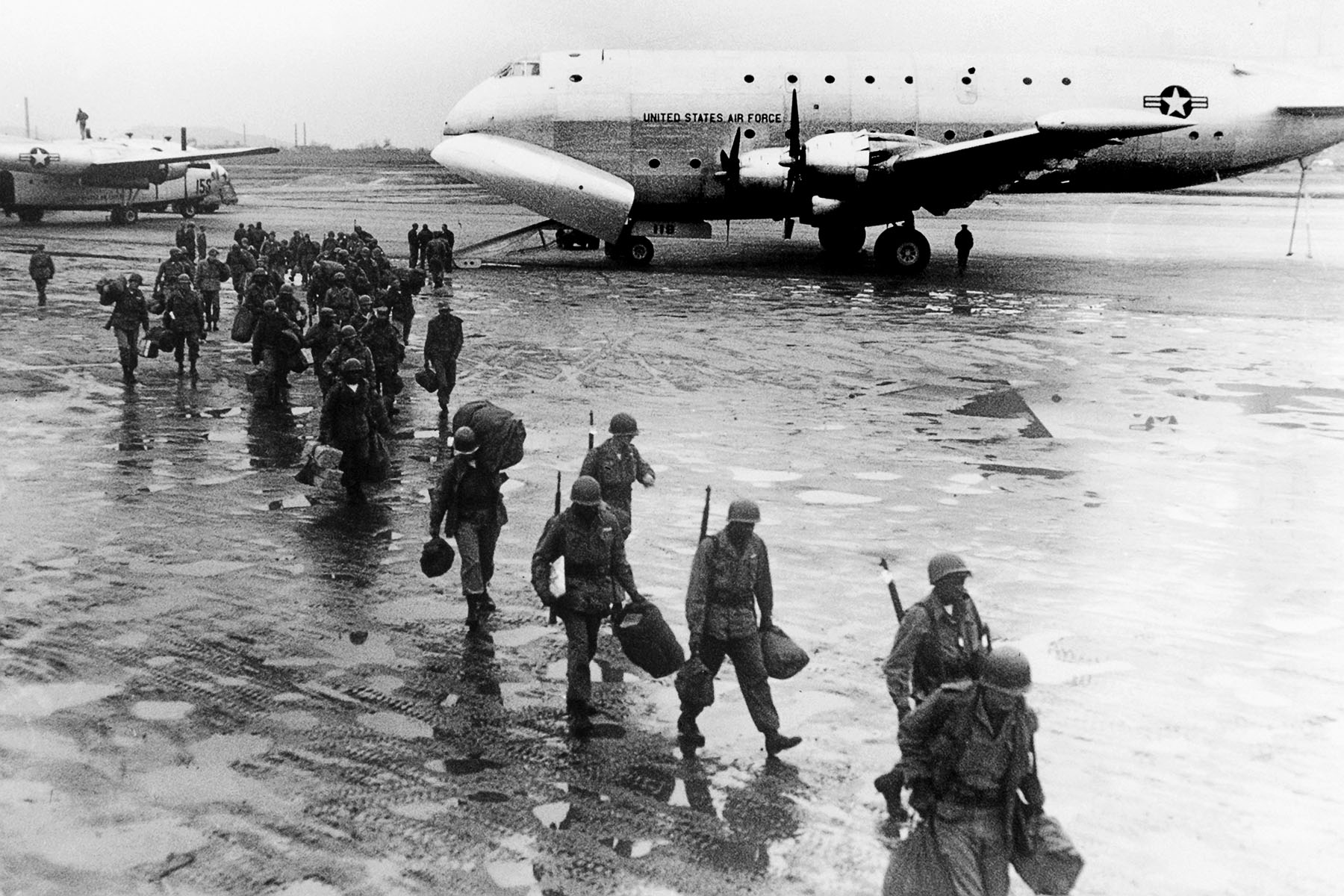
You’re twenty. You lifted your sleeve at the dinner table, unveiling your mother’s name on your bicep after your first tour in Iraq. When she asked you if you’d killed anyone, your mouth was full of mashed potatoes and you said I’d go back. And when you volunteered to go your mother refused to see you off, but I was there, standing and cursing you in the midday heat, watching the C-17 take you away, staying until they began folding up the plastic chairs.
When you called before the battle at al-Qai’m you asked for your mother, and she sobbed and shoved the phone at me, so I took it, and you told me you loved me. You thanked me for the fishing trips on the Truckee River, for sitting in the stands at miserable band performances, for toughening you up for the Marines. And after the battle you told me you’d lied, that you didn’t love me, that my belt and fist still filled your dreams, and fearing death had made you say things you thought God wanted to hear.
Your mother and I were pulling weeds in the front yard when the chaplain’s clean blue sedan edged up to the curb. He asked us to step inside, but your mother wouldn’t budge; she took the news on the sidewalk with a fistful of crabgrass. I drove through a lightning storm to the green bridge we used to fish below. It’s where I taught you to smack trout heads against the large black rocks before slicing the guts out.
Once, we tried to catch them with our hands, and I showed you how to reach into the water and rub their soft bellies, lulling them for a moment before the surprise clench and lift. I told you I’d caught hundreds of trout this way, and that my scar was from wrestling a twenty-pounder on the rocks. For all I could tell you believed me.
Your mother fell apart. She locked herself in our darkened bedroom, taking small meals there. She didn’t talk to anyone, but on the third day she came to me: Tell his father, she said. I waited a couple of hours, and after cursing and circling town, I drove to his place by the lumber mill. My hand gripped the car door handle, but I couldn’t pull the damn thing, and I sat there for twenty minutes, his dog barking the whole time. Finally, your father emerged and slowly approached my rusting Ford. He carried a baseball bat in his strong hand. I didn’t fancy up the news. He’s dead, I said, and drove away. I drove until I ran out of gas on a dirt road out by where we shot at clay pigeons. I walked the eight miles back to town.
When I arrived home, your father’s truck rested in our driveway. As I passed the truck I looked inside the cab on the chance that he had just arrived, that maybe he was sitting in the driver’s seat, buying time, but it was empty. I walked up the steps you helped me build and stood at the threshold with an overwhelming urge to knock at my own door.
I got off the bus and a woman kept pace. Skinny black jeans with a fat silver belt of keys.
“I know how you feel.”
“I feel fine.” I was lost. I asked her for directions.
She took out a red inhaler, took a puff and told me where to go, in gulps.
It was not the way I would have taken. After a few blocks it only got less familiar and I went another wrong way that felt right.
Within seconds my old neighborhood was all harrowed mud. Creosote-black timber and dark machinery. I thought of my childhood puzzlement with the phrase “raze to the ground.” Raise to the ground?
I lurched across the field. The machines intrigued. Like booby-traps. Like some people.
A hand-painted sign said ZONE ROUGE. I didn’t speak French, but everybody knew rouge was red. Not everybody knew the Red Zone. I knew it. About another one, Verdun, in the northeast of France, where a year-long WWI battle killed more than 900,000 German and French soldiers. So densely shelled with unexploded artillery and gas shells that it would be uninhabitable for four hundred years. I knew because of my father. He read to me about military history, we watched war movies, read to me war comics and he told me how he played war with his friends. Seeing war technology in ordinary things was in his bones: Krupp toasters, tank treads in earth movers, gun designs echoed in power drills and blowtorches, airplane plastics in radios, jet fins in chassis, airs scoops in car grills. Innocent seeming, now that real machine guns festooned many a man cave. Anyway, there’s always been a Nazi pedigree in everyone’s medicine cabinet, he said. In WWII American bombers were briefed on which German factories to bypass (the American-owned ones). Was there any point in fighting, (or not fighting) now that the peace prevailed? They said it prevailed.
Peace time. And everything was mined. For information. For market share. For death.
Ahead was a forested area I’d never seen before. The woman from the bus emerged from the dark. I walked on past her into the forest. It was silent and cool. Moss covered everything underfoot. She came up behind me and touched my shoulder. “Every step you take now.”
I stopped in mid-stride. Returned my foot to the spongy ground. Turned. “I need to make some money. I’m going to lose my apartment. I can’t lose my apartment.”
She said, “I know how you feel.”
“That’s what you said before. It’s not a feeling. I’m broke and not making enough to survive. I’ve got to make some money. If you can’t help me then move out of the way.”
“Don’t take another step. But maybe you won’t listen. Maybe I’ve got the wrong guy.”
I was pissed but did as she said. Nothing. “You don’t have anybody. Yet. What’s the proposition?”
“It’s dangerous, but a lot of money. Step where I step.”
I followed her back across the mud and sat in the cab of a dozer.
I tugged at dead levers. Tapped gauges. “No key. Not going anywhere.”
She pulled out the wad of keys and slid each around the ring, matching them to every machine in the field, keeping rhythm to a litany of functions. Her voice worked a spell, a comb tugged through thick, tangled dreams: “Earth mover, shaker, crusher, compactor, driller, blaster, incinerator, disintegrator, fracker, fracktaler, shifter, sifter, buster, eviscerater, pulverizer, driver, down-loader, switcher, coder, de-coder, up-loader, assembler, morpher, server, pubsmasher, browser, processor, ransomer, hackers, firewaller, coboler, encryptor, decryptor, infector, defector.”
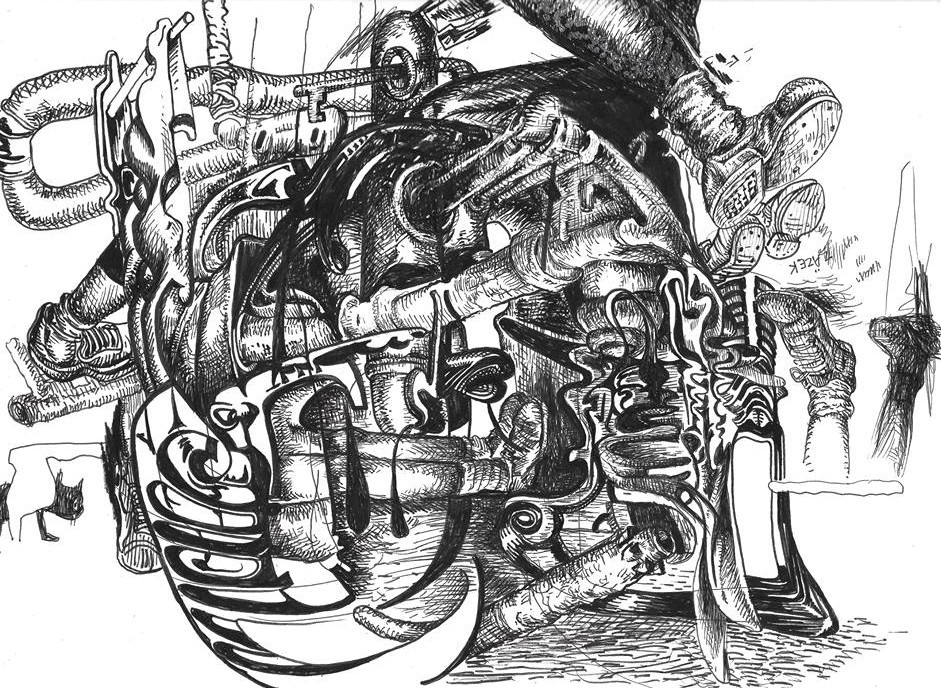
Original artwork by Gregg Williard.
I said, “Show me a war where we haven’t armed both sides.”
“You want money. Someone has to clear the Red Zone. Children wander in there. You’ll find pieces of them. But most are killed by the gas shells. Slow. Like emphysema. Or poisoned from lead, arsenic, mercury, zinc. Makes the dumb kids.”
“Dead or dumb, huh.” I looked over the punished instrument board. Taped to cracked gauge was a photo of a little girl. I looked away. “Must be prime real estate here. Chernobyl pristine. What will you call it, Rouge Manor?”
She held up the last key in front of my eye. “This is a chance to make a difference. You want to do something good, don’t you?’
I didn’t answer and she squirted her inhaler again.
“What’s the shit in your inhaler? Albuterol? See that timber out there covered in creosote? It’s a medicinal plant that you might try. A bush of it out in the Mojave Desert is one of the oldest living things on earth. ‘King Clone.’ Surprised they haven’t plowed it over for a housing development.”
“Aren’t you the king of mansplainers.”
“I know about patterns. About codes. I can find mines. I don’t even need your damn keys.” I held up my Lishi Pick.
“Use that on my cab and you’re toast.”
“I’m already toast.”
“Then I don’t need you.” She reached over and opened the cab door. I got out.
She closed the door and started up the machine. It spun in the mud and rumbled into the woods. I waited until it was gone, then followed my footprints in the mud to the street. Twenty steps, there was an explosion. I turned around and traced my footprints back to the woods. Then ran toward the smoke. Maybe I’d end up dead, but I was done with dumb.
Fiction from Peter Molin: “Cy and Ali”
The following short story is based on the myth “Ceyx and Alceone,” as recounted in Ovid’s Metamorphoses.
Cy busied himself with the by–now routine activities of a combat patrol: gathering his personal gear and stowing it in the truck, drawing the big .50 caliber machine gun and mounting it in the gun turret, setting the frequencies and security codes on the radio, helping out the other crew members and being helped by them in turn. As he waited for the mission commander to give the patrol brief, he thought about his wife for a few moments. Ali had not wanted him to go on this deployment; he had had options that would have kept him in the States, at least for a while longer, and she could not understand why he had been so eager to return to Afghanistan.
“I think you are crazy,” she had told him. Left unstated was the suspicion that he liked the idea of going to war more than he liked the idea of being with her. She loved him dearly, and though he professed his love for her, too, she couldn’t help but feel that he didn’t value their relationship as much as she did. Cy also wasn’t sure what to think, either then or now while he waited for the patrol brief to begin. Returning to Afghanistan had been important to him, but beyond his claims about needing to be with his unit and doing his duty, he sensed that there was a cold hard nugget of selfishness about his willingness to jeopardize his marriage—not to mention his life—for the sake of the deployment.
Rather than give Ali an excuse or an explanation, he had offered a compensation. “When I get back, I promise I’ll make it up to you,” he had said, “I’ll go back to school, or find some job where I won’t have to deploy again anytime soon.”
The offer seemed lame, even to Cy, like he had thought about it for two seconds, but Ali acceded to it anyway. She loved Cy in part because he was a soldier, but some things about being a military wife were really bad. Now she busied herself with her classes, her part-time job, and her friends and family. But she worried a lot, and had a premonition that things might not end well.
The day’s mission was nothing special: accompany an Afghan army unit while they resupplied three of their outlying outposts. The mission commander explained that the Americans’ role was to inspect the readiness of the Afghan outposts, and to provide artillery and medical support in case anything happened along the way. Cy’s job was gunner on the mission commander’s truck, which was to be third in the order of march behind two Afghan trucks. From the truck’s exposed turret he was to man the .50 cal while keeping an eye out for suicide bombers, IEDs, and ambushes. But nothing was expected to happen; “There has been no enemy activity on the planned route in the last 48 hours,” the mission commander informed them. They had traveled the day’s route many times before with nothing more serious occurring than a vehicle breakdown. Sure they planned well and rehearsed diligently, but that was all the more reason the actual mission was probably going to be not much.
Which is why what happened, at least at first, had an unreal feel. Three miles out, on Route Missouri, Cy saw the two lead Afghan trucks come to abrupt halts and their occupants pile out. The Afghan soldiers took up firing positions on the right side of the road and pointed their weapons back to the left side. Because he had headphones on and was chattering with the other truck occupants, Cy was unable to immediately distinguish the sound of gunshots, and it took him a moment to comprehend that the Afghans had stumbled into an ambush. Other Americans also soon gleaned what was going on and suddenly the radio net crackled with questions, reports, and commands.
“Action front…. Scan your sectors….. Anyone have positive ID?…. There they are…. 11:00 200 meters. Engage, engage!”
Cy identified three turbaned gunmen firing at the Afghan army trucks from behind a low wall. He charged his machine gun and began to shoot. He had fired the .50 cal dozens of times in training and thus was surprised by how far off target were his first two bursts. But very quickly he found the range, and was rewarded by seeing the big .50 caliber rounds chew up the wall behind which the insurgents were hiding. Dust and debris filled the air; Cy couldn’t tell if he had hit anyone, but surely the fire was effectively suppressing the enemy. By now, the other American trucks had identified the gunmen and were firing, too. Still, it was so hard to figure out exactly what was happening. That the three insurgents behind the wall were capable of resisting the torrent of fire unleashed on them by the American and Afghan soldiers seemed impossible, but no one could tell if there were other enemy shooting at them from somewhere else.
Soon, however, the sound of explosions began to fill the air. Again, it was not immediately clear that the Afghan army soldiers and the insurgents were now firing Rocket Propelled Grenades at each other. “What’s going on up there?” Cy heard the mission commander ask him through the intercom. Loud booms resounded everywhere from the impact of the rocket-fired grenades. Cy next heard “RPG! RPG!” echo through his headphones as the Americans understood that they too were now under attack. A round exploded against the truck to his left and Cy felt the blast wave wash over him. How could the enemy engage them so accurately?
As the battle unfolded, Cy realized the situation was serious, no joke. The rest of the crew was protected inside the armored truck, but he was partially exposed in the machine gun turret. He continued to fire the .50 cal, doing his best to punish the insurgents who were trying to kill them. The noise was deafening, but in the midst of the roar of his own weapon and the other American guns, as well as the cacophony of human voices on the intercom, he discerned that enemy fire was pinging around him and sizzling overhead. Though he was not scared, he thought about his wife.
Ali had felt uneasy throughout the day. She had not been able to communicate with Cy, which in itself was not so unusual. She understood that sometimes missions made it impossible for him to call or write. Still, she sent him emails and texts and the lack of a response for some reason felt ominous. That night, she had had a terrible dream. Cy appeared, looming over her, silent and reproachful, and Ali had awoken with a start. Nothing like this had ever happened before, not even close. She didn’t know what to do, so she watched TV for a while and then began surfing the Internet. She thought about calling her husband’s unit rear-detachment commander, but decided not to. There was no one she could talk to who wouldn’t think she was overreacting, so she didn’t do anything except continue to worry.
*
The next morning two officers appeared at Ali’s door. “The Secretary of Defense regrets to inform you that your husband has died as a result of enemy fire in eastern Afghanistan,” one of them intoned. It was all too true, but for Ali the reality of the situation dissolved in a swirl of chaotic thoughts and physical sickness.
Ali waited on the tarmac at Dover Air Force Base with Cy’s parents. An honor guard was also present, as well as a contingent from her husband’s unit, and a general whom she had never seen before and whose name she didn’t catch. Everyone was very nice to her, but Ali was confused. She didn’t know if she was supposed to be strong and dignified or to collapse in a pool of tears. She also didn’t know if she was angry with her husband, angry toward the Army, or just some strange combination of sad and proud. As her husband’s casket emerged from the plane, Ali felt herself drawn toward it. First she was taking small tentative steps, as if she were nervous about breaking some kind of rule or protocol. Then she was running, moving quickly toward the casket while the others in attendance waited behind. She was barely aware of what she was doing, but her feet seemed to no longer be touching the ground. It was as if she were floating or flying, and her arms were beating like wings of a giant bird. “O, Cy, is this the homecoming you promised me?” she thought, or maybe said aloud. Then she remembered throwing her arms around the casket, but at the same time she also felt herself rising into the air, in unison with her husband, who now was alive again and also seemed a magnificent, noble bird. Together, Cy and Ali soared upward, and the plane and the honor guard and the onlookers whirled beneath them as they circled in the sky.
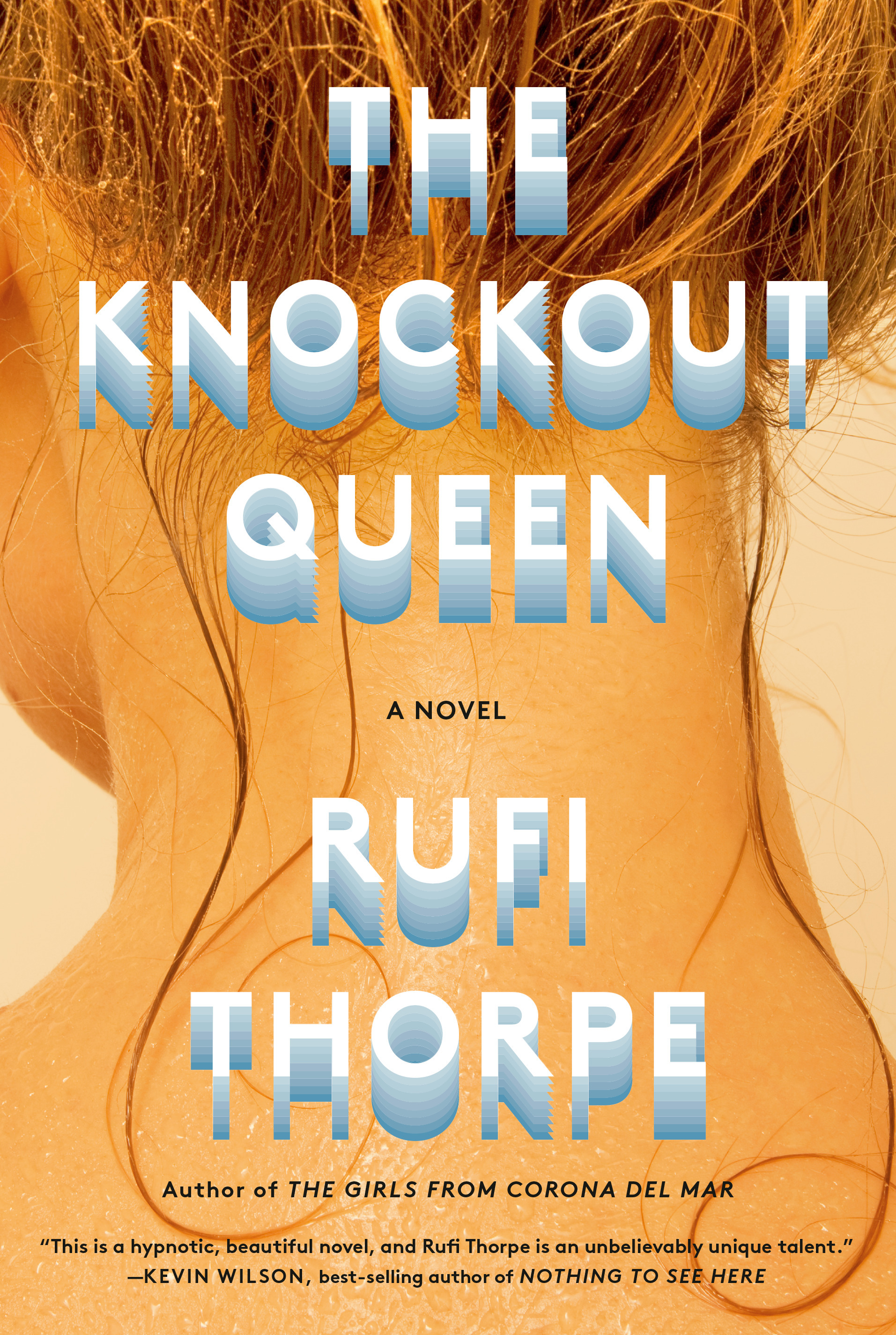
New Fiction from Rufi Thorpe: An Excerpt from ‘The Knockout Queen’
The following excerpt of The Knockout Queen by Rufi Thorpe is reprinted with permission by A.A. Knopf.
When I was eleven years old, I moved in with my aunt after my mother was sent to prison.
That was 2004, which was incidentally the same year the pictures of Abu Ghraib were published, the same year we reached the conclusion there were no weapons of mass destruction after all. What a whoopsie. Mistakes were made, clearly, but the blame for these mistakes was impossible to allocate as no one person could be deemed responsible. What was responsibility even? Guilt was a transcendental riddle that baffled our sweet Pollyannaish president. How had it happened? Certainly he had not wanted it to happen. In a way, President Bush was a victim in all this too. Perplexingly, the jury had no difficulty in assigning guilt to my own mother as she sat silently, looking down, tears running and running down her face at what seemed to me at the time an impossible rate. Slow down, Mom, you’ll get dehydrated! If you have never been in a criminal courtroom, it is disgusting. You have seen them so often on TV that seeing an actual one is grotesque: the real live lawyers, all sweaty, their dark mouths venting coffee breath directly into your face, the judge who has a cold and keeps blowing his nose, the defendants who are crying or visibly shaking, whose moms are watching or whose kids are trying to sit still in the back. It’s a lot to take in when you’re eleven and even just a few months prior you were making an argument that not receiving a particular video game for your birthday would be “unfair.”
The town to which my little sister and I were relocated after a brief stint in foster care was a suburban utopia a la Norman Rockwell, updated with a fancy coffee shop and yoga studio. We moved in just before the Fourth of July, and I remember being shooed into a town fair, where there were bounce houses and hot dogs being sold to benefit the Kiwanis club. What the fuck was the Kiwanis club? I was given a wristband and ten dollars and told to go play. A woman painted a soccer ball on my face. (All the boys got soccer balls, and all the girls got butterflies; those were the options.)
Bordered on the west by the sea, on the north by a massive airport, on the east by a freeway, and on the south by a sprawling, smoke-belching oil refinery, North Shore was a tiny rectangle. Originally built as a factory town for the oil refinery, it was a perfect simulacrum of a small town anywhere in America, with a main street and cute post office, a stately brick high school, a police department with predictably brutalist architecture; but instead of fading into rural sprawl at its edges, this fairy-tale town was wedged inside the greater body of Los Angeles.
My aunt’s place was one of those small stucco houses that look immediately like a face, the door forming a kind of nose, and the windows on either side two dark, square eyes. She had a cypress bush in the front that had turned yellow on one side, and many pinwheels planted on the border of her lawn, the bright colored plastic sun-bleached to a ghostly white as they spun in the wind. North Shore was a windy place with many hills, and I was shocked that people could live in such a wonderful climate without smiling all the time. The air pollution from the airport and oil refinery were pushed inland by the sea breezes. Even our trash cans did not smell, so clean was the air there. Sometimes I would stick my head into them and breathe deeply, just to reassure myself that trash was still trash.
On either side, my aunt’s house was flanked by mansions, as was the case on almost every street of the town. Poor house, mansion, poor house, mansion, made a chessboard pattern along the street. And the longer I came to live there, the more clearly I understood that the chessboard was not native but invasive, a symptom of massive flux. The poor houses would, one by one, be mounted by gleaming for sale signs, the realtor’s face smiling toothily as the sign swayed in the wind, and then the for sale sign would go away, and the house would be torn down and a mansion would be built in its place.
If there were people living in the mansion to the right of our house, I never saw them. Their trash cans did not go out, no cars parked in their drive, except a gardener who came like clockwork every Tuesday, who always gave me a nervous but friendly wave. In the mansion to the left of our house, there lived a girl and her father, a girl who, though I would never have guessed it from looking at her, so young and unsullied did she seem, was my own age, and with whom I would go to school for the next seven years. Her name was Bunny Lampert, and she was the princess of North Shore, and somehow, almost against my will, I became her friend.
One thing that Bunny and I had in common, besides being next-door neighbors, was an unusual lack of adult supervision. North Shore being the paradisiacal bubble that it was, many children walked to school or rode their bikes. But I noticed that Bunny and I were never scooted out the door by parents who rushed to remind us of lunches or fetch lost backpacks, but instead climbed out of houses empty and untended, checking our belongings ourselves, distracted as adults about to set out on the morning’s commute. Perhaps it would have been natural for us to walk to school together, but this did not occur. I was invisible to Bunny, and so I came to know a great deal about her before she learned anything about me.
The first year I was in North Shore, we were in sixth grade, but even then Bunny was tall, the tallest girl in our year, but also taller than the tallest boy. I’m sure there are people who would tell you who the most beautiful girls in our school were, and Bunny would not have been found on any of their lists, and yet I loved to look at her. Not for any arrangement of features or gifts of figure, but because she was terribly alive. Like a rabbit or a fox. She was just right there. You could see her breathing, almost feel the blood prickling in her skin, her cells gobbling the sunlight.
I think, as we headed into middle school, it was this vital, translucent quality that kept boys her age from having crushes on her, crushes that required a more opaque surface that they could project onto, that evoked different things than life itself. They were interested in girls who reminded them of movies, or who seemed older, or who seemed innocent, or who seemed smart. Bunny didn’t seem. She didn’t remind me of anyone. I liked to walk behind her for the cute way she would pull a wedgie from her butt, the way she would sing to herself, always a little sharp, the way she ate an Eggo waffle from a paper towel as she went, careful to throw the paper towel away in a trash can when she got to school.
Her father, though I hardly ever saw him, I saw everywhere. It was his wolfish grin on almost every dangling for sale sign in the town, his arms crossed over his chest, his white teeth showing in a friendly laugh. He was on for sale signs, but he was also on banners at our school, where he sponsored a seemingly endless number of fund-raising events. He was on the city council and so his name was further attached to every fair, carnival, rally, or Christmas parade. Ray Lampert was inescapable.
I had seen him at that first Fourth of July fair, a huge sign with his headshot on it at a booth where a pretty blond woman gave out picnic blankets with his company’s logo stitched on one side. Two Palms Realty. I was afraid to take one of the blankets, even though the pretty blond woman manning the booth told me they were free. In my child gut, I believed they were sewn with some kind of voodoo that would ensnare anyone who touched them.
I often passed by his office, which was on Main Street. He was never in there, though I grew used to seeing the blond woman I had met at the fair, wearing her headset, tapping keys on a space-age-looking computer with a monitor bigger than our TV at home.
Because our houses were next door to each other and on rather narrow plots, the bedroom windows were directly across from one another on the second story, and so I had a literal window into Bunny’s life, although I could not see her without being seen myself. When she was home, I kept my blinds carefully closed, but when she was not at home, I would look into her room and examine its contents. In fact, I looked in all the windows of their home, which was decorated with a lavish ’80s decadence: gilt dining chairs and a gleaming glass-topped table, white sofas and white rugs over dark, almost black, mahogany floors. The kitchen, which I had to enter their backyard in order to properly examine, was a Grecian temple of white marble, though they never seemed to cook and what was obviously supposed to be a fruit bowl was filled instead with junk, papers, and pens and keys.
They had no dogs or cats, no hamsters, not even plants. Nothing lived in that house except for Bunny, and presumably her father, though he was never at home. As to what had happened to Bunny’s mother, I knew only that she had died and that there had been some air of tragedy about it, a suddenness, not a prolonged illness, and I was in high school before I learned that it was a car accident. I found this explanation disappointingly mundane. Why had a simple car accident been so whispered about, so difficult to confirm? My informant, a glossy, sleazy little imp named Ann Marie, the kind of girl who is incessantly eating a sucker or popsicle in hopes of being seen as sexual, giggled. “That wasn’t the scandal,” she said. “The scandal was that her mother was fucking a day-care worker at the Catholic preschool. Mr. Brandon. And he was only like twenty at the time.” Where was Mr. Brandon now? He had moved, had left town, no more was known.
I often walked by that little preschool, attached to the Catholic church, which was a lovely white stucco building on a corner lot with a playground and red sandbox, and wondered about Bunny’s mother and Mr. Brandon. No one could tell me what he looked like, but for my own reasons I pictured sad eyes, too-low jeans, ice-cream abs begging to be licked. Perhaps I imagined him so only as a foil to Bunny’s father, whose salt-and-pepper chest hair exploded from the collar of his dress shirt in that ubiquitous head-shot. Everything else about Ray Lampert was clean, sterilized, the bleached teeth, the rehearsed smile, the expensive clothes, but that chest hair belonged to an animal.
The gossip about Bunny’s father was that he drank too much, and specifically that he was a regular at the Blue Lagoon, a tiki bar tucked a few blocks off Main Street, though he was what was referred to as “a good drunk,” beloved for his willingness to spring for pizza at two in the morning and listen to the tragic stories of other sad adult men. There was further supposition that his incredible success as a real estate agent was due to his habit of frequenting drinking holes, making friends with anybody and everybody. Having spent many years observing their recycling bin, I can attest that such a justification would be a bit economical with the truth. Ray Lampert was turning his birthday into a lifestyle, to quote Drake. Each week there would be two or three large gin bottles, and then seven or eight wine bottles, all of the same make, a mid-shelf Cabernet. Perhaps he bought them in bulk. It was difficult to imagine him shopping, wheeling a cart filled with nothing but Cabernet and gin through the Costco. How did someone with such an obvious drinking problem go about keeping themselves supplied? Or rather, how did a rich person go about it?
In my experience, addiction was messy. A pastiche of what you bought on payday as a treat, and what you bought on other days, convinced you wouldn’t buy anything, then suddenly finding yourself at the liquor store, smiling bravely, like it was all okay. What did the cashier at the 7-Eleven make of my own father? Did he note on what days my father bought two tall boys and on what days he bought the fifth of cheap bourbon as well, and did he keep a mental tally of whether he was getting better or worse, like I did? Or did everyone buy that kind of thing at 7-Eleven? Perhaps my father was so unremarkable in his predilections as to avoid detection at all. And what was happening to the children of all those other men? Buyers of beef jerky and vodka, peanuts and wine? What did a 7-Eleven even sell that wasn’t designed to kill you one way or another?
Most scandalous to me, and yet so alluring, so seductive, was the possibility that Ray Lampert felt no shame at all. That a rich man could stroll through the Costco, his cart clinking with glass bottles, and greet the cashier smiling, because she would just assume he threw lavish parties, or that he was stocking his wine cellar, that these dark bottles were just like shirts for Gatsby, talismans of opulence, but whatever it was, even if it was weird, because he was rich, it was fine.
The first time I met Bunny, or what I consider to be our first meeting, because we did encounter each other at school from time to time (in fact we had been in the same homeroom for all of seventh grade, and yet never had a single conversation), we were in tenth grade, and I was discovered in her side yard. I had taken to smoking cigarettes there, and I kept a small bottle of Febreze hidden behind a piece of plywood that was leaning against their fence. The side yard itself was sheltered from the street by a high plank gate, and then was gated again before it led to their back yard, and because it ran along the side of their garage, there were no windows, making it a perfect hiding place. Bunny and her father kept their bikes there, but neither of them seemed to ever ride, and I had been smoking in this part of their property for years now without having been detected, so I was startled when she opened the gate, already wearing her bike helmet, which was pink.
She was surprised to see me and she jumped, but did not yelp, and swiftly closed the gate behind her. She tipped her head, made comically large by the helmet, and looked at me. “What are you doing here?” she whispered.
“I smoke here,” I said, bringing my cigarette out from behind my back.
“Oh,” she said, looking around at the fence, and the side of her garage. “Can’t people see the smoke as it rises above the fence?” Her first concern seemed to be abetting me in my secret habit.
She was neither offended nor concerned that I had been breaking into their property and hiding in their side yard.
“So far as I know,” I said, “no one has. But usually I kind of crouch with the hope that it dissipates. And I always figured people would think it was you.”
“Your name is Michael,” she said with concentration, dragging my name up through the folds of her memory.
I nodded.
“My name is Bunny,” she said.
“I know.”
“I’m just getting my bike.” She started to walk toward her bike, which was just to my right.
“The tires are flat,” I told her, looking down at them. They had been flat for almost a year now, and I wondered what had possessed her today of all days to take a ride. There was a gust of wind then, and the fence groaned a bit, and we could hear, rather than feel, the wind rushing over the top of the fence, making a sound like scissors cutting through paper.
“Oh.”
“Where were you going to go?” I asked.
“To the beach.”
“By yourself?”
She nodded. “You know, I could put a chair out here for you. Like a camp chair.”
“That’s all right,” I said.
She put her hands on her hips then, and twisted her torso with such strength that I could hear every vertebrae in her spine crack. She was perhaps five inches taller than me. “Do you want to come in?” she asked.
“To your house?”
She took off her helmet. “No one’s home.” There was a babyish quality to Bunny’s voice, perhaps because it seemed too small for the size of her body, and she spoke as though her nose was always a little stuffed. Of course, I wanted desperately to see inside her house up close, and so I put out my cigarette and hid it in the Altoids tin that I also kept behind the plywood, and she watched as I spritzed myself with Febreze, and then we let ourselves out the back gate and into her yard.
“This is our yard,” she said. “There’s a pool.”
I said, “Oh wow,” though I had swum in her pool several times when she and her father had been on vacation. I had climbed the fence from my aunt’s yard and dropped down into hers, which was dark, since no one was home and the outside lights seemed to be on a timer, and the pool, instead of being a lit rectangle of blue, was a black mass of reflected stars, and, shaking, I had taken off my clothes and slipped naked into the warm water and swum until I felt erased.
She opened one of the French doors that led onto the patio, and we entered the hushed cathedral of her living room. She closed the door behind us, as though it could never be left open. The outside, with its scent of grass and sway of water, its gauzy light and chafing winds, would destroy the interior, the careful, expensive furniture, a pretend world that had to be exactingly maintained.
She gave me a tour of the house, showing me her father’s office, with its many bookshelves filled with leather-bound books I doubted he had ever read, and the marble kitchen. She offered me a Pop-Tart, which I declined. She opened one of the crinkly metallic packages for herself, and then, to my horror, spread the two Pop-Tarts with butter and slicked them together as a sandwich. She led me upstairs, taking bites of her Pop-Tart sandwich along the way, and showed me the spare room, decorated in an Oriental style with a disturbing red satin bedspread embroidered with cranes, and the connected bathroom, which had a shiny black vanity and sink, a black toilet, and black floors. They were ready for Madame Butterfly to commit suicide in there at any time. While the house was uncluttered, I noticed that it was also not exactly clean. Gray trails marked the highest traffic routes on the white carpet, and the sink in the all-black bathroom was spangled with little explosions of white toothpaste.
She gestured at a closed door and said, “That’s my dad’s room,” and then took me into her own bedroom, which was done up, as I already well knew, like a much younger girl’s bedroom, with a white canopy bed and a white dresser that had been plastered with My Little Pony stickers. There was a small white mirrored dressing table with a pink brocade bench. Where there should have been makeup and bottles of fancy perfume, Bunny had arranged her schoolbooks and papers. There was a bookshelf that contained not books but trophies and medals and ribbons, all so cheap and garish and crammed together that it looked more like installation art than a proper display. On one wall, there was a bulletin board that I had not been able to see before as it was on the same wall as the window. At first, it appeared to be a Hydra of female body parts, but as I looked closer I could see that they were all women playing volleyball, and then, as I looked yet closer, I could see that they were all the same woman playing volleyball, carefully trimmed from newspapers and magazines.
“That’s my Misty May-Treanor altar,” she said. “She’s a volleyball player.”
“Not creepy at all,” I said. I would have asked her why she had invited me in, or why she had shown me around with the thoroughness of a realtor, except that I already knew, for her loneliness was so palpable as to be a taste in the air. I had been many places in my life. Apartment buildings where babies free-ranged, waddling down the halls with dirty hair and diapers needing to be changed; houses like my aunt’s, where everything was stained and reaching between the couch cushions to find the remote left your fingers sticky. Bus stations, and prison waiting rooms, and foster-care homes, and men’s cars, and men’s houses or apartments where there was sometimes only a mattress on the floor, and none of them had scared me quite as much as being in Bunny’s silent, beautiful house.
“I’ve never had a boy in my bedroom before,” she said, a little apologetically, and she sat on the bed, as though she expected that I would fuck her right there on her white eyelet duvet.
“I’m gay,” I said, my affect as flat and casual as I could manage. I had never spoken those words to anyone before, not in that way.
“Well, I’ve never had a gay boy in my bedroom either,” she said, and flopped backward, finishing the last of her Pop-Tart sandwich, licking the butter off her fingers. She contemplated the ceiling and I began to wonder if I could simply leave. I was fascinated by Bunny and I liked her, but I was beginning to realize I liked her more from a distance than I did close up. It was too much, being in her room, smelling her smells, hearing her breathe. “You probably think my room is stupid,” she said, still staring up at the ceiling, her legs, in their athletic shorts, agape on her bed in such a casual way that it was almost lewd, even though technically nothing was showing.
“It’s a room,” I said. “I’m not the room judge sent to adjudicate your decor or whatever.”
“It is stupid,” she said. “My dad keeps saying we should redo it. But I like it. I like it just like this.”
“Well, thank you for showing me around,” I said, trying to indicate that I would like to leave, when we both heard a door slam downstairs. Bunny sat upright on the bed, and I froze as we listened to the thumping of feet on the carpeted stairs. And then there he was, a man I had only ever seen in photographs, his giant head wedged between her door and the wall. “You’re home!” Ray Lampert cried, giddy. “And you have a friend! I thought we could get Chinese—do you feel like Chinese?”
“Ugh, I’m starved,” Bunny said. I, who by fifteen was already a neurotic counter of calories, almost gasped at this statement, having witnessed the 700-calorie Pop-Tart sandwich.
“And you’ll join us, obviously,” Ray Lampert said, turning to me. He was substantially fatter than in his picture, and whilethere were dark puffy bags under his eyes, the rest of his skin tone was so peculiarly even that I could have sworn he was wearing makeup. His blue dress shirt was unbuttoned a scandalous three buttons, and he was wearing a ratty red baseball cap. It occurred to me that I had probably seen him dozens of times and had just never realized that it was the same man as in the photograph.
“This is Michael,” she said. “Were you thinking Bamboo Forest?”
“No, I want good, really good, egg drop soup. Bamboo Forest is so watery.” He turned to me. “Don’t you think it’s watery?”
What I thought was that I didn’t know anyone was such a connoisseur of egg drop soup. To me it just came, like napkins and forks. “I should probably get home,” I said.
“You don’t really have to go, do you?” Bunny said with sudden, cloying desperation. “Say you’ll come with us!”
Ray reached out and squeezed my shoulder. “He’s got nothing better to do, right, son? Don’t tell me you’re one of these overscheduled kids that’s got back-to-back tutoring and chess club right before you off yourself because you didn’t get into Harvard.” He had found me unattended in his daughter’s bedroom; I stank of cigarettes and was wearing a Nirvana T-shirt and eyeliner, and I had a septum piercing. My hair was loose and went halfway down my back. It was unclear to me if his remarks were meant ironically or if he was actually blind. “Let’s make it a party!” he said, slapped me on the back, and headed downstairs, shouting that he would meet us at the car.
Bunny turned to me and said in a low voice, “My dad’s kind of weird, but I promise it will be fun.”
And I thought: If Ray Lampert was one of the men I met on Craigslist, I would be too scared to ever get in his car, because he was the kind who would lock you in a closet or put a gun in your mouth and then cry about his ex-wife. Bunny took my hand and twined her fingers through my own. And she looked at me with eyes so hopeful that I nodded.
Honestly, I probably would have let her take me anywhere.
In high school, I was invisible–acne and braces, last year’s wardrobe. I didn’t have close friends. My grades weren’t going to win me any scholarships. The football coach offered me the equipment manager’s position after tryouts.
In the ninth grade, 9/11 happened. In tenth grade, I watched the Air Force drop daisy cutters on Tora Bora. In my junior year, I watched the Marines level Fallujah. There were yellow ribbon magnets on every car and American flags on every porch. The military was a way to be somebody.
So after I graduated, I ran to the recruiter’s office; shaved my head before I even shipped out. Some guys hated basic training. Not me. I couldn’t wait to get home in my dress uniform and strut through town, to show all those people who had looked over me or looked through me instead of looking at me. I’d be impossible to miss with a chest full of ribbons and medals.
I finished basic and shipped to Fort Bragg. My unit deployed to Iraq three weeks later, just in time for me to get some. But our area of operations was only peace and the endless desert. Nobody had died in almost a year. No Americans.
My platoon drove around Iraq in humvees, pointing our guns at the horizon, hoping to draw fire. We escorted supply convoys. We transported detainees. We set up checkpoints.
The recruiter never said shit about supply convoys. And he definitely didn’t mention sitting at a checkpoint, in a hundred and fifty degrees, in body armor, in a truck in the desert, just sitting. That lying prick told me about kicking in doors, calling in airstrikes, airborne infiltrations. Never checkpoints.
But, no shit, there we were.
When we arrived, the lieutenant radioed in our coordinates. Sergeant Schwartz and the other team leaders arranged orange cones and stretched out large, spiral coils of barbed wire creating a temporary barrier. Two soldiers positioned signs at either end of the checkpoint. In Arabic and English, they read, “Caution. Stop Here. U.S. Forces Checkpoint Ahead. Wait for Instructions. Deadly Force Authorized. Caution.” My job was to stand in the turret and man the .50 caliber machine gun, to provide security while the other guys set up.
Sergeant Schwartz pulled the heavy door shut as he got back into the truck.
“And now we wait,” he said.
Scwhartz took a pinch of snuff and tucked it in his bottom lip. He passed the can to Carpenter, the driver. I heard them spitting into empty bottles. Out past the barrel of the .50, the dirt road shimmered like water. Two hours went by, then three. Farmers’ trucks kicked up dust as they drove from one rural village to the next.
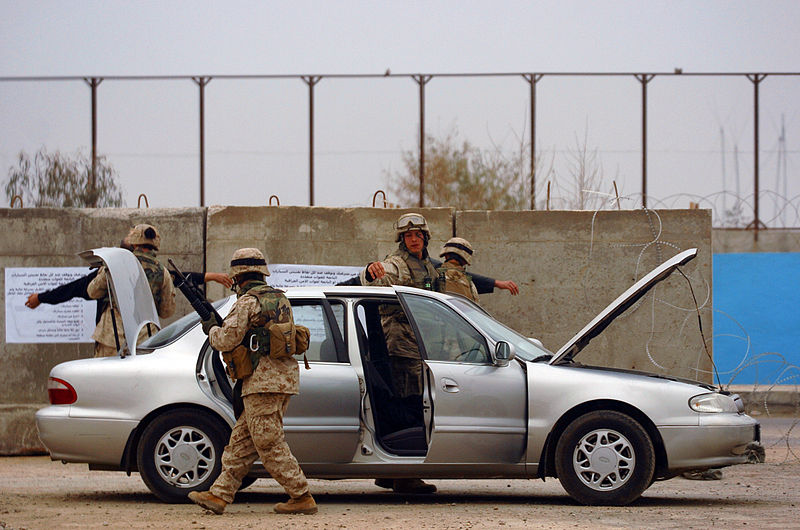
Ramadi, Iraq (Feb. 20, 2005). U.S. Navy photo by Photographer’s Mate 1st Class Shane T. McCoy.
So far, we had searched two vehicles and had found nothing.
“Hey Sergeant Schwartz,” I called down from the turret. “Is it always like this?”
“Like what?”
“This…” I said, “boring.”
“The last deployment wasn’t,” he said. “We were up near Baghdad. Urban environment.”
“What’s the craziest thing you ever found?”
“No shit,” he said. “This one time, we stopped a car full of midget hajjis.”
Schwartz told us that Bobby Barrow, one of the other team’s sergeants, had halted four lanes of traffic so he could take pictures. This was back when he and Schwartz were still privates. While Bobby was getting his picture taken, the search team found a wooden box full of Iraqi money hidden under a spare tire. So Bobby and Schwartz had to zip tie all these tiny little hands together while the lieutenant radioed headquarters. Turns out, all the money had Saddam’s face on it, so they let the driver keep it. Before they left, one of the Iraqis tried to get Barrow to marry his daughter and take her home to America.
“Bobby told him, I can’t take no hajji girl home to my mama!” Schwartz finished, laughing.
A truck approached.
“Punisher 7,” I called it in. “This is Punisher 4. Vehicle approaching from the south. Over.”
“Roger. Over.” The bored reply.
A door clunked open and the truck rocked as Sergeant Schwartz stepped out. I heard the team leaders from the other trucks doing the same. Out at the furthest clump of orange cones, the white pickup truck slowed, as if the driver was reading the sign. I stood in the gun turret and held my hands and arms straight out in front of me like a traffic cop, but he kept driving, rolling past the sign.
The team leaders, standing in the road beside my truck, raised their long guns and pulled the butt stocks tight into their shoulders.
I fired a signal flare, a warning. The flaming red ball arced past his windshield.
Still, the pickup didn’t stop; it accelerated toward the barbed wire, our position.
“Light him up!” Sergeant Schwartz nodded at me.
I aimed. I fired three rounds.
The pickup lurched and jerked and skidded to a halt. The passenger’s side sagged off the dirt road into an irrigation ditch. A door screeched open, and three female figures scrambled out, screaming and crying. The search team corralled them. Someone shouted, “Clear!”
There was nothing in the truck.
And then Doc sprinted up and pulled the driver out. She laid him on his back in the road, cut his pants apart, and stuffed handfuls of gauze into the gaping wound in his groin. And then she gave up. I heard the call for a body bag on the radio.
I clambered up out of the turret, pulled my headset off, and ignored Carpenter’s questions about what I was doing, his warnings that I would be in trouble for leaving. I marched down the road, around the serpentine of barbed wire to where the truck had stopped.
One round had passed through the windshield of the truck high on the passenger’s side, a cloudy spider web centered around a clean hole. Another hole in the grill, driver’s side. Fluids leaked from under the truck, oil and antifreeze. Blood soaked the driver’s seat, dripped out the door and puddled in the sand to form tiny lakes.
I caught glimpses of the driver, with all of the people crowded around: the platoon sergeant, the medic, the team leaders, too busy talking about the details of “the report” to notice his wispy moustache. They didn’t see the zits that dotted his face, because they were talking about proper escalation of force. They didn’t notice me either, standing outside of their huddle.
Two young girls wailed on the side of the road. Their mother, or grandmother, was ancient and dry. The lieutenant asked the interpreter why they didn’t stop at the sign, and the interpreter turned to the woman and said something in Arabic.
Her voice was papyrus. She held her hands out in front of her and patted her breast with her hand.
“She says they didn’t know what to do,” the interpreter said.
“Did they not read the sign?” the lieutenant asked.
“She says there is no school here,” said Nasir.
The old woman patted her chest again and again.
“There’s no school here,” the lieutenant said, almost to himself. And then, not so quietly, “JESUS! FUCK!”
Heads turned to look at him, including the platoon sergeant’s. I stood in the middle of the road. His eyes flicked to the empty turret 40 meters away.
“What are you worried about that for?” He jerked his head back over his shoulder. “You’re supposed to be worried about your fucking sector of fire, dumbass.” He shoved and pulled me to the truck and ordered me back up into the turret.
I watched my sector while the platoon packed up road cones and signs. They loaded everything into the trucks.
The platoon sergeant and interpreter spoke to the old woman, telling her how to file a claim. They gave her a piece of paper with the information printed on it. Before they left, Schwartz kneeled and offered the girls a package of M&Ms. The smaller girl burst into tears and clung to the woman’s burqa.
As they walked away, the old woman stopped and rasped at me, “Asif.”
“I don’t speak your language,” I told her. “I don’t understand.”
“She says she is sorry,” Nasir said.
*
On the ride back to base, Schwartz kept telling me not to worry. We did everything by the book.
“You’ll have to write a statement when we get back. Probably answer some questions, but just tell the truth,” he said. “We did it all by the book.”
It was annoying, the way he kept repeating himself.
I finished my tour of duty. The army gave me a medal. Later, they gave me my discharge papers. I grew out my hair and enrolled at a state university.
I didn’t strut around town in my dress uniform.
*
Two years later, Carpenter’s email arrived. It was short.
“Hey G,” he wrote. “I don’t know if you heard, but Schwartz died. Wanted you to know. Hope you’re doing good.”
The first email came a week after I left the army. Donahue died. Suicide attack in Baghdad. Last year it was Bethea. IED on some road in Afghanistan. He had gotten married the month before. Now Schwartz.
At the bottom of Carpenter’s email, there was a link to an obituary. “Staff Sergeant Michael A. Schwartzenberger, age 32, died on…”
I hadn’t talked to Schwartz, or practically anyone from the unit, since I left the army, but I felt like there ought to be more than just some dates and a list of people he left behind.
I read his name over and over. Schwartzenberger. The name tape on his uniform had the tiniest little letters so that they would all fit. We had just called him Schwartz.
I emailed my professors and left that morning.
*
The honor guard stood off to the side with their rifles. Some hairless kid in a baggy dress jacket held a bugle.
Standing behind the crowd, I searched the backs of heads for familiar faces. Bobby Barrow was conspicuous, his shoulders as broad as ever. He was the only person in a dress uniform who wasn’t part of the honor guard. Carpenter would be here somewhere.
The chaplain stood next to the coffin rambling through generic scripture– The righteous perish and no one takes it to heart. The devout are taken away, and no one understands that the righteous are taken away to be spared from evil— I wanted to shout him down. I wanted to tell Schwartz’s real story.
Schwartz was 20 when he joined the Army.
His grandfather and his father worked in Youngstown, but Schwartz was born the year after the steel industry moved to China. There was no future at the plant.
The Volunteer Fire Department didn’t offer a pension. No benefits package either. Fourteen dollars an hour might have been enough for him and Melissa, just the two of them, but then the baby came.
Schwartz was an all-American kid: athlete, honors student, Eagle Scout. The recruiters had hounded him right after high school. Then, he had tucked their cards into his wallet and nodded and smiled. When things got tight, he dug through the drawer in the kitchen where old wallet clutter was archived with dead batteries and receipts of questionable importance.
Melissa’s belly was seven-months-fat when the recruiter came to pick up Schwartz for basic training. She sobbed on the porch while Schwartz rode away.
“Don’t worry,” the recruiter told him in the car. “You’ll be gone for a couple of months, and then you’ll move her and the kid down to Fort Bragg, and you’ll see her every night. Except for a training exercise every now and then.”
After basic training, he moved Melissa and Emily to Fort Bragg. He spent every night with them, except for the occasional training exercise.
After 9/11, the exercises came more often. The nights he spent at home, he lay awake, straining to sleep. He never explained it explicitly, but I understood. Some part of him needed to record the sound of his wife’s soft snores or the smell of her hair. He needed to absorb the blank hiss of the baby monitor.
On a tiny base in Khost Province, he earned an Army Commendation Medal and corporal’s stripes. He kept a picture of his daughter in his helmet. He wrote letters home every week. The letters never mentioned rockets or mortars or any kind of trouble. He told Melissa about his promotion. He wrote how much he missed her.
They had been in Afghanistan for six months and already there were murmurs about Iraq.
He received another medal and another promotion in Baghdad. He wrote letters. He kept a copy of his wife’s sonogram along with the pictures tucked in his helmet. The unit arranged it so that he could make a phone call home on the day that Ashley was born.
These are the stories he told us while we were overseas together–his third deployment, my first and only.
*
Schwartz’s unit was still in Afghanistan. The honor guard had been scraped together from the fuckups left at Fort Bragg. The rifle detail and the bugler were privates, fresh out of basic training or discipline cases. The detail’s leader was a fat, dumpy sergeant first class. All of the able bodies, and minds, were in Afghanistan.
The chaplain finished the service. The fat sergeant stepped up to the casket and raised his right arm in a slow salute. I watched to see who would jump at the first volley of shots. As the last volley’s echo rolled through the cemetery, the bugler started to play “Taps.”
It wasn’t even a real bugle. There were so many funerals, and so few trained buglers, that the army had to use fakes. The digital bugles played a perfect rendition every time, but anyone who ever played a brass instrument would be able to look at the kid in the baggy jacket and tell he wasn’t playing. He didn’t even know how to hold the fucking thing.
The fat sergeant handed the folded flag to Schwartz’s mom.
Some of the attendees walked back to their cars. Others waited to pay their respects to Schwartz’s parents, still seated, looking as if they’d be guarding his grave forever.
*
Bobby, Carpenter, and I met at a bar near my hotel.
Neither of them knew how Schwartz had died. Bobby said Schwartz’s unit had deployed eight or nine months ago, but like the rest of us, he’d lost track of Schwartz after leaving Fort Bragg. Carpenter hadn’t really talked to anyone since he’d been kicked out–cocaine.
Schwartz’s honor guard walked into the bar a little after sundown. They were in civilian clothes, but I recognized the fat sergeant who had handed the flag to Schwartz’s parents. Bobby asked about my hair: “So, when your girlfriend is pegging you, does she pull your hair? You know? And, do you have to put it back in a bun when you’re licking her balls…”
I nodded toward the door, distracting him.
“Hey bartender,” he yelled. “Get these boys some drinks!”
We sat at a table and told stories about Schwartz. Bobby had known him far longer than me; Carpenter too, so I let them do the talking. I was drunk. I smiled and nodded in the right places, chimed in with exclamations when I was expected to.
We kept waiting for the fat sergeant and the honor guard to open up. They were happy to drink on Bobby’s tab, but they stayed quiet, like we were still at the funeral. They seemed surprised by the way we described him. It was like they had never even met Schwartz.
We wanted to hear their stories about him, but what we really wanted was to know how he died. The obituary had said nothing, not even where he died. And it wasn’t like he was a spy, out doing something classified. He was in the fucking field artillery.
The jukebox died. Bobby was content to give it a rest. There was a lull in storytime.
“Tell ‘em about that kid you smoked at that checkpoint,” Carpenter said.
My stomach dropped. I focused on the beads of condensation running down a bottle of beer, but all I could see was that dusty, old woman. I could hear her voice, her rusty tongue dragging across the roof of her mouth. Asif.
She says she is sorry.
I struggled away from the memory and looked up, hoping for an interruption, an earthquake, a meteor strike, anything not to have to relive it.
The men from Schwartz’s honor guard stared at me hungrily, waiting for blood. Bobby wouldn’t meet my gaze. He understood that this was necessary. If I shared my story of bloodshed, then they would tell us what happened to Schwartz.
Blood calls for blood.
“So,” I said, “this kid, who it turned out couldn’t read, blew through a sign at our checkpoint, and I thought I was doing the right thing, but it turned out–.”
“Dude!” Carpenter interrupted me. “Tell it right, man!” He turned to the fat sergeant and the rifle detail. “So no shit, there we were, in the middle of this fucking dirt road …”
He told it all.
When Carpenter finished, the fat sergeant raised his bottle towards me, and then everyone at the table did the same. I waggled my bottle side to side. The label lay in shreds on the table.
“Sorry boys,” I said. “I’m empty.”
“Get me one too!” Carpenter called as I walked away from the table.
The parking lot was dark and cool. I pondered getting in my car and driving back to Asheville. The keys were in my hand.
Raised voices and breaking glass forced me to do an about face.
Inside, Bobby stood in front of his overturned chair, red-faced, cursing down at the fat sergeant. “You don’t fucking know. You weren’t there, you tubby shit!”
And now the fat man jerked to his feet knocking his chair to the ground too. “Listen, sergeant.” He pointed his sausage fingers in Bobby’s face. ”You need to tone it down. I don’t know who it is that you guys knew, but it wasn’t the guy that I knew. Schwartz was a fucking shit bag and a drunk. That’s why they left him in the rear.”
“What?” Bobby’s arms sagged.
When a unit deployed, they left people back in the States to take care of admin stuff– bitch work. They called it rear detachment. It was for broke-dicks, whiners, fuckups. Schwartz wasn’t any of those things. This was a mistake.
“They. Left. Him. In The. Rear,” the fat sergeant repeated, accentuating every word. “Schwartz got a DUI, and then he got busted for being drunk on duty. His ex took his daughters and got a restraining order. He was about to get busted down to sergeant.”
“Liar!” Bobby said. Angry tears brimmed from his blue eyes.
“That morning, when he didn’t show up to P.T. formation, no one blinked, because, like I said, Schwartz was a fuckup. When he missed 0900 formation too, we sent a couple guys to his quarters.”
Bobby made harsh cawing sounds and the tears spilled over.
The fat sergeant continued. “When they knocked, no one answered, but they knew something was wrong. So, they broke in. They found him in the garage, in his truck with the engine running.”
Bobby crumpled into a chair. Until now, I’d never seen him look deflated.
“Did he leave a note?” I asked.
“Sort of,” the fat sergeant said. “That’s how the guys knew something was wrong when they went to Schwartz’ place. He wrote Sorry in giant, spray paint letters across the garage door.”
Asif.
New Fiction from Matt Gallagher: Excerpt, ‘Empire City’
Reprinted with permission from Atria Books.
Mia Tucker woke before the alarm. She usually did on weekdays. She was a person of routine and that’s what routine did. Sleep whispered like a lullaby through the black morning but she pushed it away, sitting up in bed to put her mind in order. If she’d been dreaming, she’d already forgotten what about.
Monday, she thought. Cardio.
A storm had rolled through the city late in the night, leaving the brittle musk of rain. A coldness nipped at the top of Mia’s shoulder. How do they keep getting in here? she wondered, rubbing at the mosquito bite. I shut the screen last night.
Jesse hadn’t come home. He’d sent a few texts, first saying he wasn’t sure when he’d be leaving work, then saying he wouldn’t be. All-nighters during Bureau emergencies weren’t unprecedented. Mia knew the deal. All part of marrying a special agent. Even if waking up by herself in darkness brought on a loneliness she didn’t trust.
Mia ate a yogurt, then changed into light workout gear and fitted her running leg and sneakers. Downstairs, the summer air smelled of metal and moss. Dim streetlights lined the corners like sentries and the sidewalks had almost dried. A garbage truck on an adjacent block groaned through the still while monitor drones pulsed red in the sky. She stretched her left leg and then her core in front of her building, looking up to watch the flag whip around atop the Global Trade. Sixty stars and thirteen stripes, pale against the dark. It didn’t strike her as cluttered, anymore, all those rings and stars in the blue canton.
Mia finished stretching and tapped at her right knee. Her running prosthetic was hard and coiled, like a spring. She appreciated the city most during these early morning runs, because it was empty enough to seem welcoming, even hopeful. It reminded her of the city from her childhood. It reminded her of the America she’d grown up in.
Daybreak always ended the spell.
Cut the crap, Mia thought. These ten miles aren’t going to run themselves. Then she took a deep breath, set the digital green of her wristwatch to 00:00, hit start, and began, the joints of her leg cracking with the motion while the socket of her prosthetic did the same. She headed west, toward the harbor.
Mia had run most of her life, discovering as a girl that she was good at it and being good meant respect, and trophies, and approval. It made an object of her body, but it was a functional object, something that mattered to her even before she’d figured out why. She’d pushed herself to be very good at points in her life, competing in college for two seasons before it interfered with ROTC, and later running the city marathon her first year with the prosthetic to prove that she could. But she’d never crossed into greatness, and for that she’d come to be thankful. Mia lacked the masochism of true runners, the renegade fanatical gene to ignore and ignore all the warning blinkers thousands of years of evolution had instilled in the human brain. Bloody calluses and angry muscles were one thing. Tendons ripping from bone were another.
The baby, or not-baby, entered Mia’s mind. She focused on her breathing. Then came General Collins’s job offer. She focused on her breathing.
The first scratches of sun were tracing the water. Lady Liberty rose in the distance, droopy torch in her right hand. The whole statue needed repair, though how, and when, had become a political hot potato. Decades’ worth of money allotted for national monuments had gone to the Council of Victors, toward honoring the triumph of Vietnam. No one wanted to be the congressperson who redirected funds from that.
A lot of citizens had come to loathe the statue, considering it an eyesore. Mia’s father thought it a sentimental leftover. She sort of liked it, the way a person enjoys a musty childhood blanket found in storage. She remembered climbing to the torch on a field trip as a girl, through a staircase of graffiti and rickety metal, seeing the city from an entirely new angle. A snapshot of old American might, sealed in memory.
They’d closed the torch after the Palm Sunday attacks, then the entire island. Students like her adolescent cousins wouldn’t ever see Empire City as she had. No one could now. The sad, corroding statue was their normal. It was all they knew. In the meantime, Lady Liberty sank slowly into the island it rested on. Turned out it’d been set on sodden ground.
Mia adjusted her sports bra and glanced at her watch. A mile in, which meant her warm-up was over. She lengthened out her strides.
She turned north along a waterfront path, moving into the bike lane to dodge fallen tree branches and loose rocks. Other than the occasional taxi striking through the predawn and a man in rags watching the city from a bench, she was alone. The wharf across the river jutted out like a broken jawbone, suggesting a past when its docks did more than shuttle around office workers and tourists.
The city changed like a photo album, slowly and slowly and then all in a rush. Repair shops became delis. Parking garages became art studios. In the water a flotilla of coast guard barges that’d been restored as restaurants and pubs drifted to and fro. Steel and glass high-rises gave way to the architecture of the last century, rowhouses and squatty brick apartments. The streets narrowed, a few dotted by tidy cobblestone. The waterfront path leveled off, though Mia kept her strides long. She knew an incline awaited. She wanted to meet it in force.
Sunrise arrived somewhere between miles three and four, stained-glass clouds chipping the sky. Mia passed a vomiting young man in a sport jacket too large for him. Probably an intern for one of the banks, she thought, before turning around to make sure it wasn’t one of hers.
“Call in sick!” she shouted. He raised his fist and managed a weak “Defy!” before purging again. The motto of the old radicals’ caucus in Congress. Funny, Mia thought.
Another mile on, Mia ran into a short concrete tunnel. The tunnel lay underneath an abandoned railway line. Sunlight filled it with a fierce yellow shine. Around ten feet long, the sides and top of it had been covered in graffiti, dozens and dozens of circles of different colors and sizes. Just about every inch of available concrete had been tagged, leaving a sort of rainbow mosaic. Each of the circles contained three arrows pointing down and to the left. The job was fresh—Mia could tell by the tint to the spray paint. She came to a stop in the center of the tunnel, her breaths sharp but controlled. She rubbed a hand against a small purple circle. It smeared across her palm.
I know what this is, Mia thought, looking at her palm, then at the purple circle, sifting through her mind to place where. It took a few seconds, but she remembered a course in modern European history, and this shape and question from the final exam. The antifascist sign, she thought. From Nazi Germany.
A gust swept through the tunnel, and Mia smelled storm from the night before. She fought off the urge to shiver. It was going to be a cold summer day.
*
Most mornings Mia turned around and headed home on the same pathway, but the tunnel had spooked her. She pushed east and then south instead, running the sidewalks. The light and the city rose slow, together. A medley of urban noise was beginning to tune and it sounded mostly like construction din. There was order within the mayhem; one just needed to know the refrains. Mia did. She made it back to her apartment building on time, stopping only to remove her running leg before showering and dressing for work. She was back out her front door sixteen minutes later.
The air had turned and smelled of humid dew. Mia decided to walk through Vietnam Victory Square. Under the gaze of the Four Legionnaires sculpture, a couple of kids had waded into the fountain, laughing while splashing water at each other. Across from them, a tour group stood in front of the grand white marble wall with the simple words: “Praise to the Victors/In Honor of the Brave Men who went forth to Vietnam/1955–1981.” The guide was explaining why the inscription stopped there, despite the insurgency continuing after in parts of the north. He was stumbling through the history and Mia wanted to intervene. Because wars have to end, she thought. Just tell them that.
Coffee-charged angst and white-collar id crackled along the streets, bankers and lawyers and digital communications associates hustling to be at their desks before the workday siren sounded. As she turned onto Wall Street, Mia passed the brownstone Trinity Church she attended every month or so. She’d considered herself an atheist since her tour to Albania, but she still appreciated the ceremony of church and the sense of renewal it allowed for. Her family had fled to America in 1620 for that ceremony and sense of renewal. She wouldn’t give up that heritage for something as banal as not believing.
Then there was Jesse. “Jesus’s heroin needle,” he liked calling Trinity’s Gothic steeple. The church’s adjacent cemetery, where a slew of American founding fathers and Union generals from the Civil War rested? “A yard of goy bones.”
And he’s all mine, Mia thought. Trinity was an option for their wedding, though her family wanted it held in Connecticut. One more decision that she needed to make, and soon.
Mia’s bank was located in the Westmoreland Plaza, a mass of skyscrapers bundled together at the end of the island. As she neared it, a vast, bright fire engine came into view, its lights twirling and flashing like a hallucination. A row of police barricades separated the vehicle from the street, uniformed officers turning away confused citizens trying to get to work. Mia joined the crowd.
“No one’s allowed in the plaza today,” a cop was saying, not for the first time. “And yes, that includes you.” His eyes lingered on Mia’s blouse, and she stared at him flatly until he looked away. Her grandmother had taught her how to do that on her fourteenth birthday. It worked in Empire City boardrooms just as well as it had in aircraft hangars along the far edges of the world.
“Ms. Tucker.” A man shaped like a square wearing a rumpled dress shirt and overlong tie called to her from a corner of the barricades, close to a large bronze globe. It was the security director of her bank. He looked wired to Mia, even eager. “Ms. Tucker,” he repeated. “The office is closed today. Your father sent out a message to everyone—work from home, as you can.”
“Hadn’t checked my email yet.” This didn’t make any sense. The office, as far as Mia knew, had never closed. Finance didn’t “work from home.” That was for other people, other jobs. “What’s going on?”
“I shouldn’t say,” he said, in a tone that suggested he very much wanted to.
“Mum’s the word,” Mia promised. “I’ll be finding out, anyhow.”
“A threat,” the security director said, his voice low and hushed. “Whole plaza. Homeland marshals got it last night.”
“Oh.” There’d been a few lockdowns in Empire City over the years, for both real and false alarms, but Mia couldn’t recall any of them shutting down a main cog of the Finance District. “Must be some kind of threat.”
The security director looked out the corner of his eye to make sure no one else was listening, then pulled out his cell phone and read.
WITH FIRMNESS IN THE RIGHT AS GOD GIVES US TO SEE THE RIGHT, LET US STRIVE ON TO FINISH THE WORK WE ARE IN, TO BIND UP THE NATION’S WOUNDS, TO CARE FOR HIM WHO SHALL HAVE BORNE THE BATTLE.
MAYDAY, MAYDAY. FROM THE ASHES, HOLY REDEMPTION.
“Mean anything to you?”
Mia shook her head.
“The first part’s from a speech Abraham Lincoln gave. Used to be the motto of the old Veterans Administration. The second part . . . I don’t know. The distress signal or something.”
Mia contemplated that. “There’s a Council of Victors office down here. Some crazy’s angry about the colonies again?” She tried not to laugh but couldn’t help it. “It all needs to be taken seriously, of course. But shut down the plaza?”
The security director shrugged. “Federals think it means something. The Mayday thing, especially.”
“I see,” Mia said, wondering if this was the Bureau’s emergency, and if so, why Jesse hadn’t said anything to her. He worked intel analysis, not counterterrorism. Though he hadn’t always been behind a desk.
This is how the fight happened: earlier that morning, while waiting on reveille to bugle from the loudspeakers across the blacktop, Harvey forced it on the new kid, Private Gilmore, as the rest of us watched, some gruff comment about his curly, black ponytail—the barbers hadn’t shaved him yet. Only two days into OSUT, Ft. Benning’s one-stop infantry shop, and the poor kid couldn’t catch a break. I remember shaking my head as Harvey yelled out to all the knuckleheads huddled there in formation, “What the hell’s this faggot thinking enlisting without a haircut?” And right along with every other shivering private, he laughed and laughed.
Gilmore had arrived late the night before from Hortons Bay, up in Michigan, and right from the start of that cold January morning, Harvey Coates had it out for him.
“Bet that bitch has some nice pussy!” Harvey slapped his battle buddy, Wilkins, on the arm. “Hey, you think the Army issues jungle-green tampons?”
Gilmore muttered, “Shut the fuck up.”
Just what Harvey wanted. That Alabama redneck wasn’t exactly looking for a fair fight. He just needed a quick release, all pent-up from the barracks. “Boy better not mind me tugging on that cute little ponytail tonight,” he said, loud enough for everyone to hear, “‘cause he’s gettin’ fucked up.”
And just then, Drill Sergeant Malone emerged from HQ and snapped the entire column to attention, stomping into the asphalt with the heel of his polished black boot. Two other drill sergeants followed close behind. When Malone spotted Gilmore, he let out a low whistle, advancing upon him slowly. “Well, ain’t you just the battalion beauty queen!”
Gilmore’s eyes glanced at Malone as he approached.
“Why your eyes flickering at me, private? You see something you like?” Then the drill sergeant leaned in to Gilmore’s left ear. “Oh, I think so, battle. I think this joker does see something he likes.” Malone’s voice got really low, then—I could only hear him because I was nearby. “Hey, private. Maybe, we can work something out, you and me. Maybe, I’ll slip in the barracks tonight, when everybody’s sleeping,” he whispered. “Maybe I’ll let you touch it. You’d like that, wouldn’t you, private?”
Sweating bullets, Gilmore said, “Drill sergeant, no, drill sergeant!”
“You don’t like my cock, private? What’s wrong with it?” Malone’s voice got louder and louder until he was screaming. “Why wouldn’t you want it in the palm of your hand? You think it’s ugly, private? Not big enough like you’re used to?”
That poor bastard didn’t know what to say. “No, I—uh, yes, drill sergeant?”
Malone threw his campaign hat at the ground and yelled down the rest of the line, “Hey, Bravo Company! Listen up!” Malone checked the kid’s name tag. “Private Gilmore here asked me to slip in the barracks tonight so he can rub my dick purple. That the kind of battle buddy ya’ll want in this Army? A special kind of ground pounder? Or is this joker just the typical slack-jawed fuck-face that makes up this training cycle?” He waited as the wind blew. “Answer me, faggots!”
Within five minutes, the drill sergeants forced Gilmore to wear his hair down around his shoulders. They dressed him up in a flamingo-striped civvy polo and then mix-matched it with a pair of regulation BDU bottoms. And that was just the beginning. By the end, Gilmore was bear crawling up and down the hallway, with his ass up in the air, yelling out, “I want a big, gay Viking to ride me! I want a big, gay Viking to ride me!” Their fun lasted over an hour, turning Gilmore into a rock star, a company legend.
I didn’t get to see it all. And honestly, I’m glad I didn’t. Although my hair was a lot shorter than Gilmore’s and I’d cut it before heading to Georgia, it stuck out like a thick mane even by the laxest military standards. That was the thing. You didn’t want to be different from anybody else. And mine was just long enough to be different—ten minutes before that, while headed to the latrine for a shit, I’d seen Harvey smirking and pointing at me with Wilkins, who pretended to toss his hair like some Vidal Sassoon model. That’s probably why I kept so close to the Michigan kid. It was pack animal mentality: I knew they’d go after the longest hair first.
*
Gilmore finally caught up to me a few hours later. “Lookit,” he mumbled with that Michigan accent. He nodded down the hallway at this other recruit who’d gotten singled out by the drill sergeants. “Elliott’s got the mannequin.” Probably out of his instinct to survive—by finding someone lower on the totem pole than he was in that moment—Gilmore’d pointed out another company pretender, Tommy Elliott, who’d already skipped PT for sick-call three times in a row. Well, now they had that fat fuck sliding his duffel bags along the cold vinyl flooring with this ridiculous dummy-soldier slung across his back. A traditional hawes carry.
Officially, the dummy was known as Private Emanuel Ken—the drill sergeants always called him out during roll-call—but they told us he liked to go by “Manny” on the block. The top-half of a faded CPR dummy from the 70’s, the mannequin had been dressed up in old BDU’s to look like one of us. They’d built the lower half of his body by stuffing flimsy pillows into the leggings of an Army uniform strapped to the dummy’s waist, using olive-green utility rope and a spare pistol belt. A camouflaged patrol cap topped off his head. One of the supply sergeants joked that they packed half a sand bag in his crotch to help Malone pick him apart from the rest of us.
“Private Ken!” Malone would yell across the barracks at the dummy, which was propped up against the wall to make him stand. “Sound off with your name, Manny Ken!” The drill sergeant charged past us right across the bay as if he were going to hit him. “Why don’t you ever sound the hell off?” Sometimes Malone yelled so loud at him, Manny’s legs would cave-in at the knees like a raptor, his entire body deflating under the drill sergeant’s shadow. “Since Private Ken ain’t enthusiastic today like the rest a-you dickheads, I’ll just have to make the whole company push!” And so, another smoke session would begin.
Wikipedia. “Drill Instructor at the Officer Candidate School.”
But the mannequin wasn’t just an excuse to regularly fuck us. The drill sergeants kept their eyes open for unattended TA-50. They said we were accountable for every last piece of our issued gear, so to hammer that home, when a private left a Kevlar at the water cooler and turned his back to crack a joke with his buddy, they’d swoop in, and God help you if Malone got his hands on your sensitive equipment before you did. It could be taken that quick.
The punishment was always the same: Private Manny Ken. You’d get 24 hours of light duty honing your fireman’s carry, that familiar dummy weighing across the length of your back, that sandbag pressing into it hard. Made a long day even longer. I remember Malone crooning over me the one time I earned it, “That’s good training, private!” hands on his hips like a proud parent. “Damn fine training.” The mannequin was heavy against my body, and a layer of sweat had started to form, but even so, I pulled it tighter.
*
That afternoon, Malone marched our entire company to the PX, the Walmart of the Army. We’d get to buy phone cards there, and buzz cuts. As our feet loped along, out of step and undisciplined, the pine trees loomed along the road like an old frontier fort’s paling. The January wind had died somewhat. Then the PX came into view—a low brick building with the words Post Exchange in thick, bold lettering. Our phone privileges lay inside. A gang of drill sergeants stood on the street corner across from there, shooting the shit, and after taking one good look at our marching column, they shook their heads.
Malone greeted them. “When I get these jokers down-range next week, ya’ll gonna be happier than fags at a hot dog stand!”
“You sure right about that,” one of the drill sergeants shouted back.
“It’s just too easy, battle—too easy!” Malone pulled his belt up a little higher as he passed them on by and grinned.
The entire cluster of campaign hats doubled over, and they began talking fast to each other, just low enough so that we couldn’t hear them. I swear, even though they were laughing the entire time, they glared at us like a pack of hungry wolves tethered by invisible leashes, growling through rabid teeth.
To avoid mixing us with the rush of Army wives and old retirees, Malone filed the company into the PX through a side entrance, warning us: “You will all shut the fuck up and act respectful inside, is that understood? And you’d better not be cat-callin’ any teenage girls or officers’ wives. If I see or hear any of that shit, it’s gonna be a long fucking night, privates—a long fucking night! I don’t give a flying titty if you’ve got a PT test tomorrow. I will smoke you retarded, trackin’?”
“Drill sergeant, yes, drill sergeant!”
“All your fancy handbags are locked up in storage, so the Army’s gonna give you a monetary advance.” The drill sergeant pulled out a stack of what looked like black debit cards from his pocket. “Each of you gets a 200-dollar money card. That’ll get ya’ll through reception until them first paychecks hit at the end of the month. Since Mother Army don’t put out nothin’ for free if she ain’t gettin’ something back, your earnings statement will show this amount deducted.”
Good ol’ Mother Army.
Shops lined the exchange’s main corridor inside—a women’s salon, vitamin store, uniform tailor, travel rep office, food court, and barber shop. The main department store had its own double-wide entrance, flagged with shoplifting detectors. After a quick glance inside, I could see designer clothing racks, a shoe department, grocery aisles, shelves lined with Harlequin romance novels, and even a big sign for home decorating and gardening. Everything a man needed to get by.
Malone snaked us around the entrance of the barber shop in long, orderly rectangles, packing us in elbow-to-elbow and nut-to-butt. When a few of us caught glimpses of the younger wives or the older daughters moving past, we kind of puffed up and all, being that we were dressed for the first time in our Army uniforms. “Move aside for them shoppers, privates. Eyes front. Mouths shut.” His inside voice was considerably lower than the one he used on the blacktop. The drill sergeant pointed at the main department store. “When ya’ll finished getting a haircut, head straight to them workers up front and buy a shaving kit.” He hesitated, then rolled his eyes. “You can get phone cards, too.”
“Holy shit,” Elliott cried.
“We’re really getting phone cards!” Gilmore said.
Our first chance to call back home. A collective sigh issued from the entire company as we grinned with excitement—all in agreement, for once.
Suddenly, Malone was up in Elliott and Gilmore’s face, whispering loud enough so we could all hear: “Have you two dirty dick-beaters lost your damn mind? If you two don’t shut the fuck up this instant, I’m gonna stick my foot up both your asses and wear you around like a pair of autistic flip-flops!” The drill sergeant looked the rest of us up and down, watching us squirm like kindergartners about to start recess as a pair of grannies shuffled by. He nodded his campaign hat at them politely. “Afternoon, ladies,” which made them blush. When they were far enough away, he added, “And no fucking candy, privates. It’s contraband. Makes your dick small.”
The first recruits rushed into the barber shop as soon as Malone gave the word, and the old men inside directed them to the row of black leather chairs on the righthand wall, reserving the left side for non-recruits. This portly grandma wearing thick glasses waved me over after ten minutes of waiting. She was the only lady barber. “Get over here, son.” My turn to get shaved and soldiered, I guessed.
I sat down and said, “A number one on the sides and a taper near the top—”
“Boy, you gettin’ a monkey cut!” She palmed my head with her hand and flicked the razor on. It buzzed like a wasp as she brought it close to my ears. I felt it press against my sideburn and shave up my temple, a rush of cool air on my open skin. Clumps of hair didn’t fall like I thought they would—the razor had this vacuuming device built into it that sucked the loose debris down a thick tube. As she mowed up and down the back of my neck and head, the barber yelled over the razor’s noise, “You got a lotta moles on your head, boy.” I watched her in the mirror as she ran her tongue across the front of her teeth. “That’s a sign of good luck.”
I felt special. Then I felt a sharp pain.
“Oh. Sorry about that.” She’d cut one of my lucky moles. A thin stream of blood ran down the smooth grooves on my scalp. “Just nicked you some. You’ll be all right.” She only slowed her handiwork to slop a hot, dripping wash cloth on my skin, rubbing it over the wound. “It’ll heal.” When she’d finished my hair, the barber spun me around to give me a good look in the mirror, holding a smaller one up behind me so I could see the back of my head’s reflection.
I looked like a leukemia patient. My eyebrows were longer than what was left atop my head. She might as well have shaved them off, too! If there was one thing I’d taken pride in as a civilian, it’d been my thick, dirty blonde hair, all styled and gelled. Ma always said I’d never go bald. Apparently, a sliver of Cherokee blood ran in her family.
The barber slapped a cotton ball against the cut and fastened it down with white electric tape. “That’s the only band aid I got, kid. Clean it tonight in the shower.”
Next, I had to get my Private E-2 rank sewn on my uniform at the tailor shop. Because I was a university drop-out with over thirty college credits, the Army decided to promote me to a higher starting rank than the kids out of high school, but that meant I needed the E-2 patch sewn onto my BDU collars and my field patrol cap. This Korean lady behind the shop counter steadily worked at the needle and thread with her lined and thin hands. She seemed to know that I was in a hurry, but took her sweet-assed time. There was a moment, when she was about halfway done with her delicate work, that the patch just hung there flimsy off my uniform as I watched. A single chevron rested on it. It made me wonder about the Asian ladies—swarms of them worked as grocery baggers, wives, and tailors on most military installations. They came from countries our soldiers had conquered. Now they labored to provide.
When she finished, I paid her the four-dollar fee and moved on to the main department store to get my shaving kit and phone cards, like Malone ordered.
Gilmore—still rubbing at his own landscaped head—nudged my arm when we’d finished shopping and formed back up outside. “Bro, you might wanna get back in there and buy some Selsun Blue,” he said. “Your head’s ate up with mad dandruff.”
Elliott laughed. “He’s right! Red patches all over your scalp.”
“Sons of bitches,” I muttered. That was the other reason I loved having a thick head of hair—they hid my skin flakes.
But there wasn’t any time for that. Malone had returned. “Fall in!” The company formed up too slowly, and it made our drill sergeant grit his teeth. But something kept his anger in check. “Hurry up,” he shouted at a few stragglers. When the company was ready, he looked us over. “I tell you what,” Malone said, before ordering column-right march. “A company of fresh-bald privates’ll make even the most grizzled old first sergeant weep. Goddamn beautiful.”
*
“Phone calls!” Malone came storming into the bay. “You shit-birds get fifteen minutes, the whole damn company!”
Our entire bay of recruits dropped what they were doing and scrambled for their phone cards, stashed away in wallets and duffle bags, even their shaving kits. We pressed out the bay doors to a series of metal booths with black pay phones under white artificial lights. We still wanted our mothers to save us. Each recruit jockeyed for position. “Every man gets three minutes!” Malone yelled. “That includes dialing time.” Then our fearless leader signaled the phone calls to begin, even as privates were already dialing home.
I was about halfway back in the third line. Gilmore stood in front of me, his face impatient and eager. “It’s pot roast night,” he said aloud to everybody and nobody. “Momma makes the best damn pot roast—I hope to God I can smell it.”
Elliott was huddled against his booth one line over, trying to hide the fact that he was crying. Some of the more respectful privates just turned away, pretending not to notice. It seemed the right thing to do. But a few made sure to rub it in good.
“Be gentle with her,” Harvey was saying to Wilkins. “She just needs a little something in the bay tonight to make her feel better.”
I hated that motherfucker.
“Twelve minutes!” Malone shouted.
Gilmore was up. I’ve never seen someone dial a phone number so fast. You woulda swore he called 911. That got me thinking about who I’d call on my turn so I could dial it just as quick. My girl needed a phone call, for sure, but I hadn’t told my parents that I’d enlisted yet. They still thought I was back home.
“Nine minutes!”
Gilmore’s back got animated. He was talking too low for me to hear, but I just knew he’d gotten his mom on the phone. Whatever he was saying sounded really happy. Family does that for you. No matter how many times you hurt each other, you can always push all that aside. Just be there for each other. I rubbed at the palm of my hand. The artificial lights hummed above, and for the first time, it dawned on me how quiet Ft. Benning was. Above the still pine trees and the freshly mowed grass, the American flag, towering above our complex and wider than several cars, hung limp from its metal post.
“Hurry, man. Time’s up.”
Gilmore turned and gave me a dirty look.
“Six minutes!”
“You’re done, Michigan.” I inched forward to the booth, trying to be as close to that damn phone as possible so I could get a dialing head start.
“Back the fuck up,” he mouthed to me, pissed. “I’m talking to my momma!”
“We all gotta momma.” I flashed him my phone card, as if to reason.
Gilmore shook his head and turned back into the booth. “I gotta go,” he said. “Tell Charley and Liz I miss and love them. You need any money, mom? I’m gonna send you my first check.” He listened for a few seconds. “Nah, I’ll be fine. It’s going straight into your account. Just keep your eyes open for it soon—I know, I know. But I gotta go.” He let out a deep breath. “Love you, too.”
I heard her tell him, “My big strong young man! I’m so proud of you.”
Then I pounced on that damn phone. Gilmore started throwing sass my way, but I was too busy reading the dang instructions on the phone card. It took me over a minute just to get through to the other side.
And then she picked up.
“Hello?” Her voice sharp and suspicious—it was after eight o’clock. I could hear the clanging of pots and pans in the kitchen sink.
“Ma.”
The sink faucet got quieter. “Danny? Is that you? Why are you calling from a strange number? You’re lucky I didn’t hang up.”
“Look Ma, I can’t talk long. There’s a line behind me.”
“A line? Did you drop your phone and break it again?”
“No, Ma. I didn’t drop it—”
“Well, no wonder you didn’t answer your phone last night. I tried calling but it went straight to voicemail. We can meet tomorrow at the mall and I can get you a new one—”
“Ma, listen. I’m a hundred miles away from there. Is Dad around?”
“You didn’t go on another one of those EMD road trips, did you?”
“It’s E-D-M, Ma: electronic dance music.”
“Oh, God, you’re at a pay phone and you’ve lost all your money again! Last time you lost your wallet I had to wire money into your account just to—”
“Jeez, it’s not that. I’ve got all my money, for cryin’ out loud!” My grip squeezed the edge of the phone booth. “I joined the Army.”
It sounded like a glass casserole dish struck the sides of her stainless-steel kitchen sink. “You did what?”
“They sent me to Ft. Benning.” I wrapped my finger around the telephone cord. “Same as Dad.” As I waited for her answer, I noticed that the metal phone booth had a clean look to it, like it had been wiped down recently by recruits that looked too bored when Malone waltzed by. Those little smear marks you always see after.
It reminded me of this one time, back in high school, when my mother had called my little brother into the driveway to help Dad carry this heavy couch she had ordered from La-Z-Boy. She came into my bedroom right before and told me to Windex the front bay window, so I took the paper towels and went into the living room like I was told, spraying that blue shit all over the glass panes. Wiping and wiping at them. When I started working the double-hung on each side, I saw my Dad and brother out there, struggling to heave that big-assed piece of furniture up the sidewalk and through the front door. Even though he was in his late fifties, Dad kept up his old PT routine, hitting the gym pretty regularly. My brother sometimes lifted weights with him, too. Ma stood outside watching them, hands on her hips, the three of them out there working. I guess I really never liked the gym anyways. As I finished my chore, I went to set the Windex bottle on the dining room table, but just then, Ma came inside and took it from me, tucking it into the shadows of a kitchen cabinet as I watched.
“Three minutes!”
“Look, I gotta go. We only get a few minutes to call.”
“But—wait, Danny! When did you—? What does this mean?”
“Hey, get off, rawhide. I need my phone call, too.” Wilkins behind me.
I raised my elbow at him to fuck off and give me another minute. “It means—” I uncoiled my finger from the cord. “It just means I ain’t got no choice, Ma.”
*
Later that night, Harvey finally hit him. It was about a minute or two into personal hygiene. Gilmore had walked up to his own bed and laid his uniforms on top of it, and as he adjusted the bags and tried to figure out how he’d store the things—maybe under his bunk, he’d said aloud—and as he talked with Elliott, who was sleeping on the mattress above him with that damned mannequin by his side, about how all the girls in the hick town he was from were easy to sleep with if you knew how to hunt or fish, Harvey rounded the aisle with a small, patriotic wall of eager recruits, their heads gleaming under the LED lights. Every last one of them savaging for a good fight. He locked eyes on poor Gilmore, that scarred eyebrow tightening on his skull as he picked up speed, and leaning forward, swung hard at the Michigan kid’s baldness. Harvey’s forearm bulged as Gilmore’s head snapped back. The poor bastard slid along the polished floor until his body stopped. Gilmore lay there a moment, a puffy redness around his right eye that immediately began swelling. He palmed blindly at the metal bunk rails nearby.
“Get up, muthafucker,” Harvey shouted. “You think I was playin’?” He reached down and grabbed Gilmore by the shirt and yanked him up, landing his rough, beefy knuckles on the Michigan boy’s nose. Blood slung through the warm barracks air. “I ain’t no liar—I said I’d fuck you up this morning, that’s what I meant!” Harvey hit him again and Gilmore’s skull whipped up and down like a fishing bob in the water. The poor bastard’s mouth hung open in shock, his eyes wide with fear.
“Please—stop, Harvey!” he begged, panting heavy. “I don’t want to—”
“The fuck you don’t.” He hit him one more time and Gilmore crumpled to the floor. Then Harvey hocked up a huge wad of spit. The phlegm shot from the roughneck’s lips onto the naked scalp at his feet, and then, his face red and his blood pumping, he stomped on the poor kid’s stomach. Gilmore heaved and whimpered and fell again to the floor. After finishing, Harvey shook his head with disgust and barreled through the crowd, storming away to his side of the barracks.
The Michigan boy just laid there, crying.
We all stood around and looked at him for a while, waiting for him to get up. I went over finally and put my hand on his shoulder, rolling him onto his back. Someone muttered man, he fucked him up and then the crowd began to disperse, in ones and threes, until only me and Elliott stood around him. He helped me pull Gilmore off the ground and we tucked him in bed. I wrapped the sheets over his shivering form. Turning away to my own bunk one aisle over, I stripped off my uniform, piece by piece, covering myself in a thin towel. Then the shower heads in the latrine fired up, and listening to them, like a faraway rain, I drifted through the barracks until I stood underneath one, its hot lines of water tracing my exposed body and face. The thick steam roiled across the checkered tile flooring, and as the other privates lined the showers—saying little—their collective sigh rose above the running water. It came up heavy and joined the showers’ mists.
New fiction from Taylor Brown: Excerpt, ‘Pride of Eden’
The following is an excerpt from Chapter 2 of Taylor Brown’s newest novel, Pride of Eden, out March 17th, 2020. Reprinted with permission from St. Martin’s Press.
Lope knelt before the fire engine, rag in hand, polishing the silver platters of the wheels. An old song rose in his throat. Muddy Waters or Howlin’ Wolf, begging his baby not to go, not to be her dog. Lope let the words hum against his lips, unvoiced. There was heat in the blues, he knew, as if the singer’s heart were held over the blue hiss of a gas flame.
Lope started to part his lips, to sing to the sleeping engine, when a whistle rose in accompaniment, like the train songs of old. A turbocharged diesel came whining up the drive, a black Ford dually with smokestacks risen over the cab like a pair of chrome horns. The truck skidded to a halt before the firehouse bays, rocking on its wheels, as if summoned here.
Little Anse Caulfield jumped down from the cab, his backcut cowboy heels clacking in the gravel. He was a square-jawed bantam, built like a postage stamp, bowlegged like the old jockey he was. He wore a bush hat, the brim pinned on one side, and the small round eyeglasses of a small-town clerk, his nose smashed broad and flat against his cheeks, as if by God’s thumbs. His eyes were iron-gray. In one hand he held a double rifle, like for shooting elephant. He stood before the open bay, squinting at Lope.
“You ain’t seen a lion, have you?”
Lope stood from the wheel. He snapped the rag at the end of one long, dark arm. “Lord,” he said. “Not again.”
*
Her name was Henrietta. She was a golden lioness, born on the grasslands of Africa, sired by a black-maned king of the savannah. She was still a cub when poachers decimated her pride, killing the lions for their teeth and claws and bones. The cubs were rounded up and sold on the black market. She became the pet of an Emirati sheikh, who later sold her to a Miami cocaine lord who enjoyed walking her on a leash amid the topiary beasts of his estate, ribbons of smoke curling from his Cuban cigar.
“Heracles Slaying the Lion.” Roman mosaic, Lliria, Spain.
After a team of DEA agents raided the place, she found herself under the care of Anse Caulfield. His high-fence compound on the Georgia coast was a sanctuary for big cats and exotics of various breeds. It was located an hour south of Savannah, where the dark scrawl of the Satilla River passed beneath the old coastal highway—known as the Ocean Highway in the days before the interstate was built. On this two-lane blacktop, laden with tar-snakes, tourists had hurtled south for the beaches of Florida while semis loaded with citrus and pulpwood howled north. Sometimes they’d collided. There had been incredible wrecks, fiery and debris-strewn, like the work of airstrikes.
Now traffic was scarce. Log trucks and dusty sedans rattled past the compound, which was set back under the mossy oaks and pines. Behind the corrugated steel fence, there lived a whole ambush of tigers, many inbred or arthritic, saved from roadside zoos or private menageries or backyard pens. Some surrendered, some seized, some found wandering highways or neighborhood streets. There lived a duo of former circus tigers, a rescued ocelot, and a three-toed sloth once fenced in a family’s backyard jungle gym. A range of smaller big cats—servals and caracals popular in the exotic pet trade. An elephant that once performed circus handstands, a troop of monkeys, and a lioness.
Anse called the place Little Eden.
No one knew why he kept the property, exactly. His history was vague, rife with rumor and myth. Some people said he’d been with an elite unit in Vietnam—a snake-eater, operating far behind enemy lines. Others said a soldier of fortune in Africa. Some claimed he was a famous jockey who’d fallen one too many times on his head. But Henrietta was his favorite—everyone knew that. He’d built a chain-link enclosure for her, sized like a batting cage for Paul Bunyan, and people said his big dually truck cruised the night roads, rounding up strays to feed her. Others said it was Henrietta herself who stalked the country dark, loosed nightly to feed. Why she would return in the morning, no one knew.
“You reported it yet?” asked Lope.
“What you think I’m doing now?”
Lope got on the radio. The schools would be locked down, the word put out. The county cruisers would begin prowling the backroads along the river, looking for tracks. The firefighters would take their own personal trucks. When he emerged from the radio room, the firemen had paired off into two-man search teams. Anse stood bouncing on his bootheels, grinding histeeth. The odd man out.
“I’ll ride with you,” said Lope.
They aimed up the old coastal highway at speed. Lope had one long arm extended, his hand braced against the dashboard.
“This fast, ain’t you afraid you could hit her crossing the road?”
Anse was hunched over the wheel, his chin pushed out like a hood ornament.
“Serve her right, running out on me again.”
Lope eyed the elephant gun rattling on the rack behind their heads.
“Where’s your tranquilizer gun?”
Anse sucked his lips into his mouth, then popped them out. “Forgot it.”
They passed the old zombie neighborhoods built just before the market crashed. Satilla Shores, Camden Bluffs, King’s Retreat. Whole housing developments killed mid-construction, abandoned when the housing bubble burst. Their wrought iron gates stood twisted with vines, their guard shacks dusty and overgrown, vacant but for snakes and possums and the odd hitchhiker needing shelter for the night. Their empty streets snaked through the pines, curling into cul-de-sacs, skating along bare river frontage. They turned in to one called Plantation Pointe, the sign weedy and discolored. The community was neatly paved, with greening curbs and sidewalks, periodic fire hydrants standing before overgrown lots. There were four or five houses built, pre-recession dreams that petered out. They were empty, their windows shining dumbly in the morning sun, their pipes dry, their circuits dead. Squatters had been found in some of them, vagrant families with their old vans or station wagons parked in the garages, the flotsam of Dumpsters and thrift stores strapped to the vehicles’ roofs. The vagrants cooked only at night, in fireplaces of brick or stone, like people of another age. They kept the curtains drawn.
The dually rolled through the neighborhood, the tires crackling around empty cul-de-sacs. The windows were up. Lope had his ballcap turned backward to press his face closer to the glass, scanning for a flash of golden fur in the trees. “How’d she get loose?”
Anse frowned. “Same’s last time.”
“And how was that, exactly? I never got it straight.”
Anse chewed on his bottom lip. “Look,” he said, pointing over the wheel. “A kill.”
*
They stood in the overgrown yard. It was a whitetail doe, or used to be. It had been torn inside out, the guts strung through the grass. The rib cage was visible, clutching an eaten heart.
“Lord,” said Lope. “You been starving that thing or something?”
Anse spat beneath his bush hat and looked up. A white clot bubbled in the grass. “She’s born for this. What do you expect?”
Lope looked out at the tree line. Fragments of the Satilla River shone through the trunks and vines and moss. The lioness must have stalked the doe from the woods, bursting forth to catch her across this man-made veld. Anse had the elephant gun cradled against his chest, still staring at the mess in the yard. “Used to be lions all across this country, hunting three-toed horses and ground sloths, woolly mammoths.”
“You mean saber-toothed tigers?”
“They ain’t tigers. They’re saber cats. Smilodons. Then you had the American lion, too—Panthera leo atrox—four foot tall at the shoulder. Them cats owned the night. ’Course they disappeared at the same time as the rest of the megafauna, ten thousand years ago.”
Lope shivered. “Thank the Lord,” he said.
Anse’s upper lip curled in sneer. “They would of ate your Lord off his cross and shat him out in the woods.”
Lope stiffened. He thought of the hymns sung in the small whitewashed church of his youth, where his father, a deacon, had often preached on Sundays, his face bright with sweat. Songs of chariots and lion dens and flying away home. He looked at Anse. “Not Daniel they didn’t. ‘God hath sent his angel and shut the lions’ mouths.’”
Anse smiled at the killed deer. “Hath he now?”
Lope could remember his first structure fire more clearly than his first kiss, than his first fumblings for buttons and zippers in the dark of movie theaters and backseats. The stable fire peeled back the darkness of the world, so bright it seared him.
He was ten at the time. He’d already developed a fascination with fire. Under his bed, he kept a cardboard box filled with cigarette lighters he’d collected. He had a vintage Zippo, a butane jet lighter that hissed like a miniature blowtorch, even a stormproof trench lighter made from an antique bullet casing. He would sit cross-legged on his bed and thumb the wheel of a Zippo or Bic, relishing the secret fire in the house. Sometimes, after school, he would erect small temples of kindling and tinder in the backyard, then set them alight, watching rapt at the transformation—the twist and glow of their dying architecture, the chemical brightness.
The day of the fire, he followed a black pillar of smoke home from school, weaving down the shoulder of the road on his BMX bike as the fire engines roared past. His heart raced faster and faster as he realized what was burning.
The stables where his father worked.
The man had grown up on one of the sea islands, riding bareback on marsh ponies while other children were still hopping around on hobbyhorses. A hard man among his family, but strangely tender with animals. He spoke to horses in Gullah—a tongue Lope never heard him use among men. His loose-jointed body seemed built for horseback, his seat and shoulders bobbing in time to their trots. With his long limbs, he could trick-ride with gusto, swinging low from the saddle like an Apache or standing high atop their spines, his arms spread like wings. He worked as the barn manager and groom for a local equine community.
Lope straddled his bicycle before the blaze, his face licked with firelight. Antlers of flame roared from every window, like the blazing crown of a demon, and the smoke looked thick enough to climb. An evil hiss pervaded the scene, pierced now and again by the scream of a frightened animal. Only later did Lope learn that his father had been inside trying to save the last of the horses when the roof beams collapsed.
Ten years old, Lope could not help but feel there was some connection, that his secret fascination had sparked this awful happening. His secret desires or jealousies. So many times, he’d wrapped his arms around himself and wished for the gentle touch and cooing voice his father gave only to his horses—never his son. So many times, Lope had huddled over his yard-built temples and pyres, watching them burn.
Back at Anse’s truck, Lope called his wife. He told her to stay inside with the baby until she heard from him.
“Larell Pope,” she said, using his full name. “I got a cut-and-color at ten. One of my best clients. I’m not canceling on her because some zoo animal is on the loose. I already have a girl coming to watch Lavonne.”
Lope turned toward the truck, gripping the side mirror. “Please,” he said.
“That new dryer ain’t going to pay itself off, Larell.”
“It’ll get paid.”
Lope could sense Anse waiting behind him, his boot heel grinding into the pavement. “Just cancel it,” he said, hanging up.
When he turned around, the old man was sliding a giant,double-barreled pistol into a holster slung under one arm. The gun looked like something the captain of a pirate ship would carry, with twin rabbit-ear hammers and double triggers.
“The hell is that thing?”
“Howdah pistol,” said Anse.
“Howdah?”
“An elephant carriage. Back in the colonial days, hunters carried these pistols on shikars—tiger hunts—in case a pissed-off tiger tried to climb the elephant they were riding.”
Lope swallowed. “Hell,” he said.
The old man took the double rifle from the backseat and held it out. “Can you shoot?”
Lope looked at the old safari gun. The twin barrels were huge, the stock scarred from years in hard country. He sniffed. “I can shoot,” he said.
Look for the novel on March 17th wherever books are sold. It is also Wrath-Bearing Tree’s giveaway book for the month–a comment anywhere on the site enters you to win.
New Fiction from John Darcy: “Sorry I Missed Your Call”
An hour before the drive, Bubs finds himself sucking down an edible. A big blowout blowtorched dab of a brownie. He could feel it stonerizing his insides the second the swallow went down, that ashy grass-stained aftertaste staking a claim on his tongue
Been doing a lot of things like that, lately. Ill-advised things. Bubs’ best guess pins the start of it back to February. March at the latest. And he didn’t know where the hell this getting out of bed problem came from. The brownie was the prize he’d promised himself for completing the task this morning. Bubs has even stopped spying both ways when crossing the street. He just kind of steps out off the curb.
The weed thing’s, like, not a big deal? is the argument he tries to make to Omar, his driver’s licenseless trip mate and his best friend, hopefully, still.
‘Why the whole thing?’ Omar asks. His jaw is doing that thing it does when he’s not happy. ‘Why not just a bite?’
Bubs sags his shoulders in a sort of shrug. He does, however, feel Omar’s disappointment as if it’s parental in origin, a weathered, rock-like thing, barely shining in the clear bluish glimmer of this dazzling late-May morning, a steely cold shamewave of the someone-expected-better-from-you variety.
Omar says, ‘You do remember what we’re doing here, yeah? Let’s try not to forget.’
Bubs does remember what they’re doing, thank you very much, but he gets to thinking about the purpose of the trip, about how Germ might feel when he understands that Omar and Bubs are not just saying hello, are not just passing through with their sights trained on simple catch-up, that their actual mission is to complete a very serious and sober welfare check.
‘No snacks in that bag by chance?’ Bubs says in his best McConaughey.
‘Seriously?’
‘There’s this side effect of THC called the munchies. Familiar?’
Omar’s face says he isn’t having it, isn’t going to have it, today. Head to toe, Omar is one smooth motherfucker. A good six inches taller than Bubs, he’s got that chill studied coolness of a hipster high school teacher, the dark haired young socialist you could probably call for a lift after getting blind on UV Blue. It’s a first impression thing, impossible to miss.
Bubs can still remember when he had the experience. Fresh off zero hours of sleep, Bubs was getting his face melted off by the acid rain spittle of a Ft. Benning drill sergeant, a walking little napoleon complex who still shows up in nightmares from time to time. For taking too long to get his ass off the bus, Bubs was sentenced to a viscous fucking tongue lashing and a hip toss up the aisle. When he finally made it down the rubber-ribbed steps up front, he saw the formation of new recruits caught in a chokehold of screams and he went to join them in the full nelson, this new clan, his first tribe. Some were doing pushups and it was hot, hot as Bubs could ever remember feeling, and mainly his brain told him, Might have messed up here, Might have made the wrong choice. Then he saw what would turn out to be Omar, front and center, not a drop of sweat even thinking about trying him, not a screaming campaign hat anywhere near, as if a memo had made the rounds before the shark attack, indicating one young soldier in particular it would probably be better not to mess with.
‘Okay then,’ Bubs says, ‘coffee it is. Java. Brain fuel.’ The high still hasn’t hit fully. He is looking forward to its blanketing caress, the slow juicy haymaker of it.
Strapped in, tunes on, shades perched smooth on the oily bridge of his bony nose, Bubs pulls out of the dashed-off fire lane in front of Omar’s building. Bubs wouldn’t call himself handsome, exactly. Especially not next to Omar. Adequate, maybe. Passable. His lips are on the thin side, pincer-like where they curve into each other. On his head an orchestra of dark black hair sits crazy and unbrushed, the texture of very fine straw. A spiraling tattoo of ones and zeros on his left forearm spells out BINARY CODE in binary. There is an efficiency to his composition. His dad used to say, It’s like you were made on an assembly line except with the brains God gave a dog. Ignoring that last part, Bubs is thankful for the proportionality, though if anything he feels it makes him look calculated, indifferent, lame.
That said, Bubs comes alive behind the wheel. The inside-out knowledge he has of his machine, a stock Impreza with more miles than he’d care to admit, makes him proud as an honor roll dad. It takes some foreplay to shift from second to third, but timed properly the latent torque is enough to shove his heart against his ribcage. It’s two make-and-models away from being a full-on rally car, and Bubs loves to remind himself of this fact. He basks in it, the low-level ladder rung of his vehicle, its impossible potential.
‘Can I get one of those?’ Bubs says. Omar has a cigarette rappelling from his mouth. He smokes a snooty, hard-to-find Turkish brand. It’s the kind of thing that’d drive Bubs up the wall with anybody else.
Omar says, ‘Always hanging with the smokers, never has any smokes.’
‘Come on,’ Bubs says, and Omar lights one up for him.
Bubs rolls down the windows in reply.
A rush of air and motion.
Before long they’re gaining speed.
The wind blasts a racket through the nicotined interior. Sunlight is just absolutely pouring down, swallowing them up, threatening to swallow them whole.
Bubs says, ‘What I didn’t expect is that it’d be Germ.’
‘Not really about how someone looks or acts, you know? Germ’s been through a lot.’
‘I mean who hasn’t?
‘I think the divorce puts him in a higher tax bracket.’
‘I get that,’ Bubs says.
‘And his mom’s cancer stuff.’
‘I really get it. But sometimes it is the biggest fuck up––right? It’s the king of the fuck ups, who, you know.’
‘Fucks up?’
‘Nailed it.’
‘Sometimes,’ Omar says. ‘Maybe sometimes.’
‘Not that Germ is one of those guys.’
‘Not at all.’
‘Just generally speaking. You see my water bottle anywhere?’
Omar says, ‘What happens when that shit hits you too hard and we have to pull over?’
‘Not even on my radar. I like driving high anyway. There’s this thing about it, yeah? There’s this way it makes you feel.’
Omar had wanted to hit the road at ten-thirty, introduce themselves to Chicago traffic no later than one in the afternoon. Bubs makes no bones about the delay being his fault. Rolling from his sheets today, phone flashing a harsh nine thirty, it was about the earliest he’d mustered all year.
Omar, on the other hand, has really got his shit sorted. Bubs thinks he should run one of those schemey self-help seminars. Only with Omar it wouldn’t be sleaze. It would be blue-suited and cologned, sharp, deathly fucking sharp. When Omar was enrolled on the GI Bill, he did some day trading on the side. He came out of college well in the black, psych degree in hand. Bubs had signed up for a few certificate courses at the technical college in Janesville, decided not to go.
There is a possibility, Bubs sometimes thinks, that his closeness with Omar finds its bedrock on their uneven terrain of accomplishment. That it’s a necessary condition for their continued buddy status, a cornerstone from the start. He supposes there are worse foundations for a friendship, although it seems to him like a fuel source that’ll eventually burn itself out. Bubs prays it does not. While it collapses his heart to imagine life without his best friend, Bubs is pleased that he struggles to picture the full bleak immensity of it. It is a good sign. Like checking your own pulse, surprised to feel the beating.
***
Bubs curves the car through the interchange and hauls them onto I90. He asks Omar to remind him about the plan. ‘The plan,’ Omar says, ‘is to just see how he’s doing. Snag a beer. Check out where he’s living. Face to face stuff.’
Bubs is glad about the beer. He is also glad his eyes are on the road, preventing Omar from seeing how bright they flare at the sound. That’s another thing about Omar. He’s never tapping on his phone during a conversation. He’ll even say, like, One sec, let me just pop this off, don’t want it interrupting us, and leave it clear in the other room.
‘I’m excited to see him,’ Bubs says.
‘Yeah.’
‘Honestly I am.’
‘Okay,’ Omar says.
Unsure of what Omar’s deal is today, Bubs keeps focused on the southbound highway. The straightness of the road. Its continued reappearance on the far edge of his sightline leads Bubs to think that it wasn’t so much built as dreamed, less engineered than imagined, plopped right into place from way up above, signage and all, aligned just so. If there’s a single cloud in the sky Bubs cannot for the life of him find it.
‘Germ is a good guy,’ Omar says, apropos of nothing Bubs can gather. ‘He’ll be glad you came with.’
He asks Omar, ‘How many guys we lose this last year?’
‘I think it’s three. Three or six. I can’t remember which. But it’s one of those.’
‘How come we didn’t go to any of the funerals?’
‘I don’t know,’ Omar says. ‘How am I supposed to know?’
‘The war back home.’
‘What?’
‘That’s what it’s getting called,’ Bubs says. ‘The war back home.’
Omar rockets around, real intense with the motion. His dark eyes are little discs of deep set stormclouds. ‘Why does everything have to have a name? Why can’t it just be people trying to figure stuff out?’
‘I mean it wasn’t me that came up with it.’
‘Sure,’ Omar says, slinking his head back, turning it to look out on the sectioned squares of farmland around the road. It’s the only thing a person could look at on this stretch of federal street. Bulky portions of agriculture and landmass, barbed and divided, flat yet somehow still rolling, rippling, flowing. Cows out to pasture whiz by in the distance, lifeless specs against the green.
It’s no surprise to Bubs that Omar took the reins in planning the check-up on Germ. What he can’t figure out is why he himself was enlisted for duty. Bubs doesn’t think of himself as a great instiller of confidence. Not really a compelling life-affirmer. But he is happy Omar asked him to come along, and he is happy he’d said yes since it would have been so much easier to say no. It’s gotten so simple––and Bubs isn’t sure why––to do nothing, nothing at all.
Germ is still an hour and a half away, but Bubs is getting the brunt of it now, getting socked by a storm of monster waves. A high tide of heady realizations. He has stepped up and done the right thing by coming along. This much he knows. He is doing what he is supposed to do: you help when you’re able, you do what you can to endure; you carve out as much space as the world allows and if the world doesn’t budge you gotta get yourself real low and push back, push hard, knowing it might not come to much. Bubs feels swaddled in something bright and endlessly comforting, wrapped and entwined, tight as granite, in the grand silky fabric of it. With a kind of worldwide tenderness moving through his body, the mot juste of existence takes shape on his tongue. For the first time in his life, Bubs sees the answers to his questions dead ahead. He’s got them dead to rights. And it’s just as he reaches out to grab them, to give them a healthy once-over, that a sweet lemony haze washes over the frontside of his horizon.
***
Bubs, higher than he has been in his entire life, sits in a patch of tall grass near the picnic area of a rest stop south of Rockford. Omar is on the phone.
Here, knees tight to chest, Bubs recalls with a good bit of nostalgia the appearance of Germ in his life. Jeremey Heck Jr., known as Germ, got his sticky nickname due to the astounding biohazard dirtiness of his Ft. Bragg barracks room. More than the room itself was the way Germ managed to clean it up on inspection day. Bubs couldn’t dismiss the possibility of little animated birds swooping through the window to help tidy up the filth. Bubs and Omar, bunkmates through basic training and airborne school, kept their lucky streak alive when orders came down sending them to the same platoon. The two of them learned early on that they had both grown up in Madison, had lived on opposite sides of the isthmus and attended opposing high schools, had both frenched Anna Cloverman and gotten the same tight slap of rejection when they’d tried to slither a hand down her jeans. And though they’d never directly met before boot camp, they sort of got the picture that this strange lifelong proximity meant they had most likely been at the same place at the same time––Eric Daniel’s historic Halloween banger, most likely––and that this was as close to a sign from the universe as anybody was going to get. Unscrambling the source code, they figured it meant they oughta have each other’s backs, ensure the other’s safe return to the selfsame home. Germ and his petri dish lived straight across the hall from Bubs and Omar, and, according to Germ’s account, got snatched up orbit-like in the pair’s friendship. Bubs’ nickname has an origin story, too. His last name is Bubsmiester. People just chopped off the suffix.
Bubs sees Omar standing above him. The grass is barely wet against his pants, coolly warm, smattered with leftover dew. Straight to his twelve o’clock, making a rug of shade for which Bubs is super grateful, Omar says something kind and reassuring.
‘I’m really sorry, man,’ Bubs says.
‘It’s all right.’
‘I am really high.’
‘You said that already.’
‘I really am, though.’
Omar says, ‘It’s all good. Don’t worry.’
Bubs likes the phrase, recommits it to memory. How many times has he told someone not to worry? Not enough.
A spray of shade over Omar’s collar. It passes quick. Bubs sees, understands, makes note of and comes to realize that he is happy where he is. Soothed. His best friend is a stone’s throw. The weather is stupid calm. Exposed out here, sun on his skin, Bubs wonders if he might be able to undo all the damage he’s done, unwind his own hurt into a manageable enough thread. He imagines constructing a kind of personal murder board for his own personal fuck ups. With enough hard work, he thinks he can do it. Because here’s the thing: It’s all bullshit anyway. So why not try. Failing that, he would settle for a glass of water. Sometimes he worries about having an unsuitable brain.
***
Sunlight. Slow breeze. Lulling hum of the interstate. Omar is out of sight now. Bubs knows he is arraigning things, talking with Germ, fixing what Bubs has broken. Impaired, definitely still impaired, Bubs stands up, wobbling, and goes towards the main a-frame building.
He passes the huge towering map of the state and the free-standing little dusty cubicle of waterpark brochures. The bubbler inside is broken; the vending machine doesn’t take debits; the sink in the bathroom is automatic, and Bubs waves and waves his hand at the sensor but nothing comes. He is as thirsty as he can ever remember being, and fucking saying something, that is.
He decides to make himself stay with the discomfort, lets it ride through him like a train or a skateboard or some other thing that rolls and glides and breezes.
Inside the building, he slips out a side door. He makes his way over a field of mown grass into a thicket of sick-looking trees. Bubs keeps the trucker’s parking lot on his right when he moves into the bramble. When he heads back, he’s just gotta keep the blacktop on his left.
Now he is here, alone, standing at the mud-slathered edge of some kind of retaining pond. A nasty spot, about the size of an above ground pool. The water is dark, murky. A kind of loose film of grime covers its surface. The water buzzes with tiny bugs, the swirling gray leftovers of vehicular exhaust. A few branches hang over the water at uncertain angles. Bubs pulls out his phone, sees a missed call from Omar.
He feels the sun on his back, feels it lowering against his spine. His surroundings are summer and sky. He stares at the pond, dirty and calm, the color of old dryer lint. He watches its surface do things with the light. Bubs bends down, brushes away a layer of dirt and gristle, cups his hands, fills them with water, and drinks.
***
When he makes his way back from the water, a silvery trembling thrashing in his stomach, he tells Omar what he’s done. Omar, without a change on his face or a clue in his eyes, balls his left hand and hits Bubs on the side of the head and Bubs hears the tinnitus in his right ear, always present, spike like a line on a chart and he is on the ground; the pain is hot and tender, but its heat is concentrated, boxed, not overwhelming him, and he groans a little mainly from the shock of it, the power of the strike and the unforgivingness of the ground.
Omar offers down a hand. Bubs takes it.
‘I’m sorry,’ he says.
‘It’s all right,’ he answers.
‘I shouldn’t have done that.’
‘I shouldn’t have, either.’
The silence in a way becomes to Bubs like a kind of song, rhythmic and brassy and tempo-heavy. A few birds fly sorties along vapor trails in the sky. Part of Bubs’ gut feel like it’s at a rolling boil.
‘You know what you have to do, yeah?’ Omar says.
Bubs does know, thank you very much. He stares a patch of prickly grass, mainly at the space between blades. He says to Omar, ‘Alright, alright. You know I’m a real retcher so plug your ears.’ Bubs bends down and aims his middle finger to the back of his mouth.
***
They move to a different piece of real estate after Bubs’ hurl. He flips his middle finger, the slimy one, at the mess he made. This makes Omar laugh. With the last of the high still dribbling out of him, Bubs recalls with a fondness bordering on sorrow when the three of them––himself, Omar, and Germ––timed their terminal leave and Army departures for the same day. Piled into a younger version of Bubs’ beloved whip, together they drove off Ft. Bragg for the final time, flipping the bird to the gate guards on their way out, sticky pre-rolled already sparked, two or three extras stinking up the center console. For Bubs it’s a source of serious regret. What good does it do to give your past the middle finger? Talk about a waste of time. It’s the only thing that remains, sure as the resin on the inside of a bong––nothing is forever except your past. But Bubs knows they were different then, on the far shore of that four year lapse of time: Germ, down half a finger from a faulty .50 caliber spring, marriage on the rocks but hopeful for a rescue operation; Omar, newly purple-hearted, lost in a lagoon of survivor’s guilt, dreamily hearing at all hours the deep metallic click of the pressure cooker bomb whose fuse tripped but ordinance didn’t; and Bubs––bias as he might be for knowing more about himself than his friends––coming off a less than honorable discharge for pissing hot, testing positive for an amphetamine they didn’t mind him taking down range, driving too fast towards middle America with his two best buds, ripping huge and unholy tokes from the joint and feeling more than anything like he was alone, cheated out of some promised purpose and belonging, a sort of cancerous growth of dejection sprouting tendrilly in his guts, as lonely leaving the Army as he was going in.
‘You can’t worry about that stuff anymore,’ Bubs hears Omar saying, either somewhere in his head or right there in front of him. He isn’t entirely sure. ‘The stuff you wish you did different? I think that’ll eat you a-fucking-live.’
***
Back at home, three days later, Bubs snoozes his alarm only four times. It is Friday, and through the slats in his blinds the day broadcasts a teaser trailer: cloudless, bright, disturbingly blue. It’s been like that for a stretch now. Bubs knows the rain will come, is coming soon, but it isn’t here yet. Before leaving to pick up Omar, Bubs decides to call his father, himself a veteran. ‘It’s not so much the bad stuff staying with you,’ his father tells him, ‘as it is the good stuff that you miss.’
Germ is driving up for lunch. After the rest stop, Omar said it might be better if Germ made the jump north to Madison. Bubs agreed.
When Bubs sees Germ outside the restaurant, he is surprised to see a person that looks exactly like someone who does not need help. Healthy skin, clipped nails, sweater crisp like hospital cornering. A damn near pregnancy glow.
‘This is the place you picked?’ Germ says. He has a small nose, short sandy hair. The smile might burst off his face. ‘Nah, no way, this won’t work. You know what we need? Tall boys and a secret spot. You guys know a secret spot?’
‘This fucking guy,’ Omar says.
‘I know one,’ Bubs offers. ‘I know where to go.’
Doubled up on six-packs, Bubs leads the way. It served as his go-to toke location in high school. They weave down the downtown one-ways and steam towards the lake. The stocky city skyline is a jagged EKG in the rearview. They park near the bike path trailhead. Exercisers stretch their calves against car tires, dressed in tight cycling attire. The air is warm and still, a breathy room-temperature bubble. It isn’t a long walk to the clearing. Bubs hears Germ pop a preliminary can.
The spot hasn’t changed. Set into a downslope, peeling towards the water, it’s a dewy little outcrop shaded by oaks and maples and shrubs, a few logs and damp boulders for sitting. There is even a metal folding chair, a new addition. The memories Bubs has of the place come back in a clattering stampede. Starlight. Music. Older-brother-bought booze.
‘This,’ Germ says. ‘Much more like it.’ The water is so still Bubs can barely believe it. Doorway-cracks of light drip down through the trees. Beers are passed around.
Omar says, ‘You know what I was thinking about the other day? Adkins and his fucking trains. In the arms room, remember?’
‘Jesus,’ Germ says. ‘The trainset. He had the fucking little trees and conductors and everything. The whole floor, covered with his trainset.’
Bubs goes, ‘And then the suits came in to inspect the arms room? You remember that guys’ face? Like he had to control-alt-delete himself because he had no idea what he was seeing.’
‘And the chickens,’ says Germ. ‘You remember the chickens? We show up one morning, and it’s pretty early, we were going to a range or something, and what’s-his-name had a fucking kennel full of chickens.’
‘What was it that he said again?’ Bubs asks. The lapping of the lake fills the gaps between his words. Omar hands each of them a cigarette.
‘I said to him, like, basically, What the fuck? And he goes, Well, I couldn’t keep them outside. As if that fucking answers my questions?’
‘Man,’ Omar says. ‘What the hell was that guys’ name? Apple-something. Something with fruit.’
‘Something with fruit,’ Bubs says. ‘Helpful.’
‘It’s good to be here with you guys,’ Germ says. ‘We live pretty close, you know, relatively speaking, but we don’t see each other enough. That’s my fault.’
‘Shut up. Nobody’s fault,’ says Omar. ‘We all have stuff going on.’
Bubs, feeling like now is the time, says, ‘It wasn’t Germ we were going to check on, was it? If you wanted to do a little intervention or whatever, you didn’t have to drag me down to Chicago.’
‘You didn’t actually make it,’ Germ says. ‘Just to be clear.’
‘You guys could have just told me though.’
‘Probably true,’ Omar says. ‘Guess I was worried you wouldn’t come, you know?’
‘I get it.’
Germ goes, ‘How often would you say you’re getting blitzed and driving, though?’
‘Follow up,’ Omar jumps in. ‘How often would you say you’re drinking, like, industrial runoff?’
‘Choke on it. That was a one-time thing.’
Germ now, ‘Doesn’t seem like it.’
‘I’m figuring things out,’ Bubs goes.
Omar, his eyes jumping from the lake and back to Bubs, asks, ‘Should we head out?’
‘Not sure. What do you think?’ Bubs says.
Germ says, ‘What, nobody wants to ask me?
Bubs takes a drink, then a drag. Sitting there with his friends, Bubs sees the moment as pound-for-pound one of the better ones he’s had in some time. He is also proud of himself for noticing this––the pleasantness, the ambient joy––while still in the middle of it. Not much feels like it’s changed, except for maybe everything. His stomach still gives him a pang or two, the side of his face faintly red.
They toss a few smiles back and forth. The summer daylight shows no signs of retreat. Omar, stubbing out his cigarette, looks over to Germ and says, ‘Okay then, what now?’
‘No idea.’
But Bubs has one. He polishes off his beer and slips his feet from his shoes. He aims his body at the shoreline. Moving towards it, he sheds his belt and his pants and his shirt. There are only a few yards left before the land gives way. He crashes into the water and strokes out into the blue. A chill comes over him in layers but before long it’s gone and he feels himself floating, sinking, floating again, drifting, and the silence surrounding him is broken by the sound of two splashes somewhere behind him.
Fiction from Peter Molin: “The Brigade Storyboard Artist”
Captain Alex Athens had been the undisputed master of PowerPoint storyboards within the brigade headquarters since the unit’s arrival in Afghanistan. No order was disseminated until he had compressed it into a carefully orchestrated one-slide tapestry of photos, maps, graphic symbols, and textual data that prescribed every detail of an upcoming mission from intelligence to logistics to actions-on-the-objective. No mission was complete until he had compiled a perfectly manicured one-page/one-screen garden of text and images representing information, data, assessment, and analysis that thereafter would comprise the enduring record of whatever had happened, no matter what anyone said later on, and each storyboard he created was eminently ready to be submitted up the chain-of-command, if the event or mission recorded was important enough, to “the highest levels” and consequently shape understanding of what was happening on the battlefields and drive policy and strategy decisions.
Nominally objective, his storyboards were in reality a representation meticulously constructed by Captain Athens’ highly organized, supremely artistic processing of what really realer-than-real soldiers had encountered outside the wire, reported in terse radio reports, scribbled about on notepads, photographed on pocket cameras, and committed to memory as best they possibly could under confusing, stressful circumstances. Though far from the senior officer on the brigade staff, Captain Athens had made himself its most valuable member in the brigade commander’s eyes. No one could tell the story of what was supposed to happen as well as Captain Athens, and no one could better tell the story of what supposedly had happened.
Declassified US Army storyboard published in “The Most Lethal Weapons Americans Found in Iraq,” by John Ismay, October 18, 2013, New York Times.
Captain Athens’ success had imbued him with an autocratic, aloof air that made him respected, though more feared than well-liked, among his peers on the brigade staff. In that claustrophobic and deeply unhappy cauldron of furious military endeavor, lots of people grumbled, could be prickly to deal with, and periodically descend into funks, but a spirit of shared servitude, black humor, and forced good cheer generally prevailed, so it was notable that Captain Athens had few friends among the many other staff officers, nor did he seem to bond with the other officers scattered throughout the base. But whether he was liked or not was really beside the point. Since no one worked for him directly, he couldn’t really make anyone miserable personally, so as long as he kept creating storyboards that were better than anyone else’s and were loved by the brigade commander, then that was enough, more than enough, really.
But when Captain Athens went on mid-tour leave, the problem arose of who would replace him as the brigade’s designated storyboard creator. Captain Jones tried, but his storyboards were full of errors and oddly un-synchronized typefaces and needed dozens of revisions before they were ready to be disseminated. Captain Smith’s were okay, but just okay, and he couldn’t complete them in a timely manner, let alone work on two or three simultaneously as could Captain Athens. With Captain Athens gone, both morale and effectiveness within the brigade headquarters plummeted. Without his storyboards suturing gaps between concept and plan and plan and action, uniting the headquarters across all staff sections and up-and-down the chain-of-command, it felt like the brigade was fighting the enemy one-handed. Orders were understood incoherently and execution turned to mush. Storyboards sent higher generated questions and skepticism, or even derision. The brigade commander’s mood turned more horrible than usual and he pilloried his deputy and senior staff members, accusing them of sabotaging the success of his command.
Desperate for help, the brigade ransacked their subordinate units for an officer or staff NCO who might replace Captain Athens. Of course none of the subordinate units wanted to give up their own best storyboard artist, so now they engaged in subterfuges to avoid complying with brigade’s tasking. That’s how Technical Sergeant Arrack’s name got sent up to brigade. In his battalion, he’d been a night shift Tactical Operations Center NCO whose potential as a storyboard artist was unrecognized. An Air Force augmentee to an infantry unit, he had never been outside the wire, much less in combat. Nothing much was expected of him by the infantry bubbas with whom he worked, thus the night shift TOC duty answering routine radio transmissions and compiling the morning weather report. The battalion submitted his name to brigade confident that it would be summarily rejected and they wouldn’t have to replace Sergeant Arrack on the night shift. But Sergeant Arrack’s trial storyboard for brigade had been magnificent. Created to support the brigade’s new plan to engage the local populace on every level of the political-economic-cultural-military spectrum over the next six months, it was a masterful blend of bullet points, text boxes, maps, charts, images, graphics, borders, highlights, and different type faces and fonts, totally first-class in every way and obviously presentable without correction even at “the highest levels.” The brigade operations officer’s heart leaped when he saw it, because he recognized how good it was and was confident that it, and Sergeant Arrack, too, would make the brigade commander very happy.
And so he was, and so for the remaining three weeks of Captain Athens’ leave Sergeant Arrack was the brigade go-to storyboard creator. In twenty-five days he generated thirty-seven unique storyboards in addition to the routine ones that accompanied daily briefings and needed only to be adjusted for recent developments. The entire life of the brigade during that period passed through Sergeant Arrack’s fingertips and into his computer’s keyboard and then to reappear in magically animated form on his workstation screen: raids, key leader meetings, unit rotation plans, IED and suicide bomber attacks, VIP visits, regional assessments, intelligence analyses, and every other operation and event that took place in the brigade’s area of operations was nothing until it was transformed by Sergeant Arrack’s storyboard artistry.
Captain Athens heard-tell of some of this while on leave and didn’t like it. Though overworked as the primary brigade storyboard artist, he liked the status and the attention it brought to him. Truth to tell, he was glad when his leave ended and he made his way back to the brigade headquarters. But his first meeting with Sergeant Arrack did not go well. Sergeant Arrack was seated at his workstation, busy on an important project. Engrossed in what he was doing, he had barely looked up. “Hm, good to meet you, sir, I’ve heard a lot about you,” he murmured, and turned his eyes back to his computer screen and began tapping away again at the keyboard. Captain Athens hated him immediately, and he could tell his place within the brigade HQ had now changed. Among other things, people just seemed to like Sergeant Arrack more than they liked Captain Athens, and were eager to work with him, eat with him, and hang out with him, while they approached Captain Athens gingerly. And when the brigade operations officer assigned Captain Athens a new storyboard project, it was obvious that it wasn’t a priority mission, what with the operations officer making a lame excuse about easing Captain Athens back in slowly.
Over the next five weeks, the tension between Captain Athens and Sergeant Arrack bubbled. Captain Athens was now Sergeant Arrack’s superior, and though Captain Athens didn’t do anything totally unprofessional, he didn’t make things easy for his subordinate, either. He assigned him menial tasks such as inspecting guard posts around the FOB walls in the middle of the night and inventorying the headquarters supply vans, all ploys designed to get Sergeant Arrack out of the brigade headquarters while reminding him of his place in things. Rarely did Captain Athens let Sergeant Arrack near a computer and he never complimented him or made small talk of any kind with him. Everyone on the staff saw what was going on, and gossiped about it endlessly, but no one said anything officially, and the atmosphere within the brigade headquarters roiled as a result of the unconfronted animosity. For his part, Sergeant Arrack spoke about the matter only in guarded terms with some of the other staff NCOs. He didn’t want to make trouble, but it wasn’t long before he hated Captain Athens just as much Captain Athens hated him. The brigade commander pretended not to notice anything was wrong, but neither did he tell anyone that he had come to like Sergeant Arrack’s storyboards more than Captain Athens’. The captain’s were good, but Sergeant Arrack’s were better.
The tension between Captain Athens and Sergeant Arrack boiled over when Captain Athens told Sergeant Arrack he was detailing him to the dining facility to conduct headcounts. Sergeant Arrack determined not to take the sleights any longer and complained to the senior Air Force NCO on post who spoke to the brigade command sergeant major who then spoke to the brigade commander. The conversation between the commander and the command sergeant major took place at an auspicious moment, however. The night previously a raid to capture a high value target had gone very wrong. The intended target had not been at the objective and the military age male who had responded to the noise outside the family kalat walls with an AK-47 in his hand and subsequently shot by the Americans had been a nephew of the provincial governor. That’s not to say he couldn’t have been Taliban, too, but there was no proof that he was, and his death would certainly demand explanation. Next, a woman in the kalat, distraught and angry, had charged the American soldiers, and she too had been shot. As the unit had waited for extraction from the already botched mission, the helicopters coming to get them had identified a group of gunmen a klick away from the landing zone. Not taking any chances, the helicopter pilots had opened fire on the shadowy shapes in their night vision goggles, but the gunmen turned out to be a platoon of Afghan army infantrymen on patrol with their American advisor team. Even worse than worse, the advisors had done most things right—they had had their mission plan approved, called in all their checkpoints, and marked themselves and the Afghans appropriately with glint tape and infrared chem lights that should have made them recognizable to the helicopter pilots–but once buried deep in the mountain valleys their comms had gone tits-up and they couldn’t talk to anyone quickly enough to forestall the attack from above. So now the airstrike was a cock-up of the highest order and six Afghan soldiers, along with the two civilians, plus one American soldier, were dead, and higher headquarters was screaming for information and the Afghan provincial governor was outside the door demanding to know what the brigade commander was going to do about it.
If any event was going to be briefed at “the highest levels,” it was this one for sure, and the brigade would need the best damn storyboard anyone had ever created to make sure the right narrative and message were conveyed or the mess would even grow bigger. It wasn’t just that the facts had to be right, the tone had to be perfect, or even more than perfect, if that was possible. The storyboard had to signify that the mishap in the dark night was just an unfortunate blip in a continuum of fantastically positive things that were happening and that everything was under control, that the brigade had this, would get to the bottom of things, learn the appropriate lessons, take the right actions, punish appropriately who needed to be punished, and just generally get on with it without any help from higher and especially without the basic competence of the unit, which meant the reputation of the brigade commander, being put up for discussion.
The brigade command sergeant major, oblivious to the events of the night before, walked into the brigade commander’s office at 0730 to discuss the Sergeant Arrack situation. Normally the brigade commander would have cut him off, but the mention of Sergeant Arrack’s name gave him an idea. He would have both Captain Athens and Sergeant Arrack build storyboards describing the events of the previous night. It would be the ultimate test, he thought, to build the best storyboard possible under the most trying conditions imaginable, and whichever storyboard was best would go a long way to forestalling tidal waves of scrutiny from above. The brigade commander issued directions to the operations officer and the operations officer passed the word to Captain Athens and Sergeant Arrack. Each commandeered a workstation with an array of secure and non-secure laptops spread out in front of them and multiple oversized screens on which to project their designs. They gathered records of radio message traffic and patrol debriefs, both hard-copy and digital, pertinent to the botched mission and opened up all the necessary applications on their computers. Each was told they had full access to anyone they needed to gather information and reconcile conflicting reports, but they had only two hours to complete their work and send their storyboards to the brigade commander, who of course would pick the one to be sent to higher. Captain Athens and Sergeant Arrack fueled themselves with energy drinks, snacks, and dip, and got to work. After two hours of furious endeavor, each pushed save one last time and sent their storyboards forward.
Captain Athens’ storyboard was good, real good. The brigade commander gazed at it on his computer screen and admired its very organized and aesthetically pleasing appearance. In the upper left corner was the required administrative information—unit name, date-time group, security classification, etc. Down the left border was a timeline, in great detail, of all the events that had taken place on the mission. In the upper-half-center was a map that showed the locations of the night’s major events. Each was marked with a succinct, well-turned description of what had occurred in each location. Below the map were four pictures, each dedicated to showing a different aspect of the night’s events. On the right were a series of summarizing statements that prudently listed complicating factors, actions already completed in response to the disaster, and actions planned to be taken in the name of damage control. Everything was done extremely competently, perfectly positioned, not a thing out of place. Borders, background, font and font-size were all to standard. It exuded the professionalism of a unit that had its shit together in every way and as such would undoubtedly forestall questions and offers of unwanted help. The brigade commander was pleasantly surprised; Captain Athens had come through in spades.
Then the brigade commander opened the email attachment sent by Sergeant Arrack. The PowerPoint slide clicked into focus and the brigade commander gasped, for what appeared was not what he expected and could hardly even be said to be a storyboard. Unbeknownst to the brigade commander, Sergeant Arrack had been up all night trying to resolve a problem with his daughter’s childcare plan back home in New Mexico. The situation still wasn’t right when he had gone to chow in the morning. At the dining facility, he sat with a group of soldiers from his old infantry battalion who filled him with stories of how shitty things had gone down on last night’s raid. When Sergeant Arrack arrived at brigade, a scorching email from his ex-wife greeted him accusing him of not fulfilling the requirements of their divorce decree. Then the operations officer gave him the mission to make a storyboard that would cover the brigade’s ass about the fucked-up raid, and do it in so-called “friendly” competition with an officer whose guts he hated, and vice-versa. “Fuckin’ fuck this fuckin’ horseshit,” he had muttered as he settled into his workstation.
Sergeant Arrack’s creation was immediately arresting, no doubt, but it had little obviously to do with the mission the night before. Instead, Sergeant Arrack had created a gruesome montage of horrific war-related images, snippets of military operations orders and Persian script, along with smears of colors, mostly red and black. The most striking image was that of an Afghan man with a knife sunk to the hilt in the side of his head. Somehow the man’s countenance teetered between that of an extremely gaunt but handsome young Afghan and a skullish death-head whose vacant eye-holes bore into the viewer like the gaze of doom. It was as if Sergeant Arrack, an extremely talented artist, had perceived the assignment as a chance to portray the hellishness of war as effectively as possible, without a touch of romantic idealization of its dark side, and had done so in way that manifested both supreme imaginative power and technical skill. The whole thing, beautiful and terrifying at the same time, constituted a huge FU to the Army mission in Afghanistan generally and to a brigade he no longer cared about personally.
The brigade commander expressed mild concern about Sergeant Arrack’s state-of-mind—“Holy shit, Sergeant Arrack has lost it!”—but he was too busy to either take offense or worry much about Sergeant Arrack now. He of course selected Captain Athens’ storyboard as the competition winner and with no changes immediately forwarded it to his boss accompanied by a note explaining that he was in full control of the response to the calamities of the previous night. He then told Captain Athens to look out for Sergeant Arrack but under no circumstances did he want to see him in the brigade headquarters again. Captain Athens didn’t have any problems with the order and even gloated a little that his competitor had cracked up under the pressure of the tough assignment. Sergeant Arrack’s perverted storyboard might be museum quality but that’s not what mattered now. Working with the command sergeant major and the Air Force liaison NCO, Captain Athens placed Sergeant Arrack on 24/7 suicide watch for a week and then reassigned him to the FOB fuel point in the motor pool. Now, instead of building slides in the air-conditioned brigade operations center for review at “the highest levels,” Sergeant Arrack pulls twelve-hour shifts in a plywood shack annotating fuel delivery and distribution on a crumpled, coffee-stained spreadsheet secured to a dusty clipboard. To kill time during the hours when absolutely nothing is happening, he sweeps spider webs from the corners of the office.
“The Brigade Storyboard Artist” originally appeared in Time Now, October 7, 2016.
New Fiction from Amy Waldman: ‘A Door in the Earth’
On her third night, Parveen stayed in the main room with Waheed and Jamshid after dinner while the women and girls went to clean up. The radio was on, tuned to the BBC Persian service, as it was each evening, radio being the sole medium by which news of the outside world regularly came to the village. An Air France flight with two hundred and twenty-eight people aboard had vanished; a South African woman claiming to be one hundred and thirty-four, and thus the world’s oldest person, had died; General Motors had filed for bankruptcy—the family solemnly took it all in . . .
Most of the news they received, however, was about Afghanistan, its politics and its war, reports of which drifted in through the radio like ash from a distant fire. In every other way the war felt remote, as if it were happening in another country. This was a relief to Parveen, for in Kabul it had seemed uncomfortably close, like metal woven through the fabric of the city—a hard, cold presence you kept butting up against in the course of normal life. Her relatives, as they took her to museums and palaces, a Mughal garden, the British cemetery, and the zoo, not to mention internet cafés, kebab joints, and the homes of many distant relatives, often had to pull over for the military convoys that bulled their way through the streets. They pointed out the blast craters left by insurgents’ bombs, and navigated around the barricades and walls meant to guard against them. Western embassies and Afghan government offices had all clawed out so much territory for their own self-protection that to Parveen, the city read like an aggregation of security fiefdoms. A reprieve her cousins had planned—a picnic in Istalif, a famously beautiful spot north of Kabul—was canceled after a suicide bomber attacked a NATO convoy on the road they would have taken. Such disruptions were not routine, for they could not be predicted, but neither were they surprising. To Kabul’s residents, the war was like a giant pothole that you kept swerving around until you fell into it.
Each night she and her relatives gathered in the living room to watch television, where a more disturbing face of the war was playing out. A few weeks before Parveen arrived in Afghanistan, an air strike in the western province of Farah, some five hundred and fifty miles away from Kabul, had killed more civilians, it was said, than any similar incident since 2001. It made the news in America, but Parveen, preoccupied by preparing for graduation and her journey, had barely noted it at the time. Now she couldn’t escape it. It was believed that a hundred or more people had been killed, and most of them were children, mainly girls. Their bodies had been so badly shredded that not all of the pieces could be recovered, leaving Parveen with a new and chilling understanding of the word remains. Then there were the wounded children in their hospital beds, including three sisters she couldn’t forget. They had singed hair and charred skin that had been smeared with yellow ointment. The youngest, just five, clutched a glass of milk.
“Why is your new president escalating the war?” her aunt asked. “We hoped he would find a way to end it.”
The politeness of her voice hid her emotions. Pessimism? Resignation? Suppressed rage? As the sole American in her relatives’ house, Parveen felt culpable. She remembered her Berkeley friends savaging the military. How could she argue with them now? She’d expected to find clarity about the war by coming to Afghanistan. Instead, the blur had worsened.
Now, on the radio that Waheed had taken off the shelf and set, like a small pet, to his right, came a discussion of the Farah air strike, in which the U.S. government had at last conceded significant errors. Unable to help herself, Parveen began to speak about it, to describe, as best she could in Dari, the images she had seen on television in Kabul. The girls in the hospital. The men pawing through rubble looking for family members. A mass grave.
The females had rejoined the men and Parveen saw the twins, Adeila and Aakila, staring at her in shock and clutching each other’s hands. She could have been describing them, she realized with horror, when she talked about the sisters. She’d given the twins, perhaps the whole family, a new sense of their fragility, their vulnerability, and she wished she could undo that. Although, unlike the radio reporters, she’d witnessed nothing other than what she’d seen on television and the internet, the family reacted as if she were the one offering a firsthand account of the air strike, maybe because this was a place with no screens, to where images didn’t travel. Or maybe the family was rapt because of the guilt she confessed to—an admission that embarrassed her. It seemed so American, to act as if everything was about her own emotions and be so shocked by the barbarism of war in a country whose past three decades had been consumed by it. And yet she wanted to insist, but didn’t for fear of sounding condescending, that it wasn’t silly to expect that your government would act decently and to be crushed when it didn’t.
The family looked to Waheed, the patriarch, to say something. He turned down the radio and began to speak, occasionally stroking his beard as a much older man might. The village had a great commander, he said, who’d fought with the mujahideen against the Soviets. This man, Amanullah, had gone into the mountains for years, eluding the Russians who were hunting him, surviving on roots, nuts, mulberries. He’d lost a hand in battle and he’d gained great fame. Because of his valor, Waheed added, almost as an aside, the village forgave him his sins.
Parveen knew about the commander, for he’d figured prominently in Crane’s book. She also knew his sins. In the late 1990s, he’d lent his courage to the Taliban, becoming a commander for them and terrifying the region for a time. Amanullah had whipped women, beheaded men, and run a private dungeon. And he’d kidnapped Crane during his stay in the village.
Waheed didn’t speak of any of this. How painful it must have been for the villagers when their hero joined the Taliban, Parveen thought; too painful to be spoken of. No, Waheed talked only of Commander Amanullah’s exploits against the Russians until he reached his point, which was that if Amanullah decided the Americans were an enemy, he’d take up arms to fight them, and many villagers would follow him. Not that anyone wanted that, he added. They wanted to stay here and farm. For the villagers, too, this war felt like another country. No one here had even gone to fight for the government, although that was mostly because they couldn’t meet the literacy requirement for soldiers.
“But the Americans should be aware,” Waheed said, “that this soil has never been hospitable to foreigners.”
It was all Parveen could do not to roll her eyes. This was the one cliché about Afghanistan that every American seemed to know.
* * *
The next afternoon Waheed came back from the fields and announced, without explanation, that they were going to the clinic that Gideon Crane had built in the village, and where Parveen was planning to volunteer. Parveen wondered if she’d passed some test. From a hook near the door, he lifted a ring with a pair of heavy, ornate keys. Nearby hung a row of emerald-green chadris, what Americans called burqas: the head-to-toe coverings, with netting over the eyes, that the women wore when they left the house. Parveen did not take one—her Kabul relatives had told her that, not being from the village, she should feel no obligation to wear one—yet their mere presence shadowed her into the yard. She chafed at the cloister she’d been living in. The women and girls watched her go.
When she stepped out of the compound she felt free. This was her first clear view of her surroundings, unobscured by walls. The village lay in a long, verdant valley that spilled out from between the feet of the mountains. The valley floor, flat and rich in river silt, had been given over to fields shaped into neat squares or sweeping crescents. Wheat and corn, rye and barley, rice—each claimed its own shade of green. The land had been terraced, and on higher levels there were orchards: almond, apricot, mulberry, peach, many trees enveloped in clouds of pale pink blossoms. The houses, built from tawny mud bricks, stepped up a low stony ridge, their intricate patterning guarding the privacy of each family. And ringing it all, the mountains.
As Parveen was getting her first view of the valley, the villagers were getting their first view of her. When she was just steps from the compound, a passel of boys and a few men gathered around, as if they’d been waiting these past days for her to emerge. Her hair was covered but not her face, and it was her face they stared at, their gazes pinning her in place. Her seconds of freedom vanished.
“Have you never seen a woman’s face?” Waheed shouted. “Don’t you have mothers?”
His assertiveness on her behalf surprised her, although she sensed that some of his irritation was directed at her for putting him in this situation. The boys didn’t move until Waheed took a step toward them and clinked the large keys. Then they scattered, continuing to spy on Parveen from behind walls and around corners. Once she and Waheed reached the bazaar, the boys didn’t bother to hide. They stood a few feet away and gawked.
The bazaar was a simple place: two rows of facing stalls, about fifteen all told, propped up by stripped tree limbs, with corrugated tin roofs overhead. The main path was mucky from the buckets of water merchants tossed on it to keep down the dust. Waheed gave one-word self-evident descriptions for each stall they passed: butcher (a skinned sheep hung on a hook, its bare pink flesh flecked with black flies), baker (loaves were stacked for those too poor to buy ovens), and tinsmith, a maker of pots and pans. There was a shop with a desultory hodgepodge of stale biscuits, cigarettes, expired medicines, and pirated DVDs (although no one in the village had a DVD player) of 2 Fast 2 Furious and Bollywood films, merchandise that had probably been bought and sold a hundred times between Kabul and here, where it had washed up, as an ocean deposits plastic far from its source, to gather dust.
“Some of those things have been here since I was a child,” Waheed joked.
The shopkeeper laughed a little too hard. People greeted Waheed deferentially, as if he were someone important, and Parveen wondered if this was because she was with him. He bantered with them but did not introduce her.
The blacksmith worked outdoors, next to his forge, which was made from mud. The coals within it glowed orange, and a large kettle sat atop it. The blacksmith was an inquisitive graybeard with sweat trickling down his face, but it was the man next to him who caught Parveen’s attention. He was as big in the belly as he was in the shoulders and had a hennaed beard, a gray turban wrapped expertly around his head, and in place of one hand a metal hook. With his intact hand he was popping pistachios into his mouth, then loudly biting them with a sound like knuckles being cracked. The shells he ejected with a buffoonish pfft. This was Commander Amanullah.
She looked in vain for signs of the terror he had inflicted on so many or of his famed courage. What she saw was a grizzled aging man, hardly in fighting shape. Waheed’s suggestion that he could lead an army against the Americans seemed comical, a pantomime of threat. But when someone changes slowly before your eyes, Parveen thought, the change can be hard to see.
“You are the American doctor,” the commander said after Waheed had introduced Parveen.
She was not a doctor, she clarified.
“Then who are you? We need a doctor here.”
“The clinic doesn’t have one?”
“The lady doctor comes once a week. We’ve instructed our wives to get sick or give birth only on Wednesday, but they don’t always listen.”
The small crowd of men who had gathered laughed; Parveen didn’t find it funny. She was about to tell the commander so but Waheed had disappeared, so she held her tongue and instead asked, “Didn’t Gideon Crane hire a full-time doctor?”
“I don’t know what Dr. Gideon has done.” Like Issa, the villagers called Crane Dr. Gideon, she noticed.
Parveen said that she would report the situation with the doctor to Crane’s foundation.
“You work for Dr. Gideon?”
“I’ve come to be helpful to him,” she said, uncomfortable with this elision but uncertain what to say instead.
The commander asked if Parveen spoke English. The question struck her as hilarious until she remembered that of course they had no way to know what language, other than Dari, she spoke. Yes, she said and smiled.
“Let’s hear some,” the commander said in Dari.
She stuttered, “H-hello, how are you?” and was surprised to hear how strange English sounded to her.
“Yes, she speaks English,” he confirmed in Dari to his minions, who laughed because the commander himself didn’t speak the language and had no idea what Parveen had said. He asked her if she’d learned Dari in school.
No, she told him. Her family was from Afghanistan, from Kabul, where she’d been born. Her parents had left in 1988.
“So they left with the Russians. Were they Communists, your parents?”
“No! That’s just when their visa came through. They were trying to escape the Soviets. No one knew they would with- draw—”
“The little bird has quite a sharp beak,” he said, amused by Parveen’s outrage.
They’d left everything behind, she went on. They’d started over in America with nothing. Her father, for several years, had driven an ice-cream truck. That this was humiliating for Ashraf didn’t register on the villagers’ faces. An ice-cream truck was as mythical here as a unicorn. Truck drivers earned good money.
“The suffering of those who left can’t compare with that of those who stayed,” Amanullah said, and Parveen fell silent. “I’ve lost two sons to war. And this.” He waved his hook.
“I’m sorry about your sons,” she said, unsure whether to offer condolences for his hand.
“It’s a blessing to lose sons fighting for God,” he said.
“Of course.” She rebuked herself. She should have known that was how he would see it.
There was an awkward silence. The blacksmith picked up his hammer and began to bang on his anvil. Commander Amanullah looked away, as if to say he was done with Parveen.
She could see the clinic from the bazaar. She couldn’t not see it, since it was two stories high and painted a white so bright that it looked primed for sunburn. It was completely out of scale and character to the rest of the village. If she hadn’t known better, Parveen would have figured the building for a wedding hall planted by some entrepreneurial provincial. It looked like the photo in Crane’s TED Talk, but it was much grander than the photo in the book, which she had recently perused.
She mentioned this to Waheed, who laughed; the clinic looked smaller in the book because it had been smaller. Originally the structure had been just one story with a few rooms, he said. But after the book was published and donations poured in, that clinic was torn down and a new one built at three or four times the original size.
From what Issa had told him, there were three warehouses in Dubai full of unused equipment, Waheed said. “The donations kept coming; the clinic had to keep growing.” He sounded almost sad, but his eyes were creased with amusement, as if he understood his own illogic. Supplies were brought in, sometimes by helicopters, he continued. A high wall, also white, surrounded the clinic. Both wall and clinic were repainted at least twice a year, because of the dust, Waheed said, then added: “It can never be defeated.”
“Dr. Gideon wants the clinic to look sanitary,” Parveen said, feeling obliged to explain for him.
With one of the large keys Waheed unlocked the metal door that led into the clinic’s courtyard. Among the children who had tailed Parveen and him, only Waheed’s were permitted inside. The rest were harried off. The courtyard was large and dusty, unadorned except for a single shade tree that stood slightly off-center. In the late-afternoon light, its shadow stretched diagonally across the empty space.
“So the doctor comes once a week? Isn’t the clinic open any other time?”
Waheed was using the other large key to unlock the building door. “If there’s no doctor, it stays locked,” he said. “The equipment here is more valuable than all the fields in this village. And what good’s a clinic without a doctor?”
His question struck Parveen as unintentionally profound, more profound than anything in Foucault’s The Birth of the Clinic, which they’d read in Professor Banerjee’s class. Parveen had been taken with the idea of the “medical gaze,” which was how Foucault described the way doctors, even as they were elevated to sages, reduced patients to bodies alone. She’d been curious to see how that would play out here, in the developing world. That there might not be a doctor to bestow a medical gaze had never occurred to her.
The clinic facility itself was good, staggeringly so, Parveen thought. The interior walls were a soothing white and there was a reception desk and several rows of sturdy metal chairs screwed to the floor in a waiting area. The chemical smells— ammonia, bleach, paint—were acute, almost painful. She hadn’t smelled chemicals anywhere else in the village except for the diesel that fed Waheed’s generator. There were skylights and— this seemed almost miraculous—a light switch, which Parveen flipped. Nothing happened.
The fuel was saved for when the doctor came, Waheed explained. They couldn’t run the generator all the time. After sparking a lantern, he walked Parveen from room to room, beginning upstairs with the ten-bed maternity ward and the adjacent nursery, which held three empty incubators. Downstairs he slung the beam of the lantern into windowless rooms labeled, in both English and Dari, examination, labor, delivery, surgery, and recovery. The equipment looked state-of-the-art. That this pristinely kept temple to health—to modernity—should be in this village, of all places, moved Parveen. If, approaching the clinic, she’d questioned the abandon with which Crane flouted the village context, now she celebrated his refusal to let the village’s history or isolation limit its possibilities. The clinic’s seeming excess proclaimed these humble villagers to be worthy of the same medical care that Americans were, a message almost as meaningful as the treatment itself.
The Spotlight Trial
“Ye shall know the truth and the truth shall make you free.”
-The Gospel of John
One day you’re a teenage girl in the arms of Fidel Castro and you’re carrying the Christ child of the Christless revolution and you’re thinking this man needs a filling between his front teeth and then he will be perfect. The next you’re a lonely New Yorker taking a long walk just so you can sleep. It’s getting late. You clutch the American’s letter in your hand and stall by the summer stoop under the lightning on a night warm and wet like a mouth, the flashes revealing skyscraper spires and a proud trumpeting pig in the passing racks of silver nimbus. Most people don’t have enough imagination for reality. They find their only paints in the office and the TV and the two or three streets of their Saturday nights. You are not one of these people, though tonight you wish you were.
The American lawyer wants you to tell your story. You hear thunder like the echo of a shot. You hear a click. You look over your shoulder at the door to your Queens apartment but it is only the old Italian with the brittle papery hands and the tomato garden where he seems to spend every hour of his summers.
You wave. You walk inside to a warm laundry smell that reminds you of candy, black and white subway tiles checkered beneath your feet except that one bare spot beneath the chandelier. This missing tile—this is you.
And the American wants to return you to your place.
Dallas.
Dallas. Dallas. Dallas. You imagine old American Indian women saying it around a fire while poking a pale doll with a needle. Dallas. Dallas. Dallas.
The American has organized his entire life around this one city and this one day and this one man named Eduardo and the American sees you as his key, his missing piece. He seems like some kind of lonely figure obsessed with a jigsaw puzzle: the body of John F. Kennedy. Who is the one woman who can fill in the holes? How many others are there like the American, lost men in small rooms staring into holes, waiting for the black jewel of your tale.
_____
You stand against the window holding the American’s letter between your thumb and your forefinger, hoping for another flash of lightning. The top of the Empire State building needles into the sky as if in bequest of the same strike, the start of the storm. You could turn on the TV, what you sometimes call “the boob tube,” but you don’t care about the Olympics or the talk shows or the news. Instead you stand for a moment waiting for the rain, trying to make out the words of your Soviet neighbor next door with his grouchy wife and sick daughter. You listen to the Russian, the music of the dying revolution, the squabbling over the heat and the TV. You read the letter out loud:
“There will be no telephone service in the room,” the American says.
You almost trust his assurance. You have always been a fool for a strong voice, all these men like Eduardo and Fidel who want to protect you and feel they know the story of the future.
_____
A small woman with chestnut hair and a turtle brooch sits silent in the corner, prepared to record your story. This is the best most women can hope for: a place in the room. Like the blacks who mop the floors and the Mexicans who clean the sheets, most women in America move silently around the white men with the booming voices. Silence is survival. You know this. To come from Germany is to know a story that dwarves the evil of all others, but it is also to know that you do not tell that tale while the beast is still alive if you wish to survive.
“Come to Miami,” the American says.
“You are lucky to have me here,” you say.
You are lucky to be alive. You have been on the edge of death your entire life. Your mother was born in America. Like you, she fell in love with a foreigner and tried to help the laborers in Bremen escape the wrath of the Fuhrer and this is how a child ends up in the camp at Bergen-Belsen. This—this American blood—is how you end up daring enough—foolish enough—to fall in love with Fidel and because of your ties of love to this one man you now have ties to the men who hate him and so here you are in this beige room across the street from Madison Square Garden with the American. You are the daughter of a German sailor and an American actress and now here you are standing in a black dress in a hotel next to the biggest stage in New York City with one more chance to sing your song.
The American keeps pressing you about coming to Miami for the trial. He wears the black Buddy Holly glasses you used to see everywhere in New York. Like you, he is not as young as he once was. You dye your hair. He does not. He takes off his glasses for a moment and taps the temples against his forehead. This is the man Lee Harvey Oswald’s mother chose to represent her son. But the Warren Commission refused to accept him as the assassin’s advocate. Dick Gregory, the famous black comedian, made this white man his vice-presidential candidate in 1968 for the Freedom and Peace Party, but now this American, like you, is largely forgotten. You are his last chance at a second act. And perhaps he is yours.
“If you don’t come to Miami, I’m going to have to hire an actress to read your testimony in court,” he says.
“How perfect,” you say.
“Could be,” he says. “But it might also ring hollow and contrived. People want the real thing.”
“There you are wrong,” you say. “People want the performance, not the facts. Look at the president. Why am I telling you this? You know this.”
“I know a courtroom,” he says.
“You don’t know these people,” you say. “They have killed and would not hesitate to kill again.”
You know these people. FBI. CIA. Army Intelligence. Whenever they get caught they change names like the corporations. The American returns his glasses to his face. He stares at you, as if seeing you for the first time—as if still trying to grasp the strangeness of your life, the incredible fact of your survival. Who else can build the bridge from Hitler to Havana to Dallas? Can the American see what Fidel saw—the ghostly glint of the eighteen-year old girl you once were? If beauty blinds men and ruins revolutions, you also know that it opens their eyes and fuels their fires and prepares them to die for an ideal rather than merely survive in the name of retiring to some small white home on a golf course in Florida. You were once the one who lit the fire. You were the one with the entire world wrapped around her finger. You were the one the young lider wanted and the one the old white men needed to kill him when he grew too big. But somehow, you and Fidel are still alive, and so is your son, Andre, who has has your eyes and your mouth and Fidel’s nose, and maybe you are here because you want to give him a better world and maybe you are here because some part of you will always be faithful to Fidel.
“Let’s talk about Eduardo,” the American says.
_____
The American looks you in the eye and asks you about your present employment, but you just smile. You cannot tell him the truth. The closest you can come is telling him that you cannot tell him the truth. That is the truth. You refuse to give your home address. But when he finally asks if you have been employed by the Central Intelligence Agency, you answer, “Yes,” and even the stenographer with the turtle brooch looks up, and outside a car honks its horn twice like they do every day in New York, but the sound makes you sick today because you know their ears are everywhere.
The American continues to question. You cannot believe Eduardo is foolish enough to bring this lawsuit against this tiny magazine—The Spotlight. It is like there is some sick part of him that wants to give the left exactly what they want. Like he, too, wants to tell the truth before he dies. Or maybe Eduardo has become just another tired throwaway governed by the terrible truth at the black scoured bottom of America: money.
“During and prior to November 1963, did you live in Miami, Florida?” the American asks.
“Yes,” you say. “I did.”
“During and before November of 1963, did you work on behalf of the Central Intelligence Agency in the Miami area?”
“Yes.”
“Did you work with a man named Frank Sturgis, while you were working for the CIA?”
The American removes his glasses and skims the temples against his forehead. The motto of the CIA is from the Bible: “And ye shall know the truth and the truth shall make you free.” If by free they mean dead, sure. Fine. You imagine the actress who will perform your lines in Miami with her chest thrust out and her lipstick bright red and her eyes dark and defiant like you when you were young and the world seemed a tree full of ripe low-hanging fruit. And you were not the only one who was once young. You know the American lawyer thought he could do what will never be done. You know he thinks CIA stands for “Capitalism’s Invisible Army.” You know he thinks you have served the devil and that the devil can be killed, somehow separated from God.
The American still believes. And maybe you do, too. It feels good not to lie for once. You admit to knowing and working with “Frank Sturgis.” You go further and tell the American that you knew him as “Fiorini” and “Hamiliton” and when the American asks you if you ever witnessed anyone give money to Fiorini for the work both of you were doing on behalf of the CIA, you say:
“Yes.”
And with this one word you know you have just shot a hole into Eduardo’s story. Fiorini is the bridge. Eduardo claims The Spotlight ruined his life and convinced his children that he is Kennedy’s killer. He testified in the first trial that Fiorini—Frank Sturgis—never worked for the CIA and Eduardo won, but the magazine has appealed with the American as their new attorney and the only way now that they can strip Eduardo of his precious money is if they catch him in a fiction.
You imagine Eduardo played by Paul Newman but you know Paul Newman would never play a man everyone knows to be a murderer, a thief, and a swinger, so you imagine Gene Hackman instead. The Lex Luthor villain character from the Superman movie. You see Sally Field as the actress who plays the actress who plays you. You see Eduardo’s shiny bald head and those predatory eagle eyes and that Florida tan and that thin glint of a smile that was so cool and calm in November of 1963 before Capitalism’s Invisible Army killed their president, killed his killer, and then threw Eduardo into prison for the Watergate burglary like a common criminal. Today is not the first time that Eduardo’s last name—Hunt—has struck you as the perfect description for the life he has chosen.
“Who,” the American asks, “did you witness make payments to Mr. Sturgis?”
You see Sally Field bite her lip the way she does when she’s nervous. You see Anjelica Huston and Sonia Braga. You see Hackman smile next to a greasy lawyer played by the nephew of a director who is funded by the mob, the famous smile a wink to that one viewer who waits around in the theater after everyone else has left to study the maps of lies and compromise and money anyone can read in the credits, all those fake names and those lawyers and editors who make sure nobody says anything too dangerous.
You bite your lip. You glance at the stenographer whom you imagine as Sissy Spacek. When the American asks you the name of the one with the money, you say:
“A man by the name of Eduardo.”
For the first time the American smiles. And his grin is not so different from all the others. Fidel, Kennedy, Hunt—they were all hungry young men on a mission and
you were always running their errands, wearing the costumes, the shawls and sunglasses. You see those days in Miami like a black and white movie in your mind: strangers passing through a square, a man looking like a banker, a woman like a housewife on her way to pick up the laundry. Eduardo was the moneyman and Francisco handled the guns and contacts. A live drop meant Eduardo put the cash in your hand like a husband giving his wife a bit of spending money before a business trip. A dead drop meant a briefcase or a brown bag left at a bench or an envelope stuffed in a mailbox marked with chalk or soap.
“Did you go on a trip with Mr. Sturgis from Miami during November of 1963?” the American asks.
You remember it like it was yesterday. You remember the wind from the open window as you drove north, the laughter of the men at the gas station with the old bald tires sitting flaccid in the weeds. There were seven of you before you arrived in Dallas. You see the sky over the gas station again: the grasping racks of clouds over the barren land, the brown mangy hound tied by a chain to a phone booth, the way it rose up on its hind legs to try to capture a fly in its mouth. Eduardo had not yet joined the party. He was on his way from DC.
“Was there one or more cars?” the American asks.
“There was a follow-up car,” you say.
“Does that mean two cars?”
“Backup,” you say. “Yes.”
“What was in the follow-up car, if you know?”
“Weapons.”
This was what the men liked to talk about more than anything: their weapons. The new guns and the new bullets. The scopes and the range. The angles and the number of shots it would take and you kept asking yourself, “What am I doing?” as you passed normal Americans driving south with men looking at maps and children looking out the windows and billboards for Coca-Cola with women in bikinis smiling to a single hand coming out of nowhere with a Coke and the single word, “Yes,” on the sign, but you were thinking, “No.”
“Did Mr. Sturgis tell you where you would be going from Miami, Florida, during November of 1963, prior to the time that you traveled with him in the car?”
“Dallas, Texas,” you say.
There’s that name again. The needle in the neck of the pale doll.
“He told you that?” the American says.
“Yes.”
“Did he tell you the purpose of the trip to Dallas, Texas?”
“No,” you say. “He said it was confidential.”
You almost betray more, but you have been trained well. There is a fine line between the obedient housewife and the intelligent operative. You take orders and you get taken care of. You speak when spoken to. Fidel was the same way with you. Most men are. They don’t really want to know what a woman thinks or remembers, but you remember everything and anyone with half a brain remembers what everyone was talking about in Miami in 1963: Kennedy, Kennedy, Kennedy. They called him a pantywaist and a nigger-lover. They called him a communist and the anti-christ and a sonofabitch and they called him a traitor for letting all of those men die on the beach—the bahia de cochinos—and they—Francisco and Eduardo—they were always talking about “the fall” and “the beach,” and you were no idiot. You knew exactly what the talk was all about. What you weren’t exactly sure of was why Eduardo wanted you involved, but the more cigarettes you smoked on the road to Dallas the more you believed Eduardo knew that you still loved Fidel because you did and if Eduardo knew what was in your heart—and Eduardo knew everything—he would use you like he did everyone else and would throw you away to get exactly what he wanted and you knew exactly what Eduardo wanted. Eduardo wanted Fidel dead. He wanted World War III. Eduardo wanted to return to the beach.
_____
You want to know what the actress will look like. Sally Field is too fragile, not enough bite. You imagine some stock raven-haired refugee the American finds in a Miami theater troupe for a couple bucks, a little thing sticking out her chest as she places her right hand on the Bible and raises her left like a robot. You can hear her heaving her whispers at the obese jury. You see the scattered silhouetted heads of show-goers watching you scowl at Gene Hackman as you tell your story in a movie you know the Americans will never have the balls to make.
The American flips the page of his legal pad. For a moment, you remember that there are two Americas, two hundred and fifty million Americas, and this one has risked his life for the truth. You see him played by Gregory Peck. Atticus Finch suddenly in color, his hair going salt and pepper as he tells the obese amnesiacs in the jury the story they don’t want to hear.
“After you arrived in Dallas,” the American asks, “did you stay at any accommodations there?”
“Motel,” you say.
This one word tells the tale. Motel. Not a hotel where families laugh and husbands toast wives in a bright-lit lobby. No. You stayed at a motel, a small anonymous roadside hive of strangers plotting sex and death.
“While you were at that motel, did you meet anyone other than those who were in the party traveling with you from Miami to Dallas?”
“Yes.”
“Who did you meet?’
“E. Howard Hunt.”
You cough a laugh as you imagine Gene Hackman wincing and Eduardo wincing at the fact of Hackman wincing on screen. You see yourself walking into your apartment tonight as the actual Hunt, clad in a black turtleneck, waits for you behind your door and whispers “bitch” into your ear as he crushes your hyoid bone with his black gloved hands before tossing you down to the street where the lazy police and the lazy reporters from the tabloids will, of course, call your death a suicide.
“Did you see Mr. Hunt actually deliver money to anyone in the motel room which you were present in?”
“Yes,” you say.
“To whom did you see him deliver the money?”
“He gave an envelope of cash to Frank Fiorini.”
“Did anyone else enter the room other than you, Mr. Fiorini, Mr. Hunt, and others who may have been there before Mr. Hunt arrived?”
“No.”
“Where did you see the person you identified as Jack Ruby?”
This will be the moment the camera pans back to the obese amnesiacs in the American jury. Here will be the moment where the movie’s musical montage breaks and silence plays its seven-second role in the American mind. See the septuagenarian schoolteacher with the nervous sniffle and the octagonal glasses and the varicose veins. See the pale carbuncled walrus-faced machinist as the name “Jack Ruby” dawns in his pouchy eyes, the black and white television memories of his youth struggling to latch onto the colored drama of hazy middle age, the tragedy that so badly wants to remain a comedy.
If one day an actress will perform the actress who performed you, who will perform the killer who killed the killer to hide the identities of the true killers? You will never forget Jack Ruby. There he was: the mob guy who asked, “What’s the goddamn broad doing here?” Fiorini told him to be quiet, that you were part of the team, but Ruby said, “I don’t do business with broads,” and you couldn’t stand his macho bullshit. You stared at this squat, egg-shaped man with his stubby fingers and sebaceous skin and his adenoidal voice and his sick furtive smile, this man who would later bark Ozzie’s name before killing him on national television. There you were, the only “broad” in that smoky little motel room. You tell the American that Ruby arrived forty-five minutes to an hour after Eduardo left.
“When you say Eduardo, who are you referring to?”
“E. Howard Hunt,” you say.
You repeat the name with mock irritation. You know it is important that the American and his actress repeat the name E. Howard Hunt, like a chorus, as many times as possible. Hunt. Hunt. Hunt. America’s amnesia is fueled by names like Eduardo, Francisco, and Marita. Names like pills. White pills they remember. Dark pills they forget. The “E” stands for Everette. Everette Howard Hunt, unlike most of his countrymen, could speak both Spanish and English. If you were a member of Operation 40, as you were, you spoke at least two tongues and had at least two names. You were all actors playing parts your entire lives. That was the great thrill of the CIA. It was all a performance. The name for the Dallas movie was The Big Event. Everyone in America, it turns out, bought a ticket to the show. Except you and the American and all the others who are now dead.
“Screw this mission,” you told the team that night.
You left that Dallas motel room the day before they murdered Kennedy in the streets and you returned to Miami where you saw it all on TV. Eduardo never imagined a Russian immigrant with a handheld camera could ruin his plan. The man with the home movie of the killing was named Abraham. Abraham Zapruder. He was a dress-maker and he captured the president’s head exploding and he captured the president’s wife in her pink dress and her pink hat crawling all over the brain-spattered back of the black convertible as it drove through Dallas. This is the movie that shows the shots. This is the movie that changed America forever.
_____
On a cold February night, your handler calls you to tell you that Leslie Armstrong, the foreperson of the Miami jury, has spoken to the local cameras, claiming that the evidence in the trial clearly revealed that President Kennedy had been murdered by his own government with the assistance of the plaintiff, E. Howard Hunt. Armstrong asked for the government to take responsibility and bring the killers to justice.
“This is not going to end well,” your handler says.
You say nothing.
“If this goes national, you’re in big trouble,” you are told. “Big big trouble.”
You smile and hang up. You pour yourself a glass of wine and wait for the nightly news, a break from the daily numbing charade of Reagan and the Russians. But Tom Brokaw, Walter Cronkite’s dashing but slightly effeminate young successor, doesn’t mention the trial. He doesn’t say a word about Miami or Eduardo. Sometimes NBC needs to wait for the CIA to know what they can say. So, with the rest of America, you wait. You turn up the heat. You mute the game show, but keep the picture on the screen in case the news breaks through.
You listen to the Russians through the walls, the horns of the cabs. You rifle through your bills. You throw away a summons for jury duty. You take off your shoes and sip on your Cabernet with your feet up on the couch and you now turn on the sound and watch the new show about the black family in Brooklyn with the doctor-father played by the famous comedian, Bill Cosby.
“Heathcliff Huxtable!” says the doctor’s wife in a mock-scolding tone.
They call the black doctor Heathcliff on the show, like the orange cartoon cat. Doctor Heathcliff Huxtable. The alliterative name, coupled with Huxtable’s nostalgia for jazz and his sweaters that seem both a tribute and an insult to Jackson Pollock—they all combine to suggest—no—you don’t want to say it. You are glad the blacks have their show. After what happened to King and the Kennedys the least they can do is give them this show with a good father.
You wait for the urgent horns, the symphonic interruption, the return of Tom Brokaw. As you finish your glass of wine and the laugh track triggers a smile at a line you don’t even hear, you wonder how the American pulled it off. You see Gregory Peck thundering and this woman named Armstrong actually listening to the argument and you see Gene Hackman wincing and you wonder: Did Eduardo get too cocky? Did he explode in front of the obese amnesiacs and shake them out of their trance with his entitled anger? Who was this Leslie Armstrong who dared to dress down the American government on camera? Years later at a party, just after Eduardo dies, you will talk with an Israeli who was also sworn to secrecy for her entire life, and the two of you, the German and the Jew, will laugh about Fidel and Eduardo and their appetites and how America has no stomach for the truth.
“The truth in America,” the woman will say, “is like constipation. You know the business has to come out. You know you will die if it does not. But it surprises you how long a body can last.”
But that is the future. For now, before the constipation and the inflammations and Hollywood coming to you for the rights to your life, you drink your Cabernet and laugh along with America at the black family in Brooklyn. The show is so good there is a small part of you that prays that the news break will wait until Cheers, the show about the bar in Boston tended by the retired baseball player with the saddest name in the world: Sam (M)alone. You are like this Sam Alone. And you have a little crush on Ted Danson, the actor who plays Sam. You wish him well. You don’t want Sam to end up with Diane. You want him to wait, because admit it: if he does not the show will end, and when it finally does begin and the fat jolly Norm sits down with the erudite mustachioed postal worker named Cliff and the two men begin to drink away their day, you pour another glass of wine and you join them. You fall asleep years before the news finally breaks.
New Fiction from Brian Barry Turner
“So, you feel the earth rotating under your feet?”
As Specialist Torres grasped tightly to the doorframe of the CO’s office, a litany of questions flashed before Captain Savalas’ mind, least of which involved the earth’s gravitational pull.
“Yes, sir.”
“That’s why you’re holding onto my doorframe?”
Torres struggled to keep his feet from slipping out from under him, “It’s gravity, sir. I think I’m losing touch with it.”
“Levitating Man,” Andrew Spencer, https://unsplash.com/photos/eY7ioRbk2sY. Image at the Wayback Machine (archived on 24 April 2017)
Torres’s gravitational issues manifested shortly after the Fiasco at Bunker Hill. Squad Leader Vogel opted to destroy the pillars holding up the roof of a bunker filled from floor to ceiling with artillery shells and propellant, effectively walling up the munitions in a concrete sarcophagus.
“Losing touch with gravity?”
“It’s causing me balance issues, sir.”
“Try adding weight to your IBA,” Savalas said as he pointed at Torres’s ballistic vest. “Increase your mass and you increase the force of gravity.”
As fate would have it, Torres had been selected to pop the five-minute time fuse on the bunker. Perhaps because of a faulty initiator, static electricity, even operator error, the charges detonated early, hurling Torres twenty feet into the air. Within seconds dozens of 122 mm rockets—initiated by the heat of the artillery propellant—soared through the sky, garnering the Fiasco title. His ears still ringing from the blast wave, Torres lay prone as the Grad’s high explosive warheads pulverized the earth around him. Blaming himself, Vogel threw Torres over his back and ran half a Klick through hell, carrying him to safety.
Once back at Charlie Base the medics checked out Torres, confused about his inability to stand upright. With no visible injuries present, they recommended he inform the Company CO of his bizarre ailment.
After Savalas informed Sergeant Vogel of Torres’s strained relationship with gravity, he radioed the combat stress team, requesting that an Army psychiatrist be sent out to Charlie Base. In the meantime, Vogel took preventative measures, adding as much weight as possible to increase his mass.
Vogel double checked Torres’s IBA as he held fast to the bumper of a Humvee, “Two drums of 7.62 ammunition?”
“Check.”
“Two drums of 5.56 ammunition?”
“Check.”
“Eight M-16 magazines of twenty rounds?”
“Check.”
With over one hundred pounds of weight added to his vest, Torres was little more than anthropomorphic armory. After taking a deep breath, Torres let go of the bumper and cautiously stepped toward Vogel. Unencumbered by a vest that would cause even an airborne ranger to stoop, Torres’s steps slowly turned into leaps. Then the leaps turned into jumps. Within moments Torres was bounding around the motor pool, mimicking the movements of a lunar spacewalk. Vogel’s jaw dropped. He couldn’t believe his eyes.
*
The psychiatrist arrived the next day. He took a seat across from Torres who clung tightly to the chair’s arm rests. The psychiatrist stared at his laptop computer screen and ruled out every known ailment: post-traumatic stress disorder, anxiety, depression, schizophrenia, schizo-affective, obsessive compulsive disorder, even gender dysphoria. Torres was perfectly sane.
“Perfectly sane?” said a perplexed Savalas.
“That’s right, Captain, but I’ll need a second opinion.”
“You declared him perfectly sane. Why do you need a second opinion?”
“Good question,” the psychiatrist said, zipping up his laptop. “In the meantime, I’m requesting a physiatrist check for brain or spinal injuries.”
The physiatrist was stationed miles away in the Green Zone. He informed Savalas that he’d arrive in two days. In the interim, Torres’s gravitational condition took a turn for the worse. His bounds became increasingly difficult to control, and he was often seen jumping over the TOC and the derelict two-story building they slept in. Vogel added even more weight to his vest: two 50 Cal barrels, a pouch of satchel charges, and several bandoliers of 7.62 ammunition.
*
The physiatrist arrived as scheduled. He checked for everything: traumatic brain injury, herniated disks, stroke, muscle and joint pain, even Skier’s thumb. After a lengthy examination, the physiatrist informed Savalas that Torres’s body was completely normal.
“Completely normal?” Savalas said, his brow furrowed into a perfect v.
“That’s correct, Captain. However, I’ll need a second opinion.
“You said his body is normal. Why do you need a second opinion?”
“Good question,” said the physiatrist as he flipped through Torres’s file. “In the meantime, I’ve requested that a physicist investigate his gravitational issues.”
The Air Force physicist was stationed miles away in Doha. He stressed that the earliest he could fly out to Charlie Base was the following week. This minor detail troubled Savalas; he’d noticed a decline not only in Torres’s gravitational issues, but in his mental health as well. After tying sandbags to his feet to keep him grounded—Torres became increasingly manic. He spent hours on the internet studying gravitational lensing, observational reference frames, and inertia. His mania became singularly focused on a planet named Gliese 876 d, a mere fifteen light years away.
Torres turned to Vogel as he escorted him out of the internet café. “Do you know that there are no wars on Gliese 876 d?”
The day before the physicist was due to arrive, Vogel burst into the CO’s office. “Sir, it’s Torres!” he said, struggling to catch his breath. “His gravitational condition is getting worse!”
Savalas followed Vogel to the motor pool where he was rendered speechless. Torres – with his four drums of ammunition, eight magazines, two 50 Cal barrels, satchel charges, four bandoliers, and several sand bags attached to his feet – was bounding across Charlie Base at a height of 200 meters.
“Get a rope,” Savalas said pointing to a nearby post. “We’ll tie his feet to the ground to keep him from floating away!”
*
With Torres’s feet firmly secured to a post, the physicist arrived a day later. Standing beside a white board in Savalas’s office, he derived all of Newton’s Laws, including Lorentz transformations. With a board full of subscripts, superscripts, letters, brackets, parenthesis, and commas he concluded that Torres’s condition was mathematically unworkable, and therefore, impossible.
“Impossible?” Savalas said as he stared at the board full of equations. “Lemme guess, you need a second opinion?”
“Not at all,” said the physicist as he erased the white board. “Newton’s Laws are infallible.”
“So how you do explain him bounding 200 feet in the air?”
“Parlor tricks. But I must admit, his skills as an illusionist are superlative.”
Prior to leaving, the physicist agreed to ask an astronomer about Torres’s obsession with Gliese 876 d, a planet that – as far as the astrophysics were concerned—didn’t exist.
Vogel escorted Torres out of the TOC, his eyes focused on a large question mark Torres had shaved onto the top of his head.
“Why’d you shave a question mark onto your head?”
“Because I’ve found the answer to the greatest question of them all.”
“And that is?”
“Are we alone in the universe,” Torres said with a placid smile.
*
The following morning Savalas received a radio call from the psychiatrist informing him he had overlooked Torres’s flat affect—unusual given his gravitation condition. His conclusion was that Torres was suffering from schizophrenia.
“Schizophrenia?” Savalas said into the phone. “You said he was sane!”
“That’s why I asked for a second opinion Captain.”
Immediately after hanging up with the psychiatrist the physiatrist called him on the radio. Struggling to form a coherent sentence, the physiatrist briefed Savalas that he had misread his brain injury examination
“Traumatic brain injury!” said a frustrated Savalas. “You said his body was normal!”
“That’s why I asked for a second opinion, Captain.”
After hanging up on the physiatrist, Savalas received a call from the physicist. Unlike the previous two conversations, the physicist reiterated that Torres’s gravitation condition was mathematically impossible. But his obsession with Gliese 876 d was most confounding.
“There is in fact a planet that goes by that name in the Aquarius constellation, but…”
“But what?”
“It was discovered less than ten hours ago.”
Savalas dropped the hand mic as the color drained from his face. He ran out of the TOC and noticed that Torres’s rope, previously taut, was lying slack.
Standing motionless at the end of the rope, Savalas stopped beside Vogel. Both men stared at the four drums of ammunition, eight magazines, two 50 Cal barrels, satchel charges, bandoliers, and four sand bags lying on the ground. Torres had cut the rope fasted around his ankle.
Vogel stared upward, straining his eyes. “Torres… he’s gone, sir.”
“Gone? Where?”
“Space, I guess. Gliese 876 d.”
Savalas sighed as he ran his hand over his closely cropped hair, “You think he’s coming back?”
“Coming back?” said a bewildered Vogel. “Why?”
“If he’s coming back I can write him up AWOL. Otherwise, it’s desertion.”
Excerpted from the collection Black Coffee by Daniel Ford, September Sky Press, June 2019.
“Are we ever going to leave this bed?”
“God, I hope not.”
“We have to at least attempt to do something today.”
“I’d argue that we’ve done plenty already.”
“I mean real things.”
“That all seemed pretty real to me. Seriously, what could you possibly want to do out there when you could keep making love to me in here?”
“You’re insatiable. Aren’t you hungry? I’m hungry.”
“One of us can go get food and the other could stay here and hold down the love fort.”
“Don’t say ‘love fort’ ever again.”
“Roger that.”
“Trying to get used to the lingo already? Can you believe the draft went that high?”
“With our luck, yes.”
“The news says things are improving, but now we need more muscle over there?”
“I’ll give you a full briefing when I get back.”
“I prefer you give it to me right now.”
“Yes, ma’am.”
“Ugh. ‘Ma’am’ doesn’t sound good on me.”
“Everything sounds good on you.”
“He bedded the girl and is still in hot pursuit. You’re not going to use those lines on other women over there are you?”
“Come on, give me some credit. I’d never reuse old material.”
“Bastard.”
“We’re not going anywhere, so get back under the covers.”
“Fine, but only because I’m chilly.”
“Pretty sure all my heat is gravitating to one place at the moment.”
“Well, I’ll just have to go where the heat is, I guess. Consider this your incentive to come home.”
“Yes, ma’am.”
“Now I’m using teeth.”
*
Mike’s fifth therapy session didn’t go well.
He didn’t mind talking about things, which made his panic attacks even more arbitrary. If he were anyone else, every session would feature a breakthrough. For him, it was chatting with a therapist who seemed just as disappointed that they hadn’t found anything close to a root cause.
Damn my parents for being loving and supportive, Mike thought. Would have been easy to pin all this on an abusive mother or absent father.
“Are the attacks happening more or less frequently?” Ernest asked.
“Same amount. More powerful.”
“Takes time.”
“I’ve been back a while.”
This room reminded Mike of most of the accommodations over there—federally mandated gray walls and IKEA-like furniture built by the lowest bidder. Ernest didn’t have a beard, which unnerved him a little bit. The guy could probably go a month or two without shaving.
How much knowledge and life experience could he actually have without the ability to grow facial hair? Mike thought.
Ernest paused his questioning to write a few more illegible lines in his notebook. He did a lot of writing during these sessions, which also caused Mike anxiety. His pen movements were swift, especially when he was crossing out full paragraphs. Mike was impressed that someone could think out loud and on the page simultaneously—even if that person was wrong most of the time.
“Do you feel like killing anyone during these episodes?”
“No. Feels more like high school heartbreak.”
“Did someone break your heart in high school?”
“Of course. Feels like we’re fishing here.”
“We are. Could you possibly have anything else to reveal?”
“I was an altar boy as a kid.”
“Did you get molested?”
“No.”
“Too bad. You’d be rich.”
Mike had told him about the killing. The fear, the sweating, the loneliness, the firefights, the bullets he took, the blood, her death, the crying. The ability to open up about it all only provided more questions.
Ernest rubbed his cheek where his therapist beard should have been.
“Can you still get it up?” he asked.
“You’re pretty old. Can you get it up?”
“Nothing wrong with your sense of humor. So you didn’t think of any fresh ideas?”
“It’s pretty random.”
“Like the duck?”
“Like the duck.”
“Thinking about her doesn’t necessarily trigger an episode then?”
“If it did, I’d be in an asylum by now.”
“You think about the good and the bad?”
“Everything. I cry about it. I have a drink. I usually don’t have to flee the premises or check myself into the emergency room.”
“You don’t remember going?”
“Not until I regained consciousness. Woke up to a pretty hot nurse. Wish I hadn’t soiled myself when I walked in.”
“What were you doing before?”
“Can’t remember. In line for a movie maybe? I vaguely remember a woman screaming into a phone.”
“How many of your buddies died over there?”
“We lost guys too fast. I didn’t have time to make friends. I can’t picture faces. I only have snippets of a couple of guys. How he was shot. What info was on his dog tags. A hometown or two.”
“Ever feel guilty you survived?”
More old territory, Mike thought. Spinning in circles.
“Yeah, but I’ve always had bad luck. I guess I was saving up all my good luck to make it back. Living and carrying on seemed the best way to honor those guys who didn’t make it. Certainly better than being angry all the time.”
“Damn.”
“What?”
“You’re well-adjusted.”
“I know. Pisses me off, too.”
New Fiction from Roz Wiggins: “Lucky”
I.
Under a ceiling topped by swirling fans and surrounded by walls whose windows had no glass, the Private lay on the bed like a slab of stone as hands went about the routine tasks that evidenced that, despite all probability, he was still alive, even if no longer whole. The hands stuck a thermometer in the Private’s mouth, which opened instinctively, and fastened a cuff around his bicep, then inflated it with a whoosh, whoosh. The hands searched his wrist for a pulse, and paused a while when it found one. They patted and tugged at the bandages that covered his pelvis and thighs, not in an intruding manner but with inquiry, before retrieving the thermometer from between his lips.
The hands were soft and delicate with smooth short fingers and nails that occasionally scraped the Private’s skin. Sometimes, before leaving him, one of the hands would rest gently for a few minutes on the mound of bandages that encased the Private’s face. Then the soft hand would seek out that small square of his cheek that had been left uncovered like a forlorn orphan. The fingers would stroke the Private’s cheek as if to convey to him that they knew he still existed, that he still was there, somewhere under the mountain of gauze and adhesive and plaster.
Several times a week there were other hands, meaty and calloused, that would grasp the Private and roll and lift him on and off a bedpan. Other times they would lift him onto a gurney and set him aside while they changed the bedsheets stained with the blood and slime that oozed from his wounds or and with urine and shit when he had gone without the pan being under him. The strong hands would wipe along the exposed parts of his body with deliberation and efficiency, but with no more tenderness than if he was a tub that needed scrubbing. While he was set aside, they would change the sheets and then lift him roughly and return him, like an item being restocked, to his place in the middle of a bed smelling of bleach.
These things were happening to the Private in the dark silent space that he had come to inhabit ever since the day he had been on a hill in Kaesong with Randall. One minute they were trudging up the slope same as any other day, then there was a click⎯just a low barely audible sound, like snapping with butter on your fingers⎯and he had been thrown into the dark silent void.
Sleep came and went for the Private in the dark space, but there was no rest. Sometimes in the void, the Private smelled his Momma’s buttermilk biscuits baking in the oven or his Pops’ corncob pipe rich with his special blend of tobacco that he made from the first leaves of the harvest, which he reserved for himself and cured with slices of apple or pear until it had a sweet intoxicating aroma. And when the void seemed too deep and so dark that the Private was sure he might never leave, the musky scent of sweat that rose from Marren’s cleavage just after she came held him from the abyss. All through basic training at Fort Jackson, all during the long trip to Kaesong, and the stops at places with names he could hardly pronounce or remember, and then, even into the darkness, he had remembered lying beside Marren after they’d gone at it like a couple of rabbits in heat. He would close his eyes and suddenly he would be beside her watching her ample chest heave and inhaling her special scent.
The Private hoped that maybe one day he would have enough strength to leave the dark void. He was willing to go to Hell and back just so he could bury his soul in Marren’s plump soft breasts until the light came again.
*
One day the Private heard a woman’s voice singing “Amazing Grace, how sweet the sound,” and it was like the voice of an angel because it had been a very long time since he had heard anything at all.
And then there were other voices⎯the fast, accented repartee that went along with the meaty calloused hands that lifted the Private on and off a pan several times a day and instructed him to piss or shit, which the Private sometimes did, and sometimes didn’t. When he didn’t, the meaty calloused hands were accompanied by foreign curses.
Most of the time what filtered through the Private’s dark void was a general chattering and a low dirge of constant moaning. But from time to time, he would hear a car horn or a scratchy radio station, and all too often a nightmarish wail. Nighttime in the ward brought the low hum of the man who mopped down the floors with a strong ammonia odor that whipped across the Private’s nose when the man splashed the mop under his bed. Then, the man’s melodic self-serenade floated over to the Private like a jazz riff demanding to be heard.
Less frequently, other voices came; deep and authoritative, they invariably sounded irritated as big words flowed out. These voices were accompanied by the ruffle of papers, unanswered inquiries put to the Private, hurried questions to the singing voice, a few pokes and prods and occasionally the splat of a dropped metal chart.
“Now keep your eyes closed,” one of the deep voices said one day as it unwound the bandage that had been tight around the Private’s head and eyes. “The glare may hurt at first, but you will get used to it. You won’t notice at first that the one is not there but eventually you will realize that you have a restricted view.”
The Private struggled to open his eye lids against the crusty muck that had built up across them and the tears that flowed without effort. He finally succeeded with the help of a warm cloth pressed to his face. After a minute, he saw a midget of a man with very hairy eyebrows looking back at him. The doctor stretched to shine a small flashlight into Private’s remaining eye and squinted through another instrument causing his eyebrows to move like fuzzy caterpillars.
“How’s it look, Private?” said the doctor. “Looks pretty good to me.”
The Private didn’t say anything because he didn’t know what to say. Didn’t the doctor know that at that moment anything, everything, looked good to him?
“There’s some shrapnel in your eye, but it’s too risky to try and remove it. You’re lucky that it’s not worse. Over time your vision may worsen as it moves around. Can’t say how long before you notice a difference. Could be years, could be a decade. But it’s just too risky to try and get at it.”
The midget doctor continued with his detailed explanation. He was an animated fellow and his face and caterpillar eyebrows bounced up and down as he looked at the chart then back at the Private throwing out words that pained the Private’s still recovering ears.
In response, the Private looked all around the ward trying to figure out just what he could see, and what he could no longer see, now that he was a one-eyed jack. The room’s lights cast an irritating glare that stung like a lightning bolt. It caused him to keep closing his eye even though that was the last thing he wanted to do.
The Private heard the singing voice approach and turned to face a petite woman the color of toast, not Negro Colored like him, but different with a generous length of wavy black hair that fell down her back like a fine mule’s tail and almond shaped eyes, very pretty.
“Good to have you back among the seeing, Private,” the singing nurse said patting him gently on the arm. The Private looked down and saw the smooth delicate fingers that he had previously only felt.
“Maybe now, we can get you to say something too?” the nurse teased.
The Private watched the nurse with the singing voice as she cleaned up the spent bandages and scissors and returned the metal chart to the foot of his bed. She arranged his sheets and fluffed his pillows. Pausing by the head of the Private’s bed when she’d finished, she smiled down at him. The smooth square of his cheek that had not been covered by bandages now lay in what would have passed more for a plate of raw hamburger than a face; red and craterous.
“I guess you’ll just talk when you’re good and ready, and not before,” she said squeezing gently his hand that swallowed hers.
Once the singing nurse had left, the Private raised himself up the little bit he could; and saw what he had before only felt, the bulkiness of a cast that started under his armpits and ran down the length of his torso. He gingerly lifted the sheet and saw other bandages, great white mounds that were fitted uncomfortably around him like a diaper (but open in the middle), and which spread down his right leg, devouring his knee but not his calf. His breath quickened at the sight and he hurriedly dropped the sheet letting it hide the mess he had become.
Later, when the Private felt that he had to pee, he wasn’t on the pan and the men with the calloused hands were long gone. They had told him someone would come if he called. But he didn’t. Maybe he wasn’t thinking clearly. Maybe he was so messed up from the torrent of drugs that they were giving him to dull the incessant pain that he didn’t know what he was doing. But some part of his brain told him that a man did not piss lying down flat on his back. So, he was determined to try.
The Private struggled out of the bed and onto his feet. It was rough going because the body cast did not allow him to bend. But he managed to get his feet to the floor and to grab hold of a chair that they had planted beside his bed. Placing all his weight on to it, he proceeded slowly like a bruised leviathan, stopping every few feet as he crept towards the light that signaled the bathroom.
At the bathroom door the Private stopped to heave breath into his lungs, exhausted. His atrophied muscles were overwhelmed by the effort and the weight of the cast. He almost hadn’t made it the twenty feet. He backed into the bathroom pushing the door with his ample body weight. He reeled and almost lost his footing from the harsh storm of whiteness that assaulted him. Glare from the fluorescent lights bounced off the white tile that covered the floor and crawled up the walls, where it met white paint. Along one wall were a long porcelain trough and a row of sinks, all white and shiny. The Private turned the other way, towards the stalls, barely seeing through his half closed eye. It was not the manliest approach, but he needed to sit. Suddenly, a blurry image in one of the mirrors above the sinks caught his attention. He had thought he was alone. Out of instinct, despite the pressure in his bladder, he shuffled closer to it and as he did, the image multiplied into the neighboring mirrors. He rested a hand on the sink below him and leaned into meet the image, trying to make sense of it, and gasped. Then he lost his grip on the sink, and then the chair started to slide away from him. In the next instant, just as he lost his footing, and right before the floor became stained with his urine, his consciousness also fled as he realized that the horrific one-eyed monstrosity squinting back at him from the mirrors was, of course, him.
II.
It had been a crisp sunny day when the Private and Randall had started on the recon mission shoulder to shoulder, slowly winding their way up a craggily path on the side of a foothill that had been used by local farmers and their goats for centuries. The hill ringed their main target, the Hook, the bigger mountain in the distance outside Kaesong where the Communists were taking a stand even though they had heard solid rumors that a ceasefire would happen any day. where Movement on the backside of the hillock had been reported and the Private and Randall were just going up to scout the area. It was to be just a quick reconnoiter mission and back down to report. They hadn’t even been told to expect mines.
About half-way up the path narrowed, and Randall took the lead. A few minutes later, the Private bent to tie his boot and Randall got ahead of him. When the Private heard the click, he instinctively looked up and reached out to Randall, but only grabbed air. Randall turn towards him as if in slow motion and mouthed the words, “Oh Shit!” Then, the Private saw Randall explode, his arms and legs flying in different directions, a bloody burnt hole where his chest used to be. In the next instant he saw that Randall had no more mouth, no more head; there was no more Randall. There was just a mass of bloody slime where he had been and then the Private felt that bloody slime all over his face and body and felt it choking him, and felt a thousand pieces of shrapnel and rocks cut into him like a storm of bees. He flailed about and screamed trying to escape but it propelled him to the ground and then into the dark space where he couldn’t see, couldn’t hear, and couldn’t think or move.
*
The Private had liked Kirby Randall, a gangly white boy from Minneapolis, Minnesota with enough height, at six foot five, to look him in the eye when most other men of any age or persuasion couldn’t . Randall would hang out with the Colored soldiers, drinking beers and listening to their special brand of foolishness that was so new to him. None of the other white boys hung out with them in Mr. Truman’s newly-integrated army.
Before Randall, no white boy had ever walked right up to the Private and offered him his hand like he too was white as rice, not in his whole seventeen years of living. But that’s just what Randall had done when he had first entered the barracks in Fort Jackson and saw the Private rearranging his army-issued supplies in his footlocker next to the only open bunk on account that there was sure to be an inspection that afternoon. Even though they were in South Carolina where folks just didn’t do that kind of thing, Randall had done so like he didn’t know no better. Right then, the Private had said to himself⎯ maybe this army gig was going to be all right after all, if he could just manage to stay alive.
After a few weeks, the Private had come to believe that the real reason Randall acted like no other white man he had ever met was that Randall just didn’t much care for the south’s special brand of divisiveness. He hadn’t known any Colored folk in Minneapolis, but his parents had been committed Lutherans who taught him to honor the dignity of all men since they were all God’s creatures. So, much to the chagrin of most of the other white soldiers, Randall treated the Private and the other Colored soldiers like they too were human and like he might one day soon need to rely on one of them to save his neck.
III.
The Army patched the Private up. The eye doctor returned bearing a replacement made of glass that filled the caved-in socket on the right side of the Private’s face. They sent another doctor for his hearing who shouted that there was not much that could be done there. Likewise, for the discolored blur resembling raw hamburger that now was the right side of his face. They said that it would just take time. Shrapnel was like a million little red hot daggers; it makes a mess. In time they would know how much more they might be able to do for him.
The next doctor was the one who carved patches of skin from the Private’s buttocks and thighs and grafted them onto his torso to close up deep rips in his skin the exploding mine had left. He chatted away at the Private like he was a tailor who routinely applying patches to the elbow of a coat.
And then the Army sent a doctor who removed the Private’s diaper bandage and pronounced that he was still a man after all.
“It could’ve been worse”, said the doctor while casually tapping the Private’s thigh with the little metal instrument that he had used to lift his penis and examine the underside while straddling a small wheeled stool in front of the examination table. The room was cold and the Private felt colder down there without the bandage diaper.
“You’re a lucky boy. You are,” the doctor went on. “We’ve seen much worse.”
The Private didn’t respond as the doctor lifted his Johnson, moved him about, and then scribbled notes on his chart. Instead, he ignored this doctor whose teeth flared out like a mule’s and were way too close to where they were never supposed to be. He focused his one eye on the rows of bottles filled with colorful pills inside the cabinet on the wall behind the doctor. The doctor scooted back his wheeled stool and stood up, checking his notes and nodding in that way that indicated that he was satisfied with the job he had done.
“Here’s the deal, Private,” he said while loudly snapping off his rubber gloves. “You took a bad hit down there, lucky to still have it, you are. But there was lots of shrapnel. We did the best we could. Had to take one of your testicles; it was just shredded, a damned mess. But we managed to save the other one. The swelling and discoloration you see, that should go away over time.”
The doctor paused and waited for the Private’s response but the Private was trying to ignore the chill on his Johnson and was desperately taking inventory of how many bottles in the cabinet on the far wall held the all green capsules and how many held the half-orange, half-blue ones. He wondered what they were for and just how many of each, separately, or in combination, he would have to take to die.
“Private, I know this is hard,” the doctor continued. He moved closer and laid a hand on the Private’s shoulder and the Private realized that the mule teeth came with sour breath. “But you need to understand what’s what, so I’m going to give it to you straight,” the doctor continued “It could’ve been a lot worse.”
Maybe, the Private thought, if he just swallowed a handful of each color, that would be enough. It would be a coward’s way to die, the way a woman would take her life. He wished he had his pistol. One shot to the head and all this talk about whether he was or was not a man would end. But they must have taken his pistol so here he was contemplating the pussy way out. He’d just take the whole bottle, that should be enough to do the job.
“Once the swelling goes away, you should be able to go at it. Even with just one testicle, you should be able to get an erection and ejaculate,” the mule teeth and sour breath droned on. “It might take a while for you to get your confidence back, that happens, the body has to remember. But physically you should be OK. Remember that… I gotta be honest though, son, your sperm count, it’s just not there. . . But you never know, Private, these things sometimes work themselves out. You have fun trying. With your luck, you just might be OK. It could’ve been a lot worse.”
*
They said the same thing again and again at every hospital over the next two years. The Private came to believe that it was something doctors were taught to say no matter how bad the injury─Tell the patient it could have been worse. The Private wondered─How? Lose two eyes. Have half his face blown completely away instead of being roasted and riddled by a storm of red hot shrapnel? Lose a leg? An arm? One of each? Loose both testicles and end up a total freak? How could it have mattered anymore?
They said it to him in Guam, Hawaii, San Francisco, Kentucky and Virginia⎯“You’re a lucky boy. You are. We’ve seen much worse.”
The Private had never believed them. Their words had never held one ounce of comfort for him. He had never reconciled to this luck that everyone spoke of. He was nineteen. He’d been in the Army just eight months and in country only thirty three days, and just days before the whole damned shebang was over, his life had been torn apart. Some fucking luck!
IV.
The Army sent him home, back to the tobacco farm he loved and loathed because it was home and because his family had worked it for a white man for generations, something he’d vowed never to do, which was why he had enlisted in the damned Army in the first place. His ten younger brothers and sisters acted skittish around him, even though his mother, who had given him his stature, kept telling everyone to stop being foolish. She insisted that he was the same boy who had gone away; the same giant manchild who could wring a chicken’s neck by the time he was seven, hand as many rows of tobacco as she by thirteen, and consume half a dozen of her buttermilk biscuits nonstop. She would not admit the truth to herself , even as she slathered fatback on his mottled patched skin and calmed her littlest ones when his screams in the night woke them.
But his father did. And this small man, from whom the Private got his redbone coloring and his fierce wanting for more, this man with a frame made smaller from years of bending to the tobacco plants and hands grizzled from tussling with the red earth and wrenching a life from pure adversity, he knew immediately that his first-born had left a great deal on that hill in Ko-re-a. He would load his giant of a son onto a wagon hitched to a tractor or a mule and drive him out to the backfield where the constant acres of cash crop finally broke and a kitchen garden bloomed.
In these alone moments, the Private’s father would roll cigarettes with his special tobacco and they’d take long drags as the cicadas sang their forlorn song and the bees violated one flower after another with impunity. In the shade provided by the full leafy crowns of the clustered trees, with the air swathed in the sweet aroma of the tobacco, the father would go to work.
“Son,” his pops would say, “ You got to talk about it sometime. You got to get it out of you.” He’d pull a long drag on his cigarette before continuing. “I’m not saying you can make the memories go away. Cain’t no amount of talking make something like that go away. But you needs to talk about it, to get some of it out, or it will just become a big pile of rot inside of you. It will rot you if you don’t get it out.”
The father would let his words sit with his son as he wandered back among the garden rows to find the perfect melon. He would quarter the cantaloupe, scoop out the web of seeds and hand the fleshy orange quarter-moon to his son. Under the cool of the elms, away from the blazing sun and everyone, they would slurp mouthfuls of the delicate fruit with gusto, wiping their mouths with the back of their hands. And eventually, the father would listen while the Private poured out some of the horror that was inside him. Then the father would hold his son as he shook with the dry crying that men do only when they can no longer stand the pain. It was his father who convinced the Private that life, though different, could still be worth living.
*
V.
The first time the Private rode to town with his father, children started to cry at the sight of him and even adults shrank away. It didn’t matter one bit that he was a war hero who’d been awarded a Purple Heart, that he had been injured fighting back the Communist hordes, protecting the American way of life and keeping the world, their world, safe for Democracy. After that, the Private shrank into himself a little more and when his Momma hid his pills that kept the pain at bay, he tried to drown out the world with bourbon.
He waited for Marren to come see about him.
She wasthe only girl that the Private had stayed with for more than a couple of months after she’d let him go all the way. Even at sixteen she had a way of making a man believe that Heaven lay right between her size 38D breasts and plump but sturdy legs.
The Private had hooked up with her at the beginning of his junior year of high school and spent the Fall driving her around in his pick-up truck, which was a hideous green color and rusted around both front fenders. But that didn’t matter to the Private. He had bought it for only one hundred dollars with the money that he made the prior summer washing dishes at a beachfront hotel in New Jersey with his cousin Ray-Ray. The Private had brought Marren RC Colas for months before she finally gave up her stuff after the Christmas social at the Shiloh Free Will Baptist Church.
By the next summer, when he left for the Army, the Private had made up his mind (but had not told Marren) that he would marry her when he got back. He thought that maybe they’d move north where his cousin Ray-Ray said he could get them even better jobs working indoors wearing uniforms and waiting tables; they could make tips in addition to a wage. But he’d grown impatient waiting for Ray-Ray to send word to him and joined the Army instead.
Marren didn’t write to the Private while he was away. She wasn’t good at words or writing, but that he forgave. The other stuff he could not.
He knew that Marren knew he was back as soon as he arrived. Everyone knew; it was a small, tight, community that prided itself on caring for (and gossiping about) one another fervently. About a week after his return she had sent word to his house that she was sick, then, that she had to tend to her sick mother, and then, that she had to watch over her sick brother. Well over a month passed before the Private had his brother Odell, who was just fourteen months younger and whom folk often mistook for his twin, drove him over to her place because he just couldn’t believe what he already knew to be true.
By then, the Private’s face no longer looked like raw hamburger, but it didn’t exactly look like a face either. The chickens scattered as Odell brought the truck to a stop under a crooked old oak tree whose long branches spread majestically to overhang the front porch thankfully shading most of the dusty yard. It had been scorching hot for the past few days and everybody was craving any little piece of shade.
Odell climbed down first and went around to help his brother out of the truck, but the Private gently pushed him off even though he had to stop every few minutes to steady himself, holding tightly to and leaning on the Moses-like staff his father had fashioned for him. He hobbled to the house and made the Herculean effort of climbing the two squat steps onto the porch, pausing to catch his breath before moving to the screen door that had seen better days and which was clearly losing the battle to the flies and mosquitoes that snuck through its many rips. He banged on the screen door, too loudly and too urgently because of the tremor in this hand, which he fought to control even as he desperately grasped his staff in the other.
“What y’all banging on my door like that for?” Marren said sashaying towards the door full on like he remembered her. She was wiping her hands on a dish towel head down as she came but paused midsentence when she looked up and saw him. She finished wiping her hands deliberately before tossing the towel aside and closing the distance between them.
“Heyyyy TJ, I heard you was back, “ she cooed smiling brashly from behind the screen door. She didn’t rush to give her big teddy bear baby a welcome back hug and kiss and press her soft body into his as had been their usual greeting when they’d spent any time apart.
“Been back over a month,” he mumbled. “Thought I’d a seen you before now.”
“Oh, you know how it is, folks getting sick. I’ve got to take care of them, she protested. “I didn’t want to come over there and bring all kinda germs on top of all that you got going on.” She narrowed her gaze and took a step backwards before looking him up and down, as if she could see just by looking at him all that he had going on. Satisfied, or unable to reach a conclusion, she started to fan herself with her hand. “Sure is hot today.”
“All that I got going on,” he replied with a half-hearted chuckle, “ain’t none of your germs going to make a difference.” He shifted his weight from one side to the other trying to keep the staff out of her view.
He saw that she’d put on a few pounds, which only made her curves more curvy. She wore a thin cotton dress, a slight, sleeveless number in a muted yellow with tiny red flowers all over. The dress had a deep “V” held together by four small white buttons that looked totally inadequate to the task of containing her glistening cleavage. It fell over her body perfectly, across her flat stomach and broad hips, ending at her calves.
“You look good Marren,” he said with as much of a smile as he could muster considering the scarred skin of his face, which at that moment felt like there were maggots crawling all over it. “How you been?”
“You know, been fine. I’m fine, about the same. This my last year; graduating in the spring. Class of 19-55!” She did a quick twirl and raised her arms in celebration, before coming back to face him full of giggles.
“Yeah, that’s great. I knew you’d make it,” he said with a sigh. “Kind of wished I’d stayed and graduated.”
“Don’t you tell that lie, TJ,” she said sucking her teeth. “You been places, done things. You always wanted to go somewhere, and you did. TJ You’ve seen the world! Not many folks round here been to New Jersey and Ko-rea.”
She fanned her face and let out a few deep breaths. Then she rested her arms on top of her head. “It sure is hot as hell today.”
It was a habit of hers, unusual for a colored girl. They were usually so finicky about their hair, especially after pressing it with a hot comb. But Marren had just enough Cherokee on her father’s side, and enough gumption of her own, to make her auburn hair loose enough so that she didn’t bother with that. She stood winding her fingers in her thick braids and shifting her weight from one trunk-like leg to the other. The Private couldn’t help noticing that her arms had been bronzed a deep chestnut color by the sun and now gleamed with perspiration. He loved how the sun just kissed her all over glorifying her even more.
Each of her armpits sprouted a tuft of curly auburn hair and every time she lifted her arms they flashed a torturous musky scent at the Private. Every time she took a breath, her glistening cleavage threatened to pop the tiny buttons that barely contained it. Her nipples pushed at the thin cotton as if desperate to escape.
Without warning, she lowered her arms and leaned against the door-jamb. For the first time, she looked him full in the face and in the eye, “What was it like?”
He looked down at her and tried not to be too obvious about sucking the sweltering air. For a long minute he couldn’t bring himself to answer as the sweat ran down his temples and beaded up in his crotch and armpits. A bee buzzed at the screen door agitated that it couldn’t find one of the tears to enter through and finally moved away.
As he stood there, the Private admitted to himself that he had never looked at Marren’s eyes much before, but now he did. They were a warm brown, large and doe-like, surrounded by thick lashes and set deep in her beautiful dark face with its slightly broad nose and full lips. He saw genuine curiosity there in her eyes, but he was hoping for so much more.
He shifted his weight from one side to the other and then back again, and opened and closed his right hand to calm the tremor before speaking.
“It was war,” he finally responded flatly, not wanting for a minute to sully her with even the slightest hint of what he had done and witnessed. “War is hell. Don’t let nobody tell you different.” He inhaled deeply, stopping himself from saying more and fighting the ache that was beginning to burn in his right side.
Marren crunched up her nose at his confession and twisted her mouth around as if tasting his words and considering what to make of them. “That’s all?”
“I thought about you every day, every minute of the day,” he blurted out. “I just wanted to stay alive to get back here to you. You kept me alive, Marren.”
He poured out his heart to her, blabbering on through the screen. He stood there like an idiot and clutched his staff as if for dear life, no longer able to obscure its presence. He tried not to show how badly he hurt just standing there mustering every ounce of muscle strength to stay on his feet and still the tremor, so he didn’t appear a spastic moron.
He knew he was losing the battle as he reached up with his trembling hand to wipe the sweat from his face. “I came back for you, I did.” Spent, he lowered his head and took a few deep breaths inhaling her scent as she fidgeted and played in her hair. She bit her lip and started to speak a couple of times but managed nothing but fidgeting.
He waited, wishing for the courage to reach out, yank open the door and pull her towards him. He so wanted to sink to his knees and bury his face, scarred and mutilated as it was, in the sweat of her cleavage for one last time for one fresh memory of the feel of her to go along with the memories that had sustained him through those cold wet mountains in Korea and then the dark silent void of a dozen hospital beds.
But the strength eluded him as did the courage. What if he toppled over when he went to reach for the door? What if the door was latched? Which almost nobody did, but he couldn’t be sure what all had changed in the three years that he’d been away. If he reached for the door he could miss and punch through the flimsy screen. And even if he did open the unlocked door and reach for her, would she recoil from him as so many did?
“I’m sorry,” Marren said finally. She peeled herself from the door jamb with an audible sigh and began shifting her weight from one leg to the other, which he saw were just as bronzed as her arms, and which ended in bare feet whose stubby toes were painted a harlot’s red.
“I missed you too, TJ. I really did, “ she purred benevolently. “You was my first and some of the best loving I ever had.” She closed her eyes for just a moment, and he saw her tongue slide absently across her full lips before she looked at him again. “Not that I got whorish since you left,” she quickly added. “But I’ve grown up. I’m graduating. I’m a woman now, and I got to think of my future. . . .I just needs me a whole man.”
The words, coming out of her succulent lips, out of that beautiful dark face that he knew so well and loved with all his being, cut into him like the storm of shrapnel that had attacked him on that hill in Kaesong. For a minute, he stopped breathing. Then he started coughing and he desperately, jerkily, fought to regain his breath while fighting not to lose his footing. After a moment that seemed like an eternity, some instinct of self-preservation gave him back his breath and compelled him to retreat. The color of auburn and the smell of seduction painfully blended into one and chased after him like a taunting demon.
The Private lumbered down the stairs like the rejected, defective soul that he was, tilting heavily. Odell rescued him as he started to shuffle across the dirt yard. He had waited just five minutes as their momma had instructed him before getting out of the truck and standing at the ready. Equal in stature, he caught his older brother’s weight, and this time the Private did not resist as he bore him the remaining yards to the truck. As Odell reached for the truck’s door handle, they heard the screen door screech open and slam shut. Looking back, they saw that Marren had now dared to venture beyond her threshold and was standing at the edge of the porch.
“You lucky, you know,” she called after him, as if tossing a stray dog a bone. “You could’ve died over there. Don’t know what yo Mama would’ve done if you’da died over there.”
VI.
The encounter with Marren chilled the Private for a long time and almost knocked him back to the dark void. It made him remember the stink of human flesh exploding and suffocating him on a hill in Korea and hospital beds that he knew only by their feel. It made him struggle with the taste of a revolver, steel mixed with bourbon and self-loathing. It made his momma order his ten siblings, from Odell down to three-year old Little Bit, to never leave him alone. And Little Bit, who had fearlessly taken to chasing the chickens around the dirt yard like a demon as soon as she could walk, took her instruction extremely seriously. She became her brother’s anchor and his shadow. When he woke up, she would be perched on the edge of his bed staring at him. When he ate, she ate. When he headed out to the outhouse, he had to convince her that no, she could not come into the little shed, but had to wait outside until he returned.
Over time, the Private somehow managed to push the haunting thoughts that plagued him back to a far corner of his being. He knew he needed to stay out of the dark silent void. He knew with certainty, without knowing how he knew, that the next time he went there, it would be his coffin.
Eventually, he began to tell himself what his parents had been saying all along, that he wasn’t dead. He could hear most things. He could see out of his one eye. Thanks to the Army plastic surgeons, his face looked less like raw hamburger as time passed. He didn’t yet know if he could get a woman, but at least he still had most of his equipment so maybe he could, and maybe one day it would work properly again.
Little by little, day by day, the Private went on living. He limped around leaning heavily on his staff with Little Bit skipping beside him. And then he hobbled along without it. And then one day, after Marren and the Class of 19-55 had made their ceremonial walk down Shiloh’s center aisle, with the whole community, except him, cheering, he shuffled down to his old school and asked the teacher to help him study for his diploma.
Mrs. Ruby Dee Jackson had received him with perturbation and reticence, rather than sympathy and enthusiasm. She had chastised him about going into the army in the first place. She had even driven out to the farm to try to convince his parents to forbid him from enlisting.
“He should at least wait until he graduates,” she had plead. “A high school diploma is a valuable asset, especially for a Negro. TJ is a smart boy. He could make something of himself, if he applied himself.”
But he hadn’t listened, and his parents had backed his decision.
Now, he spent hours listening to Mrs. Jackson, who had a face as plain as a paper sack but a mind as full as an encyclopedia, read him his lessons. She had graduated from Howard University in Washington D. C., and when she read to him the books and problems that he was to figure, her voice sounded like a news broadcast on the radio. His eye tired easily as he struggled to make out the words on a paper held an inch from his faceand his damaged hearing was challenged to grasp the words as they tumbled out of her thin flat lips that she always colored in cherry red lipstick. But he persisted.
They spent months with her patiently repeating a passage or stopping to explain a word that produced in the Private (who despite her high opinion of him had never been more than the most average student) only a blank look of confusion or a frustrated pounding on the desk. But over time, he absorbed enough, and he finally became a high school graduate years after he had become a disabled veteran.
The day after he received his diploma, the Private counted his discharge pay and the money the Army had been sending him. It wasn’t much in the big scheme of things, certainly not enough to compensate for all he had lost, maybe not much to somebody else, but it was something to him. The Private used some of the money to buy his parents the first Frigidaire they ever owned. And to show his gratitude, he bought Mrs. Jackson a handkerchief on which he had her initials embroidered and a hat with a real ostrich feather sticking out of it that he sent for all the way from Raleigh. Mrs. Jackson burst out in laughter when he presented the hat to her and she caused quite a storm when she boldly stepped into the Shiloh Free Will Baptist Church with it perched on her head.
Mrs. Jackson told the Private about the G.I. Bill and how this time they were even letting Colored soldiers benefit too. She said that it could pay for him to go to college. He hooted at the thought, remembering the long painstaking hours it had taken for him to earn his diploma. “Don’t tell me you want to spend your whole life reading my lessons to me.”
Mrs. Jackson assured him that as much as she liked him, she had other plans for her life. But she also told him that he could get a job with the Veteran’s Administration and a loan to buy a house. That got the Private’s attention.
“Now you talking,” he exclaimed, with one of his still infrequent grins. Since he was going to go on living, he would need a job. “Hell, that’s why I joined up in the first place. So, I wouldn’t have to hand tobacco for some white man all my life. Any job with the VA got to be better than that.”
And why shouldn’t he take advantage of all the VA could offer him, after all that he had been through? And as for the house, he hadn’t thought much about it. But when he did, he wasn’t thinking to live with his parents all his life. As far as he knew, none of his kin had ever owned any property; if there was a way that he could be the first, he might just have to do that too.
In the following months, as Mrs. Jackson and he worked through all the required forms and applications, the Private would often whisper to himself ─I’m alive. I’m going to go on living. He said it to fix it in his mind and to firm up his resolve.
But there were moments, despite his new-found prospects, when waves of despair would bulldoze him. Some new insult from someone in town would compel him to go out to the back field to sit alone and eat cantaloupe fresh off the vine, his body and soul aching so much that he often vomited. Or he would masturbate for what seemed like an eternity, until his flaccid penis was raw, without relief, which even a river of bourbon could not provide. At such times, the Private’s thoughts would roam back to that hill in Kaesong and to that day that had changed everything. He knew in his mind he was lucky to be alive; but often he didn’t feel lucky. He could walk, but now his journey through life was an obstacle course paved with hot coals and barbs he had to navigate barefoot, scarred, half-blind and half-hearing, maybe always alone. He didn’t even know if he was truly still a man.
At moments such as these, the Private would think that maybe Kirby Randall from Minneapolis, Minnesota was the lucky one. Randall, who was crazy about his mother and his Labrador Spike and who carried pictures of both in his fatigues, whom the Private had called friend and seen become a flying mess of bloody body parts the instant before his life changed forever, who had been granted the dignity of a body bag and a closed coffin in lieu of the best medical care the U.S. Army could provide⎯maybe Randall had been the lucky one.
Maybe.
New Fiction from Mike Freedman: KING OF THE MISSISSIPPI
The only thing to fear is missing out. Sources indicate all opportunities to pre-order a first-edition of King of the Mississippi will be lost forever by July 9, 2019. Click the image to avoid missing out.
The shine and swagger of a new day.
Great Recession? Not Houston. And yet, and
yet there had been a speed bump in September 2008, sure, but that had been
assessed and corrected; and now the city of Brock Wharton seceded further from
the rest of the flatlined country in the first week of September 2014. As
Wharton was considering whether to rearrange his weekend schedule to pencil in
sex with his wife, one of the strangest men he had ever laid eyes on breached
the space of his open doorway. Of average height, the boyish, sun-cooked man
appeared taller than he was as his askew brown hair lashed out in every
direction. His rangy build (accentuated by the too-small, off-the-rack, navy
double-breasted suit he wore as if he were a redneck admiral at a regatta that
Wharton would never enter) seemed pulled at the sinews’ seams. It was the sort
of flawed build that none of the South Texas ranching families would ever
breed. If not for the intensity of the blue eyes—divided by a comic eagle nose
that dived toward raggedly chapped lips—so nakedly sizing him up in return,
Wharton would have dismissed the figure as an apparition too absurd to be real.
Unnerved by the fixed eyes that looked through him
to some burning skyscraper or falling zeppelin outside the window, Wharton
twisted around anticipating to be hit by a tornado. But the downtown skyline
was undisturbed. Annoyed by this intrusion and humiliated that he had been
tricked into a search beyond his window, Wharton spun around in his chair to
regain the initiative. “Who—”
“You’re the man to beat?” A smile the size of the intruder’s
face tore through the puffy lips and exposed a series of swollen red gums
congregated around two monstrous white tusks for front teeth, which, if not
fake, the hospital-white fangs had avoided the yellow staining of the other
teeth and clearly swam in their own current in the man’s mouth. A muddy five
o’clock shadow surrounded the giant mouth, which surely, upon closer inspection
of this dark facial sandpaper, would be attributed to not shaving than some
celebrated regeneration of stubble.
His piney, log-cutting aftershave sprayed Wharton’s
office with his scent. A hand slithered in the air above his desk toward
Wharton. He stood and asked in a harsh tone that betrayed the mask of imperturbability
he wished to project, “Who are you and what is the nature of your business in
my office?”
“I’m Mike Fink,” the man said in a mysterious
dialect, a dialect hailing from a region that Wharton could only place as from
the land of the lower class while his limp hand was grabbed by Fink. His flagrant
confidence-man grin expressed an expectation that Wharton knew the name, if not
the reputation. “I’m here for the leadership position.”
I, Wharton declared to himself, will personally see
to it that that never happens. This was a case that needed no analysis. Wharton
pulled his hand from Fink’s clasp and came around from his desk. “Be that as it
may, I have never heard of you. I am sure we can resolve this misunderstanding
in no time if you would please . . .” But Wharton trailed off, watching in
horror as Fink plopped down unasked in the chair across from Wharton’s desk and
wriggled his lanky body to find an incorrect posture. This creature’s
cheekiness apparently knew no bounds. Wharton found himself slightly behind
Fink and facing his back; Fink tapped his right foot, waiting on the start of
an interview.
Wharton was not about to give
such an entitled lout. Leadership position? Papers rustled behind where
Wharton stood, but he could not take his eyes off the hunched back of Fink.
“I see that you used your Special Forces
navigational skills to find Brock’s office, Mike,” a squeaky voice said behind
Wharton.
“Too easy, Carissa. Didn’t even have to consult the
compass.”
“Consult,” Carissa repeated in a higher pitch that
no doubt carried a waving of a finger at clever schoolboy Fink for his
introduction of an unimaginative punning attempt to their colloquial exchange.
“A good consultant never consults a compass.”
Click on the image to order the “Catch-22 for the millennial generation.”
“Miss Barnett, what is going on?” Wharton asked, as
he swung around to see the top-heavy recruiter giggling and swaying her head to
the savage’s tapping beat. Was she blushing? Her lips certainly now bore the
mark of lipstick, adorned in a Valentine’s Day red to match a pair of six-inch
stiletto heels that had magically sprouted up from her earlier flats like weeds
in a trailer park. She was without her jacket, and it appeared that—was it
possible, even amid the other illusions?—she had lost three or four buttons,
too, judging by the excessively gratuitous amount of breast on exhibit. All at
once, Wharton felt the butt of a joke, a weary traveler who had stumbled into
some rustic country inn for shelter only to be mocked by the randy bar maiden
and the regular patrons.
“Oh, Brock, I’m so sorry. I guess you hadn’t been
notified that Mike would be interviewing this afternoon. He was traveling from
New Orleans and wasn’t able to make it for the morning block of interviews.”
She ruffled through the stack of papers in her hand and pulled a badly mauled
page out and passed it to Wharton. “Here’s a copy of his résumé. Like I told
Mike, you are the only one left to interview him before the meeting in the
conference room in half an hour to decide on who the new hires are.”
Wharton waved her on before she disclosed any more
details of the hiring process. Oblivious to the intent of his wave, she leaned
over to Wharton with the bright eyes of a much younger child, a mercurial
silver sparkle that screamed antidepressants, and whispered audibly for Fink to
hear, “He’s a Green Beret.”
“I don’t care if he’s the pope, Carissa, as I have
only a half hour
to give an intensive
interview,” Wharton said truthfully, for despite his conservative Christian
upbringing, he now cared little for religious figures. Indeed, besides possibly
salvation, little reward stemmed from religious fervor beyond the required
Christian affiliation among his strategic-friends crowd. Wharton thought even
less of people in the military, despite the nauseating resurgence of post-9/11
glorification of a segment who’d been the frequent subject of derision prior to
that day. In Wharton’s youth, the military was the last stop for the talentless
who could not do anything else in life. It usually wasn’t even much of a
choice: You can go to prison, or be all you can be in the Army. Now
everyone was expected to shake their hands, pick up their checks in
restaurants, turn over their first-class seats on airplanes, and worst yet,
stand up and clap for them at sporting events while nodding that the only
reason the sport is even being played is because of heroes like them fighting
in some country with cities no one can pronounce. An inane rah-rah
yellow-ribbon patriotism, a shared ritual offering peace between the jingoes,
Middle America, and pinkos where everyone emerged feeling good about their
participation. Doubtless this explained how this Fink character was granted a
CCG interview.
“Well,” Wharton said to Fink, shutting the door on
Carissa, “it appears I am to interview you. I’m going to take a minute to scan
through your résumé.”
“Take your time,” the applicant advised the
interviewer. “There’s a lot there.”
There, Wharton quickly realized, was not a lot
there: current employment listed as none, no work experience (unless
ten years in the military counted), a 2.9 GPA, and a bachelor of arts in
English literature (was that not the easy major?) from Tulane University (a
bottom first-tier university that CCG did not even review applications from)
the same year Wharton graduated. Lo and behold, Fink’s résumé was actually a
mirror out of a fable, in that if you held it up, your exact opposite looked
back at you.
“An English literature major?” Wharton murmured,
bringing the CV closer to his eyes.
“With a minor in theater. I read
somewhere that English majors make the best consultants. Stands to reason.”
Had recruiting seriously thought the special forces
bullet in bold letters at the top alone merited an interview? Special Forces
could not be that special if Fink lacked the cognition to apprehend that he did
not belong at CCG. That his presence, an interloper squandering his time, was
offensive to a Brock Wharton, who had conducted a life cultivating a résumé.
Fink was a great example of a candidate not having researched CCG; how had he
passed the first-round interview? In fact, Wharton assessed it to be the most
heinous résumé ever submitted for his review: not even the oversized font or
alignment from section to section was consistent in what amounted to only a
stretched half page of largely questionable achievements (high school senior
class president?). Wharton looked up at Fink in time to see him fondling his
Texans football!
“Put that down!” Wharton pointed at the ball holder
on the wall next to Fink, who on his orders positioned the ball upside down on
its seam.
“I apologize. I had forgotten that you were drafted
in the last round after playing for UT.”
Wharton searched the blue eyes sunk back in the
triangular face for an intended slight in the usage of “last” to describe the
still-prestigious seventh round. What it seemed Fink hadn’t forgotten was the
chatter of sports columnists, recruiters, superfans, and boosters who had once
ranked Wharton the top high school quarterback in the South and proclaimed him
the next UT football savior. He in turn ranked this same mindless mob number
one in cowardice after four years of enduring their catcalls every time he was
injured and being denounced by them for betrayal when their impossible
expectations for their fair-haired boy were not met on the field. “Were you
drafted as well after graduating college?”
“Drafted by our country,” Fink said, startling
Wharton with a belly laugh loud enough to be heard down the hall.
Wharton avoided Fink’s face to conceal the anger he
was sure must be reddening his own cheeks. He found refuge in Fink’s résumé. A
review of it demonstrated that the undereducated Fink knew absolutely nothing
beyond the art of exploiting some tax credit for businesses that interviewed
veterans. Another bending of the laws, no less egregious than allowing veterans a pass in public
with their PTSD service dogs while their pit bulls created anxiety for everyone
else. Wharton pushed aside the flash of resentment that made him want to
physically kick Fink from his office. He settled on an approach he was
convinced would inflict far more damage to this impertinent CCG impostor’s
candidacy: cede the stage to an unwitting Fink and allow the veteran to shoot
himself, hailing as he did from a demographic statistically known for its high
suicide rates.
“Thank you for your service. Now why don’t you walk
me through your academic accomplishments?” Wharton began anew, chumming the
waters of that pesky foe of Delusion: Fact. “I see here that you had a
two-point-nine grade point average at Tulane.”
“Two point nine four five to be exact, but if you
round that up it is a two point nine five, and if you’re really telling a tale,
you could round that to a three point zero.”
“CCG, almost as a rule, requires its applicants to
have a GPA of three point six or above from a top-ranked college. You are
applying for the position of consultant with an undergraduate GPA of two point
nine against a field of applicants that all have MBAs, and, in some cases, two
advanced graduate degrees. Have you done any graduate-level course work at
all?”
“The Special Forces Qualification Course.”
Fink was making this easy for Wharton. “I don’t
think I follow,” Wharton said, baiting him to continue his charm offensive and
rambling lack of reflection, which conformed ideally to Wharton’s plan of
wrestling back control of the interview. “Can you elaborate specifically on how
this course qualifies as graduate school and how it relates to a career in
consulting?”
Fink straightened up in his chair. His arrowhead
chip of a face leaned in over the desk. Was he applying for a job or auditioning
for a small part in a play?
“De Oppresso Liber,” Fink said, enunciating
each Latin word for Wharton’s appreciation.
Wharton stared dramatically at the now confirmed
lunatic and awaited a further terse three-or-four-word inadequate explanation that was not forthcoming. It
was not as if Wharton lacked experience playing a part; he knew full well what
was expected of him in life’s starring role. Finally, Wharton asked, “Excuse
me?”
“Motto of the Green Berets.” Fink thumped his chest
with his fist (in the spot where the handkerchief, which could have been the
only item to make his costume more ridiculous to Wharton, was missing). “It
means ‘To Liberate the Oppressed.’ ”
“What does this have to do with consulting?”
“For a decade I trained not only on how to
operationally liberate the oppressed, but also how to free my mind from the
oppression of conventional thinking. A consultant referencing unconventional
thinking in a plush CCG office and actually being unconventional when the
stakes are high are as different as a yellowbelly catfish is from a bullhead
catfish,” Fink exclaimed. He had also managed to concurrently use his hands to
grotesquely elucidate the contrasting courage of each subspecies by forming
what Wharton interpreted as human female and male genitalia. “Like consulting,
it’s about being adaptable. Who is the most adaptable? Ain’t that America? Now,
I’m not a big war story guy, but you asked me to describe a situation where I
had to lead a group of people and convince them that an unconventional solution
was the right way and to that I say: how about every day in Iraq! If
that—”
“Two alphas battle to be top dog at a global consultancy in this amusing satire on business, ambition, and entitlement…. A solid entertainment from a writer of considerable talent and promise.”
– Kirkus, Starred Review
“I didn’t ask you anything of the sort. You are
barking up the wrong tree.”
“I once stared the bark off a tree I was so riled
up,” Fink offered as further qualification. He laughed and winked at Wharton.
“Too much time overseas in the sandbox dodging death this past decade will do
that to you. The relevance of my graduate work in the Special Forces
Qualification Course is that I have unique professional training and a record
of success in solving and analyzing complex problems. As I explained to the
senior partners, and this perhaps fails to come across in a limited reading of
a CV, there is a value in being able to establish networks of influence—”
“Influence,” Wharton repeated. “You are claiming to
have acquired this from the military?” Here was a hick who could not influence the next banjo number at a
hoedown—could Wharton get a witness among the kinfolk (because they’re all
related) messing around on the hay bales?—and yet Fink thought himself up to
CCG snuff. The true tragedy of these small-town military applicants not being
that bright was that they were unaware of it. Seeing how everyone else was
afraid of the possibility of veterans returning to the office and shooting up
the place, Wharton saw it as his duty not to coddle military candidates, but
rather to use the interview as a teaching moment to direct them to their
intellectual rung below dieticians. He did not doubt that they probably thought
his posture that of a cheese dick. But comporting yourself as such was part of
the game, be it assimilation of the fittest douches. In Wharton’s CCG class,
there had been an ex–Naval Academy nuclear submariner who had lasted a year out
of the Houston office with his conventional mind-set, his pervasive logical
staleness onsite incapable of turning the client ship around. He’d even had a
gut.
“May I please just be allowed an opportunity—” But a
knock at the door cut Fink off before Wharton could cut him off again.
Nathan Ellison, a senior partner in his midforties
with the body and energy of a younger man able to both network around town at
all the right social gatherings and find time to teach Sunday school, stepped
inside. “Didn’t realize you were still doing an interview.” He apologized to
Wharton, then noticing Fink, asked, “Is Brock giving you a real pressure
cooker?”
“Can’t complain, no one’s shooting at me,” Fink
said, bounding up from the chair to straighten his corkscrew backbone into an
erect figure of authority for a handshake, with a nod to Wharton. “Yet.” Their
hands met and held, arm wrestling blue veins popping out in the kind of
kingmaker handshake set aside for finalizing backroom palace coup plots. They
smiled at each other and continued to ignore Wharton as if he were a naked man
changing in their locker room row. “Only jesting. He’s great, Nate.”
Wharton brooded over the liberty taken with Nathan’s name, paraded as it was by
Fink, who no longer sniffed the air but deeply inhaled the noxious fumes that
he had introduced to the office.
It dismayed Wharton that the late-afternoon autumn
light from his window slightly softened the crags of Fink’s bird-of-prey
profile, the challenging mannerisms and hillbilly hostility of the hawk-nosed
dive bomber jettisoned for the litheness of the assassin, high on hash and his
mission, who moves limberly along the corridor wall in wait on the balls of his
feet. “Unlike our intellectual discussion, Brock and I were sparring about the
value in establishing networks of influence onsite with clients. I suppose we
represent differing schools of thought”—Fink motioned with his hands to group
him and Nathan on one side against Wharton on the other—“regarding the best
method of how to mine pertinent data to achieve effective results. Just waiting
on him to give me the case, but if you two are in a rush to get to your
meeting, I am happy to skip over the bio part.”
“Can’t talk about it,” Nathan said, and turning to
Wharton added, “or he’d have to kill us.” Was the newly christened infantile
persona Nate, once a sober CCG senior partner by the honest Christian name of
Nathan, as high as Fink?
“Influence.” Fink flicked his wrist in the air to
snap an imaginary towel at Nathan, who laughed and closed the door. Fink’s
reciprocal laughter, forced to begin with, stopped the moment the door shut.
Wharton hypothesized that Fink’s true intellectual
capacity could be brought to the surface quite easily with the right
application. Deployed not to the Middle East but to the far more unsympathetic
region of high finance, how would Fink operate in the world of big money?
“Let’s play with some numbers. We have to know that
you are comfortable with numbers and speak the language of the business world
while coming up with unconventional solutions to complex problems, as I recall
you endeavoring to frame it earlier. The best way for us to discern whether you
have the skill set required for the intellectually rigorous environment of
consulting is by walking you through a case and seeing how . . . you . . .
compete.”
“Mike Freedman writes with a distinct sensibility. His new novel King of the Mississippi throbs with humor and American exuberance.”
—Ha Jin, National Book Award winning author of Waiting and The Banished Immortal
“I like to win . . . in . . . life.”
Win? Was Fink attempting to commandeer winning,
the very ethos Wharton lived by? Wharton handed him four clean sheets of paper
and a clipboard with a pen attached. “How many in-flight meals were prepared on an average day
last year for flights from George Bush Intercontinental Airport?”
“Forty thousand.”
“Come again?”
“Forty thousand.”
Wharton could not have been felled harder had Fink
launched his entire gangly frame at his knees. In point of fact, Wharton
would have normally explained if Fink had not rendered him speechless, the correct
answer to the market-sizing question was forty-three thousand after factoring
in the four thousand meals for the international flights. Wharton attempted to
salvage some dignity from this unfathomable opening checkmate that had always
stumped even the smartest business school students by an incorrect margin of
at least ten thousand. “Would you care to illustrate how you arrived at that
number?”
“For the reason that around forty thousand is the
right answer,” Fink charitably clarified.
“I am interested not in Hail Mary guesstimates but
your thought process. That you were on the runway for ten minutes and watched
two other planes touch down that you then multiplied by six to calculate how
many per hour. You then extrapolated out that there were three runways total
and each plane on average carried one hundred forty-five passengers. Which you
multiplied by twenty instead of twenty-four, as the time from midnight to four
in the morning is essentially a dead zone for departures. And that, of those
domestic flights, only twenty-five percent of them provided a meal service.”
“Which is how I arrived at around forty thousand
meals. Just do the math like you just did. I solved it like I had one shot, one
kill. Some of us applicants have been vetted—and I don’t mean at an investment
banking desk job playing with myself and numbers.”
Fink released a cackle of a laugh aimed to pierce
what patience Wharton had left. The Prohibition gangster–suited Brer Rabbit
across from him had duped Wharton into illustrating a method aloud that backed
Fink’s wild-ass guess, now claiming ownership of Wharton’s mathematical
reasoning. What next: squatter’s rights to Wharton’s office? After Fink’s
barrage of assaults on football, his manhood, and the nonvetted like himself who had played with
themselves while investment banking, Wharton suspected that his colleague Piazza
was behind all of this. The explicit attack on investment banking by Fink was
an overplaying of the inside information he had been fed, revealing the puppet
strings. It was time to cut them, as Fink was still an applicant applying for a
job at Wharton’s firm. Why hadn’t he stuck with the Dr Pepper case, a
straightforward branding case? Fink could not even articulate his own identity.
“You will need to write down your calculations and structure an outline for the
remaining part of the interview. And I will be collecting your notes when we
finish for confidentiality purposes.”
“I understand. You’re talking
to a holder of a Top Secret security clearance.”
It occurred to Wharton that
such a fact, if true, did not bode well for national security. Wharton got up
and walked to the window. “For the sake of simplicity, let us use the number
forty thousand meals a day.” He faced Fink and began the mad minute of firing.
“Our client, a company called Swanberry Foods, is responsible for fifteen
percent of the daily in-flight meals at George Bush Intercontinental Airport
with a profit margin of one dollar per meal—but the meals only stay edible for
eight hours. Recently, management at Swanberry Foods has been considering an
overhaul, moving to frozen meals that stay edible up to twenty-four hours,
enabling our client to increase its profit margin twenty-five percent per meal.
The technology and new equipment to switch to the frozen meals costs fifteen
million dollars over five years.” Fink’s pen lay untouched atop the paper.
“What would you advise our client to do under the circumstances? You may take a
minute to structure your—”
“I’d pull the trigger and double down on this new technology if our client’s only objective is to maximize profit over the long run. You’ve got to roll the dice to make money.”
Clicking on the image above jumps to the Amazon page for KING OF THE MISSISSIPPI.
“Please demonstrate beyond the
usage of military and gambling metaphors how our client should strategically
approach this decision. This time, be so kind as to walk me through your
calculations that support your hypothesis after taking a moment.”
Fink held up his index finger
to Wharton and began to scribble manically. The same index finger reappeared
two more times separated by three-minute intervals between flashes. It took
all the reserve in Wharton not to snatch the finger on its third appearance and
break it.
“What do your numbers say?”
Wharton asked, putting an end to the longest ten-minute silence of his life.
“Profits of almost six million
dollars a year if Swanberry switches to the proposed plan. That’s before I
shave their fixed costs to trim them down.”
“I think you mean variable
costs,” Wharton said, allowing a laugh to escape at such amateur histrionics.
He leaned over to try and read the chicken scratch on the top piece of paper.
He was enjoying this and shook his head slowly at the illegible writing,
indubitably representative of the mind that had dictated it. “God only knows
where, but I’m afraid you have an extra zero or two in there somewhere. I don’t
know where to begin helping you because I can’t make out a single number on
your paper. This is why a successful applicant will use this as a dialogue
and voice aloud each major step in his or her explanation; that way we can help
guide you a little should you stumble in one of your calculations. Had you done
the math correctly, you would see that at their projected rate of sales
Swanberry would lose almost a quarter of a million dollars a year over the next
five years, and that it would take almost six years just to break even after
the investment if they could withstand the initial losses.”
“I was shooting for long term,
the big picture.”
Like the trajectory of a clay pigeon, Wharton had anticipated this
rationalization before he fired. “If you were thinking ‘long term’ and the ‘big
picture,’ you would have noted they needed to increase their market share by
marketing to airlines that their newly designed meals would last longer and
save the airlines money compared to the other products being offered by
competitors. Even acquire a competitor and streamline costs. And that’s only
after analyzing whether the industry is growing. You would have recommended
that they diversify with other products or at least expand their current market
into supermarkets, hospitals, retirement
centers, prisons, and even your military base chow halls. And that is exactly
what we did, because I worked on this for eleven months—though the real company
was not called Swanberry.”
“Not bad, though, for ten minutes versus what took
you a year, right?”
Wharton did not bite on this tease designed to
distract him from closing in for the scalp. “Where’s your outline or structured
strategy? I need to collect your scratch paper as well.”
Fink first handed Wharton a sheet from the bottom,
the outline. “There might be a gem or two buried in there y’all could use,” he
thought he heard Fink say as Wharton gazed transfixed on the only two things
written on the paper: profits = revenue –costs, and circled below it, always
look at the revenue.
“ ‘Always look at the revenue.’ I don’t even know
what this means,” Wharton muttered in shock, letting the outline float down to
his desk. “This is your foundation?”
“Winning,” Fink instructed, standing up and tapping
with the familiar index finger on the written equation at the top of the
outline. “Or in the more narrow terms of this particular world, maximizing
profits. In a wildcatting oil town like Houston, a thin line—”
“I must conclude this interview, for I have to
attend our office meeting,” Wharton said, rising from his chair and sparing
himself from Fink’s clichéd interpretation of the essence of Wharton’s hometown.
“Do you have any questions for me?”
Fink held up his hands as if about to make a
confession. “I’ve got nothing for you.”
Wharton thought it was the first valid point Fink had made.
New Fiction from Steven Kiernan: “All Your Base Are Belong to Us”
“Exposition La Commune de Paris à l’Hôtel de Ville de Paris,” 1871. Photographer unknown.
For the amputees of Walter Reed Army Hospital, Segways were the new fad. It had become common to see roving gangs of them, upright and speeding across campus and through the hospital, riding in elevators and waiting in line at the cafeteria or pharmacy, causing a flurry of complaints from doctors and staff. And when Doc Rodriguez looked up from his physical therapy mat and saw Anthony cruising down the hall on one, a public affairs officer plastered against the wall as he sped by, Rodriguez couldn’t help but smile.
Rodriguez had been feeling sluggish, unmotivated. Kristen, his therapist, had tried getting him to do some core work with a medicine ball, but he stopped as soon as her attention moved on to another patient. He was about to leave when, through the glass windows that made up the room’s far wall, he saw Anthony. Anthony had gotten his Segway a few weeks prior from an organization that was donating them to wounded vets, and he hadn’t gone anywhere without it since. Rodriguez had tried riding one, but it bucked him off like a horse when he awkwardly attempted to step up with his prosthetics, and that was enough for him. Anthony parked the Segway against a wall and then joined Rodriguez on the stretching mat.
“What’s up, Rod?” Anthony asked.
Rodriguez shrugged.
“Yeah, yeah, I know what you mean. Hey, we gotta hit up some Halo later. Gotta practice for the tourney next week. Can’t let Jeff and those army assholes beat us again.”
“For sure. Talk to Juan and the guys lately?”
“Nah, haven’t seen them online for like a week. Wonder what they’re up to?”
“Getting ready for another deployment, probably.”
Anthony paused.
“Miss those guys.”
They were silent for a while; Rodriguez picking at an ingrown hair on the stump of his left leg, Anthony brushing dandruff off his shoulder. There was a commotion in the hallway and Rodriguez looked up to see some officer striding towards the entrance with a gaggle of aides scurrying around him, one of whom broke off ahead and opened the door shouting, “Officer on deck!” to everyone in the PT room. When the officer, a colonel, entered he waved his hands saying, “At ease, at ease,” despite no one having gotten up to begin with.
“Must be the new base commander,” Anthony whispered. “Looks like an asshole.”
“That’s just how officers look,” Rodriguez said.
The colonel was now walking towards the center of the room, “Don’t mind me, gents. I’m Colonel Darby, new Commanding Officer of Walter Reed. I’m here to introduce myself and get the lay of the land, to see how the sausage is made, if you will.”
His aides, a group of lieutenants and captains, stood behind him, their hands on their hips.
“Definitely an asshole,” Anthony said.
The room then shifted back to its normal atmosphere. Patients returned to their workouts and conversations, therapists moved from mat to mat, treadmill to treadmill. Colonel Darby stalked around the room, asking questions about exercise machines and what unit people had served with, which they grudgingly put up with. His jovial attitude wore off slightly with each conversation. When he moved on, a captain appeared and handed the patients a heavy challenge coin with the Colonel’s name on it. Eventually, he made his way to Rodriguez and Anthony.
“So, what are your names?” Darby asked, arms crossed tightly.
Time for another life story, Rodriguez thought. They had all been through these conversations before with every fucking VIP that came by. He was about to speak, but Anthony beat him to it.
“I’m Anthony and this here is Rod,” Anthony cracked his knuckles, causing Darby to flinch. “We got blown up together, which is pretty cool. I think. We were both—”
“Do you have a rank?”
Rodriguez and Anthony exchanged glances. “Well, I’m a lance corporal.”
“And you?” Darby nodded.
“HM2 Rodriguez.”
“HM2? I’m not familiar with Navy ranks.”
“It means I’m a petty officer, an E-5.”
“Sir,” Darby said.
“Hm?”
“You will address me as Sir, HM2 Rodriguez,” Darby said, drawing out the syllables in Rodriguez’s name and rank and jabbing his finger into Rodriguez’s shoulder.
The room was quiet again and he could feel a dozen pairs of eyes on him.
“I’m an E-5,” Rodriguez repeated. He lowered his eyes to the floor, deflating his previous confidence, before adding, “Sir.”
Darby smiled and leaned back.
“E-5. An NCO. Tell me, petty officer, how is it everyone here is so undisciplined? Going by first names, not respecting rank. Have you forgotten you’re all still soldiers? Why are you not ordering them to wear authorized PT gear? Why do half the soldiers in here not have proper haircuts? I didn’t want to believe the reports of poor morale around here, but now I completely understand.” He was no longer speaking to Rodriguez but addressing the whole room. “There are going to be some changes around here. It’s time you all started looking and acting like soldiers again instead of a bunch of moping civilians. You’ve lost your pride.”
“Actually, some of us are Marines, sir,” Anthony said.
Darby glared at him and then stormed out of the room, followed by his aides.
*
Every now and again, despite not having feet, Doc Rodriguez took the bus up Georgia Avenue to the Wheaton Mall and bought a pair of shoes. These were the only trips he took outside of Walter Reed since arriving from Iraq eight months ago, and so he liked to make the most of them. Months in a wheelchair had taught him how people tip-toed around him, afraid to make the slightest insult. It amused him to watch them squirm.
Col. Darby had been in command for over a week now and the hospital was beginning to feel even more suffocating than usual. Every wounded warrior (a term Darby had grown fond of repeating) living in the barracks now had to attend 0700 accountability formations. Authorized PT gear was made the uniform of the day, no longer could they wear what they wanted or what was most comfortable. Wounded warriors had to check-in and out with the SNCOIC every time they went to an appointment, which was often multiple times per day. There was even talk of a curfew being put into effect. Rodriguez needed some kind of escape. So he went to the mall.
When he reached the shoe store, Rodriguez rolled straight to the athletic section. Two salesmen behind the counter exchanged looks of confusion with each other before pretending to be busy on the computer. No doubt hoping he would leave, Rodriguez thought. After a few minutes picking up shoes, checking the flexibility of the toes, comparing their weight, the younger of the sales reps, a lanky teen who hadn’t yet filled out his overgrown frame, cautiously approached.
“Looking for a gift for someone?”
“Nope,” Rodriguez inspected the tread of a running shoe.
“Well, that’s a great runner right there,” the rep said, rubbing his hands together and looking back at his comrade, who was still feigning interest in the computer screen.
“It’s got great tread for cross-country and is very light weight. And the sides here allow your feet—” he paused, a hint of panic in his eyes. Rodriguez said nothing and waited for him to continue— “um, they allow your feet to breathe.”
Rodriguez raised an eyebrow, wondering how long the kid could last before bursting into a frantic apology. But he’d had his fun, and instead asked if they had them in size ten; a good, solid size, he thought.
The sales rep made a quick glance towards Rodriguez’s nonexistent feet. “Let me go check.” He disappeared into the back of the store, the other rep following close behind.
Rodriguez knew he was being an asshole. It made him feel good, normal, like he still had some control over his life. If that meant some ableds had to feel uncomfortable for a minute or two, then so be it, they could walk it off.
The lanky rep came back out, alone this time, and Rodriguez met him at the cash register. The rep removed the security tag and boxed up the shoes, asking Rodriguez how he would like to pay. He was relaxed now that he was making a sale. Rodriguez was about to respond when he was grasped around the neck. Whoever it was squeezed tightly. Rodriguez could feel their body pressing against his back and shoulders.
“Excuse me,” Rodriguez said.
The arms gently released and he turned to see an old woman. She was somewhere in her sixties, seventies maybe, judging by her gray, dry hair and purple fanny pack. He could see tears welling up in her eyes.
“Oh, I’m sorry I just couldn’t help myself. I saw you and just had to come over and hug that poor soldier. I just can’t imagine what you’ve been through.”
“Sailor.”
“What was that?”
“I’m a sailor,” he said, pointing to his shirt which read “NAVY” in big block letters across his chest. “A Navy Corpsman.”
“Oh, I apologize, I just assumed. What’s a corpsman?”
Rodriguez sighed. Nobody ever knows what the fuck a corpsman is.
“A medic for Marines.”
“That sounds wonderful, sweetie. A real hero! Please, let me buy these shoes for you.”
She had already pulled out her card from the fanny pack and was handing it over the counter before Rodriguez knew what was happening.
“No, ma’am, it’s really all right. I can—”
“Oh no, don’t you worry. It’s the least I could do to thank you for your service. You boys really have done so much for this country.”
“Thanks, but—”
She pulled him in for another hug, nearly yanking him out of his chair. When she was done, she kissed the top of his head, signed her receipt and left. What the fuck? The sales kid was stifling a laugh.
He sat at the bus stop, waiting to return to the hospital and hoping no one else would talk to him. Other than a few confused glances at his shoebox and the empty space where his legs used to be, no one bothered him. He wanted to shrink into his chair and disappear. When the bus arrived, he waited for everyone to board before moving to the door and asking the driver to lower the lift in the back.
“Didn’t notice you there,” the bus driver said. He was a big man and had to rock himself forward a few times to build enough momentum to get out of his chair, but once he was up the bus driver was surprisingly quick. “My apologies, folks. Gotta help get this young man get loaded up.”
He met Rodriguez at the back of the bus. “This’ll take no time,” he said, reaching for the lift controls, as if Rodriguez hadn’t done this a hundred times before, and didn’t in fact know that the lift was slow as hell. Rodriguez could see the other passengers watching through the windows, visibly annoyed that their ride was being delayed. When the lift was finally lowered, he reached for his wheels, but the bus driver beat him to it, grabbing onto his chair and pushing and guiding him onto the ramp.
“Hey,” Rodriguez said, “I got it.”
“I just want to make sure you get on nice and straight. See?”
“Fine, whatever.” He just wanted to get on board.
“Make sure you lock your wheels, I’d be all shook up if you rolled off backwards once this thing is up in the air.”
“I’m good. I’m holding on to the rails.”
The bus driver ignored him and locked the wheels himself.
Rodriguez wanted to scream at the man but didn’t want to make this already ridiculous scene any bigger, and so he bit his lower lip instead. The other passengers were huffing and sighing, checking their watches and phones with annoyance. It was embarrassing to be such an inconvenience. When Rodriguez was finally aboard, the bus driver pulled out some hooks and straps, and used them to anchor the chair to the floor. Rodriguez again tried to protest, he hated the idea of being locked in place, unable to move until someone came and untied him, but the bus driver, all smiles and stupid jokes, ignored him again.
*
Back in his room, Rodriguez tossed the shoebox on top of the dresser and transferred from his chair to the bed, shoving a pile of clothes out of the way. He was tired, mentally drained. No, it went deeper than that, he thought. Spiritually drained, that was a better word for it, but not in the religious sense. Mentally, he could take anything, had taken everything, but this place was wearing him down in other ways. And now Darby. Rodriguez was still pissed about their first encounter. Address me as Sir, he thought. Act like soldiers. Where the fuck did he think he was? Like we don’t have more important shit to worry about than getting a fucking haircut every week. And that dumb grin. He should have just stuck to his guns.
He couldn’t dwell on it, he thought. Negative emotions will just demoralize the patient, making their survival less certain. Always direct their attention elsewhere. He began to run through the procedure for bandaging a sucking chest wound: stop the bleeding, seal the wound with plastic, you don’t want any air entering the chest cavity, place a bandage on top of the plastic and tie it around the chest for good pressure, roll the victim onto their injured side while awaiting evacuation, monitor for shock. When he was done with that, Rodriguez moved on to treating immersion foot, pitted keratolysis, where to place a tourniquet and for how long.
After several minutes his phone chirped with a text message: get online bitch. It was Juan, one of his old squad mates still down at Camp Lejeune. Rodriquez reached over to the nightstand for an Xbox controller and microphone and logged on.
“Hey, Doc, how’s it goin, dude?”
“Same old shit, man,” Rodriguez said, “It’s good to hear from ya.”
“Fuck yeah, man. Ain’t nothin new here, just playing some Call of Duty while the boots do working parties.”
“Ha ha, just like the old days.”
Rodriguez wished he could be back there, dealing with all the bullshit, but these game sessions went a long way to make him still feel connected, still part of a unit. When he first arrived at Walter Reed, the doctors and therapists kept going on and on about his “new normal” and how once he got adjusted he wouldn’t feel different at all. A life of adventure awaited; wheelchair basketball, handcycling across the country, sit-skiing down Breckenridge, fucking hiking up Kilimanjaro, and all that other inspirational horseshit everyone expected them to be doing. New normal, he scoffed. Fuck all that. He just wanted to feel normal normal.
“Aint the same without you, Doc. These new corpsmen we got are boot as fuck. Could use you down here training ‘em up.” There was a commotion on the other end and Rodriguez had to pull the headphones off when the sound started banging around and scraping in his ear.
“Yo, Doc, you legless asshole.” It was his old roommate, Benjamin, clearly drunk.
Rodriguez laughed. “Benji, what’s up, brother?”
“Corporal Benji to you, you fucking squid.”
They continued like that for a couple hours, shit talking back and forth, Rodriguez asking what training they were up to, if they got their next deployment orders yet. Afghanistan, Juan said, though he didn’t know where exactly. They were heading out next week for mountain warfare training in California, they’d be gone for a few weeks. Even though he had hated combat, hated how afraid it made him, hated bandaging up his friends, had felt relief when he woke up in Germany with no legs, knowing he’d never have to do it again, Rodriguez had a sudden, deep longing to go with them, and when he logged off and turned out the light, he fell asleep fantasizing about not having been blown up, about getting drunk in the barracks, about training in California, about the mountains of Afghanistan.
*
The next day, after physical therapy, Anthony came over to Rodriguez’s room to play some Halo. It was a usual routine for them after PT and helped them relax after working out for two or three hours. Though Rodriguez would never admit it out loud, playing video games made him feel like his old self, back when he didn’t need any kind of handicap or special equipment to play sports or any other activity. They were the one thing that made him feel like he was still equal and whole.
There was a knock at the door and Anthony got up to open it. It was Jeff, their Halo tourney rival. He pushed past Anthony and walked in.
“Yo, you trying to steal our strats or what?” Anthony said.
“Like I need to. You noobs can practice all you want but you’ll never beat me and the LAN Warriors.”
Rodriguez rolled his eyes. “You idiots still using that dumbass name?”
Jeff waved him off, “I’m not here to talk about that. Colonel Darby is doing room inspections. Just finished with the second floor.”
“What, here?” Anthony said. “Are you serious?”
“Yeah I’m fucking serious. Asshole just burst into my room and chewed my ass out for leaving one of my arms on the bed and clothes on the floor.”
The three of them surveyed the room. The “barracks” they lived in was actually a former hotel, converted for use as overflow patient housing when amputees began coming home in unexpectedly large numbers, and like most hotels was not an ideal long-term living solution. Every inch of floor space not necessary for wheelchair traffic was covered in luggage bags and spare limbs, a collection of t-shirts and knitted blankets lay in the corner, growing with every new tour of American Legion and VFW groups to come through. Clothes were haphazardly piled on the guest bed and the small garbage can was overflowing with empty Red Bull cans and soda bottles. The bed sheets were open and scrunched to the side. A collection of magazines, pizza boxes, and orange pill bottles lay across the desk.
“Well, it smells all right,” Anthony said.
The door swung open and in walked Col. Darby, who gave the room a quick once over and then stood in front of the TV.
“HM2 Rodriguez, why am I not surprised?”
“You tell m—”
“I’ll tell you why, HM2 Rodriguez. I’m not surprised by the state of this,” Darby scanned the space again, “room because every gosh darn room so far has looked exactly the same. Clothes every which way. Pizza boxes, spit bottles, pop cans,” he hesitated, “pornography.”
“And I’ll tell you something else, HM2…”
Rodriguez could have sat there silently and taken the ass-chewing like he did earlier. Just stare and say a couple of “Yessirs,” maybe squeeze in an “Aye Aye, sir” just to throw Darby off a bit, a slight stick of the needle so he could feel smug about it later. Then toss him some platitude like “I’ll get right on it, sir” with no intention of actually following through, but offering just enough to make Darby feel like he had accomplished something so he could leave.
And that’s exactly what Rodriguez did, Anthony and Jeff following his lead. But when Darby finally reached the end of his self-indulgent tirade he said something that caught Rodriguez off guard.
“Excuse me, sir?”
“I said, HM2, that I’m tired of seeing all of these Nintendos. I don’t believe in coincidences and I believe there is a direct correlation to the lack of discipline around here and those darn machines.”
Nintendos? he thought. “Do you mean video games, sir?”
“Don’t correct me, HM2. Give me anymore attitude and I’ll be speaking with…whoever it is in charge of you.”
“Aren’t you in charge of me, sir?” Rodriguez allowed himself a slight grin.
“You find this amusing, do you? Well, I think I’ve seen enough here. It’s obvious what the problem is. Captain!” An aide appeared at Darby’s side as if she had been there the whole time. “I want you to call IT and instruct them to shut off network access for all…video games.” She nodded and pulled out a Blackberry.
“You can’t do that,” Anthony nearly shouted.
Darby regarded him, “It’s my base, son.”
“You can’t mess with our personal time like that,” Rodriguez countered. “We’re,” he searched for the right word, something Darby would understand, “off-duty!”
“You’re never off-duty when you live on base.”
“But, we’re fucking hospital patients!”
“And that’s exactly my point. You all need to get back in the right mindset. You’re not hospital patients, you’re soldiers! And soldiers don’t play video games, they train. You should be working on PMEs for promotion boards or taking online college courses. There are plenty of more productive activities you could be doing. Believe me, I’m doing you a favor.”
“But, sir,” Rodriguez pleaded, all the resistance in him from a moment before had drained out, “I know it’s hard to understand, but this is important for us. All of us. It’s how I keep in touch with the guys in my unit.” He hoped that would be enough, that Darby could at least sympathize with that.
“You have a cell phone, don’t you? Shut it down, captain.”
She was still holding the phone to her ear but gave a thumbs up.
“Why don’t you three spread the word.”
*
They gathered at the smoke pit in the courtyard. A few dozen soldiers, sailors, airmen and Marines in wheelchairs and on crutches. Some listened from their windows, their heads and arms dotting the walls of the hotel which surrounded the courtyard on three sides. They were angry. They were powerless. Who do we blame? The colonel? For most of them he only existed in the abstract; some liminal force both real and unreal, capable of controlling their lives, their actions, manipulating their fears and desires towards his own ends. Another authority free of accountability. And so they blamed each other. Arguments spread over who hadn’t been keeping their room clean, who spent more time playing Xbox or Playstation, who didn’t cut their hair, shave, bathe, didn’t render a proper salute, act professionally, ate too much pizza or Chinese takeout—
“Enough!” Rodriguez shouted.
He made his way to the front of the group, wheelchairs parting to let him through. All eyes reluctantly turning to him.
“Are we really going to turn on each other? Over one asshole’s stupidity?” That got him a few laughs. “An asshole who’s been here all of a few days and already thinks he knows how to the run the place, who thinks he can barge into our rooms, our PT building whenever he pleases? Humiliate us?” Hell no, someone shouted. Rodriguez pointed at Jeff, “How long have you been here?” Thirteen months, Jeff replied. He pointed at someone else, “How long have you been here?” Ten months. “And you,” he pointed to his left, “how long have you been here?” Two years, was the answer. Rodriguez paused and let that sink in.
“Walter Reed exists for us. We are the reason for that state-of-the-art PT building. We are the reason celebrities and politicians come here, supplying them,” he pointed towards the administrative buildings, “with good PR and propaganda. We are the reason their budget has been doubled.” Hell yeah! Damn straight! The crowd was nodding and clapping in agreement. “I don’t know about you all, but I’m tired.” Real fuckin tired! A shout from the middle of the crowd. “Tired of people grabbing my chair without permission.” Yeah! “Tired of having my therapy interrupted by some chicken hawk senator or b-list actor offering to take a picture with me.” Fuck those douchebags! “Tired of being told about my ‘new normal.’” Hear, hear! Hell, yeah! Speakin truth! “Tired of being forced to live up to everyone else’s expectations of how we should think and act!” Furious applause. “And I’m fucking tired of thinking we have no control around here!” The crowd was wild, clapping and waving canes in the air, surging towards him. “WE run this place!” Rodriguez shouted over the noise. A chant began seemingly from everyone all at once, “No play, no work! No play, no work! No play, no work!”
Back inside the group gathered around Rodriguez. It had grown larger as more people came down from their rooms and into the open lobby.
“What are your orders, Doc?” Anthony asked.
“I’m not giving any orders. But we do need to organize. We’ll need volunteers.” Everyone raised their hand. “Good, strength in numbers. First off, we’ll need some counter-intel. People who can make some posters for propaganda and psy ops.”
“I can do that,” Anna said. She was an air force staff sergeant who had lost her left arm in a rocket attack. She was fairly new, having only been here a few months. Normally, she kept to herself in her room, went to PT in the afternoon when fewer people were there. She wasn’t timid, Rodriguez thought, just quiet. He nodded to her and she raised her one fist in acknowledgement and then left to gather more members for her team.
“Okay, hopefully we won’t need it, but a direct-action team would be nice.”
“That’s got my name all over it, Doc,” Jeff said.
“Focus on gathering stuff to use as barricades, we’ll need to be ready to block the entrances and stairwells in case they try to force us out.”
“Roger that.” Jeff raised his fist.
“Everyone else should help out where needed. Prepare some defenses or gather up enough food and meds to last us a few days. We’re not going to ANY appointments until we get our video games back. They can’t punish us all if we stick together!”
Rodriguez turned to Anthony. “I’ve got a special mission for you.”
Two days later they were still holding strong. That first night, Rodriguez had called Darby’s office and stated their demands. He hung up before the colonel’s aide could respond. Soon after, all internet access in their rooms was shut off. They’d heard nothing since. But morale among them had never been higher. With no instruction they had eagerly organized themselves into four-man fireteams, each responsible for a set of windows or hallways. A rotating guard shift was set up at every entrance and a direct-action team waited in the lobby ready for anything. The building custodial staff had given them the keys to the building, raising their fists to Rodriguez when they handed them over, and now they had unlimited access to the cafeteria as well as the roof, where they posted lookouts. The staff had also donated a few sets of walkie talkies, which were distributed throughout the building. If Darby thought he could wait them out, Anna had said, he was mistaken.
“Man, we shoulda done this sooner,” Jeff said. “I’m fuckin’ pumped.”
“It’s nice to feel useful again,” Anna replied.
“I’m just glad to be a burden on my own terms for once,” Rodriguez said. The others nodded.
OP1 to HQ, movement on the northwest of the courtyard. Coming down the path, looks like Darby and some aides, over.
Anna clicked on her radio, Roger that, OP1, out. “Looks like he finally wants to talk.”
“We’ll see,” Rodriguez said.
They waited for Darby to come closer, so he could see what they had left for him. All along the building, along all three sides of the courtyard, the windows were plastered with posters. NO PLAY, NO WORK was the most predominant, with others like FUCK THE POLICE and ALL YOUR BASE ARE BELONG TO US interspersed throughout. A large pirate flag hung from a window. From behind the glass doors Rodriguez could see Darby carefully scanning each sign, his disgust evident by the ever-growing scowl on his face. His aides stood nervously behind him. Rodriguez instructed the guard to unlock the door and then rolled out to meet him.
“This little insurrection of yours ends right now!” Darby said as soon as Rodriguez was out of the building. “If it doesn’t, I’ll have every last one of you charged and court martialed!”
Rodriguez snorted, “Good luck with that.”
“Listen here, Aitch. Em. Two, this facility will not be held hostage and I will not negotiate with insurrectionists. This insubordination will end—”
“I’m sorry but we don’t really care what you think is going to happen.”
“How dare you, you—”
“And we don’t much care for your indignant attitude.” A round of banging echoed across the courtyard as those watching from the windows drummed their canes on the window frames. “It’s time you recognized who holds the power around here. Us. You’re here to serve us, to make sure we’re getting the proper care we need. We’re through with being treated as if we were children on timeout. Now, turn the internet back on and restore our video game access and we’ll gladly return to our duties.” More drumming. The aides took cautious steps back.
“I will not be ordered around by some enlisted man, a petty officer! I’m in command here and you will shut this, this, this charade down!”
“I think we’d prefer not to.” Rodriguez smiled and crossed his arms.
“Fine. Seize him!”
Darby’s aides hesitated a moment, and then rushed forward. A lieutenant grabbed his left arm and Rodriguez punched him in face. The lieutenant let out a sharp squeal that even had Rodriguez feeling embarrassed for him and crumpled to the ground. Before Rodriguez could reposition himself two captains clutched his arms from behind and tried to pull him out his chair.
“CHARGE!”
The captains paused and turned back to the building entrance. Out from the building burst Anthony on his Segway wearing a Che Guevara shirt followed by two others on Segways. They were wearing helmets and elbow pads, and wielding canes. Anthony pointed his cane forward like he was Patton galloping towards the enemy upon his steed.
“Go for their legs!” He shouted and soon they were upon the aides and slashing down on them. They rode circles around them, smacking and beating their thighs and calves. Projectiles were now reigning down from the windows; shoes, challenge coins, tomatoes; someone was firing BBs from a slingshot.
“Retreat!” Darby ordered. “Fall back!” The officers, laying in the fetal position, scrambled and stumbled to their feet. They sprinted shamelessly, trying to catch up with the colonel.
“NO PLAY, NO WORK. NO PLAY, NO WORK.” The chant grew louder as they shouted from their windows. The officers ran faster. Anthony and his team escorted Rodriguez back inside where the direct-action team prepared for a possible counterattack.
“Lock it down!” Rodriguez shouted.
Jeff reached for his radio and gave the signal, Turtle up! Turtle up!
A flurry of activity ensued as they locked the doors. Empty wheelchairs and spare limbs and unused furniture that had been kept off to the side were now piled against the entrances. Fireteams on each floor pushed more wheelchairs down the stairwells. Every lookout and post were doubled up as they went to 100% security. Food and water were evenly distributed. Their time had come.
*
Over the next thirty-six hours, the base MPs made several probing attacks. The colonel’s goons first tried to get in through the front entrance, rather than attempt another courtyard gauntlet, but found the way blocked by a lifted, yellow H2 Hummer and a black Mercedes Benz AMG (both courtesy of the government’s tax-free $50k/per limb compensation to each amputee). They then attempted a night raid through the courtyard, thinking the resistance would be asleep. They were beaten back by a combination of million-candle-power flashlights and water balloons filled with urine. Jeff was particularly proud of that idea. Then, on the fifth day, the real assault began.
They heard it first. The unmistakable sound of boots on pavement, marching. The lookouts on the roof confirmed what the others already knew, this was no probe. I count at least 50 headed towards the courtyard, over. It took ten minutes for the MPs to file in, riot shields over their heads, boots clomping in a methodical rhythm, but the resistance held their fire. They formed up five troops wide, all that could fit through the doors at one time. Rodriguez, Anthony, Jeff, Anna and two dozen of Jeff’s direct-action team stood ready to face them at ground level, a mountain of twisting metal and rubber separating the two sides.
Panic seized Rodriguez for a moment as he considered what was about to happen and all he had done to bring it about. He may not have forced his comrades into mutiny, but he couldn’t help but feel responsible for the real danger they all now faced. Had he been right? Were these actions justified? Was their cause doomed? He began to cycle through a dozen similar questions he hadn’t contemplated before and the weight of it all nearly sent him to grab the nearest white flag, until Anthony placed an arm around his shoulders.
“If we could only see us now,” Anthony said, smiling.
Rodriguez looked up and down the line and saw the same determination in every face. His panic passed. Doomed or not. Right or wrong. They were together.
It happened all at once. The MPs rushed forward, quickly smashing through the glass doors. The window teams opened fire with an assortment of heavy and disgusting objects. The MPs responded with pepper spray, but their range was limited and could only reach up to the second floor. Both sides dragged away their wounded. The front rows of MPs were grabbing and tossing all the debris in the blockade aside, passing it over their heads to be carried back and out of the way. “Hit em with the balloons!” Jeff barked. They crashed and broke against the barricade, spraying the MPs with all their contents. The front row disappeared as they retreated out of the line of fire but were quickly replaced by those behind them. The two sides repeated the cycle for several minutes, but the MPs were removing the debris far quicker than the resistance could deplete their ranks, and eventually the MPs broke through.
“LAN Warriors, charge!” Jeff sprinted towards the breach. Rodriguez nearly choked laughing, but he and the others followed right behind. The next moments were a blur of canes and batons being swung back and forth. Two men, one in a chair, the other on crutches, fell to the floor, blood spilling down their faces. They were quickly dragged off. Rodriguez and the others were slowly being pushed back by the MPs, lacking the leg power needed to hold their ground. The MPs had given up on pepper spray now that they were in close quarters, switching to their tasers instead. Two more amputees on the left flank went down, bloodied, forcing the remaining men on that side to fall back and cede ground. The MPs quickly took advantage and Rodriguez and Jeff found themselves surrounded, batons coming in from all sides. Rodriguez fought back with all he had, swinging his cane like a baseball bat, chopping down like an axe. He smashed one MP in the nose, sending a gush of blood spraying out. Jeff knocked another out cold, he had lost his cane and was now punching any uniform he could reach. An intense pain surged through Rodriguez and he lost control of himself as his body seized up. He fell out of his chair and was convulsing on the ground as two MPs tried to drag him off.
He heard a scream from somewhere in the mass of bodies and he couldn’t tell if it was one of his or one theirs, but then Anna burst from the crowd and threw herself at the MPs dragging him. “Get Doc outta here!” There were new hands on him now, dragging him away from the fight, further inside the building. Anthony screeched by on his Segway and drove straight into the mass of uniforms, disappearing as he flew over the handle bars. The last glimpse he got of Anna before the MPs surrounded her was of her swinging her prosthetic arm like a club.
*
Now in the casualty collection point, Rodriguez had time to think again. He was badly bruised and sore from where his muscles had tensed themselves up into knots after being electrocuted but looking around it was clear he had gotten off easy. Nearly two dozen people lay about the floor in different states of shock and injury. Most had blood leaking from gashes in their heads, some lay unconscious, others had their arms in slings. A group in the far corner were busy pouring milk over their faces and sitting in front of large fans. A man Rodriguez didn’t recognize lay next to him, struggling to wipe the blood from his eyes with the stubs of his arms. Rodriguez leaned over and pulled a bandage from his pocket. He did his best to wipe the blood from the man’s face and then applied the bandage to the wound on his forehead.
“Thanks, Doc,” the man said before groggily closing his eyes.
It was all too much for him now as the panic crept its way back into his chest. How many had new concussions? Rodriguez thought. How many broken bones? How long would their recovery now be delayed because of these new injuries? He began to shake and he lost the strength in his arms, and fell back against the wall. He took another look around the room and nearly burst into tears. “I thought I was done with this,” he said to himself. He could still hear the sounds of battle going on in the lobby. The banging, the shouting. He tried to cover his ears but the sounds were too loud and slipped past his fingers. There was only one thing he could do. He pushed himself back up and crawled from patient to patient, tending to their wounds.
The fight went on for thirty more minutes until the MPs retreated. A second direct-action team had arrived as Rodriguez was being pulled away and managed to hold the lobby. Jeff found Rodriguez and gave him the quick AAR: half of their resistance was injured, and of those, half could still fight. Several members were missing, including Anna and Anthony, and were presumed captured. They’d depleted all their water balloons and most of the projectiles. But, Jeff said, we still own this place. No MPs got past the lobby.
Rodriguez was quiet. Anna. Anthony. Everybody. They sacrificed themselves, for me, for my dumb plan, he finally said.
“No. They did it for themselves,” Jeff answered. “Look around, man. Even with blood and pepper spray in their faces, they’re laughing.”
Word had spread of the MP’s retreat and the mood in the room had shifted to an exhilaration not unlike that after a firefight. The exhilaration of fear and of being alive. Of having fought and won. It became clear to Rodriguez that the outcome of this mutiny no longer mattered, had probably never mattered. He climbed back into his chair and he and Jeff headed to the lobby.
A voice from a bullhorn echoed in the courtyard.
“HM2 Rodriguez. I think we’ve all had enough of this and are ready to come to an agreement.” It was Darby. “Unless you’d rather I throw your friends in the brig.”
Rodriguez and Jeff approached the window. Darby stood in the courtyard with a team of MPs in SWAT gear. Anna and Anthony sat handcuffed and bandaged at his feet.
“That motherfucker,” Jeff said.
“I’m willing to restore full internet access and grant everyone immunity if you end this rebellion now,” Darby continued, “Well, not everyone. HM2 Rodriguez will have to face punishment. Someone has to, after all this destruction.”
“Fuck that, Doc. If anyone needs to be punished it’s that asshole.”
“No. We’ve won,” Rodriguez said. “We did it.”
“But you can’t just turn yourself—”
“I don’t want anyone else hurt over this.” Rodriguez looked over his shoulder at the guards by the doors, still defiant despite bandages on their heads and torn shirts, one of them raised his fist. “We got what we needed.”
Jeff nodded reluctantly and clapped his hand on Rodriguez’s shoulder.
*
It was silent when he rolled out to Darby. The grin and arrogance from Darby’s face was gone. It was clear he hadn’t slept at all for the past five days and looked as though he had lost twenty pounds, his uniform hanging off his shoulders and arms. Rodriguez raised his fist at Anna and Anthony and they both smiled in return. Darby said nothing to him, didn’t even look at him, just signaled for the MPs who came and handcuffed Rodriguez’s arms behind his back. They took hold of his chair and began pushing him towards a patrol car on the far side of the courtyard.
They were halfway down the courtyard when a single voice shouted from the windows, “NO PLAY, NO WORK.”
Others joined in and the chant quickly spread around the courtyard.
“NO PLAY, NO WORK.”
A prosthetic leg came sailing out from a third-floor window. Another came from the second floor across the way. Then an arm, a foot. More and more came tumbling out of the windows in a cascade of limbs all around the courtyard. The chant got louder and built up to a thunderous echo, bouncing off the walls and the trees, rising, rising, rising above the buildings and out across the street and into Rock Creek Park, down Georgia Ave and downtown and into the Capitol, the National Mall, the White House.
“NO PLAY, NO WORK. NO PLAY, NO WORK.”
Rodriguez laughed and laughed, tears streaming from his eyes, as he was wheeled down the path and out of sight.
New Fiction from Adrian Bonenberger: “Special Operations World”
No more than 10 percent of the United States military was special operations when I got out. Being in special operations or “specops” as it was known at the time was something to be proud of. There were Rangers and Special Forces and Marine Special Operations and Force Recon and the SEALs like me, and the boat guys who did infiltration aka infil operations for the SEALs, and the different task forces, and CAG (I’m sorry I don’t know what the acronym stands for) otherwise known as Delta Force. Then there were the pilots for helicopters and planes and who knows what else all. There was a lot of special operations, is my point, but that amounted to about (again) 10 percent of the military, maximum. Special operations meant something. It was special.
Now, man, whew. The number’s closer to eighty percent. No joke. Eighty percent of the military is special operations.
I had to join again, is how I found out. When I left the military to get an education and pursue a career—back when I had dreams like that—it never would have occurred to me that one day the military would be people wearing different colored berets and taking part in top secret missions to countries I’d never heard of. But the education I got outside didn’t amount to much. And the career, working for some jackknife-grinning moke named Carl doing financial spreadsheets didn’t go anywhere either. I guess I’m just unlucky that way.
So I slunk back down to the Army recruiter’s office one cloudy Tuesday on my lunch break. I’d been posting on Facebook about how well things were going with my life and the job, but in reality it had been a mess. The beard and tattoo photos, the birthdays with kids, a promotion—sure, they’d happened, and online they probably seemed impressive to everyone who wasn’t there, but living those moments had been stuffing my mouth full of ash. I needed back in “the game,” as we special operators call it, but was so embarrassed that my former buddies would see me and find out that I couldn’t make it on the outside. I asked the recruiter what openings they had. “Anything except special operations,” I said, certain that they’d open the book for me.
The recruiter, a former sniper in the Ranger Reconnaissance, looked over my resume, and then laughed. “Buddy you want to go into the Regular Army? What are you going to do, water logistician?”
“Yeah,” I’d told him. “That sounds good.”
He’d jumped out of his chair. “The fuck do you think you
are, squid, walking in here and asking to be a water logistician.” His face was all snarl, but I wasn’t afraid of
him. Ranger Recon Sniper infiltration teams were tough, sure, but we special
operations folks knew that the Rangers barked harder than they bit. I stood my
ground.
“That’s right pal. Hook a trident up.”
“Look around. You notice anything?”
I scanned the room using my SEAL powers of observation, and
realized something odd. Everyone was a Ranger or a Special Forces Green Beret,
or a CAG sniper from Delta.
“What’d I walk into, special operations recruiting command?”
I quipped.
I had, which made it all the more appalling how few options
were open. There was a 10-year waiting list for water logisticians, and a bunch
of other lousy jobs in the Army. They were the most coveted positions around,
according to the recruiter.
I leaned over the desk and grabbed the Ranger by his lapels.
“Listen, I don’t have time for your b.s. Are you telling me that everyone in the military is special
operations?”
He gritted his teeth. “Geddoffa me, you bum,” he said
through clenched teeth. It was good special operations talk, strict, macho, and
I appreciated it, so I let him go and dusted off his shoulders.
“Sorry, don’t mean to be sore. I’ve been out for a while,
this seems really different from the military I was in before,” I explained,
hoping to assuage his anger. It worked: he calmed down.
“Let me see what I can do,” he said. “I’ve seen your record. You did a lot of good work sniping terrorists when you were in. Saved a lot of special operators. And that still means something to us.” He tapped my file meaningfully. “We stand by our own here.”
He sat down in his beaten swivel chair, purchased by the
limitless dark cash swilling about the special operations community (which to
remind you here was basically the whole military at this point!!) and punched
up the employment system only us JSOC / SOCOM folks had access to
(again—literally eighty percent of the military). He scanned through the job
listings for a minute, then turned to face me, his chin resting contemplatively
on a pyramid made by his fingers and thumbs.
“How does this sound. Human waste disposal specialist. Fort
Polk, Louisiana.”
His offer was not suitable, and I told him so.
“Let me hit you with this then, cowboy—more appropriate for
your skill set as a SEAL. Are you ready? Okay. Chaplain’s aide. Comes with a
two-year stabilization incentive. Fort Irwin, Kansas.”
That wasn’t it, either. I would’ve asked for things like
infantry or armor, even artillery, but those jobs were long gone. The Germans
and Poles handled those duties, now, and some Ukrainians. The professions I
could’ve fit into were no longer available and hadn’t been for years. “Got
anything in communications? Signal, public affairs, anything like that?”
He laughed, a harsh and insulting laugh, the more so for its
apparent sincerity. “Look,” he said, wiping tears away, “I got one more
opening. Veterinarian. You go around putting meds up the ass of sheep, donkeys,
that sort of thing. Think you can handle that, hotshot?”
Now, normally, I’d have walked right out. But I could see what was what. If it was between cleaning actual human shit all my waking hours, having to sexually service some randy old clergyman (that’s what chaplain’s aides did and do, it’s a fact, look it up) and slathering up sick animals with medicine to keep them walking, well, dang. I might not’ve made it in the real world, I might’ve been just another financial stock-whatever day-trading bro with a 29-year-old shift manager named Carl who was a cousin of Eric Trump or something screaming at me as though I was a child, and all of my SEAL skills might have come to naught, but dad didn’t raise no fool.
“I’ll do option number three,” I said. And that’s how I got
back into the military, and learned how few people were outside special
operations any more. It wasn’t what I expected, but it wasn’t all bad, either.
The only thing I wish were different (apart from everything about my job) was
that there were fewer generals. I think the exact number is 19.8%, 19.8% of the
Army is generals. And I, dear reader… I am not one of them.
Japanese Poetry Never Modifies
August 2011
I remember when you first joined, I used to tell you that the Army would be four years, the way that college had been four years, and that really used to help you. These days, I’m not so sure. You called me this morning on my way out the door. You know the routine, the sun’s still not out yet so I go out onto the landing looking down on the parking lot to wait for the carpool of teachers so we can drive the hour north to Clinton. Closer to Mississippi than Baton Rouge, but we don’t pick where we’re assigned, you of all people know that. I was smoking my morning cigarette—God, I’m turning into my mother—when you called me and told me you’d killed a man. I didn’t know what to do with that—I don’t know what to do with a lot of the things you tell me. So I told you to wait, wait until you got home. We would deal with it together. You said you didn’t feel anything, weren’t you supposed to feel something? But then Jimmy and Becky and Mormon Rick showed up in the carpool, headlights jumping at the speed bump and I told you I had to go. You said you knew. Hung up.
#
So why did I stay with you? Maybe because I remember the string lights hanging above us like torch flies when we’d kissed. The smell of the East River as you’d walked me to the train. The sound of your voice after midnight, how it felt like biting into something alive. The vacuous kinds of things people with marriages that never last say. Maybe because I looked at you, and there was a sadness on your face that you’d been born with, like the freckle beneath your eye or your fullness of your lips.
You told me about your mother, your father during the war, and I envied them. I thought your parents took up so much space in your heart, and I wanted to take up as much as they did, to be carried as you carry them. Maybe I’m just another white girl with a savior complex, but then, all those Peace Corps kids can always go home. It can’t be like that for me; I need you. I’m struggling to figure out why. If you would just talk to me again in that open way you do like when we’d first met and it was like I’d known you all my life, if you’d topple those walls of sandbags and pull away those spirals of razor wire you put up around you, if you’d fucking say just one honest thing to me instead of going out there every day, rifle in hand, and pretending like you’re doing something good even though you know you aren’t.
When I hear your voice, I know that something else sits there in your heart, beside yours parents’ memories. I should’ve known it was never them—a woman I’d met twice, and a man I’ll never meet—who’d, like a festering tumor, plastered itself to that beating organ. It was always war, wasn’t it? It grew, it grows, it will grow, and one day it’ll kill you. I shouldn’t have to compete with something so big for possession of you. Any sane woman would be long gone. But I wonder if that’s what love is, a kind of insanity, an irrational urge to never wash your pillowcase and sleep in the dip you’ve left in the mattress. A mnemonic kleptomania of the way your hair feels between my fingers, the way your sweat smells stuck to all those worn out shirts, the way your eyes look in the sun—not black, but a deep, warm brown masquerading as the absence of color. A manic episode of binging on the way you smiled. A depressive plateau when I realize I may never see that smile again. I hoard these pieces of you and each one slices into me, bleeds me. It’s the only thing that’s real anymore, the pain of it. And I fear if I ever let go, I’ll be letting go of a piece of myself.
#
Things That Quicken the Heart
(After Sei Shonagon)
How fewer egrets there were after the oil spill. Imagining you with an infant on your chest. Laying down to sleep and dreaming about waking up from this life into another. Looking into a broken mirror that splits me in two. A beautiful woman with a simple request who makes me forget you for just a moment. The weight of a camera, to spool a ribbon of cellophane into it and walk out onto a strange boulevard somewhere, and even if I’m nowhere special, I feel a drunken kind of pleasure knowing I can capture thirteen moments in time. After all this waiting, on a night someday soon, knowing that, like the summer rain, you’ll come back to me and drown the stifling sun with the heat or cold of your body, making my heart quicken.
#
You disappear for days or weeks at a time, and when I don’t get an email or a phone call, I’ll make whoever is driving us to work or home turn the radio to NPR so we can catch the BBC World Service or Steve Inskeep and Renee Montagne read the news. I’ll hear things like, five dead in Kandahar, drone strike in Helmand, bombing outside the embassy in Kabul, and Becky or Mormon Rick might say, oh God, but I’d tell them it had nothing to do with you—probably. I often stew over their ignorance, tell them for the fiftieth time you’re in Wardak province, Wardak goddammit, and they forget again the next time, but I guess I can’t really blame them. They don’t have maps of Afghanistan pinned to the walls of their bedrooms.
There was the week you sent me a short email, told me to check the news, and I looked up the Times and there was a developing story about that helicopter full of SEALs that’d been shot down, how it was the biggest loss of life in a single day since the beginning of the war. You called when you got back, told me how, on the last day there in that valley, you’d killed that dog—a bitch you called her. But then you surprised me and said you wished you hadn’t. You said there were pieces of men scattered all through the branches like Christmas ornaments; how the valley smelled like raw crab and you didn’t think you could ever eat crab again. I didn’t know what to say, then. I guess I don’t know what to say still.
Then there was the day bin Laden died. I came home, turned on the news, watching those fraternity bros and sorority girls partying in the streets. I thought, they’re the ones who should get drafted and they’re the ones who should be sent over there, because I wanted you back here with me. It should be them, not you, over there fighting. But you don’t know that, do you?
We say so little when we talk, always speaking around and past and between one another. You want to know more about home, and when I tell you what’s happening in Louisiana, back home in New York, it only makes you seem further away than ever. I want to tell you, instead, how tragedy magnifies beauty, how this pain stitches us together, how I hope that someday all this distance and lack and yearning will be useful, one day. I want to tell you that you need to survive so we can start a family together, like we always wanted. I want to tell you that I know you’ll be a good father, no matter how afraid you are of becoming one. Instead I just talk about the radiators in my classroom cranked up to eleven and phone bills and what so-and-so said at that party I’d half forgotten because I drank too much. If I could go back, change anything, I think I’d like to say what I feel more often.
#
At the beginning of your tour, when we spoke on the phone, it felt like you were right next to me. Now you sound like you’re on an entirely different planet.
#
July 2011
When you told me Sergeant Finley died, I thought of his straw-haired wife, that EMT. I wondered if she would get a flag at his funeral, seeing as they’d been divorced. Or would they give it to her boy? I wanted to give you all the time and space in the world to grieve, I wished you would cry, if only to remind me that the man on the phone was the same man I’d fallen in love with. It’s selfish, I know. But you didn’t, so I cried for you.
#
There’s still time, that’s what I kept thinking the whole time you were on mid-tour leave. Then it ran out and we missed our chance. Now, with all this—a dead man on your conscience, all that fighting, all those moral compromises that have shaken you, I can’t help but think of where I went wrong, what I could’ve done differently to persuade you to run across the Canadian border. Now I worry that even if you make it home in one piece, it wouldn’t matter, because I’ve already lost you.
I know there would have been consequences if you had run. Maybe you would never be able to come back to the States. But it was never your country—not really—anyone could see that. Just a flag and a bunch of stupid rules everyone agreed to. But then again I’m not one to talk, am I? I pay my taxes and have a bank account and drive a car to work every day, I follow the rules just like you, like everyone else. Sometimes I wonder if you think I’m a hypocrite, turning my back on my convictions. You used to say my life was politics, but now, I wonder if you think you couldn’t trust a college anarchist who’d once shouted about abolishing the state, only to become one of its many drones. Maybe I’m projecting. Maybe telling you to run was selfish of me, a way for me to stay true to the woman I’d used to be. Or maybe this was a way to keep you all to myself.
I thought I knew your heart well enough—you were always selfless in a way that you refused to see—and if you didn’t to it for yourself (how could I ever believe you’d do something for yourself?), then at least you’d do it for me. I forgot about your boys. You were thinking about them after Finley died, weren’t you? What you could have done differently. But if you’d gone AWOL, you wouldn’t have been there and it wouldn’t have been your fault and you wouldn’t have to carry that around with you.
I also forgot about Afghanistan. The first few weeks you were there, you’d write me, saying that you hoped there’d be peace soon so I could see it. No place as beautiful in the world, you’d said, you could understand how people believed in God—just seeing how small it makes a man feel, you’d said. Sometimes you’d write angry e-mails or be flustered on the phone over how the people around you refused to see the Afghans as people. Mothers and fathers and children just like us. You’d wanted to do everything to help them, and I was proud of you, but now I wish I hadn’t told you that, because I know your heart is over there, and not here with me.
Sometimes, I dream that you did run off, go AWOL. I see you rowing the little aluminum boat up Champlain, going north, and I’m worried you’ll get lost or caught, but I’ll remember that you’re a soldier and I should have faith in you. In the dream, I wait months or years—impossible to say in that floating life—but I find you, we start our lives over. I go on teaching, you become an artist, we start a family—in Montreal, maybe. I dream our kids have miraculously red hair and wide smiles and you see them and forget all about that faraway country and the mountains that made you feel small. I dream this dream, and when I wake up, I half expect you to be in the kitchen making coffee, frying eggs.
#
I worry sometimes that you’ll kill yourself and leave me all alone to put the pieces back together. Maybe you wouldn’t do it by your own hand, but let the enemy do it for you. That way you get to die a hero. I think about you, sitting on the bank of the Mississippi in New Orleans, before you deployed. We watched the barges and container ships easing past as slow as honey. You joked that if you were killed over there, I’d be able to pay off my student loans with the life insurance money.
#
I’ve been thinking of writing poetry, like Shonagon’s The Pillow Book. I like the idea of a book composed of lists. I like the way that, in Japanese, every word stands on its own.
#
June 2011
When you were on leave, we developed rolls of your film and I saw all those smiling girls in the school you’ve been helping to support. I wish I could speak Dari and I didn’t have asthma and I could come to Afghanistan and teach in your girls’ school. I would teach math, just the same as I do here, teach them to make cranes from square sheets of paper, how to make garlands of them to hang in the classroom. We might have to share the same discomforts and dislocations and disappointments, but at least we would be sharing them together. At least that way, I’d be making a difference. Not like teaching to a test my kids will fail because they’ve got bigger problems, like grandparents on dialysis and electricity getting turned off and their unemployed parents and the revolving door of principals at the school.
If we actually did what we said we were supposed to—get kids to graduate and go off to college and rise out of this backwoods Jim Crow town, that’d put this whole white savior factory out of business, wouldn’t it? I fantasize about flying away from this place every time I go to the dollar store to buy school supplies to send you. When I pack boxes full of crayons and notebooks and pens and coloring books, with a carton of cigarettes or a can of shag tobacco on top for you, I feel like I’m sending myself over there piece by piece. I wish that were truly the case; that I could just mail myself out of here.
I used to look forward to teaching, but these days I’m just looking forward to the end of the week. One of my kids has been acting up since her father left, and one day poured a soda out on one of her friends. I didn’t want to send her down to the vice principal’s just to get smacked around a bit. I told you about the vice principal, didn’t I? Has this big paddle hanging on the wall with air holes drilled into it and a handle wrapped in leather. My student’s grandmother, who has taken over raising her, told me just to whup her right there in front of the whole class. That’s what she’d said, whup. Said if I didn’t want to do it, she knew enough teachers who’d be glad to. I thanked her and hung up. When I told it to one of the other teachers—a scab like me—she said I should’ve let the vice principal take care of it. These kids can be animals, she said. Her eyelids have become a sleepless shade of red, her skin—I used to marvel over how it was so clear she never had to wear foundation—was caked to cover up the way her skin looks like spoiled milk from all the stress. When she said, animals, there was a rusty creak in her birdsong voice. We were all so idealistic when we’d started. How much a year can wear on you.
I don’t think you remember when I told you this on one of the nights we talked. Our conversation lasted only a few minutes—you’d just gotten back from a long patrol rotation. You didn’t say much, but when you spoke, I heard that creak in your voice too.
#
May 2011
After you started helping that Afghan school, I felt something else. A little worse than envy. It seemed like your work was the most important thing in the world and I took a back seat. You, playing the man, the savior, the martyr, the hero. You get to be Odysseus. I’m typecast as Penelope.
You fucker, can’t you see how hard I’ve tried, how much work I’ve done for you? I do the taxes, I pay the bills, I go apartment hunting, I manage the bank accounts. I’m the one on the phone with the rear-detachment commander every time we get a red message, a white message, seeing if there’s anything I can do for the families of those dead and wounded boys. I’m not some shrinking violet in the damn wives club, and even if I were, they’ve got kids to raise while you men are off playing GI Joe. Can’t I be the hero of my own story?
But I don’t suppose you know that. A little like how I can’t know what combat is like, how I can’t feel it in my veins. So how could you ever know what it’s like waking up every morning and wondering if today will be the day two men arrive on my doorstep to tell me you’re dead? How do we balance the two? How do we reach across these shores?
If I were the hero of this story, it would be the war at home, not the one over there that I’d fight. We’d march on the Capitol, throw off the government and hang the profiteers and politicians from their neckties, line Pennsylvania Avenue with their corpses and leave them for the crows. I’d build schools where we taught girls and boys that life isn’t money; it’s clear September days and the way the leaves are most beautiful before shedding in death and how finishing a book is as bittersweet as saying goodbye to a friend. If I were a hero, I’d go over there and rescue you, my damsel, and all the soldiers toiling and bleeding and dying. If I were a hero, I’d have a little agency, a choice to make, a journey with arcs and morals and an ending well earned, but this isn’t that kind of story.
#
March 2011
Here is a List of Things That Make My Heart Lurch:
-Strangers’ footsteps in front of my door.
-The country code +93 before a number beckoning on my phone.
-The word Afghanistan.
-The words America and liberty and freedom, and how I don’t know what they mean anymore.
-The words Standardized Testing.
-How the word rifle, which figures so heavily into the stories you tell me, is so violating, as if a stranger goes through my things each time I hear it.
-A scowling parent and/or guardian.
-The sounds of police helicopters overhead and how I look up and wonder if you too are looking up at a metal bird beating its wings.
-The way I sometimes confuse your dismay at what you’re doing over there with my dismay at what I’m doing here.
-Other couples with their cliches, couples who wonder if their lovers are looking up at the same moon. For you and me, that’s impossible. The moon can’t show its face to both of us at once, and my day is your night.
-Sleep deprivation combined the hour long commune to East Feliciana Parish at 5am.
-What waiting feels like.
-What nothing feels like.
-What knowing that no matter how hard I try, I’ll fail feels like.
-The nightly news.
#
February 2011
There’s one memory I save for special occasions. I hide it away, use it sparingly to keep its blade sharp. It comes out when I’m alone and the night is cold like it had been the night we’d met. When I see a couple all tangled up in one another’s arms. When the news reports six dead in a suicide bombing at a remote forward operating base. In it, you walk me to the train. I wear your coat. You even swiped onto the platform to see me onto the car. Then I gave you my number. Then the train took me home. You forgot to take your coat back. Then you called the next day. No one does that.
#
January 2011
I wish my great-grandmother Ada were still alive today, so she could tell me what it was like to see her husband enlisted in the Navy and sent off to the battles on the Atlantic. I wish I were as lucky as she; to learn that the war had ended ahead of schedule, sparing my great grandfather, sparing the generations that followed from meeting our ends at the hands of a German submarine captain. I’d want to ask her what was in my great-grandfather’s heart when he’d sworn that oath of enlistment to a country that hadn’t considered us Jews any more American than they consider blacks or Latinos or anyone or Vietnamese. I’d want to know what my grandfather’s skin felt like when they reunited, if the sun had tanned and cracked his face, if ropes had calloused the palms and fingertips his large hands, if there were other changes—in his heart for instance—which took years to undo, changes which could never be undone.
#
November 2010
I sometimes wonder if it was right to follow you to this place. I wondered it the day you left, and I saw you march to the buses that’d take you to the plane that’d take you away. I had to drive the two hours back to Baton Rouge to get to work on time, and I got lost in a cornfield because I couldn’t stop crying long enough to notice I’d taken a wrong turn, and I thought why the fuck did I follow you here? I don’t mean Louisiana.
#
October 2010
I hadn’t been able see you when the whole brigade assembled on Honor Field, patchy with carcinomas of dead grass and barren dirt. You said you you’d be in the first rank, and that may have been true, but I didn’t see you. You said you saw me there, in my green dress with my Yashica in hand, waiting to snap a six by six of you, my soldier husband. I thought I’d show it to our children one day, and they’d say it was funny how daddy’s body blended into the bodies around him, your uniforms melting into the half-dead landscape. A hot day, and the medics had their hands full with soldiers passing out from standing in the sun so long. Everyone wore those bladders of water on their backs, and you seemed less like brave soldiers and more like brigade of hunchbacks. They played some Sousa march from speakers hooked up to a CD player. It reminded me of high school football games. I thought of our future children again, and what you said to me when your orders came through for Afghanistan—there was more danger here, in America. That I ran a higher risk of dying in a car crash than you did in combat. Look at the numbers, how few people died anymore. Saved by the wonders of modern medicine, all the clotting agents and cargo planes turned into ICUs and little strips of velcro and ballistic nylon used to stem blood from severed limbs. You told me about all these things that were meant to reassure me, but didn’t. You marched past and I couldn’t find you, so I snapped a photo of a row of soldiers, their heads turned to face the reviewing stand.
#
September 2010
At the cavalry ball, you men all wore your ridiculous cowboy hats and silver spurs on your shoes as if they made you like those horse soldiers on the plains, as if they tied you to history. It would’ve been amusing if I was drunk, but I stayed sober so I could drive us the hour home. I stewed. At our table, Barker kept making jokes about the red snapper, and I told him to shut his mouth. I think his wife, Kelly, smiled at that, but I can’t be sure. She didn’t say anything all night.
You sang your damn songs and waved your damn flags, and I thought it was all a nice bit of trickery, all this ceremony and pomp. What is it Napoleon said, that he could persuade a man to die for a pretty piece of ribbon? You were getting drunk with your soldiers, who had their arms around you, pulling you towards the dance floor, and I could see how uncomfortable that made you; how you couldn’t tell where the line was between fraternal love and fraternization. But they were—we all were—just a bunch of dumb kids.
I didn’t talk to the officers’ wives; we didn’t have anything in common, not really. Tupperware parties and boozy breakfasts and needlepoint or whatever it was they did with their time. The enlisted wives—who were covered in tattoos with jobs as bakers or smile-worn shop girls or soon-to-be de facto single mothers—all reminded me of people back home, a little creased and windswept, even though they were, for most part, youngish. Two of them were still in their teens; they could’ve been plucked out of the graduating class of my anemic Upstate high school. They were both knock-kneeed and vine-armed and clinging to each other while their husbands—barely old enough to drink themselves—fed them booze for what I’m sure they thought would be a romantic night. They reminded me too much of home, so I kept to myself. I was alone, even then, even with you just a few yards away. That’s not why I came to shindig, to sit by myself and watch a bunch of grown men act like kids who’d broken into their parents’ liquor cabinet.
You and I used to sit in laundromats and make up stories about strangers passing by the big storefront window or eavesdrop on diners in the restaurants we could barely afford, whispering jokes about their problems and arguments and bougie sensibilities. We’d been so sure we would never be those people. I remember once, it had rained while we were out buying books and it didn’t let up, so we’d had to spring to the L and rode home soaked. You put my book—I can’t even remember what I’d bought—and stuffed it under your jacket so it wouldn’t get wet. We stripped out of our clothes when we got home and you made tea. I lay in bed naked, thumbing through a graphic novel—The Photographer—and there was something about all those images, the real contacts sheets and fictive illustrations, and the way the protagonist cried that’d given me the idea to give you a camera to take with you over there. You brought in the tea and we drank it. Got under the covers of your thin twin mattress, and stayed up talking about all the nothing we’d do after you were done with the Army, talking about where we’d live and what our kids might look like—if we wanted them. We’d talked about how, sometimes, the most important thing in an image wasn’t its subject, but what lay just outside the frame. We’d talked until we stopped, and we stopped because we slept, and we slept through the soundless night in your windowless room and it felt like the world had ended and it was just the two of us in our abandoned city. When I woke, I was disappointed to hear your roommates shuffling around outside the door, to hear that life had continued without us.
Here it was again, all this life around me marching forward, but this time I was alone. Your men kept pressing drinks on you, and each time you refused, but took it anyway, and you were all were singing, I wanna be in the cavalry, if they send me off to war. So I went to have a cigarette, out in the air, which was somehow as sticky hot as inside, and found a bench out front. I hadn’t noticed that Barker had followed me out. He asked me if I was okay, and I just shrugged, and didn’t say anything. I gathered he wasn’t used to that—not being listened to. He started talking about my dress, if this was one of those ironic things people my age did. Something about making a statement by dressing like a flapper instead of wearing a ball gown like all the other women. It was an A-line, a formal mid-century modern piece I’d found in a thrift store, but I didn’t bother to correct him. I was a little afraid of him, the way he looked at me, the way he swayed ever so slightly. He was drunk, and I might be able to throw a mean punch, but he’s a large man and we were basically alone. I crossed my arms, like I was cold. He offered me his jacket, which I didn’t want. He sat down beside me, fanned himself with his Stetson. He said I shouldn’t worry, he’d do what he could to bring me back. He said it’d be hard, what I was about to go through, told me how when he’d come back after Iraq, things with Kelly, well they’d never gone back to the way they’d been before. I thought these were just the musings of a drunkard who’d stayed in the Army too long, who’d lost touch. These days, I wonder if he was trying to warn me.
#
Here is a List of Things I Would Do if I Left You:
Here is a List of Things I Would Do if You Died:
–Drink Find something less cliche to do, something warm and numbing, something that feels like early-onset dementia—and permanent.
-Find someone new to sleep with and feel nothing.
-Gather up a handful of blow-flowers and instead of doing what the name commands, set them on fire.
-Think about suicide without making a plan.
–Eat a handful of pills. I could eat a handful of pills, but someone would find me because I’m a broke-ass teacher and we share everything, like cars and bar tabs and apartments and a pool of school supplies which always comes up short when you go looking for another manila folder or calculator battery—and yeah, we share pills too—so that’s out.
-Think about suicide and try not to look at the Huey P. Long bridge—the second smaller one, its steel bones oxidizing to death—or the Mississippi. Think about how stupid people are when they believe water will somehow be softer than concrete at that height.
-Go to the funeral.
-Push everyone away.
-Quit TFA and leave all the future politicians padding their resumes and the twenty-two-year-old scabs who don’t know better and the white saviors with their Jesus complexes behind.
-Nothing.
-More nothing.
-Enough nothing to get behind on the rent, which, as you know, is not at all like me.
-Live out of my car for a while.
-Consider moving to Arizona like my doctor had suggested when I’d been hospitalized for asthma for the fifth time in a year. Consider doing something with turquoise, maybe. Remember how much I hate sand and heat and the sun and fucking turquoise.
-Move back in with my parents.
-Climb the Adirondacks
-Try not to think about suicide when I make a climb in the rain. Try not to hope for an accident, a slip, a broken neck, a painless death.
-Write poetry, let one be titled: Here is a List of Things I Would Do if You Died.
-Write a poem titled: Here is a List of Things I Would Do if I Left You.
-Burn everything I’d written.
–Never write poetry again.
-Never shave a hair on my body again.
-Never date another man again.
-Never look at anything that reminds me of you.
-Never start wearing makeup.
-Never date.
-Never say never.
-Drink, and try to think of less cliche things to do with grief.
-Apply to every job that’ll take me to the place that took you from me.
-If rejected from every job for which I’d applied: book a ticket to Kabul anyway.
-Make a list of things to pack. A camera will be at the top of it.
-If visa to Afghanistan gets rejected, buy a ticket to Pakistan, plan to sneak across the border.
-Come home alive or die there or never come home at all or abandon all those plans—I haven’t decided yet.
-Buy a hairless cat, name him/her/they Gefilte Fish. (I’ve always wanted a cat.)
-Live longer than my cat; remember that nothing lasts, especially not love.
-Find the shoeboxes and musk-laden clothes and books and 35mm negatives that remind me of you and start a fire and burn it all and immediately regret what I’ve done.
-Find some small town—preferably in Vermont—with an empty role to fill, a need, a lack. Occupy that unoccupied space, and with time, become a familiar fixture, a woman with graying hair, a woman past her prime and alone. Become someone everyone wonders about, worries about. Become an enigma, a mystery. Let them say, there’s Old Lady Fishman, off to the library/animal shelter/schoolhouse/tollbooth, what a sad story—even if they can only speculate. I’ll put my lights on at Halloween and give out full-sized candy bars. I’ll put out food for all the neighborhood strays and the town will try to stop me, but they won’t succeed. I’ll teach a class to the local kids on how to photograph, just like I’d taught you; I’d teach them to think about the picture plane and what lies outside it and how absence is sometimes more poignant. Maybe I’ll find another lonely woman, let her fall in love, never her tell her anything. (She’ll leave eventually.) And when I’m in my autumnal years, I’ll think of how trees are most beautiful before they die and think about you and not think about suicide and fade and fade and finally go, and I’ll die thinking that if I can let you go in this life, it’ll make the next one, our next meeting, our next reunion, that much more sweet.
#
March 2010
Our honeymoon was one night in a fancy hotel. The next day, you drove two days south to your new unit.
#
Our wedding day, in the living room of my parents’ creaky old farmhouse, was a string of mishaps. It was rushed. So much went wrong. My mother was sour that we hadn’t asked the rabbi to conduct the ceremony, but a county judge. At least he looked Jewish, she said. When your family arrived, your grandmother brought me a jade bracelet as a wedding present, but it wouldn’t slip over my knuckles, not even with a little grease, so I couldn’t accept it. Then I heard your little brother whisper to my brother how he’d just enlisted, and to not tell you, because last time you saw him, you’d told him not to join. Then we even saw each other before the ceremony, and my mother rushed you back into my bedroom where you were changing. It’s a stupid tradition to keep bride and groom apart, but I guess that’s what I’d signed up for. Some anarchist I am. Just to make sure, you practiced breaking the glass under the chuppa half a dozen times, and each time you did it perfectly.
But then none of it mattered, because I saw the tears in your eyes and heard the shudder in your voice when you recited our vows. I wasn’t thinking of tomorrow or the next day, just this moment together. If you weren’t wearing your dress blues, we could’ve pretended we were just like any other couple in the world. But I hold onto that moment, that idea that a wedding ring represents infinity—I hoped, for once, one of these damn symbols would hold up. My father put the glass on the ground. You brought your foot down on it, but it slid off, breaking only the stem. I wonder now if it was an omen, but you’d always been the superstitious one, not me.
#
After we got our marriage license, we threw ourselves a little engagement party. You were on leave. The old rad crew was all there, belting out Defiance, Ohio songs and dancing like the tomorrow would never come to that indie electronica garbage you like so much. There were gifts, even—like we were real adults. Sara brought us that Spanish wine that we didn’t know would, turn to vinegar during the move to Louisiana. Daria brought us pralines from New Orleans without knowing I was allergic to all those tree-nuts. We got a few cards, a leather-bound edition of Arabian Nights from Ranya, which, if you’re wondering, I call dibs on if we ever get divorced. I don’t know why I joke like that. I don’t know if I could’ve stood any more gifts than that, and thank God all our friends lived on day-old bread and bottles of Four Roses and were too broke to give us anything but their presence—or pretended to be that poor, at least.
Everyone marveled at how we were getting married, how young we were—I was 21, you were 22. I guess we’re still young, in a way. I know some people judged us for it. Judged me, really. They were my friends, anyway. All those dreadlocked boys with their bandannas tied around their necks like their convictions and girls who’d thought freeing the nipple was the first step towards the revolution. That’s the thing, we were so young, believed so ardently that things like matrimony and jobs are quaint antiquities that belong in museums. But that’s not real life. They didn’t have to worry about the things we did to pay for college like holding three jobs or joining the military, and still leaving with tens of thousands of dollars in student loan debt. If I told them how it is now, waking up in the night, thinking there’s a knock at the door, and two men in their blues are waiting outside, what would they say? If it were them, what would they do? Anyway it was my choice.
Arianna was there. You already know all about us. You already know she was never right for me. But she’s loyal, and my friend, and I couldn’t just throw that away. She watched the two of us dancing our asses off, dancing and drinking because it all hurt so much was already on our shoulders. I found her crying in the stairwell, her voice bouncing off the breezeblocks. She’d told me she asked you why you were doing this—the Army and all that. You said you had to go. She told me, he’s got you, Mir, and now what’re we going to do? I didn’t know what she was talking about, but she was drunk, and I pulled her up and folded her into my arms. She held the hug for a little too long, pressing her nose into my hair. She pulled back and looked at me with her head tilted to the side, her eyes half-closed. I don’t know when I’ll ever get around to telling you this, Dave, but she tried to kiss me. Like it was the easiest thing in the world to get me back, like real life and marriage and hardship and poverty were quaint things best left in museums. I dragged her back inside, told her she was drunk.
#
November 2009
I decided we’d get engaged, there in the whispering gallery with all those Metro North commuters buzzing past. We were going to my Aunt’s place in Westchester. You were on pass; flown in from Armor School for Thanksgiving. I was thinking how we had so little time, how fast life was moving—and wasn’t it crazy that two kids had to rush like this? But it wasn’t rushing, it was the right time. How we knew, and couldn’t explain it, but we did. I was thinking, at least if he gets hurt, I’ll get to come to the hospital. At least if he dies, I’ll get a folded American flag. A Gold Star in my window. The excuse of a lifetime. I was thinking how I’d look in a black dress and a black veil and what it’d feel like to watch your body lowered into the ground and how selfish I was—that’s what came to mind, selfishness—to fantasize about your death.
And/or I was thinking of simple things—the ways your eyes snatch the light out of the room, how your face opens up when you see a film, the way your hair feels between my fingertips. How our words curl and nest into each other’s and I feel like something missing had been found. Does that make sense? Let me try another way of saying it. When you speak, I can’t help but listen. When I talk, I can’t help but feel heard. And without you, I’m mute to the world, deaf to its music. How no one else in the world can do that to me. Fuck me, I’m drunk and you’ve got me talking all purple. I’ve always hated over-qualified language. But it’s always the small things, the details.
I thought these things, and decided—in a split second—to tell you to stand in one corner and press your ear to the tiled wall. I hushed my words up the vaulted ceiling and over the bustling commuters’ heads and into your ear. I slipped those words in like my tongue, and I could almost taste the bitter wax and delicate hairs when I said marry me. I thought about how I could stick my tongue in your ear, and that’s all I needed to get you going. I was thinking how much like foreplay it was. How our children might look, what features they’d steal from you, from me. What your body would look like beneath a closed casket, because I can’t imagine it being anything but closed. How there’d be a hunk of me carved away and how I’d wake up each morning you were gone and be surprised that I’d waken up at all.
#
October 2009
As a birthday present, I sent you a copy of Chris Marker’s Sans Soleil. You said it was the best gift you’d ever received. Then, you sent me the diary you’d filled since you’d started training. I was dismayed at how often you’d sketched scenes of your own death.
#
August 2009
You went back and forth between the city and all those joint bases and forts and posts where you’d trained. Each time, you’d come back to me a little changed—though I don’t think you’d noticed. After Fort Benning, your manner had stiffened. You told me how one of your training sergeants said you were too polite, that it just wouldn’t do in combat. They asked which branch you’d been assigned to, and when you told them Armor and Cavalry, they laughed. No room for good manners among tankers and scouts, they’d said. Still, you spent nearly all your pay on flights back to me when they gave you the rare weekend pass. I thought that’d be enough to keep us—this—going.
#
July 2009
There’s a photo you took of me in Montana, on the first leg of our cross-country road trip. That was supposed to be our send-off. The last hurrah between college and the real world. We’d agreed that this was how our relationship would end. I look at that photo now; I use it as the backdrop for my computer, and sometimes I think it’s a kind of self harm, like I’m carving hatch-marks into my skin every time I set my eyes on it. I’m the subject in the photo—a strange sensation. I’m wearing your plaid flannel, cleaning my camera. There’s a layering of images—you’re on the other side of the motel window, the reflection of a parking lot of cars superimposed on our room, the ghost of your silhouette imprinted on the pane of glass. I see me as you see me, and that makes the distance harder. Don’t ask me to explain how that works. I’m looking at the photo, and it’s only been a year, but I’m already thinking, I used to have such good skin, I’m already thinking, we used to be so young.
We went out to dinner that night at the motel bar, where they served us steak and fries, and when we were done, we got a six-pack of that skunky beer they called Moose Drool, which I hated, but which you liked just fine. When we finished it, we had sex on the motel bed with a movie flickering on our bodies, and it felt desperate, like something out of a neo-noir film, like we were on the run from gangsters or cops or both, and of course they’d all have ridiculous accents. Cawfee. Shawtgun. Brawd. I wished it was real—that we were on the run, I mean. And if the villains caught up to us at the end and we made our last stand in some seedy parking garage staring down a dozen goons with automatics, that would be fine by me.
At the time, I was thinking about how far we’d come to just end it. It couldn’t; I couldn’t. We saw Ohio and all that flat farmland, Chicago on the shore where you reached down and dipped your hand into Lake Michigan, the Twin cities where we imagined ourselves settling in a brick house if New York ever sank into the Atlantic, the Crow Reservation where I wanted to go one day, to teach, and past Billings and Bozeman and Butte and Missoula and into the Rockies. How much further we’d go. Past the mountains, into Idaho, through Coeur d’Alene, where you’d be terrified of the way down, coasting the whole winding descent. We’d strike forth into the Eastern Washington scrublands and desert, into the Redwood forests and onto the coast, the briny-aired Pacific coast. And I’d imagine it’d be a new beginning, just the two of us. I would’ve let that air stay in my lungs forever if I could, but it wasn’t the start of a new life, just a brief interlude.
When you reported to your first duty station—a temporary posting to train cadets, just like you’d been a year ago—I flew back to New York to my para job at PS 21 and the ICP gig. You’d given me all those rolls of film and all those moments from out trip, and when I developed them, I was surprised to see how many you’d taken of me. That image of me in your flannel, the ghost of you on the window. I thought about asking you to marry me.
I’m thinking about that damn photo, and thinking about taking it down, replacing it with a black field, because when I look at it, I remember that what I’d felt when we drove across the mountains and forests and plains and cities of this God-forsaken country, how I felt like the last woman alone left on Earth with the only man in the entire world, and that hurts, Dave, you can’t imagine how much that hurts.
#
May 2009
I gave you my dad’s old 35mm before we graduated, and we went out into Carroll Gardens to practice shooting. You didn’t load the film right—the sprocket holes hadn’t lined up. I took it to the dark room and found one long, empty strip. I still have photos of you from that day—you on top of a traffic light control box, you at the edge of the F and G train tracks, you in front of Rocketship Comics aiming your lens at me. You thinking you’d captured all these moments.
#
I try writing about things, like they’ll make them easier to say. All that comes out is bad poetry, fragments of memories.
#
Do you remember how you’d been saying that you knew distance was hard? You never said you were thinking about your parents, about the day your dad had left.
#
Do you remember our first date, not the time we met at the Waverly, but our first real date? Film Forum was showing Sans Soleil. You left the theatre in a haze.
#
I can’t seem to describe a sun as a sun unless it’s radiant. A spring is not a spring unless it’s limpid.
#
I remember the first time you said, I love you. It wasn’t when you thought, not at the top of the Williamsburgh Savings Bank, but in your sleep when you came to stay the night in the dorm where I RA’d.
#
January 2008
I follow my friends to your place for a party, a rent party they called it. There you are, thinking you’re so smooth, but you’re drunk off your ass. Handsome in your own awkward kind of way, and not stringy like all the beanied bearded hipsters. At least you’re not dangerous. At least I’ve got my friend around me.You ask if I’m Jewish, and I think that’s an odd kink. I want nothing to do with you; I’m looking to hook up with another girl. I’d broken up with Arianna a few days before, but I won’t mention that. And you’re still here, acting like a schmuck. The music’s playing, some David Bowie cover band. You pour me a beer that’s ninety percent foam, grinning at me the whole time.
A few minutes later, I witness you making out with someone else. (Did you forget you’d been hitting on me?) You had the nerve to come back, trying your bungling German pickup lines (I’d told you I spent a semester in Berlin). I was a little down, and hell, you ask nicely, so I let you kiss me. We make out, and it’s nice because I can forget about my two jobs and student debt and financial aid and Arianna. I can forget, and you’ve got wide, soft lips, and the press of your fingertips just wrap me up in this second. You try to convince me to stay the night. I laugh, tell you I’ve got work in the morning (I lie). Just a little make out session, that’s all it’s supposed to be. That’s all I need. But you sober up. We talk a little, dance a little, there’s a DJ on now. When I want to go home, you offer to walk me all the way to the train in the snow. It’s not snowing, but it’s a nice flourish, and that’s how I’ll choose to remember it.
You wear your flannel shirt, and I wear your workman’s coat. The streetlights all take on fuzzy haloes and toss our shadows far ahead and behind us. You tell me you listen to electro-clash and hip-hop and folk music. I stare at the warehouses that go for blocks, the ones under demolition and the fishbowl condos taking their places. You tell me how when you hear Pete Seeger play Frank Proffitt’s “Going Across the Mountain” the banjo sounds just like a dan nguyet, how that song about the Civil War might as well be a Vietnamese song. We’re all wrapped up in history, I say, and you ask me if you can hold my hand and I say yes. A hipster dive is still open on North Fifth. A Polish bar is still open on Bedford Ave. But they’ll be closed soon. We’re racing daylight for a few hours of sleep. The warehouses end on a block of vinyl-sides row-houses and shutters shops and restaurants. I expect you to leave at the corner of the station, but you walk down. I expect you to say goodbye at the turnstile, but you swipe in. We wait on the platform and I tell you about folk-punk, which you think sounds a little funny, but say makes sense anyway. You apologize for being so forward at the party, and ask to see me again.
The train won’t be here for another fifteen, and you tell me about your future, what the next couple of years hold. The Army. I write my number in the notebook I find in your coat pocket, a fresh one with a few sketches—a dead rat, a woman holding a child, the facade of a brownstone being demolished, but the rest is still fresh, blank. It’s the empty sheets of paper which appeal to me the most. I say I’d like to see you again, but what I say is overpowered by the announcement that the train is here. It howls into the station and the doors open and I enter and you’re on the edge of the platform and I’m on the edge of the car and for a moment that’s nothing between us and you ask to kiss me and I nod but the doors close. I try to tell you that we have all the time in the world for a kiss, but the announcer is too loud, the doors too thick. Then the train takes me away.
“Japanese Poetry Never Modifies” first appeared in the Columbia Journal, November 12, 2018.
Photo courtesy goodfreephotos.com.
New Fiction from Ulf Pike: “Title and Price”
Art by Gordon McConnell. ON THE ROAD, photomontage and acrylic on canvas, 24 x 48 inches
It was not rare to see horses on Main Street when I was growing up in this town. I was spindly and spry then, when distances were calculated by how much jerky and water to pack, when the idea of pocket-sized computers was still the realm of science-fiction, the same stuff as teleportation devices and alien invasions. Around the house an intricate network of deer trails canvased the woods like a sense of smell. I’d run them through the sagebrush and chokecherries, shivering in the shade of dense lodgepole pine stands. Still panting, I’d knock on a neighbor’s door and ask a mother if her child could go to the river.
We’d walk miles in our minds, finely-tuned to the snapping of dry branches in the needle-cast, summoning to our soft skin the possibility of predators emerging with the warmth of a late spring day. The distant sound of swift water rushing over boulders always made us start running.
Rays broke on the surface and scattered as if through a fractured emerald onto the slick stones below, shimmering off the scales of large trout and made hazy where their tails whipped up a cloud of fine silt, spooked by our careless approach. In the deeper pools heated by afternoon sun there was no place for our bodies to know their own boundaries. It was a richer kind of air through which every motion rippled to the bank and returned to us, but slower, expanding.
Where the May and June runoff cut the bank from beneath a large cottonwood its roots reached exposed like tentacles into the water. By mid-summer we could entwine our arms in them and float on the surface cutting the gentled current with our heads as we looked to the bottom and into the shadows, hoping the fish might not mind our company and maybe even glide along the length of our bodies. We would bask on the smooth, day-baked stones, let the sun dry us, scratch the sand from our scalps and feel clean, even a little magical walking home.
In late summer my father would wake me before dawn with his large hand on my shoulder, the smell of coffee drifting in behind him. A quiet blue light through the trees laid our shadows down before us on the trail, fishing poles sprouting from our heads like antennae. Sleep still in my eyes, I imagined being led to the river by some dreamed extension of myself, one who might rather do anything than trick a fish into swallowing a hook just to turn it back to the current, stunned and bleeding. Tearing barbs from their mouths and throats then holding them like trophies while they mouthed the air was a suffering I learned to fold into layers of pride. I’d ask why we didn’t keep them and was told there was no need.
The temperature dropped sharply near the river as soon as it could be heard. My skin raised with the chill and my heart sank to hear my father’s pace quicken. He inhaled the cool morning into his nostrils with pious vigor. Later, looking upstream, he welled with pride to see my pole bowed down to the weight and fight of a large trout. He laughed and shouted, “Fish on!” as he made his way toward me with the net in his hand.
————
I knew they were Cal’s boots stomping around on the hardwood. His restless energy vibrated through the floor and into my head. I gathered my jacket back into a lumpy pillow and tried to fall asleep again. He opened the front door then stomped back, smacking me on the head as he passed with the rolled up newspaper he had retrieved then trumpeted the first few notes of reveille through it.
Every minute or so, just as I started to doze off, he’d loudly clear his throat, pick up the paper by either side and pop it as if to freshen the news before smoothing it back down on the table. I squinted with one eye and leered at him across the room with all the hungover evil I could conjure. His hair was cow-licked where his head had finally come to rest after the long night of drinking and dancing, embellishing war stories, and doing whatever we thought those stories gave us license to do.
Every couple of weeks it seemed we began making feints into blackout territory, each night a fresh chance to regain the thrill of courting death and going once more unto the breach, as Cal liked to call it. Empty bottles stood gathered together on the table. From my floor’s-eye-view they looked like a city of glass buildings. I remembered Cal upending one then musing woozily to it, “Thank you for your service,” as he added it to the skyline. I remembered dancing wildly to Louis Prima and an almost inhumanly beautiful, dark-haired young woman yelling at me and storming out into the snow—Oh, Marie! Tell me you love me. I let out a long dramatic groan and rolled onto my back.
“Where’d she go, Cal? Where’s the girl of my dreams? The love of my life?”
Even when he wasn’t reading the paper he never really listened to anybody. He ignored me and started reading out loud: “At 3:36 a.m. a woman reported a nude man at Main Street and 3rd Avenue jogging with a hammer and chanting….” In the seven years I’d known him, reading the police blotter had become something of a ritual, one which required coffee to be fully appreciated first thing in the morning. I reminded him of this. He told me to get up and make it myself.
“Wouldn’t go in there barefoot,” he added without looking up from the paper as I pulled myself off the floor.
“Why not?”
He scoffed.
I stepped into a pair of Cal’s beat-up cowboy boots by the door and walked to the kitchen. It looked like a grenade had gone off. Cabinet doors were splintered on the linoleum or dangling from their hinges, the breakfast table and chairs laid upended surrounded by shards of bottles and dishes. In a corner the coffee machine was in pieces, all of it soaking in pools of wine. My eyes rolled over the scene turning up little flashes of memory. My stomach began to turn. I knew what had happened but I asked Cal anyway.
“You happened, you crazy bastard. You went dark as the devil.”
I was locked inside my skull again, where Cal’s voice echoed absently like some tired machine switched-on and abandoned. I remembered a dream-like space where time and gravity unfixed themselves and there was nothing to give my body shape but vague, immovable objects where the waves crashed; where I wanted wild and inexplicable things; to catch a rattlesnake, kiss it on the mouth, grip it by the jaws and pull it over my head like a balaclava. I wanted to vibrate. To hum and rattle into pieces.
————
Cal and I would jog from downtown calling cadence like the ghosts of soldiers, released to haunt everyone’s dreams on those snowy, sleeping streets. We would call on the emptiness to recognize us, to embrace us as its own: Mama, mama can’t you see…what the Army’s done to me? We’d wake up and drink coffee and read the paper like we’d aged a hundred years overnight.
Cal said we needed to quit blowing money on hangovers and buy a couple horses already. I could usually count on this train of thought after a night of dragging our drunk bodies around town. “All my old tack’s just gatherin’ dust in my aunt’s barn. Bet she’d probably cut us some slack on a couple geezers. Get us started anyway. Get us outta this shithole and into the wild anyway.” He’d dream us there and try to convince me it was what we were put on earth to do. That one cool morning we’d saddle those horses and disappear like phantoms into some blue shadowland, as if somewhere just beyond the horizon a paradise was waiting to be reclaimed. “We’ll sell everything and just go. What’s the song say? Rob the grave of the setting sun.”
He’d pop the paper as if to set it all in motion. I’d go along, too sick and tired to pretend like I had a better idea. Not to say he didn’t have something. Cal had vision. If anyone did, he had the drive to turn back the clock, or if not, at least smash the damn thing and start from scratch. He accused the world of trying to pull one over on him, trying to wash his brain clean of some ancient instinct. He knew better though. He could see it all happening right before his eyes. And he’d be damned if so-called progress was going to catch him sleeping. He’d roll a fat joint and lay on his back on the hardwood floor, blowing clouds of smoke at the ceiling, picturing exactly how he was being screwed out of his destiny.
————
In a sterile, over-air-conditioned conference room Cal pictured a three-point-plan written on a dry erase board. He could hear the whisk and thwack of an aluminum pointer striking the whiteboard under each number as a buttoned-down agent eyes one of the many pale faces around the table. “One,” said the agent with detached authority, “Disenfranchise.” Cal saw him swat the board under the next word, scan and lock eyes with a different face. “Two,” he shouted this time, making his victim pucker and quiver, “Romanticize.” Then a thwack and a new face for the third and final pronouncement: “Commodify.”
The room nodded in obedient assent. “It’s that simple, men. If it ain’t broke don’t fix it.” He then led them in a three-count, swatting each word down the list for punctuation and lastly under the slogan written above them all, which they uttered in solemn unison. I heard Cal’s voice before I walked in. He was laying on the floor, chanting at the ceiling: “Kill the Cowboy, save the boots!”
————
When Cal came home from areas he often referred to as the “wild west,” he felt everything harassing him, closing in on him, telling him he was too late. “Too many goddamn people on this earth. Zombies,” he’d correct himself, “and their kiss-ass little cyber-lives; big-money buyin’ up the whole goddamn valley, pricin’ out real goddamn people; fuckin’ movie-star wannabes turnin’ working ranches into playthings….” He’d work himself up and have to roll a joint. Though he would never admit it, he was paralyzed with fear. He saw the way of his father and grandfather, his birthright, the way of the cowboy “going the way of the Indian,” as he put it. He laid on the floor throughout the day exhaling thick clouds at the ceiling and rubbing his temples. Images of conspiracy and betrayal loosened and drifted from his mind. Like Judas, he thought, feeling suddenly a new, special kinship with Jesus.
He pictured a resurrected Christ clinching a thin cigarillo between his teeth and squinting through the shadow of a sharp, felt brim. He saw the hand of God drawing the cold, heavy steel from his holster as he considered a man in a business suit kneeling before him, shielding the sun from his eyes. Arrayed in that righteous light, thumbing back the hammer and tenderly touching the muzzle to the man’s impure lips, Jesus smiled—Cal smiled. “Kiss this,” they said.
————
When I came home I burned my uniform with all its ribbons and badges. Made a ceremony of it and everything. Cal considered it an act of treason and shunned me for months. But, for better or worse, I was bound to him. And him to me. Without Cal’s kind of animal sensitivity and callous justice, I might not have made it home at all.
————
We put it behind us, both desperate for an old kind of familiarity, even if a false and decidedly immoderate one. I had developed lofty ideas of self-deconstructionism, that I was somehow dismantling something broken inside my head. And I did truly believe this. But after a couple bottles of wine it became tiresome and all I had was bleary aim at something near pleasure. I could at least hit the present moment, it being a pretty big target. In it I surrendered to a sense of time and gravity backing their screws out of my bones. Every motion seemed fluid, intuitive, rippling out from my body toward some mystical integration, but ultimately retuning a kind of lazy hypnotism—the kind of magic you long to believe but also loathe for the weakness that longing betrays. That was the general, dull ache of it. Things that could never truly be, maybe never were at all. Out of place. Out of time. But we soldiered on through the illusion, allowing the selves we remembered being to manifest friction for traction.
————
It was a Friday night. Every Friday night art galleries on main street opened their doors and offered complimentary wine to anyone who entered so long as they pretended to care about the stuff inside. Cal and I used to make it our duty to impose and make sure that no wine went to waste. We filled and refilled plastic cups as if hydrating for a mission. Once loose enough, we’d liberate bottles from the table and walk around with them, standing in front of Western landscape paintings, probing the air for volatility.
“Me. Oh. My,” Cal would say, adding a little whistle. “A damn sight better than the real thing, you ask me. Who in his right mind wouldford that river horseback in real life? You know there’s rattlers in there will swim right in your saddlebag and take a nap, and you never even know it till you reach in there happy as an idiot for the wineskin…then fffft, ffft fft…,” he struck my forearm, shoulder then the side of my neck with his fingers as fangs, “It’s goodnight, Irene, goodnight.”
I’d hum and turn the price-tag, speaking with a degree of dismay, “How could you live with yourself knowing someone else walked out of here with this beauty?” Then feigning a scan of the gallery for someone to talk to, I’d say, “I must have it.”
The night would go on like that until we reached a kind of critical mass, finally just walking out the door, bottles in hand, whistling, humming, leaning into a kind of warning buzz.
————
Some mornings after a night of unraveling Cal and I would meet in a coffee shop to spool back into the form of something socially acceptable. We’d read the paper at a corner table and psychically loom. The walls were almost always hung with big glossy photographs of wildlife. Under each photo was a little wooden placard with a title and price. Above Cal’s head was a photo of a herd of bison. Hungover and slightly nauseous, I sipped my coffee and stared at it osmotically.
I looked down at Cal. His head was lowered to the paper. Not moving his eyes from an article he took a sip from his mug and made a sound like he was expelling steam.
“Did exactly what I knew they would,” he said without looking up, after a minute going on, “Abandoned their tanks and guns…our tanks and guns…burned their uniforms and ran away like babies from the boogeyman.” He loudly folded up the paper in disgust and stared off toward the front windows. “You can lead a horse to water,” he said to himself, raising his mug again. “Fucking cowards.”
I looked up at the photo then down at Cal. Nothing mattered all of a sudden. I felt the urge to throw my coffee in his face, walk out and never think twice about anything ever again.
Cal had his visions. I had mine.
The feeling surged then dissolved. I looked back up at the photo and imagined us just out of frame sitting our horses, Cal’s eye laid down the barrel of a rifle. Very near us the photographer stood aiming his camera down the slope. Cal tested the wind then reached to make adjustments to his sights as the photographer made adjustments to his camera. Seasons altered when I blinked. The river valley below flashed white and frozen then vibrant and lush, full of grazing bison, then hazy red as if lit by a smoke-veiled sun.
Cal spun his horse a half-turn then kicked up his legs and spun his body the opposite way. He laid his barrel across the horse’s hindquarter, lowered his body behind it and wrapped his legs around the horse’s neck. Chinning a mocking glance at the photographer then looking down at the heard, he wagered he could shoot more of them. They both squinted with one eye, fingertips poised.
I couldn’t discern the explosion of gunpowder from the snapping of the shutter. They were simultaneous and unmitigated. Cal seemed to levitate above his horse, purring with the recoil and instantly, expertly retracting the bolt with the meat of his palm, extracting each cartridge with a shimmering ting, then racking the bolt forward, slightly adjusting his aim and firing again. His zeal was as lethal and endless as his ammunition. The stampeding herd was swallowed up in a cloak of dust but Cal continued shooting, now indiscriminately, wildly into the cloud until finally spinning on his haunches back riderwise, sheathing his rifle and trotting down the slope.
Streams of blood merged into pools, gathering momentum through dirt for the river, then dripped viscous over the bank and into the current, carried down-valley, frothing over boulders and swirling into sun-warmed eddies. Our horses emerged on the other side as if dipped up to the withers in rusty oil. We made camp atop the opposite plateau.
I saw our fire spitting embers up at the night. I saw Cal’s face warping through the flames, a mesmerized glimmer there. I saw him get up, walk to his horse and reach into his saddlebag for the wineskin.
I wanted to tell him he was nothing, tell him to swallow his tongue and get out of my head. But I drank my coffee and agreed. “Fucking cowards.”
————
We rolled cigarettes and sauntered from one art gallery to the next, getting drunker, whistling and humming obnoxiously. Cal hurled a wine bottle like a grenade over his head and didn’t look to see where it shattered. All glass started to pulse with fragility. From the street the galleries looked like snow-globes, I thought. We watched them sip their drinks and attempt to shake their evening into something special. Cal and I joined them. I overheard someone suggest that the price-tag dangling from a bison skull was “irrelevant, really.” I laughed out loud. Everyone seemed to be laughing. I drank deeply from a bottle and laughed again. A laugh I hardly recognized.
From the sidewalk I peered back inside through my reflection in the window, suddenly paralyzed. They swirled their cups. A weird light shifted through the window onto them. I saw a race of aliens discussing a different skull: “This,” one said, cupping it like a wineglass, “this was one of the snow-globe dwellers. They were the first to be eradicated or relocated. They seemed to possess no memory nor useful skill to contribute to the re-cultivation of these once fertile lands.” The alien swirled it and took another drink. “We were baffled, and quite frankly horrified, to see them building their settlements on the richest soil in the valley. Even worse, they hunted large creatures for the size of their crowns, not the yield of their sustenance. They tricked fish into swallowing hooks on strings that they might enjoy the suffering and fear transferred to their hands, just to rip the hook from their flesh and throw them back to repeat the ritual.” Exhaling sharply then making a motion to drink but balking, the being continued, “In fact, we have discovered evidence that their economy relied heavily on these ‘sports,’as they called them.” They all drank and another chimed in, “Where they got the food they actually consumed is another story entirely.” Their long antennae wobbled as they shook their heads and sipped from their cranial vessels, “Savages, I tell you. Real savages.”
Apparently, there was one more gallery, though I couldn’t really say.
————
The last thing I remember is standing in front of a hundred old machine parts—gears, springs, brackets—all tack-welded into the form of a giant bison skull. Its hollow eye-sockets glowed with electric lights timed to change every few seconds from white to green to red. I looked around and saw everyone taking photos of the sculpture with their phones then bow their heads. Their faces glowed piously, bathed in the light of their screens.
I saw them growing undead, praying as though from that liquid crystal had whispered a promise of immortality. I saw the ghost within it baiting them, desperate for them to vacate their own minds that it might take up residence and power there. I saw them offering their knowledge and memory, their lives as tribute.
I saw horses and a long, cold winter. I saw ribboned stacks of paper bills, photographs, paintings and furniture piled high in the center of a room. I saw fire in the floor, fire licking at the rafters. I saw blood rising to my skin in a vacuum ravenous for it, inhaling me as if for the marrow in my bones, as if to extract from my body that which my dreams had promised it.
I saw white then green then red.
————
The judge gave me my own private cell and some time to think about my life choices, as he put it. Miraculously, the only book I could get my hands on when the library cart rolled by was TheDeath of Jim Loney by James Welch. Jim Loney is my age, estranged from his community and going “gently insane” on his drunken descent toward “noble, inevitable self-destruction,” as one reviewer suggested. I had to laugh. I read it in one sitting. Then I cried. Simple tears at first as I reluctantly turned the final pages, feeling that the resolution would be far too costly. Then involuntary, spine-binding weeping to the edge of suffocation and back. An hour, maybe two, three before the waves subsided. Rolling over, I mouthed silent, unknown things at the ceiling, staring holes through it. I traced forms of animals on the naked cinder-blocks and wanted to die.
The night before I was released, I dreamed. I stood under bright stars at arms-length from a fire. I reached in with my hand and held it there, entranced by the impossibility of not being burned. There was a metallic clink followed by a voice. “Will is fate,” it said. I turned to see him bent to the ground with a hammer in hand. Around his wrists were manacles attached to a length of chain rooted in stone. He set the hammer to mark his aim then raised it above his head and swung it, sending the soundinto the night and a splash of sparks to the ground. Without looking up he said, “Until it breaks,” and marked his aim again. He punctuated himself with the slow but deliberate rhythm of a simple machine made to mark its own rate of function: “Will is fate…” clink… “Until it breaks…” clink…. And on and on, chanting through the night.
I turned back to the fire and felt the memory of stepping into it. There was a vibration each time the hammer struck. The light began to pulse. A step closer brought a roar like waking up at sea in a terrible storm followed by a deeper vibration, a kind of rhythmic thudding and a drone of voices. As I stepped fully into the flames figures appeared to be weaving themselves into each other, their bodies bound up in one form of writhing then another, their desperate faces mouthing the air, their arms and hands hitting me unfeelingly as I pushed my way through. Everything mounted into a violent, unbearable wave of anguish. I was knocked to the ground and began scrambling furiously. The thudding grew in my hands and knees, in my stomach, vibrating everything into one densely concentrated center until it could no longer contain itself. Light flashed from the core of an explosion, consuming everything. Then darkness. Silence. I felt the coolness of night as if directly on skinless muscle.
I woke up and stared at the ceiling, something inching its way from my stomach into my throat and finally over my lips, so delicately that even I could not quite make it out. Though I understood. Kill the soldier, save the man.
————
Cal picked me up. He rolled around the corner of the jail in my 1986 Land Cruiser. The old leaf spring suspension had long since lost its spring and took all bumps under the tired, squeaking protest of its joints. From a dead stop it coughed up a little cloud of exhaust and could putter up to sixty-five mph given a long enough, flat enough stretch of highway. I smiled to see it parked at the curb.
Cal waited for me to move but I just stood there and stared at him through a fog of breath. His hand went up as if to ask if I was getting in or not. He eventually got the picture, opened his door and circled around front to the passenger side, lunging toward me, shouting “Shotgun!” in my ear as he passed. He didn’t even have a driver’s license.
In fact, I wasn’t sure if Cal existed at all. As far as I knew he had gone completely off the grid. In his mind, veterans of our stripe were all on a secret government watchlist. He believed the state was not so obtuse as to train us to abandon empathy, kill on command, send us to war, and then simply release us back into the world with a pat on the back, an unlimited prescription for drugs and a suicide hotline card without at least keeping an eye on us, see if we could still play the game without getting too wise. Cal had it all worked out. When he smoked he became very lucid, almost telepathic, he claimed. He’d lay on the floor blowing thick clouds at the ceiling and intercept conference calls from the Pentagon between a handful of politicians, a data-storage gate-keeper, and a spooky DoD agent going on about “the imperative to track and, when necessary, guide liabilities as they are released back into the mainstream.” There would be unofficial requests for sensitive information and off-the-books transactions.
Cal would close his eyes, point to both of his temples and see top-secret memos appearing in encrypted email inboxes regarding a surveillance operation to acquire location- and activity-intel on veterans who meet signal criteria. He’d start listing them: “…combat…college…debt-free…single…,” as if straining to receive each word which, according to him, constituted a probability of ideological disillusionment and sedition sufficient to red-flag an individual for life. According to Cal, one of us was on the fast-track to being “disappeared.” He’d relight his joint and blow smoke, occasionally mumbling another paranoid stream of thought: “If credibility is established by credit…and credit is debt….” He’d take a long drag and ash in the big planter pot then keep going: “…and debt is forced labor, and forced labor is the mechanization of humans, and…,” and on and on.
He tapped out a short couple of beats on the dash board. “The Colonel’s looking for guns,” he said to the windshield, waiting to see if I’d respond, then continued, “I told him we’d meet just as soon as I could spring your sorry ass.” What he meant was hired guns. The Colonel was actually a retired Army Colonel who by whatever nebulous network of connections was eager to put together a private security team to head back into high-conflict areas. His types of teams ran defense and often offense for god-knows-who, doing things that made for long redactions in official reports. The one certainty was the money. “A hundred fifty Gs for six-month’s work, boy.” I could tell by his voice Cal was already there. He never really left. “Fuck it,” he said, “I’ll text him right now.”
I don’t know why I didn’t tell him not to. The cold, clean air drafted through the window and I was just glad to be feeling and breathing it. I couldn’t summon the energy to negate anything that was going to happen. He plugged the auxiliary cable into his phone as he read the Colonel’s text. “Sanctuary. One hour.” He cocked his head at me, “There it is. Let’s get a few freedom beers in you, partner.” He scrolled down his screen and selected Oh, Marie by Louis Prima, rolled the volume knob, drummed the dash with his hands and yowled as the cymbals and sax really kicked in, “Once more unto the breach!”
————
I righted the table and chairs, found a broom and swept all the glass, mopped the floor and fastened the cabinet doors best I could back on their hinges. Cal sat at the table with the paper, occasionally reading out loud something that twisted up in his mind just right. I finished putting the kitchen back in order, poured myself a glass of water and sat down across from him. Without looking up he said something about meeting the Colonel again to iron out the details, sign some papers for clearance. It hadn’t registered to me that a decision had been made, as though I was simply caught up in some kind of entropic undertow. I didn’t even know how many days I’d been waiting to get spat out and wash ashore. But there I was. He told me I better go warm up the beast.
On cold mornings, because the cable was broken, I had to pop the hood of the Cruiser and manually wedge the choke closed with a stone that had sat in the console for years and just so happened to be the ideal size, apparently waiting for that very purpose. We cut tracks through a couple inches of fresh snow, hit main street and headed downtown. The sidewalks were empty. We sipped coffee at our usual table in the corner and waited for the Colonel.
Every few feet on the walls were different glossy photos—a silhouetted elk, spotted whitetail, nesting blue herons, rainbow trout. Above Cal’s head was a photo of a single bison, its eyes like polished obsidian squinting against wind-driven snow directly into the lens. Written beneath it on a little wooden placard was the title and the price: Winter Hunt, $290. It was number four of twenty-three prints. I scratched out the math on a napkin and said the amount to myself. Cal asked what it was. Ignoring him I looked around the shop counting the photos with similar placards and did that math. “One hundred thousand, fifty dollars.” I sat there waiting for whatever else was rising to the surface.
Cal sensed a shift and switched to recruiter-mode. “Don’t get weird on me, son. We’ll be out of this sorry shithole by tomorrow. There’s a zero-six-thirty to Seattle, Seattle to Frankfurt, Frankfurt to a nice desert paradise, eighty-five degrees. Masters of our own destiny again.” He kicked my chair to get my eyes off the photo. “Hey, you listening to me? Don’t forget you’re getting paid to get the hell out of this phony-ass town to do some real shit again. It should be the easiest decision you ever made.”
I stared into my coffee and spun the mug a half-circle by the handle and muttered it back to myself. “The easiest decision.”
“The easiest. What’s there to think about?”
“You ever wonder why it’s easy?”
“Christ almighty. Is your head screwed on? I just told you why.”
“I don’t think I need easy. I don’t need a way out of here.” I sort of rolled my eyes around the coffee shop then leveled them across the table. “I need a way out of here,” I said, reaching across the table and tapping Cal’s temple with my finger. He grabbed my wrist and stared at me, then through me as he let go. He wasn’t there anymore. I stood up sharply, knocking my chair over. A couple heads turned to see what was happening. I picked up the chair, gathering myself upright, then pushed it back under the table and inhaled slowly. “Thank you for your service, Cal.” I apologized to no one in particular then turned and walked out the door.
————
The Cruiser stuttered faithfully into action. I pointed west and drove until all signs of civilization faded but the road itself and a few old ranch houses. I drove for an hour, then two, in silence except for tires on pavement and crisp air whistling through a crack in the window. I knew where I was going. Soon the road turned to frozen dirt and up ahead cut through the crest of a ridge at the base of a giant V in the earth before descending sharply into the river valley. I could hear the glimmer in my father’s voice telling me I’d better hold onto something as the truck accelerated toward what looked like the edge of the world.
Even though I knew what was coming my stomach would rise into my throat, out of my body it seemed, and stay suspended somewhere above in a moment of perfect weightlessness before rushing back into me like a flood as the wheels received the full weight of the truck again. With a big youthful grin he would gently apply the brakes and, taking in the view, exhale as though to slow down his heart. I let myself believe that was the memory which accompanied him over the edge when his heart finally slowed to a stop.
The width of the valley was marked distinctly by sheer plateau walls like far-reaching bookends. It spanned maybe a mile at most and was never so narrow that you could throw a stone from one side to the other. The road sort of disintegrated into a primitive two-track used occasionally to hay cattle and check fences. But there were no cattle to be seen and all the post-latch gates were laid open. Where the way intersected the river I turned left paralleling it upstream through dormant, snow-dusted grass and sagebrush. In the narrow sections of river the water was frozen solid like frosted glass and I wondered how thick, if it could be driven across without breaking through or getting stuck. A couple of times I passed large stones and nearly stopped to hoist them from the bank down onto the ice but decided to keep going.
Eventually the road curved out into the field and then back toward the river-crossing. I held the wheel at an angle and the slight pull felt like being in a slingshot. Depressing the pedal and bracing either side of the wheel my head hit the roof as I sped over a sharp dip at the bank. Ice shards and water instantly cascaded over the hood and windshield. I instinctively ducked and held my breath, pinning the accelerator to the floor, feeling each stone under the tires claim a little more momentum. And like a beast whipped to the brink, hissing plumes of steam and coughing, the vehicle limped up the bank on the other side. I managed to coax it to the foot of the escarpment, where it sputtered to a halt alongside a small juniper. There was no sense in trying to start it again but I tried anyway, turning the ignition over and over until there was nothing. I opened the door, stepped out and closed it, reluctantly accepting I was stuck there.
When I was just a boy, standing very near that same place, I’d look up the steep slope to the base of the cliff with dread anticipating the burning in my lungs and thighs, the terrible thirst and having to claw through the crevice at the top. Somehow everything I’d seen since in no way diminished that feeling of dread. I started hiking.
Halfway up I kicked through the snow a bit, more for the memory than anything. In the summer if you dug around in the talus you could sometimes find tooled stones, pieces of spear or arrowheads, even bison remains, bone shards. I was so much smaller then, when the world went on forever yet seemed closer somehow. Peering up to the top of the cliff I would shudder to imagine an entire herd leaping one after the other from the edge and plummeting toward me, the frantic adrenaline in their eyes, the earth heaving under the impact of their massive bodies. Young men would peer panting from the edge down to the bloodied arms of women expertly stripping those bodies of their hides and carving the meat from their bones. They would be all around me as I made my way up the slope to the base of the cliff wall.
The only way to the top was through an opening there wide enough for one person. It led through the stone where water had eroded its way for thousands of years through weaknesses and where very little light penetrated. Acute claustrophobia held each breath just out of reach as I inched my way up and through, relieved only in the assurance that at least in the winter, rattlesnakes lay dormant, brumating in their dens, their hibernacula. In my mind they were coiled tightly together, purring through dreams in the buried warmth of the earth around me. My skin ran flush with a surge of heat then shivered in the last shadow as I pulled myself finally from the hole at the lip of the plateau. Catching my breath, I turned to survey the valley. Behind a thin veil of clouds the sun was soft and low on the horizon. I stepped back from the edge and picked a couple of rocks from beneath the snow. Flinging them underhand I watched them spin silent in the air and tumble down the slope. I threw one half-heartedly at the Cruiser before sitting down and staring out across the valley.
It seemed there was nothing in sight to indicate when I was. It was all time and no time at all. I plucked a sprig of sagebrush, rolled it in my fingers and held it under my nose, inhaling its sweetness, cool like mint in the back of the throat. I scratched up a small handful of icy snow, compressed it in my palm and sucked the moisture from it. Tracing the river upstream I saw sun-baked ground and fine clouds of dust rising along the banks behind horse-drawn travois, the sinew-lashed lodgepole bowed under a winter’s rations. I saw naked young men and women washing blood from their bodies where the current was swift. I felt everything slow and waited for darkness.
New Fiction: Beethoven and the Beggar
A handsome couple strolled arm in arm down Central Park West. The man, tall and athletic with a thick, well-brushed mane, wore a black, fur-trimmed cloak over an Armani smoking jacket. The lady, slim but curvy with lustrous blonde hair done in a complicated braid, wore white mink over a low-cut black Prada gown. Though bedecked in high-heels, the lady adeptly kept up their brisk pace past tourists, joggers, baby-strapped mothers, and other assorted humanity either living in or making their pilgrimage to the world capital of wealth and culture. Curious eavesdroppers would have been able to hear snippets of the couple’s conversation as they passed.
Did you see who Angelica left with last night?
You mean the French gentleman? What’s his background?
Apparently his family owns the Laurent-Perrier champagne house. Why else would she look at him? By the way, what’s on the playbill tonight?
Let’s see, there’s Handel, Ravel, Mussorgsky, and of course Beethoven.
Is that the best Alan could come up with? Which Beethoven are they doing?
The Fifth.
How uninspired! We can’t be staying for the entire show, surely? I’d like to change before Camilla’s soirée. Oh look, is that Dmitri and Sveva over there?
They continued across the piazza, stepping past a beggar at the base of the steps before going up and into the packed lobby of the Lincoln Center.
The beggar’s name was Daryl Jack. He started sleeping in his car two years ago; after it was compounded by the police he began sleeping outside. At first he stayed in North Harlem, then gradually worked his way down Central Park and the Upper West Side—much greener panhandling pastures. The last two months his main turf had been the prime territory around the Lincoln Center, which he worked along with his friend and ally, Mikey McAdams. The two men had met at the Saint Ignatius soup kitchen and hit it off right away. They found that they had been in the same infantry division and had both been to Iraq for the same deployment. They joked about the division Sergeant Major Fat-Ass who had called out Private McAdams more than once for uniform violations—dirty boots, crooked beret, badly shaven face. Private Jack had got to know that senior NCO much more intimately during his second Article 15 hearing when he had been accused of smoking marijuana on the night shift. No one had actually seen him smoking or found any weed, but he had the misfortune of already possessing a disciplinary record—drunk on duty and fighting with a white sergeant in his platoon. The case was sent up to the division commander who quickly recommended Private Jack for a Dishonorable Discharge from the U.S. Army. Three months later he found himself back at the Washington Heights housing projects he grew up in. For a while he didn’t think about work and drank away the little money he had left to his name. By the time he got around to looking for a job he found that nobody was interested in a high school dropout and former infantry grunt with a bad record.
Daryl Jack and Mikey McAdams took shifts pulling alms duty in front of the Center, while the other one set up camp across Broadway near the edge of the Park. Daryl had already developed his go-to gimmick—a big Louie Armstrong grin with bobble-headed nod. He supposed it made people feel safer and happier, which made them more generous on the whole. Somehow, Mikey, a former supply sergeant’s assistant, had recently scored costumes for both of them that brought in even greater returns. A jacket with tails fit for a butler and a tattered top hat for the tall, wiry Daryl; a threadbare tweed jacket and deerstalker for the short, stocky Mikey.
The first day after sporting the new (old) threads they raked in a combined $37.35, an all-time record. That night was an unforgettable bash for the “Baghdad Boys”, as they had taken to calling themselves. They each splurged on burgers and fries at an all-night joint; they chugged their way through a couple bottles of Olde English malt liquor; after midnight Mikey found a local pusher to score a few grams of herb. They parked themselves in some tree-cover a stone’s throw from Tavern on the Green and lit up a sizeable blunt. It was life itself they were celebrating—tonight they felt good, no matter what tomorrow would bring. Around 3 am, they located a prostitute near the pond and spent most of their last earnings on a two-for-one bargain trick.
The next morning the bright sun was not kind to the two revelers who had camped safely through the night without being spotted by police. Parched mouths and pounding headaches limited their mobility until park security finally zeroed in and sent them packing. Daryl dragged himself vaguely westward, towards the Center. Incredulous passersby looked on when he stopped to lap up a stomach-full of water from a public fountain on the way out of the park. He found a good marble step on the shady side of a Deutsche Bank branch, where he spent the next twelve hours alternately sitting and dozing. He exchanged few smiles and even fewer words for the better part of the otherwise crisp autumn day, his energy still sapped from the previous night’s blow-out. Darkness fell and he peered into his upturned hat set out in front of him; near emptiness is what he saw. A few coins that totaled $3.51. He cursed to himself and then to some of the few walkers in the area, who exited the scene warily glancing over their shoulders. “Food or booze?” he thought to himself. “Let’s go see what Mikey’s got going on.”
Daryl remembered his friend telling him about a new rendezvous point, further up the west side. Apparently there were some new gangs trying to work the area and it was better to stay one step ahead of them. Daryl joked that those suckers would have their hands full if they scrapped with the Baghdad Boys, but Mikey thought avoidance was the best strategy. He had heard those other boys were playing for keeps. Daryl dragged his skinny body up block after block, keeping to the middle of the sidewalk, mostly looking down at his feet. Couples coming from the other direction had to suddenly split up and jump to the side as Daryl ominously and unrelentingly advanced. One man reacted too slowly and got shoulder-bumped, after which he berated Daryl in an angry but ultimately non-threatening manner.
Daryl turned left at 82nd Street and entered a shuttered construction site. As he negotiated a broken chain-link fence he heard the sound of glass and someone screaming inside the building. He continued without speeding up or slowing down through the doorway, where he saw Mikey holding a broken bottle surrounded by three dark figures.
“What’s going on here?” Daryl asked Mikey. They all looked up at him, while simultaneously a bald man took the opportunity to stick a blade into Mikey’s blind side. Mikey howled.
Daryl watched his friend struggle to stay upright. Daryl felt rage take control of him. He grabbed a length of metal piping that was lying in the rubble around the entrance and ran towards the unknown trio. Two of them split up to handle his onslaught while the knife-man covered Mikey. Daryl swung the pipe at the nearer of the two men. The man tried to dodge but was nonetheless caught offguard by Daryl’s ferocity and sunk to the ground after taking a crunching blow to the shoulder. The second man came from behind trying to stick his own knife into Daryl, who swiftly brought the pipe down on an over-extended arm to a loud cracking sound.
Meanwhile, Mikey was attempting to fend off the original attacker with his bottle but had proved too slow. He received another quick counter-stab to the upper back and dropped the bottle, after which the bald man immediately pounced with a final thrust to the chest. Daryl witnessed this last action just after dropping the second man to the ground. Mikey’s eyes widened and then rolled back as he buckled and hit the ground. The last man remained relatively calm as Daryl, in full berserker mode, closed in on him. The man narrowly avoided Daryl’s first swing and made a long gash down Daryl’s arm with his blade. Daryl’s second strike connected and knocked the man back. As he stumbled Daryl continued the assault with a wild overhead swing. The man violently lurched upwards with his knife and caught Daryl across the face just as Daryl brought his own weapon solidly down on the bald head of this unknown combatant. Daryl knelt beside his friend while the man twitched unconsciously nearby. The two others had fled the building at some point during the climax of the battle. Daryl reached out for Mikey’s hand, now lifeless on the cold ground.
Daryl awoke in the back of an ambulance, and then later in a hospital ward. After being patched up he was interviewed by a detective. He told the whole story, including the party the night before and his and Mikey’s shared service in Iraq. The detective didn’t say much as he jotted down notes, but the next day a social worker stopped by and offered to help Daryl get his life back together. She spoke of the range of opportunities there were to earn his keep honestly, like helping a construction clean-up crew, for example. Daryl told her to get lost; he wasn’t cleaning up for anybody. The social worker left a card in Daryl’s jacket pocket with her name and number. That night Daryl exited the building and walked back onto the street without anybody noticing or taking account of him. The nasty scar on his face didn’t make it easier to beg, but some people still took pity and gave.
By the night of the concert a week later, Daryl had been pondering his life for the better part of the day. He watched well-dressed people and happy families walking past. Where had he gone wrong? Why hadn’t he been born into money, or happiness? He had never known his father. His stepfather drank and often beat him, until he and Daryl both got too old for that game. Daryl had friends, but never the kind that a mother would have wanted for her son. They always seemed to get into trouble together, with Daryl typically catching the blame. Mikey was the first one he could remember who actually cared about Daryl as a person, who gave back as much as he took. Now he was dead, and Daryl didn’t even know why. He started from his trance by the sound of high-pitched laughter and looked up at a particularly beautiful couple that had just brushed past him. He imagined that the man and woman were mocking his ugliness and squalor as they floated up the steps into the opulent sanctuary above. He looked down at his upturned hat on the sidewalk—total emptiness. “Goddammit all to hell,” he said aloud to himself in a raspy voice. “I’m gonna jump in the river.”
He struggled to his feet and shuffled around the corner of Amsterdam Avenue and 65th Street towards the dark waters of the Hudson. At the edge of the sidewalk at the end of the block he glanced left and saw two men coming out of a door and jumping into a large white van parked on the curb. The engine started and the van lurched forward onto the road just a few inches from Daryl’s face. He didn’t notice this close call; he was looking intently at the still slightly cracked open door. There was no one else on the sidewalk. He turned back and crossed the threshold. There was no one inside the corridor in which he now found himself. He had entered a rear service entrance of the Lincoln Center, the mysterious palace outside which he had spent so many futile hours manning his post. He never connected the geography or even the purpose of the building itself to his own situation. He walked aimlessly down the corridor, like an escaped zoo animal on a temporary reprieve. He stopped short of a junction ahead and instead tried the handle to a side door, which was unlocked. He entered and found scattered pieces of orchestral and theatrical bric-a-brac: chairs, music stands, a set of kettle drums, unmarked wooden boxes, folding set backdrops, bundles of heavy curtains, a fake marble statue, and an old couch, beside which someone had left a half-empty box of chocolate chip cookies. Daryl made for the box with the quickness of someone who hadn’t eaten all day. Having devouring its contents, he was then content to lie back and take a moment’s rest. He had almost forgotten the comfort of reclining on a soft divan—he closed his eyes and entered a timeless, dreamless sleep.
DA-DA-DA-DUH. Daryl rolled off the couch and jumped to his feet after being awoken by a thunderous sound just above his head, the likes of which he had never before heard. His instinct told him that it couldn’t be human in origin. He squatted at the foot of the sofa, holding his quivering hands to his temples, hounded by incessant horn calls above and all around him. He rocked back and forth, more conscious than usual of his nearly permanent state of headache and hunger. “Is that you, God?” he said aloud looking up at the shaking ceiling. The cacophony continued unabated, seemingly oblivious to his question. Inchoate rage bubbled from his brain and down his spine, eventually taking control of his whole body. It was of a different species altogether from the emotions surrounding the recent murder of his friend. This rage was directed towards the world at large, to the heavens, to his fate, which had never cut him a break and now was pounding him over the head, literally, in mocking, pitiless tones. He gnashed his teeth and pulled at the unwashed curls of his hair and beard. A collage of wordless images and scenes passed through his racing mind, stoking his hatred: his mother, his stepfather, his sanctimonious half-brother, all the white cops who ever harassed him, shopkeepers who watched his every move even when he wasn’t shoplifting, the self-satisfied army recruiter who lied to Daryl and unconcernedly modified records to facilitate his enlistment, the black drill sergeant at basic training who always singled him out for extra duties, the other drill sergeants who laughingly went along with it, his racist squad leader, who in Iraq constantly uttered the phrase “sand nigger” in Daryl’s presence, and escaped punishment while Daryl got busted down and docked one month’s pay for fighting, the fat sergeant major who called Daryl a “worthless piece of shit” to his face during his Article 15 hearing, the baby-faced captain who barely looked at Daryl as he calmly signed chapter papers and said “That’s your problem, sport,” when Daryl asked what he was supposed to do outside the army, the rich bastards and their gold-digging women who never even threw him a dime, the constant hordes of tourists who didn’t know there was more to New York City than lower Manhattan, the gangs that roamed Harlem and further afield, the bald man, who could burn in hell.
Daryl collapsed and bent over double in front of the sofa, not exactly relaxed but at least mollified for the present. Lyric string arpeggios above sounded like chords of despair. The heat of his anger subsided as he realized, unconsciously at first, that the music was now softer and sweeter. He began to weep. Mysteriously, Daryl’s anger at his own fate transformed into a profound sorrow for the fate of all living things. He extended his own feeling of doom to everything else. He had wanted to kill himself tonight, to end the tragic joke of his life. He understood now, instinctively, that everyone else around him and everyone he had ever known would perish just like him, no matter their fortune or station in life. Somehow, though he remained in the same hunched position, a change was happening inside him, unbidden and inexplicable. The time of his tears and anger seemed ephemeral, and now he reentered the flow of time’s stream. Spontaneously, his fingers started tapping to the surrounding rhythm. He started swaying in time to a braying theme that sounded like the hunting horns of some dark deity. An elephantine passage of low strings moved almost imperceptibly slowly upwards, from darkness to light, like leaving the underworld for the solid earth.
Daryl leaped to his feet as a thunderbolt struck and charged him with its primordial energy rather than smiting him. A wall of sound louder than anything he had ever heard—a shrieking fanfare worthy of the gods. The mighty New York Philharmonic was more overpowering than the Chinook helicopters, the tank columns, or the 155mm howitzers that used to buzz, grind, and explode all around his plywood hut in Baghdad. He raised his arms and waved them vigorously as if he were conducting the unseen orchestra. He hummed along to the music as he perceived it, eventually howling as the melody carried him away faster and faster, a runaway train, building to a fire-breathing cadence that left him gasping for air at its triumphant conclusion.
A security guard entered the room after the finale and took a moment to make sense of the dark, wraithlike intruder with bloodshot eyes. Daryl, opening his mouth and speaking to another person for the first time that day, asked, “What was that music?” The guard, looking at him with either pity or indifference, said, “Beethoven.” “BAY-TOV-EN,” Daryl sounded out the vaguely familiar syllables to himself in a hoarse voice. He tried to think when he had heard this name before. After a moment he said, “I thought it was God.” The guard chuckled and said, “Plenty of folks around here probably think they’re one and the same.” He took his arm and gently led him down the corridor towards the exit. When they reached the door, the guard said in a conspiratorial voice, “Listen, I don’t usually do this—I’m supposed to wait for the police, but, to tell you the truth, I think it’d be better off if you just disappeared. Don’t try anything like this again though.” Daryl, looking down at the floor, reacted with neither surprise nor gratitude, but shuffled slowly out of the building towards the road and the river. He felt a small piece of paper deep in his jacket pocket, which he turned over slowly. Suddenly he raised his head, looked the guard in the eyes for the first time, and asked, “Can I use your phone, brother?”
New Fiction: The Sandbar
The morning of day three, Kelly decided to go out on a jet ski. She’d been resistant at first for all the usual reasons. But the accumulated effect of watching other vacationers roar around on the water, the insanely beautiful tropical backdrop, and listening to Dan complain about her unwillingness to try new things finally broke her. It was for her own good, this trip down to paradise. That’s what everyone said, and what she told herself. Looking out onto the water, however, she’d felt nothing. As though the blast that had ripped open her leg had taken something besides blood.
Dan smiled when she made her wishes known and said, “told you, it’ll be fun.” Then they walked down to the jetty to catch the 11am trip. Kelly wore a one-piece under mesh shorts and a yellow t-shirt, Dan wore a bathing suit and a unit t-shirt from the 82nd. The shirt, which Kelly had bought with some encouragement from her first sergeant, featured a grinning metal skull with wings that said, “Death from Above.”
She’d met Dan at crossfit, and she’d given him the shirt after they started dating. Dan had never served, but the shirt suited him. It brought up bad memories for her, but seeing it on her man made the shirt seem less menacing, more like an affectation.
When Dan had left her at the bar last night to chat with an older gentleman and his younger wife—but mostly the younger wife—Kelly had remembered the shirt, how it hung on his shoulders. To be so hard on the outside, so sculpted, made her feel like she couldn’t trust him. He was undependable inside, soft, but, she thought, that was the point. His violations the errors of a faithful dog kept inside too long, or of a baby, helpless to avoid filling its diapers with the effluvia after a day’s feasting. He had come back to her at the bar when another guy bought her a drink. She’d made sure not to return the new guy’s attention, and Dan’s ego (light as it was) hadn’t even been bruised.
At the beach, a resort employee wearing a blue shirt with “Chris” embroidered in white thread checked the names of guests against a list he had affixed to a clipboard. He was tall and well-built, and for some reason he reminded her of an Eastern European Staff Sergeant from the maintenance platoon. Dan introduced them, shaking Chris’s hand and grabbing his elbow while looking in his eyes. “Got room for two more?” he said.
“Sure,” said Chris. “Which house do you have?”
“We’re in the ‘Prince Eugene,’ up the hill,” said Dan.
Chris scanned the list he held on his clipboard, pausing halfway down the second page. “Dan Fuchs and Kelly Browski. Know how to swim?”
“Practically born with webbed feet,” said Dan, laughing.
Kelly pointed toward the lagoon’s middle. “How deep does it get?”
Chris scratched his head. “Not too bad—maybe twenty feet around the middle? Thirty?” He looked at Dan. “Thinking about diving? It’s much better further out, on the reef.” He saw Kelly’s leg, then looked away quickly. “Wouldn’t recommend going into the water if you have any cuts or scrapes… you know. Can attract the wrong kind of attention. Anyway, you’ll want to catch the dolphins, they should be around here somewhere.”
Dan shook his head, looking down at her with an expression. “Jet skis should be plenty for us today. Maybe I’ll head out to the reef tomorrow.” The “by myself” was implied.
They dragged Kelly’s jet ski into the water, then Dan grabbed his own and pulled while she pushed, wanting to help. Chris and the other guests were already in the water. Dan brought the engine to life with a roar and joined the larger group. Kelly mounted hers gingerly, settled into a comfortable position. She ran her hand down the scar on her right leg, tracing its fresh, raw lines. Without thinking, she itched it, and blood welled up.
“Shit,” she said, wiping the red on her thigh. She debated bailing on the event, then imagined what Dan would say. She fired up the jet ski and sped out after them.
The lagoon was huge. Three hundred feet out from the shore the bottom had already vanished in the blue. Kelly supposed if it was as deep as Chris said, she didn’t want to see the bottom, see the life swarming beneath the waves, looking for a big shadow, graceful serpentine undulation. The logical antipode to her mantra as a paratrooper with the 82nd — “Death from Below.” Ahead of her, someone shouted—Chris was on a jet ski, pointing. A group of dorsal fins broke the surface of the water. They’d spotted the dolphin pod.
She drifted to a stop, admiring the graceful animals, their subtle rhythm. They seemed so carefree and happy. Of course, life outside civilization was more complicated than a video snapshot of photogenic mammals grinning, they were just animals. For them, life was a ruthless competition for food, sex, sleep, and safety. Maybe what looked like fun to her was a chaotic mess of anxiety and barely-contained violence. She’d heard something about infanticide and murder among dolphin pods, but Christ, at least they didn’t attack humans. Who cared what savage acts they committed against each other?
She moved to join the group, then shut down the engine. Ahead of her, Dan was talking with two college-age girls. They were pretty, which, with Kelly’s injury and the secondary effects it had had on the rest of her previously balanced system, meant they were prettier than her. He was sitting up straight on his jet ski, with his chest out, watching one of them talk—the more attractive of the two. She wondered whether he’d explained his military themed shirt—whether he’d told them he didn’t want to talk about it, or told them it belonged to his girlfriend. The attractive girl laughed and pointed at the dolphins. Dan was laughing, too.
Kelly sat still for a moment, gave herself space to feel what to do. If she went over now, she’d arrive clumsily, she’d be jealous. In pulling up to Dan, she’d intrude, or worry about intruding, in that way she had of being intrusive in overcrowded social situations. Things would require an explanation, which Dan would furnish, introducing her as his girlfriend. The girls would greet her perfunctorily, and then stare. She’d feel awkward about her body, her legs, forced by bullshit society and their expectations to feel bad about her greatest source of pride: her service. Dan would make the appropriate qualifications. Kelly realized that she didn’t want to ruin everyone’s good time. She looked out at the sandbar that made the lagoon possible, and headed there instead.
Kelly had grown up in Connecticut, on a typical Long Island Sound beach. During exceptionally low tides, a sandbar connected the beach to a nearby island. This semi-permanent bridge had a little trail of hardened sand at the very middle, a crust of safety above the mud below. Her dad had warned her to stick to the sandy part, and sink up to her ankle or worse. That if she were too heavy she’d break through, and the mud was bottomless. Clams lived in the mud—normal clams, unsafe to eat from decades of chemicals spilled into the water, and razor clams, native to Connecticut. The razor clams were so named due to their resemblance to a nineteenth century barber’s straight-edge. When Kelly was eight, she had walked out to the island during summer and broken through a patch of thin sand into the mud beneath. A razor clam had cut her and she’d bled for an hour. This was one of her most vivid memories from early childhood. Panicking as her parents reacted to the sight of the cut, the red mixed with dark, rotting brown.
Nobody noticed her absence. The dolphins jumped through the water, frolicking and spinning in the hot midday sun. Kelly decided to cruise with the jet ski before succumbing to the inevitable despair of social maneuvering. She revved the engine and headed out toward the sandbar. Forced herself to enjoy the sense of mechanical power, though she knew how many ways that sword cut, forget about it, just try get a sense of the lagoon’s boundaries. Kelly bounced on the waves, hesitantly at first, then with abandon. As she got closer to the sandbar she could see the bottom. It was like the shore, not deep at all. Actually pretty safe. And the sandbar was wide. Unlike the murky water of the Atlantic northeast, with its lurking threats.
Five minutes of this left her soaked with sea-spray, and although her wounds burned and tingled, the pain reminded her of childhood, and life, and her unlived future. She remembered the simple pleasure of tearing around dirt roads on a bicycle, wet from exertion and alone, blissfully independent. Kelly let the engine idle as she drifted up to the sandbar, and slumped forward on the handlebars, watching the sea beneath her. She remembered parts of a dream from last night, and wondered if the other guys in the truck would’ve liked this place. Portmanteau was always talking about the water—from Mobile, Alabama, with a slow, deliberate drawl—he and Rafe, bullshitting about what they’d do when they got out. Get buried, that’s what they did, that was the sum of their human potential, no more youth, no vacation. Barely worth the time it took to remember their names. And here she was, floating in warm, quiet luxury. Two feet of water, maybe less. She could feel the bottom of the craft scraping against the sand.
It was horrifying, the feeling. The lightest of touches on the sand, the machine was no longer floating but almost resting on the ground. Fuck that. Kelly gunned the engine and sped into deeper water. After twenty seconds her panic subsided, and she realized that she’d moved far from the rest of the group. They were 500 meters away, now, just a series of black dots, still following the dolphin pod. She hated the jet ski now, everything about the experience made her skin crawl. She turned her craft toward the group, no longer worried about the consequences of her arrival.
As she turned, the jet ski’s engine sputtered and died. Kelly drifted to a stop near the middle of the lagoon, facing the group. No chance of capsizing, not with this ingenious contraption. She checked the gas meter—still nearly full. She tried starting the engine again. Nothing.
“You’ve gotta be fucking with me,” Kelly muttered, like she was back on deployment. “Cheap goddamn resort piece of shit jet ski…” She beat her fists on the the plastic engine cover. Nothing. The group was so far she couldn’t hear them, which meant it was doubtful whether they’d hear her even if she yelled. She stood up awkwardly and waved her arms. No reaction.
Kelly sat down again and looked around. 500 meters from shore, she’d never make that swim because she’d never leave the jet ski. Exactly why she hated doing this type of shit. Her wound was oozing blood again, dropping her life into the water like a sacrifice to the old ones beneath the waves. Grateful for the one-piece, she took off her shirt and stood up again, waved it in a circle. Maybe a lifeguard would notice or something. After a couple minutes, a commotion among the jet ski group gave Kelly hope that they’d seen her. Three riders sped out from the main group, but cut to her left—heading further out, toward the sandbar. She sat down, quivering with anger. She couldn’t wait to tell those lazy irresponsible bastards a thing or two when they got over here. Oh yeah.
Except, she wouldn’t. It wasn’t really their fault, they were just college kids. Maybe she’d hunt down the mechanics and give them a good razzing. Nothing to do but sit at the moment, she’d try again in a minute or two. Movement out of the corner of her eyes caught her attention, and she looked over the side of the jet ski for the first time since it lost power. The sun was hitting the waves and the tiny objects suspended below, sending shapes and shadows into the depths. Here, the water was deeper, darker—this wasn’t 30 feet, it must be more like 50. She blinked. A deeper shadow among the others swam in the depths, slow, unconcerned. Or maybe it was just a trick of the light. She looked again—no way to be sure. Now it moved, now it didn’t. Should she look again, confirm her worst fears, see the hammerhead or the tiger shark or the bull shark or whatever they had down here in tropical fucking heaven? A goddamn pack of sharks, a hundred of them, the big ones, twenty-footers, ready to explode up from the deep, cresting through the surface, a storm of teeth and hunger, and take her legs, everything this time, right at the torso? Dan was still too far away. He’d left her alone, just like he had at the bar last night, just like fucking Portmanteau and the rest of them had when it counted, marching off to Valhalla and leaving her adrift.
Kelly made herself a part of the jet ski, hung on to it for dear life, melded into it, gasping for breath, squeezing. The jet ski was hot, the waves, warm. She forced herself to look down. Nothing. Just the way sun hit the water at that depth. Why keep living this way, goddamnit. Why pretend that this was any better than just fucking doing it. She looked again. No shark. Come on. Beneath the unhealed wounds on her leg, wounds that would never heal, fully, a deeper hurt stung now, aching, weeping.
Carefully, deliberately, she let go of the small watercraft, and slipped in. At 500 meters it would take her fifteen minutes to swim ashore, and someone would notice way before then. Her legs throbbed like mad as she began to kick toward the beach, and she imagined the tendrils of blood flowing out behind her, searching for whatever destiny awaited.
Flash Fiction from Amanda Fields: “Buffalo”
In Badlands National Park…American Bison (Bison bison)
When I was a child, and my father had just begun to be noticeably strange, my mother took me to the zoo. It was July, and hot. The lions were thin, their manes as brittle as straw. Monkeys tumbled in a canopy of ropes, pausing to pick at each other’s hair. They ignored us. The parakeets seemed lifeless, tucked into layered bark. After hours of this, our wrapped sandwiches eaten, our feet sore, my mother suggested that we leave.
“Please, can we stay?” I scuffed my thick shoes on the walkway to slow her down.
Her dress seemed too loose in the cooling wind. “The crickets are tuning up,” she said. Strands of hair dropped on her cheeks.
“Just one more thing, then,” I begged. I was thinking of the meerkats in their artificial desert, a painted sky behind them. I wanted to see them one more time. A sentry always stood at attention on its hind legs, making sure no harm came to the rest.
“The buffalo,” my mother said, touching her rounded stomach.
As we crossed a little bridge over an expanse of land, my mother gave me a nickel, and I slipped it into a metal stand that resembled a parking meter. A pair of enormous binoculars perched on the stand, the lenses opaque without the click of the coin and the tick of the meter. I strained up and felt the crick-crack of my corrective shoes, the ones my parents made me wear so that I wouldn’t walk pigeon-toed.
The lenses blurred until I moved my eyes into just the right place. Then the view through the slits became clear. There were the mighty buffalo, grazing in what appeared to be deadened grasses – what at the time I thought of as prairie, not understanding that the prairie didn’t exist anymore.
I squinted one eye, then the other, watching the buffaloes’ fluffy bent heads in the stalks. Despite the binoculars, the buffalo were distant, as unrealistic as moon craters in a telescope. The sun warming my back seemed a closer friend.
“See the buffalo?” my mother whispered. “They don’t belong here.”
I pulled away from the binoculars and blinked. My mother wiped at the sweat beneath her nose then gripped the railing. I heard the tick-tick and put my eyes back.
But I didn’t get a good look before the minute was spent and my mother held out a white-gloved hand, her forefinger smeared a light pink where it had run against her upper lip.
I twitched my face to indicate that I might cry, turning my left foot inward.
“No more nickels,” she said, glancing at my toes. “No more time.”
New Fiction from Jennifer Orth-Veillon: Marche-en-Famenne
The following is an excerpt from Jennifer Orth-Veillon’s work-in-progress, The Storage Room. Here, she intersperses real letters from her grandfather (italicized), an American soldier who fought at the Battle of the Bulge, with her own imagined accounts of the stories behind the letters.
The Battle of the Bulge, which ended 74 years ago on January 25, 1945, was the largest and deadliest battle fought by Americans in WWII and the second-deadliest battle in American history.
All photos provided by the author. – WBT Editors
Three American soldiers in Europe, WWII, taken by the author’s grandfather. Photo courtesy of Jennifer Orth-Veillon.
January 12, 1945 Somewhere in Belgium
My Darling,
You are probably sore at me as you read this. I’m sorry. I write as often as I can, and even then, Uncle Sam doesn’t handle the mail service over here like he does at home. I admit I laughed at the way you gave me hell in one of your letters. In fact, I read the letter to the boys.
To bring you up to date: we are fighting with the 7th Corps in the north who are using the pincer maneuver. “Pincer” is just like it sounds—a military tactic that actually “pinches,” meaning we flank the enemy on both sides and press in. We pinch them. It works beautifully. We are planning to trap some Jerries in the drive.
I hate missing holidays with you. Did I ever tell you about our Thanksgiving Day in Geronsweiler, Germany? It was Roosevelt’s best T-day yet. Jerry had an artillery observer in the town, and we hit him hard. Still, we took a pounding for the several days we were there. We were stationed in a central building that the Jerries bombed so regularly we timed our trips to the john according to their schedule.
Often, I daydream about you. Sometimes it’s so real that I can almost feel you in my arms. Dreaming of you is one of two things I do other than work. The other is dreaming about good food. Incidentally, the Christmas cookies and peanuts arrived in good shape.
The November wave of muddy battles around the Siegfried Line that carried Brillhart and the Railsplitters, the 84th Infantry, east in December 1944 turned to ice at the Belgian border. They had to blink to keep their eyeballs from freezing, but the cold muted the smell of rotting. A few Christmas lights hung in some little town squares, softening the browns and greys tracks from tanks that stained the new-fallen snow. Frozen mud and dirty snow, brown and brown-grey stains dominated the colors of the Bulge landscape, blurring the contours of quaint villages with pointy church spirals and red clay roofs so they almost looked intact after the intense bombing.
Unfrozen mud could swallow bodies and fill holes, but against the backdrop of snow that spanned the flat fields and streaked the Ardennes, nobody could completely disappear. The cold preserved the dead in seconds, the look of horror or peace seemed almost chiseled on their faces by the precise hands of ice. The bodies reminded Brillhart of sculptures he saw in the Paris Tuileries Gardens and he caught himself studying corpses as the snow dusted their bloodied clothes. Wounds frozen in time. The snow would never stop falling, blanketing the bodies, until spring turned the statues into fertilizer, humus for revitalizing the battle-ravaged soil.
Brillhart and his men shuffle-kicked and stomped their way through the Ardennes forest moonlit snow towards a Belgian farmhouse in the distance. Translucent smoke poured from its great stone chimney. The more the soldiers pounded the ground, the less likely that Brillhart, the battalion surgeon, would have to cut frostbite away from their feet, with amputation the eventual outcome. The thermometer registered thirteen below Celsius. They had to find a warm place for the night or freeze to death by morning.
I am sorry you cried at Christmas. I felt a little low myself. I can imagine the menu and it must have been wonderful. You should see me – I look like a coal miner, judging from the slack in my pants. But don’t worry. It won’t take long to get my figure back once I start eating your cooking.
Snow! When I was a kid, I always loved the snow. It’s nearly a foot thick in the fields here. There’s less in the forests, which are beautiful but show battle scars. Belgium is a beautiful country. The Belgian people are simple and homegrown. They live quiet lives and never seem to be in a hurry. All along the way they gave us delicious apples. You want to fight to help these people. Already, they have been invaded twice by the Boches — we are here to prevent a third.
Over their thick wool uniforms and insulated helmets, Brillhart and the other Railsplitters were still wearing the long white winter underwear to camouflage themselves in the snow. During the past few days of the Bulge, wearing long underwear on the outside of their clothes became protocol. The disguise had helped them win the last yards of the town of Marche-en- Famenne, a three-day fight. The story told through the ranks was that, a few nights prior, the Railsplitters, wearing the outer layer of long, ghostly underwear, spotted two Germans cowering behind leafless trees in the winter forest lit by the full moon. Hunching over in the dark, the GIs first thought they were frightened bears. “Hände hoch!” one of the battalion sergeants had called, apparently mangling the German order with his strong Texan accent. The Krauts must have heard them coming but made no effort to run or fire. They raised their hands without protest as the Railsplitters surrounded them. Both Germans–now prisoners– had officer status. What were they doing alone in the woods in enemy territory? Rumors surmised that Krauts were tired and wanted to get caught by any ally before they had to confront the Russians again— American POW camps were said to be more humane. The two captured Germans had led the entire ghostly American battalion unnoticed away from five enemy squadrons and into the heart of a strategic Belgian village.
The rest of the Krauts didn’t see the GIs coming at them from all sides and were forced to capitulate. Brillhart tried to get the American generals who implemented the rule to honor the insignificant private from his company who came up with the idea, but his superiors refused to admit that a boy who hadn’t been to military school or even college was that smart.
White soldiers on white snow. A small town, big victory. A thousand men lost. The Bulge was far from over.
My birthday, Jan. 6, was spent in a town that I can’t name – but I had French-fried potatoes (with salt!) and fried chicken (with salt!). I also heard a Kay Kiser radio program. What a treat! Kelly – the guy I told you about before – is still a Lieutenant. I found out why he wasn’t promoted to Major: apparently, he hasn’t got the guts, brains, foresight or desire. Personally, I have no respect for Kelly, but I play along to get what I want. Then there’s the translator, Urban – we call him “Burpin Urban”—who asks to be evacuated every time he has some damned minor ailment. The whole regiment will rejoice if he gets really injured and leaves.
We get decent food from time to time, but what we really want is a bath, clean clothes, and a shave. I am glad to hear you are working on a scrapbook of our relationship. I wish I could send you something for it.
Brillhart and his men reached the farmhouse with the chimney. As he prepared to knock at the door, he realized that the orange light of the hearth would illuminate the blood and dirt stains on the white underwear covering their uniforms. They would look like murdered ghosts rather than American saviors. Brillhart instructed the men to shed the outer layer, then knocked. A toothless man with a hollow, dark-stained mouth answered. He uttered something Urban couldn’t understand and slammed the door shut. Brillhart’s stomach squeezed with hunger at the brief blast of heat and glimpse of the stove. He ordered the men to put their frozen C rations on the ground in front of them as a peace offering.
A string of obscenities rose from the men. Goddamn frog. Goddamn Belge.
Goddammit, there was booze in there. Brillhart kicked at the door with his boot. Urban was a wiry nineteen-year-old with chronic indigestion and a Canadian mother. He tried to talk to the Belgian man when he re-opened the door, but the man shouted, waved his hands in the air, and slammed the door again. Brillhart kicked harder, shoving Urban in front of him. The Belgian opened again and gestured wildly. He held up all ten fingers, made fists, held up two more, and pointed to his crotch. Brillhart looked at Urban, his eyebrows raised. “What in the hell is he saying?”
Urban, useless, shook his head. “I can’t understand this accent, Doc. I get one word out of ten.”
The Belgian man held his hands to his chest in the shape of a woman’s breasts. Still speaking quickly, he pointed to his crotch again and thrust towards the door as if he was taking a woman from behind. Then ten fingers, fists, and two more. More thrusting.
Oh! And I’m glad you like the perfume I bought you at Guerlain. Tell Aunt Bessie she’d better stay away from it, that cow!
The further along you get with the pregnancy, the more I wonder about whether you are taking care of yourself and if you are being careful. I wish I could have seen you at Christmas. We would have had so much fun together—shopping, packing, mailing presents.
Belgium at the present is wrecked with war. I don’t know what kind of Christmas they had, but the people don’t seem to mind. They realize that there must be some destruction in liberation.
“What’s he saying, Doc, that he’s a woman?” shouted Lt. Kelly, the short redhead Irishman from Chicago. “He wants to fuck us? What the hell? Tell him, sure! We’ll make sweet love to him in exchange for a bed and some booze.”
Brillhart turned around and drew his finger across his throat, looking at Kelly and the others. He shoved Urban forward to the door again. “Ask him to speak slowly. And ask it slowly.”
“Nous comprenons rien, Monsieur. S’il vous plaît, nous comprenons rien. S’il vous plait, parlez plus lentement. We don’t understand you, Sir. Don’t speak so fast, please.” Urban held up a can of C rations and a pack of cigarettes. He knocked the can against the house’s stone wall to show that it was frozen. The man held up his palm and said slowly “Att-en-dez. Stop.”He pulled the door partly closed but left it open a crack. Brillhart moved closer to the sliver of heat coming from the house.
“Wait, he says wait,” Urban said.
The Belgian man appeared at the door again, offering Brillhart a framed photograph. Twelve somber-eyed children dressed in white stood between a younger version of the man and a plump woman in black. Her lips were pressed so tightly that Brillhart wondered if they could soften into a kiss.
“He has twelve children sir,” Urban said, “Douze enfants, c’est ca, Monsieur? Pas de place, c’est ca?” The man nodded vigorously and smiled, revealing several brown teeth lingering at the back of his mouth.
“Doc, we can’t stay here. He’s got twelve kids. No room. No food.”
“Thank him and let’s move out,” Brillhart said. All twelve were probably sick and undernourished. He had dealt with enough depressing scenes over the last days and couldn’t fathom caring for anyone else without a few hours of sleep.
Brillhart felt his men’s disappointment and reminded them to keep rubbing their hands together to keep blood flowing.
“Son of a bitch.”
“Merci, merci Monsieur. Au revoir. Bonne nuit,” Brillhart said, mangling the few French words he learned.
“Et merci. Merci à vous, nos sauveurs. Que Dieu soit avec vous jusqu’à la fin,” said the man, bowing his head and then saluting.
The door closed. The emptiness of moonlight in the snow silenced them. Their hunger deepened, but they left the C-rations for the family in front of the house. When you talk about buying diapers for Junior, I wonder about the name we should choose for him when he’s born. I’m at a loss. I have considered every single name in and out of the family, and even some girl names just in case. Belgian names like Colette, Therèse, Jeanne, but I still can’t hit it. I think about cigarettes, too. I’ve got more than a carton left, but I give so many to civilians. They need them more than I do.
Still stomping and kicking at the snow, Brillhart felt the heat at the bottom of his veins dwindling. His blood was slowing. Little knives of cold dug in. He was minutes from frostbite. Nothing could stop the necrology of frozen tissue.
When the Railsplitters first arrived in the region, he found the rolling mountains of the Ardennes comforting. They brought back pleasant memories of snow-covered hills in Kentucky after football practice when he would walk home to the wood stove and hot food. As the star of the team, he ran miles, back and forth on the practice field, crushing himself against other players and smelling dirt as he hit the ground. After practice, he stayed in the hot shower longer than the others, feeling the gentle pull of his muscles recover. He knew that he wanted to spend his whole life studying the body’s power. Back then, all he knew of war were the medals his grandfather won in 1917 from the Meuse-Argonne. His grandfather was strong and quiet although he cried at odd times.
While poor, he was a nobleman in the coal mining town. Everyone respected him. Before the Bulge, it had never crossed Brillhart’s mind that his grandfather saw things like uncoiling intestines.
But within days of the Battle, the Ardennes appeared squat and bulbous under a gray sky that faded or darkened according to the amount of smoke rising from arms fire and shelling. Only at night could Brillhart see a few stars. Now, in leading his freezing men in search of another house, Brillhart decided he wanted to live in an isolated, beautiful place like pre-war Belgium, alone with June and Jr., away from everyone, away from the cities and people. He would build a beautiful Belgian stone house from the rubble.
Since you always ask, I’ll tell you about the old farmhouse in Belgium we stayed in. It was typical of Belgian farmhouses in that the barn and house were located together, but the Belgians are very clean people. It was clear that Jerry had used the house as an aid station a few short hours before we arrived. Fresh piles of dirt indicated that a few dead Jerries were buried outside.
The men almost passed by the next farmhouse. There were no lights, and no smoke rose from the chimney, but it was quiet. Brillhart switched on his flashlight and shone it across the stone walls. Bullet marks dotted the façade, but no other sign of significant structural destruction was visible. He knocked on the door, prepared to wait, but the it swung open. The men stepped inside and swept their flashlights across the rooms.
A Belgian farmhouse during WWII, perhaps the one mentioned in these letters, or another. Photo courtesy of Jennifer Orth-Veillon.
As their eyes grew accustomed to the dimness, they saw soiled gauze, empty morphine ampoules, discarded scalpels, and shards of disinfectant tubes littering the floor. Sofas, chairs, and a piano with missing keys had been pushed towards the wall and the large kitchen table had been dragged into the center of the living room. The top of the table was slick with frozen blood and icy bits of flesh.
“All clear Doc,” called Kelly from the kitchen. “Not even any dead ones lying around. Think they’re all outside already, buried and frozen, so they won’t stink us out. God, I love German efficiency.”
Though it was a hygienic disaster, the house would do for the night. Brillhart and his men decided to light a fire in the stove, eat, sleep a little.
The soldiers found enough logs stacked in the small barn adjoining the house to make fires in the kitchen stove and in the living room fireplace. Slowly, their hands and C rations thawed. A few portraits hung on the wall, but the subdued eyes and high-buttoned collars inspired little empathy from the hungry men, who were more concerned about the unpleasant taste of canned rations. The flames revealed details of their physical condition— all the fat chiseled from their cheeks, chins peppered with dirt and stubble, eyes like dull moons. They looked to Brillhart like the coal miners limping into a diner in Loyall, Kentucky after days underground. Brillhart remembered thinking that no amount of sunlight could erase the miners’ ashen pallor as they drank coffee and ate toast with pork gravy. The color was stain, not dust.
Every meal for Brillhart and the medics had become a guessing game since the labelling disintegrated in the wet snow. Tonight, they opened three cans of meat and potato hash, two meat stew, four meat and beans, and five cellophane-wrapped fudge bars. They added two instant coffees and nine pressed sugar cubes. Except for the chocolate and sugar, all had the same soft, morbid taste of over-salted metal. They had eaten the same range of things for almost two months. It calmed but never vanquished their hunger.
Kelly stubbed his cigarette out in the viscous film of meat hash left in one of the cans. “Well, that was disgusting, as usual. Anyone want to go with me to find the cellar? They’ve always got something stored away in those basements. Maybe even booze.”
Urban followed him. Brillhart stayed upstairs and smoked one of his last cigarettes.
Kelly’s trip to the basement reminded Brillhart of Christmas when he and some other Railsplitters had spent the holiday with a Belgian family in the town of Comblain La Tour. During the meal, Monsieur Colson, the father, recounted the town’s proud history. It was famous for its picturesque houses along the quais of the river Ourthe, and for its steep granite cliffs, called Le Rocher de la Vierge. After dinner, when Brillhart thought he had eaten and drunk everything the family had to offer, Monsieur Colson stood up and announced he was going to the cellar for the rest. He disappeared and then re-emerged with one arm full of dried sausages. In the other, he carried a bucket sloshing over with a thick dark red liquid. “C’est du boudin. C’est du sang. Pour le nouvel an.” He set it in the middle of the kitchen, rolled up his sleeves, and pulled out strings of sausage links. “Blood sausage. For New Year’s.
As he stared into the bucket of blood, Brillhart his eyes swirled. In the messy pail, he saw intestines spilling out of downed men. Blond curls belonging to a private he lost back at the battle at Geilenkirchen in December swirled together with the intestines. His vision blackened and he fainted, falling off of his chair to the floor. He came to as Kelly pinched his cheeks and announced to everyone that Brillhart had never been able to hold his liquor. He hoped that Kelly would come back from the basement in this deserted house with something more appetizing than blood sausage.
In the basement of the house, we found two girls— one around 18 and the other 8 – and a smaller brother who was blind and badly crippled. Jerry had locked them down there. They hadn’t eaten for four days, it was very cold, and upstairs, the parents had been shot dead. The mother and father were still in bed under the covers. We brought the kids upstairs and gave them food and hot coffee and blankets.
“Doc, you’d better get down here,” Kelly called from the top of the basement stairwell, breathless. Urban panted behind him.
The soldiers’ flashlights made a flickering kaleidoscope of yellow dots as they thundered down the stairs, then formed a bright circle around three children, two girls and a boy, propped against the far end of the basement wall. Pale and shivering, tears traced lines down their fear-pinched faces, but they didn’t move. The younger girl whimpered as the men moved closer.
Brillhart pointed to the red cross on his sleeve and then to the sleeves of all the other medics as he approached. He motioned to Urban, who said, “We’re doctors. We’re here to help you. Don’t worry” and then, “Nous sommes médecins. Nous sommes là pour vous aider. Ne vous inquiétez pas.” Despite their tears and dirty faces, he noticed the two girls were beautiful, with heart-shaped faces and thick wavy brown hair. They huddled around the boy. Brillhart elbowed Urban in the back when he fell silent. “Keep talking, Goddammit. They need to know they can trust us.”
Urban jumped and repeated “We’re Americans. We’re allies,” several times.
Finally, the girls unlocked themselves from around the boy and the young girl looked at the men with a faint smile. Nous sommes Américains.
The eldest girl began to get to her feet as if to move toward them, then fainted, her hand sliding down the wall as she hit the floor. The other two children bent over her, screaming, Germaine, Germaine!
“Sh, shhhh. It’s ok.” Kelly moved forward and gently slid his arms under Germaine, while Brillhart took her feet. Despite the fullness of her face and lips, her body was almost emaciated. She seemed to weigh almost nothing. Together, they made their way up the stairs. Urban stayed with her as she recovered in the kitchen while Brillhart and Kelly went to get the other sister and the boy, who could barely walk.
Brillhart put more C rations on the fire and melted clean snow for drinking water. The children brought the food and water to their mouths in swift, jerky movements, and it was gone in minutes. The men searched their bags for more cans. Brillhart saw a bit of color return to the childrens’ faces and realized they were more beautiful than he thought. With a bit of regained strength, the girls looked tearfully around their devastated house.
Brillhart felt grateful when he learned the boy was blind. At least he couldn’t see the blood and dirt covering his family home, or how the lace curtains had been torn from the windows, probably used for tourniquets.
The younger girl, Colette, sprang up from the table and ran toward the stairs leading to the second floor.
“Non!” Germaine cried. She lunged forward but teetered and gripped the table for balance. “Please, stop her. She’s looking for my parents are up there. She can’t see that.”
Brillhart caught Colette and lifted her up as she kicked her legs in protest. He set her by Germaine, who enveloped her sister with her arms. Colette shuddered and buried her head in Germaine’s shoulder.
“Maman, Papa,” she sobbed.
Germaine, who had begun to cry again, dug her lips into Colette’s hair and muttered quick, soft French until she calmed. Brillhart dug in the rations and pulled out all of the pressed sugar cubes that the men used to make the terrible coffee somewhat drinkable.
“Look,” he said, holding a cube up to Colette’s face. “It’s magic.” He stuck out his tongue and placed one of the white squares. He pulled his tongue back in, scrunched his face for a few seconds, and stuck it back out. The square had transformed into a smaller, rounded lump. He stuck his tongue back in again and repeated the process two more times. Finally, the sugar cube disappeared and his clownishness had drawn a weak giggle from Colette. He offered the box to the girls, who mimicked him. He gave one to the blind brother, Jacques. He had steadied them enough for now. He would give them the chocolate at the next outburst if necessary.
While Jacques and Colette sucked and played with the pressed sugar cubes, the older girl, Germaine, who spoke excellent English, stood in a corner out of earshot of her siblings and quietly told Brillhart the story of the last few days. The Jerries had arrived in the middle of the night, kicking open the front door, waking the whole family, but it was too late for them to hide. The children ran to the room where the parents slept, and they hugged each other in fright as the soldiers climbed the stairs. The soldiers kicked the bedroom door open, ordered the children out, and shot the parents. They made the children take them to the cellar. The Jerries were tired of their own rations too. When they found nothing, they locked the children inside. That was four days ago.
According to Germaine, the cellar had done little to muffle the sounds of battle that raged around them and of the makeshift hospital the Germans had made in their home. Shelling shook the house for hours at a time and the children were sure they would be buried alive when the walls caved in. The screams they heard came in waves, followed by silence. “Either they died, or the morphine kicked in,” Brillhart explained. Germaine had heard someone calling for his mother.
The scene was a tear jerker. Unfortunately, I’ve seen things like it several times.
What can you do? Curse Jerry and carry on. When we left, we notified civilian affairs and made sure the children had some food. And then we looked to our next job.
Brillhart made a bed out of the Army blankets next to the dwindling fire in the stove for the children, who had barely slept while locked in the cellar. Germaine sung to Jacques and Colette until they closed their eyes.
“You should sleep too. We’re not going anywhere right now. It’s safe.” Brillhart handed her the blanket he was going to use for his own bed. She wrapped it around her shoulders. Colette whimpered in her sleep. Germain placed her hand on her sisters head to soothe her and then closed her own eyes.
Once the children were all asleep, curled in their blankets next to the stove, Brillhart went upstairs, harboring the stupid hope that the mother and father had somehow suffered only surface wounds, and were still alive. When he found them, he understood why Kelly overlooked the scene. He was surprised to find the parents’ room neat, untouched, except for minimal bloodstains on the floor and the pungent odor of decomposition that they had all gotten used to. Under a pristine white blanket two figures, a set of shadowy lumps dappled with moonlight appeared to sleep.
Once, when his father had rare a day off from the railroad and slept the whole night at home, Brillhart woke before sunrise and tiptoed to watch his parents sleeping. They snored in soft, cacophonous bursts. His mother’s snore was deep and throaty, while his father exhaled shrill, nasal blasts. He watched them hopefully, willing his father to get up and go outside to the pond with him to catch the early-biting fish.
That morning, his mother awoke to her young son standing in the doorway of her bedroom. Instead of shooing him away, she lifted the covers, and Brillhart crawled over her into the warm space between his parents. He pressed his back into his mother and let the snoring lull him back to sleep.
When he pulled back the blankets on the bed in the Belgian farmhouse in Marche- en-Famenne, Brillhart was relieved. The gunshot wounds on their heads were dried. The blood had drained from the backs of their heads into the pillows and mattress. The Germans had made a perfect, thorough shot. Madame and Monsieur Jacques Bourguignon. A mother, a father asleep with the knowledge, Brillhart hoped, that their children had been spared.
It had only taken a few months of combat for Brillhart to understand what he now called German logic. Unlike the French, the Germans were exacting, methodical. When he checked German medical bags left on the field, he found them to be impeccable, well- stocked, with clean instruments. The tanks, the weapons, the burp guns fired precisely. The Germans spared no one, not even animals got in the way of the mission or the order.
Few traces of life sprouted back after their destructive path. The rumor was, though, that they were also tired. Americans were fresh from two decades of peace. It was their main advantage.
Brillhart couldn’t understand why the Jerries had let the children live. This bedroom looked like someone had tucked the parents in. If the parents were trying to protect the children or vice versa, some kind of struggle must have ensued. Sheets on the floor, nightstands knocked over blood and brains everywhere. Someone had taken care to clean up, to recreate a peaceful diorama. Given his take on German behavior, the scene both dumbfounded him and made perfect sense. He placed the covers back over the couple’s head, went downstairs, and ordered Kelly and Urban to take the bodies to the barn outside before the children woke up.
I read your letters over and over to make them last longer. It is darned nice of you to write so often. Mother never writes, but I guess she is busy with her sister and can’t find time. I should be in bed right now, but I wanted to write to the dearest person in my world.
A few hours later, in the kitchen, they were awake, hovering over the stove to keep warm. Jacques plunked away on a piano with a few keys missing. Colette was the only one still sleeping. Brillhart and his men talked intermittently with Germaine.
In 1914, the girls’ father had stopped trusting Germans after losing his entire family to the first World War. As soon as Hitler annexed Austria, the father dug a hole in the basement floor, barred it with a wooden plank, and covered it with dirt. Day after day, he filled it with his hunting rifles, ammunition resistance, yards of dried sausage, pork fat, dried potatoes, jars of apples, bottles of beer, and candles. He was determined to see his family survive the second coming of the Germans. That’s why, at first, the children weren’t worried when the Germans locked them in the cellar. But when they tried to get to the supplies, they found that the ground was hard and frozen. They didn’t have the strength to dig all the way through.
“Why didn’t you tell us when we were serving you that horrible army crap?” Kelly cried.
Germaine shrugged her shoulders and blushed. “It wasn’t that bad.”
In minutes, the GIs were chopping away with axes they found in the barn. Within two hours, pork fat and potatoes sizzled in a heavy pan. Apples bubbled beside them. The soldiers drank the thawed beer and gnawed on the sausages, giddy that they outsmarted the Germans with this treasure trove of food. Thanks to their father, these children would survive on the surplus through the rest of the war. Colette started to cry again and run to the stairs, but Brillhart brought her back and gave her chocolate, which she had never tasted. The novelty quieted her briefly.
For the second time, Brillhart entertained the idea that June, his wife, might give birth to a girl. If so, he would name her Germaine. Jacques felt his way to the piano and played a song resembling Yankee Doodle Dandee on the remaining keys. Blind and crippled, he seemed the least affected by the parents’ death or perhaps he was just used to other people taking care of him so he trusted the soldiers. Brillhart, Kelly, and Urban laughed as the boy sputtered the words to the song. How did he know? they asked. “Papa taught it to him and told him to play it as soon as the Americans got here,” Germaine explained.
“Well, shit,” Ramsey, a medic from Georgia said, “Your Pops had his damn head too far up north. Shove over boy, let me play you the real song.” Ramsey sat next to the boy and pounded out Dixie. Even with the missing keys, Ramsey managed to render an accurate version. After hearing it that one time, Jacques replayed it perfectly.
“He’s a goddamn Mozart,” Ramsey said.
His sisters smiled shyly “He can do it with almost any song,” Germaine said.
The GIs all sang the southern hymn of Dixie together and then returned to the food.
After more apples, potatoes, sausage, beer, and coffee, Brillhart sat down and talked to Germaine again. Germaine told them how Monsieur Bourguignon had put away money for at least one of his children to go away and study something other than farming. Since his only boy was blind and crippled, he decided Germaine would be the best educated of his two girls. The schools nearby didn’t have a spot for her, so instead, she spent six months in Amsterdam studying to become an English teacher, which explained why she hardly needed any translating from Urban. She had a second cousin in Amsterdam, who lodged her in exchange for housecleaning and goods from the farm in Marche-en-Famenne that Monsieur Bourguignon brought once a month.
The mention of the Netherlands made Brillhart remember the package nestled under his coat. He had been carrying a slightly-torn Dutch comic book that he found in another house weeks ago. He understood none of the words – he just knew it wasn’t German – but the pictures of the animal characters made him smile. He ruffled Colette’s hair and pulled it from his leather satchel, spreading the pages out on the newly-clean kitchen table. Colette seemed transfixed by the critters jumping over the pages and giggled when Brillhart snorted like one of the pig characters. When she pointed to a horse, he neighed and stuck his upper teeth out. She giggled again. Germaine leaned over the table, too, smiling at the comics and at her little sister.
Brillhart announced that he would return in a few minutes. Germaine nodded and waved. He heard Jacques still puttering away at Dixie on the piano. He couldn’t see the children’s faces when he said goodbye. Perhaps the first overwhelming stirrings of fatherhood. Germaine, Colette, and the boy almost felt like his children, as if he owned them, as if they owned him. If he could wrap them up and send them to June, he would. They would love America. He envisioned a bustling household full of the adopted French-speaking children and his own. Germaine could be the nanny and go to school. He pictured the crippled boy sitting in the sun by the pool he hoped to build one day. Water exercises would be good for atrophied legs. If he stayed with them any longer, he might stay forever. Brillhart kept walking.
When he reached the main road, he saw the line of surrendered German soldiers, many carrying litters of wounded. They filed past Brillhart as he went to the battalion station in the center of town. Kelly would have yelled obscenities at the prisoners, but Brillhart kept his head down.
That afternoon, the Railsplitters moved on to another town, another battle. A few days later, they came back through Marche-en-Famenne. Brillhart had let civil affairs know about Germaine, the two younger children, and the dead parents. Brillhart walked into the center of Marche-en-Famenne taking photos for June, though few of the buildings rising out of the icy rubble remained intact. The Town Hall with its Romanesque and Gothic facades, the Mosan church and belfry, made of red brick with ornate white trimmings, and the classical columns of what had been a bank, represented Old Europe. This was what June would want to see. This was where she dreamed that Brillhart ate and slept each night. He tried to aim the camera so that it didn’t capture the hungry townspeople or piles of broken homes. Sometimes, without taking pictures, he let the camera linger in front of his face to hide his eyes that searched everywhere for Germaine and the children.
He paused in front of a modest, partially-caved-in church and observed a small cemetery with a group of civilians gathered by tombstones that had been knocked sideways by shelling. A priest crossed his hands over the bodies of the dead before closing their makeshift caskets. Brillhart recognized, among them, Germaine’s mother and father. Next to them was a hole that Brillhart knew had taken hours to dig in the hard ground. He looked into the crowd for the children but still didn’t see them. He hoped they were drinking Red Cross hot chocolate and eating doughnuts under warm blankets.
Today, I saw townspeople burying bodies in a churchyard. Amid the rubble and ruin, a small group surrounded a priest who was quietly conducting the ceremony. Some of our boys helped to dig the graves. The parents from the farmhouse were among the bodies.
There is so much ruin. It’s hard to imagine the Belgian people regaining the quiet lives they once had. And at the same time, it’s easy to see how this destruction feeds all our hatred of the Germans. It makes us want to kill more, and take fewer prisoners, to grind every German deep into the soil. Sometimes I am afraid of how you will react when I return. I hope and pray that you’ll still know me, but that the memory of this ruin will stay vivid enough that we will never let the German or any belligerent nation get a foothold again.
We thoroughly enjoyed the cookies and the Readers Digests you sent, as well as the tuna fish, knackers, sardines, and saltines. Thank you. My darling, I must stop now. I have a big day ahead of me. I will try to write more often, but regardless of how busy I am, I’m never too busy to remember you and the things we’ve done together, to think about our plans for the future. I love you more every day. Brillhart.
Brillhart’s wife upon the birth of their first child, a girl, in April of 1945. Photo courtesy of Jennifer Orth-Veillon.
HOMEBOY: New Fiction from Mark Galarrita
I went home to Jersey only once since the enlistment. I had to see my Ma. Back in the summer of 2011 I finished Basic and Advanced Individual Training for Cav Scouts and thought I’d officially become a real patriot now. The son of Filipino immigrants transformed into a proud, government-paid U.S. Soldier. A real Soldier, though, I was not. Drill sergeant said that me and the rest of my squad back at A.I.T wouldn’t experience anything too bad in Iraq or Afghanistan by the time we got in it. The War was almost up. When we deployed overseas, it would be like a vacation to Thailand, too easy. “Y’all are the lucky ones,” she said. “You’ll never see anyone die violently in your lives. You can thank Obama for that.” Joke’s on her, though. By the time I was thirteen, I’d already seen a few dead people in my life. My Pops for example. I don’t need to speak on that, though.
I showed up to Newark airport looking like a civilian, not in my ACU’s or my shiny class A’s like the Budweiser commercials have you believe we all come home looking like. Only pogues wear their uniform at the airport. Nah, I wore a grey fitted tee that felt snug and showed off my brown, ripped arms, and some boot cut jeans I picked up at the Fort Benning PX that were too baggy. It was like I was stuck in the early 2000s. Still, I had this image that Ma was going to be real proud of this new look on me. What I expected was love and admiration for the work I accomplished, the money I made, and the simple truth that I did it all on my own. Grown man now, no Pops needed, no bullshit. But when she saw me at the pickup gate with my assault pack and my Class A’s in a garment bag, she stayed in her ’93 ruby-colored Corolla as if she were a goddamn cab.
Woman who popped me out almost twenty-one years ago wouldn’t even get out of her car. She unlocked the passenger door to let me in and only glanced at me once before she drove off. Ma was about five inches shorter than me, a light-skinned woman with black hair that stopped at the back of her neck. She always wore light turquoise blouses, even when it was shy of being cold as hell. In the winter she’d switch between three turquoise hoodies all the time and never anything else, even if the heat was on blast. Two cars in front of us, this college-aged Latino boy was coming out the gate with his mother, girlfriend, and whole extended family in tow like a Pharaoh had just arrived. I wondered about that dude for half of the ride until Ma spoke up.
“Have you eaten anything, Jason?” First thing she said to me.
“Pretzels–”
“What?”
“I had pretzels on the plane. They gave me that and a Sprite.”
“Sugar they put in those sodas will kill you. Do you want to have your heart burst so young like your father?”
I had no answer for that. The main thing on my mind at the time was this: Big Jason Zobel was back in town, looking the part of a Cav Scout. There was a time when I did the whole college thing for a stint—even tried ROTC once—but enlisting turned out to be the smartest thing I ever did. When I completed Basic I went on Facebook and posted my graduation photo. My Facebook Likes lit up (104 to be exact) from a mix of people I never talked to before: high school people, Ma’s side of the family, and even this one girl, Rebecca, who I crushed on all of my junior year but who never gave me a second glance in the hallways of Saint Barnaby High. Rebecca didn’t just like my pic–she commented. She did more than just say, Congrats! She added: “You look so handsome, Jason.” You best believe I saw that shit and sent her a message. I asked if she wanted to chill at Flannigan’s Pub the day I got back to Jersey. Rebecca messaged back, “sure, let’s hang,” and yo, who am I to turn her down?
“You have to eat, Jason,” Ma said. “I’ll cook adobo for you at home.”
I tried to turn the radio on, but she told me not to touch the dial or the air con. She claimed it would kill the battery. I tried to explain that that wasn’t how cars worked.
“Those crooked mechanics changed my oil, and now half of the things don’t work,” she said.
“This is an eighteen-year-old car, Ma. That’s what happens when things get old.”
Ma immigrated to the Land of The Free in the middle of the Philippine dictatorship: President Marcos, military crackdowns on dissidents, drug violence in Manila—all kinds of shit. When I was about seven, she told me about a dude who owed this other dude a bunch of pesos and was straight up shot on the street. Not to say my family’s blood country is Apocalypse Right-The-Fuck-Now but I’d trade Jersey smog over getting gunned down for bad debt. I’m fifty grand in the hole since I dropped out of undergrad and I ain’t paying shit because Uncle Sam said he’d wash it all away if I went off to War in some place he felt like sending me to. Some men have the option to get their slates cleaned after pushing enough paperwork; others have the option to run away from it and never look back. I chose to give myself up to a cause—if you could call it that—and if I get lucky I’ll never even deploy. If I did, I’d deserve what I signed up for. Right?
When we got home, Ma ordered me to pick up groceries since there were no chicken thighs and vinegar in the apartment for the adobo she promised me. I would’ve said sure and gone off, but I got distracted by the horde of boxes stacked throughout the living room. They stretched from the front door all the way to her shrine of the Virgin Mary facing the parking lot. It was a warehouse. One side near the living room couch was stacked with cardboard boxes labeled by QVC, Amazon, and a bunch of stores I’ve never even heard of before. Cases loaded with questionably-made jewelry cushioned by styrofoam packing peanuts; old hardcovers from libraries across the country that rotted at the spine; vinyl discs from bygone musicians I didn’t even know. A brown maze of receiving and no shipping.
Before Benning, Ma had checked out a bunch of books from the library on entrepreneurship and reselling crap on Amazon to turn a profit. She got really into it, first time I’d seen her happy in years. I didn’t stop her. Her ‘business’ had gone on for so long, I almost felt guilty whenever she told me to just wait until “the money comes in.” But we’re both still waiting.
“Where did you get all of this stuff?” I said.
It had been a little over six months since I drove a civilian car, so instead of going to the Wal-Mart five minutes down the road, I plotted for the Target in Lawrenceville, a good half hour away. Some alone time was in order. First, I went to the Wawa for gas, a hoagie, tall can of Monster, and a pack of Marlboro Reds; wouldn’t be a trip home without the essentials. Pops used to smoke a pack of Reds a day, they turned his heart black. Course he never knew about it until it was too late to quit. Unlike some fathers who change and give it up the day their child is born. I figure if Pops could live until the end of his days with tobacco and bad diets, why shouldn’t I?
All him and Ma used to talk about was me being independent and successful one day because they were hard-working immigrants, but what did that mean? When I dropped out of college and told Ma I wanted to enlist, she pretended like she didn’t hear. Instead she avoided me by praying to Momma Mary’s statue plus her whole holy gang. Sometimes she’d leave me for hours at a time: lost in prayer or driving to different churches throughout the county as she never stayed at one parish for too long. I’m amazed I got through high school without asking for her help—like SAT prep, or which college I should go to, or how to interview for a job. That kind of small shit that adds up to big shit after a while. Sure, physically she was there, and she signed checks and authorized payments on bills (sometimes with my money), but on life advice or what I should be doing—she was a ghost.
As I drove, I tuned the radio until I landed on a public station. Two British women were in the middle of a discussion about troop drawdowns in Iraq and what that meant for Afghanistan. I tuned it up to a sound that was slightly short of max. They spoke in gentle voices about the history of The War on Terror. They sounded as if they were reviewing a television show, and not their topic: the wedding massacre in Mukaradeeb by coalition forces. One of them asked, What happens to our children during a time of War? out of nowhere. The other lady paused for a bit and that’s when my fingers turned the knob left, right, and back again before I tuned it off. I struggled to pull one of the Reds out of the box, but I yanked it out and smoked it until it was a brown stub.
—
When I got back with fifteen or so bags of groceries wrapped around my fingers, Ma was still on her laptop. As I stocked the groceries, she called me out.
“What took you so long? You’re putting miles on my car.” She clicked away without looking up. “Took your uniform out. So dusty! I cleaned it up a bit.”
My blue Army Service Uniform was unpacked, hung up on the frame of her bedroom. She wanted me to explain it all to her. Last time I’d worn it was for the AIT graduation party.
Ma stood by me and touched the uniform’s lapel. I explained what every trinket stood for: the name tape, the rank, the flimsy ribbons I sort of earned just for being a living soldier. Ma’s head shook once. Twice, maybe? There was a semblance of recognition I needed—balance, I guess. Part of her eyes got really big then super small, staring at the cross and silver on my upper left chest. When I told her it was a marksmanship badge, meaning I was a good with a rifle—the badge that I’m proud of the most, being a small town Jersey boy with no history of handling a gun, let alone an assault rifle—there was no wow or pause to congratulate me. She asked: How did I pay for this (out of my government stipend) and when do I wear it (things graduation, weddings, or military funerals.) Ma wasn’t too pleased with that last statement. She went straight to bed. I put the ASU back and took her car keys.
“I’m going out, Ma,” I called.
“What did you say?”
“I’m going out. See what’s changed around town for a bit.”
“Do not destroy my car.”
I arrived at Flannigan’s off 295 in Ewing shortly after 1800. By the time I got there, happy hour had started, an hour before Rebecca would show up.
Flannigan’s was a remnant of a New Jersey bar that once was—a replica of what could’ve been a local’s hub straight from a television sitcom, but the idea was scrapped after years of just trying to get by. Bartender didn’t even look at me when I sat in a corner section, far from the Rolling Rock lights and the empty crimson red booths cushions that sunk and tore where your ass was supposed to be. Last time I came around, I was just shy of finishing off high school at eighteen. They didn’t have a guard at the front checking ID’s, it was up to the bartender, but everyone in school knew that no one checked; it made ‘em more money that way. Now the staff changed, the only person still around was one of the regulars: a crusty-looking bald dude with blue eyes and dry skin. Didn’t recognize me though. I ordered a High Life on draft and finished half of it before five minutes passed. The bar’s floor hatch opened from below, and a white boy about my age with a short blonde crew cut emerged. He wore a fitted black tee with the pub’s logo on the front and back.
“Kowalski, can you go back and bring up two more Miller kegs,” the bartender said as he changed the channels from ESPN to Fox News, “they’re tapped out.”
The barback didn’t say a word as he marched back down. I tried to listen to his voice to make sure it was him; but when he came back around to face the door, we stared one another down. Ben Kowalski was a junior when I was a freshman and he used to harass me and other kids in school for the fun of it. We were on the wrestling team together but never got along as I was the most out of shape in the group, chugging behind while he led the team in sprints, suicides, and up-downs. Outside of the sport, he’d pick me out in the cafeteria and chide me, asking if I needed any food today or he’d say something to his group in the hallways whenever I’d pass by, something that made them laugh when my back was turned. It went on for a few months until he got a DUI one semester and he couldn’t act a fool anymore, he’d become one.
At the bar we scanned each other for signs of life’s wear and tear. The Marine was three years older than me, but looked twenty more.
“No shit,” Ben said as he leaned against the bar. “Hey sir, I thought you were trying to be an LT? Least that’s what Facebook said.”
“And I thought you were in jail for selling pills,” I said.
“Murray’s dad helped me out on that one. The Corps a hand in it too.”
“Good for you.”
The two of us slapped hands and hugged, like all that past didn’t make a difference. Ben had developed into a sturdy, wood-colored deck of a man, polished with pink along the edges you can expect—the neck, the ears, and the side of arms. Once he got that DUI, he spent his senior year brawling with people over his ex-fiancé and doing pills with a couple of other oxygen thieves who were either in AA, in jail, or on house arrest now. Sometime after he signed up for the Corps and deployed a few months later.
Ben was getting off work in a few, so I told him I’d wait around. Rebecca was late anyway, I figured she was stuck in traffic or something. I thought about texting her or sending her a Snap, but I didn’t. On the TV, a Fox News reporter in Manhattan said that a former Marine fractured his skull at a California Occupy Wall Street Protest and when I finished my third High Life, the bartender shut it off and called them all a bunch of communists who got what they deserved.
It was Ben’s war anniversary, and also around the time he got out of the Corps, so he was thrilled to tell someone about it. After four years and two deployments on him, he got out so he could work a second shift job at Flannigan’s and third shift at the Buffalo Wild Wings on Route 1, slinging boneless fried chicken and watery beer.
“What about your G.I. bill?”
“What about it? Who needs college?” Ben said.
In the Marines, his role was in signal operations between the various services. He claimed to be a master of the phonetic alphabet, and when I called bullshit, he bought three shots of whiskey and drank them in a row—waited five minutes for it to settle—and proceed to utter each letter backward and forwards, twice. It was like putting together Legos for him.
I was so impressed I offered to pay for the shots, but he kept saying no, no. “It’s OK, brother,” Ben said. “Too fucking easy. It feels like tricks like that are the only thing I’m good at anymore.”
I bought us a round of Miller Lights and he talked about Afghanistan, his last deployment. “We dropped so many rounds on the enemy, but I never got to see any of it up close. Pissed me off. They’d relay back to command how many targets they supposedly took out, or the LT’s on the ground would radio back if they could engage a fucker, and I was pretty much the link between the green light and the action and—” Ben stopped to take out a Marlboro Red and offered me one too. “It was all indirect, never up front, you couldn’t see them. I know I got ’em because I’d hear the report on the comms or watch the video a few days later. Every shot hit home. One minute a dude is running for his life in a poppy field and then out of nowhere…his remains are painted all over the flowers. Yeah. Yeah. It was fun. Hey man that’s sick you went enlisted man, you’ll fucking love it and then hate it a few days later. What did you sign up for in the Army?”
I told him about the cavalry.
“You went Cav? Cav? Why the fuck would you sign up to be a bullet sponge, homeboy? You should re-class and go M.I. They got the hottest chicks in the Army. Bar none.”
I offered to drive Ben home but he said, “I’m Good to Fucking Go.”
He got in his green Jeep and swerved out of the parking lot while I waited past twenty-three hundred for Rebecca to show up, except she didn’t. She didn’t text or nothing. About an hour in, ex classmates from high school came into the pub and passed me by—they looked at me, squinted, and walked away. Few people remembered me, can’t blame ‘em. I only had about two hundred or so friends on Facebook, perhaps eighty percent or more of them I didn’t even talk to. It could’ve also been the beer and Ben’s shots that must’ve given me some kind of funk for people to keep their distance, but by midnight the buzz went away, and I started sipping on another light beer minding my own until this brunette approached me to say hi and she called me Eduardo, and when I said I wasn’t him, she apologized, turned, and went to her friends by the pool tables. I finished another pint and drove to Ma’s with the windows down. The night’s chill pressed against my face and tickled my scalp. A Statey followed my ass on Route I-195 from Trenton to Robbinsville until it zoomed around me to pull over a speeding Camaro. An ambulance roared by in the other direction. Where it went, God knows.
I got home a quarter past one. Five thick red candles flickered along the apartment’s window sill. The Venetian blinds swung in a lazy, steady motion, guided by the wind. I unlocked Ma’s the front door and listened to the soft murmurs of prayer in a mix of Tagalog and English. She was in a nightgown, her knees pressed against the carpet, praying to the Virgin statue; tiny candles lit around Mary’s ceramic feet like beggar children. Her eyes remained closed as her index fingers clutched the red rosary beads, her lips lost in the movement of The Lord’s Prayer. She didn’t stop or look over until I locked the door.
“You took my car without permission,” she said.
“You said I could take it.”
“No. I asked where you were going,” she took a deep breath and turned back to the statue. “Come here. Pray with me, Jason.”
My walk must’ve been awkward, gaited even, but I got on my knees next to her. It must’ve been the smell of candles that had me all fucked up still. It had been a while since I’d done this. I tried to recall how to pray and what to pray about; Hail Mary, or Our Father, or The Apostle’s Creed. They all sound the same. Ma tapped my closed fist. “Pray,” she said.
Prayer is an eerie and intimate feeling with another person next to you. When Pops was still around, we went to Saint Barn’s as a whole family. We knelt in the rows at the front, not too far off from big Jesus himself looking down upon us. We recited the rosary, bead for bead. When it was done, Ma went up to the rows of candles and lit one up for her sister, another for her home in Manila, and another for Pops. Come up, Ma said to me, and I lit one up for my future, whatever that looked like. Another for Ma. Another for Pops. The light glowed in front of me as if it were a power that only I could hold; a thing that I could control.
After extinguishing the candles, I helped her to the bedroom. Her body felt grainy against my shoulders, light in weight but uneven and hard. I laid her down upon the mattress, stacking the pile of self-help magazines and business textbooks on her bed to the floor. As I tucked her in, she grabbed my wrist.
“When are you leaving me, Jason?”
“Soon. Back to Texas. Army life. Afterwards, maybe I’ll deploy. I don’t know.”
She rubbed my wrist. “You’ve always had dry skin problems,” she said, “you need to put on some lotion. My boy. God, you’re my only boy. My only boy is going away.” Her hand flowed down onto the bed in a slow, fluid, motion like a fat droplet of Georgia rain water off an up-armored Humvee’s roof. I closed her bedroom door with my body upright, my neck tight and my eyes salty with sweat from the whiskey or the candles or I don’t know. In the darkness of her warehouse, I sat on the couch and wrapped my left hand around the straps of my assault pack and tapped my fingernails against my knee with the other.
New Fiction from Patrick Mondaca: “The Ministry of Information”
Too often your mind wanders back to those places where God has turned his face away. For example: the prison your platoon guarded in Baghdad in the early months of the war. Displaced Iraqi families were making new homes under the comforting shadows of your machine guns and you kicked soccer balls around the dusty yard with delighted Arab children like you would have had they been your own nieces and nephews.
But they were not your nieces and nephews, and at the end of the day they would sleep in jail cells stained and streaked with the blood of their countrymen, tortured and executed by now-deposed Saddam Hussein and his two crazy sons. When you walk down the narrow hallways, peering through iron cages, you marvel at the claw marks in the walls, made by human claws, and at the shoestrings and bootlaces and belts, broken and frayed, tied to the window grates where the doomed had tried to hang themselves, where desperate people would now be grateful for the shelter.
As you lounge on the roof of the prison, baking within the overwatch position on the roof—which is just a makeshift tent rigged from ponchos encased in sandbags with cheap folding camping chairs you’ve purchased at the PX back in Kuwait—smoking shisha from a hookah in the heat of the afternoon sun, you begin to better understand why you are there.
Marwan, the Iraqi kid from across the way who’s been acting as an unofficial translator, tells you more of what you’ve heard on CNN and Fox News and read in the New York Times and Stars and Stripes. The torture and the death. The rape and pillaging. The opulent wealth and endless greed.
One late afternoon, after you’ve been in place for a few days and the locals start wandering over to barter, or look on curiously, a couple of girls come to visit. They look to be in their late teens and they don’t have their heads covered. They come asking for cigarettes, or Pepsi, or something of which you wouldn’t have thought that’s the thing they’d be looking for after having been invaded just a few weeks earlier, but they do and they stick around to chat in their limited English. One is blonde, probably dyed, and they are unafraid to talk to American soldiers, they ignore your weapons and body armor, and they ask things that every girl would ask a soldier, about your wife or girlfriend and if you have children, that kind of thing.
Marwan has seen this before. Maybe with the Marines in the weeks prior. “Turkish,” he says, and makes a face. “Prostitutes, I think.” They invite you for tea in their apartment, on the tenth floor across from the prison. That’s high up. You have an image of yourself spiraling face first to meet your death from blunt cardiac trauma while Turkish whores rifle through your wallet, your squad leader gingerly rolling over your smashed head with a gloved hand and wondering where your BDU pants are. What his after-action report would sound like. You think that this is not a good idea.
“Come on, man,” says the PFC most enamored with the girls. “We’ll go and come back before anyone knows.” The girls follow the debate with hopeful expressions. For tea, they insist. Yeah, right.
You do think about it. The logistics of it. One up, one down. Cover me while I cover you, that kind of thing. What the hell, right? You could all be dead by morning. You don’t even know what you’re doing here besides babysitting an empty prison rapidly filling up with displaced Iraqis.
But the Turkish girls go home, much to the disappointment of the PFC.
The shift is over, but because there is nothing else to do but sleep, this is where you stay. The next team takes up positions in another spot, eating the good parts of their MREs and tossing the remainder to the kids below. You smoke hookah until the sun goes down, Marwan heads back to his apartment, and eventually you drift in and out of a fitful sleep on a poncho liner underneath the stars for a couple hours before waking up to drink water and rinse the dust off your face and out of your mouth and eyes again. Some of the guys are sleeping in the trucks still, but you and your team will sleep on the roof because it’s both easier and minimally more comfortable, at least at night when it’s about thirty degrees cooler.
This is a strange place for a prison, you decide: behind a government complex and smack in the middle of a residential street. You suppose Saddam Hussein had them everywhere, so probably people just forgot they were there. Until the invasion when he gave the order to empty the prisons and release all the prisoners, and the inevitable chaos that followed such a directive when criminals, psychopaths, dissidents, and whoever else were now back out in the street. You wonder what condition these prisoners were in. Did they just stagger out, the ones that could, blink into the sunlight and fall back down onto their knees into the sand in despair? Did they dash from their cells and out the prison gate into the apartment complexes and beg passersby for a bite to eat, some money for a taxi, or a cellphone to call their loved ones? Did they just run outside and murder the cellmate they hated, or track down the guy sleeping with their wife and kill him amidst the chaos of the American invasion or join in on the citywide looting sprees with their countrymen? You wonder these things for a while, smoking cigarettes on occasion to pass the time.
You stare at the now vacant Ministry of Information building, hulking, towering above the prison yard. What kind of government information ministry has an onsite prison? You think it would be like if the Voice of America office in Washington D.C. had its own prison behind it for anyone accused of crimes against it. Voice of America dissenters all locked up and forced to listen to Armed Forces Radio deejays and shitty Brittany Spears pop music on a loop twenty-four hours a day. The horrors, you think. What if, though? What a weird fucking place, you answer your own question. That’s the only answer.
You think about “Baghdad Bob,” Saddam Hussein’s comically misinformed Information Minister Mohammed Saeed al-Sahhaf, who spent the last days of the war broadcasting that the American infidels were committing suicide outside the city gates while American tanks rolled down Baghdad’s streets. What’d Bob do in his off time? Stroll casually through the backyard prison kicking at the cell doors of prisoners and late-for-work newscasters, calling them imperialist dogs and commies and stopping occasionally to administer the usual electric shock or to rip off a fingernail or two? Where’s old Bob now? Where is that crazy fucker?
What’s Baghdad Bob going to do with himself now that there’s no war to rattle on about? You picture him hosting Iraqi Jeopardy in his retirement, some sultry Iraqi swimsuit model flipping clues on the game board. “Weapons of Mass Destruction for $200,” he announces to the audience, his signature black beret still plastered to his head.
You wonder if Baghdad Bob had a fancy office, all gold and gaudy and plastic-treed, with ornate massive chairs like at Uday’s palace where the platoon first was camped out. You think maybe you’d like to go look for that office, kick your boots up on his desk, take a picture with his favorite beret on or something. Maybe tomorrow.
“Where you wanna go?” asked your buddy Jay from home, another sergeant who’s come up the ranks just a couple years before you.
“I’m just going to go to see what kind of cool shit’s left behind that the Marines didn’t get,” you tell him. “You know, like flags and uniforms and bayonets and shit. Stuff to send home.”
“Yeah, let’s do it then.”
And so the two of you go in the morning. You stack your rifles in the overwatch lean-to—bringing pistols only; you want to be light and unencumbered–and tell the specialist on watch you’ll be back in a bit.
This is how soldiers die, you decide. Boredom, the age-old killer. Boredom and curiosity and kleptomania combined. You’re still going to go in, though.
When you step inside the exterior door to what must have been the basement loading dock, all you first see is what looks to be an abandoned storage room, desks and furniture tipped over, papers scattered everywhere, nothing too exciting. Because it is dark and there are few windows on this floor, the two of you alternate using your high-powered Surefire flashlights as you sweep the corners of the room, peering into the shadows, stepping gingerly over spilled boxes of binders, files, gas masks, breathing canisters for gasmasks, and piles of other stuff you can’t quite make out.
“This is pretty fucking stupid, man,” you whisper to Jay who grins and whispers back, “So, fucking go back out, then,” nodding in the direction you just came. But you don’t. And you know neither of you will. The two of you are going to the top of this thing, and you both know it, stupid or not. And so, you sweep left to right, right to left, Surefire flashlights in your left hands and Beretta 9mm pistols in your right, wrists and backs of your hands together in the traditional police “ice pick” grip, and the two of you move slowly shoulder to shoulder, back to back, toe to heel, trying not to make a sound.
There are definitely people still in there, though. Or close by. You can hear other voices somewhere else around the building, muffled, but human nonetheless. Considering the population of displaced persons now living in the prison cells next store, you wonder if there are displaced persons doing the same thing you are, looking for cool shit to steal, or maybe food.
Yeah, you think if they’re displaced persons, then they’re probably looking for things they can live off of, food and water, things to sell maybe.
Unless they’re Fedayeen hiding out still, or wounded Ba’ath Party Ministry officials biding their time, waiting for the right moment to escape. You feel the hair tingle on the back of your neck and the muscles in your forearms tighten and the flexor tendon connecting that muscle to your trigger finger twitch. If someone comes around that corner screaming “Allāhu akbar!” you’ll be prepared to double-tap that motherfucker and hope for the best. You flick the safety off the Beretta and look at that little reassuring orange dot that says it’s ready to do its job, and you hope that this is one of the days when it doesn’t jam.
Jay does the same and you say “Shhh…” with your pistol barrel to your lips instead of an index finger, but it comes out as more of a nervous “Shhh…” giggle and he suppresses his own nervous laugh.
“We’re fucking assholes,” you say under your breath.
“Yeah we are,” he smirks.
It occurs to you briefly that any one of the boxes or drawers or corrugated metal filing cabinets that you’ve just kicked open might have exploded in your faces, and you might be nothing more than a pink mist clinging to the thick morning air right now if you kicked the wrong box, and then you see it and any thoughts of tactical awareness evaporate the second you glimpse that red, white, green, and black fabric wedged between the box of photographs and flipped over desks.
You will have no thought whatsoever that those photos of men women and children are most likely of prisoners who have been tortured or killed while you’re hurriedly pushing aside the only evidence of their existence with the hopes that you will get your greedy little dirty mitts on the discarded colors that represent their homeland.
But you don’t give a shit about that. You want your souvenir. You kick that box of Iraqi humanity right the fuck out of your way, and you pull that Iraq flag out from under all that shit and hold it up. “Jackpot. Look at this thing,” you say and it’s intact other than the line of successive holes singed around the edges where it appears that a Marine or some other fucker went full auto with a small caliber rifle.
“Damn, son,” Jay shakes his head, “Fucking jackpot.”
“Don’t worry, man,” you say, “We’ll get another one.” And so, the two of you clear all twelve floors left to right, right to left, ceiling to floor, floor to ceiling—looking not for enemy fighters, or hidden caches of weapons and evidence of the Saddam Hussein’s regime of tyranny, but because you are looking for garbage quality mementos like flags and unit insignia and bayonets that the Republican Guard has discarded to send home to your colleagues in suburban Connecticut.
When you get to the top, the sun is blinding, the blue skies are clear, there are only a few burning buildings in the distance, and the effect is surreal. You have a butt pack fall of Iraqi flags, Republican guard insignia, and other Iraq military paraphernalia in your U.S. Navy-issued Kevlar vest under your Connecticut National Guard-issued flack vest and you’re not dead.
It’s a beautiful day in Baghdad, you think. “Good morning Baghdad!” you scream into the wind doing your best Robin Williams in Vietnam impression. Jay laughs and points to an abandoned anti-aircraft gun emplacement at one of the corners of the rooftop, and the two of you gleefully climb into the gunners’ seats completely forgetting to check the thing for booby traps. You get up to set the timer on the camera that you brought with you and the two of you take celebratory photos sitting in Baghdad Bob’s anti-aircraft gun on the top of his wrecked and looted and bombed-out office building. Just a couple of buck sergeants hanging out on the roof like fucking tourists.
“Let’s get the fuck out of here, man,” Jay says, and so the two of you descend the twelve stories in a much less guarded fashion than you climbed it.
Years later when you are home again and you have dragged that same Iraqi military shit around since that day in the Ministry of Information building well over a decade ago, you will wonder why you still have it. Why you still schlep it from place to place, apartment to apartment, state to state, and country to country so many years later. You will want to know what it means, what value it has, this box of war tokens still smelling of smoke and dust and fear and stupidity a decade and a half later.
But you won’t know why you hold onto it, of all things. The footlocker that holds those things that you took so long ago is the only thing that you would never part with of all your earthly possessions. You think that these are the things that should be buried with you when you finally go. That this should be the rule: whatever remains of any war ought to be buried with whoever has been a part of it. That maybe this is your final penance, to be buried with your stolen Iraq War paraphernalia. Your dinars and your insignia and your bayonets and your flags. Bury it with you, and you with it; and bury the war, and forget you and it and your part in stealing it. Forget your part in a dirty war.
New Fiction by Matthew J. Hefti: “Jean, not Jean”
Illustration by Matthew J. Hefti
Jean, not Jean
by Matthew J. Hefti
When I look in the mirror, I think I look stupid. Otherwise, I don’t even think of how I look. But when I do look in the mirror, it’s like I can’t look away. Also when I do, I pick a lot. Today is especially bad.
My mom said once that it’s anxiety from stress.
My dad said, he’s thirteen. What’s he got to be stressed about?
I’m pretty torqued on the way to school. I don’t really know why. I think it’s because I missed the bus. I missed the bus because I couldn’t stop picking at myself, and I think it’s because I can feel everything—like how tight my socks are and how my feet are already a little moist and my socks aren’t doing anything about it, and my shirt’s a little tight in the armpits and it’s pulling at my armpit hairs, and one of the hairs in my eyebrows is curled or something and it’s really annoying me, and I think maybe I have a hair growing in my ear. I’m not sure.
My mom asks what she can do to put me in a better mood.
I tell her that she doesn’t have to do anything.
She says my happiness is important.
It’s important to you, I tell her.
Jean isn’t at school today. He’s probably my best friend. He had an allergic reaction yesterday. He’s allergic to pretty much everything.
Mr. Rogers is subbing again because Mrs. Neumann is sick. Mr. Rogers hates when we call him that and tells us to call him anything but that. We called him all kinds of things for a while, like Mr. Fluffy Head and Poo Poo Bear, but it got boring because he really meant what he said about being able to call him anything. He didn’t care.
You wouldn’t guess it by his name, but Mr. Rogers is this tough looking dude that used to be in the military. He still has a flat top.
Mr. Rogers calls Jean’s name three times, pausing for infinity each time as if it’s not completely obvious there’s an empty desk and no one is responding. But he says it like Jean, like something you wear or like he’s a girl, but his name is Jean, like Victor Hugo’s hero. It rhymes with Shawn. You’d think he’d know that by now.
I’ve never read anything by Victor Hugo, but that’s what Jean’s mother always says when someone says it wrong: It’s Jean, she says. Like the greatest hero in western literature, drawn in full by Victor Hugo. Except she says litra-ture. And then if people say, who’s that, she won’t answer. She just snorts a little like they’re stupid.
I asked his mom once if I could see the picture of the Jean in the book. She said, What do you mean? I said, the one drawn by Victor Hugo. She snorted. I guess she thinks I’m stupid.
Jean told me that his mom named him that because the Jean in the book is like a kind of Christ.
I asked him what that was supposed to mean since there’s only one God.
He said, he’s not Christ. He’s a type of Christ.
I said, you can’t be a type of something if there’s only one of that thing.
He said he asked his dad about it once and his dad said that the only thing he’s the hero of is the miserable ones.
Who? I said. Jean or Christ?
Jean shrugged. Both I guess.
I used to call him Jean too. Even though it’s Jean, not Jean. Everyone did. He’s small and kind of nerdy looking. Plus he’s sick a lot, and saying Jean made us feel stuck up. But now most of us have gotten used to it. It’s just his name.
I didn’t call him Jean because he was nerdy. I called him that because he was my arch nemesis. He stole my job as milk monitor last year, when we were in sixth grade. Each of us had a class duty, and I had the best one.
It wasn’t the best because counting the orders and getting the milks at lunch was so great or anything. But the milk monitor for the fifth and sixth grade classroom had to go with the milk monitor for the seventh and eighth grade classroom. And Heather Saint James was the milk monitor for the seventh and eighth graders. Heather Saint James didn’t have the prettiest face—that was Jennifer Gohrman—but she did have the biggest boobs in the school.
The way it worked was, the older kid would bring the milk crate and wait by our door. That was like the signal to Mrs. Neumann that she needed to wrap it up. Then she’d say, raise your hand if you want chocolate. Then, raise your hand if you want white. You’d count the hands and then go to the gym closet with the older kid to get the milks, and then you’d bring them back.
Heather Saint James would put the milk crate on the ground to slide open the big fridge door to get the milks and put them into the crate.
I could see right down her shirt where those big heavy things were hanging. While she waited for me to stammer the count for our class, she would stay bent over like that with her hand on the bottom shelf. Like she didn’t even realize they were there.
To get to the gym closet, you had to walk through the whole school and then finally the principal’s office. You could go through the gym instead of the principal’s office, but we weren’t allowed to go that way.
When I was in fifth grade and David Pfeiffer was the milk monitor, I thought they made them go through the office because they were afraid the milk monitors would start playing in the gym on the way there. That was before Jean even went to our school.
But then when I got older, I realized that didn’t make any sense because all the balls and toys and stuff were stored in the gym closet, which is where you had to go to get the milks anyway.
After I had spent some time as the milk monitor myself, I realized they made you go through the principal’s office because they were probably afraid that if you went through the gym, you’d probably goof off in other ways. I never did though.
Jean says I chickened out and had plenty of chances, but that’s not what happened. What happened is that he stole my job.
One day while I was doing the sweater stare—it was fall by then—I had forgotten the count when Heather Saint James asked me the numbers. I thought fast and gave her two numbers that added up to eleven. That’s how many students we had in our class after all.
But Jean doesn’t drink milk. He’s allergic. According to his mom, deathly allergic. So the real number was supposed to add up to ten.
I should have guessed that anyway because that’s how many kids had been in my class my whole life until Jean showed up. But I remembered the new kid made us eleven.
It wasn’t the first time I had gotten the numbers wrong. It wasn’t even the first time I made the mistake of bringing back eleven milks. But the first time I did it doesn’t count. I just did it that time because I thought that Mrs. Neumann would let me have the extra chocolate instead of taking it back.
She didn’t like that.
I told her I couldn’t take it back because Heather Saint James already went back to her classroom.
She told me that she was sure I would find my way. She was always saying that, even when it didn’t make sense in context.
The time I forgot the numbers on accident, she asked why I brought back the wrong number of chocolate milks again.
I told her it was because I forgot Jean was allergic to milk.
She said, you know who won’t forget that Jean is allergic to milk?
No, I told her.
Jean. That’s who.
So she made Jean the milk monitor.
When I told my dad what happened, he laughed and said, Well, there’s dramatic irony for you.
I was pretty mean to Jean for a while. Then one day he asked why I cared about being milk monitor so much, and I told him it was obvious.
He said it wasn’t obvious to him.
I mentioned Heather Saint James.
He said, that’s it? Then he claimed he didn’t care about that because he could look at all the boobs he wanted because they had the internet at home. I think he just wanted me to like him.
He offered to stick his finger in one of the milk cartons so I could get the job back. I think he wanted to be liked so badly that he would have really done it, but I told him not to because they might give the job to anyone. And if someone else got the job, he’d just be risking his life for nothing.
It made me feel bad that he was so obsessed with being liked that he would risk his life to get a friend and also give up the chance to sneak peeks down the shirt of Heather Saint James.
So I said sorry for being so mean and that I wouldn’t view him as my arch nemesis anymore.
After me and Jean became friends, I asked him why he came to our school.
Jean said the public school told him he missed too many days. He didn’t want to be stuck in fifth grade.
So I asked him why he could be in sixth grade in our school when everyone said it was harder than the public school.
He said the state couldn’t tell our school what to do. Then he said our school was just as easy as public school. But going to any school is a waste of time, he said.
He had a point there.
When I asked him why he didn’t just get home schooled, he said his mom told him that all home school kids are weird.
He had a point there too.
But why our school? I asked. You’re not even Christian.
Yes I am, he said.
But you don’t go to our church, I pointed out.
Are you stupid or just brainwashed? he asked.
I told him he could use some milk of human kindness.
We both had a good laugh at that one.
It was milk that gave Jean the reaction yesterday, but it could have been anything considering practically half the normal foods in the world are like phosgene or mustard gas to him. I learned about phosgene and mustard gas yesterday in history class, not from Mr. Rogers, but from Jean.
When history class started, Mr. Rogers asked what we were learning about from Mrs. Neumann.
Jean told him World War One.
Tabby Gardner raised her hand and said, why do we always have to learn about wars in history class?
Mr. Rogers told her it was because wars were like the epicenter of an earthquake in a country’s timeline with seismic waves moving out in every direction. If you wanted to, he said, you could pick any given war and study the whole country’s history just by studying that war. You could ask yourself what led to the war and then what were the consequences of the war. By asking what led to the war, you could go as far back into history as you wanted. By asking what the consequences of the war were, you could study all the history from the war until the present and then as far into the future as infinity if you wanted.
Tabby Gardner told him we’d already been studying World War One for infinity.
I have to admit, I was pretty bored myself.
Well, Mr. Rogers said, if a war is like an earthquake in a country’s timeline, then wouldn’t a World War be like an earthquake in the entire world’s timeline? So doesn’t it make sense to spend time studying it?
Okay, Tabby Gardner said, but we already know everything about it.
Then tell me what you know about the war, Mr. Rogers said.
Jean raised his hand, like always.
Mr. Rogers said, I want to hear from Tabby. But then she didn’t say anything for a long time, and Mr. Rogers called on Jean, like always.
Did you know, Jean said, that in World War One, they used phosgene and mustard gasses? Also, did you know that the Germans would hit troops with gasses that could get through the gas masks? It would hurt their eyes and nose and stuff so bad that they would take off their masks, even though that could kill them. Then after taking off their masks, they’d inhale the phosgene and mustard and stuff like that. Their lungs would start to blister and their eyes would bleed or they’d start coughing so bad they could puke up their stomachs and all sorts of stuff.
Tabby Gardner raised her hand.
Mr. Rogers called on her.
Real prissy she said, can we please not talk about blistered lungs and puked up stomachs?
You could tell Mr. Rogers was thinking about it because he didn’t say anything for a while.
Then he said, so like I was saying before about the earthquakes, I actually know a guy who got messed up really bad—big red oozing blisters all over his body—after he put a mustard round in his truck thinking it was a regular old projo.
Then he told us all about IEDs made with chlorine tanks, stock piles of mustard rounds, troops that got gassed that couldn’t get benefits once they got home, and how the whole reason we were there was because some General convinced the UN that there were WMDs there.
Jean ate it up. He loved that kind of stuff.
But what happened with the milk yesterday was, after history class we had lunch. I was reading the joke on my milk carton, and I said, I don’t get it.
The jokes were like numbered in a series. Everyone with a number five, for example, would have the same stupid joke. An example would be, Why was the cow jumping up and down? Because it wanted a milkshake. But that wasn’t the actual joke yesterday.
Mr. Rogers was at his desk eating his lunch and drinking his milks—he always ordered two chocolates. He asked me what number I had.
Twelve, I told him.
Me too, he said. It’s a pun.
But I don’t get it, I told him.
He said, you know back when I was in school, milk cartons didn’t have jokes. They had pictures of missing kids.
But these have jokes, and I don’t get this one.
Instead of jokes, we’d have to look at pictures of these kids who were abducted, he said.
Jean asked what the joke was.
Mr. Rogers said, it’s not a joke. It’s a pun.
Then Jean said, well then read me the pun.
Mr. Rogers said, you wouldn’t get a pun like this if I told it to you. You have to read it.
I can’t read it myself, Jean said. I’m allergic to milk.
When I was a kid, Mr. Rogers said, we didn’t have all these allergies either. All this helicopter parenting. Kids are too sheltered these days. Protected from everything so they can’t handle anything.
I think Jean didn’t want to look weak in front of Mr. Rogers. He grabbed my milk carton to look at it for himself. And I guess a little spilled on him or something because it wasn’t long before he started turning red and wheezing and everything.
It’s a good thing Mr. Rogers was subbing that day, because Mrs. Neumann probably would have freaked out. She’s the nervous type, but Mr. Rogers has all that war training.
Mr. Rogers acted all calm like it was no big deal. He asked Jean if he had an EpiPen and where it was. It was in his desk, so Mr. Rogers grabbed it in no time and gave him the shot. Then he pointed at someone and said, you, go down the hall and have the secretary call 911. Then he pointed at me and said, you, go in the top pocket of my backpack by the right side of my desk. There’s an EpiPen in there. Bring it to me.
In pretty much no time, the ambulance had come to take Jean to the hospital.
Mr. Rogers said it was just a precaution.
Jean loves Mr. Rogers. Every time he subs, Jean spends all recess talking to him, and Mr. Rogers doesn’t seem to mind.
But today at morning recess, Mr. Rogers just stands at the corner of the soccer field with his hands in his pockets. He swings his foot back and forth like he’s kicking apart an ant hill or something, but he does it the whole time. He never looks up at the kids to make sure we’re not fighting or anything.
Mr. Rogers looks pretty lonely without Jean there. But before recess is over, the principal comes out and says something to him. Mr. Rogers doesn’t say anything back. He just goes inside early and the principal follows after him.
I asked Jean once why he wanted to waste all his recess time talking to the teacher about boring stuff like history.
He said we had to study history because those who don’t study history will be doomed to repeat it.
Sounds like the opposite would make more sense. If you don’t know about it, it would be pretty random to repeat it, which makes repeating it seem pretty unlikely.
I told him so, and he said we should ask Mr. Rogers what he thought.
I told Jean I’d just take his word for it.
But I guess Mr. Rogers is pretty lousy at the whole not repeating history thing. What I mean by that is, Mr. Rogers isn’t in the classroom when we get back inside from recess. While we’re all just waiting around, I hear Paisley Schmitt say they fired him because he was talking about bleeding eyeballs and coughed up stomachs during history class yesterday.
That makes sense coming from her.
I say that because the first time Mr. Rogers subbed for us, he told us not to ask if he killed anyone unless we wanted him to kill us. Then the principal made him apologize to the whole class after Paisley Schmidt narced on him to her mom.
And it’s doubly believable because Mrs. Neumann shows back up, even though she still looks sick and sounds like she’s going to cough up her stomach.
I don’t think Mr. Rogers is as great as Jean does, but I think he’s okay. He says bad words sometimes when he’s telling stories, and you don’t often get to hear a teacher say swear words. It’s easy to distract him and his stories are pretty good. Better than Mrs. Neumann’s anyway.
But that’s kind of just how he is. He’ll talk to you like you’re on the same level.
Like when he started his apology speech after Paisley Schmitt narced on him. He said, apparently, you’re not supposed to talk about killing with middle schoolers. You could tell he thought the whole thing was stupid by the way he said apparently.
Me and Jean had a good laugh at that too.
New Fiction from Andria Wiliams: “Polecat”
Camp TUTO, Greenland
1960
When Paul, a nuclear operator, had arrived in Greenland, the reactor at Camp Century was still not fully assembled, so he and a dozen other men were being held temporarily at another camp a hundred miles south. Everything he could see on the edge of the polar ice cap was white and brown like some kind of visual trick: dirt, and snow, and snowy dirt, and snowy air, and sometimes blowing dirt. The snow and dirt were constantly changing places.
He was in the mess hall when Master Sergeant Whitmore appeared at his elbow. Paul hopped to his feet, and Whitmore asked, with no preamble, “You ever drive a D8 Cat?” Whitmore had buggy, vein-scraggled blue eyes that seemed to intensify anything he said, giving any question he asked an oddly moral implication.
Paul hesitated. “Not yet.”
“Well, you’re gonna have to fill in,” Whitmore said. “It’s just like driving a tractor, except it’s a giant one. You’ve driven a tractor, right?”
Paul had not.
Whitmore forged on. “You’ll be towing a fuel canister. All you got to do is stay behind me and follow the bamboo markers. Do not fall asleep and drive into a crevasse. We drive six hours on, six hours off. It’ll take about a week.”
Paul was relieved enough to simply get on the road, so he nodded, and when Whitmore left, his friend Mayberry appeared beside him.
“King of the road!” Mayberry said, grinning at Paul. Mayberry was the camp geologist, and this was his fifth tour in Greenland. Tall and thin, with a scientist’s buzzing mind, he worked in an underground lab below the base, surrounded by rows of ice samples stored in what looked like oversized poster tubes. Because he spent his working hours alone, he seemed perpetually delighted to encounter other people. He said that Camp Century was a dream compared to his first base in Greenland, which had been called Fistclench.
“How bad will it be?” Paul asked.
But Mayberry was watching Whitmore, who stood across the room talking to the camp cook. Cookie, as they called him, had been in Greenland for who knew how long. He was as thin as a Confederate zealot, and while the men ate he stood smoking in his stained apron, watching them as if it gave him either grim pleasure or unabated pain.
“Good!” Mayberry said. “We get to bring Cookie.”
“Should make for great conversation,” said Paul.
“Oh, he talks,” Mayberry promised. “You’ll see.”
The Polecat was idling next to several others just outside the camp’s garage. They rumbled in concert, swathed in plumes of steam and exhaust. Paul identified his by the orange fuel canister attached to the rear and mounted on skis. The Polecats were Swiss innovations, specially adapted vehicles with huge track frames – Paul guessed twenty feet – and wide track pads that could traverse uneven ice without tipping or breaking through.
There would be three other Polecats like his, carrying various types of freight in the middle of the caravan. Whitmore’s D9 led the line, with a blade attached, to help clear a path. Then there was the Command Train, a huge tractor that pulled the cook shack, radio shack, and three refurbished old boxcars on skis called wanigans, where the soldiers relaxed or slept. Finally, there was the last boxcar on the whole train: the latrine, that foul caboose, following them like a bad thought. What an absurdly human predicament, Paul thought, having to cross the polar ice cap lugging literal shit behind you.
Whitmore strode up and slapped Paul on the back. “Good luck,” he said. “Don’t drive into a crevasse.” This was becoming a common theme with the master sergeant, and Paul was beginning to suspect he wasn’t kidding. To Mayberry, Whitmore said, “Quit smoking by the fuel rig. Here’re your keys.”
Everyone climbed into their tractors. Slowly, Whitmore pulled his D9 out into the lead. At this rate, Paul thought, we will never get anywhere. Then he pulled his own tractor in line and found it moved even slower than the boss’s.
It seemed unbelievable they’d travel at this snail’s pace for an entire week. Paul tried not to think about it. He wondered when he would break down and allow himself a cigarette. He wondered what his wife, Nat, back in Idaho was doing. He thought quite a lot about what they would do if they were together. Meanwhile he squinted to keep track of the pointed tops of the bamboo poles they followed, many almost buried beneath the moving glacier. Sometimes the poles would be so hard to see that an impossibly-bundled man would have to walk ahead, locate them, and then wave in the direction the trucks should go. Paul’s Army career had started in petroleum supply, and stunts like this were one reason he’d left that field. Lugging massive canisters and a shitter across the ice felt like some Neanderthal gig, the work of people without bright ideas.
photo by Ray Hansen
Between their shifts, the drivers sat in the rocking but well-heated wanigan, paging through month-old newspapers someone had brought from Fort Andrews. There they were joined by Cookie, who had never stopped smoking, his legs crossed and one foot jittering up and down. Cookie would wait until the men around him began to engage in any kind of interesting conversation—about sports back home, their previous tours of duty, anything—and then he’d suddenly interject his own litany of complaints against the Army and life in general, as if that had been the topic of discussion in the first place. “I wasn’t meant to be here,” he’d say, sucking on one cheek, his small eyes blazing. “I’m from Mississippi. No way was I meant to be here.” He alternated this thought with its close cousin, “I wasn’t meant to be in the Army” (he had initially attempted to get into the Navy) and also, “I was never meant to be a cook” (he had hoped to be a machinist, but failed some critical aptitude test). Cookie and his quibble with destiny had rapidly become tiresome, and it was impossible for the other men not to occasionally respond with wiseacre remarks.
“I was meant to be here,” Mayberry said as he flipped the pages of the classifieds. It was the only section everyone had not yet read multiple times. “This, here, is the point in life I was born for.” The wanigan gave a lurch and someone in a bunk cursed.
Cookie ignored him and continued, “I was a runner in high school. I ran cross-country. I wasn’t meant to stand in one place, flippin’ burgers.”
Mayberry was reading the classifieds aloud. “Here’s an ad for a home dental care system. It says, ‘Polish Your Teeth on Your Own Time.’”
“That’s what I’ve always wanted to do with my own time,” said Benson from a folding chair across the room.
“We could let Cookie drill our cavities,” said Mayberry. “Maybe he was meant for that.”
“I had three ladies back in Mississippi,” said Cookie. “Three of ‘em, who loved me. They cooked for me.”
“Hmm,” said Mayberry, in a placating way.
“I had five women,” said Benson. “They polished my teeth for me.”
Cookie snapped to attention. “You did not,” he said. “That’s stupid.” Then he lapsed back into thought.
The wanigan hit a deep groove, and the men steadied themselves. “Jesus,” said Benson. “And people think they get seasick in the Navy.”
“I was meant to be in the Navy!” Cookie said, with sudden interest. Then he stood from his chair and looked at the boxcar door with a focused expression, his hands on his hips, knobby elbows sticking out from white shirtsleeves. “Forget this shit,” he said. “I’m going home.”
Mayberry rattled his newspaper so it wouldn’t slump. “Great,” he said, without looking up. “Tell your three ladies we said hi.”
“Forget you,” said Cookie, very loudly, leaning over Mayberry who looked over the top of the paper in surprise. “Forget you, all you stupid food-eaters, who just sit around eating my food. Complainin’ and complainin’. I am a man! I was not meant for this shit job!” He stepped back and glanced around with flashing eyes, muttering, “Maybe you should cook for your damn selves is what.”
“Geez, I’m sorry,” Mayberry began, but Cookie strode to the boxcar door, unlatched it, and heaved it open. The air that entered the room felt as cold as rubbing alcohol.
“Whoa,” said Mayberry, getting to his feet also. And then the cook, in only his short-sleeved white uniform, jumped right out.
For a moment everyone stood and the room was silent. Paul looked around, as if this had just been some optical illusion, and Cookie would actually be sitting back in his chair where he’d been a moment before. But the chair was empty. The wanigan door creaked slowly toward closing.
“Holy shit,” Mayberry cried, and he and Paul scrambled. They reached the door at the same time and yanked it open. Mayberry leaped out first, and Paul followed. The force of the cold nearly spun him around, and it took him a second to gather his wits and begin running. He heard Benson hit the ground a few beats behind him. Cookie had taken off across the ice, surprisingly fast, heading for the white horizon.
“He’s a runner,” called Mayberry as they sprinted after the cook. “He ran cross-country.”
“He’s gonna die,” Paul cried. Any second he expected Cookie to slip from sight into the narrow cradle of an unseen crevasse.
The ice was hard and slick, and their feet slipped every few steps. Cookie, on the other hand, appeared to have magic shoes. He was loping ahead at a steady pace, his body a slim, efficient machine.
“Go back, Benson,” Mayberry said over his shoulder.
Paul could hear Benson’s heavy breath like a zipper being yanked up and down. “Someone will radio the boss,” he shouted encouragingly.
“That someone should be you!” Mayberry said.
This is ridiculous, Paul thought. He knew he had to give the chase all he could. He focused on pumping his arms and legs as fast as possible. He narrowed his vision on Cookie and raced all-out, his lungs burning with an intense pain.
photo by Ray Hansen
Cookie might have actually gotten away, run off to the top of the world, if he hadn’t hit a ripple on the ice and stumbled. He caught himself and straightened, limping slightly, and Paul, feeling delirious and oxygen-deprived, gave his last burst of speed. The gap between himself and the cook narrowed. Paul took several long strides and flung himself against the cook’s lower back, pulling the two of them down onto the ice with a painful slap.
The second Cookie hit the ice he began yowling. He fought like a wildcat. He kneed Paul in the gut and smashed the flat of his hand against Paul’s nose. Paul realized that his only advantage was his greater size, so he fell forward onto Cookie and clung to the wiry man for dear life. It was like wrestling a greased snake. All he could see was Cookie’s white-shirted abdomen, into which his face was pressed, the muscles twisting and bucking against his cheek. He gritted his teeth and waited desperately for Mayberry to reach them.
A moment later Mayberry sprinted up and fell on top of them both, and from a distance it must have looked like some ecstatic reunion, or the winning touchdown in a football game. “Sit on his arms,” Mayberry grunted, and Paul, dazedly obedient, tried to find one to sit on. He crawled up Cookie’s body and fought to pin down the cook’s skinny, flopping limb, which jumped over and over again just out of Paul’s reach like a fish on land. Finally, Paul pegged the arm and sat on it, and Mayberry sat on the other, and then there they were, gasping for breath, the cook writhing and screaming on his back beneath them.
Benson finally jogged up, looking ill, and in the distance they could see Whitmore’s D9 turn slowly, slowly, to come and get them. This seemed absurd; they could walk faster than it drove.
“I’m sorry, Cookie,” Mayberry was saying. “We’ll show you we care. We’ll bake you a cake.”
“We need to stand up,” Paul said. “We’ll freeze.” He was concerned about Cookie’s bare elbows on the ice.
They waited for Benson to catch his breath, and then they all grabbed onto an available part of the cook and lifted him to his feet. Cookie screamed; Paul winced to see the two lines of blood on the ice where his arms had begun to freeze to the ground. “Sorry,” Paul said to the cook, and “Start walking,” to the others. With mincing, difficult steps they made their way toward the line of tractors.
Sergeant Whitmore leaped down from his idling vehicle, waving his arms and shouting, “What the hay, Cookie?” for he was a man who did not curse. “What did you think you were doing?” Cookie stared at him defiantly, and Whitmore made a sound of disgust. “Tie him up,” he said, “tie him to a bunk til we get to Century. We’ll decide what to do with him there.”
On the count of three, Paul, Mayberry, and Benson heaved the slender cook up into the wanigan and over to a bunk. Whitmore fetched a coil of rope. “Don’t you tie me,” Cookie began to shout, “don’t you dare tie me!,” but they did anyway, binding him to the bunk in a seated position with his arms behind his back. From there, he yelled half-sensible platitudes at them for hours. “You can’t keep a man where he don’t want to be,” he said, and “This is my life, not yours, you rat bastards,” and, cryptically, “You’re just like all them, you know what.” He hollered until he wore himself out, and then he stared at them despondently from where he sat.
That night, after a dinner of cream of wheat and tinned milk, Paul tried to sleep, but every time he opened his eyes he could see Cookie’s own, glittering back at him. Paul rolled onto his side to face the wall. Cookie’s gaze crawled up his back. He yanked his wool blanket to his shoulders. “Cut it out, Cookie,” he said.
Cookie’s voice came across the room, plaintive, almost mewling. “I ain’t doing nothin’,” he said. “I’m just sittin’ here like a good boy.” A moment later he hissed, “Come on, untie me. I won’t go nowhere. I’ll sit just like this.”
“Can’t do that,” Paul muttered.
Cookie’s voice was hoarse. “My Leroy’s itchin’.”
“Sorry.”
“Untie me, please,” Cookie begged. “Come on now, you’re the only nice one of them in here. You’re the nice guy. The best one.” A minute later he said, “Never mind, you’re the worst one. You a priss is what you is. You prissy!”
Paul had never been called this before and felt actually startled.
“A man’s body is his own,” Cookie said. “It’s the only thing he really got. You know, someday the rules are gonna be here for you when you don’t want them, either.”
Paul screwed shut his eyes. The wanigan lurched and groaned, and a coffee cup slid off a table, hit the ground with a thud, and rolled hollowly across the floor. Outside, the pitch of the wind rose and fell, a sound both strange and familiar: a waning alarm, distant machinery, blood roaring in the ear.
Editor’s Note: “Into the Tunnel” is the first chapter of Patrick Hicks’s new novel, ECLIPSE.
“The rocket will free man from his remaining chains, the chains of gravity which still tie him to this planet. It will open to him the gates of heaven.”
—Wernher von Braun
He was tired and cold when they arrived from Auschwitz. The moon hung above him, battered and beaten, as he trudged down a long concrete road with thousands of other men. The train that had carried him across Germany huffed in the night. A whistle pierced the frosty air—it was a single note, strangled into silence. The huffing engine took on water and he licked his dry lips. He tried to swallow. Searchlights paced the dark as dogs strained against their leashes, their front paws wheeling the air. Guards stood along the road and yelled at the prisoners to move faster, faster. Behind him, bodies were tossed out of the railcars. They hit the pebbly ground in sickening thuds. Stones skittered away.
Eli Hessel glanced at the moon. It looked like it had been pistol whipped, wounded.
“Move it, you pieces of shit!”
Another voice chimed in. “March in unison! Your left . . . left . . . left.”
He had no idea where he was or where he was going. The shadowy bulk of a hill was on his right and, in the moonlight, he could see that a haze of pine trees lined its ridge. To his left were strange metal cylinders with nozzles on them. They were stacked on flatbed rail cars.
The men kept moving, trudging, schlepping. Their wooden clogs clacked against the concrete road. Dogs continued to snap and bark. There was the smell of wet fur. And there was something else too, a smell he couldn’t quite place at first. It was a mixture of oil and creosote. There was also—he breathed deeply—there was also the smell of decaying bodies. It was the stink of rotting meat and grapefruit. That’s what a corpse smelled like. During the past few months he had plenty of time to familiarize himself with it.
But where was he?
The journey from Auschwitz had been hard. They’d been stuffed into wooden cattle cars and, as they rocked and clattered over hundreds of miles of tracks, these men, who had been crammed in cheek by jowl, had to relieve themselves where they stood. The weakest slipped to the floor. Many of them never got up again.
Eli stumbled. He was woozy. His lips were chapped and his tongue was leathery. It hurt to swallow. He couldn’t make spit. On his lower back, at that place where the spine meets the pelvic girdle, he had a perfect bruise. A hobnail boot had kicked him into the cattle car a few days ago when he left Auschwitz, and although he couldn’t see it, he knew it must look like a horseshoe with studded dots. Whenever he twisted his waist, a sharp firework of pain sizzled up his spine. He worried that his vertebra was shattered but there was nothing he could do about it. He had to walk faster. He hobbled. He tried to stay at the front of the line because prisoners were being beaten with metal rods behind him. The road beneath his clogs was splashed with oil. Or maybe it was blood? It was hard to tell at night.
“In unison, you pieces of shit! Left . . . left . . . left.”
He ignored the nipping pain in his stomach and watched his feet move on their own. The blue and white stripes of his trouser legs swung in and out of view beneath him. He wondered if they were being taken to a gas chamber. He’d seen it happen at Auschwitz many times before. He’d seen whole families walk down a gravel path to a gas chamber and he’d seen the black tar of their bodies rumble up from a crematorium at night. Flames shot out from the chimney and the whole sky above Auschwitz was stained a dull orange. The heat from thousands of bodies made the moon shimmer.
He focused on his swinging legs and didn’t think about his mother or father, his younger brother, or his grandparents. They were gone. They’d been turned into ash long ago. And yet, against all odds, he was somehow still alive.
“Faster, you sons of bitches!” a guard yelled. “We don’t have all night.”
Maybe he could run away? Maybe he could slip into the night?
Barbed wire was on either side of him—he could see that—and there was the shadow of a wooden guard tower illuminated beneath a searchlight up ahead. No doubt the fence was electrified. To run would mean—what, exactly? All of Germany was a concentration camp.
“Move it you useless eaters, you pieces of SHIT!”
The guard was from Berlin. Eli could tell from his accent. How could he be so angry, so full of venom? And while he was thinking about this, something surprising and alarming appeared up ahead.
The rail tracks curved into a mountain. There was a tunnel. A huge one. Two massive sodium lights sparkled overhead like twin stars and they cast long shadows on the ground. A cloud of moths jittered in the lights and, for a long moment, he wondered what they might taste like. Dusty, he thought.
When it became obvious they were going into the tunnel, Eli looked around in wild terror for a chimney or a vent. Were gas chambers in there? Underground? His muscles tensed and he almost stopped walking. He had to force his legs to keep on moving even though he was shakingly afraid of what he would find up ahead.
Calm down, he told himself. It didn’t make sense to ship them halfway across Germany only to kill them. The Nazis could have done that at Auschwitz.
“It’s okay,” he whispered to himself. “Yes, all is well.”
But the claws of fear continued to scratch at the inside of his skull. His asshole tightened and his eyes darted to the left and right. If this was a work camp, where were the other prisoners?
The moon was swallowed by a cloud and this made the dark beyond the searchlights absolute. The moon had been snuffed out, choked. Two enormous iron gates on either side of the tunnel were wide open, and camouflage netting was strung above the entrance like an awning. A white wooden sign was suspended from the ceiling and someone had taken the time to get the calligraphy just right.
Alles für den Krieg Alles für den Sieg
Eli looked around. It was understood by everyone that German was the only language that mattered in the Reich. If a prisoner was confused or didn’t understand something that was shouted at him, well then, he would learn soon enough.
When they entered the tunnel, a sudden dampness fell over his skin. It felt like a heavy wet cloak had been placed over his shoulders. He began to shiver. And somewhere up ahead, metal banged against metal—it was deep and rhythmic—double-syllabled—bah-wung—bah-wung—bah-wung. There was also the low hum of a generator to his right. Floodlights cast grotesque shadows on the wall. He looked around and realized that everything he could see must have been hewn out of the rock by hand. The floor. The walls. The curved ceiling. How many prisoners had died making this place, this cave?
Modern-day view of the tunnels where the V-2s were made. Photo by Patrick Hicks.
They passed a cluster of SS guards who stood around laughing at some joke. They smoked and paid no attention to the column of prisoners that shuffled past them. Bright balls of orange glowed at the ends of their cigarettes. They pushed each other playfully and talked about roasting a wild boar. For a moment, Eli allowed himself to imagine what it might taste like. The fibrous meat, the juices, the sucking of the marrow from bone.
“Keep moving!” someone shouted from the rear. Surprisingly, it was a French accent.
Steel pipes were bolted to the walls and he wondered what they were for. When he looked up at the high rounded ceiling he felt claustrophobia run though his chest like spiders. For several long moments he had to fight a wild urge to run. What if the ceiling collapsed? How many thousands of tons of rock were above him? Eli looked for support beams but couldn’t see any. The air around him was thick and oppressive and cold. It crowded his lungs. His nose was chilly.
He focused on his wooden clogs. They were badly stained from the mud of Auschwitz and he counted his steps as a way to control his fear.
One . . . two . . . three . . . four . . .
All is well, he told himself. Yes, all is well.
When he looked up, he saw a winch and two dangling chains. The rhythmic banging got louder. Bah-WUNG. Bah-WUNG. Bah-WUNG. There were hundreds of prisoners working in the tunnel up ahead. They were dressed in blue and white striped uniforms like him. The light was weak and this made the underground world feel sunken and submerged. What were they doing? Mining for gold?
As he got closer, he realized they were hunched over tables and assembling something that looked like gearboxes. Others worked on metal tanks. Down a side tunnel, a group of prisoners carried a huge nozzle. It was the size of a church bell.
“Drop it and you get twenty lashes!” a voice roared.
It was a kapo. This man was given extra food if he agreed to do the dirty work of the Nazis. In exchange for beating his fellow prisoners, he was given a good night of sleep and a full belly. The nozzle suddenly teetered sideways, the metal cone slipped against the wall, and when it bounced onto the ground—sending out a low ringing sound—the kapo immediately began hammering a prisoner with a stick. The blows rained down. Bloody stains formed on the man’s back.
“Be gentle with that!” the kapo shouted. “Gentle! Gentle! Gentle!”
An SS officer watched all of this with bored curiosity. Cigarette smoke vented from his nose. Eli studied this man’s clean face, his manicured hands, and he couldn’t help but notice the high polish of the man’s jackboots. They twinkled in a perfection of night. Eli turned away when the guard looked at the parade of arriving prisoners. He knew better than to look the SS in the eye. Surely the rules of Auschwitz must apply in this place too.
“Fresh rags,” the SS guard yelled out. He took a long drag on his cigarette. “Welcome!”
As they marched deeper into the tunnel, Eli saw that many of the prisoners didn’t have shoes. Their feet were bloody and caked with grime. He also became aware of the overpowering smells around him: diesel, the sulfurous burn of arc welding, and there was something else too. He recognized it from that factory at Auschwitz. His teeth tasted of iron. There were pools of water on the floor and he wondered if he could bend down and cup some into his hands. A kapo, however, was marching next to him. The man twirled a metal rod.
All around him were the scrapping of spades against wet rubble. The floodlights of the tunnel gave way to carbide lamps. Soon everything flickered and it was hard to see. He stumbled over a thick cable and nearly fell. Others were having trouble too.
When they rounded a corner, he decided to chance it. Eli bent down for a handful of water. It was beautiful and wet and primal against his skin, but when it passed over the dry seal of his lips he spit it out. It tasted of urine.
A moment later, they came to a halt.
The sound of hundreds of clogs coming to a stop filled up the tunnel. It was like horses clattering to a standstill.
At first, Eli couldn’t tell what was before him. He squinted and waited for his eyes to adjust. A skirt of light fanned onto—he wasn’t sure what, exactly. There, in a long line, were giant metal tubes that looked something like torpedoes. Maybe they were for a secret submarine? Maybe they were for a massive U-Boat and they’d be sent across the Atlantic to attack New York or Boston?
A high-pitched voice came from the edge of the light.
“Mützen…ab!”
Eli and the others immediately took off their caps and slapped them against the seam of their trousers. They stood at stiff attention.
There was a long pause and, during this silence, Eli felt a sneeze coming on. He wriggled his nose in the hopes he could fight it off. In Auschwitz, he once saw a prisoner get hit in the face with a crowbar for sneezing. It killed the man. He fell to the ground like a sack of wheat. The tingling continued deep in his nasal cavity, so he held his breath.
A man in a business suit stood before them. He wore a white smock and, even from this distance, Eli could see the sparkle of a Nazi pin on his lapel. Lurking in the distance were SS officers. They stood back, smoking.
“You’re in the heart of it now,” a kapo yelled. He extended both arms as if he were a magician. “Welcome to Takt Strasse.”
Eli had grown up in Berlin and he knew that a takt was a baton used by an orchestra conductor.
The kapo, who had the green triangle of a criminal stitched onto his striped uniform, pulled out a wooden club from behind a metal cabinet. He paced back and forth before adding, “On Takt Strasse, I keep time on your heads if you don’t move quickly enough. Do you understand, my assholes?”
He brought the club down onto an imaginary head.
“In this place we build rockets.” There was a deliberate pause. A knowing smile. “Yes, my assholes, we create machines the Americans and the British cannot even imagine. Our technology is going to win this war. You’re standing in the future.”
Eli looked at the torpedoes and nodded. Ah, he understood now. They weren’t designed to fly through the water. They were designed to fly through air and come crashing down onto cities. His eyes opened in the horrible realization of what was around him. Each one of these rockets could kill…how many?
“You are enemies of the Reich and in this kingdom beneath the mountain you will work to destroy your own countries. Do you understand me?” There was another wide smile. “In this place you will build wonder weapons the likes of which the world has never seen.”
He held the club and moved it like a scythe. “This is your last home, my assholes. The only way out of this camp is through the chimney.” He opened is arms. His voice was suddenly bright and friendly. “Welcome to Dora!”
Eli didn’t know what any of this meant, but he had a good idea. In Auschwitz, after his family had been sent into the sky, he had come to understand such speeches. In this place called Dora, death was a way of life. There would be death in the morning. Death in the afternoon. Death in the evening. Death would be everywhere, like oxygen. Death. Death. Death.
“Listen up,” came another voice. It was deeper and darker. “Approach the table in groups of five. We need to process you.”
And so it was that hundreds of starving men entered the most secret concentration camp in the Nazi empire. When it was Eli’s turn, he held his cap in both hands. He decided this made him look like a beggar, so he stood at attention. He stiffened his back.
“Age?”
“20.”
“Do you speak German?”
“Yes, of course.”
“Occupation?”
He needed to make himself useful because the Nazis believed one simple and ironclad rule: only valuable workers stayed among the living. Everyone else was wheeled into the darkness.
“I’m…an electrician,” he lied.
The prisoner behind the desk stamped a green work order and handed it to Eli without looking up. There was a number with an inky swastika punched over it. 41199.
Eli Hessel, a Jew from Berlin who hoped that many decades of life still lay ahead of him, turned from thoughts of the dead and let his mind focus on clear, clean water. Yes, he thought, he’d love a tall glass. There would be ice cubes, big ones, big enough to sting your upper lip when you took in the cool wetness. It would flow down his throat, wet and pure.
And with this image hovering on his tongue, he stepped into a sub-tunnel.
He went to work.
* *
The official name of the camp was KZ Dora-Mittelbau. The KZ stood for Konzentrationslager and work began on the tunnels on August 28, 1943 when a hundred prisoners from nearby Buchenwald were ordered to dig into the hardened rock of an abandoned gypsum mine. By the end of 1943, some 11,000 prisoners were hammering and blasting their way through a stubby mountain called the Kohnstein.
“Mountain” is too grand of a term, though. It was a ridge that lifted up from lush farmland, jack pines sprouted up from its hump, and it was home to a rich variety of wildlife. Beneath the soil was a tough rock called anhydrite. It was so hard, in fact, that tunnels didn’t need supporting beams, which is precisely why the Nazis decided to create a factory deep inside its heart. Huge internal spaces could be chiseled into the center of this mountain and, as a result, no American plane would ever spy the assembly line of V-2 rockets hidden inside. The Nazis knew the enemy would fly on, seeing nothing, suspecting nothing, and even if they found out what was happening in the cool depths of the earth, no bomb could ever punch its way down to the factory floor. It was a natural fortress. It was bomb proof. The war could never touch it.
In the early days of the camp’s existence, the growing cavity of rock was a place of constant noise and dust. Emaciated prisoners blasted holes into anhydrite around the clock. They hunched against walls before each deafening explosion—they pinched their eyes shut and held their breath—and as they crouched there with their hearts racing they must have wondered if the ceiling would collapse. Would the tonnage of rock suspended above continue to hold?
While they imagined a waterfall of rocks tumbling down onto their bodies, that’s when the cracking detonation of TNT happened up ahead. A huge cloud of rolling white covered them, it submerged them. Dust particles filled up their lungs. Whenever they spit, their saliva became like paste.
Once the dust settled they were ordered to clear away the largest chunks of rock. The prisoners were ghosts that tossed huge jagged pieces into rail cars called grubenhunten and then, by sheer force of will, these men muscled the carts down a track and out into the sunlight. There, they tipped out their load, turned around, and went back into the tunnel for more.
These withered men with burst eardrums slept inside the mountain. And because there was no plumbing, this meant sanitary conditions were beyond disgusting. Men relieved themselves into barrels of diarrhea, they walked across streams of excrement, and they were given hardly any drinking water. As a result, disease spread at a fearsome rate and prisoners fell to the ground in unrelenting numbers. Still, the work continued. It went on day and night.
For the Nazis, they didn’t care who lived and who died. It was slave labor. The bodies of these men were the property of the Reich. Even now, we’re not entirely sure how many prisoners perished from all the blasting and hauling but the numbers are thought to be in the thousands. We do know that the dead were hauled away to Buchenwald where they were burnt in a crematorium. The SS at Dora-Mittelbau felt this was too inefficient—all those trucks traveling back and forth, wasting gasoline—so they requested their own oven for burning the dead. This wish was granted.
By early 1944, Tunnel A and Tunnel B were finished, along with rail tracks that led out from their gaping mouths. Some 35 million cubic feet of space was now available for rocket assembly. If we think of Tunnel A and Tunnel B running parallel to each other—with a slight S curve to both—there were forty-six smaller tunnels that connected them. In this way, seven and a half miles of space had been chiseled into the Kohnstein. The world’s largest underground factory was finally ready for use and, if everything went according to plan, the Nazis would soon rain warheads down onto cities in a way the world had never seen before.
One thing was certain: the idea of a rocket was about to move from the realm of science fiction into the realm of science fact. What would soon rise up from blueprints would not only change the course of the twentieth-century, it would rumble down through the years to come. It influences us still. It threatens us still.
* *
Eli knew none of this when he arrived because the prisoners who built the tunnels were all dead by the summer of 1944. However, even if he did know how Dora-Mittelbau had been created, would it really matter? Not to Eli. He only cared about the narrow road to survival. This was part of the literal and figurative tunnel vision that existed in the underground camp. All living prisoners felt this way. The present and the future were all that mattered. The past? The past didn’t matter. It was a place of pain and loss. The past held images of happier times and of family members who had all been murdered. And so, Eli didn’t think of the past. It ceased to exist. It was a weight that threatened to drag him down.
He was housed in Barrack 118 along with 400 other men. It was a clapboard shack with thin windows and a dirt floor. It was one of many barracks that had been set up outside the tunnels and the whole outdoor complex was surrounded by electrified wire. Searchlights roamed the night. In the distance, dogs barked and he could hear classical music drifting out from the SS camp. Occasionally, laughter sliced the night air and, once or twice, he heard the sound of gunfire. The SS at Dora consisted almost entirely of men who had long careers at other concentration camps. They knew what they were doing. They were stone faced professionals.
Triple layered bunks had been shoved into Barrack 118 and it was here that shivering men nuzzled into each other for warmth. As the curfew siren wailed out, Eli searched for sleep. After sixteen hours of work—during which time he’d seen five men collapse from hunger and another beaten to death—getting a good night of sleep took on existential importance. A night of sleep might repair the damage that had been done to his joints and ligaments, it might help clot wounds, and it might allow his back to heal.
His uniform was infested with lice and, whenever he tried to slip into the syrupy void of rest, he could feel little mouths walking across the landscape of his body, nibbling here, nibbling there. If he thought about it too much it seemed like his skin was on fire, like he had already been shoved into the crematorium.
He scratched his eyebrow and felt a white speck moving beneath his fingernail. The man next to him twitched in sleep. His breath stank and, gauging from the smell of shit that was on the man, he obviously had dysentery and hadn’t made it to the barrel in time. While the man snored, Eli studied his skeletal face, how the eyes darted back and forth beneath papery lids. Maybe this man, this stranger with a homosexual’s pink triangle on his uniform, would magic into a corpse in the next few hours? Such things happened. Just yesterday the kapos woke up Barrack 118 for morning roll call and seven men had died during the night. One of them had hanged himself.
Eli glanced out the window. The moon was pock-marked and brilliant. He saw that it was bleached white, just like the walls of the tunnels of Dora. In the drowsy chambers of his imagination, he wondered if the moon and the tunnels were made from the same rock. He saw himself quarrying into the moon, digging down, down, down, deep into its belly where he could sleep in peaceful glowing warmth. Sleep, he thought. To drift away…
A gust of wind rattled the window.
He adjusted his wooden clogs beneath his head. They hurt the base of his skull but that was far better than waking up to find that someone had stolen them during the night. Imagine walking into the tunnels with bare feet, he thought. He could almost feel the cold against his toes.
When he was kid, he loved feeling grass beneath his feet. July sunshine trickled down through oak leaves and the warmth was delicious. He imagined stopping at a café for a slice of chocolate gateaux. Maybe he’d sink a finely polished fork into frosting and lift the crumbling goodness to his lips where—
He opened his eyes and felt a hundred mouths on his body. Stop, he counseled himself. Go to sleep. Go to sleep so that you may live.
And with that, he drifted into the abyss.
The lice, meanwhile, continued to feed.
* *
Unlike other camps in the Nazi system, Dora didn’t have a grand gatehouse that prisoners marched through on their way to forced labor. In places like Auschwitz, Sachsenhausen, and Dachau, the phrase Arbeit Macht Frei was emblazoned over a main gate. By contrast, the gate at Dora was simple, artless, and had no such phrase. There was, however, an unofficial slogan in the camp that everyone knew. It hung silently in the air. Sometimes the SS even said this phrase during roll call. “Vernichtung durch arbeit.” Extermination through work.
This was the essential element of Dora and we should note that between the years 1943 and 1945, one in three prisoners died there. Work camps like Dora realized they didn’t need a gas chamber: they simply had to work prisoners to death and, by doing so, they could extract as much useful labor as possible.
In his first week there, Eli came to know Dora well. There were the tunnels, of course, where he and thousands of others were forced to work. This underground area of camp was called Mittelbau, and this is where the world’s first rocket was built. In the years to come, the designer of the V-2, Wernher von Braun, would shed his Nazi past and go on to create the thunderous Saturn V for NASA, which lifted American astronauts to the moon. The bargain for the United States was simple: ignore von Braun’s past and in return he would deliver the most powerful rocket the world had ever seen. Whenever questions about Dora-Mittelbau did come up in later life, von Braun would simply smile and talk about Apollo, and Tranquility Base, and the bright pull of the future.
To the west of the tunnel entrance was the SS camp. This was off limits to the prisoners and yet, whenever they marched past, they could see fine homes, a fancy pub, dog kennels, and vegetable gardens. Just to the south of the SS camp was the rail yard where the V-2s were loaded onto trains and sent to launching pads across Germany. Further to the west was the gatehouse of the prison camp. Aside from a horrible stench lifting into the air—a stench that stung the eyes—the first thing a visitor might notice would be the guard towers, the searchlights, and the barbed-wire. The prisoners were woken at four in the morning by kapos. They entered the barracks with rubber truncheons and flayed away until everyone was assembled for roll call. Thousands of striped uniforms had to stand at attention while the SS strolled among them, roaring out commands. Dogs strained at leashes. Men in guard towers yawned and smoked cigarettes. They lifted their machine guns and took aim while a swastika on a flagpole snapped and rippled in the shadowy blue of sunrise.
Roll call lasted for hours. The prisoners stood at attention with their caps off while a kapo read off their numbers in German. Eli listened for his new name as a soft breeze moved through his uniform. He was no longer Eli Hessel. He was 41199.
The numbers were always shouted out.
“VIER EINS EINS NEUN NEUN!”
“Jawohl!”
He raised his hand and was counted among the living.
As the count went on, crows circled overhead. They wheeled around and landed on barrack rooftops. They cawed and hopped. Sometimes, if the wind was right, Eli could hear church bells bonging in the valley below. Wisps of smoke lifted up from unseen chimneys. He wondered what they were eating for breakfast. Eggs? He liked to imagine eggs. Boiled. Poached. Fried. Scrambled. Thick with butter.
When they were dismissed, everyone rushed for rutabaga soup, a slice of moldy bread, and coffee that tasted of acorns. When Eli drank the soup for the first time, he noticed that it tasted of petroleum. Blobs of oil floated on top. The soup arrived in fifty gallon drums—they probably held fuel once—but he didn’t care about this. He poured the soup into his mouth and tore at the green bread. The coffee too disappeared. When it was all over, he looked at his dirty hands and ached for more. Many of the prisoners went over to the empty metal drums and began to lick them clean with their tongues. One of the cooks, a burly man with thick forearms, hit them with a ladle.
“Stand back. That’s all for today!”
Some prisoners ate lice off their shirt. Others ate snails off fence posts. Others tried to eat leaves or tufts of grass. Eli watched all of this and wondered if he, too, might do the same thing in a few weeks. Yes, concluded. Yes.
An announcement crackled out from the camp loudspeaker. “Attention . . .” There was a shriek of feedback. “Return to the roll call square. Return to the roll call square immediately.”
They moved back and lined up. A brass band started to play and, in this way, thousands of men marched out of Dora for the tunnels of Mittelbau. The work day had begun.
As they moved for the tunnels, and the rockets, and all that the future might bring, Eli glanced at the guard towers. The wind picked up and the trees began to rustle. Birds soared overhead, riding the currents into quieter valleys. Behind the prisoners, the crematorium rumbled softly. The tall chimney looked like an inverted rocket. It belched up tarry exhaust, staining the bright blue sky with the fuel of flesh and bone.
His arms were heavy and he shuffled carefully to keep his clogs from falling off.
They turned for the tunnel. It was a gigantic black opening, a wide mouth. Soon, the long column of starving men were swallowed by the mountain. Eaten.
Eli focused on what lay ahead. No matter what happened, he told himself, he must not give up. He must fight to the death to live.
Fiction from Sara Nović: After the Attack
Well, nothing at first, not right after. In those initial moments panic is still optional.
At the grocery store, the one across from your building on Frederick Douglass, or farther up on Ft. Washington near your boyfriend’s place, depending—a shrill, unfamiliar tone piercing the Muzak. It startles awake a sudden bond between you and other shoppers, people with whom you’d so far avoided eye contact, mumbling a continuous apology for bumping into one another. Now there is camaraderie in the unison groping of pockets, the rifling for phones among purses and reusable totes.
Across the river on Atlantic Avenue, in the urgent care waiting room, you and the receptionist both jump. The emergency alert system, this is not only a test.
Or on your couch at home, your phone dead from the night before, you receive no alert. You won’t see the special report ticker tape because you are watching Netflix. At the moment, it doesn’t much matter. At first, there are only unconfirmed reports.
It can, as it has before, happen at any time, and therein is the bulk of its power. But city mornings offer certain opportunities—more people on the street, on subways, concentrated in office buildings. People running late, or still bleary-eyed, unseeing, unsaying. See 9/11, 8:46 AM; see Oklahoma City, 9:02 AM.
The West Fourth Street station is bombed in the morning. In your Columbus Circle office tower, a splay of technological gadgets laid out before you on the conference table sound unanimous alarms. The first alert does not contain the word “attack”; it only says “explosion.” So you and your colleagues ignore it. Because the meeting is about to start.
Because New York is a big city, and old, and badly-kempt. Because, though you have watched your share of terror unfold live and on screens, it is still possible that this is not that. Possible is all you need, and in New York possibilities are myriad—gas line break, signal malfunction, flood, or trash fire. You’ve read the posters; the MTA boasts hundreds every year.
Nothing more will happen for a while. You get in line to pay for your groceries.
The receptionist will turn on the television just as you are ushered to the exam room, and you’ll scroll through Twitter in your paper gown, seeking a hashtag.
Or you’ll lie on your couch with your feet atop the armrest and let your eyes glaze hard against the electro-glow, allowing one episode to flow into the next. It is, after all, your day off.
When, that morning, about halfway through the meeting you remember it is a Tuesday, you pull your phone beneath the table and text your wife. She would’ve passed through West Fourth on her way to class. U ok? Saw the alert, you write, then put the phone back on the table, designating half an eye to the task of monitoring the indicator light that might signal her response. A moment later you see the graphic designer making a similar move. The meeting facilitator, who flew in from LA, does not notice.
The second alert changes things. It goes off mid-walk-up, echoing through the stairwell, and you abandon your grocery bags on the kitchen floor and turn on the television. There has been another explosion; cops are in pursuit of a suspect; there is speculation about his race and religion.
You shiver in your paper gown while your doctor, a Pakistani man from Jackson Heights, wishes for the attacker’s whiteness, laments the hate crimes his neighborhood will be in for otherwise. Why, when there is an attack, must they always suffer twice? As he talks you reach for your phone to text your roommate.
Or you fall asleep there on the couch before the computer, waking only when Netflix stops its auto-play, seeking validation that you are, in fact, still here.
After the second alert, you step out of the meeting to call her. She doesn’t answer. It doesn’t even ring. Maybe, you think, she has made it to class and is mid-lecture. Maybe she is stuck underground, train traffic bottled up beneath you. Maybe, you think, New York should get its shit together and get some goddamn phone service in the subway like every other city in the goddamn world. Some Russian oligarch is probably dragging his feet, trying to figure out how to wring more money from it first. Fuckers, you think, aware that in your glass skyscraper on the Circle, many have thought the same of you. You call her again—no dice. You see Adrian—your partner on the project—in the hallway. He is on the phone, and you nod at each other as you pass.
An inactive group text once made to plan a reunion dinner (failed due to irreconcilable schedules), is reanimated as friends check-in. Quickly, most everyone says they are fine—stay safe—and you wait for the stragglers to respond.
You ball up the paper gown and jab at your phone with one hand, pull your clothes on in brusque, awkward bursts with the other. You hop on one leg as you yank at the backs of your shoes. You hear from your roommate, or you still haven’t heard from your roommate.
You finally plug in your phone and the missed calls from your mother, seven in total, are how you find out something is wrong. You try to piece together the story from her news jumble. No, you rarely go to the place where it happened, but this is cold comfort, and you do not attempt to detail the reality of city living for her. You wake up your computer while you listen to her relief set in. Of course you take the subway, everyone does, but you’re home now. You remember a guy you’d had a crush on at your last job and wonder if he is okay, then if it is creepy to seek him out online and ask. You refresh Facebook to see if he surfaces.
The attacker’s manifesto has surfaced, though what it says doesn’t matter much. Whatever the angle it serves as fuel for someone else’s vitriol. Already the feeds have been coopted by trolls of diverse hatreds, practically gleeful in how the dead people are indisputable proof of their political stances, casualty numbers collected and laid out as evidence like a good hand of poker. As if in defiance, the body count fluctuates all afternoon. NBC volleys between 30 and 33 while CNN holds steady at “dozens.” A reporter reads snippets from the document, lines they have also turned into an infographic, to be shared and repeated in and out of context in the weeks to come.
Around the table, you and your colleagues are each engaged in your own ceaseless scroll, searching for a live newsfeed online. But the streams are jammed, or they are an erratic, pixelated froth—frozen in one moment, blurred and jerky the next, altogether unwatchable. Adrian drags a TV cart into the conference room, the kind the gym teacher used to pull out of the closet when it was time for the Sex Ed videos. Aptly, someone has drawn a penis in the dust on the screen. Once the TV is on you can no longer see it, but while the news flashes grainy Chopper 7 footage of fire belching up the subway stairwell, you still wish someone had wiped it off. You send another text as you watch the FDNY charge the flames. The hose water does not look like water; it looks solid, a length of rope lowered into the chasm, its impact on the flames inconsequential.
You want to go home, but with the subway down and traffic gridlocked, you are told to remain in a safe place as the police sweep the city for IEDs. Despite being forced to stay in the office, you are wholly unproductive. The guy from LA, trying to be kind, passes in and out of the room intermittently. At a borrowed desk he calls his home office, where the day is still new and unmarred.
The feeling when her message comes through: relief pushing up your chest with such force it is almost nauseating. Like eating something so sweet it burns your tongue, makes your stomach jump.
I’m good. stuck on train for a while. class canceled so headed home. love u.
You yelp when you read it, a weird, strangled sound, and you aren’t even embarrassed. “She’s okay,” you announce. And they are happy for you.
Politicians from all over the country call in to news shows to offer thoughts&prayers, having less to do with either endeavor than with being on record as having said the phrase.
You are out of the way and grateful to be so, way uptown in a place no one has yet thought to blow up.
You leave the doctor’s office and try to decipher the map of bus routes that might get you back to your place.
Or, when you hang up with your mother, you remember you were supposed to meet a date tonight. You text him to ask whether you are still on.
You cut out at 4:30, a rarity for you, but you weren’t getting anything done anyway, and you want to see your wife. You try to call, but it goes to voicemail. You’re grateful you had some contact, you feel lucky. On your way, you notice the receptionist has been crying, but you don’t stop to ask. Outside it is Sesame Street weather, such sharp contrast to the smoke screened footage of downtown, it feels as if it had all happened much farther away. Your phone rings but you don’t recognize the number, so you ignore it and contemplate the nerve of telemarketers these days. You walk home, thirty blocks, and think it really is a nice commute on foot, that you should do it more often.
The doorman greets you, searches your face and, finding no distress, looks reassured.
“Good to see you, sir.”
“You, too. All okay in your family?”
“Yes sir. And the missus?”
“She’s fine. She’s upstairs, actually.”
He gives you a look that suggests he is trying figure out what he might say next. You register the question in your arched eyebrows.
“It’s just—I’ve been here all day, sir. The other doorman couldn’t make it in, because of the trains.”
And you remember him bidding you goodbye early that morning. You excuse yourself and get in the lift and rush to your door, though you know before you open it—she isn’t there. You call and call on the landline but it goes straight to voicemail like the battery is dead. A while passes before you remember the unknown caller.
You never hear the whole message. You hang up as soon as you realize it is the police, call the number back. They are uncharacteristically polite as they cast you around the circuit board.
Finally, an officer says your name, your wife’s. Apologizes. Asks if you could come down to make an ID.
“There must be a mistake,” you say. “I heard from her after the attack. She said she was okay.”
“You spoke with her?”
“She texted.”
“Sir, we’d still appreciate if you came down.” He gives you directions to Washington Square Park as if you are an alien, and in that moment you feel like one.
You call your boyfriend and tell him to come over for dinner, you have been grocery shopping today and can make a nice stir fry; you can catch up on that show you’ve DVR’d.
You get a phone call from your roommate sounding groggy, saying yes, he is fine, but they’re taking him to the hospital—somewhere nearby, maybe Brooklyn Heights. Or you hear nothing and lament your morning quarrel over toast crumbs, or hear nothing and invent grand schematics for his escape from peril—perhaps he is still deep underground, inching along the wall of the tunnel, making his way home.
Or you flat iron your hair and put on extra mascara and things go back to normal. You feel guilty about it or you don’t. You take a cab in a wide arc around the affected blocks and look away when you see caution tape. You arrive at the restaurant right on time.
You take a cab, get out after ten minutes, feeling sick, remind yourself that nothing is for certain. You run twenty blocks buoyed by that hope, hail another cab. At the scene it is not yet night, the NYPD’s neatly ordered mobile generator streetlamps muted by a fuchsia sunset so striking it makes you want to punch something. The police have cordoned off the park, one corner swathed with tarps where the EMTs swarm. You know this is where you are supposed to go before anyone tells you; the policeman at the gate who checks your ID confirms.
In the makeshift tent: ferric scent of blood and antiseptic-as-cologne. A policewoman leads you down the row to a stretcher tagged with your last name. On the ground beneath it is your wife’s purse.
“I don’t understand. She messaged,” you say when the cop pulls back the sheet.
“It’s possible the message was sent with a delay, after extraction,” she says. “As they’re brought above ground and reconnect to the grid—the phones—it’s been causing some confusion.”
You stare at the cop as if she is speaking another language. She expresses her condolences, tells you to take your time and then return to the front table for the paperwork.
Beneath the sheet you take her hand, except she doesn’t feel like your wife anymore—fingers cool and taut—so you settle for stroking her hair, soot and shrapnel flecked through like glitter. You cry until you think your ribs might crack; you sign your forms and push your way out of the tent into the twilight. You stand there on the grass, holding your wife’s purse and wondering what the point of that goddamn arch is anyway, wondering what the hell you are supposed to do next. Once, when you were fourteen, you and your best friend skipped school and got high in this park, but you have never been as dazed as you are now, generator stars boring through your eyes and into your skull, no hope of an exit wound.
“After the Attack” originally appeared in BOMB, June 16, 2017.
New Fiction from Ulf Pike: “Welcome Home, Brother”
My arm burned red resting out the window in the summer sun as I drove east out of the mountains. I passed through the shade of centuries-deep bluffs carved by the Yellowstone River, then curved south into open, tall-grass prairies.
A road sign for Little Bighorn Battlefield flashed by with its mileage—more than once a “stop along the way” during road trips when I was young. A few cars passed with the vanity license plate of General Custer staring across the plains at Sitting Bull. I tried to picture the battle, as I always had, hear the rifle-fire and war cries. I tried to picture my great-great grandmother, speaking no English, boarding a passenger train with her children en route to a new life in Montana. What might she have been picturing? What did she hope for and fear, studying the strange landscape into the West, into Indian Country, news of Custer’s defeat no older than her youngest daughter?
Being a fifth-generation Montanan had always nurtured in me a special kind of pride and ownership. But nothing felt that way anymore, not since I got back.
My brother-in-law’s penciled directions read end of the world gas station – L. I turned the wheel as I took in the derelict old building, scrawled with graffiti, a sunken canopy over absent pumps, pointed shards left in the windows. The truck bumped a few more miles through open range where sparse groups of horses pondered the ground and swatted flies with their tails. One tan and bony mare ambled along the shoulder of the road, unfazed by my passing.
As I drove through town past pairs of following eyes, I had to reassure myself that I’d been invited. Feral dogs with taut stomachs trotted through alleyways, cowed as if under an invisible raised hand. In a dirt lot a girl of maybe three sat alone on a swing, pumping her legs and grinning vibrantly. I caught her eyes and smiled. Behind her, two shirtless teenage boys with long braided hair played basketball under a netless hoop.
Turning onto a dusty two-track, I saw the first sign and slipped the directions into my shirt pocket. Through sagebrush up the hill, spray painted in safety-orange on scraps of plywood with arrows at the turns, they guided me to the Other Medicine Sun Dance.
————
I woke in the bed of my truck to the first rays of light and the sound of drumming, rhythmic and steady, above which men’s voices sang in solemn unison, one occasionally leaping from the rest, a piercing wail which made my blood rush. The first of the four-day ceremony had begun and the many family and friends who’d come to support the dancers and offer prayers gathered around the lodge, which was constructed of numerous tree trunks stripped and re-planted in a large circle around a much taller center-tree, all of them linked with draping boughs and long strips of thin fabric which wavered in the gentle morning breeze. I stood a distance away and waited. No one regarded me with scorn, nor did they encourage me to come closer, until a man in a wheelchair rolled up from behind me and told me they didn’t bite, “…most of them anyway.”
I followed close behind him and stopped at his side in the shade just outside the lodge. He wore a black hat with “Iraq War Veteran” embroidered in yellow around a Purple Heart. His face was puffy and badly scarred. Both of his legs were missing above the knee. When he turned his head to look up at me he seemed to smiled and spoke so as not to be heard over the singing: “An Offering Song.”
I nodded.
He extended his massive calloused hand and said even softer, “No Mud.”
I took his hand and told him my name.
“So,” he went on, keeping his grip, “how many years did they get out of you?” At my hesitation he explained, “I saw your vet plates last night when you drove in.”
“Oh, right. Just three. One deployment.”
His dark eyes were watery. He seemed to be looking vaguely beyond me. I asked him the same question.
He applied more pressure and pulled me closer as if to tell me a secret and breathed warm into the side of my face, “They took years I ain’t even lived, little brother.” He loosened his grip and disarmed his voice, adding a quick, “Hey!” before dropping my hand as if forgetting why he was holding it. A couple people glanced back with looks of restrained concern then sent their eyes in search of someone else.
A tall woman approached No Mud, crouched and put her arm around his shoulder, lowered her face to the side of his and said something softly in another language. He appeared to weep momentarily but quickly composed himself and kissed her on the cheek. She squeezed his shoulder as she stood up and then the back of his neck, glanced a courteous smile at me and returned to what she had been doing. We waited in silence until there was a change in drumming and the singers began a new song.
Four men emerged from a small tent behind the lodge and filed toward the center tree. They wore only red and white cloth around their waists and a whistle-like piece of bone with a feather at the end around their necks. No Mud nudged my leg and leaned towards me: “Eagle Dancers,” he said. I didn’t tell him one of them was my brother-in-law, but I figured it was obvious enough. Seeing him made me blush with the heat of a hundred eyes.
Each dancer stood his turn before the center tree as a long-haired elder wearing aviator sunglasses and latex gloves, used a surgical scalpel to make two inch-long incisions down each of their pectorals. Then like a lace through a stiff leather boot-tongue he pushed the sharpened end of two three-inch sections of deer antler under each bleeding loop of flesh. Four ropes hung from the top of the center pole, each split at the end like a Y. He attached these ends to either side of both antler tips thus marrying each Eagle Dancer to the tree. For the next four days they would go without food and be called upon to dance when the drumming and singing began, their sacrifice shared and elevated by the presence and prayers of their family and friends.
————
My brother-in-law had ridden bulls in a semi-pro rodeo circuit for a few years until finally giving in to the doctor’s insistence that his body wasn’t going to last another eight seconds up there, let alone under hoof and horn. He moved to Montana to cowboy with a vision in his head he gathered from accounts like Yellowtail: Crow Medicine Man andSundance Chief, a book he would later present to me as a gift. The author spent months with the Crow leader recording everything he was told. He was adopted by the Yellowtail family and in time participated in their Sun Dance. For my brother-in-law it was more than a romantic notion, it was a calling from a time he felt he was meant for, but by some tragic cosmic glitch had ended up fair-skinned and red-bearded in a world of credit cards and cell-phones.
He hunted elk, deer and antelope with both rifle and bow in the valleys and eastern plains of Montana and alone deep in the Tobacco Root, Beartooth and Crazy Mountains. Each time was a spiritual attempt, he insisted, to dislocate his self from his body and reintegrate with the universe. Though I barely knew him then, he would send letters to Iraq, to the brother he never had, a brother fighting in a war, also in pursuit of something beyond his sense of self. I received envelopes with return addresses of Deep in the Crazies and The teeth of a Chinook. I imagined him crouched behind a boulder high above the timberline gripping the paper and pencil, jotting down a few words between gusts. He was almost mythical to me, as I would learn I was also to him.
I read of his friends, the sweat lodges, feasts and the Sun Dance. The new-old way. I allowed myself to escape through his descriptions of rituals and celebration, of the eternal hunt and finding his forever eyes. Under stars after a night patrol through open desert, where there was no thing nor body, where officers would call for fire from artillery to explode in the emptiness, I’d relieve myself of armor and ammo, light a cigarette and try to imagine myself stalking elk in knee-deep snow through the mountains or crawling naked into a sweat lodge, into the womb of the universe, as he said it was called. I tried to imagine it and hoped to dream of it when I fell asleep—though dreams were rarely anything but fevered scenes of some repetitive task like cleaning a combat-load of bullets one-by-one after a sand storm.
People ask how hot it was over there and I tell them many nights failed to sink below triple digits and we patrolled often in a hundred-and-thirty degrees during the day. They raise their eyebrows and I don’t tell them of the eighty-plus-pounds of body armor, weapon, ammo, food and water. I don’t tell them how unnatural it all felt. And I don’t tell them how our suffering seemed almost absurd reflected in the stare of a shepherd, a shop keeper, a mother standing in the doorway of her home as we passed, assuming the worst of them. Theirs was an ancient suffering most of us could only wear like a costume. Whenever I locked eyes with them I found it nearly impossible to pretend they weren’t beyond us somehow, seeing us not as we imagined ourselves but as we truly were. They were willing us away.
Official U.S. Navy photo by Photographer’s Mate 1st Class Arlo K. Abrahamson.
Every day I wanted to leave more. And every day it was less from fear of dying. It was a feeling that slithered around inside. The best you could do was try and shake it loose and hope it coiled up in a different part of your body.
————
A stern wind carried dust from the road and drove it through the lodge. Thin strips of fabric tied to the tips of each tree thrashed at nothing from their knots. The drummer’s song fled out over the sage brush and a distancing presence was felt. New resolve seemed to rise in the dancers against the assaulting air, each of them tasting the ground in it with dry tongues, reassured of their purpose in the sting of splitting lips.
No sacrifice can be made if doubt is not confronted. No Mud assured me of this. I saw it in the dancers when they closed their eyes and gathered themselves against visible inner friction, lifting and dropping their bare feet as if to draw the song back from the squall driving it away. I imagined myself an Eagle Dancer, the person enduring suffering that it might be undone, though vanity banished the vision like a swirl of fine earth to some unseen end. The wind tore at us in gusts and No Mud secured his hat on his head with one hand.
————
As a boy I rode a dreamed horse through desert washes, open plains and timbered mountains with a carved tree branch for a rifle. I imagined ambushes and firing lead into swift animals, into enemies as they rose from behind boulders and thickets with bows drawn. I’d mouth the explosions of my rifle and fall from my saddle with an arrow sunk deep in the muscle. Invoking the movie scenes which most haunted my sleep, I’d break off the fletched end, clinch it in my teeth and push the tooled stone out the other side and pull it free, wincing with great drama at the tragedy of my own blood. I’d pack the entry and exit wounds with gunpowder and taste the bitter chokecherry wood as I brought the flame to each wound and my eyes would roll back in my head with the pain and smell of carbon and seared flesh and I would fall into sand, into pine needles, and follow the merging and dispersions of clouds.
After carrying my rifle for almost a year through the desert, the day finally came when I switched it off of safe and squeezed the trigger. It was not an ambush, not a battle, not movie material. It was a serene afternoon in late October. We were patrolling outside a rural village when someone spotted a tunnel entrance dug into the side of a canal. Ordered to recon by fire I prayed my bullets would find a meaning there. For months I tried to convince myself I was disappointed that the only thing I ever shot while at war was a hole in the ground.
“Come to the Sun Dance,” my brother-in-law wrote in his last letter. “As a warrior you are invited to help cut down the center tree for the lodge.” Even though most people I met seemed obliged to convince me, or at least themselves, that I was a warrior or some kind of hero, I had stopped trying to convince myself. When anyone shook my hand and thanked me for my service, or worse, for their freedom, I became vaguely nauseous as if shallowly buried beneath our feet was a decaying corpse we both pretended not to smell.
————
By the third day the Eagle Dancers seemed to have transcended the failure of their bodies and rose each time from the grass to pledge their feet to the drums and move in toward the center tree then back, breathing rhythmically through the eagle-bone whistles between their teeth with the drummer’s voices urging them in song to dance “for their heart’s deepest wound,” No Mud told me, “and pray for healing.”
The sun was high behind us and burned the back of my neck. I drank guiltily from my water and watched my brother-in-law. His skin was badly burned, as if bruised by exposure and peeling from his forehead and shoulders. His lips were visibly cracked and bleeding, the loops of skin in his chest stretched and raw from being pulled taut repeatedly by the weight of his body as he danced away from the center pole to the full extent of his rope, sometimes leaning back, his points of flesh pulling skyward as he sunk into the pain.
A breeze occasionally wafted smoke by, giving the air a burnt sweetness. Anyone entering the inner portion of the lodge received the attention of an elderly woman holding a bundle of smoking sage, which she would pass over and around the individual’s body in a motion that reminded me of an airport security guard scanning someone with a handheld metal detector, which she performed with similar practical efficiency. I followed No Mud’s gaze to a line of women approaching the lodge. Each stood before the elderly woman as she drew the smoke over their heads with a cupped hand and under each of their feet, indicating when she was finished with a hand extended in the direction of their next steps toward the long-haired elder wearing latex gloves.
“The women will make flesh offerings,” No Mud said to me leaning closer but not turning his head. Then looking at me askance and patting his stumps he said, “I already made mine,” managing an upside-down grin. His eyes returned to the elder who was pushing the root of a feather through the incisions he had made in a woman’s shoulder. “That’s my sister,” he said, “the tall, pretty one.” She waited her turn behind two other women. I remembered her measured smile and feeling politely tolerated. The elder held both ends of the feather and made a quick jerking motion breaking the loop of skin holding it in place. “I made her a promise,” No Mud continued. “I’m here to honor that promise.”
————
The Eagle Dancers laid in the cool grass under the first stars blinking into sight. A drumless song was being sung almost like a lullaby by two elderly men, both with long braided hair and wearing pearl-snap western shirts. No Mud invited me to eat with him. We filed through the tent and filled small bowls with elk heart stew and a piece of fry bread. Crickets seemed to sigh with relief in the cool stillness as we made our way across the matted grass of the field turned parking lot. I lowered my tailgate like a table and waited for No Mud to finish before asking him what had been bothering me ever since I decided to come to the Sun Dance. He laughed to himself and told me other tribes have made declarations of war against non-Native participation in their Sun Dances, calling it a desecration of their sacred ceremony. “Some people don’t think your brother should be here,” he told me plainly, “or you.” Feeling the blood run from my face I asked him what he thought about it.
He looked away past the lodge up a darkening hillside, tilted his head back slightly and spoke from a different place, “My grandfather says some people have blind sorrow, and they abuse us with it. They make themselves feel better by honoring us like ghosts. But they honor their own guilt.” Then leveling his eyes after considering this he continued, “Sometimes I wish I was a ghost.” He was quiet again and seemed to be listening to the men singing, who could be heard faintly. “If people tell you what you are for long enough then that’s what you can become in your own mind if you’re not careful…. But I think your brother has a good heart. Maybe he wants to assimilate to our ways for the sins of his people. Your people.” He laughed again, hitting my leg with the back of his hand. “Maybe it’s a sin for my people to let him think he can.”
Late in the sun of the final day the singers struck the drum with a tempered fury and dug for their most naked voices. The long-haired elder approached my brother-in-law, standing as if in a lucid dream, and removed the tether-loops from the antler ends letting the rope swing back to the center tree as he pulled out his scalpel and stepped around to face his back. Of the same size and depth as the chest incisions he calmly made six, three down the right, three down the left side of his back, pushing then the sharpened antler tips through each and attaching to them the six split ends of another rope which hung slack like a tail on the ground behind him.
A man from the far side of the lodge labored slowly toward them, his fists around a rope at his chest and slung over his shoulder pulling behind him six horned buffalo skulls linked and dragging the well-danced ground by their teeth, dust rising around them in the dry heat. This man collected the rope from the ground and tied them together so the chain of skulls lay only a few feet behind my brother-in-law. A third man draped a buffalo hide over his shoulders like a blanket and gave him a tall staff.
His first attempt to move forward summoned a kind of impossible acceptance to his eyes as the rope pulled taut and he planted the end of the staff, clutching it with both hands and leveraged himself forward, each step holding that acceptance as if too close to a flame. Sharp, deliberate breaths left his mouth as he pulled the skulls around the center tree, eyes cast to the ground, blood staining the white of his cloth and running in thin streams down the backs of his legs. The singers sent their drum sticks into the stretched hide as if to drive it into the ground and the high, clean voice of a young child sprang from among them singing with un-lived years. I heard the murmuring pleasure of proud parents.
My brother-in-law made his way around the inner lodge and soon he was near me and he lifted his eyes from the ground as he approached and held mine as if to pull himself closer. I shuddered to be recognized and though I wished to shield my heart from the piercing eyes I imagined all around me I could not. Righting himself before me, seeing me from some burning emptiness, he extended the staff to touch my shoulder, and spoke his only words in four days as if speaking them made our bodies present and visible again. Standing next to No Mud, who did not so much as shift his weight, my skin flushed to be so spectacularly recognized.
As the skulls were drug out of the inner lodge my brother-in-law was reattached to the center tree. Before the pounding of my heart could subside I was asked to participate in a final ceremony where a sacred pipe would be passed between anyone with a prayer before being given to an Eagle Dancer that he might finish his dance with those prayers in his guard. No Mud urged me to do it.
The elderly woman drew sage smoke over my head and under my feet and I again tried and failed to shield my heart. We lined facing one another as the lit pipe was passed down the line alternately, each individual placing it to their lips briefly and inhaling. At the mouth of the line where the pipe would be handed to a dancer, my brother-in-law stood waiting.
The final dance is a rite by which each dancer prepares their heart to break free from their rope by moving methodically, prayerfully into the center tree then back, gathering the strength and resolve needed to honor their sacrifice before sprinting backwards from the tree with enough force to break the loops of flesh, as foreshadowed by the women’s offerings. Each dancer in their own time did this, the sound of their separation a visceral snap in the dry air.
As the pipe-bearer, he went last. With it cradled in his arm he moved in toward the tree, his bloody legs tensing then gaining speed until meeting the full purchase of his rope. But instead of breaking free, his body bucked forward, sending its extended length past parallel with the ground and six feet above it then down on his chest with a dusty thud. Returning to his feet and immediately back to the center tree he danced without noticing half of the pipe lay broken behind him. A second time running back and he met the end of his rope as if being shot in the shoulder, one loop breaking sending that half of his body in a violent twist hinged off the other. On his third attempt, he broke free and stood panting for a moment before looking finally at the pipe.
His eyes searched back to where he had first impacted the ground. Kneeling there as if to make himself as small as possible he retrieved the other half. I looked at No Mud and knew nothing would be said. The collective silence was static like that of dry lightning and followed me back down the dusty two-track onto the highway, through the tall-grass prairies along the Yellowstone River, into the low sun.
————
We all crawled naked into the lodge, No Mud using his fists like feet, the rest of us on our hands and knees, shoulders and thighs pressing together as we formed a tight circle inside. The elder shoveled stones from the fire outside and placed them in the pit between us. Once full he crawled in and closed the flap behind him, sealing the lodge in darkness. At his side was a pile of beargrass bundles which he passed around one-by-one. “It opens your pores,” my brother-in-law whispered as he handed me one. Into a bucket of water at his side the elder dipped a cup and poured it over the rocks which hissed and steamed and he began to sing.
The heat was instantly unbearable, the vapor burning the back of my throat, searing my skin. I clinched my eyes shut and rocked back and forth begging myself to endure it. Everyone sang, their voices moving through my head with a submerged, burning singularity and I felt myself sinking into the ground. They soon began using the beargrass like whips over their legs, stomachs, shoulders and backs. I bent to the dirt in search of cooler air. Finding none I sat up desperate for breath. I gripped the beargrass and whipped my face reflexively then my chest and shoulders. I whipped my back repeatedly as if the thin clean sting of it might drive the deeper burning away. This went on until it seemed there was no time nor space and I was certain my muscle shone exposed beneath the skin.
The singing eventually ceased and the flap was peeled open, flooding the lodge with light and cool air. Relieved and suddenly proud, I watched for the men near the entrance to begin crawling out. But they remained seated with their eyes closed, inhaling sharply through their nostrils then letting the air out slowly, silently. No Mud clutched the beargrass between his legs. His chest rose and fell, glistening, spotted with the scars of many Sun Dances. I looked to the entrance and saw the elder watching me. He turned, reached up behind him and pulled the flap closed, sealing the lodge in darkness. There was only breathing until my skin became warm with it. I heard the cup emerge from the bucket and the thin, seething hiss of the stones.
New Fiction: Excerpt from Hilary Plum’s Strawberry Fields
An excerpt from the novel Strawberry Fields. Alice, a reporter, and the detective Modigliani are both working on the case of five murdered veterans of the Iraq War (including Kareem, named below). The investigation has extended in many directions, including toward the private military contractor Xenith, with whom the victims were involved.
Alice
Modigliani came over, a bottle brown-bagged in his hand. I’d hoped for wine but it was gin. He poured for us both and produced a jar of olives from his jacket, with his fingers dropped three into each glass. Thank you, I’m sure, I said, eyeing the greasy floating pimentos. Your table sucks, he said, rocking it back and forth with his hand.
The death of Farzad Ahmad Muhammad, I said.
OK, Modigliani said.
You remember it, I insisted. He was murdered in US custody. A British journalist got interested, and so there was an actual military follow-up. A few guys were held responsible, or kind of—I pushed photos toward him, tapped each face in turn—this one spent two months in jail, this one was demoted, this one not even discharged. These photos, I added, were Kareem’s. He was working on some kind of amateur investigation.
OK, Modigliani said.
Modigliani bent down and slid the lid of the olive jar under the short leg of the table. Now we have to finish these, he said. How did he die?
I said: He was hanging from the ceiling by his hands, which is common practice, but he was left there for days, and they beat his legs to interrogate him, the backs of his knees. Pulpified, is how the autopsy describes his legs—if he hadn’t died, they’d have had to amputate. They said the beatings were normal, but none of them realized how many teams were going at him, how many altogether, and blood pooled around the injuries until his heart stopped, with him just hanging there. They found him on the morning of the fifth day.
Modigliani nodded. And where does Kareem come in?
He knew one of the guys who was later held responsible, the guy who went to jail. They were based out of the same compound for a while, they met socially, if that’s the right word. I’m trying to see if maybe Kareem is the one who tipped off the journalist in the first place. Like, he gathered this evidence to give it to her.
And this works out to a motive for killing Kareem, what, seven or eight years later?
Fuck, I said, fuck.
Modigliani stacked the photos and pushed them back toward me, maneuvering around drinks and olives. He said: If the guy who killed the prisoner was Kareem’s friend, Kareem could have been looking to get him off, not get him punished. But you know that. Not to mention, he added, that we have four other victims.
I know, I said. The photo on top was of the bruised legs, and I covered it with both hands.
Alice—Modigliani said, looking in the direction of the air conditioner—your thinking is the opposite of conspiratorial. It’s the web without the spider.
He said: I think I’ve always liked that about you.
Later I understood this was the one thing he ever said that I truly believed.
If I were a conspiracy theorist, he went on, I’d think you were trying to distract this investigation from its real target.
Bill LeRoy, I said obediently, Xenith.
Right now he’s angling to replace the military in Afghanistan, Modigliani said. All private contractors, private air force. British East India Company model.
I said: At the same time he’s selling his forces to countries hoping to keep migrants in or migrants out. Or rather, Muslims out. Turn back the boats at gunpoint.
Modigliani shifted and I thought he was going to lay his hands over the photo, over my own.
What happens, I wondered, when a spider mistakes itself for a fly?
Modigliani finished his drink and rose. The table rocked again.
Have you ever noticed, he said, how rarely I ask a question?
After Modigliani left I went on: I’d called the guy who’d served time, the guy Kareem knew. He was punished most severely because he’d visited the prisoner the most and was supposed to be the one signing off, keeping track of the others.
I was only halfway through Kareem’s name when the woman who had answered the phone interrupted: He doesn’t know anything. Don’t call here again. She was gone and with her the background sound of a child’s off-key singing. I called again. I thought of going out there, to the Midwestern farmland where they lived, not far from where I used to visit a long-dead uncle of my mother’s. Amish in buggies or on bicycles on the road’s shoulder, cornfields, trampolines in yards that back then I’d coveted. He was a farm boy, this man, and at first I thought this should damn him. Shouldn’t a boy like that have known, have understood the body and what it won’t endure? Only once did they unhook Muhammad from the ceiling and by then he could no longer bend his knees. But tonight, the refrigerator assuming the role of crickets, the floor athrum with someone’s bass, I understood why this made no difference.
Strawberry Fields was published in April, 2018 and is available from Fence Books or your local bookseller.
New Fiction from Ulf Pike: Son of God
I. Esses
The warmth of his voice makes us wary of his intentions. He bears our sin of greenness like a precious burden, our softness like a direct order from God to transform us in his image.
A helmet fits his skull like the mold from which it was cast. When he removes it
his bare head glistens in the sun. We pretend not to look, as though he were a woman undressing, feeling almost queasy waiting for him to put it back on. His skin is fair and something childish in his face does not relieve it of an old mortality, which is what one feels when caught in his stare. Under the kevlar brim crouches some secret in eyes, level as a landless horizon. He takes in the world as if in the path of some vast, righteous burning.
“Without death,” he tells us, “there could be no beauty.” Behind us in all directions, warping heat weaves the sky and earth together like two banners in a low wind. He continues, “They had to consume death to know how to live.”
Had we not been standing around the smoldering carnage of a recent Apache gunship
engagement, talk might have remained speculative. The target was a small truck, now a skeletal remnant riddled with 30mm holes. We all lean on it and peer in. Of the reported three enemy kills, the charred remains of one are scattered in the bed. The way the body has come to rest, it looks as if his hand is trying to prevent more of his brains from spilling out. Esses fixes his eyes there while he removes one glove and probes gently around. He pulls at the partially coiled pink and black matter.
Standing at the tailgate he considers what he holds between his fingers like a sacrament.
He looks up, holds each of us in his gaze, searching our eyes as if for the words he wants to say.
He speaks warmly: “Even the light of a dead star can guide us.” He smiles, pleased by his
own insight. He says, “The past is always present but never as it was.” Then extending his hand: “Memory comes back in pieces, some of them not our own.”
II. Chrysalis
Upstream, an elk lowers his velvet crown to drink. A sudden gust tears a flurry of leaves from their branches and they flutter to the current like butterflies. He remembers being told as a child that before they could fly, they were caterpillars, and they ate milkweed because they knew it was poisonous to their predators. Some predators were too hungry to care and ate them anyway. Only one-in-a-hundred caterpillars would get to fly. But they ate milkweed anyway until they were fat, then they curled up in a sleeping bag called a chrysalis and hung from the branches of trees to wait for their second birth.
Abraham Begeyn, “Still Life with Thistle,” circa 1650s.
A storm rumbles off across the valley and sunlight breaks through in its wake. The dirt road is scattered with shining blue and silver portals. He remembers walking with his mother, holding her hand, imagining being pulled through them into that underworld and drifting weightlessly. He remembers her voice, excited to show him something beautiful. How she motioned ahead: “Oh, sweetie, look!”
Wing-to-wing, hundreds of Monarchs covered the surface of a puddle like a
burnt-orange blanket, undulating lethargically in afternoon warmth. He remembers crouching down and his hand recoiling to the sharp change in her voice, “No, no! Don’t touch! You can’t touch them, honey. They are very, very delicate.”
He remembers curling up on the couch early in the mornings and twirling her hair between his fingers while she leafed through the thin pages of her old King James Bible. She says it was the most obsessive thing he did. If he was crying in church it was likely because she wouldn’t let him claw his way into her long, brown, carefully styled hair. In the event of an outburst he would be escorted to the nursery and left with all the other criers. He learned to twirl his own hair and draw on the back of donation envelopes and prayer request cards, whatever it took to endure an hour of liturgy without causing a scene. According to the pastor there was an invisible war being waged inside of him and his soul was in the balance. According to his mother, his actions and even his thoughts could tip the scales.
When he walked through the sliding glass door, blood streaming from his scalp, holding a
fistful of his own hair in one hand and scissors in the other, her terror was quickly suppressed by rage. Following the swift and blunt force of her hand he was marched to the barber shop where for the first time he felt the cool, metallic pleasure of clippers vibrating over his skull and the feeling of wind moving over his exposed mind as they walked back home. They stopped on the sidewalk to speak with her friend who insisted on running her open palm over his new bristle. She cooed to the sensation and a mysterious pleasure fused him to that moment, to her touch, like a corridor of heated light.
He remembers hiking to Fallen Leaf Lake in northwest Montana and his father giving him
what was in his metal-frame rucksack so his weary youngest sister could fit inside. The extra weight made his shoulders chafe and bleed, made him proud. It rained a warm summer rain and when they arrived they were all soaked through their clothes, except for his sister who emerged from under the top flap of the rucksack dry as a bone. They had a small fire and he remembers feeling almost magical as he unrolled his sleeping bag and sealed himself inside.
New Fiction by John M. McNamara: “The Mayor of West Callahan Creek”
A bare bulb in a hooded fixture illuminated the sign. Fog obscured the wooden placard, and as Joseph neared it, the black lettering seemed to recede into the white plywood. It read:
WEST CALLAHAN CREEK
POPULATION 1,187
EST. 1866
CITY LIMITS
VIOLATORS WILL BE PROSECUTED
Prosecuted for what? Joseph Hunter walked his bicycle along the highway shoulder; the rear axle ticked off his progress like a metronome, tires crunched on the gravel. He paused and stared across the embankment at the billboard, and then chuckled.
The ashen fog had intensified since Joseph battled the shadows earlier that afternoon, enshrouding him more thoroughly than the day before, clouding his concentration and fuzzing his perceptions. The attack came as suddenly as an ambush. He’d developed an instinct for anticipating the murkiness, but it had descended upon him with viciousness soon after he crested the tallest of the hills on Highway 22, which paralleled the Loup River. He had pedaled off the road and kicked down the bike’s stand, then squatted and caught his breath. Under an overcast and featureless sky, he rolled onto his back and locked his hands behind his head. Then the choking shadows, their edges indistinct, (they lacked clarity, which he assumed meant he lacked it as well), assaulted in full force. His chest constricted and the panic rippled; the sensation felt like his organs were being drawn through seams in his skin. Deliberate breathing, measured and slow. Fingertips pressed firmly against the temples in circular rotation, eyelids lowered while his thoughts focused upon past recoveries.
Paul Vogler, Lane Near A Small Town, 1864.
No one had agreed with his decision to undertake this journey, not parents, therapist, or friends. To a person they fretted about the solitude, about his coping mechanisms, about tendencies they dared not name. His therapist warned about the risks of self-diagnosis, the danger of assuming Joseph knew what was best for Joseph. It’s the brain telling the brain how to fix the brain, she’d said. It’s unreliable.
He opened his eyes and glanced around, assessing the location for possible campsites. He made out a barely visible fence line beyond the sign, rows of barbed wire on wooden posts, and continued rolling his bicycle slowly, keeping to the edge of the highway in the limited visibility, fearful that in the fog a vehicle would encounter him with no time to react, to swerve and avoid striking him. He’d witnessed IEDs heave men and metal skyward in sooty, sandy-brown plumes, and believed the mockery of a collision on an American roadside might prove more than he could process. In the distance he spied spires of evenly-spaced lights vanishing up into the fog, each encircled by a woolly halo. Silos, he realized, like so many he’d encountered in towns across the prairie. They sharpened in definition as he neared the gated entrance to the co-op. Farther down the road he saw a dome of diffused light.
As he approached, its structure materialized: a Gas’n’Go with two pumps and a manual car wash bay. A widow sign advertised cold beer.
A hundred yards or so beyond the store, Joseph crossed a bridge with a low, steel railing, peered down at the slow-moving water, and imagined it must be the creek that offered the town its name. On the other side of the bridge, the gravel edge gave way to asphalt. The entrance to a parking lot; a single pinkish bulb cast an aura on the space. Joseph read the redwood sign with mustard-colored, inset lettering: West Callahan Creek Park. Below the lamp, a path led away from the empty parking lot; Joseph wheeled his bicycle and the small trailer in which he towed his camping supplies past the circle of light, along that dark path, navigating more by intuition than sight. He stopped, retrieved a flashlight from a pouch on the trailer, and switched it on. The fog refracted the beam into a ball of hazy illumination, affording little visibility of his surroundings, but he did discern a curtain of drooping tree branches a short distance from the path. Willows. They favored stream and creek banks, he knew; he switched off the flashlight and steered his bicycle toward them.
Joseph managed to pitch the tent in the foggy twilight (the mechanics had become rote during the two weeks of his trip), and when he’d spread the foam camping mat and unrolled his bag, he lay quietly on his back and listened to the environmental sounds: a sluggish hint of water, feathery wisps of the willow branches chafing when a breeze rippled, and (undulating along the creek like a current), the metallic clatter of a hog feeder. He dined on dried fruit, a handful of mixed nuts, two strips of beef jerky, and a packet of cookies, checked his cell phone for messages, surprised when he saw three bars in the upper corner (it seemed West Callahan Creek had a cell tower nearby), and then lifted the tent flap to go out and relieve himself. It was an evening routine he followed with rare deviation. (One afternoon when the western sky portended thunderstorms, he stayed in a no-name motel, lavishly soaking in a hot tub in the dark bathroom as the thunder bouldered, lightning illuminated the room, and the rain strafed the windows). He lay on his sleeping bag, reading of a North Vietnamese soldier who had survived that war on his Kindle for an hour before stripping to his underwear, rolling to his side and closing his eyes, wondering what dreams he might encounter, and how much of them he would recall in the morning.
—
Hello, someone called. Wake up in there.
Joseph stirred and rose to a sitting position as he realized someone stood outside the tent.
Hey. Open up.
Joseph said he was awake and slid into his jeans, then unzipped the tent and crawled out into bright sunlight. The fog had disappeared and as he stood, he glanced quickly at the topography of the park: flat ground, the willows trees he had discerned the previous evening lining the bank of the narrow creek.
This isn’t a camping area.
Joseph shaded his eyes with his hand and looked at the sheriff’s deputy who had retreated a step or two from the tent entrance.
Sorry. Last night in the fog, I couldn’t make out much and I needed somewhere to sleep.
Well, it’s a violation. I’m going to have to take you into town. Judge will probably fine you. Let’s go.
The sheriff removed handcuffs from his equipment belt and gestured for Joseph to turn around.
Are you serious? He couldn’t read the man’s eyes behind his sunglasses, to determine if his tactic was to scare Joseph into quickly moving on, not lingering in the town.
Dead serious. Turn around.
Joseph stepped toward the man, who gripped his wrist and sefficiently around. The sheriff affixed restraints to his wrist, gripped his elbow and guided him toward the path.
What about my stuff?
We’ll collect it for you.
During the short drive, while the deputy radioed in that he had a prisoner in custody, Joseph tamped down anger and worried about a rise of the shadows. The patrol car, with emergency lights flashing and siren keening, circled a three-story, red brick courthouse, situated in a town square ringed by storefronts. The deputy completed a loop of the building before steering the car to the rear of the structure. He parked beside a set of concrete steps leading to an iron door.
He opened the rear door and rested a hand on Joseph’s head, as he had when he placed him in the back seat at the park. Up the steps, he indicated. His tone, calm, without inflection.
The heavy door opened onto a small holding area with a polished wooden floor; another deputy behind a half wall, the upper section caged with chain link fencing, except for a small slotted opening on the countertop.
Vagrancy. The arresting deputy nodded to his counterpart, who smirked as he reached under the counter. A loud buzz sounded and he steered Joseph through another door, into a windowless, high-ceilinged corridor; creamy globes Joseph associated with school rooms hung from the ceiling.
Is this really necessary? Joseph loathed the plaintive quality of his own voice, as though he’d galvanized the words with solicitousness.
You can ask the judge.
At the end of the corridor, the deputy turned a polished brass handle and ushered Joseph across the threshold, into a courtroom filled with people, who rose almost in unison and began applauding. He turned his head to the right, where a woman wearing black robes rose from her chair behind the elevated judge’s bench, and with a wooden gavel in her hand, motioned for the deputy to bring Joseph to the area directly before the bench. She extended her arms and patted the air a few times, urging the people in the gallery to sit and grow quiet.
What is your name? Her voice startled Joseph, her tone officious but her smile playful.
Joseph Hunter.
The deputy gripped his wrists and unlocked the handcuffs. Joseph swiveled his head and studied the people in the wooden rows behind him. Everyone smiling, a few nodding and waving to him. His imagination flashed visions of horror movies through his mind, of human sacrifice cults and inbred cannibal creatures, and then he turned back to the judge, asking what the hell was going on.
You’ve been found guilty of violating our municipal code, Joseph Hunter. Do you have anything to say before I pass sentence?
Twittering and laughter from the crowd.
What is happening here? Are you kidding me? He rubbed his wrists where the handcuffs had bound him.
I’m quite serious. The judge leaned across the bench and aimed the gavel at Joseph. You do have a choice how you serve your sentence. Three days in jail. She paused and her eyes glinted as she surveyed the rows of people behind Joseph. Or you can serve as the honorary mayor of our town for this weekend’s sesquicentennial celebration.
The entire gallery erupted once again in applause as the deputy clapped Joseph on his back, leaned in and whispered an apology for the cuffs.
Personally, the judge said, I recommend you accept our offer as mayor.
Joseph stood dumbfounded as people streamed out of the wooden seats, entered the area beyond the counsel tables, and crowded around him in front of the judge’s bench.
He wanted to ask again if the judge was serious, but within the new context of the celebrity she had asked to confer on him.
Quite a bait and switch, he said to the deputy, who stood with his arms behind his back in a parade-rest position. The man, his eyes unmasked now, squinted as a smile enveloped his face.
We like a little theater, he replied.
A balding man gripped Joseph’s hand, pumping it as he introduced himself as the office holder Joseph would supplant for the two-day celebration of the town’s one-hundred-fiftieth celebration.
Ben Hampton. Happy to relinquish my duties and responsibilities, young man. Welcome to West Callahan Creek.
The judge banged her gavel several times, calling for quiet. The prisoner hasn’t chosen his sentence yet. What do you say, Joseph Hunter?
Joseph wagged his head, glanced around at the folks in the courtroom, and then looked up at the judge. That’s Mayor Joseph Hunter, your honor.
More laughter and applause, as Ben Hampton led Joseph out of the courtroom, trailed by townspeople. Let’s get you settled at the hotel. It’s really more of a bed and breakfast. Only four rooms, but they’re clean and comfy. You’ll like it there.
How did you choose me? Joseph followed Ben Hampton outside the courthouse, down a wide set of stone stairs, and onto the green expanse of the tree-lined lawn.
We left it up to the sheriff. The town did the same for its centennial and it seemed like a fine gesture for this anniversary. You kind of surprised us, though. We thought he’d nab a speeder where the limit falls from fifty-five down to twenty-five. The twenty-five-mile-an-hour sign might be blocked by a low-hanging tree limb. He chuckled. But finding you was good fortune. I hope all the festivities won’t inconvenience you unduly.
Gale Stockwell, Parkville, Main Street, 1933.
They arrived at a stone walkway in front of a two-story Victorian, crowned by a cupola with a pheasant weather vane, bedecked with gingerbread trim, trellises along the wrap-around porch laced with blooming vines; two women Joseph assumed were mother and daughter stood on the porch, smiling as he and Ben Hampton climbed the steps.
Good morning, mayor, the older woman said, looking directly at Joseph. Her gravelly voice reminded Joseph of the sound of his tires on the roadway edge in the fog. Your room is ready and I’ve laid out your things. She wore a wrap-around denim skirt and a pale blue cotton blouse.
Joseph paused until he felt a hand on the small of his back. He glanced sideways at Ben Hampton, who arched his eyebrows, nodded.
The younger woman, light brown hair pulled back in a long braid, wore black shorts and a sleeveless blouse, flesh-colored, pale against her tanned arms. She held open the screened door and Joseph entered the house. In the foyer stood a round oak table, covered in a lace cloth, upon which rested a vase of black-eyed-susans. To his right he saw a sitting room, with several upholstered wingback chairs, a red brick fireplace, and a settee with carved wood legs. To the left a dining room with a long table that he surmised cold easily sit twelve people.
I’m Sally Hutchins and this is my daughter Peggy.
He noted resemblances between the two women: blue-gray eyes, brown hair (worn longer by Peggy than her mother, and with straw-colored highlights), the square shape of the hands.
Here’s your room key. It’s up the stairs, last one on the left, with a view of the gardens out back. Why don’t you take some time to freshen up and I’ll come get you around noon for lunch?
Joseph thanked her, mounted the staircase, and turned left along a corridor papered with a pattern of alternating rose and lavender stripes. The door to his room hung open and as he entered he saw his clothing laid out on the canopied bed. In the adjacent bathroom, his sparse toiletries had been arranged on the black granite vanity. The floor was covered with white, octagonal tiles, the walls with white subway tiles; he twisted the taps of the claw foot tub and tugged the pull-chain handle of the old-fashioned commode; the water tank elevated above the bowl whooshed, and Joseph chuckled. He wondered how he could have achieved a greater contrast between the claustrophobic fog of the previous evening and the expansiveness of the morning’s surprising revelations.
As he had the night of the thunderstorm, Joseph drew a hot bath and lay with a wet washcloth over his eyes, recalling what have given him the impetus to begin this trip: sessions with the therapist, isolating himself in his parent’s house, watching marathon reruns of Law & Order and its spinoffs, eventually switching off the television because he needed no reminders of how horrible people could be to one another. Deciding to act according to his nature as a fighter, to learn to cope with the shadows without assistance, but not pushing himself to exhaustion. Going the distance, but not at a sprint. Trimming away life’s excess to reveal a core, essential truth about himself.
The darkness imposed by the washcloth reminded him of the previous day’s fog, how at twilight it had enshrouded him in a gray chrysalis. Something his father had expressed as Joseph left: hopefulness that his quest would be successful. He may not have fully understood his son’s need for this journey, but he identified with it as a mission. He had served in Vietnam. His father’s father had served in the second world war. Joseph associated singular smells with each man: cigarette smoke with his grandfather, Lava soap with his father. As a child, Joseph watched TV shows with his father about war: Combat, Twelve O’clock High, Hogan’s Heroes. When he asked why there no shows about Vietnam, his father said they didn’t make TV shows about wars that were lost.
As he dried himself with the plush bath towel, Joseph wondered: if he had a son, what smell would the boy associate with him?
Through the window overlooking the back yard, he watched Peggy clipping herbs from a raised-bed garden. Her braid slipped over her shoulder and she flipped it back; as she moved down the row of plants, it continued to slide over her shoulder and she continued to flip it away from her work. Retaking the same ground again and again, he observed.
—
When he sat at the dining room table with Sally and Peggy Hutchins and saw the size of the grilled pork chop on his plate (an inch-and-a-half thick, stuffed with a sage dressing), he nearly chuckled. After the meal, Ben Hamilton arrived with a garment bag: khaki slacks, white Oxford shirt, red tie, and Navy blue blazer. We guessed your size, he said. Weren’t sure if you were traveling with dress-up clothes. Why don’t you change and then I’ll take you on a tour of the town? Introduce you to some of the people who’ll be attending the dinner tonight at the lodge.
Joseph nodded, slinging the garment bag over his arm and retreating to his room. He had urged Sally and Peggy Hutchins to talk about themselves during lunch. People enjoyed that, he knew, and regardless of whether they blared like a horn or whispered secrets, it kept them from asking questions of him.
The clothes fit: not tight but also not loose enough to make him appear clownish. When he descended the stairs to the foyer, Ben Hamilton offered a thumbs-up. Sally Hutchins brushed an imaginary fleck of lint from his shoulder and bestowed a proprietary smile.
The two of them walked back toward the town square, which Joseph noticed had been transformed: patriotic bunting draped from building fronts, lamp posts, and second-story windows; a grandstand in front of the courthouse; and a banner stretched across the street proclaiming the celebration of the town’s founding in 1866. He and Ben Hamilton greeted folks who extended their hands, welcoming and congratulating Joseph. Most of the people on the street fit a curious demographic, old people and teens; there was hardly anyone Joseph’s age and he imagined them fleeing the town for more exciting settings as soon as they reached the age of mobility.
They circled the town square. The barber, pointing a finger at the hair falling onto Joseph’s collar, offered a free trim, which Joseph declined. At a florist shop, a woman pinned a red carnation in the buttonhole of the blazer lapel. Hand-crafted caramel was presented at a candy store. Every stop brought excessive yet heartfelt generosity and hospitality. He developed a soreness in his neck from the frequent nodding and tension in his jaw from the repeated grinning. But his anxiety of meeting new and unfamiliar people remained submerged as Ben Hamilton introduced person after person, names that floated away like windblown pollen, faces that morphed into a single countenance of genial salutation.
Fear of the shadows often menaced more frighteningly than the shadows themselves; he’d described the fear to the therapist as a light gray hint of the ebony darkness. Being enveloped by them was the least amniotic feeling he could imagine. When he told her he was unsure how to live, she counseled that PTSD was not a weakness.
Acknowledge it. Understand what it is, she’d said, and you’ll learn to control and handle it.
But it had not been in his nature to wait, so he embarked on the trip, and in a paradoxical twist, conceded that patience was one of the trip’s most constructive lessons.
Many of the people they encountered expressed hope that Joseph was not too inconvenienced by his honorary incarceration, to which he responded that all he was losing was time. Thoughts of loss had consumed him when he returned from the army, but one stood out above the others: loss of feeling that his childhood home was home. The absence of people his age in the town and his urge to leave home reminded him of an old song lyric: How you gonna keep’em down on the farm, after they’ve seen Paree.
For Joseph it was the shadows; for the town’s youth it was the escape of the gritty sameness of their lives. Had any of them chosen the army, he wondered? And would they come to regret their decisions? The therapist told him regret was punishment levied by an internal authority. Self-imposed penance, she said. Forgiveness doesn’t always come at a cost.
As they approached the bed and breakfast, Ben Hamilton laid out the schedule for the celebrations: a dinner that night at the lodge, a parade the following day (during which Joseph would serve as the Marshall), and then a cookout at the park and fireworks.
Sally and Peggy will drive you to the lodge tonight. I’ll see you then, he said, and then walked away, a man with purpose in his stride.
Instead of mounting the steps to the porch, Joseph followed a flagstone path around the house to the garden in which he’d seen Peggy Hutchins clipping herbs. In a gazebo at the rear of the yard, he removed his blazer, reclined on a padded chaise, and closed his eyes, birdsong in the trees surrounding the yard serenading him. He had encountered so many birds on the trip and lamented not having brought a field guide to help identify them. One vestige of life in the army: the ability to fall asleep anywhere, anytime, under nearly any conditions.
—
The lodge hall struck Joseph as a haphazard fusion of a high school cafeteria and a roadhouse bar. It was cluttered with folding tables and chairs. Large, metal-framed windows overlooked the gravel parking lot on one side, and on the other a corn field. Framed photos hung on the wall of stiff men in dark suits, aligned in stiffer rows in front of the building. Guided to a raised dais, Joseph passed folks he’d met that afternoon, who greeted him with the intimacy of an old friend. The closeness of the space and the volume of people (more than a hundred, he estimated), sparked worry that the shadows would harass him. He envisioned them reaching out from the walls to harass him; a fear of reacting to them in the environment that engendered them often doubled the anxiety. A nagging feature of fear: it rarely emerged in a pragmatic location. Of course, what sort of location would that be, Joseph mused.
Remarks followed dinner. Ben Hamilton. The judge who had sentenced him and other town officials, but the keynote address was delivered by Selma Fenstrom, introduced as the town’s unofficial historian, a retired teacher and part-time librarian.
Joseph Patrick Callahan, veteran of the civil war, served in the 18th Regiment Massachusetts Volunteer Infantry, fought in several notable battles: Second Bull Run, Chancellorsville, Gettysburg, the Wilderness, and Petersburg, where he sustained a bullet wound to his lower left leg, and as a result, he walked with a slight limp for the remainder of his life. Achieved the rank of sergeant. Returned to his home in Bristol after the war, but soon embarked west, by train to Omaha, and then, burdened with the tools and trappings of a farmer in the bed of a buckboard, followed the Platte River, turning north where it was joined by the Loup River and diverting then again along a then-unnamed creek. He paused one night to camp and, according to his journal, (the prized possession of the West Callahan Creek Library collection), determined he’d put enough distance between himself and Massachusetts to forget his home and memories of the war.
Joseph Callahan quickly learned he possessed no aptitude for farming and after two disappointing seasons turned instead to shop keeping, establishing and managing a general store for neighboring farmers and ranchers. The town of West Callahan Creek grew around the store, (Selma Fenstrom noted that the official date of incorporation differed from the date of Callahan’s arrival on this stretch of prairie, as detailed in his journal; they preferred the latter for purposes of marking anniversaries).
She spoke of Callahan’s service as the town’s first mayor, a thirteen-year tenure, his reluctance to observe the tenth anniversary of the surrender of Lee at Appomattox, his contrary attitude toward the neighboring Pawnee, Ponca, and Arapaho, (contrary to that of other settlers, Callahan advocated peaceful relations), and how he riled many townspeople by banning the wearing of firearms within the town boundaries. But he was overall a popular, if at times moody, citizen and public servant. Selma Fenstrom continued with her biography of Callahan, but Joseph latched onto the single word: moody. Was there within his journal a more detailed account of the cause of his moodiness? Sipping from his water, Joseph scanned the crowded room: Many of the attendees nodded at her recollections about the town’s growth, its sons who had served in both world wars, Korea, and Vietnam. No mention of any active duty service members or casualties from Afghanistan or Iraq, and Joseph hoped the town’s youth had wised up to the nationalistic rhetoric of army recruiters.
One hundred and fifty years on this prairie we call home, Sarah Fenstrom said, born of a wanderlust by a man from Massachusetts who answered the call of his country to preserve the union.
Joseph side-glanced at her as she neared her conclusion. A birdlike woman, with closely-cropped graying hair, wire-rimmed round glasses that reminded him of photos of John Lennon. Her voice belied her slight frame. Strong and confident. The commanding projection of a teacher accustomed to corralling fidgeting children.
In his final journal entries, Callahan reflected on his life, and logged his life’s greatest regret: he never married, never fathered any daughters or sons, remained disheartened within his pride that the town bearing his name would never be home to any descendants. But, Selma Fenstrom concluded, we are all the children of our founding father, Joseph Patrick Callahan.
The crowd applauded as she shuffled her pages and nodded once, then twice, and waved a hand at the audience, returning to her seat on the end of the dais opposite from Joseph. Ben Hamilton rose to the microphone, as Joseph stared at Selma Fenstrom, determined to speak with her at the conclusion of the dinner. Reminding everyone that during the town’s centennial, an honorary mayor had been drafted to oversee the celebrations, Ben Hamilton indicated Joseph with an extended arm, his palm up, gesturing for him to stand. Joseph complied, facing the room, grinning, bobbing his head, glancing at Selma Fenstrom, whom he discovered had been studying him in profile, squinting through her eyeglasses, smiling in a manner that made him feel she recognized in him something he didn’t wish to reveal.
Mayor Joseph Hunter, would you care to say a few words?
Ben Hamilton’s request startled Joseph, and he glared at the man for a moment as applause rippled through the room and people stood, chanting Speech! Speech!
Ben Hamilton beckoned him with a wave of his arm and stepped from the microphone.
Refusing was an untenable position, so Joseph stood, walked to the tabletop lectern, gripping it with both hands, and surveyed the crowded room as a tightening in his sternum warned that the shadows lurked patiently on the periphery of the room, awaiting the most inopportune moment to cloak him in debilitating fear and anxiety. But they remained at a distance, and he wondered if the good nature and the good will of the assembled people kept them at bay.
Thank you all, he said, hopeful his amplified voice repelled the shadows, even if temporarily. It’s an honor to be your honor.
Laughter coursed through the room. Joseph wondered if cheerfulness and good spirits could also inhibit his shadows.
I’ve been given every hospitality. I’m very grateful and looking forward to tomorrow’s festivities. Thank you all. He waved an arm above his head in a sweeping arc and stepped back from the lectern, nodding and smiling like a campaigning politician, and then returned to his seat. He glanced quickly at Selma Fenstrom; she stared at him with a close-lipped grin and nodded at him as she sluggishly blinked.
As Ben Hamilton announced an official end to the evening, Joseph side-stepped behind those seated on the dais until he stood beside Selma Fenstrom’s chair.
I’d like to hear more about Joseph Callahan, he said. If you have some time.
The woman’s eyes softened as she rose from her chair. Why don’t I meet you at Sally’s and we can talk there?
Joseph nodded. Thank you.
—
Selma Fenstrom’s late husband, a Marine veteran of the Korean War, exhibited symptoms of PTSD, although the condition then was called combat exhaustion or fatigue. His spells, she called them, never turned violent, but her research into the life of the town’s founder uncovered what she called common singularities.
It’s a contradiction in terms, I know, but too many quirks in their character aligned like fence posts.
Callahan’s journal alternated between brief and lengthy discourses. The short entries recorded mundane, day-to-day goings-on, notes about the weather (an unremitting concern in an agricultural community). But the longer entries revealed the man.
Bared his soul, she said. It was tortured at times by recollections of the war. He wasn’t alone in that out here on the prairie. Many veterans from both sides went west after the war. Seeking what they couldn’t find any more at home.
Callahan wrote that he knew when to stop his travels because it was in his nature to recognize it.
As I suppose you’ll know as well. It’ll be in your nature to know. Selma Fenstrom sat on the settee in the sitting room, cradling a glass of bourbon in both hands. Sally Hutchins had escorted them to the room, returned with the bottle and glasses, and then withdrawn as though she and Selma Fenstrom had choreographed the scene.
You mentioned he had a reputation for being moody. Joseph traced the rim of his glass with the tip of a forefinger.
Those were other people’s observations. Nothing too erratic. He mentioned trying to control his spells. That’s what he called them. He described how his conscience haunted him, like a specter, often at night, and at other, inopportune times.
Joseph chuckled at the mention of inconvenient timing.
Like yours, right? Selma Fenstrom lifted the bourbon to her lips and gazed at Joseph over the rim of the glass.
Sconces on either side of the fireplace and a floor lamp behind the settee illuminated the room in a golden glow, casting shadows in a variety of geometric forms against the walls, papered in a pattern of tiny roses among giant peony blooms. No good time for them, Joseph said. Did Callahan mention how he coped with his spells?
No. Only that they occurred. But he wrote about how coming west affected them. Founding this town gave him a new flag under which to fight. That’s a direct quote. An allusion to his war experiences, I’m sure.
A new flag. I like that, Joseph said.
A flag that represented him, not a nation at war. That’s what I want to believe. And that Joseph Patrick Callahan founded this town as a form of occupational therapy, long before the benefits of such an approach were even anticipated. He never called his spells demons. He understood what haunted him. Not a single incident but the cumulative experiences of his wartime years. We’re a curious lot, you know, people. We strive to isolate a problem’s cause, then fix it.
One fell swoop.
Exactly. Ridding the body of a parasite, but without destroying the host.
I’ve been questioning whether that’s possible.
Oh, my boy. It’s possible. Callahan wrote that toward the end of his life he felt like a husk, but he didn’t have the resources available to you today. Ironically, he was surrounded by men who shared similar experiences; talking to them might have helped quell the spells. Selma Fenstrom laughed at her own rhyming phrase. He could have held a group therapy session in his general store. Wouldn’t that have been a sight to set tongues wagging!
It would have done them a world of good.
I think that’s exactly what Callahan sought. A world of good. Not of war. Not of destruction and death. Juts a world of good. And he tried to establish that here. His writings reveal his wishes in that regard.
He sounds like an interesting man.
He was. Like many public figures, we’ve mythologized him, sanded down his rough spots to fashion a presentable figure. But I’ve glimpsed into his soul, as trite as that sounds. He possessed the breadth of a prairie sky and the depth and of the deepest well. A fascinating man.
Do you think he ever achieved his redemption?
Fascinating question. In all his writing, I’ve never seen him use that term. Unlike a lot of the people at the time, he was not religious. But I suppose redemption was wrapped up in what he sought. What about you, Joseph Hunter. Do you seek redemption?
Not by that name. Maybe reconciliation.
Selma Fenstrom nodded, braced herself on the arm of the settee and rose. It’s been a pleasure meeting you. She extended her arm and Joseph gripped her warm hand in his own. Trust your nature to help you recognize when it’s your time to stop. She clasped Joseph’s hand in hers as he walked her through the foyer to the door.
—
Seated in the grandstand in front of the court house, Joseph (wearing a blue sash with the word MARSHALL emblazoned in gold satin letters) applauded bands, floats bedecked in crepe-paper flowers and tugged by tractors, a convoy of fire trucks from neighboring towns, a procession of antique automobiles restored to pristine condition, and a bearded man in the uniform of a Union sergeant, riding a black horse and waving a sword at the crowds lining the streets that enclosed the square. Trailing the Callahan figure in a ragged picket line, half a dozen other men in Union garb paused every few yards and fired off a volley from their antique rifles. Joseph winced at the first report, but with repetition grew more confident the gunfire would not trigger the shadows.
Ferdinand Krumholtz, Dom Pedro II. von Brasilien, 1849.
He recalled his conversation with Selma Fenstrom, realizing his predisposition to try and glean wisdom from her familiarity with Callahan. Tracing the name of his spells through the histories of war: shell shock, battle fatigue, stress response syndrome, PTSD. Even Job, the embodiment of patience, was said to have suffered mental disturbances from battle. Every person around him bore a smile and he imagined that later circumstances in their lives might enforce grimaces or expressions of sadness; nothing was permanent. But then, the grimaces and expressions of sadness held to impermanence as well. He remembered moments when he and his brothers rested, post-action, guzzling water, leaning their backs against walls, removing their helmets and shading their eyes beneath blinding, cloudless skies, and then regarded one another as similar smiles and then laughter erupted to rinse the amassed tension from the clustered squad members. The parade. Could it be his victory parade? The conquest of fear. The taming of the shadows.
At the cook-out in the park, Joseph wandered among the crowd, asking questions, listening to the answers, and revealing some of his story to those who asked about his life. Person after person thanked him for his service, to which he nodded and told them they were welcome. His father early in young Joseph’s life had emphasized the importance of how to receive a compliment. It’s a gift to the giver to acknowledge their thanks, he’d said. Tell them they’re welcome and look them in the eye.
The fireworks that night drew a collective oohing and aahing approval of the gathered onlookers, and although Joseph flinched at the first noisy bursts, he soon relaxed on a grassy spot in the park, watching the display with what he could only define as a lightness in his heart, a sensation he wondered if Callahan had ever experienced in this town that bore his name. The deafening finale brought him and those around him to their feet in explosive clapping, and as the quiet night replaced the booming echoes, Joseph joined Sally and Peggy Hutchins for the ride back to the bed and breakfast.
As they wished him good night and walked toward their rooms at the rear of the house, Joseph felt an urge to ask them to linger, to engage them in conversation, could envision night stretching into dawn, as it had sometimes in Iraq, as man after man talked, the subjects varied and unimportant, camaraderie being the unspoken objective.
In the morning, Joseph descended the stairs for breakfast, with Ben Hamilton, Sally and Peggy Hutchins. He had hoped to say good bye to Selma Fenstrom, but reasoned such a farewell might seem anticlimactic. She’d provided Joseph all the assistance she had to offer the night before. At the conclusion of the light meal, the mother and daughter flanked him as they descended the steps to his bicycle and trailer. At the curb beside the sheriff’s squad car, the conjoined vehicles rested, cleaned and polished, the blue frame glinting in the morning sunlight.
As befits mayoral transport, the sheriff said, emerging from his car. I’m going to escort you to the town line.
Joseph grinned, gripping the hand of Ben Hamilton, looking him in the eye as the man thanked him for being such a good sport, accepted hugs from both Sally and Peggy Hutchins, and then mounted his bicycle and followed the sheriff’s car, its emergency lights flashing, as it crept back toward the town square, where several people paused and waved at Joseph, wishing him good fortune and a safe journey. No one had gathered to see him off or welcome him back from Iraq. A few blocks from the square, the sheriff steered to the shoulder and turned off his lights. Joseph pulled astride the driver’s window.
I know you’re not a marine, the sheriff said, but Semper Fi.
Joseph eyed him and the sheriff chuckled.
First gulf war.
Thanks, Joseph said. For everything.
Our pleasure. Stay safe.
Watching the car complete a gravel-spitting U-turn and speed back toward town, the sheriff blasting the siren briefly as he waved his farewell, Joseph recalled Selma Fenstrom’s confidence that his nature would allow him to recognize his destination, if not his destiny, that he would receive a signal that he finally knew himself. Shadows, he considered, might darken and diminish his vision, but they need not blind him.
New Fiction: The Lost Troop by Will Mackin
We had a dry spell in Logar. It was December and the weather was dog shit, so a degree of slowness was expected. But this went beyond slowness. It was like peace had broken out and nobody’d told us. Nights we’d meet in the ops hut for the mission brief. We’d tune the flat screens to the drones—over Ghazni, Orgun, and Khost—only to find all three orbiting within the same cloud. We’d listen to static on the UHF. We’d stare at phones that never rang. We could have left it all behind, walked off the outpost into the desert, never to be seen again. We could have created the Legend of the Lost Troop. Instead, we chose some place where we imagined the enemy might be hiding—a compound on the banks of the Helmand River, a brake shop in downtown Marjah, a cave high in the Hindu Kush mountains—and we ventured out there, hoping for a fight.
I thought of the Japanese soldiers on Iwo Jima, who, when their island fell to the Americans, didn’t know that it had fallen. Who, not long after, didn’t hear that A-bombs had destroyed Hiroshima and Nagasaki, and that their emperor had admitted defeat. Those soldiers hid in tunnels, on Iwo, for weeks after the war was over. For months, even. For them, the fight continued in those dark and narrow spaces, until they ran out of food. Until they drank the last of their water. Until, absent the means and/or the will to take their own lives, they climbed out of ratholes into the sun, to wander warm fields of lava rock in surrender.
I wondered if, one night, we’d drop out of the starry sky in our blacked-out helicopters and land near a walled compound in the desert. We’d run toward that compound with the rotor wash at our backs, through the dust cloud that had been kicked up by our arrival and out the other side. Through a crooked archway in the compound’s outer wall, we’d enter the courtyard. And there, among the fig trees and goats, we’d find an American tourist with a camera slung around his neck. Having served his time in Afghanistan, our fellow American had gone home, fallen in love, got married, and had the two bow-haired daughters now hiding behind his legs. Maybe he’d wanted his girls to see how brightly the stars shone in the desert. Maybe he’d wanted to share with them all the strange places the Army had sent him, way back when. I imagined that he’d look over at us and then say, with understanding and remorse, “Dudes, war’s over.”
But, as far as we knew, it wasn’t. Therefore, we met in the ops hut every night at eight. In the absence of new intelligence, we’d review old intelligence. We’d double-check dead ends and reexamine cold cases. Finding nothing mission-worthy, Hal, our troop chief, would open the floor to suggestions. It’d be quiet for a while, as everyone thought.
“Come on,” Hal would say.
He’d be standing in the middle of the room. We’d be sitting on plywood tables, balancing on busted swivel chairs, leaning against the thin walls. The drones, orbiting inside moonlit cumulonimbi, would beam their emerald visions back to us. Lightning would strike twenty miles away and the UHF would crackle. I, for one, didn’t have any good ideas to offer.
One night, Digger spoke up: “Who remembers that graveyard decorated like a used-car lot, out in Khost?”
I raised my hand, along with a few others.
“I think we might need to go back there,” Digger said.
The graveyard in question was on the northern rim of a dusty crater. We’d patrolled just to the south of it, a few weeks prior, on an easterly course. The “used-car lot” decorations were plastic strands of multicolored pennants. One end of each strand was tied high in an ash tree that stood at the center of the graveyard. The other ends were staked into the hard ground outside the circle of graves. The graves themselves were piles of stone, shaped like overturned rowboats. I couldn’t recall the name of our mission that night, its task and purpose, its outcome. But that graveyard stuck with me. I remembered the pennants snapping in the wind, dust parting around the graves like a current.
Digger, who’d been closer to the graveyard than I was, thought that the graves had looked suspicious. He thought they resembled old cellar doors—the type, I imagined, you’d find outside a farmhouse in Nebraska and run to from darkened fields as a tornado was bearing down. Digger postulated that at least one of those graves was made of fake stones.
“Styrofoam balls,” he suggested to us in the ops hut, “painted to look like stones, then glued to a plywood sheet.” Digger though that, if we sneaked into that graveyard and pulled open that hypothetical door, we might discover a Taliban nerve center, a bomb factory, or an armory. Digger had no idea what could be down there, but he’d got a weird feeling walking past that graveyard that night.
“Good enough for me,” Hal said. “Let’s make it happen.”
We rode our helicopters—two dual-rotor, minigun-equipped MH-47s—northeast from Logar. We sat in mesh jump seats, across from one another, roughly ten per side. The MH-47, at altitude, stabilized like a swaying hammock. Lube, dripping from the crankcase, smelled like bong water. Beyond the open ramp at the back end of the tubular cargo bay, we watched the night pass by like the scenery in an old movie.
The 47s dropped us off in a dry riverbed, three miles east of the graveyard. We patrolled westward under heavy clouds. The clouds carried a powerful static charge, while the earth remained neutral. Sparkling dust hovered, and through night vision I saw my brothers, walking with me, as concentrations of this dust. All I heard, as we walked, was my own breathing.
We connected with the crater’s easternmost point, then walked in a counterclockwise direction along its rim until we reached the graveyard. We found the pennants torn and tattered, the ash tree diseased, the graves crooked. None of the stones were made of Styrofoam. Not one of the graves was an elaborately disguised entrance to a nefarious subterranean lair. Though, upon closer inspection, I noticed that the dust that I’d remembered parting around the graves, like a current, actually funnelled into the spaces between the stones. In fact, it seemed to be getting sucked into those spaces, as though there were some sort of void below the graves, which lent a measure of credence to Digger’s theory.
From the top of one grave, I selected a smooth, round stone, about the size of a shot-put ball, and I heaved it into the crater.
Joe, our interpreter, was right there to scold me. “I would expect such disrespectful behavior from the Taliban,” he said, “but not from you.”
Joe was Afghani. His real name was Jamaluddein. After the Soviet invasion of Afghanistan, in 1980, he’d escaped to the U.K. with his parents; he was twelve years old at the time. Now, as a middle-aged man, he’d returned to help save his country from ruin. He wore armor on missions, but he carried no weapons. His interpretations of our enemy’s muttered words were always clear and precise. He had a bad habit of walking two steps behind me on patrol and closing that distance whenever we made contact with the enemy. Thus, I’d seen conflagrations reflected in the smudged lenses of Joe’s glasses. I’d heard him whisper prayers between sporadic detonations. His voice, with its derived British accent and perpetual tone of disappointment, exactly matched that of my beleaguered conscience.
So I jumped into the crater after the stone. I found it at the end of a long, concave groove in the dust. Turning toward the crater’s rim, I saw my boot prints in the dust, descending the slope, each as perfect as Neil Armstrong’s first step on the moon. On my way back up to the graveyard, I was careful not to disturb those tracks, or the flawless groove that had been carved by the stone. I wanted these things to remain, I suppose, in the event that an asteroid should slam into the planet, sloughing away the atmosphere, boiling the seas, and instantly ending life on earth. Our troop—asphyxiated, desiccated, frozen—would lie scattered about the graveyard, preserved in the seamless void of space forever, or at least until other intelligent beings came along and discovered us. Perhaps because those beings existed as thin bars of blue light, incapable of offensive or defensive action, they’d puzzle over our armor, our rifles, our grenades. They’d wonder, especially, why we’d worn such things to a graveyard. There would be no mystery, however, regarding the boot prints in the crater, since they’d know, from the boots still on my feet, that I was the one who’d left them. Furthermore, they’d deduce, from the groove, that I’d descended into the crater after a stone. Only one particular stone could’ve cut that groove. And they might find it, among a thousand others, right where I’d returned it, atop the grave, just moments before the asteroid struck the earth. But none of that would explain why the stone had been in the crater in the first place. “Did one of them throw it?” the curious bars of blue light might ask themselves.
The wolves are restless this morning. Pacing the woods, huffing and murmuring. It’s not that they’re hungry; Rin fed them each four squirrels. No, it’s a clenching in the sky like a gathering fist. The wet heat pushing in on her temples.
Juney feels it, too, her head swaying, fingers splayed. She is sitting on the wooden floor of their kitchen, face raised, rocking and rocking in that way she has. Hair pale as a midday moon, eyes wide and white-blue.
“It smells sticky outside, Mommy. It smells wrong,” she says in her clear, direct voice, no hint of a whine. Soldiers don’t whine. And Juney is the daughter of soldiers.
“Nothing’s wrong, little bean. Maybe we’ll get a summer storm, that’s all. Come, eat.”
Juney is nine years old, the age of curiosity and delight before self-doubt clouds the soul. Fine hair in a braid to her waist. Bright face, wide at the temples, tapering to a nip of a chin. Delicate limbs, skinny but strong.
She lifts herself off the floor and wafts over to the kitchen table, a polished wooden plank the size of a door, where she feels for her usual chair and settles into it with the grace of a drifting leaf. Starting up one of her hums, she dips her spoon into the granola Rin made for her—sesame seeds, raisins, oats, and nuts, every grain chemical-free.
“More milk, please.”
Sometimes, when Rin is not hauling feed, chopping wood, weeding, or fixing some corner of their raggedy old farmhouse, she stands and watches Juney with wonder, her miracle daughter, and this is what she does after pouring the milk; she leans against the kitchen counter, still for a moment, just to absorb her. Juney moves like a sea anemone, fingers undulating. She can feel light and sun, shadow and night, and all the myriad shades between.
“I want to go weed,” she says when her bowl is empty, sitting back to stretch, her spindly arms straight above her, twiggy fingers waving. The scrim of clouds parts for a moment, just enough to allow a slice of sun to filter through the windows, sending dust motes spinning and sparking into the corners of the kitchen. She rocks on her chair inside a sunbeam, hair aglow, fingers caressing the air. She can hear their cats, Purr, Patch, and Hiccup, stretching out on the floor. Smell their fur heating up, their fishy breath slowing into sleep.
“Me, too,” Rin says. “Let’s go.”
Juney was born in the upstairs bedroom, amid Rin’s outraged yells and the grunts of a stoic midwife; she knows her way around their ramshackle house and land as well as she knows her own body. Rin only helps by keeping unexpected objects out of the way, as even the dogs and cats have learned to do. No tables with sharp corners; no stray chairs, bones, mouse corpses, or drinking bowls. The house itself might be a mishmash of added rooms and patchwork repairs, windows that won’t open and trapdoors that will, but everything inside has its place.
Out in the backyard, Juney stops to sniff the thickening heat—the clouds have closed over again, gunmetal gray and weightier than ever. “Itchy air,” she declares, and makes her way to the vegetable garden. Ducking under the mesh Rin erected to keep out plundering deer and rabbits, she squats at the first row of tomatoes. Weeding is Juney’s specialty. Her fingers climb nimbly up the vines, plucking off the brittle spheres of snails, the squishy specks of aphids. Her palms caress the earth, seeking the prick of dandelion leaves and thistles, the stubs of grapevine and pokeweed, and out they come, no mercy for them.
Her father loved planting. Jordan Drummond was his name, Jay to all who loved him. Jay, flaxen-haired like Juney, face white as a Swede’s, eyes set wide and seaglass blue. Tall and rangy, with enormous feet, and so agile he might have been made of rubber. He, too, was born and bred on this property, back in the time when it was a real farm. Helped his parents raise cows and corn all his life, until the farm failed and drove him into the army. When his platoon razed the date groves around Basra, acres of waving palm trees, their fronds a deep and ancient green, their fruit glistening with syrups—when they ploughed those magnificent trees into the desert just because they could, he wept as if for the death of a friend.
Now Rin arranges her days around forgetting, pushes through a list of tasks tough enough to occupy her mind as well as her muscles. Juney comes first, of course, but her wolves take concentration, as do her chickens and goats and vegetables. She has staked out her ground here with all her companions. If anyone wants to find her, they have to negotiate half a mile of potholed unpaved driveway, barbed wire, electric wire, a gate, and her four dogs, who are not kind to strangers. Not to mention her army-trained marksmanship.
Juney feels her way around the spinach and carrots, pulling and plucking. “Mommy, what are we doing today?”
“Going to town. The clinic. Not till we finish the chores, though. Come on, let’s feed the critters.”
“Which clinic?”
“Yours.”
She hesitates. “Have I got time to do the birds first?”
Juney’s favorite job is tending the bird feeder. Rin wanted to throw it out after that mama bear knocked it off its squirrelproof stand, plunked herself on the ground and dumped the seeds down her throat like a drunk—Rin watched the whole thing from the kitchen window, describing the bear’s every move to Juney. But the feeder means too much to Juney to relinquish. She judges how empty it is by feeling its weight in her palms, plants it between her feet to hold it firm, fills it to the brim from the seed sack, and deftly hangs it back up. Then she sits beneath it, head lifted while she listens and listens. “Shh,” she says this morning. “There’s a nest of baby catbirds over there.” A faint rustle, the quietest of hingelike squeaks. “Three of them. They want their breakfast.”
Leaving her to sit and listen, Rin kicks the sleepy cats outside to make their way through the day and eases her car out of the barn. The barn sits to the side of her house, on the edge of a flat field that used to hold corn. Beyond that, a hardscrabble patch of rocks and thistles meanders up a hill to scrubby hay fields and a view of the Catskill Mountains to the south. Otherwise, aside from her yard, the ancient apple orchard in the back, and the vegetable patch, she is surrounded by woods as far as the eye can roam.
Ten acres of those woods she penned off for her three wolves, leaving them plenty of room to lurk. Wolves need to lurk. They are normally napping at this time of morning, but the seething heat has them agitated and grumbling. Rin can sense their long-legged bodies moving in and out of the shadows, scarcely more solid than shadows themselves. Even her absurdly hyperactive mutts are feeling the unwholesome weight of the day, but instead of expressing it with restiveness like their cousins, they drop where they stand, panting heavily into sleep.
Frederic Remington. Moonlight, Wolf, 1909.
The entire compound is preternaturally still. The yard, the woods, the porch cluttered with gnarled geraniums and fraying furniture; the rickety red barn with its animal pens clinging to its side for dear life; the piles of lumber and rusting machinery—all are as somnolent as the snore of a summer bee.
Rin looks at her watch. “Time!”
Juney straightens up from under the bird feeder, wipes her earthy hands on her jeans, and walks toward her mother along the little path planted with lilac bushes, a path she memorized as an infant. She puts her head on Rin’s chest, reaching the exact level of her heart.
She smells her mother’s fear even before she hears it in her voice. The sweat breaking out slimy and oyster-cold.
Juney was conceived in the back of a two-ton, Camp Scania, Iraq, under a moon as bright and hard as a cop’s flashlight. A grapple of gasp and desire, uniforms half off, bra up around Rin’s neck, boots and camo pants flung over the spare tire. Jay’s mouth on her nipples, running down her slick, sandflea-bitten belly, down to the wet openness of her, the salt and the sand of her, the wanting of her, his tongue making her moan, his fingers opening her, his voice and hers breathing now and now and now.
Wartime love in a covered truck, that desert moon spotlighting down. His chest gleaming silver in its glare, eyes glittering, the scent of him sharp and needing her, the voice of him a low growl of yes like her wolves.
But even through the slickness, even through the wanting and wanting, she felt the desert grinding deep into her blood. Toxic moondust and the soot of corpses.
As Rin drives her rackety maroon station wagon along the rural roads that take her to town and the clinic, Juney hums again beside her, rocking in her seat, her warbly tune following some private daydream. The windows are open because the AC refuses to work and the sweat is rolling down Rin’s arms, soaking the back of her old gray T-shirt, the waistband of her bagged-out work pants. She glances down at herself. She is covered with dirt from the yard. Probably has burrs in her hair. Once she was slim with just enough curve and wiggle to make Jay smile. Long hair thick as a paintbrush till she cut it for war. These days, squared-out by childbirth and comfort food, she looks and moves more like a lumberjack. Still, she should have had the decency to shower.
Juney is mouthing words now, rocking harder than ever to her inner rhythm. Rin should teach her not to do that—it makes people think she’s retarded—but she doesn’t have the heart. Juney rocks when she’s happy
“Tweetle tweetle sang the bird,” she croons in some sort of a hillbilly tune.
“Twootle twootle sang the cat.
You can’t get me, sang the bird.
I don’t want to, sang the cat.
Tweetle and twootle, tweetle and—”
“Juney?” Rin is not exactly irritated but needs her to quit. “You’re going to be okay at the clinic, right? No screaming like last time?”
Juney stops singing long enough to snort. “I was a baby then. And they stuck me with that long needle.” She takes up her song once more, then stops again. “Are they going to stick me this time?”
“Soldiers don’t mind needles. It’s just a little prick, like you get every day in the yard from thistles.”
“Yeah. Who cares about needles?”
“It’s just an annual checkup to see how much you’ve grown. Nothing to worry about. They’ll probably tell you to eat more, skin-and-bones you.”
“That’s ’cause you won’t let me have candy. I’m going to tell the doctor to order you to give me candy.”
This is an old battle, Rin’s strictness about food. She is strict about a lot of matters. No TV, no cell phones. No radio, either, not even in the car. Yet there are limits to how much even she can cushion her daughter. Thanks to the law, she is obliged to send her to school, and there, as if by osmosis, Juney has absorbed the need for the detritus that fills American lives. Despite all Rin’s efforts, Juney has caught the disease of Want.
Rin wonders if Juney’s daddy would approve of how she’s raising her: Jay, the only man she’s ever wanted, ever will want. Jay, gone for as long as Juney has been alive. And look what he left behind. A broken soldier. A fatherless daughter. The wolves who patrol the woods like souls freed from the dead, their thick-furred bodies bold and wild—the ones who won’t be tamed, won’t be polluted, won’t be used.
It was Jay’s idea to raise wolves. His plan was to do it together once they were done soldiering—he had always wanted to save them from extinction, the cruelty of zoos and those who wish to crush them into submission. “They need us, Rin,” he said to her once, his big hand resting tenderly on her cheek. “And we need them.” So when she found herself alone and pregnant, she decided to carry out the plan anyway. She tracked down a shady breeder over by Oneonta and rescued two newborn pups, blue-eyed and snub-nosed, blind, deaf and helpless, their fur as soft as goose down, before he could sell them to some tattooed sadist who would chain them up in his yard. One was female, the other male, so she hoped they would breed one day. As they did. “Never try to break wolves,” Jay told her. “They’ve got loyalty. They might even love you, who knows? But we must never tame them. They’re wild animals and that’s how it should stay.”
Her guardian angels. Or devils. She hasn’t decided which.
“We’re here!” Juney sings out. She knows the town of Huntsville even when it’s midmorning quiet and raining: the asphalt steaming, the wet-dust funk of newly soaked concrete.
Rin drives down the main drag, a wide, lonely street with half its windows boarded up and not a soul to be seen. A Subway on the left, a Dunkin’ Donuts on the right, its sign missing so many letters it reads, duk do. The CVS and three banks that knocked out all the local diners and dime stores. A Styrofoam cup skitters along the gutter, chipped and muddied by rain.
Pulling up the hill into an asphalt parking lot, Rin chooses a spot as far away from the other cars as she can get, her stomach balling into a leathery knot. She hates this town. She hates this clinic. She hates doctors and nurses. She hates people.
Pause, swallow, command the knot to release. It won’t. She sweeps her eyes over the macadam, down the hill to the clinic, over to the creek bubbling along behind it. Back and forth, back and forth.
“Mommy, we’re in America.”
“Yeah. Sorry.” One breath, two. “Okay. I’m ready.”
If Rin could walk with her wolves flanking her, she would. Instead, she imagines them here. Ebony takes the front guard, his coat the black of boot polish, eyes green as a summer pond, the ivory curve of his fangs bared. Silver brings up the rear, her fur as white as morning frost, her wasp-yellow eyes scanning for the enemy, a warning growl in her throat. And the big stately one—the alpha male, the one Rin named Gray, his body a streak of muscle, his coat marked in sweeps of black and charcoal—walks beside her with Juney’s fingers nestled into the thick fur of his back, his jaw open and slavering, ready to tear off the head of anyone who so much as looks at her.
With her invisible wolves around her and her daughter gripping her hand, Rin plows through the now-strafing rain to the clapboard box of a clinic and up to its plate-glass front, on which, painted in jaunty gold lettering, are the words Captain Thomas C. Brittall Federal Health Care Center’s Pediatrics/U.S. Department of Veterans Affairs.
“Department of Vaporized Adolescents,” she mutters, pushing open the cold glass door and its cold metal handle. They step inside.
***
Naema Jassim is standing in the white starkness of that same clinic, suspended in one of the few moments of tranquillity she will be granted all day. Her hands, long-fingered and painfully dry from constant washing, press down on the windowsill as she gazes into the hot wetness beyond. The sky has turned an uneasy green, tight with electricity and tension. Even from inside her clinic office, the air smells of singed hair and rust.
“Doctor?” Wendy Fitch, the nurse, pokes her head into the room. “Your nine a.m.’s here. We have four more before we close. TV says the hurricane’s due around two.”
“Yes, the rain, it has already come.” Naema turns from the window, so slight she is almost lost inside her voluminous white coat, her black hair gathered in a loose knot at her neck. Face long and narrow, eyes the gold of a cat’s. A star-shaped scar splashes across her otherwise smooth right cheek.
Behind her, a sudden wind catches the weeping willow outside, sending its branches into a paroxysm of lashing and groaning. But the tightly closed windows and turbine roar of the clinic’s air-conditioning, set chillingly low to counteract the bacteria of the sick, render the premature storm as silent as dust.
Naema slides her clipboard under her arm and moves to the door.
Outside, the trees bend double and spring back up like whips. The clouds convulse. A new deluge drives into the ground, sharp as javelins.
A mile uphill, the wind seizes a tall white pine, shaking it until its ninety-year-old trunk, riddled with blister rust, splits diagonally across with a shriek. It drops onto the Huntsville Dam, already thin, already old, knocking out chunks of concrete along its crest until it resembles a row of chipped teeth.
***
Rin grips Juney’s hand while they sit in the waiting room, her palms sweating as she scans every inch of the place: walls too white, lights too bright, posters too cheerful, a television screen as big as a door blasting a cooking show. But she refuses to look at the other women. Their calculating eyes. Their judgments. Their treachery.
The monologue starts up in her head, as it always insists on doing at the VA, even though she is only in an affiliated pediatrics clinic, not a full-fledged hospital full of mangled soldiers and melted faces. She fights it as best she can, trying to focus on Juney, on her wolves growling in their hot fur by her feet, but it marches on anyhow, oblivious to her resistance: Where were you ladies when I needed you, huh? I saw you fresh from your showers; I saw you listening. Scattered, every one of you, like bedbugs under a lamp. Where were you when, where were you. . . .
“Stop.” Juney pulls Rin’s hand to her chest. “Mommy, stop.”
Rin looks for her wolves. They are crouched around her still, tongues lolling, their musky fur and meat-breath reassuring. She should have brought Betty, her service dog. She keeps telling herself she doesn’t need Betty. But she does.
Juney lifts her nose and Rin can tell she is smelling the medicinal stinks of the clinic. All scents are colors to Juney, an imagined rainbow Rin will never see. The disinfectant in the wall dispensers, sickly sweet and alcohol sharp—this is her yellow. The detergent of the nurses’ uniforms, soapy and stringent, she calls bright orange. The chemical-lemon odor of the floor polish: purple. The pink of freshly mown grass, magenta of oatmeal, green-bright breath of their cats, black of their dogs panting. The glaring white of her mother’s alarm.
Rin sends her mind to her hand, still clasped against Juney’s narrow chest. Juney’s heartbeat reminds Rin of the chipmunk she once held in her palm, soft and weightless, alive and warm—a tiny bundle of pulsating fluff.
Another soldier mother is squeezed into the far corner, holding a feverish infant to her breast. A second sits by the wall with her child, its back in a brace. A third walks in with her toddler daughter, whose right hand is wrapped in a bandage. The beams of the women’s eyes burn across the room, avoiding one another yet crossing like headlights, smoldering with their collective sense of betrayal.
Time inchworms by.
Finally, a hefty nurse with frizzled blond hair steps through the inner door, the name fitch pinned loudly to her bosom. She runs her eyes over Rin and Juney and all the other mothers and children suspended in this stark, white room. “Rin Drummond,” she calls.
Rin cannot speak.
“Mommy?” Juney lifts Rin’s hand off her chipmunk heart and jumps down from her chair. “We’re ready,” she tells the nurse and pulls her mother’s arm. She and Rin follow the nurse’s broad back down the corridor and into an examining room.
“Just strip to your undies, honeypie, and hop up here,” the nurse tells Juney. “Doctor Jassim will be here in a jiffy.”
“Thank you. I know what to do. I’m nine years old and my name is June Drummond.”
“Of course it is,” the nurse says, unruffled.
“Did you say ‘Jassim’?” Rin asks, finding her voice at last. “Who’s he?”
“Doctor Jassim is a woman. She’s been a resident with us for half a year now. She’s very good, don’t worry.”
“Where the fuck is she from?” Rin’s hands curl up tight and white.
“Mrs. Drummond, relax, okay? She’s the best physician we have here. You’re lucky to get her.” The nurse leaves, closing the door with a snap that sounds more as though she is locking them in than giving them privacy.
Juney peels off her T-shirt and shorts and kicks away her flip-flops. Both she and Rin are dressed for the heat of the August day, not for the clinic’s hypothermic AC, so her skin is covered in goose bumps. Rin finds a baby blue hospital robe hanging on the back of the door and wraps Juney’s shivery body in it before lifting her onto the plank of the examining table, its paper crackling beneath her. She is so fragile, her Juney, a wisp of rib cage and shoulder blade, legs pin-thin as a robin’s. Rin holds her tight, not sure who is comforting whom.
***
The wind rampages through woods and parking lots, streets and gardens, seizing sumacs, maples, and willows and shaking them until their boughs drop like shot geese. Up the hill, the rain-bloated creek presses its new weight against the crumbling dam, pushing and pounding until, with a great roar, it bursts through, leaps its banks and rushes headlong down the slope toward the clinic; a foaming wall of red mud, branches, and rocks flattening every shrub and tree in its path.
Inside, the air-conditioning hums. Voices murmur. Babies whimper.
Wendy Fitch hovers by the door of the examining room, checking her watch. Dr. Jassim might be great with her patients but the woman has zero sense of time. Whether this has something to do with her culture or is only an individual quirk, Wendy doesn’t know, but the doctor needs to finish up here and fetch her son from his friend’s house, the boys’ summer baseball camp having sensibly closed against the impending storm. The rain is beating on the windows now and Wendy can feel the patients’ parents growing more restless by the minute, as eager as she is to get back to their canned food and bottled water, their batteries and candles. Her pulse quickens. As a lowly nurse, she has to bear the brunt of the parents’ ire, and these are no ordinary parents, either. They are all military veterans, half of them ramped up or angry. Like that pit bull of a woman, Rin Drummond.
“We better hurry, storm’s coming on quick,” Wendy says when Naema emerges at last from the first examining room. “Watch out for this one,” she adds in a whisper, touching her temple. “Room three.”
Naema nods with a resigned smile and walks toward the door.
***
Rin can’t believe they gave Juney an Arab for a doctor. Typical of the VA to hire the second-rate. The woman probably bought her certificate online, did her training on YouTube. Probably blew up some sucker of a soldier or two on her way here, as well.
“Mommy, what’s wrong?”
Rin takes a breath. And another. “It’s okay. It’s just this place.” She strokes her daughter’s hair and pulls her close once more, feeling her frail body shiver.
A knock on the door. Gentle, yet it sends a spasm through Rin’s every nerve.
The door opens and in walks a woman in a white coat, as if she’s a real doctor. No head scarf, at least, but there’s that familiar olive-brown skin and blue-black hair. She’s carrying a clipboard file, which she reads before even saying hello, which Rin considers damned rude. Then she looks up.
A splattered white scar on her right cheekbone. Most likely a shrapnel wound. Rin would know, having some fifteen herself.
“Good morning,” the doctor says to Juney, voice snake-oil smooth, accent not much more than a lilt but oh so recognizable. “You are June, right?”
But Juney isn’t listening. Her head’s up, cocked at the angle that means her mind is elsewhere. “Mommy?”
Rin is shaking. The face. The scar. Her breath is coming short and airless.
“Mommy?” Juney’s voice is more urgent now. “I hear something.”
“There is no need to be frightened, dear,” the doctor says, and Rin can’t tell whether she’s talking to Juney or her.
“Mommy!” Juney jumps down from the examining table, her robe falling off, leaving her in nothing but white cotton underpants, skin and bone. “Something bad’s happening!”
“Get out of here!” Rin yells at the doctor.
“What is the matter?” The doctor looks confused.
“No, not her!” Juney cries. “Run!” And she hurls herself into the dangerous air, unable to see the metal table covered with glass bottles and needles, the jutting chair legs on the floor.
Rin reaches out and catches her, but she wriggles free in true terror. “Let us out!” she screams, and the doctor turns around, bewildered, saying something Rin can’t hear because at that moment the window bursts open and a torrent of red water crashes through, smashing them against the wall, knocking them over, pounding them with a whorl of mud and branches and shattered glass. . . .
Rin’s soldier training, her war-wolf heart, these are not in her blood for nothing. She struggles to her feet, seizes Juney around the waist and forces the door open, kicking away the flailing doctor tangled in her white coat, her long hair, her scar, and her legacy.
Rin slams her face down in the water and steps on her, using her body to lever her daughter through the door and out of the water to safety.
New Fiction: Excerpt from Taylor Brown’s The Gods of Howl Mountain
There was the stone pagoda, three-tiered, built on a small hill over a stream that shone like pebbled glass. The platoon had dammed a pool in the stream. They crouched in their skivvies, soaping and scrubbing the August grit from the creases and crannies of their bodies. Howitzers were perched on the hills around them, like guardian monsters. Still, the Marines washed quickly, feeling like prey without their steel helmets and green fatigues, their yellow canvas leggings that laced up at the sides. Their dog tags jingled at their necks, winking under the Korean sun.
Rory stood from the pool, feeling the cool water stream like a cloak from his form. His bare feet stood white-toed on the curved backs of the stones, eon-smoothed, so like the ones on the mountain of his home. He walked up the hill toward the accordion-roofed temple where they were billeted. He passed olive shirts and trousers drying on rocks and bushes, spread like the skins of killed beasts. The air felt full of teeth. Earlier that day, searching an abandoned village, they had taken sniper fire. Their first. They were Marines, but green. The whip-crack of the shots had flayed the outermost layer of courage from their backs; they were closer now to their bones.
A pair of stone lions guarded the entrance to the pagoda, lichen-clad beasts with square heads and heavy paws. “Foo dogs,” the Marines called them. There was a nisei in their platoon, Sato, whose older brother had fought with the 442nd Infantry Regiment in World War II. All Japanese Americans.
“Komainu,” he said. “Lion dogs. They ward off evil spirits.” Someone had thrown his shirt over the head of one of the beasts. Rory pulled the garment away, so the creature could see. He stepped on into the temple. The air felt cool here, ancient, like the breath of a cave. The black ghosts of old fires haunted the sconces. The place smelled of incense and Lucky Strikes and nervous Marines. Their gear lined the walls. He had never been in a place this old. Granny was never one for churches—“godboxes,” she called them—and those in the mountains seemed flimsy compared to this. Desperate cobblings of boards, some no more than brush arbors. But standing here alone, nearly naked at the heart of the temple, he felt armored in the stone of generations. Swaddled. No bullet could strike him here. No arrow of fear.
He wanted to remain in this place, so still and quiet amid the hills of guns. But a cold wind came whistling through the temple, lashing his back, and he remembered that fall was coming soon, for leaves and men. Blood so bright upon the sawtooth ranges, and the screaming that never stopped.
He could never forget.
Rory woke into the noon hour, his bedquilt kicked off, his body sweat-glazed despite the October bite. His lost foot throbbing, as if it were still attached to the bruised stump below his knee. He rose and quickly dressed. His bedroom window was fogged, the four panes glowing a faint gold. Paintings, unframed, covered one wall. Beasts of the field, fowls of the air—their bodies flaming with color where the sun touched them. They reminded him what day it was: Sunday. He scrubbed his armpits and washed his face, slicked his hair back and dabbed the hollow of his neck with the sting of Granny-made cologne. He donned a white shirt that buttoned to the neck, a narrow black tie, the bowler hat that had been his grandfather Anson’s. He looked at his face in the mirror—it looked so old now, as if a whole decade had snuck under his skin in the night. The flesh was shiny beneath his eyes, like he’d been punched.
He was sitting on the porch, carving the mud from his boots, when Granny came out. She had a pie tin balanced in the crook of one arm.
“I can get that,” he said, jumping up.
“I’m fifty-four years old. I ain’t a god-damn invalid.”
She sat primly in the beast of a car, straight-backed, as if she were riding atop a wagon. It was no stretch to imagine her riding shotgun on a Wells Fargo stagecoach, a short-barreled shotgun in her lap. She looked at him as he slid behind the wheel.
“You had the dreams again?”
“No,” he lied.
“You need to take that tincture I made you.”
“I have been.”
“You been pouring it through that knothole in the floorboard. That’s what you been doing.”
Rory fired the engine, wondering how the woman could know the things she did.
In an hour they were down into tobacco country, square after square of mildly rolling fields passing on either side of them, the clay soil red as wounds among the trees. Giant rough-timbered curing barns floated atop the hills, like weathered arks, holding the brightleaf tobacco that would fill the white spears of cigarettes trucked all over the country. Chesterfelds and Camels and Lucky Strikes. Pall Malls and Viceroys and Old Golds. The highway wound through Winston-Salem, where the twenty-one-floor Reynolds Building stood against the sky like a miniature Empire State. It was named after R. J. Reynolds, who rode into town aback a horse, reading the newspaper, and went on to invent the packaged cigarette, becoming the richest man in the state.
“They say it’s the tallest building in the Carolinas,” said Rory. Granny sucked her teeth, wearing the sneer she always did when forced to come down off the mountain.
“It ain’t whale-shit compared to the height of my house, now is it?”
They passed Greensboro and Burlington, assemblies of giant mills, their smokestacks black-belching day and night, while beneath them sprang neat little cities with streetcars and straight-strung telephone lines. They passed Durham, home of Duke Power, which electrified most of the state, and then on into Raleigh, passing along the oak-shadowed
roads as they wound upward toward the state asylum at Dix Hill. It was massive, a double-winged mountain of brownstone that overlooked the city, four stories high, the narrow windows stacked like medieval arrow slits. The center building looked like something the Greeks had built, four giant columns holding up a triangular cornice, with a glassed rotunda on top.
They signed the paperwork and sat waiting. When the nurse came to fetch them, Rory went in first. His mother came light-footed across the visiting room floor, hardly a whisper from the soles of her white canvas shoes. She was like that, airy almost, like a breath of wind. She could be in the same room with you and you might not even know it. Her black hair was pulled behind her head, waist-long, shot through with long streaks of silver. Her skin ghost-white, as if she were made of light instead of meat. As if, squinting hard enough, you could see her bones.
“They treating you good?” Rory asked.
She nodded and took his hands. Her eyes shone so bright, seeing him, they ran holes in his heart. She said nothing. Never did. She was always a quiet girl, said Granny, living in a world her own. Touched, said some. Special. Then came the night of the Gaston killing, and she never spoke again. Rory had never heard her voice. He knew her smell, like coming rain, and the long V-shaped cords that made her neck. He knew the tiny creases at the corners of her eyes, the size of a hummingbird’s feet. He knew the feel of her hands, so light and cool. Hands that had scooped out a man’s eye with a cat’s paw, then hidden the detached orb in the pocket of her dress.
There had been three of them, nightriders, each in a sack hood. The year was 1930. The men had caught her and a mill boss’s son in an empty cabin along the river. The place was condemned, destined to be flooded under when the waters rose. They bludgeoned the boy with ax handles, but she fought them, finding a cat’s paw from a scatter of tools, an implement split-bladed like a cloven tongue. She took back from them what she could.
An eye.
None of them was ever caught.
The boy they beat to death was named Connor Gaston. He was a strange boy, people said. But smart. He liked birds, played the violin. His father ran the hosiery mill in town. A boy of no small advantage, and she a prostitute’s daughter. Probably one herself, the town said. Didn’t she live in a whorehouse? Wasn’t she of age, with all the wiles and looks? Hadn’t she lured the boy there to be beaten, robbed?
She refused to defend herself. Some said a hard blow to the head had struck her mute. Others said God. The doctors weren’t sure. She seemed to have one foot in another world. She had passed partly through the veil. The Gastons wanted her gone, buried. Forgotten. This stain on their son’s name. The judge declared her a lunatic, committing her to the state. Her belly was showing when they trucked her off. Rory was born in the Dix Hill infirmary. The Gastons were already gone—packed up and returned to Connecticut, with no forwarding address.
Rory and his mother sat a long time at the table, holding hands. Rory asked her questions, and she nodded or shook her head, as if too shy to speak.
“Any new paintings?”
She nodded and brought up the notebook from her lap. They were birds, mainly, chimney swifts and grey shrikes and barn swallows. Nuthatches, bluish with rust bellies, and iron-gray kinglets with ruby crowns. Carolina wrens, chestnut-colored with white thunderbolts over their eyes, and purple-black starlings, spangled white. Wood thrushes with cinnamon wings, their pale breasts speckled brown, and lemon-breasted waxwings with black masks over their eyes. Cardinals, red-bright, carrying sharp crests atop their heads, and red-tailed hawks that wheeled deadly over the earth.
They were not like prints on a wall. These birds were slashed across the paper, each creature angular and violent and bright, their wings trailing ghostly echoes of fight. They were water-colored, slightly translucent, as if she painted not the outer body of the bird but the spirit, each feather like a tongue of fame. Strange fires that burned green and purple, rust and royal blue. Rory knew that eagles could see more colors than men. They could see ultraviolet light, reflected from the wings of butterflies and strings of prey urine, the waxy coatings of berries and fruits. Sometimes he wondered if his mother was like that, if she discerned the world in shades the rest of them couldn’t see. As if the wheeling or skittering of a bird’s flight were a single shape to her, a poem scrawled in some language the rest of them didn’t know. His heart filled up, like it always did. Tears threatened his eyes.
“They’re beautiful,” he said.
As always, she sent him home with one. This time it was a single parrot, lime green, with red flushes about the eyes. He would paste it on the wall of his room, part of the ever-growing aviary that kept him company.
It was late afternoon when they started toward home. Rory lit a cigarette, Granny her pipe. Their smoke unraveled into the slipstream. They passed city cars painted swan white or flamingo red, glade green or baby blue—bright as gumballs under the trees. Every yard was neatly trimmed, many staked with small signs that read: WE LIKE IKE. The people they passed looked strangely clean and fresh and of a kind, like members of the same model line.
Soon they were out from beneath the oaks and the traffic thinned, falling away, and the land began to roll and swell, an ocean of earth. In the old days, Rory would ask Granny to tell him stories of his mother. Of how beautiful she’d been and how kind. Of how she once held a death vigil for a giant grasshopper she found dying on the porch, singing it low lullabies as it lay legging the air on its back, green as a spring leaf. How she buried it behind the house with a little matchstick cross.
“Girl had angel in her blood,” Granny used to say. “Where she got it, I don’t know. Not from me.”
But all those old stories had been told, again and again, save one. The story only his mother could tell. What really happened that night in the valley.
The land rose before them, growing more broken and steep, the mountains hovering over the horizon like smoke. Howl Mountain was the tallest of those that neighbored it, the fiercest. It rose stout-shouldered and jagged, like the broken canine of some giant beast. On its summit floated a spiked island of spruce and fir, a high-altitude relic of prehistoric times. The wind whipped and tore through those ancient evergreens, whirring like a turbine, and it did strange things.
It was said that gravity was suspended at the mountain’s peak, and in the falling season the dead leaves would float upward from the ground of their own accord, purring through the woods, as if to reach again those limbs they’d left.
There was a lot of blood in the ground up there, Rory knew. Guerrilla fighters from the Civil War, throat-cut and shot and hanged by rope, and frontiersmen before them, mountain settlers with long rifles who warred with the Cherokee, dying with arrow-flint in their bellies, musket balls in their teeth. And who knew how many rival tribes in centuries past, blood feuds long forgotten before any white man showed his face, the bones of the fallen scattered like broken stories across the mountain. Some said it was all those men’s souls, trying to rise, that made the dead leaves lift.
Rory thought of what Eustace had told him, when he was little, of how men in the mountains had made a sport of eye-gouging and nose-biting. How those wild-born woodsmen faced each another inside rings of roaring bettors, their long-curved thumbnails fired hard over candle flames and greased slick with oil, and how Davy Crockett himself once boasted of scooping out another man’s eye easy as a gooseberry in a spoon. Back then there was no greater trophy in your pocket than another man’s eye, followed closely by the bit-off tip of his nose. A cruel story, like any Eustace told, but designed perhaps to make the boy proud of what his mama had done when cornered.
He was.
He just wished it had not stolen her voice, and he wondered sometimes if there wasn’t something wrong with him, that he wasn’t himself silenced by what he’d seen in Korea. By what he’d done. He looked at Granny.
“Is it true you got that eye hid somewhere, stolen by some deputy you had in thrall?”
She sniffed.
“Ain’t nothing but trouble in that eye, boy. Some things are best left buried.”
“I got a right to see it.”
“Sure. And I got a right to tell you to go to hell.”
Gods of Howl Mountain is forthcoming from St. Martin’s Press on March 20, 2018 and is available now for pre-order wherever books are sold.
New Fiction: Excerpt from Jay Baron Nicorvo’s The Standard Grand
The veterans of the Standard had been back from their wars for some time, trying to figure out how to live lives in the face of newfound civilian freedoms. No one barking orders but their girlfriends, wives, and mothers. Fuck them. The vets could do anything they wanted anytime—they were Americans in America—though what they wanted wasn’t what they needed.
They had good cause to bolt home and wind up straggling in the streets of New York City, where they couldn’t qualify for hud/vash benefits, having exhausted the good graces of the dom program, unable to uncover any information on Project Torch, given the run around by the administrators of Operation Home. They had multiple DUIs, student loans for what the GI Bill 2.0 didn’t cover to attend the University of Phoenix, credit cards with 20 percent interest rates. They were drug addicts, closeted queers, amputees, alcoholics. They were Born Again. They were Black Muslim. They were violent offenders and ethical vegetarians. They’d done short time in county lockups, charged with violating restraining orders, lewd and lascivious conduct, six counts of animal cruelty for selling a litter of kittens with pierced ears over the internet. To say they all expressed both the loss of physical integrity and a response to an event that involved terror and helplessness—the hurting-for-certain hallmarks of PTSD—would’ve been too easy. The harder truth was that they were men unmanned. More than the sum of the bullet points in the revised DSM-5, they were the very reasons for some of the revisions. They were outliers. They hadn’t fallen through cracks. The ground opened up and they dove in face first—hooah! But they could only live like beasts for so long, so they’d gone with Milt, who gave order to their days, even if his orders were crazy.
The vets mustered at the center of the Alpine village. Over their secondhand camos bought in bulk from Liberty Military PX, they wore full alpaca pelts fastened with lengths of catgut. The pelts, worn casually, were their uniforms, part of Milt’s psyop campaign to ward off trespassers while keeping alive the legend of the Catskills Sasquatch.
They called their hides ghillie suits, except for Stotts-Dupree, who called his a yowie, which was how they referred to them at Camp Robinson, Army National Guard Sniper School, where Stotts-Dupree flunked out after contracting a bad case of the yips.
Most of the vets were accustomed to the notion that in uniform they looked like Germanic shepherds being retributively raped from behind by a herd of lanky sheep. Come winter, they’d again be grateful for the warmth the pelts provided. But here it was, end of a scalding, droughty summer, and they were in furs. They were uncomfortable and irritable.
Their routine had been busted. They hadn’t eaten lunch. Midday Simon Says—part military drill, part camaraderie builder—had been canceled, the daily briefing pushed back to evening. All so Milt could make one of his weekly milk runs.
Scratching their beards of varying lengths, the Standard vets stood at a remove from the old fountain pool they used to contain their cook fire. The two Marines of the company climbed in, kicked over the sewer grate that served as a grill, and stomped out the coals. Smoke tumbled up around them. They sought to settle a grudge and, despite the disruption, the entire company was glad for a diversion from their standing orders—split wood; set snares; see to the meat rabbits, chickens, and alpaca; gather their droppings to age, mash up, and water down to fertilize the three-acre garden after they tilled; weed endlessly, harvest, seed the fall crops, on and on. Readying for winter was a nine-month means they got a break from only while trying to survive its end. This unrelenting work distracted them from their real-world guilt over the families they’d abandoned, and from the certain knowledge that these families were, to a one, easier off for their absences.
For most of them, the Standard was their last potshot at a decent life. Once they left, they’d be on their own, and most of them wouldn’t make it alone.
Like Luce, who will leave in the middle of a biblical plague of bats to bum his way out to Greenport toward the end of the North Fork of Long Island. There, he begs his ex-wife, on a Tuesday, on his knees, on her sunken front stoop, to let him in, and when she does, as soon as the door closes behind them, he’s back to begging her, back on his knees. He wants to get her off with his stump. She can’t believe it, and against her bad judgment, she undresses and lets him. Despite her reservations and the ugly, unsanitary look of the thing, she appreciates it, enjoys it even, the bizarre behavioral therapy. Trying to turn loss into love. This alone gets them through the first month, but it doesn’t erase her suspicions. In month two, she catches him picking up Asian men on Craigslist, using her computer, and she throws him out. He rents a room in Riverhead at the Peconic Inn, next door to a pizza parlor, a long commute to Greenport for a job crewing aboard the Shelter Island ferry. Before work, he buys a fifth of the cheapest vodka at the closest package store. Nipping from the plastic bottle, he walks to the Riverhead train station. Moments after a train passes, he can be seen, on his knees, as if in prayer, resting one cheekbone, then the other, against the tracks. The vibrations jostle, warm, and loosen the mucus in his sinuses, the tracks heated on the iciest days by steel wheels worn to a mirror shine. For a few seconds, his head clears. He can go about his day crossing and re-crossing Peconic Bay.
One blustery winter morning, he rises off the track lightheaded and chases after an unloaded freight train picking up speed. He heaves himself aboard with his good hand, his only hand, and settles into an empty unlocked stock-car, its floor covered in frozen manure. There, he eases into the long, windy ride, sub-zero, kept company by a fifth of Kasser’s Kavkaski, and twenty-four hours later he’s found dead, no ID, his one hand rigor stiff and curled through an opening in the steel slats. The responding firemen and medical workers are confronted with the choice of cutting through the steel wall of the cattle car or breaking the poor hobo’s wrist to free his body. An EMT tries a forearm massage to loosen up the hand. Nothing. Guy’s hard as rebar. After a call to Anacostia Rail Holdings Company, they decide against cutting the cattle car. With a hair dryer, they take turns thawing the wrist and fingers, the freight train outrageously late by the time John Doe lets go.
New Fiction: “Plink, Rack” by Steven Kiernan
There are many moving parts in a gun. There’s the trigger, which most people mistakenly believe is what fires the whole thing. This is understandable. The trigger is elegant and shapely and romantic. Simple. Easy to comprehend. But, the trigger is just the instigator. It compresses a spring, slowly (or quickly) building up enough energy to pull back the hammer, a blunt object, which in turn hammers the firing pin, striking the primer and setting off the small explosion that jettisons the bullet out of the barrel and toward an intended target. The target is missed more often than not. The bullet is a part of the gun, but not part of the gun. They’re the only expendable bit. A gun will not fire unless all of these parts work together in that order. Otherwise, it is useless. If you have ever held a gun before you will recognize what a sad thought that is. Guns are too tempting not to fire. They are surprisingly heavy things, cold things, and when you hold one in your hand and feel its heft, its power, it makes you powerful, and for a moment in time you feel the urge to blow something away, anything. Sometimes this disgusts you. Sometimes not.
***
Hal kept the rifle under his bed in a hard-plastic pelican case he surrounded with balled up clothes and used towels. It wasn’t hard to sneak on to the hospital campus. They stopped searching vehicles after the Army MPs were switched out with civilian security. The rifle was a Bushmaster carbine, not unlike the M16 he used to carry in Iraq. It was short and black and he liked to feel the weight of it in his hands. Liked to lift it up into his shoulder and rack the bolt, which he kept properly lubricated so that it slid back in a smooth metallic fashion. Liked the plink sound the firing pin made when he pulled the trigger with an empty chamber. Plink, rack. Plink, rack. Hal never aimed in on children, but everyone else was fair game.
Odd numbered days.
Those were the days he would get the rifle from under the bed, remove it from the case, and rack the bolt a few times. Then he would hop over to the window on his one foot and sit down in the wheelchair he kept by a small round table, no more than two feet in diameter. It was the one surface in his room that was clear of debris. No dirty clothes or half-filled spit bottles. He’d settle in, leaning on his elbows, and aim the rifle out of the window and down into the courtyard below, which sat inside the “U” shape of the building. There was a large brick patio that stretched about fifty meters in length. It had barbeque grills and a couple dozen chairs and tables and during the summer was always busy with some cook-out or special event. A long walkway led out towards the main hospital and administrative buildings on the other side of the campus. Last summer, part of the walkway had been replaced with red bricks. You could purchase one for a hundred dollars and have it engraved with a name or message. The bricks sold out in less than a week as guys rushed to immortalize fallen comrades. For a few days after the bricks were lain, there was always at least one person out there in a wheelchair admiring the names of the less fortunate. But that was last summer. Now people tread upon the dead without ever looking down.
The smoke-pit was too close to the building and he couldn’t get a decent line of sight without having to stand, but Hal had an easy vantage over the walkway and patio. He felt the cold plastic of the buttstock against his cheek as it warmed to match his temperature. The solvent smell of the gun oil sat inside his nose rather than slip into the back of his sinuses and throat the way gunpowder did. He looked over his sights, searching for a target. Two soldiers in grey camouflage sat at a table in the patio area. They were both laughing and one was gesticulating wildly, accidentally knocking his beret off. Hal chose him. He settled his cheek back against the buttstock and peered through the iron sights. He aimed like he was taught. Center mass. Focus on the front sight post, not the target. Exhale. Plink, rack. He swiveled towards the other soldier. Plink, rack.
“Doing alright up there, Hal?” J asked from the driver’s seat.
“Just great,” Hal said from the turret.
It was eleven in the morning and already the temperature was over one hundred degrees. Standing inside a metal Humvee turret and wrapped in body armor Hal felt like he was in a microwave. He pulled off his sunglasses and wiped the sweat from his brow.
“I fucking hate pulling security for 1st platoon, man. Assholes just do not know how to search a compound,” J said.
Hal checked his watch. Almost forty-five minutes.
“Hajjis will start getting ideas if they take any longer.”
“I got ya, bro,” Hal said. He scanned the street with the ACOG on his rifle, the four-power scope giving him clear vision out past five hundred meters. Normally he would have had the machine gun, but it had been cannibalized to fix another and they hadn’t yet received a replacement. It was awkward being in the turret with just a rifle, like he was incomplete, less safe.
“This is just getting ridiculous.” J said.
Fifty-five minutes.
“You know, I was planning on going to film school before I enlisted.” J said.
“No shit?”
“Had been accepted and everything. A real fucking Spielberg I wanted to be.” He took off his helmet and tossed it on top of the radio. “Then I got this great fucking idea, I’ll join the Marines and then come back and make an epic war film,” he said in a nasally voice. “Even told my recruiter about it.”
“I bet he fucking loved that,” Hal said. “Why didn’t you go combat camera? He get you with the old ‘Infantry is the only slot open right now’ line?”
“Guilty as charged.”
“So, how’s your ‘epic war film’ working out? I bet it’ll be realistic as fuck.”
“Don’t you worry, I got it all planned out. It’s gonna be six hours long with only ten minutes of action. Ree-ah-lis-tic.”
“Yeah. But those ten minutes though…”
J began to drum his fingers on the steering wheel and for a while that was the only noise in the Humvee.
“My grandfather fought in World War II,” J said. He had quit the drumming and now gripped the steering wheel loosely. “Was on Tarawa and Saipan. Got shot on both. Saw some real shit. I used to bug him all the time as a kid, asking him to tell me war stories or to show me his medals. He never did though. Wasn’t until just before I shipped out on my first pump that he told me anything. My mom threw this big going away party for me, invited the whole family. My little cousins were going wild running through the house and my uncles kept pulling me aside to shake my hand over and over and tell me how fucking proud they all were. Anyway, I managed to sneak away into the den and found my grandfather sitting there alone. Fuck it, I thought, and asked him, Marine to Marine, what’s it like? He shook his head a little bit and chuckled, then told me this joke:
A man kicked his brother down the street.
A policeman shows up and says, “Hey, why are you doing that? You can’t do that.”
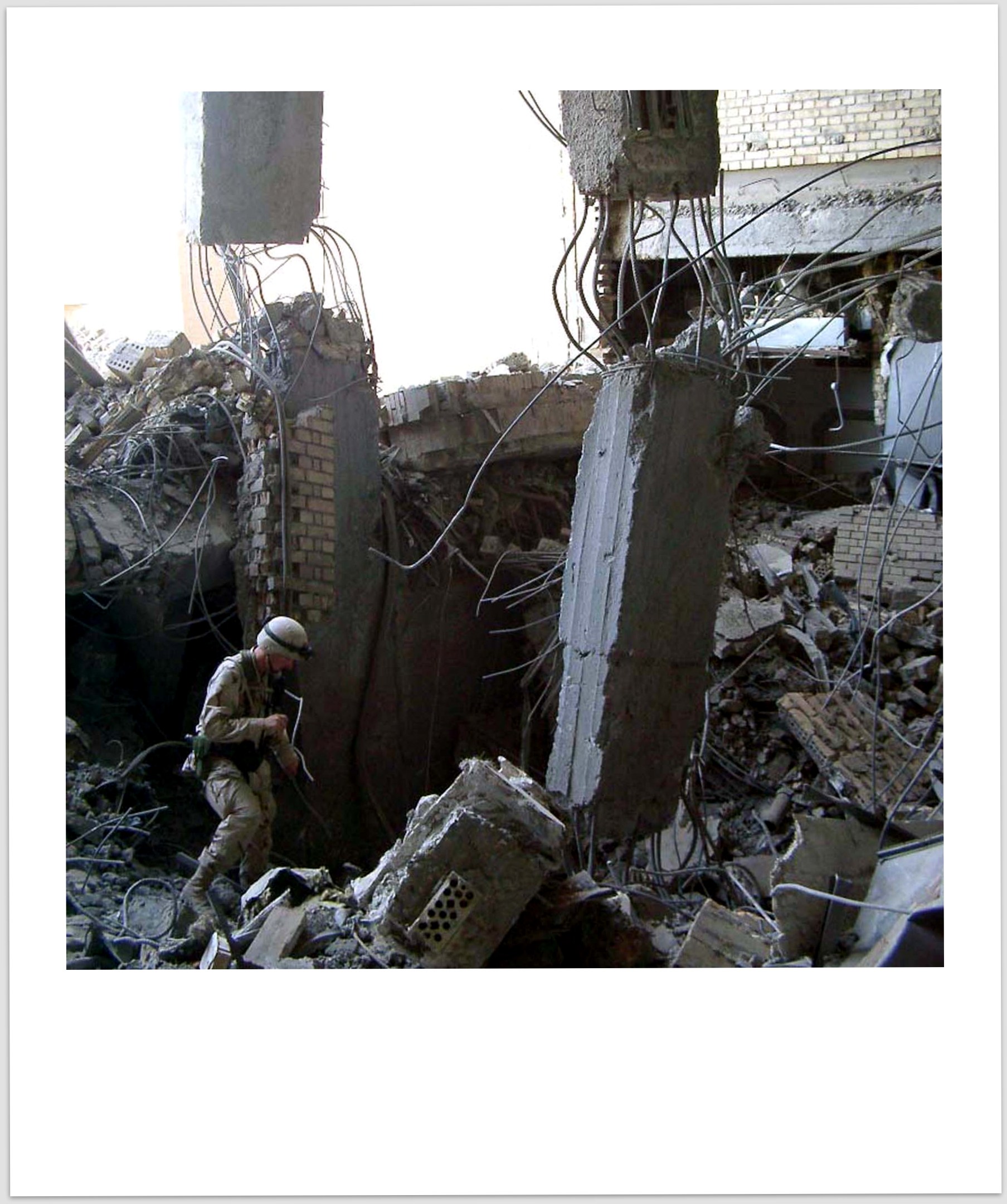
The man turns and says, “It’s alright, he’s dead anyway.”
“I didn’t get it at the time, but after two tours to this shithole I think it’s pretty fucking funny.”
It was after noon now and the sun was directly overhead and seemed to have a kind of weight to it. Arms got heavier and shoulders slouched more, the color drained from the sky as it was slowly pushed back down towards earth until the horizon disappeared and looked like one big barrier. The weight of it all was unrelenting, purging all thought and leaving you apathetic and complacent. Time continued to pass but Hal no longer kept track of it. This part of the day was always the most dangerous.
Hal had turned the turret so that he could cover the left side of the Humvee, leaving J to watch the front from the driver’s seat. Hal faced an alley that ran about two-hundred meters in length before it ended and split into a T-intersection. The squat cement-brick buildings along the sides held a dozen different shops and even a poolhall and they reminded Hal of public storage units back home with their metal roll-up doors. Nobody was out, which didn’t surprise Hal, with the heat and all. He wiped some sweat from his eye and when he looked back up he saw a head peeking around a corner fifty meters away. After a few seconds it disappeared back behind the wall, then popped out again a few seconds after that.
“I got someone turkey-peeking over here,” Hal said.
“Mmm hmm,” was all J said.
“He looks kinda shady,”
“Well, then pop off a couple rounds and let him know you see him.”
Hal brought the rifle up into his shoulder and right as he did so, the man stepped from behind the corner into the open, a long tubular object resting on his shoulder.
“Oh, shit. He’s got an RPG!”
“What?!” J said. Hal could sense him jerk towards the door window. “Shoot him, man. Shoot him!”
Hal could hardly believe what was happening. He had been in-country for five months, participated in at least a dozen firefights, but not once had he seen a live, no-shit enemy fighter. Even muzzle flashes were rare to spot. But here he was, fifty meters away, appearing large in his four-power scope. Hal could easily make out his details. Track pants, sandals, and a snot covered knock-off Affliction t-shirt. He could have stopped there, shot him in the chest and been done with it. But, he had to see his face.
“Shoot him!”
The patchy beard got his attention. How it grew in splotches, wide avenues of bare skin between them. It reminded Hal of his own attempts at facial hair while home on leave and how his girlfriend Dani would always give him shit for it. But it was the eyes, wide and white that gave him pause. It wasn’t really fear that Hal saw, more disbelief. Like his body was moving and he was just along for the ride. The eyes of a first-time skydiver sitting on the edge of the plane looking down and getting ready for the plunge. And it was there, between the white and spackles of flakey brown that Hal recognized him as more than a target. Hal had never shot at people before, only in directions or tree-lines or windows, and in that moment of realization he knew that he never could.
“Shoot him!”
He never heard the explosion, but he felt it. For half a second the air turned into a searing heat and an immense pressure squeezed his chest and he couldn’t breathe. When he opened his eyes, he was on the floor of the Humvee, his rifle swung just above him, its sling still caught on the turret. He panicked a moment when he thought the vehicle was on fire, but calmed down when he realized the smoke was just a thick haze of kicked-up dust. He saw that his right foot was gone and he saw that J was dead.
There was no one else down on the patio and so Hal turned his attention to the walkway. It was empty now, but he knew if he just waited a few minutes someone would come. He flicked the safety on and off with his thumb. Five minutes later a patient in a wheelchair turned the corner down at the far end of the walkway and began rolling towards Hal and the patio below. Hal settled in like before, cheek snug against the buttstock. He exhaled. Plink, rack. There was a knock on his door. “Hey, Hal, ya in there?” Hal ignored it, he kept his aim on the patient in the wheelchair. Plink, rack. “What are you doing, man?” Plink, rack. It’s alright, Hal thought. It’s alright.
Photo Credit: United States Marine Corps
FOB by Daniel Ford
An excerpt of the debut novel Sid Sanford Lives!
by Daniel Ford
Sid stepped into the desert surrounding the cramped forward operating base just as the sun surged over the distant mountaintop. He scratched his patchy, three-day-old beard. He inhaled deeply, the already warming air singeing his raw nostrils. The sand didn’t crunch so much as slither away from the hot breath of desert wind.
Daniel Ford’s debut novel Sid Sanford Lives! is now available from 50/50 press.
He eyed the line of beige Humvees parked by sandbags piled waist-high. He strode over and climbed into the makeshift garage. Sid propped himself against the tall front tire of the closest vehicle. He stretched out his legs and crossed them, feeling the full weight of his still stiff boots on his ankle. He shifted his position just enough so he could awkwardly pull his notebook out of his back pocket. He stuck his pen behind his ear, sure the words that had been eluding him since the troubled descent through the mountain range would come before the afternoon sun boiled his internal organs. For now, Sid propped his head up against the hard, black rubber and tried to remember how he’d landed in this dusty valley.
Roger Ray’s slamming door muffled the newsroom’s buzz. So many conversations from which Sid had long ago felt disengaged continued in shouted whispers once Ray started howling in earnest.
“I’d be weakening my damn city desk in the middle of a mayoral election,” the aging editor said. “On top of everything else, I’d be giving you, a little pissant, a promotion ahead of, frankly, a long line of more goddamn qualified reporters.”
“Someone else can cover the Bronx borough president’s philandering and embezzling,” Sid said over Ray’s incoherent grunting and molar grinding.
“Plus, I’d catch all kinds of holy fucking hell from the board…” Ray said. “Wait, what did you say?”
Sid patiently reached into his messenger bag and retrieved a blue folder that looked like an overstuffed jelly donut. He tossed it on Ray’s desk and watched as he casually flipped it open. Ray rolled his eyes as he read the top sheet, but that hadn’t stopped him from skimming the tax forms, illicit photos, and tawdry phone records bulging underneath.
“Sources?” Ray grunted.
“Waiting for a phone call from whomever you decide to assign the story.”
Ray held Sid’s gaze, hoping his young reporter would wear his self-satisfied grin just long enough for him to slap it off his face with a hefty Sunday newspaper.
“This doesn’t change anything,” Ray said, slamming his hand on the pile of front-page fodder. “I could just as easily order you to write this.”
“I have a draft someone can polish if that helps,” Sid said. “You don’t even have to use my name. Actually, I’d prefer you didn’t, I don’t want to get banned from Harlem and its chicken and waffles.”
“Listen, son…”
“I believe you owe me one,” Sid said, his jaw stiffening.
Ray waited a beat before nodding weakly. He got up, sat down on the edge of his desk, and put a hand on Sid’s shoulder.
“A desert warzone isn’t an appropriate place to overcome personal demons,” Ray said.
“That’s not what this is about,” Sid said. “I’ve just moved beyond writing about tainted politicians and transit complaints.”
“You better hope so. You survive our security training and I’ll think about it. That’s the best I can do.”
Sid took the deal and flew out to the Middle East three weeks later.
A sharp pain in his shin brought Sid back into the present. He cursed his luck, certain he’d been stung by a scorpion. However, the pain dulled quickly, but not before another kick to his boots forced him into a crouch. His eyes burned red as he opened them fully. He put his hand against the sun and made out a camouflaged hulk wielding a wrench standing in front of him.
“Scared the fucking piss out of me,” the soldier spat.
A tobacco-infused glob of spit now sparkled in the sand between the two men like a brushstroke of oil puddled in a Queens parking garage.
“Sorry,” Sid muttered.
“You’re not supposed to be here. I could have put a bullet in your fucking head. Probably give me a damn medal considering you’re a reporter.”
“I get it,” Sid said. He brushed the sand off his pants as he stood. “I’m leaving.”
“Don’t be a pussy,” the soldier said, extending his hand. “I’m Mason.”
“Sid.”
“Oh, I know your name. We get daily briefings on how to talk to you.”
“Is that why no one has done it yet?”
“Fuck, easy killer,” Mason said. “PR is not our strong suit.”
“Funny considering that’s part of your mission.”
“Enjoying the heat while you’re preaching at me?” Mason asked, slapping a wrench into his palm.
“Had to get out of the AC,” Sid said. “Too small a space and too many closed windows.”
“You want to open those bulletproof windows for the enemy, be my guest, but make damn sure me and my friends are all in the latrine when you do. And try not to make too much of a mess for us to sop up later.”
“Yeah, well, never been a fan of central air. Messes with my sinuses.”
“You been in a sandstorm yet?”
“No.”
“Might change a few of your preconceived notions about our little air conditioned shit box.”
“I didn’t mean to offend anyone.”
“Well, could you not offend anyone a few paces to your right. I’ve got to park my ass under the vehicle you’ve been using as a hammock.”
“Right,” Sid said. “Yeah.”
He moved out of the way and heard Mason slide under the front bumper. Sid rubbed the back of his head.
“Something wrong?” Mason asked from beneath the vehicle.
“Can I help you with anything?” Sid asked.
“You know much about auto repair?”
“Not really, no.”
“Then I’m good.”
“Well, how about I just keep you company then?”
“Like to work alone.”
“This is the longest conversation I’ve had in days,” Sid said. “Give me something.”
“I didn’t shoot you, what more do you want?”
“Son of a bitch,” Sid mumbled.
The clangs and grunts stopped. Mason wagged his boots back and forth.
“Coffee,” he said.
“Do you want anything—?”
“Black.”
“You got it.”
Sid headed back to the FOB. He found another hulking figure in fatigues leaning up against the counter, waiting for the coffee pot to finish gurgling.
“Lieutenant Núñez,” Sid said, keeping a respectful distance.
The officer growled something through his dark mustache that sounded like, “motherfucker.” Sid contemplated reaching for his notebook and peppering Núñez with questions before the man had even poured his morning coffee, but thought better of it.
“Given any thought to my, um, repeated requests?” Sid asked instead.
The officer’s severe, but sleepy, brown eyes motioned toward the coffee pot.
“Got it,” Sid said, grabbing two Styrofoam cups from the stack.
“Thirsty?” Núñez asked.
“Getting one for your mechanic.”
“Are you referring to Sergeant Ward?”
“This would be a lot easier if you didn’t break my balls every time we had a conversation.”
“But it wouldn’t be as fun,” Núñez said. He filled his mug and turned to walk out the door. “Don’t bother my men without my permission or I won’t talk to you at all.”
The officer knocked into Sid’s shoulder as he left.
“Sir?” Sid called out.
“You’re not ready to leave the wire,” Núñez said, pausing in the hallway. “Some of my men aren’t ready. Request denied.”
“Thanks for your time, Lieutenant…” Sid muttered.
He knew picking fights with commanding officers wouldn’t get him anywhere, but he hadn’t been raised to keep his mouth shut (or respect authority for that matter). However, Núñez had just confirmed Sid’s suspicions about the base’s preparedness. What Sid couldn’t piece together is whether that mattered in this country or not.
Sid returned to the Humvee and found Mason’s boots pointing out the opposite end. Sid pounded his fist up against the bumper.
“Jesus H. Fuck!” Mason yelled out.
Sid heard tools thump against the sand.
“Delivery,” he said. “I’m allowed to give you coffee, right?”
“Hell yes,” Mason said.
After climbing out from the car’s underbelly, Mason grabbed the cup and downed the coffee in one swallow. He tossed the cup back at Sid who caught it while preventing his own coffee from sloshing out.
“That must have felt good,” Sid said.
“Nothing feels good here. Needed a jolt.”
“Happy to help. Does this mean I can ask you a few questions?”
“Hope you’re not looking to fill column inches with me,” Mason said. “I’m a pretty boring story.”
“Yeah, I figured that out pretty quick,” Sid said. “But I’ll take what I can get right now.”
“What are you writing about?”
“Don’t know yet.”
“See, you want us to engage, yet you have no fucking clue what your plan is.”
“I’m here, that is the plan. A lot of people have questions about what’s going on over here.”
“Tell you what, a lot of guys over here have a question or two on what’s happening.”
“Maybe we can learn from each other.”
“When can I say I’m off the record?”
“Whenever you want.”
“And you can’t use what I say?”
“That’s how it works.”
“Then I’m off the record.”
“Fine by me.”
Sid leaned up against the door, burning his elbow on the hot metal handle. He pulled it away, more pissed about the squad’s antipathy than by the glowing red blotch on his arm. Mason wiped his forehead with an oily rag and then got back to work.
Mason clamped his thick hand down on Sid’s shaking leg.
“Really? Still with the fucking nerves?” Mason asked. “The mission is over, fucking relax.”
Sid adjusted his helmet and nodded.
“Lieutenant, Bob Woodward here is still pissing himself,” Mason yelled above the roar of the Humvee. “Any suggestions on how he can calm his delicate senses?”
In the passenger seat, Núñez turned his head slightly and growled something that sounded like “fucker.”
“Well, I wouldn’t do that to your mother,” Mason said. “Just sit tight, we’re almost home.”
Sid had hounded Núñez for nearly a month to authorize his first patrol. The squad now fancied itself a crack staff, impervious to the anxiety and turmoil endemic to other platoons across the desert. Outside of the occasional pop-pop-pop in the distance, however, none of the men crowded in the FOB had been in a firefight or had to halt a long caravan in order to investigate and detonate an IED. How would they react in the face of something more treacherous than cleaning out latrines or standing at attention for Reveille?
It turned out that Sid’s hands refused to stop shaking the moment he parked his ass in the Humvee. They shook all through the meeting with the hard-eyed, sun-scorched elders of the nearby village. Núñez listened patiently to the staccato Arabic flying off the leader’s rotten teeth like acid. He absorbed the overwhelmed translator’s stuttering and backtracking while nodding and trying to maintain eye contact with his counterpart. Sid watched as younger, more anxious men prowled along the back of the tent, shouting and pointing every so often. They had been stripped of their arms before entering, but their danger still permeated the cramped space.
“What are they pissed about?” Sid had asked Mason.
“No water. Limited food. Enemy offering it all at discount prices,” Mason had said. “It means we’re fucked. Now shut up and keep close to me or anyone else with a gun.”
Sid’s concentration was broken by Mason leaping out of his seat and climbing on top of a snoozing soldier in the rear of the Humvee.
“I said move your hand, Bee,” Mason shouted, slapping his subordinate on the cheeks.
“Wake the fuck up, this ain’t fucking nap time.”
“Sorry, Sergeant,” Bee said.
“Up all night playing ‘Call of Duty’ again?” Mason asked.
“Nuh-uh, Sergeant,” Bee said.
“Christ, just what Uncle Fucking Sam had in mind when he signed your sorry ass up,” Mason said, retaking his seat. “Has more goddamn kills online than he does in real life. Put that in your article, Sanford.”
“Why do they call you Bee?” Sid said, ignoring Mason’s jabs to his bicep. “Hard to figure considering your nameplate reads Zdunczyk.”
Bee glanced at Mason, who nodded his approval.
“Real name’s Frank,” Bee said.
“I’m aware,” Sid said. “Why Bee?”
“Aw, tell him,” Mason said, throwing in another scoop of tobacco below his bottom lip.
“My first day in the mess I wanted to make conversation,” Bee said. “So I started talking about this article I read about bee hives being like a communist society. Then I started in on the similarities and differences between hives and military bases. Kind of explains it all.”
“You’re so fucking lucky ‘Queen Bee’ didn’t stick,” Mason said. “Whole squad was fucking howling so bad Núñez smoked the shit out of us. So worth it.”
Sid reached the pocket of his flak jacket and pulled out his recorder. He waited for Mason’s affirmative before turning it on.
“Why’d you sign up?” Sid asked.
“No one needs to hear that fucking story,” Bee said, wearily looking at the slim device. “No offense, sir.”
“This is your penance for conking out,” Mason said. “Be thankful it’s not fucking licking my boot whenever the fuck I tell you to.”
“Yes, Sergeant,” Bee said. “It all started when my father was murdered…”
“Murdered?” Sid asked, the quake in his hands now having less to do with nerves or the Humvee’s shimmy.
“Yeah, couple of townies broke into our house looking for shit to pawn to buy meth or some shit,” Bee said. “My dad went to investigate and they dropped him with one to the head before he could raise his pistol.”
“Holy shit,” Mason muttered, spitting tobacco juice into a cup. “Where were you?”
“Getting high in the woods with a bunch of fucks from school,” Bee said. “We all passed out there. Cops ended up coming out to find me. We all scattered thinking they were going to bust us for weed. Ran home and right into the yellow caution tape like a goddamn marathon runner.”
“They catch the bastards?” Sid asked. “I mean…did they apprehend the suspects?”
“Nah, this is the best part,” Bee said. “They stepped over my dad and started ransacking the rest of the house. Probably looking for money or trying to cover their tracks. Make it look like there were more than two shit kickers. My mother had holed up in her closet and waited for them with a Remington 870 shotgun she bought on layaway from Walmart. Blew both motherfuckers away when they opened the door.”
“My kind of woman,” Mason said. “Shit, sorry about your Pops, but this is making my shit hard.”
“So how’d that lead to you enlisting?” Sid asked, once again ignoring Mason.
“Despite being relieved, my mother was pissed as hell I wasn’t home when it all went down,” Bee said. “She told me that since she took care of my father’s killers, the least I could do was go shoot some towelheads in the desert. Sorry, is that too crass for a newspaper?”
“Only regret I have is not killing those pricks myself. And not having a chance to kill anyone here. Fucking glad-handing political bullshit isn’t my thing.”
Sid nodded and pressed the pause button.
“Thank you for trusting me with your story,” he said, extending his hand. “I’m sorry to hear about your father.”
“Oh, I don’t trust you for shit,” Bee said, shaking Sid’s hand. “But Mason does and I report to him. I’m just as liable to shoot you next time you come near me.”
“Understood,” Sid said. “Just make sure Mason’s behind me when you do it. Takes care of both our problems.”
“You fucks know I’m still fucking here, right?” Mason asked.
The Humvee’s breaks squealed like a downtown bus as the hulking transport swerved abruptly. Sid tumbled into Mason’s lap just as the cup of dip flew out of the Sergeant’s hands and onto Sid’s chest.
Núñez shouted something unintelligible from the front of the vehicle.
“Shit,” Mason said. “Look alive, fellas.”
Sid’s nerves actually calmed as the camouflaged men around him checked their weapons and reached for additional ammo. He heard a distant whistling that aggressively faded into dense thuds nearby.
“Fuck, we’re in the shit now, boys,” Mason said.
The Humvee shook after a mortar landed a few yards away, spraying sand and debris across the small windows. The whistle intensified as the enemy’s aim improved. Núñez’s orders came out in a stream of profanity and pseudo-Spanish as he exited the front seat. Sid could feel the ripple of steel and sand as the Humvee continued to race across the desert. Mason shoved a finger into Sid’s chest.
“What did I fucking tell you before?” He asked.
“Stay close,” Sid said. “Preferably next to someone with a weapon.”
Daniel Ford is the author of Sid Sanford Lives! He’s the co-founder of Writer’s Bone, a literary podcast and website that champions aspiring and established authors. A Bristol, Conn., native (and longtime Queens, N.Y., transplant), Ford now lives in Boston with his fiancée Stephanie. He’s currently working on a short story collection.
We head into the fireball sun, packed in battle armor, baking from the inside out,
throats coated with dust, hearts like parade drums, adrenaline spiking off the charts.
We’re alone, cut off from the rest of the brigade back at Taji, and now thanks to a busted
drive shaft weakened in last week’s IED blast along Route Irish, we are without a
Humvee. We’ll have to finish this on foot.
We double-time across Baghdad on our twelve feet, a mutant dozen-legged beetle
dashing from rock to rock, confident in its shell but always careful of the soft belly
beneath. We are six men moving single file along the alleys, the edges of roads, the maze
of beige buildings. We keep moving: ducking and dodging and cursing and sprinting. We
wonder how it could have gone so wrong so fast.
Going on foot was never part of the plan. That damn drive shaft—nobody saw it
coming. And it’s not like we can call for help—dial 911 or send up a flare—because
we’re not supposed to be out here. We’re on our own and now we really have to keep up
the pace if we’re gonna make it.
The memorial service starts at 1500 hours. The last time we checked our watches, it
was 1030. Half the morning gone. We may not make it.
From the back, Cheever calls out, “Hey, wait up.”
“Keep moving, Cheeve,” Arrow says, not turning his head as he jogs down the street.
He’s on point and he’s focused. We wait for no one; we pause for no Cheeve.
“It’s these blisters, man. They’re killing me.”
“Aw, somebody call the waaambulance,” says Drew.
“My boots’re filling with blood. I can feel it.”
“Squish, squish, squish,” Fish says.
“That’s enough, guys,” says O, his voice softer than ours: steel wrapped in velvet.
That’s O. He’s never loud, but we always listen.
Everyone loves O. His full name is Olijandro, but we keep it at O—short, simple,
sweet. Round as a bullet hole.
We have every right to give Cheever a hard time. He is, after all, the one who left the
radio back in the Humvee—forgotten in our mad scramble to get out of what at the time
looked like a singularly dangerous situation, an SDS. That’s what Rafe would have called
it, the kind of thing he was always warning us about—before he himself was the victim
of the ultimate SDS.
Two hours ago. Jesus, was it really only two hours?Feels like a whole week since then. Two hours ago we were cruising along, taking the streets quick and easy. There was no laughter because we were on a sober mission, but we were feeling good. As good as we could, given the circumstances.
Park said he knew the way and we believed him. Why shouldn’t we? Park was quiet,
but he was smart. He wasn’t one to take risks. And today, of all days, we needed to be
risk free.
Everything was going fine. Smooth as a baby’s shaved ass. Park at the wheel, Arrow
riding shotgun, the rest of us crammed in the back: O sitting on Fish’s lap, Cheever
digging into his second bag of Doritos for the day, Drew sandwiched somewhere in the
middle. Early morning locals in fluttering robes swished past the Humvee’s small
windows. Burnt shells of cars lined the curb, lingering memories of bombs. Billboards
with soccer players saying things we couldn’t understand, but offering us a Coke and a
smile. Everything good and fine, then bang! It’s like the Humvee decided it had had
enough. Sorry, guys. I’m calling it quits. You’re on your own from here.
You should’ve seen the look on Park’s face when the steering wheel locked up.
This cannot be happening. Not here, not now.
Then came a hard clunk, and the Humvee shuddered to a stop. When we realized it
wasn’t coming back to life, we were out of there. Every which way in crazy panic, no
time to stop and think. Even the Doritos got left behind.
By the time we regrouped two blocks away and Drew said maybe we should just turn
ourselves in and call back to headquarters, we realized Cheever, our radio guy, was
empty-handed and the situation had gone from bad to totally fucked.
A look came into Cheever’s eyes and he released a string of curses.
Arrow closed his eyes, ground his molars, then said (over Cheever’s shit shit, damn damns): “I know you’re not gonna tell me you left the assault pack back there. Don’t you dare let those words come out of your mouth.”
“Just kill me now,” Cheever moaned. He stared hard at the ground, his eyes boring a
hole, digging the dimensions of a grave.
Some of us were all for doubling back and retrieving the PRC-119, but Fish shook
his head and said, “Too late. Hajji’s already scavenged the whole damn thing by now.
We’d be lucky to find a single hubcap spinning in the gutter.”
Humvees don’t have hubcaps, but that’s typical Fish—always exaggerating to make
things worse than they were.
In this case, though, he had a point.
We blame Cheever. Never leave a PRC-119 in the hands of a guy like him. A
platoon’s radio operator is supposed to be the smartest guy on the team—like a Yale Law
School grad slumming in the Army—but we ended up with someone who never quite
mastered the call signs and treated the radios like crossword puzzles he couldn’t finish.
Cheever is the self-appointed jokester in our little band of not-so- merry men. He’ll
go around saying things like: “Don’t fire until you see the whites of their eggs” or “I’m
so broke, I can’t even pay attention.” Once, when Private Cartwright slipped in the motor
pool and came down hard on a trailer hitch between his legs, Cheever goes, “Ooh, right
in the Balzac!” Lame-ass stuff that no matter what he thinks doesn’t earn him any extra
cool points.
Nobody’s laughing at anything by this point. All kinds of scenarios unspool through
our heads. We think about Jessica Lynch and all the wrong turns her convoy took in the
labyrinth of streets. We remember hearing about a British journalist kidnapped last
month. His beheading is now trending on YouTube. We think of those civilian
contractors who were caught, strung up from the girders of a bridge, and then hung there for days after their bodies had been burned. They looked like big slabs of beef jerky swaying in the breeze. None of us wanted to end up like that.
So there we were, a cluster of dumb in the middle of Baghdad.
Oh well, at least we had a map.
We reached into our cargo pockets, unsnapped ammo pouches, probed fingers into
pockets behind our flak vests.
Nothing.
We looked at each other, swallowing hard (none of us wanting to admit to the others
that we were swallowing hard). We already saw how this would play out—like the
surprise twist of a movie you can see coming fifteen minutes before the credits roll. If we were the virgin tiptoeing around the serial killer’s lair, we’d be jeering and throwing
popcorn at ourselves.
Arrow said we had to go back to the Humvee, take our chances, hajjis or no hajjis.
We didn’t argue. We needed the map.
Arrow led us back. We were half a block away—keeping to the shadows, hugging
the buildings—and were about to turn down the street where the Humvee was hasty-
parked with two tires up on the curb when Arrow held up a fist for us to stop.
We didn’t need to be told. We’d seen the men and boys and some women streaming
down the street, magnet-pulled toward something unseen. We knew what that invisible
attraction was. We’d been such fools to leave the Humvee like we did.
We slammed ourselves flat against the wall of an electronics store. Arrow inched
himself up to the corner, snapped a peek around the side, then pulled back just as fast. He looked at us, shook his head, then twirled his finger for us to reverse.
That’s when we smelled the smoke and knew we were no-question- about-it fucked.
Mapless in Baghdad.
We threw together a quick plan and made a good guess at our current location. Then
we moved out away from the destroyed Humvee and the happy chants of Iraqis
celebrating what to them looked like a victory.
Now here we are, slipping from building to building, street by street, trying not to
call too much attention to ourselves in this city that already hates us.
“Arrow,” Cheever calls again. He’s still limping. “I’m not kidding.”
Arrow doesn’t stop, will not stop until we reach Forward Operating Base Saro safe
and sound. That’s the mission and he’s intense and focused as a shaft whistling through
the air until it thunks into the target at the FOB. Arrow’s not his real name. He’s tall and
thin and moves like he’s been shot from a bow. His real name is Arogapoulos—the letters
squeezed together into tight, muddy stitchery on the Velcro name tag over his heart—but none of us could ever manage that, so we called him Arrow. It started after one of the company “fun runs” back at Fort Drum. The last half mile, First Sergeant usually let us break ranks and compete our way to the end. That day, Arogapoulos was leading the pack and he pushed hard all the way to the finish line. Slim, intent on purpose (finish FIRST finish FIRST), the breeze whistling in his ears. As we came out of the woods,
Arogapoulos whipped past the entire company and collapsed to his knees, gagging on the grass in front of the barracks. Later, huffing from his own last kicking sprint, Sergeant Morgan looked at him and shook his head, grinning. “Jesus, you were like an arrow there at the end, Specialist A.” So the name stuck. When Rafe christens you, you keep it.
“C’mon, Arrow—”
“Shut up, Cheever,” Park snaps.
“Yeah, we’re all walking on blisters,” Drew says.
“Fine! Fuck all y’all,” says Cheever. He lags behind.
Five minutes later, Arrow is forced to slow, then stop. While we pull security,
Cheever unties his left boot. We surround him in a ring, M4 barrels pointed out, a
bristling pincushion. We scan the rooftops, the windows, the doorways. Somebody could be up there right now with us in his sights, ready to take us out with one RPG. Later, we’ll look back on this—at least some of us will—and think, We weren’t too smart, were we? Bunching up in a cluster around Cheever, the fat pudge. But since we know Cheeve will pay more attention to himself than he will team security, we pull in close. Cheever has his good points, but selflessness is not one of them.
We are six men—Arrow, Park, Drew, O, Cheever, and Fish. And we are moving
through the most dangerous sectors of Baghdad—the bubble of the boil—on foot now,
thanks to the goddamn drive shaft and its microscopic cracks. We are on our way to FOB Saro to attend the memorial service for Sergeant Rafe Morgan and we are determined to make it there before sundown, alive, intact, all twelve arms and legs still attached.
We look at Cheever’s foot outside the boot. It’s moist and raw—straight out of a
butcher’s glass case. And the smell. It’s a sun-ripened leather bag full of vomit sprinkled
with sugar. It makes our nostrils cry for mercy.
We all go, “Jesus, Cheever!”
“Moleskin,” Arrow says.
Cheever drops his eyes, mumbles, “It’s back at Taji.”
Camp Taji, our home away from home, is thirty klicks behind us.
“Well, that’s a good place for it,” says Drew. “Better there than on your foot.”
“Sure could use Doc right about now,” Cheever says.
“Savarola, shit,” Fish spits. “What a pussy.”
“Hey,” O says. “Doc’s all right. He made his choice, just like we made a choice.”
Savarola could have come with us, said he was gonna come with us, but he backed
out at the last minute. We waited around the motor pool for fifteen minutes this
morning—longer than he deserved—until Arrow called it and said, “Looks like he stood
us up.”
And so we went out into Baghdad on our own without a medic.
“Wish he were here now,” Cheever is still going on. “At least he could give me some
Tylenol to chew on.”
“Suck it up, Cheeve.”
“This whole day is turning out to be nothing but one big suck hole,” he grumbles.
There is a sound halfway down the block, a clang of metal. A baseplate getting set
into position, or the metallic mumblings of crated artillery shells knocking together. We
snap back into the moment. Our M4 rifles come alert.
We wait. We listen. We watch.
Nothing.
“Stand down,” Arrow says. “Jesus.” He shakes his head. “It’s too early to be this
jumpy.”
We relax but don’t lower our rifles.
Then O says, “He can have my moleskin.”
“Bullshit!” we cry.
Arrow says, “You are not giving up your moleskin, O.”
“Why not?”
“Because I said so.”
They stare at each other for a long time—too long, if you ask the rest of us. This is
how it goes—testing a new leader’s boundaries, poking the bear to see if he’ll wake and,
if he does, how hard he’ll roar. They’ll send over Sergeant Morgan’s replacement
soon—from Bravo Company or maybe HHC as a last resort—but for now Arrow is in
charge of our squad. For today, a week—or, who knows, as long as a month if he’s lucky.
Besides, before he died, Rafe all but promised Arrow he’d get his stripes.
We’re trying to get used to Arrow being the de facto squad leader. This day, this
SDS we’ve gotten ourselves into, has called for one of us to step into Sergeant Morgan’s
vacuum. Given Arrow’s time in grade—he got promoted to specialist long before the rest
of us—it looks like he’s the man of the hour. He doesn’t have Rafe’s stripes or his
years—this was Sergeant Morgan’s third deployment and he knew his shit—but on this
day, things like that don’t matter as much as they would if we were back on Taji.
We’re all in the same boat. Like the rest of us, this is Arrow’s first trip to the desert.
We’re all blind men feeling our way across Baghdad; Arrow just happens to be the one in
front with the cane. Like it or not, we trail behind him.
O looks at Arrow, says, “It’s just a piece of moleskin, dude.”
Arrow looks away, scans his sector of fire, says nothing more. O does the
same—after pulling a patch of moleskin out of his ammo pouch and tossing it to Cheever.
We are silent, watching the street. After a minute, Cheever puts his socks back on his
feet. As he laces his boots, he grumbles and curses, but that’s to be expected. Cheever
being Cheever.
We move on. Cheever limps but keeps up.
* * *
Staff Sergeant Raphael Morgan was one of the best men we ever had. Rafe was what
they call a born leader. He watched out for us, pushed us when we needed it, backed off
when he knew it wasn’t the right time to push. We don’t want to put him on a pedestal or anything, but he really was everything we could have asked for in an NCO. He knew the field manuals inside and out, chapter and verse. He was prime time in the field. The
sloppier, wetter, and colder the conditions the better. He encouraged us to find our inner warrior; he was relentless in his quest for our perfection; he made us hate him in the times we were exhausted, blister sore, and sleep robbed. But then that night, he’d sit
down with us at chow, give us the lemon pound cake out of his plastic MRE pouch, and
ask nothing in return (and not because he hated lemon pound cake—we knew it was his
favorite). He was a used-car salesman when it came to persuading us to do the difficult,
the near impossible.
He wasn’t a big man, not one to loom over his subordinates with a barrel chest and a
Sgt. Rock jaw, using his NCO stripes to bully us. He wasn’t like the others—the bitter
assholes, the career sergeants who delighted in our torment. Rafe never flaunted what he didn’t earn. In fact, now that we think of it, he always seemed to be curled into himself, as if apologetic for his stripes and rocker. Like he was and forever would be one of us, a guy among guys.
He was short, a stump in the infantry forest, and used that height to his advantage,
swimming below the sergeant major’s radar when he was prowling for an NCO to blame
for his own fuckups. Sergeant Morgan kept his head down—below shoulder level of his
fellow platoon sergeants—and went about his work without unnecessary chatter and
bluster. But the unwary were fools if they believed that quiet demeanor: Rafe was iron
behind that black velvet. And man, he was smooth. We used to call him MC behind his
back. Milk Chocolate. Goes down nice and easy.
We remember this one time back in the States, soon after we got a new commanding
general. Word came down from on high that a weekend detail was needed for what
turned out to be some special landscaping work around Fort Drum. Post beautification
they called it.
Names were chosen, put on a roster, but they didn’t tell us what it was all about until
it was too late. Captain Bangor gathered us in a huddle after formation on Friday.
“Dandelions,” he said. And we were all like: What?
“Men,” he continued, “it seems the new CG’s wife hates the color yellow and so
we’ve been ordered to go out and pluck every single dandelion on post.” And we were all
like: What the fuck? But we didn’t say that out loud, of course—not in front of Old Man
Bang-Her.
It was up to Sergeant Morgan to get us through the weekend without all of us going
to Officers Row, armed with knives, breaking into the commanding general’s quarters,
and stabbing him and his wife to death. Or maybe just dumping a bucket of yellow paint
on their heads.
“Hey guys,” Rafe said that Saturday morning, our garbage bags fluttering in the
wind. “This ain’t so bad.”
We looked at the parade field—the largest plot of grass on all of Fort Drum. It was a
carpet of yellow.
“Sure looks bad,” Arrow said.
“Naw, this ain’t nothin’,” said Rafe, giving us a milk chocolate smile. “Now
3-5, they got it bad. They been out in the field all week and it only stopped raining
yesterday.” (We knew this, but it was good to be reminded of Third Battalion’s misery.)
“You think they ain’t sick of each other’s smell by now? And they still got another three
days to go. Sucks to be them. But here we are—warm, dry, doing a little gardening for
the CG. Can’t believe they pay us for stuff like this.”
It was still a crap detail, and we bitched and moaned, but we moved forward in a line
across the parade field anyway, feeling like we’d somehow one-upped 3-5.
“Besides,” Rafe said as we bobbed and plucked, “ain’t none of you heard of
dandelion wine?”
None of us had.
“You never read that book by Ray Bradbury? About the kid?”
We stared at him, our faces not moving. Sergeant Morgan, despite what you’d think
by looking at him, was well-read. We were not.
“Anyway,” Rafe went on, “I figure we got enough to make at least a bottle apiece
right here at the parade field alone. Just wait till we get over by the housing area.”
We moved across the field, our boots sweeping softly through the tall grass and
weeds.
“Golden flowers,” Rafe said. “The dazzle and glitter of molten sun.”
“Whatever, Sar’nt,” we said, turning away to hide our smiles.
“Dandelion wine—like summer on the tongue,” he assured us.
“Okay, Sar’nt.” Our smiles gave way to laughter.
And so we made it through the day, picking dandelions and looking forward to
drinking weed wine—which, as it turned out, we never made.
That was Rafe, always pulling us through the shit the Army shoveled our way.
That’s why we took his death hard.
We were there that day, that most horrible day on our calendar of awful. We don’t
like to think of our Sergeant Morgan like that—the obscene pieces of him flying through
the bomb-bloom air.
Yes, we took his death hard and, later, one of us might have gone outside to the
solitude of a concrete bunker and cried until the snot ran, and one of us probably dashed for the latrine, vomit splashing the side of the toilet bowl, and one of us most definitely would press the tip of a revolver—a cold metal kiss good-bye—to his forehead eighteen months after our return. But we’re not saying who. That’s private stuff we won’t share.
And so here we are, out in the bull’s-eye center of Baghdad, on foot, moving through
hostile neighborhoods with no commo and minimal ammo but with plenty of love for our dead dismembered platoon sergeant. Dismembered but not disremembered. We’re doing this for Rafe and there’s no turning back.
Photo Credit: Grove Atlantic
New Fiction: “East New York, After the War” by Gregory Brereton
I miss the fragrance of Polish women. I have not encountered anything quite like it. This tender unwashed grassy odor. Part stench, part hymn, evoking mysteries, bygone days, some kind of particle enigma. American women smell of chemical flowers. False lavender, concocted rose. In the hallway of the row house, my cousin’s wife leaves this botanical wash in her wake as she passes, as I press myself to the crumbling walls and bow my head at her coming.
I am distracting myself trying to recall the scent of Polish women, to recall what my Monika was wearing the last time I saw her and the dizzying lovely reek she gave off that’s gone now twenty years along with the rest of her. Cousin Johnny at the wheel of the moving truck won’t stop telling me to let it go, let it go, we turn around now and it’s over, all the way through the Flatlands down to a spot I know off the Belt Parkway with a trail to the water that can’t be seen from the road. He has to talk loud over the strange gargling sounds coming from the rear of the truck, Roman Wszniewski all bug-eyed with the rag stuffed in his mouth.
The war is over, Cousin Johnny says. Think of our plans. Think of what you’re throwing away.
He is cautious in that American style, always thinking of some bright future about to turn our way. I tried to be like this once but there is no counterfeit for it. There is only the past.
I am police these days. Before that I was only an exile but the difference is not as great as you might expect. Either way, you learn things. For instance:
They say Murder Incorporated never held the same sway over East New York after the cops threw Kid Twist out a window of the Half Moon Hotel and scattered his brains all over the Coney Island boardwalk but they also say that Jew gangsters hunt ex-Nazis with the apple pie aliases to this day through the rowhomes off Pitkin Avenue, Wyona, New Lots, Bradford, down through the python darkness beneath the elevated tracks over Livonia Avenue and out beyond toward Bushwick, Brownsville, Ridgewood and further still to the slinking green hush of the suburbs where nobody has a past worth remembering anyway, twenty years on from the war’s end and that taste for revenge still whetted like a fresh blade.
I believe it all, every last word, mostly because in America, in New York, things surpassing belief occur as regular as the morning papers. When there is blood involved, they are a matter of routine.
My cousin Johnny and his wife Sophie are laughing in the next room. One could all but reach through the walls of these cramped quarters. It is not merely sounds that pass through them – intimate, furious, the farcical bodily outbursts. Or the accompanying odors, though these are legion. The cheap plaster of these row house walls seem to be pliable and thin as memory itself. Resentments, treacheries, longings all come leaching through. Eventually it becomes difficult to know where your own share of these things end and the invisible incursions of your fellow lodgers take up.
If she has not already, I suspect my cousin’s wife Sophie of thoughts toward another man. I can’t yet say who it might be. My suspicions arise in part from a soft disarray, a mild turbulence, to her thoughts and ways broadcast through the walls. Through a spot just below the portrait of the Black Madonna, clear as a radio speaker, so that the wall like a murmuring heart itself seems to pulse with these things, the sounds of a restlessness come. Pacing footfalls, clattering dishes, a vase of flowers filled and emptied and filled again in quick succession. I suspect her as well because it has happened that I myself seem to have fallen at least a little bit in love with my cousin’s wife Sophie, and so I am keen on her moods and feel these odd inner shufflings at her ordinary arrivals and departures. These have been erratic of late. I have too this sense of a far-off despair, abstract as though it were a story I heard once the details of which are dim to me now, to think of her feeling some powerful emotion for another man. In part, this is loyalty to my cousin Johnny. In part, this is the hateful ache of unrequited longing. Most of all, I suspect her because I suspect all women. I have it in me to know I would never act on these feelings or even look too long or too deeply at the feelings themselves. Perhaps, as is usually the case, it is not love at all but simply a masquerade of solitude, a thrown-voice howl of desire in protest against a condition of life so unnatural as mine. I rise in the afternoons and walk my beat, in the borough of Manhattan, way uptown. I return before dawn, tired and free. My only contact with another occurs along the wrists of criminals as I bind them in metal cuffs or the colored women who sell their companionship in my precinct. But if I have gained nothing else from that chaotic and transient past of mine, even as it too recedes to a sort of impersonal fable, it is the absolute omnipotence over every act, beginning with a control of the breath beneath floorboards creaking heavy under Gestapo boots all the way up to the approach signals of something as absurd and perilous as love.
Most days, we listen to baseball and drink beer and my cousin speaks of his dreams to someday own a tavern and I let him believe that his dreams are my dreams as well. I have no resolve for dreams of my own. I want simply to forget. He grants me this, in his indirect way. He doesn’t care to hear about the war. He was on a mine-sweeper in the great Chesapeake Bay in the state of Virginia for the war’s duration and to him it was all something distant and strange. The war was a thing the Americans went over to and beat the Germans at and then came home singing. They don’t care to hear about the camps, the incinerations. They don’t care to hear tales of eating children in the ruins of cities.
This is all I want. To be free of memory in the American style.
Life will proceed as it has been planned, because our plans are modest. I will work to full pension and Johnny will sell the moving truck and we will open a tavern somewhere out beyond Brooklyn and be each a friend to mankind. And Johnny and Sophie will grow old together and I will slip easy into my fate of the mad drunken uncle from the old country, with each passing year growing more adept at folding up old longings and tucking them away back in the darkness where the disastrous ends of past longings are cast unremembered. I will grow so adept at this that eventually doing anything else will seem unnatural and perverse.
I am police now but it makes no difference. A bullet is a bullet, whatever the uniform. The bullet meant for me has been travelling twenty years now, ever since it passed clean through the pale cool forehead of my Monika, beloved and doomed, and continued through the darkness beyond where all she felt and desired and fought for lay earthen still and out again to cross the continent of Europe in ruins beneath the tailwinds of a billion spent bullets and on across that cold gray ocean vast beyond myth or reason, whistling low as it gathers strength to someday trace me clear to this room, to this open window at which I sit, top floor of the row house on Bradford Street, East New York, cleaning my service revolver to the sounds of transistor rock ‘n roll. It is coming for me.
I’ve found that the condition of the exile is excellent training for police work, for the policeman is a kind of local exile. People are wary and they speak at him reluctantly, always with careful deliberation. They keep things from him. They want to be away from him as quickly as possible.
So when we rouse this Yid body boy from a policy bank off Lenox Avenue and he asks me about my accent and inevitably he reveals we were all but brothers in the old country, I know that things are catching up to me.
These things proceed as always. You must ask every question but the one you want answers to. He hears my accent and dips into Polish and in a few deft phrases we are back on Florianska Street in Krakow, piano music tumbling up from the bricky catacomb taverns there behind the cathedral. We are arm in arm along Paulinska Street beneath the lindens nodding over the old rectory walls at the edge of Kazmierz. Past the Skalka sanctuary to that park on the river where the girls would pass with bare knees in the summer.
English, I say. You must speak English here. I don’t know anything about all that.
He tells me he knows my name. Knows my people out in East New York.
I know friends of yours, he says.
I have no friends here, I say.
He goes reeling off names, half of East New York, half of Brownsville, half of Brooklyn. Long dead, half-remembered crooks. He is talking now to save himself. There is nobody in Brooklyn beyond his knowing in service to that kind of salvation. Says he knew Abe Reles aka Kid Twist before he got his brains dashed all over the boardwalk. Says he drove for Pittsburgh Phil. Says he shook hands with Lepke Buchalter in Rose Gold’s candy store on Livonia Avenue once during the war.
They never really gone away, he says.
You want what? My thinking is you’d likely keep your mouth shut, I say. If any of it were true. Names in the papers. That’s all you know.
They’re still around. Not what they once were. Not like that, of course. But there are killers out there. Friends of you and me. They got a hit squad out for ex-Nazis to this day. Them ones we brought over through the ratlines. The ones who slipped through secret. Camp guards, SS men, if you will, may they drink dog’s blood and get cholera. You simply can’t outrun fate, officer. Especially when fate is dressed like an old Jew gangster.
I’ve heard this tale before.
Me? I’m some schmuck trying to make a living. What can I tell you?
Enough fairy tales, brother.
It’s all true, take it or leave it. Check your records.
There are no Jews left in East New York, brother. It’s all going to the coloreds now.
They’ll burn the place down, he says.
I don’t tell him how I much respect the coloreds. The colossal remembering in them, the perseverance against such wrongs. I never saw a colored until they posted me uptown and now I think they are the finest of the lot. Deserving better, anyway, than the habitual swindle of policy bankers. He goes on naming names but it’s not until he gets to the name Roman Wzniewski that I stop him.
I don’t talk about how I came to America, to New York. I learned a strategic ignorance as I moved across borders with the imploring silence of the refugee. I was admitted because in 1912 my father had a sister who left for work in a candle factory in Hamburg and when the first war broke out she couldn’t go home. Go west, go west. Now my cousin her son owns half a rowhome in Brooklyn on Bradford Street near the elevated train and I tell anyone who asks I got my English from him. He got his English at the church school of St. John Cantius on New Jersey Avenue. His children got theirs from the cradle and only know enough Polish to curse and say the rosary and their children in turn will only know the curses, which is enough, God help us.
But the name Wzniewski calls back to me through the despair of all those intervening years. We were Home Army during the war. Then the war ended and the Nazis went away and the Soviets came and there was hope for a brief instant and then that too went away. But Roman was nothing if not shrewd, merciless shrewd, and saw with great clarity the smallness and cruelty of the coming regime. Small, cruel acts were to be the new currency, exchanged against the grand annihilations of the past six years. He gave them my name and the names of a half dozen others – friends, comrades in arms, men he had fought and bled beside in the underground. Versions vary. In one, he blurted it all out only after the temple screws touched bone in the Palace of Miracles, the big house on Rakowiecka Street. In another, he went direct to the NKVD and spilled like a fishwife. He gave us up to secure certain things for himself inside the new regime. He gave them my name but when they came for me I was somewhere west of Salzburg, moving steadily on, my name and the life over which it had hung like a shingle or Damoclean sword all relinquished eastward where the bloody past went on repeating itself. They found my darling Monika instead.
Unrevealed days of wandering across the ruins of Europe followed. Eventually, I washed up here, where we all end up eventually. Brooklyn must be a sort of afterlife for the beleaguered Pole and the hunted Jew and the gypsy of the every bloodstrain braided loose in exile. Maybe there is the kind of heaven they evoke Sundays in the mother tongue at St. John Cantius. Where my thoughts slip back into the language of my birth as into healing waters. But if you kill a Polack like me, the kind with more killings to his name than he can recall, he gets sent express to Brooklyn. If I am fortunate in anything, it is in that name which I surrendered back in the old country, back when my comrade gave it up to the man from the NKVD. This was part of their mission to liquidate partisans and they came for me and found my Monika instead and did to her what they had planned all along. The squeezed trigger, the flash bang and soot in the air all appear when that old name returns to me in the silence of my thoughts there in the pews of St. John Cantius. I plead with God for mercy for that man I was. For that name I have surrendered. They killed me once already, in the war. We all rise again, say the priests. Some of us sooner than others. Maybe the trouble is that we don’t get to choose the time or place of resurrection. Or whatever precedes it. I beg that if there is a heaven, that Monika is there and her sadness has been taken from her along with the life itself. I clasp my hands and bow my head, my thoughts washed with that soft sibilance of the mother tongue, and beg God to grant me the chance to forget it all. I never dared pray for a chance at revenge. But most people pray too modestly. God is many things but modest is not one of them.
When it comes, it happens in the way of all things in this city. A bit of rumor, a stray thought, some overheard snatch of nothing talk that goes unraveling out and slithers from subject to subject. A Yid body boy from a policy bank off Lenox Avenue with a loose mouth and too many friends and his own skin to save.
Roman Wzniewski. Sure, you must know him. Though he dropped that rather unwieldy moniker soon as he stepped off the boat no disrespect. He goes by Ray Wisdom, you believe that?
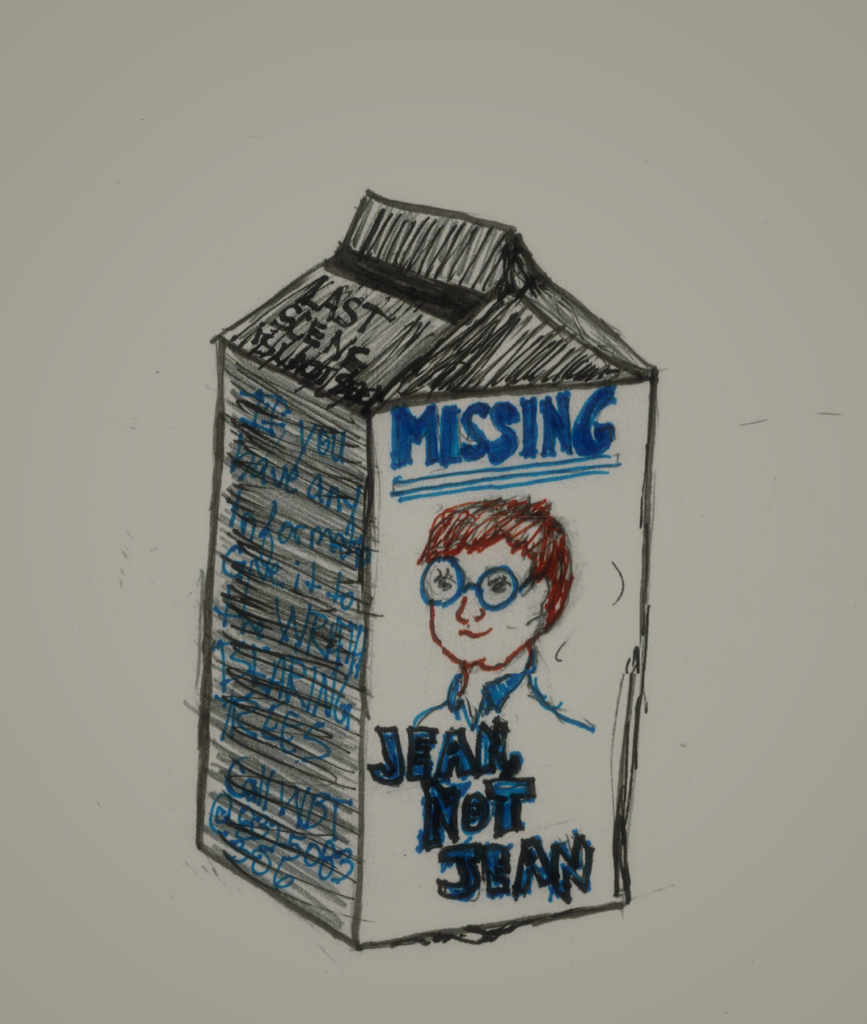
Where does he live?
I can see it in you, my friend. The blood rising. It comes right to the rim of your eyes. Not such a good thing I think. Information like this maybe. Maybe I’ve said too much.
What do you want?
I want what any man wants, he says. To run a legitimate business in peace. What can I do?
Tell me where this man lives and you are free to go. Or keep it to yourself and I will visit you every single day from now until the revelation, keep my boot in the ass of your whole operation until you’re begging nickels on the subway. These are the only choices available to you now.
What can I do, he says again but the tone has turned and the light has dropped from him.
Lights are strung across Bradford Street. We’ve been drinking all afternoon. There is a predictability to a city like New York. No matter where he might be, what borough or neighborhood, I am nearly certain that Roman is sitting at an open window, in a small room, hearing the same things over the radio, looking out over crowds in the street, thinking perhaps as I do now how very little the particulars of a man’s biography amount to in a city like this.
I ought to let it go. Let the past lie. But that name in my ears after so long has me remembering.
Nights, I clean my gun by this open window to radio music and ballgames. I am five years from full pension. Johnny hauls davenports and dining sets up the narrow stairwells. There is an old tavern out at the edge of Queens with a down payment in reach, where I picture myself drinking away the remaining days. An exquisite stupor, then a solitary corpse wrung dry. I only became police several years after arriving here in New York, after pushing brooms in schoolhouses and hauling furniture down tenement halls, after working for the city spearing trash on the end of a little stick in the dark eerie calm of the parks of Manhattan. I held court with my thoughts there below the hissing streetlamps and the rats the size of puppies and the brown-skinned teenagers who menaced me occasionally with knives or sticks. Sometimes they merely glanced up from their work painting odd names and phrases on the rocky outcroppings or restroom walls. When I became police and donned that crisp blue uniform, it was the response to my appearance that took some getting used to.
Winter, summer, winter, summer, as my mother would say. Twenty years go by and whoever you happen to be is the life you’ve made for yourself. I am some cop with an accent, living in a small room in a house full of drinkers, somewhere in Brooklyn. Trying half-heartedly to forget.
I am never lonely. I have not spent a single lonely night since I arrived in America. There are paid women in my precinct and I visit them from time to time. They’ll let police have a go for free but that feels wrong to me. Payment feels somehow more honest. These are colored women. It is all dark people in my precinct. They are clamoring for something now. Preacher types with that righteous fire. Dr. King. Malcolm X and him they gunned him down February last on stage at the Audubon Ballroom, two precincts over from mine. I thought of Kid Twist, of the efficient ways this city has of ridding itself of inconvenient men. The coloreds who are beaten like dogs in the street. Who remember every wrong. But vengeance is mine, the Lord says.
I don’t bother asking if he remembers me, remembers my face or name or what we lived through together. Cousin Johnny brings the furniture truck around from the warehouse on Liberty Avenue. Cousin Johnny who tells me to let it pass. We have plans. We have this life we’ve built. Cousin Johnny with his beautiful wife and his half a rowhome and what have I got? Cousin Johnny brings the truck around when I ask at least, I will say that much for him. I myself did not know how it would play out until I set eyes on him. I thought of Monika then. I wondered not for the first time what had passed through her panicked mind when the betrayal was laid bare. Roman W. walking along Pitkin Avenue like any other man in any other city.
We go up to his apartment on Starr Street and I press myself to the wall while Johnny knocks, holds an old bill of lading up to the peephole and says delivery for Mr. Wisdom. The reply comes fuck off in a voice I last heard in dying echoes in the sewer below Warsaw. Johnny says it again and there is the jangle of undone chains. I move Johnny aside and step into the doorway and the look on the man’s face as the door swings away is almost worth all the years and the troubled sleep and the remembering.
There is a trace of wonder in it. There is a certainty. There is the faintest shadow of relief. After all he has seen and done and lived through, when the prospect of dying was as near to him minute by minute as the drum of blood in his ears, he meets his revelation here in deepest Brooklyn. To know at last must have seemed a somber kind of mercy.
I myself did not know how it would play out until I set eyes on him. I thought of Monika then. I wondered not for the first time what had passed through her panicked mind when the betrayal was laid bare.
In the back of Johnny’s truck, I cuff him to the door handle. We don’t speak at first. My brother in the underground. I take in his face, the marks left by the passing years. Something close to affection returns even now. Something else, some complicated feeling of anguish overlaid with a numb confusion, makes me reach for the pint of rye under the passenger seat. I take a pull and hand it to him and as he drinks I slip my service revolver from my waist and rest it on my knee. He swallows and breathes deep and it all comes back up over the wood slats of the truck bed. He takes a second, modest nip of rye and begins to speak.
We could use someone like you, he says.
You already have, brother, I say.
We are engaged in a holy mission.
I know all about it. You go by the name Ray Wisdom. Nazi killer. Avenger of the Jewish race. All that ended long ago, brother.
It goes on still, brother.
That’s not what I’m here for.
You remember things funny, brother, he says. You talk like a man who has been wronged. But I was there too, brother.
How could I forget, I say.
Maybe it’s been too long. You have it backwards. I was the hunted man, brother. I was the one who had to flee for my life. Maybe Monika has been in the ground so long you remember her like she was someone else.
All that is over now, I say.
Do you have a wife, he says.
That’s neither here nor there, I say.
Not you, Roman says. I’m not talking to you.
Cousin Johnny looks at me, looks back at Roman.
None of your fucking business, Johnny says. How’s that?
You would do well to keep an eye on her, Roman says. With this man around.
He starts to laugh in a low, dry way and I slip the gun from my waist, turn and jam it up his right nostril and the laughter goes on, his whole face distorted with this mad glee.
Down along the rim of the parkway, the tidal flats crammed with refuse, we pick our way between the truck tires and animal bones and broken bottles upturned in the mud like jagged flowers. Roman doesn’t struggle. When I cuff his wrists I can see his eyes brimming with tears in the moonlight. All his deceptions have brought him to the edge of this stinking estuary, this particular moonlight. The cool scent of salt water in the breeze.
In the end, we had to flee Warsaw by way of the sewers. On a fathomless slow-moving Nile of shit we made our getaway. You might expect some altered character to the waste of a populace starving, terrorized, insentient with worry, futureless. Bowels clenched with dread, inert, sustained on nothing very much, down to vermin, shoe leather, sawdust, could hardly be expected to metabolize in the customary way. Yet life at the level of bestial necessity seemed to go on in much the same way, if anything more fulsome in keeping with the animal savagery taking place up above.
This is what I remember of those days. We stop at the water’s edge, Cousin Johnny restless. Roman who had come all this way, across an ocean by way of a river of shit, only to receive that same bullet roving now twenty years. Let it go. You too might hesitate. Then I see a pair of jade-colored eyes with that sadness to their cast that recalls Monika for a moment. That kind of soft sadness in her looks to make the bearer believable in all things. And how she knew this. How it made her so effective in her deceptions.
She died weeping, he says. Pleading for them to take you instead. Since you seem determined to make an end of things, there ought to be no illusions between us any longer.
I have none. Never have.
There is something else.
He is telling tales now, the beloved rat standards and ancient heartless singsong of the traitor. He tells me it was for my protection. He tells me it was for my own good. It is always somehow for the good of the dead when the living are made to explain their crimes. He asks me to remember. He says do not forget about your beautiful Monika. She possessed secrets of her own.
This I should believe, I ask. A man two minutes from death?
And were you so pure, he says, near tears. Were you so good and holy?
The end is already here, my friend. This is no time for excavations. Tell me something true.
I tried to save you, my friend. Monika, my friend. She was the one. You must have asked yourself why she stayed behind. You must have wondered about the lives she carried in her. She would not have made it out of Warsaw. She was being watched at all times. Which means you were too. You must have known.
I know nothing. I remember nothing, I say. Only a name.
You must understand, he said. She was my wife. I loved her. More than you can know.
I would have liked to know if he was being truthful or if it was only a ruse to prolong his life by way of my confusion. The difficulty in this arose from that sort of crazed, breathless smile he gave me as he said it and the bullet I placed as close to the center of that smile as I could manage in the darkness.
I cannot see the blood against the black water. His open eyes gather the moonlight in and I would swear I saw cloud shadows pass across their dazzled whiteness. He moves gently away over the little lapping swells coming up the sea channel, those last futile gestures of some distant oceanic furor coming to rest at last broken on this unknown shore.
New Fiction from “Still Come Home” by Katey Schultz
The following is an excerpt from Still Come Home, Katey’s novel set in Afghanistan.
A few weeks ago, it wasn’t the Taliban fighters’ movements that gave them away to Rahim, but their laughter, little jabs of sound punching through the packed heat. Rahim looked up and saw them traversing the slopes above the road. They moved as easily as mountain goats along the edge of distant boulders and, very quickly, they were upon him, telling Rahim and Badria to climb out of the creek bed. It’s not as if the fighters held them at gunpoint. No one threatened or fired; no one suggested that Rahim couldn’t back out. The desert simply offered the fighters and their money, pairing them with this sideline opportunity to ambush deliveries and suspicious non-residents. Rahim had wanted to ask about the Americans. They were nonresidents, but their firepower wasn’t anything two men could take on. Didn’t they still patrol here once or twice a year? But he stayed quiet, shocked by the currency the Taliban promised next. The Taliban’s instructions were clearly given: deter vehicles just enough to get them to turn around and prevent them from entering the valley. Five American dollars paid to each man, per deterred vehicle—more than a month’s income for Rahim and Badria combined. One of the fighters had even waved a bill in the air, like candy, chuckling as he incanted: “In God we trust.” More laughter. “In God we trust.”
All totaled, Rahim and Badria deter four vehicles for today’s work—the van and SUV, one sedan, and a rusty delivery truck bearing a different, unfamiliar logo. French? German? Such odd letters, as haphazard as insect trails in the sand. By the day’s end, Rahim is more than ready for a break. Soft shade. Warm tea. The ease of letting his eyelids close. With shovels and buckets in tow, he and Badria part ways along the loop road and Rahim walks the remaining blocks back home.
As he nears his apartment, Shanaz shouts and waves, insistent on a visit. He avoided her yesterday. Today, he relents. She never cares to listen; rather, to report. It annoys Rahim, if for no other reason than the energy it takes to pay mild attention to her when he’d just as soon be in his own home. Between bursts of pious proclamations, she informs him that Aaseya went to the bazaar by herself yesterday morning. Did he avoid his sister’s gaze? Did she even notice? He is so utterly fatigued—by the day, the circumstances, the endless, endless rope of it all. Even years ago, working in the Mirabad Valley, as beautiful and free as it had felt, it still came at a cost; some sense of fatigue and falling behind Rahim can’t seem to shake.
Finally home, he sets his supplies in the alley near the defunct tap stand, its dusty pipe a mockery. Such uselessness. Such waste. He can recall a few years of his forty on this Earth when Afghanistan wasn’t being invaded. But those times are mostly lost to the fog of childhood or delegated to the realm of family lore. Mostly, when Rahim thinks about his life, he thinks about a spiral—always circling toward the same black hole, always seeing what’s trying to pull him down, helpless against gravity.
He thuds up the mud steps to his apartment and rests for a moment at the top of the stairs. He fills the entryway from top to bottom, his long, gray dishdasha caked in sweat and dust. Linen pants of the same color balloon from his legs. Aaseya glances up from her work slicing cucumbers. Here’s the moment he could tell her he’s not making bricks anymore. That he’s working for the Taliban, but not with them. That in fact, right in their bedroom—pressed into a small wooden box—is a hidden stack of U.S. bills, which may someday very soon be of use. Whether the Taliban pay in rupees or afghanis or dollars isn’t for Rahim to worry about, though if he dwells on it, he knows it means his situation is unsustainable. The money will either run out or bring something bigger to a head. He can’t say when, but he’s seen enough of war to say one of those outcomes is inevitable. For now, he does his job, earns his pay. That’s got to be enough.
“Salaam,” Aaseya says.
A dignified man would probably shove her into the wall. Might even ask his brother-inlaw to help plot her execution. But even this thought comes with a wash of fatigue. What can be said of dignity for a man who’s had the unforgivable forced on him? Rahim’s heart pounds in his throat and he remembers nights with General Khohistani as a boy. Aaseya nears to kiss his cheeks in greeting, but Rahim feels frozen. He studies the thin, downy hair along her upper lip. A silk forest of grace, perhaps how forgiveness would feel if it were a place. More: the easy curve of flesh above her mouth, the naive hope her youthful body suggests. The General falls from memory and he leans forward, accepting Aaseya’s welcome.
“Salaam,” he replies.
He crosses the room and reaches for a cup on the counter, then sees the water pail is empty. “What’s this?” He frowns. “Shanaz said you’ve been out again and still—not even any water?”
Aaseya looks at her feet. Her restraint in his presence reassures him of his power, perhaps the only thing that remains his own in a country torn to bits. But in truth, he’s never been good at punishment, his thoughts often pulled into poetic frenzy, encouraged by his studies in music and culture as a young boy. All things good and true. All things close to heaven, echoing the divine. He’d just as soon forget the rest and go take a nap. More powerful than any weapon he fires, it’s the tiny salvations that keep him from splitting in two. Like a poem finds its form, he too will find his role.
“I’m sorry,” Aaseya says. “We were only given a small portion.”
Rahim shakes his head, nostrils flaring. He knows the spell his silence casts, the oddity of his own expression with the right side of his nose smooshed slightly off center, the result of an early disobedience Aaseya would never understand. Does she think he’s a fool or ferocious? Most days, Rahim feels too tired to venture a guess. “Tea will be fine,” he says.
Aaseya turns to her small cooking space and jabs at the coals, then sets the kettle on to boil. When the chai is ready, Rahim gulps it quickly. Warm silt slides down the back of his throat. He stares at the empty cup. He’d like more, but feels something beyond thirst. A tightness in his gut nags, some days worse than others. Today it feels like a tiny man is working down there, twisting Rahim’s gullet into knots. He wonders, briefly, if anything could actually soothe that kind of pain. It seems too unpredictable to name. An embarrassment, really. A sign of weakness. Not something he’d ever complain about out loud. Even if the pain had a name, there’s nothing that can be done. He shifts a little with the discomfort and imagines that the tiny man has started to pound pinhead-sized fists into the bottom of his gut. More than water, more than a hot meal, more than a wife, even, he’d love to kill that man and quiet the pain. The first time he felt it he was ten or eleven, as a batcha bazi dancing boy. There were nights when General Khohistani dubbed Rahim the most talented. Such a cursed compliment. Rahim learned to focus inward to get through the initial humiliation of Khohistani’s advances, imagining a rootball in his belly, firey and alive. When he danced for Khohistani, Rahim pretended that the rootball grew, spreading its tendrils upward and out of his throat until his entire body was covered in a knobby shield that protected him from the General’s fondling. Most of the time, the mind-trick worked. But one night, Rahim’s imagination failed. There was only the darkness of Khohistani’s office, the way he entered Rahim from behind. Then Rahim’s slow slump into passivity.
Quite immediately, he understood: his body was like his country; it would survive and it would always be used. But enough of that. The Persian poet Hafiz would say that the past is a grave, the future a rose. Think of the rose.
Aaseya reaches for Rahim’s cup and he feels her fingertips meet the edge of his. As soft as a petal. As un-callused as polished stone. There’s so much she hasn’t seen, but for a young woman quickly cast as a wife—and moreso, a young woman raised under Janan’s worldly idealism—Rahim knows that she’s more savvy than most her age. She returns his mug, refilled, and walks to her cooking space. She appears sluggish, her limbs moving heavily as she mixes half-moons of cucumbers with lemon juice and salt. Rahim leans his back against the wall and rests.
Before long, Aaseya carries their meal into the gathering room and sets the tray on the floor. She smoothes the striped canvas dastarkan and sits across from Rahim. They eat silently, like isolated leopards startled to find themselves in the same den. Rahim watches her chew. The nervous way her fingers clasp each wedge of bread. The calculated flick of her tongue to collect hummus from the corners of her mouth. She could almost be feral, a helpless cub. But there’s restraint in her movement. A careful calculation that Rahim recognizes as a secret withheld. Three years of marriage and still, she makes everything so much more difficult than it needs to be. He understands that Aaseya likes his touch sometimes, a firm, hot hand sifting through the folds of her shalwar kameez. But other times, he presses into her and asks, “God willing?” The pleasant shock of her lips on his. “God’s will is busy,” she said twice this week already, her freedom of refusal a rarity in Imar, in Oruzgan Province, in most of her country. He’s weary of her dismissiveness, too fatigued to press. Would she understand, if he told her? That odd pain in his gut, liminal, almost. Like a ghost. Batcha bazi—dancing boy. Two words he’ll never repeat, though they make this marriage what it is. Being courted under the guise of tradition and honor turned Rahim inward, his poetic fancies blooming into elaborate disassociations—the rootball growing, spinning, cinching down. As frequently as Aaseya denies Rahim’s advances, he has yet to push her into the wall, to grab her throat, to truly punish her. Not after all he’s seen. Besides, with what energy would he muster such violence? He’d just as soon have a day of rest.*
Daylight fades and, with it, the pervasive heat. Something that could almost be called cool settles the dust in their tiny apartment. Rahim rests along a row of low cushions propped against the wall. Every few moments, he brings the lukewarm tea to his lips. His stomach loosens slightly and he exhales, willing his shoulders and neck to release. It’s not like the leather strap of an AK feels so strange. It’s not even that so many hours in the sun each day cause more distress than he’s put up with before. No, this tightness has the twist of a warning. A tired fable. His work with the Taliban will have its consequences. Meantime, Imar continues to destabilize, its inhabitants growing more and more susceptible to bribes or back-knuckled work. “You know what they say,” Badria had told Rahim just last week after the Taliban paid them. “Follow the money to its source.”
But dollars can come from as far away as the markets in Tarin Kowt or Kandahar. They can be plucked from dead bodies or filtered through the hands of Afghan National Army recruits in training. The source of Rahim’s pay could be perfectly legitimate, even if the outcome is not—and what is legitimate, when war has its hands in everyone’s pockets? Morality is for the privileged; honor codes for the elderly still remembering a world that never knew Osama bin Laden. Everything feels like a backwards pact; as though the rest of the world is watching his country try to feed itself with its own hands, then seeing those hands go down the throat, followed by the arms, straight out the asshole and up into the mouth again. The image only exaggerates Rahim’s physical discomfort at the end of this long day. Needles move up his spine and settle like razor blades underneath each shoulder. Too much movement and he could slice himself in two. Maybe then the tiny man could crawl out. Maybe then the only thing that would matter would be those pieces of himself left behind. Pieces still useful enough to save, and isn’t redemption something else entirely? Beyond dollars and roadside bargains? His heart says yes. The poet Hafiz would believe in a world that said yes, too.
About Katey Schultz
Katey Schultz. Photo Credit: Nancy W. Smith
Katey Schultz is the author of Flashes of War (Loyola University Maryland, 2013), which was named an IndieFab Book of the Year and received a Gold Medal from the Military Writers Society of America. She mentors serious writers via distance, including a new craft-based webinar series dispatching from her 1970 Airstream trailer this fall.
New Fiction: “The List” by Andria Williams
Author’s note: I began this story in 2013, but eventually set it aside because I feared it would seem unrealistic, or possibly even quaint, to write a story about a Facebook group formed to exploit female service members. This past year, for obvious reasons, I dug it up again.
*
Green cornstalks rolled into the distance under a heavy midsummer sky. From her metal seat, peering out the small window to her right, Captain Jessica Aras watched a lone white jet-trail make its way through amnesiac blue. Then the door to the squadron building clicked open, and she saw Airman Blakely slip in with a Big Gulp sloshing in his hand, which surely he had refilled four times already and would prompt him to make half-hourly trips to the little boy’s room for the rest of the day.
She could understand how a person might drift away from the base on lunch break and have a hard time coming back, especially if that person were a nineteen-year-old male on his first stateside tour of duty after 180 days in Afghanistan. But as he approached her side of the room, the door shutting behind him, he took a leisurely, gurgling sip through his straw, and the ice cubes clattered all at once against their plastic silo. This sound was the death rattle of Jessica’s patience. Just because a tour in southern Illinois lacked urgency did not mean that someone could glide off and install himself for two hours at the mall’s food court. Three times this week Blakely had come in late from lunch, and as she saw her other enlisted folks glance up, she felt a flare of irritation. She was his Captain, and his tardiness seemed a show of public disrespect.
Even though her better judgment told her to take him aside in private, she couldn’t stop herself from standing and calling after him. “Airman Blakely,” she said, “your break ended 45 minutes ago.”
He pulled up mid-slurp and stared at her in startled silence. The straw twitched between his lips. When he lifted his head, the straw came up with it and he held it there as if unsure which would be less polite, to remove it with his fingers or to just let it dangle.
Everyone watched over the tops of their gray cubicles.
“Are we having a misunderstanding, Blakely?” Jessica asked, crossing her arms over the thick fabric of her cammies. He continued to stare, and she blurted, “Were you under the impression that lunch break was a free afternoon at the Chuck E. Cheese’s?”
It was a stupid thing to say; it hardly made sense. Their local mall did contain a Chuck E. Cheese’s, but no one called it “the Chuck E. Cheese’s,” “the” tacked like a small fart onto the front of the name. She glared up at him, this gangly kid almost a decade younger and a foot taller than herself, who a month ago had been pulling military police duty in some village in Afghanistan and now stood before her, red-faced, a florid pimple blooming beneath one nostril, the straw projecting from his mouth like a sprig of wheat, the ice shifting once more, loudly, in his drink.
And it did not. But in retrospect, this was probably how she first got on the List.
*
Jessica drove home every day with First Lieutenant Steve Hayes, her neighbor and a fellow officer. They both lived in town about fifteen minutes from the base. A coworker once accused them of being too good for standardized housing, and maybe they did think they were; they shared an unspoken aesthetic, she thought, preferring older, quality homes to the base’s sea of new beige construction. Of course, Jessica and her husband Halil liked the larger-than-base-housing backyard for their eighteen-month-old son, Omar, and Halil had a thing for crown molding and pocket doors. Jessica privately thought all these Victorian details were somewhat wasted on bachelor Hayes, whom she imagined hardly noticed them behind the flickering glare of his 78-inch TV and all his weight equipment, but perhaps he liked this side of town for its convenience to St. Louis, where he’d gone to college. He was in an MMA gym there, and he liked the comedy clubs.
Their tours at Bagram had overlapped by a couple of months, so she and Hayes had already known each other when they were assigned to the same security forces squadron in southern Illinois. He was blond, blue-eyed, and corn-fed, and Jessica had kept her distance when she’d first met him in Afghanistan, incorrectly assuming he was a frat-boy type. But he was more self-deprecating than she’d expected, and soon they were watching movies in groups on their off-nights and chowing on more Cinnabon than their perfunctory PT runs could comfortably support. Now that they were stationed here in Illinois, and neighbors, he’d suggested that they carpool together, alternating weeks—this week was her turn to drive. She found she rather looked forward to it. Hayes was single and had no kids, so he’d kept a lot of personal interests and hobbies and did smart things like watch “Meet the Press.” He also had a wise-ass streak she enjoyed.
So here he was, fiddling with her automatic windows and rummaging in his pocket for a toothpick which he popped between his teeth. He’d quit smoking since his return from Bagram, and there was always something in his mouth: gum, a toothpick, hard candy.
She wondered what he’d say about the incident with Airman Blakely: that her irritation was justified, but she should have spoken with the kid alone. Still, she feared that he might say something else, something like, Actually, you were a little bit of a bitch.
Instead, he said, “Did you hear there’s a new food truck opening in town?”
“Yeah?” she said, relieved.
“Rico’s Tacos,” he said, spinning the toothpick between his teeth. “We getting some culture here in town, maybe?”
“I’ll believe it when I see it,” she said. She enjoyed their shared yearning for “culture,” also a frequent point of commiseration for her and Halil.
He chuckled and sat in thought for a moment. “Oh, hey, did you remember?”
“Remember what?” Jessica slowed the car as the rural highway became the main road into town and cornfields gave way to gas stations, strip malls, a high school.
“Taco Tuesday at work tomorrow.” His blue eyes grinned.
“Oh God, I always forget,” she groaned. “Is it poor form if I just bring in a can of black olives?”
“You did that last week, Captain.” He spun the toothpick between his front teeth. “Lead by example. Anyway, the enlisteds like them.”
“The olives?”
“The lunches.” He examined the frayed toothpick, chucked it back through the open window, and pulled a clean one from his pocket. “Aw Christ, now here’s the band.”
The high school band ventured out into neighborhoods every summer to prepare for parade season, and here they were now, marching through the crosswalk to the measured rim-clicks of the snare drums. Their red-faced major, sweating continents into his T-shirt, held his hand to their windshield with grim, flushed solemnity, as if only this gesture kept Jessica from plowing into them all.
While the band crossed, Jessica prodded the bobby pins in her oiled bun, eager to get home and let it down. Her sunlit reflection in the car window showed the flat, rippled waves of hair across the top and sides of her head, like a shower cap made of satin and Kevlar. She liked her hair, its unique monochrome to her light brown skin, and wished it were the first thing people noticed about her. In reality, though, people probably noticed the broad, massed patterns of freckles across her nose and down her cheekbones, just one shade darker than her skin, like shadows through a screen above. She had nothing of her mother’s smooth darkness or her father’s peely ginger flush; and in fact, though she supposed they’d done their best despite their propensity for arguments and alcohol, she did not feel she was much like either of her parents in any way. After state school in Massachusetts she had joined the Air Force, and only her mother was left now, back in Boston near her Cape Verdean relatives, paranoid about “Arabs and Mexicans,” smoking a pack a day.
Jessica said, “I love the band.”
“Really?” said Hayes. “Why?” He squinted at the last of the kids as they marched past the windshield. “Don’t worry,” he shouted out the window at the drum major, “we aren’t gonna run over your goats.”
The drum major stood stoically, resisting the urge to make eye contact, as if he were guarding Buckingham Palace.
Jessica clicked her tongue, chuckling. “Leave the kid alone.”
“Speaking of kids,” He glanced at her, cleared his throat. “You sure ripped that Jiminy Dipshit a new one today.”
“You mean Airman Blakely? Did I?” she said, distressed. “No, I didn’t. I said what needed to be said. He was coming in late every single day.”
“Yeah…” Hayes waited for her to continue.
“He’s only been stateside a few weeks. He was way out at some combat outpost, you know.”
“The hell was he doing out there?”
“Beats me.” Jessica chewed her lower lip. “Do you think he’s having redeployment issues?”
“Maybe he’s just bored.”
“That, too.” Jessica sighed, steering one-handed, her right arm across her lap.
“Those were good times,” Hayes said, meaning when they were in Bagram. She suspected that not all of his times had been good—he’d been tasked to drive convoys for a provincial reconstruction team and admitted once that it scared him—but people chose what to remember. Her own security job had been so boring it felt like psychological torture. She’d pined bitterly for her son Omar, who’d been a year old when she left; cried over videos of him shoving one cereal puff after another into his mouth until his cheeks bulged while Halil and his saint of a mother, who’d spent that year living with them through each of their deployments, laughed.
Jessica pulled up at Hayes’s house and saw the ecstatic face of his terrier jumping again and again in the front window.
“Someone’s happy to see you,” she said, and smiled. He opened the car door, waved, and headed up the walk.
*
“Anybody home?” Jessica called in a singsong, minutes later, through her own front door, because this always made Omar squeal. “Oh, I guess no one’s home. I’ll just go back to work, then.”
Omar tore around the corner at a toddler’s breakneck speed, his legs kicking forward with a sweet, jerky, duckfooted motion as if not all their joints communicated with each other yet. Jessica picked him up, kissed his dark blond curls, brushed cracker crumbs from his cheeks.
The television was on in the large, mostly empty front room, still stacked with cardboard boxes in one corner, and toys tossed about as if one of those boxes had lightly exploded. She glimpsed the green of a baseball field on the screen, tiny figures running and diving, before it switched to a raucous commercial.
“Hello,” Halil said from the couch. “We were just watching baseball and eating Ritz.”
She set Omar down. “How was day care? Was there a good report?”
Halil made room for her. She perched lightly, still in her uniform and combat boots, with a long to-do list ahead of her before she could relax. “He had a good day,” Halil said, and Jessica felt a smile spread across her face, “but he did not finish his lunch.” Halil added, sounding almost sorrowful about it: “He never eats the oranges.”
“Oh, I don’t care,” Jessica said. “How was your day?”
“Not too unusual. I briefed the Colonel,” he said. Halil was on an Intel watch floor, which meant twelve-hour shifts. His eyes looked tired and heavy-lidded.
“Were you nervous?”
“Not too. I don’t really get nervous anymore.”
“Do you feel like people are taking you seriously at work?”
He looked at her curiously. “I think so. Does that surprise you?” He gave a quiet laugh. “I don’t think they say, ‘Oh God, there goes that clown, Halil.’”
“I know. That’s not what I meant. It was more about myself.”
He frowned. “You think people don’t take you seriously?”
“No, I think they do, it’s just” – Omar was climbing her legs now. She swung them up and down while he clung to her shins, and he laughed.
“Well, you scare the living daylights out of me,” Halil joked.
“Yeah, yeah.” Jessica swatted him, unwound Omar from her calves, got up, and headed for the upstairs bedroom to change. Her laced boots felt ridiculously heavy and assertive, out of context, on the carpeted stairs. Omar followed her, wailing. Now that she was home, it was Mama or no one. She handed him her phone to play with while she changed: pried her feet from the hot boots, pulled bobby pins from her hair one by one. Her head was tender from insistent pinning. She rubbed her scalp, pulled her hair through a band, and carried Omar downstairs. He still clutched her phone possessively, so she let him keep it. Halil had tipped his head back on the couch and was dozing. As she gathered ingredients for dinner her phone buzzed, and she pried it from Omar’s hands just long enough to see a message from Hayes. “Don’t let us down, Captain!” it said, with four taco emojis trotting along behind. “Go big or go home!,” and then three American flags. Jessica chuckled and wrote herself a note so she wouldn’t miss it in the morning.
*
The next day at noon, she set a long rectangular tray on the buffet table and peeled back its foil blanket, steam swirling up as if she were performing a magic trick.
Her airmen inched around the table. Rows of warm, gently folded corn tortillas spooned each other beside shredded lettuce cheerful as Easter grass. There was a mound of shimmering ground beef and a lake of thick, grayish beans, sprinkled with authentic-looking cheese. Jessica felt a glow of satisfaction. She had single-handedly taken Taco Tuesday up a notch. She stepped back, clapped her hands lightly together, and said, “Dig in!”
“Goddamn, I love Taco Tuesday!” someone behind her said. “You’re the best, Captain!” She realized it was Hayes and ignored him.
Murmured thanks came from her crew as they filed into line. “I love this place,” Airman O’Donnell said, and because he was not a wiseass like Hayes, she felt nearly dazzled by his effusiveness until she realized that he meant the chain restaurant from which she’d bought the tacos, and not their cinder-block building with its belabored air conditioning and sagging motivational posters. Still, the spread was an accomplishment. It sure beat the previous weeks’ limp tortillas and bags of shredded cheese. People heaped their plates, poured fizzing cups of pop. Someone turned on the stereo.
Airman Mackenzie Stahl, with her severe bottle-black hair and thin overplucked eyebrows, was one of the few who did not seem pleased. Stahl was somewhere around twenty. She always seemed to have such a chip on her shoulder. It had almost startled Jessica when she’d once seen Stahl out with friends at the movie theater on a Sunday afternoon, laughing and carefree in a Loony Tunes sweatshirt and pin-thin jeans. Stahl possessed none of that lightness now. She thunked a jar of watery salsa onto the far end of the table and stalked past Jessica as if the lunch were not an act of generosity but some kind of pitiable dog-and-pony show, as if Jessica were performing an office striptease. From the other side of the room someone muttered, “Where are the olives? We always have olives.”
Truth be told, Jessica felt she’d never quite struck the balance between authority and generosity. The female officers who made the best leaders, who stayed in twenty years or more, seemed to err on the side of toughness and they were often, she hated to admit, the more mannish women. They had odd, inappropriate senses of humor and short, dry laughs; they were overly attached to horses or dogs. Maybe Jessica was finding her own way, a middle ground where she could be both boss and friend, man and woman. Then she overheard airmen Blakely and Stahl at the front of the line.
Stahl asked, “You hear we’re getting a Rico’s taco truck?”
Jessica was about to pipe up Yes! She had heard that! It was the talk of the town!, but Airman Blakely, pouring neon-orange queso from a jar all over the delicate flavors of the more-authentic takeout Jessica had brought, spoke up first.
“What’d you say? Pink tacos?” he asked, grinning.
“Shut up,” Stahl said, laughing.
It was obvious Blakely was trying to be immature. Sure, it was uncouth, but Jessica was in the mood to let things slide. She wouldn’t have given it a second thought if it were not for what followed.
Blakeley widened his eyes at Stahl in mock surprise and whispered in a breathy, innocent falsetto: “What? You mean this isn’t an afternoon at the Chuck E. Cheese’s?”
Stahl pushed him playfully and hissed, “Oh, take it easy, Cocoa Puff!”
At this, several airmen turned toward Jessica and then quickly looked away again. She wondered what this had to do with her.
“Shit,” someone muttered.
And then Jessica realized—her face burning, tears sparking in her eyes—it was a nickname, their nickname for her.
Stahl turned and spotted Jessica, and her whole countenance changed. She ducked her head and, though there was only one tortilla on her plate, made a beeline for her cubicle. Blakely, his face red, did the same.
Jessica felt her body turn hot from her head to her toes. She poked at the pins in her hair, her eyes stinging. It’s okay, she told herself, a habit under stress. It’s okay, this is okay. It’s normal to gripe about your boss behind his or her back. She would not cry over whatever stupid crap some kids from podunk towns said about her when they thought she wasn’t listening. Maybe it meant her group had good camaraderie. But Cocoa Puff, Jesus. There was an edge to it she couldn’t make herself think about. Her stomach turned.
Hayes, oblivious, wandered up with his own plate refilled and gave her a smile. “Hey, kiddo,” he said. “This whole thing is a hit.”
For a split second she wanted to grab his arm and demand of him: Is this really what they call me behind my back? What else do they say about me? And please do not call your Captain “kiddo” in front of the airmen! Instead she stood silently, relieved that, at least, her distress was not noticeable to anyone else.
“You gonna eat anything yourself?” Hayes asked, landing a curved, beef-filled chip on his tongue and crunching loudly.
“Of course,” Jessica said, though she could not imagine actually choking down anything. She turned back to the table full of food: pale-green lettuce dropped here and there, the beef leaking orange-colored oil, her spectacular, now-picked-over tray.
*
For the next few days, there were no incidents. Airman Blakely was nearly tripping over himself to be punctual, returning from lunch with minutes to spare and often with a quarter of a sandwich in hand, as if putting his concern for promptness on display. “Nice touch,” Hayes whispered to Jessica with a smirk. “The sandwich.”
Then the Major called her out of the blue for a meeting. He wanted her to meet him not at his own cubicle, but in one of the small conference rooms at the end of the building, which could not be good. She knew this would be about one of the airmen. At two o’clock she tapped baby Omar’s sweet round nose in the framed photo on her desk, pushed back her chair and walked past the dark, reflective windows, pressing her bun into place.
When she opened the door Major Alvarez was already there, a dewy Diet Coke in one hand. He set it aside, stood to accept her salute, and apologized for interrupting her workday, as if Jessica had been doing something fascinating and totally unrelated to his instructions. Then he said, “We’ve got a little bit of an issue here with some of your men.”
Her heart sank: more than one?
He asked, “Are you familiar with something called ‘the List?’”
Jessica paused, mentally running through what might fit this name: a game show, a movie. Hadn’t there been a self-help book of that name recently, some Christian thing? “No, sir,” she said.
Alvarez sat down and Jessica did also. He said, “One of your airmen came forward yesterday. He said there’s a, a game going around between a couple of the offices.”
“Okay,” Jessica said.
Alvarez cleared his throat. He was a fit man with salt-and-pepper hair who often bicycled to work wearing the sort of giant, iridescent sunglasses favored by those who took both sports and eye health seriously. He linked his fingers on his lap and Jessica saw the ropy tendons in his arms, his remarkably clean fingernails, white moons, the beds a pristine grayish-pink.
“They’re keeping a list of the females in the offices, things they”—he paused delicately—“notice about the females, ideas of what the females might do.”
Jessica could feel her heart accelerate as he explained: The men in question had started a Facebook group, which they joined under decoy names. The site was “organized around sexual requests and gossip,” Alvarez said, “and inappropriate speculation.” Worse, however, the group was linked to another site where service members were apparently posting nude pictures of women—some obviously posed for, but others seeming to have been taken without their knowledge.
She couldn’t help but feel indignant on behalf of her men, in part for the absurd reason that the other squadron involved with whatever this idiotic game was had a much nicer, newer building with perfect air conditioning and sparkling, unchipped bathrooms. The airmen in the other building enjoyed such creature comforts all the time; what excuse did they have to idle their days away, dreaming up lewd nicknames and distasteful scenarios?
“It probably started as blowing off steam,” he said, “but it’s become something more.”
“All right,” Jessica said. She felt almost dizzy and cleared her throat. “Well, what do we do?”
“Airman Wallace, the one who came forward, will allow us to use his account for the next couple of days so we can figure out exactly who is taking part in this.” He scribbled something on a piece of paper and then handed it to her. “Here’s Wallace’s information so you can access the account.”
“His account name is ‘SexualChocolate?’” Jessica snorted, picturing Wallace’s eggy white head, the way he seemed to stroke it into a point when he was thinking.
Alvarez denied himself the chuckle. “We’ll go through it and identify who we can, and compare notes tomorrow,” he said. “But wait until you get home.”
Her protectiveness was replaced by a seeping disgust. “How many of my men are involved, sir? And what will the disciplinary action be?”
He counted in his head. “Right now I know of ten from your unit, plus fourteen from the other. There will be the typical non-judicial committee and appropriate punishment. And they aren’t all men,” he said, his eyes darting to her and away again as he stood and she did also. “Wallace says at least two of the participants are women.”
*
It was Hayes’s afternoon to drive. Jessica followed him out of the building and across the parking lot, which wavered black in the midday heat. His royal blue Mustang, brand-spanking-new the month before, was waiting. It was more car than anyone needed, with all the bells and whistles, but that was not something she would ever say. Besides, being a grown man with no dependents, he could do what he liked.
“Another day bites the dust,” he said, smiling faintly as they glided through the security gate, waving to Vargas and Swenson on duty. He glanced back in the mirror and switched lanes, his blue eyes light and sun-strained.
Jessica found it hard to keep up conversation, given the day’s revelation. Alvarez had asked her not to speak of it before he took the issue higher up. She wondered if Hayes knew, if he’d heard anything from the enlisted guys. She wondered, yet again, if he knew what they called her behind her back.
“Going into the city Friday night,” Hayes was saying. “Seeing the Cards game with some friends.”
Jessica managed to ask who they were playing. The Reds, he said. Cabrera was coming back in off the injured list, but he wasn’t worried. She saw his eyes in the rearview mirror again, just a flicker, and he drifted back into the left lane.
“Well,” she said, feeling exhausted, “that sounds like fun.” Then she touched his arm. “You’re driving serpentine,” she said.
“Oh, sorry. Old habit.” He shook himself, moved back into the right lane as if out of superstition, forced himself to stay there. The effort made him twitch.
She nodded, looked out the window. There were the cornfields, a half-vacant strip mall with a tanning booth and a Verizon Wireless, a pro-life billboard with a baby in a denim jacket and sunglasses. Sometimes Hayes would joke, “I’ve been wearing this jacket since four days after conception!!!,” which made her laugh.
“I know it’s just a habit,” she said. “But you don’t have to do it here.”
*
Later that night Jessica sat in the green glare of her computer, her heart pounding. She was doing what Alvarez had asked her to: scrolling through the List, jotting down the names of contributors she recognized. None of this was what she wanted to see, and yet it was impossible to look away. She felt as if her mind were unfurling.
There was plenty of tamely inappropriate stuff, shots of service women at BBQs in low-cut shirts, holding beer. Two female airmen Jessica recognized, tongueing for the camera, par for the course. Individual shots of women apparently oblivious to the commentary they’d inspired: She a real ho slept with half the MPs. This one likes it up the ass. Bitch gives the best head in Illinois!!!
She scanned through the page for links to specific pictures, trying to match her people with their aliases. Airman Rick Swenson called himself “Ron Swanson,” she put that together pretty easily. There was Spaceballs, JFK, Matt Holliday. All these losers, she comforted herself, who would be found out, one by one. All she needed to see was there.
Airman Stahl was, optimistically, “Gisele.” And it turned out she was quite active on the site, posting pathetic photos of herself in only lacy black panties, her scant breasts squashed together with her elbows in an uncomfortable contortion. Stahl posted these pictures even though the commentary was sometimes harsh – You look like B-grade Victorias Secret, girl!—or maybe because it was occasionally positive (Super hot, keep ‘em comin sweetheart!). Then again, maybe she was getting money for them.
Jessica learned, too, that Airman Vargas had a real chip on his shoulder about an ex-girlfriend, a former servicewoman he referred to as “the evil bitch” so insistently that anyone wanting to see a picture of her called her that as well. Vargas had uploaded nearly all of the evil bitch’s Instagram account to the web site before she could shut it down. Jessica lingered far longer than she needed to there, riveted in a way that felt both vapid and inevitable. She scanned backwards through the evil bitch’s life, through her parties and posing with girlfriends at clubs (and yes there was a lot of cleavage and her skirt was far too tight, but this was on the evil bitch’s own time and Jessica would have had no jurisdiction); she scrolled past the evil bitch cuddling with a large pit bull, the evil bitch posing with a nephew. The evil bitch dolled up, the evil bitch fresh-faced on a lawn chair. Jessica felt startled when Vargas himself reappeared in this reverse-timeline—she’d almost forgotten he was involved at all, and wanted to shout, Look out, don’t you know that’s the evil bitch?!—he was oblivious, his arm suddenly around the evil bitch’s slim shoulders as if they were on cloud nine.
She thinks she has privacy, Vargas wrote, but joke’s on her! She blocked me from her Instagram means she basically WANTS a war now. Fine evil bitch, you want it you got it! P.S. $$$$$ I got noodies on a film camera, will scan. $$$$$
BIG MONEY, sonny!
Aw yiss , came the replies.
There was plenty more, things Jessica did not want to see. She found herself scrolling with a sense of distance, seeing all this from the outside. She tried to forget these were her people, that she had failed, that she had allowed such a germ to grow right under her nose—instead this was some unknown airman’s strained, blurry dick before her eyes, some other unit’s men who had paid one of their own to ejaculate on a hooker’s face. There was no way these could be the people she worked with day after day. Good morning, how are you, so-and-so made fresh coffee, there’s softball on Friday—
She had a strange memory of Hayes talking to her one afternoon in the car, something he had seen on Bill Maher, saying—A dick, if you ask me, does not translate well to film. Anyone who thinks otherwise is kidding himself. And Jessica chuckling awkwardly at this non-sequitur, thinking, Where did that come from? But so far, to her relief, Hayes was nowhere to be seen on the List.
And here was Gisele, Airman Stahl, again. A post from a couple of weeks ago:“Cocoa Puff’s Nipples – Black or Pink?!!!”
Jessica felt the blood drain from her face.
Oh please no, she thought.
It was a popular post. People were making guesses. “Black,” “pink,” “vagina-colored,” they speculated, some obviously pleased with their own cleverness. One asked, “Do you think she has splotches all over her WHOLE BODY TOO?”
Jessica felt tears spark in her eyes. Her face burned.
But then Gisele/Stahl reappeared and put the guessing game to rest with a heavily cropped photo. It was blurry, taken with a cell phone Stahl had apparently set in her locker, but Jessica could see that the series of three photos were of herself.
The first was taken from behind and was unimaginably awkward: a surprisingly pale figure stepping forward into her PT shorts, the ass a sloping ramp, pocked with minor cellulite. Then it got worse: two frontal shots, the moment before she grabbed a towel, in which Jessica’s torso seemed to make a haunting, disapproving face at the camera. She wished the body had been mercifully headless but there was the lower half of her face, unmistakable, caught in what looked like a moment of mild strain. Her breasts hung dead center in the picture, like two startled, spacey eyes, while her unguarded stomach made its slack and gentle descent towards her crotch. For a moment she could not breathe. It was the worst way to be caught, in that wet, gravid moment between shower and towel, the moment you rushed through because it was so ugly; and there she was, frozen in time, evaluated by countless eyes, judged for the horrors of her normal body. She felt captured. She felt lynched.
PokerFace—OMG this makes me so hot I need to jack off and then kill myself
Holler Uncle —At the Chuck E. Cheese’s?
JFK—KILL ****ME***** FIRST!!
Spaceballs—oh God, I can’t unsee it
PokerFace—Ladies and Gentlemen, you have seen the face of terror.
This, from a particular wordsmith— the existance of the allusive Locker Room Sasquatch has now been prove. Approach with extreme caution!!!!!!! If it comes near you, throw food to it then back away. LMFAO
Yet another—How can she do this to us?????
The responses ranged from that sort of prudish hysteria—as if the images had been thrust upon them from the outside, by a calculating third party, the pervert in the movie theater or the creep on the bus, and not sought out and encouraged by themselves – to a chuckling, jaded cruelty, a voice that was calm and sexually wise, somehow above the other banter. Jessica didn’t know which was worse, and she couldn’t bear it anymore anyway. She needed to get out of there.
She clicked back to the Facebook page and was about to close out when a new post caught her eye. Unrelated to the main content on the page, it was just a casual conversation between two members. But a sudden suspicion made her read on.
Spaceballs—Hey Matt Holliday you got those tickets for Friday?
Matt Holliday—yeah
Spaceballs— 8 of us right?
Matt Holliday— yup
Spaceballs— What, you didn’t invite Cocoa Puff on the way home? LOL When you gonna bag that?
Matt Holliday— Shut up. You’re an ass
Spaceballs— She’s into you, you know it
Matt Holliday— prolly
This conversation had ended half an hour before. Jessica waited a few more minutes, but nothing else came up. She recalled seeing “Matt Holliday” elsewhere on this page; it was the name of a star Cardinals player and, she now knew beyond a doubt, that it was Hayes’s moniker as well. She began scanning the list frantically for Matt Holliday’s other posts. They were infrequent and rather passive, in occasional response to others. He had not commented on the more illicit items, including the naked pictures of herself. But he had seen them. He’d known about this for some time.
She resolved to click out once and for all, but the cursor in the top bar blinked like a challenge, a dare. SexualChocolate, how are you feeling? it asked, with all the saccharine remoteness of a non-human.
SexualChocolate—YOU ARE ALL FUCKING ASSHOLES she wrote, and closed out of the computer at once.
*
There was no way that she could sleep. She sat up with a glass of wine and tried to calm herself: the List would be shut down the next day. She’d watched it from the outside with a superior glow of knowledge, seen its deathbed tremor. Those boys thought they were so clever, thought they could keep their fun little club on life-support, but it had only a few hours to live. And she had snuck in among them and deceived them, too.
Why had she expected Hayes to snitch on the others, anyway? She and Hayes carpooled to and from work because they lived a block apart; she’d been stupid to think they were friends. They did not get together on weekends or BBQ in her backyard or hang out in bars. But they talked, and something about the way their conversations bookended the day made her feel that these chats were significant; they checked in with each other because being in the military, in their squadron, having done a tour in Afghanistan, was like being in your own little country, a specific world that made you somehow equal. They were the yolk of an egg, she’d once thought, and the white of the egg was all the diffuse civilian-ness around them, the tanning booths and the Dairy Queen and the high school band and all that shit the military made possible for their indulged, beloved, oblivious citizenry to enjoy.
But right now, she hated him. She hated him more than she had hated anyone in her life.
Their service didn’t make them equal. She’d always known that perfectly well, and just sometimes forgot. He’d sat by while people joked about her, while nude pictures of her scrolled before his blue, blue, American, baseball-loving eyes, as if what she didn’t know could not possibly hurt her. But that was the thing, she thought tearfully, feeling bitterness rise up through her body. That was the thing about being a woman: what you didn’t know did hurt you, over and over.
She tried to imagine how things would go from here: The List would be shut down, effective immediately. The transgression would be discussed at work in endless conferences and reprimanding e-mails, and everyone would be very, very serious. They would hold a non-judicial disciplinary committee, and there would be docks in pay, maybe even someone getting held back in rank for a few years. For Hayes, as an officer, the punishment could be severe.
But these were her people, also, and there was a chance she would be punished as well. She was supposed to be in charge of them, to know what they were doing. She’d helped create a culture. Hadn’t she?
*
She didn’t sleep. Hours later she stood by the back door and watched the sun rise in a pink smudge from the direction of the base. A distant cargo plane climbed into the warm, heavy sky. Beneath it swayed the drying cornfields, waving their crinkled arms as if to remind everything above them that they were there.
Halil would be home in a few minutes from his night on the watch floor. When Omar woke up, Halil would toast him a frozen waffle for breakfast and take him to day care before falling finally into bed to sleep the day away.
By then, Jessica would already be at work. Hayes was coming by to pick her up soon, and he was always on time.
Photo Credit: United States Air Force
New Fiction: “Old Wounds” by Therese Cox
The YouTube walkthroughs have names, like action movies or episodes of a serial TV show. Judgment Day. Suffer With Me. Fallen Angel. Old Wounds. If you were playing, you’d fire up your console, scroll through the list, pick your game, and go. But Tracey Knox doesn’t play. She’s only here to watch. One quick click and SchoolofHardKnox is leading the way through the war.
She’s watched them all, headphones on, grinding through anti-tank fire, lobbing grenades at ditches, clamoring for weapons, hoping there’d be one, just one, with a voice-over and a howzit goin’. How else is she going to hear Geoff’s voice? Flat Michigan vowels with those U.P. dips and stalls: a sound she doesn’t get a lot of in New York. She’s spent hours patrolling these deserts. It’s only grown worse since she lost her job at the architecture firm. There’s nowhere she has to be at 9 a.m. No project manager to look over her shoulder. No more designing cat fences for rich ladies in Connecticut. She is thirty-nine and can do as she likes.
There are thousands of views. Who was Geoff making these walkthroughs for? He didn’t do voice-overs, didn’t narrate, never popped up mid-scene in a Fugazi t-shirt, flashing his tats, to explain strategy. Each episode is like a movie he lived once and forgot about, one long jittery dream that Trace lives over and over.
“Old Wounds.” She likes the sound of that one. He dies too soon in it but it’s badass and medieval to gallop on horseback, brandishing a sword pried from a skeleton’s ribcage. She clicks on the name and lets it roll.
*
It’s Friday night at the Hampton Inn in DC. Tracey Knox is incumbent on a queen-sized bed, surrounded by plugs and remote controls. A screen flickers from her lap, lighting her face in flashes. Her eyes glazed, ears snug under industrial-sized headphones. She’s been dressed in the same clothes for a week straight—baggy cammie trousers bought discount from the Gap, $4.98, an end-of-summer deal, and a faded Jackass t-shirt. She’s skinnier than usual. All week it’s been nothing but sunflower seeds and Arizona iced tea, but then, the anniversary usually has that effect. At the moment she’s knee-deep in a YouTube k-hole and doesn’t care who knows it. Each fresh burst of gunfire grinds her guts with a bad longing. It calls back the barrage of explosions drifting down the hall from under Geoff’s bedroom door. The on-screen desert had been Geoff’s playground. Virtual Sergeant Foley, a stand-in for Dad.
Tracey’s best girlfriend, Constance Lawson, is knocked up and across the room, embedded in a nest of Hampton Inn pillows. They’ve decided to do a girls’ weekend in DC. Just the two of them, like the old days, one last hurrah before Constance, now Connie, becomes an FTM, or full-time mommy.
Connie had planned everything. Two queen beds and an all-you-can-eat menu of reality TV shows and room service mocktails. Right now Connie’s reading to Tracey from an upbeat email. Connie’s writing a book about her experience of IVF, half memoir and half how-to. The future for mommy lit is apparently bright. She’s landed a slick agent on the basis of a sample paragraph and outline and is already in negotiations for a book deal for her WIP.
“What’s a W-I-P?” Tracey asks, slipping off one headphone.
“Work in Progress,” says Connie, who’s superstitious about names for unborn projects.
Tracey, for her part, has no reason to fire up her email on a weekend. She recoils at the memory of the last exchange before HR sent her the marching papers, a “reply all” that should very definitely not have been a “reply all.” Tracey nods, says it sounds promising. She switches to half-listen mode and goes back to the screen.
On her laptop, a menu of a dozen other options pop up, all listed under her brother’s screen name. She’s stopped talking to people online after a Skype with their LA office went balls-up and cost Tracey her job. She’s been living off her severance package above a tire shop in Greenpoint, buoyed by the salary of her Dutch bicycle-parts designing husband, Niels. Her job search is equal parts day-drinking, flirting with bartenders, and experimenting with the font size on her CV. If there’s a café with free wi-fi, she’s freeloaded. Whenever either of her parents, divorced of course, gets her on the phone, Tracey says the same thing: she is pursuing other options.
“Do you think I should come up with a new name for TBD?” Connie asks.
“To be determined?”
“No, no, Trace, T-B-D. The Baby Dance. It’s what the What to Expect When You’re Expecting to Be Expecting book calls sex.”
“Why don’t you just call it sex?”
“Because,” Connie says, “That’s so louche.”
Connie reclines in yoga pants and places her hand on her swollen belly. She balances the phone on top and shows Tracey a new app, plugging in a set of hot pink earbuds. The app’s main feature is the frantic liquid throb of a fetal heartbeat so Connie can eavesdrop on her unborn infant. The baby, in all its amniotic fury, pounding away. It is just a cluster of nerve endings and cells and life pushing blood through its fetal chambers, but listen to it go. The heartbeat hypnotizes her with its systole and diastole, evidence of its miraculous, furious progress. Connie is transfixed in the dull spell, fingers slack on the edges of her iPhone, earbuds shoved in, the better to hear the back and forth of the protean sludge. Tracey tries to ignore it but Connie insists. Through the wire comes a birdlike thrum, frantic and pulsing, the life that is both part of her yet apart from her—primordial—she is life-giving—this baby-to-be, sloshing over and over just for her, the sound (she makes Tracey listen. Listen, Trace!) going mama mama mama oh god.
“But Tracey, don’t you think about it sometimes?”
Sure, Tracey thinks about it sometimes. The possibility of new life. The thing her friends are all doing, the thing she knows Niels wants. It’d be a beautiful baby: half-Dutch, half-red-blooded-American. Niels would have the kid on training wheels in no time. She could forget about the architecture. Embrace the FTM. Make their offspring her avatar.
But Tracey Knox pursues none of those things. She unhooks herself from Connie’s app and slinks back to pole position, head hunched, knees curled, itching to get back to her trance. She’s not even playing the game, a level way worse, just watching virtual violence, eyes glued to the stuttering screen, explosions collapsing around her in bursts of orange and red, choppers snip-snip-snipping the sky above.
Outside the hotel room, DC lurks. Connie had come to grad school here. Tracey, dragging an art history degree behind her, had followed her out and spent a year mopping gallery floors, playing the mistress to a fastidious art buyer who lived in Dupont Circle. DC never spoke to Tracey in quite the same way it did for Connie. When Connie had first suggested it, that if they came to DC, Tracey could visit the grave, Tracey blanked.
“The grave,” Tracey said, nodding. “Right.”
As she fires up the next episode, she thinks maybe she’ll look Danny up again after she gets back from DC, hit him up for a couple of cold ones and ask him more questions about what else he knows about Geoff. Now that she knows the story, or enough of the story. Maybe it’s that she knows too much?
Blood and Gore Intense Violence Strong Language Suggestive Themes Mature 17+ Online Interactions Not Rated by the ESRB
Let’s roll—
She adjusts the headphones so they’re snug and then wham! she’s back at the helm of the war machine, flexing assault muscles and tactical ops, leaping out of choppers as shrapnel rains from tall sheared-off buildings. Jump cuts, jittery exterior shots, implausible musculature and digitized MRAPs. Quick flash of landscape porn, desert mountains and desolate horizons, fade in then fade out, the Ken Burns effect plus amphetamines, amplified and sped up and pumped out, life through the barrel of an assault rifle. She hijacks a chopper and mainlines that view from above—I don’t see, I fly—then whoosh, she’s back at ground level, hand to hand combat, slow sexy focus on metal and skin and tattoo and blood. She swims and she flies with her entourage, industrial war machine overhead in twenty parts glittering. Down below in the rubble it’s all dirt and desert and fumes, the phosphorescence of foreign war, choppers rising up in clusters and scattering.
She’s shooting lasers from what looks like a souped-up staple gun, exuding godlike luster in a landscape of smoke and red sand. She’s busting into hideouts and blowing up bodies, dodging the splurge of vermilion enemy blood, no time even to blow on the smoking gun. Here she is no one, she is cranked up to full speed and smoothed down to her essentials—blood and muscle and armor—kicking down doors, spitting steel. She has no womb, no wounds. Tracey Knox is a killing machine, trained to close and destroy, breach and clear, dismantling all the architecture, trafficking in the invincible.
*
When Geoff Knox came back from his first deployment in Afghanistan, he was full of stories. They weren’t usually what you would think of as war stories but more about things going wrong—stupid stuff, just everyday things: bad latrines and gravity-fed showers and pranks with packages. Over time the Afghan villagers had picked up certain American phrases. Sex was “up-and-down.” Bombs were “bang-bang.” The one word pretty much all of them knew was “killed.”
One day, Geoff said, there’d been a bomb in a neighboring village. The usual shit—IED—and their interpreter—their “terp,” Geoff called him—was off meeting with some village elders. So there’s Geoff, asking around, trying to get a tally of the civilian dead. There was this one kid, maybe eleven or twelve, name of Omar, who spoke some English and was trying to translate. And the kid had told Geoff, “One killed, dead. Two killed, not dead.”
Geoff scratched his head. “Two killed, not dead? The hell does that mean?”
Omar kept saying it. “One killed, dead. Two killed, not dead.” It took Geoff some time to realize that by “killed, not dead,” Omar was trying to say “hurt.” The kid didn’t know the word for “hurt.”
There’s a lesson in that now, Tracey thinks. Every wound, especially in the war, killed you. It’s just that some wounds left you dead, and others left you alive.
I have two siblings, Tracey Knox says. She’ll say it to this day, will say it to the end, whenever anyone asks. I have two siblings, a sister and a brother. One older sister: killed, not dead. One younger brother: killed, dead.
Tracey lost her brother, and her brother was in the war. At thirty-nine years old it was her saddest story. Some days it was her only story. Maybe she should just fix people in the eye and say, My brother died in the war. Or: My brother was killed? She’s always hated the passive voice, hated the linguistic gymnastics she had to do around the topic of her brother, who was dead, and it had nothing to do with just causes. He didn’t die in the war, he died during the war. And that’s as close as Tracey will ever get to telling Connie the truth.
*
After 9/11, Geoff Knox marched up to Lake Superior State University to the fold-out desk. The Army recruiter had been a bemused bruiser who, learning he had an eager fourteen-year-old kid on his hands, didn’t change much about his pitch. Geoff didn’t tell the recruiter about his big sister Tracey, who was living in New York when it happened. The desk was busy that September.
The Soho firm had been Tracey’s first job after architecture school. She’d landed a position with an architecture firm in the city and had been downtown when the planes struck the towers. She got to the eighth-floor window just in time to see the fireball roar through the second tower. Through glass she watched the haggard red stripes of flame rip the steel beams and the confetti of paper and debris that had fluttered out of the twin towers from gaping black maws. She called home, unable to get through till almost midnight, called that night and every night after to talk to their mom and Geoff, trying to describe the scene. What does she remember? The smoke, mostly. There was the smoke, first the black plumes and then the blanket of white ash and then the nauseating waves of air for days after, the rank stink of rent steel and rotting flesh.
As for New York? Vigilance—that was the word on the street. That was the order. Be vigilant. But what did it mean to be vigilant? Semper Vigilans. You’d better know, because you were supposed to be it at all times. If you see something, say something. The city’s nervous system ran on a code. Orange alert. Red alert. Tracey played into the system like the compliant citizen she was trained to be, reduced to stimulus/response. Tracey tried with the subway but she couldn’t be underground. She started taking buses. Goddamn buses. They were inefficient and made her late. But she had to see the world through windows, had to be near the yellow tape so she could press it at the first sign of mayhem and get the fuck out.
The American flag hung in every window. Stars and stripes stabbed into every lapel. Passing strangers on street corners, or sharing an stuffy elevator ride, Tracey looked into their eyes and asked them with her eyes, If I look at you, if I show you my humanity right now, can I stop you from blowing yourself up? Or: If this top floor gets blown to kingdom come, will you hold hands with me? She looked down at a stranger’s hand and pictured its entangled with her own. She pictured their two hands, severed, fingers entwined, lying on a pile of smoking wreckage. She saw the first responders finding their mutilated remains, heard the heavy goods vehicle carting off the load to Fresh Kills, all in the time it took an elevator to climb four floors and the stranger to scratch his nose.
There’d been the thing with the shoe bombs and the nitroglycerin. There’d been the anthrax letters. Investigating, Tracey learned the word cutaneous. Cutaneous, subcutaneous, airborne: it could get you any of those ways. Weeks of tension and indigestion. Ash and aftermath. Couldn’t look at headlines. While Tracey Knox was commuting to work in Soho and coming home to hide in her Tribeca basement bunker, workers ten blocks south were down there shoveling through the rubble. Firemen, policemen, EMTs, contractors and volunteers, picking through smoking wreckage. Deadly particles seeping into skin, latching onto lungs. Outside the Century 21, finding actual human remains. But then somehow, over time, the terror here was wrapped up, boxed, and shunted back to its place over there. Till Ground Zero became just another construction site. Till the whole thing just deteriorated into a cycle of hearsay and fear—whispers and rumors—a ticker tape terror feeding the twenty-four-hour newsroom beast. Till the rumor of war had hardened into the certainty of war. A war that, fifteen years on, would know no end.
There’s a longer history than the story she tells herself. But she still thinks back to that blue-sky morning. The day when, fresh out of Harvard, from the eighth floor of the architectural firm, she watched the towers burn.
Maybe Tracey feels at fault for the stories she has told. But the truth is, it didn’t matter at all what she had or hadn’t said all those years ago. All he had to be was an American citizen, clap eyes on those collapsing towers, and his mind would be made up. He would want to do something for his country. For his sister. For all the usual words. Freedom. Terror. These are laden words. Tracey doesn’t get them, didn’t then and doesn’t now. She understands form and function, angles and AutoCAD, blueprints and markups. Geoff hadn’t seen the things she saw. He lived in a different aftermath. For a while, he put off enlisting. There was that degree he’d decided he wanted after all. He was so close to not being a part of it. That scholarship, Tracey thought, had saved him. But through four years of university, through a trail of tailgates and chemistry lectures and test prep on Red Bull and Adderall, he never forgot the towers. After all, Geoff Knox went off to war.
*
The third tour was to be the last. It is three years since Tracey stood in that moon-drenched kitchen and heard the story of Geoff’s death, and she can’t shake that phone call. Elyssa—it’s always Elyssa who’s the first to know everything—calls to tell her sister the news.
So it’s happened at last. Their brother has died in Afghanistan. The first thing Tracey thinks when she get the news is that it’s not Geoff who’s died. She doesn’t think of her brother dying in Afghanistan. She can’t. She thinks of her brother, alive, in Michigan. She thinks of him back from basic training, planting green plastic army men on the Christmas tree for hide-and-seek the way they used to do as kids. The sniper was always the hardest to find, laying low in the bristles and garland, aiming his plastic gun at this ornament or that: the macaroni candy cane, the cradle in the manger. Or she thinks of her brother with skinned knees and gap teeth, climbing the crabapple tree in their old backyard. Or maybe she’s remembering how he was the last time she saw him, at home on the couch at Thanksgiving, lean and muscled and laconic, eyes glazed after his second tour, dream-weaving his way through Call of Duty while she was trying to talk to him, you know, actually talk to him about his deployment. But she’s hard-wired against accepting such bullshit, that her brother would actually go to Afghanistan and get himself killed, of all things.
All evidence to the contrary—in four days she’ll be carrying that urn—and she refuses to believe Geoff’s mortal. Won’t buy that it’s her little brother who died in the war. She’s going to watch him get hitched to some cute, fake-tanned Michigan chick and raise a crop of cornfed kids. He’ll settle down in some government job, spend his weekends with his buddies at the Joe watching the Red Wings lose, eat red meat and wipe his ass with Foreign Affairs. Such news—her brother dying in Afghanistan—doesn’t register. And as Elyssa keeps talking, the details really don’t line up. In this story, there are no notifying officers, no Army chaplain. There are ER doctors and paramedics. She distinctly hears the word Detroit.
And so when it turns out that her brother dies but it’s not in Afghanistan, that Geoff never went back on that last tour like he said he was going to, when it turns out her brother dies less than a mile down the road from DMC Detroit Receiving Hospital, that he’s died all right, but it’s in a squat with festering walls and peeling linoleum floors, when it happens that Geoff’s been kicked out of the Army and OD’ed on oxycodone, Tracey tries to to piece together the unbelievable story she’s hearing with the scenario she didn’t even know to imagine. And none of it makes sense.
Tracey books the flights from JFK to Toronto, Toronto to Sault Ste. Marie, pronto. She pays way too much for the tickets but what is she going to do, it’s her brother’s funeral. She flies back to Sault Ste. Marie with Niels, who is Dutch and has never been to an American funeral before.
One day after the phone call, just before she flies home for the funeral, Tracey meets up with Danny, Geoff’s war buddy, and gets a debriefing in a Queens sports bar en route to the airport. Tracey rings Danny on their way to JFK because he’s local and he’d once given her his number and said, If you ever need anything, give me a ring. The place reeks of Windex and buffalo wings. Tracey and Niels sit next to Danny at the sticky bar under flickering screens. They bear hug and order a round.
“You didn’t know about Geoff’s TBI?”
Danny blinks at Tracey, then at Niels, dipping a wing in sauce and gnawing chicken from the bone. Know about it? Tracey doesn’t even know what the letters mean. Danny has to spell it out for her. Traumatic Brain Injury.
“Is that like PTSD?” she asks, timid. It’s hard to make herself heard over the din of the bar and the Eagles-Patriots game.
Danny talks, gesturing to his temple with the chicken bone. “After the blast. He was bleeding from the ears, man. It scrambled his brains. He was all messed up. They had to send him off to the unit.”
Tracey doesn’t get it. Danny washes down the gnawed meat with a Rolling Rock and tells all. Things that didn’t make sense before start to make sense. Geoff’s fuzzy details about the last deployment. Her letter, stamped Return to Sender. And the discharge, unearned in Danny’s humble opinion, of Other Than Honorable. Tracey feels her face flush. She hasn’t touched her Jack and Coke. Danny, wide eyed, looks from Tracey to Niels, Niels back to Tracey.
“You don’t know he spent that time on a wounded warrior unit?”
“Geoff’s Humvee got hit with an IED and he didn’t tell you?”
Well, and what if he didn’t? That was always Geoff’s way. If he was sick, he wouldn’t admit it. Wanted to take care of himself, always did, didn’t cry even when he was six and Tracey, who’d more or less brought him up, went off to college. And here’s the big sister, not one but two higher degrees. Graduates from Michigan with honors, goes off to Harvard and can’t tell when her own brother is lying about his last deployment. But why would Geoff do that that to her, to all of them? Who had he been trying to save?
Trace feels sick so they leave the bar early. They hail a cab on the parkway to take them to the airport. Niels loads her luggage in the trunk. Tracey’s eyes are hot with rage. The driver rollercoasters them to the terminal, and all Tracey can think about is their mom. Geoff’s not going to have the military burial, that’s one thing. Their mom had been hysterical about him going off to war in the first place, said she had a premonition. Now the premonition’s come true, so good luck with that anxiety disorder. At JFK Tracey pushes her purse down the conveyer belt, is patted down by TSA, goes with Niels to the gate. There’s that sense of being cheated. There’s that Other Than Honorable. The discharge hung Geoff out to dry, now it’s going to leave their mom without any benefits. Mom’s on disability, their stepdad’s a barely functioning alcoholic, and their dad, their real dad, oblivious in Grand Rapids with his new wife, will be no help at all. Remember when their mom was a successful marine biologist? Remember when Geoff was still alive? Tracey does. That life. What is it now but history?
At the gate, Tracey goes online to find out what’s she’s missing. She learns a lot of really awful vocabulary in the process, like the word repatriate, but she does gain some intel. It turns out when you take the whole foreign war component out of it the whole thing can be over and done in a lot faster than you imagine. The body didn’t die in Afghanistan, so it doesn’t have to be repatriated, it doesn’t have to be flown into Dover on a military plane. A quick trip in a fast ambulance to the ER of DMC Detroit Receiving Hospital doesn’t cost as much, and it’s much quicker. You can place a notice in the paper days later of the general death and keep details quiet. All you have to say is “in a private ceremony” and everyone has to respect that. They won’t ask, you don’t tell. Except when it’s your best friend involved, and you happen to lob her a fib. Then it gets complicated.
He wished to be cremated, so they honored his wishes.
She’d been distraught at the sight of the urn. Who wouldn’t be? She’d always imagined it as an elegant container, a silver goblet with a name engraved, displayed on a mantelpiece. This, though, was decidedly not that. This had been an industrial plastic tub stamped on one side Detroit Crematorium in an inelegant sans serif. The plastic lid screwed on and off. It looked like it held weed killer.
There’d been debate after the ceremony about what to do with the ashes. This was the Knoxes. Of course there was debate. The whole thing was ghoulish, Geoff’s body stashed into a Ziploc in the Detroit Crematorium tub, but Tracey had wanted to give him the honors he deserved. And so the day before she’d flown back to New York, Tracey had unscrewed the lid and made off with a scoop of her brother’s ashes. Is this the story she is supposed to be telling Connie over room service mocktails?
Because there’s the story Tracey told Constance, the story she’d told all her friends. The one about the military burial, about Geoff dying in the goddamn war. And here is Tracey Knox, anniversary number three, stationed for two days in hallowed DC. From the Hampton Inn, Tracey Google Maps the directions: 2.3 miles from that cemetery. That great green ground of tended graves. She ought to do something. She ought to lay it to rest.
*
It’s bone-chill weather, mid-November. Week before Thanksgiving. Tracey is stalking the grounds near Washington Mall alone. She gets to thinking about monuments. You can’t avoid it. Here, Lincoln parked in an armchair on that grand staircase. There, that obscene obelisk, rising up out of the ground like Mother Earth with a concrete hard-on. Tracey takes it in, drinking coffee from a to-go cup, her hands in mittens. A couple of people with clipboards and smiles, college kids, come at Tracey on the curvilinear walkway wrapped in bright red smocks that say Save the Children. Tracey dodges them, staring at her feet as she hurries past. Does she have a few minutes today for saving children? It would seem not. She cannot save children. She couldn’t even take care of her little brother, the one child that had ever been entrusted to her. She let him go into that war. Is the people in the red smocks’ plan to not let the children go fight wars in foreign countries? Because maybe she’d have a few minutes for that.
Tracey pitches her coffee in the trash and keeps walking, hands in her pockets. There’s the packet of ash in her right pocket. She feels its uneven lumps through her mittens. She thinks maybe she’ll find another Knox, a namesake, and scatter the dust there. But so far, no Knoxes, and the mission’s making her sweat.
Tracey dreams, as she walks, about designing a monument for Geoff. Or no, monument isn’t the right word. A memorial. She thinks back to her architecture school days and calls up a quote from Lewis Mumford. “The more shaky the institution, the more solid the monument.” So, a memorial then. She can imagine it. There’s a field lit in a haze. Lemon-colored light. Reeds and grass and stems. There’s a crop of pink and red poppies, swaying and bending. She’d call it “The Poppy Field.” It would be a vast stretch of land designed so you could walk through it. No sign would tell you not to touch the flowers or not to step certain places. You could press the velvet-soft petals of the poppies to your cheek. Or you could stand in the middle of the field and let the wind blow through your hair. You could breathe in the scent of earth, of sweet prairie grass and Queen Anne’s lace. There would be no bodies buried underground. There would be no bodies at all, no ash, and no plaque to tell you what to think about. No why, no when, no who.
What can she say about the evenly spaced rows, the dignified engravings, the markers of moral purpose and patriotism? She can only wonder: Where is my brother? Where was I for him? She is insurgent milling through the manicured lawns. As she walks, she thinks about the memorial she wants to design, the one with the poppy field, and thinks it shouldn’t be called “The Poppy Field.” It should be called “Old Wounds.”
Tracey hadn’t meant to tell Constance, those years ago, an untrue story about her brother’s death. It had started as a story Tracey was telling to herself, a story she could use to comfort herself with, a story that he had died for a just cause. She wasn’t thinking when she typed it into a screen and hit send, and then the whole story had gotten out of hand. Tracey doesn’t know how to say it. That she never flew to DC for the funeral. That there had been no honors, no gun salute. That they’d scattered most of her brother’s ashes in Chippewa County into the St. Marys River between Michigan and Canada. All Tracey knows is, she didn’t tell the real story right away, and at some point—who knows when?—it had become too late. Connie, who has planned the whole weekend, has carved out a grave-shaped space into Sunday, assuming Tracey will want to use the time to visit her brother’s grave in Arlington National Cemetery. And who is Tracey to say that Geoff is not buried there?
That morning, Connie had asked if Tracey wanted company when she went to visit “the grave.” Now, coming back into the hotel room, cheeks flushed from the cold, it’s all Tracey can do is turn to her best friend and say, “Geoff’s not here, Connie.” It’s her attempt to come clean, and Connie misses it entirely. She thinks Tracey is being figurative, that it’s something spiritual. So close to telling the truth, Tracey lets the confession drop. She hangs her coat from the plywood hanger where it swings, the packet of ash still sitting in her right coat pocket.
That night, Tracey crawls into the hard bed and snaps on the bedside light. She takes it out of its drawer, the little green Gideon’s Bible. But all she’s thinking about as she rifles through the tissue-thin pages is Geoff’s copy of The Art of War and how she’d claimed it as her own. Geoff’s secondhand paperback copy, underlined and dog-eared, is the closest she’s come to his idea of a theology. The book’s not with her. She hears Connie’s breathing deepen. Tracey puts down Gideon and opens her laptop. She opens a browser tab and searches Geoff’s username until she finds what she’s looking for. No graphics, no explosions, just a careful set of instructions. She reads through the list for “Suffer with Me.”
Throw a knife at the guard at the post.
Spam the FIRE button when Woods climbs to the first guard post.
Survive enemy RPG blast which causes collateral damage (to buildings).
Her tasks, here, are clear. Destroy enemy chopper with mortar round. Destroy tank with anti-tank mine. Her eye scrolls down to the last lines.
Kill 8 enemies in the clinic.
Collect all Intel.
Do not die.
From The Art of War to Call of Duty, military theory boiled down to one order: Do not die.
And if you do?
Tracey dips her head, plugs in the headphones, goes back down into the Black Ops forest.
*
“All Hunter victors, this is Sergeant Foley. Prepare to engage. We’re taking sniper fire from multiple directions.”
“Prepare to engage, we’re going in! Spin it up!”
The screen is flecked with blurs and drops of crimson. It’s an ambush. She moves forward but with difficulty. The explosions now have ceased to be controlled, now she surges forward with a deep nausea through the exploding mortar and shrapnel. Tracey hears the breath of the soldier come in hard, heavy bursts, so intense she can’t tell if it’s the soldier breathing or if it’s her. A message flashes on the screen: “You are Hurt. Get to cover.” The hands in front of her, her hands, Geoff’s hands, stay set on the gun as they stumble deliriously through the wreckage.
They are under sniper fire. She sees clothes and rags draped on a clothes line, a banner on which something is written in Arabic. Her head jars with every lurch. It feels like she is under fire from the very infrastructure. Her hands don’t leave the rifle. She falls into an alley between a chain-link fence and a corrugated steel shed. The sky is a smudge of smoke and rifle fire, the tracers of bullets garlanding the background. It feels like being drunk, stumbling to find a doorway she cannot find. Gunfire goes off but it’s a muted spray. She can hear Sergeant Foley screaming directions through a walkie-talkie but she can’t move her mouth to answer. Breathe. Breathe. The message flashes again, small, insistent: “You are Hurt. Get to cover.” Geoff does not get to cover. Tracey is spinning with him, stumbling each inch forward. She cannot rescue him, cannot get him to cover. The screen is streaked with fog, her eyes stung with shattered glass, drops of crimson, this is the way the world ends, not with a bang but—
“Trace.”
Tracers, rocket launchers. Connie is saying her name. How long has she been saying it? How long has Tracey been holed up in this hotel room in DC with her pregnant friend? There is nowhere to go. Her neck is clammy with sweat, her heartbeat going like mad, its pulse wild and lone and unmeasured. The screen is flashing but the sound no longer fills her ears. A desert stretches up to her feet, all the way up to the dull upholstery of the olive-colored couch, the beige wallpaper, the styrofoam coffee cups. Her hands, shaking. It would be so easy to snap the laptop shut, but she can’t bring her hands to do it. She’s still waiting for orders.
What I really want to say, Alma, is how Remy looked on the beach that first night, his teeth perfect in the glow of the phosphorescent kelp, but I can’t tell him that right now, and maybe after this week, not ever.
This past spring, before him, I spent every Saturday morning running the ridgeline here on Camp Pendleton—rolling hills with the occasional ass-kicking peak. Mountain goat’s paradise. Then afternoons at the beach in Del Mar or a coffee shop in Encinitas. Just reading and people-watching away from the barracks. Saturday nights, while everyone partied, I’d head back to base for the quiet. Didn’t mess with anyone, and no one messed with me. There are enough female Marines around here that I don’t stand out from the
rest of them.
But credit where it’s due, I’ve got Maria to thank for finding me Remy. At first I never wanted to hang out with my admin-clerk roommate. She’s from the air wing. Looked like a lipsticked barracks rat who inspired Porta-John graffiti. Weekends, she’d brush on her thick-paste mascara and call out from her flowered comforter, you never go anywhere, Hugo, you wasting your life inside. She only called me by my last name because our first names are the same. Each week, I told her I was exhausted—blamed it on my lieutenant, the hill sprints we ran Friday mornings, our twenty-five-mile hike. Whatever excuse worked.
I should mention now, Alma, that I’m in a different unit than when I first wrote you. A Marine Expeditionary Unit—a MEU. Maria’s not on the MEU, but I am. I’ll train for another few months, then get on an amphibious ship and go on float. That’s where you plow around the world, doing exercises with the Navy, directing locals to on-the-spot dental clinics, setting up sandbags and radio networks after floods, handing out food. I didn’t mind it ‘til a couple weeks back.
Then came a sermon from our old-lady First Sergeant—the Almighty Senior Enlisted. I was showering after PT, and I heard her telling the ma’am gonna snatch up my snatches. The ma’am snorted her coffee, laughed halfway down the hall. Next thing I knew, all twelve of us females had to cram into the First Sergeant’s office, see her crinkle-lined eyes, the gray wisps in her tousled bed-head. Snatch up her snatches. Her chocha probably hadn’t been touched since Bush’s daddy was in charge. Same fucking safety brief, six different ways. All the males ever get is a reminder to wrap their dicks, but oh no, get a bunch of women in front of the First Sergeant and it’s the full thumping Ten Commandments. Watch your drink. Watch those males. Be careful.
You know I’m not stupid, Alma. I keep to myself. Got my prescription refilled just last week, little blue pill every morning. But the way the First Sergeant talked to us—it pissed me off.
So that Friday, when Maria stank up our room with a cloud of hairspray and laid on again with the you-should-come-out, I said let me get ready, five minutes. If they’re gonna treat us like criminals, I might as well have some fun. I threw on my one crisp white blouse and a pair of blue jeans—you know I clean up nice, though I don’t do much makeup. I smoothed my bun.
“Nuh-uh,” Maria said, waving a hair iron. “You gotta take that shit down.”
“Ugh,” I said, but I did it. This was her turf. I straightened my hair all Wednesday Addams, and she loaned me dangly earrings.
Muy guapa, she said. I shrugged. Let’s go. She raised an eyebrow at my black Vans, but I was in her Civic before she could force me into a pair of her strappy heels.
We drove south of Pendleton and parked on a side street a few blocks from the Oceanside pier. Maria walked us down to a place that served fish tacos; its bar was bumping, and the bass hurt my ears but we moved past it quick. The tables were jammed with jarheads and shrieking women. Maria pointed out the grunts, their farmer tans all tatted up, Pacifico empties laid out like Godzilla’d been through. They hooted like the boys on our old block, Alma, the ones in your pictures: the same shaved heads, inked biceps, running mouths. Your boys had red rosaries, Rangers caps, bandanas. These ones, they wore Polo and board shorts. Didn’t matter what they had on, though. They all thought they papi chulo.
That’s when I spotted Remy. Blue seersucker shirt. That smile. He had high-and-tight hair like the rest of them, no tattoos that I could see. His snaggletoothed buddy looked at Maria, and she was like, um, no. Then she caught Remy staring at me, and bless that girl, she sighed, okay, maybe. We walked over.
Remy’s brown eyes shone friendly and open, like morning coffee. His boys looked sideways at us, but handed over their last two beers from a bucket of ice. “Who’s coming with me for more?” said the broken-grinned guy as we sipped. One of his canines lapped over the other; he smiled at Maria like a disheveled wolf. She’d switched to full-on flirt mode, and she let him lead her away. Remy leaned into me close, asked was I okay here. I nodded, and he looked pleased as we bobbed our heads to the bass. After a half-hour, his restless pack stood up to drink and dance. Remy said, “Why don’t we walk down the pier?” And the bar was loud and he was cute, and I figured I could handle myself. So I said, “Well, okay.”
We walked down worn boards and passed the last fishermen packing their buckets. A country-pop song whistled through the outdoor speakers. You know the cheese restaurants play when they’re trying to get you to have a moment. He asked where I was from and I just said, “South Texas,” not giving anything away. He said he was from East LA, and I was like, “Nuh-uh. I don’t mess with cholos.” His face flashed hurt and he said, “C’mon, I’m not like that.” I looked at the ocean. Then he took my fingers and twined them all cute, and we watched blue kelp light up the waves, and some knot inside of me slipped undone. After a couple of songs, I couldn’t find Maria. I sent her five or six texts, and then Remy said it was cool, he’d drive me home. At first I didn’t want to tell him where I lived, but we got to his truck and of course. DOD stickers. I should have known he was a Marine.
I said, “Listen, you can just bring me to the gate.”
“No, I’m driving you to the barracks,” he said, and the way he almost barked it, I knew he must be an NCO. I didn’t want to ask his rank, though. Because then he’d ask me what mine was, and he didn’t need to know that it’d still be a couple of months ‘til I pinned on Corporal. He let me off in the parking lot and I crawled into bed, still feeling his hand in mine.
Maria slipped in 0500 like normal for a Sunday morning, yawning, said, “Oh, you made it.” Huge Budweiser t-shirt on that she didn’t go out in. Turned out she was actually into that homie with the funky teeth. Remy was his roommate, she said. We should all hang out again. The next Saturday she clucked approval at my Wal-Mart sundress, made me take her flat sandals—again I was like, no heels—popped her stickshift into gear and vamanos down the 5. We wound up at a pizza joint all the officers go to, thick-crust slices and fancy beers.
“How in hell you think I can afford this?” I said.
She pulled into a parking spot. “Don’t worry, they’ll cover us.”
~
At the bar, the boys’ eyes were boozy, but Remy’s lit up when he saw me. Hey chiquita, he said, little hug, kiss on the cheek, like he was more than my brother, but not by much yet. He smelled like orange-pine aftershave. Maria pounded two shots, holy shit, and her boy’s fingers played at the hem of her skirt. The others raised their eyebrows and traded knowing laughs. When Remy jerked his head towards the door, I was glad to escape. We walked past the officers’ Dockers and tans; their sticky children crawled the patio. Bar noises faded down the two blocks to the beach. Surfers dotted the waves. Sunset streaked like those Day-Glo necklaces we always got Fourth of July in Port Isabel. But Alma, the Pacific’s not slick like the Gulf, just freezing and blue with the wind kicked up.
“I’m cold,” I told Remy. “I’m a Texas-turned-California girl, you think we bring sweaters anyplace?”
He tugged his polo shirt striped red-white-blue, said, “Why don’t you take this?” Literally, girl. Shirt off his back.
He turned away from me all modest-like to take it off.
It was then I saw his tattoos.
He had this moto one above his right shoulder blade: full-color eagle, globe and anchor. I got brave and reached out a finger, teasing, said, “Hey, whatcha got there, motivator? Drop and gimme twenty, devil.”
He turned around and smiled, handed me his shirt.
And then I saw the other one. She stared straight at me from Remy’s left pec. Young-ish lady, two dates in script. Did the math real quick: only forty.
He caught me staring.
“My mother,” he said. “Cancer.”
It’s then I knew, Alma, I could be in deeper than I thought.
You remember my papi? The way he held my hands and let me dance on his toes? How he stopped by your house with beers and twenties for his sister, your mom? The bus he took across the border, to and from Reynosa every week?
You remember the year we were eleven? The porch in McAllen, me finding the doll the morning of Mami’s birthday? I was too old for dolls, but Papi had sent it, and I didn’t want to say nothing that’d make him feel bad about not seeing us for a while. Miguel ran around the block, overalls straining, searching for Papi’s balding head. You rounded the corner with birthday balloons. One was shaped like the number three, the other a zero like a frosted donut. You tied them to our porch, your hot pink nails glinting. Your mami brought foil pans filled to bursting. Mountains of arroz con pollo. A huge heart-shaped cake. Soda poured out in Dixie cups.
Then the hysterical phone call, plastic utensils clattering to the floor. The factory workers saying the shootings broke out and he was always mi hermano, mi hombre. Fistfuls of Mass cards in the mail. We were in middle school, thirsty for fights. Swearing revenge in bubble script.
And Mami, who after that death-day did some running away of her own. Worked more and more shifts at the grocery ‘til Miguel and I barely saw her, our homework scrawled on milk crates behind the counter. I don’t know why she moved us out to the edge of the county, insisted we switch to Catholic school. Grief does strange things.
But all I said to Remy was, “My father, too. Shot.” I’d run so fast and so far, I hadn’t spoken of it in a while.
“I’m sorry,” he said, putting it all together, south Texas, shot. “That’s some bad shit.”
“He wasn’t—” I said, trying to explain “—he was a factory worker.”
“I get it,” he said.
I say, “Looks like we both picked a different gang to run with.”
Remy just shrugged. “Mami is over my heart,” he said. “And my brothers have my back.”
He let me put on his shirt before pulling me close. The wind picked up, and sand swirled at my calves. When I looked at him, he kissed me, and I was enveloped in citrus, warm.
I got back to the barracks late that night. Maria made fun of me in the morning, crowing, oh, you’re so in looooove. She was amused that I’d ditched her, I who have always been so conscientious. So I asked her to do me one favor: use her admin-clerk ninja skills to find Remy in the personnel database. Didn’t want a surprise wife or kid on the books.
There were none—but there was a different surprise. Maria untangled that Remy and I are in the same Marine Expeditionary Unit. We’ll deploy together in a few months. For now, his battalion trains in San Clemente, in the hills on the north side of base. And I was right; he’s an NCO. A Sergeant.
The following week felt too long. Up at 0345 every morning to qualify on the rifle range while Maria snored. Then back cleaning weapons into the afternoon. Friday morning came the gas chamber. I held my breath and lifted my mask, mashed it back down, blew hard to clear out the pepper. My eyes watered and my nose stung, and coming out of the hut, I coughed hard. Our section got off early to go clean up. By the time I got out of the shower, Remy had called. He and his boys were grilling at their apartment. Did I want to come over? I slipped the keys in my truck’s ignition before his voicemail even ended. Didn’t tell Maria.
By the time the afternoon traffic let me through, his roommates had headed out to the bars. Remy unwrapped a still-warm tray of drumsticks, poured hot sauce over the charred parts, and levered the caps off two Red Stripes.
We moved to the couch and sat leg to leg. I had to concentrate to keep my knee from jiggling. Coleslaw seeped through our paper plates, and he handed me extra napkins. I wiped my mouth before I spoke.
“I—I think we’re going on the same float in a few months,” I said.
“Are we?” he said, and laughed low and throaty. “Who’re you with, anyway?”
“Electronics maintenance,” I said, “what about you?” though I already knew.
“Fifth Marines,” he said. “Up in San Clemente.”
He sank lower into the couch ‘til our shoulders touched. “Ha. Float,” he said. “If you came along, it might not be so bad.”
“What, sitting on bunks stacked three high, reeking of diesel?” I said. Being with him in the privacy of his apartment was one thing. But in a few months, aboard ship—if we were even on the same ship—everyone would trip over each other. All drama, no privacy. If Remy and I met up on liberty, we’d stand out, start rumors. It wasn’t like California.
“It’d be like a cruise,” he said, “our own little cruise. Seven whole months. Everything included. Rooms. Meals.”
I snorted; he mistook it for a laugh. How would the other Marines view me in uniform, a thousand miles over the ocean, if they knew we were together? God forbid I had to fix his platoon’s gear. Next would come graffiti. Smirks, nods, jokes. The way I used to talk about Maria. And she wouldn’t be on this float to be the lightning rod for their attention.
Remy waved a drumstick under my nose. “Hello,” he said. “Lady with the pretty eyes? You hungry?” I gave a short laugh and put on a smile. “Yeah. Fine. I was just thinking about—our cruise,” I said.
He laughed and described the port calls. Thailand. Australia. Nothing like the gray-browns of the neighborhood. I imagined us snorkeling the Great Barrier Reef. Me in a two-piece and flippers beside his tan chest. His tattoos. His understanding. I tried to settle
into the moment, leaned my head on his t-shirted shoulder. He turned and kissed my forehead.
“Hey, I almost forgot,” he whispered, “you want the grand tour of the place?”
“Uh,” I said. What was I supposed to say?
“Come on,” he said, “I’ll show you.”
He took me by the hand; we walked down a short hall. I still held my Red Stripe. He pushed open the door to his room. Crucifix over a brown plaid bedspread. His Navy Achievement Medal framed on the wall. I poked only my head in. He circled his fingertip on my shoulder, his other hand braced on the doorjamb. His dreamy smile, I saw now, belied a jaw shadowed and set.
I wondered what he’d told his boys. I couldn’t shake thoughts of low-voiced leers, of words scrawled in Sharpie. I hadn’t worked this hard to become the subject of the First Sergeant’s next lecture.
“I, uh—I have to go,” I lied. “I have duty in the morning.” I patted my pocket for my keys, awkward as hell. Remy kept asking if something was wrong. “No, I’m sorry,” I said. “I just have to go.”
~
So, Alma, that was last night. He called me at zero-six, but I didn’t call back. Instead, I went for a run in the ridgeline while Maria slept. I wonder how she handles it all. I’m brave enough for float, but—dammit—not for this. Mist rose from tufts of grass, and I heard the coyotes bay as I dodged their dried shit. I heaved up the trail to the crest of a hill and stood, catching my breath. The Santa Anas blew their smoke as the morning broke hot and bright. I raised one hand to block the sun and scanned the hills for San Clemente.
New Fiction from “The Midnight Man” by David Eric Tomlinson
The Midnight Man book cover design by Sylvia McArdle.
The sousetrap north of the courthouse is one of those expensive, contrived places doing its best to look like a dive—sawdust on the floor, animal pelts on the walls, microbrews on tap—and its patrons have the long-suffering air of parolees waiting out a sentence. Ingrid, the bartender, is a waifish hipster with an obvious piercing problem and a Wile E. Coyote tattoo peek-a-booing from her shirtsleeves, the once purple dye-job in her pageboy haircut paled partway to gray. When Dean bellies up to the bar she takes one look at him and pours off two shots of well whiskey, casually clinking the glasses onto a cocktail napkin placed under his nose.
“On the house.”
“I’m good.”
She turns back to the television balanced on the bar flap. “If you could see your face.”
“Really, I’m okay. Just waiting for someone.”
“Trust me mister, the one thing you are not right now is okay. Those two’ll get you closer to fine.”
Posted behind the carefully antiqued liquor display, tacked amongst the handbills wallpapering the corkboard paneling, is an oversized poster of a puckish Crash Lambeau in three-quarter profile, one eyebrow arched conspiratorially into the camera:
BIG GOVERNMENT IS WATCHING . . .
ARE YOU LISTENING?
WEEKDAYS, KTOK—AM 1000
Dean shouldn’t be here. There are rules about interacting with a witness once the trial has started. Some people might say this is tampering. But there is a thread he has yet to pull all the way through. And it has to do with more than just this case. In what feels like an ancient gesture he cradles one of the whiskeys, rolling it slowly between his palms.
The first two whiskeys burn going down. Dean orders two more.
While Ingrid preps the shots she says, “From here on out you pay your own way.”
There is an empty booth nearby and as he carries the drinks over to it Lambeau’s eyes seem to follow, tracking Dean’s every movement. The TV is tuned, just like every third set in town, to the O.J. Simpson spectacle in Los Angeles. A week or so ago, in what has turned out to be that trial’s most captivating exchange to date, LAPD detective Mark Fuhrman denied using the dreaded n-word. And now, whenever the networks have dead air that needs filling, footage of Fuhrman’s testimony can be seen looping as split-screen accompaniment to the pundit of the moment.
When Aura arrives she stands silhouetted in the doorway, as though bent on some official or even malignant business. Dean waves her over. She has just come from court and looks great in her gray suit and heels. She slides into the seat across from his.
“What are we drinking?”
“Bourbon.” He nudges a drink across the tabletop. “I’m sorry about how Wolfman treated you up there last week.”
“Wolfman?”
“Sorry. Paxton. We all have nicknames in the office.”
She lifts her glass. “To surviving this trial.”
“To surviving.”
They drink. Aura hides her grimace with the back of a hand, eyes shining. “Still running?”
“Every day.”
“I don’t know anybody who does that anymore.”
“I might be burning out. I used to get into this zone, a kind of endorphin dream…”
“I know all about the zone.”
“…where I’d picture this invisible-type barrier between myself and the finish. Or the world, the future. Whatever.”
“It doesn’t have to compute. You were in the zone.”
“Right, so you get it. Well for the rest of that run, my job was to push through the barrier. To see what was on the other side.”
“What was it?”
“That’s the thing. I never broke through.”
“I hope you haven’t asked me here to decipher your dreams.”
He chuckles. “You did a good job against Wolfman.”
“I thought the D.A. was about to shoot your boss.”
“We’d have some hope of winning if he’d gone ahead and done it.” Dean flashes the high sign to Ingrid and she pours two more whiskeys but makes him fetch them himself, which he does. Walking back from the bar he can hear F. Lee Bailey grilling detective Mark Fuhrman: “…use the word BLEEEEP! in describing people?”
He’s settling back into the booth when she says, “What’s yours?”
“What’s my what?”
“Your nickname.”
“Tonto.”
Her disappointed face.
“I know,” he winces.
They hear “…Not that I recall, no.”
“Carl wasn’t a monster,” Aura says.
“Neither is Billy.”
“You mean if you called someone a BLEEEEP! you have forgotten it?”
Aura is trying hard to ignore the television.
“The way you talk about Carl, the way your boss does. It isn’t the Carl I remember. This isn’t the truth of him.”
“A trial has very little to do with truth.”
“There are these things called facts.”
“Facts aren’t sufficient for getting at the truth. We’re about to see a whole boatload of facts in the next few weeks. And in a perfect world they would all be true. But we don’t live in a perfect world. If Wolfman wanted to, or if Macy did, he could hire an expert witness to testify that two plus two equals five. And everyone, basically, would believe him.”
“You’re exaggerating.”
“In my experience, the argument with the least amount of untruth in it is usually the winner. And that’s the best anybody can hope for.”
“The least amount of untruth. Wow.”
“I want you to assume that perhaps at some time since 1984 or 1985, you addressed a member of the African American race as a BLEEEEP! Is it possible that you have forgotten that act on your part?”
“They can’t execute Billy Grimes without you,” says Dean. “If a family member asks the jury for mercy, most times they’ll grant it.”
“Your boss tells me I’m responsible for Carl’s death. You say I’m responsible for this Billy kid’s life. You two give me too much credit.”
“Answer me this. If Billy gets the death chamber, who’s responsible?”
“How about Billy is?”
“Nice. But it’s out of his hands now.”
“So the district attorney.”
“No. First he has to present the evidence. Then he needs a jury to decide the case.”
“So the jury then.”
“All twelve of them?”
“Sure.”
“Okay. But no. Someone has to carry out the sentence.”
“So the warden.”
“No. He needs someone to administer the injection.”
“So the executioner or doctor or whoever.”
“Which one?”
“What?”
Dean holds up three fingers. “There are three executioners.”
“…you say under oath that you have not addressed any black person as a BLEEEEP! or spoken about black people as BLEEEEP! in the past ten years, Detective Fuhrman?”
“Each of them stands behind a cinder-block wall, finger on a button. They wear Halloween masks to hide their faces. And after Billy’s last words everyone will push his button and head happily back home for dinner, secure in the knowledge that he probably wasn’t the one who killed the prisoner.”
“So nobody is responsible,” Aura says.
“This is the genius of capital punishment. Nobody feels responsible because the responsibility is spread so thin. But the genius has a weakness. They can’t do it without you, Aura. During the victim impact testimony you don’t just speak for Carl. As far as the jury is concerned, you are Carl.”
“Stop saying my brother’s name, Tonto.”
“Billy has a son. A son who loves him.”
“I heard,” she sighs. “Are they going to make him testify?”
“There’ll be no point. After Willa has testified, after Billy’s cellmate does . . .”
“So that anyone who comes to this court and quotes you as using that word in dealing with African Americans would be a liar, would they not, Detective Fuhrman?”
Without warning Aura slides out of the booth.
“Yes, they would.”
“Wait, just hear me out . . .”
But Aura is already strolling casually over to the television set, where she bends down to tug briefly at the power cord, killing the broadcast. An enormous silence quiets the bar. For what feels like an eternity—five, eight, nine seconds—she stands there, hands on hips, staring down the patrons. She’s the only African American in the place and, aside from Ingrid, the only woman.
As she makes her way back to the booth Aura’s heels clap a hollow clop upon the sawdusted hardwoods. She falls back into her seat.
“Do you believe in evil?”
“I think evil is a failure of understanding,” Dean says.
“I didn’t ask what you think.”
Dean pulls at his neck, loosening the tension clamped along his spine.
“I believe in . . . no. I believe there are evil acts. I believe they happen when people focus on their differences instead of their similarities. But I don’t believe there are evil, inherently, people.”
“Well I sure as hell do. And I want to hear how evil people are reconciled into this kinder, gentler worldview of yours.”
“In, again, a perfect world . . .”
“Jesus Christ, Dean. You sound like a trailer for a B movie.”
“Let me finish. Because in a perfect world I could justify killing Billy. In a place where nobody lied and we understood not just the facts but the truth of every case beyond a shadow of a doubt. Because what this kid has done is horrible, Aura.”
The bar banter is picking back up.
“But people are people,” Dean says, “and people aren’t perfect. Evidence gets manufactured. Eyewitnesses make mistakes, prosecutors bend the rules because they’re just absolutely certain this guy is their killer. People lie to get on a jury, people lie from the witness stand, people lie to seem smarter or stronger or better than they really are. They lie to themselves about their biases, which is the most insidious kind of lying there is. And innocent men die for crimes they haven’t done.”
“Billy Grimes isn’t innocent.”
“It doesn’t matter.”
“It matters,” she pokes herself violently in the chest, “to me.”
“You’re trusting a bunch of guys who put on masks when they get dressed for work in the morning. A man wears a mask because he has something to hide. I know a little about this, Aura. A bank robber wears a mask. A rapist wears a mask. The KKK…”
“Did you really just say KKK?”
“There’s a double standard at work here. You’ll see, what, hundreds of pictures in this trial? Pictures of Carl’s dead and bloated body. Pictures of discrete wounds. Bloodstains and bodily fluids and weapons and hemorrhages. But you’ll never see a picture of someone gasping for air in the death chamber. You won’t see a picture of the guy that swallows his tongue or shits himself or takes forty-seven horrible moaning minutes to die because they punched through a vein and injected the poison into his soft tissue. The guy whose head explodes because one of the executioners was drunk and forgot to wet the sponge in his electric chair. Oops. The guy who’s allergic to the cocktail, his convulsions so intense he snaps his spine like a twig, even with the restraints.”
Aura begins clapping. Slowly, ironically.
“You talk as though you have it all figured out. Righteous Mr. Goodnight against the whole jury-rigged system. Everybody and nobody is responsible.”
“The court wants you to believe the responsibility for Carl’s murder lies solely with Billy Grimes. But it won’t own up to the murder it’s about to commit. It wants you to believe this is as routine as putting the kids down for a nap. But it’s a premeditated, a cold-blooded, a deceptive kind of killing. And you’re being recruited into it.”
“There’s a big glaring error in your logic, Tonto. If everyone is responsible on the other side, who’s responsible on yours?”
“My boss.”
Aura jabs the tabletop with her index finger. “One person.”
“He’s the one making the argument.”
“And why is that? You aren’t smart enough? You’re an Indian, just like this Grimes guy. You apparently understand him better than this Wolfman fellow. Sound pretty convincing to me. So why hasn’t Dean taken the trouble to get that law degree? Find out if he has the chops to save some of these poor wayward souls?”
She has caught him out, seen into Dean, the way he does his clients.
“I’ll tell you why.” She points the finger at his chest. “Because you’re too scared to argue one of these cases.”
“Don’t get back in that witness box with an agenda, Aura. Or . . .”
“You don’t want the responsibility that comes with losing.”
His hands are shaking under the table.
“What are you going to do?”
“You keep asking me that.”
“You keep not answering.”
She lifts her shot glass. “To answers.”
They toast.
“Answers come cheap,” Dean says. “To understanding.”
Oklahoma, 1994. The Waco siege is over; the OJ trial isn’t.
Dean Goodnight, the first Choctaw Indian employed by the Oklahoma County public defender’s office, pulls a new case—the brutal murder of a once-promising basketball star. The only witness is Caleb, the five-year-old son of the prime suspect. Investigating the murder, Dean draws four strangers into his client’s orbit, each of whom becomes deeply involved in the case—and in Caleb’s fate.
There’s Aura Jefferson, the victim’s sister, a proud black nurse struggling with the death of her brother; Aura’s patient Cecil Porter, a bigoted paraplegic whose own dreams of playing professional basketball were shattered fifty years ago; Cecil’s shady brother, the entrepreneur and political manipulator “Big” Ben Porter; and Ben’s wife Becca, who uncovers a link between the young Caleb and her own traumatic past.
As the trial approaches, these five are forced to confront their deepest disappointments, hopes, and fears. And when tragedy strikes again, their lives are forever entwined.
THE MIDNIGHT MAN is filled with joyful, vividly drawn details from the basketball games serving as backbeat to the story. With great compassion and grace, author David Eric Tomlinson explores the issues underpinning one of the most dramatic events in our recent history.
David Eric Tomlinson. Photo Credit: Cadence Tomlinson.
David Eric Tomlinson was born and raised in Oklahoma. He grew up in the manufacturing town of Perry, where, in April of 1995, one hour and eighteen minutes after detonating a truck bomb that killed one hundred and sixty-eight people, domestic terrorist Timothy McVeigh was apprehended. David earned an undergraduate degree in creative writing from the University of California, San Diego, and has worked as an illustrator, copywriter, art director, web designer, usability consultant, product manager, Kenpo karate instructor, and stay-at-home dad. David lives in Dallas, Texas with his wife and two daughters. THE MIDNIGHT MAN is his first novel.
New Fiction – “Iqbal” by Dan Murphy
Across the eight-lane roadway from the observation post was a gas station where Iraqis waited for days, siblings and cousins trading shifts and standing guard, eyeing the other clans and tribes. Pierstein crouched behind a chest-high wall of dusty sandbags and hugged the shade it created just outside the post’s front entrance, a long piece of floppy plywood propped against the doorway and secured with a string on a nail. Trash tumbled in the road, clung doubled-over to the curbs. He wiped his brow and watched them mill around through the line. They paid no attention to the Detroit chug of turbo-diesels pulling up on Pierstein’s side of the road.
He called back into the OP, “Log run’s up.” His voice skipped off the ceramic floors of the three-story mansion’s interior and wound up the marble-columned atrium to the upper floors, finally muffled out against the sand bags stacked in the window frames. The roof had fortified posts with bulletproof glass, and central Fallujah and its desert environs spanned out unbroken but for minarets and crackling calls to prayer that mingled with smoke clouds from burning garbage.
Pierstein heard Corporal Baylor’s throaty notice to fall out followed by the heavy-laden footsteps of 1st Squad scuffing down the tiled stairway inside.
Pierstein walked out into the nascent daylight as the first truck stationed itself in front of the house next door. The turret gunner swept his weapon outboard, slumped and mechanical. A covered trailer hauling cases of water and rations followed the second truck, and Cullen stepped out of the passenger side.
“Any ice today?” Pierstein asked.
“Negatron, dude. Generator’s still down.”
“Well, fuck our lives,” said Pierstein.
Cullen snapped to attention and saluted, “Fuck our lives, aye-aye.” He let the trailer hitch drop and clang against the frame. “Plenty of piss-warm water though.”
Pierstein’s squad filed out to the trailer. “Got another surprise for you though, Piers.”
“Finally get your dick hard?”
“You’d like that wouldn’t you? Nah, but this might get you up.” Cullen opened the rear door. A gaunt man, blindfolded and soiled, with a patchy beard and big goofy ears sat with his hands zip-tied behind his back so that he had to slouch deeply, his knees crammed into the back of the driver’s seat. A black gash poked out from under the blindfold. His left cheek was a dark pulpy purple and his lower lip was split, the corner of his mouth pinched red and raw. A silty mist swarmed the sunlight passing through the truck around the man’s face. “Think you two have met.” He shrugged.“Sorta.”
The man’s stench cut through the burning garbage and diesel, and Pierstein gagged and turned to his side and spat.
“Yep. This piece of shit smells like straight shit.” Cullen leaned past Pierstein and gave the man hard shove. “Don’t ya, you fucking Muj fuck?” The man was stoic. Pierstein was not impressed.
Pierstein was unsure at first but then recalled the elvish ears from the posters all over the FOB. Iqbal bin Hassan. S-2 said he was the guy behind the scope, shadowing the battalion’s movements throughout the city and pulling the trigger at choice, vulnerable moments. Pierstein recalled the hole where Ben’s face should have been, his battle buddy like a mannequin propped up against a heap of rubble. Pierstein had scrubbed his trousers for an hour but couldn’t get the blood out. He was down to two pairs now. S-2 said a lot of fucking things.
Iqbal’s breath was slow, tidal, though he must have known where they were taking him. It occurred to Pierstein that Iqbal probably knew better than he did. This was a confrontation Pierstein knew he was meant to relish. Another platoon had picked him up three days before, and the CO had come to find Pierstein to tell him They got the son’bitch, but Pierstein was relieved that they would not let him see Iqbal.
Cullen tried to fill the space opposite the open truck door like a valet, peering around, scanning behind the truck and checking the windows of the neighboring homes. Pierstein stared. “That’s him?”
“That’s him,” said Cullen.
Pierstein stepped closer to the truck. He started to reach out to touch Iqbal, looking for a parallel to how Iqbal had reached out and touched them. His heart beat dragged. No cry for blood rushed to face or his fists. Looking at Iqbal, defenseless and whipped, he felt like retreating, like dropping his gear and shutting his eyes.
“That’s the dirty haji fuck right there, bro, fucking Muj motherfucker.” Cullen peered around some more.
Pierstein stepped closer. The diesel hummed, and a gust of wind sprinkled a glittering of sand through the open doors. He watched it collect on Iqbal’s swollen lips. Pierstein let his rifle hang loose and shifted it to his back. The scents of gas and sewage danced back and forth. He could see a thin piece of string tied in a simple knot around Iqbal’s wrist. Too slight to serve a tactical purpose, Pierstein wondered if it meant something, a friend back home or a reminder not to bite his nails. He wondered for a moment if Iqbal ever jerked off during the long hours hunting behind his gun, waiting for a Marine to wander into his aperture, the same way they all did on post. Did he feel guilty about it after? Like he had sullied the mission?
Pierstein pumped his fists, rolling his fingers in and out of a ball, wishing his arms would leap out on their own, but somehow Iqbal’s placidity was contagious, and Pierstein could not find the way to violating it. The failure huddled in his stomach. He tried to believe he would stay as calm as Iqbal was if the roles were reversed and winced the question from his mind, a new failure altogether. It was not like he would ever get his trousers back.
Was it even calm he was seeing in Iqbal? Hard to tell with the blindfold, without knowing what his eyes were doing. His even breaths and slouched posture could just as easily be his body opting out. Probably he had not been allowed to sleep for days. But Pierstein was inclined to believe it was fear that held Iqbal in check, the second-to-second will to not make another mistake, to not invite more pain or abuse, to breathe each breath so that it will leave room for the next. In the three previous days, the man, whoever he was, had learned not to beg or cry, learned only to survive the next minute.
The working party stopped, the drivers, the guys up in the turrets, his squad cradling cases of food and water mid-step, all watching him, all waiting for the show.
“That’s the motherfucker.”
Pierstein heard his squad leader from the house. “That’s him?” Corporal Baylor trooped across the dirt lot from the house wearing only a t-shirt under his flak, arms sinewy and bulging. Baylor didn’t say anything else as he dropped his rifle against Pierstein’s chest and went in. Cullen peered around again for onlookers.
Baylor did not touch Iqbal’s face. Gripping the nape of his neck and shoulder with one hand, he put his other to the spot where abdomen meets oblique, about a fist’s width in front of the kidney. Pierstein watched Baylor’s uppercut land over and over again, ashamed of his relief that someone else was doing his job for him. Iqbal let out a couple involuntary grunts and yelps, but he never cried out. After the fourth or fifth punch, Pierstein looked away and all he heard were muffled gags and impacts like fruit splattering on the sidewalk from fifty stories up.
Pierstein wondered about that: why the gut? Wasn’t the face more satisfying? The one whose effect you could measure and say That spot right fucking there? His blood on your knuckles? The one he will see in the mirror and recall the exact moment he received it–from you–and wince when he turns his head over his pillow and wakes up because of it? Feel it chewing food, dragging on a cigarette, bending his forehead to the ground. Chuck Norris never round-housed dudes in the hip.
When they finally pulled Baylor off Iqbal, he was not throwing punches anymore. He had Iqbal by the collar in a sort of combat conference, practically mounting the guy in a cultural exchange of sweat. It sounded like growling at first and strings of Baylor’s saliva unfurled on Iqbal’s swollen face. It was only when Pierstein and Cullen were pulling him off that Pierstein heard what he was saying to Iqbal, over and over again through his teeth: Baylor.
Later, thinking back on it, Pierstein realized why Baylor had chosen the gut. The face was already bloody and bruised, a pulpy blast zone previously claimed. Baylor wanted agency, and his wrath would not be felt on the face. If he had the time, he would have tattooed his name on Iqbal’s oblique or anywhere else. But all he had was a few seconds, so he claimed his spot.
Free of Baylor, Iqbal crumbled out of the truck and started puking in the gutter, the mealy bile nestling in the bright green household sewage. Somebody said something about a corpsman. They let him linger there a minute unmolested. Pierstein was not sure if this was a deliberate mercy, that Iqbal should have this respite to reflect on his misery and talk it out with someone in his head, or if it was an exhibition in its own right—the dominated bared at the pleasure of its dominator.
Cullen eventually hooked him under the arm pit, said, “Get the fuck up,” and crammed him back in the truck and slammed the door home. Baylor told the squad, “Let’s get these guys out of here.” Pierstein still had Baylor’s rifle, and he watched as Baylor slapped the dust from his hands off on his trousers before reaching for it.