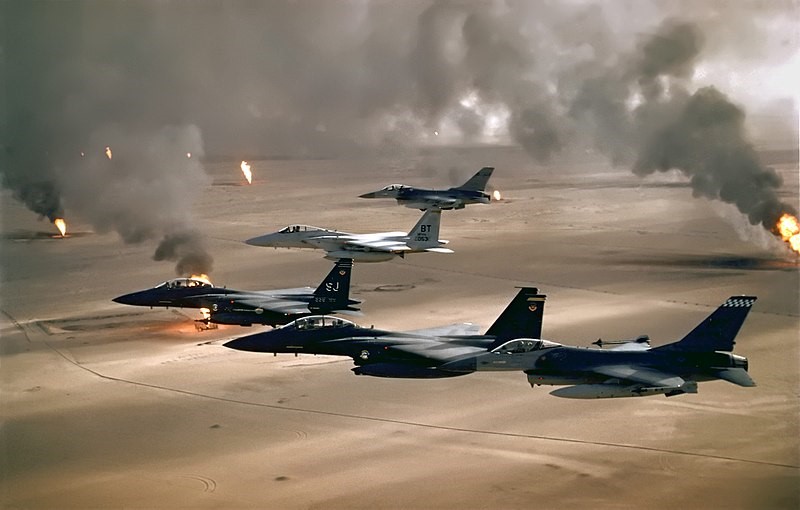
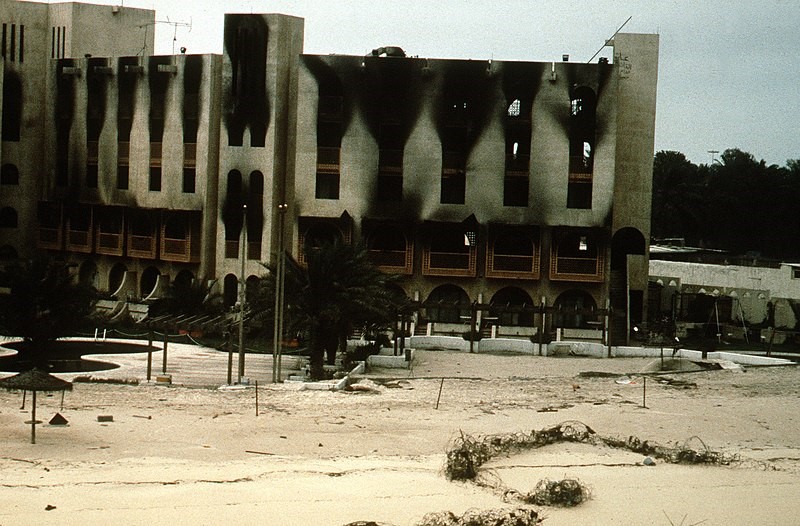
New Review by Michael Gruber: “The Myth of the Clean Air War”
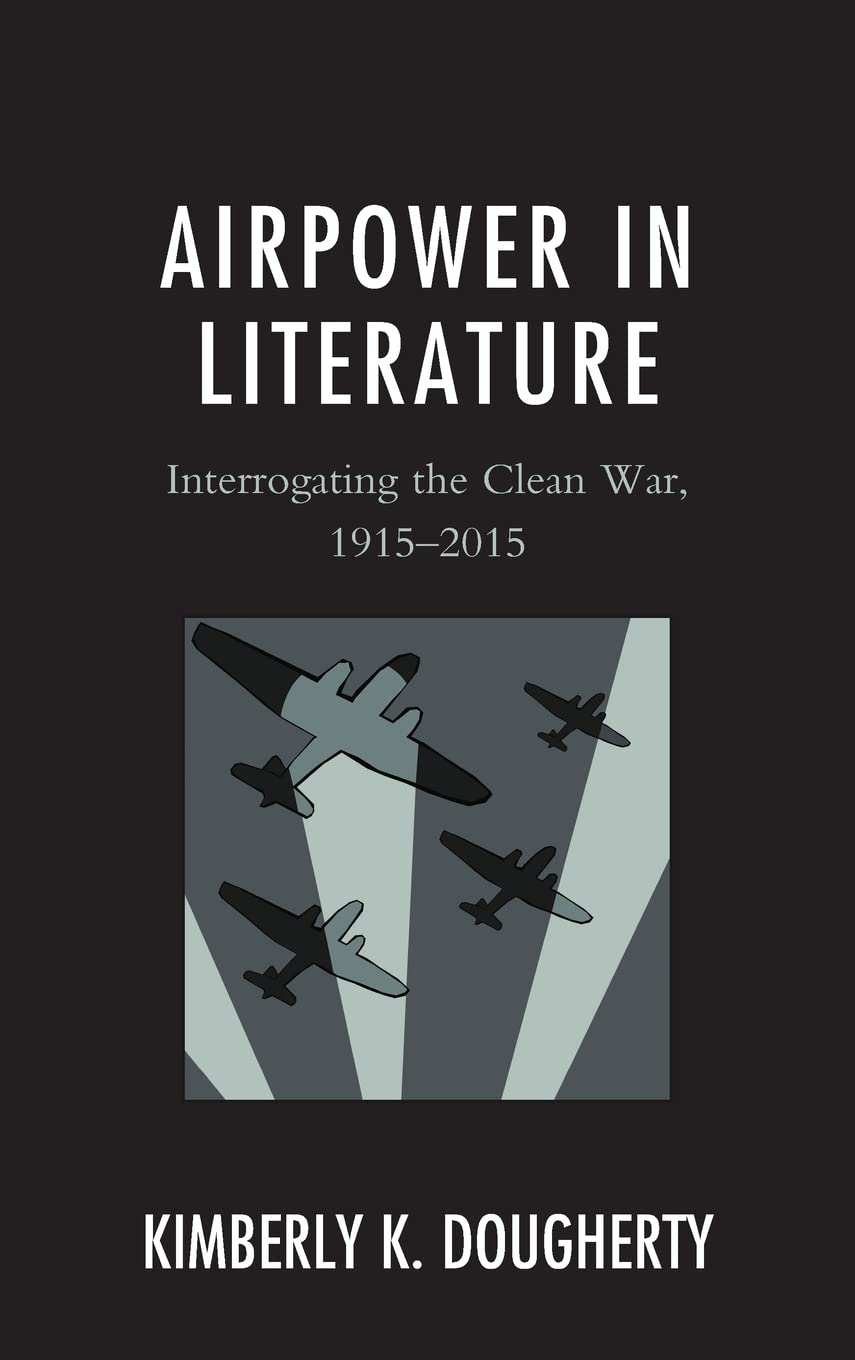
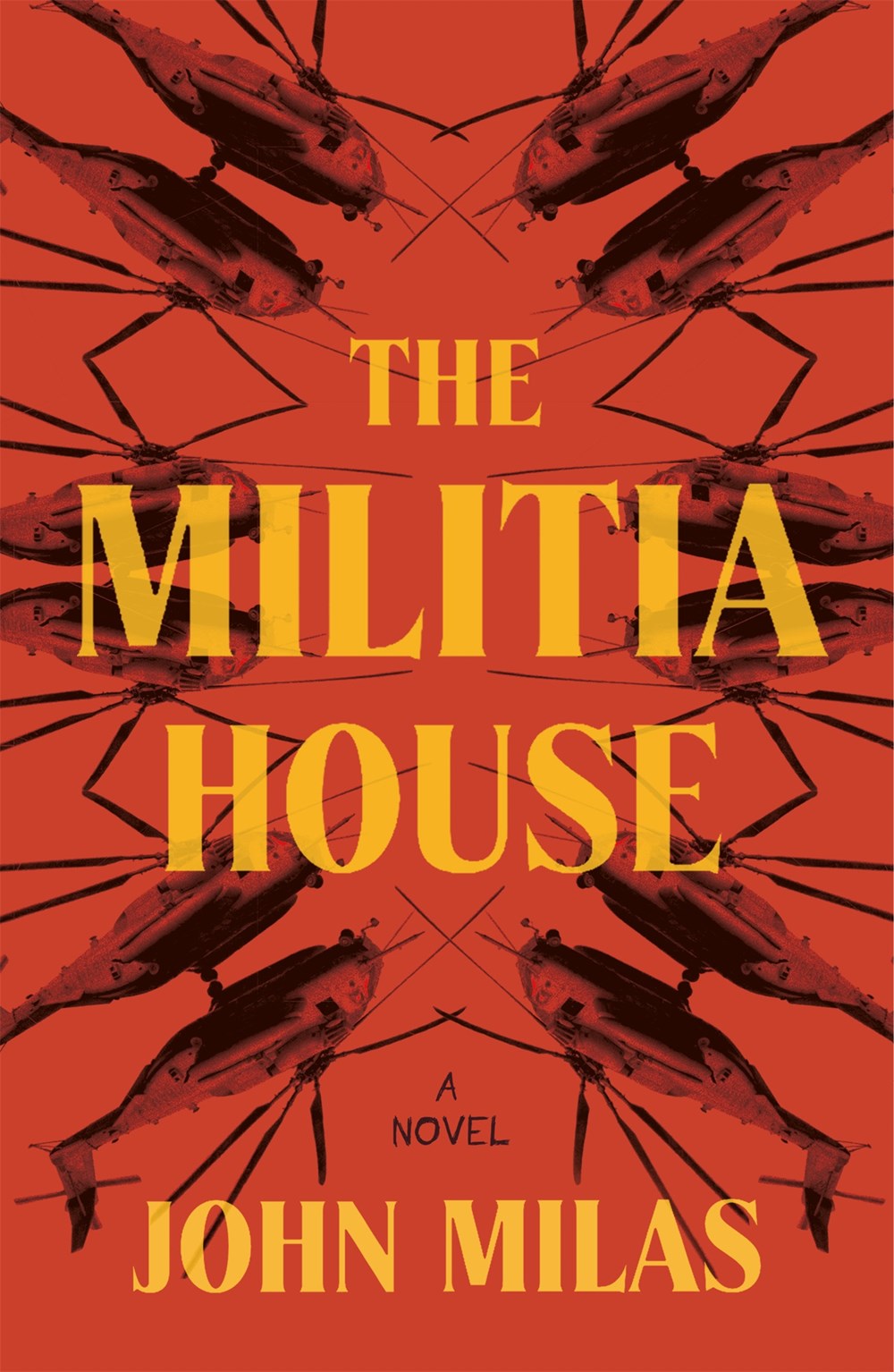
A review of Kimberly K. Dougherty’s Airpower in Literature: Interrogating the Clean War, 1915-2015
One of war’s most pernicious myths is that new technology will not only hasten its outcome but lessen its brutality. Paul Fussell describes this delusion in the first pages of his text Wartime: Understanding and Behavior in the Second World War, where he recounts American propaganda images from the 1940s showing “the newly invented jeep, an elegant, slim-barreled 37mm gun in tow, leaping over a hillock.” Such “agility and delicacy,” Fussell contends, conveyed the impression that “quickness, dexterity, and style, a certain skill in feinting and dodging, would suffice to defeat pure force” (1). Subsequently, as World War II began, “everyone hoped, and many believed, that the war would be fast-moving, mechanized, remote-controlled, and perhaps even rather easy” (1). The muck, grime, and hellish attrition of Guadalcanal, Okinawa, Iwo Jima, the Hurtgen Forest, and Anzio testify to the contrary.
This myth is not merely restricted to land. Although the airplane has been deployed since the Great War, the enduring fable is that technology has advanced to such a degree that new airframes, because of their sophistication and speed and precision, will end wars quickly, cleanly, and with minimal loss. Such conceits show surprising longevity, being as old as the military use of the airplane itself, and have massive implications for aircrews, the bombed, and especially our beliefs about how modern wars are fought. In her text Airpower in Literature: Interrogating the Clean War, 1915-2015, Kimberly K. Dougherty takes these beliefs to task. Her central aim is to contrast these beliefs with various portrayals of the so-called “clean air war” in war literature. In doing so, she puts forward a compelling argument that airpower is an enterprise that is not only slow, messy, and deadly, but has even greater unseen costs, and is spoken about in such ways that the true price of its deployment remains always cloaked in euphemism.
Ironically, Dougherty’s “interrogation” is effective for its precision. She makes many keen observations about these unseen costs, noting that during war, for example, the bodies of air crews are often “hidden” from view by virtue of their manner of death, being incinerated or blown out of the sky, rendering their remains unrecoverable. Sometimes, these same air crews are presented as “becoming one” with their aircraft, such that what flies are not aviators but a kind of Frankenstein’s monster that is half man, half machine. Another insight is that in the numerical tally of an air war’s casualties, it is the number of aircraft shot down that seem to be given primacy over human casualties. She notes the long history of airpower’s description by military planners and strategists as being “above” the earth, in the domain of the sky, giving it a kind of omnipresence, and where it also gains omniscience, as aircraft can purportedly observe battlefields in ways unavailable to the mere mortals constrained to the ground. All these mythologies, says Dougherty, conspire together to present aerial warfare as “clean,” powerful, godlike, and unencumbered by the grotesque violence and terrain of traditional warfare.
Dougherty also makes much of “discursive distancing,” which originally refers to a kind of Foucauldian rhetorical analysis that assesses how subjects are allegedly dissociated from hegemonic social systems through discourse, despite ostensibly being benefactors of those same systems. Basically, her point is that the discourse surrounding the use of airpower contributes to its reckless mismanagement. Key to her exploration are two texts, Michael Herr’s Dispatches and Tim O’Brien’s Going After Cacciato, which both provide “stunning portraits” of helicopters, “the machine perhaps most associated with the Vietnam War” (145). She notes that the helicopter enjoyed special intimacy with the troops they ferried, being close to the ground and slow, and as such “this intimacy, perhaps, makes it all the more important to separate human from machine, as the borderlines becoming increasingly blurred” (145), and as such they merit a special kind of profile about how the rhetoric of airpower contributes to its inevitable misuse.
But it is Douhgerty’s concern over this melding together of man and machine that is, in my opinion, the apex of the book, as it leads her to surmise that the rhetoric surrounding the deployment of airpower lends itself to certain beliefs about technology and its use in war. As Dougherty so capably demonstrates, the infatuation with “clean” airpower is naturally sourced in its innovativeness. The trajectory of this infatuation is an alleged “technological war prosecuted solely by machines, with no threat to one’s own population” (145), where the human cost of war will have been supposedly entirely eliminated. This reflection becomes especially prescient when one considers the ongoing war in Ukraine, or the 2021 war between Armenia and Azerbaijan, where the use of lethal drones have been notably effective. Additionally, so-called “drone swarms,” theoretically composed of thousands of remotely controlled unmanned aerial vehicles, so designed to overwhelm enemy air defenses, have gained currency in the thought of future military planners, both in the West and with our foreign adversaries. While it is not hard to see how Dougherty’s bone-chilling vision will manifest, given recent evidence, it is also not hard to see how her description of “clean” airpower’s trajectory—that is, its culmination into a supposedly bloodless “technological war,” fought primarily with machines—will be anything but another fable in the sprawling compendium of historical fables that have always surrounded how “the next war” will be fought. Propaganda will continue to assert the next war’s supposed “cleanliness,” highlighting how new technological innovations eliminate the need for the pointless suffering of those archaic and barbaric wars of decades past, only for the “on-the-ground” reality to offer different evidence—that is, the evidence of tens of thousands of mangled corpses of 18, 19, and 20 year-old kids.
All being said, a natural rejoinder to this—which I admittedly found myself asking as I read this text—is “so what?” Is Dougherty’s counterargument really that we should not substitute machine for man, given the capability? Or that Dresden or Tokyo should not have been bombed because the Allies unfairly privileged the lives of its own service members over unarmed civilians? Should a future defensive war fought by the United States not privilege its own service members over the unarmed civilians of belligerents, given such a tragic choice? It seems ludicrous to demand that wars only be fought by one side unilaterally leveraging itself into a potential disadvantage. The Second World War in particular was an existential struggle between mutually exclusive and competing visions for the world, the role of the state, societal organization, and how natural resources should be utilized to serve those ends. It’s not hard to see how Dougherty’s musings feel like a luxury good given this environment.
But I suspect such a rejoinder misses the point. Dougherty’s point isn’t to say such things are right or wrong merely—it’s that wars are fought with elaborately constructed mythologies about the use of technology (such as airpower), and that military planners and service-members alike not only believe these mythologies, but sometimes even believe them despite knowing they are myths. The cost of believing in such myths is unimaginable brutality and the loss of life to millions of people, as various truths are obscured or unable to be recognized because of the political nature of the war. The geopolitical environment of the Second World War, for example, not only made realities like the humanity of the enemy impossible to recognize, but exaggerated their costs and contributed to immense suffering both among the bombed and the bombers. Such calamity is worth recognizing.
On the more pedantic side, I sometimes found Dougherty’s emphases and language distracting, if anything because she too strongly relies on the kind of intersectional analysis and related academic jargon that dominates contemporary humanities publications. In one section, she also provides a summary of the causes contributing to the Spanish Civil War that are laughably uncritical and overly generous to the Republicans and the Popular Front, which made me suspicious of her framing of other historical events. But these are rather nitpicky when her broader contributions are taken into consideration. Dougherty has ultimately produced a razor-sharp text that attacks the fictions we all too easily attach to the role of technology in warfare. In uncovering beliefs about airpower’s “cleanliness,” she has produced something worth celebrating.
Peter Molin’s “Strike Through the Mask!”: Memory and Memoir in Afghanistan
The opening of this month’s column repeats much of a Time Now: The Wars in Iraq and Afghanistan in Art, Film, and Literature post I wrote in 2018. The rest updates and expands upon that post by reflecting on two recent Afghanistan memoirs by veterans who served in the same area of Afghanistan as I did in 2008-2009. Reader, read on!
***
My tour in Afghanistan as an advisor to the Afghan National Army was not over when I returned to the States in November 2009. Many things have happened since that have extended its reach deep into my post-deployment life. The list includes:
-the infiltration bombing of Camp Chapman in Khost Province in December 2009, a FOB I often visited before leaving Khost in July 2009.
-the awarding of the Medal of Honor to a fellow US Army advisor I knew from our train-up together at Fort Riley.
-a long article in a major weekly profiling the commander of the advisor unit two or it that referenced many people and places I knew well.
-the WikiLeaks release of classified combat reports, several of which recounted by the advisor team I led.
-a visit from Army Criminal Investigation Command (CID) telling me that they had detained a Russian-born jihadist who had attacked us in Khost in June 2009, killing one of the members of my team, who was the gunner in a truck in which I was a passenger. (The last I time I checked, the jihadist was still in jail in America.)
-a visit from another CID agent doing a background check on one of my linguists who was now translating for an American one-star general—this after emigrating to the United States, serving a tour in our Army, earning an Associate’s degree, and gaining his citizenship.
-a visit from two lawyers on Bowe Bergdahl’s defense team, because my name figures in the Army investigation report of the severe wounding of one of the soldiers involved in the search for Bergdahl.
-a profile in a major media venue of an Afghan National Army officer whom I knew in Khost who has since emigrated to the United States.
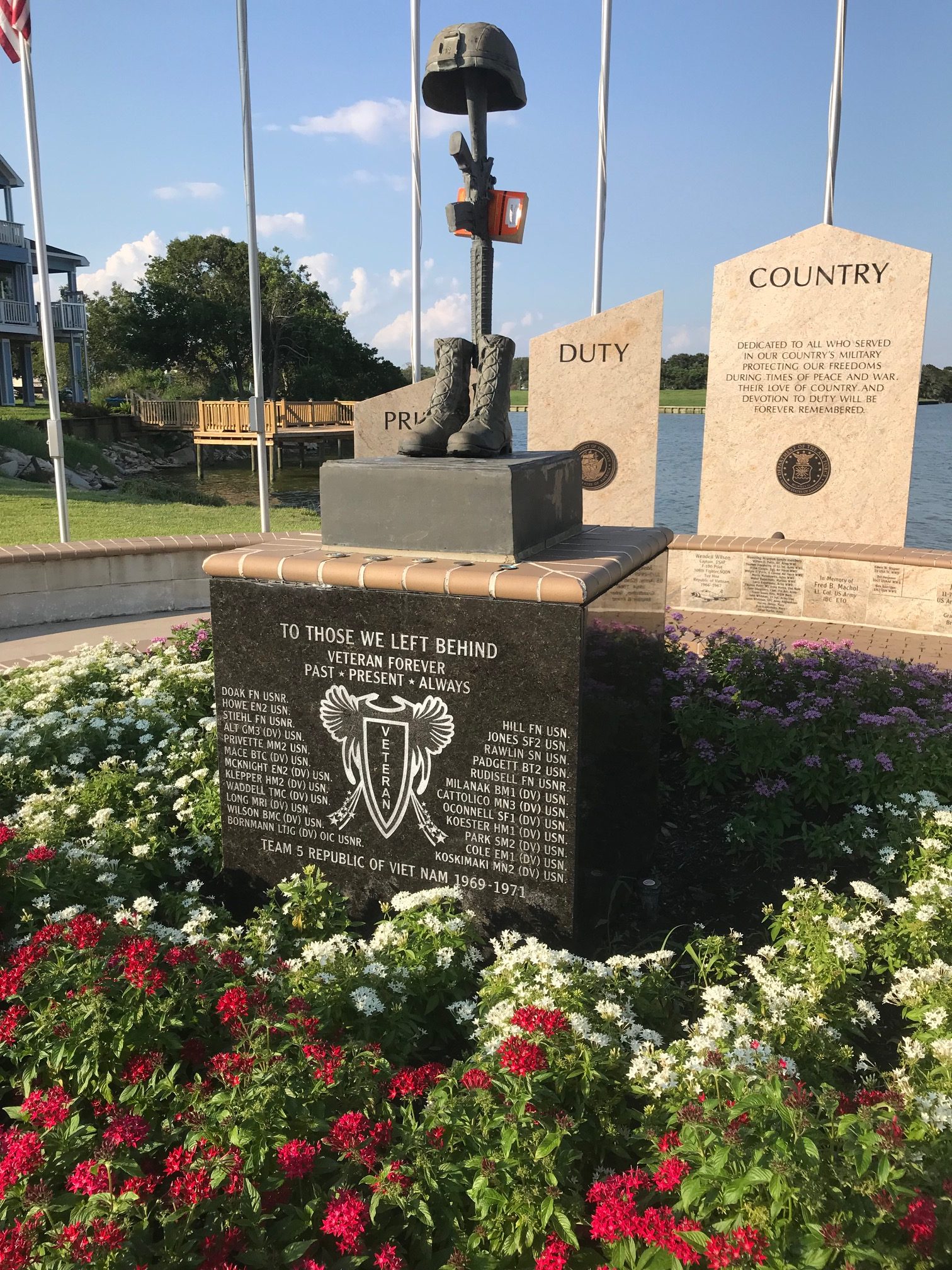
-the chance to offer comments at the dedication of the Chicopee, Massachusetts, War on Terror Monument, a chance that arose because one of the six men honored by name on the Monument had been a member of my advisor team.
-efforts in August 2021 to secure the evacuation from Afghanistan of Afghans with whom I had served, efforts that largely failed but which continue today.
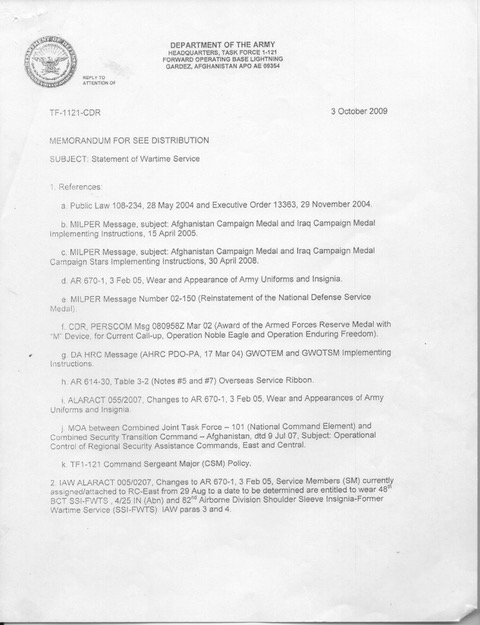
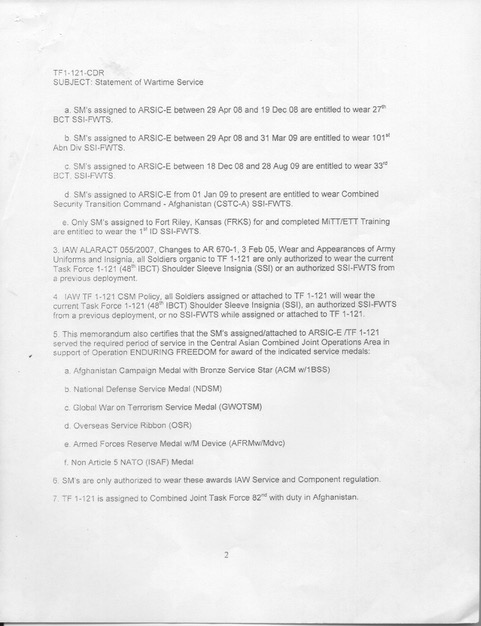
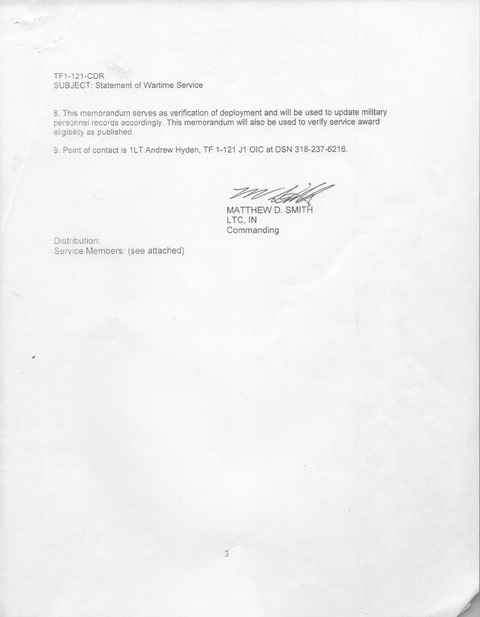
According to this Statement of Wartime Service, I could wear any one of eight different patches on the right sleeve of my uniform to signify the unit I belonged to while in Afghanistan. Just knowing your chain-of-command, let alone supporting them, was difficult.
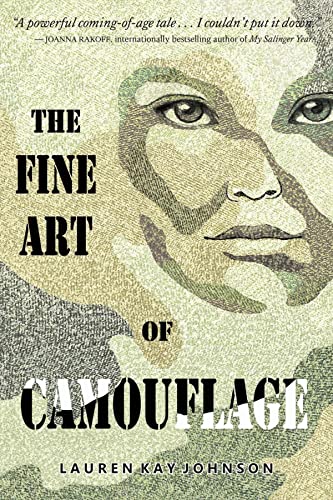
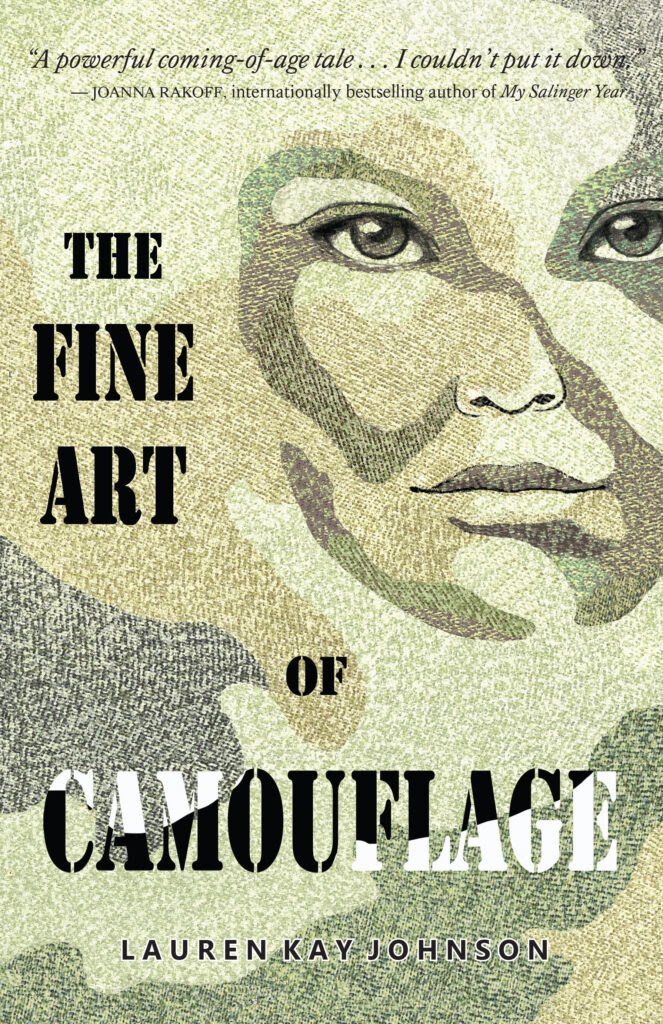
Now, within the last two years, I’ve become aware of memoirs written by two veterans of Operation Enduring Freedom in the Paktika-Paktia-Khost (“2PK” in military-speak) region at the same time I was there. One is by an Army sergeant who was a member of my Embedded Transition Team (ETT) in Khost province: Sergeant Major (retired) Chad Rickard’s Mayhem 337: Memoir of a Combat Advisor in Afghanistan. The other is by an Air Force lieutenant who served on the Provincial Reconstruction Team (PRT) in Paktia province where I served out the last five months of my tour on a nearby FOB: Lauren Kay Johnson’s The Fine Art of Camouflage. Together, Rickard and Johnson superbly describe the two spheres of activity that concerned me most: fighting the Taliban and supporting Afghan governance.
I offered glimpses of my day-to-day activities in Afghanistan in my first blog 15-Month Adventure: Advisor Service in Eastern Afghanistan. But those blog posts were written in the heat-of-the-moment and suffer from lack of detail and insight on the events I experienced. Further, I seem to lack the instinct—or the courage—for memoir, and I’ve never since tried to deepen and thicken the narrative of my own deployment or link the many separate episodes into a cohesive whole. Both Mayhem 337 and The Fine Art of Camouflage do that for their authors in ways that bring my own memories rushing back and help me understand them better. Rickard and Johnson recount many events of which I was aware and sometimes those in which I also participated. Each does a great job establishing the overall ambiance of the mission and the physical characteristics of the operating environment. Both authors write perceptively about the factors that made success in Afghanistan difficult (and ultimately doomed it), while conveying a welcome lack of self-righteousness and self-aggrandizement in the face of the challenges we encountered.
Sergeant First Class Rickard (as I knew him then) impressed me from the minute we met in my first week as advisor team chief on Camp Clark in Khost in 2008. A rawboned former college football player who was now a member of the California National Guard, Rickard exuded competence and a quiet can-do spirit. He was an infantry veteran of two tours in Iraq, and my team lacked both infantry grit and combat experience. We were all willing, but I knew the coming months would be tense. Rickard immediately volunteered for our toughest mission—serving on a much smaller very remote combat outpost on the Afghanistan-Pakistan border—and as the next few months transpired, I learned to ensure he was in the thick of whatever fighting was to be had throughout our sector. It was an unfair burden for Rickard to shoulder, but my thought was that our operations stood little chance of success without his presence. And as Mayhem 337 recounts, Rickard eagerly embraced these challenges, with little thought at the time of the consequences on him and his family in the years afterwards, which Mayhem 337 also documents.
Speaking frankly, and perhaps enviously, Rickard had the kind of tour most infantryman could only dream of. Duty on Spera Combat Outpost brought near-daily engagement with the Taliban enemy, and Rickard’s account of working alongside Brigade Combat Team soldiers, Special Forces units, and most of all the Afghan National Army are both riveting and highly instructional for any infantryman who might face similar circumstances in the future. Many episodes stand out, but for me most illuminating were accounts of in-battle coordination with Air Force jet pilots and Army attack helicopters, along with Army artillery, to bring American firepower to bear upon wily and determined foes. While in Khost, I often sat by the radio tracking Spera COP battles, feeling mostly helpless and anxious—reports of small Army outposts being overrun elsewhere in Afghanistan were never far from my mind. As I monitored radio reports, I was aware of how crucial air and artillery support were for saving Rickard and his men from death, but Mayhem 337 reinforces the point that for those in action their lives depended on allies in the sky. But don’t take my word for it, here’s Rickard’s account from his Acknowledgement:
I want to personally thank each and every pilot and aircrew member who flew in support of combat operations I was involved in throughout my time in Afghanistan. I would not be here today if were not for the daring courage of the pilots who supported our ground combat operations.
And here’s an excerpt illustrating that support in action:
Soon after the departure of the Kiowa’s, two F-15 fighter jets reached our location. The pilots conducted their fighter check-in as soon as they arrived. They let us know their call signs, what planes they flew and what weapons they had available. They also told us how long they could stay and help. This team flew a pair of F-15s; their call-signs were Dude 1-1 and 2-1. Dude 2-1 was actually a female fighter pilot, not a “dude” per se; she operated as the flight lead that night… We confirmed that all US and Afghan forces were within the [infrared] glowing perimeters on the mountaintops. After confirmation we said “Roger Dude 2-1, you are cleared to engage.” And engage she did. She dropped a 500 pound [Guided Bomb Unit] and scored a direct hit on that group of enemy fighters….
Lieutenant Lauren Johnson was Air Force, too, though by her own account anything but a hot-shot fighter pilot. Rather, she served as the “information operations” staff officer on a Provincial Reconstruction Team in Paktia province. I make small cameos in Mayhem 337 (Sergeant Rickard thankfully goes easy on me), and though I’m not in The Fine Art of Camouflage, I may well have been in the same meetings as Johnson at many points. Provincial Reconstruction Teams were composed of military and civilian specialists charged with governance and infrastructure projects meant to enhance the “legitimate government of Afghanistan.” During my last few months in Afghanistan, I was one FOB over from Johnson and largely involved in much the same business. Specifically, our time in 2PK was marked by the run-up to the 2009 Presidential election. We all worked hard and worried endlessly about ensuring the elections were safe and fair, even as we strove to let Afghans “take the lead” as a measure of our faith in their capability and independence. That didn’t happen, unfortunately, and the disappointments and vexations associated with the endeavor foreshadowed the complete collapse of western-style Afghan governance in 2021. They also proved personally devastating to Johnson. The projects she was in charge of came to naught, and several experiences destroyed her idealistic attitude toward the overall mission and general faith in the competence and integrity of the military.
Among its other virtues, The Fine Art of Camouflage nails descriptions of the FOB, FOB daily life, and the stultifying and claustrophobic nature of staff work within Army headquarters. Johnson ventured off the FOB occasionally, sometimes for good, sometimes for worse, but the majority of her tour was spent in front of a computer generating the same reports she had filed the day before and in meetings with the same people she sat in meetings with every other day of the week. That business was my business, too, to a large extent. As a middle-aged middling rank officer, I did it all as well as I could and understood, kind of, its necessity. For an idealistic junior officer eager to lead troops and make things happen, such existence was spirit-killing. Though I was more senior to Johnson by far, I identified at many points with her recounting of staff-work trials-and-tribulations, and in particular the disconnected experience of trying to serve a Brigade Command Team whose commander—whom I also served—barely knew of her existence. A key episode in The Fine Art of Camouflage describes how a project of Johnson’s on which she worked for weeks goes to shit, and how on the nightly radio staff meeting, the Brigade Commander professes to not even knowing about it. For Johnson, being chewed out would have been better than the bemused nonchalance with which the colonel dismisses not just the project’s failure, but its worth and all her hard work:
The commander admonished the room to do a better job supporting the others and coordinating on missions, and then dismissed me with a brusque, “Lesson learned. These things happen.”
To my mid-ranks career-officer self, I kind of get where the colonel is coming from—he’s trying to be nice and not publicly crush a very junior office—but I also understand how condescending and demoralizing the experience must have felt for Johnson. Johnson also has a larger point to make, about how dysfunctional and uncoordinated was almost everything the military tried to accomplish in Afghanistan:
…how had the brigade commander been so unaware? The directive had come from brigade in the first place, and the plans had been in my report for a month, all the BUBS and CUBS and SITREPS and daily/bi-daily/weekly updates. As an official brigade tasking, the training had been monitored on …[the] PRT operations tracker too. I’d worked with the Department of State representative and with Army contacts at each of Paktia’s five combat outposts to finalize the attended list. I’d coordinated with pay agents, air transport, security, intelligence, convoy operations, and the mission commanders…. the crossed lines of communication were worse than the tangle of network wires winding through my office….
As the leader of a small element operating in support of the same large brigade, I also often felt marginalized and only intermittently supported. My remote perch led me to observe the internal machinations of the brigade with wry detachment that sometimes flared into frustrated outrage. My own dealings with the brigade commander were also characterized by paternalistic indifference on his part (though in all fairness, an episode toward the end of my tour in Khost rendered a more favorable impression). Along with Johnson, for me it was and is impossible not to think that our own travails mirrored in miniature the uncoordinated and un-sustained American effort throughout and over-time in Afghanistan.
There is much more to be said about each book and both books in tandem. While in some ways the two memoirs are juxtaposed—one a combat narrative by an infantry sergeant, one a story of nation-building staff-work by an Air Force officer with an eye on how tours in Afghanistan were experienced by women—there is also much that connects them. Each book, for example, situates the author’s story in the context of their personal and family histories before and after deployment; both works suggest that one reason it takes so long for memoirs to gestate is that their authors need time to measure the reverberations of their actions across the range of their closest social relationships. Also, I appreciate the authors’ even-handed depictions of the Afghans with whom they partnered. Neither Rickard nor Johnson had idealistic expectations nor perfect experiences, but neither were they reduced to sputtering contempt by their Afghan partners’ lack of military discipline, their potentially suspect loyalty, or their personal habits grounded in off-putting cultural and religious convictions. Finally, I’ve only touched on how emotionally debilitating their tours were for both Rickard and Johnson in their own long years after deployment.
There is also much more to be said about the overlaps between my own experiences and Rickard and Johnson’s descriptions of places, people, and events and my own. For readers interested in my own experience of combat, the 15-Month Adventure post titled “Gun Run” describes a mission in which I too relied on life-saving air support. I describe the staff-work misery I experienced and observed in a Wrath-Bearing Tree story titled “The Brigade Storyboard Artist.” Reflecting on the genre of memoir, I’ve always been hesitant to criticize the “self-writing” of fellow men-and-women in uniform. Every story is important, and who am I to judge?
Here though, I’ll say that though I’m sorry that the authors had to live through the hells they experienced, I’m glad Rickard and Johnson have written the books they have. They will long sit on my bookshelf as narratives that describe in familiar terms an intense period in my own life. Especially since I know (somewhat) both authors, I am happy that they have written such good books and that by their report writing them has helped them make sense of their own time in Afghanistan. Further, the appearance of the two memoirs makes me wonder how two such fine writers came to serve within my ken during my own deployment. It was obviously coincidence, but it seems like fate. The appearance of their memoirs now reminds me that my year in Afghanistan will never really be completely behind me.
Chad Rickard, Mayhem 337: Memoir of a Combat Advisor in Afghanistan. 2019.
Lauren Kay Johnson, The Fine Art of Camouflage. MilSpeak Foundation, 2023.
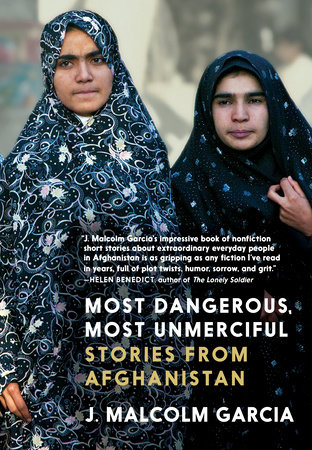
New Nonfiction from Michael Gruber: Review of J. Malcolm Garcia’s “Most Dangerous, Most Unmerciful: Stories from Afghanistan”
Humanity in Afghanistan
For the average American G.I. who served in Afghanistan, the country was of a different world. Most understood Afghans had relatively little in common with us, its would-be Western custodians. For starters, its population spoke obscure Indo-Iranian languages like Pashto and Dari, which had no share with our West Germanic-based English. It was universally Muslim, which while monotheist, had a variety of practices we found puzzling, or even less charitably, threatening, at least when viewed through the vaguely jingoistic shadow of 9/11. The day-to-day life of Afghans seemed to revolve around the dull monotony of subsistence agriculture, and moved at an unhurried, slow, perhaps even complacent, pace. Their households were multi-generational, with sometimes four or even five generations living under the “roof” of the same qalat. Whether in the bazaar or the fields, Afghans seemed to us frozen in amber, living a way of life that we ascribed to ancient times. Our assessment was that they were illiterate, poor, simple, and locked behind barriers of social custom and theology we could never hope to penetrate.
Much of this analysis is clearly retrograde and patronizing, but it was far more motivated by youthful hubris and ignorance than some sort of loitering colonial mindset. The average American G.I. in Afghanistan was not college educated. The extent of our education on Afghanistan had been delivered in a vulgar milieu of VH1, Comedy Central, cable news, and only the most remotely accurate Hollywood renditions. Most of us didn’t even own passports. In fact, for many American service members, their deployment was their first time abroad. One’s ability to empathize, or to even understand the Afghan way of life, was also limited by the task at-hand, which much of the time was unambiguously dangerous. Life experience and cross-cultural barriers only accentuated this divide. To put it bluntly, as has been true for the membership of all armies throughout history, we were really just kids, and therefore had an appropriately teenage level of understanding. It is hard to assign an “imperialist” mindset to what Robert Kotlowitz terms “adolescent fervor.”
Much of what we learned of Afghanistan has therefore come since our deployments, as a way to help make sense of what we observed. J. Malcolm Garcia’s Most Dangerous, Most Unmerciful is one such continuation of this project, describing the innards of a world many of us only observed from a distance, despite being immersed in it. Garcia is a freelance journalist who appears to have a niche for war-torn or impoverished regions: his website reports he has also worked in Chad, Sierra Leone, and Haiti. The text in question is a collection of short stories that Garcia has compiled from his time in Afghanistan, all of them non-fiction.
As a writer, Garcia seems to be something of a Studs Terkel disciple, and the text is relentless in its centering of Afghans and capturing the raison d’être of social history: “history from below,” as it’s termed. In fact, we learn relatively little of Garcia himself, except for a tender chapter where he adopts and ships home an orphaned cat he names “Whistle.” At least, I interpret this to be Garcia, although it may not be, as he refers to the anonymous protagonist only as “the reporter,” and I can’t tell if this is Garcia’s effort at rhetorical humility or his description of a third party. Elsewhere, the text is mostly page after page of Afghans in their own voice, articulating their own feelings, history, and sentiment.
It seems notable that I cannot recall a similar literary project—one which centers the experience of the average civilian Afghan or Iraqi—sourced from any of our recent foreign entanglements. It is loosely represented in other journalistic media, like occasional pieces one may have encountered in The New York Times or The Atlantic, but these are news reports, not short stories collected into a single volume. Likewise, Khaled Hosseini’s The Kite Runner is historical fiction, not documentary non-fiction. Garcia’s project seems unique in this regard. To be sure, Most Dangerous, Most Unmerciful’s genre—which I classify as oral war history—was pioneered some 40 years ago in Terkel’s The Good War. But texts like these, especially when written by Americans, have primarily relayed the perspective of war veterans, not civilians in warzones. This underrepresentation of the noncombatant civilian is a tremendous disservice, especially considering the horrific suffering they often endured. That Garcia’s text makes this glaringly obvious is perhaps its most important contribution.
The stories shared by Garcia are wide-ranging. “Mother’s House,” the longest and most compelling in the book, tells of a recovery center in Kabul for narcotics addicts, likely the first of its kind, ran by a woman appropriately nicknamed “Mother.” “Feral Children” gives voice to the destitute children of Kabul, who are subject to collecting cans or polishing shoes. Garcia makes observations of Afghan society throughout these stories, noting, for example, the marked contrast these youths have with their Westernized counterparts, whose libertine style of dress and flamboyant mannerisms are nearly indistinguishable from an American teenager in, say, Atlanta or Houston. And while Garcia seems to gravitate around Kabul, commentary like this—and his occasional bravery in venturing out to rural areas, such as when he is confronted by what appear to be Taliban supporters while at “a graveyard for Arab fighters” in “In Those Days”—speaks to the unfathomable chasm that existed in Afghanistan between Kabul, where the decided minority of families who benefitted from NATO occupation usually resided, and the destitute rural poor, who did not share in those benefits. Garcia attempts to give voice to both, showcasing the country’s complexity and tremendous contradictions—ethnic, moral, economic, social, and otherwise—and how they defined both its people and the war writ-large.
In tandem with the text’s keen insights is the steady drumbeat of this book, which is poverty and relentless suffering. To be sure, the stories are varied and unique, but my sense is they begin to blend. They are stories of human suffering which manifest into clambering, scrabbling, and scavenging; people using what meager resources they have just to survive, whether from the war, disease, or hunger. But the themes become so common and consistent that I felt myself having the reaction ones does when they are exposed to homelessness or panhandling in a major city—“I’m not numb to your suffering, but this appears so ubiquitous that I don’t know how to help you address it, or if I even should, or if I even can.” I felt a sort of self-protective compassion fatigue while reading this text, or worse, that I had become a sadistic voyeur engaging in slum tourism. Perhaps this is Garcia’s intention, or perhaps it speaks to sneaking deficits in my own character as I continue to process my—and our—involvement in that country and our two-decade-long war. Regardless, Garcia has produced here a fine addition to this continued exploration, and gives us an exposure to the humanity of Afghans that we would do well to absorb.
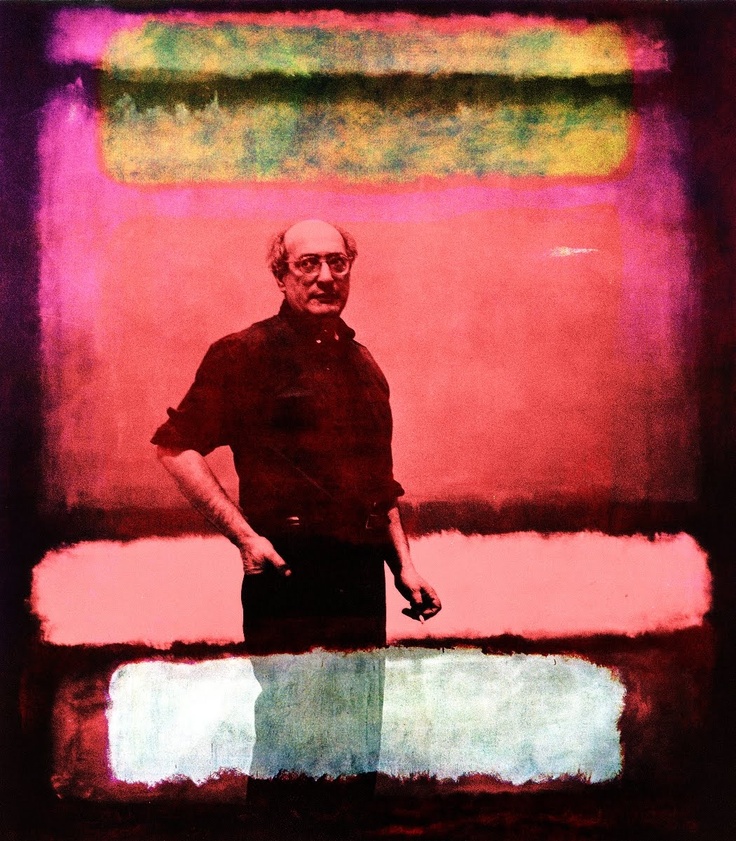
New Fiction from Chris Daly: “The Rothko Report”
“My father’s work takes you to the edge of the abyss and invites you to look.” -Son of Rothko
Dateline South Florida, October, 1962: It was Monday 2:00pm EST when Sister Linus began to slap the living shit out of Louie V. The original offense was, along with Richard L., “jumping like a puppet into line behind the ring-leader”, that would be one Brian B. Except to exist, Brian had done nothing in the new school year. Richard was unpretentious, almost unconscious at times, naturally refined, and not a person even the most obtuse teacher would strike. But Louie was scrawny-strong, head rising on his neck like a bird about to eat something amazingly large; him one could smack, especially when he would not stop laughing. Stop it. Stop it. Stop it. Stop it. Today this would be so viral. The nuns were not always wrong; Louie later went to prison, Richard became a junkie, Brian escaped to the West Coast and a long underground life as a political satirist. The three members of the puppet gang were given notes directing their parents to a meeting on Wednesday.
Up the coast in D.C. on that same date a bit after 8:00pm EST Secretary All Hail MacGeorge was shown U2 photos of possible missile launch sites on the cold war enemy-client island “ninety miles away”, and at midnight he informed Secretary Mac the K, and they decided to let J Fucking K sleep, because he might be needing same.
Parental or legal guardian conference would not be a big deal, another adolescent pain in the ass. Tuesday after school they were down at the back-to-back paddleball court off Dixie Highway, south end of town, in time for the surprise appearance over by the concrete wall of Louie’s father. Not exactly homeless, he lived by the good grace of an east coast Italian American network that did not include the nearby well-kept house of Louie’s aunt; from which he was likely on stay-away remittance agreement that he was likely in violation of by showing up in the park. Worse for the gang: in his hand were their packs of cigs taken from their designated concrete cubby-holes, and he was doing a thing all kids hate; keeping them in the dark. Fairly soon they understood that Louie’s father would be giving back the herbs, but of course he proceeded to fuck with them. Too bad they couldn’t bring him to the schoolhouse meeting, but here’s the way that worked: Louie’s aunt ran a prosperous mid-size I/A grocery store, and Richard’s father was a necktie manager with a wife who kept plastic covers on the living room furniture. From both of those families to the church the money flowed, actual appearance not required; for the Brian family, reverse that.
In the western-style democratic nation-state capital that morning J F-ing K had been informed of the photos, and later at the meeting with the Macs, the Brother (RFK), the “Birds” and others, options were discussed. Do nothing, as the threat of thermo-n annihilation was already completely and firmly in place, and new spots on the island, though psychologically and politically spooky, were window dressing. Another option: apply boiler-plate diplomatic pressure. Or: back-door a choice to the Bearded Man of Island Truth: split with your angel or we bring T fucking R back to life for San Juan Hill II. Maybe we can without further adieu just do that. Or at least an air-strike on the sites. (This last plea from General LeMay-I, hawk of hawks, always ready to bomb the East Wing and ask questions later – in fact all the joint big birds were doing that thing with their wings.) Finally, there was the Harvard Yard son of a whiskey runner way: set up a blockade, call it a quarantine. Peaceful co-existence as we know it on hold.
The female parent of Brian got home from her Nurse’s Aid night shift Wednesday morning and they went to school. (Da was out pushing a hack.) Brian was fairly quiet, appropriate for a celebrity in reverse, owing to a somewhat screwball-ish exit from parochial school into the public system, out of that into juvie home, then back into the arms of holy mother, all in one family-on-the-skids year; after that a year off for all concerned, and now a lecture was being delivered hard upon the kid’s denial, he was about to turn thirteen, how much is he supposed to be able to explain, but they all knew that something was up and so they treated him like Al Capone. Brian later in life learned that both parents had folded in a fair amount of boozing to make it through more or less undetected. Of the three friends, his was the only in-person meeting.
The flyboys were getting better and ID’d another site on the island that same day. The transgressor-sponsor nation was like the Brian family, with barely three hundred “Little Boys”, while the Big Dog had three thousand that they were admitting to, so it was the player with the smaller arsenal who had to issue forth the official denial that any missile sites existed on the proxy island. In J Big Dog K’s top desk drawer was a recon photo of something in a clump of palm trees.
At age twelve members of the criminal syndicate weren’t ready for the girls they had begun to notice, except for Richard. He was not loud or dangerous or great looking or especially witty, though like his friends he faked some version of all those things. He’d learned to carry himself in a way that was beyond his age, and had a natural sweet spot for girls that they responded to, including Susan S., queen of the grade level, who had a good personality and was developing nicely. Richard, Susan and Brian hung out briefly, significantly, Thursday after school till Susan was picked up, and Richard and Brian headed home in the other direction. Louie was not present because the aunt clan had him on close watch working at the store while gypsy dad was around. Richard and Brian decided that on Saturday morning they had to get the hell out of town.
DOOMSDAY UPDATE: OPERATION DOMINIC, JOHNSTON ISLAND, CENTRAL PACIFIC, WAS THE SITE EARLIER IN THE DAY OF AIRDROP TEST CHAMA, (PHOTO OF WHICH IS A ROTHKO); RESULTS WERE “THOROUGHLY SUCCESSFUL” WHILE THE YIELD WAS REPORTED TO BE BELOW THE PREDICTED VALUE.
The friends did a version of the Three Musketeers sword thing on the playground on Friday afternoon and headed off separately, Louie to the well-stocked Italian American store which had great food that was beyond the Brian family budget. Richard was picked up by his creepy stuck-up mother in their creepy Buick. Richard had learned to communicate succinctly, with a word or slight turn of head. Brian hit the sidewalk feeling that the week had been a seasonal hump and getting over it was an accomplishment. The school, Little Flower, on U.S 1, was too damn small, it got inside you. In the compact perfectly square back half of a duplex mini-compound of the Brian clan he had a place by the bedroom window, fan blowing in his face, to read every forgettable book in the Little Weed mini-library. Maybe he loved Friday more than the weekend it promised. On this particular one he looked out through the fading light and had a thought: I’m having a thought.
Up the road the photo-op boys were getting their meeting legs. Affairs of mutually assured destruction are best settled in the heat of the moment, within a few days the first best option was declared to be the thirty-knot ocean-going blockade, though if the other guy was rushed to get in and complete set-up operations, one might later have to deal with hot targets, thank you, Brother LeMay-I.
Richard’s already gone brothers were twelve and fifteen years older, one of the curiosities of that mausoleum house was an untouchable double stack of Playboys on a corner hallway table, which entitled Richard to be unassuming. Brian was more familiar with the world of sidewalks than need be admitted. They were Saturday kids trying to not look like kids on tour down around 1st Street in Miami before 9:30 am, having bused from Young Circle in Hollywood; they hit a few elevators, people were starting to look at them, self-appointed cop-types, they escaped across the street to Bayfront Park, where a certain amount of laughter ensued, the natives, the Cubans, the queers, everyone was funny; across the water was Arthur Godfrey Beach on the spit of land known as the Gold Coast. At certain ages one can complete an adventure by 1:30 in the afternoon. They trudged back to their respective homesteads. Richard’s house of sophisticated moral relativism had powerful A/C. At his de facto duplex Brian laid down on the terrazzo floor next to his bed where it was cooler. Richard was probably on the phone with Susan S.
DOOMSDAY RECORD CONTINUED In the world of insanely significant meetings beware of what may follow a day when “nothing happens” except the discovery of other sites. Earlier on this particular date ninety vertical miles from a particular faraway atoll there was A SECOND SUCCESSFUL OPERATION FISHBOWL EVENT, ESSENTIALLY ABOVE THE ATMOSPHERE, SO NO LUMINOUS FIREBALL WAS FORMED; AT THE MOMENT OF DETONATION OBSERVERS IMAGINED A GREEN AND BLUE CIRCULAR REGION SURROUNDED BY A BLOOD RED RING GONE IN LESS THAN A MINUTE, AND BLUE-GREEN STREAMERS AND PINK STRIATIONS THAT LASTED HALF AN HOUR. Who knew about THE DEVELOPMENTAL EXPERIMENT, SAME DAY, IN THE IMMEDIATE ATMOSPHERE OF DISTANT SEMIPALATINSK, ABOVE THE FAR STEPPE IN NORTHEAST KAZAKHSTAN?
Sunday was traditionally the most dangerous day in Brian’s life, and more than twice he had been hauled in on the afternoon of the day of too much rest for normal types, and too much exposure for the new generation of under-financed freaks. After casing the church parking lot for cigs, he spent some time over in a half demolished, half interrupted construction area of a certain block where it felt “bombed out” and was interesting to be in. Get out of there, yelled a passing parishioner; Brian interpreted this as a warning from the small gods he’d learned to respect.
On that holy day up on the porch the Big Dog determined to continue the discussion of the future of the existence of the human race on the high seas where at least there was literary precedence for wit and wile.
Louie was installed Monday at the front of the line, the rightful place of Brian who was in the middle, and Richard was at the very end; in a barely covert manner they were all laughing because being famous is funny. Louie had a certain extra-nutty look in his over the shoulder eye and on the playground later with the dynamic diction that would later win third place (crowd favorite) in the speech contest, confessed immortal inspiration for a caper; his neighbor across the street was gone for two weeks and Louie had a key to water the plants and turn on the hose in the yard; in this domain was much cool shit, and likely in an old world hiding spot, cash; on Thursday night the whole street would be gone to a big Knights of Columbus event, and yes he would be the obvious suspect, which was the perfect alibi! Louie had missed out on the weekend adventure, and anyway they had a rep to live up to.
On this date in the evening J Fucking K made a Big Dog dinner time TV speech revealing that their boats were steaming this way and our boats would be cutting them off because evil hardware will not be tolerated so near the Gold Coast even if it meant putting everything on the line. The TV store crowd chewed on that and it tasted like an opinion the populations of all nations are used to concealing.
Same date doomsday check-in: AT 6:10 IN THE PARTICULAR TIME ZONE, TOP OF A VERTICAL ARCHIPELAGO JUST NORTH OF MOST OF THE MODERATE PART OF THE SOVIET, ABOVE CAPE DRY NOSE, ON AN ISLAND OF RED AND BLACK SHALE WITH STEEP CLIFFS FAMOUS AMONG LOONS, A THERMO-NUCLEAR POP QUIZ.
On Tuesday after school Louie had a fight with Patrick K, a stocky individual normally of no interest to the three immortals. At first it was even but at a certain point Louie’s strikes ceased to have effect so he picked up a piece of thin piping and delivered a whack across the shoulders and back, mainly an indication of true craziness. But Patrick was stocky of mind and body and barely blinked, and after that things wound down, and they even shook hands, not that any invitations to join any elite groups would be forthcoming.
Cargo was in the water and the whole world was chattering. N fucking K the Red Dog sent an unpleasant telegram. The secretaries and the Bootleg Heir continued discussion of the options as the cabinet-level brother played pocket-pool and LeMay-I danced up the wall and along the ceiling. There were further reconnaissance revelations and “states” lined up. Adlai the Intellectual Dog (and bald icon of loss at Brian’s) was working the U.N.
Louie didn’t make it to school on Wednesday and Sister Slappy made the mistake of advising stone-faced Richard and Brian to distance themselves from their friend with the crazy disposition. You’ll never learn, she said, and that’s when she predicted they would all wind up in the big house, which so nearly came true. Later Brian would not remember any practice ducking under the desk that week. Did the parochial world not get the memo from a fellow-travelling power-earthling who was the first Catholic in that high office? That day Richard and Brian were allowed to hang a bit, and it was noted that it might be OK if the following night’s somewhat screwy b&e caper were called off.
Out on the briny the boats came near the other boats and a holding pattern ensued. It was poop time in the meeting rooms; invade the former gambling and good music mecca and Arthur Godfrey was probably fucked. One more thing, said Mac the data genius of the automotive business who’d been installed in the cabinet to lend horn-rimmed credibility, the incoming vessels with the barely camouflaged decks are shadowed by a sub. Che Fucking G, Island Beard #2, said bring it on; said the yankee didn’t know or didn’t want to know that they would lose.
The foolish three, imagining that Thursday was a new day at school, gravitated along the lines of attraction, and so were taken to their assigned punishment places, Louie by the ear, Brian by the sleeve, and Richard, whose clothes, a version of the blue and white, one did not touch, by the little finger, whatever that was supposed to mean. In semi-covert caper-conference at recess it was decided that they would look at stuff but only take that which was irresistible. At an early hour of the night the three holy bums were spotted on the approach by a neighbor and had to veer off from the target house. They screwed around in the paddleball park for a while, waiting for the coast to clear, and then re-scheduled for Saturday daytime when walking around was not as conspicuous.
At the U.N Adlai the Man of Loss, an intellectual vivant who kept a social apartment on the premises, had big pictures and a pointing device, and the other guy, per a flyer in the original charter, refused to respond to direct or indirect questions. About that time a ship slipped red rover and made a run for the island. All right, they were warned, we know that’s not a serious tub, but don’t let it happen again or else.We and you ought not now to pull on the ends of the rope in which we and you have tied the knot, wrote one world leader to another. N Fucking K who had pounded the international table with his shoe, might be cracking but on-site construction continued, and the Bearded One demanded the big pushback if they were invaded, for which eventuality he correctly guessed the BD was in preparation.Someone came into one of the smallest meeting rooms with word that a U2, whose existence the BD denied, had been shot down out of the other motherland’s airspace, pilot probably dead. Life at the top can be embarrassing.
After school that Friday Brian reported to the back of the nun station wagon to be delivered for an hour and a half of weed-pulling originally scheduled for Saturday. He had toyed with the idea of trying to make it on the coming weekend day from the convent straight to the break-in, but nah. Louie was attuned to craziness, Richard was untouchable, but Brian was the slightly and essentially seasoned criminal. When Brian got home he received for his birthday a small money tree to which was attached eight one-dollar bills and one fiver on top. He thought of bringing his wad on the caper and pretending to find it. He didn’t exactly know why, the whole thing did not bear a lot of thinking, but he was feeling lucky.
Brother R Fucking K met secretly with one of the opposition’s Brothers Fucking K straight out of Dostoevsky, who put the parallel missiles of Turkey on the table with the one’s on the Island. The highly competitive presidential sibling left the room to make a phone call.
Doomsday Progress Report EARLIER, JUST AS THE DAY HAD ARRIVED, AT AN ALTITUDE OF 31 MILES, 19 MILES S-S/W OF JOHNSTON ISLAND A SLIGHTLY DISTORTED BRIGHT MOON-LIKE SPHERE WAS SEEN, YELLOW AT FIRST, THEN GRADUALLY SHOWING GREEN, PINK AND VIOLET HUES. BLUE-PURPLE STREAMERS WERE FORMED AND TWO OBSERVERS WITHOUT GOGGLES IN PLACE SUFFERED RETINAL DAMAGE.
The first thing the juveniles did was get tired of watching the fresh white mouse cower in the corner of the cage of Louie’s pet snake. They took a circuitous route to the paddleball court that offered the broadest operational perspective. Damn if that same neighbor wasn’t about, but in a more oblivious mode. At the right moment they crossed over and entered the back part of the back yard. The grass was of a type too nice to walk on. Tom Sawyer and the two Huck Finns traversed the immaculate lawn in preparation of entry through a window left open and through which one could be boosted and then open the door from the inside. Why just use a key when one could ruin the end of a good story? In fact, at the last minute there was the sound of crunching gravel on the street, which was the residents returning a week early from vacation just because the world might blow up. Louie covered the retreat by turning the hose on the fantastic lawn. Brian spent some of his roll on fresh packs of cigarettes and soda and by the time they got back to Louie’s Mr. Mouse was barely a lump in the long throat of Mr. Snake.
It was Black Saturday, LeMay-I and his ilk of the various persuasions were bouncing off the walls and N Fucking K officially blinked, the hardware would be off the island and J Fucking K secretly blinked, the Turkey items would be removed without announcement, most boats turned back. A sub shadowing the flotilla in question was out of communication and came close to launching the first final torpedo. Apparently three guys down there argued it out correctly.
From the Journal of Doom WITHIN THE DURATION OF THIS PARTICULAR ROTATION OF THE EARTH, NEAR THE USUAL ATOLL THE CALAMITY DOMINIC MUSHROOM CLOUD REACHED THE HINDU HEIGHT OF SIXTY-THREE THOUSAND FEET.
Brian determined to save his bread for a non-white shirt for the upcoming social season, a new concept, and so had a Sunday afternoon to fill somewhere besides the pinball arcade, without his friends. After eighth grade graduation the three went to separate schools and thereafter saw each other around town now and then. Louie developed a knack for hanging with an older crowd, making himself useful, and followed them into the county jail, where one time he dropped acid. Brian would rather die ten thousand deaths. Then Louie topped himself; after getting out on bail he went back on visiting day with a bag of weed down his pants to smuggle in, and on that particular Lord’s Day he disappeared into the correctional system. Same thing almost happened to Brian for a bogus pot bust, the judge fucked with him and then let him go to California, where one night at Barney’s Beanery he sat in a booth with visiting Richard, who was out on bail, and there is nothing like waiting for a court date. Richard had gravitated upwards, which is possible when money and a little finesse are involved, to a small group of rich kids who became practiced hedonists chasing after excellent junk in two-seater sports cars. Brian arrived at the little local deconstruction site thinking spot to find that a passing idiot had taken a dump in one of the half-finished rooms. He took a step back towards the street, and spotted just in time the front end of a patrol vehicle emerging to the left; his reflexes were sharp but he was still living too close to the line. The arcade was safe, and he could just watch.
N Fucking K was never the same, there was the old familiar low buzz in the politburo. J Fucking K had one year to live, but this Sunday was a good day; K Brother met with Brother K to finalized the deal and have some Chinese. Someone came up with the idea of exchanging phone numbers; the Man of the Moment had an exit line out of advertising: if one invades when the same result could have come through negotiation, then you don’t have a very good war.
Doomsday Nightly Sign-off AT THE END OF THE KAZAKHSTAN STEPPE HARD BY THE SPOT CALLED SEMIPALATINSK ON THIS PARTICULAR DATE IN A BUSY YEAR, ONE COULD HAVE HARDLY HELPED BEING AWARE OF YET ANOTHER BEATIFICATION OF DUST.
Peter Molin’s “Strike Through the Mask!”: Interment at Arlington
The vet read that the hero’s burial ceremony in Arlington Cemetery was taking place the following Tuesday. As it happened, the vet was going to be in Arlington, the county in Virginia, that day and he had known the hero. They had taught together at West Point, and thought the vet was senior to the hero and they didn’t socialize outside of department functions, a couple of episodes had offered closer looks at him. Among other things, the hero was on the softball team coached by the vet in their last summer together.
The hero played left field, an important position in softball. The leftfielder has to catch the long drives hit by the opposing team’s best right-handed hitters. That summer, the hero chased down those towering shots, or circled under them, until he reared them in. It never seemed like a sure thing, honestly, but the hero almost always got them. The hero was fast, too, so he batted lead-off or second in the line-up. He was not a home-run hitter, but could easily turn a single into a double if the opposing team did not field the ball cleanly or hesitated for a moment.
But the hero was not a hero for his softball ability. Early in the post-9/11 wars he had protested the interrogation tactics used by members of his platoon when they questioned detainees in Afghanistan. Brutality, let’s just say torture, was forbidden by policy and regulation, but now appeared to be a tolerated standard practice. The hero sought clarification first from his chain-of-command and then from the highest governmental levels in Washington. He then took his concerns to a human-rights watchdog group in New York. The hero had been celebrated for doing so by many and was even been named a “Man of the Year” by Time magazine. Others, however, considered him a troublemaker. Couldn’t he have addressed the problem other than by writing politicians and advocacy groups? The vet wondered how he might have handled the same situation.
At West Point, the vet had seen the hero lead a philosophy workshop. He was laser focused, deeply logical, and profoundly aware of competing factors and viewpoints, which he would unpack in detail in front of the workshop attendees. As he spoke, he paced back and forth like a caged tiger. The furious physical expenditure of mental energy was endearing. The vet had read comments by the hero’s former students and it was clear the hero’s students had been in awe of him. In the workshop, watching him give birth to the intricacies of an argument, it was easy to see why. The vet also understood why a woman, a colleague, loved the hero and eventually married him.
At the end of his tour at West Point, the hero left the Army after 15 years on active duty. He said he had enough of the military and now wanted to study philosophy as a civilian.
But the years after the Army did not go well. First gradually, then quickly, the hero’s life disintegrated. In the beginning, he excelled in graduate school, but then his work grew erratic and unsubtle. He picked fights with other scholars and his marriage fell apart. Eventually the hero lost his apartment and was several times detained by the police for public outbursts of craziness. He was hospitalized more than once, but because he had left the Army before retiring, and it was not clear that his present maladies were service-related, the VA was slow to assume care for him. Subject to the vagrancies of state-provided mental care, he was in-and-out of institutions.
Friends from the military tried to help. So did childhood friends and distinguished professors who had been impressed by the hero’s early work and potential. The decline continued, however, and as so often happens, the hero resisted efforts by others to help him. Toward the end, his grip on what Poe once called “the precincts of reality” was tenuous. In 2021, he was found dead in his room at a mental hospital. The exact cause of his death remains unclear. Was it too much or the wrong kind of medication? Was it suicide? Did his mind and body just give out?
Now the vet sat in his car alongside other cars lined up outside the burial office at Arlington Cemetery. He knew how these interments happened, because the previous summer he had been in attendance for the interment of a childhood friend’s mother alongside her husband, a Korean War-era vet, who had died years earlier. The vet had known his friend’s father well and knew how much his Army service meant to him, along with the prospect of burial at Arlington. He also knew the interment process to be an orderly and dignified one that respected the deceased and his or her family members. Still, that interment had been a markedly casual event, with little ceremony or eulogizing of the departed. The vet had enjoyed the company of his friend and his two children, who were now adults and whom he had not seen in decades. The cemetery official was a retired Army paratrooper, and the vet, who had also been a paratrooper, bandied with the official about their airborne days. Only when the cemetery official opened the columbarium “niche,” as the square burial vaults are called, where the ashes of his friend’s father lay waiting for his wife to join him, did the vet feel the momentousness of the event.
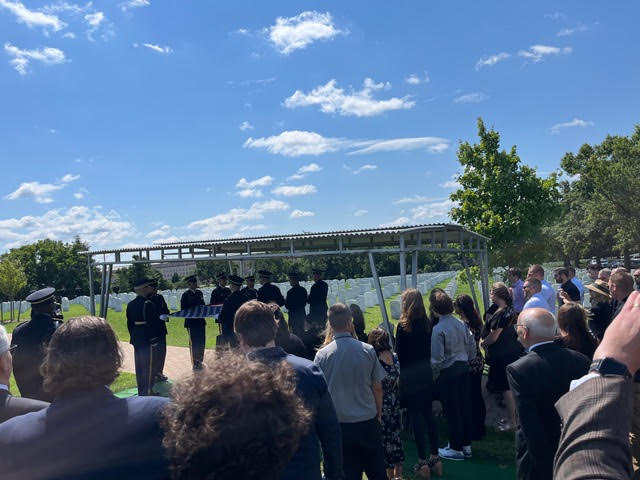
On cue, the procession of cars began to snake through the cemetery to the burial location. The hero was also to be interred in a columbarium niche, but there would be a service before the interment. A tent was set up among the gravestones to provide shade for the hero’s immediate family, along with chairs for them to sit in. Others in attendance, about fifty, stood in the sun, though for a summer day in Virginia it was neither hot nor humid. Off in the distance, the vet could see the Pentagon, which seemed ironically appropriate. An Army chaplain, a woman, stood waiting, along with a small detail of uniformed soldiers poised to fold the flag covering the hero’s burial urn. About 100 yards away stood a platoon-sized honor guard and a military band. Also present was a firing squad and bugler. The vet recognized a couple of teachers from West Point with whom he and the hero had taught, but not anyone else he knew. The attendees seemed composed equally of family and friends who looked like they might have either served with the hero or been his students. Only a couple of attendees were in uniform—none especially high-ranking.
The chaplain called the service to order. She said kind words about the hero without shying away from the controversies that marked his service and his sad final days. She read from Romans 8:28: “If God is for us, who can be against us?” When she finished, the detail folded the flag and presented it to the hero’s father. The bugler played Taps and the firing squad fired a three-round salute. Then the chaplain asked for a volunteer to carry the urn containing hero’s ashes to the columbarium. At first no one volunteered, and the vet wondered if it was appropriate if he stepped forward. Then the hero’s father said that he would carry his son’s remains.
The vet had read that the hero’s father was a former Marine Corps machine-gunner and a Vietnam veteran. He had also read that the father hated the military and had been a member of Vietnam Veterans Against the War. He was the only male at the ceremony not formally dressed or in military attire. Confined to a wheelchair, wearing a plaid lumberjack shirt, the hero’s father exuded determination that his son’s life was worthy of military honor.
As the procession walked to the columbarium, the band played a song that sounded like the Elvis Presley classic “Love Me Tender.” It’s a sweet song, but the vet wondered at the selection. Only later did he learn that the melody belonged first to a song called “Army Blue” that predated “Love Me Tender” and was long associated with West Point.
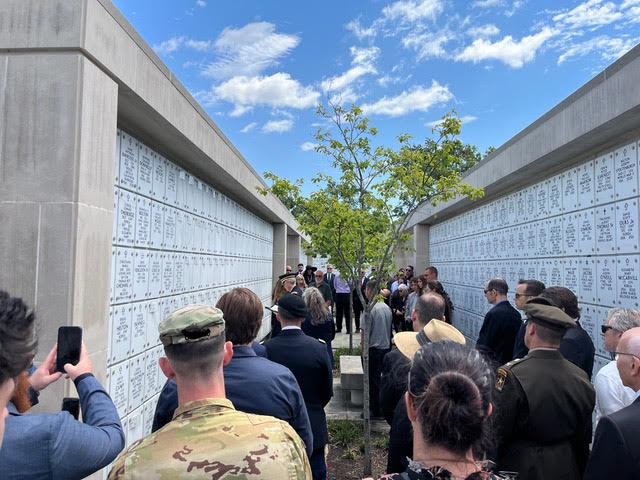
The columbarium at Arlington Cemetery has its own kind of dignity, but it’s narrow for the purposes of a ceremonial gathering. The previous summer, at the vet’s friend’s mother’s interment, there was only the cemetery official, the friend, and the friend’s son and daughter. Now the attendees squeezed into the row between the walls of burial niches or looked on from the ends of the rows. More words were said, but from the vet’s position it was hard to hear them. After final remarks were completed, attendees filed past the niche and paid their last respects.
The vet had so far viewed the day’s events abstractly, almost without emotion or consolidated articulation of his thoughts about the hero. But when his turn came to stand before the urn in its dark square final resting place, tears welled up and the vet suddenly found himself both short of breath and short of words. Conscious that others were waiting in line behind him, he stammered under his breath, “Good job man, good job” and moved on.
Following the ceremony, the vet spoke with his friends from West Point and a couple of others present. Someone pointed out former students of the hero’s. Another pointed out the childhood friend who had gone to the most length to organize help for the hero in his troubled final days. No ready opportunity to speak with the hero’s family presented itself, and the vet was hesitant to force the issue. A reception was announced, but the vet didn’t get the location and had already decided he would not attend.
An official announced it was time to for the procession to depart and the attendees in their cars drove slowly toward the cemetery gates.
On the way out of the cemetery, the vet saw signs directing traffic to the Marine Corps War Memorial. It had been a long time since he had visited the memorial, so he followed the signs to the parking lot. He walked around the grounds, read the signage, and contemplated the magnificent statue of the six soldiers raising the flag on Mount Suribachi on Iwo Jima. The crowd was sparse: a few casually-attired tourists and some vet old-timers wearing ball-caps adorned with patches and pins representing military units. Unexpectedly, a wedding party, dressed in their finest, strolled by from a site farther off from the statue where they had gathered for pictures.
After taking it all in for a while, the vet walked back to his car.
****
Biographical details about the life of Ian Fishback not recounted from memory were obtained from C.J. Chivers, “Ian Fishback’s American Nightmare.” New York Times, February 21, 2023.
Muhamet reaches for a plastic water bottle resting on the metal filing cabinet that serves as a nightstand. He drinks the last of it, tosses the empty bottle to the floor. It’s early, no sunlight seeping in yet through the open seam in the plywood and sandbags that cover the only window. He rolls out of bed and pulls on clean coveralls and dusty work boots while the dull, familiar soundtrack of small arms fire echoes in the background. Before the war, the camp was a Ba’ath Party resort, a favorite of Uday’s and Qusay’s. When the Americans arrived they named it Camp Baharia, but everyone here calls it Dreamland.
He takes a deep breath, pushes open the door, steps out under a pale moon onto loose gravel that crunches under his weight. It’s a two-cigarette walk to the Hydrologie office. A modest, regional wastewater firm based in Düsseldorf before the war, Hydrologie was now global, with expertise in logistics, cybersecurity, force protection. Hired as an electrical engineer, Muhamet spends his days cleaning portable toilets and repairing the generators and A/C units that keep Dreamland powered up and cool. When he reaches the office, he jams his cigarette into a bucket of sand by the door and steps inside, letting the aluminum door swing shut behind him. He flips on the overhead lights and trudges over to the calendar pinned to the wall above Fatmir’s desk. With a black marker he draws a diagonal line through March 13th. Another week and this war will be the same age as his daughter.
He brews coffee and takes a cup out to the small courtyard behind the office, sinks into a white plastic chair. Holding a fresh Marlboro, he runs his fingers through his thinning hair and looks out to the north, where he can see tracer rounds careen like little red meteors, the ricochets charting a random and ruinous path through the sleeping hamlets beyond the wall.
He lights up and inhales as a tangerine sunrise spills out over the desert. This is why he comes out here so early. Over time, the walls of the camp can numb the senses. When he isn’t working, he passes the time watching movies or playing ping pong in the rec tent. But it’s only here, sitting alone, a slight buzz from the caffeine and nicotine, that hemanages, however briefly, to forget about the heat and the thousands of miles between his heart and home.
He ventures back inside and sits down at his desk, using his sleeve to wipe the dust from the framed photo of his family that was taken before he left Ferizaj, an old city in the rolling foothills of the Sharr mountains of Kosovo. The situation back home is far less dire now than it was three years ago, when half a million ethnic Albanians fled the country to escape Milosevic and his Serbian nationalists. By the time Muhamet left, he had the luxury of a return date. But fighting for peace and independence is one thing, and buying food and warm clothes for the winter is another. Leaving Kosovo was the only way he could earn enough to provide for his family. When he thinks too much about that day at the airport, he can’t breathe.
***
Now the fifth-largest city in Kosovo, for centuries Ferizaj was an anonymous farming community in a forgotten corner of the Ottoman Empire. Then, in 1873, a new train station was built that linked it to the Orient Express, a massive rail network that stretched all the way from Istanbul to Paris. Over time, the flow of goods transformed it into the modern city it is today.
On his way to school every day as a child, back when Kosovo was still part of Yugoslavia, Muhamet would pass by a mosque that stood right next to an orthodox church. The only thing separating the two houses of worship was ashared courtyard. Today this phenomenon is a tourist attraction, a symbol of religious and cultural harmony in a region long plagued by sectarianism.
Nearby, just west of town along a country road his family would drive on weekend trips to the mountains, isanother phenomenon: the fork in the Nerodimka River. It’s one of only two rivers in the world with a natural fork that drains into two different seas.
And a few miles in the opposite direction is Camp Bondsteel. When half of Kosovo was unemployed after thewar, this sprawling new NATO base became a lifeline. Thousands of locals, Muhamet among them, earned reliablewages in the warehouses, kitchens, chow halls, and laundry facilities on base. Muhamet drove a sanitation truck and ate Taco Bell six days a week, always bringing extra home for his family.
It was at Bondsteel that he first heard about the job offers in Iraq. By then, several men he had known his entirelife had already signed up and left, and it wasn’t long before rumors circulated about the bonuses they had earned for being in a war zone, despite living and working a safe distance from the front lines.
The morning before he left, Muhamet drove west of town, past the neighboring church and mosque, until hereached a small park. It was empty, and he sat in the cool grass and stared down at the fork in the muddy Nerodimka. Some of the water flowed to the left and some flowed to the right, some people prayed in churches and others prayed inmosques, and some people stayed while others left. Leaving was a big decision, but most days he felt more like a drop of water in the Nerodimka than a man making his own choices — part of a larger system that is perpetually movingforward, twists and turns and currents carrying you to greener pastures or dumping you an ocean away from the people you love.
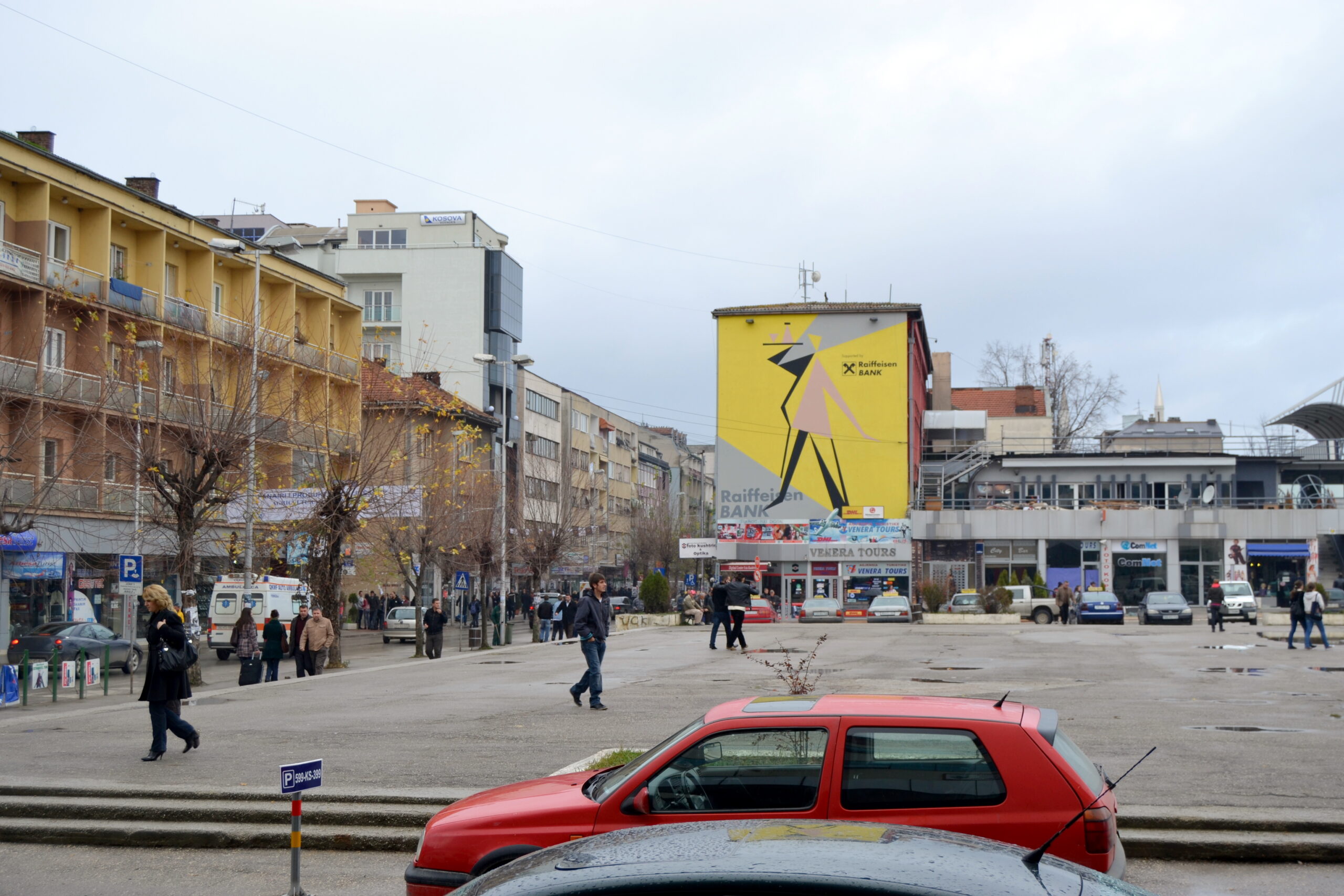
In the framed photo on his desk at Dreamland, they’re laughing, huddled together in the snow in the main square in Ferizaj, in front of the cubist mural of a waiter that covers the side of the Hotel Lybeten. A passing stranger took it a few days before he left, on the last night they all went out together as a family.
***
Fatmir arrives at the office and mutters a tired good morning. Muhamet wipes his eyes and sits up in his chair when hehears him come in. Trailing Fatmir are two Marines, one tall and dark-haired, the other short and stocky, his head shavedclean. Muhamet recognizes them from 2/6, an infantry unit from North Carolina that arrived at Dreamland around thesame time he did. Fatmir introduces them.
“The American law firm of Preston and Godchaux?” Muhamet says, grinning as they shake hands. He cringes to himself and is grateful when they laugh at the joke.
They sit down together at the small table in the middle of the room. The Marines notice Muhamet eyeing the green sea bag lying on the floor at their feet.
“Right, almost forgot,” Godchaux says. “We brought gifts.” He opens the bag, pulls out two new pairs of combat boots and a box of cigars, pushes them across the table to Muhamet.
“For us?” Muhamet says. “What for?”
Godchaux shrugs, smiles. “Fatmir says you’re his best driver and his best mechanic,” he says.
“We hear you’re good with generators,” Preston adds. Muhamet glances at Fatmir.
“I already told them we aren’t allowed to leave the camp,” Fatmir says. “If we did…” He snaps his fingers, thinking. “What’s the word I’m thinking?”
“Hypothetically?” says Preston.
“Yes, exactly. If we did, hypothetically, there could be no paper. Handshake only.”
Godchaux speaks next, but Muhamet has a hard time focusing and only hears some of what he says. They want him to join their nightly convoy that resupplies the Marines scattered across their area of operations. There’s a faultygenerator at one of the observation posts, and the portable toilets and showers need service from Hydrologie’s “honeywagon.” They assure him it’s a one- time request, to support a “hygiene surge” ordered by their commander. In turn, they’ll pay Muhamet and Fatmir each five hundred U.S. dollars — equal to three months’ pay back home and two weeks of his Hydrologie wages.
Muhamet clears his throat. “Your vehicles, they have armor?”
Godchaux and Preston exchange a look. “That’s right,” says Preston. “And a lot of firepower. Nobody messes with us out there.”
“You tow my truck and I ride with you? Behind the armor?”
Godchaux frowns. “I wish we could do that, Muhamet, I really do,” he says.
“Unfortunately…”
He tries to explain, says something about “maintaining a tactical posture,” but Muhamet isn’t listening. He’s thinking about the roads, how dark they must be at night. His palms feel clammy. He imagines straining to keep his truck from rolling over into an irrigation canal.
The Marines promise to stop by again the next morning to check in. The convoy leaves at dusk.
When the door closes behind them Muhamet says, without looking up, “If you like this plan, why don’t you go?”
Fatmir smiles patiently. “One, because I can’t fix a generator, and two, because I have a shop to supervise.” He places a hand on Muhamet’s shoulder. “It’s your call.”
***
He spends the rest of the day and a fitful night of sleep mulling it over, surprised that he’s even considering it. The money would help, of course. And Dreamland is teeming with contractors like him in search of a payday. If not him, they’ll find someone else, and they won’t even have to pay as much.
Unable to sleep, he walks to the phone center and uses a prepaid card to call home.
“It’s me,” he says, softly, when Samira picks up. It’s late in Ferizaj, too, just an hour behind.
The call woke her up, he can hear it in her voice.
He calls often, and sometimes, on days he’s feeling particularly homesick, he writes long, poetic letters that she reads aloud to Adriana, their daughter.
“I was hoping it was you,” she says.
“Who else would it be?”
“I don’t know, someone calling with bad news. But I don’t want to think about that. Guess what?”
“Tell me.”
“It’s snowing.”
“No. This late in the year?”
“I know, I wish you were here to see it. It’s so pretty. The river is frozen over.”
He can hear the furnace popping in the background, and he imagines walking home in the snow, stomping the slush from his boots and stepping through the front door to a roaring, cozy fire. Samira takes his coat and hands him amug, and he feels the first sip of steaming rakia coating his throat and chest.
“Muhamet?” “I’m here, love.”
“How are things there? Has the rain let up?”
“Yes, no more rain, but it’s getting hot now. I wish I was there.”
After they say goodnight and hang up, he leaves the phone center and heads for the gym, where Fatmir looks up from his stationary bike. “I’ll do it,” he says.
***
He arrives at the staging area just before dusk. A stiff wind has stirred up the desert air and painted the row of armoredvehicles a mix of deep orange and shadow gray, the patterns shifting with the setting sun. The motor pool is a beehive ofactivity: silhouettes of turret gunners greasing up their crew-served weapons, mechanics in tan flight suits making last-minute repairs, Godchaux gathering his drivers in a semicircle for the pre-brief. There’s a detailed model drawn in the dirt. Parachute cord marks the route, small rocks represent the vehicles. Popsicle sticks from the dining hall for the hamlets, twigs and bunchgrass for the vegetation, red dice for the radio checkpoints.
Godchaux — shorter than his troops, square and muscled, his freshly shaven head glowing pink — spots Muhamet and makes his way over. “Glad you could make it,” he says, smiling. “You’re just in time.”
He turns to address the drivers. “Ok, everyone on me,” he says. His voice booms. He pauses while the young men standing before him, who look to Muhamet more like orphaned boys than grizzled fighters, gather around. “This here is Muhamet. He works for Hydrologie. You’ve seen their trucks all over the camp. He’s Santa Claus tonight, so make surehe has everything he needs.”
Before Muhamet can ask, Preston appears and pulls him to the side as Godchaux kicks off his convoy brief. He’sgrinning, holding something white and fluffy. “Santa Claus beard,” he says. “Cheers the guys up when we deliver theirmail and supplies. Normally we draw straws to see who
wears it. It’s rare that we have a guest.” He looks down, then back up, like he’s just remembered something. “Shit,” he says. “You’re Muslim, aren’t you? I didn’t think about that till now.”
Muhamet lets out a full-throated laugh. Maybe it’s his nerves, or the look of doubt on Preston’s face, over something so silly when they’re about to do something so serious. Whatever the reason, it cuts through the tension in theair. He grabs the beard by its elastic band. “It’s okay,” he says. “We celebrate Christmas in my country, too.”
Preston pats him on the back and motions to another Marine, who hands him a Kevlar helmet with night visiongoggles attached to the front, a flak vest weighed down by thick ceramic plates, and a small digital camouflage backpackthat contains a pair of Nomex gloves, wrap-around ballistic eyeglasses, and a handheld Icom radio and headset fortalking to the other vehicles in the convoy.
“Here, like this,” Preston says, moving the goggles back and forth on the hinge to lower them to eye level and back up. “It might feel weird at first, but your eyes will adjust. Just take it easy and follow the truck in front of you. Ifanything seems off to you, or you need something — anything at all — just hold the talk button down here and speak clearly. We’ll take care of the rest.” He smiles. “Good to go?”
When Muhamet gives a thumbs up, he can feel his hand tremble.
After Godchaux ends his brief with a reminder to stay alert and follow radio protocol, Muhamet climbs up intothe cab of the Hydrologie truck, starts the engine, checks his mirrors and gauges, tests the pump switches by turning them on and off. Then he jumps down and does a walkaround, checking the treads on the tires, looking for a screw ornail, anything that might cause a slow leak, and takes a quick inventory of the long metal box that’s bolted to the back of the cab in front of the sludge tanks. There’s a tire jack, a toolkit, some spare generator parts, a backup pump hose, eight twelve-packs of toilet paper for the resupply. Satisfied that everything’s in order, he dons the flak vest and helmet and climbs back into the cab. Idle chatter, inside jokes and wordplay that’s hard for Muhamet to follow, fill his Icom headset. He closes his eyes and takes deep breaths to calm his nerves.
***
It’s dark when the Humvee in front of him finally inches forward. He fights the instinct to turn his headlights on as they weave through Dreamland’s date palm-lined streets. Preston was right, he thinks to himself. I can’t see a thing.
They halt just inside the front gate. Seeing the Marines dismount, he puts the truck in park and follows along. A voice from the front of the convoy calls out “Condition one!” When every weapon is loaded, they climb back into their vehicles.
Muhamet’s Icom crackles, followed by, “Victor One, Oscar Mike.” Moments later, the convoy is rolling through the gate and the radio banter goes quiet. The lead Humvee calls out the first checkpoint when they reach Route Michigan.
The first stop is the police station in Karmah, on the outskirts of Fallujah, where the Marines from Echo Company live with a dozen Iraqi police. Even Muhamet knows Karmah’s reputation for violence. He’ll have twenty minutes to fix a generator, clean and restock the chemical toilets, and fill the mobile shower units with fresh water.
At Route Golden, the convoy turns left through a break in the median. Golden is a two- lane road that starts on an incline. When it levels out, the minaret of a mosque comes into view. Narrow dirt roads splinter off the main route at random intervals, the turnoffs overgrown with wormwood and other thick brush. They’re essentially long driveways thatconnect the paved road to small hamlets of sandstone houses that twinkle under the moonlight. Muhamet sees something move up ahead, and in the quiet of the cab he can hear himself gasp. There’s something by the road, and now a second shape emerges from behind the first one. Eyes. Four of them, green and glowing.
There’s static on the handheld, followed by Preston’s baritone: “Fuckin’ dogs.”
***
They weave through the serpentine barriers at the IP station, where a working party is waiting to offload the supplies from the seven-tons. Godchaux jumps out of his vehicle and ground-guides the convoy into a defensive posture whilePreston helps Muhamet back his truck up to an opening in a row of Hesco barriers. Muhamet cuts the engine and steps down from the cab. Lifting up his night vision goggles, he’s stunned by the ragged appearance of the working party. They look like the feral dogs they just passed on the way in: pale and skinny, dark circles around their eyes. Muhamet whiffs a nauseating mix of body odor, cigarettes, foot powder.
“Look, Santa’s a fuckin’ Haji.” They’re pointing at him now, laughing. Only then does he suddenly feel ridiculous in the beard.
He knows this vibe from his time at Bondsteel — a mix of youth and tribal hostility toward outsiders that’s more bark than bite. Thinking fast, he grabs the end of the vacuum hose from the back of the truck and holds it up in the air.
“Ho, ho, ho!” he yells. “You have been good this year, boys and girls. Allow me to suck your shit!”
The working party doubles over in laughter, and Muhamet goes about his work while they offload the trucks. He cleans the toilets and refills the shower tanks, and Preston points out the generator and holds a flashlight for him. Muhamet takes a knee to get a closer look, and when he bends down he notices three men sitting on the opposite end of the courtyard. They have long beards and they’re wearing dark pants and light blue shirts with the sleeves rolled up.
Preston squats down by his side. “See how they just sit out here all nonchalant, no body armor or nothin’?” hesays. “Like they know they’re safe somehow.” He nudges Muhamet. “Watch this,” he says, standing up.
“Evening, pig fuckers!” he hollers. The three men glare at Preston, who waves back at them. “SalaamAlaikum!” They frown and say something that Muhamet can’t hear over the gargle and spit of the generator.
***
From the IP Station they head north to a small observation post on the north end of town. They have a schedule to keep if they hope to make it back to Dreamland before sunrise.
Muhamet tails the Humvee in front of him as they turn back onto Golden. They move slow, scanning the road ahead, ready to stop on a dime. It’s still and quiet under the curfew, and with the first stop behind them he lets his shoulders relax for the first time all day.
“Watch your asses,” Godchaux growls over the Icom. They’re approaching a traffic circle the Americans call the Lollipop. On one side is the mosque.
As soon as Muhamet’s truck enters the roundabout, there’s a bright flash. Something has knocked the wind out ofhim. He feels a vibration surge through his body, like a fault line cracking open his insides, then nothing.
He comes to face down on the side of the road, a loud ringing in his ears. Voices in his headset sound distantand muffled, and he tries to speak into his handheld but nothing comes out. He tastes metal, and before he can think about it his vision narrows and he loses consciousness again.
***
When he wakes up, he tries to stand but stumbles, his legs rubbery. Out of nowhere, Godchaux appears and grabs hisarm to keep him from falling. He can feel something wet under his clothes. He reaches for his thigh, expecting blood, butpulls his hand back to see blue liquid from his truck.
He leans back against a berm and sees the charred remains of the truck halfway submerged in the canal. Metal fragments are scattered across the road and the adjacent field. A medevac helicopter clatters overhead.
But when he looks up he’s surprised, and delighted, by what he sees: falling snow. It looks beautiful through his night vision goggles. An ethereal, emerald green flurry. that he realizes is a cloud of ash and burnt toilet paper whipping around in the air from the force of the blast and the rotor wash.
Godchaux reappears. Maybe he never left. “Are you okay?” he shouts in Muhamet’s face. Muhamet points up at the snow, not knowing it’s just ash and burnt toilet paper swirling from the force of the blast and the helicopter’s rotorwash. Godchaux looks up, then back down at Muhamet. “Just sit tight,” he says. “Doc’s on his way.”
His head throbs, his heart beating in his throat. He nods at Godchaux, who disappears again behind the white cloud of a fire extinguisher someone is spraying at a burning Humvee tire. His Santa beard has melted away and his mouth feels gravelly. He wipes an index finger along his gums, to scoop out the debris, and pulls out the pink fragmentsof a molar. Feeling his vision start to close in again, he gazes up at the eerie green snowflakes, swirling around and around, waiting for gravity to take hold. He sticks his hand out, hoping to catch some, but he feels dizzy and steadies himself against the berm. He closes his eyes and thinks of home. With a little luck, he’ll make it back before Christmas and take the family to Gjyla, their favorite restaurant. Samira and Adriana will wear the new coats he can afford to buy them, and they’ll warm themselves by the crackling brick hearth until their table is ready. He smiles at the thought of it when he feels himself being lifted into the air and carried away.
New Nonfiction from F. Ahmeti: Bunker Mentality
“The home of the Albanian belongs to God and the guest.”
Kanun
Durres reminds me of the Jersey Shore. The mix of family fun and adult nightlife, and the dirt, is not unlike the town featured on the MTV reality series in which a bunch of people mostly from Staten Island, NY stayed at a house on the boardwalk in Seaside Heights, New Jersey. Like Durres, Seaside’s boardwalk has a carnival atmosphere, with games, prizes, and vendors selling novelty food and toys – and all the litter that comes with it. There are many Jersey Shore experiences which are nothing like the infamy promoted by MTV, and far from the filth one would expect from an almost comically industrialized and densely populated state. These were all beyond my family’s price range, though, so we used to go to Seaside Heights when I was a kid. My family is from north jersey. Our path to the ocean is geographically blocked by Long Island. Thus, we don’t go to the beach but down the shore, per local dialect. On the long journey south the landscape becomes sparse and starts to look like a Springsteen song, and one can infer why there is an undercurrent of animosity between the northern and southern sides of the state.
My memories of Seaside Heights, perhaps mercifully, grow sparser with time. There was the time when we stayed in a high-up hotel and I got a Cookie Monster themed fifth birthday cake, and I remember that was when my mother quit smoking for several years because she said it was a wake up call that she got pneumonia in the summer. There was a time my father frugally brought down discounted focaccia from an Italian grocery store up north and we ate it cold sitting on the floor of the cheapest motel room we could find. The last time we went, when I was eleven years old, a man who was arguing with his pregnant girlfriend in the street punched out the driver side window of my mother’s van in the middle of the night. When the motel’s night manager knocked on our door, the police had already wrapped the man’s hand and taken him away. Some old men hanging around outside relayed the story and pointed out the trail of blood. I remember seeing the old men and thinking I was like them, because I like to stay up late, too. I realized when out-late later in life that those who stay up and idle in the streets at night are people (drugged up or not) who can’t or won’t go home. My mother brushed away the broken glass and drove home up the highway with 70 mph winds in her face. At home, I discovered I was covered in bed bug bites that I’d thought were only mosquito bites.
Like the Jersey Shore, there are plenty of places in Albania to go if you’re in need of something more scenic. But I used to swim at Seaside Heights. One spring, still battling a bout of bronchitis, I bathed in the cold waters of Brighton Beach off Brooklyn. I breathed in big swigs of the Hudson River in small installments through the mist blanketing transit stops in Jersey City. I was practically nursed on dirt. So it doesn’t bother me like it should.
~
The Albanian collective memory, whether painted in blood, or etched on the angry edges of towering gray stone mountains, is threatened by our general lack of written record. There exists an Albanian literary canon, nursed in mosques and monasteries, written by exiles and those who became martyrs because they didn’t act quick enough at becoming exiles. These works withstood the deliberate destruction of cultural heritage that goes on in the background of every occupation: the slow burning suppression, like not allowing children to be educated in their native tongue, and the literal burning of libraries and cemeteries. My Albanian parents left Yugoslavia in time to avoid being martyrs or refugees, so are instead exiles.
Despite sharing a language that survived several consecutive centuries of occupation, those Albanians whocould read and write did so until the turn of the twentieth century in three different regional alphabets. In 1908, Albanians converged from all across their regions at the Congress of Manastir, (present day Bitolla, North Macedonia) to decide on one alphabet to unite them all. Among those in attendance were guerilla fighter Cerciz Topulli, priest-and-poet Gjergj Fishta, and Avni Rustemi, a school teacher who later assassinated the traitor Esat Pasha Toptani with two bullets in broad daylight in front of the Hotel Intercontinental in Paris.
Early English records of the ancient and as-yet uncharted nation came in the form of travelogs written by those well-to-do westerners who bothered to visit and found what they saw interesting enough to write down. There was Edith Durham, who first went to the Balkans for some fresh air after her doctor told her that her stuffy upper-class Victorian lifestyle was making her ill. After her first trip, she wrote a book affectionately titled Through the Lands of the Serbs. On her second trip, she met the Albanians, and dedicated the rest of her life to writing and lobbying for the Albanian cause, decrying the then-new Yugoslavia as a front for Serbian hegemony, calling it a new tyrant worse than the old. There was Lord Byron, the ever-image-conscious poet, who had his portrait painted in southern Albanian costume, and stayed with Ali Pasha Tepelena at his castle situated in the bright blue waters across from present-day Greece. He characterized us as “brave, rigidly honest, and faithful…. cruel though not treacherous, and [having] several vices, but no meannesses.” Byron acknowledges in his letters home that Ali Pasha, who treated him with the utmost hospitality, was a bona-fide tyrant. But he was equally well known for his diplomatic prowess, progressive religious pluralism, and most importantly for defying the Sultan and running his governorate as an almost-autonomous Albanian state. For the last of these, Ali Pasha’s head was paraded through Istanbul on a silver plate in 1822.
Castle of Ali Pasha Tepelena, Butrint, 2022
In movies we are gangsters, human traffickers, arms dealers. Taken shows Liam Nisson murdering his way across western Europe to retrieve his daughter from the Albanian traffickers who sold her into the sex trade. In War Dogs two American arms contractors travel to Albania to seize upon a cache of discounted AK-47 rounds, only to find that the Chinese-made munitions are subject to embargo and must be fraudulently repackaged before sale. The first season story arc of the Law and Order spinoff, Organized Crime, revolves around Detective Elliot Stabler going undercover to infiltrate the Albanian mafia in New York City; they own a boxing gym, as is expected of people with a warlike nature. In a classic episode of The Simpsons, Bart is traded for an Albanian exchange student, a polite and conscientious guest who turns out to be a spy seeking nuclear intel. I will gladly tune into any of these, no matter how negative the representation, if only to hear the actors take a shot at the Albanian language.
Of course stereotypes are not pulled from thin air. Florin Krasniqi, a school teacher from Kosovo, crossed the US-Mexico border crumpled in the trunk of a Cadillac on Christmas Eve 1988. In New York, he worked as a cab driver and a construction worker and eventually opened his own roofing business. Then, Krasniqi funneled $30 million in weapons and equipment to the fledgling Kosovo Liberation Army, purchased legally in the US and transported under the pretense of exotic game hunting.
~
The Balkans, particularly the formerly barricaded fields of Albania, carry a type of mystique that quirky off the beaten path type travel bloggers salivate over. There is a particular brand of adventurer that marvels at scarcity as spectacle, and Albania is certainly vulnerable to them. One can get a similar effect by visiting their own ghettos or touring the ruins of an old boomtown close to home, but it reads sad when the subject and audience speak the same language and carry the same currency. Here is an example (based on 100% true events) of what one of these might sound like:
My first morning in Duress I woke up to dead jellyfish all along the beach. They had been spit up onto the shore in a storm, and the waters of the Adriatic were dark, churned muddy by the rains.
By the hotel poolside, families with multiple close in age little children drank Turkish Coffee and ate Bread and Cheese for breakfast. I walked the beach a bit and saw The Bunkers! which were filled with trash and there was also trash strewn everywhere all around…..
………At dusk, a dog descended on a polluted drainage ditch to drink. I went out to get some dinner along the cobblestone promenade between the beach and the long strip of hotels that vary in price and quality from bare bones cheap family digs to infinity pools and dining terraces that transform to dance clubs at night, complete with live music. One charismatic performer switched between traditional Albanian songs and Dua Lipa hits and shouted “join us” in English, waving at passers by on the cobblestones.
I gave some lekes to a beggar with no hands who raised his wrist-stumps in appreciation and offered what sounded like blessings in his native language.
I stopped in a restaurant that specialized not in Albanian cuisine but the food of neighboring Macedonia, where the waiter brought an ashtray with the menu, something we don’t do in the USA anymore.
The restaurant offered Kosovan beer and local raki, an Albanian white whiskey that is said to be a healing tonic for all manner of ailments. I had Macedonian specialties like speca (peppers) and buk me djath (bread and cheese), some qebapa (kebabs), and a lettuce-less salad of cucumber and tomato. I washed it down with a liter bottle of mineral water. They don’t serve tap because the tap water in this country is not drinkable.
I didn’t drink alcohol because I was too scared (out here in a strange land all alone).
For dessert and digestion I walked and wandered down the cobblestones a bit more and there was a Turkish in a vest and a red fez selling dondurma,the iconic stretchy mastic ice cream, in excotic flavors like hazelnut and pistachio to complete the oriental ensemble of it all. At that moment, I realized it was late, and feared I would be human trafficked, so I went home past the stray dogs and also humans that all but hid away during the day and slept on the beach at night. [Here is where the tourist might add candid photos of the locals as if they were inanimate]
Albania is one of the poorest countries in Europe, and this is why the exchange rate was ever in my favor. A leke is not equal to a dollar…….
~
Durres is not foremost a resort town, but a port with an incidental beach. At a hotel there, I remembered the words of my immigrant friends, who say things like I was too afraid even to order a coffee, when describing the disorienting experience of their early days in America. I know about enough Albanian to get by as a guest, but not enough to hold a job or build a life. I know enough that a variable in accent or cadence can completely throw me off balance. I can barely read a poem in Albanian, but even with jet lag, I can still read most signs and restaurant menus.
In Durres, I drank coffee sitting in the sun by the hotel and read the news from America on my phone. I read about the people who cooked to death in the cargo hold of a tractor trailer in Texas, and I thought about the violently bumpy roads of Albania and the empty expanses on either side of them and the conditions that lead one to throw themselves into the potentially deadly journey of migration even when their life at home is not under imminent threat.
After breakfast, I went for a walk on the beach, where I saw big purple jellyfish, like the ones on Spongebob Squarepants, staggered in a line, dead. I ducked around a bunker, and saw that it had been filled with trash, an act of resourcefulness that helped keep the contents from blowing around the beach in the breeze.
Image of Death in Durres, 2022
All along Enver Hoxha’s border, guards waited with rifles ready to fire upon any enemy upon entry – and to shoot on sight any who dared to defect. The bunkers, built by Hoxha as a project of national defense, are a visual culmination of his extreme isolationist policy.
They were built to be used by citizens in the event of an invasion, but more importantly, to loom in the background of daily life. Enver built 173,000 of these instead of fixing the roads. Today, these concrete domes of varying sizes sit like small bitter blisters on what could otherwise be an unspoiled panorama. Some bunkers dot the peaks and valleys of the countryside, while others are sprinkled on the shores of coastal cities. Some of the larger bunkers have been creatively repurposed into museums and others painted as public art. Many are sinking slowly, soon to be reclaimed by the land, unsightly but unworthy of the effort of being removed. But the bunkers have an enduring mythology all their own. They are known as hideaways where young lovers go for privacy – something like what the automobile was for American teens in the 1950s. They are known as sites where rural people relieve themselves when an outhouse is too far away. I have been on Albania’s highways. For an idea of the experience, picture the landscape where Wile E Coyote chased the Roadrunner through endless empty miles, but painted gray and green and more poorly paved. While I don’t personally know what passions would possess one to want to have sex in a mad, dead, dictator’s concrete bunker, I do know that there are not many rest stops in the Albanian highlands, and if it was between pooping in the open road or befouling Enver’s bunker, I know what choice I would make.
~
The Austro-Hungarian scholar Franz Nopsca wrote about asking for water at an Albanian home he passed on his travels in Kelmendi. He was offered buttermilk instead, and consumed the entire container. When a family member came home with a craving and saw that the buttermilk was all gone, he proclaimed his relief that Nopsca had arrived first, sparing the family the shame of having no food to offer to a guest. Albanian hospitality is legendary but not very much more legendary than anyone else’s. There is a reason why a viral Reddit post about a Swedish family not feeding their son’s guest spiraled so out of control that it garnered a research-driven analysis in The New York Times. Most cultures will feed and protect their guests. It is considered indecent to do any less.
View of the Adriatic from inside bunker, Durres, 2022
Once I worked in a beer restaurant in the domain of yuppies along the Hudson River. This is a place where, for example, factories where immigrants toiled are refurbished as luxury apartments and the brutal markers of the building’s past life like ceiling beams and exposed brick are fetishized as features, rather than blight. One evening, a Turkish gentleman came in and sipped a big beer on the terrace. He was very sociable, very bald, and very much a happy drunk. He asked me questions about the history of the building; I asked around and learned that it used to be a belt factory, and shared this info the next time I circled past his table. Amazingly, that was the same night my favorite work belt that had served me well for several years finally broke. It was Italian leather, given to me by an Albanian old lady ex-coworker who said it used to be her own but now she was too fat. The Turk said he was interested in the restaurant’s concept – modeled on an Austro-Hungarian beer hall – because he had majored in hospitality and hotel management at school. I had always felt suspicious that the vibe attracted at least a small percentage of covert white nationalists. I don’t remember if I told him that. Obviously, it came out that he was Turkish and I was Albanian when we finally told each other our names. He told me, with some excitement, that his grandmother was Albanian. I told him I might have some Turkish mixed in somewhere amid the five-hundred-year occupation. I told him, we might be cousins.
I left to do other work and returned to perform the final closing task of shutting the terrace umbrellas and front gate. My cousin was now sitting with two white people at another table, captive in conversation with these strangers who were fast becoming his friends. So when the white lady said she feels bad about holding me up, but didn’t actually get up, I saw an opportunity to give her some soothing perspective and maybe even close the show. I said: Don’t worry about overstaying your welcome – this guy (my cousin) came to my house once and didn’t leave for over 500 years! My cousin commenced to shake and laugh as the whites declared themselves unaware. Then he rose, staggered towards the restaurant gate, set down his beer, hugged me, and handed me a $10 bill.
Upstairs, the manager said for future reference that this late after closing I was allowed to simply kick people out.
~
Enver wasn’t completely crazy for thinking up the bunkers. The lands of the Albanians had over and over been invaded. We starred as supporting acts in so-called proxy wars between major world powers. We were there as states splintered and borders bled together.
His paranoid policy was only a shrewd exploitation of the Albanian collective memory.
There were many things that attracted occupiers to us. Kosovo has its silver mines. Macedonia fertile soil for farming. Albania a path to the sea. On the edges of Montenegro and Greece there are still droves of Albanians who exist in a precarious position, plentiful enough to be a political scapegoat but not quite plentiful enough to hold their share of political power.
While the path forward for the Albanians in former-Yugoslav states has been and remains bumpy, no Albanian inside of Albania has been killed or persecuted for being Albanian in generations. I try to imagine, as an exile’s child, how bad it had to be that someone from Albania would elect to defect and risk being shot for it along the way. Only a few years before the war that sent Kosovars pouring out into Albania to avoid death by Yugoslav federal army, and a few years after Enver Hoxha finally dropped dead, Albania had its own mass exodus out.
There is a famous image from this time. Type in “Durres migration” and Google will give you the original photo and everything you ever wanted to know about it all from differing angles. The picture was appropriated during the height of the war in Syria and the migration crisis it precipitated. Those who defended migration aimed to garner sympathy by claiming the photo showed European refugees fleeing the Nazis in World War Two. The Nazis (of today) said the ship showed Syrians. Both were wrong.
The ship was called Vlora, leaving from Durres bound for Bari full of Albanian migrants and Cuban sugar. The photo was not from 1944 or 2015 but 1991. These weren’t Europeans,TM but Albanians. A few seconds of Googling could have stemmed the tide of this disinformation. The name Vlora is clearly visible on the bow. Vlora is a coastal city in southern Albania, the former capital, and site of the 1912 flag raising and declaration of independence. Vlora is Albania’s Philadelphia.
Durres Sea Cliff across from Italy, 2022
View of Durres, 2018
In 1991, twenty thousand Albanians hitched themselves to every available inch of space including the ropes and ladders and parts of the Vlora’s rigging; many were forced to hang on for dear life the entire voyage. On arrival, the passengers were crammed into a football stadium while Italy planned. Conditions rapidly worsened, and police even alleged some of the people who had arrived without any luggage and some without shirts on their backs had fired guns inside the stadium. Some escaped the stadium, but all of the rest were deported. The Albanians were especially plucky and so continued to try. Italy seemed tired. Politicians resorted to lazy tropes about the Ottoman Empire and the migrant “invasion” of the day, their own more contemporary incursions into Albanian lands notwithstanding. In 1997, the ship Kateri I Radkes sailed from Vlora across the Strait of Otranto. An Italian navy ship assigned to intercept and inspect instead crashed into it, causing it to roll and sink, 35 miles from Italy’s shores. Over half of the 142 people aboard drowned.
~
I empathize with immigrants. Sometimes, in my effort to be hospitable as possible I tell them their English is very good even when it isn’t and sometimes I accidentally go too far and flippantly say their English is perfect when I really mean I can understand them perfectly. I don’t know what it’s like to immigrate, but I know what it’s like to be in a room full of people I know well and all-but understand their conversations, but not be able to participate. I know the frustration of filtering your feelings through your own inner-translator and it still coming through slow with plenty of sediment. I knew what it was like, back then when in the den of yuppies but now more than ever, studying in tiny Tallahassee, to have everyone ask about your accent. I know what it’s like to be asked to coach everyone you meet on how to pronounce your name and still have most people just avoid calling you by any name altogether. I try and try and try again to find a short and satisfying way to explain to others why I am an Albanian does not mean I am from Albania.
I was born and educated in America, and so I have a soft spot for the visual poetry of aquatic migration. We were taught early of the mystic power of the Mayflower, and the music of mass migrations to Ellis Island, all those millions who muted themselves to become a part of one collective American orchestra of white noise. In conversations about migration, I think about the ones who aren’t invited to assimilate, even with the proper paperwork. I think about those who survive sneaking through the desert only to drown in the Rio Grande. I think of the little boys Aylan and Elian – one drowned, and one seized by immigration officers at gunpoint, their names aloud almost like anagrams, their images emblematic of the endgame for sociopathic immigration policy. When I get frustrated with our country, I think about the group of Yugoslav-Albanian conscripts who were accused of killing a Serbian comrade who drowned in an accident. They fled across the border and Hoxha handed them back to be executed. I think about my father as a conscript, placed in the brig for cursing Josef Broz Tito in an argument with his Yugo-Slav commander. Me and my father have the same name and somewhat of the same temperament and I’m annoyed with him and my mother for giving me this name but grateful at least they gave me an Albanian one.
View of from Butrint Lake, 2022
Entrance to Ali Pasha Castle, 2022
~
It is not likely for most people reading this to find themselves in the Balkans, but likely enough that they may someday find themself in the home of an Albanian, as we tend to immigrate out. I have encountered more than one of my brethren even in my time in tiny Tallahassee. So, below is a travel guide not for the Albanian homeland, but an Albanian home, wherever in the world you may find it:
We don’t wear shoes in the house; this keeps the floors clean. Sitting on the floor is optional, normal. The couch is as much a seat for your ass as a backrest for floor-sitters.
You will get dry fruit and nuts and tiny cups of coffee (sometimes tea) and depending how serious your guest is about their religion you may get with your small cup of coffee a shot of raki. Be careful, some people think it’s water. They grab it to cleanse the palate after the strong sediment-laden coffee. It will successfully clear your palate, but only by burning off whatever flavors are on there.
Kids can choose between White or Black soda. There’s going to be smoking so if you have asthma or your kids do not like smoke, visit only in good warm weather so you can be received on the patio, porch, terrace, or equivalent where there is ventilation. Eat even if you are not hungry. If someone offers you something to eat, say yes and eat at least some of it.
When it’s time to go, the signal is you will get fresh fruit. You may be able to tell how beloved you are by your host based on what kind of fruit you are served. Chilled melon, for example, is a labor of love. On holidays or special occasions you may get a baked sweet. Baklava is another labor or love. But the layered politics of Baklava are too dense to cover here.
After the fruit, instead of leaving, talk for like two more hours in the doorway. Talk until the sun sets if it hasn’t yet. Be sure to have many peaks and valleys in this conversation, many false endings and wild asides, so as to reflect the peaks and valleys and various wild wormholes of Albanian terrains and topographies.
Note:
Mirembrema = good evening, hello
Naten a mire = good evening, goodbye
New Review by Adrian Bonenberger: John Milas’ “The Militia House”
In the Mind of Madness
There is a nightmare I used to have with some regularity even before my time in the military, in which a house from my childhood concealed some horrible and sentient threat bent on doing me harm. How else to describe it? The house — its bannisters, its rooms — the attic, sometimes the basement, sometimes a room at the end of a hall — contained within a horror so awful that to perceive it would be to go mad, or die. Naturally, I’m sitting here writing, so the horror was never perceived… but what if… someday… ?
This dream contains within it the purest and most intense fear I have ever experienced. No event or encounter approaches it, in or outside combat. Fear, paralyzing and irresistible, is not like the anxiety one actually encounters in one’s daily life. And in moments of great danger one does not feel fear as such — in my experience it is either a rage that compels one to action, or something quite different, which compels one to inaction (often, taking cover behind a wall).
John Milas, whose publications have appeared before in Wrath-Bearing Tree, has a new book out that captures a small portion of that pure fear, and taps into it as effectively as any story I’ve ever read. The Militia House follows a marine lance corporal and his unit during the tail end of an uncomfortable deployment to Afghanistan. As they take over responsibilities for a helicopter landing zone run by the British, a remote building just outside the base draws their attention. The British discourage the marines from exploring it but they insist, and have a very bad time inside. Bizarre things start happening to them — or is it all in their minds? As reality itself begins to fray, ultimately, it doesn’t matter.
Another horror story that considers the line between sanity and insanity is In the Mouth of Madness, a John Carpenter film starring Sam Neill, and I thought of that while reading the book. The protagonist has a blog that’s gotten him in trouble with his commander — the power of writing to change a deployment, to get people fired, is a quiet but insistent thread in the background. Again, if the protagonist has the power to destroy others’ lives with words, with his perspective of the war, isn’t it likely that he can author his own destruction through imagination (madness), too?
And what are haunted house stories if not stories about the mind, with the “house” and its various rooms forming memories, concealing some terrible insight about the self that a protagonist cannot face? In another film starring Neill, Event Horizon, the haunted house is a spaceship — and the revelation by Neill’s character every bit as awful as that of any film of its genre.
The book functions effectively as an allegory about regret, and shame, and if not PTSD, the conflicting emotions that arise from military service overseas. Milas is a veteran of Afghanistan who deployed with the U.S. Marine Corps, and writes with authority about the place and the inconveniences particular to those deployments. In that sense, it is in addition to a reflection about the war, a kind of meditation on the challenges faced by young leaders; responsibility for the lives of others, and being “good” in the eyes of authority.
Milas’s protagonist and marines return to The Militia House later in the book. They cannot keep away from it. What happens is both upsetting and also surprising, and I don’t want to spoil the ending, because it’s worth reading the book to learn what happens. I encourage people to do so, and enjoy the well-composed story as well as it’s lively (if — well, this is horror! — plausibly frustrating characters). If you’ve ever suffered from nightmares, and you enjoy interrogating why, you probably like horror as a genre… and if you like horror as a genre, you’ll like The Militia House.
Peter Molin’s “Strike Through the Mask!”: The Afterlife of Words and Deeds
A recent Los Angeles Times review of A Line in the Sand, the latest novel by Kevin Powers, the author of seminal Global War on Terror novel The Yellow Birds, proposes that GWOT fiction written by veterans, which was much celebrated on its arrival, has lost its luster. Author Mark Athitakis writes, “Two long wars, clumsily entered into and clumsily exited, won’t capture the hearts and minds of readers the way they did in 2012.” Even more pointedly, Athitakis writes that A Line in the Sand “delivers a sense that amid the literary battles of the last decade, the war novel lost. For all its accolades, The Yellow Birds and its compatriots aren’t much discussed now.”
The argument that GWOT fiction and film was once in ascendancy and is now a sideshow intrigues me. I’m on the record for calling the initial flurry of post-9/11 fiction and movies circa 2012 a “Golden Age.” In 2018, however, I wrote a Time Now: The Wars in Iraq and Afghanistan in Art, Film, and Literature blogpost titled “Does Anyone Remember American Sniper?” I had in mind both the book and the movie, but sticking here with the movie, I described watching it on Sunday afternoon network television while channel surfing. Half-paying attention in between naps, commercials, and trips to the kitchen, my impression was that the movie’s resonance was now deflated, almost flat, as compared to the fever pitch of media commentary occasioned upon its release in 2014. I didn’t state it in the blogpost, but I was also wondering if the cluster of vet-authored fiction, including The Yellow Birds, that inspired me to start Time Now in 2012, was now past its prime, too.
Musing on the reception and afterlife of GWOT artistic expression, I revisited a 1989 essay by none other than French deconstructionist Jacques Derrida. Reading Derrida is never a walk-in-the-park, but this essay, titled “Biodegradables Seven Diary Fragments” is reasonably accessible and full of interesting things, beginning with the title, which for some reason omits the expected colon between “Biodegradables” and “Seven.” In graduate school, I mined the essay often while writing papers on how literature lingers (or doesn’t) in the cultural memory after initial publication.
In “Biodegradables Seven Diary Fragments,” Derrida first considers biodegradability as an ecological construct, in keeping with burgeoning worry about the ability of man-made materials to decompose over time. The quote below suggests some of the complexities Derrida finds inherent in biodegradability. The uneven line spacing is not in the original essay, but resulted from my cutting-and-pasting words from a PDF copy of the essay into a Word document. The jaunty result seems to do justice to the often-playful dissonance inherent in Derrida’s thinking and writing:
The issue of biodegradability of course is still with us. Just this week I read an article about the danger of “micro-plastic” particles—the residue of bazillions of water bottles and plastic bags, tires and food packaging—that infect even the most fervent plastic recyclers and abstainers. The import is that even as, say, a milk jug dissipates over time, its alteration of the environment persists. And as with milk jugs, even more so with nuclear waste and other more toxic chemical residue.
Riffing on biodegradability, Derrida suggests that the concept of biodegradability might be applied to books, magazines, and newspapers. His fancifully proposes that the processes of biodegradation corresponds with what might be said to be the “shelf-live” of publications in libraries. Left to themselves, texts, especially ephemeral ones such as newspapers, lie largely ignored while they disintegrate slowly into oblivion. The question, Derrida intuited in 1988, was becoming massively complicated by the creation of digital libraries and archives, which chart a similar-but-different path from first appearance to obscurity. But Derrida wonders whether the ideas and sentiments contained in texts, like micro-plastic particles, ever really disappear. Perhaps they still circulate in diluted, but still potent or even toxic form throughout culture and the lives of people. Or, perhaps the process of biodegradation can be interrupted or manipulated, and old ideas and texts given new life.
Playful as Derrida’s musing might be, the larger context of “Biodegradability Seven Diary Fragments” is serious. It has more connection with war and war-writing than I have made clear so far.
Derrida’s inspiration for writing was a controversy over the discovery that the World War II journalism of another prominent deconstructionist, Paul de Man, was sympathetic to Nazi Germany’s attitude and actions to oppress Europe’s Jewish population. Derrida does not defend de Man, but implies that the long-neglected physical copies of the newspapers in which de Man’s journalism appeared might well have been left to rot. To resurrect them forty years later and hold them afresh for more debate than they received in their own time, Derrida implies, is an abrogation of a “natural” process and thus somewhat unfair to de Man.
That’s a curious way of looking at things, for what else are library archives for but to serve as repositories for future scholars to study artifacts of days gone-by? But Derrida does not stop there. Drifting from consideration of physical objects, he proposes that there is such a thing as “cultural biodegradability” that structures the dissolution of a publication’s ideas and import into culture over time. He asks, “Can one transpose onto ‘culture’ the vocabulary of ‘natural waste treatment’—recycling, ecosystems, and so on, along with the whole legislative apparatus that regulates the ‘environment’ in our societies?” In Derrida’s formulation, ideas, like micro-plastics, do not achieve maximum potency only in their original expression, but through a process of permeation of general outlooks and attitudes in what he calls “the great organic body of culture.”
For example, upon publication, a book might be read by many and its ideas publicly debated. With time, in most cases, fewer people read the original book, and the book and its ideas begin to fade. Or, though fewer people might read the actual book, knowledge of the book continues to circulate and its ideas seep into the cultural mainstream, where they influence other ideas and in turn are influenced by them. Specific examples (mine, not Derrida’s) might include The Bible; not so many have read it cover to cover, but its stories and tenets have been imbibed by all. Or, we might consider the novel Uncle Tom’s Cabin, written by Harriet Beecher Stowe in 1854. In its time, Uncle Tom’s Cabin was hugely popular and influential in galvanizing abolitionist sentiment in the North. Over the ensuring decades, however, fewer people actually read Uncle Tom’s Cabin, but many knew of it, and colorful characters such as Uncle Tom and Topsy became cultural touchstones, as did the anti-slavery sentiment it promoted. Or, to use examples from the literary theory realm, Thomas Kuhn first proposed and explained his theory of the scientific “paradigm” in a 1962 book titled The Structure of Scientific Revolutions, while Laura Mulvey promulgated the idea of the “male gaze” in a 1975 essay titled “Visual Pleasure and Narrative Cinema.” Not-so-many read these essays today, but the concepts of the paradigm and the male gaze are generally understood by most educated readers.
The concept of cultural biodegradability is interesting to think about in terms of my own area of interest: books, movies, and art about America’s wars in Iraq and Afghanistan. Returning to Mark Athitakis’ article, we can wonder about the process by which the attention a book such as The Yellow Birds commanded upon publication withers over time. Per de Man, we can also think about stories, books, and movies that were overlooked on arrival, but which now possess significance unaccounted for at the time. Also per de Man, we can think about the early writings of now-prominent authors and consider what might happen if we gave them more scrutiny now than when they first appeared.
For example, though the movie version of American Sniper now lies fallow in various streaming services, some future critic or scholar might mine it for purposes not apparent now. Or a devotee or devotees will find new ways and new energy to proclaim its importance. However things play out, certain ideas promulgated by American Sniper have not stopped resonating, and in fact many have gained valence and saturate thinking about America’s wars in Iraq and Afghanistan. Among these ideas are the “good man with a gun” sentiment. Or, that special operations represented the most effective means of waging war in Iraq and Afghanistan. And another, the idea that soldiers have difficulty transitioning to civilian life after military service.
Whether “biodegradability” or “cultural biodegradability” best describes the processes of public reception and historical reckoning I’m describing, I’m not sure, but I don’t know what the better words are. Derrida doesn’t clearly explain whether an important work (a “classic”) resists biodegradability by continuing to be read in its original form or whether it exemplifies the way the spirit and messages of a work permeates society through a process of dissolution. He also does not clearly distinguish whether cultural biodegradability is an agent-less process—a function of an organic or structural occurrence—or if it can be manipulated by scholars, critics, audiences, marketers, or the creators themselves. I like the idea that worthy books will find their readers as they will, but there’s also plenty of evidence that a book’s reception and long-lasting esteem can be manipulated and is often contested. We see it all the time on social media, for instance, where posts frequently proclaim the overlooked greatness of this-or-that war novel or film.
Still, the ideas in “Biodegradability Seven Diary Fragments” are suggestive, even provocative. In Derrida’s formulation, every act, once committed, and every text, once published, commences a process of dynamic interaction with the culture into which it is born. Most works contribute only slightly to the prevailing milieu, either immediately or over time. Other, more highly charged works retain their influence longer. Some possess a radioactive-like toxicity.
De Man (who died in 1983) probably had little reason to think that his World War II journalism would resurface after his death and to a large extent define his legacy. An early example of today’s cancel-culture wars, the rediscovery of his journalism opened consideration of whether de Man’s expressed views in 1941 negated appreciation of his later contributions to literary theory. Or worse, whether hostility to Jews and sympathy for fascist Germany was part-and-parcel with the philosophy and techniques of deconstruction, with the two sets of ideas congruent with each other. In other words, you can’t have one without the other. As Derrida writes, “the actual stakes, the enemy to be destroyed in these simulacra of trial proceedings, is doubtless not only and not principally the de Man of 1940-42, but ‘the Deconstruction’ of 1989.”
A similar recent case involves the former president of Stanford University. Marc Tessier-Lavigne stepped-down when Stanford students discovered that there was manipulated data in research he published between 2001 and 2008. Tessier-Lavigne has denied the charges and apparently was not the member of his research team responsible for the fraudulent data. But he was listed as one of the authors of the research and thus could not avoid the tarnish of scandal.
What would such a case look like for vet-writers who fought in Iraq and Afghanistan? Thoughtless or even shameful early publications, or ones that didn’t jibe with the values held by the later and presumably wiser and more mature author? Dishonorable or incompetent service while in uniform, on deployment, or in combat? Disreputable personal conduct? For myself, I’ve got a string of publications dating back to the 1980s. I think they hold up pretty well, and I’ve made at least a token effort to rescue some of them from oblivion, in the form of a Time Now post that reprinted my contributions to Military Review from 2001-2009. My two blogs, Time Now and 15-Month Adventure, are still online for anyone to peruse, and a few scholarly articles are available to those with access to a university library digital archive. I cringe when I think about places in each blog where I might have been unfair or mean to a real person. Fortunately, those places aren’t many or particularly egregious, though I still dread the day that I am called on them. My military record is nothing spectacular, but there’s also not much to hang me for either, at least not from the highest of trees.
As for my personal life, I like the line from a great Drive-By Truckers song called “The Righteous Path”: “I’ve got a couple of big secrets / I’d kill to keep hid.” My intent is to take my “big secrets” to the grave, but we’ll see—secrets are hard to keep buried. Like decades-old journalism and obscure scholarly articles, the particulars of anyone’s life are rarely scrutinized until reasons emerge for doing so. The import of cultural biodegradability is that once something is done, it can’t be undone, and once something is written, it can’t be unwritten, and it all counts.
Mark Athitakis, “What Happened to All the War Vet Novelists? They’ve Moved On and So Have We.” Los Angeles Times. May 12, 2023.
Jacques Derrida, “Biodegradables Seven Diary Fragments.” Critical Inquiry 15.4, Summer 1989. Peggy Kamuf, a frequent translator of Derrida, is here named as co-author.
Peter Molin, “Whatever Happened to American Sniper?” Time Now: The Wars in Iraq and Afghanistan in Art, Film, and Literature. July 2018.
Peter Molin, “Before Time Now: Military Review Book Reviews, 2001-2009.” Time Now: The Wars in Iraq and Afghanistan in Art, Film, and Literature. January 2023.
New Review from Adrian Bonenberger: Jaroslav Hasek’s “The Man Without a Transit Pass and Other Tales”
There are few things I like better than sitting down with a copy of classic Central or Eastern European literature from the 19th century onwards, especially its short fiction. The best authors from this area all have this in common with Stephen King: the longer works can be powerful, but there is something particularly pointed about their short work. Constrain them to a few thousand words and one is rewarded with beautiful, absurd, and entertaining stories suitable for any setting: morning or evening, summer or winter.
I read Jaroslav Hasek’s The Man Without a Transit Pass and Other Tales, published by Paradise Edition and translated into English by Dustin Stalnaker (@Jaro_Hasek on Twitter) over the course of two days. Consisting of 15 short stories of between a thousand and several thousand words, no single story is so sophisticated or overwhelming that it will require a PhD to read; furthermore, those references in the story that do benefit from context to which your average English speaking 21st century reader does not have access are suitably footnoted.
The stories are filled with a wry and subversive humor characteristic of those places touched by the Austro-Hungarian empire — the absurdity of a space defined by hidebound bureaucracy and hereditary aristocracy, combined with the knowledge that its many flaws notwithstanding, at least the system was to a certain extent a known entity. Like the works of Babel or Kafka, one has the impression of looking into a world that could not exist after the Holocaust; the little indignities and tragedies of life not quite yet condmned to the absolute horror of totalitarianism.
Hasek’s Czech, Hungarian, and Galician regions bustle with charming frauds, shameless charlatans, fools, and ne’er do wells trying to hustle their way through life one scam at a time; these are its heroes. Aligned against them are those government functionaries, holy men, and police (always the police) who are embodying or upholding a fundamentally hypocritical and iniquitous system that is dedicated to oppressing its citizenry. In “The Footrace” a con man seeking a bed and a meal accidentally swindles his way into a betrothal with a young woman while pretending to be a British (or American) millionaire; this is similar to what happens in “The Beckov Monastery” where a con man lies about his purpose to monks and enjoys their repast on the backs of local farmers, and also “A Legitimate Business” and “A Guest in the House is a God in the House.” “The Reform Efforts of Baron Kleinhampl” follows an imbecile who inherits a manor and sets about bedeviling its residents with harebrained improvements.
My favorite story — a difficult feat in a book filled with delights — was “A Legitimate Business,” the heart of which is a familiar concept to fans of Seinfeld. A group of hucksters used to showing people things like flea circuses, while hunting for a new trick, come upon a novel idea — a show about nothing.
“Hang on a minute with the ‘show them something,’ I interrupted, drawing with my walking stick in the sand. “Why this ‘something’? Let’s go one step further. Do you get me? Show the audience nothing!”
The show consists of a person entering a dark room where they’re promptly seized and thrown out of the room into daylight; it proves a hit with locals who want to see others subjected to the “fun,” and ends (as do many stories in the collection) with police breaking things up.
Perhaps this story resonates in part because so many of today’s controversies feel so odd or irrelevant. A professional American football team, The Washington Commanders, were briefly known as The Washington Football Team (and before that, a name that was too rude to write here). A dislikable and argumentative short man, Ben Shapiro, reviewed a movie by way of a video titled “Ben Shapiro Destroys Barbie for 43 Minutes.” Meanwhile, a war rages in Ukraine — part of which, Galicia, appears in Hasek’s stories. It’s been a while since so much of so little consequence has occupied our attention — or so little of things of great consequence have not.
The society and time related by Hasek is filled with lighthearted and for the most part seemingly inconsequential mix-ups, which means people can feel comfortable taking pleasure in the follies that unfold over the pages. I encourage anyone who enjoys this sort of literature (as I do) to pick up a copy and read it. And thanks to Matthew Spencer (@unpaginated on Twitter) of Paradise Edition for putting this into print — you can acquire your own copy here.
New Nonfiction from Andrew Davis: Korta Za: Go Home
Andrew Elliot Davis was born July 1, 1990 in Worcester, MA; his family moved to Milford, NH, where he graduated high school in 2008. Although Andrew had a lot of different interests as a young man, his dream was to be in the military, and he joined the Marines right out of high school—not knowing exactly what to expect but willing to take on whatever his country needed from him. Andrew faithfully served in the Marines as a Sergeant in the Infantry through three tours overseas, including a tour in Afghanistan. That is where he got his idea to write Korta Za.
After he was honorably discharged from the Marines, he went on to get his bachelor’s degree in environmental economics from the University of New Hampshire. While attending UNH, he became an avid fan of their college football program, where Andrew was a season ticket holder. He would later donate a New Hampshire state flag that he had taken on his tours overseas to the UNH football program, and they still bring it out at every game to this day.
Like many other military members, Andrew had a hard time in life after his service, and throughout his successes he also suffered from PTSD. Unfortunately, Andrew passed away before he could publish his story. His family is very proud to share this story with others and our hope is that he would be proud as well. Andrew is buried at the Boscawen Veterans Cemetery in Boscawen, NH and is finally at peace, at last.
Korta Za: Go Home
When you experience something so life-changing, it is sometimes with you everywhere you go. Such is the case of my experience. When I turn away, I see it; when I go to bed, I feel it. When I close my eyes, it haunts me like a horrible movie on rerun over and over in my head. I will drift to sleep in order to get some liberation, but the dreams always turn into nightmares. It’s like a rat caught in a maze with no sensible exit in sight—just a loop of walls and empty corridors. This is my experience that changed me from who I once was to the man I am today. Whether I like to admit it or not, it affected me with such magnitude that I cannot possibly ever hope to comprehend it. The only thing I know for sure is the change will forever be with me.
This is about my time in Afghanistan, when 45 men from Third Platoon, Alpha Company, 1st Battalion, 2ndMarines left the United States for seven months. We were going to a place we had never been but had read, talked, and heard so much about. For many of us, this was the first time out of the country, or even away from home for that matter. There is nothing in this world that could have totally prepared us for what we would go through in the next seven months. Not all the training, not all the class time, not a thing could. We left as boys. For those of us who did return, we were men, but not ordinary men. We were tired, broken, and defeated. This is my story.
***
The hum of the rotors pierced my ears like the sound of a million wasps swarming around my head. The heat of the helicopter engulfed me as I struggled to breathe through the exhaust filling my lungs. This was a United States Marine Corps CH-53 helicopter, and it was my golden chariot to battle. Inside it were twenty tightly packed Marines, not knowing what awaited us. I sat with my heart pounding out of my chest, clutching my rifle for dear life as we were tossed and turned in our seats. Outside, I could hear the gunfire from below and I could feel the pilot swerving to avoid it. So, this is it, I thought to myself. This is what I have been waiting for my entire life. Ever since I watched the World Trade Center Towers collapse on the screen over and over, I knew what I was destined for. Here I was, sitting in a metal coffin headed to the middle of nowhere in a country that might as well have been Mars.
We were given the signal for five minutes out and in one fluid motion I placed my rifle into condition one. This meant that I now had a bullet in the chamber and my rifle was ready to fire. We hit the ground, hard, and the ramp immediately dropped. Half dazed, we all threw ourselves up and ran out the back as we had practiced hundreds of times in the States. I struggled to see as the brown-out conditions of the sand overtook my eyes and throat. Still, I knew what I had to do and followed the outline of the Marine in front of me. Almost on cue, I threw myself to the ground in a defensive posture. I heard the helicopter take off behind me and then there was nothing but silence as I heard her rotors slowly fade into blackness. I pulled the butt of my rifle hard into my shoulder and immediately started scanning my surroundings, looking thoroughly for any possible sign of a threat. In the distance I could hear the sounds of war, but of them I could see nothing. The scene before me was like something out of a movie about other planets. All around me, we were surrounded by large mountains that would have looked more appropriate on Mars. They were nothing but rocks and dry dirt, not a tree on them. The ground itself was made up of hard-packed dusty sand that got into my eyes and throat with every breath. The sun beat down so hard it was like walking into an oven, the wind like holding a hairdryer on high to my face. We lay like this for what felt like an eternity, until the order came from around the group. Pickup and move! With my heart nearly pounding out of my chest and my body numb from adrenaline, I slowly rose to my feet and proceeded to fall into place with my comrades.
We set up our forward operating base in an abandoned police compound on the outskirts of a town called Dehana. This area had many strategic advantages. It sat right on the Dehana Pass, which was situated between two mountains. It was a central chokepoint for any movement coming through the area, and it gave us enough high ground from which to keep observation posts on the valley below. This pass was famous for Alexander the Great’s army moving through it during his invasion of Afghanistan. We felt as if we were following in his footsteps. At one time the town might have been flourishing, but all that I could see of it now were bullet-ridden walls and shops in appalling states. War had torn this town apart and its inhabitants were equally tattered. Our base consisted of one central building that had at one point held the town’s police force, and then before us was owned by a drug lord. Now it was to be our home for seven months. There was no running water and the only electricity we had was from two generators we set up ourselves. The generators were used specifically for charging radios and running vital equipment. We slept on any ground that lay within the walls of the compound, but mostly sticking to our squads of thirteen Marines.
We took no time at all militarizing our new home. We placed barbed wire on entry and exit points and set up trip flares all throughout the perimeter. If anyone came near us in the night, they would be surprised with a large flash of light. We built posts and filled the sandbags. To us, we were just doing what we knew how to do, what we had always been trained for. To the people of the village. we were invaders from a far off land. Whatever we were, one thing was for certain: The Marines of third platoon had moved in, and we were here to stay.
On our forward operating base (F.O.B), life to us was good. We had bottles of water plentifully, and we ate prepackaged food called MRE’s. But best of all, we had walls. Walls made out of mud so thick that the danger of what was right outside them seemed so far away. That for a moment we could feel safe was all we needed sometimes. Knowing that just right outside our gates was an entire town that wanted us dead would become disconcerting, on occasion. If I said life on the F.O.B was amazing, I would be lying. But if I said I couldn’t have asked for better, I would be telling the truth. We had water, food, and walls. I couldn’t have imagined it could get any better. I was nineteen years old and there wasn’t a telephone, toilet, or running water for that matter, in sight. We went to the bathroom in a bag and then burned it in a hole we dug out of the ground with our shovels. We would eat two meals a day consisting of food all out of a package, some twenty years old or more—but it was food. We would sleep maybe once every forty-eight hours or so—but it was sleep. I would huddle close to my brothers when the nights got freezing cold, and collapse into the shade of a wall when the temperature outside rose to 130 degrees during the day. On post, I would laugh with the children and throw them packages of freeze-dried muffins and anything else they would beg me for. This was my daily life within the base. Eat, stand post, eat again, laugh with friends, clean my gear, clean my rifle, and reload ammo. It was a good life, and it was a welcome opportunity from what lay just but a few hundred meters away.
Of all the men I was with, my best friend was Jake Fanno. He was from Oregon and had grown up similarly to me. He was in my squad, and we had gotten along from the beginning. We would always hang out and make jokes to each other to pass the time, and I always knew I could count on him for anything. I had no problem trusting him with my life. Of my best memories, I can recall this particular time when we found a bag of taco meat and then searched everywhere for packaged tortillas. Everything we found happened to be rotten and about thirty years old. We were so excited by the time we finally found tortillas that we forgot we had no way to cook the meat. So we just opened the bag and ate it cold. We were so happy we had found something good to eat that neither of us wanted to admit how horrible it really was.
“This is so good,” Jake said.
“The best,” I replied, “you could never get anything like this at home…”
“Dude, this is horrible.”
We both laughed hysterically for about ten minutes and finally gave up on the entire situation. This was what made us happy—finding food that was thirty years old and pretending like it was edible. Just because of the idea that it might make us think of home. We could never get past how fake the food was, or how sick we always got from it.
When it was our squad’s turn for patrol we would suit up and head out. Patrols were always conducted on foot and were the most dangerous parts of our days. We would wear our helmets, bullet proof flak vests, boots, camouflage utility uniforms, and of course our rifles, ammo, and whatever grenades or rockets we could carry. It was particularly dangerous because this was when we were most likely to be attacked. The enemy would watch and wait for us to get away from our base to open fire. Every step could have been our last. A favorite tactic of the enemy was to plant bombs in the ground, called IED’s, that could blow up right under any of us if we didn’t find them in time.
Walking through the village was always the most stressful time for me. The people did not like us at all and made us very aware of it. As we walked by them, they would clamp their mouths shut and berate us with their eyes. Any sign of weakness and they would be quick to take advantage. We were outnumbered by them, so it was important to always be on watch and not allow for any mistakes on our part. Whenever I was dealing with the villagers, I always had both hands on my rifle and kept such an aggressive posture that no one would dare to attempt to get the better of me. No matter what it took, I was coming home alive. I would let nothing get in my way.
IED’s were always my biggest fear while on patrol. Of all the times I was shot at it was easy to take cover and shoot back. IED’s were another thing. While patrolling, my heart would fall into my stomach with every step. My mind was always so convinced that this would be my last step on earth. I had seen it happen to so many friends, to so many villagers that I was convinced that I was next. One second, everyone would be walking around like everything was fine. The next second, the ground was opening up, and hell for a split moment was swallowing the world as I watched my friends launched into the air with agony and horror in my heart. This was the fate that scared me the most. I was a grown man, and I went through horrible things on a daily basis. But of everything that happened to me this was the fate that was always so continuous in my mind.
One day while I was eating lunch, it began to thunder. I found this odd because never in all my time being in Afghanistan had I seen it rain. That was when I heard the familiar snap of rounds overhead. I instantly sprang to my feet and threw on my gear as fast as I could. My adrenaline was pumping so hard that I couldn’t even remember placing a magazine of bullets into my rifle and making it condition one. It was just all a fluid motion, as if my rifle was an extension of my body. I flew to the gate where everyone was already waiting anxiously. They had never dared to attack us in our own backyard, and we were all nervous of what we would find right outside the door. Without hesitation I opened it and led the way out. They had come looking for a fight from us and they were going to get one. Had my body been listening to my mind before I opened the door and went outside, then maybe I would have acted more slowly or rationally. My mentality of “act immediately without hesitation” is exactly what had kept me alive up till that moment, but I feared this mentality would now get me killed. Instantly, upon stepping out of the gate I heard and felt the symphony of death play its encore all around me. The dust at my feet and the air around my body was being sprayed with what felt and sounded like millions of little firecrackers. I pushed on and flung myself behind a grave and began to return fire. Rockets exploded right in front of me, but my body was so full of adrenaline that I ignored them. As my mind screamed for it all to stop, as my gut gave out, as I instantly wanted to vomit, my legs carried me, and my hands reacted. It was as if I was acting on autopilot and was up above watching the entire situation. When I made my way up to the wall, I knew that my fire team was behind me. I knew that if I pushed on, they would be there. They always were. I had two choices, go left or go right. If I chose right and everyone followed me, we could all be killed. If I chose left and everyone followed me, we could also be killed. It was the most important decision of my life, and I knew exactly what to do. I followed wherever my legs would take me. These are the moments that defined my time there, the times that I can gaze back on and know that I am lucky to be alive.
So many years later I can look back on my experience and I can talk about it. There are many things I did not mention in this story. Some things are so horrible that they need never to be talked about to a single soul, things that nobody could possibly comprehend. Those horrible things were part of my everyday experience. But it has shaped who I am today. Not a day or a minute goes by that I do not think of these things. That how at nineteen years old I was a grown man, knowing that each day, each moment, each step could have been my last. I have many friends that do not have the opportunities that I have today: to go to school, to enjoy a football game, to kiss a girl. They are no longer here, and they are some of the best men I have ever had the honor of knowing.
In Pashto “Korta Za” is a phrase that means “go home”. The locals would always tell us that, meaning that this was their home and we needed to leave. To me, it always had more meaning. To me, it meant that we would be going home. But not going home as who we once were; we would be going home as shells of those young men. Forever changed by our experiences, our innocence forever left on a mountain top in the Dehana Pass of Helmand Province, Afghanistan.
Peter Molin’s “Strike Through the Mask!”: Spotlight on MilSpeak and Middle West Presses
Major publishing house enthusiasm for war, mil, and vet-themed books has noticeably waned in the past few years, but two small presses, MilSpeak Foundation and Middle West Press, have emerged to fill much of the void. Between them MilSpeak and Middle West have recently published a remarkable number of interesting titles by new and established vet and vet-adjacent authors: MilSpeak published six titles in 2022 alone, with more coming this year, while Middle West has been nearly as prolific. The energetic output reflects the passion and vision of MilSpeak and Middle West’s current executives, Tracy Crow and Randy Brown, respectively, both veterans and accomplished authors themselves. The vet-writer community is something of a subculture and vet-writing is something of a genre, but subcultures and genres require material manifestation. In this regard, MilSpeak and Middle West are carrying far more than their fair share of the load by publishing so much mil-writing. Frankly, their presence, let alone their accomplishment, within the contemporary war-writing scene has been a blessing. We are lucky to have them.
Tracy Crow is a former Marine and college writing instructor whose memoir Eyes Right: Confessions from a Woman Marine and craft-guide On Point: A Guide to Writing the Military Memoir are well-worth pursuing. As good as these books are, I’m even more struck by Crow’s publishing vision and eye for talent—she seems motivated by recognition that there is a surfeit of talent in the war-writing community that is underserved by the publishing industry. I first met Crow in 2018 at the War, Literature, and the Arts conference at the United States Air Force Academy, which featured an astonishing number of contemporary vet-and-mil authors. Crow may well have been recruiting, for a number of authors present at the conference have since been published by MilSpeak or have books on the way.
Randy Brown, aka “Charlie Sherpa,” is also a contemporary war-writing plank-holder, early-on offering war-writing commentary on his blog Red Bull Rising and frequently organizing panels at the annual Association of Writers and Writing Program conference. In those early years, Brown was still in uniform in the Iowa National Guard, with whom he later deployed to Afghanistan post-service as an embedded journalist. Along the line, Brown stood-up Middle West Press as an outlet first for his own writing. Soon came his poetry volume Welcome to FOB Haiku and then Twelve O’Clock Haiku, as well as the vet-writing anthologies Why We Write: Craft Essays on Writing War and Our Best War Stories. Later came titles by other vets and fellow-travelers, with an emphasis on poetry, and more vet-centric anthologies.
I recently asked Crow and Brown to answer a short set of questions about their enterprises, and each responded fulsomely with shrewd and entertaining responses. Their stories offer lively insights into military press publishing and each is packed with guidance for aspiring writers. Crow answered each of my questions as I proposed them, while Brown composed a narrative that riffs on my questions. Read them below, please, and join me in saluting their efforts:
:
Interview with Tracy Crow, President of MilSpeak Foundation
When you became President of MilSpeak, what was your sense of its potential? What was your vision for it?
My vision for MilSpeak is constantly evolving. In 2017 when I became president, my vision was limited to relaunching the Foundation’s dormant writing workshop component. I’d already been leading workshops for women veterans and women military family members when MilSpeak’s founder, Sally Parmer, a retired, disabled Marine Corps veteran, encouraged me to merge my workshop program with the Foundation’s. A year later, we secured the Foundation’s first grant, which was from Wounded Warrior Project® for the funding of two weekend writing retreats for women veterans and family members that could accommodate 200 participants and 11 faculty, each of whom was a vet or spouse with creative writing teaching experience and published books.
But Sally’s vision when she founded MilSpeak in 2009 had included two components—writing workshops and book publishing. Her retired status had afforded her the time to manage both from 2009 to 2013, and MilSpeak’s titles from this era are still available on our archived website and on Smashwords. In 2020, I received an unexpected, generous donation from a friend who had seen me lead workshops and wanted to fund others; when I suggested we use her donation to relaunch the Foundation’s publishing component, she was overjoyed to do so, and has been actively involved ever since as our CFO.
In 2022, MilSpeak released 6 books in paperback and ebook formats, and will release 5 in 2023, and at least 4 in 2024. Meanwhile, we continue to offer writing workshops, mostly online since the start of the pandemic.
Today my vision for the Foundation is so much larger than I’d dared to dream in 2017. Using Graywolf Press as a model, I hope to evolve MilSpeak Books and our newest imprint, Family of Light Books, as presses recognized for their artful efforts to explore and elevate our understanding of human consciousness.
What are the rewards of being a small-press publisher?
The rewards are numerous. The greatest reward, however, is being able to say yes to a writer with a meaningful, high-quality manuscript who has felt marginalized and shut out by other traditional publishers, and then the collaboration with that writer from copyediting to cover design, and beyond. Our team of freelance editors and designers work hard to ensure our authors enjoy every aspect of their publishing experience.
What catches your eye in regard to proposals/drafts submitted to you for possible publication?
While MilSpeak publishes books authored by veterans and family members, not all our books are about the military or even mention the military. Our mission is to support the creative endeavors from within our community, period. However, the quality of the manuscript—and I’m referring to everything from sentence level writing to use of sensory language, pacing, character development, and a narrative arc—determines whether we’ll make an offer.
We’ve published an excellent coming-of-age debut memoir by Norris Comer, a military family member, who spent his first summer after high school graduation salmon fishing in Alaska, and earned a lifetime of lessons. His memoir, Salmon in the Seine: Alaskan Memories of Life, Death, & Everything In-Between, has received so many awards this year I’ve lost count.
Another family member, Karen Donley-Hayes, reveals the heartbreaking story in her debut memoir, Falling Off Horses,of a friendship that began in high school over a mutual love for horses that survives numerous falls, a rollercoaster of love losses and triumphs, and finally, a heartbreaking diagnosis of a fatal illness.
Navy spouse, Samantha Otto Brown, author of the debut memoir, Sub Wife: A Memoir From The Homefront, lifts the curtain on nuclear submarine life, revealing how she and fellow wives keep themselves afloat during the occasional excruciating silence during their husbands’ sub deployments.
Amber Jensen, wife of a National Guardsman, reveals the loneliness of pregnancy when her husband is deployed to Iraq, and the marital strains for a couple when a loved one returns from deployment, forever changed, in her debut memoir, The Smoke of You: A Memoir of Love During & After Deployment.
Our new imprint, Family of Light Books, has released a brilliant young adult novel, American Delphi, by military family member M.C. Armstrong, in which his main character, fifteen-year-old Zora Box, sets out to discover the true history of her family, including her father’s secretive military mission, and finds herself at the center of an activist movement with international hashtag status following the tragic death of her best friend, a trans-teen. The Greensboro, North Carolina, Library selected American Delphi for its summer reading program, and Kirkus Review described the book as “An intriguing kaleidoscope…compelling….An engaging story of current events and social justice for teen readers.”
And of course we’ve published books written by veterans about the military experience, such as Lauren Kay Johnson’s memoir, The Fine Art of Camouflage, about her service in Afghanistan as a public affairs officer, Kevin C. Jones’s short-story collection, Collateral Damage; RLynn Johnson’s debut novel, Cry of the Heart; and Jennifer Orth-Veillon’s collection, Beyond Their Limits of Longing: Contemporary Writers & Veterans on the Lingering Stories of WWI.
What have you learned about trying to market war-and-military themed books? What do books about war-and-military themes have to offer a general reading public?
As for the actual marketing, MilSpeak supports its authors and their releases as best as our financial and personnel resources allow, but we’ve also discovered that the most successful approach for us tends to follow an organic unfolding. I can’t say enough about the unwavering support from the military writing community, and this includes military publications as well. Our authors have also appeared on local television programming, podcasts, book clubs, book fairs, etc.
From a business aspect, MilSpeak boosts the success potential of its releases by offering the same wholesale discount to retailers as the large traditional publishers offer, and the same return policy for unsold books. Not many small presses can do this if they’re profit driven. As a nonprofit, everything from our sales after paying royalties to our authors gets earmarked for the publication process of another book by a veteran and family member.
I’ve been closely examining the cross-generational impact of military service for more than a decade now, especially the impact of combat service on families. My sincere hope is that human consciousness will more quickly evolve toward conflict resolution that never includes war, and so our books tend to reflect the lesser known, yet gut-wrenching, aspects of how and why our world mindset seems trapped inside a warmongering matrix.
What MilSpeak titles are forthcoming? What is exciting about them?
In the fall, we’re releasing two novels:
Releasing October 15 is The Waiting World, by Andria Williams, author of The Longest Night that earned a starred Kirkus Review, and that Entertainment Weekly described as “A stunning debut.” In The Waiting World, Andria takes us back to the era just after WWI, and explores the seedy underworld of an American business tycoon, and that of his two Irish servant girls and their chauffeur-friend who are intent on forging a life on their terms, no matter the risks.
Releasing November 15 is Changelings: Insurgence, a captivating science-fiction thriller by Navy veteran and Cal Poly Pomona professor, Liam Corley, who shares that he drew from his experiences as a humanities professor and his overseas deployments to Afghanistan and Iraq to portray a futuristic world with a potentially harmful outcome for humanity if it eliminates what makes it truly human.
Spring 2024, we’re releasing three titles—The Celdan Heresies (a fantasy) by Megan Carnes; Shoalie’s Crow (a young adult novel by Karen Donley-Hayes); and Hills Hide Mountains (a novel) by Travis Klempan.
Fall 2024, we’re releasing a collection of essays and poems about a family’s cross-generational military service, The Indignity of Knowing, by University of Tennessee-Knoxville professor, Amber Nicole Albritton.
Randy Brown on the history and vision of Middle West Press:
I started Middle West Press as a sole proprietorship in 2003. I had been editor of a number of national Better Homes and Gardens-brand “how-to” newsstand magazines, and I continued to provide freelance writing, editing, and editorial project-management services to that sector, while also pursuing a graduate degree in architectural studies. My architecture thesis involved something you might call cultural-terrain analysis. Emplacing an object of public art as grit in the community oyster, to see what develops.
In 2008, my family and I started preparing for a deployment to Afghanistan. I was an Iowa National Guard citizen-soldier with one previous overseas deployment. Preparing for war, my daytime Army job involved internal communications and organizational lessons-learned. It wasn’t public affairs—although I often worked alongside the Public Affairs officer and NCO—but the brigade commander kept asking us all for ideas on best-practices and -policies regarding soldiers’ off-duty blogs and social media. The Internet was the Wild West back then. Sometimes, I didn’t know what to tell him.
There weren’t any training manuals, so I started my own off-duty blog under the pseudonym “Charlie Sherpa.” The exercise was equal parts “learn by doing” and “ask forgiveness, not permission.” People still call me “Sherpa,” particularly in veteran circles. It helps people find my published work. It also helps differentiate between my efforts as a veteran-activist, and as a for-hire writing and editing professional.
I ended up not deploying to Afghanistan. Got the word about 10 days before Mobilization-day. I retired instead. However, I eventually went to Afghanistan on my own, embedding as civilian media with my former unit. That story became an essay, and has even been re-told in comic book form (True War Stories, Z2 Comics).
In 2015, I registered Middle West Press as a limited liability corporation in the State of Iowa, and expanded business operations as an independent book publisher of journalism, non-fiction, and poetry. Poet Lisa Stice joined us as an associate editor in 2023. In the past, we’ve also had the pleasure of working with guest editors such as the Line of Advance journal’s Christopher Lyke, and Steve Leonard—the creator of the military-themed DoctrineMan!! cartoon.
We call ourselves a “micro-press”—we publish only one to four titles annually, and our projects can be driven as much by intellectual curiosity and artistic exploration as by potential profit. Our bottom line: We like to complicate and enrich readers’ insights into the people, places, and history of the American Midwest—and the U.S. military.
What’s the connection between “military” and “midwest”? Both are often overlooked by ivory tower academics, big city publishers, and others who seem to have their own pre-conceptions about what being a Midwesterner or veteran must mean. The truth is, not all veterans are “heroes.” Neither are all veterans “broken.” Reality is more center-mass than those tropes; reality is equal parts sublime, mundane, and human. To paraphrase Walt Whitman: We contain multitudes.
Veterancy shouldn’t be flyover country—a place viewed from 40,000 feet every November 11. War poets—a term that can include veterans and mil-fam and anyone else willing to do the work—can short-circuit expected narratives with amazing, everyday insights into hurt and loss and growth and reconciliation. I’ve often said that every U.S. citizen has a connection with the military, even if only as a voter and taxpayer. The fight for hearts and minds and empathy for what it means to go to war is out here. In the hinterlands. In the boonies.
Middle West Press published our first book of poetry for the same reason Sherpa started a blog: Learn by doing. Once we learn how to something—and to do it well—we try to teach others. The Army would call it “lessons-learned integration.” In 2022, I tried to capture the philosophy in a short prose-poetry-memoir, Twelve O’Clock Haiku.
(Another lessons-learned tie-in: After the unit returned from Afghanistan, Middle West Press also worked with my former brigade public affairs colleagues, compiling and publishing a 668-page organizational history titled Reporting for Duty: U.S. Citizen-Soldier Journalism from the Afghan Surge, 2010-2011.)
Since 2015, we’ve serendipitously developed an expertise in curating and promoting “21st century war poetry.” Many of these soldier-poets—but not all—are rooted in the American Middle West. Each collection we publish is intended to disrupt stereotypes of what it means to be an American veteran, or to be a member of a military family. After all, we’re not all Navy SEALs and American Snipers. Some of us are F-16 pilots. Or Navy Corpsmen. Or Coast Guard mustangs. Or Army logistics soldiers.
We use poetry to build bridges of mutual empathy and understanding, between “military” and “civilian” audiences. Every poem is a conversation.
Our collections usually comprise more than 50 poems. In considering manuscripts, we look for unique voices, life-experiences, and perspectives. We also like to see lots of chewy intersections and contradictions within a poet’s veteran-identity. People are not just uniforms, after all—they are parents, spouses, hikers, professors, nurses, etc.
From a business standpoint, poetry books provide low-stakes opportunities for experimentation. We are a traditional-model publisher; in other words, we pay our authors—they never pay us. We don’t fund our operations via submissions-fees or “contests.” We don’t ask our authors to pimp their friends and families for pre-sales. And, when we publish, we use Print-on-Demand (POD) technology—wherever it is sold in the world, a copy of a book is printed only when it is purchased. That way, no one ends up with 500 extra copies sitting in a garage or basement.
Our starting goal with poetry books is to sell more than 100 copies. Because we run on bootstrap-budgets, that covers most everything but editorial labor. Our poetry books are priced to be accessible: Usually about $12 recommended cover price.
With our first books, we ended up doing more than break-even, and we’ve been able to replicate those successes a number of times over. By the end of 2023, we’ll have published 13 individual poetry collections, as well as anthologies of military-themed prose, poetry, and non-fiction.
Our poetry books are eye-catching, award-winning, and best-selling. One forthcoming collection is by a U.S. Navy Reserve intelligence officer, who also teaches American literature. One is by a U.S. Army veteran of Iraq, who now also writes gritty (and funny) crime fiction [Liam Corley, who is mentioned above by Tracy Crow]. A third is an Army veteran of Afghanistan—she’s a divorced single-parent who recently gender-transitioned, after years of sobriety and therapy.
Our books can be found on the shelves of such places as the Pritzker Military Museum & Library, the Dean F. Echenberg War Poetry Collection at the University of Texas-Austin, and even the Library of Congress.
We’re particularly excited about an anthology forthcoming this November, The Things We Carry Still: Poems & Micro-Stories about Military Gear. Showcasing the work of approximately 60 war writers, the book will also feature a set of 10 discussion topics and writing prompts inspired by the book’s content. The foreword is written by Vicki Hudson, a former U.S. Army officer who advocated dismantling “Don’t Ask, Don’t Tell” policies.
We’ve got some crazy things planned for 2024 and beyond. For example, Middle West Press recently opened a call for a “Giant Robot Poems” anthology that will engage themes related to culture, war, and technology. Everything from Predator Drones to R2D2. We’re also conceptualizing a potential first call for an anthology of short war fiction; it would likely be organized around a particular geographic or genre theme.
I continue to volunteer as poetry editor for the national non-profit Military Experience & the Arts’ literary journal As You Were—a post I’ve held since about 2015. Editor-in-Chief David Ervin and other editors work hard to make that publication a welcoming, inclusive space. It’s a great market for war-writers who are just starting to explore their stories on the page. They love working with established writers, too.
Middle West Press also underwrites a community of practice called The Aiming Circle (www.aimingcircle.com), a resource for writers who regularly engage military themes and topics. Our coverage helps writers identify potential book publishers, literary journals, academic publications, and other markets for their work. The Wrath-Bearing Tree is one of our most-recommended literary markets.
So that’s a quick history of Middle West Press: Grit in the oyster. Learn by doing. Then teach others. Along the way, build bridges and disrupt stereotypes.
Full disclosure: I have an essay in the MilSpeak anthology Beyond The Limits of Their Longing and another under consideration for an upcoming Middle West anthology.
New Review from Larry Abbott: Lauren Kay Johnson’s “The Fine Art of Camouflage”
Camouflage can exist on a number of levels. There is the basic military definition of disguising personnel, equipment, and installations to make them “invisible” to the enemy. There is the idea of blending into one’s surroundings to be unobserved, hiding in plain sight. There is the connotation of pretending, concealing, falsifying. One could add that there is also self-camouflage, where one pretends or conceals or falsifies to others and even the self. These latter connotations are more relevant to Lauren Johnson’s The Fine Art of Camouflage. Indeed, her epigraph is a quote from Bryce Courtenay’s The Power of One: “‘I had become an expert at camouflage. My precocity allowed me, chameleonlike, to be to each what they required me to be.’” The book follows the familiar three-part pattern of going to war, being in country, and coming back home. The twenty-five chapters in five major sections, utilizing copious flashbacks, interweave all three phases of her military experience, along with the gradual peeling away of self-camouflage leading to a more truthful vision of self and others.
Lauren Johnson comes from a line of familial military service. Her grandfather, his two brothers, her mother’s father-in-law, and her mother, all served. When Johnson was seven, her mother deployed to Riyadh in December of 1990 as a reservist Army nurse in the first Gulf War. These months were a time of uncertainty and stress for the young Lauren. She feels emotionally disconnected and, of course, worried about her mother’s safety. However, when her mother returns in March of 1991 “the world was whole again.” It seems as if everything has returned to normal: “Then, gradually, the Army faded into the background again, one weekend a month, two weeks a year. The blip, Desert Storm, followed us all like a shadow, not unpleasant, but always there.” Her mother would give Veterans’ Day talks at local schools, and Johnson felt immense pride about her heroic mom. However, what Johnson did not recognize at the time was her mother’s struggle to re-integrate into “normal life,” the camouflage her mother wore psychologically upon her return: “She didn’t discuss her terror at nightly air raids, or her aching loneliness, or her doubts about her ability to handle combat. I didn’t know she carried trauma with her every day, . . . I didn’t understand her earnestness when we made a family pact that no one else would join the military, because one deployment was enough.” Later in the book, her realization of her mother’s war experiences comes again to the fore: “I saw the infallible hero that I wanted to see. I saw what I was allowed to see; because we needed her, and because she knew no other good option, Mom spent twenty years swallowing her trauma.”
Eleven years after her mother’s return, during Johnson’s senior year in high school, that pact is nullified by 9/11. Upon hearing news reports that day she writes that “Something inside me awakened” and she feels “a latent patriotism, the subconscious pull to serve, like my grandfathers had before me, and to emulate my hero, my mom.” She takes and passes a ROTC exam and eventually signs a contract to be become a cadet during her four years in college. After graduating as an Air Force 2ndlieutenant she has a month-long post to Mali. Finally, in 2009, after three months of training, she deploys for a nine- month tour to Afghanistan. She is optimistic about the Provincial Reconstruction Team (PRT) objectives, working with locals and actually helping people. At the same time, she is torn, because going to Afghanistan “felt like a betrayal . . . because part of me . . . wanted nothing more than to be a good daughter.” The theme of split emotions is one of the major motifs in the book and reflects the idea of camouflage, putting a positive spin on a less than ideal situation. In one email to her family she raved about her living conditions at FOB Gardez in Paktia Province, but she also admits to herself that “Other details, like the knot corkscrewed around my stomach and the choke hold of fear on my mind, I left unsaid.” Similarly, she also fears that, despite outward appearances and newly-minted rank, she would not measure up: “I was afraid I wouldn’t be good at taking or giving orders, that I would fail, somehow, as a military officer, and in doing so I would betray my family history.”
The book actually begins in May of 2009 while Johnson is undergoing three months of training at Camp Atterbury in Indiana to prepare for deployment to Gardez. She is an Air Force public affairs officer, a self-described “desk job chick,” now armed with an M9 and M4. As a member of a PRT headed for Paktia she is not expecting combat, but the team has to be prepared for any eventuality. In this particular exercise she has to clear a village. The exercise ends on a mixed note: as she charges into a plywood room a “bomb” of pink paint explodes and covers her, leading to her new nickname, Combat Barbie. Even though there is laughter and a hint of humiliation in this result, at the same time the incident was a catalyst, giving her a sense of accomplishment: “When I charged into the room, I looked professional and confident, like I belonged. And for once since arriving in Indiana, I didn’t feel out of place. I didn’t feel like a displaced Air Force desk officer, or a city girl, or even a woman. I felt like a soldier.” Her feelings of achievement and optimism in pre-deployment training will gradually give way to doubts about her role and what exactly the mission in Afghanistan is all about.
For example, she writes an op-ed and a commentary about the August 2009 Afghanistan elections (“I commended the success of the Afghan security forces and the bravery of the voters”). In the back of her mind she seems to recognize that there was a discrepancy between the successful appearance of the elections as presented in her articles and the reality of what actually occurred: fraud, violence, desertion by the Afghan security forces. Her generally rosy view was countered by Thomas Ruttig, an observer for the independent Afghan Analysts Network. In his response he calls her articles ‘“plain propaganda.’” She writes that in September of 2009 she disagreed with his assessment but, she adds, “In April 2010, I agreed.” This is the start of her questions about her role in the mission to “win hearts and minds.”
Another incident illustrating the dissonance between “good news” and reality involves an elderly detainee who is being compassionately released and sent home. She looks forward to interviewing the man, with coalition forces radio DJs, because he could be “an ally in our information war.” He could speak to local citizens about the merciful Americans and tell how thankful he was for his release. However, the man is not the terrorist she expected but an old man who did not know why he was originally detained. She admits: “And all I felt was pity.” The interview turns into a disaster and the public affairs team has to edit out awkward details from the interview. Johnson later writes a blog post which puts a positive spin on the incident by writing that the “detainee spoke kindly of his treatment,” adding “that his eyes ‘were also thankful,’” but admits that “I don’t know if it was a conscious lie. . . . Mostly, though, I simply wanted that line to be true. . . . More importantly, I needed the line to be true for myself.”
In October 2009, around the time of her 26th birthday, she helps prepare for a visit by the American ambassador (who never shows) by diverting resources and personnel to give the appearance of safety and progress (“For the ambassador, we flipped the notion on its head: our security mission was to create an illusion”). In addition, there was a communications failure in attempting to develop a media training session for government officials. She takes the brunt of the attacks on this failure. Gradually, as the negative incidents, blaming, and finger-pointing cascade she concludes that her duties were becoming more and more meaningless at best, counterproductive at worst, “the claims [the PR team were making] were starting to feel exaggerated, the efforts sleazy.” The title of chapter 14 succinctly represents her outlook on “the mission”: “F*#K.”
Part Four/chapter 16 opens in spring 2013 after she is well out of Afghanistan. But as she watches Zero Dark Thirty with a friend she flashes back to December 2009, the deaths of CIA agents at Camp Chapman, which puts a chill of paranoia, loss of trust toward Afghans, and anger on Gardez. In January, 2010 threats escalated, including a possible suicide bomber at Gardez and mounting civilian casualties. She tells, in an extended sequence in chapter 18, “The Fog of War,” of a joint U.S. and Afghan raid to capture a suspected insurgent. Unfortunately, three civilian women, one pregnant, were killed, and initial reports blame the Taliban for the deaths. However, as the story unfolds, certainty turns into ambiguity. As the possibility arises that American troops were culpable, she has to produce euphemistic reports: “I hated the way the words tasted coming out of my mouth, and how easily they came, even when I fought against them. I hated that there was nothing I could do but tap dance, stall, and repeat hollow command messages.” She is in a continual psychological battle between telling the truth and loyalty to the mission (“Even when my emotions ran counter to the tasks of my job, duty always won out”). She continues: “A new kind of fear stalked me too. Maybe I was not only not changing the world for the better; maybe I was actually making it worse. What if my IO messages, radio broadcasts, and media talking points—all promoting support for the war, the American military, and the Afghan government— what if those messages sent ripples. And what if, on either side, people got caught in those ripples. And what if people died. My job isn’t life or death, I’d always told myself. But what if it was?” As the chapter ends, though, she cannot bring herself to tell the truth, writing “I still wanted to be a good officer.”
On March 2, 2010, replacements arrive at Gardez, she departs a week or so later, and after nine months in country arrives in Tampa, and 18 years from her mother’s deployment reunion she re-unites with her family. Hovering in the background, though, is a sense of alienation. She writes that the first two weeks back, before returning to PA at Hurlburt, were “a period of numbness . . . driving aimlessly around town . . . my brain lingered in Afghanistan.” She is caught between two worlds and unable to reconcile either. She is hit hard by the deaths of friends, two by car accident in Scotland and two by a plane crash in Afghanistan. While earlier she was able to emotionally distance herself from death, she is now haunted by the faces of the dead: “Now, faces swam like holograms across my vision. Ben, Amanda, the seven CIA agents, the pregnant Afghan woman, the seventeen Fallen Comrades of Paktia Province.”
She takes a short trip to Seattle as a “lifeline” but receives orders to South Korea. She faces a dilemma: report, or decline the orders and finish her military career. She chooses the latter, and “would be a civilian by Christmas.” She also learns that U.S. forces were responsible for the deaths in the Gardez raid. This information, among other factors, begins her downward spiral into depression, excessive drinking, and PTSD. When she returns to Florida she decides to get help. The counseling seems pro forma and she does not immediately return for a second session, although the counselor does recommend that Johnson talk with her parents about her experience. Her “confessions” are the first step in regaining control of her life and stripping off the camouflage: “Talking to my parents was a catalyst for a conversation that would go on for years to come: an open discussion with my mom and often my dad, sometimes my siblings and grandparents, about our wars: how they’d affected us, all the ways they were different, and all the surprising ways they were the same.” She also realizes that “War, I was starting to understand, was part of my inheritance too.” Another step she takes is to pursue an MFA in Creative Writing from Emerson College in Boston. Her writing has appeared in a number of newspapers, magazines, and journals, and in the anthologies Retire the Colors, The Road Ahead, and It’s My Country Too.
In her Epilogue dated August, 2021, she writes of the traces that PTSD left on her: “In many ways, my brain has spent the eleven years since my deployment withdrawing from Afghanistan.” She adds: “Still, the military always bubbled under the surface.” This included a dysfunction marriage to an Army veteran. It takes her five years to get her “bearings.”
As the book ends the “bearings” seem to have held: she is remarried and has two-month old twin daughters. But images of Afghanistan still cast a shadow. The year she became a mother was the year of the withdrawal. Reflecting on her daughters she recalls photos of Afghan children being handed over from their families for evacuation. She writes, “I try to wrap my head around the kind of desperation that would lead a parent to surrender a baby.” She wonders if her life took a different turn would she be standing on the tarmac of the Kabul airport; perhaps she would be interviewing heroic Marines and writing uplifting press releases. She wonders if she could, or should, dissuade her daughters from following in her military bootsteps, and she wonders further about the young Afghan girl she met eleven years ago, and her musings speak to the unreconciled questions raised by “the mission”: “She must be a young woman now, likely with children of her own. I hope she experienced a glimpse of the brighter future we promised. I worry she is among those seeking refuge, and that she may not find it.” Have the promises, and the hopes, been fulfilled? There is no way to tell. But there is a lasting truism: wars are never over.
In 1939 Vera Brittain, in her notes to “Introduction to War Diaries,” ponders her World War 1 experiences as a nurse and how those experiences affected her post-war sense of self. She writes: “For myself to-day I feel sorrow no more; my grief is for those I have known & loved who were cut off before their time by the crass errors of human stupidity. I can only give thanks to whatever power directs the seemingly unjust and haphazard course of human existence that I have survived the sad little ghost of 1917 sufficiently long to know that the blackest night – though it never ceases to cast its shadows – may still change, for long intervals of time, to the full sunlight of the golden day” (16). Over eighty years later Lauren Johnson echoes this sentiment in “War and Peace of Mind,” one of the final chapters in The Fine Art Of Camouflage: “In the eerie quiet, I thought about the ripples I sent in my IO job, imagining them joining with other ripples sent by other naïve soldiers and aid workers, feeding a tsunami that swept across the country, swallowing people like Ben and the seven CIA agents and the pregnant Afghan woman. I couldn’t close my eyes without seeing their faces, or conjuring other nameless faces yet to be swept away.” Yet she also speaks, if not of Brittain’s “full sunlight of the golden day,” of a dawn that can dispel the darkness of Afghanistan, depression, and PTSD.
Brittain, Vera. Chronicle of Youth: The War Diary 1913-1917. Ed. by Alan Bishop and Terry Smart. New York: William Morrow and Company, 1982.
New Review from Rachel Kambury: David Chrisinger’s “The Soldier’s Truth: Ernie Pyle and the Second World War”
The War of Little Things
A review of David Chrisinger’s The Soldier’s Truth: Ernie Pyle and the Story of World War II
“I’ve got something I want you to have,” Grandpa Art told me, apropos of nothing, “wait here.” Pre-double knee replacement, it took him some time to climb the stairs to the second floor of the moderately chintzy two-story house he shared with his wife, my Grandma Jo, in Delaware, Ohio. My dad—their eldest—and I had flown out from Oregon for 4th of July weekend that year, a rare trip to his home state for a visit with the grandparents, aunts, uncles, and cousins.
A deeply awkward teenager at the best of times, I was also deeply uncool at 15-16, and as such I had no issue leaving home if it meant getting to spend time with my only living grandfather. It certainly wasn’t a hardship: Arthur Kambury was a delight to be around. He was always quick with a funny story, a fascinating family anecdote, or a jazzy riff on his old trumpet. He loved to entertain people, especially family. His laugh was infectious, and I can still hear the whistling sibilance of his S’s when he spoke.
Our love for each other was born out of our relationship as granddaughter and grandfather, naturally, but it was deepened by our shared interest in World War II history. Unlike a lot of the men I’d already encountered in my young life who’d questioned, even interrogated, my sincere interest in the war, Grandpa Art never so much as blinked. It would be years before I truly understood how important that steadiness was to me, and how profound an expression of love it was on his part.
When he returned from his sun-drenched office on the second floor, soft shoes chafing against low-pile oatmeal colored carpet, Grandpa Art was smiling. Coming to a standstill in front of me at the dining room table where he’d left me in eager anticipation (what kid doesn’t love getting a present from their favorite grandparent?), he barely paused to catch his breath before holding out his gift to me.
“A book!” is what I think I said. Probably, since that’s my usual reaction to such a gift. (Honestly, I think my obsession with books is hereditary.) Grandpa Art certainly loved them. And I could tell he loved this book, if only because it was already so visibly worn, and it was one of the few books he ever gifted me—knowing, perhaps, that I wouldn’t need a lot of help growing my own personal library over my lifetime. But the way he handed it to me, the way he held my shoulder for a moment after, the way he talked to me about it, felt like I was being given the one book he thought I needed to own now, that he needed to give me himself, before I followed this path of study, however informal, any further.
Wrapped with librarian-level precision in crystal clear cellophane, the faded remnants of the brick red first edition hardcover dust jacket were still easy to read. The pages inside were yellow with age and probably smoke from my grandpa’s four-decade, four-pack-a-day smoking habit; the text was printed in columns of two, a hallmark of books printed during the war.
I was most struck, however, by the face on the cover looking over my left shoulder: Below a broad bald dome haloed by cotton whisps of white hair (features, I immediately thought, that closely resembled my own grandpa) was the disembodied head and neck of a middle-aged man who wore a furrowed expression of consternation above a thin-lipped open mouth, hovering large over a shadowy line of American soldiers, their helmeted heads dipped low, stretching backwards, shrinkingly, until they seemed to fall off the edge of the jacket and into space itself.
This was my introduction to Ernie Pyle.
***
Years after Grandpa Art gave me his first edition wartime copy of Pyle’s bestselling Brave Men, I jumped at the chance to receive a galley of David Chrisinger’s latest and, in a breathless ask to my fellow WBT editors, to write about this remarkable travel-memoir-meets-biography about that whip-thin chain-smoking Hoosier who told America as much of the unvarnished story of World War II as he humanly could (and as much as the war department’s censors would allow).
A prescient and engrossing story, Chrisinger intricately weaves moments of memoir and hard journalism with incredibly granular and well-rendered studies of Pyle’s life, the parts of war he witnessed, and the people he met, knew, and loved. This is history writing, which means these are rigid threads—I can begin to imagine the author caning a chair—and Chrisinger maneuvers them over and under each other with enviable deftness.
More importantly, he prioritizes them correctly: on the biographical relief map of the home front(s), mountains, valleys, and beachheads (“bitchheads,” as they were at times called by American infantrymen) of Ernie Pyle’s dynamic life, Chrisinger’s crisply written accounts of his own travels across North Africa and Western Europe rests like carefully laid cling film, transparent (this is a fairly straightforward narrative structure) but strong (I couldn’t put the book down, and not only because of personal bias).
Here, the author operates in the true spirit, as I understand it, of Ernie Pyle. He offers us a portrait, flawed and faceted, of a “middle-aged travel writer without any experience covering combat, the military, or foreign affairs.”
A man—nothing more, nothing less.
Ernest Taylor Pyle was born in Dana, Indiana in 1900, a farmer’s son; neither of Pyle’s parents had more than an 8thgrade education. A shy, bookish child among small-town sharecroppers, his world was comprised almost entirely of humble individuals on the blue-collar scale; grandiosity, one could argue, was not in his vocabulary. In time he picked up the grease pencil and began wending his way up and down and all around the United States, befriending “pilots…outside Washington, DC…lumberjacks in the Pacific Northwest…bellhops and bartenders…” many of whom would one day be fighting in the war Pyle reported on.
By the time Pyle stepped foot on Algerian soil, he had spent most of his life churning out slice-of-life columns for the local paper, a skillset that would serve him well on the frontlines and would make him the correspondent Americans came to trust most during the war. “It was his familiarity and kinship with ‘unimportant small people and small things,’ as a writer for Time put it in the summer of 1944, that would suddenly become enormously important to millions of readers when the American involvement in the war began.”
Indeed, it was Pyle whose “version of the war…became the version America chose to remember.” Some of Pyle’s contemporaries were quoted referring to him as “more of a propagandist” than a journalist, “a public relations man [who] sold a story about the war that omitted more truth than it espoused.”
But to the folks back home with family overseas, reports about generals and machinery and troop movements—the cold, hard facts of war—meant almost nothing. To them, Pyle’s approach to describing the war, “not the mode of strategic overview, but that of moral intuition” was far more valuable. As the author writes, “Americans at home needed [Pyle] to explain the war to them, and what life for their sons and husbands was really like. If those who made it home were ever going to find some semblance of peace, Pyle realized, the American people needed to be able to understand why their boys froze at the sound of trucks backfiring, why the smell of diesel or copper transported them back to some shell-pocked battlefield, why they were coarsened and reluctant to talk about all they endured. It was the least they could do.”
Of course, no biography of Ernie Pyle the man would be complete without the woman at the center of his life. Geraldine Elizabeth “Jerry” Siebolds, Pyle’s relationship with her, and their fascinating dynamic, rightfully takes up as much space in the book as Chrisinger or Pyle do. Many of the letters quoted throughout seem to be from those Pyle wrote to Jerry while overseas, and they feature some of the most transparent writing about the war coupled with some truly sweet expressions of love and devotion.
References also abound to what could be considered affairs, but in the context of Jerry and Ernie’s relationship take on the shape of what we now might consider an “open” marriage. Jerry struggled with severe mental illness (most likely a form of bipolar disorder), a kind I personally recognize all too well, and Chrisinger does a fine job of depicting it here without judgment. (I was moved to see the author include a note in the frontmatter mentioning references to suicide in the book; he also provides the relevant hotline(s) for those readers who might need them.)
Pyle himself only ever seems to express despair over Jerry’s health and discusses the other women in his life with her freely. They share in each other a depth of love and mutual respect that seems impossible to maintain, because it is—with Pyle constantly overseas out of his immovable sense of obligation to the “goddamn infantry” and Jerry’s alcoholism and drug abuse combined with her mental illness, the pair openly acknowledge in multiple letters that their relationship seems doomed no matter how much they wish it were otherwise. They divorce; they stay together. Ernie writes about war because he must, but also because it pays Jerry’s medical bills, which he also must do because he loves her more than he hates the war. The fame that comes with his columns is indulged only barely so that she never lacks for anything, including round-the-clock in-home care and multiple visits to psychiatric hospitals and sanitariums.
It’s a fraught, destructive relationship, but one that is also full of love and respect and understanding. In the hands of a lesser writer, it’d be all too easy to reduce Jerry to a troublesome housewife, a thorn on the stem of Pyle’s upwardly mobile rose, but Chrisinger understands that nothing is further from the truth, and the truth is abundant in the countless letters the couple sent back and forth to each other. It’s also in the letters Pyle wrote to the others in his life, including his editor, his friends, and his few but cherished lovers: Pyle was a deeply loyal, loving man, who could be both to a fault, and his relationship with Jerry was as inextricable as his relationship to the war. She supported him in his pursuit of telling Americans the truth about the war even as she spiraled out in his absence, and she held the fort back at their home in Albuquerque, New Mexico as long as she could, and when she couldn’t, he supported her in turn.
It’s Jerry who, in “a letter Ernie would never receive,” expresses the sentiment that so many other Americans felt toward the correspondent: “I am thankful for whatever it is that has made me feel through the years that as long as you were somewhere, nothing could be completely wrong—or hopeless.”
The two most important relationships in Pyle’s life, his wife and his war, have equal airtime in The Soldier’s Truth, and the book is an even more remarkable accomplishment for it.
Indeed, The Soldier’s Truth further adds to my theory that some of the best war history writing isn’t written by greyed British historians or the generals who spent their war miles behind the line, but by people who, like Pyle, have lived their lives close to the ground, or in some cases, in a foxhole a few feet below it. The bulk of my personal library that is just war history is comprised of [a not inconsiderable number of] books written by individuals exclusively about individuals. Both philosophically and in practice, I leave the minutiae of things like artillery technicalities, troop movements, combat tactics, and top-brass politics out of it—as much as is possible, anyways. Because the “underbelly” of war isn’t the underbelly at all, but the whole damn digestive system: it’s the people who fight, and the people who die, and the people they leave behind.
The reason we remember Ernie Pyle, and the reason I suspect my grandpa gave me that copy of Brave Men, is because Pyle understood this fact better than anyone. Better than any other correspondent reporting from the ETO, anyways.
So, if you’ve ever wanted a “worm’s eye view” history of the North African and European Theater of Operations, The Soldier’s Truth is your book. Put another way, speaking as someone who edits this stuff for a living, The Soldier’s Truth is a phenomenal example of the hybrid memoir—a book that roots a big subject in a personal narrative—at work. It is a course correction, the kind American classrooms desperately need, to say nothing of the general adult reading public. Perhaps most importantly (to me anyways), it’s a book that does what all genuinely good books with good writing in them do: it makes you think, and it makes you feel. It’s the kind of writing Pyle became famous for, became beloved for, the kind of writing we remember even after the fighting has long since ended.
Following Chrisinger across Tunisia, Sicily, mainland Italy, and France, we are taken on a vivid, emotional road trip across space as well as time: As I read scenes from the author’s time in Normandy, I was transported back to the four separate occasions I’ve visited that particular battlefield, most recently in 2019 for the 75th anniversary of D-Day, when I stood on a bluff similar to the one Chrisinger describes here, one overlooking the long, snaking French coastline from Pointe du Hoc to far-off Sword Beach.
In Tunisia, the author’s interpreter, Yomna, guides him as part of his tour of Kasserine Pass to a field of worn-down rubble that was once her family’s compound. It had been destroyed during the war, she explains, but “we can’t prove who did it, so we don’t know which country [Germany or the US] to ask for damages.” A few pages later, while sitting down for lunch, the author describes hearing what sound like far off explosions coming from the nearby Mount Chambi, which had become an al-Qaeda stronghold in recent years. “That’s the army,” Yomna tells him. “They must have spotted a terrorist.”
It’s the perfect encapsulation of my other theory, which is that most wars, especially one as big and all-encompassing and globally destructive and devastating as World War II, don’t end. In many cases, the fighting literally never stops, but is instead taken up by younger and younger generations as the older ones die out, or move up the ranks, or flee at their own risk. It’s not hard to draw a line, however jagged, from Pyle’s war to our own. Not if you look hard enough. The author himself draws the line all the way to the current war in Ukraine:
“War really was hell, no matter who told you different. But sometimes it was necessary, especially when some purported great power felt that its proper place in the world was to invade, conquer, and subjugate its sovereign neighbors because it had the power to do so, and because some intoxicating ahistorical claim to greatness that helped salve the humiliations wrought the last time the world went to war.”
I think anyone who’s read and genuinely appreciates Ernie Pyle’s work as a war correspondent will appreciate the tack Chrisinger took with his approach to covering the man’s life by retracing the long, arduous steps leading up to his death. We follow the author sweating, breathless, up mountains and quietly along sandy beaches in the middle of winter; we attempt to speak foreign languages and drink the local because it’s what you do when you travel, especially when the local is three fingers of a truly unique ’44 vintage, a “premixed calvados cocktail” some “enterprising residents…designed…which the Americans preferred to straight apple brandy.”
It’s the kind of detail Pyle would have loved (and a detail that literally made me shout, “You lucky bastard!” out loud when I read it).
Also to the author’s credit is his understanding that while it’s pointless judging historical characters against modern values, it behooves us who do write about those historical characters to point out their objective flaws regardless. In the case of Chrisinger with Pyle, the author does his due diligence in rendering the man honestly: Amid his worsening battle with what is now recognizably alcoholism, we see Pyle struggle with depression, his marriage, his resentful relationship to the fame that brought in the amount of money required to care for Jerry during his long absences, and his toxic attachment to the war, itself.
In one of the last chapters of the book, we read some of Pyle’s descriptions of the Japanese soldier and can easily recognize his renderings of them as being deeply racist; even after exposure to the enemy outside of combat, he struggles to adjust his thinking. “In Europe we felt our enemies, horrible and deadly as they were, were still people,” whereas “the Japanese are looked upon as something inhuman.” He would later describe them as “human enough to be afraid of us.” Sentiments that are perhaps not surprising given the sheer amount of explicitly racist and xenophobic propaganda the U.S. put out during the war, let alone the fact that there were still thousands of Japanese American citizens being forcibly interned on U.S. soil in 1945.
In all, Chrisinger offers us a detailed, unsparing, and empathetic—but never pitying—biography of a man who had plenty of chances to turn the job over to someone else but chose not to, kept choosing not to, because to do so in his mind would dishonor the doughboys, both living and dead, who’d come to see him as one of their own.
The combat scenes Chrisinger renders throughout The Soldier’s Truth embody this sentiment well. He relies almost exclusively on direct quotes and lines pulled from Pyle’s columns, veterans’ recollections, and postwar histories. Very rarely does he editorialize for the sake of it. But when he does, Chrisinger shines as a writer unto himself: One night in Italy, he writes, “The air bit a little. Not too sharply. The soothing sound of gentle surf massaging the sand was a comfort at first. Then, walking along the sea’s dying edge in the melancholy winter light, I thought about life on the beaches during that miserable winter of 1944, about young lives snuffed out capriciously. After nearly a half mile of walking, it struck me that life at Anzio was not separate from death; they were knit as tightly as the threads in a carpet.”
Or, in a beautifully restrained rendering of the first moments of the landings at Omaha Beach:
“As the first wave of landing craft drew close to shore, the deafening roar stopped, quickly replaced by German artillery rounds crashing into the pewter-colored water all around them. The flesh under the men’s sea-soaked uniforms prickled. That many of them would die was a matter of necessity. Which of them would die, exactly, was a matter of circumstance—and they knew it. So, they waited, barely daring to breathe.”
My favorite history books all have this in common: They all recognize, as Pyle did, that as ugly as war is, it is often marked by moments of the kind of exquisitely painful beauty that steals the breath from your lungs. Both should be written about in order to paint a more complete picture of what it is like to go to war. In Chrisinger’s case, these moments of beauty (his and Pyle’s blended description of flying over the Atlas Mountains at sunset comes to mind) are balanced, sometimes in the same sentence, with brutal renderings of men in combat or the aftermath of it that made the hair stand up on the back of my neck.
The author’s depiction of Jerry’s suicide attempt with a pair of scissors—a gift, he notes, from the Ringling Bros. and Barnum & Bailey Circus to Ernie years before—is harrowing, but not overly descriptive, as Chrisinger acutely understands the profound value of restraint when it comes to portraying such a thing on the page. (Jerry, a woman of wanderlust and immense intelligence and creativity, whom Ernie’s readers knew well as “That Girl,” died seven months after her husband did, of “acute uremic poisoning,” in November 1945.)
It’s only in the context of combat that Chrisinger lets the horror truly rear its head, and even then, he lets Pyle take the reins. In one of Pyle’s most famous columns, written in the immediate aftermath of D-Day, he wrote: “As I plowed out over the wet sand of the beach…I walked around what seemed to be a couple of pieces of driftwood sticking out of the sand. But they weren’t driftwood. They were a soldier’s two feet. He was completely covered by the shifting sands except for his feet. The toes of his G.I. shoes pointed toward the land he had come so far to see, and which he saw so briefly.” Later that summer, he attempted to describe myriad scenes after battles had moved on from an area, drafting line after anaphoric line:
“From the scattered green leaves and the fresh branches of trees still lying in the middle of the road.
From the wisps and coils of telephone wire, hanging brokenly from high poles and entwining across the roads.
From the gray, burned-powder rims of the shell craters in the gravel roads, their edges not yet smoothed by the pounding of military traffic.
From the little pools of blood on the roadside, blood that had only begun to congeal and turn black, and the punctured steel helmets lying nearby.”
By the time he left Jerry for the Pacific, we understand that Pyle had reached a critical breaking point as a man and as a correspondent. Exhausted, sickly, stuck, and missing Jerry terribly but needing to be away from her, he oscillated between hyper-productivity and complete collapse regularly as he hopped, island-to-island, from Guadalcanal to Guam to Okinawa with the First and Third Marine Divisions and the 77th Infantry Division, among others.
Alcohol became a mainstay of Pyle’s writerly tableau—if he was at his typewriter, he was probably smoking a cigarette with a drink close at hand. “Not even the end of the war, not even victory and that last trip home, would be able to bring back all the people killed or counteract the damage done to the war’s survivors,” Chrisinger writes of Pyle’s mindset toward the end of his life. “By the time the unconditional Allied victory was within grasp, Ernie had come to believe that there was simply no way the war could ever simply be a story with a happy ending.”
Indeed, one of the few detriments to a book about Ernie Pyle is knowing the ending at the start. The Allies win. Pyle is killed by a machine gun round to the head on the island of Ie Shima, during the Battle of Okinawa, in April 1945. In terms of narrative stakes, it’s about as anticlimactic as you can get. Chrisinger, to his credit and to the strengthening of an already strong narrative, embraces this fact of his subject, and it results in what I would classify as one of the finest obituaries to come out of this or any war involving the United States—a piece of writing that not only exemplifies who Ernie Pyle was in life, but underlines the importance of him as a citizen correspondent among citizen soldiers.
“Pyle was embraced by enlisted men, officers, and a huge civilian public as a voice who spoke for the common infantryman,” he writes. “With his traumas in Sicily, Italy, and France, he had, in essence, become one of them. After sharing so much of their experience, their pain and their purpose, he understood better than most how gravely war can alter the people who must see it and fight it and live it. He knew that many survivors would come home with damage that is profound, aching, and long lasting. It was a truth that he found hard or even impossible to communicate to his readers back home—and it’s a truth that is still difficult and troubling now, all these decades later.”
***
One of the many downsides of losing loved ones when you’re young, I realized recently, is this tendency to think of questions you wish you’d asked them in life but thought of too late. “Staircase wit,” or l’esprit de l’escalier; that moment when you think of the perfect response (usually a pithy one) to the person at the top of the stair’s words only when you’ve just reached the very bottom.
I have plenty of these moments, on a very regular basis, and the worst ones aren’t the witty rejoinders I wish I’d lobbed at this or that rude person, but the questions I wish I’d asked my grandpa while he was alive. Most of them are questions I was never brave enough to ask, despite knowing deep down that he would have been incredibly generous with his answers; toward the end of his life, Grandpa Art shared with me, during what would end up being one of our last phone conversations, the story of him shooting the shit with some buddies one afternoon during his time stationed in India. “I walked away for a minute,” he told me, meaning of course it could have been hours, but time can make even the strongest memories a little fickle, “and when I came back, they’d disappeared. I found out later they’d been roped into going to the Pacific, and I never saw them again.”
The subliminal, ghastly horror of it was in his voice, so I didn’t feel an immediate need to ask how the memory sat with him. I was simply honored to at last receive a piece of my grandpa’s war story, the true one, not just the one he’d spent his life burnishing into a series of charming anecdotes about trumpet playing and beer stealing and shooting off rounds into the air because he was young and bold and far from home (the last two, of course, being closely related). Both are true, in their own way, but measured by Pyle’s yardstick, only one touches on what it was actually like for the average American servicemember to be anywhere in the world during the war. And like so many who’ve seen war, my grandpa kept the darkest truths of that experience close to his chest, because how could anyone begin to understand?
Somehow, he knew I would. In his absence I try not to punish myself for not trusting that more. But I do wish I’d asked him their names, if he’d tried looking them up after the war; if he was scared about being sent to the Pacific, too, or if, like Pyle, he’d been resigned to it as a fact of his existence as a soldier in wartime. I would have loved to know how he felt when he found out Ernie Pyle died. If he, like Robert Capa, “drank himself stupid in silence,” or if he picked up his trumpet and played “Taps” while his fellow soldiers stood at attention and saluted the horizon, in the direction they knew Ernie Pyle, “the rail-thin son of an Indiana tenant farmer,” now lay dead.
Whatever he felt in the moment, however he mourned, perhaps it meant more to my grandpa that he’d found someone he could share Pyle with, even decades after the fact; they were both wordsmiths, after all, and war writers, ourselves a niche bunch, tend to recognize other war writers. Perhaps Grandpa Art giving me his timeworn copy of Brave Men was as much a gesture of that recognition as it was a lesson-by-proxy in writing about World War II, namely, in the only way that did it any justice.
As Pyle handwrote in his final, unpublished missive, a note found on his body before he was buried: “To you at home they are columns of figures, or he is a near one who went away and just didn’t come back. You didn’t see him lying so grotesque and pasty beside the gravel road in France. We saw him, saw him by the multiple thousands. That’s the difference.” Shadowed men all in a line, falling off the edge of the dust jacket.
Look harder, I now realize Pyle’s face hovering above them seems to say: Do not look away. This is not a story with a happy ending. How could it be? It is a war story. Tell it anyways.
New Nonfiction from Laura Hope-Gil: “The Train”
We were staying in the youth hostel in Zermatt at the base of the Matterhorn and on a day trip to see the castle in St. Nicklaus. I was twelve and my sister fourteen. My period started the night before while we played foosball in the hostel’s arcade. Starting your period at the base of the Matterhorn summons amazement, but my mom, surrounded by our backpacks she had emptied to do a laundry, handed me an inch-thick sanitary napkin with the simple instruction, “The tape goes on the panties.” My father was in the room, standing between the bunk beds. He was stressed out. Mom was stressed out. They had a disagreement before on the hike to Pontrecina.
We each wore a distinct-color K-Way windbreaker. My father was red, my mother yellow, my sister green, and I was powder blue, always in the back. I had small legs. We walked with what felt like a mile between us, wending our way between unbelievably tall pines and all the silence in Switzerland. My sister said it is because Dad wanted another baby and Mom did not. What a day to start your period. It was the end of my autonomy. Things were tense in St. Nicklaus. My usual efforts to get everybody laughing failed. The family had entire moods, and this was a dark one. My sister’s hypoglycemia was at least yet in check, but I knew eventually she would eat a Toblerone, then, a couple of hours later, lose her mind. Now that we were in the region that appears on the Toblerone triangular box, things felt shaky.
Castles, for my sister and me, were a reason for travel. Yes, there were art galleries and Eiffel Towers and windmills, but we loved castles, especially the one in Montreux with its crypt and torture chamber and a hole from the gallows down to the rocks and waves of Lake Geneva. A terrible way to die and darkly intriguing. Just a meter or so away: the pillar to which Lord Byron was chained or about which he wrote the poem The Prisoner of Chillon. I didn’t have the whole story yet. I won’t say I didn’t understand anything. I understood enough. In third grade I had found a brick in the basement of our Toronto home, and with a crayon I had written three words: Daddy is dumb. I’d tossed the brick back into the pile of bricks. One day soon after, my father found it and brought it upstairs.
“Did you write this?” he asked me.
“No,” I said.
I had just earned my “writing license” at school, an actual document that meant I could write in cursive on my assignments. I took it to mean something more. We writers are supposed to downplay what we know and how we live, like it is some sad accident, like we do not know exactly what we are here to do. I knew exactly what I was here to do: to listen, to watch, to write about it. There was nothing else to do. The writing license did not come with a list of ethics or guidance on what we should or should not write. This was something we figured out on our own. I had written on the brick in reaction to something my father had said or done. I had externalized my pain. This was a learning moment: you can write anything you want on bricks with a crayon, but you shouldn’t throw the brick back with the other bricks.
Thinking every castle must be as cool as Chillon, my sister and I wanted to see the castle at St. Nicklaus. We did other things that my father wanted to do, and my mother towed along in constant damage-control mode, forever appeasing him and ensuring that my sister and I were not entirely in danger. There were precedents of danger. In British Columbia he had insisted we take this long hike through Burgess Pass, where an avalanche had recently torn apart a valley. With instructions not to talk, we walked for two hours amid upended whole trees on a sea of shards of Rocky Mountain. We made it to our destination and back before midnight, but when you are in the Canadian wilderness, where bears happily steal honey from backpacks not strung up in trees, anything after sunset is late. He seemed happiest when he was risking our lives in some situation he created. All of this was his lifelong reflex to being a child in a Japanese prison camp in China. We failed him repeatedly. Nothing we did could reach that high of an infancy in barbed wire, bayonet, liberation by atom bombs. In St. Nicklaus, Switzerland, he decided he did not want to see Waldegg Castle. He wanted to go back to Zermatt and watch the Mistral windsurfers on the lake. He was thinking of trying it. Windsurfing.
My sister had not yet eaten a Toblerone so was complacent. I was less so. I really wanted to see the castle. I was a castle junkie. I wanted secret tunnels between chapels and courtyards. I wanted crypts, ossuaries, and carpets hung on walls. I did not know that Waldegg Castle was not a medieval castle but a baroque one, and that it was not in St. Nicklaus but a little way out. So I fought for it like it was Chillon and just around a corner. My father did not let me argue. A Great Wall had grown out of that one brick. There was no returning it to the earth. No getting over it, such a small thing, so few words, eternal damnation. Standing in the street of this small town in the shadow of the Matterhorn, my father grabbed my mother’s arm and led her away. We followed because we were children. He led us to the train station. I could not stand the idea of missing a castle. The train to Zermatt was on Gleis 1. We were right there beside it. The door opened. My father, holding my mother’s arm and pulling her, got on the train.
“Get on the train,” he said.
“No,” I said.
“Get on the goddamned train.” My mother pleaded with us with her eyes. My father glared at her for doing so.
The thing people who have not seen it do not know is that the Matterhorn is not a mountain like the other mountains around it. When we first arrived in Zermatt and disembarked from the train, my father had told us to look at it. The Matterhorn. I looked and saw a row of mountains with some clouds over them. I wondered what the big deal was and felt this massive wave of betrayal by the world that told me this was a spectacular mountain. I pretended to see it just so we could get to the hostel and rest.
“Look up,” my father said.
“I’m looking,” I said.
“Look up more,” my sister said and placed her hand on my chin and tilted my head up. And I saw it, above the clouds, the wall of its north face, the sheerness and height I had seen on the Toblerone boxes my sister devoured and transformed afterward. It was everything a mountain on a chocolate bar shaped like it should be, a sight that makes you glad you can see, to behold it, to recognize it as something you have always known. It has been sold to you and you to it. Even when you are taller, it will be forever taller, more vast, more imposing, and out of proportion than anything else ever could be. With my chin lifted, now forgetting I was tired, I was metabolizing wonder, awe, and, in a little way, terror because when we look at mountains, we are always both where we stand and at the top of them looking down at ourselves through its eyes, and we feel we could easily disappear with all the other small things in the world. When I was only three, the family had camped at Interlaken, and for days helicopters floated over us in search of a Japanese climbing team who had all perished on the Eiger’s north face. The north face of everything was terrifying to me. It was what you got lifted off of after it killed you.
The train doors began to close, and our father did not step off with our mother. The door closed. The train left. We stood there in St. Nicklaus, wanting to see a castle but not realizing that our desires could so easily cause our abandonment. Not that we thought we could win, but we did think that he could concede. It was just a day in Switzerland. A holiday. It was a castle, something the children wanted to do. But that was incorrect. When he wanted to deny us something, he could. Control was altitude. He could come crashing down on us; we should have remembered.
Neither of us had any money, just our Eurail passes in little pockets around our necks with string. We learned that the castle is a walk from Solothurn, where we were not. It was afternoon. Our parents had left us in a town, although it had been noticeably clear to both of us that our mom thought Dad was bluffing since this was not normal parenting behavior. We would only catch on to how enthralled we had all been decades later when the entire world quieted down when he died. Yes, there were still wars and still starvation and every violation of human right imaginable, but they were not in our respective houses. That is a critical difference in how we perceive the world. My sister and I walked around St. Nicklaus in search of some other castle. It did not make us friends. We had truly little connection. But on that day we had something. We were the daughters of something that could leave us if we said no to it. We understood that now. Standing in quite possibly the safest place in the entire world, on cobblestone, between white stucco buildings with high-pitched roofs and geraniums in the stained-dark window boxes, with tickets in our neck-safes to anywhere on the continent, alone, we understood.
Peter Molin’s “Strike Through the Mask!”: American Veterans and the Ukrainian Crisis
Bordentown is a pleasant town located on the New Jersey side of the Delaware River about twenty miles north of Philadelphia. For a small town, Bordentown has seen a fair amount of history and notable residents. Clara Barton lived there for a while, as did Napoleon Bonaparte’s brother Joseph. Most famously, Thomas Paine, the British author and friend to the American and French Revolutions, bought a home in Bordentown in 1782 and lived there on-and-off until his death in 1809. Paine is sometimes called “the father of the American Revolution” for his writing and active support of the American cause. His 1776 pamphlet Common Sense stated the American case against England’s King George III clearly and persuasively and so helped galvanize the American will to fight for independence. Later in 1776, another Paine essay, titled “American Crisis” contained the famous words:
These are the times that try men’s souls: The summer soldier and the sunshine patriot will, in this crisis, shrink from the service of their country; but he that stands it now, deserves the love and thanks of man and woman.
I don’t live far from Bordentown, and occasionally visit it in the course of daily life. So it was on a Sunday afternoon this past February that I arrived in town to find the downtown square packed with people assembled to honor the memory of Peter Reed, a Bordentown native and former Marine who had recently been killed in Ukraine aiding the resistance against the Russian invasion. I had read of Reed’s death earlier in the week, but had not noted the Bordentown connection. Given my own sympathy for Ukraine and interest in the lives of veterans, it seemed a fortuitous coincidence, or even a matter of fate, that I happened upon the ceremony held in Reed’s honor.
From the spoken remarks, it was clear that Reed was well-liked and admired, and also a guy cut from a different cloth. Speakers remembered Reed fondly as a good guy, but also something of a joker. One story was that he had streaked through the new local high school in the days before it opened, christening it in his way to the delight of friends who cheered him on. Another speaker told of how Reed had filled her car interior with wadded-up newspapers in a friendly show of prankster one-upmanship. Every speaker noted Reed’s desire for adventure, to help, and to serve—impulses revealed in service in the Marines as a medic and culminating in stints as an NGO providing medical aid in Mosul and then in Ukraine. This impression is corroborated by a reminiscence published in the Guardian by an author who had worked with Reed in Mosul helping fight ISIS: “Pete was one of the most selfless people I’ve ever met. You should know a bit about the good he did in this world.”
While I listened to the speakers at Peter Reed’s memorial, I did not hear mention of Thomas Paine. Maybe I missed it. Maybe the speakers thought it a stretch to invoke his name in connection with Reed’s sacrifice on behalf of Ukraine, or they didn’t know how. For myself, I greatly admire Paine in his time as a man who combined striking writing ability, political acumen and righteousness, and courageous service in the field. As I listened to the speakers in Bordentown, I came to admire Reed in his time as a man who, like Paine, was possessed by an unwavering sympathy for people fighting against tyrannical government.
Reed, as far as I know, was not a man of the pen, as was Paine, but he was just one of a number of American military veterans who have volunteered to fight on the side of Ukraine. Early on, the most prominent of these has been James Vazquez, a former Marine whose Twitter dispatches from the frontlines described in vivid detail the action and emotional caliber of the war. No doubt Vazquez’s model inspired other vets to volunteer, either through admiration or envy.
But more recently, Vazquez’s claims to prior combat experience have been discredited, and doubt has been cast on the verity of his reportage from Ukraine. Unfortunately, other articles have also portrayed some American vets in Ukraine as thrill-seekers, or as not having much to offer, as seeking profit, or as having little stomach for the long fight. Several veterans and the organizations with which they are affiliated have become ensnared in legal and financial turbulence that besmirch the good names of the participants and which suggest their utility, even at best, has been marginal.
Such articles are necessary, for the complete picture is important to understand. But in our overheated political times, they also seem motivated by an instinct to discredit the Ukrainian cause and undermine support for it in America. From my vantage point as chronicler of Iraq and Afghanistan literature, art, and movies, I’ve been most intrigued by the accounts of Ukraine written by veterans of the GWOT art-and-literary scene. My sense that these men (all men that I know of, so far) have much to offer in terms of insight and expertise and possess the capacity to write shrewdly and in-detail about their experiences. In short, I trust them—not that their ideas are conclusive, but that their words are sturdy start-points from which my own thoughts develop.
Three writers in particular have published long trenchant articles that weigh their observations about American vets in Ukraine in light of their own war-and-military experiences in Iraq and Afghanistan: Elliot Ackerman, Luke Mogelson, and Matt Gallagher. Another, Adrian Bonenberger, the founder of The Wrath-Bearing Tree, has spoken at length about support for Ukraine on a recent podcast.
Ackerman, a former Marine and now a novelist and journalist, has written frequently about Ukraine for high-profile media outlets such as The Atlantic and Time. Ackerman’s articles often address policy and strategy, but my favorites have been those that describe scenes and people. Ackerman’s portrait of soldiers already in the fight or moving to the fight, refracted through his own thoughts about the allure of war, are brooding and evocative, never more so than in an article published in the literary journal Sewanee Review titled “Four Letters from Ukraine.” The passage below renders Ackerman’s talent for scene-setting:
The driver nodded glumly. We piled our bags in his trunk, and he sped us through town to the hotel I’d booked on Expedia a week before. It never ceases to amaze me that you can e-book your rooms in a war zone. Wars can often feel to me like distant, far-off things, even though I have experience writing about them and fighting in them. With a war I’ve never seen, I usually feel this distance. The stream of headlines, the assault of images—it commodifies war, condenses it into a packageable story. When I feel that distance—whether I’m planning to head to that war or not—I’ll often pull out my phone and see what it would take to get to the front line. In nearly every instance, I discover I could arrive at the war with a place to stay within twenty-four hours. And suddenly, the war feels closer.
Later, Ackerman ruminates directly about the international volunteers he meets in Ukraine:
The effort to rally foreign fighters to Ukraine seems to suffer from an adverse selection problem. Although many are sympathetic to Ukraine’s cause, a person must place their life on hold to fight. Typically, this means a person can’t have much of a life to begin with. If you have a job, or a family, or myriad other adult commitments, it is likely you can’t drop everything and go to Ukraine for an indeterminate amount of time. If you don’t have any of these commitments, it might be for a reason, and perhaps these folks … aren’t the best raw material from which to forge an international legion.
Luke Mogelson is not a vet, but a journalist and fiction-author who often writes about war-related and veteran subjects. His short-story collection These Heroic, Happy Dead is one of my favorite collections of GWOT-themed fiction. Even better, his New Yorker account of Kurdish fighters in Mosul served as the basis for my favorite post-9/11 war film so far, Mosul. Last year, Mogelson traveled to Ukraine to take stock of the international fighters fighting on Ukraine’s behalf. A passage from his New Yorker article “Trapped in the Trenches in Ukraine” describes the best and the worst of the new arrivals:
Of the hundreds of foreigners who had been at the facility when it was hit, many had returned to Poland. According to my Canadian friend, this was for the best. Although some of the men had been “legit, values-driven, warrior-mentality” veterans, others were “shit”: “gun nuts,” “right-wing bikers,” “ex-cops who are three hundred pounds.” Two people had accidentally discharged their weapons inside his tent in less than a week. A “chaotic” lack of discipline had been exacerbated by “a fair amount of cocaine.”
The [recent] attack functioned as a filter….
As the article proceeds, Mogelson describes members of the Ukrainian military International Legion in action on the front-line, to include the precarious experience of trench warfare. At the article’s close, he balances the sense of purpose that animates vets to volunteer in Ukraine against the lack of purpose many veterans felt in Iraq and Afghanistan. One vet in particular impresses him:
More than any other foreign volunteer I met, Doc seemed to be genuinely motivated by a conviction that the conflict was “a clear case of right and wrong.” I sometimes wondered to what extent his desire to participate in such an unambiguously just war was connected to his previous military career….
Expanding on that last sentence, Mogelson juxtaposes service in Ukraine with the tenuous displays of gratitude veterans received from Americans for fighting in the Global War on Terror:
I also suspected another appeal in Ukraine for International Legion members. During my lunch with Doc on Andriyivsky Descent, in October, I’d been unexpectedly moved when the old man in the fedora thanked him for his service. I shared Doc’s discomfort with similar gestures Stateside, but something here was different. Although the conflicts in Iraq and Afghanistan were transformative for those who fought in them, they had no real impact on most Americans and Europeans. Everyone in Ukraine, by contrast, has been affected by the Russian invasion; everyone has sacrificed and suffered. For some foreign veterans, such a country, so thoroughly reshaped and haunted by war, must feel less alien than home.
Iraq veteran Matt Gallagher and author of the novels Youngblood and Empire City has published two long articles in Esquire about his trips to Ukraine. The first describes a quixotic venture in the company of fellow vet-writers Adrian Bonenberger and Benjamin Busch to train rear-guard Ukrainians in basic infantry skills and tactics. Gallagher possesses the sardonic, anti-authoritarian streak of a humorist, but in this piece the instinct for comic appraisal bumps up against his desire to help and belief in a cause that was no joke whatsoever for the Ukrainians he was training:
Then that lawyer does it again, and again, and again, and then, all at once, he’s capable. Because he must be. Every woman and man there said they’ll defend their homes if the war comes to western Ukraine. I pray it doesn’t, but they’ll be ready if those pleas go unheard. During our two weeks together, they gave our group their trust, their commitment. It’s a heavy thing, to pick up a gun in war. The choice, if it does come, belongs to them alone.
Gallagher’s sentiments made me think of Thomas Paine’s words from “American Crisis”:
He who is the author of a war lets loose the whole contagion of hell and opens a vein that bleeds a nation to death.
Gallagher’s second piece more directly explores the motives and behavior of American and other international veterans fighting in Ukraine. The article is buried behind a paywall, so you’ll have to accept my summary of it, but the title hints at the ambiguities Gallagher discovered: “The Secret Weapons of Ukraine: A Journey Through the Strange, Semiprofessional World of Volunteers and Foreign Fighters Who, One Year Into Russia’s Invasion, Are Risking Everything to Defeat the Invaders.” Not everything Gallagher describes is reassuring; several volunteers are obviously opportunistic and less than well-behaved. Gallagher is a fervent believer in the Ukraine cause, so he doesn’t throw the let’s-just-say “colorful” volunteers under the bus. But he’s a shrewd observer of the veteran-scene in America, and he doesn’t miss that that some of the same dynamics that have driven some American GWOT vets to folly have reemerged in the overseas fighting community:
Everyone’s story is different. Everyone’s story is a little the same. Certain traits and patterns recur as we meet more volunteers. Most are men, but not all. Many of the younger ones served [in the US military] at the tail end of the war on terror and didn’t get the combat experience they’d anticipated or perhaps wanted. Some of the older ones sold their businesses and homes to sustain their work. More than a few are living off military retirement and disability checks. I stop tallying the number of divorces and separations.
Taking stock of this ambivalent portrait, Gallagher lands of the side of the glass being half-full:
One can view this as a bit sad, even pathetic. Or one can regard their coming to Ukraine as an act of courage. Here they are, in another war zone, trying to pay it forward to others, because they believe they still have something to give.
The aforementioned Adrian Bonenberger is a US Army veteran of two tours in Afghanistan and the author of a memoir and short-story collection, as well as the founder of The Wrath-Bearing Tree. Bonenberger’s wife is Ukrainian, and he has been in-and-out of Ukraine many times over the past decade. As I write, he is back in Ukraine and serving in the Ukrainian military as an advisor. Though he has not yet written at length about his endeavors, we await the time when he does, for it surely will be interesting. In the meantime, a podcast with Paul Rieckhoff offers insight into his motivations and actions. Speaking of his work helping Ukraine prepare for a spring offensive, he states, “Helping them get ready for the offensive was probably going to be the single most useful thing I could do as a democratic citizen, a citizen of the US, a citizen of the democratic world, of the civilized world.”
Later in the podcast Bonenberger explains, “The United Sates invested seven years of time in me. I went to Ranger School, to Long Range Reconnaissance School. I was a platoon leader and executive officer in the 173rd Airborne Brigade. I was an [operations] officer and company commander in 10th Mountain Division. I knew what I had to offer to the Ukrainians….”
How to read Thomas Paine’s belief and support for America in light of American veterans fighting today in Ukraine? Is the connection specious? Is it meaningful? Perhaps it’s best not to make too much of it. None of the veteran-authors I’ve described above made 1/100th the impact of Paine in his time, even measured collectively, and the same might be said for the international fighters they describe. Paine’s life was not without complication and controversy, both during the American Revolution and afterwards. Today, he is as likely to be as invoked by the right as by the left as an ideological forebear to contemporary political currents. Roughly stated, conservatives view Paine as a fierce critic of overbearing state authority, contra the more popular understanding of him as an apostle of democracy.
Be all that as it may, given the force with which Paine met the demands of the 1776 moment, less savory particulars and after-events seem secondary. My own thought is that anyone who volunteers to get anywhere close to a war-zone has less regard for convention, propriety, and personal safety than most. For Ukraine to defeat Russia now requires men and women of action first, with talent important, and idealism and commitment factored into the equation in uneven doses.
Also important is the war-of-words that place events in context while guiding readers’ thoughts to the fullest appreciation of circumstances. At Peter Reed’s memorial ceremony in Bordentown, after friends and family members spoke, a representative from a local Ukrainian Church took the podium. Though not an official emissary, the man spoke with authority and gravitas. “I know the war in Ukraine is a distant one for many Americans, but for us it is life or death. Peter Reed’s death fighting for Ukrainian freedom may be difficult for you to understand, but to every Ukrainian he is a hero. Thank you for sending him to us. We know you will never forget him, and neither will we.”
Later, re-reading Paine, the Ukrainian’s words seemed reflected in this “American Crisis” passage:
It is not a field of a few acres of ground, but a cause, that we are defending, and whether we defeat the enemy in one battle, or by degrees, the consequences will be the same.
Works quoted in this article:
Elliot Ackerman, “Four Letters from Ukraine.” Sewanee Review, Fall 2022.
Adrian Bonenberger, Independent Americans with Paul Rieckhoff podcast. Episode 220, May 2023.
Matt Gallagher, “Notes from Lviv.” Esquire, March 2022.
Matt Gallagher, “The Secret Weapons of Ukraine.” Esquire, February 2023.
Luke Mogelson, “Trapped in the Trenches in Ukraine.” The New Yorker, December 2022.
Cengiz Yar, “My Friend Pete Reed was Killed as He Saved Lives in Ukraine. You Should Know the Good He Did.” The Guardian, February 2023.
Thomas Paine’s writings are easy to find on-line. I also found the following two biographies helpful in understanding his life, work, and times:
Edward G. Gray, Tom Paine’s Iron Bridge: Building a United States. Norton, 2016.
Harlow G. Unger, Thomas Paine and the Clarion Call for American Independence. DeCapo, 2019.
New Nonfiction by I.S. Berry: “Math and Other Things I Learned from War”
Numbers don’t lie, they say. 2 + 2 = 4. No matter how you rearrange it; no matter how you solve it. Turn it into subtraction (4 – 2 = 2), and it still works. Math’s rules are inviolable, unyielding. Particular inputs yield fixed outputs. Even, say, in cases of absolute value, where more than one answer is possible, the results are still finite and consistent.
Then again, numbers can be irrational. Complex. The existence of a mean requires that data fall above or below it. There are exceptions to rules (the commutative property doesn’t apply to division); theorems, you realize, rest on assumptions. You start to see that numbers, perhaps, aren’t as honest as they appear. Sometimes they trick you. Sometimes they betray you.
Twelve feet was how far the mortar had plunged into the ground of the CIA compound. People said the thud shook every trailer. I was on the other side of the Green Zone and heard about it on my radio. Lucky thing I’d been gone: the mortar had landed behind the Morale, Welfare, and Recreation building, only twenty feet from my trailer, along the path I walked to work every morning. A dud, thankfully: no detonation; no injuries. By the time I returned, workers had buried the unexploded ordnance, blended new soil with the old so thoroughly I could barely see the point of impact. Invisible, as though the thing had never existed—a null set, an imaginary number.
The mortar landing in the neighboring compound a few weeks earlier should’ve been a warning. But somehow an incursion into our own house seemed different. There were rules, hard-and-fast—of physics, probability—that all but guaranteed something like this wouldn’t happen. That assured us the chances were almost nil.
In November 2004, Iraq was many things: the location of my first tour as a CIA counterterrorist case officer; home to the confluence of the Tigris and Euphrates; safe haven for terrorist leader Abu Musab al-Zarqawi; a sweltering, palm-freckled desert; the most dangerous place on earth. By November 2004, more than 800 American soldiers had been killed in Operation Iraqi Freedom.
At the CIA station in Baghdad, we were trying to track down Zarqawi, but the war kept getting in our way. We couldn’t conduct source meetings in the Red Zone. Couldn’t do the usual things: eavesdrop in cafés, schmooze on cocktail circuits, dine at strategic restaurants. Couldn’t even leave the Green Zone to walk the streets. We were trapped in a fragile green bottle. Five attacks a day. Ten. Twenty. Some in daylight; some in darkness. Some aimed at the center of the Green Zone; some, the fringes. Some victimless; some fatal. An almost infinite number of variables.
Iraq was the place I learned to do math.
Like an alarm, mortar rush hour began most mornings at 0700. I’d open my eyes a fraction, watch the neon green numbers on my small digital clock, guess the seconds before another mortar would launch. Outside, “Big Brother”—the centralized public address system—would broadcast unintelligible instructions from the neighboring U.S. embassy compound. Sometimes—depending on my ratio of fear to exhaustion—I’d drag myself out of bed and run to the bunker outside my trailer. I knew by heart the graffiti inside its concrete slab walls: slogans and drawings that laughed at war, taunted war, ran from war, tried to make sense of war.
We’d heard stories—of the State Department officer reading in his trailer when an inert rocket pierced the wall; of the Gurkhas, huddled inside a building, killed by a mortar. One station officer confessed that he slept on the bottom bunk, wore body armor to bed, and drank himself to sleep. Others talked of spending the night at the CIA station, which had a sturdy roof and walls. I was arriving at work earlier and staying later.
But amid the hailstorm, nothing had ever struck our compound—which surely meant that nothing could. After all, what good is data if it can’t predict outcomes, offer certainty?
There were rules, I’d learned. Mortar attacks were preceded by audible launches (deceptively gentle, like hiccups). Rockets offered little warning—except a high-pitched whistle on close ones—but produced deafening explosions. Car bombs were deeper, more sonorous, lasted longer. If you could hear but not feel a detonation, it was remote. When the ground shook and pebbles sprinkled down, you ran for cover.
Insurgents launched more attacks in warm weather, some at the station postulated. But others countered that wintry air prompted action. Daylight offered insurgents good target visibility and freedom from curfew, but night provided cover. During the occasional rain shower, U.S. military helos couldn’t fly and deter attacks. But insurgents’ trucks and grip stocks would get stuck in the mud. Everything boiled down to probabilities.
I was doing my own calculations. I didn’t condition my hair in the morning: five fewer minutes in the shower meant five fewer minutes under my flimsy trailer roof. Didn’t hit the snooze button. It was, we all knew, just a question of out-calculating the enemy: Master the math and you’d be fine.
Sometimes I chatted about the mortars and rockets with the Military Police on our compound. A few shrapnel-resistant guard booths offered shelter, but the MPs spent most of their time outside, unprotected.
“Shoots,” my favorite MP dismissed the threat. “We been noticin’ them mortars always go over our compound. Comin’ from the other side of Haifa Street. We ain’t in their trajectory. Ain’t got nuthin’ to worry about.”
Everyone had a rule. A failsafe equation. Until the dud mortar landed in our compound.
Some four months into my tour, and the sky was gem-blue, translucent. Usually, the air was choked with dust, char, and smoke from explosions and burn pits; at night, stars pulsated through the thick haze like small dying hearts. You never got a sky so rich, so blue.
I’d gone for a long jog. Stripped off my running clothes and turned on the shower. Iraq’s first democratic elections had triggered a fleeting and tenuous peace, and the mortars and rockets had temporarily receded, a bully nursing his wounds. The sky was quiet. I didn’t know how long it would last, but for now I could condition my hair.
I dropped the bar of soap. My left hand returned to my right breast. A lump. Hard, palpable, so close to the skin it was almost visible.
Naked, dripping wet, I walked to my bed, probed the small mass. The statistics, the calculations, began. I was too young. No one in my family had ever had breast cancer. I didn’t smoke. Most lumps were nothing. Worst case scenario, breast cancer had a high cure rate. The odds were all in my favor. Math, trusty friend: don’t fail me this time. Like you did with the mortar.
I palpated my breast and stared at my trailer’s thin ceiling. Pairs of Blackhawks descended toward Landing Zone Washington. I wondered if I’d miss their sound when I left. They’d keep coming and going long after a new tenant occupied my small trailer, after I was gone.
On my next home leave, I had a biopsy. The lump was benign. The math hadn’t failed me. But I knew the law of averages: eventually, you’re bound to land above or below the mean.
1,900? 1,950? How many soldiers had been killed? My yearlong tour was drawing to a close, and the number plagued me. More than double the count when I’d arrived. It couldn’t break 2,000 before I left Iraq, I decided: this was my hard-and-fast rule. Every day, like a fanatical horoscope reader, I checked the death count.
One month left in Baghdad and days slowed down, passed in paralyzed motion, as though they were slogging through mud. The math wasn’t adding up; 24 hours was longer than 24 hours. Thirty days became sixty, became a hundred, became infinity.
October 25, 2005. Number of American soldiers killed in Iraq: 2,000.
I left a few weeks later.
A week? A month gone by? Writer Graham Greene said, “When you escape to a desert, the silence shouts in your ear.” So it was for me. When I escaped Baghdad, the silence was deafening. Leaving war didn’t necessarily mean that war had left me, I found.
These days, it’s almost clichéd to recite the litany of stumbling blocks upon a return to civilian life—traffic jams, loud noises, big crowds. Some days, just getting out of bed. (Does anyone, in fact, come back from war without these stories?) Often, I stared out the window for hours at a time. Days fell through holes, disappeared like the mortar under the ground, as though they’d never existed.
I moved from my cramped condo in Washington, D.C. to a more spacious, quieter house in the suburbs. It was near Reagan National Airport. At night, sleeping on a mattress on the floor, I could hear airplanes descending. I thanked God they weren’t Blackhawks and at the same time wished they were.
It was a degree of luck, I knew, that I’d survived. For others, the math hadn’t worked out so well.
I volunteered at Walter Reed Hospital. I delivered care packages to injured and ailing soldiers. My fellow volunteers and I roamed the sterile halls around every major holiday like tooth fairies. The psych ward—the largest in the hospital—was off-limits. Nurses warned us not to put sharp objects in care packages. Even mentally healthy soldiers weren’t allowed to have access to instruments of suicide. War had reached every bedpost.
One evening, our charity organized a casino night for the recuperating soldiers: card games and raffles bearing prizes like stereos and computers. My job was to talk to the veterans while they played cards, divine what they wanted in care packages. Every soldier had ideas. They were unflappable, oblivious to their missing arms and legs, the bandages around their heads, the wheelchairs to which they were confined for life. Shot glasses, robes, candy, they suggested. Small things made them happy.
As casino night drew to a close, the volunteers assembled on the stage to announce the grand prize. The soldiers gathered below, excitedly comparing numbers of tickets won and lost. Two men—not more than forty years combined—boasted only one ticket between them, intending to split any prize they won. One had lost his legs and was lying on his stomach, leaning over the stage to grasp half of the precious ticket, while his buddy, in a wheelchair on the floor below, held the other half. They clutched the scrap gleefully like it was a ticket to another world. The odds, I knew, were overwhelmingly against them.
The announcer called the winning number. They’d lost.
I have a complicated relationship with math. Sometimes it’s my friend, sometimes my enemy; sometimes reassuring, sometimes brutal and uncaring. Either way, it’s here to stay, like a childhood memory or a scar. I still find myself crunching the numbers, often on a daily basis. Anytime I feel death might win.
During the pandemic, I computed the chances of getting COVID from passing someone on my morning jog. How likely was I to die if I got sick? (I was middle-aged, healthy, didn’t smoke…my numbers were good.) After getting vaccinated, I calculated the necessity of a mask, the risk of transmission at a restaurant, a concert. How long would it take for my inoculation to wear off? For a booster to kick in?
As I grow older, I get increasingly nervous at doctor appointments. I wonder if the smog of burning trash, ordnance smoke, and other toxins we breathed daily in Baghdad will eventually defeat my body’s defenses, warp my cells. If the math will tell me it’s my turn. Statistically, I know, I’m at higher risk.
Now I’m a parent, and every time there’s a school shooting, the numbers start forming columns on the page. Chances are small, I tell myself, that it will ever happen to my son. That a school in our district will be the next target. Miniscule probability that it will be my son’s school. Half a percent? Quarter percent? His classroom. Surely less than an eighth of a percent. (Right? Don’t fail me, math. Please don’t fail me on this one.)
Math is my memento from Baghdad. Adding, subtracting, multiplying, dividing chances of death, looking for answers and rules and reassurances, something to hold onto in a world that feels every day, in a million ways, like a war. All I can do is hope the numbers are on my side.
New Nonfiction by M.C. Armstrong: “Murder Most Foul: The Role of Lyndon Johnson in the Murder of John F. Kennedy”
What is the truth, and where did it go?
Ask Oswald and Ruby, they oughta know.
“Shut your mouth, ” said the wise old owl.
Business is business, and it’s a murder most foul.
-Bob Dylan,Murder Most Foul
Doyle Whitehead flew Air Force One on November 22, 1963, the day JFK was killed in Dallas, Texas. Whitehead waited a long time before speaking up about the assassination of John F. Kennedy. He enlisted in the Air Force after graduating from Oxford High School in 1954. In 1959, after one of Dwight Eisenhower’s Air Force One stewards suffered a heart attack, Whitehead subbed in and became part of the executive detail. It was while serving on Air Force One that Whitehead came to know Kennedy. Caroline, JFK’s daughter, called the steward “Whitey.”
“Did you know I have a steward on my plane who went to Oxford?” Whitehead remembers the president teasing on occasion.
“People celebrated on the plane ride back to Washington,” Whitehead said in 2016. “They were laughing and talking about ‘what we gon do now.’ They were so loud we had to shut the door so Jackie wouldn’t hear them.”[i]
Only hours earlier, Johnson was being investigated for corruption by the Senate Rules Committee.[ii] As recently released evidence reveals, Kennedy was about to drop Johnson from the 1964 ticket.[iii] Thus, flying back to DC, drinking nearly a fifth of Cutty Sark whiskey on the way, LBJ had reason to celebrate. His job was secure. And as President of the United States, he now possessed control of the investigation into the murder of JFK.
The Radioactive Belief
In 2020, at the beginning of the pandemic, the Nobel Prize-winning songwriter Bob Dylan released “Murder Most Foul,” a seventeen-minute ballad about the death of President Kennedy. Many writers reported on the song’s length and surprise surge to the top of the Billboard charts. But Richard Eskow wrote, “most commentators tiptoed around the true news value: a major cultural icon has boldly given voice to a widely held but professionally radioactive belief: that John F. Kennedy was killed, not by the lone nut,’ Lee Harvey Oswald, but as part of a plot that was tantamount to a coup d’etat.”[iv] Is America finally ready to have an adult conversation about this “radioactive belief”?
It is time to reclaim the narrative of the Kennedy assassination from the propaganda machine Lyndon Johnson catalyzed when he commissioned the Warren Report, the official government version of the JFK assassination. Johnson played a hand in the murder of President Kennedy and America needs to reckon with what this means for our democracy. To be sure, we must be careful when handling the reputation of a public figure, especially one like Johnson whose presidential achievements in civil rights tie his story to so many others. But America is a deeply divided country whose democracy is in danger. The post-truth moment we find ourselves in will not go away by continuing to dance around the history of the coup in Dallas.
Dylan writes, in “Murder Most Foul,” that “We’ll mock you and shock you and put it in your face/We’ve already got someone here to take your place.”[v] But who was the “we” and what was Johnson’s role in the conspiracy? In November of 2022, longtime JFK assassination researcher Jefferson Morley asked on Twitter, “What’s the evidence tying LBJ to the crime or to Oswald? I don’t know of any.”[vi] Morley is not alone in viewing the LBJ theory as a hidden history. But there is a mountain of evidence hiding in plain sight to indict Johnson and demonstrate that he was the mastermind of the coup.
Nobody but Johnson had the means, motive and opportunity to kill Kennedy, and those who knew LBJ left behind a trail of transactions, confessions, and forensic evidence. As members of Kennedy’s Secret Service acknowledged after the murder, there were multiple conspiracies to kill JFK in the fall of 1963, such as one in Chicago just a month before Dallas.[vii] To pull off a coordinated attack against a formidable security apparatus required a command of the police on federal, state, and local levels. The fact that the successful plot finally played out in Johnson’s home state of Texas is no coincidence.
We cannot comprehend Johnson’s role in the plot without understanding the network of supporters he cultivated from his earliest years as a Congressman from Texas, among these being Herman Brown, Johnson’s number one source of money. Johnson’s “power base,” in historian Robert Caro’s words, “wasn’t his congressional district, it was Herman Brown’s bank account . . . His power was simply the power of money.”[viii] To understand Johnson’s part in the killing of Kennedy, we must map the finances and motives of the men who depended on Johnson’s access to Washington. Among these were three key figures: Herman Brown, the oilman D.H. Byrd and Ed Clark, Johnson’s attorney and a former lawyer for Brown and Root. The story of the Kennedy assassination is the map of Texas power. The “we” Dylan describes in his song is the bipartisan war industry that depended on Johnson for their work, both at home and abroad.
Forensic Evidence & CIA Confessions
Dylan’s “we” suggests that the Warren Commission’s official story of a lone nut assassin was a myth and that there was a second shooter stationed atop a slope of grass in Dealey Plaza. The songwriter sings, “Put your head out the window, let the good times roll/There’s a party going on behind the grassy knoll.”[ix] Twenty-first century scholarship supports Dylan, revealing that the decisive headshot from frame 313 of the Zapruder film was, in fact, from an angle consistent with the location of the grassy knoll. In a 2001 issue of Science and Justice, a quarterly from Britain’s Forensic Science Society, a government researcher named D.B. Thomas claimed that there was more than a ninety-six percent certainty that the infamous headshot came from the front right of JFK’s limousine and, more specifically, from the grassy knoll, not the Texas School Book Depository.[x] Thomas’ article, supported by Josiah Thompson’s 2021 study, Last Second in Dallas, refutes the Warren Commission’s 1964 “lone nut” theory and affirms the findings of the 1978 House Select Committee on Assassinations who argued the president’s murder was most likely the “result of a conspiracy.”[xi]
The power of Last Second in Dallas is a function of Thompson’s methodology “that ignores the sexy and elusive” question of “whodunnit?”[xii] Like the scholarship of D.B. Thomas, Thompson takes us back to the fundamental questions of forensic data such as “Were there multiple shooters?” and “Where did the shots come from?” By focusing rigorously on the forensic analysis, Thompson creates a firm foundation for investigators to now concern themselves with the question of culpability. The answer, in line with the work of researchers like James W. Douglass, Gaeton Fonzi, Oliver Stone, and David Talbot is that the CIA, using Cuban and mafia assets, murdered JFK, with Allen Dulles playing a key hand.
But we must now go one step further and share the big open secret in Texas: Lyndon Johnson sat at the top of the plot’s chain of command. Johnson, Kennedy’s Vice-President, ordered the hit and, through his attorney, Ed Clark, played a decisive role in the orchestration of both the assassination and the cover-up.
To prove this point, we must step behind the curtain of attorney-client privilege. Barr McClellan, who was the father of Scott McClellan, the press secretary for George W. Bush, was employed by the Johnson administration (National Labor Relations Board and Federal Power Commission) and served as a Johnson attorney from 1966 through 1971, working under Ed Clark and Don Thomas at Clark, Thomas and Winters. For decades, McClellan maintained a silence consistent with the code of confidentiality that attends lawyer-client relations. However, like Whitehead, McClellan felt an obligation to tell the truth before it was too late. In 2003, forty years after the murder of the President, McClellan wrote Blood, Money, & Power: How LBJ Killed JFK. What McClellan’s book reveals is a man who was an eyewitness to history and intimately understood why Johnson had Kennedy murdered: to end a government investigation into Johnson’s corruption. In 1973, the same year LBJ died, Don Thomas confessed to McClellan the firm’s role in the assassination and that Ed Clark was the figure who planned the hit. McClellan writes, “Edward A. Clark, attorney at law, Johnson’s right-hand man and the only man he trusted, was the key man in the scheme that culminated in Dallas on November 22, 1963.”[xiii] McClellan’s book investigates Johnson’s hand in the assassination, Johnson’s theft of the 1948 Senatorial race (Don Thomas stuffed the ballot box in Precinct 13), and also explores LBJ’s relationship with Malcolm “Mac” Wallace, whom McClellan claims was responsible, at Johnson’s behest, for the 1961 murder of government investigator Henry Marshall. McClellan writes that Johnson was a “psychopath” and capable of murder and that the Wallace case offers precedent for the murder of JFK.[xiv] Recent scholarship from Jeremy Kuzmarov supports the claim that Johnson had plotted other murders before Kennedy’s. McClellan, in his book and Kuzmarov in his article, “Was LBJ A Serial Killer Who Advanced His Career by Murdering 6 Other Men Who Stood in His Way?”, both reveal a nexus of Texas corruption (“Bubba justice”) that resonates with this student of the Iraq war under Bush and Cheney.[xv] But before the Kellogg, Brown, and Root that regulated the burn pits of the Global War on Terror, there was the Brown and Root that served Lyndon Johnson and his corporate partners in Vietnam.
McClellan points readers toward a “money trail” that shows contracts at risk before November 22, 1963, and contracts secured after the assassination. On January 17, 1963, John F. Kennedy proposed the repeal of the famous “oil depletion allowance,” a revision to the tax code that would have cost Texas oilmen up to $300 million a year.[xvi] In addition to documenting these provocatively progressive policies from Kennedy, McClellan goes beyond circumstantial evidence and delivers forensic data that places the fingerprint of Wallace, Johnson’s henchman, on the sixth floor of the Texas School Book Depository on the day of Kennedy’s murder. Furthermore, the Wallace print has now traveled through a blind submission peer-review process and has been confirmed by two independent researchers, including Interpol print examiners in Paris, France.[xvii]
The Wallace print is significant and so is the precedent of the Marshall case. In 1961, Henry Marshall was himself investigating Johnson and another LBJ aide, Billy Sol Estes. Wallace, implicated in Marshall’s murder, was spotted at the Texas School Depository on November 22, 1963, by a Chickasaw Indian named Loy Factor who claimed that he himself—Factor—was part of the kill team. Factor’s statement and Wallace’s fingerprint in “the sniper’s nest,” places Johnson’s key fixer at the scene of the crime. But Whitehead and McClellan’s disclosures, Factor’s eyewitness account, and Wallace’s fingerprint (available for viewing in the National Archive) do not close the case of the Kennedy assassination. No single data point does. As Jim Marrs, the author of Crossfire: The Plot That Killed Kennedy, writes, “when it comes to the assassination of President John F. Kennedy, don’t trust any one source.”[xviii] Let it be clear: McClellan is not the only witness indicting Johnson. So let the story now turn to corroboration from participants in the coup: E. Howard Hunt and David Morales.
Famous for his role in the Watergate break-in, Hunt was also a novelist and screenwriter, as well as a friend of former CIA Director, Allen Dulles. Hunt, who died on January 23, 2007, admitted to being a “benchwarmer” on the CIA team that murdered JFK.[xix] Hunt’s testimony, published on the pages of Rolling Stone and Wired in 2007, can also be located in his son Saint John’s 2008 memoir, Bond of Secrecy.[xx] In the map of the hit that he provided to Saint John, Hunt places the name “LBJ” at the top of “the chain of command.” Beneath LBJ is a CIA agent named “Cord Meyer,” a man whose estranged wife, Mary, was a mistress of JFK and was herself murdered less than a year after the president. In addition to this “chain of command” map, Hunt provides a timeline for a plot that begins in 1962 and includes the names of CIA agents Marita Lorenz, David Atlee Phillips, and David Morales. Lorenz, Phillips, and Morales, separately, claimed Kennedy’s death was a CIA hit, but Morales went further, arguing, like Hunt, that Johnson approved the plot.[xxi][xxii] Even more than this, “According to his lawyer, Robert Walton, Morales revealed that he [Morales] was involved in both Kennedy assassinations.”[xxiii] Yes, Morales’ and Hunt’s story point straight at the man McClellan accused and the same man Whitehead heard laughing and celebrating on November 22, 1963: Lyndon Johnson.
“Business is business”: The Money Trail
Clare Boothe Luce, former Congresswoman and the wife of Henry Luce, the media magnate who founded Time, Life, Fortune and countless other mainstream media publications, knew a thing or two about power and propaganda. On the way to JFK’s inaugural ball in 1961, Luce asked the new Vice-President, Lyndon Johnson, if he minded being relegated to the number two spot. She asked Johnson to “come clean.”
“Clare,” Johnson replied, “I looked it up. One out of every four presidents has died in office. I’m a gamblin’ man, darlin’, and this is the only chance I’ve got.”[xxiv]
If Johnson rolled the dice and was indeed the figure at the top of the chain of command for the assassination of JFK, why should we care, now that both men are dead? Sixty years later, what does this story tell us about contemporary America where this is still so much talk of coups, corruption, and treason? In order to comprehend government corruption we have to understand how corporate power captures government agencies and assets. We cannot fully fathom the means and motives of Johnson without understanding America’s permanent war party, the ongoing bipartisan social network of politicians and their clients in the military-industrial community. In order to contextualize the killing of Kennedy, we have to study the city and state of “The Big Event,” as the CIA called the assassination.[xxv] If Johnson ordered “The Big Event,” and Clark and the CIA orchestrated the logistics and Brown was one of Johnson’s primary financial backers, who in Dallas facilitated the placement of Lee Harvey Oswald in the Texas School Book Depository?
In 2021, the year after Dylan released “Murder Most Foul” and the same year Thompson published Last Second in Dallas, the historian H.P. Albarelli published a posthumous book called Coup in Dallas. Based on the 1963 datebook of CIA operative, Jean Pierre Lafitte, Coup in Dallas offers readers a primary document that maps the cast behind “The Big Event.” On November 23, 1963, Lafitte writes, “Rene says, ‘Coup de grace.”[xxvi] “Rene” was the name of Lafitte’s wife, the woman who gave Albarelli the datebook. Rene Lafitte once remarked, “Dallas, ah goodness, I’m not sure what to say . . . I wasn’t there anywhere near as often as Pierre . . . not at all. But Pierre would say it was . . . Dallas was like the arms and legs of the American secret service, your CIA.”[xxvii] Albarelli’s book shines a light on the major players in the coup and pays particular close attention to Johnson’s friend, D.H. Byrd.
Other than C.I.A allegations, eyewitnesss accounts, and the fingerprint of Mac Wallace, how else do we answer Jefferson Morley’s question and connect Oswald to Johnson? The answer is David Harold “Dry Hole” Byrd, the military subcontractor, Texas oilman, and founder of the Civil Air Patrol, to which Oswald belonged as a teenager. Incidentally, Byrd also owned the building that contained the Texas School Book Depository where Oswald was employed on the day of the assassination. Byrd was a crony of Johnson and once said, “Sam Rayburn, Morrie Shepard, John Connally, and Lyndon Johnson on the national scene were to become men I could go to anytime that I wanted action, and so were a succession of Texas governors.”[xxviii] Like Brown, Byrd knew Johnson personally, stood to profit greatly from a Johnson presidency, and, likewise, stood to absorb substantial losses if the oil depletion allowance was allowed to expire or if Johnson went to prison. We may never know for sure whether Oswald was a whistleblower, CIA double-agent, or “patsy” (as he claimed on TV), but what is now irrefutable is the fact that there were multiple shooters and that on November 22, 1963, Oswald was working in the building Byrd had purchased just the year before and where a fingerprint of Johnson’s fixer, Mac Wallace, was discovered by police.[xxix]
McClellan, Byrd, Clark, Hunt, Factor, Wallace, and Morales all tie Johnson to Kennedy’s killing. McClellan claimed that Johnson’s attorney, Ed Clark, was horrified when Oswald wasn’t murdered after the assassination but was instead arrested and allowed to speak on TV and declare he—Oswald—was a “patsy.”[xxx] McClellan provided his colleague’s confession and Wallace’s fingerprint as evidence to connect Johnson to the crime of the century, but also insisted that researchers follow the money trail of Johnson’s social network in order to witness foreknowledge of the plot. Nowhere is the advance intelligence more apparent than in the pre-assassination stock trades of Byrd and his associate at Ling-TEMCO-Vought (LTV), James Ling, former employer of Mac Wallace. LTV, perhaps the inspiration for “Vought International” from the Dynamite Comic series, was one of the largest engineering and manufacturing conglomerates in the United States in 1963. Like with Brown and Root, the profits of Vought went through the roof in the years after JFK’s murder. Right before the assassination, Ling and Byrd, through an investment vehicle called the Alpha-Omega Corporation, “purchased 132,600 shares of LTV stocks for around $2 million.”[xxxi] LTV was responsible for developing a number of planes and weapons that were used during the Vietnam War. According to Albarelli, the “$2 million investment by Byrd/Ling was worth $26 million by 1967.”[xxxii] As Johnson reversed the Kennedy policy of withdrawal from Vietnam and the war progressed, LTV “would consistently be among the top-ten aerospace companies in dollar volume of prime contracts.”[xxxiii] Which is to say, Byrd got rich off the coup in Dallas, and so did Clark and Brown of Brown and Root, later renamed KBR. Lyndon Johnson was the savior of the military-industrial complex. So much depended on that day in Dallas.
“Lyndon Johnson Did It”
Critics might reasonably ask, “Where are the stories of the marginalized?” in the history of the Kennedy assassination? How do we summon the voices of the millions dead in Vietnam? We can’t possibly tell the tales of all the people around the world who were impacted by Kennedy’s murder. But perhaps some small measure of justice can be achieved by listening to four American citizens whose stories have been muted by the media. So, let us turn here in the end to Abraham Bolden, Evelyn Lincoln, Jacqueline Kennedy, and Dorothy Kilgallen.
On April 26, 2022, President Biden pardoned Bolden, a man JFK called “the Jackie Robinson of the Secret Service,” which is to say the first Black Secret Service agent to serve on White House detail. Bolden was hired by Kennedy and then later challenged Johnson and the Warren Commission with Secret Service evidence of conspiracies to kill Kennedy prior to the release of the Warren Report.[xxxiv] Was Bolden rewarded for his bravery? No. Like so many who came after him, Bolden was attacked for telling the truth and on May 18, 1964, Bolden was thrown in prison for bribery, conspiracy, and obstruction of justice.
Bolden committed a narrative violation. Decades before Snowden, Assange, Hale and Manning, Bolden blew the whistle on the military-industrial complex. He told the truth. For sixty years, Bolden claimed he had been framed by the very government he took an oath to serve. He has stated to this writer and others that he heard Johnson threaten both Kennedy brothers while serving in the White House.[xxxv] In the twenty-first century, Bolden has been forceful about his analysis of the killing: “[T]he assassination of the president went to the highest position of government,” he said in a 2018 interview. “There was a coup to take him [Kennedy] out of power.”[xxxvi] Like “many in the DFS” (Mexican CIA), Bolden’s investigation of the murder points to “the highest position in government.”[xxxvii] But for a long time, Bolden, author of The Echo from Dealey Plaza, has been ignored by America’s mainstream media. Fortunately, with the help of journalists, President Biden heard Bolden’s story before it was too late. In January of 2022, Mary Mitchell, writing in the Chicago Sun-Times, published an editorial in which she wrote, “While Bolden’s life story might seem like a conspiracy theory to some, Black Americans will identify with the brand of injustice that buries its victims under false accusations and legal documents.”[xxxviii] Mitchell’s voice, amplifying Bolden’s, was legitimated by Biden, the man who now keeps a bust of Robert F. Kennedy in the Oval Office and is currently being challenged by Robert F. Kennedy, Jr. for the 2024 Democratic nomination.
Perhaps part of RFK Jr.’s challenge to Biden has something to do with Biden’s refusal to go all the way in the story of Kennedy’s uncle. Robert F. Kennedy, Jr., whose career and campaign platform focuses on government corruption and agency capture, may be the only American capable of compelling Biden to open the assassination archives. Certainly, others are trying. In October of 2022, The Mary Ferrell Foundation sued the Biden administration for once again postponing the release of the JFK files.[xxxix] In December of 2022, the Biden administration ordered the release of more than 13,000 records, but caved to the CIA’s appeal to maintain the redaction of more than 4,000 others.[xl] Why does the censorship persist? Is this just institutional protection or is something else at play? And beyond the redaction and withholding of documents, why does the American media refuse to listen to the people closest to this case? What did Evelyn Lincoln, Kennedy’s secretary and a passenger in the motorcade, say at the time of the assassination and how did Jackie Kennedy, covered in the blood of her dead husband, view the crime she witnessed?
Lincoln, who was fifty-four on the day of the murder, visited JFK’s grave every year on November 22nd. On the plane ride back from Dallas, the same flight where Whitehead overheard Johnson celebrating, Lincoln wrote down a list of suspects. At the top of her list was the same name at the top of Hunt’s deathbed chain of command: “Lyndon.”[xli] Was Lincoln the only one on Air Force One who felt she was travelling with the architect of a coup?
No.
Jackie Kennedy knew what many in DC knew about her husband’s relationship with both LBJ and Allen Dulles. She knew that her husband loathed the Vice-President and that the ex-head of the CIA resented her husband after JFK fired Dulles subsequent to the disastrous failure of the Bay of Pigs invasion of Cuba. Did Jackie see the pictures in the Chicago Tribune on August 15th, 1963, three months before her husband’s murder, revealing Dulles meeting with LBJ at the Vice-President’s ranch? Did she ever come to find out that Dulles, who kept a meticulous datebook, left that particular encounter with LBJ off the record?[xlii] We may never know the answer to these questions, but we do know that on November 22, 1963, Jackie Kennedy was an eyewitness to a crime that traumatized her, her family, her nation, and countless others beyond America’s borders. We also know that Jackie, like her brother-in-law, Robert F. Kennedy, suspected a conspiracy from the very beginning.
RFK once famously said, “If the American people knew the truth about Dallas, there would be blood in the streets.”[xliii] Jackie Kennedy knew there was a conspiracy. She was caught in the crossfire. Hours after the assassination, while aboard Air Force One with Whitehead and Johnson, she considered her grisly appearance. “My whole face was splattered with blood and hair. I wiped it off with a Kleenex,” she said. But then, “one second later I thought why did I wash the blood off? I should have left it there, let them see what they’ve done.”[xliv] Jackie knew from the start that her husband’s murder was the work of more than one lone communist nut bar. Her pronoun was “they.”
But Jackie went further.
According to Whitehead, after the assassination Johnson and his cronies were laughing and celebrating within earshot of the widow and were so out of hand that Whitehead had to hide Jackie away. Perhaps keeping this woman in the dark seemed an act of mercy in the moment, a gesture of compassion on behalf of “Whitey.” But the truth has a way of getting through those doors men close to protect women. No one was closer to the crime of the century than Jackie Kennedy. No one had a better seat for what Dylan called “the greatest magic trick ever under the sun.”[xlv] In the singer Eddie Fisher’s memoir, Been There, Done That, Fisher describes his relationship with Pamela Turnure, the press secretary for Jackie Kennedy at the time of the assassination. “On the flight back,” Fisher writes, “Pam told me, Jackie told her, ‘Lyndon Johnson did it.’ Words I’ll never forget.”[xlvi] Those words, like Bolden’s, Factor’s, Hunt’s, Lincoln’s, McClellan’s, Morales’, Whitehead’s and so many others, cannot stand alone. In this essay, however, they find accord. In closing, they stand here with the voices of Dorothy Kilgallen and Jack Ruby.
In “Murder Most Foul,” Dylan sings, “What is the truth and where did it go? Ask Oswald and Ruby, they oughta know.”[xlvii] Dorothy Kilgallen did ask Jack Ruby, the man who murdered Oswald on national television. Who was this fearless journalist who dared to question her government’s official narrative? According to Ernest Hemingway, Dorothy Kilgallen was “the greatest female writer in the world.”[xlviii] Kilgallen, in the final years of her short life, worked as a crime reporter and was about to publish a book about the Kennedy killing. But Kilgallen died on November 8, 1965, just before she could deliver the pages of Murder One to her publisher at Random House, Bennet Cerf.[xlix] However, history has documented that Kilgallen’s quest for the truth was focused on Ruby. Kilgallen attended the Ruby trial and was the only journalist granted a private interview.
Dorothy Kilgallen, journalist
In February of 1964, Kilgallen wrote, “It appears Washington knows or suspects something about Lee Harvey Oswald that it does not want Dallas and the rest of the world to know or suspect.” Kilgallen told her closest friends that her Ruby disclosures would “blow the JFK case sky high.”[l] But then, at the age of fifty-two, Kilgallen died of an “accidental overdose” of alcohol and barbiturates. Was she murdered because she knew too much? We may never know. But what the historical record can provide, even though her book and notes have disappeared, is the voice of Jack Ruby, the key to the Kennedy assassination, according to Kilgallen.
In a letter he sent to a friend while in jail, Ruby wrote: “I am counting on you to save this country a lot of bloodshed. As soon as you get out you must read Texan looks at Lyndon (reference to a book called A Texan Looks at Lyndon by J. Everett Haley), and it may open your eyes to a lot of things. This man is a Nazi in the worst order.”[li] Yes, Jack Ruby knew that Johnson was corrupt and part of the plot. Ruby shot Oswald to protect the cover story. Jack Ruby didn’t kill Lee Harvey Oswald out of love for JFK and he certainly didn’t do it out of love for the man he calls “a Nazi.” This pattern of focusing on LBJ can be further located in Ruby’s testimony to the Warren Commission and the videos of his brief exchanges with reporters.
“I wish that our beloved President Lyndon Johnson would have delved deeper into the situation,” Ruby said to the Warren Commission, but the Commission never granted Ruby his request to leave Texas and travel to DC where he felt he could tell the truth.[lii] So Ruby continued to hammer on the president in later interviews.
“The people that have had so much to gain and had such an ulterior motive for putting me in the position I’m in will never let the true facts come above board to the world,”[liii] Ruby said. When asked by a reporter to elaborate, Ruby who was himself about to die in 1967 (right after winning an appeal for a new trial), said, “I want to correct what I said before about the Vice-President.” He then continued. “When I mentioned about Adlai Stevenson, if he were Vice-President, there would have never been an assassination of our beloved President Kennedy.” The reporter asked Ruby to “explain again.”
“Well,” Ruby said. “The answer is the man in office right now.”[liv]
“[T]he man in office right now,” in 1965 when the interview with Jack Ruby took place, was Lyndon Johnson, the architect of the Vietnam War and the man Ruby characterized as a Nazi. Ruby’s response here gives the reader a sense of why Kilgallen was so excited about publishing her book, Murder One. Kilgallen’s voice, however, was never heard. Like Ruby and so many witnesses in this case, Kilgallen died a premature death. But here, alongside Jackie Kennedy and Evelyn Lincoln, we can see that the women closest to this case all came to the same conclusion. Cumulatively, as a people’s history, the story these women tell aligns with the arguments of JFK’s Secret Service, LBJ’s attorneys, and the CIA agents who were part of the hit team. Their voices, revealed as Bob Dylan’s chorus in this space, support contemporary peer-reviewed scholarship and its thesis of conspiracy. John F. Kennedy, the thirty-fifth president of the United States, was murdered by his successor, Lyndon Johnson, in a coup d’etat, an act where the means and motive were one and the same: power.
Albarelli, H.P. Coup in Dallas. New York: Skyhorse Publishing, 2021.
Armstrong, M.C. “Josiah Thompson’s Last Second in Dallas.” The Brooklyn Rail. April, 2021.
Belzer, Richard. Hit List. New York: Skyhorse Publishing, 2013.
Bet-David, Patrick. Interview with Abraham Bolden. “JFK Assassination: Was It An Inside Job?”
Valuetainment. October 11, 2018.
Bolden, Abraham. The Echo from Dealey Plaza: The True Story of the First African American on the White House Secret Service Detail and His Quest for Justice After the Assassination of JFK. New York: Harmony. Books, 2008.
Bryce, Robert. “The Candidate from Brown and Root,” The Texas Observer, October 6, 2000.
Byrd, David Harold. I’m an Endangered Species: Autobiography of a Free Enterpriser. Houston:
Pacesetter Press, 1978.
Caputo, Marc. “Biden Releases Most JFK Assassination Records—But Withholds Thousands.”
NBC News. December 15, 2022.
Caro, Robert. The Years of Lyndon Johnson: The Path to Power. New York: Vintage Books,
1990.
Czachor, Emily Mae. “Biden and National Archives Sued Over JFK Assassination Records.”
CBS News. October 18, 2022.
Dylan, Bob. “Murder Most Foul.” Rough and Rowdy Ways. Columbia Records, 2020.
Eisenhower, Dwight. “Farewell Address.” National Archives. 1961.
Eskow, Richard. “What Everybody Is Missing About Bob Dylan’s JFK Song.” WhoWhatWhy.
May 5, 2020.
Mary Ferrell Foundation, “Memo: Lee Oswald/Contact with the Soviet Embassy.”
Fisher, Eddie. Been There, Done That. New York: St. Martin’s Press, 1999.
Fonzi, Gaeton. The Last Investigation. New York: Skyhorse, 2013.
Goudie, Chuck. “44 Years After JFK’s Death, New Assassination Plot Revealed.” ABC News. February 6, 2009.
Hunt, Saint John. Bond of Secrecy. Walterville: TrineDay, 2008.
Kuzmarov, Jeremy. “Was LBJ A Serial Killer Who Advanced His Career by Murdering 6 Other Men Who Stood in His Way?” CovertAction Magazine, February 6, 2023.
Lane, Mark. Last Word: My Indictment of the CIA in the Murder of JFK. New York: Skyhorse Publishing, 2011.
Laney, Ruth and Doyle Whitehead. “Memories of serving three U.S. presidents as steward on Air Force One,” Country Roads. October 24, 2016.
Marrs, Jim. Crossfire: The Plot That Killed Kennedy. New York: Carroll & Graf, 1989.
Morrow, Robert. “Secret Service Agent Abraham Bolden, on or about June 28, 1961, Witnessed
an Explosive Argument in The Oval Office between Lyndon Johnson and the Kennedys,
JFK And RFK.” Robert Morrow Political Research Blog. January 27, 2023.
Nechiporenko, Oleg. Passport to Assassination: The Never Before Told Story of Lee Harvey Oswald by the KGB Colonel Who Knew Him. Boston: Birch Lane Publishing, 1993.
McClellan, Barr. Blood, Money, & Power: How L.B.J. Killed JFK. New York: Skyhorse Publishing, 2011.
Mary Mitchell, “It’s long past time to finally clear first White House Black Secret Service agent’s name.” The Chicago-Sun Times. January 14, 2022.
Morley, Jefferson. Twitter. November 16, 2022.
Phillips, Cabell. “Major Political Scandal Looming in the Bobby Baker Case.” The New York Times. January 25, 1964, 146.
Powell, Lew. “VP Sanford? How Serious Was JFK?” NC Miscellany: Exploring the History, Literature, and Culture of the Tar Heel State. September 17, 2020.
Report of the Warren Commission on the Assassination of President Kennedy. New York: McGraw-Hill Book Co, 1964.
Reynolds, Nick. “New Documents Shed Light on CIA’s Connection to Lee Harvey Oswald.” Newsweek. December 6, 2022.
Rogers, Rosemary. “Wild Irish Women: The Reporter Who Wouldn’t Go Away.” Irish America Magazine. June/July, 2017.
Talbot, David. The Devil’s Chessboard. New York: Harper Perennial, 2015.
Thomas, D.B. “Echo correlation analysis and the acoustic evidence in the Kennedy assassination revisited.” Science and Justice, (41: 2001), 21-32.
Thompson, Josiah. Last Second in Dallas. Lawrence: University of Kansas Press, 2021.
Thompson, Paul. “Who Killed JFK? List of Suspects Made by Secretary of Assassinated President Goes Up for Auction.” Daily Mail. December 13, 2010.
*
Footnotes:
[i]Ruth Laney, Doyle Whitehead: “Memories of serving three U.S. presidents as steward on Air Force One,” Country Roads, (October 24, 2016).
[ii] Cabell Phillips, “Major Political Scandal Looming in the Bobby Baker Case,” The New York Times, January 25, 1964, 146.
[iii] Lew Powell, “VP Sanford? How Serious Was JFK?” NC Miscellany: Exploring the History, Literature, and Culture of the Tar Heel State, September 17, 2020.
[iv] Richard Eskow, “What Everybody Is Missing About Bob Dylan’s JFK Song,” WhoWhatWhy, May 5, 2020.
[v] Dylan, “Murder Most Foul.” Rough and Rowdy Ways. Columbia Records. 2020.
[vi] Jefferson Morley, Twitter, November 16, 2022.
[vii] Chuck Goudie, “44 Years After JFK’s Death, New Assassination Plot Revealed,” ABC News, February 6, 2009.
[viii] Robert Caro, The Years of Lyndon Johnson: The Path to Power, (New York: Vintage Books, 1990), 659.
[xv] Jeremy Kuzmarov, ““Was LBJ A Serial Killer Who Advanced His Career by Murdering 6 Other Men Who Stood in His Way?”, CovertAction Magazine, February 6, 2023.
[xxxiv] Abraham Bolden, The Echo from Dealey Plaza: The True Story of the First African American on the White House Secret Service Detail and His Quest for Justice After the Assassination of JFK, (New York: Harmony. Books, 2008).
[xxxv] Robert Morrow, “Secret Service Agent Abraham Bolden, on or about June 28, 1961, Witnessed an Explosive Argument in The Oval Office between Lyndon Johnson and the Kennedys, JFK And RFK.” Robert Morrow Political Research Blog, January 27, 2023.
[xxxvi] Patrick Bet-David, Interview with Abraham Bolden, “JFK Assassination: Was It An Inside Job?”, October 11, 2018.
[xxxvii] Oleg Nechiporenko, Passport to Assassination: The Never Before Told Story of Lee Harvey Oswald by the KGB Colonel Who Knew Him, (Boston: Birch Lane Publishing, 1993), 181.
[xxxviii] Mary Mitchell, “It’s long past time to finally clear first White House Black Secret Service agent’s name,” The Chicago-Sun Times, January 14, 2022.
[xxxix] Emily Mae Czachor, “Biden and National Archives Sued Over JFK Assassination Records,” CBS News, October 18, 2022.
[xl] Marc Caputo, NBC News, “Biden Releases Most JFK Assassination Records—But Withholds Thousands,” December 15, 2022.
[xli] Paul Thompson, “Who Killed JFK? List of Suspects Made by Secretary of Assassinated President Goes Up for Auction,” Daily Mail, December 13, 2010.
Peter Molin’s Strike Through the Mask!: “So Say We All and the Veterans Writing Workshop”
Justin Hudnall, the founder and director of the San Diego-based performative writing-and-reading collective So Say We All, asked me to lead a Zoom writing workshop for veterans and veteran-affiliated writers. (The event was co-sponsored by The Wrath-Bearing Tree.) I first met Hudnall many years ago at a writing conference and have long admired what he has achieved with So Say We All. Judging from their social media posts, their readings are very well-attended and lively and fun. They are not always centered on veterans writing, but many have been, and Hudnall has sponsored several writing series specifically for veterans and has published anthologies of vet-writing.
Hudnall asked nice, and I wasn’t about to say “no.” The thing is, though, I’m not much of a creative writer or a memoirist. I do teach writing, but it’s college composition and research papers, not imaginative literature. Nor have I have attended an MFA program. I didn’t feel completely unqualified, because I have participated and led vet-writing workshops before. But compared to vet-writers such as Ron Capps, Matt Gallagher, and Tracy Crow, authors with many published books who have led dozens and hundreds of writing classes, I knew I didn’t bring much experience or authority to the endeavor. But Hudnall believed in me, and I was intrigued.
One reason I was intrigued is that vet-writing workshops have been huge forces in contemporary war-writing. Organizations such as Warrior Writers, Veterans Writing Project, Words After War, The War Horse, and Voices from War have been instrumental in helping veterans discover their writing voices, find outlets for publication, and build audiences. Situated structurally midway between isolated amateurs in the hinterlands and professional publication in New York City or elsewhere, writing workshops, along with online vet-writing journals, form the material core of the vet-writing scene.
The evening of my workshop, I logged on to find ten participants waiting. The mix was evenly split between men and women. Two Vietnam vets were in attendance; the others were post-9/11. A few had not served in uniform, but had family members who were vets or had worked for the military. I knew a couple, and learned that several had published before, while others were just beginning their writing journeys. The sub-title of our workshop was “Finding Your Voice,” which suggests that it was aimed at beginning writers, but I had prepared writing prompts meant to engage both new and experienced writers, veterans and civilians alike. We had two hours, and so I had crafted four prompts, thinking we’d probably have time for three, with one in reserve.
The prompts were designed to preclude dark or graphic responses, which was somewhat disingenuous given that’s exactly what many vets want to explore in their writing. Still, good work could be done, I thought, helping participants connect physical detail with emotional resonance in regard to less sensational subjects. I allotted fifteen minutes for writing on each subject, with ten-to-fifteen minutes following to discuss and share.
The first prompt I borrowed from a Warrior Writers workshop I had attended: “Write about an article of uniform or piece of equipment that was important to you and still lingers in your memory.” I’ve seen this prompt used in other places, too, and there’s even been contests built around the theme. It’s also a staple subject of vet social-media threads, so I thought it would be a good one to start with.
I wrote to this prompt alongside the attendees. In truth, I had been thinking about the prompt all day and then wrote my passage an hour or so before the actual workshop. Be that as it may, I wrote about Leatherman utility knives:
When I first joined the Army I noticed that many soldiers more experienced than me carried on their belt not just a jackknife, but a particular kind of multi-purpose tool called a Leatherman. The Leatherman resembled a Swiss Army Knife, but without the elegance of design. Where a Swiss Army knife seems like, well, it was made by Swiss artisans, a Leatherman was dull black and seemed forged out of cheap or leftover tin. It wasn’t even all that functional. When I got my hands on one for the first time, I noticed right away that the blade was neither long nor sharp, the bottle and can openers marginally useful, and the scissors and saw functions pathetic. A saw? The only function that seemed like it could be useful were the pliers, but how often was that going to be necessary? Plus, when I priced a Leatherman in the local military gear store, it seemed very expensive for what you were getting.
But that’s the thing—the idea was not to buy a Leatherman with your own money, but to obtain one through your unit supply shop. Leathermans were cool; the soldiers who had them whipped them out with panache and were always all the time finding some little task to do that could only be performed with one of the multitools. And not only did all the cool guys have a Leatherman, they were able to obtain them for free, because they knew someone in supply with whom they had made a deal to get one off-the-books. To actually have to buy a Leatherman was evidence that you weren’t yet worthy enough to wield one. If you were a newbie in the unit, not having a Leatherman was a sign of exactly how new you were.
And so it was for the first twenty years of my military career. No Leatherman for me, just ordinary old pocket-knives of one brand or another. But then, in training at Fort Riley prior to deployment to Afghanistan, we drew a lot of personal gear. In fact, we drew gear three times at three different places, and there were individual issues as well. And every time we opened our bag to receive new equipment, the supply guy would drop in a Leatherman. Not once, not twice, not three times. By the time I packed my duffle bags to fly to Afghanistan I had four Leathermans.
I didn’t think I was now cool, but something had changed, and things were different.
I shared this vignette and we discussed it for a few minutes. A participant then volunteered to read his vignette, which against my expectations, turned out to be very graphic. I offered comments meant to be supportive while also returning things to a less intense place. Other participants either had not written anything or were not ready to share, so we talked generally about the prompt and writing process.
The second prompt invited participants to write on a trip they had made in the military, or just before or just after. This prompt was inspired by a University of California summer writing-intensive for veterans I had once co-taught. At the writing-intensive, a student-veteran of Chinese-Uighur descent had written about a trip he had made cross-country from Fort Benning, GA, to California after completing his service. His short essay, which described the places and people he had met on this long trip, with the residue of Army-service and his family in China on his mind, had many of us in tears when he read it at our final group event.
I hoped to capture some of this magic, and indeed this prompt was more of a hit than the first one. Most of the attendees either read their vignette or chimed in with comments about memorable military journeys. One vignette described a bus ride while on leave through the wilds of New Jersey and New York. Another described deploying into the Middle East at the beginning of Operation Iraqi Freedom on a military landing craft. I didn’t write on this prompt, but read a classic Brian Turner poem, “Night in Blue,” about flying home from war:
At seven thousand feet and looking back, running lights
blacked out under the wings and America waiting.
a year of my life disappears at midnight,
the sky a deep viridian, the houselights below
small as match heads burned down to embers….
We only had time for one more prompt, so I posted one that occurred to me from reading the veteran fiction and short-stories: I asked participants to describe a memorable character they had met while in the military. Like the second prompt, this one generated a vibrant response. Everyone either read or spoke about a larger-than-life person they had known in the military. In some cases the vignettes were light-hearted and affectionate. More seriously, one was about someone who had been important in the author’s life at one point but who had since drifted away or perhaps was no longer alive.
As a model for consideration, I deliberated between two vignettes from contemporary novels. One was from Nico Walker’s novel Cherry in which Walker describes the death of a platoon-mate named Jimenez:
The battle roster number was EAJ-0888, and we were trying to think of who that was. We knew it was a guy from First Platoon because Staff Sergeant White had called it in. We knew it wasn’t Specialist Jackson, First Platoon’s medic, since line medics weren’t attached to Bravo from HHC and if the dead guy were Jackson the battle roster number would have started with HHC and not E. The first initial A wasn’t much help was we weren’t in the habit of calling one another by our first name. It took us the better part of ten minutes to come up with a guy from Third Platoon whose last name started with the letter J….
The last time I saw him was about eight hours before Haji killed him. He’d been boxing Staff Sergeant Castro in the weight room, sparring, and Castro had popped him on the nose pretty good so his nose was bleeding—not broken or anything, just bleeding….
Jimenez was a cherry….
The other passage was from Stephen Markley’s novel Ohio. Markley’s not a veteran and Ohio’s not exactly about the military and war, but two soldiers who fought overseas are central characters. In one place, Markley describes a group of soldiers reminiscing about a deceased comrade named Greg Coyle who referred to everything as a “MacDougal,” as in “Bring that MacDougal over here” or “And then this MacDougal said….”:
When they stood for inspections, Dan, like everyone, would get ripped, maybe because he’d stored his compression bandages in the wrong place or always tried to get away with not wearing the side plates of his body armor (those heavy, awkward five-by-five bastards). Greg Coyle, no matter how goofy he was, never got ripped, was always on point. Coyle, who referred to everything as a “MacDougal.” A bore snake, pliers, a target at the range, military-age males, MREs, ops, battalion—they were all just MacDougals to him. To the dismay of the whole company, within weeks of their deployment everyone was saying it.
“We’re getting those up-armored MacDougals next month.”
“Those powdered MacDougals—goddamn! Better than Mom’s homemade MacDougal.”
“That other MacDougal was getting rocked by IEMacDougals.”
They landed in Iraq in 2006, when the country was no joke, but that joke worked right through rocket attacks and EFPs.
The second thing Dan did after he got out and visited Rudy in the hospital was attend Bren Della Terza’s wedding in Austin, Texas. A lot of his friends from Iraq were there, guys he hadn’t seen in a while because they’d gotten out after two tours. Badamier, Lieutenant Holt, Cleary, Wong, Doc Laymon, Drake in his wheelchair, “Other James” Streiss, now with two robot hands. They of course got drunk and began referring to everything as a “MacDougal,” annoying the hell out of those piqued Texas bridesmaids. Decent, churchgoing women who had never seen soldiers cut loose. How hilariously stupid they could be. In his buzz, Dan found himself wishing to return to 2006, to be back on patrol with his friends.
Ultimately, I chose the Ohio passage; the death of Jimenez passage from Cherry is fantastic but also both graphic and full of Army infantry jargon I was not sure everyone would get.
At this point, nearing the end, everyone except one participant had shared at least one vignette. This last participant now volunteered to read his passage in response to the first prompt, about a piece of military equipment. As he read, I could see why he had hesitated at first. The piece was brooding and complex; the piece of equipment was intimately connected with a serious family event, but widely separated by the passage of time. For such a short piece, it really packed a punch; it was both very moving and also very accomplished. I was glad the author shared it with us, and I hope he finds means to share it more widely in the future.
And with that our time was up. “You’re up, you’re moving, you’re down,” as we used to say in the Army to describe the quickness with which infantry soldiers must pop up-and-down when charging against enemy fire. I didn’t offer many pearls of writing wisdom, nor tips for professional success. The main thing was to make the event absorbing in the moment. Writing is an individualistic endeavor at heart, but I wanted to convey how meaningful writing can also be inspired by the company of sympathetic fellow authors.
As I reflected on the event in the days following, I realized I had not availed myself of two very worthy vet-writing handbooks: Ron Capps’ Writing War: A Guide to Telling Your Own Story (2011) and Tracy Crow’s On Point: A Guide to Writing the Military Story (2015). Both are full of sensible advice, inspiring examples, and creative writing prompts. Writing War includes many excerpts from classic and contemporary published war-writing, while On Point offers more personal modeling of how the events of one’s life might be transformed into memorable prose relatable to all. But each is highly recommended.
So, to end, thank you Justin Hudnall. Other workshops in the So Say We All/Wrath-Bearing Tree series have been led by Andria Williams, Abbey Murray, and Halle Shilling. I don’t know Shilling, but I can vouch that Williams and Murray are both authors and teachers with much to offer students and emerging writers.
Another author in the war-writing scene, Jesse Goolsby, once wrote, “There are blank pages in front of us all. If one wants a different war story then go write it, and I wish you well.” I like the spirit of that, and I hope that the So Say We All/Wrath-Bearing Tree collaboration continues. Here’s to all the leaders of vet-writing workshops and to all who participate in them.
Works mentioned in this article:
Ron Capps, Writing War: A Guide to Telling Your Own Story. CreateSpace, 2011.
Tracy Crow: On Point: A Guide to Writing the Military Story. Potomac, 2015.
Stephen Markley, Ohio. Simon and Schuster, 2019.
Brian Turner, “Night in Blue,” Here, Bullet. Alice James, 2005.
Nico Walker, Cherry. Knopf, 2018.
New Nonfiction from Larry Abbott: Review of Joy Damiani’s “If You Ain’t Cheatin’, You Ain’t Tryin'”
Joy Damiani: If You Ain’t Cheatin’, You Ain’t Tryin’ (and other lessons I learned in the Army)
You will hate this book. You will hate being compelled to finish Damiani’s story in one sitting (you’re excused if it takes two). You will hate spewing coffee (or other beverage) onto your computer keys if you are reading the book on Kindle, or sopping a few pages of the paperback, because of Damiani’s humor and sarcasm. And you will hate that the story she tells is, regrettably, true, not only about her personal experiences but also about her analysis of military culture in general and the Iraq War.
Formerly known as Emily Yates, the author now goes by Joy (her middle name) Damiani (her family name). She “traded in” her “old name” to put closure on her divorce and to move ahead with new projects. As a musician and songwriter she has released a number of albums and music videos; a recent music video, a lively romp, is entitled “Brains in Meat Suits.” She is also a poet. “I Am the Savage” relates to her time in Iraq, while “Yellow Ribbon” criticizes the empty patriotism of civilians who feel that a yellow ribbon on their car absolves them of complicity in war. Damiani has published essays on veterans’ issues, especially the difficulties faced by women vets returning home.
She now turns to memoir. If You Ain’t Cheatin’, You Ain’t Tryin’ (Joy Damiani Words & Music, 2022), “Dedicated to every veteran who has lived these lessons and to every young person who learns them for the first time here,” is divided into thirteen chapters that describe Damiani’s teenage pre-military years, the reasons she joined the Army at age 19, her six years in the military, with two Iraq deployments writing “Army news” as a Public Affairs Specialist, and concluding chapters that assesses her experiences and offers a bit on her immediate post-deployment life.
The book begins with a brief mention of 9/11 and then a flashforward to 2004, where Damiani, as a nineteen-year old Public Affairs Specialist, has to revise the post newspaper to include a KIA report and a photograph. She “mechanically considered” the change, “calculating the dead in terms of column inches.” Then she learns that the KIA was actually a friend, Tuazon; he had only been in Iraq for two months. She had learned to separate herself from any emotions about her stories, especially about those killed, but she realizes her well-crafted professionalism is starting to crack when she thinks of all the dead and that she is just repeating a script: “A wave of nausea washes over my body . . . I was so proud of my well-rehearsed presentation—showing no sorrow, always professional! But now I seem to be playing the part without trying.” She smooths over the crack with Jim Beam.
Damiani’s journey to the Army is somewhat circuitous. Her sarcastic bent and dislike of authority lead her parents to more or less spirit her away to the Family Foundation School in order to cure her of her sins of sarcasm and rebellion. (The Family Foundation School, in Hancock, New York, closed in 2014 amid lawsuits and accusations of physical, psychological, and emotional abuse of its teenage students). In the eighteen months plus she spends at the school the only bright spot is a class in folk music, where she develops an “affinity” for Bob Dylan, Joan Baez, and Kris Kristofferson, among others, and writers Jack Kerouac and Hunter S. Thompson. Sure cures for rebellion! Unfortunately, Damiani is not suitably cured of her sarcasm, and she faces another six months of “supervised rock-picking.” Eventually, she decides to leave the school and hitchhikes back home to Syracuse, where her parents put her on a strict regimen in order to live at home. She also enrolls in a local community college and after six months back home gets a call from an Army recruiter, offering her, for a five-year hitch, a journalism, or “Public Affairs Specialist,” opportunity. It takes Damiani all of twelve seconds to answer in the affirmative.
She goes to Fort Jackson, South Carolina for basic training. She stumbles through, with sprains, blisters, a broken nose, and two black eyes, but compared to her time at the Family Foundation School she writes that, “the Army’s attempts at indoctrination seem almost quaint.” Her rebellious tendencies are still in evidence: She does qualify in marksmanship but names her M16 A-2 rifle “Bungalow Bill” after the Beatles’ song. She also pokes her finger in the eye of the Army in other ways: “The drill sergeants ignore me when I hum ‘The Times, They Are A-Changin’’ while on guard duty, or when I use my turn calling marching cadences to lead the platoon in a rousing chorus of ‘War! What is it good for?’”
The next chapters detail Damiani’s first deployment to Kuwait for training and then to Iraq. When she finally reaches Baghdad her job “is to put out a decent newspaper . . . I’ve come to take it seriously.” Although she is still a rhombic peg in a triangular hole she does have the commitment to do her best; “the option of apathy has never even been on the table before.” She has integrity about her work even as she remains cynical about the “big picture.” At the same time her dream of being a real “war reporter” is evaporating: “Now, I feel defeated, rotting away in a combat-zone cubicle, waiting—wishing—for one of those incessant mortar attacks to successfully explode the headquarters.” After her complaints, bordering on insubordination, Damiani does get the opportunity to go out on joint U.S. and Iraqi patrols. Unfortunately, that assignment is short-lived. Because of her criticism of an incompetent co-worker on the journalism team, she is removed from her associate editor position and basically has to cut and paste articles from Google searches. She still has seven months to go.
After a year in Iraq Damiani’s cynical side begins to emerge more and more. She writes: “I’ve already spent the better (or worse) part of twelve months in Iraq as part of what I have come to recognize as an illegally-invading force.” She notes that Orwellian language needs to be used to present everything in a positive light. “‘Interrogation’ becomes ‘intelligence-gathering’”; the “occupation” is “‘reconstruction’”; the “war” is a “‘peace-keeping mission’”; “suicides” become “‘non-combat-related deaths.’” She feels herself to be a “foreign invader.”
Interspersed with her time in Iraq, Damiani uses flashbacks to chronicle her disastrous marriage. She was married a few months before deployment and right before her return to the States after a year in Iraq she realizes that the relationship had devolved further, that she has become “expendable.” As she sits alone in her trailer at Camp Liberty she reaches her nadir, writingthat she “eyed my assault rifle and let my mind wander . . . absentmindedly measuring the distance from the trigger to the barrel, the distance from my fingers to my head.” Damiani does return home and the marriage hits bottom, involving her arrest for domestic violence and a stay in a psychiatric hospital after suicide threats. She is released after seventy-two hours and returns to work at [what base?]: “The information war must go on. The war inside my head will have to wait.” Her resentment over assignments grows: “I’ve come to accept that by the time a typical day is over, I will want to cut someone open and feed them their own intestines. I see this as a step forward in my quest for self-realization and inner peace.”
When there appears to be light at the end of the military tunnel the threat of stop-loss is the oncoming train, to paraphrase poet Robert Lowell. Damiani believes that she will be out before stop-loss takes effect, and if she re-enlists she can choose her duty, but the Army comes up with a creative way to hold on to her. They devise an Orwellian “do-not-retain,” but still deployable list, albeit a falsehood, which is a method to guarantee her second deployment to Iraq. Damiani agrees (without really agreeing) to return, and it is worth a look at her reason: “The thought crosses my mind that I would feel like a jackass if I tried to get out of the Army on time while everyone around me shipped out. Even if it was an option, could I bring myself to be that soldier? I’m not deploying because I want to, or because I think it’s a good idea. I’m doing it because deep down, I believe that if I don’t do it—if I get out of it on a technicality—I will be making light of everyone else’s sacrifice. I’ll be saying that I am special, that I deserve to stay home when my fellow soldiers pack up and go to war, and that the contract I signed is negotiable . . . Without realizing it, despite every effort to resist the Army’s conditioning and retain control of at least my own mind, I have suddenly become the kind of soldier the Army has always wanted: even when given the choice, I can’t quit the team.”
She returns to Iraq for fifteen months, and the Public Affairs duties are not much better. Damiani’s major project is photographing visiting morale-boosting cheerleaders. She also details the secretive drinking and an attempted sexual assault by two soldiers she thought were friends. Faced with an extended deployment, she decides on the (not so) subtle course of annoying her superiors (“Intimately aware of the drastic repercussions for out-and-out revolt, I’ve swiveled my sights in the familiar direction of subtle rebellion. The delicate dance of expressing my displeasure while also staying out of trouble requires more finesse than I usually can claim”). This entails including quotes from Hunter S. Thompson and lyrics from Bob Dylan in official emails, to the consternation of a major and a colonel, and creating a custom-made ID badge with a decidedly unserious face.
As the memoir winds down, Damiani becomes more critical and somber about the whole enterprise, seeing failure everywhere. She writes: “As far as I can tell, five years after the ‘surgical’ airstrikes flashily-nicknamed ‘Shock and Awe’ leveled the nation’s cities, government, and infrastructure, our presence in Iraq is a clear indicator that if an exit strategy ever existed here, it has to have gone horribly awry. Either that, or—I shudder at the thought that I don’t want to believe—this whole debacle could be intentional.” As a kind of bookend to the death of Tuazon mentioned at the beginning of the book, she learns of the death of a friend from her first deployment, Mele, killed by an IED. Choking back tears she is left with one thought: “What is the fucking point of this? What. Is. The fucking. Point? Nobody is winning here.”
The book closes in 2011, three years after Damiani’s return to the States. She is twenty-nine years old. She spends some of her GI Bill at Cal Berkeley, where one of her courses includes study of the Iraq War. Her fellow students are ten years younger. To them, the war is an object of study; to her, it is still “present tense.” She writes: “My friends are still fighting it, after all. Sometimes I wonder if I am, too.” She begins to second-guess herself with “what ifs?” and “maybes.” But after all is said and done, she ends with the recognition that “The Army didn’t make me blind. My sight is the clearest it’s ever been.”
Although she might protest my estimation, Damiani is the type of soldier the Army needs. She refused to take the easy way out, to fall victim to simply “playing the game” to make her time more agreeable. Even with the disappointments, the misery, the betrayals, and the lies that she endures, sometimes with humor, sometimes with rancor, she retains the integrity of her commitment.
New Nonfiction from Thomas Donovan: “After the War”
Marines Walk Over Hills, Guadalcanal, 10 January 1943
There was a heavy snowfall that February night in 1946. A six-year-old boy watched from his bedroom window as the big snowflakes slowly covered everything. The intrusive sounds of my Uncle Ray’s raspy cough and talking to himself sounded louder than usual.
When World War II ended, my father’s brother Ray, after serving 27 years in the Marine Corps, retired as a Master Gunnery Sargent and came to live with us. Ray saw action on Guadalcanal, Tarawa, Midway, and the Philippines. Hidden in his dresser drawer was a box of combat medals including several Purple Hearts, none of which he ever talked about.
Three weeks of every month Ray walked around the apartment like he had a ramrod up his back. Never talkative or loud, always clean-shaven and neatly dressed. But the arrival of his monthly pension check was the start of a tough four days for the family. Ray kept just enough of that check to finance his monthly four-day bender. Surrounded by enough beer and cheap whisky, he stayed almost legless for those four days. Eating very little, he just sat at the kitchen table, drinking around the clock.
Usually a somber and quiet man, during the daylight hours our drunken uncle suddenly became a talkative, funny and entertaining guy. At night, not so much. Ray raved, sang and talked all night to his buddies who lost their lives on those South Pacific islands. Nights like that always seemed longer than usual. The mornings always smelled of stale beer and spilled whiskey. The family tried to somehow adjust.
Along came that pristine snowy night in February ‘46 when the snowflakes fell
like in one of those snow globes that people shake. That night Ray crossed over some mental bridge into a land where things were not what they seemed. At 2 AM he barged into Mom and Pop’s bedroom. Loudly he insisted they both needed to get up and come into his room where he had this guy Martin Block in the dresser drawer.
Dad worked three jobs; Mom worked one. They got little enough sleep, so I was surprised to see them follow Ray down the hallway to his bedroom.
Being six years old and by no means at the top of my class, I still knew a few things. One was that this guy Martin Block was a radio personality who hosted a music show on WNEW called “Make Believe Ballroom.” I was also pretty sure this Block guy wasn’t anywhere to be found in my uncle’s bedroom, let alone a dresser drawer. I crept into the hallway where I could watch.
The voices grew louder and took on a harder tone. My hands began to sweat. Ray shook the dresser, yanked open drawers and pulled clothes out. He shouted, “Damn it, Block, they’re here. Where the hell are you?”
Pop turned to leave. Attempting to stop him, Ray slipped and knocked Mom down. Seeing she was OK, Pop flew into a rage. He slammed Ray against the wall and threw him on the bed. “That’s it. I’m finished with you. First thing in the morning, I want you the hell out of here.”
Ray tried to get back up on his feet and slipped down on the bed, “You want me
out of here, I’ll leave right now.”
“Good, and take your cheap whisky with you.” With that my father led Mom to their bedroom and closed the door.
Ray, using the dresser for support, slowly pulled himself to his feet. Still cursing Martin Block, he staggered over to his closet and pulled out a ratty old suitcase. He crammed in whatever he could grab. Struggling out of his undershirt, Ray stood there naked from the waist up.
His misshapen body was covered with scars. There were long lacerations, incisions, and signs of wounds that had been crudely stitched up. Having never seen him shirtless, I suddenly realized the price he paid for those Purple Hearts.
Ray slipped into a fresh undershirt and took a clean-pressed khaki Marine Corps shirt from the closet. After some trouble locating the armholes, he finally got it buttoned and tucked in. He pulled on an old coat and placed his Marine Corps hat on his head. Straightening up, he looked at himself in the mirror, and saluted.
When he shuffled down the hallway I stepped into view. Barely upright, Ray leaned against the wall. “Uncle Ray, don’t go,” I pleaded. “Wait until tomorrow. It’s snowing hard out there.”
“Sorry kid. Not staying where I’m not wanted.” He stumbled out the apartment door into the cold. Bare fingers pulled the coat collar around his neck in the blowing snow.
From my bedroom window, I watched Ray leaving tracks through the deep drifts. He stopped and turned, as out of nowhere in the deserted street someone came running up behind him.
Falling snow made it hard to see. The two figures grappled, and the man ripped the suitcase from Ray’s hand. Then he put his arm around Ray’s shoulders and steered him back towards the apartment.
That’s when I spotted the dark grey pajama cuffs sticking out from the bottom of my father’s coat as he led his brother back through the snow. Mom was waiting by the front door as Pop led Ray into his bedroom.
My father never cried — never. But the snow must have left some dampness on his face as Mom reached up with her ever-present Kleenex and wiped away the moisture. Pop stammered as he tried to tell her not to worry. He would do something about Ray; he’d take care of it. Mom cupped both her hands on his face. “It’s OK, Frank. Come to bed.”
Still at my bedroom window, I watched those large, soft snowflakes slowly fill up the tracks on the sidewalk. Soon they’d be no sign that anything had ever happened out there. It’d all be gone. Except for the memories — those memories remain.
Peter Molin’s Strike Through the Mask!: A Review of Andrew Bacevich’s “Paths of Dissent”
What did you do if you were deployed to Iraq or Afghanistan and believed the wars you volunteered to fight were unethical or badly managed? Keep quiet and perform your duties as best you could? Take your concerns to the chain-of-command? Express your reservations privately to friends and family? Protest publicly by writing a congressman or news outlet? Or, wait until you were out of service to tell the world about your misgivings?
In Paths of Dissent: Soldiers Speak Out Against America’s Misguided Wars (2022), editors Andrew Bacevich and Daniel A. Sjursen invite fourteen veterans of the Global War on Terror to describe acts of public protest they made while still serving or in the years afterward. The contributors describe the events that led them to protest and explore the consequences of their actions. They also reflect on the shape dissent has taken in the post-9/11 contemporary political and cultural climate.
Contributors include field-grade officers, junior officers, and enlisted service members; former non-commissioned officers are notably absent. Army and Marine voices dominate, with only Jonathan Hutto representing the Navy and no former Air Force or Coast Guard personnel featured. Hutto is the lone African-American voice, and Joy Damiani’s the sole woman, while Buddhika Jayamaha’s contribution illustrates the multi-cultural make-up of America’s post-9/11 military. Arguably the most-well known contributors are National Football League star and Army Ranger Pat Tillman’s brother Kevin and Army veteran-author Roy Scranton. In many cases, the contributors’ acts-of-protest were letters written to influential decision-makers in Washington or opinion-pieces published in the New York Times or other high-brow journalistic outlets. Others were published in military venues such as the Armed Forces Journal, or in book form. Contributors often describe brief moments of mainstream news notoriety, but curiously, the Internet as an outlet for protest or as a possible galvanizer of public outrage is rarely mentioned. Only a few authors report actively participating in public protests or anti-war organizations.
The lack of a vibrant antiwar movement is foregrounded in Andrew Bacevich’s introduction, as Bacevich, a retired colonel, came-of-age in the Vietnam era. That war’s glaring sins and mistakes, as well as the ensuing public demonstrations, are on his mind: “In fact, from its very earliest stages until its mortifying conclusion, America’s war in Vietnam was a crime.” The implication, then, is that Iraq and Afghanistan were also crimes, with the additional message being that we have ignorantly repeated Vietnam’s mistakes. “…of this we can be certain,” Bacevich writes, “rarely has such an excruciating experience yielded such a paltry harvest of learning.”
The dismal historical record drives Bacevich to ask contemporary contributors to examine the disconnect between their isolated protests and popular tolerance of the long wars in Iraq and Afghanistan, marked as they were by torture, wanton killing, disrespect for our allies, helplessness in the face of Improvised Explosive Devices, unresolved debates about policy and strategy, and, most of all, lack of success. The personal narratives that follow Bacevich’s introduction are varied and compelling.
For the field grade officers represented, such as Jason Dempsey, Paul Yingling, and Gian Gentile, speaking out against failed policies and tactics came not in the guise of impassioned outcries, but as reasoned analyses in books and thought-pieces aimed at military decision-makers. To a man, they report their ideas and objections fell on deaf ears. Gentile, an Army colonel who served in Baghdad at the height of the surge and subsequently took issue with COIN strategy and its primary proponent General David Petraeus, states it most bluntly: “From what I can tell, [my] seven years of professional military dissent had no impact on the actual US strategy and the conduct of operations in Iraq and Afghanistan.” Instead, the failure to conform to repeat the party line brought upon their authors ostracization leading to early-retirement. No one’s going to feel too sorry for colonels forced to live on a colonel’s retirement pay-and-benefits, but taken together, the essays by this group of authors are savvy about military institutional politics and culture, particularly within the officer corps and especially in regard to its capacity for intellectual honesty and rigor.
The essays by junior officers typically begin by describing the youthful idealism that led the authors to the military, followed by accounts of how their idealism was crushed first in training (or in their educations at West Point or Annapolis), and culminating in scornful howls fomented by battlefield events in Iraq and Afghanistan. Army infantry officer Dan Bershinski describes how losing his legs to a mine in Afghanistan made him a pariah within the infantry corps. Rather than treated as a hero who might speak the truth of combat to officers in training, he was isolated from the junior officers whom he wanted to help become better leaders for fear his words and injuries might bum them out. For Marine Gil Barndollar, two desultory tours in Afghanistan drove home the point that the war was unwinnable, in equal parts due to failed American overarching strategy, the incompetence of the Afghan military, and his own units’ risk-averse and uninspired tactics. For Marine Matthew P. Hoh, experiences in Iraq similar to Barndollar’s in Afghanistan soured him. For these former officers, the gaping chasm between stated goals and ideals and actual experience of the war was intolerable. The sentiment expressed by Hoh that after leaving the military he vowed “to live a life according to how my mind, soul, and spirit dictate—to be intellectually and morally honest for the remainder of my days”—unites their accounts.
The contributions by junior enlisted service members are the most varied and in many ways the most interesting reflections in Paths of Dissent. Often, they recount dutiful performance of duty while in uniform, even by left-leaning and artistically-minded soldiers such as Joy Damiani and Roy Scranton. Airborne paratrooper Buddika Jayamaha reports with almost chagrin and regret an act-of-protest—an article he and squad members composed for the New York Times—he undertook while serving in the ranks while in Iraq. Frankly, the sense that the military was a reasonably tolerable institution for young men and women just starting out in life seems to predominate. Only Jonathan W. Hutto’s essay describes a sustained and contentious wrangle with his chain-of-command and the big Navy while in uniform born of miserable terms-of-service. For most of the enlisted authors in Paths of Dissent, the real drama takes place after leaving the military. Several accounts report flirtation with anti-war movements. A more common experience is a period of drift and dysfunction as they sorted out their past lives as soldiers with efforts to build meaningful lives afterward. Jayamaha writes, “I had too many choices, and every choice seemed hollow. I had survived the war relatively unscathed, thankful to my colleagues, leaders, and God for saving my dumb ass… But what would be the most meaningful way to spend the rest of my life? How could I be of service again?” Similarly, Roy Scranton writes that “…dissent may need to take form not in words but in deeds: not as yet another public performance of critique but as the solid accomplishment of repair.”
The principled literary objections to small-unit practices or big-military policies recorded in Paths of Dissent differ from more overt forms of protest, such as refusal to obey orders or demonstration outside the halls of power. There are, however, other ways veterans manifested dissent than by writing letters, disobeying orders, and marching in the streets, which Bacevich and Sjursen seem not inclined to foreground. We might think of the low-boil burn virtually every deployed soldier felt about the wars. It was evident to almost everyone that that victory was far-off as the wars were being imagined and fought. As someone who has read dozens of Global War on Terror soldier memoirs and fictional portrayals, I’m surprised that the truculent dissatisfaction of lower-enlisted soldiers and junior officers surfaces in only a few Paths of Dissent accounts. Damiani’s essay points to it, as does former-Marine’s Vincent Emanuel’s; general readers might know this spirit of unruly disobedience best from the sarcastic Terminal Lance cartoon strip.
We might also consider how the national conversations around Post-Traumatic Stress Disorder and veteran suicides represented if not direct dissent, then touchstones by which the ill-begotten wars were often measured. In other words, the cries for help broadcast by troubled veterans might be understood as a dissent that had not found the right words for what those cries signified. Only Jonathan W. Hutto’s contribution directly references racism as a rationale for dissent; Hutto’s unfortunate experience illustrates how large could be the gap between the military’s stated ideals and the reality of life in the ranks for people-of-color. Even in Joy Damiani’s essay, which wonderfully documents what might be described as an early case of “quiet quitting” to silently register protest, gender inequity and sexual assault and abuse are not explored for the rottenness they all too often exposed at the core of military culture and the war effort. Finally, the idea that alienation generated by disgust with military hypocrisy and incompetence might lead to anti-establishment fervor for President Trump and radical conservative outrage is not considered in Paths of Dissent. What might Ashli Babbitt, the Air Force veteran of Iraq and Afghanistan who died storming the Capitol on January 6, 2021 have to say on the matter? Or active-duty Marine Lieutenant Colonel Stuart Scheller, Jr., whose tirade against President Biden for his perceived mishandling of the evacuation of American allies at Hamid Karzai International Airport in August 2021 effectively ended his military career?
So, Paths of Dissent leans heavily toward mannered outcries-from-the-left against the American war machine, inspired by conscience, principle, and duty. I like that fine, but the mannered approach also hints at reasons why protest never caught hold with the populace as it did in the Vietnam era. Bacevich and many contributors view the tepid indifference of the American public as structurally facilitated by the all-volunteer military that allowed the populace to safely avoid thinking about the war. Considered from the populace’s perspective, the Global War on Terrorism did not exact much of a cost, and was hazily connected with the fact that there were no more major terrorist attacks on American soil. “Thank You for Your Service” and “Support the Troops” rhetoric was enough to demonstrate care and assuage guilty consciences about not personally doing more to fight “terrorism.” Left mostly unspoken was a less-flattering corollary in regard to veteran protest: “Well, what did you expect? You volunteered for it.” Even more: “You volunteered for it and were well-compensated for your service.” Vets themselves were subject to the force of these sentiments. It’s also hard not to think that a significant portion of the American public rationalized that there were plenty of Al Qaeda in Iraq and Taliban in Afghanistan who hated America and wanted to kill American soldiers. To continue to fight them—to not admit defeat—registered as legitimate, whatever the problems that accrued in the process.
Thus civilians, deferring to the military itself to shape and win the wars, did not demand accountability from political leaders, who in turn did not demand accountability from senior military leaders. In the absence of oversight, the military in the field floundered. Units did what they could, which often wasn’t much. Soldiers, murky about the big picture, understood missions in terms of tactical proficiency, loyalty to their squads, and body counts of dead Al Qaeda and Taliban fighters. Without clear orders and a winning strategy, soldiers made up their own minds and often took matters into their own hands. Some fought more brutally than policy and circumstance called for, while others turned in lackadaisical efforts that focused on staying safe and doing as little as possible.
While demanding that civilians and civilian leaders listen more carefully to the voices of soldiers, Paths of Dissent zeroes in on the military’s own culpability for creating the specific conditions that caused soldiers to dissent, as well as its inability to correct those conditions. An overarching message repeated often is that the military was and is incapable of critiquing or reforming itself. The accounts by field grade officers illustrate that perpetuating the status quo is the imperative that most governs military culture, not winning wars or taking care of soldiers. Even relatively sustained efforts at internal change, such as the pivot to a counterinsurgency strategy in Iraq, or application of manpower “surges” in Iraq and Afghanistan, have been poorly conceptualized and wracked by group-think and “flavor-of-the-day” thought-processes. A political sphere and populace that either refused to exercise oversight or just didn’t care made the situation even worse. That the whole war enterprise might have been a disgraceful crime, as Bacevich suggests, tugged at the mind of all participants, thus adding layers of denial and self-deception. Given such inadequacy, is it any wonder that junior officers and junior enlisted felt unsupported and unheard?
*****
Paths of Dissent is dedicated to Ian Fishback, the Army special forces officer who took his grievances about the lack of guidance regarding the use of torture while interrogating prisoners in Iraq to the Washington political establishment and media mainstream in 2005. Bacevich reports that he asked Fishback to contribute, but Fishback was too overtaken by the madness that consumed him at the end of his life to author a publishable essay. Bacevich himself is no stranger to dissent; a retired Army colonel himself, he has written books whose titles illustrate his own objections to America’s modern wars: The New American Militarism: How Americans Are Seduced by War (2005), Washington Rules: America’s Path to Permanent War (2010), and The Age of Illusions: How America Squandered Its Cold War Victory (2020). Co-editor Daniel A. Sjursen is not as well-known, but he’s a retired Army officer who served in Iraq and Afghanistan and is now associated with the website Antiwar.com.
Paths of Dissent: Soldiers Speak Out Against America’s Misguided Wars. Edited by Andrew Bacevich and Daniel A. Sjursen. Metropolitan-Holt, New York. 2022.
New Nonfiction from Antoinette Constable: “A Hundred Roses for Olga Herzen”
Still Life with Roses of Dijon, 1882, Ignace-Henri-Jean-Théodore Fantin-Latour (French, 1836–1904)
To some people outside our circle, Charles Rist was seen as a saintly hero. Charles Rist, our grandfather, was a famous economist, and vice-governor at La Banque de France. He was among the first to sign Zola’s “J’Accuse,” in a public letter defending Alfred Dreyfus. It was a courageous act for a man of the establishment. For this gesture, he was condemned by some as a nefarious sinner.
My most vivid memory of my paternal grandfather is that he ran away from the Villa Amiel in Versailles—where he lived with his wife and mother-in-law, Olga Herzen—early on January 1, 1950. The Rist home had been designed and built for Olga Herzen at the time of her marriage.
Grand-Papa’s chauffeur-driven Hotchkiss rushed him to Paris, while at the same time, the Russian Embassy delegation sped away from the capital toward his home, to honor our great-grandmother, the surviving daughter of Alexander Herzen. Her aristocratic father had written eloquently at the turn of the century, being the first to advocate the abolishment of serfdom and the distribution of land to peasants. In exile, he published his famous newspaper The Bell outside Russia. His writings had sparked the Russian Revolution. If Karl Marx was the Revolution’s father, Herzen could be credited with being its grandfather.
The Soviets manning the Russian embassy in 1950 demonstrated their undying admiration for Herzen by delivering to Herzen’s only surviving child, Olga, the gift of one hundred roses on New Year’s Day. She became a hundred years old that year.
Each magnificent rose was an intense, brash red, trumpeting a total allegiance to Stalin. By contrast, the White Russian Community sent Olga a magnificent white azalea that stood at a place of honor in her salon. Delighted to speak Russian that day with native speakers, Olga sat in the sitting room, thanked the men, and nodded during the usual speeches, though she held her brass hearing horn well away from her ear. Then she spoke of her famous father, wished everyone a happy New Year, and told a few jokes. We children had been sent upstairs, but at least one of us managed to creep to the landing, to eavesdrop and peer through the railing.
Olga at a hundred was much prettier, more expressive and shapely than Queen Victoria in her widowhood. Like her, Olga wore black dresses down to her feet and high-laced boots. Her sparse white hair was parted in the middle, pinned over her head in a tiny bun. She had a pronounced Bourbon nose. Her forehead was as wide as Herzen’s, above blue eyes clouded by inoperable cataracts.
That day, we heard Olga speak a few sentences in a language we didn’t understand, followed by the exuberant laughter of several men. Our grandmother, Olga’s daughter, came out of her bedroom several times, wringing her hands, terrified that neighbors might have guessed who was visiting her solidly bourgeois French home, weighed down by the anticipated burden of disposing of a profusion of bloodred roses.
Our urbane, conservative grand-papa felt forced to spend the day at the Banque de France, since he refused any contact with the despised Communists. Grand-Papa had been born old, which meant he was unchanging in our eyes. He was about five feet ten, with a square face and rich gray mustache. The chain and fob resting on his vest added to his dignity. He wore immaculate, stiff-collared white shirts of fine linen, and three-piece suits made by his tailor, with discreet ties imported from England. A semicircle of gray hair ran from one ear to the other. To us, told biblical stories by our Jewish mother, he was a bald Moses dressed up as a judge.
He came home from Paris that evening well after dark. Before walking in, he checked that no black Volga cars with opaque windows and well-armed drivers had parked by the gate. Once inside his home, as a further precaution, he hid in the darkened hall, to make sure no foreign conversations were taking place in the sitting room. Silence confirmed that the enemy was again ensconced inside its fortified Russian embassy, since no fur-lined overcoats hung on the rack. At last he could take off his coat, hat, and gloves.
Grand-Papa’s birthday, coincidentally, happened to take place on New Year’s Day and was, by necessity, celebrated a few days later with many relatives. He never mentioned the crimson roses flooding his home on his special day. Twelve of the loveliest had found their way into Olga’s room, where he never set foot. The rest were apologetically given away, many to service people, so that within days, all trace of the embarrassing visit had vanished.
Germaine Monod, our grandmother, and her husband, Charles Rist, came to live at the Villa Amiel in Versailles in 1912, when Olga became a widow. It was in Olga’s welcoming home that my grandparents raised their five sons. Perhaps because he looked like a slender, younger version of Alexander Herzen, my father, with his wit and generosity, was Olga’s favorite grandchild.
My two sisters, and myself the middle child, started visiting the Villa Amiel as toddlers. In 1936, when we were in grade school, my older sister and I began to spend weekends and vacations there.
At the Villa Amiel, the day started for me when Rousseli, the spaniel, scratched at my bedroom door. I dressed and hurried to breakfast in the dining room, where my grandmother presided over a solid silver tea tray, teapot, and cream pitcher—gifts from a grateful Alfred Dreyfus and his wife to Grand-Papa on the occasion of his marriage.
Sometimes Olga, our great-grandmother, was talkative. I loved hearing stories about her devoted German governess Malwida, who’d swept her away from the Herzen household when she was twelve to live with her in Italy, or stories about her cruel stepmother, or the man with the strange look in his eyes who’d offered marriage when she was only sixteen, a man named Friedrich Nietzsche.
We children were too young to fully understand, but we’d heard whispers and had guessed there were secrets and scandals in the family. Only as adults, when biographers wrote about Herzen’s life, did we learn about our great-great-grandfather’s reluctant acceptance, twice, of a ménage a trois, as recently depicted in Tom Stoppard’s brilliant play trilogy, The Coast of Utopia.
It must have been in 1938, when Hitler marched into Austria and extreme persecutions of Jews started in Germany, that the adults began talking about pogroms and held alarming discussions about insufficient war preparations and my mother being Jewish.
“France will fall, that’s inevitable, considering…” I imagined a lady looking like our mother falling headfirst down a long flight of stairs. It was terrifying. Better to sneak upstairs and visit Olga in her room.
Having lost most of her sight, Olga managed well by feel. When she pulled out family albums filled with postcards and brown photos, she knew which page showed my father in a sailor suit, or my father and his older brother on wooden bicycles without pedals; where to turn for the photo Dostoevsky had send of himself to her father, Alexander Herzen, whom he met several times in London.
Constance Garnett, translator of Russian novels, stated in a footnote to The Brothers Karamazov that the father in that novel was modeled on Herzen’s own father, Ivan Yakovlev.
During my visits, Olga spoke not of our nebulously grim future, as did the family downstairs, but of the past, so vivid to her. Olga had shaken Garibaldi’s hand and enjoyed Wagner’s operas in his loge at Bayreuth as a friend and guest of Cosima Wagner. She knew Turgenev and had read his letters to her father and to her sister, Tata. She had met Kossuth, the Hungarian writer, and many others. All these people with ringing, mysterious names were fascinating characters in an endless story to me. I never tired of hearing about them.
Near blindness didn’t keep Olga from her favorite occupation: attending to her vast correspondence. Over her writing pad she placed a metal frame of horizontal bars enabling her to write line after even line down the page. She wrote in a slanting script in the five languages she spoke equally well: Russian, German, Italian, English, French, and Russian, to send out her own invitations.
Afternoon tea was a grand event, and the best meal of the day at the Villa Amiel. Our grandmother’s Russian grandfather Herzen and her mother Olga’s home had swarmed with guests. Olga, like her father, would have been ashamed had not two extra place settings been included daily for unexpected, last-minute guests. At tea, the adults talked among themselves and ignored the children. We kicked each other under the table. I took advantage of the situation by eating more than my share of quince paste squares and wolf-teeth anise seed cookies with impunity.
At the time, I had no idea what an illustrious group of people sat around the table. They’d come in response to invitations, jumping at the chance to talk to Olga, daughter of the famous Alexander Herzen. There was Baron Eugene de Vogue, author of a study of Russian novels, and grandmother’s nephew Wilfried De Glehn and his wife, Jane, both artists and friends of Sargent, among others. At age five, in 1936, I posed for Jane. That portrait hangs on my wall.
On our grandmother’s side, Germaine née Monod, Philippe Monod was a government minister. His brother was Jacques Lucien Monod, whose DNA studies won him a Nobel Prize. Another cousin, Jacques Louis Monod, became a well-known composer. Trocmé cousins also came to call, as well as Grand-Papa’s brother Edouard, a tuberculosis specialist. My father and his brothers were frequent visitors, with wives and children. Scientists, engineers, educators, and politicians were also drawn to the Villa Amiel because of Grand-Papa. The lawyer Alexandre Parodi broke bread with us. It was Parodi, right-hand man to De Gaulle, who, at the end of the war, influenced Von Choltitz’s decision not to destroy Paris. Several guests were intimates of Charles Rist, our grandfather. Some guests belonged to both the Olga and the Charles Rist coteries: Marguerite Bonnet, founder of the first La Maison des Etudiantes in Paris; my father’s friend Jean Milhaud, a nephew of Darius Milhaud; and a promising young novelist, friend of our uncle Noel, who recuperated from TB at my grandparents’ house in the Alps. This was Albert Camus.
Often on Saturdays before the war, Grand-Papa whistled for Rousseli, and took us with the retriever for a walk to the nearby woods of Glatigny, where we roamed beneath European oaks, beeches, and leafy ashes. On Sundays, we sometimes took a favorite morning walk on the grounds of the palace, to the delightful Hameau du Le Petit Trianon, a protected, idyllic enclave of thatched cottages with a tiny pond, a dairy, a lighthouse, and a mill, set among lilacs, tulips, and forget-me-nots. It had been created for fourteen-year-old Marie-Antoinette, whom we believed played hide-and-seek around the corner with her ladies in period costumes.
One warm afternoon, shortly before the exodus of May 1940, Grand-Papa, frowning, strode along with us for a change in the geometric gardens of the Palais deVersailles. He gave talks to elevate our minds. Yet it seems to me now that as much as he wanted to teach us French history, our grandfather was in serious need of a respite from the worries of the fast-approaching catastrophe. It was years before I understood his talk, and learned that he’d just returned from Washington, where he was received by President Roosevelt before the US entered the war. Charles Rist had gone to Washington to ask the United States and Canada to stop exporting their nickel and molybdenum to Germany, essential to the manufacture of weapons. The meeting was successful.
Rousseli yapped an accompanying chorus as Grand-Papa poked his cane straight ahead of him as in a fencing move. “Louis XIV was a wiser ruler than he’s given credit for. Look at his choice of admirable ministers, devoted to king and country, indefatigable.” He stopped in his tracks. “You’ve heard of Colbert and Vauban, haven’t you?” We nodded, afraid to interrupt. “Vauban was an exceptional architect responsible for splendid fortifications on France’s borders. Remember, to fortify means to make strong, or stronger.” After a pause, he added, “As war minister, the king chose Louvois, who introduced the musket, uniforms, regular pay, and the use of barracks for the army. Great innovations. These ministers’ work greatly increased the influence and prestige of France. Thanks to them, France was a great nation. France had power.”
Grand-Papa poked the ground with the tip of his cane, before leading us back to the Villa Amiel, and repeated with conviction, “France was a great nation. France had power,” like a spell that could keep us, and all the beauty around us, forever safe.
New Nonfiction from Patrick Hicks: “A Woman’s Place”
The following is an excerpt from Patrick Hick’s upcoming novel, Across the Lake, due out in 2024.
Ravensbrück Ash Memorial
Ravensbrück did not fall from the sky. It was planned. It was built. It was managed. The only all-female concentration camp in the Third Reich was so large and complex that no single person—whether they were a prisoner or a guard—could possibly know it all. By the end of the war it sprawled deep into the woods, but it all began one day with a simple architectural drawing on a draftsman’s desk. It started with a ruler, a T-square, and a pencil.
In November 1938, boundary markers were staked out next to Lake Schwedt, an idyllic body of water ringed by spruce, pine, and oak trees. The nearby church bells of Fürstenberg echoed across the water and it was common to see storks soaring across the sky. Soon, a massive courtyard was built by prisoners and this was surrounded by a rising wall of concrete. An enormous iron gate was fitted onto hinges. Lime trees were planted to create the Lagerstrasse—the wide avenue that cut through the camp—and this would become the main thoroughfare which funneled women to work. Hammers and crosscut saws were brought out to create barracks. Electrified fencing was fitted into place and a generator hummed to life. Architects stood around, smoking. They consulted blueprints and pointed at what still needed to rise up from imagination. Roads were graded smooth by prisoners, stone stairways were fitted into hills, and homes for the SS were constructed. A large plaza was laid out before the Administration building and a flagpole was sunk into the soil. A Nazi flag was tied onto snap hooks and it was slowly raised. It fluttered and flapped in crisp wind.
Ravensbrück officially opened in 1939—the same year the war started—and when the Soviets finally liberated the camp on April 30, 1945, it had grown to monstrous size. It had expanded far beyond its original blueprint and it had become a center of gravity for a number of subcamps. Rail lines were laid out in the woods. Huge wooden warehouses with wide platforms were assembled near the tracks and goods were stacked high. These were things the prisoners had been forced to make in the camp—things like socks, blankets, electrical components, shirts, fuses, mats, and servomotors. During its ruthless years of operation, some 132,000 women passed through the gates of Ravensbrück. At least a third of them perished.
Those parts of camp that were most used by the SS and the Aufseherin (the female Nazi guards), were made functional and attractive. There was an art deco gas station near the Administration building along with a row of fine garages that kept a fleet of Mercedes safe during thunderstorms. As for the Administration building itself, it had a large foyer with a huge painted swastika and eagle on the wall. Beyond that were two wide wooden staircases; they rose to mid-floor and then merged to become one set of stairs that lifted up to the second floor. A stained-glass window was on the landing and, when the sun hit it just right, pools of color shimmered on the oak parquet floor. The upstairs corridor was long and clean. Flags stood at attention and plaques were bolted onto the walls. The Commandant’s office was in the corner of the upper floor and his desk was positioned so that he sat with the windows at his back. There was the sound of typewriters and the occasional flare of a telephone ringing. There was the frequent smell of cigarettes, brandy, and aftershave. Boots clicked quickly off the wood floor—silenced now and then by carpets—only to click off wood again. There was a small room for tea and biscuits, as well as a larger room for dinners that required fine china and silverware.
It wasn’t just the working spaces of Ravensbrück that had an air of wealth and gentility to them because the men who ran the camp also had luxury at home. The SS had family houses built on a low hill near the Administration building. Stone stairways climbed up to these mountain chalets and, in each one, was a wide fireplace, handsomely carved wooden ceilings, a kitchen, a dining area, and a bathroom with a toilet. A set of stairs curved up to the second floor, which had three bedrooms. Wives and children lived here and made their way into town for shopping and school. At night, as they climbed into their beds, an orange glow came from the chimney of the crematorium. There was the constant smell of burning kielbasa and grapefruit in the air. No one needed to ask what was being put into the ovens.
As for the Aufseherin—the female guards—they had barracks that could hardly be called “barracks” at all. These buildings looked like something out of a mountain scene in Switzerland. White walls. Carved wood. Pretty flower boxes. There was a front porch with seats to enjoy a view of the lake and, inside, was a cozy front room. Down the hall was a kitchen and individual bedrooms. Each room had a fitted cupboard, a wash basin, and a radiator. Newspapers like Völkischer Beobachter and Das Schwarze Korps were delivered each morning along with the milk. A mirror was next to the front door so that the Aufseherin could check to see if her coifed hair was properly arranged under her cap. They could make sure their capes were neatly arranged and that their truncheons hung just so off their hips.
Construction at Ravensbrück was relentless. Ever since the first boundary marker was hammered into the sandy ground, there was a need for more buildings, more roads, more housing, more rail tracks, more barracks. Just a few years after opening, Ravensbrück had factories full of sewing machines, it had villas, gardens, kitchens, huge laundry facilities, kennels, storage depots, a shoe repair shop, a furniture repair shop, a painters’ shed, and a water treatment plant. It had potato cellars, a mat weaving factory, a thread spinning workshop, huge hutches full of Angora rabbits, a telephone exchange, an electrical substation, and a furrier shop that made winter hats out of Angora wool. It had gasoline tanks, a massive sand pit, a coal bunker, chicken coops, and medical facilities that killed more women than it ever cured. There was an SS canteen that served gourmet food, a two-story prison known as the Bunker for those women who required special punishment, and there was a crematorium that had three coal-fired ovens.
After only a few years, Ravensbrück was so big that it began to gather subcamps around it like a planet collecting moons. Soon the subcamp of Uckermark was created on the southeast perimeter and teenage girls were forced into it where they had to sew and stitch. If they spoke, they were beaten, and when they turned eighteen they were sent up the sandy path to the main camp. To the south was a subcamp run by the Siemens Corporation. It was here that women were forced to build electronic components for secret wonder weapons that might change the course of the war. As with other camps like Auschwitz, Buchenwald, and Sachsenhausen, the SS at Ravensbrück rented out their prisoners to corporations for a fee. When it was suggested that the Siemens Corporation could build a factory to their exact specifications outside of the main camp—and that they could have labor at an unspeakably cheap rate—it wasn’t long before high technology came to Ravensbrück. These facilities were kept sanitary in order to protect the electronic parts that had to be built. Prisoners assigned to the Siemens Camp felt as if they had entered a different world because they were rarely beaten as long as they kept up with their daily quotas. Here, they were reasonably well fed. Here, they got their own bed and a blanket. Here, they worked long hours in clean clothes and, although the work was fast-paced, the Siemens Corporation had a vested interest in taking better care of their prisoners. All these women had to do was put electronic parts together quickly and efficiently. It was precision work. They built servomotors that were then transported to the secret underground concentration camp of Dora-Mittelbau where prisoners fitted them into V-2 rockets. The women who built these rocket parts had little idea what they were creating, but it hardly mattered because these bits of technology—whatever they were—gave them a better life. Perhaps not surprisingly, when word got out about the Siemens Camp, those in the sock factory and mat weaving factory began to look upon it with envy. To build rocket parts was to find yourself in the aristocracy of the camp. To build weapons of death meant that you might live.
Aufseherin barracks today
* *
Because Germany was supposed to win the war and make a colony of the Soviet Union, the realities of Ravensbrück were never supposed to appear in history books. After victory, the camp was meant to be repurposed, buried, forgotten. But the past often has an unexpected future. We know that Ravensbrück was a training ground for violence and we know that over 4,000 Aufseherin passed through its gates and went on to terrorize other camps, including Stutthof, Majdanek, Vaivara, Mauthausen, Bergen-Belsen, and Auschwitz. In many ways, Ravensbrück was a finishing school of brutality. And when the time was right, female guards would pack their suitcases, hug their friends, and get onto a train that would take them elsewhere in the Reich.
The women who wore the dark grey uniform of the Aufseherin had little use for school and most of them had dropped out early. They believed in the bold future that Hitler had mapped out for Germany and they signed up knowing they would be working in a concentration camp. Most of these young women were nervous and fidgety at first, but when they were given truncheons, and when they were allowed to beat others, they quickly warmed to violence. Many of them grew to like it, especially the power. Yet the idea of women enjoying violence is taboo in most societies. We like to assume that violence is a male trait and that any woman who embraces savagery has somehow crossed a border. Women who act with fury and spill blood are often seen as entering a land that does not belong to them, that they have somehow trespassed onto foreign soil and entered territory that is instinctively alien. And because of this, violent women seem far more monstrous than men who commit the very same crimes. We want to imagine that women are nurturing, caring, and motherly. We want to believe that bloodshed does not come naturally to women, and we do not want to imagine our mothers, daughters, or wives as being agents of destruction. And yet, all across the world, mythology is full of women who are at home in the dark landscape of butchery. The Furies. Medusa. Circe. The Sirens. Amazons. Banshees. Soucouyants. Manananggals. Kumiho. Succubus. Lamia. Our stories say much about our fears.
While the Aufseherin may have controlled the barracks and factories of Ravensbrück, they existed in a society that saw their gender as a limitation. The Third Reich was a thoroughly patriarchal nation and it was believed that women should stay home in order to raise children. And yet, during the war, women were allowed into male spaces that would normally be shut off to them. The Aufseherin did their hair and they used perfume. They were also given heavy boots and truncheons. Notably, they wore a culotte-style skirt, which is both a dress and also a type of short trousers, depending upon how one moves. When standing around and chatting, a culotte looks like a dress, but when marching across a factory floor to beat a prisoner, it looks more like baggy pants. Put another way, a culotte is sometimes a skirt and sometimes wide-flared trousers. These uniformed women in culottes were at peace with what they were doing in the concentration camps because it was legal and acceptable. The state, after all, had hired them to commit acts of violence. At Ravensbrück, killing became normal, beating became normal, sexual abuse and prostitution and infanticide—they all became normal. What was once forbidden was now permitted. And of course, although Ravensbrück was a place for women, it is good to remember that it was run by men. The freedom to commit violence like a man did not mean that women were trusted with governing themselves. That power rested solely with the men in the Administration building. It was only the men of Ravensbrück, the SS, that were allowed to carry a gun. Pistols were for men. Truncheons and whips were for women.
Ravensbrück was a place not just of forced labor, disease, and hunger, it was also home to unrelenting executions. Women were shot near the crematorium. Medical experiments also happened at Ravensbrück. Between July 1942 and September 1943, Professor Karl Gebhardt, a leading orthopedic surgeon who taught at the University of Berlin, had wood shavings, dirt, cloth, and bits of glass inserted into prisoners’ legs to mimic battlefield conditions. Often, anesthesia was not used. Some victims were given sulfanilamides to see if this might slow down rates of infection. In later experiments, bones were transplanted, muscles were severed, and nerves were resected to see if they might regenerate and grow back. More than eighty women were experimented upon in this way. They called themselves “Rabbits” because they felt like laboratory animals and the wounds in their legs made it very difficult to walk—many of them had to hop.
Also around this time—between February and April 1942—approximately 1,500 prisoners were taken to nearby Bernberg and murdered in a euthanasia center that masqueraded as a sanatorium. This was done under a secret program called 14f13. Nearly half of these victims were Jewish. By the early months of 1942, at least 1,500 Jewish prisoners were rounded up and sent to Auschwitz. This was an attempt to clear all Jews from Ravensbrück and make the camp Judenrein—cleansed of Jews—but within a matter of weeks new prisoners were standing for morning roll call and new prisoners were marching into the sock factory.
At least one gas chamber was at Ravensbrück and the guards called it the “New Laundry”. Built in early 1945, it was given its euphemistic name, of course, to hide its lethal purpose. This secret concrete room could hold 150 women and, according to camp survivors, it was dynamited by the SS on April 23, 1945 in order to pretend that it had never been built in the first place. There are rumors that several rail cars were hidden in the woods near Ravensbrück and that they were used as mobile gas chambers. While this is certainly within the realm of possibility, there is no definitive proof beyond the adamant testimony of camp survivors. This, however, is the nature of mobile gas chambers. They are meant to be moved and, in that moving, the reality of their existence is taken with them—they disappear into fog, dragging facts with them.
As the decades have moved on, the facts about Ravensbrück are dissolving away in memory. We may live in a post-Holocaust world, but that doesn’t mean we have come to understand the Holocaust. Not really. It is easier to look away. It is easier to let the facts disappear into the woods of places like Ravensbrück. It is easier to tell ourselves that it all happened so very long ago. But as Auschwitz survivor and memoirist, Primo Levi, warns us, “It happened, therefore it can happen again.”
Ravensbrück crematorium today
Peter Molin’s Strike Through the Mask!—Elliot Ackerman’s “The Fifth Act: America’s End in Afghanistan” and Jamil Jan Kochai’s “Haunting of Hajji Hotak and Other Stories”
Afghan resettlement camp, Joint Base McGuire-Dix-Lakehurst, October 2021
It’s a commonplace that America largely ignored the long war in Afghanistan while it was being fought. Now, after a brief flurry of heightened interest in the 2021 evacuation of Afghan allies from Hamid Karzai International Airport (HKIA) in Kabul, Afghanistan has again receded from national interest. But another truism has held that a proper accounting of America’s post-9/11 wars, either in fiction or non-fiction, couldn’t usefully happen until the wars concluded. “Tell me how this ends,” is a quote ascribed to General David Petraeus in regard to Iraq. The imperative now is timely in regard to Afghanistan.
And so, the first drafts of history, in the form of online articles and podcasts by veterans who fought in Afghanistan and in particular those who were involved in the HKIA evacuation, have begun to appear. In summer 2022 came former-Marine Elliot Ackerman’s The Fifth Act: America’s End in Afghanistan, among the first of book-length appraisals.
Ackerman has always been quick into print. His previous books—some fiction, some non-fiction—have appeared with yearly regularity and have consistently zeroed in on hot-button issues: refugees, disabled vets, Syria, China, and now the Afghanistan end-game. More a novelist, essayist, and memoirist than a scholar, historian, or journalist, Ackerman’s primary subjects in The Fifth Act are his own life and thoughts, which he portrays in vignettes heavily reliant on narrative and physical description, which he then connects to large-scale events in which he played parts. Though The Fifth Act is not a work of focused, deep analysis, Ackerman definitely has ideas born from his experience fighting in Iraq and Afghanistan and, more recently, circulation at high-levels among military and national powerbrokers. Judging from The Fifth Act, Ackerman has an eye-opening number of well-placed contacts in the nation’s military and security apparatus, as well as in government. An invitation to lunch with Afghanistan’s ambassador to America in the summer of 2021 is described; so too is an invitation to speak privately with the Chairman of the Joint Chiefs of Staff. Similarly, many of the officers with whom Ackerman formerly served with in the Marines and as a CIA paramilitary officer are still in service, and a surprising number were stationed in Kabul in 2021 and involved in the evacuation effort.
These connections come into play in one of The Fifth Act’s two main narrative thrusts: description of the part that Ackerman played, from afar in Italy, and operating mainly via text messages, helping busloads of Afghans evacuate in 2021. Ackerman at the time was on vacation in Italy with his wife and kids, and vignettes of tourist-life are interspersed with recaps of text exchanges with his network of fellow veterans in Kabul and around the world fighting to evacuate Afghan allies. These scenes, to my mind, are vivid and dramatic. Even more compelling are passages depicting scenes of combat in Afghanistan leading small American advisor teams and Afghan militias in battle. Ackerman has seen an extensive amount of combat, and a previous book, Places and Names: On War, Revolution, and Returning (2019), recounts actions in Fallujah that led to him being awarded a Silver Star. The Afghan accounts in The Fifth Act, however, are far from triumphant. Instead, they are haunted by Ackerman’s sense that he has failed in certain respects and disappointed people who were counting on him. Two long passages describe combat missions recovering bodies of American fighting men; another describes a wrenching conversation with a mentor whom he must tell that he is leaving a CIA career in which he was being groomed for success. The connection between the two narrative arcs, mostly juxtaposed, but sometimes asserted explicitly, is clear: Failure experienced on the personal level in Afghanistan reflects the American failure at large, with both arcs culminating in the ad hoc evacuation effort in 2021. Underlying Ackerman and his network’s desperate desire to rescue endangered Afghans is the battlefield ethos of “leaving no man behind.”
Speaking personally, and also on behalf of at least some veterans, these passages resonated strongly. My own tour in Afghanistan was marked by events remembered remorsefully, even painfully, and my own efforts to help Afghans evacuate in August 2021 (and since) were all-consuming, though without the successes Ackerman and his network achieve. (Earlier I have helped three of my interpreters emigrate to America, and remain in periodic contact with two of them, who are doing well. I am also still trying to assist allies still in Afghanistan who are stuck in the infernal Special Immigrant Visa purgatory.) GWOT memoirs by officers are fewer than those by enlisted soldiers, and the enlisted memoirs tend to portray officers harshly—incompetent and self-serving, often out-of-touch and even delusional, not to be trusted. Be that as it may, The Fifth Act excels at tracing the deep tugs of responsibility and duty that motivated at least some officers to do their best in tough circumstances. Responsibility and duty are embedded in military codes-of-honor, but The Fifth Act documents how they are experienced personally as desire to please, desire to not disappoint, desire to measure up, and desire to form allegiances with fellow officers of perceived merit. Early on, Ackerman describes how Marine officers are judged as either “a piece of shit or a good dude.” Something of the same emphasis on personal reputation and honor animates Army officer social dynamics, and I’m sure the other services as well.
Intermixed with the passages about evacuation efforts and combat missions in The Fifth Act are ruminations on the collapse of Afghanistan in the wake of the American withdrawal and Taliban takeover. Some of Ackerman’s ideas are widely shared, but given interesting new formulations. The tendency of Americans to fight a twenty-year war “one year at a time” is brought home to Ackerman by his observation that buildings on American bases were built out of plywood rather than concrete. Afghan military ineptitude is touched on, but the real issue, he asserts, was the doomed structuring of Afghan forces that had ethnic minorities fighting outside of their regional homelands. To send, say, Uzbeks, to fight in Pashtun regions such as Paktika and Kandahar de facto deprived the Afghan National Army of local legitimacy and cultural competence. Glossed over are American military tactics and operations, either those that didn’t work or which might have worked, to include consideration of indiscriminate night raids to kill or capture high-value targets that many critics suggest destroyed Afghan trust and confidence in the American war effort.
Instead, Ackerman holds Presidents Obama, Trump, and Biden accountable on-high for decisions that led to military and government failure in Afghanistan. According to Ackerman, Obama’s declaration that his 2009 surge would be short-lived was an open invitation to the Taliban to wait out the influx of forces. He judges President Trump’s Doha Accords a craven notice to the Taliban that the country would soon be theirs, while messaging the Ashraf Ghani government that they were effectively out of the picture. Regarding Biden, Ackerman maintains that the final collapse that led to the impromptu evacuation was an extreme failure of leadership. He asks why, given the US military presence in so many countries around the world, it was so impossible to conceive of leaving a force of some (unspecified) size and capability in Afghanistan to protect American interests and facilitate working relationships. Finally, Ackerman suggests that the American public’s failure to care much at all about anything in Afghanistan represents an egregious manifestation of a civil-military divide that left many military members and veterans (such as Marine lieutenant colonel Stuart Schiller, Jr. and former airman Ashli Babbitt) seething with resentment and contempt.
In a review of The Fifth Act by Laurel Miller published in Foreign Affairs, the author, an Obama-era diplomat who served in Afghanistan and Pakistan, refutes Ackerman’s big-picture analysis while expressing scant regard for the human narratives that constitute most of Ackerman’s story. Miller accuses Ackerman of basing his claims on opinion rather than scholarly analysis of facts and events : “When the book comments on policy and politics, it offers no basis for its reasoning besides Ackerman’s personal experience.” This is a reasonable charge, I guess, given the highly-literate Foreign Affairs readership. I don’t think Ackerman would disagree and general readers might not expect otherwise. But Miller makes a further claim that bears heavily on what will follow in this review. That The Fifth Act is so “me-centric” is actually congruent with the biggest problem with the American war effort in Miller’s diagnosis: from beginning-to-end it paid short-shrift to the cultural and structural aspects that defined the Afghanistan operating environment while remaining fixated on American goals, policies, and actions, as well as the personal experiences and opinions of participants. “Looking at the conduct of the war through a narrow aperture,” Miller writes, [Ackerman] focuses, as Washington did, largely on U.S. forces and U.S. policy; the politics, motivations, and experiences of Afghans are pushed offstage.” Books such as The Fifth Act illustrate, then, how Americans measured the war primarily in relation to American perspectives, while marginalizing Afghan (and Pakistani) actors.
Bad reviews suck, and valorizing the experience and opinions of like-minded individuals over those of racially different “others” and structural aspects can be a problem. In regard to Afghanistan, this line of critique also appears in a Los Angeles Review of Books review of Afghan-American author Jamil Jan Kochai’s 2022 collection of short-stories titled “War Is a Structure: On Jamil Jan Kochai’s “The Haunting of Hajji Hotak and Other Stories.” Author Najwa Mayer praises Kochai’s stories about Afghans both in America and in Afghanistan for “[i]ndicting a transnational structure of war that conscripts everyone” as opposed to war literature that “glosses over the geopolitical structures that produce unequal suffering.” Continuing, Mayer writes, “War’s structure includes its diffuse militarisms, profit economies, reforged borders, and cultural marketplaces, as well as its displacements and wounds, which leave indelible marks and absences long after the bombs have dropped.” Ultimately, Mayer praises the stories in The Haunting of Hajji Hotak for finding fresh literary-thematic means of not “narrating the harsh trials of war and displacement through the interior life of a character.” So, according to Mayer, down with stories that emphasize the “interior life of a character” and up with literary portraits of the “transnational structure of war.” That sounds dry, but literary efforts to alter the template of things-that-happened-to-me-and-what-I-thought-about-them are welcome. Mayer’s review elsewhere highlights how Kochai’s stories are imaginatively and poignantly crafted, a sentiment I share.
But Mayer’s review really begins to crackle when she turns her attention to Ackerman’s own review of The Haunting of Hajji Hotak published in the New York Times. Ackerman is not totally critical, but over-all the review is luke-warm. Ackerman is not especially impressed by Kochai’s literary verve and innovation, and outright rankles at Kochai’s failure to get military details right. Most of all, he is irritated by what he perceives as Kochai’s portraits of white American soldiers as evil and Kochai’s overall “fixation on whiteness.” Ackerman writes, “When Kochai wants to signal characters are generically bad, he describes them as white; all the characters from the U.S. military — a remarkably diverse institution in reality — are described as ‘a small clan of white boys.’” In response, Mayer states, “Yet, very few white characters appear in the collection; indeed, a narrative decentering of whiteness in a collection about the US empire’s racialized wars is, perhaps, the point. Kochai does, of course, intimate the well-documented history of white supremacy that is foundational to the enterprise of US imperialism— a history never lost on the colonized themselves.”
Mayer’s concern expressed here is measured compared to numerous other denunciations of Ackerman (and the New York Times) following publication of his review. Played out in Tweets and blog posts, one of the charges was that in a short review Ackerman focused obsessively on trivial aspects of The Haunting of Hajji Hotak—getting military detail right–at the expense of more considered evaluation of its virtues. The larger charge was that the review was racist and so per force was the New York Times for commissioning a former Marine officer and CIA operative to write a review of a book that illustrated the ravages of war on Afghans in their home country and displaced throughout the world. Ackerman’s review is curious in respects (The Haunting of Hajji Hotak has otherwise been universally acclaimed), but Ackerman upon reading the social media firestorm that followed his review must have been thinking about his own endeavors on behalf of Afghanistan. To have lived and fought side-by-side for some 500 days-and-nights with Afghans and to have successfully engineered the evacuation of hundreds of endangered Afghans, to say of nothing of having written a novel—Green on Blue (2015)—that is focalized through the eyes of a Pashtun, only to be reductively categorized as a member of a “small clan of white boys” by Kochai and “a former Marine and CIA officer” by Kochai’s supporters must have grated. The closing words of The Fifth Act quote a video-message from an Afghan who with his family squeaked through the HKIA gates and is now on to a new life:
For such a help, for such a mercy, for such a service, I have no idea how to thank. But I’m thankful of everyone, of every single person of US America, because we never dreamed of such a thing. Their love. Their mercy. Thank you. Thank you for everything.
Jamil Jan Kochai’s family emigrated to America from Afghanistan in the early 1980s; they might have had similar high hopes and equally copious amounts of gratitude. The stories in The Haunting of Hajji Hotak, heavily autobiographical (though enlivened with flights of magical-realism fantasy), trace the subsequent decades of transiency, menial jobs and poverty, sickness and injury, constant cultural clash (both within the family and up-against the larger strictures of American life), and ultimate disillusionment and remorse bordering on regret that the family had attempted such an audacious transplantation. Roughly half the stories are set in contemporary Afghanistan as characters travel back to their home province of Logar or the capital of Kabul. War has ruined the lives of the Afghan characters in the novel, and to the Afghan-American characters it’s a matter of chagrin that it is the Americans, not the Taliban, who are responsible for blowing apart Afghanistan culture and society and making so many people miserable. And yet, as fractured as modern Afghanistan is portrayed in The Haunting of Hajji Hotak, the Afghan-American characters, given a choice, commit to life, on whatever terms, in contemporary Afghanistan as preferable to continued second-class citizenship and cultural alienation in America.
All in all, a grim vision, but making the tension and anxiety compelling as stories are the characters that (perhaps) most resemble Kochai himself—immigrant sons imbued with American habits and attitudes who carry the weight of their family and cultural expectations. These characters for the most part come to detest how thoroughly Westernized they have become, though they also struggle with their parents’ old-fashioned ways and outlooks. It is these characters’ often sulky and sometimes irreverent voices that spice up the stories in The Haunting of Hajji Hotak. To my ears, they are in the great tradition of young male adult American fictional characters—think Huck Finn, think Holden Caulfield—struggling with the circumstances of their lives and who wield scorn as a weapon to protect the shreds of their idealism while desperately searching for place and purpose in adult life. The opening paragraph of the first story, “Playing Metal Gear Solid V: The Phantom Pain” illustrates:
First, you have to gather the cash to preorder the game at the local GameStop where your cousin works, and even through he hooks it up with the employee discount, the game is still a bit out of your price range because you’ve been using your Taco Bell paychecks to help your pops, who’s been out of work since you were ten and who makes you feel unbearably guilty about spending money on useless hobbies while kids in Kabul are destroying their bodies to build compounds for white businessmen and warlords–but, shit, it’s Kojima, it’s Metal Gear, so, after scrimping and saving (like literal dimes you’re picking up off the street), you’ve got the cash, which you give to your cousin, who purchases the game on your behalf, and then, on the day it’s released, you just have to find a way to get to the store.
That’s a bravura opening, to be sure, inflected throughout with vivid detail and signifying resonances. Not to make too much of it, but the wildly undisciplined melange of sentiments expressed by the young male narrator also resembles that of disgruntled Iraq and Afghanistan military veterans flailing against the limits of their own lives, as expressed in many GWOT stories and memoirs.
It’s doubtful anyone will be inviting Jamil Jan Kochai and Elliot Ackerman to the same dinner party anytime soon, nor ask them to share a conference stage. The war-of-words surrounding their recent works reveals that the civil-military divide still gapes, and efforts to speak across it can easily exacerbate mistrust and miscommunication. However, it’s not impossible to like both authors’ books. Readers interested in Afghanistan-American relations and the Afghan diaspora in particular can read them in tandem for insight into how the population flows linking the two countries are often experienced individually as confusing and disappointing.
Former site of the Joint Mguire-Dix-Lakehust Afghan Resettlement Camp after its dismantling. July 2022
Elliot Ackerman, The Fifth Act: America’s End in Afghanistan. Penguin, 2022.
Jamil Jan Kochai, The Haunting of Hajji Hotak and Other Stories. Viking, 2022.
Elliot Ackerman, NYTimes review of The Haunting of Hajji Hotak:
New Nonfiction from Lauren Kay Johnson: “Inheritance of War” an Excerpt from The Fine Art of Camouflage
I swore I would never become a soldier like my mother.
She called it a blip, a few months out of an otherwise enjoyable career with the Army. No one saw the blip coming. Both of my grandfathers served in the military, but their wars stayed cold. My mom’s reserve unit, Seattle’s Fiftieth General Hospital, with 750 personnel, was too big, too expensive deploy, the very reason she’d chosen the unit. Aft er three years as an active-duty Army nurse, she wanted to start a family. The Fiftieth promised stability; for them to deploy, it would take World War III.
On Thanksgiving weekend of 1990, my mom got a phone call. She had been receiving practice calls ever since Saddam Hussein invaded Kuwait, drills to make sure the phone tree was accurate, to keep everyone prepared. This time, the call wasn’t a drill. The unit was put on alert for deployment orders. My sister, brother, and I were asleep, so we didn’t see the white-faced shock when Mom answered the phone. We didn’t watch her crumple into Dad’s arms when she told him or see the shock mirrored in his own face as questions of her safety, the family’s well-being, single parenthood flooded his mind.
Mom and her hospital unit wouldn’t receive orders right away. They would spend Thanksgiving with their families, worrying and hoping—hoping World War III would dissipate with the holiday weekend; hoping their orders would leave them as local backfill for active-duty soldiers who deployed or send them to Germany, the unit’s assigned overseas operating location based on the Cold War model; hoping their orders would be short.
None of these hopes materialized. Mom’s orders were for Riyadh, Saudi Arabia, for an undetermined length of up to two years.
I hardly recall the Army’s presence in our family before Desert Storm. The Army slipped in and out one weekend a month and two weeks a year when Mom put on green clothes and went “camping.” Sometimes we ate hotdogs and pretended to camp too. With that Thanksgiving phone call, though, the Army consumed us. I had just turned seven, my sister, Shavonne, was eight, and my brother, Matt, barely two. Suddenly, we were no longer a regular young family. Mom had always been the center mass around which we all orbited, and now our gravity fi eld had shift ed. In preparation for the deployment, she took frequent trips to the local Army base, sometimes for days at a time. Big green Army bags piled up in the living room where we used to build puzzles and pillow forts. Instead of driving to school with Mom, Shavonne and I went to daycare with Matt early in the morning when Dad left for work. Neighbors stopped by our house to drop off funny-tasting casseroles. They said nice things like, “We’re praying for you,” and “Let us know if you need anything.” I just needed my mom. I was restless in school and gymnastics practice, anxious to get home and hug Mom and hold onto her forever.
Before she left for Saudi Arabia, I told my mom I hated the Army. “Oh sweetie,” she said, “I know it feels like the Army is being mean, but it’s the Army’s job to go help people. A bad man invaded another country, and we need to go help the people there and get him out.” With that, she redirected my hatred to Saddam Hussein. The Army wasn’t taking Mom away; a bad man was making her leave. Shavonne and I even learned a song about that man and how much we all hated him. We sang the song over and over, and Mom laughed the hardest:
Joy to the world, Saddam is dead!
We barbequed his head!
Don’t worry ‘bout the body
We flushed it down the potty,
And round and round it goes . . .
I don’t remember this, but my parents tell me that before she deployed, I asked Mom if she could die. I imagine myself climbing into her lap. In my mind she’s wearing the soft blue bathrobe she had when I was growing up. I’m clutching it, nuzzling into her brown permed curls. Mom wraps her fuzzy blue arms around me, and I can feel her heartbeat, strong and serious. She gazes out through her thick-framed glasses, her eyes light like mine above the long, sharp nose and freckles inherited by Shavonne. Mom purses her lips. She’s thinking about my question, about my life—all our lives—without her. She’s thinking about the briefings the hospital unit received, the expectations of chemical weapons and massive casualties, the potential for an attack on Israel and an ensuing holy war of nuclear proportions. She’s thinking this might be a suicide mission. Mom pulls me closer and strokes the top of my head, trying to memorize the feel of me. She’s weighing her need to protect her child with a desire for honesty.
She answered my question: “I’m going to do the best I can to come back to you as soon as I can.”
“Don’t tell her that!” my dad said. “Tell her no!” But my mom couldn’t lie.
Just before she left, Mom wove Shavonne’s and my hair into double French braids, like she did when we had soccer or T-ball games, the only thing that would keep my thin hair and Shavonne’s unruly curls in place under helmets and through trips up and down the fi eld. These braids were special, though. They held the memory of Mom’s touch: her gentle fingers brushing across my scalp, the nail of her little finger drawing a part down each side, her soft breath on the back of my neck. I wanted to keep the braids forever. I promised Mom I would. It would be our connection while she was gone, and every time I looked in the mirror I would think of her.
Mom deployed right after Christmas. Christmas has always been my favorite holiday, and the occasion carried extra weight in 1990 because we had Mom with us. The Christmas morning snowfall seemed magical to us kids but made a treacherous drive for our relatives, who commuted several hours for everyone to be together. I don’t know if our house has ever been so full; it’s funny how war brings people together. We had an epic snowball fight with my cousins, opened presents, ate roast beef and mashed potatoes and gravy, and took pictures around the Christmas tree, just like every year.
A few days later, we watched Mom board an Army transport bus. She waved to us through a grimy window until her pale face was lost to camouflage and dust and distance. On the bus she was surrounded by other moms and dads, sons and daughters, brothers and sisters, and a single twenty-something medic. The medic had no family to wave to through the grimy window, but he saw us: a man with red-rimmed eyes standing next to two girls with double French braids. Both girls clung to the man and cried. In the man’s arms was a small boy. The young soldier couldn’t hear it, but the boy repeated, “Where’s Mommy going?” over and over, long after the bus rolled out of sight.
“Looking at your family when we left was my war moment,” the medic later told my mom. “Seeing how heartbroken they were.”
My memories of Mom’s deployment blur into a fuzzy background, punctuated by snapshot images of clarity. I remember cheese quesadillas, “cheese pies” I called them, cooked in the microwave. A neighborhood mom who watched us aft er school served them to us while we waited at her house for Dad to pick us up. One day while there, I got the stomach flu. The neighbor tucked me into a nest of blankets on the couch with Gatorade and a bucket, but I kept getting up. I walked to the hallway and threw up. I threw up in the living room. I kept walking, looking for my mom.
As the days passed, oil slickened my hair and my precious braids started to unwind. I remember an angry fit of protest, and an ultimate compromise. Every few days the gracious neighbor cleaned and re-braided my hair. It looked exactly the same. But it wasn’t.
I cried every night in bed aft er Mom’s tape-recorded voice finished reading a bedtime story. I saw the school counselor for a few weeks. I don’t recall her name or what she looked like or even what we talked about, but I remember staring out her window at the snow-crusted ground. My classmates were at recess, throwing snowballs, having fun. For the first time I did not feel normal.
We were the only local kids who had a parent deployed. Neighbors took turns babysitting and delivering meals. A yellow ribbon hugged the big maple tree in front of our elementary school. When she returned, my mom would cut the ribbon off to a whooping chorus of cheers from our classmates. But while she was gone it hung there, through rain and wind and snow. I saw the ribbon every day, and I hated it.
We lived for weekly calls from Mom, letters, occasional pictures, anything to let us know she was safe. Each trip to the mailbox was its own tiny Christmas, marked by expectation and, too often, when no letters came, disappointment. At one point, Mom sent Shavonne and me matching T-shirts with pictures of camels wearing combat boots and gas masks. I still have that shirt, a child’s size small, buried in the back of a drawer. Dad pointed out Saudi Arabia on our office globe. Mom was there, inside the little star that represented the capital of Riyadh. It didn’t look very far away.
We watched news reports every evening on TV. Headlines that spring covered topics that interest me now as an adult: an escalation of violence in Sudan following the imposition of nationwide Islamic law, an historic meeting between Nelson Mandela and Zulu Chief Mangosuthu Buthelezi, Haiti’s appointment of its first elected president, the controversy over Dr. Jack Kevorkian’s assisted suicides, the Exxon Valdez oil spill. In 1991, I could focus only on the war. My world expanded exponentially when Mom deployed; I wasn’t yet ready to stretch beyond the Middle East. Besides, the Middle East was everywhere, dominating TV, radio, and newspaper reports. In a letter home Mom noted that we were probably getting more news of the war than she was; TV was censored in Saudi Arabia, and she didn’t have free time to watch anyway.
In the States, we witnessed a new era in broadcasting, the first time war received real-time coverage from reporters on the ground. They showed awesome footage of planes taking off from aircraft carriers and terrifying shots of exploding missiles. All around were people in camouflage, but not the green and black my mom wore on Reserve duty. These uniforms were brown like dirt. There was a lot of dirt on the news when they talked about the war. I thought it must be hard for Mom to stay clean. I had never watched the news before. Sitting on the couch, my legs curled beneath me, I got my first exposure to the industry of which one day I would be a part. As a public affairs officer I would be there, against the dusty brown backdrop of war, ushering reporters, directing camera angles, providing talking points to the people in camouflage, filtering conflict for the families back home.
Operations Desert Shield and Desert Storm represented a new era in warfare too. Mom was part of the largest reserve component ever activated in support of an armed conflict, and the first involuntary call requiring reservists to report to active duty since the dissolution of the draft. In total, the government activated more than 227,000 reservists. The Army provided the bulk of personnel, nearly 140,000, with around fourteen percent in medical specialties like Mom’s hospital unit. Mom was also part of the largest contingent of U.S. military women ever to deploy. By war’s end, 40,000 women had served overseas, almost as many as had been on active duty during the height of America’s last large-scale conflict, the Vietnam War. Desert Storm saw two American women held as Prisoners of War, and thirteen killed in action.
Sometimes on the news they talked about people dying. At recess one day I was by myself, as I often was during that time, wandering along the edge of the concrete basketball court, when my class bully sauntered up to me. “Hey, I heard about a lady that got killed in the war,” he chided, “Do you think it was your mom?”
I hadn’t heard about the lady. Had she been on the news the night before? No one had called to tell us something bad had happened. Wouldn’t they call? But what if they had called; what if Dad answered and didn’t want to tell us before school? What if they knocked on our door but no one was home? Maybe the bully had seen a news report that I’d missed? The thought of never seeing my mom again overwhelmed me, and I sat down on the concrete and cried for a long time.
While Mom was gone, we made up games to make time and distance not seem so massive, to trick ourselves into feeling like we might have some sort of control. For “When will Mom come home?” the whole family—my dad, sister, brother, grandparents, and I—scribbled our return date guesses across the calendar. My sister’s prediction, March 12, 1991, was the earliest, three and a half months aft er Mom’s departure. The rest of us hoped but doubted she was close.
As March arrived, we only got a couple days’ notice that Shavonne’s guess was exactly right. As suddenly as war had swooped into our lives, it ended. We let ourselves be consumed by frenzied preparations for Mom’s homecoming, spending hours tracing letters and gluing glitter onto bright sheets of poster board. There were trips to Party City to buy trunk-loads of yellow ribbons and American flags. We must have alerted the relatives the elementary school, my Girl Scout troop, the whole neighborhood, and Mom’s college roommate, because hordes of them showed up at McChord Air Force Base outside Seattle on the morning of March 12.
Together we stood behind a chain link fence, a crowd of hundreds, watching the empty runway. Shavonne and I held signs and chattered with our classmates. Matt, too young to understand where Mommy had been or why, just knew that this was the day she was coming home. He coiled his tiny hands around the fence and rocked back and forth, back and forth, eyes glued to the tarmac. His expectant little face, framed by a puff y black and red jacket, became a popular clip on local news segments.
I don’t know how long we waited before we heard the drone of an approaching aircraft . The crowd hushed. We twisted our heads frantically and shielded our eyes from the sun. A dark speck emerged on the horizon, and we erupted into a cacophony of cheers. The dark speck got bigger and turned into a place that drift ed slowly across the landscape. As it inched closer, the crowd grew wild. We screamed and shook the fence. My dad scooped up my brother. Someone, a grandparent maybe, grabbed my hand. Reporters yelled into their microphones. We were supposed to stay behind the fence, but when the plane landed and the first camouflaged figure emerged, we stampeded the runway. All I could see was legs: jeans and khakis and sweats, then a trickle of camouflage moving upstream, and then a pair of legs that stopped and dropped a bag and bent and hugged and cried, and then I was in her arms and nuzzling my face into her hair and the world was whole again.
For a while after her deployment, I screamed every time Mom put on her uniform. Then, gradually, the Army faded into the background again, one weekend a month, two weeks a year. The blip, Desert Storm, followed us all like a shadow, not unpleasant, but always there.
We were extra thankful on Thanksgiving when the phone didn’t ring. We got teary-eyed whenever Lee Greenwood’s “God Bless the U.S.A.” came on the radio, an anthem for Mom’s unit. For years, our schools asked Mom to give Veterans’ Day speeches, and Shavonne and I modeled Saudi Arabian clothes she’d brought back as souvenirs: black draping capes and veils that covered everything except a square around our eyes, similar to the burqas I’d see eighteen years later in Afghanistan. I loved being a part of Mom’s experience, if only from under the veil. I liked to twirl and see the fabric billow around me. Mostly I liked watching my mom.
She talked about how difficult life was for women in Saudi Arabia. “They have to cover all their skin, even when it’s really hot outside,” she said. “If they don’t, the police can arrest them! And they aren’t allowed to drive!” Even as an American, Mom said, she couldn’t go certain places because she was a woman. She told our classmates about the armed guards on the hospital buses and around the compound to help keep the doctors and nurses safe. Mom shared that she was afraid at first to take care of Iraqi prisoners, but she learned that they only fought because their families were threatened by Saddam Hussein. I thought how brave she was and how lucky I was to have a mom who was more than just a mom, but also a soldier, a healer, and a hero who helped save people from that mean man. After Mom finished speaking everyone clapped for her, and I beamed under my veil.
I didn’t know how painful those events were for my mom. I didn’t realize she struggled diving back into her roles as wife and mother and everything else we heaped on her. She didn’t discuss her terror at nightly air raids, or her aching loneliness, or her doubts about her ability to handle combat. I didn’t know she carried trauma with her every day, even aft er she returned home. I didn’t understand her earnestness when we made a family pact that no one else would join the military, because one deployment was enough.
New Nonfiction from Joan Stack Kovach: “What He Wore”
He was always a very sharp dresser. Firstborn child, he toddled around in a merino wool coat from Lord&Taylor and a short pants suit from B Altman that would be handed down to his younger brothers. At seventeen he looked “collegiate” in madras plaid shorts and a pastel button-down shirt. He hated to be called “preppy”, but he was. Handsome and preppy.
Years later, after the war, when he worked his way into an office in a high rise down in Boston’s Post Office Square he wore gorgeous suits he’d purchased at a men’s store called Zara.
But for two years of the time between the madras shorts and Zara suits, he wore jungle camouflage, just like all the other draftees. And when he finally flew back home, exactly 365 days from when he’d landed in Vietnam, he wore the requisite Dress Greens with combat patch and overseas bars on his right sleeve.
He asked that no one meet him at Oakland Air Force base when he landed, didn’t want to be seen in uniform. He stashed the gabardine greens and the cotton camouflage in the attic, gave his little brothers his medals to play with, and created a new narrative, one in which the combat never happened. He didn’t speak of what he endured on the commercial flight cross country either.
Back in the states he tried hard to resume a life in civilian clothes. He married, started a family, bought a boat. On weekends in his khaki shorts, polo shirts with embroidered alligators on the chest, and topsiders, he was surrounded by those who dressed the same and colluded in his denial. It wasn’t hard. Most of America had little to say about Vietnam beyond the horrors of Kent State, and then the tragic beauty of the memorial in DC. When he applied for jobs, there were no Veteran boxes to check, or if there were, nobody smart would check them.
During the week he sat at a desk wearing button-down shirts and Brooks Brothers suits, until he discovered even better suits at Zaras. There he chose ties that were silk and dreamy, even his socks soft and stylish, and Italian wingtip shoes. He bought his underwear, boxer shorts, for full price at Mr. Sid’s, the men’s store in Newton Centre.
It was thirty years in these lovely suits before the force he’d used to push it all away gave out, before memories from the days of jungle fatigues blindsided him, kept him awake, immobile, defeated. It’s always hard to know for sure what is really the precipitant for a powerful change. For him was it his sons becoming the age he was when the draft found him? Or the TV flooded with news of a new war, young kids like he was, but in desert not jungle cammo? Maybe simply the loss of the intense and rigid structure of his job that had held him together. But once he left that job, moved abroad for a family adventure overseas, an elective plan to live differently for a while,there were no more desks in a high rise piled high with work to do, no more suits, no more daily conversations with engaging colleagues, or pressing deadlines. But there was plenty of late night TV coverage of men at war. Is that what made his wall crumble?
When he finally went for help at the Vet Center, he dressed down in khakis and loafers, a sweater, and a windbreaker for his intake appointment. Bearded men in bandana headbands, fellow Vets ahead of him on their journeys, sat in the waiting room. They wore jeans and work boots. Tattoos peeked out from their open leather jackets, flannel shirts.
“I’m not like them,” he said when he got back home. “They’re alcoholics or recovered druggies. They’re on maybe their third wives. They smoke like chimneys. They seem like good guys, but I can’t relate to them. I’m just not one of them.”
“Welcome soldier. You know, you’re one of us, bro,” they repeated, patiently, gently when he joined them in the group. “It’s okay. We get you. You’re one of us.”
He kept showing up to the appointments. He swallowed the meds. There was a six-week rehabilitation program at White River Junction; another two weeks up at North Hampton. Then weekends. A weekend on grief. Another on guilt. He met one guy who wore tassel loafers and worked on Cape Cod in real estate. “Mark seems more like me,” he said, but Mark didn’t stay with the program.
He brought out those Zara suits for family events, celebrations, or funerals where he had to show up. He looked dreadfully handsome in them, handsome, calm and in control. Being in a crowd demanded a new kind of courage, especially that one crowded wedding reception in that arts gallery with the low ceilings and unmarked exits. “I can’t stay” he said, quietly. It was impossible to hang out in a building with no clear way out. It was too much like a clusterfuck, an ambush ready to happen. He waited two hours in the safety of the parking lot until the rest of his family was ready to go. That’s the kind of guy he was.
He wasn’t working in a high rise anymore, so he worked in the driveway. In work boots, flannel shirts and jeans, he scraped and painted the shutters for the house. On Thursdays he showed up at those group meetings in his boots and jeans, sat and shared thoughts, feelings even with the tattooed men in leather jackets.
On one of those Thursdays in May, a man dressed up in aviator sunglasses and a flight suit landed on an aircraft carrier for a nationally televised press conference. Surrounded by Secret Service, he stood before a banner that said “Mission Accomplished.” As if some sanitary business deal was completed. As if a photo shoot reinforcing a stylized image of warfare would tie things up neatly. In fact most of the casualties in Iraq came after that speech by a president who, though dressed for the part, had never flown a combat mission.
The President and most of the country were oblivious to the tattooed men in flannel shirts, men with Purple Hearts and Bronze Stars sitting in a circle at the Vet Center that day. They sat and talked about what they’d experienced, maybe wondered what it all had accomplished beyond their disabilities.
Twenty years on, more Veterans, those lucky enough to survive, will follow these men, sit in a circle, maybe wonder the same. This next crew, men and women, might wear tee shirts and desert camo, sweatpants and flip flops, as they talk about what most of us in our busy lives and busy attire don’t know, about what really happens in war.
New Nonfiction from J. Malcolm Garcia: “Othello Avenue”
In the cold autumn dawn shadows blanket Othello Avenue, the parked cars and vans little more than gauzy, damp lumps, like furniture hidden beneath old sheets in a darkened room. The rising sun reveals a towering red sign with white lettering promoting, Wentworth Automotives, like some sort of beacon to the new day, and the increasing light penetrates the San Diego fog until it offers a display of dewy windshields and the dented metal of damaged bumpers and wet, warped cardboard in place of broken windows. In a 2003 VW station wagon, Robin sleeps on her right side, mouth open, the back of the front seat pushed down so that her body can conform to this rough and barely endurable estimate of a bed, and in a white Chrysler Town and Country behind her, Michael lies prone where there once had been a passenger seat. Out of the open passenger window of an RV rise the sounds of sleep from another man, Steve, snoring amid a disaster of discard—castoff shirts, pants, cereal cartons, plastic bottles, generator cords, pop cans, stained styrofoam plates, magazines and mountains of crumpled paper.
Across the street behind a Target two cats, a Siamese and an orange tabby, stare out the windshield of a 1982 Chevrolet P30 Winnebago. Its owner, Katrina, rouses herself from a bed in the back, stretches, yawns and presses the heels of her palms against her eyes.
She found the Siamese cat tied up in a plastic bag in bushes behind Target. She can’t believe what some people do. Her boyfriend, Teddy, still asleep, rolls onto his side. He manages a gas station and gets off at six in the morning. Husband, Katrina calls him. Marriage a ceremony neither can afford and perhaps the fragility of their lives warns them against. Tweekers both of them but clean now. She looks out a window at the cracked street still wet from the calm night. A block away, the silence is being nibbled away by cars on Interstate 805, soon to be a madness of rush-hour traffic. Not long from now Katrina will awaken to other noises. She wonders what those will be. Some traffic, sure, this is San Diego. Every city has traffic but maybe she’ll hear birdsong, too. Waking up to birds as she did as a child. Imagine. She and Teddy recently found an apartment through the housing authority. Of the nearly 8,500 homeless people in San Diego County, more than 700 live in vehicles. Almost 500 emergency housing vouchers became available in 2021 to address housing insecurity worsened by the COVID-19 pandemic. Katrina and Teddy got one of the vouchers, but it took them nearly a year to find a place. One landlord told her, All people on Section 8 have bedbugs. She felt he was just lumping her into a stereotype. In her opinion, there’re the bums who are content being homeless, and then there are people like her and Teddy who are working but don’t have a place to live.
The landlord who finally accepted their application rents apartments on Loma Way. She offered Katrina and Teddy a two bedroom with brown linoleum floors. Much better than that cheap brown carpet so many apartments have, especially with cats. Katrina checked it out on Google Maps and thought it looked like crap. But the photo she saw was old. When she and Teddy met with the landlord they found that all of the apartments had been recently remodeled and freshly painted. Nine hundred and fifty square feet. Beats the thirty-two square feet of the Winnebago and the leaky roof. When it rains, water pours into the bedroom and kitchenette. Teddy will shove her to one side of the bed so he can stay dry, her body pressed against the frayed particleboard of a cabinet. The other day, her mother called from Utah and said a foot of snow had fallen. Tell her we got a foot of rain inside, Teddy said. When they were using drugs they draped tarps over their tent to keep out the rain. One night, Katrina had to be life-flighted out of a riverbed near the golf course behind Fashion Valley Mall because of flooding. She was detoxing from speed and shaking so bad she couldn’t climb out ahead of the rising waters.
The landlord did not hold the history of drug arrests and convictions against them. As long as you tell me the truth before I do a background check, you’ll be fine, she had told them. They can move in two weeks. Hard to imagine having a place after living in the Winnebago for a year. No, eighteen months. A year and a fucking half. She and Teddy didn’t sleep much when they lived on the street before the Winnebago. Afraid who might walk up on them. Katrina knows three people who died, one stabbed, two OD’d. Bad stuff. If you make someone mad they can hide anywhere and come for you about just stupid stuff. Could be a guy touched someone’s backpack. People are nuts about their packs. This one dude took a guy’s pack because he owed him money. The pack had his heart meds and he died that night of a stroke. At least that’s what the paramedics said. Scary out there.
Robin stirs, opens one eye and watches a man walk past her car wheeling a garbage can. He picks up pieces of paper with a trash picker, peers at her, glances away and moves on in a desultory fashion suggesting that the sight of her provided only a temporary diversion from the mindless tedium of his task. She sits up, opens both of her eyes wide, squints, opens them again allowing the morning to sift around in her head until it settles into the beginning of yet another day, then she pulls the door handle, gets out and stretches. She wears a faded, green sweatshirt and gray sweatpants. Short, stocky. A wrestler’s build. Her brown hair falls around her cheeks. She holds a hand over her eyes against the sun. No clouds. Down the street toward The 805, a sign promoting Hawthorne Crossings shopping center shines in the sun as do the names of stores listed beneath it: Staples, Cycle Gear, Ross, Book Off, Dollar Tree.
The staff at Cycle Gear throw away bike helmets like confetti. The slightest dent and scratch and they’re tossed into a dumpster. Robin has seen Teddy collect them to recycle. Teddy’s out there, a hustler. He says he even finds Rolex watches but he’s got to be bragging or lying or both, right? C’mon, Robin tells herself, selling just one Rolex would get him off Othello. But he and Mike keep the tweekers away. Othello Avenue is quiet for the most part but if someone parks here to get high, those two are on them and get them gone, they sure do. Robin doesn’t know Katrina and Teddy well, or Mike for that matter. Talks to them but not all the time. What’s the point? Get to know people and then they leave. Katrina and Teddy aren’t staying. If all goes well, she won’t be far behind them.
Robin has lived in her VW for about a year. Stick shift. Saving for a new clutch. She has a clutch kit but needs someone to install it. The car is her everything. It’s a mess of Burger King wrappers and coffee cups but it ain’t horrible. She’s not a packrat like Steve. When it becomes a mess, she cleans it and when it turns into a mess again, she cleans it again. Like her life. She works as a caregiver for a grandmother and her two-year-old granddaughter. The child’s mother lives on the street turning tricks for crack, a toothless, emaciated figure peering wide-eyed into the slow trolling cars. In four weeks, Robin will move in with a man who needs in-home care 24/7. She has known him for eight years. Not well but they talked a lot over the years. A Polish guy, Harold. In his sixties, maybe seventies. He lived next door to a mutual friend. He sorted mail at a post office before he retired. He wanted to be a cop but, he told Robin, in those days the San Diego Police Department wouldn’t hire a Pole. Injured his hip on the job and it’s given him problems ever since. He’s in Carmel Mountain Rehabilitation & Healthcare Center now. Comes out in about four weeks. She’s ready to move in with him, ready for a room of her own. She’ll sleep a lot the first couple of days, she’s sure.
The median home pricein San Diego County has surpassed $500,000 and the median monthly rent is almost $2,800. Some studios downtown rent for $2,000 a month. With prices like those, Robin feels grateful for the arrangement with Harold. It won’t be her place but it’ll be better than living in the VW, and she’ll still have time to help the woman with the grandchild. With two jobs, she should do all right. She used to clerk at a day-old bread store for four years until she screwed up. Was going through a divorce.. Was going to casinos and losing money. She stole one hundred dollars from a cash register at work one afternoon. Got caught, got fired. Then one night at a casino she lost what little money she had left and in her fury she punched the window of a slot machine and broke it. Damn window must’ve been pretty wobbly because she did’t hit it that fucking hard. Prosecutors charged her with a Class A misdemeanor for destruction of property. Had to pay $1,800 for that little bitty window plus the one hundred dollars she owed the bread company. People in charge don’t play. Stuff follows you. Background checks screwed her when she put in job applications. She left her apartment with only her clothes and took to the streets. When she got tired of being in her car, she pitched a tent in one of the many canyons around the city. She tried to think of it as camping, but she missed her bed.
Mike sits in the driver’s seat of the Chrysler, left elbow out the window like a bored taxi driver waiting for a fare. His blonde hair falls to his shoulders. One side of his scruffy beard skewed from sleep. Heavy set, he looks much younger than his sixty-one years. Thick body, his belly spills over his belt buckle. His black shirt, speckled with dandruff, stinks of his unwashed body. The stale air within his vehicle carries his funk. He rolls down the passenger window and feels the breezy crosscurrents. Steve appears in his side mirror walking up from behind the Chrysler, a skinny little dude the same age as Mike, T-shirt and jeans sloppy with wrinkles hanging off his body. He pauses, pokes his head in, Hey. Mike. Says he’d gone to Target for coffee and dropped his phone but someone found it and gave it back to him. Pretty lucky, huh? Stressed him out. Feels exhausted. Gonna take a nap. See you, Mike. He walks to his RV, turns to face Mike again as if to fix him there. Mike makes a face, folds his arms and looks down and shakes his head. Steve’d lose his arms if it they weren’t attached to his shoulders. He’s OK. Harmless. Suffered a head injury in a motorcycle accident, or so he says. Might have TBI. Mike considers himself lucky that he doesn’t have it. Or maybe he does. He can be forgetful. When he was in the army, a tank hatch cover fell on his head. Dropped him like a stick. He receives VA disability, about a $1,000 a month.
The other day, he saw Katrina, and she told him that she and Teddy had found a place. They don’t talk much but if he splurges on a pizza, he’ll offer them a slice. Steve and Robin, too, if he has enough. Good for them. So many homeless people. Mike keeps his head down, minds his own business. If he sees someone shooting up in their car or loading a pipe, he writes the license plate number and calls the cops. They show up eventually. He tells the tweekers, I know what you’re doing. Get out. He doesn’t yell at them. That’d be a good way to get a gun in his face. Teddy always backed him up. Now, Mike just might have to settle for calling the police and leave it at that.
Every morning he drives four or five blocks, gets something to eat. He has received tickets for being parked in one place too long. Five of those and the city will tow him, and then where’d he be? Carl’s Jr., it’s close. Gas costs too much to go far. He has up-to-date tags so he’s good there, and insurance, he’s got that too. It’s hard to get insurance being homeless. He lies. Gives the DMV an old address. They don’t check. He loves to cook but can’t in his car, of course. He warms soup at a 7-Eleven. McDonald’s, Denny’s, Jack in the Box, they’re not too expensive. His doctor says he has high cholesterol and type 2 diabetes. Blood pressure off the charts. Well, doc, I eat nothing but fast food. At Costco, he gets grapes, cherries, and water. Bananas, too, but on hot days after hours in the car they begin to turn brown and spotty. In cold weather he’ll buy up to six bananas. If he eats one a day, they’ll be gone before they spot.
He worked as a home healthcare aide for his old man for thirty-eight years after a driver ran his dad off a highway in Arizona. It was 1979. The old man had dropped Mike off at a boy scout jamboree near the Grand Canyon and got hit on his way back home. Never did catch the guy. Mike was something like a junior in high school at the time. Yellow paint from the driver’s car etched into the old man’s passenger door. He flipped into a ravine. His headlights tunneled straight into the night sky. He broke about every bone that could be broken and remained in St. Joseph’s Hospital in Phoenix for a year. Came out a paraplegic but he didn’t quit living. He met a woman from San Diego, got married and moved with her to California. Mike stayed in Arizona, married his high school sweetheart and joined the Army. Bootcamp at Fort. Lewing, Washington. Served three years on the DMZ in South Korea. That was enough. Came home, got his wife pregnant. He worked at KFC, Jack in the Box, and Jiffy Lube. Bounced from one job to another. Eight months later, he and his wife divorced. Young love gets to be old love and then no love at all after a while. He had gotten into speed by then. The old man told him to come to San Diego. Mike had nothing keeping him in Arizona, so he moved, settled next door to his father in Oceanside. In 1986 he began taking care of him full time after the old man’s wife left him. Like father, like son. Shot speed with his sister, who lived in Santee, a suburb.
The old man died in October 2018. Eighty-nine years old, three months shy of ninety. Had dementia in his final years. He served in Korea during the war, won a Bronze Star, three clusters. Before he got dementia in 2011, he volunteered at the VA. Mike didn’t know about the medal until he sorted through his dad’s things. That sort of bothers him. After so much time together, they shouldn’t have had secrets. He thought they were as tight as Siamese twins. Guess not. Goes to show. He’s not sure what but it does. The old man never talked about the war to anyone so he didn’t deny Mike anything he hadn’t denied others. And he never confronted Mike on his drug use. Fair’s, fair. But Mike wasn’t anyone else. He cared for him for decades even when he was high. So much for family. Caring for the old man for so long, Mike didn’t have much job experience. No résumé that’d count for shit. By May 2019, nearly a year later, almost out of money, he moved into his Chrysler. He’s not using drugs now but his sister still is so he won’t stay with her even if she offered to take him in which she hasn’t. He stares out his windshield at Steve’s RV. Steve has two grown sons. They aren’t offering him a bed. So much for family.
Steve stirs from his nap as the draft from a passing car rocks his RV. He has so much crap he can’t open the side door. To get out, he wriggles through the sliding window that separates the cab from the back of the RV squinching his nose, and while still on his stomach, sprawled across the driver and passenger seats, his legs bent, toes balanced against the driver’s window, he opens the passenger door and crawls out to the sidewalk. Loose tennis balls and a fishing pole, follow him. He bends and tugs at his belt and a man walking pat glances at him and keeps going. Steve picks up the pole and tennis balls and drops them on the passenger seat. He went fishing the night before, caught one small fish, and threw it back. Watched it swim crookedly to the bottom and felt bad he had hurt it. He decided not to fish again giving up a diversion that began in his childhood. Loved the rhythm of tossing the line, reeling it in. Kind of hypnotic. Almost disappointed when a fish took the bait and broke the spell. He was born in San Diego but spent a big part of his childhood in a Fresno ranch house. He just saw it after God knows how many years, decades really. Super cool. He had driven his niece, Nicole, to Washington state where her husband was stationed in the Navy. She had been visiting friends in San Diego and needed a ride. When the bottom fell out of his life, Steve lived with Nicole for a time in Liberty Military Housing – Murphy Canyon until her husband was transferred to Washington. His keeps in touch with his sons, Jacob and Gabrielle. Gabriele is in the Air Force in New Mexico. Jacob lives in University Heights, San Diego. Computer guy. Steve uses his address for mail. Jacob lives with his daughter, Scout, 7, and his girlfriend. Not enough room for Steve, at least that’s what he assumes. Jacob gave him one hundred dollars one time. That was nice. He wants to believe his boys have faith in him. He doesn’t pull alarms. He doesn’t complain.
Steve was on his way back to San Diego after he’d dropped Nicole off when he decided to stop in Fresno and check out his old childhood place. More developed now, nothing like it was in ’69 when he was kid. He had pulled over and just looked at the low-slung brown house, closed his eyes and his memories played out like a movie. He took a bus to school, walked down the long driveway when it pulled up. Cows nearby strolled in their heavy, head-bobbing way, pausing to pull at grass, and chickens wandered fields. That night as he slept in his RV, someone stole the generator he had strapped to the bumper. In the morning, when he realized what had happened, he shook his head with the innocence of someone who could not fathom how such a thing could happen anymore than how he could comprehend inadvertently injuring that fish. He continued his drive back to San Diego and Othello Avenue.
The morning progresses. Emaciated weeds grow through cracks in the sidewalk, vine-like and pale green. Palm trees sway. The noise of children and women drift from the Target parking lot. Gulls bob on currents staring down at the confusion below them and a few alight on the hot pavement of Othello Avenue snagging a speck of something before flapping their wings and rising again.
Katrina starts work at ten in the morning, stands behind the counter of the Häagen-Dazs store in Fashion Valley Mall and opens a box of paper cups. She wears a black T-shirt with the Häagen-Dazs logo and she ties her long hair in a ponytail. This is her time, the early hours. Gets more done working by herself, restocking for the afternoon and evening rush.
You have chocolate? Someone asks, poking their head in the door.
Of course.
I’ll be by after lunch.
I’ll be here, Katrina says.
She has worked part-time at the store for about a year and earns about $1,600 a month. A customer, a four-year-old girl named Sophie, recently asked her to be her best friend. Katrina smiled and agreed. Another asks for pumpkin ice cream, a combination that sounds disgusting to Katrina. She has gotten to know a hairdresser and her three daughters. Another customer said he’d miss her when she told him she had applied for a job at the Target store where she and Teddy park. It would be a wonderful opportunity to work there and so convenient. Even after they move, it would be closer than Fashion Valley and better pay with benefits.
She finds a stepladder and climbs onto the bottom rung so she can reach a box of styrofoam bowls from a shelf. Raising her arms, she arches her back. Her body curves, her shirt and pants tight to her body. A man pauses by the door and admires her. She grins. It’s good to be noticed. Good to feel attractive. Good to like herself, her figure. She pulls the box and sets it on the counter. Reminds herself to call her mother. She normally does every morning but she was running late today.
Katrina was born in Orem, Utah, and moved to Huntsville, Utah, when she was eight. She liked Huntsville, a small, quiet town. No weirdos. As a little girl she could hang out with friends in a park at night and play hide-and-seek near their elementary school. Rode their bikes. In the winter they met at the ice-skating rink. Father a diesel mechanic. She has two brothers in Washington near the Canadian border. Can’t recall the town. Another one still lives in Utah. Doesn’t hear from any of them.
Her senior year in high school she met a guy and got pregnant four months before graduation. She doesn’t know what she liked about him. He was cute: she was in love. They were young and she thought he was perfect. Even when she realized he wasn’t, she stayed with him. Her parents had divorced and she didn’t want her kids to grow up like that.
Stupid, she says to herself.
He didn’t work, sold drugs and introduced her to heroin and pills. In 2016, they divorced. She kept the kids until her mother informed the Department of Social Services about her drug use. Katrina had tried to hide it from her, but she knew. She saw her hanging out a lot with a crowd that looked like they hadn’t bathed in a month. Katrina didn’t allow her to see the kids because she didn’t want her mother to see her. So, yeah, she knew. Her ex-husband’s aunt ended up raising the children. A blessing, Katrina thinks now. They’ve done better without her. A twenty-year-old son joined the Marines; her eighteen-year-old son is about to graduate high school, and her thirteen-year-old daughter joined the girls’ eighth grade wrestling team. She hasn’t spoken to them in two, three years. The last time they talked, it didn’t go well. Pissed off at her for leaving them. They’ll come around. She’s different now. She writes letters and sends gifts, tries not to beat herself up. Does it hurt? Yeah. Does she feel bad? Yeah, but she can’t change the past. Guilt makes her want to get high. She’s no good to them high. That’s how she lost them. A lot of tweekers don’t quit. Or they do but just for a minute. They stop and look around and all they see are the bushes and dirt where they live. They start thinking about the mess they’ve made of their lives and they get high to stop thinking. So, yeah, she feels bad but she’s happy for her children. And for herself now.
Katrina did four months in a Utah prison for theft and other charges resulting from her drug use including prescription fraud. When she got out, she met a truck driver whose route included California, Colorado and Utah. He’d stop at the Flying J Truck stop in Ogden where Katrina panhandled for drug money. The trucker bought her a sandwich from Denny’s every time he came through. They became good acquaintances if not friends and after five years, he told her if she ever cleaned up he’d put her up in his San Diego home. In 2017, she got on a Greyhound bus and took him up on it. He died a year later at sixty-two of cancer. Katrina started using meth again and stayed in Presidio Park. She met Teddy about the same time outside of a 7-Eleven, tall, skinny and handsome and high on speed. He had just done a ten year stretch for drug crimes. He kept getting busted until his most recent release from prison in January 2019 when he decided to clean up. He told Katrina he was through with drugs and had even stopped smoking cigarettes. He wouldn’t see her unless she also quit. She did. When they received their housing voucher Teddy told her to leave him, that she’d have better luck finding a place alone. His extensive prison record, he said, would hold her back. Why would I leave you when you helped me get clean? she asked him.
With Katrina at work Teddy awakens alone. On his off days, he hustles with the instincts he honed scoring drugs. He found twenty-six helmets from the dumpster behind Cycle Gear one night. Abandoned shirts, pants and jackets he sells at swap meets fifty cents to a dollar. Jewelry, iPhones, he finds it all. He buys aluminum cans from homeless people, a penny a pop, and sells them to recycling centers. He has $250 worth of cans in the Winnebago. The cats squat on the sacked piles like royalty. His babies, Teddy calls them. Coils of tattoos snake down his arm and both sides of his neck. Braided hair down his back. Not like he was when Katrina met him but filled out. Buffed. A presence. He stops shoplifters busting out the back doors of Target with carts full of stolen stuff. One man yelled at him, At least let me keep the shoes! He didn’t. Teddy runs Othello Avenue.
Robin knows a lot of people, even a few with homes. There’s a woman she works with now while she waits for the postal worker to get out of rehab. She helps her raise a two-year-old granddaughter. The girl’s mother runs the streets. This woman, the grandmother, used to live on the streets. Just got a place. Everybody Robin knows needs a little bit of help, and she’s not afraid to help herself. Robin loves to work. Never once was she on welfare. Always found some kind of job even if it was only day labor. She passed those values onto her daughter, now thirty-years old living in Colorado working as a teacher’s aide. Married with two kids. Robin can go out and see her anytime but she ain’t no beggar. She’ll visit when she has money. She’s never been like the guy she sees now on the sidewalk by the shopping center, flat on his back, using his T-shirt to cover his face from the sun. No, never that bad. She always had a tent, a stove, and a good place near a highway or in a canyon when she got tired of the cramped conditions of her car. Police charged her with vagrancy more than a few times. She probably still has bench warrants from all her citations. Was it vagrancy or trespassing? She doesn’t know. Whichever, it’s not worth the time of any cop that’s not an asshole to bother her about it. She’s met all kinds of homeless people: the desperate, the meth heads, and the general trouble kind. One guy slammed her face with a rock in a Starbucks parking lot in Clairmont. Crazy. What did she do? Nothing. Still sees him jabbering to himself. Robin knows she’s a mess but she’s not crazy. A little touched maybe. Takes that to survive out here.
Steve has a 1973 sHonda CT90 in a carrier on the rear of the RV. Sweet little ride. Nice orange job. Sort of a keepsake, he guesses, from his good, younger days. He was into motorcycles as a kid. In high school, he rode a Honda Cl 175. He loved the way it turned, getting low to the road. Wind in his hair bugs, in his teeth. It was all that. Not a team sport, really, motorcycling. Just him and his bike and the road. All that. He moved up to a BSA DB350 and then a Yamaha RD 400. It was fast but heavy, it felt like he was riding a bus. He traded it for a Yamaha RD 350. Smooth better handling. Nimble. An extension of himself. His wife Sandi would sit behind him, arms wrapped around his waist. First date with her was on the last day of his senior year in high school, 1979. Pretty as all get out. Captain of the drill team. They had a history class together. Married in 1985. He scrolls through old photographs on his phone. There he is in a blue helmet showing all his teeth in a wide grin; there he is crouched low over the handlebars; there he is posing with a white Labrador retriever, his two young sons and Sandi, her mouth open with the same tooth dazzling smile he has.
Steve stopped riding after he crashed his 350 in November 1988. He was out with his buddies on California-78 and Banner Grade when they stopped for a break.. A beautiful day. One of those clear days where the sky stretches forever. The road ran into a flat stretch flanked by scrub and desert. Steve had a sip of a friend’s beer, put his helmet back on and said, I’m going to see the rest of this road. Sightseeing, staring at distant mountains going eighty miles an hour. Not paying attention. He skidded, lost control and hit the pavement striking his head, brains scrambled. He remained in a hospital for three weeks. Sandi had just given birth to Jacob three months earlier. Steve tried to return to work but he couldn’t focus on any one task for very long. He forgot what he was doing almost as soon as he began it. At home, he tried to help Sandi with Jacob. He understood he needed five scoops of formula to make his bottle but he couldn’t remember how to count to five.
He lost his job but found another as a maintenance man with a packing company. His boss wrote down what she wanted him to do so he wouldn’t forget. He was named an employee of the month one year but was laid off a short time afterward. In 2009, after years of taking odd jobs, he went on disability. Eight years later, he found a love letter to Sandi in the glove compartment of her car from another man. Steve called her all kinds of names and she slapped him and he shouted, Hit me like you gotta pair, bitch! She moved out the next day. He remained in the house until 2019 when they sold it, and then he moved in with a woman he had met on an online dating site. After two months and endless arguments, he left her and stayed with Nicole and her husband. When they left for Washington, he settled into his RV. He doesn’t know where his money from the sale of the house went. He believes the IRS took thousands of dollars for back taxes but he doesn’t know why and amid all his junk he can’t find any documentation to confirm that. He cashed out some of his savings with the idea of moving to Mexico but he thinks he left the money in a bag somewhere or did something else with it. Whatever. He doesn’t have it. He knows that much. Some days, he scrolls through his phone and looks at old family photos. He sends angry texts to friends condemning Sandi. She’s a narcissist, cheated. I discovered her dirty, little secret. He looks at pictures of his bikes like a lover. My beloved RD350. My beautiful RD 400. My gorgeous Super Sport 750 Ducati.
This morning, he considers the mess inside the RV. He has an older brother, Joe, in Las Vegas, a retired maintenance man. Move in with me, Joe has suggested. His son, Joe Jr., runs a pest control business in San Antonio. Steve could work for him. They’ve talked about it but he can’t decide. Should he move to Las Vegas and be with his brother or San Antonio and work for Joe Jr? He doesn’t know. He feels so overwhelmed sometimes his head hurts. Today, I’ll throw away trash, he tells himself. He needs to do something.
A damp breeze tosses crumpled food wrappers across Othello Avenue. Pigeons strut, pecking at the ground. A slow moving semi-truck rattles a rusted sewer lid as it turns into the driveway of Wentworth Automotive. The driver swings out holding a clipboard and walks with a determined stride toward a door. Clouds collect in the distance above downtown .
A man pauses by Mike’s car.
Two guys tried to break into my ride.
What they look like? Mike asks.
No idea. Had gray hoodies. When they saw I was in it they ran.
Thanks for the intel.
Be careful, the guy says.
Same to you.
Mike sighs. A tweeker robbed him at gunpoint not too long ago. Ninety-five percent of the time Othello is quiet but not that day. Bastard got seven dollars, his eyes the size of dinner plates. Fucking tweeker.
Maybe it was payback for his own drug-addled days. When he was twenty-seven and doing speed with his sister, her neighbor, also a speed freak, accused him of abusing her fourteen-year -old daughter after he told her he had no dope to give. She hangs around your house a lot, she said. Maybe that’s because you’re fucked up all the time. She filed a complaint and the police arrested him. A public defender told him to plead guilty and she’d get him five years probation. You know what they do to child abusers in prison if you’re convicted? she asked him. Scared, he took the deal. He thinks now that his lawyer screwed him to make her job easier. He checks in with the police once every thirty days. Has done that for thirty-six years. Nothing else on his record but parking tickets. He can forget about finding housing and a job. A background check will take him out faster than he can say, I didn’t touch that girl. Othello Avenue allows him a kind of peace. Here he experiences no judgment.
Teddy scours neighborhoods on blue days, the days of the week when households put out their blue recycling bins. He knows the hotspots. One week he made $1,000, and he and Katrina bought the Winnebago. He was ten years old when he arrived with his mother in San Diego in 1993, refugees from poverty and civil war in Ethiopia and devout Muslims. His mother tried to steer him away from the street, but he saw drugs as a fast way to make money and followed a different path than the one she had chosen for him. He had money and women until he didn’t. Before he met Katrina, he lived for four years camped in a parking lot. He has two kids in grammar school, one son at Georgia State University. His wages are garnished for child support. He doesn’t complain. Past is past. He won’t say more. Doesn’t need just anyone to know his business. He lives for the future. He changed course, follows a different path.
The cats in the Winnebago settle on the dashboard and watch Katrina walk toward them after a coworker dropped her off from work. She opens a door and they rub against her ankles until she scoops food from a bag into their bowls. After being on her feet all day she would like to sit and relax but she knows if she does that she wouldn’t get up again. Instead she finds a broom, goes back outside and begins sweeping the sidewalk, her way of showing appreciation for being allowed to park there 24/7. Teddy found a perfectly good generator in a dumpster that she’ll use later to power a vacuum and clean the Winnebago. They purposely work opposite shifts so one of them is at the RV at all times to prevent a breaks-in. Once they move into their apartment, they’ll try to work the same hours so they can spend more time together.
When she lived on the street, Katrina spent her evenings at a soup kitchen downtown. After she quit using drugs, she stopped by to show the staff she had changed. She wore makeup, had on a perky pink blouse and designer jeans. Teeth fixed. Told everyone to call her by her full name instead of her street name, Trinny. She wasn’t that person anymore.
It’ll be so good to get off Othello. People drive down it at seventy miles an hour, tow trucks barrel ass. What if someone hit the Winnebago while she was in it? There was an accident one time in the Target parking lot. A guy’s car got smashed in a hit and run. Katrina heard the noise inside the Winnebago. The guy whose car got hit was dazed but unhurt. The airbag had knocked him almost cold. At first he didn’t know where he was. She comforted him until the police came. He was so grateful that he invited her to his beauty parlor and did her hair.
She rummages for a jar of peanut butter to make Steve a sandwich. He forgets to eat sometimes. And Mike and Robin. They might want one. She won’t be back here, she knows. She won’t forget about them, but there’s no need to return. She’ll no longer be bound by the experience that now connects them. Being homeless isn’t a group sport but they do look out for one another. So, while she’s here. While she’s homeless. Sheltered homeless, as social workers call it because she lives in a vehicle. She supposes that sounds better than plain old homeless but whatever they call it, it still sucks. A distinction devised by people who haven’t been on the street, she’s sure. She reaches for a loaf of white bread, removes six slices. After she makes the sandwiches, she puts them in a bag maneuvers around the cats and steps outside.
Thank you, Steve tells her in a breathless voice that reminds her of a child.
Thank you, Robin says.
She stops at Mike’s van.
Thank you, he says taking the last sandwich.
I’ll see you tomorrow.
I’ll be here.
Shadows spread over Othello Avenue as late afternoon progresses into evening. A clear night concealing in its depths the sounds of desolate, unsettled sleep in the cramped confines of vehicles. Except for Katrina. She looks at the clear, night sky and stares into the light of one star until its yellow glow is all she sees. Her mind clears. She dreams in that kind of emptiness. Dreams quiet dreams of a yard, birdsong, and a cute little garden. Something small. Something clean. Something safe.
New Nonfiction from MaxieJane Frazier: “A Military Liberal Education”
The scored green vinyl seat inside an Air Force Bluebird bus at the base of the “Bring Me Men” ramp at the U.S. Air Force Academy was slippery under my jeans. On this 1987 June afternoon, I was wearing my acid-washed Levis and the shortest haircut I’d ever had. The Naugahyde stink of the seats with the warm, nervous bodies made my already churning stomach a witch’s brew. In some ways, these nerves felt like they were happening to someone else. I was a distant observer of a movie scene where military recruits were about to enter basic training. I felt my damp hands opening and closing as if forcing my body to move would prove to me that I was still myself.
To my right, I saw the glass and metal dormitory windows of Vandenberg Hall blindly reflecting the sun. A line of tables with boxes set up on the open concrete pad beneath the windows stood between us and cadets fiddling with folders. They were wearing green fatigue pants and tight white t-shirts with dark blue cuffs, their last names and USAFA screened onto the left-hand side of their chests. The ones near the bus folded their arms and their tight faces under their molded blue berets showed nothing. Not one person on the bus with me said a word under the idling rumble of the diesel engine.
The whoosh of opening doors made me whip my head forward. A muscular demon of spit and sound boarded the bus yelling “Basics, I am Cadet First Class ….” but I wasn’t hearing the details, only coming back into my body and noticing that every muscle there was vibrating. It’s starting. A smile played around my quivering lips: nerves coming to the surface, that ingrained response to please that would become the bane of my existence. He growled “…if you have any doubts about this, whatsoever, do NOT get off this bus.” When I stood, gripping my small bag with my pre-purchased and broken-in combat boots and my underclothes, a guy a few rows back from me stayed seated.
Under screams of “Go! Go! Go” we hustled off the bus and over to the tables where other cadets handed us cards on strings to wear around our necks. With a checklist to complete, we snaked off in a single-file line through medical stations, unwittingly signing up for a life-time membership with the Association of Graduates, taking armloads of issued uniforms. We all received haircuts even if our hair was already cut; men were shaved bald and women had to have hair above their collars and less than one-inch thick. I misread that fact as less than an inch long, arriving with woefully short hair they still cut. We looped up and down hallways and through rooms that would become familiar in the coming years but were a blur without meaning on this first day.
∞
Thirteen years after I trailed in my brother’s footsteps through a yellow jacket’s nest outside our Oregon childhood home, I followed in his same footsteps to the U.S. Air Force Academy. The movie Top Gun was one year old by the time I stepped off the Bluebird bus, but my brother and his freshmen-year roommate visited our home the previous summer just as the movie came out, radiating that same cocky confidence that made the characters in that movie so enviable. I wanted that power, too, so I pursued their confidence all the way to the Air Force Academy. I didn’t notice that Kelly McGillis’s Charlie in Top Gun, was a civilian. That she never flew a plane or wore a uniform or served much purpose beyond being arm candy for Maverick. I just continued to believe that I could do anything my brother could do.
My beginning on this journey into the military was as an annoying little sister. I tried almost everything he did. And if trying the same stunts hurt me, I had to make sure he didn’t see me cry. In fact, I just didn’t cry by the time I was a teenager. I was his groupie, his cult follower, his worshiper. I learned that hiding my weakness was a badge of honor. That skill, at least, was great preparation for the Air Force Academy.
On the day I arrived at that steel and glass fortress for Basic Cadet Training, BCT or Beast, my brother was nowhere around. The large painted footsteps that taught basic cadets to stand in formation might as well have been made in his image. Somehow, I knew that this military college was small and that any failure on my part would be passed on to him. I’m sure I was feeling all of the emotions people around me were feeling: fear, anxiety, inadequacy, probably not in that order. I pushed them down so hard that I can’t remember them.
Faking my way through the physical demands of Beast wasn’t an option. My bravado was an act, and I wasn’t sure about my ability to follow through in reality. Up to this point in my life, I set goals and I achieved them. Straight A’s in high school? Bam. A four-year scholarship to Washington State University? Done. And that high school senior spring break, after visiting Cameron at his college, I decided I would apply there as well. Too late to be accepted to the Air Force Academy immediately after high school graduation, I took the scholarship to Washington State University for a year. When I applied to the Academy, I think I was expecting someone to finally tell me no. But they said yes.
Who leaves a nearly free ride at a state party school for a strict military college with payment in kind for military service when I finished? Apparently this girl.
The Bluebird bus was hours ago, now. At some point, after we dumped our pile of issued uniforms into our basic squadron dorm rooms and came out dressed in polyester tight shorts and white t-shirts with our last names scrawled in felt pen over the USAFA, I stood at attention studying CONTRAILS, the small book of knowledge we had to carry and memorize. An upperclass cadet woman leaned in and asked, “Do you have a brother?”
A smile ghosted my features as I said, “Yes, ma’am,” one of seven basic responses I was allowed to give.
“Wipe that smile off your face, Basic,” she hissed. “What do you think this is, a tea party?”
∞
The next morning, the first real morning of Beast, bleary from a lack of sleep, I stumbled out into the brisk Colorado dawn making rows and columns with my peers, my arms locked at my sides, my feet in military-issue running shoes, splayed out duck fashion in my attempt to be at the position of attention. My hair was so short, the chilly, soft breeze didn’t lift it. Cadets only two years ahead of us, but every bit adults in our eyes, were yelling instructions. As a group, we learned the basics of marching the afternoon we arrived. I was a member of the award-winning Montesano High School marching band. I wasn’t worried about that part.
But almost everything else worried me. My alternately grinning and serious face gave no clear clues to my interior turmoil while my head spun with self-doubt. Could I make it through the physical training? Cameron joined me on a joint run and doing some push ups only a few days before I boarded a flight away from home for this challenge.
“You’re not going to make it,” he said with frank eye contact and raised eyebrows.
Now as I faced the test of the first morning, I could feel the pre-breakfast acid trickling through my stomach. Punch drunk on minimal sleep, terrified someone would see I didn’t belong, I clenched my hands to avoid shaking in the fresh, scentless air.
Even though we kept our eyes “caged” without looking around us, marching band taught me to sense my neighbor’s state of mind by the smallest of body movements. Every last one of us, even the cadet cadre training us, was exhausted by the “oh-dark-thirty” fire alarm that sent us all stumbling out of the dorms and waiting across the street.
Hunched against the night air, the gaggle of brand new recruits looked like hundreds of mental patients in our pale blue Air Force-issued pajamas, velvety dark blue robes, and slippers. Upperclass cadre wore civilian pajamas and did their best to herd us into accountability. I, for one, wondered if the sense-splitting shriek of the fire alarms was the usual wake up call. They took away our watches and, for all we knew, it was time to get up. I knew so little about this training, and what I did know had an air of the ridiculous. We never found out if that first night’s alarm was a prank or a real alert, but we never woke up in Beast that way again. After what felt like an hour, we returned to our rooms to sleep until reveille. I’m sure I wasn’t the only one who waited in bed, plank stiff and staring at the ceiling, ready for the real wake up that would kick off the six grueling weeks of training.
There were about 120 of us in my Basic Cadet Training Squadron, almost 1400 new freshmen in total spread evenly over ten squadrons. The Basic squadrons were named by letters and each combined four groups of freshmen divided into flights. I didn’t realize, at first, that the people in my flight would be in my numbered squadron in the school year.
For morning runs, they sized us shortest to tallest to make sure the people with the shortest legs, mostly women, were setting the pace. I was surrounded by other C Squadron “Cobras” of the third Basic Cadet Squadron when we received the order to “forward march.” As we stepped off into the chill air, I wondered for the first time why that order, when the commander shouted it, sounded like, “Forward, HARCH!” In another few steps we heard the call, “Forward at the double time…..HARCH!” In that pause before and during the final sharp directive we growled like animals showing our enthusiasm for the physical effort awaiting us.
We scuffed off across the pebbled-concrete Terrazzo, a square which connected the buildings of the campus. If I could have been a falcon, the school mascot, that morning, flying at 10,000 feet, I would have seen the 10 basic cadet squadrons filling one side of the concrete, jogging beside Vandenberg Hall toward a massive ramp burnished with the metal words “Bring me Men” on the back side, just where we were dropped off by Bluebird buses the day before.
So far, our movement was flat or downhill. I could make it.
I learned that the Academy clusters in the foothills of the Rampart Range at an altitude of 7,258 feet above sea level… “far, far above that of West Point or Annapolis” we learned to say. Signs in the sports complex warned rival teams “The Air is Rare.” Viewed from the air, USAFA is unique with its sharp angles, shining metal, and glittering glass. The architect intended a wholly modern space to represent this new military branch.
The massive rectangular space was lined with Terrazzo-pebbled concrete and marble strips with a grass square east of the chapel and between the dorms. From a falcon’s height, the old fighter planes punctuating each corner of the grass became tiny models and the corner closest to the dining hall was a hill with the patently unbelievable myth that it covered the bones of the earliest cadets. Between that hill and Fairchild Hall, was the Air Gardens, with hatched terrazzo-style paths slicing the grass. Perfect, architect-model Honey Locust trees representing each graduate who died in the Vietnam War led our eyes to the Eagle and Fledglings statue facing the dining facility, Mitchell Hall, instructing on its brown marble front: “Man’s flight through life is sustained by the power of his knowledge.”
When I felt the slope of the ramp dropping away under my feet that were slapping in time to our cadre’s rhythmic call “Left, left, left-right-left,” I heard a tall blond leader wail out the notes in cadence “C-130 rollin’ down the strip,” and I became part of a machine answering this call and response: “C-130 rollin’ down the strip!” My breath was taken away in the enthusiasm of the music of this military jody—the song forming some military complaint that was to take our minds off the running and keep us breathing. As I began gasping in the effort to sing and jog, even downhill, I was swept up in the camaraderie and sheer military-ness of the moment. I was doing it.
“Airborne Daddy gonna take a little trip.”
“AIRBORNE DADDY GONNA TAKE A LITTLE TRIP!” our hundred-plus voices already knew that we needed to drown out the other 9 squadrons singing different jodys around us.
Later our required, rote freshman knowledge informed us that each of the USAFA building names belonged to a man famous in making the Air Force a distinct branch of the military or for his honorable and heroic service. In fact, my basic cadet summer marked the first year a woman showed up in our required memorization, even if there were still no massive structures honoring women’s achievement. This 1987 summer, only seven years after the first women graduated, we were supposed to memorize a quote by Amelia Earhart from our small Contrails book of information Air Force doolies carried on our person at all times. We memorized the book from cover to cover by the time the year was over. Back then, I didn’t bother to learn what Earhart said, already trying to inhabit these guys’ values: to devalue women who I was already seeing as “other.” I wouldn’t find any value in the wisdom that pioneering woman was meant to impart to us. What could a woman teach me?
During that freshman year when a faceless upperclassman yelled, “Give me Earhart’s quote,” we recited in a high-pitched wail, “Sir, Amelia Earhart’s quote is as follows: I was lost when I wrote this.” We were ridiculing a ground-breaking aviator’s disappearance. I recently rediscovered the intended words, and learned that Earhart, who was also a poet, wrote: “Courage is the price that life exacts for granting peace.” Perhaps the eloquent, thoughtful words were too sophisticated for the juveniles meant to know them. If only I had memorized her words, held onto them as a form of rebellion instead of conforming to the older cadets’ blind misogyny. I wish I had known who I would become instead of trying to be like everyone else, mostly men.
We trotted down the Bring Me Men ramp and then across the short leg of the road north of Fairchild Hall. Straight and farther down another ramp, we leveled out on the Cadet Parade Field, soon to be named Stillman Field for the male first Commandant of Cadets. In the third of 10 squadrons, I ran in the squishy tracks of the columns in front of me, and they reeked like an overflowing toilet underfoot. Across from the bleachers, we formed up into position so that all 10 squadrons faced the empty seats. The leaders gave us an order that spaced us out for calisthenics, and we went through the paces of jumping jacks and stretches before finding ourselves prone in the mud doing leg lifts and pushups. So far, so good. I could do all the physical work. I felt my confidence boosted. Later, we learned that the stench was from the non-potable water used to water the grass, cold and leaching through our clothes. The stains never came out of our white t-shirts.
When we finished a series of body-weight exercises, we formed up for the run back up to the Terrazzo. We circled the parade field once and headed up the ramps.
That first morning, I kept right in step, laboring under the absence of oxygen at this altitude but relieved to discover I was up to the task. On other mornings, those short people up front proved that having shorter legs didn’t mean they weren’t fast. Sometimes sprinkler saturated ground meant the mud sucked at our shoes and hindered our strides. Probably about the second week of training, our leader growled and turned us away from the ramp after the first lap. Soon I didn’t always keep up with the formation. I also didn’t always drop out, but some mornings I just couldn’t get enough air.
Others dropped out of some runs, too, but I had no energy to notice their struggles. My ability to finish with the group, or not finish with them, still seems random to me. Some mornings I could keep up with the formation. Other times I was left gasping with my hands on my knees. Any time I dropped out of a run because I couldn’t breathe, I found that, once I caught my breath, I could run at the same pace as the squadron behind them. I could keep running at the squadron’s pace until we arrived back at the dorms at the top of the hills. This last trick infuriated the unfortunate cadre member staying back with me who hissed, “If you can run this fast now, Torrens, why can’t you make it with your classmates?”
“Sir, I do not know.” One of the seven basic responses I was allowed to give. And I was telling the truth.
New Nonfiction: “One Woman’s History of Sexual Abuse in Prison” by Patty Prewitt
Missouri inmate Patty Prewitt has been in prison for almost 40 years. She is serving a life sentence for the murder of her husband, Bill, in 1984. The conviction, however, is problematic. The prosecution’s case relied upon slut-shaming Prewitt and questioning her fitness as a mother based on relationships that took place five and more years before the murder, a time when the Prewitts were separated. The prosecutor did not share with the defense evidence that established a strange car was seen parked around the corner, a significant omission. A pathologist, brought on only weeks before trial was discredited in a number of trials where he served as a witness for the prosecution.
Prewitt is not eligible for parole until 2036, when she will be 86 years old. Maintaining her innocence, she declined a plea bargain that would have made her eligible for parole after just seven years. Had she taken the deal, she would have been released many years ago.
As the longest-serving inmate at the women’s prison in Vandalia, Prewitt has been a model prisoner. Former Missouri Department of Corrections Director George Lombardi who, during his 41 years in corrections, has never recommended anyone for clemency supports Prewitt’s release. In light of “the long sentence she has already served, the total support of her children and grandchildren, and her unprecedented contribution to the culture of the prison and to her fellow offenders,” he recommends that “Missouri Gov. Parson take the just, responsible and compassionate action and grant Patty Prewitt clemency.” Warden Brian Goeke identifies Prewitt as a woman best suited for release.
In May of ’86, 20 days after I first came to the prison near Jefferson City, I was shackled, chained, cuffed and shoved on a state bus to the prison in Chillicothe. Upon arrival, a male corrections officer caught me alone in my cell and strongly suggested, threatened, that I would be his sex slave with no choice in the matter. His words and manner were horrifying to this newbie, but his prediction did not come to fruition, because my new guardian angel cellmate, Theresa, made it her business to protect me. She was a large no-nonsense heroin-addict biker chick who had done serious time in Florida where she acquired absolutely no love from prison staff. She also teased me about being a scrawny country gal, a rube, but we both agreed that the perv was not going to get his hands on me, so help us, God.
In August of that year, after Theresa was paroled, word came down the prison grapevine that a federal court declared that male and female corrections officers are to be treated equally with the very same duties and rights. That sounded only fair until we realized that it meant that male guards could frisk and strip search us. A bit of panic ensued, but the officers I spoke with swore they didn’t plan to jump into that trick bag fraught with unforeseen and seen problems. But it only takes one.
As Carol and I exited the chow hall, this particular guard, a stout big-bellied greasy man, motioned for Carol to turn around and assume the position with feet apart, arms outstretched. Prior to this we’d only been patted down by females. To our shock and surprise, that man stepped close on Carol’s backside with his face buried in her hair, then reached around to cup and squeeze her breasts. I stood frozen–the next in line. The color drained from her face as he roughly moved his beefy hands over her buttocks, then reached between her legs to feel her pubic mound. Color came back to her visage with a scarlet vengeance, while he retraced his steps from buttocks to breasts. I couldn’t stay to witness the rest because fear kicked my rabbit legs into gear, and I found myself running, racing up the stairs to hide in my cell.
After I calmed down, felt safe to come out since he hadn’t come after me, and shift change was over, I found poor Carol, a tall, handsome lady with considerable intellect and two teenage daughters who adored her. But her husband was abusive. During one violent event, as she attempted to leave, he chased after her like the maniac he was. He yanked open the car door but slipped while grabbing at her. She inadvertently ran over him. To ensure he wouldn’t kill her and the girls as he had promised, she slammed it in reverse and backed over him which earned her 25 years for second degree murder. After 20 years of horror at her husband’s hand, she did not deserve this guard’s sexual assault in the name of penal security. From that day on, if that guard was on post, we’d miss a meal. Sometimes the chow hall would be nearly empty except for a handful of masculine inmates whom he never bothered.
A few months later, on December 14, I was called to the visiting room to see my parents and five kids. To my dismay that guard stepped from the side and in front of the female officer as he motioned for me to assume the position. (In those days we weren’t strip searched prior to a visit, just frisked. They rightly reasoned that we wouldn’t be bringing drugs out of prison to our visitors.) I quietly appealed to his inner gentleman, “Please, sir, I’m a rape victim. I beg you. Please allow the female officer to search me.” Trembling in trepidation, I saw and felt his rage explode like atom bombs within his gray eyes.
My five young children and parents watched this exchange while trying to figure out exactly what the hold up was. The pat search prior to a visit had always been quick, so to them this was suspect foot-dragging, but my protective father got the picture, narrowed his eyes and set his jaw. Attempting to sound like a grownup who’s in charge, I sternly advised the officers, “If you’re not going to allow me to visit, give my family the big box of Christmas gifts I made for them.” Both stared blankly at me, so I bravely added, “Do you understand?”
By this time every husband in the visiting area was asking his wife if that particular greasy-headed fat man had run his hands over her. I was not alone in my indignation and could feel the energy shift. The guards exchanged looks and silently decided the female would frisk me and allow me to visit. But the moment all the visitors left the area, I was escorted to the hole for “creating a disturbance and disobeying a direct order.”
In May of ’87, that same man sent me to the hole again for the same transgression–refusing to submit to his sweaty hands on my body while huffing his sour breath on my neck. This was the last straw. A group of us dug around in the law library and successfully sued the Missouri Department of Corrections in federal court. On September 30 of that year, seven of us rabble-rousers found ourselves shackled, chained and sitting in court testifying to not only the abuse of officers, but, for some, the years of abuse by husbands and boyfriends. The kindly older federal judge was visibly shaken to hear a lady tearfully explain that a male guard had felt her sanitary napkin and interrogated her about it. Another lady had a double mastectomy, the result of cancer, and was torturously embarrassed when a man made fun of her “flat-as-a-pancake” chest. We and the officers also explained that the searches were targeted to find cookies–cookies that were served to us on our trays at chow. That particular guard stumbled through his testimony as to why he must thoroughly search our breasts, buttocks and inner thighs to keep America safe, while his fuming wife glared from the gallery. Because of the fuss we caused, the Missouri Department of Corrections was mandated by the federal court to create a method for officers to cross-gender pat search without fondling and grabbing certain body parts, but of course no one can make rules by which everyone abides. I’ve had issues since with both male and female guards who can’t help but take liberties.
In December of ’89, a large group of us trouble makers were shipped back to the prison north of Jefferson City. While there I ran into several minor sexual skirmishes and wrestling matches, but nothing I couldn’t handle until a new education supervisor was hired. Unfortunately I was his clerk. This persistent little man thought it was his duty and right to have sex with me, so he literally chased me around his desk. Our warden got wind of this problem and asked me if it were true. I explained, “If I tell you that he is inappropriate, I will go to the hole under investigation. Right? Well, I will not do that and miss visits with my kids.” And I didn’t. But I had another plan. My lecherous boss was friends with a recreation officer, and I let it be known that my brother would do bodily harm if I told him that a black man was abusive to me. Everyone had seen my big handsome brother visit, and evidently my boss believed my lie, because he nearly ignored me after that. The truth is my sweet brother was a peaceful preacher and never fought anyone in his life, but these people didn’t know that.
The Great Flood of ’93 ruined our prison and sent us packing to a men’s prison called Church Farm. I was so accustomed to unsolicited, unwanted sexual encounters that those years seemed pretty mild–nearly peaceful. For example, one maintenance man quickly lost interest in me when I harshly kneed his groin. Then in January of ’98, we were transferred to a brand new prison in Vandalia with all new guards. During a count time, one COI, who resembled a bloated Elvis impersonator, knelt at my chair in front of my other three cellmates and sincerely inquired, “What do I have to do to get you to suck my big ole dick?” My friends inhaled in shock, but after he disappeared, Donna remarked that the reason he jumped up and exited quickly was the lightning quick drop-dead look I shot at him. As if!
During the next couple of years, more than several staff persons were caught with their pants down and lost their jobs. One sergeant in particular had a type: petite, pretty, young, white. One of his targets, a lovely twenty-year-old with a soft bootheel accent, asked me for advice as to what to do. I counseled her that if she tells what he’s up to, she will go to the hole. Her only safe recourse is to never get caught alone around him. But this panicked kid confided in a grandma-like officer who slammed her in the hole just as I predicted. The girl rotted down there for months until she “admitted” she lied and then was transferred to another prison. Standard operating procedure.
Years of his terrorism passed by until this sergeant met his match. His final victim, who was beautiful in a mean way, spit his semen on her sheets and called her lawyer who called the cops. I never found out what became of the sergeant, but this gal sued and settled for millions and freedom. I thanked her while telling her that we’d been trying to get rid of him for years. With her hands on her slim hips, she leaned back, cocked her head and plainly told me, “Ya weren’t tryin’ too hard.” With a chuckle, I had to agree.
For years we were terrorized by a guard who loved to grope us and call it a routine pat search. Not only did he pull up close on a butt, he’d grind his hard little penis on the butt and whisper nasty words in an ear. If you protested in the slightest, he cuffed you and hauled you to the hole, the original walk of shame. Everyone, including staff, knew about him, but staff turned a blind eye. Every hour he was on shift was torture. My friends and I were repeatedly in trouble over him, and he took down too many good women. He would still be employed here, except he was arrested for a pervert-related crime in the free world.
In 2010 I heard about a federal law called the Prison Rape Elimination Act, which was designed to prevent vulnerable prisoners from being sexually assaulted by either staff or inmates. A few years later, as I exited the chow hall, a male lieutenant called me over to assume the position for a pat search. In my smart-ass way I casually commented, “So much for PREA.” PREA must have been a sore subject, because he yelled at me a long tirade about how they don’t have to follow laws and can do anything they want with us and to us because we have no rights and nobody knows what goes on in here because we are hidden and nobody cares about whores. He was so angry that he didn’t even see that a crowd had gathered around us. That’s how crazed he was with neck veins bulging and snot and spittle flying. He finally noticed his audience and gruffly ordered us to disperse. A few more years passed before our prison was forced to abide by PREA and stop cross-gender pat searches, but by that time I had grown old and gray, so guards and other staff ignore me as an object of desirability. I may be the only woman ever who is thankful for wrinkles and white hair. Prison staff still yell at me and treat me like a stupid slave, but none want to have sex with my scrawny old body. Praise the Lord.
New Nonfiction: “A Bridge” by Kent Jacobson
Take me to the alley
Take me to the afflicted ones
Take me to the lonely ones that
Somehow lost their way
Gregory Porter
The twelve-foot chain link capped with concertina wire said, Whoever you are, you aren’t welcome. The penitentiary sprawled on a barren hill in a forgotten tract in Connecticut, far from houses or schools or the next town. It was 1990, the dirt and rutted parking lot empty. Maximum security didn’t pull many visitors, and this would be my first time inside. I recognized no fear, not at first.
I remembered waiting as a boy in a lot outside another penitentiary. I perched in the passenger seat of the state car my father drove, the black 1950 Chevy with the siren and flashing light. Dad exited the facility smiling. The men inside fashioned signs for the Rhode Island Forest Service and were likely paid very little. The work, Dad said, was always good, always professional, and always on time.
Great oak trees surrounded that old place.
Here, there were no trees, no flowers, not a planted bush. A twilight overcast pressed down as I made my way to a squat, concrete-block building that appeared to be the welcome center, beyond which crouched the penitentiary, a low mean spread of menace which housed two thousand inmates. I explained to the officer hovering behind dark, inch-thick glass what I was there to do. He grunted.
He asked for a driver’s license and peered into the worn briefcase Dad had gifted, checking for anything an inmate might want as a weapon. He dropped the license into a drawer and extended a laminated pass through a small hole in the glass, and with the sweep of an arm, he motioned to a steel gate through the chain link.
Dad had been a hard man. While he never came clean about his earliest days, I realize now he was aware a ghetto kid like he had been, loose with brawlers on a drunk through Providence speakeasies, could have landed in a prison making signs. Possibly he smiled as he left that Rhode Island penitentiary because he felt lucky.
He’d floundered as a student and dropped out at sixteen to do piecework in a factory where he poured out work with speed. A threat to more senior men and making hardly any money, he turned back to finish school. And throughout the Depression, without support except an immigrant father’s scorn, Dad bulled a path through college. He worked a year and enrolled in school the next.
He died a decade before I entered Osborn Correctional.
I flinched as the steel gate clanked shut behind. I crossed a dirt yard on cracked asphalt to an officer in a head-to-toe black uniform, and I flashed my laminated pass.
“Wait here.”
His glower said, Forget it. We have more to deal with than you.
“Screw ‘em,” Dad would say, “whoever the hell they are, whatever the bastards do. Sometimes, you’ve got to stand and be counted.”
Black uniform ordered me through a second, heavier steel gate where more guards lurked behind more dark glass. My Harris tweed jacket, the worn briefcase, and the evening hour said who I was.
I’d been warned about the guards.
The second steel gate clanked shut behind me. My stomach churned. Will anyone open these doors when I want out?
There seemed to be no laughs in this dwelling, only these cold mothers and their freaking gray walls.
“Why you here?” a voice barked from behind the glass.
“I teach in the college program.”
Books won’t help thugs, Mister, I was ready for him to say.
He gestured down the wide hall.
“Take a right down there and go till you find a guard.”
Still no waste of words.
I did what he said and took a right into an enormous, extended corridor. Voices blasted off the walls and concrete floor. Inmates exited a room far ahead, most of them bulked up bodybuilders in identical tan shirts and tan pants. They thundered toward me four abreast, one pack after another. I stepped faster and avoided eye contact.
They ran over 225. I was an Ivy League poster boy in tweed and corduroy. Their faces said, Who’s the punk? Who invited him?
What had I expected? I’d joked the inmates might have two heads and keep cobras as pets.
A woman at a party asked why anyone would teach in a prison. Wasn’t the place dangerous?
I said teacher-pals declared prison the best experience they’d had in a classroom and didn’t say more. Their conviction was absolute and I bit. They’d crossed a bridge they hadn’t supposed was there and learned something, though they didn’t say what.
Bedlam grew as more streamed from what was maybe the dining mess. Masses of them, and too many to count. They howled.
What am I doing in this place?
I showed my pass to a guard I found. I said I taught the English course. He smiled and proceeded down one more hall to a room assigned to Jacobson.
“Is this experience new for you?” he asked.
The guard seemed curious, not at all prickly. He wished me the best.
Inmates passed and nodded to the new guy. They smiled.
I thought, I must be in a different institution.
The room that was mine had an immense oak desk and a matching oak chair. I wasn’t going with that; I wanted no barricade. I took a plastic chair-desk from the front and turned it to the other chair-desks in neat rows facing the front, the oak desk and chair and the blackboard behind me.
I tried not to think what men had done to end in maximum security. Murder, pedophilia, armed robbery, rape, the worst crimes were the most likely. A section of my brain spat images of fiends.
Get a grip. You can’t teach fiends. Dad drank with Tommy Pelligrini, a man rumored to be in the Providence mafia. Tommy wore a navy suit and a modest tie. His memory seemed to quiet my mind.
I understood little, nonetheless, about the actual men I was teaching. I’m certain I looked grim. I picked fingernails and fooled with the marriage ring on my finger. Men were finding seats. I rooted in my briefcase for a pen, a pad of paper, for nothing. My back had a knot the size of a golf ball.
Would I recognize anyone? I scanned the roster.
An inmate asked a question and I gave a too brief answer. I didn’t initiate conversation like I usually did in a new class.
I glanced at my watch and a voice inside chirped, You’ve crossed scarier roads than this, boyo. A buddy remarked once on my cool in a crisis and my son, Morgen, cracked: “Dad’s good in a crisis. It’s ordinary life that gives him trouble.”
He was ribbing, though I hoped tonight he was right.
I counted twenty-three men in all. Half, I would learn, had killed someone. Most had spent their childhoods in fractured homes, abandoned by fathers whose savvy might have pointed to a better pathway.
The men sat in four straight rows, seats directed at the teacher like we had in grade school. I didn’t ask them to form a circle because I planned to hog the talk tonight. They were black men except one, everybody in a tan uniform with a buzz-cut. White people can’t tell one black person from another, a smart observer said.
The single white sat in a far corner. Outside, darkness had fallen and inside it wasn’t bright. He wore deep-ink shades. What lay in wait there?
I’d memorize their names and offer that much consideration.
Now. Let’s go.
I called the roll and scribbled a note when a man responded. One had red hair. A coffee-colored inmate displayed freckles. One was Goliath, a second a featherweight. Another wore a bandana. Still another had a sweeping scar on a left cheek.
I went one by one, up a row and down the next. I used the scribbles and named each inmate correctly. Bodies straightened. The room perked. Two mentioned how little respect they received in Osborn and others nodded.
The next would be easier, I thought. I would describe in general terms what we’d read and their writing would analyze in coming weeks: American writers from Irving to Twain to Baldwin to Tobias Wolff, with a handful of accessible poets.
I started to speak and couldn’t get the words out. My hands shook and my voice fluttered. Fear had taken a public walk. I stopped. I couldn’t teach like this.
A hand shot up three seats away. The Goliath, maybe in his twenties and close to three-hundred pounds, a football player once, I bet. He plowed holes for running backs.
Head down, he waved a hand, hesitant.
“Can . . . can I say something?” He spoke with a stutter.
“Sure,” I said.
He held a beat, reluctant to say what he wanted to say.
“You . . . you seem nervous.”
“You got that right.”
The room exploded. Laughter, every single man, belly laughter, even No Eyes behind the ink shades.
Without a prompt except my fear, the men spilled their first hours in Osborn, last week or years before. The shakes, the diarrhea, the sleeplessness, the stares into the dark, the dread, the guards, the threat they might not live.
They did their best to talk me back from where I’d shrunk. They’d been there. They understood. Don’t be ashamed. We managed. You can too.
***
I’m old. I forget names. Days are shorter and they fly too soon. I admit it was a tiny episode in a prison, years ago, hardly worth a mention.
The moment stays.
We are you, they said. We are you. These men who were like the mill kids I grew up around, only older, and in more serious trouble. Men who brought me back to my brawling father.
They weren’t foreign. They weren’t strange. For a moment, they saw me as I was. Like them, afraid. They were me.
I came from no fractured home, I hadn’t been abandoned by my father, I hadn’t ever been so continually disrespected. Yet here I was, at a bridge my father knew.
And there they were too, waiting.
New Nonfiction by Bettina Rolyn: “Why Did the Chicken Cross the Road?”
I have come to do a writing residency at the Museum of Loss and Renewal in Molise, southern Italy, in a remote mountain village to escape the distractions of Berlin. Just as every writer does when they go off for a residency, in this case, with the added burden of Covid having prevented me from escaping myself for eleven months straight. I had been fighting the need to flee from myself for years, yet Covid closed my usual escape route outwards and made me turn inwards. And towards depression. It wasn’t just the desire for Mediterranean sun but the name of this residency that got my attention: Loss and renewal. I am working on a memoir about my three-and-a-half-year stint in the US Army as an enlisted soldier during the early years of the American wars in Afghanistan and Iraq, but it was not proceeding smoothly. For over two years, I reread my journals, wrote up notes and insights in fits and starts, fought back various pains, and despite writing fifty-thousand words, it wasn’t moving forward after the bleak winter of lockdowns and isolation. I decided to focus on one chapter during my trip to southern Italy.
I arrive at the Museum of Loss and Renewal on a hot afternoon in July and after getting settled in my room, the curators show me around the little town. In the morning, I awake to the sound of tractors passing in the street below, the neighbor’s chickens clucking, and roosters crowing as the village comes to life.
There have been periods of my life where every day, I consider my own death. Should I stay, or should I go now? Suicide is on my mind a lot. I can’t remember the first time I thought about killing myself, but I was surprised to discover in my “self-research” that already as an angst-ridden teenager, I had written about it in my journals.
Watching the cult classic Harold and Maude as a teenager, I was less interested in the age gap between the titular characters and more in Maude’s status as a Holocaust survivor and Harold’s fixation on death by suicide. I spent several years in high school consuming every story and image I could get my hands on about the Nazi era. Photos of dead bodies, emaciated prisoners, piles of teeth, glasses, and shoes—it all fascinated me.
The iconic movie It’s a Wonderful Life, traditionally aired on TV every Christmas, was also part of my childhood.The pivotal scene, of course, is where James Stewart’s character wants to kill himself by jumping off a bridge because of the impending financial ruin of his community bank until his guardian angel intervenes. This is what crisis looks like: suicide as a solution to our problems arises naturally in the human mind. Despite the taboo on discussing it and for its potential contagiousness, I’d like to think that I came up with the idea all on my own sometime around the age of nine or ten when I began contemplating my existence. You cannot contemplate life without death; being without non-being.
***
The curators of the residency have a well-stocked library and leave the novel The Original of Laura (Dying is Fun) by Vladimir Nabokov out on the table, somehow reading my mind. The book of notes for a work-in-progress was posthumously published by the author’s son Dmitri, who wrote the introduction. Nabokov—who likes the em-dash as much as I do—always held a curious fascination. He also spent fifteen years writing in Berlin and lived a life of displacement; the loss of his homeland and the themes of sex and death echo in his work. In this story, the main character is an obese cuckold scholar who resorts to the pleasurable erasure of himself, a process that occurs in his imagination but fictionally appears real. “The process of dying by auto dissolution afforded the greatest ecstasy known to man.” By the end of the book, he claims, “By now I have died up to my naval some fifty times in less than three years and my fifty resurrections have shown that no damage is done to the organs involved when breaking in time out of the trance.”
I have suffered uncountable imaginary deaths. Sometimes by my own hand, other times in perfectly acceptable, nay, even understandable ways. Cancer is a top contender—even as loved ones die for real around me from the disease. There isn’t a pain, bump, ache, odor, or other bodily irregularity or phenomenon that I don’t suspect of being cancer at some point.
Although my ten-year-old self wasn’t familiar with French philosophy, later, when I read that Albert Camus says in The Myth of Sisyphus, that the most fundamental question of philosophy is whether to commit suicide, I thought, “Well, duh.” Camus concludes that the most urgent of questions is the meaning of life because whatever higher purpose we ascribe to our lives will determine whether we will live (not kill ourselves) or even die willingly (in war) for that meaning.
***
In college, I took a seminar called “Theories of the Good Life,” where we read, among other texts, Victor Frankl’s famous book about finding meaning in life. He wrote it after surviving the Nazi death camps. He was already working on suicide prevention amongst students in Vienna before he was sent to Auschwitz, where his new wife and family were murdered. Later, he developed “logotherapy” and “existential analysis” wherein he identified three main ways of finding meaning in life: making a difference in the world, having particular experiences, or adopting particular attitudes. A helpful attitude may be, “The universe is fundamentally good.” Or, “Every human being brings something unique to the world.” I was down with that.
***
In the military, which I’d joined at the age of twenty-five seeking to “make a difference,” I hoped to deploy and was prepared to die honorably, heroically even. I fantasized about stepping on a landmine in Afghanistan. I would welcome either death or to at least be rid of my right leg, which had been giving me so much pain during my enlistment. But because of the leg and back troubles, I instead was medically discharged.
With each episode of depression and crisis—when my suicidal ideation usually appears—I’m surprised at what challenges tear apart my ability to withstand the strain of existing in this human body, one that comes with so many pains and issues. One common denominator is that I have a tunnel vision of self-absorption and a warped sense of my place in the world. A combination of “I don’t matter” and, “I am the center of this universe of pain.” The first such experience as an adult happened while I was in the pressure-cooker of army basic training. I had been under the special “tutelage” of a female drill sergeant who informed me that I was a piece-of-shit soldier one too many times. I snapped and believed her. I wanted to die. I considered how best to do so, and settled on our rifle marksmanship training, when we were given live ammunition. But I also wanted to take her out with me. There was even a moment when she crouched behind me on the firing line, ostensibly to help me make it through the test with a malfunctioning rifle and I could have turned around and shot her. I did not. Perhaps it was that spark of anger at her and the army for putting us both in this situation that got me through the ordeal with no-one the wiser about what had transpired in my head. By now, I have envisioned my own death in a million ways. Preferably an accident, but that’s a fine line to walk. I used a lot of energy imagining my demise, and here Nabokov’s description of Philip’s exercise in Laura is apt: “Learning to use the vigor of the body for the purpose of its own deletion, standing vitality on its head.”
***
According to the various spiritual and religious beliefs toward suicide, it is considered either a sin, self-defeating, or ineffective. In the view of the world and afterlife that I was raised with, I knew suicide was frowned upon. It does not solve a problem; instead, it takes away the ability to solve it, ridding our souls of our body—which we need to live out this incarnation on earth. Later I learned the line, “Suicide is a permanent solution to a temporary problem.”
In much of the literature I have read about near-death experiences, when people return to earth and report on what they learned in their “preview” of the afterlife, the stories are similar. They say that souls who die by suicide are often tortured while stuck in between heaven and earth in a sort of purgatory. They are unable to comfort those left behind nor move on to higher spiritual realms—for how long differs based on theology. Now, that’s a bummer. This belief that our souls are eternal (and reincarnate) and the attitude that there’s no quick fix to end it all kept me alive for a long time, but it did not prevent me from turning to such thoughts when in crisis. I have come to view the siren call of release from earthly chains now more as an indicator of how bad my situation has become. It’s time to make necessary adjustments—even major ones that make other people unhappy, and also cause me to lose face. I must cancel plans, disenroll from school, seek help from professionals.
***
In 2012, I volunteered on a crisis and suicide hotline. I was contemplating a career change from linguist in the defense industry to therapist in the helping professions and wanted to get a taste for the job. Before being let loose on the lines, we trained in the Carl Rogers method of unconditional positive regard and learned that the fundamental goal of the hotline was to preserve life. One policy was that as hotline listeners—that’s what we were called—we would not accompany people while they killed themselves. We were trained to intervene, by—in the most extreme cases—calling 9/11 and sending the authorities to the caller’s house while we had them on the phone. This only happened once or twice during my tenure.
Figuring out how to answer people’s concerns and know what to say was anxiety-inducing. I sweated through one hundred logged hours of answering the phones in a dank hospital basement in suburban Virginia, though the amount of time I spent on actual calls was probably only one-third of that. Those thirty hours were enlightening. Hunched over in a booth, organs on high alert as I strained to hear my way into the pain of another soul, I learned how a suicidal crisis goes in waves or cycles. The trick is to remove the means to implement the urge and ride out the wave to safety.
During my hotline training, I also learned that in the US, more people kill themselves with guns than die in car accidents or homicides and I changed my views entirely on the second amendment. I learned compassion but also just how frustrating people who are in need can be. I was having a good year in many ways and ended by making a major decision to go to Europe to theological seminary and not study counseling. But a year or two later, amid a toxic relationship-induced crisis, I learned that it’s difficult to do the trick of de-escalating on oneself, or rather, only possible to a point.
***
In late 2016, after deciding to take a year break from pursuing ordination into the priesthood after three years of seminary, I was searching for something to do for a year and processing a breakup. I decided to finally visit Spain for a week and check that off my bucket list, and on the descent into Madrid, we hit turbulence. It was the worst I’d experienced in all my years of flying. As the plane shook back and forth, up and down, and people cried out—I was perfectly calm and ready to die. I have done everything I came here to do, I thought as my stomach jumped up to my throat. I have traveled the world and followed my major impulses (to serve in the military and go to seminary). If this plane crashes, I won’t have any regrets. And it was true, but it was also because I had ended a life chapter but wasn’t yet ‘out of the woods’ to even see that I had been in a wood, much less a dark one. It took another year of wandering and contemplating the truth that although I had religion, as the expression goes, the more theology I got, the less I wanted to be a priest. A year of suicidal depression followed, and I realized I wouldn’t go back to be ordained anytime soon.
In his esoteric lessons held in Berlin in February, 1913, the Austrian philosopher and mystic Rudolf Steiner said that God is real and active where we see the destructive powers of nature; in autumn storms, in all shattering and disintegrating of things. I sat and watched the seasons pass outside my window and existed, being crushed by the manifestation of the divine. Slowly, once I let go of the idea of needing to do something meaningful in a foreordained, meditative, and godly way, moments of happiness returned.
When describing the difference between the “normal” everyday life versus the “esoteric” and supersensible one that can be accessed through meditation, Steiner issues a warning: “Exoteric life takes place in the world of cognition. We know something because we confront an object, look at it and make mental images of it. This changes the moment we meditate.” In advising the seeker of spiritual wisdom through meditation, Steiner cautions that “We shouldn’t immediately make ideas about what approaches us in this world [of supersensible reality]. We should just open ourselves, listen and feel what wants to stream into our soul.” In my case, however, I am not a very regular practitioner of meditation except for three years of attempting to know ‘higher worlds’ in seminary training. I already sense my mind’s existence astride the boundary of the exoteric and esoteric, between mental cognition and psychic reality. One in which often-unwilled thoughts of my own death are what stream into my soul, taking up an inordinate amount of “space.” When I opened the door further to this supersensible world, disorientation, depression, and death awaited. One evening last year, my ear began to hurt, and I thought immediately, “Oh, it must be some terrible disease and I will soon die.” I see signs in hypochondria. I read into my symptoms the hope that the journey is almost over. The plane is about to crash.
Steiner continues: “We must preserve absolute equanimity with respect to spiritual experiences, just as we should remain calm in everyday life with respect to all events, ideas, etc. so that we don’t get excited or upset.” Great tip, Rudolf. When not describing the intangible world, Steiner does offer some practical advice for how to practice such equanimity, and it involves disciplining our soul’s capacities for thinking, feeling, and willing. This much I have learned is true—there are ways to mitigate the inner emotional turbulence; but I have also learned to sense when I am in danger of being dragged down by an external situation, one that inevitably involves other humans. Why did the frog cross the road? …
Because it was stapled to the chicken.
***
Sitting in my room in the village overlooking the Mainarde Mountains of Molise, I look down at my swollen fingers, the instrument of my intended work and they look foreign to me. No, not quite, they resemble my mother’s leathery hands which are slightly swollen from arthritis and seventy-five years of work, but mine are now also covered in an angry rash of hives. The left hand has red bumps full of liquid bubbling up from my swollen flesh like poison ivy burns. Slowly bursting from the pressure after a few days, my body’s juices ooze out of my finger like maples being tapped for their syrup. The itching on my hands and legs is maddening, coming in waves, triggered by even a slight mountain breeze upon my skin. Even many weeks later, the itching returns like the echoes of a bad dream. The first day I arrived at the residency, I must have encountered the cause of this reaction, but I have no recollection of what it might have been.
I have been in this situation before. In 2013, once I abandoned my career in the US defense industry and decided to attend seminary in southern Germany. First, I stopped by the eastern Mediterranean following an invitation to visit some pastors from my church who were holding an inter-religious peace camp in the hills of Galilee. After one night sleeping underneath the pine trees with the youngsters, I awoke with what I thought were mosquito bites all over my hands, feet, and face. When they quickly turned into these oozing, itching sores, I saw the Kibbutz doctor who told me about the pine processionary moth. I was the only afflicted party in our group. This miraculous creature of the genus “Thaumetopoea,” species “pityocampa” has microscopic urticating hairs in its caterpillar stage, which cause harmful reactions in humans and other mammals. The internet tells me that “The species is notable for the behavior of its caterpillars, which overwinter in tent-like nests high in pine trees, and which proceed through the woods in nose-to-tail columns, protected by their severely irritating hairs.”
Although the name pityocampa comes from “pine and larva,” the word pity seems most appropriate to me now. Pity-evoking is the only word for a skin rash. It’s hard to hide and catches the eye. You can’t help but be moved by either disgust or pity, in the best case. I am so full of self-pity it is literally oozing out of me. Did the pity come from feeling unattractive due to these angry hives swelling my limbs, or was it always there and just now coming to expression?
There are certainly many things that I am angry about but do not say. There are truths I want to shout out to the world that are unsightly and unpleasant about what I have done and experienced in my life. I am trying to write them in the form of a memoir, but I’m blocked. In the meantime, my skin will reveal it as literal and metaphoric markers and warnings. These are expressions of my attitude towards the world I’ve encountered.
***
One morning on the mountain, I read the introduction to The Original of Laura. In it, Dimitri describes how his father’s downward spiral to death started with falling in the Swiss mountains while pursuing his hobby of lepidoptery, the study of butterflies. In the cooling late afternoon of that same day, I found myself walking up the hill to the last house in the village on the left, where I had intended to visit Clara, an elderly woman recently widowed earlier in the year. She said to stop by anytime and meant it, but once I finally got myself up the single road, past the village’s old houses, to ring at her door, she wasn’t home. Later she told me she was picking out her husband’s gravestone. I followed the road upwards on its rough-hewn sun-bleached cobblestones, which ran parallel to one of the many stone walls that crisscrossed the mountainside.
During World War II, the Americans came through here on their way north from Sicily, having beaten back the fascists in bloody battles throughout southern Italy. They fought the Germans here in the Gustave Line, which practically runs right through the village, in the winter of 1943/44. They even built a road still named after “the Americans” to access the remote mountains of Molise in the slimmest part of Italy’s boot. The curators tell me about a Scotsman who fought against the Germans in southern Italy but upon returning home met an Italian from this village, and so returned to Italy for good. He stayed on the hill for the rest of his ninety-two years. That’s one way to deal with the aftermath of war.
Along the white stony path, I found myself chasing butterflies to capture them with my iPhone camera, far from civilization, and contemplating the purchase of a house in this village that I had just left. There are many empty houses in the towns of the region. Many of the children of families who’d lived here for generations having long since moved to the big cities of Europe, though some continue to return to build more energy efficient houses or move to lower altitudes, where the winters are milder. The house I looked at came with a plot of land, upon which fig trees already grew. The idea of having an orchard and chickens providing fresh eggs daily and growing my own food in the garden captured my imagination.
If I wandered off the path here, I had been warned there might be shells, unexploded ordinance, and other nasty surprises like scorpions and wild boars awaiting me. I had seen the boars already, hurtling through the underbrush uprooting everything in their path—hard to miss—but also the seemingly invisible moths and caterpillars which caused me grief. As I wrote and searched through my journals—trying to put them in some meaningful order in my memoir—plumbing the depths of my memory, I found undiscovered ordinances of thoughts and feelings, a seemingly endless supply of trauma and suicidal ideations that I had confided to my journals but otherwise hidden from those around me, and even myself for so many years. I had been mentally living a life on the edge for decades, where thoughts of suicide would lie waiting behind every bush, stone, boulder, or obstacle in my path. Whenever I was challenged and felt like I had no more choices out of a bad situation, I had thoughts of ending it all. And now I was stumbling upon them in my journals and wondering how I’d even made it this far without hurling myself off some cliff.
The rugged beauty of this landscape appeals to me because it is not just pretty, or quaint, or touristy, but real. Molise is beautiful in its wildness. It wasn’t always quite so wild. It has been worked, yet it is a work in progress as the re-wilding of this region takes over. My hosts explained how over the past fifty years, nature has been slowly reclaiming these hills and hiding the many stone walls and paths that had been cleared over generations for small plots of land to be cultivated. In the photos of the area at the WinterLine War Museum in the nearby town of Venafro, the landscape looks vastly different. There is history here, but there is still potential amongst the rocky terrain and partly deserted villages. People like me are coming here in search of something quieter and safer, like the curators of the Museum who created such a residency for artistic reflection. Some things look better with the passage of time; others just appear different.
I imagine a life where I live in the house that I saw for sale in the village. I have chickens in the yard and a garden, and I harvest figs. If I had chickens—whose lives I would worry about preserving—and a plot of land to care for would the incessant thoughts of my own mortality fade? Keeping busy certainly is one way of keeping the hounds of existential angst fed and quieted for a while.
***
I wrote a children’s story about chickens once. I wrote it mostly in my head and like Nabokov, whose characters in Laura never get fully fleshed out, my chickens never saw the light of day on a page. They were inspired by real ones my sister kept in Pittsburgh for a few years. Her young children loved to chase them around the small backyard. Every night the hens went into their plastic coop, but one night, as my sister later relayed, several of them managed to flee into the uppermost branches of a tree in their yard. She had to chase them around in the dark for what seemed like an eternity, so intent they were upon staying in danger.
In my story, these imaginary hens escape their coop and have an adventure in the big city. The story began thus: Miffy, Laurel, and Hilary lived in the small backyard of a big house in a big city. Their coop was opened every day, and they had free range in the yard to search for tasty bugs and juicy caterpillars. They often flew up and roosted on the boughs of the big pine tree next to the house—especially when they got tired of being chased and hugged by their small human friends. From the tree branch, they could see into the big house. From high up, they could see over the fence into the neighbor’s yard. They could also hear the shouts, whoops, cries, laughs, and bits of conversations about life out in there in the big city. One day, Miffy—she was always the one starting such debates—said to Laurel and Hilary: “What do you suppose it’s like out in the big city?” And so off they went, out into the wilds of urban America, encountering curious raccoons, venomous vipers, pensive pigeons, and friendly foxes who share with them how to stay alive in the big, scary, cityscape. Eventually, they return home, safe and sound.
Is it too obvious to say this story is an allegory? That I long to return to the heavenly coop is a simplification. I am not a mere chicken. I yearn for a sense of meaning in my life. Having pursued it in various external titles, roles, and institutions for years, I am on my own now.
***
There are many ways to deal with suicidal thoughts; the stigma attached to seeking help for mental health issues is thankfully disappearing. I also know from other friends and acquaintances, not just myself or suicidal exes, that while so many of us remain depressed, we are not alone in our suffering. We often need other humans to assist us with getting through the worst of the wave of crisis. Other times, we are being called to connect with our purpose. The Quaker theologian Parker Palmer writes about his depression in Let Your Life Speak: Listening for the Voice of Vocation—the title itself giving away the key to healing—and connects our ability to hear and thus speak the truth of our selves with maintaining our mental health.
My dad used to tell jokes around the dinner table. Here’s one I remember: A man goes to a psychiatrist and explains that he thinks he is chicken feed. They work together for months until finally, the man comes to understand that he is not chicken feed. Just as he’s saying goodbye, he says, “Wait, Doc, I have one last question. I know that I’m not chicken feed. You know that I’m not chicken feed, but what about the chickens?”
When do we label ourselves something like “suicidal”? Once you tell someone that you’ve had thoughts of suicide, they never look at you the same way again. After my formative experience in the military where I was constantly overworked, muscle fatigued, sleep-deprived, harassed, and pushed over the threshold into suicidal ideation (all without deploying!), I learned to be wary of having everything taken from me or “giving my all.” It still happens that things become too much, but I remain protective of my internal and external resources, most importantly my soul resources. I try to avoid situations where I might be stuck in a situation that I do not desire; I always have an escape route. My life depends upon it.
Rudolf Steiner also said, in the same lecture given in Berlin almost 100 years ago, quite helpfully that the Gods protect those unprepared for what lies on the other side of the threshold of the visible world by giving us pleasure and enjoyment in creative activity in the physical world. So here I stay, on the haptic side of the line of consciousness and immateriality: writing, eating, and when possible, making merry. Besides writing out the truths of my life and turning hives into literary hay, I’ve learned to let the imaginary chickens save my life. Creatively sending the hens out on adventures or calling them home to roost again. Just getting to the other side can be enough. This is an attitude that Victor Frankl would endorse.
New Fiction from Thomas Mixon: “Strong Feelings of Sympathy and Horror”
A little stoned, on the screen porch facing the invisible grunts of New Hampshire spring peepers. Something night, something woods, something long sleeve. Lou looks down into mostly darkness. They can barely see the plaid pattern. One of Alex’s, figures. You can swear off a person, but still wake in the middle of the night wearing her damn shirt you swear you didn’t go to bed in. You can be a person, listening to thawed frogs, little creatures literally frozen the month before, and only hear her voice, though it’s been two months since she’s been gone, only taking half her clothes.
The two of them made it through the pandemic, the election, Lou’s own thaw, cracked egg, the fucking whirlwind of body and mind and for once in their fucking life not having to deal with it alone, coming out stronger on the other side, all those cliches. Alex going back to school, Lou moving north for her, buying a house neither could afford separately, making fun of the debt, together, making fun of work, leaving work, making fun of the Olympics, fuck you Intel, fuck you AI, fuck you 2032, working off a little laptop in the forest, tall trees on all sides swaying in the wind like they’re bound to fall, but they don’t, or, OK they do sometimes, but not on the house, far away. The turbulence of the 2020s transitioning to perpetual hurricunt of the new decade, tyfool, all puns but no groan, Alex gone.
Gone over such a stupid thing, compared to everything before. Lou gives the finger to complacency, somewhere in the nearby vernal pools, with one hand, undoes the buttons on Alex’s flannel with the other. They open the door and throw the shirt into the yard. Half-dressed and shivering, they root around in the dark for the rest of their ex’s wardrobe, tossing pants and hats out the windows. Living up here, can’t even have a proper blowup scene, end of a dirt road, no chance of anyone driving by and wondering why the mess. Had they broken up in Mass, they could have given the suburbs the expected show. But no, they were fucking bulletproof, made it through everything, only to lose it after all the hard things. Now it’s all soft things, mud, rain, hurt by flannel, hurt by others’ smiles, smiling back, pretending to everyone at their new job that they are this quirky and fun kid who happens to be in their mid-thirties. It’s cool. Yeah, I love New Hampshire. No, not born here. Why’d I come? You all have the best maple syrup. Change the subject. Hey, look at my new piercing!
#
The unicopters paused over the New Hampshire State House, longer than planned. There were just under 200 in the sky, hovering quietly above the gathered, applauding, crowd. They had left from Hanover that morning; another crowd, a set of speeches, the procession of the chosen students, standing before the doors of each aircraft as they opened automatically. June, the semester had just ended, the passengers mostly undergrads heading home. These models could make it safely to Michigan, to the west, the Carolinas, down south; all autonomous, all single occupancy, electric, and irritatingly plastered with Live Free or Die, on the sides.
That they had to pass over the State House first, before scattering to their destinations, was ridiculous, political, unnecessary. The design had come from two Dartmouth grads; for years they had tried to get the state to invest, no luck. New Hampshire only kicked in a little bit, at the end, once it was clear these things were special, were getting buzz. The state stamped their motto at the last minute, so the football field still reeked of paint, as everyone waved the unicopters off.
Downtown Concord was a mess of closed streets and temporary grandstands, so Lou drove in from the east, parked in a strip mall lot across the Merrimack River, and walked along the Route 9 bridge toward the ceremonies. They wished they had a hat, even one of Alex’s, lost to the forest; it was hot and stupidly muggy. They wished their camera worked; their phone was cracked and stupidly old. Mostly they wished they could have thought of a good reason not to attend. They were not, and had no desire to be, a real journalist. But, they had forty pages of magazine to fill by end of summer, and this little show was sadly the biggest thing in New Hampshire.
At least since the legislature passed the latest round of abortion restrictions, at the end of their spring session. A month ago, GOP clowns barely containing their glee, emboldened by the new governor, leaning in to the fucking circus mentality of the campaign, egging on the protestors, begging for a pie in the face, wearing chunks of banana cream on their foreheads for days, defiance kink, ringmaster high. The opposition did their best, showed up, filed lawsuits. But it wasn’t looking good.
Lou passed a small band of them, protestors holding signs, snakes in the shapes of uteri, Margaret Atwood-inspired bonnets, homemade everything. The demonstration was being kept far back from the festivities; even most of them stopped chanting, when they saw the first of the copters take its place downtown, waiting with the clouds, for the others.
A small square past Storrs Street. Eagle something? Atrium? Umbrellas, brick, a good enough view of the sky without Lou needing to push further on, close enough to the action.
Of course, in retrospect, it was still too close. The swarm of machines dipped in unison. Just a little bit; the cheering turned to one collective gasp. Then faint clapping again, as they all ascended back to their original altitude. Hmm, didn’t think that was part of the program. Lou tried to check their phone; stupid thing, too slow. Then the things dipped again, but seemingly at random. The little vessels jerked groundward, then back up. Something wasn’t right. No one was clapping anymore.
The Republican Speaker of the House found a microphone, started asking people to remain calm and – wasn’t able to finish his sentence. The unicopters started plummeting, on the crowd, on the State House, on the street. There were explosions, fragments of bone and tar, screams. Lou was knocked down some steps as the crowd ran. They dragged themself as far as they could to the side, under the lone umbrella that hadn’t yet been overturned. They covered their head and heard the parade of impacts, all down North Main, panicked footfalls of those separated in the confusion, survivors moaning and circling tragedy in real time. They stayed down until someone (a medic? not in uniform) shook their arm. Lou swatted the hand away, limped past people running in all directions, until they reached the highway, crossed the median in a daze, stupidly, and sat with their back against the guardrail, facing away from the disaster, toward the river.
#
By the time their leg feels good enough to cross the bridge back, they’ve forgotten which lot they’ve parked in. To Lou, it seems at least an hour must have passed since the mayhem, yet firetrucks are still streaming in, the echoes from shouts and glass breaking still bouncing off, one can see even from the river, an unrecognizable downtown.
It may as well be a different country, the other side of the Merrimack, though. Plenty of cars in all the lots, people walking into stores. Lou’s got the vague sense they should call someone, but no names pop into their head, let alone a string of digits. They follow a family into Books A Million, hypnotized by the group’s normal gait, the unfazed parents, the unpretentious children.
When they see a photo of the newest iPhone on one of the magazines, amongst the periodicals, they get the bright idea to look at their own phone. Still unsure who to dial, Lou tries someone named Mary it looks like they tried to call fourteen times this morning. Line disconnected, odd. They then pick a name at random from their contacts, Lionel. No luck either, but wow the guy’s timbre is soothing, on his voicemail. Lou’s lucky it’s one of those long ones, where the person must be wonderfully eminent, conscientious, and leaves a ton of info, who else to reach out to in case of something urgent. Considerate, beautiful. They are murmuring into the device, mindless appreciations, without hearing the beep, not realizing they are leaving a message.
They see someone wearing a “Tamra” name badge, in a Books a Million polo, watching them with concern over the racks.
“Excuse me, where is Lionel.”
“Lionel? Are you lost?”
“It’s just, he’s got a, very sonorous.”
“There’s no Lionel working here.”
“Tamra though, that’s a pretty name…”
And then they pass out.
#
Smell of burnt coffee, Bates Motel cushioning. Must be in the cafe section.
Lou shifts from slumped to sitting, unnecessarily dusts themself off. Tamra is holding a phone.
“There’s no need, I’m fine.”
“Er, you fainted.”
“I haven’t eaten.” Lou blinks, scans the cafe menu without taking in the words.
“I wouldn’t,” Tamra warns. “But, water.”
She’s back in second, somehow, with a glass of mostly cubes, and a little piece of paper.
“What’s that?” Lou asks, chewing the ice.
“From the community board.” Tamra hands them a card. “If you need it.”
Lou reads aloud. “Crisis Center of Central New Hampshire.”
“You can use my phone if you’re in trouble.”
“I was, it was.” They look around for a TV. It’s a cafe, not a sports bar, so. “Are we, under attack?”
“OK I’m definitely calling the police.”
Lou scoffs. “I think they’re busy.”
Tamra hesitates, puts the phone away, looks out the front window. “It’s awful.”
“Yeah, I slept bad before, so, this will be fun.”
“Wait, you were there?”
“Barely, I was lucky.”
“Um you look like shit.”
“Um yeah it was a fucking horror show.”
“Sorry, I mean, sorry. You just, I wasn’t sure.”
“If I looked like shit?”
“No, you do.”
“Thanks.”
“You kept saying something about Lionel.”
Nice voice, Massachusetts, Cultural Council. Ah, all coming back now. “Someone I used to work with.”
“Yeah. I thought like, abusive boyfriend, and…” Tamra trails off.
“Not quite, or, never.”
“You’re not in trouble?”
“I think I just strained, pulled something.”
“Or, you know, PTSD.”
“Time will tell, Tamra. I’m Lou.”
“I already know. I’m crazy.”
“Crazy like clairvoyant crazy?”
“Almost. I remembered your septum piercing.”
Lou lifts their hand to their nose. Barbell still there, no tearing.
“Where?”
“Aren’t you, working at NOM now?”
“Interesting, it’s, not that big a publication…”
“I flip through every page of every magazine we get.”
“Is that your department or something?”
“Nope, just control freak type thing.”
Lou tries standing. Nope. “Do you still have a copy?”
“Blah, it was last month, so no,” Tamra says, sitting down. Finally.
This is nice. “That’s OK,” Lou says, instead.
“You don’t have one?”
“I do, plenty. I was just going to tear my photo out.”
“What! You looked cute.”
“It’s insane, that they’d do a profile on me.”
“I think sweet, you looked cute.”
“I was just supposed to be the tech grunt, website content.”
“K, you already get a promotion then?”
“Sort of. The Editor, she just, up and left.”
“For real, forever?”
“Absconded to Massachusetts.”
“Smart lady.”
“Mary, yeah, that’s who Mary is.”
“You’re doing that mumbling thing, again.”
“You said I was cute, two times.”
“You were, are.”
“Sorry. I’m mad with power.” Lou stands, stable enough.
“I like it.”
“I don’t. I think I’m the new Editor.”
When Lou leaves, they’re still holding the Crisis Center card, Tamra’s number penned on the back.
#
The details on the malfunction are released within days. It may not be a malfunction. A young postdoc fellow at Dartmouth, Cindy, is being held in federal custody. Suspicious syntax in her code, an unusual amount of commented sections. She says it’s poetry. But officials are wary. They have avoided releasing anything thus far, but today a few sections were leaked to the press.
nh failure / experiment that only ends / with everyone pretending / autonomy means just for men
sycophants pull down / their pants to check who’s hardest / whose dick swells most for hurting girls / who’s the best bad bill / filer the granite state / has yet to spawn
i wish the adamantine beasts / below the flying blades / meet some sunny day / and crushed concrete / is indistinguishable / from their meat
Oof. That last one. Sounds damning, but, what does Lou know about verse?
They are looking up the word “adamantine,” when the first submission comes in. It arrives from the contact us link on NOM’s website. Lou still doesn’t have access to all Mary’s folders, inboxes, and has been dreading getting a complaint via the generic comment box, or a question they have no idea how to or if to respond to.
The submission’s not a complaint. It’s, more poetry. From someone “South of Manchester but with a White Mountains ethos.”
They say calamities insist
The weakest parts of us
Fall from our souls
And leave remaining
Only our best
To wrest the metal
Back in place.
This time, we rest
Only when our roads
Sparkle with a diamond
Shine, and we remember
Them, the blessed,
Who gave their lives
Without knowing why,
So we could attest
To undivided spirit,
Present, stressed,
Yes, but unbroken.
Lou is thinking, that was, sincere? Then they get another submission. And another. Some with real names attached, others anonymous. Lou wants to write each back, make sure they know they’re writing to a quarterly mostly food magazine. But, they make a new folder on the desktop, arrange them by time received, start playing with the layout, for a few, just in case.
By the end of the week, they have more than enough to go cover to cover. It would be a departure, but Mary’s run a few pages of poems before, when no new restaurants were opening, when the magazine couldn’t feasibly do another feature on the same corn maze or apple orchard it had already covered extensively, multiple times during previous seasons.
The question still remains, is sincerity enough? There are some obvious bad ones, but the majority seem, just fine, maybe a little trite, but how original can you be about a bloodbath that’s captured the entire country’s attention? Lou could get away with this, devoting an entire issue to these remembrances, these little poignancies, in honor of everyone injured or dead. Lou needs to get away with this, they’ve got literally nothing else. Accounts locked, Mary missing; shit, this is really how it is.
They send an email to the lawyer representing Cindy, why the hell not. Maybe she’ll elaborate on her leaked lines. Certainly not expecting an exclusive, her freshest criminal justice metaphors, not to NOM, at least. But, Lou’s thinking of a front cover. If they could get permission to use something from the villain (plaintiff…) herself, that would definitely get some attention, sell some ad space for the fall.
They make a call. Tamra answers.
“I was wondering how long you’d take.”
“Tell me everything you know about poetry.”
#
Turns out, not much. But, Tamra suggests an outing. Flyer she’s seen tacked to the Books a Million community board, picture of a peace sign, open mic night in Warner, thirty minutes north or so, at a cafe called Warless, local poets promised.
Warner, interesting. Lou may not be a reporter, but some easy searches show that’s where Cindy grew up, graduated high school from, a decade ago. If she wasn’t being held in federal prison, who knows, maybe the kind of place she’d hang out, congregate with rural creatives, farm type beatniks.
While Lou’s driving up there, Lionel calls.
“Please tell me you are not still in New Hampshire.”
“I am still in New Hampshire.”
“Come back to civilization, Lou!”
“Don’t you know I’m very important now.”
“How bad was it?”
“Twisted ankle. Lots of smoke. Things I can never unsee.”
“Jesus, Lou. I really thought, when Alex left.”
“I’d rather not say, the mortgage, a lot.”
“Mass real estate is insane.”
“Yeah I’m stuck here. Got a date, though.”
“Hot damn! Go get em, tiger.”
“Tyger, tyger, burning bright…”
“Impressive. All the readings I invited you to.”
“I know. I’m late to the game.”
“Poetry is very serious, Lou, not a game.”
“I’m headed to an open mic night, right now.”
“For your date?”
“Yeah, work maybe, too.”
“Good luck, have fun.”
“If I need some like, line break, advice…”
“You call me. You call me if you need to escape south, also.”
“I did call you, your voicemail saved me, I think.”
“I’m not kidding. Your state is devolving.”
“They just copy Texas, Alabama, we’ll get a heads-up.”
“Do you think that kid fucked with the code?”
“Fuck if I know, Lionel. I wouldn’t blame her, though. Is that OK?”
“Suffering aside, in a vacuum, lots of people would agree.”
“New Hampshire’s worse that devolving.”
“Seriously I know some well-off jerks, love to have you, however long Lou.”
“New Hampshire’s a fucking hole, a black hole, it for real sucks in all the loonies nearby, your state, the Berkshires aren’t all Tanglewood and roses.”
“I know, there’s a new gun shop, down the road from the Norman Rockwell museum.”
“Idiots in Vermont, idiots in western Maine, pent up rage from worse people in better states than mine, who come here, to fulfill their worseness.”
“I pray for women, every day.”
“Gonna take more than prayers, Lionel.”
“Amen. Have a fun time tonight.”
#
Warless Cafe is attached to the back of the town’s Unitarian Universalist church. Lou meets Tamra outside, little hug, both squeeze onto a bench near the order counter. Inside, the place is packed, mostly because it’s small, probably thirty people or so. Lou’s steadying their coffee as the barista keeps walking past, delivering drinks. Tamra’s balancing a BLT on a plate, on her lap, it falls, she lets out a big sigh and eye roll.
They talk briefly between poets reading elegies very similar to the ones Lou’s received since the tragedy. Maybe it’s the setting, this unsubtle conscientious objector vibe in here, lots of protest photos on the wall, that makes each recitation feel tired. Like, how terrible how terrible the wounds, but also how strong how strong we must be, we must not meet violence with violence, we must acknowledge the pain, but seek counsel with our better angels.
You know. No details of the shards of glass and human flesh bouncing past the bystanders’ faces. Where’s the poem like that? For sure, it would kill the mood in here, but Tamra already seems bored. Maybe Lou’s paying too much attention to the acts? They try to ask Tamra about the bookstore, or her life, or anything. Is she still mad about the BLT? Wasn’t this her idea, what else did she expect from a small town? Lionel wouldn’t be caught dead in here. It’s nothing great, but again, it never promised to be, the cafe name is a bad pun, should be a warning, right off.
Lou’s about to suggest maybe they go out for drinks, real drinks, somewhere else, instead. But then the barista passes them again, delivering nothing but himself to the microphone stand. He’s about to speak, puts a finger up, behind the counter briefly, dims the lights, giddily reappears. A ham, yeah, so Lou’s expecting something very melodramatic. But the guy starts performing a, poem? Something, from memory, or he’s making it up on the spot. It sounds, a lot like Cindy. Bits about the hopelessness of men, how they’re the dregs, some strange metaphors involving sediment, gathering up useless matter, setting it ablaze. It doesn’t make a ton of sense, it contradicts itself. It has hushed the crowd. Even the what-seems-to-be regular knitting club clique near the back, stop their work, listen.
The barista excoriates the state. Begs for annexation from Canada, Mass, New York, anyone. He speaks of his hometown and the shame, the shame of still being here, and strangely the people here, in this very hometown, are nodding their heads. At the end, he references Cindy’s last name, in a long list of names, of those working towards disMENbering the status quo, misquotes her leaked code:
anyone defending / autonomy for men / is good as dead / already
When he’s done, the lights go back up, it’s intermission, Joan Baez on the speakers. He thanks the other barista, is about to make someone a latte, does a double take. He walks right up to Lou, bends down, peers close at their face, rummages through the book rack near the entrance, comes back to the bench holding the previous month’s pages of NOM.
“Please don’t do a feature on us.”
“Jesus, if I knew a nose ring would, do this.”
“I beg you. The food is terrible.”
“Wouldn’t know, you knocked my date’s sandwich over.”
He appears to notice Tamra for the first time. Gives her the once over.
“I may have saved you from diarrhea, for real.”
“Refund, apology?”
Tamra is standing up, is adjusting her bag as she gives a weird wave.
“Soooo I should be heading back.”
“You sure?”
“Yeah, I’ll call.”
“Um OK.”
She leaves. The barista sits down next to Lou, who is still processing the goodbye.
“That’s some shitty customer service.”
“I’m not kidding, the bread’s stale.”
“I kind of do now, wanna write something.”
“This is me, imploring you.”
“We’re technically a lifestyle publication…”
“The owner, he’s delusional, cheap.”
“…with merely a heavy focus on food.”
“So NOM, like Not Only Meals?”
“North of Manchester.”
“That’s classist as fuck.”
“You’re rude as fuck.”
“I’m Zeke, I’m sorry, where’s your friend?”
“My date, probably blocking my number.”
“Could be worse, in federal prison.”
“You know Cindy?”
“Know her? We were practically the same person.”
“So you should be locked up, too?”
“Maybe, if anyone would publish me.”
“That why you never left home?”
“Low blow. I did move out, last year.”
“You stayed here, though, in town.”
“Yeah. Cindy was always way smarter.”
“She’s on trial for conspiracy.”
“Wait here.”
Lou shouldn’t. Zeke seems like a tool, Tamra’s stormed off, they already have enough material for the fall issue, last thing they need are angry musings from a semi-eloquent hick.
What Zeke brings back to the bench, though, aren’t poems. They’re pictures. The first ones he pulls out he says aren’t the best; it’s Cindy being presented with medals, trophies, in various auditoriums, in her teen years.
“She was, is, a genius. Math bowl, debate, spelling bees.”
He shows Lou more. The good ones. Photos of Cindy writing in the hallway of some school building, head down, in a notebook. Apart from the awards photos, and a few with her laughing next to an awkward looking younger Zeke, she is alone. She is jotting down something furiously, or gazing off into a distant space. She is walking her dog in the dark, lost in thought. She is in her car, arms straight out, but chin thrust to the roof, exasperated. She is someone New Hampshire was bound to lose, one way or another. She is presented first place ribbons, pinned to her by quote reasonable men, who denounce very obvious evils, like the Confederate flag, but who then, since they are so quote reasonable, take their self-assessed moderate cred, and come up with quote sensible voting restrictions, laws for female bodies, lower taxes to make the schools quote earn their place in the community. They were going to lose Cindy. They have her in custody, but they’ve lost her.
#
The state loses Lou, too, shortly after Zeke gives them the albums.
They accepted the photos, the good ones, decided to scrap the poem content, publish a whole issue with portraits of Cindy inside. They left Warless, Warner, tried to call Tamra, had no luck, emailed Cindy’s lawyer again. Zeke swore he had permission, owned the copyright, everything was taken with his camera, but Lou wanted to make sure.
A week went by, nothing from the lawyer, simplistic texts from Tamra, she saying no no all is good, just busy, maybe in a couple weeks? The New Hampshire Legislature, in a special session held in honor of their fallen colleagues, doubled down on the abortion law, no exemptions for incest, rape. Then, they passed a real Rumpelstiltskin of a state terrorism bill, everyone who read it said it couldn’t pass federal muster, everyone who didn’t read it chanted its talking points, loved it, considered it law already.
The lawmakers must have directed the state troopers to their positions, as well, comprehensive strategy, scary version of safety. Lou hadn’t been keeping up with the local news. They were stressed, they were picturing overturned cars as they showered, as they slept. They were out of weed.
Down to Massachusetts, since it still wasn’t legal in New Hampshire. As they crossed from Nashua to Tyngsboro, they noticed the brown and yellow Dodge Charger, not hiding at all, parked right behind the Bienvenue! Lou assumed they were being paranoid, pulled into the gas station instead, but sure enough the state trooper pulled out, as soon as the first NH plate to leave the dispensary did, crossed over the border, lights on. Oh fuck that. They tried Methuen, same thing, even goddamn Salisbury, little beachbum Salisbury had a cop on the north side of Lafayette, ready to pounce.
They couldn’t go more east, the ocean, didn’t feel like going more south, so headed back towars Concord only to collect their things and call Lionel, to ask for his wealthy friends’ numbers.
#
A little stoned, in the basement of a retired college president’s harborfront villa, Boston, board member of the Humanities something. Lou gets an email from Cindy’s lawyer. No, the defendant does not authorize any use of her writing or likeness, for any popular culture publication. Furthermore, the defendant has no idea who any person named Zeke is, strongly advises that any purportedly consensual images be immediately destroyed. Anything less than full cooperation will result in…
Lou zooms in on the photos, the ones with Zeke and Cindy together. Shit, of course those are photoshopped. Of course they almost went to press with the collected works of a stalker as their total content. Of course they try Mary again, line still disconnected, decide to leave a rabid voicemail on a completely rando person’s number.
They could reinsert all the mediocre poems, still make the printer’s deadline, but they draft something for NOM’s website, instead.
The resignation is not necessary, will not be read by many. Lou types up their account of the devastation. It lacks sentiment, dwells on the lone umbrella left to them to shield their body, their head, from debris. They work themself into a sweat, remembering. They take off their shirt, it gets stuck on their septum piercing. They yank the cotton and accidentally rip the ring out. It bleeds, it hurts, Lou curses, Lou cries. Lou takes a picture of their own, uploads the wound underneath their homepage statement. They google “great disaster” and find this, from a 1912 New York Times op-ed:
“…the hundreds and hundreds of people who have sent us verses about the loss of the Titanic…may be moved to share our own wonderment at the audacity they showed in attempting to deal with such a subject. For very few of those hundreds and hundreds of people had any other excuse for trying to write, other than the fact that the great disaster had excited in them strong feelings of sympathy and horror. They all took it for granted that, being thus moved, their verses would give poetical expression to their emotions.”
And then, below the picture of their inflamed nostrils, they list the names, actual and fake, of every person who sent the magazine some stanzas. Just the names, no comments about or excerpts from their work. They close their laptop, dial Alex.
“Why are you calling me.” No pleasantries, icy. She left in winter and forever wrapped the season around her.
“We’re both on the mortgage,” Lou says, throwing up in their mouth a little.
“We had an agreement.”
So did we, Lou wants to say. “I left, I’m never setting foot in New Hampshire again.”
“Good, don’t blame you.”
“You must know someone in real estate.”
“I’ll get on it, this weekend, Lou.”
“Handle it, everything.”
“That’s fair, thanks.”
“Just take care of it Alex.” Also, I still love you, but better to be all business, aloud, and romantic on all the silent frequencies, where it doesn’t count for shit.
“Fine, Lou, but I’m not splitting –”
“And don’t ever call me again.”
“What? You called me –”
They hang up. Another edible. They ruin the retired college president’s towels. They make good on their word; in the future, they don’t so much as cross the Ipswich River. Cindy is found guilty. Zeke moves back in with his parents. Tamra takes off for Burlington. Lionel passes away, respected and loved. There’s another attack, another draft. Warless in Warner goes up for sale, is turned into a tanning salon. Unicopters become ubiquitous, but are called something else, and look different. Amateurs write banal but mostly harmless rhyming couplets. A few idiots are prosecuted for incitement. Many idiots are not prosecuted for upholding the “law,” denying human rights because a bunch of doofs wrote down their discrimination and got some other doofs to sign it. The UN is ignored. The Supreme Court’s expanded, but it doesn’t go well, it gets worse. A lot is ricocheted, lobbed through the air without much force, returns stronger than anticipated. A lot of people don’t like this, a lot do.
On the next major anniversary of the sinking of the ship, the New York Times reprints the op-ed Lou found. With every tragedy, more and more of us investigate our mood, as if that mattered. We pencil our enthusiasm, wonder how a thing could happen, wonder at the pieces put together, afterward, as if our words were stone, and supported anything, except their own created tension.
New Nonfiction: Review of Christopher Lyke’s “The Chicago East India Company”
Gravitational lensing – as half-remembered from an article I read years ago, as confirmed courtesy of a recent Wikipedia dive – takes advantage of the presence of massive objects to shape the path of light coming from objects on the far side relative to the viewer. A sufficiently large star, for instance, could be used by Earth-bound astronomers to “see” far beyond what they otherwise could by bending rays of light coming from distant bodies. The basic physics behind the principle was known to Newton and Cavendish, and a multinational effort just after World War I confirmed many of Einstein’s theories about gravitational lensing. It may be our best bet for obtaining direct visual evidence of habitable exoplanets in other solar systems.
Christopher Lyke’s The Chicago East India Company (Double Dagger Press) is a sufficiently large star. A collection of short stories and vignettes based both on the author’s time in uniform and career as a teacher, the book takes on a refreshing and encouraging role, despite the sometimes-laden and harrowing subject matter of surviving combat and finding purpose in a bureaucratic education system.
I’ll return to the “sufficiently large star” concept in a moment.
The writing throughout TCEIC is, as one would guess, taut and clean, in the sense that there are no wasted words or characters or stories. There’s a physicality that guides the collection, present in spare but efficient vignettes – whether character portraits like “Canton”’ or meditations on events as in “Another Ginger Ale Afternoon” – but on full display in the longer pieces like “Life in the Colonies,” which amplifies the corporeal experiences of a jungle excursion by examining the personal and political context surrounding it. The sensory descriptions also ground what could be otherwise ephemeral introspection, and this balanced duality continues throughout the book.
In “These Are Just Normal Noises” the monotony of a foot patrol drags on for more than four pages but the writing never falters. Not a word is unnecessary in building to the tension of the impending incident. Every description – of the “kohl-lined eyes and dyed-red beards” on the men and women encountered in the village, or the “riverbed…the tall grass that covered the ground…the ditches and small stonewalls” – seems at once familiar and extraordinary. The connection back to the world entices, but endangers:
We pulled them from thoughts of Chicago and the L and the weekend festivals that they were missing. A soldier remembered the way a girl had spoken to him and how she seemed cool and like the river that glided through the valley below him. We pulled them from this and back to the mountain, to a path or a rocky outcrop at which to point a gun.
We know it’s coming, right? The ambush, the firefight, the attack – we’ve seen this before. The description continues, though, hard and unrelenting, and the agony of a withdrawal delayed by wounded vehicles and drivers, another couple hundred words detailing the by-now familiar yet still deadly blow-by-blow, but “It must have been only a minute since the fight began.” We feel that minute stretched over two pages and the exhaustion weighs heavy on us.
A similar burden falls on our shoulders when we read “Solon,” perhaps the most memorable story in the book. An unnamed teacher – though likely the same man whose travails we’ve been following the whole time – ventures from the demanding and unfulfilling classroom to the football field, coaching a team of students unaccustomed to winning and not far removed from the soldiers he once served alongside. Hopes are raised, then tempered; this is no Hollywood story of a team defying all the odds, though the growth and depth of the kids is much more realistic. Dreams are dashed, not by death but by an injury sufficient to upend what would be, in a scene meant to inspire, the rags-to-riches career of the honest and likable young Darnell. The teacher unspools, seeing the players set beside soldiers set against football players from his own suburban youth in Ohio, and spins out of control:
…he knew that the team he was coaching was bad, and that it wasn’t their fault. They were in a system that prevented them from being slightly more than terrible. And if it were a movie maybe an emotional director would have the poor kids win. But in reality, if they played one another his boys would probably get hurt…He didn’t blame the suburban boys, they didn’t hate the city boys, they just knew they’d beat them to death and wanted to, because they wanted to beat everyone down. That’s what they were trained to do, and bred to do, and would do. It wasn’t malice so much as inertia. They’d smile uncynically and help our boys up after cracking their ribs.
I found no morals here, because every time I tried to connect the Ohio players to Afghanistan or the Chicago players to the insurgents or reversed the roles or asked Who would be who in the war zone the futility of that line of questioning stopped me. War is not football, football is not war, but both deserve our attention for their consequences.
The other stories – “No Travel Returns”; “The Gadfly”; and the title piece – contain just as much depth of characterization and breadth of plot, maybe even more so. As readers we recognize the central character – sometimes first-person narrator, sometimes third-person participant, even as a literal bystander in “Western and Armitage,” when he spends less than a page delivering a gut-punch and denouement at the scene of a traffic accident – that Lyke inhabits and uses to bring us along on a journey that doesn’t end. “None of it ended,” he says in protest to the idea that stories need resolution. But compared to many combat or redeployment stories about the hopelessness of such an idea, I feel like there’s something to look forward to here.
TCEIC arrived at an opportune time for me as a writer. Full disclosure: Christopher Lyke founded and runs Line of Advance, a military- and veteran-focused literary website that has hosted much of my work, and even more work from many other writers. LOA sponsors the Col. Darron L. Wright Award for military and military-adjacent writers. They’ve amassed enough groundbreaking and stunning writing to publish Our Best War Stories (Middle West Press), with hopes for a second volume. LOA has been a great and generous home for my own writing, and I was excited to read more of Lyke’s own work, if only to see into the mind behind a mainstay in the vet writing constellation.
Getting civilians to care about “The Troops” has been far easier than getting them to care about veterans. Wave a few flags, drop a few parachutists into a football game or two and they will stand for the anthem and mouth the affirmations they’re expected to. It’s American tradition – dating back to the Newburgh Conspiracy, the Bonus Army, and burn pit legislation – to celebrate war and forget the vet.
The writing in TCEIC embodies an antidote to that malaise, not in building overly optimistic bridges across the civil-military gap, but in reminding those of us in the vet writing communities that this kind of storytelling still matters, and will continue to matter. As major combat deployments to Afghanistan and Iraq fade in the general consciousness – if it were ever really there, short of jarring news announcements – and attention shifts elsewhere, spaces like LOA and books like The Chicago East India Company serve to focus our efforts. The longevity of a website that allows for creative expression gives hope. The straddling of worlds in TCEIC – connecting the experiences and people in a combat zone miles and years away to the experiences and people in contemporary and ongoing America – gives us that sufficiently large star. We can use its presence to bend the light and see habitable planets beyond the terrestrial profusion of “typical” war stories, the kind you see in Hollywood if at all, and imagine literary planets where authors with military memories can explore stories beyond combat, can continue “writing things that aren’t just bang bang stories,” as Lyke puts it in an interview with Phil Halton, and maybe one day bring along a few of those civilians to populate these new worlds.
The Chicago East India Company by Christopher Lyke is available for purchase here.
New Nonfiction from Patricia Contaxis: “Luminous Things”
It is late October and the season is turning. The morning chill is not the surface cool of fog, the chill you feel in summer here at Point Reyes National Seashore, but the deeper cold of coming winter as the hemisphere tilts farther from the sun, a cold that settles in to ground, rocks, trees, and your body. I am on Trail Patrol, carrying my usual pack and a radio strapped to my hip belt.
Volunteering for Trail Patrol with the National Park Service was a gift to myself, to celebrate my coming retirement. For sixteen hours each month, I rove the park freely. My pack includes supplies for visitors in need—extra food and water, a medical kit, everything needed for an unexpected night out—and I’m trained to warn against hazards they may not realize. The park calls this preventive search and rescue. I’m also encouraged to share my continuing education as a naturalist, which the park calls interpretive work. I might explain leash laws to a visitor with a soft start-up, an offhanded invitation to view, say, the small, camouflaged snowy plovers nesting in the sand above the wrack line. When a dog tears through the nesting area, it destroys the nests. When a plover is frightened off-nest, it won’t return and the chicks won’t hatch. Over time there won’t be any more plovers. On a good day you can see the light turn on in a visitor’s mind.
I’ve only had to use my training in wilderness first aid once on Trail Patrol, to recognize that a horseback rider, who was diabetic and nine miles off piste at the end of the day as the sun was going down, needed rest, water, to stay warm, and have some food available while I drove into town for help.
My assignment each shift is to choose a route through these seventy-one thousand acres of wonder: a peninsula of coastal ridge jutting out ten miles at its widest point, bordered by wild beaches; a hot spot for migrating birds; home to wild, free-roaming tule elk, to bobcats, and one shy mountain lion. As I wander the actual landscape, an internal world opens to me, maps itself onto the wild and familiar terrain of Point Reyes. And on this particular day, I am forced to take account. At the trailhead I call in my location and planned route. The radio squawks back: “Copy. Have a good day.”
*
In the slanted morning sun, I walk through a corridor of orb weaver spiderwebs. Beaded with dew, they glisten and wink at me as I pass. I feel charmed, delighted by them. Then I climb the first rise, noting the effort it requires, and feel the first frisson of fear. Twice in the last few years, an episode of exhaustion has overtaken me while hiking, as if someone pulled a plug and all my vital energy drained. Both were brief. A drink of water, a bit of food, and they passed. But these are not things I felt in my younger body. Walking the long, deep quiet of Point Reyes, I feel more alone than in my usual daily life, a solitude that harkens to a much bigger, far longer solitude.
I enter a valley whose steep walls prevent me from hearing the ocean on the other side of the ridge. Within the valley sound is amplified. My boots thudding on the rutted, hard-packed trail remind me of a saying both chastening and reassuring: You are not the only pebble on the beach.
Rabbit, raven, spotted towhee, and quail. A downy woodpecker, vociferous and hardworking. Rounding a bend, there is a gorgeous, healthy coyote. A big one, close to fifty pounds. Coyote sightings this close up are not common in the park, in my experience. In three decades I have only seen coyotes from my car as they slinked across the road ahead of me and disappeared into underbrush or foraged in a field far from the road. This one has staked out a gopher hole, snout down, back curved, still as death. I wait and watch. The coyote leaps into the air and pounces, missing its mark. It swings its head toward me. I could feel that I am seen. A chill. Sharp intake of breath. And then it faces forward, trots away so swift and smooth, it is as if it were skating.
In late morning I climb the rise that will take me out of the valley and begin the long descent to the beach. I have warmed up through the morning’s hike and acclimated to my pack. I feel loose and strong. A thought surfaces that I am deep into the park, hours away from any possible rescue, which is true, factual, but not imminently relevant. I take a moment to check my surroundings in case my intuition is ahead of a situation I haven’t completely registered. But I see no actual danger. I keep walking.
I decide to note my fears as I would note thought and breath while meditating. I list them as they float through my mind:
~ I’ll meet a dangerous human. (Possible.)
~ I’ll be stung by a bee and go into anaphylaxis. (I carry an EpiPen.)
~ My hip or back will go out, and I won’t be able to walk.
~ I’ll stumble and break a leg or arm.
~ I’ll fall down a cliff.
~ I’ll choke on my sandwich, and no one will be with me to squeeze my diaphragm and blow it out. (This one made me laugh at myself a little.)
~ My heart will give out.
There it is. My father did not live to be my age. He died of a broken heart. Stroke. Heart attack. Years of heart disease claiming his every breath. I was twenty when he died and have lived most of my life without him. But his decline haunted me, and as I approached the age at which he died (he was sixty), some subtle thought line worked its way out, as if entering a narrows in a small skiff, the disturbance of the waters increasing, my grip on the gunwales tightening. And then I was through. Slight disorientation from a future foreclosed to the usual unknown: bright, hectic, and sweet.
Still, something lingers. The visceral shock—unfathomable, really—held in the body that we are here and then we are not. I am sixty-three now. I’m retiring. I’m happy. I’m writing and playing music. I am in love. My father was none of these. The radio squawks, a ranger calling dispatch to check a license plate and VIN number before issuing a parking ticket.
*
At noon I reach Coast Camp. A large group of high schoolers is packing out after a week-long service project of trail restoration. They trudge in knots of chatting, bumping magnetism, edging me to the side of the trail. I seem invisible to them. I walk to a picnic table and slide my pack off, enjoy the lightness. I sit on the table, eating my sandwich while watching a dark-eyed junco flit from campsite to campsite. A song sparrow supervises from a post and then from an unused grill. The sun is directly overhead in a clear sky. I can feel its warmth on my arms and face and on my back, where it dries my park-issue khaki shirt, damp from carrying a pack all morning. After lunch I amble down a wide cut through the coastal bluff that leads to the beach. Halfway down the gentle descent is a broad-canopied eucalyptus with a rope swing on which my daughter played all the many times we camped here when she was a child. On the beach a wide wrack line tells the story of a stormy night. But the surf is mild now, a gentle lap followed by a longer, quiet interval. At the shore sound surrounds you, even the sounds of an easy tide and amiable breeze. Climbing back to camp, sound resumes its directional quality, comes at me from identifiable points, and the air around me feels different, heavier, ground-stilled.
The junco and sparrow have moved on, also the high schoolers. I have the place to myself, and I sit on the picnic table a while, gazing at an outcrop of sandstone halfway up the western slope of the coast ridge. It is enormous. Sections have weathered into shapes like ramparts and parapets, looking like a medieval castle. I can still remember the rush of joy I felt the first time I saw it, thirty-one years ago. It was 1987, the year my wife and I moved to the Bay Area. It was our first hike in Point Reyes. The castle loomed above us, standing alone, as it does, on a dry flank sparsely dotted with rubble and low scrub. We were on the upswing of a ten-mile loop from ridge to beach.
*
The radio crackles, then falls silent. Sometimes the radio helps me feel less alone, but sometimes it reminds me of how alone I am, how far from base, as I ramble into the peninsula. There are dead spots in the park, places where radio repeaters cannot penetrate. In the months following the death of my wife, I took to this landscape like the balm of Gilead. I was fifty-six years old and full of pent-up vigor that wanted to spend itself on these hills, quick-stepped and blind, all motion and breath. It was as if movement through this landscape would scrub my grief, rinse my hot, swollen eyes with the cool waters of wonder and awe and possibly, if ever again, promise.
In those days, not so many years ago, I walked fast. I pushed my thumping heart ahead of me to its limit. It was as if I dared it to break. “Go ahead,” I might have said. “Try it!” I traveled light: an ultralight pack, a small bottle of water, my EpiPen, a map. Nothing like the pack I carry on Trail Patrol. Fear was not part of my landscape, inner or outer, then. I may have been too exhausted for fear, my shock and grief having wiped out a wide swath of emotional range. I was just doing everything I could to feel alive. I kept moving.
My mind cleaved, in the aftermath of my wife’s death, into an altered, bifurcated state I both inhabited and observed. On the one hand, I was a small creature standing on the crust of an empty world in a vast, cold universe, completely alone, with a galactic wind whistling around me. On the other hand, it seemed the natural world had been lit from within, and I was transfixed by that glow evident everywhere I looked. I moved through the world—pushed myself through it, really—to keep seeing the next luminous thing. All objects sentient. All events sacred.
*
The radio squawks again, another parking violation and also a call for maintenance to repair a utility shed near the lighthouse. I take up my pack and hike along the base of a low escarpment. Soon I enter a riparian clutch, singular and unexpected, an oasis in this otherwise dry expanse of low coastal scrub. And then I am out along the exposed bluffs. I spot the red bandana of a northern flicker and watch it for a while. Further along a pair of red-tailed hawks hovers over the pale-blond hills, hunting. I stand still a long time, watching. They hover and dive, hover and dive. They pop up, glide, circle round, and return to the same spot. After a long, long time, they catch nothing.
A group of three hikers pass me. The women are in shorts and sneakers. The man carries a light day pack. They’re in their late sixties, a few years older than I. Trim and fit, swift and chatty. They blow past me with cheery hellos and disappear over the rise.
The red-tails move south. Two ravens catch up to the hunting pair. They dog the hawks, fly over the hunting ground, circle out over the beach bluffs, and swoop in again. I stand in the shade of a tree and watch.
At the Sculptured Beach trailhead, I size up the path. It’s a steep trail along a narrow drainage down to the beach. My companion on this particular day of Trail Patrol—inchoate fear—organizes itself into questions. What if I can’t make it back up? What if I get hurt on the beach and the tide comes in? Are there bees?
I hesitate at the trailhead. I imagine how I would feel back at my car at the end of the day if I allow myself to get this far and then turn away out of fear. Turn away from something new. I have never been to Sculptured Beach. My radio has been quiet all this time. I am out of range.
I force myself to continue down the trail. It briefly winds down a scrub hump and then narrows precipitously through a cut in the coastal bluffs, a corridor with cliffsides that are sheer and very close. The trail becomes a section of rough steps cut with long plateaus and inhumanly high risers. Turning sideways, I step down from one riser to the next. The weight of my pack forces a harder landing than I would like. I hesitate on one for a moment, for no reason, really, perhaps an intuition, when a terrible crash comes from my left. I freeze. Sudden as a lightning strike, something passes in front of me. It is too fast. I cannot comprehend. My mind is wiped clean. An explosion of fear racks my body. I feel as if I am inside an enormous bell that has been hammered. And then I see the three deer. They had leapt from the sheer cliffside on my left, onto the path before me, and then up onto the cliffside to my right. I could have touched them, they came that close. One after another. Pow! Pow! Pow! Having descended the cliff to my left, they could not stop and wait for me to pass. They committed. By chance, we crossed one another’s paths at that very moment, a miracle in a world of a thousand trillion encounters. The deer bound up the cliff in a few jumps. Once near the top, they pause to look at me. Three young does. Tails erect, ears like radar saucers. One ear twitches.
My adrenalated body feels wispy, as if cool air were blowing through holes in my existence. I feel like a ghost. We stare at one another, having cracked open time. I laugh. When else had I seen such a thing? Joined by these three wild characters that are poised on the hillside, looking over their shoulders at me, we are line breaks in a poem, something sudden and new, cheeky and fresh in the seconds before leaping up and over the ridge top.
New Nonfiction: “Survivor’s Paradox” by Chris Oliver
When I first saw the photo of David Spicer in a 2009 Army Times, I was excited to recognize my friend there on the page staring back at me. The picture was closely cropped around his face, but I could tell he was in his dress uniform when the picture was taken. I could see the globe and anchor on his high collar. There was no smile, except in his eyes. Marines don’t smile, but David sure looked happy to be one. David and I were friends while growing up: grade school, middle, and high school. He always talked about being a Marine, and he joined up before he even graduated. The picture was lined up with half a dozen others, all servicemen and women, their faces inside their own individual boxes, names and ages typed out neatly beside. Above all of the pictures in a much larger and darker font than the rest was a headline. It read: “Photos of the Fallen.” My initial excitement evaporated as I looked back at the picture of David. Underneath his name and age was another block of text: “KIA, Helmand Province, Afghanistan.”
As most high school kids do after graduating, we went our separate ways in life. Even though we had both enlisted in the military around the same time, I had heard nothing else about David until I saw the picture. In that moment, we were jarred back together in recollection and sorrow. I had known others that had been killed in the War on Terror, even served with some. But this was the first time I had grown up with someone who had been killed in combat. I saved that issue of Army Times, folded it neatly, and tucked it away in the back of a notebook. On the first page of the notebook, I wrote David’s name and the date of his death. Beneath the inscription I added the names of others I had fought beside in Iraq but didn’t make it home. In the years that followed, anytime I heard of a friend’s passing in Afghanistan or Iraq, I wrote the name down. One by one, the names kept coming. A guy named Cota who I knew from Basic Training in Fort Knox. A Sergeant named Rentschler I knew while stationed in Germany. Sometimes months would pass between names, at times only weeks, but the list kept growing. The wars in faraway lands kept chewing up friends and acquaintances. I had more than one turn in the same meat grinder, and during these deployments I would lose men who were as close, and at times, closer than my own family. Brothers. Slowly and deliberately I inscribed each letter until the page bore their names with honor. The names sat together, unified without regard to color, race, or creed. Melo. Sherman. Tavae. Edens. Morris.
As days turned to weeks and months and years, the list kept growing but much slower. The fog of pain surrounding the list would slowly lift and I began to look at the names with less sadness and more admiration and respect. I began to understand their loss as a by-product of conflict and war. It didn’t matter if we believed in the reasons or politics of the wars, we would always honor their memory. In early 2015, it had been close to five years since my last combat deployment and I retired from service. The list had stopped growing altogether. The notebook was put up, tucked away along with the rest of my war memories. Hidden, to be looked upon only through a haze of whiskey and tears. At some point the ink used to write the names began to fade.
Now, with quite a few years since my retirement, most of the men I served with have gotten out of the Army and moved on with their lives, as have I. Though my part in the war is done, or should be, I am still fighting. There is still a war raging. There is still death. New names to add to the list. I find I can’t add these names though, as the deaths are much harder to accept. I don’t know if they belong next to the others.
I find out in the same ways, while doing the same things. Someone from an old unit will call out of the blue. Maybe a message on social media.
“Did you hear? Chad Golab just died.”
“How?” I hope the answer is a vehicle accident, or a robbery gone wrong. Murder. Anything other than what it really is, but deep down I already know what happened to Chad. The caller’s reply comes easily in a matter of fact way.
“Shot himself.”
Slowly the story is told. There is little emotion given with the caller’s words and I give none in return. We are both well versed in giving and receiving horrible news, numb to tragedy. At least, on the outside. Inwardly I feel sick. I flashback to a memory from years earlier in Mosul. I see Chad Golab leaning against a wall out of breath. He had just sprinted across an open area through a hail of bullets and rocket propelled grenades. He wore a smile from ear to ear. He was laughing. So very alive. I can’t believe that the man I saw in that moment was the same one who was found outside of a convenience store in the front seat of his car, dead from a self-inflicted gunshot. But it was.
The same types of calls and messages have continued at a steady pace, to the point that I dread seeing the name and number of an old Army buddy pop up on the caller ID. Each time a call comes I learn yet another person who made it back from “over there” decided they had had enough. The question of “Why?” always lingers in the air, drifting along searching for an answer. The answer never comes, only more of those horrible phone calls. More names. More questions. I’m angry. I feel a deep sorrow and love for these men. I also hate them. I hate them for what they have done to themselves and the unfair enigma they have left behind for us all. We cry for those who have gone before us, yet they are the very ones who have created our pain. What sense can be made of this?
Why did they do it? Why? We will never know what only they knew. We are left to guess in wonder. And mourn.
After these calls of notification are over, my mind floods with more questions than answers. Deep down inside, my old wounds, the ones which don’t leave visible scars, fester once again. The wounds never fully heal and the pain they create is always there, subdued, yet constant. The hard, built-up crust covering these wounds is ripped away and the pain returns in full force, always stronger than before. I sit with hot embers burning away at my gut, wishing for one more chance to talk with these men. The chance for one more conversation. I want to ask them questions and I need them to answer me. What has caused their pain to be so great they decided to leave this world behind? What was the whole point? Why did we work so hard to keep each other safe when there was so much harm surrounding us? Why end it now? You made it home! You made it back to mom and dad and wife and child and friends! Why now? I want to tell them I’m sorry. Sorry for their pain. Sorry for my anger and hate. Of course, I am left to render my own conclusions, more a meditation in pain than an answer.
War is a journey, a journey with many paths and roads moving different directions to different places. In my own experience the trip begins and ends at the same destination. Home. Or at least whatever place each person finds most dear. It might not even be a place. It might be a person or activity. This “thing,” whatever it may be, is what the warrior turns to when things are at their absolute worst. It’s what they turn to after they have been away from home for months and it’s hot and it’s only going to get hotter and they are carrying 80 pounds of extra weight up the same fucking hill for the one thousandth time and someone they have never met tries to kill them and instead kills their best friend who was standing right next to them and then they have nothing to look forward to except that they get to do it again tomorrow. And the next day. And the day after that. When you go through days like that, there has to be something that keeps you going, makes you say, “I’m going to make it out of here.” And then, finally, one day, you do make it out. Make it back home. Everyone cheers and is happy and claps their hands and you smile and you are truly glad to be home. Home in a physical sense. In body. Your mind however is still in turmoil, still back in the desert or on the side of a mountain, stuck at a crossroads with no idea which direction to take. I think everyone who experiences war travels down the same road passing the same intersections. There are no signs to follow. No light to show the way through the darkness. Each intersection is a question which needs to be answered to make sense out of the senseless experience of war. The questions are impossible to answer. No one ever makes it completely back, but you can make it most of the way. Maybe these people, these guys like Chad, never make it far enough back. They take a wrong turn and lose their way. They get caught at a spot between the Hell of war and the comforts of home. The division becomes blurred by expectation and guilt and shame. Months of constant fear and excitement mixed with boredom and hate has made them question reality. Their loved ones are foreign beings. The precious people who occupied every waking thought and dream and fantasy are happy to see their soldier. Glad they are home. Home safe and in one piece. They give hugs and shake hands and have no idea the soldier is still fighting. Still “over there”.
Of course, the soldier is glad to be home too. But home is different now, not at all like he remembers. His family and friends, like the soldier, have changed. His fantasies were a lie. He wants to talk about the war but can only do so with those who will understand. Only his brothers in arms will do. The one’s he laughed and cried with and got blown up with, and shot at people with. Killed people with. They are gone now. They live across the country or are out of the Army, working at a home store or drawing disability from the VA. Some are buried and forever seared into the soldier’s mind. The soldier wants to talk to the dead the most. The situation is an ocean of impossibility. They miss home while they’re at war but find they miss war when they get home. To them, salvation can only be found at the bottom of a bottle or inside of a gun barrel.
I don’t know if it does any good to sit here and ponder these questions or make half-hearted attempts to understand why my brothers have killed themselves. Wondering why they have survived so much only to give in at the last minute. I won’t stop though. I can’t stop. I can only keep asking the questions. And wait for the phone to ring.
New Nonfiction from Leah McNaughton Lederman: “Man of Steel”
There’s a solid history of stupid when it comes to fireworks at our family cabin at the corner of Pennsylvania, Maryland, and—as Dad called it—West by-golly-stand-up-and-smile-when-you-say-it Virginia. When we spent weeks of our summers there in the eighties, Dad developed his own sort of bird call: “Careful!” The mountains put him on edge.
In his defense, between the creek, the pool, the fire, the road, the wasps, the bears, and the cottonmouths—and being completely off the grid, forty-five minutes from the nearest emergency room—there was a variety of creative deaths and injuries available. We knew where Dad was when we heard “Careful,” and headed in the opposite direction with our handfuls of bottle rockets.
He always showed up a few days in, and we knew without asking he wouldn’t stay long. My grandmother and uncle had both lamented, over the years, that his trips to the cabin had become less frequent since his return from Vietnam and, back when he still drank, he drank more when he was there. He explained it in simple terms: “I went camping for a year, once. That’s enough for me.”
On her own in the Appalachians with seven kids, Mom used to hand out packets of gunpowder snaps just to get us out of her hair, and we set to snapping them on each other’s bare skin or combining several snaps into one giant snap and throwing it in the fire. My cousins liked to play “who can hold the firecracker the longest,” a game with no discernible winner.
We hadn’t grown out of it and weren’t any smarter three decades later, in the summer of 2010. Our extended households arrived by the carload in the days before the Fourth of July each year, turning the yard into a parking lot. We were there not just to blow things up but to rebuild the cabin, on account of snow having caved in its roof.
Children spilled out from their hours-long imprisonment and sprawled into the surrounding woods to make sure everything was still there: the creek, the pool, the fire, the road, the wasps, the bears, and the cottonmouths. Inevitably one of them discovered an unsuspecting toad and the cousins all fought over who was going to “rescue” it. I joined my siblings barking orders to leave the thing alone so that it could limp away gratefully, albeit bedraggled and panting. Our aunts and uncles had said the same thing to us when we spent summers there leaving hapless amphibians in our wake.
In the midst of all the unloading, my brother Asher crouched near the fire he’d somehow already built, lighting bottle rockets that would flash across the creek. Grandchildren materialized from behind boulders and dropped down from trees, leaving behind half-erected tents and protesting parents, toppling themselves and each other in their frenzy to see which uncle was going to do what next.
The extent of pyrotechnic safety was a quick headcount to ensure the littlest kids were accounted for and seated behind a boulder. Asher and the oldest nieces and nephews took their places behind the behemoth slab of sandstone we’d always called “Grandfather’s rock,” and began their assault. One after another, bottle rockets zipped across the creek and burst, miniature contrails marking their trajectory up the opposite slope and crisscrossing through the trees like a stringboard.
Each explosion drew more cheers from the younger children, and competition between the bottle-rocket-lighters led to the epic discovery that bottle rockets did in fact explode underwater. The submerged blast made a “thworp” sound like a muffled whale fart followed by a satisfying “bloop” as bubbles burst to the surface. Cheers exploded from all directions, each time.
The smoke bombs were next. The grandkids lined up, each year another one old enough to light their first, and tossed a different colored ball into the rushing waters. Tightly coiled smoke unraveled behind each one, releasing a stream of color. The air in the valley was heavy with moisture that had nowhere to go, so the purples, yellows, reds, and oranges mixed and swirled together, creating a sunset you could walk into.
Those first few days, we filled that valley with gunpowder and with the noise of power drills and hammering. The cabin got a second story and the new roof’s trusses were up. Then on July Fourth, my oldest brother Jim started preparations for his annual fireworks show in the field across the street. With nieces and nephews fetching him tools and beers, he installed an impromptu fence, muttering to himself about safety precautions as he adjusted scraps of lattice fencing and particle board.
There couldn’t be a repeat of last year, when a mortar zipped over the heads of a dozen-odd grandchildren, over the cement pool, and exploded directly above the cabin’s front porch where Grandmother was seated. She’d clapped her hands and asked, “Have the fireworks started?”
This year, Mom planned to sit with Grandma in the relative protection of the car to watch the show.
Dad showed up at dusk and immediately harangued a group of feral grandchildren charging past, “Careful!” My nephew stopped to give him a quick squeeze around the waist then zipped off just as quickly. Dad’s arms were still raised in a startled half hug as he looked down at the little-boy-shaped stamp of mud across the front of his khaki shorts.
“Welp, that didn’t take long,” he said, brushing away the mud.
I snagged a baby wipe from my sister-in-law’s diaper bag and offered it to him. “It’s Maryland. If you’re not dirty in the first five minutes, you’re not doing it right.”
“You know, a little mud never hurt anybody.” He took the wipe and dabbed at his shorts. “We’d spend weeks in the jungle in Vietnam. You know, ate there, slept there, shot and got shot there. Got to a point where the only difference between us and the mud was that we had skin.”
He laughed and handed back the soiled wipe, which I held by the corner and dropped in the cabin’s garbage can before joining my little boy for the fireworks. He and most of the kids were on blankets on the ground, trading glowsticks.
Dad situated himself on the bench just as Jim lit the first of the cakes and occasionally during the show he’d let out an appreciative “Whoa ho ho!” More often, though, he was signaling passing cars to slow down, or repeating “careful” to any grandchild who moved.
The truth was, he didn’t much care for fireworks. He’d seen enough of them for a lifetime during the Tet Offensive, a period of time that supplied a great number of his regular nightmares and the piece of shrapnel from a mortar lodged “Forrest Gump style” just below his butt. He’d stayed in the field the night he was wounded so as not to leave his men. Together they watched the fireworks displays and shot back with their own.
The morning after the Fourth of July, I was washing dishes when Dad came into the cabin. Outside, grandchildren shrieked with glee while bottle rockets discharged at random intervals. Here and there something bigger would go off, and neighbors up and down the road answered with their own explosions. Dad didn’t speak but groaned quietly as he eased himself on to the musty couch and opened his bible, spreading it across one knee. It was a familiar pose. This time, though, he didn’t run his hand down the length of the page while he read. He stared at the book, but he never turned the page.
He’d been on patrol with his platoon north of Quang Tri when there was a tremendous boom. He told me it was like “a thunderclap on steroids.” The earth shook beneath their feet and a gigantic fireball plumed in the distance. They were sure it was a nuclear bomb, and spent the next few hours in the dripping, humid jungle convinced they would never see their homes again. A few hours passed before they learned it was the explosion of 150 tons of munitions at the ammo dump in Dong Ha, about eighty miles away. They were in the clear. Still, Dad didn’t much care much for abrupt, random explosions.
Unless he was the one doing the exploding. Later that afternoon, I joined him back by the fire with my sister Cori and brother Peter. Grandkids swarmed, all waiting their turn to light the next thing. My niece Channin batted at the military-grade mosquitos and groaned when she found the can of bug spray empty.
Dad grinned. “Eh, just chuck it in the fire.” He crossed one arm across his chest and with his other hand, he smoothed his moustache. Starting with his thumb and forefinger pinched in the middle, he ran them towards the opposite ends of the handlebars.
Channin, wary but obedient, tossed in the can. Immediately, we all took backwards strides and found cover behind trees or rocks. Cori shooed the younger grandchildren towards the cabin, promising them bubbles.
I locked eyes with Peter, the man who’d once put leeches on his ears and called them earrings, and the look on his face reflected mine: This is bad. Also, There’s no way I’m going to miss this. Dad stood off to the side of the footpath, the same amused look on his face as when he watched me parallel park: something was about to go wrong and it was going to be funny when it did.
When the can blew, about a quarter of the fire went with it, exploding logs into ember-riddled splinters on a ten-foot trajectory towards the creek. The mini boulders circling the firepit were dislodged and lolled aimlessly in the surrounding sand. After checking ourselves over for shrapnel, we erupted into frenzied cheers and applause. Dad laughed so hard his face was one big crinkle, and then he let out another one of those “Whoa, ho hos!”
Across the fire, I looked at Pete. He was grinning, and when we made eye contact again, he clenched his teeth and raised his eyebrows in a “Can you believe that just happened?” face. We were relieved when Mom rang the dinner bell.
On the day after the annual fireworks show, we blew up watermelons. Why we had declared that war, no one knew. As with most of my brothers’ absurd, and generally-just-plain-stupid ideas—like “Bottle Rocket Badminton”—it was a collective effort.
The boys would huddle together with screwdrivers, hatchets, and cordless drills in hand, discussing geometry and the laws of buoyancy. It took a lot of planning to stabilize the fruit on a makeshift platform so that, after they’d bored holes into it and stuffed it with mortars, it could float downstream without turning over and extinguishing the wick. We couldn’t do it in the yard on account of the exploded bits attracting wasps—a lesson we’d learned the hard way.
“We used watermelons for bayonet practice in Basic Training,” my dad said to me once when I was a teenager. I was doing my best to cut up a watermelon, struggling to pull the blade through its reluctant innards. His arms crossed, he leaned back against the counter and watched with his head tilted to the side, those bushy eyebrows raised, assessing my work. He told me to be careful and then continued, “They mimic the suction of a human body. In the movies, they show ‘em just hacking away at someone with a blade, but it’s not like that. There’s a lot of pressure to pull against.” He snagged one of the pieces I’d already carved and took a bite. “That’s why they use watermelons.”
Once my brothers had constructed the watermelon-stabilizing platform, we began our procession back to the creek, an assortment of cousins and siblings and grandchildren, all of us rating our favorite explosions from previous years. Whoever’s job it was to set the thing in the creek had to get away real fast, which is why we usually left it to Peter. The wick hissed in response to his lighter and we held our breath while he skittered back to shore like a water spider.
The mortar ignited, and the blast lifted the bulbous fruit into the air for a dazzling moment before the rind ripped open and fleshy pink innards plopped all over the stream and the opposite slope. We lost our damn minds. Jumping and hollering, belligerent high fives everywhere. Jesse threw back his head and shouted, “I hate you, watermelon!”
I loved the watermelon war as much as anyone else, for the pure absurdity of it and because blowing up fruit is surprisingly satisfying. Every time, though, I’d watch the chunks of watermelon careening downstream, swirling with the current, and I’d think about the suction of a blade through watermelon, just like the suction of a blade through a human body, exposing pink flesh.
The next morning, my two-year-old son, RP combed the yard for spent bottle rocket sticks, yelling “Boom!” all the while. It was his first word. Even when I stepped inside for coffee, I knew where he was from his onomatopoeic shouts.
Blankie in hand, he marched over to my Dad, bellowing, “BOOM!” He threw his arms in the air for emphasis. Dad’s eyes lit up and he repeated the motion, answering with his own sonorous “BOOM!” much to his grandson’s delight. Finally, someone who understood.
“I’ve seen that gesture before,” Dad said, smiling. He leaned in a little closer to my little boy. “Means something’s about to go ‘boom’.”
RP stared up at him, grinning, and proffered a handful of spent bottle rockets.
“No thanks,” Dad said.
Unfazed, RP toddler-stomped off in search of someone willing to make things explode. I lingered near Dad, waiting for the story I knew was coming. It was so good my siblings and I often retold it to each other.
“So this one time,” he began, taking a step closer to me and already smiling at his own story, “I was getting dropped off to deliver supplies to some South Vietnamese troops. The pilot sets me down in this little field and the second we land, the guys on the ground start jumping up and down, yelling and doing this”—he repeats RP’s signature movement—“you know, ‘boom.’ Turns out, I was standing in a minefield.”
This was the point in the story where I would raise my eyebrows in surprise.
“I try to get back on the chopper,” he went on, “but the SOB pilot has also put together what’s going on, and he takes off.”
“What did you do?”
“Well, I couldn’t stay out there in the open, it was getting dark. They’re all just watching me, the South Vietnamese guys.” He crossed his arms. “So, I take out a cigar, light it, and walk out of the minefield.”
I scoffed in disbelief and delivered the wows like it was the first time I’d heard it. Dad had even included the story in his letter to the VA requesting compensation for his PTSD and asked me to look over the whole thing for spelling and grammar. I was sixteen at the time.
Every time he told it, at this point, a shadow passed over his face. “The pilot came back to pick me up the next day and I told him I’d rather walk. I guess I can’t blame him for abandoning me in a mine field, but I do. I hitchhiked back.”
The story was finished but Dad lingered, looking at something on the ground and scratching his face in thought. “They all figured I was some kind of man of steel, those guys.” He chuckled on his way past me towards the fire.
No matter how many times he told us that story, he always left out what he’d admitted to the VA in that letter: “I still wake up shivering from that one.”
He stopped about halfway down the path and turned. “You comin’?”
By about the third day of being in the mountains, it was time for a resupply. Most of the grandkids went with my mom and sister to get the Amish Coffeecake and sage sausage in Grantsville, plus a stop at the candy store. My husband and older brothers had driven to Morgantown for lumber to install the cabin’s new stairs.
I stayed behind to get RP down for an overdue nap, then busied myself tidying the front yard, clearing away random tools, old juice boxes and the damp, discarded clothing that I found everywhere—were any of the children wearing clothes? I gathered the towels littered around the concrete pool and began folding. The jumbled terrycloth carried the sun-warmed scent of uncut grass and campfire that was Maryland.
I loved the quiet moments here more than anything, this rare off-the-grid place that allowed me—perhaps forced me—to be nowhere else. The trees were the same trees my father and uncles had climbed; my great-grandfather’s feet walked through this same grass. The valley enveloped me with a sense of belonging.
“Hello there, Sugar Wee,” Dad said, coming out of the cabin. He held a can of pop in one hand and with the other he batted away a loose slab of insulation hanging above the door. He walked slowly towards the wooden bench out by the road, stopping to give me a squeeze around the shoulders. The uneven ground hurt his leg, and with that chunk of metal wreathed in scar tissue, he did a lot of groaning when he moved around. It wasn’t unusual for me to see him stiff-backed in his chair at one or two in the morning when I came in from having campfire beers. He took Vicodin when he was in Maryland.
My brother-in-law Doug and three nephews came rounding the bend in the road, returning from one of their fishing trips at Youghiogheny Lake just down the road. A little town, Guard, sat at the bottom of it after being flooded by a dam. In dry years, you could see the foundations of old buildings rising out of the stinking mud like crustacean braille. Apparently, it made for good fishing holes. The late morning sun glinted on the poles slung over their shoulders. Their tackleboxes, swinging like pendulums, marked the air with invisible grins to match the boys’ happy faces.
Dad didn’t greet them. He whirled around and took quick, choppy steps back to the cabin. Every muscle in his face was taut as though holding fast whatever was inside him, threatening to spill out. He disappeared inside and moments later, through one of the loosened tarps, I caught a glimpse of him seated on the second floor, his head in his hands.
When the fireflies came out at dusk, the kids, pockets filled with candy, made their way back to the fire for s’mores. Dad was seated once again on the wooden bench, looking out at the street. I tugged on a jacket and brought his McNaughton-plaid scarf out to him. Even in the summer, valley evenings were cool.
He acknowledged me by scooting over to give me space, though the bench had plenty, and he thanked me for the scarf, which he spread across his lap so that he could rub the edge between his fingers. We sat quietly together. Eventually he spoke, and his words had a soft, rounded edge to them that I wasn’t used to.
“You know, my whole life I used to go fishing with my dad. Almost every day when we were here. When I first got to Vietnam and saw the streams out there, I thought about him, how nice it would be to have him fishing with me.”
I hardly remembered my grandfather. I used to stare at his waders hanging from the basement ceiling at grandma’s house, suspended in the air like some disembodied fisherman, and wonder how someone could wear boots that were taller than I was. No one had the gumption to take them down.
“I didn’t like streams so much anymore, after Vietnam,” Dad continued. “No cover. And I saw a lot of dead bodies floating in them.”
A truck went by with a boat hitched to it. We waved, and the driver raised his hand in casual, relaxed acknowledgement. I studied the rolling gravel disturbed by the heavy tires. I knew the story from dad’s VA letter. He had been on the radio and didn’t know a VC was creeping up behind him. His platoon sergeant shot the enemy soldier and the body tumbled into the nearby creek bed. I often remember this young VC floating face down in the water with his hair streaming, he wrote.
I stayed silent, giving Dad his room to speak. Another car had driven past, this one earning a “Slow down,” before he finally said, “When I saw those boys coming down the street with their dad and all their gear, I went upstairs and wept. I just—I don’t know. The thought hit me like a ton of bricks: I haven’t been fishing in fifty years.”
Laughter bounced around the campsite, but the weight of his statement settled heavy in the air between us; the space between his words steeped in grief, some sense of loss he hadn’t recognized before and was confronting for the first time.
It made sense: Fishing was being surrounded by nature, waiting for the bite; war was being surrounded by nature, waiting for the bullet. Sitting silently in the outdoors would be torture for him. My mother told me that while hiking along the creek together, early in their marriage, Dad had looked into the dense forest and whispered, “This is a good place for an ambush.”
Another car drove by, and even though the guy waved, Dad kept his hands folded in his lap. His head was tilted up and his gaze lingered where the sky met the trees. His eyes were glassy.
He’d never hidden that he only showed up at the cabin during our summers out of obligation and that he’d rather be anywhere else. Some years he didn’t even come. I didn’t know what Dad’s childhood there in the mountains looked like and, to my memory, he’d never said a single positive thing about the place, this parcel of land that had been in the family for a century, and never tired of telling us about the time his cousin dunked him in the pool—“I almost drowned!”
But we’d all almost drowned each other in the pool, fought like cats and dogs as children. Hell, a few times even as adults. It didn’t stop us from loving the place.
The image of Dad as a little boy fishing with his father rolled around in my thoughts for the rest of the evening. It was like getting a peek at the little town of Guard when the lake was dry—it was still there, had been there our whole lives, but it had been covered over.
I had sometimes wondered what it would be like if he came to the lake with us or dipped his feet in the creek; what it would be like to take a walk with him down the road where the sun peek-a-booed through the crisscrossed fingers of trees a hundred feet high. Maybe it would release something in him, a cache of fond memories would flood back to him and he’d recaptivate the self that had explored the forests and hiked through the creek, turned up rocks to find salamanders and crayfish. But he didn’t do any of these things, and I mourned for an irretrievable part of him that I had never known.
The next morning after his cup of coffee, Dad announced that he was leaving early to beat the traffic. For most of us, packing up meant an hours-long ordeal of haranguing children, overloading trunks and backseats with soggy clothes and rumpled sleeping bags, stuffing cans of bug spray and kitchen pots in odd corners. Dad dipped into the cabin for a few minutes and emerged carrying his red overnight bag in one hand.
A few kids had unzipped from their tents and shuffled around in the grass waiting for their cousins to wake up. He kissed their heads on the way to his truck and placed the crisp-looking bag in the spacious, empty backseat. It seemed lonely there. I wondered if he’d think about fishing on his way home, or the things that kept him from fishing. With the driver side door open, he raised his hand in a generic wave to anyone in the vicinity, then started up the truck and drove away.
New Nonfiction from Sari Fordham: “Mending”
Our pre-WWII house has two small bedrooms, a tiny closet in each. I feel virtuous when I fit my clothing into one, leaving my husband Bryan’s clothes to migrate between our daughter Kai’s closet and the hall’s. Once upon a time, an American family fit easily into this house. Perhaps they even kept a car in the garage.
I buy The Life-Changing Magic of Tidying Up by Marie Kondo with the intention of paring down my belongings to their essential. I donate and donate. I learn to fold my clothes into origami shapes, but the deeper lesson, to accumulate less, is a harder one to master. Never before in human history have so many beautiful things cost so little. We can’t seem to resist. When the poppies bloom, Kai runs out to pick the prettiest ones. She’s indifferent to their fates—a swift wilting in jam jars of water—because it is the acquisition that fills her heart with joy. I feel the same thrill when the dress I ordered arrives in the mail.
The actual cost is in Bangladesh, where the dress is sewn by women earning too little. Count also the water used to grow the cotton, the pesticides sprayed onto the plants, the insects killed by the pesticides, the dyes thrown into a river, the coal or gas powering the factory, the energy spent on transportation, the plastic the dress is wrapped in, the box used to mail it to me, the tree the box came from. The clothing industry accounts for eight percent of greenhouse gases.
When my favorite pair of jeans gets a hole, I fold them into an origami rectangle and perch them in the back of the drawer. Jeans are the staple of my teaching wardrobe, but I draw the line at worn out knees. One must have standards. I would toss them, but they have been kind to my post-baby body.
Enter mending and Sashiko stitching. Without the stunning picture—white circles stitched onto navy fabric—I wouldn’t have clicked on the how-to article. In the Little House books, Mary mended, while Laura explored the prairie. I never wanted to be Mary. Yet here I am, intrigued by the artistry and simplicity of fixing your own clothes.
I borrow a book on visible mending from the library, and Bryan volunteers a pair of his old jeans for the patch. When I invite friends to a mending party, they’re enthusiastic. Mending! How quaint! They do not, however, bring clothes to fix—because who mends anymore?—but they bring other tasks and we talk and laugh and when everyone leaves, I’m still mending. I’m enchanted with my progress, which is slow. When the patch is finally finished, the jeans look better than they did when they were new. The stitches travel boldly across one leg and are visually interesting. The reward circuit of my brain, the one activated by pretty things, is pleased with this outcome. More pleased, even, than when buying something new.
Mended socks, by Sari Fordham
I become the house mender, a position I hadn’t realized our family needed. I fix the hole in Kai’s sweater and then embroider a heart on it. When the dog chews our couch cushion, I announce that I can mend it. The couch is brown, and I first sew as much of the tear together as I can with matching thread. Then I use red fabric for the patch, and red thread to sew it into place. I am satisfied with my choices, which is fortunate since the dog chews another hole in the couch. He does this five times before we wise up and buy bitter tasting spray. Then, I mend the hole the dog chews in Kai’s bedspread. I mend Kai’s stuffed snail. I mend Bryan’s shirt. I mend a second pair of my jeans. I mend my sweatpants. And then, I get serious: I start darning socks.
I have purchased a vintage Speedwever on eBay and wonder aloud if mending is just another excuse to buy things. “If you use it, it’s not,” Bryan says. The 1950s Speedwever is a tiny loom that makes darning faster and more aesthetically appealing. Though measuring quickness is relative. “I don’t know why it’s called speedy,” Kai says. “If it were really speedy, it would work like this,” and she makes gestures that remind me of an electronic typewriter.
“It’s okay to be slow,” I tell her.
*
I’m darning at a time when humanity has both slowed down and gotten busier. The pandemic has arrived in the United States. Everyone I know is baking bread. I repair socks. I have a pile with holes. In the evening, hands busy with darning, I call my friend Youngshil in South Korea and we first gossip about old friends and then we sit with our fears. What do you say? Well, we say a lot. We compare our worries and the responses of our respective countries. “After this is over,” she says.
“Yeah,” I say. “You’ve got to come visit.”
When I hang up, I feel hopeful, grounded by a web of connections. It’s the same web that makes things like viruses spread faster and the planet heat up. Connectivity is vice and salvation. Bryan and I have joined our local branch of 350.org. We’re learning the granular details of legislative bills, making phone calls, writing letters, meeting representatives, and amplifying the efforts of environmentalists in other places. If the Earth is to avert disaster, systems must transform. Climate change is a global problem and we can only fix it together.
I repair a hole in the heel of my sock and understand how trivial my efforts are. Okay, do this because it feeds your creativity. Do this to remember the nobility of small things. I thread the needle again, and pull the thread through the colorful fabric of my sock. I tell Bryan that I’m preparing for the apocalypse, and without irony, he nods.
New Nonfiction from Fabrizia Faustinella: “Infinitesimal Possibilities”
You are in the stairwell, standing with a few of your fellow medical students, waiting for that door in the basement to be unlocked. The smell of formalin and paraffin emerge from the hallway below, penetrating your nostrils. You take shallow breaths, which adds to your slight anxiety. Your heart rate rises just enough for you to be aware of it and makes you uncomfortable. Your stomach growls. It must be hunger. You decide to eat that fruit bar which you’ve been keeping, just in case, in your white coat’s right-side pocket. The fruit bar is filled with blueberry jam. Maybe not a good choice considering what’s waiting for you, but you could not have known. The sweet, artificially flavored concoction melts in your mouth combined with the acrid taste of the preserving chemicals which impregnate the air. Your mouth fills with saliva. You feel somewhat nauseous. You hear the footsteps of the anatomo-pathology assistant, the dull thumping sound of his prosthetic leg on the hard floor, unmistakable, accompanied by the jingling of a large ring of keys. He opens the door. The students, alerted by the noise, start walking downstairs with a mix of apprehension and excitement. Someone bumps against your shoulder, and a piece of that fruit bar you’re still nibbling on falls. You pick it up with a Kleenex, the blue jam smearing on the step. You notice the purple undertone of the stain on paper. Your jaw clenches.
Everybody enters the large, windowless, high-ceiling basement room, artificially lit with tubular neon lights. Several metal tables are lined up, each with a white sheet on top. Instruments of dissection and sewing material are neatly placed on movable carts: saws, scalpels, forceps, scissors, knives, bone cutters, needles, thread. Against the walls, to the right and to the left, two large wooden cabinets hold many jars of human body parts.
The students are divided in small groups. You are the only one assigned to go to a certain examining table. You notice that under the white sheet on that table, there isn’t much. Usually, you can make out the shape of the corpse, thin, large, tall, short. Occasionally, a hand may stick out, and you are able to guess if that’s a woman or a man, young or old. This particular heap seems too small to be of any significance. Is this a joke, a prank? Did the assistant place a tiny pillow under the white sheet just to break the tension, for a change, to make you laugh? Then the sheet is removed.
This is not a joke; this is not a prank; this is not insignificant. This is a corpse. The corpse of a baby. You see a beautiful baby boy lying on the cold steel table, naked, belly up, limbs spread, limp. You are told that it is a newborn. You think you have never seen a newborn that beautiful. A plump little body, with a round little belly. A head full of dark, glistening hair. His eyelids closed and hiding underneath are big, almond-shaped eyes. Thick eyelashes. Peaceful lips. A face so serene and healthy looking, you would have thought he was just sleeping, unamorino dormiente, if it wasn’t for the strange bluish skin discoloration and the purple bruises on his scalp and on his puffy cheeks. You feel the sour taste of the fruit bar in the back of your throat.
What happened to him?
This is what happened: he was found in a dumpster a few hours earlier, wrapped in a blue blanket after his teenage mom, who had managed to conceal the pregnancy all the way to term, suffocated him with a pillow. The teenage mom apparently gave birth to this baby all alone, by herself. You don’t know anything about the life of that young woman or the circumstances of that conception. You are left to speculate all the different case scenarios, but then you realize that it all comes down to two possibilities: young, consensual love or the other option. Either way, a tragic unfolding of events ensued, leading to the suppression of a newborn life and the derailing of the mother’s. So many promises, so much potential, all shattered.
It didn’t have to end like that.
You wondered what would happen to the girl. Maybe she would be sent to a correctional facility for minors, a reformatory, to be re-formed. A word with Latin root, like in re-shaped, formed again, changed. You pray for her to stay sane and keep it together during the process of re-formation. You wonder what will happen to the amorino dormiente. Who will claim his little body? Will he wake up in heaven? You cringe at the idea that there might not be such a thing.
The autopsy room still haunts your dreams. At night, in your mind, you often walk down those steps with a sense of dread. You get lost in the dark basement hallway, lights flickering, nobody around, the footsteps of the assistant echoing in the distance. He never hears you calling out to him, asking him to wait for you. You don’t hear your voice either. It swells up in your chest, but you can’t push it out. You want to leave, but you open the wrong door. Inside, you see dreadful, unspeakable things: maimed bodies, severed heads, chopped limbs, putrefying corpses. You wake up in a sweat, and you are so relieved that it was just a dream.
But was it just a dream? After all, the forensic pathologist took you with him on rounds to teach you how to recognize firsthand the signs of strangulation; a bullet entry wound from an exit wound; a blunt blow to the head; the differences between asphyxiation and a natural death; the various stages of decomposition. The more you think about it, the more you remember, the more you can see those bodies, although, somehow, the faces are often blurred. Victims of violent crimes, their lives abruptly ended. All possibilities disintegrated.
Then you start thinking about the others. Those who died of incurable diseases or curable diseases that went untreated. You remember that young woman, with pink nail polish and masculine features, which got you perplexed. She died of an arrhenoblastoma, a rare type of ovarian cancer in which the tumor cells secrete male sex hormones, causing virilization, the appearance in females of male physical characteristics. She had the only case of arrhenoblastoma you have ever seen throughout your clinical career. You think that it could have been you on that metal table and how unfair it was that she had to die so prematurely and so painfully. You think how terrible it must have been for her to fight the puzzling changes with the pink nail polish and the eye shadow and feminine clothes. You also think how horrible it is that those very organs destined for reproduction, for the survival of the species, can kill you in so many different and ugly ways. Mother Nature betrays you, punishes you, keeps you under her thumb. And yet you still have to show her, if not love, respect. Your rebellions are futile. She has no mercy.
Some of those you saw on the tables died of self-suppression to keep life from happening to them, to stop the thinking and the feeling.
You’ll never forget that middle-aged man who jumped off a building, with a problem list that went like this: “anxiety disorder, unspecified; housing problems; economic problems; occupational problems; other unspecified problems related to psychosocial circumstances; problems related to social environment; unavailability and inaccessibility of health-care facilities; post-traumatic stress disorder.” You wondered what was the trauma that sent his life spiraling down. Were his parents still alive? Did they witness the demise of their own child? Did they cause it? How many times did they hope things would get better? Did anybody try to help him?
Then again, that twenty-three-year-old girl who died of an overdose, not accidental, whose medical record documented she was a “victim of sexual assault when young, marijuana smoker, Chlamydia infection, Gonorrhea infection, Syphilis, major depressive disorder, recurrent, severe, with psychotic features, schizoaffective disorder, foster care when young, problems related to primary support group, legal problems, poverty, homelessness, P3G3A0” (three pregnancies, three births, no abortions). You asked yourself what happened to her children, and you thought that the same cycle of destruction must have already been ignited.
Then there are those you didn’t see but you heard of. There was that seventeen-year-old boy who hid himself in a cargo container on a ship sailing from a port in North Africa, looking for a better life somewhere in Europe. He was found dead, dehydrated, asphyxiated, when the container was finally opened upon arrival to its destination. Would his loved ones ever learn what happened to him? Would they at least get his body back? You wondered whom and what life he had left behind. You wondered what he was running away from. You wondered how he must have felt when the air started to run out, when the container got too hot, when the water was down to the last drop. Did he ever give up the hope of surviving? Could that have been you in that predicament? You found yourself holding your breath.
***
Infinitesimal vs. infinite.
Incalculably, exceedingly, or immeasurably minute; vanishingly small vs. limitless or endless in space, extent, or size; impossible to measure or calculate, countlessly great; immense.
Infinitesimal, like a number that is closer to zero than any standard real number. Infinite, like the infinite mercy of God.
The Infinite-Infinitesimal is the difference between those who are mainstream and those who are at the margins, those for whom the sky is the limit and those who have no sky, those with lives full of promise and those with no promise at all. All ripped away from them sometimes right at the beginning, sometimes early on or barely halfway through.
You find it puzzling that words with an identical root can mean something radically different, even opposite; that a minor change in the letters at the end can cause a catastrophic reversal in meaning. You are unsettled when you realize that life behaves very much the same way; how a shift in circumstances can subvert everything; and how easy it is to be derailed, left behind, forgotten.
***
You often find yourself thinking of the amorino dormiente and his young mother.
You wonder what could have become of her and her little boy if she had help and support, if she was given the chance of welcoming him with open arms and raising him with love.
She could have been happy and proud of her little boy.
He might have been the one to save her. He might have been the one to save us all.
New Nonfiction by Carol Ann Wilson: “Live Oaks”
‘Tis a fearful thing
to love
What death can touch.
To love, to hope, to dream,
and oh, to lose . . .
by Judah Halevi
12th century philosopher and poet
June 1991. I’m half-way up a seventy-foot rock facing at Camp Hale, Colorado, my body pressed against the hard, cool granite. My fingers search for purchase on what feels like a polished surface. I’m ascending one of the rock towers the Tenth Mountain Division, a unit of 15,000 men, scaled when preparing for mountain and winter warfare during World War II. CIA secret operatives trained here, too, including Tibetan freedom fighters in the late 1950s and early 1960s. Inside me, my own war rages. I took the lead instructor, David’s, suggestion that I climb blindfolded, because I trust him. But under normal circumstances, even trusting an experienced instructor, I wouldn’t climb this giant slab for love or money.
These are not normal circumstances. Yet, a niggling bit of fear keeps me vigilant, which puzzles me, since I know nothing can possibly hurt me now. I’m invulnerable to pain or injury, my heart and soul already shredded. Why would my body matter? My greatest fear is trying to live life as usual when I see only a void in my present and future. Living at all these past few weeks since my sister’s death is hardly bearable. Caught, as I am, in limbo, between life and death. If Susan is dead, how can I be alive? We were so close. Attached at the heart, we liked to say. Yet this little inkling of fear causes me to wonder if something in me wants to win this battle, this struggle for meaning in my life, something to live for.
The shock of the diagnosis, stomach cancer that had metastasized, was all the greater because we’d thought it a benign tumor. That “we” included the surgeon. Like thinking your feet are on solid ground, only to feel that ground fracturing into an infinite abyss, taking you with it. When the doctor told me, I could only stare at him as my whole body began shaking. My teeth chattered, top hitting hard against bottom, jarring my vision, making my words stutter. The shaking wouldn’t stop. A nurse led me to a bed and piled hot blanket after blanket on me. Still I shook.
This hard, bare surface threatens to defeat me, but my fingers find a tiny crevice I can use to pull myself upward. I rest for a moment, surprised by the comfort this small indentation brings. My breath slows, and I begin searching for the next fingerhold.
Through a harness, I’m attached to a rope that’s anchored at the top of this cliff. It will save me from crashing to the ground below, but it will not save me from a terrifying experience of dangling in space, far above the ground—my particular nightmare. Nor will it keep me from bashing against the rockface.
Suspended. That’s how I felt in those early hours of the morning, alone in the deserted Spokane airport. No bustle, no aroma of coffee brewing, not even the airline desks were open. Only a gray emptiness occupied the space. My brother’s call had come only a few hours earlier, fueling my need to get to the closest airport, find the first flight available, get back to my sister, because she was going downhill, and quickly.
A month ago, I was in Idaho as part of a team reviewing the state’s teacher preparation programs, a trip that had been scheduled for months. Susan and I had talked about whether I should go. Since we thought we had months ahead of us, given the doctor’s prognosis of possibly a year, we agreed I should honor the commitment. I did so reluctantly, weeping all the way to the airport. Our brother, Bruce, was with her, our mother on her way from Florida, and I would be back in a week. We all thought it would work out for that short period.
My foot explores the available area up a notch, in synch with my fingers, to push and pull simultaneously. Actions that could be in opposition with each other, as they are deep within me. But here on the rock, they work in concert, and I’ve gained a few more inches.
Our team had been in Moscow, Idaho when Bruce called in the middle of that dark night. A colleague borrowed a car and drove me to the nearest airport, sixty-eight miles away. We arrived about 2:00. I found a phone booth and called Bruce to tell him I was getting the first flight out, at 6:30. In a voice low and contained, he said, “It doesn’t look good.”
We agreed I would call every hour to check on Susan’s status. I stayed in the phone booth, close to the phone that was my link to Bruce—and to Susan.
My fingers find another tiny indentation and tug to test. The rock crumbles and I pull my hand back, then feel around for another. I hear voices above me, encouraging me on. “You’re really close! Take your time but keep on coming!”
Finding a few more indentations, I hear a voice say, “We’re here if you need us to pull you this last bit.”
At 6:00, I phoned again, the last call before I was to board the flight. Bruce’s voice sounded far away, as if it were coming from some foreign place. “Susan died, minutes ago,” my brother told me. It was ten days, not even close to a year, after her surgery.
My fingers investigate the surface area within reach, find a place to grip, and with a final thrust from my feet and pull of my fingers, I feel someone’s hand touching mine. Balancing against the rock, I take the hand and, with a grunt and a push, I plant my feet on solid ground.
Pulling off my blindfold, I greet my belayers, one of whom gives sweaty me a hug. “Congratulations! You did it!” she says. I smile and hug her back before she says, “Now you can rest until you’re ready to rappel back down.”
I look at the rope and the huge sturdy rock around which it is tied. The anchor. My anchor. It will help me make it back safely to the ground below, to thank the people who have been rooting for me, classmates, friends, and the trustworthy David. But will it help in my effort to climb out of this grief, or at least to accommodate its accumulation?
I hadn’t been particularly excited about this week-long Outward Bound course, the culminating component of a year-long community leadership program. But I’d loved the rest of it, the seminars, the community projects, the other twenty-four people in the group, the coordinators and seminar leaders. Still, knowing some of the Outward Bound activities would include heights, I wasn’t sure I could participate. But when the time came, just four weeks after Susan died, I figured, what the hell? What difference does height make now?
It makes no difference. As I prepare to rappel down, I listen to the belayer review my instructions. Holding the guide rope in my left hand, my right hand ready to work the rope and the carabiners to control the rate of my descent, I step off the cliff backwards. Strangely, it feels like the most natural thing in the world. I am descending and in a controlled way. I know how to do this. I walk myself down the sheer rockface, sans blindfold. It’s exhilarating.
Back on the ground, I join a group of classmates and instructors who cheer and pat me on the back. Then we turn our attention to others making their way up the rock.
We were surrounded by rock formations, some accumulations of dirt, dust particles and magma, some resulting from layers of sediment and sustained pressure. I remember thinking of my own pressure, my own accumulation of grief and heartache. Susan’s death had ignited all that and more. The accumulation, I see now, had threatened to crush me. Would there be a metamorphosis for me, I wondered, as there had been for some of these formations?
While suspended on the rockface, I’d begun to think about what had brought me to that point of despair and hope. Then, with my feet finally on the ground, my mind settled on a particular day, fifty-five years ago, on a landscape populated not with rocks, but with trees.
1966. A November afternoon, outside a small cement-block house near a Florida bay. Wind rustled dead sycamore leaves across a sleeping lawn. It gusted through the trailing Spanish moss growing in the towering live oak’s branches, and soughed through places where songbirds sought refuge from storms. The tree’s limbs plunged to the ground before sweeping upward toward a low gray sky.
Ron and I drifted across the expanse of lawn and sand we called our yard. In our early twenties and married four months now, our hands entwined, we moved slowly, dreamlike. Ron seemed pensive though, distant from his usual buoyant self.
He paused and I paused, too. Looking into my eyes, his own seemed pools of uncertainty, of puzzlement. My breath held itself while I waited for him to break the silence. He did so, slowly, as if he were considering every word.
“I’ve been having strange feelings lately,” he said. “They’re not like anything I’ve felt before, and I can’t seem to get rid of them.”
His tone sent a chill down my spine. “What kind of feelings?” I wanted to know.
“Disturbing ones. Like something bad is going to happen. I can’t think of a way to describe it other than that expression ‘like somebody’s walking over my grave.’”
He ran his hand over his military-short, sandy brown hair before continuing. “I’ve always thought that saying was ridiculous, but now I know what it means. Or worse, how it feels.”
A chill spread throughout my entire body. Fear darted through me like a small animal and, for moments, I couldn’t conjure words, only images—Ron in his flight suit, in his officer’s uniform, in planes—all part of his jet pilot training. There was such danger in all of that, and worse, danger lurking in his almost-certain posting to Vietnam.
Pushing these perils away was a constant in my life. Dislodging the fear with thoughts of his love of flying, the thrill he found in each stage of the training, his sense of duty, all were essential for restoring my peace of mind, so capricious those days. But this? Was this his own grave he was thinking of?
Ron’s voice slipped through my thoughts. “Why don’t you call your dad? To see if he’s alright. If he’s still planning to come for Thanksgiving.”
I was reluctant to leave him, even for a moment. But I turned to walk toward the house and, as if the wind had timed it, a blast hit my back just as my fear found a new target— Dad. My dad who was alone and lonely, with a difficult divorce from my mother only a couple of years behind him. My dad, whose health wasn’t great after two heart attacks some seven years ago. My dad who meant the world to me, with whom I’d always felt a visceral bond.
Twenty-three years into a troubled marriage, my parents separated, then divorced. Wrenching for me, that parting, because it meant parting with Dad, who returned to his small business in the Florida panhandle, our family home during my early years. My mother stayed in Colorado, the place she loved, and where I was in college. But less than two years later, when Ron and I married and moved to Pensacola for the first phase of his flight training, we were only three hours from Dad.
Dialing my father’s number, I tried to push every trace of panic from my mind, not wanting him to hear it my voice. When he answered on the second ring, he sounds strong, expectant. A surge of happiness buoyed me.
“Ron and I wanted to check to see if you’re still planning to come for Thanksgiving,” I said.
“You bet I am,” he assured me. “Do you think I’d miss your first Thanksgiving dinner as the cook?”
I grinned at the phone as I told him Ron and I both had to work on Friday—me at my uninspiring receptionist job and Ron on aircraft carrier landing practice. Dad was fine with that since he could stay just the night.
“A couple others will be here,” I told him. “You remember Steve, Ron’s close friend from college?”
“Sure. Best man at your wedding,” he said.
“Yep. He’s in flight training, too, in helicopters, in the Army. Stationed in Texas. He’s coming over for the weekend to see us and some other friends.”
“That’s great! Who’s the other?”
“John, a newer friend in prop training here.” He and Ron met during the first phases of training and became instant friends. “You’ll like him, too,” I said.
I remember the relief of talking with Dad, how the light-hearted exchange cheered me. Even so, deep down, I knew it was only a momentary respite from the vague but ever-present unease, an abstraction of a war that could instantly come too close, too vivid, if I let it. War. Constantly in the news, often the topic with Ron and friends. Sure, I knew there was a slight chance Ron wouldn’t have to go, that John and Steve could be assigned elsewhere. But the odds were against it. Yet, I still clung to a slim hope.
That dinner was all I’d hoped it would be. I roasted a turkey, prepared mashed potatoes, sweet potatoes, and green beans. The day before, I baked a pumpkin pie. So much work, but my anticipation of the day kept me at it. Excitement in preparing my first holiday meal in my own home interlaced itself with the anxiety of wanting everything to be just right for that singular gathering.
Sitting at the table before the spread I’d conjured, the fragrance of roasting turkey not yet a memory, with my father, husband, and two men whose friendship I treasured, I savored their compliments and light banter. Steve had been a part of my life almost as long as Ron had, since the two were virtually inseparable in their college years. My dad seemed happy getting to know Steve a little better, and he took to John, as well. Ron, he’d always loved.
Leaning forward, light dancing in his eyes, he said, “Seems like you three have us covered in the air. Jets, choppers and props.”
“Yes, sir, I think we do,” John said, raising his glass to Ron and Steve.
Dad was hooked, wanting to know all about flying helicopters and planes.
Flying. The war. We all knew the risks. Sometimes I thought the higher the risk, the heartier the humor in how these three military pilots found ways to make light of danger. In some odd way, I found that reassuring. Joking and laughing could turn a gale into a soothing breeze for me.
I watched my dad and my three pilots smiling and relaxing together. The winds that evening were all warmth and affection.
It was a leap from Thanksgiving dinner to work the next day. Since we had only one car, Ron dropped me off at the office on his way to the base.
At work, the huge office building seemed a ghost town with most people off for the holiday. But someone had to answer the phones, and that someone was low-ranking me. Being a receptionist for a large corporation that made chemical fertilizer wasn’t my idea of rewarding work, but it was all I could find for the short time before we moved for Ron’s next phase of training.
I tackled a stack of filing when the ringing phone broke the silence, surprising me. I was surprised even more when I heard my Aunt Rubye’s voice.
“Carol, I hate to tell you this,” she said in her soft, southern syllables. “Your daddy had a little accident on his way home. He’s at the hospital in Crestview. He passed out driving home, and his truck went off the road,” she said. “Someone from the hospital called me since I’m still his emergency contact.”
“But is he okay?” I asked, desperate for a reassuring answer.
“They said nothing’s broken, but they’re keeping him for tests. Can you get away from work? Do you have some way to get over there?”
I thought for a moment. I could take the bus. Company phones be damned.
I remember staring out the window of the Greyhound, willing the bus to go faster. My eyes took in the passing lives oaks, welcoming the sight of those trees with their almost continuous gift of green. They shed for only a short time in the spring, when their leaves replace themselves. The oaks seemed a hopeful sight, contrasting blatantly with leafless sycamores, cypress and dogwood trees. Those bare branches reflected the starkness and anxiety I felt deep inside— moss clinging to those tree limbs like the worry hanging on my heart.
I inspected the other passengers reading, sleeping, or gazing out the window. They seemed remote, as if I were seeing them through the wrong end of binoculars.
At last we reached Crestview.
The details of how I found the hospital and Dad’s room have blurred, but the image of him in that hospital bed, pale and out of place has never dimmed.
He wore the ubiquitous faded green hospital gown; a blanket covered all but his shoulders. An angry gash on his forehead, possibly from where it hit the steering wheel, accentuated his pallor. Despite that, his face lit up when he saw me, his smile a salve for my anxious self. But his vulnerability took my breath away.
Leaning over to give him a kiss, I felt his warm skin and noted his shallow breathing. He started to speak, but instead began coughing. When the cough subsided, I ask how he was feeling.
“Woozy, I guess. This cough takes over every now and then and saps the little strength I have.”
He told me that the doctor on duty said he had too much sugar in his system, which is what caused him to black out. He had late-onset diabetes. “I think I’ll be okay if I rest a while,” he says.
His pale, injured face, his unsteady voice punched holes in my heart. His vulnerability was mine, too.
That day brought another twist. Given the holiday, the small-town hospital was understaffed and had no one qualified to read the film. Someone in DeFuniak Springs, thirty miles away, could, but the hospital couldn’t spare anyone to take it, so the nurse asked me.
I did as she requested, but on those bus rides, the bewildering string of events pushed my thoughts in a direction I’d been trying to avoid. My mind latched on to old Mrs. Harper, my childhood friend’s grandmother. Mrs. Harper was the first person I knew to die.
As a nine-year old, I had no frame of reference for such a situation. Our family, and the community in general, didn’t discuss difficult matters. Perhaps that was why it made such an impression on me.
I could easily call up the front parlor the day of Mrs. Harper’s viewing. How strange it felt to walk into that dimmed room where my friend and I had spent so many happy hours playing with our tea sets and dolls. The casket rested in front of the bay window at the far wall, the dark, heavy draperies a backdrop to the somber scene. The room felt foreign, and I felt an intruder. I stayed close to the doorway; the thought of seeing Mrs. Harper’s body filled me with dread, and I could not make myself look.
After that, I avoided funerals. Even the thought of going terrified me, made me feel as if I were sinking into the cold dark with the dead.
Ron arrived with the evening. His presence and firm hug reassured me in a way I’d been hungry for all day. Some of the day’s strangeness dissipated as I watch Dad and Ron together.
“Are you feeling any better?” Ron asked.
Dad smiled. “Not enough to dance.”
The warmth of their interaction comforted me until the nurse returned to say visiting hours were over. I kissed Dad goodnight and promised to be back first thing in the morning.
Drained, I slumped in the seat of our little Volkswagen bug as Ron drove us through the thick southern darkness. I saw a few stars through the clouds, but no moon. The cold outside was damp and pierced to the bone. I felt the darkness inside me and the cold settling around my heart. I tried to speak but my words turn to sobs.
“It’s going to be alright.” Ron said. “They’re taking good care of him and you’ll see him in the morning.”
I nodded, but all I could do was cry. I knew I’d never felt that kind of gut-wrenching, uncontrollable weeping. Bending forward, my whole body shook as tears flooded my face. I felt I was drowning in them. Something dark and unfamiliar consumed me.
Finally in my warm bed, exhausted, I fell into a deep, dreamless slumber. I wanted that escape from the nightmarish day. I wanted my life to return to normal. I wanted my dad to be well.
From the depths of sleep, I heard the phone ring. Fighting my way back to consciousness, I looked at the clock, registered that it was midnight and knew immediately what was behind the ringing. Ron handed me the receiver and put his arms around me. I heard only fragments . . . a heart attack . . . sparked by pneumonia not detected.
For months after, fog shrouded my memory. In the midst of that devastating loss, some images stood out: my dad’s funeral in the little church where, as a child, I attended Sunday School, the ride to the cemetery, the emptiness of his house, the endless details to attend to.
My anger seemed endless, too—anger at the world, at the fates, at luck, at whatever took my dad away. And anger at those who tried to tell me I would be okay, because I couldn’t imagine how I would. Anger at those who told me it was part of God’s plan. Anger because I wanted no part of their god.
Anger was an animating force, but I ran out of the energy to sustain it. I didn’t know how to grieve, how to accept what had happened. I can now see I knew only how to push the hollowness away, not realizing how temporary that would be.
Bob Wilson, 1963, Golden, CO
In October, 1968, we’d been in Southern California several months, and Ron was set to go to Vietnam. Steve had been there a month, and John had left a couple of weeks ago. I remember the night before John shipped out. Ron and I were with him and others at El Toro’s officers’ club. A surprisingly festive atmosphere infected our group, and we danced, laughed, and drank as if there were no tomorrow.
Margaritas were favored. After John finished one, he’d slam the bottom of the glass on the tabletop in such a way that the cup would break cleanly from the stem.
“Maybe that’s not a good idea, John,” someone said. “You could cut yourself.”
“What the hell,” John shouted. “I’m going to war.”
Soon everyone was trying it, broken margarita glasses piling up on our table, the glitter of little glass shards sprinkled around like stardust. Caught between visions of stardust and thoughts of John leaving, I watched him break another. The moment the cup parted from the stem, something cracked inside me.
Ron’s departure was quieter, with the two of us spending the afternoon at the beach, then having dinner at home. We talked about the future, about when his commitment to the Marines would be over, and what we wanted to do with our lives.
I remember how Ron suggested I return to Colorado for the spring semester and work on that degree in English literature I longed to finish. He knew how much I needed my time to be productive; how working in the bank’s accounting department was interesting, but only held a space for something more important, something useful. And that without my feeling useful, the bare branches inside me would languish in waiting for their leaves to reappear.
When the time came for him to go, he gathered me into his arms. “I’m already looking forward to being back home with you,” he says. “It’s only thirteen months, and then we have the rest of our lives together.”
I knew I couldn’t trust myself to speak. He told me he wanted me to be happy. That if something happened to him, he hoped someday I could be with someone else. Maybe someone like Steve.
“But I don’t want someone like Steve,” I said. “I want you.”
He smiled, kissed me, and then he was gone.
Carol and Ron Meridian
Our letters sustained us. We planned for the future, chose a simple, elegantly shaped china pattern, and exchanged news of close friends. I wrote about Kimmy, our beloved Siamese cat, and my work in the bank’s accounting department.
What I didn’t tell was breaking the beautiful opal ring he’d sent, how the opal cracked when I slugged an overly friendly coworker when doing inventory in the bank’s vault or how the myth about opals bringing bad luck played out for that guy.
Ron’s letters brought news of his life there, how he sometimes sat around in the drab rainy weather, bored, waiting for the clouds to clear enough for him to fly. At one point he recounted a recent scramble in which his wingman scored a direct hit on a camouflaged truck. A huge secondary explosion indicated it had been loaded with ammunition.
But he also wrote that he hated working targets in that place, the Ashau Valley. “It’s right on the Laotian border and is surrounded by five-thousand- foot mountains. The NVA [North Vietnamese Army] holes up in the mountains and puts up a hail of fire when you fly near one of their hideouts—and you always pass near one when pulling off a target.”
This letter shook me, just as the one in which he told me about the big rocket attack on Chu Lai. His jet, which he’d named Jefferson Airplane, took a hundred-twenty-two-millimeter rocket and was blasted to smithereens. But when it happened, he was in Japan, part of a group flying new aircraft back to Chu Lai.
His letter reminded me that A-4 Skyhawks, those small, nimble jets that carried only the pilot, always flew in pairs. I’d heard more A-4s were shot down than any other jet. That wasn’t something I wanted to know.
I did want to know what his life was like, what he was experiencing, but knowing so much left me full of fear–my stomach in knots and my mind spinning out the worst scenarios. Trust his optimism, I told myself. I thought that would get me through his tour. Knowing that in a few months I would return to Colorado and to school also helped. Meanwhile, I distracted myself with work, my cat, and friends. And I counted the days.
Ron had been in Vietnam only two and a half months that November of 1968 when he wrote telling me to meet him in Hawaii for R&R, the rest and recuperation leave military personnel usually got half-way through their tour. He’d been approved for an early one, hoping that meant he would get a second. Not common, but possible, and Ron loved trying to beat the odds.
I arrived in Honolulu before Ron. The soft, warm air greeted me, and so did a young Hawaiian woman, who placed a lei of lavender flowers around my neck, welcoming me to the island.
Standing at his gate and inhaling the flowers’ fragrance, I felt the minutes doing a slow dance, out of time with my eager self. I’d had too much waiting those last months. I wanted to see Ron. I wanted to hear his voice, its warmth and wonder. I wanted to touch him, to remember he was real. And then, there he was.
We had candlelit dinners under the stars, walks along the beach, playful dunking in the waves, and we held each other tightly in the night.
Our visit to the USS Arizona Memorial at Pearl Harbor turned somber despite the sparklingly beautiful day. Lush foliage met deep blue water, blossoms asserted their splendor as we listened to the guide tell us about that December day when more than a thousand sailors and Marines died. When our small tour group entered the compact submarine on display, I felt I was entering a metal trap. The air close, the contrast to the outside complete. A sense of foreboding stirred in me, which I tried to push away.
Later, in our hotel room, Ron seemed pensive. When I asked what he was thinking, his reply took me aback. “I don’t know if I should talk about this,” he said.
My antenna started to rise. “Please tell me.”
After a long moment, he said, “I guess being at that memorial today stirred it up again.”
Taking a deep breath, he told me, “Most of the guys are great. They know the power of their aircraft, and they take great care with what they do.” He rubbed his forehead and continued. “But some of what I’ve seen troubles me. War itself is more than troubling, but some things make it even worse.”
He spoke of incidents, of bombs and napalm dropped by accident or carelessly, of attitudes, arrogance. Of how Al, a pilot who went through training with him, dropped napalm in error on a village, with horrible repercussions for the people, but little for himself. Of how Al tried to brush it off. Matters both vague and specific weighed on his mind.
“I didn’t know I was signing up for this, and I don’t know what to do about it.”
“I know you’ll do what you think is right,” I said. His words lay in a lump in my stomach. “Just take care of yourself. Be careful.”
“I’ll do my best.”
Will that be enough? I wondered. But I did not say it. Seeking reassurance, my thoughts turned to my brother, who had been a Marine and in Viet Nam. On the ground, he’d been in the midst of horrific action and had made it through. And three uncles had fought in World War II, in dangerous situations. All survived. But this war seemed different. Exactly why were we there? Yet, I wanted to believe there was a purpose.
The week flew by. On New Year’s Day we had to part. Ron’s flight left before mine, so we headed for his gate. I tried to be cheerful, to think about new beginnings, but it didn’t feel like a new beginning with our week at an end. Ron, who could read me well, saw through my efforts.
“Everything will be okay,” he told me. “We’ll have another week together in a few months, and after that, it’ll be no time before I’m home.”
That encouragement made a smile possible as we said our goodbyes. But it lasted only until Ron boarded his flight. When I could no longer see him, I was overcome with a sense of despair. That strange, uncontrollable sobbing I knew in Florida, driving home from the hospital that night in our VW bug overtook me. Was this a premonition? The thought that it might be terrified me. I couldn’t stop the racking sobs, yet I had to catch my flight. Knees weak, body trembling, I made my way to the gate, vaguely aware of people’s stares. But I didn’t care.
In January, 1969, only weeks after the Hawaii trip, I moved back to Colorado. Kimmy and I lived with my mom, the three of us settling into a comfortable routine. My classes stimulated and the professors encouraged, and I felt cheered knowing I was making good use of a difficult time. One blustery February day, I returned from class to the ringing phone. The surprise and delight of hearing Ron’s voice were short-lived.
“I have some bad news.”
“What is it?” I asked, my breath on hold.
His words tumbled out, “It’s John. His plane was shot down south of Da Nang. He didn’t make it.”
Reeling, I thought of John, his mischievous grin, his blue eyes, the mountain of broken margarita glasses. Stardust.
I felt broken, too, as if someone had shattered my inner being and shards floated inside me, stabbing my heart. How to think of John dead? I tried to hold together for Ron, but once the receiver was back in its cradle, grief took over.
During that long month after Ron’s call, I found it difficult to focus on my studies. I welcomed new leaves clothing branches in tender green, the fragrance of early lilacs, and air teeming with bird song. Spring signals a new beginning, or so I thought at the time.
The last evening of spring break, my brother and I went to a club in Denver’s Larimar Square to hear a Dixieland jazz band. Revelers jammed the club that Friday evening, but we found a table and ordered drinks. Sound assaulted us—jovial patrons bantering in high decibels, glasses clinking, and strains of “Basin Street Blues” flavored the cacophony. Bruce and I joked and tried to talk above the noise.
A waiter approached, and I thought he was checking on our drinks but, instead, he looked at me and asked, “Are you Carol Layton?”
When I nodded, he told me I had a phone call. I was puzzled. Only our mother knew we were there. My insides knotted as I followed the waiter, but I told myself it couldn’t be anything serious.
The twenty-minute drive home seemed an eternity. My mind spun. My muscles tensed. I tried to breathe as I gripped the steering wheel.
In the living room, my mother sat across from two Marines in uniform. They stood when I entered, and I sank into a corner of the sofa. I knew.
“We’re very sorry Mrs. Layton,” one said, his eyes meeting mine.
My world had ended, yet the other man continued, “Your husband had been flying close air support, protecting his fellow Marines. His Skyhawk came under enemy fire and went down. It all happened quickly. He wouldn’t have suffered.”
The first one again, “Your husband was a brave man,” he said. “A hero.”
No. This was just a script, I thought. My whole body rejected the very notion. A chasm opened and I was falling. But I was frozen and couldn’t feel, couldn’t think. But I knew. I didn’t want to know. But I knew.
Morning came. It took everything I had to drag myself from bed. The day dark, rain poured from the heavens, matching the leaden feeling in me. Scooping out cat food, I heard the phone ring. I was surprised to hear my sister’s voice. In college in Pensacola, she had no phone. Mom and I had wondered how to get in touch with her.
“Carol, are you alright?” Susan asked, concern flooding her words.
“Oh, Susan,” I answered. “No.” Forcing the words, I told her about Ron, about the Marines who were there last night.
I could almost feel her listening. In my mind’s eye, I could see her long, dark hair framing her face, a look of total focus signaling she was taking in every word.
“But are you okay?” I ask. “Why are you calling?”
“I dreamed about Dad last night,” she said. “He was worried about you. He said I should call.”
The days did pass but, too often, I had to force myself into them. Every movement felt as though I were pushing through molasses. My mother was distraught, the light and fire in her eyes had given way to a somber dullness. She loved Ron deeply. His open-hearted, fun-loving nature and his caring for me won her over early in our dating days. He was drawn to her adventurous spirit, a reflection of his own. She felt her own grief, yet she tried to comfort me. Now I realize how shattered she was, both by his death and by my loss.
The military allowed me to request an escort for Ron’s body home, and I chose Steve. With John, then Ron, dead, I wanted Steve out of Vietnam. Two long weeks elapsed before he arrived. But, finally, he did.
Steve called before he came to the apartment, and I could hardly wait to see him. When I opened the door, he opened his arms, and I stepped to fill them. Bound even more tightly through loss, we held each other for a long moment. For an instant, I told myself, when I open my eyes, it will be Ron holding me. Then I felt the disservice to Steve and held him for who he was, my cherished friend, and Ron’s.
Steve’s presence was a comfort. His steadiness steadied me, though he was hurting, too. But there was little he could do when we went to the funeral home and I saw the casket holding Ron’s body. A flag arranged across its curved surface, it was not to be opened. The words of the telegram flashed before me. “Remains are not viewable.” As if I were a feather pulled by gravity, I sank to the floor.
In the mortuary chapel, I sat beside Steve in a special curtained section with Ron’s family and my mother and brother. Despite the somberness of the chapel, inexplicably I felt giddy. I wanted to say something outrageous, defy what was happening. But I suppressed those urges and glanced at Steve. Something in his eyes suggested he was battling the same impulses. Was this a symptom of denial? Or maybe an acknowledgement of Ron’s own impish nature?
I was barely aware of the ride to the cemetery in the funeral limousine that smelled, nauseatingly, of lilies, but I was glad for the clear day. Jets flew in formation overhead and guns fired three volleys. I was numbed by the ceremony, by seeing the casket again, by the jets and the guns. A lone bugler played “Taps” as two Marines removed the flag, folded it, and handed it to me. A confusion of feelings hit me. That flag represented Ron’s death, and I wondered if it was worth it. Yet, I knew I would keep it forever.
Finally home, my mother and I spotted several large boxes by the door. I open one to find the china Ron ordered while in Japan.
A letter from Ron came, too. His clear, bold handwriting told me, “Today is ‘over-the-hump’ day. My tour is exactly one-half over. Now everything is downhill.”
The emotionally fraught days brought a sense of relief when Steve’s orders sent him, not back to Vietnam, but to Monterey, California for his remaining months of service. We stayed close through phone calls and visits. He voiced concern for me and, looking back, I can see why. I’d lost my bearings, felt untethered. Lacking the ability to focus, I dropped my courses, determined to take them up again in the fall at the Boulder campus.
For the most part, my professors showed kindness and understanding. One took me under his wing and advised me on a course plan. He asked me to be his undergraduate assistant in the fall, which encouraged me in a way nothing else had. Another asked me to marry him. Repelled and disoriented, I thought he was untethered.
One day when Bruce and I were out, we saw a funny little car. “What’s that?” I asked.
“It’s a dune buggy,” Bruce said. “It has a Volkswagen engine and a fiberglass frame. I know a guy who makes them.”
“I want one,” I decided on the spot.
My dune buggy was a frosty purple with a yellow and white striped canvas top that folded down. I took it to a nearby area where people rode and jumped motorcycles. Speeding up and down the steep hills, I pressed to see how high off the ground I could get. Danger was nothing to me. What did it matter if I got hurt, or worse? Bruce told me, “I’m not riding with you if your main purpose is to catch air. That’s crazy.”
He was speaking of more than the dune buggy. He knew I was truly uncoupled. I respected his wishes, when he was with me. But when I was alone, I sailed through the air undaunted. It wasn’t a jet, but I welcomed the sense of danger. With each jump, I tried for more air.
Against Bruce’s advice, my neighbor Annie, a young teacher who’d become a good friend, and I decided to drive the dune buggy the thousand miles to California. At the time, I couldn’t understand Bruce’s concern. I’d driven across vast parts of the country alone during Ron’s various phases of flight training. And because Annie I planned to visit friends in my old neighborhood and then go north to Monterey to see Steve, I thought our plan reasonable.
On the way, we drove through Phoenix to visit John’s parents, with whom I’d been in touch. Bunny and Jim Meyer lived outside Phoenix in a modest home.
Annie and I stayed only a few hours, but they were tender, poignant hours. Bunny, Jim, and I shared stories about John and looked at photographs. A deep ache filled me, seeing these shattered parents, seeing myself reflected in them. But, unlike them, I ranged between shattered and defiant. I couldn’t push away the reality of Ron’s death, but neither could I let myself give in to what it meant. I didn’t know how to make a place for the pain, how to let it in, how to accept it. It was too big, too horrible to fully acknowledge, and so I didn’t. I knew, though, I was trying to fool myself, for when I saw someone in a crowd who even remotely resembled Ron, for an instant, I believed it was him, that it wasn’t my husband in that closed casket. Then, crushed again, I’d come to my senses.
Annie and I drove across a desert that was searingly hot and empty. Sometimes it seemed as if we were the only humans for miles. Sagebrush, cacti, and small hills were our only companions, the sage infusing the air with its earthy-mint scent. The dryness and emptiness of that land was a metaphor I didn’t want to recognize, yet I felt as if I were looking in a mirror. A vast blue sky contained only a few small drifting clouds. I wondered, was I drifting toward something, or was I just drifting?
We shared the driving, Annie and I, stopping at the occasional gas station to change drivers and get cold drinks. At one stop, we saw a sign telling us there would be no services for thirty miles. Annie, the more practical of us two, asked the attendant if he would look at the engine given it hadn’t been running all that smoothly.
“Do you think we can make it to Palm Springs?” she asked.
“Probably, if you don’t push too hard,” he said. “Maybe stop every now and then and give it a rest.”
Knowing we were heading into a long stretch without services, Annie suggested we get a bucket of ice to put on the passenger side so it could cool the air coming through the vents. A kind of air-conditioning.”
“Great idea,” I agreed. “We can put some drinks in, too. What shall we get?”
We looked at each other, chuckled, and bought a couple of six-packs of beer. Then we were off again, floating down the highway on waves of heat our bucket of ice mitigated. Annie opened a can of Coors, handed it to me, and opened one for herself. We laughed and sang to the cacti, “We all live in a yellow submarine, yellow submarine . . .”
Before we were half-way through our beers, the buggy gasped to a stop, giving me just enough warning to pull to the side of the road. Since there was nothing to do but wait till someone came along, I raised my beer can to Annie, then to my mouth. The malty liquid slid down my throat, and I relaxed into our wait.
Waiting wasn’t a problem. Time stretched in all directions, as did the vast openness. Heat waves danced in the distance. But for Annie and the beer, I had nothing to respond to in that moment. I had nothing that mattered anyway, that could fill the untethered vastness, the emptiness inside me. Would I find my way out of my desert? I wondered if there were an oasis to be found. I wondered what an oasis would look like for me.
In the distance, I saw shapes moving toward us, and as they came closer, I realized it was a military convoy—eight huge trucks, with big brown canvases covering the back sections. My mind didn’t know whether to recoil from the military reminder or welcome the likelihood that soldiers would help us.
When they spotted us on the side of the road, tall, blond Annie and small, dark me leaning against the buggy, both of us in colorful sundresses, the whole convoy stopped. One of the soldiers jumped out and walked toward us.
“This is a heck of a place to break down,” he said, grinning and eyeing the beer cans in our hands. “Want me to take a look at the engine?”
“Yes, please,” I said. “Thank you!”
He walked back to his truck to tell the driver what was going on. The driver seemed to have radioed the other trucks, because several men climbed out of the vehicles and walked over to where we were standing.
While two soldiers conferred over the buggy’s engine, several others chatted with Annie and me. They couldn’t believe we’d driven the vehicle all the way from Denver, or that we’d wanted to. Just like my brother. In minutes the engine was running again, but they turned down our offer of beer. Not while on duty.
“You should be okay now,” one of them told us. “But just in case something happens, we’ll escort you to Palm Springs.”
The image of our entourage–the little purple buggy chugging along behind two huge dirt-brown Army trucks and in front of six others, still makes me smile. In Palm Springs, saying our appreciative goodbyes to our unlikely rescuers, I understood the world could still offer surprise and kindness—its own kind of oasis.
The trip proved a welcomed adventure, a timely distraction, given the various places we went, from San Diego to Hollywood then me to Monterey, and despite the numerous times the dune buggy broke down. Looking back, I realize it also marked the beginning of the longer search for myself.
Carol with Dune Buggy
I decided to fly to Monterey to see Steve. Greeting me at the small airport, he seemed more relaxed than the last time I’d seen him. Over seafood lunches, he talked about how much he liked this part of California yet was thinking of what would be next. I wasn’t surprised his mining engineering degree had nothing to do with it. “I’d like to keep flying,” he told me. “Maybe cargo planes.”
That evening, while he mixed gin and tonic, I turned the television to the news. War protesters filled the screen, some carrying signs— “Give Peace a Chance.” Next President Nixon began speaking, and I moved to change the channel. But when I heard him say “Vietnam,” I froze, remembering his campaign promise to end the war.
He said, as he’d said before, that we wanted to end the war honorably. But then something shifted. I listened as the president told the world that from now on, the U.S. would begin handing over military defense efforts to the Asian nations themselves. He pledged to complete withdrawal of the first 25,000 troops by the end of August.
It took only a moment to register, “But it’s too late,” I cried. “Why now? Why not earlier?”
Steve hurried across the room and put his arms around me. Gasping from what felt like a gut punch, I moaned, “Why not sooner? Why couldn’t this have come sooner?” A seed I’d barely noticed took root. What did Ron die for? The question only magnified my loss.
I treasured my time with Steve, cherished our years of shared history and that we cared deeply for each other. We were united in our grief for Ron, and that was a powerful bond. Yet, when he embraced me, the unbidden thought returned: it was Ron holding me. And there was confusion in my mind that Ron wanted me to be, not just with someone like Steve, but with Steve himself.
Back in Colorado, I began searching for an apartment in Boulder, dumbfounded when one landlord said she refused to rent to widows. But eventually I found the perfect apartment, a one-bedroom full of light and within walking distance of campus. With each other for company, Kimmy and I settled into our new lives.
I threw myself into the coursework, relieved to be doing something challenging, focusing my energy. And I was beginning to realize a need to make up in some way for Ron’s absence in the world. Finishing my degree would be a start.
One class, Oral Interpretation of Literature, a requirement for English lit majors, involved performing prose and poetry as spoken word, vocally expressing the meaning of a piece, as classmates critiqued performances. The professor handed out short selections for the first readings.
My turn came, and I read Robert Frost’s “Nothing Gold Can Stay.” After I read, a student asked, “How do you feel about this poem?”
Puzzled by her question, I told her that I liked it, I liked Robert Frost.
“I ask because the feeling of the piece didn’t come through to me,” she said. “Could you read something with more emotion next time? Maybe Amy Lowell’s ‘Patterns.’”
“That’s a good suggestion,” the professor concurred.
I didn’t know the poem but agreed to give it a try. I was stunned when I found it, this poem about a young woman waiting for her lover, her fiancé, only to learn he’s been killed in battle. Though taken aback, I felt I had to read it—if I could.
The next week, as I read, I tried to evoke the scene—a noble-woman walking on a patterned garden path, observing patterns in her richly-figured dress and the garden, thinking of her lover to whom she was to be wed in a month, and the letter she has hidden in her bosom. She longs for him to free her from the stays that hold her in—to make love to her. I focused only on the words, I couldn’t let myself dwell on their meaning. Entering the final stanzas, I intoned:
In Summer and in Winter I shall walk
Up and down
The patterned garden-paths
In my stiff, brocaded gown.
. . . . .
Gorgeously arrayed,
Boned and stayed.
. . . .
For the man who should loose me is dead,
. . . .
In a pattern called war.
Christ! What are patterns for?
The professor asked me to read it again, with more feeling. I looked at the poem, then at him. “I can’t.”
His puzzled look asked for an explanation. “My husband is dead,” I whispered, “in this pattern called war.”
In the stunned silence that followed, I realized I couldn’t loose the stays on my emotions. If I did, they would consume me. Instead, I pulled them tighter. I wondered if I would ever be able to loose them.
On May 4, 1970, during a demonstration at Kent State University, National Guard fatally shot four students. One a young woman on her way to class; another, a young man shot in the back. The shock and horror of it jettisoned any denial of my growing aversion to the war. I joined with students across the nation boycotting classes. One professor dropped my semester grade to a B; I later learned her brother worked for the State Department. I joined every anti-war protest I could. To the bumper sticker, “America. Love It or Leave It,” I said loving it is not enough. Loving it will not prevent unnecessary war, unnecessary death. And I asked, why can’t we learn from what we’ve lost?
Later in the fall, Steve completed his commitment to the Army and took a job in Dallas. He was happy to be flying cargo planes, and he reconnected with a woman he’d dated before he went to Vietnam. Ron and I had met her before Steve shipped out. I liked her, and what I liked best was that Steve seemed happy.
With a full class load, I was home writing a paper for my Shakespeare class when the phone rang. It was Wayne, Steve’s older brother. I heard him say, “I wanted to tell you myself, knowing how close you and Steve were.”
Were? I thought. “What’s happened?” A too-familiar chill seeped through my body as I tried to take in Wayne’s stumbling words.
“His plane went down outside of Dallas,” he said. “Mechanical failure. Steve died.”
He told me he would call when he knew more. “I’m so sorry, but I thought you would want to know right away.”
But I didn’t want to know. I didn’t want to know that Steve, my dear, caring, friend, was gone. Steve, who loved Ron, who loved me and whom I loved, was dead. I wondered, how many times can a heart break?
I mumbled condolences and placed the receiver back in its cradle. Reaching for Kimmy, who was rarely far from my side, I stroked her soft fur. Holding her close, I felt her warm little body breathing in and out, her gentle purr like a small engine. I closed my eyes and was in the Volkswagen again, driving through the cold Florida night and the darkness I could not name—and my father dies. Ron calls from Vietnam to tell me about John. Two Marines stand in my living room. Wayne calls . . . until I was the only one left from Thanksgiving dinner.
For years I avoided Thanksgiving. I made sukiyaki for family and friends, traveled to San Francisco where Susan and I ate Indian food in a lovely restaurant by the Bay. I went to the movies.
There were other men in my life, men I was attracted to and cared for, men who cared for me and I stayed with for years. But it seemed I could let myself care only so much. I didn’t make the commitment needed for a truly close and lasting connection, I didn’t allow myself to be vulnerable. And so, I kept leaving those relationships.
For the twenty years after my dad died—and then John, Ron, and Steve within the next three years— through therapy and reflection, I worked to chip through the barriers I’d erected. And like water that slowly carves new canyons, time, with its gentle assurances began to help me open.
Then, Susan died. Unimaginable, unthinkable, yet there it was. Two decades after that Thanksgiving dinner, her death broke my heart completely. Her death cratered me, broke me wide open to the grief of all those losses. I was completely defenseless and floundering.
That was when I found myself on the rockface searching for hand holds. It may have been there that I first realized my love for her and the joy I felt when she was alive were worth the heartbreak when she was gone. From there I believe I began to open enough to chance grief again. Open enough to let David, that trusting and trustworthy Outward Bound instructor in, to eventually become my life partner.
In our early years together he and I went on week-long backpacking trips in southern Utah. We carried everything we needed on our backs and hiked deep into canyon country. When it rained, we found an overhang. On clear nights we slept under the stars. When we encountered a swift river, we found solid sticks to balance us as we crossed. On those outings, we took life as it came, and it was a lesson for me, one that took a near-lifetime to learn.
Carol and David-Ticaboo Canyon-2003
Fifty-four years after that Thanksgiving dinner, my first as the cook, I visit that small cement-block house near a Florida bay where Ron and I lived. It has changed slightly. It looks more weathered, a little worn, and the carport sags slightly. But the sky is as I remembered, the gray sky and the Spanish moss hanging from live oak branches.
Those live oaks are larger, fuller now. Rooted in salty soil where little else thrives, they do. They shed their leaves many times, only to replace them again and again. Their graceful branches bend toward the earth before turning skyward for the light.
I’m grateful for what they’ve taught me, the greatest lesson that Susan’s death finally opened me to. Their ability to endure, through storms, through the years, always offering refuge to birds seeking it. The storms I’ve experienced, the many deaths of loved ones, have battered and tested me. But most importantly, what I finally learned was, like those strong, supple branches, rather than resist, to move with the force of the wind, to live more fully by opening myself to all of life’s dimensions.
These many years on, my heart open and hopeful, I can see myself with Ron, walking across the expanse of lawn and sand we called our yard—and the house where once I made Thanksgiving dinner for four men I adored. I can, finally, welcome that memory.
How does loss shape our lives? Does it cause us to falter or to muster resolve to give the world at least some of what was lost to it? Does the absence of a dear one affect us in equal measure to their presence in our lives? Life after a death changes in countless ways, impossible to predict. Yet, for many of us, some things are inevitable. We flail. We search. We hope. And in our yearning, we turn toward the light.
Susan at Hastings School of the Law circa 1979
New Review from MaxieJane Frazier: “Mapping Fault Lines in Kate Schifani’s Cartography”
Kate Schifani’s memoir, Cartography, maps faulty practices and question of fault over her year serving in Iraq as an advisor and logistician to the Iraqi military. In her dangerous deployed experience, she excels in her ill-defined, nearly impossible advisory role while serving during the context of the “Don’t Ask, Don’t Tell” repeal that personally affected her as a gay woman. The everyday events she details build to bigger questions about the U.S. role in the Middle East and our country’s culpability for its impact on Iraq.
Schifani’s gritty, no-bullshit narrative places her voice within the scope of widely varied war literature such as M.C. Armstrong’s The Mysteries of Haditha, Brian Turner’s My Life as a Foreign Country, Teresa Fazio’s Fidelis, and even Tim O’Brien’s classic novel The Things They Carried. A confident and unforgettable narrator, Schifani brings us down to the paperclips, dried-up Wite-Out, government pens, and the Saddam lighter in her desk drawer sketching the details of a convoluted conflict. Cartography leaves us grappling with the figurative (and sometimes literal) fragmented remains of the people the American military should have been protecting: Iraqi citizens acting as interpreters for the U.S. military; innocent Iraqis caught in the midst of this conflict; American servicemembers’ and their families’ lives disrupted by seemingly unnecessary deployment; the LGBTQ+ members of the armed forces, and more.
Cartography is a series of connected, chronological essays that highlight the Catch-22-esque absurdity of Schifani’s experiences in Iraq which waver between outlandish cultural differences with her Iraqi counterparts to painful dissonance with her homophobic American peers. Keeping her sexual identity hidden in an inevitably misogynistic, hyper-sexual deployed environment leads readers to question if there is anywhere that this young Air Force captain does not face threats. The Air Force sends “a B-52 aircraft maintenance officer serving here as a logistician embedded with two dozen Green Berets” or as she puts it, “the least qualified person for this job” as an advisor to Iraqi military. She only mentions her career experience and barely highlights the possibility that these men will not listen to a young woman. Reading how she earns respect is one of the most satisfying aspects of this memoir.
We bump along early in the account through humorous stories of a forklift that turns only one direction and outdated Iraqi gym weight loss equipment that jiggles the user on a 1950s belt. Then she shifts us into more serious and heart-stopping moments as the humor behind her experience dissipates. The absurdity never changes. The worst of Schifani’s many meetings with the Iraqis she advises happen in the middle of the night, and we are like a film audience begging characters not to check out a noise in a horror movie. But she unfailingly performs her mission in the hours of darkness and pre-dawn hours, bumming rides when they lose transportation, and coming up with successes against all odds. She finds mattresses and air conditioners and all sorts of items the Iraqi military needs, even as the American people she works with marvel at her ingenuity. The tension in Cartography builds with such a subtle trajectory that we find ourselves longing for her tour to be finished, for her to leave this unpredictable and unwelcome deployed mission, because the bigger shoe feels constantly ready to drop.
Military readers will recognize the tightwire act Schifani negotiates of gender discrimination from all fronts during a deployment where she’s making an impact and doing her job surrounded by men and hiding the fact she is gay. Already, only a few years after her experience, we’re coming to believe things are better for women and for gay servicemembers. They probably aren’t.
In a theme common with so many other women writing about the military, Schifani explores the sense of indoctrination into an outdated boys’ club mentality. Military units, especially deployed units, flatten out individuality and make juvenile, worn out jokes about “no homo” and “your mother” along with a table-top, full-size poster “of a woman entirely naked except for a pair of shoes and a bandolier that sits between her obviously augmented breasts” unquestioned, common practices. Schifani’s masterful dialogue is one of the best places we witness this smart, capable woman navigating the discrimination bombarding her from all sides. One exchange between an Army lieutenant colonel, embarrassed and unbudging, ends with her quiet victory, only marred by the overheard “Motherfucking air force cunt waltzes in here with some haji motherfucker and tells me how to fucking count.” The stream of obscenity trailing down the hall after her feels as if it could sum up most capable young women’s military experience. But we can tell Schifani shrugs off this and most of the rest of the hostility she faces. She saves her emotions for when they matter most.
Cartography wins us over in the details as if Schifani has drawn out a treasure map with dashed lines of her experiences drawing the relatively unscathed pathway through the landmines of her deployment. Still, we dread what we’ll find when we reach “X” marks the spot. Yet, every time a sentence begins with “We shouldn’t be allowed to,” Schifani joins a chequered and popular lineage of military people doing what it takes to complete their mission while skirting around the more restrictive rules. O’Brien’s young soldiers giggle over tossing a smoke grenade between them and Fazio’s deployed boyfriend cuts deals to obtain air conditioners from the logisticians, to name just a few instances. We know there is a long history of military stories about people shouldn’t have done something, but they do it anyway. With Schifani, we learn it’s a way of life.
Schifani becomes competent at something other than her Air Force trained career path and, though she wouldn’t say it outright, damn good at her job in a way that constantly surprises her immediate superiors but that seems second nature to her. She makes the phone calls, listens in meetings, and comes up with “the goods” when everyone seems to expect her to ignore the requests. In a quiet way, she proves her gender and sexuality have nothing to do with her outstanding performance.
If the book is a map of experiences, the sense of place and movement is hard to follow in a reader’s head, mostly because her deployed location was surely classified or adjacent to a classified compound. We drive off places with Schifani, but we’re not always sure what is part of her compound, what is out in the unprotected space beyond the compound walls, and what locations are important to pay attention to. When she takes us to a partially built building as the narrative is coming to a close, we’re not sure if it’s in her compound. Knowing the layout and proximity of this scene is essential to the plot. At this building, her story abruptly ends. While Schifani could be enacting the sudden way the U.S. ended the mission at her location, readers might wonder what she means when she says in those final lines “I think I did this.” How metaphorical is her intent?
Schifani’s memoir is a vivid book that places readers in a combat zone for a glimpse of the mind-numbing dullness punctuated with moments of paralyzing fear, the circular nature of huge bureaucracy, and the thrill of life that wavers on and off a razor-sharp edge of uncertainty. In a palimpsest of individual experience, she maps fault lines in the U.S. military Middle East involvement through the ingrained cultural narratives of misogyny from the American military and from the Iraqi people.
Cartography is a must-read to understand more about deployed military experiences. The unspoken questions are just as important as her richly rendered narrative—who lets this situation happen? Who allows both the Iraqi and American soldiers act toward this woman? Who thinks any of this is normal? And, finally, who is at fault?
Schifani offers a quiet and clear criticism of our role and influence in Iraq, questioning her own culpability for what happens in the country. As she might say herself, after her deployed experience there, Insha’allah.
New nonfiction from Rebecca Rolland: “A Letter to My Ten-Year-Old Daughter
“Something terrible happened today.”
“At my school?” you asked.
“No,” I replied. “But at a school, yes.”
You asked how far away it was. You sat and blinked hard. You asked whether you would be safe. You reminded me that a similar thing had happened before, a week ago, or ten days ago, you couldn’t remember. You asked if a person could be shot and still live.
I sat with you and answered your questions. I tried to be as honest as I could.
But what I didn’t tell you was that I had looked at the photos of the dead children and their teachers and saw in them your face, saw your upturned smile in their smiles, saw their hope and happiness and honor-roll certificates and thought of you. What I didn’t tell you was how ashamed I felt having to have this conversation, how I couldn’t in all honesty promise you safety, not when there were active shooter drills and active shooters.
And what I didn’t say was how I write about empathy, teach empathy, but how empathy without compassionate action is never enough. It’s not enough to feel the pain of others if we simply sit with that pain. It’s not enough to have conversations that stay in our individual homes; that don’t become broader conversations, and concrete acts in the world.
What I didn’t tell you was how much a generation of mothers and fathers and grandparents and relatives are hurting, with the images of those dead on their hearts, and how much more the relatives of the dead are hurting, the lives of their loved ones become statistics. The number of children lost to gun violence, the number of shootings since the start of the year: all these statistics may be true. But they don’t always help us see those children: the boy who wanted to spend the summer swimming, the girl proud of her grades, the gymnast who wore a bright pink bow and stared at the camera, confident of life ahead.
What I didn’t tell you was how I can’t bear, as part of this generation, to leave you and all the children your age with this crisis, a problem referred to as simply “intractable,” as if gun violence were like the weather, and simply existed, no matter what.
Before this letter, I wanted to write about how to talk with children about gun violence, about how to assure them they are safe, but stopped. You are not safe, not completely; this we know but cannot say. You are not protected from the horrors of this world.
And as I think about all the other families across this country, and all the other children and teachers fearful to go to school, I want to make one critical distinction. Yes, we need to sit with our children, to hear them out, to answer their questions as honestly, with as much care, as we can. Yes, we need as much patience as we can muster, and care, and time. But we need to do more than sit in the face of this overwhelming terror and death. We need the empathy to feel the pain of others, and then the empathy to take action for change. We need to promise our children they will be safer, not only because of our empathy, but because of the concrete changes we decide on collectively. We need to be able to face our children and, out of love and honesty and respect, tell them we will do more than empathize. Across the political spectrum, we must gather together, in horror and pain and grief, and then, we must model for our children that we can act.
New Nonfiction from Dr. Anthony Gomes: “The Gun Culture in America: Will There be a Light at the End of the Tunnel?”
To fathom the Gun Culture and gun-related violence in the US, it is important to understand The Second Amendment (Amendment II) to the United States Constitution, which protects the right of the people to keep and bear arms. It was adopted on December 15, 1791, as part of the first ten amendments contained in the Bill of Rights. The Second Amendment was based partly on English common law¾the right to keep and bear arms and was influenced by the English Bill of Rights of 1689. Sir William Blackstone described this as an auxiliary right that supported the right of self-defense and resistance to oppression, in addition to the civic duty of every citizen to act in defense of the state. It originated during a turbulent period in English history during which the authority of the King to govern without the consent of Parliament, and the role of Catholics in a country that was becoming Protestant was challenged. Ultimately, James II, a Catholic, was overthrown in the Glorious Revolution, and his successors, the Protestants William III and Mary II, accepted the conditions that were codified in the Bill. One of the issues the Bill resolved was the authority of the King to disarm its subjects, after James II had attempted to disarm many Protestants and had argued with Parliament over his desire to maintain a standing (or permanent) army. The bill stated that it was acted to restore “ancient rights” trampled upon by James II.
There have been several versions of the Second Amendment. As passed by Congress and preserved in the National Archives, the amendment states: “A well-regulated Militia, being necessary to the security of a free State, the right of the people to keep and bear Arms, shall not be infringed.” The Supreme Court of the United States has ruled that the right belongs to individuals, while also ruling that the right is not unlimited and does not prohibit all regulation of either firearms or similar devices (Epstein, Lee; Walk, Thomas G. September 18, 2012). State and local governments are limited to the same extent as the federal government from infringing this right.
Early English settlers in America (Hardy, p. 1237; Malcolm, Joyce Lee (1996). p. 452, 466), viewed the right to arms and/or the right to bear arms and/or state militias as important for one or more of these purposes (in no particular order):
enabling the people to organize a militia system.
participating in law enforcement.
deterring tyrannical government; (Elder, Larry; July 3, 2008)
repelling invasion.
suppressing insurrection, allegedly including slave revolts; (Bogus, Carl T, Roger Williams,1998)
facilitating a natural right of self-defense.
Excepting for the last, none of the other purposes hold sway today.
THE NATIONAL RIFLE ASSOCIATION (NRA) AND ITS ROLE IN THE POLITICS OF GUNS
The NRA was founded in 1871 in New York by William Conant Church and George Wood Wingate. It is headquartered in Fairfax, Virginia and had 5 million members as of 2017. The NRA advocates gun rights and informs its members regarding gun related bills since 1934. Since 1975, the organization directly lobbies the presidential candidates, the US Congress and Senate for and against gun legislation. According to Center for Responsive Politics, nearly 90% of NRA donations went to Republican candidates. The NRA spent $54.4 million in the 2016 election cycle, almost all of it for or against a candidate but not a direct contribution to a campaign. The money went almost entirely to Republicans. Of independent expenditures totaling $52.6 million, Democrats received $265! The NRA’s largest 2016 outlay was the $30.3 million it spent in support of Donald Trump for President. (Mike Spies and Ashkley Balcerzac, OpenSecrets, November 9, 2018). According to ProPublica and the Federal Election Commission, most of the money went to support the Republican Presidential candidate and Republican Congressional races in 2020. Undoubtedly, the NRA is one of the most powerful lobbies in Washington that rates political candidates targeting candidates that are for gun control. Essentially, it uses the Second Amendment as cover to promulgate gun dissemination and profits on gun sales, much at the cost of gun deaths of Americans.
Guns are displayed at Dragonman’s, an arms seller east of Colorado Springs, Colo.
THE IMPACT OF NO-ACTION ON GUN-CONTROL ON YOUNG HIGH-SCHOOL AMERICANS
Since the Columbine High School shooting on April 20, 1999, in Littleton, there have been 229 U.S. school shootings not including misfires or instances in which a shooter was stopped before inflicting deaths or injuries. In 2022 alone there have been 212 mass shootings. On May 14, 2022, a racist attack at a Buffalo, New York, supermarket by an 18-year old gunman took the lives of 10 people and left three more injured. And just only 10 days later, an 18-yeard old gunman killed 21 people including 19 children at an elementary school in Uvalde, Texas. It was the deadliest school shooting in America since Sandy Hook.
There is no purpose in reviewing these ghastly events; however, to mention just two that touched me the most since these were only children, is what happened on December 14, 2012, in Newtown, Connecticut at the Sandy Hook Elementary School, and on May 24th in Uvalde, Texas.
There is no doubt that Adam Lanza, the mass killer of Sandy Hook was mentally deranged, but without guns he would be unable to go on a killing spree of innocent first-grade children. Although the states of Connecticut and New York passed stricter gun laws, despite President Obama’s highly emotional appeal and repeated appeals after other gun shootings, the US Congress and the Senate did nothing. To me this was and remains unconscionable and speaks of total inhuman cowardice of politicians in front of the world at large. Besides, most of these politicians are of the Christian faith who flaunt their Judeo-Christian faith and the greatness of our western civilization. I have wondered where Christ fits in this equation!
On the night of October 1, 2017, Stephen Paddock of Mesquite, Nevada fired more than 1,100 rounds on a crowd of concertgoers at the Route 91 Harvest music festival on the Las Vegas Strip in Nevada, leaving 58 people dead and injuring 851. He was found dead from a self-inflicted gunshot wound. This incident was the deadliest mass shooting in the United States committed by a single individual whose motive remained unclear. As usual it reignited the debate about guns and guns laws. This time around the attention was focused on bump-stocks used by Paddock to convert his semi-automatic rifles to fire at a rate of a fully automatic weapon. The usual pictures on TV; the mourning, the flowers, the prayers, President Trumps visit to the injured, but NO action whatsoever!
And it happened again: On February 15, 2018, a 19-yesr old Nikolas Cruz opened fire with a semi-automatic gun at the Marjory Stonerman Doughlas High School in Parkland, Florida killing 17 and wounding 14 others, five with life-threatening injuries. Apparently, he purchased the semi-automatic weapon a year ago when he was only 18. It is ironic that the legal age to purchase alcohol in the US is 21 years, whereas a semi-automatic weapon can be purchase at the age of 18! As usual we saw the same pictures on TV: students running helter-skelter, parents crying, TV and newspaper correspondents saying and writing and asking the same questions all over again, and politicians offering prayers and condolences.
Mental health has been often used as a scapegoat. Yes, indeed these killer individuals could have significant psychiatric issues, that need to be dealt with, but without a gun and a semi-automatic moreover, they couldn’t kill. Yes, they might stab some, and even kill some with a knife or whatever else, but the overwhelming number of killings with a semi-automatic wouldn’t occur. Mentally deranged people are all over the world, but they don’t go killing innocent people at random, because they don’t possess guns! Furthermore, it is difficult to determine which medical condition is associated with a desire for mass killing, and young people with mental disorders unless institutionalized are well known to stop their medications for a variety of reasons.
It seems these killings of young people, and the after-emotions have become routine, and in a few days all of this drama disappears from the radar, until another killing surfaces. All of this despite the fact that the majority of Americans favor some gun control. Today, as before, parents all over the US agonize over the safety of their children. It is ironic that instead of passing sensible gun reforms, some elected politicians and lawmakers would prefer to further militarize our schools by arming teachers.
Our politicians and gun advocates can take the examples of several countries in the world, in particular Australia, where the current homicide rate is the lowest on record for the past 25 years. In 1996, after a mass shooting in Tasmania in April of that year, Australia passed the National Firearms Agreement. In the Tasmania killing, known as the Port Arthur Massacre, a 28-year-old man, armed with a semi-automatic rifle, shot and killed 35 people, and injured 18 others. Under the 1996 law, Australia banned certain semi-automatic, self-loading rifles and shotguns, and imposed stricter licensing and registration requirements. It also instituted a mandatory buyback program for banned firearms. (Eugene Kiely, The Wire, October 4, 2017).
What can be done to prevent gun violence in America?
1: Ban on the purchase of all semiautomatic and automatic weapons, bump stocks, and high-capacity magazines. These are military style weapons and need not be used for hunting or protection.
2: Strict background checks and uniform gun-laws nationwide. There is high rate of gun violence in Chicago despite strong gun laws; however, guns in Chicago come from Indiana.
3: Increase age limit for gun purchase to 21.
4: Better attention and alertness to mental health issues. However, this is a difficult problem to deal with in our multi-faceted culture and our dysfunctional health care system.
4: Campaign finance law in the US changed drastically in the wake of two 2010 judicial opinions: the Supreme Court’s decision in Citizens United v. FEC and the D.C. Circuit Court of Appeals decision in SpeechNow.org v. FEC (Campaign Finance Historical Timeline, 2011). In a nutshell, the high court’s 5-4 decision gave a green light to corporations and labor unions to spend as much as they want to convince people to vote for or against a candidate.
Our corrupt political system based on lobbies and campaign contributions by individuals, PAC’s, super PCC’s, and corporations should end forthright. Each individual should be able to contribute an X amount, and the pool of public money should be divided equally both in local and presidential elections.
5: Regarding the Second Amendment it is important to recognize that at a time when the English Bill of Rights of 1689 was written England had no standing army. And when the Second Amendment was adopted on December 15, 1791, as part of the US Constitution, the US had gained freedom from British colonialism and imperialism just 15 years before, and consequently feared a foreign invasion. Furthermore, it is important to recognize that we have the largest and most sophisticated military the world has ever seen, and we don’t need guns in individual citizenry to protect us from a foreign invasion. Those amongst us who feel threatened by our own government, should keep in mind that their guns and militias are no match to our government military forces. Thomas Jefferson believed that unless every generation had the right to create a new constitution for itself, the earth would belong to “the dead and not the living”. (Thomas Jefferson to William Plumer, 1816.)
These arguments in no way means that we should take away guns for self-protection, sport and hunting. One can well understand that for rural America gun ownership for sport is part and parcel of their culture.
These changes would go a long way in asserting our humane values and our democracy and shall not deprive any person in the pursuit of life, liberty, and property without due process of law.
Hardy, p. 1237. “Early Americans wrote of the right in light of three considerations: (1) as auxiliary to a natural right of self-defense; (2) as enabling an armed people to deter undemocratic government; and (3) as enabling the people to organize a militia system.”
Malcolm, Joyce Lee (1996). To Keep and Bear Arms: The Origins of an Anglo-American Right. Cambridge: Harvard University Press.
Bogus, Carl T.; Professor, Roger Williams University School of Law (Winter 1998). “The Hidden History of the Second Amendment”. U.C. Davis Law Review. 31: 309–408.
Michael Roberts: Parkland School Shooting 208th Since Columbine: The Tragic List. Westword, February 15, 2018.
Mike Spies and Ashkley Balcerzac: The NRA Placed Big Bets on the 2016 Election and Won Almost All of Them. OpenSecrets, November 9, 2018.
Emily Stewart: Trump blames Florida school shooting on Russia investigation. VOX, February 18, 2018.
Eugene Kiely: Gun Control in Australia, Updated. The Wire, October 4, 2017
Campaign Finance Historical Timeline. Archived from the original on2011-07-24
Thomas Jefferson to William Plumer, 1816. ME 15:46
New Nonfiction from Ulf Pike: “Tone Deaf”
With a slightly youthful blurring of reality, sandhill cranes resemble pterodactyls in flight. Each year when they return to the valleys and high plains of southern Montana, their warm bugles trill two miles in advance of their prehistoric forms, sounding the merciful turning of the season.
Fuzzy aspen catkins map sporadic, swirling gusts while the thawing ground gives underfoot. Surrounding peaks loosen their hold on treasuries of snow, reluctant at first and then with the ecstatic flourish of a gambler intent on losing it all—as one must be, in the end, to live free and die well.
Drainages thrum with frigid, crystal surges, pulling down silver snags and churning up boulders. A great tumbler, the mountain unlocks, releasing winter to the rivers and creeks in muddied volumes. Sagebrush slopes and grassy pastures blush green where fawns wobble on new legs after their mothers and drop like speckled stones at the faintest threat. Smoke rises in thin columns from slash piles and wafts throughout the valley, drawing on long memories of starry skies, the sharing of food and mingled voices around an evening fire. Days open and close in slow beauty along the arc of the sun, in the ungovernable balance of the planet, in the violent, wordless, infallible perfection of natural phenomena sustaining us. Atmospheric pressures constrict into fists and then fall sharply. Cumulus clouds gather and darken into an anvil where the season’s first low peal of thunder is hammered out like a skeleton key to the warm womb of the universe.
In the beginning was the tone: that matter-manipulation wrought between the amplitude of some original cosmic drop. The vibratory paradox of which resonates in perpetuity, pleading with us like a mother to please, for heaven’s sake, turn off that noise and go outside. Deep down she feels an impossible urgency to protect her babies from her own need to protect them. She is plagued by her duty and meditates on one true miracle: In the beginning, she knows, either something came from nothing or everything is infinite. She peers into the pit of strip mine, down through geologic eras and finds herself traversing veins of minerals through time. She feels the sublime adrenaline of a shrew falling under the shadow of an archaeopteryx, everything vibrating at harmonic frequencies with the unequivocal imperative of that original-bird. Both lived in
vibrant, kinetic, absolute necessity. The shadow of death is what kept them both alive. That was the tone. For millions and millions of years. Anthropologists surmise that during an era in emergent hominoid history the tone forever changed when consciousness was identified.
What is perhaps most unique about being human, as far as we know, is that we know. We know we are here. There is a thing that it is like to be human and we know of this thing as an abstraction from our corporeal, moment-to-moment presence. And what purpose does this knowledge serve? To know we are here means we also know that at some point we will cease to be? This ancient epiphany was the foundation of the first timeline, the first mystery of existence.
Life was suddenly charged with new impulses for projections and provisions. Planning on death redefined human instinct to produce surplus, more resources than were required to satiate immediate hunger. By fortune of birth or early migration, populations in resource-rich environments were able to procure exceptional stores of wealth allowing their numbers to grow exponentially. In their numbers was previously unknown strength. The protection of such wealth spawned the crude hierarchy of class and government, the legacy of organized warfare and systemic dependence under which our race of knowers still generally functions today. Though “functions” is a relative term. A heart, after all, can function just as flawlessly as a guillotine.
On the flip side of the surplus coin was the novelty of free-time, at least for those of some status. The cultivation of self-consciousness, almost by necessity, amplified the otherness of everything outside the experiencer’s internal landscape. Just as projections of an abstract physical future produced surplus and therefore power, so a burgeoning mind-world whispered of similar promise. That which was hunted and grown for food became the subject of worship. It became the life-giver, the savior. In the form of painted representation it became an idea which transcended the physical realm into the other place, the spirit-world, the invisible home of the soul into which death was the portal. Perhaps the sum of all human expression—technological, artistic, religious—can trace its origin to a single moment of clarity between near-human eyes staring into glassy water—the moment a mind cleaved itself from nature.
We’ve come a long way in a very short time. The standardly cited fulcrum is the Industrial
Revolution, a mere 250 years ago. The chart graphing human consumption, reproduction and toxic emissions from that point on looks like a cartoonishly steep tidal wave looming over all our tomorrows. Ever since, many constructively sane and criminally insane have been waving their hands, warning us that we’re taking a long walk off a short pier. They cry that we have gone deaf. That seems to be the tone these days. Panic, desperation, delusion, denial. Through technological proliferation and our inextricable integration with it, our abstraction of death is now so thorough and complete that its sudden arrival falls over us like the shadow of some prehistoric terror. Our dependence on surplus and the powers that rule over it has been proven our greatest weakness. But for very few, we no longer are capable of providing for ourselves, for directly contributing to our own survival and the survival of those for whom we are responsible.
The system thrives on our unexamined dependence on it. The system, as it were, is the Shadow Mother and we the feeble children at her chaffed nipples, dimly aware of the in beauty we have forfeited for instead being coddled. This revelation is a profound, visceral injury to our pride, one from which the psyche staggers back and hides in the dark to protect itself from the compounding insult of closely assessing the trauma. Yet this is what must happen. The hard look in full sunlight at the wound. Tragically—perhaps catastrophically—this wound will fester in darkness while we fumble to put the fragments of our habituated, abstracted conceptions back together then sheepishly push them out
into the light as decoys, only peeking out once in a while from hidden safety. We will not risk enough to be free.
A time traveler wandering deep into the misty mountains might find themselves greeted with outstretched hands holding a vessel of water which had been hummed and chanted over for days, purifying it for the intrepid visitor. Endlessly compelling is the geometric symmetry of fine sand formed on a screen when vibrated by harmonic frequencies and then is scattered and blurred by dissonant frequencies. More compelling still, is the same effect such frequencies have on the molecular structure of water. Which begs the question: Are we not mostly water ourselves? What is humming and chanting over us?
Spring is returning and with it the sound of sandhill cranes, of rushing wind and water. Soon like a mother that low peal of thunder will vibrate through the atmosphere and lodge in our chests: Go out there, child. It is dangerous. I love you, and you must go out there.
Interview with Tom Keating, Author of ‘Yesterday’s Soldier’
Andria Williams for The Wrath-Bearing Tree:
I was honored to read Tom Keating’s memoir, ‘Yesterday’s Soldier,’ an excellently written and sensitive account of his time as a non-combatant servicemember during the Vietnam War. Tom had been a noviciate in the Roman Catholic priesthood, but when the priests at his seminary deemed him a not-ideal candidate for that calling, he enlisted in the army, which caused him a massive change in his state of mind. His responses to some of my questions are below, and the link to the full interview is embedded. Please come watch — Tom is a great speaker, and his thoughts on how various cultures of religion and obedience play into military service are interesting.
Good news: Tom is now happily married and lives in Massachusetts.
*
WBT: Can you explain your path from seminary school into the military?
Tom Keating: I am the first son of my family of Irish Roman Catholics. Back then, to be a priest was admirable. I attended an all boys’ catholic high school taught by priests, the Congregation of Holy Cross. They were young priests, and they were great role models. The idea of being like them grew as I went through the four years. In my senior year, I sought their advice and declared my intention to be one of them. The next five and one half of my life I was one of them.
My admission of my CO struggle at Bridgewater State college during the class on educational philosophy. The assignment was, we all had to share a moment of radical action we performed. The class was full of veterans. It was tough to share my story with them. Their positive reaction to my story gave me the idea to write a book, but it took years to complete.
WBT: You mention that there were 27 novitiates in your first-year group, but only 5 remaining when you left. What do you think made them leave?
Tom Keating: I was a young seminarian full of the aggiornamento of the church, full of the idea to be Christ’s apostle for the flock, so to speak. That flock included the young men who wanted to avoid the draft. I saw my role as ministering to them. Hell, I even co-signed a loan for my friend, a coed who needed money. Of course I had none myself. That action and my activities did in fact affect my future as a priest. The men who were in charge of the seminary were afraid of the liberal trend in the church that I embraced. I originally wrote in the EPILOGUE of the book “And Father’s world? The world he lived in, one of order, Latin masses, strict obedience to a hierarchy, Gregorian Chants, celibacy, black cassocks and clerical collars, a world he treasured and tried to protect? He was right to be afraid. That world had been turned into—dogshit.” A reference to the dog poop on the previously spotless corridors of the seminary (Cat, my editor, thought I should change that, so I did make it milder.)
My Dad and I watched the demonstrations in Chicago during the convention. I was home then from the seminary. We shared our shock and disgust at the police in the riot. He was from the World War 2 generation, respect for authority, etc. It cemented our relationship.
There were violent incidents where I didn’thave that aversion, mostly in-country. A monument to Army training/brainwashing. In the book, I described a vehicle accident that happened when I was on my way to the elephant factory. That violence was accepted by me and the jeep driver. The dead bodies on the wire after a sapper attack elicited no aversion, just acknowledgement of our firepower. I was bothered by that but could not show it.
Seminary life in 1963-64 was harsh. Monastic rule meant sparse meals, rule of silence except when in class, early morning prayers before breakfast, work on the property after class. No social life, parental visits once a month, poverty chastity and obedience. The social dynamic of 27 mostly teenage boys in that pressure cooker of conformity and strict rules was tough. The novitiate year, where we spent working and praying on a farm in Vermont was very strenuous. It was a pressure cooker, like military basic training, only it lasted one whole year. Our farm was located outside the town of Bennington VT, and we could hear the music playing on car radios that drove by. The world was driving by us, and we were anchored in a centuries-old system. Desertion from the novitiate was swift. We finished the year there with 10 newly sworn in religious.
War and peace today? Of course right now the Ukrainians are being assaulted by Russia. Peace is harder to find. I don’t have any great thoughts on war and peace except to say countries are fighting for lithium and rare earths now, and resources like water and iron and salt and sugar. It is insane. I try to have peace around me, so I work with my church and the local veterans’ community to help them. I can’t do much for nations and their wars, but I can give peace to my friends and social circle.
*
Watch the full interview with Tom Keating here:
New Review from Brian Castner: Malcolm Gladwell’s “The Bomber Mafia”
Why did Malcolm Gladwell write a World War II book? The bombing campaign over Europe and Japan is hardly his typical beat: Cliff-noting TED talks for the MBA crowd. Where’s the investment edge here?
It’s an obvious question that Gladwell addresses in the opening Author’s Note. The Bomber Mafia is not so different than his other books, he says, because it is about “obsessives,” “my kind of people.” The topic is no less than “one of the grandest obsessions of the twentieth century.” Join him, for “I don’t think we get progress or innovation or joy or beauty without obsessives.”
Which I think we can all agree, if nothing else, is a completely bizarre way to open and frame a book about killing millions of people with air strikes.
The Bomber Mafia was my first chance to experience the Gell-Mann Amnesia Effect with Gladwell. You know the phenomenon, if not the name. Michael Crichton described it this way:
“You open the newspaper to an article on some subject you know well. In Murray’s case, physics. In mine, show business. You read the article and see the journalist has absolutely no understanding of either the facts or the issues. Often, the article is so wrong it actually presents the story backward—reversing cause and effect. I call these the “wet streets cause rain” stories. Paper’s full of them. In any case, you read with exasperation or amusement the multiple errors in a story, and then turn the page to national or international affairs, and read as if the rest of the newspaper was somehow more accurate about Palestine than the baloney you just read. You turn the page, and forget what you know.”
Turn the page on Gladwell—the self-proclaimed reviser of history, who helps us see and understand the overlooked and misunderstood—and what do you find? It wasn’t until he wandered into my area of expertise that I appreciated the extent of the shallowness, so to speak.
My first encounter with him was Outliers, which in classic Gladwell fashion promises to explain sociological events with a surprising counter-intuitive twist. Why are rich New York corporate take-over lawyers Jewish? Why are 40% of professional hockey players born in January? (They’re not.) The book stuck with me because I had a young son obsessed with hockey; should he just “give up” because he wasn’t born in the right month?
Gladwell calls Outliers a how-to guide, but always dissatisfyingly so. I can’t change my son’s birthday. And even if you accept his case for why Jewish people from the Garment District born in the 1930s were destined to become highly successful attorneys, he never explains how the individuals themselves did it. Why one poor boy in the tenement and not his friend? Why one hockey player born in January and not another? One gets the sense that the answer may undermine Gladwell’s thesis and so is left out, or, more conspiratorially, is revealing of other Big Ideas that Gladwell has less interest in exposing, such as the false meritocracy.
I am not a sociologist or a sports psychologist, so I can’t tell you the failures in Gladwell’s arguments in Outliers. But as a former Air Force officer, I know a fair bit about the service’s history and culture, and so I was curious what would happen when he took on a subject I knew.
My conclusion is this: Gladwell is right about Air Force pilots being obsessives, but completely wrong about the object of their desire. Which is surprising, because if anyone should be able to understand amoral perfectionists, it’s a wanna-be Tech Bro like Gladwell.
*
Before I go further, a relevant admission: I tried to write a Gladwell book once. Or, more specifically, I had a book proposal that several editors said would be more successful as a Gladwell book. Meaning, crush the narrative inside a big unifying theme that obliterates nuance but provides more reader satisfaction, that simplifies reality into an easily digestible 220-page pill with a plain white cover. “Gladwell on IEDs” or “Gladwell on Modern War.” This was the editorial feedback.
My second book, All the Ways We Kill and Die, was this book. The only vestige of the Gladwellian feedback is the biz-speak ubiquitous white cover. Any airport bookstore patron can tell you that a white cover with a single centered object says this is a book with easily digestible ideas.
But the Big Idea in my book—that my friend Matt Schwartz had died because he was targeted by the Taliban individually, just as the United States fights the “War on Terror” by targeting individuals as well—was really always more about personal pain than an objective critique of American SOF policy. My friends died and lost arms and legs and so instead of writing a revisionist counterfactual I wrote about grief and suffering, which are not really business seminar topics. That Matt’s death was premeditated murder, and not just random violence, was confusing, and more hurtful somehow. Working with the right editor, I eventually found the unifying theme, but never the hubristic clarity. And without an application for corporate America, my Gladwell cover did not have the effect my publisher’s sales department hoped.
Gladwell’s Big Idea in The Bomber Mafia is that in the 1930s and 40s there was a deeply moral initiative by a small group of pilots at the Army Air Corp’s Tactical School in Montgomery, Alabama called the Bomber Mafia. Their secret plan was to “make all that deadly, wasteful, pointless conflict on the ground obsolete” by strategically bombing key pieces of enemy infrastructure, forcing them to surrender. This “dream” is embodied by two men, the flawed true-believer Haywood Hansell, and the hardcore Curtis LeMay who betrays the cause and falls to the “temptation” of winning World War II through the indiscriminate firebombing of Tokyo.
It goes without saying that such a fable ignores plenty, including most of the people in said mafia who worked on the doctrine and were responsible for its conception, implementation, and later revision. For example, Gladwell makes much of the fact that to prove the efficacy of precision air strikes LeMay led an exercise bombing US Navy ships in 1937, while ignoring that Billy Mitchell did the same thing to prove the same point, but sixteen years earlier, in 1921.
But a short book only has room for a few characters, a hero and a villain, plus a few cherry-picked anecdotes disguised as the discovery of something new, the surprise of the “overlooked and misunderstood” papering over the messy reality. The Bomber Mafia’s small pages, large font, and conversational tone are noted in every review, but it bears repeating: this book should appear on creative writing syllabuses at colleges all over, as a cautionary case study in the major differences between writing for the eye and the ear.
The idea that the strategic bombing campaign of World War II in Europe and the Pacific is overlooked is laughable on its face — few campaigns have been discussed at greater length, or in more detail. Presumably Gladwell has written his book because he believes we misunderstand the campaigns, then, and the misunderstanding is the deeply moral nature of the effort.
Reviews at The New Republic and The Baffler have thoroughly discussed the repugnancy of this view. Say what you will about the military necessity of strategic bombing, it should be beyond question that killing millions of civilians as a by-product of that bombing was immoral. Gladwell is not interested in considering how the ends may or may not have justified the means.
Instead of discussing Gladwell’s ethical stance, I’d like to address his central conceit: was the Bomber Mafia motivated by morality? Were their intentions pure? Were pilots and leaders animated first and foremost by a shining ethical ideal while planning and executing one of the most harmful events in absolute terms in the history of warfare?
Here, not only does Gladwell misunderstand how events unfolded, he misunderstands the part that speaks to his supposed greatest strength as a journalist: corporate organizational culture. The Air Force, dominated as it is by pilots, has a distinct culture from the other branches. To Gladwell, the precision daylight bombers are early Silicon Valley pioneers, just trying to make the world a better place through scientific advancement.
Whether Gladwell misjudges all Tech Bros, I cannot say. But at least he misunderstands pilots. Precision daylight bombing is not a moral undertaking. It is an amoral obsession with perfection.
Pilot culture is about never making mistakes while operating in extremely complex situations. When a mistake is made, and a plane crashes, investigators will spend hundreds of pages documenting every error and failure. The goal is absolute perfection at all times.
In All the Ways We Kill and Die, I wrote about this culture, through the eyes of an F-15C pilot named Evil. He explained to me that being a pilot is about tactical thinking.
“First breaking a problem down into its component variables, and then solving the equation repeatedly as each variable changed second by second: …. air speed, heading, altitude, missiles, gun, radio, radar, wind speed, direction, cloud ceiling, the Cons, restricted airspace, wingman’s location, wingman’s heading, target, tactics. Double that number to consider the enemy’s equivalent of each. Computing and computing and computing every second.”
Relentless problem-solving and obsessiveness, according to Evil, permeated everything. “It’s why our wives hate us. We are all competitive, and we all try to make everything perfect,” he told me.
Missing a target with a bomb is not primarily a moral question, to this culture. It is a mistake. It is inefficient. Unprofessional. Flawed. Culturally, precision daylight bombing was an opportunity for pilots to maximize their equations. A greater chance to be perfect.
In the Cold War, the search for the perfect bombing campaign expanded, from a strategic theory to the entire reason for the Air Force’s existence. At its heart, the Air Force’s main goal is to fight and win wars all by itself. Small wars are distractions from this purpose. The Air Force exists to win the Big One, all alone.
Being able to win a war solo is still fundamental to the Air Force identity. It’s why the Air Force became a separate service, why it so jealously guards its budget and chip-on-its-shoulder heritage. On a basic level, the Air Force believes that everything the Army and Navy might do in Big One will be secondary to the main fight. Evil told me once that he trained his whole professional life for the first hour of fighting over Iran and the first 24 hours over Taiwan, in which he needed to be no less than perfect.
In the decades after World War II, the service worked to develop the technology to win the perfect campaign. TV-guided weapons, then laser-guided, then GPS-guided, and now automated weapons that synthesize information and guide themselves. As the Cold War turned hot in Vietnam, the leadership of the Bomber Mafia gave way to the Fighter Mafia, as the best pilots and top leaders followed the action. But as fighter pilots took over key leadership posts in the Air Force, the pursuit of perfect precision remained.
And so the Air Force has never really gotten the war it wanted. In the last 80 years, it has come close twice: Bosnia and Kosovo in the 1990s. All military objectives achieved from the air, no messy boots on the ground during the fighting, only for the boring stabilizing afterwards. Not the Big One, but almost a Perfect One.
In the late 1990s, when I was studying to become an Air Force officer, I read serious articles in academic publications, like Airpower Journal, that predicted the end of ground combat had arrived. Airpower had finally lived up to its potential, specifically when led by the Air Force, which allowed the Navy a few sorties as a goodwill gesture. As late as the Winter 2001 issue, the last pre-9/11 edition, authors were still writing articles with titles like “Airpower versus a Fielded Army: A Construct for Air Operations in the Twenty-First Century,” about strategies for the Air Force to defeat enemy ground forces singlehandedly. There is a certain wistful tone. Yes, the Air Force existed to strategically crush the enemy’s overall will to fight, but they could tactically destroy soldiers too as required. Air Force weapons were so precise, the scalpel so sharp, they could slice off fingers individually as well as carve out the heart, just tell them where to start cutting.
That the enemy would put their hands in their pockets, or hold hands with children, never seems to occur to the grand strategists; this is a perfectionist pursuit, not a moral one.
*
Gladwell provides no primary source evidence that the Bomber Mafia generals themselves saw precision bombing as a moral undertaking. Instead, he provides quotes from two modern historians, Stephen McFarland and Tammi Biddle, as proof of this belief. (There is no bibliography, and according to the notes the book is based on interviews with eleven people.)
And yet the evidence that the Bomber Mafia were obsessed with perfection rather than morality is to be found in the book itself. LeMay, a dyed-in-the-wool member of the mafia, eventually dismisses the strategic bombing plan as nothing but late-night grad school discussion, calling it “trying to find something to win the war the easy way, and there ain’t no such animal.” LeMay was cold-blooded in balancing aircrews lost versus bombs on target. He counts percentages of cities destroyed, as later generals would do body counts in Vietnam and “AFRICOM assesses four terrorists killed” press releases about drone strikes today. When he talks through the details of his tactics, how they kept trying different methods, practicing take-offs in the fog, changing formations so all his pilots flew in straight over the target (even Robert McNamara later called him “brutal” for doing it), Gladwell sees a moral stalwart rather than someone focused on continuous improvement. Later, Gladwell quotes Conrad Crane, the former director of the US Army Military History Institute, who calls LeMay “the Air Force’s ultimate problem solver.” But also, “he was one of those guys that, if you gave him a problem to fix, you didn’t ask a whole lot of questions how he was going to fix it.” Correct, and also hardly someone engaged on an ethical crusade. It is someone doing the best he can with the tools he has.
The American general Ira Eaker, in selling his bombing plan to Churchill, says that if the British bomb at night and the Americans by day then “bombing them thus around the clock will give the devils no rest.” Biddle tells Gladwell that it is “very odd” that Arthur “Bomber” Harris of the Royal Air Force (who bombed at night) and Eaker would become such good friends. But it’s only odd if you think the Bomber Mafia was about signalling virtuous behavior rather than achieving success.
If Gladwell had chosen other quotes by those characters, the case is even stronger. Yes, LeMay is famous for saying he would bomb his enemies back to the Stone Age. But even that same Ira Eaker, briefing President Truman in June 1945, about the upcoming invasion of Japan, said that he agreed with General George C. Marshall that “It is a grim fact that there is not an easy, bloodless way to victory in war.”
The ugly truth is that LeMay was not “tempted” to do a bad thing, in the firebombing of Japan. Neither temptation nor salvation were on the table. Rather, the perfectionist simply saw firebombing as the best amoral option, the best solution to the problem. LeMay isn’t cruel, he’s indifferent. And ultimately, the Air Force continued LeMay’s problem solving mindset to fix, ironically, the process he had derided as “the easy way.” As the technology has gotten better, “the easy way” has remained the goal.
Gladwell writes as if the way history happened is the only way it could ever have been. That any attempt to imagine another historical path is to misunderstand an inevitability that only he can explain. By providing the counter-intuitive “revisionist” version of this history, he aspires to sound doubly convincing. My new explanation is air-tight, he implies confidently. A Calvinist dressed up in a pedantic sociologist’s clothes.
Jewish people in the Garment District were destined to run law firms and LeMay would inevitably fall to temptation. Hansell was too pure to succeed, LeMay too gruff to stay true.
Couching the bombing campaign in terms of a tragic character flaw, rather than a choice, makes Gladwell’s offhand descriptions of the firebombing itself more grotesque. Nothing more than the cast-off by-product of one of his obsessives. It’s jarring and incongruous. Is this truly a moral issue, or just a bad business decision, as he would cover in his other books? Gladwell engages with the actual horror of war as he would a quarterly loss report, and yet even manages to praise the actions in the end. Japan surrendered and gave LeMay a medal in 1964. Maybe it wasn’t lost profit after all? Maybe the firebombing was an investment that paid off.
*
Gladwell ends the book with a chatty roundtable of current Air Force generals at the Chief of Staff’s elegant home on Fort Myer, Virginia. From the quotes provided, the journalist Gladwell was seemingly asking such hard-hitting questions as “Tell me again how great airpower is,” a continuing of his tendency to go to the leaders of organizations to find out what it’s like to be a peon.
After listening to the generals brag about the precision of today’s weapon systems, Gladwell concludes “Curtis LeMay won the battle. Haywood Hansell won the war.”
Which is more than simply confusing and factually incorrect. It also presumes that Hansell didn’t just “win” the ideological battle within the Air Force, but that he was objectively correct as well.
Air strikes are regularly cited as a swiss army knife solution to seemingly every international problem, from Yemen to Afghanistan to Ukraine. Last July, during anti-government protests in Cuba, Miami’s mayor floated the idea of bombing the country.
Which is why it is noteworthy that Gladwell never asks this basic question: what is the evidence that strategic precision bombing works? He cites no cases, either positively from Kosovo or negatively from, well, anywhere else. A la Outliers and the illusions of the meritocracy, this is perhaps not the kind of question Gladwell tends to ask of his obsessives.
So let’s instead ask a similar question on the book’s own terms: what is the evidence that strategic precision bombing is more moral? Or that it simply kills fewer civilians?
Azmat Khan’s reporting in the New York Times has put to bed the lie that the American-touted bombing campaigns spared civilian lives. Rather, officials denied civilian casualties, or failed to investigate, to ignore the true cost. Khan reported that one American official broke down when he realized that though the US had seemingly taken great pains in precision attacks in Raqqa, and the Russians had no such precautions in Aleppo, in the end both Syrian cities were utterly destroyed.
“Eventually I stopped saying that this was the most precise bombing campaign in the history of warfare,” the official said to the New York Times. “So what? It doesn’t matter that this was the most precise bombing campaign and the city looks like this.”
The Russians purposely target hospitals and chicken farms, the Americans accidentally hit them; either way, the results are the same.
And is it not results, measured quarterly, that are most important to Gladwell’s MBA readers?
In many ways, contemporary Russian attacks in Syria and Ukraine are closer to what the American World War II generals actually wanted in their bombing campaigns: both precision and impunity. The ability to target a hospital, hit it precisely, and get away with it. Modern American generals enjoy immunity in other areas. Drones strikes, on average, kill ten times more civilians than attacks by manned aircraft, and yet have a reputation for precision and cleanliness, and thus largely, until recently, get a pass by the general public.
Are precision strikes a moral way to win war? Not yet. Strategic bombing campaigns remain bloody, messy, often ineffective, and still of arguable necessity. This ambiguity is difficult for even experts to handle, and Gladwell’s entire raison d’etre is not to write as an expert but as an amalgamator of expertise. The Bomber Mafia isn’t an honest or earnest look at what experts have written and thought about America’s air campaigns during WWII. In the end, the book’s central flaw resides at the core of Gladwell’s supposed greatest strength. The Gell-Mann Amnesia Effects predicts sociologists and sports psychologists would say the same for his other books.
New Nonfiction from Rob Bokkon: “The Last of the Gonzo Boys: P.J. O’Rourke, War, and the Evolution of a Political Mind”
“We hear the Iraqi army is systematically blowing up buildings in downtown Kuwait City. If the architecture in Kuwait resembles the architecture in Saudi Arabia, the Iraqi army will have done one good deed, anyway. As soon as the Iraqis have all surrendered, let’s send them to New York and let them take a whack at Trump Tower.”—P. J. O’Rourke, February 25, 1991
On February 15, 2022, Patrick Jake O’Rourke shuffled off this mortal coil owing to lung cancer. If P.J.’s general demeanor was any indication, this probably left him pissed off and in need of a drink. It certainly did me.
Who was P.J. O’Rourke?
P.J. O’Rourke was a dick.
“Gadfly” isn’t really evocative enough. He fulfilled that function, but it wasn’t his only schtick. “Curmudgeon” isn’t right either, even though he tried a little too hard to be one, especially as he got older. But curmudgeons don’t like anybody or anything, and P.J. had more than his share of joie de vivre. “Dick” pretty much sums it up—that one guy with an attitude problem and a drinking problem and possibly a coke problem, who says outrageous shit after his second bourbon that pisses off the whole room, and after the third one has everybody roaring with laughter.
He was a dick. But he was our dick, goddamnit.
And he was one hell of a writer.
At the risk of showing my age:
Back in the Grand Old Days of Print Media—in the misty, forgotten, sepia-toned era that is the late ‘80s and early ‘90s—everybody, and I mean everybody, read Rolling Stone. If you had the least pretension to musical hipness, you read RS. Your ex-hippie parents read RS. Your Atari-generation older siblings grew up on it, so there were always copies lying around the house. If your high school library was hip enough, they had it; college libraries always did, and so did record stores. We read it, we talked about what we read, we argued over the music reviews, we cut pics out to hang on our dorm room walls. It piled up under the coffee table, it stacked on the backs of toilets. It was everywhere.
Rolling Stone was fucking cool back then, too. They reviewed shit you’d never, ever have heard of otherwise, especially if like me you grew up in a rural coal-mining area of the Upland South. My friends and I pestered the poor long-suffering employees at Disc Jockey in the one tiny mall in Owensboro with increasingly strange requests for shit we’d heard of but couldn’t find in the bins, we kept lists of shit we wanted to hear in our pockets to offset the dread phenomenon known as Record Store Amnesia. Buying music was a big deal back then and we spent enormous amounts of the disposable income that we used to have so much more of on it. It was a feedback loop; read Rolling Stone, go to record store for shit you’d read about in Rolling Stone, buy the new Rolling Stone while you’re there, repeat. And it wasn’t just the music. They had great pieces on the entertainment industry, politics, global affairs.
But the really, really good times came when there was a P.J. O’Rourke article gracing the issue.
I’ve lost count of how many people have stared me down and said “YOU like P.J. O’Rourke? You, Rob BOKKON, Marxist and identity politics asshole and general leftist menace, actively buy his books?” Yeah, I do like P.J. O’Rourke. He’s a great writer, he’s funny as fuck, and he’s also wrong about almost everything and often heinously offensive. Do yourself a favor and don’t look up anything he ever wrote for National Lampoon. In fact, most of what was in National Lampoon is virtually unreadable to modern audiences and that’s probably a good thing—they were never as funny as they thought they were, and that whole “shock comedy” thing is mad lame anyway. That’s not to denigrate their impact culturally or whatever, but a bunch of white boys yelling the n-word because they can is not revolutionary and it wasn’t then either. I dislike all of PJ’s views on Marxism, not least because they’re facile and, well, silly; I dislike his views on American imperialism; I especially dislike his defenses of capitalism, which are based on a grade-school understanding of economics and amount to not much more than the “get rich while you can” ethos of Gordon Gekko or Patrick Bateman. There’s also the casual racism and sexism, which is to be expected from a Boomer white male straight Republican.
With that all said: I have rarely laughed harder than when reading P.J. go off on one of his tangents, especially when the target is his own party (which is frequent) or matters of foreign policy, with which he was well acquainted as an on-the-ground reporter, for ABC Radio, RS, and the egregious American Spectator. And his writing is valuable as historical documentation, of a particular political attitude that has vanished from the American intellectual landscape. Much, I would argue, to the detriment of that landscape.
I’m no big fan of “the discourse.” I don’t really regard engagement with today’s right-wingers as a useful or healthy activity. We have nothing in common other than citizenship, and I know that no amount of pleading on my part can convince anyone to stop being a terrible person. That falls firmly under the category of “personal development”, and people who think the government shouldn’t provide us with clean water but should have the authority to arrest LGBT+ people for existing are not, generally speaking, capable of much in the way of soul-searching. (You’re free to disagree with any of these statements as long as you know that you’re wrong.) I could give less of a shit what some KKK member in Indiana thinks of the economy or Black Lives Matter or socialism, because A: I already know what he thinks and B: what he thinks is shitty, so having a “dialogue” is going to benefit no one at all.
P.J. O’Rourke, of all the Republicans in the world, really just wasn’t like that. Sure, he was a plutocrat-fellating asshole and a warmonger and an apologist for the worst economic system the world ever created, but he would flat-out tell you that he was all those things and then smoke a joint with you. Hunter Thompson didn’t suffer fools gladly. Hunter Thompson liked P.J. So did Jann Wenner, the publisher of Rolling Stone for many decades, who’s hardly what you’d call a right-wing ideologue. And so did a lot of (in those days) liberal kids like me who found reading P.J. a delicious sort of crime, the thrill of the forbidden making the humor even more sharp.
We saw ourselves in P.J., even if we didn’t like what he had to say. He was a pure Boomer, but his attitude was so much more like that of Gen X: question everything, have an attitude about it, say what’s on your mind. Be bold. Be very wrong, if you have to be, and then take the time to examine what you were wrong about. But above all, say something. If something annoys you, bring it up. Be the squeaky wheel. Be the gadfly. Stir some shit up.
And stir shit he did. Liberals hated him (probably because he turned that laser gaze onto the silliest aspects of American pseudo-leftism and proclaimed them to be exactly what they were); conservatives hated him too. He thought Reagan was a dunce and Bush Sr. an affable goofball who stumbled into all his political successes (both of these facts are categorically correct); he hated, but hated, the Drug War and called it out for its waste of public dollars and its human consequence, to say nothing of its impact on our civil liberties. As P.J. saw it, no strict constructionist could defend the unlawful search and seizure that was drug testing, nor the Fifth Amendment violation of self-incrimination it virtually guarantees. “Jail will screw up your life worse than a whole Glad bag full of daffy dust,” he wrote, acknowledging something we’re just now starting to talk about, the failure of the punitive system to address anything meaningful about drug use in America.
Imagine a Republican saying THAT now. Imagine a Republican questioning the importance of the prison-industrial complex. Fuck, imagine a Republican questioning anything his own party did.
And that is why P.J. was the last Republican on this planet with whom I would have, willingly, shared a whiskey. Because he didn’t think the government needed to fuck with your private life. He didn’t think there was anything particularly noble in politics or politicians in general, and regarded the cultish worship of people in the public sphere of government as both perverse and un-American; he didn’t think people in a democracy were obliged to bow to anybody in particular, regardless of whether that somebody was JFK or Reagan. Plus, he is, to date, the only person to describe a landscape using the words “blood and diarrhea” in an article on American foreign policy, and that takes a certain amount of style. Audacity, anyway.
And nothing in this world succeeds like audacity. As P.J. himself might say, just look at Congress; right there you’ve got 535 people who work six months out of the year (maybe) for six-figure salaries, and the chief qualification for their job is saying things very loudly. Not only when they’re right, but especially when they’re wrong. Even the reasonably good ones have a huge dash of chutzpah, or they wouldn’t be in politics. P.J. famously called Congress a “Parliament of whores” in the early ‘90s. I would argue that this situation, post-Citizens United, has only gotten worse.
The current debate on members of Congress and their ability to trade stocks is also extremely germane to his basic point: public servants enriching themselves at the public trough at public expense are not good for the Republic. He was right about that. He was often right. He was more often wrong. But somewhere in all this, there’s a grain of something gone; that center we all hear about, the “core values” we’re all supposed to share, the general idea that maybe, just maybe, we could in fact all get along again if we just sat down and talked. But that was before QAnon, and anti-vaxx nonsense, and people who think the Earth is flat actually being elected to Congress (something P.J. used to joke about a lot). It may sound like I’m spreading the blame around equally here, and to some degree I am; the Democrats are largely useless. But they’re not the ones who got us to this point, and the liberal silliness P.J. so often derides ain’t got a patch on the festering pile of batshit crazy that is the modern Republican Party. P.J. thought book burnings were bad and wanted you to be able to snort all the coke you want. Marjorie Taylor Greene he wasn’t.
“She’s wrong about absolutely everything, but she’s wrong within normal parameters.”—P.J. on why he voted for Hillary over Trump
Original artwork for this essay by artist Tom Law at [email protected]
Speaking of coke: If you like Dr Hunter S. Thompson, you’ll like P.J. It’s the same basic thing; gonzo journalism, the writing of a serious piece as though it’s a work of fiction, Truman Capote’s nonfiction novel concept writ large (writ small?), the whole world filtered through style. A rejection of bland reportage in favor of commentary, a flat exposure of the lie of objectivity, an embrace of the good things about writing in English. Just because it’s news doesn’t mean it can’t be fun. There would never have been a Jon Stewart without gonzo journalism, nor a Colbert, nor a Jon Oliver, nor an Anthony Bourdain. There’s something very true about it. Something honest. No bullshit other than the author’s bullshit, which is a given when you write anything; when the reader knows, intimately, that what they’re reading is opinion, they’re much more likely to pay some attention to the content of what you say.
This is why smart people like shit like The Daily Show and stupid people watch Fox News. If you know you’re consuming biased content, and act accordingly, at least you’re thinking. If you consume biased content, and either don’t know it’s biased or, worse, defend it as unbiased, then you’re doing the opposite of thinking. P.J. hated stupidity. He hated Trump. He held his nose and voted for Hillary Clinton because, as he said, “She’s wrong about absolutely everything, but she’s wrong within normal parameters.” This would have made sense to Dr Thompson. It was, for a Republican, a very gonzo thing to do. It was…well, it was honest. And it added to the rich narrative thread that was P.J.’s life. At this point, he was a darling of NPR, a regular on Wait Wait Don’t Tell Me, every Democrat’s favorite Republican, the snide funny dude on your radio while you made lunch on Saturdays, if that’s your sort of thing. His previous persona must have been shocked, but his capitalist soul liked the checks, so I guess it worked out, even if his bread and butter came from publicly-funded liberal media.
Imagine Lauren Boebert being on Wait Wait Don’t Tell Me. Imagine Lauren Boebert on any quiz show at all. Fuck, imagine Lauren Boebert in high school academic team. Actually, don’t do that, because that exact scenario is coming soon to a dank conference room near you, now that the GOP has discovered books exist and are doing their level best to do something about that.
P.J. at War
“Wherever there’s injustice, oppression, and suffering, America will show up six months late and bomb the country next to where it’s happening.”
P.J. was no stranger to world conflict. He’d been in Lebanon in 1984, in Seoul for the 1987 election of Roh Tae Woo that ended decades of authoritarianism. In ’89 and ‘90, P.J. was assigned to cover the (often premature) collapse of various Communist regimes in Central America and Europe for both Rolling Stone and American Spectator, along with a few other global hot spots that were in turmoil outside of the realm of Marxism. There’s a lot to like here, a lot to laugh at, and a lot of head-shaking. He advances the cause of the modern conservative narrative “liberals = socialists = supporters of totalitarianism”, which is both silly and contains one small element of truth: the liberal-to-socialist pipeline is a thing, as anybody who started out as a James Carville Democrat and wound up a red-flag-waving socialist can tell you. (Author waves enthusiastically at the audience.)
Regardless of his silliness and eventually incorrect predictions about the “death of Communism”, the articles were good. They took us to places that, as P.J. said, “the United States only cared about if we got our dope from them.” The crowing over the defeat of the Sandinistas in 1990 is amusing in hindsight, given how long Danny Ortega has now been President of Nicaragua and also given the continuing Pink Tide in South and Central America. But the piece on Paraguay was particularly good, acknowledging as it did that U.S. allies in the Dirty War were also super-comfortable with Nazi expatriates and connections with apartheid South Africa, and flatly stating that our Cold War ally had tortured its own citizens. P.J. said that was a bad thing. He acknowledged U.S. complicity in bullshit, which wasn’t even the focus of the article. He just said it and moved on. At the time of publication, it was barely noteworthy. Now it’s revolutionary. P.J. wasn’t always right, but he was consistent. He hated what he hated and he liked what he liked, and he didn’t approve of torture. He didn’t like it when Stroessner did it in Paraguay and he didn’t like it when Saddam did it in Kuwait and he didn’t like it when we did it in black sites. Conservatism once had limits.
Imagine, if you will, those days. Imagine conservatism with self-examination. Imagine conservatism being, well, conservatism.
The way I see it, it’s a pretty philosophy on paper, but it never works in the real world.
“HOOOOO-AH!!!”, as the Gulf troops say.”
In 1990, Saddam Hussein, perpetual ally/enemy/focus of American Middle East foreign policy, invaded Kuwait, and very shortly the United States wound up in its first proper shooting war since Vietnam, since everyone knows Grenada and Panama don’t officially count. Whatever, this was big, and more importantly it was on TV, and a bunch of people I know and you know were fucked up by it. It led directly to our continuing policy of interventionism in a region that was better left alone or influenced by diplomacy. It led to Bush Jr. and Guantanamo and Abu Ghraib and twenty fucking years in Afghanistan and more dead civilians than anyone knows how to count properly, and a bunch of American kids with lifelong PTSD and wounds that won’t heal. It led to Bill Clinton bombing Iraq, on average, every two weeks of the eight years he was in the White House. It led to the attitude that perpetual war was the norm, not the exception.
Maybe it is. Maybe we can’t function without it now. But in 1990, it was a fun new conceit and it didn’t involve the Soviet Union, so we were fairly convinced it was an adventure that wouldn’t precipitate The Big One. I guess it depends on what your definition of The Big One is. Regardless, ABC Radio (of all people) sent P.J. to the Middle East as a war correspondent on the strength of his global reporting of the last couple of years, and Rolling Stone decided to get in on the action too with print columns, and thus we got a Rolling Stone view of American foreign policy in the Bush years. Which is a weird sentence, no matter how you parse it.
P.J. was on the ground for most of the war, and his writings on the subject are still poignant, still relevant as a document of a time when the USA was in its ascendancy and the Soviet Union descending into chaos. We were flexing our global muscle against someone who’d been an ally as recently as two years ago; we were enforcing the Carter Doctrine; we were giving the finger to the planet, and weirdest of all—almost no one objected.
As P.J. said, “There don’t seem to be a lot of celebrities protesting against this war. New Kid On the Block Donnie Wahlberg did wear a ‘War Sucks’ T-shirt at the Grammy awards, but that’s about it. In fact, I’ve heard that Jane Fonda has decided to maintain public silence on the subject of Desert Storm. Getting Jane Fonda to be quiet—this alone makes fighting Iraq worthwhile. ” It’s a cheap shot for P.J., an easy, misogynistic swing at a conservative target of ire so predictable that it should be beneath his notice, but it’s worth mentioning for a reason. The complete defeat of anti-war ideology in the US in those days was a very real thing, replaced by what P.J. called “kick-ass patriotism” and a general belief that what we were doing was just. P.J. certainly believed in the cause, but he also thought the whole thing was absurd and was happy to point out exactly how:
“You may wonder what the job of a Gulf War journalist is like. Well, we spend all day broadcasting on the radio and TV telling people back home what’s happening over here. And we learn what’s happening over here by spending all day monitoring the radio and TV broadcasts from back home. You may also wonder how any actual information ever gets into this loop. If you find out, please call.”
P.J. traveled through Jordan, Syria, the UAE, Saudi Arabia, and wound up in Kuwait City just before US and coalition forces arrived, but after the Iraqis had trashed the place and headed for home. He embedded with troops (another first for that war) and got shot at, nearly arrested more than once, had Scuds lobbed at him and very nearly blew himself up when he, lit cigar firmly screwed in the side of his mouth, opened up an Iraqi demolition booby trap consisting of a pile of RPGs and a grenade with the pin out. Although he later said the most dangerous thing he did throughout the whole war was cook spaghetti sauce on a camp stove on the Hilton roof with his flak jacket off, because the Kuwaitis took that opportunity to celebrate the US victory by firing “every available weapon in the air, including the .50 caliber dual-mount machine guns on the Saudi and Qatari APCs…Finally, a Brit and a veteran of the Special Air Services could stand it no more and leaned over the roof parapet and bellowed at the trigger-crazed Kuwaiti merrymakers ‘STOP IT! STOP IT! STOP IT! PUT THOSE FUCKING GUNS AWAY AND GO GET A MOP AND A BROOM AND CLEAN THIS COUNTRY UP!’”
“Peacenik types say there would be no war if people truly understood how horrible war is. They’re wrong. People don’t mind a little horror…but everybody hates to be bored and uncomfortable. If people truly understood how much sleeping on rocks, how much eating things rejected by high school cafeterias, how much washing small parts of the body in cold water and how much sheer sitting around in the dirt war entails, we might have world peace after all.”
Kuwait City after the Iraqi withdrawal. “It looked like all the worst rock bands in the world had stayed there at the same time.”
******
Here’s the thing about P.J.
P.J. opened your mind to the possibility that ideologies could be fluid. That you could believe a thing and maybe later change your mind. That you could evolve. He had.
A self-confessed “peace weenie” and “liberal goofball” in the ‘60s, P.J., like so many others of his generation, made the rightward swing in the late ‘70s and landed, not so much in the Reagan camp, but at some outpost of his own building, an ideological stronghold somewhere between classical liberalism and drug-legalization libertarianism, with a hearty dash of that countercultural anti-authoritarianism (and of course the dope) still firmly in the mix. He wasn’t tidy, in fact he could be absolutely all over the place and even self-contradictory. Good thinkers often are. Great writers usually are, because they say what they’re thinking when they’re thinking it and often live to regret it later.
Here’s why that’s important, at least to me: P.J., in his rejection of his former principles, gave me the courage to take the step away from moderate centrism and to embrace the leftist principles that truly evoke my core beliefs. I stopped caring about where people wanted me to be and reached out for the things I thought were right. It’s messy here sometimes, and it pisses people off. (Lord knows P.J. would think I was a weenie or worse. He would also be pleased that I don’t care.) But it’s mine. I thought it through, I stood up, I said something.
As I write this, Russia has invaded Ukraine. The world situation is dire in a way it hasn’t been in decades. Putin is rattling the nuclear saber, Zelenskyy is making himself into a world media icon, Ukrainian grandmas are becoming social media darlings by cussing out 18-year-old conscripts on video, there may or may not be thermobaric bombs dropping on civilians and nobody knows if the Ghost of Kyiv is real or not, but damn, it’s a story of kick-ass patriotism. And all over the world, people are standing up, people are saying something, people are trying to make a difference.
I just wish P.J. were here to give us his take. I wish Anthony Bourdain was here too. The world needs cynicism and humor, but also basic decency and compassion, when the shit gets too real. Oh, they’d probably hate each other, but I’d pay real money to see the two of them shout at each other over whiskey and cigars on CNN. Wherever you are, Gonzo Boys, we could use a dose of your realness right about now.
—
O’Rourke, P.J. Give War a Chance. Grove Press, 1992.
O’Rourke, P.J. Holidays In Hell. Grove Press, 1988.
O’Rourke, P.J. Thrown Under the Omnibus. Grove Press, 2015.
New Nonfiction: “Underground” by Mark Hummel
Hands at the Cuevas de las Manos upon Río Pinturas, near the town of Perito Moreno in Santa Cruz Province, Argentina. Picture taken by Marianocecowski (2005).
In my childhood, television was a great unifier, for there existed a limited choice of three television networks, discounting PBS. But even if we were watching the same programming, television had begun to shape and change all of our lives—and our democracy—for the Vietnam War was broadcast into our homes every night as was the coverage of Nixon’s downfall and resignation. Politics reached beyond the nightly news and entered drama and comedy. Programming like All in the Family provided a shrill echo of conservative politicians in its portrayal of bigoted Archie Bunker as he faced an America that looked, in his eyes, nothing like the one he had known before. M*A*S*H, a laughter-heavy depiction of an army surgical unit set on the frontlines of the Korean War began airing in 1972 and offered a not-so-subtle editorial about the folly, politics, and dehumanizing effects of the real war still raging in Vietnam.
Hogan’s Heroes, an altogether different slapstick television-vision of war with no pretense of condemnation, ended the year before M*A*S*H began. That it is a regular presence on Nick-at-Nite and in YouTube videos offers a sure sign I’m getting old. The comedy held a vision of a time when enemies were still identifiable, choosing as its setting a prisoner-of-war camp in Nazi Germany. Written and released within an America that emerged as the savior of Europe, it broadcast clear allegiances. My own childhood fascination with Hogan’s Heroes had little to do with bumbling Colonel Klink and “I see NOTHING” Sergeant Schultz and the other Nazis made to look like incompetent fools. My interest was with the hidden tunnels and the secret underground chambers dug by Allied prisoners. I was fixated on Colonel Robert E. Hogan, the obvious star, in his leather bomber jacket and perfect hair (and on all those busty blond turncoat spies he seduced). The show started in 1965 and lasted two years longer than US involvement in the actual war it spoofed.
The era of its airing goes back. Back before we knew Bob Crane, who portrayed Hogan, was a sexual misfit, back long before someone murdered him, way back before they made a movie about him. You know about all that, right? Those underground stories, that Bob Crane was obsessed with pornography, watching it and making it, recording his sexual conquests over women for posterity, even laying soundtracks over his videos? Crane was murdered, bludgeoned with his own tripod in his Arizona condo in 1978. After his death, the details of his surreptitious life began trickling out, as did the videos in which he documented his sexual conquests dating to the days of Hogan’s Heroes. Many of his secrets only became widely public in 2002 with news stories accompanied the release of a biopic titled Auto Focus.
Today we might shrug at a television star proving to be a misogynist and sexual deviant, but such behind-the-scenes information was kept strictly behind-the-scenes in those days. No hot-mics or soundbites. No cable channels or 24-hour news cycles. News, like entertainment, entered our lives on a decidedly different trajectory in those days. There was no such thing as streaming services or binge-watching. You showed up at your television at 7 PM on Sunday because that’s when The Wonderful World of Disney aired. As a child I could never have imagined a Disney streaming platform or that they would own sports and television networks, no more than I could imagine funny, handsome, smiling Bob Crane was a sexual deviant. There were no television or internet radio venues for future presidents to discuss their wealth, ex-wives, or sexual interests. That sort of talk was kept strictly in the underground. And discussions of global pandemics weren’t yet the plotlines of movies, the metaphors of Zombie apocalypses on our television screens, and certainly not our lived reality. We hadn’t yet fractured into political divisions you identified by where you received your news. We didn’t air our beliefs or our dirty laundry to a network over social media. In those days, if you wanted to avoid the lives of those beyond your neighborhood or ignore world events, you didn’t need to construct an underground bunker, for the network gatekeepers already provided cover. I suppose entrance to the right Manhattan cocktail parties, Senate offices, or newsrooms would have gotten you every manner of uncensored stories, but public spectacle on a grand scale seldom appeared under the bright lights.
I’ve been thinking about going “underground” for years now. Maybe it’s a sign of aging and reveals a nostalgic longing for a childhood where I dug a lot of underground forts and passed exorbitant hours playing in my parent’s crawlspace. Or perhaps it’s a reaction to the daily surrealism of life during a global pandemic, when the desire to “stick one’s head in the sand” becomes something approaching literal and has resulted in a lot of Netflix. Or maybe my underground thoughts have been brought on, much to my bewilderment, because America has survived a president who was so locked inside his own nostalgic yearning for the era of his youth that he built a political agenda out of it.
My own nostalgic longings are, like most things, complicated. I turned twelve in 1974. At twelve I reached an age when playing with model tanks in a dirt crawlspace was beginning to seem uncool. Which is also to say that I had reached an age where I had begun to care what might pass for “cool,” if there is such a thing in junior high. I was also awakening to a wider, above-ground world, which largely entered my consciousness through television. I read a lot, but I wasn’t the sort of twelve-year-old who perused The New York Times, and I stuck to headlines in the paper I delivered, The Cheyenne Tribune.
The above-ground world mostly entered through snippets from my father’s ritual of watching the ten o’clock news, though like most kids at twelve, I’d have a hard time finding synthesis in the relationship between my experiences and what was broadcast into our family room. I grew up in Cheyenne, Wyoming, a place remote enough and small enough that it offered, and suffered, insularity. Reality, and the outside world, crept in mostly through our televisions and newspapers. With the benefit of hindsight, I can now see that in the isolation afforded by living in Wyoming—and in those pre-globalization, pre-internet days you could be quite isolated—the social tensions of pro-Civil Rights and anti-Vietnam War arrived years later than elsewhere in the nation. What might take an hour to arrive from the coasts now might take a year or more then. Yet Cheyenne, apparently, was not isolated from realities like economic woes, and the 1973 – 1975 recession arrived right on schedule. In my narrow experience, local economics were manifested in the 3rdfloor of our school being condemned, so the building could not accommodate the entire student body. As a result, my first year of junior high was defined by our school operating on a split schedule where half the school attended between 7:00 AM and 12:00 PM and the other half from 12:00 PM to 5:00 PM. I was on the afternoon shift, which meant athletic practices took place at the high school (also condemned) in the morning and riding the bus home from school in the dark on winter days to deliver newspapers by flashlight.
In 1974 a new school building opened. The atmosphere of fresh paint and new carpet and a functioning cafeteria were marred by locker searches that frequently turned up weapons and a near daily early dismissal due to bomb threats. Delayed incidents linked to war protests and backlash against national civil rights organizing were fueled by a community within an almost entirely homogenized state that found unexpected diversity in its schools through the presence of the children of airmen and airwomen with skin tones decidedly not white. Unfocused, misplaced anger and confusion had fueled the broader tensions also resulted in riotous skirmishes in our city’s schools and something akin to perceived class wars sparked between the children of educated professionals and those of blue-collar workers. There were frequent fights, often at scale. Mostly there was more threatening than fighting, and typically I hightailed it for home, now in walking distance from the new school. I no longer had to wait for a bus, which is where most of the trouble happened, when insults were hurled and fights erupted.
The world that entered my twelve-year-old world through the television screen was every bit as contentious and bleak. 1974 was the year Richard Nixon resigned. A year later, Saigon would fall and the last American troops would retreat from an unethical war. My dad regularly took his turn waiting in around-the-block lines to put gas in the family Buick.
The 45th U.S. president turned twelve in 1958. I suspect that he may have never pumped gas in his lifetime. The year was marked domestically by escalating tensions from court mandated school integration and racist responses. The Supreme Court ruled in Cooper v. Aaron that fear of social unrest or violence, whether real or constructed by those wishing to oppose integration, did not excuse state governments from complying with Brown v. Board of Education of Topeka. Popular culture in 1958 mostly cast misogyny and racism as harmless and conformity as patriotic. The following year our future president would be sent away to boarding school. Based only on his self-confessed adult habits, my guess is that he watched a good deal of television as a child. What I am certain of is that, like every twelve-year old, he believed the world revolved around him. The difference? He never stopped behaving like he was twelve.
Forgetting the narcissism, the hyperbolic tweets, and the actions that led to his two impeachments, the closest thing to a coherent political vision the 45th president (or perhaps that of his advisors) articulated is a vestige from the middle of the last century, a simple-minded view of lapsed American greatness best conveyed in his “American Carnage” inauguration speech:
This vision of America is derived from a uniformed backwards glance that neglects a great deal of economic and technological transformation and that is inextricably intertwined with misogyny, racism, and convenient, actionless patriotism. With unidentified and unexamined nostalgia guiding political action, we entered a geopolitical fantasyland where down is up and anyone who disagrees is cast aside as un-American or lying. The promise that a nation could unilaterally disentangle the complexities of a global economy that American capitalists seeking cheap labor largely constructed is laughably naïve. It is a promise that emerges from a nostalgic view held by someone born into wealth, specifically wealth originally derived from charging poor people rent. Who wouldn’t like more American made products or better paying jobs that don’t require an education or patriotism where you only have to wear a lapel pin, stand for the national anthem, and send someone else off to war? Easy right? Like reality TV easy. If instead we recognize the inherent complexity of living in an age where everything is global—marketplaces, resource allocation, human migration patterns, climate change, viral transfer—the intellectual demands are exhausting. Safer to listen to the guy at the end of the bar and nod along complacently. Safer to go looking for subterranean refuge.
I expend directionless energy wondering if our culture can be repaired. Is it possible to reeducate multiple generations with the critical thinking skills required to distinguish truth from lies? To distinguish nostalgia from history? Can we again learn what it means to participate in a civil society?
It would be so much easier to dig a big hole and hide.
I should likely go searching for non-political explanations for my current underground obsession. After all, I’m clearly guilty of my own nostalgia, whether my politics originate in it or not. Could my desire to withdraw be as simple as not sleeping well? It’s true that I have been awakened by “upside-down” dreams prompted by Netflix addictive viewing of Stranger Things and The Leftovers. Or is there a through-line present here as well? Is a desire for a return to an older vision of America real or imagined?
I didn’t watch a great deal of television as a child, growing up in a time and place where my friends and I had the freedom and safe environment to play without supervision and the space to explore. There were family television rituals that united me to other kids of the same era of course: The Brady Bunch on Friday nights, Emergency on Saturdays, The Wonderful World of Disney and Mutual of Omaha’s Wild Kingdom with requisite popcorn on Sundays. Outside of that, there wasn’t a lot of connective tissue to kids from elsewhere. Wyoming was a place so foreign and typecast by most that when my family traveled on summer vacations, kids I met in motel swimming pools would ask if we rode horses to school. Their vision of the West I lived in was more formed by Gunsmoke than textbooks or Yellowstone vacations. Of course, I knew no more of their homeplaces than they did of mine.
When winter forced my brother and idea inside from the prairie, much of it was passed in our crawlspace. Perhaps inspired by Hogan’s Heroes, we spent a lot of time excavating under our house in the weak light of a sixty-watt bulb. My best friend and I used the tailings of our excavations as a play space for our painstakingly constructed, authentic reproduction plastic model World War II tanks. The Americans and Brits on one side of the crawlspace dug in with complex forts constructed under the dirt with scraps from dad’s table saw, while the Germans positioned the big guns and long- range tanks on the ridge we’d piled against the foundation wall. That pretend World War II of our imaginations was a war we could manage, a clearly delineated war that bore little resemblance to the Cold War we lived daily and never understood or the Vietnam War played out on our TV screens and in our draft board chambers, a tidy war studied in our history books when the enemy wore distinguishing colors and marched under a swastika, not the nebulous, endless “war on terrorism” of our current age.
I was a cold war kid all the way. Not just by historical era but by virtue place. Cheyenne, Wyoming is the home of Warren Air Force Base and the headquarters for the Strategic Air Command, that wing of the US Air Force charged with control over the nation’s nuclear warheads. Many of my classmates’ fathers were officers who managed the bureaucracy of nuclear missile movement and maintenance. Growing up, we were told that Cheyenne was Soviet target #2, just behind NORAD in Colorado Springs where an incoming nuclear onslaught would be tracked. NORAD inhabits a bunker scraped out of a mountain (eerily named Cheyenne Mountain) and refashioned from concrete and steel.
We lived among daily reminders of nuclear presence in the long, white semi-trailers passing on the interstate pulled by blue USAF semi-tractors. As a teenager I crossed beyond the posted “No Trespassing by Order of the United States Government” signs and chained gates to explore an abandoned Atlas missile base in the inky blackness of a Wyoming prairie night. We were made to understand that the nuclear missiles and their command had been placed in our midst precisely because we lived in the middle of nowhere—as if one could have a serious conversation about minimalization of causalities in a nuclear firestorm so vast it would literally alter planetary climate. Perhaps the mental instability of our leaders in that age simply took a less overt form than we have come to expect today.
How did one find victory or freedom in a nuclear holocaust or in a political war of competing ideologies? No wonder we needed the predictability of Colonel Hogan. When our teachers directed us in nuclear raid drills, wrangling us from classrooms to interior hallways where we were instructed to sit against walls with our heads resting on our knees, we longed for Hogan’s tunnels and our crawlspace. We weren’t foolish enough to think the earth offered sufficient protection from a nuclear blast but it seemed a far sight superior to our teachers asking us to assume the position.
With Hogan’s Heroes I grew up on images of Lt. Louis LeBeau popping his head out of the ground beneath the guard dog’s house or lifting an entire shrubbery beyond the prison camp fence. My brother and I had big plans for just such a tunnel. We figured we’d leave from an entrance hidden in the crawlspace, tunnel under the front foundation, and come up in an immense Golden Elder. It was the only damn thing that seemed to grow in the dry, wind-ravaged arctic zone called Wyoming. The tunnel was going to be a thing of beauty. Deep, clean, and precise. We envisioned it clearly. We’d sneak out of the house at will—down through the basement, through the furnace room, through the small hatch door into the crawlspace (that too-small door dad cursed whenever he bent his 6’4” frame to retrieve a storage box each time mom wanted to change seasonal decorations). Through the crawlspace and through the bare stud wall to the other side where dad had piled all of the dirt from his excavations when he’d had the bright idea to dig out all of one side—a chamber twenty feet long by fifteen feet wide—digging it down three feet and leaving a dirt shelf along the entire perimeter where he could stack the boxes of ornaments and Easter baskets and out of fashion clothes. We’d slip between the bare studs, duck through to the other side, our own beloved dark chamber where we had to kneel or literally crawl over the excavated dirt, down into our secret fort through the tunnel, through the bush, and into freedom.
Never mind that there was a door to the back yard next to the furnace room, unattended, unlit, a direct path to the world beyond. Never mind that we had no idea where we’d go if we did sneak out. Never mind that, had we succeeded, we would have, inevitably, passed the time asking, “What do you want to do?” and responding, “I don’t know; what do you want to do?” that mantra a rerun of pre-adolescent summer afternoons. I’m talking about that in-between age, those years when we were too “cool” to play guns (“You’re dead.” “No, I’m not, you missed me.”) or cops and robbers on our bicycles. The age before we found beer and Mad Dog 20/20 and weed and girls. Never mind that our parents were entirely trusting and we lived in a safe place where we could venture into the prairie for whole days of play, stay out until after dark all summer playing kick-the-can or flashlight tag with every kid in the neighborhood. Never mind the back door. The tunnel would have been so much cooler.
We got as far as digging the “secret” fort that we proudly showed our father from the distance of “his side” of the crawlspace, shining our flashlights into its depths. Unfortunately, these excavations were permanently interrupted by my brother discovering girls.
Left to my own devices, the tunnel idea was more forgotten than abandoned and, for a time at least, the new mound of dirt created by our previous industry grew of greater interest to avid model tank builders than the rather grave hole, particularly once my next-door neighbor and I discovered the simulated bombing realism accomplished by rock throwing, the effects of matches on plastic models, and the excitement generated by tin foil basins buried beneath the dirt filled with lighter fluid. Eventually the hole gave way to more construction on an American tank compound and filled to a point where it marked the “no man’s land” between Allies and Germans, a soil fought over for years but oddly never crossed by either army, likely in part due to the fact that the G.I.s eventually discovered nurses (more evidence of Allied superiority over Germans, who never once threw a party). Colonel Hogan would have admired our imaginative industriousness.
Like the fort and the tunnel, the tanks, dozens of them, all carefully hand-painted and laden with tank tread, gas cans, shovels, sandbags, additional armor plating, and long aerial antennas melted from the thin plastic strips that held the model parts, were abandoned. How we had labored over these weapons of war, ironic given that we were circled by weapons with firepower beyond imagination and our fathers attended service club luncheons alongside the warriors of Strategic Air Command. We built tanks, we could have reasoned, not missiles, as if one means of killing had moral superiority over another, or as if we were oblivious to the ways the world had transformed in the years between the war we carried out under our house and the one our fathers watched on the nightly news. I should have had the consciousness to understand the dangers of such a blasé vision of war as acted out in our play, for my father had landed on Normandy and fought through Central Europe. That is the risk of looking backward as entertainment rather than a living history. We’d constructed models with precise engineering, forgoing their function, a mistake common to engineers the world over.
Having gathered dust for two or three years—and the crawlspace offered nothing but gritty dust that embedded into the plastic in a manner superior to what any airbrush artist could accomplish—we had created artifacts rather than toys or weapons. I remember the day my next-door neighbor, now sixteen, rang the doorbell where he waited with a big cardboard box. “Hey, man,” he said. “I thought I should probably get my tanks.” On the way out he asked, “Want to party tonight?” We’d stopped our underground play. My brother had submitted his draft card. There now existed a thing called HBO, and it ran dirty movies.
There are any number of euphemisms for the word “underground.” It often refers to things that are “clandestine” or even “subversive,” the usage bringing to mind spies or secretive groups. We use the term loosely to reference those who go into hiding, referring not just to the actions of fugitives on the lam but also to psychological remove from the broader society such as we encounter in Dostoevsky’s Notes from the Underground and the narrator’s descent into ennui. Often the word underground is included in the monikers of those committing the act of “speaking truth to power” as in an underground press. And frequently we apply the word to “things nearly present in plain sight but not acknowledged.” The early punk band The Velvet Underground took their name from a documentary-style book of the same title by Michael Leigh that depicted wife-swapping and kinky sex beyond the white-picket fences of suburbia.
I cannot speak of euphemisms for “underground” when writing about a World War II television comedy without speaking to its starkest inverse, for of course the French Resistance movement to German occupation was dubbed “the French Underground.” Courageous but otherwise ordinary French citizens combatted the Nazis with intricate intelligence networks, underground newspapers, guerrilla warfare tactics, and escape routes that aided Allied soldiers and airmen trapped behind enemy lines. Americans cut from a similar cloth included members of the Underground Railroad, that network of abolitionists operating in secrecy to secure the freedom of the enslaved.
The lesson both groups taught us: When fascists rise to power, as when capitalists enslave humans to generate labor, those driven underground become the clandestine activists tasked with restoring social justice.
The men and women of the French Underground took actions to try and save lives, to preserve freedom for a future generation. My father was among the Americans who landed in France to ensure their actions and sacrifices were not empty. He, like the men he served alongside, guaranteed I could spend a childhood with the liberty to waste my time watching Hogan’s Heroes and digging in the dirt.
What freedom we had! The prairie was our second home. One summer my brother risked ruining our father’s lawnmower when he embarked on an enterprise of prairie development. The baseball diamond came first. Next, he mowed a football field, clambering through gopher holes and spitting rocks like a machine gun. (Note: the prairie, despite all clichés and claims stating otherwise, is decidedly not flat.) His most ambitious effort: a nine-hole golf course. The greens (rougher that the roughest rough on the municipal course) featured hand-sewn flags and buried tin cans. Like in the crawlspace, we dotted the prairie with underground forts. We played on and under the prairie while boys a few years older than us—Strats, we called them, we civilian kids in an Air Force town—passed long shifts just miles away under that same network of grass roots babysitting lethal nuclear payloads. We played while young men died in Vietnam. Some of them died infiltrating the vast network of underground tunnels the Viet Cong used to launch deadly attacks and to ferry lethal supplies.
Exercising our freedom, we spent a summer jumping bikes out of the abandoned basement excavation of someone’s dream home. They’d never gotten beyond digging the huge square hole. Soon it was crisscrossed with hardened bicycle trails at every possible angle. We’d charge down one side, dropping steeply off the edge, pedal hard up the opposite side and on up where they had moved the tailings from the excavations, the fill mounded to make the steep sides of the once-wanted basement taller, more dangerous. There we would shoot off the tops of these manufactured jumps and take to the air.
I won’t say that hole abandoned by some over-extended builder was our inspiration, for maybe it was Hogan Heroes that gave us the idea, but digging forts was as regular a part of our summers as spear grass wars. It was mostly my brother and his friends who built the forts, and mostly, the younger kid-brothers were stuck on the outside wanting in. They started small, one room chambers with a single entrance, small enough that a single sheet of plywood was sufficient for a roof. Get the plywood in good and deep, pile it with soil, and within a year the prairie would reclaim the gap. Soon they learned they could dig deep enough to leave the prairie above intact, reinforcing the span overhead every few feet with scavenged 2 x 4s rather like the preserved gold mines every Western kid visited during weekend trips to the surrounding mountains.
Our older brothers were the real engineers. The best forts became ours by inheritance. Our own creations were puny and unimaginative. It was our brothers who had built the fort we were awed by, a fort we only gained rare entrance to by special invitation. Our imaginations made it grander in our minds, just as the activities we imagined they carried off in our absence grew roots in our reverent daydreams. We assumed they held secret rituals, maybe were members of secret societies. Certainly, they must have taken girls down there, and girls were still a mystery to me darker than a fort under the prairie with candles extinguished.
But one fort surely must have lived up to our mental excavations. They’d dug three rooms, linked by curving narrow tunnels. It had a distant, protected entrance and a secret escape hatch. (We’d all spent enough time catching gophers and snakes to understand why, at minimum, you had to have a second, secret entrance.) The entrance was covered by a plywood scrap, the kind of weathered board you were required to check under anytime you were in the prairie as a likely source of snakes. It opened onto a long, sloping tunnel that forced those entering to crawl on their elbows. The largest room could accommodate four adolescent boys, and they’d dug a long bench into one wall, rather like dad’s dirt storage shelf in the crawlspace. The walls had carved niches to hold candle stubs. Illuminated in the flickering shadows, prairie grasses and sage dropped roots penetrating the ceiling in fibrous tangles. The air was heavy with the rich scent of clay, and the walls were cool to the touch and revealed the smooth spade marks of construction. The excavation tailings were piled to obscure the entrance and emergency exit and were soon overtaken by the weedy growth of a hungry prairie. To stand at the neighborhood fringes and look into the distance you could never know what lay beneath the grass. Surely, some adults must have wondered where those heads of kids disappeared. Or did they? This felt like a different time when kids were free to roam outside the company of adults, a time when I might worry every day that a Soviet nuclear missile was likely to conk me on the head but I never once worried about being abducted.
Within a year of being old enough to have succeeded minimally with my own fort digging, my brother and his friends shifted interests and passed boredom torturing snakes. Their engineering abilities turned to manufacturing execution devices—snake guillotines and battery-powered snake electric chairs, snake death by fireworks ingestion, that sort of thing. We dug in their absence, quickly learning that the real fun, rather like our model-building, was in the construction. Once completed, no matter how ingeniously engineered, a fort quickly became little more than a hole in the ground.
At some point that summer something else shifted too. I don’t know if my brother and his friends were all assigned The Outsiders for English class or if the crowding and tensions that had yielded protests and marches and incidents of Molotov cocktails at their high school sparked them, but the neighborhood suddenly divided, and those boys living south of Harvard Avenue formed one kind of gang and those north another. They spent half a summer in two packs, one group of rabid mongrels pursuing the other in random courses across the prairie, over the abandoned golf course and up Boot Jack Hill and down across the rooftops of forts both groups had apparently forgotten. There were frequent fights. Maybe it was some other kind of turf war to which I was naïve and they represented a preamble to the tribalism that infiltrated my junior high and that continues in politics today.
The division that happened in my small neighborhood broke roughly along the same economic lines that we experienced in the larger outbreaks of violence that happened at school, or to be more accurate, the perceived differences in economics. The world was chaotic and school mimicked the chaos. I wonder what gaps in our education remain because school was so often dismissed because someone had called in an anonymous bomb threat or a disgruntled classmate pulled the fire alarm. The bomb threats, like the rumors that reached the teacher’s lounge, resulted in frequent locker searches. Those consistently produced knives and homemade weapons. We knew something serious had shifted when, near the end of the 1974 school year, a locker search produced gun.
*
On the days I’m not reaching for a shovel, I find myself thinking about Mr. White, the neighbor every child feared during my Rutgers Road upbringing. Mr. White—and no, I am not making that name up—lived at the end of our block where a dirt road intersected our paved street. Everyone in the neighborhood referred to road as “the alley” when really it was the demarcation line between our odd little neighborhood—six blocks named after universities bordering the interstate—and the Wyoming prairie. The alley led directly to the new junior high and offered a quick escape route home. School represented real danger, featuring a population harboring a communal misplaced anger that shadowed that of its parents. The only dangers the alley posed was an open trench being dug for a sewer line, a mean dog that broke its chain with regularity, and unsolicited rebukes from Mr. White.
Mr. White was the neighborhood misanthrope. He made it his business to enforce his strict code of how the world was supposed to behave. The warnings he issued through his front screen door to “Stay off my grass!” were shouted with the venom of taunts at a 21st Century political rally. The signs he posted announcing the unwelcoming terrain of his lawn were written with an incendiary tone, like Twitter tweets lobbed from the safety of cyberspace. The wire he strung taut between green metal fence posts where his front yard met the alley was a visible reminder, a message more than utilitarian barrier.
In sixteen years as his neighbor, I never recall seeing a visiting car fill his driveway. I only knew there was a Mrs. White because she, on rare occasion, answered the doorbell when I collected monthly payments for my newspaper route, a required action that inspired foreboding. From the porch, I glimpsed their living room, which felt like observing a diorama—furniture attired in plastic slipcovers and a console television dating to a previous decade. When Mr. White answered the doorbell in a tank-style t-shirt, he grumbled complaints, remarking when the newspaper had been late or that the fat Sunday edition arrived with too much noise, despite his being one of two houses on my route where, rather than throw the paper to the door—with a precision of which I was proud—I laid the paper on his porch.
Clearly, I either place too much blame on or give too much credit to Mr. White when I recall his yellow house and his uninterrupted lawn and then try to make sense of our bifurcated democracy. My elderly mother assures me that Mr. White—Herb, she reminds me—was a perfectly nice man, one who hosted milk-can suppers and did body work on neighbor’s cars, although she does add, “But I can see why children would have thought he was mean.” I’m sure she is right and there were other sides to him. But then I must also recall that all of my friends were decidedly afraid of my mother, and not without reason. As with Mr. White, had they come to know her in her fuller complexity, they may have had a more nuanced opinion.
Perhaps, like too many of my fellow Americans, I’ve become guilty of seeing all events through a warped lens. Who might Mr. White have proven to be had I shown the maturity and courage to shake his hand and engage him in a conversation? Mr. White is long dead. I can’t go back in time and try to find the man beyond the transactional exchanges we had when I was a boy.
The neighborhood boys, whether north or south of Harvard Avenue, were united against Mr. White. Perhaps if we could have focused on a common enemy, we could have avoided the tribal divisions that emerged. Or perhaps not. It’s entirely possible that the divisions that occurred in our neighborhood, like those that brought such turmoil to our school, was rooted mostly in boredom. In the endless downtime between the neighborhood campaigns, the northern boys would sprawl, listless, across our front yard or spar with one another like dueling dogs. If I hung around them for any time at all, some scrawny high school acquaintance of my brother would test me by picking a fight, which was a mistake because I fought ferociously and without logic, having spent a lifetime fending off the abuses of an older brother. I secretly looked forward to such fights because my brother seemed to like me better after I put one of his friends on his back. But I never joined in their prairie campaigns. My best friend and I had our own battles awaiting us in the crawlspace, a domain that had become totally our own.
As soon as driver’s licenses settled into our brother’s back pockets, the gang wars, at least on the home front, ceased, though the trouble seemed to worsen for the boys living south of Harvard and several became real criminals and then convicts. Our brothers’ interests shifted. The prairie forts were ours if we wanted them. We entered them on a kind of unspoken dare, like crawling through the drainage tunnel that connected our neighborhood and a borrow ditch near the elementary school on the other side of the interstate. The forts seemed more dangerous, more primitive now that lack of use had fostered thicker spider webs spanning the tunnel entrance and little cave-ins where there were finger holes of penetrating light.
I remember going to the big fort when I was fourteen. It was night and the only light we carried was a cigarette lighter. My tank-building best friend and I had found a nearly full pack of Marlboros on the street. Sucking on someone else’s cigarette, sitting, cramped, in the dark of an underground fort dug into the prairie, the talk of girls and parties and high school, I remember thinking I had passed into something. It seemed only a matter of days later when Mr. Johnston bulldozed the fort. The bulldozing felt like a violation, but we’d never liked Mr. Johnston in the first place, didn’t trust his son even if he was part of my brother’s group, and didn’t have any interest in rebuilding. An era had passed. I felt late to the party. In fact, the party had ended. Growing up into the above-ground world felt exciting and scary at the same time, yet even in the midst of change, I was aware that I would not be allowed to go back in time or return to ignorance.
Of course, the fields we played in as children are now lost too, the prairie soil no longer violated by kid’s forts but dotted everywhere by the penetrations of actual basements. The prairie has succumbed, like every other part of America it seems, to suburbia, and this little part of Wyoming now—paved over, strip-malled, homogenized—looks exactly like ten thousand neighborhoods in California or Florida. Except for a lack of trees, which stubbornly refuse to grow, the curved streets that make up the place now are lost in place and time. Along the way someone purchased the slowly refilling foundation hole where we jumped our bikes and built their home, though I couldn’t identify which house used to harbor this playground, just as selecting the house that stands atop what was once a fort would be little more than an educated guess.
In the years since we have watched the end of the Cold War be replaced with terrorist attacks and nuclear power plant disasters. We have seen the weapons hidden in the Wyoming prairie grow in payload if decrease in number. We still don’t know what to do with the waste of the missiles we have decommissioned. We have seen Bob Crane murdered, and now we have watched as celebrities do the killing. Increasingly we elect celebrities and billionaires rather than statesmen and stateswomen, mistaking television figures for leaders and reducing democracy to a popularity contest.
The crawlspace in my parents’ home is still there, of course (sans tunnel), for so long as the house exists, the crawlspace exits. My parents lived in the house until they were eighty-seven and eighty-six before moving to an apartment where they had help available. It was only in the final couple of years living in their home that dad finally stopped managing to contort his tall frame sufficiently to retrieve the artificial Christmas tree and its boxes of ornaments.
I have owned two homes of my own with dirt crawlspaces, and while I used them for storage, my primary ventures into them were for mechanical repair or to retrieve the recycling bin every two weeks, for I had built a chute from the kitchen for that purpose. My children showed no interest in the crawlspaces, finding them dirty and scary.
The home where we raised our children had no crawlspace. It featured a finished walk-out basement. We bought the home, in large part, for the natural light that warmed the basement nearly as well as the main floor. Yet I regularly fantasized about building a secret chamber. I imagined breaching a foundation wall through the garage and under the deck. I wasted good time thinking how I’d dispose of the dirt. I thought about the engineering required to make such a chamber stable. I imagined disguising it, hiding it behind a sliding panel, a secretive entrance to a chamber dug deep into the earth, awaiting my return.
Perhaps that longing arrived out of fear, a desire to escape adult responsibilities rather than a wanted return to the play places of my childhood. Looking backwards is nearly always self-delusional and messy. Memories typically appear purer than the actual times recalled, as if we must filter out the less-pleasant parts of our past, the sadness and embarrassment, in order to move forward into the future. I suppose it is human nature to be nostalgic for the past. We all want to believe times were simpler “then.” Yet I would argue that humans have a unique capacity for viewing the past through forgiving lenses or, at the very least, with the full benefits of hindsight that allows us to create documentary style versions of times gone by, events now neatly in context, relationships one to another entirely clear rather than suffering the murkiness of real time. We are all capable of self-deceit. Perhaps that is how we survive, as individuals and as a species. Perhaps it is a biological imperative, something akin to how women’s bodies are able to mitigate the memory of childbirth pain. The alternative, to see only the hard times or the ugliness of the past, is a journey into despair.
But the real dilemma is, as with all things, how do we find balance? In this instance, how do we benefit from a more forgiving recall of the past without failing to learn from it? Can we carry fondness for the past without sanitizing it? We must heed George Santayana’s famous warning, “Those who cannot remember the past are condemned to repeat it.” What is that space between definition of nostalgia—sentimental longing—and its origin—acute homesickness? Balance requires distinction as well, that between sentimental longing held by the individual and denial of history carried by a collective. When entire segments of a population accept “alternative facts,” whether about an individual’s past or a shared history, the road for corruption is already paved. The distance between self-deceit and narcissism is not long.
Ruminating on Hogan’s Heroes, it is evident that nostalgia is certainly present in television writers’ rooms. It seems we have been caught inside a full-throated nostalgic return to the 1970s and ‘80s as material for artistic rendering for some time. There would seem equal measure of writers of my generation looking back to our shared formative years and the generation of our children examining times they did not live within, likely in an attempt to understand us. The former suggests writers of my generation are as guilty of referencing our past as those political leaders I have accused of longing for an idyllic vision from a previous era. But the latter suggests wisdom in a younger generation to act with intentionality about trying to understand something of how we have, collectively, come to arrive in our current age.
Among the better-known media projects set in the years formative to my generation’s worldview are: Stranger Things, where a group of adolescents encounter secret government projects and supernatural forces, set with an opening in 1983, and The Americans, where two Russian spies brought to infiltrate the US as a married couple try to steal enough American secrets to sustain a failing Soviet system, the series opening in the early years of the Regan Administration.
Of course, looking into the rearview mirror is also a phenomenon derived from familiarity—the desire to turn away from contemporary events. Or at least a step sideways, like the long run of zombie television fare, which offers a rather obvious mask for the evil we feel present around us and what seems to many as a continuous creep towards end times. For we are living in an age with new sources of fear and new enemies. One cannot predict the nature or the placement of terrorist attacks. Moving, clandestine, ideological warriors are nearly impossible to identify and defeat. In the years since 2001, Americans inhabit a nearly invisible yet omnipresent fear of jihadist attack that has been a regular feature of life elsewhere in the world for decades. And in the United States, we seem to breed our own brand of terrorists with as much regularity as any jihad. We now reference horrific events by shorthand: Columbine, Sandy Hook, Parkland. To scan interactive maps identifying mass casualty event escalation from one year to the next is like watching a medical contagion take hold in a population. In the span of twenty-two years, we witnessed the obliteration of the Murrah Federal building in Oklahoma City and savage machine gun fire into a concert crowd in Las Vegas. Those two attacks alone account for 226 innocent deaths. No wonder we are forever fearful when death arrives for our neighbors at church, in nightclubs, at work, and in school. If we associate the cold war with those most paranoid among us constructing underground bomb shelters, would we seem so insane as to wish underground retreat today?
For of course those fears that had some of our fathers and grandfathers stockpiling canned goods and batteries within concrete bunkers remain. The presence of nuclear weapons has only grown more tenuous. We have every reason to fear unstable governments. Just as we have every reason to fear a degrading nuclear arsenal in a place like modern Russia, let alone those lethal devices lost in the dissolution of the former Soviet Union that face internal corruption and jihadist assault. Our headlines are filled with the fear stoked by the emergence of nuclear capabilities in North Korea and Iran. Shouldn’t such a world prompt all of us to want to dig a little deeper? After all, the only country to have ever unleashed nuclear weapons on a civilian population were, in television terms, the “good guys.” Is it sensible to believe there won’t be other entities present on the planet willing to follow our example whether we label them enemies or allies?
Our current political climate would once again suggest that nostalgia does not breed intelligent insight to learn from our past. When we routinely elect those who spurn education and intellectualism, when we promote those who shun books, reject science, and disregard history (recalling that we now have elected those who openly embrace Q-anon to Congress), we fail to heed Santana’s warning. And when we choose to follow those who employ bullying as a method of wielding power, we abandon our values and withdraw from a vaunted history of social justice. The stakes could not be higher.
In my Wyoming circa 1974, the warring factions varied. Often it was the self-identified “cowboys” vs. the self-identified stoners. Sometimes, if we were capable of time travel, we might leap forward and find the divisions at a schoolyard fight would parallel the left and right so regularly at one another’s throats today. And sometimes, the divisions were remarkably clear between those of us willing to defend Black and Brown friends with our fists and those who attacked them because their “otherness” apparently incited fear.
The near future is being fashioned by divided politics forming two camps incapable of agreeing on rules for a game of Capture the Flag. One camp is rooted in a vision of a 1950s America that afforded unregulated pursuit of material gain without consequence and that envisioned a culture that was entirely patriarchal and homogenous. Its vision as emblazoned on red campaign hats suggests America is no longer great and that there was some past, perfect moment when it was. This simplistic vision of America never really existed beyond television fabrications. We do not live upon a Happy Days set any more than we ever have inhabited the world of Leave It to Beaver.
While the 1950s may have given birth to Disneyland, NASA, and the Interstate highway system, it is also the period in which America enabled Joseph McCarthy, joined the Korean War, and authorized a CIA-orchestrated coup to return the Shah of Iran to power. It was a decade notable for, and in desperate need of, Brown vs. Board of Education, the Montgomery Bus Boycott, and the school desegregation of Little Rock. As suburbs grew and post-war home-ownership rates were sustained, one cannot reasonably believe that rates of spousal abuse, alcoholism, adultery, and other cancers that preyed on families were less common, rather they were more sequestered behind closed curtains and silence. I’m not arguing many social features haven’t changed, even changed rapidly and radically in the decades since the 1950s, but I do steadfastly believe that we cannot truly long for something that never existed any more than we can watch reruns of Hogan’s Heroes and accept it as an accurate, or even an alternative portrayal of World War II. Rather than longing for an uninformed nostalgic view of the past, why not work for the ideals represented in the Declaration of Independence?
Even if we can no longer identify facts when we depend upon social networks for our windows on the actual world, we can still possess enough critical thinking ability to discern what is reality. Or can we? Perhaps it is a worthy reminder that we elected someone to the presidency who entered American consciousness as a reality television “star.” Would we ever have acknowledged him at all were this not the case?
Perhaps more to the point, are we at risk of no longer distinguishing between the fiction of dramatic television, no matter its historical setting, and “scripted-reality” television? It is not only the young who long for the idyllic lives and flawless bodies of social media “influencers.” When I become so feeble-minded that I can no longer distinguish Colonel Hogan from Bob Crane, I will not just be someone to dismiss as sad and irrelevant, I am likely either a danger or in danger.
Yet in the last years of the 1960s, the time of Vietnam and street battles for civil rights, when tie-die challenged IBM blue suits and red ties, is there a wonder we wanted the comfort and predictability of Hogan’s Heroes? It was understandable, if dangerous, to fabricate a vision where those who had enacted the Holocaust were reduced to buffoons. Would we rather have a sitcom that shows the butchering regime Hitler created as dupes and simpletons playing out recycled plots or the reality of discovering Bob Crane’s body after he was bludgeoned to death in his Scottsdale apartment among his sex tapes?
Maybe I have an unfiltered view of the past as well, yet I have faith that most television viewers in the 1960s could differentiate comedy from real history. I no longer hold such faith. We now inhabit a media space where we are “fed” news. Those news feeds are no longer objectively journalistic, rather they provide a specific viewpoint determined to fit our preconceptions as analyzed by algorithms so complex that only a tiny minority of the populace understand them.
Will you blame me if I long for the predictability of my childhood crawlspace?
Of course, going underground, as the characters of Stanger Things can tell us, is inherently topsy-turvy and possesses its own dangers. When the show takes its characters literally within the earth, they enter the “Upside Down,” a bizarre, glowing, creepy, vine-filled underworld that harbors a literal monster that preys upon humans for its meals. As the audience for the show, viewers are challenged with the question: which is scarier, the upside-down world monster or the government that hides knowledge of its existence? Or, like any well-plotted drama might ask, perhaps the real questions are: has the government, in its secrets, created the monster? and has it had a hand in creating the superhuman adolescent girl who might save us from it (the monster and the government)?
The entire plotline of The Americans creates a different kind of topsy-turvy, upside-down response in which we are likely to find ourselves rooting for Soviet spies and sometimes even aligning with their cause. It’s a rather odd response to television depicting our old Cold War enemies infiltrating our culture and battling our government, stranger still in a time when we acknowledge that their real-world motherland has repeatedly subverted our democratic process.
There are reminders and warnings for us in both shows. When we live inside of history and technology that moves so fast that we cannot keep pace, when we participate—or don’t—in politics that feel at once insidious and inept, when we encounter global events that require such sophisticated knowledge that we are made to feel overwhelmed and anxious, is it any wonder we may wish to go looking for holes to hide within? In an age when we have all been united by a virus’s unwillingness to differentiate between us by gender or race, nationality or ethnicity, political affiliation or wealth status, why shouldn’t we long to have identifiable monsters for our enemies and superheroes as our defenders? It gets quite confusing when we begin to cheer for murderers on television while encountering them more frequently in real life and when we wear masks as barriers to infection rather than to hide our identity.
Of course, my own nostalgia for a simpler time, a “wistful affection” dug into the cool womb of the earth, is folly, like all escapist thinking. I cannot pretend to be immune from recalling fondly a childhood where I was left to play with friends or within my own imagination from the time I left the house in the morning until my mom pulled the rawhide cord on the bell attached to the back of our house at sundown. Nor am I not guilty of self-deceit or for wanting a return to a time when politics seemed simpler, communication less fraught with risk, facts were more readily identifiable and more frequently trafficked. The forts I construct today are the indoor variety, which are built alongside my grandchildren using an ingenious framework kit that allows construction of nearly any shape or size, but many of the blankets that cover the frame are handmade by those who passed before me, and the wonder and joy I see in my grandsons’ eyes as they hold a flashlight to their faces when inside their creations is familiar and comforting.
But I have dug no holes, constructed no bomb shelters. I live firmly above ground. Mostly now I am reminded my current residence has a crawlspace only by the regular flush of the sump pump that indicates the snow is melting out of the mountains as spring nears or when retrieving the storage bins filled with toys for the grandchildren when they make an annual visit. Like their parents, when I invite my grandchildren to maneuver the wooden ladder and descend into the crawlspace with me to get their toys, they decline, the two-year-old declaring the space “scary.” That is, I suppose, a normal reaction to the underground.
When I see old pictures of Bob Crane today, in nearly every image taken for Hogan’s Heroes, whether screen shots or stills used for marketing, he seems to possess a sly smile, one best described as a smirk. In a 2002 article about the release of Auto Focus, The New York Times astutely recognized that “decadence and self-destruction make for the best kind of celebrity” and provided Crane mythical longevity his career would never have allowed him. Maybe I’m thrown off by the jauntily placed hat or the trademark Colonel Hogan bomber jacket, but I still find myself looking at that smile and within those laughing eyes and wondering what other underground secrets they hide.
New Nonfiction from J.G.P. MacAdam: “Was His Name Mohammed Hassan?”
I don’t want to keep going back there. I’m damn near forty years old; too broke and tubby to deploy anymore. It’s my kid’s birthday next week. I should be thinking about balloons, wrapping paper, last-minute toys to order off Amazon. I don’t want to keep going back there, to the dust up my nose from another bomb buried in the road, to the holes left in me, those feelings, the loss, but I do.
*
It’s eight months into my second deployment. August 2009. I’m standing in a guard tower sandwiched between two hesco bastions, looking out over a lush green carpet of terraced farms and qalats, all of it laid out before me with titanic, purple-brown, barren peaks rising up either side. Wheat grows down in the strip of green, apple and apricot orchards. Your night vision snags in their branches during patrols. I’m standing in my uniform, wearing a patrol cap, my radio tucked in my back pocket with the antennae whapping me in the shoulder. There are two other guys with me in the tower, wearing their mitch helmets, vests, ammo, however-many pounds of gear. I’m the Sergeant of the Guard, on light duty inside the walls of COP Blackhawk. My left hand looks like someone’s blown one of those purple latex gloves into a balloon, but the swelling’s been going down over the last couple of days. Within a week or so, I’ll be on patrol again.
One of the guys is talking about this new JSS—a Joint Security Something or other, I can’t remember my acronyms anymore. It’s a base. We’re going to build another base out at the far western nexus of that green carpet. Near a village named Omarkhel.
“Somebody’s gonna fuckin’ die,” he says.
I can’t disagree with him.
“You believe this shit, sergeant? We’re practically combat fuckin’ inoperable what with all the casualties we’ve taken and they want us to go out there and man another fuckin’ base?”
“Bullshit,” says the other guard.
“What’s gonna happen when this JSS gets hit, huh? I mean, we can’t even use the road without Counter-IED clearin’ the way. How’s anyone supposed to get out there to help us?”
“Hell, even Counter-IED got hit with an IED.”
This is all stuff way over any of our pay grades.
“What do you think, sergeant?”
I don’t say it but I think he’s probably right. Whoever came up with the grand idea of plopping another base even deeper into Nerkh Valley is going to get a rude awakening when they hear about yet another truckful of soldiers getting blown sky-high either on their way out to or back from it. It’s the road. There’s only one squiggly-ass dirt road in or out of that valley; a natural bottleneck. We’ve already lost so many because of that road. Hall. Ogden. Wilson. Obakrairur. Farris. I’m twenty-four years old and I’m tired of people dying. People I knew, ate with, slept next to, traded jokes and slaphappy bro-handshakes with.
Maybe my name is next.
But if the higher-ups want a base out in Indian Country then they get a base in Indian Country. That’s where the bad guys are at, hooah.
The guard flicks his cigarette. “Shit’s pointless.” His cherry somersaults through the razor wire, and down, out of sight. “We’re just shoving a stick in a hornet’s nest. These people aren’t ever gonna change.”
And it hits me that if a couple of grunts with probably nothing more than high school diplomas (and a Good Enough Degree, in my case) can see the fruitlessness of our endeavors in Afghanistan, then why can’t the generals, politicians and think-tank analysts up there in the Big Beltway in the Sky? How many more grunts have to die until they do?
“What do you think, sergeant?”
“I think both of ya need to mind your sectors.” Or, in other words, quit your bitching about shit none of us have any control over. “I’m headed to the other tower, call me if you need anything.”
Within a month the JSS would be built, then abandoned. It happened on their way back. It happened on the road. Pellerin. That was his name.
*
Wait, no. What actually happened was that I was in the recovery tent on FOB Shank. It wasn’t even twenty-four hours since I’d been wounded when a whole truckful of Blackhawk guys choppers in. Another IED. I beeline it into the triage tent and stand next to them, let them see a face they recognize, crack a joke or two. Some are still out of it. Specks of dirt in the creases of their faces. A couple in neck braces. One with a broken leg. Everyone’s been thrown around the inside of an armored truck and, yes, the steel is just as hard on the inside as it is on the outside. Necks, backs, heads, spines—all discombobulated. I count five, total, in the triage tent. They’re missing one. The driver.
It isn’t until after nightfall that we send Pellerin home. No lights but the ghostly green out of a Blackhawk. The wind of its rotors. The medics, doctors and others create a cordon leading up to the bird. I’m unexpectedly grateful it’s my left hand that’s wounded and not my right since I have to salute with my right.
We salute Pellerin.
He floats between rows of saluting soldiers. A body shape inside a black body bag. Four carry him on a stretcher but I don’t see them, I just see Pellerin sliding onto a waiting helicopter and the doors close and the engine rises in pitch as its wheels cease to touch ground and he’s gone. The IED had blown him mitch-first through three inches of ballistic windshield. I pray it was quick.
In another day or two, after catching a rare hot shower—careful not to get too much water in the hole in my shoulder, or the one in my thigh, or those in my hand—I’m on my own Blackhawk to FOB Airborne in Maiden Shar, then on a convoy back out to Nerkh, where I belong. That’s the order of events. A conversation with a guard in a tower about somebody dying actually happened before I was wounded. But it’s all so twelve, thirteen years ago, it’s like something out of a dream anymore. A gush of emotive images, smells, meanings. Takes a while for everything to settle into place.
Nettlesome memories, getting in the way of the story I want to tell and how I want to tell it, memories half-imagined anymore, memorized imaginings, best just forget about all of them, I got a kid’s birthday to prep for—tap, ctrl + A, delete.
*
I’d rather a thousand Afghans die than one more American soldier. This is what I write on my laptop in a not-so-diary word doc. It’s mid to late August 2009 and I type this, and save it, because it captures everyone’s frustration, my own particularly. A thousand lives equated to one. I write it because it feels so right, visceral, and I write it because it feels so wrong, vile.
At the beginning of the deployment, I spent months not in an infantry line company, where I felt I belonged, but behind a desk in the Maiden Shar District Center trading scraps of intel with Afghan police and national army about what was happening where, which outposts were attacked when, IED reports, and so on. I learned to speak some Dari, shared meals and chai with one Afghan officer after the next, traded jokes, was guarded by them while I took my turn grabbing a few hours of shuteye in a connex no more than a few steps outside the door of our little intel-swap office. I came to admire a number of Afghans, their patriotism, their ingenuity, their faith, and to sympathize with them, with the obstinacy of Afghanistan’s many hydra-headed problems, from corruption, to extremism, to poverty, to incompetence.
But now I’m back in an infantry line unit and things are a little different. I’m so tired of people dying. Everyone is. You deploy raring to kick some ass only to discover your entire deployment is turning into a line of losses, one after the next, like holes left in the road out in that bottleneck. You try to fill in the hole with something, anything, but it never fills.
Sure, we conduct a handful of night ops in retaliation, kick in some doors, find some IED-wire, but, soon enough, that hole’s empty all over again.
We’re rough with the people. Headed back to base, we’re dismounted, when my team leader spots a guy on a cellphone. He zeroes in on the guy, smacks the cellphone out of his hand, shoves him up against a mud wall, pats him down, stomps his cellphone into pieces. Another soldier smashes their buttstock through someone’s windows while we’re searching their qalat. Oops. When another IED hits, more than a few of us squeeze our triggers off at anyone. Goat-herder running away from the explosion? Pop-pop-pop. Van getting too close, not responding to shouts and waves to stop? Put half a belt of 7.62 through their windshield. Guy digging in the middle of the road for no discernible reason? One shot, one kill.
Yes, there were good things we did, promises kept. Communication barriers overcome. But throwing bags of candy at little kids and drinking chai with elders and showing general good will at best papers over the bad stuff. When the Big Army comes down and an investigation ensues about why this farmer was killed, it’s found that escalation of force procedures were followed. It’s an unfortunate accident. Here’s some money for the family.
But the people’s grievances keep piling up. Whatever trust we build, it’s erased with the single squeeze of a trigger. Try to paper over things but all that does is add fuel to the fire. It also doesn’t help that the Afghan army is often more indiscriminate with their bullets than we are.
The people are convinced, the Taliban encourages them to think this way, that you can never trust a non-Muslim, a foreigner, an American, or the puppet government they’re propping up. Trust is the hot commodity. You trust your brothers-in-arms over any Afghan stranger, but do you trust an American soldier’s narrative over an Afghan’s? Should you?
On another mission, a couple of guys wander into our perimeter, smiling, waving, out for a morning stroll—Oh look, Americans sprouted in our front yard overnight. We detain both of them, zip-cuff their wrists, put them in a row with all of the other military-age males we’re rounding up. Because we don’t know. We can’t tell the difference between who’s Taliban and who isn’t. We don’t speak the language, don’t understand the culture, we don’t really want to.
First day in country and they’re telling you about counterinsurgency doctrine, winning hearts and minds, even the President of the United States can spout off buzz words like COIN and the people are the key terrain, but it doesn’t make a dent in us. Not down in the thick of the ranks. From newbie privates already indoctrinated to mid-career professionals to flag officers, the majority of us resist counterinsurgency. These people, the rank and file, the army with its sergeants, lieutenants, captains, majors, colonels and kickass (kiss-ass?) corporate culture, they’re never going to change.
I’d rather a thousand Afghans die than one more American soldier. We put the people in our sights because, often enough, they were the only target we could find. The people, stuck in a no man’s land between pissing off the Taliban, who will kill them for talking to Americans, and us, who kick in their doors in the middle of the night and make their children scream when we zip-cuff their fathers. Still hear myself screaming at ten-year-olds. Sit down and shut the fuck up! Is that me? Is this who I am? Where’s my compassion?
I’m too tired of people dying, of worrying about one of my guys dying, or myself, tired of civilians catching the flak from soldiers frustrated with their role in a mean little war. It’s only another week until my scheduled R&R and it can’t come fast enough.
*
I’m on my way back from R&R. September 2009. I’m sitting in coach and reading the latest Stars and Stripes when there’s an itch on the top of my left hand, on the meaty part between my thumb and forefinger. I scratch at it. It feels like the tip of a screw just starting to poke out the wrong side. What the hell? And I realize: it’s my shrapnel. It’s working its way out.
Don’t pick at it.
Eventually, I leave it alone and return to reading my Stars and Stripes. The engines decelerate; we begin our descent. I finish my article and turn the—stop. Remembering the Fallen. Two full pages of photographs, ranks, names, places and dates of death, so many soldiers and marines, so many faces, names, but I’m zeroed in on just two of them.
That’s them—isn’t it? That’s their faces, ranks, names, dates, place of—that’s fucking them. Cox. Allen. They’re fucking dead.
“Shit!”
Heads swivel. I’m on a civilian flight. I’m not wearing my uniform but one look at my high-and-tight and anybody can probably tell. I fold up my Stars and Stripes, open it back up, recheck their names, their faces. I stare and keep staring until I’m certain I’m not seeing things.
“Shit.”
I say it much closer to myself this time. I fold up my Stars and Stripes—don’t, don’t open it again—and drop my head back and close my eyes and try not to think anything, to hear anything, but it comes on, under the clunk of landing gear and the roar of decelerating aircraft, a whisper in my head, an incantation, repeating names, all of their names.
*
I’m standing in a shower connex with a pair of tweezers in my right hand. I’ve been in Kuwait a few days, waiting for a C-17 to shuttle me back to Afghanistan. My shrapnel’s made a little recess for itself in the top of my left hand, though initially, boom, it entered through my palm. My tweezers don’t even have to pull, it just snaps through the last threadbare bit of skin and rimming of puss and I’m holding it, looking at it, my shrapnel, under the phosphorescent glare of the light over the mirror. It’s like a tiny meteor, silverish, clean. The hole in my hand isn’t bleeding or anything. My body made a perfect little recess to spit out the contaminant. New skin’s even starting to grow down inside. Without waiting to think twice, I release my tweezers and watch as my shrapnel drops into the sink, clink, down the drain, gone. I don’t need any token reminders. Their names are etched in my memory.
*
I also own a black bracelet with all of their names etched onto it. After we got back, roundabout January 2010, everyone in the company received a black bracelet with our fallen writ across it. Many Blackhawk guys were already wearing one; now even more wore one. I did not wear one, I still don’t. My black bracelet is hidden in a box in the basement, along with all of my other army stuff. To meet me, to walk in my house, you’d never know I was even in the military. No awards or folded flags hanging from my living room wall. My scars and the beaten pathways of my thoughts remind me enough, thanks very much.
*
It’s October and I’m back where I belong on COP Blackhawk talking to a couple of my fellow non-comms.
They’re tolerating me, sort of.
“Remember back in February, back before we even started building the cop,”—COP, or combat outpost. “And there was this intel report about the AP3 checkpoint out in Omarkhel getting attacked?”—AP3, Afghan Public Protection Program, call them whatever just don’t call them a US-equipped militia of half-Taliban good ol’ boys.
“Sorta,” says one of my fellow non-comms.
“What about it?” says the other.
“You remember the checkpoints falling? In February it was the checkpoint in Omarkhel. In March, the one in Karimdad. Then Mir-Hazari in April. By May, it was Dehayat’s turn.” I remember this because I used to work in that intel-swap office. A big map on the wall demarcated every AP3 checkpoint; I remember erasing them. “One after the next, west to east, all through the bottleneck, those checkpoints fell like fucking dominoes, remember?”
They’re not sure, it’s October and this is all so four months ago. (I’m not even sure, umpteen years later.)
“But you see what I’m saying? Special Forces set up the local militias, equipped them, then set up the checkpoints to safeguard the road. But the SF are all over the place, they can’t back up the militias day and night. Those checkpoints didn’t have any support. Not even from us though we can literally see Dehayat from here.”
“Mac, what’s your point?”
“June was when we started taking major fucking casualties, right?”
“Yeah—and?”
“It’s the road, see? The Taliban wanted unfettered fucking access to the road. That’s why the checkpoints were attacked. That’s why building a JSS all the way out to Omarkhel was never going to work, cuz the bottleneck was already IED-fucking-alley by the end of summer. The Taliban knew the road was key, they knew it all along.”
“Taliban don’t know shit. Don’t go giving those goat-fuckers any more credit than they deserve.”
“Yeah Mac, sounds like you’re scrapin’ the bottom of the barrel on that one. Every road’s got IEDs in ‘em.”
And they leave me standing there in the dirt. Now I’m the one talking about stuff way above my pay grade. They didn’t quite say that, but they didn’t have to. And it takes me a cold minute to realize: they’re right. Stay in your lane, buck sergeant. Stop talking about shit you don’t know the first thing about. No one wants to listen to you, you make too many mistakes.
I look down at my left hand.
Sure, I do some things right. I’ve maneuvered my squad under fire, engaged the enemy, prevented my own soldier from firing on someone they weren’t supposed to only to spin around at the shot from another finishing the job. Still, I’m nowhere near the level of competence I expect myself to be. I mean, no one is, but I’ve got one field-grade and two company-grades under my belt in my seven years in this man’s army, and—
Only a divot of a scar left in the top of my hand, a pale slice in my palm.
They told us before the mission not to go near the road. There was intel about (yet another) IED. Don’t go near the fucking road, they said. And what does Sergeant Mac do?
Thing is, it wasn’t just me who was wounded that day. Our lieutenant caught one or more pieces of shrapnel, too. But because his were located near a major artery—which I believe he made a full recovery from, last I talked to him—the docs shipped him back stateside, just to be safe. Be glad it wasn’t worse. That’s what I tell myself.
And it hits me: I’m not cut out for this operational shit. It’s October and we’re not even pulling patrols out west of Dehayat anymore. We’re doing odd jobs around COP Blackhawk, pulling guard, visiting “safe” villages like Kanie Ezzat and Dae Afghanan. Busy work. Minimal risk. Command doesn’t want any more casualties, not this late in the game. It’s October and all we’re doing is winding down the clock, waiting for the next regular infantry company, the 173rd out of Vincenza, to begin rotating in. It’s October and I’m less than a year out from the end of my enlistment, and I’m done. Done with Afghanistan, with the army, with all of it. If I make it back to Fort Drum in the next couple of months, I’m out.
*
It’s the day before my kid’s birthday and we don’t have any cream cheese. How’re we supposed to make frosting for his birthday cake? Who’s running to the grocery store? You? Me?
Please let it be me.
Going into it you think it’ll be easy, being a stay-at-home dad. You won’t turn into a frazzled wreck of your former self. You won’t end up desperate for a mere thirty-minute jaunt to Walmart, a slice of time, a guilty convalescence from the rabid lunacies of your toddler, a chance to feel, I don’t know, normal again, but you do. Transitioning to solids. A dab of toothpaste the size of a pea. Fucking potty training. Your spouse gets to go and do adult things like commute to work, talk to other adults at work, stress out about work, while you get to stay at home and watch Blippi the clown for the umpteenth time and fight to survive another day of it. Because when you’re a stay-at-home parent every day can feel like a losing battle. He’s teething (again). Only daddy can rock him to sleep anymore. Take that out of your mouth. Spit it out—now!
I’m standing in the dairy section at Walmart and I’m spacing out. I’m not thinking about the all-natural organic cream cheese in my left hand, a buck-fifty more expensive than the low-fat generic cream cheese in my right. The coolness of their cubes in my palms. No, I’m trying to remember the names of mountains.
*
It’s December and my last night in COP Blackhawk. The remaining days of twenty-o-nine, and our deployment, can be counted on one hand. We’re hours away from lining up in our chalks and hitching a ride up to Bagram. Midnight flights. Darkness the infantryman’s friend. The 173rd have already come in and taken over, pulling guard, running missions, sleeping in what were until very recently our tents. I’m standing down at the smoke pit and the stars are above me, brilliant spangled sonsabitches like nothing you see back stateside. And there are the mountains, black crags tearing into the spectacle.
I recall a few missions where we scaled the mountains and when we scaled them, we named them. Names like Mount Outlaw, Chocolate Chip, Drag-Ass One, Drag-Ass Two-point-O, Blackhawk Point. Who knew, or cared, what names the Afghans had given them.
*
At least, those are the names I can remember. I doubt my memory and I absolutely doubt my own versions of events, biased and incomplete as they are bound to be. I don’t really mention any heroics, mine or anyone else’s. My mind doesn’t dwell on standard heroics like it does the unpleasant realities, the blind spots in our collective rearview, the things that should not have happened but always do.
I’m damn near forty years old, staring into space, until I remember the cubes of cream cheese in my hands. Organic or generic? Price and packaging. What’s the difference, really? Is there any difference between the mythic me, the combat story me, and the now me, the real me standing in the dairy section of Walmart in flip-flops and pajama pants with two leftover bits of twelve-year-old shrapnel still in him? God knows they may never work themselves out.
*
My cherry crackles in the midnight December chill. There’s only a handful of us down at the smoke pit. None of us speak. We’re all looking out at the stars and mountains. Each of us in our own way saying goodbye, good riddance and good fucking luck. It’s only a few hours and we’re walking across the landing zone of COP Blackhawk under the gusts of propellers. I count my guys aboard the Chinook. Then I embark and catch a seat with a view out the back ramp. The only light is a green bulb in the fuselage. It details each of our faces. The only sound is the thrum of the double rotors. I give a thumbs-up to the crewman, then, in the next moment, we’re leaving. Never get tired of that elevator-drop in the pit of my stomach when the chopper’s wheels cease to touch ground.
I’m looking out the back of the Chinook, at the dark outline of COP Blackhawk as it circles below. The overall square of hesco bastions. The moonlit carpet of gravel from one end of base to the next. Armored trucks parked in rows. Light discipline observed. In a few beats of the chopper’s blades, COP Blackhawk is out of sight and I lean back in my seat, and my gear, my carbine muzzle-down between my legs, and I’m looking back at when we first arrived in Nerkh.
COP Blackhawk did not exist back in January or February or whenever it was. We visited the Nerkh District Center, a stone’s throw down the hill from where COP Blackhawk would be. The District Center wasn’t much to look at. A handful of Afghan soldiers, a sprinkling of police. What caught our attention were the bullet holes riddling the walls around the outside of the compound. One sergeant looked at me, grinned and said, “It’s like the Alamo.” I grinned back at him. Hell yeah, the Alamo. That’s what every infantryman really wants deep in their bones.
*
From January to December 2009, Blackhawk Company lost a total of eight killed in action. All of them to IEDs. Not to mention the dozens upon dozens of others who did not die but continue to suffer from paralysis, imbedded shrapnel, leg, neck and back injuries, PTSD, suicide. Their names are forever etched in my memory.
After we left, COP Blackhawk was renamed to COP Nerkh. Did the 173rd rename the mountains, too? Or the company after them? Or the company after them? The names that stay with you, the names that wash away.
*
When I ask the Afghan army commander who had taken over COP Nerkh after the Green Berets’ exit if there was any way that someone could bury a body 50 yards outside his perimeter without him being aware of it, he laughs. “There is no possibility,” he says, pointing out that his guard towers have clear lines of sight in all directions over the flat ground. No one could start digging outside the base without attracting immediate attention. “The Americans must have known they were there.”
—The A-Team Killings, Rolling Stone, November 13, 2013
It puts my hairs on end. I’ve walked over that ground. We, Blackhawk Company, built COP Nerkh. My ten toes tingling inside of my boots. Ten bodies buried under the ground. When a place you’ve known becomes a site of torture and mass burial, it’s unthinkable, tragic, and then, all too familiar.
Many regular infantry bases, built up during the surge in ‘09, were turned over to Special Forces roundabout 2012. The surge was drawing down, the decade-long withdrawal from Afghanistan just beginning. Special Forces were sent in to assure Afghan allies we weren’t completely abandoning them while appeasing taxpayers back home by supplanting thousands of regular troops with “pods” of Operational Detachment Alpha (ODA) teams.
ODA Team 3124 took over COP Nerkh.
In November 2012, Aziz Rehman was found under a bridge in a wadi, beaten, near death. He’d reportedly been stopped by Special Forces, on the road, earlier that day. He died right before reaching a hospital in Kabul.
Mohammed Hassan, in December 2012, was waiting with his family for the bus to Kabul. The bearded soldiers told him to come with them. Mohammed said to his family not to worry, that he’d meet them in Kabul. They never saw him alive again.
Nasratullah, a veterinary student, home on break in Ibrahimkhel, was abducted in a Special Forces night raid in February 2013.
I’ve read there was a box, on COP Nerkh. A plywood cube. The bearded soldiers put the men they arrested in the box. Agha, a fifty-year-old man and employee in Maiden Shar, described how Special Forces broke into his house without knocking and took him to their base. When he was electrocuted, buried up to his neck and left to freeze overnight, or dunked headfirst into a barrel of water, Agha said it was the Americans telling the Afghan soldiers to do it.
The SF went to Karimdad, to Omarkhel, to Dae Afghanan, to all of these villages I still see before me, the road twisting through them, golden mulberries drying in a wooden bowl, the apple orchards with the oldest trees and the deepest shade. There was a man I met in Dae Afghanan, in twenty-o-nine. We knocked on his door and he allowed us to search his home. It was a cursory search; peek inside. Clear. I remember I stood outside, just below the man, in his courtyard, my eyes feasting on his garden. A bee rummaging across the fiery head of a zinnia. Red-lipstick geraniums. The cool blue of cornflowers, or something like them. Salamalekum. You have a beautiful garden. I said this to him through our interpreter. He put his palm to his chest. Salam. Thank you. Was his name Mohammed Hassan? I don’t know; I can’t remember even asking the man his name.
In 2013, a military investigation was opened, shut, with “no evidence connecting US troops to allegations of abuse, torture, harassment and murder of innocent Afghans.” Protests erupted in Wardak Province. Hamid Karzai demanded the Special Forces leave Nerkh and, by April 2013, they did. Within a month, with permission from Afghan security forces, relatives began uncovering bodies scattered in shallow graves around the walls of COP Nerkh. Relatives who had searched, questioned and quested in vain to find out what had happened to their brother, father, son, as no record existed of their relation being detained in any official database, now knew.
Neamatullah wept when, with pickaxes, his three brothers, Hekmatullah, Sediqullah, and Esmatullah, were raised up out of the brown broken earth. He knew them only by their clothes—a telltale scarf, a shirt, a watch. All else was bones and barely decayed flesh.
Information is scant, but from what I can discern an investigation was reopened, per new evidence presented by the International Committee of the Red Cross, and it’s still pending, or has gone stale, unresolved, or is closed again. Who knows? It’s all so five, six, seven years ago. Many fingers point towards the Special Forces’ interpreter, Zikria Kandahari, but, as a 2013 Human Rights Watch article points out: “Even if Afghan personnel are found to have carried out the killings and mistreatment, US personnel can bear criminal responsibility for war crimes and other violations of international law if they aided and abetted, ordered, or knew or should have known about crimes committed by their subordinates and took no action.”
Things buried, whether in flesh or earth, have ways of wriggling themselves out into the light. Ten bodies buried under the ground. Another eight found dead or left for dead in wadis, under bridges, or what have you, in Nerkh Valley, Afghanistan. Come home, kiss your wife, go to your kid’s birthday party. And what of the people you left behind who don’t have their son, father, husband anymore? What memorial will come to stand on that ground? What plaque speak their names?
Mohammad Qasim. Nawab. Sayed Mohammad. Noorullah. Mohammad Hassan. Esmatullah. Sediqullah. Atiqullah. Mansoor. Mehrab Khan.
Maybe the tragedy itself needs a name for people to remember it by. Maybe we call it the Nerkh Massacre, or the Nerkh Killings, so it can join the long sad list of other massacres, named and unnamed, committed by US military forces, from Wounded Knee to No Gun Ri, from Bud Dajo to Bad Axe, from Haditha to My Lai. That village, or valley, or river, that ground forever in collective memory stained in blood. Or will their names, too, one day, wash away?
*
My kid’s birthday goes off without a hitch. He’s running circles around the yard with cream cheese frosting still stuck to his cheeks—organic, only the best for my baby. I’m sitting in a lawn chair, watching him, and imagining a future-me and a future-teenaged-him sitting at the table in the kitchen. I’m talking away about something or other, but then, out it slips, and he asks, “Wait, dad, you were in the army?” and I say, “Yeah, for… a little while.”
“Why have I never heard about this?”
“Well, it wasn’t anything to write home about—say, what’re you doing with your friends this afternoon?”
That’s how it goes. Divert and distract. Change subjects. It never works out that way. But I don’t want my kid following in my footsteps. Chasing war, combat, strife, then growing into a forty-year-old man who spends his days trekking the fields of his memory, gleaning shoots of violence, reciting the names of others gone before him to prevent their dying a second death. No, not for my kid. If I could swaddle him in a bubble of innocence forever, I would.
Though, chances are, it’ll all go to shit.
He’ll grow up wanting to join the army, the infantry of all things, he’ll go off to fight in some mean little war just like daddy-o. Because I can’t stop going back there. Because the United States can’t help itself from starting mean little wars it can’t finish every couple of decades or so. Because part of me is in love with the making of a myth of myself.
In May 2021, with only a thousand or so American troops remaining in Afghanistan, the Nerkh District Center is overrun. A Taliban spokesman claimed Afghan security forces were killed or captured in the taking.
I don’t know how to make it stop, or what remedy would suffice. I can’t bear to count the dead anymore. All any of it makes me wonder is: whose names are next?
<<<<<<<<>>>>>>>>
References:
— Gaskell, Stephanie. “Frustration Mounts in Afghanistan for Soldiers from Fort Drum-Based 10th Mountain Division.” New York Daily News, September 23, 2009. https://www.nydailynews.com/news/world/frustration-mounts-afghanistan-soldiers-fort-drum-based-10th-mountain-division-article-1.403466
— Left in the Dark: Failures of Accountability for Civilian Casualties Caused by International Military Operations in Afghanistan. Amnesty International Ltd, 2014. https://www.amnestyusa.org/files/left_in_the_dark_afghanistan.pdf
— Aikins, Matthieu. “Afghanistan: U.S. Special Forces Guilty of War Crimes?” Rolling Stone, November 6, 2013. https://www.rollingstone.com/interactive/feature-a-team-killings-afghanistan-special-forces/
— Wendle, John. “Did U.S. Special Forces Commit Atrocities in a Key Afghan Province?” Time, February 28, 2013. https://world.time.com/2013/02/28/did-u-s-special-forces-commit-atrocities-in-a-key-afghan-province/
— Aikins, Matthieu. “Mapping Allegations of an American War Crime.” The Nation, June 21, 2016. https://www.thenation.com/article/archive/wardak-investigation/
— “US: Investigate Killings in Afghanistan.” Human Rights Watch, November 6, 2013. https://www.hrw.org/news/2013/11/06/us-investigate-killings-afghanistan#
— “Taliban Capture Key District near Afghan Capital.” Reuters. Thomson Reuters, May 11, 2021. https://www.reuters.com/article/us-afghanistan-conflict-idUSKBN2CS2DV
New Nonfiction from Karl Meade: “Knee-Capped”
We all live in a kind of delirium: as if we have control of our lives, while we know damn well something is coming. We don’t know if it’s coming from the inside or the outside—a disease or a rogue wave. We don’t know when or where. But we know it’s coming.
For me, I always thought it would be my stomach, or water. I nearly drowned at two, and that seemed to do something to my stomach—twist it into a sinuous time bomb. My dad, who never forgave himself for my near-drowning, always thought it would his heart, or his brain. But never his knees.
*
When he wakes lying on his back in the dark—he tells me later—his whole body throbbing, his mouth dry as sand, his tongue so swollen he can’t even lick his lips, he hears cockroaches scuttling, water dripping. He thinks he’s in a cave. He has to get out. He’ll never survive here.
He lifts his head slowly and looks around. A shaded window, a door rimmed with light. He tries to sit up but his arms and legs are strapped to something metal. Voices in the distance. He calls out, quietly: Lorna?
The door bursts open to a blinding light. God no, they’re back: two figures in white lab coats brandishing shiny weapons. One grabs his leg and stabs his thigh with a knife of ice. A woman’s voice says it’s okay, Ray, relax—but it’s a trick—she grabs his head and sears his eye with a laser. He thrashes wildly but they pin him down, voices barking orders, eight hands on his limbs now—where did the others come from? They strip him bare, rip off his underwear. A hand grabs his genitals.
No, he cries.
Finally they let go and slip out the door. Darkness falls. His heart pounds. Cockroaches ooze out of the walls. He counts his breath, like they taught him at boot camp: in two-three, out two-three.Stay calm. Survive.
*
“You see that, Karl?” Nurse Sandra leans her full weight on my dad’s wrist, his massive hand curled into a fist. “He’s trying to punch you in the face.”
I can barely hold his other arm down as his wild blue eyes glare up at me, his face glistening, his hair a frizz of grey, like he’s been zapped out of the sky. It takes two nurses to hold each leg—at seventy-eight, he’s as strong as the day he enlisted.
Sandra says, loudly: “It’s okay, Ray. You’re at the Ottawa-Carleton Hospital. I’m one of your nurses.”
“It’s MajorMeade to you,” he says.
“More like Major Trouble.” She smiles, but Dad doesn’t react. “You had your knee replaced yesterday, Ray.”
Now he laughs, derisively. “Your comrades tried that one already.’
Yesterday he was clear and calm, couldn’t wait to get “back into action.” I flew in from Vancouver to help him through his physio, at home—drink a few beers, watch a few games—but now I watch, helpless, as they tear off his Velcro-ed diaper and take a urine sample.
“Hands off the bird,” he says. He starts giggling. “Stop, that tickles! You’re making me horny!”
They put on a new diaper and strap him down. I follow Sandra into the hall, my stomach a rope of fire. “What do I do?”
“Someone has to stay with him. Just go with it.”
“Go with what? What’s wrong?”
“You’ll have to ask his doctor.” An alarm sounds down the hall. She looks left and right, her forehead creased. “Betty!” she shouts down the hall. She glances at me—”The drugs should make him sleep now”—and rushes off.
In my dad’s cramped room of steel and plastic, I find him turned completely around in bed, his head at the foot, the IV cord wrapped around his torso. “Dad, how did you do that?”
“I don’t know.” He stares at his hands as if they belong to someone else—these blunt-fingered hands that taught me how to grip a golf club, how to flip an egg, even how to change a diaper. He looks at me, upside down, tears in his eyes, pleading: “Get me out of here.”
“They said you have to stay in bed, Dad.”
His face hardens. “It’s your country.” He reefs his arm sideways and rips out his IV. An alarm beeps and Sandra rushes in. I shrug—”sorry”—while she turns him around and tightens his straps. Someone walks by in the hall and Dad calls out: “Help! Help!”
“Shush, Ray, you’ll alarm the other patients.”
“Patients my arse! We’re prisoners!”
Sandra re-attaches his IV and injects oxy-something into it. Dad lies back and she smiles at me, but I see the fatigue in her eyes, the fear—unlike me, she knows what’s coming.
She rushes out and I settle into the chair at the foot of his bed. It’s past midnight, I’m exhausted from the long trip out here, and now this—whatever this is. But he keeps pulling me into his waking dreams: eyes open, swearing, laughing, crying. I’m his brother in Korea, his drunken father in Halifax, my mother Lorna before she died. Then I’m his guard and he’s a POW in Germany. Every time I close my eyes, he makes a break for it—yanking the arm straps, clawing his IV—and I pop up from my chair. He freezes—caught in escape—then plays casual: “Want some advice, Sergeant Pop-up?”
“Sure,” I say, to engage him.
“Stop jogging.”
All night he cries for help, calls me bloody Kraut, Sergeant Pop-up, Karl with a K. Born in Germany, eh? He laughs, wildly, derisively. Finally, at 5 a.m. his eyes close and he weeps, quietly, for my mother: Lorna. Help me, Lori. Even though she’s been gone for thirty years, her name on his lips grants us both the gift of sleep.
*
I wake to a weak winter sun through the window, with my dad staring at me—his youngest son—slouched in the chair in the corner, my coat over my lap. I see tears on his stubbled cheeks, fear in his glazed eyes. Or maybe it’s my fear I see.
Then his eyes narrow. He picks up a crust of toast from the tray across his lap and chucks it at me. “When the hell did you get here?”
I smile, relieved—his old self, the joker. I sit up and stretch my arms overhead. “Yesterday. Don’t you—?” I catch myself.
He nods at me, stares, as if taking me in. I know this look of his. For years he’s teased me that my mother said I was the daughter she never had, that I have her sensitive eyes, her slender fingers, even her mouth. I’ve caught him, over the years, looking comforted to see me, but also saddened, remembering Lorna.
I hear a deep, familiar voice down the hall. Ken, my oldest brother, strolls in carrying three coffees. He’s the epitome of tall, dark and handsome, with a quiet confidence I’ve never felt in my life. I feel my shoulders drop, as if the cavalry has arrived.
“Good morning,” he says, placing a coffee on Dad’s tray, studying his eyes to see if he’s there. “Feeling better?”
“Bright and chipper,” Dad manages, hesitantly. He looks from Ken to me. “I didn’t do anything bad last night, did I?”
I stand up, glad to hear him lucid. “The Major? Bad? Never.”
Suddenly he glares at Ken. “Who are you? You’re in one of those gangs, aren’t you.”
Ken and I trade glances. Adrenaline grabs my stomach. The day-nurse enters, a short Francophone woman named Genevieve, with dark hair and bright, friendly eyes. Dad gestures at her uniform. “That’s nice. Did you put that on just for me?”
‘Ah,’ she says, wagging her finger at him. “I heard about you.”
She takes his pulse, smiles at us, then at Dad. “Where did you get that nice tan, Ray?”
“Walmart,” he says. “Blue Light special.”
Genevieve looks at Ken and I. We both shrug, just as the doctor walks in, clipboard in her hand, hair pulled back in a severe bun. I can see she’s a hard-ass, which Dad will like. She doesn’t ask how he is, just gets right to it. “What day is it, Ray?” Her voice is loud, like he’s hard of hearing. I resist the urge to say he’s not deaf.
He blinks and shakes his head hard, as if trying to uncross his eyes. “Sunday.”
She writes on her clipboard. “It’s Thursday, March 11. Do you know the year, Ray?”
“1932,” he shoots back.
She nods. “That’s the year you born. So that’s good, but right now it’s 2011.” She flips to a new page and hands Dad the clipboard and a pen. “Can you draw me the face of a clock?”
Dad raises his hands in the air: it’s a trick question, an accusation. “I haven’t seen O’clock’s face in thirty years.”
She flips the page back on the clipboard. “Ok, Ray. How about this place? Where are we?”
He looks around the room, then blankly at me, then Ken. His eyes widen and he snatches at something in the air, like a fly.
“Ray,” the doctor says, firmly. “When did you last drink alcohol?”
He sits up straighter, tries to see out the window. “Where did the water come from? Is this a prisoner ship?”
Ken steps forward, calm and polite. “Ray stopped drinking two weeks ago, just as he was told to.”
“You, stop talking!” Dad jabs his finger at Ken. “He wants my pension. My own son, betraying me!”
“He’s not betraying you,” I say.
“Now it’s both of you?”
“He’s saying you stopped.”
“I never took you two for squealers.”
Ken and I look at each other. Genevieve touches my arm, then escorts Ken and I into the hall.
*
“It’s more confusing to him,” Genevieve says, in the hallway, “if there’s too many of us.” Her hand moves to the pager flashing on her belt, but she doesn’t look at it. Her eyes tighten, as does her demeanor. “Let’s stay out here and let the doctor do her job.” Now her pager rings aloud and she strides off down the hall.
As I watch her and two other nurses rush into a room, I feel like I might vomit: fatigue, fear, confusion. I glance at Ken, for big-brother guidance, but he has a deep crease down his forehead, staring at the door to Dad’s room.
“Do her job?” Ken says, shaking his head. “They always go to the alcohol. Blame the fucking patient.”
The doctor emerges, and Ken cuts her off.
“Excuse me,” he says, politely. I know he’s seething, but he sounds calm and cool. “But what’s going on with Ray?”
The doctor glances down the hall, then counts off her fingers. Her voice is as cold as the pale green walls: “It could be stroke, TLA, infection, anaesthetic reaction, electrolyte imbalance, alcohol withdrawal—”
“—I told you he stopped drinking two weeks ago,” Ken says.
“Look,” she says, “he’s getting the million-dollar treatment. Blood tests, urine, EKG, we’ve even pushed through an emergency MRI to see if there’s been a stroke.” She says it like that, as if the stroke is somewhere out there, rather than in Dad’s head. “You’ll have to trust me.”
Genevieve sticks her head out from a door down the hall. “Doctor.”
Ken takes the dayshift to sit with Dad, while I go to Dad’s to unpack and rest. But first I stop in the lobby to call my wife on Salt Spring Island, off the coast of Vancouver. When I say stroke, my voice buckles. “I truly thought he was gone,” I say.
Beside me, a youngish bald woman wearing a kerchief, sitting with a girl on her lap, hears my voice break and smiles at me, kindly. I glance at her daughter and my heart sinks. My mother died when I was seventeen, but this girl is more like seven. I try to smile back, but my throat squeezes into a sob. I shove it back down but I can no longer speak. My wife tells me to call her father, a retired surgeon. He’ll know what to do.
I steel myself and call. He doesn’t miss a beat: “I saw it all the time, Karl. It’s overhydration. Your dad’s drunk on water. Get them to turn the IV rate down.”
I search out Genevieve, the day-nurse, and tell her. She shrugs, apologetically: “Doctor’s orders.”
I see the doctor and literally chase her down the hall. She sighs, and says, flatly: “Drunk on water?”
My voice seethes—not calm, not cool. I’m the youngest, the hot-head. “My father-in-law was Chair of the College of Surgeons! He’s not just some quack with a theory!”
There are nurses and patients and visitors in the hall. Everyone stops. They’ve heard Dad’s cries for help.
The doctor looks me straight in the eye. “Sir, lower your voice, please.”
I manage to lower my voice. “He knows what he’s talking about.”
She does not waver. “I’m sure he was good in his time, but we have protocols now.” She looks at her watch. “I have other patients.”
I stand there for what feels like a long time. Patients and visitors walk past, trying not to stare. Finally, I shuffle out to the parking lot, sit in my rental car staring out the windshield at the hospital. I try to figure out which is Dad’s window, and what’s happening to him in that room. When my head bobs forward in sleep, I drive slowly, dreamily, to Dad’s house.
*
I should sleep, but instead I go for a long, slow jog through my childhood neighborhood, retracing the routes my dad and I used to run. After showering, I Google “overhydration,” print out my findings from McGill University Health Centre, and plan to hand a fait accompli diagnosis to the doctor:
“Overhydration can lead to dangerously low sodium levels in the blood, or a life-threatening condition called hyponatremia, which can result in brain swelling. Because the brain is enclosed in the skull, it leaves almost no room for expansion, which can cause headaches and brain fog, even cognitive problems and seizures.”
Then an email from my father-in-law says exactly the same: “This condition is well known and the causes were worked out in the 1960s. It is nothing new.”
I’m so angry I can hardly breathe. I try to calm down, get some rest. I spend the afternoon wandering the rooms of my childhood house studying the photos on the walls and dressers and tables. I even lovingly admire his duct-taped broom, his black-taped toaster—two of many testaments to his lifelong Air-Force Supply-Officer modus operandi: nothing gets junked.
When I return in the evening, to my relief I find a note from Ken saying Dad was “pretty clear” for most of the day—”fingers crossed.” I collapse into the chair beside Dad’s bed. I can’t believe it’s still Thursday. I’ve only been here for twenty-four hours, but it feels like a week. He smiles at me, a bit oddly, like I’m a stranger on a train. We begin the nightshift watching TV in his room. He’s laughing at Jerry Seinfeld, and I’m so relieved to see him lucid that I need to wipe away the tears.
“God, that’s funny,” I say, pretending my tears are because of Seinfeld.
A minute later, he tries to get up. “I have to go home. I have people expecting me. My son Karl is coming.”
“I’m Karl.”
“You’re not my son. My son would let me get up.”
He starts twitching and flinching. He folds his arms to keep them still. Then he swats the air, points at the wall: “That one’s tall!”
By ten o’clock he’s gripping the bed rails like an amusement ride, his wide eyes flicking from one wall to the other.
“You okay, Dad?”
“Watch out,’ he says, ‘those spiders are jumpers!”
Nurse Sandra arrives with a trolley of meds and needles. Dad settles down, plays calm for her while she chats away, taking his vitals, reading his chart. But when she jabs the needle into his IV, he says, “No more of that, thanks.”
Sandra chuckles. “It’ll help you sleep, Ray.”
“Please, no.” He looks at me, desperately. “Please.”
She glides her trolley out of the room and I follow her. I tell her about overhydration, hand her my crumpled pages of research, but she hands them back, gives me the same answer: “Doctor’s orders.”
I turn away. I think maybe if I had more sleep, or was a better person, a better son, I could be more useful. Every time I walk down that hall back to his room, I feel like I’m walking into death. I pull my chair closer to him and read Sam Shepard’s elliptical, almost drugged-out stories, and Dad loves it.
“When you come to Ottawa, you have to come visit me.”
“On Ogilvie Road?” I say, testing him.
“Good memory,” he says.
I close the book, pull my chair to the corner, and before I know it he’s sunk into a mime of drowning: back arched, hands gripping the steel rails, his nose in the air, trying to stay above water, trying to breathe. Later he says the IV shot him off a cliff into the sea. But right now he can’t close his eyes. I’m his mother, after her heart attack at fifty: she’s here, sinking with him through all those eyes lost in the Halifax explosion. I’m squeezing his hand, as his mother, then he’s my mother, Lorna, saying to me: “What a good boy you are, Karl. What a good boy.”
The water streams down my face. What am I supposed to do? What am I supposed to say?
Sandra appears as if from a dream, taking Dad’s vitals as he gazes up at her lovingly. “You’re being a good son to your father,” she says to me.
I can’t even say thank you.
She places her hand on my shoulder. “It’s hard to see your father like this.”
The night plays out much like the first. He takes me on his full tour of duty: Halifax, Moncton, Montreal (where he met Lorna), Germany, Manitoba, Comox BC, Ottawa, Greenwood Nova Scotia. His eyes wide open, he draws me into his Halifax childhood, his Air Force boot camp, his mother dying, Lorna dying.
At 3 a.m. his eyes finally close and I wander down the pale-green hall into the pale-green common room and stand in front of the muted television: a science documentary showing a strange ocean wave stretching along an entire coastline. My mind keeps expecting the wave to break and recede, like any wave, but it doesn’t. The wave crests a sea wall, hits the shore, and rolls through a town—buildings collapse, cars bob like toys—then continues into the countryside, swallows a road, rolls up an embankment, and engulfs an entire bridge full of cars and trucks. A woman and her son clamber onto their car roof, watching, helpless, as this wave out of nowhere just sweeps them off the roof and they’re gone.
A caption scrolls across the screen—LIVE: Tsunami Strikes Coast of Japan—and I realize, my God, it’s the news. I return to Dad’s room and sit in the chair, watching his chest rise and fall. My hands won’t stop shaking. All those people—that mother and son—gone, just like that. And Dad—where has he gone?
Finally, my eyes close and I’m caught in a wave of bodies and cars drifting through a recurring nightmare from my childhood: my mom and dad and I, trapped underwater in abandoned warships. I’ve had nightmares of water, been afraid of water, since I nearly drowned at two years old. My dad always blamed himself: he turned his back for a few seconds—”Seconds!” he cried—then found me face down in the water.
*
The next morning, Ken finds us both asleep—mouths open, faces pale. “I thought you were both dead,” he says later.
He quietly wakes me with coffee. We let Dad sleep while we talk. I tell Ken about my father-in-law’s theory, and my confrontation with the doctor. “I think you better be the one to talk to her,” I say, sheepishly.
Dad wakes, just as the doctor comes in on her rounds. She seems pleased. Her eyes almost smile. “Good news,” she says. “The tests all came back negative. We’ve ruled out the biggies.”
Adrenaline surges through me. “Then what’s wrong with him?”
“Time will tell. Be patient.”
I feel the tears rise and it angers me. “Time? He’s drowning! Turn the water down!”
She goes on about protocol and treatment. How do you argue with a doctor, once you’ve raised your questions and been dismissed? It’s my one hour of Google versus her seven years of medical school. I won’t win, and usually shouldn’t. But what if I’m right? How do I know?
Ken squeezes my arm, lets the doctor finish. When she leaves, Ken hands me a sheath of his own research. He and his son Conor have discovered Postoperative Delirium (PD), and Postoperative Cognitive Dysfunction (POCD). I quickly scan what he’s printed, and the frustration rages through me. Both are well-known syndromes, “a central nervous system dysfunction that complicates the recovery of elderly patients following surgery.” I read on, sweating. PD typically occurs on postoperative days 1 to 3 and is associated with prolonged hospital stays, increased risks for morbidity and significant health care expenditures.
I want to strangle somebody. But Ken talks me down.
I drive back to Dad’s, fall asleep on his couch. Delirium: Hippocrates called it brain fever, but all I see is fear. Fear in Dad’s eyes, fear in Ken’s forehead, fear in my stomach. Even in the nurses and doctors, hidden beneath their professional cool.
When I return that evening, Dad’s lying flat on the bed with his arms at his sides, wide-eyed and breathing toward the ceiling, mesmerized with “all the gibberish,” as he later says to me. I squeeze his hand and he squeezes back, but he won’t, or can’t, let go of what he’s watching on the ceiling. He tells me what he sees, like a romantic poet’s visionary work, his own Kubla Khan, all of his family and friends in a “great film,” as he puts it.
He’s crying and laughing. “I had a great life. Lorna was such an extraordinary woman.”
“You were a good man, too,” I say.
“I’ll take that, Karl, but I could’ve been a greater man.”
“We all could’ve been greater. That’s what keeps us going.”
“I’ll give you that.”
Sandra comes in, then stops dead. She sees Raymond’s eyes welled up and wide, and mine brimming with tears. Squeezing each others’ hands. She leaves, without speaking.
Raymond says: “Karl, thank you for that.”
“For what?”
“For the great film you made. That was a mammoth production.”
“I didn’t make a film. It was your mind.”
“They don’t let you make films like that anymore.”
I open my mouth to speak but he stops me with a raised hand.
“Look at that waterfall! Jesus, it’s just beautiful.” He looks from the left corner of the ceiling to the right. “I love my family so much. My boys. I never bragged about them, okay, I guess I did.” He laughs and looks at me. “So, am I going to die now, at 79?”
“No,” I say. “That’s just your birthday.”
“Who’s coming for me?”
“We all are.”
His “film” lasts fifteen minutes. I hold his hand, he squeezes mine so hard, eyes glistening, wide with horror, then glee. “There goes sister Rosie, there’s Bob in a tank. He was a great fucking hero he was!”
“And there I go, into the grave. A great fucking smash-up.”
All night he lives this monologue, sleeping, awake, narrating his visionary babel.
*
The third night, the fourth night, the fifth: Dad slowly rises out of the fog. On day five, our middle brother Dave arrives from Oklahoma and takes the nightshifts. On day seven, all four of us limp out of Admitting together, the walking wounded. We sit in Dad’s living room and watch the news, stunned: twenty thousand people gone. We feel angry at the doctors, but lucky that Dad’s still here.
In the coming months, he tries to tell us what it was like: the bugs, the cave, the dreams. Lorna right there in the room with him. Little do we know that the next seven years will play out like the past seven days, only in reverse, in slow motion. Next year he’ll lose his keys, the year after that his car, then his words. Five years from now, when the diagnosis comes—Vascular Dementia—he will blame his knees: that it all started here. The fog that never quite lifted, just thickened slowly through his brain.
But I can’t help but think of his near-drowning: what if I hadn’t turned my back on him, not for seconds, but for days? What if I’d been calmer, more skilful with the doctor? What if I hadn’t let him drown from the inside? Then, instead of checking him into a dementia floor this week, maybe we’d be walking together along the Halifax beach of his childhood, watching the waves roll in.