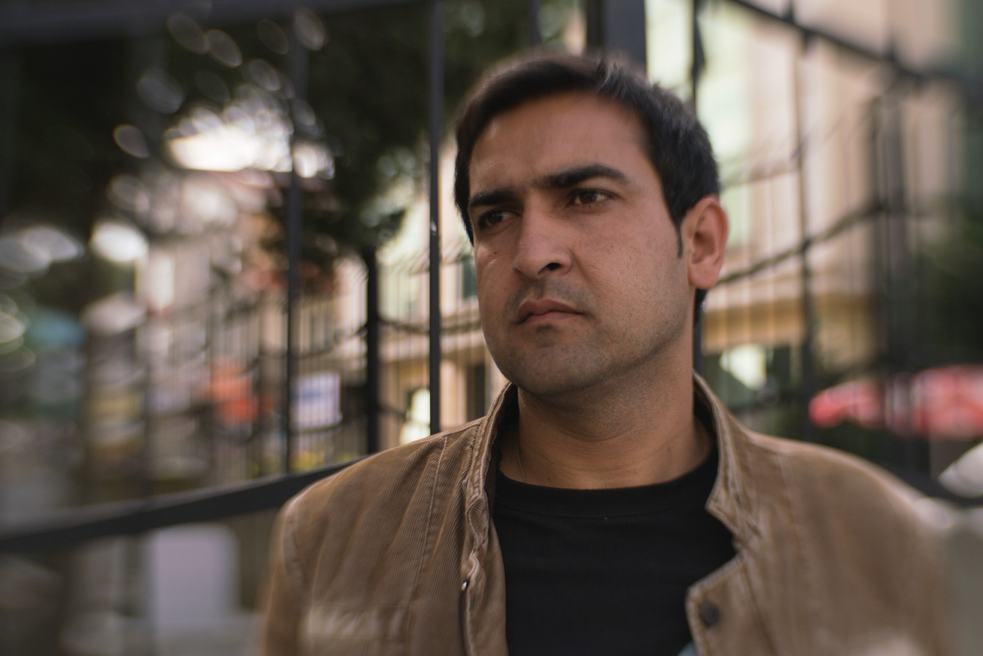
A photo essay on the ongoing struggle of Korean “comfort women”
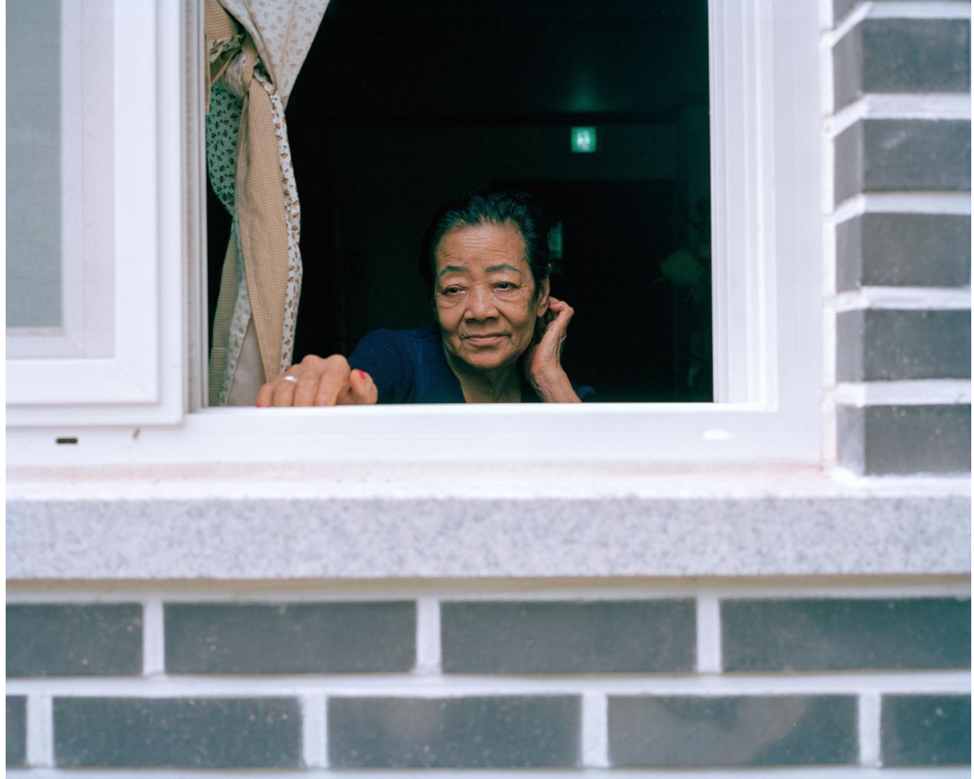
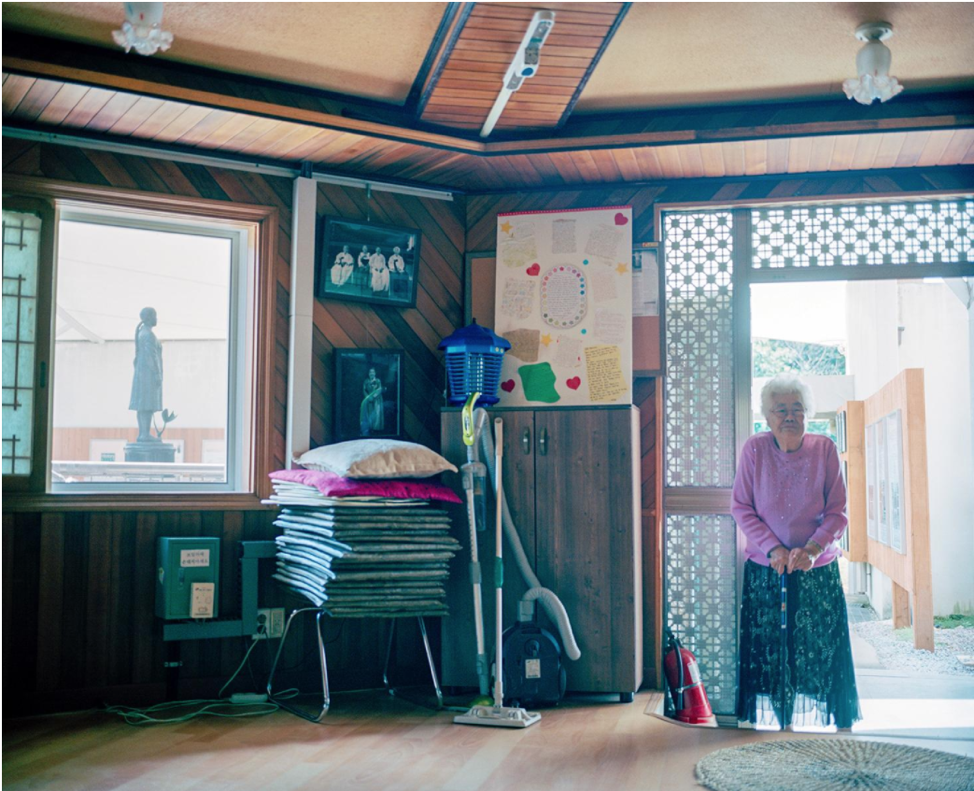
Kim Hwa Seon Halmoni looking out, House of Sharing, Gwangju, South Korea, 2010
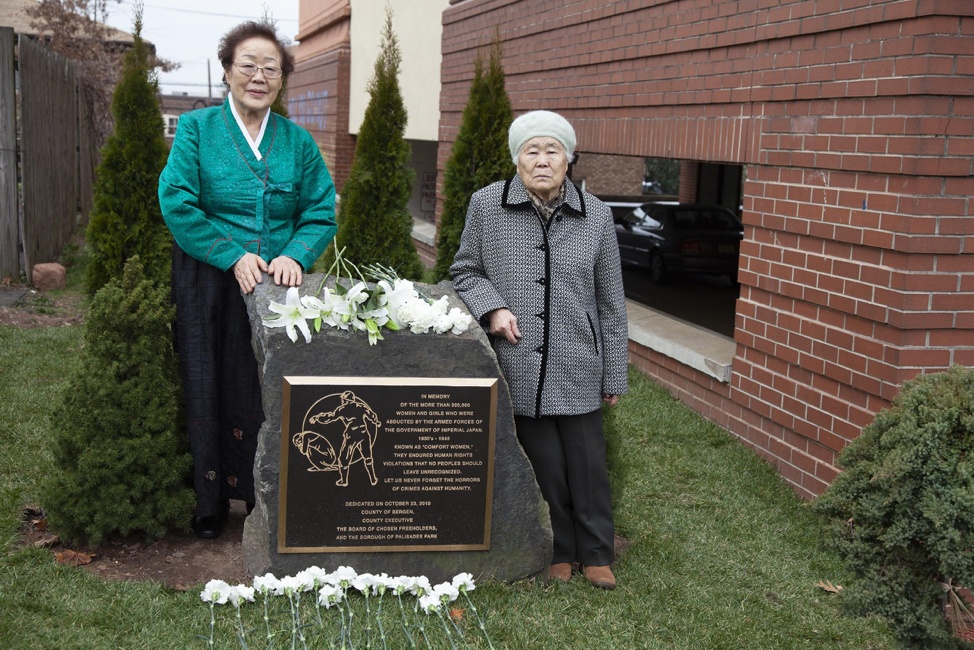
In 2010, I visited The House of Sharing, a residence and nursing home outside of Seoul, South Korea, for former Korean “comfort women.” It was founded in 1992 by funds raised by Bhuddist organizations and civic groups. “Comfort women” is a euphemism for females (mostly teenagers) who were forced into sexual slavery for the Japanese Imperial Army during the Second World War. These days, Koreans endearingly refer to them as “halmonis” (grandmothers). Despite the overwhelming number of testimonies and historical evidence to support their claims, no acceptable apology or legal reparations have been offered by the Japanese government. The idea for these portraits began when I got involved in creating a memorial for the halmonis. The memorial, now completed, is the first one dedicated to such women in the Western world.
Lee Yong Soo and Lee Ok Seon Halmonis visit the memorial, Palisades Park, NJ, 2011
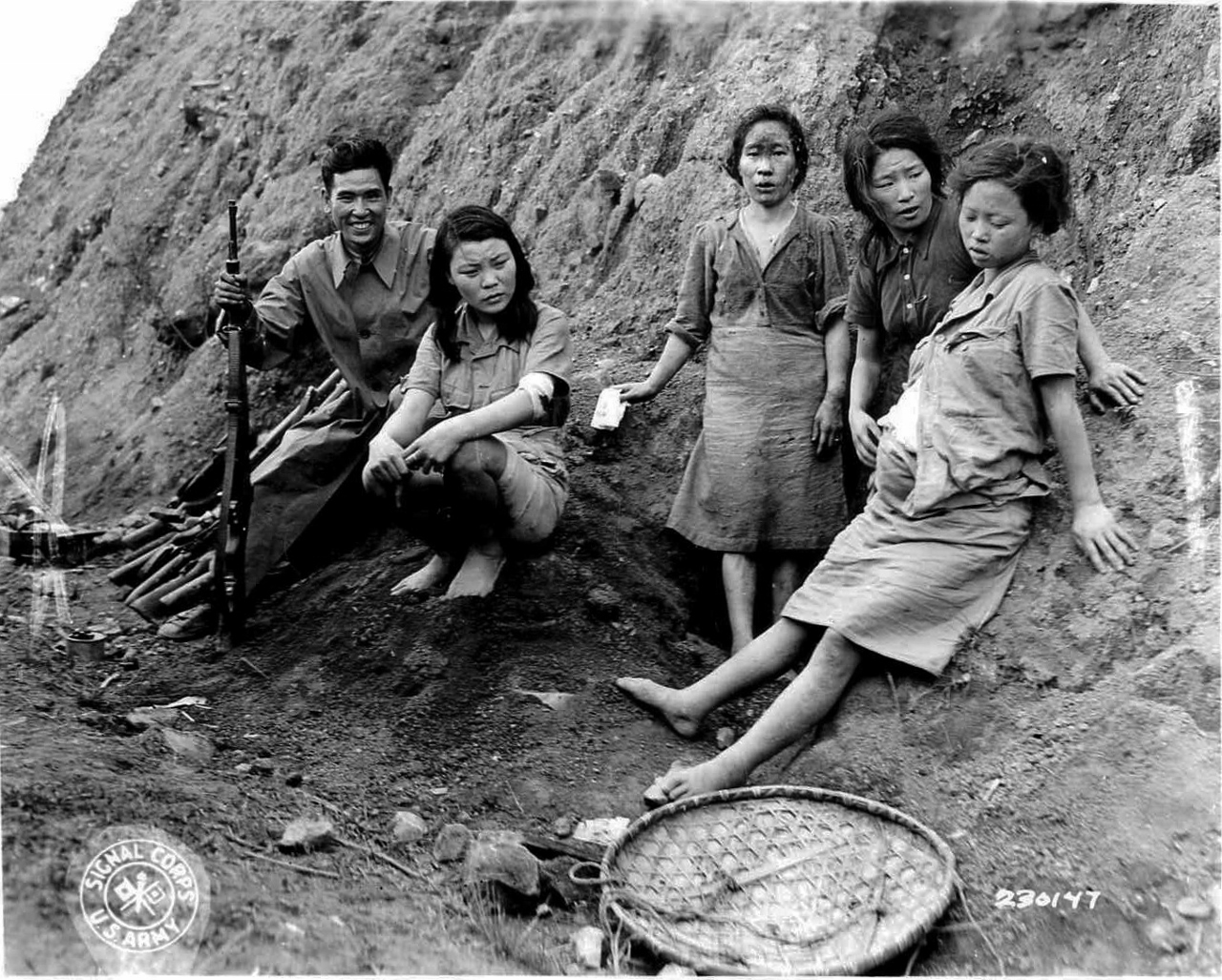
Chinese soldier with Korean ‘comfort women’ after they were liberated by US-China Allied Forces, Songshan, Yunnan Province, China. September 3, 1944 Photo by Charles H. Hatfield, U.S. 164th Signal Photo Company, US National Archives
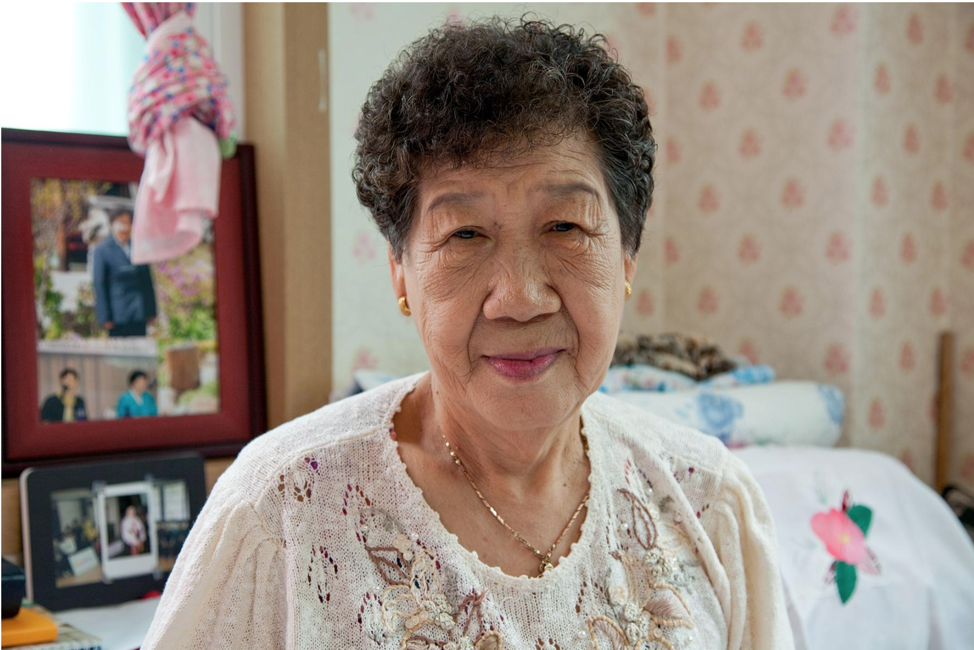
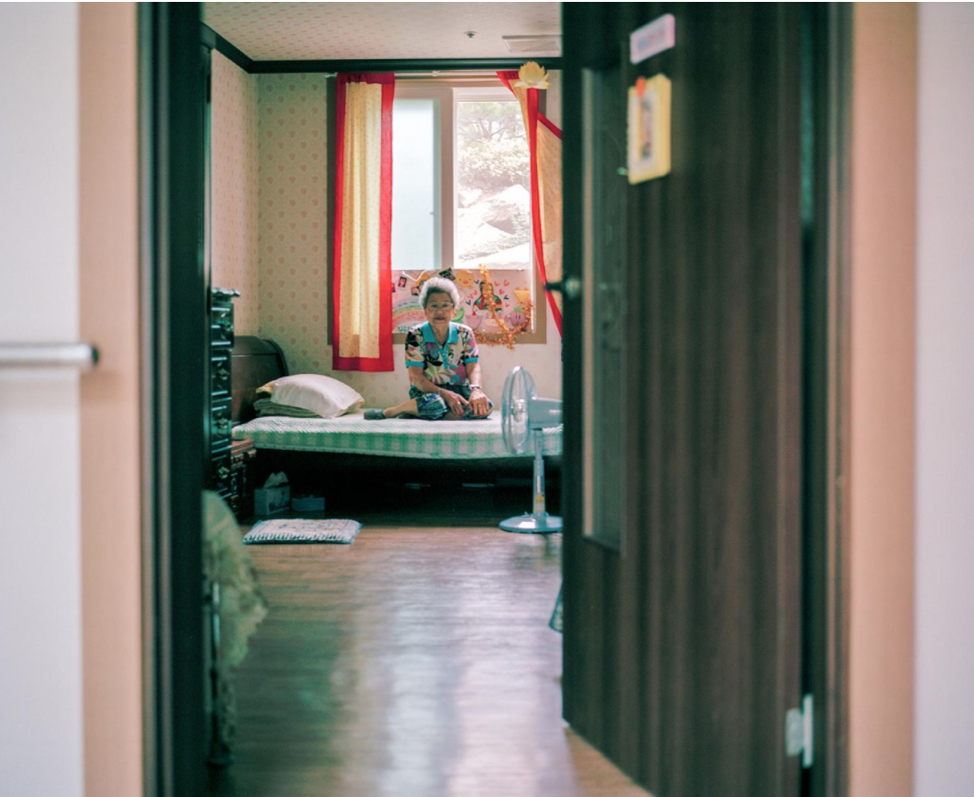
Kang Il Chul Halmoni in her room, House of Sharing, Gwangju, South Korea, 2010
Kang Il Chul Halmoni looked up from her chair as locks of her short curly hair floated to the floor. I bowed: “Annyeonghaseyo.” Kang Il Chul Halmoni was born in 1928 in Sangju, a town in southern Korea. In 1943, when she was 16, a military officer abducted her. She was taken to Manchuria, where she was forced to work in a Japanese military “comfort station”. Fortunately, Korean independence fighters rescued her. After the war, she remained in China and later served as a military nurse for Korean communist troops. Upon her discharge, she moved to Jilin City and married a Chinese man. She returned to Korea in 2000.
Walking outside, I saw Lee Ok Seon Halmoni sitting on a bench under the statue of a young girl wearing a hanbok, her face framed in a white halo of hair looking at the distant mountains. “Don’t take my picture,” she said. I put down my camera.
Lee Ok Seon Halmoni in the doorway, House of Sharing, Gwangju, South Korea, 2010
But over the next day, the halmonis gradually warmed up to me. They began asking me questions about my life in America. They told me stories, summarized the latest television dramas, and showed me their garden. I painted their nails, we listened to music, and looked through their albums together.
Kim Hwa Seon Halmoni insisted that I take a picture of her in her hanbok. But after she lay down to get a massage from a young mother and her two daughters, she closed her eyes. “Maybe you should just take one of those pictures on my wall, one where I’m wearing a hanbok.”
Kim Hwa Seon Halmoni with visitors, House of Sharing, Gwangju, South Korea, 2010
Hours before sunrise, I awoke from the tapping on the hollow gourds keeping rhythm with the monks’ prayers. I thought of the things the halmonis had told me, and what I’d read in my research. “I was poor and hungry.” “I was taken from my own home.” “She was sold by her father, twice.” “Stricken with typhoid fever, she was taken to be cremated alive.” “If I didn’t do what they said, they would slash your clothes and shove the knives into your private parts.” “It was no place for humans.”
I closed my eyes. The tapping and prayers intensified.
Kim Soon Ok Halmoni in her room, House of Sharing, Gwangju, South Korea, 2010
In Korea, there is a concept of a collective emotion called “han,” a word that embodies the sentiments of Koreans having been colonized, a kind of unity that is inherent in their collective sorrow, a darkness from where beauty can emerge.
When students protest with the halmonis in front of the Japanese embassy every Wednesday, it is with this sense of han. It is their history too.
As a Korean woman, this project was motivated not only by this same desire, but also in hopes of creating a visual narrative about their lives beyond their victimhood. I realize that it’s more than just revisionist history that threatens their cause, it is also the sensationalism around their experiences that people try to fuel their own causes, like a photographer who profited off their images, or an activist who used their money to advance her political career.
It has been exactly a decade since I shot this series. There were 63 known Korean survivors in 2010. Today, only eighteen remain.
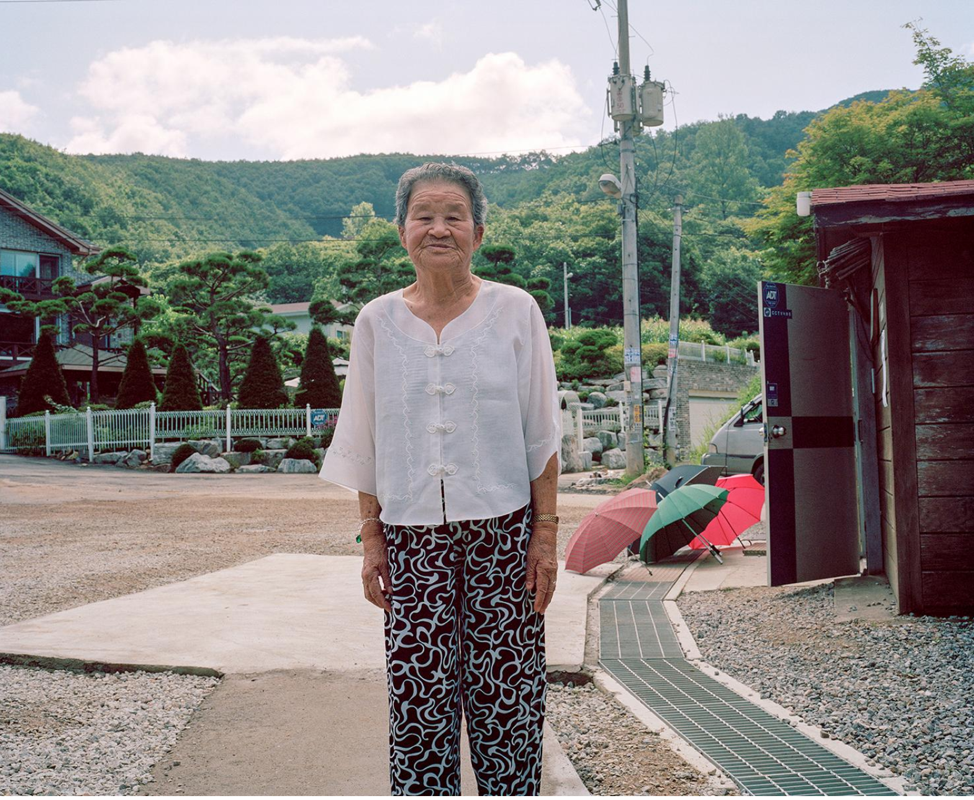
Park Ok Seon Halmoni and umbrellas, House of Sharing, Gwangju, South Korea, 2010
New Essay by Joshua P.F.: Bombs in the Trash
It was a relatively clear and cool night in the spring of 2008 on our fortified U.S. compound, Camp David, which was co-located on the property of the Najaf Technical University at the southern end of Najaf, Iraq. I was smoking hookah and watching Arabic TV with our local Iraqi guards, something I did nightly, when my Captain, a West Point grad, sheepishly poked his head in the door and asked if we could talk. Of course, I said, then passed the hookah’s hose to the Iraqi next to me, ensuring the tip was pointed back toward me so not to give offense (passing the phallic hose’s tip facing outward is considered vulgar). I rose, then walked to the door.
My Captain, a tall, thin, dirty blond in his late 20s, was in uniform: combat boots, ACU bottoms, and a military-issue fleece top; I, on the other hand, was wearing my usual ensemble: Vibram-soled Merrell hiking boots, Dickies work pants (a California staple of ‘90s skate culture), plaid snap-button shirt, and a navy-blue nylon windbreaker.
“What’s up, Sir?” I asked.
He scanned the room pensively. There were no other Americans around, just the two of us, and our non-English-speaking guards inquisitively throwing casual glances away from the TV toward our conversation.
“Soooo….” he began to say. “I’ve heard you take little trips outside the wire in civilian clothes…”
I looked at him, trying to keep my expression neutral. The accusation, though true, was quite salacious. U.S. Military personnel in Iraq, even Special Forces like he and I, were strictly confined to the guarded installations, Military Camps and FOBs, and only left under direct orders to conduct a mission or move to another installation. When leaving “the wire,” soldiers travelled in convoys of heavily armored military vehicles with guns big and small, medical supplies, commo gear, and anything else needed for a prolonged fight. No soldier would want to venture out alone as a vulnerable civilian–logically it didn’t make sense.
“…if you happen to be out tonight, do you mind checking to make sure the MSR is clear?”
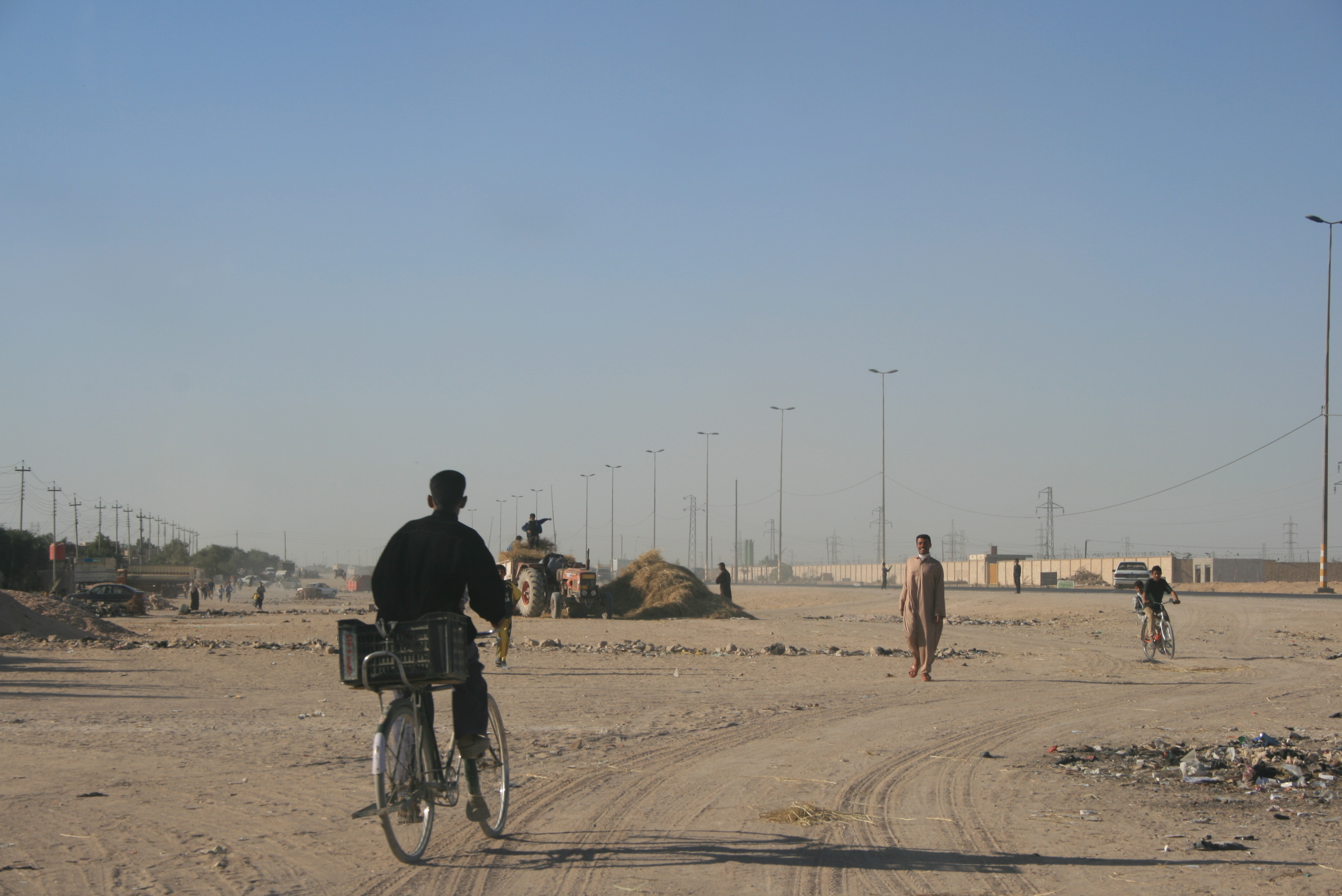
Clear, I thought to myself. What does he mean by clear? I asked. The Captain explained his concern that there might be something hidden in the roadside trash (sporadic piles of trash line every major road in Iraq) on the MSR (Main Supply Route) in front of our compound. Apparently, he’d read some intelligence cable claiming terrorists were threatening to disrupt U.S. Army convoys in the region with IEDs, and he was apprehensive about his resupply run the following day. This didn’t surprise me. I’d seen Special Forces officers refuse to get out of armor-plated trucks during a mission, fearing stray bullets. I’d known Special Forces commanders who reject orders of battle that position them at the head of a convoy, fearing roadside bombs that often target the first truck.
I reiterated his request in more direct language: “So you want me to go outside the wire in civilian clothes and dig through trash piles looking for bombs?”
His response: “Basically, yes, if you’re out already.”
I asked again. Maybe he was tired and didn’t understand the ramifications of his request. He wasn’t suggesting an official military mission with bomb detection technology and protection gear; he was proposing that I go out, unsanctioned and unprotected, into what was technically a war zone, risking my personal safety to ensure his. What if something happened, like if I was kidnapped or blown up? Surely this would get him in trouble, maybe even court martialed. He was such a straight arrow, a by-the-book kind of guy. Why would he risk this?
Was he really that scared?
Was he a coward endangering someone else for his own protection?
But in my Captain’s defense this wasn’t an order, like how they say in movies “that’s an order!” It was more like a suggestion, and I felt free to decline his request (although consent becomes fuzzy when there’s an asymmetry of power: he a captain and I a sergeant). Actually, I think he was asking me for a favor, that’s probably the best way to describe it. And that surprised me more than anything.
He and I’d had a rocky relationship up to that point. To be honest, I’ve had a rocky relationship with authority my entire life. This came up in my psychological evaluation during Special Forces selection, and I was almost kicked out over it. Fortunately, they let me pass with the excuse that I was young and would therefore age out of my rebellion, which I don’t think ever happened. So I don’t think my Captain knew what to do with me. I, and a few others on the team, often did things without asking his official permission and ended up begging for his forgiveness after. I never hesitated to do what I thought was right. He hated that, but he needed me. I was one of the more senior members of the team, and I ran all of the HUMINT (human intelligence) operations.
So maybe this favor was a proverbial olive branch, a way for me to get back into his good graces. Or maybe it was the other way around, maybe he felt like a disrespected outsider and wanted to be included in our extracurricular activities. Maybe he wanted my respect? It was no secret that I thought of him as weak and ineffectual. That’s how we were taught to think of officers; and most I’d encountered (but not all) lived up to those expectations.
*
To add to the confusion that night, I think I’d been drinking with our Iraqi guards. Technically, U.S. soldiers in Iraq weren’t allowed to drink alcohol, but I and a few others on my team were released from General Order No. 1 so we could drink during meetings with intelligence sources. Of course we abused the privilege. I’ll confess that once or twice my team (minus the Captain) got drunk and then went out looking for a fight.
Anyway, I gave my Captain one last chance to retract his request.
But like a good officer, he stayed the course: “Let me know if you find anything!”
Dumbfounded, I went to get Jim, our Senior Weapons Sergeant and my partner in crime. Jim is an interesting guy, physically imposing, sort of a redneck, and up for anything; he definitely fit the stereotype of an SF dude. And he’s one of the most kind and loyal people I’ve ever known, though we did have some heated arguments.
“What the fuck?” Jim asked. “Is he serious?”
“Yeah, I think so.”
“This is fucking ridiculous.”
“What isn’t?”
“He’s such a fucking pussy…”
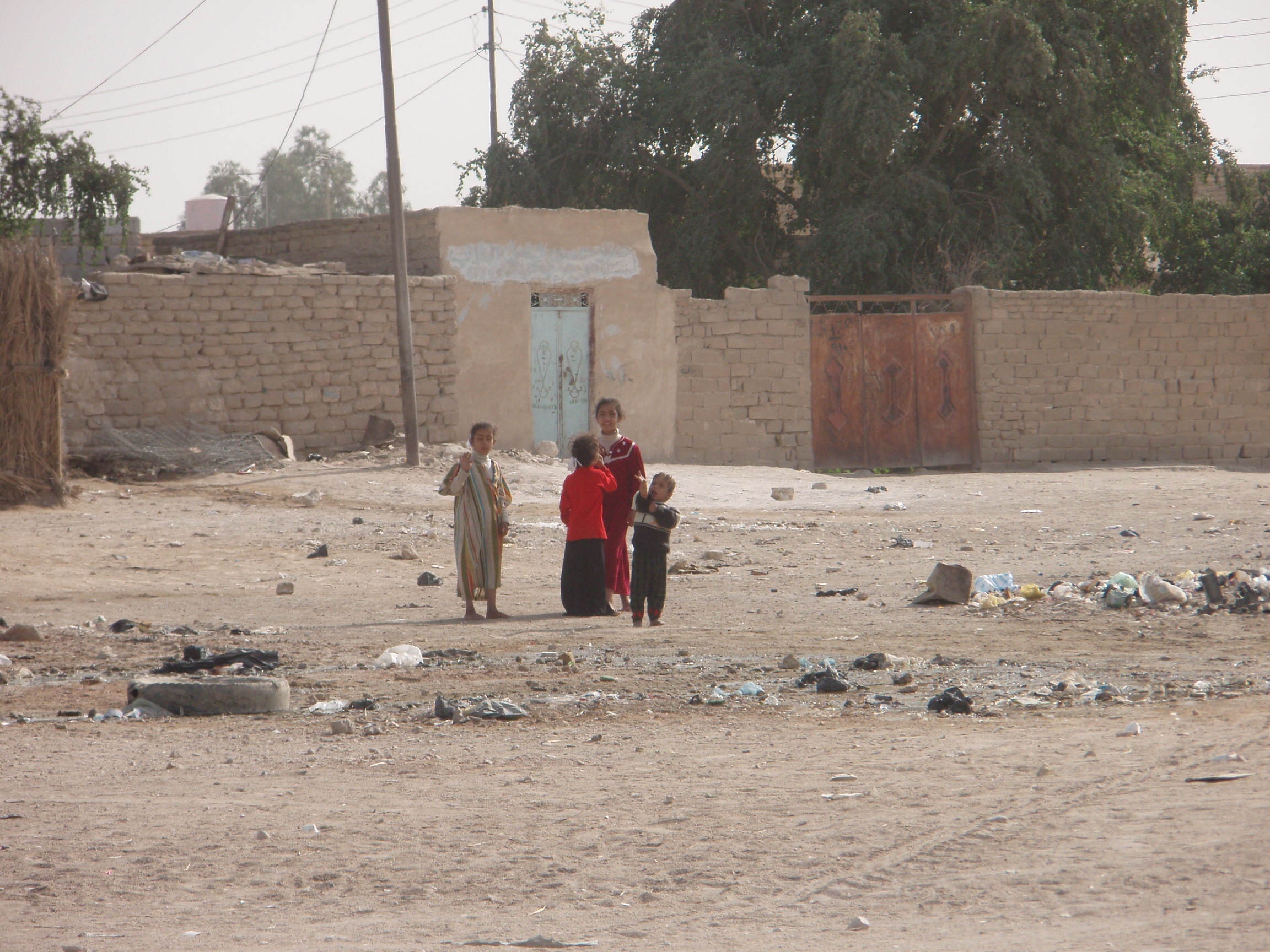
Jim and I continued to discuss the bizarre tasking. We couldn’t deny his accusation: in the past few months, Jim and I, along with an interpreter, had on several occasions dressed up like locals and quietly snuck off our compound. Sometimes it was to meet an intelligence source, or attempt to recruit a new source, and sometimes it was just for fun, like to go to a restaurant or sightsee. There weren’t many places in Iraq where U.S. soldiers could get away with this sort of thing in 2008, especially in southern Iraq, but Najaf was a relatively peaceful city because of all the Shia holy sites that brought over a million tourists every year, mostly from Iran. As long as we kept our mouths shut and dressed like locals, people would hopefully assume we were light-skinned Iranians on holiday.
So it was far from unreasonable for Jim and I to accept our Captain’s secret mission. We were frankly bored in Iraq, and we’d do almost anything, no matter how dangerous, to get the wartime experiences our egos craved–that’s why we joined Special Forces. Despite the military’s emphases on rules, structure, and hierarchy, many soldiers (especially in Special Forces) flagrantly break those rules with the excuse of “making mission,” as we called it, with little to no thought of the repercussions. This, at least in our minds, seemed heroic. So how could we refuse our commanding officer’s tacit permission to break the rules, knowing there was a chance we’d uncover IEDs and potentially save American lives?
“At the very least,” I told Jim, “this will make for a funny story later.”
“Yeah, if nothing fucking happens.”
“Right…” I said looking at Jim. I could tell he didn’t particularly want to go, but we’d spent so much time talking shit about others on our team, like the Captain, how they were weak, how they were pussies, that I think we both felt saying “no” would have made us hypocrites, and potentially cowards. My pride couldn’t handle that.
Jim looked at me. He wasn’t going to back down if I was in.
“Let’s just do it,” I said.
“Fine.”
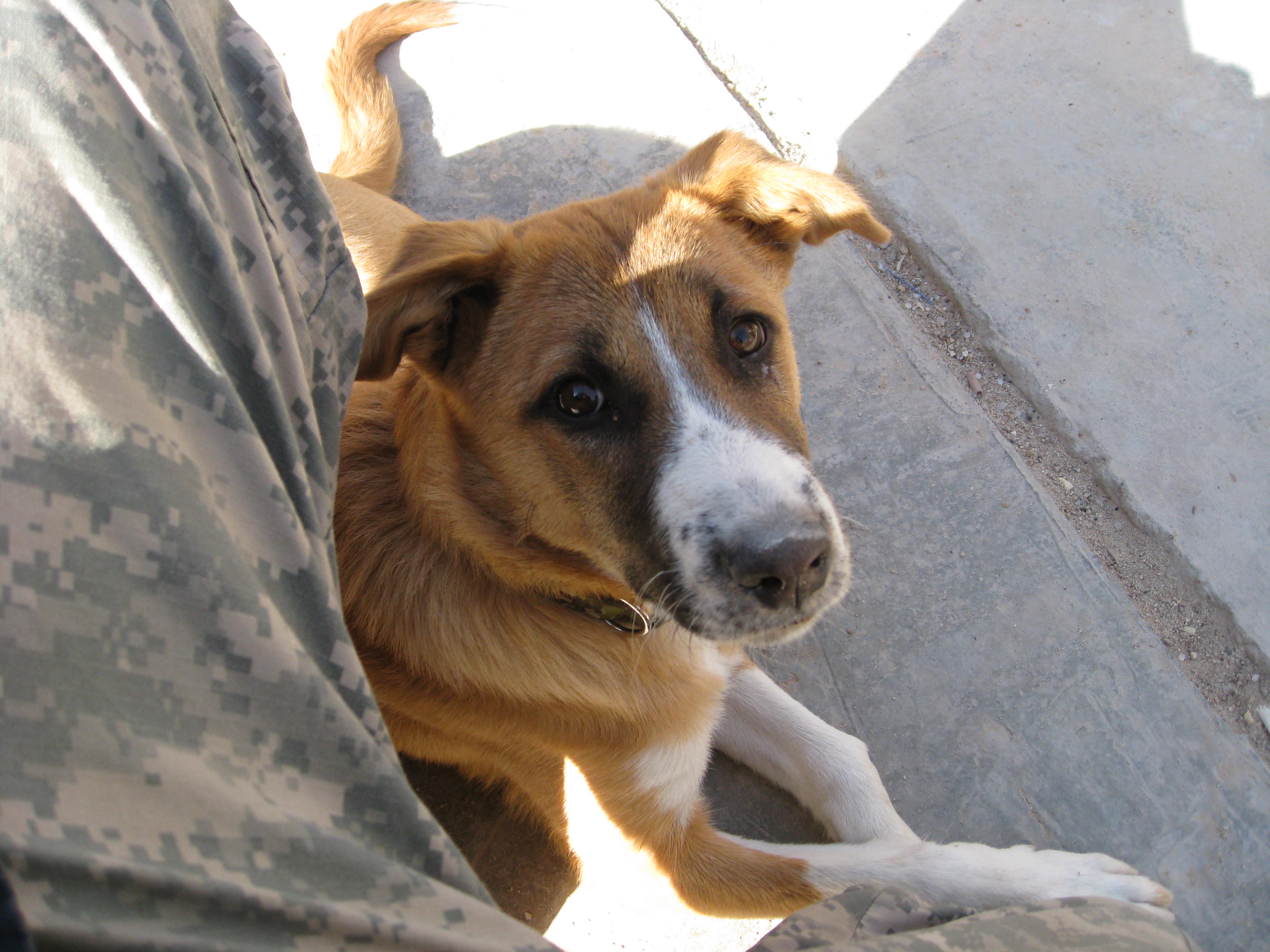
Jim and I decided not to bring an interpreter on our trash-digging escapade since we weren’t expecting to meet anyone that night. But we did bring one of our local Iraqi dogs, Willy. Willy had an athletic, medium build, droopy sad eyes, and a burnt orange and white coat. We thought he’d happily dig through trash piles looking for uneaten food and expose any explosive devices. We loved that dog and we’d hate to see anything happen to him, but if someone was going to get blown up that night, better him than us.
Jim and I chose to drive our newly acquired covert POV (Privately Owned Vehicle), a white Toyota 4-Runner with ballistic glass, steel-reinforced doors, and armored seats. Wearing civilian clothes, we grabbed our body armor, Glocks, M4s, bugout bags, and the dog, then jumped into the SUV. We exited our compound through the main gate onto a side road. It was after midnight and the Iraqi gate guards gave us funny looks; I can’t imagine what they thought (there were all sorts of rumors swirling around about our activities in Iraq, like that we were putting sharks in the aqueducts to eat children). We drove a few hundred meters down the main road, and then we stopped at our first large pile of trash. The houses on that MSR were set back pretty far back from the road, so there was plenty of room for us to park in the dirt. And lots of trash.
At the first pile, we opened the car door and shooed Willy out. Of course, the scaredy-cat looked at us, then looked at the open door, then whimpered. We tried to pull him out, then we tried to push him out, but Willy absolutely refused to exit the vehicle. I think he was afraid we’d leave him out there, outside of our cozy compound. Iraqi dogs have a harsh life in the unforgiving desert, but live in near luxury on U.S. military camps (I bet the Iraqi dogs think we invaded the country just for them. And who knows, maybe we did).
So, Jim and I had to search the trash ourselves. Our first instinct was to take turns; one would stay inside the protective vehicle while the other checked a trash pile, and then we’d switch. But neither of us could stomach the thought of watching the other get blown up while cowering in the truck, survivor’s guilt and all. So we got out together. Willy still stayed in the truck though. I think he was the only one that night thinking clearly.
We carefully approached our first pile of trash. Jim extended the muzzle-end of his rifle into the pile and carefully turned over several pieces of trash. I followed suit. Willy watched suspiciously. Nothing, thank Allah.
We searched through a few more piles, fortunately still nothing. Then we moved farther down the road, still nothing. Just as we were about to give up for the night, Jim and I looked up to see lights flashing in the distance. We were on a main road next to a suburban area a couple miles south of downtown Najaf, and not surprisingly, we attracted the attention of local residents who probably assumed we were actually planting IEDs, not looking for them, and called the police. So just when we thought this night couldn’t get any weirder, Jim and I looked at each other.
“We’re about to get arrested, in Iraq.”
As we watched the lights approach, I tried to imagine what the police would think, rolling up on two bearded, heavily armed white guys in western garb rummaging through piles of trash after midnight.
“What the fuck are we going to do?” Jim asked.
“Uh, I don’t know… but we may know these guys.”
The cops arrived, a pickup truck loaded with Iraqi police officers brandishing AK-47s. We lifted our hands to present a non-threatening posture, and I offered the traditional greeting, “salaam a’layk.” Then I quickly told them we were American soldiers stationed in Najaf: “Ihna Amreekan, saakin gareeb minna.” Then I asked, in more broken Arabic, what police station they were from. Their response: the station about a mile southeast of the city limit. This confirmed my suspicions. We did know these guys, unfortunately.
*
A few weeks prior, our SF team in armor-plated, turret-mounted-.50-Cal Humvees descended upon the Iraqi police station at the southern end of Najaf, about a mile east of Camp David, in a “show of force” unsanctioned by our Captain.
We were pissed.
It was common practice for police in Iraq to arrest someone on fictitious charges and extort money from his family for release; the Iraqi police were considered quite corrupt by the general population. But unfortunately for this particular cohort of extorting police officers, their hostage was one of our coalition partners, a soldier from the Iraq Army unit located on the northern end of Najaf. This unit came to Camp David several days a week for training, and we conducted joint combat operations together. So we were pretty close with these guys.
The kidnapped soldier lived in the neighborhood next to Camp David, and after he was arrested, his wife and a few fellow Iraqi soldiers quickly rushed to our compound to inform us. At this point in the deployment, we were sick and tired of watching our collaborators get exploited and sometimes slaughtered while we stood idly by, usually waiting for bureaucrats to sanction intervention. So this time, before any military officers could debate the appropriate course of action, or more likely just schedule a meeting to discuss who’d be in charge (who’d get to take credit), we decided to grab our guns, pile into our military vehicles, and rush to the Iraqi police station to conduct an impromptu rescue operation.
Our Captain wasn’t consulted.
We pulled up to the police station aggressively, jumping the curb and nearly ramming one of the buildings. We trained our .50 Cals on blind corners and quickly exited the vehicles. We swiftly disarmed each cop we encountered as we made our way to the headquarters building. We kicked in the door, pushed everyone up against walls, and demanded to speak with the person in charge. He timidly revealed himself, a short pudgy dark-skinned man.
We yelled. We bullied. We demanded. And out-gunned, the police chief relented (thank Allah this went as well as it did).
We got our guy back and tucked him into one of our gun trucks. Then we thought it’d be funny to disarm the Iraqi cops, so we grabbed all their heavy weapons, about 4 “BKCs” (Russian PKM machine guns) and a few AKs, and brought everything back to our compound. We laughed all the way home.
But our Captain didn’t find it funny when several Iraqi police officials showed up at Camp David an hour later complaining about what we’d done and demanding their weapons back. Our Captain came undone, red-faced and nearly hyperventilating, yelling at us:
“What the fuck were you thinking!” He kept repeating, almost to himself.
Jim and I looked at him but didn’t respond. The Captain was in no mood to hear our excuses, or argue. He was angry, yes, maybe uncontrollably angry, but I think he was also deeply embarrassed. And afraid. Our Captain was afraid of injury and death, much more so than Jim and I were, we already knew that, but I think he was also afraid of something else, maybe his biggest fear: ruining his military career. This was the first time he’d personally had to face our action’s consequence, and I suspect he feared word might get back to his (and our) superiors. We’d get a slap on the wrist and probably a chuckle, but since he was technically in charge, he’d surely be scapegoated for our actions.
“You better give the fucking guns back!” he continued.
Jim and I still didn’t respond. Then we quickly walked away before our discomfited Captain realized we weren’t taking him, or this threat to his career, seriously–in our minds, the only thing to fear was cowardice. We knew we’d pushed him over the edge, but that just made the situation even funnier for us. We laughed awkwardly as we weighed our options. But we didn’t have much of a choice. So begrudgingly, we gave the guns back.
I wondered if the Captain would ever speak directly to me again. He did of course: a few weeks later he tasked me with a secret mission to dig through trash looking for bombs.
*
So needless to say, Jim and I were a little apprehensive when a truck full of these same Iraqi police, with their weapons, emerged out of the darkness. This time we were the ones outgunned.
Gesturing to us and the surrounding area, one of the cops asked what we were doing: “Shitsawi hun?”
Willy could be seen through the windshield peeking over the passenger seat.
“Walla inshoof a’la mutafegiraat [we’re looking for bombs],” I said. I expected a laugh, I thought the situation was pretty funny; but they just stared. I continued to explain, or at least attempted to explain, that our commander heard there might be an IED on this road and we were searching for it. I asked if they’d seen anything: “itshoof walla ishi?”
“Lah,” was the curt response; they showed no interest in continuing our conversation. I could tell they were confused, maybe by my shoddy Arabic, and they must have thought we were complete idiots (which we were of course). Then without offering to help, they abruptly left us there on the road. “Bishoofak ba’adayn,” see you later fellas.
Jim and I left too.
On the ride back, Willy was finally at ease.
Back at Camp David, Willy happily bounced out of the truck. I think he was ready to call it a night and snuggle into his warm bed (he slept with one of the interpreters).
“Now he finally gets out of the truck,” I said to Jim.
“Fucking pussy,” Jim said with his usual levity, and a dip in his lip. Then he spat on the ground.
Willy scampered into the interpreters’ building. He’d survived another day of our crazy war. And he’d have to survive many more days to come. We’d all soon go home, back to the U.S. to get on with our lives and military careers, but Willy would stay. Deployment after deployment, SF team after SF team, Willy would have to find a way to survive. We didn’t understand that. We never thought about the long-term consequences of our actions.
“Let’s go tell the Captain,” I said.
We found him waiting outside our team room in a small courtyard, looking up at the stars. “What did you find?” he asked.
“Nothing, Sir.”
“Good,” he responded casually, and went back inside.
And that was that.
*
About a decade after I left the military, I saw my Captain in the dining facility of a compound belonging to one of the most elite units in the Special Operations arsenal. I had since gone back to school to study physics, graduated with an engineering degree, and was now hawking high-tech solutions and methodologies to problems the U.S. government wasn’t yet facing. Jim had retired after a long and successful career in the Army, and was now building his redneck dream home in the hills of rural Tennessee. And there was my former Captain, who was probably a Lieutenant Colonel or even Colonel by now, standing near the salad bar.
I hadn’t seen him since leaving Iraq in 2008, but he looked about the same, maybe a little older and a little stockier. I was the opposite, about 30 pounds lighter from sporadic bouts of fad dieting. We were both in civilian clothes, but I could tell he was still “in the fight”: probably hunting the next Abu Musab al-Zarqawi or Abu Bakr al-Baghdadi. Well, not hunting himself. I’m sure he still sent enlisted soldiers to do the fighting. But even then, I envied these soldiers, the simplicity of their mission. I still imagined their experiences capturing and/or killing HVTs (High Value Targets) most closely aligned with my idealization of the heroic military life. In contrast, my experiences digging in trash looking for bombs felt meaninglessly reckless.
When I first saw the Captain, I reflexively smirked. Look who it is, I said to myself conceitedly as chills ran up and down my spine. But how could he be here, amongst the bravest of the brave? The best of the best? How could they not see him like I did, as a coward who sent others into harm’s way for his own protection and professional advancement? I knew in that moment, even after ten years, I still wanted to feel superior to my Captain. I still wanted to see him as the career-obsessed coward, and me, in opposition to him, the self-sacrificing soldier willing to risk everything, break any rule, to do what was right, what I thought was right.
But I also knew I was wrong. There’s nothing right in war. My smirk had always been a defense mechanism hiding something deeper. I felt it almost immediately. It welled up in my stomach, my mouth relaxed, my countenance dropped. In Iraq, I just wanted the experiences of war—to feel what it felt like to be a hero—with wanton disregard for any of the long-term consequences suffered by the Iraqi people. But now, seeing my Captain, who after ten years had reached the pinnacle of the “heroic” military system I’d envied, I could no longer pretend. My actions overseas, disrupting a country in which I didn’t belong, weren’t brave. They were an attempt to live out a juvenile fantasy. Thinking my Captain a coward was just an excuse to justify this selfish pursuit.
I took a step in my Captain’s direction. There was one thing left to do, the right thing. I needed to say, “I’m sorry.” I was sorry for how I treated him. I was sorry for who I pretended to be. I was sorry for almost everything I did in Iraq. But for some reason, I hesitated, and he walked out of the room.
I guess that makes me a coward too.
New Op Ed from Teresa Fazio: This Memorial Day, Let’s Honor Essential Workers
In the first weeks of lockdown, I paced my two-room Harlem apartment, feeling trapped while an unpredictable threat loomed. After a few days, it clicked— the collective need for vigilance and protective gear had stoked memories of my deployment to Iraq as a Marine Corps officer. There, rocket and mortar attacks had punctuated long periods of boring routine for my communications company colleagues and I. In the early evenings, our company’s evening brief provided solace and companionship.
In the midst of the pandemic, that version of nightly comfort became the Twitter feed of Columbia’s Department of Surgery—a daily summary of pragmatic encouragement, written by its eloquent chair, Dr. Craig Smith. He used familiar military jargon of staff “redeployments” and “battlefield promotions” for emerging medical leaders. He wrote about colleagues infected with COVID, and one who committed suicide.
This Memorial Day, as Dr. Smith and other first responders lose colleagues on a scale not seen since 9/11, and supply chain personnel from meatpackers to grocery clerks risk infection to keep America fed, we should extend honors to all of the essential workers who’ve given their lives. Doing so would help unify the nation and bridge the military-civilian divide.
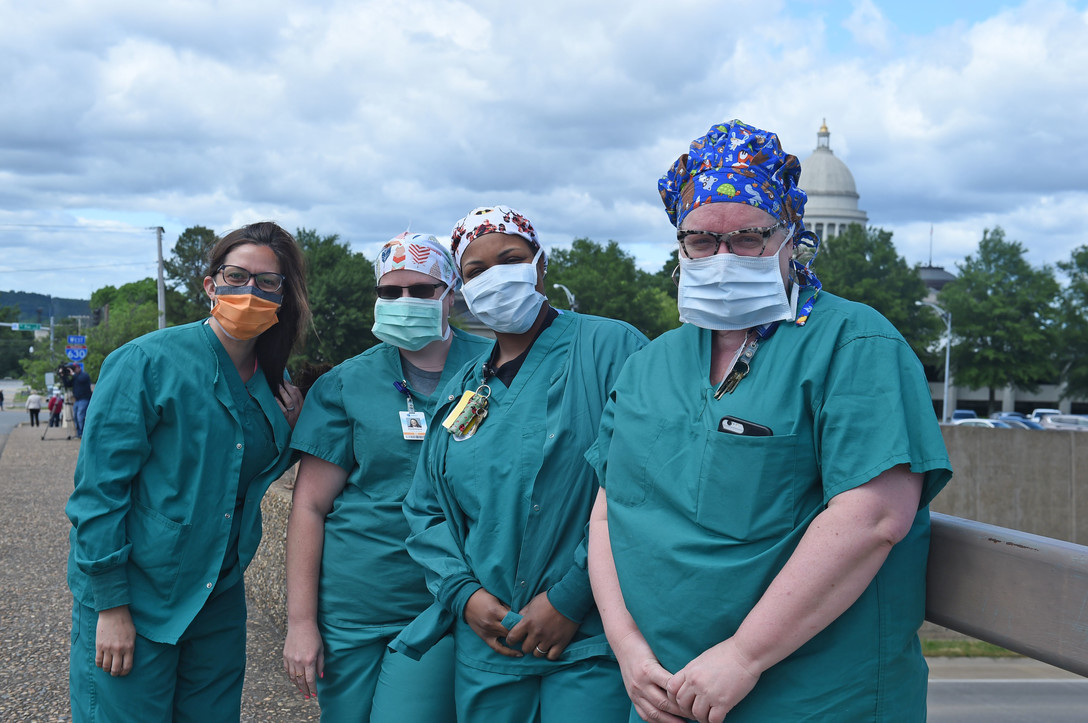
Healthcare workers watch U.S. Air Force C-130s from Little Rock Air Force Base fly over Arkansas, May 8, 2020.
Only about 1% of US workers currently serve in the military, but according to the Bureau of Labor Statistics, an equal number serve as firefighters and law enforcement. A whopping ten times that number— more than ten million people— work in healthcare professions as doctors, nurses, EMTs, and hospital personnel. Transportation and delivery workers— warehousemen and truckers who transport everything from asparagus to zucchini— make up another 10% of American workforce. And that’s not even counting agricultural, food, and maintenance workers. A mid-April CDC report listed at least 27 US healthcare workers dead of COVID, a number that has undoubtedly grown, and the Washington Post reported over 40 grocery store worker fatalities in the same time frame. As of early May, about 30 firefighters nationwide have died of the virus, too. The NYPD alone lost over 30 personnel to the pandemic, and national police casualties count dozens more. Like troops in a war zone, those essential healthcare, public safety, and logistics workers now face a wily, invisible enemy every day. Paying respects to their fallen just as we veterans honor our own would mean acknowledging that it takes everyone’s service to help us get through this crisis.
Coronavirus is forcing businesses and governments to acknowledge the dignity of the blue-collar and service-industry workers who make our vast supply chain possible, similar to the physical work we honor in common servicemembers. In April, the United Food and Commercial Workers International Union (UFCW) issued a joint statement with Stop and Shop calling on the government to classify grocery workers as “extended first responders” or “emergency personnel.” Moreover, in Passaic, New Jersey, a firefighter’s coronavirus death prompted a mayor to ask for state legislation to classify it as a death in the line of duty, which would entitle his family to additional benefits. We can’t bring these workers back, but we can honor them by helping their families recover, and funding their children’s educations—just as we do for fallen service members. If, as Fed chair Jerome Powell said, we are facing an economic downturn “without modern precedent,” one piece of recovery will be financial remuneration for those who have sacrificed in the name of keeping the country running.
Emotional support is necessary, as well. Medical professionals who triage an avalanche of patients decide who lives and who dies. We don’t yet know how many of them will suffer PTSD or moral injury from scenes like overflowing emergency rooms. In the past month, New York Presbyterian emergency room physician Dr. Lorna Breen and FDNY EMT John Mondello committed suicide in the wake of treating an overwhelming number of coronavirus patients. Military veterans who have rendered first aid at the scene of IED blasts, rocket attacks, and similar catastrophic mass casualties know these emotional scenarios all too well. Losing colleagues with whom one has served side by side— and perhaps blaming oneself for failing to protect the sick and wounded, even in an impossible situation—are experiences many troops know intimately.
Whenever well-meaning civilians called me or former comrades heroes, we often told them, “The heroes are the ones who didn’t come back.” I suspect some of the medical professionals I now call heroes would say the same thing. Which is why we must honor the fallen without putting all those who serve on a holy pedestal. Veneration of the dead without practical follow-up care for the living only alienates trauma survivors; it doesn’t help them reintegrate into society. Military veterans have learned this the hard way; recent Memorial Days have included remembrances for troops who have died by suicide. So in addition to honoring essential workers who have died from coronavirus, we must treat the burnout and PTSD from those who survive, especially in the medical professions, so we are not remembering them as tragic statistics in future years.
Columbia’s Dr. Smith wrote a total of 59 nightly missives, each offering comfort and guidance to my anxious-veteran mind. In the meantime, the United States has lost over 83,000 people to coronavirus. In memory of them— 83,000 parents, first responders, warehouse workers, delivery persons, doctors, nurses and counting— let’s expand this Memorial Day to honor essential personnel, with the aim of creating a more united America.
Editor’s note: Teresa Fazio’s memoir, FIDELIS, is forthcoming in September 2020 from Potomac Books.
Reading Camus’ ‘The Plague’ in 2020: A Dispatch from Lyon, France, by Jennifer Orth-Veillon and John Tyrrell
“It is as reasonable to represent one kind of imprisonment by another as it is to represent anything that really exists by that which exists not.”
20th-century French writer Albert Camus chose these lines penned by Daniel Defoe as the epigraph for his novel, The Plague. It may come as a surprise that they hail from Defoe’s 1719 fictional work Robinson Crusoe, about a slave trader who escaped after, in an ironic turn of events, he was taken prisoner and became stranded on a remote island for 28 years. Defoe’s 1722 book, A Journal of the Plague Year, which is based on real historical events and a family member’s diary kept during the 1665 Great Plague of London, would seem the more logical choice. Camus studied Defoe’s A Journal of the Plague Year along with other pandemic narratives as he conducted research for The Plague, but he decided ultimately that his plague story should be introduced by a statement emphasizing imprisonment rather than illness.
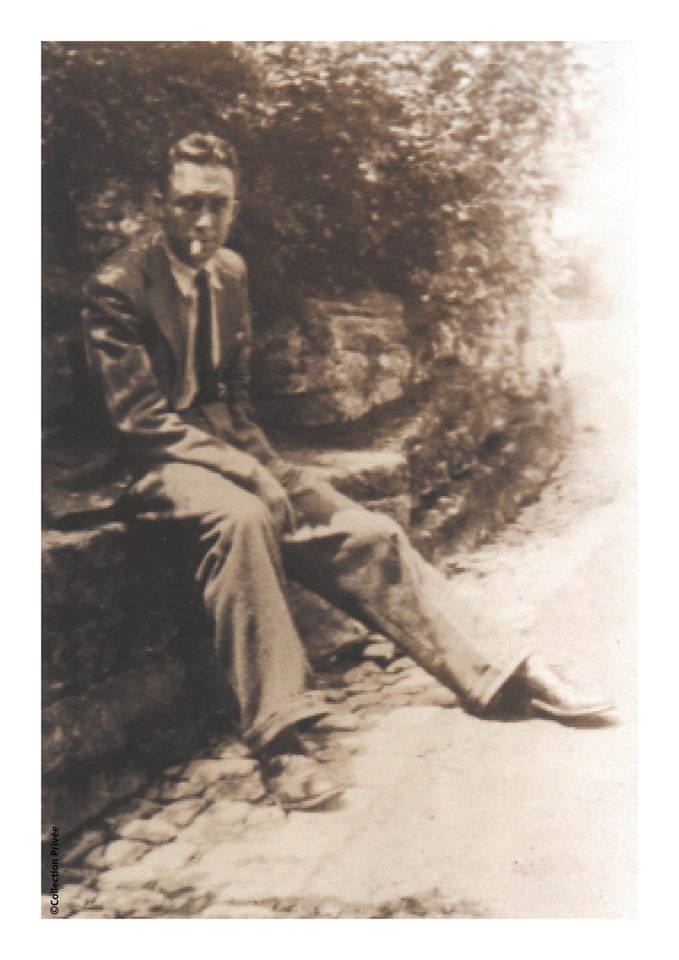
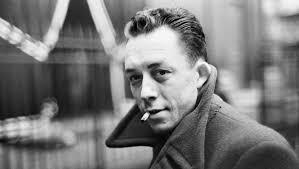
Albert Camus
When Camus began writing The Plague in 1942, he planned on calling the germinating novel, “The Prisoners.”[1] The Germans had begun their invasion of southern France and the Allies had landed on the coast of North Africa. At the time, Camus was convalescing in southeastern France after another bout of tuberculosis, an illness he had battled since childhood.[2] He was blocked from returning home to Algiers and his wife, Francine. While most consider Camus a French author, he saw himself as Algerian and the forced separation from his terra mater undoubtedly stoked the novel’s dominant themes of isolation, exile, and separation. “The Separated” was also among the working titles.
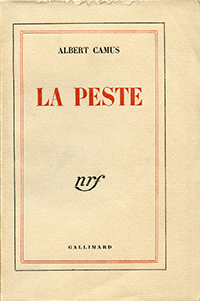
Original 1947 The Plague edition by Gallimard. Editions Gallimard
The struggle of individual imprisonment was nothing new to Camus. In 1942, he published his absurdist story The Stranger, which chronicles the downfall of Meursault, a man who is convicted and sentenced to death not because he killed an innocent Arab on the beach but for not crying at his own mother’s funeral. In that same year, his philosophical essay “The Myth of Sisyphus” appeared, which lays out his basic theory of the absurd. Like Sisyphus who continues to push the rock up the mountain despite its inevitable fall, humans will always search for meaning. What counts is not so much the struggle to push the rock up, but the walk back down the mountain while contemplating renewal.
The Plague marks Camus’ shift in focus from the individual and the absurd to the collective and what he calls the literature of “revolt.” Around the beginning of 1943, he wrote:
I want to use the plague to express the way we have all suffered from suffocation and the atmosphere of threat and exile we’ve all experienced. At the same time. I want to extend this interpretation to the notion of existence in general. The plague will give an image of those who shared the reflection, the silence of moral suffering.[3]
Cover of the French 1947 special edition of The Plague. Cover design by Mario Prassinos. Editions Gallimard.
The Plague tells the story of a bubonic plague outbreak that strikes the French-Algerian town of Oran, decimating the population. It begins with sick rats coming out to die in the streets. When the rats disappear, the disease moves on to infect humans. At first, most of the inhabitants, with the exception of the character of Dr. Bernard Rieux, refuse to believe that the disease is dangerous. Rieux works tirelessly not only to save sick victims, but also to mobilize a movement against the plague by calling on others to help in the fight against it. As the city closes its gates, Tarrou, Grand, le Père Paneloux, Rambert, Castel, and Othon are among the characters who risk their lives to care for the victims of the unrelenting epidemic.
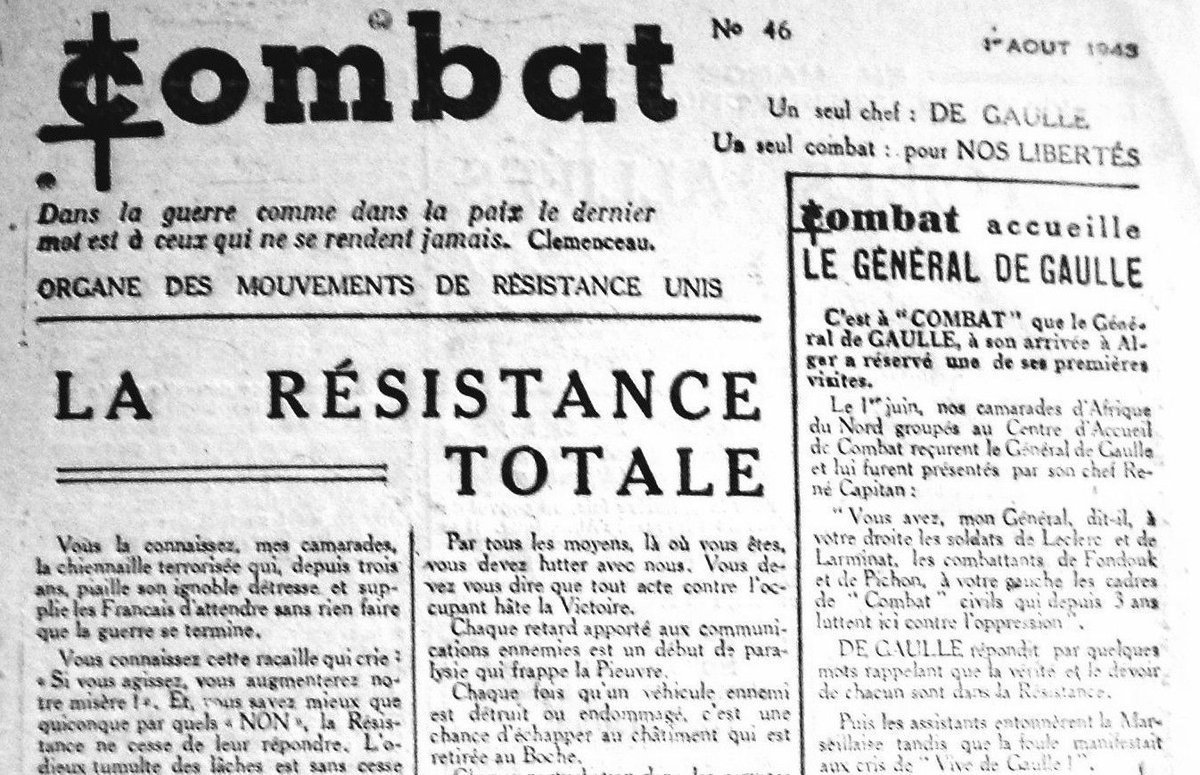
In 1943, Camus joined the French Resistance as an editorial writer for one of the most influential underground publications, Combat, and became its editor-in-chief at Liberation. He wrote moving articles inciting citizens to resist and then detailed the shock of the painful return of Jews and political prisoners who had been deported to concentration camps. Despite the fact that, in aiming for universality, Camus erased the most explicit references to the Second World War, the French recognized themselves in The Plague. As such, in 1947 the book became known as the novel about Nazi occupation, the Holocaust, the Resistance, and Liberation.[4] When Camus signed a copy of The Plague for his friend and fellow resistor, Madame Jacqueline Bernard, he wrote “To J., survivor of the plague.”[5] She was deported to Ravensbrück concentration camp in 1944 and that same year her husband died on the way from Paris to Auschwitz.
Cover of underground French Resistance publication that Camus edited, Combat.
Almost 75 years later, it could be said that Camus’ vision of The Plague gaining a more universal significance has found renewed focus with COVID-19. For Camus, the pandemic virus symbolized not just Nazism but was supposed to serve as an allegory for any omnipotent force that imprisons people and inflicts human deaths in arbitrary ways. Since February of 2020, The Plague has made the bestseller list in countries such as South Korea, Italy, and France, and, in some places, has sold out on Amazon. When reading it, it’s impossible not to wonder how someone writing in 1942 could have foreseen so accurately how things would play out in 2020. The general disbelief and denial of the severity of the virus, the unwillingness of government authorities to enforce prophylactic measures, the hoarding of goods, profiteering, quarantine, lack of medical supplies–these themes play out in The Plague as they do today.
Albert Camus
While these comparisons are striking, some of the less-sensational parallels of today’s crisis with The Plague delve into the heart of the book’s deceptively simple message – it is a story about acquiring a sense of love and duty for all humankind that functions outside of personal, moral, religious, or ideological motivation. It’s about breaking out of a certain kind of individual imprisonment and isolation to combat a collective imprisonment and isolation.
Le métier d’homme, le devoir d’aimer, and abstraction
Two major terms from Camus’ lexicon give shape to this concept: le métier d’homme and le devoir d’aimer. Le métier d’homme, loosely translated as “humankind’s profession,” means that all humans have a job, tailored to each individual, that involves combating misfortune in the world to reduce suffering. What drives le métier d’homme is le devoir d’aimer, the “duty of love” not just to one’s partner or family but also to humankind. Camus said, “love is the right and duty of each human” and “the only duty” he knows is “that of love.”[6] It is only this conception of love and duty without moral or material motivation or compensation that can heal plagues, imagined or real.
At first glance, Le métier d’homme and le devoir d’aimer appear to be simple concepts that any decent human being should be able to enact humbly. However, throughout The Plague, Camus demonstrates that this becomes nearly impossible in times of massive catastrophe due to the third major term from Camus’ lexicon–abstraction. Different abstractions allow the citizens of Oran to avoid confronting the horrible reality of the plague’s spread and impact. At its most simple, abstraction means turning the concrete into the immaterial or ideal, and it’s the different forms of abstraction that individuals employ–both wittingly and unwittingly–that become obstacles to the city’s efforts in countering the plague. As long as they create abstractions, humans cannot love or do their duty in preventing the suffering of humankind.
*
The rest of this article will be devoted to dissecting the different ways the characters of The Plague generate abstraction while comparing these with a few ways different, real actors in today’s world have avoided confronting the most severe impacts of COVID-19. The authors–Jennifer Orth-Veillon and John Tyrrell– both residents of Lyon, France, who can’t go further than one kilometer from our homes for more than one hour a day, are seeking to resist the abstraction of this pandemic in textbooks (years from now), or on social media (minutes from now). To that end we have interviewed two real people close to us who have, against the odds, won their own personal battle with abstraction and helped, or rather loved, humankind during this crisis.[1]
Abstraction and The Plague
In 1955, eight years after the publication of The Plague, the French journal L’Express published an article by Camus entitled “Le métier d’homme” in which he presents his recurring idea of “humankind’s profession.” He speaks of the human need for meaningful work, without which “life suffocates and dies,” a theme he explored in The Plague through the actions of Doctor Rieux. In the article, he also addresses humankind’s “duty to love” (“devoir d’aimer”), which drives Rieux, and undoubtedly motivates today’s health care professionals as they work tirelessly and selflessly to protect lives against the onslaught of an invisible and deadly adversary. As a nurse in Lombardy, Italy, expressed to New York emergency-room doctor Helen Ouyang in early April when the city registered 47,440 cases, the merits of the profession can’t be understated. “Please, don’t give up,” she wrote. “Our jobs are difficult but are the most beautiful ones.”[2]
As with this nurse, Dr. Rieux’s task ‒ performing his “duty to love” ‒ gives meaning to his existence. However, no lofty aspirations brought him to his calling. By his own admission, he entered his profession “abstractedly,” as it was a desirable career “that young men often aspire to.” Subsequently, as a young doctor, he was exposed to the hard realities of human suffering and death. The injustices he witnessed outraged him, challenging his capacity to see his patients abstractedly. Indeed, it was his inability “to get used to seeing people die” that spurred him on. But later, faced with plague in Oran, he found a new purpose for the abstraction of reality in allowing him to take on an unprecedented number of critical patients. He observes that “an element of abstraction, of a divorce from reality, entered into such calamities.” However, he finally comes to the conclusion that he can never completely let down his guard and give way to abstraction, as he proclaims, “when abstraction sets to killing you, you’ve got to get busy with it.” For Rieux, fighting his own abstract view of the plague becomes almost as difficult as fighting the plague itself.
Somewhat like Sisyphus, Rieux rarely wins the uphill battle with the plague. While a few make what he views as miraculous recoveries, most succumb to a violent end as the plague attacks in horrific ways. Their buboes ooze, their fevers soar. As the plague continues its rout, a group of men let go of their abstractions and join Rieux in helping the communal effort. The journalist character, Rambert, decides to stop illegally planning his escape from Oran to join his lover in Paris. Since the outbreak, he has tried bribing officials and finally resorted to engaging the services of some shady characters to smuggle him out. For him, the plague was not about the arbitrary deaths of thousands of humans, but about his individual sadness. When he abandons the quest to escape and instead joins the rescue teams, he admits to Rieux “I belong here whether I want it or not. This business is everybody’s business.” Rieux tells Rambert that he didn’t blame him for wanting to pursue happiness with his lover. At this moment, it’s easy to forget that Rieux has been separated from his wife too. “But it may be shameful to be happy by oneself,” Rambert confesses.
Rieux and his friends fight the plague–and their abstractions of it–until cases diminish and an effective serum is found. About a year after the first case appeared, the gates of Oran reopened and the citizens flooded the streets and cafés to celebrate. It is just then that Rieux is shattered by the sickness and death of his friend Tarrou, who has contributed greatly to the efforts. As Tarrou dies, Camus resists imposing an emotional reaction on his readers, yet the impact of the episode on Rieux is clear. Unable to be of any use to his friend, the doctor nonetheless remains steadfastly at his side, recording the details of their interactions during Tarrou’s final hours. The tragedy of this death, all the more poignant for having occurred as the plague was receding from the town, finally forces back the protective shield of abstraction which had permitted Rieux to carry out his duty so assiduously and for so long. It is the first moment since the onset of the epidemic in the town that he puts aside the others who are sick to stay with his friend. And it is the moment where the reader is presented with the real human cost of the ravages of the plague, free from all abstraction.
The next day, when Rieux receives the telegram informing him of his wife’s death, it is hard not to wonder how he will carry on. Yet we know he will, as will the suffering. Rieux admits that “He’d been expecting it, but it was hard all the same. And he knew, in saying this, that this suffering was nothing new. For many months, and for the last two days, it was the selfsame suffering going on and on.”
Abstraction and COVID-19
In the context of the COVID-19 pandemic, abstraction has also been an important coping mechanism. For the general public, abstraction comes in the form of harsh realities in hospital wards reduced to news headlines and data points on graphs.. For front line medical professionals, it’s the daily struggle to manage the waves of emotion resulting from unprecedented sickness, death, and deprivation of contact with loved ones. Like Rieux, some of those doctors and nurses have found that allowing the mask of abstraction to slip can be desirable in the face of such monumental difficulties. Italian E.R. doctor Andrea Duca said, “I realize now that keeping the emotions outside of me can help to manage the shift and the stress, but I need to be human to keep working.”[3]
However, opening the floodgates to those emotional realities can also have devastating consequences. New York E.R. Doctor Laura Breen tragically took her own life following weeks of fighting the virus in others, and had even recovered from it herself. According to her father’s account in The New York Times, “She had described to him an onslaught of patients who were dying before they could even be taken out of ambulances.” He said, “She tried to do her job, and it killed her.”[4]
If ongoing mitigation measures are successful, it’s likely that the vast majority of the global population won’t contract COVID-19, or even have direct experience of it via immediate family and friends. This means that for most of us our experience will remain an abstraction, limited to what we see and hear on TV, radio, websites and social media in the form of soundbites, statistics, graphs, and their various interpretations through each channel’s unique prism. As Camus suggests in The Plague, “we tell ourselves that pestilence is a mere bogy of the mind, a bad dream that will pass away.”
Today, the bad dream plays out on screens at home and on mobile phones, adding a further stage of disconnection with reality. Many are looking hopefully towards a better future post-pandemic, in terms of improved health systems, sustained reductions in urban pollution, or more flexibility in remote working for example. The mass-scale abstraction of the pandemic, however, could prove to be a hindrance to such positive outcomes. If COVID-19 doesn’t directly touch a person’s life, it’s easy to ignore its reality, deny its impact and believe that there’s nothing that needs fixing.
In The Plague, Camus says that discussing humans as being good or bad citizens in times of crisis misses the point. Rather “they are more or less ignorant.” He suggests that “the evil that is in the world always comes of ignorance, and good intentions may do as much harm as malevolence, if they lack understanding.” It follows that to counter ignorance and gain this all-important understanding, people require information. But it needs to be correct information. This is challenging when facts depend on the way they are collected, and truth is subjective depending on the channel through which it is transmitted. In his story, Camus describes the “epical or prize-speech verbiage” employed by the media beyond the walls of Oran when describing the situation within. This grates on Dr. Rieux because it fails to capture the reality of the “small daily effort” made by so many to sustain the lives of the afflicted.
It’s possible to imagine that some Italians reacted in a similar way to the sensationalist reporting in British media in early March when COVID-19 began to exert its deadly grip on Northern Italy.[5] Fast forward to April, when the infectious tide rose to similar levels in the UK, and the tone of reporting in popular newspapers was muted in comparison. At times, it leveraged the distraction of Prime Minister Boris Johnson’s own battle with the virus to keep the worst domestic horrors from the front pages.[6] It appears that it’s only a sensation when it’s happening to someone else.
Meanwhile, one debate currently raging in our communities and news media concerns the medical efficacy of wearing masks to protect ourselves and others from COVID-19. This might be missing the point, however. Camus goes straight to the heart of the matter, recording an exchange in which Tarrou hands a mask to Rambert the journalist, who immediately asks if it is really any use: “Tarrou said no, but it inspired confidence in others.” Our leaders frequently speak of community responsibility and the vital role that everyone has to play in mitigating the worst impacts of COVID-19. Staying at home and following social distancing guidelines is vital, but for any who share Camus’ view, the action of wearing masks is equally of value. It requires investment in modifying behavior to extend greater respect and understanding to those who share this world, its streets, and places of work and play. How people behave ‒ whether or not they wear a mask, for example ‒ has a very real impact on the level of safety or anxiety felt by others.
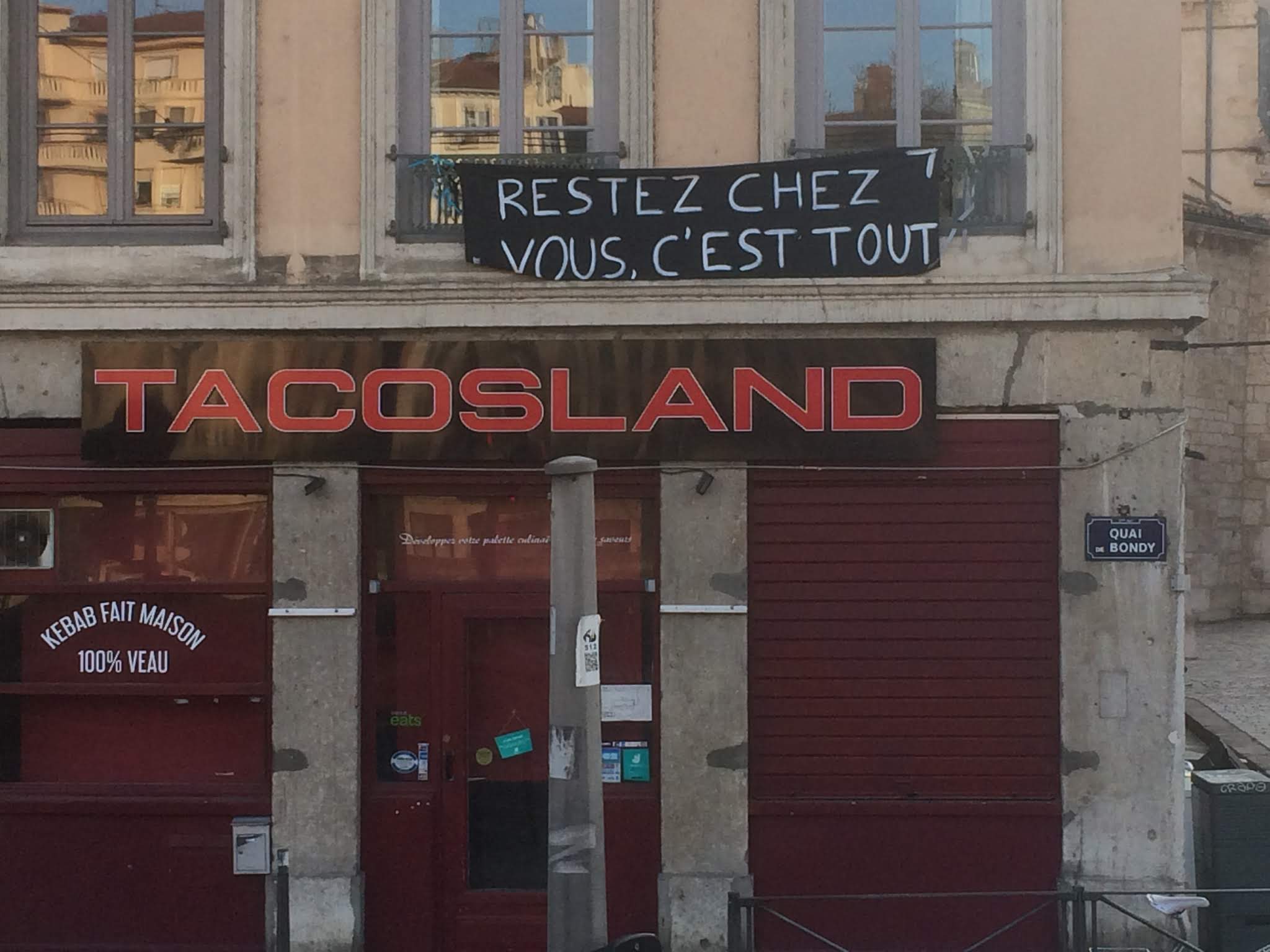
In Lyon, a sign reads “Stay home, that’s all.” Photo by Jennifer Orth-Veillon
In the high-score, high-stakes world of COVID-19 statistics, the relative differences of individual country’s approaches are laid bare. Every commentator has a different take, but it’s hard to claim that a country like South Korea has a lower infection rate because it lacks the freedoms of western liberal democracies. Sweden, for example, has achieved remarkable results. Some observers credit this to the heightened sense of social responsibility that saw Stockholm city centre foot traffic reduced by 70% without any enforced lockdown.[7] As COVID-19 takes its permanent place in the world’s ongoing reality, time will tell whether people are willing to invest in their communities through the wearing of masks and other perhaps inconvenient new behaviours as we seek to, as Camus suggests, “inspire confidence in others.” Such communal social responsibility is the manifestation of Camus’ “duty to love,” and its value should be embraced more than ever in trying times.
For individuals to grasp the importance of behavioral change and their wider social duty, it’s vital to break through abstraction and connect meaningfully with them. It’s here that the power of personal stories is paramount. The story that Camus told in The Plague is a fiction, but there are many narratives today that mirror its events, and it is those that must be elevated. By doing so, we can reveal the truth of Camus’ words when he says of the contagion, “it doesn’t always pass away and, from one bad dream to another, it is men who pass away.” And we can begin to better understand our shared duty of love.
We have come to know two individuals whose stories are relevant and valuable in the context of Camus’ discussion of abstraction in The Plague and our city’s experience with COVID-19. Yasmina Bouafia and Walid Feda are two French citizens who, against great odds, demonstrate “le métier d’homme” and “le devoir d’aimer.”
Yasmina Bouafia, 6eme Arrondissement, Lyon
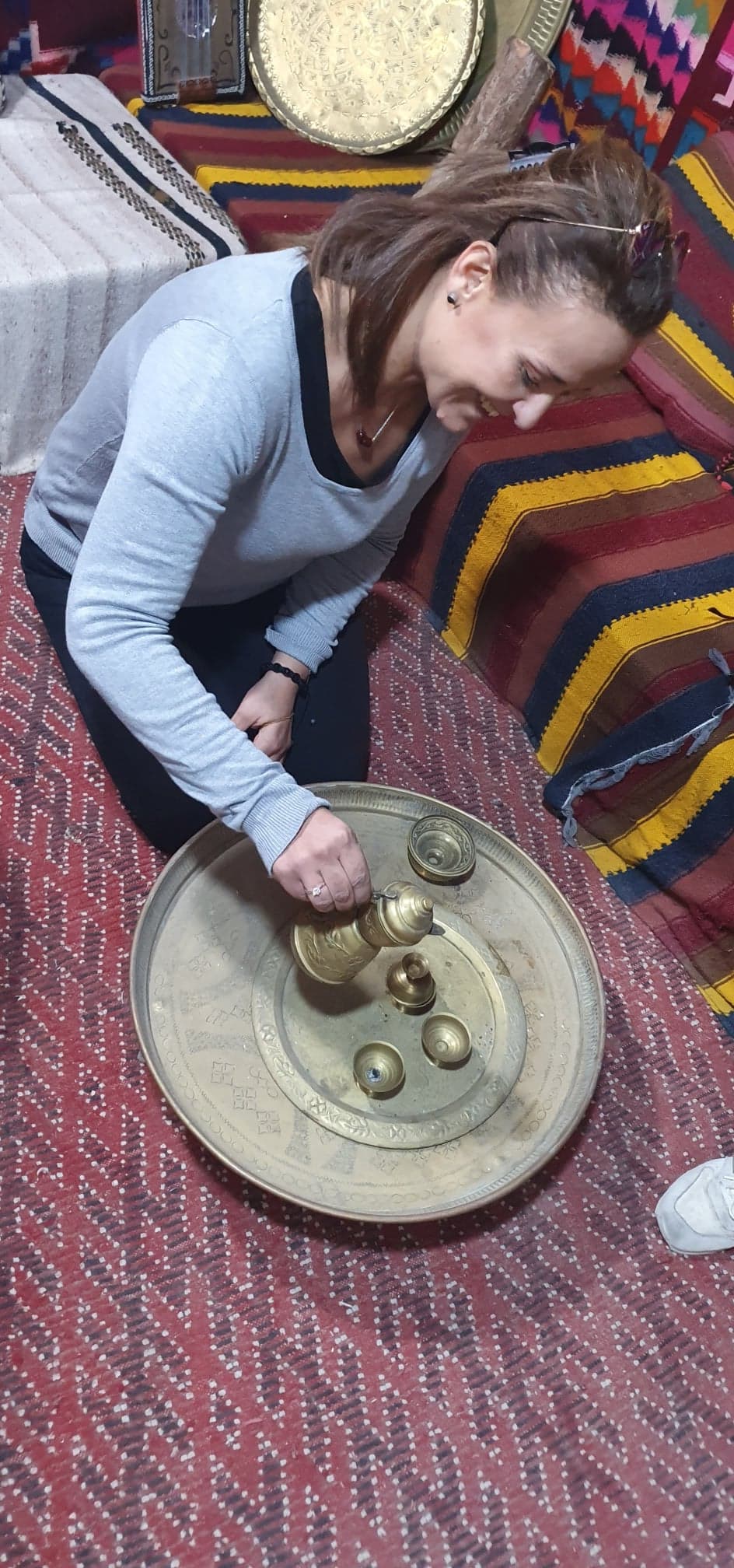
“With The Plague, Camus has given us the copy that we have cut and pasted into today’s Covid-19 France,” claims Yasmina Bouafia, a 38-year-old French-Algerian woman living in the Charpennes neighborhood in the southeastern city of Lyon. Yasmina’s parents are Algerian, but she and four of her nine siblings were born in France. “It’s hard to find an Algerian of my generation who hasn’t read The Plague.”
Yasmina Bouafia serves Algerian mint tea. Courtesy of Yasmina Bouafia.
The pandemic has shed light on an aspect of Camus that she hadn’t previously grasped in his work. Camus, although he became known as a French writer, had always considered himself Algerian, despite having joined the French Resistance, and eventually settling in France after Algeria won its independence in 1954.. Almost all of his writings spring from his place of birth, and when he was forced to relocate to France after the Algerian War, he chose to live in the south of France because the intensity of the sunlight there most resembled that in Algeria. Yasmina, born in France, to a family steeped in Algerian tradition, has always considered herself French.
It has been from her position as an outsider that she has been able to help women in Algeria improve their health. Two years after giving birth to her twins, she divorced her husband and found herself almost exclusively responsible for raising her five children under the age of 11. Uncertainty and stress about her family’s future caused Yasmina to reach a weight that threatened her well-being. Through a combination of meditation, nutrition, and exercise, she regained her health, and went on to create a foundation co-sponsored by French and Algerian organizations, to help women in Algeria combat the rise in obesity and its related problems. Gyms, yoga studios, and nutritionists are easy to find in France, but in Algeria, they are rare and inaccessible to most women. Even though she is unable to go to Algeria now, she stays in contact with the women in her program, who have, Yasmina admits, struggled since being confined to their homes due to COVID-19. She tells them they have to hold out at least until September when she will be able to help them again in person.
Reading books like The Plague in the time of COVID-19 have allowed us to believe more in fiction than in reality, she says. She’s taken to watching the British series, “Black Mirror,” and sees parallels in the way technology has taken over during the pandemic. Technology, she intimates, has made an abstraction out of the world and replaced real experience: “There’s no more kissing, no more hugging, no more face-to-face meetings.” Reality happens through the “black mirror” of our phones and screens.
Yasmina, worried about technology’s influence over reality, believes the screens and the media are masking stories many don’t want to be told. “I feel like the media is in competition for whoever tells the most sensational story, even if it has to do with pseudoscience.” For example, it’s rare to hear stated a truth that she believes most politicians don’t want to admit: months ago, President Macron’s government consistently crushed and criticized the Gilets Jaunes (Yellow Vest) Movement that involved working and middle class citizens protesting what they saw as the unfair decline in their standards of living. These people included nurses, farmers, truck drivers, and grocery store employees. They are the same people who, despite the dangers of contracting COVID-19, have been asked by the French government to continue working as they are considered “essential” to the nation. Their weekly protests throughout France have been forbidden, which probably “suits the government.” “The values have reversed,” she says.
She cites another underrecognized issue in Algeria. Many people in Algeria work, as she describes, “day to day,” meaning they leave for work in the morning in order to make enough money to eat in the evening. With the stay-at-home order, they can’t leave their houses. This is especially difficult during Ramadan. In one particularly hard hit commune, Blida, military service members have been delivering meals to struggling families at night to break the fast, a response made possible by donations of food from over 1,000 households.[1]
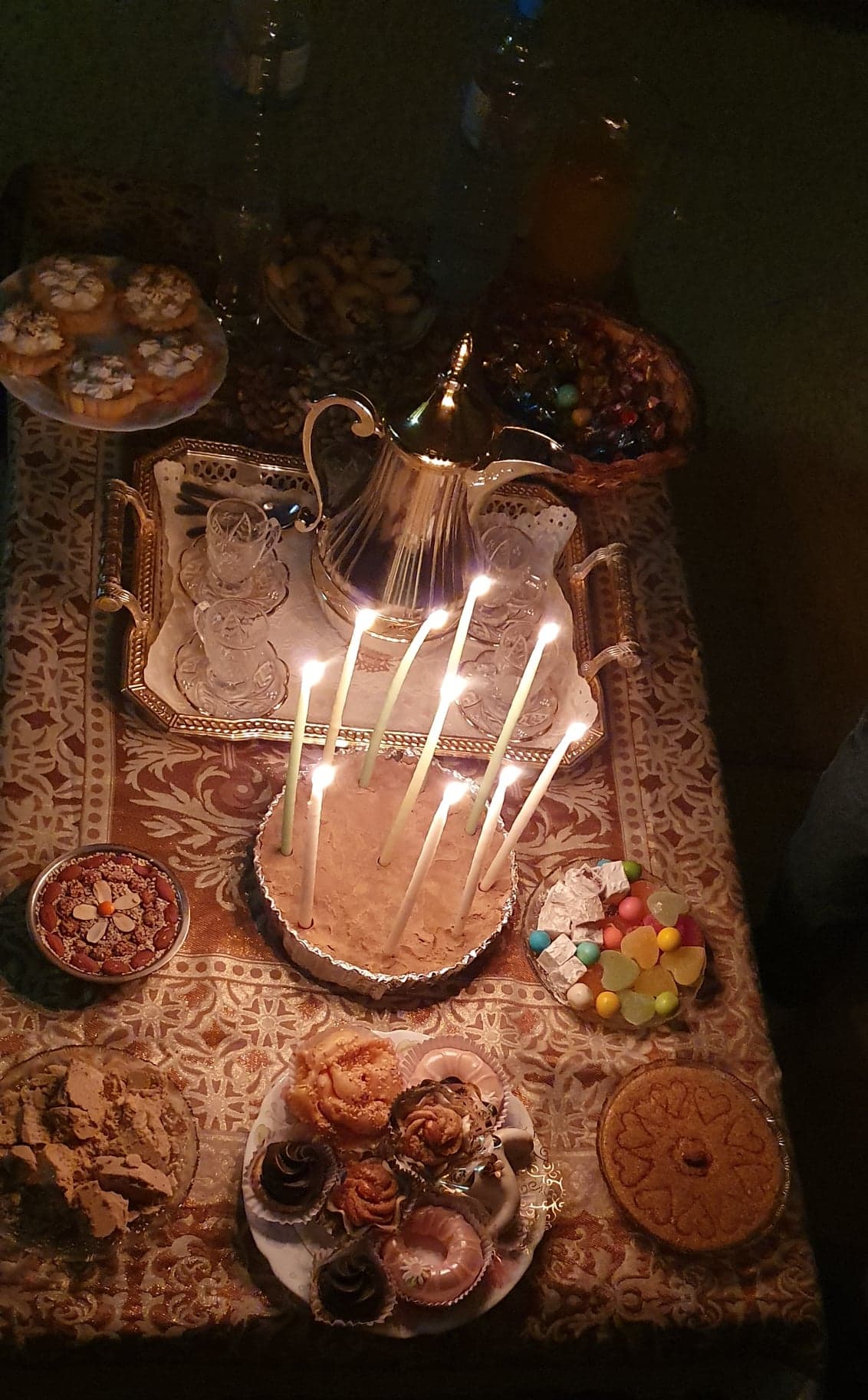
Algerian Ramadan specialties prepared by Yasmina Bouafia. Courtesy of Yasmina Bouafia.
In France, Yasmina has managed her family’s food budget by dipping into her savings. As a single mother of five children, she benefits from a reduced lunch fee at the school cafeteria. Even if her children don’t eat much at night, she is reassured that they had at least one good meal with meat and vegetables during the day. With the children at home, her food budget has more than doubled and she worries about providing proper nutrition on a daily basis. In addition, she is limited from buying the necessary quantity of food since it is impossible for her to go out each day with all of her children and she doesn’t own a car. In France, it’s not permitted to go outside without a government-issued justification citing for example exercise, shopping for necessities, or seeing a doctor. There is also a one-parent-to-child obligation. Each time Yasmina went for a walk with her children, the police stopped her and ordered her home. Her older sister decided to move in with her to help ensure the children’s outings could continue.
Instead of taking her sister’s help as a cue to let down her guard, Yasmina decided that the extra pair of hands at home would finally allow her to do what she felt was her “human duty.” While her sister watched her children, Yasmina went to the local chapters of the Salvation Army to prepare meals for the poor and homeless. She wore gloves, a mask, and protective clothing and declined to help distribute due to risk of infection. However, she reported each day to the centers until she severely sprained her ankle, forcing her to walk with crutches and stay home until the injury healed.
The task of fasting has become a greater challenge during Covid-19 due to the fact that Muslim families and friends can’t visit each other during the day. This is especially painful in the early evening as the fasting draws to a close and they prepare to eat for the first time in over twelve hours. Yasmina explains, “In the Maghreb culture, we are used to taking a walk to visit family and friends after eating the evening meal and we talk late into the night. It’s a time to reunite with people. Now I have to eat alone.” Most of Yasmina’s children are too young to fast during the day and her evening Ramadan ritual has felt less celebratory as she eats in isolation.
A few days ago, her children surprised her. As if they had inherited their mother’s selfless, benevolent impulse, they surprised her as she prepared their breakfast – they announced that they had all decided to join her in fasting for the day. And, in spite of a few grumbles, they made it to sundown. Instead of the traditional Ramadan soup, chorba, or orange-flower blossom pastries, her youngest begged to go to McDonald’s, which is one of the restaurants that hasn’t stayed open for take-out or delivery. “If McDonald’s were open, I would have definitely taken him,” said Yasmina, still flabbergasted by her children’s resolve.
For Yasmina, Camus’ novel is valuable because it isn’t about Algeria. It’s not about France either. “It’s a novel about humankind.” As she explains, this is what Camus meant by “métier d’homme.” Yasmina isn’t helping Algerians or French. She’s helping humans.
Walid Feda, 1er arrondissement, Lyon
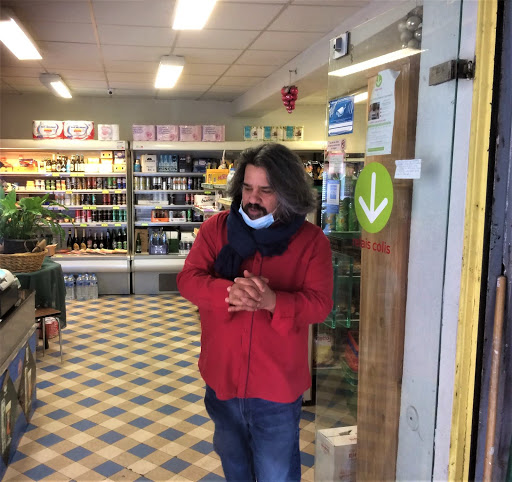
“The most negative word of 2020 is positive,” pronounced Walid Feda, owner of the Lyon neighborhood convenience store, Panier Sympa (The Friendly Basket).
Walid Feda, owner of Panier Sympa convenience store in Lyon, waits for customers. Photo by Jennifer Orth-Veillon.
Since high school, Walid has read The Plague several times, reflecting his lifelong interest in major global pandemics in history. Every 100-400 years, he reports, the world faces something like COVID-19, be it Bubonic plague, cholera, or the Spanish flu. Still, he never thought such a thing would affect him at all, either positively or negatively.
In his shop, Walid sells the basics– fresh fruits and vegetables, canned goods, sodas, chips, candy, cold beer, bleach, toilet paper. He also sells more high-end goods like expensive champagne, aged cheeses, vintage wines, and cured meats. In normal times, both the bourgeois and working-class flock to Panier Sympa on Sunday afternoons or as the sun goes down, when regular supermarkets are closed. His store is never overcrowded, but there’s always at least one person purchasing something and a few others hanging around the fruit and vegetable stand at the entrance as permanent fixtures. On summer nights, the smell of exotic spices wafts through the neighborhood and we know that Walid is not only cooking things to sell ‒ he is also preparing meals for his friends and neighbors, free of charge.
Walid’s storefront in Lyon. Photo by Jennifer Orth-Veillon.
Walid was born in Kabul, Afghanistan. His mother was a schoolteacher and his father civil engineer and well-known intellectual. They were both outspoken community leaders against the regime and, as such, their lives were threatened. When he was 10, Walid and his parents were granted asylum in France and settled in Lyon. Walid was educated in international schools in Lyon and Dubai, and after gaining a degree in computer science in Lyon, he returned to Dubai where he led several technological and commercial enterprises. When he met his wife in India, his business was doing well, and together, they had three children‒two boys and a girl, and lived between India and Dubai. When his wife fell ill with breast cancer in December 2007, they made the decision that she should pursue her treatment in Lyon, where cancer treatment facilities were cutting-edge. In 2008-9 the subprime crisis and the Arab Spring hit his businesses hard and they folded in Dubai, Bahrain, and China. With his children, he moved back to Lyon. His wife still sick, he used his remaining money to open the convenience store because, as he told himself, “people always need to eat.” The store limped to modest success until 2014 when his wife’s cancer returned and she died, leaving Walid alone with his three children. He floundered economically and emotionally. Luckily, his parents agreed to help with the children and he found himself back on his feet again in late 2018.
Things were starting to look up until March of this year when the rapid spread of COVID-19 imposed a lockdown of citizens. Considered by French law as an “essential” business for the health of the nation, Walid has been allowed to remain open. However, he knows that his sales of foodstuffs are anything but essential. “The seniors in our neighborhood see me as security,” he says. “They come here once or twice a week to buy a few things but really they come to talk. For some, I bring them their groceries. If I close, I’m scared they will fear the worse and succumb to their isolation. I look after them.” Walid explains that he orchestrated placing a local woman in an assisted-living facility just before the pandemic because no one could take care of her. He calls and checks on her each day to make sure that the new Coronavirus hasn’t invaded the facility and that she remains in good health.
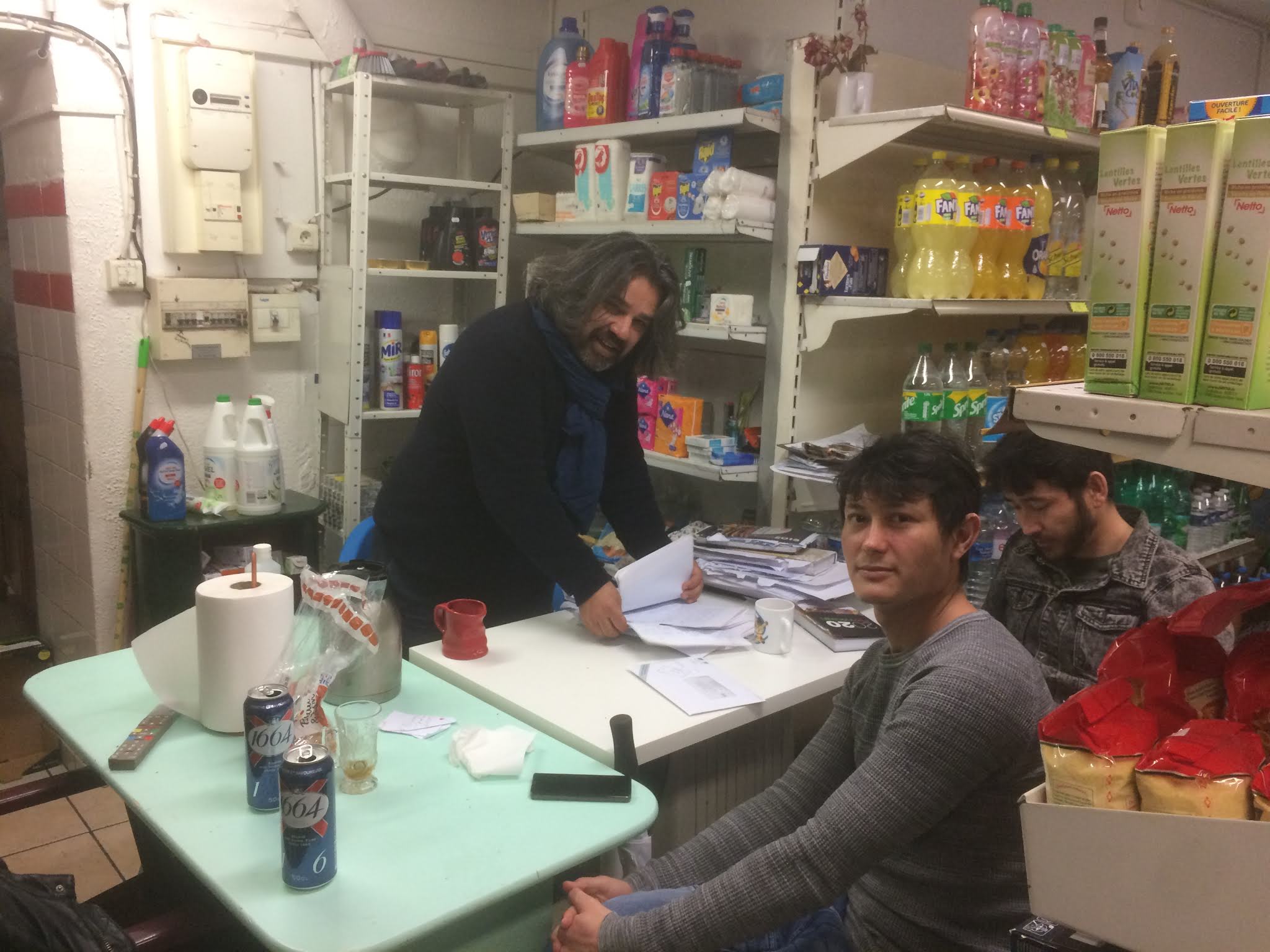
Finally, he’s remained open not because he offers essential food, but because he offers a service for those who are in danger in falling outside of what the French nation considers legal. For some time, Walid has helped asylum seekers, refugees, and immigrants process governmental documents related to obtaining French legal status. Among the bleach bottles and disposable hand wipes stacked in the back of his shop, he’s set up a card table and chairs. A pot of hot tea and cups sit among the scattered papers along with a few empty beer cans. Prior to Covid-19, he had cases that helped fill the occasional monotony of afternoons before the shop’s business picked up in the evening. Today, however, he has a steady string of customers. The French government has decided to extend visas to all immigrants awaiting decisions regarding their permanent status. While this may appear to be good news, it presents a lot of unknowns–not only on the part of the immigrants, but also on the part of those who are sometimes unaware of the new rules. For example, if a pharmacist is not aware of the visa-extension law, they may not understand that the client still has the right to a lower price for medicine. This gets especially complicated when the immigrant in question doesn’t speak French or English.
In the back of his shop, Walid helps two men from Afghanistan with their papers. Photo by Jennifer Orth-Veillon.
Nowadays, Walid accompanies these people to pharmacies to argue in their favor, and helps them fill out paperwork that guarantees the extension of their rights on French territory. “They have legal status that not everyone knows about. That’s why I have to be there,” Walid explains. “My religion is my humanity. So, no matter where they are from, I help them. It’s more important to do something good for humanity.”
Walid charges no fee for this service. “It’s my heart, my humanity that does this.”
Walid has remained open for business and, no doubt, he has helped many, but his business has paid an enormous price. “My debit and credit cards are maxed out,” he reports. “My bank has blocked me. I use the cash I make from shop purchases to buy stuff to replenish stock. I let my oldest son work here so he can have some pocket money and feel independent.” The French government has promised to help struggling businesses during COVID-19, but only those who were doing well before the crisis will get immediate and substantial aid. Walid was just getting back on his feet after recovering from his wife’s death when the pandemic exploded. He fears the worst. With three children who will all encounter the rising costs of French higher education in the next few years, he hopes he and his family will be spared. His oldest son has his eye on an aeronautical engineering school and, besides his work in the shop, fixes smartphones for pocket money.
When we asked Walid if he would respond to a few interview questions, he requested a few days to reflect. After this time, he produced a narrative of eleven handwritten pages. Here is, fittingly, the abstracted version of some of his most pertinent reflections on Camus:
Today, we are living in a historical moment of our lives. In the world, we are observing certain ideological and political discriminations within our own communities and even families. The virus is forcing us to come back to a notion of family again by enclosing parents with their kids. Are we seeing that our relationships have become more virtual, making us express even our gratitude to the ones we love only on screens? When I come home from work, I want nothing more than to hug my kids, but I have to take off my clothes and shower first. My clients come into the shop – we have always been friendly, shaking hands or giving the French “bise” – a kiss on each cheek. Now, behind masks, we nod heads coldly. But, at the same time, my actions for others come from my solidarity and my responsibility is to my humanity.
The Rats Will Rise Up Again
French writer Roland Barthes took issue with La Peste in 1955, claiming that Camus’ use of allegory muted rather than exposed the catastrophic reality of the Holocaust.[8] But only reading The Plague as an allegorical mirror of the COVID-19 masks its fundamental message about humans helping humans. By not speaking directly about real events, The Plague allows for this more universal meaning, which is especially relevant for today’s COVID-19 world.
Outside of Lyon, France, quarantined Yellow Vest protestors hang their symbols outside their windows. Photo by Jennifer Orth-Veillon.
If we believe that The Plague can only stand for political totalitarianism or health crises, we will have too quickly dismissed one of the essential functions of the book, which is to provide a blueprint for both identifying and overcoming the kind of abstraction that prevents us from performing our “métier d’homme” and our “devoir d’aimer.” With The Plague, Camus has created a neutral space from which the rise of catastrophe and collective resistance against it can be staged. Walid and Yasmina are but two of thousands of individuals who have played their part and we can only hope that more faces and names like theirs are revealed as the COVID-19 crisis marches on, and indeed the next one lies in wait. Because Rieux, in the last lines of The Plague warns that these kinds of fights are far from over:
And, indeed, as he listened to the cries of joy rising from the town, Rieux remembered that such joy is always imperiled. He knew what those jubilant crowds did not know but could have learned from books: that the plague bacillus never dies or disappears for good; that it can lie dormant for years and years in furniture and linen-chests; that it bides its time in bedrooms, cellars, trunks, and bookshelves; and that perhaps the day would come when, for the bane and the enlightening of men, it would rouse up its rats again and send them forth to die in a happy city.
[5] Jacqueline Bernard. “The Background of The Plague: Albert Camus’ Experience in the French Resistance.” Volume 14, 1967 Kentucky Romance Quarterly, Issue 2.
Pages 165-173 | Published online: 09 Jul 2010 Taylor and Francis
[6] Albert Camus. Les carnets. 1942-1951
[1] For a description of France’s restrictions see this article in The Local
[8] Barthes, Roland. “La Peste: Annales d’une épidémie ou roman de la solitude.” Œuvres complètes. Ed. Eric Marty. Vol.1. Paris : Editions du Seuil, 1999, p. 540.
—
About the Authors:
JENNIFER A. ORTH-VEILLON, who holds a Ph.D in Comparative Literature from Emory University, curated the WWrite blog for the official United States World War One Centennial Commission from 2016-2019. She has published her translations, fiction, and non-fiction in Les Cahiers du Judaism, L’Esprit, Storysouth, Lunch Ticket, Wrath-Bearing Tree, and The New York Times. Based in Lyon, France, she teaches university courses in literature, philosophy, and communication in international programs. She is polishing her novel manuscript, The Storage Room, based on the WWII experience of her grandfather, a concentration camp liberator.
Based in Lyon, France, John Tyrrell is a British writer, teacher, and creative director working in video game marketing. Formerly Worldwide PR Director at Atari, John is now a partner in European video game marketing agency Cosmo cover, helping its clients develop and implement communications strategies. Since 2005, John has traveled the world making documentary films about the work of video game creators for clients including Atari, Bandai Namco, Unity, and Devolver Digital. He teaches a range of digital marketing disciplines to business school students in Lyon and writes for a major global technology brand on subjects ranging from Virtual Reality to video game marketing.
New Essay by Anthony Gomes: Is There Finality in Death?
All beings in this world, all bodies must break up: Even the Teacher, peerless in the human world. The mighty Lord and perfect Buddha has passed away. — The joy of renunciation in The Radical Buddhist.
Of all the wonders that I yet have heard, It seems to me most strange that men should fear, Seeing that death, a necessary end, Will come when it will come.— Julius Caesar, Act 2, Scene 2. William Shakespeare
With the sudden appearance of COVID-19 that has been killing the elderly at an alarming rate, doctors may be forced to make life and death decisions based on age, underlying medical condition and the need for respirators, something unthinkable in the near past. Emergency Medical Service (EMS) teams who cannot find or restart a pulse while administering CPR on adult cardiac arrest patients have been instructed not to bring those patients to hospitals. How the COVID-19 epidemic will change our approach to death remains unclear as of this writing. In this regard it is noteworthy remembering what the Roman Seneca commented some 2000 years ago: death is sometimes a punishment, often a gift, and for many a favor.
Death is a dreaded word no living human being wants to hear. But ultimately, all of us have to face our own death or that of our loved ones. For only one thing is certain in our lives: the fact that one day we will die.
Medically, death is declared when an individual sustains either an irreversible cessation of circulatory and respiratory functions or an irreversible cessation of all functions of the entire brain, including the brain stem. On the other hand, if a person experiences the “irreversible cessation of all functions of the brain,” he or she is considered legally dead. With the availability of life-support measures, a legally brain dead subject with a beating heart may be kept “going” until the decision is made to remove all life-support measures.
The process of dying, of how, when, and where, has changed over the last century. In the US, nearly two-thirds of deaths occur in a hospital environment, in the intensive care-units where patients often undergo all sorts of complex procedures, including surgery and other life-extension measures. Some of these patients are transfers or admits from nursing homes, and many are oblivious of their life-expectancy. Their relatives not uncommonly plead with the doctor: “Please doc, do all you can,” and often the doctor obliges seeking consultations for each failing organ from a host of specialists: cardiologists, pulmonologists, gastroenterologists, kidney specialists and surgeons, all doing their thing, as if to maintain each “organ” disregarding that they are human beings, whole entities rather than parts of an unraveling body. Yes indeed, modern medicine can prolong life, but ultimately cannot avoid death. These so called “medicalized deaths” are not exactly what people desire. Polls conducted by the Kaiser Family Foundation and The Economist report that most healthy people hope that they will die at home peacefully, free from pain and surrounded by loved ones. However, that doesn’t mean that their wishes will hold when they are faced with a catastrophic illness such as COVID-19. In the past, I have encountered patients and their relatives rescind DNR (do not resuscitate) instructions to insert a pacemaker in a terminal patient.
♥♥♥
The insecurities associated with death, and the much argued presence or absence of an afterlife compound our anxieties and add to the fear of dying. One can argue that death is preferred to severe disability or suffering with its devastating effect on quality of life. However, some would strongly hold a counter position that life is sacred, ordained by God, and, nobody has the right, the subject or his doctor to end life prematurely, no matter how miserable the existence. Indeed, few people if any will celebrate death with champagne as Anton Chekhov did. Chekhov’s wife, Olga was with him when he passed away. She writes that they had ordered champagne; he took a glass, and turning his face towards her, he smiled at her and said: “It’s a long time since I drank champagne.” He calmly drained his glass, lay down quietly on his left side, and shortly afterward, fell silent forever.
In the US, in contrast to some European and Canadian cultures, we prefer to let life ebb away and ultimately extinguish itself. I have been following a patient for several years on whom, years ago, I had performed a successful ablation of a rapid heart-beat. Recently however, she was going downhill with severe limitation due to a lung condition, weight loss, and a previous cancer that left her with a single lung, now diseased as well. She was in a nursing home barely able to breathe. She said to me: “I am waiting to die a miserable death…I wish I would go quickly.” Her feelings are entirely honest. If ethicists and psychologists confirm those wishes are genuine, then one might ask whether society, cultural norms or “religious righteousness” can or should deny them. With the sudden appearance of COVID-19 doctors may be forced to make life and death decisions without the input of the patient or his/her spouse or relative.
♥♥♥
As much as death is abhorred in our society, even in the setting of terminal cancer, heart failure, and old age, the recognition and understanding of the importance of quality of life and of death itself, a subject little talked about, let alone discussed, assumes considerable import. Unlike Asian societies, Western culture, more so the American, hold in disfavor old age and death. In other societies, particularly in the Eastern, old age is revered, and in some, death has no absolute finality.
One might argue that in affluent western societies there is much to live for. And so, nobody in his/her sound mind wants to die even if the ravages of age or illness are evident. Undoubtedly, a healthy mind irrespective of age and disability can amply enjoy the fruits of living, particularly if one has a caring, loving family or one has “purpose” to keep on living. It is pleasurable for an older person, a matriarch or patriarch of the family, even if disabled by disease, to be surrounded by children and grandchildren and great-grandchildren for some or all festive occasions. Furthermore, not uncommonly, in terminal medical conditions, the will to live or the “will to die” is highly personal. Even in the most desperate of situations, death may not be a welcome alternative. A patient of mine who survived the holocaust and is now over 90 years of age and disabled, but with decent mental faculties, told me that in the Nazi concentration camp she had the option to get electrocuted on the fence while trying to escape, and some did just that. She was afraid of death and rather preferred to live a tortured existence. She survived, came to America, and raised a family. Even now, this courageous woman desperately wants to go on living, and even today, having witnessed the ravages of history, and having made a life for herself and her family, she still fears death.
♥♥♥
OUT-OF- BODY EXPERIENCES
Some of my patients who survived an episode of sudden cardiac death, and lived to recount the experience, describe seeing their long-gone ancestors around them, perceiving detachment from their own almost lifeless bodies, and looking down at them. Immediately, thereafter, they passed through tunnels into another universe of scintillating lights, and subsequently were pulled back into their bodies at the very time of successful resuscitation. Obviously, we do not have clear scientific explanations for these perceptions. But I do believe, after questioning my patients at some length that these are true and rather repetitive perceptions in people who survived an episode of sudden cardiac death, and not a fancy of their imaginations, nor perhaps dream-like states. Quite astounding is the fact that these experiences have, most of the time, been positive and not frightening. Whether they occur during activity at some cortical level due to an alteration of neurotransmitters as a result of the cessation of blood supply to the brain, or they reflect the detachment of the living energy from the body, perhaps can only be determined by scientific experiments such a functional-Magnetic Resonance Imaging (fMRI) or Positron Emission Tomography (PET) scanning during a cardiac arrest, something that is practically impossible to accomplish in the setting of a non-beating heart and no blood circulation.
On the other hand, electroencephalographic (EEG) studies that determine brain activity have been recorded during blackout spells (in the condition known as vasovagal syncope) induced by head-up Tilt Testing, where the bed is tilted to a 70, or 80-degree angle, for a period of 20 to 30 minutes. These studies reported by Ammirati F and coworkers [1] showed that in patients who blacked out because of temporary cessation of heart rhythm, there was a sudden reduction and disappearance of brain wave activity (i.e. a flat EEG) seen at the onset of blackout spells. The EEG normalized immediately after recovery. This study obviously proves that loss of consciousness even over a short time span is accompanied by loss of brain activity. Moss and Rockoff [2] reported on a 62-year-old woman who had simultaneous EEG and ECG during emergent carotid artery surgery. While the surgeon was closing the incision, the patient developed cardiac arrest. There was loss of EEG activity within 15 seconds of heart stoppage and activity returned almost instantly after resuscitation. In animal models of cardiac arrest produced by rapid injection of potassium chloride, a flat EEG occurred within 25 seconds of cardiac standstill. These studies do show that the occurrence of cardiac arrest with resultant loss of blood flow to the brain is associated with a loss of brain electrical activity. Does this then imply that extrasensory perceptions during cardiac arrest are not related to brain activity, but rather to the release of another form of energy from the body?
THE CONCEPT OF AFTERLIFE
Not uncommonly, fear of death, or lack thereof, and the idea of an afterlife are strongly rooted in religious beliefs. The teachings of world religions: Christianity, Islam, Hinduism, Buddhism, and Judaism have different philosophical viewpoints on these matters. In Judaism, the Torah is silent on the presence of an afterlife. Instead, it entirely focuses on Olam Ha Ze, meaning this world. This view is contrary to that held in the Christian and Muslim faiths, where Heaven is the eternal realm for chaste people, and damnation into Hell for evil ones. I have met dying people of the Christian faith who expressed certain contentment that soon they would attain the Kingdom of Heaven and perpetual life in the presence of Christ. Yet, despite their belief in a better eternal kingdom ahead, these believers were eager to delay dying. In the far eastern religions of Hinduism, Buddhism, Jainism and Sikhism, and even in Kabbalistic Judaism, an afterlife is grounded in the theology of reincarnation, in which life is reordered after death as another earthly life in the physical world. The transmigration of souls, or samsara, results in the passage of a soul from body to body as determined by the force of one’s actions, or Karma, in the recent past. Successive reincarnations attempt to achieve a superior grade of consciousness, which ultimately leads to liberation from the cycle or rebirth, and the attainment of Moksha. In Tibetan Buddhism, Bodhisattvas are not reborn through the force of karma and destructive emotions, but rather due to the power of their compassion. Thus, the Hindu and Buddhist do not view death as an end in and of itself.
Death, on the other hand might be more difficult to accept for a Jew, in contrast to a Christian or Muslim, who has the promise of Heaven. I have witnessed prolonged and futile resuscitative codes on Rabbis sometimes for over an hour, when the doctors in attendance well knew that the effort was useless.
There is a strong desire for a loved one, particularly for a spouse or a parent to communicate with the dead person, and this is often achieved through mediums. One of my patients, whom I shall call Mary, related her story in search of her dead child, whom I shall call Mallory. Mary together with her husband and her teenage son had a meeting with a psychic. She said to me: “Immediately the psychic said there was a little girl present and she would not stop talking. The psychic’s voice changed to that of a little girl, and, looking directly at me, said, ‘“Mommy, you are crying too much. Please stop. I don’t throw up anymore and I can run and dance. I am so happy here. Those doctors can’t hurt me or call me names anymore. Please stop crying. I am okay.”’ To her father, she asked that he should not be so sad. To her brother, she said she loved him and made reference to a tattoo he talked about. She also said that what happened to her was supposed to happen, and none of them could have changed it.
“The tears were flowing heavily,” said Mary. “We heard a lot from Mallory that day. We all left there with a new peace in our hearts, and I felt a huge weight had been lifted off my shoulders. I often think back to that reading and how it played a major role in my being able to move on.”
After my wife died of cancer at a young age of 40, I searched for her wherever I went, in whatever I saw. I expressed these feelings in a poem I wrote:
“Amid flowers: I searched her face;
in the ocean wind: I heard her cry;
in the falling star: I saw her leap;
in the snowflakes: I felt her breath.”
Recently, a friend of mine whose wife died of cancer claimed that he felt her presence at home in the form of shifting light. Undoubtedly each encounter, whether real or a figment of one’s imagination, provides relief and closure to overwhelming grief. Needless to say, it’s not the objective of this essay to refute or confirm these extra-sensory perceptions; after all, the existence of anything only occurs when we perceive it, and so if one perceives and believes that the person felt the presence of the dead person in a parallel universe, so be it. Something that we do not perceive for all practical purposes does not exist for us, but might exist for others. Undoubtedly, the lonely deaths due to COVID-19 without the presence of loved ones will leave families grieving and empty for a long time with a strong desire to connect in the afterlife.
♥♥♥
The Concept of Mass/Energy Applied to the Afterlife
The much acclaimed, Portuguese poet Fernando Pessoa, though his heteronym, Bernardo Soares, said of death: When I see a dead body, death seems to me a departure. The corpse looks to me like a suit that was left behind…
In death, all the physical, biochemical, and mental energy within us, the very idea in our brains of who we are and what we are, is energy that dissipates slowly as the body cools down. The French philosopher Rene Descartes said: “I think, therefore I am.” One can therefore pose the questions: Where does the energy spent on thinking of who we are, and other mental functions disappear? One of the fundamentals of physics is that energy does not die, that it cannot be created nor destroyed—it simply gets converted into other forms of energy. And so, the body ultimately reverts to dust, intermingling with the soil of the earth, passing on its mass/energy, or rather converting into other forms of energy, such as biochemical energy into plants and all living beings—providing nourishment to mother earth, the continuum cycle of death and rebirth. An important common belief in native American culture is profound respect for Mother Nature—the earth, the sky, the trees and the animals, and that we humans are a part of nature. Our suffering, our illnesses are not different from those of the animals around us, and when we die we become part of that from which we came: from dust to dust. Our biological material is recycled and re-distributed; and even if we do not believe in an afterlife we live on as biological matter in mother earth in the cycle of life and rebirth.
But of the soul or the spirit of man—where does that energy go?
I am incapable of conceiving infinity, and yet I do not accept finity. I want this adventure that is the context of my life to go on without end. — Simone de Beauvoir.
I depart as air—I shake my white locks at the runaway sun, I effuse my flesh in eddies, and drift it in lacy jags. I bequeath myself to the dirt to grow from the grass I love…Walt Whitman
In E = mc2 Einstein reached the conclusion that mass and kinetic energy are equivalent, and can be converted into each other since the speed of light (c2) is constant. Thus, a small amount of mass can generate a large amount of energy and vice versa. Who is to say that this energy within us does not transcend from one universe into another? Or pass on to the closest of kin? Indeed, do we not feel the energy, the life of the dead person, within us? I believe that after the death of my young wife, I was no longer the person I was before. I became a different person incorporating within me her energy. In my view, this was not a concerted effort on my part, but rather a spontaneous phenomenon without thought or intention. Thus, I believe that the very thought, the idea of a dead loved one: a wife, to a husband, or vice-versa, a parent to a child, lives within our minds as the very source of our own new amalgamated energy.
One can plausibly argue that there is no such thing as a soul or spirit as separate entities; that the very soul or spirit resides in our brain as a conglomeration of a host of neuro-hormones and neural transmitters that makes us feel and appreciate beauty, spirituality, a sense of transcendence though chemical interactions.
However, any such chemical interactions are, after all, a source of mass and energy.
There are possibly an infinite number of universes, and everything that can possibly happen occurs in some universe. All possible universes exist at the same time, regardless of what really happens in any of them. In this regard, space and time are limitless. In Einstein’s theory of relativity, there is no such thing as time in the singular. Time passes differently for different observers depending on motion. Time slows down substantially, and with it the aging process when travelling into space and at the speed of light. When Einstein’s old friend Besso died, he lamented that Besso had departed from this world a little ahead of him. That means nothing, he thought. “People like us…know that the distinction between past, present, and future is only a stubbornly persistent illusion.” Thus, immortality does not mean a perpetual existence in time without end, but rather resides outside of time altogether. This spiritual energy within us, the soul, the atman, whatever you may want to call it, exists within us, around us, since the past, present and future, or what we call space and time, could be but timeless illusions.
Undoubtedly, science has come a long way in understanding the physical nature of the human body, but our understanding of the human brain, the thinking process, such lofty and abstract attributes like spirituality, clairvoyance, the soul, and the presence or recognition of alternate parallel universes is lacking profoundly. It is possible that life continues as forms of energy in a parallel universe—some solace to the living and dying in these tragic times.
[1] Ammirati F, Colivicchi F, Di Battista G et al: Electroencephalographic Correlates of Vasovagal Syncope Induced by Head-Up Tilt Testing. Stroke, 1998; 29: 2347-2351.
[2] Moss J, Rockoff M: EEG Monitoring During Cardiac Arrest and Resuscitation. Journal of American Medical Association. 1980; 244: 2750-2751.
New Essay by Lauren Kay Johnson: Things Received
A portion of this essay was originally published in Cobalt Review.
It came by helicopter twice a week, if weather and security were sufficient for air travel. In the shack next to the Helicopter Landing Zone, it was sorted by unit; everything bound for “Provincial Reconstruction Team Paktia” loaded onto the back of a rickety cart, driven by our personnel officer down the gravel walkway to the meeting area outside our military barracks. Sometimes we waited there too. On clear days, we anticipated the announcement before the sergeant’s booming voice crackled over the radio.
“Mail call! Mail call in front of the B-huts!”
There were letters and cards, photos of people we missed and postcards of places we couldn’t be. I taped mine to the plywood wall next to my bed in a patchwork wallpaper of home. Sometimes cards fell down on me while I slept, blanketing me in sentiment:
We’re all thinking of you, Lauren.
Stay Safe!
I love you.
Kick some Taliban butt!
Though America at large may have forgotten, it was clear that elementary schools and church groups remembered we were a nation at war. Students mailed handwritten notes with endearing misspellings, backward letters and stick-figure doodles. Adult influence peppered the messages—too vengeful, too assured—but they succeeded in making us smile. Churches sent crocheted crosses and assured us that God was blessing the brave soldiers and America, though blessing us with what they didn’t specify.
There were favorite snacks. For me, Twizzlers, trail mix with M&Ms, and the Risen chocolates I’d horded as a child from my grandparents’ candy bowls. There were baked goods that had gone stale during transit (we still ate them), chocolates or gummies that melted into one gooey glob (we ate them too). We learned to hunt for the tiny plastic baby inside a New Orleans King Cake and that Italian pizzelles look like crusty waffles but taste like buttered heaven.
There were resupplies: batteries, shampoo, baby wipes, lip balm, my favorite pomegranate body wash; and practical luxuries: alcohol-free hand sanitizer, extra strength moisturizer to combat the dry air and highly-chlorinated water that flaked off our skin in scaly patches. There were indulgences: the stockpile of gourmet coffee that doused the stale office in rotations of chocolate-covered cherry and hazelnut biscotti fumes, Netflix discs that often arrived out of sequence: True Blood Season 2 disc 2, while disc 1 stalled somewhere in southwest Asia. There were iPods to replace those done in by Afghan dust and CDs for an attempt to keep up with pop culture. We ordered books and movies to read and watch, but also to ensure our names would be called in front of the barracks in 2-4 weeks.
There were holiday treats, which made missing holidays both more tolerable and more obvious, and knickknacks we imbued with greater meaning. A Halloween skeleton decoration from my mom became an office mascot, a meager version of ventriloquist Jeff Dunham’s Achmed the Dead Terrorist: Scull replaced with a printout of Achmed’s turbaned head, “I KILL YOU” scrawled across a speech bubble. He would get new attire to mark each holiday.
Achmed enjoys Mardi Gras
There were what we called “leftovers,” items that had outlived their American usefulness or had been cast off from larger bases: gossip magazines broadcasting celebrity marriages, which by the time we read of them had ended. Cases of Girl Scout cookies, but only the tasteless shortbread variety. (I once heard rumor of a single box of Thin Mints but never saw evidence.) There were packages designated “for any soldier,” usually stuffed with candy; for well-meaning patriotic souls, sugar was a salve for any conflict. Occasionally, a “for any female soldier” made its way to our tiny base on the Pakistan border, and the seven of us gathered to ogle expired Mary Kay lotions, nail polishes and lipsticks we weren’t authorized to wear, and, once, a box of extra-large bras.
There were things that defied categorization, like the shipment of promotional materials for American Idol Season 4 runner-up Bo Bice. There were items designated for Afghan humanitarian aid: hats knitted by a widow in Florida, school supplies, sunscreen and summer sandals, and boxes and boxes of Beanie Babies.
The Beanie Babies came from Indiana, the headquarters of Beanies for Baghdad, an organization that collected the stuffed animals to send to deployed troops in Iraq and Afghanistan for distribution to local children. The PRT Paktia recipient rotated to a new unit volunteer every nine months. For nine months, the Beanies came to me.
I thought it a noble idea, reallocating American surplus in the form of fuzzy, bean-stuffed animals that were fleetingly thought to be a valuable collector’s item. I was no stranger to the toys—I still kept one of the rare nine original Beanies on a bookshelf in my childhood bedroom: Flash the Dolphin, purchased at a swim meet in my pre-teen years—and I was happy to be their Paktia courier. I wasn’t expecting, however, the sheer quantity of Beanie Babies that made their way from American households to Indiana, to cargo space on a commercial airliner; to Germany or Spain for redistribution and refueling; likely to Kuwait or Kyrgyzstan for further sorting; then on military aircraft to the Regional Mail Distribution Center at Bagram Air Base, Afghanistan; then on smaller aircraft to eastern region hubs in Khost or Paktika provinces; then finally by helicopter to Paktia, separated into the PRT pile, loaded onto the back of the gator, driven down the gravel walkway and passed, with growing amusement, into my expectant hands.
The author out on mission
At first, I opened the boxes alone at my desk, rummaging through layers of bright plush, pulling out any pigs (insulting in Muslim culture), the American flag-emblazoned bears (a bit too overt), and any snacks or novelties buried underneath to be tossed in the office “morale pile” for mass consumption. The remaining Beanies were stacked in the humanitarian aid freight container next to bags of rice and fluffy piles of winter coats. After a while, though, something happened that neither I nor the founder of Beanies for Baghdad could have predicted. Maybe it was the regularity of the packages in a place where nothing seemed regular, or nostalgia to bridge comforts few and far between. Perhaps it served as simply a colorful diversion from the monotonous, dusty brown. Whatever the reason, I suddenly became very popular on mail days.
The coffee maker spewed sweet fumes over a growing crowd while I sliced the packing tape on the familiar boxes. Over the clack of busy keyboards and wind rattling the flimsy outer door, the office rang with cries of, “Oh this one’s so cute! I’m gonna put it on my desk!” A young Airman started a collection of sea creatures; by the time we left, she could have staged a production of The Little Mermaid. We could barely see our head medic behind the community of bears that inhabited her desk. I kept two cats perched next to a picture of my real cats. At Christmastime, a parade of festively-adorned Beanies marched across the conference room table. We discovered a dinosaur that bore uncanny resemblance to the sword-wielding figure on the insignia for the neighboring Army unit, and the unit adopted him, using a sharpie to make color corrections and gluing a plastic knife between his paws. Some, like the gruff Army First Sergeant, feigned annoyance, but a smile twitched across his lips as he cursed the Beanies under his breath.
Even the PRT’s hard-headed, no-nonsense lead engineer who worked next door took a liking to a lemur with large, goofy eyes. One day I threw the lemur over the wall that separated our offices—it had become habit for us to launch care package goodies back and forth, a form of warzone entertainment. On this occasion, though, all that came flying back was a comment about “this one” being “especially ugly.” Big Eyes spent the rest of our tour displayed prominently on the engineer’s desk (watched over by Bo Bice’s shaggy-haired, bare-chested image from a calendar that the engineering team swore they hung ironically).
A few of the Beanie Babies even made it back to the States. Birthday bears were popular to send to loved ones at home, but occasionally another critter grabbed someone’s attention. I remember one afternoon a Security Forces soldier plucked a Beanie from its box and held it out in his burly arm. The soldier’s rifle, slung across his chest, rattled as he bounced excitedly, smiling through a cheek-full of tobacco.
“Hey L-T, mind if I take this one? I want to send it to my daughter. She loves pandas.”
I didn’t think about it then, the irony of these well-traveled Beanies, making their way from their original homes to Indiana and through the 2-4 week odyssey to Paktia, only to be boxed up and sent back in reverse. On both ends, something to fill the gaps between the lines. Something to miss or hope for, something to crave. A distraction—escape from monotony and chaos and uncertainty, and from other topics we’d rather not discuss.
New Fiction Review: Matthew Komatsu On Matt Gallagher’s ‘Empire City’
As Avengers was wrapping up last year, I mentioned how excited I was to see the finale to a friend, who responded with a barely suppressed sneer. Granted, it’s the same friend whose Blu-Ray copy of Richard Linklater’s Boyhood I’ve had for nearly six years, never watched, and now that I think about it, might have been in the console of the car my wife and I just sold.
“Superheroes? Really?”
The question dogged me for the past year. 2019 marked the end of the seventeen-year Avengers franchise, the release of The Joker to immediate Academy Award buzz, HBO’s critically acclaimed re-imagination of Alan Moore’s graphic novel The Watchmen, Netflix’s superb adaptation of The Umbrella Academy, and Amazon’s remarkable superheroes-gone-bad-and-wild series The Boys. And it is into this tableau of a fanboy and fangirl paradise in which all our favorite comics and graphic novels are finally seeing the cinematic treatments that seemed impossible at the turn of the century, Matt Gallagher’s second novel, Empire City, has sauntered.
Empire City is an alternate history of present times, one that through rich world-building and attention to all the right details, asks us to imagine a world in which the US won (sort of — an insurgency is still ongoing) the Vietnam War through the heroic efforts of something familiar to anyone paying attention to our very real, very present Forever War: a military force of volunteers who, in a unique twist, are comprised of internationals serving in the hopes of US citizenship. The victory in Vietnam has been elevated and lionized so much that a “Council of Victors” would appear to control the national military narrative in its entirety. In this world, the present is, too, an unending global war against terrorism. With a wrinkle however. Our protagonists — three veterans and one civilian — have superhuman abilities.
The abilities appeared after they survived a friendly fire “Cythrax” bombing during a direct action mission gone bad. The protagonists who are veterans call themselves “the Volunteers” in a nod to our world’s all-volunteer military, and are drawn into a conflict brewing in “Empire City” and perhaps across the country, as the social order of over-the-top military veneration is challenged by a growing movement of disaffected veterans organizing around someone who might not be entirely unlike the Volunteers.
Gallagher’s three main narrative protagonists have relatively hum-drum abilities as far as superheroes go. Sebastian Rios, a bureaucrat and one-time war journalist who was a hostage at the hit site compound when the Cythrax bomb was dropped, can disappear. Mia Tucker, a pedigreed Wall Streeter who piloted a helicopter on the raid, can fly. And the immigrant soldier, Jean-Jacques Saint-Preux, can move at super-speeds. Which made me wonder why Gallagher would choose such recognizable abilities at all.
The answer of course goes back to my friend’s question earlier this year: it’s not about the abilities. OK, I’ll revise that statement: it’s not just about the abilities. The superhero phenomenon have always been about investigating what makes us human through a speculative lens. Even in the golden age of comics, when Jack Kirby and Stan Lee and all the old hats realized that giving human characters super abilities, and presenting their stories in graphic format, was a fun idea, they were doing things in their serialized stories to give them gravitas. We all know Superman can fly, that he’s a Man of Steel with x-ray and heat vision. So it’s not a surprise when he uses those abilities to crush the bad guy. It’s the story behind that counts: how does one live one’s life given these abilities? What does ultimately tell us about humanity? Marvel’s mutant X-men were thinly veiled discussions on the human invention of race; DC’s Batman questioned the role of privilege and social order. Time now, superhero tales grant creative permission to carry out discussions that need to happen within society writ large, by attracting us with a wow factor (Check out character A! They can do B!) and sucking a consumer into a story in which that wow factor fades behind a substantive investigation into very real, very everyday, human dynamics. Watchmen — racism in America; The Boys — the fundamental question of whether a human would choose to apply their superhuman ability towards good or evil; Umbrella Academy — the unique dysfunction of the modern American family: we want to be drawn in as viewers and readers, but we also want something deeper to sink our teeth into.
Empire City succeeds in a similar fashion. Veterans, already totemized in the real world, are taken by Gallagher one logical step further and given abilities that set them apart from the rest of humanity. But that’s just the appetizer. What’s really happening in the book, as our heroes find themselves thrust into the beginnings of conspiracy set off by the potential presidential election of a retired general officer — one that threatens to unravel a modern social order that entirely revolves around the veneration of military service — is an investigation of our troubled real world. Less than 1% of the US have, are, or will serve in the military. The national has waged nearly two decades of war across the world with little accountability to an electorate willing to write a blank check to it, no questions asked. Veteran has become an identity, a flag around which to rally political and cultural inclinations. War criminals have become public figures and welcome pundits. Given what’s happened in the real world, is it so far a narrative leap to consider a veteran with superhuman abilities?
The book isn’t perfect; Gallagher’s first novel, Youngblood, had a tighter story arc, and the effort he takes to build a convincing world in Empire City sometimes feels like overkill. But it’s a fascinating narrative. I’ve seen other readers comment on the novel’s relevance — the whole thing has a Man in the High Castle feel to it. Recognizable as almost being our current reality, but tilted towards frightening. But the novel’s relevance will hopefully fade over time, if the country can come to realistic grips with its military reality. What stands out to me about Matt Gallagher’s second novel is that he was willing to do the legwork necessary to give contemporary war fiction a speculative edge, which puts it in territory more closely aligned with Joe Haldeman’s graphic novel Forever War than it does with Youngblood, and enviable terrain if Gallagher is willing to claim it.
When I reviewed Youngblood a few years ago, I wrote that it delivered what we needed from contemporary war literature because it shunned the stereotypical war story for something more unique. With Empire City, Gallagher has reinvented himself yet again and produced another fresh, and timely perspective on the consequences of war.
New Nonfiction from Charles Stromme: “The Army Profoundly Regrets”
1972
I was back from a year of flying helicopters in Vietnam. The Army gave me a make-work job at Ft. Riley, Kansas, a base over-crowded with dejected Vietnam returnees. I hated it there, where they said, “Custer told us not to change a thing until he gets back.”
I was angry and disillusioned and clueless. A major called out to me in a hallway. “Captain, you’re going to be the notification officer next month.” He was an old major, a mustang combat vet in his last duty station. He wasn’t a bad guy and we had been working in the same battalion for several months without incident. But he hated me for being an aviator. I hated him for not being one.
“You’ll be on call for a month. When a new killed-in-action (KIA) report comes in you’ll visit the family with the chaplain and you’ll give the official first notice.”
I couldn’t bear the thought of inflicting that kind of pain on the good family of a good soldier. I was raw from the war. I didn’t want to live the back end of events that I had witnessed in Vietnam. My emotions scared me and brought back ugly memories. “No sir,” I said, “I won’t do that.”
He looked surprised. Likely no young captain had ever told him that he wouldn’t obey an order. “What do you mean?” he asked. “Do you understand that this is not a discussion, it’s an order?”
“Yes, sir,” I replied. “I understand. But I won’t do that job.”
“I can take this to the battalion CO if you want.” That was a profoundly underwhelming threat. I didn’t care, period, and I wasn’t going to do it. He brought out the heavy artillery: “I can court-martial you for this.”
“Yes sir, I know. You’ll do what you have to do but that won’t change my decision. I will not, under any circumstances, be the notification officer.”
I had unintentionally created a real problem for the major. He could, indeed, take this to the CO. He could certainly bring court-martial charges against me, charges against which there could be no defense. If he did, though, it would also bring to light his inability to control an officer under his command.
“We’ll talk about this later,” he said. In the Army that means “I’m going to give you some time to consider the error of your ways before I decide on your punishment.”
We did talk again a few days later, but there was nothing for me to reconsider. My mind was made up. I wouldn’t carry out his order. I understood that I would be punished and I would accept whatever punishment he and the CO deemed appropriate. It would surely be a court-martial, I thought.
But he surprised me by asking, “Can we reach a compromise?”
I was suspicious. Compromise is not the Army way. “What kind of compromise?”
“We need a presentation officer for the rest of the month. There are no presentations scheduled. If you’ll take the job, I’ll forget about this problem.”
A presentation officer is not quite as bad as being a notification officer. The presentation officer visits the family of a KIA soldier after they have already been given the news. He delivers whatever medals and awards the soldier had earned and expresses the regrets and condolences of the Army.
There were only a few days left in the month and the major, after all, had said there was nothing scheduled. It looked like I might skate on this yet. “OK, sir,” I said, “you’ve got a deal.”
Tracer round trajectories, Vietnam war. (U.S. Air Force photo)
The next day an order came down. I was to make a presentation in three days to a family in southwest Kansas. My first thought was to refuse that order too, but I had made a deal. I was honor-bound to carry out my part of it.
The newly-grieving family deserved more than the Army offered in the way of condolences and they deserved someone better than me. They deserved someone who knew exactly what to do. I was terrified.
I picked up the meager package of medals and awards that the KIA soldier had coming and the orders and citations that go with them. I would travel to wherever the family asked me to be, in this case to their home town in southwest Kansas, in time for the funeral. I would make an awards presentation.
It’s easier to describe than to do. No one tells you what to say. They just give you the medals, some dry military orders and a grieving family. You’re supposed to honor and comfort them, even if you’re only a dumb-kid captain like I was, with no experience in this sort of thing and no idea how to do what so obviously needed to be done.
It took most of a day to drive to the small farming town. Before I checked in at the local motel I drove out to find the family home where I was supposed to be in the morning. It was way, way out of town, a very large farm on flat wheat land that stretched forever. I went back to town, put on some civvies, ate and turned in for the night.
I set a 4 AM wake-up time, common for me in those days. I had worn my Army greens on the way down, with ribbon bars, wings and service patches – First Division on my left shoulder, First Cavalry on my right. Today I would wear my dress blues, complete with full medal display. Even on a modestly decorated soldier like me, that uniform looked impressive. I loved the silver pilot’s wings that symbolized the one great achievement of my life. I had paid dearly for them. Shave, instant motel coffee, re-spit shine my best low quarters (shoes, to the rest of the world) to a mirror finish and I was ready, or so I thought.
I drove out to the farm again. It was just past dawn but already a crowd of family, neighbors and friends was gathering. I parked in an out-of-the-way spot. Several men detached themselves from the main group and walked over. “Are you Captain Stromme?” one asked.
“Yes, sir, I am.”
“We saw you drive by last night. Why didn’t you come in? We thought you would spend the night.”
Spend the night? That wasn’t something I had imagined.
“Well, come on in. We’re just starting breakfast. The newspaper editor will be a little bit late and we don’t want to start before he gets here.” The editor was a long-time family friend. People don’t really come and go in small Kansas farming communities; they come and stay. The families had been close for generations. It wouldn’t do for the paper not to cover the ceremony.
People came to meet me and shake my hand. Some asked about my patches and medals and wings, congratulating me for things they imagined I had done and making small talk, getting to know me.
The young soldier had been named Donald. I met his grieving parents right away. His mother shyly welcomed me, then went back to work in the kitchen with the other ladies. The father’s welcome was a little warmer. What I didn’t understand was that the fuss everyone was making over me wasn’t about me at all. No, it was because I was a stand-in for their Donald. This was the welcome home that he would never have.
I sat with the father and some other men at a table reserved for the men-folk, a long, worn, heavy plank-topped table that could easily have been 100 years old. The women had their own tables; I caught several of them peeking over at me. They were normal in this world. I was the misplaced oddity.
Their men were normal, too. Most were brawny and muscled from a lifetime of hard work and heavy food, red-faced, calloused hands. Along with their wives they were straight out of Grant Wood’s painting American Gothic.
The coffee and breakfast were hot and good and I began to learn a few names. The father said, “So you were in the Infantry, too, like Donald?”
I nodded, swallowing. “Yes, sir. I was in the Infantry but I flew Huey helicopters. I didn’t do any ground combat duty at all.” And with apologies to my Infantry brothers, I still thank God for that. Most aviators do.
“Do you mind if we ask you some questions?”
“Well, sir, I’ll do my best.”
They asked me some ordinary questions. Where was I from, what did I do at Ft. Riley, what was Vietnam like?
What was Vietnam like? I still don’t know, even though I had been there for 366 days minus an R&R in Hawaii. I had flown its skies at very low levels, walked in a couple of its cities, spoken to a few of its people. But that wasn’t what they wanted to know. What they really wanted to know was “What is war like?” and “Why did Donald have to die?”
Then his father, cut from the same rough cloth as his neighbors, asked me, “What do you know about claymore mines?”
I was surprised by the question. I happened to know something about claymores, but it isn’t a subject to be discussed lightly at breakfast. They are God-awful weapons, small, curved plastic packages of death on little steel legs. They explode violently when triggered, spraying 700 deadly steel balls in a broad arc. They have “FRONT TOWARD ENEMY” in raised letters on the front to remind GIs which way to point them when they’re setting them out. I had been trained with them but I had never deployed one for real. It’s not something that aviators often do.
I told them a little bit about claymores, though I didn’t tell them all of that.
The father nodded. “Donald was killed by a claymore mine.”
The room was silent, everyone looking at me and expecting… something. I was appalled, unable to say anything meaningful. What could I say? Not for the first time I lamely expressed my condolences.
“His coffin got here yesterday,” the father said. I had already seen it, on its bier in the front room. “It was sealed, you know, but we got it open.”
I thought, you opened your son’s sealed coffin? They are sealed for very good reasons.
Grimly, he said, “It took us a while, but we finally got it open. He looked pretty good. We just took a peek from the shoulders up.”
Donald had been cut in two by the claymore. They didn’t see the bottom half. The people who prepare KIA bodies had apparently done a good job with his remains and his father wanted us to believe he’d seen what he hoped to see, the handsome young boy he had loved. But his eyes were full of stunned grief, and I wasn’t sure even he could believe what he said.
He smiled a sad half-smile. “How ’bout I show you his room?”
I thought, “Please, God, let this be over.”
The family had a huge basement. This was tornado country and most people had them. This one was finished in grand farm style. We entered Donald’s basement bedroom. It was the room I would have slept in had I spent the previous night. Donald had left for Vietnam only a few weeks before. His room was fresh, clean, the bed made for him, or maybe for me. I imagined I could still smell a boy’s scent.
He had earned a full-ride agriculture scholarship to Kansas State University, the leading aggie school in the region. K-State is located in Manhattan, Kansas, not far from where I lived. Shortly before admission he had decided to enlist in the Army. You know, before it was too late to see any action.
They showed me his yearbooks, his sports pictures, prom pictures of Donald and his girlfriend. She wasn’t there yet. They brought down his Future Farmers of America awards, his 4H projects and certificates, his award buckles, his letter sweater. All for me to see, to bear witness that Donald had lived, that Donald was a person worth remembering. What I saw was a freckle-faced boy, a parent’s dream, and I thought of a father’s cruel last view of his son.
The minister arrived. The editor was late and we waited for him as though we were waiting for royalty. When he finally arrived he took me aside, asking “Did they tell you we opened the casket? God, it was awful.”
Then we gathered in the front room with Donald’s casket. This wasn’t the funeral. That would come later in the day in the family church, with sermon and music, then the burial. I would not attend. This was the farewell, though. This was coming over to visit Donald like they always had, to say good-bye in much the same way they had said good-bye to him a few weeks before. Some friends and family spoke, then it was my turn.
The Army does little enough for its men and women but one thing it does well is train them to be soldiers. I was, am, a product of that training. It, and luck, had kept me alive when nothing else could have. Unfortunately, no one had taken the time to train me to be a presentation officer. Where was the Army Training Manual for this situation? What did it say?
When the father introduced me, I panicked. I was at a complete loss for words. I had only a few things to work with: the few minor medals themselves, the dry orders that accompanied them and whatever I could think of to say on the spot. I had thought of some words while driving down the day before. I even rehearsed them a couple of times in my motel room. I don’t know if they were appropriate because I couldn’t remember any of them.
I began, speaking directly to Donald’s father but loud enough for the room: “The Army profoundly regrets the loss of your son.” Where did that come from? What did it mean and why did I say it?
I spoke of the American commitment in Vietnam, the one in whose name their son and friend had died. I read the medal commendations, then shared what I knew about each of them. I was wearing nearly all of Donald’s medals and more myself and I spoke of the comradeship in arms signified by those medals, pointing out his and my own in turn.
Finally I ran out of things to say. Almost. My ad hoc performance needed an ending but what do you say in those circumstances, to those people gathered there?
I handed Donald’s father the small group of medals with their accompanying orders. The words I chose were “Sir, on behalf of your son’s comrades in the United States Army, I salute you.” Then I raised my hand and saluted, a smart Infantry officer salute or so I imagined, one that would impress the women and children.
Since I had made all this up, the father had no idea what, if anything, he was supposed to do. A silent awkward moment passed, then he stood and slowly raised his hand, callused and scarred from a lifetime of farming, and returned my salute as though we had practiced yesterday.
The minister spoke again, then we prayed for Donald, for all soldiers, for America, for ourselves. I made my excuses and left, not looking forward to the long drive home. The day had drained me, saddened me, used me up.
I wanted a drink, but that was no surprise. Alcoholics usually do. I wanted to make love to my wife. Not out of lust or love. I owned some of both, certainly, but neither was in play now. No, I wanted her because I wanted to feel that I was human and alive, cleansed and renewed by the act and not in pieces in a stainless steel box forever in the ground. I didn’t know how else to find that comfort. Mostly, I wanted to be held and loved, to be told that everything was going to be all right, that I would be OK. The Army doesn’t tell you how to ask for that, either.
That 1972 day is long gone. Back then I thought I could see my entire life stretching out predictably before me. A career of some sort (the FBI, I thought), a home with 2.5 children, grand-kids eventually, strength and joy mixed with occasional sadness, and at the end the personal satisfaction of a life well lived. Nothing lay ahead for Donald. Everything lay ahead for me.
Mr. Mendes’ War: Film Review, ‘1917’
“You have to construct a journey for the camera that’s every bit as interesting as the journey of the actor. What I wanted was one ribbon, like a snake, moving forward, in which the information that you needed happened to fall in front of where the camera was pointing.”
-Sam Mendes
It is a glorious thing to live in an age that is learning to remember the Great War.
Once the Centennial passed, I started to worry that WWI would fade back into obscurity.
There would be nothing more to it than the occasional badly-produced documentary, rehashing all the basic facts. Or the once-a-decade feature film composed primarily of maudlin melodrama and scenery-chewing. Great War geeks would be reduced, finally, to re-reading what little their local library has on the subject (invariably, a shelf or two perched on the edge of the vast glacier of paper that is EVERY BOOK ABOUT WWII EVER PUBLISHED, which even the most modest county library is guaranteed to have).
We’d keep on of course, as we have for decades, finding solitary joy in studying the minutiae of this defining moment of the 20th Century, only telegraphing our interests by posting Siegfried Sassoon’s “Survivors” on social media every Armistice Day. We know how to live like this.
And it may yet come to that again, in ten years or so. But for now, the Great War retains a prominent place in scholarship and the public eye. Peter Jackson’s They Shall Not Grow Old (see my review for WBT last year) was the first great post-Centennial media event, generating accolades, controversy and awards, and proving so popular it was re-released in theaters twice in one year.
Sam Mendes’ masterful 1917 carries on this legacy, and in my honest and no doubt potentially unpopular opinion, surpasses Jackson’s film in almost every way. I know, we’re talking about two fairly dissimilar things here. The statement stands. 1917 evokes the character of the Great War, it contains the soul of the War, and it conveys these ideas to the audience in a way that documentary cannot do. In short, were you forced to show someone who had never heard of the Great War only one film that evoked the nature of the War, you would choose 1917 over They Shall Not Grow Old.
For one thing, it is shorter; for another, it is much more compelling; finally, it is free from the glaring flaws of Jackson’s film. They Shall Not Grow Old suffers from low-key jingoism and Jackson’s bizarre visual insistence on depicting only white British infantrymen (it turns out there were other people there).
1917 is the WWI movie I’ve been waiting for my whole life.
Yet after I saw it, and then read more than a few reviews of 1917, I was left with one major question:
What movie did y’all see?
Because the 1917 I’ve encountered in the criticism is not in any sense the film that I watched.
For example, Manohla Dargis writing for the NYT describes a film containing “next to no history” and refers to the entire piece as “a carefully organized and sanitized war picture from Sam Mendes that turns one of the most catastrophic episodes in modern times into an exercise in preening showmanship.”
Justin Chang on Fresh Air was generally more positive, but like many other reviewers spent ages decrying the film’s technical skill. (If you’re somehow unaware, the major conceit of Mendes’ film is its use of a simulated single tracking shot, actually achieved through a variety of cinematic tricks—if you’re interested you can see exactly how it was done on YouTube.) In fact, the most persistent line of bitching about this movie has been that it’s “too perfect”, with the NYT reviewer even throwing out an offhand line about the movie spending too much time on getting the buttons on the uniforms right.
To which I have to respond: have you ever MET a Great War geek? Get the buttons wrong on the uniforms and you will quite literally never hear the end of it on the Internet. And anyway, maybe I’m missing something here with this whole “sure, it’s technically magnificent, BUT” angle. People WANT it to be sloppy?
This film is the opposite of sloppy. This is theater, ready for any contingency. This is opera, or better yet a musical, with sets and costumes meticulously and obsessively constructed. This is in every sense a careful production. I’m really missing why this is a problem. With that said:
Sam Mendes gets this a lot.
Fifteen years ago, people said the same shit about Jarhead.
Fie on the critics (for now, anyway). If you haven’t seen this movie, you need to understand what it was really like to dive into it on the big screen. Because this film is beyond epic. It’s beyond “a good film”, beyond even the proverbial “good war film”—it is an experience.
It is immediate.
Overwhelming.
Shocking.
The success of this film lies in the concept of cinema-as-immersion. Toss the viewer straight into the milieu and drag them along, whether they will or no, through all the horror and the madness and the despair that was the soldier’s lot in 1917. Of course it doesn’t dwell on politics or slap you in the face with the grade-school primer on the whys and wherefores of alliances and Archdukes. There is, quite simply, no time for that.
The plot of the film centers on two Lance Corporals of the East Surrey Regiment, Blake and Schofield, played by Dean-Charles Chapman and George MacKay. Fans of Game of Thrones will recognize Chapman as an all-grown-up version of King Tommen Baratheon, First of His Name*.
*The fact of his starring role in this film prompted the following exchange. While we were on the way to the cinema, my wife said to me “Who’s directing this?”
ME: Sam Mendes.
MARY: What else has he done besides James Bond?
ME: American Beauty. Revolutionary Road. Jarhead.
MARY: Oh. Oh God.
ME: What?
MARY: I just got this incredibly clear picture of Tommen dancing around with a Santa hat on his junk, to a tinny clarinet-and-piano ‘20s jazz version of “O.P.P.”
ME: <inarticulate with laughter>
MARY (imitating Cab Calloway): Ya down with O.P.P? Yeah, you know me!
At that point I nearly wrecked the car.
I digress (but you laughed). Blake and Schofield are first seen on their backs in an unspoiled field, trying to get in one of the naps that soldiers everywhere can manage at the drop of any hat, when they’re interrupted and summoned back to HQ in the trenches. Along their way, they pass by any number of black British soldiers from the West Indies Regiment.
Jackson’s film made no acknowledgement whatsoever of the service these people made during the war. Mendes, whose Trinidadian grandfather was a messenger serving in much the same capacity as Blake or Schofield, is careful to honor the sacrifices of these brave people who served despite the racist and classist treatment they suffered while doing their duty. All of this is accomplished in the first five minutes.
Awaiting them is General Erinmore, portrayed by an extra-gruff-and-crusty Colin Firth. Our Heroes are informed that there is a mission of extreme importance that must be undertaken immediately; the German “retreat” to the Hindenburg Line has been revealed through aerial reconnaissance to be anything but, and their comrades in the 2nd under Colonel Mackenzie are walking into a deathtrap. Their orders to attack will ensure the deaths of 1600 men. As Blake’s brother is a lieutenant in the 2nd, Blake is chosen for this mission and entrusted with orders from General Erinmore to call off the attack, and as he is allowed to choose one man to go with him, of course he chooses his best mate Schofield.
These are literally the only moments of peace the film has until its end. From this moment forward, everything is propulsive, violent, and fast. Even the scenes of relative inaction are fraught, with the promise of calamity never further away than the next street or the next trench.
From here, the camera follows Blake and Schofield with all the obsession of a stalker. Through the use of wildly varying color palettes, Mendes carefully establishes “chapters” in the film. The British trenches they leave are orderly, earth-colored, dusty but tidy. Their entry into No Man’s Land, with its foul slurry of churned mud, discarded boots, and body parts, is clearly Chapter Two: a sudden break with the imagery seen before reveals a landscape riddled with the grey of rotting flesh, the brown of human shit, the occasional burst of gold or green to remind one that this was once a place where people lived with their families, farmed, tended their business.
The initial shots of No Man’s Land are strikingly reminiscent of Max Ernst’s Europe After the Rain II:
Max Ernst. Europe After Rain II: 1940-42.
There is a moment of dark Great War humor when the two encounter Lieutenant Leslie (Andrew Scott, familiar to viewers of Sherlock as Moriarty) who lends them flare guns (“Throw them back when you’re done, we’re forever out of these”) and reminds them that on the way to their destination, they should “mind the bowing chap”. The Bowing Chap is revealed to be a decaying corpse suspended from barbed wire, a shoutout to the works of the inimitable Otto Dix, whose “Corpse on Barbed Wire” is one of the most memorable pieces of art from the War.
Further, a lingering shot on the corpses of two horses evokes the work of Dix, whose art provided an inspiration for Jackson’s They Shall Not Grow Old as well. “Horse Cadaver” is apparently every WWI movie director’s favorite; in both movies, the shots of dead and decaying horses are arranged precisely in the same aspect and POV as Dix’s picture.
Stomach-turning images of this kind can and should be employed by those who would make movies about war; 1917 pulls no punches here. During their dangerous sojourn in No Man’s Land and the German trenches, rats swarm everywhere and flies infest all surfaces, including inside a gaping wound on a corpse. Lance Corporal Schofield cuts his hand on barbed wire and then trips, firmly inserting his wounded fist into the bacteria-laden hole where rats were feasting not moments before. It is both disgusting and entirely realistic; the chief cause of death in every war before the First World War was from infectious disease, not combat. If one were feeling particularly apocalyptic, one could definitely argue that the number of people felled by the Spanish flu during and after the conflict showcases the continuing role of Pestilence following along in the wake of War.
Otto Dix. Horse Cadaver, Plate 5 from ‘Der Krieg’ (The War), 1924.
From the German trench (where Schofield is nearly killed, only saved by the valiant efforts of Blake) they proceed to a bombed-out French farmstead. Here the plot takes an unexpected turn, as the corporals observe a dogfight between the Boche and two English pilots, which ends with the German plane crashing mere yards from the broken-down barn where Blake and Schofield have taken shelter.
And it is now where things begin to go horribly awry.
The German fighter plane crashes and catches fire. The pilot screams for help. Blake and Schofield don’t wait for moral considerations or strategic concerns: they pull him from the wreckage as though he were their own comrade. He is burned and wounded, and Schofield suggest they employ the coup de grace, but Blake demurs.
Moments later, Blake is stabbed in the gut by the ungrateful recipient of his kindness.
Schofield shoots the German pilot over and over again, enraged at his perfidy, but Blake is mortally wounded. Schofield holds him as he dies, promising to write to his family back in Britain. “Don’t tell them I was scared,” Blake says, as he dies in agony.
From now on the story is Schofield’s. In service both to his comrades in the 2nd and his fallen companion, he will not be denied in his obsessive focus on the completion of The Quest.
The frenetic pace increases. Schofield manages to catch a ride further into German territory from a group of British soldiers on their way into the battle zone. Among them is a Sikh, a figure common in the British soldiery, but one whose presence in this film inspired ridiculous accusations of “forced diversity” by racist English actor Laurence Fox. To briefly address Fox’s “concerns”: one in every six British soldiers who served in WWI originated from the Indian subcontinent. Sikhs, Malays, Sepoys and others served proudly in many capacities during the War. In fact, there is a famous photograph of Indian lancers proceeding into the now-abandoned No Man’s Land during the German retreat to the Hindenburg Line:
Later, Schofield is shot at by a German sniper while making a perilous crossing over the blasted-out girders of a destroyed bridge. He survives and kills his opponent, only to be knocked out by a ricocheting bullet. When he awakens, he is forced to flee through a bombed-out cityscape of arches and dark passageways lit only by flares and the roaring fires from bombing, which scene makes clear reference to the disturbing cityscapes of De Chirico.
“Melancholy and the mystery of the street” – Painting by George de Chirico, 1914.
The existential horror of solitude. The dread and horror of war, The War, any war. All are displayed here, experienced by the viewer in real time as the protagonist experiences them. As Schofield continues on his journey, the color palette changes again and again and again, from yellow to orange to blue.
At one point, Schofield falls into a river, ending up floating in a pool laden with cherry blossoms, creating a scene that is clearly a sort of genderswapped Lady of Shalott or Ophelia:
John Everett Millais, “Ophelia,” 1851-2.
At long last, Schofield finds the 2nd, only to realize that they are already in the process of going over the top. In his efforts to reach Colonel MacKenzie with his letter calling off the attack, Schofield, gripped with the madness of obsession, runs across No Man’s Land as the shells fall around him, perpendicular to the line of battle, knocking over his comrades and nearly getting killed over and over again. He reaches his goal, delivers his message, and while he is too late to save the first wave of men cut down by German machine guns, he does manage to convince Mackenzie (played by an particularly intense and mustachioed Benedict Cumberbatch) to call off the attack. In the aftermath, he locates Blake’s brother, played by none other than Game of Thrones’ Richard Madden (the irony of a Stark playing the brother of a Baratheon will not be lost on fans of the series) and delivers the news of Blake’s death. “I am so glad you were with him,” Madden says, as he shakes Schofield’s hand and tries and fails to prevent the tears from falling.
At the end, we discover that Schofield has a wife and child at home, whose picture he regards lovingly as he finally gets a few moments of rest beneath a twisted tree, still standing despite the bombardment and destruction all around.
In a last response to the critics, I have this to say. Yes, it was technically perfect. But this movie also had soul. This was a film that portrayed the horrors and the despair of the Great War realistically, that depicted soldiers who were anything but gung-ho, soldiers who questioned where they were and what they were doing. It could not have been set at any other time than 1917, when the German “retreat” freed up more land than the Allies had been able to recapture since August of 1914. The date displayed at the beginning of the movie is no coincidence either: April 6, 1917 is the day the United States entered the war. In its last moments, the film depicts a figure at rest, able to finally hope, to consider a future. This reflects the actual attitudes and emotions felt by the beleaguered British and French who had fought themselves into exhaustion and madness in the three years prior.
1917 is a masterpiece. It is the Great War movie that everyone can love. If the theater we viewed it in was any indication—it was so crowded I couldn’t even sit with my family—it is reaching people. 1917 has accomplished what so many other films and television series produced over the last six years could not: it has engaged the general public with WWI. Mendes’ triumph is thus not just one of aesthetics or skill or “polish”; it is a triumph of thought. If only we could have a film like this every year, the world might well reconsider its addiction to war.
Nonfiction from Caitlin McGill: “Paved in Gold”
“Even if one does not know the history, one feels the presence of the past.” ~Peter Balakian
“You have to beat the egg,” my grandmother said while cracking shells over a mixing bowl.
“Beat the egg?” my sister asked, her little brows nearly colliding. “But I don’t want to hurt it!”
My grandmother laughed. Covered her gaping mouth with a flour-dusted hand and wiped playful tears from her cheeks with the other. I looked up from my fourth-grade vocabulary book and watched them push a roller over the opaque ball of dough until it unfurled like a tongue across our countertop, brushing melted butter atop the beige concoction and patching holes as they emerged. When my sister pulled the tray out of the oven, my grandmother’s childhood bruises oozed out of the blooming chocolate and cinnamon nut pastries that her own gentle grandmother, Ester, had taught her to make.
My grandmother spent decades suppressing her past, but in moments like these she occasionally, unintentionally broke her silence. When she and my sister baked rugelach for a class project, or when she took us for ice cream on Wednesdays after elementary school, or when she arrived at our parents’ Miami home two hours early to cook French toast made from challah before middle school, we swarmed her, gazed up at her beaded neck and slight waist, and begged for stories. Three husbands, a nose job, a knack for intricate baking and a sharp eye for discounted designer clothes? We were desperate to learn more about her fascinating and often scandalous life, about our family, about our cryptic past. Once we got her started, it seemed she couldn’t stop.
I don’t recall precisely when I learned that Ester’s husband-my great-great grandfather Charles-beat each of his six children, including my great-grandmother, Lillian. But at some point over the years, I gathered that Charles and Ester raised Lillian in a poverty-stricken Orthodox Jewish home, and that Lillian ran away to New York City at seventeen-ran away, I assumed, from Charles’s abuse and strict religious rules. Charles was eventually sent to a mental institution and one of his sons was admitted to The Bellevue Psychiatric Hospital in New York City. Paranoid schizophrenia. Although I understand this mental illness might have been genetic, entirely independent of environment or trauma, I still wonder if some other part of Charles’s history might have led to his abuse. After all, Lillian abused her daughter Claire after Lillian’s father abused her.
If Charles’s abuse might explain why Lillian readily deserted Judaism, why she beat my grandmother and why my grandmother repressed her past, then what explains what Charles did?
Though my grandmother once told me that Charles had emigrated from Hungary and settled in Scranton, Pennsylvania near the turn of the century, and though I have read many tales about Hungary during that same time, I still know nothing of his specific life in Europe.
More than two years after running away from a traumatic life of my own, I’m more determined than ever to understand my family’s repudiated history-to prove that their traumatic pasts somehow propelled me into mine. It’s May 2015 and although I’ve recently begun to interrogate my past, too, I still can’t see that obsessing over my family’s trauma might be another symptom of my need to understand mine-that this archeological pursuit is, in some ways, a stubborn, unconscious attempt to continue repressing my personal history.
Desperate to uncover my grandmother’s past and the environments that shaped her mindset-and mine-I call her, hoping for answers to these persistent questions: Who was Charles Horowitz? What drove his abuse?
On the phone, I do not tell my grandmother that I want to understand Charles in order to understand my great-grandmother Lillian-that I want to understand Lillian because I want to figure out why my grandmother is so deft at closing doors, why, for so many years, she’s appeared perfectly capable of not speaking about her mother’s abuse, her son’s suicide, her first husband’s abandonment and her second husband’s depression and rage. I do not tell my grandmother what I have only recently begun to share with my mother: that, I, too, am dangerously adept at burying my past-the abusive, six-year relationship with Carlos that began when I was sixteen and he twenty-one, drug abuse during that same time, and, more recently, my anorexia, the bodily siren that demanded I start talking.
I focus solely on facts about our family instead. When I finally ask my grandmother about Charles she says, “Nothing. I know nothing of my maternal grandfather.” Her response seems indisputable.
“So your mother never spoke about him?” I’m certain she must have heard something as a kid. Didn’t she meet him? Didn’t someone talk about him?
“No,” my grandmother replies. “I know nothing.”
After we hang up, I begin to wonder: Are the holes in our histories symptomatic of fallible memory and careless record keeping, or have those lost stories been purposefully forgotten? What will it take to decode my grandmother’s words, to bridge the dissonance between her shifting memories and what I know to be true?
~
The next morning I call my mother with questions my grandmother evaded. My mother doesn’t know much more, but she reminds me about the fragile, brown chest of heirlooms in her Miami living room. A deteriorating leather strap seals it shut. I long to rummage through it but I’m 1,500 miles away, sitting in my kitchen hiding from the indecisive Boston spring. Raindrops tap tap tap against the window. Green leaves and amber tulips won’t appear for a few more weeks. I miss color.
My mother is likely rocking in her chair beside the old chest, paintings of ships hanging around her, coconut trees swaying in the backyard behind her, South Florida sunlight blanketing the floor and her freckled legs.
As a child my eyes lingered over the chest, which my parents said came from my father’s South Carolina family and housed old photos my mother inherited after Lillian’s death. But the chest always seemed just another piece of the constellation of familiar and intriguing items that constituted our home. Nothing was off limits, except the knife drawer and my father’s gun, which hid somewhere in the garage.
Each of my parents’ belongings was a piece of treasure hiding in plain sight, waiting to be exhumed. Art hung on nearly every inch of the walls. Rugs and handcrafted bowls and my sister’s third-grade pottery covered counter tops. Rusty tins. An old cobalt lantern. My mother’s tiny childhood chair-originally blue but painted red for my sister when she was three. And my mother’s menorahs, which we lit for years without reciting the customary Hebrew prayers we did not know. My mother buried (and I unearthed) her most cherished items-old photos of her now deceased father and brother, birthday gifts she bought months in advance, cards and old photos and every kind of button imaginable-in her top dresser drawer or the back of her closet, shoved behind layers of discounted clothes I never saw her wear.
I inquired about every item. About each clue to my parents’ pasts, to the people they had been before they became my mother and father. I didn’t realize my curiosity might have been stronger than most kids’; I didn’t realize that other kids, especially those who went to Hebrew or Sunday school, might have known more about their history than I did. That when their parents tucked them in at night, they heard stories about their ancestry. My mother hadn’t been told much about her family’s past, and my father seemed to keep his Baptist Christian life-and his service in Vietnam-behind him. My parents read me fictional tales instead.
“Will you open the chest?” I ask my mother over the phone. The Boston rain is no longer tapping at my window. Sunlight shines through the drops as they climb down glass.
“Of course,” my mother says. She’s always wanted to know more about our family, too, though I only learned of her curiosity when I began to pursue mine. Several years have passed since anyone even touched that deteriorating leather strap. “Let me call you back.”
I imagine my mother hovering over the chest: sitting on her knees, her jean shorts stopping halfway down her thighs. Hands pressed against the floor. Perhaps one hand supporting her achy lower back. Black, curly hair spilling onto stacks of photos that smell like the old, yellowing books I used to read in the corner of the library, my little knees tucked into my chest, my long, straight hair-rare in our family of curls-spilling onto the pages. In the absence of our family’s narratives, I devoured as many others as I could. Later, as a teenager, I devoured Carlos’s narratives, too.
A reason has to exist, I keep thinking, for why I evaporated into Carlos’s world. My family, and therefore I, possessed little sense of identity because our ancestors had denied it, buried the past in order to hide from their trauma and then taught me to do the same. Logical, I tell myself. Right?
Konstantin Bostaevsky, “Old Tree,” sometime before 1947.
As my mother digs through the heirloom and I watch robins dance outside my Boston window, the trunk is no longer just another item in the constellation; it feels enchanting, magnetic, more alluring than my father’s gun or the knife drawer which, once unbearably tempting yet terrifying, now orbit the chest like planets circling the sun.
“I guess they called Lillian ‘Lily,’” my mother writes when she sends me text messages of photos she found inside.
I’ve never heard anyone refer to Lillian by that name, and neither has my mother. I’m surprised; Lily seems too gentle a name for the woman who beat my grandmother.
~
A few minutes later my mother sends a photo of Charles. As soon as I see him I think, villain. I want to look away.
Square face. Dark, full hair-cut short. I imagine someone yanking him away by one of his protruding ears, his head tilting sideways in pain. His mustache is thick and perfectly symmetrical, the ends curling upward as though attempting a smile. Perhaps it’s fake. The rest of his face is bare. Not one hair appears out of place. He does not look directly at the camera, and yet he seems to be looking at something. I follow his gaze and imagine a projector in a dark room, the machine’s light illuminating a cone of dust, the spinning film reel echoing through the room. Click, click.
I can see him running through a Hungarian village, dirt smeared across his face, no mustache above his lip yet, walls climbing up on either side of him as he plays with other eight-year-old boys-Jewish boys like the ones I have read of in historical tales.
Since Czar Alexander III ascended the throne in neighboring Russia the previous year, he’s been encouraging riots and massacres, forcing Jewish families from their villages and “removing” them from their businesses. Over several months these riots have occurred in countless nearby towns. As Charles and his friends laugh maybe they hear hooves clomping along the unpaved roads in the distance. Maybe, minutes later, men with torches and axes encircle them.
Now Charles must be running and falling and scraping his little knees, crying as he approaches his parents’ small hut. I imagine other children-siblings, perhaps-are here, too. With one arm their mother cradles a baby, with the other she rations each child’s meal: one piece of chicken as long as her pinky and wide as her thumb, a scoop of potato no bigger than an eye.
“The men with fire!” Charles shouts. “They’re coming!”
Perhaps the Jews have been sequestered in this village. Perhaps they’ve been denied work and taxed more than their Christian neighbors. Perhaps there’s been a massacre before this one. Charles and his parents and that baby and those other children hide in the chicken coop and listen for hooves. Clop. Clop. Charles watches the torches’ glow slither toward them. He watches the men set their hut on fire. He watches them slit his parents’ throats. His mother’s beige headscarf-worn by most married Orthodox Jewish women-has slipped off, the fabric drowning in her crimson river.
As I stare at that photo of Charles, I want to believe my imagination. This story is easier to believe, easier because if I can justify Charles’s abuse with a traumatic past, then I can…what? Empathize? Believe my grandmother’s abusers at least had reason? Understand why my grandmother shut the door to her past while my mother and I desperately want to open it? Understand why I, too, inherited my grandmother’s denial mechanisms?
Find an excuse for staying with Carlos all those years?
I study Charles’s suit, the satin tie fixed firmly at his neck, shiny buttons trailing down his vest. A chain extends across his chest and beneath his jacket. A pocket watch? Again I follow his gaze, this time to a scene I want to resist yet need to conceive: young Charles in a suit, no scuffs on his little knees, skipping to synagogue and eating cinnamon nut rugelach or apricot strudel and running home to parents who await him with open arms and boiling goulash. This scenario makes my inquiry harder. If Charles did not flee persecution and poverty, which may have been less likely in Hungary than in neighboring Russia, can I find another way to explain why he beat his six children? Is my very attempt to understand Charles’s violence problematic in itself? Am I unintentionally implying that trauma always (and worse: acceptably) leads to more trauma?
Perhaps my imagined scenes of young Carlos unintentionally imply this, too. Yet I can’t help but envision the world he once described. As he shook in the corner of his childhood home, thumb pushed inside his three-year-old mouth, did his father shove his mother across the room like Venezuelan guerrillas had shoved him inside hostage holes, like Carlos would eventually shove me? Did his brothers lift their shirts to reveal guns when Carlos begged for Burger King? Or did everyone just forget that Carlos was standing there, hiding in the shadowy crevices of an un-swept room, learning how to use his hands and heart as his tears spilled into long waterfall lashes?
~
The rain returns. It knocks hard against my window. As I look down at the oak trees separating the neighboring building from mine, my mother sends a photo of Charles’s wife Ester. The hair atop Ester’s head is cut short like a man’s, but long hair is pulled together at her neck, too. I’ve never seen this particular hairstyle before, though it reminds me of a mullet. Maybe she’s sixteen, seventeen. She looks away from the camera, her face angled to the right. Her football eyes appear big, and far apart. She isn’t smiling, but she doesn’t seem unhappy. She seems deep in thought. About her parents? Their farm? The old castle ruins they lived beside now more than 4,000 miles away from her? Her earrings resemble single grains of pearl couscous, and she wears what appears to be a dress-the photo stops at her waist-several layers of lace framing her chest, puffy clouds of cotton billowing from navel to neck. The bottom of the photo says: Newman. 13 Avenue A. New York. This shot must have been taken shortly after she arrived from Europe.
Another: Ester and Charles on their wedding day. Linked arms. A smirk-Ester’s. Charles’s tilted head and watchful eyes. My grandmother Claire’s handwriting curls across the top like vines strangling a fence: Grandmother and Grandfather. Their Wedding. October 18, 1898.
~
A few days later, I call my grandmother again.
“All I know is that Charles and his wife, my grandmother Ester, were from Hungary — Austria-Hungary — and that Ester was very educated,” she says.
I’m determined to know why they left. Why they came to the United States over thirty years before the Holocaust. What were they fleeing?
“Ester wasn’t fleeing,” Claire says. “She was thirteen when she came to America near the turn of the century. Her family didn’t want her to go. Her father was a German educator-they all spoke German when I was a kid-and she knew how to bake and embroider. That’s what she did. She was a baker in the Catskills for some time. Their family was well-to-do in Europe! Ester was so adamant about coming to America that she went on a hunger strike until her parents let her go. Now that’s a story.”
I sense she’s leading me to a story she wants me to tell. A story that is not about her. But I still can’t see that my desire to uncover her story-to blame her denial of the past for my lack of connection to our history and my identity-feeds my reflex to conceal my past from my family. Despite how much I’ve revealed in therapy, I’m still employing the very technique I depended on during those six years with Carlos, the very technique for which I’ve been condemning my Jewish family-even my father’s Gentile family: numbing to survive.
“But what was so appealing about America?” I ask. “Ester must have wanted to leave something behind…” Can my grandmother sense what I still cannot? That I, too, am searching for a story that’s not about me?
“No-the story is simple. It was just like everyone always said: ‘America was paved in gold…’”
I follow my grandmother’s trailing voice into her living room where I picture her sitting on the taupe couch I slept on once as a child. I imagine her lifting one arm to draw that gold road with her bejeweled hand, her delicate fingers moving through the air, her chin tilting up, eyes closed. Graceful, as always. And beautiful, though whenever I study photos of her before her nose job, I always think, even more beautiful before. I like the long, slender, familiar nose I’ve only seen in photos.
“Look,” she says, her hand probably dropping back down beside her waist. Maybe she props it on her hip. “That’s the story they told.”
Perhaps that truly is the story. America’s promise beckoned Ester and Charles, who were both, according to my grandmother, from Austria-Hungary though they met in the U.S.; it beckoned all of my Jewish ancestors who immigrated in the late 1800s and early 1900s. But this narrative still doesn’t answer my question. With what was the path behind them paved? Persecution? Violence? Or simply a desire to leave their homeland? Though I understand many Jews like my grandmother’s paternal grandfather, Aaron, fled persecution in Russia, I don’t yet understand just how many Jews emigrated from Eastern Europe between the 1880s and the 1920s; oppressive legislation and poverty and murder compelled more than two million Jews to leave during that time.
My grandmother continues discussing Ester’s family and ignoring Charles’s. But I want to know about the towns they both left behind, even if they left solely for the alleged gold. The trauma narrative must exist there.
“It’s a dead end. I have no idea where they came from exactly,” my grandmother continues. “And now the maps are all different, too. What I do know is there was a clear difference between the Austrian-Hungarians like my mother’s parents, Ester and Charles, and the Russians like my father’s parents, Aaron and Hannah. The education was different. The ones from Russia were illiterate. My grandmother Ester was much more cultured…you could just tell—”
“How could you tell?” I interrupt. Everything seems so matter-of-fact to her. But the only parts of our history that seem matter-of-fact to me are menorahs and presents and Yarzheit candles lit on the anniversaries of my grandfather’s and uncle’s deaths. As a child, having a menorah seemed as ordinary as having a Christmas tree; one didn’t have to go to mass or temple-or even understand what people did in those places-to hang ornaments or light candles. My father slung our tree over the hood of his truck, and my mother bought our Chanukah candles at T.J. Maxx and stuffed our stockings with chocolate coins called gelt. We ate mountains of previously frozen and toaster-oven-charred potato latkes, golden mudslides of applesauce eroding the pancakes’ crunchy crags.
I never attended temple. My mother never told me there might be a reason I love rugelach and gefilte fish. Her mother had never told her either. Until my twenties, I had never even seen Fiddler on the Roof. When my family lit Chanukah candles, my sister and I sang “Dreidel, Dreidel” and ate gelt and then opened a pile of gifts. When I ate dinner at my best friend’s house one Chanukah night when I was nine or ten, when we circled the menorah and I prepared to sing “Dreidel, Dreidel,” my friend’s entire family placed their hands over their eyes and started speaking some other language I’d only heard at my grandfather’s and uncle’s funerals. Baruch atah, Adonai Eloheinu…
“Ester cooked more refined food, not peasant food. The kind you’d find in an Austrian restaurant. Upscale.” I can see my grandmother’s hand waving through the air again.
How does she know what you’d find in an Austrian restaurant? She’s never traveled to Austria. And didn’t she just say she knows nothing of where her grandparents came from? I suspect that someone told her these stories, that she’s been storing them in her mind for so long that they’ve begun to feel like her own memories-or facts.
“So what does refined food look like then?”
“Hungarian. More German.”
Now that she’s mentioned German two or three times and repeated that Ester and Charles spoke German in America, not Yiddish or Hebrew and certainly not Russian, I can’t help but think she’s choosing sides. The Hungarians-the German-speakers-are winning. I haven’t yet learned that this classism among German Jews is as well known to many Jews as “Twinkle Twinkle, Little Star” was to me as a child.
She continues: “The Russian side ate peasant food. And they probably lived in a ghetto. But my grandmother’s family was educated. They must have had a much better life. More refined.”
Again that word.
Despite my instinctual detection of favoritism and my reflex to resist such classism, I still don’t know what some people might have known nearly their entire lives: that many Jews of my grandmother’s generation believed Austrian or German Jews to be more educated and refined than Eastern European Jews. That even Eastern European Jews believed this, though they hated the German Jews for their arrogance. Months from now, when I reveal my ignorance to a group of Jews, they’ll say, I hate to tell you this, but that’s old news. Everyone knows that. And I’ll grow silent, embarrassed but also suddenly afraid I don’t belong-or am not allowed-in their club.
As my grandmother speaks, I think of Mimi Schwartz’s book, Good Neighbors, Bad Times: Echoes of My Father’s German Village. Schwartz explains that in Benheim (her father’s German town) the German Jews, unlike many Russians, had numerous non-Jewish allies. Though most of those German Jews still were not saved in the Holocaust, some non-Jews were willing to help them flee-had remained their “friends.” Could this be true of my great-great grandmother Ester’s family? Did they believe their education and culture shielded them-that non-Jews were more likely to protect them because of it? Could that be why my grandmother favors the Austrian-Hungarian side? Not because their refinement made them more desirable, but because their refinement might’ve helped them survive? Even if that is true, I don’t think my grandmother could know this. She likely inherited this prejudice, wherever it originated, as a child.
“And I don’t think my grandmother’s family lived in a pogrom,” she continues, “because she could read and write and was educated and-”
“Wait—” I say, flying past the last thing she said about education. “What’s a pogrom?” My grandmother always claimed to know little of our Jewish history and traditions, never intentionally taught my mother anything about it, yet her Yiddish vocabulary appears to be growing. More clues to the past oozing out of her blooming mouth.
“A ghetto.”
I nod and write this down. I don’t realize that although she knows the word, she is wrong about its meaning. That same group of Jews who will tell me that classism among German Jews is old news will also tell me that not understanding the word “pogrom” is like not understanding the word “Holocaust.”
“Okay, so Ester might not have lived in pogroms,” I say, “but some sort of anti-Semitism must’ve still remained. Don’t you think?”
“Maybe the Jews were persecuted,” she says, and pauses. “There probably were restrictions, but there was a time in Europe when the Jews were accepted into society. I don’t think they mingled because Ester’s family didn’t intermarry, but they were able to enjoy culture at a point in time. For example, my grandmother Ester did very fine embroidery, and her superior baking and cooking…she learned it all there!”
This mention of mingling but not intermarrying, of enjoying culture despite restrictions, reminds me of Schwartz’s book again, where she explains that Benheim’s Jewish and Christian neighbors claimed they did not harbor negative feelings for each other, yet they accepted the conditions as matter-of-fact. Jews might have been restricted to live in certain areas, or they might have paid more taxes, or the Christian neighbors might have claimed ignorance when their Jewish friends were taken during the Holocaust, but neighbors still brought each other homemade Linzertortes and asked about the children and lingered in doorways. They didn’t say goodbye because they believed there was nothing they could do, and they were ashamed.
Is this the enjoyment my grandmother is speaking of?
~
When we hang up, I race to my computer and quickly learn that a pogrom is not a ghetto. Not even a place. In the 1800s and 1900s, thousands of these massacres of ethnic groups occurred in Eastern Europe, including one Schwartz discusses in her book-Kristallnacht; the 1938 “night of broken glass.” These pogroms, along with the story of my grandmother’s paternal grandfather, Aaron, who served in the Czar’s army as a boy in the late 1850s, might be among the reasons our Russian family fled. Is that why Grandma knows the word? Did she hear it from Aaron?
The severance from our history suddenly seems deeper than ever. How can my grandmother not understand this word when it was likely among her grandparents’ biggest fears before they emigrated from the old country? What does this silence say about my family?
I keep reading. Of the nineteenth-century Austro-Hungarian Empire. Of the influence of a new wave of German Nationalists in the German-speaking parts of Austria-Hungary. The Nationalists were in alliance with many Jewish intellectuals; both were in favor of a large German republic and liberal ideas like freedom and equality. During this time, many Jews had also begun to intermarry; many stopped speaking Yiddish and Hebrew and left their religion behind. But as the nineteenth century progressed, German Nationalists began to endorse anti-Semitic ideas. Anti-assimilation thoughts festered alongside German nationalism. Seeds of Nazism were planted whilst Jews attempted to integrate.
Even in early-twentieth-century Hungary, several decades after Jews were granted equal citizenship in 1867 and after the 1895 Law of Reception recognized Judaism as a “received” religion, Jewish assimilation continued to rise. As I read on, I think of Susan Faludi’s memoir, In the Darkroom. Faludi writes of 1920s Magyarization-the centuries-old, often forced adoption of the culture of the Magyars (Finno-Ugric people who conquered Hungary in the ninth century and constituted the country’s dominant ethnic group).
The deceiver was the Magyarized Jew, applauded for decades for “correcting” his alien nature, but now, in the popular parlance of the time, “the hidden Jew,” whose disguise fooled no one… In ’20s Hungary, there were to be two species-one pseudo, one true- and the pseudo-Hungarians needed to be expelled for the true Hungarians to thrive… The assimilated Jews of Hungary responded to the mounting animus by trying all the harder to assimilate… The more their affections went unreciprocated, the more the Jews of Hungary tried to prove their fealty as loyal Magyars, with tormented results. That torment had been building for decades in so many of the new nation states of Central and Eastern Europe (233-5).
While returning to these passages, I can’t help but think about the psychological responses to this rejection that had been “building for decades”: Aversion to the past. Self-hatred. Extreme conformity in appearances and imitation of Christian behaviors. Such responses to rejection and persecution surely existed before the 1867 equalization laws, and during the centuries my ancestors lived in Hungary. How much of this extreme conformity and aversion to the past had my great-great grandmother Ester inherited? And my grandmother, Claire, who tried to pass as Gentile her entire life? And me?
It seems possible that Ester’s family was among those Jewish intellectuals who once united with Magyars and German Nationalists. This doesn’t quite make sense though; I’m fairly certain my grandmother once said that Ester and Charles raised their children, including my grandmother’s mother Lillian, as observant Jews whom the family would have rejected had they married a non-Jew. Unless they reconnected with their religion when they immigrated, or unless they remained observant Jews but altered their dress and speech to appear less Jewish, they must not have totally assimilated like these other German nationalist and Magyarized Jews. My grandmother must have been the first to refuse our history.
~
Over the next several days, my mother sends me more photos. She also mentions that she and my grandmother have been discussing our conversations and recalling stories of my curiosity. Of me trailing my mother and asking of my father’s whereabouts. Of me crawling into a cabinet, slipping my left pointer finger into a hole. Of my playful sister closing the cabinet door, a sharp, metal hinge entering that hole and carving off the tip of my two-year-old finger-which eventually regrew. I knew that tale of my inquisitiveness well: my mother bagging the severed tip in ice; my sister wiping blood from the tile floor; nurses coating each of my fingers with some antibiotic I thought looked like brown paint.
As my mother tells me of her recent recollections with my grandmother, she adds that although Grandma was hesitant to talk about her childhood at first, now she can’t seem to stop. This might be the best time to call my grandmother again. She answers after one ring.
“You know…my cousin Eddie looked up the family…” she says, quickly moving away from my questions about Ester and Charles in Hungary. “He found Charles’s grave in Scranton, PA.”
Maybe Mom was wrong. Or maybe my grandmother is more candid with my mother now but still fears what I’ll do with her secrets.
“Eddie?” I’ve never heard of this cousin.
“One of my mother’s brothers, Albert, was Eddie’s father. Albert was a child abuser, too,” she says.
That’s more like it, I think. And then: child abuser? Though I’ve always heard Lillian was “rough,” I’ve never heard anyone describe the Horowitzs with such a clinical term. The dough unfurls. Maybe my mother was right about my grandmother’s new frankness after all.
“Eddie was thirteen when I was born,” she says. “Later he was in the army. I always liked him even though he considered me a spoiled brat. I was the only girl of all the boy cousins-they were all very Jewish and very poor. I guess I got all the attention.”
My grandmother’s father, who contracted pneumonia and died after a long walk in the snow and a dose of penicillin, was a wealthy jeweler. Perhaps the cousins resented her for that.
“Eddie’s a chiropractor now. Lives in Del Ray, I think. Al beat Eddie and Eddie’s brother, and just like my father didn’t interfere when my mother abused me, Eddie’s mother just let it take place.”
I want to know if she’s angry. Resentful that no one stopped it. I want details about her mother’s abuse, but I remind myself those doors are not mine to kick open.
I know what it’s like to crawl inside your shell when your secrets-your safety-are endangered. I know what it’s like to unintentionally hide long after danger disappears.
She continues. “My mother said her father Charles beat all the kids…”
I wonder if her mother was trying to explain herself then, if my grandmother is trying to explain her mother’s abuse now. Is my grandmother remembering her mother’s hands against her skin, the way I remember Carlos’s hands against mine when my therapist probes and I suddenly dream of him again? Is my grandmother closing her eyes, her arms no longer waving gracefully through the air but instead covering her mouth-a shield-just like I shield my chest and neck whenever I recall Carlos drawing near?
“Anyway, I was told Charles had clinical depression. Eddie said Charles died in a hospital and that the official word they used was ‘melancholia.’ And others said Charles was depressed because he lost a son. One of Lillian’s brothers, Clarence, died during the flu epidemic when he was nineteen,” she says. “But I don’t believe that was the reason.”
“Why not?”
“My mother said Charles had been driving a horse wagon, got knocked down, and had a head injury. She said that caused his illness.”
I, too, resist the story that Clarence’s death caused Charles’s depression, but the wagon narrative also seems suspect.
“Couldn’t that have been another story told to cover up the real one? Don’t you think this was all somehow related to Charles’s abuse? That the abuse, which had been going on long before this depression, was a result of some mental illness? And if his son, Herbert, was schizophrenic, couldn’t Charles have been schizophrenic, too?”
“I guess so.”
I know all of this speculation could be just that-a guessing game reliant on fallible memories-but I’m still determined to find the origin of the issue, whatever it might be. I’m still hoping to exhume a story that will somehow reason away my own past.
I require a tangible formula: Charles’s trauma in Hungary led to Charles beating his children in Scranton, which led to Lillian beating my grandmother, which led to my grandmother numbing herself to the past, evaporating into a man and raising my mother and her brother in an unstable home devoid of heritage and expressed love. And all of this might explain why my mother escaped into drinking, why her brother took his life. All of this must explain why I, too, knew little of our history, why I searched for myself in a man who himself had been abused by a political refugee, why I stayed in a destructive relationship for six years. Voilà! Case solved. Easy math.
As I speak to my grandmother, though, I ask only about Charles. Did genetics cause the depression, the schizophrenia, the abuse? Or is something that happened in Hungary to blame instead? My grandmother can’t say. However forthcoming she was minutes ago, she’s beginning to feel less and less reliable. I need other sources.
“I know Eddie would love to get a call from you…” she says. “He was looking for a relationship from me, but I didn’t care to give him that. I tried to close the doors for reasons I’d have to go to a shrink for. And now you come along and want to open them. The thing is, I didn’t choose to drag these memories out. I repressed them instead of trying to figure out why my mother was the way she was.”
There’s the unexpected frankness Mom mentioned. Still, I feel like my grandmother is trying to shift the burden of my questions to someone more willing to peer into the past. I’m also beginning to feel guilty for prying. Am I wrong for trying to unearth painful memories my eighty-six-year-old grandmother wishes to keep buried? Will this excavation benefit anyone other than me?
~
I spend the next day searching the Internet for more information about the Horowitzs. My mother finds and shares some of my grandmother’s first cousins’ phone numbers, including Eddie’s. I know I’ll eventually call them, but I’m still too focused on my grandmother’s slippery tales to tackle other sources yet.
When I call my grandmother to report my findings, she returns to tales about Ester.
“Did you know my grandmother Ester learned her baking and cooking and embroidering in Europe? She was very cultured. She even spoke German!”
I try once more to ask my grandmother about Charles. “So you’re certain Ester and Charles were both educated and well-off in Europe?”
“Absolutely. Now the Russian side-my father’s parents-they couldn’t read or write,” my grandmother reminds me. Claire taught English to her paternal grandfather Aaron. Between lessons he said, We don’t speak Yiddish. We don’t speak Hebrew. We hide to survive.
My grandmother told me that story years ago, and I accepted the narrative as true-complete. It seems to explain why my grandmother ignored her Jewishness. Lillian did not raise Claire religiously-no Hebrew school, no menorah on Chanukah, no Passover Seders-likely because Lillian had fled an abusive, Orthodox home, but also because her father-in-law, Aaron, didn’t want his granddaughter near a synagogue.
“My parents didn’t observe any holidays,” Claire says. “They didn’t keep kosher, they didn’t do anything. Except of course all of our friends were Jewish.”
It’s the of course that stops me again, just like the Yiddish words that have snuck into Claire’s mouth. She claims no understanding of Jewish culture yet the evidence against this is glaring. She’s been married three times. Never once to a non-Jew. But she never let anyone hang a mezuzah over her door.
We hide to survive.
Her impulse to conceal aligns with other narratives I’ve heard since childhood. About the Holocaust, first introduced to me in elementary school. About survival. I’ve long accepted those with ease, too. In my quest to understand why I possess little understanding of my own Jewishness, this makes sense: Aaron survived the Czar’s army and then told his granddaughter to hide, too. Lillian kept Judaism out of the household. And Claire was a teenager when the Nazis were murdering Jews abroad; even though she lived in New Jersey and was seemingly safe, she must have been afraid.
“Your mother, however, wanted to know about the holidays,” Claire continues. “When she was a teenager, she was very sheepish about me knowing she was lighting the menorah. I was shocked-I didn’t know she had been doing these things! I didn’t teach the kids a thing. But when she had you girls, she wanted to show you the rituals even if she didn’t quite understand them.”
I tell her I’m glad. I don’t tell her I’m surprised she’s so blatantly acknowledging her effort to erase Judaism from our lives. My mother told me of this erasure long ago, but has my grandmother ever spoken so openly of her disguising?
“On Jewish holidays, I sent your mother and her brother to school and they came home very mad at me. Most of their friends were Jewish; they lived in a Jewish community at the time,” she says. “All of those kids stayed home. But I sent mine.”
“Yes,” I say. “Mom told me that.”
I don’t return to my questions about Charles and Ester. I’m glad my grandmother has been willing to share all she has, but I still feel guilty for yanking at her suppressed past. I also can’t shake the fear that accepting these narratives as complete will close doors again. Yes, Aaron, a survivor, changed his name and denied his past. But if I can’t find a trauma that Charles fled in Europe, if he and Ester came here with beautiful clothes and opportunity and didn’t need to survive anything-if he abused his kids just because (can that ever be true?), or if our family’s history of mental illness is not dependent on trauma but instead on genetics-then I cannot explain his and Lillian’s abuse or the ultimate rejection of our Jewish identity. And I cannot, then, blame this unexplainable lack of identity for the fact that I remained in-and later repressed-my own destructive relationship. I so desperately require an external cause that I’ve begun viewing family trauma as a more desirable reason than genetics or “just because.” I’ve begun exoticizing and romanticizing my ancestors’ suffering in an attempt to explain my own.
I’m trying to claim that the ultimate reason I grew up without knowing the word pogrom is the very fact and effect of those pogroms’ occurrence, but without confirming that Charles’s abuse was born of that persecution, I don’t think I can.
And even if I can claim that his abuse caused Lillian to ignore her Judaism and my grandmother to hide from her past, I cannot continue blaming that absence for my retreat into silence. I cannot continue blaming the longing I felt as a kid-when I sensed my history tugging at me as I orbited around the items in my childhood home, when my loving parents tucked me in at night and kissed my forehead but never said what I finally know I should: We must remember our pasts. Charles’s palm hovering above his children’s heads. My grandmother’s long skirt hiding her mother’s marks. My pockmarked walls and cratered fenders and Carlos’s bruised hands. His tears spilling into the wrinkles of my dry fingers like rivulets running atop the cracked earth. My thumbs tracing the crescents beneath his tired eyes, his anger slipping off like a mask.
Lauren Johnson Interviews Amy Waldman, Author of ‘A Door in the Earth’
Amy Waldman’s novel, A Door in the Earth, follows Parveen, a young Afghan-American woman who returns to her war-torn homeland after discovering a memoir by humanitarian Gideon Crane. Parveen is not the only American influenced by the book; Mother Afghanistan has become a bible for American counterinsurgency operations in the country. If part of that story rings familiar, it is: The book-within-a-book was inspired by Three Cups of Tea, Greg Mortenson’s 2006 memoir of building schools in Afghanistan and Pakistan, which was later revealed to be largely fabricated.
I was one of the legions of soldiers who read and fell head over steel-toed boots for Mortenson’s story. Like Waldman’s protagonist, I ultimately found myself in a remote corner of Afghanistan in 2009. As a military information operations officer, I was charged with “winning hearts and minds”—an instrument of the “kind power” advocated by Gideon Crane. I didn’t share Parveen’s Afghan heritage, but I see my younger self in her idealism and naivety. I feel the crushing blow when expectations and reality clash.
I relate these parallels to Waldman before our interview, and she begins by asking me questions about my experience—curiosity cultivated through a career in journalism, but also desire to learn, to investigate, to understand. Waldman’s first novel, The Submission, explores the aftereffects of 9/11 on American soil, imagining what might happen if a Muslim-American wins a blind competition to design a Ground Zero Memorial. A Door in the Earth is her second novel.
Lauren Johnson: You worked as a reporter for a number of years with the New York Times and covered both ground zero in the aftermath of 9/11 as well as the war overseas for a few years. I’d love to hear you talk a little about what led you to pursue journalism to begin with and how your experiences reporting after 9/11 shaped your perspective as a writer.
Amy Waldman: I finished college and didn’t quite know what I wanted to do. I was interested in writing, film, but it was all fairly vague. And then I ended up moving to South Africa a year after graduation. First, I was volunteering there in a university—teaching and helping in other ways, and then I began doing some freelance reporting. It was 1992, 1993, so apartheid was ending. It was a very exciting time in the country’s history, and so partly I felt like being a reporter gave me a way to go witness all of this, gave me a reason to be going to rallies and protests. I have a strong interest in social justice, so it was a way to write about things I cared about. I sort of felt like I backed into journalism a little bit. But then felt like, Okay, this is what I want to do.
I came back from South Africa, worked at the magazine Washington Monthly, then went to the New York Times and spent five years writing about New York City. And then 9/11. I was in New York for about six weeks afterward covering the aftermath and then was sent overseas . . . I ended up in Afghanistan in November 2001, then went back repeatedly over the next few years. It was, obviously, a much more peaceful time there. There was a lot more freedom of movement. I went to Helmand and places that within a few years it was much more dangerous to go to. So I had, I think, a very personal, visceral sense of what was happening with the war because I had seen this window of optimism and openness, and then watched it closing.
I was actually briefly sent to Iraq after the invasion. And I think that was really informative for me, too—in registering all the ways that diverted resources and attention from Afghanistan, but also the sense of an occupation was much more palpable there. I think Afghanistan did have this identity much more as the ‘good war,’ and our reasons for being there were clearer. And yet, it helped me see certain parallels between Iraq and Afghanistan and our presence in both places. Also just watching things start to sour. In Iraq I felt them start to sour very quickly. I was there maybe two months at the most, and within that time I saw the change. Afghanistan, it was much slower — the disillusionment that built, among Afghans, but also my sense is even within the military, and for reporters as well. Even once I left the region I followed really closely what was happening with the war and our presence there and just felt very confused by it. I guess it’s the simplest way to put it. You know, more and more this sense that there was—and frankly is—no good solution to this, and that we hadn’t thought through where this was going.
I think that’s a very long way of saying that all of my post-9/11 experience fed into the first novel I wrote. The Submission is much more about America and how 9/11 changed us at home. I’m interested in, even in fiction, moral questions and the choices we have to make both as a society and individuals about how to answer these moral questions. The first novel came out of reporting in America and reporting abroad and the ideas of: What did we want to be as a country in the wake of 9/11? What were our values? What should change? What should stay the same? And then for individuals, how did your personal, political, psychological history weigh into how you answer these questions?
I really loved Afghanistan as a country. I always loved going there. I loved the people that I met and people that I worked with. I was good friends with a lot of our interpreters there. I felt anguish about what I saw happening. [A Door in the Earth] is, in a way, another chapter of what I had started with the first novel: who we are at home. Afghanistan was where I wanted to try to understand who and what we are abroad.
I also felt like 9/11 created this whole new set of tropes and ideas and conditions about who we imagined ourselves to be. Three Cups of Tea I think was so popular because it fit into that idea of who we think we are. I was interested in idealism, even going back to when I went to South Africa as a young person. I kind of love that impulse in Americans, to want to go and help abroad. But I also think as I’ve gotten older I question it more and see it as much more complicated, and I don’t have as clear a sense of how to think about it. Fiction for me is a good place to work out things that I don’t know the answers to, or don’t exactly know how to think about. So that all fed into this novel. That was a very long answer.
Lauren Johnson: I appreciate long answers because these are challenging things to think about, and I don’t think there is an easy answer a lot of times. I heard that for The Submission the idea kind of lodged itself in your brain, and you had initially shelved it while you were working as a journalist. Then it wouldn’t stop gnawing at you so you decided to listen to it, and you stopped working for the Times and wrote the novel. Was the seed for A Door in the Earth similar to that? Was it an obsession, for lack of better words?
Amy Waldman: Yeah, it actually was. I had not read Three Cups of Tea, and then Jon Krakauer published Three Cups of Deceit and 60 Minutes did its report, and I became completely obsessed with the entire thing. So I read Three Cups of Tea at that point. I wasn’t even that interested in [Greg Mortenson] as a person or what his motivations were, I was more interested in why did so many people buy into this myth? What did that say about us? I felt like it got at something pretty deep, both in who we are as Americans, but also in the War on Terror, the war in Afghanistan. I couldn’t easily articulate what that was, but I felt like it really went to the heart of something there. And then I also was really interested in what would it feel like to believe in this cause or this person and then find out that in all kinds of ways, it wasn’t what you thought it had been.
I spent a lot of time online reading reactions from people after Three Cups of Tea was exposed. I was interested in the people who were really angry at Krakauer for exposing him—this idea that we need heroes, and it’s wrong to tear them down, even if they’re false heroes. But then I would find, say, a 14 year old girl who would be like, ‘I’m crushed, because I really believed in this and raised money for this.’ What would that feel like to be that young and having this experience? I was trying to make sense of why was it so popular, why did the military latch on to it, and then what would it feel like to find out that basically you’ve hitched your idealism—which is a genuine feeling—to something that’s false. I kept meeting people who said, ‘Oh, I went into education because of that book,’ or ‘My brother went to help in Pakistan because of that book.’ So, if something’s not true but it’s motivating people to help, that’s really interesting as well. So anyway, it just seemed very messy and interesting. I usually feel like when I become obsessed with something, that’s fertile territory for a novel.
Lauren Johnson: And why did you choose 2009 as a time frame in particular?
Amy Waldman: Initially, I think I didn’t have the novel set in any particular year. When I’m writing fiction I’m always torn, especially the kind of fiction I do—at least everything I’ve done so far—which is so obviously spun off reality in some way. I’m always torn about how specific do I want to get? In The Submission, I don’t say it’s 9/11. I left it vague in terms of what the attack in question was. I never use the term 9/11 or September 11 anywhere in the book, because I felt like it just takes you out of a fictional world into one that immediately you’re thinking about all your associations and experiences with 9/11.
In this case, the more I thought about it and started looking at different points in the war, I just felt like it actually does matter to be specific. That year was so interesting to me, for all the reasons I weave into the novel: everything from Obama becoming president and rethinking the whole Afghanistan strategy, to the number of casualties of American soldiers rising, to growing public disenchantment at home. . . It really just felt like that was a pivotal year in the war. And so it seems a good pivot point to set the story when all of this is going on.
Lauren Johnson: And it’s definitely rooted in reality. You mentioned a lot of things that took place that year, including the airstrike in Farah that led to massive civilian casualties, and the attack in Kunduz in November where the British reporter was kidnapped. I appreciated all those little reminders. And I think someone who maybe didn’t have an obsession with that region in 2009-2010 would still pick up on those elements, that it feels very grounded.
Amy Waldman: Yes, but I think, equally though, someone who didn’t know anything—in a way it wouldn’t matter. It’s almost like I’m speaking to you as a reader in one way and another reader in another way. I’m putting all those things in; to me, it’s exciting that you would get them and register them and their significance. But equally, I know there’s a lot of readers who will not have paid any attention to any of those things. I kind of like tucking in reality into fiction. I like that people who get it will get it. But I also feel like, if you don’t, that’s fine, too. It doesn’t matter if you never read the news about Afghanistan, I want it to affect you emotionally. Maybe there’s a way putting it in fiction will do that, even if you turn off the news.
Lauren Johnson: Yeah, absolutely. It grounds it but also has those emotional reverberations, and I think particularly the way that you approach it from a new perspective. That’s one of the things that I really appreciate about the book as a whole is all the different perspectives. You’re not looking at this from the traditional whitewashed American lens that most people are used to viewing war through. You weave in all these different points of view against the backdrop of war that captures a fuller spectrum. There’s Parveen—and I would love to hear more about your choice to make her your protagonist—and then all the colorful characters she interacts with along the way.
Amy Waldman: Originally there was going to be, I think, five different sections, and each would have a different central character. Aziz, the [military] interpreter, and Trotter [the American military commander] were going to have one section, and [Parveen] was going to have another section. But when I started working on it, it just didn’t work. And so I ended up kind of folding everything into her story. And it really to me became about her story, but braided together with all these other people. I wanted someone young, because I feel like that is a point when you are more open to influences, and partly it’s a novel about her wrestling with all these adult figures and mentors and influences, and kind of coming to terms with them.
The idea of a young American going abroad is a very familiar story and has been done in fiction. I decided to make her Afghan-American, partly because I wanted her to have some understanding of the culture and speak the language. I feel like every American in some way has a place that they are connected to—it can be very immediate, it can be very distant—and they’re sort of these ghost places for us where you imagine a strong connection. And then what happens when that’s tested and you have to come face to face with real people? Also, I’m always very interested in people who are kind of caught in between. With her and Aziz, I felt like they were both in that situation. The question of allegiances: even if that’s clear in your own mind, how do other people perceive you?
Lauren Johnson: You cover a really impressive spectrum. With Parveen herself, with the family she’s staying with, Waheed’s family, who are mostly just trying to exist and live their lives in this remote Afghan village, and then Colonel Trotter and these American soldiers who are also inspired by Gideon Crane’s book and the “kind power” notion. And I’m glad you mentioned Aziz, I think he was my favorite character.
Amy Waldman: Oh, that makes me happy!
Lauren Johnson: I think interpreters don’t get a lot of attention for the precarious position that they’re in, straddling these different worlds and competing agendas. I really appreciated that perspective. But again, it’s how you weave everyone all together. Parveen observes at one point that her “sympathies kept tilting back and forth, never finding a perfect place to rest.” I have to say, that’s how I felt throughout the book, not really comfortable aligning myself 100% with any character. And I think that’s in large part because of all these different perspectives that you invite us to consider. Would you say that one of your messages is that there is no comfortable place to rest in war?
Amy Waldman: Yes. Although I’d maybe say there’s no comfortable place to rest in life!
Lauren Johnson: That’s a fair edit!
Amy Waldman: But yes, I think that’s true. When I was younger I was very certain about a lot of things, and I think I’ve become less and less so, which is often frustrating. There are things—and I could go on at great length—where I have a very strong sense of what’s right and what’s wrong, including in war. I mean, there’s a lot happening right now in Afghanistan that I think is egregiously wrong. But that feeling you have is exactly what I wanted. That certainly in that situation there’s nobody’s saintly or perfect, whether that’s because they’re trying to survive or that’s human nature. There shouldn’t be a comfortable place to rest. Certainly in war.
Lauren Johnson: I grew up in the era of chick flicks where in 90 minutes someone falls in love and lives happily ever after; it’s just this clean-cut story line. As I’ve gotten older I realized that’s not the case, basically ever. And that’s part of coming of age. To me, a lot of Parveen’s experience read like a coming of age story also.
Amy Waldman: Yes.
Lauren Johnson: She’s confronted with the fact that life isn’t black and white, that there are shades of gray everywhere, and it’s uncomfortable. Your decisions have ripple effects, and even if you’re making them with good intentions, you can’t count on them having positive outcomes.
Amy Waldman: The more I worked on this novel, that idea became something I thought about more and more. Just what do our actions do? In the name of whatever cause you believe in, how do you affect other people? That’s the beauty of being alive—how interconnected we all are—but also it’s very hard to live without having repercussions in the lives of others, whether you want to or not. And the gap between our ideas of ourselves in the world and our realities in the world interests me too. How do you ever stand far enough outside yourself to even see how you affect others?
Lauren Johnson: Having not been back to the country in so long, you render the landscape so strikingly. And you also invite readers into this very intimate setting of an Afghan home, which is mostly closed off to us here in the West. I would love to hear more about how you were able to capture the spaces and characters authentically.
Amy Waldman: The landscape there made such an impression on me. Some of that just stayed with me, and then I certainly drew on the reporting I had done when I was there. There’s little lines and things people said to me when I was a reporter that I probably wove into the book or gave me the seed for an idea. So I had that base for having spent time there, but it was very difficult not being able to—or, I should say, deciding not to—go back and research. Instagram I love for the visual reminders it provides, and there’s so many photographers doing great work there. I read a lot of books, including Afghan Post [by Wrath-Bearing Tree co-editor Adrian Bonenberger]. There are quite a few documentaries that I watched, and I also did a lot of research on maternal mortality. I read [military blogs] for more logistical detail. Anthropology—there’s not so much that’s super recent just because of conditions, but there’s enough to be really helpful. There’s a lot out there. But it’s not the same as going back.
Lauren Johnson: I’m glad you mentioned maternal mortality. Could you talk about why you chose to focus on that as one of the central issues? [Crane, the humanitarian, witnesses an Afghan woman’s death in childbirth, and in response decides to build a clinic for women in her village]
Amy Waldman: Yes. So once I came up with the idea that, in a way, it’s a book about a book—the influence of this memoir—I was trying to think, who is this person who wrote it? What was he doing in this village? I don’t remember exactly what the spark was for that, but as soon as I thought about it, it totally made sense. I mean, maternal mortality is a huge issue in Afghanistan, and it also was a way to get at one of the complicated things about this war, which is the whole issue of women. Are we there to save them or protect them? Is that a true reason or a pretext? And also the contradictions embedded in that—for example the way we’ve mostly allowed women to be left out of the peace process.
And so I wanted to see how those contradictions in America’s relationship to women in Afghanistan would play out in the story I’d invented. What is PR and what is a legitimate desire to help? What is our obligation? I felt like it was a way for [Parveen] to connect with women in the village as well. And then all the complexities around—and again this came out of my reporting, some of it at least—who can treat women, medically, and how does that work? So, it just seemed like the issue to build the novel around.
Lauren Johnson: And one of the other ways that Parveen ends up connecting with the women in the village is in reading them Crane’s book, which is such an interesting layer. She quickly realizes that events and descriptions in the book don’t line up with the reality of the people who were living it. Aside from that, the moments in those scenes where we get to see the women interacting away from the men and their daily routines was a really powerful image. They take their burqas off and they’re teasing each other, and harping on their husbands, talking about sex; just women being women. I think that’s an important element, too, that gets lost in the politicized discussions of war: just people being people and the connective power of that.
Amy Waldman: I definitely wanted to have that. I would say the war was the thing that propelled the novel into existence, and yet I didn’t want it only to be about that. And I did feel strongly that all the reasons I really loved Afghanistan, I wanted to try to get some of that across. And, you know, people everywhere are just funny and saucy and smart. Someone once said to me that it’s much easier to focus on the differences with people in other cultures than it is the similarities. That was probably in the context of being a reporter, but I think it’s true in fiction too, that it’s very easy to exoticize everything that’s different or extreme in another culture. But the truer portrait is capturing at least some of ways that people are quite similar anywhere: their friendships, their relationships, their desires—all of that.
Lauren Johnson: Were any of the moments that occur in the book echoes of experiences you had in Afghanistan?
Amy Waldman: Good question. Funny, at this point it’s so hard to even sort everything out. There are things that were not experiences, but were taken from the news. [One incident, removed to avoid spoilers] is based on this tiny, one paragraph news item that I found years ago . . . that’s always really haunted me. Frankly, the Konduz incident—the translator who died was someone I was really close to and had worked with, so that never went away for me. I had very strong feelings about it and wanted it not forgotten. And then there would just be little things. Like when Waheed says to Parveen, “You know, I wish my wives could do what you do.” When I was in a Pashtun area reporting, this man said that to me: “I wish my wife could do what you do.” I just never expected to hear that there.
There are little things that in one way or another either are my experience or things I read. [I read a paper] about the relationship between Israel and the Palestinians, the psychology of an occupation, and that fed into my thinking: this idea of, is an old man just an old man or is he dangerous? What does it mean to be an occupying power? As the fear increases, how do you start to interact with the population? I feel like that’s a central tension of our presence there: Supposedly trying to help and win hearts and minds, and yet we’re also terrified and have no idea who to trust. How do those things coexist with each other?
Lauren Johnson: I actually wrote down a line where Parveen wonders: “What did it mean to offer help to people you don’t trust?”
Amy Waldman: Exactly.
Lauren Johnson: That was certainly something on my mind when I was there, and I’m sure many of my compatriots as well. That really complicated mixture of the inherent power that comes with being an American military member, but also the vulnerability that comes with it, and just the pervasive lack of knowledge and understanding, and then the rules that are being dictated by people who aren’t actually on the ground—and you captured that web in really kind of an appropriately discombobulating way.
Amy Waldman: That’s interesting, that idea that you are not making the rules. And also that, in this novel, and it seemed to me there, like the rules were always changing.
Lauren Johnson: Yeah, absolutely.
Amy Waldman: I think for most Americans and Afghans that’s incredibly confusing. Because there’s no consistent relationship. And even as a soldier, you’re still a human being, and you’re told one day to perceive the people in this place a certain way, and the next day you’re told to perceive them in a different way. How are you supposed to reconcile that internally as well as externally in your actions and your reactions?
Lauren Johnson: Right. And how are you supposed to inspire trust in an interaction when you’re going in with body armor and two weapons and ballistic sunglasses and fourteen ton vehicles? So many paradoxes inherent in war.
Amy Waldman: Yes, paradox is the word.
Lauren Johnson: The fact that this war has now been going on for 18 years, I think it’s fitting that this is not a book that wraps up neatly at the end. Parveen has this great line that it is “a war shaggy with loose ends.” Which does not satisfy my idealistic American desire for happy ending, but it’s also very appropriate. Was that a conscious decision?
Amy Waldman: Yes. It was hard for me to imagine a happy ending, to be honest. I think this is a very slow moving, epic tragedy and it’s gotten so much worse—for Afghans, in particular, in the past few years. I just felt like the most honest ending was one that was unresolved . . . It’s more just, we have to think about these things. We can’t just be congratulating ourselves all the time on being the saviors of the world. Not that we really are any more. In some ways I feel like I’m writing about history more than the present.
[I also want to] touch on the role anger, for lack of a better word, played in the writing of A Door in the Earth. So many things about the war that were treated as normal—the lies or withholding of information; the false rhetoric about success or victory in the war; the sending of soldiers on missions or to outposts that made no sense or seemed destined to fail; the loss of life on both sides, of both soldiers and civilians, and the lack of questioning whether those deaths, or lifelong injuries, were a cost worth paying—seemed wrong to me, and the novel was a way to work through that. I think one problem with the civilian-military divide is that civilians don’t think they have the right to ask these kinds of questions, because we’re not serving, when for me that’s the reason we’re obligated to ask them.
Lauren Johnson: These two novels, it seems, very organically fed into each other. Do you think you’ll stay in that zone, about the aftereffects of 9/11? Or is that still to be determined?
Amy Waldman: I think it’s to be determined. I mean, sometimes I think there must be a trilogy. It seems like these things always come in threes, but I don’t know what the third one would be. And I definitely don’t want to force it. Both these books really just came out of, as we talked about, kind of obsessions. And so, I feel like if I don’t have another obsession, I will not write another novel along those lines. I might write another novel, but it would be totally different. And yet, I clearly am consumed by post-9/11 America and the War on Terror. And since it never seems to end, I guess eventually there may be another novel. But I would rather it all ended and then I could write about something else.
Lauren Johnson: Do you ever see yourself going back to journalism?
Amy Waldman: I don’t think I would go back to the kind of journalism I was doing. I could see doing more essay writing. I keep thinking about how to write about what’s going on now . . . The Afghan deaths, both soldiers and civilians, and the numbers—how extreme that has become. And also the number of airstrikes the US is now carrying out there, and how little information there is about that—I think that’s what’s really disturbing, that it almost becoming this secret war where we just have very little sense of what’s going on and who’s doing what. But I don’t want to write a novel about that. It would be more an essay or op-ed. So that’s a long way of saying I don’t know.
Lauren Johnson: Well you can be sure that I will be reading everything you ever write from now on.
Representation: An interview with new literary agent Tracy Crow
Tracy Crow, with her corgi puppy, Hope. The puppy is the newest furry member of the household, but hope is always something Crow looks for in the writing she represents.
Two years ago, Tracy Crow, an author, former Marine, invited me to be a part of the MilSpeak Foundation ON POINT Women Warriors Writing Workshops she took around the country, offering a free weekend of writing instruction to women veterans and veteran family members. The workshops, in Tampa and Charlotte, were creatively inspiring and a hell of a lot of fun, not only for those who attended but for the cadre of instructors she’d pulled together. I’ll never forget being a part of that team.
At every venue we met scores of women writers, many of whom had already met Tracy in one capacity or another. They’d either attended a previous workshop, had hired her for her book doctoring skills, or had served with her in uniform. And at each location she added more people to the list of writers she offered to coach, inviting them to join online workshop groups or to send her their manuscript for one-on-one review. She seemed tireless.
The workshops were for writers who’d never taken any serious writing instruction as well as writers who had already been published a number of times. For Crow, it seemed a desire to be creative and to improve your skills was the only requirement for her attention.
Crow has often helped writers with finished manuscripts find homes for them. She’d also applied her skillful pen to help guide a manuscript from unsellable to sought after. Eventually, she realized she’d been on a pathway that led to one thing—officially becoming an advocate for writers and their work. Tracy has now opened the doors to Tracy Crow Literary Agency, LLC and is now representing more than a dozen authors. I wanted to talk to her about that.
While I spoke to Tracy over the phone, she apologized for the hullabaloo her furry friends were making in the background. Since they are often the subjects of her social media posts, I already knew there were any number of things a black lab, a yellow lab, a beagle-anatolian shepherd, and a corgi puppy can get into when their mom’s back is turned. Most of the time, I couldn’t actually hear them through the connection, but evidently, as soon as we started to converse, they had all decided it was time to gnaw on their bone chews. I can only imagine what that sounded like.
How many books have you helped bring to the market?
I can tell you that just prior to my making a decision to become an agent, I had helped place four books in eighteen months. And that was when I really started thinking seriously about it. But what helped me make the decision, was when [an author] I was working with asked me if I’d feel comfortable opening the door for her for a particular publisher. Just prior to that, a different author’s book had come out and I realized that something in this book had been left out. I felt, at the time, that it wasn’t for me to say anything and I figured the publisher would catch it, but they didn’t and that left me feeling responsible. The writer didn’t have an agent, but I’d turned her over to the publisher, assuming they would take care [of the missing piece] but they didn’t. The bottom line is, when [the new author] asked me to help her with a publisher, I told her I was at the stage where I really felt guilty if I wasn’t able to walk a writer through the entire process. If I’m not an agent, I can’t represent the writers the way they deserve.
I did end up helping [the author] get her book in front of [the publisher], giving her instructions to call me with any questions because it can be a complicated process. So now, her book is with them and in their publishing pipeline. A few months later, I realized I was ready. So I formed the LLC and I haven’t looked back.
Are you mostly getting submissions from word-of-mouth or are you on Agentquery.com or any of the other agent solicitation sites?
I’m on Publishers Marketplace, but I’m getting as many manuscripts as I can comfortably handle. When you’ve gone through an MFA program and all of your MFA writing friends realize they have an agent among them, things can go a little crazy. They all start sending you their manuscripts and they all start referring their friends. And these are all excellent writers. I mean, really, really good writers. So it’s not like I have to go digging and searching as a lot of new agents might have to do. A lot of good work is coming my way. Of course I follow the latest trends, but I don’t really need to go searching for manuscripts. In fact I have to be very selective. I’m boutique. It’s just me. So far. And there are only so many hours in a day, only so much I can read at a time. And I have this thing—that is, if I say I’m going to read your work, that doesn’t mean you’re going to hear from me in six months. You’re going to hear from me within 10 days. Ten days to two weeks at the most. That’s a pipeline I need to keep moving. I can only read so many, and handle all of the other work I do during the day, like sending out pitches to publishers, doing research to find the right strategy and the right fit with publishing houses and certain editors and their preferences with what I have as clients.
I also have a number of clients in various stages. I have some who are finished and their work has been pitched and their manuscripts are being read by the large houses. I have several who are finishing first drafts, but because they have already written or published heavily elsewhere and I know their work and their quality, I have agreed to sign them for their new book.
Then I have one young man, who is only 22, brilliant, came to me as a referral but the work needs a lot of editing. But because the concept for this six-book series is so brilliant, I couldn’t say no. I told him that this is going to be a six-month-long, intensive, MFA-level instruction and revision effort, and if he was up for that, then I would sign him. So this is intensive for both of us. Every day I have a couple of hours of editing and instruction for him. But the concept [for his series] is so brilliant. I was pleased that he had gotten 455 pages to this point, but we just have to up the diction, up the level of quality of the storytelling. The story is all there.
So I have all of these different clients in various stages. It’s like having a bunch of plates spinning at different speeds, and you’ve got to keep each one spinning at the right speed for that particular client. It’s a little crazy.
You’re not just representing writers, teaching writing, you are doing developmental editing as well. You can’t get much more full service than that.
Yes. It used to be that I would charge for developmental editing. I can’t charge for that anymore since forming the literary agency, and that was a big part of my financial income that I had to give away in order to do the agent thing. From an ethical standard, as an agent, I can’t charge someone for any sort of reading or editing. I either agree to represent you and take the work as it is and we work on it from there or we don’t. Anything else is unethical. There’s a lot of developmental editing projects I’ve had to walk away from because I knew the writer wanted to be my client at some point, but I couldn’t do both.
I’ve told others to go through an additional rewrite, and bring it to me and if we’re that much further along, then I can do it. It’s just this one, young 22-year-old that I’ve agreed to go this heavy with.
What kind of work are you most attracted to?
The kind of work that I would have the easiest success in placing would be military writers, or writers with military stories, because that’s what I know the best and that’s where I have the most contacts, and the community for support and all of that. But I have clients who are writing science fiction or fantasy that I’m excited about. I have clients that are writing upmarket women’s fiction. I have a romance novelist and a cozy mystery writer. The only things that I’m not interested in representing are crime or anything horror related, or anything that’s too violent.
Recently I had to turn away the cleanest manuscript I’ve ever seen in my writing life by a very, very famous writer because there was so much gratuitous stuff that I knew I couldn’t advocate for it.. Then the next day, I’m saying yes to this young kid whose quality of writing is not there but the story is brilliant, and I want to help prepare him and get his work ready for the world. Some decisions are pretty easy and simple to make, but most of them are hard. Anytime I have to say no, it gets me in the gut because I’ve been on that end and I know what that feels like.
Of course, I’m receiving no’s all day. I’m sending pitches all day to editors and hearing … ‘you know that’s great but it’s not quite close enough to what we want for a romance,’ or ‘It’s on the fence,’ or ‘If it was only this,’ or ‘If it was only that.’ I’m getting rejections all day, which just means I have to switch up my pitch or find a new way to approach it. And that’s usually what it takes, just the right moment of timing.
It’s like when I was selling real estate (in the 1990s). It feels a little like finding that perfect buyer for that perfect home. When it happens, it’s a no brainer and the buyer says ‘of course it’s this house’. Connecting a manuscript with the right editor and publisher feels a little like that.
What kind of things would a writer do that would cause you to reject the manuscript?
A lot of writers, especially if they’re new, will completely ignore what you’ve put out there as instruction for how you wish to be contacted. I understand it, because I’ve been at every stage of this. I understand how hard it can be, so I’m very forgiving and I don’t automatically reject anyone … unless they describe the work as a crime thriller … because I’m not subjecting myself to that. I’m not into hard crime and horror.
Aside from that, it’s the writing. I had to turn away a fellow grad school friend because the manuscript was fairly well written but the story didn’t hold together. I know that in order for me to help that writer get the manuscript to a level that I could represent it would require a lot of work from me. So when I’m looking at a manuscript, I have to ask myself, how much do I love this work? How much of myself am I willing to give to it?
I’m beginning to understand why so many people are getting rejections. If the work isn’t slam dunk there, agents don’t have the time or they don’t have the skill to give the work the developmental edit it needs.
I should mention that Tracy is a former assistant professor of creative writing and journalism and has years of experience guiding authors to greatness. She told me a story about one writer whose work was under consideration with an editor she knew. The editor told her he’d read the manuscript but was going to reject it because he felt something was missing. When Tracy read the work, she said the problem looked obvious to her. She consulted with the writer and made a few thematic suggestions. The writer made the changes, and now the book is in the publishing pipeline. She went on to say this:
How many agents have the time or the developmental chops to make something like that happen? I understand now why so many writers are receiving rejection after rejection. No. No. No. No., and they have no idea how to fix something that could be great work. Agents and editors simply don’t have the time, or a teaching background in most cases, so the writer never hears from them about what is missing.
And this is what I thought I could gift to my clients. If I see really solid promise in the writing, the language, the way the writer makes connections, the way the writer develops characters on the page, if they’re indelible to me, if they speak to me—yet certain holes are obvious—then I’m going to give it everything I’ve got. If the writer demonstrates the ability to take it to the next level, then I’m open to it. Most agents would not have the time or energy for that.
When did you officially start as an agent?
I formed the LLC at the end of May. Since then the manuscripts have come in, I have had all this reading to do and I had to decide who would be my first clients. The first few weeks were just reading, reading, reading. I started pitching around early August, so we’re just really in the first weeks of this. We have gotten really close already. There was a lot of talking and back and forth, and I thought we would be getting an offer from one, but it turned out to not be the right fit. I feel really good about this manuscript and it’s being considered at several other houses right now.
All of this takes time. And editors will take weeks to read something, then they send it to others to read, then it goes to marketing and they have all of these discussions before they ever contact me. So even though we started pitching in August, we’re just beginning to hear back from editors and publishers.
What about marketing? When you look at the manuscript, you look for good writing, good character development, but are you looking at marketability in terms of how much money the book could make? There’s a lot of literary work that is wonderful, but will never make any money. How much does that impact your decision?
There are publishers who will entertain books like that and I would go there first with a certain type of manuscript. I don’t really think in terms of market because it’s so slippery and I’m not following exact trends. I’m looking for the best story, the one that’s going to stick with me. If I can remember the details and the characters, then I know there will be other readers who will feel the same thing. If it’s the kind of book that would make a good book club discussion, then I feel that a number, at least a handful of publishers might be interested in it. So it’s just a matter of finding the right one. The perfect buyer for the perfect home.
I know it’s always frustrating for a writer when they find out that the marketing department was involved in the reject. They think, how am I going to compete with that? I just think that every book will find its way into the world. I know it may sound really woo woo—I tell my clients, if you’re going to play with me, you’re going to have to understand the woo woo parts—I tell them, if this is all about money for you, you’re going to be disappointed. If this is about getting your work into the right vehicle to get it into the world, I’m your agent. We’re going to find a vehicle that makes sense for your work. We also have to allow for the mystery of it. We can’t force it. The only thing I can force is to make sure I’m working every day for these writers. I can only ensure I’m opening as many doors and making as many opportunities for these writers as I can, since I’m the gatekeeper—the only way they’re going to get to these publishers.
This is a background kind of question but, I was just wondering. Why did you join the Marine Corps?
Well, I actually wanted to join the Air Force, because I thought I’d look better in blue. They had military police and police dogs, and I wanted to get involved with that. But I found out there was a six-month waiting period. I didn’t have the patience for that. So then I went down the hall and talked to the Navy recruiter. Same thing. Six-month waiting period. Then I went to talk to the Army recruiters and they also had a six-month waiting period. I was actually walking out of the building when the Marine recruiter stopped me and said, “You’ve checked out everybody else all morning. Aren’t you even going to ask me any questions?”
Remember, this is 1977, I’d never had a single family member in the military. I looked at this recruiter and said, “You have women in the Marine Corps?” And he said, “Come on in here. Let me show you a film.” Three weeks later I’m at Parris Island.
How long were you in the Marines?
Ten years.
Tracy Crow, center, with attendees of an On Point writing workshop.
Back to the agent stuff. Do you think you’re close to placing something now?
I feel like I’m getting so much good feedback from my romance writer’s book. It’s the military version of The Ya Ya Sisterhood. It’s really intriguing, it’s really good, and it’s written by the first woman JAG (Judge Advocate General) officer to go into combat and it was down in Panama. It’s her first book. I met her in one of my workshops we held in Tampa. She’s been workshopping with me for a year. When she finished the book, she came to me.
I do these free workshops every month … four pro-bono workshops every month with these different women veterans groups including military spouses. So, she’d been working on this book for a year and she asked if I would look at it in terms of something I might want to represent. I told her I absolutely want to represent this.
She’s also writing a cozy mystery … it’s not bloody … it’s not violent and it also has some amazing redeeming qualities in terms of the storyline that I’m always looking for. I like it when the story demonstrates a higher purpose. What’s the point? Are we just adding to the noise out there, or are we enhancing something?
But this author is really in her lane with the cozy mysteries and I expect she will write one a year and will eventually sign a multiple-book contract with someone.
I’m close with several books, but I know that my authors are counting the days and anticipating my weekly emails.
I do something that I don’t think any other agents are doing. When I’ve had agents, I could go months without ever hearing from anybody. So, I send every one of my clients a Thursday weekly update. They’re going to hear from me every Thursday. They’re going to know what pitches went out and who we heard back from. Now, if I have an editor that is showing interest, I’m not going to make them wait until Thursday for that. Every one of my clients will be getting their Thursday updates.
That’s unheard of!
I know. It’s not fun when you don’t have a bunch of good news. It’s not fun when you have rejections to report but at least they know. Those who have had agents before, they’re blown away by the level of access and weekly check-ins. Now, the clients that have never had an agent, they don’t have anything to compare it to, so they’re just …‘Thanks for the update!’
I know what they’re feeling. Every time they check their email. Is there going to be something? I know that feeling. But at the same time I want them to have access and know they have an agent who is working for them every day and every week and they’re not just a client. They matter to me.
You also have to prepare them because sometimes this process can be slow, and other times it feels like it happens overnight. Editors move, they change publishing houses, and then all of a sudden that editor who I knew there who had to say no, can suddenly say yes to something over here. You just have to wait and you have to have faith in your work and faith in one another and give it that time to find its right, perfect vehicle into the world.
It sounds like this is exactly what Tracy Crow should be doing right now. Is that how it feels?
Since I got my MFA in 2005, I’ve had at least a dozen friends say that I really should be an agent. My husband would ask me why I wasn’t an agent. I have to tell you this feels really good, to feel like I’m the champion of these writers and I can go around telling people, ‘You’ve got to read this.’ It feels so good to cheerlead and to champion on behalf of writers who maybe would have been rejected maybe dozens and dozens of times because the market is so flooded with stuff. It’s joyful. It really is.
Is there anything you wish I’d asked that I haven’t asked you?
I’m really impressed with what I’m reading today, as opposed to what I was reading in 2005. Back in 2005, when I would read that writers were getting rejected, it was like they wanted to jump off a bridge or something. Now, what I’m reading is that writers are like … Next? They may not know why they were rejected but they’re not giving up. They have stories to tell and I’m seeing a difference in attitude. It’s almost like writers today, and I’m sure I’m generalizing too much, writers almost have this attitude now, that they’re going to write regardless. And maybe it’s because of the freedom the self-publishing pathway has opened up and offered. It’s almost like they will try the traditional way but the traditional way is not going to be the final gatekeeper. And I love that. I applaud that. I want to encourage that. I tell all my writers, look, we may be going this route, but let’s not get so hung up on this that we miss other possibilities. Stay open to however it unfolds. I just admire how many people know they are good writers. They know they have stories to tell. I just admire the attitude of writers today, which is … ‘I’m gonna go write another book.’ That the most important thing is being creative and allowing that creative opportunity, and not allowing people like agents or editors to steal your joy from that.
I’m wondering if the discipline you’re seeing and this determination is because your clients have some kind of military connection. Do you think it’s because of that, that they are so determined?
At this point, the dogs went berserk. There was barking, the sound of nails sliding across the floor and a brief bit of chaos. Tracy was shooing them out of the room, telling me to hold on because she really wanted to answer that question. When she came back, I didn’t have to remind her what the question was. She jumped right in.
What I’m seeing in various chatroom groups, various Facebook groups, there’s a level of frustration at times, yes. But I’m noticing that people are saying, ‘I’m still writing, I’m still going,’ and these people aren’t military. It’s just a major change. I have friends who stopped writing after their first rejection. They haven’t written since 2005. Now, it’s almost like I’m seeing a different attitude that what is more important is the creativity. And they’re saying, what if things fall apart and nobody ever gives them this validation they think they need to continue their work … and I’ve been there, I’ve needed that validation too. They still know they have a self-publishing pathway that is gaining in esteem if the work is good.
[Self-publishing is] no longer considered so negative. In 2011, I published my first book that way and was scared to death my academic creative writing colleagues would discover that I had, and I would lose my job. I just think the self-publishing avenue has taken a little bit of the pressure off because they know there’s still a way they can do it. They know they can still reach readers and still find their own market. I love it!
It’s clear that Tracy loves the work. You can see the amount of heart she gives when she’s with writers in her workshops or any writer gatherings. People flock to her and appreciate the energy, joy, and support she gives. This agent thing is the right path for her.
Tracy says if you’d like to query her, send her a synopsis of your work. She’ll give it a read and if she feels like it’s something she can advocate for, she will ask for the manuscript. She said she’s reading queries and manuscripts from writers all the time. Contact her at [email protected] and include QUERY in the subject line.
Tracy Crow is host and producer of the podcast, Accept Your Gifts: The 22-Minute Podcast for Inspiring Your Most Creative Life, a twice-weekly program with listeners in 12 countries.
She is also the founder of Tracy Crow Literary Agency, LLC, and the president and CEO of MilSpeak Foundation, Inc., a 501 (c) 3 organization dedicated toward supporting the creative endeavors of military servicemembers, veterans, and their families.
Tracy is the author/editor of six books to include the novella, Cooper’s Hawk: The Remembering; the popular history, It’s My Country Too: Women’s Military Stories from the American Revolution to Afghanistan with co-author Jerri Bell; the award-winning memoir, Eyes Right: Confessions from a Woman Marine; the military conspiracy thriller, An Unlawful Order, under her pen name, Carver Greene; the true story collection, Red, White, & True: Stories from Veterans and Families, WWII to Present; and the breakthrough writing text, On Point: A Guide to Writing the Military Story, in which Tracy combines her skills and experience as a former Marine Corps officer, award-winning military journalist, author, editor, and assistant professor of creative writing and journalism. Tracy’s short stories and essays have also appeared in a number of literary journals and anthologies.
She has a B.A. in creative writing from Eckerd College in St. Petersburg, Florida, and an MFA in creative writing from Queens University of Charlotte in North Carolina. She and her husband, Mark Weidemaier, an MLB lifer, live on ten storybook acres in central North Carolina with their four dogs — Cash, Fenway, Hadley, and Hope.
The interviewer- M. L. Doyle
M.L. Doyle calls on her years of serving as an Army Reservist to write about women in combat boots. Mary is the author of The Peacekeeper’s Photograph, The Sapper’s Plot and The General’s Ambition in her Master Sergeant Harper mystery series. She has also penned The Bonding Spell and The Bonding Blade, in a planned three-book Desert Goddess urban fantasy series. Limited Partnerships, is her four-novella erotic romance series.
She co-authored the memoirs of two brave soldiers to ensure their stories keep their proper place in history. The memoir, I’m Still Standing: From Captured Soldier to Free Citizen, My Journey Home (Touchstone, 2010) with Spec. (Ret) Shoshana Johnson, an African-American POW of the Iraq War, was finalist in the NAACP Image Award. She also co-authored with Brig. Gen (Ret.) Julia Cleckley the story of her rise through Army ranks from humble beginnings despite great personal tragedy. A Promise Fulfilled, My Life as a Wife and Mother, Soldier and General Officer was published in 2015.
Mary’s essays, reviews and interviews have appeared in The War Horse, The Goodman project, and O-Dark Thirty. She is part of the fiction editorial panel of The Wrath-Bearing Tree.
It Just Keeps Going
The first time I heard the phrase “Hate Train,” I was stationed in Japan with the Navy, attempting to enjoy a bowl of oatmeal. Our previous officer-in-charge (OIC) had finished turning over with his replacement and the new guy was proving to be a micromanaging, all-knowing, pain-in-the-ass. Mind you, I didn’t dislike him as a person, he was a nice enough guy. Still, he was awful to work for and his poor leadership, frivolous requests (usually demands), and attempts to force us to endure awkward esprit-de-corp events were a frequent topic of conversation. It was during one of these conversations, early one morning, that the phrase “Hate Train” came up. We all know what the Hate Train is because we’ve all been passengers on the Train at one time or another, hidden away behind closed doors or out to lunch, hating on someone who angers or frustrates us by way of their words or actions.
We all board the Train for different reasons. I can tell you why I ride: a fissure between reality and expectations. I remember hearing a lecture once about relational conflict. The point was that frustrations stem from failed expectations. If all week I’m planning to lay around and do nothing on the weekend and my wife suddenly decides to spend the entire weekend with her long-lost college roommate, whom I barely remember from our wedding and haven’t seen since (about 8 years now), then the odds are there’s going to be a problem.
“Long exposure of a Piccadilly line train leaving Leicester Square station, looking south-southwest.” Copyright Robert Lamb, licensed for reuse under Creative Commons Licence.
Regardless of why we’re frustrated, or where it comes from, there are good and bad ways of handling that frustration. In past versions of this essay, I would have logged the Hate Train under “bad ways” to handle frustration. But, if I’ve learned anything since I first wrote about the Hate Train, I don’t think it’s as simple as “good” or “bad.” Like hearing the same story from two rival sources, the truth lies somewhere in the middle.
I made a friend riding the Hate Train. For the sake of dispelling ambiguity, we’ll call him Tom. Tom and I were stuck in an untenable situation involving a lazy and inept supervisor and, in our desperation, we became close. Granted, we had other things in common, certain personality quirks and interests but, even when we met away from work, usually for coffee, most of our discussions took place on the Hate Train. By the time we were ordering refills, we had moved on to other topics, but I’d be lying if I said I can remember a conversation that didn’t start on the Train. We’d criticize our supervisor for his lack of presence during training exercises or, when he was present, the way he lapped up all the credit for the work we were doing. You know, real “leadership” stuff. I realize complaining isn’t a great foundation for a friendship—and this is probably why we aren’t friends anymore—but riding the Train, Tom and I latched onto each other. At the time, we genuinely believed that we were the only ones who knew what the other was dealing with.
There were other people I talked to and there were things that I had to overlook about Tom, nuances of character that I chose to tolerate because this was a “friend.” We can all relate to that, wanting to see only the best in the people we choose to associate with, because if we realized that the people we associated with were less than perfect, what would that say about us? While in time, the source of our frustration disappeared, that didn’t mean we stopped riding the Train.
Unfortunately, after awhile, the Hate Train got old. That’s not to say I didn’t enjoy my time on the Train with Tom, but I learned there’s a limit to the amount of “talk” I can handle before my eyes start to glaze over, even if it’s coming from a “friend.” There should be more to a friendship than ripping on others for their inadequacies and blunders. And so, in an effort to expand our friendship, when we met for coffee, I tried to get Tom to talk about his family (I have one too), books (I enjoy reading), movies (who doesn’t like movies?), or just life in general. My hope was that in time we would move beyond just being work friends to being “real” friends. It didn’t quite work out.
Maybe that sounds needy. Honestly though, at this point in my life, though acquaintances are nice, I have plenty of obligations (that family thing), and if I’m going to take the time to sit down with someone in the morning for a cup of coffee, I’m more interested in investing in an authentic friendship, not just one built on shared inconveniences.
About six months ago, Tom moved to a different division, work grew busy, we met less often for coffee, and we just kind of fell apart. When I did see him it felt hollow, like going through the motions of a friendship, and so I started finding other things (and other people) to occupy my time. Maybe I should have tried a little harder, put myself out there more, but when there are only so many hours left in a day after work and family have taken their “pound of flesh,” you have to be a little selfish with your time.
When I stopped riding the Train, those flaws I had overlooked started to become more apparent. Tom was good at a lot of things but he was lazy and, honestly, it annoyed me. When it came to the less-than-sexy parts of the job training units preparing to deploy, other people consistently had to pick up his slack because he simply refused to do the work. He was opinionated (who isn’t?), but not in the sense that encourages conversation. He refused to listen because no one else knew better than him. And, he was shysty, playing little power games and utilizing his personal relationships to push agendas that only benefited him. Plus, when things didn’t go his way, he concocted elaborate conspiracies to avoid the reality of his failures. When one of his training events fell apart, instead of reflecting on his utter lack of presence before, during, and after the “shit hit the fan,” he blamed the guys in other divisions who were forced to run it in his absence.
The irony of our briefly-lived bromance was that as we moved apart, I became a topic of discussion on the Hate Train. Of course I never heard it myself, but people talk and I found out that my “friend” had gathered around himself his own little cohort of travelers. From what I’m told, they practically lived on the Hate Train. Easy to believe given the palpable toxicity that they exuded when they were together and the general air of superiority they put on when interacting with anyone not on the Train. It’s sad, but I have to wonder if that was me at some point. And that possibility, that I was one of those people, more than anything else is what keeps me from setting up shop on the Train—a brief visit maybe, but no permanent residence.
I don’t know if the Hate Train is “good” or “bad.” Does the Train get old? Yes. Should we try not to ride? Sure. Still, I know the Train is good for something. I learned a lot while riding the Train: how I react to frustrations and how those frustrations can be a catalyst for change. I learned what kind of leader I wanted to be listening to other people’s frustrations. I made it a priority to foster an environment of inclusiveness, where everyone had a say, so long as we kept it civil, about how we wanted to execute training, run the division, or where to get breakfast on short days. Not least of all, I learned that I wanted to surround myself with people who didn’t need to resort to riding the Train when frustrated, but who would challenge me about the decisions I’d made and work with me to solve our problems rather than walking away to bitch and moan in secret.
Above all, I learned how long term exposure to the Train is toxic and how when I leave military I don’t want my legacy to be that of just another shit talker. It’s not in me to not act when I can see the solution. Is it easier to just ride the Train and spew hate at everyone as they struggle? Sure, but does that mean it’s “right?”
I don’t know if it makes sense to label the Train as “good” or “bad,” but the Hate Train is a reality we have to confront because the Train won’t stop going, not as long as there are people willing to ride.
Fighting for All of Time: Katey Schultz’s Novel, ‘Still Come Home’
Still Come Home, the first novel from Flashes of War author Katey Schultz, opens in the tiny town of Imar, Afghanistan, where a young woman stands by the window, wanting an apricot. The weather is hot and the woman is hungry and thirsty, and she thinks to herself that she would like very much to walk to the market and purchase an apricot. “It would taste like candied moisture,” she thinks, “like sunlight in the mouth.”
This seems a simple and easily attainable desire. But in Taliban-occupied Afghanistan, without a male relation to accompany her, it’s next to impossible. Seventeen-year-old Aaseya is a young woman nearly alone in a village that “insists on the wrongness of her life.” Her family was killed by the Taliban, under the mistaken belief that they were American collaborators. In truth, they were only a moderately liberal family with a dangerous belief in freedom and education, including–most suspect of all–the education of girls. Now she is married to Rahim, a man twenty years her senior, whose work–which she believes is bricklaying, though he has actually, and reluctantly, taken a recent job with the Taliban–keeps him away from home all day while she is taunted by neighbors, including her own cruel, myopic sister-in-law, and unable to fulfill even the most basic longing for a piece of fruit. The metaphor has many layers. Aaseya’s sharp mind longs for the pollination of reading and books but can’t get them. Her marriage has not yet produced children; all speculation as to this lack is directed at her, not at her much older husband.
Aaseya mourns the loss of the local school where she was educated and its English-speaking teacher, Mrs. Darrow, who was forced to flee three years before. She doesn’t know that her husband Rahim may be at this very school building right now—it has become “quietly minted Taliban headquarters”—getting his instructions for the day’s distasteful work. (“Afghans have been fighting for all of time,” he reasons. “Even not fighting ends up being a kind of fight.”) His employer is the gaunt, black-robed Obaidhullah who drifts through the schoolhouse overseeing a cadre of drugged, cackling foot soldiers. Rahim is an inherently nonviolent man who finds comfort in verses from the Sufi poet Hafiz (“the past is a grave, the future a rose. Think of the rose”), but his past could serve as a grave for even the strongest of people: he was taken at a young age to be a batcha bazi—“dancing boy”—for a corrupt general. He reflects, movingly, that “his body was like his country; it would survive and it would always be used.”
Rahim is paid to dig up AKs, hidden along roadsides in advance, and use them to deter aid vehicles, along with his friend Badria, who’s in with the Taliban deeper than Rahim knows. Rahim aims for the dirt, or the tires, or the rearview mirrors, and hasn’t yet killed anyone. But he cannot tell Aaseya, whose family raised her with an idealistic affection for Americans and for democracy, of this arrangement. When she sees him carrying American cash, she’s thrilled, but it hasn’t come directly from Uncle Sam—it’s come from Taliban leaders accepting payment to let certain convoys through, for a cut. Now Taliban fighters swagger through the market place showing off stacks of American dollars loaded enough with meaning to be nearly munitional in themselves.
So Aaseya spends her days alone. She will, not, in the end, be able to buy the apricot. (It’s amazing how much traction a simple desire can get in a work of fiction—the reader simply knowing their protagonist wants to buy a piece of fruit.) But this day will end up bringing a much greater gift in the form of a small, mute orphan boy named Ghazel, who’ll change the structure of her family forever, even though she’s just now spotted him from her open window.
*
Meanwhile, not far away on FOB Copperhead, National Guardsman Nathan Miller—a well-meaning, slightly uptight, former high school Valedictorian with a wife and young daughter at home, plus, sadly, the specter of the child they lost—is preparing his team for one final, humanitarian, mission. They will be delivering water to Imar, where Rahim and Aaseya and Ghazel live, a town watched over by its one, defunct water pump installed years before by hopeful Americans and now silently gauging the town’s decline, like the eyes of Dr. T.J. Eckleberg in Gatsby. The dry pump and a distant well have put pressure on marooned Imar—Rahim has returned home more than once to find there’s not enough water left after cooking to drink—and Lt. Miller is almost looking forward to the mission and the chance to do good. His four deployments have strained his marriage to a point he fears irreparable, and he struggles daily with the lack of clarity that descends on a life of perpetual war-fighting in a tribal environment of unknowable loyalties, connections, and deceptions. There is the constant threat of death for Miller and his men; death provides its own awful clarity, but he never knows when it’s coming (“it could be now. Or now. Or now”). Working for change is even harder. One step forward, two steps back. As Aaseya does, he uses the word “impossible”: “Like grabbing fistfuls of sand—that’s what this war is. Like trying to hold onto the impossible.” When Miller finally does get his humanitarian mission, it’s a dream come true, the water bottles sparkling in the sunlight as thirsty children drink. “It feels so good,” he thinks, “to do something right.” By “right,” he means something charitable, something unselfish, but also finally—clearly—that they have done something correctly. They have not, yet, screwed up.
One can’t help but think of Kerouac here, warning, “that last thing is what you can’t get.” But Miller gets so close.
*
Readers of Katey Schultz’s critically lauded 2013 collection Flashes of War will recognize Aaseya, Rahim, and Lt. Miller and his wife Tenley from those pages. As with Brian Van Reet’s character Sleed, whose genesis occurred in Fire and Forget and then grew to be a major character in Spoils, it’s a pleasure to meet these characters for another round. It’s satisfying to see them grow into not just themselves but into the preoccupations and concerns the author has provided for them. Forgiveness, shared humanity, the frustration of unfair restrictions (upon women, upon soldiers, upon children like the orphaned Ghazel and like young, exploited Rahim) come to the fore again and again in Schultz’s work. For Still Come Home she has chosen an epigram from Yeats’s poem, “A Dialogue of Self and Soul”: “A living man is blind and drinks his drop,” it begins. True enough. We’re all blind. But its close urges gentleness, with oneself and others: “I am content to live it all again…measure the lot; forgive myself the lot!”
I don’t know if these characters would want to live everything all over again. It might be cruel to ask them to. I do know that I gained understanding and compassion at being walked in their shoes. These are characters who ask questions and, by Schultz, are asked. (A notable number of sentences in Still Come Home end with a question mark, often questions the characters are posing to themselves. There are so many questions that I thought of Rahim’s beloved poet Hafiz, chided gently by the Magian sage: “It’s your distracted, lovelorn heart that asks these questions constantly.”)
Rahim might say, echoing Hafiz: “There are always a few men like me in this world/ who are house-sitting for God.” Schultz’s characters find ways to care for one another in a world that tries to claim there’s no time or energy left for that, that this is the first thing we must cut out. In the end they will, despite the hard tasks they have been given, find themselves emboldened by and for love. There is the shared sense among them that all this pain will be worth it if at least something endures.
Schultz’s authorial balance is realistic, tough, painstakingly researched, steeped in the knowledge that the world is unfair. Her writing style is supremely attentive, and it’s this attention that may be the great gift of writing and novels: not a trick-like verisimilitude or trompe l’oeil but a careful asking of questions. What would happen now; how would this person feel now? What would they say now? I find myself wanting to ask her, as Hafiz does his friend:
“‘When was this cup
That shows the world’s reality
Handed to you?’”
*
An excerpt of Still Come Home appeared in the August 2017 issue of Wrath-Bearing Tree. You can read it here and purchase the book here or here. Wrath-Bearing Tree contributor Randy Brown has a recent review of Still Come Home–with valuable insights–on his blog, Red Bull Rising.
Film Review: JOKER, by Adrian Bonenberger and Andria Williams
Andria Williams: Hey there, Adrian.
Adrian Bonenberger: Hi, Andria.
Williams: So, I heard you recently saw “Joker” in the theater, as did I. It’s gotten a lot of buzz. I’ve seen various reviews call it everything from “disappointing” to “an ace turn from Joaquin Phoenix” to “not interesting enough to argue about,” but I get the sense that you and I both liked it, and I would much rather talk about things I do like than things I don’t. So I’m glad you wanted to talk about it a little here with me.
Should we start with the styling? I’ve always enjoyed the various iterations of Gotham. In the Christopher Nolan trilogy (2005-12), for example, the sleek, crime-ridden city contains visual elements of Hong Kong, Tokyo, Chicago, and New York City. Todd Phillip’s vision seems much more an early-eighties, pre-gentrification city in the midst of a garbage strike, apparently circa 1981 (if we’re to believe the film marquee advertising Zorro: The Gay Blade, which played in theaters that year–an over-the-top comedy about a hero who consistently evades capture), without much of the warmth or can-do grit NYC often elicits.
Bonenberger: Yes, that’s true; and the Gotham of the 90s Batman—Tim Burton’s version—was much more stylized (no surprise there), simultaneously futuristic and antiquated, set in the America of the 1930s. Monumental, bleak, massive. I thought Joker did an excellent job of capturing the look and feel of the 1980s New York I remembered as a child; dirty, on edge, menacing at night. The parts that were beautiful, to which I was fortunate enough to have had some access, were cordoned off from the rest of the city, but even there things were dingy. If the setting for Todd Phillips’ Gotham in The Joker is NYC circa the early or mid 1980s, he nailed it.
Williams: I never knew that version of New York, and I can’t even claim to know the current one, so I think that’s fascinating.
I did recently learn that a city of “Gotham” first entered the popular American lexicon through Washington Irving, who described it in his early-19th-century collection Salmagundi. In its British iteration, it’s a town King John hopes to pass through on a tour of England, but the residents, not wanting him there, decide to feign insanity so that he will take another route (and he does!). I thought that was kind of fun. Do you see any hints of this early Gotham in Joker?
Bonenberger: That’s amazing, I had no idea… how delightful! It’s an excellent and appropriate comparison… in Joker’s Gotham, that allegory or metaphor is inverted, though; the residents who are mad, or driven to mad action by impoverishment and disillusionment, do want a king. When the man who wants to be king, Thomas Wayne, is murdered, the “king” who’s selected instead for adulation is The Joker, a madman himself.
Williams: With all I’d heard about its bleakness, I suspected I was not going to “enjoy” the afternoon I spent watching the film, and I was right–I didn’t, not exactly. Watching someone be humiliated is physically awful, almost intolerable. The worst parts for me, for some reason, were when Arthur Fleck would be terrified and running, in his Joker suit and makeup. It was horribly sad. He has this awful potential to kill but in those moments he’s fearing for his own life the way anyone would, almost the way a child would. There was something really pitiable about it and I found that harder to watch than the violence.
Arthur Fleck is a man writhing in torment for almost the entirety of the film. On more than once occasion he says, very clearly and deliberately, “I only have negative thoughts.” He lost considerable weight for his Joker role, and on several occasions pulls out a loaded gun, places it under his chin, and seems to prepare or at least pretend to shoot himself. I thought of Kierkegaard’s “the torment of despair is the inability to die,” his claim that despair is “always the present tense,” is “self-consuming.” “He cannot consume himself, cannot get rid of himself, cannot reduce himself to nothing.” (It should be noted that I am bringing Kierkegaard into this discussion almost solely to make our editor Matthew Hefti roll his eyes and stare into the middle-distance, and to make another editor, Mike Carson, laugh.)
What, if anything, does an audience gain from sitting with Arthur Fleck through two hours of his torment, his self-consuming, his inability to die? Is it morbid curiosity, a failure of the “darker-is-deeper” direction of DC comics, an exercise in empathy, a joke?
photo, Warner Bros. https://www.insider.com/the-joker-movie-new-trailer-video-2019-8
Bonenberger: If we’re talking about viewing Joker in terms of Phoenix’s acting, I think his performance is suitably magnificent and compelling to argue that the movie is worth watching simply because of his presence. He does transform himself, and his body is so weird, his charisma so powerful, that simply to watch the film because of a virtuoso performance is not to lose one’s money (I paid $18 for a matinee show with me and my son).
Williams: His body is very unusual, and played up to be even more so in Joker. He’s got that congenital shoulder deformity—you can’t help but notice it because in the film he’s shirtless half the time with his shoulder bones jutting out—and you have to kind of admire Joaquin Phoenix for not having it fixed, in a world where a person with enough money can pay to have anything fixed.
I read an interesting and kind of wild Vanity Fair interview where Joaquin Phoenix, who comes across as rather sweetly self-deprecating, relates almost proudly that the director described him as looking like “one of those birds from the Gulf of Mexico that they’re rinsing the tar off.” And I mean, he really does. You should read that interview, it’s bananas: he has two dogs that he raises vegan, and he cooks sweet potatoes for them, and one of them can’t go into direct sunlight so he had a special suit made for her. It’s fascinating. I mean, sometimes I brush my dog’s teeth and I feel like I deserve a medal.
But I digress. So your eighteen dollars were well-spent—it was worth it to spend two hours watching Joaquin Phoenix as Arthur Fleck?
Bonenberger: Is Arthur Fleck’s struggle worth watching in and of itself—is his torment and suffering worth two hours of one’s time? As someone who doesn’t spend much time thinking about the disabled or discarded of society, even as caricatures (this is not a documentary, it is fiction), I thought Phoenix’s quintessentially human performance was, in fact, worth watching; in me it inspired a deep empathy for my fellow humans, and for the difficulty of their interior lives. Again, that is not true of everyone, and a movie ought not to be taken literally, but if this is a tragedy, of sorts, then yes, I think it’s worth it.
Like yourself, I’ve always been skeptical that darkness equaled depth; one can easily imagine superficial movies that are dark; many “jump-scare” horror movies fall into this genre, as do gorier horror or war films that end up disgusting audiences rather than bringing them into a deep emotional moment. I would say that any dramatic movie that is deep will be dark, by definition—and any comedy that is deep will flirt with darkness only to emerge into the light. Joker is dark, and I also believe that it is deep.
Williams: I was struck by the primacy of Arthur Fleck’s imagination in the film. He frequently envisions himself doing things which are impossible, but interestingly–other than pretending multiple times to shoot himself–none of them are violent. Instead, he visualizes various yearnings: for the approval of his idol, talk-show host Murray Franklin (Arthur imagines himself being called from the audience, his weird laugh suddenly not a freakish tic but the mode that directs Franklin’s attention to him, and even brings forth a fatherly sort of love); or when he invents an entire relationship with a neighbor; or when, reading his mother’s diagnostic reports from Arkham Asylum, he imagines himself in the room with her as she’s questioned decades before.
It’s not Arthur’s imagination that leads him to commit violent crimes, it’s his knee-jerk reactions to the rejection or betrayal of these fantasies.
How do you see the role of imagination in the film? Is the fantastic dangerous; can the imagination volatilize?
Bonenberger: You’ve hit on what I think is the key to the film’s effectiveness as a human drama—the energy that makes Joker viable as a super-villain, the ante that makes the movie so moving. Phoenix portrays the story of a man with beautiful dreams, and we tend to think that such people are incapable of evil. That The Joker is a criminal, instead—this is a truth well-known to all—is the source of criticism that frets about The Joker inspiring copycat criminals or mass shooters or incels or any of the other dangerous real-world villains people are worried about right now.
Arthur Fleck fantasizes about a world where he’s loved. He fantasizes about community, and kindness, and respect, and dignity. Alas, the world he lives in and has lived in his entire life has been one of solitude, lies, and exploitation, adjudicated by violence. If this were a superhero movie, Fleck would discover in himself some hidden reserve of power, a la Captain America (a similar story in many respects), and learn to overcome the circumstances of his life and universe. Instead, he is ugly, and poor, and weird, and damaged, and the system does its best to target him for elimination. Rather than escape and hide, Arthur fights back.
It seems clear that in the world of the movie—a world where many poor and disaffected people view the police, the government, and the wealthy with overt hostility—Arthur’s conditions are not unique, or even particularly unusual. Hence the widespread rioting and looting that takes place at the movie’s end. He is simply the catalyst for change.
Because this is a super-villain origin story, not a superhero movie, the role of imagination and dreaming is a kind of joke (appropriately given the movie’s title); it is a cheat, something to deceive one into inaction. In The Joker’s world, violence against one’s powerful oppressor is the only realistic choice, the only truth. This is what a nihilist ends up believing, this is the truth that makes fascism work (a country surrounded by enemies like Nazi Germany, beset by the potential for destruction). Secret optimism is what makes Arthur Fleck a character one cares about, and explains why anyone would follow him in the first place. Actual pessimism—nihilism, really is what makes The Joker a criminal.
Williams: I think you’re really right that Arthur’s disaffection is not unique in the film. He’s only the most fantastic iteration of it.
That brings me back to the big, scary “copycat question.” In his Critique of Violence, Walter Benjamin notes that “the figure of the ‘great’ criminal, however repellent his ends may have been, [can arouse] the secret admiration of the public.” And in Joker, it’s definitely not secret: Arthur Fleck’s actions spark not just the imaginations of hundreds or thousands of Gotham city residents, but their imitation, as they don his clown mask and gang up on a pair of cops in a subway. How do you read their enthusiasm for the killer of three young, male Wayne Industries employees (the leader of whom, my husband [who, for the record, found Joker slightly boring] noted, looks like Eric Trump, although it’s hard to imagine Eric Trump being a leader of anything)? If Slavoj Zizek sees Bane as a modern-day Che Guevara fighting “structural injustice,” how do you think Arthur Fleck compares to or continues that role?
Bonenberger: I had always wondered why people followed The Joker. In the original Batman series, where The Joker is a costumed criminal who tries to steal jewels and defeat Batman (who is attempting to prevent the taking of jewels), the motive is clear: greed. In more recent films and comics, though, The Joker ends up being a figure of anarchy and mischief, violence directed against the powerful. With the recent Jokers in mind, and in this movie in particular, one discovers that people follow The Joker because he is a deeply sympathetic character in which many exploited and downtrodden individuals perceive deliverance from their own injustices. Then, it turns out, as in the end of The Dark Knight Rises when Heath Ledger’s character sets a pile of money ablaze, that The Joker is crazy, and not really interested in “justice” at all; he’s interested in destruction and violence for its own sake. This movie explains The Joker’s fascination with The Batman, and the Wayne family, and also demonstrates that his schemes and plans attract people because he lives in a world that produces many people capable of being attracted by someone like The Joker.
To get back to the last question briefly, the world of Fleck’s fantasies, in which people think he’s funny, and he’s loved, and treated respectfully—kids actually seem to respond very positively to him in reality, he is child-like—there are no Joker riots, there are no savage beat-downs in alleys. The movie requires that viewers decide, then, if the utopia of Arthur Fleck’s drug-induced reveries is more ridiculous and implausible than the reality, where The Joker somehow inspires unfathomable violence, murder, and unrest. As with most great art, what one believes is true depends on the viewer. Some will think that The Joker is the problem, and if he is removed, Gotham’s problems will go away. Others will think that the system is the problem, and that destroying the wealthy and powerful will lead to a better world. Others still will see in Fleck’s dream a call to build a world based on love and respect, in which violence is unnecessary save as a last resort.
Williams: In your Facebook post about the film, which first gave me the idea for this chat, you mentioned the “pathos and bathos” that Joker provides. I, personally, loved its increasing outrageousness in its final minutes, the grisly humor of Arthur Fleck leaving bloody footprints down the hallway and then, in the final frames, being chased back and forth, back and forth by hospital orderlies. It seemed like the film was announcing its transition from origin story to comic-book piece. It felt, to me, like it was saying, “Relax a little. This is a comic now.”
How did you read the ending?
Bonenberger: Same, exactly. We’ve gone entirely into The Joker’s world, now, and it’s a world of whimsical jokes, murder, and chaos. Perfect ending to the movie. We’re all in the madhouse now.
Williams: So, you can only choose one or the other: DC or Marvel?
Bonenberger: If we’re talking about movies: DC. If we’re talking about comic books, Marvel.
Williams: Who’s your favorite DC villain?
Bonenberger: At this point, The Joker.
Williams: Mine’s not really a villain: It’s Anne Hathway’s Selina Kyle in The Dark Knight Rises.
Bonenberger: Yeah, you’re cheating there.
Williams: I know! But what’s not to love? She’s like six feet tall (jealous!), she’s smart, she’s got a relatively articulate working-class consciousness. She’s feminine (the pearls!). She plays on female stereotypes to get what she wants. Although I’ll admit that the way she rides that Big Wheel thing is utterly ridiculous and actually a little embarrassing.
She’s also got some good one-liners. My favorite is when one of her dweeby male-bureaucrat-victims sees her four-inch pleather heels and asks, “Don’t those make it hard to walk?” And she gives him a sharp kick and says, breezily, “I don’t know….do they?”
Bonenberger: That is an amazing one-liner; I suppose it’s hard for me to see anyone but Michelle Pfeiffer as Catwoman after she dispatched Christopher Walken’s villainous character by kissing him to death. Powerful.
Williams: I guess there are worse ways to go out.
Bonenberger: My favorite villain is actually from Marvel, from the comic books; it’s Dr. Doom. He will do anything for supreme power–he is in his own way an excellent archetype of greed. I love his boasts. I love how he embodies his persona so naturally, and is so comprehensively incapable of overcoming his weaknesses and flaws…he is a tragic character. Doom is nearly heroic–he has his moments–but his great flaw overwhelms his capacity for good. Isn’t that what separates the bad from the good?
Williams: That sounds like a very Wrath-Bearing Tree kind of question to
end on.
Happy Birthday, Afghanistan
October 08, 2019
The war in Afghanistan is now old enough to go to war in Afghanistan.
Yesterday the war in Afghanistan, first to fall under the catchall designation of the Global War on Terror (GWOT), turned 18 years old, meaning that individuals who were not yet born when it started are now old enough to deploy in it.
Growing up, 18 is one of those birthdays you look forward to so much. It means freedom, emancipation from parental oversight. It means cigarettes and lottery tickets. It means taking part in the democratic process. It means tattoos.
The war is not much different.
Freedom is certainly at the forefront of its goals. 18 years ago it began its existence as Operation Enduring Freedom and it continues (since 2015) as Operation Freedom’s Sentinel. At this point there have probably been more cigarettes smoked by US troops than rounds fired. Notably absent from this new longest war is the draft lottery, a staple of the previous longest conflict, The Vietnam War.
As for the democratic process, Afghanistan has gotten it, or a version of it, since the US removal of the Taliban in 2001, having held three parliamentary elections and just completed their fourth presidential election (though the results are still unknown, partly due to ongoing violence, low turn-out, and the usual allegations of corruption).
And tattoos? Well, tattoos are just ink filled scars, and 18 years of war have left plenty of those.
I don’t much remember my 18th birthday. I’m sure it was rather unremarkable, taking place during midterms of my senior year in high school, the year we got new US history textbooks that included the September 11th attacks.
It wasn’t until two months later that I got my first tattoo, and I didn’t move out of my parents’ house until five months later. I wouldn’t enlist until two months after my 19th birthday, and with full-scale ground wars now in two countries, it was clear that I’d be deploying, especially having joined the infantry.
I received my orders to deploy to Afghanistan on October 2, 2005, just before the war turned four. By this age, much of the country’s attention was turned to its younger sibling, the War in Iraq. I went to war just after my 20th birthday.
When I got home in 2006, people constantly asked me what it was like in Iraq. They still do. This was the beginning of the realization that my war would be forgotten, but I never imagined it would reach this scale.
Over the past 18 years, less than half of one percent of this country’s population has served in the military. An even smaller percentage has deployed, and of that group even fewer saw combat. The nature of the war in Afghanistan, like the official operational name, has changed. But war is war and US troops are still dying.
According to DOD’s most recent report (October 7, 2019), there have been 1,893 US troops killed in action in Afghanistan since the start of the conflict. 60 of those have come under the banner of Operation Freedom’s Sentinel, which allegedly marked the end of combat operations in the country. There have been another 405 “non-hostile” deaths, and another 20,582 wounded in action. This is to say nothing of the US contractors or Afghan and allied forces KIA and WIA, or the veterans who have died since returning from the war, be it from complications to war injuries or from suicide.
Or the Afghan civilians whose freedom we are supposed to be sentinels of.
Questions I’m consistently faced with as a veteran of Afghanistan include: Was it worth it? Would you do it again? Should we leave? Did we win? How do we win?
The question of worth is a difficult one for me. Can we say anything is worth the number of lives that have been lost? More to the point, can we really make that judgment while we’re still in the thick of it?
Personally, yes, I would again answer my nation’s call and attempt to protect those whose position demands protection. Was it worth the injuries, physical and moral? Again, it’s hard to say in the thick of it, but when I hear that a combat outpost my team opened was closed just a few years later, or that a city we helped clear of the Taliban has fallen back under their control, it’s harder to say.
Should we leave? Absolutely. The challenge is how we leave. And I don’t have the answer. When the Soviets left in 1989 (after just 9 years of war), they did so under a cloud of atrocities committed. In some cases they just up and left, leaving behind equipment, mortars and tanks that I would patrol past 17 years later. They left a physical and political mess behind them. We can’t do the same. For the sake of the people of Afghanistan and the US troops who served there, we mustn’t. The feeling of futility, that our actions and sacrifices were entirely inconsequential, is one of the contributing factors to the rise of suicide among veterans.
The last question is the crux of it all. What can we call winning? Does the fact that the OEF designation ended mean that we secured enduring freedom? Is it only enduring because we are still there as its sentinel? One of the reasons this question is so hard to answer is a lack of missional clarity from 18 years ago.
The Taliban was removed from power. That was not the end of the war. Osama bin Laden was killed. The war went on. The Afghan people democratically elected a second president. Still we were there. We declared an end to combat operations. US troops are still dying in combat.
But if my 18th birthday was unremarkable, the Afghan war’s is even more so. Especially when considered in the context of national discourse. There was no Facebook reminder that October 7th was OEF’s birthday. There was no corresponding fundraiser.
Rather, the occasion was largely marked by attention being paid to yet another younger sibling: Syria. Headlines, television news, and online platforms were dominated by the administration’s latest GWOT decision to remove troops from a younger war. And it is unsurprising.
While withdrawing troops from Afghanistan has been given lip service in debates over the past few election cycles, nothing of substance has been done. During the confirmation for Secretary of Defense Mark Esper, not a single question was asked about Afghanistan. It took two hours for the incoming Secretary of the Army to be asked a question about Afghanistan during his confirmation.
President Trump didn’t even mention Afghanistan on its war’s birthday. The closest he came was tweeting, “I was elected on getting out of these ridiculous endless wars…” But this was clearly in response to criticism of the Syria decision.
No mention of the war that was voted most likely to be endless.
Poetry Review: Aaron Graham’s BLOOD STRIPES
1.
I’m reading Aaron Graham’s war poetry. And I think violence is a volcano.
How pressure builds. Between layers of rock. Trapped in a chamber. Or when magma pushes. Fissures like rivers. Up through the upper mantle. Finding surface. How it erupts. Spews hot lava and ash. How bodies can blow. Apart and across a desert named Fallujah. Hurtling and pyroclastic. Or the aftermath.
Graham’s poems remind me.
How war is.
2.
This is Graham’s Iraq.
Come see the valley –
the death-cradle of civilization
(Boots On The Ground)
Iraq is where war is. Where Graham was. Deployed as a Marine. It is where I find him now. A soldier narrator. On the pages of Blood Stripes, his debut poetry collection. It is where his poems take me. To Iraq where. Violence erupts and
shells of men are spit out
(Boots on the Ground)
To Iraq where. Skies are shrapnel
whose maw expands in the air
teeth like flame plumes
scorching gouts
(Boots on the Ground)
To Iraq where. Soldiers learn
fresh-burnt flesh
smells like roast beef
(Since Shit Went Sideways)
To Iraq where. There are
limbless boys
whose beautiful bodies
collided on football fields
in Iowa not six months before
(Boots on the Ground)
To Iraq where. Where
infantrymen are now the law
and the law is a pack of white dogs
hunting high-value targets
covering bearded brown faces
with black bags
(Since Shit Went Sideways)
To Iraq where. Children die and
There are bullets in young Sunni boys
mothers must take to a morgue
(Conjunctivitis)
Where the question. This question
did I bury a Sunni girl no larger than my arm?
(Marine Corps Leadership Training)
Dares to exist. This is Graham’s Iraq. Where bullets pierce organs and
When a tracer round
becomes a collapsed lung
(Marine Corps Leadership Training)
How
breath
becomes a sparrow flapping
(Marine Corps Leadership Training)
Graham’s poetry makes me think of J.G. Ballard. How he saidour civilization is like the crust of lava spewed from a volcano. It looks solid, but if you set foot on it, you feel the fire. Graham’s poems are full of fiery war. The violence of its eruptions. Graham’s words forcing themselves up the throat of a volcano. Exploding like lava onto a page.
3.
Graham writes violence as a woman. How even before. War or enlistment. There is a craving
Until bent and jointed,
I hung
Between your breasts
(Midnight Runner)
Or how at war. Violence becomes anatomical. Between fingers. Coating tongue and gums. How
with each trigger pull
until death is a second skin to me,
is the film I rub
between my index and forefinger –
a charnel film I grind against
the backs of my front teeth with a raw
and bleeding tongue
(The Situation on the Ground)
And how after war. How it never goes away. Graham writes
I wear my violent acts
like a hand knit cap – reserved like a fossil fuel
a blubber slice
(Repatriation)
Graham writes of the aftermath. How after the eruption. Lava will flow. How even after. War can push into a house. Seep into a marriage. How
I tell her there are things you know only
after you’ve seen combat, there exists depths,
intimacies, I cannot will into existence
even when in her arms
(The Curse of a Hammer, About to Drop)
Magma cools and hardens. Forms new igneous rock and PTSD. How
Your curse is the hammer about to drop –
hyper-vigilance. Doors you always lock
when you’re on the wrong side
(The Curse of a Hammer, About to Drop)
For Graham PTSD becomes its own violence. One that violates but also beckons. Graham writes
I give thanks to the dead
(Marine Corps Leadership Training)
And. How it is
Because so many of the dead
they’re always here
at the table
I’ve set,
like a mother’s breast
(Marine Corps Leadership Training)
Graham’s poems tell a truth about war. Its intimacy. How
there’s nothing as intimate as bleeding
with those men in the desert. A devotion
you’ll never share with a lover, child, or spouse
(The Curse of a Hammer, About to Drop)
War is not just what happens on the battlefield. War is what happens after. What keeps happening. To the soldiers who fight it. The civilians who survive it. After deployment is done. Armored trucks move out. Or a soldier goes home. Graham’s poems offer us the aftershocks of what explodes. And the truth. The truth that. For those it touches. War does not end.
4.
In Graham’s poems, the landscape haunts. Graham writes
I know my way around velvet
(Marine Corps Leadership Training)
How the air in Iraq is alive and cellular.
Electrons sway like the boiled wool
hides – hanging in Yezidi doorways
(Marine Corps Leadership Training)
Landscape is a language. The shape of it shapes meaning. On the pages of Blood Stripes. The desert stretches. Almost endlessly. Across Graham’s poems. Across a war. Across all wars. Years that span a history that can feel ancient. Endless like a horizon line or how
Still the magnitude hits.
A thousand years stretch
down this street
(Mythos (Deployment))
But Graham’s landscape is not endless. This is a landscape marked by war.
The golden sands
that appear
a cold dark green
an eternal crystalline lawn
surveyed by rifle scopes
(Funeral Pyre)
Here is the desert. Where war and dunes heave. Like dying lungs.
This is Graham’s Iraq. How it seems endless. And how. It is also a place of endings. A landscape cropped by the circumference of a rifle scope. Cropped by what happens when. Bullets tear through a chest wall. And hit heart.
This is the striking duality of Graham’s landscape. Because
the cost of invasion is
how something beyond
fathom is lost
or, rather –
comes to end
(Sandscape: Mojave Viper)
This is where. The desert nurtures.
Iraq sand holds your face –
like friends and family used to
(Repatriation)
And this is where war also takes and takes. Until everything is gone or dead. How
in deep deserts
there is only
the abrupt – blast –
cracked windshields
and punctured MRAP
husks. Their rhinoceros bodies –
(Footfalls)
This is where soldiers patrol streets alive. But almost dead.
We trod the pavement on dead
patrol. Deep desert has no edge.
Our third day over the line
outside the wire
horizons merge, a cusp
of bright sky bleeds into earth
where being and not
being
touch impossibly
(Footfalls)
Graham’s poems offer us the duplicity of war. It is the craving and the curse. The eternal and the instantaneous. The invigorating and the deadly. And when soldiers are lucky to live through it. War is a landscape they leave behind. Before realizing they took it home with them.
There is the question of how to write war. Because
Violence has a language all its own
(The Language of Violence)
There is a feeling. How war is
Just us bleeding in the desert
(Ode to a Wishing Well)
And that no one. No one else will understand.
Because. Americans do not know war. How they
probably learned
the words that describe
what happens to Marines
in the desert by watching
Anderson Cooper’s lips –
round words
(Speaking Arabic with a Redneck Accent)
War for civilians is somewhere else. A running body of chyron.
About a third of the way into Blood Stripes. On page 32. A poem entirely in Arabic. I make a list of who I know who speaks Arabic or how. I decide not to. Decide not to try to find out what it says. What the words mean. Because the poem speaks to me in Arabic. How I can read it in Arabic. Even though. Or because I do not know. What it says.
This is a truth of war. It belongs to those who fight it. The land it is fought on. The civilians who endure its wrath. How there are parts of it. Parts of war. That are hard to translate.
Still Graham does it. In poem after poem. He writes war. He writes war in its own language. Where
a statement is a scar
(The Language of Violence)
Where
The voice of the wound
has a flickering tongue
its syllables escape
with fine bits of lung –
falling wet, into sand
(Speaking Arabic with a Redneck Accent)
And where. A Syrian amputee standing on a road speaks. Speaking in scars
the sacred scars,
which are a language
I can read to you at night
(The Language of Violence)
When Graham writes
how to sing bombs out of the air?
How deep to listen?
(Repatriation)
This is the task. The poetic task Graham takes on. Arming himself with words and war memories.
The result is Blood Stripes. And war. Written into being in Graham’s poems.
It happened obviously. But it was something else. Something other than what we thought it was. Different from what we were told.
For Baudrillard. The Gulf War was a series of atrocities. Not a war. The Gulf War was a performance of war. Not a war. The Gulf War was a media narrative constructed. Not a war. Where even the word fighting defied its own definition. As Iraqis got bombed by Americans flying in a technological sky. For Baudrillard. The Gulf War was hyperreal. A simulacrum. It was a not-war war.
And yes Iraq.
How the Iraq War was like this too.
A war. Where American soldiers went. Because of weapons of mass destruction. To look for weapons of mass destruction. That did not exist. How the war they thought they were fighting. Was a war that did not happen.
And yet. Graham.
He writes
dry bodies
bloating and broiling
fattening in the desert
(Marine Corps Leadership Training)
How he writes
the purple lips of a wound
(Speaking Arabic With A Redneck Accent)
And I think to myself there. There it is.
Because war is not what our country tells us it is. War is what happens. To the soldiers who fight it. To the civilians. To the men and women and children and land it surrounds and engulfs and assaults. To the ripped bodies and roads. Roads of sun and bones it leaves behind. To everyone who carries it after. To everyone who carries war for days and weeks and months and years after. Long after we say it is done.
The Iraq War happened.
I know it did.
And not because my country told me it did.
But because it is there. Because I felt it. In the viscerally powerful poems of Graham’s Blood Stripes.
—
Blood Stripes is available for purchase at your local independent bookstore or wherever books are sold.
Knowing Your Father: DNA and Identity
“It is a wise child who knows its own father.”
–Homer, The Odyssey
Several women I know were stunned in later life by the discovery that the man they had long considered to be their father was not the man whose sperm actually fertilized their mother’s egg. Their pasts—all that they had taken for granted about their personal histories—suffered an upheaval, lifelong assumptions thrown into chaos, with a bombardment of new facts to explore and shape.Memories, experiences, assumptions became confused shards, any attempts to piece them together undermined by large chasms of ignorance.
In one case, the woman discovered through a long-withheld admission that her origin was the result of her mother’s one-night stand with a stranger. In another involving a close friend, the discovery emerged after weeks of pondering the results of an ancestry.com DNA analysis. My friend’s brother, two years younger, had mailed his sample first, just curious. His report came back that he was 43% Jewish and 50% Polish.
Perplexed, my friend agreed to be tested too, with the result of very similar percentages. She and her brother had always believed their families on both sides to be Roman Catholics who had originally emigrated from Poland. How could this be an accurate finding? The results also linked them to a young man in California. Through online detective work that included census data and a newspaper archive, she discovered that her biological father was the Jewish insurance salesman who had visited frequently to collect payment. The fact that he fathered two children clearly meant a long-term affair with her mother, not a drunken interlude. Eventually, my friend learned his name and saw a photograph of him. The emotional result was even more confusion and upset.
Heritage Erased: Dani Shapiro
The writer Dani Shapiro, in her mid-fifties,experienced a similar shock, but with an opposite ethnic surprise. All her life she had considered herself to be the daughter of a man called Paul Shapiro and a member of a prominent Orthodox Jewish family whose lineage went back for many generations on her father’s side. In fact, according to DNA analysis, she was only half Jewish, the people she had considered extended family for more than fifty years now questionable in their relationship, the culture that had immersed her only partly hers. Blonde, pale, and blue-eyed, she was used to being told, you don’t look Jewish, and now she knew why. Rather from emigrating from an Eastern European shtetl, her paternal ancestors had arrived in North America around the time of the Mayflower.
When Shapiro finally accepted the DNA evidence, she was devastated. She describes the reaction in her book Inheritance:
I woke up one morning and life was as I had always known it to be. There were certain things I thought I could count on. I looked at my hand, for example, and I knew it was my hand. My foot was my foot. My face, my face. My history, my history. After all, it’s impossible to know the future, but we can be reasonably sure about the past. By the time I went to bed that night, my entire history—the life I had lived—had crumbled beneath me, like the buried ruins of an ancient forgotten city.
Before her son’s bar mitzvah, she had taken care to instill to him his heritage: “It felt urgently important to me, to make Jacob aware of his ancestral lineage, the patch of earth from which he sprang, the source of a spirit passed down, a connection.” Yet now she had lost a fundamental answer to the question, “Who am I?” Who was she and where did she belong?
She writes: “Philosophers, who love nothing more than to argue with one another, do seem to agree that a continued, uninterrupted sense of self, ‘the indivisible thing which I call myself,’ is necessarily implied in a consciousness of our own identity.”
Existential Uprooting
For good or ill, even when tensions and alienations are deep, most people need to live with the conviction of being a member of an extended family and, in particular, being the child of a certain mom and a certain dad. That’s where they came from, with all the biological, cultural, and historical baggage they carry through our lives. Even if they rebel against that heritage, they have a clear center, a distinct point of departure.
But what if those essential assumptions are suddenly wiped out after a spit into a test tube or a discovered document or an uttered revelation?
From an existentialist perspective—the assumption that we are thrown into Being—we seek the foundation of an identity, something with which to authenticate ourselves—roots. That term can be taken in its cultural connotation as well as its botanical metaphor—tentacles that position us in a firm ground. Dani Shapiro and the others were uprooted by a categorical discovery. After the shock, they were compelled to plant themselves into fresh soil and endure the bewilderment of a new cultural environment.
Beyond the personal, the existential dilemma broadens into a theological dimension. The philosopher-critic Stanley Cavell explores these implications in the introduction of his study, Disowning Knowledge: In Seven Plays of Shakespeare. A follower of Cartesian skepticism, he interprets those plays from that perspective, explaining, “. . . what I have called the truth of skepticism, that the human habitation of the world is not assured in what philosophy calls knowledge.”
Therefore, if knowledge—what we consider to be solidly factual—is undermined, we lose assurance of our place in the world, our existence. If the knowledge of our father is discredited, our lives—to use Shapiro’s word—“crumble” through the loss of connection to something substantial outside ourselves. Cavell puts it this way:
A metaphysically desperate degree of private bonding, of the wish to become undispossessable, would seem to be an effort to overcome the sense of the individual human being not only as now doubtful in his possessions, as though unconvinced that anything really belongs to him, but doubtful at the same time whether there is any place to which he really belongs.
We don’t know where we belong and have to start from scratch to discover something to hold onto and affirm our identity.
Parental Divinity
Much more often than not, when we are young children, reaching the state of cogency, we consider our parents to be god-like figures who know and control, beings who will nurture and guide us, whom we can turn to for comfort when in distress. If not exactly worship, we regard parents with a kind of reverence. Even when we come to know their limitations, flaws, and failures, for most of us vestiges of that early-stage relationship linger at our core.
Jean Piaget, in Child’s Conception of the World, posits that “The child in extreme youth is driven to endow its parents with all of those attributes which theological doctrines assign to their divinities—sanctity, supreme power, omniscience, eternity, and even ubiquity.”
Cavell considers our notions of God as an antidote to skepticism, a basis of a kind of certainly that allows us to feel at home in the universe: “In Cartesian epistemology God assures the general matching of the world with human ideas of it by preserving it, its matching and its existence; in Lockean society God assures our general human claims to possession and dominion of the world by having given it to us.” This notion of a divinity who created a world that embraces human needs offers great comfort. Disbelief threatens psychic upheaval.
That’s why emerging doubts about parental powers can undermine the child’s entire existence. Piaget cites his colleague Pierre Bovet’s quotation of Edmund Gosse’s reaction when Gosse first heard his father say something he knew was not true:
Here was the appalling discovery, never suspected before, that my Father was not as God, and did not know everything. The shock was not caused by any suspicion that he was not telling the truth but by the awful proof that he was not as I had supposed omniscient.
As a result, the loss of God or the certainty of God is a source of great doubt about our place in the world and our connection with everything that is outside us. Cavell writes:
But Descartes’s very clarity about the necessity of God’s assurance in establishing a rough adequation or collaboration between our everyday judgments and the world (however the matter may stand in natural science) means that if assurance in God will be shaken, the ground of the everyday is thereby shaken.
If Gosse considers his father’s flaw an appalling discovery, how much worse to learn that the man you had always considered to be your father was, in fact, not the man who had given you life and a firm place in the scheme of things?
Even if Shapiro did not consider her father a deity, she enjoyed years of devotion to him and to his memory after he was killed in a car crash. When a DNA test shattered her assurance in his paternity, her everyday crumbled. Cavell reached such a conclusion about the vulnerability of the everyday through a philosophy of skepticism, Shapiro—like my friend—through a personal crisis that obliterated long-believed knowledge.
Discovering the Biological Father
My friend knows little more of her deceased biological father than a name, a photograph, and some few details of his life and work. She still has not come to terms with her origins. Fortunately for Shapiro she was able to know and meet the man who had donated his sperm as a young medical student, now a retired physician she calls Ben Walden. They communicated and interacted personally, coming to like one another, Shapiro even befriending his daughter.
Shapiro, in her search, enjoyed many advantages the vast majority of people lack. She is a prominent writer, married to a successful journalist and filmmaker with exceptional research skills, connected to many people who can offer information and strategies, in possession of the credentials that allow her to gain access to physicians and theologians. She is successful and appealing. Privileged. Ben Walden and others in his family read several of her books. Clearly, she is a daughter any man could be proud of.
Yet her many attributes, as much as they helped Shapiro cope, did not shield her from the traumas of her origins. They did not answer the existential question of, Who am I? Really?
Never Knowing the Biological Father
Literally knowing her biological father makes Shapiro unique in comparison to the thousands of humans conceived through artificial insemination unlikely to ever know. Many, however, are trying. Today breaking anonymity and revealing the identify of sperm donors has become a complex legal, ethical, and medical issue, exacerbated by the emergence of DNA testing and the resistance of donors and sperm banks.
But beyond those aware of the mystery of their biological origins, there may be many thousands more who will never know the man they assume to be their father is not the man who engendered them.
Steve Olsen, whose article titled “Who’s Your Daddy?” that appeared in The Atlantic, suggests, “Widespread genetic testing could reveal many uncomfortable details about what went on in our parents’ and grandparents’ bedrooms.”
Speculation on how many people don’t know their real father varies. Olsen writes, “In graduate school, genetics students typically are taught that 5 to 15 percent of the men on birth certificates are not the biological fathers of their children.” Russ Kirk, in a 2011 posting, cites biologist Robin Barker, who reports in his book Sperm Ward: The Science of Sex that the percentage of surprise fathers ranges according to geography and economic status: “Actual figures range from 1 percent in high-status areas of the United States and Switzerland, to 5 to 6 percent for moderate-status males in the United States and Great Britain, to 10 to 30 percent for lower-status males in the United States, Great Britain and France.”
Embracing Uncertainty
While fortunate to be aware of both her social and biological fathers, Shapiro still struggled with questions of identity. Ultimately, she turns to the philosophical as an antidote to the psychological, ironically embracing a version of Cavell’s skepticism as the best solution to her dilemma.
She tells of receiving in an email from her biological half sister a passage from the work of Pema Chödrön, a Buddhist teacher and writer. “To be fully alive, fully human, and completely awake is to be continually thrown out of the nest. To live fully is to be always in no-man’s-land.” These words come as yet another revelation, an answer that makes her particular dilemma just one extreme manifestation of the general human condition.
I had felt every day since the previous June that I now lived—exiled, forever wandering—in no-man’s-land. But the truth was that this had always been the case. Any thought of solid ground was nothing more than an illusion—not only for me but for all of us. Those words: Completely awake. Live fully, sent to me by the half sister I had never known. I had strived for those states of being all my life, while a part of me slumbered. We will have been like dreamers. Now there would be no more slumber. You will be set free.
Days later, recalling Keats’ notion of negative capability and the embracing of uncertainty, she experiences a further insight. “In this direction lay freedom, and, paradoxically, self-knowledge. By my being willing not to know thoroughly who I am and where I come from, the rigid structures surrounding my identity might begin to give way, leaving behind a sense of openness and possibility.”
Many of the decisions people must constantly make through the days of their existence disturb the comfort of the nest, forcing then to live in a no-man’s-land of ephemeral existence while they crave the certainty of an essence.
Most of those distraught over the uncertainties of their origin, however, lack Shapiro’s intellectual and emotional resources. They are desperate to know their fathers and all the comforting certainties they want to believe that entails. My friend, while not as accepting of her circumstances as Shapiro, has—I believe—overcome the initial shock of the revelation. Possessing her own creative intelligence, after seeking more information about her biological ancestry, she has moved on, recognizing that she has become the person she is regardless of the sperm that engendered her. Yet, despite that degree of certainty, the deception gnaws.
Sources
Stanley Cavell. Disowning Knowledge: In Seven Plays of Shakespeare.Cambridge University Press, 2003.
Steve Olsen. “Who’s Your Daddy?” The Atlantic, July-August 2007.
Jean Piaget. Child’s Conception of the World. trans. Joan and Andrew Tomlinson. Routledge & Kegan Paul, 1967.
Dani Shapiro. Inheritance: A Memoir of Genealogy, Paternity, and Love. Alfred A. Knopf, 2019.
New Nonfiction from Andrew Clark: A Church For All
On a spring day in 1984 my grandfather, Leonard Clark, whom we all called Papaw, gathered his children, grandchildren, and friends around a little building on a patch of land near the French Broad River outside of Asheville, North Carolina – a place formerly known as the Snake Farm – to dedicate a tiny church he called the Little Brookside Chapel. A preacher, one of Papaw’s drinking buddy’s sons, said a few words at the dedication; Papaw said he was “one of the good ones.” The Little Brookside Chapel was a small structure with white painted wood siding, narrow windows, and two rows of tiny pews inside that could seat about twelve people. At thirteen years of age, I didn’t want to spend my Saturday at a church dedication, and beyond that, I couldn’t understand why Papaw wanted to build a church in the first place.
Growing up in Barnardsville, North Carolina, and later settling in Woodfin, Papaw was a master of many trades. He served in the Marine Corps., worked as a baker, served as a policemen for the City of Asheville, worked as a prison corrections officer, established his own hydraulics sales and repair business, and opened a convenience store, where on multiple occasions I saw him give groceries to poor folk who came in the store with children hugging their legs. Papaw was a Mason, a real estate investor, a landlord, a city Alderman and even a songwriter, penning and recording a Christmas song called “Happy Magic Christmas” that is in the Rockabilly Hall of Fame. None of this explained why he was a building a church; Papaw never went to church. He didn’t even like church.
To say Papaw had a complicated relationship with religion is a serious understatement. When my sister, who had married a preacher, had problems in her marriage, my grandfather reminded her that he had warned her against the union, that she had been a “damned fool” to marry a “sorry preacher,” and that she would have been better off picking up a fella from a bar. He often mocked how divorced people took up religion after their marriages failed. My parents, having divorced when I was 3, were both active in their churches and Papaw said they’d gone “plum church crazy.” He would talk about how one could find God out in nature or in almost any place on earth, except a church. At the same time, he would talk about how Jesus had blessed him over and over in his life.
You see, papaw didn’t dislike Christ. He disliked Christians. Maybe not all of them, but damn near most. He was an expert at finding and pointing out hypocrisy on the part of men of the cloth, or people in local congregations who were in church on Sunday morning, but anything but Christ-like Monday through Saturday. Papaw hated hypocrisy. He would say, “I might be a real son of a bitch, but at least I’m honest.” Once when a televangelist was exposed on the news for having an affair, Papaw jumped up from his seat and yelled with delight at the television.
So where did Papaw get the idea to build a church? In the 1960s, 70s, and 80s, my grandfather took many vacations to Myrtle Beach, South Carolina. Sometime in the late 1970s or early 1980s, along the seemingly endless stretch of highway toward Myrtle Beach, my grandfather stumbled upon a tiny church. The church was in Conway, South Carolina, where it still stands – it is known as The Traveler’s Chapel. Built in 1972, the church is one of the smallest in the United States. With narrow pews that will seat 12 people, the church is always open, with a big guestbook placed by the door for folks to sign. So inspired was Papaw by the little Traveler’s Chapel, that he decided a few years later to build a similar church on land he owned on New Stock Road near Weaverville. Because the site he chose had a small stream beside it, he named the church the Little Brookside Chapel. Like the Traveler’s Chapel, Papaw put a white picket fence out front.
Of all his accomplishments, building the Little Brookside Chapel gave Papaw the most pride. He would often talk to me about the church, and how he built it for sinners. “Drunks and whores” are welcome to the church, he’d say, and “no one can judge them or look down their long noses at them.” He was proud they could come to the church anytime they wanted, as the church was open 24 hours a day. The lights inside and outside of the church were always on, and my grandmother, Christina Clark, decorated the church with a nativity scene each Christmas. Papaw would say, “There won’t be no fighting in my church, ‘cause there ain’t no preachers.”
To understand the man and his animosity toward church, it is necessary to go back. Way back. Papaw grew up in the middle of the Great Depression and he grew up poor. So poor that the one room shelter used by his family had no running water and the weather came in through cracks in the roof and walls on the children as the huddled in bed at night. I will never forget his description of how in a hard snow, there would be lines of snow across the floor of their home, including across his bed. As a young boy, he would cajole as many cats as he could under the pile of covers to help keep his feet warm. In this backdrop of poverty, the family’s misfortunes were compounded when Papaw’s father, my great-grandfather, went to prison. When this happened, Papaw said everyone turned their backs on the family and left his mother and her children to fend for themselves. Nowhere was this more pronounced than when his mother took her children to church. People at the church turned up their noses at the poor hillbilly children sitting on the pews in shoes with holes that showed sock feet. My grandfather told stories of how families would cross to the other side of the street if his mother and siblings were passing. The churches, he felt, had been somewhat kinder to his mother when she was a longsuffering wife with a husband who had trouble with the bottle. Sure she and her children were trash, but they made a nice a charity case for the church. However, when Papaw’s dad went to prison, that all ended.
So the little church Papaw had found on his way to Myrtle Beach had intrigued him. It was a church without the pain of his religious experience. It was a church without people, just a place you could get off by yourself and pray. In building the Little Brookside Chapel, he built a church for himself and others, but was also trying to heal an old wound that had festered over the years. He had been deeply hurt seeing his mother treated poorly by “church people” but somehow he had never blamed God for this, understanding Psalm 118 better than most: “It is better to trust in the lord than to put confidence in man.” With the chapel, it was as if he found a kind of redemption and wanted the world to share in it.
In the late 1980’s and through the 1990’s the church became a popular community fixture, and several guest books were filled up over the years from folks who were passing through or heard about the chapel. There were numerous weddings at the tiny church. In the early 2000’s the church was vandalized repeatedly. “Don’t they see,” I remember Papaw saying, “This church is for all the people! It don’t matter what you believe.” He fixed the chapel repeatedly, had it repainted and kept it open for the sinners and tourists who might have a need. Papaw would say that the vandals probably hated church because they had been looked down on, and that if they knew him they might have a lot in common. In April of 2005, arsonists burnt the church to the ground. After that, I saw the spark in my grandfather’s eyes begin to dim. He did not rebuild the church. “Those bastards will just burn it down again,” he explained. The Asheville-Buncombe County Arson Task Force never had any leads in the fire. The church had been open 24 hours a day, seven days a week for more than 21 years.
For many believers church is not just a building in which you pray. For many, attending church is also about community, about making connections with other people. Part of me mourns that my grandfather never found a church community where he found this kind of connection. But when I think about it, he found community in other ways. He loved to go fishing with drinking buddies, although it might be more accurate to say he loved to go drinking with fishing buddies. He kept up with some of the policemen he’d served with, became involved in Woodfin politics, and had a large family with many grandchildren and great grandchildren to keep him busy. He also loved animals, rescuing abandoned feral cats from the neighborhood, which he then chastised constantly for attacking the birds that flocked to his yard for the dozens of birdfeeders he’d installed and kept full.
We lost Papaw in October of 2012. He’d lived his whole life in the mountains of North Carolina, where his ancestors settled after coming from Scotland before the Revolutionary War. For the last several years of his life, he talked wistfully about the chapel, and it was such a fixture in his life that his sons, upon his death, had his and his wife’s tombstone engraved with an image of the chapel.
I visited the site of the Little Brookside Chapel last winter. Back away from the church site there was a section of the little white picket fence that used to stand out front. A sign from the church was also on the property, faded by time, the letters barely legible. As I walked back along the creek behind where the church once stood I saw the wooden cross my grandfather had mounted between two large creek rocks there on the bank. It still stands there, defiant, marking a place where even a sinner like me can get close to God and say a prayer, unjudged by man.
New Nonfiction from Andria Williams: Reading Joan Didion in August 2019
In the summer of 1968, while starting several of the essays that would comprise her collection The White Album, Joan Didion began to suffer from a series of unexplained physical and emotional ailments. After an attack of “vertigo and nausea,” she underwent a battery of tests at the outpatient psychiatric clinic at St. John’s Hospital in Santa Monica, CA. In The White Album’s title essay, she shares some of the professionals’ feedback:
Patient’s [results]… emphasize her fundamentally pessimistic, fatalistic, and depressive view of the world around her. It is as though she feels deeply that all human effort is foredoomed to failure, a conviction which seems to push her further into a dependent, passive withdrawal. In her view she lives in a world of people moved by strange, conflicted, poorly comprehended, and, above all, devious motivations which commit them inevitable to conflict and failure…
A month later, Didion was named a Los Angeles Times “Woman of the Year.” It did not seem to matter to her much. Instead, what she remembers of that year:
I watched Robert Kennedy’s funeral on a verandah at the Royal Hawaiian Hotel in Honolulu, and also the first reports from My Lai [in which more than 500 Vietnamese civilians, mostly women and children, were murdered by American soldiers]. I reread all of George Orwell…[and also] the story of Betty Lansdown Fouquet, a 26-year-old woman with faded blond hair who put her five-year-old daughter out to die on the center divider of Interstate 5 some miles south of the last Bakersfield exit. The child…[rescued twelve hours later] reported that she had run after the car carrying her mother and stepfather and brother and sister for “a long time.” Certain of these images did not fit into any narrative I knew.
She adds, a few pages later: “By way of comment I offer only that an attack of vertigo and nausea does not now seem to me an inappropriate response to the summer of 1968.”
*
Julian Wasser/Netflix
Hyper-awareness has always been both Joan Didion’s secret weapon and her hamartia. Circa 1968, being seemingly everywhere at once, observing and recording at an unforgiving pace, there is no way the world could not have felt kaleidoscopic, splintered. In THE WHITE ALBUM, she attends The Doors’ recording sessions (but not for long), visits Huey Newton in jail and Eldridge Cleaver under house arrest. She analyzes the California Governor’s mansion, and the Getty Museum (which she sees as an artistic flub, “a palpable contract between the very rich and the people who distrust them least”); she rhapsodizes about water. The Manson murders, happening just down the street to people like her and the subject of her rumination in the title essay, seem a symptom of this summer of dread.
*
That summer, Didion also, improbably, starts watching biker films, a habit she continues over the next two years. “A successful bike movie,” she declares, “is a perfect Rorschach of its audience.”
I saw nine of them recently, saw the first one almost by accident and the rest of them with a notebook. I saw Hell’s Angels on Wheels and Hell’s Angels ’69. I saw Run Angel Run and The Glory Stompers and The Losers. I saw The Wild Angels, I saw Violent Angels, I saw The Savage Seven and I saw The Cycle Savages. I was not even sure why I kept going.
But she does know why she keeps going, and despite the humor of this absurd list and the thought of Joan Didion investing the time to consume it all (did she ever remove her sunglasses?), she begins to wonder what these storylines are giving their audience. “The senseless insouciance of all the characters in a world of routine stompings and casual death takes on a logic better left unplumbed,” she muses.
But then, of course, she plumbs it, and what she observes, given the current political climate, feels almost prescient.
I suppose I kept going to these movies because there on the screen was some news I was not getting from the New York Times. I began to think I was seeing ideograms of the future…to apprehend the extent to which the toleration of small irritations is no longer a trait much admired in America, the extent to which a nonexistent frustration threshold is not seen as psychopathic but a ‘right.’
I begin to imagine if the heroes of these bike movies had had Twitter. I decide to stop imagining that. They are people, Didion writes in closing, “whose whole lives are an obscure grudge against a world they think they never made. [These people] are, increasingly, everywhere, and their style is that of an entire generation.”
*
Throughout all these mental rovings runs Didion’s usual vein of skepticism and aloofness. Danger, for her, is personal, never institutional. It’s the threatening man on the street or the hippie at the door with a knife. She’s not a revolutionary, not exactly a liberal (though she was one of the first to, in a 17,000-word essay for the New York Review of Books, advocate for the innocence of the falsely-accused Central Park Five). Visiting Huey Newton in jail, she mentions that “the small room was hot and the fluorescent light hurt my eyes.” A reader can’t help but think, at least for an instant, Suck it up, Joan! But mere pages later she’s on the campus of San Francisco State, which has been temporarily shut down by race riots, and her shrewd eye sees the truth: “Here at San Francisco State only the black militants could be construed as serious…Meanwhile the white radicals could see themselves, on an investment of virtually nothing, as urban guerrillas.”
*
Here in the summer of 2019, I can, in at least some minor ways, relate to the dread Joan Didion felt in the summer of ‘68. Today, it is August 10th. On the third of this month, 20 people were killed and 26 others injured by a gunman who walked into a Walmart in El Paso, Texas at ten-thirty in the morning and began firing with a semi-automatic Kalashnikov-style rifle, aiming at anyone he suspected to be Hispanic. Hours later, nine more people were killed and 27 injured in a mass shooting in Dayton, Ohio. The Proud Boys are marching in Portland and the President of the United States has denounced only those who’ve come out to oppose them. (It should be noted that these are grown men who call themselves “boys,” and that is the least alarming thing about them.) A little over a week ago I watched Private First Class Glendon Oakley, a US soldier who had saved several children during the El Paso shooting and wept openly about not having been able to save more, stand at parade rest while the President pointed at him on live television and said, “The whole world knows who you are now, right? So you’ll be a movie star, the way you look. That’ll be next, right?”
Oakley looked stricken. “Yes, sir,” he said.
*
Now it’s August 13th and there is a rally at the police station in downtown Colorado Springs. Ten days prior—the same day as El Paso—nineteen-year-old De’Von Bailey was shot seven times in the back while fleeing Colorado Springs police. I watch the unbearable video, circulating on the local news outlets, taken from an apartment security camera across the street. De’Von Bailey, young, short-haired, skinny as my son, runs across a sweep of pavement just like any you’d see in any suburban town. He doesn’t pull a weapon or even turn back to look over his shoulder. Two armed cops enter the frame not far behind him. Then, he falls, skidding in a seated position, staying briefly upright. For a moment, from this distance, in a still image, he could be merely relaxing, sitting with one arm propped behind him. Then he crumples forward and the police close in, cuffing his hands behind his back before rendering aid. In the hospital, De’Von Bailey dies.
Today, the attorneys for De’Von Bailey’s parents are holding a press conference outside the police station downtown. The Pike’s Peak Justice and Peace Committee has put out a call for citizens to show their support for the Baileys and their demand for an unbiased investigation. I like the Justice and Peace Committee, a group of tenacious old-timers who sometimes, at unpredictable intervals, convene to hold a giant sign in front of the Air Force Academy that reads, “WHAT ABOUT THE PEACE ACADEMY?” They mostly get yelled at from car windows. They have used the same sign for years; the phone number at the bottom has been whited over and repainted several times; it is canvas, more than five feet tall and probably ten feet long, printed with perfect spacing and propped by two wooden posts, so as to be quickly unrolled and then rolled back together for a quick exit as necessary. I joined them in a protest once, this past April, when Donald Trump spoke at the Air Force Academy commencement. I held one end of their sign. I was the only military spouse there, though there were a couple of long-haired Vietnam-era veterans. A man offered me eight hundred dollars to help pay our rent if my husband would divest from the military. “Just until he can find other work,” he said. He said he was helping another service member get out now, a chaplain. This man was incredibly earnest, thin, gray-haired, in jeans and a flannel shirt, with no pains taken over shaving or hygiene; I believed him. I thanked him, knowing full well my husband, an officer, is comfortable in his job and does not want to leave, knowing this man would be disappointed in what that says about us; and he shook my hand and said to call him, the church would help get us out when we were ready. I did not know what church he meant, but I am sure its people are good.
So if the Justice and Peace Committee wants me to show up for De’Von Bailey’s family, I will. I scrawl a hasty sign on a piece of foam core I bought at King Soopers: “NO POLICE BRUTALITY.” On an investment of virtually nothing, I drive downtown to the corner of Nevada and Rio Grande to see the street blocked off with traffic cones and police cars, a crowd visible already in front of the brick police station. Parking on a side street, I take my sign and head there on foot, along sidewalks with cracked concrete and sun-bleached grass growing up between the paving. I try to face the words on the sign away from scrutinizing traffic. I pass the bail bonds shop from which Dustin and Justin Brooks, 33-year-old twins, set forth a week prior, wearing bulletproof vests and brandishing their handguns, to confront these same protestors. (Dustin and Justin Brooks are what Joan Didion might call men with an obscure grudge against a world they think they never made.) That was three days after De’Von Bailey’s murder. The brothers intimidated the predominantly black gathering until finally being arrested, shouting “All lives matter!” as their hands were pulled behind their backs. Seventeen riot police were dispatched in the skirmish, standing behind plexiglass shields. Hopefully the irony was not lost on anyone that a black boy had been killed for running from police unarmed and two white men could walk around waving handguns and shouting in a crowded area and simply be arrested, off to live another day. If the Dustin-Justin brothers hadn’t been shouting, they may not even have been arrested. Colorado is an open-carry state. Who feels safe in an open-carry state varies widely depending upon circumstance. On November 27, 2015, shortly after we moved here, an armed, agitated older white man was seen pacing around outside the CO Springs Planned Parenthood building at 11:30 a.m. Concerned employees and passers-by called the police, but were told there was nothing they could do. “It’s an open-carry state,” police said. Eight minutes later, the man, 57-year-old Robert Lewis Dear, Jr., burst into the building, shooting three people dead and wounding nine others. One of the employees killed was a Filipina-born Navy wife, who had enjoyed her new job in the Springs, her husband’s duty station. The Planned Parenthood location here has been changed at least three times, and the address is not advertised on their web site.
All this crosses my mind as I walk toward the police station. I do not feel at all in danger, and I know that statistically, I am very safe – far safer in virtually any situation than the other protestors, mostly people of color, gathered on the sloping space of lawn. Still, because of men like Dustin and Justin Brooks and Robert Lewis Dear, Jr., I have left my children at home.
*
The rally is peaceful, and sad. Greg Bailey and Delisha Searcy speak about the loss of their son. Their lawyers reiterate a demand for an independent investigation. Young boys hold signs: “Please Let Me Live Past 19.” “Hands Up Don’t Shoot.” Several signs say, “Imagine If It Were Your Son.” The black families console one another, embracing. Three black reverends are there. Their mood is markedly sadder than that of the “allies” like myself who have shown up and for whom the event, though attended with the best of intentions, could be described as almost recreational.
Rally for De’Von Bailey, downtown Colorado Springs, CO, August 13, 2019. Photo by Andria Williams.
A prominent local Unitarian clergywoman – lean, energetic – is there in street clothes and her rainbow stole, wearing sunglasses, her short gray hair spiked. If not for the stole she might be some fitness celebrity, or a badass chef. There’s a contingent from Colorado College. A tall, thin young white man holds a sign that says, “JAIL ALL KILLER POLICE.” The Justice and Peace Committee is scattered around (I don’t see my military-liberator friend from back in April), but they have (appropriately) left their “Peace Academy” sign at home.
After half an hour or so, as the press conference seems to be wrapping up, the crowd is less quiet, some people whispering to one another. I strain to hear the voice of an obviously distraught black woman who’s questioning the Baileys’ white attorneys. “How do we know,” the woman is asking, “that any investigation will be impartial? How can it possibly be fair?”
(Next to me, three of the “Moms Demand” moms ask a bystander to take their picture. They turn, their blond ponytails swinging, to beam at the camera with the crowd behind them. I feel, almost desperately, that this is not the right time.)
Rally for De’Von Bailey, downtown Colorado Springs, CO, August 13, 2019. Photo by Andria Williams.
“How will we know it’s fair,” the woman calls over the crowd, “if the committee is made up of all white men?…” Suddenly her voice catches, and a pause hangs in the air for just an instant. “…White women?”
She sounds so hopeless, so angry, so deservedly frustrated and hurt. I can feel the sharp point of tears gathering in my throat. I report this not so anyone will feel sorry for me but because it happened. I can’t hear what response the woman is given. People begin to drift away. It was the last question.
For the rest of the afternoon, I cannot get that moment out of my mind, the way the woman’s voice caught, her split second of hesitation before she said “women.” Before she said “white women.” What was it that gave her pause; was it some vestige of sisterhood-loyalty that she realized no longer applied? I’d been hoping to briefly throw white men under the bus, let them take the fall. I wanted to huddle in my sense of at-least-some-shared-experience. It would have eased my discomfort. My discomfort does not need easing. My discomfort is no one else’s problem to solve. Anywhere from 47 to 53 percent of white women, depending on whose poll you believe, voted for the current president. 95% of black women did not. When she let the word “women” out, when she let the words “white women” out, it was the tiny slap-in-the-face of realizing the intersectionality you champion may not want you back. I am glad she said it. And for a moment– and I think it’s okay to say things we are ashamed of — I’d been hoping, so badly, that she wouldn’t.
*
That night I chat with my husband about Joan Didion and the late sixties and ask him if he thinks the upheaval we’re feeling now is anything like what people must have felt in 1968, when it must have seemed in some ways that the world was ending. He was a history major in college, so he tends to have a good perspective.
“No, not at all,” he says almost immediately. “Because think about 1968. Think about the instability. I think it was much worse then. The draft was still going strong. You could basically be called up from your own house and have to go fight a war with no choice at all.”
I recall Didion’s essay “In the Islands,” which I’ve recently finished, one section of which she spends watching the funeral of a young soldier at the military cemetery in Oahu, in the dip of an extinct volcano crater called Puowaina. He was the 101st American killed in Vietnam that week. 1,078 in the first twelve weeks of that year. That essay, however, was written in 1970. Maybe 1968 felt somehow quaint by then. Maybe, by then, people were wishing they could go back.
“And you had Martin Luther King, Jr.’s death, RFK’s,” my husband is saying.
“And the Civil Rights Act had only been signed four years before,” I add. I have always liked brainstorming.
“Sure. Now I think it’s the onslaught of information, all this instantaneous, inflammatory news, that makes us feel that things are really unstable.”
I think he’s right. This is no summer of 1968. I start to believe that Joan Didion, less threatened by the events of the time than many, but more observant than most, held up pretty well, considering. And over time at least a few of the problems she was experiencing, some attributed to a diagnosis of multiple sclerosis and treated with lifelong prescriptions, waned. Others didn’t. She’s not a calm person by nature; she’s anxious; I imagine she cannot turn off her brain. She’s 84 now. She’s survived the loss of her husband and her daughter. I’m not sure how. I do know that ten years after the events she describes in the title essay of The White Album, finally completed in 1978, she ends with the admission, “writing has not helped me to see what it means.”
*
Even later that night, as she has all summer, my youngest daughter wakes me at exactly three a.m. She appears by my bed in pajama pants and a short-sleeved shirt, clutching her stuffed animal. The animals change nightly. Tonight it is Joey, a seafoam-green sheep. She whispers, “I have to go to the bathroom.”
She does have to go to the bathroom. But more than that, this is her new ritual, exciting for her, a very mildly transgressive foray into the dark of night, in which I stumble groggily behind her and she switches on every light in the house as she goes, Joey under her arm, chatting up a storm. It’s as if the hours of sleep she’s had already have bottled up a torrent of potential communication, and she wants to tell me everything. She had a dream where she was drawing faces on paper plates. She had a dream that we all got ice cream. She talks and talks, all shaggy red hair and freckles like tiny seeds scattered across her sleep-pinked cheeks; expressive, energetic eyebrows. Her mood is tremendously good. She washes her hands, dripping water even though I say dry them all the way, please, and I switch off lights as I go to tuck her back in. She is perfectly happy to go back to sleep; this was all she needed, this little check-in under the pretense of a bodily function; and so I have made no move to curb this new habit, and in fact almost look forward to it, sometimes waking up just moments before she comes into my room.
As I start to shut her bedroom door she calls out, “I’m excited for tomorrow!”
I turn around, laughing. “Why?!”
She laughs, too. “I don’t know!”
I quietly close her door and wander into the kitchen, where there’s only one light still on, above the sink. I stand and look at the few dishes and mugs there, then out at the dark, flat yard. There is no way I can go back to sleep, and it does not, now, seem to me an inappropriate response to the summer of 2019.
Turn On, Tune Out, Drop In: Review Essay of Ben Fountain’s Beautiful Country Burn Again
D.H. Lawrence once claimed that the “essential American soul is hard, isolate, stoic, and a killer.” This sounds nice, something to be proud of in a masochistic sort of way; unfortunately (or fortunately), it’s not true. Americans might be hard, isolate, stoic killers at times, but what people aren’t? Here is the D.H. Lawrence quote on America that matters: “The most unfree souls go west, and shout of freedom. Men are freest when they are most unconscious of freedom. The shout is the rattling of chains, always.” This is a long Lawrence way of saying something rather simple: Americans are ridiculous.
Ben Fountain, the author of the 2006 short story collection Brief Encounters with Che Guevara, the 2012 novel Billy Lynn’s Long Halftime Walk, and the 2018 essay collection Beautiful Country Burn Again, has always been particularly good on this fundamental aspect of the American character. Here is the U.S. aid worker protagonist from Fountain’s short story “Lion’s Mouth.”
“So here was the joke: she’d come to Salone determined to lead an authentic life and had instead discovered all the clichés in herself. She wanted to be stupid. She wanted to be rich. She wanted to be lazy, kept, indulged—this is where her fantasies took her lately, mental explosions of the guiltless life.”
Here, in “Asian Tiger,” a former pro-golfer Texan half-wittingly enables a conspiracy between billionaire venture capitalists and Malaysia’s military junta:
“Maybe you felt the urge to scream and rage around, maybe you felt like that would be the moral thing to do, but you sucked it up and stayed cool. Because out here the critical thing was to play it straight. To go along with the joke. To concentrate, he realized with something like revulsion, on golf.”
And here are two U.S. Army grunts in Billy Lynn’s Long Halftime Walk, Fountain’s novel about an infantry squad invited to the Super Bowl Halftime Show at Cowboy Stadium while on leave from Iraq:
“At staged rallies, for instance, or appearances at malls, or whenever TV or radio is present, you are apt at some point to be lovingly mobbed by everyday Americans eager to show their gratitude, then other times it’s like you’re invisible, people see right through you, nothing registers. Billy and Mango stand there eating scalding hot pizza and their fame is not their own. Mainly it’s just another thing to laugh about, the floating hologram of context and cue that leads everyone around by their nose, Bravo included, but Bravo can laugh and feel somewhat superior because they know are being used.”
Fountain’s characters consistently confront this American “joke”—that wild disproportion between “the floating hologram of context and cue” and the fact that they are, theoretically, choice-making dignified and sovereign individual human beings. This disproportion has little to do with the individuals themselves, who are, almost without exception, nice guys and girls, but with the fact that they were born in a country with more wealth than God. Add in the comically lopsided distribution of that wealth, a military budget larger than the next 7 countries combined, and a 24/7 entertainment industry that makes money off every hour of our waking lives, and it is difficult to be proportional. And to act without proportion—as Lawrence well understood—is to act ridiculous.
***
Of course, just as one can’t “indulge the mental explosions of a guiltless life” unless one periodically aspires to authenticity, one can’t truly be ridiculous unless one occasionally takes oneself Very Seriously. Hence Democracy. Hence Elections. Hence the hope that despite the various horrors of our past—the slavery, the segregation, illegal wars, and ill-gotten wealth—there might be hope of renewal, straight talk, progress, and redemption. And hence the genius of the Guardian in commissioning Fountain to report on the 2016 U.S. elections. Who better than Fountain to document our 6-billion dollar circus of platitudes, sanctimony, cynicism, and apocalypticism? Who else could trace whatever it is in the American character that made Donald Trump not only a possibility—horrifying in itself—but president of an entire country with living people in it?
Unsurprisingly the author of Billy Lynn rises to the ridiculous occasion. The introduction to Beautiful Country Burn Again—the Robinson Jeffers-inspired title of Fountain’s collected Guardian reportage—even has a relatively straightforward historian “thesis” to explain both the last election and much of American history:
Our founding fathers, Fountain argues, promised us “meaningful autonomy,” but we got “profit proportionate to freedom” and “plunder correlative to subjugation” instead. In other words, the more money an American takes in this country, the more freedom an American has. Which seems pleasant enough, except for the opposite also holds true, in that the more wealth an American has taken from them, the less freedom they have. Thus, despite “all the sound and fury of the most bizarre election in the country’s history,” this unhappy equation persists and belies all the talk of “meaningful autonomy,” and until this equation changes, argues Fountain, “it’s still a chump’s game.”
But Americans today, some might protest, are educated, media-savvy, aware. We have internet. Color TV. Ironic cat memes. How can we be chumps? Fountain’s fictional characters often struggle in similar ways, agonizing over how they, who went into life so clear-sighted and full of good will, became like everyone else, actively aiding whatever it was they didn’t want to be. How could they, they ask, who so despise chumps, become chumps? Yet the reason for their failure is blindingly obvious, and all the more painful for being so obvious.
Money.
Here is Fountain in “Iowa 2016: Riding the Roadkill Express” on Hillary Clinton receiving $675,000 in speaking fees from Goldman Sachs for three hours worth of speaking:
“The human mind wasn’t built to comprehend moneys of this magnitude; we need time to behold and ponder, time for the vastness to seep into our brains like a cognitive vapor, and there remains an awesome abstraction to it all….And so the realm of political money is beyond the understanding of most of us. This many millions here, shit-tons more millions there…we numb out.”
As money wears down the moral sense of characters in much of Fountain’s fiction, so too Hillary Clinton. So too the Democratic Party. So too the American Middle Class. So too the American Working Class. So to you. So to me. Couple this impossible wealth with a trillion dollar entertainment industry—which Fountain christens the “Fantasy Industrial Complex”—and you and me not only numb out to morality but cease to believe in the possibility of reality.
“The old distinctions start to break down, the boundary between reality and fantasy,” Fountain says in “Two American Dreams,” an essay on the 1980s, Trump’s New York, and advertisement. “It becomes increasingly difficult to know what’s real anymore, especially there, inside those screens where so much of our daily existence takes place.”
Because how can you be moral or good if you don’t see a difference between the real and the unreal? How do the words we use to weigh democratic participation and civic responsibility compete with a fantastical simulacrum that consists of color blotches and furry-Star-Wars-Guardians-of-the-Galaxy-crossover fan-fic Reddit threads? Trump, in this American Dream, becomes our Shakespeare, the playwright of a peculiarly American art form, one that does not so much privilege fantasy over reality but turns fantasy into reality, and all of us sprint drunkenly into the arms of infinite disproportion for fear of the stubbornly proportional chump game—“profit proportionate to freedom; plunder correlative to subjugation”—staring us in the face.
“Easy to despise the political phony,” says Fountain of Trump’s success in “The Phony in American Politics,” “at least in retrospect. The harder work is plumbing the truth of an electorate that allows the phony to succeed. He didn’t create the situation of fear; he merely exploited it. What is it about the American character that allows the long con of our politics to go on and on, electing crooks, racists, bullies, hate-mongering preachers, corporate bagmen, and bald-faced liars? Not always, but often. The history is damning. We must, on some level, want what they’re offering.”
And that right there is the really hard question. What if we, we of the oh-so-innocent and proletariat-like 99%, want what they are offering? What if we vote for the hate-mongers and corporate bagmen and bald-faced liars because we ourselves are hate-mongers and corporate bagmen and bald-faced liars? And, if so, do we gain a sort-of freedom by voting in the hate-mongers and corporate bagmen and bald-faced liars that reflect our hateful, corporate, and prevaricatory values? Did we, despite all our handwringing over illegal invasions, foreclosures, and student debt, find meaningful autonomy in Wal-Mart hypermarkets, Dallas Cowboy halftime shows, and Netflix binges?
***
No. If you are wondering. The answer is a no. Fountain trots out an impressive array of historical evidence to prove the extent which Roosevelt’s New Deal and post-WW II prosperity have been sabotaged, how the middle and working classes have been robbed, humiliated, and manipulated by Reaganomic Republicans and Third Way Democrats, and how what happened in 2016, insane as it was, makes logical sense, given the historical record. In this view Clinton and Trump are less enemies, and more two sides of the same $100 dollar Monopoly bill, one selling the soul, dollar for dollar, piece by piece, the other telling us to just be you because there’s no such thing as a soul anyway.
Yet —joke of jokes—we buy what they sell. This is our “floating hologram of context and cue.” These are our “mental explosions of the guiltless life.” They leave us feeling like all insane pornographic fantasies do. Empty. Like chumps. Seen but not seen. Half existing. Manipulated (but ironically so!). Eating hot pizza in a giant football stadium.
So it’s our fault. We are the chumps. We sold our neighbors and ourselves time and time again. We bought into the fantasy of the corporate bagmen and crooks, of the fantasy industrial complex, of the military industrial complex, of the neurotic self-doubting complex. We said there was no other way. We watch cowboy movies. Game of Thrones. Toy Story 4. Trump hugging the flag. Hard. Isolate. Killers.
But this is part of the fantasy, isn’t it? The lack of choice. A Trumpian vision of callow sentimentality, ironic bombast, and murderous power politics thrives on the idea of necessity—“sometimes you get what you need,” the Rolling Stones sing at all his rallies—and the delusion succeeds because it allows us to imagine there is nothing but necessity. This is the force of his fantasy. It has all the appeal of reality. We need (or want?) to believe it is real so we don’t have to be real.
It makes sense. Being real means making difficult choices. And Fountain’s uncanny understanding of the American character extends not from his belief that we have no choices, and that we are doomed to make the wrong choice, but that choices matter, and that we have made the right choice before (during The Civil War and New Deal), and, therefore, that we can make the right choice again. He believes the conscience is a thing. A real thing. God forbid. And that this thing should not be given up for profit. The artfulness of his fiction attests to this. So too the eloquence of these collected essays. His prose bristles with confidence, in the belief that there was once an America that believed in the possibility of dignity for all men and women, an America where sovereignty might not depend on one’s bank account, and that there can be one once again.
In the collection’s final essay, “A Familiar Spirit,” Fountain recounts the long depressing history of racial violence in the U.S. He shows how the codification of “whiteness” promoted and excused the murder and plunder of our fellow Americans. He shows how it’s back with a vengeance in 2016, and how this shouldn’t surprise us, as it never really went away. It is a tragic note to end on, and would seem to confirm Trump’s “American Carnage” horror show and Lawrence’s “hard, isolate, killer” bit, to prove that behind all the sanctimony, sentimentality, and sententiousness is nothing other than a moral void of blind hopeless hate and greedy violence.
But Fountain does not actually end there:
“Fantasy offers certainty, affirmation, instant gratification, a way to evade—for a while, at least—the reality right in front of our face. It’s so much easier that way, but perhaps we’re fast approaching the point where the fantasy can no longer be sustained. The evidence won’t shut up; it insists and persists…Consciousness—historical consciousness, political consciousness—has been raised to critical mass, and to suppress it, to try to stuff it back in the box along with all its necessary disruptions and agitations, will destroy the best part of America. The promise of it, the ongoing project.”
The evidence insists and persists. And the fact that it insists, that people like Fountain are still writing, thinking, and voting based on this evidence proves that the idea of meaningful choice-making autonomy, while not exactly thriving, is not exactly dead either. The joke is there, yes. But the joke is not everything. It is a testament to the genius of Fountain and the power of this collection that he is able to point out the disgusting and disturbing schizophrenia so fundamental to the American character without giving up on whatever is good and true about the American experiment.
Interview: The Problem of the Hero: Peter Molin Talks with Roy Scranton
Introduction: Roy Scranton’s soon-to-be published Total Mobilization: American Literature and World War II expands upon Scranton’s controversial 2015 Los Angeles Review of Books article “The Myth of the Trauma Hero, from Wilfred Owen to ‘Redeployment’ and ‘American Sniper.’” The LARB piece asserted that American war literature over-privileges the emotional suffering of white male American combatants at the expense of their war victims, while ignoring larger social and political aspects of militarism and war. In Total Mobilization Scranton locates the birth of the trauma hero in canonical World War II fiction and poetry. He connects literature with culture by making two arguments: 1) Treating soldiers as easily-damaged and pitiable victims of war obscures moral reckoning with war guilt and effective reintegration by veterans into civilian society, and 2) identifying and isolating veterans as a sanctified social caste offers veterans a dubious cultural reverence that overestimates the authority of their experience, while satisfying a dubious logic that preserves soldiers their identities as good men and the wars they fought as good wars. In making this argument, Scranton shuffles the deck of World War II-writing, inviting readers to seriously reconsider the cultural work performed by canonical works, and asking them to pay more attention to a number of novels, poems, essays, articles, and movies that tell a different, more nuanced story about World War II and the decades after.
The interview was conducted via a series of phone calls and email exchanges.
— Peter Molin
PM: When did the concept of the trauma hero as a literary trope and cultural reality begin to form in your mind? Was it related more to your actual service in Iraq or to your reading and beginning efforts to write afterwards?
RS: I can pinpoint the origin of my conceptualization of the trauma hero and, in fact, the origin of what became Total Mobilization, in a graduate seminar I took on war literature at the New School, in 2007 or 2008. I was anxious about taking the class, because it was one of the first graduate seminars I was to take, and because I was highly sensitive about the way in which my personal experience in Iraq might distort the classroom dynamic. I wrote the professor an email in advance, asking about the course, expressing my concerns, and assuring him that I was really interested in the material, not in using the classroom as a space to talk about myself. He responded enthusiastically, encouraging me to join the class, and telling me that my personal experience need not be a focus in the seminar, though he was convinced the mere fact of it would help my fellow students better connect with the material.
The syllabus was fairly typical “war lit,” jumping from the Iliad to [Robert Graves’] Good Bye to All That and Wilfred Owen, then a bunch of stuff on Vietnam, then I think ending with [Anthony] Swofford’s Jarhead. What quickly became apparent, however, was that for the professor, all the material we were reading could only be understood through a combination of Judith Herman’s Trauma and Recovery and Joseph Campbell’s Hero with a Thousand Faces. For this guy, all war literature was a story of trauma. But not just for him: he was merely a particularly dogmatic preacher of what was, I soon realized, a pervasive cultural belief.
Now I’d loved Hero with a Thousand Faces when I read it in high school, and spent two or three years annoying my friends by breaking down every movie we saw into its constituent archetypal moments, the giving of the boon, the crossing of the threshold, confronting the father, blah blah blah. But that had been a long time ago, and I’d long since realized the limits of Campbell’s reductionist approach, despite the real insights it often offered. And while much war literature did seem to fit loosely within the adventure-story framework Campbell elaborated, reading something like [Ernst Junger’s] Storm of Steel, to take only one example, through the lens of trauma seemed deeply mistaken, not only missing what was most interesting about the work, but wrenching its central premises into an alien ideology. The same thing seemed true with the Iliad, which is deeply misunderstood when viewed through the lens of trauma (as in [Jonathan] Shay’s Achilles in Vietnam, which misreads Homer and misunderstands Greek culture, though does nevertheless have real insights), as are numerous other works.
So I did what I do, which was to ask annoying questions, find counter-examples, and probe the professor’s all-encompassing theory for weak points. The entire seminar was soon taken over by our intellectual grappling: things rapidly spun out of control and devolved into a power struggle. I was fighting for my intellectual integrity, my authority as a veteran, and my grade, while he was fighting for—well, it turned out that his brother had gone to Vietnam and come home fucked up, and this professor seemed to have devoted his life since to fixing his brother by proxy. I did not know when I started the class that I was to be another such proxy, but when our conflict climaxed in him sending me an eight-page email telling me how sorry he was that I was so traumatized and how much he wished he could help me, I went to the department chair.
The professor was not invited back to teach. I saved my grade, wrote an essay about trauma and confession that was published in George Kovach’s journal Consequence (“The Sinner’s Strip-Tease: Rereading The Things They Carried,” Consequence, 2:1, Spring 2010), and started delving deep into the idea of trauma: where it came from, how it worked, and why everybody seemed to conflate it with socially organized violence.
PM: At what point did you begin to sense that the trauma hero trope worked not as a redemptive effort by authors to “humanize” soldiers by illustrating the brutality of war, but a pernicious cultural mechanism that valorized an unhealthy way of thinking about soldiers, war, and militarism? Was there a specific book, thinker, or event that crystalized the impression?
RS: From the beginning, really, I was asking myself how this worked and who it served. Cui bono, right? I was also—let’s just say that I was deeply formed in the hermeneutics of suspicion, and at the same time as I was taking that seminar on war literature I remember reading Michel Foucault’s History of Sexuality, Vol. 1. Now Foucault… I’m not going to spend any time defending Foucault, as a thinker or a historian or whatever. I’ve always thought he’s the Jamiroquai to Nietzsche’s Stevie Wonder. But a key point of the History of Sexuality, which is a basically Nietzschean point, is that saying we’re not going to talk about something is a way to talk about it. Repression is a mode of expression. Foucault made this point about the Victorians and sex, but it’s worth keeping in mind anytime you start looking at cultural practices, since taboos and mysteries and so on are usually key to a culture.
This may seem sideways, but it’s important to remember that trauma is always “that which cannot be spoken.” Recall Tim O’Brien’s mystical lyricism about how there’s no such thing as a true war story (which I discuss in my chapter on trauma). Narrating the unspeakable is a power move: it designates you as a master of mystery. Now I already knew about and was suspicious of the moral authority invested in veterans simply by fact of their having joined the military. It was a pretty short step then to see how trauma functioned as a way of evoking and preserving a sense of mystery around that authority. Luckily, I happened to come across Israeli historian Yuval Harari’s magnificent book, The Ultimate Experience: Battlefield Revelations and the Making of Modern War Culture, 1450-2000, which provides a deep synoptic cultural history of how the experience of war changed in the west from being understood as a testament to one’s capabilities, like a bullet point on a CV, to being understood as a revelation of esoteric wisdom. That book was very useful for helping me understand how contemporary perspectives on the experience of war evolved and what kinds of cultural work they do.
PM: Early in Total Mobilization, you list a fairly conventional canon of well-known World War II fiction and poetry. But these are not the works you want to discuss in Total Mobilization. Instead, you bring to the fore authors such as poet Kenneth Koch and popular entertainment fare such as a Bugs Bunny cartoon. Why? What do we get by paying attention to this “alternative canon”?
RS: Norman Mailer wrote in “The White Negro” in 1957 that “The Second World War presented a mirror to the human condition which blinded anyone who looked into it.” Yet by the early 2000s, if not before, a clear mythic framework had emerged for understanding World War II, which can be seen in the pre-eminent WWII films of the late 1990s, Saving Private Ryan and The Thin Red Line, both from 1998, that re-interprets WWII through both the American war in Vietnam and the 1990-1991 Persian Gulf War. This framework interprets World War II as primarily an individual traumatic experience of violence that leads the individual to a more enlightened state, in Saving Private Ryan to a deeper patriotism, in The Thin Red Line to a deeper Transcendentalist engagement with the non-human world. But these films come out of a major cultural revision of the meaning of World War II that happened primarily in the 1960s and 1970s, first in literature, then in film, which laid the groundwork for these more explicitly trauma-based narratives. The mere fact of this should strike observers as puzzling, since World War II was an unquestionable American victory, a war in which America suffered fewer casualties than any other major combatant nation, and the origin of a half-century of American global hegemony. Total Mobilization explores two questions concurrently: First, how did World War II (and by extension, all war) come to be identified with trauma? Second, what is this re-interpretation obscuring?
What I found in my research by going back to the literature of World War II with fresh eyes, discounting the academic and literary consensus which tendentiously declares that World War II “didn’t produce any great literature,” is that writers attempting to make sense of WWII—from Ralph Ellison to Herman Wouk, from Wallace Stevens to Kenneth Koch, from James Jones to Joan Didion—were obsessed by a set of problems I group under the idea of “the problem of the hero,” essentially questions about how the individual relates to society in a time of total mobilization.
What was at stake was a conflict between different kinds of stories society told itself about its values, which is to say, how Americans told themselves the story of who they were: on the one hand, narratives in which every individual was an equal and independent member of a commercial democracy where everything was for sale, and on the other hand narratives in which every individual was subordinated to the collective and the most important thing anyone could do would be to sacrifice their life for the nation. The total mobilization of American society to fight World War II demanded, in Kenneth Burke’s words, a “change from a commercial-liberal-monetary nexus of motives to a collective-sacrificial-military nexus of motives.”
In effect, World War II opened wide a conflict that had been building within the western world since the Napoleonic Wars: the conflict between nationalism and capitalism, specifically the conflict between the metaphoric logic of nationalism and metaphoric logic of capitalism around the issue of bodily sacrifice. This is the conflict at the heart of Total Mobilization, the conflict at the center of World War II writing from the 1940s to the 1960s, the conflict for which the “trauma hero” provides an imaginary solution. Looking at works that have fallen outside the canon—such as Kenneth Koch’s war poetry, wartime Bugs Bunny cartoons, Wallace Stevens’s wartime poetry (which is generally derided or ignored as war poetry), or James Dickey, who has been more or less deliberately abandoned—while also revisiting canonical works such as Jarrell’s “Death of the Ball Turret Gunner,” Catch-22, and The Thin Red Line with new eyes, helps us see the complex historical reality that the post-Cold-War academic and literary framework erases and obscures.
Author Roy Scranton
PM: In particular, I was struck by your rereading of Randall Jarrell’s “Death of the Ball Turret Gunner.” How has that well-known very short poem been misunderstood or not appreciated in its full magnitude?
RS: Jarrell, as many readers will know, was drafted during the war, and served stateside as an instructor in “celestial navigation.” He never saw combat, but he did see plenty of men who were headed that way. One interesting thing about Jarrell is that he writes all these poems in which youthful, virile young men are sacrificed to state power, but his letters show a pervasive and thoroughgoing contempt for his fellow soldiers. What he thought of the actual men he served with (he calls them racists and says they are intellectually “indistinguishable from Cream of Wheat”), however, is less important than the use he made of them in his poetry, which was to revitalize the British trench lyric through a Protestant American mindset. In his poetry, pre-eminently focused on bombers, Jarrell is performing a complex ritual substitution: the victims of American political violence—German and Japanese soldiers and civilians—is being replaced by the agents of that very violence—the bomber crew. The picture is flipped, so that instead of seeing Germans and Japanese women and children physically wounded and killed by American bombing, we focus instead on the suffering that bombing causes the person doing it. With the fully developed trauma hero myth the suffering is purely spiritual, but we can see Jarrell working it out de novo, as it were, making the transition from the physical—as in “The Death of the Ball Turret Gunner”—to the spiritual—as in the poem “Eighth Air Force.”
The observation that Jarrell turns killers into victims isn’t new. As Helen Vendler noted in her 1969 review of Jarrell’s Complete Poems, “The secret of [Jarrell’s] war poems is that in the soldiers he has found children; what is the ball turret gunner but a baby who has lost his mother?” What I do in Total Mobilization is look at the context and mechanism for how this happens within the genre I identify as the “bomber lyric,” within the literature of World War II, and within broader currents of American literature from 1945 to the early 2000s.
As I write in Total Mobilization: “If we want to understand the human experience of war, we must come to terms with numerous difficult and unpleasant facts. One of them is that no agent of violence can be deemed innocent or faultless, even if that agent is drafted against their will to fight in a war ultimately considered just. We must understand the soldier first, foremost, and always as an agent of state power, since that is their objective social role. Hence stories of soldiers must be read in light of their complicity with and participation in sovereign power. Soldiers are the state’s killers. That’s their job. Jarrell’s efforts to excuse the men engaged in bombing the German people on the basis that they like puppies and opera, or because they are mortal, turn soldiers into victims of their own violence. Such efforts are not only deluded and obscurantist but ethically naïve.”
PM: In the chapter section titled “The Hero as Riddle: The Negro Hero and the Nation Within the Nation” you tie together Richard Wright, James Baldwin, John Oliver Killen’s 1962 novel about a black quartermaster company in World War II And Then We Heard the Thunder to interrogate the racial dimensions of the trauma hero. What is significant about the African-American literary perspective on World War II?
RS: What looking at the African-American literature around World War II really helps illuminate is how much the question of war literature, and the related question of the hero, are related to what Benedict Anderson famously called “the imagined community of the nation.” War literature qua “war literature” is fundamentally tangled up in questions about the national identity of the writers and subjects of that literature. This is why when people say “Vietnam War literature,” they typically mean [Tim] O’Brien’s The Things They Carried or [Larry] Heinemann’s Paco’s Story or [Karl] Marlantes’ Matterhorn, rather than Bảo Ninh’s The Sorrow of War or Lan Cao’s Monkey Bridge.
The single most important issue at stake in the African-American literature of World War II is the question of national belonging. As James Baldwin puts it in a reminiscence written many years later, “This was in 1943. We were fighting the Second World War. We: who was this we? For this war was being fought, as far as I could tell, to bring freedom to everyone with the exception of Hagar’s children and the ‘yellow-bellied Japs’…. I have never been able to convey the confusion and horror and heartbreak and contempt which every black person I then knew felt. Oh, we dissembled and smiled as we groaned and cursed and did our duty. (And we did our duty.) The romance of treason never occurred to us for the brutally simple reason that you can’t betray a country you don’t have…. And we did not wish to be traitors. We wished to be citizens.”
As I discuss in the work of Baldwin, Richard Wright, John Oliver Killens, Gwendolyn Brooks, and most notably Ralph Ellison, the dilemma faced by many African-Americans under total mobilization during World War II was that they were being ordered to sacrifice themselves for the war, they wanted to sacrifice themselves for the war, but they were structurally incapable of actually sacrificing themselves—because while they could serve and while they could die in that service, like Messman “Dorie” Miller died, like Lieutenant John R. Fox died, like Sergeant Reuben Rivers died, their deaths were not recognized as legitimate sacrifices for the nation, since they were not seen as genuine constituents of that nation. In Jim Crow America, the negro was not regarded as a free citizen, hence while the negro was expected to give their life for their country—or indeed anytime it was demanded—that act was not regarded as sacred.
For writers such as Ellison and Killens, this problem emerged not only as a sense of having been prohibited from joining the (white) nation, but also as a provocation to understand their own identity as already existing within a “nationality,” what James Baldwin called “a nation within a nation,” which is to say Black nationalism.
When we take into account how nationalism is constructed through ideas of shared blood, either through inheritance or through sacrifice, we begin to see the powerful ideological work narratives of collective violence do in shoring up cultural hierarchies—or in opening them to criticism and question. It’s no mystery that the trauma hero in American war literature has been predominantly white, or that when we talk about “American war literature,” people mostly mean literature by white men. Militarism, American identity, and white supremacy are deeply intertwined, and in fact have been woven together since World War II over and over again, in novels and poems and films that focus on traumatized white citizen-soldiers suffering for the violence they themselves unleashed on countless unnamed Japanese, Korean, Vietnamese, Iraqi, and Afghan bodies.
PM: An author who is not a veteran and who is not often thought of as a writer with an abiding interest in World War II is Joan Didion. But Total Mobilization asserts her importance in understanding how the American West and the World War II Pacific Theater were connected in ways that differed from the American East Coast’s connection with the war in Europe. How can we think of Didion as a World War II writer?
RS: One of the central conceits of so-called “war literature” is that it is primarily by and about men in combat: Wilfred Owen, Ernest Hemingway, Tim O’Brien. But the violence of combat, as dramatic as it may be, is only one aspect of the larger phenomena of socially organized mass violence. Even thinking back to the Iliad, say, only parts of that work are about actual combat, and not necessarily the most interesting parts. Who can forget the scene on the battlements between Hector and Andromache, where Hector’s son Astyanax recoils from his father’s helmeted face in fear?
The Trojan War was perhaps the greatest literary and dramatic subject of Athenian culture, but the work addressing it was in no way restricted to narrow representations of the combat experiences of individual warriors. From Homer’s Odyssey to Aeschylus’s Oresteia to Sophocles’s Philoctetes to Euripedes’s The Trojan Women, we see Athenian dramatists and poets exploring a wide range of that war’s events and effects. Similarly, as I argue in Total Mobilization, World War II was a hugely important cultural event in American history, easily the most important event of the 20th century, and when we take a wide view of post-1945 American culture, we can see that cultural and aesthetic representations of World War II have struggled to come to terms with its staggering historical, ethical, political, and psychological complexity in a variety of ways, in poetry, novels, musicals, history, television mini-series, comic books, video games, and films. From Pearl S. Buck’s novel China Sky, depicting American doctors caught in the Japanese invasion of China, to the first-person shooters set in World War II that appeared in the 1990s and 2000s, starting with the now-classic Wolfenstein 3D and continuing with the blockbuster franchises Medal of Honor and Call of Duty; from Ezra Pound’s Pisan Cantos to George Lucas’s Star Wars; from Chester Himes’s novel of racial tensions in wartime Los Angeles, If He Hollers, Let Him Go, to Don DeLillo’s White Noise, the protagonist of which is a professor of “Hitler Studies,” the variety of American cultural production from the last seventy years that works explicitly, allegorically, and sometimes unconsciously with and through World War II is at once a testament to the war’s importance and an overwhelming strain on our efforts to understand it.
Yet if we were to go looking for the war’s impact strictly in the canonical “war literature,” which is focused on the traumatic combat experience of individual soldiers, we would not see it. The focus on trauma obscures and elides the historical complexity of the event. This is how someone like Joan Didion, for whom the effect of World War II on American society is probably the central subject of her career, can be excluded from the canon of “war literature.”
There is much to say about Didion’s work, not least to speak of its sheer technical brilliance, or of the interesting place she occupies in literary history, as the American heir of Conrad and Orwell and the progenitor of the pop-art merging of advertising and the Stein-Hemingway tradition we eventually see fully developed in Don DeLillo, for example. But first and foremost she is a chronicler of American empire, the complex way that the frontier mentality of “the West” transformed into the Cold War mentality of “the West,” through the crucible of victory in World War II. As a native Californian, old enough to remember Pearl Harbor but too young to do anything about, dragged around the country by her father (a reservist called to active duty), who saw her home state undergo a dramatic transformation from what was essentially agricultural feudalism to being perhaps the primary sector of the military-industrial complex and the utopian dream-space of suburban America, Didion was remarkably well placed to witness the disruptive and disturbing emergence of the post-45 American military Leviathan, which she tracked through her fiction, journalism, and memoir, from her first novel, Run, River, which is about the effects of World War II on agricultural life in the Sacramento Valley, to her memoir Where I Was From, which explicitly connects the frontier mentality of the Western pioneers with the emergence of American hegemony, while also elucidating the inescapable, long-term effects of military industrialization on Californian culture. Indeed, as she argues about modern Hawaiian culture in a key article I discuss in Total Mobilization, postwar Californian culture is inextricable from hypostasizing American militarism. And while it may be easier to see this in the west, in Hawaii and California, which only exist as they do today because of World War II, the insight applies to the whole nation. Since 1942, the United States has been a society mobilized for war, organized for war, even if only a small cadre do the actual fighting. Didion helps us see that.
PM: To what extent do veteran authors and artists knowingly and culpably participate in the trauma hero narrative? I would think, or maybe hope, that most would be horrified to think that their works instantiate or re-instantiate misguided, reactionary, and generally oppressive cultural and historical practices and patterns of thinking. But you suggest that they do.
RS: The most generous response would be to say that we’re all figuring it out as we go. We have the stories we love, the stories we were raised on, like Full Metal Jacket and Apocalypse Now and Star Wars, for example, we have the stories we take up when we’re trying to figure out how to make sense of an experience, we see how people respond to the stories we try to tell—and we make decisions as we go. Especially those of us trying to have careers, trying to reach a wider public; you can’t just say whatever shit you feel like. There’s some back and forth, whoever you wind up talking to, and sometimes there’s more freedom and sometimes there’s less, and most folks will take the path of least resistance rather than try to fight their way through to a deeper understanding. Some people maybe know better and choose not to give a fuck. But most people think they’re good people, most writers believe they’re trying to really get into the complexity, and that they’re doing the best they can. The deeper issue is that people lie first of all to themselves, but that’s just human nature.
One example we could discuss from Total Mobilization is Brian Turner. I know Brian, I like Brian, I respect Brian. I have long admired his poetry. I think he’s a good man and a good poet. But the situation he found himself in with the cover of Here, Bullet… The cover of that book is a striking visual example of the work that the trauma hero does to refocus attention from the typically brown-skinned victims of war to the spiritual travails of the white American soldier: it shows Turner himself, alone in an empty landscape, facing the viewer with a thousand-yard stare. As Turner describes the process that led to this cover (in an interview in the Virginia Quarterly Review), he and his editor decided to literally erase Iraqi bodies from the photo they used because he thought the blunt truth of his experience would repulse readers. The thing is, he’s not wrong. From a certain perspective, he made the absolute right choice. On the other hand, telling people what they want to hear, trimming off the unpleasant bits, leaving off the hooded Iraqi prisoners—all that contributes to a collective vision of the Iraq War that focuses on the psychological suffering of American soldiers at the expense of even seeing the bodies of the people we killed, never mind discussing the larger political context, which is an outright scandal. So do I sympathize with Brian, as a young poet making decisions about his first book, to minimize the unpleasant reality of the Iraq War and try to keep people focused on his poetry? Of course. But I think we also have to consider the big picture.
Several scholars have begun attending to the ways that the “veteran-writer” operates in the MFA economy of postwar American literature, most pre-eminently Mark McGurl, Eric Bennett, and Joseph Darda. What they’ve found is that the role of the veteran-writer has been privileged in the MFA-dominated literary economy as a form of white ethnic identity writing. Just like writers of color are expected and encouraged to put themselves forward first of all as representatives of their racial or ethnic trauma, so are veteran-writers expected and encouraged to put themselves forward as representatives of their war-time trauma (A broader critique of how identity-based grievance works to create subjects conformable to the commodity logic of neoliberal capitalism can be found in the work of writers such as Joan Scott, Allen Feldman, Wendy Brown, and Asad Haider, among others). These expectations function all along the line, at every level of gatekeeping, from MFA admissions to agents to publishing to award committees. Working against these expectations is profoundly risky, especially for emerging writers.
It can be done—Percival Everett’s wicked satire Erasure comes to mind, or Eric Bennett’s novel A Big Enough Lie, perhaps my own novel War Porn—but it’s not usually going to win you accolades.
PM: My reading of War Porn is that its Iraq vet protagonist refutes sympathetic identification as a trauma hero, nor can we grant him the experiential authority of the “noble veteran.” What is the relationship in your mind (and chronologically) of War Porn and the academic work that became Total Mobilization?
RS: I started War Porn pretty soon after coming back from Iraq, while still in the army and stationed at Fort Sill, Oklahoma, then finished the first draft the summer after I ETS’d, in Berlin in 2006. There was a lot of revision ahead, but the main generative work was done. And as you suggest, I was even at that point working out a pretty strong critique of the trauma hero, even if I hadn’t distinctly articulated the figure itself. I feel like Total Mobilization is working out analytically some of the things that War Porn was working out narratively.
PM: Your framing of the issue seems divisive and perhaps even something of a betrayal of the veteran-writer community, which we might say you helped establish with the seminal 2013 Fire and Forget: Short Stories from the Long War anthology (co-edited by Scranton and Matt Gallagher, and containing work by contemporary veteran-writing luminaries such as Brian Turner, Phil Klay, Colby Buzzell, David Abrams, Brian Van Reet, and Jacob Siegel, and military spouse Siobhan Fallon). Can you talk about the desire or efforts by contemporary vet-writers to form a veteran-writer community? Can you talk about how you see your work in relation?
RS: In the conclusion of Total Mobilization, where I talk about the end of the Cold War and shifting arguments about the meaning of World War II, I bring up as an example the National Air and Space Museum’s attempted exhibit on the 50th anniversary of the end of WW2. The exhibit failed, largely because of pressure from veterans’ groups. One of the sticking points was the number of expected American casualties in the planned invasion of Japan, which was a key piece of evidence in arguments about whether the use of the atomic bomb was justified. The historical record—the consensus of professional historians—is clear: there was a clear path to surrender with Japan that would obviate any Normandy-style landing on Honshu and Kyushu, which invasion the US military at the time expected would lead to 30,000 to 50,000 casualties. The Air Force Association and others kept insisting that the language in the exhibit employ later estimates of 500,000 or more casualties, which come from Truman and Henry Stimson’s postwar memoirs and are unsupported by the historical record. As military historian John Ray Skates notes in his book The Invasion of Japan: Alternative to the Bomb, “the source of the large numbers used after the war by Truman, Stimson, and Churchill to justify the use of the atomic bomb has yet to be discovered.” At one point in the argument, Tom Crouch, who was the chairman of the museum’s aeronautics department, put the problem neatly: “Do you want to do an exhibition intended to make veterans feel good, or do you want to do an exhibition that will lead our visitors to think about the consequences of the atomic bombing of Japan? Frankly, I don’t think we can do both.”
Historian Edward Linenthal describes this as conflict between a “commemorative” view and a “historical” view. We face the same conflict every time we come back to the act of representing war, discussing war, talking about war literature, because—as I argue in Total Mobilization—war is one of the key practices through which human beings construct their collective identity. Every discussion about war, about a museum exhibit, about the cover of a book of poetry, about a poem, is a discussion about who “we” are, which is to say what it means to be American. And the conflict Linenthal describes, the conflict exemplified in the issue at the National Air and Space Museum, is over whether we should focus on commemoration—remembering together, emphasizing our bonds and our unity, reassuring ourselves of our basic goodness—or on the objective historical record, which often shows the American military and American government doing horrible things for morally unjustifiable reasons.
I’ve seen this play out in smaller ways in the vet writers community. When we were putting Fire and Forget together, around 2011 or 2012, it seemed like one major thing vet writers could do for each was to help keep each other honest: to help keep each other from telling readers what they wanted and expected to hear. I think a lot about Jake Siegel’s story from Fire and Forget, “Smile, There Are IEDs Everywhere,” in this respect: the experience of war the characters in that story are commemorating is so raw, so powerful, that the idea of betraying the experience is tantamount to betraying your battle buddy. But as the vet writers community became more definitively established, as the actual experiences of war have faded into the past, as people have built careers as professional veterans, I’ve seen the community grow increasingly hostile to dissent. It seems like there’s been a real closing of ranks, a sense of a community supporting and protecting each other, and any real critical function has been lost (present company excepted, along with a few others). Commemoration has won out over any concern for the historical record. This is no doubt connected to the way that the “vet writer” serves to recuperate white ethnic militarism as a commodifiable victim identity (as discussed above), a fundamentally unstable identity formation given the historical and contemporary privilege afforded white men in American society, and given the tendency of militarism (however tempered by liberal multiculturalism) to resolve into a fascistic worship of power as such.
PM: The conclusion of Total Mobilization asserts that contemporary war-writing about Iraq and Afghanistan represents a continuation, even a doubling-down, on the trauma hero trope. How has this come about and what are the consequences?
RS: I wouldn’t say it represents a “doubling-down”—while I think trauma has remained central to contemporary war writing about Iraq and Afghanistan, I also think that many writers have looked for ways to innovate, if only to distinguish themselves from previous generations and each other. The film American Sniper and Kevin Powers’ novel Yellow Birds are the most obvious and conventional versions of the contemporary trauma hero story, but even Powers struggles to renovate the trope, as I argue in Total Mobilization, by pushing through O’Brien’s total negation of truth to wind up with something that is the obverse of Hemingway and Owen’s insistence on particular factual sensory data: representing the act of violence as the origin of linguistic indeterminacy and the font of literary production as such. And with [Phil Klay’s] Redeployment, [Brian Van Reet’s] Spoils, [Elliot Ackerman’s] Green on Blue, and [Will Mackin’s] Bring Out the Dog, just for a few of the most talked-about examples, you can see writers struggling to get past the trauma hero, with varying degrees of gumption and success. Overall I think it has to do with long-term cultural changes: trauma remains a powerful concept for understanding reality, but I suspect that it’s on its way out, and that a new emphasis on materiality is emerging. Which is to say, that which is both unspeakable and indubitable in trauma is increasingly less persuasive than that which is both unspeakable and indubitable in the body. But this is only a supposition. We’ll have to wait and see. But as soon as the traumatized veteran becomes useful again, we see him return. The trauma hero will probably be around for a long time.
PM: In practical terms, how can understanding the trauma hero as a literary trope and cultural myth help us think better, more clearly, about actual veterans psychologically damaged and emotionally troubled by war? What might the nation, or its military-medical apparatus, do to help them?
RS: Well, I’ve written a work of literary and cultural history, not a practical guide to coping with trauma. I would say, though, that the entire way that we understand “actual veterans psychologically damaged and emotionally troubled by war” must be understood as process of collective meaning-making. The psychologically damaged veteran is certainly suffering, but that suffering takes shape in performing a specific social role, which is the “traumatized veteran.” As long as we stay within the bounds of the discourse, there’s no way to “help” such a person by pointing out that their genuine suffering is culturally produced. I suppose we might tell them “trauma isn’t real,” but then what? They have to make sense of their experience somehow, and the best that could come from delegitimating a culturally dominant way of making sense of experience would be the emergence of a new way of making sense of experience. Are there better and worse ways of making meaning? I think so. But that’s another discussion. The only practical help my project might offer is, I would hope, some understanding of the ways that the “actual veteran” exists in relation to the “nation.”
I’m a Spinozist at heart, which means I’m a materialist, but it also means that I believe freedom comes first of all from understanding. Until you understand what compels you to understand your experience through certain roles, frameworks, and practices, you’ll be stuck performing those roles, seeing through those frameworks, and acting out those practices. Understanding may never provide physical or social liberation, but it can at least open a space for some freedom of thought and movement, and the possibility of equanimity toward the world as it exists, which is to say a sense of peace.
PM: On what grounds can a veteran of Iraq or Afghanistan feel good about his or her service? On what grounds can a veteran construct a guilt-free life post-military?
RS: I’m not here to make former soldiers feel good about their experience. The whole premise feels a bit absurd to me. Nor am I interested in articulating a way for anyone to live life “guilt free.” I think guilt, like shame, can be useful and healthy. How else do you learn and grow as a person except by confronting your mistakes and owning them, internalizing them, recognizing what you did and finding a way forward? “Guilt-free” is an advertising slogan.
This goes back to what I was talking about earlier with the difference between “commemorative” and “historical” views about war and the role of the veteran in American culture. I feel no obligation as a scholar, critic, or writer to “commemorate” war or to “honor” the direct role some people play in America’s wars. On the contrary, I feel an obligation to be faithful to the historical record, objective facts, and unpleasant realities. Because I am myself a veteran, some people see a contradiction there, as if selling my ass to the US Army for four years somehow obliges me to participate in the collective myth-making of American militarism. But such an expectation is absurd. I refuse to play the role of the professional vet.
It seems clear that the wars in Iraq and Afghanistan are unjustifiable in any moral sense. Everyone involved was not only complicit, but an active agent in genuine evil and massive human suffering. You have to come to terms with that.
PM: You also have a novel coming out this year, titled I [Heart] Oklahoma? What can we expect?
RS: It’s a “road movie novel,” a vision-quest, a deep dive into the blood myths of modern America. Let’s just say there wind up being a lot of bodies on the highway. LitHub is publishing an excerpt, which I’d suggest as the easiest way to see whether you feel like taking this particular death trip.
“I Like the Real Stuff”—WBT Interviews Ben Fountain
Ben Fountain, the award-winning author of Brief Encounters with Che Guevera, Billy Lynn’s Long Halftime Walk, and, most recently, Beautiful Country Burn Again, was kind enough to invite two WBT editors, Matthew Hefti and Mike Carson, into his Dallas home for lunch and an interview this past month.The interview took place at a dining room table piled high with well-organized stacks of reading material(including Ulysses S Grant’s annotated memoirs and at least a year’s worth of New York Review of Books back issues) and surrounded by a colorful selection of Haitian and Mexican folk art. Fountain got things going by asking usif we were sure we were recording. A reporter from another publication recently failed to record his interview with Fountain on two separate occasions. That person should know better, Fountain explained(using a choice expletive), as redoing an interview is the“most painful thing.” Fountain’s speech mirrors the concerns of his writing. He is always searching for the right word, and adds on to what he has already said with words like“just” and“like” and“and,” not because he can’t find a useful or appropriate word or simile, but because he wants to find one that is truly tethered to experience, to details, to the real, and he is aware of just how much of our language has been emptied out,“un-moored,” as he says in the interview. His refusal to abide linguistic insincerity and passionate commitment to(and faith in) authentic human experience is a source of inspiration for these interviewers and the whole WBT team. You can read a review of his most recent book here and buy it here.
—WBT
WBT: Walker Percy. No one talks about him much anymore yet you, in an early interview, put him down as an important influence. How did Walker Percy influence your writing?
BF: I discovered him in college. I graduated college in 1980, and that year he was the hot guy in American fiction. He had this slow build to his career. And each step, you know, he got stronger. By the late‘70s, he was at his peak in terms of reputation. And he’d also gone to Chapel Hill. And he was a southerner. He had figured out a way to take Southern literature beyond Faulkner. It seemed like the generation after Faulkner everybody was kind of working in the same vein, the same idiom, and Walker Percy figured out a way to make it new, to keep it genuine and authentic, but also take it to the contemporary world, and find a different medium, a different language for it.
You know, I’m sure he’s very out of favor right now, because of the way he wrote about women especially. And I’m sure certain views of race haven’t aged well, at all. But I think there’s a lot that’s worthwhile in his writing, I mean a tremendous amount, and so I still think of him quite a bit. And I can’t read him when I’m writing my own stuff, because his voice is too powerful, his vibe. But I do appreciate the way he used humor. I think there’s this notion in American letters, this attitude, that if it’s not depressing the hell out of me, then it must not be profound or important. I think the really great writers use all 88 keys on the keyboard, like everything from humor, to pathos, to utmost tragedy.[Gabriel] Garcia Marquez does it, and I think Walker Percy was really, really good at humor. So I paid attention to that when I started reading him and still do.
WBT: We’ve come across people who find humor in your writing and describe it as satirical. Do you consider yourself a satirist?
BF: I think satire is different than humor. My notion of satire is exaggeration. You take reality, and you push it at least one step further. The classic example of that is“A Modest Proposal” by Jonathan Swift, where he says,“we’ll let the rich eat Irish babies.” God forbid we ever actually get to the point where someone seriously proposes that. To me, that is satire. I think I’m a straight-up realist. Billy Lynn’s Long Halftime Walk is not satire. Because everything that happens in that book, either had happened, was happening, or has happened since. So it’s just straight-up realism, and if there is humor in it, the humor, hopefully, just comes out of who the people are and the nature of the situation. I think people cracking jokes is just a basic part of human experience. I mean even in the concentration camps—people were making jokes. I’m not saying they were doing it a lot, but it’s just a basic component of human nature. In Billy Lynn, every time you get a group of guys together, within 4-5 hours, they have this inside joke that’s going on and it’s constant. There’s a lot of laughter. So, satire and humor, I would say satire can be humorous, but they aren’t necessarily the same thing.
WBT: Much of your writing focuses on history. Do you do a lot of historical research when writing fiction and, when you have free time, do you read history or fiction?
Both. There’s always the thing you need to read specifically, either for background or direct knowledge. I had the idea for Billy Lynn in 2004, and I didn’t start writing until 2009. I was working on other things, but I had the notion for it, and I started making notes. You know, it’s a sign when the notes keep coming that maybe you got something here. So my default reading for the next five years was about these wars. Because if there wasn’t anything pressing, whether in I needed it for work, or just something I really wanted to read for my own pleasure, I was always reading about these wars, about Iraq and Afghanistan, just because I thought if I’m going to make a run at this Billy Lynn story, I want to have this deep background. And that’s where my head and my heart lead me anyway. It felt very important to me to try to understand these wars and all the levels of experience that go into them.
WBT: Did you read war writing and fiction from previous wars in preparation for Billy Lynn? Or did you just focus on the wars in Iraq and Afghanistan?
I mostly focused on this recent war, and nonfiction accounts, like long-form journalism. There’s been a lot of really good long-form, like magazine journalism, written about these wars by very talented writers at Rolling Stone, Harpers, and in daily newspaper accounts. My stack of periodicals and newspaper clippings probably got about this[points to the space next to his chair], three feet high. They’re all in a file somewhere, but I’m just trying to immerse myself.
WBT: When you’re writing fiction, when you’re actually in the middle of a novel or a short story, do you read fiction by other writers? Do you ever worry about their work influencing yours?
I mean certain people—their voice is too strong. I can’t read Saul Bellow while I’m writing. And I shouldn’t read Joan Didion while I’m in middle of heavy duty, writing my own work, because they’ll bleed into my stuff. But the more I’ve done this work, and just the more I have seemed to dial into my own signal, the less of a concern that is; it’s like I’m a little more immune to this bleed over of styles. I always try to keep some poetry going, because I think it’s good for prose writers to stay in touch with that wonderful compression of language, and I do usually have a fiction book going on the bedside table.
WBT: Is there a poet you return to most often?
Yeah. Those I read are all almost contemporary poets. I could not pick out one in particular. But there’s a lot of really fine poetry being written right now, as we’re kind of in a golden age. Obviously, no one is making money at it, but there are a lot of fine poets doing great work, and lots of little publishers bringing out their books and these beautiful additions. Poetry is thriving in this country right now.
WBT: Do you ever write poetry?
No. It’s too hard. It’s like look at the poets—they’re the Formula One of writing whereas prose writers are like NASCAR. We kind of trundle around the track in these hunks of junk and Formula One is all purity and elegance. No, I’m going to stick with the stock car.
WBT: You’ve written acclaimed short stories, acclaimed essays, and an acclaimed novel. Which genre do you feel most comfortable in?
I think I’m a fiction writer. At least I want to be a fiction writer. When the opportunity came along for the essays in Beautiful Country, when the Guardian said, do you want to write about the 2016 election for us? I thought, yeah, I really want to do that. I had been dissatisfied with that kind of writing I’ve done in the past; it was like I hadn’t figured it out yet. So I thought, I really want to study these elections, figure out what’s going on, and I also want to get better at this kind of work. But starting out I didn’t know if I could do it properly—go out on the road and on campaigns. And then a book came out of that, and I’m happy with the result. I’m at peace with it. Let’s put it that way. It’s like, I did the best I could, and didn’t take any shortcuts, and I didn’t take any cheap shots. Whatever shots were in there, they[the politicians] deserved it. I now know if the need arises, I can write like that, and there’s a chance I can do a good job. But I’m working on a novel now set in Haiti, and I’m really happy working on it. I’m getting these chances to write about the election coming up in 2020, and I’m trying to say no, because I’m happy working on a novel.
WBT: Speaking of other genres, your short story“Fantasy of Eleven Fingers” has always struck me as somewhat anomalous in your short story collection Brief Encounters with Che Guevara. What is the genesis of that story?
My kids. I made them take piano when they were growing up. I would always sit there at recitals where I could see the kids’ hands. And I was just, you know, sitting there for a recital once and these are normally bright kids—I mean no prodigies here—these are just kids who applied themselves, and you’re looking at their hands. And I was thinking, My God, this was really amazing, you know, what these kids are doing with their fingers. And it just came to me: What would it be like if you threw an extra finger in there? The idea sailed in there randomly. I walked around with it for a few days after thinking about that extra finger and it started to coalesce—for whatever reason—around fin-de-siècle Vienna and Jewishness.
WBT: Music is an important element in that story. I also noticed many song references in many of the Beautiful Country Burn Again essays. What is the relationship between music and writing for you? Do you listen to music when you write?
No. I never have music on when I’m writing at home. As for the music references—it’s just that there’s a lot of music around these campaign events I went to. It seemed like part of the fabric of the story. Like, you know, describing Trump’s playlist at that rally in Iowa, and just how eclectic it was and the crowd’s like half-conscious reaction to it; or, at the Bernie rally, at the end, they’re playing“Star Man” from Bowie—Here’s a star man waiting in the sky—and just as the event cleared out, down on the arena floor, there are a bunch of kids doing a whirling dervish, that deadhead thing. I thought that I needed to record that. That has a place in there somewhere, these little whirlpools of ecstasy going on, eddying in the wake of this Bernie event, and, honestly, it just seemed a natural part of the story to weave in those songs.
WBT: In Billy Lynn you have strange text breaks where the words begin to float away. In Beautiful Country Burn Again you have mini-chapters called“Book of Days” that also break up the text. What are you trying to accomplish with these breaks?
In Billy Lynn I call them“word clouds.” They are kind of floating all over the page. By the time I started writing it I felt that there were certain words that had become detached from reality in the culture. They were used but they no longer signified what they originally did. They had become something else. In a way they had become not signifiers of realities but ways to obscure reality. You know, I thought if I heard George W. Bush say“supreme sacrifice” one more time I’m just going to fucking knock my head against the wall. It was bullshit. You could tell that often they weren’t even thinking about what they were saying; it was so automatic, like“they have made the extreme sacrifice.” There were a lot of words like that—“9/11,”“terrorism,”“war on terror.” It’s like you hear those words and your brain shuts off. And, I was trying to think, how do you get that on the page, just like they’re no longer tethered to lived experience. I thought I would have them kind of float around, and kind of like in this fog. So that was me acting out of desperation, trying to figure out a way to get as close to the experiences as I could, or at least the experience I was having of language unmoored. I just thought, well, there will be times when Billy’s hearing those words and they are no longer lines that you know, they’re no longer in orderly progression, they’re just kind of floating.
The Book of Days[inBeautiful Country Burn Again] was also a solution to a problem. So much happened in 2016. It really was an intense year, an extreme year, and a violent year, and a surreal year. And so how do you set up that context for these discrete events that I’m writing about without overloading the beginning of the chapter? It’s like so much happens in the month before the NRA convention in Louisville. How am I going to shotgun that in and give people a proper sense of the context? So I took a clue from Harper’s Magazine, in their weekly blast, where they would shotgun all this stuff that happened in a given month. I thought, all right. Let’s try that. I felt like that’s probably the most efficient way to do it.
WBT: That makes sense. It was very hard to for me to read those sections. It felt like like an assault at times.
BF: I wanted it to be an assault. Because it was. And we forget quickly. It was a wild year. Leading up the Republican Convention there had been 6-bloody weeks. And not just in the U.S. There was the truck attack in Nice, France that killed 80 people and the shootings in Dallas at the Black Lives Matter rally the week before the convention. Then, just when we get to the convention, on that Sunday, there’s somebody shooting cops in Baton Rouge. So you’re arriving in Cleveland, and you’re thinking, what’s next? Whatever is going to happen is going to happen here. Well, you know, amazingly it didn’t. Nothing happened. Except Trump getting nominated. It was a wild year. I think we forget that quickly. It’s just the nature of life these days. Something new is always coming at us.
WBT: You write a lot about the shortage of America’s collective memory. What is your first individual memory?
BF: The very first?
WBT: Yes.
BF:[Long pause] All right. My dad was getting his PhD at Carolina. He was a TA, so he was making starvation wages, and he had 3 kids, and a wife to support, and so money was really tight. My first memory was graduate student housing, there on the campus at Chapel Hill, and I’m sure it was falling down. Anyway, my first memory I think is being in a crib, like with bars, with that white enamel paint. I have a memory of those bars and white enamel paint, some of it chipped, and being sick. Down the hall there’s the sound of cartoons playing and also the smell of pork chops. My mom was frying pork chops. It’s just a powerful sensory memory and maybe it crystallizes around being sick.
WBT: WBT is run by veterans and the family members of veterans, so we enjoyed the chapter on chickenhawks and Ambrose Bierce in Beautiful Country Burn Again, and we, of course, loved Billy Lynn’s Halftime Walk. Where did your interest in the military come from?
BF: Well, I come from a very non-military family. Like we go when we are drafted. But I grew up in North Carolina, eastern North Carolina. And there were a lot of soldiers around growing up, like our neighbor in Kinston was a sergeant major in the Army. He had been at the Battle of the Bulge and was a career, noncommissioned officer. Soldiers and veterans were all over the place. And I was a normally, savage, bloodthirsty little boy. I was really into wars and reading about wars. Some kids like to play with trucks and erector sets. I liked to play with soldiers and guns. I was always very conscious of that part of history and always reading about it and am always conscious of it being around me. I thought at one point when I started writing Billy Lynn that I’ve known veterans of American wars going back to World War One. I may have even crossed paths with a veteran of the Spanish American War. I was born in’58, so it’s entirely possible, growing up in the South also, where everybody’s ancestors fought. My great-grandfather enlisted in the Confederate Army when he was 18 or 19 in 1861. Our generations are long in my family. For most people my age, it’s their great great grandfather or great great great grandfather, but for me, it’s my great grandfather. So that history, at least to me, and a lot of other people in that place and time, the Civil War felt very present. And also North Carolina was so rural back then that if you stood a certain way, it could be 1863 again. There was nothing modern within sight. There might be an old harrow or piece of farm equipment sitting out, unchanged from 1860. The landscape of it was very present.
We discuss military obsessions in Southern writers like Barry Hannah, William Faulkner, and Walker Percy, and how this doomed military past often permeates the consciousness of the southern male.
BF: They were doing a documentary on Tim O’Brien this last year, and I got to talk to him for a few hours. He and I got talking about the Civil War and he asked me if my ancestors fought for the Confederacy. And I said,“yeah, they did.” And he said,“are you proud of them?” I said,“yeah, I am.” And he pressed me on it. He said,“Why are you proud of them?” Well, it’s conflicted. They did their duty as they saw it. They risked themselves. But he was really pressing me on it. He was not being just polite. And I was like, okay, let’s get real. Let’s get down and dirty. Let’s talk about this assumption I’ve been walking around with my whole life. They went off and did their duty. They fought and risked their lives. Yet it was for the absolutely, absolutely the wrong side.
My great grandfather, he was in a private school, a small private school. He and all his classmates enlisted with their schoolmaster. The schoolmaster became their sergeant. He must have been a pretty charismatic man. In 1863 the schoolmaster got killed. In a letter my great grandfather says of the schoolmaster,“he died hard.” The schoolmaster was wounded and it took him a week to die. He was the mentor of all those kids. They must have been shattered, to watch him suffer, like that, their hero. My grandfather comes home and marries that man’s little sister. There’s some powerful bonding in that group. They just saw it like this, like okay, boys, the war’s on, let’s go join up. And you wonder what they are thinking. It’s like—I’m not staying behind.
Long interval where the WBT editors discuss our own choices at 18 and 19 to participate in the wars in Afghanistan and Iraq and whether or not we would have made the right choice in other historical circumstances and what the right choice is(or was).
WBT: Over lunch, we talked to you and your wife Sharon about the move from North Carolina to Dallas 37 years ago, and the 5 years you worked as a real estate and bankruptcy lawyer before turning to writing full time. At one point you said,“I’ve made my peace with Texas.” What did you mean by this?
When I came to Dallas, I interviewed for a job here. I was coming here because Sharie was a year ahead of me in law school. So I was visiting her here and I was thinking, Oh, this is pretty much like North Carolina. I was lucky in North Carolina to grow up around a lot of really fine adults. That was my sense of it, then. And looking back on North Carolina, you know, as a person of some experience, I think it’s still, by and large, true. Like these were people, a lot of them had real integrity and principles, and they paid the price for it at various times, but they were real role models. You know, I’m sure a big part of that perception is me being young, and just not understanding the complexities of things, but I also think there’s some truth to it.
So I came here, and one of the signals was people kept asking me who’s the richest man in North Carolina. I said that it never occurred to me. Nobody talks that way. Whereas in Texas, there’s these lists, you know, who’s the richest mofo in Texas, and every year you get these lists. In North Carolina, whoever the richest person was, he or she damn sure didn’t want to be on any list. Plus no one really had any money. In every town, the richest three men were the Coca-Cola bottler, the guy who owned the tobacco warehouse, and maybe the lawyer or doctor, but everybody else was middle class at best. Whereas, you know, you come to Texas and money—just materialism and conspicuous consumption—is part of the air you breathe.
WBT: Do you think that’s uniquely Dallas? Or Texas?
BF: I think it’s Texas. I think it’s very Texas and it’s very, very Dallas. In Dallas and Houston you get the purest strain of that kind of Texanism. When I went to my firm in Dallas, I was thinking it was going to be people like the lawyers I’d grown up around, like those I worked with as a summer associate and as a page in the legislature for four months. These lawyers back in North Carolina, they—at least in my experience—taught me this is how you should be in the world. You stand for certain things, and you work for certain things, and money is not the main thing. In North Carolina I’m living a certain kind of life and being part of the community—that’s the main thing. Then again, that’s an adolescent’s and a youth’s perspective, and yet it still feels pretty genuine to me. So I came here, and in the legal profession, money was in your face. It really was different. I’m not finding any Atticus Finches around here.
I mean I was around a lot of good people in Dallas, but not as many and not to the degree that I assumed I would be. I was also around a lot of people I did not respect. So that, and just how powerful capitalist culture is here, almost to the exclusion of virtually any other awareness that there might be different ways. It’s like what else is there besides the free market? Who wouldn’t want to have this no-holds-barred survival-of-the-fittest society?
But I made peace with it. There are certain things to be said for this kind of life. It’s a very dynamic, energetic place, and lots of amazing things happen. Texas Instruments changed the history of the world. And that’s just one example of the innovation and dynamism and initiative both corporate and individual. It’s important to recognize the good, but there remains a lot that unsettles me or strikes me as inauthentic.
WBT: What time of day do you write? Is it a set time? Or do you let the inspiration strike you?
BF: I’ve always treated my writing like a job. I get up in the morning with everybody else, see the kids off to school, start writing until lunch, eat lunch, lie down for 20 minutes to clear my head, then get up and write some more until it was time to pick up the kids from schools. The kids are grown now, but it’s still basically the same schedule. Get up, give it most of the hours of the working day, and the best hours. And that decision—am I going to write today?—is already answered. Yes, you’re going to write today. It would drive me crazy to get up in the mornings and ask: Am I going to write today? Should I write now? Should I wait until later? I can’t do it. It’s too much indecision.
WBT: Would you consider yourself a southern writer? Or are categories like these unhelpful?
I think it’s a legitimate category. It’s a legitimate way to start thinking about certain things—different traditions in American letters and placeness and particularities and peculiarities of history and geography. It’s a starting point. But I didn’t want to be one of those Southern writers. I don’t have anything against this type of writer. Jill McCorkle and a number of other people in North Carolina and around North Carolina, they are Southern writers. They are working Southern history and Southern culture. But I wanted to do something different. I wanted to go in a different direction. You know, I’ve felt guilty because I didn’t read as much Faulkner as I was supposed to. Being a Southerner and a writer, you’re told you should read every single word that Faulkner wrote. It’s just that certain writers grab you and hold and others you see the good in them but there’s not that visceral connection. When I discovered the Latin American writers, and started reading them systematically, I discovered they had really gone to school on Faulkner. I thought, okay, I’m getting my Faulkner. It’s being filtered through Latin America. That helped me get over my Faulkner guilt.
WBT: Which Latin American writers?
Gabriel Garcia Marquez is the master.[Julio] Cortázar,[Mario] Vargas Llosa,[Jorge Luis] Borges,[Clarice] Lispector. There are huge gaps in my familiarity with Latin American literature, but the things I do know feel very relevant. It’s like Garcia Marquez especially. That’s writing. I can’t try to imitate him but the scope and the spirit of it—
WBT: The magic and the humor and the wonder?
BF: Yeah, but also how it is incredibly grounded in human experience. Salman Rushdie is a writer that people hold up as a 2nd generation magical realist. But his work doesn’t ring true to me because it feels untethered. His magical realism isn’t as grounded in the real as Marquez. Marquez’s understanding of the world, and how it works, and how people behave, it just seems very profound to me and it is not as strong in Rushdie. That’s true of some other writers who have gone the magical-realist route. Garcia Marquez is not magical.
WBT: You described your work as realist earlier. Is this what you meant?
BF: Human experience is so complex. Take Beloved[by Toni Morrison], which I think is a great American novel. There’s a lot of talk about the metaphorical aspect, the symbolism and the magical realism. I’m not so sure. She’s profoundly real. It just takes a little shift in the shadows. Like place the light over here instead of over here, and it’s as real as anything in life. Whatever trauma and angst and pain is bound up in that is fucking real. I don’t like symbols very much. I like the real stuff.
WBT: Then, strangely, labels like magical realism actually work to limit the possibilities of reality?
BF: If you aren’t careful, yes. It’s shorthand. Marquez is magical realism, but that’s a start. It shouldn’t limit the discussion. Human experience is so complex and deep and varied and leveled and layered. Are ghosts real? What exactly do we mean when we say ghosts? If we are talking about the past, in the present, and the past in us, and in our psyches, and in our families, ghosts may be a way of talking about that, embodying that. There’s a mystery there that maybe we shouldn’t sweat so much. We should let be, and acknowledge, and try to portray it as authentically as we can.
Author Bio:
Ben Fountain’s most recent book is Beautiful Country Burn Again: Democracy, Rebellion, and Revolution, and is based on the Pulitzer Prize-nominated essays and reportage that he wrote on the 2016 presidential election for The Guardian. He is also the author of a novel, Billy Lynn’s Long Halftime Walk, and a short story collection, Brief Encounters with Che Guevara. His work has received the National Book Critics’ Circle Award for Fiction, the PEN/Hemingway Award, theLos Angeles Times Book Award for Fiction, the Flaherty-Dunnan First Novel Prize, and a Whiting Writer’s Award, and has been a finalist for the National Book Award in both the U.S. and the U.K. (international authors division). His fiction and nonfiction have appeared in The New York Times, The New York Review of Books, The Wall Street Journal, Le Monde, IntranQu’îllités (Haiti), Esquire, The Paris Review, Harper’s, Zoetrope: All-Story, and elsewhere.
Stuck
Ozzy
stuck pennies in Huey’s door, wedging it shut, and we all stood in the hallway
and laughed as he tried to get out. Serinson and Crater built a wall of beer
cans and set it outside Gregg’s door so he crashed into it on his way to the
shower the next morning. Butthead and No-neck tied a rope to the handle of two
doors across the hallway from each other so no one in either room could get
out, and I have to say I found the shouts amusing, quizzical and comical at
first, growing increasingly angry, until the entire dorm was filled with the
word fuck.
On Sundays Simpson wandered the perimeter of the tennis courts collecting lost balls; late Sunday night, from his third floor window, he and I aimed them at the cars below us in the lot, setting off the alarms, shattering the one night of stillness on campus. Devins threw Skoal packets in the washers and dryers in the community laundry, and Jenkins filled the soap dispensers with mayonnaise. Every night someone flooded the sinks, and every morning some new witticism like “Here I sit broken-hearted” had been scrawled on the toilet stalls.
When Pace passed out we drew a penis on his face. When Stevenson slept we shaved him, then short-sheeted his bed. Davids we ducted-taped his wrists and ankles together, and the only thing that kept us from taping shut his mouth was we were afraid he might choke on his own vomit, drunk as we all were.
What
we didn’t do was go to class. I’ll say it was because we were too tired from
constantly watching our backs, or maybe it’s that we only have so much
creativity inside us, and when we use it coming up with ways to attack others,
we forget to expand ourselves. It’s also possible we had given up. Or were so
busy trying to lock someone else in that we shut ourselves out, too busy attacking
to protect.
That first semester we had all been friends. It was only in the winter, when the First Gulf War began, that we tried to hurt each other. This was after watching the news every night: the bombs over Baghdad, the Tomahawk missiles flying in from the Red Sea. We didn’t know then how war would loom over our adult lives, how we’d move from one war to another without even realizing we’d moved. No wonder we were too tired to go to class, or care. No wonder we built so many walls, shut so many doors. It would be years before I quit sabotaging others, and still more before I realized there’s no end to the creativity we can control, it’s only that there’s a limit to how much emotion we can handle. I’ll prove it to you now. Tell me, when’s the last time you remembered we were still at war?
Paul Crenshaw is a writer and essayist. His essay collection “This One Will Hurt You” was published by The Ohio State University Press in spring 2019. Other work has appeared in Best American Essays, Best American Nonrequired Reading, The Pushcart Prize, anthologies by Houghton Mifflin and W.W. Norton, Oxford American, Tin House, Brevity, North American Review, and Glimmer Train, among others.
No War With Iran
Arlington National Cemetary
Nearly eighteen years. That is how long America has been at war since the post-9/11 Authorization for Use of Military Force Against Terrorists. Many Americans have forgotten this or have stopped caring; most active-duty military, veterans, and their families, however, have not. Regardless of status—civilian or veteran—as citizens we are all equally responsible when our country goes to war. Let us also not forget that the War Powers Clause of Article One of the Constitution, reinforced by the War Powers Resolution of 1973, grants the U.S. Congress the sole authority to declare war and allow the U.S. Armed Forces to be sent abroad.
Here at The Wrath-Bearing Tree, our editors, including their families, have spent a collective total of eighteen years at war. For some of us, it seems like a lifetime ago. We were all much younger, and most of us were stupider when we first signed up. Some of us claimed to be “apolitical,” as good soldiers are supposed to be. A few of us didn’t really mind when we invaded Iraq, and a couple of us were even happy about it. But today, none of us have any qualms, any excuses, any sense of hesitation. We have our lived experience, and a certain set of values that we trust in deeply—now more than ever.
Some things are morally justified, but illegal. Some things are legal, but immoral. Some things are neither legal nor moral.
None of us at The Wrath-Bearing Tree are pacifists. We believe there are times when war is necessary. But those times are vanishingly rare. We try our best to see through propaganda, shun conformity, and tease out nuance. We aim to see things truthfully, though we don’t always succeed.
This much we firmly believe: War with Iran would be illegal, immoral, unjustified, and catastrophic. There is no web of lies that the masters of war can spin that will erase those truths. We hope that, like us, the American people have learned from the past and refuse to accept this action for what it is: war profiteering, political distraction, and state-sanctioned murder.
In Solidarity,
The Wrath-Bearing Tree Editors:
Adrian Bonenberger Amalie Flynn Rachel Kambury
Michael Carson Matthew Hefti Drew Pham
M.L. Doyle David James Andria Williams
Wrongful Appropriation of the Soul
In regard to cruelties committed in the name of a free society, some are guilty, while all are responsible.
Rabbi Abraham Joshua Heschel
One: Complicity
Every time I read another account of sexual assault
in the armed forces—most recently, when I read Senator Martha McSally’s recent
statement that she’d been raped by a senior officer, hadn’t reported the
assault, and continues to support leaving the prosecution of sexual assault
cases in the hands of military commanders—I think of the last thing that poet
Audre Lorde ever said to me.
I said goodbye to Audre one night shortly before her
son Jonathan and I reported to Naval Officer Candidate School in 1988. I didn’t
know then that it would be our final conversation: the breast cancer she’d
survived a decade earlier had metastasized in her liver, but homeopathic
injections prescribed by a doctor in Switzerland had been keeping the tumors
under control for four years. Audre was a warrior, and at that time she seemed
invincible.
Still, she never wasted time or words. If she spoke,
what she said mattered. One listened with respect, and remembered.
She put her hands on my shoulders and looked directly
into my eyes: “Jerri,” she said, “don’t let the Navy steal your soul.”
In the decades that followed, I often wondered if I’d honored my promise or if the culture of sexual harassment and assault in the armed forces had stolen my soul. Like Senator McSally, who commissioned a few months before me, I was sexually assaulted on active duty. Like her, I did not report the assault. And like her—like almost every military woman of our generation, if we’re being honest—I was complicit in a culture that enabled systemic misogyny and abuse.
Two: Assault
Unlike Senator McSally, I was not raped. My assailant
was not senior to me. He was a foreign midshipman and I was a lieutenant, three
paygrades senior to him.
The midshipman was a foot taller and at least fifty
pounds heavier than me. He drank enough at a shipboard dining-in to imagine
that I was interested and he was desirable. He followed me to my stateroom,
pulled me inside, slid the pocket door shut, and grabbed me in a nonconsensual
liplock. I waltzed him around until I could push the door open, and tossed him
out so hard that he bounced off the steel bulkhead on the other side of the
passageway.
I didn’t report him. In the summer of 1994, the first
women to be permanently assigned to American naval combatants had just been
ordered to their ships. I didn’t want my experience to be used as an argument
that women didn’t belong at sea. The midshipman, like many of the men who
harass and assault military women, was technically proficient and behaved
professionally when he was sober. His entire career lay ahead of him, and he
had potential to contribute to the defense of his nation and to our alliance.
Most importantly, I didn’t want to tarnish the success of a joint mission with
an important ally, or diminish my own contribution to it. Like all good
military personnel, I prioritized mission accomplishment over personal
inconvenience.
And by the time I was assaulted, I’d been groomed to
accept abuse and to remain silent about it.
Three: Grooming
Military culture grooms women
in uniform for abuse like a perpetrator of domestic violence grooms a partner
for victimization. Military women are too often isolated from each other,
desensitized to sexual aggression, encouraged to accept abuse of power as the
norm, rewarded for compliance, and then silenced if they dare to object. Commanders
would consider those behaviors unacceptable and inexcusable if they occurred in
any other criminal offense against another servicemember.
Military culture mixes rewards—camaraderie, a sense of
belonging, the right to see oneself as successful and strong—with elements of
abuse. The grooming process isn’t linear. The techniques of desensitization
vary, but they’re familiar to anyone knowledgeable about domestic violence and sexual assault.
Grooming often begins in accession training.
***
I met my first
military sexual predator at Naval Officer Candidate School in Newport, Rhode
Island. Our first eight weeks of training included a class in maneuvering
board, a system of solving relative motion problems graphically and
mathematically. The instructor, a chief boatswain’s mate, made no secret of his
contempt for women. We were of no use in his man’s Navy; women’s sole purpose was
gratification of male sexual desire.
Another officer
candidate, a prior enlisted woman who’d served as an operations specialist on
an oiler, whispered to me in the passageway outside of the classroom that the
best way to handle him was not to draw his attention. Don’t ever get caught alone in a classroom or deserted passageway with
him, she said. She didn’t need to say Don’t
bother reporting him. He was still
an instructor: one needed to know only that to read between the lines. I’d
survived a violent sexual assault two years before I joined the Navy; I was so
uncomfortable around that chief that I choked on the final maneuvering board
exam and failed it.
The cadre brought
me before a board to discuss whether I should repeat just the exam or the entire
first eight weeks of training. I claimed that a relapse of bronchitis kept me
up all night before the test, and showed them that I could estimate a target
angle—a basic maneuvering board skill— using the photo of a destroyer on the
wall. They allowed me to retake the exam. A different instructor proctored it;
I passed easily.
I assumed that
the horny chief was an outlier. Some of the men in my class didn’t exactly
approve of my presence, but none of them behaved unprofessionally. Listening to
women in the know and avoiding the occasional bad apple seemed to be reasonable
strategies for sexual assault prevention—which I understood to be my individual,
personal responsibility. I didn’t realize how many bad apples were in the
barrel; that a network of street-savvy, collegial women didn’t exist everywhere
in the Fleet; or that some men worked hard to prevent women from trusting each
other and sharing information.
***
Several months
later, I attended the Intelligence Officer Basic Course in Dam Neck, Virginia.
The only other woman in my class of twenty had a girly-girl name and an open,
friendly smile. She spent Friday and Saturday nights at the officers’ club at Naval
Air Station Oceana, home to hundreds of Navy fighter pilots.
Our male
classmates told me, She’s always talking
about the pilots who take her out to dinner: where they go, what they eat, and
how much they spend on her.She’s just
in the Navy to find a husband. And if
you pal around with her, people will think you’re fucking every pilot at Oceana
too. You’re a professional, though,
aren’t you? You’re one of the good ones.
It didn’t take
long to figure out that sailors laud promiscuity among men and loathe it among
women. I learned never to use the phrase “double standard” to describe this
phenomenon; every man who heard it changed the subject to complain about gender
differences in scoring on the physical fitness test.
I wanted the
men I worked with to consider me one of the good
ones, even if it meant being judgmental about another woman’s love life, isolated
from other women, and often lonely. I stayed cool and distant around the other
woman in my class. She showed even less interest in getting acquainted. I
wonder now what our classmates told her about me.
***
In December 1989, I reported to my first duty station at the Antisubmarine Warfare Operations Center (ASWOC) at Lajes, a village on the island of Terceira in the Azores archipelago. I was one of two women naval officers in the command; both of us were young, junior in rank, and single. The command’s mission, straight out of The Hunt for Red October, was to locate and track Soviet submarines transiting the central Atlantic using P-3C Orion aircraft.
In addition to
serving as the station intelligence officer for two years, I was to earn
qualifications to be responsible for the safety of the aircraft in flight, and
to debrief the missions and report submarine contacts back to intelligence and
antisubmarine warfare headquarters commands in Norfolk, Virginia, and
Washington, DC. Although 10 USC § 6015 still prohibited women from flying
combat aircraft in 1989, the P-3C community had accepted women in support roles
for several years and was considered to be less aggressive and hostile toward
women than the carrier aviation community.
The first
person I met at the ASWOC was a Limited Duty Officer ensign, formerly a senior
enlisted man. He shook my hand and asked, “Are you going to be like our last
female intel officer, and sleep with the commanding officer of every squadron
who comes through?”
By then I’d
learned the value of a snappy comeback. I batted my eyelashes at him and
simpered. “Why—I don’t know! Do you think that’s a good idea?” Then I turned
away and walked past him as if he didn’t exist.
Later he and some
of the other watch officers introduced me to that day’s duty air crew. “I’m
Lieutenant N-.,” said a grinning pilot. “the plane commander for Crew Six. Are
you like our intel officer? She only sleeps with O-4s and up.”
I shook my
head and stomped my foot a couple of times like a Navy instructor who wants students
to remember something important for an upcoming test.
“Gentlemen,” I
said, “I am not out here to get laid. I’m out here to catch Soviet submarines.
When’s the next mission?”
First
assignments in the Navy are, as the saying goes, “like drinking from a fire
hose.” I told myself that I had no energy for sneaking around and no time to be
lonely. And since the men I worked with apparently had the right to police my
relationships, I decided that dating and sex were out of the question
altogether for the next two years. I earned my qualifications as fast as I
could, stood my watches, and learned to write intelligence reports and personnel
evaluations. I dated one man, an Air Force logistics officer, in the last few
months of that assignment.
***
One of the P-3C crews deployed to Bell’s first duty station let her fly the plane for 15 minutes—with the mission commander in the copilot seat, and the vertical autopilot on. Said Bell, “I’d have stayed in that seat the whole mission, if they’d let me.”
Women could fly
on P-3C missions as long as the crew wasn’t expected to drop torpedoes on an
enemy submarine. My supervisor in Lajes, the operations officer, wanted me to
fly as often as I could. For my first flight, the detachment officer in charge assigned
me to ride with a crew that always read the same excerpt from a fifty-cent book
of pornography aloud after they completed the preflight checklist. While the
plane commander chanted a graphic sex scene, I tried not to think about the
implications of being locked in a flying tin can for the next ten hours with a
dozen men who’d just gotten themselves all hot and bothered. I refused to look
down, and attempted to make eye contact with every member of the crew. Some wouldn’t
meet my gaze. Others squirmed and looked away.
One asked
quietly afterwards if their reading had bothered me. I smiled and said, “The
bodice-rippers I read are hotter than your crew’s shitty porn.”
I didn’t
complain. If women wanted respect, we had to act tough and never, ever spoil
the guys’ fun. The crew’s porn ritual, just words, didn’t hurt me. Acting tough
and depriving bullies of their fun generated a lovely dopamine rush. I refused
to think too hard about the effects of accepting bully behavior as the norm.
***
On another day, a pilot invited me to the hangar to learn about the squadron duty officers’ responsibilities. When I arrived, he and another lieutenant called me into the squadron duty office and told me to shut the door. On the back of the door, they’d hung a Penthouse centerfold of a naked blonde (I am also blonde) sitting in a spread-eagle split. My face was exactly level with her crotch. I could count her short-and-curlies. Suppressed snickers confirmed that the placement had been deliberate.
Looking the poster up and down slowly, I considered the options. If I complained, every man in the command would label me a “bitch” and a “whiner.” If I ignored the behavior it might stop—or the aviators might choose to escalate the harassment in hopes of getting a reaction. If I pretended that the prank was no big deal or made a joke of it, I might convince them to think twice about messing with me. I might even win their approval.
I turned to
the smirking lieutenants, shrugged, and pointed my thumb over my shoulder in
the direction of the poster’s focal point. “I think she dyes that, too.”
When I left, I waved cheerily at the centerfold. We had something in common, but for years I didn’t want to think about what it might be. Many of the strategies women use to access and retain some of the power men try to exercise over us and over our bodies become maladaptive. Even damaging.
***
When Bell commissioned, she had little idea that her career in the Navy would, at times, resemble a gauntlet of sexual advances by superiors, peers, and subordinates. In spite of this, she was able to maintain her faith in the United States, and confidence in her mission.
Over the
course of the two-year assignment to Lajes, three of my married colleagues
propositioned me. Each time I declined: Flattered, but not interested. They accepted the
rejections with grace; I had no problems continuing to work with them.
I never told anyone
about the propositions. Certainly not the married colleagues’ wives, who
already suspected me of sleeping with their husbands—or trying to—just because
we worked and traveled together.
In a “he said,
she said” situation, either the men or their wives might accuse me of having
invited the propositions, or accused me of sleeping with a married man—conduct
“prejudicial to good order and discipline” and a violation of the Uniform Code
of Military Justice. I told myself that I had too much self-respect to hook up
with guys who cheated, and that I deserved better. I allowed myself to feel
morally superior to my colleagues, and to pity their wives.
But I never
learned to feel comfortable with the old Navy adage about detached service, What goes on det, stays on det. Officers
are supposed to follow a code of honor and report violations of the Uniform
Code of Military Justice. Every time I lied by omission, I felt like I’d ripped
off another piece of my integrity and flushed it down the shitter.
***
For weeks before the summer antisubmarine warfare conference, held that year in Lajes, the only other single woman officer in the command (the administrative officer) and I endured repeated badgering from the executive officer and my supervisor, the operations officer, about who our “significant others” would be for the Saturday night dining-out event at a local seafood restaurant. The executive officer wasn’t satisfied when we told him we were going stag. Practically licking his lips at the picture of two young women paired with two hot-to-trot pilots, he ordered us both to bring significant others to the dinner.
At the Friday night reception, the admin officer and I cornered the two admirals attending the conference. We explained the situation, and asked them to be our dates for the dining-out. One had to depart for a family emergency, but we picked up the other from the VIP Quarters, stuffed him into the admin officer’s little two-cylinder hatchback for the drive out to the town of Praia da Vitoria, and arrived at the restaurant a few minutes late.
We made a grand entrance on the admiral’s arm and announced: “XO! OPSO! You ordered us to bring significant others to the dining-out. We’re high achievers, so we brought the most significant other we could find. Will this one do, gentlemen?”
Everyone laughed but our supervisors, who turned bright red. They left our love lives alone after that.
The master’s tools might not have brought down the master’s house, but taking a whack with them from the inside and knocking down a little plaster afforded us the illusion of success.
***
Bell’s solo campsite on the summit of Serra da Santa Barbara, Azores, July 1990, looking north across the caldera. Her military experience was not unpleasant, but it was, by necessity, more solitary than that of her many male peers.
In the summer
of 1990, a married pilot deployed to Lajes heard that I planned to go camping
on Serra de Santa Bárbara, the crest of Terceira’s largest extinct volcano. He
invited himself to go with me. He insisted that he would join me even after I
told him several times that he wasn’t welcome.
I didn’t complain,
but my fellow watch officers overheard him and offered to straighten him out if
he was scaring me.
I thanked them,
but told them I could handle it. If the
pilot gets anywhere near the top of my volcano, I said, I’ll just push him off the side of the mountain
and watch him die. With pleasure. I meant it literally.
I went camping
alone and kept watch on the one-lane road up the mountain until sunset. Not
even a Navy pilot would risk the hairpin turns with no guard rails, the
three-thousand-foot plunge to the sea. The pilot never showed. I slept
fitfully.
I told my
colleagues that I’d managed the situation and enjoyed the campout.
Not all
empowerment stories are true. Mine wasn’t. But I told it so many times that I
began to believe it. Fake it ’til you
make it.
***
A naval flight officer, a lieutenant commander known for harassing women—especially enlisted women—returned to Lajes for a second deployment.
Both the watch
officers and the enlisted sonar technicians assured the women in the command
that they wouldn’t leave any of us alone with him. The sonar techs wouldn’t
even go behind the sonar equipment racks if I sat at the debriefing table with the
lieutenant commander.
During one
mission debrief, he put his hand over mine and leered at me. Every enlisted man
in the room stopped working to glare at him.
I didn’t smile. His hand, I moved firmly off my body and out of my personal space. Then, with eye contact and a facial expression, I indicated that he’d better not do it again. He shrugged and grinned: Can’t blame a guy for trying. I didn’t report him.
The next day, the
operations officer—the supervisor who’d teased me about bringing a “significant
other” to the dining-out—called me into his office. The sailors had told him
about the handsy lieutenant commander. He asked why I hadn’t reported it. He’d
already arranged for the squadron’s commanding officer to put the lieutenant
commander on the first flight back to Rota. He insisted that he would never
tolerate sexual harassment.
I pretended to
see no irony in his statement. I considered myself lucky to work with men who
were pranksters and occasionally bullies instead of rapists. I wondered what would
happen to the women at the antisubmarine warfare operations center in Rota, and
what might already have happened to the women in the deployed squadron. I
didn’t wonder too long: they weren’t in my chain of command.
I’d completed
the qualification process for “handling it.”
Four: Silence
In 1991, the
same year I began congratulating myself for being tough enough to handle
military misogyny, Navy helicopter pilot Paula Coughlin reported sexual assault
and misconduct at the naval aviation community’s “Tailhook” professional
conference. I admired her courage in speaking up, and saw her as a role model.
The Navy had
one more lesson to teach.
In her essay “Cassandra Among the Creeps,” Rebecca Solnit describes concentric rings of silence, through which women who dare to speak up against powerful men descend. Navy women watched Paula Coughlin descend, and we learned.
Almost immediately, most Navy men—even the Naval Investigative Service personnel charged with investigating the allegations—either dismissed Coughlin’s story or attempted to discredit it.
Then they began to discredit Coughlin herself. The Navy grounded her and questioned her mental health. Suddenly, everybody knew somebody who’d known her: in ROTC at Old Dominion, at flight school, in the squadron, on the staff. They said she was brash, foul-mouthed, promiscuous (why else would she have gone to Tailhook in the first place?), and a shitty pilot. Claiming that she hadn’t earned the honor of being an admiral’s aide, those same men reasoned that the job had been given to her at better pilots’ expense because the Navy was pushing to integrate more women into naval aviation. That was the first year I heard the term “political correctness.”
Speaking up in Coughlin’s defense was a one-way ticket down to the next level of silence: bullying and intimidation. Are you one of those feminazis like Pat Schroeder? It takes a special kind of man to be a Navy pilot—what happened at Tailhook’s just the culture in naval aviation. Do you think this investigation will actually change anything? Coughlin’s career is toast, whether or not she wins her case. And the witch hunt is ruining the careers of good aviators who cost the taxpayers thousands of dollars to train. Would you ruin a man’s career over something like that? It’s not like she was raped or anything.
I disagreed.
Aw, we thought you were one of the good ones, Lieutenant.
Lesson learned: no woman would be awarded the Medal of Honor for jumping on the sexual assault grenade.
Coughlin resigned her commission in the Navy. I decided to stay, took another big gulp of the Kool-Aid, and jumped feet-first down to the bottom of the pit. The need for silence, I internalized as a personal survival strategy. I didn’t speak up in support of Coughlin again. Women who challenged military bullies and predators risked criticism, ostracism, lower marks on performance evaluations, or trumped-up misconduct charges that could lead to discharge from the service—even dishonorable discharge. Few senior women were around to serve as role models or mentors; those who would discuss sexual harassment advised us to keep our heads down and pick our battles. We couldn’t rely on women who agreed with us in private to stand with us in public. Men were even less likely to offer support.
In 2005, my graduate fiction advisor suggested that I write stories from the perspective of women in uniform. “Military women don’t ever tell those stories,” I replied. “That would just make things worse for every woman still serving.” That had been my lived experience, and I believed every word when I said it. I didn’t start writing about the Navy for almost another decade.
Five: Barriers
Senator McSally needed years to decide to break her silence about her assault. Many of us do. If you’d asked me when I retired in 2008 if I’d been sexually assaulted on active duty, I’d have said no: I’d handled the incident with the handsy midshipman and moved on. Senator McSally may have thought she’d handled her sexual assault, too.
An admission of complicity in the culture that
permits and encourages gender and sexual violence in the armed forces, and the
realization that there is no contradiction in being both the victim of abuse
and an enabler of it, can take much longer. Responsibility for sexual harassment and
assault in the military rests squarely and solely on the shoulders of the perpetrators;
staying silent to survive, or to remain employed, in no way equals consent to
being assaulted. But men and women who served and are still serving bear the responsibility
for tolerating and perpetuating an abusive culture that creates conditions in
which sexual assault can occur more frequently, in which victims who come
forward are routinely silenced, and in which those who courageously insist on
being heard are denied justice.
Complicity costs
us a fortune in integrity. Worse, when we fail to recognize and acknowledge the
ways in which we individually enable toxicity in the culture, we pass some of
the cost on to other victims. Military sexual trauma factors significantly in
depression for many veterans, female and male. It’s a risk factor for substance
abuse and homelessness. It’s almost certainly implicated in the suicide rate of
women veterans (250 times the national average for women). Complicity allows
the culture of gender and sexual violence in the armed forces to appropriate
our souls—or to steal them outright.
Audre Lorde wrote in her final book A Burst of Light: And Other Essays: “While we fortify ourselves with visions of the future, we must arm ourselves with accurate perceptions of the barriers between us and that future.” Visions of an armed force in which gender and sexual violence is prevented to the extent possible, and properly addressed when it occurs, must begin with accurate perception. This begins with an understanding of how the culture of sexual harassment and sexual assault functions in the armed forces. It’s a slippery slope that leads from inappropriate stressors in training, to the acceptance of gender-based harassment and sexual abuse as norms. Military leaders must also develop an accurate perception of how toleration of sexual harassment and assault, and silence about it, have for too long been the price of approval, acceptance, camaraderie, and privilege in the armed forces, especially for women.
Senator McSally’s task force will need to develop
accurate perceptions of the systemic barriers to reducing gender and sexual
violence in the armed forces. Department of Defense leaders resistant to change
and jealous of their authority, and conservative pundits with an antiquated
understanding of strength and of sexual violence, will likely attempt to reward
the task force for tolerance of the status quo and continued complicity in the
culture of harassment and assault. Members of the task force, and Senator
McSally, must refuse to allow their integrity to become the price for approval,
acceptance, camaraderie, and privilege. I wish Senator McSally and her task
force all success in tackling the challenges of sexual harassment and assault
in the armed forces, and welcome her, with sadness and regret, to the circle of
those who have finally found the courage to break our silence.
Jerri Bell is the Managing Editor for O-Dark-Thirty, the literary journal of the Veterans Writing Project. She retired from the Navy in 2008; her assignments included antisubmarine warfare in the Azores Islands, sea duty on USS Mount Whitney and HMS Sheffield, and attaché duty at the U.S. Embassy in Moscow, Russia. She also served in collateral assignments as a Navy Family Advocacy Program Officer, Sexual Assault Prevention and Response (SAPR) Program Officer, and sexual assault victim advocate. Her fiction has been published in a variety of journals and has been nominated for a Pushcart Prize; her nonfiction has been published in newspapers, including the Washington Post and the Charleston Gazette-Mail; in journals; and on blogs. She and former Marine Tracy Crow are the co-authors of It’s My Country Too: Women’s Military Stories from the American Revolution to Afghanistan.
A sickness of the soul: remembering Adam and Tim Davis
Correction submitted by Delta Company paratrooper: five, not four, paratroopers died from the IED. “Matthew Taylor died September 27th, 2007 from wounds suffered from the IED. Rogers was killed along with Davis, Rogers, Johnson, and 1SG Curry in the D11 vehicle.”
Not every man has a positive relationship with his brother. Tim Davis did; he loved his younger brother Adam, and looked up to him. Tim was shy, but Adam was gregarious and outgoing. The two brothers grew up in Idaho, had the same History teacher in high school, and attended the same Basic Training class in 2006. They dreamt of joining the same unit. Things didn’t work out the way they planned, though. And when Adam deployed to Afghanistan in May of 2007 with the 173rd, Tim wasn’t there—he was in Fort Hood, Texas. That July, driving down a dusty road in Sarobi District, Paktika Province, Adam died in an IED blast that killed his First Sergeant and two other soldiers. He was 19 years old.
A part of Tim died, too—a hole opened up in him that he attempted to fill with alcohol to no avail. After being discharged from the Army, he grew suicidal.
“Everything he did from the time he failed Airborne School
was affected by what he perceived as letting Adam down,” said Tim’s father, Tim
Davis, via Facebook. “His job, as far as he was concerned, was to keep Adam
safe.”
Life is filled with connections and causes that seem obscure
at the time. One of the reasons war holds such fascination for its participants
is that causal relationships all become clear in retrospect. A man dies,
another man lives. A brother or son or daughter dies, a brother or sister or
father or mother lives. One can trace grief back to a particular choice, a
moment in time. Grief is knowable. Loss is comprehensible. Guilt is something a
person can carry with them like a boulder, like alcoholism, drug abuse,
despair, and suicide.
This memorial is for Adam Davis, a Charlie Company and then Delta
Company paratrooper and Sky Soldier of the 173rd Airborne Brigade
Combat Team. It is also to his brother Tim Davis, a National Guardsman who
never got over Adam’s death, or the pain of separation that preceded that
death. It’s the story of two men from America’s heartland who wanted to serve
their country together, neither of whom are alive today.
Adam Davis
Adam Davis was born on July 27, 1987 in Twin Falls, Idaho to
Tracy Carrico. His grandfather served in the Navy during WWII. In his obituary,
Adam’s described as a fan of science fiction and fantasy novels. The obituary
describes him as having enjoyed spending time with his horse, hiking, and
listening to music.
Photo of Adam Davis in Vicenza, Italy, taken by his roommate, Phillip A. Massey. Circa 2007.
Jerome, Idaho, the town in which Adam is buried, has been
growing steadily since 2000. Since the census placed the population at 7,780,
it has expanded to over 11,000 people, driven in part by expanded employment
opportunities, and partly by the spillover from those opportunities (15% of the
population lives below the poverty line, a bit above average for the U.S.).
Located a few km northwest of Twin Falls, it’s also a few kilometers north of
the Snake River. The entire area was nicknamed “Magic Valley” at the turn of
last century, when two industrial dams “magically” tamed the Snake River,
transforming previously uninhabitable territory into beautiful land, ideal for
human habitation.
Nearly 12% of Idaho resides in the “Magic Valley,” or about
185,000 people. Adam was the first from the area to be killed during Operation
Enduring Freedom.
Long way home
Adam dropped out of high school, but finished his GED at a
local community college. When he joined the military, he had a plan: qualify
for the GI Bill, go to college, get a degree, and become a professor of
English. When he finished training, he received a piece of unexpected news:
rather than going to the 82nd Airborne with his brother Tim, Adam
was to be sent to the 173rd Airborne, in Italy.
His introduction to the 173rd was rocky, as it
often is with elite units. When assigned to 1-503rd’s Charlie “March
or Die” Company, the first thing he did was walk up to the hardest sergeant in
the unit, Sergeant Berkowski (a mountain of a man and a great non-commissioned
officer to everyone who knew him), wearing a Weezer tee-shirt with his hands in
his pockets and said “I’m supposed to be in Charlie Company.” One of the squad
leaders in first platoon, Adam Alexander, remembered this episode and the
‘smoke session’ (a physical reminder of the importance of discipline) that
followed via email, and described Davis as a competent soldier who “had a lot
of heart.”
Adam’s first roommate at the 173rd was Phil
Massey, a soldier who’d arrived in Charlie Company’s 1st Platoon (to
which Adam was assigned) a week before. Davis was plugged into Weapons Company
as an ammo bearer for the 240B medium machinegun, and stood out among the other
paratroopers for his size (he was shorter than most) and his tenacity (he made
up for his height with his determination never to quit or be last). Massey
developed great affection for his small roommate, writing via email that Davis
“in PT would sometimes take on the task of bigger guys and lead the way… he
would clean his weapon as fast as anyone else in the squad, and was always
there when needed. He was a soldier and a paratrooper, and nothing stopped the
little guy’s spirit.”
Davis’s platoon leader, Matt Svensson, had similar things to
say about the Idaho native’s resolve, discipline and professionalism.
First Platoon’s Platoon Sergeant at the time, then-SSG
promotable Steven Voline, highlighted Adam Davis’s professionalism while
discussing his value as a soldier, and went out of his way to describe why
Davis was ultimately moved from Charlie Company to Delta Company, the mounted
heavy weapons platoon: “Everyone loved having him around because he kept the
mood light and always had a smile,” Voline said. “Even when times were tough
and training was rigorous, he continued to keep a positive outlook.”
Voline described evidence of the young paratrooper’s resolve. “I remember being at a range somewhere in Italy and we were doing CQB (close quarters battle) qualification tables and his magazine changes were too slow. If I’m not mistaken, he stayed awake doing magazine changes through the entire night iteration training for each Platoon. It ended up being an extra 3-4 hours with his Squad Leader (Sergeant Berkowski) just dropping a mag and inserting the follow on.”
As every soldier knows, maintaining a sunny disposition and
positive outlook under those circumstances is trying for the best tempered
soldier. Having a paratrooper like Adam around was a boon for his fellow
soldiers, and Voline said that’s why he sent Davis to another Company when the
tasking came down from higher to send Charlie Co soldiers to Delta Company:
“Adam was the type of soldier who’d succeed anywhere,” wrote his former Platoon
Sergeant.
Delta Company
When Adam moved to Delta Company, he was quick to make
friends there, and developed a reputation as an easygoing, good-natured and
dependable soldier.
“Davis was a lot like me,” wrote Matthew Frye via email.
Then a First Lieutenant, Frye was Delta Company’s Fire Support Officer, and
remembered the last time he saw Adam. “He was a funny kid who kept his platoon
on its toes with his shenanigans.” Days before Davis’s fateful final patrol in
Afghanistan, he was talking with Lieutenant Frye about a soon-to-be-released video
game, Medal of Duty: Airborne.
“Occasionally the officers would square off with the
enlisted in a video game where we could bond with them in a somewhat
professional manner,” wrote Frye. “Some smack talking would be involved and a
few pushups for the losers would be owed at the end. I had ordered the video
game a couple of days prior and told him when he got back from patrol it would
be game time.”
That game time would never arrive.
Tim Davis
Tim Davis died, some say, of heartbreak over the loss of his
younger brother Adam. Things started going badly for him when he went AWOL from
Basic training in order to be closer to Adam—the two believed they had signed
up for an Army program that guaranteed they’d both be assigned to the same
unit. While Adam was assigned to the 173rd, though, Tim came down on
orders for the 82nd Airborne.
“Adam was so happy he came down on orders for Italy until Tim told him that he got Bragg, then everything went sour,” said Anthony Roszell, who went to Basic training with the brothers. Roszell, who ended up in C Company’s first platoon with Adam, described the brothers as especially close, “pretty much attached at the hip,” he wrote via Facebook. They always hung out together, with Tim staying on at Fort Benning to keep his brother company, even though he’d gone AWOL and missed his chance at the 82nd Airborne on Fort Bragg.
We are the product of our backgrounds, and especially so the
network of relationships we build during childhood. Tim and Adam built up a
very powerful bond, so powerful, in fact, that they joined the military
together. When Adam was assigned to the 173rd Airborne in Italy, it
came as a shock and a great disappointment to Tim.
Profile picture from Tim Davis’ Facebook page. The photo appears to have been posted in 2012.
The outrage of what Tim saw as the military’s betrayal impacted his performance at Airborne School, and he failed out. He was sent to Fort Hood, where he served with the Army until Adam’s death. After that, it was a sequence of bad choices or plans that didn’t amount to much. He was never able to reverse the string of disappointments; a successful stint as an Army National Guard recruiter was not enough to permit Tim a combat deployment, as he hoped, in 2010; following that, he was discharged, and worked toward a career in cabinetry. None of that made up for the dashed hopes of serving with his brother. While life had never been easy for Tim, when Adam died, something in Tim’s life stopped, too.
“Tim had a very hard time in life,” said Amber Watson, Tim
and Adam’s sister. “He was always worried about something, or thought something
was wrong.”
A phenomenon of the Social Media age, Tim’s Facebook page is
still active, here.
This means one can read his wall, and see his struggle unfold in real
time—anger with life, struggles with faith, sadness at having lost his brother.
Frustration with a senseless world where relationships and events don’t have meaning, necessarily. Where
things don’t work out. At one point, he mentions running into his high school
crush, who’s named. This person exists on Facebook. From her profile, she’s
married, with children—happily employed.
“I’m sure [Tim] felt like he let Adam down,” wrote their
father, Tim Davis. “He said Adam wanted them to be together. Tim was glad to
return to Fort Hood.”
A mission south
Paktika Province is a sparsely-populated area about 33%
larger than the U.S. state of Delaware that includes desert, mountains, and
intermittently-fertile valleys. Those valleys where rain falls in sufficient
amount to sustain life hold most of the people. The remainder of the areas hold
scattered tribes who make do the best they can in a harsh and uncompromising
climate. The elevation varies from 6,000 to over 9,000 feet on some mountains.
In 2007 the Army was pursuing Counter-Insurgency (or COIN)
Doctrine. The purpose of COIN is to defeat insurgency by refusing the enemy
military or propaganda victories, while allowing the government to provide
people with more and better assistance than the insurgents. The common term for
COIN was “winning hearts and minds.”
At the time, units would “own” battle space—be responsible
for defeating enemy activity there, and also for spreading goodwill among the
populace. Adam’s company, Delta, was a bit smaller than the other units.
Geographically, they were responsible for a larger space than some of the other
units, but in terms of population, their area was the least populated. Afghans
were spread out in villages of some dozens or hundreds of people, depending on
their proximity to water, roads, or the riverbeds (wadis in the local
tongue) that served as roads in many areas.
According to Matthew Frye, Delta Company had been training
Afghan National Police (ANP) in far-flung district centers when the unit
arrived in May of 2007. By July, it had become clear that the distances required
to travel were exposing the unit to risk, and making it more difficult to accomplish
a key tenant of COIN: living with the population one was attempting to protect
or train. When the unit had arrived in theater, there was no obvious place to
quarter an entire unit’s worth of paratroopers, so Delta began evaluating
suitable locations for a permanent Company base as part of their training
missions. On July 23rd, during a mission south from the Battalion
base in Orgun, a Delta convoy struck an IED in Sarobi District. Adam J. Davis,
Michael S. Curry, Jr., and Travon T. Johnson were killed immediately. Jesse S.
Rogers expired later from his wounds.
The IED
Improvised Explosive Devices or “IEDs” were becoming more
sophisticated and prevalent in Afghanistan in 2006-07. For years, the U.S.
military hadn’t needed to worry about roadside bombs in Afghanistan,
encountering ambushes and sometimes large enemy attacks in the mountains,
instead. But trans-national insurgents or terrorists would take successful strategies
from one place—in the case of IEDs, Iraq—and bring them elsewhere. IEDs began
making their way into Afghan roads, and then, became increasingly deadly.
As is often the case with weapons, the Army found itself in
an arms race with the Taliban and Al Qaeda, in which the Army would develop a
way to defeat IEDs, and then the bomb-makers would develop a new method or
procedure to overcome the military’s technological advantage. In the beginning
of the conflict, the most popular type of roadside bomb in Afghanistan had been
pressure-plate or pressure detonated IEDs, where the weight of the vehicle
would set off the bomb, blowing anything above it to pieces. This had the
undesirable (from insurgents’ point of view) effect of killing civilians as
often as it did Americans. By 2006-07, they were relying increasingly on
“remote detonated” IEDs, triggered by someone with a walkie-talkie or cell
phone, who could ensure that the correct target (US forces) were being struck.
As a result, US forces equipped their vehicles with signal-jamming devices that
prevented signal-initiated devices from detonating. Delta Company had such
devices installed in their vehicles.
The IED that struck Adam’s vehicle, on which he was turret
gunner, was a large pressure plate IED. The electronic jamming system was
useless.
A sickness of the soul
The deaths of Adam and the other paratroopers—especially
Michael Curry, who was nearing retirement and had a great reputation among his
peer NCOs—struck Delta Company hard, but also took a toll on the Battalion.
July of 2007 was a difficult month for the 173rd Airborne Brigade,
with Major Tom Bostick of the Brigade’s cavalry unit (another beloved
paratrooper, and former Bravo or “Legion” Company commander in Adam’s
Battalion) dying in combat in Nuristan, and Juan Restrepo of 2nd
Battalion dying in Kunar Province (a documentary named after
an outpost named in Restrepo’s honor is one of the finest of its type to
describe fighting in Afghanistan).
The paratroopers who died that day are still remembered by
the people they served with, and by their families. But the memory of Adam was
too much for Tim.
“TJ and I became close as we got older,” said Watson, Davis’
sister. “I was the one he’d call when he wanted to talk… the night before
[Adam’s] funeral he went and had the coroner open the casket, and it made him
very unhappy.”
Watson wrote that Tim struggled with suicidal thoughts, and
even attempted to act on those impulses. “I went to see him in rehab a couple
times,” she wrote. On January 18, 2016, he passed away. His
obituary reads “the most we can tell is that he succumbed to a sickness of
the soul which had been with him since his brother Adam passed away nine years
ago in Afghanistan.”
Book Review by Eric Chandler: IT’S MY COUNTRY, TOO
This happened in the 1980’s. Maybe it was after I joined the military or before, when I was thinking about it. In either case, I was sitting in a cabin in New Gloucester, Maine with my Aunt Helen and my cousin, Kim. Somehow, we got into the topic of women in combat. I made some comment that we needed to decide if that’s really what we wanted as a country. My cousin and my aunt both snorted.
I don’t remember the exact words, but my Aunt Helen said something like, “Who the hell is ‘we’?”
It sticks out in my memory like I got slapped. Even as a self-centered, male teenager, I had to admit they had a point.
I’m still trying to remove myself from the center of the universe and imagine what life is like from someone else’s perspective. I read a book during Women’s History Month called It’s My Country Too: Women’s Military Stories from the American Revolution to Afghanistan (Potomac Books, 2017). It’s filled with stories that address a question my aunt might have asked, “Why should it be so difficult for a woman to serve her country?”
I served alongside women in uniform from 1985 to 2013. In peacetime and in combat. Officers and enlisted. Pilots and ground personnel. Active Duty and Air National Guard. I went to the Air Force Academy not long after women were first admitted there. When I first joined the Air Force, women weren’t allowed to fly fighters. I eventually served in units where women were flying in formations with me. I’m married to a retired Air Force veteran and Air Force Academy graduate. Her older sister, also a grad, retired as a major general in the Air Force. I should already have a first-hand appreciation for what strides women have made and the challenges they’ve faced in military service. But Jerri Bell and Tracy Crow, the editors of this book, gave me a new perspective on where my three decades fit into the larger scheme of things.
It was a new perspective that I needed, for a couple of reasons. For one, my wife had a positive experience in military service. She’s tough, but quiet. When I push her on the topic, to find some hidden story of struggle or discrimination or mistreatment, she has almost nothing bad to say. Frankly, she seems like an exception. Secondly, I served in the US Air Force. My perspective is limited to my branch of service.
In It’s My Country Too, there are stories about women in all the branches of military service, even disguised as men so they could fight. There’s even a story about a woman who served in the US Lighthouse Service. The breadth and depth of the stories the editors included is remarkable. There are uplifting stories and ones that are ugly. Another thing that makes these stories compelling is that they are first-person accounts. There’s a lot of background provided by the editors, but the stories come from the women themselves. This is a great accomplishment, because, as it says in the book regarding Korean War nurses (but the sentiment is true for women’s stories in general), “None published memoirs.”
The editors mention Louisa May Alcott who wrote Hospital Sketches about her time as a civil war nurse. She served under a woman at the Union Hotel Hospital named Hannah Chandler Ropes, my relative. Ropes is buried in the town where my parents live in Maine, the same town where my aunt schooled me about what “we” means. Her writings were published in Civil War Nurse: The Diary and Letters of Hannah Ropes (The University of Tennessee Press, 1980) edited by John R. Brumgardt. Bell and Crow inspired me to pull this book down off my shelf for another look. I was disappointed to see that my copy, that I read years ago, didn’t have a single dog-eared page. Say what you will about desecrating physical books, but mangled pages are how I leave breadcrumbs. I read it again.
Ropes served as a volunteer nurse in that hospital in Georgetown. She showed up there on June 25, 1862, the day that the Battle of the Seven Days started. Her nephew Charles Peleg Chandler died fighting at Glendale during that battle on June 30, 1862, the same week she arrived. In a July letter, she says she’s worried about both Charles P. and Charles Lyon Chandler, his cousin. I’ve been researching Charles P. and Charles L. Discovering that their aunt wrote a letter wondering whether her nephews were okay was like getting an electric shock. I have Bell and Crow to thank for helping me learn what I should’ve known already. In a strange convergence, it was Charles P. who inadvertently motivated Ropes to become a nurse when, two years before, he sent her a book about nursing written by Florence Nightingale. Sadly, Ropes and her two nephews would never see the end of the war.
At one point as the head matron of the hospital, Ropes was so horrified at the mistreatment of the enlisted men who were patients, she complained to the head surgeon. Getting nowhere, she went in person directly to the Secretary of War, Edwin Stanton. Once Stanton verified what my relative said was true, he threw both the head steward and the head surgeon into prison. Things improved at the hospital. I was a squadron commander once, so it stings a little to read how she went around the chain of command. But she cared more about the treatment of the patients than how she was perceived. She was also a single mother after being abandoned by her husband in the 1840’s. In the 1850’s she moved to Kansas as part of the freesoil, anti-slavery movement to help make it a free state, but that’s another story. The point is that she was well past being bashful or “proper.”
The very last thing that Ropes wrote was a letter to her daughter on Jan 11, 1863 where she let her know that she was ill along with many of the nurses she supervised. She said “Miss Alcott” was “under orders from me not to leave her room.” Both of them had typhoid pneumonia. Hannah Ropes died on January 20, 1863 at the age of 54. My son and I ran by her headstone the last time we were in Maine. Louisa May Alcott pulled through and wrote Little Women. Funny how lives circle around and intersect in the past and the present.
Two stories struck me in It’s My Country Too because they seemed universal to me, regardless of the sex of the author. One was the moving piece by Lori Imsdahl. Maybe it was because it dealt with Afghanistan, where I’ve looked down on scenes like this from the air and yearned to know what it was like on the ground. Or maybe it was because she talks about luck. Or maybe it was simply because I was transported there by her outstanding writing.
I’m a pilot, so another passage that hit me hard was by Cornelia Fort, who dodged enemy aircraft in her plane as the Japanese attacked Pearl Harbor (another incredible story). But this next bit was universal for a pilot, whether you’re a man or a woman:
None of us can put into words why we fly. It is something different for each of us. I can’t say exactly why I fly but I know why as I’ve never known anything in my life.
I knew it when I saw my plane silhouetted against the clouds framed by a circular rainbow. I knew it when I flew up into the extinct volcano Haleakala on the island of Maui and saw the gray-green pineapple fields slope down to the cloud-dappled blueness of the Pacific. But I know it otherwise than in beauty. I know it in dignity and self-sufficiency and in the pride of skill. I know it in the satisfaction of usefulness.
When I read this passage by Fort and the story by Imsdahl, I don’t feel like a man or a woman. I feel like a human being.
Which reminds me of something Hannah Ropes wrote on December 26, 1862. Her hospital was overflowing with injured soldiers from the Battle of Fredericksburg. The dead and the dying and the amputated limbs. She wrote: “The cause is not of either North or South—it is the cause of, and the special work of the nineteenth century, to take the race up into broader vantage ground and on to broader freedom.”
Is she talking about emancipation? She was a vocal abolitionist. Is she talking about the advancement of women? Her writings are clearly feminist. I read all around the quote in that letter and in the book to try to understand what she meant. The editor Brumgardt infers that she means the whole human race. I hope all of those meanings can be true simultaneously.
It’s My Country Too brought me to broader vantage ground and helped me face my aunt’s question: Who the hell is “we”?
An Interview with Brooke King, author of WAR FLOWER: MY LIFE AFTER IRAQ
Andria Williams: Brooke, thanks so much for taking the time to chat with Wrath-Bearing Tree. We are all excited to feature an excerpt from your debut memoir, War Flower: My Life After Iraq. In a starred review, Kirkus called it “an absolutely compelling war memoir marked by the author’s incredible strength of character and vulnerability.”
How long was this book in the making? How does it feel to finally have it out in the world?
Brooke King: It is a bit nerve-wracking to have it out in the world, but then I remember that it took me four years to get it there, and even longer to try and write the book. I struggled with what people would think of me and what I have been through in my life, and then it dawned on me. The 19-year-old girl I was then doing all those things is not the same person that I am today, and so I gave myself permission, in a sense, to just let the criticism slide away. Yes, there are going to be people that judge what I did or shame me for falling in love with an officer when I was a married woman, but to me, that girl no longer exists. A mother of three no, I don’t even know who that girl is anymore because I am so far removed from who she was and to me, that is what makes it okay to have this book out in the world for all to read.
AW: I have to ask, because my kids (especially my 11-year-old son) are magnetically drawn to the book’s cover: what’s the significance of Boba Fett? Is that your tattoo?
BK: So, it’s funny you should ask. The Fett tattoo is mine. It’s located on the inside of my left forearm. I originally got it because I wanted to get a tattoo that symbolized my nickname, “War Flower.” And because I am a writer and symbolism is everything, the meaning behind it is kind of cool, but also very nerdy. Boba Fett is a bounty hunter form the Star Wars lore. And here is where my nerd shows through…. He ultimately was a war byproduct of his father Jango Fett who was a general for the Clone Army during the Clone Wars. The symbolism behind it is that during his hardships of growing up, he turned away from the traditions of the Mandalorians and chose to follow his own path, and so having him blooming out of a flower seemed to be a perfect metaphor for War Flower. The design staff over at University Nebraska Press asked for what my interpretation of War Flower was and I mentioned that I had it tattooed on me. I sent them over the image of my tattoo along with the meaning behind it and they loved it so much, they decided to use it.
AW: I’m a fan of the Fetts, so I think that’s pretty cool. (I have even dressed as a Mandalorian, but that’s another story.) Anyway, I love your tattoo, and it makes a perfect cover.
So, the book’s synopsis begins, “Brooke King has been asked over and over what it’s like to be a woman in combat.” I found an intriguing hint of an answer to that in the line, “Here is where a girl is made into a woman and then slowly into a man.” What does that mean, exactly?
BK: It means that there is a time in every female soldier’s service where she is forced to grow up. But for me, as a female soldier who saw a lot of things that normally I wouldn’t have, I was forced to grow up, but then thrown into a situation that normally is reserved for a male soldier sort of forced me to become emotionally and mentally like a male soldier. In a sense, I was forced into survival mode by adapting to what male soldiers would normally go through in the harsh condition of combat.
AW: And yet, even though many women have served in combat over the last decade and more, you share an anecdote about being driven by your grandfather to the local VA upon your return home and encountering not one, but two VA employees who meet your explanation of combat trauma with disbelief and even hostility: “A man comes in, asks me to follow him to the TBI and spinal injury ward. He points to the men inside the room, tells me to think long and hard about lying about combat before I tell him anything more.”
First of all, what an asshole. But also: How is it possible that such a disconnect can exist, not only between female veterans and the civilian public, but even between women vets and the civilian professionals meant to serve them?
BK: I think it stems from the concern that women are supposed to be the bearers of life, so to think that a woman can be hurt in the same way as a man at war, it makes people uneasy. However, I think the disconnect about female veterans comes from lack of knowledge. Civilians just didn’t know to what extent women were involved in OIF and OEF, and because of that, they have a hard time believing when a woman comes in for help with combat PTSD or combat related injuries. In order for this stigma or misconception to diminish, the government and female veterans really do need to speak up and account for that missing link of information. I know that personally speaking up has helped thousands of other women because I was one of the first women to go through combat PTSD treatment from OIF. I went through a lot of trial and error for years until I was able to find a regimen that worked for me.
AW: War Flower alternates between sections of traditional first-person memoir, and brief chapters of creative nonfiction in which you imagine your way into the minds of other people–a teenage Iraqi girl, a tormented young boy–and even (as in “Dog Tags”) inanimate objects. How and when did the structure of the book become clear to you? Did it begin as a more traditional memoir, or did you always know that you wanted it to be more of a kaleidoscopic view of war and homecoming?
BK: I began writing the book several years ago and it wasn’t until I ran into a part of the memoir where I couldn’t remember all the details correctly enough that I began to imagine what it would be like to be that person. I am referring to the section “Ghosts” where I imagine what it would be like to be an Iraqi girl on the other side of the war. After I wrote this section, I realized that memories are a jumbled mess of information recollected over time, and someone with combat PTSD has memories that are distorted by their trauma, so when I went back to rethink the structure, I decided that the structure should mimic my memories; fragmented, disjointed, and at times kaleidoscopic.
AW: Your wartime experience appears to have given you an empathy with veterans of former wars, and particularly for Vietnam veterans. In the chapter “Legacy,” you very sensitively craft a sort of plural voice of Vietnam vets: “I am nothing, they would say. I am the fault of my government, my father. I am plagued with nothing but lies. I did what I was told.”
This tone seems matched by one of your early observations about your time in Iraq: “We didn’t know the names of the streets or which roads led to nowhere. When shit hit the fan, sometimes we didn’t know which direction to fire the bullets…In the end the only thing we knew for certain was that we were all soldiers stuck in the same godforsaken country until the military let us leave or we died, whichever came first.”
Do you think there is a particular understanding between veterans of Vietnam and the GWoT?
BK: I think there is a sort of “oneism” that comes from being a combat veteran. There is a silent understanding that even though your war was somewhere different, you can still share that bond of knowing they went through hell as well. So you adopt with it this perspective of empathy towards other combat veterans of foreign wars. You know their struggle because you are silently struggle with the same issue. Though by no means was the homecoming I received the same as the Vietnam veterans, but it is that quiet understanding amongst us that to suffer and see war changes you into someone else, that there is a slow coming back process that each veteran must take. Some get there sooner than others and some never find their way back to the person they were before war.
AW: You mention reading Hemingway’s The Sun Also Rises while in Iraq. I’d love to hear more about your reading (and listening!) life during your military service–boot camp, wartime–because it seems that this kind of inner world is so linked to a person’s state of mind at difficult or transformational moments. (Did you listen to the Grateful Dead in Iraq, for example, or did that just bring back too many memories of your dad?)
BK: When I was deployed I listen all sorts of music. On days when I needed to unburden my soul a bit, I would turn on the Grateful Dead and listen to Jerry’s guitar in “Stella Blue” crying out to me, allowing me to feel the emotions that I needed in order to get through another day. Other days, I would stare at a blank page in my notebook unable to write a single line. Halfway through my deployment, I stopped reading and writing all together. I stopped listening to the Grateful Dead and listened more to heavy metal like Cradle of Filth and Dark Funeral. Some of soldiers around me listened to Slipknot. Sometimes I went days without anything but the sound of mortar rounds exploding and helicopters flying overhead, soldiers laughing and arguing in the smoke area, and sometimes, I just listened to the wrench I was holding while I laid underneath a truck ratcheting a bolt down. The sounds of war and of home coagulate if you let them, so I made it a point to never let the two intermingle for too long because I become either homesick or pissed off that I was still stuck in Iraq.
AW: Metal! Were you a fan before you went to Iraq, or did you start listening to it there?
BK: I listened to Pantera and Slayer, and I think I even listened Iron Maiden, but I really didn’t listen to it too much before. I was a punk rock kid growing up so I listened more to the Ramones, Rancid, Anti-flag, and Bouncing Souls, that sort of stuff. It wasn’t until the guys in the PSD team put on Slipknot and Cradle of Filth that I began to listen to more mainstream metal. And even then, it was only because one day I was smoking a cigarette and I began to really pay attention to the lyrics and was honestly blown away by how poetic Corey Taylor’s lyrics were, and it sort of resonated within my soul how I was feeling at the time and gave me some sort of tragically fucked-up sense of peace to know someone else had a dissonance within themselves they were wrestling with, in a way listening to it made it few as though there weren’t two different women inside of me trying to tear my body in half so that they could both be free. I felt that the war for me was a constant struggle between who I wanted to be as a human being and the person I had to be in order to survive, and for me, music sort of helped calm the tearing apart of my soul.
AW: Well, I think that’s a really powerful explanation of what music does best.
Is there anything you left out of the book that you wish, in retrospect, that you’d included?
BK: I think every writer wishes they had put something in the book that they forgot, but for me, I struggled with whether or not to include more about my late ex-husband. He passed away right after I signed my contract and though he was happy that the book was getting published, I wish I had incorporated more about our marriage, more about how he was the one to save me in Iraq from not only the war, but from myself. He truly was a wonderful man and I wish I had incorporated more of that in there. The next book, however, does pick up where this one left off, so maybe there is time to redeem myself.
AW: I was very sorry to hear of your loss. For what it’s worth, I think the book paints him in a positive light–as a mostly helpful, concerned person for whom life was not particularly easy.
What were the hardest and most effortless parts of the book to write?
You always want to say that the easiest parts of the book are the ones where you talk about your family, but for me, the easiest part to write in the book were the wartime sections. Because I had gone through so much therapy and introspective at myself and war, it became very easy to write it down. To me, the hardest part was writing about my family. I really didn’t want to write about my upbringing. It wasn’t something I wanted to put in the book simply because I couldn’t dedicate enough space to the matter that it needed, and so I ended up summarizing those parts and it really pained me to do that in particular because I knew I would be leaving huge sections of my life out that needed to be discussed fully. I also feel bad about it because I shed some of my family members in a very negative light, much to their dismay, and I have gotten flack for it by them, but in my defense, I did tell them that the next book was going to discuss more of family and less of war. It also was extremely hard to dissect my marriage that at the time I was writing the book was in steady decline. How was I supposed to write about falling in love with my husband when I knew he was somewhere else with another woman? But I found another reason as to why to tell that love story; my twin boys, who the book is dedicated to. I wanted them to know who their father was when I met him and even more so now that he has passed, so I wrote everything down as though we were still in love and tried to remember those memories instead.
AW: In the Sierra Nevada MFA program, you were able to work with writers who were not just talented at their craft but are also combat veterans. What did this mean for you in developing confidence as a writer? Do you think your MFA experience would have been different if it had not included other veteran-writers?
BK: Being in the SNC MFA wasn’t just about being surrounded by combat veteran writers, it was about being surrounded by talented writers. I found that I was more so inspired to tell my story from the non-veteran writers than I was the faculty that were veterans. Of course, it helped that I had other vets cheering me on in my journey as a writer, but writers like Patricia Smith reading “Siblings.” Gah! It gives me goosebumps just thinking about it now. Colum McCann. Rick Moody. Writers, truly amazing writers inspire and light a fire underneath your ass, and I think the director bringing those writers is what really helped me become the writer I am.
AW: I love hearing that. I had a similar feeling when I went into my MFA program, too–that I was finally joining a creative culture that I felt I’d been seeing from the outside for a long time. And we can all use a creative fire lit under our asses, I suspect. What projects are you working on next?
I have started writing my new book, nonfiction of course. It really does pick up where “War Flower” left off, and traces the roots of my childhood while raising my children, the ups and downs of my marriage to James, my struggle with PTSD, and the death of James which damn near almost broke me. To say that this second book is going to be a hard one to write is an understatement, but I think will be almost like an emotional enema, and will really be interesting for readers who are struggling with PTSD, or the loss of a veteran to suicide, or even being a parent struggling to raise your kids. What made “War Flower” so unique was that I was a woman with combat PTSD, but having PTSD while trying to raise kids is a whole other beast that I really didn’t tackle full on in “War Flower” so the next book is really going to explore transgenerational trauma and female veteran related issues that surround combat PTSD.
AW: Can’t wait to read it. Thanks so much for talking with me, an sharing your work with Wrath-Bearing Tree.
Review of Jon Chopan’s Veterans Crisis Hotline
A few years ago, I had a conversation with a friend named Ted. Ted is a fellow veteran, and classmate of mine from the Air Force Academy who may be forgiven his obsession with Moby Dick. We were pushing our kids across the ice of Westchester Lagoon, a large pond here in Anchorage that the municipality grooms for ice skating, exhaling thoughts on books and writing into the winter air. Phil Klay’s Redeployment had recently been released to critical acclaim, and our talk turned to authenticity in war literature. There was something about this war—this forever war—that we agreed was allowing for a wider interpretation of war. A public affairs officer, and not an infantry type, had written a well-received story collection that felt like it might end up as thebook of our wars. It seemed to signal a paradigm shift.
Jon Chopan’s Veterans Crisis Hotline (2018, University of Massachusetts Press) reinforces the idea that war literature is no longer the sole dominion of those who’ve participated directly in combat. A winner of the Association of Writers and Writing Programs (AWP) 2017 Grace Paley Prize for Short Fiction, the collection joins a growing canon of quality writing about war by authors who lack the first-hand combat experience traditionally associated with war literature.
As the title indicates, Veterans Crisis Hotline focuses on contextualizing war from the individual level. More specifically: how the Forever War affected those who voluntarily participated in it. This connective tissue links each story. With the exception of the first short story, which shares (roughly) the book’s title, each story that follows begins with a title page that includes a partially redacted name, location, tour dates, and call duration that frames the stories as having originated from a call to a veterans crisis hotline. It’s a somewhat effective artifice that allows Chopan to present narratives told, without exception, from a first-person point of view that establishes immediacy and narrative authenticity. I only say “somewhat” because the title story is the sole piece in the collection that relies on a fictional narrative built on interactions between a crisis hotline caller and operator. The crisis hotline itself does not appear in the remainder of the stories, which results tension between the collection’s physical narrative structures. I wasn’t looking for a collection built off transcribed fictional dialogue, but the greatest harmony between structure and narrative in the collection exists within the pages of the first story, titled “Crisis Hotline: Veterans Press 1.” It’s a haunting piece in which the narrator, a veteran named Byrne, works at a crisis hotline center, where he fields calls from not just veterans on the brink.
“[O]ld widowers. Some were lonely bachelors who were looking for dating advice. Others were fine, except they needed an audience to tell a war story to, someone who’d yet to hear it. Reliving it gave them a sort of pleasure, or maybe catharsis. One man who was in his nineties called me every week. Each time he called he asked for me by name, caught me up on the news from his neighborhood, “current events” he called it. Mostly it was gossip about the young soccer mom next door, the cheating husband. He talked about them so much that I felt like they had become characters in my own life. He was a veteran of the Second World War, but he never talked to me about that.”
Byrne goes on to establish a friendship with an amputee named Eddie who shares a bus with him, and the relationship progresses to an intense level of intimacy that Byrne cannot replicate with his girlfriend, a nurse at the local VA hospital. In one scene, Byrne finds Eddie in his apartment, sick for days and burning with fever. Before Eddie can go to the hospital, he asks Byrne to help him take a bath.
“Later, they would diagnose him with pneumonia, He would recover, of course. He was young and strong and had a great desire to live. I’d learned that much in my time with him. But there, in his dimly lit bathroom, as I scrubbed him and rinsed him clean, as I put shampoo in his hair and gently poured water over his head, he wept and I said nothing knowing, finally, that this was the only comfort he would ever ask of me.”
It’s a gorgeous literary moment that illustrates the bond that can exist between men who’ve shared war, and a stirring rejection of the unique brand of toxic masculinity the military tends to breed. This isn’t to say Chopan shies away from the ugly side of veteran homecomings. There’s the vigilante justice executed in “Men of Principle,” the wanton self-destruction of “Battle Buddy,” and the veteran suicide of “On Leave.” But Jon Chopan goes to great length to ensure Veterans Crisis Hotlinepeels back stereotype in his quest to understand the complex nature of military service.
The book suffers from a couple of little inconsistencies that rang hollow: the mention of a recently closed paper mill in Anchorage for example, when I’ve been unable to find record of a paper mill at any time (I live in Anchorage). But these are mere chips in the facade, and have nothing to do with Jon Chopan’s ability as a civilian to effectively convey the post-9/11 veteran experience. No, the trouble with Veterans Crisis Hotline is the company it keeps. As a short story collection that relies on first-person narration, it belongs on a shelf next to Phil Klay’s Redeployment. Sitting next to a National Book Award Winner, well that’s just tough.
The most audacious of Chopan’s stories, however, does not feature a veteran come home, but the son of a soldier whose father goes missing for some time before being declared dead. Child narrators, even the teenage boy of the story “The Cumulative Effect,” are tricky. Writers must walk a fine line between over-privileging their narrator with sophisticated language that strains authenticity, and infantilization. Nothing about the story’s narrator rang hollow, however, and at all levels, the story is a beautiful heartbreaker.
I’ve long argued that it’s time to replace Stephen Crane’s The Red Badge of Courageas an example of good war literature produced by a civilian. The last time I read through, I found it a hackneyed appropriation of veteran material manipulated to further an individual viewpoint. I firmly believe it doesn’t survive the modern era’s standards for writing outside one’s experience. And frankly, there’s no time like the present—in which a fraction of the American society fights on behalf the rest—for a non-veteran to step into the arena. Jon Chopan has achieved this feat with Veterans Crisis Hotline. With great care, he has written outside what he knows, and in doing so proven willing to grapple with societal norms and uncomfortable issues. Viewed this way, Veterans Crisis Hotline is a welcome addition to my shelves of war literature, neighbors be damned.
New Nonfiction from Brooke King: “Ghosts” and “The Only Stars I’ve Seen”
Ghosts
The young Iraqi girl stared back at me, her face covered over in black; only her eyes shown out from under the cloth. For years the girl I saw in the marketplace haunted me. I used to wonder what she saw. We were almost the same height, and though I had armor and a weapon, she stood there across the street from me staring at me as though she couldn’t decide if I was a friend she’d once known long ago when she was child. We did not speak to one another, but I often wondered what I would have said to her, what she would have said to me. She stood beside her mother, who was waiting for water and aid from one of the soldiers who was handing out supplies from an LMTV truck bed. The girl’s hands were clasped onto one another, her gaze direct. Her abaya and hijab covered her figure and her hair, only leaving the eyes for me to see. They were restraints from her religion, but they did not seem to bother her. She had lived that way as long as she could remember. She watched her mother carry out the same routine in the morning before she ever left the house: this is how you wrap the hijab around the head to cover the hair, she would say, pin it here underneath the throat and wrap the rest up and over the head. As a girl, she practiced it every day. Now a young adult, the girl had a hijab that was perfect, wrapped tightly and neatly around her head, the black shielding her from me. Her eyes peered at mine, locked in an understanding that this was her home, her street, the marketplace where her father sold spices, and though I was only there to make sure she received water and medical aid, I felt as though I were an intruder. I smiled at her, and it was then that she looked at my rifle. Two days from now the marketplace will be a pile of trash, rubble, and bodies. She will be dead. Her mother will cry out for her, not knowing in the chaos where she is, and the next time I look at her in the eyes, there will be no life in them. But I did not know that now. Right now, she stared back at me, as if to acknowledge that we were both trapped, that at some point one or both of us will die, and that for a short while we must continue living, if only to come to the understanding that the world consists of people waiting to die.
The Only Stars I’ve Seen
The Paladin tanks of First Cavalry, Eight-Second Field Artillery, had been firing shell rounds for an hour, creating a low-lying fog around the base from the barrel smoke of their guns. Their constant firing echoed like thunder and the flash bangs from their turret barrels reflected off the smoke like lightning. The war-generated storm that had engulfed our base reflecting the mirage of a foreign battleground from history’s past. Atop the back wall of our base, our brigade colors flew true in the slight wind that had picked up. It had made the battle sounds of firing guns less persistent, as the artillery unit battled not only the wind but the incoming barrage of mortar rounds that were starting to land inside our concrete barrier–lined base.
It had been a few months since my near-death experience with the mortar round, but I still couldn’t sleep; the residual pain in my healing shin and the noise outside kept me awake. I’d climbed to the top of my tin-roofed hooch, and as darkness fell I sat there thinking about what every soldier far from any familiarity would think about—home. I thought back to Kyle and the last night I spent in his pickup, his hand trying to find a space on my leg—how he finally settled on my knee, firmly holding it with his sweaty palm. I remembered wishing that he had found a place for his hand closer than my knee. I thought back about what I could’ve said in the silence of that cab or what I could’ve done, but I knew only a good fuck and an “I love you” would have made him wait for me. I looked out beyond the concrete walls lined with razor-edged concertina wire and realized how stupid I’d been to leave home and come to this hellhole. All I wanted now was Kyle’s loaded “I love you’s” and the warmth of his suggestive hand on my knee.
The outgoing fire had ceased. The smoke from the barrels was too thick, making vision nearly impossible. From my perch, sitting in the rusted lawn chair I had acquired earlier from the smart-mouthed medic who lived behind me, I watched as the smoke slowly rose into the air. I’d been trying to fall asleep when the outgoing fire started, but I now found myself looking up at the night sky, waiting for the out- going guns to start up again. It was the only sound of war I looked forward to.
Whenever the cannon cockers of Eighty-Second Field Artillery began outgoing fire, it was tradition for Tina and me to watch the outgoing shells. The artillery unit had missions only when the sky was completely clear. Normally it was covered with smog, sandstorms, or clouds. Tina and I missed the clear skies of our homes in California—dark nights full of twinkling stars and crisp, cool night air that could suck the breath out of you if you didn’t wear enough layers. Of course it was dangerous to be outside because of the return fire, but we braved it. It was the closest we could get to seeing the night sky, a taste of home. I had gotten the bright idea one night to sit on top of the roof of our hooch while incoming mortar rounds were whistling into the perimeter of the base, but it only took one time for Tina and me to be sent scrambling from incoming mortar fire for her to say that she was never going up there again. But those nights were few in number. Most times I sat for hours by myself on the roof looking up at the stars. When Tina joined me, I’d sit down on the stoop with her, swapping funny stories or talking about our families, and sometimes we just sat without saying anything, just looking up at the clear night sky, listening to the incoming and outgoing fire.
Tonight Tina had been called into company headquarters for the first shift of radio duty, and so I was left alone to watch the night sky by myself. The military field chair I had acquired from outside of First Sergeant Hawk’s hooch stood beside me empty, as I sat in the white plastic chair I stole from a Charlie Company medic for mouthing off to me in the showers the night before. The smoke was beginning to lift, but I guess not fast enough for the Eight-Second’s gun bunnies because they began to shoot flares up into the night sky, staining it with red streaks of bright light. The flares’ light gave away my position, and Sergeant Lippert, who happened to be passing by, looked up and found me sitting on the roof.
“King,” he shouted up, “just what the fuck do you think you’re doing?”
The sound of his hard voice shouting up to me made me jump. Soldiers were not allowed on their roofs because of safety issues, something Tina and I ignored at least once a week. We had managed thus far not to get caught.
“Hey,” I said, clearing my throat, trying to come up with a bullshit explanation that he knew was going to be a lie. “I just wanted to get a look at the action that’s going on by the back gate.”
He glared at me in disbelief. Normally soldiers didn’t intentionally put themselves in harm’s way, but that didn’t matter much to me anymore. He kept staring up at me. I knew he was contemplating whether or not my excuse for being on the roof warranted his attention. A couple of seconds had gone by before he looked like he’d come to the conclusion that I was up to no good.
He yelled at me and pointed to the ground, “Get the fuck down from there. It’s one in the morning. You don’t need to see anything but the back of your eyelids.”
I leaned forward in my seat and peered down at him. “Not to be a smart-ass or anything,” I said, as I gestured down at him, “but you’re not exactly slamming back zzz either.”
I was still sitting in my seat atop the roof when Sergeant Lippert stomped closer, with a heaviness to his stride like he was putting out a fire with each step. He didn’t looked pissed off, but his stiff and quick gate suggested he was none too thrilled at my remark. In a few seconds he was next to my front door and I was stuck on the roof, cornered. For a couple of seconds he disappeared and then reappeared again.
“Hey, King, how the hell did you get up there?”
I leaned out of my chair, cringing as if he was already within arm’s length of me with his hand stretched out trying to snatch me up. “You’re not going kick my ass or anything, are you?”
“No, now tell me how you got up there or I am going to kick your ass.”
For a split second I contemplated whether or not he was bluffing about kicking my ass, but looking down ten feet at him next to my front door, I realized that either way I was fucked. I sighed and said, “All you do is scale the side of the concrete bunker by sticking your feet in the metal rings on the sides. Then when you’re on top of the bunker, swing a leg up onto the roof.”
He started up, his combat boots slipping on the bunker wall. “It’s easy, once you get the hang of it,” I said, as I watched him struggle up the side. He looked like a dog trying to scale a chain-link fence to get to a cat. It took him three tries before he finally got to the bunker roof, and next thing I knew he was sitting next to me in First Sergeant Hawk’s chair.
“This chair looks familiar.”
“Really?” I said, looking away from Sergeant Lippert, who was inspecting the chair. “It’s Specialist Kennedy’s.”
Trying to shift Sergeant Lippert’s attention from the familiarity of the first sergeant’s lounge chair, I quickly changed the subject.
“So,” I said with a nonchalant smile, “what brings you up here?”
“I wanted to see if your bullshit excuse about being able to see the action was true. But from what I can see, you have a pretty good view of the back gate.”
“Yeah, well,” I paused. “That bit about the artillery wasn’t exactly true.”
We both looked at the back wall; the gun bunnies had reloaded the guns and were getting into position inside the turret. The fog from the guns had started to lift and the night sky was visible again—the stars breaking through the haze in patches.
“I thought so,” Sergeant Lippert said, as he shifted his weight in the chair to look at me. “So what the fuck are you really doing up here?”
“Don’t laugh, okay?”
Private, tell me what the fuck’s going on or I’m going drag you down from here,” he said, pointing to the ground, “and smoke the shit out of you.”
“Okay, okay.” I took a deep breath. I knew he wasn’t going to believe me, but telling him the truth was better than doing pushups until I couldn’t feel my arms. “Specialist Kennedy and I come up here when the artillery is going off because it’s the only time you can see the stars at night.” I pointed up to the sky. “That’s what we do up here.”
As I spoke, he looked up, then back at me, and then back at the sky as if to study if I was fucking with him or not. For a minute I watched him, his head tilted back, quietly looking up.
“You know,” he said, his voice dropping a little, “if you sit on the deck of my parents’ house back in Austin, Texas, you can see a whole sea of stars. So many stars, you can’t even begin to count them.” He leaned back in the chair, arching his neck so he could get a better view. “I used to love sitting out there on summer nights with my kids. I used to point out the constellations. The kids would point at other stars, trying to make them into different things.” He was smiling with his hands on his chest. “Jeanie, my youngest one, she loves horses. She’d swear up and down that Orion’s Belt was really a horse.” He laughed and glanced at me. “You couldn’t tell her anything,” he said, shaking his head, “stubborn, just like you.”
I looked over at him. He didn’t say anything for a minute but sat there quietly squinting up. I could tell he was thinking about the same thing Tina and I thought about when we came up on the roof to look at the stars—home. Though he was probably thinking about more memories of his wife and kids, I was thinking about my dad and where he lived now in Colorado. He always used to tell me about this lake, Turquoise Lake, where he would go camp out underneath the big Colorado sky. I wanted to be there now.
I turned and looked back up at the sky and said, “You know what’s great about the stars?”
“No, but I’m sure you’re going tell me,” he said, as a smirk cracked across his face.
“Constellations never move, only the earth does, so no matter where you are in the world, your loved ones are staring at the same sky as you are right now. It’s like looking up at a little piece of home.”
For a while, Sergeant Lippert sat there staring up at the sky. Then he looked at me and nodded before he got up from the rickety chair and started scaling back down to the ground. “You okay?” I asked, as I watched him move down the side of the bunker and then disappear out of sight.
Below me, the gravel shifted and rustled. I stuck my head out over the edge of the roof to make sure he’d made it down all right. After a moment he reappeared below, brushing off some dirt from his ACU top. He shouted up to me, “King, don’t fucking stay up there all night, you hear me?”
I smirked. “You got it, Sarge.”
I watched him walk down the aisle of hooches. He’d just disappeared around the last hooch on the corner when I heard Tina call to me. I chuckled at Tina’s skinny, gangly legs striding out of sync as she walked toward our hooch, flinging gravel behind her.
I called her name as she got closer to the door. She looked up. I smiled.
“No way in hell.”
“C’mon, I got you a chair.”
Slinging her M16 over her shoulder and scaling up the side of the bunker, she shouted, “We better not get in trouble for this!” I decided not to tell her about Sergeant Lippert or the fact that I had thrown her under the bus a little bit. As she made her way onto the roof of the bunker and then onto the roof of our hooch, I said, “You’ll be fine.”
“Where’d the chairs come from?”
Smiling coyly at her, I said, “You really want to know?”
With one eyebrow raised, Tina said, “Ah, something tells me no. I heard over the radio that the outgoing fire is going to start any minute now.”
“Did you happen to grab any munchies?”
She plopped down in First Sergeant Hawk’s chair, set her m16 next to her, opened both cargo pockets of her ACU pants, and pulled out two bags of Hot Cheetos. She handed me one of the bags.
“Thanks, battle.”
“Anytime,” Tina said, smiling.
Opening our bags of Cheetos, we leaned back in our chairs. We peered up at the clear night sky as we waited for the out- going fire to start up again, both content to sit and gaze at the stars all night. Again my mind wandered home. I missed the routine sounds of familiarity, the slamming of the front door, Grandpa yelling, “Don’t slam the door!” The low chuckle Nana used to make every time I purposely slammed it so I could hear Grandpa holler at me from wherever he was in the house. I missed Dad’s loud music, the crackled sound of the stereo blaring Grateful Dead that echoed in the driveway like an amphitheater. I missed how Dad burst in the door every night, yelling with a crescendo in his greeting, “Hello!” I thought about the last time I’d called home just to hear their voices. I’d only gotten the answering machine, the sound of Nana’s voice, “Hello, you’ve reached the Kings. We’re not home right now, but if you leave a name, number, and a brief message, we’ll get back to you as soon as possible. Thank you and have a beautiful day.”
I closed my eyes, trying to see the faces I knew so well. But the memory was blurred. I clenched my teeth in anger. I needed home right now.
“Do you think it’s too late to call the West Coast?”
Underneath her patrol cap, Tina was trying to figure out the time difference as though it were a calculus equation. Using a Cheeto and an invisible chalkboard, Tina leaned out of her chair, counting the hours with her Cheeto, trying to deduce the correct answer. Nodding her head in agreement at her calculations, she turned in her chair and said, “I think it’s only five in the afternoon in California.”
I lifted up my ACU sleeve and looked at my watch. It was one in the morning. Nana was always my first choice. Counting nine hours back from my time, I realized that it was only four in the afternoon California time.
“Tina, you suck at counting.”
“What?” she said, raising one hand in the air, a Cheeto caught in between her index finger and thumb.
“It’s four in the afternoon, not five.”
Throwing me a cocky look, Tina’s green eyes stared at me, daring me to challenge her again. “No, Brooke, it’s five.”
“No, it’s not,” I said, shaking my head. “You count back nine hours from our time. It’s one in the morning here, which means it’s four in the afternoon in Cali.”
With a furrowed brow, Tina threw a Cheeto at me. “Whatever.”
It bounced off my forearm and onto the tin roof. “Waster,” I said, leaning over and tossing it into my mouth.
I decided to give a phone call a shot, hoping to reach Nana. It was Thursday, which meant that she’d be home from her stint at Saint Therese’s, where she sat in the chapel every Thursday for an hour to pray. As I pulled out my phone—a red Motorola Razor, the only perk of being stationed so close to the Green Zone in Baghdad—I contemplated what to tell Nana. I couldn’t tell her that I was having a hard time being in Iraq and that I was seeing way more combat than I anticipated. You just didn’t say those things to Nana. She was a gentle and sensitive Old Italian grandma who got what she called “worrying stomachaches.” Ever since she’d had her bleeding ulcer two years back, I had tried not to worry her about my army stuff. She was having a hard enough time with the fact that I’d been deployed.
I dialed my home phone number, hoping that Nana would pick up. I let it ring twice but then closed the top of the cell phone and hung up. It felt wrong to call home, but I needed to hear her voice. Her gentle but frail voice always reassured me that everything, no matter how bad, was going to be okay. I opened the phone back up and dialed again. I sat waiting, looking up at the stars, thinking of my bedroom back home. For my seventh birthday I had begged my dad to buy me a packet of plastic stars that I could stick on my ceiling. Grandpa had said no, but Dad ignored him and bought them anyway. The night of my birthday my dad woke me up at midnight to give me my gift: the ceiling above my head covered with stars and even a glow-in-the-dark full moon. He had snuck up to my room and put them up while I was sleeping. Of course Grandpa was mad, but by the time I was in high school I had bought enough stars to cover the whole ceiling, so I had the constellations inside my bedroom. I looked up at the night sky and thought of my room with all the twinkling stars plastered to my blue ceiling as I sat there waiting for someone to pick up the phone at home, but it rang four times before going straight to the answering machine. Nana’s voice—a resonating crackled sound that echoed through the receiver I held to my ear. Tears welled in the corner of my eyes. From the other end I listened to the background noise of the greeting—the living room TV turned on, the sound of someone shuffling past in the kitchen, the distant sound of Molly, my Alaskan malamute, barking at the back door. As the greeting came to an end, Nana’s voice grew louder as she said to have a beautiful day. The usual cadence of silence passed before I was prompted by the answering machine beep to leave my message. In a shaky crackled voice I said, “Hi, Nana. I couldn’t sleep and just wanted to hear the sound of a familiar voice. I guess you’re still at the church, probably praying for me not to die here. I guess I’ll call tomorrow or something. I, ah . . .” I tried to rush the rest of my message before I totally lost it. “I miss you and love you. Talk to you later, bye.”
I slapped the phone shut and shoved it back into my pocket. I was a total wreck. I threw my hands over my face and bent forward, resting my head on my knees.
Looking up from her bag of chips, Tina asked, “You okay?” I turned my head toward Tina, wiped my tears onto my uniform, and said, “Ah, no. I think I successfully just left the worst message a granddaughter, who is at war, could’ve left on the family answering machine.”
Leaned back in the chair with her legs crossed, Tina canted her head toward me, raised her eyebrows, and nodded her head in agreement as she said, “Yeah, that was pretty bad.”
Chuckling, I wiped snot from the back of my hand onto my black pt shorts and said, “Oh gee, thanks, Tina.”
“Eat a Cheeto.” Tina handed me the one in her hand. “It’ll make you feel better.”
Shoving the Cheeto into my mouth, I let the hot flavor of the chip dissolve in my mouth, hoping that it would take away the longing for home that I felt, but it wasn’t making my home-sickness go away fast enough. I started shoving them in one after another until my mouth felt like I had just shoved ten habaneros inside of it, but I still didn’t feel any better. I didn’t feel anything but the need for the normality of home.
“Ease up on the Cheetos, Brooke.” Tina put a hand on my arm, preventing me from putting another Cheeto in my mouth. “You’re throwing those things back like some anorexic chick who hasn’t eaten in days.”
“Fuck you,” I said, spattering half-chewed debris from my full mouth.
Tina just shook her head at me, eased her hand off my arm, pulled another chip from her bag, turned to me, raised one of her Cheetos in the air, and said, “To home.”
I leaned over out of my chair, put my arm on her shoulder, raised a Cheeto, and with my mouth still stuffed full, I echoed her toast, “To home.”
A loud booming sound rippled through the air like a shock wave. The outgoing fire had begun again, but it didn’t bother me. I was thinking of my bedroom, of home.
Here’s how it happens: you get a text. Or you see a cryptic post about the
importance of friendship and “reaching out” on Facebook. Or an email. Then, the
phone call comes.
“Hey man. Don’t know if you heard, but Jack Smith died.”
And you already know what that really means. Gun, drug overdose, poison, car
exhaust. One of the many ways to undo or interrupt a fragile system.
Last year I totaled up the number of people I knew, personally, who had
committed suicide—people I’d met and hung out with, something more than a quick
“hello.” The number was seven. I knew of three people, personally, who took
their lives when I was a boy or a young man; two boys killed themselves in my
orbit when I was in my teens, and a high school classmate and lacrosse teammate
took his life sometime after college, perhaps in my mid-twenties.
Since that time, at least four soldiers with whom I served or whom I knew,
personally, took their own lives.
Not surprisingly, the event that precipitated this introspection was the
suicide of a captain whom I’d covered while reporting on NATO
maneuvers in Romania for Foreign Policy.
He was the eighth person I knew, personally, to kill himself. When we’d met, he
was acting as the S3 of an armor battalion as a senior captain (something I’d
only ever seen done by higher-ranking officers), and he was highly respected by
peers, subordinates, and superiors. I heard that he had a wife and kids back
home, in the United States. He’d sat down on train tracks and waited.
But eight doesn’t tell the full story, because those were just the people to
whom I had a direct connection, who decided to send themselves West for reasons
only they know. One Sunday in March, after climbing into bed, I scanned
Facebook a final time (always a mistake) and saw people that I served with
discussing the suicide of someone with whom I’d served, a soldier I didn’t remember.
And that experience—the experience of seeing other veterans process
the untimely death of a friend or loved one that I’d met in passing, someone
with whom I’d stood in military formation, suicide by one degree of separation—is
something I’ve processed more times than I can remember. Fifteen? Twenty?
Thirty? It happens, I’d say, around once every two or three months. Making that
calculation conservatively, at once every three months, for the eight years
I’ve been out of the military, produces the number 32.
That doesn’t count the soldier who shot himself rather than return to
prison, or the soldier who got so blinding drunk out one night that when he
decided to drive home, he forgot to buckle his seatbelt, and ended himself in a
wreck of metal and glass. They’re two of the eight.
It does include the brother of a soldier who died in Afghanistan,
himself a veteran, who died of “soul sickness,” according to the obituary—and
many others whose families and communities would prefer not to characterize the
death as suicide, though it is. It does include a soldier who hung
himself when I was on active duty with the Army. They’re two of the estimated
32.
The most
recent statistics from the Department of Veterans Affairs says that the
problem of veteran suicide is bad and getting worse. A
story from The Military Times from September of 2018 headlined
“VA: Suicide rate for younger veterans increased by more than 10 percent” did a
good job of quantifying the problem:
In 2016, the most recent data available, the suicide rate for veterans
was 1.5 times greater than for Americans who never served in the military.
About 20 veterans a day across the country take their own lives, and veterans
accounted for 14 percent of all adult suicide deaths in the U.S. in 2016, even
though only 8 percent of the country’s population has served in the military.
Numerical terms, though, are abstract. You read “twenty a day” and think,
maybe, that can’t be right or it’s horrible, or what about the context or those
poor veterans or any of the other socially conscientious things a person
might think when confronted with an impersonal tragedy, and it’s still too far,
too distant.
In the coming months and years, as the remaining soldiers and sergeants and
officers I know transition out into their civilian lives, 32 will increase to
33, and then 34, and so on into the uncertain future. At some point—not too far
off from now—I’ll have lost more comrades to suicide than we lost to the
Taliban. The count will continue its irresistible climb.
Suicide is on my mind not only because of the actions of those around me,
but because it is something I have considered in the past.
It crosses my mind occasionally, the vigor of its allure weaker than before,
now more an echo of a masochistic urge that is dismissed as quickly as it
arises. But I used to think about it often. I became accustomed to thinking
about death. I fantasized about dying in battle (gloriously) or by accident (absurdly),
and that fantasy conquered and remains in a compartment of my heart. Each time my
heart contracts, pushing blood through my veins, that compartment whispers—“what
if this were all to stop?” Over time, the thought became habit.
It took a lot to break me of that habit. I had to learn not to covet some
brief control over the terms of my demise. PTSD therapy at the West Haven
Veterans Affairs helped, and finding my wife, and friendships, and work.
But then, many of those soldiers who ended their lives had wives or husbands,
too; they had friends, and children, and jobs. Their Facebook pages were
active. They shared their happy memories of comradeship in times of war—of
exhilaration, and love, and respect. They were not so different. Their hearts,
too, must have asked, “what if?”
That’s what makes it all so maddening. Sometimes a person’s suicide seems
rational—a response to hardship, or the accumulated result of smaller bad
choices and regrets. When one hears about a promising life gone to drugs and
debt, nobody thinks “how could that have happened” (and everyone’s grateful
when it doesn’t), and similarly, something about the experience of being in the
military lends itself to this type of sensible suicide. Then, sometimes, it
makes no sense at all, from a rational perspective, or from the emotional side.
There is simply no accounting for it.
And the lack of an explanation for why
this is happening means we don’t have a good sense of what to do to reduce or
resolve suicide. Perhaps we ought to better fund national institutions and
publicize hotlines, so those desperate people who find themselves at bottom due
to drugs, or alcohol, or gambling, or bad choices can, in spite of it all, find
respite—a bed to sleep in, a job to pay the bills. Currently, $8.38 billion
goes to VA Mental Health services and programs, while there is $186 million
dedicated to Veteran Suicide Prevention and Outreach programs; one can only
imagine how grim things would look were this number cut, though it’s difficult
to imagine things improving substantially were the number much larger. A
scandal that unfolded last year about money
unspent implies that greater efficiency could contribute to the mental
health of veterans. But on a certain level this isn’t about money, it’s about
despair and solitude, the lack of company. The rich and professionally successful,
too, commit suicide.
Meanwhile, if one views the government with skepticism, and thinks that a
person’s tax dollars ought to go to charities instead, we can prioritize the
expansion of regional and local charities to accomplish the same task. This runs
into the same problem as expanding the VA, which is to say, the problem of
throwing money at a problem human empathy is best equipped to handle.
On that note, on a human level, we can be more available to the veterans in
our lives—not responsively, not reactively, but assertively, checking in with
them, calling, writing occasionally to see how they are doing. But this is the
dearest solution of all: anyone who has wrestled with depression themselves or
in a friend or family member understands that there simply isn’t time enough to
think positively for another human who’s gripped by despair; our own lives are
consumed with the requirements of job, and filial piety, and the duties of the
father, and mother, and husband, and wife. Living our own lives well guards us
against dark impulses, but as every new parent knows, it can be utterly
exhausting to live two lives for even an hour, let alone every waking hour.
A too-obvious fix of not going into war so casually any more, such as was
the case with Iraq and Afghanistan and could be the case in Venezuala or North
Korea, is rarely discussed with any degree of seriousness, though it ought to
be.
Adopting all four of these measures will still not solve the problem of
veterans committing suicide. They will help, and because they will help, we
ought to do them, but veterans will continue taking their own lives. We can’t
save everyone.
This leads to a more troubling thought. If there are people who cannot be
rescued by individual action—who cannot be saved by even the most
technologically advanced and intrusive state—who are be saved neither by
religion, nor by secular charities—what then? We are left with a group of
honorable people who wanted to serve their country, often during times of war,
who subsequently commit themselves to self-slaughter. A group of people who
are, in one regard, the type of sons and daughters we’d like, and on the other
hand, shameful cautionary tales.
Ancient Rome and contemporary Japan viewed suicide as, potentially, an
honorable act. There have been other non-Christian societies whose mythology or
narratives contain room for people who no longer wanted to live; paths of last
resort, obviously, but dignified exits to the next world. If we have confidence
that the life we have created here on earth is more attractive to people than
death (and that, surely, ought to be the most primitive, basic idea animating a
developed society), surely there ought to be an acceptable place for those
folks who can no longer abide here.
Look, we’d all like to help, according to our ability and bandwidth. But the
fact is, when it comes to trauma, the damage to veterans is already done. Many
combat veterans or those victimized by bullies or sexual assault were lost
years ago, and the bill, as they say, is just late coming due. Some of those
veterans could probably be saved by aggressive professional and personal
intervention, but let’s be honest: that’s not going to happen.
Instead, it’s only a matter of time before the next suicide, which will add
itself to the others that came before. And we’ll all be left sitting in our
chairs with the terrible news ringing in our ears, wondering: what happened to Jack?
That young soldier, jumping down off the front hood, his dusty armor slapping after
a long patrol, or seated by a campfire, laughing, full with the power and
confidence of their youth? What happened in the intervening years, what caused
them to make that choice, in that moment? Could I ever do that? What if…?
New Essay: To Honor a Hero by Claudia Hinz
2017 MCAS Miramar Air Show
It’s story time at the base library here at Marine Corps Air Station Miramar, San Diego, home to the 3rd Marine Aircraft Wing (3rd MAW). A girl in a pink dress and sequined sneakers toddles after her mother into the children’s room. They are greeted by the singsong voice of the librarian, who welcomes them into the circle of other children and their parents.
The base library is spic and span. The architecture is ’70s style, with a flat roof and concrete walls. On the display shelves, new hardcovers shine in protective plastic sheathes. The walls of the library are decorated with paintings of Marines: Marines bowing their heads against a sandstorm in Iraq; Marines in an Afghan village, conversing with elders; an Afghani man fingering prayer beads.
Miramar’s Outreach Officer, Second Lieutenant Fredrick D. Walker, leads me into a conference room next to the children’s reading room. Lieutenant Walker is courteous in a way that seems old-fashioned. In one day on base, I will be called “ma’am” more than I ever have in my entire life.
Second Lieutenant Walker has arranged for me to meet with First Lieutenant David Guerin, a pilot with the Marine Heavy Helicopter Squadron (HMH) 465, also known as Warhorse. Lt. Guerin flies the CH-53E, the largest and most powerful helicopter in the world. He was a colleague and good friend of twenty-seven-year-old Captain Samuel Durand Phillips, who was killed along with the entire crew when their helicopter went down in a training exercise in the desert north of Miramar on April 3. Also killed in the crash were Captain Samuel A. Schultz, 28, of Huntington Valley, Pennsylvania; Gunnery Sergeant Derik R. Holley, 33, of Dayton, Ohio; and Lance Corporal Taylor Conrad, 24, of Baton Rouge, Louisiana. A Naval investigation is underway. No one will speak on the specifics of the crash.
Lieutenant Guerin could be out of central casting with his high and tight, his standard green utilities (“cammies”), his dog tags snug in the laces of this boot. He looks to be in his mid-to-late twenties, not much older than my own son. It is a jarring realization: the majority of the Marines at Miramar are men (and a handful of women) in their twenties. A whole base of young people, whose daily training involves risks that I have never once faced in my fifty years.
Lieutenant Guerin does not ask why I’m here. All he knows is that I want to write a story about Captain Samuel Durand Phillips, a man I’ve never met, who grew up in the same small town in Oregon as me and graduated from the same high school my three children attended.
“I really miss Sam a lot,” Lieutenant Guerin says. “He was one of the most gentle people you could ever know.” A civilian employee tiptoes into the room to retrieve boxes. Before she closes the door behind her, I hear the children’s librarian singing in the adjacent room. Lt. Guerin grasps the black bracelet on his wrist. It is a remembrance bracelet engraved with Captain Phillips’ name and those of the three other Marines who were killed in the crash.
Lieutenant Guerin was not scheduled to fly the day Captain Phillips and his crew were killed. Instead, Guerin was back on base; he took the call that reported the CH-53E helicopter had gone down. It was his job to call in fire and rescue teams. His eyes cut away from me. He shakes his head and swallows. “I’d been to that area,” Guerin says. “That area” is the desert near the Naval Air Facility near El Centro, California, where many military training exercises take place—the “austere” conditions mimic the challenging “improvised” landings Marines may be forced to make in combat zones.
I ask Guerin if he hesitated to fly after the crash. He pauses and then says, “No.” I ask if his friend’s death has changed him. “Yes,” he replies, after a pause. “It created a desire in me to be better at my job…it added fuel to the fire.” Guerin tells me Phillips was “a good pilot…smooth on the controls.” He was a relentlessly hard worker, regularly staying late to plan flights,arriving on base early to review flight plans and double-checking every detail. He was also incredibly smart, a quick study of new syllabuses for pilot qualifications. Guerin says Phillips would have made a great instructor because he was “passionate about teaching” and “loved teaching Marines.”
In spite of what I’ve heard about the exhaustive preparations required before every flight, no matter how routine, I am curious whether Lieutenant Guerin will concede to some failure, human or mechanical. “Do you do anything differently now before going up in the air?” I ask him.
“Yes.” He pauses again. “I make sure I leave my family the right way.” He says he can’t discipline his son before he walks out the door. Every time he says goodbye, Guerin tells his family, “I love you and I’ll be home soon.”
He looks away again. “You can’t take for granted the life that you have…you have to have your ducks in order in case something happens to you.”
Two CH-53E Super Stallion helicopters from Helicopter Combat Support Squadron 4 (HC-4) pass over the island during a flight out of United States Naval Air Station.
Like most Marine pilots, Captain Phillips attended Officer Candidate School after college. He graduated from the University of Idaho and commissioned with the Corps. After OCS and flight school, Captain Phillips chose to specialize in the CH-53E and pursued additional training specific to the aircraft. On Miramar’s base are F/A-18 fighter jets, C-130s, enormous carriers which trundle as if in slow motion through the sky; MV-22 Ospreys—a hybridized tilt-rotor aircraft with the versatility of a plane’s fixed wings and the flexibility of a helicopter, able to take off and land on a dime—and, last but not least, the CH-53E. The Super Stallion of the sky.
The hangars housing these aircraft line the southern border of Miramar. The base is much like one sees in movies: a little city unto itself, although not nearly as big as nearby Pendleton, home to 70,000 military and civilian personnel. Military Police guard the entrances to Miramar’s base, and there is a steady stream of cars coming and going. Many are civilians employed by the Department of Defense. There is a commissary for former and active military personnel and their families, retail stores known as the PX or post-exchange; medical clinics; online learning centers for Marines working toward a degree; playgrounds, a sports bar, gyms; Dunkin’ Donuts, a Taco Bell, and a Starbucks under construction. Unlike Pendleton, most Marines of the 3rd MAW and their families live off-base, but there is a small complex of barracks, which, from the outside, resemble college dorms.
Marines in varied uniforms jog on sidewalks outside the flight line, which is wrapped in concertina wire. Today, F/A-18s are parked on the flight line. President Trump stood in front of these fighter jets back in March of 2018 and addressed the troops of Miramar, promising to replace the aging fleet of Super Stallions and introduce new“weaponry that we’ve never had before or seen before.”
Outside the officer’s quarters, a flag with three stars alerts everyone that a three-star general is on base. A Marine’s rank is fundamental to every exchange. Officers are addressed by the enlisted as “sir” or “ma’am” and typically saluted. As Marines approach us, my escort, Second Lieutenant Walker, checks uniforms to identify rank and look for the “shine” of the enlisted service personnel’s stripes.
“Rah, Lance Corporal,” he says when an enlisted Marine passes by. To the more senior Executive Officer of 465, he says, “Ma’am.”
We pass through security check points and enter the building of the HMH-465. The men and one woman, the executive officer, wear green flight suits with the symbol of their squadron, Warhorse, on a badge over their right breasts. When we head out to the hangar, I am instructed not to report how many CH-53Es are associated with the 465 squadron—it’s a matter of operational security—but suffice it to say, there are more than a few.
I had watched videos of the CH-53E on YouTube, but it isn’t until I’m standing next to the Super Stallion that I realize how truly massive it is. It would be more appropriate to call it “The Beast.” It’s hard to imagine how it gets off the ground, let alone lug 32,000 pounds of cargo, fifty-five Marines, artillery, and tanks. The aircraft is one hundred feet long and weighs more than 33,000 pounds on its own. It is designed for combat assault support, which means weapons can be affixed to the rear, but its main purpose is to bring in supplies, artillery, and troops, and to get Marines out. The 3rd MAW did all of these things in 2002, during Operation Iraqi Freedom, in their support of the 1st Marine Division. Crewmembers say the ’53 is “all about the guys on the ground.”
Typically, this helicopter has a crew of four, including two pilots—one commander, one co-pilot—and two additional Marines to scout the ground during flight. The Super Stallion is so large that in spite of its sophisticated instrumentation, Marines must be positioned along the side and rear of the cabin to assist the pilots in eyeballing the terrain from open windows. The enormity and heft of the CH-53E presents a whole host of challenges when it comes to flying the aircraft, to say nothing of what it takes to land one.Every crewmember has to rely 100% on a high level of training. When I asked Lieutenant Guerin why he chose to fly this particular aircraft, he described a “crew mentality”: “you have to trust the people in the back, and the guys in the back have to trust the guys up front.” This dependence on one’s fellow Marines is not so different from other Corps jobs, for which only the most rigorous and grueling training prepares a Marine for war, instilling faith that every Marine has each other’s back. Preparing the ’53 for battle requires rehearsing different flight patterns and training for a variety of landing scenarios. The training is inherently dangerous, and yet, as Guerin notes, it “builds safety” by “mitigating risk in the future.” “If we didn’t train to do this stuff all the time, we wouldn’t be ready.”
The “Ready Room” is where I meet First Lieutenant Jason Burns, who was the schedule writer with Captain Phillips on his last flight. Schedule writers take the flight plan, designed in weekly meetings, and then review every single detail regarding the assigned crew and the aircraft itself. It is an extensive and exhaustive process, from making sure that each person onboard has the proper qualifications for that particular flight’s training exercise, to confirming that every safety feature has been reviewed at least twice. A pilot or crew member who is congested or was up all night with a newborn could be sent home at the last minute, the flight cancelled. Every single precaution is taken, every risk assessed, and yet, as Guerin quotes the Navy, “If safety was the number one priority, no plane would ever leave the ground.” Risk is part of the job, and while it is assiduously assessed and minimized, it is always, always present.
Lieutenant Burns says Phillips was a solid pilot who was fastidious about details. He was tough on himself and would beat himself up if every single aspect of a flight didn’t go perfectly according to plan. And yet, off duty, Phillips was a “light-hearted and easy-going” guy. “Everyone loved him.”
Burns was teaching Phillips to surf, and while they didn’t get much time off, Phillips was really taking to the sport. Mostly, Burns says, they just played around in the white water while Phillips got the hang of standing up on the board. Burns fingers his own black remembrance bracelet. “I had to remind him not to look back at me when he got up on his board,” Burns says, smiling. Phillips was always turning around for approval, always with a huge grin on his face.
Pacific Beach, San Diego
Leaving base elicits a strange feeling. Within 1,000 meters, I am back in the civilian world, but it feels like another country. The vegetation is, of course, the same; rows of palm trees bend in the dim light of low cloud cover. Second Lieutenant Walker takes me to a Denny’s where I’ll wait for my Uber. Walker hurries around his truck to open the door for me and thanks me for my time. A few minutes later, the Uber driver pulls up. Like the taxi driver who picked me up at the airport, this driver has never set foot on base, although he has driven along the perimeter countless times over the years. Like other neighbors of Miramar’s 3rd MAW, he may look up when he hears the F/A-18’s roar or the Super Stallion lumbering off to the desert to practice landings on “unimproved” land like where Captain Phillips and his crew crashed. Civilians live side by side with the servicemen and women of the base, and yet, there is little, if any, intersection between these worlds.
Back in downtown San Diego, the news is all about the NFL’s decision to fine players who kneel during the National Anthem. Sitting down for dinner in the Gaslamp district, I look through my notes of my day on base. Behind me, a noisy table clinks glasses, and I turn around to see them throw back shots. It is happy hour, and I assume that they are colleagues glad to escape the office. They seem to be celebrating. One woman stands and dumps a handful of plastic bracelets in the middle of the table. They are rainbow colored. The other people wiggle their hands through the bracelets, while the gift giver explains why she chose them. “I got one for my son, too.” she says, explaining that there is a blessing that goes along with them: “You are precious. You are loved. You are blessed.” The guy to her left says, “Aw!” before planting a kiss on her cheek. I look out the window in time to see a woman on a scooter crossing the intersection. A giant tote bag printed with the American flag hangs from her wrist.
I am aware of my own hand circling my opposite wrist. Part of me wishes I, too, had a memorial bracelet like those worn by Lieutenant Guerin and Lieutenant Burns, but I’ve never served in the military. No one in my immediate family has served. And I never met Captain Phillips, although I’d like to think that at some point I crossed paths with him in our small town. I have friends who knew and grieve him; coaches, parents, and their grown children, who loved him and remember him as a standout athlete, the ideal teammate, and just the nicest guy. When I learned of Captain Phillip’s death, I tried unsuccessfully to get the flags in our town lowered to half-staff in his honor. I thought there should be some physical reminder of him and who he was, how he chose to live his life, how he was willing to die in service of this country. It’s why I’d like a bracelet, why I’d like everyone in our small town to wear a bracelet with Phillips’ name on it, to remember what we owe him and his crew, what we owe the Marines who at this very minute are going up in the Super Stallion.
When I go onto the 3rd MAW’s Twitter page, I see the photos of troops returning from a six-month deployment in Japan. On the tarmac, Marines in green flight suits squat with arms outstretched as their children race into them. There is a photo of two children holding a poster with small red-and-blue handprints that reads, “These are the hands that prayed for your safe return.”
And for those who do not return safely from deployment, from a war zone or a training exercise in the desert, what are, as Woodrow Wilson once asked in a cemetery in Suresnes, France, “the unspoken mandates of our dead”? What is our part to play, our due to the men and women who risk everything, who put service to their country ahead of their own families, every day? If we choose not to serve, what must we, in turn, do? Insist on improved healthcare and healthcare access for veterans and their families? Protest sending troops to wars we’ll never win? Support organizations that work with combat veterans and their families who are coping with post-traumatic stress? Is any of this enough?
Boarding the plane home, I wait behind a man in sand-colored fatigues. His backpack looks heavy. It is covered in badges naming Helmand Province; one sports the bony jeer of a skull. When the soldier turns a little in my direction, I say, “Thank you for your service.” And without missing a beat he replies, “Thank you for your support.”
While in flight, I think about the mother of the little girl in sequined sneakers back in the library on base. She must have been a wife of a Marine. I wish I had thanked her, although I don’t know what words I might have chosen to acknowledge her sacrifices, her willingness to endure the uncertainty and worry every time her husband goes up in the air. I wonder if she knows the smell of the 53’s cockpit, if she’s seen the rosy glow of hydraulic fluid on the cabin floor, the worn leather on the pilot seats, the stretchers folded up against the side of the cabin. I wonder what she feels every time her husband walks out the door, every time he hugs them goodbye.
Back home, the news continues to roil with debate over the NFL’s policy on players kneeling during the anthem. Twitter is full of thoughtful comments, some from veterans about how they fought to defend our freedom of expression and support athletes’ choices to take a knee to protest police brutality. And yet, I am left wondering if the gestures of professional athletes are insufficient. While their protests may be an important expression of their constitutional rights, they do not presage real or significant action. There are other, more outraged voices on Twitter, but even the most compelling and well-articulated arguments are merely performative, and we scroll ever on.
There is a black and white photo of Captain Phillips in the obituary that ran in our local paper. He looks different to me now. I still don’t know the color of his eyes. Lieutenant Burns told me Phillips didn’t like the cold of the Pacific and wore a wet suit when he surfed. I try to picture him, sleek in his black suit, smiling back at his buddy, the sun reflected in his eyes. I picture him now just above the cloud cover, over the terrain where the Super Stallion lumbers by, rehearsing a mission to help. I think of the bracelets, the Marines’ in metal and the civilians’ in plastic. I wonder if words are ever enough to memorialize the sacrifices of those who step up to serve.
New Essay by Patrick Medema: Being Acquainted with Violence
I was in junior high the first time my friend was bullied. This was during the late 1990s, before we could maliciously attack someone from our phones or smart devices, when belittling someone took a personal touch, away from keyboard. I wasn’t there but the bully had hit my friend, nothing serious, no broken bones, just a little hurt pride. However, when his father found out, he got in touch with my father and together they agreed that my friend and I needed to learn how to defend ourselves. I wasn’t asked, I was told that I would learn to fight. Thus began my acquaintance with the practice of violence.
I’ve never thought of violence as being “evil.” I was taught that violence is a tool, the same way a gun or a knife is a tool. And while violence isn’t the solution to every problem, the proper application of violence can be a good thing. There are limits though, a time and a place to call it quits before violence begets violence or you find yourself on the wrong side of a jail sentence. That being said, I’ve never understood pacifism, the idea that violence serves no purpose or that civilized society has no need for violence is a joke and a poor one at that. Violence can be a good thing, a necessary thing so long as you understand its proper application. It’s a thin, hazy line at times but a line nonetheless.
After the decision was made, my first acquaintance with violence came in the form of a boxing ring. Boxing, or Pugilism to the sophisticant, is an art. There’s a finesse to it that is lacking in the more popular mixed martial arts. It’s hard to explain to someone that’s never done it but it’s like a dance, a graceful and violent series of motions, second nature to the practitioner but magic to the people watching.
It’s easy throwing a punch but throwing a punch well, that’s the trick, and it’s not all about throwing punches. The secret to being a good fighter is making the other guy miss, going blow for blow with a guy doesn’t mean you know how to fight, all it means is that you can take a beating. Sometimes that’s enough but there’s a difference between a brawler and a fighter. This is the way I was taught to fight, with style and finesse and, most importantly, with my head. But, for all the talk of magic and finesse, boxing is all about the show, it’s a sport. Two equally matched fighters in a ring with a referee and gloves isn’t the same thing as a brawl in the street. In the ring, your title may be on the line but odds are that you’re going to walk away afterwards. There is no such security in the real world, a fight in the street or a brawl in a bar could end up costing you your life, whether that means a cell or a box.
Knowing how to fight in a ring or an octagon doesn’t means you can handle yourself on the streets, where we visit violence upon each other not for sport but for real, where anything can happen and anyone can catch a beating. The man that places all his hopes in his ability to perform is a fool, especially when violence is involved. Just because you can fight, doesn’t mean you should. There are no guarantees in a fight. It doesn’t matter if you’re the greatest fighter in the world; if you go looking for a fight, you’re going to find one, one you might not be able to win.
The thing about violence is that even when it’s justified, it doesn’t mean that your problem will be solved. In life or death situations, violence can save your life. In a combat zone, violence is a daily occurrence and while you are justified in defending your life, or the life of your comrades, there are consequences. The harming of another human being is anathema to our souls. The long-term effects of war and posttraumatic stress disorder are only now being fully realized as so many of our veterans are struggling to overcome the mental and emotional scars of facing and perpetrating violence. Even a simple street fight can have long term repercussions. A fist is a little like a bullet, once it’s been fired, everything else that happens afterwards is on you, the good and the bad.
My father was, and is, an old-school kind of guy. His father, my grandfather, was a cold man, detached and distant from his children, a veteran of the Korean War and a champion fighter. My father grew up in a time when streets and neighborhood were sacred and you defended them at all costs. My father was a good fighter and good fighters earn a reputation. There’s a certain mystique when it comes to neighborhood tough guys, those guys that people cross the street to avoid, the way the room gets quiet when they walk in. It’s intoxicating, the kind of power you can cultivate with the threat of violence. But neighborhoods don’t last and when the neighborhoods went away and he was forced to participate in society, my father brought his reputation with him. And, as a teamster in Chicago during the 80’s and 90’s, a penchant for violence was a good thing.
Thus, a man who thrived on violence, or the threat of violence, and who chose to isolate himself from others raised a son to believe that violence was an easy way of getting what he wanted and that people in general were only useful if they served your needs. If they couldn’t help, then they were discarded. If they could, then they were cultivated. And, if they threatened you, you hurt them. Growing up, it got to a point where it was easier sizing a person up for a fight rather than getting to know them. I’ll be honest, I’m not sure which came first, the ability to commit violence or the ability to isolate, but it’s a symbiotic relationship. Turn yourself off to people and you start to lose interest in their well-being. Once that happens, hurting them isn’t all that difficult. Not when you’re the most important person you know.
When violence is an easy means of dealing with a person, that person’s value as a human is diminished. The amount of time you’re willing to invest in a person is directly proportional to the value you attribute to that person. Why waste the time talking to them, understanding them, empathizing with them, if it’s easier to just shut yourself off? It’s a lot harder learning to live with someone instead of just hurting them when they don’t do what you say or want. It’s a time saver too. It’s much faster to hit someone than it is to sit down and talk with them.
Devaluing a person means deciding that they are not worthy and therefore require minimal effort on my part. This is hubris, believing that I’m better by virtue of who I am and what I’ve accomplished, as if such things hold any real meaning. The funny thing about arrogance, you’re never really as good as you think you are and there is always someone better. Diminishing a person’s status to that of a “thing” is unnatural, it’s a conscious act driven by our selfishness or, if we’re being really honest, our insecurities and fears. This is what relationships are all about, sharing who we are, imperfections and all, and having that vulnerability reciprocated. I dare say that kind of rejection is more painful than a punch to the face.
It wasn’t until years after I’d joined the military that I started seeing people as being meaningful, not just “useful.” So many of my problems with relationships were a result of my belief that people were just “things,” an attitude I had chosen to pursue for so long. It sounds silly to say aloud but people have value, even the ones that you don’t like. And while I still struggle to build and maintain relationships, they are worth the investment. And not only that, what kind of life is that, plotting, manipulating, using people to your own ends? Pop culture wants to glamourize it on T.V. and in movies but like everything else pop culture produces, it’s a bunch of lies. Think about all the craven, sycophants trying to earn their way to the top. Is that how you see yourself? Is that how you want others to see you?
As long as we exist in relationships with each other, violence is a possibility. If we agree that some violence is acceptable, how do we avoid unnecessary violence? Who is our enemy? The guy that talks shit about you behind your back? So what? The guy that cut you off in traffic? So what? Your shitty neighbor down the block? Call the police if you have a problem. What good is violence in any of these situations? It’s satisfying, or it can be, hurting someone. But what does it accomplish? What does it do for you other than cause more problems? In the right situation, violence can save lives. In the wrong situation, it can ruin them. If we value people and want to avoid violence then we must be willing to humble ourselves, to quiet that nagging voice that tells us every slight or perceived insult should be answered with violence. Life cannot be spent sizing people up in preparation for violence. Man was never meant to live that way.
I’m not an expert but it takes someone acquainted with violence, comfortable with violence, to know when it’s appropriate to use it. I feel bad for people that have been sheltered from violence all their life. These people are ill prepared for the reality that violence is an inevitable part of life. I don’t think we need to revel in it but we need to be prepared for it. This isn’t a rally cry for the Second Amendment or a revitalization of the “Affliction” mixed martial arts culture. If anything, it’s an appreciation for those that accept violence as a part of life and are willing to use violence to protect others, our military, and our law enforcement.
But, even amongst our armed forces, what percentage have actually taken part in violence? And of that percentage, how many have the requisite maturity and experience to apply violence in an appropriate manner, enough to save lives but not so much as to appear savage or malicious. Ditto for our law enforcement. We want to believe that those charged with the use of necessary violence are grizzled, battle tested, level-headed men and women but the truth is that most of them are no different from they people they “protect.” An oath of service or a badge doesn’t mean you are exceptionally qualified to use violence. I’d go so far to say that the majority of controversy surrounding excessive force and wrongful deaths is not only a failure of judgment on the part of the individual involved but a lack of preparation on the part of law enforcement in general when it comes to the proper use of and application of violence in a high-risk situation. And I don’t mean to second guess anyone, I won’t play armchair officer, but we owe it to our police, and our military, to prepare them as best we can for a job only a few are willing to undertake.
I think it would be great if we lived in a selfless society dedicated to the preservation and betterment of man, where egos are non-existent and where people are valued as equals rather than treated like “things.” But that just isn’t the case. Ego is a part of who we are. We can fight against our baser instincts but inevitably we all give into selfishness. In “civilized” society, there are times when the need for violence seems so distant but I urge you not to be so naive. The need is real. It’s with an appreciation of this truth that I continue boxing, attempting to perfect the art I started so long ago. The capacity for violence is like a cushion, a safety net designed to protect me and mine from the uncertainties of life. The trick is not losing sight of the fact that there is still a cost even if justified. This is how we keep our humanity while still being acquainted with violence.
Writing about Our Worst Experiences: Reshaping Memories
Max Ernst’s The Stolen Mirror (1941)
As many artists have noted, memory underpins imagination. Creating new artistic and intellectual works depends critically on the reshaping of what has gone before.
—Charles Fernyhough. Pieces of Light
At our recent MFA residency, I gave a workshop on writing about your worst experience, using a number of examples to illustrate how writers confront personal crises like madness, divorce, stillbirth, and the death of an adult child. To emphasize the role of craft in the nature of the telling, I chose two examples for each subject to illustrate possible approaches. The point I hoped to make was that there is no “natural” way to write about a traumatic event, no inevitable way of retelling. Choices and strategies can’t be avoided. Memory is only a starting point, and often not reliable. What results is, in effect, an inevitable reshaping that involves re-imagining and re-detailing.
My choices for stillbirth were passages from two memoirs, Elizabeth McCracken’s An Exact Replica of a Figment of My Imagination and Ariel Levy’s The Rules Do Not Apply. Although McCracken’s embryo had been declared dead, she still had to go through a delivery, in her retelling focusing on what other women had told her about stillbirth and on her concern that she might upset the pregnant woman outside in a waiting room. She doesn’t address her own feelings, at least not directly. Levy, on the other hand, uses a very different strategy. Hers was not a literal stillbirth. The premature baby lived briefly outside the womb. Her telling focuses on precise observation of the visual details of the child in her hands and, to a lesser degree, on her uncertainties about logistics, such as what to do about the umbilical cord. Contrasting approaches to the same harrowing experience, both avoiding explicit rendering of their emotions.
My choice of the worst experience topic was not merely academic, which is why I used examples about madness. Just a few weeks before, Broad Streetmagazine had published my essay “Commitment,” about the trials of coping with the extreme psychosis of my first wife, Judy. Living through the experience had been a hell. But writing and revising an essay about it had been a process of seeking an opening tactic, choosing and arranging incidents as best I could recall, finding words and images—essentially absorption into the strategies of a creative process, not unlike writing a completely fabricated short story.
Vivian Gornik, in The Situation and the Story: The Art of Personal Narrative, distinguishes the events that are the starting point for the act of writing from the representation that results:
Every work of literature has both a situation and a story. The situation is the context or circumstance, sometimes the plot; the story is the emotional experience that preoccupies the writer: the insight, the wisdom, the thing one has come to say.
But while fiction allows the writer’s persona to exist in the background, memoir places the writer himself or herself in the foreground. Gornik calls it an “unsurrogated” persona and explains the demands on a writer of revelatory nonfiction: “The unsurrogated narrator has the monumental task of transforming low-level self-interest into the kind of detached empathy required of a piece of writing that is to be of value to the disinterested reader.”
The Dilemma of Memoir
That certainly was my dilemma in writing “Commitment.” How would I provide vivid descriptions to convey what I remembered experiencing and turn them into meaningful insights? Ironically, though I was hoping to give the reader an emotional frisson, I—while composing—was compartmentalizing, concentrating on finding effective words rather than reliving the decades-old agonies. Yet reading the magazine’s proof months after completing the essay turned out to be an emotional experience, even though the events had taken place some forty years ago, and I was long remarried. But at this point I was just a reader, not the author.
This wasn’t the first essay I had written about Judy; the earlier, called “Fade Far Away,” was based on the intense presence of F. Scott Fitzgerald’s Tender Is the Nightin our lives. The relationship and the title choice of another phrase from Keats’ “Ode to a Nightingale” had become the basis of my deliberate essay design. (When that work was selected as a “notable” in Best American Essays, I felt an unease about exploiting pain for praise.) With “Commitment,” a title I had long been contemplating before the actual writing, I worked with the ironic dichotomy of commitment to marriage vows and commitment to a mental institution. It became the basis of my strategy.
Living with the nightmare of Judy’s madness had been, by far, the worst experience of my life. Yet, for me, writing about it was inevitable, just as many other writers find themselves drawn to creating poems, essays, stories, and novels about their most distressing times. An old saw among writers is, everything is material. Even, or perhaps especially, trauma. While non-writers often can’t stop replaying the worst in their brains, writers use the page to recreate the awful, much like picking at a scab. Some have to do it immediately, while it’s still raw, others—like me—decades later or on several occasions over the years.
During our MFA residency, for example, one colleague read the opening section of a book about her husband’s dying at age forty. Another read the beginning of a memoir about being harassed by her graduate school mentor, and her anger at university officials who, unable to deny her evidence, badgered her into silence about it.
Other colleagues in the audience had published essays about topics such as their father’s suicide and their own teenage indiscretions. Students I’ve worked with have also written about the painful deaths of spouses, about the abuse of a dead spouse’s family, about post-traumatic stress from serving in Iraq and Afghanistan, about recovering from addictions. These are only the examples I’m aware of, certain many others exist.
Why Do We Do It?
Why do we dredge up emotional pain? Why do we spend so much time immersed in reliving the most terrible times of our lives, times most people strive to suppress? Why don’t we just cry and scream?
Regarding screaming, I recall what I had been told about a former faculty colleague, a clinical psychologist with a private practice. He was an adherent of Arthur Janov’s primal scream therapy, treating a patient who had dropped her infant from an upper story apartment window. Every visit, she came into his office and just screamed and screamed and screamed.
Although some writers may have screamed their own distress, as I once did, that’s not sufficient for individuals with a commitment to finding words for emotions. Rather than screaming, we seek the language and the craft strategies to present our greatest unhappiness. The process is not simply a matter of writing as therapy, a raw verbal outpouring, even though that might be a help to non-writers desperate for immediate psychic relief. Those writing for therapy are really just pouring feelings onto paper or screen, seeking a release rather than—like the serious writer—seeking to produce a creative work. The writer knows first and foremost that he or she is seeking methods to best convey the core of the experience, and make that core resonate with a reader.
Some writers certainly have deliberately written about worst experiences with a goal of emotional consolation or even healing from a trauma. And some may be unaware that such ends lay behind their creating. Whatever the writer’s goal—relief, healing, or just a crafted memoir—the writing itself cannot avoid revision, embellishing, and reorganizing the materials evoked though acts of memory. While any person who relives a worst experience is involved in a similar process, that person is almost always unaware of the shaping. Writers do it consciously and deliberately as they employ literary techniques to turn life into art.
Remembering as a Creative Act
When we write about our worst experiences, we are, of course, accessing memory; but memory is not a reliable tool. What we retrieve from the dark nights of our souls is some recollection of emotional anguish and some sense of the events behind that anguish. Such recollection is far from an exact replication of what actually took place.
The way we remember—as the psychologist and writer Charles Fernyhough explains in his book, Pieces of Light—belies the common notion of retrieving a literal reproduction stored whole in some mental file cabinet. Each remembering, in fact, is a recreation from the bits and pieces stored in different areas of our brain. Remembering itself is, in essence, a creative act. Fernyhough writes:
The truth is that autobiographical memories are not possessions that you either have or do not have. They are mental constructions, created in the present moment, according to the demands of the present. … Memory is more like a habit, a process of constructing something from its parts, in similar but subtly changing ways each time, whenever the occasion arises. This reconstructive nature of memory can make it unreliable.
Daniel Schacter, a Harvard psychologist, in The Seven Sins of Memory, explains one aspect of this unreliability by noting the impossibility of separating the actual events of the past from all that has happened in one’s life since then. In effect, memory is an interaction of past happenings and ongoing inputs derived from our later happenings:
We extract key elements from our experience rather than retrieve copies of them. Sometimes, in the process of reconstructing we add on feelings, beliefs, or even knowledge we obtained after the experience. In other words, we bias our memories of the past by attributing to them emotions or knowledge we acquired after the event.
In addition to the “intrusion” of new after-the-fact material, even the roots of the original memory are not contained as a whole in some corner of our brains. Instead, they are scattered throughout a number of different cerebral areas, requiring a reassembly that in itself introduces uncertainties.Fernyhough calls them “close collaborations between the medial temporal lobe circuits.”
While Schacter addresses the “bias” that results from subsequent living, Fernyhough adds “distortion” from the workings of the brain. Fundamentally, it’s impossible for anyone to recall past events with anything like photographic accuracy and reliability (excluding the rare memory savants with hyperthymesia, the ability to recall most details of their lives.) But even a photograph from our past, while compete in itself, is seen through the eyes of our present.
While I suspect that few writers who find words to relate and contemplate their worst experience are experts in the psychology or memory and the functioning of the human brain, they know instinctively that their work will only be an approximation of what “really” happened, not unlike a movie that purports to be a retelling of historical events. But while the screenwriters’ fabrications are conscious choices for dramatic effect, the writer no matter how intent on avoiding falsifications cannot avoid creating something different from the actual events. Beyond matters of selection and organization, even the choice of a single word to describe an aspect of an experience brings connotations unlike those of a different word, and no “right” word exists.
Certainly, the primal-screaming mother who dropped her baby is accessing a raw, excruciating emotion. If she were forced to put what happened into language, the result would be only the shadow of a retelling, probably different each time she constructed sentences.
How Memoir Writers Remember
The novelist Jack Smith recently interviewed several memoir writers for a 2018 article in The Writer, “Is the Memoir Market Oversaturated?” Two of the writers address the reorganizations and limitations of memory.
Kate Braverman, author of Frantic Transmissions to and from Los Angeles: An Accidental Memoir, states:
Memoirs are not acts of journalism, either. The writer selects from the monumental possibilities, strategizes, omits, truncates, and then surprisingly expands. One examines and revises, denies and exaggerates, and in that active engagement with the page, the unexpected emerges. Memoir writing is about the illusion of truth.
Peter Selgin, author of The Inventors, emphasizes the role of imagination:
Among the memoirist’s greatest challenges is to rescue memory from imagination, and to do so with the understanding that the one can’t survive without the other. The trick in writing memoir as faithfully as possible is to be aware of the role imagination plays in shaping our memories, in making them cohere into scenes.
Both writers emphasize the central role of creative choices and the awareness that what will result is not a literal replication, but rather a shaped imaginative work based upon actual events and people.
At our MFA residency, when questioned about their essays and chapters about a worst experience, the authors all noted a detachment, a compartmentalizing, as they immersed in creative strategies to get a reader to share their distress. And they knew what they were producing was a literary approximation. Because the creation was—inevitably—separate from the actual experiences, the biases and distortions of memory were givens. The inevitable choices of vocabulary, selection, and organization made while writing produce additional alterations.
A New Version of What Happened
Fernyhough goes further in distinguishing memoir from memory. As a conscious art form, memoir is much more detailed and specific, and “vividness does not guarantee authenticity.”
Writing about our worst experiences produces remade memories, which, as Ferryhough and Schacter demonstrate, is true for all remembering, but even more so for the writer aware of consciously manipulating his or her past for literary goals. In a real sense, finding words, images, and relationships results in a new imaginative version of that worst experience.
In light of Schacter’s explanation, any future remembering of that painful event will incorporate the “fabrications” of the written piece as one more influence when trying to reconstruct what has happened since the original. As hard as I tried to capture the “real experience” in my essay “Commitment,” I couldn’t avoid reshaping and, no doubt, recreating. Any of my future attempts to remember those painful long-ago events are now inseparable from the details of my reconstruction.
As much as a writer may strive to recapture the authenticity of how it was, an accurate depiction of awful events, no matter how painful, both the nature of memory and the consequences of craft choices will result in a variation of what actually happened, an echo of experience. The result is not a falsification. Beneath all literary remakings of worst experiences lies the core of something real that shook the writer’s life. When the result is successful literature, the writer has something to say that matters to readers, perhaps not discovered until the process of recreation.
New Essay from Jerad W. Alexander: An Exchange of Fire
I don’t know your name, but we tried to kill each other once.
Do you remember it? It happened on November 5, 2005, on the second day of our big weeklong offensive in Husaybah, Iraq—a dense square of markets, mosques, and homes tucked into the corner where the Euphrates River meets the Syrian border. Nearly 2,000 U.S. Marines, me among them, had stormed into Husaybah before sunrise the previous morning. We had attacked across the trash-hewn desert west of town with our eyes coated with the green electric glow of our night vision goggles. We quickly smashed into the first row of homes and shoved our rifle barrels into the faces of the sleepy men who opened the doors and blew apart the locked doors of homes that had been abandoned. Children startled awake by our voices and our boots shrieked against their mothers in terror. I remember that.
Husaybah had been a violent place for us then. Plenty of our Marines had died there before we came, and our leaders wanted Husaybah mollified once and for all, and so we searched through your homes, sifted through your cupboards and closets, through your unmentionable things with the anger of a raw nerve. We looked for anything that tied the houses and people living inside them to Al Qaeda-in-Iraq forces, or ‘AQI’—just another letter set in the endless greasy sop of military acronyms.
On my second afternoon in Husaybah I stood on a roof and gazed out over the geometric madness of buildings that surrounded me. It was cloudy. Parts of the city crackled with rifle fire. You appeared around a corner of a wall that defined the small compound of a house the same way chain link fences surround our yards. I liked the walled compounds for their dominance and privacy—like fortresses. Gray metal fences are just ugly and noisy. Walls can last forever. You appeared from behind it wearing a dirty gray sweat shirt and pants, like the track suits worn by fat New Jersey mobsters. You already had the launcher on your shoulder. It was made out of white PVC pipe with a cheap wooden handgrip and a battery switch bound with electrical tape. We always laughed at them whenever we captured one. Compared to our shoulder-mounted anti-tank rockets, our wire-guided missiles, and our heat seekers, your homemade bazookas were shoddy and infantile, completely weightless against our intractable technology and sophistication. But we knew they could kill, and if we had found you before you fired it, or just simply found you carrying it, building it, handing it to someone else, or even burying it in your cousin’s backyard in a rage of benevolent rebellion against all war, we would have blown your body to pieces with high explosives that have been tested and refined and improved since the First World War. We would have scattered your atoms in a wide plume with a professional calculus learned and taught and relearned in the way of tradesmen, which is what the American military was and still is today: a profession of arms, trained to execute the final thousand meters of American foreign policy, which in this case was to kill you. We’re good at it. American troops train for battle like athletes and our officers study war like scholars. To us you are dilettantes, a junior varsity team. Many still feel this way.
Yet given all this you pivoted around a corner in a dirty sweat suit and aimed your homemade rocket launcher at my friends and me. As I sit here now I think about the resolve it must have taken to do that, to build this cheap weapon and aim it with the hope and faith against the best weapons in the world created by some of the richest nations in history. Surely you must’ve felt it when you wheeled around corner. Yet it didn’t seem to matter to you, did it? Was it God or money or hatred or maybe just boredom? You are an Arab man. An Iraqi man. A Sunni man, no doubt. Faith has driven plenty to violence. But so have debt, hunger, oppression, and just blind hatred. Did you shoot at me for those things? Can I blame you? There are many Americans, more Americans than I’m comfortable with, who stock their homes with firearms and talk as if an invasion is a real possibility, be it from some outsider or from their own government. But there is little chance of invasion for us. I am from a country that will likely wither and die by its own self-destruction.
But that wasn’t a luxury for you, was it? We were in your country uninvited. You turned from behind a corner to see a real invader. What did we look like to you? I imagine we looked like armored toadstools perched on your roofs with our black weapons held at our chests. I saw you. I saw your eyes. They were wide and filled with terror. Did our sight scare you? Your face was haggard, your hair and beard short and ragged. You looked like you were in your late twenties, perhaps older. It’s hard to say. I only saw you for a few seconds, but looking back and remembering . . . Yes, I’m certain you were maybe twenty-eight, thirty at the latest. You were older than me. I was twenty-five then. Thoughtful, but brash. I could almost hear you chanting your battle cry—Allahu Akbar, Allahu Akbar, Allahu Akbar—over and over and over again, begging your God for victory or maybe just to spare your life, your breaths short and fast as you quickly aimed and fired. Were your palms wet? When the circuit closed on your launcher your body was surrounded with a wispy cloud. I heard the rocket motor fire. A Marine near me yelled “RPG!”
***
Surely you remember the Persian Gulf War. How could you not? I was ten years old. My stepdad was in the U.S. Air Force then. He was sent to the Emirates to fix the American fighter jets we deployed after Saddam Hussein invaded Kuwait. I was in fifth grade then. As I turned and walked up a broad snowy path between a set of houses on my way home from school a cold afternoon in January, I noticed my friend Chris trudging through the deep snow toward me.
“Come on, dude. Something’s going on,” he said. “I think it’s started!”
We waded through the snow and plopped cross-legged in front of the television in his living room. We watched titillated as the special news reports showed grainy night-vision video of your anti-aircraft tracers arching toward our fighter jets high above your capital city. Whenever the screen erupted with the white flash of an exploding bomb we cheered because we knew we had killed some of you. There was nothing gory about it. We didn’t see your blood or your body parts. It was clinical and precise. Even later, when we began to see the fuzzy bomb camera footage aired on the nightly news as 1,000 pound bombs crashed into bridges and factories and aircraft revetments, we saw the thermal signatures of your people—maybe your soldiers, maybe not, but all unlucky unlike us—become engulfed in the smoke and fire of our long-learned ability to destroy the human body.
Soon your whole army fell apart in front of us. When our tanks and armored vehicles crossed the border, you surrendered to us by the thousands, trudging across the desert half-dazed with your hands above your heads, flapping coalition leaflets imploring you to surrender. When you did fight us, it was almost cartoonish. Stories came back to us from the desert, or “The Sandbox” as we called it, of the shells from our main battle tanks punching through two and three of your tanks with a single shot and of bulldozers burying your troops alive right in their trenches. Just over 1,000 of our troops were killed or wounded fighting your country. To die as an American in the Persian Gulf War quickly became the unlucky punchline of a sad joke. We were so good at killing you that within four days of launching the ground offensive we annihilated an estimated 20,000 of you like we annihilate anthills in our backyards or roaches in our cupboards.
Our whole country felt as if we had returned to the heady day’s right after World War II, when America basked in the destruction of two of the ugliest regimes in the history of the planet. We used your body to eradicate the ghosts of our mindless destruction in Vietnam. We felt as if we had returned to glory, that a curse had been broken. Our money had killed the Soviet Union. Our bombs had killed your fellow Iraqis. Our army was confirmed best in the world. We were Americans, natives from the “city upon the hill,” citizens of God’s Country. We sang Lee Greenwood songs at school recitals. Your destruction was our absolution. We felt invincible.
Americans rarely seem to make the connection, but the two wars—the one our fathers fought in and the war where you and I finally meet—are really all part of one big war, at least in a spiritual sense. Our victory over the forces of your dictator gave us carte blanche to press our moralistic notion of empire upon your people through the use of our bolstered military confidence. Because of your indomitable dictator, coupled with a strain of American Exceptionalism, we despised you all collectively. After your generals surrendered at Safwan in March of 1991 we restricted your airspace and suffocated you with the boot heel of economic sanctions. We dangled food before your face in exchange for your precious oil. Sometimes Saddam Hussein took it. Other times he did not.
The terrorist attacks on September 11, 2001 had nothing to do with your dictator, and certainly not your country, but I can’t help but think that many of your citizens saw the smoke and ash of the fallen World Trade Center, the cavity drilled into the side of the Pentagon, and the detritus of Flight 93 scattered across a field in Pennsylvania and realized with a quiet dread that your country, as proxy for your dictator, would inevitably be called to stand tall and answer for crimes real or imagined. If you didn’t, the subsequent rumblings and fist poundings from our punditry would have certainly signaled our brutal intentions. Americans wanted blood for the death of our citizens, and in many ways it was a completely justifiable desire. Our people were killed because of religious extremism, by Bronze Age clerics and zealots who failed to understand the concept of free will, and who harbored just as much sanctimonious moral superiority as the Western governments they claimed to loathe and sought to punish. You had nothing to do with it, but we came and made our demands anyway, and then we dropped more bombs.
I was a Marine by then. In late March of 2003 I watched our “Shock and Awe” air campaign smash Baghdad into rubble on CNN. I watched fire and high explosives rubble the skyscrapers of your capital with clarity of a dumb Michael Bay action flick. None of that grainy bomb camera footage that marked the opening moves in 1991. This was the modern era of the mass media spectacle. The scene felt like a cheap gratuitous facsimile of the first time, like a movie sequel that tried cover up a cheap plot with high-powered special effects.
Our leaders paraded themselves on television like conquering warlords before our troops had even crossed the border from Kuwait, counting the gold their hordes hadn’t even pillaged yet. We never discussed your plight or what you may have wanted for your own futures. You were never even considered. We just shrugged it off. We told the world we were coming to rescue you from the clutches of an evil dictator and that we would be greeted as liberators. It was only by sheer luck that the results of our hubris briefly matched your exuberate expressions of freedom when your fellow Iraqis beat on the statue of Saddam in Firdos Square with fists and the dusty soles of their shoes. But that exuberance didn’t last, did it? That same dumb hubris prompted a U.S. State Department toad named Paul Bremer to fire your entire defense industry, a move which put hundreds of thousands of trained Iraqi security personnel—men who wanted to rebuild your country, perhaps even you—right out of work and single-handedly created an insurgency (up to and including ISIS) that locked us into a quagmire for the rest of the decade. A hubris that killed and wounded so many of us and exacted a still-untold cost on you. It was the same hubris that put you and me at odds with each other.
***
And so here we are, back to the moment you closed the circuit on your homemade rocket launcher and tried to kill me. I might say you were brainwashed by psychopaths who arrived in the chaos of our occupation and who used the intellectual shackles of religion to make you a willing participant in my death. There is also the hard possibility these same psychopaths dangled a few hundred American dollars before your impoverished eyes, or maybe just pressed the hot blade of threats against the lives of your family in order to accomplish their bidding, which in this case was to kill Americans with a rocket propelled grenade.
Before I could seek cover behind the wall that surrounded the roof, your rocket exploded with a sharp crack against a building nearby. My veins were flooded with adrenaline and terror. My eyes had widened and my mouth drooped slightly. The sound reverberated across the madness of Husaybah for a number of seconds before it blended into the chatter of distant firefights. My joints felt stiff. I breathed slowly and began to unravel a knot of fear in my gut.
None of the others said much of anything. I suspect we were all ingesting just how lucky we had been. Had you raised the tube a few more inches your rocket might have carved a path right to the wall that surrounded the roof we commandeered, right to where we stood, and exploded with the same flash, spraying hot slivers of metal that might have pierced our bodies and punched frothy little holes into our livers and lungs. The sudden overpressure under our Kevlar helmets might have burst our eardrums and detuned our synapses. You might have killed us. But you were nervous and afraid, so you didn’t.
You appeared again a few seconds later. I saw you in a gap between two buildings as you ran. I knew immediately it was you who had fired the rocket because you looked back over your shoulder at us with wide eyes and a face that seemed to me as if grayed by terror. The emotions that arose in me in a millisecond I can only really describe as a crossbreed of disgust and atavistic rage, backed by the same glaze of self-righteousness that put us in your country to begin with. I was a member of the most skilled military on the face of the planet with the largest reach of any dominion since the British Empire. You were a terrorist from a broken nation. I raised my rifle.
Though it happened too fast to do so then, as I brought my rifle to my shoulder I could trace a trajectory of wanton caveman stupidity from your body to my barrel, through my rifle, and into my shoulder and beyond, all as a dark timeline of American foreign policy misadventures and the stone-crushing hubris of empire that created them. I could trace a hard red line back to the elected officials—thereby including many of us—who had read just enough glorified history to think America was somehow anointed with the right to interfere and manipulate the fates of other nations, as if your wishes, hopes, and aspirations for the future of your country seemed to be of little worth if they didn’t match our own. I can’t help but believe that to be true. We found nothing in your country. No weapons of mass destruction. No nuclear program. No terrorists but for those we ultimately brought with us, in part because of opportunistic religious thuggery, but also because of our ham-fisted American bombasticism.
For many years after 9/11, the United States, in many ways, became Captain Ahab from Moby Dick, chasing the White Whale of our national security through the “War on Terror” to all corners of the world. Like Ahab, we’re a nation with a wounded soul. A whole subset of our population refuses to allow itself to heal. Many of our people gnash their teeth with blood-thirsty indignation and rage, shaking their fists at lands they’ve never seen or even understand. Every anniversary of 9/11, we beat against our sores with old reels of doom and loss. Civic leaders, campaigning politicians, and even sitting statespersons routinely trumpet the call to arms with the fear of your hordes running through our streets with zealotry in your heart and a bomb strapped to your chest. They bang their gavels and shovel money and citizenry into the black maw of war to kill you, hoping that one more body—more than 200,000 civilian casualties in Iraq, so far—will pack that festering wound and finally bring peace. They do this in spite of the understanding that coming into your country was just a few short semantics away from being an outright war crime. But every time we lash out with drones, precision bombers, and surveillance measures the thin vindication that follows clouds a realization that every single bomb we drop, every bullet we fire, and every person we kill in the name of security only chips away at our overall safety. We will simply never be able to kill enough to bring about peace. But we’ll certainly try.
***
And so, with my rifle in my shoulder, I fired three shots.
My bullets struck out with the same thick vitriol that left my mouth when I saw you running away. I don’t remember what I said, but it was undoubtedly profane. My eyes were wide and white with controlled, but crystalline rage. The brass shell casings jingled against the concrete roof and settled. I clicked the rifle safety and let it rest against my body armor. I lit a cigarette. All that bile settled inside me and my heart rate slowed. The rage and indignation was suddenly replaced by a hollow sense of futility.
What am I doing on this roof with a rifle trying to kill you? I wondered. The thought left as quickly as it came; there was no sense in asking. But the hollowness remained and later grew, fueled with similar experiences. For many years after there was a small part of me that grew angry when I thought about you trying to kill me with a rocket propelled grenade. RPG’s are serious business, and you tried to kill me and my friends with one. Over the next few years I would think about you with the same self-righteousness that carried us to your country. Slowly, though, after I put away my rifle and left the service, the self-righteousness morphed into emotionlessness, then finally retrospection.
Regardless of my feelings, I’ve always wondered if you are still alive, and I have to recognize the odds are not in your favor. If we did not kill you before we left Iraq in 2011, then perhaps you died in Syria. Or maybe you were forced into ISIS—the monster that filled the vacuum once we finally left—and the threadbare Iraqi military cut you down, or perhaps we finished what we started and bombed you with our own airpower in our campaigning. Maybe you were killed by Kurds, or by pro-Syrian forces, or Syrian rebels, or perhaps by Russians. Or maybe you’re still out there, lost to the blinding winds of the Forever War, trapped by the flippant whimsy of our commitments.
I’ll understand if you don’t wish to hear any of this. Many things I write here are for you; some of them are for me. I cannot expect either of us to forgive the other for our intentions, nor can we reasonably ask for it. We intended to kill each other for reasons that were both out of our control.
Sometimes I daydream that perhaps the same futility that flooded me after I shot at you also filled your veins, and that you fled the war. I like to think you have a family, maybe a business, and you’re living in peace somewhere. Sometimes I wonder if there is ever a chance when you and I might walk through Husaybah and marvel at the stupidity of our insignificant little battlefield. I wonder if one day I will be able to talk with you, to explain to you how the world I lived in brought me to the world you lived in to destroy your life and finish ruining the lives of those who might have loved you. I want to explain to you what it looked like to see you in your town as I stood on its rooftops with the weight of an empire pressing me toward you. I want to show you the world we lived in when I came with my friends to kill you and others in the name of security for my people. We call it freedom and liberty, but what we really mean is security. I want to show you all the neuroses that fueled the tanks we sent rumbling across your streets and sent high explosives blasting into your home and the homes of thousands of others, neuroses that loaded the bombs onto our jets and dropped them from the clouds and turned to rubble the bones of so many of those you may have known. I want to show you how afraid of the world we had become and in many ways still are today. I want to show you the worth of all the tin gold trying to kill you has earned me, has earned us all. Unfortunately, that will have to wait; I’m still trying to tally its value.
But all these thoughts are nonsense and so I cashier them, yet I know they’ll return at bored moments while I am driving to work on a cloudy Tuesday morning. They’ll show up when I’m jogging, reading a book that I’ve grown bored with, or walking home from a bad date. But no matter how often I think of these things, whenever I think about those three bullets I shot at you and the fear and rage and blinding national stupidity that fueled them I’m always glad about one thing:
I’m glad I missed.
In war, it is not difficult to illuminate the darkness. Understanding is harder to come by. Photo by Jerad Alexander
Mr. Tolkien’s War: A Review of Peter Jackson’s ‘They Shall Not Grow Old,’ by Rob Bokkon
Anyone who knows me at all well can tell you that I don’t really have a personality, per se: what I have instead is a gigantic amalgamation of obsessions. Fandoms. Things like the life and work of Prince Rogers Nelson. Hungarian cuisine. The history of Jim Jones and Peoples Temple. The films of Peter Jackson. The Great War.
So, obviously, when word came through that those last two things were colliding, in the form of a documentary commissioned by the Imperial War Museums, I was nearly beside myself. If anyone could capture the horror and the bravery of the Great War, it’s the guy who gave us the Pellenor Fields and the Battle of Five Armies on the big screen. I counted the days until the release date. I jabbered about it to all three people I know who love WWI as much as I do. I was, to put it mildly, stoked.
Which remained my default state right up until I sat down in the theater to absorb what I truly hoped would be a modern masterpiece. The truth, as always, was rather more complicated.
The version we saw was bookended by both an introduction, and making-of featurette, from Mr Jackson himself. It is my current understanding that the greater theatrical release of the film will not include these, which is a pity, as the film loses much of its impact when one is unaware of the sheer labor of love involved in the restoration of the old footage. And, of course, consider yourselves warned that SPOILERS ABOUND, both for the film and for the works of J.R.R. Tolkien.
The theater was almost three-quarters full, which surprised us; the crowd was fairly diverse, but included a high proportion of fit middle-aged guys in outdoor-pursuits gear, who by their conversation seemed mostly to be veterans. We live in a university town, so the history dorks (us) were also well-represented. The former dean of the college of arts and letters was there. Enthusiasm was high.
And then we fucking sat there for thirty solid minutes. Not thirty minutes of previews, mind you, but some “edutainment” compiled by Fathom Features that consisted of an “interactive” quiz, six multiple-choice questions about the Great War–“Did the Great War take place in A: 1914-1918, B: 1861-1865, C: Never, D: Last Week” and “Was Baron Von Richtoven, aka the ‘Red Baron’, a A: toilet cleaner in Bournemouth, B: your mom, C: a famous WWI flying ace with 80 confirmed kills or D: the inventor of owls?”–designed for people who have never heard of the Great War.
But when the film finally began, and the rowdy high-schoolers three rows back finally shut up, absolutely everyone in the room was transfixed.
Because this movie is stunning.
It begins and ends with images of the war with which we are familiar, in shades of silver and black and white, complete with the sound effect of an antique projector. The voice-overs are the voices of old men, disconnected from their source, joined to past time and image only by association. Jackson’s decision to jettison traditional narration in favor of archival recordings from Great War veterans is meant to grant immediacy to the film by immersing the viewer in direct experience rather than received history.
The question that must be asked is, “Does this work?” And the answer is, yes and no. While my socialist soul champions the decision to represent the War exclusively from the perspective of the people who actually fought the damn thing, the narrative feels tailored nonetheless. Blame it perhaps on the source material, as the archival audio was taken from something like 600 hours of interviews done in the ‘50s and ‘60s by the Imperial War Museums, who clearly have their own version of the War they wish to promote. A version of the war where the sun still has not set on the British Empire, George V regards us all favorably from the wall of every post office, the tea is hot and everyone knows their place.
Still from Peter Jackson’s ‘They Shall Not Grow Old.’
There are moments—a few—in the voice-overs where a note of fatalism or horror or even protest will arise. Mild moments, expressed with little fervor, which seem to be included only to evoke veracity. At the end, we get a series of voices reminding us that war is useless, pointless, a waste. A series of voices that feels tacked-on, as though we as an audience of modern sensibilities expect to hear this condemnation. Overall, throughout the film we hear the stories of Tommies who were happy to be there, who’d “go over again,” who missed it when they left, who saw it as “a job of work that had to be done.” Is this the overarching experience of the average British soldier in the war?
My reading has told me otherwise. Robert Graves’ Good-Bye to All That certainly seems to indicate otherwise. Siegfried Sassoon would undoubtedly curl his lovely aristocratic lip at the very notion. Is it worthwhile to hear these voices, these stories? Absolutely. Is it honest? This I cannot answer, but I have doubts.
But never mind that. You’ll forget all your criticism, all your doubt, if just for a moment, when that color footage hits the screen.
Jackson has always directed with a cinematographer’s eye, and this film is no exception. The first few shots of Tommies arriving in France, clad in khaki (a very authentic shade of khaki, as it turns out; Jackson spent weeks getting the color exactly right from uniforms in his private collection, since Peter Jackson is the world’s biggest World War I geek), baring their very British smiles for the camera: these are enough to make you forget that this footage ever existed in another form. The color used is not the bright and hyper-real shading of a modern film. The tones are very much those of a color photograph from 1914, which just serves to make the images seem more immediate and real.
The soundtrack at this point becomes a thing of pure artifice, but what artifice—Jackson’s otaku devotion to detail has never been showcased to greater effect. As revealed in the making-of featurette at the end, lip-readers were employed to pore over the footage and to reconstruct all possible dialogue. Then, by identifying uniforms or cap-badges, Jackson was able to place the regiments, and based on their origins (Royal Welch, Lancashire, &c.) actually found actors from the appropriate locales and hired them to do the voice-overs. Further, every boot hitting the mud, every rustle of a rucksack, every clank of a helmet being thrown to the ground is there.
My jaw stayed on the floor for a long while. It is beautiful, there’s no denying that. It is a labor of love. And in true Peter Jackson style, the camaraderie of camp life, the minor inconveniences and sanitary arrangements, or rather the lack thereof, the cheerful bitching about the cheap beer and wretched cigarettes lasts only a little while, to be replaced by the screaming terror of battle and its stomach-turning consequences. Jackson has never pulled his punches when it comes to revolting images (if you’ve ever seen Dead Alive or Meet the Feebles you’ll know what I’m talking about) and this film is no exception. Popcorn went untouched when the images of trench foot, bloated corpses, maggots and rats swarm across the screen.
And yet, it is here that the film reaches its greatest artistic heights. Again and again I was reminded of the works of Otto Dix. For those who don’t know him, Dix was an enthusiastic volunteer for the German army in 1914, whose drawings from the front remain a poignant and disturbing testament to the aesthetic impact of conflict. His true fame came during Weimar Berlin, which earned him the enmity of the Nazis, who denounced him as a “degenerate artist.”
In They Shall Not Grow Old, a shot of a disemboweled cavalry horse strongly recalled Dix’s Horse Cadaver, the animal’s ruined body a testament to the service of all the animals who aided in the war effort.
Otto Dix, “Horse Cadaver from the War.”
Many times Jackson shows bodies dangling, untended and ignored, from barbed wire, akin to those from the War Triptych or the obviously named but no less striking Corpse on Barbed Wire.
Otto Dix, “Near Langemarck (February 1918).”
Otto Dix, “Corpse on Barbed Wire.”
A group of Tommies, exhausted, huddled together in their trench, are positioned almost exactly like Dix’s Resting Company, the only difference their uniforms. The parallels were too obvious to ignore; Jackson, in his years of searching through the footage provided by the War Museums, had clearly searched for and found footage that matched the works of Dix. Otto Dix, perhaps more than any other artist, truly captured the soul-killing dread and visceral, bleak reality of this war. Jackson, in his deep and thorough understanding of his subject, chose images echoic of Dix’s in order to evoke in the viewer that same sense of despair, of resignation, of trauma. This conscious homage is my favorite takeaway from Jackson’s film.
Whether conscious or not, however, Jackson’s most prominent homage, and ultimately the film’s downfall, lies in its obvious parallels to his most famous subject matter: the works of Tolkien.
J.R.R. Tolkien served in the Lancashire Fusilliers, as a signal-officer. He saw action at the Somme and lost two of his closest school friends to the War.
The narrative structure of They Shall Not Grow Old is, almost exactly, that of Lord of the Rings. A group of brave, innocent Englishmen/hobbits, inadvertently forced away from the comforts of hearth and home, reluctantly but bravely sally forth to do their duty in the face of certain destruction. Along the way, their innocence is lost. They confront unimaginable evil and emerge scarred, only to return home to a land unwelcoming, hostile, entirely changed from the one they left.
Of course, Jackson cannot be blamed for telling the truths of the War; this narrative, though romanticized and muddled, parallels the experience of many Englishmen during the War. It was certainly Tolkien’s narrative. It is the very Englishness of the narrative that presents us with the film’s biggest problem, one Andria Williams (of the Military Spouse Book Review, and a Wrath-Bearing Tree editor) also covered extensively in her review, which is that of representation.
To the casual viewer, seeing They Shall Not Grow Old leaves one with the clear impression that the entire Great War was fought by the British infantry and artillery, more or less single-handed. The French of course are mentioned, and even seen in a few shots, but overall the collection of images on the screen is of British, Welsh, Scots and Irish troops, every face a white face. The British West Indies Reserves are never seen. The film is innocent of a single Sepoy, there are no Gurkhas, no Malays.
In the featurette at the end of the film, Jackson addresses these concerns with a literal wave of the hand and a dismissive remark about the focus of the picture and the material available to him, while the screen actually shows unused footage of black troops, giving the lie to his explanation even as he offers it. What really pissed off your humble reviewer was the sentence Jackson used to cap this segment of the featurette: “This is a film by a non-scholar, for non-scholars.”
Wow. OK. Certainly it’s not an academic film, but to suggest that giving representation only to white British troops on-screen is in some way justifiable because the film is “by a non-scholar” rubbed me the wrong way. Mr Jackson, you’re going to tell us that you, the man who owns a closetful of original WWI uniforms—the man who literally minutes before was showing off his collection of actual Great War artillery pieces—the man who admitted to owning every issue of The War Illustrated magazine—you, of all people, would offer this lame excuse?
I think the issue here is not an actual dishonesty on Jackson’s part, however. I believe that his inability to see his own biases stems from a long association with the works of Tolkien, in which the War of the Ring is fought and won by the Men of the West, the people of Gondor and Rohan. (Although as noted by other viewers of this film, even Tolkien’s coalition was more diverse than the one shown in They Shall Not Grow Old—at least the Fellowship included elves and dwarves).
The issue of Tolkien’s source material, and whether or not it is actively or casually racist, is one that encompasses far too great a scope for this review. Certainly Tolkien did not think himself a racist, and was a vocal opponent of Nazi racialist theories, even going so far as to send a series of nasty letters to a German publisher who wanted to reprint The Hobbit in the late ‘30s but only after confirming if Tolkien was “arisch”—that is, Aryan. He also hated apartheid, having been born in South Africa, and was similarly vocal in his condemnation of the practice.
J.R.R. Tolkien in WWI uniform.
Yet there are Tolkien’s own works, which reflect the unthinking cultural biases of a man born in the Victorian era who came of age in the Edwardian. The nations of the East (Rhun, Harad, &c.) are all populated by dark-skinned Men who are under the thrall of Sauron. Tolkien’s own remarks about the appearance of Orcs (found in his letters) include a distressing description of them as like “the unlovliest of the Mongol-types,” and he explicitly stated that the gold-loving Dwarves were based on the Jewish people, for whom he nurtured a public admiration his whole life, but the association is an uncomfortable one to modern thought.
In conclusion: should you see this film? Absolutely. Should you see it with caveats and reservations? Clearly. Beautiful but flawed, They Shall Not Grow Old is a necessary film, but an incomplete one.
New Essay from Claudia Hinz: The War at Home
Michael Florez felt called to the Marines. “No greater love than dying for your brother,” the 42-year-old Oregon resident says. In 2004, Florez was deployed to Ar Ramadi, Iraq, with the 2nd Battalion, 5th Marines. He was the point man, the first guy in to clear buildings of Al Qaeda, Taliban and foreign jihadists. These missions scared the hell out of him because he worried about who would be shot; he wanted that bullet if it meant saving his brothers. He’d been warned that the first deaths in combat would be Marines he didn’t know well, but that each successive death would hit closer. “It was always up close and personal for me,” Florez says. At the end of his first deployment, he came home and locked himself in his house. Every day he stared at the walls, his brain replaying the scenes of fellow Marines dying. His wife would come home to find him curled up on the couch crying.
Fourteen years and two more deployments later, Florez says every day feels like Groundhog Day. Small things, like hearing his children cry, can trigger a flashback, putting him right back in Iraq, lifting wounded Marines into the Humvee. Today, Florez still looks every inch an active duty Marine, clean-cut and shaven. In the past month he’s lost nearly twenty-five pounds. Eating makes him sick. There’s blood in his urine, and he’s worried about a recurrence of bladder cancer (he’s been in remission for more than a year). But it’s the depression that paralyzes him. There are weeks when he doesn’t leave the house, plagued by thoughts of what he might have done to save a fellow Marine and wracked with a physical pain so intense he’s thought about ending his life.
Veteran Volunteer Kyle Storbokken and COVR Greenhouse Manager Orion Carriger
“You come home,” Florez says, “and you’re fighting a whole other war with PTSD.” He lost fifteen comrades in combat, half of them right in front of him. Since returning from Iraq, eight of his buddies have committed suicide, one in the past month. The numbness Florez experiences is its own kind of hurt: “I love my kids, but the numbness keeps you from the love you should be able to feel, but you can’t because the pain’s too bad.” When Florez physically lashed out a family member, his wife turned to the Central Oregon Veterans Ranch.
Central Oregon Veterans Ranch (COVR), a nineteen-acre working ranch north of the city of Bend, opened in 2015. The Ranch is home to chickens, llamas, a productive greenhouse, and the Honor Quarters, a fully accredited Adult Foster Home that provides specialized end-of-life care to veterans. It is estimated that there are around 20,000 veterans in the tri-county area of Central Oregon—as of 2018, the Ranchhas served nearly one hundred of them. Many veterans find their way to COVR through family members, including Mike Florez’s, who are desperate for help.
The Ranch is Executive Director Alison Perry’s life’s work. In 2007, Perry, a licensed professional counselor, was working at VA clinics in Bend and Portland and beginning to despair. She saw combat veterans of Iraq and Afghanistan being shuffled through a system that pushed pills and sent them home to families who felt helpless. Many of these veterans were abusing drugs and alcohol; they talked about suicide. In the meantime, Perry’s own brother, a pilot in the Army, was in Iraq, and she worried about him every day. Caring for veterans was a personal and urgent mission, and she felt like she was failing them. She remembers saying offhandedly to a colleague in Portland, “I wish we had a sheep ranch out east where we could send these guys when they got home…where they could work the land, sleep under the stars, and be in a community of other vets.”
During this time, Perry was also counseling combat veterans of Vietnam and Korea and noticing a common theme in their conversations about dying. Time and time again, older veterans spoke to her about their wish to die alone, away from family and friends. These men were afraid of losing autonomy and becoming a burden to their families. Perry’s vision of a refuge and place of healing began to take shape. How could she provide a safe environment for veterans to commune and heal, and, ultimately, to die?
COVR Founder Alison Perry with Warm Springs Vietnam Veteran Larsen Kalama after a Sacred Fire Ritual at the Ranch
Perry, 46, is an energetic woman whose reverence respect and concern for veterans is palpable. When she refers to the veterans at the Ranch as “my guys,” she touches her heart. In developing the unique model of COVR, Perry considered two of the biggest risk factors for suicide: the lack of a sense of belonging, and feeling like a burden. If the property was going to facilitate healing and nurture a sense of self-worth, it had to be more than just a gathering place for veterans; there had to be opportunities for meaningful work and purpose, and ways for veterans to develop a new sense of identity and self-worth. Since opening the Ranch, Perry has witnessed firsthand the “regenerative energy” of caring for animals and working the land.
The Honor Quarters look out to the snow-capped peaks of the Cascade Range. In the entry way, a sign reads, “Heroes Don’t Wear Capes. They Wear Dog Tags.” The Quarters feel like an inviting family home in the modern farmhouse style. A couch and chairs are drawn in close around the fireplace, which is covered in a distressed wood rendering of the American flag. The dining table is decorated with military challenge coins displaying the seals of different units in the Armed Forces. Each bedroom bears cozy, personal touches, like quilts donated by the local chapter of the Daughters of the American Revolution, and a throw pillow with the word “Dream.” The Ranch is still awaiting grants and additional funding before it can house full-time residents, and as Perry leads me through the empty bedrooms, she expresses both grief and frustration that there are veterans who would benefit from being here right now.
COVR grows greens, micro greens, and other seasonal produce for sale in local markets
Ed Ford, a veteran of Desert Storm and Iraq, is a familiar face at the Ranch, and one of many veterans who are indispensable to COVR, according to Perry. Ford comes out at least twice a week to cut lettuce in the greenhouse or dig out irrigation ditches. He speaks with a strong Boston accent seldom heard in this small town in the high Oregon desert. At 53, he’s still a burly guy. He wears a tee shirt from a local multi-sport racing event. A tattoo of the Grim Reaper shadows his left bicep. Like all veterans at the Ranch, he is exceedingly courteous. Ford served twenty years in the Marines—he retired in 2004 and then spent the next eight years working for a private contractor doing security detail in Iraq and Afghanistan. In 2011, he was the Director of Operations when the lead vehicle in a convoy returning to Kabul was destroyed by an IED. Five men were killed, among them Ford’s close friend, Ness. “Looking at him there on the slab, confirming his remains, I knew it could be me next.” Ford finished the job and got out.
These days, Ford tries to stay busy. He holds down two jobs but gets out to the Ranch every chance he gets. Working on the property provides“a good workout” and “burns out a day.” He says it is a relief to be around “like minded individuals” who understand what he’s gone through: “No one’s gonna judge you.” And he knows if he needs to talk, the veterans at the Ranch will be there.
Hanging out with the guys at the Ranch is one of the only things that brings Mike Florez some relief. The first time he went out to COVR, he was introduced to Vietnam vets and immediately recognized the look in their eyes: “the thousand-yard stare…they’d been suffering in silence too. It never leaves you.” Florez says it struck him that the older veterans had been struggling for more than 40 years, but they were still there, getting out of the house, and coming to work on the Ranch.
“Maybe they can show me something that helps,” Florez says, smiling for the first time. “And maybe I can help the younger fighters getting out. They have no idea what they’re coming home to.”
Every fall I read the first stanza of the Iliad out loud to my students: “Sing, Goddess, the Anger of Peleus’ son Achilles / and its devastation…” (Iliad I:1-2)[1]. I ask them what the poem is about and eventually someone states the obvious: Achilles’ anger. Then I ask how the poem ends. Someone says with a horse. He’s wrong. In fact, most the memorable cultural highlights from the Trojan war—the abduction of Helen, the Trojan Horse, the Death of Achilles—never show up in the Iliad. Even more discouraging, no glorious gains. King Arthur gets Camelot, Beowulf saves Heorot hall, Aeneas gets Rome. What does Achilles get? He gets angry, mourns his dead friend, and then brutally kills a lot of Trojans. As far as a war story goes, the Iliad is a killjoy.
What makes the Iliad a great war epic then? Why is it folklore that Alexander the Great, one of the greatest military conquerors of the Western world, slept with the Iliad (in scroll form, mind you) under his pillow so that he might fight as the reincarnation of Achilles? Why is Achilles remembered as the great warrior who won glory at Troy? To me, the gainless brutality and relentless sorrow written about in the Iliad doesn’t reaffirm the glory gained in war but squashes it. And this is, as far as I can tell, what we get from the first great war epic: the demystification of the glories of war and the tragic delusion of Force.
In her famous essay The Iliad, or,The Poem of Force, Simone Weil says the true hero of the Iliad is Force. By Force she means, “It is the x that turns anybody who is subject to it, into a thing…Somebody was here, now nobody is here at all.” The Force on display in the Iliad is not the mechanized and industrialized warfare we know. Instead, it is spears and swords ripping and puncturing flesh, vividly. Here is an example:
“Hippolochos sprang away, but Agamemnon killed him dismounted,
cutting away his arms with a sword-stroke, free of the shoulder,
and sent him spinning, like a log, down the battle.” (Iliad XI: 145-147)
The Iliad is chalk full of gruesome descriptions of bronze cutting limbs and shattering bone. This stuff may just be an example of something like a Tarantino e.g., Kill Bill or Django fascination with graphic human carnage. Or a Mel Gibson war movie interested in giving the most brutal war examples on record. Gahw! Look at all that blood! In some ways, I think Homer is interested in the gruesome spectacle of Bronze Age combat. But, unlike Tarantino and Gibson, Homeric death scenes are especially visceral for the audience because the warrior getting gutted is a man with a name, a lineage, and a history. He’s not just an anonymous human body—or whole group of bodies—exhibited to bleed and die. There are no anonymous deaths in the Iliad. Every death is particular. Although the individual warriors may reduce each other to objects, Homer refuses. Here he tells of a pair of brothers, one of whom will shortly die:
“There was a man of the Trojans, Dares, blameless and bountiful,
a priest consecrated to Hephaistos, and he had two sons,
Phegus and Idaios, well skilled both in fighting.
These two breaking from the ranks of the others charged against Diomedes”
(Iliad V: 9-12)
These young men enter under the contract of Force, and Phegus dies in the dust only a few lines after we learn who he is. Someone has become nothing. Although the Force of combat destroys young men, Homer resists the Force by reminding us of a man’s identity before he is slain. Still, Force in war takes individuals and turns them into dust. There is only death, and this is most clearly seen in the waring rage of Achilles, the incarnation of war.
Achilles is the ultimate weapon. As one of my students said, he is like a nuclear weapon released on the Trojans. He kills without pity or discrimination. Here is Homer’s description:
“As inhuman fire sweeps on in fury through the deep angles
of a drywood mountain and sets ablaze the depth of the timber
and the blustering wind lashes the flame along, so Achilles
swept everywhere with his spear like something more than a mortal
harrying them as they died, and the black earth ran blood.” (XX: 490-494)
As you read about Achilles’ exploits, you can hear Oppenheimer saying, “I am become death, destroyer of worlds.” As an incarnation of war, Achilles demands ultimate, sweeping annihilation. Three chapters of killing culminate in the death of Hector, the prince and protector of Troy. Achilles attaches Hector’s limp body to the back of his chariot and drags the body around the walls of Troy for his family to witness.
“A cloud of dust rose where Hektor was dragged, his dark hair was falling
about him, and all that head that was once so handsome was tumbled
in the dust; since by this time Zeus had given him over
to his enemies, to be defiled in the land of his fathers.
So all his head was dragged in the dust; and now his mother
tore out her hair…and his father beloved groaned pitifully.” (XXII 401-407)
This iconic disgracing of Hektor’s body intentionally furthers the sorrow of Hector’s surviving family members. It does little for Achilles. After all the Force Achilles brings against the Trojans, he is still angry. This destruction has brought him no respite, and he cannot fill the void in his heart that was caused by the death of his friend, Patroklos. As Weil writes: “Force is as pitiless to the man who possesses it, or thinks he does, as it is to its victims: the second it crushes, the first it intoxicates.” Achilles subjugates a slew of Trojans to the equation of Force, and in doing so he loses all sense of pity for other human beings. Ironically, pity turns out to be the one thing Homer thinks can lessen a small portion of Achilles’ suffering.
This is the truth that Achilles swallows at the end of the poem. Force only brings more sorrow, and this does nothing to quell his own sorrow. Force exacerbates sorrow and can never end it. The Iliad is not an anti-war story as we might conceive it with a clear moral lesson about the sorrows of war. I don’t think Homer thought he could end war, just like he couldn’t stop floods or forest fires. But, by putting violence and sorrow on display in the way Homer does, he saps war of its glorious claim and forces the reader of the poem to witness a mother and father in despair.
Life in war is suffering, Achilles tells Priam at the end of the poem. Weil, in a terrible historical predicament herself (born Jewish and living in Nazi occupied France) also echoes Achilles’ sad realization. “Perhaps all men, by the very act of being born, are destined to suffer violence; yet this is a truth to which circumstance shuts men’s eyes. The strong are never absolutely strong and the weak are never absolutely weak, but neither is aware of this. They have in common a refusal to believe that they belong to the same species.” Perhaps humans can’t end violence, but they can transcend the dictates of Force and be godlike in lessening this sorrow. This is the change Achilles bears witness to at the end of the poem. When Priam enters Achilles’ tent to ask for Hector’s body back, Priam grabs Achilles’ knees and begins his plea:
“‘Achilles like the gods, remember your father, one who
is of years like mine, and on the door-sill of sorrowful old age…’ (XXIV: 486-7)
Confronted by Priam, Achilles then sees his own lonely father in Priam’s face, and returns the body of Hector to the Trojans. Achilles forgives his enemy and discovers pity.
The more I read the Iliad, the more I am convinced that the poem does not glorify war in any meaningful way. Instead, the poem exposes us to gratuitous pain, destruction, and suffering. The poem is not epically cool; it is epically sad. In this, the Iliad sets a precedent by telling a war story with all the gore but no glory. It points out the sadness and vanity of the endeavor. This precedent of overwhelming sadness continues in many of the other great war novels of Western literature. Books like Red Badge of Courage, All Quiet on the Western Front, and The Things They Carried are common in our high schools and challenge the idea of glory in war. Glory and military virtue are not the main subject of many of the war novels we, as a culture (or at least high school teachers), consider great. Is a great war novel primarily an anti-war book then? Not necessarily. For me, what makes the Iliad a war-epic is that it can help us rediscover, or even reimagine, a part of our humanity. This is what we see in Achilles at the end of the poem.
Achilles learns through his own sadness how to become a human that extends pity even to his enemy. In doing so, he rejects his god-given power that subjugates those weaker than him to Force. I see this as heroic. Achilles shows moral imagination by going beyond the glory of his warrior culture, relieving the sorrows of war, rather than exacerbating them. By the end, Achilles understands the limits of Force and moves beyond those limits by practicing an empathetic kindness toward his enemy, Priam. Achilles only understands the limits and delusions of Force by living them out. Perhaps only a powerful man like Achilles can show us this because he has the full control of Force at his fingertips. In the end, Homer has Achilles use his power to heal a wound he created, and in doing so, he shows us what is meaningful about being part of the human species.
[1] All quotes are from Lattimore’s translation of The Iliad
Great WWI-era Austrian Writers: Musil, Zweig, Roth
During this ongoing centenary of the First World War, I became more interested in the details of the Italian front in that war, a campaign not generally well-known to Anglophones like me. It did not take me long to realize that I was also quite ignorant, historically speaking, of their opponent—the Austrian-Hungarian empire. A friend recommended Robert Musil’s The Man Without Qualities as a very philosophical novel that I would appreciate. From there I discovered Joseph Roth’s Radetzky March and other novels, and Stefan Zweig’s varied fiction and his memoir, The World of Yesterday.
All three writers, Musil (1880-1942), Zweig (1881-1942), and Roth (1894-1939), share many similarities. The first thing is that they were all exact contemporaries. They were all born and came of age at the height of fin de siècle Viennese culture. They were all outsiders in that society to some extent. Zweig and Roth were both secular Jews, and Musil’s wife was Jewish. All three had books burned, and were ultimately destroyed themselves by the Nazis. Like almost everyone, they were affected by the First World War, and dedicated most of their authorial attention to describing Austrian society before and after the war. All three were preoccupied by suicide, a prevelant theme in Viennese culture then. They were dedicated to literature and the arts, and despite different styles, I believe them to be among the greatest writers of the first half of the century in any language.
When I realized that Musil’s magnum opus The Man Without Qualities was over 1000 pages, I decided to approach him via a more accessible route. His early novel The Confusions of Young Törless is also critically acclaimed, and I immediately understood why. Published in 1906, Törless is a Bildungsroman about young boys in an all-male military boarding school, mirroring Musil’s own early experience. It is both disturbing and fascinating how Musil probes the psychology and motivations of the three main characters in forming a sort of triumvirate of power over the other boys in the class. This early novel also vaguely foreshadows the latent cruelty and bigotry combined with Germanic militarism that would devolve into the future Nazi state.
The Man Without Qualities (Der Mann ohne Eigenschaften)was Musil’s ongoing project from the early 1920s until his death in 1942. It is very openly a “novel of ideas,” somewhere between The Brothers Karamozov and The Magic Mountain. It is easily one of the greatest works of high Modernist fiction, somewhere between Ulysses and In Search of Lost Time. Though unfinished, its three volumes run to over 1700 pages in some editions, and around 1100 for the English translation. The unusual title refers to the protagonist Ulrich, a young mathematician who is searching for something like a meaning and morality to combat his seeming indifference to life and his place in bourgeois society. There are several other unforgettable main characters: especially Diotima, a cultural muse for Viennese society who held philosophical salons, and her would-be lover Arnheim, a wealthy Prussian businessman who also writes popular books of essays and rivals Ulrich’s intelligence. A character named Moosbrugger, a hulking laborer who murders a prostitute, provides an ongoing digression and topic of moral and legal interest for Ulrich.
As Musil had already demonstrated in an earlier volume of tales called Five Women, he had a particular talent for creating rich and interesting female characters, especially compared to other male writers from his time. In addition to Diotima, there is Clarisse, a more intellectual Holly Golightly-type, Bonadea, Ulrich’s bored housewife lover, and Agathe, his mysterious sister that appears only in the last part of the novel.
It seems like Musil’s ambition and his intellect were almost too much to be contained in this single sweeping novel. As a novelist, he seems too big for his time. The Man Without Qualities, written in the 1930s during the slow buildup to a bigger war, is set in the period just before the First World War. The main plot deals with the so-called Parallel Campaign, a military-like campaign to plan and execute a national celebration for the 70th year (!) of Emperor Franz Joseph’s reign which would occur in 1918 (the reader knows this never occurred, as he died in the middle of the war). There were never any specific proposals drawn up, but it was to be a earth-shaking event of cultural and political importance that would remind the world of the centrality of the Austrian nation. It would also, by definition, compete against and surpass the simultaneous Prussian celebration of Kaiser Wilhelm’s 30th year of rule. Ulrich was named as the secretary to the Parallel Campaign’s director, and all the meetings were held in Diotima’s salon. The fact that this event was founded in such a cultural and philosophical milieu is at odds with the real history of the upcoming war that Musil, and the reader, are all too aware of. The best way to describe The Man Without Qualities would be combining a satire of Austrian pre-war society with lyrical philosophical musings.
The novel itself is modernist in the sense that it is ironically self-aware and metafictional. It has chapter titles like Chapter One: “From which, remarkably enough, nothing develops.” While the strength of the characters and the ideas are enough to propel the narrative for quite a while, it is true that the main plot increasingly feels bogged down by inertia as the pages multiply. At the same time, this fact itself, even considering that the book remained unfinished at Musil’s death, feels almost intended. One gets the sense that this novel contains Musil’s expression of despair over the First World War and all that was lost as well as a sense of the coming disaster of the next war. It feels as if this novel is Musil’s alternate reality for an Austria and Europe that never fell into destructive war, while also satirizing the petty faults of the society that vanished in that war to be replaced by greater crimes and less humanity.
The last part of the novel is also the most inchoate and dreamlike, wherein Ulrich rediscovers his alienated younger sister in their family house away from Vienna. The pair regress into some sort of fantasy world while most of the plot and the world around them seems to gradually disappear. Even with its faults and difficulties, The Man Without Qualities is and will remain a book for serious readers and thinkers for all time.
Joseph Roth’s masterpiece is the 1932 novel Radetsky March, which follows the gradual decline of the Austrian Empire from 1859 until World War One. If Musil’s work is comparable to modernist writers like Proust, Roth’s novel is nothing less than a shorter and more ironic version of War and Peace. It follows three generations of the von Trotta family from the disastrous Battle of Solferino, which forced Austria to give up much of its Italian territory, to the middle of the Great War. It follows various characters, from servants to the Emperor himself, who is depicted with an empty brain and a constantly dripping nose. At the aforementioned battle, the founder of the von Trotta “dynasty” was a Slovenian lieutenant who stepped in front of an Italian bullet destined to kill the the young Franz Joseph. He survived and was ennobled by the grateful emperor, who thereafter followed his savior’s career closely. The event became enshrined in legend and magnified in children’s schoolbooks, so that the elder von Trotta became the famous “Hero of Solferino.” This hero was so uncomfortable that he prohibited his own son from entering the military, and eventually called upon the Emperor himself to denounce the embellished version of the event.
The Battle of Solferino, though little known today, was one of the biggest and most important battles in Europe in the century between Napoleon and WWI. It was the last battle in history where the armies were all under the command of their respective monarchs (Napoleon III, Vittorio Emmanuele II, and Franz Joseph). It was so bloody that it led directly to the founding of the Red Cross and the establishment of the Geneva Conventions for armed conflicts. It was a disaster for Austria, which was forced to give up its richest Italian province, Lombardy. It was the first big loss for Austria in a series of setbacks that continued unabated until the Empire was disbanded following WWI, just after the end of Franz Joseph’s 66-year reign. The symbolism of starting the novel with the Battle of Solferino is thus appropriate foreshadowing of the bigger tragedies to come, written as it was a over a decade after WWI of hardship and poverty for the new rump state of Austria.
The opening lines of the novel set a powerful and elegiac tone for the lost past and lost future of Austria and Europe, as seen from the early thirties:
“BACK THEN, BEFORE the Great War, when the incidents reported on these pages took place, it was not yet a matter of indifference whether a person lived or died. If a life was snuffed out from the host of the living, another life did not instantly replace it and make people forget the deceased. Instead, a gap remained where he had been, and both the near and distant witnesses of his demise fell silent whenever they saw this gap. If a fire devoured a house in a row of houses in a street, the charred site remained empty for a long time. For the bricklayers worked slowly and leisurely, and when the closest neighbors as well as casual passersby looked at the empty lot, they remembered the shape and the walls of the vanished house. That was how things were back then. Anything that grew took its time growing, and anything that perished took a long time to be forgotten. But everything that had once existed left its traces, and people lived on memories just as they now live on the ability to forget quickly and emphatically.”
Roth wrote a sequel to Radetsky March called The Emperor’s Tomb in 1938, the year before his death. It is curiously different in tone and style from the earlier novel; the high realism and irony is replaced with a more comical cynicism and looser narrative structure. It follows a character from another branch of the von Trotta family, and a Polish character related to a wealthy count in the earlier novel; otherwise there is no internal reference or connection between the two novels. The Emperor’s Tomb is set in Vienna after the end of the war, where inflation, depression, and growing extremism now reign in place of the defunct emperor.
Roth’s first novel was 1924’s Hotel Savoy, set in the real and still existing namesake hotel in Łódź, Poland. The hotel serves as a way point and meeting place for soldiers making their way home from the eastern front after the war, along with a variety of other richly drawn character types. It is an almost journalistic account of the broken dreams but still abundant hope people had after the recent war. Here is a taste of the type of muscular melancholic prose Roth employs in this early novel:
“Things were going badly with these people. They prepared their own destiny and yet believed that it came from God. They were prisoners of tradition, their hearts hung by a thousand threads and the threads were spun by their own hands. Along all the ways of their lives stood the thou shalt not of their god, their police, their kings, their position. In this direction they could go no further, and in that place they could stay no longer. And so, after a couple of decades during which they had struggled, made mistakes and not known which way to turn, they died in their beds and bequeathed their wretchedness to their descendants.”
Roth cranked out many short novels very quickly in order to make a living during his unhappy years of exile and alcoholism. None of these reach the greatness of Radetsky March, but the best of them is, I think, Job. It is a sort of morality tale of the Galician Shtetl Jewish community that Roth grew up, in which a desperately poor family reclaims a lost son in America. He deals with his Jewish roots in other books such as Leviathan, The Silent Prophet, and The Wandering Jews. The Antichrist is a sort of novelistic cri de coeur against the wave of violence and anti-Semitism in his native land, where his books went up in flames. He drank himself to death in Paris the year after the Anschluss, and a few months before the beginning of the new war he had long seen coming.
Stefan Zweig was a prolific writer and cultural figure in the three decades leading up to his death in 1942. His books were popular and best-selling throughout the 1920s and early 30s not only in the German world, but in Europe and the Americas. He grew up in a wealthy, non-religious Jewish family in Vienna. He wanted to be a writer since childhood, and published continuously in a variety of genres from age 19 to his death at 60. His fiction mostly consists of short stories and novellas, and only two full-length novels (one of which, The Post-Office Girl, was unfinished and published posthumously). He also wrote popular biographical and historical works, many of which celebrate his literary idols and influences, such as Balzac, Dickens, Dostoevsky, Rolland, Verlaine, and Nietzsche. Others include figures such as Marie Antoinette, Mary Stuart, Erasmus, and Magellan. He also wrote a few plays, plenty of journalistic articles, and a well-known autobiography, The World of Yesterday.
Zweig was a good friend and admirer of Freud, and that influence shows up constantly in his work. His fiction, but also his biography, is very focused on the psychological motivations of the characters. In a great number of his stories and novellas, the main events turn upon the obsessive and sometimes destructive personal and sexual relationships between characters. This was something not commonly found in literature of the time; Zweig, like Musil, was thus on the cutting edge of psychological writing of the 20th century. His works are the most accessible and entertaining of the three writers I have discussed. His style was fast-paced and full of surprise developments. His novel Beward of Pity, for example, is a real page-turner. Most of Zweig’s work is so short because his editing style was to cut as much as possible until only what he considered essential to moving the story forward remained (something that could have served Musil well). In addition, his stories are particularly rich in complicated frame narratives in the form of second-hand narrators, discovered letters, etc., which is an old literary technique that is difficult to pull off convincingly and often outgrows its welcome; nevertheless, Zweig somehow seems to enrich his fiction each time he uses this technique.
One of Zweig’s best stories, in my opinion, is “Mendel the Bibliophile”. It tells of an old Jewish book merchant who sits in the same cafe all day everyday and has a flawless encyclopedic memory of every page of every edition of every book, or at least every book that has moved through Vienna or Central Europe. He is taken away to a concentration camp when WWI starts, and when he returns years later, everything is changed and hostile. It is a rich and sad tale that, like much of Zweig’s work, is evocative of the rich cultural and intellectual life of pre-war Vienna, and laments the destruction of that world by the war. The title and theme of the book also prefigure later stories by Jorge Luis Borges, who had no doubt read Zweig (who was one of the main delegates at the 1936 PEN conference in Borges’ home of Buenos Aires).
Another of my favorites is the 1941 novella Chess Story, the last fictional work Zweig finished and published before his death. It tells of two incredible and highly unconventional chess masters who meet on a transatlantic ocean liner en route to South America. It is revealed that one of the men was imprisoned and psychologically tortured by the Nazi regime, but was eventually able to steal a small book from a guard’s coat that turned out to be a chess manual. Like most of Zweig’s work, it is insightful and sensitive to the vicissitudes of human suffering and success. In his novel Beware of Pity, the narrator says something which I think applies to the author himself: “Once you have gained some understanding of human nature, further understanding of it seems to grow mysteriously, and when you are able to feel genuine sympathy for a single form of earthly suffering, the magic of that lesson enables you to understand all others, however strange and apparently absurd they may be.”
Zweig is well-known also for his memoirs The World of Yesterday. The writer, typically focused on minor transformative episodes in his character’s lives rather than big political issues, revealed the depth of pain he felt by the senseless violence of the First World War which shattered the Viennese culture he knew and loved as well as his vision of a unified, cosmopolitan, peaceful pan-European culture. This book is a must-read for anyone interested in learning more about pre- and post-war Austrian society, but it is also one of the most distinctive memoirs I have read in general. After he sent it to his publisher, Stefan Zweig and his wife killed themselves in their new home in Brazil, in despair of the seemingly unstoppable Nazi advance and what it would bring.
All three of these writers were, as I have said, hugely important writers in Austrian culture, but were also enemies of the culture and society that developed between the two wars. In addition to the millions slaughtered in vain in that infinite human folly known as World War One, these three writers were among the tens of millions who were gradually broken by the suffering brought about due to the first war and leading up to the next war. Although Austrians, and, from the Allied perspective, on the “enemy” side, these three writers, like all artists, transcended their national birthright by means of the universal and timeless art they produced. I have profited and enjoying reading all of them much more than any mere history of the wars they abhorred.
Extra author postscript: Gregor von Rezzori, born in 1914 and therefore of a different generation entirely, wrote some books which provide an fascinating commentary on and supplement to the works I have mentioned above. His provocatively titled Memoirs of an Anti-Semite is not actually his memoirs but a novel, even if closely based on the circumstances of the author’s life. It recounts various minor episodes showing the paradoxes and inconsistencies within the antisemitic family and society the main character was raised in. His actual memoirs, The Snows of Yesteryear, is reminiscent in tone and title to Zweig’s memoirs. He tells of his life growing up in an old Austrian noble family that found itself outcast and culturally stateless in the eastern mountains of a newly independent Romania. The prose is rich and evocative of the same lost world recounted by Zweig, but it also reminds me of the Central European milieu Patrick Fermor encountered and described in A Time of Gifts. Rezzori spent the entirety of World War Two living as a civilian in Germany; though he was a military-aged male, his Romanian citizenship prevented him from being sent to the front, luckily for him and for us. He is well-worth reading for those looking for more writers from the extinct land of the Habsburg emperors, like Musil, Roth, and Zweig.
An Interview with Jennifer Orth-Veillon, Curator of the WWI Centennial Blog, by Andria Williams
Andria Wiliams: Jennifer, thank you so much for taking the time to talk with Wrath-Bearing Tree.
We are all huge fans of the WWrite blog, which features posts from writers investigating a variety of aspects of the events and legacy of the First World War. Since 2016, you’ve had close to 100 contributions on topics such as the portrayal and care of wounded veterans and their rehabilitation; German battlefield cemeteries; writer-soldiers of the War; and more. It’s truly a feat and, taken as a whole, a remarkably intelligent way to explore the effects of WWI on art, literature, citizens, and the public imagination.
How did you get the idea to start the WWrite blog, and how did you go about it?
Jennifer Orth-Veillon: Over a glass of Beaujolais wine. Seriously. In 2015, for family medical reasons, I packed up my life in the US and moved with my French husband and small daughter to a small village, Cogny, in the wine-making region of the Beaujolais, located in southeastern France not far from Lyon. Prior to the move, I held a 3-year-long postdoctoral fellowship in communication and literature at the Georgia Institute of Technology in Atlanta where I initiated the first student veteran writing group.
Jennifer Orth-Veillon
During these three years, I also taught a class on war literature and veteran memoirs. The students began by studying the literature of WWI as it was one of the first major conflicts that happened on foreign soil. For the returning soldiers, this meant an even greater gap to forge between the civilian community and their war experience. WWI also marked a break with traditional war narratives. Before WWI, these acceptable narratives communicated a sense of patriotism, triumph, and noble sacrifice. The strong soldier fought bravely and didn’t complain. The weak soldier was a coward and a criminal. While patriotism, triumph, and heroic sacrifice are certainly important aspects of the combat experience, they do not paint a complete portrait of the long-lasting effects of war on soldiers, on families, and on the community. It could be said that WWI writing, for the first time in history, was responsible for exposing the severity, variety, and complexity of war wounds to the public. Hemingway’s sparse prose and Wilfred Owen’s grotesque images and irony did something revolutionary.
And why did it take WWI to do this? It inevitably had to do with the unprecedented elements this war introduced to an unsuspecting world—the unbreakable nationalistic alliances formed by powerful empires, the misery of inch-by-inch trench warfare, masses of soldiers suffering deep psychological damage (“shell shock”), new weapon technology that disfigured the human body beyond recognition and razed entire cities in seconds, entire populations wiped out not only by war, but also by the Spanish flu epidemic that swept the continents. In combat, Russia, France, the British Empire, Germany, and Austria lost close to a million soldiers each and their wounded nearly doubled that number. America officially entered only in 1917 but lost around 53,000 soldiers in combat during just seven months in 1918. The Vietnam War serves as an interesting point of comparison—this conflict lasted fourteen years and the combat dead totaled around 47,000. In addition, WWI-era’s Spanish flu epidemic cost Americans another lost 63,000 lives by Armistice.
My class at Georgia Tech also read memoirs and war literature through the Iraq and Afghanistan Wars, including works by Seth Brady Tucker, Kayla Williams, Brian Castner, and Brian Turner. I was fortunate that these authors were so accessible – Seth Brady Tucker and Brian Castner both had Skype sessions with my class, which was fantastic! And, after we finished the reading, the class, for their final project, had to write a multimedia memoir on a veteran from Georgia Tech or from the Atlanta community. When the students asked Tucker and Castner about their writing influences, both immediately mentioned the writing of WWI for many of the reasons I discussed above. Seth Brady Tucker went as far to say that, while studying Wilfred Owen in an Iraqi foxhole, he learned to both read and write poetry (Incidentally, his post for WWrite is entitled “Discovering WWI Poetry in an Iraqi Foxhole”). In addition, many of the contemporary veterans who became subjects for my students’ memoirs cited WWI literature in their interviews.
I left the US, but I knew I couldn’t leave my work there entirely behind. I know that living in a golden-stone medieval village in the middle of French vineyards sound like a dream to any American, but the reality was that moving to France was professionally and personally a new start for me. And I wasn’t in Paris. It’s one thing for people living in this beautiful, rural region to encounter tourists. It’s altogether another matter if someone from the outside wants to come in and be part of the community. The Beaujolais is full of families who have lived there for generations and finding ways to integrate was an isolating challenge. Yet I did find traces of my previous life. I would spend many days driving from village to village looking for work and writer/artistic communities. I didn’t find either. However, each village’s, each town’s center features a monument to the WWI dead.
Beaujolais war monument in the village of Saint Julien, with the names of the dead on the side. Photo by Jennifer Orth-Veillon.
What I learned was that, even if the monument was small, the place’s loss was enormous. I would often get out of my car and count the number of dead and then go to the village municipality to see what the population count was in 1914-1918. One village lost 9% of its population. Another lost almost all of its young men. November 11th isn’t Veteran’s Day but Armistice Day – a national holiday for commemorating WWI only.
WWI monument in the village of Sainte Paule in the Beaujolais. Photo by Jennifer Orth-Veillon.
Once, after a car accident, I had to go to the police station to finish filing the report. While waiting, someone called to report they had found an unexploded WWI shell while digging a pool in their back yard. After the police officer said he would send someone over and hung up, he looked at me and said “happens all the time.” It’s worth mentioning that no WWI battle took place in the Beaujolais region. This anecdote illustrates how central the Great War is in the French memory and imagination.
Which is why what I discovered over my glass of Beaujolais was so startling. I was in the town of Vaux-en-Beaujolais, otherwise known as Clochemerle, the setting for a famous French satirical film written by Gabriel Chevallier. Each village in the Beaujolais makes its own wine and has a central wine bar/cellar for tasting it.
A painting of Vaux-en-Beaujolais by Gabriel Chevallier. Photo by Jennifer Orth-Veillon.
I was chatting with the barman pouring me the wine about possible translation work for the town’s tourist brochure when he asked me about my work in the US. I started to tell him about the veteran class [at Georgia Tech], thinking that it would have no relevance to his world and that he would listen because he felt sorry for my loneliness. However, he went to the door of the bar and asked me to follow him. Glass in hand, we went next door, which turned out to be a Gabriel Chevallier museum.
The entrance to the Chevallier museum in Vaux-en-Beaujolais, France. Photo by Jennifer Orth-Veillon.
A part of the small museum was dedicated to the famous Clochemerle, but a larger section featured Chevallier’s WWI experience and his novel, La Peur, translated as Fear. As I learned through the collections of drawing Chevallier did during the war and the pages from the manuscript, Fear was nothing like the satirical Clochemerle. It has nothing to do with winemaking, socioeconomic class, or religion; it was a book that spared nothing as it described the ghastly details of the ways men were killed and maimed during Trench warfare. It was published in 1930, but like many works of art that criticized the Great War in France and elsewhere, it was censored. Today, Fear represents all that we know well about WWI found in books like All Quiet on the Western Front and Guns of Steel- it was a senseless, barbaric massacre.
As it was the only thing that resembled my literary work in the US, I visited the village, the museum, and the bar several times after that. No one was ever looking at Gabriel Chevallier and that’s when I realized that, in the middle of a huge national narrative about WWI, holes existed and were ignored. Amidst the monuments, the parades, and the days off, a real discussion of the Great War and the damage it did to France was missing. Everyone knows about the monuments. No one knows that Gabriel Chevallier wrote anything other than Clochemerle.
Self-portrait of Chevallier. Photo by Jennifer Orth-Veillon.
This was the theme I found in so much of the war literature I studied with my classes. Veterans from every past or present war we studied – the celebrated icons of war– felt neglected by the public narrative. This did not stop with WWI. In fact, these same veterans, including contemporary ones like Tucker and Castner, had even expressed that this phenomenon was first brought to our attention by WWI writers like Owen and Hemingway. I realized that today’s war writers owed something like a debt to WWI writing and, with the imminent Centennial, I wanted to explore that idea. I contact the United States World War One Centennial Commission with my ideas. At the time, they had no substantive information about WWI literature although I found such sites elsewhere. Looking not just at WWI literature, but at how WWI can continue to shape literature, writing, and thought today seemed original. They accepted my proposal and I started work in April of 2016. The first blog post went in January 2017. And it’s been going ever since.
AW: Where did your personal interest in WWI begin?
JOV: WWI has always been both a personal and professional interest for me. I realized WWI had more importance than the few pages about alliances in my history textbook when I started working on my first novel, which is based on a lifelong friendship between my grandfather, a WWII battalion surgeon, and a concentration camp prisoner he liberated, a Dutch artist. I read the 1,000+ letters my grandparents wrote each while he was gone and one struck me as very important. It was a letter from August 1945, a few months after VE day in Europe. With his war over, he finally had the space to digest the horrible scenes from combat and he had terrible crying spells and nightmares. That’s when he told my grandmother that he finally understood why one of his close relatives, who had served in WWI, was always “crying at nothing.” Before that, he had considered this relative weak and unmanly. I knew that to understand WWII, I need to better understand WWI. That’s why I jumped at the chance to be TA for a study abroad summer class on WWI and literature taught by James Madison University English professor Mark Facknitz, my former mentor. I was living in Paris at the time working on a Master’s Degree at the French University on WWII and Holocaust literature. Concentrated on Paris and the Nazi Occupation, I had never explored WWI in a deep way. With Mark and about 15 students and other TAs, we traveled in vans across the WWI battlefields and memorials in France, Belgium, and England. We read literature and essays and then applied the ideas about cultural memory and war narratives to the different public memory sites – the American cemetery at Belleauwood, the French ossuary at Douaumont in Verdun, Kathe Kollowtiz’s famous statue “The Grieving Parents” in a German cemetery in Flanders. I did this for two summers and came to realize that WWI was present everywhere. It’s end was one of the reasons for the turmoil in the Middle East today, it advanced feminist movements, shed new light on racial issues, and shaped many US federal programs today. I believe that to grasp any geopolitical issue today, you have to dial back to WWI to fully understand it.
AW: I know that no one can pick favorites, but I’m curious which contributions or posts surprised you the most, gave you new information or made you see something from a wholly new angle.
JOV: That’s like asking which child you love most! I have valued, loved, and learned so much from every single blog post and its author. That’s what’s so great about the blog – not only the variety of different kinds of posts, but the incredible quality of the writing. I have never been disappointed by a post and each time I get a new one, I feel so lucky to have discovered this author and their work. I guess that before the blog, I felt like a fair amount of knowledge about trench warfare, the events of combat, the major battles, the perils of nationalism, the poetry, the literature, the culture of commemoration. However, I knew much less about the role women, African Americans, Native Americans, and immigrants played. And, sadly, I came to learn how much they had been forgotten. Chag Lowry’s post on his graphic novel about Native Americans, Soldiers Unknown, Tracy Crow’s post about female Marine Sergeant Leila Lebrand, Peter Molin on Aline Kilmer, Joyce Kilmer’s wife, Keith Gandal on the treatment of African Americans after the war, and Lorie Vanchena’s post about German immigrant poetry provide a few examples. I also have a new perspective about WWI in other countries, even in enemy countries through Ruth Edgett’s short story about Canada, “Hill 145,” , Andria Williams’ (your!) post on the British “Black Poppies”, Michael Carson on Victor Shklovsky and the Russian Revolution, Mark Facknitz on German POWs in Japan, and Benjamin Busch’s post about finding a British WWI cemetery in Iraq. From an ideological perspective, I was struck by Elliot Ackerman’s post on Ernst Junger’s Storm of Steel. Through Junger, Ackerman argues that we live in society that pushes us to thrive on violence rather than mourn war and hate death. But again, these just come to mind at the moment. If I had space and time, I would list every post as one of my favorites. Every post has given me new information and angles.
AW: What has been the biggest challenge in curating the WWrite blog?
JOV: I’ve had two major challenges. The first is the technical side of the blog and issues of design. I’m not a coding expert and I have to make everything fit the platform requirements of the WWICC site. I think it is much more sophisticated than I am. Formatting takes an incredibly long time. I’ve spent an hour on getting a picture inserted, margins adjusted, etc. But, I think this is an issue that many artists have to confront today. The digital medium is necessary but requires extra training and patience. The second is convincing writers that they are, in fact, influenced by WWI even if they don’t think they are. Sometimes I’ll contact a writer and, even if they are interested by the project, they say no because they don’t know anything about WWI. I beg to differ! Everyone is touched by this war in some way. It just takes a little digging. For example, I met and actor/writer in Atlanta named Darryl Dillard. We talked about the project and he basically said, good luck! But later he came back to me because he realized that African American WWI soldiers faced horrible racism, similar to what they faced on stage at the time.
AW: Woodrow Wilson famously (after H.G. Wells) called WWI “the war to end all wars.” How do you find the study of this war significant in our modern approach to conflict? Are there any particular lessons you think humanity stands to learn, or does WWI paint only a bleak picture in terms of the way history repeats itself?
JOV: I don’t know if history is repeating itself or it’s just the present asserting itself against things that haven’t changed but should have throughout history – like nationalism, economic inequality, class inequality, gender oppression, emasculation, misogyny, racial oppression, using technology to kill masses of people – these things at the heart of WWI’s tragedy haven’t gone away. They are still present and still cause harm. So, yes, it’s a very bleak picture.
However, I do believe that’s it’s not irreparable as long as we can take action by engaging in a fight to make these issues better. Remembering and commemorating war is not enough. As the French say, we need engagement.
AW: What is your favorite piece of art or literature to have come out of World War One?
JOV: Once again, picking favorites is hard. I think the work that has stood out for me most recently is Mary Borden’s The Forbidden Zone, which was, of course, censored because it was considered too ghastly and graphic. As a nurse, she wrote this surreal memoir about the war during a period when most war memoirs were written as conventional autobiographies.
Using images and other aesthetic strategies, she seems to show that conventional language wasn’t enough to capture WWI combat. Conventional autobiography cannot push the limits of human experience the way war can. I admire her battle to challenge us with language, to show that there are parts of war that are unimaginable, that don’t fit into proper punctuation or sentence structure. The work is indeed ghastly, but it is so much more that I come up against my own limits of expression when I try to describe it to anyone. And, it’s in that incapacity to describe that I know her writing comes from where no one can go and survive intact – no man’s land, the space between the trenches. She uses language to take on that space. It’s a battle.
WWrite Blog contributions by Wrath-Bearing Tree editors:
Election Special: To Hell With Civility by Rob Bokkon
I’m so tired of re-writing this article.
The drafts kept piling up and piling up and piling up, one after the other. I’d think I was done, and then—here comes the goddamn news again.
Shock. Anger. Horror.
And again.
And again.
And again, but way worse this time.
I’m beginning to feel like a character in a Borges story, or a Lev Grossman novel. A chronicler fated to write the same story over and over again, only to find that he has to begin it all over, once more, as soon as he reaches the end.
Because the atrocities just will not stop.
As of this writing, bombs are still traveling through the mail to “the enemy of the people,” the media. You know, like the headquarters of CNN. Those are words, you may recall, said by the sitting President of the United States. You probably forgot that quote, given the torrent of appalling things he says daily. This most recent bomb came on the heels of many other potentially deadly packages sent to the leaders of the Democratic Party, including two former Presidents.
Poster found on Purdue campus this past week. Photo: Patrick Johanns.
As of this writing, two black grandparents are dead in my home state of Kentucky, shot down in the produce section of a Kroger by an avowed white supremacist who was heard telling another person of his race, “whites don’t kill whites.” The shooter was a white supremacist who had attempted to gain access to an African-American church just minutes before shooting up the grocery store.
As of this writing, a synagogue in Pittsburgh has lost eleven of its congregation. They were shot, by a Nazi, in the United States of America, in the year 2018.
The worst thing is: by now you’re almost OK with it.
Stop. I don’t mean you condone it. I don’t even mean you accept it. But I do mean that you’re becoming, more and more each day, used to it.
The nature of fascist violence, fascist politics, fascist ideology, is not insidious. It is not subtle. It is not clever.
Fascism is brassy. Loud. Bombastic.
Overwhelming.
Eventually, you start to tune it out. Whether from compassion fatigue or a sincere desire to protect your own mental health or just sheer exhaustion, you start to push it aside. Ignore it. Convince yourself that someone else is doing something about it, just so you can focus on the important stuff like getting dinner ready or taking out the garbage or your kid’s grades.
Which is, unfortunately, exactly what fascists want.
They are counting on you to be overwhelmed. They are counting on you to change the channel. They are counting on you to see so much hateful rhetoric, so much ethnic violence, so much anti-LGBT+ legislation that you just can’t anymore.
And so this, gentle reader, is where we are. We have actual Nazis marching the streets. We have a government that refuses to do anything about it, that is known to cultivate them for votes and political support, that only makes the most terse and backhanded of statements “condemning” them.
We have a Supreme Court likely to deliver the death knell to the last vestiges of a woman’s right to choose, in the United States of America.
We have an executive branch making determined and deliberate assaults on LGBT+ rights on a scale literally never before seen. The rabble-rousing polemics of the George W. Bush administration, the casual hatred of Reagan: these are nothing compared to the systemic offenses committed by Trump, Pence and their evangelical cronies. The transgender military ban, the attacks on title IX, the effort to ban the same-sex spouses of diplomats from entering the USA—all a product of Trump’s America.
See? You’re tired already. You’ve heard it all, or if you haven’t, you’re not surprised.
There are worse things than being tired, though.
Actively encouraging this stuff, for example. Those people, though—the ones who still support Trump, the ones who think his plan to end birthright citizenship (and with it the Fourteenth Amendment) is a great idea, the ones who believed the Democrats actually mailed bombs to themselves—those people are lost to any rational appeal. We can’t count on them anymore. They’ve been given the opportunity to regret their decision, to show some basic decency, and they’re not going to do it.
And yet, we have among us those who are, to my mind, even worse than the Trumpites. That would be the legions of people standing around wringing their hands and wondering aloud why we can’t all get along. The people yelling about “the discourse.” The people who inevitably seem to lecture the left on something called “civility” while utterly ignoring the actual fascists marching in the streets.
These would be that lofty political class known as “the moderates.” I say “lofty” because every single last one of them will tell you, at some length, about their moral superiority to “extremists.” They “don’t vote party, they vote for candidates.” They “refuse to condemn someone over something as trivial as politics.” They “remember when there was a spirit of bipartisanship in this country.” And what’s more, they will tell you in no uncertain terms why you’re what’s wrong with this nation, and how it doesn’t help to call Nazis what they are, and…I’m making myself sick writing this.
I just don’t understand. Twenty or thirty years ago, maybe, I could see that sort of thinking. Back when the GOP wasn’t entirely composed of homophobes and plutocrats. Back when the Democratic Party still nurtured a few nasty Dixiecrat types. Back when neither party much cared about LGBT rights. Back when the GOP still believed in the social safety net. But now?
Now, in this day and age, you’re telling me “you vote candidate over party” when the party platform of the GOP is explicitly anti-LGBT? You’re telling me that you’re sometimes OK with taking away a woman’s right to choose? You’re telling me that you’re sometimes OK with dismantling the entirety of the New Deal and the Great Society? You’re telling me that you’re sometimes OK with a brutal and xenophobic, to say nothing of racist, immigration policy?
You’re sometimes OK with the guy who was endorsed by Nazis?
Fuck that. And fuck the calls for “civility” from these very same, amoral people. These people will tie themselves in knots over Mitch McConnell getting his dinner interrupted, but then blithely ignore the fact that he is actively seeking to remove health care from millions upon millions of aged and poor people. They get upset when people shout at Sarah Sanders, but ignore the fact that she lies for, and repeats the lies of, a man who is actively placing children in cages because their parents had the audacity to seek asylum in the United States of America.
When they say “civility” they don’t even know what they mean by it. They think they’re calling for politeness. They think they’re calling for decorum. But you cannot be polite to someone who is actively seeking to disenfranchise, dehumanize or otherwise harm you through the apparatus of the state. You cannot afford common social graces to people who, through their hateful rhetoric, inspire acts of terror against marginalized groups. You cannot extend greater consideration for those who would oppress you than they would extend to you.
Because to do so is to cede power. To do so is to say, “You are deserving of better treatment than I am.” To do so is to prop up the very power structures that are currently aimed at us like weapons, to be complicit in our own ruin.
Martin Luther King did not sit down with the leaders of the KKK. Gandhi did not concede that the British Raj “had some ideas worth considering”. And Marsha P. Johnson was not worried about respect, or civility, or decorum when she threw the first brick at the NYPD during the Stonewall riots. She was worried about her survival. Her right to exist. Her right to be a fully recognized human being.
So no, I won’t be civil to these fascists. Not now. Not ever. And you shouldn’t either.
The Long Road of History Impacts Today
More than one hundred years ago, nine thousand acres of fruit trees and farm land in Maryland were converted to one of 16 cantonments established in preparation for America’s entry into WWI. Laws establishing Camp Meade were signed in April of 1917. By September of that same year, the first recruits arrived, moving into wood barracks so hastily erected the men walked through clouds of sawdust as they entered.
In five months, 1200 wood barracks were built on Camp Meade in the first phase of construction to hold troops preparing for WWI.
Throughout its 100 years, Fort Meade was the home to a great many firsts, many of which were a direct result of WWI. Troops at Camp Meade were the first to receive new Browning automatic rifles, including the M1917 Browning .30 caliber machine gun.
The first women in uniform, known as the “Hello Girls,” operated telephone trunk lines at Camp Meade which connected the states to the battlefields in France. Some of the women deployed with the troops and worked from bunkers near the front lines.
After the war, having realized that poor food and sanitation can greatly impact a soldier’s ability to fight, the first school for military cooks and bakers would be established at Camp Meade.
Also after the war, U.S. tank crews trained and equipped in France, would return to Camp Meade to establish the first Tank Crops. Among them were seasoned tank operators who had engaged in the deadliest WWI battle, the Meuse-Argonne Offensive. Under the command of Lt. Col. George Patton, 165 French Renault FT tanks from the 304th Tank Brigade, attacked fortified German positions along a 20-mile front. As leaders in the first Tank Corps, Patton, and Dwight D. Eisenhower would write the book on battlefield tank tactics, and they would practice those tactics at Camp Meade.
Eisenhower with a Renault FT-17 Tank
Today, Fort Meade is home to the nation’s newest combatant command –U.S. Cyber Command, where 24/7 service members of all branches engage in conflict and competition in the firth dimension of warfare.
Despite all of these Fort Meade firsts, there had never been a definitive book written about the installation’s history, until now.
A free PDF version of the book is at www.ftmeade.army.mil. Hardcover versions are at Amazon.com.
Fort George G. Meade, The First 100 Years is a more than 300 page book, a majority of which concentrates on WWI and the rapid construction, first arrivals, training and deployment of hundreds of thousands of men and women from Camp Meade. The pages are filled with historic photography, poetry, letters, essays and personal memories of people connected to the installation. The following is just one of more than 100 essays that trace the installations role in conflicts from the trenches of France, to the terror threats of Iraq and Afghanistan and into the current conflict platform, cyberspace.
Paving the way for the Interstate
Excerpt from Fort George G. Meade: The First 100 Years
By all measure, the most notable person to have served at Fort Meade so far in its 100 year history is Dwight D. Eisenhower who came to Meade as a young officer of the first Tank Corps and went on to be President of the United States.
While stationed at Meade, Eisenhower was sent on a mission which later would inspire him to literally change the landscape of America.
In notes he wrote describing the mission, Eisenhower said, “I was detailed for duty as an observer on Trans-Continental Motor Truck Trip on the day that the train left its initial point, being impossible to join the train before the evening of that date, nothing is known by me of the preliminary arrangements and plans for the trip, nor of the start from Washington.”
Printed in Fort George G. Meade; The First 100 Years, courtesy of the Eisenhower Presidential Library.
What follows is a sober recounting of what was the first attempt to move 81 vehicles, including trucks; heavy and light; cars, motorcycles, ambulances, tractors and trailers from Washington D.C., to their final destination in San Francisco, more than 3,251 miles away. According to the final report of the endeavor, making the trip were 24 expeditionary officers, 258 enlisted men and 15 War Department staff observation officers. Due to his late addition, it would seem Eisenhower’s orders were to serve as part of the War Department staff.
The convoy began on July 7, in Washington D.C., and spent the first overnight stop on of the trip in Fredrick, Maryland, a drive that, on a good day, might take just more than an hour today. In 1919, it took the convoy an entire day. A slow start to what turned out to be a herculean task.
Eisenhower joined the convoy in Fredrick and remained with it throughout the 62 days it took to complete the trip facing untold challenges along the route.
While many roads in the Eastern and Western states could handle vehicle traffic to a degree, the roads in the middle of the country were often impassable dirt roads, mountain trails and alkali flats. The insufficient roads were littered with bridges incapable of supporting the heavy trucks and equipment or overpasses with clearance too low to allow the convoy to pass through.
The roads were only part of the problem. The vehicles were capable of vastly differing speeds making it difficult to keep them in a convoy formation and frequent stops due to breakdowns harassed the drivers. All along the way, Eisenhower assessed the performance of each vehicle and made recommendations for how they should or shouldn’t be deployed in the future. “Motorcycles had much trouble after getting in the sandy districts. Except for scouting purposes, it is believed a small Ford Roadster would be better suited to convoy work than motorcycle and side car.”
Photo courtesy of Eisenhower Presidential Library
Living and work conditions throughout the trip were described as “hardship,” with constant sanitation problems, and difficulties in finding food, shelter and even suitable drinking water. Extreme rain and wind storms, punishing heat and persistent challenges due to terrain resulted in an average travel speed of six miles on hour or just under 60 miles a day.
The convoy experienced 230 vehicle accidents. The official report of the convoy recounted, “The most arduous and heroic effort in rescuing the entire convoy from impending disaster on the quicksands of the Salt Lake Desert in Utah and the Fallow Sink Region in Nevada. In these emergencies, the entire personnel, regardless of rank, engaged in rescue and salvage operations.”
Prior to this convoy, the longest military vehicle march recorded went 900 miles. It is reported that, over the thousands of miles the Trans-Continental Motor Truck Trip traveled, “thru various casualties en route,” 21 men lost their lives.
The experience of the trip traveling along the Lincoln Highway became something that stuck with Eisenhower throughout his life. After WWII and his experience driving on Hitler’s Autobahn, the importance of a functioning highway system and the role it might play in the defense of the nation hit home. Once he became president, Eisenhower made developing an interstate highway system one of the major goals of his administration.
100 Years of Fort George G. Meade is available in PDF format on the Fort Meade website at www.ftmeade.army.mil. A hardcover version is available at Amazon.com.
M.L. Doyle has served in the US Army at home and abroad for more than three decades as both a soldier and civilian. She calls on those experiences in her award-winning Master Sergeant Harper mystery series, her Desert Goddess urban fantasy series, erotic romance and coauthored memoirs which all feature women who wear combat boots. M.L. Doyle serves as an editor for The Wrath-Bearingtree.com
No, Nazis were Not Leftists: Or, How to Debunk Right-Wing Propaganda
It is generally considered good practice not to “feed the trolls”— that is, not to engage in commentary with strangers on the internet who thrive on aggressive verbal hate and cruelty. But when the president himself is little more than a troll and the entire right-wing media apparatus increasingly relies on weaponized trolling (as well as the overwhelming spread of misinformation) as a primary means of producing propaganda, it becomes necessary to occasionally step up and defend ideas and history from the perversion of alternate realities.
That brings us to the inspiration for this piece: a recent article in the right-wing website The Federalist titled “Read a Pile of Top Nazis Talking about How they Love Leftist Marxism” by Paul Jossey. The subtitle is “From the moment they enter the political fray, young right-wingers are told, ‘You own the Nazis.’ Much of the historical record says exactly the opposite.” The article begins with this in-your-face provocation: “The Nazis were leftists.” I hope that most of our readers will instantly recognize the absurdity of the article from those few lines, but it warrants examining in closer detail to understand exactly what the author is trying to do and why.
First of all, what is The Federalist? It is clearly a right-wing website whose main driving force is to oppose gay marriage and whose main contributors are connected to those ubiquitous right-wing plutocrats, The Koch Brothers. The website itself strangely provides no information or mission statement in the form of an “About” page, but they do use this uncredited line as a footer: “Be lovers of freedom and anxious for the fray,”a quote that apparently comes from a 1918 speech by Calvin Coolidge, of all people. The Nazi article in question is categorized as “History,” and the author’s past publications all seem to be revolve around fake free speech grievances.
The introduction concludes by stating “But evidence Adolf Hitler’s gang were men of the left, while debatable, is compelling.” It is interesting to note that the author does not go so far as to apologize directly for the Nazis, or to explain why they “weren’t really so bad.” Let’s stop for a moment and at least recognize and praise this author for not supporting or praising the Nazis. The fact that this has to be emphasized says something revealing about the toxic state of political discourse in this country.
Everything else the author does in his article, however, is part of a cynical ploy to rewrite history by cherry-picking isolated facts and fitting them into a false context. The author claims that his thesis, that the Nazis were actually Leftists, is debatable, but compelling. It is actually neither. No actual historian or political scientist maintains has gone on the record to claim that Nazis were Leftists. Accordingly, there is no citation given of any such person in the article because they don’t exist. This means that the author’s thesis is not actually debatable. It is settled history. I am not personally an academic specialist in the Nazi party, but I am an amateur historian with two history degrees who has read and thought much about World War Two over the course of my life. A very quick bit of research has led me to conclude with a high degree of certainty that there is basically universal consensus by scholars that the Nazis occupied territory on the far-right of the political spectrum. The few skeptics to the “far-right-wing Nazi consensus” seem to place more emphasis on the sui generis nature of the Nazi political beast by charaterizing it as neither right nor left, but a unique populist syncretic movement. Even such a rare opinion does not go so far as to characterize the Nazis as unequivocal members of “the Left”. That is because it is by definition an absurd and offensive statement. That is like saying that Nazis were secretly communists because of a short-lived and cynical peace treaty with Josef Stalin (Actually, the author does make that ridiculous point in the article). There is no new history to be written on the main, big picture history of World War Two and the Nazi party. There is no hitherto secret knowledge or conspiracy that the author has just revealed despite decades of settled history determining what everyone knew at the time and until now: the Nazis were a far-right party—as far right as a party could conceivably be on the political spectrum. Everything else in the article is merely lies and propaganda (which are usually the same thing) to further his own right-wing views.
It is not hard to imagine why one wouldn’t want to share ideological real estate with the Nazis, and once again I do in fact applaud the author for not wanting to admit such. The fact remains though, that they were a hyper-right-wing party, and he is an ideologue in the far-right-wing American conservative movement. That is why he attempts to portray the Nazis as a Leftist party—to make himself and his likeminded peers feel better about themselves while simultaneously making the other guys look bad. He might as well just wave his arms and shout at the top of his lungs “I’m not a Nazi! You’re the Nazi!” This playground tactic is actually a well-known and useful tool of propaganda called “transference” or “projection.” It is one of the many techniques of propaganda I mentioned in my article of the same name (The Techniques of Propaganda). The current president famously does it nearly everytime he speaks, most famously in a debate with Hillary Clinton when he screamed “No Puppet! No Puppet! You’re the puppet!” The fact that he is, in fact, a puppet is secondary to the strategy of constantly maintaining a consistently aggressive and mendacious stance towards political foes in an attempt to smear them with your own crimes and faults. This is also a type of “whataboutism” which has long been used by Trump’s mentor, Putin. It’s like saying “Yeah, the Nazis were bad, but what about Stalin and Mao?! (or Native American genocide or slavery?!)” It shouldn’t be too hard to understand that such statements are intentionally intellectually dishonest distractions from the point, but the fact remains that for a lot of people, especially ones primed to follow right-wing talking points and emotionally based arguments, such propaganda is often quite effective.
The second paragraph of the article continues by citing the infamous right-wing polemicist and fake historian Dinesh D’Souza as one of the sources of recent alternative histories. The author then claims that “the vitriol and lack of candor [such “alternative histories] produces from supposedly fact-driven academics and media is disturbing, if unsurprising. They stifle dissent on touchy subjects to maintain their narrative and enforce cultural hegemony.” Lots of big words and academic-sounding language here, all in an effort to say “why do experts call us out when we make shit up?” D’Souza is a convicted felon, provocateur, and far-right hack who is popular with theocratic crowds for writing a ton of “history” books that completely make shit up and basically blame “liberals” for everything from slavery to 9/11. The fact that D’Souza is the only person cited in the article regarding such “alternative histories” is telling. He even appears to have written a trashy “history” book in 2017 called The Big Lie claiming contrary to all evidence that Hitler and his coterie were “secret leftists,” a dog-eared copy of which is no doubt on the author’s shelf. For real historians, fact-checking D’Souza is like playing Super Mario Brothers with the cheat codes on, and luckily for us there is a tireless history professor named Kevin Kruse who has taken up this challenge.
The author continues by saying that “alternative views of the Third Reich exist and were written by the finest minds of their time,” and claims that such opinions “perhaps carry more weight because they are unburdened by the aftermath of the uniquely heinous Nazi crimes.” Once again, props to the author for having the courage to admit that Nazi crimes were heinous, something becoming more difficult by the day for many of his fellow travelers. Even the president, famously even-minded and hesitant to draw hasty conclusions, wouldn’t want to go so far because there were probably many “good people” on the Nazi side. Anyway, the only “finest mind” that the author cites in the entire article is a certain Austrian economist, F.A. Hayek. Hayek does have the benefit of having actually rejected and fled the Nazi regime in real-time, which not every German-speaking intellectual could claim (looking at you, Martin Heidegger). He was also a life-long friend of liberal philosopher Karl Popper despite their many political differences, which reflects well on Hayek in my book (Popper’s The Open Society and its Enemies was written in 1944, the same year as Hayek’s The Road to Serfdom was published. Here is my article on Popper explaining why I find him more convincing than Hayek). He has also been basically the main, and the only, inspiration for that always dubious and now-extinct animal known as the “reasonable, principled right-wing intellectual.”
If we are to be generous and fair to Hayek, we must admit that he was apparently a relatively honorable person with some nuanced and well-considered positions on politics and economics. For the purposes of right-wing politicians, it has long been enough to cite him as the simplified intellectual basis for their dogma that free markets must always be unfettered and wealth must never be distributed by the government (by which they mean of course that it should never be distributed downwards; they have always been happy to distribute it upwards). This was the dogma of the Thatcher-Reagan axis, but it could have just as easily been Ayn Rand rather than Hayek providing the “philosophy.” In any case, the author here has used a few throwaway, out-of-context phrases from early Hayek to make his entire case that the Nazis were leftists. In addition, Hayek loved dictators and somehow made the case that authoritarianism (which he supported!) was different than totalitarianism (which he was against). He personally supported and sometimes collaborated and befriended right-wing dictators and war criminals like Pinochet (he claimed that Allende was totalitarian!) and Salazar (maybe let’s reconsider that thing I said about his being “honorable”). So that is a summary of the most intellectually important right-wing thinker of the century.
The official name of the Nazis was the National Socialist German Workers’ Party. They didn’t like to be called Nazis. If you look carefully, you will even find the word “Socialist” (not to mention “Workers”) in the name of party. This must mean they were Socialist, and, tout court, Leftist. Case closed. I guess all this actually proves is that political parties choose names that do not always signify their actual ideology. This is more common outside of America, with the Polish Law and Justice party, the Brazilian Social Liberal Party, the French Socialist party, and the Australian Liberal party coming immediately to mind (not to mention the Russian United Russia party). The author goes on to give example after cherry-picked example of actual Nazis making quotes that make them appear friendly to what we think of as Socialism, or of denigrating the “western capitalists” of the time. He says, for example, “Hayek describes Nazism as a ‘genuine socialist movement’ and thus left-wing by modern American standards.” That’s a pretty big red herring, oversimplification, and non sequitur all in one short phrase (three techniques of propaganda! Go read my previous essay and learn them all by name). He goes on to say, “British elites regarded Nazism as a virulent capitalist reaction against enlightened socialism–a view that persists today.” Yeah, it persists because it’s the historical truth. By the way, that’s actually being far too gentle with Nazism—calling it a “virulent capitalist reaction” is probably the most unsuperlative thing you could truthfully say about it—and “British elites” (many of whom actually supported Hitler up to and, in some cases, during the war).
As the article continues, the author gives some ad hoc definitions of “right” and “left”, and their sloppiness illuminates the ways he probably thinks his is a logically sound argument. He says the “right” consists of “free-market capitalists, who think the individual is the primary political unit, believes in property rights, and are generally distrustful of government by unaccountable agencies and government solutions to social problems. They view family and civil institutions, such as church, as needed checks on state power.” He says the “left” consists of people who “distrust the excesses and inequality capitalism produces. They give primacy to group rights and identity. They believe factors like race, ethnicity, and sex compose the primary political unit. They don’t believe in strong property rights…They believe the free market has failed to solve issues like campaign finance, income inequality, minimum wage, access to health care, and righting past injustices. These people talk about ‘democracy’—the method of collective decisions.” He then claims that these definitions prove somehow that the Nazis were Leftists.
The only thing he didn’t say about the “left” is that they have a penchant for human sacrifice and cannibalism. If you think there is something just a bit made up, just a bit Fox-Newsy about his definitions, you are not wrong. Obviously it is not easy to portray all the nuance of the variagated “right-left” political spectrum with such facile definitions, especially considering the disconnect between economic and cultural perspectives. There is a convincing case to be made that from the “right” perspective, everything that they think is wrong with the world is de facto part of the “left.” If you define everything not you as bad, and everything bad as “left,” Nazis will by necessity become leftists. Much of today’s “right” also thinks of the “left” exclusively in terms of identity, as opposed to other political ideology. Thus, anything in history that used identity in bad, or deviant ways was therefore part of a leftist plot or conspiracy. It would be easier to list the key words and ideas generally associated with each camp. In political science, it is generally accepted that the “left” tends to emphasize ideas like freedom (!), equality, fraternity, rights, progress, reform, and internationalism, while the “right” tends to emphasize ideas like authority (!), hierarchy, order, duty, tradition, reaction, and nationalism. Any disputes here? I didn’t think so.
You might have noticed those key words of freedom, and authority. Despite the American right-wing appropriation of the word, they misunderstand and detest real freedom and always tend towards authority over liberty. Usually what they mean when they talk about freedom is that they support the freedom to think and act just like they do, which is obviously no kind of freedom at all. The centrality of sexual and religious politics in American right-wing ideology is enough to illustrate their primacy of authority over freedom. Some theorists maintain that there is a natural authoritarianism and oppression of the lower orders in conservatism in general; Corey Robin in The Reactionary Mind says that “Though it is often claimed that the left stands for equality while the right stands for freedom, this notion misstates the actual disagreement between right and left. Historically, the conservative has favored liberty for the higher orders and constraint for the lower orders. What the conservative sees and dislikes in equality, in other words, is not a threat to freedom but its extension. For in that extension, he sees a loss of his own freedom.” Authority is the main hallmark of not only authoritarian (obviously) and totalitarian systems, but also conservatism writ large. Jeffrey Herf in his book Reactionary Modernism: Technology, Culture, and Politics in Weimar and the Third Reich, argues that the Nazis mixed enthusiam for technology with a total rejection of Enlightenment values as a radical alternative to liberal and socialist visions of modernity. Umberto Eco’s tour de force essay “Ur-Fascism” gives 14 characteristics of Wittgensteinian “family resemblance” that can be found in all forms of fascism. Nowhere in this exhaustive list can you find anything remotely “leftist.” Basically, the Nazi regime was reptilian, terroristic, totalitarian, and extremely right-wing.
For those who shout “What about Stalin?!”, the answer is that the Soviet Union, especially under Stalin, was also a right-wing terroristic totalitarian regime, despite the supposed “leftism” of Communist ideology that could be traced back to said Enlightenment values. The Soviet Union was never really Communist in anything but name, but from the beginning governed as just another kleptocratic oligarachy much more authoritarian than any Tsar ever dreamed of. Vladimir Nabokov, in his memoirs, calls the Bolsheviks (who assassinated his father, by the way) “fascists.” So the answer is that the Nazis weren’t “leftist,” but that the Soviet Union was actually “rightist.” You might ask if I’m being serious here or just engaging in my own propagandistic sophistry, a la the author of that hideous article. Reader, do you own research and make up your own mind. Don’t believe anything you read on the internet. Especially on websites like The Federalist. Read history.
New Nonfiction from Kiley Bense: Tell Me About My Boy
Here’s an empty grave, where a body that had been a boy became bones beneath a wooden cross. They buried him with one set of dog tags hanging against his bloodied chest.
He bled in a field hospital bed not far from here, shrapnel buried in his skin. Is that what killed him—hot metal melting flesh, an unseen severing? Or was his body tossed limply from a jeep seat as it crossed the desert, the crush of cargo snapping ribs, a crackle of tinder at dusk? “Morale is very high,” the morning reports said, on the day the boy disappeared into the horizon. The next day he’d be dreaming under several feet of sand. They couldn’t have known. They couldn’t have. They couldn’t.
When he died, the boy was twenty-three and dark-haired, all shoulder and grin: my grandmother’s little brother. It’s one thing to consider his photograph on a mantelpiece, a charming kid wearing a tilted cap; another to imagine him becoming broken, hollows purpling beneath his eyes and a bloody bandage wrapped around one thumb where a cactus thorn was entombed in the soft pad of his finger. One thing to read “artillery fire” on a typewritten government medical form (death requires paperwork); another to watch a German gun spitting shells, coughing up sounds that rattle across time and sky. How fragile is a human body in the path of such certainty.
Here is that body: one-hundred-sixty-two-pounds, down from one-hundred-and-seventy since he’d filled out his draft card in an office in Philadelphia one year before. Seventy-five inches tall. Gray-blue eyes, like his father’s. Freckles across the top of his nose blotted out by five months of sunburn and grime. One thumb now scarred. One uniform crusted with sweat, salt, blood and smoke, one rosary and an American flag stuffed in the pockets. Feet stiff, callused and blistered. Lean jaw and face, angles cut sharper by sleeplessness and fear. Shrapnel lacerations unfurled like tattered red-black lace over his left arm and chest. This is the body they buried in Tebessa with a gunshot salute and a chaplain’s murmured blessing.
Bury him at Gettysburg, his father said, when the government wanted to know where to leave his son’s bones for good. There’s no room in Gettysburg, came the reply, that meadow’s already crammed with dead American boys. Choose another tomb.
Here is a letter about nothing: “Dear Sir,” it begins. “Will you kindly change my address on your records? My son, Private Richard H. Halvey, 331356641, Headquarters Co. 18th Infantry, 1st Division, was killed in action in North Africa, March 21st, 1943, and I am anxious to have your records correct so that I may receive future correspondence regarding the returning of his body. Thanking you for your attention, I am, Very truly yours.” Signed, Brendan H. Halvey, my great-grandfather. Here is pain, laid out on one creased sheet of paper.
He bled for us. But he will not rise. Here in Algeria the air is still, the night is silent. There is no weeping. The only cross at his grave was the slatted thing they stuck in the dirt above his head, one set of dog tags looped around its arms. He hated those dog tags. The cord bit at his neck, a reminder that the Army was trying, every day, to convert him from a person into a number. It took all of one day for him to die. Then he was inked into a serial code in some forgotten notebook. 331356641. 331356641. 331356641. Repeated till it stays.
Across the ocean from the skeleton his son had become, his father wondered where to bury what was left. Here is what the government said: We can’t tell you much about your boy, other than that he isn’t coming back. They took his blood and his body, and all that’s left is bone.
Maybe Brendan asked for Gettysburg because the government was bold enough to parrot Lincoln in the pamphlet it mailed to stricken fathers. “Tell Me About My Boy,” the pamphlet was titled, though really it told nothing. The dead were valiant and heroic, said the pamphlet, they “gave the last full measure of devotion.” There was no mention of Lincoln’s next line: “We here highly resolve that these dead shall not have died in vain.”
Arlington, Brendan decided, finally, in 1947. So they shipped Dick Halvey’s body (which was jumbled bones and dog tags) to Virginia, where the Army shrouded him in stripes and etched a cross on marble above his name. Not blood-soaked Gettysburg but Arlington, everything green and white except the roses laid on headstones. Here, across the river from the capital, we buried our boys in neat rows. “Our boys,” they said back then, pleading with o-mouths at news reels for a glimmer of truth. Our boys aren’t coming back the same.
Note: Tebessa, Algeria was the site of a temporary American cemetery during World War II. Starting in 1947, soldiers’ remains were moved from Tebessa either to the American cemetery in Tunisia or brought back to the United States, according to the family’s wishes.
Our Personal Community by Curtis J. Graham
It was in the news. On a bright summer day in Helmand Province, Lance Corporal Wickie did his duty and killed an insurgent. A suicide bomber drove a truck loaded with explosives into the berm of Outpost Shir Ghazay. Wickie returned fire, then applied a tourniquet to someone’s wounded leg. He earned a Combat Action Ribbon, a Commendation Medal, and a Valor Device. He was promoted to Corporal, then Sergeant, and he reenlisted.
Before we deployed, Wickie told me he was getting out as soon as possible, that his contract couldn’t expire fast enough. He would eat the apple, and fuck the Corps.
I first met Wickie at Camp Lejeune, North Carolina. I was a Private First Class with a single chevron on my shoulder. I had orders to report to an office inside a warehouse, and the Corporals told Wickie to show me around. Wickie was small, with a round head and big brown eyes, like someone’s kid brother. He brought me to a wall locker covered in dents and bootprints. He opened the door and pulled out a plastic cowboy hat. “Check out this bad boy,” he said. He dusted it off affectionately and rapped it with his knuckles. “OSHA approved.”
Outside, Wickie led me to the far corner of the lot, where rusty forklifts were parked in a row. He began to tell me about his dad. “Yeah, he was Secret Service for a while, before he got contracted for Blackwater. You know, spec ops. Assassin shit.” He pulled out a camouflage wallet and opened it with a rip. He handed me a black business card with a longhorn skull in the center. It said, Robert P. Wickie, Blackwater Operative, with a phone and fax number.
“There’s no address,” I said. “And why is there a fax number?” The card felt like printer paper.
“Obviously, ain’t no address,” he said, and took the card from me. He stuffed it into his wallet. “Works where he wants, when he wants, my old man.”
“How much does he make, doing that?” I said.
He took a while to answer, like he was making something up. Then he told me twenty thousand a week. “Bull crap,” I said.
Wickie sucked his finger and felt the wind. The sun was setting. “’Bout that time,” he said. We walked to the formation for dismissal, and Wickie realized he’d left his blouse out back. He was wearing a green t-shirt with a toothpaste stain shaped like a lollipop. The Corporals made him stand in his own formation for a while, facing a brick wall.
I’d been in Afghanistan three months, on an outpost called Shukvani. The base was situated in a depression surrounded by hilltops. The day Wickie arrived, he threw rocks at the windshield of the forklift I was driving and shattered it in three places. The Sergeant Major sent him away, to Outpost Shir Ghazay.
In the early months, I photographed things. I had a mattress in a metal bunk frame, a luxury, and I took a picture of it. The previous occupants had left us a mini fridge, a black loveseat filled with knife punctures, and a small TV. I took a picture of the sun setting behind an abutment, helicopters landing at night. A frozen steak grilling on wire mesh over burnt wood scraps. I uploaded the images to my Facebook profile.
One night, a short burst of gunfire woke me up. The noise echoed around the base, then stopped. Everything was quiet. I climbed out of bed and pulled on my flak jacket and helmet. The radio crackled with chatter. “Everyone to the berm, now,” said the voice of the Sergeant Major.
Outside, dust blew in the breeze. The ground was pale blue with moonlight. We sprinted across the packed gravel of the helicopter pads. I imagined I might shoot and kill someone tonight, then I stopped imagining. I racked my bolt while I ran, chambering a round. I reached the berm and lay against the baked earth. I caught my breath. Nearby, I heard a radio. Someone spoke.
They told us that a small convoy operated by the Afghan National Army, our allies, had parked just outside the base. They were on their way to another part of the desert and needed to pass through. They had no radios, so they fired their AK-47s into the air to get our attention. We were not in danger.
I walked alone across the crushed stone, back to the tent. I lay awake on my mattress, and felt nauseated from unspent adrenaline. I listened to mice as they ran around the tent, invisible, chewing holes in things and attacking one another over food scraps. Their tiny screams. I awoke when the sun shone through a rip in the canvas by my eye. The next day, I went to the computer tent and logged into Facebook. I checked my album titled Afghan 2013 for likes. People had commented on my pictures of our small television, the mattress, the single steak. Someone wrote, “Wow, really roughing it over there.” I deleted each of the pictures, then the album entirely.
A month passed before the big explosion happened. It felt nearby and sudden. It was like a punch of breeze, a gentle concussion. Across the desert, at this moment, Wickie was becoming a hero.
When the deployment came to an end, we kicked the sand from our boots and flew home in cargo planes. They searched every other bag for rocks and vials of moon dust. “Leave the country how you found it,” they told us.
Back at Camp Lejeune, I found Wickie sitting in a pickup truck outside the warehouse. He’d used his deployment cash to buy a black Chevy with four rear tires. We got talking about Shir Ghazay. “No one believes me, man.” He reached up and slammed the truck door.
I’d read the official report on the Division website, and I’d heard from others who were there. Private Cody talked about how Wickie just shucked a bunch of rounds from his magazine so that later, it would look like he’d returned fire. Rucker said he saw Wickie crouching beneath a truck, covering his ears during the firefight. Wickie stood in front of me and twisted his toe in the dirt. He told me that, last week, he’d been eating a sandwich at Chick-Fil-A when someone dropped a tray of dishes. He ducked beneath the table and barricaded himself with chairs. People laughed at him, he said.
I’d been out of the Marines for six months. I grew my hair long and wore flannel shirts. I was in college studying literature, and I’d recently signed up for a course in war poetry. On my way to classes, I walked past the campus veteran’s lounge. It was an oversized closet with a computer desk and a silver mini-fridge with Capri Suns for the veterans to drink. The students inside laughed often. I never went inside. I didn’t feel like one of them. Most of them wore combat boots with blue jeans, t-shirts from the infantry units they’d been in. Their hoodies were smattered with graphics of skulls smoking cigarettes. Aces of spades, fanged dogs. They probably had good stories, and I couldn’t think of any of my own.
In the poetry classroom, students took turns reading stanzas from Brian Turner’s “At Lowe’s Home Improvement Center.” The poem was about a veteran walking through aisles and seeing weaponry in household items. The students sat in a circle, reading aloud. They were careful to pause when appropriate, to read with continuity from one line to the next. In the poem, a box tips over, and nails trickle out like shell casings from a machine gun. Paint spills and expands like a puddle of blood.
A student with a combover read a stanza about dead soldiers lying on the conveyor belt at the cash register. I listened to the description of the body. A year ago, I had been standing in a medical tent watching an Afghan civilian dying. He had fainted from blood loss. He was naked, with a catheter inserted. His toes were all crossed over themselves, and he had gashes that peeled and showed the muscle beneath. I watched the Navy Corpsmen bustle around, wearing tied-on paper scrubs over their cammies. At the far end of the tent, a little girl lay on a plywood table. She would soon have her legs removed. She would live. On the wall were x-rays of her femurs and pelvis. I saw the faint gray silhouette of her flesh on the outside, cracked white bone on the inside. She had stepped on a doormat bomb the day before. The man in the bed would die after amputation. The next day, I would drive a forklift and carry a cardboard box containing his legs, and those of the little girl, to the pit where they would be burned. I’d drop them off, and I’d smell them burning as I drove away.
In the poem, none of the shoppers see what the narrator sees. I set my photocopied page on the table because my hand was shaking. I looked around the room and was conscious of my heart beating in my ears. The students kept reading and reading. I grabbed my bag and left the classroom before it was my turn.
I walked down the hallway, touching the wall at intervals. It was cool beneath my fingertips. Billboard flyers fluttered as I walked past them, promoting frisbee tournaments and drag concerts. In the bathroom, I dry heaved. I flushed the toilet with my foot and waited in the hallway for the hour to end.
My next class was American Education. I arrived early. There were two veterans in this class, and they always came in together. The guy was bald and in his late thirties. He wore cargo pants and brown shoes. The girl wore a pink sweater that looked like shag. They didn’t fit in with anyone but each other. They seemed to like it that way.
Today, we were giving presentations about our Personal Community. The guy went first, and he talked about the Army. He had a deep, loud voice. He shook a little, being at the front of the classroom. He spoke in short bursts, like a Sergeant addressing a group of young soldiers. He had to project confidence, because of his rank. He clicked through a slideshow of himself in various states of undress, posing with weaponry outside plywood buildings. The class clapped for him when he finished talking about the camaraderie he knew in Iraq.
The class was mostly queer and transgender students studying music education. The next person to speak was Skye with the green and black hair, the pierced lower lip. She spoke about her friend who leapt to his death from a parking garage. Another friend had opened the passenger door of Skye’s car and rolled onto the freeway while she was driving. The people who understand Skye’s post-traumatic stress, she said, are her Personal Community. Someone turned on the lights, and the classroom erupted with applause.
I stood next. I kept mine generic—my family, my friends. There was no camouflage in my slideshow pictures. I clicked through the photos as I talked. A camping trip. My uncle’s ’78 Nova. I imagined it wouldn’t take much to make them think I was someone, a person of valor. I’d just have to show the right pictures, ones with sand and smoke in them. I could tell them the story of how Wickie became a hero. I could talk about the sound and the blood, and the way it felt afterwards. I could be anybody. I could be Wickie. It wouldn’t have mattered what I told them, really. They would still applaud for me. They might even call me a hero.
I walked down the hall after class and passed the lounge. Someone had just told a joke, and there was an explosion of laughter. I thought about leaning in and knocking on the door. I thought about stepping over the threshold, pulling up a chair. Maybe they’d tell the joke again. Maybe I could hear it, too.
Shining Light on the Darkness: An Interview with Patrick Hicks
Andria Williams: Patrick, thank you so much for taking the time to talk with me. I’ve just finished reading “Into the Tunnel,” the first chapter of your new novel, Eclipse. I was struck as always by what an immersive, detailed world you create, the tension you achieve, and the beauty and specificity of your language.
As the novel opens, we’re accompanying Eli Hessel as he arrives from Auschwitz — where his whole family was lost — to a vast, mysterious Nazi project deep in a mountain. The change does not bring relief. As he’s led into the dark, underground tunnel, observing the familiar cruelty of SS officers and the smells and tastes of punishment and broken bodies and death, he tries to piece together exactly what this horrible and mysterious project is and what it will require him to do.
We are learning along with Eli just what the deal is with this place, and that approach creates not only tension in the story, but an empathetic dread as we cringe along with each new shade of understanding. Did you always know that you wanted to open the novel this way, with the reader learning Eli’s situation along with him, almost in real-time?
Author Patrick Hicks
Patrick Hicks: The beginning came to me very quickly, thankfully. I could see it all in my head: the arrival at night, the huffing train in the background, the gaping mouth of the tunnel, the guard towers. I think there’s something deep inside us as a species that recoils at the thought of going underground, and I wanted to tap into that. Many of our legends and myths revolve around a fear of caves, and the underworld, and buried rivers. That natural dread of journeying beneath the soil must have been amplified a thousand fold for the prisoners of Dora-Mittelbau. Being underground? During the Holocaust? Can you imagine?
AW: No, I cannot imagine.
PH: It must have been a unique horror to be in that concentration camp. Imagine entering that warren of tunnels as slave labor and seeing the high technology of these new things called “rockets”, and now imagine knowing that you could shot or beaten or hanged at any moment. I wanted the reader to feel that sense of horrified amazement.
It also seemed like a good way to get at what I call “the moment of crisis”. That’s what drives all stories—a moment of crisis. It’s that moment in a character’s life when everything could change, the stakes are high, and the outcome is anything but certain. If a writer can find that moment, the tension will naturally follow. I wanted the opening chapter to unfold in real time, as you say, to make everything feel immediate and dangerous. It also makes the reader feel closer to Eli. He’s a likable man. We want him to live.
AW: Yes, from the very first line of Eclipse, the stakes feel incredibly high. My investment in Eli’s safety only grows as I read on.
Partway through the chapter, however–without at all diminishing the momentum–the reader’s granted a small measure of relief from in-the-moment dread when Eli’s narration is briefly replaced by a more authoritative narrator, who explains some of the history of the project inside Dora-Mittelbau. (That relief is short-lived as the nature of the project becomes known.)
“One thing was certain: the idea of a rocket was about to move from the realm of science fiction into the realm of science fact. What would soon rise up from blueprints would not only change the course of the twentieth-century, it would rumble down through the years to come. It influences us still. It threatens us still.”
Can you explain the project at Dora-Mittelbau, and the influence it still has? I’d be interested to hear more.
PH: We forget about it now, but the Third Reich had very sophisticated technology. The Allies had good reason to worry that they were quite literally being outgunned. The Nazis were developing an atomic bomb, they built the first jet plane, they had stockpiles of chemical weapons the likes of which the world had never seen before, and they also created the world’s first mass produced rocket—the V-2. Wernher von Braun, who would later move to America and build the Saturn V that got us to the moon, was the mastermind behind the V-2. He tested his prototypes at a military base called Peenemünde. The Allies bombed this site in 1943—we totally destroyed it—and this led von Braun and others to realize that a secret underground concentration camp was needed, it would be an underground factory that would churn out V-2s at a dependable rate. Hitler hoped it would change the course of the war.
Tunnels where the V-2s were made. Photo by Patrick Hicks.
And so, deep in the Harz Mountains, prisoners had to blast tunnels into the earth to create this factory. Thousands of lives were lost and, today, no one really knows about Dora-Mittelbau because what was built there—the rockets—were top secret when America discovered the camp. It was hidden from the press. We didn’t want the world to know much about the V-2s, so the horrors of this camp weren’t put in the public eye the way that Dachau, Auschwitz, Buchenwald, and Bergen-Belsen were. Even today, the name “Dora-Mittlebau” means very little to most people.
I wanted to change that. I wanted to show that this place created the blueprint of the latter half of the twentieth-century.
Those rockets became the ICBMs that exist today. They were built by German scientists who would go on to work for NASA—they’d get Apollo 11 to the moon—and in return we cast a blind eye on their crimes against humanity. That’s why the novel is called Eclipse. It’s about darkness and light. The horror of the Holocaust is directly tied to the wonderment of the Apollo program, and my main character, Eli Hessel, is involved in both events. While everyone is cheering for a successful moon landing in 1969, Eli Hessel is thinking about what happened in Dora. What would it be like to see your tormentors holding positions of high rank at NASA?
One reason some people think the Holocaust and the moon landings are hoaxes comes down to one irrefutable emotion: they both seem impossible. And yet, they both happened. We as a species did both of these things. There is ash at Auschwitz and there are bootprints on the moon. For me, they represent what we are capable of doing to each other, and they also represent what we are capable of doing with each other. Eli wrestles with all of this, and I’ve rooted everything in strong historical research.
AW: I’d love to hear about your approach to research. Both in this novel and The Commandant of Lubizec, I’ve been amazed by the absolute grounding in place and time you achieve, the attention to specific terms and images (carbide lamps, sodium lights, gypsum, kapo, Tranquility Base). What sort of reading and travel does your research involve?
PH: I really appreciate this question and I’m so pleased you felt that sense of grounding. As you know yourself with The Longest Night, all fiction is rooted in a particular time period, and it was important for me to make the reader feel they were in Nazi Germany. I wanted them to feel this in their bones, but I can only achieve this if I do a lot of research. So, in the case of Eclipse, I went to Dora-Mittelbau on two separate occasions and I spent many hours wandering around the camp, talking with curators, and getting into the ruined tunnels with a guide. I read eyewitness accounts of being at Dora, I did research on von Braun, the V-2s, and the Apollo program. This meant visiting the Kennedy Space Center, the Johnson Space Center in Houston, and the Marshall Space Flight Center in Alabama where von Braun developed the Saturn V. Did you know they have a V-2 on display at Marshall but there isn’t a plaque or really anything that explains the crimes committed at Dora? Those who were murdered have essentially been erased from the story. Seeing that—or really not seeing that—made me want to write about this all the more.
I did the same type of thing for my first novel, The Commandant of Lubizec, which is about a fictitious Nazi death camp in Poland. I did three separate research trips to the real life camps of Treblinka, Sobibór, and Bełżec. I spent over 30 hours in Auschwitz. I interviewed survivors. I have strong feelings that if I’m going to write about the Holocaust, I have to get the history correct. I mean, I just have to. It would be an insult to the survivors and the dead if I didn’t get it right.
AW: What, then, do you think is the relationship between politics and art?
PH: They’re braided together very tightly. Art isn’t created in a vacuum and artists have opinions which invariably come out. If you’re going to write or paint or make music, it’s because you have something to say, and that “something” will be a statement on the world around you. We may not see the politics embedded in Shakespeare today, but they’re there. He was a man of his era and he wrote about the world he saw.
One of my jobs as a literary artist is to shine light into the darkness. If I can illuminate new ideas and nudge readers to consider new things, then I’ve done something that goes beyond just entertainment. Good writing provokes us to think differently. It challenges us to care and it forces us to see the world through the eyeballs of another human being. The act of doing that is immediately political because you have to take in the world from someone else’s perspective, and biases, and joys, and fears. I love how literature forces me to consider the world anew.
AW: Alexander Chee has said that “writing fiction is an exercise in giving a shit—an exercise in finding out what you really care about.” With several books under your belt, have you figured out, or distilled, what you really care about?
PH: Oh, wow, what a great question. A complicated one, too. Writers tend to orbit around the same issues and approach them from different angles in different books. I’m deeply interested in how the forces of hatred and racism can turn into violence, and I feel a responsibility to help readers understand the Holocaust better. How we remember the past matters to me and I’m drawn to the idea that previous generations aren’t that much different from us. I care about cheating time and hauling the past into the present so that we might understand a particular era better, and maybe placing it into dialogue with our own concerns and values. That idea of “giving a shit”…if the writer cares, the reader will probably care too. We tell beginning writers to “find their voice” and while that’s important, it’s equally necessary to find out what you care about. Intellectual passion matters in writing. It’s the energy that propels narrative.
AW: One of the most moving passages in your previous novel, The Commandant of Lubizec, comes right before a group of prisoners decide to attempt escape.
“…As much as the guards wanted these prisoners to be faceless and anonymous, the very opposite was true. The prisoners were all individuals. Some had freckles. Others had crooked teeth…Many of the prisoners had ghostly pink indents on their fingers where a wedding ring once sat. Such a thing proved that they were beloved, once…At some point in time, the hot words of love had been whispered into their ears, and once, long ago, in what seemed like another life, they had all been the center of someone else’s universe. They were the sun. They were the stars and light. They were the molecules of God himself.”
In much of your work, fictional characters are given all the careful specificity and individuality of real people, until we feel that we know them. Why do you undertake this painstaking work, and why do you think it’s important?
PH: In order to write about a death camp, I knew that hundreds of minor characters would vanish into the gas chamber and never be seen again. But of course, they weren’t minor characters in their own lives. These were people just like you and me. During these scenes of mass murder, I wanted the reader to feel wounded that they were being taken from us. I wanted the reader to gasp at the monumental injustice of it all and see these people as fully realized lives. That’s the thing about genocide: it’s often viewed just as statistics, and I didn’t want that for The Commandant of Lubizec. I think that’s one reason why it’s made such a connection with readers. They see people dying in my novel—not numbers—people.
There’s a chapter called “Numbers” in The Commandant where all of these innocent souls are being forced to run towards the gas chamber and, in each case, I wrote pages of notes on who was in that crowd. My feeling was that if I didn’t care about these characters, than how would the reader care about them? In nearly every case, I had more information on these individuals than I put into the novel. I needed to see each of them, and I refused to make them faceless. That’s what the Nazis did. I wanted to see people—mothers, wives, fathers, uncles, piano players, poets, plumbers, book store owners, rabbis, children. They all had lives. And those lives were stolen from them.
Present-day site of the crematorium at Dora-Mittelbau, where over 20,000 souls were lost. Photo by Patrick Hicks.
AW: How do you maintain perspective, and avoid slipping into despair — if that is possible — when writing about and studying the Holocaust?
(I keep thinking of the way Eli tells himself, “All is well. Yes, all is well,” to cope with the constant threat and strain. Has such an intense working relationship with one of the darkest parts of human history ever felt like too much?)
PH: I’ve done research at ten camps now and…sometimes I feel too close to the Holocaust. When this happens, I back up and focus on the goodness around me. It’s always there though, hanging darkly in my imagination. For example, whenever I see the Yankees play baseball on television, their striped uniforms remind me of the prisoners at Auschwitz. Or whenever I see freight trains clattering across the prairie, I think of Poland. The same goes for smokestacks or crowds shuffling in the same direction. I teach at Augustana University, which is abbreviated on t-shirts as AU. That’s what Auschwitz was abbreviated to. AU. KonzentrationslagerAuschwitz. KZ AU. If you go to Auschwitz today, you can see that stamped onto certain items. I don’t know…the Holocaust flits through my brain all the time. At least I’m removed from it by the safety of several decades. How on earth do survivors cope with what they saw? How?
AW: Oh, wow – I never thought that about the Yankees uniforms, and I don’t know enough about the Holocaust to have picked up on the AU reference — but if I had studied it as much as you have, I can see how it might permeate all my perceptions. Like you, I have no idea how survivors are or were able to cope with what they have seen.
Which leads me to my next question, in the hope that we have learned from history: A common refrain, under the current presidential administration, is that many of its messages smack of fascism, or sound eerily authoritarian, or seem to endorse white supremacy. As a scholar of one of the worst eras of white supremacy and genocide human history has known, do these claims ring true for you?
PH: The Trump Administration is one of the most corrupt and reprehensible in our nation’s history. He is certainly a damaged human being who is a racist, a misogynist, and his narcissism—not to mention his unmoored relationship to the truth—all make him an ideal candidate for dictatorial aspirations. This is a man who does not like criticism and demands absolute loyalty. I have no doubt he will go down in American history as a thug and villain to our democracy. After studying white supremacy and fascism for so long, Donald Trump’s language has disturbing echoes with what happened in the Third Reich for sure. These comparisons can only be taken so far, though. Trump’s political savvy and acumen is thankfully well below Hitler’s own rise to power, and I take comfort in the fact that, unlike Hitler, Trump does not have a private army like the SA or SS at his command.
While I’m concerned about the state of our republic, the majority of Americans reject Trump’s toxic viewpoints. We also don’t yet have widespread political violence in the streets with men chanting his name and beating up bystanders. If that happens—if something like Charlottesville happens regularly and routinely—that’s when the claims of Trump being like Hitler take on a more ominous and deadly tone. Nazism was forged in the furnace of post-Great War Europe. Germany wanted a strong leader in the 1930s. Americans? Our nation was founded on rebellion. Sooner or later Trump will be tossed aside. Until that happens, it’s good to study how one man came to power in Germany and what his dark charisma unleashed. One of my favorite quotes is from John Fowles’s novel, The Magus. In it, he says that the tragedy of the Third Reich is “not that one man had the courage to be evil. But that millions had not the courage to be good.”
It’s necessary to keep such things in mind. Raise your voice. Get out there. Demonstrate. Vote. Our nation is greater than one man.
AW: Finally: I am a huge fan of your collection of poetry, Adoptable, about the building of your family: your wife and your sweet son Sean, adopted from South Korea. Each of these poems is so tender, so lovingly observant. You talk about your son’s arrival, as a toddler, and his initial terror; his mastery of the English language; and you imagine very movingly the birth mother who surrendered him mere hours into his life.
You write:
“what catches my eye is the gap
between when he burrowed into this world,
and when he was given to an orphanage.
In these missing hours, I imagine his birth mother
cupping the grapefruit softness of his head.
She breathes in his scent,
kisses his nose, memorizes
the topography of his face.
And then, reluctantly,
she lets him go.”
You’re able to turn your remarkable empathy and gift of language to almost anyone you choose. Can you talk a little about your journey to fatherhood and how it has influenced your writing and your art?
PH: I’m so happy we’re ending on this note, a note of love. I also want to thank you for these thoughtful questions, Andria. It’s been a fun conversation.
I wrote Adoptable at the same time that I wrote The Commandant of Lubizec, and although I didn’t realize it back then, I really needed to do this. I couldn’t write about the Holocaust without occasionally turning away to focus on the good things in my life. Adoption is complicated and beautiful and messy and confusing. My son will have plenty of questions about his birth country and his birth family—I won’t be able to answer these questions—but I’m looking forward to walking next to him as he searches. Aside from all the normal things a father worries about, I’m also thinking about racial issues, and belonging, and what it means to be an American. Since becoming a dad, I’ve realized all those clichés about being a parent are true. They exist for a reason. The toughest job you’ll ever love. Being a parent changes you forever.You don’t know love until you have a kid. They’re all true, at least for me.
I sometime wonder what my son will make of my writing when he’s older. One of the reasons I wrote Adoptable is because I wanted to capture the forgettable moments of his childhood—the day to day stuff. He already has huge missing pieces about background, so the least I could do was write about things he did as a toddler and try to explain how much we love him.
Being a parent has changed me as a writer for sure. I’m now totally aware that my need to write means that I’m not spending time with him. When you’re single it’s okay to be selfish and lock yourself in an office but, when you’ve got a child, that compulsion to get ideas onto the page takes on a new dimension. I’m a more focused writer now. I don’t flaff around like I used to. My writing time is more intense and disciplined. And when I do write about the Holocaust, I now see all of my characters as someone else’s child. I see the timeline of a single life more sharply. Maybe it helps me to remember how fleeting our time on this planet really is. And, when I think about how temporary our bodies really are, it makes the crime of genocide all the more monstrous, all the more important to write about.
“All. art. is. political:” An interview with Roy G. Guzmán and Miguel M. Morales
Our two featured poems for the month are selections from Roy G. Guzmán and Miguel M. Morales’s anthology, Pulse/Pulso: In Remembrance of Orlando. Here, WBT editor Andria Williams interviews the two editors about this unique, gorgeous, and necessary passion project. As Morales describes,
The pieces in Pulse/Pulso came from the initial days and months after the shooting. We needed to hold and sanctify those moments so we could have each moment that followed. So we could feel love and pride again. That is the passion I had and still have for this project.
ANDRIA WILLIAMS: Roy, one entry point into this discussion might be to start with your 2016 poem, “Restored Mural for Orlando.” The poem is beautiful and gutting. You have a masterful way of building the emotional investment with each turn, opening with the shooting itself, and then moving into a fond, pragmatic, and even tenderly humorous portrait of your family on vacation in Orlando. On that trip, you reflect that Orlando is where kids go to “fantasize about the childhood [they] didn’t have;” you’re surprised by the sight of your mother on a rollercoaster (“because she’s always been ashamed of her weight”), and note somewhat humorously that your parents ended up “buying a timeshare by mistake/ not really by mistake….”
As a non-poet but a fiction writer, I was simply impressed by the way you allow the “character” of yourself to guide us through the poem, which somehow, almost counter-intuitively, increases the intensity.
Can you talk a little more about the myth of Orlando for you, as a child, and how this mythos worked its way into your thoughts about the tragedy?
ROYG.GUZMÁN: First of all, thank you for your generous reading of my poem and, as a fiction writer, for noticing these rich aspects about the poem. I think one of the most important things I had to negotiate during the writing this poem was my position in all of this. I kept returning to that image of the club, to the colors, to what the victims and survivors might have been wearing, to the sounds. Those sensory details invited me into that space, but I had to figure out what I’d be doing in the reimagining of that space. I had to turn the gaze on myself. That is when a lot of these autobiographical details suddenly became important to my approach to the poem. I had to honor the victims and I had to be as clear as possible about my relationship to Orlando. As someone who grew up in Florida, I was affected in so many ways.
Pulse/Pulso editor and poet, Roy G. Guzmán.
The mythos of Orlando was important for me to talk about. I can’t remember how many times my friends and I would just drive up from Miami and stay in a hotel and do all kinds of stupid things. Most of us were teenagers. I probably went to Orlando a few times before I even set foot in Disney World. The timeshare event affected my family and me greatly. I’d just gotten my first job out of college and I wanted to treat my parents to something meaningful. I remember being in the info session for that timeshare and running all kinds of figures in my head to possibly work out this possibility. Obviously, I was naive and the people running the info session took advantage of that with false promises. Till this day my mom tells my stepdad and me that she never wanted to sign that contract, that we pushed her to. And she’s right.
2) AW:
In “Restored Mural for Orlando,” you write:
“I am afraid of attending places
that celebrate our bodies because that’s also where our bodies
have been cancelled / when you’re brown & gay you’re always dying
twice”
What was the particular importance to you of publishing an anthology — specifically of Latinx and LGBTQ+ writers — about the shooting?
In their poem “straight partner of ten years and anyone else,” Nicole Oquendo writes,
“do not erase my grief. there is a galaxy of this
spreading out inside my chest.”
Did you feel that the stories, the grief, of members of your community were not being heard in the aftermath of the shooting?
RG: We were totally not being heard. We still aren’t. It’s appalling how that’s always the case when tragedies affect marginalized communities. Again and again we see scholars and researchers build careers out of Black and brown pain, and whatever money they make hardly ever makes it back to our communities. This year, for instance, marked the second anniversary of the massacre. Instead of promoting queer and trans voices of color that responded with care and tact, most of the writing community decided to promote another cis white writer and what they’ve written about others’ pain or how they want to make the world a better place. I’m tired of this pattern. It’s enough to make me feel cynical. But we’re told to shut up and be grateful we’re still alive. That’s what the writers in this anthology are trying to resist.
MIGUEL M. MORALES: Pulse affected us all in ways we’ll be discovering for years to come. QTPOC weren’t being heard before the shooting, in the aftermath,or even today. But just because we aren’t being heard doesn’t mean our voices aren’t out there.
QTPOC communities across the country immediately felt connected to the shooting because so many times we’ve been relegated to the occasional “Latin Night” and even then, those spaces are filled with others trying to excoticize or fetishize us. No matter how comfortable we try to make those spaces, we are still being policed, attacked, and victimized. But through it all, we always — always — have each other. Honestly, it hurt to see so many commemorations of Pulse exclude our voices but we did what we always do, we buried our dead and made our own space. That’s what we wanted to convey with Pulse/Pulso, we have each other.
3) AW: Miguel, I know that you grew up in Texas and worked as a migrant farmworker beginning quite early in your childhood, that you lead writing workshops for farmworkers in Missouri and Kansas, and that you’re also an accomplished poet and fiction writer. Can you talk about how you initially connected with Roy to work on the Pulse/Pulso anthology, and about your own passion for the project?)
Pulse/Pulso editor and poet, Miguel M. Morales.
MM: I followed Roy on social media, but we didn’t interact much. Not long after the Pulse shooting, my friend and poetry sister, Sarah A. Chavez, asked if I knew Roy because he had a piece about Pulse that was going viral on the internet. It was “Restored Mural for Orlando” and I didn’t even finish reading it before I sent him a message thanking him for the piece. We began chatting and I shared with him how I wished someone would put together an anthology of brown queer voices responding to Pulse. That’s when he said a press approached him about doing that very thing. He said he was wary because he wasn’t sure how much he could commit to it because he was in school. But, like me, he wanted something to happen. I’m not sure who brought up the collaboration first but it was obvious that we were meant to work on this together.
Many of us endured sustained losses of loved ones during the AIDS crisis of the ’90s. Some of us have never come to terms with those losses. I didn’t want that to happen with Pulse. All I could think about in those first hours and days after the shooting were of the names of the victims. I wasn’t prepared for how similar they would look and sound to the names of people I loved. I had to do something even if it was simply to encourage/nag/beg action from more accomplished Latinx writers. As with most forms of activism and leadership, it didn’t come down to big names. It came down to us.
Everyone in this book stepped up when presented with the opportunity to honor the victims. Each of us relied on family, friends, and strangers for help. The enduring legacy of Pulse and of the lives lost is not of grief but of gratitude for the communities that sprung up across the country in the aftermath. The pieces in Pulse/Pulso came from the initial days and months after the shooting. We needed to hold and sanctify those moments so we could have each moment that followed. So we could feel love and pride again. That is the passion I had and still have for this project.
4) AW: I love the variety of the poems in Pulse/Pulso; some are quiet and sad; others, like Maya Chinchilla’s “Church at Night,” has moments that I would love to hear performed out loud (“Queerly beloved, we are gathered here today to get through this thing called life….”) How did you decide how and where to place the pieces? Did an order reveal itself as you were editing, or was it more like fitting puzzle pieces together at the end?
RG: The organization of the anthology felt very natural in how it came together. As we accepted pieces, we’d add them to a file. I remember mixing a lot of these pieces and not thinking much about order. What was interesting is when Miguel and I came back to the document, months later, and found that somehow the order we’d put the work in worked. We came up with a lot of reasons for why Chinchilla’s “Church at Night” would go where it ended up and, for instance, why Chen’s work appears where it does. I’d like to believe something greater than us helped us with that order.
MM:I don’t remember us officially having to plan out the order, much less have a disagreement on the pieces we selected. It’s easy for editing teams to agree on which pieces make it into a collection. What really tests the team is when they come to pieces on which they disagree. I was waiting for us to have that disagreement but it didn’t happen. I think that’s because we stayed focused on honoring Pulse and while there are some pieces I wish had made it into the collection, I’m extremely happy with what we curated.
From the beginning, Roy and I worked to have our submissions include new, emerging, and established QTPOC voices. We worked even harder to make sure those voices filled the anthology. Of course we had to examine those terms because someone like Joe Jimenez is seen as emerging but many of us in the community know Joe as an established voice. And since we put out the call in 2016, some of the people who submitted have since become important and emerging voices. We also included writers who have never submitted work anywhere. Including them was essential to the tone of what we wanted to reflect. I’m so proud of everyone who submitted work whether it made it into the anthology or not. They all helped shape Pulse/Pulso into what it is.
5) AW: Julia Leslie Guarch’s poem, “Shh. Shh. Be Quiet” uses the last text messages of victim Eddie Jamoldroy Justice, sent to his mother as he hid from the shooter in a bathroom. (“Mommy I love you./ He’s coming. Im going to die.”) The effect is brutal. But such messages have also become familiar, as one public shooting after another rocks the US. How do you think Orlando fits into the larger discussion of gun violence in this country?
MM: It is clear that so many of us, especially QTPOC, are not safe living our lives, telling our stories, dancing in clubs, shopping, walking, driving, standing, sitting, praying, laughing, or breathing. Gun violence is the focus of so many these days due to the immediate and imminent threat of death that it poses, and it should be. We have to shut that shit down. Gun violence is violence.
The Pulse shooting is just another example, though a rare and extreme one, of the violence queer people, especially queer/trans people of color, face daily. Violence against us is dismissed by the authorities and eventually even by ourselves. Trans women are being slaughtered. Our vulnerable queer youth and queer elderly face violence and threats by those who are supposed to take care of them. We are targeted for sexual violence and other forms of sexual assault that go unreported, unacknowledged, and unrecognized.
In some places queer people are not legally safe in our workplaces or walking down the street or using a public restroom or in our homes. And even in the places where we are legally protected, we’re still not safe.
I am not attempting to dismiss the loss of the 49 lives and the injuries of the 53 others that happened on June 12, 2016. I’m saying that our survival is much larger than gun violence. If we only focus on bullets, we ignore the beatings, the bashings, the bullying, and hundreds of other ways the blood of LGBTQIA+ people is spilled every moment of everyday. Ignoring these forms of “everyday” violence gave permission to perpetrate the violence that happened at Pulse.
6) AW: Roy, in an interview in Hayden’s Ferry Review, you have said, “[Intersections of identity] are something that unfortunately in the U.S. [do] not get to exist simultaneously. Either people want you to wave the immigrant flag and that’s it, or wave the student flag, or wave the poet flag, and a lot of institutions prevent people from having all these different identities coexist. And for me it’s like, because I exist, I exist already within all these different identities.”
Can you speak a little more about this? Do you have any insights into how this problem might have developed, and whether any progress is on the horizon?
RG: Thank you for bringing me back to what I said in that interview–for which I remain grateful. I just got back from a research trip in Honduras, so a lot of what I experienced there is going to speak to how I respond to these particular questions. I find that a system built on colonization, classification, surveillance, torture, and power is going to want to control and stratify identity. Although I noticed these problems in Honduras, in a place like the United States, where people care so much about individuality and wealth, you can’t have layers of gray. Complexity isn’t valued because American society wants the world to speak only American English. Privilege isn’t recognized when people obfuscate different levels of hardship. Something that gives me lots of joy is seeing Black women, for instance, run their own successful businesses. But immigrants, at least those from Central America, are still treated like disposables. Our laws continue to see us as barbaric, social leeches, and unable to govern ourselves. The progress I want to see happen has truly yet to come.
7) AW: Miguel, you had a fantastic poem, “This is a Migrant Poem,” a couple of years back in Vol. 29 of The Green Mountains Review.
“This poem is a gift of a strong back, of sturdy legs,
of silence, of patience.
And a never-ending work ethic
a never ending work ethic
a never ending work of ethics.”
We are, as a nation, failing to deal ethically with people trying to enter this country, and now are being led by an administration that seems obsessed with and increasingly hostile to immigrants altogether. Can you talk a little about your understanding of the “zero-tolerance” policy, the effects you’ve seen? Has it been hard to keep writing and making art in a national climate that’s this openly hostile, or do you feel that the hostility has always been there and it’s only the openness that has changed?
MM: I grew up in Texas but I live in Kansas. While the first is a border state, the second acts like it is. They are remarkably similar in their geography and in their approach to immigration and to those they regard as “others.” Kansas is one of the states receiving migrant children forcibly separated from their parents at the southern U.S. border. Like any other community we are doing our best to keep eyes and ears on these children, hold each other up, and push back against those who advocate for this monstrous policy and shame the cowards who keep silent.
Because hate and hostility have always been there, and will always be there, the Latinx community has learned to pick and choose its battles. Though now we’re facing what we thought was far behind us — emboldened, willful, vile ignorance and an increase in extreme anti-brown violence. As an artist, it’s hard to find the moments to create in this environment. But I came of age in the AIDS activism of the 90s and that oppressive, destructive, and deadly time gave us some of the most powerful and creative moments in queer history. That’s the challenge Latinx artists, and all artists, face in these exponential series of crises. We’re also learning to embrace our anger and our rage. We’re channeling it into something positive.
8) AW: Miguel, in a 2014 blog post, after the Ferguson riots in St. Louis, you wrote
“…. there is… beauty in pain. We … have a gift and sometimes that gift requires sitting in our pain, processing it, and putting it through the artist’s lens.
It means taking what’s inside our hearts, inside our heads and on our tongues and putting it in words, on canvas, or in clay — that’s our ability, our gift. It’s our super power. In doing so, we can help others process their feelings. We can stand as examples to young people on creative ways to deal with these difficult emotions that make so many turn to, and live in, rage or to simply shut down.”
I’d like to close with [both of] your thoughts on what it means to write with a political consciousness. What does political art achieve when it is doing what it does best?
MM: All. art. is. political.
People who say otherwise speak from a place of invested privilege where their politics are so deeply inherent that their positions are seen as default and apolitical. Those individuals are deluding themselves and desperately want to conscript you into any and all efforts sanctioning that delusion.
For me, art has the most impact when it meets and merges with activism. As artists, we are tasked with holding a mirror up to society. We reflect its darkness as well as its beauty. Right now, in this moment, we have an abundance of both. Every artist strives for the apex of creativity. We are there. We are standing in a vulnerable sacred space that comes along once in a generation. We just have to be bold.
RG: I’ve been writing poetry consistently for about 6-7 years, though I’ve been reading it for much longer than that. Most of my first poems primarily came from restlessness and a need to heal. I’m not sure how much has changed for me since. I think the best art operates between imminence, urgency, and compassion, as the works in this anthology claim. However, I strongly believe that any kind of embodiment must begin away from the page. If you are not doing the work your words claim you do, then it’s hard for that work to connect with readers. It’s hard for you to even connect with what you’re talking about. I’m not implying that fiction writers engage in fiction because they themselves can’t do the work urged by their words; on the contrary, the best fiction does not come from the “best gaze” but from the best embodiment of those words. You can’t claim community if you’ve never provided community for others. If we are saying that all art is political, what we are also saying is that our words carry all kinds of responsibilities and possibilities.
One time I met with author Jeanette Winterson and she said that anything she writes, regardless of the genre, is an extension of herself, a preoccupation she wants to unpack, the self wanting to grow and learn.
I think about that often. How do we want to grow? What are we consuming? When will you be ready to give back?
New Essay: How does Politics affect Writing, and Vice Versa?
I recently attended the 15th International Conference on the Short Story in Lisbon, where I met many interesting writers, read from my own work, and participated in a panel that discussed the question in the title. I would like to thank my fellow panelists, all wonderful people and writers: Garry Craig Powell, Sandra Jensen, Rebekah Clarkson, and Robin McLean. In this essay I will expand on some thoughts from before and during the discussion.
What is considered ‘political’ in fiction writing, and how far can the definition be stretched? Is it merely engagé works dealing with topics war, oppression, instability, or injustice? Or is it also anything regarding social identity and issues like race, gender, and economic class? Likewise, creating feelings of empathy is often cited as one of the greatest roles or benefits of reading fiction: is this itself a political end, for example is belief that empathy is good or that there is such a thing as shared humanity a political belief? What about writers and readers who appear to fall short of that ideal? Is it true that reading, especially of the “great books”, is educative and character—and society—improving? I always wonder about Stalin, for example—a voracious reader of literature and history, and a loving family man to boot, who was still one of modern history’s biggest monsters.
Is there a duty (or responsibility) of writers (and all artists) to take a stand against injustice or make political statements in their work? If so, does this risk the work becoming too didactic or heavy-handed, possibly subtracting from its aesthetic appeal? If not, does the writer risk accusations of withdrawal, ignorance, or cowardice, especially if they should somehow ‘know better’ based on their time and place (something akin to a writer’s version of the ‘Good German’)?
Is a writer’s attempt to avoid anything remotely related to politics itself a privilege?
Or, in times of political danger or instability (which is really all the time), is there value in creating fiction that allows the writer and her readers an escape from this reality, however brief or superficial? Is all fiction therefore escapist in some sense, or is that modifier appropriate only to popular “genre” fiction?
Regarding so-called “genre” fiction, is it possible to read mystery, romance, thriller, or fantasy novels as apolitical? It is possible, but it would be missing the point that the stories that a writer chooses to tell or not to tell is itself a political expression. For example, the paradigmatic version of the romance is often an affirmation of the status quo, and thus on the side of the patriarchy or other oppressors.
Is it fair to say that the “best” works of fiction combine a sense of personal, individual, or particular aesthetic quality with something “bigger” than the particular story—a sense of collective, universal human solidarity, or a longing for justice, for example?
How important is the author’s identity itself in how she is read? And how important is the reader’s identity in how she interprets a work? How does this dynamic change in the case of pseudonymous or unknown writers? For example, the Torah is considered an archetypal text of patriarchy, but Harold Bloom reimagined it in The Book of J as a highly subversive and satirical work of a female courtesan in the Solomonic court.
Accordingly, how does the reader’s knowledge of (or assumptions about) a writer’s identity and biography either facilitate or preempt charges of cultural appropriation? Is such a charge only accessible to various minorities, or only against, for example, the typical Western (especially Anglo-American) white male who has long dominated our politics and cultural output? If there is some truth to this, how careful does a white male need to be when making characters and plots? Are there stories, characters, and words that can be used by one writer to great power, but used by a different writer to great insensitivity?
I have myself never been to Southeast Asia, and am ignorant of much of the literature and culture of that part of the world. As it stands, I would never even attempt to write characters or plots that involve, say, Vietnam, without the relevant knowledge and experience; to do so would be doomed to failure and rightly prompt accusations of cultural appropriation. There are many white male American writers who have written about Vietnam very powerfully and convincingly, however; veterans Tim O’Brien (The Things They Carried) and Robert Olen Butler (A Good Scent from a Strange Mountain), for example, or David Joiner (Lotusland), an American who lived in Vietnam for years. Even such examples must be compared with someone like Viet Thanh Nguyen (The Sympathizer), a Vietnamese-American writer who is obviously even more well-placed to write about his own country than the knowledgeable outsiders listed above. I think that charges of cultural appropriation can fairly easily be avoided by a sensitive writer carefully choosing only things that she can write about from experience or extensive knowledge.
Cynthia Ozick, an American writer most famous for The Shawl, has been primarily a writer of the Holocaust and its aftermath. She appears to refute Theodor Adorno’s famous (and probably misunderstood) quote that “to write a poem after Auschwitz is barbaric.” In Quarrel and Quandary, there are several essays that deal directly with the issue of politics and fiction. In fact, just quoting some of her lines would be much more effective than anything I could come up with. For example:
George Orwell, in “Why I Write,” asserts that “the opinion that art should have nothing to do with politics is itself a political attitude.” There are times when one is tempted to agree with him… Yet inserting politics into literature has, as we have seen, led to the extremist (or absurdist) notion that Jane Austen, for instance, is tainted with colonialism and slave-holding because Sir Thomas Bertram in Mansfield Park owns plantations in eighteenth-century Antigua.
As would be supposed, she holds that not only do politics and writing mix, but it is necessary that they do so. All of the writers I heard from at the conference would readily agree. Despite this, the apolitical writer is not a mere straw man. At one point she also mentions a speech E.M. Forster gave in 1941 arguing for “Art for Art’s Sake”, even at a time when evil was spreading across the continent. Here is the crux of Ozick’s essay:
Art may well be the most worthy of all human enterprises; that is why it needs to be defended; and in crisis, in a barbarous time, even the artists must be visible among the defending spear-carriers. Art at its crux—certainly the “Antigone”!—doesn’t fastidiously separate itself from the human roil; neither should artists. I like to imagine a conversation between Forster and Isaac Babel—let us say in 1939, the year Babel was arrested and tortured, or early in 1940, when he was sentenced to death at a mock trial. History isn’t only what we inherit, safe and sound and after the fact; it is also what we are ourselves obliged to endure…
There are those—human beings both like and unlike ourselves—who relish evil joy, and pursue it, and make it their cause; who despise compromise, reason, negotiation; who, in Forster’s words, do evil that evil may come—and then the possibility of aesthetic order fails to answer. It stands only as a beautiful thought, and it is not sufficient to have beautiful thoughts while the barbarians rage on. The best ideal then becomes the worst ideal, and the worst ideal, however comely, is that there are no barbarians; or that the barbarians will be so impressed by your beautiful thoughts that they too will begin thinking beautiful thoughts; or that in actuality the barbarians are no different from you and me, with our beautiful thoughts; and that therefore loyalty belongs to the barbarians’ cause as much as it belongs to our own…
The responsibility of intellectuals includes also the recognition that we cannot live above or apart from our own time and what it imposes on us; that willy-nilly we breathe inside the cage of our generation, and must perform within it. Thinkers—whether they count as public intellectuals or the more reticent and less visible sort—are obliged above all to make distinctions, particularly in an age of mindlessly spreading moral equivalence.
She mentions how Forster ends his speech with Shelley’s well-known quote that “Poets are the unacknowledged legislators of the world”, and notes the irony that Forster took this as a dictum from Mt. Olympus even while Panzers were running roughshod over Europe and the camps were already operating. I like the quote myself, but I would certainly not interpret it to mean that poets (or all writers) should withdraw from the world in the hope that the aesthetic beauty of their work alone is enough to improve the world. Ozick’s comments above demonstrate why that will never be realistic.
Richard Rorty in Contingency, Irony, and Solidarity rejected the possibility that there was a single “aim of the writer” or “nature of literature”. He compared writers who pursued private, aesthetic perfection, like Proust and Nabokov, with those seeking human liberty, like Dickens and Orwell. He says “There is no point in trying to grade these different pursuits on a single scale by setting up factitious kinds called “literature” or “art” or “writing”; nor is there any point in trying to synthesize them.” In response to this, I have heard it said that even aesthetic pleasure is political. If this is true than all the admirers of Lolita will surely perceive the political foundation underlying that aesthetically pleasing novel, even if not overtly present in the plot.
J.M. Coetzee is a white South African who was opposed to the Apartheid regime, but chose to avoid overt politics or write about it obliquely, almost in the form of Platonic ideas. Here is his quote explaining his method:
In times of intense ideological pressure like the present when the space in which the novel and history normally coexist like two cows on the same pasture, each minding its own business, is squeezed to almost nothing, the novel, it seems to me, has only two options: supplementarity or rivalry.
On the other hand, Nadine Gordimer, another white South African writer and life-long opponent of Apartheid, chose to deal head-on with political issues, or to supplement history, in her works. They both won the Nobel Prize, and both showed how writing about politics can still be done in many and various ways, including supplementing it, à la Gordimer, or rivaling it, à la Coetzee.
Social reform has been a goal of certain types of literature (and art) at least since the 19th century. Dickens comes to mind as one example among many. It has always been hard to pinpoint concrete effects literature may have had on politics, beyond vaguely influencing readers to feel empathy for people unlike them. One notable exception is the much-anthologized short story “The Yellow Wallpaper” by Charlotte Perkins Gilman. The story tells of a woman oppressed and driven mad by her doctor husband’s “rest cure”, a real-life treatment popularized by a doctor named Weir Mitchell. After the story was published, Mitchell read it and actually retracted this psychologically destructive treatment method. Other real-world political effects came from Harriet Beecher Stowe’s Uncle Tom’s Cabin, and the muck-rakers, including Upton Sinclair’s The Jungle, to name two more examples.
Could Kafka be considered a political writer? Is there a spectrum of how political aa writer is, or how political certain literary themes are? For example, alienation and outsiderness play a big part in Kafka’s work, but is this because of his identity as a hated minority living among another group of oppressed minorities, or because he held views against the imperial and royal Hapsburg authorities? On the other hand, is there anything political that could be found in Borges’ stories? He seems to stick rigorously to theme of intellectual escapism in the form of his unique literary metaphysics. What about Chekhov, whose incredibly deft, character-driven portraits seem, on the surface, to be apolitical? Or Zweig, who tried to be apolitical in all his fiction even while he was working to build a more cultured and cosmopolitan Europe in real-life (and who killed himself in Nazi-induced despair in 1942)? The answer is that, obviously, all these writers were/are very political.
And all art, including fiction, is political. That holds true even if the author herself denies it or tries to avoid it. We have been told to never trust the writer but to trust the work; this seems a bit of academic sophistry, but in the case of a politics—denying writer we may do well to keep it in mind. The fact is that art production can only happen when the artist is free. Freedom of speech is central to the artist just as it is for the survival of a free society. There is no escape from politics for a writer or for anybody. We are all bound to the systems of power and human behavior that surround us. To not see or to deny this only reveals one’s privilege.
My own biographical information, if relevant: I was an officer in the US Army for over four years and spent two years in Afghanistan. This has obviously had a big effect on my character and political development, but in the 10 years since I have been out of the army, I have mostly had no desire to write or create fiction dealing with military themes. The exception so far is my story in The Road Ahead, a 2017 anthology featuring writers who are all veterans of the American wars. My other stories and the novel I’m working on were not apparently motivated by any explicit political stance and are more like historical fiction. After this panel, however, I have realized that I was rather naive and that all of my fiction and ideas are very clearly based on political realities.
Recently, like many Americans, I feel that the gravity of the political situation demands of all of us to do more. I know other American writers who have told me that they are not able to work lately because of the weight of the 24/7 news cycle. I know others who are trying to produce art or poetry specifically engaging political issues (like gun violence, for example). As a white male from the global hegemonic power, who has participated personally, if incidentally, in the ongoing state-sponsored violence, do I now have a duty to anyone other than myself, to fight for justice or against oppression? Would it be considered insensitive or even unethical of me to write only for myself? There are probably no absolute answers to any of these questions, but most of their utility comes from their very formulation and expression. In the end, there is probably no absolute duty of a writer to bring politics into their works, but it will still always be a good idea, and probably the best thing we can do.
New Movie Review: In “The Interpreters,” Home Is No Place At All
“The Interpreters,” a new documentary film by directors Sofian Khan and Andres Caballero, is a raw, emotionally vigorous, and, only too often, devastating look into the lives of Iraqi and Afghan interpreters and their efforts to flee home for the United States.
When it comes to narratives of the Forever Wars, interpreters consistently rate as some of the most important people working on the ground, frequently appearing in the novels and nonfiction works coming out of these conflicts, darting the intricately woven fabric of U.S.-focused narratives as charismatic, generous, and occasionally suspect men of two worlds. Very rarely, if ever, do they get to speak for themselves. This film gives them that opportunity.
“The American forces…call us interpreters, not translators,” a resonant voice narrates over opening frames of desert sand, Americans on patrol, soldiers and villagers deep in conversation. “The translator, he will just translate the word, exactly. We are interpreters. We interpret what they say to our soldiers, and what the soldiers say to our people.”
According to the documentary, over 50,000 local nationals have served with U.S. military and coalition forces since the beginning of the wars in Iraq and Afghanistan. But these so-called invaluable assets have found themselves flung forcibly from one fire into another, having been labeled traitors by their home countries for aiding outside forces, only to find themselves unable to acquire the necessary visa to enter and resettle in the United States.
Khan and Caballero make three such men the narrative focus of “The Interpreters,” which debuted at Telluride Mountainfilm Festival during Memorial Day weekend, 2018. “Philip Morris,” a quick-witted chain-smoker from Iraq; “Mujtaba,” a protective and desperate father of three from Afghanistan; and “Malik,” an Afghan interpreter still serving with the U.S. Air Force, whose striking features are half-concealed by a keffiyeh throughout the film. They are men who, were it not for the efforts of the filmmakers who sought them out, would otherwise be names on bureaucratic paper, anonymous victims of the machinations of the U.S. government.
Phillip Morris, Mujtaba, and Malik are three representatives of a significantly larger whole, men who were promised Special Immigrant Visas (SIV) by the U.S. government in exchange for their work as interpreters. They did this work at risk to their lives and the lives of their families. “When I started working with the U.S. Army, I was trying to help them to help us,” says Phillip Morris. “We spent our lives suffering because of Saddam’s regime.” With the outside support and aid of his best friend, Minnesota National Guard veteran Lt. Paul Braun, Morris’s SIV application moves through the doldrums of Washington bureaucracy and—after some tense back-and-forth traveling between the U.S. and Iraq—eventually sees Morris and his family safely relocated to Minnesota. According to the documentary, by law, the application and approval process should take no more than nine months. Morris’s takes four years.
Were it in Hollywood’s Midas hands, “The Interpreters” would be made as a kind of filmic victory lap with Morris as the only subject, a golden testimonial to the U.S. military’s presence in Afghanistan and Iraq and the generosity extended to interpreters by our government. Of the three subjects in the film, Phillip Morris is the resounding success story, and certainly carries the bulk of the narrative. But what Khan and Caballero have done—smartly, and well—is avoid the gilded trap almost entirely. They choose not to rest on the laurels of Phillip Morris’s story alone, and instead show a range of experiences that are far more indicative of what it means to be an interpreter marked for death while waiting, interminably, for a promise made by a foreign government to be upheld.
In Mujtaba’s case, the waiting becomes impossible, and he flees the country with his wife and children. After arriving in Turkey, Mujtaba seeks out a smuggler who can take him and his family to Greece. In their desperate attempt to cross the Aegean Sea, the small smugglers’ boat capsizes, and Mujtaba’s wife and two of their three young children drown.
Following their rescue at sea, Mujtaba and his son are returned to Turkey. Now refugees, they are forced to try and negotiate the SIV application process while simultaneously avoiding deportation. Mujtaba is adamant in his belief that his wife and two children are still alive, and enlists the help of a volunteer from a refugee organization to look for them. It’s a painful thing to watch, knowing what Mujtaba is risking by living in denial and extending his time in Turkey because of it. The longer he stays behind to look for his family, the less tenable his refugee status becomes, and if his SIV is not approved, Mujtaba and his young son will be forced to return to Afghanistan.
It is a life lived between impossible choices, every one of which is likely to end in some degree of tragedy. Mujtaba eventually receives approval from the State Department to continue with the SIV application process. The approval, unfortunately, comes two months after his wife and two children drowned in the Aegean. He continues to refuse to go anywhere without them.
Throughout the film, American voices—both military and civilian—maintain what is (or should be) abundantly clear to anyone watching the film: Iraqi and Afghan interpreters are service members of U.S. and coalition forces, and they are being abandoned. It is an ongoing injustice, an ugly stain not only on the U.S. military, but the government that sent those Americans into Iraq and Afghanistan in the first place.
Journalist George Packer, who appears in the film, authored one of the most significant contributions to the conversation surrounding interpreters, SIVs, and America’s responsibility toward the people it enlisted to help fight its endless wars in 2007. Packer’s New Yorker piece, Betrayed, drew back the curtain on what was already a messy issue at the time. Reading it eleven years later, one can easily imagine seeing Malik, Mujtaba, and Phillip Morris’s names in place of those like Othman, Laith, and Ali, given how similar their stories are, the events and struggles of earlier years repeating themselves ad infinitum with each generation of interpreters looking for a way out. It could just as easily be Malik on camera in Afghanistan telling us what Laith told Packer in Iraq so many years ago: “Sometimes, I feel like we’re standing in line for a ticket, waiting to die.”[1]
In the film, Packer—who reinforces the importance of interpreters in these ongoing conflicts—attempts to draw a line between past and present by referencing the unofficial evacuations from Saigon at the end of the Vietnam War and the interpreters being left behind in Iraq and Afghanistan today: “For some Americans, their finest hour in Vietnam was at the very end, and I wondered if something like that was happening in Iraq—were people organizing some kind of exodus for their Iraqi contacts? It wasn’t as clear-cut a situation. But if you’re an Iraqi who’s gotten a death threat, it doesn’t matter.”
When the Americans began their own gradual exodus in 2011, Morris knew he faced an uncertain future. “I told [Lt. Paul] Braun, I told him, ‘When you leave, what’s going to happen to me?’”
In the case of Malik, another Afghan interpreter and the third subject of the film, that abandonment is a very real life-or-death issue. A marked man (his sixteen-year-old brother was beaten for information regarding Malik’s whereabouts), Malik is forced to move his family from house to house and never shows his face out of doors. The film follows him as he continues to serve as an interpreter while he waits on a response to his SIV application.
Malik holds to his belief in America’s mission in Afghanistan despite knowing that he cannot stay to help rebuild his country when and if we leave. He works diligently under the pall that is the outstanding threat on his life: “As I go to my work location,” he says, “I won’t take the same taxi, the same bus, and I won’t take the same gate every day. Daesh, Talibs, Al Qaeda…if they find out that I’m still presently working with the U.S. Air Force in Kabul, they may get me, and they’ll kill me.”
The SIV program for Iraqi interpreters was enacted in 2008, but stopped accepting new applications in September 2014, leaving tens of thousands of people—interpreters and their families—in the lurch and forcing them to go through the U.S. Refugee Admissions Program for resettlement, to little to no success.[2] The same SIV program was extended to Afghan interpreters in 2009 (the Afghan Allies Protection Act) and is still active, but the number of applicants accepted dwindles with every passing year. According to Human Rights First: “As of July 2017, over 11,000 Afghan principal applicants and 13,000 of their family members are still waiting at some point in the application phase.”[3]
In the end, too many people are being forced to fight over too few visas—for those principle applicants and their families, for example, a grand total of 3,500 SIVs have been allocated for fiscal year 2018.
“The Interpreters” is a visually striking and narratively incisive investigation into a human rights issue that is as long and convoluted as the Global War on Terror itself. Interspersed with cell phone camera footage throughout, it is very much a documentary of the moment, immediate and jarring, and the stakes are all too real. Any faults are few and far between, a roughness in the editing that does little to take away from the effectiveness of the whole.
In a film full of emotionally resonant scenes, the one that arguably strikes the strongest chord is also the most subdued, the most well-earned: late in the film, having just watched Phillip Morris reunite with his family only to hear Trump extoll the virtues of the Muslim Ban seconds later, one feels braced for the worst. It’s impossible to forget, after all, that while throngs of protesters outside John F. Kennedy Airport chant “No hate, no fear, refugees are welcome here,” that Mujtaba’s wife and children remain lost to the sea.
But then we see Malik, in 2017. A long white line at the bottom of the screen illustrates the amount of time it took the U.S. government to grant him his SIV. It is a freedom moment, a cause for joy, as much as it is a long pause that carries the weight of six long years of mortal uncertainty. We see Malik, and his quiet reveal reminds those of us on the outside looking in that a face is just a face, except when it is a target.
Malik and his family arrive in America in early 2017, just under the wire of Trump’s initial ban. His success is nothing short of a statistical miracle: between January and April 2018, only thirty-six Iraqi interpreters and their families were admitted into the United States.[4]
Khan and Caballero have made a landmark documentary, a film that is by turns devastating, uplifting, enraging, and only too timely: as of this writing, the Supreme Court of the United States has voted to uphold Trump’s Muslim ban, sparking renewed outrage among American citizens and recalling the most inhumane of Supreme Court decisions past. Having watched “The Interpreters,” I can only wonder what thoughts are on Phillip Morris’s mind. Is Malik at risk of being deported? How is Mujtaba—still a refugee in Turkey at risk of being deported back to Afghanistan—contending with this latest in a long series of setbacks?
Because of the Supreme Court’s decision, it stands to reason that by this time next year, thirty-six Special Immigrant Visas will seem like a lofty goal.
Early in the film, Malik says, “I hope that they won’t forget what I do for them.” Facing away from the camera, he looks out across the American base in Kabul, his body silhouetted between an aircraft hangar and a broad swath of dusty blue sky, tracking a single C-130 as it flies up and over the sun-bleached mountains in the distance. In that moment, Malik could be any one of the thousands of interpreters left behind in Iraq and Afghanistan—men still biding their borrowed time behind threadbare keffiyehs in the hot sun, waiting for a piece of paper to decide their fate.