By December of 1992, the world could no longer sit back and watch the starvation in Somalia. Humanitarian aid had been coming in for months but the warlords grabbed all the food and medicine for themselves and gave none to the people. The situation got worse until finally the United Nations decided to take action. Led by the U.S., twenty-eight countries organized a military task force called Operation Restore Hope. The goal was to supervise the distribution of food and supplies.
In Somalia we call Americans Mareekan. When I heard these Mareekan were coming to Mogadishu, I asked my mom who they were. I didn’t know the people in the action movies were Mareekan. “They are huge, strong, white people,” she said. “They eat pork, drink wine, and have dogs in their houses.”
This sounded like the people I had seen in the movies. Whoever they were, the militias looked worried about their arrival. Many rebels started burying their guns; some fled Mogadishu. There was confusion and tension everywhere. I couldn’t wait to see Mareekans land in Mogadishu! Hopefully they would look like actors in the movies and would spray bullets all over the militias.
And so at midnight on December 9, the thunderous roar of Cobra helicopters and AC-130 gunships filled the air. From the ocean came the buzz of hovercrafts, unloading tanks and Marines onto the beach. Our house was close to the airport and the sea, so all these sounds woke me up right away. Through the bullet holes in our roof I could see the gleaming lights of the planes, accompanied by the roar of tanks along the roads. My mother, Hassan and Khadija were all up, even Nima.
I was eager to see the troops and the helicopters in the morning. At dawn Hassan and I, holding hands, walked down to the airport past streets that used to have sniper nests. There were lots of Somalis in the street, all of them headed the same way, towards the airport. As we got closer, the sounds of the Cobra attack helicopters became deafening. We joined a group of other excited Somalis, some standing on the walls, others on top of roofs, watching as big Chinook heavy-lift copters took off and landed. We could see warships in the distance on the blue ocean; everywhere around the airport, Marines in camouflage were taking positions and setting up gun posts.
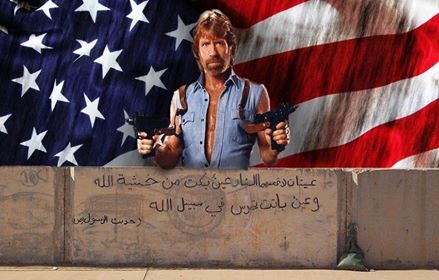
Someone said the Mareekans had rounded up the rebels who were controlling the airport and seaport. The crowd got bigger and bigger, we shouted, laughed and cheered in excitement. Security perimeters had already set up, blocking entrances to the airport. The Mareekan flag was waving, stars and stripes. That’s when it hit me: I had seen that flag in movies! These Mareekans were the movie people, and this was a real movie happening in front of us!
Commando must be here, I thought. This is it. This is the moment I had been waiting for, to meet Commando and watch him blow away all the militias! Helicopters dropped a shower of leaflets with photos and information about the troops. I picked up several of them. “United Nations forces are here to assist in the international relief effort for the Somali people,” it said in Somali. “We are prepared to use force to protect the relief operation and our soldiers. We will not allow interference with food distribution or with our activities. We are here to help you.” Because not so many Somalis could read, the leaflets also showed an illustration like a comic book of a U.S. soldier shaking hands with a Somali man under a palm tree, as a helicopter flew past. I couldn’t wait to shake hands with Commando.
Everything was moving so quickly—the tanks, the soldiers, the planes. We jostled for positions to watch the movie that was happening in front of us. Except there was no gunfire. I kept waiting for the battle to start, I wanted the Chinooks and Cobras to blast away at the rebels. But everything was peaceful. Then I remembered it’s always like this in the movies. First you see all the heavy machines and helicopters gearing up for action, then the battle comes later. I wanted to see the militias face these troops, but the rebels I had known since we returned to Mogadishu were now walking around unarmed, acting like regular people. They didn’t dare to face Commando.
I watched all day as the Marines took positions, more and more of them coming. Two men in uniform waved to let us cross the airport runway up to the sand dunes, so we could watch as the hovercrafts brought more and more Marines from the sea. Humvees and tanks roamed noisily but never fired a shot. I was getting impatient for the battle to start. We watched as the troops pulled out their stuck Humvees from the sand dunes. Hassan and I grew bolder and edged close to the troops. I stood there with my mouth open, watching them drink from a water bottle and smile at us. I made a sign asking for water, and the white guy in uniform went into the Humvee and handed me a plastic bottle. Then we made eating signs with our hands to our mouths, and they handed us tasty marmalade, bread and butter. The Commando lookalikes even spoke to us in Somali, but all they could say was “Somali Siko!” Somali move back!
One of the Marines threw a chocolate candy to me. I grabbed it and swallowed the whole thing. When I got home and told Mom, she gave me a hard slap.
“You must not eat pork!” she said.
I told her I didn’t think it was pork, it was sweet, but she didn’t believe me. How would she know what pork tastes like?
Night came again, and Mogadishu was noisier than I had ever heard it. But for the first time in two years, there was no sound of explosions and gunfire. We were surprised how the Marines lit up the airport. Lights came from everywhere, helicopters, tents, cars. It looked like daytime in the middle of the night. We were not allowed to get too close to the airport at night—“Somali Siko!” the Marines yelled over and over. But for the first time my friends, my brother and I could go out on the dusty streets after dark and play games, laugh and talk. We counted the helicopters as they flew over, and the big gunships that circled over the city. Falis’s movie theater could now stay open at night, but we did not go. For the first time in years, outside was even more exciting than the movies.
***
The year had changed to 1993, my ninth year of life. The U.S. troops and the star-spangled banner were now accompanied by blue UN helmets and flags of countries from all over Asia, Africa and Europe. Many non-military people also came to the city to help. We would see them jogging, and swimming in the green waters off the beach. One woman, some kind of aid worker, jogged every morning near our house. She was white, had long hair, and she smiled and remembered my name. I made sure to get up every morning and say hi to her when she passed. I watched her listening to music on her headphones and stretching. Sometimes she would sit and play games with me, my brother and Nima. She always brought us snacks like peanuts, candies and cookies, and she also brought painkillers, antibiotics and other medicine. We had never seen pills, so she explained what they were for, and how to take them. I think I fell in love with this woman; it wasn’t romantic but I just wanted to stay close to her. If I knew her name today, maybe I could find her in America, but I only called her what we called all non-Muslims, gaalo or infidel. One day she came to the madrassa, just to visit and say hi. Macalin Basbaas refused to shake her hand. Then one day we stopped seeing her. Soon we realized no one was jogging anymore.
The warlords were getting restless, they wanted the city back. Aidid had a radio station and was telling Somalis on the air that they should fight the “occupation” of Mogadishu. On June 5, UN forces went to the radio station to seize weapons. Aidid thought they were trying to shut down the broadcasts and he ambushed the troops, killing twenty-four Pakistani soldiers. That’s when things got bad. On July 12 the Americans sent Cobras over a house in Mogadishu where they thought Aidid was hiding and blasted it into rubble. He wasn’t there, but dozens of other people were killed. Aidid claimed the Americans had killed women and children, and he started to whip up Somalis against the infidel “invaders.” The Americans said only Aidid’s soldiers had been in the house, but the seed of resentment against the foreigners had been planted. Aidid wasted no time, planting roadside bombs in August that killed four American soldiers and wounded seven others. The Battle of Mogadishu had begun.
I had been waiting so long for this moment! I wanted to see the American troops in action and how they fight. Hassan and I were so excited for war, we ran toward whatever corner of the city we heard explosions or gunshots. Soon Cobras and Black Hawks were swooping down everywhere, hovering over buildings where militias were hiding. I looked up and cheered whenever the helicopters shot at a building, to me it seemed like the greatest movie. I stood on the streets and watched militias yell at each other, jumping from house to house and hiding in narrow alleys. We watched them take positions as helicopters hovered over them.
I thought the airplanes and helicopters would scare the militias away, but instead the huge, strong American men of the movies were being chased by Somali rebels on the streets. It was not what I expected. Soon everything had changed. We were no longer welcome near the Marines, there were no more candies or cookies. For the first time the Marines were aiming their guns at Somalis and pushing them around, even us kids. They looked nervous.
It is hard to explain why so many Mogadishans turned against the Marines and cheered the militias. The rebels had been killing us for four years, stealing our food and shitting in our houses. The Americans had been so kind. For sure it was partly the U.S. attack on the house that killed so many civilians. And at this point we were so familiar with death and destruction that this new battle seemed like a basketball game or a soccer match, it wasn’t even real life. People filled the streets, rooting for their home team. I too fell in with the crowd. I yelled out to the militias to let them know which side the helicopter was coming from. I threw rocks at helicopters. I ran with the crowd, repeating their cheers: “Up with Aidid! Down with America!”
The battle continued for weeks. The foreign troops slowly withdrew to the airport. Militias loyal to Aidid ruled the ground, but the foreign troops ruled the skies with their helicopters. At night it was hard for the Somali militias to see, but the helicopters with their infrared lasers were able to fire at their targets. Every night from our house I watched militias changing positions, shooting at helicopters. For a few minutes it would be dead quiet, then the helicopter would swoop down again and fire back. I believed my mother’s prayers saved us from the helicopter cannons but now I think it was the pilots’ precision.
On Sunday October 3, Aidid’s forces shot down two Black Hawk helicopters with Russian RPG bazookas. I heard the booming explosions and columns of smoke rising about a mile from our house. Naturally, I ran as fast as I could to watch this new action unfold. Everything was so dusty I could not see much or get very close. A crowd was dragging the bodies of dead Americans, and people said others were still alive, trapped. The rescue operation lasted until the next day. Sixteen Americans died and more than three hundred Somalis. A few days later I was playing hide and seek in the remains of one of the Black Hawks.
Five months later the Americans left Mogadishu. It was March 1994, my tenth year. The skinny rebels with their ugly brown teeth had beaten back the movie-star Marines. The Americans and the UN troops left so fast they didn’t even take their stuff. They left behind malfunctioning helicopters and vehicles, boots and uniforms. I joined a crowd that went to the same spot where the Mareekans had first invited us to watch them land on the beach in hovercrafts. This time we were looting the stuff they left behind, even the boxes of medicines, tablets, discarded syringes. We stuck the syringes into our hands for fun. We ate the tablets. Was it looting if they just left it?
The same militias whom we had cheered against the foreigners would soon turn on us again—stealing our food and shooting at us for sport. I felt shame that I had cheered against the Americans, the people who came to help us from the country of my dreams. But I now realize that I was lost—a nine-year-old boy caught between the teachings of Macalin Basbaas, my mother and her view on infidels, the American troops and their kindness and food, my love for my brave father and the glorious Somali basketball team, and the American movies I loved.
I stood on the beach, picking through the discarded camouflage uniforms with the American names sewn above the pockets. I held them up, hoping one would fit my skinny little body. My friends Mohammed, Bashi and Bocow laughed. I looked at them and scowled.
“I’m not Somali,” I said. “I am Mareekan. I was left behind by the Marines. And they will come for me soon.”
Interview with Matt Young, Author of Eat the Apple
Matt Young is a writer, teacher, and veteran. He holds an MA in Creative Writing from Miami University and is the recipient of fellowships from Words After War and The Carey Institute for Global Good. You can find his work in Catapult, Granta, Tin House, Word Riot, and elsewhere. He teaches composition, literature, and creative writing at Centralia College and lives in Olympia, Washington. His first book, a memoir titled Eat the Apple, is out now from Bloomsbury Publishing.
WBT: In Six Memos for the Next Millennium, Italo Calvino, the Italian novelist and World War Two veteran, discusses how he “gradually became aware of the weight, the inertia, the opacity of the world—qualities that stick to writing from the start, unless one finds some way of evading them.” Calvino then relates the myth of Perseus and Medusa. Perseus, Calvino argues, not only kills Medusa with his shield’s reflection, but must also carry the burden of his experiences—and Medusa’s head—with him indirectly; otherwise, he will, well, turn to stone. Perseus’s strength, Calvino claims, “lies in his refusal to look directly, but not in a refusal of the reality in which he is fated to live; he carries the reality with him and accepts it as his particular burden.”
I have found this a useful metaphor for the problem of relating war experience. Too literal, you kill the experience. Too abstract, you don’t say anything at all. It is also the first thing I thought of when I encountered Eat the Apple’s humor, diagrams, cartoons, and pronouns (“you” and “we” and “Recruit” and “Young,” instead of “I”). Can you talk to us about how and why you decided to recount your military experiences indirectly?
YOUNG: The change in POV started off as art imitating life. In Marine boot camp you’re required to refer to yourself as “Recruit So-and-so” and it felt unnatural to write a story about boot camp using “I” so I let the third person do work there.
I struggled with the fact that most war memoirs I’d read had some kind of extreme circumstance at their center—that kind of Special Forces narrative that inundates the media these days. My experiences by comparison seemed tame and silly. But I thought about all the grunts I’d served with who’d had similar experiences over the four years we were together and I thought about all the battalions that had replaced us in country full of similar guys who’d also had similar experiences. Those two thoughts gave rise to that communal first person plural voice—I realized it was best to lean into that idea of not having a unique experience, painted myself as no different than any other.
Lots of early pieces I wrote were ‘How to’ stories. Some of those made their way into the final draft, but many more changed focus later on. That highly imperative second person, felt like it confronted both military and civilian complicity in Iraq. But ultimately, the second-person perspective loses its power quickly because it often forces the audience to acknowledge they’re reading a story in ways other perspectives don’t so I tried to keep it to a minimum and fit it with form to make it feel more natural.
I also found that those other perspectives helped me confront my past actions in a less direct manner and helped me be more honest about who I’d been and what I’d done. They made me feel less alone, took me off the page and put me next to the reader and let me show them something I couldn’t have with just “I”. There’s something about the removal of the “I” that let me cut a little deeper.
WBT: The essays in Eat the Apple are relatively short and incredibly poignant. I experienced each and every one like a punch to the gut. Did this economy come into your writing naturally? Or did you have to refine longer essays into the powerful vignettes they became?
YOUNG: When I started writing I set off to write flash. I wanted the essays to mimic memory, and flash felt like a natural fit. It’s often how I remember moments—a smell or image or sound recalls a tiny thing and sends it zipping through my brain for a microsecond and then it’s gone, but I’m left thinking about it and reflecting on it sometimes for days.
I didn’t write or journal during my time in the Marines so I had to do a lot of memory recall exercises, late-night texting of former platoon mates, and research online to find incident reports. That process itself felt fractured, which also seemed to fit what I was trying to do—piecing together four years of experience and emotion to make a narrative.
I love the lyricism that generally comes with flash essays—it felt like a fantastic way to spice up the sometimes complete banality of war. In the beauty of those lyrical descriptions the horror of what I’m writing about maybe becomes a bit easier to stomach for a reader as well—that’s the hope anyway.
WBT: In a Time Magazine essay, you write the following: “I tried to fictionalize what I’d done because I wasn’t quite ready to acknowledge that I never fulfilled that manly heroic expectation people have of military service.” As someone who writes fiction, I found this unsettling (in a good way). Could you expand on what you meant here and maybe tell us a little about what you consider the relationship between fiction and nonfiction?
YOUNG: It happened on two levels for me. My senior Marines had fought in Fallujah. I saw them as the peak of manhood, real heroes. They’d been in firefights, cleared houses, killed people. I wanted to have done those things then. I’d been told those men were the pinnacle of maleness and I was so uncomfortable in my skin and lacked so much confidence as a young man that I was an easy sell and bought in fully. Then, when I got home after my first deployment I didn’t feel like I’d measured up to them and when I went to tell my family and friends about what war was like, I felt like I didn’t measure up to their expectations, either. So I made up stories to tell them, made my experience more like my seniors’. I lied. And I kept lying for years because it made me feel good and it kept me from having to reflect about what I’d done and what had happened.
Then, by the time I got to undergrad at Oregon State and started writing I had those lies mixed up with my truth. When I tried to write stories about my experience I saw myself in the characters I created and immediately began to defend them, to make their experience mean something. I wanted them to be heroes, and so they turned into caricatures. They spent their time in my stories explaining “the real world” to civilians unironically. There was no truth in those stories, because I couldn’t be truthful with myself.
It’s a bit odd, maybe. You usually hear from writers that fiction is a more direct vehicle for the truth. But for me it wasn’t writing fiction that got me there. It was using fiction writing techniques. Lines between fiction and nonfiction are super blurry a lot of the time. The moment an event happens and someone documents it, it’s filtered through an individual’s lens—that person’s contextual place in the world. Are the things I recount and the stories I tell considered fact? Probably not, by most standards. Are they truth? 100%.
WBT: Toxic masculinity is a topic much in the news recently. For good reason. We spend a lot of time of WBT debating and thinking about violence and its effect on communities. But sometimes we can forget how cultures of violence eat away at men too, at how this toxicity is a two-way street. Eat the Apple bravely confronts this exact issue. For example:
“You’ve chosen the United States Marine Corps infantry based on one thing: You got drunk last night and crashed your car into a fire hydrant in the early morning and think—because your idea of masculinity is severely twisted and damaged by the male figures in your life and the media you surround yourself—that the only way to change is the self-flagellation achieved by signing up for war.”
I feel Eat the Apple responds to this “idea of masculinity,” and I encourage readers interested in this subject to buy and read the whole collection through (a couple times). Did you set out to write on this idea of what it means to be a man in the U.S. today or is this simply a byproduct of describing your particular experiences in the Marines?
YOUNG:
Short answer? No.
Longer answer? I set out to write my experience as an infantry Marine and it was impossible to write that experience without writing about the antiquated ideals of masculinity and anti-feminism, which construct the ethos of both the Marine Corps and especially Marine grunts. It was delivered via Drill Instructors, School of Infantry Instructors, senior Marines, and higher-ups—a kind of disdain for everything feminine. Drop back on a hike? You’re a bitch or a pussy. Have a girlfriend back home? She’s fucking some other guy behind your back because you can’t trust Susie Rottencrotch. Women Marines—WMs—are dehumanized; called Wookies (which I never got) or walking mattresses. Those are the more overt portions of toxic masculinity I, and most, experience.
Then it hits you from civilians, too. Again with their expectations—what a soldier is supposed to be, what they’re supposed to have experienced and done, and how they’re supposed to react to that experience. Usually civilians expect you to have killed someone, to be damaged irreparably by post-traumatic stress, to be that strong silent type, to be a hero.
But calling someone a hero negates their experience or their feelings about that experience. It tells them their individual feelings are wrong and replaces them with a narrative people are more comfortable with. Hero worship is part of toxic masculine culture and it’s an act of silencing. It says, Shut up about your experience, smile when I thank you for your service so I can feel better about myself, and take the beer I just bought you. It perpetuates the tough guy military narrative—a thing I’d bought into so much I lied about my true experiences to family and friends when I returned home. I really couldn’t write about anything in my life right now without confronting masculinity in our culture.
WBT: Hard question time. That quote above. Isn’t this exactly what happened? Didn’t the experiences recounted in this book change you in ways that you both wanted and did not want? It’s okay if you just say, “read the last chapters of Eat the Apple.” Readers should.
YOUNG: Unsatisfying answer time: For sure. Doesn’t every experience do that? Before that quote I speculate as to what might happen if I don’t join. Do I think now that becoming a Midwest caricature was the only other outcome? No. I could’ve joined the Peace Corps, or sucked it up and enrolled in community college, or reconciled with my parents, or hit the lottery. There are infinite futures I could’ve had that could’ve changed me and affected me in infinite ways, but at that time I thought I was a bad man on a road to even more badness. I thought the Marine Corps would give me direction and purpose. I thought it would make me a man. I’m impulsive by nature, so I went with it.
I spend most of the rest of the book examining how misinformed I was and how directionless I became. This is really the problem I had with writing fiction about my experience when I got out. I wanted it to mean something. I wanted to know the world and myself better and more fully afterward—or wanted to pretend my military service had enlightened me to those things—but everything became more convoluted. It took being out and going to college and gaining education and language that I could use to articulate my experience to help me understand my experience and myself more fully.
WBT: I teach Slaughterhouse-Five to students every year. Every year they get upset by the descriptions of masturbation, pornography, and the picture of Montana Wildhack’s breasts. I ask them why they get upset by the masturbation and not all the massacres of human beings. Eat the Apple does not pull any punches when it comes to the sexual life of Marines. Can you tell us about Eat the Apple’s reception? Have you had any pushback?
For the most part people have appreciated the honesty. I write a lot about masturbation in the book for a couple reasons—one because I (and most of us) did it a lot. It really is a way to stay awake on post or pass the time or make you feel like you’re still somewhat human, so it becomes part of the fabric of Marine grunt experience. But also, it’s super intimate—in some respect more so than sex. You’re at your most vulnerable when masturbating. All your shortcomings, your kinks, your dumb facial expressions, whatever. You don’t have to hide any of those things when you’re jerking off by yourself. I wanted people to see that part of myself. It helped me let down that masculine guard that’s always up in military memoirs. Everyone masturbates. It’s a great way to build empathy.
Some people see it as crass and childish or disgusting, which says more about them as readers and people unwilling to engage with difficult topics. Most of the pushback comes from older men who don’t like me scuffing up the spit polished Marine Corps veneer. They’re a dying breed I think—those men and the stories they love so much. People want more. If the festering gash that is civilian/military divide is ever going to heal it’s going to take acknowledgement of the breadth and depth of service experience out there.
That people clutch their pearls at sex and not violence is an issue of our puritanical and patriarchal roots. Sex is bad because it empowers women. Violence is good because it establishes dominance and power—regressive masculine traits.
WBT: A fellow WBT editor and I have an absolutely unscientific generalization about war literature. There has not been, we contend, a war book published in the last fifty years that has not mentioned dogs, dead or otherwise. We have many theories as to why, none of them particularly insightful. Your work spends a lot of time talking about dogs too. Why do Americans write so many war books about dogs?
YOUNG: Man’s best friend, maybe? Relatability to the audience? Shock value? Killing a dog probably has some kind of purpose in the moment—to get them to stop eating corpses, or to get them to shut up, or out of boredom. In terms of literary merit, the killing of a dog is maybe more powerful than the killing of a human. We’re so desensitized to human death. The killing of an animal, especially a dog, is much more rhetorically pathetic.
Tobias Wolff has maybe the best line ever about U.S. war writing in In Pharaoh’s Army: “And isn’t it just like an American boy, to want you to admire his sorrow at tearing other people’s houses apart?” Of course, Wolff—being the brilliant writer he is—does not actually admire his sorrow, but interrogates it through the essay form itself—opens up the tensions implicit in recounting morally repugnant wartime experiences. I believe Eat the Apple to be one of the few memoirs since Wolff’s that accomplishes something similar. I also believe there is little “sorrow” in Eat the Apple and even less patience with those who might admire it. Did you consciously reflect on the privilege of reflection when writing these essays? How did you avoid falling into the trap Wolff describes?
YOUNG: I love In Pharaoh’s Army. One of my undergrad professors, Keith Scribner, recommended it to me when I was trying to figure out how to write about the Marines. Now that you mention that, maybe he saw me admiring my own sorrow in my fiction? Damn. My mind is kind of blown right now.
Anyway, after trying to fictionalize my experience I became very aware of the benefits and detriments of reflection. Honesty and humor kept me out of the trap. Those POV switches and different forms and styles were all working towards honesty and let me pull out the magnifying glass and pinpoint a sunspot to scorch the living hell out of my past self. Most of the humor in the book is self-deprecating—lacerating I suppose. I wanted the audience laugh at me. The humor at my own expense is naked honesty; the audience is laughing because of how horrible I am, which maybe makes the feel a bit of shame because of the rhetoric surrounding the military (“Support Our Troops!”). It creates a balance with those poignant moments and keeps me from verging into woe-is-me-I-signed-up-for-the-Marines-and-they-made-me-go-to-war-isn’t-that-sad? territory.
WBT: You teach writing. What do you tell your students on the first day of class?
YOUNG: Anyone who gives you a prescriptive fix for your writing, and means it, is a cop.
WBT: What do you tell your students on the last day of class?
Memoir by Sari Fordham: “House Arrest in Thirteen Parts”
Part I: The House, circa 1977
The house in Uganda was red brick with a metal roof, a rusted water tank, and a screened-in verandah that had once been painted green. My mother spent most of her day on that verandah. She read Psalms to us there in the mornings, combed our hair afterwards, and then wrote letters to my father’s family in the States or to her own in Finland. She was struck by how different the world was, how isolated each person was in their reality. It’s strange, she wrote my grandfather, that you’re skiing and otherwise getting in shape. Here the weather is usually so exhausting that you cannot get enough exercise.
The house sat at the top of a hill and was surrounded by jungle. Monkeys gathered in the trees, and such bright and peculiar birds flew through the clearing that my mother later regretted that she hadn’t started birding yet. The house had three bedrooms and a bath. With the exception of the verandah, it looked like an average American house, maybe a little older, maybe a little shabbier. By Ugandan standards, it was palatial. It wasn’t just the space, more than a family of four needed, it was also the amenities: running water, electricity, a fridge, a stove, a washing machine, and cupboards filled with items you could no longer buy in Uganda.
The Fordhams’ house on the hill.
We lived a mile from campus, a mile from all those grievances. Our closest neighbors were unaffiliated with the school and lived in what we called “the village,” even though the collection of mud huts belonged to a single Ugandan family: a patriarch, his wives, and their children. The wives and daughters collected water from our spigot every morning and carried it down to their communal kitchen. When my father was home, he would help hoist the pails onto their heads. One girl complained to my father that her neck hurt. “No wonder,” my father later said. He could barely lift the pails.
My parents were missionaries at Bugema College, a Seventh-day Adventist institution. The campus was twenty-one miles from the capital, Kampala, but the trip could take over an hour, depending on the conditions of the road or the number of military checkpoints. The distance suited everyone on campus just fine. The school had a dairy and a poultry farm, and beans and bananas were still available in the countryside. Whenever one missionary family eventually drove into town, they set aside personal grievances and ran errands for all the other missionaries.
The wives and daughters saw our house every day and had their own relationship with it. They walked past the screened-in verandah, the glass panes on each window, the light on the porch that turned on and off when the generator was working. They saw the external trappings of privilege and could only imagine what the interior held. We didn’t think we were privileged. My mother worried because she couldn’t buy toothbrushes in a store or children’s vitamins. To supplement our iron, she threw a nail in with the beans as they boiled.
My mother disliked the patriarch because he beat his wives, and she assumed he also disliked us and waseven spying on us for Idi Amin or someone high in the government. These were paranoid times. Bugema’s principal had been warned that “the American” was being watched, and my father was the only American on campus. When the patriarch asked my parents what they thought of Uganda, their answers were repetitive and chirpy: wonderful, wonderful, wonderful, wonderful. They were on edge with every interaction. Yet when we were under house arrest, the patriarch was not the person who accompanied the soldier.
Part II: The Missionaries
My parents, Gary and Kaarina, met in 1966 at an Adventist university in Michigan. My father, tall and skinny, had grown up surfing in Hawaii and had a fondness for practical jokes. To my mother, he seemed like the all-American boy. Later, she learned that my father and his siblings had spent their childhood bouncing around foster homes. During the last such interlude, an Adventist family took in the three children. My father and his siblings converted, and then his mother, who came for visits, did as well. My father found stability in the church and worked his way through Adventist boarding schools, eating only two meals a day because that’s all he could afford. When my mother met him, he was studying for his Master’s in Theology because he wanted to serve God and because he believed Jesus was coming soon.
My mother ostensibly came to the United States to study for a Master’s in English. Like my father, she’d grown up poor, but hers had a different texture. She was born in Finland at the beginning of World War II and was raised during the harsh austerity that followed. Her father, a Bible teacher at an Adventist boarding school, gave his salary too freely to needy students and to missions, leaving little to support his five children, the eldest of whom was handicapped. My grandmother was so anxious about finances that she tried unsuccessfully to induce miscarriages during her last two pregnancies.
My mother lived with her family in a house without indoor plumbing or running water. As she later told us, an outhouse in winter was no joke. For washing dishes and clothes, she and her siblings carried up pails of water from the Baltic Sea. It was a decent walk even without the weight of water. My mother and her siblings were always busy with the task of subsistence. In the summers, they foraged for mushrooms and berries, which they either ate or sold. My grandmother, who had never been to the United States, wanted her children to aspire to a future outside of Finland, telling them that in American even the telephone poles were higher than anywhere else.
My mother was the daughter to leave. She received a scholarship to study abroad, but more to the point, she had no marriage prospects in Finland. Despite being raised among all those potential Adventist suitors, she was, when my father met her, a twenty-six-year-old spinster who looked sixteen. The eligible bachelors had dismissed her as the Bible teacher’s bookish, less captivating daughter. In a black-and-white photograph taken before her departure, my mother stands beside all her worldly goods, three small suitcases and a bundle. Her hair is tied up, her eyes downcast. What seemed lost on everyone in Finland, especially herself, is that she’s strikingly beautiful.
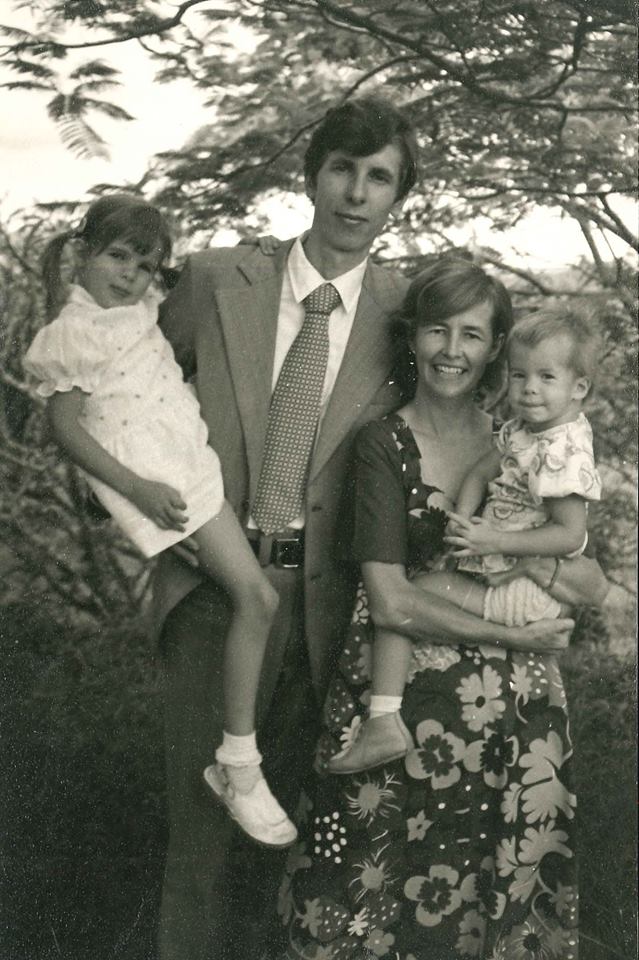
The Fordhams in Uganda (author Sari is on far right)
My father noticed immediately. He walked into the library looking for a date. Everyone knew that if you wanted to be hired as a minister, you had to be married. Earlier that day, he and his friends had planted books on each of the library’s study tables. The plan was to sit at the table with the most attractive woman, gesturing to the books. The hitch, for my father, was that my mother was a student librarian. Stripped of pretense, my father approached her directly and asked her out.
My parents got engaged four months after their first date, got married in Finland, honeymooned in Lapland, and settled in Indiana where my father pastored two churches and where my mother taught fourth grade, and where they rented their first house, a two-bedroom with wood panels and shag carpet. When Sonja was born, my mother quit teaching and spent her days photographing my sister and sending pictures to the beautiful baby contests advertised in the back of ladies’ magazines. My mother found America strange and lonely. People would say, “Come over any time,” but when my father drove her over, they looked confused, and she felt embarrassed in front of her new husband. She tried to get her driver’s license, but traffic frightened her, and she kept failing the exams. Church members critiqued her parenting. When I was born, my mother was ready to leave Indiana. She was tired of the winters, which she said were windier than those in Finland. She was tired of corn. When my father began talking about the mission field, she didn’t say no. In 1976, they moved to Uganda.
Part III: The Dictator
Idi Amin came to power in a 1971 military coup that was welcomed by most Ugandans. The deposed president Milton Obote had made himself unpopular by marginalizing Uganda’s largest tribe, banning oppositional parties, detaining dissidents, and declaring himself Life President.
The West supported the “regime change,” as coups we approved of were called. Milton Obote was a socialist, and Idi Amin wasn’t. Moreover, Idi Amin appeared malleable. Before Ugandan independence, he had served in the King’s African Rifles and had ruthlessly fought with the British against the Mau Mau rebels in Kenya. He boxed and played rugby. He was charming. He had a wonderful laugh. Western leaders considered him not too bright, despite the four languages he spoke.
Idi Amin preached an Africa for Africans, and then, in 1972, he expelled the Asians who ran the economy. It was not a small thing. There were 40,000 Asians, as the expatriates of mostly Indian origin were called, living in the country. After business hours, so few ethnic Ugandans walked the streets of Kampala that the city could have been a suburb of Bombay. The Asians had ninety days to leave, each taking with them only two suitcases of personal items. Their houses, furniture, appliances, cars, livestock, shops, pharmacies, coffee plantations, cotton farms, and factories were given to Idi Amin’s supporters.
Their bank acconnts were absorbed by the National Treasury. Uganda’s robust economy, a model on the continent, crashed hard. By 1976, you couldn’t buy oats in a store. Yet that one move helped mitigate Amin’s legacy with his countrymen. There might be nothing to buy in Kampala, but at least that nothing belonged to Ugandans.
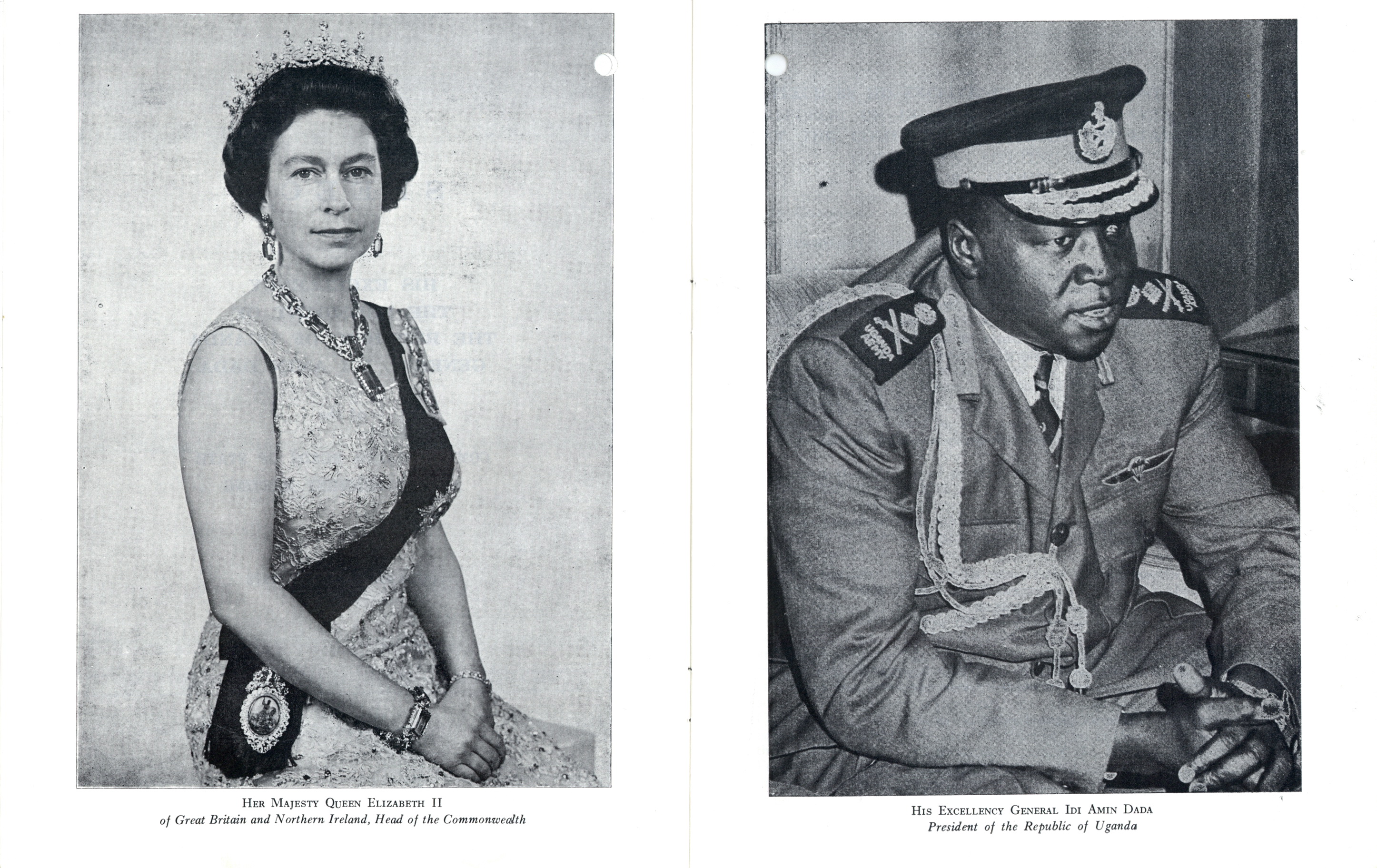
The West came to view Idi Amin as a buffoon, and in private meetings, world leaders questioned his sanity. A popular theory was that he had syphilis-induced psychosis. Amin was surely aware of his reputation and might have seen it as an advantage. In any event, he was a man who liked a joke, particularly one where the West was the punch line. You laugh at me; I laugh at you. His official title-read in full before radio addresses-was “His Excellency President for Life, Field Marshal Alhaji Dr Idi Amin Dada, VC, DSO, MC, CBE,” with the CBE standing for Conqueror of the British Empire. My parents laughed at that. They also laughed at the outrageous telegrams he sent world leaders. In a correspondence with Queen Elizabeth, he sympathized with England’s economic woes and volunteered to send “a cargo ship full of bananas to thank you for the good days of the colonial administration.” In Uganda, the killings began nearly as soon as Amin came to power. Concerned about a coup, he purged the army of soldiers from Acholi and Langi tribes, two ethnic groups allied with Milton Obote. He established the State Research Bureau, an intelligence agency infamous for torture. He killed those who threatened his power. He killed those who might threaten his power. He killed those who didn’t threaten his power at all. Bodies were tossed into the lakes, and the crocodiles grew fat. After fleeing Uganda, one of Amin’s former aides told Time magazine, “‘You are walking, and any creature making a step on the dry grass behind you might be an Amin man. Whenever you hear a car speeding down the street, you think it might suddenly come to a stop — for you. I finally fled, not because I was in trouble or because of anything I did, but out of sheer fear. People disappear. When they disappear, it means they are dead.”
Archives of New Zealand: Her Majesty Queen Elizabeth II and Idi Amin.
Humanitarian organizations were unsure how many Ugandans had been murdered. Some groups estimated that 80,000 had been killed. Other groups estimated that 300,000 had been killed.
Part IV: The Archbishop
On February 16, 1977, Janani Luwum — the Anglican Archbishop of Uganda, Rwanda, Burundi, and Boga Zaire — was murdered. The world had to notice.
Janani Luwum was a rare man, a warm individual — taking time to write letters to those he had met — and an innovative, effective leader. He encouraged theology students to take classes in Developmental Studies, and he promoted a Christian practice that looked African, not European. He was the most influential religious leader on the continent, and the first Ugandan to hold his position.
If Luwum had lived long enough to have a full career, he likely would have changed the Church. Instead, he became linked irrevocably with Idi Amin. They both were Ugandan men shaped by colonialism, both dynamic leaders, both capable of dazzling the camera with their smiles. These two men initially had a cordial relationship, despite the fact that Luwum came from the Acholi tribe, an ethnic group with sympathetic ties to the deposed president. The Archbishop used their friendship to temper the dictator’s excesses. Parishioners came to him with names written on slips of paper, and he would carry those names with him, cajoling Idi Amin into releasing someone’s brother, someone’s husband.
At the beginning of 1977, Amin survived yet another coup attempt, or invented one. Observers weren’t sure. What’s certain is that in response, he ordered the slaughter of everyone in Obote’s hometown. An entire town murdered and the world looked away. In the same fit of spite or fear, Amin purged the army of the remaining Acholi and Langi soldiers. A witness described the carnage to Time magazine. “You would hear a short cry and then sudden silence. I think they were being strangled and then had their heads smashed. Next day the floors of rooms C and D — the elimination chambers — were littered with loose eyes and teeth.”
It was too much. The Archbishop wrote Idi Amin an open letter and sent copies to government officials. Seventeen bishops signed the letter and Archbishop Luwum personally delivered it to Idi Amin. With the candor of an Old Testament prophet, he wrote: We have buried many who have died as a result of being shot and there are many more whose bodies have not been found. The gun which was meant to protect Uganda as a nation, the Uganda citizen and his property, is increasingly being used against the Ugandan to take away his life and property.
Few in Uganda were surprised when the Archbishop was arrested for “smuggling weapons,” fewer still when Radio Uganda reported that the Archbishop had died in a car accident on the way to the interrogation center. It was whispered that he had been shot. Some claimed that Idi Amin had pulled the trigger.
Part V: The Trip
After the Archbishop’s murder, even expatriates were anxious. The thing to do, the missionaries all said, was to be unobtrusive. Don’t make waves. It went without saying that you shouldn’t travel unless you had to. Any time you drove, you risked getting stopped by soldiers or by carjackers, soldiers being preferable of the two, but with the country on edge, who knew? It felt melodramatic to speak about getting killed. It felt presumptuous to clutch your passport and assume you were above it all.
For months, my father had been planning to drive into Kenya to attend church meetings. My mother had always intended to stay with us on the hill because it was safer and because she had little patience for the border crossings. She had created a shopping list for my father that might as well have said: buy all the things. Now this.
“No one expects you to still go,” my mother said. “No one.”
“I’m not that kind of missionary,” my father said. It was his favorite line.
My mother could feel the tug of their old argument. She sometimes veered away, setting her mouth and saying nothing further. More often, she railed. Why can’t you just once put your family before the church?
On the morning my father left, she was cheerful. My mother might shout during a fight, but she didn’t stew. As my father dashed through the house — “Where’s my Bible? Where’s my passport? Have you seen my glasses?” — she pointed him toward the items he needed, and when he was ready to leave she handed him a stack of aerogrammes that had accumulated on our table. For the past week, missionaries had been dropping off letters for my father to post in Kenya. Mail sent from Uganda was opened and read by someone, we all knew.
My father said goodbye to us in the yard. I sat in my mother’s arms and watched him go. It was a familiar sight. He left, and then he returned, often with presents. The best were matchbox cars. Sonja and I loved them because we loved him. At night, he would get on the floor with us and push cars around the legs of the dining room table.
“You better get going,” my mother said. “Don’t do anything stupid.”
She didn’t have to say that we’d be fine. Of course, we’d be fine. If you didn’t count snakes and malaria, life on the hill was uneventful.
Part VI: The Press Conference-February 23, 1977
My father was in Kenya when Jimmy Carter held the second press conference of his presidency. Reporters wanted to know how Carter’s campaign promises were holding up to the realities of office. No one anticipated that Uganda would be mentioned or that the press conference would have international consequences.
Halfway through, a reporter asked Carter: “What if anything, do you plan to try to do to help victims of political repression in these countries?” The countries in question were Iran and the Philippines, and the reporter noted that despite human rights abuses by both regimes, the United States was aiding their governments. Carter spoke vaguely about changes his administration was making and then pivoted to Uganda. Uganda was a small, politically inconsequential country, one the United States was not supporting either covertly or overtly; still, the Archbishop’s murder was shocking.
“Obviously, there are deprivations of human rights, even more brutal than the ones on which we’ve commented up till now,” Carter said. “In Uganda, the actions there have disgusted the entire civilized world, and, as you know, we have no diplomatic relationships with Uganda. But here is an instance where both Ambassador Andrew Young and I have expressed great concern about what is there. The British are now considering asking the United Nations to go into Uganda to assess the horrible murders that apparently are taking place in that country, the persecution of those who have aroused the ire of Mr. Amin.”
It was a throwaway line. The press conference, broadcast live on television and radio, continued for fourteen more questions, none of them about Idi Amin. Jimmy Carter didn’t mention Uganda again.
The next day, Idi Amin announced that Americans couldn’t leave Uganda and were to report themselves to Kampala on February 28 for a personal meeting. No one was quite sure what this meant. It could mean nothing. It could mean we’d be deported. It could mean we’d be imprisoned or held in Kampala. There were only 240 Americans in Uganda. Most were missionaries like us, who had ignored the State Department’s travel warnings. There were also a handful of airline employees, oil workers, and technicians. Sonja and I were some of the youngest Americans. With our father in Kenya, we were likely the only American children without an American guardian in the country.
“Goddammit. Why couldn’t our first crisis have been a more dignified one?” a White House adviser reportedly said.
Part VII: Singing in the Dining Room
News of the house arrest, as the missionaries called it, moved swiftly through campus. There was news, and then there was news.What were the Fordhams going to do now? Would they be deported or worse? What was Carter thinking? The other missionaries were relieved that the leaders of their respective nations — Australia, Canada, and the Philippines – -had sense enough not to irritate Amin, and it was fortunate, they all said, providential even, that Gary was in Kenya. They knew my mother was Finnish, and they speculated on whether or not Sonja and I were dual citizens. We weren’t. That my mother was the last to hear the news said more about living on the hill than anything.
“Please, can we have some peace and quiet?” my mother said. “We’re trying to talk here.” Her voice was sharp, and I began weeping. “Oh, for goodness sakes,” our mother said. After the midday rain, a missionary hustled up to tell us. She called out “Hodi,” and my mother’s heart lurched. “Gary’s fine,” the missionary said, as she sat on the couch. In the dining room, Sonja and I were building a puzzle. We began singing because we liked to sing and because we finally had an audience, even if she was only a missionary. The women spoke as if we weren’t there, and so we responded in the only way we could: we raised the volume. “God is so good. God is so GOOD. God is SO GOOD. HE’S SO GOOD TO ME.”
To the missionary she asked, “What does this mean? What’s he thinking?”
After we went to bed, my mother turned on the radio. She confirmed the date and time we were to present ourselves in Kampala and wondered whether or not she should take us. Who would even drive us? Surely the Ugandan government wouldn’t seek out two children. Did anyone even know we were here? Who kept track of these things?
Termites flew against the glass with steady pings. A few had gotten into the house, where they fluttered on the floor, lattice wings propelling thick bodies. They were a delicacy. When they came flying out of the ground, children would leave whatever they were doing and run out into the fields to gather them. The termites were roasted and eaten. My mother carried the mugs into the kitchen and set them in the sink. She stood in the green darkness, water running through her hands, and cried.
Part VIII: The Letter
My father sat down to write his mother and stepfather. Despite attending meetings all day, he must have felt like he was on vacation. No teaching, grading, or lessons planning. And the food! In Uganda, we only spoke of such meals: toast with marmite, potatoes and green beans, spaghetti and peas, cake.
My father dated his letter February 24, the day after Jimmy Carter’s press conference. Either he hadn’t heard the news or the detention hadn’t yet been announced.
Dear Mother and Gordon,
Wanted to let you know all is well with us. There is trouble in the land, but we have not been bothered.
He filled the front page of the aerogramme with the minutia of our daily lives: mail in Uganda was censored, the dairy farm was down to six cows, wages for Ugandans were only fifteen cents an hour, fellow missionaries were requesting transfers.
Four days later, my father, fully aware of the events in Uganda, returned to the letter. He had left the back flap empty and so he turned to it and wrote in the date. February 28. So much could happen in four days.
I am still in Kenya (Union Session finished yesterday) and Americans are detained in Uganda. We are not sure what to do because Kaarina, on a Finnish passport, can leave more easily if I’m not there. We expected to get an indication today, but now the meeting [with Idi Amin] is postponed until Wednesday. I may go in tomorrow to be there for the appointment with the president and I may wait.
I wish I could contact Kaarina, but the phones are cut at the border. We know the Lord will watch over us, but feel it may be wiser to see what’s going to happen before complicating matters. The Lord Bless you. Love, Gary
My father was a phlegmatic man who liked to say, “Don’t make a mountain out of a mole hill.” After hearing we were under house arrest, he had continued attending meetings. He was a delegate, after all. Let the world burn around him, Gary Fordham would fulfill his duty. The letter to my grandmother, however, suggested that my father had identified a mountain as a mountain. Over and over, he used the pronoun we, as if he and my mother were in consultation. We are not sure. We expect. We know. We feel. Unable to contact my mother, he was conversing with her in his head.
Two decades later, after my mother died of cancer, he returned to this unconscious habit. We think. We hope. We feel.
“Who is this ‘we’?” I finally asked. “You and mom?”
“Yeah,” he said, and smiled. He never used we in the same way again.
Part IX: The Soldier
The soldier came in the morning. We were on the verandah when we heard the crunch of tires on a road that led to us and nowhere else. The rumble was a back and forth sound, a jostling of vehicle against washed out road, against mud, against potholes. My mother set down her Bible and the three of us watched the Land Rover jut out of the jungle, roll across the yard, and stop beside the frangipani tree. A soldier, dressed in green, sleeves rolled past elbows, climbed out, and there, from the passenger’s side, emerged Joseph, my father’s student.
“Good morning, madam,” the soldier said.
“Good morning, bwana,” my mother said. “Morning, Joseph.” The soldier was tall, or so he seemed to us, and dashing. His eyes followed our chickens, Rebecca and Sarah, as they snatched termites in the yard. “Can I help you?” my mother said. “If you came to see my husband, he’s not here.”
“Can we come in?” the soldier said.
My mother led them up the cement steps and through the verandah. She removed her shoes at the door and asked them to do the same. “All the mud,” she said. She motioned toward the couch and as the men sat, she asked Joseph how he was enjoying his classes. He answered that he was liking them very much.
Sonja and I scooted behind her. A soldier was sitting next to Joseph on our couch. Any other day, Joseph would have been the occasion. I would have climbed into his lap and demanded a story, but Joseph was not the point. There was a soldier in our house. He was wearing a beret and there were holes in his socks.
In the kitchen, our mother made cherry Kool-Aid out of water she had boiled the night before. We hadn’t had Kool-Aid in months, or as my mother liked to say, not in the memory of man. Sonja and I hoped the visitors wouldn’t drink it all. My mother hummed as she moved, reaching for our tall cups, then opening a Tupperware of dried finger bananas. She carried the Kool-Aid out first, giving a cup to both Joseph and the soldier. Then she brought out the dried finger bananas and held them out, and they each took one or two. Bananas were, well, bananas, but the Kool-Aid had made an impression.
“These are my girls,” my mother said. “Sonja and Sari.” We ducked and smiled. “What do you say?” she said.
Sonja stepped up to the soldier and said, “Hello.” The soldier took her hand and shook it. “You are welcome,” he said. I pressed my face into my mother’s waist, and they laughed.
“Okay,” my mother said. “You can go outside and play. Take the cat. Stay near the house, and for goodness sakes, don’t get too muddy.” And so we went, the reluctant Kissa looped through Sonja’s arms.
PartX: Inventory
Our mother frowned as we left, feeling what exactly, I shouldn’t know, but I’ve heard this story so often I can’t separate my memories from hers, my feelings from hers, and so I see her standing in our house, irritated. She was irritated at the excitement of her daughters, irritated at their father for being gone, irritated at Jimmy Carter for opening his big mouth, irritated at Joseph for accompanying the soldier, irritated at herself for not smiling more pleasantly, irritated that she had to smile. Underneath all her peevishness was fear. Quite absent was the triumph she later had while telling this story.
She sat in the La-Z-Boy we had brought from the States. It had come in a great shipment of things that had taken a year to be released from customs and only then, after my father had overcome his scruples and bribed the custom official. Opening those crates had been like a bad Christmas. So much bounty, so little practicality. Better to have brought more soap, more children’s cereal, more watches for bribes. Instead, there sat our La-Z-Boy.
My mother now looked at the soldier with as much pleasantness as she could muster. Even if she could remember where my father kept the watches, she didn’t dare bribe an official. It might be exactly the wrong thing. She wasn’t going to give Idi Amin any reason to throw her in jail. “If there’s even a speck of mud outside, my girls will find it,” my mother said. “So today, forget it. Mark my words, they’ll be filthy when they come back in. Do you have children?” When the soldier nodded, she rattled off her Questions For Soldiers With Kids: How many do you have? How old are they? What are their names? Are they attending school? Do you like being a father? If we had been at a roadblock, she would have concluded the conversation with a small present for the children (a pencil or a nub of soap), but today she was too anxious.
“Where is your husband?” the soldier asked. “Where is Gary Fordham?”
“Joseph didn’t tell you? He’s in Kenya.” It was not lost on her that the soldier knew my father’s first name. She was certain she hadn’t told him. “He’s attending the East African Union meetings.”
My mother hadn’t expected this visit, but now that the soldier sat across from her, his visit seemed inevitable. Of course, he was here. But what about Joseph? Why had he come?
The soldier explained that he had been sent with orders from Idi Amin Dada himself. All Americans were to appear before Idi Amin on Monday and couldn’t leave the country before then. He was here because the Ugandan government wanted a list of our family’s valuables. There was nothing menacing in the solder’s voice. It was the message itself that was menacing. Soon we would be separated from all that we owned. If we were lucky, we would only be kicked out of the country like the Asians. If we were unlucky, well, no one wanted to consider it.
“This is a misunderstanding,” my mother said. “I’m European, not American.” She excused herself and returned with her Finnish passport, which she handed to the soldier.
He flipped through it, giving the pages a cursory glance. “Gary Fordham, he is American? Your babies, they are American? Madam, why is your husband gone now? Why are you all alone?”
My mother smiled blandly.
“Thank you,” the soldier said, handing her the empty cup and the passport. He was polite. She was polite. “I must inventory your belongings now,” he said. He had brought a clipboard with him into the house.
“The furniture doesn’t belong to us,” my mother said. “It belongs to the school. A fine Ugandan school, as you saw driving in.That couch isn’t ours. The table and chairs aren’t ours. The refrigerator isn’t ours. If you take them, you’ll only be hurting the school.” She shot a look at Joseph.
“This one is Ugandan?” the soldier asked, nudging the La-Z-Boy.
“Oh, goodness,” my mother said. “Of course, you’re right. That’s ours. Actually, it’s mine, and I’m not an American citizen. It’s not an American belonging.”
The solder looked at her, pointedly, though he didn’t write anything down. He walked into the kitchen.
“The stove is the school’s,” my mother said, “But the pots and pans and dishes are mine. The Tupperware is mine.”
The soldier began to pull open drawers. “Does the silverware belong to the school?” he asked.
“No, it belongs to me,” my mother said. She claimed everything in the kitchen. She claimed the rice cooker my grandmother had sent from the States and the transformer that allowed it to work here. She claimed the cheese slicer, cutting board, and ceramic bowls (which actually were from Finland), and the can opener, dishtowels, and colander (which weren’t). In the back room, she claimed the washing machine. She smiled and nodded. Mine. Mine. Mine. They went through the bedrooms, attempting to separate the property of the school from the property of the Fordhams. The beds belonged to the school, as did the mosquito nets, the dressers, and the bookcases. The sheets and blankets and books were ours. The typewriter was ours, as Joseph pointed out. So were the matchbox cars, the Fisher Price toys, our Sabbath dresses, my father’s ties, a Swiss Army knife, an old perfume bottle, the radio, our hens, the dog. My mother claimed them all.
The car, our most valuable possession, was in Kenya, but Joseph suggested that the bicycle should be here. “Pastor Fordham bikes to campus every day,” Joseph said.
“Yes, Joseph,” my mother said. “He needs the bike to get to campus.” She wanted to hiss in his ear-Whose side are you on anyway, brother Joseph? “It’s in the garage,” she said to the soldier. Bicycles were impossible to buy in Uganda. Everything was hard to come by. Even our pots and pans would be snatched up on the black market. But the bicycle? Well, people had been killed for less. “I can show it to you if you think it’s necessary.” The soldier nodded. “But I think you should know, it belongs to me.”
“Your husband’s bicycle?” the soldier said. His incredulity sat between them.
“Yes,” my mother said. “I bought it, and I’m European.” Let them prove she didn’t own that bicycle.
“Madam, what is your husband’s? What belongs to him, eh?”
My mother said nothing.
Part XI: The Misunderstanding
Jimmy Carter set up a command center to monitor the crisis in Uganda and redirected a nuclear aircraft carrier to the coast of Kenya, along with five naval vessels. The ships, which had been cruising the Indian Ocean on routine missions, were not prepared to rescue us. Time later reported that between all of them, there were fewer than 200 Marines. Still, the message was delivered. “The President will take whatever steps he thinks are necessary and proper to protect American lives,” the White House Press Secretary announced. So much promised effort, so few endangered lives. Of course, every life is precious to its owner.
Idi Amin must have felt conflicted. When a British professor had insulted Idi Amin in 1975, Queen Elizabeth had apologized personally, and England’s Foreign Secretary had come to Uganda to secure the professor’s release. After a much more public criticism, President Carter was offering nothing but a show of force. Moreover, if Amin had seen the inventories taken by his soldiers, he must have been happily considering the political support he could secure with all those washing machines and cars.
But Idi Amin had learned what even a small country might do for its citizens. A year earlier, Palestinians had landed a hijacked plane at the Entebbe Airport and held Jewish passengers hostage. Idi Amin had played host to both terrorists and hostages. He was a Big Man, courted daily by Israeli negotiators. And then the raid happened. Israeli commandos freed most of the hostages, killed the terrorists and the Ugandan soldiers on duty, destroyed the Ugandan air force, and left Idi Amin looking weak and inept. He might not survive another such fiasco.
Idi Amin sent Carter a telegram stating that “the Americans in Uganda are happy and scattered all over the country” and that “Uganda has the strength to crush invaders.” He postponed meeting the Americans and then a few days later, canceled it. The fun was over. Idi Amin assured us we could leave the country if we wished. But why would we? Uganda was a beautiful country, and he had just wanted to thank us for our service.
My father was in the Finnish embassy when the final announcement wasmade. The clerks were creating counterfeit Finnish passports for Sonja and me, which they planned to smuggle into Uganda through a diplomatic pouch. It was as James Bond as anything we would be associated with. On hearing the news, my father thanked the clerks. Now for his errands. Of course, the Fordham family would stay in Uganda. The crisis was over. Why make a mountain out of a molehill?
My father walked to the nearest duka and bought two matchbox cars.
Part XII: The Foreign Government Dances
For years, the only accounts I had of the house arrest were my own memories and my parents’ stories. I looked for confirmation in Ugandan histories, but amidst the atrocities of the Amin years, the event was too small to matter. Then one day, I stumbled upon Time’s archives and discovered articles written in the midst of the crisis. Once I found one piece of coverage, I found more and more. I listened to Carter’s press conference and watched an ABC news report that was broadcast during the crisis. Experts called Idi Amin a “butcher” and said that while Amin didn’t usually kill foreigners, nobody knew what to expect. My American grandmother likely saw the news story weeks before my father’s letter arrived.
For most of my life, I considered this my mother’s story. My mother stood in the living room and made a rash decision. She hadn’t known, until she claimed that first item, what she would do. She was angry and that was part of it. A soldier was informing her we might lose everything we owned. She had grown up poor, and possessions mattered to her, never mind that she was a missionary. She was also anxious about us, her American daughters. When we were born, she hadn’t wanted us to be dual citizens or even to learn the Finnish language. She wanted us to be fully American, unable to return to the land she had left and still missed terribly. Our US passports were to be talismans, offering protections and opportunities that we, as Americans, would never fully appreciate. As she stood across from Joseph and the soldier and claimed everything we owned, she felt utterly alone, and so she did what she did. She was courageous. I think this, still.
My mother stood across from a soldier who carried his own stories and fears. He held all the power in their interaction, and yet, he must have known that he was far more likely to be killed by Idi Amin than she was. Surely, there had been whispers about what had happened to the soldiers at the Mugire prison. They weren’t just killed, they were killed with sledgehammers because bullets were too costly. If Idi Amin stayed in power, this soldier might join the disappeared, and if Amin was overthrown, he might be killed as retribution.
Standing beside the soldier, inexplicably, was Joseph. Joseph had no obvious reason to be at our house or so helpful. My father was a popular teacher who often ate breakfast in the cafeteria with his students. He was a hard grader to be sure, but he was also funny and kind. I don’t think Joseph came because he was angry at my father. His anger — if it was that — was probably broader. Why should expatriates have so much and Ugandans so little? Upon graduation, Joseph would likely be hired by the Adventist church and assigned a district that covered hundreds of miles and included multiple churches. He would work more than forty hours a week, but he wouldn’t be able to afford a car, and if he owned even a bicycle, it would be through charity. A rural church in Ohio or North Carolina might send money for one as their “mission project.” They would expect a thank you note and photographs. Where was the dignity for the Ugandan? Where were the opportunities?
My Finnish grandmother knew that some people were more valued than others. The church might teach that God loved everyone equally, but in this world, citizenship determined worth. My grandmother had tended cows as a child, and as she stood in the dung, warming her bare feet, she decided that if she had children, she would urge them to move away and to matter. In Uganda, an entire town was murdered and my parents didn’t hear about it. How many residents lived in that town? There were surely more than 240 people, but they had no advocates. Even today, the only record of their existence is their annihilation.
After the detention of the Americans, Time put Idi Amin on the cover, titling their piece “The Wild Man of Africa.” One of their sources, a Ugandan who bad self-exiled to Tanzania, described Idi Amin’s foreign policy: “He always acts the same way. He threatens a group of foreigners, and then he says everything is okay. Then he threatens them again, and then he says everything is okay. The foreign government dances back and forth-and everyone forgets about the thousands of Ugandans who are dying.”
Part XIII: The Matchbox Car
We were the foreigners, or some of them. We weren’t thinking about political dances or how Idi Amin might be using our presence in Uganda. Officially, my parents were thinking about God. In addition, my father was thinking about teaching, and my mother was usually wondering whether there would be any letters in the mail. We were all thinking about food. And with my father gone, I was thinking about matchbox cars.
Believing my father would be home soon, my mother used the last of the whole-wheat flour to make piirakka. It is a Finnish pastry, and for months, Sonja and I had been begging her to make it. She had waved us off, saying it was too hot here or that we didn’t have enough powdered milk or that piirakka wouldn’t taste right without rye flour. She stood over the stove, stirring the rice, stirring the rice. If she let it burn, she would feel even more foolish than she already did. “We’ll see,” she told us. Who makes piirakka in Uganda? Well, she was making it now, and we would see.
My father had originally planned to return that day and my mother expected that he still would. “He has class tomorrow. He’ll be back,” she said. Sonja and I spent the morning arguing about who would tell him about the soldier. We sat for a while on the patio steps, giving each other shoves.
“I’m telling.”
“No, me.”
Our mother poked her head out the door. “Daddy’s probably sitting at the border right now, just wishing he could hear you two fight. Oh, boy. He doesn’t know what he’s missing.” And then, “As long as you’re out there, keep the monkeys off the tomatoes.”
By the afternoon, Sonja was building a puzzle and I was pushing my matchbox cars around the kitchen floor. “Daddy’s bringing me a car,” I told my mother. “Maybe orange.”
“Don’t count on it. We’ll be lucky if he brings flour. And, good grief, if I step on one more car, I’m taking them away.”
By supper, my father still hadn’t come. My mother set the table. “Never mind, he still might come. Or he might stay the night in Kampala and come in the morning. We can wait another day, right, girls?”
She put the piiraka and some finger bananas on the table and told us that it was probably the first time they had been served together in the history of mankind, making us feel very important indeed. The piiraka had a salty, creamy bite, and though my mother had been complaining about their looks, she smiled after trying one. “This is a nice change of pace.”
We were almost done eating when we heard a car. We ran for the door. My mother was out of the house first, bare feet even, but once she got outside, she slowed to a walk. She kissed my father and asked how the border went. Sonja and I were jumping and shouting, soldier, soldier, soldier, and also, Kool-Aid.
“What’s this about a soldier?” my father asked. “Did you have any problems? Did you get to meet Idi Amin?”
“Nothing like that,” my mother said, “Someone came to the house to find out how rich we are. The girls are dying to tell you. But,” and she lowered her voice, “you’ll never guess who came with the soldier. It wasn’t Idi Amin, I’ll tell you that.” She turned to us.”Okay, girls, let’s go inside and you can take turns telling. Let’s not talk out here.”
My father picked me up, and I whispered in his ear, “Did you bring me something?”
“Do you mean oil?” he said.
“No,” I said. “A present.”
“A present? Like a matchbox car?”
I nodded.
“Oh, man! I just knew there was something I was forgetting. I was driving all day today, trying to remember what I had forgotten. At least, I think I forgot it.”
Each time he came back from Nairobi, he did this. Sometimes, he said he forgot to buy matchbox cars and other times that he forgot to pack them. When he finally found them in some obscure corner of his luggage, I would be near tears or full out crying. “Gary,” my mother would say.
“This is just terrible,” my father said now and smiled at me.
I looked into his eyes and believed him. I was sure that it was the worst thing in the world.
That night, we sat at the dining room table, the four of us. Sonja and I were still damp from our bath, and my mother was still cheery from my father’s arrival, though he had already confessed that he had been unable to bring back flour or oil or any of the other staples on her list. Never mind, that was tomorrow’s problem. Sonja described the Kool-Aid and how the soldier had drunk it, glass after glass. I nodded my head, as if it all meant something grownup and important and that I had noticed it, too. In my lap, I held an orange matchbox car. I ran my thumb over the silver chrome. My father asked what flavor the Kool-Aid was and if there was any still in the fridge. It was past our bedtime and soon our mother would send us to bed. She would tell us that our father had to teach tomorrow and that we would see him at breakfast. He would carry us to our rooms, one by one, and have prayer with us. Then, we would lie in bed and listen to our parents talking, to the hushed turn of their voices.
The house in Uganda was red brick with a metal roof, a rusted water tank, and a screened-in verandah that had once been painted green. At night, I would pretend that we lived in a boat. The jungle was the ocean and the thrumming frogs were the waves and we were far away from everyone else in the world. I would close my eyes and listen for the water, and I would imagine that we were completely safe.
Sari Fordham on a return trip to Uganda.
“House Arrest in Thirteen Parts” originally appeared in the print journal Isthmus Review No. 5, 2016.
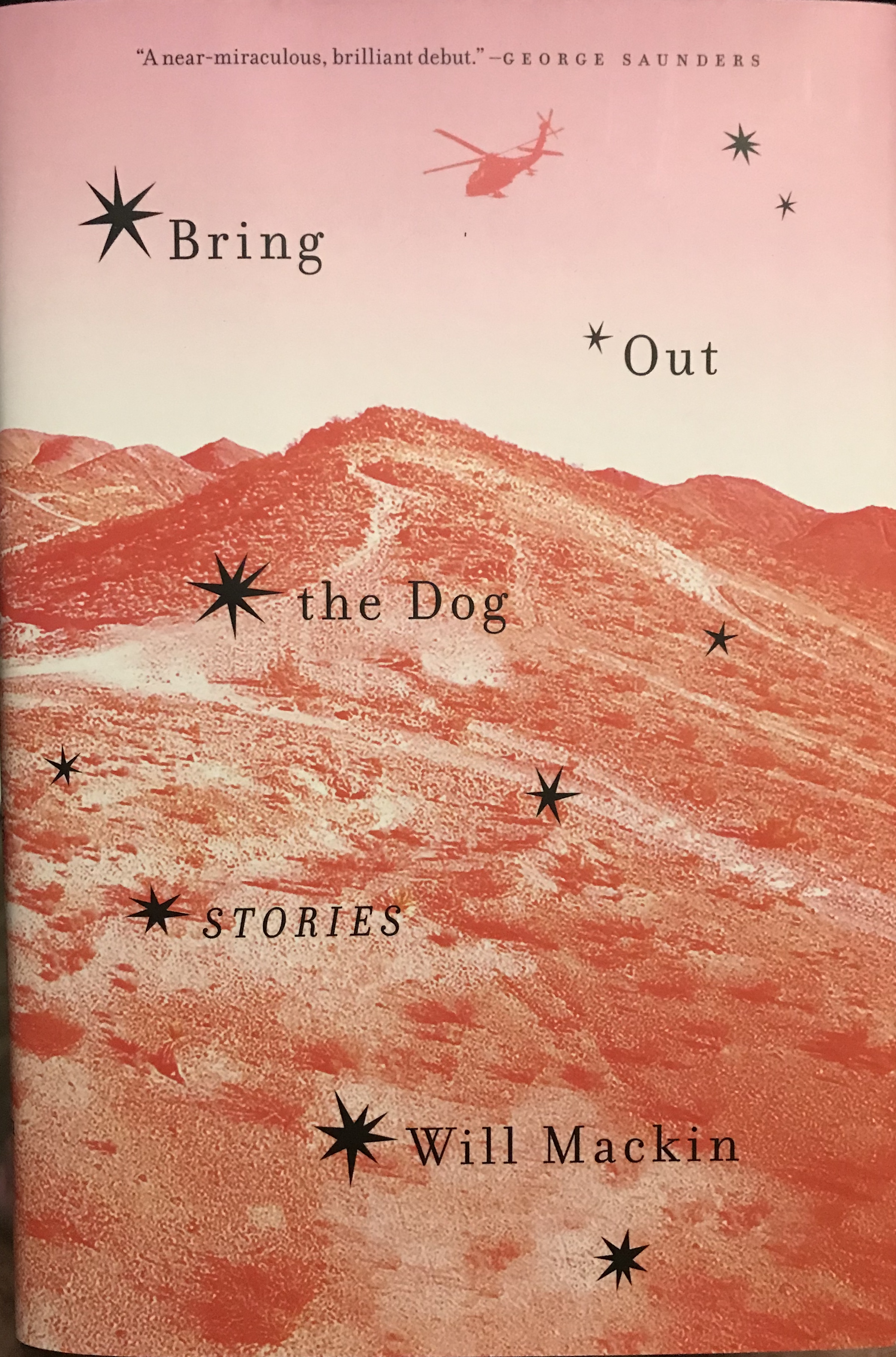
Go Home and Dig It: A Review of Will Mackin’s Bring Out The Dog
“Crossing the River with No Name,” the eighth story in Will Mackin’s debut collection, Bring Out the Dog, describes the movement of a SEAL team “to intercept” Taliban coming out the Pakistan Mountains. Using night-vision equipment, the SEALs plan to light up the night-blind Taliban with sparklers that the Taliban cannot see, and then fire state-of- the-art weapons at the invisibly sparkled men, eliminating the threat before the threat can become a threat, before the threat knows that it is, in fact, threatened. They have done this, the first-person narrator explains, many times before.
A paragraph from early in the story:
“Electric rain streaked straight down in my night vision. Cold rose from the mud into my bones. It squeezed the warmth out of my heart. My heart became a more sensitive instrument as a result, and I could feel the Taliban out there, lost in the darkness. I could feel them in the distance, losing hope. This was the type of mission that earlier in the war would have been fun: us knowing and seeing, them dumb and blind. Hal, walking point, would have turned around and smiled, like, Do you believe we’re getting paid for this? And I would have shaken my head. But now Hal hardly turned around. And when he did it was only to make sure that we were all still behind him, putting one foot in front of the other, bleeding heat, our emerald hearts growing dim.”
A series of simple sentences, each spare, lithe, exquisitely precise, usually in clusters of three, each distorting the known or assumed physical world. The rain becomes part of the night vision. The mud rises up into the bones. The cold takes away warmth but provides an uncanny sensitivity to the enemy’s pain and fear. But then a pivot, a pointed reference to the carefree juvenescence of these would-be demigods, when they couldn’t believe they were getting paid to appear in the middle of the night and massacre a platoon of clueless, effectively blind, Taliban. And yet that was then, six intercepts ago; what now? What has happened to these emerald glow-in-the-dark hearts? Where has their youth gone?
Will Mackin knows intimately. A 23-year Navy veteran, Mackin flew jets, wrote speeches for the Vice Chief of Naval Operations, and spent six years as a Joint Terminal Attack Controller with a SEAL Team before retiring in 2014. As such, his work has a unique perspective not only on the endless succession of deployments and dislocations SEALs endure, but the disproportionate vision of people and country with all the power in the world and no idea what to do with it.
The next paragraph in “Crossing”:
“We made steady progress through the rain until we came to a river. The river looked like a wide section of field that someone had broken free, that had, for unknown reasons, been set in motion. In fact, the only way to tell the river from the field was to stare at the river and sense its lugubrious vector. But to stare at the river for too long was to feel as if it were standing still and the field were moving.”
Again: paradox. How can you make steady progress through then rain and then come to concentrated water? Then a simile that claims that what has stopped them, blocked their “progress,” has itself broken free. The pivot. A slight pause, an ironic reference to fact—slippery in all of Mackin’s stories—and an appeal to concentrated vision, some determinate perspective, which is immediately undermined and inverted when the land moves and not the river.
Soon the narrator is drowning in the river. The Virgin Mary appears. She tells him she won’t be saving him. “How come?” asks the narrator. “Because saving you would require a miracle, and you already used yours,” she said, “not unkindly.” The story then transitions to the States, and a teenage narrator who laughs at a sentimental loser football coach from Ocean City, NJ (what a place to be from! To live your entire life in!), sleeps with the football captain’s girlfriend, and smashes the mailboxes of rich people in the neighboring town. Then the narrator gets the miracle. They win the football game. A skinny kid whose name he can’t remember scores a touchdown.
Viktor Shklovsky argues that Leo Tolstoy “forgoes the conventional names of the various part of the thing, replacing them instead with the names of corresponding parts in other things.” He “estranges” because he refuses, Shklovsky says, to “call a thing by its name.” So too Mackin. As Peter Molin points out in his Time Now post, Mackin calls nothing by its name—the cold sensitive heart, the literally unnamed river that does not move, the skinny kid who he does not remember. In other stories, SEALs hunt for two captured American soldiers named “no-chin” and “chin,” the SEALs hold an elaborate memorial service for a killer Vermont Trappist monk dog killed by a SEAL. “What do you folks want to hear?” asks a tuba (!) player on an isolated outpost in middle of Afghanistan. Anything, nothing, go fuck yourself, says the crowd of soldiers high on horse drugs.
This aesthetic technique is not only a delight to read, but fits Mackin’s subject. His SEALs live estranged lives. They exist in multiple time zones. They travel by air from one nameless spot on the map to the next. They have the power of gods and the soft bodies of men. At the end of “Crossing the River with No Name,” the narrator, rescued from the river by a fellow SEAL (thanks for nothing Virgin Mary), goes on to intercept the Taliban. The narrator talks about how their leader Hal used to invisibly sparkle the Taliban in the middle of the platoon. “That would be the man we spare,” says the narrator. “And that would be the man who would drop to his knees in a cloud of gun smoke, raise his hands in surrender. That would be the man who would tell who he was, where’d he’d come from, and why.”
An act of divine mercy or human sadism? What’s the difference exactly? Estrangement, undulating perspective, chip away at once obvious distinctions. Mackin’s SEALs sleep with strippers, assault stripper boyfriends, take drugs, ignore training protocol, steal manpower away from other units because they can. Rules don’t win wars. SEALs do. So what then are these modern-day Templars of the sky and sea and mountain top winning with all this money, all this power, all this violence, all this freedom? Are they saving Afghanistan? Afghans? Iraqis? Civilians? Hostages? The World?
Psychedelic British Classic rock mostly. Pink Floyd songs about mean teachers. Led Zeppelin LPs in reverse. Mailbox busting. Girlfriend stealing. A sense of teenage disaffection clings to the narrator, a cynical half-irony, vague entitlement in the face of endless plenty, combined with band-of-brothers militancy, a love not of the country—dulce decorum est and all that Horace crap—but of each other and an unwillingness not to let one another down (because, as W.H. Auden says, our sex “likes huddling in gangs and knowing the exact time”).
In other words, the narrator—for all his explosions, all this violence, all those dead bodies—is not much different than any other American boy, any other American man.
How’s that for the horror of war?
Barry Hannah’s “Midnight and I’m Not Famous Yet” provides Mackin his epigraph. “We saw victory and defeat,” the epigraph says. “They were both wonderful.” Elsewhere in “Midnight and I’m Not Famous Yet” Hannah’s narrator, a U.S. Captain in Vietnam, reflects:
“It seemed to me my life had gone from teen-age giggling to horror. I never had time to be but two things, a giggler and a killer.”
Sometimes the SEALs call Mackin’s narrator “Fuckstick” (a nod to Fuckhead of Denis Johnson’s Jesus Son perhaps, another psuedo-bystander). Sometimes the narrator throws a charnel rock for no reason and imagines and asteroid hitting the earth and aliens—little bars of blue light—finding the SEALs dead bodies and asking each other why he threw the rock. Sometimes the narrator listens to a SEAL team leader speak about the imperative of “speed and violence,” about how the SEALs are on the top of the food chain for a reason, and notices how nicotine enters through the SEALs “thinnest of membrane on his upper lip.”
Displacement. Disproportion. Despair. We can call down the fire of gods in the form of drone strikes, artillery shells, and invisible lasers, but can we save the people around us from dying off one by one? Can we combat the battle fatigue evident after five deployments? Can we stabilize and make sense of the endless succession of kaleidoscopic dislocations born of a war with no clear direction, no beginning, no end?
No. Not really. But we can love our men. We can love the war. We can giggle and kill.
“Fools. Fools,” says Barry Hannah’s Vietnam Captain. “Love it! Love the loss as well as the gain. Go home and dig it.”
Go home and dig it.
Dig what? What can we fools at home dig?
“I lay back on the outcropping,” says another Mackin narrator, during a training exercise in Utah, waiting for a plane to blow up a fire truck that may or may not be a real fire truck. “The stone was warm, the breeze refreshing. Drifting off to sleep, I found myself feeling thankful to the war. What else would bring me up here on such a perfect day?”
Dorothy Parker once argued that Hemingway wrote not like an angel—as his many admirers insisted—but like a man. Mackin actually writes like an angel. Like an angel that wants to go back to being a man, or, rather, like a man with the perception of an angel and the soul of a man. The cumulative effect is as astonishing as the fact our country has been fighting a war for eighteen years and might well be fighting for eighteen more years: it estranges us to the experience of ourselves, to the experience of America, the experience of history. Our eyes grow, as Mackin’s says, “bright with relativity”—the war does not end; it cannot end. But we see. We fools see. Don’t we?
New Essay by Patrick Mondaca: The Hideous Hypocrisy of Himmelstoss
“At the head of the column trots the fat sergeant-major. It is queer that almost all of the regular sergeant-majors are fat. Himmelstoss follows him, thirsting for vengeance. His boots gleam in the sun…Then he steams off with Himmelstoss in his wake.”
Himmelstoss, as anyone who is familiar with All Quiet on the Western Front knows, is the sadistic corporal who bullies with less power. The fat sergeant major, whose girth underscores his lavish and immoderate lust for comfort while the rank-and-file tighten their belts in the trenches, is happy to be the weight behind Himmelstoss’s threats. As the protagonist (Paul Bäumer) recounts, he and the other soldiers immediately disregard both Himmelstoss and the fat sergeant-major, continuing on no worse for the wear.
Not every human is a Himmelstoss, and this photo almost certainly does not represent one. But those that are make life miserable for everyone else.
We’ve all had a Himmelstoss in our lives at least once. They’re school principals and executive vice presidents and postal deliverymen and yes, sergeants-major. Some are fat. One should not dwell on men like these for any more time than is necessary.
I encountered one during my time at Walter Reed Army Medical Center, coming home from Iraq.
“Where is your beret, Sergeant?” the Medical Corps sergeant major, who had halted me on my way to an appointment, said. “And why are you wearing a desert patrol cap with a woodland uniform?” Thinking it obvious, I respectfully informed the sergeant major that my beret was still in a metal box somewhere in the desert. “Put that cigarette out, sergeant, and stand at parade rest when you speak to me. And don’t you dare throw that cigarette butt in my grass,” the sergeant major said. His posture was threatening, though I sensed behind it the existential terror of a man without serious occupation.
What else is one to do in such a situation but put one’s cigarette out on the pavement, then collect and squeeze it carefully in one’s clenched fist? His wet eyes pleaded with me for a minor transgression. He ached to thrust himself upon me further, so that we might enter the kind of seedy relationships this type of flaccid fleshbag seems to require for satisfaction. At that moment, I was tempted to give in, but thought better of it.
“Roger, sergeant,” I said instead.
But that wasn’t the end of it.
“What’s your name? What unit are you with? Who’s your C-O? Take that flag off your right shoulder, you’re not in theater anymore,” he said, his voice picking up speed and certainty as he warmed to the subject. “Desert boots, that’s a no-go. Are you wearing a field jacket liner? Ohhhhh heeeeaaaayl naw,” he said, his voice rising almost to a full-throated shout.
It was true, I was wearing an old M-65 field jacket liner under my uniform top instead of the newer issued winter polypropylene. “Yes, Sergeant Major, I will remove it, Sergeant Major,” I said, standing corrected, quite literally, in the brisk winter air. I had no intention of removing it, and I didn’t. I wore the motherfucker to bed that night. Hell, I’m still wearing that thing, deep in the recesses of the old foot locker that keeps my mementos of such places, stinking of smoke and dust and sweat and bullshit.
Whether you’re still in the military or you’ve transitioned to the corporate world, or are a civilian and have never served, it’s always the same. An FSM lurks, waiting to gig you on some stupid, asinine shit. It’s a threat we all must face, and disregard, with a smile and a nod and a “Yes, Sergeant Major” or “Vice President” or “Foreman”. Because that is all they will ever be—the barking, savage whiff of authority barely missed, one step below or behind the real boss. Forever the bridesmaid, never the bride. And after you realize the measure of their soul, what else do they have left to them but the illusion of power, usually shouted? They’re stuck within this sad, diminished aura, a victim of their penultimate rank. Give them “their grass” for the moment, or “their metrics” at close of business, or “their tie rods” in even rows in the next hour, and then go home. Or travel. Or go to school. Or anything. I have a photo of an Army cargo truck in Baghdad with “Stop the Insanity” scrawled across its passenger door. Sometimes that’s all we can do to remind ourselves who is really in charge and continue our idiosyncratic lives, one graffiti’d door at a time.
I never saw that particular sergeant major again, thankfully. I supposed he moved on to harass other troops about their shoulder patches until the regulation was changed a month later. I would have loved to see his face the morning after the paper came down, applying the patch he’d fought so hard against with resignation, then instructing the soldiers he’d yelled at the day before to get within regs… admitting his own impotence one betrayal at a time. Since then, there have been other FSMs who have thrown their “stripes” around in the various settings in which I have worked. Though, now that I think about it, when has it ever really mattered to anyone but them? We the people remain unimpressed.
In the Vietnam War film Hamburger Hill, a couple of troops try and buck up their platoon “Doc” after a casualty chanting, “It don’t mean nothing, man, not a thing.” And the medic, thus consoled and encouraged, goes on to fight another day. We all have bad days like Doc in the film. That sergeant major I met long ago now might have been having a bad day too. Doc doesn’t survive the battle. He succumbs to his wounds after imploring his fellow soldiers to finish taking the hill, so they can have something to be proud of. And they do. They do it for Doc and for each other. Those are the things that matter.
While violence is likely not the answer to fix people who abuse authority, it’s unclear what is.
We can choose to fall prey to the insanity of Himmelstoss and the FSM and others like them, or we can take their fear and insecurity in stride, their insistence that only by obeying the rules can one hope to elude destiny. In All Quiet on the Western Front, Bäumer and his mates lay a good old-fashioned beat-down on old Himmelstoss, and it’s hard to feel sympathy for him. Like the bloviating sergeant major I encountered, Himmelstoss is a nonfactor. His existence to Bäumer and the men is of no great importance, like whether they live or die. It should be noted that Himmelstoss, when he’s himself sent to the front, does eventually perform bravely following a motivational beating by Bäumer in a trench. Yet it remains to be decided whether Himmelstoss was merely a desperate ass-kisser seeking the favor of his lieutenant or acting out of a moral obligation to his fellow soldiers. The men aren’t in it for Himmelstoss and the FSM though. They’re in it for each other as were the men in Hamburger Hill. The regulations may not get changed every time so you can smile at the thought of the senior enlisted man or supervisor or other inflated authority wiping egg off their face. Nor will every Himmelstoss you come across fetch the beating of a lifetime every time they push the wrong troop too far. But don’t you sweat it. In the end, they don’t mean nothing, man, not a thing. Finish taking the hill, and be proud of it.
Fighting Like a Girl Means Not Being a Pussy: Mary Doyle Interviews Kelly Kennedy
It’s never easy to voice suspicions that your boss is out to get you. No matter how you describe it, the accusation sounds crazy. By the time you’re ready to put your instincts into words, you’ve already spent hours, days, weeks making the argument to yourself and telling yourself it’s all in your head. It’s not until you’ve fully convinced yourself it’s true that you’ll talk about it.
Lt. Col (Ret.) Kate Germano wrote a book about it.
Germano had come into her new job as commander of Fourth Battalion with a specific set of goals. She took seriously her role in leading the unit responsible for guiding every female recruit from civilian to Marine as they met the challenges of Marine Corps basic training. The goals she’d set for her command, like boxes on a check sheet, had tick marks from top to bottom, and yet, it took her a long time to realize that, despite her successes, her efforts were being undermined. Eventually, Germano knew without doubt that her aim to prove women Marines could train alongside male Marines was being challenged by Marine Corps leadership. The men working against her started from the very top. But unlike most of us Germano had proof that her bosses wanted to see her fail.
She maps out that proof in her new book, Fight Like A Girl, (Prometheus Books, 2018) in a calm, methodical, and well documented way.
Helping her make that argument is her co-author, Kelly Kennedy. Kennedy, an Army veteran and journalist, uses her research skills and a logical progression to map out an argument so convincing the two authors bravely name names. The names include those of Germano’s former boss, Colonel Daniel Haas and even the then, Marine Corps Commandant and now Joint Chiefs Chairman, GEN Joseph Dunford.
In 2010, when the book I co-authored with Shoshana Johnson (I’m Still Standing, Touchstone, 2010) was released, I remember feeling such relief that the book was well received and that my work on Shoshana’s story had helped make people aware of what she’d gone through. I was anxious to speak to Kelly Kennedy about her work as a co-author on Germano’s project and what it meant to be a part of telling this story that was so important, and yet, not her own.
Mary Doyle: I understand your agents introduced you and Kate Germano in hopes that you would work together on this project. Why do you think they thought the two of you might be a good fit? Had you ever worked on a co-authored project like this before? And how long did the project take?
Kelly Kennedy: Well, at first, I didn’t. I had heard bits of Kate’s story, and I was a bit worried that the military had it right—that she was abusive. But the more I dug in, and the more I talked with her, the more I felt not only that I trusted her (she backed up her story with plenty of documentation), but that I needed to help her tell it. Because we’re both veterans, I was able to ask her some questions based on my own experiences, which sparked at least one chapter. But I was also able to tell her about my experiences as a civilian, which informed part of the story. This was my first time as a co-author. We worked on the project about 1.5 years.
Kate Germano (left) is interviewed by her co-author, Kelly Kennedy, during an event at Politics and Prose at The Wharf, April 10, 2018. Photo by Mary Doyle.
MD: Part of the reason I agreed to work with Shoshana Johnson on her book was because I thought her story was, not only compelling, but an important story to tell. Germano’s story couldn’t be more important in terms of women in the military and proof positive that the decks are stacked against them. Did the importance of this story weigh on you at all? Did the weight impede or inspire?
KK: It was tough to hear her tell it, and it was tough for her to tell it. She often calls me her “therapist,” which is something we hear a lot as writers. Part of recovering from a traumatic event is the telling of it until the words don’t hurt as much, and it develops an overall meaning, rather than just a feeling of pain. But as the #metoo movement hit, and as we see more and more women prove themselves in infantry training, and even as we talked about women in endurance racing or crossfit or the tech world, we understood how important it was to say this is an issue that effects all of us, and that, as women, we really need to feel like we have each other’s backs—that it should no longer feel heroic to say, “You okay? I got you. Here’s how to…”
MD: How did you develop your work method and what did that look like? Was there ever a time when you had to stop and iron out issues? Or were you in sync the whole time? Did you have any influence in how the story was told?
KK: We started by meeting up for interviews. I would type in all of my notes, and come up with more questions, and then we would meet again. Kate speaks in story—she’s clear and to-the-point, so that part wasn’t terribly difficult. The harder part, I think, was getting the more emotional details out of her. Okay, that hurt, but what did you do? What about it hurt you? Where were you?
Generally, we were oddly in sync. When I sent over the proposal with the first three chapters, I think she was relieved. She has said, in reading the book, that she was terrified, but that she laughed and cried and got angry and loved it. But part of that is because she’s so good. The third chapter—the one about her background—didn’t quite feel right to me. I liked parts of it, but I didn’t like all of it. I sent it to her and said, “I’m not feeling this.” And she added and reorganized and sent back something we both liked a lot. So it was collaborative and fun and so much work.
We had written the story about the investigation as basically a long slog of the things that had been said about Kate. Our editor said, “You know. I think you lose Kate’s voice here. This is her story.” So we regrouped on that and focused more on her reaction—that a lot of it was just nonsense, like hugging one person but not hugging someone else, or the captain who was angry when Kate yelled at her for not doing her job so she walked out of her office. These are not things that are normal in any other version of the military, so we concentrated on that.
And yeah, I set up the outline, and Kate liked it. I would write up a section based on something we had specifically talked about or something generally important, like the background of women in the Marine Corps, and then send it as a word document. She would add or not and send it back. But she saw everything at least twice before we sent it to the publisher.
MD: One of the most impressive things about the telling of this story is the bravery Kate demonstrates in being open about how personally devastating the entire experience was for her. She often says she could have taken her own life. Did you ever fear that the retelling would have a dangerous impact on her? Shoshana suffered from terrible depression and getting her to read pages always made me feel as if I was forcing her to relive things she didn’t want to recall. It made me feel guilty, as if I were forcing her to bleed for others’ entertainment.
KK: My whole career has been about traumatic stories—from being an education reporter covering the first kids-with-guns stories to a cops reporter to a war reporter. Fortunately, I was chosen as an Ochberg Fellow after the series came out that led to “They Fought for Each Other,” because not only was I traumatized by the events that inspired it, but I was doing some incredibly intense interviews for the book. One guy talked for eight hours and said he hadn’t told any of those stories before. The Dart Center, which sponsors the fellowships, teaches journalists not only how to handle their own trauma, but how not to retraumatize someone. I have to say, I’ve never had anyone refuse to tell me a story, and I think they trust that I’ll listen, and that’s huge. We’re so often shut down: You’ve already said that. I can’t hear this. But you’re okay now, right? And I trust that the people I interview will be helped in the telling, and that the written story will lead to them being better able to tell it again—to invite people in. I hated seeing Kate cry, but I knew she needed to.
Kate Germano (left) is interviewed by her co-author, Kelly Kennedy, during an event at Politics and Prose at The Wharf, April 10, 2018. Photo by Mary Doyle.
MD: When I co-authored Shoshana’s book, the “with” co-authored inclusion was negotiated from the beginning. Would you have accepted the job if you hadn’t had co-author credit? Kate can obviously write since she has published in the NYT and other places. Did you worry that her ability to write would make life more difficult or less?
KK: I had no idea. Kate fought from the beginning to make sure I got credit—she’s huge on that, in general, and she’s been amazing about including me in the publicity afterward, which is fun. I think I just had no idea how it would work, but I did wonder what she’d think of those first chapters. I felt good about them, and they felt like her to me, if that makes sense, and it ended up being okay. After working with her for this much time, and seeing her so devastated as she told parts, some of the accusations against her blow me away. The idea that she could be cruel or unstable? Didn’t see it, and I was watching.
MD: Kate makes some very bold statements and charges throughout the book, every one of which she backs up with detailed facts and a logical argument to support them. Did you have influence in how the arguments were presented? Did you know all along that you would need to include the citations and notes at the end? I was surprised at first to see the citations in the text but understand why you used them. It’s further proof that her arguments are absolutely sound. Here’s just one excerpt among many that is an example of her supporting arguments:
We also had women break their hips. Male leadership assumed it was because of a physiological limitation, rather than a combination of a lack of fitness, their poorly fitted packs, and recruits running during the hikes rather than taking short, choppy steps.
Just like everything else at boot camp, hikes were part head game, part physical fitness. A lack of mental preparedness could make five miles seem like a marathon. But some of it was due to a lack of attention by the drill instructor staff. The hip-injury rate at Fourth Battalion had me wondering if I was training teenagers or octogenarians.
A lot of the problem had to do with how the women wore their packs. They wore their packs too far down, so the hip belts hit the wrong place. So, as they added weight, they hurt themselves. As it turns out, at one time, our athletic trainer had conducted a class with the drill instructors to train them on how to fit the packs for the recruits. But she had given the class to the battalion the year prior, so the new Marines and recruits hadn’t gotten the training. Broken hips were the result of a problem that could have been remedied with a simple solution. No one had shown the recruits how to adjust their packs properly.
Literally, adding insult to injury, the Marine Corps used that data –the hip injury rate—as justification for why women should be excluded from ground combat jobs.
KK: Sure. She’s very well-spoken and thoughtful, so I had much of the argument from the beginning. I did a lot of the research, but she constantly reads and thinks and writes, so she was sending me stuff, too. The fun one was Mona. She told me about Mona, [a section in the book about an alligator] and I kept thinking it over and thinking it over, and then it became this metaphor. So I wrote it up, and held my breath and hit send. And she was right there with me. Because she can be so black-and-white, I think part of my role was to help people understand how empathetic and funny she is, too.
MD: Since she was relieved of command, Kate started speaking out in the press about her position that female Marines need to train alongside their male counterparts for a long list of reasons. The way she has been treated since she began speaking out is further support for her arguments. Not only are her charges eye opening, she has never been afraid to name names and to boldly confront the issues. Did you ever caution her about the potential consequences? What is her attitude in terms of what consequences she expects?
KK: She understood from the beginning. Much of the time, I was trying to explain that she was going to end up helping people, and that it would all be okay in the end—that someday she would be glad she was fired. I think she’s just now starting to believe me. It’s part of her make-up to be brave, so I can’t imagine her backing away from anything.
MD: I found it interesting that you began most chapters with a letter of support Kate received shortly after she had been relieved. You also included one nastygram but she must have received many more. Some of the comments on Marine Corps Times are about what you’d expect. How did you and Kate prepare yourselves for the potential of negative comments once the book came out? You must have been deep into the writing when the Marine Corps United story broke. Did that impact the project at all?
KK: We talked about Marine Corps United a lot, but not as something to worry about—it was as something to fight. We’ve surrounded ourselves with tribe. We’ve worked hard and done our best. We’ve focused on the importance of what she had to say.
MD: There are a couple of places where Kate’s husband, Joe Plenzler, adds his take on Kate’s situation. Hearing his perspective is a major shift in the story telling but it adds an angle you wouldn’t otherwise get since he worked at the pentagon and had direct connection to Marine Corps leadership. In fact, it is in one of Joe’s portions that the main nugget of this book is revealed. Was this Kate’s idea? Yours? Did you have to negotiate its inclusion at all? What did you hope his point of view would add? Here’s an example of Joe’s input:
I served with the Commandant, General Dunford, when he was the Regimental Combat Team Five commander back in 2003, then as his speechwriter in Afghanistan in 2013 for three months, then again for the first five months of his commandancy. He too was no help.
It was pretty clear to me that General Dunford wanted to keep women out of the infantry at all costs. He was the only member of the joint chiefs (senior leaders of the Army, Navy, Marine Corps, Air Force and National Guard) to ask the secretary of defense for an exception to policy in September 2015 to keep women out of ground-combat arms jobs and units. That’s one way of saying it. The other way is to say that he wanted to perpetuate the Marine Corps’ policy of discriminating against women for some jobs based on their sex alone—regardless of whether or not they could meet the standards. His request made a lot of headlines because it placed him in direct opposition to his bosses, the Secretary of the Navy Ray Mabus and Secretary of Defense Ash Carter, who were pushing for all jobs to be open to any person, male or female, who could meet the standards. Even more disappointing, when Dunford didn’t get his way, he skipped the secretary of defense’s press conference on December 3, 2015, announcing the policy change. It’s practically a Pentagon tradition for both the secretary and his top general, the chairman of the joint chiefs, to attend together any press conferences announcing major policy changes.
In retrospect, it makes sense that the commandant would do nothing to ensure Kate’s complaint about systemic gender bias was properly addressed. It’s pretty evident that every advancement Kate made with her Marines at Fourth Battalion stripped away justifications for keeping women out of ground-combat arms jobs and eroded claims that women don’t shoot as well, don’t run as fast, and can’t carry the same weight as their male counterparts.
With every improvement to female performance, Kate was quashing critical elements of those arguments.
KK: We didn’t have to negotiate. I talked with Joe a couple of times to get some back story, and it started making sense to have him there. There would be no book without Joe because he was at the Pentagon to hear all the background, so it was nice to get him in there as a primary source having heard those conversations. But they’re also so different—Kate’s type A, obviously, and Joe, while incredibly talented and aggressive, is much, much more laid-back. I think he helps people like Kate, which was important to me—that people see more of her personality. I mean, you kind of go into the book judging her. But I think Joe also helps us better understand how we should (or could) feel about her story, almost like he gives us permission to just be pissed.
MD: Kate’s story is obviously an important one to tell. How do you feel about the role you played in ensuring that it has been told? Would you do this kind of project again? What advice would you give to others who are trying to tell their story in print?
KK: I’d definitely do it again. For whatever reason, I feel like we were the perfect team for this project—just our joint experiences fell in well together. I loved that we were able to include civilian and enlisted women, and I think some of that was me. My role, I think, was making sure that the Kate piece—the who she is a person piece—didn’t get lost in the facts piece.
MD: Just after Shoshana’s book came out, I received emails and phone calls from people who wanted me to help them write their stories. I imagine you are already receiving queries like that. I did end up doing one other co-authored memoir and seriously considered another but that project never came through. What would be your criteria for doing this again? What considerations would go into the decision?
KK: Some of that will be up to my agent, who believes I need to be careful at this point about choosing something that will allow me not to have to work a full-time job while writing a book full-time. I’m so glad I worked with Kate, but it was a labor of love for both of us. But also, I would need to believe in the truth of the story. At one point, Donald Trump’s biographer came out and basically said, “I wrote this book for the money, and it’s not truthful,” and Kate said, “Oh my god. I don’t know what I’d do if you felt that way.” My response: “I wouldn’t. I would never knowingly falsely represent someone.” That still stands. That happened a lot as a journalist, too: “I saw the story you wrote today. I want you to write a story about me.” You have to have some news judgment. I’m also finishing up a novel, so I don’t feel like I’m in a huge hurry to start something new.
MD: Has Kate had any interaction with Haas or BG Williams or even Dunford, since all of this kicked off? Have they expressed any regret? (I thought Dunford’s position was indefensible when he testified on the hill. It’s even more ridiculous after reading Kate’s book!) Does she ever worry that one of them will show up at a book signing?
KK: She has not. There is no response. It wasn’t their story, and honestly, they’ve already had their say. They released Kate’s investigation within 24 hours of her firing in an attempt to spin the media coverage. The investigation is still available online. I don’t think she worries about them showing up—and no. No one has offered any regrets.
MD: While they may not have come out and said it, it appears the Marines have taken many if not most of Kate’s suggestions and put them into practice. One small example is removal of the chairs that formerly were placed behind the women’s platoons in case one of them needed to sit down for fear of fainting. Has the Marine Corps leadership acknowledged the role Germano played in making those changes?
KK: Nope. But last month, they started pushing stories about how boot camp doesn’t need to be integrated because they’re doing such a mighty-fine job of integrating it now—and it looks as if they’ve made some changes. But it’s still not integrated at the battalion level.
MD: Is there anything you wanted to add that you wished I’d asked?
KK: This has been an odd project for me because I’ve usually stayed so far from a story I’m covering—I’m a journalist. This story was much more intimate, and I’m sure I could have stood back, but so many of the things she writes about have also happened to me or around me, or I’ve reported on them over the years, and so the story was important to me. In addition, I like her. She’s become a dear friend, and I’m proud of her.
MD: You have every reason to be proud, of her, and of this project. Thanks for taking the time to talk to me, Kelly! I think this co-author/big story relationship is so important and not one that is fully understood. I’m hoping your book, along with discussions about how these types of co-authored relationships come together, will help others understand that there are ways their stories can be preserved even if they can’t write them themselves.
—
Fight Like a Girl (Prometheus Books, April 2018) can be purchased at your local independent bookstore, online, or anywhere books are sold.
New Essay: Axe by M.C. Armstrong
I met a woman on my way to Iraq. Just before I stepped onto the midnight plane to Baghdad, she asked me what should have been a simple question:
“Who do you work for?”
Her name was Moni Basu. She was a journalist. She had thick dark hair, an intense demeanor, and she wore a helmet that said “Evil Media Chick.” We were drinking coffee at a picnic table behind a beverage kiosk at the back of Ali Al Salem base in Kuwait. Her traveling companion, a photographer named Curtis Compton, had caught shrapnel from an IED during a previous embed. A moment before, Moni had given me, a rookie journalist, an important Arabic term: mutar saif. It meant lies, bullshit, summer rain, a thing that just didn’t happen in the desert.
I told her I worked for a magazine called “CQ.”
“GQ?”
“No. CQ.”
“You write for Congressional Quarterly?”
The questions never stopped with Moni. She could smell the bullshit.
“Convergence Quarterly,” I said. “It’s a new magazine. This will be our first issue. We’re sponsored by North Carolina A&T.”
“You work at North Carolina A&T?”
I nodded nervously. I’m white. A&T is a historically black college in Greensboro, North Carolina. Many people argue that the student protest movement of the 60s began at A&T when four courageous young men conducted a sit-in at a Woolworth’s lunch counter on February 1st, 1960. This was the part of our history that we advertised to the world.
“Do you know who graduated from there?” Moni asked.
“Uh, Jesse Jackson?”
“Khalid Sheikh Mohammed?”
She said it like that, like a question, like she couldn’t believe that I was here with her and didn’t know this crucial fact. It was early March, 2008, the fifth anniversary of the Iraq invasion. I’d been working at A&T as a lecturer in interdisciplinary writing for the past three years, but didn’t know a thing about Khalid Sheikh Mohammed.
“This is the guy who masterminded the attacks on 9/11,” Moni said. “You don’t know who Khalid Sheikh Mohammed is?”
Moni glanced at Curtis who was applying a cloth to a lens with calm circular strokes. It was just beginning to dawn on me that I might be in way over my head, like maybe I was the man my father was afraid I was, a rube destined to die a ridiculous death in the coming days, my charred body hung from a bridge in some war-torn hamlet, men in loose-fitting garments cheering as my ashy corpse twisted in the wind. Or they’d put me in one of those orange jumpsuits and cut off my head, whoever “they” were.
I took a long sip of my coffee. Surely, whatever crush I had on Moni would not be reciprocated given my astounding ignorance about the war on terror. There I was, about to embed with Navy SEALS in Haditha, one of the most dangerous cities in Iraq, and I had no idea about the man who had started the very war I was trying to cover for a magazine that hadn’t even released its first issue. Yes, I was the guy who had traveled seven thousand miles to learn that the mastermind of 9/11 had been educated in my own backyard.
“Excuse me,” I said.
Rather than behave like a good journalist and question Moni relentlessly about KSM, I retreated to the bathroom to attend to suddenly struggling bowels. I stared at the graffiti from the troops:
Chuck Norris doesn’t consider it sex unless the woman dies.
Chuck Norris’s tears cure cancer. Too bad he never cries.
Here I sit, cheeks a’flexin, ready to unleash another Texan.
Here I sit, upon the crapper, ready to produce another rapper.
Can’t wait to go home.
Have a nice war.
They called my bus. I put on my army surplus helmet and bulletproof vest, jotted down a few notes about the jokes in the toilet. I sat close to Moni as the bus filled up. I didn’t want to lose her. I felt like I needed her, and I wasn’t used to that feeling, that fear. Basically, I didn’t want to be left alone in Iraq. On the drive to the plane, I made small talk about the record-breaking drought back home.
“It’s so bad in Atlanta,” she said, “that I keep a bucket in my shower just so I can save enough water for my garden.”
We walked across the tarmac and up the ramp into the loud bloated hull of a C-130 Hercules. It was me, Moni, Curtis, four soldiers, and two contractors. The C-130 is an exposed experience, a cabin stripped of padding and panel, the seats nothing more than net and pole, the lights a dim red, white, and blue, the floor studded with traction pads. After the plane took off, Moni fell asleep and so did one of the soldiers. Another sat with his headphones blasting so loud it sounded like spit was coming out of his ears. I smelled grape Kool-Aid powder. I looked around at the seemingly calm faces occasionally jostled by the turbulence. There was no turning back. For the past six months, I’d been obsessed with seeing the war for myself and escaping the media-saturated mindfuck of left versus right, peace versus war, WMDS, beheadings and 9/11 conspiracy theories. I wanted to see the thing for myself and now that I was here I couldn’t stop thinking about how blind I’d been to the very place I was escaping: America: my own backyard.
Other than KSM, what else had I missed? Was I about to get kidnapped and beheaded, my father dropping to his knees in our front yard with photographers clipping pictures all around him, just like the dad of Nick Berg, the famous decapitated contractor? And were contractors—these men snoozing all around me—were they the bad guys like everybody said? Was America evil? And why were our troops so infatuated with Chuck Norris?
All the lights went out in the Hercules, the cabin a dark tunnel of jiggling multi-national bodies as this massive airship began its spiral descent to Baghdad, the famous lights-out, corkscrew roller-coaster free-fall approach the military’s way of evading RPGs and demonstrating to rookie journalists just how simultaneously colossal and agile America can be if she truly wants to keep herself a secret.
_____
Baghdad seemed calm before dawn, more a dense constellation of sapphire lights than a bombed out wasteland. I pressed my cheek against the glass of the Blackhawk. Here was one of the oldest cities in the world, Babylon herself on a Sunday morning. As a thirteen-year old boy I’d seen SCUDS and Patriot missiles doing their duty on the news, my country at war for the first time in this city down below, but Iraq meant nothing to me back then. In high school, I owned a bong named the Enola Gay. History was just a game, a trivial pursuit, a place to get names for marijuana paraphernalia. Now I was here, in the center of the mediated world, seated next to Moni and Curtis and two soldiers manning swiveling guns as we strafed over the dark crawl of the Tigris River.
We touched down on a slab of cement behind a barricaded building known as LZ (Landing Zone) Washington. Apparently most of the soldiers at this chopper terminal for Green Zone activity were employees of a contractor firm known as Triple Canopy Security Solutions. Moni, Curtis, and I walked into the office with two soldiers who were in town for a court-martial.
The first thing I noticed inside LZ Washington was a photo on the wall, an autographed black and white shot of Chuck Norris next to the sign-in desk.
“What is the deal with all the Chuck Norris worship?” I asked Moni.
Chuck Norris doesn’t read, he stares at the words until they change into the meaning he believes they should communicate. If he blinks the whole process starts over again.
She shook her head and smiled, like I was paying attention to the wrong things. As we waited for a our ride to CPIC, the Combined Press Information Center, I stepped closer to the Norris board, the little flapping scraps of pink and green post-its framing the autographed photo, the post-its scrawled with doggerel travelers had dedicated to this classic example of the Whitmanian American, that man who contains multitudes. Norris’ life was actually quite remarkable, I realized at that moment. Not only was he an actor, but he was also a former contractor, a highly decorated martial artist who formed an entire school of Karate, and, on top of it all, he was a devout Christian political wonk who’d recently taken over William F. Buckley’s conservative column in hundreds of newspapers, railing against premarital sex, gay marriage, and other such signs of the apocalypse. The picture of Norris I saw posted in LZ Washington had him seated atop a motorcycle that might as well have been a white horse. Beneath were bits of wit like:
Chuck Norris doesn’t read. He stares at the book until it gives him information.
Chuck Norris wears cowboy boots. They’re made of real cowboys.
Chuck Norris doesn’t mow his grass. He dares it to grow.
I wrote down as many of these jokes as I could, determined to keep alive the lighter side of Iraq, but as we drove through the sunrise streets of Baghdad, I couldn’t stop thinking about what Moni had told me just before we’d gotten on the C-130.
“You don’t know who Khalid Sheikh Mohammed is?”
How bad is America’s amnesia, its will to blindness? And to what extent is that blindness connected to our sense of humor, our addiction to nervous, absurdist jokes? Was I the only one who didn’t know the names of our enemies? How little did we know about “them”? From the back of a Humvee, I looked for faces. We passed by monolithic cement barricades, flashes of street vendors with exhausted leers pushing bales of blankets, a statue for the soldiers who’d fought against Iran in the grisly chemical weapons fueled war of the 1980s. God, how did I not know that the man who started this whole “war on terror” was a graduate of the school where I taught? Was the gap a function of too many rips off the Enola Gay as a teenager? Was I the only American who was this clueless about the Global War on Terror? Sometimes I felt extremely uncomfortable about just how much I had in common with the fool we’d elected President: George W. Bush.
_____
My father gave me some advice before I left for Iraq. He said that Operation Iraqi Freedom was just as much our civil war as it was theirs. He said all anybody talked about in the press was whether we were the good guys or the bad guys.
“But what about them?” he said. “Who’s their good guy? Who’s their George Washington? That’s the story you want to find. Talk to them.”
That was my goal. I knew I had bigger fish to fry than the graffiti dedicated to Chuck Norris, but talking to actual Iraqis without intrusive oversight was easier said than done. After being in Iraq for more than a week, I still hadn’t met a single Iraqi. On the eighth day of my tour, along with my military escort, a large mustachioed Mormon named Reynolds, I landed at Al Asad, a sprawling base that reminded me of summer camp, soldiers jogging and playing volleyball, fobbits zooming around in golf carts, a commissary store loaded with candy and chewing tobacco and cellophane wrapped soft core magazines displaying pin-up girls. Around three o’clock in the afternoon, under a shelter at the back of the base, as I was paging through a men’s magazine, I heard a familiar voice.
“Eat Boy!”
I looked up from my picnic table and ran down to the barricaded cul-de-sac where my SEAL platoon had parked their humvees. I hugged my old friend, now the Lieutenant for this platoon that was actually a Joint Special Operations Force (mostly SEALS mixed with contractors, CIA, and Rangers). Diet was a man I’d known since I was five years old. He looked different, his thick bristly mustache designed to create an air of gravity and power—what the Iraqis called wasta—but to me, it was pure comedy, a nod to the porn stars of the seventies or perhaps the viceroys of nineteenth century colonial England, Panama Jack.
“Nice stache,” I said.
Diet commented on the disproportion between the hair on my face and the hair on my head. Whereas he was growing a mustache, I was growing a beard, having learned from him that while mustaches suggest power to Iraqis, the beard suggests holy man.
“You’re in the back,” Diet said, as we stepped towards a humvee with the name “Leonidas” spray-painted on the back. Leonidas was an ancient Spartan king, and also a fictional character from a recent movie, “The 300,” which followed one Spartan unit’s heroic exploits during the battle of Thermopylae. According to historical legend and the movie, the Spartans died valiantly fighting against King Xeres and his Persian horde, the Spartan story told only because Leonidas was wise enough to send a man named Dilios away from the platoon on the night before the decisive battle so he—Dilios—might tell the story of the soldiers’ bravery to the masses.
“We’re driving?” I said.
Diet nodded and smiled. I was surprised and pleased, and scared shitless. I’d enjoyed the aerial views of Iraq, the absence of Iraqis, but was growing a bit suspicious of the embedding strategy, the careful hopscotch from base to base, the way we avoided all the spaces between, the people.
“You scared?” Diet said.
“Should I be?” I said.
“No,” he said. “That’s part of the story here.”
I put on my helmet and ceramic plated vest. Complacency Kills, said a spray-painted sign on the edge of Al Asad. A soldier named B. Dubbs was driving as we passed beyond the wire, the concertina and the cement barriers. Diet passed back a tin of Copenhagen. I threw in a pinch, feeling like high school, about to go rallying through the woods on a winter day, except we weren’t entering a state forest or the rutted lanes of an apple orchard. This was a war zone.
The Haditha burn pit. Part of the desert scenery.
Diet had described Haditha to me as the West Virginia of Iraq, a triad of tribal villages a hundred and fifty miles northwest of Baghdad. Unemployment was seventy percent. There was desert everywhere, many of the people making a living the way they had for thousands of years: fishing and farming, ghostly figures shepherding goats on the smoke-plumed horizon. There were men in robes selling what looked like lemonade from cheap collapsible roadside tables.
“That’s gas,” Diet said.
I nodded my head. Children ran along the shoulder with their hands outstretched. We threw them candy, jolly ranchers. I felt good. I loved the way the desert sky was skinning my eyes, the taste of my fresh chaw and its fiberglass shards tearing through my gums, the feeling of sharing a buzz with Diet in this surreal landscape that seemed to go back and forth between war-torn and exotic, novel and vivid on the one hand, tragic and impoverished on the other. I listened to the gobble of radio communications, smelled the sweat of the men, saw fruit stands pass by along the road, date palms and eucalyptus, a graveyard of jets, a black burned out hulk of a sedan on the shoulder a reminder that I was not in the Disney version of Iraq anymore and that, at any moment, one of these swaddled and stoic-faced roadside strangers might decide to press a button on a cell-phone he’d converted into a remote control and thereby remind me that not everybody shared the enthusiasm of the children for the foreigners with their tanks and their sunglasses and their gargantuan guns and their swollen lower lips.
I tried to keep my head in the moment as we approached Haditha, my vision of the world at that moment an opaque dust-smeared profile of Diet riding shotgun, his face a single sunglass eye and the edge of that thick mustache, a wire coming out of his ear, his lips mutely mouthing orders into a mic as we passed through a gate, and then we could suddenly see a lake to our left and the Euphrates valley to our right down below, this ancient river of grade school lore now a roaring spout from the cement jaws of a massive dam, the slabby Soviet architecture and the sulfurous smell of the Haditha Dam not enough to mute the feeling of ancient resonance, the awe of seeing distant cities of mud huts clustered behind palms on the east and west banks, a vast desert stretching out forever on the southern horizon, no billboards anywhere.
“Can we go for a swim?” I asked.
“You do not want to swim in there,” Diet said.
I wondered what that meant. Was the river polluted or was he wisely discouraging the appearance of recreation, a spring break scene of buddies privileged white men splashing around in sacred waters while dark people downstream were cutting each other’s heads off? I’ve always been a sucker for symbolic baths, half-hearted ablutions. When I see a new body of water, I want to swim. I kept telling myself to shut the fuck up, to remember the wisdom of Mark Twain: “It is better to keep silent and be thought a fool than to speak and remove all doubt.”
We parked the humvees and stepped out, were greeted by a pack of sand-colored mongrel dogs that threaded their way through our dispersing ranks. I gave one a tentative pat, stretched my legs and spit out my dip, then looked around the base at black missile-shaped tubes of inflatable boats leaned up against the cement barriers that fortified the borders, red and green storage containers forming a wall against the southern end of the camp, an empty plywood watchtower like the first leg of a Trojan horse.
“Who’s on the other side?” I asked Diet, as we stood on the bank of the river looking across at the camp on the eastern shore. He told me that was where the contractors slept. Sure enough, I saw the letters “KBR” sprayed in red on a cement wall, a few extremely thick men milling around. Kellogg Brown Root was a subsidiary of Dick Cheney’s old company, Halliburton.
“What do they do?” I asked.
“They more or less take care of the trash,” Diet said.
The great secret of my time in Iraq, I thought for awhile, was that trash, the burn pits KBR ran and the rash of scary symptoms discovered in soldiers and in Iraqis, or maybe, I came to think, it was a chemical weapons discovery at the Haditha Dam, a story one of those KBR contractors told me in a tent one night back in Kuwait. According to him, we never told the media about these “WMDs” because the serial numbers indicated American origins. This was a big story, I thought, as big as they come, but after I put it out in The Mantle the very week C.J. Chivers of The New York Times released a similar story about such weapons being discovered all over Iraq, I realized people didn’t care, that our complicity in Iraq’s development of the very WMDs we’d used to justify the war meant nothing to most Americans.[1][2] No, I now believe that the big secret of Iraq is still that thing my father told me to explore: the people.
Diet showed me the trailer where I could take a shower, then ushered me into a maze of corrugated storage containers. I followed him across a wooden plank past a dark empty plywood room. Behind this was another row of these metal containers, the “ConEx” boxes that served as the sleeping quarters for his men, each door sprayed with their nicknames, monikers like “Lurch” and “Tree.” Diet’s door was marked by two big black letters: “LT.”
“Damn. Not bad,” I said, as I walked inside and beheld strands of Christmas lights forming vines above a red bed and a wall decorated with an ornate tribal tapestry, the pattern a pointillist spread of teal and brown leaves. I saw trunks of care package goodies everywhere, a Macbook on a desk under a reading lamp. Behind Diet’s computer sat a black and white photo of his father from his time in the Marines during Vietnam. Above the photo were Diet’s books, including a tattered copy of William Faulkner’s Flags in the Dust.
As Diet took off his gear, I sat down in his black swivel desk chair and read through his Faulkner. I came across a line on a page that had been dog-eared, a passage I wrote down for some reason: “When a feller has to start killin’ folks, he most always has to keep killin’ em. And when he does, he’s already dead hisself.”
“You hungry?” Diet asked.
“What do you think?” I said.
“I know. Stupid question.”
He laughed. Eat Boy’s always hungry. Diet offered me one of his care-package nutrition bars, something with flax and honey and other progressive ingredients. It felt good to eat, to take off my shoes, to savor for a second the sense—the illusion—of finally having arrived.
“Fucking Eat Boy,” he said.
“Bet you never thought this was going to happen,” I said.
“No,” he said. “To be honest. I didn’t.”
I looked at the cutouts of women from Maxim magazine he’d taped to the walls. He had a white dry board on the back of his door.
“Let’s come up with a list of five stories,” he said.
I didn’t like the sound of that. I told Diet I could find my stories on my own. Diet, for good reason, looked at me skeptically, or perhaps paternally is the better word, or maybe it was close to the same look Moni gave me when I asked about Chuck Norris and told her I’d never heard of KSM. All three of them—Diet, my dad, and Moni—knew I knew nothing, and thought this was to my detriment, but sometimes I wondered if there wasn’t a certain advantage to my naïvite.
“Just out of curiosity,” I said. “Why does there have to be five?”
“It’s a good number, Eat Boy. One story a day for a full work-week.”
Three months earlier, after our local newspaper had backed out on sponsoring me because my father had threatened their editor (his patient) with a lawsuit if anything happened to me while I was in Iraq, Diet had called from me Haditha and challenged me to “be a man,” to make the trip happen in spite of my father’s resistance. So, like my president, I faked my way into Iraq, came up with a magazine of my own. I was proud of this, my American ingenuity, but as Diet stood there telling me what stories to write, I felt like he was meddling.
“I wanna meet some Iraqis,” I said.
“Right now?”
“Yeah.”
“You wanna meet Captain Allah?”
“Yes, I wanna meet Allah.”
That’s how the name first sounded to me—Captain Allah—Captain God. Like, sure, let’s go straight to the top. I had no idea who he was, but he sounded important and he definitely sounded Iraqi. Diet and I walked back through the maze of trailers that finally spilled out into the open air of the Iraqi night, some of the brightest stars I’d ever seen, the lighting of the base kept deliberately low, the vast miles of desert all around us offering no diffusing glow to the constellations, Orion stippled with a dress of chain mail armor, stars below his belt I’d never seen before. I spun around in the cool night air like I was stoned, saw a tall black SEAL walk out of the shower hut with a towel around his neck, saw the mongrel dogs play-fighting down at the southern end of the base by the red punching bag hanging beneath the watchtower.
We walked into the room of one of the platoon’s translators, a thick-bearded Jordanian named Rami who had a large American flag posted over his bed in the same fashion that Diet had a tribal tapestry tacked over his. Cutout pictures of women in skin-tight apparel modeling machine guns dotted Rami’s walls.
Diet was briefing Rami on what was about to happen and I was admiring a photo of a blonde woman in a black dress wielding a black rifle when a tall man with a feathered mullet and a gold tie walked through the door, his entrance worthy of a sitcom scene. I half expected a studio audience to explode into a roar of applause. He was gangly, a silver pen clipped to his left breast pocket, his white dress shirt and olive suit freshly ironed, his eyes moving left to right in a furtive display of awareness and anxiety that evoked Kramer’s character from Seinfeld. But this was unhinged, unrehearsed. Here was a man like me, who did not know his role, and no feature of his appearance suggested this more than the feathered mullet.
“Matt, this is Captain Al’A Khalaf Hrat. He’s the leader of the thirty man Iraqi Swat Team we’ve been training over the past few months.”
“Assalamu Alaikum,” I said, rather proud of myself for remembering this rote greeting.
I shook the man’s hand, felt a strong calloused grip. He responded with a deep voice and an abridgement of the conventional crib sheet Arabic greeting:
“Salaam.”
He took off his jacket, revealing a shoulder holster, two pistols tucked beneath his arms. He took that off as well, spoke at length, looking back and forth between Diet and me, never once looking at Rami, which I thought was “interesting,” as they say.
“He wants to know where you’re from,” Rami said.
Either Arabic is the most inefficient language in the world or Captain Al’A wanted to know more than just where I was from. Rami wore a tan jumpsuit with an American flag above his left breast. I was anxious, aware that a lot was going to be lost in translation. I had my journal in my hands with all of the questions I wanted to ask, but felt tempted, as I almost always do, to improvise, to throw my notes aside, and go with the feeling of the moment.
For the first time in my life I was not only in Iraq, but I was finally sitting with an Iraqi, the leader of a SEAL trained SWAT team, perhaps the Iraqi equivalent of Vic Mackey, Michael Chikliss’s character from my favorite cop show, The Shield. Was it possible that Captain Al’A’s mullet meant to Iraqis what Mackey’s shaved head meant to Americans? Was I dealing with the alpha dog, the badass, a rogue cop, the sort of man who made his own rules? I kept getting this comic vibe from Captain Al’A, the ghost of the American mullet and its connotations of “I don’t give a fuck, throw me another beer” mentality.
After telling Al’A that I was from a town close to Washington, D.C. I decided to forget my questions about statistics and George W. Bush and the fifth anniversary of the invasion and “the Al Anbar Awakening,” and I elected, instead, to ask him about his hair. I told him I liked his mullet. I told him that I understood that different hairstyles meant different things to different people, that the mustache was supposed to mean power and the beard holiness, “but what does the mullet mean?”
I exchanged a quick look with Diet who shook his head in crestfallen disbelief. Captain Al’A crinkled his eyes and also looked toward his boss, perhaps not expecting the interrogation with the American journalist to broach such serious subjects as the symbolic significance of a mullet. I felt like such an amateur. I wondered what Moni would do. Over a hundred thousand Iraqis had already been killed in the war and I was asking questions about hair care. I looked down at Al’A’s feet, determined to get serious with the next question, scolding myself for my improvisational approach, my belief in naïvete perhaps nothing more than the sophist’s justification for laziness, a tragicomic foreshadowing of the America to come. In the seconds between my question and Al’A’s answer, I noticed the Captain wore ankle length socks. There were subtle pin stripes in his pants, a sharp pleated crease. He removed a pack of cigarettes from his breast pocket and offered me one.
I took it. We both lit up. And then he began to talk, his deep voice drawn into higher registers by the frenzy of his thoughts, glottals and hisses clashing, Rami listening from his desk, the Captain seated on the translator’s bed, Diet standing over us. When Al’A finished speaking, he took a deep inhalation and blew a clean two-pronged stream of smoke out of his considerable nostrils, his face—his wide eyes and large nose a bit reminiscent of the Muppet character, Gonzo.
“He says that his men are not afraid of death,” Rami said. “He says that in some cities his haircut is not allowed, that it means a man is gay, and if you are gay you can get killed. But he is not gay. He just does what he wants. He is not afraid of death. He has lost eight family members, three brothers kidnapped and killed. His uncle, who was the police chief—he and his three children were murdered. It has been a terrible time for Hadithans. Hundreds of people leaving the city for Syria and elsewhere. Refugees. There was a man, an insurgent, who spoke to an American in public so everyone could see. Fifteen minutes this man and the American talk so everyone can see. Then the insurgent goes and kills an old innocent man, a barber. What do you think people thought? Do you understand the game they play? You cannot be afraid of death.”
Lately, I’ve given a lot of thought to this moment, the story that emerged out of that question about hair. Many of the men we armed in Al Anbar, men like Al’A, joined up with the Islamic State. Many of those who did not continued to flood Syria, contributing to the destabilization of that country and its civil war that goes on to this day. So I’ve thought about Al’A’s words a lot, his story, the flood of death in his family. I’ve thought about these words specifically: “You cannot be afraid of death.” This value, what some used to call bravery, has not aged well in the twenty-first century, or at least the American version. Sometimes we now call people who embrace death “cowards.” The absence of fear in the face of death runs totally counter to the American way of life and the way it’s so structured around careerism and self-interest, retirement and insurance and health care, keeping people alive into their nineties, banking their bodies in the faceless retirement communities we find near our beaches and deserts, Florida and Arizona.
That night I looked into the spaniel calm of the Captain’s eyes as another divided slide of smoke issued from his nose. A million thoughts were rushing through my head. I thought of Native Americans, the ones who got the haircuts and joined us, the ones who didn’t, the Shawnee who occasionally came to dance at my elementary school when I was a child. Was I engaged in a timeless rite in that moment, sharing tobacco with a Brave? How ironic was it that the white man, or at least the white man’s corporation, was now the one to provide the tobacco? And who, truly, was the savage in this “game” of drones and beheadings, snipers, IEDs and WMDs? What would you think if you were in the Captain’s shoes, an Iraqi man working with Americans in the heart of a war that might well be illegal and might possibly (and simultaneously) produce positive unintended consequences, your every move fraught with the implications of poverty versus complicity? A simple conversation could cost you your life.
I felt a tremendous surge of affection and pity for Captain Al’A. We continued the interview. I learned that he belonged to the tribe known as the Jughayfi. He was born the son of a worker at a local oil refinery. He witnessed the Iran-Iraq war and thereafter the first war with America. For a long time, like most Iraqis, his hatreds were pure, thoroughly controlled by an oppressive regime and its lockstep media, a government that kept tight control over the textbooks in the schools.
“You were not allowed to think,” Al’A told me. “Everything was military.”
God, I wanted to drink a beer with this guy and tell him about what it had been like the last five years in America, generals galore on TV, generals on the radio, CIA on NBC, assassins on Fox, anchorwomen cheerleading the war, military budgets exploding, everybody in the country shaving their head like yours truly, everybody with their support our troops bumper stickers and tree ribbons, every chicken hawk politician suddenly with polished flag pins posted on their lapels, country musicians turned to jingoistic sycophants for the war machine, everybody every day constantly reminded by the streaming ticker on the TV that we were living in code orange and it was all the fault of people like Captain Al’A.
“How have things changed?” I asked him.
“Come downtown with me,” he said. “Come see the souk. It used to be so small you could fit it into the back of a truck. Now it’s like, it’s like—it’s like Europe. It’s like Paris.”
Rami laughed, said to me, “Matt, it’s not that nice. Definitely not Paris.”
“You should come to the market,” Al’A said.
I looked to Diet like a teenage son begging permission from his father to go to a party with the older guys, that archetypal convertible revving in the driveway. Diet looked back at me like I wasn’t quite ready to take that ride, a long pointed blink.
“Don’t worry, Eat Boy,” he said. “We’re going downtown tomorrow.”
I was terrified—thrilled, intoxicated by war, confident in the seal of my spectatorial membrane, my security detail. I’d never been “downtown” in a place where barbers were murdered in the streets, a city where there were “attacks” every day. I felt like I was doing the right thing. I was finally getting around to my father’s advice. I was talking to an Iraqi. But there was still a veil over the scene, a translator and a lieutenant, cement barriers everywhere outside. To go “downtown”—that might actually qualify as reality, an authentic “beyond the wire” glimpse of Iraq. Hot dog! Come on, Daddy-o! Can’t I see beyond the walls?
Diet told me to wrap it up. I suggested a photograph with the Captain before calling it a night. Then, in a moment I’ll never forget, Captain Al’A stood up and brandished a small bottle of “Axe” cologne. This baffled me. We’d been sitting incredibly close the whole evening and not once had he broken out the cologne. Smell, of course, is not conveyed in a photograph, so why the hell would a man spray himself with cologne prior to a photo? To comb one’s mullet or tighten one’s tie—this I understood. But as I flew back to America, I couldn’t stop thinking about this final gesture. Why had this man with a mullet sprayed himself down so profusely with cologne before locking arms with me? Was this a custom my crib sheets had neglected to apprise me of? And why, of all colognes, was he wearing Axe? And why do I focus on trivial things like haircuts and colognes when there are body counts and ideologies and elections and secret prisons everywhere?
Perhaps the answer is simple. I don’t know. I’m a coward. I’m an American idiot. But maybe that’s too easy, modesty to the point of dishonesty and disavowal. So let me try to step it back. Most Americans know Axe as the Walmart of colognes. Axe is the most aggressively advertised cologne slash body spray on the marketplace, a cheap and strong smell for young men looking to score. Axe is what we advertise to the young after advertising Viagra and Cialis to the old and Coke to all. As I sought Iraq, perhaps Iraq sought me as well, reaching out with the one smell that could not possibly be misinterpreted. Maybe Iraq, too, was befuddled by the multitudes Chuck Norris contained, the strange mixed messages of our muse and our media.
Ultimately, whether Iraq and Captain Al’A were are as confused about us as we were about ourselves, I think it’s safe to say that I’ll never forget either. Captain Al’A, the way his mullet brushed my bare scalp as we wrapped arms for the photo, his locks dusting me with a musk laced with body odor and American tobacco, his ribs for a moment in contact with mine, their texture uncovered by his absent holster, the awareness of those bones sharpened by that most pungent of musks; begging for my approval, hungry for my adoring stare.
M. C. Armstrong embedded with JSOF in Al Anbar Province, Iraq. He published extensively on the Iraq war through The Winchester Star. He is the winner of a Pushcart Prize. His fiction and non-fiction have appeared in Esquire, The Missouri Review, The Gettysburg Review, Mayday, Monkeybicycle, Epiphany, The Literary Review, and other journals and anthologies. He is the lead singer and rhythm guitarist for Viva la Muerte and lives in Greensboro, North Carolina with Yorick, his corgi, whose interruptions to his writing are frequent but welcome.
Interview With Will Mackin, Author of Bring Out the Dog
Guest Interviewer Peter Molin of Time Now interviews U.S. Navy veteran Will Mackin. Mackin’s work has appeared in TheNew Yorker, GQ, Tin House, and The New York Times Magazine. His story “Kattekoppen” was selected by Jennifer Egan for inclusion in The Best American Short Stories 2014, and his essay about being an extra on Breaking Bad, published in GQ, was nominated for an American Society of Magazine Editors “Ellie” award. Mackin’s debut collection of short stories, Bring Out the Dog, is on sale now.
Describe the path that led to you joining Naval Special Warfare? What were your thoughts and impressions of the SEALs when you first joined them? At what point did you feel you truly belonged?
MACKIN: I volunteered, interviewed, screened, then went through direct support selection, which is nowhere near as grueling as what the operators/SEALs go through. Most SEALs were personable one-on-one, but I found them to be very insular as a group. I never felt like I truly belonged.
From “Kattekoppen”: “The variety of ideas among soldiers developed into a variety of ideas among units, which necessitated an operational priority scheme. As SEAL Team Six, we were at the top of that scheme. Our ideas about the war were the war.” How are SEALs different from soldiers in line-units? What motivates them and what’s important to them? What were you surprised to learn about the SEALs, as individuals and as a collective fighting force?
MACKIN: The main thing that differentiated our unit from “straightleg” units was our budget. We had a lot of money to throw around. There was also a genuine desire on the part of the operators to fight, kill, and vanquish, and absolutely zero tolerance for administrative bullshit. This would sometimes bite us in the ass because no one ever wanted to plan. What we lost in lack of planning, however, was often made up for in execution. As individuals I was surprised to find those who I wouldn’t have expected to be SEALs. In other words, guys who didn’t fit the mold of the tattooed, bearded, Harley-riding Alpha male. They were just normal dudes with this ridiculous and well-disguised drive.
In the Acknowledgements to Bring Out the Dog you write, “To rejects of all shapes and sizes,” but also “And last but not least, a sacred debt to the men and women of Naval Special Warfare Development Group.” What lies behind those two sentiments, which seem to express contrasts. What specifically do you owe DEVGRU?
MACKIN: I was assigned to Naval Special Warfare Development Group, or DEVGRU, from 2006-2011. Our mission was to research and develop tactics, techniques, and procedures for operators in the field. I’d deploy with those operators to test whatever gadgetry or tactics we’d come up with. Meanwhile I’d fill in on some operational requirement, like forward air control. I’ve always felt an affinity with the fuckups and rejects who populate the entire spectrum of military activity. Some just hide it better than others.
What are your thoughts about movies such as American Sniper, Lone Survivor, and 0-Dark-Thirty? How did you try to differentiate your take on the SEALs from other works that celebrate or castigate them, or treat them as heroes, barbarians, or traumatized victims?
MACKIN: I purposefully didn’t watch any of those movies, nor read any of the books, because I didn’t want to think my way around them. Character-wise, I tried to stick with the guys who surprised me by being SEALS, those who were able to sidestep the everyday macho nonsense without losing an ounce of respect.
Who and what were you reading before you joined the military? Were you writing? Did you publish or attempt to publish anything? Were you reading and writing while in the military?
MACKIN: The first book I loved was “The Outsiders” by SE Hinton, which I read in the sixth grade. As part of our lesson my English teacher brought in a boom box and had us listen to The Who’s “Baba O’Riley” start to finish. She then related that song to the plight of the Greasers. I’ve been hooked on reading and writing ever since.
While in Navy I read mostly nonfiction and I wrote in my journal. I published columns for McSweeney’s Internet Tendency and The Believer (“Dispatches from Iraq” and “Nutrition is a Force Multiplier”, respectively) under the pseudonym Roland Thompson.
When, where, and why did you begin working on the stories in Bring Out the Dog? As you began to write, what attracted you to fiction, rather than memoir? Who or what helped most to develop you as a writer and reach your full potential? When did you realize the stories were getting good?
MACKIN: I started writing the book in 2011 after I transferred from DEVGRU to the Navy ROTC unit at the University of New Mexico. I gravitated toward fiction because it allowed me to better explore the anxiety that I’d felt during certain real-life situations. Those who really helped me were George Saunders, my friend and mentor since we met at a writing retreat in 1998; my editor Andy Ward, who gave me enough rope to hang myself; and Deborah Treisman, fiction editor at the New Yorker, who never failed to set the bar really high. I knew when a story was getting good when I’d derive energy from it and not the other way around.
What was the kernel of the first story that made it into the final selection, both in terms of its relation to things that happened in real life and when you began to write about it? Which story in Bring Out the Dog was hardest to write and why?
MACKIN: We lost a dog on the first night of my second deployment to Afghanistan. The circumstances behind that loss and its fallout informed Great Circle Route Westward Through Perpetual Night. The cat-head shaped licorice and the seven-foot tall Dutchman, both featured in Kattekoppen, were real. I wrote The Lost Troop over a long weekend in April of 2017. Otherwise every story took forever to finish, with lots of iterations and getting stuck. The hardest story to write didn’t make it into the book.
One of the recurring characters in your story is Hal, the SEAL team chief who expresses very strong ideas about tactical competence, unit discipline, and team-culture fit. What is complicated about Hal, what is simple, what is ambiguous, and what is problematic?
MACKIN: Hal is a combo of five or six real guys, named after the computer in 2001: A Space Odyssey. What makes him complicated/ambiguous is his love for his men versus his love of the war. What makes him problematic is his ego. The only simple thing about Hal is his mullet.
Many Bring Out the Dog stories describe a new team member or potential new member striving for membership and acceptance. What attracts you to this type of story?
MACKIN: It wasn’t so much an attraction as a default. Aside from providing built-in conflict, that striver was me.
From “Great Circle Route Westward Through Perpetual Night”:
“The stars were so bright we could have gone unaided. Still, night vision afforded certain advantages. I saw ice crystals trailing off the drone’s wingtips, meteor shower in the ionosphere, plasma connecting unnamed constellations. Down in the valley I observed wind, not just playing on the corn, but the actual movement of air in evergreen loops. The sky was jade, the faraway mountains aluminum, the river like something you’d discover out the window of a time machine.”
What is the story of writing this paragraph (which I chose almost at random)? What’s the real-life origin? What’s the literary genesis?
MACKIN: The real-life origin was me stopping to look through my goggles while on patrol. The literary genesis, I’d say, occurred in the space between my eye and the night vision screen, or reality and its projected image, how those things were different but also the same.
What feedback about Bring Out the Doghave you received from members of the SEAL community? Are you worried that it might not be well received?
MACKIN: Most guys say they like it, but I think they’re lying. I had to stop worrying about it or I would’ve gone insane.
Check out an excerpt from Mackin’s Bring Out the Dog Here and Buy it Here
New Memoir by Krystal A. Sital: SECRETS WE KEPT
We are of Trinidad—my grandmother, my mother, and I.
Our island is located in the Lesser Antilles of paradise, a dot on the map that is often forgotten. It like ah drop ah oil, some say, as doh somebody forget to wipe it ahwey.
The bodies of water that seep into the island are as much a part of the island’s identity as they are a part of ours, and everywhere we have come to settle after abandoning home has been with the proximity of the seaside in mind. Perhaps the openness of the sea soothes the inner turmoil of us island women, or perhaps it shows the island’s inability to contain us.
While attending school in Trinidad—hwome, as we will call it for the rest of our lives, though we are all now settled in America—we’re taught how Christopher Columbus discovered it in 1498. That the Carib and Arawak tribes were indigenous didn’t stop historians from calling it a discovery. In conversation with Americans, I’ve heard my grandmother and mother draw the same facts from our elementary education, the same ones I mention to others today. Do you know why it’s called Trinidad? It’s because of the three hills along the southern coast of the island—Morne Derrick, Gros Morne, and Guaya Hill. When Columbus first spotted the land on July 31 in 1498 he was inspired to name it after the three hills—La Trinidad, the Trinity. These ternate hills that peak above the clouds in mottled greens, picturesque, majestic, form a wall that breaks the patterns of the most ferocious hurricanes, a natural protection that no other island in the Caribbean owns. The Trinity represents our most powerful guardians.
Rising with elegance along the bluffs, the supple branches of immortelle trees stretch wide, their leaves on fire against the backdrop of a perfect Caribbean sky. Native to Venezuela, just off the coast of Trinidad, these mountain trees shine emerald all year round in their natural habitat. Once they were brought to Trinidad to cast shade over the cocoa plantations in the 19th century, they too, like all else touched by the islands, changed. Their roots burrowed deep, and they exchanged their greenery for fire petals that flicker orange and red along the regions of Trinidad and Tobago. Sown into the very history of the terrain, we choose what of the island we will share with others, and so the beak of a hummingbird dipping into the beaded nectar of an immortelle flower creates the ambiance for the stories we choose to tell. And so, like the fingers of a hand skimming the water of a glassy tide pool, you touch but the surface.
What we never say is how historians call the naming of Trinidad a “historical hoax.” Columbus had every intention of baptizing the next land he found La Trinidad. Its having three hills was either mere coincidence or a miracle. It depends on how one chooses to tell the story.
Most people shake their heads in confusion when we tell them where we’re from. Where? they ask. Where exactly is that? And sometimes those who have a vague familiarity with the Caribbean will say, I thought everyone there was black.
On our islands you will find descendants of the Carib and Arawak tribes, Europeans, Venezuelans, Chinese, Syrians, French, Portuguese, and Lebanese, but of them all, the two largest groups by far are East Indians and Africans. Centuries before Trinidad became a British colony, before Sir Walter Raleigh discovered the natural Pitch Lake that gleamed the blackest blue along spools of water on Trinidad’s knee, before Columbus spotted the island, Amerindians called it home. They called it Ieri— Land of the Hummingbird. But when Columbus sailed upon them, these people were captured, enslaved, and littered along the coasts of other Caribbean islands, forced to work for Spain.
Our island changed hands, and when the British captured it from Spain, they brought enslaved Africans to work the leafy grounds of the sugar plantations. This was the only group of people to exist on the island as slaves, and when slavery was abolished in England, the wealthy landowners in Trinidad then brought indentured laborers from India to replace the Africans on the plantations.
At least we geh pay, the Indians now say, dem niggas an dem come as slave. They know the history but continue to etch in these lines drawn for them. They perpetuate a war, the East Indians and Africans, one group thinking they are better than the other, East Indian children rhyming in the schoolyard, Nigga nigga come foh roti, all de roti done, when de coolie raise e gun, all de nigga run. And Africans taunting, Eenie meenie miney mo, ketch ah coolie by e toe, when e ready let im go, eenie meenie miney mo.
And so this enmity between Africans and Indians led them, and others, to maintain the perceived purity of their bloodlines, further carving hatred into our islands’ history. Interracial couples and their multiracial children are still shunned as they were in my mother’s childhood and my grandmother’s. The blended are labeled mulatto, dougla, cocopanyol. These words are hissed and spat at my family: my grandmother is mixed, my Indian grandfather is not.
The shorelines of the islands are still unmarred by cement skyscrapers, but throngs of tourists trample lands natives can no longer afford, and boardwalks, chlorinated pools, and lobbies adorned with plastic plants have been cropping up with the image of paradise being sold.
But the republic of Trinidad and Tobago is where coconut trees rise out of the land, their backs braced against the breezes, spines curved into C’s all along the shores, and coconut husks ripped from their mother trees dot the sand on every coast.
Our stories are rooted in the Caribbean, our histories woven into its bougainvillea trellises with their paper-thin petals; the lone road winding round and round the mountain like a serpent strangling a tree, coiling up and down again to the virgin beaches untouched by hotels and tourists, crowds, and money; the foliage so dense and green it’s a prismatic shade of malachite, almost as though the vegetation itself is choking the life out of the island. This is a place where the intoxicating aroma of curry drapes itself around you in layers; where bake and shark sandwiches are fried on the beach; where the main ingredient for every dish is the heady bandanya, our word for culantro—no, not cilantro, it is much stronger than that. Here, people devour every part of every animal from the eyeballs to the guts and lick their fingers and pat their bellies when they are through.
The island can be traversed in a day, less than that if you know what you’re doing. A mere ten degrees north of the equator, it is a place of heat so intense it can drive a person insane, and yet the waves curling against the seashore deep in the valleys between mountains and the luminous rivers that seem to fall from the sky itself can quench that same person’s soul for eternity.
Trinidad is our fears and our loves. There we discovered our beings, we dug deep and planted our roots assuming we would never leave, sucking on the armored cascadura with its silver-plaited shell, devouring the sweet flesh beneath, the only fish the legend says ties you to the land forevermore, smacking our lips when we were done. We never thought we would have to leave this place, since our mothers and fathers planted our placentas beneath mango and plum, pomegranate and coconut trees.
But in the end we choose to flee.
We leave. We do. With no intention of turning back, we embrace America for everything Trinidad was not.
An Interview with Krystal A. Sital, Author of SECRETS WE KEPT
In her debut memoir, Krystal A. Sital paints a vivid picture of life in Trinidad, which to any tourist’s eyes must seem like something of a paradise. Blue-green waters, intersected by rapid streams and jungle vegetation: the inhabitants of Trinidad are surrounded by the call of the Caribbean filled with carnivals, rum, calypso, and soca music.
For the people born and raised in this island paradise, of course life is littered with far more harsh realities. Extreme poverty, land unsuitable for farming or sustaining life, lack of education or opportunity, a caste system determined by money, race, ethnicity, religion, sex, and other accidents of birth.
The book begins as Krystal and her family, now living in the United States, learn that her grandfather, Shiva Singh, has suffered from a life threatening brain aneurism. As the reality of his condition grows more critical, Krystal is confused by her grandmother’s reluctance to immediately approve of the suggested procedures recommended for his survival. In contrast, Krystal’s mother, Arya, the daughter of Shiva, seems devoted to him and sits day and night by his side.
As the entire family grows more weary and distraught over the multiple surgeries and the harsh reality that Shiva will never fully return to normal, Krystal wants to know why her mother and grandmother have such wildly divergent emotions for him. One evening, she finds a way to question her mother.
Secrets We Kept is the story Krystal draws out in her gentle interviews with her mother and grandmother. The story is brutal and nuanced and unfortunately, timely. In the first pages, I am immediately reminded of the Rob Porter domestic abuse scandal in the White House, the #metoo movement, and even my own family’s history we avoid thinking and speaking about—those times when our father beat the crap out of our mother and us, and how that treatment made life and love of him so confusing.
Q: Did you have any idea that the release of your first memoir would come at a time when the topics it addresses would make it so political? Even if that timing wasn’t taken into consideration, there must be some feeling that it lands when conversations around it bring it into a political space. How does that make you feel? What if any reaction have you had from it in this caustic political time?
Krystal: It’s both fortunate and unfortunate that this book comes out during such a politically charged time. Unfortunate because, as human beings, we are still viciously fighting about things like immigration, domestic abuse, and women’s rights and health; and fortunate because since there is still so much silence and inequality, a book like this helps sharpen the focus on important discussions and hopefully laws around these topics.
Now looking at it as a work of art in this particular political sphere is maddening. Arts and humanities are being obliterated across the US and so it makes it extremely difficult for books that deal with issues like violence against women and children, immigration, colonialism, race, and class to make it into the hands of the right people. The political climate we’re caught up in right now is detrimental to the arts from every angle and so it’s important we all fight for it. Art, at its most micro level, is a voice being heard and we need to make sure we never squelch that.
Q: When I think of a Caribbean island, I imagine the beauty as a place to go to as an escape from the harshness of everyday life. That picture might serve as somewhat of a metaphor for the relationships your mother and grandmother lived. Strong, beautiful women who make choices they think will most help them escape the poverty of their circumstance, but instead land them in ugliness they cannot escape. Is that an accurate way of seeing this story?
Krystal: That’s such a lovely insight! Can I use that as though I’d planned it the entire time? I’m just kidding. It’s very interesting hearing and reading how others interact with the characters and the islands, what readers bring to the table and what they thought my intent was.
Having lived in America now for more than half my life, I see how people here view the Caribbean. From here it is this place of intense beauty, a place you want to escape to, not from. And Trinidad is a beautiful island, the kind of beauty that absolutely takes your breath away, the colors so vibrant you wonder if what you’re seeing is actually real. But the islands—both Trinidad and Tobago—are so much more than that and so I wanted to use the island as both a character and a backdrop. While divine in its appearance, here was this island where horrific things happened and these horrific things were never spoken about except when passed from mother to daughter, this cycle of storytelling that’s never been broken but also never recorded. And I think that’s what bothered me the most about this—is that the stories of women by women were always lost in the Caribbean while men were the ones who dominated and dictated history and we, as women, didn’t take our rightful place in the history of the Caribbean, of Trinidad and Tobago.
Questions like this is so fantastic for a classroom setting because it explores a body of work on multiple levels. My students and I often discuss the reader’s interpretation of literature versus the authorial intent. How you manage those two becomes a very individual choice but I strive to find some kind of harmony there when I read books, balancing the author’s purpose with my own response and history as a reader.
Q: Some would read this story as a cautionary tale about the violence of men and yet, in the second to the last sentence in the acknowledgements of your memoir, you write; “My beautiful partner, my husband, Pawel Grzech, I love you. Thank you for creating a beautiful family with me.” That line makes me believe that you have been able to carve out a loving and respectful relationship with your husband which is so different from that of the older women in your life. How did their experiences help or hinder the family life you now have?
Krystal: I have indeed been able to find love; respectful, honorable, egalitarian love, and the person with whom I spend my life with is everything I’ve said. While people often tell us we’re lucky, I don’t think luck has anything to do with it. I am with him for many reasons—too many to ever list—but my grandmother’s and mother’s stories played a vital role in my decision when I chose my life partner. Their tales were, as you’ve said—cautionary. As much as we were working together to write women into Caribbean history, their first instincts were to arm and warn me. My grandmother didn’t want to settle for what was prescribed for her, shunned to the outskirts of society, so she left and spent her life paying for her decision but she was able to make a choice, one that was completely hers and that is what she shared with her daughter. I won’t give anything away from the book but those moments where Arya bears witness to her mother time and time again, are isolated and incredibly important because those are the moments that shape Arya and influence the decisions she makes when choosing a husband and then later on as a mother.
I very much feel as though I owe these women and the women before them, my life. This book, a small gesture in the grand scheme of things, is to honor and thank them for helping me become who I am today and allowing me to have choices, to grow up in a space where I don’t feel forced into a decision because it’s the best one at the time. They’ve endured everything for me and while there are narratives and lives that follow unbreakable and inescapable cycles, they’ve worked their entire lives to make sure I’m outside of that. That kind of altruism is powerful.
Q: I grew up in a household where my father’s violence made loving him extremely complicated. After my parents divorced, they both became happier people, but it was difficult to square the man he became without remembering the man he was, especially since he never admitted the violent and terrifying world he had created. After hearing the stories, how would you describe the emotions you have for your grandfather and father now?
Krystal: Thank you for sharing that with me. I need to acknowledge your story because our voices and stories as women are often separate and though many of us hail from different cultures and places, when we come together, we realize how universal they also are.
My emotions for both men remain complicated. Even after writing this book and writing through some very difficult questions I found myself asking and attempting to answer, I’ve come to understand that we are not only shaped by our experiences but by that of our family members as well. That is something I would have vehemently disagreed with twelve years ago but now I bear the burden of inherited violence, history, and loss. At the same time, I’ve learned to step back and allow my mother and grandmother to narrate the experiences and relationships they’ve had with my father and grandfather. Those experiences have helped to mold me through their re-telling but cannot define or influence my thoughts completely. Just as I give them space to be, they must understand that as a being wholly separate from them, the same people we’ve known throughout our lives can be very different to each of us.
I feel like I need to say I love my father dearly. We have a wonderful relationship and a very unique bond, quite similar to the type of bond I have with my mother but that can’t come through in a book like this because in this book I am part historian, part daughter, part granddaughter, part storyteller (to name a few!), and there are only so many perspectives I was willing to take on. Our story—mine and my father’s—is for another time.
Q: Not only is this story about the highly charged domestic violence issue, it touches on the equally charged issue of immigration. By the end of the book, you ask your mother if she ever thinks she would live in Trinidad again. She answers with one word. Never. I know you wrote a piece that was published by the New York Times, When Agents Came Knocking. As an immigrant in the U.S. today, how does the current climate make you feel about the America?
Krystal: As an immigrant, I’m terrified! The US is not a very welcoming place right now and because I am a first-generation immigrant, I constantly feel as though I’m a part of several worlds which doesn’t help because I don’t feel completely anchored here. But then I remind myself that the people who are making immigrants feel this way are no more native to this land than I am. Sure many of them were born here but their history with this place is much more explosive than mine ever will be. They are the descendants of immigrants and it’s a fact that they keep forgetting. The only natives America has are the Native Americans. These two groups of people (one of which I am a part)—Native Americans and immigrants—are being attacked, murdered, mutilated, and forgotten. The thunderstorm of immigration, as you so poetically put it, is something that should touch us all. What is happening in this country right now has happened in other parts of the world throughout history and the reason we study history is to understand, learn, and prevent, something we’re clearly not doing at the moment.
As someone who has lived here as an undocumented immigrant for a long time, I do feel a particular responsibility to others, especially to the DREAMERs. I could easily be them and they are frightened. Circumstances and political climates change but the fear of a child being left behind, a mother being ripped from her children, a father being torn from his family, remains the same. No one would want that for themselves regardless of how they came to be in that desperate situation so instead of carelessly throwing around blame, we need to stand by immigrants and Native Americans. As a race—the human race—we need to rediscover our humanity because I think we’re losing it.
Q: The cruelty of the violence is sometimes displayed as something through which the men experience pleasure. There are hidden smiles and other indications that these are not just bouts of temper. Have you come to any conclusions as to the source of this violence? Any opinions of what Trinidad or even the US can do to reduce or prevent such violence in men?
Krystal: I have some theories. My grandfather was a product of the time, culture, society, history and that’s not said to excuse him in any way. He was also mentally unstable. It’s just that no one was equipped with the language or skills to name it or treat it at the time. Acts of violence like beating your wife and children are things that are taught at home because children see their father or uncle or brother doing it. But my grandfather did it tenfold, with a grotesque intensity and satisfaction that no one should try to understand because then you run the risk of empathizing with his actions and his actions are and will always be wrong. He needed help and because of his status in the society he lived in and also the time, no one could offer that to him.
In Trinidad, the US, anywhere in the world, the only way to prevent or reduce violence is to always have a conversation about it. And that is definitely something I adore about the US—there is always open dialogue. Sometimes that dialogue can get a bit crazy and out of control but the freedom to have those conversations is always there. We need to provide a safe environment to address these conflicts and situations way before college. Women and gender study departments are crucial but they come too late in education. As a student who minored in that area my mind was blown when I realized that these things are talked about and studied. And now as a teacher of that as well, I can see my students feel the same way I did and I don’t want that for them.
The key is in the literature. Choosing engaging and important texts that speak to our students and their experiences is one of the best ways to tackle this issue of violence and I know I’m not alone when I say we need to change the way schools are structured right now—to move away from testing and toward critical thinking. A step in the right direction is to change the assigned reading materials. Get some more diversity for one. That’s always been lacking but also choosing books and texts that deal with the world we occupy. It’s one way but I am certain it will make an impact and a difference. I see it in my own classrooms every semester.
Q: All of the dialogue in this book is written in complete island dialect. While at first it helped set the flavor of the story, it also made it difficult at times to understand what was being said. In a space where we are often told to stay away from dialect, how did you come to the decision to handle the dialogue in this way? Did you receive any pushback from your editors?
Krystal: You’re actually the first person to say it was difficult to read at times. And your reaction is what I expected every time someone came into contact with my dialogue. I kept waiting for someone to object or try to change it but it never happened. In the meantime I studied Caribbean authors like Edwidge Danticat, Junot Diaz, Audre Lorde, Zadie Smith, Jamaica Kincaid, and Andrea Levy alongside African American authors like Toni Morrison and Zora Neale Hurston all of who paved the way for me to feel free when writing dialogue. I read and studied these authors and many more like them while at school and then I taught them to my own students. These writers teach us that our voices are important and they come in all different forms and should be celebrated.
I teach in the most diverse city in the US—Jersey City—so my classroom is a rainbow of faces, representative of my true America and I get to observe how my students react to language in these texts. They played a large role in helping me decide how much of it I wanted to use and where. For example, Zora Neale Hurston’s Their Eyes Were Watching God remains one of those books that changed my life from the language to the characters to the plot to the masterful storytelling. I accepted this as a fact until I taught the book years after reading it for the first time. Some students just couldn’t read it the way it was written so they turned to listening to it and even then couldn’t immerse themselves. I had to respect that this book and the way it was written was not for everyone. There were choices I would have to make about dialogue that would alienate some. In the end I wrote it the way I did because the most important thing was the voices of the women. I couldn’t claim to give voice to the voiceless if I didn’t allow the women to speak for themselves.
Q: Food plays an immense role in this story. Every major scene is laced with spices and flavors that stick to you in the same way the smells must conjure up so many memories for you. It also starkly illustrates how Indian and Hindu your family’s culture is, something many people probably don’t understand about Trinidad. I found myself wanting the recipes. How did food influence the writing of this story?
Krystal: Food makes the world go round! At least my world. My mother loves to cook. It’s like meditation to her and I understand this because she’s passed that on to me. If I’m in the kitchen cooking up a storm my husband will ask no questions until I’m all finished and then reap the benefits of whatever was bothering me.
People often bond over and around food. Enticing and intoxicating, food takes away inhibitions and once I understood this, I helped create this environment for my mother and grandmother so they could tell me their stories. This proved the most effective way for me to help them open up. And along the way, I learned tons of new recipes.
Now I find it very interesting that you say it’s definitively Indian. It’s true that a lot of the food is Indian because it’s just a fact of what they cooked but at the same time it isn’t. Trinidad’s cuisine, like many other places around the globe, is unique because cultures have come together to create something new and I was mindful of this. Many of the dishes I write about are the product of Indian, African, French, Spanish, English, etc. coming into contact in one place over time. Examining any one dish on the island from the way it is seasoned to the way it is prepared, then cooked, is fascinating because sometimes that one dish can have as many as five cultures coming into contact with one another.
As for the recipes, perhaps that’s a future project. Wink. Wink. (Though I’m not sure who I’m winking at).
Q: Are there any other questions I didn’t ask that you wish I had? Topics you would like to cover?
Krystal: You didn’t ask if I had any fun! Because while this was one hell of an emotional roller coaster ride, it was also so much fun. The characters you read about are people I created with so much care and they are people I hold close to my heart. As serious as this book is, it is also reflective of the life and desire and fun that exists in Trinidad and Tobago.
An Interview with Helen Benedict, Author of WOLF SEASON
Helen Benedict is the author of seven novels, five books of nonfiction, and a play. Her most recent novel, WOLF SEASON, is this month’s fiction selection on The Wrath-Bearing Tree.
WOLF SEASON “follows the war home,” as a starred review in Library Journal puts it, examining war’s reverberations on the lives of three women and their families. There is an Iraq war veteran named Rin, who keeps three wolves from a pack she started on her land with her late husband; she is raising a daughter who was born blind, perhaps from lingering effects of Rin’s service. There’s Naema, a widowed Iraqi doctor who has come to the U.S. with her son. And there is Beth, a Marine wife raising a troubled son, who awaits her husband’s return from Afghanistan even as she fears it.
Helen was generous enough to take the time to speak to me about WOLF SEASON, war, writing, the strengths of fiction vs. nonfiction to speak to specific themes, Charlottesville, and more.
The Wrath-Bearing Tree (Andria Williams): Helen, you’ve said that your newest novel, WOLF SEASON, is about “the long reach of war.” Can you tell me a little more about that?
Helen Benedict: The Iraq and Afghanistan Wars have affected all of us in America, whether we know it or not. Our morality, our politics, our pocketbooks – all have been profoundly changed. But, of course, the most affected are those who have either served or suffered in those wars, and those who love them. Of the women in WOLF SEASON, Rin is a veteran of the Iraq War, Naema is an Iraqi refugee, and Beth is married to a marine deployed to Afghanistan. All three women are raising their children alone because of the fallout of war. Of the men in the novel, Louis is also a veteran, Todd the marine, and they, too, are profoundly affected by their experiences of war. The characters in WOLF SEASON personify the ways that war has permeated the little town of Huntsville, NY, the people who live there, and, in a sense, us all.
But I don’t want to characterize WOLF SEASON as purely a war book, for it is just as much about tenderness, love, and hope. It is also about the way human beings can rise above through horror and trauma to find and help one another, even when the odds are against them.
WBT: To which character in WOLF SEASON do you hope readers will feel most attached?
HB: I hope that all my characters are compelling in their own ways, but I suspect the answer to this has more to do with who a reader is than anything else. Already, I have heard a full range of reactions to the characters in WOLF SEASON: some readers like the women best, others the children, while yet others especially love the wolves, and some relate most to the men. One of the aspects of writing I love the most is seeing how varied the reactions of readers are, and how everyone brings their own interpretations to a book that can be quite independent from mine.
WBT: Helen, I’ve read that you grew up living all over the world, on islands in the Indian Ocean; in Berkeley, CA; and in England. You’ve said that during your years of island living you did not attend school and were allowed to “run wild,” and I was instantly reminded of Margaret Atwood’s youth, and her wild-and-free summers in remote camp sites with her entomologist father, her mom, and her brother.
Do you think the period of free time you experienced had an effect on your imagination, or somehow helped foster a writerly way of thinking?
HB: Yes! Largely because of these travels, I spent a lot of time alone as a child, so learned to read early and took comfort in books. I was an addicted reader by the age of six or seven, so much so that I’d be heartbroken when a book ended. Then I discovered I could continue the magic by writing myself.
I also learned about poverty and suffering by living on those islands, which were poor and disease-ridden at the time. Even at the age of three, I was profoundly saddened by seeing starving children and people living in shacks. Children understand these things much more deeply than we adults realize.
WBT: With such an international childhood and youth, how did the issues facing women in the American military first come onto your radar? Your nonfiction book, THE LONELY SOLDIER, was the first book I read by an academic discussing female service members; if it was not the first, then at least it was the first one I heard of, with the largest impact and starting the most national discussion. Most academics I know, at least in my experience, rarely think about the military at all. What brought you to this topic, and with such conviction that you’ve continued to address it across at least three books?
HB: I am not really an academic, but a journalist and a novelist who happens to teach. The research I did for THE LONELY SOLDIER, which was indeed the first book to look at women who served in the post-9/11 wars, was essential not only for my journalistic work, but for my related novels, SAND QUEEN and WOLF SEASON. Over a stretch of more than three years, I interviewed some 40 women veterans of the Iraq War, and then later I also interviewed Iraqi refugees. These interviews, along with other research, informed my imagination, allowing me to plunge deep into the interior lives of refugees and soldiers to create my fictional characters; something I would never have dared do had I not spent so long listening to real people.
As for why I came to this topic, I’ll start by saying that all my work, whether fiction or nonfiction, has looked at the powerless and the outsider, and much of it has especially focused on women. When I saw the U.S. invade Iraq for no reason and learned of the destruction and death we caused there as a result; and then also learned about the epidemic of sexual assault in the military and the moral injury that the war was causing to women and men, I had to write about it. I care passionately about justice, and the right of the oppressed to be heard.
As for why I turned from journalism to fiction – from THE LONELY SOLDIER to my novels, SAND QUEEN and WOLF SEASON – that is because I wanted to get to what war does to our interior lives, our hearts, our morals, our souls, our minds. That is the territory of fiction.
WBT: I first read THE LONELY SOLDIER as a relatively new officer’s-wife, and to be quite honest, felt like I went through several stages of grief while reading. It was difficult to reconcile my husband’s recent, major life decision, and his well-intentioned enthusiasm for it, with the book’s description of the military as based on a model of predation, and occupied by, in essence, various levels of predators very graphically rendered (recruiters who force teenage girls, for example, to give them head in parked cars). It was also difficult to consider our family’s new path from the perspective of my conviction that I was a feminist, with a deep concern for other women. How had I not known this was happening to female service members? I remember the striking detail that the women profiled in the book asked to use their real names, as a way of “fighting back.” THE LONELY SOLDIER was the first step in a long and rather painful exposure of, what may not necessarily be my experience with the military, but what is the truth for many women.
I guess my question here is one that’s bothered me to some degree for more than thirteen years: Do you feel that a person whose life work is spent within an institution like the U.S. military has chosen, in effect, to side with an oppressive regime? Is it possible to still be an ally to others, those often ignored or hurt by war and by institutionalized racism, sexism, and violence?
HB: I think this is a brave question, and in a way, my answer lies in WOLF SEASON, as well as my other related books, because my veteran characters are all struggling with questions like yours, especially how to push back against injustice and wrongdoing within the military, and how to feel like a good person when you have come to feel you were used to do wrong.
My veteran characters have been distorted by war and its inherent injustices, yes, but they also want to love, mend, and amend. This is the essential struggle in the aftermath of war for us all – how, having done a great wrong, we can grope our way back to doing some right.
Another path, and I do see veterans doing this, is to help the real victims of our wars: the innocent Iraqi citizens whose lives we have destroyed. This, too, is a theme in WOLF SEASON.
But going back to the earlier part of your question, yes, I do think that joining the military is to give yourself to an institution that usually causes more harm than good. But that said, I also think it’s important to fight wrongdoing from the inside. Part of our duty as citizens of a democracy is to hold governmental institutions accountable when they go wrong, and to expose and fight and correct that wrong wherever we can. I know how much courage it takes the military from within, but I’ve seen active duty service members and veterans do it, and I admire them deeply.
WBT: You were in Charlottesville, VA, during the horrifying neo-Nazi rally this past August. How did you end up there at that time, and what did you observe, on the ground? What, for you, did that event say about America circa 2017-18?
HB: I have written about that terrible day in Charlottesville before, so all I’ll say here is that I was at an artist’s residency nearby, so went to bear witness and counter-protest. The main point I made in this essay is that, as a writer and reader, I know that using one’s imagination to put oneself in the shoes of others is the key to empathy and compassion. The racists, Islamophobes and anti-Semites who attended the rally that day refused to use their imaginations to do any such thing, thus freeing themselves to dehumanize the people they wished to hate. It was a sickening sight to behold, the screaming red faces of those who relish hatred; the opposite of what writers and artists stand for.
WBT: You’ve addressed themes of systemic violence through both fiction and nonfiction. How do you feel these genres are uniquely suited to addressing political issues?
HB: Nonfiction explains it, fiction explores it. In WOLF SEASON, as in any novel, I was able to plunge into a character’s heart to show how it really feels to be the victim or the perpetrator or violence, and what that does to the human soul. The field of fiction is the human interior – our hearts, our minds, our morals. I love that. That’s why I read novels, and that’s why I write them.
—
WOLF SEASON is available from Bellevue Literary Press or wherever books are sold. A reading group guide is available for download here. You can find out more about Helen Benedict’s writing on her web site.
Blood Money: C.E. Morgan’s ‘The Sport of Kings’
On May 17, 1875, under blue skies and wearing the flapping green-and-orange silks of his legendary employer J.P. McGrath, a diminutive, tough, whip-thin African-American jockey named Oliver Lewis, weighing little more than a hundred pounds, careened to the first Kentucky Derby victory on a chestnut Thoroughbred with a white blaze and two white socks named Aristides. Thirteen of the fifteen jockeys surrounding him as they thundered down the home stretch were also African-American. In fact, black jockeys would dominate the sport in the south for another thirty years, winning 15 of the first 28 Derbies.
Aristides’ trainer, Ansel Williamson, had been born a slave in rural Virginia. Purchased by a wealthy horse breeder, he learned the art and science of groomsmanship, and was eventually hired by J.P. McGrath, of the famed green-and-orange silks, who’d been born dirt-poor but, after winning $105,000 in a single night in a New York gambling house, started a Thoroughbred farm that went on to become one of the most famous of its time.
That a former-slave-turned-Hall-of-Famer trained Aristides–whose statue now stands at Churchill Downs–and an African-American jockey the size of a young girl rode the pounding horse to victory, hints at the intrigue, breathtaking chance, and monumental toil involved in the sport of horse racing. It also, for novelist C.E. Morgan—with her sharp comprehension of history and a penchant for literary gambles of her own–sparked the genesis of a brilliant, winding epic novel of a racially and economically fraught America: The Sport of Kings.
Spanning over 200 years as it moves back and forth through time, The Sport of Kings opens in the mid-1950s. Henry Forge, a restless, ambitious teenager schooled from birth in the racial politics of the south, sets in motion a shocking crime against his father’s black groom, Filip. The event is one of several sharp seismic blips in the bedrock inequity of Forge Run Farm, initially founded by Henry’s great-great-great-great-grandfather, Samuel Forge, who came on foot from Virginia to Paris, Kentucky in 1783, accompanied by one slave. On such an act of claim and hubris the farm was built; and, as author Morgan levels her steady eye at the parallels of human history, a nation.
Young Henry Forge turns the family’s tobacco farm into a Thoroughbred empire where the green grass is “the color of money.” His frustrated cosmopolitan wife, Judith, leaves him before too long and, in a deeply un-maternal move, also leaves their sole child, Henrietta, for him to raise. (One can’t help but wonder if Henry and his daughter, or at least their naming scheme, are a nod to legendary horse trainer Leo O’Brien and his daughter, Leona; or if, given Morgan’s divinity school background and this father-daughter pair’s ruthless streak, it’s more of a Herod/Herodias sort of thing.) Henrietta is bright, offbeat, and enthusiastic in youth, qualities that become warped into a strange, intellectual coldness by her father’s intense, even immoral, over-involvement in her life. When Henrietta blurts a racial slur at school and is penalized, her father, irate, decides to homeschool her on a strange curriculum of evolutionary biology, manifest destiny, and horsemanship.
Henry Forge is, to put it mildly, obsessed with genetics. He’s especially intrigued by the strategy of linebreeding: the idea that doubling down on a certain lineage can perfect and purify it, yielding—if the circumstances are just right–the ideal specimen. (Even today, the odd, invisible world of dominance, alleles, and zygotes is a hallmark preoccupation of the sport, so much so that even the casual gambler can combine mares and stallions on fantasy web sites such as TrueNicks.com to produce virtual “nicks,” foals with an edge on wins. The site’s slogan could have come from Henry Forge himself: “Do more than just hope for the best.”)
The cloistered universe of Forge Run Farm is rendered in such careful and specific detail by Morgan that its sheer particularity could become claustrophobic–even her other characters realize how deeply weird the Forges are and try to get away from them, like the salt-of-the-earth veterinarian, Lou, who skitters to her truck to escape “these crazy people”—if it’s not for the sea change the author delivers halfway through the book, when Allmon Shaughnessy arrives on the farm.
Allmon is a 24-year-old fresh off a seven-year prison sentence, schooled in the Groom Program at Blackburn, and an undeniable talent with horses. He’s the only child of a wandering, handsome, alcoholic father, Mike Shaughnessy (“known in high school as that Irish fucking fuck”) and a caring but overburdened African-American mother, Marie. At fifteen, Allmon is noticed for his athletic promise and brought into a pre-NFL program, the Academy for Physical Education, where the coaches’ focus on phenotype is not so different from the horse breeders’ whom Allmon will encounter later (“‘How big was your dad?” “Six-two.” “Good….I want you big, fast, and I want you mean”).
But Marie’s chronic health problems, revealed to be lupus, are sinking the household. As with Erica Garner–the daughter of Eric Garner who was killed by police violence in 2014 for selling cigarettes without tax stamps, herself dead at 27 from a heart attack after childbirth–a legacy of racism and poverty live in Marie’s body, the “gendered necropolitics” of anti-Black, state-sanctioned violence, the sequelae. “Make me an animal,” Marie begs, in a heartbreaking prayer, “so I won’t know anything. Make me a man, so I won’t give a damn about anyone.”
Her son Allmon does give a damn, but he is orphaned too young to know what to do with his anger and his aching heart. He is led into crime by older boys on the street; tried as an adult for possession of narcotics, an illegal firearm and a stolen car, he is sentenced to seven years, some of which is described in horrifying detail as he learns to defend himself.
The introduction of Allmon to the farm—their first ever black groom, hired by Henrietta without the blessing or even knowledge of her father—will change the course of the Forge family forever. Most likely not in the way you, avid reader, are thinking, because Morgan will not give the reader what he or she expects. But—and there’s that wink at history again—change is coming, and change is, as Lyell and Darwin would agree, nature–and therefore man’s–most unstoppable force.
—
C.E. Morgan was born and raised in rural Kentucky. She attended Berea College, a tuition-free institution founded as an abolitionist school in 1855, and later, Harvard Divinity School. And like Allmon’s mother, Marie, she is no stranger to chronic pain, as indicated by this interview with Commonweal Magazine:
Anyone who lives with poor health or chronic pain, or who has endured poverty—real poverty—knows what it is to live with lack and a resulting fear so incessant that it becomes thoroughly normalized, invisible in its ubiquity. If you’re lucky enough to have that fear begin to ease, which it has for me only in the past year, it’s an odd experience. A stranglehold eases off your entire body.
An essay Morgan wrote for the Oxford American, “My Friend, Nothing is in Vain,” suggests that her own brand of chronic pain may, like Marie’s, be auto-immune in nature, like lupus.
But it’s important to keep in mind that a novelist need not have experienced firsthand that which they write into their work, and Morgan’s first preoccupation is with the way she renders her subjects. “Evil’s breeding ground is a lack of empathy,” she explains. “Evil acts reduce the other to an object, a being to its component parts, and obliterate subjectivity….So I locate moral beauty in an other-regarding ethic.”
She’s also concerned with the notion of “attunement”: “Humans struggle to remain attuned to one another—they want to turn away because of fear, or ambition, or boredom, or some lure of the ego. It’s difficult. It requires radical vulnerability, radical risk.”
Writing so boldly outside one’s historical period, race, and gender also puts the novelist in a position of “radical vulnerability,” and the whole thing can only work if it is a radical risk: the author wholly invested, putting her emotions and reputation on the line, tapping into voices that are not her own. It’s a gamble with a nearly paralyzing moral and ethical obligation, and that’s before you even get to the whole issue of “craft.” But if the stakes were not so high, how else could Morgan have propelled herself to create a character as stunning in thought, action, and voice as “The Reverend,” Allmon’s restless, glittering-eyed, charismatic preacher of a grandfather? (Morgan is excellent at writing convincing, multi-dimensional characters of faith, and their sermons; her first novel, All the Living, a quietly gorgeous, small-scope book taking place over only three months and focusing on just three characters, features pastor Bell Johnson, whose words read much like Morgan’s prescription for novel writing itself, her “other-regarding ethic”: “My heart was like a shirt wore wrong side out, brothers and sisters, that’s how it was when God turned me, so that my innermost heart was all exposed.”) But The Reverend is a different kind of preacher. An urgent, assertive, slightly wild and dogmatic man with an Old Testament streak, he has chosen a life of urban poverty and service. He harshly judges his own daughter, Marie, for her decisions, and is easier on his flock than his own family, much like John Ames’s grandfather in Gilead. He also speaks many of my favorite lines in the book:
“Y’all act like Jesus is dead! Well, let me ask you this: Is Jesus dead in the ground? ‘Cause I heard a rumor Jesus done rose up from the grave!”
A woman cried out, “He rose!”
“And how come he rose up out of that dark and nasty grave?”
“Tell me!”
“How come he said, ‘Eat my body and remember me?’….Because my Jesus, my Jesus is the original Negro, and he said, only I can pay the bill…”
…Now the Reverend stopped suddenly, plucked a pink handkerchief out of his suit pocket, and mopped his streaming face, and when he spoke again his voice was conversational: “Now eventually somebody’s gonna tell you Jesus ain’t had no brown skin. And you know what you’re gonna say when they tell you that? You’re gonna say: If Jesus wasn’t born no Negro, he died a Negro. What part the cross you don’t understand?”
—
The Sport of Kings is by no means a “perfect” book: its arc treads a little too close to Philipp Meyer’s The Son to feel wholly new, and at one key section, delving back into the early days of slavery on Forge Run Farm, the novel takes a sudden dive so immoderately Faulknerian—all dark and lushly incestuous and overwrought–that it threatens, like kudzu, to choke up the whole book.
But The Sport of Kings possesses a certain perfection of spirit, a reckless authorial gamble. Something special happens when a novelist combines that gamble with a terrific intellect and a heart for human suffering. We end up with a book that’s one in a million, a Secretariat, a Hellsmouth, pounding for the finish.
—
And what of those African-American jockeys who dominated the sport of horse racing in its early decades? The athletes like Isaac Burns Murphy, whose 44% win rate has never been surpassed, and whose earnings would have made him a millionaire if he lived today; or Jimmy Winkfield, who won 220 races in 1901 alone, every one of them a threat to life and limb?
Sadly, Jim Crow racism, and sometimes direct sabotage, thinned their ranks. The Irish jockeys of the northern states were not, on the whole, kind. Isaac Burns Murphy was once discovered, apparently drunk, on the back of a horse prior to a race; it was later proven he’d been drugged by an opponent. Winkfield escaped segregation in the United States with a successful second career in Russia, winning the Russian Oaks five times and the Russian Derby four; but when he was invited back to the States for a Sports Illustrated gala in 1961, he was told he could not enter through the front door.
No African-American jockey has won the Kentucky Derby since 1902, though Winkfield placed second the following year.
The sport is now dominated by riders from Latin American countries, immigrants from Venezuela, Mexico, Panama, rural gauchos of small stature and true grit. (Leona O’Brien, that daughter of famous horse trainer Leo O’Brien, whom I mentioned earlier? She went on to marry her father’s jockey, the Puerto Rican-born John Velazquez, now the highest-paid in his sport; they have two children). Morgan gives these newer jockeys a brief nod in The Sport of Kings, and a reader can’t help but think that fifty years from now, there will be a novel in their story, too.
THE WORDS ON THE INTERNET SAID MICHAEL HERR HAS DIED
Where were you when Michael Herr died in 2016? What were you doing? Did you listen to the opening voiceover of Apocalypse Now? Martin Sheen’s main character said “all I could think of was getting back into the jungle. I wanted a mission and for my sins they gave me one.” Did you watch Stanley Kubrick’s Full Metal Jacket at the helicopter scene when Matthew Modine’s Joker asks the doorgunner “How can you shoot women and children?” “Easy,” the gunner replies, “you don’t lead ‘em so much.” Or did you go right to the original source, a first edition of Herr’s Dispatches from the bookshelf and flip to the passage when Herr overheard a bunch of infantrymen watching a helicopter full of journalists fly off an LZ, leaving Herr behind —“one rifleman turning to another, and giving us all his hard, cold wish: ‘Those fucking guys,’ he’d said. ‘I hope they die.’”
I did none of those things. I was aware of them all, though, when my internet surfing tripped up against the news that Michael Herr had died. The journalist that I, like all my peers who once reported from Iraq, Afghanistan, Panama, Yemen and all the other places, wished we could have been.
It had been a long time since Herr had written anything, the last a short book about his dead friend Stanley Kubrick. The ultimate sin for any writer is silence, and by my reckoning Herr had chosen silence since 2001—an interview in a documentary “First Kill,” and nothing since. The author of Dispatches, the book that is the accepted highest standard for embedded reporting, had nothing to say about 15 years of war in the Middle East and South America in which journalists of all size and stripe broke their backs to emulate his style, approach, and see-it-all mindset. He had nothing to say about any of it— no comment on Sebastian Junger’s calling his own book War, as though it could somehow be definitive; no television commentary on Fox News or PBS, no taking a stand one way or the other; Herr neither boasted nor complained when reporters and freelancers, present company included, aped his surrealistic style in ways much more akin to plagiarism than homage.
I emulated him from my first moment in Iraq as a reporter in 2007. I got off a helicopter at the LZ at Forward Operating Base Summerall and a young captain offered to take my bags. “I packed them,” I told him, “I’ll hump them.” I learned that lesson from Herr, who wrote “I never let the grunts dig my holes or carry my gear.” And I thought of Herr when I first introduced myself to the soldiers at the Bayji Joint Security Station, where I arrived a month after a truck bomb nearly destroyed the place. The soldiers would look at me with either a scowl or a strange grin. Like Herr said, “It was no place where I’d have to tell anyone not to call me ‘Sir.’”
When I got back, I couldn’t wait to talk about it, sending photos and stories here, there, everywhere, hustling up any publication I could. That was 2007.
Goodbye to all that.
Now, it’s been eight years since my last time in Iraq. I think about it every day. I wonder how my life would have played out, if I hadn’t gone? Would I have been one of the ignorant yahoos yelling at TV, certain that my opinion was the right one?
Maybe Herr’s silence was a form of discipline. If he realized he had nothing left to say, maybe it makes sense. Otherwise it was a sin, for bottling up his wisdom and pulling a Salinger while the world crashed down around him. Call it coping, choosing peace and quiet over the endless cacophony that’s only gotten worse—why demean oneself in such a world? Would his opinion or observation have carried any extra weight because of a book he wrote in 1977? Chances are much better that in raising his voice, he would have only made another more target for revisionist history. What did he make up? Is Dispatches really nonfiction? Composite characters? Is he a fabulist? Did he even go to Vietnam?
Iraq and Afghanistan were chockfull of Pentagon lies, media misperceptions, and first-person “so there I was” memories. What would one more blowhard have added to the mix?
Instead, Herr retreated into the silence—not even mystery, since there was no Salinger-esque clamor for his reemergence. Surely, we was sought out now and then, but those entreaties didn’t reach the public (at least as far as a Google search can find).
Three movies, three books; that was his output, more or less. And hardly full credit for all of them – he wrote voiceovers for Apocalypse Now and The Rainmaker, and co-wrote the screenplay for Full Metal Jacket. Most of Full Metal Jacket’s dialogue came directly from Gustav Hasford’s underrated The Short Timers. R. Lee Ermey took a lot of credit for improvising the drill sergeant’s dialogue—but plenty of his profane monologues are right from the book; anyway, Hasford died in 1993, so he’s not around to correct anybody.
And Hasford’s no saint. I own his personal copy of Dispatches, annotated with quite a few short references, including a few times where Hasford wrote in pencil: “Problem. Did I steal this?” next to scenes that appear suspiciously like moments from Dispatches. Nothing major: a scarf on a character, a description of a spooky night. Maybe the word “spooky” itself, which both Hasford and Herr loved and used in equal measure.
Herr co-wrote the screenplay for Full Metal Jacket with Stanley Kubrick, but Kubrick didn’t have the balls to go for Hasford’s original vision—in the movie, the drill sergeant is killed by Vincent D’Onofrio’s tubby Private Pyle. It’s the same in the book—with the vital change that the Gunny knows what’s coming, knows Pyle has lost his marbles and is about to shoot him dead—and the Gunny is proud of him. He created a killer and he knows it.
The second change is even starker. In the movie, a sniper kills Joker’s friend Cowboy, and later, Joker kills the female sniper.
In the book, the sniper is never seen, picking off members of Cowboy’s squad one-by-one until finally Cowboy is in the sniper’s sights, shot in the legs so he can’t move. The sniper intends to draw each desperate man in the squad out from cover as they try to rescue their wounded.
Joker knows this, so Joker shoots Cowboy, who knows it’s coming and whose last words are “I never liked you, Joker. I never thought you were very funny.”
In 1987, it’s unlikely a movie audience would have accepted a conclusion where one American soldier mercy-kills another. A lot had changed since 1979’s Apocalypse Now, which ended with Martin Sheen’s Willard decapitating Marlon Brando’s Colonel Kurtz.
The modern version would probably feature Navy SEAL Team Six swooping in at the last minute, rescuing Cowboy and Joker as Mark Wahlberg laid down suppressing fire and Dwayne “The Rock” Johnson karate-chopped whatever faceless Muslim jihadist villain presented a threat. He would probably choke a female Muslim terrorist to death with her own hijab headdress – saying “That’s a wrap, bitch.”
It makes sense that Michael Herr remained silent, given our current culture. He’d lived long enough to see Vietnam demystified and reconstructed—turned into “do we get win this time?” foolishness matched with Vietnam’s real-life economic boom. Vietnamese tourist posters once used the English slogan “A Country, Not a War.” By 2017, it’s doubtful that clarification is even necessary.
Herr became a devout Buddhist, meditating at his home in upstate New York. It certainly sounds like a man at peace with himself, who was coping just fine with everything he’d seen and done.
This generation eof soldiers, journalists, and contractors has just started reckoning with these issues. As a coping method, “silence” is certainly the last choice many of us have made. Dignity, modesty, humility—all surrendered just like the old Iraqi firebases were lost to ISIS, overrun while we weren’t even looking. Who can blame us? This merry-go-round has too many brass rings hanging just within reach: book deals, screenplays, talking slots on news programs and bytes of space in internet columns, essays in collections that might be read, might not. So much to say, and too many years to go before Herr’s perspective is finally attained.
What it comes down too, maybe, is trying to add to the obituary – to overcoming that sense of dismay when one realizes its first paragraph is likely written. Herr got there – he knew what the first paragraph would basically say: “Author of this, screenwriter of that; lauded as a visionary journalist who created a new method of war reporting, who turned the businesslike voice of Ernie Pyle inside out, crafting war reporting as a surrealistic nightmare—and yet so entertaining.” They didn’t say that in so many words, but it would have been honest if they had—and I’m not sure to call it “entertaining” is a compliment. Herr did show that war reporting—embedded reporting, specifically—could capture the soldier’s voice and life while keeping the real focus on the writer. Pyle didn’t, not really. Herr’s prize—and curse—was presenting his story first and foremost. For those of us today writing in first person, third person, it doesn’t matter—it’s a means to an end, and the byline is often the subject.
My bookshelf is full of novels and nonfiction telling war stories from dozens of points of view. There is the patriotic jerkoff next to the self-flagellating regret; the melodramatic tale of a bright-eyed lieutenant rests on top of the cynical observer laughing at his own joke; a detached reporter unwilling to choose a side rests on a shelf full of world-weariness and guilt. My own literary attempt is right there with them—all my reporting packaged in my own self-produced creation, a marketing tool and manuscript to send to publishers back when I had something to say. It doesn’t hold up—my conclusions fall apart, what I think I saw in 2009 revealed as a mirage just a few years later. I’m glad it wasn’t published.
I’m certainly like to hear myself talk like the rest of them—I write reviews of books related to the wars, offering my take on somebody else’s. Now and then, I trundle to a library or small venue where the silverhairs spend an evening, and I narrate my photos and encapsulate my three summers spent in Iraq. It’s a paying gig; I can reuse my script and just make sure to change the venue’s name when I thank them for having me. I know the questions that they’ll ask. It’s all very familiar, and if it’s boring to me, I tell myself it’s maybe new to them, and isn’t that worth something?
I was in the Army, went to Iraq in Desert Storm decades ago. I play the veteran’s card when I can, an easy comeback against the sunshine patriots of this rancid and toxic modern era. But like my presentations, it all starts to feel a little hoary, my version of Fat Elvis creaking out “Love Me Tender.”
Still, in writing classes, I do enjoy using different drafts of my work as examples of revision—to show how the overblown melodrama of the first draft becomes a reasonable conclusion by the final. It’s a form of coping, the drafting and revision that is—working out the absurdities that no audience should be subjected too. But like I tell the students: You don’t know that at the time. I meant it when I wrote it. Nobody sets out to write a bad first draft.
Think of our emotional investment with a first draft as a kind of reverence—we’re so pleased with our words, with our thoughts and with ourselves. The revision process requires us to be—in Lester Bangs’ perfect words—contemptuously indifferent, to be willing to cut things out without passion or prejudice.
In that vein, I have deliberately disconnected with the soldiers I spent that Iraq time with, eliminating our ties on social media—no harm done, no big blowups, just a casualty of their grotesque Trumpian politics and my disinterest in tolerance of the same. We weren’t friends. What was it we spent together in Iraq? A month? Three? In the scheme of my 50 years, no time at all. It’s an edit; a paragraph in my story that doesn’t fit anymore.
If I walked into a classroom and started spouting the virtues of Dispatches, I’d be preaching to a room of those who have never heard the name of the book or the author. I would have to spend time raving about it, and who is interested in hearing some old man run his mouth about the “bad old days of jubilee?” There are so many other books to read, and who says Dispatches is better than any other? I thought it was Michael Herr, you thought it was David Finkel or Sebastian Junger or Clinton Romesha or Siobhan Fallon, or Zero-Dark-Thirty or Lone Survivor or whoever or whatever you thought spoke to what you expected a war experience to read like, to look like, to capture the violence and the chaos in a way that made you say: “they got it.” You wouldn’t believe me if I said there was a time when we agreed on Michael Herr. He’s been copied and parodied and distilled and diluted until he’s just another name from another time, another war, and what’s he really got to do with what we’re talking about anyway?
Elvis Presley died in August, 1977, and Dispatches would be published two months later. In the next 10 years, Herr would then help on Apocalypse Now and Full Metal Jacket—that trio arguably the most iconic creative outputs born from Vietnam. But from 1987 to his death in 2016, nothing of true note. Still, enough that, for a time, Michael Herr was the agreed upon war reporting standard—the center of the spoke from which everything would radiate.
What does Elvis have to do with it? Because Lester Bangs’ 1977 prediction was right: When it comes to rock and roll, my generation has never agreed on anything like our parents once agreed on Elvis. When it comes to war reporting, no future generation of reporters will agree like we once did on Michael Herr. And nobody—nobody—will ever repeat his decision to sit on the sidelines during 15 years of war filled with reportage from so many of his imposters—and say nothing.
I am the most envious of that. His ability to take himself out of the game, to accept that what he had to say was said, in a book on a shelf. If we ever want to know what he thinks, we can always go right there, to words that will not change.
I’ve left behind my own record, of stories here and there, of essays and reviews in this publication or that. In my reporting, I did my part to make these wars palatable for the masses. I feel a hint of moral crime in that participation. And it happened during a war. Put war and crime together, and what do you come up with? Did that thought occur to Michael Herr? Did he see all his copycats and sycophants and think “be careful what you wish for?”
Michael Herr showed us how to cope in a world riven by noise and discontent. Just be quiet. He has been dead for many months, but I need not bother to say goodbye to his corpse. I only wish I could say goodbye to you.
With much respect for Lester Bangs, and Elvis Presley.
Nathan Webster reported from Iraq in 2007-09 as a freelance photojournalist. He is also an Army veteran of Desert Storm. His work appears in many publications.
An Interview with Taylor Brown, Author of Gods of Howl Mountain
It’s the characters, so wonderfully vibrant and alive in their all-too-human variety―scared, tightly wound, angry, damaged, yet resourceful and resilient, some honorable, some not―that demonstrate Brown’s prodigious talent. Brown has quickly established himself in the top echelon of Southern writers.
An excerpt from Gods of Howl Mountain appears in this month’s issue of The Wrath-Bearing Tree.
Thank you so much for answering our questions, Taylor.
Let’s start with some background on Gods of Howl Mountain. The novel is set in rural North Carolina in the 1950s. Rory Docherty, a young man freshly home from the Korean War, has returned to the mountain where he grew up. He lives with his grandmother, a folk healer; his father is dead and his mother, mute since witnessing a terrible crime, has lived most of her life in a mental hospital nearby. Rory finds work running bootleg whiskey for a powerful local family. But when he falls for the daughter of a preacher, he gets himself into a new brand of trouble that may open up secrets about his mother and his past.
Begging my own Yankee ignorance here: Is there a Howl Mountain, North Carolina? How did you develop a fascination with the Blue Ridge Mountains and its long legacy of family feuds, bootlegging, folk medicine, snake-handling, and more?
Taylor Brown: There is no Howl Mountain, North Carolina — the place and history are products of my own imagination. That said, I was inspired by the history and folklore of Blowing Rock, a town in the Blue Ridge Mountains of western North Carolina. The town itself is named after “The Blowing Rock,” a rock formation that stands three thousand feet above the Johns River Gorge and is storied for a powerful wind that blows upward out of the gorge. Legend has it, a heartbroken Native American brave leapt from the cliff, only to be blown back into the arms of his lover. That idea of mysterious winds inspired the cyclonic updrafts at the top of Howl Mountain, which I do envision as being in roughly the same area as Blowing Rock. However, I wanted to be free to create a geography and history of my own.
Though I grew up on the Georgia coast, I’ve long had a fascination with the Blue Ridge Mountains, as well as the world of bootlegging, folk medicine, stock car racing, and more. As a child, I remember hearing my father play the song “Copperhead Road” by Steve Earle, still one of my favorite songs. The narrator is a Vietnam vet whose family has been involved in bootlegging for years, and who returns from Vietnam to begin growing the new cash crop of the region — marijuana. I can remember sitting in front of the stereo in my dad’s study as a kid, playing that song over and over again.
Like most of my novels, Gods of Howl Mountain started with a short story. This time it was “Kingdom Come,” the second story in my collection, The Season of Blood and Gold. With that story, I decided I wanted to write a novel set in this time and place. In fact, it was a large part of my motivation to move to western North Carolina in 2009, where I lived for two years–first in Asheville, then in Black Mountain, NC.
It’s strange how organic these books become over the years. In 2013, I met Jason Frye, a writer who has become a great friend and editor of mine. Jason is from Logan, West Virginia, and his grandfather used to catch rattlesnakes to sell to the serpent-handling churches in the area. Jason has a black-and-white photograph of this one-armed snake-handling preacher on his office wall, and he directed me toward Dennis Covington’s incredible book Salvation on Sand Mountain: Snake-Handling and Redemption in Southern Appalachia. Later, I ended up seeing someone who was in herb school in Asheville, and she was an incredible help for the specifics of Granny May’s folks medicine.
So, as you can see, this story has traveled quite a long road with me.
WBT: I can’t help but notice that many of your novels and stories feature characters whose lives have bumped up against the vast movements of history and, in particular, war. There’s Callum and Ava in Fallen Land, for example, caught up in General Sherman’s “March to the Sea” in the final year of the American Civil War; or Lawton in The River of Kings, who’s still grappling with the legacy of his recent service in ways that sometimes baffle or worry his college-student brother. In Gods of Howl Mountain, Rory is a Korean war vet and amputee, and you’ve mentioned that your newest work-in-progress features a female Army vet as well. Where do you think your attentiveness to veterans comes from–and your–what I would call–remarkably mature, long-range, compassionate interest in the ways war shapes whole generations, whole nations?
TB: That’s a very good question, Andria. I’ve begun writing a little about my father, who was killed in a motorcycle accident last fall.
WBT: Yes, I remember that, and I am so sorry.
TB: He was of the Vietnam generation, and I grew up with stories of his time in the Army. For instance, he sent his 21st birthday on guard duty at Fort Sill, Oklahoma, marching through a hailstorm. Later, he graduated from the University of Georgia Law School and Army OCS at Fort Benning in the same year.
Fortunately, he was never sent to Vietnam, but the threat of war hovered over his entire early manhood, as it did over his entire generation’s. He had so many friends who were impacted. One of his good friends, Sully, was a Green Beret in Vietnam, and I know my father was very moved by how the war has impacted his friend–the emotional and physical trauma. I think, as a burgeoning writer, you’re maybe especially attuned to such stories or emotions.
What’s more, 9/11 took place during a very formative time for me: when the towers fell, I was a freshman in college–nineteen years old–and I knew my generation was going to war. The military was never an option for me, as I was born with bilateral club feet, which have necessitated a multitude of reconstructive surgeries. but so many of my friends had to consider their involvement (or lack thereof).
Of course, 9/11 kicked off the GWoT, so our nation has been at war for most of my adult life. I think it’s easy for the average civilian to forget that; after all, so little of the general population has “skin in the game” these days. But, as a writer, I think your job is not to be incognizant or unaware of such things, you know? I think your job, in some part, is to try and empathize with the experiences and traumas of others, to put yourself in their shoes (or boots).
WBT: Yes!
In a “Writer’s Bone” essay interview with Daniel Ford, you mentioned that you’ve written several stories based on old ballads, and that Fallen Land was inspired by an American ballad of Irish descent, “When First Unto This Country, A Stranger I Came” (Library of Congress Archives of American Folk Song #65A2). What is it about these ballads that speaks to you so strongly? Was there any particular music that inspired, or worked its way into, Gods of Howl Mountain?
And, as a fellow writer, I’m curious: Are you careful about the music you listen to when working intensely on a novel, the way some authors are careful about what they read? Do you have “sets” of music that have sort of accompanied each of your novels?
TB: Yes, as I mentioned before, I think Steve Earle’s “Copperhead Road” certainly influenced this book–it’s just a song that’s been big in my imagination since I was a kid. It’s a modern ballad, really, and I love how it juxtaposes outlaws from two different generations. Steve Earle’s “Johnny Come Lately” does much the same thing, exploring the vastly different homecomings of soldiers returning from WWII versus Vietnam.
WBT: I know that song! We had it on an old Farm Aid CD when I worked in rural political organizing. Steve Earle is a good guy — a big supporter of Farm Aid! And wow, that video really has the same feel as the opening of Gods of Howl Mountain. I can see how the tone of it worked its way into the novel.
TB: As for the old ballads like the one that inspired Fallen Land, I think there’s something so timeless and visceral about them. These were songs of the people, sung again and again and again, the verses evolving over the decades. I think of those ballads as survivors, really. It’s like natural selection–only the strongest songs survive century after century, migrating from old countries to new ones, from mountains to prairies to coasts. There must be a nugget of truth or beauty or power in these old songs that just won’t die, that continue to move our hearts and blood.
I’m fairly careful about what I listen to when I’m actually sitting there writing. Often, it’s music that doesn’t have lyrics, or else I can’t understand the lyrics well–I don’t want to have other words in my head. Rather, it’s the mood or atmosphere of certain songs that seems to help. Also, there’s music that helps with certain projects, but not while I’m actually writing. For instance, I’ve been working on something that relates to motorcycles, and I’ve been playing various renditions of my favorite song of all time–“Vincent Black Lightning 1952”–on repeat.
Not surprisingly, it’s another modern ballad.
WBT: You are thirty-five, and Gods of Howl Mountain is your fourth book. This just might make you the Leonardo DiCaprio of fiction writing! What is it like to have published “early and often?” In Virginia Woolf’s “Letter to a Young Poet,” she famously writes, “For heaven’s sake, publish nothing before you are thirty.” How would you respond to Ms. Woolf?
TB: Ha, sometimes I feel a lot older on the inside than I look on the outside! To be honest, though, I only had a few short stories published before I was thirty. It may seem like an “overnight success,” but I spent the large part of a decade working in near isolation, writing and throwing away two novels before Fallen Land, as well as tons and tons of short stories. I really didn’t know another serious writer until I was around thirty years old.
I’ve heard that Virginia Woolf quote before, and, I don’t know–I think that sometimes writers use it as an excuse. Looking back at my early stories, there are some cringe-worthy moments, sure–and plenty of things I would do differently now–but I don’t regret them. We only have so much time to express ourselves in this life, and early work shows us where we were then and how we’ve arrived where we are now. It’s all part of the journey, I think.
WBT: I love that–“we only have so much time to express ourselves in this life.”
This seems like a good time to ask if you have any advice for the even-younger poets (or fiction writers) out there, those who hope to make writing their life’s work?
TB: I think Harry Crews said it best: “Get in the chair.” There’s really no secret but that. Desire, discipline, and force of will. And what did Calvin Coolidge say? “Nothing in the world can take the place of persistence.” I think that’s as true of writing as it is for anything. It isn’t going to be easy. You’re going to get knocked down again and again and again. You’re going to have to write through shitty jobs and shattering heartbreaks and rejections. But that makes you tough–not just with writing, but in life.
I hear young writers whine sometimes because they got rejected from the hippest new lit journal. Fuck that. In my book, rejections are badges of honor. Paper your walls with them. Each is proof that you kept writing despite all the forces trying to keep you from making your art, and every rejection is one step closer to the glorious moment of publication. Every rejection makes that moment sweeter. So keep your chin up and keep swinging, and remember your heroes went through these same battles. If they didn’t, you might want to find new ones.
New Memoir: Solitaire by Lauren Hough (Part II)
Part II of II
I should’ve been more concerned when someone fingered the words “Die Dike” into the dust on my rental car. I should’ve told someone.
I was a twenty-three year old Combat Rescue Controller in the Air Force. Sounds like a cool job. Makes you picture me jumping out of a helicopter, returning enemy fire, and saving a pilot. What I really did was read, play a lot of solitaire, and once a week, sit in the corner of the briefing room, clicking “next” on Power Point slides.
When I found that first threatening message, my unit was on an exercise in Egypt, a welcome trip away for our middle-of-nowhere base in South Carolina. An exercise is when you go somewhere else to play solitaire on your computer because you’re not allowed to read at your desk—reading would look unprofessional. You spend your off hours pranking each other—gluing sleeping bags shut, dropping raw eggs into someone’s boots, duct taping people to cots with cardboard “free blow job” signs.
That first note, I wanted to believe someone just had a bad sense of humor. I rubbed the dust off the car, hoping no one had seen it. And I forgot about it because something else happened while I was in Egypt. I got orders to Araxos Air Base in Greece.
All I had to do was keep my mouth shut about the stupid prank that read like a threat. In two months, I’d leave my miserable base in South Carolina. I’d move to Greece. I’d swim in the sea. I’d drink ouzo. I’d play more solitaire. I’d be more careful about who I told I was gay. I’d become someone else—something I’d been doing as long as I can remember. New country. New town. New story.
After two years at Shaw Air Force Base, I’d been to plenty of exercises. But I’d never been to Egypt. I was thrilled to go. I saw the pyramids and the sphinx, all the images I’d studied in my picture Bible when I was a kid. Knowing I was headed to Greece next, that annoying threat was just that—annoying.
I returned to Shaw and hoped, nearly believed, I’d left that problem in Egypt. Maybe that problem hadn’t come from my base. Maybe one of the Marines from Camp Lejeune or a soldier from Fort Bragg who’d come to the exercise had left the threat on my car. Then I woke up one morning to four flat tires. This was not the kind of “prank” we played on each other – it looked like I wouldn’t be able to just forget about that first threat. I should’ve called the cops then. Should’ve saved the next note, the one on paper, stuck under my windshield wiper, the one that said I’d burn, or the one after that that said we’re going to kill you.
When my car burst into flames one night in early December, I knew things looked bad, but I still held onto some slight hope—I had my escape plan. I had received orders to move to Greece in January. They were signed. I’d been issued plane tickets. I just had to wait it out.
The night of the fire, I’d agreed to babysit for Sergeant Little because it meant spending a couple nights with HBO and without roommates arguing about who emptied the dishwasher last or what movie to watch. I liked Sergeant Little. He only hit on me once and only sulked about my rejection when he was drinking. I’d been in the Air Force long enough to know that’s about as much as you can hope for in a military guy. I found they took rejection easier if I told them I was gay. Of course, they’d tell others. After two years at Shaw, most of my small unit knew about me. But other than some unfunny jokes, it hadn’t been a problem. Anyway, I liked Little well enough, his kid wasn’t too much of a pain, but mostly I liked his two german shepherds.
That night, I’d sent the kid to bed, popped EDtv into the VCR—because I was lesbian and required to watch every Ellen movie—and I settled in on the couch in the family room at the back of the house. Then I heard the windows rattle in their frames. Sergeant Little’s dogs went nuts. I ran to the front window and saw my brand new car, my shiny black Acura Integra engulfed in flames.
The kid wandered into the hallway, half asleep in her pajamas. I told her to go out back. I didn’t know if the house was on fire, but if it wasn’t, it would be soon—I hadn’t parked but two feet from the garage. I was trying to get a hold of the dogs when I saw the Little’s idiot kid open the front door. I think she was twelve at the time. When I was twelve I was taking care of twelve younger kids. She couldn’t figure out not to run towards the fire. Anyway, I got her turned around. I threw the dogs out back with her and ran back in for the phone, and a blanket so she wouldn’t freeze. I called 911 and watched a fireball shoot into the air high enough I could see it from the back of the house.
The firemen doused the flames, and called the sheriff. They told me the house was safe. I sent the kid to bed. I called Sergeant Little, and he said not to let anyone in the house. Little liked his guns and maybe they weren’t all legal.
Sheriff Horton moseyed up to the front porch where I sat on the steps drying my hair with a towel. Didn’t take much to dry it. I’d chopped off most of my hair that summer when the swamp that is South Carolina hit a hundred degrees with a hundred percent humidity and walking outside was like opening a dishwasher mid-cycle and climbing in.
He took his hat off, beat it against his thigh to shake off the water. I stood and realized he was shorter than me. I stepped back. I’m six feet tall, and guys don’t like feeling short. I offered him my hand which he crushed in his own meaty palm. .
“Looks like arson,” he said and stared at me like I was supposed to respond with something more than no shit.
So I said, “Yeah I can smell the gas.” I mimicked his accent. Sometimes the mimicry’s unintentional. The way someone talks is the fastest way to tell someone isn’t like you. Come back from years overseas to West Texas, you learn the accent fast. If you sound different, people start asking you questions you don’t want to answer, like “where are you from?” After a while, you mimic without even thinking about it. It’s safer when people don’t think you’re different. And an accent is easy to change if you learned to change it when you were young.
I lit a Marlboro, something to do with my hands because I knew better than to put them in my pockets. Southern rules often follow military rules. You don’t talk to an authority figure with your hands in your pockets.
I offered him a cigarette. He asked if I thought that was a good idea, nodded over to where my car sat, still steaming. The firemen were packing up their hoses, shouting and joking on the lawn. I said I doubted there was much risk of combusting. He asked if maybe we should go inside. I raised the cigarette like that was the reason we would not be going inside. He raised his eyebrows like that wasn’t a good reason. I told him it wasn’t my house. I couldn’t give permission, because I thought that seemed reasonable. I don’t know what he expected to find. A lighter?
He asked me if I knew who’d done it. I said it was probably the same person who’d been leaving me death threats. He pulled out his notepad and asked for names. I told him I didn’t have any. He asked with a smirk on his face why someone would threaten me, but he already knew the answer.
I’m not always this cool and collected, not even usually. This is what happens when faced with an authority figure. I can’t meet their eyes. But I wouldn’t show fear, either. I know better. I’d been through this before. Not with the cops, but when I was growing up, interrogation was one of the adults’ favorite pastimes. I knew the drill: Stay calm. See the question behind the question. Stick as close to the truth as possible. Don’t give too much away or they’ll think you’re hiding something—liars always explain too much.
I took a drag off my cigarette to buy enough time to think of an answer. I told him someone thought I was gay. I didn’t say I was gay. I wasn’t all that clear on the rules but “I’m gay” was a pretty clear violation of Don’t Ask, Don’t Tell.
He asked me if I was gay.
I said, “Hey, don’t ask, don’t tell, right?” The decade’s favorite punchline.
Sheriff Horton didn’t laugh. He said he didn’t have a problem with gay people. He liked Ellen.
I told him, “I can’t answer that. You know I can’t answer that.” He asked me if anything was wrong with the car.
“Other than it’s smoldering in the driveway? No.” And I remembered what my brother, Mikey said when I last saw him at our grandfather’s funeral that August. I hadn’t owned the car a month. I’d been circling the restaurant parking lot where Mom and her sisters said to meet for dinner, searching for a spot my doors might be safe from other car doors. “Seriously,” he said. “I’m gonna get out and kick one of your doors in and you’ll thank me ‘cause you won’t have to worry about it anymore.”
I said, “The fuck you will.”
I think the sheriff caught my smile. One silver lining of being a cult baby is that you learn, if not to expect the worst, to not be surprised by the worst. I’ll cry in frustration when my internet’s out. But when someone torches my car, well, that seems about right.
Sheriff Horton took down some information on his notepad with a pen he held with four fingers: name, insurance company, number, address. There wasn’t much more to tell him. He tried to be my buddy then, like we’d go out for beers after. Asked me where I was from. That question. I never know how to answer. I’d been telling people I was from Boston. I said Texas because guys like Sheriff Horton aren’t too fond of yankees.
He asked how I liked South Carolina, the Air Force. I said it was alright. But I was going to Greece in January.
He said, “We’ll see about that.” And he snapped his notebook shut.
The firemen left. Another squad car pulled into the driveway. Sheriff Horton walked over to the car, met the new deputy. Gave orders. The new deputy, a skinny kid who looked like he’d slept in his uniform, took some pictures, collected evidence in plastic bags.
I asked Sheriff Horton if I could get my things out of the trunk, see if anything survived—the chem warfare suit I’d been issued for Egypt that I still hadn’t returned, souvenirs I’d bought in Egypt, a chess set for my dad, a painting on papyrus for my mom, a hookah for my brother, little trinkets for my sister’s kids. He said I’d have to wait until they were done processing the car. Everything was evidence now. I watched from the porch but no one was talking to me. I told them to knock if they had any more questions. I went back inside. I gave the dogs a couple biscuits, sat on the couch, and waited for morning.
My buddy Sheriff Horton called my office a few days later. He said someone had seen a white car speeding away from the house. Asked if I knew who drove a white car. I couldn’t think of anyone. Then he asked me take a polygraph. I’d watched enough television and read a few legal thrillers. I knew I was a suspect, so I called the base legal office. The base lawyer told me I shouldn’t be too worried. I should stop talking to the cops. Tell them to talk to her. Don’t talk to anyone. Call her back if anything changed.
I waited while the Air Force took over the investigation. I waited as the investigators asked every airman on base if they knew Senior Airman Hough was being harassed, if they knew Senior Airman Hough was gay. She’s gay. I waited while investigators showed up at my grandma’s door in Texas. But they didn’t know she’d been an Air Force wife. They didn’t even finish introducing themselves before she slammed the door in their faces and called me.
The investigation took another bad turn when they talked to my roommate. He said I was a liar. Sometimes when we watched a movie set in a place I’d been, I’d say, “Hey I’ve been there.” I grew up all over the place—Japan, Switzerland, Argentina, Chile, Texas. Sometimes I forget that some people never stray too far from home. Most people know where that is. But I didn’t understand why he thought I was a liar just because I said I’d been there, unless I’d slipped. Maybe I’d forgotten my backstory. Maybe I’d switched stories, told him I’d grown up everywhere, told someone within earshot I’d grown up in Texas. Maybe I shouldn’t have been drinking around people.
The truth is, I am a liar. If you ask me where I’m from, I’ll lie to you. I’ll tell you my parents were missionaries. I’ll tell you I’m from Boston. I’ll tell you I’m from Texas. But those lies, people believe. I’m better at lying than I am at the truth because the lies don’t make me nervous. It’s the truth, the thought of telling it that triggers my nervous laugh and my sweating palms, makes me not want to look you in the eye. I know I won’t like what I’ll see.
I moved back into the dorms on base that I’d been so eager to leave a year earlier. Senior Airmen were allowed to move off-base where most of us shared the rent on run-down trailers to save money. Off-base, there were no dorm inspections, no First Sergeants trolling the common areas for rule-breakers. I liked thinking I had some privacy, but I’d been wrong. I’d let my guard down, trusted the wrong people with little bits of information like, I’ve been there. So now, at least on base, I wouldn’t have roommates.
2000
It hadn’t been a year since Barry Winchell, an Army private, had been beaten to death with a baseball bat in a barracks hallway at an Army post in Kentucky because he was gay. I was scared before. But the worst I feared was getting kicked out of the Air Force. Even the act of torching my car seemed like a far leap from murder, a beat-down seemed more likely. That is, until June, when I got the next note: “Gun knife or bat I can’t decide which one.” And of course, I thought of Winchell. And I was terrified.
The note clarified my priorities. I’d been happy over the past few months that it seemed whomever torched my car was finished with me. I thought they’d leave me alone now that I was being investigated, afraid to show themselves. Maybe they’d transferred to another base.
The investigation had stalled. My insurance company, frustrated with the lack of an outcome, sent their own investigator. He looked at the evidence the cops had, interviewed me and a few people on base, called Sheriff Horton some names, and cleared me of wrong-doing in two days. I figured the Air Force investigators had given up trying to pin the arson on me when I got new orders to Greece. Maybe they’d let me go this time, if only to wash their hands of the problem.
But now, with this new note, getting kicked out of the Air Force was no longer my biggest fear or the most likely outcome. I called the Air Force investigators. They asked me if I’d touched the note. They took me over to their office, led me down a hallway, into a room, told me to sit there in an office chair, and they sat across from me.
Campbell was built like a linebacker, all shoulders and forehead. He was wearing a navy suit in mid-July. I wondered how many times the FBI had turned down his application before he took this job, Air Force Office of Special Investigations, OSI. He’d be playing bad cop. Maldonado was pregnant and her legs didn’t reach the floor. Campbell waited while she tried to adjust the office chair—the paddle that lowered the seat wasn’t working. They switched chairs. This didn’t look much like an interrogation room. No mirror on the wall. No metal chairs. Just a government issue gray desk and three blue office chairs.
I stared at the gold cross that had slipped out of Maldonado’s blouse during the fight with the chair. She’d be playing good cop but she’d push for execution if she could. She tucked the necklace back in, cleared her throat, opened a folder. I half expected her first words to be, “should we pray?” That’s how this used to happen. But they just sat there looking at me like it was a game to see who’d speak first. I looked at my hands. I asked for a lawyer. Maldonado said I wasn’t a suspect. I shouldn’t need a lawyer. Not a very convincing good cop.
“When did you find the note? Who left the note? Is this the first time this has happened?”
“I want a lawyer. The base lawyer told me not to answer questions.”
“You’re not a suspect. This isn’t about your car. This is about the threats. We’re trying to help you.”
And the tears filled my eyes and I wiped them with the back of my hand. I wasn’t crying. My eyes were leaking. There is in fact a difference. The leaking happens when I’m frustrated.
Maldonado asked me, “Why are you so upset if you didn’t do anything?”
I wanted to shout at them. I wanted to tell them I grew up in a cult. That they used to pull me out of bed late at night and make me confess to things I didn’t understand. I told them I wanted a lawyer.
They gave up after a while. Wrote some notes down in the folder. Maldonado said she had to eat something. Campbell took me to another room where another agent, a lab rat with dandruff and a yellow collar, spread ink on my hands and arms and took impressions. He pulled hair from random spots on my head for a DNA test.
I knew then they weren’t looking for who sent me death threats. They didn’t believe me. Maybe they thought I didn’t want the investigation to stall, didn’t want to go to Greece. They were still convinced I’d torched my own car.
They wanted my DNA because a rag had been stuffed in the gas tank. The rag never ignited. Whoever did torch my car filled it with gas and lit it that way after trying to light a rag in the pouring rain. The cops had found a hair on the rag. Campbell had mentioned it earlier, hoping for a reaction.
And they let me go. I walked across the street, back to the legal office and sat down to wait for a lawyer because I wasn’t in a cult anymore, and a lawyer could make them stop asking me questions I couldn’t answer. The lawyer said to stop talking to the investigators. He couldn’t represent me because he’d just moved over from the prosecuting side and had worked on my case. If there was to be a court martial, they’d have to send a defense attorney from another base. I hadn’t considered there would be a court martial, at least not with me as the defendant. Up until that conversation, I assumed they’d either figure out who did it or drop the investigation, because I hadn’t done anything. But I had bigger worries than a court martial.
I’d always slept with a knife by my bed—too many nights when some drunk airman tried my doorknob. I replaced the knife with a little snub-nosed .38 I bought at one of the ten pawn shops between the base and Sumter, the nearest town.
I drove out of town and practiced a few shots on a row of beer bottles. The bottles remained intact. I’d barely qualified with a rifle back in basic training. I wouldn’t have qualified with a 9mm, if the good ol’ boy major beside me at the range hadn’t pitied my piss-poor shooting, said, Aw shit, and blown a few more holes in my target. His target had a single hole through dead center, where every one of his bullets had passed. And, if I had to shoot, I’d be shooting without my glasses at night. I hoped I wouldn’t need the gun. I’d end up killing my television or someone across the hall.
They told me I couldn’t work in my office anymore. My security clearance was suspended because of the investigation. They moved me to the gym where I traded IDs for towels, where no one looked me in the eye.
I only had two friends before all this. We used to drive up to the gay club together in Columbia every weekend which was better than the bar in Florence by virtue of having more than ten customers. We’d try to forget we were in the military, try to forget we might be seen by some airman who liked the music and the drugs, who’d get popped on a piss test one day and sell us out to save his ass. Now they couldn’t risk being seen around me. They’d be gay by association. I didn’t blame them. Even as a kid, being my friend had been a risk.
So I spent my evenings in my dorm room reading through the slim pickings available at the base library. I was used to being lonely. But I’d see groups of friends in the dining hall, at the gym, at the weekend keg parties in the courtyard between dorm buildings, and mostly, I just wanted the distraction of hearing someone talk.
One morning in August, I was told to report to my commander’s office. I called base legal. They said they’d assign me a lawyer now that I was going to be court martialed. Don’t say a word. You’ll have to sign the charge sheet. Call us back.
I stood at attention as my commander, Colonel Young read the charges: Arson with intent to defraud. And something about conduct unbecoming but I hear they always add that. If there’s a crime becoming of a US Airman, I’m guessing they wouldn’t charge anyone for it.
I signed the charge sheet, headed over to base legal, locked myself in the bathroom and cried. I was going to have to call my parents.
The legal office let me use a desk and a phone. I called my mom first because I didn’t know how to reach my dad. When I’d told her about the car back when it happened, she said, “Oh Jesus, Lauren. This gay thing. I don’t know about it. You’re running with the wrong crowd.”
I wasn’t running with any crowd. I was sneaking off on occasion to a gay bar. Sometimes I’d go home with someone. Sometimes I’d go home with the same person more than once which is basically marriage if you’re a lesbian. But I didn’t know how to have a relationship or what that word even meant. And I barely had friends much less a crowd.
I was worried she’d tell me more about how this lesbian thing wasn’t a good idea, “you can’t have kids, it’s just hedonism, Lauren.” Hedonism would require some degree of happiness.
Mom hadn’t had much time to get used to what she called this lesbian thing. When I told her a couple years ago, she’d said she hoped I’d change my mind. Since those first arguments, when it seemed like all she did was cry on the phone, and I’d cry after we hung up, we’d agreed to a sort of don’t ask, don’t tell policy of our own.
She said she’d pray for me. She said she’d come to the trial. She asked me if I needed money for a lawyer. I told her the Air Force was providing one.
“I’ll be okay. I need a number for Dad.” She said to ask Valerie, my sister. She might know.
Valerie was still at work when I called. So I tried to call my brother. We didn’t talk much, not since I left home and joined the Air Force. He was in college, still living with our stepdad, Gabe, even after the divorce, after Mom had moved to Massachusetts.
I hadn’t talked to Gabe in years. I called the house and Gabe answered. I didn’t get the words out, can I talk to Mikey, before he hung up. I wasn’t sure until that moment that I would call my dad. But somewhere between the click of the line going dead, and my setting the phone back into its cradle, I knew I would call him. I walked back to my dorm room and waited for my sister to call. She gave me the number for a commune in Sweden where she thought Dad might be.
We were never sure where he was, because Dad was still in the Family. Cults like that word—family. I didn’t know if he’d ever leave. He’d visited a couple times since we’d left the cult when I was fifteen. But the joy of each visit had dissolved into heated words and tears as he defended them. His eyes damp, he’d say, “Let’s just agree to disagree.” And I’d tell him, “They told you to say that.” Because they had. I’d read the memo. But sometimes his love for me broke through the fog of a cult member’s brain. When I’d told him I was gay, he didn’t condemn me as I knew he was supposed to. Instead all he said was, “Oh, honey, that must be so hard on you.” I hoped I could break through again.
I called the home. I never concerned myself with time zones. I didn’t care about who I woke up. They’d never been all that concerned with respecting my sleep. The guy who answered the phone pretended he didn’t speak English at first. Said he didn’t understand. That line, “I don’t understand,” is the sum total of my Swedish. I said I’m was looking for my dad, tall guy, American. I think he’s going by Stefan. Married to a woman who probably goes by Esther.
He said, “Oh he’s not here?” Something close to an American accent. Hard consonants, gratingly positive inflection. “Listen. Can you call back in a few hours?”
I asked, “Is he not there right now, or he doesn’t live there?” I had to be careful. If this guy hung up the phone, there would be no way to reach my dad.
He said, “Doesn’t live here.”
“Well, I can’t call back. I have to find him. It’s an emergency.”
He said, “Okay. Call back in a half hour? I need to ask someone. God bless you.”
I could hear a party gearing up in a room down the hall, loud voices, Limp Bizkit—Friday night in the dorms.
I called the number again. Three rings. Four. I was afraid he wouldn’t answer. I was afraid they’d pack up the home and leave because of a phone call. But on the seventh ring, he picked up. “Hello?” he said.
“Were you able to find anyone?”
“Oh yes,” he said. “I’m not sure, of course. This is the number of a home in Moscow, but you’ll have to look up the country code? He might be there. If not, ask for Swiss Aaron. He might know.”
Moscow. The OSI was going to open and entirely new investigation into my phone bill. But I couldn’t worry about that. Swiss Aaron passed me on to someone else who passed me on to someone else. Another home in another country. In all, I went through five numbers before I called a different home in Sweden, and Dad answered. Even in Swedish, I knew his voice. I said hi.
He said, “Shatzi!” He always calls me that, it’s something like a German version of “sweetie.” “Hey, kiddo. How are you?” I’d done the math by this point. It was five am and this was how excited my dad was to hear from me. I wanted to cry. I wanted to ask him if he’d been fishing lately, anything but what I had to tell him.
“I’m in trouble, Dad.”
“What? No. What’s the matter?” he said.
I told him everything—started with the death threats, moved on to the car, the investigation. “Anyway, there’s going to be a court martial,” I said. I knew he might be fuzzy on what that meant. “It’s like a trial, Dad. It is a trial. And if they say I’m guilty, I’m going to jail. The max is ten years.”
“But you didn’t do anything,” he said. “So there’s no need to worry?” At least he didn’t didn’t offer to pray with me.
I told him, “No. It looks really bad. I’m the only suspect because they never looked for who did it. And they’re saying I didn’t want to go to Greece.”
He interrupted me then, “Why wouldn’t you want to go to Greece? That’s so stupid.”
I said, “Fuck if I know, Dad. But they’re saying I couldn’t afford the car and didn’t want to go to Greece so I torched it. I don’t know. It looks bad.”
He asked for my number. He said he’d call me back. I figured he’d wake up the shepherds, whoever was in charge of the home. They’d pray about it and decide it wasn’t in the Lord’s will for my Dad to care about what happened to me—Story of my life. I wondered if he’d call me back at all.
My phone rang. “Hey, so when is this happening?” he asked. I gave him the dates. He said he was coming. I couldn’t believe it. My dad who hated that I’d even joined the military. Who I hadn’t seen but a couple times since my parents divorced when I was seven. Who stayed in the Family long after we’d left. My dad was coming to my trial. I’d fought against letting myself hope. He said he’d called his brother, a lawyer, who told him I needed a civilian lawyer. Said his mom had left him some money and he’d pay for a lawyer.
And so my Dad gave me a lawyer named Gary Myers who said I could pick an Air Force lawyer from a different base, and should. Gary would run the defense, but an Air Force lawyer was free. I might as well have both. The Air Force gave me a captain from a base in Oklahoma. I named him The Apostle because he asked if I was a Christian. When I said I’m not anymore, he wanted to pray with me. I wanted him to defend me. But if he just wanted to pray, I had Gary Myers who was exactly as big a prick as you want defending you.
I’m serious. He yelled at me on the phone for talking to Sheriff Horton and the investigators on base. I said, “I didn’t know any better. I talked to legal and didn’t talk to him after that.”
He said, “Well maybe you’re not a complete fucking idiot. Alright. Keep your mouth shut.”
My court martial was held in October of 2000. The trial lasted four days. Mom and Dad shared a rental car from the airport and stayed in the same hotel. They showed up every morning and sat outside the courtroom. They couldn’t come in, in case they were called as witnesses. And I needed Mom as a witness.
The prosecution started. (All these words—prosecution, jury, trial—are called something different in the military. But we’ll skip the lesson in military law.) They said I was a liar, bought a car I couldn’t afford. I didn’t tell anyone about the death threats.
Sergeant Little said, “Those dogs always bark at anything on the street, even if they’re dead asleep.” I thought we should all drive over to his house, play a game of touch football on his lawn to prove his dogs wouldn’t bark unless someone rang the doorbell.
I wasn’t surprised he’d turned on me. You may think you have friends who’ll help you bury a body. But when the cops show up and flash their badges, your friends will point to bodies you’ve never seen to keep the cops from looking their way. There are only two sides, and when it comes down to it, even those with nothing to hide will side with those who have the power.
They put my old roommate, Eric on the stand. He said, “She always locked her car.”
If I always locked my car, no one could have filled it full of gas without setting off the alarm. What he didn’t mention was that soon after I’d had the alarm installed, I’d regretted the money I’d wasted on it. The fighter jets set off every car alarm on base every time they buzzed over. We’d talked about it. He said I should have the alarm sensor recalibrated. Instead, I stopped locking my car, to keep it from going off.
He said, “Her CDs weren’t in the car when it burned.”
If my CDs weren’t in the car, obviously I’d removed them before lighting the car on fire. Or I’d brought them into the house to listen to something, or reorganize my CDs, a favorite hobby of anyone with two books full of CDs. Maybe by mood this time. I don’t actually remember and I didn’t then either. I just remember the exasperation I felt as he said it. “A few days later, I saw her CD case in the house.” And the prosecutor looked at the jury like he’d found the smoking match.
Eric said, “She didn’t want to go to Greece.”
As my dad said, that’s just stupid. I hoped my lawyers would have an argument because all I could think of was, that’s stupid.
He said, “She borrowed my gas can a few weeks before.”
Okay, that did look bad. Really bad. And my explanation after the fact wouldn’t help much. The last time I’d driven through Alabama, before borrowing the gas can, I’d been jumped coming out of a gas station bathroom because a high-schooler told her boyfriend and his buddies, “that’s the pervert was usin’ the ladies’.” I was only spared serious injury when a trucker named Jimmy T saw my uniform and stepped in about the time I hit the ground. Jimmy T told me as he helped me back to my car that he didn’t much care for my “lifestyle and such. But that uniform means somethin.’” And “you can’t come back to Jesus if yer already dead.” Guess he wasn’t a “once saved, always saved” sort of Christian.
To avoid a repeat of the experience this Thanksgiving, I was planning to only stop at busy truck stops if I could. Just in case, I borrowed Eric’s gas can. But on the way back I’d given it to someone who came up to me and said he was out of gas—I figured it’d do him more good than giving him money. And then they’d found the molten remains of a gas can in my car.
This was the prosecution’s big moment. And they played it up, and Eric was happy to play along. He wanted to be a state trooper when he got out and moved home to Ohio. His brother was a trooper and told Eric his association with a known felon wouldn’t look good on his application.
He said, “She joked about the whole thing. She didn’t seem scared at all.” We’ll ignore that assessment of my fear level because he didn’t know. I did joke about it. That’s true. And that, my outward reaction to the entire affair didn’t fit what everyone seemed to think should have been my reaction. Seemed like they’d have believed me if I’d cried in front of them. But they didn’t grow up the Family. They didn’t grow up in constant fear. They hadn’t learned sometimes all you can do is fucking laugh.
Sheriff Horton took the stand, after a small commotion caused when he walked into the courtroom wearing his gun, and the Air Force police had to take it from him. He corroborated Eric’s opinion of my unlikely affect. He said I was too calm when I talked to him. Most people, he said, “They’re crying or foaming a the mouth to kill the bastard who did it. She laughed about it.” See what I mean?
Gary asked him if he’d tried to find the white car the neighbor had seen speeding away, if he’d looked at anyone else.
Horton shifted in his seat and said, “Well, no. But she wouldn’t take the polygraph.” (If you’re shouting “inadmissible,” Gary said you’re wrong. “Damage done,” he said. “No reason to put a neon light around it.”)
“It’s all circumstantial,” Gary said. “This is what happens. You’ll even start to believe you’re guilty. Just hang tough until it’s our turn.” He didn’t seem the type to play cheerleader. Leading up to the trial, he’d been all business. How I was holding up wasn’t any of his concern. Now he was trying to comfort me and that scared me. I knew I wasn’t guilty. But guilt or innocence had never mattered all that much in my experience. And I was learning my experience in the Family wasn’t as unique as I’d believed it to be when we left. I was sure I was going to prison.
In between testimony, Gary paced the hall and talked to himself. The Apostle prayed with Mom—turns out he was useful after all. Dad sat in a chair and looked dazed. I stood outside and smoked. And I thought about going to prison.
I knew I couldn’t do it again. I’d been locked in rooms before. The last time, when I was fourteen, I broke down after only two days. The walls closed in and I couldn’t breathe and the world got dark. It changes you each time. You go through the first few hours in silence. Then you start talking to yourself. You time your pulse. You pick at split ends, scabs, and ingrown hairs. You sleep. And when you wake up, the room is smaller. You have to get out. Your chest tightens. You need space. Just a little breeze. You have to see the sky. One star. You tell yourself it’ll be okay, they’ll let you out. But you don’t believe your own words. The harder you try to control your breath, the worse it gets. You start to really panic then, and you’ve lost. Once the panic starts, it doesn’t end. You can learn to ride the waves, but every single wave is a fight for survival. And you don’t come out stronger. You lose something each time. You lose faith in yourself. I wasn’t doing it again.
The prosecution rested and my lawyer, Gary took over. My new sergeant, the guy who replaced Little, said, “Every airman on base is driving a car they can’t afford. That’s what idiot kids who’ve never had any money do.”
A couple airmen from my squadron said, “Everyone knows she’s gay and some people have a big problem with it.” They’d seen the first message in Egypt, the one in the dust on my car. Shouldn’t have been a surprise. The car had been parked right where everyone smoked outside the operations center. But I’d been too busy hoping no one had seen the writing to ask if anyone had.
My friend who’d given me a ride when my tires were slashed told them all about that morning. Another roommate said, “She never always locked anything. She’s a slob. Sometimes her CDs are in the house because she never sleeps and she listens to music late at night. All she ever talked about was leaving this base. Do you know how much it sucks here?”
The lab guy said, “The DNA test on the hair they found on the rag was inconclusive.”
Gary said, “The results I have here say it’s not a match.”
“Well, yeah,” the guy said. “That’s what I said.”
Mom took the stand and told them how many countries I’d lived in and maybe I wasn’t a liar when I said I’ve been there. She said, “When things go really wrong, Lauren gets quiet or tries to make it a joke. If she needed money, she would’ve asked me. She knows she can.”
It was strange watching my mom on the witness stand. She didn’t look at me. But she was defending me. And I wondered then why she hadn’t before, when I was younger, when I needed her to protect me. I flashed through all the times I’d been in trouble, with Gabe, with the shepherds. And I couldn’t remember a single time she’d spoken up, told them to stop. But mostly, she wasn’t even there. And I wanted to know why. But I’d been asking for years. I was starting to wonder if she even knew.
I liked that Mom and Dad were going to dinner together every night during the trial. They weren’t fighting.
I’ve never seen Parent Trap but I think most kids nurse a fantasy their parents will get back together. I was no different. After Dad, Mom had married my stepdad and my stepdad was an asshole. My dad was nice. Seemed like Mom would realize that, as though maybe she hadn’t known, and they’d realize with all this time spent together they were still in love. And I was glad they’d have each other because I wasn’t going to prison.
The military makes you shop for prison, even before you get the verdict. You have to box up your belongings for storage. You’re given a list of what you’re required to take: five white t-shirts, five black t-shirts, one white towel, five pairs of socks, five white sports bras, one bar of soap, and so on. So after I packed up my room, I borrowed Dad’s rental car and drove to Walmart where I bought what I needed off the list. I stopped in sporting goods and looked at the knives. That wouldn’t work—too slow. The base hospital was a five minute walk from the courtroom.
I dropped the car at the base hotel, gave Dad the keys and a hug. He wanted me to stay there. Just have a beer at least, he said. “Your mom wants you to call her.” I didn’t stay for a beer and I didn’t call. I knew she’d convince me to sleep in her room.
Back in my dorm room, I wrote them each a note. I didn’t say much. Just told them not to blame themselves. Told them I was sorry. I hid the note behind a painting I left on the wall because my brother painted that and I wanted to look at it some more. Everything else I owned was boxed and labeled for storage. I put on my blues, made sure my ribbon rack was straight, and shoved the gun under my service jacket, under my belt at the small of my back. I checked the mirror. You couldn’t tell. I took it out again and sat down to wait for the morning.
I sat there on my bare mattress all night, and all night, I tried to talk myself out of it. It was only ten years. Maybe I wouldn’t get the full ten. They’d offered me two but I would’ve had to say I did it. I couldn’t do it in front of Mom, how do you make your mom watch you die? But what if they cuffed me right away? Dad would be there and maybe he or someone else would know and cover her eyes. I’d have to be fast. The sentence was only ten years, and I could take ten years. I’d be thirty-three when I got out. That wasn’t so old. I stared at the painting and wanted to call my brother who I knew wouldn’t try to talk me out of it. He’d know what to say without trying, and I wouldn’t want to die more than I wanted to live in a cell.
When they said not guilty and Mom started crying, I cried too. And then I started laughing. I knew people were looking at me, the jurors were questioning their verdict. Who laughs? Who goes through a trial and then fucking laughs. Cult babies laugh. Of course, they didn’t know that. But I laughed. Maybe it was just how the tension fell out of me, maybe because I’d get to live, because that one time, maybe the only time in my life, my parents stood up for me, and I won.
The finest restaurant in Sumter, the town near the base, was Outback Steakhouse. So that’s where we went to celebrate. I sat across from my parents. We placed our drink orders and Dad looked around the room. He said, “You know, there are a lot of black people here. I’ll bet we could find some good barbecue.”
Mom, said, “Jesus. Ethan. You can’t say things like that. Lauren, do you have a cigarette?” I passed her one and held out the lighter. She looked around, “How long does it take to pour a glass of wine?”
Dad said, “Why can’t you say that?” He left the States when he was nineteen and hasn’t spent more than six months here since. “Do you both have to smoke?”
“Yes,” we answered in unison and Mom caught my eye and winked at me. The waiter came back for our orders Dad forgot what he’d wanted so Mom and I ordered while Dad searched the menu again. We finished and the waiter looked impatient so Mom ordered Dad a steak.
“Shit,” he said. And scooted out of the booth, nearly ran out of the restaurant.
I looked at Mom. “Probably left the lights on,” she said. “Sorry we were late. He left his wallet, went back in for his wallet, and then left his phone. Did you know he left Valerie behind in Berlin when we moved? I took the train the day before with you and Ann. You were only one, and I was still pregnant with Mikey.”
The wine arrived. Still no sign of Dad but Mom said, “We’ll just toast when he gets back.” We clinked glasses. “Anyway,” she said. “He was driving the car, it was a little Mini, no room for all of us and our stuff. He just had Valerie. And he left her at the flat. He didn’t realize it until he got to the checkpoint to leave West Berlin and saw he had both passports. Valerie was just sitting there at the door to the flat waiting for him for nearly an hour. She was only four.”
Dad scooted back into the booth. “What are you laughing about?” he asked.
I said, “Nothing, Dad. Taken care of?”
“What? Oh yes. So. We should toast, yes?” Sometimes he doesn’t sound American anymore. I watched them together. Dad changed subjects mid-sentence. Mom grew impatient and snapped at him. Dad tried to tell jokes to cut the tension but the jokes fell flat.
The fun thing about being a child of divorce is, you’re half of both parents. And both sides of you are tired of the other’s shit. And I watched them then and saw it. Dad needed an adult in his life to make sure he left the house wearing clothes. Mom wanted him to be an adult, back when she wanted anything from him at all.
I didn’t want to let go of the fantasy they’d get back together but at this point it would’ve been as silly as believing the Antichrist was on his way over to join us for dinner. The older you get, the easier it is to burn chapters in the book of fairytales in your head. I ordered another beer.
Once I let go, dropped the childish idea, it was easier then. I saw them then as separate people and I could laugh when Dad changed subjects mid-sentence. And I was glad I’d gotten my sense of humor from my mom because there are only so many variations of “A rabbi and a priest walk into a bar…” and none of them are funny. But I was glad my dad was that nice guy, who can’t remember his wallet but remembers every detail about you, every word you’ve ever said. And he helped my mom into her jacket, and turned up the radio in the car when Bruce Springsteen came on, because she loves Bruce.
The next week, I didn’t expect to go right back to my desk. I had “won,” but I knew I’d lost even the small place I’d carved out for myself at Shaw. They’d already replaced me since I was supposed to be in Greece. Besides, there was the issue of my security clearance. They gave me a new job that still wasn’t my old job, but at least I wasn’t handing out towels at the gym. My new job was supervising the new airmen, just out of training, who’d been assigned to maintain the dorms—changing lightbulbs, cleaning day rooms, mowing lawns. At first it was fine. I drove around in a golf cart and made sure everything got done. But soon it became apparent how much damage the OSI had done with their little investigation—Do you know Hough’s gay?
Everyone on base knew who I was, and what I was, and it didn’t take long for word to spread to the baby airmen I was supervising. Mostly it was just jokes. Where’ve you guys been? You’re two hours late. Hey, don’t ask, don’t tell, right? But a few of them stopped listening to me altogether. I’d assign them to clean a dayroom, they’d tell me I shouldn’t be wearing a uniform much less stripes and there wasn’t a goddamn thing I could do about it.
A month passed and orders came again, to Greece again. But I only got a day to celebrate before the orders were cancelled. The Greece assignment required something like an add-on security clearance called the Personnel Reliability Program. The PRP is supposed to ensure only qualified people have access to nuclear weapons. Mine was denied because I had a food allergy. I guess you never know when someone will bring guacamole into the office and bam, my avocado allergy sends me into a gauc-fueled rage and I hit the launch button. You just can’t take that sort of risk. I knew then they were never going to welcome me back. My career was over. And that’s when I heard from Mikey.
Because we couldn’t talk on the phone much, this was long before everyone had a cell phone, we used to send books. I sent him “The Fountainhead” because I thought Rand had some great ideas. (I was nineteen.) He responded with “Of Human Bondage.” I sent “Slaughterhouse Five.” Mikey sent “Catch 22.” I sent “Trainspotting.” A few months later, he sent me “Fight Club.” We’d underline passages we liked, sometimes write notes in the margins. And we’d been doing this ever since I left home. So when I opened my mailbox and saw his blocky handwriting on a package, I didn’t open it in the mailroom. I waited until the end of the day, and all day, tried to guess what he’d sent me. When I got back to my dorm room and tore open the brown paper, I sat down and laughed—Oscar Wilde. I flipped through the book and found the passage he’d circled.
Society, as we have constituted it, will have no place for me, has none to offer; but Nature, whose sweet rains fall on unjust and just alike, will have clefts in the rocks where I may hide, and secret valleys in whose silence I may weep undisturbed. She will hang the night with stars so that I may walk abroad in the darkness without stumbling, and send the wind over my footprints so that none may track me to my hurt: she will cleanse me in great waters, and with bitter herbs make me whole.
My little brother had been with me through it all. We grew up together in the Family, slept in the same bed for years, had the same stepdad who would never think we were good enough to love. Mikey had seen the worst in me and still loved me because it was never a question—He was my brother. And he knew what I wanted, maybe understood more than I did why I joined the Air Force. I thought I’d find something in the military. I’d wear the same uniform as everyone else. They’d have to accept me because I was one of them. I’d find what every book I read, every movie I watched told me I’d find, friends and maybe even a sort of family, a place where I belonged.
But all I’d done was join another cult. And they didn’t want me any more than the last one had. And there was my brother, telling me what I knew but hadn’t been able to admit. I’d never belong. But maybe that was okay. I stayed up all night reading. And I knew what I had to do. I wrote a letter.
A few days later, I walked into my commander, Colonel Young’s, office. I handed him the letter I wrote. I didn’t trust myself to speak. The letter said, “I’m gay. Please process my discharge.” And on January 12th, 2001, I was given an honorable discharge, and forty-eight hours to leave the base. My discharge papers say, “homosexual admission.” They don’t say the other part, that the Air Force was never going to let me leave Shaw Air Force Base, that they didn’t care who’d been threatening me, who’d torched my car, or what that person might do next. The paperwork doesn’t say that they would never accept me, that they gave me no choice.
I’d thought of exactly one way out of Amarillo, one thing I could do with my life. I didn’t have a backup plan. So I did what I’d been trained to do my entire childhood when we could fit everything we owned in a suitcase, ready to leave at a moment’s notice. I packed what I needed, and tossed what I could do without. A yard sale might’ve helped with the gas money. But they only gave me forty-eight hours. And no one had heard of craigslist in Sumter, in early 2001. I drove the little Ford Aspire my mom paid for with her credit card to Washington, DC, the farthest north I could reach on a couple tanks of gas.
I lived in my car a couple months. Some things are easier for cult babies who’ve practiced showering in a cup of water. I sold my car and rented a room not much bigger, and got a job as a bouncer at a gay bar. And I tried to come up with a new plan for my life.
There’s an odd narrative thread in Greta Gerwig’s 2017 Lady Bird. The titular hero lives out her senior year of high school against the backdrop of the Iraq War. Characters watch the war’s escalation on televisions while debating boyfriends, mothers, friends, school plays, and sex. But the war has no direct bearing on the narrative—it is static to lower-middle class economic desperation in the aughts United States; a violent echo, a joke and a punch line, like the posters around Lady Bird’s school encouraging students to remember 9/11.
Except for one scene.
Lady Bird loses her virginity to a boy who reads Howard Zinn, hates Dave Matthews, and rolls his own cigarettes. All the tics of suburban aughtian “rebellion.” She is under the impression that he is a virgin too. Afterwards, he lets her know this wasn’t his first time. She gets upset. He can’t understand. “I just wanted it to be special,” she says. “Why?” he asks. “You’re going to have so much unspecial sex.” He then gets upset when she gets even more upset. “Do you know how many innocent civilians have been killed today?” he asks, pointing to the television and news of the Iraq invasion.
“Different things can be sad,” she says. “It’s not all war.”
War has a way of negating the particular. When used rhetorically, extreme violence shuts down conversation, or, worse, turns it into an endless series of self-justifying repetitions. It does not clarify; it excuses. Politicians point to military sacrifice as often as they can for a reason. Partisan advocates on Facebook wax hysterical about the suffering of our fighting forces for a reason. To point to mass violence distorts particular violence, makes it absurd—trivial and sentimental. Impossible.
But the particular is everything.
The boy Lady Bird sleeps with hates anything mainstream. Lady Bird also tries to separate herself from her peers and family. Not only does she take on a pretentious name, but she wants to leave California, to escape the horrors of suburban Sacramento, her given life, for something else, anything and anyone else other than the here and the now, this present.
Her boyfriend’s father is dying of cancer. Lady Bird’s father is dying of poverty. Her priest is dying of grief. The larger sweeps of history, these violent abstractions, weigh down on the details of experience. Make them silly. Banal. Sacramento rather than a sacrament.
Greek tragedians assumed pain brought wisdom or spiritual growth (pathei mathos). This is not necessarily true. Suffering can also make it impossible to think clearly about the relationships around us—it can pervert rationality, turn us into monsters possessed by the infinite and incapable of loving the finite. Worse, when we reference pain that is not ours—greater pain, greater suffering, bigger wars, bigger genocides—we risk excusing the specific pain we ourselves give on a daily basis.
“O Reason not the need,” King Lear begs his daughters. “Our basest beggars
Are in the poorest thing superfluous./Allow not nature more than nature needs,
Man’s life’s as cheap as beast’s.”
Confronted by his daughters’ irrefutable logic, Shakespeare’s Lear warns that if we abandon ourselves to mathematical logic, if we insist on necessity, on reducing our experience to the quantifiable, proportion out our pain and empathy, we become blind to what we are, what makes us different than everything else that is. Deprived of particular wants, desires, and love, our human life becomes “as cheap as a beast’s.”
Lady Bird takes increasingly stupid risks to escape her life. She sabotages her mother’s love by insistently pointing out her mother and father’s failure as parents, their inability to meet the economic expectations of American “success.” As she does her name, she denies the life she has been given. But, in the end, Lady Bird discovers a mysterious opening in the curves of her hometown roads, the lives lived there, the memories living there. She stops setting up a false contrast, what the rhetoricians call an either/or fallacy. She takes her given name. She accepts the “isness” of experience. She is able to say thank you. To be grateful for existence.
“You’re going to have so much unspecial sex in your life,” her boyfriend says.
This is true, but it misses the point.
In the last few month’s allegations of sexual assault have dominated the headlines. Many in the United States are waking up to the particular pain silently endured by many for decades. This is a positive development. But the counterassault will soon come. Propagandists and their media teams will point to the big and the broad and the violent. They will talk much of the real world, of the truth, of people suffering in the Middle East and Middle America. They will scream about the big picture, about men in positions of power making hard decisions. They will tell us many stories about War, of missile-button pushing and beaches stormed. They will teach us about History. They will preach Necessity.
They will say you don’t know how good you have it.
Many of the accusers will begin to doubt the validity of their own pain. The victims will begin to wonder if they were selfish to be hurt in a world where people die in horrible ways and suffer so many horrible wrongs. How can their pain be special when there is so much pain? How can these violations mean anything in a world defined by greater violence? Greater violations?
But this misses the point. Pain is not quantifiable. And those who attempt to do so should wonder why they feel the need to do so, what they want to celebrate and what they want to excuse.
Like King Lear, Lady Bird, this confused suburban teenage girl, is a fool. She knows she is a fool and she persists in making a fool of herself because she cannot see any other way out (I was often reminded of Terrence Malick’s Badlands, another story of American youth finding a dangerous self in a wilderness of media, poverty, and self-loathing). And she wants out. The other characters—the priests, the nuns, her mom, her father, her brother—endure great pain, great tragedy. She dances on, this fool, knowing nothing of death, of civilians dying halfway across the world, of the suicides in her midst, thinking only of herself and her pain and her escape.
But is her dance foolish? Are her trials necessarily lesser, less substantial, than those who deal out and insist on pain because they see the world as so much pain? Should her agony be measured out, meted, compared, excused and denied by the pompous ineluctability of History and War? Don’t her experiences, the extremity of her definite emotions, contain the radical possibility of all that is singular and incomparable? Can different things be sad? Is it all war?
Lady Bird begins with the very last line of John Steinbeck’s TheGrapes of Wrath—“she put her lips together and smiled mysteriously.” In the novel, Rose of Sharon’s baby has just died. She feeds a dying man with her breast milk. Her lips. Her breast. Her smile.
Faced with the immensity of history, the refuge of the particular is not escapism. It is the thing itself. And so too this satisfying movie. It is the thing itself. Life.
Interview with Jay Baron Nicorvo
Jay Baron Nicorvo’s novel, The Standard Grand (St. Martin’s Press), was picked for IndieBound’s Indie Next List, Library Journal‘s Spring 2017 Debut Novels Great First Acts, and named “New and Noteworthy” by Poets & Writers. He’s published a poetry collection, Deadbeat (Four Way), and his nonfiction can be found in The Baffler, The Iowa Review, and The Believer. You can find out more about Jay at www.nicorvo.net.
Interviewer:
We must first start with the sentences.
Some samples from your opening (check out more here):
“Specialist Smith gunned the gas and popped the clutch in the early Ozark morning. Her Dodge yelped, slid to one side in the blue dark, then shot fishtailing forward. The rear tires burned a loud ten meters of smoking, skunky rubber out front of the stucco ranch house on Tidal Road.”
“She sped out of the hotdamn Ozarks through the Mark Twain National Forest. She threw her ringing phone—Travy—out the window and into the parched summer. It smithereened in the rearview. She used her teeth to pull off her wedding band and engagement ring. Spat them into her hand and shoved them into the trash-crammed ashtray, mall-bought diamond solitaire be damned.”
T. Geronimo Johnson, author of Hold It Till It Hurts and Welcome to Braggsville, once argued that writers should consider the paragraph a sentence rather than limit themselves to movement between two individual periods (my rough–very rough—paraphrase). Your novel sparks from the first clause to the last, and each paragraph feels carefully crafted, as if itself a sentence. Can you give us some perspective on your syntactical choices?
Nicorvo:
Thanks, and I couldn’t agree more with you and Mr. Johnson. I’ve got zero patience for shoddy craftsmanship. The neat masonry of reading in English, left to right, row after row, is a bit like brickwork. And writing is little more than masonry. Stacking, unstacking, restacking. If the basic building block is the word, than the syllable — where we’re able to isolate the music, the meter, of each word — is my mortar. Sounds of words reverberating off one another, that holds my sentences together. The syntactical choices I make are often musical. If a word doesn’t sound right, even if it has the right meaning, it’s got to go.
And it sounds fussy, but I’m not satisfied with the perfectly uniform bricks you get at the big box stores. I like a flaw. Give me those old terracotta bricks cut by hand, no two alike. They’ve got a warmth, a life, a history and a heft you can feel in the hand. Sure, they’re more brittle and difficult to work with — they smithereen — but that’s part of the satisfaction. Each sentence, like each brick, should be radiant, alive, tell a story and have its own weight. No two alike. And so, too, each paragraph. That’s how you get — ultimately and after interminable years — to the place where you’ve built, brick by brick, not just a whole novel but a whole world. But that thing I said earlier? That writing is little more than masonry? That’s some bullshit right there.
Interviewer:
Your novel is one of the first to directly connect the experience of two American wars—Vietnam and Afghanistan/Iraq—both through the lens of establishment outsiders and post-traumatic stress disorder. Not coincidentally, anxiety runs through each page and each word, and the reader is often rewarded with poignant paragraphs like the following:
“She loved being on the road, when the road wasn’t going to explode beneath her. She gave it more gas. Milt leaned back as the van accelerated—slowly, surely—and reached the speed limit, 55. There she coasted. She was driving like an old lady. What’s state motto was Live Free or Die? Freedom was like war that way: if it didn’t make you nervous, you weren’t truly engaged in it. Driving, she felt anxious, she felt alive.”
What drew you to this subject and these points of view?
Nicorvo:
Well, I suppose I’m an outsider and I consider myself anti-establishment. I’m a civilian who wrote a war novel — though it’s really a post-war novel — so my perspective has to be farther from the frontline. This has its drawbacks. Harder for my point of view to have the immediacy — never mind the moral authority — of Kevin Powers’ The Yellow Birds, Elliot Ackerman’s Green on Blue, or Matt Gallagher’s Youngblood. These are breathtaking novels by novelists who’ve had fingers on combat-weight triggers, and their stories are close-quarters. But every position has its disadvantages. The trick is to be aware of them, and then use that difference to possible advantage.
As an outsider, maybe I’m more inclined toward the long view, from the homeland, but also historically. I can’t help but see the invasion of Iraq — Afghanistan is different — through the warped lens of Vietnam, but through, too, as many other conflicts as I’m able. Civilians should feel obliged to read more about war, and some of them to try to write war. The author of the Iliad was a blind man. The Red Badge of Courage was written by a reporter. A Farewell to Arms is the work of an ambulance driver. Tree of Smoke was conceived by a hippy burnout. The Sympathizer came from an academic.
The late Tom Hayden is a bit of an easy target, a peacenik Freedom Rider and the second of Jane Fonda’s three husbands, but there’s a quote of his I think about a lot: “If you conduct a war, you shouldn’t be in charge of narrating it.” I take this to mean that those who conduct our wars should be doing the narrating, but not all of the narrating, and I don’t believe anyone should be in charge of who gets to tell a story. We’ve got no shortage of soldier writers. Oddly enough, though, they’re mostly dudes in my demographic: white working-class. I say oddly. One of the most beautiful things about the American military is how the institution takes in all kinds — though it likes the poor kind best — and puts them on firm but equal footing. I can’t think of a more meritocratic American institution — for men, at least, though the women are securing their rightful place — and in my mind that makes it ideally American (even if the real America is about how best to subtly tip the scales in your favor).
So I’m an outsider in some ways, not in others. I’m right up there on the emotional frontlines, for one. I was diagnosed with PTSD about a month before my agent sold the damn novel. I like to joke that novel writing — and trying to publish a novel — caused my traumatic stress. But the hard truth is that I’ve suffered from anxiety overload (as you so perfectly put it) all throughout my adulthood, induced by my childhood sexual abuse, something I kept largely secret for 35 years. Phil Klay’s got a killer essay, “After War, a Failure of the Imagination,” that closes the gap between traumas. A funny thing about trauma — haha. The experience of it is absolutely singular. No two alike. You can never know my trauma. But the after-the-fact symptoms of trauma are all shared. That tourniquet chest. Those quick sipping breaths. The feeling like you’ve been here before and will, for fucking ever, be here again. Our emotional fallout is communal. You can’t know my trauma, but you can share my anxiety, because anxiety is contagious. Once I can overcome my anxiety — which is not the same as having no anxiety — then I can tell you the story of my trauma. In my experience, that’s one of the hardest things a person can learn to do, never mind do well.
Interviewer:
Irish novelist John Banville once said, “the world is not real for me until it has been pushed through the mesh of language.” D.H. Lawrence famously wrote at length about the dramatic divide between the didactic and art. Yet, with a novel like yours, I feel “reality” and “language,” are not necessarily mutually exclusive (or the former the product of the latter exclusively). Further, you have written powerful non-fiction about the United States Code of Military Justice, Bowe Bergdhal, Trump, and the history of democracy. Particular political wrongs and historical injustices seem to motivate your writing. What, then, are your thoughts on the relationship between politics and art?
Nicorvo:
I don’t really recognize those dichotomies: reality, language; art, politics. In my fiction, I’m trying to make a recognizable reality using language. I’m doing the opposite in my nonfiction: trying to make reality recognizable using language. I’m not someone who believes all art is political, all politics is artistry. Music can be apolitical, I think. But writing, as an art form, has to be political. There’s no way around it; it’s guilt by association. They both traffic in the same medium: words. Novels and laws require nouns and verbs. The US Constitution isn’t a piano concerto or saxophone solo.
Maybe because I grew up poor — sometimes on welfare, sometimes off — I’ve long thought the system was rigged. But one thing I learned pretty early was that command of language is a way to overcome some of the trappings of that system. Because our language shapes our reality. This, in part, determines the resistance to political correctness. When people try to shape our language, it quickly comes to feel like mind control. It’s authoritarian. What Samuel Taylor Coleridge called the “willing suspension of disbelief” required for immersion into a good story might more accurately be classified as a willing surrender to authority.
Reading is submission to mind control. And some people can’t take it. The reader gives up his inner self for a time — in what should be understood, in this egocentric age, as nothing short of heroism. When you read, you allow the writer, in this case me, to take up residence in your head. While you read this, your thoughts don’t exist apart from mine, as I’ve here expressed them. This is, in part, what gives the word of God, as captured in the Bible, its control. Most of us have only a tentative grasp on the extent of this power — here’s where politics comes in — but all of us feel its sway.
In my writing, what I’m aiming to do is to honor the trust you’ve given me — the leap of faith you’re willing to take — by choosing to read what I’ve written. The way I best know how to hold up my end of this bargain is by making the effort to write about our most difficult issues — the wrongs and injustices — in a way that doesn’t try to put them in a good light or a bad light but in a true light. If I do, you can tell, because the light hums.
Interviewer:
A lengthy author’s note in the back of The Standard Grand lists a wide variety of source material. Your epigraph includes a quote from a Josh Ritter, a contemporary country singer. You have told me that particular television shows like Rectify inspired moments in The Standard Grand. Not all artists are comfortable acknowledging the collaborative nature of an artistic project. Some would resist lumping different mediums together into fiction. Obviously, you have no anxiety of influence. How did you come to this expansive (and refreshing!) view of the art of the novel?
Nicorvo:
Failure. I’m a firm believer in failure. And debt. One of the dumbest things F. Scott Fitzgerald ever wrote, in The Last Tycoon, was that “there are no second acts in American lives.” That reflects the backwards thinking of someone born into excessive privilege, where there’s no where to go but down. Look no further than the White House. America, where our pariahs become president. I’ve found that there’s nothing more expansive than failure if, ultimately, it’s overcome. And a debt repaid offers significant gratification. But if you succumb to your failings, if you’re overwhelmed by your debts, well, there’s nothing more isolating and suffocating. An awful feeling, getting choked out by the world. Failure imparts humility. Hopefully, it’s balanced out by a dram or two of success now and then. Otherwise, you’re reduced to sniveling, that or the tortured thinking of the conspiracy theorist or the lone gunman. If you’re lucky and stubborn enough to meet some eventual success after multiple failures — The Standard Grand, my first published novel, is the fourth one I’ve finished — I think you’re instilled with an increased capacity for gratitude. Because I have a great deal of influence anxiety — maybe more than my fair share — but it’s overshadowed by my gratitude. We vastly overestimate our independence. Especially in this country. And among writers, it’s no big secret that we take a great deal, knowingly and unknowingly, from everyone and everything around us, in order to finish what me make. I wanted to go on record acknowledging that I am not owed. I owe.
Disrespecting the Troops
Sitting in front of my computer one evening, scrolling idly through Facebook items, a long post catches my eye. As a novelist, I’m sympathetic to fellow writers who can’t fit their thoughts into tidy soundbites, who need space to express their concerns. So I click “read more,” hoping someone will give me valuable food for thought in a simplified world.
Alas, I have made a mistake:
Hey, real quick. For all y’all big ole football players who want to take a knee during the national anthem I just want to say “go ahead.” That’s right biggun’, take that knee. The 1% got it. They will continue to embrace the suck for minimum wage in a country where you can’t even begin to understand the various civil liberties that are violated. …When the day is done and you take off your pads, have your interviews, sign your lucrative cereal box deal, and fly home to your castle, the 1% will clear their weapon, take a cold shower in the hopes of cleaning off their best friends blood and brains that covered their face and flag. They will eat yet another MRE before laying on a ragged cot only to wake up, put a round in the chamber and walk the streets in the hope of providing just 1/10 of the lifestyle you kneel in protest against.
I feel myself thinking, for the billionth time since last year’s election: What the hell is this?
Why is protest seen by some sectors of US society as disrespectful to the troops? Photo by Britta Hansen
Right off, there are some things I can recognize: the Fox News sneer, oddly colloquial hostility, and chummy racism. Why do these conservative op-eds always feel like being advanced upon by an irate stranger in a grocery-store parking lot?
Instead of slamming my computer shut, for some reason, I want to understand this. I want to get to the bottom of why this person is so very, very angry, and what it is about men kneeling at football games that makes him so, and what on earth that has to do with the poor guy sleeping on the cot in some unnamed country.
So I read the post again. And I can start to see it: that familiar bitterness, rage even, toward any non-white person who’s ruffling the status quo. Somehow, this anger is “justified” through the righteous defense of veterans.
Wait, hold up, what? What have veterans got to do with it?
The answer, I believe, is very little. But an idea of veterans, and of the American military as a whole, is being cultivated by American conservatives, with striking confidence and vehemence, to justify the right-wing platform–one that now more than ever imagines the US as white, masculine, and authoritarian.
My Facebook rhetorician’s name is “Todd”, but I don’t know Todd personally. The post was shared by a female acquaintance of mine, whom I happen to know is neither a military spouse nor a veteran. What could appeal to her in this message?
The 1% got it. They will continue to embrace the suck for minimum wage in a country where you can’t even begin to understand the various civil liberties that are violated.
“Embrace the suck” – interesting. Is “Todd” a veteran? Vietnam, maybe? An impersonator? Or, more generously, someone who’s simply channeling a pro-military self-righteousness that utilizes whatever slang he’s picked up?
Now I want to know: What are the various civil liberties I can’t even begin to imagine are being violated? Aren’t “I,” in the alternate universe of this folksy polemic, somehow partly the big guy kneeling to protest violated civil liberties which I have not only imagined but to which I have likely borne witness?
Now, when the day is done and you take off your pads, have your interviews, sign your lucrative cereal box deal, and fly home to your castle, the 1% will clear their weapon, take a cold shower in the hopes of cleaning off their best friends blood and brains that covered their face and flag. They will eat yet another MRE before laying on a ragged cot only to wake up, put a round in the chamber and walk the streets in the hope of providing just 1/10 of the lifestyle you kneel in protest against.
This is ramping things up significantly. There’s not only a cultural-disgust element to this wee jeremiad, but a high emotional pitch, too. And emotion is why the post is being shared among the conservative underbelly of my friends-set, and agreed upon with such relief and gratitude (“THANK YOU!” “I’m so glad someone said it!” “I knew this would speak to YOUR family, X.”).
Because here we are: this is about loving the veterans. This homegrown Pericles is offering his support to the veteran, defending what he imagines is his life of harsh privation – interestingly, not something to be protested against but something in which to encourage pride, around which to rally.
Other than the offensive casual racism of the author’s viewpoint to begin with, that pride is what worries me most. The conception of modern soldiers as thralls on an endless treadmill of violence and sacrifice. The author’s hypothetical soldier seems to have had the worst day of his entire military career, and yet it’s described as almost run-of-the-mill. Certainly, days like that, or worse, have taken place for countless soldiers since the wars on terror began: days when they lost limbs, or friends; were lonely or depressed or at the least very physically uncomfortable. But, thirteen years after the 2nd Battle of Fallujah, is this really what civilians think a full “one percent” of the American population continues to do daily—to literally wipe their best friend’s blood and brains off their faces every night before sleeping in a “ragged cot?” To live the same sort of horrific, numbing day over and over again into infinity, for “minimum wage,” in a country that apparently can’t respect them?
And if so, why the hell would they be okay with that?
*
Much of what happens on social media today is the equivalent of watching someone throw a flaming dog turd into a swimming pool, then sitting back to see who paddles delightedly toward it and who thrashes away. But it can be a useful vehicle for recognizing patterns in human thought and behavior, and like many members of military families I can’t help notice the constant contrast that’s being drawn between veterans and, most immediately, the NFL protestors, who’ve undertaken the very American act of regular, meaningful, and visible protest. From the conservative corners of the newsmedia, in conversation, and across the lightning-fast interwebs, I’ve seen veterans contrasted with virtually anyone conservatives don’t like: all those spoiled, whiny millennials, for example, or immigrants, who apparently should be grateful to get through the day without seeing the inside of a holding cell. It’s like constantly being lectured at the dinner table by a crabby, work-exhausted dad in khakis who (although he didn’t serve, but his father did) answers your every complaint by telling you to shut up, because men died for this country and you’ve had everything handed to you on a silver platter.
Less than 0.5 percent of Americans currently serve in the military. This is the “military-civilian” divide we’ve all heard about, though exactly what can be done is still up in the air. Overwhelmingly, the divide is referenced by veterans and their family members, because (and this is part of the problem) they are the ones most concerned with it. The veteran-artists who bravely write, talk, act, or make art and music about their experiences do so for a wide range of reasons, but for many, stripping away a romanticized notion of war and military service is part of what they hope to accomplish through their work.
Meanwhile, the American public bears witness to a bizarre lovefest for the American military, predominantly (but not exclusively) from conservatives. This is more than just supporting the troops. This is the first time your ex-boyfriend got suddenly, really weird. It’s as if conservatives are channeling some kind of political and cultural fantasy into the notion of military service, using it to justify their beliefs, their prejudices, their vision for an America that not only does not now exist but maybe never has.
This is what I think of as “the American military in the modern conservative imagination.” Or, the way my friend Peter Molin put it in an e-mail, conservatives have mentally constructed a military that is white, masculine, and “safe” in the sense that it defends all that the right holds dear. Conservatives seem to hope this vision will reflect back onto the nation as a whole, giving them the whiter, manlier, safer America they desire. But you make the military out of the people who live in America; you don’t somehow make America out of your idea of the military.
And the only way to craft a fantasy out of a differing or even opposite reality is through force.
*
I’m watching a series of old GOP attack ads made during the Obama-McCain election in 2008.
Here’s one narrated by a disapproving-sounding woman; she’s the worst secretary you ever had to wait with in the principal’s office. As she addresses her conservative demographic, I can tell this woman would like to spit in my little liberal whore face. The ad scans over a filmstrip of images (alarming explosions, fighter jets, a waving flag, a smiling and very young male soldier with all of innocent Caucasiamerica in his blue eyes) and she warns of alleged liberal attempts to “cut off funding for our active troops, endangering their lives,” as if liberals would like to rip the weapons from their hands, leaving them encircled by slathering Taliban. The camera zeroes in on a triumphant-looking picture of Obama flanked by that estrogen devil herself, Nancy Pelosi on one side, and on the other an almost absurdly-thrilled-looking black politician I don’t recognize who has his hands flung upward, fingers pointed in a double V-for-Victory, as if, at last, the domination of white America by minorities is finally complete.
The camera goes back to that young white soldier, his life, paradoxically, in our very hands. “Obama and Congressional liberals,” says the angry-sounding woman. “Too risky for America.”
Alright, so this is par for the course when it comes to political ads. They’re the equivalent of those Facebook posts I mentioned earlier, except the flaming dog turd has been traded for an actual human shit with sparklers sticking out the top. Anyway. While I find them irritating, it’s neither the existence, nor the tenor, of these ads that particularly troubles me.
It’s the fact that Obama’s skin has been deliberately darkened in almost every single one of them.
A Stanford University study analyzed more than 100 of the videos and found the difference in his skin tone between the ad images, and the same images in their original forms or publications. Furthermore, “[Obama] appeared especially dark-skinned in Republican attack ads that aired closer to election day. Meanwhile, McCain’s skin appeared gradually lighter over time in the same ads.”
While you’re wondering how America possibly possesses the technology to make McCain’s skin even whiter than it already was (was he translucent?), consider this: the article’s conclusion, put forth in an understated way: “The study… suggests that the images could have been intended to tap into possible racial biases of some viewers.”
I’ve just watched a visual implication that the very fact of a black President might be harmful to American troops.
*
No matter what the political far-right would like to believe, the American military has never upheld its regressive dreams. Forty percent of active-duty service members are people of color, with African-Americans and Native Americans represented in higher proportion than their actual population percentage in the United States. According to a Pew study, racial intermarriage is also “typically more common among people in the military than among civilians.”
The desegregation of the U.S. military took place in 1948, sixteen years before Brown v. Board of Education made segregation illegal here at home in 1964. Even so, desegregation was seen as particularly dangerous for the troops. The Army was not an “experiment,” claimed Army Secretary Kenneth Royall to Harry Truman, adding, “It is a well-known fact that close personal association with Negroes is distasteful to a large percentage of Southern whites.” Secretary Royall’s warning has been echoed with strange fidelity by conservatives in the many years since, over everything from women in combat to the presence of LGBTQ+ troops. “The U.S. Armed forces aren’t some social experiment,” said Sen. Chuck Hagel in 1999 when asked about the repeal of “Don’t Ask, Don’t Tell”; and over a decade later, former Marine Corps Lt. Col. Oliver North said the same thing, with a little of the righteous indignation we now expect to accompany political statements: soldiers “deserve better than to be treated like lab rats in Mr. Obama’s radical social experiment.”
In all seriousness, as a military wife, I have to ask these affronted and obstinate politicians: When do we not treat our military like some kind of giant experiment? Any time we send men and women overseas, every time we commit them to action in Vietnam or Korea or Somalia or Iraq or Afghanistan, every time they’re sent to meet with tribal leaders or walk through the streets, or to (in the case of female service members) form FET teams and enter Afghan womens’ homes, it is all part of some big experimentor another, all of which are far less predictable, with more immediate and potentially dangerous outcomes, than the possibility (or, “threat” as North & Co. call it) of compassionate social progress.
Maybe we should take greater care with the lives of our fellow citizens than to hazard them trying to prove that people in the Middle East prefer our form of representative democracy, or the notion that given enough money thrown at them, feudalists or tribalists will suddenly become responsible middle class citizens.
And if we really want to stop “experimenting” on our troops, maybe we should stop doing things like sending them out on caravans in under-armored Humvees, or deliberately exposing them to chemical weapons and psychoactive agents the way the U.S. Army Chemical Corps did at Edgewood Arsenal in Maryland for twenty years, or making them tend burn pits in the toxic fumes of everything from scorching rubber and plastic to unexploded ordnance to human and medical waste.
Or would the political right like to think of this, too, as a strange mark of pride? Does military service mean that anything can be done to you, to your body? Is that what you signed up for? As a female service member, if you are raped or assaulted during your service, should we all, like Trump, simply wonder, “Well, what did they expect to happen?” If you spend, as in that original Facebook post, every single day in discomfort and loneliness, away from your family, wiping brains off your cheeks, is that just what you signed up for?
I can’t help but feel that part this fantasy about the American military that it’s both the seat of rule and order, but also a lawless place where anything can happen. It’s HBO in a sitcom world, where men are sheriffs or cocksuckers and women are angels or hookers. In this masculine dream, let men do what they are gonna do; just don’t try to improve them, or make them think. Save that for the lab rats.
*
I’m attending the memorial service of a veteran here in town. He was a Vietnam vet, twenty-year career. He and his wife had no children, and she feared she’d be alone at the memorial, so the local VFW has put out a call for people to attend the service and show their support.
I’ve dressed the kids in their best; they’ve made cards with rainbows and hearts for the red-eyed, exhausted widow, who seems genuinely touched by them. My husband, like the other active-duty service members present, is in uniform. We marvel at the hundreds of people who’ve shown up: whole legions of bikers in bandannas and black leather, smoking and chatting and already sipping beer at the bar; a serious and highly-decorated African-American Marine who waits in line behind us; cars full of Air Force cadets, so bright and shiny in their blue uniforms that the mom in me wants to remind them to wear their seatbelts.
Standing in front of us in the long line, which winds through the VFW with its many coffee pots and posters and plaques and ancient dark-green carpeting, is a young man in a burgundy leather jacket, holding his toddler son. “I brought him ‘cause I want him to grow up to have respect,” the young man says. “Kids don’t have respect these days.” I tell him I think it’s nice that he’s there. He keeps talking about respect. He’s so earnest about this, he’s almost excited. His face shines with nervous sweat. His son, far too young to understand what’s going on or certainly remember it, plays with the lapel of his dad’s jacket.
Typically demanding training in austere conditions is why people think of the military with respect (U.S. Air Force photo by Staff Sgt. R.J. Biermann)
As we walk back to the car, my high heels clicking, my kids trailing behind me, my husband in uniform, we spot the young man again, buckling his toddler into his car seat. The child babbles something and the dad says, “That’s ‘yes, sir!’ You gotta have respect. You say, ‘yes, sir.’”
We pass bumper sticker after bumper sticker: “Hillary for Prison 2016.” “Hillary Lied, People Died.” “Proud to Be Everything a Liberal HATES.” “The Lefties Are Coming! LOCK AND LOAD.” I peer at who’s climbing into these trucks. Overwhelmingly, they are not the service members in uniform, but civilians who’ve been drawn to the service out of a sense of patriotism and a desire to support the troops. Minutes before, they were, quite warmly, shaking my husband’s hand.
*
It’s a very gray November morning, and I’m drifting through a Facebook page called “FuckColinKaepernick,” maintained by a man who makes the not-so-comforting claim of being in law enforcement. I don’t really want to be here, and I feel anxious that my surfing, however research-motivated, is being catalogued by some demon algorithm and will come back to publicly haunt me. But I suck it up in the interest of trying to understand why Kaepernick’s protest in particular has instigated so much conservative ire, and whoever devotes himself to the cultural abscess known as “FuckColinKaepernick” is giving me some clues.
The page features the sort of intellectual gems you’d expect: photo after photo of—who else– soldiers and Marines and policemen honoring their flag; images of Kapernick paired with captions like, “I Only Take a Knee When I’m Blowing Someone for a Job”; “ISIS Signs Free-Agent Kaepernick to 1-Year Deal.” One commenter, “ColinKaeperdick,” mentions enthusiastically that he’d like to see the football player dead.
Through this disgust for the First Amendment-as-expressed-by-nonwhite-people runs a familiar vein of support for authority, for force, for the smackdown. Don’t put up with that SHIT, is what every post seems to yell. You are the authority. You are strong. The defiance of other races, the simpering of women—you are above that shit. The conservative loathing of crybabies seems to extend even to actual babies, I learn a few minutes later, as I come across an unexpected image on the “FuckColin Kaepernick” Facebook page: a stock photo of a mother cradling a crying child. The mother appears sympathetic and tender, but a bigger issue is resonating with FuckColinKaepernick as he posts the meme:
“When you touched a hot stove, what was your parents’ reaction, A or B?”
A) [illustrated by the picture of the mom comforting the child.]
B) “Bet you won’t do that shit again huh?’”
This meme gives me pause. It’s been given some “likes” and a few laughing-face emoji in response. And, sure, while the thought of this mom snapping something so harsh at her cute child is a little off-putting, it’s hardly shocking after the garbage I’ve been scanning for the last fifteen minutes. I’ve seen similar on the Facebook pages of conservative friends.
Still, it seems part and parcel of what’s troubling me. I remember, from our time stationed in Virginia, an approach touted by many of my friends: the “Biblical Approach to Spanking.” A little while later I’m looking for the official word from Focus on the Family, a conservative, evangelical organization that puts out 4 million pieces of mail a week and is so prominent it has its own zip code. On its web site, a man named Chip gives step-by-step pointers on how exactly to spank your child:
Have the child lean over his bed and make sure you apply the discipline with a quick flick of the wrist to the fatty tissue of the buttocks, where a sting can occur without doing any damage to the body. You want to be calm, in control, and focused as you firmly spank your child, being very careful to respect his body.
I won’t get into the merits or demerits of corporal punishment here, and I am very familiar with the myriad frustrations of parenting, but I do find it telling a few paragraphs later when Chip writes, “For my part, some of the most intimate, touching moments I ever had with my kids were right after exercising discipline.”
*
Perhaps one of the most startling revelations of the 2016 Presidential Election was the almost-surreal enthusiasm of conservatives for the modern Russian state and especially its bullish head honcho, Vladimir Putin. It shouldn’t have been so surprising. The conservative love affair with Putin, cultivated steadily through Obama’s presidency, has spawned fawning articles by the likes of Pat Buchanan and Matt Drudge of The Drudge Report. In “What Trump’s Putin Love Reveals About Conservatives,” Neal Gabler points out that, quite simply, “authoritarians love authoritarianism,” and that “the Russian state does appear to be the conservative paradigm: white, highly nationalistic, militaristic…nostalgic for a lost past.”
American conservatives share something even more specific with Putin, and that’s his almost monomaniacal hatred of homosexuals. “They should be banned from donating blood, sperm,” he has said, “And their hearts, in case of the automobile accident, should be buried in the ground or burned as unsuitable for the continuation of life.”
No wonder that the military is where conservatives try to police homosexuality first, where they hope they’ll have the most success. Again, I can only comfort myself with the certainty that they can’t make the America of their dreams simply by tweaking the military to their specifications; it simply won’t happen.
But still, these are the people in power, in America, in 2017. And they love the troops so much that they aim for its conservative perfection, for it to give them—when America itself sometimes can’t—that perfect dream of a white, white, masculine world – a world where, if people do dare to step outside the lines, we simply will not put up with that shit.
*
Despite my aversion to being lumped in with the authoritarians of the world simply because of my husband’s military service, I can’t ignore the fact that many conservatives do genuinely wish our veterans well. When people thank my husband for his service, which always embarrasses him somewhat, I don’t think they are being insincere. And if the greatest gift you can give someone is paying attention to them, well, conservatives are. They may be paying a myopic attention, but it’s there.
The troops sacrifice physically and emotionally during training and operations, so that citizens can express different opinions without fighting. Kneel away!
The military is a complicated beast, and I feel it every time I’m at a social gathering: at a little girl’s birthday party, for instance, where, amidst a cheerful Pinterest explosion of tissue-paper flowers and tea-party hats, the parents’ discussion somehow veers into a brief Colin Kaepernick Disgust, making both my husband and I squirm (and I’m sure I see in his eyes the pleading, Woman, please do not announce you are writing an essay on this!). Everyone there is white. At that moment, can I say that the conservative idea of the military is false?
Or: While watching a friend’s children this weekend so she can run some errands, she returns with the report that she’s gotten a phone call: her husband’s battalion has had their first K.I.A., just weeks into a 7-month deployment. “Oh, shit,” I say. “No, no.” The deaths of these men are our nightmares. Her husband is Special Forces, and his experience may be as close to that Facebook poster’s imagined lifestyle as any active-duty service member’s can get. Just because it is, at this moment, rare doesn’t make it less real; conservatives do understand this.
Downstairs, my own husband’s heavy uniform is tumbling around in the dryer. My friend and I are squinting to talk in the fall sun. Funeral arrangements, childcare, meal trains: the brisk, terrible, simultaneous familiarity and strangeness of these things. The sun is bright and beautiful over the mountains. There’s a new widow somewhere here in our temporary town, and our nation is still, still, still at war.
*
As a woman, I’m used to watching the way men imagine us. The male imagination, with its prominence in film, art, sports, politics—everything– has obvious and obsessive ideas of what women are, so intense at times that you can’t tell what part of you even came first, what part of you was naturally feminine, or what part developed that way as a coping mechanism or simply so you wouldn’t rock the boat.
Now, I see veterans put in a similar situation, a similar discomfort. They didn’t, perhaps, enjoy the violence of war, but they’re coming home to an increasingly violent and divided country. They are a diverse group, quite often thoughtful, often (if this is still the minority) liberal, but they’re supposed to pretend that they’re not.
They are black service members who see, time and again, as people of color are beaten or shot by police who get off nearly scot-free. They are women who’ve served their country and come home to a president who jokes about grabbing ‘em by the pussy. They are the many, deeply caring parents of children with disabilities, using the Exceptional Family Member Program to get the best care for their kids while they watch their president boggle his eyes and jerk spastically on the TV screen, mocking a disabled reporter. They are soldiers from Puerto Rico watching their president leave their American islands nearly for dead and complain about providing even basic aid. They are combat veterans who watch as a civilian with more weaponry than they maybe ever handled in-country guns down 500 people at a country music concert, of all things, and how do they not feel like, what the fuck is this, what the fuck were they fighting for?
It may take force to make a fantasy out of a reality, but somehow, in America in 2017, the far-right pulled this off. It still feels like a sleight of hand, a magic trick. A joke. Sometimes I wonder if, for Donald Trump, those moments of conquest were when he felt closest to America, to his people. If the authoritarian pleasure is in domination, then we’ve all been royally had.
This essay is solely the work of the author and is not intended to represent the Department of Defense. All opinions are the author’s own.
My first time at the closest gay bar to Shaw Air Force Base, the bouncer asked me if I had a membership. I wasn’t expecting that question. But South Carolina blue laws only allowed private clubs to serve liquor on Sundays. So every bar in South Carolina called itself a private club. I was expecting to have to show my driver’s license. It was my twenty-first birthday. And I didn’t want anyone to notice, least of all this bouncer with bad skin and frosted tips that made him look like a youth minister.
I told him I was not a member. “Well, you gotta sign up here. Fill this out.” The bouncer handed me a card. Name. Address. Driver’s License number.
“I can’t fill that out,” I said. “I’m military. I can’t be on a list at a gay bar.” My paranoia wasn’t unfounded. This was 1997 and Don’t Ask, Don’t Tell was the law. I’d heard rumors of witch hunts at other bases. Though so far, it seemed no one suspected me.
There’s an oft-repeated maxim about women in the military—you’re either a whore a dyke. You hear it first from your recruiter, as a warning. You hear it thereafter as an accusation, sometimes it’s meant to be a joke. But even so, if there’s a useful side-effect to homophobia, it’s that most people who find gays abhorrent, find it rude to assume someone’s gay, despite all obvious signs. Which is why any gay person could have told you Ricky Martin was as queer as eight guys fucking nine guys. And yet people were shocked. It’s not gaydar. It’s the ability to see reality without the constraints of judgment.
Still, I knew I had to be careful. All it took was one person, the wrong person, the wrong grudge, the wrong rumor, and my career was over. The criminal investigation arms of the military would find one gay whose roommate or ex turned him in. They’d use that one person, his emails, phone calls, confession, to root out as many homosexuals as they could. For the most part, they’d just kick the gays out. But some went to prison for violating the UCMJ, the military code of law. I was determined to keep my secret.
My pen hovered above the line. I hated that I couldn’t just write my name without thinking of all the ways this could hurt me. Fear is, above all else, exhausting. And the frustration of my indecision made me want to cry. The bouncer leaned toward me. “Honey, I don’t care what you write on the card,” he said. His voice sounded like he’d smoked a pack of road flares. “You put a name down there, and when you come in next time, that name will be on this list.” He held up a clipboard with a list of names and coughed. “You point to what you wrote. And I put a little check mark by it. I don’t give a shit if it’s the name your mama gave you.” He coughed again. Swallowed something large. “Look babe,” he said and pointed to the list. “We got Mary Jane, Trent Reznor, Anita Dick, Cherilyn Sarkisian, Sam Iam, and that’s just the obvious ones. You sure as shit ain’t the first military we got.”
I stood there trying to make up my mind. Trying not to ask if Cherilyn was Cher’s real name, afraid he’d laugh at me. Part of me wanted to run back to my car, drive back to base, and forget about gay bars. I’d sat in my car listening to the radio for a good ten minutes just trying to build up the courage to walk in the door. I’d been waiting three months, for my birthday, just to come here.
But even if I gave up now and turned around, it’s not like I felt any more at ease on base. On base, at Shaw, I worked in an office building, the headquarters of CENTAF, the part of the Air Force that worries about the Mideast. To say I worked is a lie. I showed up every morning at eight, jiggled the mouse to wake my computer, and read news for an hour or so.
Sometime around ten, Major Coffindaffer would hand me the half-filled-in crossword from the USA Today he bought on the way to work. He’d switch his radio from the John Boy and Billy show to the right wing AM channel.
The guys in my office loved John Boy and Billy. There was this clip they’d play for anyone who hadn’t heard it. My supervisor, a big cornfed looking guy called Sergeant Ewing, played the clip for me my first day—some guy from the radio show, their serious news guy, reading what was supposedly a news story about queers and a gerbil. I got grossed out and laughed, asked which desk was mine. But Ewing blocked my path and said, “no, wait this is the best part.” I’ll spare you the “best part” (there was a fireball). The guys were all looking at me, waiting for a reaction. I smiled and tried to force a laugh. I wasn’t angry. I was just sad. It’s easy to hate what you don’t understand. But I’d never be able to explain how stupid it was to believe gay men played with gerbils, without the inevitable follow-up, “How do you know?” They’re like kids, really, guys in the military. They never get tired of gross-out jokes, trying to make the girl gag, and suspecting anyone who doesn’t get the joke of being different.
All day long, I’d listen to Rush Limbaugh and friends debate the President’s treasonous blow job, and gay scout leaders, and gays in the military. Major Coffindaffer would mutter about how we should just go ahead and hold public hangings like back in the good ol’ days. And I’d fill in the crossword. Sometimes I’d read at my desk, what Major Coffindaffer called “book report books.”
I couldn’t see myself spending two years in that office. I’d been there two weeks when I heard this guy who worked in my building complaining one day at the smoke pit. He’d received orders for a four-month stint in Saudi. His wife was pregnant. They didn’t have a car. I told him I’d go for him if he could get permission to switch.
He tried to argue with me. I didn’t blame him. I can relate to a suspicion of altruism. But I wasn’t motivated by altruism. He said, “You can’t drink there. Seriously. Not even beer.”
“I’m twenty. If I keep drinking here, I’m gonna get caught. And I don’t need an Article 15.”
“There’s nothing to do.”
“There’s nothing to do here.”
“You’ll really do it? I mean, if I go ask my sergeant and then he asks you, you won’t
change your mind?”
“I’m totally serious, man. What’s your job? I mean, what do you do in Saudi?”
“I’m a one-charlie-three. Same as you.” Meaning we’d both been trained to answer phones and follow checklists in a command post—the nucleus of a military base. As there’s only one command post on each base, the rest of the command post techs get assigned to command units like CENTAF, where we were, to fill desks at operation centers—larger command posts. We were basically phone operators with really high security clearances.
He said, “But there, we only do the briefing. You just need the clearance to be in the Op Center. We take the sortie numbers and build the slide for the daily briefing.”
“I can probably figure out a power point slide. I don’t have to stand out on the runway and count planes as they take off for sorties do I?”
“Shit. You don’t even have to make the slide. We just switch the numbers out every day. And then you hang out in case the numbers change. It’s boring as fuck. You’ll really go to Saudi?”
“I’ll go anywhere that isn’t Shaw. I’m bored out of my skull here. Can’t be worse.” The truth was, I was itching to leave the country. No one joins the Air Force because they’re dying to see more of South Carolina. I wanted to travel, even if that meant Saudi Arabia. But more than that, I needed a place like Saudi to keep me out of trouble. My problem wasn’t the drinking. Though, had I been caught, the penalty would’ve ruined my career. I was gay and didn’t know what to do about it. I needed time. It’s not that I’d put much thought into going to Saudi. But, determined to avoid the problem I couldn’t solve, I saw four months in Saudi as the perfect way to buy time.
We shook on it. And I went to Saudi. I left him my car keys while I was gone. I preferred Saudi Arabia to Shaw. I preferred being locked on a base that we only got to leave twice, and only in full-body abayas with the hijab. At least in Saudi, I’d had something to do. And because we were all locked on base, I’d had something of a social life. I’d go to the base bar where they served near-beer and play cards with all the others who had nothing better to do.
When I got back from Saudi, nothing had changed. I was still gay and still in the military. Still stationed in South Carolina. Still sitting next to guys who I was sure, any day, would look at me and recognize what they hated.
This fear never left my mind, but day-to-day, the good thing about the little office where I worked was that the officers like Coffindaffer mostly ignored me. The NCOs, like Sergeant Ewing, were busy sending out resumes to government contractors where they’d double their pay once their enlistments were up. So that Friday, no one knew or cared that it was my birthday. No one had to know I was going to check out a gay bar.
Now I was standing outside the bar and worse, people were noticing me. I’d told myself just walk in, don’t be obvious, get a drink, look around. Then you can go home. I wondered if I’d worn the right clothes. I could see inside, just over the bouncer’s head. Gays. And all I knew was I was gay and these were supposed to be my people, my community.
Someone came up behind me, and asked what was going on. I turned around. He was about my age. Just a kid. Military haircut, the unmistakable ill-advised mustache that, following military regulation, always rests one shaving mishap away from Hitler-lip. He lived in the same dorms I did. Not my floor or I’d know his name. But I’d seen him in the laundry room. I felt better seeing him, until I realized this meant I might see others from the base. They might see me. I hadn’t considered this. I’d driven thirty miles to have a drink where no one would see me. I told him I didn’t want to put my name on a list.
“Why? I’m on the list,” he said. The bouncer handed him the clipboard. “Right here, Truvy Jones.”
“Steel Magnolias,” I said. He clapped like I’d learned to roll over. And I realized then he had just as much to lose as I did. But he didn’t seem at all scared. I put down Ouiser Boudroux on the card, filled out the address for the local carpet company with the annoying radio jingle, and Papa John’s phone number on the line for driver’s license.
I sat at the bar waiting for the bartender to finish wrestling with the little airplane bottle of Jack—another oddity of South Carolina’s liquor laws. And I watched the room through the mirror behind the glasses. Truvy was nowhere to be seen. I’d hoped he’d come get a drink. We’d talk about Steel Magnolias. He’d be impressed with my vast knowledge of Dolly Parton trivia. We’d bond and maybe become friends. I wouldn’t feel so obvious sitting there alone.
Seemed like everyone at the bar knew everyone else. Everyone was divided into factions. The younger lesbians owned the pool table; the older lesbians occupied the tables outside. As I walked by, they all stared like I’d walked into their private house party and changed the music. A few older gay men took turns on the poker machines. The younger gay boys held the dance floor. I didn’t belong here. That I was used to the feeling didn’t make it any more comfortable.
I found a payphone in the alcove for the bathroom. I dug my calling card out of my wallet, hoped I had minutes left on it. And I called my brother, Mikey. He answered. “Where are you?” he asked. “Is that Prince?”
“Yeah. I’m in a gay bar. I don’t think the lesbians are in charge of the music,” I said.
“That’s a relief. But still, gross,” he said. “Not gross that you’re in a gay bar. Obviously.”
“Obviously. There’s a mirror ball over the dance floor. Your bedroom is bigger than the dance floor.”
“Jesus. You spent a year in San Fran.”
Right out of basic training, I spent a year in Monterey, two hours south of San Francisco. And I’d had a fake ID. But I was too scared to drive to San Francisco on weekends and hang out in the Castro. Of course, if I’d known I’d be sent to South Carolina, I might’ve worked a little harder at accelerating my coming out.
“Monterey isn’t San Fran,” I corrected him.
“Okay. But you’re still dumb. What’s a gay bar like in South Carolina? Are you counting mullets? Oh, dude, you should find the butchest woman there and bring her home for Thanksgiving,” he said. Then added, “Gabe wouldn’t let you in the house.” I’m sure he was picturing the scene. But even alone, Gabe wouldn’t let me into the house if it were burning.
“I don’t think I’m coming home,” I said. And it occurred to me I wasn’t sure when I’d see my brother since I was no longer welcome there. He was nineteen but still living at home. I thought about buying him a ticket to come visit. “Oh, there are three. And that’s not counting the almost mullets. I think they want to fight me,” I said.
“If you knew karate, you’d probably live,” he said. “I was thinking it would be cool to have a gay brother. He’d run off to New York and starve a couple years. But then I’d get to move into his shitty studio and paint. And he’d introduce me to all the rich guys who’d buy my paintings ‘cause I’d be the hot brother of a gay guy.”
A skinny kid with what I thought was a bad cold because I’d never been around a coke problem came out of the men’s room. I flattened myself against the wall so he could pass. But he just stood there across from me and sniffled and stared. You could’ve fit three of him into his jeans.
“Sorry,” I said. “I know this is tough on you.” This was not tough on him. I’d officially sealed my brother’s role as favorite child by being gay. He’d recently been caught smoking pot. Gabe, the stepfather most likely to call the cops on his stepchildren, laughed about it.
“You should be. I can’t hear you though. I’m gonna get off the phone. Gabe’s coming home soon.” The skinny kid was staring now. Assuming he wanted the phone, I held up a finger to show I’d be done in a minute. But he shook his head and sat down on the wet tile floor. I turned around.
“Are you not allowed to talk to me?” I asked. “Last time I called to talk to Mom, he just hung up on me.”
“No, but he thinks this is something you’re doing to him. Like, on purpose to piss him off. It’s just weird now. I think they’re getting a divorce,” he said.
“Well, fingers crossed.” I didn’t believe my mother would ever leave Gabe.
“Shit. Happy birthday,” he said. “I’m gonna send you a book. I’m almost done with it.” I wasn’t offended he’d forgotten. He forgets his own. But the reminder didn’t help my mood.
Maybe it was weird to call my brother from a payphone in my first gay bar. But I’d always had him with me in these situations, when I didn’t belong, when everyone else knew each other, knew the rules, and the language, the dress code, knew who and what to avoid.
My brother and I grew up overseas, in one of those cults that sprang up in the late sixties. Ever since we came back to the States, after we left the cult, I’d tried to feel like an American, like I belonged. Funny thing is, I felt more American in the cult than I ever did out of it. Back in the cult, being American was part of my identity. I had what the other kids told me was an American accent. I had an American passport. My grandparents and aunts and uncles and cousins lived in America. My parents were American. And so, from the time we landed back in Texas when I was fifteen, desperate for any identity, I tried to be what I thought was American, the way I understood it, which was not at all. I said the pledge of allegiance in school. I listened to country music. I ate junk food and drank more soda and milk than water. I smoked Marlboros. I tried to love football and pretend I found soccer painfully boring. I joined the military and took an oath to defend the constitution. I actually read the constitution. I hung an American flag on my wall. I considered buying a gun. I was like an inept spy pretending to be American based on movies I’d watched and books I read. None of it worked. I felt nothing. And I couldn’t understand what I was supposed to feel.
I walked back to the bar but couldn’t get the bartender’s attention. So I drove home alone. When I was a kid, I never thought I’d live to be twenty-one. The Antichrist was supposed to show up around the time I turned sixteen. Even if I survived the wars and the persecution of Christians, the world would end soon afterwards. By the time I realized all that was a lie, I didn’t have much time to plan a future. The Air Force recruiter was very helpful with that.
There’s this day in Air Force basic training where they try to make you feel like you’re really in the military. They keep you up most of the night before working in the kitchen. At dawn, you march a few miles carrying your duffle bag, singing jodies to keep cadence. You shoot the M16 for a couple hours. You sit in the dirt and pick through MREs for lunch. Airman Eudy who watched all the right movies tells everyone else to avoid the Lucky Charms—they’re bad luck. And because you’ve never eaten an MRE, you enjoy the plastic food. Then they march you back, into an auditorium.
You file in without speaking because you’ve been in basic training six weeks now, and no one has to tell you not to speak. The lights go out and there, on the stage, a single spotlight pops on to show a guy, one of the instructors, tied to a chair. The bad guy enters, stage right. You know he’s the bad guy because he’s wearing a towel on his head. The bad guy slaps the good airman around a little. But the good airman won’t give up the mission plan. Just name, rank, serial number—which is really your social security number, but I didn’t write his down. The bad guy pulls a gun. Shoots the airman dead. And the lights go out. Then, I shit you not, you hear Lee Greenwood’s “Proud to be an American” kick on.
At that point, I looked around. Everyone was crying, shouting the words. Some of the kids fell back on their evangelical upbringings and waved their hands in the air to the music. I knew I was supposed to feel something. And I did. I felt revulsion. Because I’d been through this before. All of it. The sleep-deprivation, the fun outdoors preparing for war, the play-acting interrogation by the bad guys, and the singing. Always the singing.
When I got back to the base, I sat on the hood of my car facing the highway. Just past the highway stood the fence surrounding the base, and just past that, the runway. The runway lights never went out, but no one was flying tonight. I leaned back against my windshield to see the sky. I’d always searched the sky when I felt alone. I’d look for the constellations my mom taught us when we were little. I don’t remember the stories she told about Cassiopeia or Andromeda. I only remember how to find them. But here, in the South Carolina lowlands, there were no stars. The damp air was too thick and glowed a sickly yellow from the lights on the runway and the sodium lights on the highway. I could see the moon, but barely.
Homage to Veneto
There is no status quo in politics. Things really do fall apart, to quote the overly quoted Yeats. For those of us born after WWII, the seven decades of Pax Europa and subsequent founding of the European Union seemed like a permanent state and a symbol of progress and hope for human solidarity. History, it turns out, really is a cyclical story, where collective human action occasionally succeeds but is often defeated by the other deeper and stronger human impulses: tribalism and greed.
The United States has not been so disunited since 1865. The United Kingdom will not remain united for long (nor, possibly, a kingdom). The European Union, after many expansive years of plenty, is now receding and fighting a losing battle against internal enemies of unity. Despite barbarians outside the gates, the fall of any empire always comes from internal pressure within its borders. In Europe these days, that pressure takes the form of nationalist political parties.
In Spain, the autonomous region of Catalonia held an illegal referendum on independence on 1 October, 2017. In Italy, the regions of Lombardy and Veneto are holding a legal referendum on autonomy on 22 October, 2017. It seems that the first step to independence is greater autonomy, and that is what Lega Nord, the dominant political party in the north of Italy, has been agitating for ever since it was founded in 1991. Though I am not Italian, I have lived in the Veneto region for over 10 years, and this is where I will now focus.
Łiga Veneta (that strange L is supposed to represent elision in the local dialect, though I’ve never heard this elided L at the beginning of a word) is a political party allied with the Lega Nord, both of which ultimately want to secede from the Republic of Italy to form a new nation called Padania. Why would they want to do this? Obviously it’s all about the money. The north of Italy is much wealthier than the south, and supporters of the Lega Nord want to keep all that money for themselves. The central policy platform of the Lega Nord is greater fiscal autonomy and eventual secession. It is a populist right-wing party, strongly opposed to immigration and the EU, allied with like-minded parties in other countries such as the French FN and the Dutch PVV. Just as with these other parties, the Lega Nord are not as popular as they like to appear, and they have never been able to translate their separatist sound and fury into electoral success.
In the 2013 federal elections, they took about 4% of the national popular vote. In the 2014 European Parliament elections, they took about 6%. Even in their regional strongholds of Lombardy and Veneto, they only took 12% and 10% respectively. They have had a bit more success in the regional elections, winning the governorship for both regions, including a record-high 40% in Veneto in 2015. Despite this, the Lega Nord has never won a majority of votes even in its own territory. Part of that is due to the fractious nature of Italian politics and the huge number of political parties appearing on the ballot (I counted over 100 different party “lists” at one point). Maybe a larger part of it is that northern secession is just not as popular as the Lega Nord wants it to be.
Sign advertising the referendum next to my town’s elementary school. It shows the Italian flag torn in half with the intact Venetian flag flying away, an illegal image according to Italian law.
I am writing this one week before the referendum on autonomy, so the results are still in doubt. It seems very probable that the “Yes” vote will win in a landslide, though I’m less sure if there will be a quorum. This is not an election between many different political parties and platforms, but merely a single-issue emotional appeal to the citizens of Lombardy and Veneto to “take control of their history and their future”. A few days ago, I noticed an elderly Italian man stuffing papers in my mailbox, going from house to house on foot doing the same throughout my small town. I thought it was probably a fundraiser for a church event or advertising for the town’s upcoming chestnut festival. Almost everyday mailboxes are stuffed with brochures for supermarkets or other local businesses, but 100% of the time these are distributed by African or Asian immigrants (who probably do this work 12 hours a day for a pittance, all so that those reams of wasted paper can go straight to the bin), not by retirees. When I opened the box, I found a well-made, colorful, 25-page pamphlet supporting the “Yes” vote, full of statistics and other propaganda.
The pamphlet enjoins “The Venetian People” to “rewrite its history” and finishes with the slogan, in Venetian dialect, “Vote Now, or Shut Up Forever.” Catchy. I’m doubtful that the individual tax burden will relent if Veneto becomes autonomous. In fact, the whole referendum seems like a victory for propaganda rather than actual change to the status quo. Unlike the illegal Catalonia independence vote, the Lombardy and Veneto referendum for autonomy is based around a weakly worded question, and even the results would have to be voted on for approval by the full Italian Parliament afterwards. The question appearing on the ballot is: “Do you want the Veneto Region to be given other particular forms and conditions of Autonomy?” Not very specific, to say the least.
Here are the highlights from the pamphlet, all resembling mytho-historical propaganda rather than facts, and none of which seem remotely relevant to the current political or economic situation in Italy:
the Veneto civilization is older than the Romans, with foundations in the 13th century B.C., fighting with the Trojans against the Greeks (shouldn’t need much commentary, but my Master’s Degree in Ancient Greek and Roman History gives me reason to be skeptical of this one)
the @ symbol was invented by Venetian merchants for commerical reasons (impressive!)
Federico Faggin, a scientist from Vicenza, invented the world’s first microprocessor (Faggin was actually my neighbor in one of the apartments I used to rent in Vicenza overlooking the magnificent Basilica Palladiana; I’m doubtful that he supports the referendum despite being named–he has lived mostly in America for the last 50 years, has American citizenship, and received a medal from President Obama in 2009)
the American Constitution was inspired by the laws of the Venetian Republic, and Benjamin Franklin entertained himself in Venice for almost a year (almost as impressive as the @ symbol!)
the Venetian Republic lasted 1100 years (I’ll concede historical accuracy here, even if “Republic”, just like the earlier Roman variety, meant something more like “oligarchy”, and by the time Napoleon put an end to it the “Serenissima” had been in decline for two centuries)
in October 1866 the Veneto became Italian because of a fraudulent referendum, which then caused widespread hunger and forced the people to emigrate to all parts of the world (tendentious and overly simplified; after the Austro-Prussian war, Veneto was passed from Austria to France, who passed it directly to the new Kingdom of Italy according to prior agreements; Italy was unified by force and fortune, not by popular votes)
the first state to abolish slavery was the Venetian Republic in the 16th century (difficult to confirm; cherry-picking from a long and complex history)
Elena Cornaro, a 17th-century philosopher, was the first woman in the world to receive an academic degree (no qualms with this one; too bad most Venetians or humans today are not more like the highly intelligent philosopher herself)
the bells ring at noon to celebrate the Venetian victory over the Turks at the 1571 Battle of Lepanto, which stopped the Muslim advance into Christian Europe (the Venetians single-handedly won the victory with only a bit of help from the Kingdom of Spain, Naples, Sicily, Papal States, Genoa, Tuscany, and a few other friends like England and the Holy Roman Empire; also, this plays into the current Islamophobic narrative of European right-wing parties such as the Lega Nord)
the Venetian flag is the only flag in the world with the word “peace” (the actual Latin translation says “Peace to you Mark, my evangelist”; seems similar to when Muslims say “peace be upon him” when they name Muhammed; we could also add that this flag is the only one in the world with a flying lion–impressive!)
Veneto has the highest number of volunteers in Italy (can’t find any source data on this; even if accurate it probably counts food-selling volunteers at the ubiquitous town feasts more than anything else)
Yes, that was fun to deconstruct, but propaganda and manipulative emotional appeal for political gain is something that I am always happy to fight against (even if I will probably always be on the losing side). The rest of the pamphlet is a series of tables and cherry-picked statistics basically stating the same thing over and over: that Veneto contributes more money to the federal government than it receives in public services. What a terrible tragedy! A relatively rich region subsidizes other poorer regions in a modern nation-state. It would appear that there is no poverty whatsoever in Veneto, and all its problems comes from the federal government (or immigrants!). This is a widespread opinion among well-off citizens in every developed country; it is the mentality of self-interest over altruism; tribalism over human solidarity.
The last part of the pamphlet takes much time and care to compare Veneto with the Autonomous Province of Bolzano, also known as Alto-Adige or Südtirol, the German-speaking, formerly Austrian region ceded to Italy after World War One. One table shows how Alto-Adige keeps 50% of tax revenue for local administration while Veneto keeps only 24%. One point of emphasis is also that education is completely managed locally in Alto-Adige while in Veneto the federal government manages 70% of the budget. There is no reason given for why this is good for Alto-Adige or bad for Veneto. One obvious point is that Alto-Adige is 100% German-speaking and has always been awarded special autonomous status because of its history and culture (along with four other Italian regions with similar situations: Sicily, Sardinia, Fruili-Venezia Guilia, and Val d’Aosta). I have spent a lot of time in schools across Veneto and I can tell you that a huge number of teachers come from the south of Italy (Veneto has a relatively low educational level and the Southern regions are relatively high, probably because there is no work in the South so more people attend university and get advanced degrees). Many residents of Veneto in general also have roots in other parts of Italy or other countries, especially Romania, Morocco, Moldova, and Albania, since there is more work to be found in here.
One of the main platforms of the Lega Nord and Łiga Veneta is xenophobic anti-immigration, but given the history of Italian emigration (including huge numbers of Venetians, who mostly fled to Brazil, Argentina, and Australia) it seems myopic and hypocritical to use immigration as a rallying cry. There are plenty of racists in Italy, just like every other country in the world, and the presence of more dark-skinned people on their streets and in their schools and companies has scared the natives. This is unfortunately a universal trait in humans that can only be expunged with education, travel, empathy, and an open mind, many of which are sorely lacking in Italy, Europe, America, and the World.
My main question regarding autonomy, secession, and independence is this: why is a smaller political unit necessarily better than a larger one? It seems like flawed logic to me that any given region with mostly arbitrary borders would automatically and by definition be better at governance than a nation-state with mostly arbitrary borders. Why not autonomy or independence for every province, every city, town, village, and house? On the other hand, why isn’t every world region divided into European Union-like entities that together would make up a single world government? The contigencies and accidents of history have determined our present political circumstances. If Princip’s pistol had misfired, if Marshal Ney had taken Quatre Bras earlier, if Ali Pasha hadn’t missed his coffee before Lepanto, if Hektor hadn’t killed Patroklos outside the gates of Troy, history might have turned out differently and there might have been no Veneto, no Italy, and no EU.
Superstrada Pedemontana Veneta
The point is that history and culture are not the same thing as governance. Appealing to history and culture in the name of more fiscal autonomy is incoherent. I see no evidence that an autonomous or independent Veneto government would be any more efficient or less corrupt than the obviously inefficient and corrupt Italian government. On the other hand, I need only to mention Veneto President Luca Zaia’s project of a new highway called the Superstrada Pedemontana Veneta to make the opposite argument. It is an unnecessary highway, that no one asked for, being built across the previously beautiful foothills south of Monte Grappa and the Asiago plateau. It has created a hellscape of endless trucks, dust, and cement where once all you could see were cherry orchards and castles. It is so enormously behind schedule and over budget that it may never be completed. If so, it will be financed by increased taxes on local residents, followed by the additional slap in the face of making it a toll road for the same residents. A recent collapsed tunnel under the hills near my town is the latest construction setback for this environmental and economic disaster. This, along with policies favorable to corrupt, Mafia-driven cementification, enormous banking scandals involving the Popular Bank of Vicenza and Veneto Bank, and the super expensive and useless MOSE flood prevention project surrounding Venice, proves that regional government is no more efficient, capable, or trustworthy than federal government.
Absent oppression or persecution, I see no justification for nationalistic separatist movements. That is why the propagandists of these campaigns, including the Brexiteers, rely on disinformation as well as natural human greed and tribalistic tendencies. There is a difference between Kurdish or South Sudanese independence, and that of Catalonia, Scotland, Lombardy, or Veneto. There is nothing wrong with being a proud patriot or even being appreciative of one’s history and culture; there is something wrong with being a nationalist who bends and misuses that history to suit exclusivistic political aims. The best thing to do is to help one’s country and everyone in it to succeed, rather than retreating into a fantasy world of mythical history and no taxes. What’s needed in Italy, Europe, and the whole world is not more division and greed, but more openness, activism, and human solidarity.
Exit West and Dark at the Crossing: Two Novels of Syrian Refugees
It has been a long six and a half years since the Arab Spring, the popular movement of early 2011 that toppled dictators and challenged regimes across the Middle East. While Tunisia, Libya, and Egypt have since then followed different political paths trending either upwards, flat, or downwards respectively, Syria has virtually fallen off a cliff. Over six years of constant war between four major belligerents have left the country with perhaps half a million dead and at least two thirds of its people displaced. The formation of Daesh created a new terroristic boogey-man for Westerners that somehow distracted from the consistently cruel inhumanity of the Assad regime.
Meanwhile, the worst refugee crisis since World War II continues unabated. The neighbors of Syria–Turkey, Jordan, Lebanon, and Iraq–have taken in most of the refugees. The paltry number of victims that have made it into Europe or North America has prompted a xenophobic and Islamophobic backlash resulting in a resurgence of far-right parties. In such a world of hard-heartedness, it is often art that helps us rise above the quotidian news mill and find shelter in stories of compassion, love, and our shared humanity. Two new novels by two very different authors have attempted to tell the stories about Syria and its refugees that we need to hear: Exit West by Mohsin Hamid, and Dark at the Crossing by Elliot Ackerman.
Exit West, shortlisted for the 2017 Booker Prize, is the fourth novel of Pakistani author Mohsin Hamid. It tells the story of Saeed and Nadia, focusing on how their relationship begins in an unnamed city (presumably Aleppo) before and during a civil war. The first third of the novel follows a straight-forward narrative arc of the main characters’ increasing desperation in the face of the violence surrounding them. Nadia, independent and rebellious by nature, agrees to leave her flat and move in with Saeed after his mother is killed in her driveway by a stray bullet. Hamid describes the life-altering horror of trying to survive in an urban warzone: “One’s relationship to windows now changed in the city. A window was the border through which death was possibly most likely to come. Windows could not stop even the most flagging round of ammunition: any spot indoors with a view of the outside was a spot potentially in the crossfire. Moreover the pane of a window could itself become shrapnel so easily, shattered by a nearby blast, and everyone had heard of someone or other who had bled out after being lacerated by shards of flying glass.”
As the fighting escalates, there are rumors of doors around the city that transport you to other places, the kind of desperate superstition that takes hold when true hope for a reprieve is nearly lost. Eventually, Saeed and Nadia decide to pay an agent to lead them to one of these doors; they give him their money and don’t hear back from him for weeks, the victims of con artist. Until he does actually call back and lead them to an bombed out dental clinic with a pitch-black opening where the supply closet should be. They both walk through this portal and find themselves on a beach in Mykonos, Greece. The reader also suddenly finds herself in a new type of book that is no longer realistic narrative but Borgesian speculative fiction. It reminds me of last year’s Booker Prize winner The Sellout, by Paul Beatty (my review here), in which straight-forward story of slave plantation brutality opened up to a literal Underground Railroad in which the characters ride from state to state.
The novel changes focus from survival in a war zone to survival as a refugee in a foreign land. After a bit of bartering and wandering between the numerous refugee camps on the Greek island, the pair are helped by a local to another escape door, this one landing them in London. They find themselves in an abandoned but curiously well-appointed condiminium with plenty of food and soft towels. Hamid does not ignore details like the pleasure of a long, hot shower after weeks of living in a dusty tent. Soon, numerous other refugees from all over the third world start filling the house. It turns out that the system of transport portals is not limited to Syria and Europe. Hamid writes: “That summer it seemed to Saeed and Nadia that the whole planet was on the move, much of the global south headed to the global north, but also southerners moving to other southern places and northeners moving to other northern places.”
As you would expect, the locals do not like the presence of millions of new residents inhabiting their cities, and a violent nativist movement begins to isolate and attack them relentlessly. Unexpectedly, an eventual accord is reached and people begin to live in relative peace and start a new socialistic society. During their final move to the Bay Area in California, the same pattern repeats. Hamid makes an allusion to the historic promise to freed slaves in America in this passage: “In exchange for their labor in clearing terrain and building infrastructure and assembling dwellings from prefabricated blocks, migrants were promised forty meters and a pipe: a home on forty square meters of land and a connection to all the utilities of modernity.”
Throughout the novel there are short episodes of unrelated and often unnamed characters in the same alternate universe, following the tone of the main narrative by telling stories of how other humans are dealing with the radical change of free movement. In one, a Japanese man ominously follows a pair a young Filipinas in a dark alley; in another an elderly Dutch man meets a Brazilian artist and moves to Rio; in yet another an elderly English lady who has never left her mansion watches as society changes around her while she stays in place. As Hamid writes: “We are all migrants through time.”
In Exit West Hamid has created a convincing and uplifting portrait of what the world could become if humans evolve ever so slightly out of their instinctive tribalism. The author is in fact an avowed optimist with an interesting biography, which he discusses in his collection of personal and political essays called Discontent and Its Civilizations. The titles of some of these essays include “When Updike Saved Me from Morrison (and Myself)”, “Get Fit with Haruki Murakami”, “Nationalism Should Retire at Sixty-Five”, and “Why Drones Don’t Help”. The relatively sanguine attitude he conveys in this quote, for example the picture he presents of modern Pakistan, is indeed a refreshing view in an increasingly unoptimistic world: “But if globalization is capable of holding out any fundamental promise to us, any temptation to go along with its havoc, then surely that promise ought to be this: we will be more free to invent ourselves. In that country, this city, in Lahore, in New York, in London, that factory, this office, in those clothes, that occupation, in wherever it is we long for, we will be liberated to be what we choose to be.” He is also the author of a gripping, enigmatic novella called The Reluctant Fundamentalist, which I highly recommend and which can be read in a few hours (and has also been made into a film that I have not yet seen).
Elliot Ackerman’s second novel, Dark at the Crossing, is shortlisted for the National Book Award. It is the story of Haris Abadi, an Iraqi former interpreter who wants to cross the Turkish border to fight in Syria. Haris gained American citizenship in return for services rendered from years of loyally working with Special Forces in Iraq (a plausible but unlikely occurrence in real-life). He was able to bring his sister along to his new life in Michigan, but he loses a sense of purpose for his own life after she gets engaged and he does not have to support her studies anymore. He travels to south-eastern Turkey to fight for a cause in Syria. It turns out that neither he nor the readers ever get a strong sense of what exactly that cause is. A large part of the narrative involves waiting in Turkey trying to cross the border, and flashbacks to his time working with SF.
The only American character (other than the naturalized protagonist) was one of the SF team members named Jim, who seemed to be a stand-in for the muscle-bound, arrogant, secretly sensitive, not-as-smart-as-he-thinks American soldier trope. This is similar to Ackerman’s previous novel, Green on Blue, in which a mysterious CIA operator known as Mr. Jack is the only American among a cast of Afghans. In flashback scenes, we see Jim involve himself again and again in Haris the interpreter’s life, including drunk midnight confessionals in his tent. Jim obviously meets an untimely death, and the guilt Haris harbors is part of the reason for his quest.
During the long period of waiting to cross the border, Haris is taken in by a Syrian refugee couple, Amir and Daphne. Educated and sophisticated, they were among the first revolutionary protesters before the civil war started. Now their lives and relationship is stuck in place as Amir wants to move West and start a new life, but Daphne cannot abandon the dead daughter she thinks is still alive in their old village. As Haris becomes entwined with these two and other seedier characters, an opening is found to enter Syria, and their journey together continues inexorably, bewitchingly towards its destined climax.
Ackerman was a Marine Corps officer for eight years, serving multiple tours of duty in Afghanistan and Iraq. His first novel, Green on Blue (review in The Wrath-Bearing Tree here), was a remarkable tale of an Afghan boy’s gradual rise through the ranks of militancy in War on Terror-era Waziristan. In fact, it was riveting reading for me because it is set exactly in the Afghan province of Paktika in which I also spent two years deployed to Forward Operating Bases, specifically around Bermel, Shkin, Gomal, and Orgun. Ackerman has also published a short story in the veteran writers’ anthology The Road Ahead (to which I am also a contributor), and now lives in Turkey.
One of the greatest benefits of literature is that it can build empathy for people whose lives you could not previously imagine (a theme I discussed in my essay Why Black Literature Matters). I have visited the western part of Turkey, but never the eastern borders of Syria and Iraq, nor have I personally met any Syrians or Iraqis. The only Syrian characters I have previously encountered in my reading are the types of conniving, cultured, expatriot merchants that occasionally dot the pages of a Conrad, Durrell, Naipaul, or Greene. With their characters and their stories that let the reader experience the lives of others, Hamid and Ackerman, like all great authors, show how ultimately we all share the same hopes and fears, and that our humanity defines us more than our nationality.
Stalin’s Biography: For Serious Readers Only
Diving into an 850-page biography of one of the most monstrous and powerful men who ever lived is not something one does lightly. So it was with some hesitation that I opened the pages of Simon Sebag Montefiore’s acclaimed Stalin: The Court of the Red Tsar (2003).
Montefiore begins the biography on a night in November 1932 in which Stalin and all the leading Bolsheviks and their wives were having an intimate holiday party. Up to this point, despite the mass carnage they had wreaked on Russia and the peasant class, the political elite lived a charmed life together, a so-called “golden age”, strolling around the Kremlin relaxedly with their kids, and taking vacations to the same Black Sea resorts. All of this would come to an end on this particular night in which Stalin’s beloved second wife, Nadya, returned home alone after a public row and killed herself. Thirty-one years old to Stalin’s fifty-three and mother to Vasily and Svetlana, she had been his secretary since before the Revolution and, like many of the Bolshevik women, a historically important character in her own right. In a gripping novelistic account, Montefiore shows how this most mysterious and tragic event of Stalin’s personal life began the downward spiral towards the Great Terror of the Thirties.
As a student of history, political philosophy, and literature, I have long been interested in the phenomenon of the dictator–the set of conditions that facilitates his rise to power, the ways he remakes a government and state in his image, and the ways he is portrayed and resisted by writers and artists (the topic of my essay The Dictator Novel in the Age of Trump). Stalin, more than any merely regional potentate like Rafael Trujillo or Mobutu Sese Seko, was basically the Dictator to whom all dictators bow down in (dis)respect; the cannibalistic Cronos who ate all his own children; the monster who out-monstered even Hitler. The fact that Hitler is (rightfully) our universal archetype of monstrously inhuman dictator rather than Stalin is mostly because of the not insignificant detail that we were allied with the latter in the world’s biggest war. Regarding Hitler, the title of world’s worst human and author of the most heinous genocide has not stopped him from still being read and worshipped by neo-Nazis in America in 2017 (including the current American president). Regarding Stalin, even his image as an ambiguous but not-all-bad tyrant is being rehabilitated by the current Russian government. Vladimir Putin, himself an illiberal second-rate dictator and master of false equivalence, has stated that “there is no difference between Stalin and Oliver Cromwell”. Whatever that means. Someone named Marx once said that history repeats itself first as tragedy, then as farce. Stalin and Hitler formed a secret alliance that led to WWII; Putin and Trump are now allies. Draw your own conclusions.
The importance of reading true history and biography is that it allows us to work out complex series of causes and effects, and to make sense our own world and how it got to be this way. But also because that old cliche about history repeating itself really is true in a certain fundamental way–this is because the ways in which humans wield political power is fairly limited and predictable, and also because most ideologies human have created share many commonalities. If we want to examine 20th century authoritarian ideologies, for example, we can quite easily find a set of overlapping traits between Fascism, Nazism, Falangism, Marxism-Leninism, Stalinism, and Maoism. They all believed that the ends justify the means, that individual lives are meaningless, that violence is necessary or even good, and that the Leader is indistinguishable from the State. Resistance to existing dictatorships requires no knowledge of the leader’s biography; resistance to future potential dictatorships, on the other hand, does. While I have no interest at all in reading about Hitler (Don Delillo’s White Noise was enough), reading Stalin’s biography has been slightly disturbing but also very insightful.
Montefiore is quick to dispel the common myth, first propagated by Trotsky, that Stalin was a “colorless bureaucratic mediocrity” but was in fact “exceptional in every way”. Early on, he gives a powerful summary of Stalin’s character:
“The man inside was a super-intelligent and gifted politician for whom his own historic role was paramount, a nervy intellectual who manically read history and literature, and a fidgety hypochondriac suffering from chronic tonsillitis, psoriasis, rheumatic aches from his deformed arm and the iciness of his Siberian exile. Garrulous, sociable and a fine singer, this lonely and unhappy man ruined every love relationship and friendship in his life by sacrificing happiness to political necessity and cannibalistic paranoia. Damaged by his childhood and abnormally cold in temperament, he tried to be a loving father and husband yet poisoned every emotional well, this nostalgic lover of roses and mimosas who believed the solution to every human problem was death, and who was obsessed with executions. This atheist owed everything to priests and saw the world in terms of sin and repentance, yet he was a “convinced Marxist fanatic from his youth.” His fanaticism was “semi-Islamic,” his Messianic egotism boundless. He assumed the imperial mission of the Russians yet remained very much a Georgian, bringing the vendettas of his forefathers northwards to Muscovy.”
Montefiore avoids the familiar territory of the Russian Revolution and Soviet foreign policy in order to focus almost exclusively on how Stalin interacted with the small inner circle of Bolshevik leaders to wield power and dominate the Soviet Union from Lenin’s death in 1924 until his own in 1953. Using previously unreleased archival documents and correspondence, Montefiore paints a vivid picture of this unique group of revolutionaries who remained a close-knit family for the first decade and a half after the Revolution: “They were surrounded by the other Bolshevik magnates, all hardened by years in the underground, blood-spattered by their exploits in the Civil War, and now exultant if battered by the industrial triumphs and rural struggles of the Stalin Revolution. Some, like Stalin, were in their fifties. But most were strapping, energetic fanatics in their late thirties, some of the most dynamic administrators the world has ever seen, capable of building towns and factories against all odds, but also of slaughtering their enemies and waging war on their own peasants.”
Despite my having no credentials in psychiatry, it did not take me long to recognize Stalin as a clinical psychopath, rather than the madman he is often dismissed as. Montefiore writes: “He was emotionally stunted and lacked empathy yet his antennae were supersensitive.” He was also an extremely charming and even lovable person to everyone around him, and this was his best tool of manipulation. “The foundation of Stalin’s power in the Party was not fear: it was charm. Stalin possessed the dominant will among his magnates, but they also found his policies generally congenial… While incapable of true empathy on the one hand, he was a master of friendships on the other. He constantly lost his temper, but when he set his mind to charming a man, he was irresistible.”
I usually skip past the first pages of a book which contain laudatory blurbs from journals and reviews, but in this case I found myself reading with great interest the several dozens of such examples. The cognitive dissonance between how an excellent book about a horrible person was expressed, and the contradictory language used for such a delicate purpose led to typically awkward phrases like this: “A wonderful, well-written, extensively researched portrait of a terrifying, inhuman madman.” Some of the reviews seemed to blur the lines to a slightly disturbing extent between the superlative skill of the biographer and the superlative monstrosity of the protagonist. Some examples of this include the words “hero”, “humanizing effect”, and “black humor”; one even spoke of how Labour and Tory ministers should read it for tips on “how to become an efficient fighting machine”, whatever that means (presumably start murdering your enemies and allies alike on industrial scale). One brief review by notable war criminal Henry Kissinger jumped out due to the sheer arrogance of this would-be universal expert: “I did not think I could learn anything new about Stalin but I was wrong. A stunning performance.”
It’s not always easy to continue reading such a book, heavy with chapter after chapter of paranoia, manipulation, and the vicious blood baths inflicted by Stalin and all his equally monstrous lieutenants. It is only Montefiore’s telling of this important story that really draws in the reader and makes it impossible to quit. Neither the man nor the ideology find any semblance of redemption here, but it does help to account for the lengths to which humans can go (or the depths to which they will sink) in furtherance to their ideology. Bolshevism, as much a religion as a political system, maintained that a classless utopia was possible if only the old capitalist corruption were destroyed. One of the most useful facts we can understand by reading history is that there is no utopia that will ever be free of human corruption, and that power should never be concentrated into individual hands. Montefiore comments that: “It is hard to find a better synthesis between a man and a movement than the ideal marriage between Stalin and Bolshevism: he was a mirror of its virtues and faults.” Now we must continue to be on guard against the next would-be dictators of our own age, the type of charming psychopath who values power over others as the ultimate goal and would subsume entire continents to achieve it.
On the Subject of Walls
While it’s fallen off the news somewhat, one of Donald Trump’s most conspicuous campaign-trail promises was to build a wall between the U.S. and Mexico. Not only did Trump say that a wall was necessary, but he said that he would get Mexico to build it, conveniently ducking the question of cost to U.S. citizens. This is because the border between the U.S. and Mexico is long, and walls are expensive. Especially the kind of well-built walls that are required to stop crafty humans from getting around them.
Ukraine has a wall of its own. Or, at least, it’s building a wall. Sort of. In September 2014, during the height of Russia’s attempts to intervene in Ukraine, shortly after Russia occupied Crimea and during the beginning of its ongoing incursion into Ukraine’s east, lawmakers developed a plan to create a wall between Russia and Ukraine.
The wall received some coverage in Western Press—not much, but some—because building a wall along thousands of kilometers of territory is a big project, and the wall had a big number attached to it: 4 billion UAH (at 8 UAH to the dollar in 2014, $500 million, now at 26 UAH to the dollar, or about $160 million). The wall was scheduled for completion in 2018, and building commenced. Since then, there have been questions over whether or not it will be completed on time, according to the printed standards. There have been allegations of corruption, as well as questions over whether the planned structure would be capable of accomplishing its military mission of stopping Russian infiltration and military intrusion.
A Wall in Name Only
Based on reporting that I have done, including visits to the wall and interviews with subject matter experts, national security personnel, veterans, villagers living within 10 km of the wall, and online research, if the wall is completed as promised and planned, it will not serve as a significant military obstacle against Russia. Without being able to find any evidence beyond official statements and visual confirmation that something is being built, it’s impossible to decisively state anything. Has money been embezzled? Maybe. It’s Ukraine, so, maybe probably. Is the wall being built to standard? Has every meter of the border with Russia been accounted for? There’s no way to confirm that construction has succeeded or failed.
As of right now, the wall consists of two elements. The first, which looks much like what the wall was supposed to be based on initial projections, are a series of well-developed emplacements near significant border crossing points along major highways. Ukraine’s State Border Service and military units staff and patrol these sections, guarding against sabateurs, infiltrators, and the possibility of a Russian military offensive. Practically speaking, of course, a ditch, concertina wire and double-fences won’t create much more than a brief tactical pause for even the smallest military unit (and no pause for airborne or air assault units)—but (apparently) according to military thinkers and the politicians who give them strategic guidance, something is better than nothing at all.
This reality has given rise to a new story: the idea that the wall will be useful for stopping criminal activity. Smugglers and illegal border crossings will be diminished by the wall, which (along with the security provided by the wall) will help make Ukraine a safer and more law-abiding place. This has some merit to it, although it’s also worth stating that every person with whom I spoke living near the wall viewed it as an eyesore at best, an actual nuisance at worst, and that it seemed (paradoxically) to be increasing smuggling and illegal activity—precisely the opposite of its intended effect.
Notwithstanding the views of its residents, the border area with Russia is startlingly, astonishingly open. When I visited the area north of Kharkiv last in February, I nearly walked into Russia. There was no wall present, though residents were on edge, and warned me (through the Ukrainian who was interpreting) that patrols came by every few minutes looking for people who didn’t have a reason for being there. I assumed that they meant Ukrainian patrols.
As of February 2017, two years after the battle of Debaltseve and three years after the invasion of Crimea, it was still possible to walk into Russia from Ukraine, more or less accidentally.
Why Should We Build a Wall?
Walls require strength and power, and wealth. They require organization and commitment, and maintenance. They are also the single most noticeable evidence of a nation’s insecurity and fragility. What nation requires walls? What confident people would even think about erecting barriers? A weak nation, filled with anxious and neurotic people. And while this describes Ukraine to a certain extent—with all due respect to my Ukrainian friends, whom I love and respect, and with due respect for the idea of a country called Ukraine, (a) Ukraine as a country lacks significant allies, and has an overwhelmingly powerful enemy on its doorstep while (b) its people are justifiably traumatized by the repeated revolutions and various attempts by Russia and Russian agents to undermine their economy, political autonomy, military, and (writ large) their independence.
Those justifications don’t travel very well when the destination is the U.S.A. Although walls require power, money, and strength to build, they aren’t for the powerful, they’re for the weak, the fragile, the exhausted. Walls exist where there is no energy left to patrol, where one believes that some powerful energy or tendency toward chaos and entropy will, left unwalled, lead inexorably to conquest. This is what certain Americans believe: that a wall with Mexico is necessary, presumably because Mexico is more powerful, and left to its own devices, Mexico’s Mexican inhabitants will swarm over the border and destroy what they find on the other side.
Of course, if U.S. citizens legitimately believed that Mexicans constituted some type of threat, the response to Mexico would be different from wall-building. What Americans fear is not Mexico—it’s the loss of control, it’s not being able to convince others that it is in their best interests to behave according to America’s best interests. In many ways, this has been the story of the millennium, a slow-building narrative since the towers came down on 9/11.
On a psychological level, it seems almost certain that to Americans, the wall with Mexico is a replacement for the Twin Towers. We want to rebuild the towers and protect them from being blown up. We will call the product of this constructive but paranoiac impulse “The Wall with Mexico.” It’s a sad and quixotic impulse, if impossible due to constraints built into the space-time continuum.
But Why Build a Wall at All?
There are good points to be made against the building of walls. They restrict commerce, dampen the flow of accurate firsthand experience between citizens of different countries, reduce the ability of people to communicate, and lead to factionalism, nationalism, and the dangerous kind of international competition.
Walls are a last resort, when one must defend oneself against some foe that cannot be deterred by any other means. They are fixed positions that generate no revenue and require great sums for their upkeep. They can be avoided with the use of airplanes, rockets, and boats. They are as useful and necessary as fixed fortifications (which is to say, not very).
Ukraine’s excuse for building a wall is that it’s hard up for emotionally satisfying ways to thwart Russia. A wall is something that is seen, and can be measured, and will make it more difficult to enter Ukraine from Russia. There are many downsides, but from the perspective of Ukraine, a much smaller country than Russia, and isolated from meaningful alliances, building a wall is something (given that it actually gets built, rather than partially funded while the remainder of the funds designated to build it are pillaged by oligarchs).
Ukraine’s planned wall with Russia—the word impregnable quickly springs to mind
Where the wall is supposed to be and what it’s supposed to look like
No attacker could ever possibly breach this conceptual wall, it is perfect
For Americans, the question is different. To begin with, it is a more powerful country than Mexico—the most powerful nation in the world, in fact. Its southern border with Mexico is patrolled by drones, security personnel, helicopters, dogs, radar, and automatic detection systems. There is already a fence separating the two. Inside the U.S., it’s very difficult to exist off the grid without eventually running into some electronic or procedural requirement that will establish that one is in the country illegally (whether the people monitoring those systems do anything about it or not is a different question).
Normally, one builds walls under desperate circumstances when no other possibilities are available to solve some critical international question or another. Mexico’s turmoil stems from the illegal drug trade. The drug trade is profitable in part because it is so unpleasant to live in a capitalist society that objectifies its citizens that many U.S. citizens will pay excellent money for drugs that are easily fabricated and refined in Mexico, and in part because the U.S. (despite creating and abetting the conditions by which citizens would want to use drugs in the first place) has criminalized non-prescription drug use, artificially inflating the market to the point where Mexican citizens involved in the trade can afford to build private armies large enough to contend with the government’s military (or simply buy government units wholesale). Rather than build a wall with Mexico, it’d be cheaper and ethically more humane to do something about the drug trade—legalizing and taxing drugs would be an excellent first step.
Ukraine cannot “settle” with a Russia intent on its partition and destruction—Ukraine is left with the unpleasant choice of having to just grit its teeth and do what it can to prevent Russian intrusion. A wall isn’t the best way to do that, and especially when details of the wall’s construction are kept secret. Still, it’s understandable in a way that the U.S. wall with Mexico is not.
In Defense of Writing Modern Epic
At some point during my education, I developed a powerful sense of skepticism toward the Epic. Every literary or cinematic attempt to tell the story of a nation on behalf of the nation ended up oversimplifying distinctions, privileged the powerful over the weak, and trivialized or marginalized individual stories outside the mainstream. I don’t remember whether it was high school or college when this idea metastasized in my consciousness as a kind of intellectual given, but somewhere between having to read Virgil’s Aeneid and watching Saving Private Ryan it occurred to me that big H History did more harm than good.
Timing may have had something to do with it. What was probably unthinkable to someone living in, say 1870s Great Britain was much more logical to a young man in 1990s USA. After the WWII and the Cold War, it felt like stories creating national frameworks were just so much exploitative triumphalism—not worth the effort it had taken to write them.
In the years since then, I’ve seen the U.S. begin its first “post-modern” wars—wars without any particular meaning or significance on a political or individual level beyond whatever an individual decides to ascribe to it. The world has watched as Russia invaded Ukraine, a war that continues to this day, actively affecting millions of displaced civilians and hundreds of thousands on or near the front lines of fighting. The United Kingdom has voted itself out of Europe, while Germany and France have forged an increasingly humane and just path forward for the EU, working together. America, under Donald Trump, threatens to spin away from the rest of the world, or maybe even spin itself apart.
If the world is stable and secure, there is more space for individual storytelling, and individual stories take on a greater significance. But as the center collapses through a combination of inattention, greed, political nihilism and pressure from the extremities, it becomes more urgent to ask the question: if individuals are owed stories, allowed privileged place as the focus of modern novels or cinematic works, should some nations (those without Epics) be allowed to develop stories in order to help justify their existence, too?
The Argument Against Modern Epic
Epic is the purest intellectual form of nationalism—a powerful piece of literary or cinematic art that, in its execution, delivers an aesthetic, emotional justification for a nation’s existence. It always begins with a hero who is struggling to build something from little (or sometimes nothing). Nationhood, and nationality, begin from a position of weakness. The arc of a television series or epic poem or novel moves from weakness to strength—often through war against some specific enemy. The Iliad describes Greek city-states struggles against the Trojans. The Aeneid explains the animosity between Rome and Carthage, as well as its struggles against various other nearby Latin tribes, and the Greeks. An Epic story is therefore an imperial story, whether or not the nation in question achieves empire, or (in the case of civilizations before the modern nation-state) nationhood. Hypothetically, this is not necessarily the case—many tribal societies describe their origins in terms of celestial or supernatural birth.
Anything that founds its argument on the necessity of violent struggle against an enemy should be viewed with extreme skepticism. Violence on an individual and collective level can only be argued in the context of self-defense, and even then, moral purists might argue that peaceful non-resistance is a better way of conducting one’s personal and professional affairs.
Even people who support “pre-emptive strikes” still couch the necessity of attacking another country or civilization in defensive terms—Germany of The Great War, Nazi Germany of World War II, Imperial Japan’s sneak attack on Pearl Harbor, George W. Bush’s U.S. invasion of Iraq and Vladimir Putin’s Russian invasion of Ukraine all required that a significant portion of their country viewed their attacks in defensive terms. No modern nation state wages war purely for territorial expansion—most people instinctively recoil from the idea that violence is to an individual or community’s long-term advantage.
Epic and national storytelling depend on heroes and villains, in-groups and out-groups, appropriate and inappropriate behavior. They create hierarchy, and ways of describing actions that exclude certain types of behavior. They are conservative, nativist, reactionary, and tend to privilege heteronormativity. They can give rise to fascism or national socialism, and taken to extremes, work to oppress individual rights.
Generation War
In 2013, Germany finally got around to making its own modern WWII mini-series. Inspired by Band of Brothers down to the last name of the two army protagonists (Winter), “Generation War” follows a group of typical Germans during WWII. Its original title in German translates loosely to “Our Fathers, Our Mothers.” It came in for a good deal of criticism by anyone with a hand in WWII who wasn’t fighting for or alongside Germany.
Germany’s “Band of Brothers” is a dark anti-Epic that follows the birth of modern Germany through the struggle of those citizens who were of fighting age during WWII
When the series came out, those criticisms felt universal in a way that they don’t today. While there was always something to be said for German children and grandchildren getting a say in how they remembered their dying grandparents (caveated by the requirement that they face their crimes in daylight, without flinching). The makers of Generation War did not avoid the worst parts of WWII. the extermination of Jewish people, the extrajudicial murders of civilians and combatants, the basis of modern German guilt.
They did tell the story of WWII from the German perspective. This necessarily grants viewers a feeling that the protagonists deserve to live, a chance to make decent lives for themselves after the war. From this perspective, given that Nazi Germany is defeated, Generation War functions as an Epic, by forging a unified identity through loss.
As already noted, when one encounters this German story from the outside, either in terms of time, or space, or identity, the story quickly becomes problematic, even offensive. I noticed that the U.S. and the U.K. were left out of the story, save throw-away lines about the U.S. having entered the war, the destruction of Germany’s North African Army, and then about 150,000 Allied soldiers having landed in France. So much for my version of WWII! Generation War occurs almost entirely in or near Russia, on the Eastern Front. So it was for most German soldiers, whose experience of WWII was something that involved fighting Bolsheviks and/or Central and Eastern European partisans.
Meanwhile, the war represents Germany allies very unsympathetically. The two times Ukrainians are seen or mentioned are first as savage auxiliary police who horrify the protagonists by murdering Jewish women and children, and then later as “camp guards.” But this isn’t a Ukrainian version of WWII—it’s German. Didn’t Germans employ many locals to carry out reprisal killing against groups the Nazis saw as undesirable? Of course.
In German and Russian versions of WWII, there’s always a savage auxiliary policeman beating helpless Jewish women and children, and that policeman is always Ukrainian
The Polish government brought a similar criticism to bear against the series. Watching Generation War it’s not difficult to see why—Polish partisans play a major role when they shelter a major character, who is Jewish. This is important for the purposes of the plot because the Jewish character, Viktor, must keep his identity secret from the partisans, who are far more overtly anti-Semitic than even the creepy SS major (there’s always a creepy SS major hunting and killing Jewish children in WWII stories). Whereas the SS major seems fairly dispassionate about the killing of Jewish people—it’s either his job, or he’s a psychopath, or both—the Poles clearly harbor a personal hatred that transcends professional duty. Were the Poles all serious anti-Semites, moreso than the Germans? Surely not, surely not in any imagining or remembering. Then again, their hands weren’t clean, either, regardless of Poland’s experience of the war as a victim of German and Soviet aggression.
Why Defend Modern Epic
The point of this piece is not just to maintain that Germany has the right to tell WWII (caveated, as stated earlier) from its own perspective. German filmmakers succeeded in making Generation War into an Epic of their defeat, dignifying the characters who reject war and punishing those that don’t. More broadly, the point of this piece is to argue that we live in an era when smaller nations like Poland and Ukraine should also seek to create national Epics that tell their stories, in as expansive a way as possible.
Let’s focus on Ukraine. Portions of Ukraine’s history have been told by Germany, Russia, Poland, and Austria-Hungary. This isn’t sufficient for Ukrainians, and leads to a dangerous sense of national inferiority. Rather than having a central story to which all citizens can look, citizens interested in identifying themselves with nations look outside Ukraine. There is enough history to furnish an epoch-spanning story about the country—yet none exists.
What would such a project look like? A Ukrainian Epic would need to accomplish the following objectives. Firstly, there should be likable (which is to say heroic) characters from different national and historical backgrounds. Jewish, Polish, German, Hungarian, Romanian, Russian, Ukrainian and other groups all helped build modern Ukraine. Second, the story should be written to accomplish the difficult task of giving people from different backgrounds a place to inhabit—something to call their own. Third, the series should begin at some suitable point in pre-history—maybe with the Scyth, or the Hittites—and, over the course of progressive seasons, follow history through to the present time. One way of diminishing the effect of casting certain people as groups or villains would be to use the Cloud Atlas approach. A character who is heroic as a Jewish Ukrainian resisting a Cossack pogrom in the 18th century might return as a Russian during the season that deals with WWI and the capitulation of Kiev to the Bolsheviks. As the seasons approach the present, time would condense, and people would have to be stuck into the roles that they inhabit the season before—until the final season, which would likely detail Euromaidan, and the current conflict with Russia.
All of the more dangerous elements of Epic would be difficulties that filmmakers or writer would need to overcome. But I think that it’s possible to do so, to write or film a great work about and for Ukraine without relying on villainous enemies. To give Ukrainian children in the East and in the West an idea into which they can fit themselves—the idea of people loving and living under difficult conditions, in a vibrant crossroads that often finds itself in defensive wars against more powerful neighbors.
Arms Sales, Cash, and Losing Your Religion
The lucrative Arms Sales market exists in the exact place where rational self-interest intersects with humanist idealism. Much as individuals have a right to exist, countries have a right to exist, and few would contest the prudence of building and maintaining modern weapons by which to protect that right. When a country builds weapons for its own military, and the purpose of that military is to defend, one may argue or object about the extent to which it is wise to train and organize the use of those weapons, but their necessity is comprehensible. Countries, like individuals, have a history of attacking one another.
While building weapons and equipment for self-defense is therefore fairly uncontroversial, selling said arms and weapons to people or nations that will misuse them—or, worse, are already engaged in busily and enthusiastically misusing them—is not necessary or prudent. This is because (1) human life is supposed to have an intrinsic value beyond anything money can buy, and (2) bullets and blasts tear open human bodies in order to spill out guts, blood, shit, and all the strange fluids that lurk beneath every human’s skin, maiming and/or killing them. How one uses weapons, therefore, is one of the most important things in the world, once the decision has been made to produce them for self-protection. Much as a war of aggression is immoral, the sale of weapons that will create the conditions of a war abroad is also immoral. That’s pretty simple. Or… is it?
Leaving Points on the Board
It is, it is simple. Nevertheless, in the ongoing effort to appear balanced, everyone’s favorite “sick man of the old media” The Atlantic recently published an article arguing that “Progressives” should stop allowing political rivals to monopolize weapons sales to other countries. Written by Army veteran of Afghanistan (this means the author knows the effect weapons have on his fellow humans), former Obama policy thinkfluencer, avowed Democrat and (apparently) Friend to America’s Arms Industry Andrew Exum, the piece is titled “What Progressives Miss About Arms Sales.” It offers a logically coherent argument in favor of profitability (political, industrial) over morality.
This argument has been made by many over the years. Readers familiar with the Judeo-Christian-Muslim tradition likely know Satan’s temptation of Jesus Christ during the Son of God’s wanderings in the desert. Whether one is a devout Christian and believes that this was an actual event that occurred and Christ’s refusal to be tempted had the consequence of saving Christian souls by redeeming them from original sin, or one is an atheist and values the story as an allegory for how to resist debasing oneself and exhausting one’s moral and ethical (which is to say, one’s human) credibility, few would argue that actually Satan is the good guy with a smart idea, and Christ is the bad one who’s a dupe and sucker for not choosing all the kingdoms of earth (with their weapons-making industries) over the Kingdom of Heaven.
SATAN: Hey guy sell some weapons to this demon I know he’s a cool dude CHRIST: That would be wrong SATAN: Guy you’re leaving points on the board I know this other demon who’ll sell them instead CHRIST: Oh well in that case
But that’s the piece’s argument, that Christ was a chump. The too-good Progressives are foolishly spurning Satan’s offer of cool, hard cash. They’re damaging America’s weapons industry by shrinking client pools, and eroding America’s ability to exist as chief of the Western hegemony [why American should be chief if it cares more about profitability than people’s lives is a question that goes unposed and unanswered]. These lousy point-missing Progressives are, through their Sunday-School fixation on morality (surely, the naïve morality of a decent if simple child), boxing Democrats out of controlling the Executive branch by letting Donald Trump and Jared Kushner take credit for sweet arms deals (“deliverables,” for those who have any experience working in government, according to Exum, who has). Presumably, it would have been better if President Clinton had been able to score this deliverable.
Exum describes two Progressive objections to selling arms to bad people, what he describes as the strategic objection, and the moral objection. The strategic objection boils down to modern variations of “we gave the mujahedeen weapons to fight the Soviets but then they turned Taliban and used the weapons on us so we should avoid doing that again.” This is a good objection, and reasonable. Exum’s answer is that if we don’t sell arms to bad people, other people will, so we should sell them to (a) maintain our influence with the bad people who want to buy our weapons, and (b) lower the costs of producing said weapons, for ourselves and for the bad people / bad actors. Exum himself calls this answer “quick and dissatisfying,” which is a good assessment, so I’ll just repeat it.
Objection #2 is “moral.” And here’s where I feel really bad for someone who deployed, and saw combat and the consequences of combat, and attended Sunday School as a child, and “has a lot of respect” for the Progressive standpoint (which opposes selling weapons to repressive, totalitarian, religiously intolerant and/or authoritarian regimes). I feel bad because Exum’s answer to moral objections is equally dissatisfying, to the point where one really wonders what compelled him to write and publish such an article.
The first part of his answer poses the sales of weapons to bad actors (in this case the Saudis) as hypothetical: “selling weapons to the Saudis that might be used in Yemen,” is how he characterizes representative Chris Murphy (D-CT)’s objections to the deal. In general, hypotheticals can be good—we’re not selling arms to the Ukrainians because hypothetically they might be used to start WWIII. But the arms deal with Saudi Arabia is unusually clear and—what’s the opposite of hypothetical?—actual. Weapons sold to the Saudis are either the exact weapons being used in Yemen, or weapons used to arm and equip soldiers in Saudi Arabia, freeing different weapons (that would otherwise not have been available) to be used in Yemen (or against rebellious Saudis, or anyone else). There’s no hypothetical about arming and equipping a regime engaged in warfare—you don’t get to choose which bullets Stalin uses to shoot Hitler and which he uses in a pogrom against Jews. It doesn’t work that way. Also, in this specific case, fuck hypotheticals, we’ve had 16 years of killing in the Middle East. “Uh, maybe they won’t drop that specific bomb” is the rhetorical device of a coward.
Irrefutable argument
The second component of the argument is even more absurd. According to Exum, when Progressives take a moral stand against arms sales, it’s “leaving points on the board.” This analogy is somewhat confusing; unless there is another context for it with which I am unfamiliar, “leaving points on the board” describes the phenomenon in American football where Team A is penalized during a play in which Team B scores (practically speaking, usually, a field goal). Depending on the context and field position, the correct move for Team B’s coach is to “leave the points on the board” and accept the field goal’s result rather than taking the penalty and continuing to play but “taking the points off the board.” If there is sufficient time, or if the situation is desperate, the coach of Team B could elect to “take points off the board” and accept the penalty instead—if, say, time was running out and Team B needed a touchdown to avoid defeat, or, conversely, if there was plenty of time and the risk was worth it.
Exum’s formulation has the Progressives as Team B—the group which has scored a moral victory while Team A suffers the equivalent of a penalty by being seen to do something every scrupulous adult human knows is bad. Team B then elects to “leave points on the board” rather than use their position of moral advantage for profit. In so doing, though, Team B / Progressives somehow (the analogy does not make it clear) end up losing out to Team A, politically and financially. At best, this analogy is puzzled and incomplete—at worst, it makes a clear case to readers and thinkers that morality is something crafty people use to exchange for money, friendship, or political position.
Ol’ “Joltin'” Joe Namath doesn’t know all that much about arms sales, but he knows that in a clutch situation, you *always* leave the points on the board, always
What happened to arguing that generosity, kindness, and preserving the sanctity of human life were ends unto themselves? Surely, if one is being sincere, those ideals are incompatible with selling weapons to objectively unethical regimes. Wasn’t this the ultimate intellectual lesson of the enlightenment, combined with humanity’s experience with The Holocaust and other genocides in and around World War II? That after the hundreds of millions killed or forcibly displaced through warfare, ethnic cleansing, starvation, and outright genocide that there was ontological, immeasurable value to humanistic, non-utilitarian good, and that this good stood apart from whatever religion one happened to believe?
Collapse of the Democratic Party
Deliberately or not, Exum asserts that political expediency should be the point of human action, rather than an outcome of virtuous individual and/or collective action. This assertion is evil, plain and simple. It has been popular with mainstream or centrist Democrats for most if not all of my adult life, and as far as I can tell, has severely damage the Democrats’ ability to interest voters. By focusing on “deliverables” and “low-hanging fruit,” a certain class of people without any identifiable ideology beyond profit for profit’s sake has systematically bartered away the Democratic Party’s reason for having existed in the first place. The science of politics to them is how a target demographic group polls with a certain political position during an election year—not whether or not the content of that position is ethical.
As a Democratic Socialist, it seems plausible to me that this is simply one more manifestation of the way capitalism distorts and frustrates the will of the people, exploiting their work and the hours of life lived on earth to unethical ends. Pandering to a few million people who happen to be part of the industry pushing weapon systems sales to war criminals makes sense when you’re the CEO of a weapons manufacturing company whose bonus is tied to sales. When you’re a skilled mechanic, you probably care less about what you’re making, exactly, and a bit more about what that thing is being used to do. The capitalist system depends on convincing everyone that participating in the festival of rapacity and shitty unnecessary product-pushing stretching from Silicon Valley to Hollywood, from Hollywood to New York, and then to Washington D.C. is in their best interests. It isn’t!
Why can’t establishment Democrats see how their ethically promiscuous attitude toward selling weapons is exactly what’s turning workers of all colors, ethnicities, nations and gender and/or sexual identifications away from the party, and from America? That losing votes isn’t a function of certain hyper-specific constituency platforms, but rather of conspicuous moral turpitude and blatant hypocrisy? Is the cash from Raytheon that good?
Globalism for Few, Insecurity for Many
The hypothesis floated by George H. W. Bush and Bill Clinton after the Cold War was this: increase the amount of money earned in the developing world, cultivate a middle class abroad and at home, and democracy would flourish. This was a good idea, but it seems to have failed, in part because a “middle class” as we understand it in the U.S. depends on social mobility, and that’s actually been reduced since the collapse of the USSR. Fewer people have more money. Capitalism’s promise of a “better” life has been exchanged for the promise of a more convenient life. Convenience, conveniently, leaves plenty of room to argue for global and local exploitation, slavery, warfare, and all the awful shit most Americans and Westerners probably, if they thought about it, would say they don’t think is something in which they should participate (and certainly not abet).
Without an ethical anchor, without a firm understanding of the difference between good and evil, otherwise known as the difference between generosity and selfishness, one creeps inexorably toward the latter. Either (or both) Real and Allegorical Jesus Christ makes an important and powerful decision to embrace philosophical good not because it’s an easy thing to do—money, power, and dignified employment are seductive. The better the money, the better the job, the better the influence, the more seductive the choice. Important: Jesus spurns this choice, offered by Satan.
And choices that result in people dying in war (especially Americans dying) weigh particularly heavy on Americans’ consciences, more so even than more quotidian choices with equally far-reaching effects. One might think that if the lesson was going to be learned, that Democrats would have learned this lesson after getting us into Vietnam, and certainly after authorizing the use of force in Iraq (they did not). Somehow in spite of history, the American Center-left has slowly but inevitably arrived at the current moment, wherein an Obama Democrat and war veteran who knows what it means to make the argument claims that if we don’t arm and equip a horrific, repressive regime that is actively and enthusiastically murdering its own people as well as everyone with whom it disagrees and can lay hands on—Saudi Arabia, most recently—that China will do so, and we’ll lose money and influence. And oh, right, Democratic squeamishness has made it so that Trump can make this deal with the Saudis instead of the Chinese, and that’s why workers support Trump, because he’s willing to do what’s necessary.
This hedonistic, Satanic view of the world (selfishness and cynicism usually descend into Hedonism, very rarely sublimating into Stoicism) only accounts for one part of the equation (the financial part that we can measure precisely, today) and ignores the probability of any potential negative consequence, even likely negative consequences. But there’s another component—as long as we peddle weapons to bad regimes, we will always—as in, never not—live in a world beset by the type of systemic oppression and repression that only ever get resolved through violence. Regimes like the one ruling Saudi Arabia have a way of murdering their civilians and those of neighbors, then requiring more weapons.
The Piper Gets Paid
Arms sales will make people employed by military-industrial companies and consultancies more comfortable (not as comfortable as they would be if they controlled the means to production but that’s another essay). These people will buy homes, and afford medical insurance, and enroll their children in expensive private schools and universities. It’s a pretty good deal for shareholders with stock in Raytheon or Boeing or Lockheed Martin or Kellog, Brown and Root. Most of all it’s a great deal for the executives who run these companies, and the politicians who benefit from their campaign contributions.
Ultimately, if one is a patriotic American, like myself, one is forced to reconcile injuring or killing other humans with turning a profit. And I’m not sure a few dollars is worth it if it means losing my integrity in the bargain, assuming that the profit is even real. For every multi-year $100 billion dollar contract the U.S. signs with Saudi Arabia or similar execrable, criminal regimes, we dish out well over $100 billion per year fighting the terrorism that happens when the same criminal scum uses these weapons against their rivals in and outside their country. This does not reckon the value of a human life (priceless), nor does it factor in the financial obligations we incur for U.S. veterans of those wars. Ethically and financially, selling arms to regimes that are inclined to use them for bad purposes is a bad deal for the U.S.
And that’s what some people seem to miss about Arms Sales. It’s an easy mistake to make, for those who view financial or political profit as capable of redeeming morally objectionable actions. Progressives would be wise to continue “missing” this point.
John Berger, Max Sebald, Teju Cole: International Men of Culture
I think it was Ousmane Sembene, the Senegalese author and filmmaker, who talked of the writer being the voice of the voiceless. That is still true in all societies. Art should ignite our dreams for a more human world. –Teju Cole
In a previous essay on the Dictator Novel, I touched on the question of whether we can concurrently have good art and good politics. It remains an open, almost rhetorical, question. The most reasonable response is that we will rarely have anything approaching good politics, but we hope (or take for granted) that we will always have the ability to create and appreciate good art, because of or in spite of an apocalyptic or at least uncertain future [note: I use the terms politics, art, and artist in the broadest possible terms]. An even more relevant question might be how much the artist treats with politics (or, to put it more bluntly, to what extent politics intrudes on art). Some think that the ideal artist should rise above petty, or quotidian, political concerns; others would claim that all art is grounded in some kind of political milieu, whether overt or not. As much as I would like to believe in the possibility of a creative genius who follows her muse isolated from the messy world around her, it is simply not realistic. Paraphrasing Aristotle, there is nothing in human life that is outside of, or untouched by, politics, and that goes for artists and writers as much as farmers, laborers, managers, and secretaries. Even Shakespeare, the ideal artist and writer, was limited by the Tudor and Stuart monarchs, and produced many propagandistic “history” plays to placate them. John Berger, in his book The Success and Failure of Picasso, states that the Cubists (1907-1914) were the last group of revolutionary artists who could at the same time be optimistic and almost wholly unconcerned with politics. Since World War One, no artist has been able to divorce herself, intentionally or not, from the real-world. Utopia is dead. For the foreseeable future, we are all grounded on the earth, condemned to be free, struggling in our various ways to survive, and, if we are able, to create and consume art. Therefore, for me, the important question in examining art is not whether or not it is political, but how politics influences artists and is manifested in their art.
In this essay, I will examine the works of three writers and artists, John Berger, Max Sebald, and Teju Cole, who all share a “family resemblance”. All three are sophisticated, polyglot, cosmopolitan writers who combine wide-ranging erudition and serious-minded aesthetics with a profound sense of humanity and social justice. All three are cross-genre writers, combining fiction, essay, criticism, and memoir; all three employ embedded photographs or drawings to support their prose. They all thoroughly investigate the arts in their stories and essays: Berger focusing especially on painting and drawing, Sebald on architecture, and Cole on photography. They are all self-imposed exiles from their homeland who use their own cross-cultural experience to reflect on the lives and sufferings of others. Politics, on the other hand, is treated differently by the three: Berger was a highly engaged marxist whose politics were central to most of what he wrote; Sebald’s work always deal obliquely or subtly with politics; Cole lies in between these two extremes. All three benefit from being able to live and work where they want, in free societies where politics does not interfere with art; nevertheless, all three extend their perspective beyond artistic solipsism well into the the political project of global justice for all.
John Berger
John Berger died in January 2017 at the age of 90. Originally from London, he had lived in a tiny village in the French Alps for over 50 years and was a highly prolific author of 10 novels, several plays and screenplays, and roughly 50 collections of essays and art criticism. He won both literary and public renown in 1972 when his novel, G, won the Booker Prize, and his popular TV miniseries, “Ways of Seeing”, was broadcast on BBC. Berger donated half of the Booker Prize money to the Black Panther party as a token of support and a way of calling out the racist and exploitative legacy of the Booker foundation, whose fortune was built in the Caribbean slave-working sugar trade. Here is a key paragraph from Berger’s essay explaining his rationale:
Before the slave trade began, before the European de-humanised himself, before he clenched himself on his own violence, there must have been a moment when black and white approached each other with the amazement of potential equals. The moment passed. And henceforth the world was divided between potential slaves and potential slavemasters. And the European carried this mentality back into his own society. It became part of his way of seeing everything. The novelist is concerned with the interaction between individual and historical destiny. The historical destiny of our time is becoming clear. The oppressed are breaking through the wall of silence which was built into their minds by their oppressors. And in their struggle against exploitation and neo-colonialism — but only through and by virtue of this common struggle — it is possible for the descendants of the slave and the slavemaster to approach each other again with the amazed hope of potential equals.
G is a picaresque novel based around a Casanova-like protagonist in pre-World War One Italy. The most memorable sections for me are about the first flight over the Alps, and the dark atmosphere in Trieste before the war. With the rest of the Booker Prize money, Berger spent years researching and writing A Seventh Man, a photography-based book about the struggles of migrant workers around Europe. One of his later novels, To the Wedding, is one of the most heart-wrenching things I’ve read (comparable with other stories of the death of one’s child such as Cry, the Beloved Country, Beloved, and The Child in Time). This beautifully written novel recounts the journey of an estranged husband and wife traveling across Italy to the wedding of their dying daughter.
John Berger, 1926-2017
As good as his novels are, Berger’s essays and criticism are probably his most important and lasting legacy. I have only begun to delve into these, but I have greatly appreciated and enjoyed everything so far. I have already mentioned The Success and Failure of Picasso (1965), which discussed a watershed moment in art history with such depth and persuasion that I was forced to reconsider everything I thought I knew about art (which admittedly was not much in the first place). He summarizes, towards the end:
I have tried to show you, on the evidence of paintings from 1900 to 1952, how Picasso’s imagination and intuitions have always presented him with an alternative to modern Europe: the alternative of a simpler, more primitive way of life. The Cubist period from 1907 to 1914 was the great exception to this. Then, the influence of friends and of other artists led him to believe for a short while in the opposite alternative: that of a more complex, more highly organized, more productive way of life. Except for this Cubist period, his genius has always owed allegiance to the comparatively primitive. It is this allegiance which underlay his self-identification with outcasts in the so-called Blue and Pink periods. It is this which inspired the rage of the Demoiselles d’Avignon. It is this which explains the fancy-dress and magic with which he protected himself after the First World War. It is this which was the secret of the physical intensity of his work in the thirties and early forties when he was painting autobiographically. It is this which is now the excuse for the sentimental pantheism of most of his original paintings (original as opposed to his variations on the themes of other artists) since 1944.
In his Selected Essays (2001) there are many fascinating theories and narratives weaving his erudition and knowledge of every artist in the Western canon with his political activism. As a vegan and animal rights activist myself, I was particularly interested in his “Why Look at Animals?”, which discusses in surprising detail the long and evolving relationship between humans and animals, to the mutual detriment of both. His 2011 book Bento’s Sketchbook uses the story of Spinoza’s lost sketchbook for Berger to demonstrate many of his own sketches and the story behind them. In one episode, Berger tells of how he was kicked out of a museum by an overly zealous private security guard while sketching Antonello da Messina’s “Crucifixion”, because he was not allowed to leave his backpack on the floor.
What is especially striking about Berger’s fiction and non-fiction is the proliferation of incredibly beautiful and powerfully true lines of prose that complement the larger story he is telling. Here, for example, from Bento’s Sketchbook:
The human capacity for cruelty is limitless. Maybe capacity is not the right word, for it suggests an active energy, and, in this case, such energy is not limitless. Human indifference to cruelty is limitless. So also are the struggles against such indifference. All tyrannies involve institutionalised cruelties. To compare one tyranny with another in this respect is pointless, because, after a certain point, all pains are incomparable. Tyrannies are not only cruel in themselves, they also exemplify cruelty and thus encourage a capacity for it, and an indifference in the face of it, amongst the tyrannised.
And another:
To protest is to refuse being reduced to a zero and to an enforced silence. Therefore, at the very moment a protest is made, if it is made, there is a small victory. The moment, although passing like every moment, acquires a certain indelibility. It passes, yet it has been printed out. A protest is not principally a sacrifice made for some alternative, more just future; it is an inconsequential redemption of the present. The problem is how to live time and again with the adjective inconsequential.
Here, from G, at a moment when the protagonist witnesses some of the widespread labor riots in the pre-WWI, pre-Soviet years:
Every ruling minority needs to numb and, if possible, to kill the time-sense of those whom it exploits by proposing a continuous present. This is the authoritarian secret of all methods of imprisonment. The barricades break that present.
Here, from To the Wedding, at the exact moment after the daughter, Ninon, learns that she has AIDS:
All I had to offer, old as the world, God-given, balm for pain, honey for taste-buds, promise for always, silken welcomes, oh to welcome, to welcome, knees turned on their sides, toes extended—all I had has been taken.
And later, after the wedding:
The wedding guests are becoming a single animal who has fed well. A strange creature to find in a widow’s orchard, a creature half mythical, like a satyr with thirty heads or more. Probably as old as man’s discovery of fire, this creature never lives more than a day or two and is only reborn when there’s something more to celebrate. Which is why feasts are rare. For those who become the creature, it’s important to find a name to which it answers whilst alive, for only then can they recall, in their memory afterwards, how, for a while, they lost themselves in its happiness.
Max Sebald
W.G. “Max” Sebald died in 2001 at the age of 57 after having had a heart attack while driving near his home in Norfolk, England. He was from a small Bavarian village near the Swiss border, and lived in England as a professor of literature for most of his adult life. Though he began writing late, publishing only four books in the last ten years before his premature death, his works won him many admirers in the literary world and it is certain that his fame and recognition would have grown. What we are left with, those four novels and a collection of essays, is a unique, powerful, and extraordinarily thoughtful body of multi-genre work. His novels are classified thus only for marketing reasons–they are all similarly constructed pseudo-memoirs of a character, seemingly exactly like Sebald, wandering around Europe and recollecting, often at second or third hand, the stories of places and people he encounters. They all deal indirectly with the paradoxical European legacy of Humanism and inhumanity, in which scientific and cultural development sits alongside constant imperialist war and exploitation. He focuses especially on World War Two and the Holocaust, treating this history in comparably non-traditional ways as, for example, recent Nobel laureates Patrick Modiano and Svetlana Alexievich (in 2001, the Nobel Committee chair said that Sebald, along with Derrida, were two recently deceased authors who were under consideration for the prize).
W.G. “Max” Sebald, 1944-2001
Sebald’s first novel, Vertigo (1990), combines a travel narrative across northern Italy with short vignettes from the lives of Stendhal, Casanova, and Kafka. As the title suggests, one of the main running themes between the four separate narratives is a lingering, unplaceable feeling of dizziness or anxiety; the reasons for these feelings remain unsaid, but it is possible to surmise, especially with the hindsight of Sebald’s later work, that the weight of European history surrounding each of the characters was enough to produce a certain existential dread. To paraphrase Adorno, it is impossible to see the full beauty of a continent and culture that ultimately produced the Holocaust. Venice is a city with such a rich literary history that it is hard to say anything new, but here is how Sebald manages to work in a subtle shade of foreboding:
As you enter into the heart of that city, you cannot tell what you will see next or indeed who will see you the very next moment. Scarcely has someone made an appearance than he has quit the stage again by another exit. These brief exhibitions are of an almost theatrical obscenity and at the same time have an air of conspiracy about them, into which one is drawn against one’s will. If you walk behind someone in a deserted alleyway, you have only to quicken your step slightly to instill a little fear into the person you are following. And equally, you can feel like a quarry yourself. Confusion and ice-cold terror alternate. It was with a certain feeling of liberation, therefore, that I came upon the Grand Canal once again.
While the main character takes a long rest at a resort on Lake Garda en route to his tiny Bavarian village he hadn’t visited in decades, he encounters some of his compatriots, leading to a sentiment I, as an American based in Italy for the last decade, can sympathize with:
I heard Swabians, Franconians and Bavarians saying the most unsavoury things, and, if I found their broad, uninhibited dialects repellent, it was a veritable torment to have to listen to the loud-mouthed opinions and witticisms of a group of young men who clearly came from my home town. How I wished during those sleepless hours that I belonged to a different nation, or, better still, to none at all.
Sebald’s second novel, The Emigrants (1992), more explicitly takes up the theme of exile from one’s country. In four parts, it tells of four characters, all related to the narrator in some personal way, who were all emigrants from the greater German Reich before or during the Second World War. In all of these seemingly true biographies, the narrator only gradually begins to understand the deep secrets and traumas buried in these characters’ past lives, hidden under a veneer of seeming polite normality. In three of the four cases, the characters commit suicide. In the last story, the most powerful in my opinion, the narrator recounts his long friendship with a Mancunian artist and his late realization that he had never asked the necessary question of how the artist had come to live in England without his parents. The artist, based on Frank Auerbach, later showed the narrator a letter written by his mother while she and his father awaited transport to Auschwitz. The very slow and indirect unfolding in which Sebald deals with such a monumental tragedy as the Holocaust is sublimely cathartic.
His third novel, considered the last of the trilogy, is The Rings of Saturn (1995), which is ostensibly a walking tour across Suffolk with long discourses on various historical personages that are somehow connected to the places he visits. In one long section he gives an account of the life of Joseph Conrad, and how much he was affected by the brutal exploitation he witnessed in the Belgian Congo. As is typical in Sebald’s work, there is always as much lurking under the surface of the explicitly stated. In this case, though I don’t recall any mention of the Holocaust by name (though he markedly uses its original meaning of a burnt sacrifice), there seems to be a subtle ongoing dialogue about human capacity for cruelty, even in scientific experimentation. In one example, he says, almost as an unimportant aside to the main story:
Again, the inspector of the Rouen fish market, a certain Noel de Marinière, one day saw to his astonishment that a pair of herring that had already been out of the water between two and three hours were still moving, a circumstance that prompted him to investigate more closely the fishes’ capacity to survive, which he did by cutting off their fins and mutilating them in other ways. This process, inspired by our thirst for knowledge, might be described as the most extreme of the sufferings undergone by a species always threatened by disaster.
Here is another evocative passage during a recurring discourse on Thomas Browne:
The almost universal practice of cremation in pre-Christian times should not lead one to conclude, as is often done, that the heathen were ignorant of life beyond death, to show which Browne observes that the funeral pyres were built of sweet fuel, cypress, fir, yew, and other trees perpetually verdant as silent expressions of their surviving hopes. Browne also remarks that, contrary to general belief, it is not difficult to burn a human body: a piece of an old boat burnt Pompey, and the King of Castile burnt large numbers of Saracens with next to no fuel, the fire being visible far and wide. Indeed, he adds, if the burthen of Isaac were sufficient for an holocaust, a man may carry his own pyre.
Near the end, Sebald concludes the last of many references to the history of the silk worm across Europe with this strangely disturbing passage which is as close to a literary climax as Sebald ever gets:
After all, the Professor added, quite apart from their indubitable utility value, silkworms afforded an almost ideal object lesson for the classroom. Any number could be had for virtually nothing, they were perfectly docile and needed neither cages nor compounds, and they were suitable for a variety of experiments (weighing, measuring and so forth) at every stage in their evolution. They could be used to illustrate the structure and distinctive features of insect anatomy, insect domestication, retrogressive mutations, and the essential measures which are taken by breeders to monitor productivity and selection, including extermination to preempt racial degeneration. —In the film, we see a silk-worker receiving eggs despatched by the Central Reich Institute of Sericulture in Celle, and depositing them in sterile trays. We see the hatching, the feeding of the ravenous caterpillars, the cleaning out of the frames, the spinning of the silken thread, and finally the killing, accomplished in this case not by putting the cocoons out in the sun or in a hot oven, as was often the practice in the past, but by suspending them over a boiling cauldron. The cocoons, spread out on shallow baskets, have to be kept in the rising steam for upwards of three hours, and when a batch is done, it is the next one’s turn, and so on until the entire killing business is completed.
His last book, Austerlitz (2001), seems like a full-length version of one of the biographies from The Emigrants. The narrator tells of his many conversations with the main character, Jacques Austerlitz, over the course of three or more decades in which they randomly meet each other in stations and libraries across Europe. Austerlitz is an architectural historian, and the narrator always recounts his own version of the many precise details about the various buildings and cityscapes they encounter in their mutual peregrinations. The narrative is presented in an even more oblique and unreliable way than Sebald normally uses. For example, a typical line from the narrator could be something like, “Years later, I remembered what Austerlitz told me his landlady had remembered what his mother had told her the night before leaving.” Austerlitz, like the narrator and then the reader, gradually learns of and then reveals the details of his background. He was raised in Wales by a pastor and his wife under the name Dafydd Elias. When his parents died he was told by the headmaster that his real name was Jacques Austerlitz. When he asked what that name signified, he was merely told, “I think you will find that it is the name of a famous battle.” That battle, as well as the Paris station named after it, play a role in the narrative. It is also notable how similar the name Austerlitz is to Auschwitz. The story comes round eventually to the fact that Austerlitz was sent on one of the last refugee boats to England as an infant, and later travels to Prague to discover more about his parents. This haunting novel is a significant work, probably Sebald’s best. Like all his novels, the narrative is supplemented by found photographs that add to or silently comment on the text. One of these is a close-up of Wittgenstein; most often they are anonymous pictures of architecture, signage, or family gatherings. In his introduction to the novel, James Wood writes: “As Roland Barthes rightly says in his book Camera Lucida, a book with which Austerlitz is in deep dialogue, photographs shock us because they so finally represent what has been. We look at most old photographs and we think: “that person is going to die, and is in fact now dead.” Barthes calls photographers “agents of death,” because they freeze the subject and the moment into finitude.” Sebald’s novels as a whole tend to do something similar: to freeze the disturbing history of modern Europe both in order to preserve it, and to help block its return.
Teju Cole
Teju Cole, a Nigerian-American, was born in 1975, making him conspicuous in my comparison as the youngest of the three authors, as well as the one who was most influenced by both of the previous writers. He openly and enthusiastically speaks of Berger’s influence in many public dialogues, including a valedictory celebration of that writer’s life after his recent death. He has dedicated at least two essays to Sebald, including one story of how Cole visited his grave near Norwich, England. Cole’s first novel, Open City, was widely praised and widely noted for following a Sebaldian construct–a narrator, apparently similar to the author, wandering and meditating on modern cityscapes and the history they conceal, and engaging in intellectual but emotionally fraught conversations with friends and strangers along the way. As with most of Sebald’s works, we gradually learn of secret crimes and forgotten traumas that are not-so-neatly hidden away in the subconscious. It is a powerful and important debut novel.
Teju Cole, b. 1975
Cole’s second novel, Every Day is for the Thief, does not appear to be a novel at all except that it is labeled as such. It tells of the narrator’s visit to Lagos after over a decade’s absence. It is partly a travelogue, partly a story of the corruption that has so pervaded Nigerian society as to pervert even human relationships.
Cole is a notable photographer and critic, as well as a popular Twitter writer until finally closing his account. Many of his essays appear in his recent collection Known and Strange Things (2016). This book is divided into three parts on writing, photography, and travel. The whole reveals an almost impossibly thoughtful, erudite, and wide-ranging mind. Every essay is littered with references to poetry, art, history, as well as popular culture. One fantastic review of A House for Mr Biswas is preceded by an essay telling of how Cole came to be invited to a dinner with “Vidia” Naipaul. After the dinner Cole and Naipaul flip through a Mark Twain first edition and laugh together at his witticisms. Naipaul is taken aback when Cole beats him to the punch in comparing them to La Rochefoucauld. Despite this, Cole is unsparing in his appraisal of the Nobel laureate’s personal faults. The essays in the photography section are so well-done as to have captured my interest even though I know nothing of that craft. It has prompted me research many of the named photographs and artists and begin taking more note of photography in general.
I think the best piece in the collection is the strange, short, stream of consciousness essay called “Unnamed Lake”. It was supposedly written in one sleepless night as Cole’s mind wandered variously between the Tasmanian tiger, Derrida, Furtwängler’s version of the Ninth, concentration camps, the Biafran War, and the atomic bomb. The book’s final section on travel is more explicitly autobiographical, personal, and political than Cole’s usual work. In one piece he reflects on a six-month paid residence in Switzerland, in which he walks in James Baldwin’s shoes. He writes of the troubling disconnect between Obama’s rhetoric and his escalated drone killings. He writes of Joseph Kony and the white savior complex. He writes of a trip to the Mexican border and a Berlin-style piece of the wall he brought back. He rewrote the first lines of famous novels as if they were all part of a drone assassination report. Everything he writes makes you think, often long after you’ve finished reading; like the best essays, everything in this collection not only warrants a rereading, but it is essential to do so, which is the greatest praise I can give to a writer.
Conclusion
So where does this leave us in regards to my original question of the relationship between art and politics? I do not have a final answer, and do not think there exists a final answer. Rather, every work by every artist is part of an ongoing dialogue between every other work of that artist, as well as his interlocutors, and the world around her, both past, present, and future. An artist can make politics her raison d’être, like John Berger, or deal with it occasionally or obliquely, per Sebald and Cole. All three artists have benefitted from their personal freedom to create, living and working as they did in countries of the post-war western democracies. I would not say that any of them engage with politics in their art as a result of personal traumas or limitations, but rather due to their sense of humanity and the cold injustice of history. If any of them had been born a few decades earlier, or possibly later, or in another country, they could have possibly been killed or imprisoned for their art. Insofar as all three writers understand this, I would guess that they understand freedom more globally than just their personal ability to create art.
As Geoff Dyer writes in his introduction to Berger’s Selected Essays: “The ‘invasion of literature by politics’ may have been inevitable but Orwell was somewhat grudging about having to forgo the single-minded literary devotion of Henry James in favour of the manifold obligations of pamphleteering (though his distinction as a writer depends precisely on this abandonment). For Berger, there was no tension or regret on this score. Responding to his critics in a letter to the New Statesman (4 April 1953) he insisted that ‘far from my dragging politics into art, art has dragged me into politics’.” What is necessary to the artist, beyond mere survival, is the freedom to produce art. This underlines the fact that whether or not “art” is political, its existence is always predicated on a set of political circumstances that are either more or less “free”, and thus more or less open to art. This counts whether or not the artist subjectively considers politics as something that happens around us without our control, or something we choose to value or fight for. No matter what politics she claims, defending this freedom should therefore be the central preoccupation of the artist.
Resistance Dispatches: Foreign and Domestic
Every American soldier takes an oath to support and defend the Constitution against all enemies. Since I left the service, I wondered who those enemies truly were. Once, I thought they were those disciples of God in the mountains of Afghanistan. When we went to war, the newsreaders told us that the Taliban buried women up to their necks and crushed their skulls with stone. It was a war on American ideals, because it was a war on women. They locked them away like prisoners, forced them into marriage, scarred their faces with acid. Though I cannot say what this had to do with airplanes pitched into our monuments of commerce and battle, I went to war to fight in the name of women whom I never saw. The closest I ever came was when we killed the men and heard the mothers, sisters, and wives wailing behind the qalat walls. The saccharine thrill of combat turned to lye in my mouth. Only after years of contemplation can I ask myself if I was just another man waging war on women, simply on another front.
When we elected the 45th President, I felt as if the war had followed me home. It seemed like everyone was looking for an enemy. For those who won the election, the enemy occupied the space of the foreign—the sexually aberrant, culturally diverse, economically anathematic to the so-called American Dream. My enemy, on the other hand, was domestic—that man elected President and the bigots he enabled with hate speech.
I welcomed a fight. It was a respite from my self-imposed exile from the people around me. Sharing the beauty, pain, and trials of my time in Afghanistan was like speaking an alien tongue. Gone was the collective purpose that I took for granted in the Army, but now the threat of that man in the high castle galvanized people into action. I also must admit that there was comfort in the tumult and panic—the pain of others seemed to lessen my own—helplessness and isolation were now part of the emotional vernacular. So when the call went out to march on the Capitol, I volunteered. Many of the protesters drew from a well of deep moral wounds, structural oppression, or strength to march. If I am honest, in that moment I approached the Women’s March as a soldier, and this was simply another battle to fight.
Ksenia V. CPT, USAF (sep.)
I traveled with my friend Ksenia, a former Air Force Captain. We planned to march with Common Defense, an organization of progressive veterans opposed to the new president. On the drive south, she told me that many of the people with whom she served opposed her politics. Many of them cut ties with her when she made public her intention to march. I watched the nude trees outside my window, passing too fast to distinguish branches. So many of my former comrades and fellow veterans also spoke against the protestors. I found people I love on the other side of this new conflict. Would I have to count them among my enemies as well?
Give war a chance, one of them wrote on Facebook.
OPEN YOUR small minds, you whining losers, wipe away your tears, and open your malicious hearts, AND JOIN IN GIVING GOVERNMENT BACK TO THE PEOPLE! wrote another.
At the time, I did not realize that I would have to carry their reputation with me—that others would see me as the same as these angry veterans. I buried my phone in my pocket for the rest of the ride. At rest stops, I watched the nursing mothers in pink hats and elder matriarchs with their signs in windows. These were the people my one-time comrades railed against? I cried in front of my soldiers, fought beside them, triumphed because of them. Would they see my decision to march as a betrayal?
Abuse of power comes as no surprise
I muffled my doubts. When we arrived, I reunited with old friends. We smoked and drank too much, dancing the way the young do because they do not yet understand they will die. To celebrate with people I loved felt novel, like learning how to whistle, and for the first time in years I thought I might name something happiness. Voices too loud from liquor, hands fluttering, and wide eyed, we looked forward to a march, organized by women of color, Muslims, and queer women. It appeared that the organizers had made good on their claims to place intersectionality at the fore.
In the morning, I pinned my medals to my jacket, took up my sign. VETS VS HATE, it read. Demonstrators inundated the subway platforms. Trains passed, one after another, bringing more people. The station choked with bodies, it was almost impossible to move. Cheers coursed through the crowd, amplified by the arched concrete enclosure and I worried if the huddled voices might rattle the station walls apart and bury us alive. There were so many people underground, it was difficult to breathe. Above-ground carried the same sense of unease, the overflowing streets patrolled by national guardsman and police, yet as people gathered, even they were hemmed in and immobilized. I grew up in Alexandria just across the river, and I never saw the streets so full. The place I planned to meet Ksenia and the other veteran protesters was too crowded when I arrived. I looked for her, but I couldn’t move more than a few feet, wriggling through the assemblage. I thought, if we all wanted to, we could take control of the city.
Demonstrators wore the near-ubiquitous cat-eared pink hats, held their signs—their political convictions aloft for the world to see. I too performed my identity, but as a veteran of the War in Afghanistan. Some of the demonstrators looked at me the way I once had looked at Afghans—friend or foe? There were many men there—fleece-clad fathers pushing strollers, boyfriends and husbands clinging to lovers or spouses, waving rainbow flags, but I was the only one who trespassed into the territory of threatening. Being a veteran may have evoked images of violent American Legionnaires at rallies during the election. Man, soldier, medals—symbols of masculinity, patriarchy.
Yes, I’m a veteran, I told them, yes I’m here in solidarity. I could not choose between removing my hat and my medals, or shouting at the top of my lungs I’m one of you. I told myself that it was important to show that those that served were not props for hate. I told myself that this day was never about me. Yet there was something else. Most of the faces around me were white. There was a group of Muslim students, a smattering of people of color, but each of us—all of us, were surrounded. I made calculations—was I using the right speech pattern? Was my posture sufficiently unthreatening? Did my expression say I don’t want any trouble? I’ve been told that I’m too self-conscious, that I should just relax, but anyone who said that never had to live a life of color. I remember one childhood summer in Philadelphia, fleeing from a white teenager brandishing a baseball bat. In Louisiana, I lived on a block where I let all my white neighbors know that I owned guns because they spoke as if blacks still belonged under the lash. They only spoke to my white wife, as if I wasn’t there to hear them—that I served on active duty seemed to make no difference to them.
Yet I was still a man among hundreds of thousands of women. They came to the Capitol because of a misogynist and bigot. Where the sense of urgency brought my friends and me together, at the march, my anxieties might have played off those of the other protesters, creating distance. White or not, that we all feared for our bodies should have been enough. We were all there together, after all.
The rally started—a mixture of cheers, punctuated by bouts of silence from a crowd that appeared uncertain of what to do next. Demonstrators shouted their adoration for celebrity speakers like Gloria Steinem, Michael Moore, and Ashley Judd. Though situated among vital voices from marginalized groups, the biggest voices where white ones. An hour passed, then another. More speakers, musical interludes. Those in attendance looked at their watches, waiting. I looked up at the signs, held aloft like pikes. It’s not Feminism if it’s not Intersectional, one read. I did not know whether this was lip service or a rallying call.
By the third hour, many of those assembled chanted, Let us march, let us march. I too was tired, my back ached from tensing against the shifting crowd. National Guard and paramedics ferried the ill through the throng, parting it for ambulances that crept forward like giant flashing snails. In the shuffle, I found Ksenia. We had been so close the whole time, but could not see one another because of the mob around us. Let us march. The words nearly drowned out the speakers.
Tamika Mallory, one of the national co-chairs took the podium.
“To those of you who have for the first time felt the pain that my people have felt since they were born here with chains shackled on our legs—today I say to you, welcome to my world,” she said.
Moved though I was, those words did not seem to sit well with many around me.
They began again, let us march. I too wanted to move, but the urgency of the narratives told on the stage held me there. Yet another hour passed. Though I am young, years of carrying half my body-weight in body armor and ammunition had ravaged my joints, which started to ache. I cannot imagine the pain of the elderly among us. Impatient voices became angry. Louder they said, let us march. Many did not carry the chant, yet it only took everyone else’s silence for a few to reenact the silencing of people of color, Muslims, and the LGBTQ community. What had they done to earn such ill treatment? It was imperative to stay and listen, yet I am ashamed that I wanted to leave and take to the streets. The anxious current infecting the thousands around me took a hold of me too. The women telling their stories asked of us a mere four hours of our time. The marginalized wait all their lives to be heard, and so many never live to have the chance.
The revolution will not be televised
Some booed as the organizers announced each subsequent performer and speaker. They booed before Alicia Keyes arrived on stage, but the cheered when they heard her name. When Janelle Monet performed with the mothers of Eric Garner, Mohamed Bah, and Dontre Hamilton, everyone knew better than to chant or jeer, but it did not stop them from complaining, as if they were waiting too long for a cup of coffee rather than paying tribute to the women on stage. No one booed or chanted when Amy Schumer and Madonna took the stage. Some even yelled for people to lower their signs so they could see the performance. Madonna said she thought about blowing up the White House, but only a white person had the luxury of saying that without repercussion. I thought of what Tamika Mallory said.
“This is not a concert.”
Ksenia and I broke away to find our group. As everyone set off on the slow walk around the Mall, we left the rally like the recently concussed. I could not reconcile the words I heard on stage with the behavior of the throng. As we made our way to the rendezvous we passed through the crowds. I tried to chant, to rouse the crowd, but few followed my lead. A few demonstrators plugged their ears. Ksenia mused that she was not yet ready to be out as a veteran. Despite everything she suffered, everything she achieved, she felt she could not show the rest of the world who she was. I thought of the entitlement I had to wear my medals. To be a male veteran is acceptable. To be a woman veteran is transgressive. I wondered if blending in was a matter of survival for her, like my own habit of dialect hopping.
Ascending the low hill at the Washington Monument, I saw the immensity of the movement below us. The great swathes of humanity streaming through the Capitol’s marble canyons resembled the masses fleeing strife across Africa and Asia for the unwelcoming shores of the West. Who would dare oppose such a force? Then, if the right wing vilified the biggest humanitarian crisis since World War Two, of course they would also vilify us. The light retreated from the day. Ksenia and I stood there, watched. An immigrant from the Soviet Union. A son of Vietnamese refugees. Vestiges of the last long struggle watching the embers of the next.
We found our group, after everything ended. We spent the night celebrating, commiserating, mourning. The fatigue of the day softened with the comfort of old friends and new comrades. The veterans of Common Defense spoke in practical terms—lessons learned, future collaborations, the long road ahead. Among that small group, I saw the vision for the march that felt so elusive during the rally. Women leading a movement, men in solidarity. People of the First Nations, people of color, Muslims, queer folks, alongside whites—united.
“Veterans issues are women’s issues,” one of the organizers said to me. “When we talk about [Military Sexual Trauma], when we talk about the repeal of [Don’t Ask Don’t Tell], when we talk about women in combat, these are women’s issues. These are veterans issues.”
When I heard this, I felt so short sighted. I understood then, that whatever this movement becomes, we are no longer siloed into labels like Anti-War, Racial Justice, or even White Feminism. The old guard of activism must give way to this generation, a large interconnected spectrum all concerned with justice. We parted ways, and for the first time all day I felt hopeful that we would overcome.
I crossed the city to meet my college friends again. The drive took us across the city. Demonstrators continued marching in ragged informal lines. Trashcans brimmed with discarded signs. I met my friends at Comet, an establishment made famous by a fantastic scandal that began with wild speculation and ended with a deluded man armed with a weapon bent on violence. When I first heard of the so-called Pizza Gate scandal, I could not fathom why so many subscribed to such a spurious narrative. That folly felt little more than a fever dream that night. Protest signs leaned against every wall. Among the patrons, staff, my friends, I felt the relief of taking the first small steps down a long difficult path. Eyes ringed by fatigue from the march, everyone in our party welcomed sleep.
As we departed, the flashing lights of police cars and the garish banners of the Westboro Baptist church greeted us—HOMO SEX IS SIN, Got AIDS Yet? The police scrambled to get between the zealots and the Women’s Marchers. Men yelled, by bullhorn, over the bullhorns. I thought to defy my old habits of resorting to anger. In Afghanistan, anger sustained me, protected me even. A policeman between us, I spoke to one of the men on the picket line. I asked to talk, to tell me why he was doing it on his terms. I told him that we were not so different, both Americans. I served for him to have freedom of speech, I said.
He called me crazy. Someone filmed the exchange, draping us in harsh white light. Another man screamed over my shoulder.
“That guy didn’t ever do shit for his country. He never had to give anything up.” He pointed at the evangelist, “Fuck you buddy.”
“Why am I crazy?” I said.
The man behind me pointed to a black church member.
“There’s some real self-hate going on there.”
The man behind me was white.
Westboro protesters at Comet Pizza
The evangelist ignored the commotion, gaze fixed on me. I remembered—these people protested soldiers’ funerals. Dead soldiers. These wild-eyed men with their long beards activated an old familiar heat in my chest. I moved through the crowd. Music played, and my friends dancing. Beat and rhythm carried through the revelers like the sway of wind through water. Protest signs held aloft like boughs overhead. Rainbow flags like falling leaves. The man with the bullhorn singled people out, women he deemed un-weddable, men he called sexual deviants. They flipped him off, or cursed at him, but they kept their smiles, bodies still moving.
When it came my turn, the bullhorn man jabbed a finger at me.
“You, I know your kind. You’re doomed to hell. Hell waits for you.”
“I’ve been to hell,” I told him. “We had a name for people like you in Afghanistan—munafiqeen.” The false pious.
“Hell,” he went on, “hell for your kind.” I wanted to reach past the policemen, tear the beard from his face. After everything I gave, this is what I defended?
“You motherfucking Taliban.” I screamed back.
A woman chided me.
My anger broke. Present, but not blinding. Cooler now. Around me, that moment of rage did nothing to dampen the mood. Two women kissed. Children cavorted atop patio tables. This was what I hoped to return to after my war ended, yet in that moment I watched as if I never came home.
I drew back into the crowd, tried to unfold the seams of that brief glimpse back into my past. Against what did I swear to defend? Once, it was enemies from without, students of God hiding in the mountains. Yet, the Taliban never sought to destroy America. I learned over there that even the worst of them believed that they were simply defending against invaders. No, America’s real foes were always at home. The bigots, kleptocrats, and the new President among them. We must disabuse ourselves of biases, entitlement, alienation. The road ahead needs cooperation, joy, and compassion. If I am to be ready for the future, I must defend against enemies domestic—at home in my cities and fields. Home in my heart of hearts.
Photo Credit: Drew Pham
The Dictator Novel in the Age of Trump
“Storytellers are a threat. They threaten all champions of control, they frighten usurpers of the right-to-freedom of the human spirit.” Chinua Achebe
Of the thousand and one reactions of horror and shock following the illegitimate victory and first months of the Trump administration, one of the most interesting variations I have heard is: “at least there will be good art.” The hypothesis is that dangerous political years inspire greater art than do times of relative safety. That this is an unverifiable consolation distracts from the obvious point: Why can’t we have good art and good politics?
The Dictator in Context
The installation of Trump as president has prompted endless historical comparisons to various dictators and fascists. As I previously argued here, I firmly believe that Trump hews closely to many of the methods, if not always the ideology (it is apparent that Trump has no agenda beyond his self-aggrandizement), of what Umberto Eco labeled “ur-Fascism. Even before the emergence of Trump I wrote of how the Republican Party’s rejection of democratic principles was ultimately a road to fascism. The difficulty in such definitions is that, like unhappy families, dictators, tyrants, and fascists are all infelicitous in their own unique ways. I would still argue that Trump shares certain characteristics and methods with Mussolini, Idi Amin, and yes, Hitler (this is a serious and relevant historical parallel rather than an ad hominem attack, thus Godwin’s Law does not apply). On the other hand, Trump is also different from every other past dictator since, to give one example, he rose from outside the military or political ranks and was merely a failed businessman and con man who played the reality TV character of a successful businessman. Trump’s peculiar brand of power politics is sui generis, but our understanding of the Trump phenomenon is very clearly rooted in our reading of history and literature.
While it is necessary to explore the parallels to Trump in American history (the closest are Andrew Jackson, whose portrait Trump placed in the Oval Office, and of course Nixon) and European history (there are many; regarding Italian politics, to give but one example, a mixture of Mussolini and Silvio Berlusconi seems apt), I think the most appropriate family resemblance to Trump is found in the Latin American caudillo, or charismatic strongman. The reasons for this include: 1) personal enrichment as the only constant and coherent ideology, 2) the need for constant praise and adulation, 3) the exaggerated chauvinism, misogyny and virility, 4) the carefully controlled image, 5) the promotion of family members and cronies to key political positions, 6) the claims of a singular ability to interpret the “people’s will”, 7) the appropriation of kitsch over culture, 8)the use of the epithet “enemies of the state” for anyone who criticizes or opposes his will, 9) the total disregard of all existing democratic values and institutions, as well as 10) disdain for writers and intellectuals of every stripe (who are always among the first to be persecuted). Many of these traits overlap with more overt right-wing or left-wing ideological positions held by dictators in modern history, but all depend solely on authoritarianism for the sake of power itself rather than any particular ideology. Of course, there are ways that Trump differs from the typical caudillo, such as lack of a popular nickname (the Chief, the Supreme, Generalissimo, etc.) and a glaring lack of exquisitely adorned military uniforms (give him time, though–he might come around). The cult of personality that is another universal trait of caudillismo easily lends itself to each individual dictator giving his name to the political system, i.e. Peronism, Trujillism, Trumpism, Chavism, etc, and requiring personal loyalty to the dictator himself over any other abstract value like the constitution, the laws, or the welfare of the people. The various labels of dictator, tyrant, despot, strongman, autocrat, autarch, president for life, and the corresponding adjectives for the type of government (authoritarian, totalitarian, kleptocratic, oligarchic, etc.) are all, in my opinion, synonyms differing only in context and nuance. The phenomenon of the caudillo is always located in an American (in the general sense of the Western hemisphere) context, and has a history in almost every Latin American country going back 200 years to when Simón Bolívar and José de San Martín threw off the Spanish yoke.
The Myth of the Benevolent Dictator
Are there any upsides to being ruled by a dictator? There is an old chestnut that says “at least Mussolini got the trains to run on time”. This is probably more propaganda than historical fact, even though he certainly did drain the swamps around Rome (finishing a plan drawn up by the Emperor Claudius). Hitler is sometimes given credit for the Autobahn. Stalin gets credit for…(let me get back to you on that one). In fact, it is inevitable that the apologists of any dictatorship will cite the improvement of public infrastructure and massive building projects, as well as the order, stability, and national sovereignty such regimes bring. There is a lot of truth to these claims. After all, even a budding dictator of below average intelligence (like Trump) would quickly figure out that he (because always men) needs to supplement constant state-run propaganda with big visual signs of progress to pacify and distract the little people under his thumb. Likewise with order and stability—if these are the highest ideals of a regime, they are relatively easy to enact by empowering the secret police and suppressing all individual freedoms.
Another occasional positive side effect of dictators is the unilateral protection of the environment, seen for example in the Dominican Republic under the arch-caudillo Rafael Trujillo and his authoritarian-leaning successor, Joaquín Balaguer (Jared Diamond discussed the latter in depth in Collapse: How Societies Choose to Fail or Succeed). Is stopping deforestation and pollution and aggressively protecting natural areas worth tolerating autocratic rule? I think not, especially since we can achieve those goals democratically (as the countries of northern Europe and Costa Rica demonstrate). However practical or progressive a dictator may be in one particular facet of governance, there are always mountains of horrors piled up on the opposite side, clearly disproving the notion that it is ever beneficial for the host country to be under the dictator’s heel. Have there ever been any historical instances of a mostly benevolent dictator?
In the original practice of the Roman Republic, a dictator was summoned only during the most urgent national crises and given complete control of the military and government, but only for six months. This temporal limitation seems like the best way to ward off the universal corruption of power. Kemal Ataturk was the father of the modern Turkish state, liberating it from European militaries after World War One and ushering in centuries worth of reforms in a couple decades. I ranked him here as an overall beneficial dictator, doing the best for his country, with few downsides (one-party rule, authoritarianism) that could not be avoided in that context. Even more exemplary is Giuseppe Garibaldi, the superhumanly heroic leader of Italian Unification. He led from the front in hundreds of battles and dozens of wars over 50 years, always in the name of freedom and what we would today call “human rights”. In his most famous and important campaign, he singlehandedly conquered the southern half of Italy with 1000 men and a few rusty carbines, ruled as a dictator (when the word was still used in the Roman sense) for six months instituting many reforms, before voluntarily handing power to the new king of Italy in the name of national unity, and retiring to farm on his private island. The hardest thing to get right in any transition from dictatorship to democracy is the peaceful transfer of power. That is why early Roman dictators like Cincinnatus, who gave up power and returned to his latifundia, or George Washington, who chose to finish his life as a civilian farmer instead of serving as president-king for life, are so celebrated by later generations (even though Cincinnatus was also violently opposed to the plebian reforms, and Washington was also a slave-owner). It is rare in the annals of history to find leaders uncorrupted by power, or who give up absolute power willingly. That is why the 22nd Amendment to the Constitution, limiting the president to two terms, is so important, and why, at a minimum, there should be term limits for every executive office in every country. Only when a precedent for this has been set in a country can it begin to dream of a time without dictators.
Trump the Would-be Dictator
Trump’s open disdain and flagrant assault on hallowed democratic principles like the rule of law, separation of powers, an independent judiciary, freedom of speech, and freedom of the press is a deeply disturbing spectacle which clearly demonstrates his authoritarianism. Most dictators have their own particular brand, and Trump uses a strange mix of hyper-partisan, hyper-individualistic, privatized pseudo-fascism that prizes winning (though not necessarily violence) as the highest good, and total humiliation for those who are not “winners”. Not exactly Nazi rhetoric, but there is a family resemblance. Dictatorships do not happen overnight. There is a strong case to be made that America has been creeping towards authoritarianism for 40 years, and thus the reasons for the installation of Trump are many and varied (and have little to do with his skills as a politician). Kitsch, another universal trait of totalitarian regimes, is a powerful tool to control and subvert real independent thinking with sentimentality. Milan Kundera famously discussed the role of kitsch in the Communist bloc in The Unbearable Lightness of Being, saying: “When the heart speaks, the mind finds it indecent to object. In the realm of kitsch, the dictatorship of the heart reigns supreme.” Mike Carson has argued on this website how ubiquitous kitsch is in American society. Maximillian Alvarez has written that even my identification of Trump as a fascist can be seen as a type of counterproductive cathartic use of kitsch.
Trump “the Winner”
No matter the underlying causes of the illegitimate Trump election, even an openly authoritarian president backed by a cowardly Congress cannot unilaterally dismantle 240 years of republican government. Therefore, there are still reasons to be hopeful about the outcome of this constitutional crisis. One is the incompetence and corruption of Trump and his administration. Their conspicuous weaknesses will prevent them from accomplishing some policy goals, and could sooner or later lead to impeachment. Another is the unprecedented unpopularity of Trump (almost every dictator had authentic claims to mass popular support at least in the early years, something Trump certainly lacks) and the highly energized resistance movement by the majority of Americans that will in turn greatly reduce this aspiring tyrant’s capacity to subvert the U.S. Constitution. This counts not only for the big-ticket marches, protests, and lawsuits, but even for a more profound reawakening to the values of civic participation in civil society, and widespread grassroots involvement in things like discussion circles, teach-ins, and reading groups. Indeed, the burgeoning interest and sales of classic dystopian novels like 1984, The Plot Against America, It Can’t Happen Here, and The Handmaid’s Tale, to name four of the most famous,is a sign of these troubled times. As important and relevant as these English language novels are, I would argue that there is a less well-known but even more relevant genre: the Dictator Novel.
The Dictator Novel
The novela de dictadore is a sub-genre with wholly Latin American roots, and drawing on the long history of caudillismo in the former Spanish American Empire. Most of these countries have spent many more years as dictatorships than democracies, and by my rough count there are at least 50 examples in Latin American history of strongmen (yes, all men, though Eva Peron comes the closest to being a strongwoman; it is actually unsurprising that I cannot find any examples of female dictators in world history). The development of the Dictator Novel was a reaction by the writers of Latin America to the endless parade of caudillos preying on their people like wolves guarding flocks of sheep. The first example is the 1845 novel Facundo by Domingo Sarmiento, which is a criticism of Juan Manuel de Rosas of Argentina, the first major caudillo and a model for many subsequent ones. The sub-genre became especially popular since the Latin American Literary Boom of the 1960’s and 70’s.
Mario Vargas Llosa’s 2000 novel The Feast of the Goat recounts the horrific totalitarian regime of Rafael “el Jefe” Trujillo, who made the Dominic Republic into his personal fiefdom from 1930-1961. Vargas Llosa, a master storyteller who won the 2010 Nobel Prize for Literature, was also a political activist who ran for president of Peru in 1990. He is therefore well-placed to write about politics and dictators in Latin America. I first encountered the horrors of the Trujillo regime via Junot Díaz’s The Brief Wondrous Life of Oscar Wao, which I would consider a semi-dictator novel, about how the protagonist is the recipient of a multi-generational curse caused by the rapaciousness (literal and figurative) of Generalissimo Trujillo.
Vice President Nixon and Rafael “the Chief” Trujillo in 1958.
The Feast of the Goat is concurrently told from three perspectives each revolving around Trujillo’s last day before being assassinated. One part is told by Urania Cabral, the daughter of a disgraced official of Trujillo who visits the Dominican Republic for the first time in 35 years. One part recounts the harrowing tale of the conspirators who kill Trujillo and seek to evade capture and torture. The final part enters in the mind of Trujillo himself as he goes through every minute of his final day, interrogating and humiliating ministers, while also revealing his own most humiliating secrets to the reader.
The main character, Urania Cabral, tells her family the story of why she never returned to the Dominican Republic, ending in a harrowing climax at the long-dead dictator’s country mansion: “I don’t think the word ‘kitsch’ existed yet…Years later, whenever I heard it or read it, and knew what extremes of bad taste and pretension it expressed, Mahogany House always came to mind. A kitsch monument.” The tyrant’s horrors reach deep, and continue to haunt long after death.
Trujillo was certainly one of the most prototypical of the caudillos, both by his beliefs and his actions. At one point Vargas Llosa’s version of Trujillo says: “I don’t have time to read the bullshit intellectuals write. All those poems and novels. Matters of state are too demanding.” Then later, echoing every dictator ever, he says to Balaguer, his puppet president and unbeknownst successor: “I’ve always had a low opinion of intellectuals and writers. On the scale of merit, the military occupy first place… Then the campesinos…Then the bureaucrats, entrepreneurs, businessmen. Writers and intellectuals come last. Even below the priests. You’re an exception, Dr. Balaguer. But the rest of them! A pack of dogs.” That these words were put into the Generalissimo’s mouth by a notable writer and intellectual is part of the irony. One can easily imagine Trump expressing the same sentiment, if much less coherently and eloquently.
One of the most nightmarish aspects of living under a dictator is the vague idea that his reign will never end, or will swallow up entire generations like Saturn devouring his children, rendering the future well-nigh hopeless. This is the central theme of the 1975 dictator novel The Autumn of the Patriarch by Gabriel García Márquez, winner of the 1982 Nobel Prize for Literature and the most esteemed Latin American writer. In an unnamed country, the unnamed Patriarch has been the sole ruler for nearly 200 years. The novel is a poetic meditation on the dangers and solitude of absolute power. At the beginning, the superannuated tyrant’s corpse in found in the presidential palace, but his allies, the people, and finally the reader, are led to wonder if this is really the unimaginable death of the eternal leader, or merely one more of his ruses to root out enemies and tighten his stranglehold on power. Absolute power is absolutely corrupting, and frightening to imagine. The lengths to which the dictator must go in order to gain and hold power for decades always leads inexorably to a regime of terror and torture. The Patriarch reminisces about past actions he has taken to defeat one of his foes or increase the awe of the people, but the narrative is not explicit about the details of this dark-side regime. Vargas Llosa’s novel is a much more straightforward prose account of such a regime, while García Márquez’s deals more obliquely and poetically with the nightmare of a never-ending totalitarian ruler.
There are a great many dictator novels, just a few more of which I will mention. The Paraguayan writer Augusto Roa Bastos wrote I, the Supreme (1974) about the first dictator of Paraguay, Dr. Francia (whom Adrian Bonenberger has written about on this website here). Dr. Francia was a populist despot who isolated his country from the outside world, both for trade and immigration, and cracked down on all political opposition and criticism (sound familiar?). Bastos’ novel is widely considered an attack on the Paraguayan dictator Alfredo Stroessner, who ruled for 35 years over a repressive regime and forbid the Bastos to return to Paraguay after the novel’s publication.
Simon Bolivar, “the Liberator”
García Márquez wrote a second dictator novel, The General in His Labyrinth (1989), about the last month of Simón Bolivar, the Liberator of South America whose rule once extended to Venezuela, Colombia, Panama, Ecuador, Peru, and Bolivia. Bolívar has most often been treated as a universal and mythical hero, a portrayal that García Márquez does away with. He shows the Liberator with all his defects, dying prematurely, scheming for a return to power, howling about betrayals by his enemies. It is a powerful meditation on power and death. Likewise, Vargas Llosa wrote another dictator novel, the monumental Conversation in the Cathedral (1969), which describes life in Peru during the dictatorship of Manuel Odría.
While the Dictator Novel has its roots in Latin American history, its impact has spread to other continents. Two examples from Africa are Chinua Achebe’s 1987 Anthills of the Savannah, and Ngũgĩ wa Thiong’o’s 2006 Wizard of the Crow. Both of these novels are excellent works of fiction from two of the most eminent African writers, showing both the horror and black humor that can paradoxically be found in the dictator’s regime. Like the caudillo, the typical African strongman also has a love for buffoonish uniforms, which is possibly the only thing separating Trump from their ranks.
One final aspect of the dictator novel is the constant presence and impact of United States imperialism, whether implicit or explicit. Insofar as the U.S. does intervene in Latin American politics, it is virtually always by means of the C.I.A. and its bag of dirty tricks. For example, the precariousness of the last two years of Trujillo’s regime before his assassination can be directly attributed to loss of American patronage, C.I.A. agitation and material support for the assassins, and threat of invasion by the Marines. Trujillo, originally trained by the Marines himself, always considered himself the United States’ strongest supporter in the Western Hemisphere, and was long treated by the Americans as an important and reliable bulwark against Communism. It is either ironic or just sad that the same organization that is responsible for propping up so many dictators and overthrowing or assassinating so many others in the name of “American interests”, is now one of the principle means of stopping the new would-be American dictator. If Trump had read any dictator novels (even though he is functionally illiterate), he might have been able to understand that waging a war on the entire press as well as the many powerful intelligence communities is the wrong way to consolidate power. It is a war that he will lose decisively, we can be sure, but Trump’s bungling experiment in tyranny have exposed the flaws in the American political system, possibly paving the way for future exploitation by a younger and much more competent aspiring dictator. From now one, we must always be on guard, never taking for granted the inevitable survival of our democratic principles, and never forgetting the lessons of historical and literary cautionary tales.
Conclusion
There is something very disturbing, for me and millions of others, in the fact that we are veering towards an outcome we have been warned against by our literary prophets (not to mention our reading of history), and it is a message people are taking seriously. Two plus two is four, the emperor has no clothes, and the dictator is neither omnipotent nor immortal. For all the comparisons to the Nazi rise to power, one advantage we have as historical latecomers is our awareness of the past, our vigilance against a Reichstag fire-type event, and our will to resist the encroachment of the totalitarian dystopias we have read about. The power of the pen is real—satire and mockery of dictators are some of the best ways for writers to fight for freedom, as is the relentless reportage of the truth for journalists. I do not believe that all art is or should always be political. The artist is free to transcend or vie with the bounds of politics and history in her own search for beauty and meaning. However, there are times when, as Hannah Arendt said about 1933, it is no longer possible to be indifferent. We are living in one of those times when no one, including the artist, can afford to be indifferent.
Such Modest Proposals, And So Many
Most schoolchildren in the English-speaking West read Jonathan Swift’s A Modest Proposalin high school or college. Since its publication in 1729, A Modest Proposal has become a staple of English literature, the most recognizable satirical example of hyperbole. A Modest Proposal is often read by students of history, politics, and economics for similar reasons. It is a genre unto itself—the “modest proposal” essay—and is treated as such in many online media publications (Salon, Slate, Jezebel, TNR, The National Review, and… well, all of them, irrespective of political alignment).
John Swift, proposer of modest proposals (Wikipedia Commons)
For those people who missed Swift’s original satire, here’s a quick summary. In the early 18th century (really from the 17th-20th century), the Irish, colonized and exploited by England, suffered from extreme poverty. Meanwhile, a growing overseas empire and industrialization helped expand the British middle class, and drove appetite for consumer goods. Swift offers a solution to both issues—the middle class should cultivate an appetite for the flesh of Irish babies, which will alleviate the suffering of poor Irish families.
A Modest Proposal is not modest, nor is it sincere. Swift does not expect people reading it to take his argument at face value, though it is likely that he earnestly hoped his writing would help raise awareness and empathy for poor Irish civilians. The type of person (a person like Swift’s fictional narrator) who would suggest developing a market for baby flesh—breaking humanity’s taboo on cannibalism for sustenance, satisfaction, or profit—would be an immoral monster. But Swift’s ambition isn’t simply to shock with A Modest Proposal, he designs the essay to deliver horror logically, to examine a particular way of thinking about problem solving. The essay derives much of its power through fusing “thinkable” (the expansion of markets and generation of wealth as a way of alleviating human suffering) with “unthinkable” (that market expansion, in A Modest Proposal, is Irish babies).
Because A Modest Proposal communicates its point so effectively, it is widely emulated. A favorite of NewYorkTimesOp-Edcolumnistsandcontributors, (as well as bloggers) and many other media publications (as described ealier), the “Modest Proposal” of today is (unlike its inspiration), often quite modest in terms of its ambitions, and respect for the sensibilities of English-language readers. These not-immodestcontemporary proposals have lost almost all connection to the original sense of Swift’s intentionally outrageous essay, and function simply as a way of grabbing readers’ attention. They’re a kind of bait-and-switch, where naming the essay in a way sure to draw parallels to Swift’s essay serves as the “bait,” and a justification for maintaining the status quo is the “switch.”
Writers propose modestly, today, when writing modest proposals
One (out of countless) example of a failed “modest proposal” directly inspired by Swift is this Obama-era 2010 think piece that whimsically offered to improve U.S. intelligence-gathering efforts by firing everyone in the CIA and replacing them with out-of-work investigative journalists. Elements shared with Swift’s Modest Proposal: (1) offers to solve two social problems in one stroke, (2) is an unethical and bad idea, (3) clearly forwarded for rhetorical impact rather than as a serious suggestion. Elements it lacks: (1) offers some truly transgressive idea for the sake of exaggeration, amusement, and illustration [journalists are intelligence gatherers, and better at intelligence gathering than the CIA].
Even unconventional proposals (like Noam Chomsky’s 2002 “modest” proposal that the U.S. arm Iran and let them attack Iraq) fall short of actually breaking taboo. In the case of Chomsky’s satirical essay, a much worse thing happened than the invasion of Iraq by a U.S. supplied Iran—the U.S. invaded Iraq itself, destabilizing the area so completely that open warfare in Iraq is ongoing. In fact, Iran has contributed mightily in the struggle against ISIS, in terms of soldiers and material. Chomsky’s vision for possible horror was totally insufficient for the satirical form, and is now a reality in Iraq.
The best or purest recent “modest proposal” to be found is tagged and searchable as a “modest proposal,” but not explicitly titled as such. It is a Clinton-era essay from 1999 by David Plotz that proposes to end school shootings by arming all schoolchildren. Plotz doesn’t spend the time exploring the idea—how useful this would be for the gun industry, and (presumably) would assist the U.S. economy in ways that would create more prosperity, thereby reducing the type of family conditions that often lead to dissatisfaction, mental illness, and murder—but it’s similar in tone and feel to Swift’s satire. It’s also pretty close to a stance actually supported by the NRA in the wake of Sandy Hook. Still, a decent attempt.
What’s stopping writers and thinkers from going beyond Swift’s rhetorical form? It’s not as though the world is essentially more just or equitable than in Swift’s time—on the contrary, knowing what we do about history, a compelling argument can be made that things are worse now then when Jonathan Swift was writing. Sure, there have been advances in technology and science. There have also been catastrophes on an almost-unimaginable scale, such that if one does not learn about them at school, one is inclined to believe that they are hoaxes. The Great Leap Forward, the Holocaust, Holodomor, the genocide of Native American populations in the Americas, the invention and deployment of nuclear weapons, and many other horrific tragedies of the industrial age required the invention of new legal and ethical categories for which Swift and his contemporaries did not have words.
Granted, Not Everyone is a Satirist
One possible reason so many authors and thinkers invoke A Modest Proposal without using the most powerful component of its energy (taboo-busting hyperbole) is that most writers don’t consider themselves satirists. They don’t write to satirize, they write (a column, for example) to advance a serious policy with serious people. In this case, serious writers could be interested in referencing A Modest Proposal to show that they’re well-read. They could also hope to use a portion of A Modest Proposal’s energy to highlight the desirability of their position (which is not eating babies) while affiliating the competing argument with calamity.
Here’s another factor to consider. Pundits and the political/media commentary class tend to come from the ranks of the wealthy, influential and powerful. This offers an incentive for employees of the wealthy and powerful (those working for Jeff Bezos at TheWashington Post or the Sulzberger family at The New York Times, for example) to be careful with what they write, and how they write it. One will find criticism of The New York Times and The Washington Post within their own pages, because those media institutions practice journalism (and do so well). Nevertheless, that criticism rarely takes on a disrespectful tone, or one that is strident or moralistic. There are limits.
The Sulzbergers are great patrons of the Democratic Party, and (an assessment based on regular readership of The New York Times) tend to pull for mainstream icons of the Democratic Party including the Clintons and the Kennedys—political families accustomed to chummy relationships with large media organizations. This is just one prominent example from an industry rife with patronage and nepotism, on both sides of the political spectrum. Nepotism and favor happens to be visible to many people who keep track of politics or consume journalism in a way that it isn’t visible in physics or rocket science. Nepotism and favor are also differently useful in politics and journalism. When a political or authorial brand passes from one generation to the next, having a prominent father or mother who can parlay influence into access can make or break a young career in either. Is it any wonder that within two groups who depend on each other for power there tends to be little incentive to write hard-hitting satire that might undermine the position of either?
Social media also makes bold satire difficult by particularizing audiences, and opening satirists up to personal attacks (as well as the potential consequences of those attacks). Although satire is not supposed to care about being criticized, certain topics cannot be satirized without being criticized as offensive. There is a higher standard for satire today, that takes more into account than an essay’s subject (for example, the author’s personal connection to the topic at hand). Besides, media institutions can be destroyed by the wealthy and powerful.
The final criticism of A Modest Proposal and similar satires could be that hyperbole as a rhetorical device has been overcome by the horrors of the 20th century. Satire, no matter how well-intentioned and effectively written has yet to prevent the worst human impulses. From this perspective, if satire isn’t effective, maybe it’s better not to write it.
But I’d tend to disagree with that idea. Here’s an example I wrote of a satirical piece that emulates the intent behind Swift’s argument in A Modest Proposal without imitating the structure. In this case, a man seeks to assuage his fears about terrorism, and in so doing, becomes a terrorist. As a matter of course, the piece (built as a how-to) describes terrorist activity. It’s not great satire, but neither is it awful—and certainly on par with, say, most of what passes for satire in mainstream media today outside Clickhole and The Onion. If it were to go viral and be read by everyone in the U.S., would fewer people become terrorists? Maybe!
Or, to put that better—if it were good enough to go viral, it would almost certainly have a deterrent effect against domestic terrorism, because that’s what great satire does, it makes bad but appealing ideas clichéd, it exposes the ephemerally attractive as flawed and stupid. Anecdotal evidence suggests that clever mockery can do more to make an argument against a given issue or idea stickier and more effective than earnest straightforward appeals. Common sense suggests the same.
Ultimately, what does it matter if satire is ineffective or inefficient? Who said efficiency was the standard of value? Probably a British capitalist eating Irish babies.
Writers Invoking A Modest Proposal Should Be Less Modest
Without innovative, bold, confrontational writing, satire ends up excusing unethical or hypocritical behavior. It is satire’s job to attack the status quo in those ways that the status quo has grown oppressive to humans—regardless of whether or not that attack is successful. Selectively, yes, and constructively, satirists and writers hoping to improve society must do so sometimes through offensive and/or provocative literature.
Absent real satire, the landscape for substantive discussion shrinks until it has been reduced to two agreeable gentlefolk bowing before one another, respectfully begging one anther’s pardon for being so bold as to ask whether the other might be willing to favor them by proceeding through yonder open door.
A Modest Proposal is not extreme, save in comparison with almost all of its recent published descendants. That there are fewer sincere satirical calls for evaluation in political, social, or economic terms at the same time that there are many essays pretending to do so is a commentary on the general comfort many well-educated people feel with the status quo. It’s also a comment on how effective publishing has become at supporting writing that most people find satisfying. That’s almost as bad as a President Trump. And not quite as bad as raising Irish babies to feed the aesthetic tastes of the affluent.
Noble Accounts: American War Stories, American Mothers, and Failed American Dreams
In the social history of our country, the current cultural moment may seem particularly conducive to division, denial and fear. But in his 1962 essay “As Much Truth as One Can Bear,” James Baldwin exposes what he sees as a specifically American character trait: panic at the idea that our dreams have failed, and the complacency that “so inadequately masks [this] panic.” Discussing the great American novelists up to the time of his writing, he elaborates: “all dreams were to have become possible here. This did not happen. And the panic… comes out of the fact that we are not confronting the awful question of whether or not all our dreams have failed… How have we managed to become what we have, in fact, become? And if we are, as indeed we seem to be, so empty and so desperate, what are we to do about it?” In life, as in fiction, this is an incendiary question.
Baldwin posits that “the effort to become a great novelist simply involves attempting to tell as much of the truth as one can bear, and then a little more.” Living as we now do in what some deem a post-truth society, would a novelist hewing to Baldwin’s definition be noble or naïve?
Acknowledging the prominence of war literature in the American canon, Baldwin takes issue with those who idolize the giants– Hemingway, Fitzgerald, Dos Passos, Faulkner– and complain that the younger generation doesn’t live up to their legacy. “It is inane…” he says, “to compare the literary harvest of World War II with that of World War I—not only because we do not, after all, fight wars in order to produce literature, but also because the two wars had nothing in common.”
As Michael Carson discussed on this site, Sam Sacks, in Harper’s, lately took up the question of war literature and the prominence of the first person account. In “First-Person Shooters: What’s Missing in Contemporary War Fiction,” Sacks echoed Baldwin’s characterization of the American public as complacent, pointing out that the tendency to praise modern war writing “ennobles the account while deploring the event.” Returning soldiers, attempting to process or at least to share their experiences through literature, are met with a “disconnected,” “distractable” public. In Phil Klay’s much-praised Redeployment, Sacks observes, “redemption seems to rely on a shared incomprehension of what exactly [the Terror Wars] were about.”
Does incomprehension, then, become the only thing the narrator and the reader have in common? It is personal experience that gives soldier-writers the authority to attempt to write about war, but it is also this very experience that distances them from their audience.
Sacks takes issue with soldiers’ personal accounts as literature. Citing an argument by Eric Bennett, he says, “Nearly all recent war writing has been cultivated in the hothouse of creative-writing programs. No wonder so much of it looks alike.” (I would argue that there’s something of a post hoc fallacy here, and point out that given the opportunity to use the benefits of the Post-9/11 GI Bill, veterans already inclined toward writing might understandably choose to go for an arts degree that would otherwise seem impractical and/or financially out of reach.)
Sacks asks, “What might the novel be capable of—aesthetically and politically—if it broke out of its obsessively curated pigeonholes of first-person experience?” While this is a tantalizing question, some of the best fictional portraits of twentieth-century Americans were necessarily based on such specific “pigeonholes,” isolated as the characters were by madness, geography, oppression, alienation, or a host of other factors. This was true not only for soldiers, but for women in various circumstances, notably that of the “desperate housewife”. This hyper-personal view through which we filtered literature over the last century paved the way for current trends; some dismiss the primacy of first-person accounts, others criticize the rise of “identity politics,” and the cult of the individual perhaps enforces our general cultural narcissism. Certainly the legacy of individuality, while containing elements we can be proud of, contributed to the rise of social media as both useful tool and scourge (depending on who you’re talking to). We hurtle insults; we troll each other; the more civilized and less anonymous among us agree to disagree. Maybe, as Baldwin implied, what unites us is our shared panic.
Failed dreams and illusions littered the ground in mid-twentieth century America. In Fifth Avenue, 5 a.m.: Audrey Hepburn, Breakfast at Tiffany’s, and the Dawn of the Modern Woman, Sam Wasson observes: “With an unprecedented degree of leisure time, and more media access than ever before, the Fifties woman was the single most vulnerable woman in American history to the grasp of prefab wholesale thought, and by extension, to the men who made it.” These living Barbies in their gilded cages, straining against intellectual stultification, lead us to a generation of characters like Maria in Joan Didion’s Play It As It Lays and, much later, Betty Draper in Matt Weiner’s Mad Men. In one episode of that show, a newly divorced mother moves to the suburbs and is regarded as an alien for, among other infractions, taking long aimless walks. “Where are you going?” a housewife asks, seething with disdain and suspicion.
Didion’s Maria is nearly incapacitated by “the unspeakable peril in the everyday… In the whole world there was not as much sedation as there was instantaneous peril.” This is reminiscent of stories of American soldiers in Vietnam, getting stoned out of their minds or slipping into heroin to numb their terror. Maria lives during the same era, but rather than being on her belly in a jungle, or marching in Mississippi facing down guns, riot gear, and water hoses, she is in L.A. on a vast freeway of loneliness, surrounded by drugs, vapidity and self-deception. After her husband leaves her, she sleeps near the pool, though sleeping outdoors strikes her as the “first step toward something unnameable.” Hers is a very specific and isolated terror, perhaps even its own type of war. Can one human being’s abject fear of annihilation be distinguished from another’s? As readers, we may become irritated by the overly personal account, especially when the speaker is perceived as privileged, selfish, or narcissistic. But, says Baldwin, “What the writer is always trying to do is utilize the particular in order to reveal something much larger and heavier than any particular can be.” Sacks thinks recent war writing has it backward, trying to shoehorn the universal into the particular: “The public’s unprecedented disconnection from the fighting in Iraq and Afghanistan—wars waged by a volunteer army and funded with borrowed money—has made it all the more eager to genuflect before the writing that has emerged from these conflicts. As if in response to this public appetite for artistic redemption, veterans have been producing stories of personal struggle that are built around abstract universal truths, stories that strive to close the gap between soldier and civilian.”
Lucia Berlin’s Korean War-era story, “Lead Street, Albuquerque,” depicts a brilliant young artist who avoids military orders by getting his new wife pregnant. After she has the baby, his wife—another Maria—gazes out of the hospital window and smiles, saying, “How come nobody ever talks about this? About dying or being born?”
The next war, Vietnam, would be the first “television war,” and there would then be plenty of talk about dying. But unlike the men his age who are sent to be killed, Maria’s husband, who “hated the baby’s smells,” is above such earthbound matters. (Except, of course, when having sex with his mistress, as he was doing when the baby was born). At the end of the story, the artist abandons Maria when she informs him that she is pregnant again. He leaves behind his rare, caged birds, which Maria gives to a neighbor. The story could be read as a sly take on McCarthy-era fear of artists and bohemians as morally corrupt and un-American, or it could stand on its merits as a depiction of one woman’s reality.
Berlin tells, in an indirect way, a woman’s experience (or non-experience) of a war. Where, I wonder, is the great American “spouse left behind during wartime” novel? The great one written by a female veteran? Sacks reminds us that “There are more than 200,000 women on active duty in the military, but the female experience of warfare has barely been broached.”
What does it mean for our cultural conceptions of “big ticket items” like war, morality, and artistic authority that we live in a country with a long history of women’s voices being silenced? This history strengthens the case for the centrality of personal experience in fiction. Still, Sacks’s characterization makes sense. We, the somatized public, are supposedly at a safe remove from the dangers of war, praising the accounts of those who return without having to comprehend their realities or condone the act of war itself. “Ennobl[ing] the account while deploring the event.”
It strikes me that we do the opposite with certain women’s experiences. Mothering, for example. The “mommy wars”, in fact, have this as a basic tenet: motherhood is an inherently noble pursuit, the most important job you’ll ever have, etc. ad nauseam, but you’re doing it wrong. Here is a kind of symmetry; men can’t physically experience childbirth, and women have not—historically, officially-—been able to experience combat.
Baldwin said that “The multiple truths about a people are revealed by that people’s artists—that is what the artists are for.” This is interesting, given Berlin’s antagonist artist character, obviously not the kind of artist Baldwin was thinking of. Or perhaps he was including such nasty characters? Maybe our dreams have failed: the American dream of what it is to be a mother, an artist, a soldier, a reader, a citizen. Perhaps they have failed because no American is able to fit these notions as neatly as we would like, now or ever. Baldwin also called this nation one “in which words are mostly used to cover the speaker, not to wake him up.” Is panic and its attendant complacency surprising in a country where your youth doesn’t belong to you, nor your body, your time with a new baby, or your privacy? And why shouldn’t our fiction reflect our personal experiences of these failed dreams?
J.M. Coetzee: The Master of Cape Town
South African-born writer John Coetzee is one of the most decorated and celebrated living writers. He has won the Nobel Prize, the Jerusalem Prize, and was the first two-time winner of the Booker Prize. He has written 13 novels, 3 fictionalized autobiographies, and numerous essays and translations. Every one of his works from his first novel, Dusklands (1974), to his most recent novel, The Schooldays of Jesus (2016), is uniquely compelling, difficult, ambiguous, and, for me and many other readers, richly intellectually rewarding.
Coetzee was born in Cape Town in 1940 to white, liberal, middle-class Afrikaans parents who insisted on speaking English at home and sending him to English, rather than Afrikaner schools. He was a sensitive, poetry-loving child in a land of ruddy, big-boned, bullying brutes who maintained violent separation of blacks and whites, all of which gave him a life-long sense of being a foreigner in his own land. It is no wonder that one of the most ubiquitous themes among the many to be found throughout his works is the solitariness of the outsider, and the need for individuality to resist powerful systems of government or societal control.
J.M. Coetzee
He has long had a reputation in the literary world as a writer of austere, inscrutable, almost Platonic prose, and as something of a recluse with no sense of humor. Always a moderately experimental novelist, since approximately 1999, when he won his second Booker Prize for Disgrace, he has adopted a confessional, highly metafictional style of writing which has revealed an intriguing portrait of a renowned author who is wrestling with his legacy, his mortality, and his place in the literary pantheon, while also subtly hitting back at critics and giving academics much more to analyze and debate.
Coetzee is himself an academic, with a Ph.D. in literature (written on Beckett’s novels), and decades of university lecturing in America, South Africa, and now Australia. He is the namesake patron of the J.M. Coetzee Centre for Creative Practice at his current position at the University of Adelaide, and he is well-respected, studied, and taught in the academic world (he has inspired as many monographs and research papers as any living writer). Coetzee once ruminated on his critics by writing that he consoled himself for many years of his early teaching career by telling himself that he was actually a novelist; once he became famous it was frequently claimed that he was just an academic pretending to be a novelist. Either way, his work is indeed steeped in the history of literature and ideas, with widespread intertextuality a key feature. His most important influences are Dostoevsky, Kafka, and Beckett.
The two phases of Coetzee’s career can be roughly divided based on his relationship to South Africa; the first phase lasting through the last years of apartheid and the presidency of Mandela, culminating in the publication of Disgrace in 1999. The second phase is ongoing since his move to Australia, where he has been a citizen since 2002. It seems apparent that Disgrace is the final novel that derives most of its ideological and narrative intensity from the need to resist colonial violence and the pressures of the apartheid state. The “Australian” phase novels and autobiographies are much more focused on literary and ethical concerns. Coetzee was always an opponent of apartheid and the National Party in general, but he chose to deal with politics in his works obliquely, unlike other South African writers and intellectuals, such as Nadine Gordimer. The key quote to help understand this perspective was given in a 1987 interview, during the death throes of apartheid. “In times of intense ideological pressure like the present when the space in which the novel and history normally coexist like two cows on the same pasture, each minding its own business, is squeezed to almost nothing, the novel, it seems to me, has only two options: supplementarity or rivalry.” For Coetzee, the role of literature is too important to allow it to merely supplement politics (which is present history, temporary, and changeable). In his eyes it is necessary for novelists, and artists in general, to create their own reality and history that challenges real-world events on its own terms, and, one assumes, striving for universality and timelessness that are beyond the province of merely history or politics. Coetzee’s first-phase works, often enriched by the reader’s awareness of the landscape of contemporary South Africa, do in fact surpass local politics, reaching the level of literary allegory or fable (I’m thinking especially of the two most important works of this phase: 1980’s Waiting for the Barbarians and 1983’s Life & Times of Michael K), though they still suggest complicity in the systems of violence that are often present in these books.
The second, Australian, phase is characterized by more metafictional experimentation, and a preoccupation with physical mortality and literary immortality. In Elizabeth Costello (2003) the title character is a quintessential Coetzean (he has attained nominative adjectival status) creation: an aging Australian novelist with a prickly personality, a problematic relationship with her surviving relatives, and a set of strong, contrarian opinions despite inner uncertainty. She first appeared in the short campus novella The Lives of Animals (1999) which presents her two speeches at an American university to accept an award, all within a narrative frame involving her son and daughter-in-law’s reluctant hospitality, and the various (skeptical) reactions to her speeches afterwards. Interestingly, these two speeches were really delivered by Coetzee at Princeton before this book was published, and the whole of this novella was later subsumed into Elizabeth Costello. The most memorable and controversial part of these speeches is when the character compares the modern system of factory farming and the suffering it imposes to the Holocaust. Coetzee is himself a longtime vegetarian and animal rights activist. In a break from his usual fictional renderings of his own ideas, he has written essays and editorials under his own name arguing for the immorality of factory farms and abattoirs, and his concern for animals has featured in some of his other fiction (such as the treatment of dogs in Disgrace). The second novel gives much more substance to the character of Elizabeth Costello’s life and travels, with each chapter featuring other speeches she gave on different continents (and all of which were actually given by Coetzee in real-life, which could be considered an example of literary performance art). Coetzee’s fictionalization of his own life for novelistic ends is an ongoing project (or joke) of his. The last chapter of Elizabeth Costello is a direct homage and appropriation of a Kafka story, where the protagonist finds herself in the afterlife trying to express her inexpressible beliefs before a tribunal in order to gain access to the golden gates. The meta-character of Elizabeth Costello also appeared in Coetzee’s following novel, Slow Man (2005), as well as a short story in which the author’s alter-ego visits her daughter in Nice. Elizabeth Costello is probably my favorite of all Coetzee’s novels due to its fascinating ideas presented with great literary craft and exceptionally intelligent dialogue.
Another recent novel, his most autobiographic, is Diary of a Bad Year (2007), featuring another thinly disguised authorial doppelgänger known as Señor C. The main character, an author whose life and works almost totally align with Coetzee’s, is working on a collection of serious essays about politics and other things called Strong Opinions to be published in a German magazine. One of the most powerful and recurring arguments deals with his horrified reaction to the Iraq War and the use of torture by the Bush regime. The range of the essays is broad and reminiscent of Montaigne. He discusses the relative merits of Tolstoy and Dostoevsky, and also reaches the conclusion that the music of J.S. Bach may be “the best proof we have that life is good.” The most interesting part of the book is the almost Bach-like contrapuntal narrative in which each page of the essays is shared by the story of author’s working relationship with his beautiful, part-Filipina secretary who lives upstairs with her sleazy investment banking boyfriend. Two threads of narrative strands are woven in simultaneously with the essays–the conversations between C. and the woman, and also between the woman and her boyfriend. It is another complicated self-conscious metafictional gambit that Coetzee somehow pulls off successfully, in the end revealing personal stories and opinions that are deeply revealing and anything but banal.
His two most recent novels, The Childhood of Jesus (2013) and The Schooldays of Jesus (2016), both tell the ongoing story (I’m sure we can expect a third part in a few years) of a young boy named David, his guardian Simon, and his adoptive mother, Ines. The setting is an unnamed Spanish-speaking country (or afterlife) where everyone arrives by boat with no memory, everything seems to be vaguely socialistic, and people go about their daily routine with no real problems but also no real passion. These inscrutable novels are highly open to interpretations in what message they may be conveying from the author. This is exactly the point, to my mind. Coetzee in these latest works seems to be trying to set up a stage for universal questions that have always been present in his work, but which results in the raising of even more questions than answers. At its heart, the questions are what is truth, what is happiness, what does it mean to be an individual in a rule-based society, what would a post-historical society look like? Coetzee has apparently drawn heavily on his literary influences with a Beckett-like stage and Kafka-like mysteriousness and inexplicability.
The three novelistic “autre-biographies” of late Coetzee also introduce a fascinating way to subvert a well-worn literary form. Boyhood (1997), Youth (2002), and Summertime (2009) are all narrated in third-person, present tense, and they all present the author in the harshest possible light. The first deals with his time growing up, attending school, and visiting the family farm in rural South Africa in the 40’s; the second covers three years from finishing university in Cape Town to working as a computer programmer for IBM in London in the early 60’s; the third acts as a posthumous series of interviews by a researcher talking to four women and one man the author was close to in the mid-70’s. None of the books say much at all about any of the published novels or even ideas of the great writer; rather, they detail an endless series of personal shortcomings and character flaws, especially his emotional immaturity, selfishness, and sexual ineptitude, of the young man to an almost uncomfortable degree. Of course, it is highly fictionalized and it’s hard to know how much to take seriously and how much is some sort of dark humor, but they make for fascinating reading. The first two books are clearly Künstlerromane in the mold of Joyce’s A Portrait of the Artist as a Young Man. Another obvious precursor is Tolstoy, who also wrote self-criticizing autobiographies called Boyhood and Youth. The confessional spirit of Rousseau and especially Dostoevsky seems ubiquitous in these and all Coetzee’s later works. In all three autobiographical works, it is clear that Coetzee’s holds consistently to his devotion to literature and art as rivals to history even when it is his own personal history.
Dostoevsky’s influence on Coetzee is very overt in one way: he wrote a novel about him. The Master of Petersburg (1994) recounts (mostly invents, actually) a few turbulent months of the Russian writer’s life in 1869, three years after Crime and Punishment was written, and during which time he was writing the lesser-known novel Demons (aka The Possessed). The story is that Dostoevsky returns from exile in Germany to Petersburg to investigate the apparent suicide of his 20-year-old stepson, Pavel. The author stays in his Pavel’s lodgings, starts a relationship with the landlady and (possibly) her young daughter, and interacts with police authorities and the leader of an anarchist group with whom his son was involved. The novel is very evocative of 19th-century Russian literature, and there seems to be some attempts at dry humor or irony that is part of Dostoevsky’s style (he was a great admirer of Gogol). The novel’s style is occasionally reminiscent of the Russian’s work, in the later scenes with the landlady and her daughter, and with the anarchist leader, Nechaev. While real-life Dostoevsky did lose his newborn son with his second wife around this time, the stepson story is wholly invented. Real-life Coetzee, on the other hand, lost his 23-year-old son to a mysterious accident similar to Pavel’s four years before this novel was published. Knowing that fact helps explain how this is one of the darkest and difficult, but also most moving, novels in Coetzee’s oeuvre.
One way in which the common critique of Coetzee as an academic, austere, even pedantic writer rings true is in another of his major influences: poststructuralist philosophy and literary theory. As a lifelong literary scholar and academic himself, Coetzee is obviously steeped in these theories that have more or less dominated university humanities departments since the 60’s. Various themes that can be found in many of his works include the limitations of language, the paradoxes of post-colonialism (including Coetzee’s common theme of awareness and complicity in violence carried out for the sake of others), the subversive role of the author, and the impossibility of locating unambiguous objective truth or semantic meaning. There are entire monographs dedicated to poststructural deconstructions of Coetzee’s work. The French philosophers of Barthes, Derrida, and Foucault figure prominently, as usual. As an example, the novel Foe (1986), a retelling of Robinson Crusoe, is overflowing with poststructural ideas. A woman named Susan Barton lands on Crusoe’s island where she finds the old castaway living with Friday, a mute ex-slave who had his tongue cut out by slavers (or possibly by Crusoe). Crusoe dies en route to England, and Barton hires the writer Daniel Defoe to make the story into a best-seller. It is very easy to see Barton as a representation of feminist critique, and Friday as representing postcolonial theory. The somewhat duplicitous character of the writer Defoe is also interesting; at various points he says things like: “you must ask yourself, Susan: as it was a slaver’s stratagem to rob Friday of his tongue, may it not be a slaver’s stratagem to hold him in subjection while we cavil over words in a dispute we know to be endless?” Curiously, Coetzee returned to this theme in his 2003 Nobel Prize acceptance speech, where he read a short story called “He and His Man” also questioning the nature of fiction by way of the conflicting authorial relationship between Defoe and Crusoe (and Coetzee).
Another novel that is ripe for poststructural analysis is the Booker Prize-winning Life & Times of Michael K. The hero is a very simple (or perhaps autistic, or just severely uncommunicative) black South African (though there are only the faintest explicit references to location or race in the novel) who journeys from the city to the country to help his mother find her childhood farm. She dies en route, and Michael finds himself adrift in a confusing and unforgiving world. He spends a lot of time living rough outside an abandoned farm, before being taken to a camp, where he stops eating and eventually escapes by floating away and walking through the fence. At one point towards the end a medical officer at the camp imagines addressing Michael directly saying: “Your stay in the camp was merely an allegory, if you know that word. It was an allegory—speaking at the highest level—of how scandalously, how outrageously a meaning can take up residence in a system without becoming a term in it.” This is a reference to Derridean deconstruction in the apparent lack of any final meaning to the words that comprise the novel. The novel also plays off the story of Joseph K. in Kafka’s The Trial, where the search for knowledge is always elusive and incomplete. Michael K.’s personal agency and continued survival on his own terms is also paradoxical and subversive of such merely intellectual constructs as deconstruction.
The effects of violence, especially in colonial and imperial societies, is the last major theme I will discuss that runs through many Coetzee novels, figuring most prominently in all throughout the “South African” phase. One of the questions he also raises, and struggles to answer, is how the writer, qua artist, can represent violence and torture without supplementing or becoming complicit in it. This is most apparent in Waiting for the Barbarians. An unnamed magistrate represents an unnamed Empire in a small provincial town at the Empire’s northern edge, beyond which lie nomadic barbarians. The question of torture and its psychological effects is explored in great depth here. In an essay, Coetzee wrote that the writer’s duty is to “establish one’s own authority to imagine torture and death on one’s own terms,” and to refuse to “play the game by the rules of the state.” Resisting the regime is not only the job of real-life dissidents (in apartheid South Africa; the martyred Steve Biko, for example), but also writers by way of their characters’ actions, and how the state-sanctioned violence and torture is dealt with in narrative form. Though the magistrate (and Coetzee) resist the violence and torture of empire, Coetzee always acknowledges the complicity of “ordinary” citizens that make state terror possible. The novel, whose title is taken from a poem about the Roman Empire by Constantine Cavafy (“Now what’s going to happen to us without barbarians? Those people were a kind of solution.). It also evokes the Kafka short story “In the Penal Colony.” This is a powerful allegorical masterpiece that I would recommend as the best place to begin for first-time readers of Coetzee.
I will briefly touch on three other novels from Coetzee’s first phase whose narratives all feature varying types of political (imperial and colonial) violence and implied resistance to it. His first novel, Dusklands, a fusion of two thematically-related short novellas, features his most unsettlingly explicit verisimilar representation of violence; he refined his allegorical and distancing technique in subsequent novels. The first is a tale of a psychological warfare analyst writing a report about effective propaganda in the Vietnam War, involving the campaigns of terror that characterized much of the American effort, and who ends up going mad. In this harrowing excerpt, the narrator ponders the use of the torture and prison camps by Americans in Vietnam: “These poisoned bodies, mad floating people of the camps, who had been–let me say it–the finest of their generation, courageous, fraternal–it is they who are the occasion of all my woe! Why could they not accept us? We could have loved them: our hatred for them grew only out of broken hopes. We brought them our pitiable selves, trembling on the edge of inexistence, and asked only that they acknowledge us…But like everything else they withered before us. We bathed them in seas of fire, praying for the miracle.” It is worth mentioning that Coetzee was arrested, but never charged, for participating in an anti-Vietnam protest while a faculty member in SUNY Buffalo; this is apparently the reason why his permanent visa was later denied, forcing him to return reluctantly to South Africa in 1971. The second tale is of a brutal Dutch colonizer named Jacobus Coetzee who marches inland from Cape Colony on an elephant hunting expedition in the early 18th century. As the first white man in these parts, he “discovers” the giraffe and the Orange River, ends up being humiliated by a “Hottentot” tribe, and returns later to exact vengeance (I am reminded of an ice-cold line from the scientific Vietnam report in the book’s first part: “Atrocity charges are empty when they cannot be proved. 95% of the villages we wiped off the map were never on it.”). In these two stories of imperialism, the theme of complicity (by way of awareness and complacency) in violence becomes personal since one of the characters is an actual, though completely fictionalized, ancestor of the author.
Coetzee’s second novel, In the Heart of the Country, is the story of a white Afrikaner woman on an isolated farm in the Karoo desert. She first imagines her father bringing home a young wife and murdering them both; later, she does commit patricide after her father begins an affair with the young wife of the black farm worker. Afterwards the power relationship between the black worker and the white woman reverses when they are left to survive unaided on the remote farm. It is narrated in numbered paragraphs representing the main character’s lonely and disjointed thoughts.
The final novel I will discuss is Age of Iron, in which an old white South African woman who was a classics professor becomes terminally ill. The novel takes the form of a letter to the woman’s daughter in Canada. She is completely alone and allows a homeless black man to live with her, drive her around, and listen to her one-sided conversations (he rarely speaks). Two young black men, the son of her housekeeper and his friend, are murdered by the police, and the woman protests vehemently but ineffectually (even this harmless, liberal old woman concedes that the system was designed to protect “people like her”, thus conceding her own complicity in the violence) against the state of affairs in the country. It is Coetzee’s most explicit political commentary on South African politics. It is a powerful and thought-provoking meditation on mortality, which also features Coetzee’s first attempts at the confessional style he will later perfect.
Albert Camus said that “the whole of Kafka’s art consists in compelling the reader to re-read him.” This is high praise that can only be applied rarely, though subjectively, in the canons of literature. Borges, Chekhov, perhaps, for shorter fiction. For longer fiction, the universality and depth of human experience captured by Homer, Shakespeare, and Tolstoy makes them the undeniably strongest precursors to their literary inheritors. Below this holy trinity, the slopes of the literary Olympus become more and more populated the farther down one goes. John Coetzee will never be as re-readable as Kafka, nor does he reach the rarified heights of the summit (or of one of his heroes, Dostoevsky); nevertheless, by great imaginative skill and intellectual tenacity he has climbed higher up the mountain than any of his coevals. That is a significant achievement, and a gift to readers like me.
1917: Ukraine’s First Bid to be Independent
The Red Revolution created space for independence in Finland, Estonia, Latvia, Lithuania, and – for a time – in Ukraine
This February marks the 100 year anniversary of an event that transformed Europe, brought the US into WWI, and nearly led to the destruction of capitalism. While it seems farfetched from the perspective of our western-dominated consumer-capitalist world order, a union between workers and soldiers—February Revolution, in Petrograd (now St. Petersberg)—toppled Russia’s Tsar Nicholas II and terrified the US and Europe.
These events also led to a (briefly) independent Ukraine. After it declared independence, Ukraine was embroiled in its first war for sovereignty and self-governance.
Military background
It’s impossible to imagine an independent Ukraine or the Russian revolution that made independence possible without WWI. Contemporary discussions of the feasibility of leftist organization or revolution in Europe or the US often overlook the importance of that extraordinarily damaging war to Lenin’s success.
And it didn’t take much war—the workers and soldiers of Petrograd rejected Moscow's authority after a bit more than two years of fighting. Consider by contrast that Germany would not surrender until 1918, and only after pushing Great Britain and France to the very brink of their own capitulation. Germany and Austria-Hungary differed from Russia, of course, in that both of them incorporated democratic mechanisms into their governance—whereas the Russian government was barely changed from that which had resisted Napoleon in 1812.
Critically, too, Russia was not directly attacked by Germany or Austria-Hungary—from the outset, those nations were fighting a war of self-defense, where Russia was the aggressor. Its largely-disenfranchised citizens did not see throwing millions of lives away in the name of "alliance" and land grabs as a good exchange.
Fighting in WWI was bloody, dramatic, industrial. As a country whose industrial base was more thoroughly exploited than others, the blood Russian soldiers shed told more deeply. Brusilov’s Offensive—a battle that lasted from June to September of 1916 that ended in major Russian gains, still entailed millions of killed and wounded on both sides. More than any other battle, Brusilov's offensive was responsible for creating the conditions necessary for an independent Ukraine in both Austria Hungary and Russia.
As Russia's social order frayed, Germany and Austria-Hungary held on along the Western Front, scored important victories against the Romanians and Italians, and slowly fell back along the Eastern Front. While Russia advanced into Austro-Hungarian Galicia (part of modern-day Ukraine), trading heavy casualties for territory, its ctizens grew increasingly disgusted with the war. This disgust took different forms for the Russians, Fins, Estonians, Ukrainians, and Poles fighting for the Russian military.
It also wrecked Austria-Hungary's military and strained their society to the limit. These conditions were perfect for granting constituent populations greater political power and autonomy within Austria-Hungary. So long as groups were working against Russia and Russian interests, they were permitted to go about their business.
So it was that Russia traded battlefield success for social stability. The empire was teetering on the brink of revolution, and when workers and soldiers revolted in Petrograd, the Tsar abdicated his throne. He was replaced by a Soviet-friendly government led by Alexander Kerensky.
This could have been the end of Russia's problems. Seeking to follow up on victories in 1916, however, and eager to propitiate military committments to France and England, Kerensky pushed the Russian military further. Despite making some progress at the beginning of an offensive operation, when the Germans and Austro-Hungarians counterattacked and the Russians began taking heavy casualties, the offensive halted, then turned into a rout. Rather than unifying his country and quieting social unrest as Kerensky had hoped, the military failure resulted instead in the total collapse of Russian morale.
By June of 1917, moderate socialists declared the “Ukrainian People’s Republic” in Kyiv. In October of 1917, Kerensky's government collapsed, and he was forced to evacuate in front of Bolshevik forces. Lenin signed the Treaty of Brest-Litovsk in March of 1918, bringing Russia's role in WWI to an official end.
Social Background
Ukraine experienced a wave of nationalist sentiment during the 19th and 20th centuries. Many Ukrainians believe that this understanding of themselves as Ukrainian dates back to their national literary and artistic icon, Taras Shevchenko. Shevchenko wrote in Ukrainian in the mid-19th century about a Ukrainian nation. Publishing in Ukrainian was forbidden in Russia then, as was doing anything that could be construed as advocating for autonomy or independence.
A counter to the “Ukrainians were waiting for a hero to unite them” narrative can be found with Russian historians, who claim that Ukrainian nationalism (like the language) was an invention of the Austro-Hungarians, a 19th-century example of one nation attempting to destabilize another. On its face, it sounds reasonable—Russia has distinct ethnicities, and using them as a lever to undermine Moscow’s authority would be a brilliant plan. It’s also what the Russian empire did with the Kingdom of Serbia, which helped lead to WWI.
There are problems with the Russian reading of history. If Austria-Hungary invented Ukrainian in the mid-late 19th century, then why did Russia ban Ukrainian in the early 19th century? Why was Taras Schevchenko’s poetry, written in Ukrainian, perceived as a powerful tool of subversion to Russian interests? One can’t “invent” a language overnight, nor can one compel people to read or speak a language in sufficient numbers to make rebellion, resistance, or alternate identities feasible. The popularity of Shevchenko’s poetry and the threat with which it was viewed by the Russians offers powerful testimony against some Russians’ claim that Ukraine was a Russian-speaking part of Russia with no sense of itself as having a history or culture separate from Russia.
Furthermore, Austria-Hungary is rarely mentioned in histories as a net exporter of intrigue—the empire’s strengths included administration, bureaucracy, and multiculturalism, but its weaknesses included modern force projection and subterfuge. There was no legion of Austro-Hungarian spies flooding into its neighbors to undermine or destroy native sovereignty.
Still, there is some truth to the Russian claims. Austria-Hungary did not have the same laws restricting publication of books in minority-ethnicity languages as did Russia. So the poetry of Taras Shevchenko was free to spread and germinate outside Russia’s borders, in a way that it wasn’t inside Russian-occupied Ukraine. The free spread of powerful anti-Russian ideas did, then, occur in Austria Hungary—but not because it was part of an Austro-Hungarian plan. Rather, anti-Russian ideas spread because there was a group of people, Ukrainians, with their own distinctive language and culture, and it spread because there was a nearby nation-state that offered Ukrainians freedom of speech, thought, and identity, as well as political opportunity. Austria-Hungary may have given Ukrainians reason to hope for independence, but it did not do so deliberately.
Russia exiled Taras Shevchenko and denied that Ukrainians were a people apart from Russians, while referring to them separately as “Little Brothers” and banning the publication of any literature in the language most “Little Brothers” spoke. Still, the idea spread among Ukrainians that they were a group apart from Russia. This was true for Austria-Hungary as well. Czechoslovakia, Poland, Yugoslavia, Hungary, and western Ukraine all lay within Austria-Hungary’s borders (to say nothing of Austria and Hungary).
Austria Hungary was great at letting people be themselves, but not as good at getting them to cooperate to defeat their neighbors, which is why that Empire isn't there any more
It is worth pointing out here that an expansion of this idea, self-determination, used so effectively as a tool against the Austro-Hungarians, ultimately resulted in the destruction of the British, French, Belgian, Spanish and Portuguese colonial empires.
So while the Allies were encouraging western Ukraine (then called Galicia) to understand itself as separate and distinct from Austria-Hungary, the Austro-Hungarians (who had always seen ethnic minorities as entitled to their own languages and cultures so long as they did not interfere with governance, conscription, or the collection of taxes) were permitting Ukrainian identity to germinate and spread in their own territory. Those western Ukrainians, who saw themselves as part of an entirely different nation that, historically, had extended far into Russia, cooperated with Ukrainians living under Russian occupation.
Political Background
At the same time that the Brusilov Offensive was breaking the Russian military’s morale, wrecking Austria-Hungary’s military capacity to fight, and outraging Russia’s industrial population against the Tsar, many populations were preparing to declare themselves independent. Finland, Estonia, Latvia, and Lithuania all date their modern independence to 1917 or 1918.
The Allies – Great Britain, France, and (as of April 1917) the USA—were in a bind. Ostensibly supportive of Russia as a military ally, they were hostile to Russia’s absolutist monarchy and what they perceived as its unenlightened social order. Supporting movements that promised ethnicities independent, sovereign nations apart from Russia would be in accordance with their ethical logic, but would also assist Germany, their enemy.
While the Allies were deliberating how to respond to Russia’s political situation, Russia was engulfed in flames. Before the Allies could mount an effective campaign to support Russia's Tsar, he abdicated his throne. His successor, Alexander Kerensky, attempted to work with the Allies by continuing Russia’s participation in WWI on the side of the Allies, and ordered an offensive that was turned back by the Germans, who then overran Ukraine and Belarus.
Aftermath
Ukraine's ambitions for an independent state unraveled swiftly after 1917. The provisional Ukrainian governments in Kyiv and in Lviv were both willing to work with the Germans at first. That changed when they learned that Ukrainian independence was not part of Germany's plans for the region, and Germany began cracking down on Ukrainian politicians and nationalists. If Imperial Russia was unable to contain Ukraine’s ambitions for a State, several German divisions had no chance. Nationalism continued to spread, and while the minor German occupying force was enough to enforce a superficial subjection to German rule, it also bought Ukraine time to organize while the Central Powers fought it out with the Allies. It wasn't enough: after Germany’s defeat in 1918, a republic in the West of Ukraine was defeated by a joint French/US/Polish force. Meanwhile, the Ukrainian republic based in Kyiv was steamrolled by the Red Army.
Ukraine did not become legally independent from the USSR until 1991, and continued its status as a de facto Russian proxy until 2014. It is a strange accident that it should have taken nearly 100 years, but in fighting against Russia’s latest invasion, Ukrainians may have finally achieved that for which many of them had hoped 100 years ago—a real nation of their own.
Sebastian Junger with WBT’s Drew Pham on “Tribe”
How can a society so disconnected from its wars welcome back its fighting women and men? What do we lose when we privilege individuality over collectivity? WBT Writer Drew Pham joined in a panel discussion with Sebastian Junger on his book Tribe: On Homecoming and Belonging, alongside Columbia University Professors Beth Fisher-Yoshida, Peter Coleman. Venera Kusari of the Negotiation and Conflict Resolution Program at Columbia moderated.
Watch the recorded discussion below:
Sebastian Junger is the New York Times Bestselling author of The Perfect Storm, Fire, A Death in Belmont, War and Tribe. As an award-winning journalist, a contributing editor to Vanity Fair and a special correspondent at ABC News, he has covered major international news stories around the world, and has received both a National Magazine Award and a Peabody Award. Junger is also a documentary filmmaker whose debut film Restrepo, a feature-length documentary (co-directed with Tim Hetherington), was nominated for an Academy Award and won the Grand Jury Prize at Sundance.
Dr. Peter T. Coleman specializes in the field of conflict resolution and sustainable peace. Dr. Coleman holds a Ph.D. in Social-Organizational Psychology from Columbia University, where he today serves as Professor of Psychology and Education. He directs the Morton Deutsch International Center for Cooperation and Conflict Resolution at Teachers College, and is the Executive Director of the Advanced Consortium on Cooperation, Conflict and Complexity at the Earth Institute.
Dr. Beth Fisher-Yoshida is a faculty member and the academic director of the Negotiation and Conflict Resolution program, Director of the Youth, Peace and Security program and Co-Executive Director of AC4, all at Columbia University. Dr. Fisher-Yoshida teaches classes in conflict resolution and related fields and conducts participatory action research, and research in the areas of conflict and conflict resolution with a focus on intercultural communication, transformative learning and Coordinated Management of Meaning (CMM). She i received her Ph.D. in Human and Organizational Systems from Fielding Graduate University in Santa Barbara, California.
Hierarchy and Americans, A Long Love Affair
We have leaders, in the USA, it's always been that way. I don’t believe in some magical, fairyland communal or egalitarian America that was free from hierarchy. The settlers who occupied the land through Siberia and Asia did so in tribal societies some of which were patriarchies, and some of which were matriarchies. The invading Europeans all arrived from their own feudal or quasi-democratic traditions—they were not free from the assumptions or rules of their parents or grandparents, though they may have loathed them.
The original American settlers – whether the Native Americans or the Europeans – were all people who called someone master, and elevated that person above the rest, for a variety of reasons. They had to, in order to survive.
Even so, after several generations of European immigrants arrived in the late 18th century, and following certain intellectual innovations in political and moral thought in Europe, a choice was made. Many of the colonists decided to create a new system of government, based on the idea that white, male humans all had some inherent dignity apart from their financial responsibilities. While that dignity has often been couched in financial terms, the original statement of human rights—life, liberty, and the pursuit of happiness—is idealistic and totally (by luck or design) abstract.
Those white men revolted against their political masters, the kingdom of Great Britain. They fought British soldiers, German mercenaries, and neighbors who disagreed with them. With the help of France, the pro-humanism white supremicist European colonists won, and the United States of America was born.
Since then, people have extrapolated a great many things from that original idea about human dignity—that it should apply to non-white people, and also that it should apply to women. These notions seem self-evident to most today, but were not at the time. Every one of those social revelations (black humans are entitled to these rights, female humans are entitled to these rights, etc.) depends on a single, overwhelming and revolutionary idea: that government owes something to the people it serves, because it is the people it serves.
In the US, we have yet to reach even an approximation of that ideal. One reason behind this inability to think or view government as belonging to the people is that in word and thought, we consistently place ourselves below elected political representatives.
This problem comes down to an infatuation with hierarchy. No single factor—not the electoral college, not gerrymandering, not money in politics—is more dangerous or damaging to democracy than the tolerance for giving titles and honorifics to people who serve as elected or appointed officials in whatever it is we call the American democratic experiment. “Secretary Clinton,” “President Trump,” “Senator Cotton,” “The Honorable Clarence Thomas.” Our use of titles—our enthusiastic desire to label and categorize damns us as authoritarian collaborators, as servile scum to be used and abused at any and every opportunity.
And abuse by the authorities is precisely what happens in America, routinely. Our elected leadership and their political appointees use and harm us. Who can blame them? We tell them that they’re powerful, and that exploitation is okay. Not just okay: good.
If we want to reform our system, the first thing to do is to strip every politician of their title. Him, her, they – the titles must go. In their place, we should mandate that they be addressed using insulting and offensive nicknames, the more humiliating the better, to be used whenever and wherever possible. The potential criticism that this is what Trump did to be elected might be countered by pointing out that now that he has become elected, he would be subjected to precisely the same obligatory disrespect he has encouraged, which seems like something he doesn't like.
More precisely, elected and appointed citizens with political power, for their part – members of Congress, judges, the President, members of the Presidential cabinet—should address every U.S. citizen as “sir” or “ma’am.” They must also say, upon greeting an American citizen: “you’re stronger, smarter, and more beautiful/handsome than I am. Because I am weak and stupid and look like shit, like actual dogshit.” If they fail to say this, it should be legal and necessary to kick them—not too hard, but not soft, either. In the ass—like they are a dog, that has annoyed you. When doing so, you (the citizen) must say something like “I’m kicking you with my foot instead of slapping you because one uses one's foot to kick a dog or some other unclean thing. I don’t want to get my hand filthy by touching you.” Elected representatives should address felons convicted of brutal and appalling crimes as “brother” or “sister.” Nonviolent felons should be addressed as "sir" or "ma'am."
Elected representatives should be on a similar social plane as felons. If you don’t agree with me, you’re a coward, a fool, a slave, and you’re destroying our democracy.
Why do our elected representatives need titles? What does it do for them? Is it necessary to remind them that they have power, or responsibility? No, that’s a silly argument, obviously they have power and responsibility. They know that. What they don’t know is that the power and responsibility is totally, completely contingent on their service to citizens. They forget this in the way that they speak to us, in the way that they live, in the influence they wield. They forget this, living in a democratic society, by insisting (institutionally, officially, or personally) that they be addressed by some form of title. That they believe honor or respect is their due as a Senator or Cabinet Member.
Absurd, untrue, obscene.
People in the military understand that they serve the country—they swear oaths to the same. They address civilians as “sir” and “ma’am” in part because doing so preserves the essential hierarchy of violence in America—citizens are above soldiers, politically and socially, and should be. In turn, soldiers are given some tangible benefits, while (in most practical terms) being treated like dogs, made to wear silly uniforms, and subjected to the real prospect of a quick death. We can do the same for elected and appointed representatives, but as the consequences are so much greater for the politicians who can do things like declare war or authorize military intervention, those politicians should be treated with accordingly less respect than soldiers.
I say “soldiers” because the proliferation of titles for different types of soldiers—“marines,” “sailors,” airmen” “SEALs” and soforth is more of this servile and appalling, totally inappropriate impulse to set apart and above. If you’re in the military, you’re a soldier. People who believe otherwise are willing idiots at best, and dangerous radicals at best, attempting to subvert and destroy democracy. Stop using any word other than "soldier," immediately.
Furthermore, as much as Americans secretly despise soldiers—they do, unarguably, despise them, passionately and secretly, as all great passions are secret passions—soldiers are still offered a measure of public respect. Soldiers offer to die, which is pretty generous of them, considering, so they get monuments and speeches. Politicians never offer to die for their country, although we'd all be better off if most of them did—not offer, die, I mean—so we should give none of the tongue-in-cheek, superficial and almost entirely bogus support we say we give to "the troops" to politicians.
“Shitheel” or “Shit-for-brains” would be a good title for people serving in Congress. “Hey Shit-for-brains Cotton. You really have Shit-for-brains.” Whether you agree with Tom Cotton’s politics or not (I don’t, but that’s beside the point), you see the benefit. He remembers that in spite of his representing a constituency, it’s everyone’s duty to tell him what a total, complete, utter disgrace he is for being in politics. If you don’t like my example of Tom Cotton, don’t worry, it applies equally to Tammy Duckworth, someone for whom I have a great deal of respect, whose politics are 100% diametrically opposed to Cotton’s. Basically, pick someone in Congress today—anyone. It works.
Now, I don’t want to peg the title to a specific phrase—“Shit-for-brains” is insulting now, but give it a couple years and people would be trying to make it into a mark of honor or distinction. Really, people in Congress should just be called whatever you call a drunken, stupid, lying, criminal sack of decrepitude. Today it’s “shit-for-brains,” but tomorrow it could be something totally different.
The president would have a worse title, because the president has more power than any single congressperson. When addressing Congress, however, the president would obviously say “brothers” or “comrades” or “collectively, my equal.”
People who work for Congressmen and Congresswomen, as well as those working for a president’s cabinet or the President should not be addressed under any circumstances. They should be ignored, and if anyone hears them speaking, they should be kicked and called a dog, and otherwise belittled. If any of these people acquire prominence simply by working with or for a powerful person—Clinton’s aide Huma Abedin comes to mind as an excellent example of this, as do all of Trump's children and Obama’s former Chief of Staff, Rahm Emmanual—they can be kicked on sight. What happens later in their career does not matter, so that Rahm Emmanual’s becoming Mayor of Chicago does not mean he's suddenly immune to being kicked, or having voting-age citizens scream “you shit, you fucking worthless piece of shit, I own you” while kicking him, so close to Emmanual that spit flies off their mouth and onto his face—no, that just means now he’s Mayor of Chicago, but also these earlier bad things are still happening to him.
Caveat: as a politician you can't hit back or say anything while being kicked or screamed at except "I'm sorry, you're right citizen, I'm sorry." And it better fucking sound sincere.
Some Bullshit Counterarguments, Easily Dismissed
Here are some counterarguments against my wise scheme. Firstly, there could be concern that people elected or appointed to leadership positions would get depressed by getting called bad names or kicked, and do a worse job—especially without any positive reinforcement. I would point out that in the military, especially during training, I and every other soldier in training were subjected to every horrible name one can imagine and worse, and made to know both that we had no right to expect anything, but also that what we were doing was very important. What I saw in training and at the unit level, on a tactical level, was that the very best people did not care about what they were called, and worked very hard to earn the respect of their peers. Only when you got away from that small, personal level, only when you left “the tribe” did things begin to break down, did rank and tabs or awards become more important than actions. In any case, I did not see verbal abuse as dissuading good people from working hard—in fact, it seemed like a stimulant.
Another counterargument could be that using vile language to describe American leadership would encourage citizens to do actual violence to them, or to murder them. This is an excellent point, but not, I think, a counterargument. On the contrary, I believe that if a clever human like Hillary Clinton had been called “Shit-for-brains” or “garbage-taint-scumheart” or whatever else people wanted instead of “Madam Secretary,” it could have helped guide her political evolution in a more productive directin than the trashcan of history, where she and her philosophy have ended up. Ditto Donald Trump, obviously.
In other words, the violence of words would signal in plain language to officials that, in fact, they were, at all times, very close to their end, and that, like the character of Nick the Greek in Lock Stock and Two Smoking Barrels, they’d have to work very, very hard to avoid that actual (rather than threatened) end.
Another criticism could be that this practice or habit would lead to an increase in violence in society overall, and a desire to use harmful language in general. I don’t think this is a valid criticism, because people tend not to enjoy using violence under any circumstances—violence is profoundly unsettling. People who love hierarchy want us to believe that the alternative to hierarchy is violence, but of course that assertion is as hypothetical as the assertion that communism is practical. The requirement to describe elected leadership and their political representatives as “Shit-for-brains” or “Shit-soul” or “Stupid-Fascist-Fuckup-Fucker” would not suddenly result in many people cursing in public all the time. Rather, it would serve as a kind of caution to everyone living in the society: but for the grace of god and hubris, there go I. Furthermore, human decency would protect those elected leaders who truly worked for the people from the worst outrages. Politicians would see that working for the good rather than for each other or themselves would result in ameliorated negative interactions. Rather than curse at them in public or in private, citizens would just try to ignore interacting with them in general, so as not to hurt their feelings or stop the good work they were doing. This would only happen with the best of them, though. The sign of a great leader would be that people only grudgingly (rather than enthusiastically) made remarks that in other circumstances would be slanderous about their person and personal lives. Good leaders would be allowed to do their good work.
A final counterargument would be that this situation would dissuade people from getting into politics. I disagree—I think it would dissuade all but the most sturdy people from getting into politics, people who do not depend on titles and honorifics to describe their authority as do our cousins in Europe or Asia or Africa. If you don’t mind getting called every horrible, insulting phrase under the sun—if you don’t mind hearing your mother and father and sister and brother and wife and children abused in the most horrifying, borderline criminal, graphic detail imaginable, politics shouldn’t be for you. If you want someone to address you as “Ambassador such-and-such” or “Secretary so-and-so” or “Mr./Mrs. President,” there are many other countries in the world that will accommodate this type of (to my American thinking) nauseating pander: this should not be how we do things in America. Bowing and scraping and elevating the most servile and precious, the most proud among us to positions of leadership—it is below us, individually and collectively.
Let's choose instead to call our elected leadership and their political appointees what they are: shit-for-brains, asshole-grease. Down with hierarchy, up with democracy!
The Long March Ahead: A Veteran’s Place in Resistance
The day after the election felt all too familiar. It felt like 9/11. Then, as now, that day only promised a long road ahead. The years that followed, I dreaded a war I felt duty bound to fight. I was only twelve on 9/11, but I came from a family a Vietnamese refugees, for whom war and resistance is as much a part of the fabric of our lives as family reunions and weddings. We have always fought for whichever country we called home, Vietnam under the French, both the communist north and American-backed south, and now the United States. My brother and I both fought in Afghanistan, and my family shed no tears when we deployed because for us it was inevitable—we fight.
Before all of that, on 9/11, amidst the anguish and strife, I somehow had the presence of mind to think:
Welcome to the rest of the world, America.
I thought the same thing the day Trump claimed victory. Yugoslavia came to mind that morning. My friend Sara, a Croatian-American writer, likened a Trump presidency to the election of Slobodan Milošević. The hate-speech and ultra-nationalism of the Trump Campaign were the same starting points for ethnic cleansing and genocide in the Yugoslav wars. To many, Yugoslavia was once a paragon of multi-culturalism, but we witnessed a model society descend into conflict distinguished by crimes against humanity. In Love Thy Neighbor, Peter Maas writes that before the Bosnian War started, Yugoslavs thought the brazen inhumanity that occurred would be impossible. They satirized and lampooned the idea of a civil war on national TV. All it took were a few—a small, cursed, hateful few—to throw a once great nation into turmoil.
My wife and I spent the whole day texting, asking, what are we going to do? She told me that she wasn’t going to be one of those Jews that waited in Berlin until the day they put her onto a train; she wasn’t going to just wait and see. Some part of me wondered if we were being irrational, these epigenetic memories of pogroms and falling napalm—surely these nightmares would never come to fruition? We have middle class jobs, a rent-stabilized apartment, we vote in local elections—surely it would never come to violence? I asked myself if everything I worked towards—my art, my family, my dreams—would be cut short by another conflict. The soldier in me yearned for the comfort my M4 carbine gave me in Afghanistan, but I didn’t fight for an America ruled by the rifle rather than the ballot.
I was told by white men in my life to be patient, wait for the smoke to clear because it cannot be as bad as everyone thinks. One man told me that the campaign’s bigotry might subside, that it was only a tactic to get into power. He said that the adult thing to do now was to build bridges, as if my anger at the election’s result was childish—now wasn’t the time to take up arms. I remember thinking that no one would come for him for being the wrong skin color, for saying the wrong thing.
I knew then that resistance was my only option. I struggled with that decision. I wondered if I was just contributing to a deeper division in a country that seemed split nearly straight down the middle. Right wrong or indifferent, we elected Trump president—by action or inaction, we are all responsible. Yet it can’t be just about healing, because the people that brought Trump to power seem to have little interest in bridging the divide given the uptick in hate-speech.
My wife and I took to the streets Wednesday, the ninth of November alongside thousands. We flooded Union Square. A city in despair called out, voices echoing through glass and concrete canyons. Those voices became one. Though we disrupted the organized chaos of Manhattan rush hour, bystanders cheered us from their city buses, honked their horns in solidarity, even joined us. Rain fell, but we were warm. When the night was over, I felt purged of despair. I am wary of emotionally cathartic experiences, because poverty, illness, and war have taught me that catharsis can be a cheap illusion, but I thought I felt something genuine.
That Saturday, I marched again. There were thousands more demonstrators on Fifth Avenue, where veterans had paraded with their flags and patriotic banners just the day before. There was something subdued about the demonstration, contained—police barriers formed a fence between us and pedestrians shopping at upscale retailers or couples leaving from brunch. The mass of protestors stretched for dozens of city blocks—it was hard to see where the huddled bodies began and ended, but there were times when the slogans and chanting stopped, falling into a cowed silence. It had only been a few days, and I worried that the collective passion that compelled us to gather had somehow subsided.
The closer we came to Trump’s tower, the closer the police hemmed us in. A block away, the demonstrators were penned in on all sides by barricades. I speculated on how many of the men and women the NYPD would be called on to enforce the systemic cleansing of the country proposed by Trump and his cohort. How many would relish it? Would I count them among the enemy soon?
It’s just a job, most of the officers said when I asked them why they joined the force.
The black officers laughed when we started chanting, Fuck Giuliani.
I told one sergeant from the Seven-Seven out of Prospect Heights that I was sorry they had to spend their Saturday out here.
“At least it gets us out of Brooklyn,” he said.
When we reached the police blockade below that glaring, obsidian edifice, Trump supporters—young men in their twenties perhaps—heckled the crowd. These men—or boys—were not the white working-class poor, those rust-belt disenfranchised that the new media looked to scapegoat after the election. They were patricians, dressed in expensive oxford shirts and high-end outdoor jackets. I can’t remember what they said; I just remember their smug self-assuredness. While the others around me tried to ignore them, I yelled back. I wore a hat that read Operation Enduring Freedom Veteran, with a Combat Action Badge embroidered at the center.
“Motherfucker,” I said, “why don’t you go down to the recruiting station and put your money where your mouth is.”
While his friends backed down, one of them leaned over the barricade and shouted louder. I didn’t hear what he said over the sound of my own voice responding in kind. As we marched past I slung insult after insult until they were out of sight. I used my status as a veteran to humiliate him, and some part of me is ashamed, because I forgot that I didn’t just fight for my idea of what America should be, but his as well.
By that point, my friends were tired and hungry. Everyone’s enthusiasm had dissipated. As we wriggled out of the pen, street vendors hawked cheap light-up toys out of granny carts and high-school kids took selfies, while an activist festooned with leftist pins and patches performed for a news anchor on the other side of the corral.
Free of the crowd, I watched the spectacle from the perspective of the cameras and passers-by. I remembered that they protested in Yugoslavia too, but tens of thousands had to die before Milošević was brought to justice. Almost everyone hoped for a peaceful resolution—everyone but the ultranationalists who laid their genocidal plans. In Love Thy Neighbor, Maas captured the laments of Bosnians caught unprepared for the violence that would beset them for nearly three years. As I watched the crowd disperse, I wondered if I too would be caught underprepared—outgunned, outmanned, starving. I wondered how many of these women and men around me would be willing to take up arms. Perhaps my greatest asset as a veteran was my capacity for violence, my ability to fight and kill, but the idea dismayed me.
When my train crossed the Manhattan Bridge, my wife texted me.
Traffic is totally fucked on bway/ in the 20s
Good job 🙂
Social media, the news, my friends—they all noticed the stand against hate. The whole country watched—continues to watch those that struggle for equality. I understood then that as a veteran, I am not an asset because of my capacity for destruction. We veterans seeking to fulfill our country’s promise of liberty and justice for all are assets because of our capacity to organize. Going forward, we must exercise and teach our acumen for strategic decision-making, our ability to marshal resources, our ability to lead. If America is to resist the threat of mass deportation, hate crimes, and free-speech suppression, it will need its veterans.
Perhaps the day will come when we must defend our communities against violence, but violence is a tool of last resort. We would do well to remember that organizations like the Black Panther Party, Young Lords, and the American Indian Movement were populated and led by veterans who sought to build community, contrary to the popular narrative that they were terror organizations. Veterans are already standing up to Trump’s vision for America. Organizations like Common Defense are speaking out against misogyny and homophobia, and Veterans for Peace are standing in solidarity with Muslim Americans in their #vetsvshate social-media campaign.
University of Massachusetts Dartmouth Professor and Albert Einstein Institution founder Gene Sharp outlined 198 methods of non-violent action to resist the threat of hate looming before us. For now, mass protests are important to show the country how many of us oppose racism, sexism, and homophobia, but there is more work to be done. What stands out about these methods is that in aggregate they amount to the formation of an alternative society. Nonviolent methods can be performed by any of us, from members of the government to workers and consumers. Sharp’s protégé Jamilia Raqib gave a TED talk on using these nonviolent methods to disrupt and ultimately dismantle tyrannical regimes like Daesh, but they could easily be applied to a Trump autocracy. She says, “The greatest hope for humanity lies not in condemning violence but in making violence obsolete.” Our country needs us again, whether infantry, mechanics, or logisticians—our skills can build that alternative society together.
There is already so much hate in our country, and those of us who fought know that war is not a vicious cycle, but a downward spiral. The challenge before us is not to respond to hate with violence, but to foster a society that values community above enmity. My friend, Ali Dineen, a musician and activist, told me that we should not seek to call our adversaries out; rather we should call them in. I might have asked that Trump supporter to talk instead of berate him. I might have simply asked him what his name was, undoing bigotry is a long process that starts with a conversation. In the coming years I fear that resistance may come to mean armed conflict, and though my soldier’s heart sometimes yearns to fight again, I don’t want to fight my own countrymen. Violence can only deepen the deep divide in America, but making violence obsolete, having a vision for the future that includes our enemies, that kind of resistance can bridge the divide in our country. I spent four years in the Army practicing the art of war; now in revolt, I have the chance to build rather than destroy.
Photo Credit: Ken Shin
Correction: A previous version of this essay stated that Gene Sharp was a professor at NYU.
The Sellout by Paul Beatty: A Review
Shortly after Bob Dylan won the Nobel Prize in Literature, the Booker Prize was awarded to fellow American Paul Beatty for his novel The Sellout. It seems Americans are having a moment in the world of literary prestige, maybe to counterbalance the current political nadir. Dylan was the first American to win the Nobel in 23 years, and Beatty is the first American ever to win the Booker Prize, the pre-eminent prize in Anglophone letters. Originally the Booker Prize had been limited to British writers, then eventually to English language writers from the larger British commonwealth, now to any writer in English. I have read a few handfuls of the past winners and candidates, and I can say that Paul Beatty’s win is well-deserved and ranks among the best of them.
The Sellout is a satire on race in America. It is not only one of the funniest and most intelligent books I have read about race in America (a relatively limited number for me), but one of the funniest and most intelligent books I have read, period. The novel is told by a Black urban farmer with the surname Me in a fictional South-Central Los Angeles slum called Dickens. This impoverished locality, “the murder capital of the world”, was an embarrassment to L.A. and the U.S.A. and was disincorporated by the authorities. One of the central plans of Me is to reconstitute and delineate his hometown of Dickens. He also begins to slyly reinstitute segregation, first on his girlfriend’s bus, then in shops, the library, and the school. After this gambit, crime plummeted and student test results skyrocketed.
The main character was raised and home-schooled only by his father, a prominent psychologist and intellectual who made his son’s life into one long racial sociological experiment. The farm they inhabit takes on Garden of Eden-like qualities, with an impossibly wide-range of exotic fruits that are well-known around town, and delicious enough to make rival gang members put away their Glocks to lick up watermelon juice. One of the members of the local donut shop intellectual club is a Black media impresario named Foy Cheshire, who steals Me’s father’s best ideas to get rich, and calls the main character “the Sellout” for most of the book.
The funniest and most controversial character by far is an aged television actor named Hominy Jenkins, who played a minor role in the old Little Rascals TV series of the 1920-40s. Hominy rejoices at all signs of overt racism, and happily enlists himself as the Sellout’s lazy and unwanted slave. The eventual discovery of this relationship and the resegregation scheme puts the main character behind bars, and eventually in front of the Supreme Court.
There are numerous mentions of real-life African-Americans, often unnamed for legal reasons, throughout the novel, including Barack Obama, Clarence Thomas, Colin Powell, and Dave Chappelle. The novel makes use of the author’s detailed knowledge of Los Angeles, as well as Black pop culture, intellectual culture, language, film and TV, and literature. The plot is very engaging from the first page to the last, as well as being chock-full of new ideas in almost every paragraph. The author never seems to run out of interesting and funny new formulations about race and life in America. It is a very difficult book written with frankness and irreverence, not worried about upsetting any sacred cow or offending overly sensitive readers. It appears at a time when just such blunt discussions of race are needed.
One instance of how biting the book can often be is this passage about all of the miserable cities of the world that rejected Dickens as a potential sister city. The last of these is the Lost City of White Male Privilege:
“The Lost City of White Male Privilege, a controversial municipality whose very existence is often denied by many (mostly privileged white males). Others state categorically that the walls of the locale have been irreparably breached by hip-hop and Roberto Bolano’s prose. That the popularity of the spicy tuna roll and a black American president were to white male domination what the smallpox blankets were to Native American existence. Those inclined to believe in free will and the free market argue that the Lost City of White Male Privilege was responsible for its own demise, that the constant stream of contradictory religious and secular edicts from on high confused the highly impressionable white male. Reduced him to a state of such severe social and psychic anxiety that he stopped fucking. Stopped voting. Stopped reading. And, most important, stopped thinking that he was the end-all, be-all, or at least knew enough to pretend not to be so in public. But in any case, it became impossible to walk the streets of the Lost City of White Male Privilege, feeding your ego by reciting mythological truisms like “We built this country!” when all around you brown men were constantly hammering and nailing, cooking world-class French meals, and repairing your cars.”
In the final anecdote in the novel the main character tells about a long-ago visit to a local comedy club featuring open mic night for black comedians. Halfway through, a white couple walks in and begins joining in the laughter. The comedian confronts the white couple and asks them to leave. “This is our thing,” he says. The main character then expresses regret that he did not stand up for the couple’s right to be there. It’s a serious end to a powerful, nuanced, and funny book. As all satire, it punches up at an entrenched system of power–racism and bigotry, in this case. Most of the blows landed. In "post-racial" America, though, it will take a lot more people punching to topple the system in question. And a lot more people reading and writing and engaging in open dialogue with each other, and defending each other’s rights to live and laugh freely.
Against NATO: The Other Side of the Argument
Since 1989-1991 when every country in the USSR or the Warsaw Pact (save Russia) jumped ship at the earliest opportunity, reasonable people have asked the question: why does the North Atlantic Treaty Organization (NATO) still exist? This essay represents an attempt to understand basic criticisms that exist across the Western and non-Western political spectrum—to take them at face value, and examine them in good faith. The author of this essay believes in the necessity of NATO–its goodness, in fact–so it is an attempt to see things from another perspective.
Speaking with people on the right and left who argue against the North Atlantic Treaty Organization, one encounters two different critical methodologies that arrive at the same conclusion. This is how Americans who support former candidate for US President Bernie Sanders or current presidential candidate Dr. Jill Stein could find common ground with Libertarian candidate Gary Johnson, Republican candidate Donald Trump (and former Secretary of Defense, Robert Gates). It’s also how Americans can find common ground with Russian nationalists, Chinese nationalists, and far-right groups across Europe.
Jumping into a comparision between the two groups' methodologies requires some minor simplification. I don't think this veers into oversimplification, but then, as I view both arguments against NATO as insufficient, that shouldn't be surprising. The motives of the left and the right are very different. As such, their criticisms have different moral weight, and require different types of justification to make sense. The left and right are not "the same" for reaching similar conclusions about why one should not support a European Cold War alliance, but their conclusions do happen to agree. That's important.
Conservative NATO skeptics tend to bring two types of criticism against the organization. The first draws on skepticism over globalization and alliance, and is not unlike the “States Rights” argument one often encounters among this type of thinker. These people view NATO membership as a concession of US sovereignty and agency. Taking part in a mutual defense pact means the US having to defend other countries in ways that run contrary to its own interests. The US loses more than it gains from a military alliance with Europe. The second describes the problem in financial terms: the US cannot afford to spend the money it does on NATO, that money would be better spent almost anywhere else. This second source of concern is similar to the first in that it assumes that the US is somehow being cheated by participating in the alliance—out of sovereignty, agency, or money.
NATO as of this article's writing, from Wikipedia (NATO countries in blue)
NATO skeptics on the American left are less concerned about advancing “US” interests, and more interested in expanding a world where people can live free from war. To this type of thinking, the US is itself a source of much or the dominant piece of aggression in the world, and as NATO is subservient to US influence, it should be diminished. The hypothesis here is that a smaller or non-existent NATO would inevitably lead to a more peaceful world. People tend to live harmoniously with one another, much moreso than nations, and reducing any nation-state agency is to the good. This type of thinking also leads people to advocate for the reduction or outright destruction of all nuclear weapons. From this point of view—the humanist or humanitarian—the stronger and larger NATO is, the more likely war becomes.
Leftist criticism of NATO spending resembles conservative criticisms, with both claiming that the money spent on defense could go elsewhere. Whereas conservatives tend to prefer that money spent on alliance flow instead to grow US military capability, liberals or progressives would prefer that money to be invested in education, infrastructure, and science, both domestically and overseas. This leftist tends to believe that lack of education or transportation leads to misunderstanding and violence, and that were everyone to have the same basis of understanding and knowledge, wars could be prevented.
Another possible anti-NATO stance comes from countries hostile to Europe. Countries that would prosper from NATO's wane (China, Russia, etc.), which correctly assess that a militarily unified Europe checks their own territorial or economic ambitions, are natural enemies of NATO. These countries view any alliance of which they are not a part as something to be diminished or destroyed. In a few cases, like that of Serbia, whose territorial ambition NATO buried in the 1990s, hostility could also represent lingering resentment toward having suffered military defeat. It is worth pointing out that people who refer to Serbia as "Yugoslavia" are, as a rule, almost always anti-NATO along these lines.
The final perspective hostile to NATO comes from within the US military establishment. This criticism tends toward the conservative: defense industry spending is a zero-sum game. A country only accumulates so much capital, and conservatives believe that investing in alliance or partnership wastes that capital. While the motivation in this case is financial, the criticism manifests itself as political: these skeptics focus on the possibility of fighting war at the tactical level, independent of strategic considerations, or the diplomatic minutia of whether Russia was somehow tricked or deceived by NATO’s expansion. In all cases, the argument by people like Congressman Dana Rohrabacher (R-48) ends up being reduced support for NATO. This amounts to tacit or explicit acceptance of non-Western agendas.
Across the spectrum, people who have criticisms of NATO should not be viewed as necessarily hostile to American, European, or Western interests. While that is certainly the case in a few circumstances, for the most part, criticisms of NATO end up being reflections of the West’s failure to translate its prosperity into a model that is sustainable in the rest of the world. As few places outside the US and Europe have experienced lasting prosperity under Western models, it’s difficult for the West to dismiss criticisms out of hand.
In the US and in Europe, hostility toward NATO should be viewed as a failure on the part of NATO to communicate its purpose effectively. If NATO and the US were able to describe how and why, specifically, Europeans and North American participants benefit from the security arrangement, it seems unlikely that any morally and logically humanistic citizens of Western countries would see meaningful opposition to NATO, save on the absolute fringe. On the fringe left, people wish to weaken the US and Europe following the hypothesis that strengthening all non-European countries would lead to an increase in global justice. On the fringe right, people wish for there to be absolute US or European power, and see alliances between the two as contrary to the interests of each.
If you believe that peace and prosperity for all humans require a weaker Europe and USA, you see NATO as a problem. If, on the other hand, you believe the USA or Europe should be absolutely powerful, NATO appears wasteful at best, and a threat to your sovereignty at worst. I think you're wrong–but I understand your position.
Why Does the Universe Exist and Other Things We Cannot Know
Philosophy used to be the king of science. Hard to imagine now, but it’s true. Over the last few centuries, however, the divide between science and philosophy has grown larger and more irreconcilable, even while science overwhelmingly surpassed philosophy in importance. Philosophy has become a specialized field for unanswerable metaphysical and ethical questions, while science, the new king of human knowledge, searches for and finds answers. That is the conventional wisdom, anyway. Philosophy, more than a specific field of academia, is something more akin to a way of thinking, questioning the world, and exploring possibilities. In reality, all cutting edge scientific research depends on philosophy. Most theoretical scientists worth their microscopes would readily admit that posing questions, hypotheses, and thought experiments (otherwise known as philosophizing) are the foundation for conducting research. In philosophy, unlike in science or in daily life, questions are the answer, the journey, the raison d’être. As Will Durant wrote in The Story of Philosophy: “Science without philosophy, facts without perspective and valuation, cannot save us from havoc and despair. Science gives us knowledge, but only philosophy can give us wisdom.”
Despite the opinions of some scientists, there are some questions that concern both philosophy and science, and there are certainly some questions that will likely never be solved even by futuristic science. These two issues are at the heart of two recent books I will review: Why Does the World Exist: An Existential Detective Story (2012) by Jim Holt, and What We Cannot Know: Explorations at the Edge of Knowledge (2016) by Marcus du Sautoy. I strongly recommend both books for philosophically or scientifically inclined readers interested in life’s biggest questions and mysteries.
A single question provides the impetus for the first book, whose title says it all: Why does the World Exist? Actually, the title does not say it all–the question should be framed: “why does the universe exist?” This is a question which most likely goes back to the dawn of mankind, to our most primitive myths and religions, and which certainly interested our earliest philosophers. As Holt goes on to show in great detail, it is also a question that has interested virtually every philosopher who ever lived (and not only philosophers but poets, preachers, politicians, and plumbers). There is something so basic, and fundamental, and unanswerable about the question, that anyone with a brain cannot help but give it some serious thought at some point in their life (and in many cases, over the course of their life). Holt points to the 17th century German philosopher and mathematician Gottfried Liebniz as the first one to really formulate and attempt to answer the question, “Why is there something rather than nothing?”
Spoiler alert: Holt does not conclusively answer the title question, but by the end of the book this lacuna is almost beside the point. It remains an unanswered and (most likely) an unanswerable question. Holt nevertheless travels around universities and cafes in Europe and America to interview ten of the most brilliant minds across various fields that all have a stake in the question. Over half of Holt’s interlocutors are theoretical or cosmological physicists: Andrei Linde, David Deutsch, Alex Vilenkin, Steven Weinberg, Roger Penrose, and John Leslie; the remaining four are two philosophers, Adolph Grünbaum and Derek Parfit, the theologian Richard Swinburne, and the novelist John Updike. Each interview gives new insight from a completely different perspective and set of assumptions. Holt, a philosopher himself, finally does attempt to formulate his own theoretical flowchart that explains how the universe could have come to existence out of nothing. The result is somewhat technical, metaphysical, and probably not terribly convincing, as the author himself might admit, but still food for a good day’s thought.
Why Does the World Exist? is far from a dry recitation of theories and ideas, but rather a lively personal and even emotional journey which invites the reader to think for himself. We travel from place to place with the author, who writes in witty and readable prose. Along the way he fluently provides the commentary on the relevant existential views of virtual every major philosopher in the western tradition, along with abundant references to literature, art, and music. The book is so jam-packed with captivating information that I almost wanted to reread it immediately after finishing–the best praise I can give to a book, especially the philosophical non-fiction variety.
What We Cannot Know is another book which doubles as both a big-picture explanation of science and philosophy and a personal quest for the limits of human knowledge. Marcus du Sautoy is a mathematician whose title at Oxford University is Simonyi Professor of the Public Understanding of Science, a chair he took over from Richard Dawkins. If du Sautoy’s goal is to help the public at large to begin to understand the arcane questions that underpin the latest scientific developments, his book is highly praiseworthy but not completely satisfying. In this book, he sets out the task of exploring the limits of human knowledge in seven specific areas he calls ‘Edges.’ He explains: “They represent the horizon beyond which we cannot see. My journey to the Edges of knowledge to articulate the known unknowns will pass through the known knowns that demonstrate how we have travelled beyond what we previously thought were the limits of knowledge.” Thus, he is interested not just in what we still do not know at the present, but what kinds of questions might be fundamentally unknowable to human science.
The seven Edges of knowledge du Sautoy discusses are the following: Chaos Theory, the indivisibility of subatomic particles, quantum mechanics, the limits of the universe, the nature of time, black holes, and what came before the Big Bang, the problem of human consciousness, and the troubling mathematical paradoxes surrounding infinity. Typically du Sautoy devotes two chapters to each Edge, with one being a summary of the relevant scientific history leading up to the present, the the second being an exploration of the possibilities for expanding our current knowledge.
One on hand it’s hard to find fault with such an ambitious and erudite book that just about does everything it set out to do. If I have any qualms at all they are more than likely due to my own significant limitations rather than the author’s. I found it hard to keep track of exactly the main point of each chapter, each of the ‘edges’ that were being discussed at a time. Du Sautoy never gives a concise introduction or conclusion of each area that reinforces what the particular question under discussion was. Because of this, as well as the overly long technical sections, it was hard to maintain narrative focus. Added to the fact that I am much less capable of engaging in scientific and mathematical concepts than in history and philosophy, there were chapters which I found myself struggling to get through–say, the minute consistency of leptons, muons, and quarks and how they are measured. Obviously there were parts that I was more interested in than others, especially the more philosophical parts discussing the limits and origins of the universe (naturally, following Holt’s book), and the debate of human consciousness and free will. Du Sautoy presents a massive, almost overwhelming, amount of information, and looking back, I find that there are very few specific things I remember learning from the book, rather than several general viewpoints I absorbed. If I had the time and patience to reread it, I would doubtlessly glean more than the first reading.
For those who are analytical minded and interested in the cutting edge developments of science and math, What We Cannot Know is a great book to get you started or broaden your base of knowledge. For others who prefer a more speculative, and focused journey into the philosophical history of the investigation of existence, Why Does the World Exist? is probably the best overall summary you will find on the subject.
Last Week This Week 9-25-16
Wrath /ræθ/ noun
1 : strong vengeful anger or indignation (chiefly used for humorous or rhetorical effect)
2 : retributory punishment for an offense or a crime: divine chastisement
On WBT
David's review of Mark Thompson's The White War and the particular stupidity of the Italian front in World War One.
With the murders of unarmed black men by police happening over and over and over, with no apparent consequences, it's time to revisit Matt's Letter to America from one year ago, which specifically addresses the murder of young boy Tamir Rice, but is sadly still relevant.
Editor’s Recommendations
American Politics
Whatever your views on Barack Obama, it is hard to argue that he has been one of our most dignified, thoughtful, and well-read presidents. This interview with the historian Doris Kearns Goodwin shows why.
Yet another metaphor for the Donald Trump rolling fiasco: it's like a low-brow piece of punk rock-inspired performance art.
World Politics
Professor Timothy Snyder writes about the long-dead Russian fascist ideologue who provides Vladimir Putin's favorite bedtime reading, and how this relates to the undermining of democracy around the world as Putin's main aim. This involves Trump, obviously.
Alex Tabbarok in The Atlantic makes the strong case for the moral failure of the current system of closed international borders.
War and Art
According to Bryan Doerries, the founder of Theatre of War, Greek tragedies "Don't mean anything. They do something." Is he right? Should returning veterans privilege the emotional over the intellectual?
Free Speech
David Bromwich with an illuminating, original and exhaustive take on the problem of innocence and censorship (a topic often discussed at WBT).
The Italian Front in WWI: Bad Tactics, Worse Leadership, and Pointless Sacrifice
During this ongoing centenary of the First World War, interest in “The War to End All Wars” has returned, especially in the form of articles and essays. In the English-speaking world, this is almost always focused on the Western Front and the battles featuring Britain or the USA (I contributed to this phenomenon with my essay discussing Robert Graves, Goodbye to Christmas Truces). The contributions of nations on other fronts are largely forgotten in this context. How many people even know which side Romania or Bulgaria fought on, or where Galicia is? The Italian Front is also largely unknown in the Anglosphere, except perhaps to note that it is the setting for Hemingway’s A Farewell to Arms. After reading Mark Thompson’s The White War: Life and Death on the Italian Front 1915-1919 (Basic Books, 2010), I learned a great deal about this important historical chapter, and strongly recommend this book to all readers of history.
The Charnel-house of Pasubio, towering over the Venetian plain
I have lived in Italy for 10 years, during which time my passion for history and mountains has served me well. I have hiked up dozens of alpine peaks still crisscrossed with trenches, tunnels, and artillery positions. The World War I front is ubiquitous in northeast Italy, stretching over 400 miles across the Dolomites and Julian Alps from Lake Garda to the Isonzo River in Slovenia. When I was in the U.S. Army I participated in a battalion staff ride to the Asiago plateau north of Vicenza to study the battlefield. As an artillery officer myself I was responsible for researching and giving a presentation to the group about the nature of indirect fire during the war. There are many enormous, Fascist-era war memorials and charnel-houses along the front holding the mortal remains of tens of thousands or more of fallen soldiers. I have visited these monumental tombs at Asiago, Pasubio, Monte Grappa, and Caporetto several times each, and it is always a sobering experience. Every town in Italy displays a plaque in the public square with the names of those native sons who died in the wars, a dozen or less in the case of the smallest villages. Unlike America, which has not seen war on its own soil since the 1865, the memories of the two world wars live on in a much more profound way in Italy and all the countries of Europe. In Italy’s case, the ostensible “victory” of the First World War make it the source of a continuing myth of heroism. Here’s the truth: Italy’s participation and conduct in that war was a total disaster that led directly to its two decades of Fascist rule, and subsequent defeat in the next world war.
Bad Tactics
Alpini, Italian mountain soldiers still revered today, climbing up steep slopes to their mountain-top positions
One notable recent exception to the general lack of English-language recognition of the Italian front is this fantastic journalism by Brian Mockenhaupt in Smithsonian Magazine. In this article the author mainly discusses the extreme winter hardships of the high mountain fighting in the Dolomites and the feats of engineering by both the Italians and Austrians. Despite repeated offensives, almost all by the Italian side, the front throughout the war stayed remarkably stable in something resembling an even more inept version of the trench warfare of the Western Front. The two main sectors were the high mountainous border between the Trentino and Veneto, especially around the Asiago plateau down to Monte Grappa, and the line of the Isonzo (now Soča) River which nearly aligns with the current border of Italy and Slovenia and is characterized by a plateau called the Carso. The first sector is rightly famous for the unprecedented extremes I mentioned before. Indeed, Mark Thompson says in The White War: “The mountain units had to endure fantastically severe conditions. War had never been fought at such heights before, up to 3,500 metres. Fighting in the Sino-Indian war of 1962 and more recently in Kashmir occurred at even greater altitudes, but the soldiers’ experience on the Alpine front remains unmatched.” As for the feats of engineering, this was probably the single strong point of the Italian war effort from 1915-1918, and one has left traces all over the mountains today from the 52 tunnels carved up into Mt. Pasubio, to the cable cars, vie ferrate, trenches, and explosive mining under enemy positions. Otherwise, both sectors of the front still suffered from the same massive errors of strategic and tactical planning and execution that doomed both belligerent sides to such a brutal and dismal struggle.
The blue-green waters of the Soča (Isonzo) as it flows peacefully today through a verdant valley near Kobarid (Caporetto)
For anyone who has never been in close proximity to artillery shells landing or machine-guns firing, it is hard to imagine the destruction these modern weapons can cause on unsuspecting or unprepared human beings. Imagine men moving up exposed and difficult terrain into unbreachable barbed wire entanglements, then you will have an idea of the fundamental tactical problem of World War One that led to the stalemate of trench warfare. On the Isonzo Front, the Italians fought 12 large battles along the exact same lines over the course of over two years, involving over a couple million soldiers, a million casualties, and absolutely no change of tactics to face the artillery, machine-guns, and barbed wire. The Austro-Hungarians defended this front extremely well for over two years, very undermanned and under-equipped, giving up very little territory, and inflicting more casualties on their enemy than they received most of the time. In The White War, Thompson writes: “The Italians kept coming, wave after wave, across open ground in close-order formation, shoulder to shoulder, against field guns and machine guns. To one Austrian artillery officer, ‘it looked like an attempt at mass suicide’. Those who reached the deserted Austrian line met flame-throwers, tear gas, and machine-gun and rifle fire emanating from hollows and outcrops on the crumpled Carso. When dusk fell, their only significant gain was a hilltop, wrested from the Polish infantry of the 16th Division.”
The 12th Battle of the Isonzo of October 1917, often called the Battle of Caporetto, was the first and only offensive by the Austrians on this front during the war. It was also a massive and unexpected defeat for the Italians that took back a part of the territory ceded to Italy in 1866 and nearly succeeded in forcing Italy to sue for a separate peace treaty. Superior German forces participated and led the way in this victory, including a vanguard company led by a young Lieutenant Erwin Rommel whose initiative caught much larger Italian forces unawares and helped break the poorly defended Italian lines west of the Isonzo. Thompson writes: “Caporetto was the outcome when innovative tactics were expertly used against an army that was, in doctrine and organization, one of the most hidebound in Europe. The Twelfth Battle was a Blitzkrieg before the concept existed.”
The disaster of Caporetto for the Italians led to the long overdue replacement of the inept Supreme Commander Luigi Cadorna, and the consolidation of Italian forces along a much more compact and well-defended line of the Piave River north of Venice. This allowed the Italians to bide their time and build up forces for one last offensive against the by-then completely exhausted and hopeless Austrians. This last battle, with the auspicious name of Vittorio Veneto, supposedly washed away forever the stain of Caporetto and the Isonzo (which seem to have been traumatically erased from Italian memory immediately after the war).
Even for someone who spent two years in combat and is well-versed in military history, the stupidity and callousness of the Italian generals is enraging. Sending millions of courageous young men into uphill attacks without effective artillery backup, aerial support, intelligence, or even wire-cutters for the barbed wire is a way to earn the absolute contempt of your own soldiers, as well as the enemy, as well as posterity. Thompson described the front in this way: “Italian losses were increased by sheer carelessness, born of inexperience and also ideology. Many officers disdained to organize their defenses properly because they thought the Austrians did not deserve the compliment. Only tragic experience would expunge this prejudice.”
And again here: “The troops were unprepared, in every sense, for the conditions they faced. Lacking weapons, ordered to attack barbed wire, struck down by typhoid and cholera, poorly clothed and fed, sleeping on wet hay or mud, the men began to realize that they were ‘going to be massacred, not to fight’. Hardly Garibaldian warriors, rather cannon fodder in a new kind of war.”
On the living conditions at the front that never improved in nearly three years: “Sweat, dust, mud, rain and sun turned the men’s woolen uniforms into something like parchment. Their boots often had cardboard uppers and wooden soles. Lacking better remedies, the men rubbed tallow into their cracked feet. Helmets were in very short supply. The wooden water bottles were unhygienic. The tents – when they had them – leaked. The wire-cutters were almost useless, and unusable under fire: ‘mere garden secateurs’, as a Sardinian officer wrote disgustedly in his diary. Ration parties were often delayed by enemy fire. The only hot meal was in the morning, and so poor that soldiers often rejected most of it. The pervasive stench could, anyway, make eating impossible. The effects of such poor nutrition were evident after three or four days in the trenches, and some units sent out raiding parties for food and clothing in trenches that the enemy had abandoned. The soldiers slept on straw pallets, but there were not enough to go around. Even in the rear, before proper hutments were built, the men lived in tents that quickly became waterlogged and filthy. Abysmal medical care led to ‘a good number of avoidable deaths due to inhuman treatment’. Wounded men were routinely ‘shipped on 20 or 30 km ambulance runs on vile roads and then kept waiting for hours outside hospital’.”
Worse Leadership
How did things get so miserable for the Italian side? The answer is an utter lack of political and military leadership. The only person of leadership during this war who comes out well in reading The White War is General Armando Diaz, who replaced Luigi Cadorna after Caporetto and injected basic competence and caution into the war. I cannot recall in any historical period a supreme commander who combined such unchallenged authority and staying power with such complete incompetence. In any other situation, a leader such as Cadorna would have been quickly killed, replaced, or forced into surrender. The less said about this character, who somehow still has streets named after him in Italy, the better.
Luigi Cadorna
I’ll leave him with two succinct descriptions from Thompson’s book: “Worst of all, Cadorna had discovered a knack for abandoning offensives when Boroević [the very capable Croatian general of the Austrian Isonzo forces] had committed his last reserves. The steely exterior concealed a vacillating spirit.”
“Cadorna’s and Capello’s [another inept general] actions in the Eleventh Battle were so careless and self-destructive that historians have struggled to account for them. In truth, the two men acted fully in character. Cadorna’s battle plans always tended to incoherence, his command often slackened fatally in the course of offensives.”
The other, more complex side of the leadership vacuum was political. Cadorna was only able to consolidate such unchallenged power for so long because he answered only to the monarch, still a position of great power in Italy at that time. The monarch was a figure known as Vittorio Emmanuele III, the grandson of the first king of unified Italy, and a weak-willed and morally suspect character. This king nevertheless enjoyed a long reign from 1900, when his father Umberto was assassinated, to 1946, when he finally abdicated in a quixotic bid to save the institution of the monarchy for his son and for Italy. Fortunately, Italy voted in a referendum to abolish the monarchy and establish a republic, and finally vindicating the true fathers of Italy, Garibaldi and Mazzini. Victor Emanuel was so short (4’11”) that he could not wear a real sword, and so his nickname was “Little Sabre”. Italy engaged in at least five foolish wars during his reign, and he was instrumental in allowing Mussolini’s Fascist regime to violently take control of the government and hold it for 22 years.
Mussolini and D’Annunzio in 1925: architects of the reactionary “anti-Risorgimento”. Mussolini paid the poet a yearly stipend from 1922 to his death in 1938 for not interfering in politics.
Before Mussolini, there was the fascinating and nauseating character of Gabriele D’Annunzio, a Decadent poet, for a long time the most famous person in Italy, and a bloodthirsty proto-Fascist. Thompson spends an early chapter explaining the importance of D’Annunzio in making the blustery rhetorical case for Italy’s involvement in a war most Italians did not care about. The poet at least backed up his words with actions, as he was given an army commission and entered himself into many battles on his own authority, seemingly getting a rise out of the abundant bloodshed falling for Italy’s sake. This disturbing character does not come out well in Thompson’s account, and rightfully so, I think.
The last aspect of failed political leadership that needs mentioning is the shameful way Italy’s representatives behaved both before and after the war. The Prime Minister and Foreign Minister before and during most of the war, Salandra and Sonnino respectively, ensured that neither its allies nor its enemies respected Italy’s shameful conduct. Italy was actually a member of a secret defensive alliance with Germany and Austria before the war. Italy did not support its allies at the outbreak of war because Austria’s declaration of war against Serbia was not defensive in nature. The Italians stood on the sidelines for almost the first year of the war, playing both sides to get a better deal for its aggressive territorial claims. Everything about the beginning of World War One was tragically absurd, but Italy ended up being the most unnecessarily and nakedly opportunistic of all the belligerents. It wanted Austria to give up large parts of its territory in Trentino, South Tyrol, and Friuli (including Trieste) in return for Italy’s honoring its alliance. When Austria (who was still Italy’s historical nemesis despite this dubious alliance) balked, Italy obtained a secret deal with the England and France called the Treaty of London that guaranteed it would get all the territory it wanted after the war. In the end, Italy’s disastrous human cost of participation in this war can be placed fully in the hands of just three people, according to Thompson–Salandra, Sonnino, and D’Annunzio.
Pointless Sacrifice
Italy’s total number killed was 689,000, the total number of wounded was nearly 1,000,000, and prisoners and missing in action was also 600,000. A huge majority of them occurred on the 55-mile Isonzo front, and Italy, almost uniquely in this war, was only fighting one enemy. The total casualties of the Austro-Hungarian Empire were over three times higher than Italy’s, but that includes the much larger front against Russia as well as Serbia and Romania. For further comparison, Italy suffered more casualties during 3 1/2 years along its only front than both sides of the entire U.S. Civil War, which was the bloodiest in American history.
The War Memorial of Asiago holds the remains of 55,000 soldiers
Again and again, the numbers of men slaughtered in each and every battle was much higher than it should have been given even modest improvements of tactics or basic respect for human life by the officers. At one hilltop near Gorizia, whose importance was only symbolic, Thompson writes: “The conquest of San Michele had cost at least 110,000 Italian casualties over 14 months, including 19,000 dead, on a sector only eight kilometers long.” At one outcropping defended by the Austrians in the Dolomites, wave after wave of Italians were sent into machine-gun fire and “more than 6000 Italians had died on Col di Lana for precisely nothing.” After one of the endless offensives on the Isonzo, Thompson writes of Cadorna: “As for his actual gains on the Carso, they amounted to several villages and a couple kilometers of limestone, won at a cost of 80,000 casualties.” In another nameless struggle: “Five regiments were launched against the lone Habsburg battalion on Hill 383. Outnumbered by 15 to 1, the Austrians still inflicted 50% casualties on the attackers before succumbing.” All of this bloodshed was obviously mind and soul-numbing, not only to the millions of soldiers who were called up, but also for the entire nation, most of whom did not want or care about this war and did not even know why it was being fought.
After the war, Italian politicians once again played disgraceful diplomacy to the abhorrence of allies and enemies alike. Prime Minister Orlando and Foreign Minister Sonnino made absurd claims to places like Rijeka, the Dalmatian coast, Albania, and even Turkey, in order to justify their sacrifice, apparently forgetting that every other country “sacrificed” at least as much, and that Italy’s position on the “winning” side of the war still did not exactly give it the moral high ground. As Thompson writes: “Orlando’s and Sonnino’s zero-sum strategy in Paris dealt a fatal wound to Italy’s liberal system, already battered by the serial assaults of wartime. By stoking the appetite for unattainable demands, they encouraged Italians to despise their victory unless it led to the annexation of a small port on the other side of the Adriatic, with no historic connection to the motherland. Fiume [Rijeka in Croatian] became the first neuralgic point created by the Paris conference. Like the Sudetenland for Hitler’s Germany and Transylvania for Hungary, it was a symbol of burning injustice. A sense of jeopardized identity and wounded pride fused with a toponym to produce an explosive compound.”
D’Annunzio’s thirst for violence and aggressive nationalism was not quenched at the end of the war, and he laid the blueprint for the next several decades of fascist dictators by seizing the port of Rijeka with a small militia and declaring it an independent Italian Regency. After he declared war on Italy itself the Italian navy placed a well-aimed shell in D’Annunzio’s palace, which led to the poet’s quick surrender and flight from the city. Furthermore, the combination of a destructive war and the economic hardships it imposed laid the foundation for future political upheaval. “This enduring sense of bitterness, betrayal, and loss was an essential ingredient in the rise of Mussolini and his Blackshirts.” Thompson further comments: “For many veterans, Mussolini’s myth gave a positive meaning to terrible experience. This is the story of how the Italians began to lose the peace when their laurels were still green.”
An outside observer such as Hemingway, barely 19 years old and on the front for only one month, was able to see the war as “the most colossal, murderous, mismanaged butchery.” Somewhat incredibly, from my experience and what I’ve read, the general opinion about the First World War in Italy is either of forgetfulness or buying into the heroic myth-making of the Fascist regime that wrote the history books in Italy for over a generation. Even if that regime is mostly discredited now (pictures of Il Duce still adorn the mantelpieces of at least a few rustic houses around the peninsula–I have even seen it with my own eyes twice!), the history involved before and during the world wars is too tragic to be accepted. The heroism of the Alpini, rugged mountain soldiers, lingers in the national consciousness more than anything else. Thompson comments that, for all the destruction, World War One was Italy’s “first true collective national experience”, one whose exorbitant cost only led its victims to embrace it even further. It may be that every symbolic “birth of a nation” always only truly comes about through a horrific spasm of violence.
I think this is where the history of one front of one particular war becomes something more universal in the human experience. War is the worst thing humans do. Based on our biological and social development, it is also one of the most complex and psychologically conflicted. The lessons of history always point to the folly of war, but that has rarely stopped opportunistic politicians and greedy businessmen from precipitating the next one, even against the wishes of the majority. In Italy, as Thompson meditates: “The Risorgimento [the national unification movement led by Garibaldi and Mazzini] was libertarian, patriotic, democratic, enlightened, and still unfinished, forever wrestling with its antithetical twin: authoritarian, manipulative, nationalistic, conspiratorial, and aggressive. From 1915-1944, the anti-Risorgimento had the upper hand. Perhaps the two still contend for mastery of Italy’s dark heart.” I would venture to say that in all countries at all times, these two antithetical notions always vie for control of political power, using emotional calls to arms, for the purpose of either the enlightened betterment of all, or the greedy enrichment of a few. We must always heed these two irreconcilable ideas, and always come out on the side that seeks to end whatever war we are in, and oppose the next war.
Punk! Last Week This Week: 9/11 Music Edition
On 9/11–Punk, Protest, and Witness: WBT Editors Choose Their Jams
There was a chance, in 1991, for the US to take a responsible role in leading the world into the 21st century. Rather than do this, we worked instead to profit from former enemies’ weakness. In doing so, in prioritizing our own interests over those of others, we lost an unusual opportunity to build a peaceful world based on trust and collaboration. Ten years later, with America atop an increasingly conspicuous global pyramid scheme, we breathed a collective sigh of relief when we were granted a reprieve from judgment. Rather than face the consequences of our behavior, we doubled down—and, on 9/11/2001, decided to assign blame outside our national borders.
On this, the fifteenth anniversary of our collective moral cowardice, a national giving in to neurotic fear of cultural or individual weakness unbecoming of exponentially the most powerful nation on earth, we recommend listening to the following songs and albums. On your way to work, during lunch, returning home from a profitable (or unprofitable) day at the grind.
Don’t worry, an admission of guilt isn’t weakness—it’s evidence of strength. Like your 2nd grade teacher said, correctly, and many adults seem to have forgotten.
Adrian Bonenberger's Selections
Before 9/11–We saw it coming: Bad Religion Recipe for Hate (1993)
The last solid album release before a generation of teens all lost our innocence still takes me right back to that summer before 9/11, those few carefree months between high school and college. They changed the album and song name after 9/11, but it seems almost prescient: Jimmy Eat World Bleed American (2001)
Whether it be the wars, our apathy towards our nation's poor, or our xenophobia toward refugees, Rise Against is post-9/11 protest punk that comes closest to perfection. Rise Against Appeal to Reason (2008)
Drew Pham's Selections:
After 9/11, Sage Francis lamented the bigotry of our newfound nationalism, and presaged the longest war in American history: Makeshift Patriot(2002)
Himanshu Kumar Suri, otherwise known as Heems, was a student at Stuyvesant High School on 9/11. In Patriot Act (2015), he recounts that day, and the racially charged days that followed.
Mike Carson's Selections:
James McMurty's 2005 "We Can't Make it Here" pretty much sums up the anger of much of middle America over the last fifteen years and does much to explain our current election.
Crazy Horse and the Legacy of the American Indian Genocide
Recent news articles about coal pollution in the Powder River Basin in Montana and Wyoming, and protests against new pipelines in North Dakota by the Standing Rock Sioux caught my eye. I’m an ardent environmentalist, but I’ve never been to and know little about the Mountain West area of the United States. The name of this particular river jumped out at me, however, because I had just been reading about the 1876 Lakota Sioux War and its famous Battle of Little Bighorn, which took place along a stream parallel to the larger Powder River where much of the theatre of war was centered. I thought about how a minor link between past and present symbolized the entire history of the American Indians’ relationship with the United States.
Coal mine in the Powder River Basin
I have always been interested in the story of the American Indians. When I was in the first grade in elementary school, we spent one week preparing a project on American Indians; everyday I had to fight with one other equally keen classmate over who got first rights to the ‘I’ volume of the class encyclopedia set. There was a long article on Indians in this volume with many great pictures and maps showing the locations of all the tribes, and their inexorable migration westward. A couple years later, in 1992, “The Last of the Mohicans” was the first R-rated film I saw in the cinema; I have seen it a couple dozen times since and it remains one of my all-time favorite films. There has always been something powerful in my consciousness, even before I understood it, that the country in which I was born and raised was once populated with a totally different group of people who were gone now–mostly gone, anyway. For a big, year-long historical research project in 7th grade in middle school, I chose the Trail of Tears–the forced death march of the Cherokee tribe from Georgia to Oklahoma to allow for gold-mining on their land. Long before I was politically aware, the innate feeling of tragic injustice moved me, and has continued to inform my historical and political readings to the present day.
My first year of college I took a class on early American history, during which I learned much more about the Pequot War and King Philip’s War. These two wars, beginning in 1634 and 1675 respectively, pitted for the first time New England colonists against local Indian tribes. They were brutal and both sides engaged in what would now be called ‘war crimes’, but by a narrow margin the Pequot and Wampanoag tribes were defeated, dispossessed of their land, enslaved, and driven into extinction (in a case of damnatio memoriae it was even forbidden to mention the name Pequot after the first war). The continual westward push of the European immigrants from the eastern seaboard gave rise to the same theme recurring again and again: frontiers with the Europeans and Indians were established, usually with an official peace treaty between the parties; the growing European population fueled the need for land; encroachment on Indian lands by Europeans started new conflict; Indians were defeated by Europeans, often with the help of rival Indian tribes, and often with extreme cruelty and duplicity. This pattern played out hundreds of times in the 280 years or so from the first English colonies in Virginia and Massachusetts to the “official” closing of the western frontier in 1890 (if we extend this history back to Columbus’ enslavement of the Arawak Indians on his first voyage in 1492 then it becomes almost exactly 400 years; in this essay I will focus only on the American Indians of the United States and not the entire American continent, though the history follows a similar pattern everywhere).
The contours of this long history are only ever taught in American history classes as a broad and tame overview, eliding most of the relevant details, and thus not providing scope for the scale of the tragedy of the American Indians’ plight. Only through independent reading and study, Howard Zinn’s unconventional history book The People’s History of the United States or Dee Brown’s engrossing Bury My Heart at Wounded Knee to name two famous examples, can one come to learn the heartbreaking tale of the American Indian.
Last Fight of the Fierce and Feathered
The last major war in these centuries of conflict between European Americans and American Indians was the 1876 Lakota Sioux campaign, called the Great Sioux War. This is one of the most famous events of all the Indian wars due to the abundance of contemporary sources (though no one bothered to interview or report anything from the Indian perspective until decades later, long after hostilities between Indians and white men were a thing of the past), as well as the well-known protagonists on each side. This war featured the most famous Indian fighter in American history, George Armstrong Custer, and two of the most famous Indian warriors of all time, Sitting Bull and Crazy Horse.
Custer was one of those 19th century American originals who made his name by fighting, first in the Civil War and then against the plains Indians. His total defeat by the Indians at Little Bighorn (known as the Battle of the Greasy Grass to the Sioux) is still the worst loss in American military history in which an entire unit was destroyed in such a short time. The 210 cavalry troops in Custer’s personal detachment of the 7th Cavalry were killed to the last man against a type of foe (Indians) who had never won a war against American forces in over 200 years of near continual, if low-level, conflict. This battle is described in a fascinating, thorough, and even-handed way in Nathaniel Philbrick’s 2010 The Last Stand: Custer, Sitting Bull, and the Battle of the Little Bighorn, which I would highly recommend (as well as his other books In The Heart of the Sea and Why Read Moby-Dick?).
Crazy Horse was a warrior leader of the Oglala Sioux tribe, one of five confederated groups that made up the Lakota, or western plains Sioux Indians. Sitting Bull was a chief and holy man of the Hunkpapa, another one of the five tribes. Both of these men shared the characteristics of noble defenders of their people against an unprincipled and perfidious enemy. Crazy Horse, considered strange and incomprehensible even to his own people, was never defeated in battle in hundreds of engagements against the U.S. cavalry and rival tribes. Despite this, even he had to surrender to the U.S. government in order to save his people from starving. In the end he was stabbed in the back by one of these people, and with his death the spirit of resistance of the Indians died. He was never photographed and his final resting place is still secret. One of the best biographies I have read is Mari Sandoz’s Crazy Horse: The Strange Man of the Oglalas, which tells his story entirely from the Indian perspective with a compassionate and poetic touch. There has been an ongoing project in the Black Hills for the last 70 years to carve a sculpture of this great warrior, which will be the largest sculpture in the world when completed. It was originally blessed by one of the leaders of the tribe, but most Indians today feel the monument is a desecration of a sacred mountain in the hills they consider their rightful home.
The original cause of the Great Sioux War was that Custer led a large cavalry march into the Black Hills to cut open a path, which violated terms of the peace treaty between the Sioux and the U.S. government which stated that the Black Hills were property of the Sioux and would never be entered by white men. This path became frequented by gold diggers who had discovered a rich source of mineral wealth. As happened again and again, when Indian land was found to be valuable, treaties were summarily ripped up and war of conquest, displacement, and destruction was visited upon the Indians, who never understood why the white man’s word was not his bond. Offers of millions of dollars to buy the Black Hills were rejected over and over by the Sioux tribes, which led to the government taking the land by force. Today, moral resistance against the theft continues since no Indian has ever taken the money offered by the government for the Black Hills (now sitting in a trust worth $1.3 billion), which have since been extensively mined for over 130 years with the total gold and metal extraction unknown, but probably coming to at least hundreds of billions of dollars. As recently as 2015 Congress passed a defense bill authorizing Native lands in Arizona to be sold without permission to foreign companies for copper mining. To recap, the U.S. government and many private companies have made an enormous amount of money from a small piece of land that was stolen from Indians, who never took any money in return and today survive on unwanted land that they are not allowed to own in abject poverty.
The Economic and Environmental Effects of the Indian Genocide
I am fully aware that genocide is a strong word, the strongest one used by historians in fact. Genocide is the deliberate killing of a large group of people, especially those of a particular ethnic group or nation. I am also quite familiar with the entire centuries-long history of Indian wars and the many individual tragic episodes that comprise it, and I have no misgivings about using the word genocide. Starting from the Pequot War and King Philip’s War to the Trail of Tears to the 1864 Sand Creek Massacre, 1868 Washita Massacre (one of Custer’s proudest “victories”), and the final, painful Wounded Knee Massacre of 1890, the classification of genocide is appropriate. Look up the harrowing details and I’m sure you will agree.
Estimating historical population figures is always tricky, but the typical average estimate for Indian population in the Americas in 1492 (the watershed year) is around 50 million, with high estimates of 100 million; up to 20 million or so has been estimated for the population of the area of the present-day United States. For comparison’s sake, the likely population of Europe in 1492 was probably around 60 million (and for even further comparison, the Roman Empire at its height in the second century CE was around 50 million). This goes to show the general truth that population figures have held steady or grown very slowly for most of human civilization, with the explosion to nearly 8 billion humans building up only for the last two centuries. The current American Indian population in the United States today, on the other hand, is less than 3 million. This number, which has actually grown rapidly in the last couple decades after staying very low for most of the 20th century, shows how there is just a fraction left of the people that used to inhabit the entire continent, while the total non-Indian population of the United States itself has exploded from 0 to 320 million since the 1600s (it goes without saying that disease played the largest part in decimating the Indians, but for those survivors it was an endless campaign of total destruction waged by the white men that drove the Indians nearly to extinction; it is always worth revisiting Jared Diamond’s outstanding Guns, Germs, and Steel demonstrating how Europeans came to wield such power over the rest of the world’s inhabitants).
The surviving Indian tribes remain dispersed almost completely in arid, resource-less lands of the American West, land unwanted by any white man for good reasons. Not only that, the arrangements by which they were herded onto reservations and which govern Indian relations today state that it is illegal for the Indians to actually own their own land, which makes them the only people in the country who are denied property rights, in a land which was all stolen from them in the first place. The irony is stunning and tragic. The biggest issue that raises awareness of the Indians’ plight today is not land or even history, however, but sports teams and school mascots. Most Indians today are not very concerned or offended by the Washington football team using the name Redskins, or by the hundreds of high schools and colleges using Indian names and mascots. They are too busy living in squalor, in third-world conditions in the richest country on Earth, and with little hope to even own their own property or improve their situation.
General Philip Sheridan ordered his soldiers to exterminate the American buffalo, which he thought would kill off the resisting plains Indians
Like all indigenous peoples of the world, especially those of the western hemisphere, American Indians are the best and wisest advocates for environmental protections and the most dedicated fighters against exploitation of natural resources. According to Noam Chomsky, indigenous peoples of the world are the only hope for human survival. From the First Nations of Canada to the Zapotecs in Oaxaca and Mayans in Chiapas to the recently murdered rights activist Berta Cáceres in Honduras to the Amazonian tribes in Brazil and the Guaraní of Bolivia, indigenous peoples are leading the protests against deforestation, new pipelines, new dams, and other wanton destruction that is part of an exploitative capitalist system that does not account for environmental or human costs. As I have already mentioned, the Black Hills sacred to the Sioux are now deforested for timber and dotted with thousands of mines that blight the landscape. The Powder River basin of Montana and Wyoming, scene of the Great Sioux War, now produces 40% of the United States’ coal in super-intensive mining that renders the land into a real-world version of Mordor. The millions of American bison that once roamed the plains were massacred by the white man until there were only a few hundred left, all so that the plains Indians could not survive by their traditional nomadic hunting lifestyle. In 2016, members of the small remaining Standing Rock Sioux tribe are still protesting against new pipelines of dirty tar sands oil and a fracking-derived natural gas pipeline that would cross their land without their permission (or the land they inhabit but cannot own, which is considered public land by the government). If Crazy Horse were alive today he would be one of the leaders demanding political and property rights and environmental protections for his people. The current situation is the result of hundreds of years of principled American Indian resistance to genocide. Perhaps it is time for the rest of us to heed the wisdom and courage of the American Indians, and all indigenous people, and to treat animals as brothers and the land as if it is sacred, and not just an endless resource to be consumed and destroyed.
Last Week This Week 8-28-16
Wrath /ræθ/ noun
1 : strong vengeful anger or indignation (chiefly used for humorous or rhetorical effect)
2 : retributory punishment for an offense or a crime: divine chastisement
On WBT
Adrian writes about how deep war memories go in today's Eastern Europe, especially Ukraine
Another one by Adrian discussing the legacy of the British retreat at Dunkirk and its possible modern corollary–Brexit
Editor’s Recommendations
American Politics
Charles R. Pruitt writes on how politics is gutting the equalizing institutions that at one point made the American Dream seem more than a myth: public Ivies
Big brother watches Baltimore and Big Business reaps the bounty, reported in Bloomberg
World Politics
Piece by Anne Applebaum in New Republic that bears revisiting on Ukraine
The story of the East India Company, the original corporate raiders and a private empire unto itself
Sports and Politics
Old but good during run-up to NFL season and a propos patriotism and the Colin Kaepernik pseudo-scandal
Yuppies
A viral video of yuppie privilege becomes a Chicago neighborhood walking tour
World War Two Never Ended
World War Two never ended. It sounds like the plot of a dystopian science fiction novel, right? Either the bad guys won, or the good guys didn’t win, and either way, history as we know it isn’t right. You can hear the Hollywood producer saying “great premise, kid, get a star to sign on and we’ll run it on Netflix for a couple seasons, see if it sticks.” Or some kind of click-magnet bait-and-switch b.s., like “well, technically Germany only signed a ceasefire…”
This essay is about an astonishing thing that I discovered while traveling in Eastern Europe, where much of the worst killing took place during the World War Two. What I discovered was this: for some people—mostly in Ukraine—WWII is still going on. It never ended.
This first occurred to me as a possibility while traveling with NATO forces in Poland for Foreign Policy. There was an intense moment when the Poles observed German armored vehicles, tanks, and bridging assets crossing the Vistula River. A shadow crossed the faces of Polish Generals and civilians, I saw it happen: it started off as shock, then anger, then, over time, a kind of understanding. The Germans were back, yes, but as partners and allies. In other words—until that intellectual confrontation with the German military in their present-time, World War Two had not ended for the Poles.
About a month later, while interviewing a couple from Luhansk Oblast, the Ukrainian couple mentioned their 91-year-old grandmother. The elderly woman, a supporter of Ukraine, continued living Luhansk after the separatists took over because (like many from her generation in Ukraine’s east) she was simply too frail and poor to pick up and move. Fuzzy on the math, I asked them what she’d seen in her lifetime. Their answer? Holodomor, the Nazi Occupation, the Holocaust, the undeclared war with Poland, the Soviet recapture and plunder of Ukraine, the destruction of Ukraine’s anti-Soviet rebellion by 1954. This was the first thirty years of one human’s life.
Later, conducting analysis on the heavily industrialized east of Ukraine, along the contact line (where millions are at risk of shelling or attacks), I saw many elderly civilians confined to their homes, I became curious. How many people would have known about World War Two from their childhood? I used 1934 as a starting point, because (excluding Holodomor) WWII began for Ukraine in 1941, and I can remember being 7-8 years old pretty clearly. Being 10-15 is even clearer in my mind’s eye. Well, according to numbers from 2014, there should be between 900,000 and 1.2 million Ukrainian citizens alive today who (judging from the things my grandfathers remembered after they slipped into senility) remember WWII. All of them understand that their country is at war. Tens of thousands of them live in the area directly threatened by hostilities.
Memory is a powerful tool. What, whether, and how a thing is remembered determines a lot about whether it stays active in the present. A woman broke my heart in college, and it took me years to get over it. That event was my present. People suffering from PTSD relive the trauma of the stressful event over and over—without medication, often, for the rest of their lives. Which explains why people who are traumatized are at greater risk for alcoholism, drug abuse, and suicide.
So we have a population that grew up suffering under Stalin, the actual (not metaphorical) Hitler, and then Stalin again, which is currently being re-traumatized by Putin’s Russia. This brings us to the reason that World War Two never stopped.
World War Two never stopped because it was a war fought over whether repressive anti-englihtenment totalitarianism would rule Europe and the world, or whether humanism and western values (even those espoused haphazardly as in republican oligarchies like the United States) would hold sway. And while we have said that we won WWII and the Nazis lost, or that the Soviet Union won WWII and the Nazis lost, the truth is, the intellectual and ideological conflict at the heart of WWII never disappeared. On the one hand, it didn’t disappear because the Soviet Union was basically a more enthusiastic and popular if less well organized version of Nazi Germany (especially after 1945, when ethno-linguistic nationalism drove Russian ethnic cleansing)—and the USSR lasted well into the 20th century. So all the places that we neglected to liberate from the Soviet Union were basically places where WWII didn’t have a chance to end, at least until the USSR’s collapse. Because of active wars today, to some of those places (like Ukraine), we might as well have never fought WWII in the first place.
After all, even though we’ve moved on and successfully contained our understanding of World War Two
The Old Woman of World War Two – still traumatized after all these years
to kitsch movies or good-timey-grandpa television series, there are people in every country who still aver that nationalism and race are ethically valid (even necessary) ways of organizing people, that constant war against cultural nor national enemies should inspire praise or enthusiasm rather than anger or condemnation. These people exist in America, and in Russia, in Ukraine, Poland, and Germany. In Syria, Iraq, Afghanistan, and Yemen, and Pakistan, and China and India. In Japan, of all places (proving that even nuclear weapons are not as powerful as human endurance).
We tell ourselves that World War Two ended because we have bad ways of understanding conflict—we speak in legal terms. A declaration of war means that the budget is spent certain ways, and that other types of medals become permissible for killing human beings. War is a state of being, where one lives in more or less constant anxiety that one’s life will be taken, or that one will be hurt so badly that one will wish for death. War is rape, and murder, and looting, and lies—war is everything that’s horrible about humans, brought out from the darkness and celebrated. War is also a legal state of relations between nation-states that become committed to each other’s destruction—between ideas, and ideology.
But World War Two didn’t end. Not in victory for us, nor in defeat for the Nazis, who somehow spread their way of thinking into other countries around the world, their vile attitudes toward religious and ethnic minorities, their appalling lack of humanity and contempt for post-enlightenment human rights. WWII did not end in victory for the Soviet Union, either, because the Soviet Union ended up incorporating the most meaningful platforms of Nazi Germany (ethnic nationalism based around Russia, rather than Germany, and victimizing minorities like Jewish people). For the UK’s part, it lost its empire trying to stand for the things that might prove that it really had won WWII, or at least been on the winning side. Emancipating its former colonies was a decent gesture, but ultimately irrelevant, as Brexit has demonstrated—eighty years after the conclusion of WWII, it’s likely that today’s England would have allied with Hitler’s Germany, or at least managed to stay neutral. From an economic, ideological, and geopolitical position, the only country to come out conspicuously ahead after WWII was the United States of America.
The Old Woman of World War Two – still traumatized after all these years
World War Two lives on in the memories of those who survived the Holocaust, in places like the USA, France, Russia, and Israel. It continues in the daily shelling endured by eighty-five-year-old women who live too close to the artificial border of the republics of Donetsk and Luhansk, and who are still drawing water from the wells of their grandparents. The ideas that compelled Europe to tear itself to shreds twice in three decades are still alive and well. The job begun of clearing darkness from Europe, the night of pre-enlightenment thinking, has yet to be completed.
Dunkirk: the Bravest British Retreat
Whatever one might think about the United Kingdom’s recent behavior toward Europe—its antagonism toward the European Union, willingness to undermine international markets, and everlasting search for the best possible deal—you can’t say it didn’t help beat the Nazis. Regardless of their unwillingness to participate in the collective European post-war experiment, you can’t say the UK didn’t help rescue Europe from the night of Nazi totalitarianism. That the UK didn’t stand for European values in Europe’s darkest hour.
An upcoming movie, “Dunkirk,” might change that. “Dunkirk,” which appears to be a movie about the fear of death, seeks to reevaluate the UK’s role in WWII, as well as its role in European affairs. In the current context. It’s possible that “Dunkirk” will cause audiences to question whether the UK is capable of long-term alliance or partnership when its interests aren’t at stake.
Most WWII movies confirm what people already know about WWII—who was good, who was bad, and why it was important to fight. The ideological stakes were unusually clear during WWII and it makes for a great dramatic setting. Few WWII movies communicate any urgent questions about life (a phenomenon called kitsch by some on this site). Instead, WWII becomes a superficial and emotionally vapid garden of thematic consistency, a circus freak-show of predictable actions and reactions. See! Conspicuous bad guys (the Nazis). Marvel! At clear-cut good guys (as told here, the British, the Americans). Cry! For hapless allies in need of rescue (the French and the poor Jewish folk in the Holocaust). Laugh! At dopey enemies who are easily dispatched (the Italians and, paradoxically, the Germans). At the end of the exhibit, a happy ending.
Whenever an established filmmaker decides to tackle an unheroic corner of the war, they take a big risk. Awkward stories don’t fit with audience sensibilities, especially when it comes to WWII. Two of the best WWII movies—The Thin Red Line directed by Terrence Malick, and Cross of Iron directed by Sam Peckinpah—represented big gambles, which impacted both directors in the short term. These movies take unusually honest looks at war, without glamorizing it. Both movies encountered skeptical or hostile critics and audiences when they were released.
Now, the Christopher Nolan who directed Batman has undertaken to tell the story of the British Expeditionary Force’s (BEF) retreat from France. From the West’s perspective, this was one of the most significant actions of the war, and basically guaranteed a Nazi victory when the outcome of the struggle was still very much in doubt. Rather than stay and fight as they had in WWI, pinning down the German flank and giving the French Army time to regroup while landing reinforcements further down the coast, the BEF fled, and essentially doomed the French and continental Europe to four years of Nazi occupation, as well as the Holocaust. Adding insult to injury, barely a month later the Royal Navy bushwacked and sank great portions of the French fleet in North Africa without provocation or warning.
THE HISTORICAL EVENT OF DUNKIRK IS EMBARRASSING
To say that Dunkirk was an embarrassment would be an understatement. By any honest measure of evaluation, Dunkirk was a catastrophe. In other areas, the British fought doggedly to protect their Imperial interests, dedicating extraordinary resources to defend Egypt, Africa, and India. Where France was concerned, though, Great Britain was just as happy to watch its economic and colonial rival burn.
This is not to suggest that there was a British conspiracy to lose France—they committed significant soldiers to keeping the Germans out, and were legitimately hoping to avoid strategic defeat in Europe. This is only to point out that where Britain dedicated itself to fighting Nazi Germany, it did not lose (Egypt, England, India)—and places it saw as expendable (France, Norway, Greece) or where racism was involved (anywhere facing the Japanese), it did. The battle of Dunkirk is filled with incidents of apathy and inattention, missed opportunities, inaction, and half-hearted effort. The only time British officers dedicated their unmitigated attention during Dunkirk was when it came to loading their boats as quickly as possible to return to Great Britain. Had they applied a quarter of the energy expended in leaving France to staying there, it’s entirely possible that World War II could have turned out differently. The French might have had time to rally, as they had in WWI. The Italians might have thought twice about entering the war on the side of Hitler (unknown to many, Mussolini did not actually commit to the Axis cause as a belligerent until 10 June, after the British flight from France).
Many, many things could have turned out differently—had the British not decided (after a week of skirmishing) that it wasn’t worth defending France. Granted, this is counterfactual history (which in clumsy hands can be worse than useless), but Hitler did not cancel the invasion of Great Britain because of the British Army—they had left most of their equipment in Normandy and were viewed as already defeated. It was cancelled because the Luftwaffe and the Kreigsmarine were unable to secure a crossing of the English Channel. Had the BEF been defeated (worst case scenario), the Nazis could not have invaded the UK.
Of course, that’s not how the narrative goes. The way most people read history is that the British barely avoided total destruction at the hands of the Germans—that the German victory was inevitable, so they had to run away. In this context, the retreat was not a disaster, but some kind of miraculous victory. Viewed in its appropriate context, however, the Battle of Dunkirk reads as the version of Monty Python’s Holy Grail where Brave Sir Robin was the only one who survived to tell his version of the encounter with the confused three-headed ogre.
But everyone knows that our grandfathers weren’t pussies. Unlike the current generation of me-first baby-boomer handout-for-free wantniks, our grandfathers were honorable and hard as nails. The ultimate proof of this, beyond teary stories of sandwiches earned by chopping wood, is how they comported themselves in WWII. Our grandfathers, you see—British and American—beat the Nazis. It was the least morally ambiguous war we’d ever seen, and the hardest war, and they were lucky to get to fight in it, and every vet since—from Korea to Vietnam to Iraq and Afghanistan—understands that we owe an unpayable debt to those great, titanic figures looming over our shoulders. And the retreat from Dunkirk is part of that exciting, dramatic story.
CHRISTOPHER NOLAN DOES WELL WITH MORAL COMPLEXITY
Christopher Nolan’s success as the director of the Batman trilogy should not be understated. The Dark Knight is worth watching and rewatching, filled with interesting and well-presented individual and philosophical clashes. And while Batman: The Dark Knight Rises veers into parody, it is still far superior to most of the other superhero offerings of today—it is not superficial in places where the Spider Man franchise has always bowed to temptation, it is not wanton or spuriously violent where Marvel’s Iron Man and Avengers franchises embrace violence as a justifiable means to an end. Nolan may or may not be consciously aware the Hegelian dialectic, inevitable conflict between ideas, and the ways in which competing ideologies twin and intersect and depend on each other for definitional integrity but he espouses those themes with admirable consistency. If you’re going to make a serious movie about serious heroes, Nolan’s the person to do it. His Batman villains were tasteful and appropriate as these things go (Raz-Al-Gul, The Joker, Two-Face, Bane). The heroes were complex and accessible. This is likely true in part because Nolan’s world is a human world, not supernatural—episodes have logical (if unexpected) explanations. The enemy is not a silly robot or a magic alien—the enemy is us, an exaggerated, intentionally distorted vision of our potential for causing harm to each other, for making mischief on a grand scale.
Hence Nolan’s unique suitability to direct a great WWII movie. The way we read about it in the history books, WWII is basically a superhero fairy tale, starring knowable humans in the heroic roles, and engagingly inscrutable humans as the villains. Our grandfathers don’t (or didn’t if, like mine, they’re dead) talk about what they did, except when they get drunk, and then the stories are a mixture of horrifying and pathetic, comical. In graphic novels and movies, though, as I mentioned earlier, WWII is a morality tale—the good, handsome officer. The loyal sergeant. The conflicted soldier. The bad officer. And—of course—the strong and untrustworthy SS guy to be defeated at any cost. Even—especially—if it means turning into the SS guy. That’s the lesson we learn from WWII movies. Weakness is bad. Killing is necessary. Necessary is good. An elliptical but pleasant logic that generates the same satisfaction in English and in Russian.
There’s another level to Dunkirk, and it’s worth mentioning, because stories go deep when one pulls back the curtains of history. All the significant British and German leadership had direct experience with World War I, and were responding in various ways to that war. The Germans and British leading the fight in and around Dunkirk all recalled what had happened the last time their armies had thrust and parried in a total blind as to what was going on. Both sides had come of age during the age of trench warfare. Both craved certainty, needed to understand their lines—the destruction of which on both sides (deliberate on the part of the German blitzkrieg, unintentional on the part of the Allies) had resulted in an unseen opportunities and great anxiety. In that chaotic tempest, the British and Germans lost their nerve at the same time, in different ways. When the French line collapsed and the German armor started rolling south, flanks exposed, the British leadership continued to decide against an unequivocal and powerful counterattack (which might have defeated Nazi Germany or at least given the beleaguered French a chance to catch their breath) until flight by sea was the only option left. And the Germans chose to allow the Luftwaffe an attempt to destroy the British (not the last time a military would hopefully but unwisely and unsuccessfully entrust operational victory to its Air Force). Both militaries were led by veterans of World War I. Neither were willing to risk everything against one another. Into this decisional vacuum, the British High Command chose flight.
It was possible to accurately and correctly review Fury from its original two-and-a-half minute preview, but Dunkirk’s preview lasts one minute and seven seconds and involves precious little to evaluate save Nolan’s deft use of sound and physical gestures to convey dread. It doesn’t look bad. In another director’s hands, I’d worry that the movie would retread tired tropes like Allied heroism (rather than cowardice) in the face of inevitable Nazi victory and thousands of Nazis killed while stalwart British defenders did their duty. I’d be waiting for that inevitable exemplar, a brave NCO expiring on his dead crew’s hot machine gun having single-handedly saved the British Empire. Knowing Nolan’s accomplishments, I’m hopeful that he’s going to pull a Peckinpah or Malick instead. Contrary to popular belief, humans don’t need unrealistic and ahistorical monuments to psychotic excess—no, humans seem constantly in want of reminding that actions have consequences. The consequences of Dunkirk were simple: France was destroyed, and the Jews annihilated.
EMPIRES ALWAYS FALL
Then, within fifteen years, Great Britain’s empire collapsed anyway. And no matter how much the current British would like to deny it—their history, the world’s history—abandoning one’s allies leads to horror, death, and bloodshed. The USA (mostly) the USSR (some) and China (a little) stepped into the vacuum created when colonialism collapsed, while those nations freed from Great Britain attempted to make their way in the world despite having been intentionally and systematically hobbled. Many of those countries—hundreds of millions of people—suffered through savage, bloody wars of independence, accustomed as they were to the implicit and direct threat of violence behind British rule. One British retreat occasioned its most spectacular retreat of all—that which left the United Kingdom a sliver of its former self, and its citizens pining for independence from Europe.
These sandy beaches are perfect for training. Can’t wait to race the Germans in France!
Whatever direction we learn Nolan decided to take Dunkirk—kitschy, hackneyed morality tale or counterintuitive evaluation of a desperate and rather despicable (again, talking about the UK here) Empire on decline, it deserves a well-educated evaluation. The UK—or Great Britain—or England—whatever it’s called—has a long history of interfering with European affairs to its advantage when that interference is unnecessary, counterproductive, or self-interested (Hundred Years War, WWI), then taking off when it’s needed most (Dunkirk, Brexit). This movie is an excellent reminder of that pattern, at a time when we’re watching it unfold again in real time.
Last Week This Week 6-7-16
Wrath /ræθ/ noun
1 : strong vengeful anger or indignation (chiefly used for humorous or rhetorical effect)
2 : retributory punishment for an offense or a crime: divine chastisement
On WBT
In case you missed it the first time, check out Drew Pham's fascinating essay Every Soldier a Thread.
Mike Carson wrote about why the nation's capital does not need another war memorial.
Editor’s Recommendations
Fiction
Matt Gallagher has a new short story out in Playboy this month.
Politics
Graham Allison and Niall Ferguson propose a President's Historical Council, which is actually a fantastic idea, as long as Niall Ferguson is not one of the historians.
What is wrong with people who use their children as a mouthpiece for politic opinions? Sam Kriss tells us here.
From Occupy Wall Street to Bernie Sanders, there has been a growing public recognition of the defects of our brand of late American capitalism. But what could replace it? One little part of the answer may be local cooperatives, whose success in Italy is a great model of bottom-up economic solutions. (One of the editors of this website is a member of this Italian coop and can attest to how well it works).
Film
Most reviews of new superhero film Suicide Squad are negative, but they missed the main point: its all about families and divorce.
Last Week This Week 7-24-16: Donald Trump Edition
Wrath /ræθ/ noun
1 : strong vengeful anger or indignation (chiefly used for humorous or rhetorical effect)
2 : retributory punishment for an offense or a crime: divine chastisement
On WBT
David James discussed Plato's Republic and how it relates to Donald Trump–namely, what kind of leader and democracy do we really want?
Adrian Bonenberger writes live from Ukraine, where an expected Russian Orthodox Church "March for Peace" might turn out to be something straight out of the Russian dictator's playbook.
Editor’s Recommendations
Trump and Foreign Relations
Speaking of Putin, distinguished historian and expert in Eastern Europe, Timothy Snyder, has written a fascinating, and scary, article about how Putin is an ideal model for Trump.
Franklin Foer at Slate: "Vladimir Putin has a plan for destroying the West, and it looks a lot like Trump." Lots of research and detail here.
The same author earlier this year profiled Trump's new campaign manager, a certain Paul Manafort. The man has apparently worked for two dozen dictators in a long career which is almost unbelievably devoid of humanity or morality of any kind.
Trump as the Republican Party's Frankenstein's Monster
Norm Ornstein and Thomas Mann detail in great depth how the Republican Party laid the groundwork for a no-nothing populist demagogue by waging war on government itself for three decades.
Trump, The Sociopath
Trump's ghostwriter regrets his part in painting a myth shrouding a deeply troubled man.
Trump's Character
There is not enough time in the day to list all the ways Trump is a flawed candidate, but this article does a great job summarizing how much he has faked out the Republican Party for his own egotistical ends.
Matt Taibbi at Rolling Stone with a laugh-out-loud, over-the-top annihilation of everything Trump is and represents.
Trump Satire
Remember that Christmas classic cartoon, How the Grinch Stole Christmas? It taken't take much changes by College Humor to rework the orange Trump monster into something scarier than the Grinch.
The office of American President is too much power and work for a single person. Donald Trump does not want to do any work but wants to be a figure-head. This ingenious article shows how we can kill two birds with one stone by reforming the American political system. All hail, King Trump!
On Plato, Donald Trump, and the Ship of State
Plato’s most famous work and the foundational text of political philosophy is the Republic. Written in the form of a dialogue between Socrates and other real-life Athenians, the book opens with a discussion about the nature of justice and then proceeds into Plato’s ideas about what an ideal state and its leader would look like. I will argue how these ideas are still relevant nowadays, especially regarding the disturbing state of American politics in which the American people are considering electing for the first time an openly authoritarian leader who is blatantly unqualified for the job.
Plato, an aristocrat, held a deep antipathy for democracy; he had lived through the defeat of Athens at the hand of Sparta as well as the condemnation of his mentor, Socrates. He blamed democracy for these twin catastrophes. His own ideal state would actually bear strong resemblance to Sparta–a totalitarian state in which a small elite trained for success in battle, the majority were disenfranchised slaves who did all the labor, and all cultural activities were forbidden. Bertrand Russell in his History of Western Philosophy summarized Plato’s Republic as follows:
“When we ask: what will Plato's Republic achieve? The answer is rather humdrum. It will achieve success in wars against roughly equal populations, and it will secure a livelihood for a certain small number of people. It will almost certainly produce no art or science, because of its rigidity; in this respect, as in others, it will be like Sparta. In spite of all the fine talk, skill in war and enough to eat is all that will be achieved. Plato had lived through famine and defeat in Athens; perhaps, subconsciously, he thought the avoidance of these evils the best that statesmanship could accomplish.”
Russell goes on in his criticism, answering the question of how and why Plato could have achieved such greatness despite having, frankly, mostly terrible ideas:
“Plato possessed the art to dress up illiberal suggestions in such a way that they deceived future ages, which admired the Republic without ever becoming aware of what was involved in its proposals. It has always been correct to praise Plato, but not to understand him. This is the common fate of great men. My object is the opposite. I wish to understand him, but to treat him with as little reverence as if he were a contemporary English or American advocate of totalitarianism.”
Plato's Non-Ideal Republic in Practice
Indeed, the millennia of admiration for Plato’s Republic came to a sudden end when Russell’s History and Karl Popper’s The Open Society and Its Enemies were published in the same year–1945. No coincidence that both were written during the Second World War at the height of the destruction wrought by demented dictators and dangerous ideas. Popper’s was perhaps the first, and still most important work, that separates Plato from the humanistic and democratic ideas of Socrates, and shows rather that Plato’s ideal state was a totalitarian one. The overriding theme of the book, which follows the thread of totalitarianism from Plato and Aristotle to Hegel and Marx, is how all these philosophers relied on historicism, a false theory in which history unfolds according the universal laws, to enable dangerous ideas to follow. He accused all of these thinkers of being partially culpable in leading Europe towards the crisis of leadership and war contemporaneous with the book’s publishing. Popper argues instead for a strong defense of the open society, which protects liberal values and institutes reforms without violence. One relevant issue Popper also discusses is the Paradox of Intolerance, which says that for an Open Society to flourish, we must not be tolerant of intolerance (which include the type of hate speech, bigotry, and violent rhetoric that is becoming normalized in Donald Trump's Republican Party).
The most famous parable from the Republic is that of The Cave, whose premise about Plato’s theory of ideas most undergraduates would be familiar. Much more useful, in my opinion, however, is the parable of the Ship of State. Imagine the state as a ship, whose captain is a skilled stargazing navigator. The citizens are sailors, who may have many various skills but are not qualified to pilot the ship, especially through rough weather. The sailors mock the captain and try to replace him, but ultimately he is the only one with the ability to lead them. In Plato’s view, the captain in a state should be a philosopher-king, wise and trained at birth for his position as total ruler. One sees that democracy and Plato do not mix well–for him, the people were a mob who could not rule themselves.
Let’s bring these analogies into present day America.
As far as I can tell, America is the longest running large democracy in history, though a number of smaller polities, such as Iceland or the old Iroquois Confederation, to name two, are certainly older. For a huge and diverse nation of over 300 million people that has the world’s largest economy and strongest military, the fact that it has survived 240 years and a bloody civil war without ever deviating from a democratic and peaceful transition of power is quite amazing. Unprecedented actually. It was taken for granted when the Founding Fathers drew up the Constitution that Athenian-style democracy could only ever end in manipulation of the mob, or demos, by a demagogue or tyrant. They drew up a system of checks and balances between branches of government in which no person could amass enough power to take over the government, and through which change would necessarily be slow and conservative. This has often frustrated the ability to pass needed reforms, but has also the greater benefit of preserving the system peacefully.
Past American Presidents
Never in American history, discounting the obvious case of the Civil War, has the original political system drawn up in the Constitution come under threat of being radically altered. Likewise, there has never been a single person in American history who has had the power, or even sought the power, to completely control government in anything even resembling a dictatorship. Out of all the 44 presidents (Grover Cleveland served non-consecutive terms and is counted twice), historians typically agree on Andrew Johnson as the worst. It was certainly Abraham Lincoln’s biggest mistake to name him his Vice President for short-sighted and unnecessary electoral reasons before his reelection, and Johnson’s horrible term had awful ramifications for the next century regarding the reconstruction of the South. Even so, it is hard to find any American president who was unqualified to hold the office, in the traditional sense of having the ability and experience to operate an executive organization with delegated tasks and many moving parts. This has nothing to do with ideology, or even effectiveness, but of basic qualifications for the job before taking office. Several highly successful generals had either mostly good, mixed, or awful administrations (Eisenhower, Jackson, and Grant, for example), but their qualifications were never questioned despite their success or lack thereof. Herbert Hoover is generally considered an awful president mostly due to the Great Depression beginning on his watch, but he was highly successful in his private career and as the head of the U.S. Food Administration during WWI and Secretary of Commerce under two presidents before being elected, and was thus very qualified. Even George W. Bush, whom historians will most likely rank closer to Andrew Johnson than Franklin Roosevelt, governed the second largest state before becoming president. Most presidents have been highly educated and experienced men (obviously all men to date) with military backgrounds and terms as senators, congressmen, or governors. Men who understood something about the world and also how government works at various levels. The most successful presidents have also had temperaments suited for the rigorous stressfulness of this unique position as well as the ability to listen to advisors and learn from mistakes. To have a combination of many of these rare skills is what is wanted in a president, as well as a certain degree of other abstract qualities like intellectual curiosity, integrity, and empathy.
The Ideal Leader in a Democracy
Basically, I would argue that we want the same thing today as Plato wanted, even if we have different ways of going about it. Even if they will not be philosopher-kings, our leaders should be the best among us, and chosen by an informed electorate. They should be highly skilled at steering the large and unwieldy ship of state even in the rough waters of domestic and international politics. Plato, a member of the hereditary aristocracy and an anti-democrat, thought that these leaders should be bred from birth for the role, with the rest of the people having no say in the matter. There is another meaning of aristocracy, which is merely “rule by the best”, not involving genetics or inheritance but pure merit through earned experience, training, and natural character, and selected for by the majority of citizens. In our democracy, even with the two major political parties nominating candidates for the office of president, there has long been a de facto sorting out of the best qualified candidates. Once again, this has nothing to do with ideology but of basic minimum ability to function in a very complex role. Despite differences in ideas by the parties and the electorate, there has always been a tacit understanding that the winner will uphold the duties of his office and continue to serve in the government for the people.
The Disqualification of Donald Trump
Thus, we have never before in American history been in the position we are currently in–namely, to have a major party candidate for president who is clearly and without any doubt unqualified and unsuited for the office that he seeks. The Republican Party, once a bastion of principled conservatism, respect for law, and personal responsibility, has become so radical and reactionary over the last three decades or so that it has nominated a person who would certainly be the most disastrous, irresponsible, and unqualified president in history, and the closest we have yet come to a dictator, however petty. Trump’s open disregard for the rule of law, free press, and clear lack of basic knowledge of the world and the government he would operate is a disqualification for president. His other temperamental flaws, his proudly open bigotry (the likes of which has not been seen in a major candidate since there was legal slavery), his shocking, world historical level of narcissism and mendacity (unprecedented even for a would-be politician), and other shallow but toxic policy ideas are almost beside the point–any one of these attributes should easily have disqualified Trump from coming anywhere near being an realistic candidate for president, but the ultimate fact that he has none of the necessary tools to meet the minimum standards for piloting the ship of state is the single most important fact. He is not trained or experienced in anything like running the executive branch of the richest and strongest military power on Earth. He has shown no ability to succeed in anything other than making his own name universally known, however he goes about that. He is not a stargazer who can pilot America through bad storms, nor is he someone who should have instant control over soldiers’ lives and nuclear weapons.
The Republican Party, for the first time in American history, has failed in the basic task of nominating a human who is at a basic level of qualification for the office of president. There is no need to get any more into the details of how and why this happened--this article gives a brief summary of how the Republican Party began moving rightward three decades ago and cynically cultivating deep distrust of government itself for its own electoral gain, and this is the result. The most important thing is that Trump be defeated at all costs, and that a strong warning is cried out that never again will We the American people tolerate such a denigration of our hallowed tradition for maintaining a functioning democracy, whatever differences of policy and ideology. I disagree with Plato's sentiment that democracy is a bad thing. It is not a perfect system; it is merely less bad than every other possible system. Its strength, and also its only flaw, is that it ultimately depends on an electorate that votes in the best interests of the peaceful and prosperous survival of the state, and not on a single tyrant who manipulates the mob with promises to solve all problems on his own. Let’s hope that we can continue for at least another 240 years without such a threat and an affront to our great country.
Last Week This Week: 7-17-16
Wrath /ræθ/ noun
1 : strong vengeful anger or indignation (chiefly used for humorous or rhetorical effect)
2 : retributory punishment for an offense or a crime: divine chastisement
On WBT
Drew Pham's essay Each Soldier a Thread meditates on the Orlando massacre and how violence effects soldiers long after coming home.
David James reviewed two more recent science books that attempt to answer some of the biggest questions of life, just like the title of Paul Gauguin's masterpiece: Where Do We Come From? Who are We? Where are We Going?
Editor’s Recommendations
Military
General Petraeus is too busy to talk to Nick Turse. Turse wonders: How do generals who lose wars get so busy?
For some reason, War on the Rocks is becoming the publication without peer for delivering skeptical reports on NATO’s efficacy, as well as why people won’t participate in it. The latest installment in their series how to bias people against NATO
Politics and American History
John Quincy Adams was the only person to return to Congress after being President. This article shows how his knowledge of history and deeply held sense of morality made him into an effective leader and someone today's politicians could learn something from.
Bush Jr. has been hesitant to leave his beloved ranch and show his face in public life since his term ended. He insists, however, that history will judge him differently. One recent biography shows why that is probably not the case.
Politics and French History
"The Other Paris" by George Packer. French Muslims struggle to place themselves in a society that seems to reserve liberty, equality, and brotherhood only for it's White, native-born citizens. Packer asks the question, are Paris' suburbs incubators for terrorism?
Just because you are a scam artist like Trump, doesn’t mean you have to advocate inhumanity like Trump. Roger Pearson at Lapham’s Quarterly reveals that the iconoclast and champion of liberty Voltaire would flourish on Wall Street today.
Literary Parody
A Zambian woman writes about her frightening gap year in Cornwall.
E.O. Wilson on Biology as Politics, Culture, and Human Nature
One of the most illustrious living scientists, E.O. Wilson, is still active and writing great books well into his ninth decade. In this article I will review two of his most recent works, The Social Conquest of Earth (2012) and The Meaning of Human Existence (2014).
E.O. Wilson (1929-)Wilson, a biologist considered to be the world’s foremost expert on ants and sociobiology, is a gifted writer who explains difficult concepts for non-expert readers. My interests have always lain mostly within the humanities–history, literature, and philosophy above all–but reading these two books has opened my eyes in a couple ways. Firstly, that biology strongly determines many of the things often considered as separate and non-overlapping fields of study–history, politics, and the arts, for example. Secondly, that the fields of science and the humanities really would be best served by combining their forces and engaging in joint dialogue and research. I will attempt to explain these in greater detail.
The Social Conquest of Earth is the story of how the most successful and dominant organisms in Earth’s history are the ones that developed eusociality–namely, the social insects of termites, bees, wasps, and especially ants on one hand, and human beings on the other. Eusociality is the term for the systematic cooperation between a large number of organisms in a given species for the benefit of the group over the benefit of individuals. Out of hundreds of millions of years of evolutionary history and the rise and fall of as many different species, this trait of social cooperation has only arisen 20 times as far as experts can tell (mostly species of the aforementioned insects, along with two varieties of shrimp, and two species of naked mole rats that are the only other eusocial mammals besides humans). Wilson spends the rest of the book explaining why it was so rare, why human beings in particular are so unique, and how this relates to the rest of the world’s history.
“The origin of eusociality has been rare in the history of life because group selection must be exceptionally powerful to relax the grip of individual selection. Only then can it modify the conservative effect of individual selection and introduce highly cooperative behavior into the physiology and behavior of the group members.” This is the key point of why social cooperation is so rare, leading to what Wilson calls the iron rule of genetic social evolution: “It is that selfish individuals beat altruistic individuals, while groups of altruists beat groups of selfish individuals.” This is true for all the relevant species, but especially for humans as we will see.
So how did such a trait evolve in the first place? Wilson lists three reasons: “One solid principle drawn from this analysis of the hymenopterans [the ants], and other insects as well, is that all of the species that have attained eusociality, as I have stressed, live in fortified nest sites. A second principle, less well established but probably nonetheless universal, is that the protection is against enemies, namely predators, parasites, and competitors. A final principle is that, all other things being equal, even a little society does better than a solitary individual belonging to closely related species both in longevity and in extracting resources from the area around a fixed nest of any kind.”
A significant part of the book deals with detailed descriptions of ant (and termite and bee) colonies and how they developed socially, which is Wilson’s particular specialty (at one point he mentions nonchalantly how he discovered and named 442 new species of ant). More interesting is how he compares and contrasts these social insects with humans, and describes the evolutionary process by which humans became a uniquely transcendent species. (For another interesting take on what happens when the planet’s two most successful species go head to head, see the classic short story “Leiningen Versus the Ants”, which I remember reading in high school English class).
Wilson describes the development of Homo sapiens as a maze, ultimately random, with each subsequent mutation bringing us closer to our modern form and capabilities. The first necessary adaptation was existence on the land so that fire could be harnessed (this is why highly intelligent dolphins and whales will never develop civilizations). The second necessary adaptation was large body size which allowed for bigger brains and advanced reasoning and culture (this excludes all eusocial insects). The third necessary adaption was the use of grasping hands with soft spatulate fingers that could hold and manipulate objects (this eliminates all large land animals besides the apes). The next necessary step was a dietary shift to a large amount of meat, a much more efficient source of protein that led to both larger brains and more social communities (this also excluded all other apes who are either vegetarian or, like chimpanzees, get only a small fraction of their calories from meat [additional note: I have often written of my vegetarianism and how good it is for people, animals, and the environment; I do not see any disconnect, however, between our ancestors’ adoption of meat into their diet for extra caloric and social development in a very limited world, and our current need to cut down grossly or eliminate meat consumption from our diets for the good of ourselves and life on our planet]). “About a million years ago the controlled use of fire followed, a unique homonid achievement.” This was likely because early human ancestors found cooked meat from animals burned in forest fires, and began to bring the fire with them. “Cooking became a universal human trait. With the sharing of cooked meals came a universal means of social bonding…along with fireside campsites came division of labor.” This maze seems very logical and easy to trace in hindsight, and from here it is relatively easy to trace the rest of human social development.
Wilson comes to some similar conclusions as another biologist Yuval Noah Harari, whose Sapiens: A Brief History of Humankind I reviewed here. For instance, he says “The origin of modern humanity was a stroke of luck–good for our species for a while, bad for most of the rest of life forever.” He spends a lot of time describing how human culture developed to favor group cooperation over individual interests, and how this has affected our history, culture, and even psychology. “An unavoidable and perpetual war exists between honor, virtue, and duty, the products of group selection, on one side, and selfishness, cowardice, and hypocrisy, the products of individual selection, on the other side.” In fact, he comments at length on the tribal instincts of our species which lead to the worst part of our nature, yet has been ingrained in our cultural development over thousands of generations of evolution. “The elementary drive to form and take deep pleasure from in-group membership easily translates at a higher level into tribalism. People are prone to ethnocentrism. It is an uncomfortable fact that even when given a guilt-free choice, individuals prefer the company of others of the same race, nation, clan, and religion…Once a group has been split off and sufficiently dehumanized, any brutality can be justified, at any level, and at any size of the victimized group up to and including race and nation.” What a history of human war and social conflict this sociobiological fact entails.
A portion of the book is spent on laying out the case for the theory of group selection versus the theory of kin selection, which had been the most popular one for four decades. The latter, discussed by Charles Darwin, formally theorized in 1964 by W.D. Hamilton, and popularized by Richard Dawkins in his 1976 The Selfish Gene, states that kinship is the dominant criteria for genetic reproduction. Wilson references a new mathematical model and a variety of examples to show why group selection is actually the more likely reality. Altruism, for example, never fit well in the kin selection model, but it is the basis for Wilson’s theory. Dawkins, a renowned polemicist, did not take lightly to the dismissal of his preferred theory, and it led to quite the biological war of words in the press (here is a summary). I am not equipped to weigh in on what is still a controversial issue in evolutionary biology, but Wilson makes his case very convincingly.
Another fascinating aspect of the book that warrants mentioning is its discussion of how human cultural development differs from other animals. Somewhat surprisingly, Wilson says that we did not invent culture. Our common ancestor with chimpanzees did millions of years ago. “Most researchers agree that the concept of culture should be applied to animals and humans alike, in order to stress its continuity from one to the other and notwithstanding the immensely greater complexity of human behavior.” Accordingly, he mentions how dolphins and whales have culture, shown by their imitative social interactions. He reminds us again, though, why such intelligent creatures did not progress as far as humans in social evolution: “Unlike primates, they have no nests or campsites. They have flippers for forelimbs. And in their watery realm, controlled fire is forever denied.” Culture is especially dependent on long-term memory, a trait which humans possess far above all other animals. Our enlarged brains have made us into storytellers and planners, able to imagine past and future scenarios, invent fictions (a point also highlighted in Harari’s book Sapiens), and delay immediate desires in favor of delayed pleasures.
The Social Conquest of Earth explores a number of other engaging topics, but in the name of brevity I will conclude my synopsis here (in this New York Times “The Stone” article, Wilson also gives a nice summary of his ideas). I think one of the most important points of the book is the connection between biological development and what we usually think of as humanistic studies. I, for one, will be rethinking much of what I thought I knew about political and ethical philosophy. If we simply trust facts coming from scientific research, we will not need to construct theoretical hypotheses about how human societies developed and invented laws–those of Plato, Aristotle, Hobbes, and Rousseau, for example. Likewise with thorny questions of morality–if we consider that we are social animals who evolved successfully to work together, but that we still maintain the older individualistic impulses that go against the group, it helps to understand why humans behave the way the do. Perhaps Nietzsche was right, but not in the way he intended. We need not use the terms good and evil to characterize human actions–we can assess them as altruistic or selfish. Wilson comments: “Individual selection is responsible for much of what we call sin, while group selection is responsible for the greater part of virtue. Together they have created the conflict between the poorer and the better angels of our nature.”
The Meaning of Human Existence is a slimmer volume with a more multidisciplinary approach, but no less ambitious than its predecessor as the title implies. In it, Wilson rehashes some of the same information as before, such as another extended case for group selection theory over kin selection (prompted no doubt by the controversy it stirred up two years earlier). For the most part, though, Wilson attempts to give a brief but comprehensive version of human history and development, and how we can advance as a species by uniting scientific and humanistic studies, and overall being better stewards of our immense, godlike power over the planet.
Here are some interesting quotes in my opinion that give some flavor of what the book is about:
“The function of anthropocentricity—fascination about ourselves—is the sharpening of social intelligence, a skill in which human beings are the geniuses among all Earth’s species. It arose dramatically in concert with the evolution of the cerebral cortex during the origin of Homo sapiens from the African australopith prehumans. Gossip, celebrity worship, biographies, novels, war stories, and sports are the stuff of modern culture because a state of intense, even obsessive concentration on others has always enhanced survival of individuals and groups. We are devoted to stories because that is how the mind works—a never-ending wandering through past scenarios and through alternative scenarios of the future.”
“What we call human nature is the whole of our emotions and the preparedness in learning over which those emotions preside. Some writers have tried to deconstruct human nature into nonexistence. But it is real, tangible, and a process that exists in the structures of the brain. Decades of research have discovered that human nature is not the genes that prescribe the emotions and learning preparedness. It is not the cultural universals, which are its ultimate product. Human nature is the ensemble of hereditary regularities in mental development that bias cultural evolution in one direction as opposed to others and thus connect genes to culture in the brain of every person.”
“It is tribalism, not the moral tenets and humanitarian thought of pure religion, that makes good people do bad things.”
Both books are highly recommended reading for anyone interested in life’s big questions, which should be everyone. In The Social Conquest of Earth, Wilson opened with a discussion of Paul Gauguin’s masterpiece, “Where Do We Come From? What Are We? Where Are We Going?”, and what led the painter to create such a work. Gauguin lived an interesting life, giving up everything in a quest for truth and beauty (as portrayed in William Somerset Maugham’s great roman à clef, The Moon and Sixpence). The painting reveals the questions which are still central to religion, philosophy, and science; these questions may perhaps never be solved, but Wilson overall gives as good a try as anyone at some likely answers. He ends on a positive, if quixotic, note that if humanity can harness its power for good, we can conquer our gods and demons: “So, now I will confess my own blind faith. Earth, by the twenty-second century, can be turned, if we so wish, into a permanent paradise for human beings, or at least the strong beginnings of one. We will do a lot more damage to ourselves and the rest of life along the way, but out of an ethic of simple decency to one another, the unrelenting application of reason, and acceptance of what we truly are, our dreams will finally come home to stay.”