I never knew the cold barrel of a gun;
I carried a weapon and
chanted the incantation that my weapon was my life.
Warmed in midday rays piercing
baked earth at 33 degrees 34 minutes 44 seconds
latitude north,
even hours in the shade would not
disabuse my weapon of the notion
that it was an extension of me
and thus alive.
Monstrance barrel and compensator,
nazar front sight post assembly.
It inhaled brass and linkage, coughed lead and burning zinc,
hot cordite exhalation and hydrogen cyanide bolks;
I am become Breath,
Destroyer of whorls,
see the lives unravel.
Body warm as we shared a sleep sack,
friction warm beneath a gentle bristle brush and oils and rag,
spoken warm in terms reserved for women—
—she’s high maintenance;
—she’s one badass bitch;
—she’s pampered before I even think to open chow,
and if she fell,
I followed her.
Never more than an arm’s distance away,
never left on the deck,
never forgotten,
never neglected.
Rather than creating life, strange then,
that this only female part of me,
birthed man’s destruction,
carried man’s war,
created man’s vengeful death.
This phantom female limb for
which I still reach and whose absence
still tingles at
the site of amputation.
New Poetry by J. Raymond Bennett: “Tourniquet” and “Different than Before”
7,902 Miles Away / image by Amalie Flynn
Tourniquet
I learned how to tie a tourniquet
before I could drink a beer. Drunk
with the knowledge of stabbing
a straw into a throat while pimples stole
the evenness of my face. A sucking
chest wound requires plastic and a valve—
things I never learned in high school,
facts more real than arithmetic, one plus one.
Two minutes is the time it takes to bleed out
from arterial spray.
I run out of Mississippi’s while
my imaginary friend dies.
Where is my imaginary grief
to balance out the loss?
My Sergeant scolds my failures, my failures
every time I quoted Robert Frost
in hallways like it mattered
that I could remember words that didn’t smell
of metal and dirt, that didn’t reek
of my own piss. My hands shake
as the count starts anew. I am eighteen
with a fake body pissing blood on a table.
Two minutes to expose the limb and
twist and twist and twist and twist.
A tourniquet is just a tight band.
Different Than Before
You told me about your abortion
by email- click send, fire and forget.
I am 7,902 miles away,
sitting next to people I suddenly hate.
Rising like a pastor about to begin prayer
A eulogy for the child I would never meet
I lift and pin a MSG against the wall
Screaming words that didn’t make sense
We agreed we never wanted kids
But I was two months deep in the desert
7,902 miles away
I was already different than before.
New Poetry by Peter Newall: “Deserters”
DRY REEDS RATTLING / image by Amalie Flynn
DESERTERS
The lake, leaden.
Dry reeds
rattling
in the cold wind,
the flat sky scratched
with harsh birdcalls.
Over the hill
we came, shabbily,
no longer marching, badges
torn from our coats.
Below us
the burned manor
raising charred posts,
an empty accusation,
a futile cry of loss.
We were not the first.
In a roofless barn
a motorcycle, theirs, and
three grinning faces
under helmets. But eyeless;
the crows have no pity.
Amongst the cinders, books,
only a little scorched,
in our language.
We trod them underfoot. The time
for books
for language
for homeland
is long over.
New Poetry by Deborah J. Hunter: “March 2003”
ARMS A CANOPY / image by Amalie Flynn
March 2003 (the US bombing of Iraq)
while I was riding to San Antonio
I watched a hawk
that looked like a hieroglyph
against a fingerpainted sky
at the same time
on the other side of the world
pyrotechnic flashes
ripped a hole in the heavens
while I was riding to San Antonio
trees fanned out across fields
on the edge of the road
like embroidered bird bones
at the same time
in a place we think of as faraway
explosions rattled walls
shook the bones of children
while I was riding to San Antonio
I saw trees gathered in a huddle
their legs a corral,
their leafy arms a canopy
for cattle and their young
at the same time
in a city built on sand
mothers huddled in corners
wondering
who was the real terrorist
when I sleep tonight
I will not dream of
hawks on the wing
grassy prairies and
pastoral tranquility
New Poem by Darren C. Demaree: “Emily as There is a Prison”
AND INSECT SHELLS / image by Amalie Flynn
Emily as There is a Prison
Summer is full of us
& the weeds, gravel
& insect shells
are as much intimacy
as our intimacy. Want
& time, paths through
heat take sanity first
& Emily won’t get out
of bed, won’t invite
me into bed. When
nothing arches, everything
becomes arch, even
metaphors need action
or all they can do is strain
for a slight collapse.
Poetry by Amalie Flynn: “Ours”
EATING AN ORANGE / image by Amalie Flynn
Ours
PUUUfirst written in March 2012 upon hearing the news of a U.S. soldier PUUUwho, while deployed to Afghanistan slipped off of base, went to a PUUUvillage in Kandahar province, and massacred 16 Afghani civilians
When I hear the news
About the massacre in Kandahar
About how sixteen Afghans were killed,
Shot, in their homes, in the middle of the night
I am standing in my kitchen, eating an orange
Peeling back the skin, and then tearing if off
In pieces that are as thick as human cartilage
And when I see the photograph of a boy
This boy, who is wrapped, in a blanket
Lying, there, in the back of a pickup truck
Lying across my computer screen dead
His face turned to the side eyes closed
And his feet, bare and still and resting
Side by side like he is asleep
I cannot breathe
And it is the middle of the night in America
And I know it should be dark, here, by now
So I am turning
Turning off my computer
Turning off the television
A light left on in the living room
Turning at the end of a hallway
To stand watch, between the bedrooms
Of my two sons both asleep
Safe, their faces facing doors
And roads that are far away
Far away from war
Or later when I cannot sleep
How I will turn over in bed to face him
My husband who was sent over there
To fight this Global War on Terror
And how I will always think about it
A pickup truck that boy and this globe
Half covered in war bloodied and ours.
New Poetry by D.R. James: “Stunned”
AND LINGERING SLUSH / image by Amalie Flynn
Stunned
PUUUU PANJWAI, Afghanistan — Stalking from home PUUUU to home, a U. S. Army sergeant methodically PUUUU killed at least 16 civilians, 9 of them children, PUUUU …early on Sunday. PUUUUUUU —The New York Times, March 11, 2012
Saffron daffodils three and four deep
line the low-slung factory’s white-washed
wall like spectators along a parade route
watching as we wander to an art exhibit.
They have exploded three weeks early
and seem surprised to see our passing,
their breeze-tossed faces long rows
of ruffled O’s aglow in the spotlight
of the daylight-saving sun. We all
were stunned that mid-week morning
several oddly mellow days ago to awaken
to the Southwest desert’s weather skewed
toward winter Michigan, to children heading
for school in T-shirts and plastic sandals,
our spring relief reserved for late April
arriving in force in early March. It’s eerily
just like summer, with highs near eighty,
and as we walk I’m astounded by my body,
how it knows to bully my sullen disposition to get over it as if I’d already survived
the blizzards, shoveling, and lingering slush.
But it’s also spring break and warmer by
fifteen degrees than Daytona or San Diego,
and last Sunday, even across the ice-cold lake,
short-sleeved Chicagoans shopped in droves,
and tulips in the short-fenced beds beside
the bus stops were already half-a-foot tall.
In sympathy I’ve warned my Afghani students
not to fall for this unseasonable withdrawal
of the arctic’s brutal jet-stream occupation,
that they likely haven’t seen the vicious last
of what assaults us every winter, what
most certainly will bewilder them once again.
New Poetry by Jess Avelno Flores:
FREEZING IN THE RANCHO / image by Amalie Flynn
this year
i heard it’s freezing in the rancho
saw the fog in the pictures
i’m on the wrong side of the border this year
for dia de los muertos
trying to channel my grief
into arranging vivid orange cempasuchil
homemade móle on a hand embroidered Mexican cloth
for my bedroom ofrenda
this time it’s personal that i’m so far away
now i know first hand there’s nothing therapeutic
about sending money to buy velas P flores P alcohol
everyone is bundled against the cold
huddled around the fire
i mouth the words of the rosario
along with the video call
as i sip my cafe de olla
they pass around a bottle of homemade mezcal
not enough room for all the flowers in the family plot
it’s one person fuller este año
our departed are much beloved
i’m warm inside
pero pagaría con mi alma para estar alla
como el año pasadoPU wrapped up in a blanket
stumbling home on numb feet as the sun rises
are there seasons
where you arePUUUU Tío
is it raining tonight in Mictlan?
New Poetry by Jason Green: “Winter Haiku,” “Spring Haiku”
HAZE OF DESERT / image by Amalie Flynn
Winter Haiku
Seventy degree
December morning. God, I’d
love some cold weather.
——————————————–
The north wind brings a
layer of black smoke over
the camp each evening.
Sometimes we cough and
sometimes our eyes get red. We
just keep on breathing.
Who woulda thunk that
years later we’d still be out
here coughing and shit?
Not the congressmen
who fought against the burn pit
bill. America!
——————————————–
Hindu Kush mountains,
snow-capped and rising above
Mazar-i-Sharif.
At any other time,
this would be one of the most
beautiful scenes ever.
Instead, all I can
think about is my hatred
for President Bush.
——————————————–
We cough because we
sleep next to always burning
tires and chemicals.
Years from now we’ll drop
like flies and Congress will be
confused as to why.
——————————————–
Desolation is
not even the word I would
use to express this.
Flying over what
used to be Fallujah is
heartbreaking for us.
By “us,” I mean those
soldiers who can empathize
with the citizens.
There is no way that
every person down there
doesn’t hate us now.
——————————————–
It’s like Groundhog Day.
You wake up. You guard your small
piece of Afghan land.
You go to bed. Then
wake-up and do the same damn
thing, every single day.
Never gaining an
inch and never giving back.
Just biding our time.
——————————————–
I like to read books
on Oysters and steak. Then go
eat gray chow hall eggs.
——————————————–
New Year’s Day marks the
midway point of our Iraq
deployment. Jesus.
——————————————–
First sunrise brings a
flight to Tallil. I see a
small boy waving up.
I wave down in hopes
that my gesture will keep him
from hating us all.
——————————————–
I got a popcorn
machine for our movie nights.
Now we need butter.
Why dodge mortar fire
all day, then watch films about
war? What is going on?
Spring Haiku
Lengthening days and
darker mornings. More dust storms,
more rockets coming.
——————————————–
We pretend that at
home there was tranquility,
while in our bunkers.
——————————————–
Sand sticks in places
the balmy breeze takes it to
and showers don’t help.
——————————————–
I hear the whistle.
Through the haze of desert
sand, their death prayers.
——————————————–
The spring moon lights my
path as a camel spider
hides in my shadow.
——————————————–
Spring rains bring mud so
deep it could suck the boot right
off your fucking foot.
——————————————–
Muddy fields of sand
the rainy season is here
fuck this fucking place.
——————————————–
Watching from the sky
the balloon shows them setting
up a mortar. Shit.
Send out QRF
find out it was a hookah
glad we didn’t shoot.
——————————————–
He’s planting his fields
while carrying an AK.
Why is he shooting?
I’d be mad at us
too if I was just trying
to work and then this.
Maybe mad enough
to shoot randomly at three
soldiers in a truck.
——————————————–
Miry fields are more
than a nuisance to pissed-off
troops. Synecdoche.
——————————————–
We crossed the spring hills,
in a tiny CIA
plane flown by a dude.
He wore a backwards
baseball cap and wouldn’t look
ahead at the “road.”
We skirted the heights
of the Hindu Kush, barely
making it over.
This shit ain’t fun no
more. I’m ready to leave this
FOB, maybe by car.
——————————————–
We fly higher than
the kites they fly below us.
I’m bored, so I wave.
They don’t wave back up
at the infidel. Maybe
it’s the big rifle?
——————————————–
Chris died just a week
before Memorial day.
Irony. That’s all.
——————————————–
The poppies are in
full bloom and I’m popping pills.
Please help ease my pain.
A hole in my gut,
medics, wet gauze to dry gauze,
I need my morphine.
The shakes, not shitting,
but I’m feeling amazing.
Thank god for poppies.
——————————————–
Maple syrup doesn’t make
cardboard pancakes taste any
better. Fuck this place.
——————————————–
Powdered eggs and a
rubberized sausage make up
our Easter breakfast.
——————————————–
Flooded rivers and
muddy fields and all day we
stay wet and angry.
New Poetry by Wayne Karlin: “What Binds Us”
FROM THE BOMBS / image by Amalie Flynn
What Binds Us
I spent twenty-six years
in the jungle;
I was thirty years old
before I kissed a woman,
the Vietnamese poet said
and stared at
the American veterans
as if amazed at
what he had kissed instead.
In the war, he said,
his comrades had covered
his body with their own
to protect him
from the bombs
so he could finish
writing his poem,
although now
in his country
he fears there’s no one
who will understand
the language
in which it was written.
New Poetry by Kyle Hanton: “Deployment, 2017”
ETERNAL DUSK SUN / image by Amalie Flynn
The stars in the North Atlantic hide
for months behind an eternal dusk sun.
I can’t take comfort that we see the same stars
if I can’t see them at all; time passes
even though we’ve been apart for months
and the calendar says the days do, too.
Without the stars flickering or the hint
of clouds gliding through moonlight, I can’t tell.
I left Norfolk months ago and yesterday;
tomorrow, the next day, or ten years from now,
I’ll be home, greeted like Odysseus by Eumaeus:
a king returns to Ithaca and strings his bow.
New Poems by Rachel Rix: “Experimental Simulation of Joint Morphology During Desiccation;” “Second Deployment;” and “CO’s Canon”
HAIR OF THE WOMAN / image by Amalie Flynn
Experimental Simulation of Joint Morphology During Desiccation
In the dried-up river bed of the Helmand the body of a husband lies dead on the
hot cracked dirt. The hair of the woman married to the husband hasn’t been
washed in days. Her arms flex and hook the husband’s lower limbs. Dragging
him makes each step the woman takes heavier than the last. Vultures hover her
salt trail. Vast is what they see surround her. The daymoon watches too. Night
never comes only more heat magnified by the hours, searing the thin flesh
between vertebrae C-6 and C-7. The woman knows she’s blistering. Letting go
of her husband is not an option she thinks of.
Second Deployment
Our agreement was
only one. I have
difficulty carrying myself,
I—weightless. Rising
to the crags. Old world vulture
alone I sail for hours in the sky.
I eat my home. A pile of bones.
I’ve learned to crack open
what I cannot swallow,
a lamb’s femur. I am
bone breaker. Soft tissue drinker.
I eat his words.
I’m now dust bather.
Silent blood tracer.
I am burial maker.
Tossed knuckle
scraper. Someday he’ll find me
by the bed
in a pile.
There will be a hovering
and a hollowing.
No welcoming home.
CO’s Canon
If the cadence may be regarded as the cradle of tonality, the ostinato patterns can be considered the playground in which it grew strong and self-confident.
His green duffel bag
could have carried two of me inside.
Near the opening a faceless angel,
I try: Dearest,
because I’m tumbleweed,
but he never reads me.
There are more important things
to do, shake hands with soldiers
going out on mission,
because when you’re the commander
We came to provide help that you didn’t want.
We came to provide security you didn’t need.
We came to provide schools that you didn’t care about.
We came to provide a government that didn’t work.
We came to provide democracy you didn’t understand.
We came to provide infrastructure you wouldn’t take care of.
We came to provide a better life that you didn’t ask for.
And we kept spilling our blood and couldn’t understand how you could be so ungrateful.
New Poetry by Elisabeth Lewis Corley: “An Loc”
THE CHOPPING BLADES / image by Amalie Flynn
Someone is running, there,
just out of call.
We all hear the air beaten into waves,
the chopping blades. I am afraid
I will see a face, I will fall.
As it is the hand, small with distance
claps the air.
Listen, a bitter churning,
lungs roar, ragged like yours
on your morning run.
You are out of breath, we are out
here.
From blank distance the helicopters
return for another pass. I say, Welcome back. Facts are your only friends,
they say. There is nothing
I wish to forget.
New Poetry by Patricia Hastings: “Dad”
SLOWLY IN THE DARK / image by Amalie Flynn
Dad
1950s father. Family man
as best he could.
Provided everything but
stories of his life.
I played army with his old canteen,
green backpack, wore his sergeant’s cap
in open fields, running bush to bush
avoiding bullets fired by Rick and Neil.
Nothing real about my war
No blood unless a briar scratch
Grass-stained jeans, home for supper
Pork chops, mashed potatoes, apple pie.
We liked Ike and flew our flag
Memorial Day and on the Fourth
No mention ever of the War
less than a decade past.
Eighth grade social studies essay question: Did your soldier/father see combat?
I scrawl, No, he never left the states.
Didn’t watch men die. Or kill them. Not my dad.
He died of too much drink
Earnest citizen/father turning mean
though never loosening his tongue
to tell tales of army days.
Turns out you did see combat in the war.
Watch men die. And kill and kill again.
Your job: to fire fire into tunnels
where Japanese holdouts hid.
Creep slowly in the dark
nerves shriek, sweat stings.
Something moves! Throw your flames
Then hear screams and smell the burning flesh.
Did you sleepwalk through your life
wife and children just a dream,
stare at fireplace, Scotch in hand
while other ashes floated into focus?
New Poetry by Faye Susan: “I am the Daughter of a Storyteller”
The Deadlift Static / image by Amalie Flynn
The conversations I treasure with my father are when life is thick,
calibrated for someone with muscles, a la Arnold, circa 1970.
I don’t ask about the years sweating through C130 jet jammies,
the adrenaline squint and salt crusted glass like blinds, ripping lives
from frothing canines of rabid Bering Sea. The Memorial Day knells
and widows brine that drove him to coax groans from floorboards
into photographic memory of drab morning.
He doesn’t ask about the seams, healed to spiderweb white,
where the man who bound my finger in gold and stone, pressed
caustic knowledge into me until I driveled rust. Shrieks buzzing
like flies on pink fleshed roadkill, fermenting in oversized hoodies,
to manifest in sage half moons, under darting gaze.
We don’t talk about those things. We swirl coffee and cream.
We talk about the Boston cabby, with the bent nose and worse fender.
The enigmatic professor of poetry, who couldn’t say what anything means.
A poem is a poem. It means what it does.
In the deadlift static, we do nothing, curating mundanity.
New Poetry by Celeste Schueler: “In Oklahoma, Another Air Force Spouse Tells Me Starlings Are An Invasive Species” and “I First Compared You To A Blue Jay”
THE STARLINGS SWOOP / image by Amalie Flynn
In Oklahoma City, Another Air Force Spouse Tells Me Starlings Are an Invasive Species
The starlings swoop and
Fly in a union
To land on red dirt and
Daddy told me blackbirds
Carry disease and the images
Of my turbulent mood swings
Are blackbirds swelling
Their feathers in my chest
And I read that Females are more likely to experience rapid
cycling and mixed states and
How come my disease does
Not swoop and fly in unison
But movements breaking my brain
Yet the starlings land like an
Electric current and a therapist friend
Tells me that ECT is different
Than The Bell Jar but the
Only sacrifices I’m willing to
Make are swallowing pills every-
Day and therapy twice a week
And according to the DSM-5
30% show severe impairment in work role function and is
That why every job I’ve ever had
Gave me panic attacks and I
Watch the starlings fly
In a beautiful drove and I write
An essay about my moodiness as
Birds and another military spouse
Tells me that Pacific Northwest
Corvids are the smartest and
I wonder if the crow playing
With a yellow tennis ball
Is stability and the flock of
Starlings is what my pilot husband
Tells the passengers is
Rough air and if my
Brain will always be in
Flight when all I want is
To root in dark clay along the
Banks of the Mississippi and
Bury these moods in the swamp
And Carson McCullers wrote A most
mediocre person can be the object of a love which is wild, extravagant
and beautiful as the poison lilies of the swamp. And I realize
The learned love for my brain
Is growing like the annual
Peonies in the backyard and this
Brokenness is sinking into the Puget Sound.
I First Compared You to a Blue Jay
Three years before we met,
Friends tell me to stop reading
Virginia Woolf after my suicide
Attempt and an ex-boyfriend
Gifts me a burned CD of
The Beatles at Easter––
I delete and block all my exes
But I keep The Complete Tales and Poems of Edgar Allan Poe and the Drew Brees
Jersey and tell my therapist I want to
Be a writer and my psychiatrist still
Won’t diagnose me––
In Oklahoma City, you sit quietly in the
DBSA meeting with me and count out
My pills and I keep all the voicemails from
Your deployments and now in this
Future I still question your apologies because
I can’t believe you still love me––
I watch crows rifle through an overturned
Garbage can and a woman in a DBSA
Meeting says not to tell anyone your
Diagnosis because they will use it against
You and the ice split parts of the mimosa
Tree in Altus and I tell you I won’t be
Going back––
Your hands find mine as the word
Disabled sits between us and the
Invasive bamboo is growing in our flowerbeds
Again and I confess the guilt because I
Need you more than you need me and
I’m reminded of the blue jay diving into
Trees and the lone cardinal is locked inside
Me and you have the keys.
New Poetry from Galen Cunningham: “Winter of Discontent” and “War Games”
OUR PINK FLESH / image by Amalie Flynn
Winter of Discontent
When in the winter of discontent, we disenthrall the houses
entombing our pink flesh; having too long embalmed peace;
and make war on the money for the money that is war:
when our liveries of weighted disconcert shake off their
Judas fears, taking greedily to unholy plots of murder—
when these “Sons of Liberty” burst their bombs into air—
then will all cower like we were destroyers from the Abyss;
then will our gallop into sun be the light’s last remiss.
No delight to pass away the time, unless to sport at people
who never ask from right to left; who never look before
crossing the roads to meet the devil and weigh their second
option as a whirlwind comes down to hiccup debris, leaves,
houses, schools, hospitals, monuments, and the places of
worship where the holocaust is never taught, dissected,
and avoided by those inglorious sons of flammable history:
Nothing to be but apathetic in this clime of ours;
nothing too great, too small, too precious for us.
War is a necessary casualty; and if said enough,
like magic, like hypnotism, the masses soon agree.
Since they cannot love, they will waste the pipes of song
on rhetoric, war propaganda, and budgets to pass before
parliament, senate; through pentagon corridors; through
corporate arms that build the muscle;
and then into the hands of friends who need the bells and
whistles to break the enemy’s spirit. Since we cannot pass
away our time with undisguised deformity, we shall wear
the mask of destruction, making all the world
our mangled, hideous shadow.
The best way to deform is to conflagrate the area, eradicate
the densities, and chemicalize their rivers, their tears,
their blood. This is also how you make terrorist: you destroy
their homes, their lives, their childhood, their parents, their
memories, and bring grief, loud clapping like a thundering army;
like democracy obscuring, choosing what to dictate or who.
You begin by dashing their infants not with sticks or stones,
but words like bombs away, martyrdom, or liberation.
War Games
He wanted to play the game of sizzle,
spittle, rump and womp;
a game of catch the snake in the grass
before it blows its pesticide—
of sonic missiles from Cape Canaveral;
games of marooning ships.
The hide and seek of people and missiles,
of the occasional burning hospital.
Fox in the chicken coop, quick game of
tag; maybe capture the flag:
capture the people, the sky, the water,
and all those ideal steeples—
those idyllic tundra’s, ideological tools—
like democracy to defend the weak
from the strong, and the strong from the
weak; from all of us from ourselves.
Our modern world replete with modern
religions, those throes of liberty
they wash down the poison with; that
colonizes their capital bundles lined
in island bungalows, chauffeured notes;
pleasure to steal the sting of thinking
the thinking that is crunching, corrupting
numbers; laws, taxes to winnow
all the wrong places. It’s a game of fierce
manipulation of rune and language.
A game to see what conscience is or what
of it be consequence, if any.
Cheating, winning; who is counting? If
it be not I, then why not gripe;
but if it be I, let I become a monster fang;
indifferent, with visage ragged—
a mountebank of bust like Rushmore,
fearless because I am powerful—
a begetter of detonation, destruction; of
Palestinian desolation;
like Angels of Kuwait breaking the dry
spell with dessert rending storms:
if pacifism makes little of my destiny, let
the pathos of the great game inform me.
New Poetry by Sara Shea: “Customs”
To U.S. Soil / image by Amalie Flynn
Coming through US Customs from Ecuador
the passport agent asks if I have anything to declare.
I know he doesn’t mean the duty free,
exotic perfume or rare cigars.
He isn’t referring to bitter cacao or
sun-sweetened coffee beans.
Granted, I’ve stashed a few seeds in my pocket. Granadilla seeds, wrapped in foil- that last snack I ate in the courtyard with my grandparents in Guayaquil. This isn’t his concern.
Coming through US Customs from Ecuador, the passport agent asks if I have anything to declare.
I envision my grandparents sipping sangria along El Malecon in the 1940’s, dreaming of a fortune in rice, bananas, oil- running those early tankers through the Panama canal. It was a marvel then! They were betting on a love that would outlast malaria, revolutions, temptations, typhoons.
Coming through the Department of Homeland Security from Ecuador, into Miami International Airport, the passport agent asks if I have anything to declare.
I should declare the apologies. The explanations. The what-if’s. The missing photographs. The heartaches that have haunted my grandparents, their parents, their children.
Coming through customs on to US soil, I could declare that the actions and decisions of one generation stretch exponentially through families for decades to come. Instead, I shrug, knowing seeds easily drift from their roots in winds of change.
The passport agent asks my reason for travel. I reply, “family.” He nods, calls me an American and stamps my passport.
New Poetry by Benjamin Bellet: “What Was It Like?”; “Zero Five Thirty”; “West Point”
Once Again Spreading / image by Amalie Flynn
What Was It Like?
Over-lit airport terminals
or the rifle range at night,
the first tracer
crackling in night vision
over pale green hills. Or—
a group of souls
preparing
to die together,
the plane shuddering
in its evasive bank,
our eyes knowing
for once
each other. Or—
relation based
not on preference
but direst need.
The livid explosion
we invited,
then flinched.
Thousands of miles.
Cadet (West Point, N.Y.)
On restriction to barracks
for dereliction of duty
(otherwise known
as sleeping through classes),
you look beyond
the window.
Clad in gray
Civil War-era uniforms,
a broken succession
of nineteen-year-olds
walk through the snow
at right angles,
flinching at the chill
across their razor-burn,
the wind off the Hudson.
West of the river
atop Battle Monument
stands winged Fame,
her bronze pinions cut
into the overcast.
In your room
sits you.
A bit too warm,
the floor fresh-cleaned
with Mop & Glo,
dry-cleaned wool pants
hanging over
stacked tins
of shoe polish
in the congestion of New York
midwinter air.
You loved back then
to sleep, hovering
in un-location,
absolved until
the dread summed to
the impossibility
of being again
late for formation,
running cold water
then the razor
over that same
old rash—Now, somewhere
down the hallway
the boot-squeak,
hoot and snicker
of men making
their weekend exit
for nearby Newburgh,
the last door-slam,
that triumph
of silence
once again spreading
Zero Five-Thirty (Fort Riley, KS)
From the hilltop down,
the base is rimmed by a crust
of bluish signs
glowing somewhat
appealingly at dawn—
pawn shops, strip clubs,
quick-cash stores.
The fragmented receptacles
for the nightly outflux
of dirty dollar bills,
leftover sand,
hard-ons and sweat.
Flitting between
blackout shades,
the vague milky secretions
of our half-drowned
dull and brightest, now
making their way back up
to formation.
Their bass-notes drift
across endless plains
of identical duplexes
where their families still sleep.
Sunrise comes soft
as a bloody nose.
Groups of men
jog past in squares.
New Poetry by Loretta Tobin: “In the Dead Man’s Seabag” and “River City”
Condition River Shitty / image by Amalie Flynn
In The Dead Man’s Seabag
On top of clean uniforms,
his Bible rested,
a well-worn photo
of his wife and two sons,
tucked inside with a letter— We love you and miss you. Hurry home.
A blue ribbon marked First Thessalonians,
where he had underlined— Be joyful always;
pray continually; give thanks.
River City
As you wait
for my promised letter,
I count the slowly flooding
minutes of condition river shitty,
like a meteorologist watching
a crest stage gage, helpless
to stem the overflow
as it breaches. I can’t reach
through this void, extend
my fingers to brush yours,
can’t lift and spin you in a hug.
An AH-64 Apache helicopter
encountered hostile fire,
casualties confirmed.
Waiting as the Army notifies
next of kin, I thank God
they’re not coming to you.
I pray for those in the way
of fate, grateful my destiny,
today, is only to make you wait.
New Poem by John Thampi: “Ad Memoriam”
AM A PART / image by Amalie Flynn
Here’s to not killing yourself P with DA issued narcotics
with Deer Hunting Rifles PRecreation what life left
in forest PUUUin sand Pin the White Throne Room
where you sat among Pblood & brothers
and the Valkyrie your sisters Pwhen you raised up your call
sign like a prayer Pand called down hell
fire in our age Pwhere our every battle is
ragnarok and you wept Pwithout shamePU in salute
and the throng of well wishers
I am a part
the kind you met
at the arrival gate
shook hands and welcomed back
visitors
if there is anyone
Welcome Back
the kind that could mark
your wounds by
your inabilities
to speak to speak to listen
in anything but blast fragments
the kind that never knew
the certainty of steel
and the strength of the wild flowers
as you patrolled with men
and ate alone
for what company
is there in men?
leaving the divided house Pand the black tent
the cry of the delivery room Pand the shout of the bedroom
racing into the crackling fire Pthat you mistook for sunrise
the distant moon Pthat you mistook for friend
the laughter of wolves PWe allowed to circle us in
and lay to rest PWe refuse to rest
warring till our company arrives Pwarring till our company arrives
warring for our company who holds the line
in blood and breath and life itself
here’s to not killing
yourself.
New Poetry by Ben White: “Cold” and “Cold II”
JUST SPILLED FUEL / image by Amalie Flynn
Cold
In the tracks
The heaters never worked –
They just spilled fuel
All over our gear, PUUUUUUUUSo, winter maneuvers
Were saturated
With the depressing smell
Of diesel
That put the cold PUUUUUUUUIn the Cold War.
Cold II
We didn’t have the chance
To become
Household heroes
As the battlefield games PUUUUUUUUWere played out
In Cold War villages
With routine maneuvers,
So we weren’t individualized
Into a series PUUUUUUUUOf celebrated PUUUUUUUUAction figures –
We just stayed molded
Out of plastic – PUUUUUUUUGreen and generic,
In the same
Old postures.
New Poetry by Layle Chambers: “Becoming a Lighthouse #1;” “You Find Wonders;” “Pilot Air”
LAPS THE SHORE / image by Amalie Flynn
Becoming a Lighthouse #1
cold laps the shore
no choice but to step in
stride out, stake my place
transmute into tower
two minutes since I looked
no longer 12:59 now 1:01
I count the difference
between my night and your morning
losing you on the Caspian Sea
where signal ends and I
set my clock to wake when
you are expected to land
how should I feel when you are flying over Turkmenistan?
I make my feet melt
into bedrock, desire me
into mortar and stone
I strobe the
surface of the earth
I send a beacon
to your soul
should it be jolted free
then you send pictures of the Hindu Kush
mountains I will never see
you find wonders
I’m glad you broke in Aqaba not Benghazi
resort style hotel, manmade island
with security
your voice uneasy wanting to be home for thanksgiving
stranded, describing the intense blue green
of the Red Sea
shards of unsaid stuck in my hand
then your pilot eyes find the nearest wonder
and you walk me
to Petra
where a rose canyon gives you
tea to drink in a cave and I see
the men who made it
Pilot Air
A.I.B. and
consequent
articles
lead off:
pilot error
so easy
to say, slips so
easy off
so
easy
off the side
nose over tail
so easy
to say: who knows?
what happens
in the air
where
when thinking fails
there is training
when training fails
there is sky
when sky fails
there is
g r o u n d
*These poems are part of a larger collection titled Blue Stars.
New Poetry by Kathleen Murdough: “He Signed Up”
Are My Midnights / image by Amalie Flynn
“This is what he signed up for,”
my mother says when
my brother graduates from West Point.
He always wanted to be a soldier,
so she and I pin the bars on his shoulders.
He’s twenty-two, we’re fighting two wars,
and one will come for him in the end,
but first it comes for our friends.
Kills one in the summer, and then
it comes for my brother, too, and
takes all
the light with him.
His dawns are my midnights.
We talk over the noise of firefights.
For an entire year
I don’t sleep or write
because poetry can’t abide the war-
not yet-
The phone rings at 2AM, and
at first, I think he’s dead.
He’s not.
But he’s not coming home.
He’s going to Baghdad instead.
This is the moment I don’t forgive.
120 days of moments come after,
and years I spend trying to
recapture his laughter.
Sometimes, I look at him
and still see the war
that I never signed up for.
New Poetry by Devin Mikles: “Telegram to Mrs. Sargent”
BLUE POWDER SMOKE / image by Amalie Flynn
ONLY MUDDY BOOTS AND HELMETS CAKED RUSTING
ROTTING IN STEAMING GREENHOUSES STICK UP
FROM DECAYED REMAINS CAUSED BY DETESTABLE
HUMAN ANGER VENT BY WORLD POLITICAL COMPANY FOUNDED ON INORDINATE DESIRE.STOP. BLUE POWDER SMOKE SIFTS THROUGH THIN LIGHT
RAYS AMONG MANY OTHERS YOUR SON ARRIVED HERE
TODAY SHORTLY AFTER MORTAR FIRE
STOPPED ON PHENOM PHENH. STOP. PUUUUUUUUUUUUUUUUUUUUUUUUUUUGOD
Devin Alaric Mikles
Colorado Springs, Colorado 1976
New Poetry by Aramis Calderon: “Loyal”
THE DESERT ROADSIDE / image by Amalie Flynn
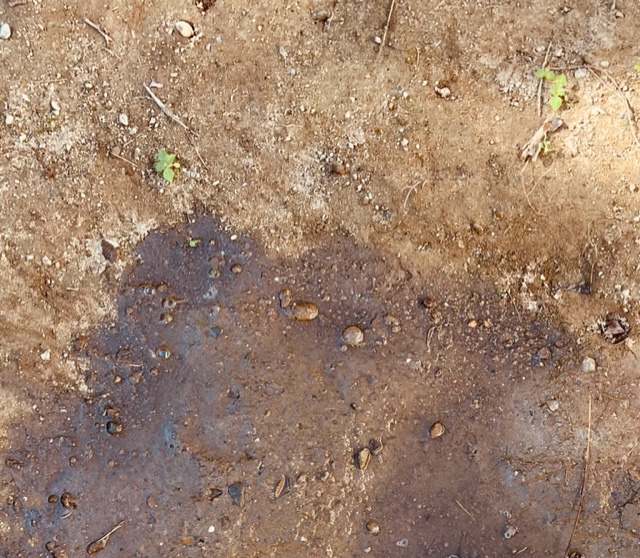
We saw a stain on the desert roadside.
The moist spot wasn’t from an emptied spit
bottle or a planned checkpoint alongside
the route to stop and relieve the unit.
It wasn’t a bloodstain from a gun fight,
where men and rifles roared and proved their worth.
It was diesel used to compact dirt tight,
to leave no impression of disturbed earth.
I followed my CO. He dug for the bomb.
I did not call for help or special gear.
I failed to think of a prayer or psalm.
I stood with him, too loyal to show fear.
He talked the whole time about his ex-wife,
said she’s the biggest mistake of his life.
New Poetry by Carol Alexander: “Late of Somewhere in the East”
AREAS GRAYED OUT / image by Amalie Flynn
Here is his daughter in a mustard seed bauble
bearing the initials M.S. And this is the hyena’s claw
that dug up ash-cloud & gold putrescent tooth
yet I had to ask, who, how many.
I was all trust and confiding hands. This is a snap of the destroyer
on which a body tried to come clean in hard water.
Here, too, memory’s ineradicable scum
rendered as the famous scream.
There is the miniature house where we four never slept very well –
was it only chance, the refugee street? We moved among them
death in the pocket, the cue ball rolling on felted grass.
These are the countries that stirred fear
around the fragrant globe, whole areas grayed out.
The affinity of heart with ice
a chicken stripped of feathers, candles for new blackouts.
In truth, M.S. sired no children but the wild mustard
boiled down for soap. Still, bees pierce yellow & lungwort
duple lobes which marry seed to breath, Everything
came of that nothing on the street of transliterated names,
gardens where none would bury psalm or song.
New Poetry by Rachel Landrum Crumble: “Against Urgent Brilliance”
CRACKING EARTH’S MANTLE / image by Amalie Flynn
My brilliance is slow-growing as magma.
And that’s my fault, like the San Andreas: consequential, but maybe notthisyear.
My brilliance has dimmed
in the silver drawer,
polished for company
who never comes.
Meanwhile, I’m cracking
Earth’s mantle way below,
and above, work shoes walk
dirt roads, or city sidewalks,
finding fault. Whose fault is it
when everything firm is now shaken?
Someday I’ll blow,
and carve a fiery blackening river
out of a tropical forest
to your door.
My urgency has waited
a thousand years.
Now I’m here.
New Poetry by Nathan Didier: “Hearts and Minds”
We Came To / image by Amalie Flynn
We came to provide help that you didn’t want. We came to provide security you didn’t need. We came to provide schools that you didn’t care about. We came to provide a government that didn’t work. We came to provide democracy you didn’t understand. We came to provide infrastructure you wouldn’t take care of. We came to provide a better life that you didn’t ask for. And we kept spilling our blood and couldn’t understand how you could be so ungrateful.
New Poetry by Rachel Rix: “Experimental Simulation of Joint Morphology During Desiccation,” “Second Deployment,” “CO’s Canon”
I Weightless Rising / image by Amalie Flynn
Experimental Simulation of Joint Morphology During Desiccation
In the dried-up river bed of the Helmand the body of a husband lies dead on the hot cracked dirt. The hair of the woman married to the husband hasn’t been washed in days. Her arms flex and hook the husband’s lower limbs. Dragging him makes each step the woman takes heavier than the last. Vultures hover her salt trail. Vast is what they see surround her. The daymoon watches too. Night never comes only more heat magnified by the hours, searing the thin flesh between vertebrae C-6 and C-7. The woman knows she’s blistering. Letting go of her husband is not an option she thinks of.
Second Deployment
Our agreement was
only one. I have
difficulty carrying myself,
I – weightless. Rising
to the crags. Old world vulture
alone I sail for hours in the sky.
I eat my home. A pile of bones.
I’ve learned to crack open
what I cannot swallow,
a lamb’s femus. I am
bone breaker. Soft tissue drinker.
I eat his words.
I’m now dust bather.
Silent blood tracer.
I am a burial maker.
Tossed knuckle
scraper. Someday he’ll find me
by the bed
in a pile.
There will be a hovering
and a hollowing
No welcoming home.
CO’s Canon
If the cadence may be regarded as the cradle of tonality, the ostinato patterns can be
considered the playground in which it grew strong and self-confident.
His green duffel bag
could have carried two of me inside.
Near the opening a faceless angel,
I try: Dearest,
because I’m tumbleweed,
but he never reads me.
There are more important things
to do, shake hands with soldiers
going out on mission,
because when you’re the commander
New Poetry by Douglas G. Campbell: “The President’s New Children’s Crusade”
The Mudweary Bringing / image by Amalie Flynn
The President’s New Children’s Crusade
We are the mudweary
bringing the blossoms of death.
We are the Contras, the blessed,
liberty’s torching lames us,
we are the old children.
shredding night’s humid serenity.
bombs unleashed are our laughter.
we are the young men of war.
We are the death marchers
who slink through the mountain,
one endless serpent of soldiers
sent to strangle our enemies;
The president sends us
with his blessing, blesses us
with his sending, blesses
the bleeding.
There is no need for interceding,
for the Sandinistas
are infidels wrapped in red,
red in their wrapping;
rapping on doors in the night.
Contras are the bringers of light
rapoing indoors when we might,
we bring the light to the burning,
always discerning the right,
the right. After the bellies
are emptied of babies,
after the buildings are belching,
their flames springing higher
we scatter, no matter the plunder,
the thunder roars through the dark,
the spark of freedom is lighted,
ignited.
We are innocents marching,
we are the crusaders of death,
new life we bring our nation,
new breath, new salvation our message.
We have the president’s blessing
he sends us the blessing of rending,
his blessing is drowned
in the bleeding.
New Poetry by Sylvia Baedorf Kassis: “Detritus”
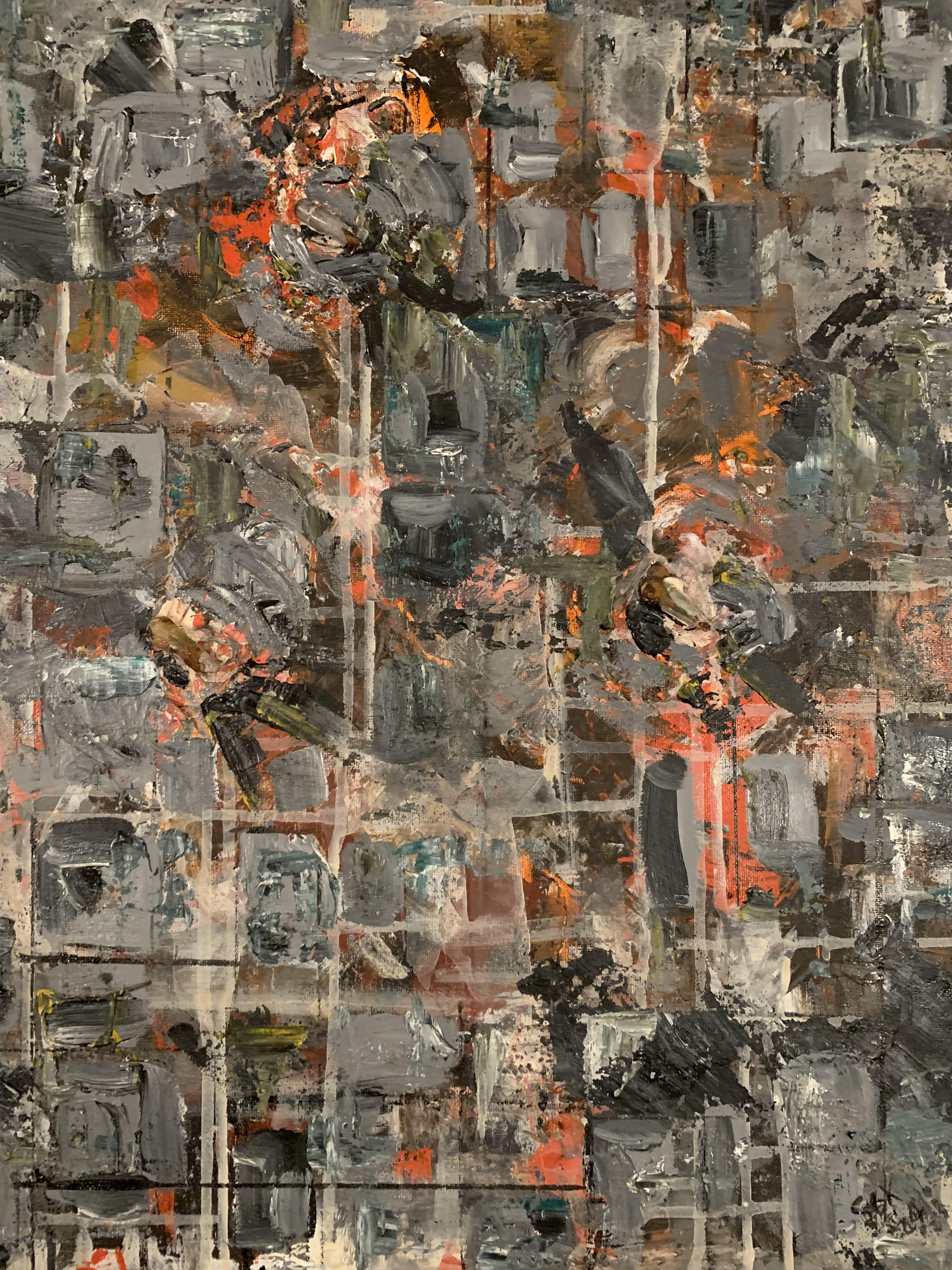
“Bullets 1.0” by Sylvia Baedorf Kassis (acrylic, ink, gesso, rust and found shell casings)
Detritus
You can tell me
that what happens PUUUupon the soil PUUUUUUUUUbeneath our feet
does not matter
that the violence – PUUUgunpowder PUUUbullets PUUUlandmines PUUUblood spilled PUUUand rot of bones and flesh
does not affect the terroir
that the terror
over centuries
on land – PUUUdisputed PUUUand stolen PUUUfought over PUUUconquered PUUUand lost
is not ad infinitum
buried in this graveyard PUUUUUUUUUUUUcalled home
You cannot tell me
that what happens PUUUupon the soil PUUUUUUUUUbeneath our feet
does not matter
that the battles – PUUUsweeping or contained PUUUas enemy or ally
are not eternally captured in the earth PUUUdust inhaled and ingested PUUUUUUUUUbut also embedded PUUUUUUUUUUUUin our collective consciousness
like a rusty compass
nestled in the palm of each newborn child PUUUUUUUUUUUUits arrow clearly pointing PUUUUUUUUUUUUUUUUUUUUUUto the forever trenches PUUUUUUUUUUUUUUUUUUUUUUUUUUUUUUUof inheritance.
New Poetry by Richard Epstein: “The Dance”
WITH A BURST / image by Amalie Flynn
I can still see it.
I hit him with a burst from my M16.
He jumped up and danced.
Everything gray.
Bamboo stood silent
and lowered its leaves.
The earth stood still.
Breathe! I said.
Breathe!
New Poetry by Ellie J. Anderson: “Impact, 1984”
WALL OF ROCK / image by Amalie Flynn
We hike toward a waterfall cascading
through a split in the wall of rock above us.
A crow soundlessly slices a shadow
across the field of snow.
One breath, and the bird is gone.
At the tree line, the tail section
of an airplane, the metal edges ripped
and ragged, stands shiny in the twisted
alpine firs.
The engines lie in the shallow creek,
water pouring over cylinders. Scrub cushions one wing, the other is charred into rock, the ground littered with pieces I can hold in my hand: aluminum with buttons, rivets, zipper heads, upholstery, and jacket fabric melted into lumps. In one, the fingertip of a leather glove, a bobby pin. It happened in nineteen forty-eight. A cargo plane clipped the ridge in a blizzard. Six men died. One woman. The color of her hairpin tells me she was blond. The townspeople saw a fiery flash in a night sky filled with snow. In daylight, fighting drifts and high winds, they dragged the bodies out in bags on toboggans.
This would be a good place to leave your spirit. In the silence, the wind breathes over the ridge, and water trickles beneath a layer of ice that turns blue as it melts into itself. Gentians and Indian paintbrushes in the meadow throw their colors against the rocks. And the delicate columbine, pale yellow and pink, only blooms in August.
New Poetry by Peter Mladinic: “Fist”
AIR THICKER THAN / image by Amalie Flynn
In Okinawa I made a fist
and my fingers stuck together
that stop over night
my one stop before Danang,
between two worlds,
the flag burning, tear-gas
U.S. and the Vietnam rat-tat-tat
automatic fire, the LBJ
How many kids … and the sandbag
fortified bunkers. Didn’t
see anyone die, only the dead.
In Okinawa, planes
on the runway, the air thicker
than Danang’s.
The smell of napalm,
how real for some.
I stood holding a metal tray
in a chow line, slept
in a top bunk, spit-shined boots
so their tips were mirrors.
New Poetry by David Burr: “Harvest”
HARVEST OF THOSE / image by Amalie Flynn
PUTTTI don’t know whether war is an interlude PUTTTduring peace, or peace an interlude during war. PUTTTTTTTTTTTTTTTTTTTT-French Prime Minister Georges Clemenceau, 1919
Hurl of metal – iron, steel – as shrapnel,
as bail hail, as HE detonation, all
forged and spit out again with new fire,
matériel barrae, meat-mincer for extruding the mortal mettle of mere men.
The sowing and the reaping are all one –
short is the harvest of those born to it.
After the wrecking, reaping, reckoning,
all are scuppered on the killing field,
khaki men with hopes of home snuffed out.
Sheaves of men scythed down mid the muck-mire-mud,
bowels churned with the disemboweled earth, red wet.
Gravity flows to the lowest reach, but not
here in the gorge of this blood-gutted earth,
saturated but not satiated.
On and on this crimson stain will drain,
young men will come to fill the gap – futile
like a record where the sylus is stuck
in the groove over and over again –
out of trenches to fatal, final ground.
They die individuals, but banal
as communally their yield is too large –
none a hero in this no-winners game
nor a tragedy – just raw statistics.
All that grieve them soon too, to oblivion.
After this Great War comes the entr’acte before World War roman numeral II,
just in time for those who survived and bred
to lose their sons in the next harvesting.
Never an end, merely an ellipsis …
New Poetry by Jayant Kashyap: “The War”
A NIGHT KNOWS / image by Amalie Flynn
The War
“The war continues working, day and night.”
–The War Works Hard, Dunya Mikhail
It has a way of knowing people,
the way a night knows our stories.
Everything’s quiet, then you learn to fall,
deeply. It’s said how you approach an issue
says a lot about you, PUUUbut how do you approach war?
Everything quiet – almost
at peace – when you learn to fall. Deeply.
And even the night changes its colour.
The dawn is difficult to accept.
Your palms have broken into little chips
of stone, which you will either throw
at people or swallow yourself.
In the kitchen, the water’s boiled, the pan
is ready for eggs. The child you sent out
to get some bread hasn’t made it back.
In the news: everywhere, the streets PUUUhave learnt the meaning of blood.
New Poetry by Phillip Sitter: “Krakivets, Odyn” and “Elemental”
WINDOW / image by Phillip Sitter
Krakivets, Odyn
I wasn’t a medical volunteer – only came in with a backpack, an overweight suitcase,
all the baggage of the past eight months and a heart to pump into here
the ability to stop someone’s bleeding in whatever capacity and degree I could.
But that would’ve been too much nuance for that moment,
with me just being able to count to not much more than eight in Ukrainian
and the guard’s English and tone more apt to counting to three.
I’ve already forgotten some of the exact nuances of that moment.
Did the guard ask me through the open car door, over the empty driver’s seat in the dark, “What were you doing in Ukraine?” or something more like “What brought you to Ukraine?”
For almost a week? Your first time, with emphasis on now?
Incredulity, perhaps, that someone would choose to come to a war,
unarmed, at least in the Kalashnikov sense.
Was he holding such an automatic rifle, a worn cousin of the one I’d fired in Texas -just precaution-or was it only a fellow guard I saw cradling the legacy of an empire chasing again the impossibility of restoring itself
by unloading terror upon
and blasting through flesh
of people like him or me?
I tried to answer the guard’s questions but he got frustrated
and he waved us on to keep the line of hundreds of vehicles moving toward Poland,
as foreign fire engines and weapons re-supplies for firefights came in the other direction.
And with that, we crossed the line — after the Polish guards searched the car, anyway.
One side, the imminent threat of death from the sky above — and not on the other.
Those night skies, no light on the ground to obscure the stars or guide the drones.
I slept well, except when I cried myself to sleep the last night in Kyiv at the thought
of having to leave you, brother, in all this.
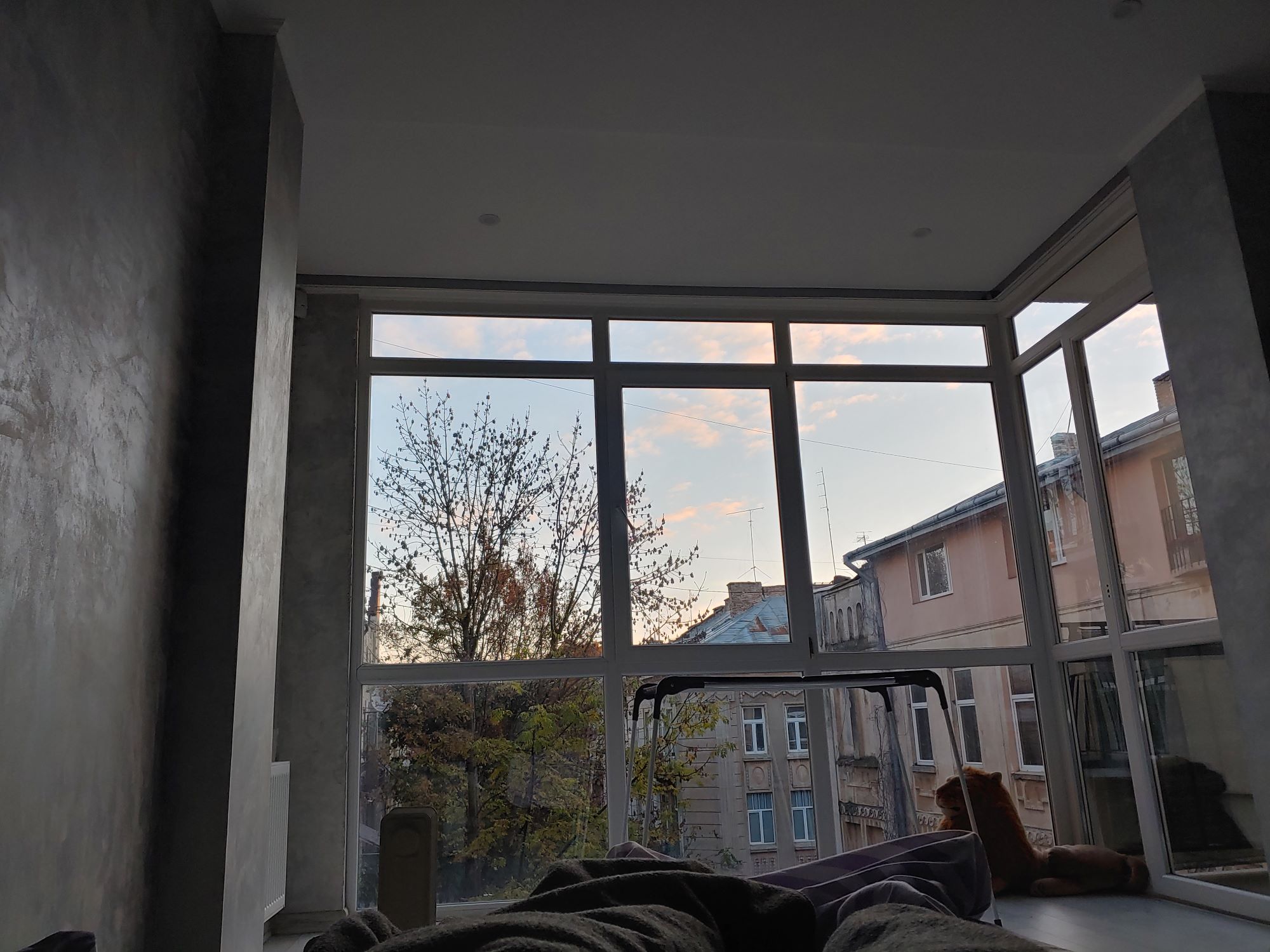
Your big windows in Lviv didn’t bother me much.
Neither did the lights in the sky out your windows in Kyiv,
lights that moved in the darkness.
Elemental
Hydrogen, the sun’s power
sends light 93 million miles
to give life to the sunflower
that stands for hope in all our trials.
Nitrogen and phosphorous, they make the sunflower fields more fertile.
When used in explosives and incendiaries, they add more shock and awe to a projectile.
Oxygen, the spark of life in my lungs.
I would give you the last of it from my chest,
my last breaths, if suited best,
for a continuance of your song to be sung.
Heavy stuff, uranium.
It’s not all gone as quickly as in a flash,
not for many or most.
Did I mention half-life with strontium-90?
Like calcium, it seeks bones as hosts.
Carbon, the basis of life as we know it.
If I had to, could I recall any debt to be owed it?
Could all I’ve ever sent off to be recycled
be traded to rebuild your body, your blood, your soul?
Enough to make you whole?
With enough left over to also recreate the man shot off his bicycle?
Our bonds are strong.
Between two hearts, two time zones.
Subatomic critical mass, but love more than chemistry and physics alone.
New Poetry by Shawn McCann: “All I Can Do Is Watch” and “No Way To Fight Back”
DONE WITH MOONS / image by Amalie Flynn
All I Can Do Is Watch
It’s 0400 on a bridge crossing over the Tigris River. Qayyarah is a town along its fertile banks, 15,000 people call it home. I wonder how long it has been here, how many times conquered and rebuilt.
On the outskirts lies an oil field, it’s where I live. The wooden walls of this makeshift bunker in the sand wouldn’t stop an attack, just slow it down.
Surrounded by blackness, my mind wanders valleys of homesickness, forced to breathe toxic air, flanked by those who want to kill my invasive body, parade it through the streets.
A bright light hits the oil field, shakes the ground. Movement on the hill to the north— I call it in.
Orange flames rise in oxygen, twirl in mirthful celebration, the smoke swirling higher, my life forever changed and all I can do is watch.
No Way to Fight Back
I can smell the exhaust from
the plane that’s taking me home.
Standing in line to board the whale,
maw open wide to let us inside.
Air forming breath in the illume,
I’m done with moons in this hemisphere.
These stars, still foreign to me.
Even at the end, I know I don’t belong
in a land of sharp sand, the broken
glass bowl of democracy.
This land won’t let me leave, though.
Raining metal explodes my dreams of home;
swarming red flames engulf
the surrounding canvas. The sound
catches the light, knocks me flat
to the ground as alarms blare attack,
bullets ricochet off cold slabs.
And just like that, I’m crouched inside,
cold-cocked by the reality of
no way to fight back.
New Poetry by Kathleen Hellen: “People Boats” and “Pretending There Is A Garden In The Spring, Paradise In Time”
DREAMS SWELL LASHED / image by Amalie Flynn
people boats
dreams swell/ lashed to circumstance in Syria/ in Gambia/ launched from Libya in leaky rubber chugs to birdless deep/ chugs w/ floor of feet w/ canopy of arms like 700 starfish sweating/ surfing demons/ keeling keening groaning spinning ferment/ tossed estrange/ the black moon sinking into raucous mucus maelstroms/ cataract of violet distress/ the turbulence of orange sun/ bursting over flotsom/ boats adrift/ boats repelled/ prison haulers fatal w/o water, w/o air fatal in shrieking rescue/ panicked sea/ 10 hours tossed to grief/ where vomit waters sweep the beaches gnawed by ruptured rubber masses/ huddled under searchlights/ infant wish:: democracy
pretending there is garden in the spring, paradise in time
this silk and golden weft that weaves
its vines through field and forest
this intricate design atop a kingdom
of the dying, above the restless thread
of streets, the rot beneath:: Deep
the sleep of mouse and wren, the carcasses
of crickets. The desiccated corpses
of the moths. Beneath the flowers all
dyed dismal, dog and possum disemboweled,
little deer with tongue stuck out, the rat
beheaded, like video of hostage
New Poetry by Cheney Crow: “The Grey Phone”
ON MY STREET / image by Amalie Flynn
The Grey Phone
The Tet Offensive, 1968
Lights on, lights off.
The scrambler phone howled on my father’s desk during Vietnam. Mostly late at night.
Somewhere, the enemy.
A regular sequence for dads on my street. First the phones, grey with no dial, a red light blazing with its siren howl.
Somewhere, the enemy.
Then the ruffle of staff cars pulling up to collect the men on our silent, guarded street. Lights on, lights off.
Keeping us safe.
The deep rumble of inboard motors at the dock. Three blocks away, the boat drove the men across the Potomac, a machine gun mounted mid-deck. The Tet offensive.
Keeping us safe.
They did their best. It wasn’t enough. My father shook his head that politicians would try what the French under DeGaulle couldn’t manage in twenty years.
Somewhere, the enemy.
One father on our street had two sons: one went as a pilot. The other, conscientious objector, chose oceanography. He loved them equally. We played chess. One father died. Also one son.
Somewhere, the enemy.
I played guitar and sang folk songs at hospitals,
ward to ward, for air-evacuated wounded,
the most severe. Hard to look at, but
some of them smiled at a teenage girl.
Nixon ended the draft to be more popular. Politicians do things like that.
Keeping us safe.
All the dads on my street were against the war. They threatened to resign en masse unless we got our prisoners back. Lights on, lights off.
Somewhere, the enemy.
Nixon ended the draft to be more popular. Politicians do things like that. All the dads on my street were generals. They did their best. It wasn’t enough.
New Poetry by Joshua Folmar: “Sudoku”
A REMOTE DETONATION / image by Amalie Flynn
Sudoku
Death? She’s your final lover, playing the numbers of this cosmic game—set between lines on an overlaid map
of patrol routes winding throughwadis deserted in Iraq—here’s shrapnel fragment: zone 3, row 2, column 1.
The first time she came, she was like fire- crackers: pounding down the dirt, skirting the stack with sweat and AK rounds.
Chute down and right 2 columns. Death swears she’ll never betray me; promises we’ll be together soon—gives me dysentery.
She keeps me at a distance, shitting in Gatorade buckets on post. She’s such a tease not to finish me off.
Humbling me, she pulls the ego from my chest: a puzzle I tried to solve, but I couldn’t get the numbers right.
The 9’s looked like electrical wire sticking out sandbags of IEDs— she was a remote detonation
at the town square’s edge, jacking my head off at block 8, row 7, column 6— click. We made the news at 5 today.
The TV in this dusty bardo switches from news to daily numbers— Play? What for? Where are you,Habibti?
New Poetry by Lawrence Bridges: “Time of War and Exile” and “Taking an Island”
THE BROKEN LAND / image by Amalie Flynn
TIME OF WAR AND EXILE
Delicate horse feathers climbing the bier, Rhesus monkeys playing sincerely with bombs, Alouette, the weightlifter, seasons the vegans’ food with the rillerah and finds Roger dozing among bananas. PUUUUUHistory is pleased by turnabouts none can explain nor defend because they’re dead. If only we’d noticed that it was primal behavior going back eons that was on display – No war, no truth, no civility – the beards grow over niceties that fast! Then we make peace to survive. No wise hand placates the broken land, nor kisses the clan that feeds it. I watch myself display courage in emptiness. With emptiness, every hour is the same, a wait for exile from the churning heart long separated from its homeland.
TAKING AN ISLAND
The stations in my head broadcasting jazz and news since VJ-Day almost have witnessed everybody escaping annihilation almost, and I’m loading material bare-chested on a beach
in the tropics, a sniper in a nearby palm playing Bach. I have nothing but the memory of home and her tattooed on my arm, the caressing lagoon at my ankles a whiff of plumeria as I carry my weight, swift bullet whizzing toward my head
New Poetry by Marty Krasney: “Where We Are Now”
FEEL THE GRAVITY / image by Amalie Flynn
WHERE WE ARE NOW
Neruda wrote:You are mine; rest your dreams in my dream. I wish that I could write that to you. I love you that much. More. But because I do, I couldn’t. Couldn’t possibly.
We are approaching 80; the end is coming more and more into sight— we’ve begun to feel it in our bones, our throats, even in our thoughts— and women like you don’t rest their dreams in men’s dreams, even in macho men’s, like the great Neruda’s. If they ever did.
You and I have had marriages that ended, spouses we watched die. We have grandchildren, pensions, headaches, joint pains, and regrets Books we started and will never finish, sweaters we haven’t worn for years. Life promised so much and has given so much. If not everything. Some of what we’ve done endures, some disintegrated to ashes, to dust. You are my star, incandescent, lighting up the inevitable horizon.
As we complete the journey and feel the gravity of the black hole, what can I offer you now, ask of you, try to provide? Come in just a little closer and hold me even more tightly. Walk alongside me, my love. Let’s lean on each other, lean together. Wrap yourself around me and rest your warm old head on my old head. Help me to remember. Help me to forget
New Poetry by Matthew Hummer: “Amortization”
JUST SAY IT / image by Amalie Flynn
AMORTIZATION
Carl showed me the chart years ago, when we first thought to buy a house. But we wouldn’t write a note saying she’d go back to work the same hours after birth. The under- writer, in fluorescent office by the two lane road between golf course and condo, wanted a wink- wink. “Just say it.” A lie worth a sixty thousand dollar house, brick row home with sagging window frames and tilted doors. A loan unto death. Camus, I think, pointed that out.Mort, en francais.
PUUUUUUUUUUDianoia: How you’ve led me astray. Res publica. Fasces. Words and phrases we use without knowing the root. Character in the play. “History. History!” Dag Nasty said at the end of a song:Now that it’s gone just admit it to yourself. Now that it’s gone just admit it to yourself. Drum rapid as the rumble of a gasoline engine—leaded. Army green paint. Nova; V-eight. From stop to start, shifting up from floor to top. Another typical youth…
Thirty years to pay
it off. The life of the loan, more than two dog lives. Not the lifetime guarantee of a washing machine—the expected lifetime of the appliance. Five years? Seven? Fifteen before nineteen eighty. The green fridge next to the coffee pot kept milk for decades. Vietnam to Iraq, outlasting the man smoking cigarettes on the concrete patio, feeding peanuts to squirrels and telling a child about the Battle of the Bulge, the tank driver who fell back in headless, the German soldiers who “tried to get away in the snow,” the aristocrat’s sword the post office stole from the box he sent home.
PUUUUUUUUUUThe guarantee spans the projected lifespan. Lottery ticket, Camels, Dominoes, V.A., Life insurance. Actuarial predictions with cosign charts— bodies in the morgue. Dead reckoning. Except the Black swan, clot-shot. Dead cat bounce. Bank-breaker. Mid- life degeneration. A rogue wave rises and swallows the bobbing tanker.
New Poetry by Linnea George: “Course Correction”
QUESTION PATTERNS SLOWLY / image by Amalie Flynn
COURSE CORRECTION
they told me Jesus would save me but i have done all of the footwork down here on the ground rolling my sleeves up seeing what i have a father who hates me a mother who ignores me a heart who turns the tenderness of each moment into a tornado i do the work ask questions write down thoughts understand learned behavior question patterns slowly brick by brick i build the church of my own presence and the altar of my own body
New Poetry by Almyr Bump: “Plowing Water”
IN BROKEN GROUND / image by Amalie Flynn
Plowing Water
We return to nightmare ground, looking over the scene
of the crime, the copper reflection of little clouds
in the torpid, tainted canal masking disquiet
and chaos created in us. Toiling in soft sand
underneath a burden that would make a mule bleat,
we bitch and moan when told to drop the rucks. Now we must
dig in, not like blind moles, but like crippled gravediggers
in broken ground started by high angle hell. Mangled
sandbags and serrated pieces of metal pulled from
dirt wounds, also a hand only missing two fingers.
Using a bayonet, we bury rancid, fetid
flesh in a hole, puking, not worried about a name.
New Poetry by J.S. Alexander: “Sabat”
AWAY HE STAYS / image by Amalie Flynn
Sabat (Loyalty)
Dead bodies stop looking like bodies
after a certain point.
The face, like a popped milar balloon
with all the air blown out the top,
the legs, oddly angled, their bottoms
looking for all the world
like tubes of children’s toothpaste
unevenly squeezed.
No, the dead here never arrive in an
orderly manner, like in the movies.
This is Afghanistan, so they show up
carried in blankets or what’s left
of clothes, bandages waving
like May flags.
But they all go out the same way.
The mullah works systematically,
washing and praying, singsong in his labors.
Next to him, a step back Mortaza watches
them prepare his brother for the next life.
Mohammad Gul was the pride
of Ismail Khel.
Young, handsome, brave. Funny.
Everyone said he was funny.
You don’t hear that much in Afghanistan,
someone being funny. As they lift what’s left
into the particle board box that looks like
an Ikea desk repurposed
hands seek to guide Mortaza out. But
he pulls away, he stays.
He watches as they wrap Gul’s head in
cotton and prop it up on
pillows of cheap foam. They spray him with Turkish
perfume from the bazaar, and then
drape the Afghan flag and the prayer rug over his
box, taping it down with rolls of
scotch tape. Mortaza sniffs back a tear, both for
his brother and the debt
he knows he’ll now have to pay. He’s not scared,
just tired, and knows
that somewhere, out in Lakan, is a man he’s never
met but will kill, as the way demands.
When we walk out, together, my boots slip,
squeaking and squishing on the sodden, dirty
tile.
New Poetry by D.R. James: “Surreal Expulsion”
COAL BLACK TUNNEL / image by Amalie Flynn
Surreal Expulsion
PUT—for Marjory Stoneman Douglas High School
Fourteen chairs loiter, emptied, no young bodies adjusting for the next lesson, hand-raising, class-clown antic, contemplative talk, pat show of teen contempt, rhythm beaten with pencil, palm, bouncing knee, jouncing heal, wise-crack, step in the impossible problem never to be solved. Instead, more of the same news, the same vows taxiing the hellish hallways of feigned intention but never taking off—the same dazed moments of the dead. Perhaps their freed spirits now see through the coal-black tunnel of some eternity right into the next school’s beehive of victims. Perhaps they still shadow their three steady mentors who stood staunch ground in the slow-motion flow of high-speed ammo. The clip of names shoots holes clean through law’s callous gut—
PUT_CCCCCCCCCCCCCCCAaron, Helena, and Alex, Carmen, Peter, Cara, Chris, and Meadow, PUT_CCCScott, Alaina, Martin, Alyssa, and Nick, Jamie, Luke, Gina, and “Guac” Joaquin—
PUT_CCCCCCCCCCCCCCCCCCCCCCwhose roll call claims only an absurd third of a minute, while their totaled lives witnessed nearly 5 thousand wheels of the moon through some 75 trillion miles. But unlike the pull of that implacable moon, the glib fever of ‘prayers and condolences’ can’t turn the tide of memory’s radiating its fixed fissures scored by shards of glass and bone. Here, we’re left to settle the moonscape ofToo Late for those whose expelled footsteps befuddle us. And lauding immortality soothes no better. We know we relax at our children’s peril, run rash risk of shoring up the open/closed-carry-frenzied fight, take false hope in the bundles of white-washed bills. Anthony Borges took five bullets to shield twenty surviving friends, sacrificed his soccer stardom because somehowheknew what he had to do. His lacerated back and shattered femur scream in a language we now must teach across America.