New Poetry by Naomi Ruth Lowinsky: “In And Out Of Time,” “In The Wake Of Our Lady Of The Double-Edged Axe The Notorious RBG,” “Prepping For Apocalypse,” “Sideswiped,” and “The Queen Of Souls”

THE ALWAYS HOVERING / image by Amalie Flynn

IN AND OUT OF TIME

In the fire-eaten land
in the smoke-drenched air
PUT CHARACTI dream

PUT CHARACTCrystal Lake  
PUT CHARACTsquare raft afloat
PUT CHARACTat the center

I   in my clodhopper shoes
in the patchwork circle skirt  
I made myself    
PUT CHARACTin my hippie days

have jumped in the lake
to show   
my solidarity

with forest
mountains
ancestors 

with glittering Crystal Lake   
I swam   as a girl   
whose raft   was sanctuary

from Father’s far-flung furies
from head-smacked howling brothers
from tongue-lashed weeping Mother

This simple   handmade craft  
of wood    of nails
floats me   out of time

holds me
in the great blue round 
of lake    of sky

the green surround
of pines
where the always hovering

Old Ones
who knew me then
who dream me now

give me the words
to write myself back   
PUT CHARACTTTTTTinto time

in my waterlogged
clodhopper shoes 
 my patchwork skirt

back to the fire-eaten land
back to the smoke-drenched air
PUT CHARACTtt                   my handmade craft

 PUT CHARACTTTT                                        my raft


IN THE WAKE OF OUR LADY OF THE DOUBLE–EDGED AXE
THE NOTORIOUS RBG
(Erev Rosh Hashana   in the year 5781)

The shofar wails

She’s gone
from her body   gone
from her seat on the court   gone
from her grip on what’s equal   what’s just  
gone
from her fierce resolve
to keep breathing
until January 20th 2021

Everything hung on her small   frail   frame
What will we do without her?

Once I forgot I was real
a daughter of earth and sky
forgot what the angel
had told me at birth

Once I had holes in my tongue
from biting it
had blood on my hands
from broken glass
on the top of that wall
There was no escape

Throttled by custom   by law
I spat my teeth on the road
My fire was used to burn me up
My body did not belong to me
a vessel for lust   for seed

But you   our soft-spoken battle-ax
our mother who was a falcon
had the cunning   the courage   the ken
to seize the keys to the castle  
the plantation   the prison
to deliver us
from gender’s cages
the shackles of race  
from those scoundrels in power
who steal from the poor
and ransack the earth

The shofar wails   

She’s become one
of the Holy Ones
No longer can everything hang
PUT CHARACTTTTTTon her small   frail   frame

Too much for one body   to bear
It’s your fight now

Bless us   O falcon-headed soul
of the notorious RBG
Our Lady of soaring sight
of focused attack
Our messenger
between the worlds

Sit on our shoulders
Hunt in our dreams
for the courage   the cunning   the keys
the double-edged axe
we’ll need
to end the mad king’s reign
and rouse your spirit in us
                                          all over this land


PREPPING FOR APOCALYPSE
          for Alicia

requires   the pursuit   
of toilet paper   avocados   gluten-free bread
He needs blueberries   with his yogurt
You need mushrooms   with your eggs
Both of you stuck   in lockdown

So   surrender  
Hang  yourself   upside down  
Be the bat   who sees   in the dark     Smell
the terror   cruelty   carnage     Hear
the echoes   of the ancestors

Pandemic    is pandemonium
the world turned into   a charnel house
The sinister rider   on his pale horse 
has rolled us all up    in The End of Days
like a medieval map    ringed with dragons

A Revelation   is at hand     The sun  
gone black     The moon  
a bloody show     Guadalupe wanders 
the woods   haunted by who  
She once was

Our Lady of the Serpent Skirt     Apocalyptic
woman   crowned with stars   in the fierce grip
of birth     Will She bear us  
a savior?         Will She bear us
a demon     shatterer  of worlds?     How will we know  
PUT CHARACTTTTTTTTTTTTT                    the difference?


SIDESWIPED

Sweet Lola    my Barcelona Red   hybrid   chariot   
you   who transported me   from sixty something
to the middle of my seventies   through Obama’s two terms  
Michelle’s organic gardens   the color spectrum
of her splendid gowns     you   carried me  
when we were all   blindsided
by the 2016 election   fed me NPR news
the Russian hack job   on America  
the wannabe Pharaoh   throwing tantrums  
on Twitter   while the traffic   roiled around us

even as you approached   a hundred thousand miles
you stayed stalwart   kept me safe   in your calm interior  
as you switched   from gas to battery and back  
making our small gesture   toward saving the planet   
you who   delivered me   into our garage   protected
from rain   from wind   from the ash   that devoured the mountain
Dan coming out   to help   with the groceries

There were groceries   for Passover   in your trunk   Lola  
flame raisins   dried apricots   dates   almonds 
for the Sephardic charoset    which symbolizes the mortar  
it is said   we Jews used   to build the pyramids    
when we were slaves   in Egypt     But who knew  
when I made that left turn   a big black Beamer
would hurtle toward you   Lola   we almost
made it   before it hit you   in the right rear
I thought it was just   a fender bender
They’d fix you up   at the body shop
like the surgeon   fixed my hip

But the man in the Beamer   leapt out   shouting  
It’s all   your   fault!
I can still hear him shouting    
while his kind   quiet wife                                                     
asks for my registration

What’s that?   I think
my mind   in fragments

Later I’ll gather the flame raisins 
dates  apricots and almonds   pulse them
into small bits   in the Cuisinart     knowing one needs
to break things up   to make that rich   sweet                     
Middle Eastern paste   charoset
that’s meant to bind us   together
when vessels shatter

Later the total loss   claims man   will pronounce you  
totaled     You   Lola  
who had the saichel   to feed your own battery     I’m still reaching   
for your slow-down lever   grasping thin air   forgetting  
I’m driving a clunky   Chevy rental  
on my way   to retrieve the layers of umbrellas   shopping bags  
shoes   in case of earthquakes   maps   we no longer use  
flashlights   whose batteries   likely died   in all those years  
before you started   losing oil 
before the black Beamer   sideswiped you  
before the man   began to shout  

before the total loss man
pronounced you   worth more dead   dismembered
for spare parts   instead of resurrected   one last time
at the body shop    the buff young woman
commiserates with me   helps me carry
the detritus   of our years together
to the clunky Chevy

It’s Easter week   and Passover
We remember the ones   who’ve passed on
We light candles   for my children’s father  
Dan’s children’s mother   my mother  
the bedlam that erupted   in her wake
O   my separated kin   will you ever   join us again?

We name the plagues   Old Pharaoh flings at us
as we gather our mishpocheh    on the way to freedom
We name   what plagues our own   shattered    times
     Stolen Elections    
     Separated Children
     Hatred of Strangers 
     Greed
     School Shootings   Sanctuary Shootings   Police Shootings   Street Shootings
     Homelessness
     Climate Chaos
     Species Extinction
     Family Feuds

The youngest one adds
     People who cannot forgive

     Pass the charoset


THE QUEEN OF SOULS
PUT CO Lady, Lady of the changing shapes,
PUT Chelp me remember…
                               —Judy Grahn

Some souls are shy     They hide out   behind the shutters   of your eyes
Some souls are soggy    like the earth after rain   like a woman   after a good cry
Some souls get born to sass the universe     listen to them snicker
                                                                                                 in the back of the class

Some souls can never be satisfied     Give them three wishes   they want five
They eat your heart out   send your spirit packing       You forget
who brought you here     You question your every breath 
                                                               your spirit guides    your mother’s milk

Some souls have rocks in their shoes    drag you down  
to the bottom of the slough   where earthworms squirm  
and you are sunk   spat out   for what terrible deed
PUT CHARACTTT             in what former life?

Some souls insist   on dance     Some need poems     Some will make you
map out a whole world   of characters   who’ll take over  
your inner chambers     Won’t stop talking   until you write them down

Some souls keep singing    even in the eye of the storm   even at the bottom
of the pit   where the Queen of Souls    She who harrows   your bones   knows  
even black holes   even dead trees   grow mushrooms   host baby birds   and snakes

Some souls live in sandcastles  
until a wave   knocks them down    
The child forgets   what she built

Some souls have feathers   and claws     
Some souls can shed   their skin    
Some souls become jaguars   in your sleep

Some souls surf atmospheric rivers   wrangle tornadoes  

ride nightmares   glide and glitter
amidst rays of the sun   in the redwood grove

Some souls are old   and lonely     Can’t remember
                                                               the last body  
           they were in

They hover in the rafters   watch the infinity loop
of lovers   impatient for that last   passion cry   
for the deft dive   of sperm into egg   hungry   to leap  
into new life

Some souls remember themselves   as tears   as pearls  
on the throat    of the Queen of Souls   
When your time comes   She’ll weigh

your heart   your balance   of feather   and claw    
Maybe She’ll give you a glimpse  
of your soul’s flight   wings aflame  
                                                     on the way   to your stars


New Poetry by D.W. McLachlan: “Tanana River” and “The Heaviness of Age”

THE RIPARIAN ZONE / image by Amalie Flynn

Tanana River

We followed your Hilux along the riparian zone,
a green snake blooming through the desert brown,
when you met in secret like lovers, and the way you
hugged each other in greeting showed an intimacy
I didn’t particularly want to consider at that moment.

The second before the Hellfire splashed down, you
looked into the sky, and I still wonder if you thought
it was a sign from god, but when your world went
black I think it must have confirmed your suspicions.

My first full memory was standing on a grassy shore
watching my father catch a salmon in the Tanana river.
And I can still see the coil of the fly line snapping silent
and how it unfolded and laid out onto the silty sheet.

There was something above elegance in those motions
as the salmon breached, and I saw the slick of its back
as it stretched the surface, the rippling kick of its tail,
and then it shot back down, the line gave, my father’s
back bent, the line went in, went out again.

As a modest crowd grew slowly along the muddy banks
watching my father race up and down the shallows,
it seemed to me that he was going to pull up a demon
straight from hell, and I remember the shouts and jeers
when my father finally dragged the salmon on shore.

And I remember my commanding officer’s laugh when
half of you was dragged gently under a shade tree.
I remember the grip on my shoulder as he told me
that it was a damn good job, a fuckin’ good job.
I remember the way his boots rested on the desk,
and how he donned his number twenty-four hat,
and how he drank his coke, turning his attention
to the NASCAR race circling on the other screen.
I remember the way the other man laid you back,
how he talked to your body under that shade tree.
I still to this day wonder what he was telling you.

I was scared when I stepped close to that salmon,
dancing and darkening the dirt with wet slapping flops,
its mouth opening and closing, sucking in nothing.
The great gibbous black mirror of its pupil asking
for something, something that I knew I couldn’t give.
I felt small and shameful in that goggle-eyed stare,
so I picked up a long stick and gouged out its eye.

The Heaviness of Age

Sometimes in my dreams the world is covered in sand
and I wonder why no one cares.
I can feel it in my sheets as I sleep, in my mouth
and crusted in my eyes. I kick and brush it away,
but it’s never gone, and the sand always returns.
But no one cares and they act like they don’t see it.
Why is it then that I’m treated so funny?

The custodian on my floor looks like a man
we tracked down and killed in Helmand province.
The custodian on my floor thinks I’m racist
because I avoid him and never look him in the eyes.
I have to sit in my chair to get over the nausea sometimes.
He once told me I’m not gonna bite you and laughed
and I laughed and I asked him about football
and then he walked away, and I took my fifteen minute
break to step into the utility closet and cry.

I don’t even remember why we killed the man.
I don’t remember anything but the face
That’s mostly all I remember now.
His mouth blood black and tongue lolled in a dog pant.
And I don’t know why we had to take pictures of them all.
It’d be much easier if they hadn’t taken the trouble
to fly out there and take their god damn pictures.

A child still visits me at night.
I see him sitting at the edge of my bed
He’s always looking away, out the window
and when my wife wakes up
and asks: what’s wrong?
I tell her nothing, it’s just a bad dream.

But he’s not a bad dream,
he doesn’t deserve that epithet.
I sometimes want to hold him like I hold my son
when he feels betrayed by the world.
I like giving that feeling of love and security.
I’d give it to him if I could.

I see paintings of heaven
and I never see any children in the paintings.
Where are the children?
Homer has no children in his underworld.
Just indifferent or spiteful adults.
Sometimes I think it must be the heaviness of age
that allows us to sink down and rest.


New Poetry by Tony Marconi: “Song of the Roadway Door”

WE AND MACHINES / image by Amalie Flynn

…three hundred miles,
PUT CHahead the road more visible
PUT CHas the land dissolves in the pink light
     PUT CHARAPUT CHARAPUT CHof almost dawn   

you sit beside me,
PUT CHeyes fixed and restful on my face,
PUT CHoffering hot coffee from a thermos
PUT CHPUT CHARAPUT CHARACwhile the farm news
PUT CHARAPUT CHARAPUT CHAbreaks morning music
PUT CHARAPUT CHAPUT CHARAon a local station 

i could be here forever,
            moving toward an unfamiliar place,
            held by speed and the vibrating engine,                               
PUT CHARAPUT CHARAtouched by the warmth of your breath 

i could be here forever,
            even as day turns into twilight;
PUT CHARAPUT you borne lightly on sheets stiffly cleaned,
PUT CHARAPUT wrapping your strength within, around mine;
PUT CHPUT CHAprepared for tomorrow’s miles 

we and machines;
PUT CHPUT CHAonly we moving,  moving;   
PUT CHARAPUT CHARAPUT CHAi could be here forever…


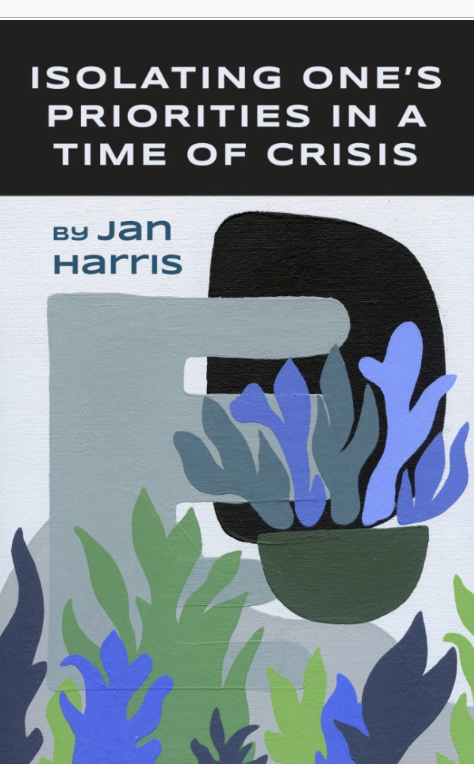
New Review from Amalie Flynn: Jan Harris’ “Isolation in a Time of Crisis”

The poems in Jan Harris’ Isolating One’s Priorities in a Time of Crisis are about the apocalypse.

Or after.

What happens after.


&
After the apocalypse happens. After the world cracks like an egg.
Splits apart. The crushed eggshell membrane and how.
Covered in fluid yolk we emerge blinking –

we pass clement evenings foraging among the wreckage
of shop local boutiques and chain drugstores
(Season’s Greetings)

we observe
long vacant cities teeming with rats and pigeons PUdark seas replete
with giant jellyfish PUwe do not live in an elegant age
(Mass Extinction)


&
The apocalypse has already happened in Harris’ poems.

Some humans survived –

in the day-glow light
our old skin cells flake
off and drape across, the zoysia grass
(Marauders All)

Born again into this.
This fallout world.
And the scale of destruction is ecological –

ours is an age of salination
desiccation PUan interminable heat
(Mass Extinction)


&
I am reading Harris’ poems now. In this dystopic America.

A hellscape of.

Toxic religiosity. Evangelical Trumpism. Bigotry and brutal police.
Global war and fiery planet.
Pandemic plague. The lack of air. How when the virus inhabits lungs.
We flip the bodies over.
On their bellies like fish. How one woman survived but lost half her upper lip.
From the tube and pressure. Of being facedown for months.
That missing chunk of flesh now.
This fever dream wasteland nightmare America or how we find ourselves.
You and me. How we find ourselves.

Still alive.


&
I write to Harris, saying –

These poems are about COVID, right?
About Trump?


&
Because how, I think.
How can they not be?


&
But Harris did not write these poems about COVID or Trump.
She wrote them after the 2018 Kavanaugh hearings.
They are about surviving sexual assault.


&
Harris tells me –

I guess I’ve always been thinking about the end of the world. You know I had this Southern Evangelical childhood – very rapture focused. Then, when the Kavanaugh hearings were happening, I was appalled, obviously, and as a survivor myself, I kept thinking about who gets to speak.


&
Harris’ poems are about the apocalyptic devastation of sexual assault.
And the disappointment of unrequited rapture.
About waking up in a destroyed world. How we piece it back together.
Or declare it broken. And live in it somehow.


&
She says –

I kept plugging on and thinking how do we survive, like in the sense of what do we do with our days, our shames, our broken hearts. How do we open to what’s next?”


&
And yet poems are alive.
Each sentence with words like organs.
How syllables are cells.
How once written.

Poems are alive.


&
And for me. Harris’ poems are about.

The Kavanaugh hearings and the assault by a nation that did not care.
Would not believe women. Women who said this happened.

And these poems are about.
About what has happened since.

A presidency that assaulted truth and science and equality and the environment.
War. And a virus that has assaulted the globe. Leaving over four million dead.
So far.


&
Because what is apocalyptic can be plural.
How apocalypses are multiple and countless.
Intensely personal and collectively shared.


&
Harris’ poems are full of hydroponic lettuce, half grown, empty cul-de-sacs.
Broken call boxes and a rapture that never comes.
Because after disaster there is always aftermath.

Where what is left is left.


&
I met Harris in graduate school in Tuscaloosa.
Where I came and left as bones.
How I almost disappeared and yet.
I remained.

Graduated and moved to New York City where.
After that summer I would stand on a corner and watch a plane hit the Twin Towers.
Or how they fell.
And how people jumped and fell and died.
And how somehow. Somehow I survived.


&
How existing is this.
The same as not disappearing.


&
Harris’ poems acknowledge those lost –

we saw that some us had been separated
from themselves and their reintegration
into the whole was not a possible outcome

we could not replace their inner vacancies
we could not estimate the size of their lonesomeness
or fill them with vanities of optimism and hope
(Post-Apocalyptic DSMV)


&
But Harris is focused on survivors.
The sheer magnitude of what it takes to survive –

when we look at the frontier we know we can survive
deep in us the memory of arid plains and savannahs
solacing us through our hard scrabble expansion
(Episodic Memory)


&

How survival is plagued by loss –

our sorrows are beyond counting and lie scattered around us in the radon dust covering
our planet’s irradiated surface
(The Average Mean)

Loss of a world –

when the worst was over the
marauding tribes settled down we started migrating
back to where we had come from PUwe walked through
shells of suburbs and condo communities
(Radio Silence)

Loss of how it was –

and who could have imagined this cold
there is no more joy and no time for
simple pleasures like strawberry jam and
the other ways we spend our time
(After the Sun Goes Out)

Loss of readiness.
How hard it is to move forward.
Or go on –

we are prepared for what we will encounter
so long as it resembles all we left behind
(Time and Duration)


&
But how meaning can persist.
Found in permeated rock, like radioactive isotopes –

our predicament has freed
us from the oppression of quarterly
target goals bike commutes having
three children whose monograms
match on all their school accessories
(A Handbook for Resilience)


&
In 2004 I reconnected with Harris. I called her and told her a baby.
How I was pregnant. Or how she said I didn’t know you wanted to do that.


&
Motherhood is seismic. It is a series of explosions real and imagined.
The world hot lava active. How my entirety is only this.

Calculating risk and trying.


&
Now there is a pandemic.

In the morning my one son bikes to school wearing an N-95 mask.
My other son is homebound. He cannot leave the house because the world.
Is not safe.
How he is disabled by his disability but more.
The disregard of others to wear a mask or get vaccinated or.
Do whatever it takes to end this.


&
And I know Harris does not have children.
But I found motherhood in her poems.


&
There is the fear of it –

we cannot know what evolutionary biologists will call this
age PUwe cannot know which of our offspring will survive
at night we count them and wonder PUwhich one will it be
we search their sleeping faces for resilience PUwe are looking
for a future we will build with what we have left
(Mass Extinction)

How motherhood is a fear.
Fear of wondering if they will.
Will survive. The desperation.
Of wanting them to survive.
And how ravaged this world is.
Apocalypse world we are giving them –

the limits PUof our perception PUmuch like our
children’s PUrefusal to believe us when PUwe tell them that limes PUgrew on trees PUand
how succulent limes were tree limes PUand all the luscious things PUbelong
elsewhere PUthey are ancient remnants PUof a forgotten anointing
(Chrismation)

Or how mothering in the aftermath is hard –

we are finding our way back to fellowship but it is perilous practice
to release our fear and allow our offspring to wonder in the garden
to watch their precious DNA drip away when they are pricked by thorns
(Cognitive Flexibility)


&
Harris’ poems speak to a collective mothering. Parents or not.
That we do. Do in this world. Especially one ravaged and torn.
How we are all connected. Connected by care or our lack of it.
Connected by our fear and yet love.
That overlap –

we too are motivated by the vectors of love and fear
we live in the Venn diagram between them
each of us entwined in their corresponding sway
(Cognitive Flexibility)


&
In Harris’ poems there is the loss of a promised rapture –

yet despite all our
fixations on the last days we never imagined
the whistling sounds of radio-magnetic grass
on abandoned golf courses
(Eschatological Ruminations)

How –

we cannot indulge
these reckless hopes of deliverancePUthe earth
is indeed a globe whose elliptical orbit barrels
us toward infinity PUand even though it rends our
hearts to confess it no rapture is coming to save us
(Eschatological Ruminations)


&
And the loss of rapture in Harris’ poems feels symbolic.
Of what it means to survive.
How it can mean being left behind.
Left behind by a religion or rapture or savior.
The belief that someone or something will save you –

the
whole time we dreamt of a superhero
who was coming to save us every night
we would warm our bread by the fire and
lather it with strawberry jam as if to say
we are not afraid of the hypothetical dark
(After the Sun Goes Out)

And –

at one time we all believe like this that
our lives would tumble on and then when
no one was paying attention in a fanfare
god would intervene
(Eschatological Ruminations)

Or, how –

some flirt with believing in providence but we cannot tarry in those illogical
assumptions
(The Average Mean)

Because.
What holds this universe together is something else.
Or nothing. Nothing else –

we muster our resources unsure
of our end PUour final ablation an offering PUfor the black holes who
hold our universe together
(Mass Extinction)


&
Ultimately Harris’ poems are about us.
How disaster connects us –

Our lives ran parallel until we met in the knot of disaster
(Many Worlds Theory)

They are poems about who we are and what we do.
When we wake up in the aftermath of disaster –

Our intertwining presented two alternatives
1. to collapse everything and begin again
2. to recognize the limit of universes
(Many Worlds Theory)


&
How we survive. What we build. How we move forward.
Beats as the heart of Harris’ poems.
Whereas rapture is unrequited and reckless, the answer seems to be love –

in the latter days we have embraced an enigmatic
vocation PUwe stand in abandoned cul de sacs and
radiate love
(Exclusion Zone)

How –

although it is hard labor
we stand in cul de sacs point our chests towards
discarded mc-mansions and their derelict hedges PUwe
begin to oscillate with the intractable surge that vibrates
between our ribs PUlove pulsates with a ferocious
diffraction like the nuclear fallout that is still releasing
(Exclusion Zone)

Harris admits –

we cannot know if our work changes
anything
(Exclusion Zone)

And yet –

rumors persist that deer and
foxes have returned to Chernobyl’s exclusion zone that
wildflowers crowd its meadows and in the shadows
green things begin to grow
(Exclusion Zone)


&
Isolating One’s Priorities in a Time of Crisis ends with hope –

we know that something is there because we
feel it breathing against us reaching past twilight’s
consciousness
(Modern Homesteading)

How it –

whispers that we too must
die and death will be sooner than we know
(Modern Homesteading)

How after the apocalypse.
We can find hope.
How there is light in the aftermath.
Light within us and each other.
How it radiates out in this new broken world –

yet we
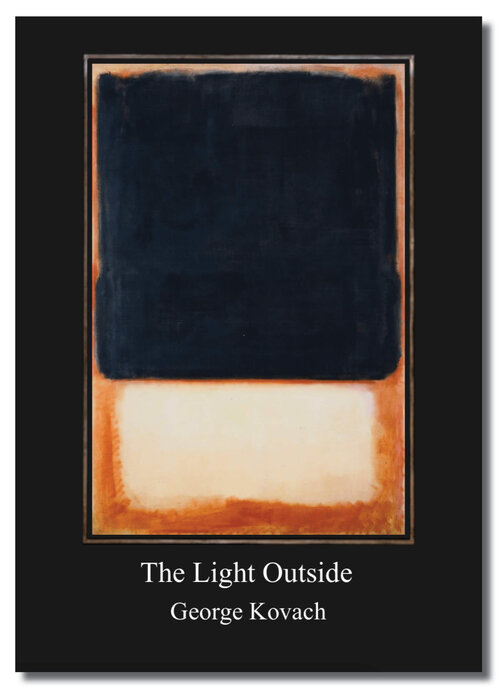
will be braver than we think because the light inside
is the light outside PUand it’s already shining around
us as we begin to inhabit a world we had known but
waited for this moment to discover PUwaited to
catch our breath before plunging into that white
burning we call existence
(Modern Homesteading)


&
Harris’ powerful collection is a testament.
To destruction and what remains.
How to rebuild the city of oneself.
How to make meaning out of the meanness of existence.

Her poems offer hope.

That maybe. Together.

We can survive.


New Poetry by Sam Cherubin: “Don’t About Not,” “Mermaid Tavern,” and “Emerald Inula”

SUN HOLDING ME / image by Amalie Flynn

Don’t About Not

If I can’t or think
            do it like I’m doing now

a beach
            sun holding me

I am holding space
            not space itself

not looking
            being 

gathering toward me

sun’s filaments

fluidity
            is all I need 


Mermaid Tavern

A night-wind touching bare backs lying down
and bare arms spooned across my bed, in blue
light dreaming over skin, light-fingered sparks
of seaweed, dendrites rippling through the room.

Scales rubbed against smooth sheets, in silver
puddled water, a smell of open
ocean, roseate tips of waves, our hips’
undulations, in my body’s rhythmic memory.


Emerald Inula

i.

Apples in Schiller’s desk, Balsam of Peru, rockrose,
rose alba, Helichrysum Everlasting, Immortale.
Why can’t this be enough?

ii.

Dried petals staining the pages.
Attar of cells breathing sun.
Flesh never accepting, but aching.


New Poetry from Alison Hicks: “I Took A Walk With A Friend” and “Untitled”

AWAY INTO SEA / image by Amalie Flynn

I TOOK A WALK WITH A FRIEND

Instead of starting a poem

            I told her about my son’s first semester
As long as he’s home & happy & in one piece, she told me

            Worry squeaked out my sneakers onto wet pavement
The rest dissolved with the pitcher of margaritas

            Though it was wet & rainy
I did not get a headache

            Married for thirty-four years
We selected the movie about divorce

            By the time we finally got to watch it
He fell asleep

            The book was about a friendship that started in graduate school
I skipped ahead to the parts where she snorted OxyContin

            Didn’t want to think about graduate school
But stayed up reading the juicy parts anyway

            Personally, I blame the recliner


UNTITLED

The sea is a room without walls. It spills, falling over land. Land shears away into sea,
rooms echo with spills and falling walls. Walls are powerless in the war of land and
water, swells uproot trees, sweep cars, shopping carts, diamond necklaces out to sea,
rooms of plastic ingots drifting down. The sea has room, gathering spoils from falling lands.

(UNTITLED is included in Hicks’ new book Knowing Is A Branching Trail, winner of the 2021 Birdy Prize and forthcoming in mid-September from Meadowlark Books.)


New Poetry from Amalie Flynn: “Married”

MARRIED TO A MORNING / image by Amalie Flynn

For twenty years I have been married
to a morning. Of blue sky that stretches
and pulls across me like water filling up
a suburban swimming pool. The pit that
formed a hole. The bodies falling down
as if bloodless dolls instead of kneecaps
and muscle shins and thighs hot fingers
letting go of metal or chests and ribs an
artery that runs down the length of a leg
like a hose cheeks that hold in teeth and
tongues jaw and soft palates or a brain
inside of a skull. How the sky was full of
bodies so many falling thoughts fell down
or how the word land crashes and breaks
breaks and breaks apart on impact. How
the day still drowns me.
Today my husband is crouched in our
garden calves flexed. Today I reach out
and I run my fingers across broad fields
of skin between the shoulders. Shoulders
of my two sons. And I know.
How I know beneath.
We are bones.


New Poetry from Gladys Justin Carr: Numbers

THE WAY WE DISSOLVED / image by Amalie Flynn

that night we forgot for a while
the broken country where we lived
in hearts discontent walking backward
into unicorns, rainbows, butterflies
grazing beauty until blood oaths shattered
and you left, the hard leaves crying out
under your step it was good once, you said
well, thank you for that, you touched my face
a scribbler’s tender touch, is there a better way
than this, you said, this nuclear family two dogs
a cat the twins asleep until the rage of words
tore at the roots    the spiny hurts
too late for I love you.  .  .  . that last evening
spread out against the sky
with mathematical certainty    gone
not even so long, it’s been good
to know ya
unique, I think, the way we dissolved
into yards of ancient lies it wasn’t deceit
no not a pity party not even a rave
of dances and songs just two shills
selling our micro myths glasses raised
so  here’s to the years left after you left
I wonder how my new lover
will like my plastic cheeks
my potty mouth my breasts
of steel    even now as I scour
the rooms of your scent
where we died in an instant
in this freeze-frame
of memento mori I still
turn down the covers
and wait


New Poetry from Barbara Tramonte: “Tailored To Fit In”

I WAS GATHERED / image by Amalie Flynn

Somebody sewed me with a string
On the bias
I was gathered
And about to pop

This has been a pattern all my life

They hemmed me in with notions
Each stitch bringing me
To a false whole

(I longed to slit my wrist)

I jolted with a shock of recognition
To see that I had drifted to the wrong side


New Poetry from G.H. Mosson: “Warrior With Shield”

                                                                                                after Henry Moore

AN X STILL / image by Amalie Flynn

Blasted, broken to frag-
ments, left arm won’t—
both legs blown &
absent, the spaces abuzz
w/ anger—but I edge
forward, shield up
as leg-stumps toe
for foothold. My mouth
is an X. Still-
ness. Yet I see. 
I’ve been left. 

Moonlight empties
onto my chest,
rivulets down
in a branching sheen
& I swell w/ a hunch
I’ll make it
as if an old tune
warms the heart,
as if I too
might sing
again to Shelly.

I’ve been        
PUT CHARAsome-              
PUT_CHARACTERS_HEREone     
else
PUT_CHARAonce 
PUT_CHARACTERS_HEREsome- 
body   
PUT_CHARAother:
PUT_CHARACTERS_HEREa child.
Dandelion
PUT_CHARApods
PUT_CHARACTERS_HEREtumble
past my
PUT_CHARAopen
PUT_CHARACTERS_HEREpalms.


New Poetry from Alita Pirkopf: “Roadkill,” “Sounds of the Past,” “Spring,” and “Unhealthy”

BLOOD IN BUCKETS / image by Amalie Flynn

ROADKILL

I bring you blood in buckets,
a heart that I hear, a palsied hand.
It has been eight, ten
years, my issue.
The same as twenty years ago
when your father felt
about me as you do now.
I felt the world shrink
but I thought something,
not necessarily the world,
would end. I had not thought
the world lay flat, as Renaissance
cartographers mapped it.
But now, like an automobile tire
not only flapping, flattening,
parts of it, or me, lie on the shoulder
of my road with dead things and dirt.

SOUNDS OF THE PAST

She thought she had found
soft music and warm dialect,
a sunny sort of near-Italian soul,

But surfaces surprise.
She found out. She found
that underneath pounded
a martial drumbeat
vibrating still

from Vienna’s center,
his childhood years
under the Third Reich,
a father fighting
occupying Yugoslavia
with others
missing
the village polkas,
his son.

A burst of marches,
explosions, still resounding.
All of us hearing
pounding steps and hearts.

SPRING

Shreds remain—
unraveled weavings
of brown grasses and mud—
in branches a bird eyed
for her family tree.

The rest, the nest,
that we had watched
through last week’s window,
fell.

The dog found
blue broken eggs
in the grass.

Families, all of us
consider seriously.
Upsetting winds
come to nests.
It is spring
and windows
open views
and dooryards fill
with the ambiguity
of lilacs.

UNHEALTHY

I loved my doctors
until one
played sick games,
touching and taunting,
and knowing of rules
I didn’t know.
Telling jokes
I didn’t understand.
Dismissing me
for my naivete—
stupidity.

The years passed,
and he operated
on me appropriately,
savingly. Later he
mentioned dining
together or going out
for coffee, but didn’t ask,
and got angry for reasons
I didn’t know, saying
I hadn’t said I’d go.


New Poetry from Jesse Frewerd: “Symphony”

OUR TARGETED HEADS / image by Amalie Flynn

Ballistic medleys project ambition, while
dancing tones find their pitch. There is
unexpected buoyancy in our youth. March,
advance, train, drill, prepare, disseminate.
It’s the 4am ensemble, time to crescendo
awake for guard duty. Report to post, front
gate, alert and ready. Hours, minutes,
seconds, tempo depends on the action.
The symphony begins with an RPG flying
over our targeted heads. Return fire.
Bullets staccato the enemy location.
A cappella commands over the comms.
Write the counterpoint, execute. Threat
neutralized, they retreated. Though my
heart is playing allegro, via adrenaline.
Dynamics decrescendo the scene, bringing
it to normalcy. I return to my life as it is,
my new normal cadence amid syncopated
pop-shots, RPG’s, mortar rounds, and IED’s.


New Poetry from Ron Riekki: “my”

WET ASPHALT / image by Amalie Flynn

            my

brain was left back in the war, the burial
of civilian-normality, how my amygdala
kicks out the ladders in my head, falling
decades, erasing exes, fought for my nation
and now, hibernation, isolation, chairs
stacked in front of my bedroom door when
I don’t sleep at night, the end of the world
in my head, the tingling headaches in my
head, my head in my head, the dead that
lullaby me every night, stormed around
my bed, the hole in my head, how I smell
corpse and I’m medical now, delved into
Detroit, elated when the night is slow,
the moon is shrunk, smoking out in
the parking lot, a doe tiptoeing across
the wet asphalt, a northern red oak’s
branches waltzing behind it, and how
oak is so often used for caskets, how
beautiful they look only when empty.


New Poetry from Hannah Jane Weber: “My Childhood Smelled Like,” “Surprise Dawn”

FROSTED WITH MOONLIGHT / image by Amalie Flynn

MY CHILDHOOD SMELLED LIKE

cabbage, salted tomatoes, and cracklings.
the flume of dust I awakened when my fingers
untangled the shag carpet’s red mane.

crayons I melted against the wood stove,
our terrier’s feet, with that same scent of fire.

night crawlers, shad, algae, and lake,
blanketing our boat after a morning of fishing.

Dad’s scrapyard, fragrant with hot tar
and smoke from his brown cigarettes,
acres of rust and grease, a twisting maze
leading to one abandoned refrigerator after another,
each filled with jars and jars of ancient rot.

fireworks and muddy gravel roads,
leadplant, elderberries, horsemint.

Grandma’s lilac bushes,
reeking of booze from the bar next door,
their purple bunches lighting up the dark
with neon liquor perfume.

SURPRISE DAWN

rows of cedars push through slats of slain brothers
dense boughs gushing berries
frosted with moonlight

my bike light skims twilight from creamy sidewalks
a premature dawn blaring from the flashing bulb
illuminating the wind’s fabric
in rustling leaves

I lean far from the sweep of branches
but my jacket catches the emerald froth
and propels me into the flustered chatter of birds awakened
and tossed about by my helmet’s pillage of their feathered hearth


New Poetry from Kevin Honold: “Elegy for the Emperor Frederick II”

HERE AND GONE / image by Amalie Flynn

i.
view from Emigrant, Death Valley

The snowy Amargosas kneel
beside the salt flats stained
with the blue shadows of clouds and the fading
paths of walking rain.

The bitter dust comes back to life.
Dervishes of gypsum and borax
spin across the basin, divine conjurations here and gone,
celestial legerdemain.

The winds entice them, no prayers detain them.
Beloved of heaven but a moment,
then drown themselves
in salt and distance.

ii.
Mesquite Flats

They say the dunes of the basin
pace a vast circle on the desert floor, inch
by inch, a millennial march about the perimeter
of their colossal stone corral until they arrive
back where they began.

Not a grain of sand, they say, escapes this valley,
but each is buried in its turn a thousand years
until disinterred by a chosen wind
that carries the grain to the next dune,
there to be buried once again.

                                            Centuries pass
in this manner: a wild leap then a long
long wait, an elemental orbit
to nowhere—not at all like us or
maybe not.

iii.
Your Majesty had so many questions.
Where is Purgatory, where the Pit?
Below ground? above the clouds?
++++++What strange things to ask when the very
seas and mountains were counted
among the treasures of state!

iv.
Certain winds prevent departure,
wrote a Jin poet during the difficult
months after the Mongols sacked Kaifeng, observing
how breezes compose
abandonment in dead leaves and in memories

of friends no longer with us.
But little troubled was the old master
in his cups, seated on a stool
beside the door to his mountain hut, knowing
          the costly scent of haw blossoms
               will vanish at a touch of breeze.

Such grace in the face
of hardship and change
is rare, and always has been.

v.
traces of old wildfires in the Panamints

The tangled cries of unseen coyotes echo from hillsides arrayed with the black skeletons
of junipers torched by the fires
that crossed these hills
ten years ago.
                  A howling so
joyously unreal, a purling

bright as the waters of Shilohs,
Hiddekels, Pisons,
and many other streams
I’ll never walk beside.

vi.
That the intellect would expire
of inanition except it find nourishment
in the world of things, was current wisdom in Frederick’s day.
The mysteries of faith were for slaves to proclaim, and so
he called Christ and Moses
arch-deceivers.

Ill-advised citizens who disdained the imperial corvées
inevitably emerged from their beleaguered
towns with their swords hanging from their necks
in token of submission. Anyhow,
he hanged them in the royal forests where
they ripened, split, and fell
like fruit in its proper season.

Stupor mundi he called himself, Wonder of the World,                                              no longer with us.
Truly, not all his ships, not all the slaves,
                              not convoys of painted
oxcarts creaking with treasure, nor all the blood
and all the pain will be forgotten
till the last jewel is pawned
for the last war.

vii.
death of Frederick

At the limits of knowledge stand the sentinel
oaks of curiosity and desire, and there he paused,
dispirited and syphilitic.
The contention that those who possess
great power are more terrified
of death than common folk

is probably true. With his own hand he drew the white cowl
over his brow, took the bread of Christ on his tongue
and died on the feast of Saint Lucia.

A period of silence lasting seven nights
was periodically broken, the chronicles say,
by the mournful cries of gibbons trapped in narrow silver
cages in the imperial menagerie.

To this day, Frederick’s
Science of Hunting with Birds remains
the final word on falconry.

viii.
The great wheel of stars
turns above the Chloride Cliffs,
            shedding peace and ancient light.

                      The stars are pinholes in the night’s
blue brocade, so the royal stargazers affirmed,
through which the ethereal fire
                        or the Holy Spirit burns.

In the high pastures, the Herdboy leads the moon by a rope
up and over the Providence Mountains.
The stars—so many silver bells
each of which I must
dust and name before I sleep—

keep company with honest
Orion, who hath no place
to lay his head, who rests
a bony jewel-encrusted
hand upon a crook,
lamenting his meager
flock through the wee hours.


New Poetry from Alise Versella: “Parallels,” “Red-Breasted Sparrows,” “I Wonder If History’s Men Knew They Would Be Great,” “A Fierce Sense of Resolve”

TRENCHES OF MY LUNGS / image by Amalie Flynn

PARALLELS

The birds with conviction
Tap out their lyrics in the snow
And their chatter descends upon the mountains
Look how the flowers still struggle to grow
Like lungs filling with air
The soft despair
      of endings
           of so much life lived
It must be written
And then it must be sung
Like the chorus of a sun after a lightning storm
The bees like oboe players thrum
The morning sky an afterbirth of blood
This is how we love
It’s also how hate seeds in the veins
But mostly
Morning’s birthing is how the stars are made
Occasionally
The stars burn out
Like flames in church hall candles
Their ashes floating on the wind
But for centuries death is how time begins
Infinite explosions and black holes
All the songs the Earth sings that we don’t know
The words to
Like psalms in a foreign language
But they have always been my favorites
Like autumn’s blood-red season
Her heavy soil and decay
I love how a little death choreographs
The sycamores in a grand ballet

RED-BREASTED SPARROW

There’s one red-breasted sparrow and he speaks
To me of grief, how snow diseased emerald
Spring, the morning worm dying in his beak
All alone he’ll sleep between twigs nestled

As I am nestled warmly into bed
Goldenrod spears through plants on windowsills
That know not of sickness in heart or head
Mourn not, for there’s glory in winter rose

The map of my veins runs wild with blood
I breathe to fill my lungs unconsciously
Outside the beehive with sweet honey hums
Hexagonal cities, combs built between

These milk bones of mine like geometry
Have faith in the calculations a body sings

I WONDER IF HISTORY’S MEN KNEW THEY WOULD BE GREAT

In case you were wondering
                If at all you do wonder
I mean stare off into the space collecting dust particles in the sun
Wonder
I hope you wander forward

Do not get stuck in the loop of reliving
All the conversations you wish you held
                Isn’t it funny how we always think of the right remark after the arrow has left the quiver?
Sailed on like great fleets on uncharted seas
Circling around unknown America thinking it was the West Indies
                We all just want to discover something

Like a cure for the aching
I hope your daydreams lead you to rejoicing
In the architecture of your body
++++++A city skyline rising
++++++How it glimmers like those dust particles in the sun
I hope you wonder about the things you could become
                Not what you have done
I hope you never ruminate on anything you think you missed

That it isn’t here anymore only means there is room on the gallery walls for new art

Do you understand what I am telling you?

Your mouth is a paint brush; I want the acrylic to speak to me a new language
Teach me a new word for matrimony
That colors and my empty sighs could wed
And the canvas and I

Would bleed a glorious red
                The beautiful ruin of the withering day
How you empty it out for its worth because no gold can stay

In case you were wondering
I dream about the galaxy, turn my mind to stargazing
Believe in little green men terrorizing craters like two-year-old boys ransack the waiting room
We are all waiting for something to begin

Daydream about what that is

I know it to be breathing under water; I am waiting for my gills to appear
I want to swim, Pinocchio in the mouth of the whale

Don’t you see?
Movement is the way the lake ripples, breathing
The sky is a wave cresting
And you could be as great
As history’s greatest men
                If only you believed the way they did.

A FIERCE SENSE OF RESOLVE

Resolutions require revolution
And I have been at battle with the nation of my body since puberty
I have gone to war with my heart as it broke
And broke
And broke
Reinforced the battalions to hold the pieces up
And the bullets ricocheted off the trenches of my lungs
And I swore the fires pillaging the village of my stomach would wipe out the living

I am living like a militia razing the fields of foreign countries
I am burning the boundaries
Rewriting the policies
I am done policing this body

I am done living like I am a war-torn country
A refugee seeking refuge from my own self-pity
I am finished doubting the ability to achieve my dreams
Just because they haven’t happened yet

Civilization was not built easily
There was death in battle and conquerors invading
Trespassers trying to take away
All that I made
Of myself

How dare I
Monarch and sovereign body
Forget that I am royalty
A king
A rajah in the Bhagavad
How dare I lose faith in the ruby red of my blood
Propelling the turbines of this heart

I have resolved to tap this vein
And inundate the land
The great flood once again
Ready your ark and corral your lambs

The fox is on the hunt
I am cunning enough
To see through the lies I tell myself

A kitsune never deceives herself
Never traps herself in the hunter’s snare
She will own the year
And the forest
And the air
Breathe the freedom she pulled from his rib.


New Poetry from Tyler Vaughn Hayes: “They even pipe it into the bookstore,” “His first time: flight by ropes,” “The edict,” “Rappel annuel”

WAX-LADEN DAY / image by Amalie Flynn

They even pipe it into the bookstore

It’s never quite silent, though
there’s no lowing, not from God
nor his glutted blind bovine. Only

the thudding of shuffling ungues
on stereos hemmed, hidden
in the high grass—muzak

piercing through, prodding each
tagged ear. Far better this way—
now they needn’t contemplate

the cacophony in BARN 8, the strain
of strings tucked tight to necks, jammed
trumpets jutting through guts, and

the flutes flushed fast with blood.
No, much better this way.
Bow, hark, try not to think.

His first time: flight by ropes
(for Corbin Vaughn)

it’s fleeting
the rebuff
of a flutter
fleecing
the sway
in his wee
depleted eyes

exhausted
the college
girls of August
ferry a whole
life on the neck
heaving TVs
sleeping late
they flit
from mom
then return

we can’t split
a pendulum
a heavy head
tightened white
like a fading grip
on the tethers
just out of reach

give it up already.

The edict

There is, without question,
a tendency to beg for
those things we have
already.

For instance, I once
commanded God: turn me
into a poet, else I’ll pretend to
be a walrus.

Brugghhllff!

Rappel Annuel

I
(for one and once)
intend to celebrate
a soothing din
the cleansing mess
fresh from the wet
wax-laden day.
Hip hip


New Poetry from Andy Conner: “Apples,” “Untouchable,” “Remanded In Custody”

YOU MEAN NOTHING / image by Amalie Flynn

Apples
‘The landmines are just like apples’
Khmer Rouge survivor

Apples can peel your skin
Like it isn’t there

But more often than not
The cruellest fruit
Sucks the rusty blade

And leaves threads

Dripping

Threads of skin
Threads of your life
Dripping
Seeds onto barren ground

You mean nothing to the apples
You mean nothing

Their anaesthetic minds
Hold no sense of time
No sense of pain
No sense
No sense of what remains

And if you
Are one of the hand-picked
Who escape in a step-right-on-it flash
Give thanks for this windfall

Which leaves survivors
Green
To the core

As they crawl
With the worms
With the worms
And the decay

Praying
To scrump a handout
With no hands
For the crumb
Which may or may not come

As they sit
In their own shit
Begging
On their stumps
For a friendly worm
To turn
Up
And eat it

Untouchable

On my recent trip
to Gujarat

I took
numerous
pretty photographs

of Modhera
Palitana
Dwarka
The White Desert

and other pretty places

but

the image
I can’t delete
from my heart

my hard drive

is of a ragged street child
at Vastrapur Lake
who stepped out
from the promenading crowd

raised
his left
index finger
into the stifling
late afternoon

air

and drew
a rectangle
to take
an imaginary selfie

with me

Remanded In Custody

How can you talk
Of an even split
When you’re parents
Of three kids

How can you ask
For understanding
When you won’t say
What you did

How can you demand
We keep calm
When all you do
Is shout

And scream
It’s your own business
When we’re what
The fight’s about

How can you plead
You need your freedom
When you’ve built
Our jail

Whose four sad walls
Have heard it all
Every selfish
Last detail

How can you think
We’re stupid
’Cos we don’t know
What it means

To move on and
Make a new start
When we’re not yet
In our teens

If you two
Are so clever
And know what
Life’s about

Why must it
Take forever
To sort
Your problems out

You’ve no thought
For our feelings
Or respect for
What we think

While you resent
That we need feeding
When you don’t have
Cash for drink

You complain
We’re far too young
To understand
Your trials

Well in this case
It’s not the children
Who’re acting
Like a child

You both believe
That you’re the victim
Of the other’s
Poisoned mind

But if your eyes
Can still open
You might see
The only crime’s

Neglect of
Your own kids
All three
Ripped apart

By being used
As silent weapons
Against your
Other half

How dare you
Claim us as conscripts
To fight
Your filthy war

When the offence
That we committed
Was only
Being born

You’d never think
You’re guilty
But if you’d any
Common sense

You’d see the last thing
Left in common
Is we’ve all got
No defence


New Poetry from Lauren Davis: “The Flowers You Brought Back From Italy”

FACES TUMBLING DOWNWARD / image by Amalie Flynn

Each time I open my notebook the pages stick.
Because I’ve forgotten.

And onto the ground
they fall:
royal purple flowers fall
out,
emerald stemmed, blue veined,
life
from the coast of Italy.

You pulled them from the earth,
pinched their feet
with your fingertips,

you breathed into the sea

and thought of the way my hair
swayed between my shoulders,
while you once walked behind me
near an American riverside,
flowers sway in the field
the same way.

You placed the poppies then
into the spine of your bible
you pressed it,
punched the face
and rubbed the back
onto the ground
to release water
into sacred words
you pressed,
wanting me there
and you breathed into the sea.

Yesterday, you stood in the kitchen
of your new house
while the songbirds in the yard
called good morning,
you opened your bible
and pulled the flowers up
by the end of their stems
like tails,
their faces
tumbling downward

and I opened myself / my notebook
and tossed the flowers into
my spine / my book’s spine

and there
I closed it
and pressed it into the granite
underneath
to press
wanting to stay there with you
out.

You asked me:
when again do you leave?
Two weeks.

Now,
one-thousand miles away
the pages stick
each time I open my notebook

and onto the ground they
fall,

and I remember how
you must have looked
collecting purple poppies
by the sea of Italy.

Our modern lives,
so set apart,
both
by miles
and unsteadiness.


New Poetry from Scott Janssen: “Bottle Tree”

VIETNAM DID I / image by Amalie Flynn

On my first visit I asked
A stock question about
Whether you’d been in the military.

Marines, nineteen sixty-six, you said,
A hint of menace in your eyes.
I never talk about it.

On my way out the door
I asked your wife about a
Tree in the front yard,

Its branches capped with
Blue and green and pink
Bottles made of glass.

It’s a bottle tree, she said.
Pointing at a cobalt blue bottle
Glinting with sunlight,

She told me it had
Special power to lure in
Ghosts and lurking spirits.

They get trapped in there, she said.
Then sunlight burns them up
So they can’t haunt us anymore.

Eight months later
You could no longer walk.
I rolled your wheelchair

Onto the warbled porch
Where we sat and talked
About how rough life is.

I never told you about
Vietnam, did I? You whispered.
I shook my head.

As you spoke,
Your eyes averted,
I looked at that cobalt blue bottle

And imagined it slowly filling
With blood and shrieks
And grief and the sound of

Rotor blades and the smell
Of burning flesh and the
Taste of splattered gore

And the sensation of
Adrenaline pulsing and
Memories of home and

Buddies who were killed
And of fear and rage and
betrayal and weeping

That lodge in your throat
Before you swallow
It all down

Into your belly.
Don’t ever tell anyone
About this, you said,

Your hands trembling,
Jaw shivering.
I asked if there was

Anything else.
You started to say something
But stopped yourself.

No, you said.


New Poetry from Nestor Walters: “Homecoming”

FLATTEN TO BREATHLESSNESS / image by Amalie Flynn

Only the dead have seen the end of war –Plato

he lies down, finally to rest.
grey light bands his closed door
with no silver at the edges. They said he left
one foot in the sand. wait, a head
no, a hand. the pale orange bottle, only
dust at the bottom, slips from his
fingers. one missed his mouth
small, white, and round, it
shines from the dark floor like
a little moon. In the space
between shadows and dreaming
his way to death, he smoothes a dressing on
the hole in Seth’s neck, he wraps
a scarf on Nick’s face, still
burning with chemical fire, he
lowers Jeremy’s hand, still gloved,
into a black trash bag. His
pupils sharpen to pinpoints, his
chants flatten to breathlessness, these,
his friends’ names, hammered into
cold steel necklaces
Jeremy, Seth, Nick
beckoning
from darkness

won’t someone tell him
you’re not crazy
you should want to go home but
stay a while
stay and be here with me


“Art-Making is My Light:” An Interview with Poet Suzanne S. Rancourt

As Suzanne Rancourt notes, her work is a bridge between disparate worlds, attempting to make connections between these worlds, whether they be the Indigenous and Anglo worlds, or the worlds of the veteran and the civilian. Her poetry (but not only her poetry) reflects a healing process that involves artistic creation as a method of “finding our way back home.” 

Her first book of poems, Billboard in the Clouds (2004), evokes the prevalent themes in her work: the continuity of the past and its impact on the present, the interaction of childhood and adulthood, Nature, the enduring strength of family and heritage, relationships, and cultural loss.

For example, in the poem “Even When the Sky Was Clear,” she recalls childhood experiences of observing her father’s connection to and understanding of Nature: “I would watch him/through my mother’s kaleidoscopic den windows,/ . . . I would watch my father/stand in the center of the dooryard appropriately round/ . . . Even in the summer/he’d look to the clouds, to the sky/at dawn, at dusk.” Her father was able to read Nature for knowledge of snow, rain, and wind. As an adult she stands “in a circle” and sings “to the clouds/in the language/my father/taught me.” In this way both the family and the broader cultural heritage are remembered.

The idea of the continuity of memory is also shown in “Thunderbeings.” In this poem Rancourt recalls her “Parisienne farm woman” grandmother, Dorothy, whom she called Memere. Memere, killed in a freak lightning strike in 1942 (before Rancourt’s birth) while touching a post of a brass bed, was an artist who “painted in oils/the light and dark of all things— . . . .”  Rancourt recalls that as a child she would trace the brushstrokes on the paintings, “wondering where these ships were sailing/in my Memere’s head.”  Then, forty years later, the adult Rancourt discovers the bed and polishes the “spokes and posters,” with the bed transformed into a “brass lamp” which “illuminated images of a woman/I never knew.” As the poem ends Rancourt writes: “For years I slept in this bed,/and often heard her/still humming in the brass.” Rancourt creates unexpected connections through visual imagery and forges a link between the grandmother she never knew and her adult self, between past and present.  

That the link endures is also shown in “Haunting Fullblood.” Memere represented Rancourt’s European heritage, while in “Haunting Fullblood” Rispah is the Native “Grandmother to grandmothers” who embodies her Huron/Abenaki heritage and speaks to her “through the generations/ . . . Were you anything more than a photograph ?/Oh, yes, Rispah, Grandmother, my subtle bridge/over flooding time—shhh—/I am breathing proof.”  

Her second book, murmurs at the gate (2019), extends and develops the themes in the first. In “Harvesting the Spring” she reflects on past springs and recalls how frozen ground would thaw so that she could “sink my feet into” the mud and how spring would blend into summer and the longed-for wild strawberries. She ponders the familiar memories, the certainties, of childhood, that often stand in contrast to the confusions and losses of adulthood. The poem concludes:  “I long for wild strawberries/and the little girl/who used to pick them.”    

There are also meditations on Nature in such poems as “Along the Shore—Five Miles,” “Grace” (“Gazing across the valley, across the Sacandaga, across the surface/ . . . drinking the self/drinking the Universe”), and “Swimming in the Eagle’s Eye.” In this poem she sits by a “secret” pond in quiet observation. She would lose herself in the “reflections of backward worlds” and, echoing Thoreau, “I recognized something/in this Eagle’s eye/this everything and/nothing/striking calm.”

However, she is more explicit in murmurs about the violence of war and her military experience. “When We Were Close” details a lover’s PTSD.  “The Execution” uses “the photograph I grew up with,” Eddie Adams’ photo of the execution of the Viet Cong prisoner on the streets of Saigon, to ask about this incident, which is metonymic of the brutality of war, “You will remember, won’t you? Won’t you?” “Iron Umbrella” notes that “The burden of war is strapped to the backs of the survivors.” Other poems address her MST, as in “Against All Enemies—Foreign and Domestic.”  The anger at her violation is palpable:  “I wanted to kill you/assailant/because you violated my home—my body.” The story “The Bear That Stands” discusses in more detail her rape and its aftermath.

Rancourt also utilizes music to express her experiences. “Sisters Turning,” (co-written with Anni Clark, who also did the music), is based, as the liner notes indicate, on the “testimony and writings of Army and Marine Corps veteran Suzanne Rancourt.” In the song she recounts her military sexual trauma (MST) as a “naïve Marine” at the hands of a Navy man. This is her first betrayal. She tells another woman what happened, but is initially not believed. This, she writes, is her second betrayal. The song suggests that healing from MST can be facilitated by women trusting in the truth of the others’ experience: “Where do we turn/if not to each other . . . If we lose each other/we’ll never get home.”  

Rancourt utilizes music, dance, photography, writing and other modalities to help others heal from various types of trauma, substance abuse, domestic violence, and Traumatic Brain Injury. Using her education, life experience, and training as a photojournalist and information specialist in the Marine Corps she created an integrated Expressive Arts program that promotes healing.  She lives in rural New York State and works locally with veterans in a peer to peer program but also travels internationally to work with others to help them regain a sense of home.

*

The novelist Henry James wrote that “A writer is someone on whom nothing is lost.”  If I expand James’ aphorism to include any creative artist, then Suzanne Rancourt is that artist “on whom nothing is lost.” Through memory, emotion, and observation Rancourt reveals the truths of her experience in all its dimensions.

LA: Let’s start with discussing your new book of poems.  How does it continue or differ from previous work?

SR: My third book of poems, Old Stones, New Roads, has been picked up by Main Street Rag Book Publishing and is scheduled for release in Spring of 2021. Old Stones, New Roads differs from previous work in that I am further down the road in age and healing. The continuation aspect is seen in the things that simply remain the same, my spirit, temperament, how and where I was raised, my culture, and various trauma events. All of these factors propel my continued self-exploration, figuratively and literally. For example, this book is dedicated to my father’s mother, Alice Pearl, who collected stones. I clearly remember, as a child, sitting beside my grandmother in front of the stone hearth at the Porter Lake camp. I was incredibly young. I recall Grammie pointing to each stone and telling me where it came from and who brought it to her. Each stone had a story, a life, a history. Since a small child I have also collected stones. 

I come from independent people who enjoyed travel. Mobility was supported at young ages: hiking, bicycling, driving, travel in a variety of vehicles, learning, exploring something about resonance of place and how some places “feel” more than others. I was encouraged to observe, ask questions, take note of how people lived, to respect differences and similarities and to figure things out. It is interesting to me, and hopefully readers, how where we come from is always brighter the further we travel from it. Part of this phenomenon helps me take a look at what is identity narrative and what is trauma narrative. Post-traumatic growth, for me, is being able, first, to recognize what is a trauma “story” and accept that that trauma “story” is not my identity, and then to ask, how do I transpose the trauma stories, tones, and images into syntactic stones, and new discoveries?

LA: Various themes emerge in your work: relationships, family/history, Nature, Indigenous heritage, impact of the past on the present, loss.

SR: The themes that emerge in my work are simply the themes of life that everyone has in various intensities and manifestations. It is in our commonalities, our collective consciousness, and shared experiences,that metaphor can rise up into our forebrains. Sometimes this happens subtly and sometimes not. Part of traveling to ancient and sacred sites strikes me as collective resonance. Maybe this is a type of empathy?

Perhaps there is something about dowsing. As you may know, I come from a family of dowsers and was taught to sit quietly in the woods, to be attentive. This clearly supported my multi-modal sensory development and still does. Some folks may refer to this as situational awareness, or Zanshin, or synesthesia or being present. Either way, it isn’t by living in the past that I explore the past. Au contraire. I must be firmly in the present to view the past, present and future. This is why stacking wood is one of my favorite meditations; I’m in constant movement while fully conscious of the past, present and future. I am willing to step into all the memories to find the beauty, the strength, and yes, grief and rage, and then emerge. I don’t heal or get stronger by denial, or by pretending that something never happened, or that I wasn’t involved in something. I am but a part of the natural world and the natural world is a part of me. No more, no less. Perhaps this is a way of annealing the Soul. 

Furthermore, life isn’t linear. That is a Eurocentric perspective. Life is circular, non-linear. Some people experience life as an upward rising spiral, as opposed to Dante’s Inferno; we traverse through levels and layers of increased awareness that each experience offers in support of our progression. What stays the same? What changes? My writing is always a journey, an exploration, always something to learn, and yes, things can get pretty dark. One of the most profound lines of poetry I carry hails from a fortune cookie: “It is better to light one small candle than to curse the darkness.” Art- making is my light.

LA:  Part II of murmurs at the gate seems to be more about military experience with reflections of the Vietnam War, like in “The Hunt,” “Iron Umbrella,” “Tsunami Conflict,” and “Ba Boom.” In “Throwing Stars” a “hyper-olfactory” stimulus sets off a memory of a traumatic event.

SR:  murmurs at the gate is a deep exploration of events, memories, incidents, character development that ultimately reflects decades of exposure to war trauma in some variant form. Part II indeed dove into war and conflict experiences. All things in the physical realm change molecularly, atomically, when under pressure, and the intensity of fire. Elders always taught “that all truth is found in nature” if we know how to simply see that which is before us, no matter what the environment. My concreteness of a metaphor’s abstraction is always the natural world and/or my current environment.  For example, when I taught creative writing at Clinton Correctional, the windows still had that old blue glass with the bubbles in it and it had the same thickness and blue hue as my Grandmother’s old Ball canning jars, the ones that had a rubber seal and a latch to hold the glass lid. The lessons of seeing what is before me, the environment, whatever that environment may be, offers an endless vocabulary for metaphor, similes, tension, meaning. Images and lessons from nature fuel my questioning that hopefully inspires others to question, wonder, consider.

As a writer, I distinctly recall being extremely young, fully open, and experiencing with all my senses, the outdoors. I had the good fortune of no video games and incredibly limited TV. For some reason, Western society attempts to lead us into a false belief that there is a magic this or that to eliminate memories and residuals of trauma. From my individual trauma survivor perspective, my experiences are what bring depth to my humanness. My poem “The Execution” is a true event, both the execution and my seeing the corner of the photo as a writing prompt. 1  I was trained in the Marine Corps as a photo journalist/journalist/public relations person. This training has made me keenly aware of how words and photos can spin propaganda, politics, and deliberately mislead the masses. That’s what this poem is about and when I read this poem at events, I read it once through without commentary. Then, I ask how many people recognize the photo I described.  I follow that up with questions about the two main people in the photo. I follow that up with the truth about the individuals, the complete story to properly place the image in its true context. We have to look at the era, what type of film and photo equipment existed, and how point of view and images out of proper context can be manipulated to mean the exact opposite. The poem is a warning as much as anything. I end the brief discussion with a re-reading of the poem and note the measurable change in the audience. Think about it.  

I believe the artist is a witness. This is my mission and perhaps this has been the mission all along right up to this specific moment for you to ask these questions and to whoever is reading this word literally, right now. I want people to ask questions. Many of the poems you have mentioned are true word for word. Some poems hold a person, image, of event that is nonfiction and then I enter into it and allow the narrator to question, answer, apply the “what ifs” without editing, just the freedom to express.  This is where the surprises can emerge in the movement. Telling our stories is a bridge. Telling our stories is an action that connects generations, human to human. This is healing, this is “medicine.”  

LA:  How much does your military experience figure in poems like “The Hunt,” “Iron Umbrella,” “Tsunami,” “Throwing Stars,” and “Ba Boom”? You were in both the Marines and Army.

SR: My most recent time served was from ’05 – ’08 in MEDCOM. In “The Hunt,” for example, one place I was working at was an Airlift Wing where I had to pass through a hanger of Black Hawks. They seemed so docile cycled down and their prop blades really did remind me of the long ears of hunting hounds I grew up around as a kid, “their hound dog props pick up to attention/at the sound of clips, bolts, boots.” Also, worth noting, I know the difference between a clip and a magazine. Clip refers to snaffle-type or carabiner-type clip. Everyone was always on alert, always training, training that triggered rapid response. Sounds, smells, heart rate, respiration, everything in response to a hunt. A hound dog sound asleep only has to hear a minute sound and they’re by the door and fully alert. “Iron Umbrella” was inspired by a black and white photo prompt of an indigenous father and son clearly in a tropical country that, of course, was in the throes of violent conflict. I gave myself permission to ask questions of those characters and let my narrator respond freely. I allowed my military experiences and being a parent to inform and fuel my narrator. In this way, the tone remains authentic, the story plausible and real. The poem “Tsunami Conflict” is what I call truth-inspired because the shell is a gift that a Viet Nam era vet gave me decades ago. It was something that he acquired when on leave and carried in his A.L.I.C.E. [All-Purpose Lightweight Individual Carrying Equipment]. I still have the shell. It is on my desk and I can reach out and touch it even as I write this. I hold the shell, sometimes. It brings comfort, simply brings comfort. “Throwing Stars” is a true account. Smells. “Twenty years later when I’m at the park at Saratoga,/You’d hardly notice that I knew anything./And if it weren’t for my hyper-olfactory,I would have forgotten you.” Some smells one can never scrub clean of. “BA BOOM” is a tone poem that is driven by the adrenalized beating of one’s heart – hard, strong, the type of beating you hear from the inside of your body, the type where it feels like your heart will explode violently through your chest. The title, in bold capital letters, when spoken is one’s heartbeat, you know, that onomatopoeia thing, while also exploding. There is a tension of hypervigilance in this poem that hopefully helps people who have never felt such things, to feel with their bodies via the vagal system, primitive brain, not the forebrain.

All of my experiences get transposed into an “experiential” vocabulary for my art- making. A metaphor requires two parts: a bass line and a melody, concrete and abstract. Our bodies are naturally wired to remember sights, sounds, smells, air tension displacement and much more than we are even consciously aware of, like the situational awareness/hyper-vigilance combat and other threatening situations require. How could I not draw from my military experiences? Or any of my life’s data? Writing as craft is the skill of shaping, forming and transposing these stories into a form that people can receive.  

My military time is what they refer to as broken time, meaning I was in, out, in again. When I first went into the Marine Corps, the times were way different. I am an MST survivor, veteran, and have been the spouse and partner of combat and non-combat veterans. Thus, my military experience is multi-faceted. 

My MST happened while in the Marine Corps attending my photo journalist/ Public Affairs/Information Specialist training. Things went downhill rather quickly after that. My next stint was in the Army because back then I would have had to give complete custody of my child over to someone else. I declined. My second MOS was a Medic. I fulfilled my commitment and moved on after also working as a Chaplain’s Assistant. My most recent time in was from 2005 – 2008. By then a whole lotta shit was catching up with me that I had never addressed. That’s when I connected, for the first time ever, with Travis Martin’s organization Military Experience and the Arts, now headed up by David Ervin. My life changed significantly and for the better. I’m still in contact with many of the folks from that first MEA 2012 Symposium. murmurs at the gate is what I refer to as my heuristically-inspired “poetic dissertation.” It was the first time in my life that I could safely acknowledge how much the military was, and still is, who I am. The word is validation.  

LA: In Native Voices the editors note that ‘Fabric’ and ‘The Smell of Blood’ are fine examples of her ability to intertwine personal experience and communal history.”  2  Is this what you try to do in your work?  What is your creative process?

SR:  Ahh, my poem “Fabric,” so much love and loss in that poem. Better to have had some good love than none. I wrote the first version literally decades ago and was told by an academic that it was garbage. I did not throw the piece out as suggested. I trusted something deep inside me that said no, that it was a strong poem and I held onto it. I held on to myself. In 2015 I was invited to write a piece for a special women veteran’s issue of Combat Stress magazine 3 [released January 2016] entitled, “Women Veterans and Multi Modal Post-Traumatic Growth: Making the Tree Whole Again.”  By then I had experienced several failed marriages, lost so many people that I had truly loved, been retraumatized in a variety of ways linked to unresolved military experiences, that I rediscovered the poem.  I renamed it “Fabric.” As a result of new connections with the military community, I had finally been receiving the help I needed to make sense of things and recognize unhealthy patterns and beliefs. And, I was always writing. I tweaked the poem and added the last two lines about  accepting life, love, and loss. I am a human being and so are my readers. The causes of our specific experiences, i.e. love, loss, violation, may be vastly different, however, our humanness connects us. By diving below the surface of self, into the currents of hurt and love, I give myself permission to validate with words and images. And this, I feel, lets others know that they are not alone in their existence. We see each other. Indigenously, if I say, “I see you,” it means that I see ALL of you and it has really nothing to do with your occupation or your wealth or poverty. I see who you are. I see you. We see each other. Sometimes it is but a flicker in one’s eye or a microexpression, but the soul is there. This reflects my work experiences with people in comas, or people who are quadriplegic – this skill of seeing isn’t really about using my eyes to visually see. Recognition is something far deeper than that.

Because of the types of trauma that I have experienced, coupled with a rich memory base of the powerful smells from the natural world, and also my quirkiness, I have always had a strong sense of smell. Bears can be like that. I did not sit down with the intention to write “The Smell of Blood.” It could have been something as subtle as passing a person in a store who wafts a certain odor or literally a restroom with old trash. I used my writing to release the reaction that became a list poem of sorts. When I do the first write of a piece I just let ‘er rip. Patterns, rhythms, meter – all that reveals itself in the rereading and editing process. I am an honest writer, meaning, I just say it. This poem offers an opportunity for people who have not experienced trauma to feel on a cellular level anxiety, a triggering event, run-away thoughts. As a writer I had to be responsible of the climactic curve and tempo. This poem had to have that final line to allow for breathing, release, resettling. When a person’s PTSD is triggered, it doesn’t make sense to most folks. This poem lets people know that I hear them.  It offers validation. We are not alone here, in the in-between “…in the lives outside of reasoning.” 

LA:  You mentioned that you were influenced by Robbe-Grillet, Samuel Beckett, and Eugene Ionesco, among others.  What impact did they have on you?  

SR:   My mother used to sing that Cinderella song to me, the one that goes “In my own little corner…I can be whatever I want to be.”  As a young child this is possible.  However, one hits a certain age in child development and realizes the outer world can be quite cruel. That’s when creativity gets shut down and injured on so many levels and in so many ways. Much later in life I reignited my creative self. This rebirth, if you will, was definitely fanned by the freedom that Robbe-Grillet, Beckett, and Ionesco said yes to. Trauma, especially when it occurs to children, can close us up.  The innocence of being open is no longer safe. As I matured intellectually, spiritually, physically, I discovered healthier ways to be open and safe. Some folks may refer to this as “self-regulation.” To finally have the go-ahead from significant creatives to ask questions, explore and discover through art-making, I was finally able to feel comfortable in my own essence as writer and human being. Just think of me as an example of the 100th Monkey, the one that breaks the pattern, walks point, changes the outcome, someone has to do “it” first.

LA:  What do you mean by “I Am My Own Evidence”?

SR:  I am my own evidence. Yes. And my evidence and experiences are as valid and, in some cases, more so than any individual in any hall of academe or therapeutic field. My experiences as a kid, my theories, came from very physical experiences, often pain- related, like profound migraines, for example. Only within the last decade has neuroscience been able to offer data that I frequently wrote about in various fields in the 80’s, ‘90’s, and early 2000’s. I am multi-modal, which is no different than cross-fit training. I am making sense of my world through the senses and art-making modalities available to me and that includes what is culturally specific, whatever those cultures may be. Be authentic. Be yourself. Let your narrators tell the story because there is absolutely no way your own experiences will not find their way through your narrator. For people who would like to research this more, look into Heurism as research method. A fantastic text is Clark Moustakas’s book, Heuristic Research:  Design, Methodology, and Applications. 4  This understanding and method is one reason why I refer to murmurs at the gate as my poetic dissertation. 

LA:  You work in various modalities:  poetry, song, photography, dance, drum-making. How do these all connect? 

SR:  The various modalities that I express and create through connect within myself as a human being and also as a living, neurological organism. Each modality has a predominant or primary sense that it requires for expression. For example, dance for me is physical and relates to all that movement requires, singing actively engages my auditory mechanisms including self-soothing, photography fires up my visual cortex and all that that requires, and so forth. Writing is like the piano for me in that to learn the piano one learns all the keys and therefore can read music for all instruments. Writing is my primary modality where I can use all sensory mechanisms to better engage the reader and/or listener. This is my cross-fit training and I do include actual physical fitness! The connection is the whole person that is me. It has taken time for me to get here and I certainly didn’t get here on my own. I had to ask for help and thankfully there have been and still are really good people who are there for me. This is called Community, with a capital C.  

LA:  You did some songs with Songwriting with Soldiers: “Running Out of Flags” and “Just This Side of Freedom.” How did these come about?

SR:  It took me a long time to get up the courage to apply and attend the Songwriting with Soldiers retreat in New York. Those two songs were written in 2015 and I had just finished up about a year and a half of seriously intense work with the MST doc at the local VA. I was still pretty squirrely. An Air Force woman vet and I were teamed up with James House to write “Running Out of Flags.” Again, I brought what I know to the table. I am the recipient of two of our nation’s casket flags. I know what it’s like to have people in dress blues show up. I know intimately that grief that I still carry. I lived through the Vietnam War. I remember the Kennedy assassinations, MLK assassination, Civil Rights movements, war, violence, more war, more violence … what are we creating? How many generations will forever be scarred by our actions? 

Oh oh they’re running out of flags
How many more are they gonna have to make
Another one flies in the cold at half-mast
Take a thousand years to call out all the names

Just This Side of Freedom” is a song that came forth when I was paired up with Darden Smith.  5  There are two versions of this song. I brought to the table my original version to which Darden applied his professional songwriting skills to create the second, Songwriting with Soldiers version. The first version I titled “Sacred Light” and it emerged from one of my lowest life points. I gave myself permission to let the weight of my plight flow. I wasn’t in a good place. I was on the verge of being homeless. No job. Life was bottoming out and shitloads of unresolved trauma – decades worth – was all bearing down on me. I have had trauma events where I was dead, without life, and had to be brought back. Western medicine doesn’t talk much about this type of death experience phenomena with trauma survivors or even acknowledge it. So, one aspect of the song was to give voice to that in-between place and to validate my fellow in-betweeners. Western medicine will call us crazy when, in fact, what we’ve experienced is most real. The “Sacred Light” version speaks of a clear memory of one of my experiences. My Indigenous ceremonies that I participate in and conduct are what bring comprehension to my experiences that I offer up for others’ validation:  you’re not crazy; when the Soul, spirit, life force – whatever you want to call it – leaves the body, it is a type of self-preservation; and, I’m still here because you need to hear what I am telling you, we can get through this too. You are not alone.

After I wrote the song, I would listen to it from the inside out. I felt the chords, the incredibly slow tempo, the tone. I was too close to an edge. This song is when I realized I must get help. When I play this song out in public, I always pay attention to the people who respond to it and have even stated generally to the audience my story and that we are not alone on this journey.  There is help right here. Right now. There will always be wars. There will always be warriors. There will always be warriors, both men and women, coming home and therefore there will always be a need for an empathetic Community to welcome them home, validate their experiences, be present in the Coming Home process, which for some of us has taken decades if not lifetimes. 

I have also had the great experience of working with Jason Moon’s program, Warrior Songs, where I teamed up with Anni Clarke for Women at War Warrior Songs Vol. 2, “Sisters Turning.”  6   Ironically, Jason didn’t know that I was from Maine when he paired me with Anni Clarke who  attended U.M.F. [University of Maine at Farmington] at the same time I did.  Synchronicity…is it?

LA:  Can you talk about Expressive Arts Therapy? How does art help “find your way back home?” How does art lead to healing?

SR:  Expressive Arts Therapy  7  is a relatively new field for Western/colonized societies. 

Positive psychology, I have found, focuses so intently on keeping all things positive that it negates and fails to validate the trauma experience of the trauma survivor. Granted, this method creates a bubble-pack buffer zone around the therapist/counselor that better protects the therapist/counselor from client trauma transference; however, from a military trauma survivor perspective, especially military sexual trauma, this active practice of only perpetuating the positive exacerbates the “same ol’ shit” of non-validation wielded stringently when attempting to report rape in the military system. I mention this to better clarify that Expressive Arts Therapy draws more from the Phenomenological and Heuristic philosophy schools where we use a variety of art-making modalities in safe, respectful settings that support the natural emergence of experiences via the art modality in action. There is indeed a sound paradigm from which methods of application are skillfully employed. The process remains fluid within a frame designed to support the modality being used, the participant(s), and the experience as a whole.  Healing is usually an uncomfortable and sometimes painful experience. Just because we deny its existence, doesn’t mean it isn’t constantly working in the back ground like some software worm.  murmurs at the gate is what emerged when I delved into those hurtful places.  There are also poems of profound beauty and sensuality in murmurs at the gate that emerged from the darkness of trauma. Neurologically, the brain is a fascinating mystery that Expressive Arts Therapy is accessing when application practices are comprehended. I was way ahead of my time with multi-modal practices and the more I worked with adult survivors of Traumatic Brain Injuries, the more I realized I had to keep learning. Hence, this learning led to numerous degrees, certifications, cultural immersion, and a reclaiming of identity, because back then there simply wasn’t anything close to Expressive Arts Therapy. My entire life is the validation of existence and all my experiences that have brought me to this point and wherever I travel to next. A friend in the Army, a very long time ago, called me “Pathfinder.”

LA:  In your essay for Combat Stress, you mention your 1978 MST.  How does trauma and the experience of the military and war come out in your work?

 SR:  I’m more of a Wilfred Owen fan because he describes the in-between weirdness of PTSD along with what we now refer to as moral injury. No fanfare. His work offers what he sees and what he feels, not what he interprets…Holding on to the concrete is a way to remain “in body,” so to speak, to remain present in the unreality of trauma events swirling about you. When brain chemicals are released en masse and tsunami into your physical body…shit happens…sometimes literally. This neurochemical wash of neurotransmitters can be akin to dropping acid. There are specific things that happen that only another who has experienced may recognize.  I recognize this in Owen’s work. I also recognize this in Rod Serling’s The Twilight Zone.  When I’ve read and watched documentaries of J.D. Salinger, I also recognize behaviors that reflect experiences, perhaps, from his WWII trauma, and I wonder if Salinger wasn’t attempting to deliberately trigger this neurochemical dump to comprehend or re-create a tone or a sensory experiences. Neuroscience has indicated that trauma can change our DNA.  Perhaps that’s where my idea for a PTSD equation emerged from. [(trauma event over intensity) x (duration over frequency)] x by length of time, i.e. 1 week, 3 mos., 18 mos. 2 yrs., 20 yrs. 

I’m finally at an age where all of my experiences are a part of me and I’m O.K. about that. Therefore, to quote another one of my favorite writers, “How not?”

LA:  How has your work evolved over the last 20-30 years?

 SR:  My work has evolved because I have evolved as a human being. I never give up. Giving up is never an option. It’s just who I am, it’s my temperament. In this process I have become more informed in my professional fields and more accepting of who I have been, am now, and becoming. Outward Bound winter survival when I was sixteen. Wow. Then Parris Island. Again, I am alive because somehow my upbringing and who I am was able to transpose events into strength. I still do Aikido and Iaido. This quarantine is profoundly difficult for many and I miss my Dojo.  Ceremonies have helped me make peace with being solo. The natural world, my land, I remain in relationship with. Self-discipline is crucial. Being in recovery essential. The last 20-30 years I have gathered tools.  

I have had, and continue to have, some amazing elders, mentors, editors, and my family who have painstakingly kept me going. I will always have profound gratitude for my family and the future of my family. Being able to ask for help and then being willing to receive help is key not just in my survival, but in my thriving. As a writer my craft is strengthening and changing. I love it. I never know what will emerge, what new relations will I meet and make, and where will this next thread take me. The wind, you see, it’s always in the wind.   8

1   The poem appears on pp. 50-51 of murmurs at the gate and refers to Eddie Adams’ famous photo.  See, for example, https://www.nytimes.com/2018/02/01/world/asia/vietnam-execution-photo.html

2    Native Voices:  Indigenous American Poetry, Craft and Conversations, ed. by Marie Fuhrman and Dean Rader, North Adams, MA:  Tupelo Press, 2019, pp. 270-279.

  1. Combat Stress, Vol. 5, No. 1, January 2016, https://stress.org/wp-content/themes/Avada-child/lib/3d-flip-book/3d-flip-book/?mag_id=16192, pp. 72-86.
  2. Clark Moustakas, Heuristic Research:  Design, Methodology, and Applications, Sage Publications, 1990, Moustakas, Clark. Heuristic Research: Design, Methodology, and Applications. United Kingdom, SAGE Publications, 1990.
  3. See Songwriting With: Soldiers video:  https://www.pbs.org/video/klru-tv-their-words-songwriting-soldiers-episode/;  web site:  https://www.songwritingwithsoldiers.org/
  4.   Women at War:  Warrior Songs Vol. 2, available through warriorsongs.org
  5.   See https://www.ieata.org/
  6. Suzanne Rancourt website:  https://www.expressive-arts.com/index.html; books:  Billboard in the Clouds (2004), Curbstone Press, https://nupress.northwestern.edu/content/curbstone-books; murmurs at the gate (2019), Unsolicited Press, http://www.unsolicitedpress.com/; Old Stones, New Roads (forthcoming, 2021), https://www.mainstreetrag.com/


New Poetry from Sheila Bonenberger: “They Gave Their Lives”

UNDERGROUND FORGETTING / image by Amalie Flynn

The brass buttons are piled in a bowl
that sits on the shop counter
beside the cash register,
so I buy one,
watch as the clerk drops it
into a paper bag, gently
folding the open end over
so the button doesn’t fall out. 

Such are the tender considerations
we resort to when it comes
to Union buttons mined
from Marye’s Heights, the field
blood transformed into a massive
trauma center, and those many
soldiers, hastily tipped into graves
scratched higgeldy-piggeldy in the earth
and quickly left, without markers,
abandoned to the underground,
earth’s crowded room,
to work its magic on the soldiers
and their uniforms under
the same gibbous moon
shining down on life going on,
so that one day a treasure hunter
turns the detector’s sensitivity
to high, reaching well past
unreadable trash,
finally capturing a deeper
signal to shovel through grass,
past stones and worms, into dreams
of wealth or glory, pulling up
a solitary, now verdegris button
bent slightly as the soldier
fell hard perhaps against a rock
that would sleep unchanged beside him
until the treasure hunter conspired
to craft a stranglehold on history
proclaiming that this discovery
announced an end of sorts to the story
of a fallen soldier,
one that can be labeled,
one you can put a price on,
but the truth is that buttons
cannot be counted on
to hold a jacket snug, can even
loose their hold on the fabric
of dignity, on the fable
of victory, if what they hold
has been released to flourish
underground forgetting
that perfection is elusive
and we are not perfect
though we hurl ourselves at it
again and again.


New Poetry from Mack Freeman: “Death Row Butterflies”

DEATH ROW BUTTERFLIES / image by Amalie Flynn

Gossamer wings glint
Razor wire gleams in sunlight
Death row butterflies


New Poetry from Ben Weakley: “Checkpoint,” “There are 4 Ways to Die in an Explosion,” “Good Friday,”

PRAY FOR THE BLAST / image by Amalie Flynn

Checkpoint                                                                                      

The car came from nowhere, it came
from everywhere –

white blur and tire squall,
a four-door payload
of heat and pressure and steel.

When it is over, there is just
the tinkle of falling brass and a man
slumped
in a pool of broken glass
and coolant on hot asphalt,
calm as a corpse.

Doc cuts his shirt.
His face is weathered by years
of this. Layers
of skin and yellow fat pucker
from his open side.

He breathes.

In the trunk of the rusted-out sedan,
where the bomb
should be,

there are only two tanks,
an oxygen mask, and a box
filled with apricots and dates.

There are Four Ways to Die in an Explosion                                  

First the blast rips limbs
from the torso. Throws tender bodies
against concrete walls. Pulverizes
bones against pavement. Those closest
to the bomb are never found
whole.

Then the fragmentation.
Little pieces of metal debris,
like the one that punched
an acorn-sized hole through the back
of Sergeant Gardner’s skull.

Heat from the explosion starts fires.
Vehicles Burn. Ammunition
burns. People burn,
alive. When a driver is trapped inside
white-hot steel, prayers
must be said silently for the smoke
to take him first.

Pressure collapses
lungs and bowels. The bleeding
happens on the inside.
It can be hours
before the skin turns pale
and the bulk of a person
drops.

None of the anatomy is safe,

so when the time comes, pray for the blast
or fragmentation. Pray for the heat that vaporizes.
Pray for the kind of pressure
that makes the world dark and silent
before the bitter taste of iron
and cold panic.

Good Friday, Udairi Range Complex, Kuwait                                 

The first time I saw the sun
rise over the desert
it was 4 a.m.

Across miles of sand
and rusted hulks, the throbbing
of heavy guns echoed.

Over the horizon,
where the beginning and the end
meet and disappear, Friday arrived.

We saw the jeering crowds, the scourge
and spear-tip, the crown of thorns
and the crucifix, waiting.

What could we have known about atonement?
What did we know, then, of judging
the quick against the dead?


New Poem from Nazli Karabiyikoglu: “Hymn: A Coffin at the Gates of Topkapi”

COLD SONGS / image by Amalie Flynn


The head, decapitated,
it sits on a shore, at some corner of the world.
Desperation is what they feel as blood gushes out from the half-neck.
Death, however, has always been there,
nothing new, an enslaving event.
The name of the deal was predefined –
“flight”. It has been around since the Order of Assassins.
Part of us see the beauty in all this, even when the tortures last
till the moon starts to shine over us.
Sir!
There you lie, your frail length almost pours out from the bed.
And here I am, by your side, barren inside,
yet my mind replays a moment with you,
where you feed me freshly-picked strawberries.
My worst nightmare is finding a way into my life,
into you, through your flesh and bones
yet my heart replays a moment with you,
where you dress me with freshly-picked strawberries.
Sir!
Many calls for prayer have been sung.
And here I am, can’t look away.
My devotion may be in vein, but what I’m losing now is transcendental.
You missed most of it, as they held a mirror to your nose
and checked if you still breathed. So beautifully you lay there.
Before this fate, I was as effective as a human shield.
Here I am, bitter as rock, by the frilled duvets,
thinking how we must keep you alive
and not sickly-yellow and quiet like this.
See? I’m here by the frilled duvets, ice cold,
thinking how I crave to coil up next to you.
Sir!

We finally made peace with death. First our eyes watched the floors, then our fists beat our chests. Distances reached, horizons obtained, flasks of scarce water and worn sheaths. Almost everyone lost their sons to this war. Our sons. Our people. They believed in the protection of their shields and wanted to go as far as it got them, is that why we say our hymns for our sons, on and on for days? Is this our fate?

I decided I’ll surpass fate and kismet and luck or whatever. So here I am, standing before that reckless hope. I grabbed it by the chin, pushed it against a wall and I let anger take control. I asked it, and I was quite sincere about it too, “How is it that death gets in?”

The way you put your head on my head,
lifeless, breathless, heavy.
Your word is my law, and I stand by its chime.
With largest oceans behind my back,
you were my creation, and I gave you away.
Your first steps, your first words, have been my challenge.
And the way you put your shoulders on my legs.
Sir!
Greatest storms whirled inside me, and, oh, I prayed
to the Almighty; to His holiness, I presented all of my organs,
but they pulled out my womb, or what’s left of it,
and even then, all that mattered was you, sir.

Something penetrates, once, twice, my spleen watches it happen, smells pleasant, like linden, my favorite, something to go for a child is being created, from the char of my liver, my flesh puffs, my flesh grows fat,
count those things that penetrate me, arms maybe, one, two and three,
stop there, stop at the second syllable of my name, I did not do this to
me, I did not choose to carry this burden

Beings must produce, yet I’m barren inside.
Your look is my law, and I stand by its tingle.
With vastest moors behind me
you were my darling, and I gave you away.
Your first words, my sultan, your highness, have been my challenge.
Beings must produce, yet I’m barren inside, and you’re lovely inside.
That’s what you said

All this glory and all these gifts, what use do they serve, I pondered for
a long time and I could not find the answer. I knit for a long time, laces
and wools too, wore them in the cold maroon rooms of this palace, in
the cold of my own body, cold, songs were cold, my violin was warm,
only to me. They took me right away, and no surprise there, I was
pretty, I stayed quiet when they split my legs, but I’m known for
kicking quite hard. How funny, the way things change so much so fast,
we were a thousand and now I’m just one, do the winds always bring injustice with them or does it travel in the pockets of soldiers?

Crying my lungs out, biting my tongue, fires scorching my stomach,do these all go together for me now?
Or have I just comprehended death and broken apart while at it?
If we can’t breathe where the dead go,
tears can flood, for the duration of the earth’s age even,
quail with rice or grape compost.
He found his place in the history books
as did I.
It takes courage to stand before a dagger; I did,
I stood still as a brick and I shed tears.
If it wasn’t for your shadow, I’d call you my child,
my life, my signature, the one that makes me get lost in those oceans.
Don’t be hurt, because I’m ordinary, I think you’ll outlive me.
You’ll have no idea though how we managed to get that life out of you.
I bit my tongue, held back at every chance, and saved the pain along my spine.
My womb dried off and shrunk, they pulled it out, but I
will not give up on your scent.
I yearn for your chest to rise up to the highest,
for you to take one deep breath.
If it wasn’t for your soul, I’d call you my child,
my flesh, my bone, the one that makes a prisoner out of me.
Don’t be hurt, because I’m ordinary, you’ll outlive me.
I think I see the blue of your eyes again, yes.
You’ll have no idea though, what getting that life out of you cost us.
I bit every part of me within my reach, saved the pain deep in me.
The nightingale dried off and shrunk, they pulled it out of me,
but I will not give up on you.
How hard it was to bring you to life!
If it wasn’t for your soul, I’d call you my child.

Sign off my sentence, my tears are my sin.
Tightly tie the rope around my neck
and tightly tie a knot to the rope that goes nowhere.

Translator’s Note: The story, although fiction, sits in actual history, and gives us some pointers towards having an understanding of era and geography. Topkapi Palace is in modern day Turkey, and was mostly used as the emperor’s residency during the Ottoman Empire’s rule between 13th and early 20th century. The Order of Asssasins, Ḥashashiyan or Ḥashīshiyya, was a radical Nizari Isma’ili sect that assasined Muslim and Christian leaders before that time period. The ordeal of flight, as in the work towards enabling humans to fly by any means, caused controversy in the Muslim world in the past, since it is simply unnatural for humans to fly, but attempts are encountered in Ottoman history. The story, too, is likely placed in a time period where such attempts stir political balances.


New Poetry from George Kramer: “Three Snapshots of Superman’s Mother,” “Google Earth”

ASTRONOMICAL DISTANCE OF LONGING / image by Amalie Flynn

Three Snapshots of Superman’s Mother

Budapest, Hungary.  December 1944.

This stagnant end squats over its vile start
Faster than a speeding bullet!

from the slag pile, the louse waste
More powerful than a locomotive! 

the fecal secretions of war
Leaps tall buildings in a single bound! 

the girl’s father was sought for
It’s a bird, it’s a plane, its Superman!           

the column of Jews being
Truth, justice and the American Way. 

marched to the river.
            This is a job for Superman.

It was then that God stole her belief
but left her fraught wonder.

Fort Collins, Colorado.  November 1963.

The vertical hold hop-skips,
horses drawing hearses
plod inside the droning box,
fusing to the vitreous reflection
of his mother’s tear-streaked face. 
Preschool Superman stews. 
No president calls Him to Dallas.
He was not consulted
on preempting His TV show for this
dull parade.
His caped powers, though mighty,
are no match for the elegiac bagpipes or
the morose Kennedys on this untuned Magnavox.

Alexandria, Virginia.  April 2016.

Floating in my feeble galaxy of lost atoms,
I peer at an old picture frame. 
Behind glass the girl’s silver halide half smile
issues a cautious greeting across
this astronomical distance of longing. 
I orbit that smile’s twilight glow —
a planet where love has nowhere to go.

Google Earth

Somewhere Gerardus Mercator
met on an equator
the ragged hunter who first drew
from warm pitch and raw whisk
the rugged path she found
to the grazing grounds.

Their compasses agreed:
on friable parchment
mapmakers must have
their maniacal dragons, their
flawed seas, and their ranges
of rumpling blunders.

An old wall was woken by
a flattened paper globe,
a remnant copy etched
by an ancient calligrapher
with a cliff grip
chiseling a copper plate.

It is easy to see what is lacking here:
a map’s crinkle, or its volcanic dimples,
green alpine frock, sweat of ocean.
No chance for glass-headed pins,
and lands not thick nor lean are pliably lying
on a polarized screen.

Swipe past the displaced perspective
and its warning of the asphalt assault,
sharp canines snapping
at the ribs of gated jungles,
as the electric sky thunders
down boundless data.

In this benign monitor light I read
about the first arrow and its story
of the bloody hand that held it
and the slaughters that it stopped.
We daily stride newly into changeless air
on the journey to pixel from dot.


Poetry from Westley Smith: “Homecoming,” “On Not Dying,” “Nocturne”

THE SHOTGUN, BREATHES / image by Amalie Flynn

Homecoming

He doesn’t feel quite right, being there—
same house, a little run down, dirtier
than he remembers. They smile and shake his hand,
escort him to his room—with everything
just where he left it.

+++++++++++++++++++++Then, they surprise him—
they leave. He hasn’t been alone in years.
When night arrives with no boots to shine, 
no weapon to clean or letters to write,

he listens for threats that never come.
He’s up and moving before everyone
to stalk the house, lock and relock each door,
his family asleep in separate rooms.

*
Days later, he finds a retail job at Sears,
takes orders from some stateside twit named Greg.
When he’s had enough, he slams Greg into a wall—
Then, no more job.

++++++++++++++++++++++++++++++He starts to drain his savings.
His family adjusts to him being home.
They start ignoring him, which he prefers.

*
Deer season now. He packs his rucksack, grabs
the shotgun, leaves the family a note
and hikes out to the deep woods of Ohio.
First time he’s felt himself: carrying
and wearing his BDU’s, scarfing MRE’s.

He sets up camp near where he tracked a deer-
swatches of scraped oak-bark and tramped ground
mark its territory. On the cold, hard ground,
he sleeps the best he has in months.

*
He wakes, packs up his gear and climbs the oak.
Wandering back to friends, to when he knew
what was expected, back to when he had
a purpose, when he knew his life mattered.

In the tree stand, he sees the shotgun’s dirty—
a stick jammed in the slide and around the chamber.
He pulls it out, unloads the shells, and wipes
the weapon down with the pre-oiled rag

he carries in his pack. He does a functions check,
reloads, then sees a deer, a five-point buck
breaks cover and stands, looking him in the eye.
He aims the shotgun, breathes. The deer just stares. 


On Not Dying

I’m glad I didn’t pull the trigger
on the .44 magnum while

the barrel was in my mouth.
Oh, I’ve done crazier shit—

Walking at night along
the handrails of bridges, backwards,

to entertain laughing friends.
Drinking rotgut whiskey

on top of abandoned buildings, hoping
never to wake, but always waking again.

After the war, during a protracted
divorce, unable to see my kids,

I’d wake from a nightmare to grab
my gun and patrol the perimeter

of my ranch-style in Richmond,
Indiana, to make sure everything’s

secure, everyone’s safe.
Finding no threats, I’d sit

on the couch, in the dark, feeling
stupid, still fighting—

for what? I didn’t die there
and I refuse to let it kill me now.


Nocturne                                                                                                        

I’m awake-the bed shakes
as I bleed out, alone, a blade still
buried in my thigh.

I feel the warm wet
on my legs but it isn’t blood.
I throw the sheets in the washer,

retreat to my favorite chair.
Flipping through reruns,
I settle on a comedy I’ve seen.

It’s dark. I hear his breath
wheezing slow. The odor  
of cigarettes as he drives the blade

deeper. I scream—my dog barks.
The windows blush:
I’m on the floor, the TV

flickering the news of a new day.


New Poetry from Jacqlyn Cope: “Mission 376: Patient X,” “Prolonged Exposure Therapy,” “Doxies and Rum”

THERE’S EARTH INSIDE / image by Amalie Flynn

MISSION 376: PATIENT X

There’s dirt in his mouth now

                                                                                    you
know that for sure.

There’s Earth inside his bloated belly

                                                                                    you
know that for sure.

The worms might have eaten away his ragged skin by now

but the metal is still there.

Splayed on the satin or cotton lining

like sad coins of a wishing well.

His casket might be oak, or cherry wood

                                                                                you hope it was something sleek

and aesthetically pleasing

                                                                             you hope the flag was soft enough

for hands and cheeks that needed touching.

PROLONGED EXPOSURE THERAPY

Ten minutes staring at
a fountain pen stabbing,
scribbling paper.

A rocket hit a concrete wall
I told her.

Water spots on bifocal glasses
blurring iris’s, flickering like
burnt out pixels on a screen.

A desk placard bolded
with professional credentials
hooraying the study of mental illness.

A rocket hit a concrete wall and

Tic-tacs shaking in my red purse
snapping the container at its neck
revealing the candied-mint nonsense
delaying my esophagus to stretch
in the direction of answer.

A rocket hit a C-130 fuel tank spraying
shrapnel

Her voice dives
down into the depths
of her vocal cords
pulling out
forced tonal sympathy
an octave of care.

If
you’d like, I can prescribe you Zoloft today.

The rocket hit a concrete wall
the metal
a rocket
hit
the fuel tank
a concrete
w
a
l
l

DOXIES AND RUM

My Dachshund

                   watches me pour

                                                my
third

                                      rum and
Coke.

                                                          His
bowed legs sit

                                      firmly
under

                                                                   his robust

                             chocolate colored
chest.

                                                          Eyes
beaming

                                                                             not
in judgment

                   but acceptance.

                                                Captain
Morgan’s

                                                                   leg
swung firmly

                                      resting on
a barrel

                                                                    he winks, opens his mouth

                                                and
howls a whistling screech

a
rocket’s screech.

A
hand over his mouth

                                      I quiet
him.

Pouring
the rest in the empty glass

                                                                             the
ice breaks up

                                                                                      dissolving
into

 themselves.

                                      Spice,
sugar, caramel,

                             washes away the
dryness in my throat

and
salt from the sinuses stuck there.

                   Salt that I refuse

                                      to expel

any
natural way.

                             My Doxie jumps on
my lap

                                                                   smelling
distinctly of corn chips

for
no reason at all.

                             He rests his head
in the crevice

          of my arm

                             sighing deeper

                                                than
I thought he could.


Poetry from Dennis Etzel: “The War in Coming Out,” “The War in Men,” “The War in their Duties”

SELF-ASSURANCES FENCED IN / image by Amalie Flynn

The
War in Coming Out

Today we honor those soldiers who fought for our country
against oppressing forces. It was a matter of showing up.
Like Leonard said, They gave me a medal for killing two men
and a discharge for loving one. Howard told me how it was
a point-blank question in the draft line for Vietnam: Are you
a homosexual? Howard didn’t lie. The man started
screaming, We have another f-g here. We have a queer one
here. It was a matter of showing up.

The
War in Men

When they enter, the guards strip them down and beat them.
The guards shout, demanding compliance. They are shown
their quarters. The guards continue, tell themselves, it’s
either us or the prisoners. They don’t care why they are here.
The guards didn’t choose to be here. They say, The prisoners
must have done something, or they wouldn’t be here. As
small as serving time to be sent back to the front or as big as
waiting to face prison in the US. Little self-assurances
fenced in and in solitary confinement.

The
War in Their Duties

My father joined the National Guard to avoid being drafted.
When the draft came, the National Guard was sent over.
Same old song and dance. Cliff said he saw the action
through the helicopters. He saw the bullet holes and repairs
needed, as his duty was to fix them. Cranked up I Can’t Get
No Satisfaction. Gordon told me he served in Vietnam, too.
He played French horn. He played Reveille. He played Taps.


New Poetry from Mbizo Chirasha: “Casava Republics,” “Sad Revolutionary Lullabies,” “Rhetorics”

SUNSETS OF POLITICAL MASTURBATION / image by Amalie Flynn

CASAVA
REPUBLICS

Juba

Child of lost sperm in sunsets of
political masturbation

Wagadugu

Deadline of our
revolutions

Darfur

Constipated stomach ,disease ravaged,
bloodless dozing  monk.

Nairobi

Culture lost in the dust of Saxon lexicon
and gutter slang

Soweto

Xenophobia
Drunk and Afro-phobia sloshed.

Marikana

Cervical blister of the unfinished
revolution fungi.

Harare

Corruption polonium deforming elders into
political hoodlums

Congo

Lodge of secessionists and human
guillotines

SAD REVOLUTIONARY LULLABIES

……..Sing songs of afghan circumcised,

Damascus masturbating bullets

Sing Belafonte Sing!

Of
revolutions that never crawled, sing!

Lumumba, see whiz kids castrating
political gods

Nkurumah, see them mutilating
revolutionary goddesses

Sing Kunta, Sing Kinte

I am tired of revolutions importing
colonial mood,

Propaganda decayed pimps frying anthems
like frikadels

Tired savages roasting constitutions in
corruption oil pans

Sing songs of freedoms that never walked,
Sing!

RHETORICS

Mandela, the summer sun that rose through 
rubbles of our winter

Gadafi and Sadamu making shadufs and
pyramids

…… . another spring

Obama and Osama pulling rich political
carrot in Segorong

Robin Island slept golden nightmares and
charcoal dreams,

Soweto virgins cracking their under feet
in the long walk to freedom

Faces carrying the burden of  freedom and
anthems.


New Poetry from D.A. Gray: “Mosul Reflections,” “St. Martin in the City,” “The Rearview Has Two Faces”

STOMACH OF A COUNTRY / image by Amalie Flynn

Mosul Reflections

Ten years and the place is not the same.
Memory of green hills in a dry land,
cratered by what fell from the sky.
I don’t know whether to trust the image
on the screen or the one in my mind.

One I only knew as Sayyd gave well water,
sweet tea and mince meat on laffa.
We were tired from the spring rains,
three days in the stomach of the country,
we sank into the hard wooden benches
and we ate.
                  I thought of Jonah, not wanting
to travel here, and when he did, enraged
at an apocalypse that never came –
how he rested under a bush then watched
it die.
            The father of the family smiled
as I ate — both of us, with time, smiling.

Dost thou well to be angry?

His child in the corner never took her
eyes off me.  Her mother would glance
over, expressionless, as if waiting
for something that never happened.

Rain fell like mortars, knocking the edges
from the dirt roads, craters in the middle.
In a few minutes it would take us with it,
descending.  We’d see the fragments,
some carved reliefs; we’d wondered
what we’d destroyed,  what we’d left
the world – an image of broken rock
in need of a makeshift savior.

St. Martin in the City

Hunger sometimes reaches up
grabs your cloak while you’re riding.
You can’t shield your eyes,
or go into hiding.
Every treasure you’ve carried home,
is never enough.
A beggar beside the road, lifts his head;
loose skin and sullen,
he shivers and so do you.

* * *
The day before we shipped
I was walking with Preacher
into the Walgreens for cold
medicine and we saw a man
asking for change.  ‘Pity it
couldn’t be him,’ Preacher said,
not waiting while I fished for coins.

Since returning the eyes
of every refugee leap
out of every face.

* * *
The stuff of nightmares.

Suffering
you thought you knew.

Sometimes it happens, a hand
reaches out and causes
you to draw back – until
you see your fear in their eyes

both surprised how easily
the veil between you parts.

The Rearview Has Two Faces

Your memory has two faces.  The thought occurs
as you adjust your mirror in the chapel parking lot.

The eulogy’s done its job, a few tears from even
the most stoic, stone-faced ground pounders,
the cracks in the First Sergeant’s voice as he belts
‘Smithson,’ once, twice and again – as he waits
for a response that never comes.
                                                If you believe the words-
he defended the abstraction of freedom with every fiber,
never showed late, said his prayers, and flossed.
You remember an emails he sent.  ‘When I get back,
there’s a lineman job in Oklahoma.  And the houses
are cheap.’  Days before he did it.
                                                You remember the night
on your property, shooting empties off fence posts.
‘I’m not going back,’ he said.  And you knew he would.
Frustrating as hell but reliable.  And you’d rather
have sincere doubt than cocksure and careless.

The sun from the East burns the side of your face
through the driver’s side window.  In the rearview
you can see your left side turning red.
                                                            Yeah.
The night he told you, you didn’t sleep, agonized over
what to do about what he hadn’t done yet.
And when he showed that morning, early,
two full duffel bags and a goofy grin, you chided
yourself for doubting.
                                    You look one more time.
Sometimes he’s there sitting in the back seat,
an afterimage lingering after the flash has burned,
you still trying to regain your vision.


“What Is The Name Of Your Dead Horse”

CHARGE TO THE SEA / image by Amalie Flynn

We start again:
With promises made for silver pass, platinum deferment,
tithing calls go out to the faithful wealthy,
subscribers to the graveyard newsletter.
Minute Men race for lifting choppers.
Laughing to say, “Your war this time,”
Buffalo Soldiers rattle dice on the hangar floor.
Bayonets strike when the Continental Army razes
river villages, hospital ships at the pier.
Raid command reminds, “Steel does not discriminate.”
Camping at desert’s edge, pilgrim rangers
lift prayers to the Judges, purity rings
glistening at rifle bolt and bandolier.
A burial procession pays praise,
follows a lynch knot regiment
through an air raid evening.

The River Sheriff wipes his cock
on a daughter’s dress, washes his hands
of a prisoner’s dreary clamor.
Bare feet twist in broken glass.
A favored son wobbles his feeble penis,
pees in a hunting field distressed at his trophy.
With bodies in a ditch,
evidence concealed in the weeds,
we have lessons located in news video.
Take a lie, a grifter’s spittle,
as the plan to beat a jury to the border.
Cross of Honor raised and burning,
The River Sheriff gestures to his girlfriends—
the weary one and the captive,
passes them a check and a signed bandanna.
The Humvees load under shelling.

In the February shock,
the Millennium March is a charge to the sea,
freed inmates a scarecrow caravan.
Drones departing overhead,
we find vehicles at the shoreline,
water lapping at burning suitcases.


“Daily Exercise”, “America”, “I Tell My Children”

SPACES BETWEEN US / image by Amalie Flynn

daily
exercise (haiku)

my morning poems
have begun to sound like Tweets
fragments of bird song

America

we
best reflect

the
spaces between us

when
we stand

together

I tell my children

to clean their own rooms
to play fair and make right
to always do
the best they can.

And then I apologize
that I am not leaving them
a better world
than my own.


New Poetry from Chad Corrigan: “Hidden Mountain Tops”

SMOKE CLOUDS / image by Amalie Flynn

The top of the mountain is hidden.
It looks like a cloud of smoke.
But it’s a snow filled cloud.
The map says it’s thirty-seven hundred
and sixty-nine feet.
The clouds must be about thirty-four hundred.
From their helicopter cockpits
they still look up
dwarfed by the mountain
and ceiling.
Small against the storm.


Two Poems by henry 7. reneau, jr: “watch what they mouth say, but listen what they hands do” and “The Book of Hours”

AIR THORNS / image by Amalie Flynn

watch what they mouth say, but listen
what they hands do

i grew up hearing certain accents
& vocabularies
& speech patterns
that were the aural essence of Home
or the audible signal of danger:  the feral howl
of incarceration, or the sudden voicelessness
of the morgue,
that makes Home a muted whisper of fear,
or pain that is slow to change, that is now, & how
it’s always been, a metaphor’s promise
of how it ought to be:  trying to reach the next world
with a spoon;

(thrust    
lever     lift     toss.
)

my life, a soundtrack of false platitudes
flattering the air of thorns about my ears,
continually looping a distorted truth,
a disabled symbolism for freedom,
like a gimp
would drag the weight of her body, 
to exist
with a deleted allotment of common sense,
blind, cripple & crazy as
drowning in silence.  we hear nothing,
but the clean crack of hearts breaking,
& the accepted ruin
of matters of fact.  Repetition
like a shovel searching out the truth;

(thrust     lever    
lift     toss.
)

a soundtrack now, looping
funeral dirges of national carrion eagles &
securitized oil,  the official government
propaganda: an Oscar worthy suspension of disbelief
patriotic cheering the murder of bin Laden,
that goes viral & seals a book deal,
& movie credits, for Seal Team 6;

(thrust     lever     lift     toss.)   

The Book of Hours

The sun sets on enhanced interrogation,
even as it rose, exponentially, on drone strikes, 

like the sum of collateral damage
became a euphemism, beyond our peripheral

vision, & we held the shining black eye
of history in our mouth, as if

we imagined God in our every breath, as if we
are, all of us, alone in the complicity of others.


New Poetry from Eric Chandler: “The Things You Leave Out”

LEFT OUT LEAVES / image by Amalie Flynn

The Things You Leave Out
     after Yamamoto Jōchō, Jim Morrison, and Robert Frost

You quote

One cannot perform feats of greatness
in a normal frame of mind.

You leave out

One must turn fanatic and
develop a mania for dying.

You quote

I drink
so I can talk to assholes.

You leave out

This includes me.

You quote

I took the one less traveled by,
And that has made all the difference.

You leave out

Though as for that the passing there
Had worn them really about the same,

And both that morning equally lay
In leaves no step had trodden black.

You leave those things out
so we won’t know you’re  

morbid
livid
timid


Poetry Review of Jabari Asim’s STOP AND FRISK

1.

They say

Stop-and-frisk
Is a brief and non-intrusive stop of a suspect.
Which can be deadly in America where
Statistics show being black in America
Makes you a suspect

Even. When you aren’t.

2.

They say

In order to stop
Police must have reasonable suspicion of a crime.
Which can be deadly in America where
Statistics show being black in America
Makes you a criminal

Even. When you aren’t.

3.

They say

In order to frisk
Police must have reasonable suspicion of a gun
Which can be deadly in America where
Statistics show being black in America
Makes you armed and dangerous

Even when.
Even. Even. Even. Even. Even when you aren’t.

4.

They say

The word reasonable
When statistics show police in America are
Racist.

5.

Jabari Asim’s poems sing and scream America.

6.

And here
Here is what is true about America.

7.

America is racist.

America is unjust.

And being black.

Black in this

America is dangerous.

8.

How being black in America

Can get you.

Get you killed.

9.

The Talk is instructional.

How being black in America means giving the talk
Talk to children.
How there is
A hope it will keep them
Alive.

Asim writes –

It’s more than time we had that talk
about what to say and where to walk,
how to act and how to strive,
how to be upright and stay alive.
(The Talk)

But throughout Asim’s poetry there is
A painful futility.

How being black in America means no matter.

No matter. What someone does. How many
Talks they have. How high. Up in the air they
Raise their hands. Where police can see them.
No matter how many times
They do as they are told. During another and
Another and another traffic stop. No matter
How many times they
Say no and yes or please don’t kill me

It will not matter

And they might get killed anyway –

But still there is no guarantee
that you will make it home to me.
Despite all our care and labor,
you might frighten a cop or neighbor
whose gun sends you to endless sleep,
proving life’s unfair and talk is cheap.
(The Talk)

10.

Asim gives us America.
All its unfurled and bloody white supremacy.
He marches America up and down the pages
Of Stop and Frisk

Like a parade.

And makes us.
Makes us watch.
Makes us listen.
Makes us watch and listen.
And wonder what the hell.

How I am wondering what the hell I am doing here.
Standing. On the grass. Holding an American flag.

11.

In Warning: Contains Graphic Violence and Menace to Society,
Asim structures the poems as police dispatch calls.
Where a dispatcher sends police to a scene of someone who is
Black and doing nothing wrong

Encouraging police to respond

Brutally.

12.

The woman in Warning: Contains Graphic Violence is a woman
In her fifties. A grandmother armed. With a pink purse. Walking
Eastbound on 1-10. Or how the dispatcher uses the word suspect.

Or how the dispatcher says she will resist by walking away slowly.

And how. How police should respond –

Throw her on her back and squeeze her
between your thighs.
Raise your fist high and punch her face
until she is still.
(Warning: Contains Graphic Violence)

Or how –

She may resist by
continuing to breathe, in which case
raise your fist high and continue
to punch
(Warning: Contains Graphic Violence)

13.

The woman in Menace to Society is a professor.
Not a menace. How the dispatcher calls her in
Anyway –

Attention all units,
black woman walking
outside the lines
near College and 5th.
(Menace to Society)

The dispatcher warns police. How –

She may resist by flexing her vocabulary,
insisting on respect and kicking your shin.
(Menace to Society)

At which point –

consider your life in danger.
Be advised that promising to slam her
conforms to university police patrol,
as does twisting her arm behind her back
before you throw her to the ground.
(Menace to Society)

14.

Asim’s Walking While Black is an American
Play
In three acts.

How it starts with –

A man walking in the middle of the road.
A man walking in the middle.
A man walking.
A man.
(Walking While Black)

Then the muzzle flash. Blast. And whip of a gun –

Firing
Firing
Firing
Firing
Firing
Firing
Firing
Firing
Firing
Firing
(Walking While Black)

Or how this American play ends painfully. Predictably –

A man dying in the middle of the road.
A man dying in the middle.
A man.
Dying.

Heat.
(Walking While Black)

Curtains start to shiver. Before lowering. Smattered
Applause. Hands coming together again and again.
This impact of a performance that happens every
Day in America. When you are black in America.

15.

Asim’s Stop and Frisk poetry is a poignant profile  
Of a racist America. Heartbreaking poems about
People who are racially profiled.

16.

A man looks for loose cigarettes outside a gas
Station. Making noise in Cancer Sold Separately.

Asim writes –

Apparently he slept on the surgeon general’s warning
to black men: bellowing in public
may be hazardous to your health.
(Cancer Sold Separately)

17.

Again. In Loosies. The warning –

Enough loosies over time can be hazardous to health,
As deadly as breaking up a fight in an intersection crowded
With witnesses or dashing through drizzle for Skittles and tea.
(Loosies)

A man rummages in the glove compartment of his own car
In front of his own house –

But a black man in the middle
of the night knows better than
looking for loosies beyond his own driveway.
Safer instead to root around the glovebox
For that previous, planned-ahead pack.
(Loosies)

The man. The man
Rummages in the glove compartment of his own
Car. In front of. Front of. Of his own house. And

Gets shot at by the police –

Later he’d say it felt like a firing squad
when deputies opened up from behind, leaving him
not only smokeless but sixty years old and shot in the leg.
Suspected of stealing his own car in front of his own house,
he thought his neighbor was joking when he heard a
command to put his hands in the air.
(Loosies)

18.

This is a profile. Of an unjust America.
That does not care. Care about the pain
Of being black and brutalized in America.

19.

Of course, there is the accusation. White
Supremacist accusation of –

All he had to do was comply and he would not be dead.
Tough shit and too damn bad.
(Found Poem #2)

In One thousand chokeholds from now,
It powerfully lingers.

Or how Asim’s poetic response is a
Measurement of necks squeezed or
Choked and strangled. He writes –

One thousand chokeholds from now,
Black and brown people will no longer insist on access to taxis.
They will not step into elevators when white women are already inside.
(One thousand chokeholds from now)

20.

Because how many chokeholds will it take.

How many beaten bodies. Bloodied cheeks.
How many
Broken hyoid bones
Snapping strangled necks. How many. How
Many penetrated raw rectums. How many
Will it take.

21.

Or what it does. What is does. To people

When a country does this.

22.

In We Have Investigated Ourselves and Found Nothing Wrong
Asim shows the effects of racism and injustice in America by
Manipulating font. Using a strikethrough. And crossing out
All the references to rights. Or how. All that’s left are words
And lines like this –

remain silent
broken
choke
you’re next
(We Have Investigated Ourselves and Found Nothing Wrong)

23.

Every poem in Stop and Frisk is an answer
To the question of compliance. The accusation
of One thousand chokeholds from now.

Because no matter how many necks get choked.

No matter.
Backs or chests get
Shot up.

No matter how many abdomens get ripped up. High velocity
Muzzle or shred intestines. No matter how many heads get
Shot. Bloody hole matted by hair and follicles. No matter
How many.

24.

The. Brutality. Will. Not. Stop.

25.

Furtive Movements gives us names. A poem
Made up of names. First names last names.
Targeted by racial profiling. And brutalized
By police. How almost all of them are dead.

Killed by police.

26.

Because Eleanor Bumpurs did not leave when evicted. How police
Shot her dead. Because Tyisha Miller was unconscious in a broken
Down car. How she had a gun in her lap or when police woke her.
She sat up and grabbed it. And they shot her 23 times. And dead.
Because when his football hit a police car. How Anthony Baez. He
Resisted arrest. And police choked him. How he died of asphyxiation.
Because Jonathan Ferrell crashed his car. Went to a house. Banged
On the door. Or how he ran at police. And they shot him 12 times.
Dead. Because Claude Reese was 14 and standing on stairs in such
Darkness. How police thought he was holding a gun. How he wasn’t.
How the bullet entered his skull behind his left ear and how. It never
Came back out. Because Amadou Diallo looked like someone else. Or
Did not put his hands up in the air. How he reached in his pocket for
His wallet. But they shot him. Shot him and shot him 41 times dead.
Because. Because Michael Wayne Clark. Because Jonny Gammage
Did not pull over. Because Oscar Grant. Police had him face-down.
On a subway platform. Shot him in the back close range. Because
Police beat Mohammed Assassa when he struggled. Broke it. Broke
His hyoid bone when they strangled him. Because police hit the car
That Sean Bell was driving. Hit it with more than 50 bullets. Because.  
The Central Park Five were innocent. Because LaTanya Haggerty was
A passenger in a pursued car. How police thought she had a gun. But
She was talking on a cell phone. And police shot her dead. Because.
Henry Dumas came through the turnstile. Shot dead. Because Sonji
Taylor was on the roof of a hospital. How police say she lunged at
Them with a knife. But they shot her 7 times in her back. Because.
Jordan Davis. Because Johnny Robinson threw rocks at a car draped
In the Confederate flag. Because Eula Love resisted. How it was over
An unpaid gas bill. Because Michael Stewart sprayed graffiti. How
Police hog tied him. And then choked him to death. Because Rekia
Boyd was in a park. Because Prince Jamel. Because Gavin Eiberto
Saldana. Because Aiyana Jones was 7 and in a house that got raided.
How police shot her. How it was the wrong house. Because Marcillus
Was homeless and sleeping in a bush. How he threatened a K-9 dog
With a screwdriver. Police shot him dead. Because Rodney King. And
Everyone. How everyone saw. Because Abner Louima got strip searched
Outside a nightclub. Police kicked him in the testicles. Raped him at the
Station with a broomstick. Broke teeth when they shoved it in his mouth.
Because Kenneth Chamberlain was wearing a medical necklace. Because
Julio Nunez. Because Patrick Dorismond. Because Jimmie Lee Jackson who
Police shot in Selma. How he was unarmed. Because. Because. Because.

27.

Their names are eulogy.

Presented in Furtive Movements as a list. Their
Brutalized bodies paraded out. The letters that
Make up their names are the drumbeats rolling
The low guttural groan of a tuba. This screaming
Trombone. Or how Asim capitalizes some of the
Letters. These are the lyrics to the song that is his

Poem. How it reads FUCK THA POLICE.

28.

But we cannot. Let’s not. Forget
Renisha McBride. Crashed her car –

Renisha reeling
Head full of fire,                wreck and
Ruin behind her.
(Reckoning, for Renisha McBride)

How Renisha ran to a nearby house
For help.

For help and Theodore Wafer came
To the door. Shot her through it. The
Screen door dead.

Let’s not. Let’s not. Let’s not forget
How racism and injustice in America
Is all encompassing. Dark streets or
Racist neighbors. How a bullet can
Tear through a screen door like
Skin. Which is why. Which is why –

No more odes for the Confederate dead.
Let’s grieve for Renisha instead,
All the Renishas, the broken sisters crushed to dust
And bone in our neighbor’s tangled pathologies.
(Reckoning, for Renisha McBride)

29.

Asim makes the powerful point in his poems
Not to. Not to forget women. Because racism
And injustice in America crosses and breaks
Gender lines. Being black and a man in this
Country means. Getting thrown against the
Hood of a car. Cheek bone. Zygomatic bone
Crushed. Horseshoe hyoid bone fractured
From the gripping. Pressing and strangling.

Or shot dead.

But so are women.
And girls.

Because when you are black in America
And a woman. Racism and injustice in
America means you may be expendable.

30.

Asim’s poems don’t start none, A House Is Not, and Wild Things
Offer a portrait of a woman caught up in the racism and injustice
Of America. She is an abused wife who. Finally shoots at him. Her
Abuser. She is –

A woman wreathed in smoke,
standing her ground.
(don’t start none)

And when she misses. Bullets hitting air. How police come.

Drag her half naked outside. Breasts exposed. Outside of
Her apartment complex and her neighbors. How they are
Standing and watching and filming. Or police. How there
Are 12 officers. So many. So many men. Asim writes –

Good men stood all around all around the good men stood all around
(Wild Things)

Conjuring. For her and for us. A memory of –

your great-grandmother
raped by white men with guns on the dirt floor of a bar what she
remembered most were those who stood and watched, doing nothing
(Wild Things)

31.

Asim’s poetry serves as a gut-wrenching indictment.

How brutality may come in the shape a man’s hands make
When he wraps them around the neck of another man and
Squeezes until he kills him. How brutality is also standing on
The stairs of an apartment complex and watching a woman
Dragged out of her apartment by police. Her breasts exposed
And the skin of the back of her thighs and buttocks scraping
Raw against cement.

This is the parade.

Parade of what America is. And who is responsible.

32.

Or Relisha. In Vanishing Point. A child in a DC shelter
with –

A numb mom and three hungry brothers,
dirt, scabs, bedbugs, and a teddy bear
named Baby.
(Vanishing Point)

How the janitor preys on her. Reveals his plan to
Groom her with candy. And kidnap her. Or how.

It will not matter. Because –

Don’t nobody care about these kids.
Half they mamas don’t want ‘em
and the city sure don’t.
(Vanishing Point)

33.

Vanishing Point is terrifying.

That moment. The one where Relisha will
Disappear –

You’ll see her for the last time at Holiday Inn,
Pink boots and paper bags streaming light
From a security camera.
(Vanishing Point)

But Relisha is just one. Just one.

One of the already. Forgotten.

34.

In The Disappeared Asim writes –

Every portrait posted on the Black and Missing website
looks like someone I know.
(The Disappeared)

How –

Sixty-four thousand
mostly missing in New York, Georgia,
North Carolina, Maryland, and Florida:
signs of struggle, prints wiped clean,
empty cars with engines running.
(The Disappeared)

35.

The dead and gone haunt Asim’s poetry.

Or how they should. Should haunt all of us.

36.

In Young Americans, they march in the streets –

Dead children make mad noise
when they march. The doomed, solemn-eyed youth
of Chicago are putting boots in the ground,
gathering in ghostly numbers
to haunt us with their disappointment.
(Young Americans)

How they will keep marching. Keep marching.

How –

The slaughtered innocents of Chicago
ain’t going nowhere gently.
Circling the sad metropolis
in loud, unearthly ranks,
they raise their voices to the bloody sky,
above the roar of the monstrous guns and the
bullets, falling like fat rain.
(Young Americans)

37.

Asim shows us America.

America where being black means
A bullet will come for you. Where
Police will come for you. America
Where you will be forgotten even
As you lay on the floor of a subway
Platform. Police knee in your back.

Laying on the on ramp of a freeway
Pinned. Pinned between the thighs
Of a police officer.
Where you struggle. Struggle to just
Breathe one more time. Pleading.
Pleading for your humanity to be
Remembered.

38.

The men and women and boys and girls
Brutalized and beaten. Raped and killed
For being black in America march in the
Powerful and heartbreaking poetry of
Stop and Frisk.

39.

Poems that are snare and are bass.
Skin stretched over the drum of this
Country. Poems that are percussion
Of police brutality. Pounding beat in

This American parade

Of black bodies assaulted. Performative
High step. Poems that are the alto and
Tenor. The deep bassoon.

Sharp piccolo of human pain.

40.

Poems that are 8 and 8s on loop. That
Are feet hitting cement. Feet strapped
In showstoppers and patent leathered
Marjorette boots. Leather tassels that
Shake. Heels smacking asphalt.

41.

Asim’s poems sing and

Scream America.

42.

How every day America assembles its
Racist and unjust formation. And how.
Every day. Racism and injustice march

In an endless and brutal loop.

43.

I am a white woman.

Asim’s poems coil around me like a marching
Tuba. Around my body like a metal snake.

How they blare what is true in my ears.

These are American poems.

These are beautiful brutal bloodied American
Poems.


New Poetry from Matt Armstrong: “Covid Night”

SUSPENDED PETALS / image by Amalie Flynn

Paris sirens
Pewter sky
The white lace
Of a dogwood bough
At midnight

Reach up
Clutch and huff
Hungry before bed
For the sweetness
Of a rose

But a dogwood
Is a dogwood
And there’s no escaping
The sentence
For the world:

The old blacks
And the new poor
Must die
From the bugs
At the grocery store

Drones police the distance
Between
New Yorkers
Robots shout from spring sky:
Stay away

While sanctions
Strangle Caracas children
Bleed Persian women
And a million singers scream
To the people of the screen

A poet in Madrid
Sits under house arrest
Another in Algiers
Might as well
Be in Madrid

And what do I mean by
Paris sirens
Beyond the sad
Pin pon wail
That cries arretez

I mean a rhythmic wigwag
Just a bit more rounded
Now our own martial horn
But Greensboro, Nazareth,
Athens, Melbourne

It’s all the same sentence tonight:

No more fingertip touches
From the beached weaver
No more whispered breath
From the one making masks
For the world

Just this:

The unyielding petals
Of a midnight limb
As the strange siren hunts
For those with a touch
Of needing too much


Poetry by Stephen Mead: Remembering Beirut, Halloween ’83; Map Pins; Forced Labor

STOMA / image by Amalie Flynn

Remembering Beirut, Halloween ‘83

The ground beds a stuffed effigy with bulging leaves.
Through peculiar affinity
it resembles some soldier.
Notice the guise of these clothes.
Consider its uniform grubbiness. Be a witness.
Here is frailty.

I lug the dumb body as if carrying my own reflection.
In another land some marine is dragging the dead weight
of his friend from the steepness of a ditch.
Hear the solstice hour toll? It’s the season of reaping
soon to be celebrated, full-fledged, on All Saint’s.

Jack O’ Lanterns gape from their pumpkin infernos.
They tug at my form, a sinewy candle lending motion to dusk.
The moon wears the same face of negligence,
staring directly through, perpetual, obsessive.

Skulking beneath it I haul my likeness on a cross
of dried corn stalks. In the garden a fire rages.
Leaves crackle, russet, auburn, yellow. Witches burnt pure
of skin, the singed autumn embers ascend and I let,
with a gasp, my twin fall to be caught.
In stacked grass, the silhouette burns and smolders.

Let flames state metamorphosis, take change
from the depths, their swaying shadows.
Let them be purged, untouched by harm and rise fertile
from earth to winter the long haul of a death and a grievance.

Tonight something in me was sacrificed but saved by the struggle.
Let it be just an event ritualized for one night
and not a sequence, serpentine, leading to another whole era of hell.

Map Pins

& photo opportunities—
A world between say, this
President’s address & some plane’s covert
loading. Operation
Heartbreak. That’s
melodrama, effete
emotionalism. Stick with
facts. Contracts. Point A
& Point B, land masses &
bodies of
water, the planetary typography
worn on a polyester shirt. There’s

import, exports. There’s the dollar
value status, the stock market
resources who happen to be human,
each significant as a billboard
but not all necessarily advertised.
An after-thought that would seem, the
boardroom memo, a game of

telephone,
the press      (cover)
reports     (up)     inside leaks      (dodge)
a thousand pricks      (question &
answer)     of light      (the cameras)
fastened by      (flash)    brass tacks

Forced Labor

The long haul is the term for strain.
To go in, sweatshop ore digger, your colony owned
by a bigger government who, in turn, is at war with a different one…
Sure, to go in, after the Big A & surrender subsequently:
reality a mirage but for body counts, headaches,
the daughter, photosensitive who can’t leave darkened rooms & dies
anyway, at 39, her siblings, one female born without bones,
& the next, presently 50 but burying his youngest,
such recessive aberrations passed on by their Mom,
a Korean import from Japanese mines…

Sound
familiar?

To put bombs behind us, prejudice, an epidemic,
look at Bikini Island on film:
the natives packed up, the burned homes,
and those natives told,  shown diagrams:
“Testing Site. ” “You are at war.”
Foreign phrases. News to them. The pictures helped
while they smiled, waved at cameras none had ever before seen.
Next in came the Navy, understanding perhaps as little,
leaving 2 goats shorn and placed in metal crates:
no hemp to chew through or bolting when meters hit red.

To many, in tinted goggles, watching, the blast was:
“Magnificent.” “A firecracker”. “A sunset.”
Others thought it “a let down.”
Still, all the votes were not yet in—–
There were still those sailors swimming through such liquid marble,
the clean-up crews, the witnesses touching charred Palm,
their uniforms Geiger-clicking & their flesh as well,
having to shower, be re-tested & wash wash again
to get radioactivity off.
The same happened elsewhere, only to town-folk.

This is the humanity within inhumanity, that, in ignorance,
we bombed ourselves, & this is the knowledge:
genetics, marrow-solvent,
a tunnel pushing to upturn the stone fetuses.

In P.S., another news item my fingers squeeze:
a photo, its caption snatched from the TV page.
“Mushroom Cake, Navy Admirals Blandy, left, & Cowery,
assisted by Mrs. Blandy, celebrate first atom bomb test, 1946.”

Here’s the close-up: two hands, the Blandy’s,
joined by a knife slicing frosting, the confection rising,
a cloud of froth as washed out as Mrs. Blandy’s hat.


Hostile Threat Detected: Adrian Bonenberger Reviews Joe Pan’s “Operating Systems”

Joe Pan popped up on many veteran writers’ radars in 2014. He had recently written the first great poem about what let’s call the Global War on Terror, “Ode to the MQ-9 Reaper.” At that time it was possible to find the poem in pdf via Pan’s website; it may be that this is still the case. Many downloaded it and read it, and reread it, and were carried away by its vision and drive, and talked about it over beers in trendy taverns. It is a powerful poem, urgent, reckless; it is also, in its own way, scored through with hope and possibility. In the MQ-9 Reaper’s flight one hears the screech and wail of Hart Crane’s “The Tunnel”—one also sees the flash of a seagull’s wings, turning over the Brooklyn Bridge and out to sea:

& I get why we heart the hype. Your sleek iBomb design is haute Apple adorable: the extended wingspan, the ball turret cam. Viewed full-frontal, Hellfire missiles hang loosely clamped to the horizon of your asterisk body, itself a fusion of X-Wing Fighter & Lambda-class Imperial Shuttle from Star Wars, a sexy sort of curvilinear Geek Goddess whose forehead slope recalls the stately dolphin fish, rear propeller the whirr of a rubber-banded planophore. Behold our Indian Springs Sphinx, riddled with weapons.

The MQ-9 Reaper is a type of drone capable of firing missiles. It was well known to soldiers who deployed to Iraq or Afghanistan between 2005-2012, and also to people who played the video game “Call of Duty: Modern Warfare 2.”

“Ode to the MQ-9 Reaper” is simultaneously the drone itself—its physical characteristics, an accounting of its capabilities, its uses—and a way of looking at the world when one is an American. The poem is an exploration of the specific type of systemic power capable of producing a thing like a drone. It begins with the narrator’s third-grade, childhood self dreaming the Reaper into existence, and then wanders through the past and present, shifting perspectives and narrators to catalogue the ways in which seeing and thinking about the Reaper has come to dominate modern life.

As a collection of poetry, “Operating Systems” elaborates on the Ode (the collection’s final and ultimate poem) as an extended preface, delving into how people think about and communicate with the world around them. Written mostly in free verse, “Operating Systems” offers an unsparing look at how people live in a world predicated on well-meaning urges, and desire, and hope, and need. It is less a manual than a guidebook to a world where subjectivity and perspective shift along with the narrator. Each poem is a formula for a moment in time, a mechanism by which that moment plays out.

The collection is organized into five sections of six, six, five, seven, and one poem, respectively. Each poem is assigned an OS or “Operating System” in code, that offers some insight into the poem’s meaning and tone, from the serious (Thanat*OS) to the whimsical (Whack*OS). It’s meticulously organized, which helps orient readers on the one hand, and gives one a sense of confidence and security that Pan’s poetry is deliberate, in addition to beautiful. One can sometimes become lost in a collection of poetry, especially when it is sincerely felt and written; Pan is one of those rare poets who balances the intense emotions he evokes with careful attention to how each poem’s construction.

In spite of the overarching concern driving the collection—the worry that when we aren’t using operating systems to govern our own behavior, we have given over our agency to a series of literal operating systems that choose our friends, and our news, and the things we buy, the poetry we read and (worst of all) the wars we fight—in spite of that all, “Operating Systems” maintains a dogged optimism. In poems like In “Tattoos,” where a garden thrush that endures the stings of bees for a meal becomes an avatar for desire, and “Bedford Avenue L,” where Pan shows how in spite of the formulaic modes of language and mechanics of social interactions, the impulse to help or assist others can be sufficient in a moment of crisis:

This is the moment I tell you you will be okay
& this is the moment you say no.
I do not know who I am
& this is the moment you say no.
I do not know who I am telling this to.
I do not know myself in this moment,
& I do not know you. But hey buddy, hold on.

This underlying redemption exists in the Ode as well, as when its narrator discusses one of the oldest operating systems to appear in the book: the story of Abraham and Isaac on the mountain, envisioned from the perspective of a son having the story read to him in bed by his father.

“Operating Systems” should be read and considered at length. It is not easy or accessible, in contrast with the systems that almost everyone uses to facilitate the minutiae of their daily lives. If much of life is an effort to simplify communication, and the acquisition of those things that bring people satisfaction, isn’t it necessary and good occasionally to step back with a good collection of poetry, to pose the question?


A Poem from Colin James: “Dinner at the Masocis’t Hand Peninsular”

FLOTSAM / image by Amalie Flynn

                                               The smell between

fingers is unmistakable                                        

                                               and now my head aches

like an ocean’s despair

                                               at not being awarded

significant status,

                                               the stigma all abutting

in the flotsam

                                               that takes credit for, or

an investment share.

                                               Sometimes you can sit

and not smell it

                                               but for only a few days

in the short year.

                                               I have already

suggested long walks

                                               until suddenly

exploding within legal limits

                                               all over your a more

unique smell, most fair.


Three Poems from Suzanne Rancourt

EXPLODE / image by Amalie Flynn

The Shoes That Bore Us

It is a dream of kind slippers that coddle bunions appeased
by hands mittened as the same kind slippers
holding warmth as forgiveness for all the combat boots
sogged by brackish muck of wars
when not hoisted in the occasional stilettos of never regrets
a conundrum of cognitive dissonance stabs the dreams
of where ever we had been, we escape to now over racked rails
rocked goat paths and deer runs you think it’s a man’s world until
it is not

a sidearm presses to a right hip as cupped palms to iliac crests
walking boundaries and borders skirting domains of possibilities
that astrological forecasts stagger out on slow printed pages
like stammering promises spoken by the dead selling real estate,
“Check Mate”
no choice is a lie when the inevitable is an illusion, no freeze to suffice
that fighting, although futile,
is still taking a stand


Unhinged Again

a stone leaves the hand that flung it-air escapes
constricted vocal cords – a vomiting wild – enraged urgency and angst

kinetic makes contact – leaves bruises the color of bludgeoned
fists pounding flesh is quiet.  I can’t remember if I was screaming

my face and shielding hands turned overripe plum purple
sweet with sticky juice that dribbles down chins

attracts sugar bees you swat in autumn sun
that smells of maple leaves red with change

this hammer drives the firing pin into a child’s memory, my memory, of cap guns
explode a thousand times greater than a simple pop & puff

a chunk of lead propelled, is unhinged
from the mansplaining – the antagonistic prod of condescending joust

I was stuck in a ring of double fisted doubts: leave don’t leave
I didn’t know that I was a prisoner of white picket conditions

like my mother. Was she also a prisoner? A side bar of recollection
a nursery rhyme my mother sang to me:

 “Peter, Peter, pumpkin-eater, had a wife and couldn’t keep her
He put her in a pumpkin shell, and there he kept her very well.”

I know my Mother knew when I was being beaten
there – my face laying with one ear pressed to cold linoleum

the other, an upward funnel catching my Mother’s vengeful whisper
“get up…get up…fight”

to be marginalized – a side note or comment, placed in the periphery, only seen
when the reader desires or deems worthy of notice

only one of us walked from that house that day
to be silenced – a voice, a room, a home, a door closed upon it

a mind made up, barred entrance, not worth the time to view, hear, acknowledge
I’m writing this and telling you words are a privilege

voice is a human right thrown as stones – they fall from the wind


Crying Over Continents

windfarms
white wake of ferries
channel crossing

a nonstop jack hammer knee
Morse code through time zones
pounding out instructions, the next destination

I’m not letting go like I used to. I feel heavier
in my gathering of nuances, intimacies –
You watch someone for hours, days
you learn what time they take their dog for a shit
turn on the garage light – the one just right of the workbench
and always with their left hand
You learn to recognize the screams of a woman
in an upstairs back bedroom being struck
or the subtle moans of make up sex easing across the back yard
from windows never locked and left half open

Or maybe,
it’s the man in the downstairs apartment under yours
that you watch shaving his son’s head before forcing
the kid to wear a chain and crucifix bigger than the kid’s malnourished chest with ribs that break at 0200 hrs
when Dad comes home drunk, no sex, and vile. The mother
died mysteriously, they say, in a different town, a different country

Intimacy is being there as a ghost
being fed the compromise of “I’ll never do it again”

Intimacy is being there at the end
and being held in the mantle of a dying eye


Poetry Review: “The Light Outside” by George Kovach

George Kovach’s poetry collection, The Light Outside, begins with a narrator who’s stuck holding open a window.

He’s a little embarrassed about it. The window, that is. He accidentally painted over it a few years past, in a hundred-year-old house, and only just now has gotten it to budge. And so, finally, holding it, he’s not sure that he wants to shut it again.

With the window free a burdened balance replaces
the ease the architect intended. I have to hold it open.

The situation is humorous, humble. It sets the stage for the way Kovach will approach many of his poems: curious, searching, and then decisive. The journey he is about to take the reader on is far from light, and sometimes darkness will overwhelm. But there is a unique resolve to this collection: “I have to hold it open.”

It’s a resolve befitting a poet who has chosen to try to see hard-won light, who has endured the Vietnam war and then, as an artist, worked (through his literary magazine, CONSEQUENCE, and other venues) to highlight and promote artistic voices often very different than his own: prismatic, divergent; contrasts and complements. Like the Rothko painting that graces the collection’s cover—“Dark Over Light (No.7),” in which a charcoal square threatens to overtake the apparent delicacy of a smaller, pale rectangle—or the Sugimoto photograph referenced in the poem “Picture at an Exhibition”–the strength may not be in the encroaching square but in the sliver below that, against all odds, remains open.

*

Hiroshi Sugimoto, “Boden Sea,” 1993.

Kovach’s poems often ring with the language of the sea–coves, moorings, ledges, gulls—though each word holds a far more distilled power than that of a natural world merely-observed. Here, nature observes you–the melded, overlapping nature of the populated Atlantic seaboard, where the human and the wild may have long cohabited but can’t claim to be used to one another, not quite. The gray fog and tides meet low chain-link fences, lilacs, Catholic statuary, paved patios and Coppertone in summer, echoes of Pinsky and Bishop and Lowell.

The legacy of the latter is most overt in “Covenant,” which opens with Lowell’s famous line, “The Lord survives the rainbow of His will,” borrowed from “The Quaker Graveyard in Nantucket.”  Like “Quaker Graveyard,” it is a poem about a shipwreck. Both poems share a rhyme scheme and irregular pentameter as well as a vein of bitterness-in-loss, of grappling with what could easily seem, from the ground, an indifferent Almighty.

Whole families

Left what failed them, but held close to their faith;
boarded the St. John in Galway,
threw sprays of white rock-cress leeward
and watched the green hills fade. October 8th

1849, hard into a gale
Within view of a sheltered cove the rigging
failed, shrouds ripped from the bleeding deck,
voices below screamed in the dark and wailed at God.

Now a statue of John the Baptist stands watch there, over a shoreline that has eroded to his bare, stone feet.

Lowell, a conscientious objector who dedicated “Quaker Graveyard” to a cousin killed at sea in the Second World War, limned that poem with a tense and devastating ask: Why would a creator let so many people perish in such cruel ways, and why do we, as humans, seem hell-bent on heaping even more suffering upon ourselves?

Kovach, contrasting Lowell as a combat veteran of a different, perhaps in some ways more culturally fraught war, uses “Covenant” to ask the same. “Covenant” is subtler and shorter than Lowell’s poem, and equally compassionate, but it maintains its predecessor’s edge, the sharp intelligence that won’t let the reader off easy. If a rainbow must be initiated by massive loss and violence—survived, perhaps, only by the Lord with his iron-and-dew will–then it is a double-edged sword: a promise of an eternal love, and a promise that large-scale loss will happen again. Does it comfort you? In a stunning twist, Kovach’s final line reaches out to another Lowell allusion, this time from “For the Union Dead,” which uses a separate historical event to cast its evaluating eye on modern man. Kovach writes,

Slick cormorants skim
with cruel black wings beyond the harbor’s edge.

and that judgment-by-nature, which may seem at first an easier thing to dodge than the judgment of God or man, is packed with all the horror and human-on-human hurt Lowell alludes to with his own famous final lines, A savage servility slides by on grease.

We are the mourners, of course; and we are the noble lost, the starving faithful. We are also the savage servility. Anyone can slide by, watching.

*

I am not surprised that “Covenant” reads to me like an anti-war poem. Kovach is founding editor of the aforementioned Consequence magazine (along with Catherine Parnell and a masthead of other editors), which focuses on the “culture and consequences” of war and its effects. Consequence is an exceptional journal, wide-reaching and brave, and it has served, for me in my last two years with Wrath-Bearing Tree, as a model of what a real literary, intellectual and artistic effort toward justice, true exchange of ideas, and cooperation might look like. Dedicated to the voices of all people touched by war, the magazine has published a special issue featuring Cambodian writers, and its most recent issue—its eleventh volume—features poet Brian Turner as guest curator of a selection of searing and fantastic Iraqi poetry.

Kovach’s “Editor’s Notes” for each issue read like beautiful small essays in themselves. “Prejudice finds soft targets among the vulnerable,” he writes (Vol. 9, February 2018), making plain his opposition to the Muslim travel ban. The Editor’s Note for Volume 7, three years prior, reads like a mission statement:

For me, reading these works [in the magazine] unfastens the flak jacket of my assumptions and enables me to enter a kind of sacred space where the meaning of suffering and loss become complex, nuanced, spoken in a voice that’s both strange and familiar. The cumulative effect is recognition of our shared humanity and how the experience of war is both different and the same, regardless of where it’s fought.

“Unfastens the flak jacket of my assumptions”: It is this humility–this willingness to make oneself a soft target, on par with everyone else–that sets a journal like Consequence apart, that sets the work it features apart. This is an age where it is so easy to turn away—to slide by, watching; or to dismiss the soul for the show, to over-watch, isolated, judgmental, and gaping.

I like the closing lines of Judith Baumel’s poem “Sputinu in Gerace,” published in Consequence last year. It is a poem about olives the way “Quaker Graveyard” and “Covenant” are poems about shipwrecks. The voice is one of both inclusivity and distinction. Some readers will be the voice of the colonized islander, describing the types of olives, and some will be the invaders. Perhaps this is historical and cannot be helped. Perhaps, being human, we can choose the way we proceed from here.

No. Don’t say. I’ll tell you. The invaders didn’t call these cultivars nocellara etnea e Moresca and Biancolilla as we do now but it is what kept them here, wave upon wave, until we did not know the difference between them and us.

*

Several of the poems in the first half of THE LIGHT OUTSIDE touch on veteran experience. “The Page is Empty,” about the memory of a body—interestingly, the written-down memory of something the narrator claims he cannot remember– is almost too harrowing to read.

He’s uncertain, so he leaves out
the glottal stop of a lung
pulling air through the folds
of a fresh tear; leaves out the snap-
shot-silence of the others, prone
in rank water, transfixed

by a wall of patient reeds (the missing
sound’s the soft sweep of reeds)

It’s followed by an equally unsettling but highly visual, energetic long metaphor, “[Another prose statement on the poetry of war]”:

Imagine war after a fix, gold studded and cuff-linked, prowling the wedding reception, uninvited. He fingers the tip of a rubber tube coiled in his coat pocket…He shakes hands greedily with the wedding party. They beam at his glazed eyes, sallow flesh, acetone breath. The groom’s family thinks he’s a friend of the bride’s, the bride’s family looks at each other as he slides to the maid of honor, the best man….

Each poem in the collection hands off a word, theme, or object to the one that follows it. “Soundings,” for example, a poem about tourists on a whale-watch boat, passes a tour guide (in another time and place) to the curious travelers in “Basilica.” “Basilica” passes a watchful eye, as well as mentions of gods and trees (wood, oak, carvings) to the wonderful three-part poem “Siegmund,” a lively and humorous recounting of Richard Wagner’s “The Valkyrie” from the Ring Cycle.

It’s a wonderful interplay, not just between the lines of each poem but between the poems as partners and showmen, jostling slightly to tell you the story, as if they’re saying, But there’s more, there’s more. You really didn’t think that would be all, did you–that there was only one side to a thing?

I should mention, then, that the poems about war hand off to poems about family, parenthood, marriage—that they lead into poems about love.

*

There is humor in these poems, too. “It’s hard to watch immortal mid-life crisis,” the poet muses in “Siegmund,” as the Norse god Wotan throws a hissy fit. (Surely, Cosima Wagner thought the same thing about Richard a time or two.)

Another god, or demigod, arrives, in a playful rumination on Ansel Adams:

He breathed the tops of hemlocks
spectral oaks and snow above the tree line.
When the aspens silvered, he came down

From El Capitan carrying plated images
of rivers slowly splitting mountains,
his hoarfrost beard brittle in the wind.

Word play is in fine form; the poor, boat-bound tourists in “Soundings” “toggle in dramamine equilibrium between alarm and regret,” and in “Basilica,” there are “hubristic papal bees squatting between olive branches, a profligate pope’s baroque addition.”

More than anything, though, there is the joy and relief of a world filtered through this poet’s searching mind. In many poems we are reminded of what we are not seeing–reminded, gently, to look back—or forward. In “Soundings,” the tourists miss the whale after all: “But we’re looking behind, to where we thought we were.”

Frustrated, the narrator in “Basilica” observes a statue and thinks, “I can’t make out what’s in the pupil’s blurred/geometry.” Later, s/he says,

There’s no sense of scale; every perspective’s
blocked by angles, ages of angles designed
for rapture, built on boxes of bones.

*

The overwhelming mood of the book is one of a tender, intelligent hunger for illumination–to see the world for what it is and our human role in it. What is the point of us, so easily distracted, easily discarded, building our monuments? We rapture on boxes of bones. The stone god won’t look us in the eye. “But why,” Kovach asks, in “Lucifer’s Light,” “do I remember darkness better than light?”

I’d argue that he might not. After reading the collection twice, I’m still thinking of that first poem, “A Burdened Balance,” where the narrator is holding open a window he’s accidentally painted shut.

Years ago, careless and in a hurry to finish at the top
of a tall ladder, I painted it shut from the outside.

Now it won’t budge.

And so the narrator is stuck there, having finally got the hinges to move.

I hear inside the wall the window’s counterweights recoil and clang together,
bang against the wood mullion.

The brittle cord connecting them fails—they fall
and with them what I took for granted, the way things work.

Fresh air flows in, rousing a wasp which has been nesting in the attic. The wasp flies out and the narrator, still indecisive, remains, laughing slightly at himself (the window is getting heavy), but waiting for something. “I’ve no reason,” he thinks, “to keep the hobbled window open.” This admission is funny, self-deprecating, and wry. The poem is about holding a window the same way “Covenant” is about a shipwreck and “Sputino in Gerace” is about olives. We are waiting, like the narrator, stuck, laughing, humbled, to see what will come next—some bit of joy or mercy, some bit of the light still outside. There’s certainly been enough of the opposite. Why not just shut the window?

I’ve no reason, I suppose

To keep holding the hobbled window open. But I don’t
want to let the heft of it drop, to close a way of returning.

Kovach, George. The Light Outside. Arrowsmith Press, 2019.


New Poem from Olivia Garard: “Hurry Up”

Hurry up

Halt. And quiet,
Marines sleep.

Covers askew
necks cocked
weighted by
the waiting.
Dozing softly
in dark down-
time flutters by.

U.S. Army Soldiers from the 4th Brigade (Airborne), 25th Infantry Division, in support of Talisman Saber 2013. (U.S. Air Force photo/Staff Sgt. Zachary Wolf)

Sweet & sour
breath bellows,
flickering life.
Bellies swell &
roll heaving
hearts into a
billowing pyre.

Ares kisses each
Achilles slowly.
From his lips—
welding dry ice—
wafts the incense
of men burning
in god’s slag.

Still in sleep—
mouths agape.


Poetry Review: Graham Barnhart’s THE WAR MAKES EVERYONE LONELY

1.

The book arrives. By mail and on the cover. There are clouds.

Gray clumped in altostratus heaps. A military helicopter headed.

Into thick sky that stretches off. The bottom right hand corner of cardstock.

Or how the title. The War Makes Everyone Lonely makes me think of 2007.

How my husband deployed to Afghanistan. And how lonely we both were.

When he came home.

2.

Graham Barnhart’s poems are about war.

What war is.

What war is not.

Like clouds his poems

gather.

3.

There is a musicality to them. Barnhart’s poems.

The transformer outside his sister’s house –

still humming somehow

(Everything In Sunlight I Can’t Stop Seeing)

How the hum makes memory.

Reminds Barnhart of war –

electricity quieting in the wire when the sun

scrapes its knee bloody up the mosque steps

(Everything In Sunlight I Can’t Stop Seeing)

Or how. When he was at war. For Barnhart –

every insect droning is a cicada

(Unpracticed)

4.

Or bullets. How –

Bitterness sounds like this: steel-tongued

cascades pouring out by the handful.

(Range Detail)

5.

At home there is. A child playing an oboe.

Through a window and after.

After Barnhart comes home from war dull.

Growing dull or the music of it.

Human breath pushing down an oboe’s neck.

Blast of sound. How the boy –

he sounds like a robot learning to speak,

but now and then an almost “Ode to Joy”

or “Lean on Me” outlines itself, and I forget

I am going to die.

(Belated Letter To My Grandmother)

6.

Barnhart’s poems are electric.

Like voltage in a box. Or moving down a wire.

How it is this constant current.

The persistent hum of still being alive.

And then the jolts. When you remember.

7.

Remember yes.

Writing to his grandmother a letter about the letters

he never wrote.

While he was away. How Barnhart writes –

to say yes

yes, the guns were loud

loud like gods applauding

(Belated Letter To My Grandmother)

8.

But most of all there is tension.

Tension in Barnhart’s poems.

9.

Tension between war and home. Between

remembering war and leaving it behind or

how –

Flashbacks

don’t announce themselves.

It takes so little.

(Everything In Sunlight I Can’t Stop Seeing)

In one poem, Barnhart is flooded with it.

Memory of barracks and army green wool.

White sheets. Film reel dark rooms.

Passing moon.

The fire watch and screams. Of a drill sergeant.

How Barnhart writes –

I told her all of this when she found me

standing in the bedroom doorway.

(Somnambulant)

10.

The tension is a distance. Between

what happened and how he cannot

describe it. Or regret. When he does –

Behind headlights growing darker

night against the snow, I regret saying

kind of like Afghanistan aloud

with my mother and grandmother

in the otherwise silent heat of the car

(Sewing)

11.

In Barnhart’s poems, there is a sense that

coming home from war is displacement or

this placement outside of time. How –

tree branches, black

in the dawn sky, resume their grays and browns

by lunch. The black wrought fences continue

leaning into their rust, rigid and failing

(Everything In Sunlight I Can’t Stop Seeing)

Everything remains. Goes on.

And Barnhart writes –

there

is no war in this but me.

(Everything in Sunlight I Can’t Stop Seeing)

12.

Or the tension between what is real

and what is not. How there is training

for war. Watching grainy videos of men

over there. Placing bombs. Or defecating

under almond trees. Set to pop music.

Only to emerge in America –

sunbright Texas

tobacco juice hissing on the tarmac.

(Capabilities Brief)

13.

How soldiers play Call of Duty. To pass time.

This game of war. Where –

Rifles were weightless. Bombs fell with nothing

close to oversight. Injuries meant

heavy breathing –

a red-tinged screen.

(Medics Don’t Earn Killstreaks)

But in a video game, war is fiction. And unreal.

How –

there’s no difference between urgent and expectant.

No need to estimate under fire

the percentage of a body burned.

How much fluid to administer. How much per hour

they should piss out. No need to pull the bodies to cover.

They disappear without you

checking their pulse.

(Medics Don’t Earn Killstreaks)

14.

And the unreality of war is not limited to what is virtual.

Barnhart describes an army recruiting advertisement.

A child hugging a soldier. Her brother or her father.

How the word army is used five times. Strong six.

But there is little war. How there are no –

piles of feet

on airport roads

and no one assigned to shovel them.

(Notice and Focus Exercise)

And –

No blistered trigger fingers.

No depressions in quiet skulls

(Notice and Focus Exercise)

15.

In Barnhart’s poems, war is –

Another year refusing water to children.

When they made the universal gesture for thirst

along roadsides you wouldn’t stop.

(Days of Spring, 2016)

It is bombs –

A bombing at the gate before you arrived

was just a story you knew about rubble.

(Days of Spring, 2016)

It is guards at a gate –

hired to die so you wouldn’t when another bomb came.

(Days of Spring, 2016)

16.

Barnhart’s poetry acknowledges militarism.

Acknowledges aggression.

The physicality of deployment.

Occupying space in a country

that is not your own.

Barnhart remembers arriving in a village

raided by American soldiers. Arriving and –

Dressed
like the men who killed

their
husbands, we passed out sewing machines

to
widows so they could make clothes

for their children and embroider cemetery flags.

(Sewing)

17.

Or in Iraq. Dinner with a man who called himself. King of Kawliya.

Who fed them meat peeled from goat bones.

How they fed each other from their hands.

Barnhart writes –

I remember my fingernail

against a man’s lip .

(Shura)

Or how later –

the women who had prepared our food

and waited with their children for us to finish

were given to eat what we had left.

(Shura)

18.

There is leaving in Barnhart’s poems.

War and

what it leaves behind.

Remembering transitioning a village, Barnhart writes –

all the small corners in that small base

were pulled open. Picked blessedly clean.

Before our dust-wake settled, no stone,

if we had stacked it, was left standing on another

(How to Transition a Province)

This is the tension.

Between going to war but not staying.

Between leaving a mark and wanting

to leave nothing at all.

And the complicity when it is not possible.

19.

Barnhart remembers H.E. rounds. Their smoke and

dust. How –

illume
shells – packed light and smoke

and
shot too low – drop phosphorous

through
civilian fields we aren’t

supposed
to burn, so we wait down

the cease-fire in the bus that brought us.

 (Indiana-Stan)

There is privilege in leaving. Because –

Over there, if the wheat

or poppy crops catch, we can leave

those fires as soon as they start.

(Indiana-Stan)

20.

This is the complexity of going to war.  

21.

When imagining himself on a dating site.

And choosing a profile picture.

Barnhart writes –

Hope it all says: confident

and responsible.

As an aggressor

aware of his complicity.

(Tinder Pic)

He acknowledges –

there will be left swipes

for that arrogance.

For trying to play imperialist

and dissenter without seeming too

patriotic or worse –

apathetic. Naïve or too reckless.

Unwary and soon to explode

(Tinder Pic)

22.

This is the complicity of it.

23.

Or how
because. Because Barnhart is a medic. D18.

U.S.
Army Special Forces Medic. There is a tension.

Between going to war and going to war as a medic.

24.

How the word medic in Latin.

Mederi

Means to heal.  

25.

During
deployment, Barnhart works with a physical therapist –

learning
to scrape sore tissue

with
a slice of machined steel  

curves
to match the shape of the musculature.  

Like
a cradle or scythe, you said to no one

(Days of Spring, 2016)

In
Barnhart’s poems. This is the tension.

How
he is both. A cradle. And a scythe.

He writes

And that was how morning found you,

sometimes
a cradle, sometimes a scythe

(Days of Spring, 2016)

26.

But out
of it. Out of this complexity of war.

The
complicity of it. Comes Barnhart’s poems.

Like
the purple loosestrife he describes. That

grows
at the prison near Mazar-i-Sharif –

gathered

trembling
against the walls

(Tourists)

27.

Barnhart
imagines himself –

a glowing green eye in a gargoyle mass.

(0300)

28.

He
describes going to see an informant.

How
he is remembering the man and his cell phone video –

Hacksaw tugging neck skin.

The careful
way you spoke in English

my
uncle, my brother, my uncle’s son.
Your
finger

touching
each shemagh-wrapped face.

The
one you couldn’t name I knew was you

(Informant)

Or how
Barnhart’s poetry is like this.

How in
his telling it. He straddles worlds.

Reveals
secrets. Identifies himself. And

invites
the reader. To find themselves.

29.

The
war. The war stretches on like sky.

Across
countries and deployments.

How this
war does not ever end.

30.

Because how many years ago. When I stood on that corner watching.

As a plane
hit the first tower. And a plane hit the second tower. Fire.

Or
people clinging to the metal. Slipping and jumping and falling and

how
the two towers crashed down.

31.

There is a poem about post 9/11 tear gas training.

Words PRO PATRIA MORI in red.

Above a cement hut door. To die for your country.

Or how. After. Barnhart writes –

Somehow
outside, somehow after

on my
knees with everyone else, purging

years
of sediment phlegm from scraped alveoli,

I saw
the line waiting to go in, heard

the
men behind me learning to drown.  

Learning
to breathe that evil pure as air.

Motes
of gas, like dust in sunlight,  

wafted
from the exit labeled DULCE ET

(Post 9/11 Gas Training (II))

32.

How
many. Soldiers have gone to war. Gone to

war
post 9/11 and how many have come home.

And how
many.

How
many dreamed of its sweetness.

33.

There
is a futility.

Poems
about training and more

training
or the feeling that it may

not
matter.

34.

Barnhart writes –

Today
I can deadlift four-oh-five.

When
I can move four-ten it will

not
stop a bullet or

the
overpressure of a bomb

(Cultivating Mass)

There is a sense of inevitability.

Because

A
tourniquet will work  

unless
it doesn’t

(How To Stop the Bleeding)

35.

Language
is questioned.

Its
privilege. How Barnhart inscribes diplomas in Pashtu.

Only
to be told. By the Major. To write them in English –

The
Pashtu,

he said,
is lovely

but unofficial.

(Certificates of Training)

36.

Or the
task of announcing he will deploy again.

How Barnhart
imagines his words as bats. How –

I’ll
probably just open my mouth,

wait for something to fly out

(Telling You I Will Deploy Again)

Or when the words don’t come.

Barnhart describes hitting them

with a racket.

Scoops and sloughs them outside.

And –

Regretting,

only
a little, the need, the abrupt

cessation
of a fragile thing,

that terrible
satisfaction, even  

with
these apologies hanging limp,

crumpled in the rhododendrons.

(Telling You I Will Deploy Again)

37.

In
trying to describe to his father –

the
dull machine chunk

of a
rifle’s sear reset between rounds

(What Being In The Army Did)

Graham
offers –

maybe
there is no word

(What Being In The Army Did)

Just
space.

Air
between bars. Distance between keys.

To
which his father replies –

No,
he said,

there
is definitely a word

(What Being In The Army Did)

38.

And
Graham questions poetry.

Remembering
a photograph of two dead bodies.

Men wrapped and left on a dirt field. Barnhart writes –

bodies

sloughed
in a field then photographed.

In
their repose

deserving
more than this poem

and
its portions

of
sky framed by power lines.

(Deserving
(II))

39.

Of
course. Loneliness is this.

This
futility. The question.

Of
whether anything makes a difference.

Or if
words are enough.

40.

But
in Barnhart’s poems. His words

are
the answer. The raveled call to

prayer.
Or his surprise to see a boy –

kneeling beside his bucket to kiss the dirt.

(Call
to Prayer)

The shared
humanity of experience.

Even
in war. Even in our loneliness.

41.

In
his poems, Barnhart sews together.

The pieces
of war. Memory. Leaving

and coming
home. What it means to

fight
a war and care for its wounded.

42.

He
describes history as a skeleton –

each city suturing

new skin to the skeleton.

(Pissing in Irbil)

Or
how his poems are flesh.

Attaching
themselves to the

skeleton
of what happened.

Wrapping
bone in meaning.

43.

At a poetry
reading, Barnhart sees a bee

dragged
by a spider. As the poet who is

reading
says –

Those
with the time

for
poetry don’t deserve it

(Deserving
(I))

Barnhart wonders –

The
poetry or the time

(Deserving
(I))

44.

I am
not certain we deserve either.

But,
as I read Barnhart’s The War Makes Everyone Lonely,

I am
grateful.

Grateful
for both.


New Poetry from Amalie Flynn: “Celebrate”

TREE / SKIN / BONE image by Amalie Flynn

1.

Celebrate them.

2.

Celebrate the soldier who went to war

Just to kill.

This soldier accused of shooting and

Killing civilians. How the men from

His own platoon. They say he did it.

He shot civilians. He shot at civilians.

Shot a girl in Iraq in a flowered hijab

In her stomach.

Blooming wound. Like a daisy eye or

Hole in her gut. How he shot an old

Unarmed man dead. His white robe

Drenched red. The stain a spreading

Blood sun.

And they say they saw him. Saw him

Kill a teenager.

An ISIS fighter. Wounded and waiting

For a medic on the dirt floor in Mosul.

How they say the soldier said

Lips into a radio

Don’t touch him.

Because he’s mine.

Before driving his knife deep and deep.

Hunting knife

Into the boy’s neck. Through skin and

Muscle. Tissue and ligaments an artery.

3.

Or how

There is a photograph.

The soldier squatting in the sand.

Full battle rattle next to the ISIS boy.

His dead body. Face up. Arms bare.

Calves exposed. His legs sprawled.

And the soldier. How he has the boy.

His hair. Gripped in the fist. And he is

Yanking. Yanking him. The boy’s head.

His face up. For the camera.

How in the photograph.

The boy is dead.

And the soldier is smiling.

Because the boy is not a boy.

He is deer kill.

3.

Celebrate him.

Celebrate that soldier and the way it felt

When he held that soft sweat tuft of

Human hair.

Between his thumb and fingers like.

Like feathers.

4.

And why. Why stop there?

How there are more. More soldiers

5.

Soldiers who stood over dead bodies

On a video. Standing over the dead

Bodies of Taliban fighters they killed.

Killed in war in Afghanistan.

How the soldiers exposed their penises

And urinated on the bodies. Urinating

On the dead bodies or how

They are laughing.

Celebrate them. Celebrate those soldiers.

Celebrate how they felt when that stream

Of urine. Their urine.

Hit the men. Hit the dead bodies. Hit dead

Legs and dead torsos. Dead faces. Splashing

Open dead eyes. Into dead mouths.

Celebrate how.

How it felt. When their urine

Filled the dead men’s nostrils.

6.

Celebrate Abu Ghraib.

Celebrate that it happened. Celebrate

Soldiers who stripped prisoners naked.

Raped them with truncheons. Strapped

Dog collars around their necks. Soldiers

Who dragged men on leashes like they

Were dogs. Who placed bags over heads.

Made men stand on boxes with wires

And electrodes attached to fingers and

Skin. Soldiers. Soldiers. Soldiers who

Tortured men.

Soldiers who piled men. Piled men up

And into contorted piles. These piles

Of tortured human flesh.

7.

Celebrate them.

8.

Celebrate all the soldiers who do it. Who

Do things like this.

Celebrate them even though. Even though

The military is filled and filled and filled

With soldiers who

Would never. Who never do these things.

9.

Just don’t say. It is because

They did nothing wrong.

Don’t say. Don’t say they didn’t do it.

10.

Celebrate them because you know.

You know they did.

11.

Celebrate them because you like it.


New Poetry from Paul Lomax

Faces

                     oak branches reach               
through villages                    veiled
beneath nuoc mam frowns,

enlightened cracks                creak
above unwilling spills
leaving
                                every chào buổi sáng
                                every gaze

                                                                 very little

Sir, Yes Sir

& there was never any toilet paper
never any soap            not even a blanket
                                       just salivary glands
washing up against    underarm hopes

& yesterday                  eye had a sore throat
dry as hashish
salty as the Dead Sea
& from my ass
chickens continue to fall
like spent shells
cracking the red         green chickadees

& today                         eye shot around
looking for                   regurgitated sweat glands
while
              Monday
              Wednesday
              Friday
              every Sunday
                                     eye bury rubber thalami
deep behind thick lips asking
When will the chopper arrive?

This was metabolized as a journey
never ridden with a smile as
                                    eye digest what’s left in my boots
scraps from blue potatoes in my underwear
minister to seasons, —
             crucifying Charlie
             rebuking Snoopy
             backsliding Lucy

& tomorrow
before a billion points of aortic lights                                                
cast across a face-less velvet canvass     twirling                    
with 7 spleens ducking & diving             whirling                               
                                     eye watch Mars
salute every Corporal                         
yelling with every breath                                                                                                       
                                    eye followed my orders…!

Thomas Cole. “The Course of Empire: Desolation,” 1836. New York Historical Society Collection.


Silent as Impression Made by Stone

Silent   as an impression          made by stone
Black onyx flamed with writings       to go gentle     in the night
So it is that I   a Mysterious Traveler                          walk this way alone

In this silence              I sit on the side           of the dirt bone
Waiting at the edge     of the black line          of the farthest woods
Silent   as an impression          made by stone

Where all who believe             this                              sarcophagus sown
Well into the hands                 of Osiris and Ra          as mummies
So it is that I   a Mysterious Traveler                          walk this way alone

All but a water lily      speaks              in the shadow                          of a lotus tone
I go formless   shadowing-less            across wading waters              tarrying
Silent   as an impression          made by stone

Delivered        on parchment paper                             to a mass of one
This message   driven from     essence long since gone
So it is that I   a Mysterious Traveler                          walk this way alone

In my will        take this much             without loan
Paint me                      crate me                                   canvas this I say
So it is that I   a Mysterious Traveler                          walk this way alone

The Blood of Rain

Drowning in meadow-spoken roots, I reach for heartfelt songs, once, so rich with oxygenated virtues, twice, so free from an unforgiving life. Songs gleaned from salvific tomatoes, flowing sweet the Nile. Voyages imprismed as a glint refracted without blink, without smile, messages to splat against something, anything – life-supporting droplets passed with grass concern, lawn pity. What was there: a bed of crabs to obscure the analgesic dirt, the antiperspirant stench, the grandeur embodying a crimson stance. Like knuckles half-curled tapping on the drum of a shack, shadow of a room existing as a postal address with but one letter in the box, this song of rain continues to pour dry. Behind closed mores, I lick deliberate snowfalls, wrangled after birth. What did this mean? From where does this floodwater spring? My cup remains half filled, cracks lining its bottom have laid their webs. I watch reminiscent musings of pellets fall, nerve endings teleconference heme & beryl-blues & female & globin & woman & man & child, all raced by fashionable weather, as I drown, listening to the pulsations of torrential veils.
Why am I so thirsty?


Poetry from Bryan Blanchard: “Pillar of Salt” and “The Mannequin”

Pillar of Salt

Raining fire, burning steel …
And now I see haunted

Images of headless
Bodies bathed in bloodstained

Sand of a mannequin
Head with a swollen face

And lifeless eyes looking
Back at an explosion,

A disfigured Humvee
Staggering down the road,

A charred and gaping door,
A torso hanging out –

Sketch by Sarah Blanchard


The Mannequin

I am not a mannequin!
I am a pillar of salt!
I am the salt of the earth!
My heart is heavy with sand.

An earlier version of “Pillar of Salt” appeared in O-Dark-Thirty, March 11, 2013.


Forgive Me

I have confused
the bombs
that were in
the desert

with those
birth control devices
implanted
in the uterus

Forgive me,
war and women,
I know nothing of either