New Review and Interview by Larry Abbott: James Wells’ Because
Because CoverVietnam: The War That Keeps on Giving . . . and Taking

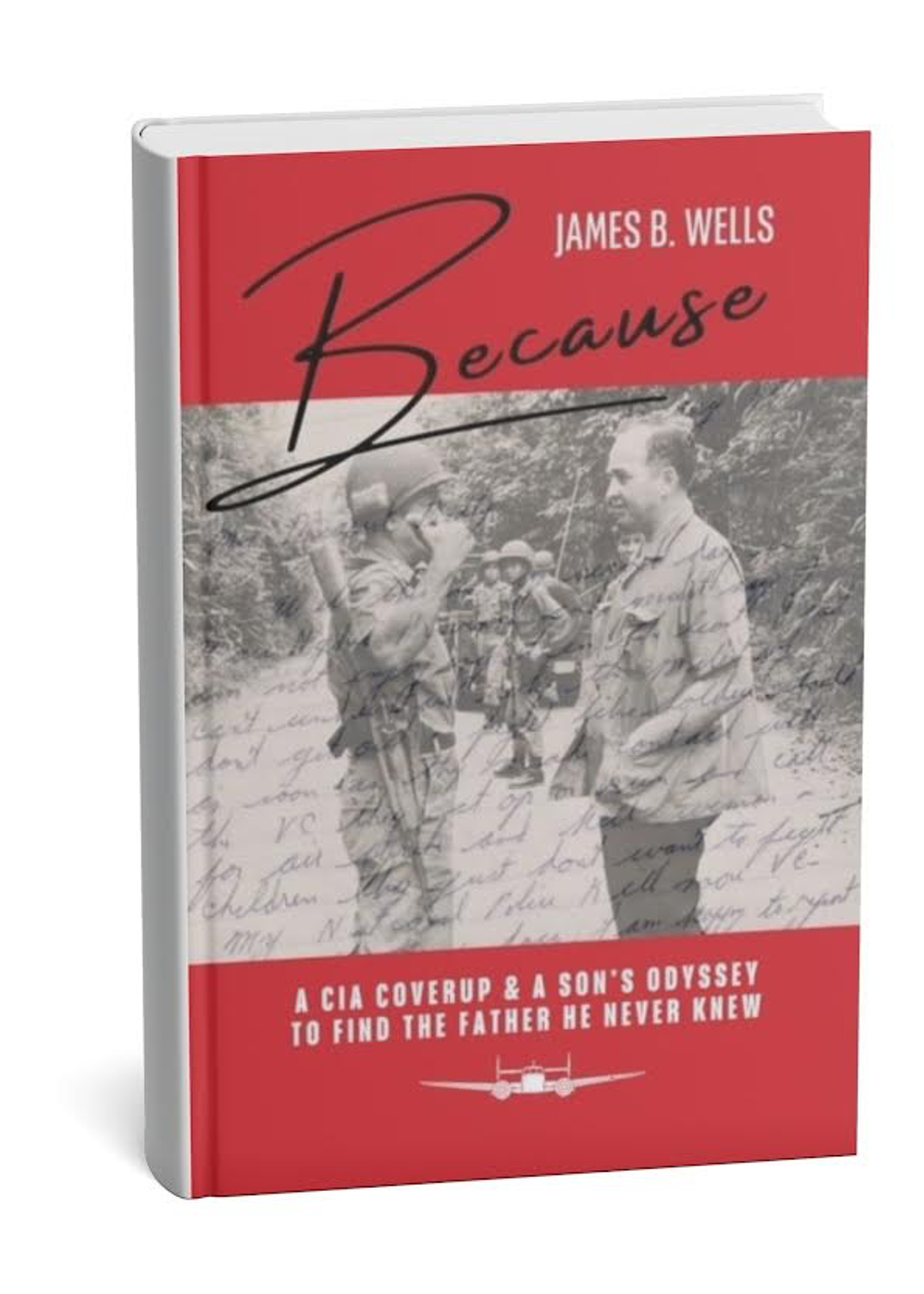
Because: A CIA Coverup and A Son’s Odyssey to Find the Father He Never Knew, by James B. Wells, Milspeak Books, 2025. Hardcover and paperback.

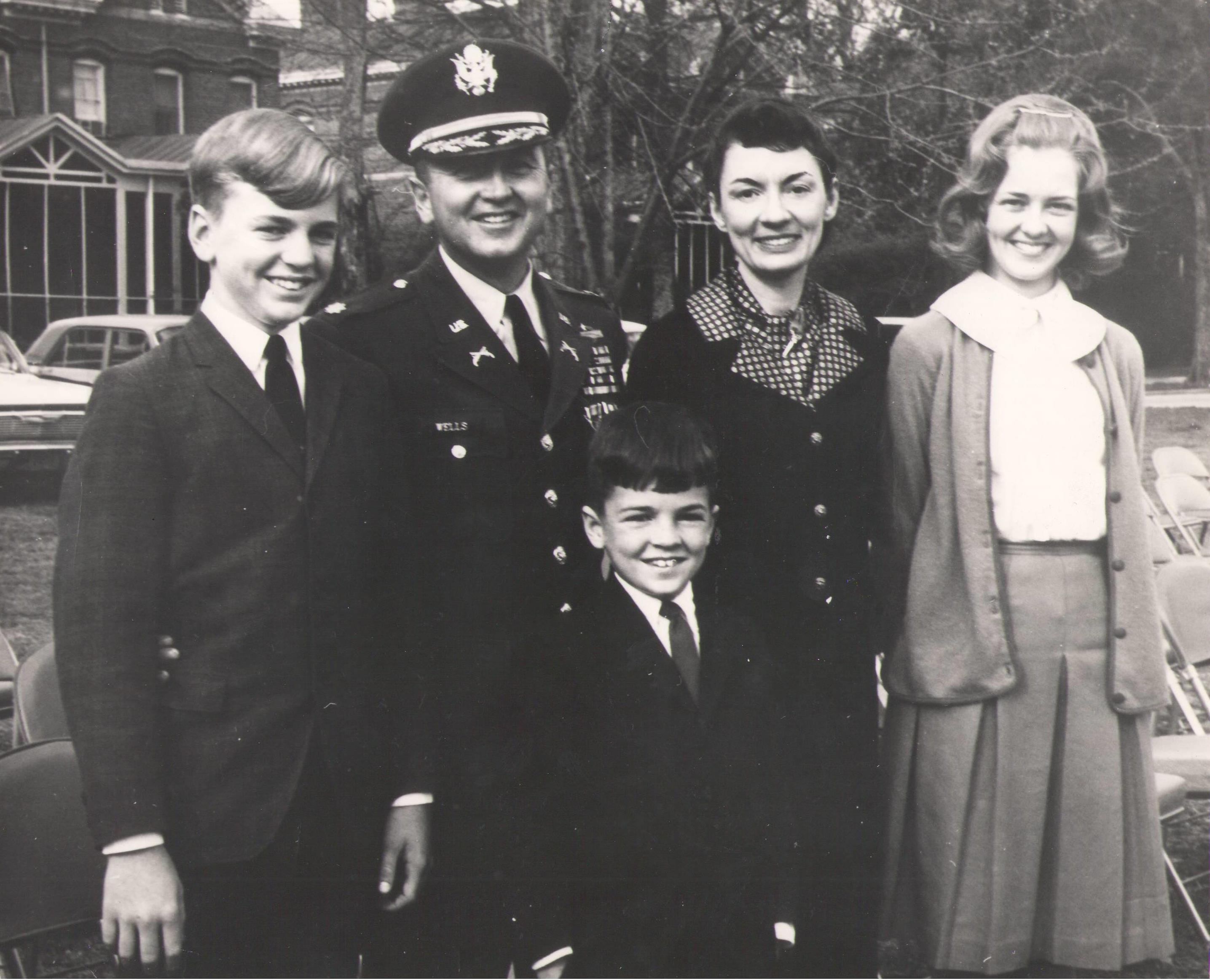
On September 27, 1965, Jack Wells, a World War II Pacific Theatre veteran, Army captain in Vietnam (“MAAG Counter-Insurgency Expert and Battalion Weapons Advisor with the 24th Civil Guard Battalion, III Corps, Vietnam”), and senior advisor in the Public Safety Division of USAID, with two tours in Vietnam in 1962-63 and 1965, was killed in a crash of an Air America twin-engined Beech C-45 as the plane approached a small airstrip in Bao Trai. Wells was on his way to implement a pilot program to “improve security and reduce corruption in the U.S.-funded Refugee Processing Program.” He was 39 years old at the time of his death, and left a wife, Betty and three children, Ora, Kathleen, and the youngest, nine-year old James.
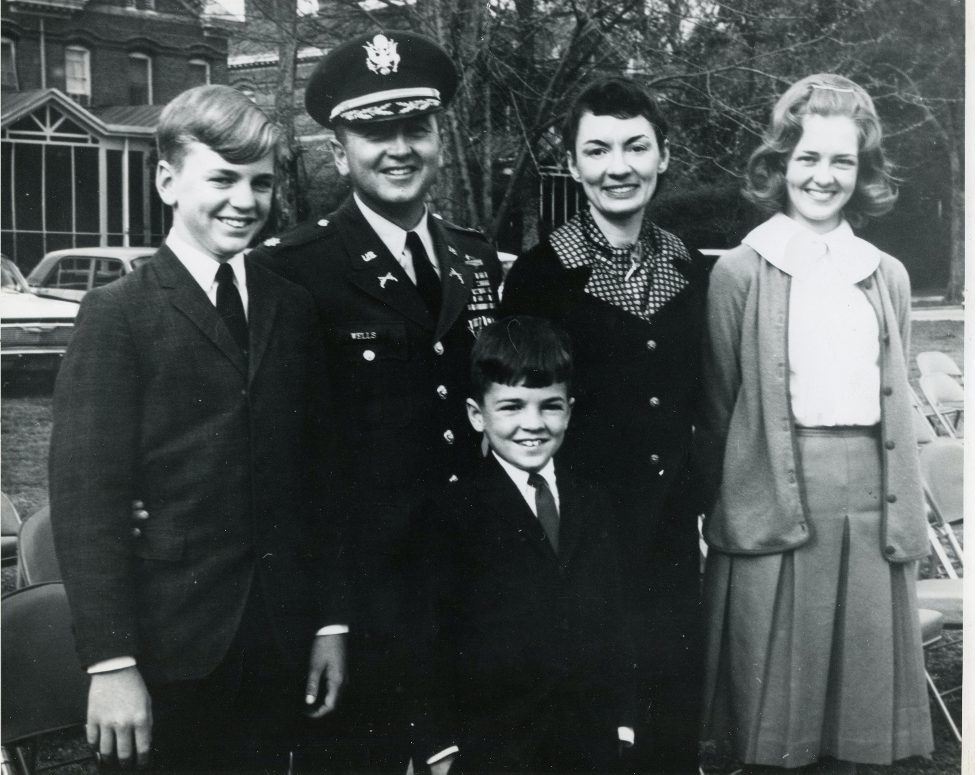
Family

From the outset, there were some details about the crash that didn’t add up. There were supposed to be just two pilots and Wells in the plane, but there is evidence that there were two additional, last-minute passengers. Government officials who arrived at the Wells’ home in Georgia the day after the crash told the family that the plane was shot down by enemy small-arms fire. However, there is proof that the shooting originated inside the plane. Further, it was officially noted that seven South Vietnamese policemen were killed by Viet Cong while trying to help the casualties escape the wreckage. Yet there is no documentation, or recollections from villagers whom Wells interviewed, that anyone was killed on the ground.

The effect of the death on the family, especially Betty, was devastating, but it might have been viewed as just another tragedy in the fog of war, except for James’s discovery in 1991 of some 400 letters from Jack to Betty during his time in Vietnam.

The letters trigger the desire, which became an obsession, to find the truth about his father’s death, and form the centerpiece of the narrative. The book interweaves the personal story of James Wells’s search for the truth of his father’s death and thereby obtain a sense of peace, the family story centered on the life and legacy of Jack Wells, and the national story of the war that seems never ending. James Wells’s desire to uncover the truth leads him to research in seven archives in the U.S. and two in Vietnam and multiple interviews with Jack Wells’s supervisors and colleagues in USAID, CIA operatives, Air America pilots, and Vietnamese on both sides of the conflict. While the archival research discloses “factual” material, Wells also utilizes what he calls “triangulated research” to create “evidence-based imagined scenes . . . so even when an event or conversation is imagined, it is emotionally true.” However, he provides copious notes and sources for these scenes and they read seamlessly. Nothing seems false or forced in his telling.
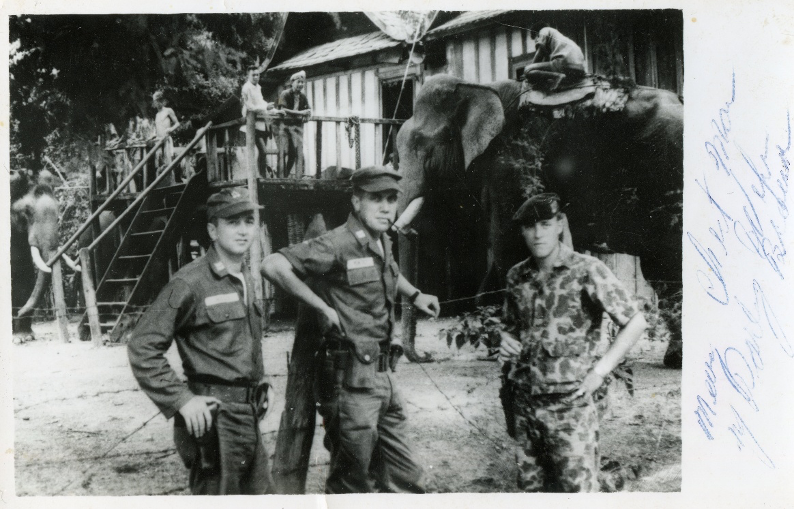
Jack Wels at Bon Don
Jack Wells (left) at Bon Don on November 26, 1962; the inscription
Reads: “Merry Christmas my Darling Wife, Because.”

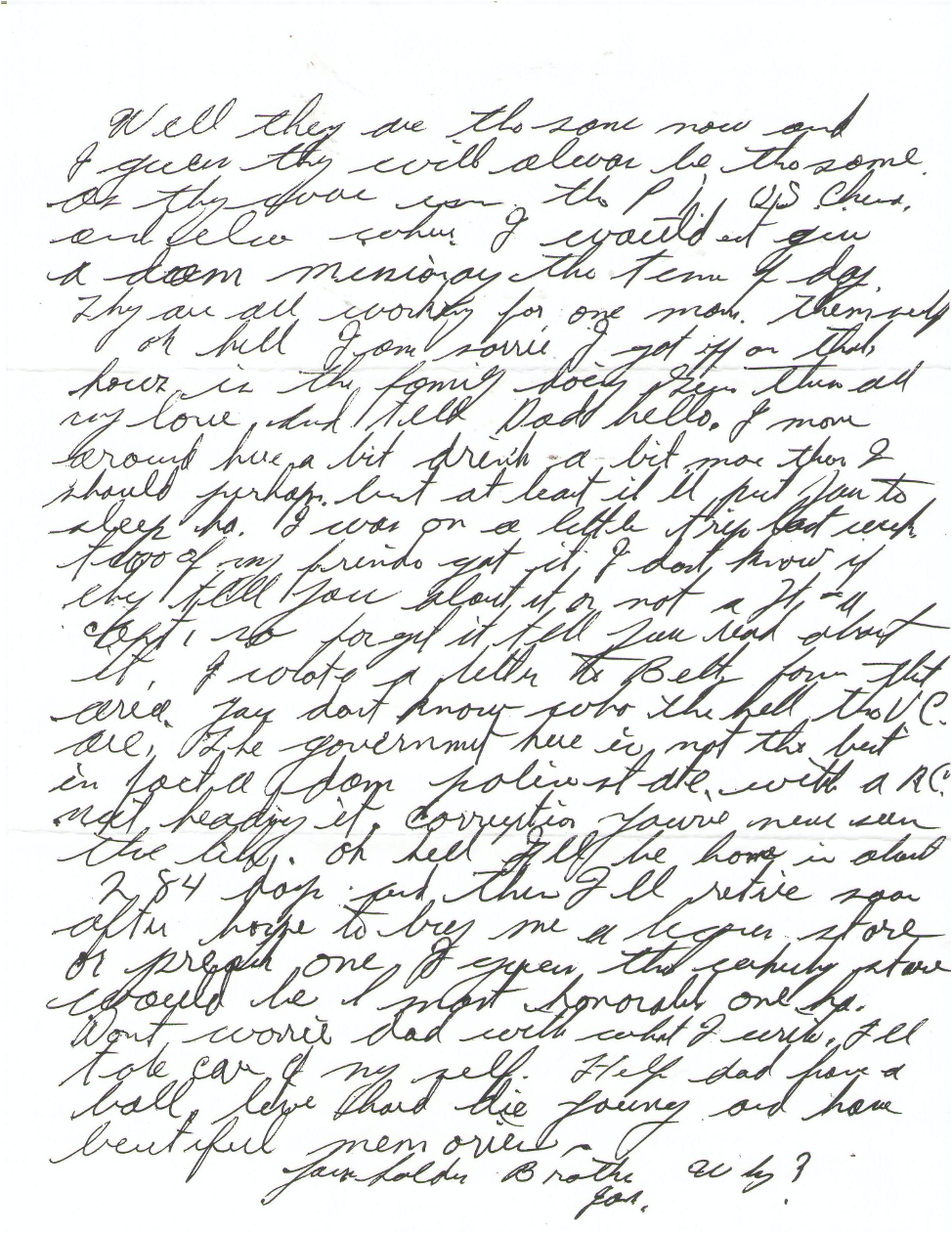
The letters recount such mundane events as lodgings and dinners, Wells’ day-to-day activities and travels in Vietnam, and his interactions with both American officials and Vietnamese allies and villagers, and, understandably, they express the longing to be back home with his wife and family. But the letters are also quite pointed about the corruption he witnesses in his travels. As early as June of 1962, Wells writes, “the government here is not the best in fact a dam police state, with a R.C.  . . . heading it, corruption you’ve never seen the half.”
Wells's Letter

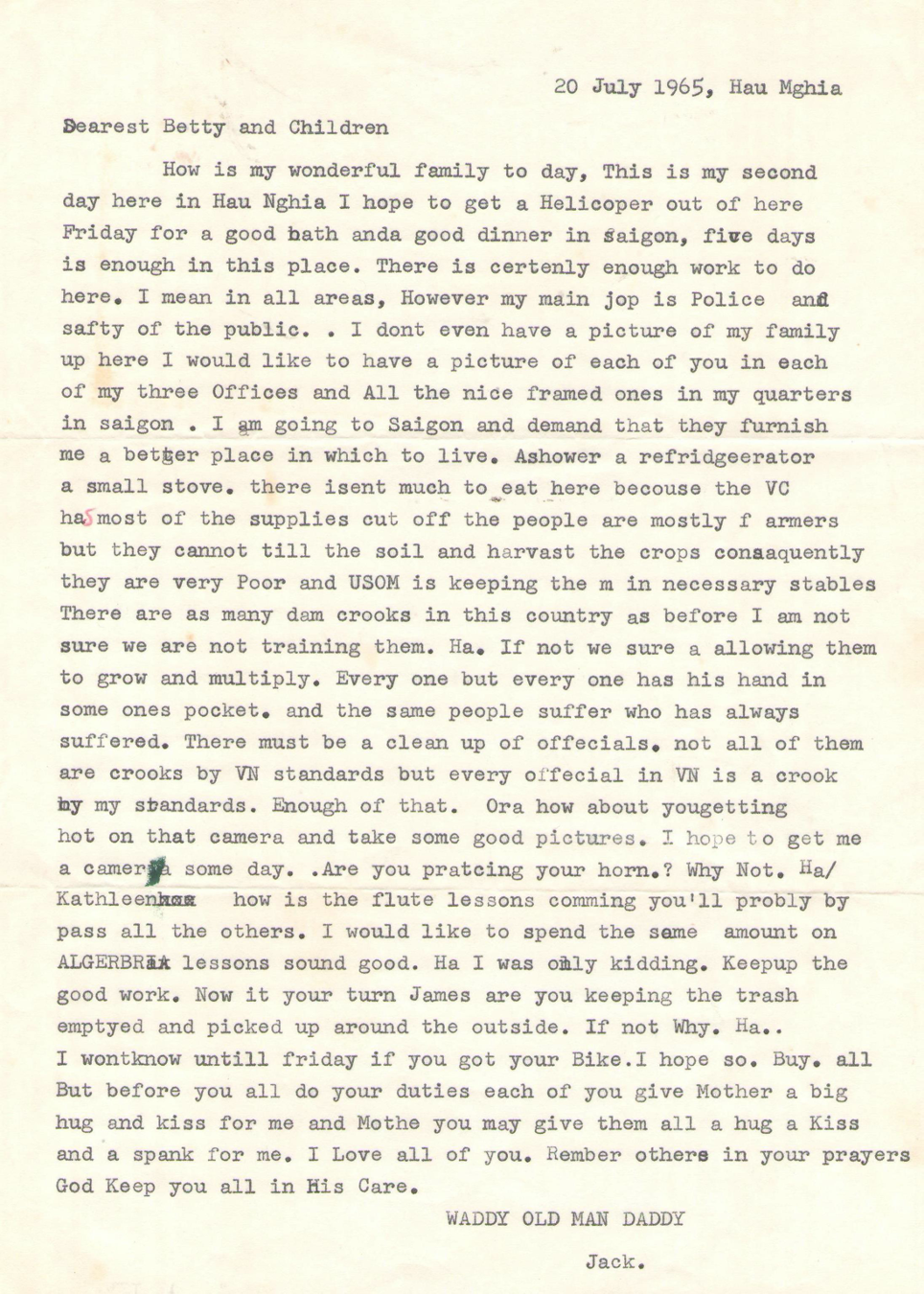
The situation did not change by 1965. In a July letter written from Hau Nghia, about two months before his death, Wells again talks about his daily activities and hopes that when he gets to Saigon he can have a better place to live. He also gently chastises his son James: “Now it is your turn James are you keeping the trash emptied and picked up around the outside. If not Why, Ha.” At the same time there is the concern, and anger, about corruption. He writes, “There are as many dam crooks in this country as before I am not sure we are not training them. Ha. If not we sure a allowing them to grow and multiply. Every one but every one has his hand in some ones pocket . . . ”

In another letter dated August 28, 1965, Wells wrote his wife: “Didn’t accomplish a dam thing. Perhaps another day. Oh Well, try I must, mad I do get however I told an American Lt. Col and a VN Major they weren’t worth a dam and they were giving the VC more service by not doing their job than if they were real VC.”

By all accounts, Wells maintained a high standard of honesty and morality for himself and expected others to follow that standard. His ethical commitment was evident early in his military career. After serving in the Pacific theatre, at 21 years old he acted as a “provost sergeant in charge of a special confinement unit at the war crimes trials in Nuremberg.” In letters written from Germany from 1946 to 1948 he indicates that American soldiers were selling contraband to prisoners. He turned them in. In an episode in Vietnam recounted by James Wells, Jack suspected that an ARVN captain was illegally transporting ammo and C-rations through a checkpoint, most likely for delivery and sale to VC. An armed standoff occurred but was de-escalated; Jack decided that the lives of his policemen were more important than stopping every suspect vehicle at the checkpoint. As a result, however, his father was called in by his supervisor, John Kesler, to discuss some recent reports. The upshot was that Kesler wanted the reports to be rewritten to falsify events and eliminate criticism. Jack’s response was that he would not be silenced.
Wells's Letter 2

James Wells’ search for the truth takes him to Vietnam in 2017, over fifty years after his father’s death, with the hope that he will find the site of the 1965 crash. Through a series of coincidences (which may not have been coincidences) he meets a number of Vietnamese people who remember, as children, the day in 1965. He talks with “a top-ranking communist official” at the time of the crash who “contradicted what the U.S. authorities told us. . . . I started to feel vindicated, knowing that a tiny hunch, a slight suspicion my mother had years ago, had grown exponentially into what looked more and more like a coverup and conspiracy.” After some false starts he finds the location of the crash, and on March 6, 2017, James and his siblings have a resurrection service. He connects his personal story to the family story to the national, really international, story of the war: “I thought of all those lost in this war and those that preceded it, who may have suffered and died here, perhaps even near this very spot we were standing in.”

The penultimate chapters take the reader further into the spiritual nature of James’ search for truth and closure, and raise issues that are relevant to anyone seeking a sense of peace after the unresolved death of a loved one. His tentative realization is that “‘Like Odysseus and Telemachus, my father and I have been searching to find each other to complete each other’s lives.’” There are echoes here of Hamlet’s search for the father cut off in the prime of life under circumstances that are purported to be true but are actually false. Hamlet’s quest is to find the truth and thus put his father finally at ease.

In a recent essay, “How Photography from the Vietnam War Changed America,” Damien Cave notes that “Long after wars cease, the happiest ending you can hope for is survival and the continued search for understanding. As Viet Thanh Nguyen, the Vietnamese American author, wrote: “All wars are fought twice, the first time on the battlefield, the second time in memory.’” In James Wells’ decades-long odyssey seeking the truth about his father’s death, and to come to some sort of understanding about both his and his father’s lives, perhaps the best he can hope for is psychological survival with the understanding that there will never be a final absolute truth.


Larry Abbott talks with James Wells

LA: What was the genesis of the book?

JW: The book began when I found approximately 400 of my father’s letters, 26 years after his death, back in 1991. Since I was only nine years old when he was killed, and had been gone on a year-long tour prior to that when I was five, I didn’t know the man, so of course I began to study the letters to learn as any son would want to know about their father.

LA: What was the basic content of the letters?

JW: Incredibly, the letters are a timeline of mid-20th century U.S. history, since the first letters are from a 17-year-old runaway delinquent infatuated with the most intelligent girl in school prior to joining the Army in WWII, and the last letter is from a 39-year-old warrior turned humanitarian the day before he is killed in Vietnam.
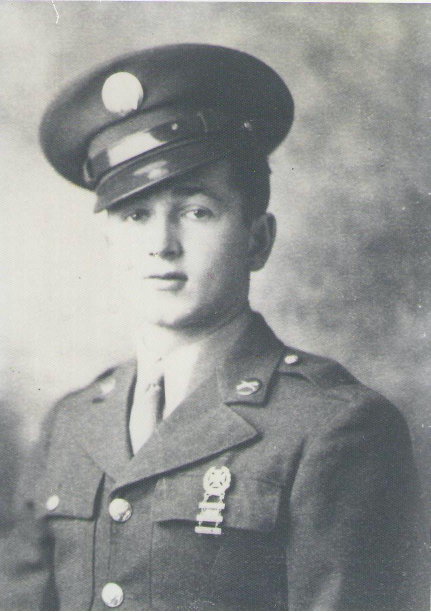
17-year-old Jack Wells during basic training

At first, I thought I would just publish the letters since they were so interesting and revealing of my father’s character. Granted, many of the letters are love letters, but what was most telling was that it came across that he was a very moral, righteous, and religious man, obsessed with the truth, and highly critical of those around him who did not perform their roles as they should. As a criminologist and familiar with whistleblowing, I suspected, and later confirmed, that his actions and words did meet the definition of a whistleblower.

In addition to often expressing his love of God, family, and country so eloquently, my father had a unique gift of writing to my mother as if she were sitting across the table from him as he spoke to her. Just like we engage in multiple conversations with our loved ones each day, he would continuously share his thoughts with her throughout the day, starting before breakfast, then at midday, then at night, and sometimes after waking in the middle of the night. Although they were polar opposites, I don’t believe a couple more in love ever existed.

I got caught up in that, feeling like he is communicating with me. The ring I wear—the same ring that belonged to the hand that wrote those letters, and that I scraped the burnt flesh off of when I found it in his personal effects—and whose inscription inside its diameter contains the title of my book, adds to the impact his letters have on me as I read them.

In my book, I describe how, through counseling, I learned how my story parallels Homer’s Odyssey. Like the Odyssey, mine doesn’t begin with the exploits of our fathers; instead, it starts with Odysseus’ son, Telemachus, who, like me, is languishing in pain and grieving for his father’s return. Meanwhile, on the other side of the world, or perhaps in another realm, our fathers are struggling and battling to return home to reconnect with their sons.

I want to remind you and the reading audience that, initially, my siblings and I generally believed what we were told about our father’s death. However, his letters prompted me to question what really happened to him and inspired me to embark on a quest for the truth through archival and field research across two continents, and as a consequence, reveal a CIA coverup. I consider that a miracle.

This wasn’t the only miracle I experienced. While in Vietnam, my siblings and I encountered countless wonders that left us in awe. I write about several of these miraculous events in the book. With respect to what drove me to write and finish the book, what initially drove me was simply wanting to get to know my father. Over time, and after counseling, I came to realize that it was about both of us getting to know each other and finding peace with what we learned and may never know. Keep in mind the CIA sent me a response this past April, eight years after my appeal of their 2017 denial, saying they will continue to withhold information due to national security, foreign policy, and personal privacy concerns. I’ve appealed again, but my siblings are now 75, 73, and I’m 69. We may not even be around when we hear from the CIA again. To tell you the truth, I now suspect it will remain forever classified. I think I’ll eventually be okay with that, since I write in my book about what I believe really happened, and what it will take for my father and I to find peace.

LA: What was the most challenging part of writing this book?

JW: Researching and writing faced many obstacles and challenges. In addition to the countless hours and expense of the research, traveling across the U.S. and Vietnam, the most significant challenge was the toll it took on my family, especially my spouse, Brenda. Ever since finding the letters in 1991, I’ve been obsessed with them. In addition to interpreting, transcribing, digitizing, and uploading them to an archivist website, I’ve spent years studying them to better understand my father’s actions and how they may have led to his death. On top of that, I spent a few years taking private writing classes, and after that, decided to get an MFA in Creative Writing, my fifth university degree. At least once during each of those years, my wife confronted me with that obsession that has taken so much time away from her. It has taken a toll on our marriage; I write about that in the book. For obvious reasons, the book is dedicated to her.

LA: How did you come up with the title?

JW: My father closed and signed many of his letters with simply the word “because.” I found out that it was a popular love and wedding song for much of the 20th century [see https://en.wikipedia.org/wiki/Because_(Guy_d%27Hardelot_and_Edward_Teschemacher_song].

My mother told me it was their song, ever since they were a couple. That, combined with the fact that my father’s wedding band contains the word “because” as part of its inscription, is another reason I discuss in the book. I devote part of a chapter to that discussion, and close it with what I think the word means to them.

In addition to Because being my parent’s song from high school, its single word communicates something much deeper and more revealing than just love. Though difficult to explain, it is a word that attempts to answer whatever questions its recipient might have had, no matter how emotional, sensitive, complex, and difficult they might be. No explanation or reason was needed. It was simply … “because.”

LA: Why do you think the CIA has refused your FOIA requests, especially after appeals and nearly 60 years after your father’s death?

JW: On one hand, I suspect that the CIA may not even know exactly what happened, and they are embarrassed about it, which is why the crash investigation report remains classified. As readers will discover, I confidently confirm that there was a coverup and a false narrative surrounding his death. In some respects, I may know more than they do. Unlike them, I had the opportunity to interview former NLF guerrillas and their leaders, who all insisted they had nothing to do with the plane’s crash. They were just as puzzled as everyone else about why it happened.

In addition, there is substantial evidence indicating that corrupt officials with a history of misconduct, including murder, particularly related to the refugee processing program and its coverup, may have been involved in his death. On the day he was killed, he was actively pursuing his initiative to reduce corruption within that program. We also know that the U.S. military often tolerated corruption because those often involved were competent military commanders who could assist U.S. forces. Ask almost any veteran of the recent wars we’ve been involved in in the Middle East and they will tell you this is a common occurrence with our allies.

As I mention in the preface of my book, I informed the CIA of my research agenda in May 2015 and initiated a Freedom of Information Act (FOIA) request for information related to the crash investigation of the Air America C-45 in which my father died. Nearly two and a half years later, in October 2017, the CIA responded, denying my FOIA request. After appealing the decision in December 2017 and seeking support from five different congressional representatives, I have seen no progress until now.

In fact, just recently, eight years after my appeal and 60 years after my father’s death, I received a final response from the CIA. They stated that information about the crash investigation of the Air America C-45 will continue to be withheld under FOIA exemptions b1, information kept secret in the interest of national defense or foreign policy, b3, protection of information prohibited by laws other than the FOIA, and b6, withholding information that would constitute a clear unwarranted invasion of personal privacy.

Through my study of President Obama’s Executive Order 13526, I learned that classified information over 50 years old should be declassified. However, “extraordinary circumstances” can justify maintaining classification beyond that time frame. My investigative memoir outlines those extraordinary circumstances for the reader.

Believe it or not, I have been anticipating this news from the CIA, which further validates my story.

One appealing aspect of the book is its whodunit nature, which allows readers to formulate their own theories about what might have happened to him and why.

LA: You are quite clear that there has been and continues to be some sort of coverup. Do you think there will be any type of retaliation for writing this book?

JW: Ha! Thats the question I get asked most often. I now joke about it and respond, “Well, if I were found dead one morning with a 22-caliber bullet in the back of the head, that would really increase book sales.” But no, I don’t fear retaliation, especially now since the book is out. The story about me writing it has been public for over a decade, with probably thousands of social media posts by me and reposts by others. I’ve personally notified veterans from all sides of the war, and the U.S. Army, the State Department, the CIA, and even Congress are aware of my actions and desire to write a book. If somebody wanted to retaliate, they would have done it before the book went to press. What would it accomplish now? Nothing!

James Wells

James Wells has had a prolific career. He’s written or co-written over 65 books, chapters, and essays, and has authored some 150 reports for local, state, and federal agencies. His work has appeared in Military Experience and the Arts, Wrath-Bearing Tree, and Proud to Be: Writing by American Warriors. In addition to his writing, he was a corrections officer in a maximum-security prison and later assisted architects in prison design. He holds an M.S. degree in Criminal Justice, a Ph. D. in Research, and a creative writing M.F.A. He is a retired criminal justice professor at Eastern Kentucky University and currently lives in Lexington, Kentucky. Further information on his career and current activities can found at: jamesbwells.com.

Letters are copyrighted by James Wells and used by permission.


New Nonfiction by I.S. Berry: “Math and Other Things I Learned from War”

Photo by <a href="https://unsplash.com/@roman_lazygeek?utm_source=unsplash&utm_medium=referral&utm_content=creditCopyText">Roman Mager</a> on <a href="https://unsplash.com/s/photos/math?utm_source=unsplash&utm_medium=referral&utm_content=creditCopyText">Unsplash</a>

Numbers don’t lie, they say. 2 + 2 = 4. No matter how you rearrange it; no matter how you solve it. Turn it into subtraction (4 – 2 = 2), and it still works. Math’s rules are inviolable, unyielding. Particular inputs yield fixed outputs. Even, say, in cases of absolute value, where more than one answer is possible, the results are still finite and consistent.

Then again, numbers can be irrational. Complex. The existence of a mean requires that data fall above or below it. There are exceptions to rules (the commutative property doesn’t apply to division); theorems, you realize, rest on assumptions. You start to see that numbers, perhaps, aren’t as honest as they appear. Sometimes they trick you. Sometimes they betray you.


Twelve feet was how far the mortar had plunged into the ground of the CIA compound. People said the thud shook every trailer. I was on the other side of the Green Zone and heard about it on my radio. Lucky thing I’d been gone: the mortar had landed behind the Morale, Welfare, and Recreation building, only twenty feet from my trailer, along the path I walked to work every morning. A dud, thankfully: no detonation; no injuries. By the time I returned, workers had buried the unexploded ordnance, blended new soil with the old so thoroughly I could barely see the point of impact. Invisible, as though the thing had never existed—a null set, an imaginary number.

The mortar landing in the neighboring compound a few weeks earlier should’ve been a warning. But somehow an incursion into our own house seemed different. There were rules, hard-and-fast—of physics, probability—that all but guaranteed something like this wouldn’t happen. That assured us the chances were almost nil.


In November 2004, Iraq was many things: the location of my first tour as a CIA counterterrorist case officer; home to the confluence of the Tigris and Euphrates; safe haven for terrorist leader Abu Musab al-Zarqawi; a sweltering, palm-freckled desert; the most dangerous place on earth. By November 2004, more than 800 American soldiers had been killed in Operation Iraqi Freedom.

At the CIA station in Baghdad, we were trying to track down Zarqawi, but the war kept getting in our way. We couldn’t conduct source meetings in the Red Zone. Couldn’t do the usual things: eavesdrop in cafés, schmooze on cocktail circuits, dine at strategic restaurants. Couldn’t even leave the Green Zone to walk the streets. We were trapped in a fragile green bottle. Five attacks a day. Ten. Twenty. Some in daylight; some in darkness. Some aimed at the center of the Green Zone; some, the fringes. Some victimless; some fatal. An almost infinite number of variables.

Iraq was the place I learned to do math.


Like an alarm, mortar rush hour began most mornings at 0700. I’d open my eyes a fraction, watch the neon green numbers on my small digital clock, guess the seconds before another mortar would launch. Outside, “Big Brother”—the centralized public address system—would broadcast unintelligible instructions from the neighboring U.S. embassy compound. Sometimes—depending on my ratio of fear to exhaustion—I’d drag myself out of bed and run to the bunker outside my trailer. I knew by heart the graffiti inside its concrete slab walls: slogans and drawings that laughed at war, taunted war, ran from war, tried to make sense of war.

We’d heard stories—of the State Department officer reading in his trailer when an inert rocket pierced the wall; of the Gurkhas, huddled inside a building, killed by a mortar. One station officer confessed that he slept on the bottom bunk, wore body armor to bed, and drank himself to sleep. Others talked of spending the night at the CIA station, which had a sturdy roof and walls. I was arriving at work earlier and staying later.

But amid the hailstorm, nothing had ever struck our compound—which surely meant that nothing could. After all, what good is data if it can’t predict outcomes, offer certainty?


There were rules, I’d learned. Mortar attacks were preceded by audible launches (deceptively gentle, like hiccups). Rockets offered little warning—except a high-pitched whistle on close ones—but produced deafening explosions. Car bombs were deeper, more sonorous, lasted longer. If you could hear but not feel a detonation, it was remote. When the ground shook and pebbles sprinkled down, you ran for cover.

Insurgents launched more attacks in warm weather, some at the station postulated. But others countered that wintry air prompted action. Daylight offered insurgents good target visibility and freedom from curfew, but night provided cover. During the occasional rain shower, U.S. military helos couldn’t fly and deter attacks. But insurgents’ trucks and grip stocks would get stuck in the mud. Everything boiled down to probabilities.

I was doing my own calculations. I didn’t condition my hair in the morning: five fewer minutes in the shower meant five fewer minutes under my flimsy trailer roof. Didn’t hit the snooze button. It was, we all knew, just a question of out-calculating the enemy: Master the math and you’d be fine.

Sometimes I chatted about the mortars and rockets with the Military Police on our compound. A few shrapnel-resistant guard booths offered shelter, but the MPs spent most of their time outside, unprotected.

“Shoots,” my favorite MP dismissed the threat. “We been noticin’ them mortars always go over our compound. Comin’ from the other side of Haifa Street. We ain’t in their trajectory. Ain’t got nuthin’ to worry about.”

Everyone had a rule. A failsafe equation. Until the dud mortar landed in our compound.


Some four months into my tour, and the sky was gem-blue, translucent. Usually, the air was choked with dust, char, and smoke from explosions and burn pits; at night, stars pulsated through the thick haze like small dying hearts. You never got a sky so rich, so blue.

I’d gone for a long jog. Stripped off my running clothes and turned on the shower. Iraq’s first democratic elections had triggered a fleeting and tenuous peace, and the mortars and rockets had temporarily receded, a bully nursing his wounds. The sky was quiet. I didn’t know how long it would last, but for now I could condition my hair.

I dropped the bar of soap. My left hand returned to my right breast. A lump. Hard, palpable, so close to the skin it was almost visible.

Naked, dripping wet, I walked to my bed, probed the small mass. The statistics, the calculations, began. I was too young. No one in my family had ever had breast cancer. I didn’t smoke. Most lumps were nothing. Worst case scenario, breast cancer had a high cure rate. The odds were all in my favor. Math, trusty friend: don’t fail me this time. Like you did with the mortar.

I palpated my breast and stared at my trailer’s thin ceiling. Pairs of Blackhawks descended toward Landing Zone Washington. I wondered if I’d miss their sound when I left. They’d keep coming and going long after a new tenant occupied my small trailer, after I was gone.

On my next home leave, I had a biopsy. The lump was benign. The math hadn’t failed me. But I knew the law of averages: eventually, you’re bound to land above or below the mean.


1,900? 1,950? How many soldiers had been killed? My yearlong tour was drawing to a close, and the number plagued me. More than double the count when I’d arrived. It couldn’t break 2,000 before I left Iraq, I decided: this was my hard-and-fast rule. Every day, like a fanatical horoscope reader, I checked the death count.

One month left in Baghdad and days slowed down, passed in paralyzed motion, as though they were slogging through mud. The math wasn’t adding up; 24 hours was longer than 24 hours. Thirty days became sixty, became a hundred, became infinity.

October 25, 2005. Number of American soldiers killed in Iraq: 2,000.

I left a few weeks later.


A week? A month gone by? Writer Graham Greene said, “When you escape to a desert, the silence shouts in your ear.” So it was for me. When I escaped Baghdad, the silence was deafening. Leaving war didn’t necessarily mean that war had left me, I found.

These days, it’s almost clichéd to recite the litany of stumbling blocks upon a return to civilian life—traffic jams, loud noises, big crowds. Some days, just getting out of bed. (Does anyone, in fact, come back from war without these stories?) Often, I stared out the window for hours at a time. Days fell through holes, disappeared like the mortar under the ground, as though they’d never existed.

I moved from my cramped condo in Washington, D.C. to a more spacious, quieter house in the suburbs. It was near Reagan National Airport. At night, sleeping on a mattress on the floor, I could hear airplanes descending. I thanked God they weren’t Blackhawks and at the same time wished they were.

It was a degree of luck, I knew, that I’d survived. For others, the math hadn’t worked out so well.


I volunteered at Walter Reed Hospital. I delivered care packages to injured and ailing soldiers. My fellow volunteers and I roamed the sterile halls around every major holiday like tooth fairies. The psych ward—the largest in the hospital—was off-limits. Nurses warned us not to put sharp objects in care packages. Even mentally healthy soldiers weren’t allowed to have access to instruments of suicide. War had reached every bedpost.

One evening, our charity organized a casino night for the recuperating soldiers: card games and raffles bearing prizes like stereos and computers. My job was to talk to the veterans while they played cards, divine what they wanted in care packages. Every soldier had ideas. They were unflappable, oblivious to their missing arms and legs, the bandages around their heads, the wheelchairs to which they were confined for life. Shot glasses, robes, candy, they suggested. Small things made them happy.

As casino night drew to a close, the volunteers assembled on the stage to announce the grand prize. The soldiers gathered below, excitedly comparing numbers of tickets won and lost. Two men—not more than forty years combined—boasted only one ticket between them, intending to split any prize they won. One had lost his legs and was lying on his stomach, leaning over the stage to grasp half of the precious ticket, while his buddy, in a wheelchair on the floor below, held the other half. They clutched the scrap gleefully like it was a ticket to another world. The odds, I knew, were overwhelmingly against them.

The announcer called the winning number. They’d lost.


I have a complicated relationship with math. Sometimes it’s my friend, sometimes my enemy; sometimes reassuring, sometimes brutal and uncaring. Either way, it’s here to stay, like a childhood memory or a scar. I still find myself crunching the numbers, often on a daily basis. Anytime I feel death might win.

During the pandemic, I computed the chances of getting COVID from passing someone on my morning jog. How likely was I to die if I got sick? (I was middle-aged, healthy, didn’t smoke…my numbers were good.) After getting vaccinated, I calculated the necessity of a mask, the risk of transmission at a restaurant, a concert. How long would it take for my inoculation to wear off? For a booster to kick in?

As I grow older, I get increasingly nervous at doctor appointments. I wonder if the smog of burning trash, ordnance smoke, and other toxins we breathed daily in Baghdad will eventually defeat my body’s defenses, warp my cells. If the math will tell me it’s my turn. Statistically, I know, I’m at higher risk.

Now I’m a parent, and every time there’s a school shooting, the numbers start forming columns on the page. Chances are small, I tell myself, that it will ever happen to my son. That a school in our district will be the next target. Miniscule probability that it will be my son’s school. Half a percent? Quarter percent? His classroom. Surely less than an eighth of a percent. (Right? Don’t fail me, math. Please don’t fail me on this one.)

Math is my memento from Baghdad. Adding, subtracting, multiplying, dividing chances of death, looking for answers and rules and reassurances, something to hold onto in a world that feels every day, in a million ways, like a war. All I can do is hope the numbers are on my side.


New Nonfiction by James Wells: “Signs”

June 27, 2008

I count between my mother’s breaths: one-thousand one, one-thousand two.

Thirty minutes ago, her breaths were one second apart, and an hour ago, they were less than half a second apart. In the next few minutes, I know the interval between her breaths will become even longer, and soon, they will cease altogether.

My mother’s big, beautiful, brown eyes are now glazed over, her eyelids almost closed. Her mouth is half-open, and her teeth, teeth that had been pearly white for nearly her entire life, have yellowed, most likely because the care staff at the nursing home had not brushed them as often as she once had herself. My brown eyes, which many have said remind them of my mother’s, stay fixated on her mouth and chest as I watch the gap between her shallow breaths grow longer.

As I put my face closer to my mother’s and kiss her forehead, I recognize her smell. It’s Pond’s Moisturizing Cream, mixed with the scent of her hair and skin. The only sounds in the hospital room are my mother’s shallow breathing, the clicking of the I.V. machine pumping antibiotics into her bloodstream, and the occasional whispered conversation between myself and our oldest daughter, Millicent, who was able to meet me here about a half-hour ago.

My mother lived a remarkable yet tragic life. Today is no different.

Despite the attentive care of a nurse and the monitoring of all of the medical equipment, I knew my mother gave up her struggle fifteen minutes before any machine or medical professional did. I was able to detect the very slight change in her breathing before the monitors or staff. As soon as I noticed the difference from what I felt were struggled breaths to more relaxed breaths, I called the nurse. After checking my mother and the monitors, she told me there was nothing different about my mother’s condition. To me, the change in her breathing occurred as clearly as the transfer in sound and rhythm of a muscle car shifting from a lower gear into overdrive. Her breathing, which seems more relaxed now, tells me that she has resigned herself to her death and is coasting on overdrive to eternity.

But this wasn’t the first strange thing to happen today. About five hours ago, I was at a Delta Airlines gate at Bluegrass Airport in Lexington, Kentucky, waiting to board a flight to Fort Lauderdale, Florida. I planned to meet my wife, Brenda, who was at a conference near there, and for us to embark on a thirtieth wedding anniversary cruise. We’d already canceled our trip once before when Brenda’s mother became very ill, and this was our second try.

As I watched the first passengers move toward the gate to board, I received a call from my mother’s nursing home in Versailles, Kentucky. One of the staff there told me, “We think your mother’s bronchitis has flared up again, and to be on the safe side, we’ve admitted her to the hospital for tests.” She suspected that my mother would be fine and back in her room at the nursing home in a few hours. Despite her reassurance and my eagerness to get on the plane, I still didn’t feel right about it. My mother was treated at the same hospital the year before for pneumonia, so I called the hospital and asked for more information. My call was transferred from Reception, to Emergency, and then to my mother’s ward. I was reassured when the nurse informed me she knew my mother from her previous visits. She told me my mother might have pneumonia and that a round of antibiotics should knock it out of her, just as it did the year before. When I told her my predicament and pressed her for more information, she informed me that the worst-case scenario was probably an overnight stay in the hospital, and given my mother’s present condition, I should not cancel my plans to go out of town.  But I still felt uncomfortable about the idea of getting on that plane. I called my daughters Millicent and Emily. I also called my older sister, Kathleen, and my brother, Ora, neither of whom live in the state, and briefed them about the changes with Mother. They all said, “Get on the plane.” I even called our Episcopal priest, Father Allen, who visited my mother at the nursing home. He told me the same thing. “Get on the plane. Do the badly needed, over-due cruise with Brenda.” I called my wife, waiting in Orlando. Only she recommended forgetting the cruise and be with my mom.

I can’t explain it, but as I was about to board the plane after I heard the last call to board, I changed my mind, convinced the Delta agents to get my already checked luggage off the plane, and rushed to the hospital, only twenty minutes away.

Just a few hours later, I am cradling my mother in my arms and watching her die.  I hate to think how I would have felt if I had gotten on that plane and my mother died alone. If that was God’s miracle, I know that it was intended more for me than it was for my mother.

One-thousand one, one-thousand two, one-thousand three.

Mother was a very bright woman, the smartest in her high school class, and graduated first in her nursing school class during World War II. Fifty years later, when my siblings and I admitted her against her will to an alcohol detox facility, the mental health professionals there measured her I.Q. to be very high. The medical and mental health staff there could never convince her that she had an alcohol problem. Sometimes I wonder whether she really did, too.

We never heard my mother slur a word, never saw a stagger or stumble. However, the mountains of empty, opaque green and brown sherry and wine bottles in her basement made us wonder. I suspect the alcohol helped numb the pain of her overwhelming grief. Today, when I see the large trashcans full of empty beer and bourbon bottles and crushed beer cans in my garage, I wonder whether the same demons that haunted her might now haunt me.

She was an introvert, an avid reader, and in the last decades of her life, a hoarder and a recluse. She and my father were polar opposites. She was studious. He was not. She was a good writer and speller. He had to struggle with every word and sentence he wrote. She was always calm. He had a bad temper. She took her time and often made him late. He always had a lot of energy and wanted to get things done right away. They were so opposite that my father often wrote about how he felt he did not deserve to be married to my mother.

My mother was a widow at the age of thirty-eight. After my father’s death in Vietnam, she never dated, went out, or even spoke to or about another man. For years after his death, my siblings and I would wake up in the middle of the night and hear her not crying—but wailing like a wounded animal, for my father. I never thought about the difference between crying and wailing, but those nights, I learned. Her crying and shedding tears in silence could have been a private communication to my father that she had not accepted his fate. But the prolonged, high-pitch scream of her wail was a mournful plea designed to convince the heavens to let my father come back from the dead. We would all eventually fall back asleep, wake in the morning, and pretend that everything was normal.

Despite the yoke of grief she could never escape from, my sister, brother, and I agree that she couldn’t have done a better job raising us. After my father’s death, her only job, her sole motivation in life, was to take the very best care of us and give us the best possible educations. With my father’s life insurance funds, she put us in some of the finest private college prep schools in the South. She helped us with our English, French, Spanish, German, algebra, calculus, and trigonometry lessons. She drove us to band, dance, swimming, wrestling, football, and soccer. She put all of her energy and resources into raising us and did nothing for herself. For example, in the forty-three years separating her death from my father’s, she only bought three cars, the last one in 1972.  By the time my siblings and I all finished college and got our M.A.’s, M.S.’s, M.D.s, and Ph.D.’s, she knew she had accomplished her mission. Left only to the company of her grief, without us being there, she started to go downhill a little faster. My father’s death broke her heart and destroyed her mind; she just kept it all together until we finished our education and started our own families.

We were kids, and awareness of mental illness was not as prevalent as it is today—and so we never recognized our mother’s depression since our father’s death. Had we known what we know today, had we been a little bit older, a little more informed, we would have encouraged her to seek help.  The years of depression eventually led to her self-medicating with alcohol, which years later probably led to her dementia.

A few years ago, we had to put my mother in a nursing home after the assisted living community’s management kept complaining about her behavior. She began acting as if my father was still alive and would do odd things, such as set an extra plate at the dining table and insist it was for Jack. The last straw for the management was when she packed her small suitcase, went down to the lobby, and told everyone she was waiting for Jack to pick her up in his car.

One of the toughest and most memorable days for me occurred when I took her for an eye doctor’s visit. She was holding onto my arm as I helped her up some steps. As she lovingly looked at me with her big, brown eyes, she said, “I’m so fortunate to have a husband as good as you.” I faked a smile back at her and said to myself, “Shit, she now thinks I’m Dad.” My heart broke as I realized that the primary foundation for her existence for over forty years was now cracked and crumbling away right in front of me. After being faithful to his memory, she had forgotten his death and the sacrifices the two of them have made. To this day, I have not made up my mind whether that statement from her was a blessing or a curse, for her, as well as for me.

One-thousand one, one-thousand two, one-thousand three, one-thousand four.

My mother’s death did not begin this afternoon. It started in 1965. I knew what killed her and what haunted her for decades. In addition to her grief and depression, it was not knowing why my father felt he had to do the things he did, as well as the mysterious circumstances behind his death.

It won’t be long. It won’t be long before my mother and father are together again. After being apart for over four decades, within minutes, she will be with him. And in a few days, her casket will be placed directly on top of his in a national military cemetery.

One-thousand one, one-thousand two, one-thousand three, one-thousand four, one-thousand five.

How is she still holding on? Why doesn’t she let go? As my daughter and I hold her and stroke her face, and with tears streaming down both of our faces, we whisper for to her to “Go to Jack, go to Jack.”

One-thousand one, one-thousand two, one-thousand three, one-thousand four, one-thousand five, one-thousand six, one thousand sev….

And still no breath. My daughter calls for the nurse. The nurse comes in, bends over, and places her stethoscope on my mother’s chest. She says that Mother’s heart is still beating. We wait…ten seconds, twenty seconds, thirty seconds. The nurse removes her stethoscope and stands up. Her actions tell us everything.  No words are necessary. My mother is gone.

§

Three days after leaving my mother’s hospital bed, while going through her box of “important papers,” I come across a note she had left among her financial records and insurance policies. There is no date on it, but knowing she wrote it on the back of a mimeographed assignment for a class I have not taught in twenty years, I suspect its date was around 1990. At that time, we lived within a half-mile of each other, and she would often babysit our youngest daughter at our house. I suspect she removed the assignment from the trash can in my home office. She would often leave notes on little scraps of paper all over the house when her memory started to fail.

The note reads:

Jack had written about how furious a certain Vietnamese colonel was at whatever Jack had said to him. I couldn’t help but wonder at the time, when Jack was shot down, if that colonel might have had something to do with it; might have had connections with the V.C. — or somehow been involved — yet of course, perhaps not.

I think again of that moment at the eye doctor’s visit. I now believe that she was telling me that day to assume my father’s role and investigate his death’s actual cause, as he would have, being a career military police officer and criminal investigator. The downing of the CIA plane my father was a passenger in may have been a random act by the enemy. It may have been an assassination order by someone in the National Liberation Front, the South Vietnamese government, or God forbid, the U.S. government.

Signs pointing to what really happened could be anywhere.

I thought of the alcohol bottles in the basement. The screaming at night, when she thought we were all asleep. I thought of the mysterious force that told me not to board that plane, to be with Mother, and not go on vacation with my spouse. I thought of my own future, my own children, the way the past does not go away, and how the crimes and sins of the past persist, and haunt the present.

Right there, holding my mother’s note, the clue she left hidden in the tragic wreckage of our past, I make a promise to myself that I will do everything I can to uncover the truth. I will learn the truth about what killed my father, and that killed my mother—before it kills me, before it kills my family.