New Fiction by Michelle R. Brady: Thirty Broken Birds
I. Valley of Quest
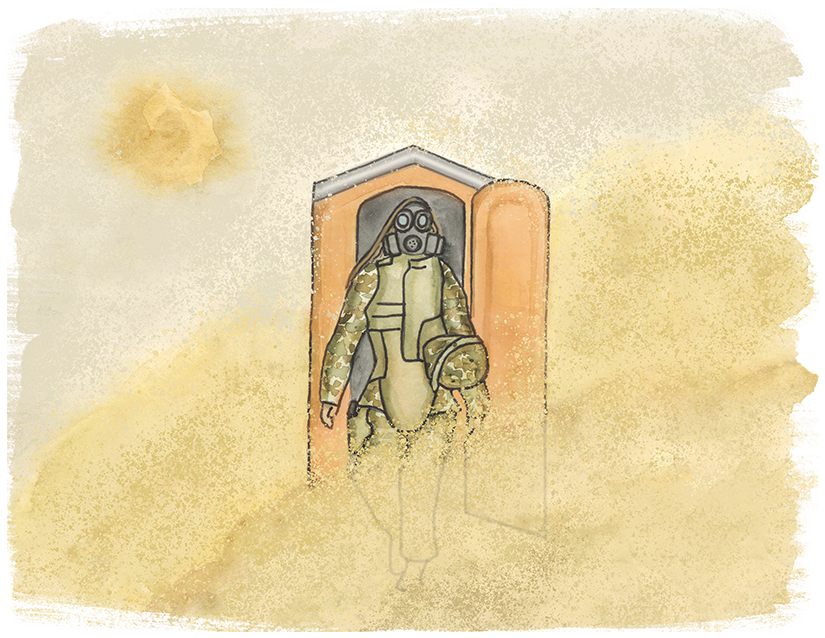
Before what happened to Christine, before arriving in Iraq, before even leaving Nebraska, all we knew for sure is that there would be violence and sand. We began by trying to solve the wrong problem. And although wearing our gas masks in sandstorms was almost certainly the most sensible way to avoid breathing difficulty and probably eye damage, the memory of her exiting a port-a-potty in one, sand swirling around her, still chills me. So much can hide in the sand when it’s like that—some things you want to conceal and some you later try desperately to uncover. And I guess some that you’re just not sure about.
I remember lying and sweating on my cot, mask in place outside our tent where I slept to get some privacy, my head hanging over the edge so that she was upside down in the haze walking toward me, her uniform covered in the white ragged circles of salt from her sweat. It was only Christine, but with the fog creeping inward on my mask’s lenses, she seemed like an astronaut on Mars. And in the mask, she looked like the rest of us. Like nothing special at all.
***
She came from another unit, somewhere far away like Maine. I don’t know why she was transferred, but someone said she’d been a stripper there. Her unit wasn’t deploying, and ours was—and in need of military police—so I guess that was it; it definitely didn’t have anything to do with stripping, if that was even true. She didn’t seem like the type.
The rest of us weren’t MPs, the rest of us girls, I mean. I was an admin clerk, but the others were medics and food service. Four of us altogether. Well, five if you counted Christine, but we never really did. She slept in the female tent, but she rarely talked, and, yes, I have to say it, even though no one else did, she was startling. I mean that in the literal sense, that her beauty was so strange it startled you. I won’t describe her; it wouldn’t do her justice. Just picture what you will. Personally, I always thought of her as a bird I’d seen on the cover of National Geographic from one of the donation boxes that came in every week: a grey crowned crane; it has a halo. And dignity, like her.
Her face made her less welcome in our tent, where we sat around, breathing in burn-pit fumes, sweating with IVs in, courtesy of the medics, and watching Sex and the City on scratched and skipping DVDs. And being less welcome in our tent meant being vulnerable. We weren’t the only ones bored, and we were far outnumbered.
We had a plan, and in our defense, we did try to tell her. It was when we were washing our uniforms. We only had two because this was the beginning of the war, what we all later called the Wild West, when units of untrained reservists were handed M16s and sent to do infantry work, regardless of their actual job. All that meant, when it came to uniforms, was that we had to wear one and wash the other in buckets with grey water every so often.
When it came to everything else, it meant innumerable things. Like, we took the plates out of our vests on patrol because it was so hot, they were heavy, and it made more sense to us to carry snacks in there. Like, we took pictures with ammo we found out in the desert and explored old bunkers as if this was summer camp. Like, we didn’t have armored vehicles, so we put sandbags under our feet to slow rolling over if we hit IEDs, and we actually thought it would work.
Nonetheless, uniform-washing provided a good opportunity to talk. And Christine, perfect as she was, still had to wash her uniform. So, pastel wash buckets in a line next to the water truck, we orchestrated a casual intervention, like hyenas luring our crowned crane to the watering hole.
“May I join you ladies?” Peterson asked, but we were prepared for this.
“Hey, we need to chat about something. Would you mind coming back in twenty?” I said, walking him away. “And tell your friends.”
Christine looked up at this. “What’s going on?”
Monica, the only sergeant among us, but still just Monica to us, said “Let’s take our buckets over there.” She pointed to sand far enough from the water truck to avoid overhearing.
“Look,” I said when we’d started washing, water warmed by the sun battling ineffectually against salt stains and dust. “You have to choose someone.”
“What are you talking about?” she asked, but I knew she had to understand.
“You have to pick a guy,” Nikita said. “Anyone want an IV?”
She hooked Jen up, and I said, “I can’t believe we have to explain this, but the reason you are constantly fending off guys is because you haven’t chosen one yet. And it’s not just about you, you know. We don’t want random MPs creeping around the tent all the time.”
“You mean like the dudes you guys are fucking?” she asked. “I’m not into them creeping around either.”
Monica, perhaps due to the emotional escalation, jumped in. Though, the truth was that even though Monica outranked us, she wasn’t really into leadership. “Look, having a boyfriend at home isn’t enough. You need to have someone here who they respect enough to leave you alone,” she said, kind of too quietly, I thought.
“Christine, they will keep hounding you until you pick one of them,” I clarified. “Simple as that.” My hands were getting pruney, but submergence in water was a luxury, and I didn’t want to be done. I watched the bubbles spread to the edges of the bucket and slowly dissipate, and I wanted to put my face in the water and stay there forever.
“I don’t want a boyfriend here. I’m not going to have sex with someone so that you guys feel better. None of this is your business.” Christine wrung out her uniform, dumped her bucket, and walked away.
“Hey, we tried,” Monica said. “Right? Victoria?”
It was shocking how quickly the moisture left your body here. My hands were dry, not a wrinkle on them now. I nodded. “There’s only so much you can do,” I said.
“And you know she was a stripper in Michigan, right? Maybe she knows what she’s getting into,” Jen said.
“Maine,” Nikita said.
“Right. Well, I’m sure they have strippers there, too.” Jen said.
Nikita looked at me, waiting, and I said, “Tell the guys to keep an eye out for her anyway.”
She nodded, satisfied, I guess, and we got up to leave. The trouble was that our guys were not MPs, so our guys were never close enough to keep anyone safe but us.
II. Valley of Love
I had a secret. I was happy on that deployment, really happy. I loved being part of a team, being valued. I hadn’t fit in in high school, mostly because I was too smart for the normal classes and too poor for the gifted ones. But here, my poverty was an asset. I used tenacity and ingenuity to solve problems, the way only someone with a lifetime of training could. I was used to dirt and hard work and sleeping on the ground and eating terrible food or going hungry. I didn’t have to waste time becoming adjusted to our situation or wishing I was somewhere else. When we couldn’t get enough water shipped in, some of the girls wasted what we had washing their hair, but I cut mine off. In Iraq, the guys called me Sunshine. For the first time, I flourished. Obviously, I pretended I hated it, but secretly, it felt like home.
Christine had a secret, too.
III. Valley of Knowledge
I spent the day Christine was raped with the People’s Mujahedeen of Iran—the MEK, eating biscuits made from chickpeas called nan-e nokhodchi and drinking dark orange tea heated with their samovar. I was the only female who worked in the command tent, mostly filling out forms and fending off the Major’s childlike advances, so I got to drive them to the meeting. The MEK was still a terrorist group then, but borderline, in possession of things we needed, and, importantly for me, mostly matriarchal. So, I joined the officers in the Humvee on an adventure outside the wire to represent all American women, though I’m not sure that including one who was so inferior that she was driver, note-taker, and photographer all in one sent the message they thought it did. They were certainly annoyed when the female generals addressed their questions to me and served my tea first.
But that story is always tainted in my memory by the worst sandstorm we saw on that year-long deployment and what happened to Christine when it kept the officers away from camp for so long. It rolled in like waves of a waterless ocean. The tent shook, and the MEK covered their mouths with their hijabs. Less prepared, we pulled our shirts up over our mouths and noses as professionally as we could. But the wind was too strong, and sand stung our faces through and around the tent walls, so one of the MEK soldiers shoved blankets in our direction. I helped cover the officer nearest me, but we’d run out of blankets by then. The youngest general came to me and covered us both. Our faces were side by side, and we smelled like sweat and dirt and tea under the blanket.
I suppose it was obvious I was terrified from my shaking, so she told me a story muffled by the roaring wind, by sand simultaneously pounding and peppering the tent, by her accent, and by her hijab.
It was about birds. The birds didn’t have a leader, so the wise hoopoe thought they should find the most righteous and courageous bird to lead them—the simorgh. She lived in the middle of a sea in a tree that held all the seeds of the world. When she flew away, a thousand branches grew, and when she came back, a thousand branches broke, and the seeds fell into the sea.
To get to her, they had to cross seven valleys, each with its own peril. Along the way some of the birds died from fright or thirst or violence, until only thirty were left. When they reached the tree in the sea, they learned that the simorgh was their reflection, their shadow: si: thirty, and morgh: birds. But not all along; the simorgh was the thirty birds who crossed the seven valleys, not the untested ones that began the journey.
It was dark under the blanket so I couldn’t see much of her face while she told the story, but suddenly, the tent, which had been flapping wildly, partially dislodged, and we were exposed to the storm. The wind beat us down, and my young MEK general—I didn’t remember her name—pushed me to the ground and covered my body with hers. Sand cut into our skin through the blanket, and then I saw something I never expected. Lightning. So bright, I couldn’t mistake it even through tightly woven wool. Lightning without rain, breaking up billowing clouds of sand in brilliant, ragged lines. Although dwarfed in significance by what followed, it is still the most magnificent event I’ve personally witnessed.
***
It was night by the time we could leave. We picked ourselves, and what was left of our military bearing, up less gracefully than our hosts, who were presumably used to such intrusive acts of God, and drove dazed and shaking back to camp. But before we left, they agreed to provide us water and internet, so the Major said all in all, it was a successful journey.
IV. Valley of Detachment
A farmer from a family of Quakers, the Major maintained that attaining water rendered the mission a success, “because, Sunshine, we can’t live without water.” But he didn’t sound as convincing when the doc visited the command tent with news from Christine’s examination. Of course, the other officers didn’t notice I was there, but the Major sent me outside. The thing is that a tent only blocks eyes, not ears.
“There’s considerable damage,” the doc said.
“Definitely forced? Or borderline? What’s she saying?” one of the officers asked.
“I mean, I can’t say for sure, but it looks bad. She’s saying forced.”
“Who was it?” the Major asked.
“That’s not really my department. I think you should ask her.”
I didn’t finish listening because I decided to ask her for him. And for her. Our camp was in shambles from the storm, so almost everyone was helping rebuild it. Returning to their owners personal items scattered across the sand and re-erecting tents in groups of four or so. If I didn’t know better, this could have been the scene from any missionary trip—college kids setting up an area to feed refugees or provide medical aid. Because we were college kids; almost all of us joined the reserves to pay for school and left it to play soldier. Though, I guess, some took it more seriously than the rest of us, testing the line between machismo and misogyny.
I took a deep breath. How much she must hate us to go to the doc alone, to feel safer without the only other females in camp. I knew there was something wrong with us, something damaged. Why else would we have abandoned her? It was the only explanation. We were broken.
V. Valley of Unity
Before I even found Christine, everyone was unified in the narrative. Nothing else we did was particularly efficient or organized, but in the face of a threat, suddenly we were the dream team. Hers was a voice shattering what we wanted to believe in. That we were the good guys, the civilized ones, doing something worthwhile. It was a lie, I could see then, that made it bearable for them. I didn’t need that lie; I just wanted to belong to something, and, at the time, I didn’t think I cared if it was something good.
Christine was behind our tent, on top of a shipping container, staring out into the world beyond the concertina wire. I climbed up, sat down next to her, and handed her my water. From the container to as far as I could see there was nothing but sand. Nothing. “So, everyone knows?” she asked.
“No. Only you know.”
I was watching the nothingness, not her, so her sob surprised me. She crumpled next to me, and I wrapped my arm around her and pushed her head onto my shoulder. “I’m supposed to be a cop,” she said through tears. “I can’t even protect myself.”
“No. He’s supposed to be a cop. You’re supposed to depend on your battle buddy to watch your back, not assault you. What a piece of shit.”
“I can’t go down there.”
I nodded. “Then I’ll bring you food up here. She hugged me and drank the rest of my water.
“Are you scared?” I wanted to ask, but I didn’t, and I didn’t say: “You have to turn him in. He can’t be allowed to go around hurting people. Was it Martin? DeMazzo?” I just hugged her back.
But she was scared, so we stayed on top of the container where she could see anyone who approached. And I could feel the unit holding its breath to see what damage Christine was going to do. What she did was tell me her secret.
“Did you drink with him or was that just something else they made up?” I asked, still not knowing who him referred to.
She shook her head.
“Do you want me to tell them that?”
She stared at the desert. “No. It doesn’t matter.”
“It might help—”
“It doesn’t matter, Victoria. People have consensual sex without alcohol every day.”
“I’m just saying that it might make it more likely—”
“Victoria,” she interrupted quietly. “Can I trust you?”
“Of course,” I said. “Look, if you tell me that you made the whole thing up, I will take it to my grave.”
“What? No. The reason it couldn’t have possibly been consensual is because,” she breathed out. “I’m gay.”
So, I finally understood. “And he knows.”
She nodded. She didn’t have to tell me that it was worse to be gay than raped in the Army in 2003, when “Don’t Ask, Don’t Tell” was still enforced. And she didn’t have to tell me that she could be kicked out and unable to pay for college. “I’m so sorry,” I told her.
She looked at me, and I think she understood what I meant. She handed me the hot sauce from her MRE. She hated it, and I loved it, so it worked out well.
I looked at the little glass bottle. It seemed so out of place in an MRE. “You know, I’ve never met a gay person before,” I said, the way only an eighteen-year-old from Nebraska two decades ago could.
She laughed. “I bet you fifty bucks that’s not true.”
After a day or so, the rest of the girls started taking shifts watching while she tried to sleep, stockpiling MREs, taking her to the latrines. And slowly we all moved up there with her, our cots in a row with her in the middle, and she slept again. Through the whole night.
VI. Valley of Wonder
The other girls still had to do their jobs, so they left during the day, but the Major strongly implied that my mission was to watch Christine ; whether to keep her safe or to keep them safe, I never asked. So, I brought up binoculars to make her feel like she was contributing to security, and when I returned with more MREs and some magazines from care packages, she said, “Come here.”
She handed me the binoculars and pointed in the direction of the MEK camp. It was still beyond sight, and I didn’t know what I was supposed to see. “Are you at the horizon?” she asked.
“Mmhmm.”
“Okay, down three inches and two to the right.” She waited. “Do you see it?”
“The rock thing?”
“Yes! It’s a fulgurite! From the lightning the day of the storm.”
The thing I was looking at was like a weird coral rock, ragged and crooked and thin. But it was strange because there was nothing else out there at all. “How do you know that? Are you sure?”
“I was a meteorology major. And I guess I could be wrong; it’s pretty far away, but I’ am pretty sure. It’s glass. Glass formed by lightning hitting the sand. Isn’t that amazing?”
“Like a sculpture,” I said. “Out there, in the middle of nothing.”
“People used to call them fingers of God,” she said.
I looked through the binoculars again. It was pointing toward us. “Let’s go see it,” I said, and she smiled.
Borrowing a Humvee was easy at that point because the officers were terrified of her. When the Major gave me the keys, extra ammo, and a walkie talkie, he just said, “It’s a four-seater, so fill all four seats. And be careful, Sunshine.”
He knew that she would never leave the wire with a man, and I like to think he also knew that she needed this. Still, I had to say, “Could you call me Walters, Sir? Victoria is okay, too.”
He nodded and looked tired. “Be safe, Walters.”
VII. Valley of Death
We all went. There were four seats and five of us. Jen said, “I can’t believe this is happening” from the back between the medics. I drove, and Christine directed. The cool thing about nothingness and an off-road vehicle is that you can drive in a straight line, and it was actually safer than roads there because no one plants IEDs in the open desert. All you had to worry about were landmines from the Gulf War, and most of those were probably too old to blow up.
The fulgurite was about twelve feet long, curved like an elderly finger toward our camp. It felt like hollow rock, and when we were finished touching it and gaping at it, we sat down under its crook. Christine started laughing and couldn’t stop. We exchanged looks that were somewhere between worried and hopeful and waited. When she caught her breath, she looked at us and wiped her eyes. “I told him I wanted to see the lightning, so he came with, and we had to hide in the shipping container when the storm got bad.”
“The container we’ve been living on?” I asked, shocked. I could not believe we moved onto the place she was raped, that she had wanted to stay there.
But she didn’t seem to hear me and said, “And here it is. A fulgurite is petrified lightning. It would have waited for me forever.”
“Yeah,” I said. “But you’d never have known if you weren’t sitting on top of that container with a pair of binoculars.”
She looked at me for a second and ran her index finger across God’s. I looked up at the glass suspended by a force I hadn’t even known about and saw a tiny clear spot that reflected my eye and nose and some of Christine’s face, too.