1. Heads
Years later, long after the bodies had been pieced back together, after they’d been bagged and buried, after the lawyers got involved and Code Pink rallied, after the stacks of cash and the nightmares that finally ended, he would still want that one simple thing. The same thing he’d been after that first night. Back when everyone was screaming and crying and looking to him for answers. Back when all he had was a single phone number, a string of digits read out by a voice on the phone. The number, like so much of what was to come, wasn’t really for him. It was a stranger’s dissent, a single act of absolution from an anonymous man. But he didn’t know that yet. All he knew was the number, and that night Faisal al-Lawjari dialed it again and again.
*
Salem had always been stubborn. Faisal knew that going in. Outsiders saw the preacher’s big-bellied ease and the gentle way he joked with the kids he mentored and thought him soft. But his family knew different. Salem didn’t bend. He just smiled and stood firm. And that’s why, after listening to his sermon, Salem’s father had asked for help.
Faisal was the obvious choice. He was Salem’s brother-in-law and one of his closest friends. People respected him and his quiet counsel. Part of it was the way he spoke, soft and slow like a story before bed. A 58-year-old electrical engineer with a pressed and polished taste in clothes and eyeglasses that never quite sat straight, Faisal would know what to say. Half a generation older than Salem, Faisal had a lot in common with his brother-in-law. Both of them had made it out of Baraqish, the dusty pinprick of a village in Yemen’s eastern desert, where everyone was related and nothing ever changed.
They knew what life was like on the outside. But they also understood the obligations of family and tribe. And that one simple truth of life in Yemen: no one ever truly escapes where they’re from. Home is always there, a fixed point, anchoring those who might stray too far and a buoy for everyone else. Faisal and Salem each sent money back to Baraqish, remitting salaries and returning themselves for holidays and special occasions. This time it was for Faisal’s eldest son, Majid, who was about to get married.
But first Faisal wanted to talk with his brother-in-law. Salem’s sermon three days earlier had been a mistake. Like most of the men in the village, Faisal had been in attendance, as Salem walked to the front and started to speak. He was going to preach on “killing outside the law,” he announced from the raised platform near the front of the mosque. Salem was characteristically calm throughout the thirty-minute sermon, patiently walking the congregation through each of his points. But soft words couldn’t disguise what he was doing. From where he was sitting on the mosque’s thick, red carpet, Faisal could see that Salem was crossing a line. His brother-in-law was attacking al-Qaeda, and he was doing it from the pulpit.
Looking out over the crowd of men, Salem asked a simple question: How can al-Qaeda carry out attacks in Yemen that kill Muslims and then claim that they are defending Islam? This is a group, he continued into the microphone, that likes to dress terrorism up as theology. “That’s not jihad,” he said. “That’s murder.”
This wasn’t a US-sponsored program or a government preacher arguing against a terrorist group, this was a single man – a 43-year-old, father of five – in the heart of one of al-Qaeda’s most fertile recruiting grounds standing up and saying what he believed: al-Qaeda operated outside the laws of God and man. The longer Salem talked, citing examples and quoting verses, the more uncomfortable the crowd became. Most of the men in attendance that morning were members of Salem’s clan, but there were always a few strangers around. And no one wanted any trouble. “I challenge al-Qaeda to show me one piece of evidence in Islam that says such killing is justified,” Salem said as he finished his sermon.
Three days later, in a parked car out in the desert, Faisal asked him about the challenge. Salem listened politely as the gentle man next to him voiced the family’s concerns, and worried over his safety.
“Will I die if I continue?” Salem asked as he stared out the window.
Faisal paused, considering the question. “Yes,” he said a moment later, nodding his head as he answered. “They will kill you. You know they will.”
“What if I don’t continue?” Salem asked. “How long will I live?”
Faisal looked over at his brother-in-law and friend. “Only God knows your appointed hour.”
Salem nodded. “Then while I am alive I will seek justice on this earth.”
There was nothing left to say. The two sat there a while longer, the air conditioner ticking in the morning heat, but Salem wasn’t going to change his mind and there were things to do before the wedding.
The next day, Salem danced for hours holding Majid’s right hand in his left as the circle of men moved back-and-forth across a teal tarp laid down on the sand. Faisal spent most of the day watching from the sidelines, but late in the evening two of his son’s friends tried to pull him onto the dance tarp. Slight and self-conscious, Faisal resisted for a moment, but his smile gave him away. Finding the center of the circle, he started to bounce and move, slowly at first and then a bit faster as he found the rhythm of the music, his white hair flashing under the floodlights.
****
Three men, a trio of strangers, trailing drones after them like an invisible tail. Who they were and why someone half-a-world away had marked them for death were mysteries, two more things Faisal would never know.
Shortly after evening prayers on March 13, as Salem walked back to his house, the strangers dispatched a village boy to ask the burly preacher if he had a few minutes to talk. Salem hesitated. It was already dark and he was tired from the wedding the night before. But his cousin, Waleed, one of the village’s two police officers, said he’d go with him to make sure nothing happened. “Don’t worry,” Waleed told him. “I’ll be with you.”
The men walked just outside the village, stopping under some palm trees near a sign that read: “Baraqish Welcomes You.” None of the villagers, who had followed them to watch, could hear what the men were saying. But everyone heard the explosion. A giant flash that tore up the ground and spewed body parts. Three more followed in quick succession. Four missiles, five bodies.
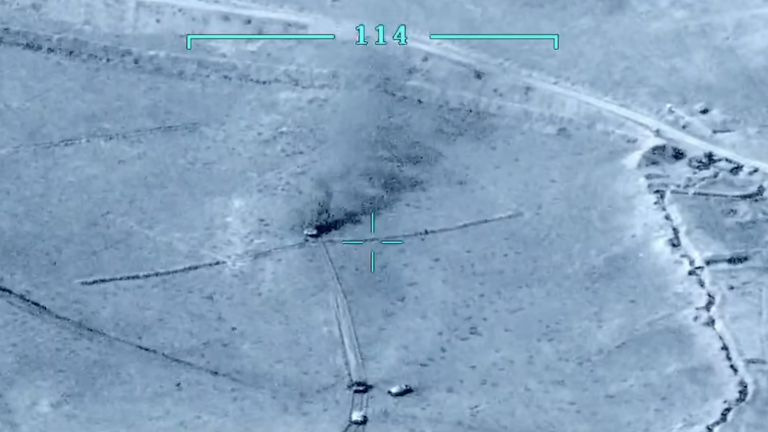 This is what the far side of a drone strike looks like: scorched sand, twisted metal, and fragments of flesh. Sometimes there’s blood, sometimes barely any. Sometimes the fire burns for hours, other times it sputters out within minutes. There are shell casings and shattered limbs, bits of bone, and lots of black. Everything is black after a strike: the ground, the car, and whatever’s left of the bodies. Oftentimes the dead are terrorists; sometimes they’re not. That night in Yemen they were both.
Standing under the palm trees less than an hour after the strike, Faisal couldn’t tell where one body ended and another began. He was in a slaughterhouse. What the US military called the “kill zone,” he called home. He’d been born a few hundred yards away. He’d played under these trees as a boy and walked here as a man. And now nothing was recognizable. Everything smelled and all the pieces looked the same: flesh made meat. One of the men sifting through the sand with a plastic toy pail and shovel, collecting pieces for burial, pointed at a flap of skin near his feet. Faisal stared at it for a few moments before he realized what he was seeing. It was a mustache, part of a cheek and a section of lip. Waleed.
A few hours later, Faisal’s cell phone rang. The man on the other end of the line knew exactly what had happened. “Salem and Waleed were not the targets,” he said. Faisal listened, but the man wouldn’t say much. He didn’t have any answers. But he did have a phone number. “This is who you want,” the voice on the phone explained.
Faisal dialed the number three times that night. He wanted to explain that there had been a mistake. Salem never should have been killed. He wasn’t a terrorist, he preached against al-Qaeda. As Faisal punched the keys on his phone, redialing the entire number each time just to make sure he hadn’t made a mistake, he felt himself getting angrier and angrier. Al-Qaeda hadn’t done this. The US and Yemen had. They were the ones responsible. They were the ones who had murdered his brother-in-law and cousin. In his hand, the phone rang and rang.
2. Tails
I stomped hard on mushy brakes, and the embassy’s ancient ‘87 Land Cruiser shuddered, slowed, and rattled to an unsteady stop inches from the lowered tailgate of a battered Hilux. Sanaa’s night traffic had wound itself into the usual knots, twisted and tangled as four-pound test line. Taxi drivers held glowing cigarettes out open windows with one hand and adjusted the volume of dueling Lebanese pop songs with the other. Late model Mercedes jockeyed for space and pole position against an unruly mob of medieval mule carts, past-their-prime Peugeots, and assorted European castoffs. “Yemenis are the world’s nicest assholes,” my predecessor as chief of station had warned me during our handoff meeting. “They’ll stuff your face with their last piece of bread even as they sink that curved dagger of theirs into your back. Watch how they drive. That’ll tell you everything you need to know about this sweltering hellhole.” He wasn’t wrong. After qat, Yemenis flock to the roads like escaped djinn out of a sorcerer’s lamp, gleefully cutting each other off and delighting in the vehicular chaos of smashed mirrors and busted bumpers they leave in their wake.
In the back of the Hilux, two pre-teens cradled collapsible AK-47s and stared Sphinx-like at my white face, three-day beard, and Padres cap. I knew what they were thinking, and for once they were right. But so what? This was my job, and I was good at it: 47 years old and chief of one of the hottest stations on the planet. 24 confirmed kills in just over seven months in country. Not quite a record, but not bad for my first time at the controls. I stared straight back at the boys until they blinked and looked down. Part of me wondered if I’d ever see their faces in a targeting deck? God, I hoped not.
My mind caught, skipping thousands of miles, multiple time zones, and one enormous ocean. I looked at my watch. 8:13 in Sanaa meant 1:13 in Falls Church. I ran through the schedule Diana had e-mailed me at the start of the semester. If Adam was where he was supposed to be – no guarantee – he’d be sitting in tenth grade English. Katherine would be in place and on time, which thanks to the oddities of a middle school block schedule I still didn’t quite understand, meant an end-of-the-day lunch she’d calorie count and chuck untouched in the trash. And Jonathan? How did a seven-year-old boy with a serious Lego addiction spend his school days? Diana had sounded worried during our weekly phone call. She said he was slipping into our bed at night again, curling up on my side and refusing to budge.
“He’ll be fine,” I’d assured her. “Don’t worry. It’s just a stage.” But what did I know. I’d missed three of his last four birthdays.
This wasn’t the life I’d promised my wife. ‘Twenty and out,’ that’s what I’d told her. Pick up the pension, pay off the mortgage, ease into the cushy life of a 9-to-5 contractor, and send the kids waltzing off to college debt-free. But that was before the attacks and this one big war, which turned out to be a million tiny ones, happening everywhere and all at once, and somehow my 20 years had turned into 23 and counting. Still, if Sanaa went well I could hit SIS-level and the land of golden pensions.
“Rationalize it however you want,” Diana said the last time we discussed my perpetually postponed retirement. “But I know who you are, Julian Fisher. You complain about the work but deep down you love it. You love the mission, and you’re petrified of what will happen if you’re not there to do it. Just remember,” her fingernails tapped a warning on my chest, “when you’re there, you can’t be here.”
I shook my head and recited my half of the argument. Of course, I liked the work, but what mattered is that I was trained, experienced. If I didn’t do the job, someone else would. Someone a little less trained, a little less experienced, and a little less skilled. That made things less safe and how – in this world – could you justify making something even a little less safe?
I pounded the dash, bouncing a few coins and some scattered cassette tapes. It was impossible to have these conversations with civilians, even well meaning ones. Even ones you shared a bed with. No one knew what it was like. Not really, not unless you’d been there. Crunched through broken glass and chalky debris, smelled the acid smoke and nitroglycerin that lingered for hours after a blast, tasted the grit and grime in the air knowing you were inhaling the dead, and then tried to puzzle-piece broken bodies back together again into something suitable for burial.
Terrorist attacks only felt random. In reality, they were plotted and planned by individuals, people who made mistakes and left a trail, people who could – and should – be stopped before they started. That’s what I do, I explained in the colorless briefing voice I knew she hated. I reduce the odds, play the angles, work my sources, and use every last trick the lawyers bless. And even then I still don’t know if I’ve done enough.
Enough. I blew out my lips and resisted a pre-meeting cigarette. To calm myself, I recited all 15 verses of Psalm 91, said a quick prayer asking the Lord to protect my family when I couldn’t, and told myself to focus.
Somewhere up ahead, tucked into the Sanaa shadows, back pressed against a rough stone wall, crouched my pick-up, Ghalib al-Qamish: counterpart, agent, and, more recently, friend.
Ghalib was an officer in Yemeni intelligence, which meant he wasn’t a unilateral. Officially, Yemen’s Political Security Organization was an ally in the war on terror. But in practice the organization was about as loyal as Art Modell. Ghalib was our insurance, a mole buried deep in the PSO. Unlike most of his jihadi-leaning colleagues, he actually knew the US. He’d been a student at the University of Arizona on September 11, and the unlikely trifecta of that day, its disorientating aftermath, and the unflinching kindness of a host family had, more than a decade on, paid off in the form of an excellent reporting agent. Ghalib said he owed the United States a blood-debt for 9/11, which he paid down by handing over raw intelligence on al-Qaeda and making sure we were well-informed on the inner-workings of the PSO. “It’s tribal,” he’d told me once in an aborted attempt to explain his motivation and Yemen’s code of ‘urf.
“You mean like collective responsibility?” I’d asked, remembering a pre-country briefing. “The actions of the one implicate the whole.”
Ghalib masked his smile behind a heavy blast of cigarette smoke. Kamaran lights, I noticed. “Something like that,” he’d said, and politely changed the subject.
That had been seven months earlier at our first meeting. The meeting when I told him my first and, to date, only lie. The relationship between Ghalib and my predecessor,redacted , had been fraying for weeks, missed meetings and the usual domestic squabbles of an officer and agent who’d been together too long. redacted didn’t smoke and Ghalib did. Sometimes it’s that simple. Running an agent is half first date flattery and half the bedrock trust of ‘till death do us part’. Neglect either side of the equation, and the whole charade collapses faster than the Phillies in a pennant race.
redacted suggested he make the introductions and then disappear, while I bonded with Sanaa Station’s most valuable asset. To kick-start the process, I tweaked my bio, trading out a football scholarship to Chadron State for a political science degree at the University of Arizona. “Wildcats unite,” I told Ghalib over a bottle of diplomatic pouch Lagavulin, explaining we’d graduated 14 years apart, “like brothers.”
He smiled and held his glass up to the light. “Bear Down.”
We toasted the memory of John Button Salmon, sang an off-key rendition of a fight song I’d memorized the night before, and talked about our daughters. I showed him cell phone pics of pre-teen Katherine, and he produced one of look-alike five and three-year-olds in matching red dresses with white bows. Sama‘a and Nour, Sky and Light. When I asked about the names, Ghalib blushed and swirled his scotch. “Daughters lift your eyes. They force you to look up and out. Plus,” his grin was unguarded, “they’re always laughing.”
We agreed to meet every other Thursday for a quick check-and-chat. Ghalib would brief me on the latest from Political Security; I’d ask my questions and hand over a Ziploc bag, taped down and stuffed with twenties. He hadn’t wanted to take the money at first. But redacted had insisted. Motivations matter on the seventh floor. Cash was acceptable,‘urf was not.
Ghalib’s preferred spot was the Sailah, the sunken stoneway that separates Sanaa’s crumbling old city from its just as crumbling new one. He’d squat along the edge of the road in ratty robes, I’d swing by in a clean car, and he’d crawl inside. We called it a drive-by and on that Thursday we executed it perfectly.
Ghalib came out of his bedouin crouch slowly, like Piazza that last year in San Diego, eased open the unarmored door, and slipped into the passenger seat. He tucked a plastic Rothmans bag between his feet. I’d switched the dome light off an hour earlier, a precaution like the Toyota’s civilian plates and Ghalib’s stained street robes. I doubted anyone was watching, but we were in Indian country and you could never be too careful. “Mistakes in the field,” an instructor once warned me, “are a lot like marriages: the wrong one can ruin you for life.”
I flashed my lights twice at an oncoming taxi with purple running lights and cut behind him up the ramp toward Tahrir. Outside my window, white-haired men sat at metal tables on the steps of the Mahdi al-Abbas mosque, clicking prayer beads and sipping at milky cups of tea. Across the street, their younger selves, teenage grandsons and boys younger than Jonathan, kicked a lopsided soccer ball against a wall and waited their turn at a brightly flashing video game. SEALs v. Terrorists, probably. I wondered what the boys thought as they played at American soldiers gunning down bad guys who looked strikingly like their fathers, uncles, and brothers.
A dented minibus blocked the narrow street ahead of us, leaking Thursday night shoppers into the gold market. An angry horn sounded three cars up, and the bus lurched back into sluggish motion. Ghalib leaned forward in his seat, eyes locked on the side mirror, scanning for tails. Two more turns and we were on Abd al-Moghni Street headed south toward Haddah.
He made the call first. “Clear.”
I waited another thirty seconds, until we passed the Taj Sheba Hotel, to second his assessment.
Ghalib pulled two cigarettes out of his pack of Kamarans, lighting both and handing one over, as I pushed Neil Young’s “Cinnamon Girl” into the tape deck for noise cover.
“So,” he smiled, looking younger than his 33 years. “We got him.”
“Yeah?” I slowed to let a white-and-yellow taxi with no fender dart in front.
Ghalib blew a line of smoke out the open window and pointed to the Rothmans bag. “It’s all there. The source delivered.”
The source, whom I’d codenamed “Greenmantle,” had appeared three months earlier, just after Christmas, claiming to be Samir al-Zayadi’s brother-in-law and second-cousin.
Ghalib debriefed him for four hours in a PSO safe house that first week. “I think’s he’s legit,” Ghalib told me after their initial meeting.
Greenmantle was close to his younger sister who, in the tangled thicket of tribal bloodlines, had married their second cousin, fellow tribesman, and local al-Qaeda commander: Samir al-Zayadi. For the first year all was bliss. The sister was happy, soon pregnant, and Greenmantle found work as his brother-in-law’s driver, chauffeuring Samir back-and-forth to al-Qaeda meetings. But one night Samir got slap happy and the sister miscarried. Greenmantle didn’t confront his terrorist brother-in-law – who would? – but it was clear his sister wanted out. Equally clear was the fact that Samir wasn’t going to grant her a divorce. Ghalib made an executioner’s chop with his hand. “This is his solution.”
Together we worked out a deal: Ghalib would run Greenmantle and I’d run Ghalib, sort of. Neither the source nor Ghalib’s superiors at PSO would know he was talking to us, but the station would have full visibility.
For weeks there had been nothing. Samir hid in his spider-hole and Greenmantle refused to hand over his location for fear his sister might get hurt. “Wait ‘til the bastard’s traveling,” he messaged Ghalib.
And now he was. “Tuesday’s the day,” Ghalib said, as Young and Whitten rasped about “chasin’ the moonlight.”
I nodded. “Anything else?”
Ghalib pulled a transcript sheet out of the Rothmans bag. “Greenmantle will receive a courier at some point on Tuesday,” he translated. “The courier will take him to collect al-Zayadi. He doesn’t know where he’s going or who al-Zayadi will be meeting, only that’s its someone important.” Ghalib looked up from the paper. “Remember, Greenmantle will be driving the car. You have to wait until they’ve cleared the vehicle to fire.”
“When were you guys going to give this to us?”
Ghalib offered a sheepish smile. “Tuesday morning. General Ali is going to rush over to the embassy with an ‘urgent’ tip.”
“Not really enough time to get an eye in the sky.”
“No, not really.” Ghalib hesitated. “Be convincing, Julian. It’s my neck that’s on the line. But” – he flicked his cigarette through the cracked window – “this is your shot. Don’t miss.”
*
“Sir,” the marine guard on the phone sounded jumpy for 11 am. Too many Rip Its, most likely. The marines drank them by the case, crushed the empties, and stacked the carcasses beneath their desk like Genghis Khan piling bodies. “Sir, there is a General Ali Muhammad here.” The lance corporal lowered his voice. “He says it’s highly urgent.”
I nodded into the phone. Game time. “Escort him back, please.”
General Ali Muhammad: fifty-seven, fat, and one of the last holdovers from the old regime. I remembered how redacted had described the man: “As dangerous as a swaying cobra and with the same hooded eyes.”
I double-checked the recording equipment in my desk and waited for the Marine’s knock.
“Sir.” The lance corporal escorted our visitor into my windowless office, before stepping back outside.
I poured steaming tea into hourglass tumblers, and offered him one. “General.”
Ali Muhammad took a careful sip, wiped his mustache, and got straight to business. “This morning, we received information about the location of the Mr. Samir al-Zayadi.”
“That’s excellent,” I interrupted half-standing, overselling for effect.
The general grimaced slightly at my display and rested his hands on his belly as if it might bounce away. “Yes, of course, excellent. I wanted you to know as soon as possible.”
“Do you have the location?”
General Ali slid a torn scrap of paper with handwritten coordinates across the desk to me. “Unfortunately our information says he’ll be moving soon, likely within the hour.” He blew out a theatrical sigh. “I do not think that is enough time to get a drone from your base in Djibouti into the sky, no?” The General shook his head at the unending cruelties of this world.
I leaned back in my chair, savoring the next few minutes Ghalib had gifted me. “Care for a cigar, General?”
He nodded, warily.
I clipped a pair of Padrón Anniversaries and leaned across the desk to light his. “Just between us,” I said, my voice conspiratorially low.
Ali Muhammad’s eyes flickered hungrily beneath their hood, and I thought of reading Jonathan Rikki-Tikki-Tavi the last time I was home. The General gave a slight “go ahead” nod.
Somewhere in my desk was a memo instructing Ambassador Rees to brief Yemen’s new president on everything I was about to reveal. The ambassador wouldn’t like it, but there was no real harm in jumping the gun by a few days. I blew out a mouthful of Nicaraguan smoke. “To tell you the truth, we have just completed transforming an old Saudi airstrip – airfield 30 – into a new drone base.” I tapped the torn edge of paper with Samir’s coordinates. “It will be close, but I think, thanks to your help, we can do this.”
The General coughed slightly as he exhaled, but made no comment.
I stood quickly. “Thank you, General. But as I’m sure you understand time is tight. The lance corporal will escort you out.”
*
I dropped General Ali’s scrap of scrawled coordinates in the trash, and walked up two flights of metal stairs, through three sets of cipher locked doors, and into the Box. Exact same smell anywhere in the world: stale air and unwashed bodies. Strip away the burnt coffee odor and the stress, and I could be walking into Adam’s 16-year-old bedroom back home.
Two of my targeters, Alyssa and Doug, sat at a conference table, staring silently into a row of screens, surrounded by $250 million of machines that hummed, clicked, and whirred like an insect army.
“Anything?”
Alyssa’s eyes didn’t move, but her 28-year-old ponytail swished back and forth, carving an arc in the dead air. “Nothing yet. But we’ve got two Reapers stacked on top of the site.”
Alyssa had been a senior in high school on 9/11. A decade later, and five years into her Agency career, she’d already been on the ground in Pakistan and Iraq and was on her second tour through Yemen. She was short, Asian, and one of the best. Doug talked less, but beneath his blue light glasses and acne-flaked exterior was just as good. He’d been part of the al-Awlaki strike team the year before, earning a medal he’d touched once at a private ceremony before surrendering it back to the director and a sunless life in the Agency vault.
I sat in a swivel chair in the back and clicked open a screen to catch up on cable traffic. Greenmantle’s information would either be right or it wouldn’t. Either way, I’d have to call Peter, my boss at the Counterterrorism Center. But – I checked my watch – 4:13 am DC time was early, even for Peter the Wolf.
I knew his reputation: a workaholic obsessive – like Angelton only worse – who’d converted to Islam to understand his enemy better. But Peter also knew what it was like to operate in the field. Shortly after I arrived in Sanaa, he’d axed the dreaded “triple trigger,” which required the ambassador, the station chief, and the head of CTC to all sign off on a strike. Now it was just the two of us, completely in-house, a much more efficient process.
“Boss.” Alyssa’s voice was higher than usual. “One man entering the house.”
I walked over to where she was pointing. On the screen things looked the same: a dusty brown building in a dusty brown desert. But Doug confirmed her spot.
Twenty minutes later two men walked out of the house and climbed into a white Toyota Hilux with an orange racing stripe. I had Greenmantle as the stocky driver and the courier as the taller passenger, but without sound it was impossible to be certain.
Alyssa and Doug tensed like a pair of birddogs. I kept my voice steady. “These are our guys. Put both eyes on the car.”
Alyssa relayed my directions to the pilots at an off-site facility in Virginia, and the twin 66-foot Reapers climbed a few thousand feet, steadied, and locked onto their prey. Barring a technological mishap, cloud cover or, God forbid, a sand storm the drones could follow the vehicle for the next 18 hours.
The Hilux bounced over a barely discernible track for several minutes, sprouting a rooster tail of dust that splashed a grainy white on the screen. At 1:45 pm local time Greenmantle stopped outside what, from 17,000 feet, looked like the world’s saddest roadside restaurant: a tattered canvas sunshade, cracked once-white plastic tables, and no customers. The courier got out, walked inside and, a few minutes later, three different men exited the restaurant and climbed into the Hilux.
“Ok,” I told the room. “That’s Greenmantle, Samir al-Zayadi, and two likely AQ members. Remember Greenmantle is red, everyone else is righteous.” Time to call Peter.
Two hours of slow driving later, the Hilux stopped outside a cluster of mud-brick huts. Everyone walked inside and no one came out. “Nap time,” a voice from Virginia joked.
“Qat time,” Alyssa snapped back, popping her gum.
An hour later, one of the men walked out on the flat roof and stared straight up into the sky, shielding his eyes with a brown hand.
“Can he hear us?” I asked.
“Not a chance,” Doug said.
“Well, give us a 30,000 foot floor to make sure.” Alyssa’s fingers tapped at the keys, and the image on the screen blurred, dropped out of focus, and reappeared at ¾ size.
Shortly after 6 pm local time, the men walked out of the house, climbed into the car, and started driving northeast across a hard, flat plain. They stopped after 27 minutes just outside a village.
“Where are we?”
Alyssa clicked twice. “Baraqish.”
The village wasn’t familiar. “Do we have anything on it?”
“Nope.” Her voice sounded tight. “It’s clean.”
“What do you think?” I asked Peter.
“Let’s watch them, see what happens.”
On screen, the passenger door opened and three figures in robes piled out. “Greenmantle’s staying with the car,” Alyssa said.
“I see it.”
Peter broke in from Langley. “Who are they talking to?”
Doug pointed at the screen. “Some kid.”
“Ok.” I took a deep breath. “We wait.”
A minute later the boy’s pixelated body scampered away, just as a low-altitude cloud drifted beneath the drones, blocking the camera. When it cleared the three men had drawn off by themselves, about 100 yards outside the village on the road into town.
“They’re clear,” Alyssa said from her seat.
“Not yet,” I said. “They’re supposed to be meeting someone.”
Fifteen sets of eyes, in Yemen and Northern Virginia, watched Samir al-Zayadi and his two companions walk slowly toward a cluster of date palms. They looked animated and in good spirits, waving their arms and kicking off bright heat signatures on the infrared monitor. One of the men broke off from the group, ducked behind a tree, and knelt to piss. A few minutes later, two men walked out of the village and joined them.
“Is this the meeting?” I asked Peter.
Silence on the line, as Peter contemplated scenarios. “Male, military age,” his voice was a croaky whisper. “But your source, your call.”
I hesitated. On screen the five men were greeting one another, cheek kisses and shoulder hugs. One minute stretched to two. Alyssa’s gum popped.
“Julian?” Peter’s voice chimed in my ear. “Window’s closing.”
I thought of my first buck. Eight years old, breath fogging the frozen October air, my father’s hand on my back, reassuring me. I nodded. “Go.”
In front of me the screen flashed, then flashed again.