New Fiction by Kevin M. Kearney: Freelance
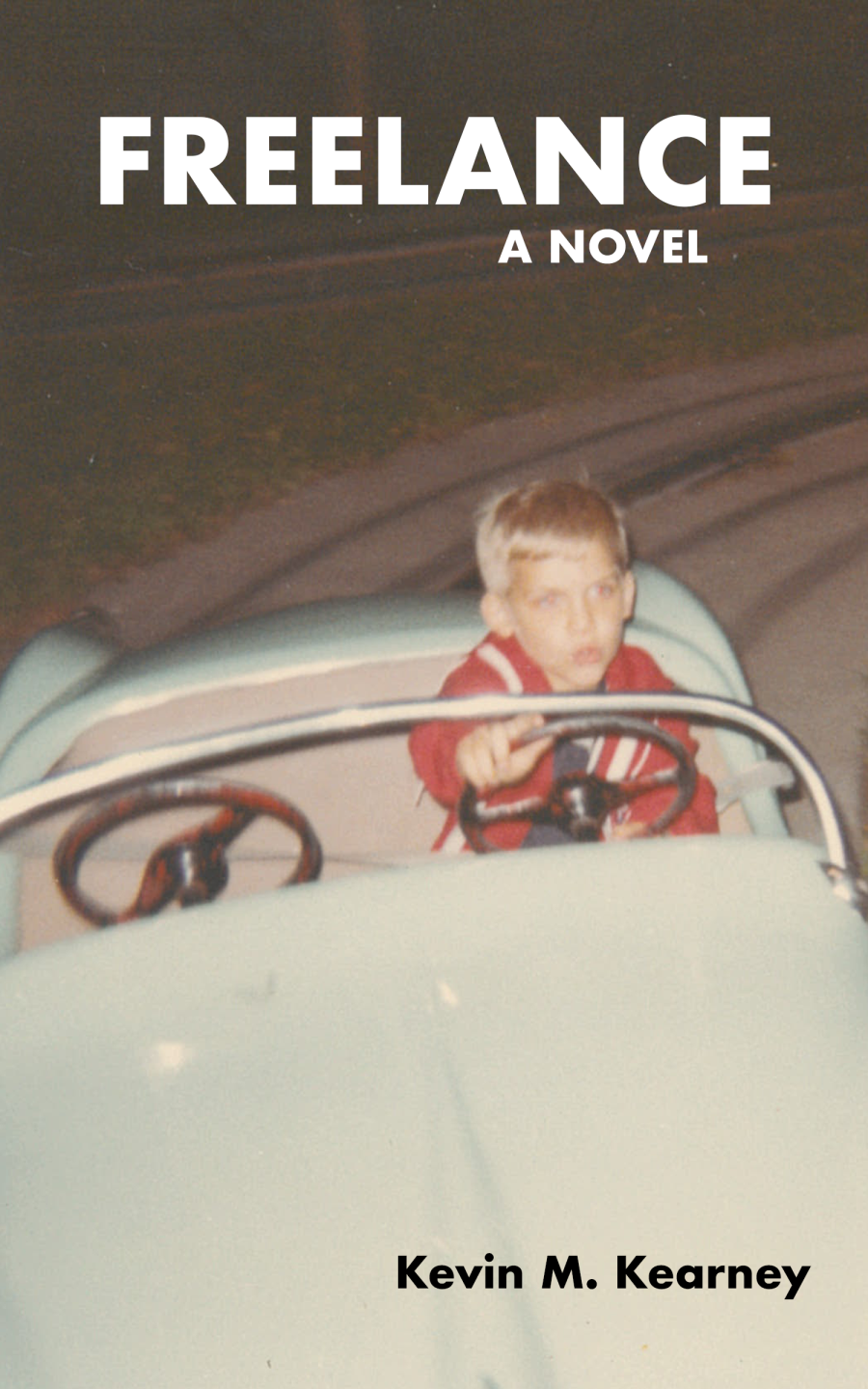
Freelance Cover

Excerpt from FREELANCE: A NOVEL

The HYPR Dryver Manual was clear: a Dryver should not, under any circumstances, touch a customer. Simon read and re-read the line on his phone, looking for an exception, something like a loophole that might help him remove the snoring man from his back seat.

They’d arrived at the destination two minutes earlier, but the man’s eyes were still shut tight, his head still leaning against the rear window. “Excuse me,” Simon said from the driver’s seat. He glanced at the phone on the dash to double-check the man’s name. “Thomas?”

The man coughed a few times, sounding like he was working through a winter’s worth of mucus, but never opened his eyes. Drool ran down a gin-blossomed cheek. In the few weeks Simon had spent working as a Dryver, he’d had to deal with drunk people; getting shitfaced was one of the main reasons people called a HYPR. Before Thomas, though, that reality had never been a problem. None of his previous alcoholics had fallen asleep.

Simon considered checking HYPRPPL, the forum he’d been lurking on since starting the job, but he knew it would probably offer little help—its users tended to talk tougher than they acted in real life. If there were an answer, it’d be in the Manual. He tapped “Find in Page,” typed “problem with a passenger,” and watched as his phone jumped to a possible solution: “If you have a problem with a passenger and feel like you are in danger,” it said, “contact the local authorities.” Simon imagined calling the cops, the smirks on their faces as they jotted down his concerns. This fat drunk scares you?

He didn’t need Thomas arrested; he just needed him out of the car. He needed to grab another fare. He needed to stop wasting time. “Thomas,” he said again. “Ride’s over.” The man shook his head and rolled onto the headrest, slathering it with his spit.

Simon returned to the wheel and stared at the crowded city just beyond his windshield, at the 2100 block of Market Street and its towering glass buildings. The people passing by his car were well-dressed. They were moisturized and manicured. They spent their days in cubicles, talking about slide decks and KPIs. He knew they couldn’t relate.

He took a deep breath, closed his eyes, and counted to 10. The day before he’d watched a YouTube video called “Calm Down QUICKLY” that suggested these techniques created positive delusions; even if things were spiraling, the woman in the video had said, controlling your breath would tell your brain all was well.

When he reached 10, though, he didn’t feel any different. Thomas was still passed out and he was still stuck at the corner of 21st and Market. He would have to wait for the man to wake up on his own. He imagined the lame excuses he’d offer: something about a restless newborn at home, an early morning at the gym, a long and trying history of incurable narcolepsy. Simon gripped the steering wheel and took out some of his aggression on the worn gray rubber.

Some passengers left tips as penance for their bad behavior, acknowledgments that Simon’s job was inherently shitty, that having to deal with this many people every day deserved more than what the algorithm paid. He wondered if telling Thomas about all the fares he’d missed out on while the man had been napping might subtly suggest one of these generous tips was in order. He knew that might be too soft, though. Maybe what the situation really called for was a threat. Thomas would be banned from the app—immediately, and permanently—unless he forked over a 50% tip. No, Simon thought, go bigger. It would have to be 60%. 50% sounded like a gamble, but 60% sounded assertive. 65% sounded even better. It would be 65%. The number was more arbitrary and, as a result, more official.

Now he just needed him to wake, then he would begin the blackmail. Unfortunately, he saw himself saying, there’s only one way out. He looked at the man in the rearview. He was still out, but he began shifting in the seat, a move that Simon thought might be the early start of his entry back into the waking world. Instead, he let out a titanic fart.

Simon squeezed the wheel tighter, until his knuckles ached. He stared at the flesh between them, amazed at how his white skin turned even paler than usual.

Then his eye caught the Subaru logo. The horn. Of course.

He pressed hesitantly at first, worried he might startle one of the office workers on their way to lunch. The car let out a soft chirp and Simon eyed the rearview mirror, hoping to see the man’s eyes creak open. It didn’t work. In fact, Thomas looked rather peaceful in his newfound California King.

It would have to be harder. It would require some real force. Simon leaned all his weight into his palm and held it there, determined to get the thing screaming. He began working the horn like a mound of dough, kneading it into an atonal mess. He smiled as people on the sidewalk stopped and stared.

Thomas shot up in a panic, demanding to know where he was.

Simon pulled back from the horn. “2100 Market,” he said. “Your destination.”

“Good,” Thomas said, and took a tin of mints from his breast pocket. He threw a handful in his mouth. Simon could see imprints of the headrest across his face.

“You were out for a while,” Simon said. He was laying the groundwork for the tip. The man would feel guilty, indebted. “It ate a lot of my time.”

The man stared at him for a beat. “And?”

“It cut into my other fares. I lost money.” Simon decided he would go with 40%. It was the more reasonable number.

“That right?”

Simon nodded. “And as a result of your actions—”

“—sounds like a shitty business model,” Thomas said, cutting him off. He left the car without another word, slamming the door behind him.

Simon took a deep breath and started counting to 10. He saw the woman from YouTube encouraging him to find the origin of his breath, to locate it deep within his chest and hold it there.

“Always, always, always place courtesy and hospitality above everything else,” the HYPR Dryver Manual said. He knew he would need to disregard Thomas’s words. He knew he could not afford to be in a bad mood for the next passenger. He would forget the entire experience. He needed to.

Simon’s phone vibrated in its dashboard holster. He assumed it was a notification from HYPR, an offer for a new passenger, an opportunity to make more money. The woman from the YouTube video would’ve told him to ignore this, to tune out the rest of the world until his brain was at peace, but he didn’t need to be Zen, he just needed to be calm. Calm enough. Calm enough to drive without jeopardizing any more fares.

The notification was from HYPR, though there was no mention of a new passenger. “Your Dryver Score has been updated!” the app informed him. For all his efforts with Thomas, he’d been awarded a single star. It had been the confrontation, he knew. If he had kept quiet, if he had just waited for the man to wake up on his own, he wouldn’t be dealing with a tanked average.

He put the phone back in its holster and took another deep breath. This time, he decided, he would count to 100.


Order a copy of Freelance here.


New Interview with Kevin M. Kearney

broken phone

Genre-wise, there’s a lot at play here. I would call it a coming-of-age novel, but also kind of an “anti-bildungsroman,” in that Simon doesn’t so much find himself as quite literally lose himself. There are also science-fiction elements as well as horror ones. How would you break it down? What are some of your inspirations, in this vein? Do you think it’s horror and science-fiction—or is this just our lives at this point?

I’ve described the book as a “speculative Philly noir,” because I think it captures the vibe, sounds intriguing, and people tend to like compact descriptions like that. That being said, I don’t know what it is beyond a novel. To your point, I think writing about technology requires the tools of (at least) science fiction and horror. It helps that I’m drawn to writers who intentionally blur the lines between genres, so it felt natural for me to try to do the same.

Early on in the writing I was leaning into science fiction, reading stuff like Neuromancer and the novelization of 2001: A Space Odyssey. I also read a handful of Raymond Chandler books, like The Big Sleep and The High Window, because I knew that I wanted there to be this simmering tension, a kind of uncertainty about HYPR and its intentions, and Chandler is the master of that. I’m also very cognizant of the reader’s experience—I’m terrified of boring someone—and all of those books are really engaging texts that make you keep turning the page.

I don’t know how much those books are reflected in the text, but I like assigning myself potentially inspirational reading while I’m working on a project because I like to believe the moves of these great works find their way into my brain, even if I’m not totally conscious of it. If nothing else, it’s fun.

Philadelphia seems like a perfect setting. It’s trite to phrase it this way, I know, but the city feels like a “character.” It also feels like a ripe setting for a particular kind of juxtaposition (between old and new, perhaps) you draw in the novel. Why do you think that is? What are some of these tensions? Why is this novel set in Philly and not in, say, New York or Los Angeles?

I lived in Philly as an adult for 12 years, right out of college into my early 30s. I grew up in South Jersey, about 20 minutes outside the city. It was close enough that I went to high school in Philly rather than Jersey.

I started writing the novel almost immediately after moving from Philly to California, back in August 2022. I was pretty homesick, I think, maybe a bit culture-shocked, and found that writing about the city was a good way to process a big life change. So, I think that’s the most immediate answer: I was trying to figure out where I was by exploring the place I’d left behind.

I also just think it’s a beautiful city, despite all its problems. I lived in the house at 8th and Washington where Simon lives and, because I was in my early 20s when I did, I was enamored with the possibility of the city, in spite of the sidewalks being lined with trash and something in the air always smelling like shit. It felt alive, you know? Like you’d sit down on the stoop and it’s mostly just cars passing by, but you still feel like you’re taking in this beautiful scene. I guess maybe that’s a lot of cities, but Philly was my city for so long, so it felt right for me.

But, to your question about bigger cities, Philly is decidedly not New York or Los Angeles. People in Philly don’t want it to be New York or Los Angeles. Unlike other major American cities, it’s still possible for normal people to have respectable lives with modest jobs in Philly. My wife and I were both teachers and were able to buy a house in the city by 31. As far as I can tell, that’s not possible in New York or L.A.

So, I think that aspect made the story feel more realistic: Someone really could make rent doing rideshare in Philly. It wouldn’t be easy, but it could be possible. If FREELANCE were set in New York, Simon would have to live in, like, Newark.

The flow of passengers in Simon’s Subaru (a good alternate title) is a very effective narrative “vehicle.” I notice the voice—his voice—has a particular penchant for classifying customers into “types” and judging them based on certain sociocultural markers. What do you make of this kind of reduction? Is it something a social-media-fueled service economy does to us?

The internet classifies its content as well as its users. Whether you use social media or Google or almost any other popular piece of the modern internet, your keystrokes are being collected and used to frame your experience. Your data is your identity. So, the short of it is: The internet classifies us in the same way Simon classifies his passengers.

I thought of Simon, and a number of other characters in the book, as someone who’s been taught to view the world through data and metadata, because I think we’re all being taught to do the same.

Simultaneously I’m drawn to and repulsed by the Dylan character. He seemed to embody an important symbol, or carry an important frequency. I didn’t find him particularly redeeming; in fact, he seemed to be the target of a good deal of venom. He represented to me a historic truth: that often disaffected privileged people take up the battles of the working class, whether earnestly, symbolically, as a means to virtue, or as some kind of aesthetic or intellectual exercise or game (“Catan” is a symbol of this). In a way, though, he feels like the novel’s villain but also its truth-teller. I’m reminded of his line: “we’re accepting the machine’s warped versions of ourselves!” What is at the heart of that contradiction, that venom? Are we all bourgeois at this point?

Dylan was a fun character to write because I think he’s a very contemporary, very real type-of-guy, at least in certain parts of the country. He is an avowed socialist, yet can’t help talking over working class people. He has read a lot of theory on intersectional solidarity, but is still just a loud know-it-all. He’s interested in labor issues, though he’s never seen working.

I don’t think he’s a villain, necessarily, because as you pointed out, he actually makes some good points about HYPR, technology, and surveillance. He’s not an idiot, even if he’s annoying. And I think almost everyone in their early 20s talking about politics, and I include my 20-something self here, is insufferable.

Overall, though, Dylan’s worst trait is not that different from the American Left’s: he has great ideas but dogshit delivery. So, no, he’s not a villain exactly, but I definitely aimed to make him a foil for Simon. Not that Simon is a hero. Both of them are just younger dudes trying to figure out their place in the world. Their pasts are what cause them to do that in such different ways.

This novel feels particularly interested in thematic concepts of “SEO” and the ambiguity of whether, when algorithms are involved, anything is actually “chance.” I’m thinking of when the algorithm puts Cassie in Simon’s car (a rich allegory for dating apps).  I’m drawn to the line on page 74: “It wasn’t that robots were spying on humans; it was that humans were just glorified robots.” What was the inspiration here; how far has it gone; and to what extent do you think it’s true, that we’re essentially pre-programmed for robothood?

I was working for an SEO-focused website when I started writing the book and was amazed at how it changed my perception of the internet. I quickly realized how much of Google’s search results were just shoddy, recycled (often imprecise and sometimes outright incorrect) information tailored to rank high on the page and earn clicks. Once you learned a few things the algorithm was rewarding, you could quickly rejigger a page with some keywords, new-fangled headers, and a few lines of code to make it jump to the top of the results. It didn’t have to be good, it just had to match what Google had deemed “good.”

SEO is now in sort-of a death spiral thanks to AI. But AI is being fed millions of web pages that were written explicitly for SEO—the same pages that were constructed from recycled, shoddy information.

So, the information isn’t any better, but people assume it is because it has the appearance of authority. It’s AI! But that’s just not true. Unfortunately, that might not matter. The more people defer to the internet/AI for answers, the more they begin to see the world in the way the internet/AI sees or wants them to see the world.

Am I rambling? Maybe.

Probably stating the obvious here, but Google (and most popular websites/apps) are collecting massive amounts of data and then using it to spit content back at you. Apple recently paid $95M in a lawsuit related to Siri listening to user conversations. Years ago, people who said their phones were spying on them were seen as paranoid. Now, we’re aware that all these things are happening, but we passively accept them as the cost of having such amazing technology.

But it’s still disappointing, for me at least, when I realize that I can be pinned down so easily. It’s pathetic that I’m such a clean marketing demographic, you know? Not that I’m a particularly unique person, but it’s depressing to know that what I perceive as the complexity of my brain, past experiences, desires, and interests can be categorized so easily by an algorithm.

I take solace in the fact that there’s still a lot of things I do offline. I don’t track my exercise, I listen to a lot of physical media, and I almost never rate things I consume. The YouTube algorithm is mostly serving me live Ween videos, so I think that’s probably a good sign.

I love Simon’s parents. What is it about Gen X parents that begets this kind of depiction—at once kind but something also naïve about them? Can we talk about this?

Thanks for saying that.

I don’t know what it’s like to be a parent, but I can imagine it must be really difficult to watch your child seemingly become someone you don’t recognize. I taught high school for 10 years and got to know lots of parents like Simon’s. Good, decent people trying to get a handle on why their kid was suddenly failing out of school. Earnest, well-meaning parents just trying to get through the work week and feeling frustrated that their teenagers were making that so difficult.

And I think people, parents and non-parents alike, often look for easy answers for complex problems—and the internet is happy to provide those for them.

The image of the unseen damage Cassie is accruing over years of standing next to an X Ray is a particularly affecting image, especially when coupled with that she says software will eventually do it, and all that matters materially is the paycheck. Would you call this novel “anti-work?”

No, I wouldn’t, but that’s mainly because I’m leery of classifications like that. In general, I get uneasy categorizing anything I write as explicitly political. I’m interested in storytelling above all else. I don’t pursue a narrative to execute a theme or an agenda. A lot of times I’m not even concerned with having “a point.” I just want to follow a story and see where it goes.

Of course, some people might say, “Okay, but pursuing that story is really just delving into your unconscious, which is filled with the signs and symbols of your belief system.” (They might say it exactly like that.) And that’s fair. It’d be disingenuous for me to say that the book doesn’t comment on work. It does. It pretty clearly criticizes work that aims to dehumanize people, in ways both overt and subtle. So, I don’t know if it’s “anti-work” but it’s definitely “pro-human.”


There are people in the novel, mostly poor or working class, who are outside of its ire. The bearded man with the capped tooth (until he’s revealed to be a plant from a rival ride-share app) functions as a kind of Diogenes the Cynic. Cassie’s daughter, Maya, seems to get it, when she says, when asked what she wants to do when she grows up, is just “be Maya.” What is the way out, in your opinion, beyond smashing our phones?

I think Simon proves that smashing your phone won’t fix the problem. The boring answer is that the tech industry needs to be regulated. It won’t fix the deeper problems, but it’s a start. And it’s one of the few bipartisan wins in this country.

But on a personal level, I don’t think there is an easy way out. I think the real answer is you need to go the other way—you need to change your mind. If you believe that tech is intentionally trying to rewire your brain, then that should frame everything you read on a device. Why was this fed to me? And what is it trying to make me feel?

I’m glad the scene with Maya resonated with you. That’s kind of the crux of the book, I think. I left teaching after the pandemic and struggled a little with that departure: for so much of my life, I had thought of myself as “a teacher” and assumed that signified things about my values, my identity, and how I treat others. Suddenly, when I no longer had that shorthand (“I’m a teacher!”), I was left wondering…well, am I still someone with values, an identity? Do I still treat others well? Was I ever that person? And I had to try and prove that to myself, outside of a readymade job title. It was difficult but ultimately really healthy; it forced me to confront who I am versus who I say I am.

Around that time, my wife and I were babysitting our nieces, and I helped the older one with her bedtime routine. When she went to brush her teeth, she was so focused on the task at hand. It seemed like there was nothing else floating through her mind—she wasn’t worried about the next day’s tasks or regretting something she’d said earlier. She was fully present for this totally mundane activity in a way that a lot of woo-woo adults wish they could be. And I found that really beautiful. She’s not caught up in her professional identity or even her social one. She’s just there. She’s just herself. It’s something I’m striving for every day.