New Fiction by Ben Yeager: “Big Game”
He looked for disturbances on the smooth, blue horizon, birds diving, fish breaking the surface. Out to sea He saw spilled-ink patches: schools of menhaden. The presence of forage fish injected air into the atavistic depths of his blood. They signified feeding, the violence of an unseen universe.
A sun-bleached kayak, pastel orange, rested against the dune fencing. It had been left there since the spring. He flipped the vessel over onto the sand with a thud. A sit-on-top, a double, the kind they rent out at resorts. Its forward nylon seat had been shredded to black ribbons by sharp teeth; the rear seat was slightly better, but no longer supported his back. He rested his two fishing rods linked together carefully on the plastic deck and tucked a single paddle along the gunwale and under the forward seat.
Bending his knees, He dragged the kayak from a handle on the bow down to the water’s edge. Then He walked around the boat and placed both hands on the stern, eying the waves tossing themselves lightly against the sand like bedsheets. When there was a lull He lunged and ran with the boat as if launching a bobsled, which He rode on his knees into the water. Then He lowered himself into the rear seat, removed his paddle and took long, purposeful strokes toward the horizon.
~
Lately He had begun to brim over with an inexplicable feeling beyond language, beyond words, for which He had to find a form. Too much a captive of his own life, He had become his own third-person narrator. He was not sure what it was He wrestled from his well of inspiration; it was the same as that of his suffering. His mind caught on its own painful mysteries: what it was He could not give; or that which drew his writer’s eye to others, and whether there were characters or there were people.
The curvature of the island began to reveal itself. On one end of the distant sand strip stood a black and white lighthouse. The sea changed from a turbid, sandy teal to a cosmic cobalt blue. For a moment He stopped. Soundlessness enclosed him. The negation of everything pressed in on his ears. Wind swell lapped gently against the kayak. His eyes adjusted to the complexity and logic of the water’s texture: the direction of the lifeless wind; the complementary angle of the swell; a lost buoy or party balloon breaking the surface a few hundred yards distant.
Waiting changed the nature of what He saw: darkness beneath the surface, not far on the horizon. He started rowing again, steadily, remembering to breathe regularly, toward the dark edge of a school of fish about the size of a baseball diamond. The fish appeared in detail breaking the surface by the thousands, swimming open-mouthed to sift the water for plankton in a singular orbit. En masse, they descended in a column for fathoms. As the kayak made contact the fish scratched along its hull and rolled over themselves, deeper away from him as one organism, an endless chain like a great, silver face trying to speak.
He drifted downwind, cutting a channel in the mass. The surface provided a clear medium downward into that channel, like a cross section of a honeycomb. On the school’s downwind edge He reached forward for his Penn snagging rod and from an eyelet unclipped the snagging hook, which dropped heavy and spinning to the deck. He cast out into the school, first letting the weighted treble sink. Then He spun the reel quickly, wrenching the rod, until the line caught on something, bending and dancing lightly with some captive lifeforce. Reeling steadily, He brought a wounded menhaden, hooked in the clay-soft skin of its back and bleeding, to the boat. The forearm-sized fish beat its head and tail against the plastic. He constrained it with his palms, took a circle hook from a pocket and tied it to the rod. Then He hooked the live fish through the upper lip and tossed it back into the school.
The fish fought to rejoin the formation; He felt the chaos of each individual making contact with the taut line, jostled this way and that. He waited for a particular feeling. It did not take long: a single pull, forceful and sustained. The drag was loose; line peeled from the spinning rod. He let the fish run. When it began to slow, He started to reel in, working line back. The fish ran again, so strongly that if He protested it would break the line; then He stopped again and was able to win back more line. This went on for a moment or two, the fisherman advancing, until the spiny ridge of a dorsal fin, unmistakably a striped bass, protruded from the surface.
Those gray spikes indicated the success of the right kind of fishing—for the right species. He pulled the exhausted bass, oscillating weakly, into the boat. It had engulfed the menhaden in a single breath and caught the circle hook perfectly on the lip. A beautiful cold-water fish, fat from bunker, skin a luminescent pearl-white, defined stripes the color of obsidian. The fish was too large to keep legally, probably almost fifty inches, a breeder. He held the fish overboard by the tail until it began to sway again, and then let go.
~
Into the afternoon He found several schools of menhaden with bass underneath them, catching several more fish too big to keep. Large bass tended to make one long run until they surrendered, burning with lactic acid, and were pulled back to the kayak. For his own amusement He loosened the drag.
His hands had become cracked and bloody from handling bunker’s sharp seams. The wounds were like little paper cuts. The fish blood mixed with their brown gut-sludge and pooled thickly with shimmering scales in the kayak’s crevices, staining him around his heels and under his ass. He stuck hooks in the bunker. Sometimes, if the snagging had killed the fish, He cut it in half. This was called chunking. Blood attracted predators. Oils. If he forgot a knife, he would tear the fish in two with his hands; doing so, often He felt as though he were sinning, killing for pleasure, committing some violation of natural law. His uncle called bunker “reincarnated Nazis.”
He no longer had sensation in his exposed toes. His lower back had begun to ache. After a few hours the world called to him; He wondered about his phone, face-down on the table; how many messages it had accumulated. Was He needed? Was anybody angry at him? Had they discovered the truth about him?
He had done no writing, rendered no part of himself, found no vocation. He had moved back to the reeking city of claustrophobic concrete, of dumplings and algorithmic dating. He lost himself in books and in his own cogitation, but learned nothing other than that there was nothing to learn. With his own body he was at war, slouching with a growing potbelly over a computer, until his body was no longer an idea; upon it no action was wrought and it reflected how he lived, like a kind of externalized spiritual genitalia. All nature, no grace, a creature with some itchy telos unresolved dragging itself into the woods. The bottom of his sea held sportive monsters, but he did not like his own seriousness, which he could not express. There was something thanatological He had always wanted to do. The pathos of the doer.
He paddled dutifully back toward the beach. Houses He recognized manifested on the shoreline. Inner bands of menhaden schools congregated in discrete dark circles on the surface like an endless ellipsis. One more, He thought; it would be great to bring home a bass for dinner. At the edge of a smaller school He snagged a healthy bunker and held the rod at attention. The fish was hit by an unseen force, several jagged pulls, and He fought the bass to the boat. Right away, He could tell it was a slot fish, approximately thirty inches, which He left dying on the plastic deck in front of his seat. Something had been accomplished. Nothing tasted better than a legal bass.
Now, He thought, home. On his way in, just outside the outer sandbar, He stopped at another school of menhaden, this one huge, taking up about an acre. Something had possessed him: the choreography of a fantasy. He unstowed his snagging rod and cast into the school. A large specimen found his hook. This time, He used his heavy rod and plunged a circle hook the size of his thumb and forefinger through the fish’s upper lip and tossed it back into the sea.
Suddenly a catastrophe of water and air. An enormous object broke the surface, dark, and shaped like the wingspan of a small aircraft. A humpback whale, heading toward the school on the edge of which his kayak sat. The whale swam beneath the boat, its long, dark form visible in the clear water, then, surfacing with a geyser-like spout, turned around and headed back toward him. The air stank of sweet rot. What approached him looked like an open door into a dark barn: the whale’s great mouth, black and white and deeply pleated, distended with water. Flashes of silvery fish bounced like thrown coins from its jaws, spotted with barnacles and hung with dripping algae. As soon as the attack had begun it was over, leaving a long fissure in the menhaden. The airplane-wing tail appeared once more, and then the whale sounded, gone for good.
~
In the devastation of the whale’s wake his rod tip flexed. Another bass, He thought. Smaller life often followed a whale for the stunned, damaged fish it left. He picked up and yanked the rod. There wasn’t any movement, any give. He had snagged the bottom. Two more yanks. The line was caught on something immovable. Maybe a truly massive bass. A world record. But a bass would have run by now. Sometimes enormous fish are so big they don’t realize they’re hooked, or don’t know to care. Debris on the bottom, certainly.
The line began to move with a sourceless momentum, knifing sharply through the water back toward the kayak’s stern, so quickly and powerfully that it left a streak of cavitation, air pockets. It was as though the earth itself were moving him and his line. The kayak rotated 180 degrees. He now faced out to sea. That was the direction the line was headed. He loosened the drag on the large reel, just in time for the movement of the animal to accelerate, really take off, and line began clicking at speed from the rod. Whatever it was, it knew it was hooked. He exhaled deeply. His hands were shaking. To strengthen his center of gravity He settled low into his seat.
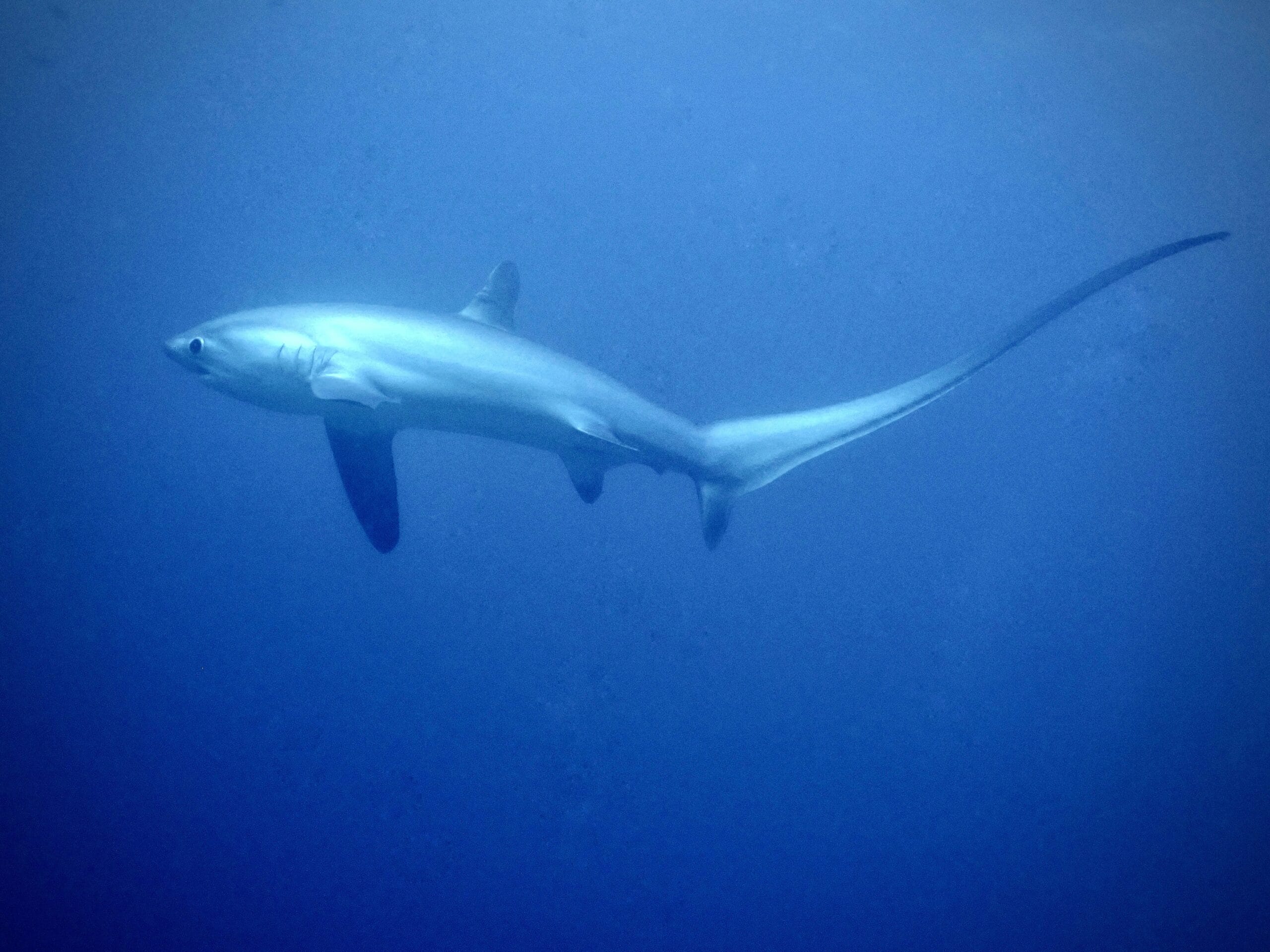
In his peripheral vision the giant fish breached like a seaborn missile. A flash of white and gray, half of it tail, whipping wildly. A thresher shark, which used its gigantic tail like a scythe to stun bait. One of God’s strangest creatures. He had barely registered it, too quick, too distant to accurately discern the size, but it had been roughly as big as the kayak. A ten-foot fish, twelve-foot, an adversary all tail, all torque, leaving a splash like after a depth charge.
The creature back in the water, the line screamed off the reel, nearing the backing, traveling toward the horizon. He palmed the reel to slow the loss of line. The shark could spool him, simply keep going and take all of the line with it. Then He would be left with nothing but half a story and a desperately pumping heart.
He was running out of line. Stop, He thought, turn. He had to turn the fish. If He yanked the rod, or tried to reel, He might break the braid or snap the steel hook. The reel got lighter and lighter, more and more of its metal axle visible. It was down to its nylon backing—lighter line beneath the primary line; that, too, was fleeting.
Then, the miraculous, the point of no return; the line reached its end: a slip knot around the axle in the reel. He shifted his body even lower, as if reclining completely in a beach chair, and held the rod aloft as if preparing to water ski. The force met him in the hands and then in his abdomen, which flexed with the change in tension; the kayak started to move, slowly at first, out to sea, and then quickly. The boat’s smooth plastic bottom had no drag. The bow planed like a skiff.
~
Thrilled, terrified, He held on. The sandy coast grew distant, the water darker again. The crook in the eastern half of the island emerged, its curvature, like the earth viewed from space. He thought of a slippery validation, a triumph back on the beach, a sunset benediction. He thought of a story, his photograph in Newsday. Moron Catches Giant Shark on Kayak. Genius Achieves Waking Dream. But the fish was not slowing. He stayed low, flexing his arms. Craning his head back, He could no longer see any structures on the island. He was losing sight of the shore.
The first run of the great fish began to recede. The kayak slowed, its bow dropping. Its wake disappeared. He now had the leverage to turn the rod vertical and begin to reel, gaining line. He reeled and reeled. The shore was only an impression, a residue of land’s uncanny haze. Any earthly odor, of sand and dirt, diesel and people, had vanished. The sea, when one was truly out in it, had no scent. There was only the stink of fish on his hands and that of dried blood on the kayak’s hard plastic. His striped bass had lost its color, its luminousness. The skin had toughened under the sunlight and the body hardened with rigor mortis.
Still in the fight, He had line back on the reel, not so much bringing the shark to the boat but the boat to the shark, which still swam steadily out to sea. There was enough line out the fish could be two hundred yards away, a hundred feet deep. It was in a dark world in which He could not see. The line’s angle was too tight to the surface to determine the positioning of the fish, or when or if He might see it. Just as He was gaining the advantage, the shark took off again, and He started losing line. If He did not see it He would have nothing.
~
The sun was a pale white disc on the horizon. A blue sky had deepened into the vastness of an autumn evening. His hands were bloody. Oozing blisters on the tops of his palms and on his first row of knuckles. He and the fish were locked in a stalemate at the mid-point of his line; the fisherman too tired to advance, the fish tired, too, but steadily pulling the boat slightly out to sea, upwind at an oblique angle to the island, which He could no longer see. He shifted upright in his seat and began to reel. Slowly, one inch at a time, he gained on the fish. He hadn’t even brought drinking water. That didn’t matter. The offshore sea was now wine-dark. Reaching into his own depths he continued working the crank.
A straight object broke the surface ahead of him, erect, like an empty flagpole extending several feet out of the water. It was the animal’s tail, knocking back and forth like a bullwhip, moving wildly with an alien flagellation. The tail disappeared, and with a burst demonstrated power, taking more line, then it appeared on the surface again. He groaned, shouted into the empty, darkening sky. Reeled and reeled. The fish appeared beneath him, a luminous purple-blue streak in the water column, a tail like the last line of God’s lavish signature. He had not an ounce of strength left. His heart beat wildly, nearly rocking the kayak. A palsy had come over his limbs, which, contorted into the kayak’s footholds, lost all sensation.
He reeled. The great fish arrived alongside the boat. Its tail broke the surface and rose over him: a seven-foot tower of piebald flesh, gray on top with a pink and white underside, thicker than his thigh. A crack sounded in the air as the tail began to move, snapping at the air above him, breaking it with crushing force. He ducked, shielding his head with his arm; with his other he held out the rod to keep the shark close to the boat. Then the tail made devastating contact with his left side, his head and his upper shoulder. Briefly his vision went dark, then blurred into latticed light. The pain came next, a stinging chain reaction down the knuckles of his spine. The shark had struck him with the force of a baseball bat. Another blow might knock him unconscious. The fish sank back into the water. Again, line began to peel from the reel. He opened his eyes again. Let out a scream. The shark was still green. This had been a dress rehearsal.
~
The sun was leaving a pool of orange in the southwestern sky. A sunset provided his last directional clue. Away from it was shore, salvation. He reeled again. The shark was making another approach. Like him, it was exhausted. For miles it had been dragging the kayak. Often, however, a shark surrendered temporarily, due not only to exhaustion, but to curiosity; an apex predator was unaccustomed to being pursued. One had to be careful. It, too, was a god, in the thrall of a comparable force; what pulled the shark to the boat and vice versa was mutual fascination.
The shark broke the surface alongside the kayak, its tail tree-like, bending like a broken frond over him. He dropped his rod to grab a thick bowline, which had a slip-knot ready to lash to the tail. The bottom section of the giant fin was a paddle-shaped knub. He grasped at its sharp edges, but it slipped from him.
The tail whirred in the air above his head with the soupy sound of a ladle mixing something thick. Next to the kayak the shark’s massive body rested half-submerged like a docked submarine. Above him, the tail was a threat—moving so quickly and with such violence that like a helicopter blade it could not be seen—and it would also be one below him, in the water where it had torque; the shark could run again at any moment. He had to secure the tail. He reached again for the lower part of it, around which He could get his rope. The fleshy cartilage found his hands, grasping tightly, and dexterously he brought his loop around the gray appendage.
With his line secured around the base of the tail, He ducked low and pulled with all his weight. The animal countered, flittering beneath the surface, flesh shining. It now had something to pull against. His stomach lurched with disequilibrium; the kayak listed sharply to its port side. He nearly lost balance. Water poured over the gunwale onto the deck. The dead striped bass slid into the water and sank quickly. He adjusted, hanging over the starboard side, locked like Atlas in position beneath the earth, pulling down on the rope lashed to the beast’s tail. Needing every finger, He could not move.
Light remained on the sky’s edges; the last of it reflected milky on the black surface of an alien ocean. He was afraid, he was thrilled. He had not seen the front half of the shark. For a moment he loosened his grip on the rope and pulled on the line to try to bring the animal around. With the tail, it was as long as the kayak, twelve feet or so. His grip was weak; the bowline slipped from his hand, and the tail dropped back into the water, where it swayed, devoid of the power it once had. The shark swam slowly next to the boat. A loose rope trailed behind it. It was back in its element and had regained the advantage, where it could run, starting the process all over again. He did not know whether He had the strength to continue fighting.
With the last of what he did have He pulled on fishing line with his fingers, inch by inch as though drawing blinds, to bring the shark’s head, a dark cone of flesh the size of a fire hydrant, to the gunwale. The skin rippled with iridescent color like abalone. A circle hook was set tenuously in the upper lip. He pulled on the line, and the shark leaned its great head away from him. They were like two heavy columns of an old building which had fallen into each other, whose respective weight was the only thing keeping the other standing. With his free hand He removed the filet knife from the pocket at his breast. An onshore breeze had picked up with the dying light, prevailing, from the southwest. Remember, the island would be downwind.
Listed on its side, the shark leveled its great eye at him, two concentric rings: the thin border of a light one around a dark one, unfathomable in its black depths. This was a creature which did not know life. The white outer ring quivered, growing and shrinking. He peered into the eye like a child looking down into a well. Only his own blackened reflection. His profile in the last of the grim light. The shark had an ambivalent, absurd mouth: a small hole facing downward on the underside of its head. The tail was its real weapon; the mouth was designed only for eating stunned fish. In the crisp air it opened and closed slowly, toothless and enervated, as if trying to speak. He felt the sensation returning to his skin.
Then, a miracle. The last vestige of the sunlight flashed green at the bottom of the horizon and caught in the shark’s eye to reveal a turquoise and purple jewel. The shark’s tapetum lucidum, a deep-sea layer for lightless vision—a mise en abyme, a fractal abyss of gemstone color. The vision was the texture of a hummingbird’s heart, more marvelous than any sunset. He had found it, a portal to a truer world, an opening finally, if He leaned forward, wide enough to fall through. Can you see it? The shark stared back at him, and as quickly as the last daylight had appeared, that beautiful animation was gone, plunging the fisherman into darkness.