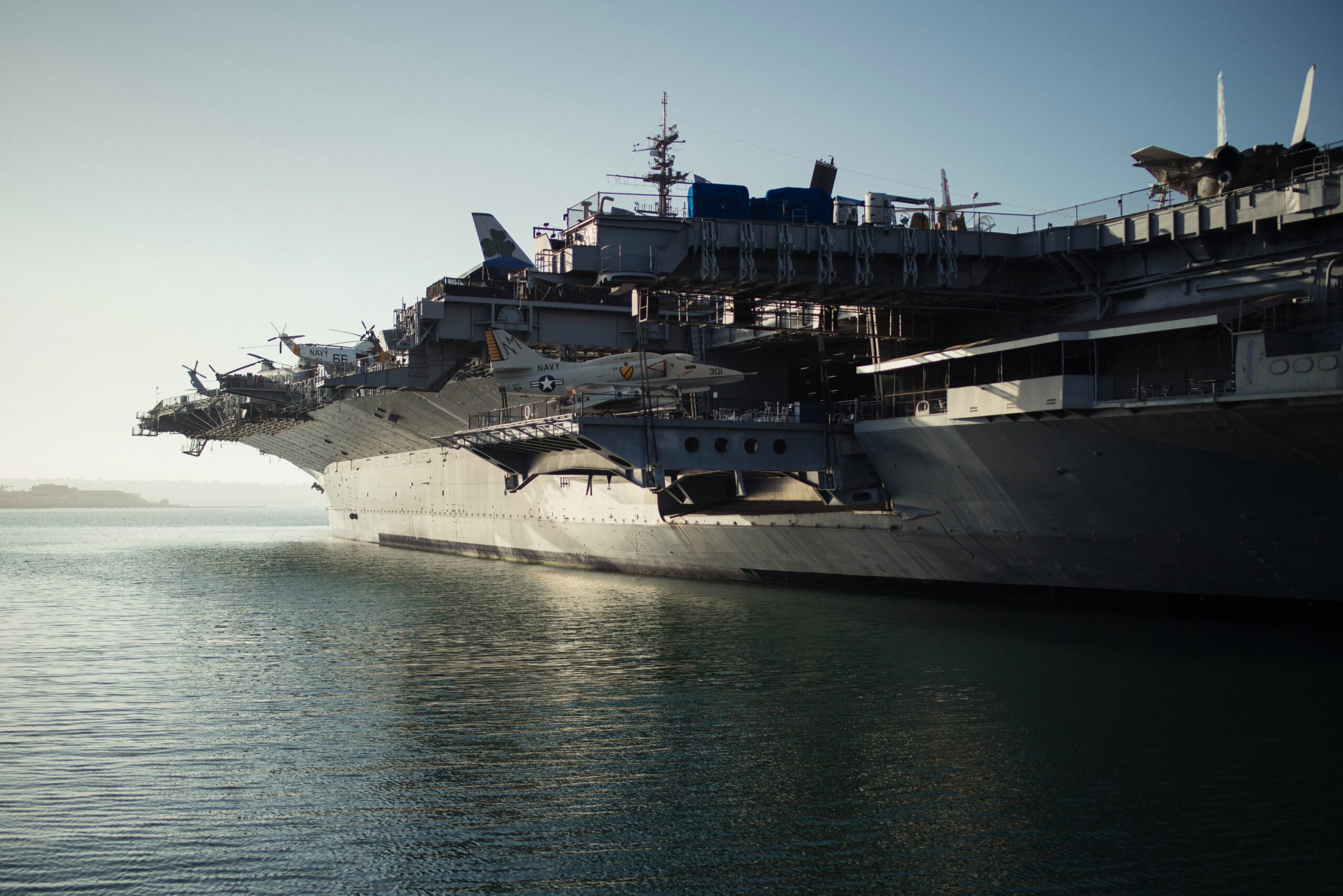
I remember the smell of the plastic blue gym mats under my face as I grappled another Marine in the hanger bay of the USS Boxer. What felt like a youth indoor football field, except grey non-skid instead of turf, two huge accordion sliding doors which opened up to the elevators to take aircraft to the top deck of the ship. In reality, in our day to day the doors just let in all the weather from outside into the bay. Today, the humidity was somewhere between eighty percent and Satan’s asshole and our polyester-blend uniforms did absolutely fuck-all to absorb the sweat—no one even bothered to wear skivvy shirts anymore because all it did was create more laundry.
I was training for my Green Belt in MCMAP (Marine Corps Martial Arts Program). I was a two-year Corporal and had been on leave when our grey belt class was offered, so now I was working back-to-back courses to avoid getting left behind on the Marine Corps standard.
Today, the Staff Sergeant (SSgt) running the program thought it would be funny to pair me with the fat-fuck LCpl. LCpl Cox outweighed me by easily 50 pounds—you were supposed to be partnered with people similar in stature in order to do body weight exercises and carries with your partner. Instead, I had a SSgt with a grudge against me for being the office clerk and not just a “gun bunny” (artilleryman) who decided today was the day he’d screw me over.
We’d been training for about an hour and a half, covered in sweat and face stuck on the mat. My Direct Report came running into the hangar bay and told me that First Sergeant (1stSgt) was looking for me. Having been the Battery Clerk for some time now, this was not an unusual request because my job was to generate reports for him. In fact, I had been training Stueland, my LCpl, to be my replacement, but it seemed he liked spending less time in the Battery Office than I did, and I would frequently get calls from the 1stSgt asking me where the hell his clerks were.
“Did he say what he wanted,” I asked.
Stueland just shook his head and said, “All the Brass are up there though.”
Great. I thought as I walked through the ship. There was nothing like an ass-chewing from everybody. First Sergeant knew I was in MCMAP—he had insisted upon it—so he wouldn’t send for me unless something was wrong.
I walked through the mess hall, down the passageway, up a flight of stairs, and took a right at the exercise bikes. I paused in front of the flimsy, white door of the Battery Office, took a deep breath and entered.
When I opened my mouth to say good morning to 1stSgt, I was eye to eye with Chaps.
Chaps was the Battalion Chaplain, who, in an earlier life was a college football player. He now stood in front of me, large shoulders slumped, fidgeting with his wedding ring as he did when he thought. He looked down and quietly told me to shut the door. A SSgt from beside me slid a chair into the back of my legs.
“Sit, please,” Chaps said. I did. As I sat down it started to dawn on me what was about to happen. It also dawned on me how many men were standing in the smallest company office I’d ever been in.
The Navy provided offices for the Battalion around the ship’s gym. Each infantry company had an office and then all the attachments, like our artillery battery, got the smaller rooms. Inside the small room was my CO, XO, my LT, 1stSgt, my Gunny, Company Gunny, my Platoon Sgt, and HQ Platoon Sgt all off to the sides of the office, and Chaps in front of me on a little metal chair. Ten grown men in a 10×10 room furnished with desks on both sides and two filling cabinets shoving us all into an even smaller, more uncomfortable 8×8 foot space to talk about whatever bad news Chaps was about to lay on me.
That’s when he picked it up off the desk. The red folder. Two things in the military come in red folders: Secret Material and Red Cross messages. Chaps wouldn’t be here to deliver an Intel brief—I may be a Marine, but I’m not a complete fucking moron.
“We received word today that your grandmother passed away.” Chaps said slowly.
“Which one?”
“Uh…” He fumbled the folder open again and looked, “uh…both, I’m afraid.”
“Both.” I repeated. “So, Nancy and Marylynn?”
Chaps looked again, wanting to make sure he got this right.
“Yes, I’m afraid,” he repeated his salve.
“When?”
“Marylynn on the 24th and Nancy…” he checked the record, “The 11th.”
I took it all in for a moment. God love her, but Nancy—my mom’s mom—was kind but in a depressive state for most of my life and we never had much of a relationship.
But Marylynn; she was a third parent. She had my sisters and me over for sleepovers, holiday weekends, and birthdays all the way until we were in our teens. She did all the grandma things: She let us stay up late and watch movies, order pizza, eat too much ice cream, play pool in the basement, and in the winters, would always have my grandpa make a fire for us to roast marshmallows for s’mores.
My sisters and I would read books or magazines, play with new toys, or play Chinese checkers with my grandma in the living room. Grandpa would sit in his chair at the back of the room and Grandma would take her time-outs to have a cigarette and let us continue to play.
She would often tell me I had a beautiful smile. She’d just watch me laugh and play with my sisters, never commenting on if a joke I said was funny or if a story I told was interesting—she had no mind for the substance of our adolescent prattle—but she would stare at us; happy to see our smiles. A form of currency, as a grandparent, to know you’re fostering happy moments in your grandchildren, a confirmation of love.
The last time I can remember her commenting on my smile was when I stopped by my grandparent’s house on my 10-day post bootcamp leave. I had graduated some ten pounds lighter than when I left and, according to her, hadn’t had ten pounds to lose in the first place.
I had worn my uniform to church and then driven over to her house to say hello and check in after being away three months. She smoked her GPCs at the kitchen table and greeted me with a turn of her shoulder and an, “Oooh hiiii,” as I knocked and walked in the door.
“Hi Gram,” I said as though no time passed.
“Look at you! Looking sharp. Say, what a nice uniform.”
“Thanks, Gram.”
“Oh, there you are,” she said as the smile had broken across my face. “So handsome.”
I was hoping the compliments would die down before my grandpa heard and came into the room. He had been in the Army, my dad had been in the Army, they all were in the Army. So, me being in the Marines was a point of needling for my grandpa.
“So those are your dress blues,” he said, entering the kitchen from the living room.
“Yes.”
“Look pretty sharp,” he said with his subtle inflection that let me know he was a little proud.
“But remember,” he changed to a would-be serious tone, “You ain’t shit unless you’re Airborne,” he chuckled.
I laughed and felt at ease knowing I was still just their grandson. I wasn’t a warrior, a devil dog, a hard charger, Jarhead, Killer, Hero, or any other bullshit name given to Marines. I was just a kid.
***
But now I wasn’t at ease. Nor was I laughing or smiling. Nine men avoided eye contact with me. One man, Chaps, who had been like an uncle to me since I moved to this Battalion and started going to church regularly, stumbled through the details, out of love and empathy of course, but nonetheless, there I was sitting like a fool, getting factoids from inside a fishbowl. Alongside men I didn’t want to drink a beer with let alone be completely torn open; none of these men knew me, none of them cared. We’d shared nothing more than pleasantries in two and a half years and now I sat in a cold room, on a metal chair, sweat freezing against my body, as my blood congealed inside me and my mind reeled from the idea that when I do get to finally go home, the woman who had made my family a family was no longer there. No more drawn out “hi’s” when I walked through the door, no more soft hugs, and no more holidays in her house where the petty family squabbles died, because she said so, and we just got to be a family and enjoy the food and decorations she made.
Now, looking up, and seeing them look back at me, that was worse. Everyone looking for me to react, waiting with vacant faces for me to tell them it was okay and that they could go back to their own lives and fuck off about my own issues. My tongue felt fat and heavy in my mouth. My mind was screaming at me to just say something and get out of there.
“Can I… go?” I asked. I felt like a child asking for a snack, but what the hell else was I to say.
“Sure.” Said Chaps, “But before you go…” I felt whatever energy I had that was trying to lift me off my seat, slump back down again.
“Let’s pray quickly”
Fuck. Me. Hard. The thought screaming in my head. Chaps, buddy, as much as I appreciated this gentle gesture, I just needed to leave.
But he prayed. He prayed that they be at peace and other such things. I’m sure it was sweet. He was being so kind. But until he said, Amen, I didn’t hear a word of it. I was biting my lips and repeating, Do. Not. Cry. in my head until he finished.
“Thank you,” I said clumsily after the prayer was over. As I stood up to leave, I finally made real eye contact with my LT and Platoon Sgt who were both nodding their heads slowly in an attempt to be consoling, but only looking stiff and uncomfortable as their weight shifted, brushing against one another. I gave them a nod back and opened the door and closed it with a crack.
I was back into the gym next to the empty exercise bikes, walked forward only a few paces, before my favorite Sgt appeared,
“Did you hear if we were going out tonight?” he said to me.
I didn’t hear him. I didn’t understand the words until later when I was back at my rack with the shades pulled. But at that moment, I reached out to hug him and he hugged me back. And I cried. I cried hard. In total the hug probably lasted 15 seconds. But it felt like an hour. When we separated, he asked me if I was okay. I didn’t respond directly or even to him. I simply straightened up, wiped my tears, and said aloud that I was sorry.
I was sorry I wasn’t with my family. I was sorry for crying on a grown man. I was sorry for getting myself stuck out here in the middle of the ocean, so I couldn’t go home. There was a great deal I was feeling sorry for—not least of which was being there for my grandma. Not holding her hand, sitting in a hospital room, trying to ease the pain by telling her a joke. I have thought many times that, had I been home, maybe I could have made her laugh and maybe even myself laugh, and we would be sharing, “I love you’s,” and making a final memory with laughter.
Or perhaps it could be some other happy cliché I could have on replay inside my memory bank like saying goodnight and turning the lights off for her to pass blissfully in her sleep. But that doesn’t happen in real life. There are no perfect hospital-scene endings. No holding her hand while the music fades and the lights go out. No whispering a final message into her casket.
It’s been fifteen years since then, and I haven’t smiled the same way since. Oh, I can laugh. Some days, I can feel truly happy. But it never seems to feel the same and I find it’s an all-too-common practice to remind myself: Smile. There you are.
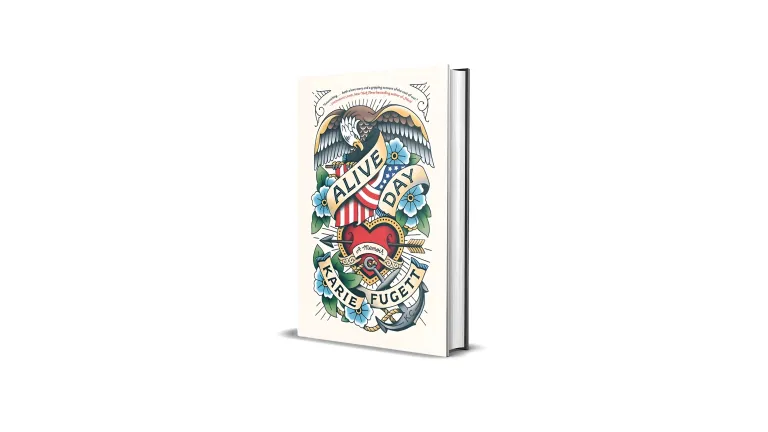
New Nonfiction by Karie Fugett: Excerpt from Alive Day
Dillon crawled in circles on the carpet, the TV behind him glowing with reports of destruction and death. Though it had been only days since the boys left, it felt much longer.
“Three people died in Iraq yesterday,” Brittany said as she watched the news and flipped through a People magazine, her gaze switching from page to screen and back. “I wonder how long it takes them to call the families.”
“How can you watch that shit?” I asked as I passed through the room.
“If I don’t know what’s actually happening, my brain just makes stuff up and that’s always worse. Oh no!” Brittany jumped out of her chair and ran to her son. “That’s not for you, baby boy.” She took a picture frame from his hand, then picked him up over her head to sniff his diaper. She kissed him on the cheek and placed him in his playpen.
“You just haven’t found good enough distractions,” I said. Cleve’s unit had been sent to fight the Battle of Ramadi. It was dangerous: fighting in the streets, virtually no law and order. Cleve called it the most hostile place in Iraq. His unit’s job was to secure the city center, and it was very likely that someone would die or be wounded. “Cannon fodder,” I once heard someone call units like Cleve’s. The units that were young. Uneducated. Replaceable. Expendable. The idea that these men were simply pawns, meant only to put a barrier between the enemy and the higher-ranking Marines who were considered more valuable, made me sick. I was starting to wonder if this had been part of our country’s plan all along: let poor people struggle to survive so that when the time comes, they can be lured into the military by the promise of food and healthcare and shelter in exchange for using their bodies to protect the rich and powerful.
Watching the news was like watching the sun set: the result was inevitable. Someone in Cleve’s unit was going to get hurt. Someone would die. The news reported seven service members had died in Iraq since the day our husbands deployed. I knew because Brittany was keeping me updated. Watching all the world’s pain and suffering on a tiny screen from the safety of my home has always been difficult for me, a reminder of how small I am, of how little power I have. There was nothing I could do about any of it. If something was going to happen to Cleve, something was going to happen to Cleve. For my own sanity, I needed to focus on things I could control.
I sat down at the computer Brittany kept in her bedroom and wiggled the mouse. The screen came to life. Firefox still had all the tabs I’d pulled up the day before: Monster.com, Coastal Carolina Community College, a list of things to do in the area. I had even looked up guitar lessons. I’d wanted to learn to play since childhood. Lessons were too expensive, but a girl could dream.
“How are those distractions working out for you?” Brittany asked that night with a smirk on her face. She was sitting across the dining room table from me, eating a bowl of macaroni and cheese. Brittany had tried to avoid thinking about the war during her husband’s first deployment, but it didn’t work. She wasn’t convinced I’d be any more successful at it than she’d been.
“Shut up,” I said. “How long before they can contact us, though, for real?”
“Last time, it was sometime in the second week. They’ll probably have computers. I’m not sure if they’ll have Myspace, but they had AIM last time.”
While I waited, I wrote Cleve letters. I mailed him a letter every day so that once they started arriving, he’d have something each night to cheer him up. I printed off pictures of him and placed them around my room, including one under my pillow. At night, I would pull it out and stare at it, wondering where he was, what he was doing, and if he was okay. Boredom and loneliness have a way of making time stretch. Com- bine the two, and you might be stuck in a single moment forever. This deployment had only just begun, and it already felt unbearable. On the fifth day, he finally called.
“It’s not pretty out here,” he said. “I sure miss those pretty eyes of yours.”
“I miss you, too. Are you okay?” I could hear voices in the background.
There was a long pause before he answered. “Yeah, I’m fine. Y’all doin’ all right?”
“Yeah. I think there’s a lag. Something’s wonky. Our power got turned off a couple days ago, but we—”
“Yeah. It’s always like that,” he interrupted. “Ah. That sucks.”
“What, your power was turned off?” he said.
“The lag is so annoying.” I laughed uncomfortably. “But yeah, the power’s fine now. We figured it out.”
There was another long pause, then Cleve said, “Okay, good. We’ll get paid soon. It’ll be more ’cause I’m deployed. Help Brittany with bills or whatever you need.” He’d given me access to his bank account before he left, and because we chose not to live in on-base housing, he had some extra money from getting married that he insisted I use while he was gone. We’d talk about money again when he got back.
I waited a second until I was sure he was done.
“Thanks, babe. I applied to a bunch of jobs, too. I also applied to the dental hygiene program. Then I’ll be the moneymaker taking care of you.”
Pause. “You goin’ to be my sugar mama?” Pause. “I can be your sugar mama.”
Pause. “Hey. Gotta run,” he said. “I love you. I’ll try to call ev . . .” “Oh, okay. I . . . damn it, this lag. I love you, too.”
Pause. Cleve laughed. “Bye, baby.”
Cleve called every day at first, sometimes multiple times a day, and he always seemed relieved when I answered. I learned to keep my phone on me so I didn’t miss him. When I slept, my cellphone sat next to my pillow with the volume turned all the way up. By the end of the second week, Cleve called less, and when he did, he didn’t say much.
“I’m just busy s’all,” he said when he called for the first time in four days. I’d asked him if anything was wrong. His answer made sense—of course he was busy—but it didn’t explain the shift in tone. There was a heaviness I couldn’t pinpoint. Something was being left unsaid. He’s at war, I told myself. 7is isn’t about you. But I couldn’t help feeling like something else was going on. The way we’d gotten married left me feeling insecure. I’d wondered from the moment he proposed whether he’d felt obligated to do it because I was living in my car. I wondered if he regretted making such a huge decision so hastily. I heard an explosion in the background, but he didn’t react.
“Well, I love you,” I said, and he said it back. “When will you call again?”
“I dunno,” he said, and that was that.
When I told Brittany I was feeling insecure, she was careful but honest.
“You need to take care of you,” she said. We were drinking beers on her bed. We’d just put Dillon to sleep. “I know him, and he’s going to take care of himself.”
When I asked her what she meant, she shrugged and shook her head. “I didn’t expect to be close to both of you. I just want you both to be happy.”
Brittany and I had become inseparable in the few months since we’d met. We did everything together. We did each other’s laundry. We cooked each other food. We cried and laughed together almost every night over bottles of wine. She was the closest friend I’d had in years. But despite our budding relationship, she’d known Cleve longer than me. She was conflicted about who she should be most loyal to.
“I need you to promise me you won’t say anything to him,” Brittany said quietly.
“I won’t,” I promised.
“Well, you aren’t the first girl he’s brought here.” “What do you mean?” My heart was starting to race.
She sighed and took a swig of her beer. “He proposed to his ex like six months before you two got together. She said no and they broke up, or maybe they weren’t even actually together, the story changed a few times, but I’m pretty sure they keep in touch. That’s all I know for sure,” Brittany said. She exhaled. “You okay?”
When I tried to respond, I just cried. Cleve hadn’t mentioned this ex before, even though he’d asked her to marry him not long before he messaged me on Myspace. I was already afraid he’d only wanted to marry me because he felt bad that I was living in my car, and now I wondered if he was looking for any wife at all to get the extra benefits from the military. I wondered if he even loved me. Was I just a rebound? “I know he loves you. It’s not that,” Brittany said. “I don’t know what
it is, really. He’s just . . . Kinsey. You know how guys are.”
I knew how guys were. I thought about the twenty-year-old who took my virginity when I was sixteen; the shadowy figure who molested me when I was six; the Tampa men; the married pilots who were always trying to hook up with the young flight attendants. Now Cleve was keeping secrets from me, possibly even using me as a rebound. What is this game I’m playing? I wondered. Whereistherulebook?
“What do I do?” I asked, but I already knew what I would do if I had to.
I could feel the instinct I’d learned from my parents kicking in: I wanted to run. I was already going over escape plans in my mind before Brittany could answer. But I didn’t have a lot of options. Cleve was financially supporting me until I could find a job.
“I don’t know,” she said. “But I’ll help no matter what you decide.” Two days later, the phone rang. When I picked up, silence. “Hellooo?” I said a second time.
“I just don’t know what I’m doin’ in this life anymore,” Cleve said finally.
A knot grew in my chest. It was happening, I thought. He could have been talking about anything, but I knew in my gut he was gearing up to say getting married had been a mistake. He’d been so quiet with me, and now the news about his ex. Something just wasn’t right. Unsure of how to respond, I waited to see if he’d say anything else. When he didn’t, I asked if he was okay.
“Some days I feel like this is it, ya know? Like, maybe I’m not comin’ back this time. This is my destiny or some shit,” he said.
That was not what I’d expected. I’d been so distracted by what Brittany had told me and by how quiet he’d been that I almost forgot where he was. I grappled with asking about the other girl. Who is she? Do you call her, too? I wanted answers, but I decided to wait. He needed me to comfort him.
“Please don’t say that,” I said. “Just get through the next few months. Then you’ll be home with me, and this will be behind you. I’ll take care of you,” I said. “I love you.”
“Thanks,” he said. “I’m just all in my head. It’s fucked-up out here.” “What can I do?” I asked.
“Just somethin’ I have to deal with on my own,” he said. There was a prolonged pause and a deep sigh, and then, “I don’t think I can keep doin’ this relationship.”
There it was. So quiet. A whisper, almost. Infuriatingly quick and straightforward.
“What do you mean?” I asked. “Please don’t say that.”
“We shouldn’t have gotten married, Karie,” he said. “I messed up.”
I begged him to take it back. It was the war, I tried to convince him, something in that hot, foreign place, something temporary that was clouding his judgment.
I pleaded. I begged. All he could say was sorry. I cried into the phone for too long, then heard a sigh and a click. I spent the rest of the day in bed, crying and cursing at pictures of him. What was it about me that made me so easy to leave?
When I woke up the next morning, I decided I wouldn’t let the sadness
keep me from being productive. If there was one thing I’d learned from moving so frequently as a child, it was how to adapt quickly. I pulled myself together and began planning my next move. Brittany said I could live with her no matter what happened with Cleve, and I was grateful. I had some interviews lined up, and to my surprise, I’d been accepted to the dental hygiene program at the local community college. The plan seemed solid. I could breathe now.
“What a mess,” Brittany said one night as we sat on our back porch, drinking wine and smoking cigarettes. “The boys changed in Iraq last time. Who knows what will happen with Nick and me.” Nick was Carson’s first name. Everyone except for spouses called the guys by their last names. Brittany shook her head, rolled her eyes, and took a sip of wine. “He hardly even pays attention to his son. It’s probably because I had him when he was deployed. There’s no connection there. Nick left when I didn’t look pregnant at all, then boom, he comes back to a baby screaming in the back room.”
“I’m sorry,” I said. I’d gotten the sense that she felt stuck. I knew what that was like. I had felt that way for most of my life. “I’m glad we found each other.”
She raised her wineglass. “It’s hard not to be bitter sometimes. I was dragged out here for love, then left in the dust of war.” She took a drag of her cigarette. “You know Nick and I met in high school? He chased me. I kept saying no, but finally I gave in. I fell hard after that. Life is crazy. Now it’s two years later, I have a baby, and I’m the one waiting.” I thought about Brittany—the way her shoulders slumped, the way her hair hung stick-straight at her shoulders, her calming voice, her half
smile. She was only twenty years old and already so tired, so resigned. “You think this is a phase?” I asked. “Maybe they’ll go back to nor-
mal after they get out?”
She shook her head, her hair glowing the color of wheat under the porch light, june bugs winding in the air and slamming their bodies into the sliding glass door as if they’d been drinking, too—clink,clink... clink.
“Who knows? The best thing we can do is look out for ourselves and each other and hope they get their shit together.”
I nodded. “Cheers to that.”
Cleve called back, apologizing. He still wouldn’t promise anything about the future of our marriage, but he did say he loved me. There was a lot of silence, then he said, “Burns shot himself in a porta-john yesterday.”
Suddenly the space between us seemed infinite. “My God. Cleve. I’m sorry.” I felt like such an asshole for acting like my own issues were life-or-death when he was across the world fighting a war. “I wish I could hug you.”
“I . . .” he gasped. “I had to clean out his fuckin’ body. I had to put him in a . . . I had to put him in a fuckin’ body bag,” he sobbed.
Helplessly, I listened as Cleve’s sobs turned to wet, heavy breaths, then to silence. And then he had to go.
Cleve was a big dude: six foot three and 225 pounds. I’m not sure I had ever seen a man cry, so it was difficult for me to imagine his eyes producing tears, his large male body heaving as he fought to catch his breath.
Over the next three days, Cleve called at least twice daily, always ending with I love you. This time, I tried not to overanalyze the conversations despite my insecurities. Meanwhile, Brittany and I made care packages for Cleve and Carson. We filled two boxes with snacks, socks, drinks, and anything else we could think of that might cheer them up, including Listerine bottles filled with whiskey.
“Military wives’ trick,” Brittany said. “You don’t think someone’ll notice?” “They didn’t last time . . .”
It was April Fools’ Day when I got a message on Myspace from Cleve’s brother, Nathan. He was the only person in his family who knew Cleve and I had gotten married, but we rarely spoke, so I knew something was up. The message was quick and to the point: Cleve’s hurt. if you don’t know, call me.
The nausea was immediate. I yelled for Brittany to come as I dialed the same number I’d memorized in high school. She pushed the door open with Dillon on her hip.
“What’s going on?”
The phone was still ringing. I put my hand over it and whispered, “Cleve’s hurt.”
“Oh my God! Hurt hurt or is he . . .”
I waved my hand at Brittany and mouthed, Holdon!Holdon! Someone was picking up the phone. It was Nathan, thank God, but he didn’t have much information. The military was looking for me because I hadn’t had an address or phone number to give them when we submitted paperwork for my military ID. Cleve was alive, but his foot was hurt bad enough that he might lose it. A bomb, Nathan thought. While his parents were mostly scared for their son, they were also upset about the marriage. They had only found out about it when the Marine liaison called them trying to find me. They didn’t want to talk to me. I was okay with that.
I stayed up through the night smoking cigarettes and telling stories about Cleve with Brittany as if he’d died. The military liaison officer called me the next day. He didn’t give me much information. He confirmed Cleve was alive and well. An improvised explosive device had hit his Humvee, and his foot was severely injured. He was in Germany, getting ready to be flown to the States. He’d be at Bethesda Naval Hospital in less than twenty-four hours. He gave me an address and a phone number.
“Is there anything else I should know?” I asked. “Sorry, ma’am, that’s all the information I have.” “Will I have a place to stay in Bethesda?”
“Yes, ma’am. Someone will meet you at the hospital with all that information.”
“And I just call that number when I know I’m coming?”
“Yes, ma’am, so they can meet you. We have someone there all hours.”
“Well.” I paused to be certain I had no more questions, biting at my thumb’s cuticle as I thought. I couldn’t think of any. “Okay, then. Thanks so much.”
“Very welcome.”
I closed my phone, tucked it into my back pocket, turned to Brittany, and shrugged. She’d been standing next to me, listening to the phone call.
“That’s it?” she said. “Thaaaat’s it.”
“It’s really just his foot?”
“I guess so? I’m not sure that guy really knew what happened.
Sounded like he was passing on info from a piece of paper.” “Damn. This is crazy town.”
“Right? Cleve was hit by a bomb. At war. After only three weeks. I mean . . .” I shook my head, mouth agape.
“Well, I can drive you so you don’t have to fly,” she said. “I want to see him, anyway.”
“Can I hug you?” I asked.
She looked at me like, Well,obviously, and opened her arms.
Cleve called during our drive to Maryland. It was quick. He’d been flown from Ramadi to Baghdad, then Baghdad to Germany. In Germany, doctors performed surgery on his leg to stabilize him for the flight back to the States. He said he’d be in Maryland a few hours before me.
“I’m okay,” he said. “They got me, but I’m okay. I love you.”
That should have confirmed that he expected and wanted me to come be with him, but I couldn’t shake the words Ican’tdothisanymore. I wondered whether he felt obligated to call: wounded men are supposed to call their wives. It didn’t matter now. Whether he liked it or not, I was coming. I’m gonna love the shit out of you until you love me back, I thought.
Brittany and I arrived at Bethesda Naval Hospital sometime after midnight. The hospital was asleep except for the liaison officer who waited for us, his office a fluorescent sore in an otherwise low-lit and shadowy space. I was delirious from lack of sleep, too many energy drinks, and the anticipation of seeing Cleve again. The liaison officer— who introduced himself as Addair—was just a little older than me, in his early to mid-twenties. He was tall and thin with piercing hazel eyes, a sarcastic attitude, and a subtle limp. I wondered if he always worked in the middle of the night or if he was only there for me. He handed me a stack of paperwork to fill out. I’d had a headache for hours now, and the brightness of the paper, the tiny words covering each page, made me feel like my head might pop. Brittany sat patiently in the corner, holding Dillon, who’d fallen asleep on the ride over.
“What’s all this for?” I asked, gesturing to the forms.
“Just some red tape,” he said. “Non-medical attendant pay, info we’ll give to the Navy Lodge where you’ll be staying, stuff like that.”
The military would pay one non-medical attendant, or a primary caregiver, just under two thousand dollars a month as long as the patient had to be away from their duty station (in our case, Camp Lejeune) while receiving treatment. I got stuck on the word month. The dental hygiene program started in four months. I wondered for a moment if I’d still be able to go, then shooed the thought away. Cleve.I’vegottoget to Cleve.
When I finished, Addair told us the baby wasn’t allowed in Cleve’s room. Because he’d just gotten back from Iraq, he could be contaminated with who knows what, and it wasn’t safe.
“I don’t mind waiting,” Brittany said. She kissed Dillon on the head. “As long as he’s asleep, I’m fine.”
Though I hadn’t known Brittany long, she’d shown me a kind of friendship—one of kindness, patience, and selflessness—that I hadn’t found in many people before. I put my hand on her shoulder, careful not to wake Dillon. “Thank you. Seriously.”
Addair’s and my footsteps echoed in the hospital lobby as we made our way to the elevator. When we reached Cleve’s room, Addair instructed me to put on a yellow paper gown, a mask, and gloves. I opened the door. A lamp in the far corner draped the room in soft light. Cleve was in the bed closest to the door. At first, I thought he was asleep. I was afraid to walk toward him, afraid of what he would say when he realized I was there. But then, he moved. His eyes opened, and he turned to look at me. For a split second, his face was blank, and I swore he was mad and would tell me to leave. But then, he smiled.
“There she is.” He reached out his good arm—the other had been hit by shrapnel and was being held by a giant piece of foam that looked like Swiss cheese—for a hug, and my uncertainty melted away. “Come here. I missed those freckles of yours.”
I walked over to him and kissed him on the forehead. “What the hell did you let them do to you? I told you to be safe,” I said.
He looked down at his leg. “War takes what it wants, I guess. I was just along for the ride.”
It was apparent he was high on pain meds. His movements were a little too fluid, his words slurred.
“Can I see it?”
“Sure. They got me good,” he said, lifting the sheet from his left leg. It looked like something you might find at a butcher shop, a large chunk of bloody meat wrapped in what looked like cellophane. I gasped.
“They said your foot. That’s your whole damn leg.”
“Oh, yeah. The whole damn thing. They put rods in my thigh before I left Germany. The bottom half ’s goin’ to take a little more time to figure out, but they said I should keep it.”
Addair walked into the room.
“I hate to break this reunion up, but it’s well past curfew, and I need to get you and your friend checked in to your hotel room. Visiting hours start at eight in the morning. You can continue catching up then.” “Aw, come on, Addair. You can’t give a broken man some time with
his wife?” Cleve said.
I smiled.
“Trust me, you’ll have plenty of time together in the next few months,” Addair said. There was that word again. Months.
“Will we be going back at all before then? Are people usually here that long?” I asked.
“It depends on the injury,” he said. He looked at Cleve and made a clicking noise with his tongue. “I’m no doctor, but I’d get comfortable if I were you.”
I sighed. I would have to forget about college, at least for now. “Okay,” I said, nodding. “I’ll get comfortable, then.”
As Addair left the room, he tapped his hand on the wall and said, “Happy Alive Day, man,” over his shoulder. Later, Cleve would tell me that every wounded service member celebrated what they called an alive day. It was the day they almost died at war but survived—the day they were given a second chance. I wondered what Cleve’s alive day meant for me.
New Nonfiction by Matt Eidson: Binge
The trails in Coopers Rock State Park range from wide and flat to narrow and steep. My eyes scan the path just in front of me to make sure the ground is clear of any tripping hazards. I’m four laps into a five-lap race, a 50k put on by the Robin Ames Foundation. And as it stands right now, I’m not just winning the race, I’m on pace to break the course record.
It’s late October, a beautiful time to be outside in West Virginia. Massive moss-covered boulders surround the winding dirt path. The trees are somewhere between green and brown and yellow and red. Fog lingers, reflecting the sunlight and keeping the air cool and thick. I almost never look around and enjoy scenes like this when I’m racing because my mind is totally committed to the task at hand. Have I eaten enough calories this hour? Should I stop and change into dry socks? Have I been drinking enough electrolytes and water? Am I maintaining my pace? There are so many things to consider that by the time I think to look beyond the two or three feet in front of me, I’ve run another five miles.
The fact that I hardly ever stop to admire the scenery makes me wonder why I’m so drawn to long runs in pretty areas. I’ve spent hundreds of dollars registering for races across the country—races in National Parks, races along massive rivers, races that loop around mountains. For the most part, I don’t remember any of the scenery because I was too busy looking at the ground right in front of me.
I’ve heard other ultrarunners talk about how grateful they are that their bodies can do things like this—propel them along beautiful trails through remarkable scenery. I sometimes hear them chatting with each other after the race, talking about views they stopped to photograph with their phones. They show off the photos and describe an overwhelming sense of clarity found on the trail—one that brought them to laughter, and then tears, all in a matter of minutes. I can understand feeling grateful for the opportunity to exist in these beautiful areas, even if I don’t stop to take photos of the scenery. But I’m not sure I’ve ever felt grateful for my body.
I’ve always been critical of it, though.
Every ounce of fat and every acne scar and duck-footed step is logged in my mind. My critiquing of my body is constant, but it does die down a bit when I’m out on the trail. Again, probably because I’m too busy looking at the path in front of me.
In Coopers Rock State Park, I bound from spot to spot on the way down a massive hill, taking care to avoid the rocks and roots trying to trip me. I reach the bottom of the incline and suddenly I’m running on a flat piece of trail next to a creek. I let myself look up and admire the woods around me. It’s taken me a really, really long time, but I think I’m finally starting to see what all those other runners are talking about.
It all started at the dinner table when I was nine years old. My mom,dad, and sister had just finished dinner. My parents told my sister to go play. They told me to stay.
We need to talk to you, they said. They sat side-by-side and put their arms on the table and cupped their hands together in unison.
Your dad isn’t your real dad, my mom told me.
My dad, “Ron” now, kept his eyes down. I looked down at the floor too. I don’t remember why, exactly. I might have felt ashamed. I might also have wanted to mirror Ron, as if to say “No, you’re wrong, he’s definitely my dad, look at how we’re both looking at the floor at the same time.”
Ron would like to adopt you so you could have his last name, my mom said. I looked up to see my mom staring straight at me. Ron was still staring at the floor.
I thought “Eidson” was my last name already.
Would you like that? Would you like it if Ron adopted you and gave you his last name?
I picked at the bits of food still on my plate and took them up on the offer. It was the only name I’d ever known, after all. Somewhere in my little brain, “food” and “comfort” latched onto one another gently. Over the years the bond would grow stronger, more entrenched. There would come a time when I wouldn’t be able to distinguish between physical hunger and emotional hunger. There would come a time when I’d have to stop and listen to hear if my stomach was growling, so I could determine whether or not I needed that extra slice of pizza.
The evolution didn’t happen overnight. It was slow and subtle. An extra cookie here, another plateful there. My body grew taller and wider. At nine years old I was skinny—a string bean, a noodle. By the time I got to Junior High, I was obese.
The 50k race is a 10k-distance loop repeated five times. Each loop is roughly 6.2 miles and has about 687 feet of elevation gain. The main climb, the last few miles before you reach the start/finish line, has an average grade of 3.4 percent and 429 feet of gain. After completing four loops, my body is screaming at me. One more lap, I tell it. Suck it up, we got this. I look down at the path and focus and get to work.
The first few miles of the loop follow a well-maintained trail that runs alongside the main road into the park. I pass a couple aid stations where friendly volunteers offer high-fives and water and snacks, like bananas and oranges. They recognize me by now and yell out encouragement: keep it up and you’re CRUSHING it and great job man. Eventually the course hangs a hard left and starts a slight decline deeper into the park. The trail seems to never let you fully embrace a long incline or decline; it wavers back and forth mile after mile. At least it’s a well-marked path, which isn’t rare exactly, but it’s not a given.
During my first 50k, in Minnesota, one other runner and I found ourselves ahead of the pack, but due to a bad trail marking, we ended up running two miles in the wrong direction. We went from first and second to seventh and eighth. When we realized the mistake, we had opposite reactions. He slowed down, changing from the “I could win this thing” mindset to the “just finishing would be cool” mindset. I got pissed off and knuckled down. I pushed my body, keeping my eyes on the trail just ahead of me, ignoring the aid stations and refusing to eat for the entire 33-or-so miles of the race, and only stopping for water once or twice. I ended up in third place. For the next two weeks, I could barely walk, let alone run.
When you do the math and drop the two extra miles I ran, I could have taken first. I think about that often. Not for egotistical reasons though. I think about it because on that Minnesota run, for the first time, I realized my body was more than a decoration for praise and admiration. It was also capable of doing incredible things. Years later, running in Coopers Rock and about to take first, I don’t mind the mistake I made years ago. I embrace it; it lit a fire in me.
I first shoved my index finger down my throat when I was a teenager. This was after my best friend, Jake, joined the wrestling team and lost a bunch of weight. Before he got rid of his love handles and gut and the extra-puffy skin below his jawline, we used to joke about our fatness. We owned it. We were fat, sure, but we were funnier than all the fit boys. That was why they kept us around, because we were so funny. Or Jake was funny, anyway. And I was Jake’s best friend. So, I could hang around too.
We still played football like all the other boys in our tiny hometown. Most of the kids seemed to love it. To me though, it felt like a requirement. In my mind, Jake and I stood just outside the typical high school experience. We accepted that things like sex and love were not afforded to us in our small town. We were the jesters, the comedic relief. We were the chubby, goofy, acne-scared teenagers who made the fit and smart boys laugh alongside their girlfriends. We couldn’t earn attention with our bodies, so we did it with our jokes.
In college we would shine, though. That’s how I imagined it, anyway. But then Jake and I got busy and didn’t talk to each other for a few months. The next time I saw him, he was skinny and dating a beautiful girl from one town over. I was still fat and alone.
Soon after I saw Jake’s skinny body, I binged more food more quickly than I ever had before (and I’d binged plenty of times). I snuck upstairs, went into the pantry, and took two of everything—Pop Tarts and Chewy Granola Bars and Ding Dongs and Little Debbie Brownies and those sugary little cakes in the shape of Christmas trees. I washed down thousands of calories with Dr. Pepper and pinched the fat rolls on my stomach harder with every bite, imagining a smaller body. I was a nice kid, I reasoned. A good kid. I didn’t have the best grades, and I wasn’t good at football, and I didn’t enjoy hunting or working on cars. But I didn’t deserve this body, this appendage latched to a brain that only had space for movies and pop punk music.
I don’t know if I cried in my room that night. But I do know that something in me snapped. I snuck back upstairs and locked the bathroom door behind me. Kneeling in front of the toilet in my boxers, I shoved my finger into my mouth. My fingernail scraped the back of my throat, drawing blood. The muscles in my throat lurched and throbbed and tried to push my finger away. I didn’t budge. My stomach turned over and promised me it would rid itself of the garbage inside. I pulled my finger out just as thousands of calories launched into the toilet. I cried and puked, snot pouring from my nose. I emptied my stomach until hot, black stomach bile had thoroughly acid-washed my tastebuds. I flushed the toilet and wiped my face. For probably the first time in my life, I felt I was in control.
Months passed and I ate only what I needed to survive. Like Jake, I joined the wrestling team. Each practice started with a 30-minute run. I would shuffle up and down the hallways leading to the high school gymnasium, bent over and sweaty and breathing heavy, while all the skinny fit boys flew by me, their backs straight while they talked and laughed with each other. I learned not to make eye contact. Something about the lack of effort or concern in their eyes rubbed me the wrong way. I’d keep my head down and keep my eyes to the ground.
I wasn’t good at wrestling, but I was good at losing weight. And losing matches. Still, I found that losing weight brought me things I’d never had much of before: attention, compliments, praise. The smaller my body got, the more people could see me.
I became addicted.
More months passed and the number on the scale crept lower. I started at 240 pounds and gradually dropped to 215. Then 200. Then 190. Eventually I was wrestling and losing matches at 189. By the time the season ended, I was as skinny as I’d ever been. And I had a real girlfriend for the first time. I still didn’t love running, but I understood it as a thing to give me the body and praise I craved. I could keep up with the skinny boys during our 30-minute run. I could even beat them sometimes. I learned that if I starved myself until an hour or so before practice, I’d have just enough energy to run with the fit kids.
Running wasn’t just a way to earn attention with a smaller body, it was a way to earn attention through action. Plus, I didn’t have to try to be funny all the time.
Years later, I decided to kick off the 50k in the Coopers Rock State Park differently than any race I’d ever run. On a fun little trail race a month before—the Run Wild 20-Miler in Barboursville, West Virginia—I figured out that a strength of mine was maintaining a consistent and quick pace for long periods, no matter how tired or worn out I felt. For the Coopers Rock 50k, my plan was to push as hard as I could for the first half lap and then settle into a steady pace, the idea being that I’d destroy any chance the other runners might have in overtaking me.
I took off faster than usual. But there was a wrinkle in the plan right away—someone else seemed to have the same goal.
I took off at a fast-for-me clip of 7:20-7:30 pace per mile, hoping I’d be propelled right to the front. Instead, I found myself in the dust of a young woman who was easily running 6:50-7:00 PPM. She was booking it. Seeing my chance at finally winning a race slip through my fingers, I quickly considered my options.
Her pace—my pace, even—was not sustainable for a 50k. Not unless you’re an elite runner with sponsors. The chances were good that she’d have to slow down eventually. And while I couldn’t match her pace on flat ground, I knew I could at least keep her in eyesight. Then, when we hit an incline, I’d break out another ability I discovered at the Run Wild 20-Miler—I’d run, not hike, the inclines.
Most runners choose to conserve their energy and start hiking when the grade shoots up. I figured out that I could overtake a lot of runners by fighting that urge. No matter how worn out I was when I reached the top, I could will myself to keep running.
When we hit the first incline in Coopers Rock, I made my move and sped up when the young woman began hiking. I overtook her. I ran all the way to the top and then kept running. I’d pulled it off. I had a little celebration in my head and then settled back into my 7:20-7:30 PPM. But I couldn’t enjoy the victory for long. The next thing I knew, the young woman was right on my tail.
In trail running, the paths are usually narrow. Passing another runner can be tricky. But one of my favorite aspects of trail running is the comradery and respect. Yes, we’re competitive, but we’re not assholes. Any trail runner in my position could easily keep their pace and block the path. But to the vast majority of trail runners—every runner I’ve ever met—that thought wouldn’t even occur. As the young woman caught back up to me, it didn’t occur to me either. I side-stepped off the trail and let her pass. Thanks, she said. Good work, I replied.
For the next couple miles, longer than I planned, I fought like hell to keep the young woman in sight, hoping she’d get tired and slow down. Sometimes I’d pass her, but then she’d quickly pass me. We were both getting tired. I got the feeling, though, that she, like me, would rather pass out on the trail than lose the friendly back-and-forth. I could also tell she was more experienced than me. So, I did the math—I had meant to go faster than usual, for longer than usual, but not like this. This young woman, whoever she was, had whooped my ass as far as I was concerned. I started to settle back into the pace I had originally planned. Good work, I thought, as I watched her widen the gap between us. Then I realized something: This young woman wasn’t wearing a pack. Which meant she wasn’t carrying snacks and electrolytes and water. If you’re running the full distance, that’s not sustainable. (Not to most, anyway.) Was she just a total badass, more than I already commended her for, or was she…
Shit, I thought. She’s part of a relay team.
Part of the Robin Ames Foundation 50k was a 50k relay. In other words, you and however many friends you wanted to bring along could split the distance and run sections individually. This young woman was basically sprinting the first 6.2-mile loop because that was likely all she had planned for the day. I had nearly exhausted myself on the first of five loops trying to overtake someone I wasn’t even competing against.
I laughed quietly to myself. You dork, I thought. Calm down and run your race. As the young woman left my eyesight, still going strong, I grinned and shook my head. “Goddamn,” I said out loud. “Good work.”
Toward the end of my junior year in high school, I began to receive compliments and praise from women other than my girlfriend. My body was smaller, trim, tan. It garnered attention like a delicate ornament on a Christmas tree. I broke up with my girlfriend and began binging sex and love.
Somewhere along the line, “sex” and “intimacy” unlinked in my head. Sex was a performance, a chance to show off the body I’d beaten and starved. Intimacy required feeling vulnerable in front of another person. The last time I had felt vulnerable in front of other people was at nine years old at a dinner table. And in that moment, food had been the comfort. Not people.
I didn’t need intimacy; I learned how to replace that. Sex, on the other hand, was hard-earned validation, a compliment to my body.
The routine was to go on a date or two with someone new, have sex, and feel like everything was going just fine. It lasted for years—from high school to well into my thirties. At 36 I met a pretty stranger at a brewery with two shots already in me. She was nervous and sweet. She wore a long, flowery skirt and a black tank top. Her hair had streaks of gray because she’d decided to embrace it, not try to hide it with color. I liked that about her. We hit it off right away. We talked about music and the difference between a lager and an ale and what’s actually at the center of a black hole. We watched people sing karaoke. I told her my song would be Taking Back Sunday’s Cute Without The ‘E’ and she tried to get me to sing it and I said I didn’t like the stage. We had sex that night and made plans to hang out again soon. But as the second date got closer, staying the path got harder.
As with many women, I started to feel nervous or stressed or upset about something. The second I start getting nervous or stressed or upset, I crave food. Sugar in particular. I knew I’d fight the urge but eventually lose, binging thousands of calories in minutes. Then I’d be ashamed of myself, my lack of will, my body. Then I’d punish myself. Sometimes by eating until my stomach was so full I would throw up, sometimes by punching or slapping myself across the face, sometimes by adding miles to my run the next day. But always, always by canceling the date I had planned.
The last third of the loop at Cooper’s Rock, the incline is brutal. Rocks and roots and slippery logs cover the path. I jump carefully. The last thing I need is to land on a slippery log and face-dive into the ground. Eventually I reach what will become my favorite section of the race: Rock City.
Out of nowhere, a sign points downward from the dirt path to a narrow passage that can best be described as a crevasse, with steep rock walls on either side. The trail drops 30-40 feet, widening out to three yards at most. At the bottom, it’s an entirely different world. I look up beyond the few feet in front of me and try to take it all in.
A thick layer of autumn leaves blankets the ground. A few trees have managed to sprout along the path and reach skyward, and massive rocks pile up along the path. I pass little stone hallways to my right and left and find myself wishing I wasn’t in the middle of a race, so I could explore the area. The sun slips in through the tree branches, creating slices of orange light across the ground, and fog still hangs in the air. It’s like I’ve slipped off the path and into a fantasy novel—now I’m on a quest to toss a ring into the fiery depths of Mordor. Rock City is no more than 80 yards long, but it’s enough to distract me from the pain in my legs and keep me going.
A few years earlier, while the pandemic was in full swing, I would wake up at 4 a.m. for my morning run through the streets of Kansas City. I’d gotten into the habit of rolling off my cot the second the alarm went off, not allowing myself the opportunity to fall back asleep. I would stand up and stretch and imagine how my stomach might look in the mirror. Sometimes the sight of my body disappointed me, sometimes it didn’t. Keeping my eyes down to avoid the mirror, I would walk into the bathroom to take a piss—imagining that emptying my bladder would shave off a few millimeters. I didn’t want the sight of my piss-bloated stomach tainting the first glance of how my body actually looked. I’d pee and go over the previous night’s numbers in my head—at 6’1” and 194.2 pounds and 33 years old, my body mass index was at the top end of “Average.” I knew I could do better. There were still little bulges of fat hanging just above my hip bones. After pissing, when I was confident I’d be at my lowest possible weight, I would step onto the scale—192.5 pounds. Better, but not there yet. Only then would I look into the mirror. And whether the sight of my body disappointed me that morning or not dictated how much I’d eat that day—or if I would even eat at all.
According to the Center for Disease Control and Prevention, 192.5 pounds is considered “Overweight” for my height. That’s why my long-term goal was 180 pounds—that would just barely put me in the “Healthy Weight” category. But according to the CDC’s body mass index calculation, I could drop down to 140 pounds before I’d cross the threshold from “Healthy Weight” to “Underweight.”
As I write this today—years after Kansas City and the 50k in Coopers Rock State Park—people say I’m skinny at 180 pounds and that I should eat more. “140” is a number that would terrify them if I ever mentioned it. So, I keep it to myself.
Five years before my 4 a.m. runs in Kansas City, I was in the Marine Corps—lifting twice a day and avoiding running at all costs. I left the Corps a bulky 232.1 pounds. My final physical told me I had high cholesterol and high blood pressure. So, when I moved to begin college I started running every day and avoided eating meat. A few months later, someone said I looked really good, thin. I ran more and started skipping meals.
When I’d finally face the mirror in my apartment in Kansas City and examine my body, I was almost always disappointed. I’d put my hands on my sides and push through to the sharp hipbone underneath. The mushy pulp between my hands and the bone had to go. I’d grab it and squeeze and stretch it out, pinching and bruising the area, punishing it for existing. Sometimes I’d imagine that compressing the areas of fat would break apart the tissue and allow it to dissolve into my body. In my downtime, I would knead the fat to a pulp.
In front of the mirror, I’d turn to the right and check my side profile. I’d force myself to relax, so I could get an honest sense of how far my gut stuck out. The bulge between my chest and waistline needed to go too. I’d angle my body slightly, observing my love handles—the bubbles of fat dripping off my hipbones and bulging just above my ass. I had a long way to go. Every morning I’d tell myself that today was the day I’d achieve perfection with my diet and exercise routine. No mistakes. Follow the plan exactly.
The thing about demanding perfection, though, is that when you trip up even a little bit, the day feels ruined. Countless times I’d stray from my diet one millimeter—a candy bar, a cheeseburger, a glass of milk—and end up calling the day a waste and punishing myself by eating twelve donuts or two boxes of cereal. It’s like I was walking on the side of a cliff with a bag of M&Ms, testing my resolve by promising myself that I’d hurl my body into the void if I even thought about eating one of those little pieces of chocolate. Staying on the cliff takes incredible focus—eyes down, no mistakes, don’t fuck up.
I had to earn every calorie I consumed. At the time I ate mostly salads and limited my dairy intake to shredded cheese. I only ate complex carbs like whole grains because they break down more slowly in the stomach, making you feel fuller longer. I’d only eat between noon and 8 p.m. because of intermittent fasting. The desire to avoid food until noon was so deeply ingrained that my stomach didn’t even grumble until midday.
Sometimes I’d tighten my eating window to 2-6 p.m. Sometimes though, I’d test my resolve and only eat dinner. Sometimes I didn’t eat at all. Once I didn’t eat for three days. They say it’s good for you, fasting. Supposedly there’s anti-aging benefits; when you starve your body, you force it to attack the older cells and generate new ones. I’d never spoken to a nutritionist about any of that, though. I still haven’t.
When I avoided food, I’d sometimes stare at my body and tell myself the second I ate or drank water, I would no longer be as skinny as I was right then. With every bite and every sip, my mind would weigh the calories and calculate my stomach expansion to determine the number of miles I’d need to run or the amount of pull ups I’d need to complete to rid myself of the food. I’d finish the equation and process the thoughts and motivate myself to run.
Time on the trail is slow time, and the Coopers Rock 50k is no different. There are long stretches when everything’s clicking and there’s nothing to occupy your mind. In those minutes, sometimes hours, your mind has a tendency to ruminate on anything and everything.
I keep my eyes on the trail in front of me and sink into my memory.
I joined the Marine Corps when I was 20 years old. All my friends had gone to college, but I didn’t have the grades for it, so I got a job at a factory instead. When I got fired, I had to call my mom to ask for rent money. She cried on the phone and said okay. I hung up and drove to the recruiting office. A couple months later I was on my way to the Marine Corps Recruit Depot in San Diego, California.
The Marine Corps loves running. Over the course of my seven-and-a-half-year career, men with more rank and power than me would relish in lining me and my fellow junior Marines into formations and running us for miles while singing cadences about Marine Corps history and killing people. I despised it. Running was a power flex for officers. My buddies and I rebelled by hitting the weight room and spending hundreds of dollars on Bodybuilding dot com, lifting heavier and heavier while we drank protein shakes and pre-workout and popped multivitamins and creatine and pills meant to increase your testosterone.
Lifting was another way to hyper-focus on my body. My body weight increased with the amount I could lift. In what felt like no time, I weighed approximately 230 pounds. I could bench press 305 pounds, deadlift over 400 pounds, and squat nearly 500 pounds. To maintain strength and size like that means eating. A lot. I ate thousands of calories a day—pretty much whatever I wanted—and lifted heavy and scoffed at officers with their trim runners’ bodies. Then I got out of the military and went to college.
For nearly eight years I was in a field where I was well-trained and disciplined. I held a job that prompted respect from folks I had never met—thank you for your service. Then suddenly, I was 27 years old, surrounded by 19-year-old young adults who, though nice enough, had totally different perspectives than mine. I didn’t fit in, and there weren’t many people I could relate to. I quickly felt othered, ostracized. I grew depressed and anxious. I felt like I was a failure who couldn’t make it in the real world.
I also dragged around a not-yet-realized PTSD diagnosis. Eventually I’d see a therapist and start to heal, but I didn’t feel like I had that option at the time because I was drowning in comparative suffering. In my mind, I wasn’t allowed to have PTSD or depression or anxiety because I had several friends who’d gone through so much worse than me. What would they think if I claimed to have PTSD? In my mind, they’d call me a faker—a phony, looking for some extra disability money every month. So, I did what I always did when I was depressed and frustrated: I took it out on my body.
I got out of the Marine Corps in 2015. By 2018, I was running for 30 minutes a day and still lifting. Soon after that, I was running for an hour every day and fitting in a lifting session when I felt like it. By the time I ran my first 50k in Minnesota, I had stopped lifting altogether.
Running was a way to occupy my body so I could process the thoughts plaguing me. It was a way to leave people and responsibility behind and enjoy some peace and quiet. It was a way to keep my weight in check while I began binging again. It was also a way to rebel against my Marine Corps identity, which I had grown to hate. I didn’t want to be seen as a Marine anymore; I just wanted to be another guy nobody looked twice at. So I ran off the size and strength and grew my hair out—the calling cards of my military self, left in a puddle of sweat somewhere behind me.
On the Coopers Rock trail, I trip and catch myself before I fall, pulling myself out of my thoughts. I check my gear and look around quicky to get my bearings. Refocused, I put my eyes down again and keep running.
After I left Kansas City, I moved into an apartment in Grand Forks, North Dakota across the street from an 8.6-mile loop called the Greenway. I ran the loop once or twice every morning without eating any food or drinking any water. (I ran early in the morning, which wasn’t in my eating window, after all.) I’d take off after my 4 a.m. wake-up, then I’d shower, pack my lunch, and walk one block to the brewery where I worked. I wouldn’t even think about touching food until noon. Stay the course, eyes down, focus.
Around this time, I began to consider bumping up from marathons to ultramarathons. I’d completed four or five marathons, mostly without eating or drinking anything the entire 26.2 miles. I realized I would never be fast enough to run a sub-three-hour marathon, which had been my goal. But I knew I could maintain a decent pace for a long period. I began to research what it took to run an ultra. One of the first things you learn when looking into running 30+ miles is that runners eat while they’re running. And not just gel packs and gummies. Some of them eat whole meals.
Fasting as an ultrarunner is almost unheard of. When you’re on the trail for 30 or 50 or even 100 miles, the body depletes its glycogen stores quickly. You have to eat a lot while you’re running to replace it, otherwise you’ll “bonk”—a silly word for “hit the wall,” when your body exhausts all of its glycogen and has to shift from burning the sugary fuel to burning fat. And fat breaks down much, much slower than glycogen. If you want to keep going the distance, you have to give your body simple sugars while you’re running. Which presented a unique dilemma for me, and my body.
I avoided sweets because even one cookie or ice cream cone would derail my carefully planned diet. One taste of something I “shouldn’t” have would lead to me binging over 10,000 calories in a matter of minutes. But now, if I wanted to be good at ultrarunning, I’d have to address my eating habits head on. I’d have to live with food I considered “bad,” not avoid it.
I started slowly, buying what I considered to be healthier versions of sugary snacks. I’d take off for long runs and tuck the snacks into a tiny storage belt I bought from the local running store. When I’d get close to 30 minutes on the trail, I’d pull out a snack and tell myself it’s okay, you need this, it’s okay and take careful bites. I began thinking of those snacks as fuel, not sweet treats that cheated my diet. Because I now needed these things, I didn’t feel the urge to binge like I had before. Before long, running wasn’t just a way to check out from the noise in my head—it was a way to eat really good food without feeling guilty or feeling the need to punish my body.
During the 50k at Coopers Rock State Park, I reach the base of an impossibly steep hill—the last segment. The path swoops left and right to lessen the grade, but it’s still steep enough to slow my run down to an open-stride hike. The rocks and roots are damp and slippery, so I keep my head down and my eyes peeled. After surviving four clean laps, it would be a real shame to have to drop from the race for a stupid fall only minutes from the finish line.
I check my watch—I’ve been running for just over four hours. I need to eat something every 30 minutes. I reach into one of the pockets of my Black Diamond running pack and pull out a blueberry Nature’s Bakery Fig Bar. The tiny snack is perfect for ultrarunners. It’s 200 calories, 38 grams of which are carbs, and it fits in the palm of your hand. I rip open the pack and start eating the bar.
When choosing the right running snacks, carbs are the name of the game. Your body needs simple sugars that break down into fuel quickly. I’ve always looked for snacks that have the highest number of carbs per calories.
Eating on the run is a science. Since you’re chewing, it’s tough to breathe through your mouth. You have to run slow enough to breathe through your nose—but not so slow that you’re no longer competitive. On top of that, your mouth is usually super dry because you’re constantly on the verge of dehydration. So, you have to sip water or electrolytes. My pack has holsters for two 16-ounce collapsible water bottles on my chest. Between chewing I crane my neck down so I can take a sip of orange Gatorade—80 calories and 22 grams of carbs per scoop, three scoops of powder mixed between two water bottles.
I finish the fig bar, stuff the trash into a pouch in my pack, and keep hiking up the incline.
After years of on-and-off dating and failed relationships, I finally met my wife, Becca, a Physician Assistant in Pittsburgh. When she was in her mid-twenties, Becca had become pregnant while working as a hairdresser in Nashville. She decided that she wanted more for her son, so she went back to school and got her degree. Then she got into a PA degree plan, a highly competitive, two-year program that only allows its students to miss two days of class. Through two degrees, she endured the judgmental stares of fellow students whose eyes would linger on her tattoos as they passed by her in the halls, on the little boy in her arms with toys to occupy him while she sat through college lectures.
To say I love and respect and admire my wife doesn’t even scratch the surface. She’s everything to me. She’s the only person I’ve ever been completely honest with when it comes to my disordered eating and body image issues.
And one of the many, many things she loves to do is cook.
Many nights I stand with her in the kitchen and offer to help. She always gives me a small task—quartering potatoes, washing rice, stirring sauce. Cooking is relaxing for her. She’s calm and confident as she spins from the oven to the sink and back in our tiny kitchen. She mixes and slices and samples the food, piecing together the puzzle step-by-step. Sometimes she stops to give the food a taste test. If it needs something, she’ll wrinkle her nose. If it’s perfect, she does a little dance in celebration. I watch and laugh and learn from her. She likes having me there, and I like witnessing food as a form of love and meditation.
Before I met Becca, I always managed to hide my food issues behind a veil by telling friends and family I was just eating healthy, or on a diet. It made sense to them; I’ve been an active and competitive person for years, so it stands to reason that I’d be careful about what I eat. But I always hid the struggle behind the supposed control. My disordered eating was the thing I wouldn’t, or couldn’t, talk about. And because I didn’t talk about it, it would disrupt my relationships with family and friends and potential lovers. But that all stopped when I met Becca.
As much abuse as I level against my body, I’ve learned to trust it when it comes to other people. Your body reacts when you meet someone new. We call it “instinct” or a “gut reaction,” but it all means the same thing. Your mind tells a story; your body tells the truth.
Becca and I hit it off right away. As we grew closer, I found myself being honest—insisting to myself that I be honest—when I’d have an eating episode. I started slowly by just being truthful about my disordered eating and addressing her questions or concerns. Then I’d tell her if I binged. She’d ask the right questions, questions that required vulnerability on my part, like, what were you feeling or thinking about when you started binging?
One night we were in her kitchen, playing around, when I made a joke about my weight in high school. I don’t remember what I said. I probably called myself a “fat boy” or something. But the joke flipped a switch in Becca. Her face went from happy and playful to concerned. What do you mean by that? she asked. I told her everything. I watched her heart break from the other side of the kitchen. These things I’d been carrying were dense and scary. But I was so used to them that it didn’t occur to me how awful they were. It took seeing Becca’s reaction to realize how entrenched the negative thoughts about my body had become. It was as if I’d been running for years through a treacherous crevasse, my eyes and attention wholly-focused on the two-or-three feet ahead of me. And it wasn’t until I found Becca that I thought to look up and marvel at the beauty around me.
The last one hundred yards of the last Coopers Rock loop is finally in sight. A stone and log staircase, with a sign that says, “Stairway to (Almost) Heaven,” is the last obstacle before the finish line comes into view. I’m not ashamed to walk up these stairs, head down and eyes scanning for any last-minute roots trying to snag me on the homestretch. I widen my stride and give the muscles in my calves a break. When I hit the top of the stairs, I bend over, take in a huge breath, and push on to the finish line. People cheer and wave me in and say things like hey man good job and you got the course record and congrats. I’m too tired to respond to them, but I’m grateful for their praise. I’m grateful that a few friends came to meet me at the finish line. And I’m grateful that the race is finally over.
I catch my breath and rub my stomach, imagining only for a moment how flat it must be after so much exertion. I grin from ear to ear, take a look around, and soak it all up. There are no mirrors out here, no scales to tell me how much I weigh, and no urge to punish my body—no urge to punish myself. Because my body is not an appendage separate from my mind, or a thing to focus my frustrations on. It’s the greatest instrument I’ll ever have, and it’s capable of extraordinary things. In this moment, I’m truly grateful for it.
I walk over to a table serving free burrito bowls to runners. One with everything, I say pleasantly. They load up a bowl with beef and cheese and lettuce and sour cream and salsa. I stop them right before they try to add the last ingredient though—crushed up Doritos. No thanks, I think to myself. I don’t eat that shit.
New Nonfiction by Kyle Abbott Smith: The Superman Fight
Fights within the infantry were common enough that their variations came to be source material for a dark form of in-unit comedy. So it was with one of my tussles in the Pendleton dirt.
My platoon, nearing a four-day weekend of liberty, hurled headlong into its assignments like men frenzied by a demon possession. Our leaders enthralled our thinking minds with the simple incantation of the word “leisure” alone. Noncoms whipped themselves into a lather, finding a way to use the carrot of a long weekend as a psychological stick. Every whiff of insubordination, every instance of languor was shouted-out as sufficient cause for losing precious hours of rest.
Leadership had planned this so-called Final Exercise prior to our release. It was as a field maneuvers demonstration一a check mark within the long list of requirements needed to attain the status of combat readiness, elevating us from a training atmosphere to a higher, deployable strata.
We hustled overladen vehicles hungrily about a portion of the base restricted from live fire. So deprived of ordnance within our training exercises, we found ourselves reduced to infantile instances of make-believe that rapidly bled-out the platoon’s energy. The brass fed us unsatisfying reasons for our empty magazines and absent ammo boxes related to fire safety and protected wildlife species, all of which we decoded as thin cover for their avoidance of the paperwork and bureaucratic effort involved in drawing ammo and identifying a suitable training theater.
Jokesters in the platoon gifted us with over-blown sound effects to mock the silliness of the exercise, improvising the blast sounds of an 81 mm mortar system before gamefully cycling through childlike takes on the percussive noises of our small arms weapons. Daunted more by boredom than combat, they struggled mightily against the dullness by inventing a soundboard of fictional laser guns to mine for any scarce laughs. Gruff Marines felt uncomfortable as such horsing around left a residue of foolishness, implying the unwelcome notion that we were unserious men at play. Soured by the exercise, the warrior class of our platoon retreated into stoic silences and meditative tobacco dipping, abruptly disinterested in bird-dogging us onward.
We were ordered, uncharacteristically, to establish a static firing position for all eight of our mortar squads without the usual fuckery of being shifted about the terrain like a knight giving chase across a chess board. We set aiming stakes, assembled the M252 81 mm mortar systems, practiced site-to-site procedures to ensure we were firing as a unit, and spent the ensuing hours digging ever deeper mortar pits, filling sandbags, and rotating out to periphery watch positions, vigilant for an imagined enemy within the borders of Camp Pendleton and, unthinkably, within the United States.
Idle hands.
We settled in for the night with ample time to find cause for complaint, for our muscles to tense from disuse, and to turn on each other.
Morning came sleepily with its characteristic valley cold. Light fog lazed about the hills until chased away by an ambitious California sun. We burrowed into our three-layer sleeping bag systems and bulked-up on layers of Polypro undergarments which we shed through the slow progression of the day and its rising heat. Relative to other large-scale exercises, we were skating along Easy Street which we managed to spoil with the tone of our own malaise.
There were no hypothetical fire missions, no ammo dunnage to be cleaned, and our weapons would be free of carbon upon our return to the armory. There was only the occasional squawk of the radio and light whispers between the radio watch. The officers and Staff NCOs hovered around some kind of illicit field coffee maker that could have easily set the dry grasslands afire.
We reconciled ourselves to eating MREs the likes of beef stew or teriyaki chicken for breakfast, tending to their careful heating and preparations like entranced Zen masters engaged in sacred ritual. Some Marines tugged dog-eared novels from overstuffed cargo pockets and soughttheir escape through the mind. Others napped within their flak jackets and deuce gear, ready to move at a moment’s notice should such orders ring-out like spontaneous gunfire.
I was sent on an early perimeter watch rotation having been spared from a night shift through a miraculous cosmic dice roll. The lax discipline that was everywhere on display had seeped into my bones, and I sauntered to a watch position on an elevated ridge cocooned in my green poncho liner which I had tucked into the neckline of my flak jacket, flagrantly assuming too much comfort to be an effective guard. I chose a prone position, laying on my stomach, occasionally scanning the hillsides for movement. Intermittently, a few CAAT platoon Humvees could be seen, sight-lined along various hillside approaches.
“Contact right!” I called out, generally unclear if CAAT was considered our ally or our enemy in this particular portion of the pretend field exercise, as much to feign attentiveness than out of any real desire to invest effort into the day’s training. Our platoon leadership generally held back the underlying intent of any given exercise as a means of bottling information to feed their own self-importance and maintain an artificially created advantage they lorded over us. The only information that filtered through the sieve of ranks was when to break down, where to go, and when to dig-in. All else was “need to know” and it had been made abundantly clear that I didn’t ever need to know.
Having established a veneer of alertness by communicating a few vehicle approaches, I allowed the cool of the morning fog to lull my body into a relaxed state and slow my breathing as I pretended to look out beyond the sights of my weapon. Sleep quickly overtook me, drawing me down into a place of deep and inner calm like a rounded stone welcomed gradually to its new resting place at the bottom of a quiet pond.
“Wake the fuck up, Smith!” a voice screamed into my ear. His volume was deafening and was easily loud enough to carry throughout the valley. I had been caught. Panic and adrenalinebegan coursing through me. I had never fallen asleep on watch before; this was something I prided myself on, though many Marines struggled with the discipline of it throughout their enlistment. Yet, here I was, undeniably in the wrong and spotlighted before the Staff NCOs and the officer. I scrambled to my feet and sought out the snitch.
Alanzo.
Chunky. Worthless. He stood leering over me, a light duty commando who was able to slip through the cracks of the Marine Corps by embracing an encyclopedic documentation of his various and vague ailments that precluded him from ever engaging in any serious training. It confounded me as to why he had chosen to be in the infantry when he so clearly did not belong even, apparently, by his own assessments. I could understand not being talented; I could not abide the way he gamed the system to drift by. If you don’t want to be here, my thought was, then be bold and shoot yourself in the foot or take a few sips of weed like some many others did and move on. Don’t waste everybody’s time pretending you’re a part of the unit instead of a platoon bottom-feeder in search of an easy way out instead of working your way up.
He represented all that was wrong with the Corps. He regularly cheated on his Physical Fitness Test, finding sympathetic or similarly chubby Marines who would lie about the number of sit-ups he could perform in the span of 2 minutes to goose his score by about 50 points. There was no cheating on pull-ups or run-times, which were too public, but it was obvious he did not meet the weight requirement standards, nor could he complete a unit run without falling back, wheezing and making over-exaggerated facial contortions intended to convey the depth of his unbearable pain to justify his inability to run further. Through his sick hall manipulations, he managed to alter his status to non-deployable before our pump to Iraq. Though his pretense had sickened me, I was glad he hadn’t participated in the invasion. I had no desire for someone of his questionable worth to supposedly watch my back. Perhaps more true, I felt his inclusion in the Corps cheapened what it meant for me to be a Marine, robbing my chosen struggle of its intended meaning. That he represented what it was to be a Marine dimmed the light of our collective reputation.
His presence compounded my embarrassment and fear at having been caught shirking my duties. I felt dirtied by his involvement. Those emotions immediately evolved to rage at the sight of this shit-bag Marine gloating at having the upper hand over someone (anyone!) to divert the negative attention away from himself and garner a sliver of praise, if only for a fleeting moment. I reacted in the only way that made sense in an infantry platoon. I balled my fist and let fly a wild haymaker at the general direction of his stupid face.
My punch smashed into the side of his Kevlar helmet, dampening its intended effect but delivering enough power to knock him to the ground. After he fell, I immediately scrambled atop his chest to pin him to the ground with my body weight and began raining blows towards his mouth. My strikes were largely ineffective given he wore armor and used his flailing hands to shield the exposed portion of his mouth and nose and eyes. In the heat of the grapple, he managed to shoot his fingers up and into my mouth, thrusting his fingers into my throat. I let loose a bizarre animal growl, frustrated, and swatted his hand aside before resuming my ineffectual attack on his face. My anger was only ramping up, with years of smoldering disdain for this near worthless Marine stoked to blast furnace rage by his momentary air of superiority over me.
We had the platoon’s full attention. There wasn’t much going on that morning, so it was a welcome entertainment. Even so, it could only be allowed to go on so long.
“Smith, get your fucking ass over!” called Corporal Wes. My anger waned, undermined by the uncertainty of just how bad the disciplinary action to come would be. “Now!” I didn’t have much time to think it over. I released Alanzo, shoving myself to a standing position by pushing down on him to add a parting gesture of disrespect. I ripped the poncho liner out of my flak jacket, realizing how undisciplined I looked, collected my light machine gun, and trotted back to my squad’s mortar pit.
“What the fuck were you doing?”
“Punching that piece of shit in the face, like he deserves.”
“You were sleeping on watch, weren’t you?”
“I was,” I admitted, clenching my jaw, forever proud.
“I sent him over there. I knew you were sleeping, idiot.” I didn’t respond, waiting. “Why do you think he was wearing armor? I told him to put on his Kevlar before messing with you. Fuck! It’s like I’m a puppet master pulling all the right strings! I knew you’d take a swing! I willed it into being!” he said, smiling around an oversized dip of Copenhagen snuff. I couldn’t tell if he was proud of himself for busting me asleep on watch, for manufacturing conditions that led to Alanzo getting punched, or for having an excuse to screw with me for the remainder of the field exercise. Probably all three. Corporal Wes—master drama tactician. I appreciated the subtle genius of it. In addition to the obvious amusement, I had also served as an example to the remainder of the platoon to tighten up. There was always a sacrificial lamb, and I had become the fool unknowingly marked for slaughter. Worse still, a fool unredeemed by innocence.
“What are we going to do with you?” he asked, rhetorically. I knew enough not to offer-up any solutions. Best to shut your face and work through whatever came. I deserved it, which made it easier to swallow. “To start, lock your body at Present Arms. Now hold out your SAW straight-out at arm’s length. Keep your arm perpendicular to the deck.” I followed his order. I was well versed in this game from boot camp. He observed me as the strain grew in my muscles, then he glanced at the Staff NCOs and the Platoon Commander who were watching from a distance. Unsatisfied with the visual tableau he’d created, he unclipped the Kevlar that hung from my deuce gear and placed it atop the flash suppressor on the barrel of my machine gun. He forced me to heft an extra five pounds or so, cantilevered at the distance of my extended, skinny arms. The weight immediately created fire in my delts and shoulder muscles. “You better keep it the fuck up, Smith.”
“Aye, Corporal.” The worst part was not knowing how long it would last and was worsened by knowing that it was a biological fact that I would ultimately fail. I threw myself into the hazing, concentrating my entire being into denying the existence of my bodily pain and to hold my weapon and Kevlar at a perfect arm’s length. My friends walked by, some laughing and shaking their heads, others making weird faces at me to disrupt my military bearing and get me in further trouble for their entertainment. I don’t know how much time passed. Not much. It could have easily been three minutes as thirty. Pain stabbed at my muscles with increasing fervor until Corporal Wes next came by to venture an appraising look.
“Put your Kevlar on and lower your weapon,” he said. “You’re going to be an Ammo Man for the remainder of the day,” he said, demoting me from my usual position of Gunner. “But while we’re waiting for our next fire mission, I want you to low crawl out to both aiming stakes and adjust them.”
“Aye, Corporal.”
“That’s not all. Put a dip of Copenhagen in, before you go.” He handed me his can of snuff and watched as I pinched a healthy portion between my lip and gum-line. “That’s right.”
I stepped away, clipped my chin strap into place, then began low-crawling toward the first aiming stake fifty meters away, careful to drag my Kevlar’s edge in the dirt as I had done in Basic Training to simulate avoiding direct fire and, more importantly, to help convey the sense that I was being adequately punished. I used my sling to drag my light machine gun along with me, careful not to flag any one behind me, but occasionally (unavoidably) flagging myself, inadvertently breaking the weapons safety rules. By the time I reached my objective, the nicotine ambushed my body, vulnerable in its chemical unfamiliarity, leaving my head plundered and spinning. The day was by then hot. The heat coupled to the unfamiliar tobacco had my stomach turning somersaults. Once there, I made minute adjustments to the cant of the stake based on hand signals from my mortar squad. I crawled to the most distant stake a full hundred meters out from our position. Occasionally, I took a scenic route to circumnavigate clumps of cacti and brambles with thorny seeds.
“Hurry the fuck up, Smith!” Corporal Wes yelled. I marginally increased my speed immediately after he ordered such things, but quickly returned to my previous rate which is the only acceptable way to say “Fuck You” to a ranking Marine while in duty without actually mouthing the words aloud.
Once returned to the mortar pit, Corporal Wes smiled broadly. “Come on, Smith! Lighten-up! You know I had to do something, or Gunny and the Lieutenant would have come over, and it would have been worse. They probably would have fucked with all of us, and that’s when the whole damn platoon turns against you.” I nodded, acknowledging the truth of this. I was sullen, but more so at myself for having fallen asleep than at having been called-out on it.
Stan Walton, a Lance Corporal like myself at the time, rejoiced in the retelling of my fight. Before enlisting, Walton had routinely played in a Death Metal Band while studying blues guitar at the University of Memphis. He had sleeves on his forearms—tattoos that covered all available skin with endearing messages such as “Dying” scrawled laterally down his forearms, with flaming skulls embellishing the periphery of each word.
“You looked like a retarded Superman!” he teased, smiling ear to ear. “We saw everything. When you went back to wind up for a punch, the poncho liner you had tucked into your flak jacket whirled out like a goddamn cape! Ha-ha! Then you gave this ridiculous over-punch that made you look like something out of a DC comic or like some fool trying a drunk version of a Street Fighter super move!” Everyone in the squad laughed until they couldn’t breathe. He began re-enacting the scene, miming it over and over, wildly exaggerating my every move. I couldn’t help but smile and laugh along with them at my idiocy.
“I just can’t believe you sent over fuckin’ Alanzo!” I kept saying. Obsessing over his involvement. Amazed by it.
“He’s worthless. He deserved to be hit in the face.” This was the general consensus of the squad and, most likely, that of the platoon. It was probably the driving reason Gunny and the Platoon Commander had decided not to get involved, tacitly approving of the desire to police our own. Letting us men work it out like men are supposed to do.
That I had been the bully in this remembrance gnawed at me, undermining my ability to think of myself as a good guy. I had beat on a weaker Marine to cover my shame. I regret. I have so many regrets.
New Fiction from Kate Sullivan: “All Sales Final”
GoodSouthernBoy™ is born to a RegularAmericanFamily! in Tennessee. You won’t learn where exactly, and if you do, you won’t remember. It’s not important. GoodSouthernBoy™ stands over six feet tall, has blond hair, and you shudder to think that at one point in time, GoodSouthernBoy™ was ConventionallySexuallyAttractive. GoodSouthernBoy™ has the trappings of a nice smile, white teeth and with enough cheek dimple for RegularAmericanMoms! across the country to swoon and say things like You Found A Keeper! and What A Heartbreaker! and there’s never enough time for you to say it isn’t your heart that GoodSouthernBoy™ will break. GoodSouthernBoy™ is a Marine Officer in his spare time, could be a poster boy, you can almost see him on the highway billboards proclaiming the few, the proud, can almost see his dress blues cover tipped forward to reveal the quatrefoil and some hefty under eye shadow. The manufacturers really go for that. Mystery! Intrigue! GoodSouthernBoy™ has it all. The RegularAmericanMoms! are so proud.
GoodSouthernBoy™ comes with accessories like SoftGreyTShirt and AlcoholicDrinks and Excuses!
GoodSouthernBoy™ has a pull string that says lines like let me walk you home and I insist and reach for the sky. Well, maybe not that last one but it sort of fits? See, GoodSouthernBoy™ has this effect where you remember the acute things, the contours, but some of the specific details are sold separately. The manufacturers and makers of Marine billboards call it CHARM™, and although you were also a Marine Officer in your spare time, you don’t get a billboard. You know it’s not fucking CHARM™ but this story is about GoodSouthernBoy™ so you know what, you don’t get a say.
GoodSouthernBoy™ is everywhere and nowhere, he lurks around every corner, attends every planning meeting because you’ve been assigned to the same 80-piece playcastle that’s really a thousand piece jigsaw puzzle of an old World War II facility. Even though you know the likelihood of him being at the same meeting as you, or crossing the crosswalk at the same time is slim, thanks to Reassurances™ from your JobManager, the malleability of GoodSouthernBoy™ makes it so your JobManager’s words ring hollow. You stop walking to that coffee shop at the far end of the work complex, the one where you know
GoodSouthernBoy™ is most likely to have clients and comrades, but just when you think you have a Routine!, GoodSouthernBoy™ will emerge from some adjacent stairwell and when your JobManager asks why you’ve slowed downyour normally very Purposeful and Powerful walk, you’ll say you left your notebook in the conference room, and when your fucking JobManager points out you’re carrying a notebook you snarl no, the other one. JobManager became a JobManager when They realized that he’d be LeastLikely to cause a problem. In his performance report They wrote “HighlyCompetent” and “Client-Focused.” GoodSouthernBoy™ isn’t rated “HighlyCompetent” or “Client-Focused” but when you have CHARM™ They don’t seem to care.
Extension packs for GoodSouthernBoy™ feature drunken texts months later with prompts like hey are you out? and hey did you just start working here? and i don’t know if I’ll ever forgive myself, and though you’ll start to wonder, you trust the manufacturers that it’s not a defect. Even if it was, there is no return policy, no extended warranty. All sales final is in GoodSouthernBoy™’s fine print.
GoodSouthernBoy™ isn’t a T R A N S F O R M E R™, he doesn’t shapeshift into a car or a truck or a shark. You’re not a T RA N S F O R M E R™ either (what you’d give to be one of those lucky bastards), but you don’t really know what you arebecause your manufacturers can’t seem to make up Their mind on what to call you. They’ve done reissues like: SoccerGirl™, LIMITEDEDITIONMARINEOFFICER! -NEWWITHPARACHUTINGCAPABILITIES™!, BackcountrySkier™, and queer™. Your collectors’ items have included soccer balls and combat boots and plastic skis with felt climbing skins, ice axes, and rainbow flags. You’ve had collectors. So you still can’t understand why They prefer GoodSouthernBoy™ and his stupid blond hair even though you’ve done better in sales, outperformed and outlasted and in every reissue, your accessories have never broken.
The announcement of your latest model is particularly infuriating because there was never any preparation or marketing campaign for it. You just woke up one day and like GoodSouthernBoy™’s Excuses!, your new release just circled around your brain like a halo, because that’s the technology They’ve settled on for mass announcements. When They announced the release of V ! C T ! M, you tried to tell them it’s not how you feel for a reissue but They insisted. V ! C T ! M, defender of virtue and honor, comes complete with YouShouldSmileMore! and a 50-yard stare and a POWERsuit. It’s all about power, They say. You don’t like the way people look at you as V ! C T ! M, you don’t feel they can see what you’re defending.
The manufacturers create a special, limited edition dual set, “V ! C T ! M vs. GoodSouthernBoy™.” Even then it doesn’t make sense, because you’re the one defending honor and virtue but that’s not what marketing is reporting back to us as what the people are responding to! They say.
They tell you the reissue includes a tete-a-tete with GoodSouthernBoy™, who’s evidently been preparing for months. They tell you don’t worry, GoodSouthernBoy™ is scared, he’s sweat through all five of his SoftGreyTShirts, has downed the last of his AlcoholicDrinks and will be forced to rely on his Excuses! You already know you’re stronger, you’re just not sure you can look him in the face.
You tell JobManager you’re taking a vacation (it’s not), and he says to make sure your OutofOffice™ is on (it is). He never thinks to ask you how you’re doing. In his performance report They wrote “EmotionallyIntelligent.”
You’re supposed to have a Law!yer but there isn’t one available. Your fate and the city’s rest in Their hands. GoodSouthernBoy™ has a Law!yer issued to him named Eric. You shift uncomfortably in your seat because V ! C T ! M’s cape and collar are made of itchy, scratchy wool and it’s ninety-seven degrees in this cardboard courtroom.
You cough but They programmed your catchphrase to Let’s get ‘em! What you hear is a voice not your own, a register belonging only to V ! C T ! M.
The city’s burning, They say. Whatever will we do? I meant no harm, says GoodSouthernBoy™.
I told him I didn’t need to be walked home, says V ! C T ! M.
He was just being Nice™! says Eric.
In the fight for justice, V ! C T ! M vs GoodSouthernBoy™! We wish there was someone to save us, They say.
I said no, says V ! C T ! M.
She invited him inside, says Eric.
I was confused, says GoodSouthernBoy™.
That seems really confusing! They say. We’re so confused!
He wouldn’t leave, says V ! C T ! M. He’s over six feet tall and weights over 200 lbs.
But weren’t you a LIMITEDEDITIONMARINEOFFICER!NEW,WITHPARACHUTINGCAPABILITIES™? They say.
Yes, but, says V ! C T ! M.
Ah, the lady™ protests too much, says Eric.
I never was a lady™, says V ! C T ! M.
There’s silence as sweat drips down yours—V ! C T ! M’s—collar. They say YouShouldSmileMore! and you feel the corners of your mouths involuntarily turn upward in smirk. Eric paces on the floor in front of you.
We’re gathered here today in V ! C T ! M vs. GoodSouthernBoy™ to witness a most remarkable occasion. As we watch our city burn, we pay our respects to all those who perish beneath the flames. But we find renewed solace in the judicial proceedings that have taken place today.
Eric pauses.
I remember when I was a GoodSouthernBoy™, life was, indeed, so scary! Surely, you will show my client mercy.
Your legs stick to the plastic chair, you feel V ! C T ! M’s weaponsbelt™ conform to your hips. This is who you are now. They look at you with daggers in their eyes.
Thank you Eric! They say. We’ve considered all the evidence laid before us today and we thank you both for yourradicalcandor™. In the case of V ! C T ! M vs GoodSouthernBoy™, we are pleased to announce,
You wish you They assigned you a rocket ship to blast off into the cosmos. You and V ! C T ! M hope that your RegularAmericanMom! will understand.
GoodSouthernBoy™, we are pleased to name you Jeff.
New Nonfiction by Carol Ann Wilson: “Live Oaks”
‘Tis a fearful thing
to love
What death can touch.
To love, to hope, to dream,
and oh, to lose . . .
by Judah Halevi
12th century philosopher and poet
June 1991. I’m half-way up a seventy-foot rock facing at Camp Hale, Colorado, my body pressed against the hard, cool granite. My fingers search for purchase on what feels like a polished surface. I’m ascending one of the rock towers the Tenth Mountain Division, a unit of 15,000 men, scaled when preparing for mountain and winter warfare during World War II. CIA secret operatives trained here, too, including Tibetan freedom fighters in the late 1950s and early 1960s. Inside me, my own war rages. I took the lead instructor, David’s, suggestion that I climb blindfolded, because I trust him. But under normal circumstances, even trusting an experienced instructor, I wouldn’t climb this giant slab for love or money.
These are not normal circumstances. Yet, a niggling bit of fear keeps me vigilant, which puzzles me, since I know nothing can possibly hurt me now. I’m invulnerable to pain or injury, my heart and soul already shredded. Why would my body matter? My greatest fear is trying to live life as usual when I see only a void in my present and future. Living at all these past few weeks since my sister’s death is hardly bearable. Caught, as I am, in limbo, between life and death. If Susan is dead, how can I be alive? We were so close. Attached at the heart, we liked to say. Yet this little inkling of fear causes me to wonder if something in me wants to win this battle, this struggle for meaning in my life, something to live for.
The shock of the diagnosis, stomach cancer that had metastasized, was all the greater because we’d thought it a benign tumor. That “we” included the surgeon. Like thinking your feet are on solid ground, only to feel that ground fracturing into an infinite abyss, taking you with it. When the doctor told me, I could only stare at him as my whole body began shaking. My teeth chattered, top hitting hard against bottom, jarring my vision, making my words stutter. The shaking wouldn’t stop. A nurse led me to a bed and piled hot blanket after blanket on me. Still I shook.
This hard, bare surface threatens to defeat me, but my fingers find a tiny crevice I can use to pull myself upward. I rest for a moment, surprised by the comfort this small indentation brings. My breath slows, and I begin searching for the next fingerhold.
Through a harness, I’m attached to a rope that’s anchored at the top of this cliff. It will save me from crashing to the ground below, but it will not save me from a terrifying experience of dangling in space, far above the ground—my particular nightmare. Nor will it keep me from bashing against the rockface.
Suspended. That’s how I felt in those early hours of the morning, alone in the deserted Spokane airport. No bustle, no aroma of coffee brewing, not even the airline desks were open. Only a gray emptiness occupied the space. My brother’s call had come only a few hours earlier, fueling my need to get to the closest airport, find the first flight available, get back to my sister, because she was going downhill, and quickly.
A month ago, I was in Idaho as part of a team reviewing the state’s teacher preparation programs, a trip that had been scheduled for months. Susan and I had talked about whether I should go. Since we thought we had months ahead of us, given the doctor’s prognosis of possibly a year, we agreed I should honor the commitment. I did so reluctantly, weeping all the way to the airport. Our brother, Bruce, was with her, our mother on her way from Florida, and I would be back in a week. We all thought it would work out for that short period.
My foot explores the available area up a notch, in synch with my fingers, to push and pull simultaneously. Actions that could be in opposition with each other, as they are deep within me. But here on the rock, they work in concert, and I’ve gained a few more inches.
Our team had been in Moscow, Idaho when Bruce called in the middle of that dark night. A colleague borrowed a car and drove me to the nearest airport, sixty-eight miles away. We arrived about 2:00. I found a phone booth and called Bruce to tell him I was getting the first flight out, at 6:30. In a voice low and contained, he said, “It doesn’t look good.”
We agreed I would call every hour to check on Susan’s status. I stayed in the phone booth, close to the phone that was my link to Bruce—and to Susan.
My fingers find another tiny indentation and tug to test. The rock crumbles and I pull my hand back, then feel around for another. I hear voices above me, encouraging me on. “You’re really close! Take your time but keep on coming!”
Finding a few more indentations, I hear a voice say, “We’re here if you need us to pull you this last bit.”
At 6:00, I phoned again, the last call before I was to board the flight. Bruce’s voice sounded far away, as if it were coming from some foreign place. “Susan died, minutes ago,” my brother told me. It was ten days, not even close to a year, after her surgery.
My fingers investigate the surface area within reach, find a place to grip, and with a final thrust from my feet and pull of my fingers, I feel someone’s hand touching mine. Balancing against the rock, I take the hand and, with a grunt and a push, I plant my feet on solid ground.
Pulling off my blindfold, I greet my belayers, one of whom gives sweaty me a hug. “Congratulations! You did it!” she says. I smile and hug her back before she says, “Now you can rest until you’re ready to rappel back down.”
I look at the rope and the huge sturdy rock around which it is tied. The anchor. My anchor. It will help me make it back safely to the ground below, to thank the people who have been rooting for me, classmates, friends, and the trustworthy David. But will it help in my effort to climb out of this grief, or at least to accommodate its accumulation?
I hadn’t been particularly excited about this week-long Outward Bound course, the culminating component of a year-long community leadership program. But I’d loved the rest of it, the seminars, the community projects, the other twenty-four people in the group, the coordinators and seminar leaders. Still, knowing some of the Outward Bound activities would include heights, I wasn’t sure I could participate. But when the time came, just four weeks after Susan died, I figured, what the hell? What difference does height make now?
It makes no difference. As I prepare to rappel down, I listen to the belayer review my instructions. Holding the guide rope in my left hand, my right hand ready to work the rope and the carabiners to control the rate of my descent, I step off the cliff backwards. Strangely, it feels like the most natural thing in the world. I am descending and in a controlled way. I know how to do this. I walk myself down the sheer rockface, sans blindfold. It’s exhilarating.
Back on the ground, I join a group of classmates and instructors who cheer and pat me on the back. Then we turn our attention to others making their way up the rock.
We were surrounded by rock formations, some accumulations of dirt, dust particles and magma, some resulting from layers of sediment and sustained pressure. I remember thinking of my own pressure, my own accumulation of grief and heartache. Susan’s death had ignited all that and more. The accumulation, I see now, had threatened to crush me. Would there be a metamorphosis for me, I wondered, as there had been for some of these formations?
While suspended on the rockface, I’d begun to think about what had brought me to that point of despair and hope. Then, with my feet finally on the ground, my mind settled on a particular day, fifty-five years ago, on a landscape populated not with rocks, but with trees.
1966. A November afternoon, outside a small cement-block house near a Florida bay. Wind rustled dead sycamore leaves across a sleeping lawn. It gusted through the trailing Spanish moss growing in the towering live oak’s branches, and soughed through places where songbirds sought refuge from storms. The tree’s limbs plunged to the ground before sweeping upward toward a low gray sky.
Ron and I drifted across the expanse of lawn and sand we called our yard. In our early twenties and married four months now, our hands entwined, we moved slowly, dreamlike. Ron seemed pensive though, distant from his usual buoyant self.
He paused and I paused, too. Looking into my eyes, his own seemed pools of uncertainty, of puzzlement. My breath held itself while I waited for him to break the silence. He did so, slowly, as if he were considering every word.
“I’ve been having strange feelings lately,” he said. “They’re not like anything I’ve felt before, and I can’t seem to get rid of them.”
His tone sent a chill down my spine. “What kind of feelings?” I wanted to know.
“Disturbing ones. Like something bad is going to happen. I can’t think of a way to describe it other than that expression ‘like somebody’s walking over my grave.’”
He ran his hand over his military-short, sandy brown hair before continuing. “I’ve always thought that saying was ridiculous, but now I know what it means. Or worse, how it feels.”
A chill spread throughout my entire body. Fear darted through me like a small animal and, for moments, I couldn’t conjure words, only images—Ron in his flight suit, in his officer’s uniform, in planes—all part of his jet pilot training. There was such danger in all of that, and worse, danger lurking in his almost-certain posting to Vietnam.
Pushing these perils away was a constant in my life. Dislodging the fear with thoughts of his love of flying, the thrill he found in each stage of the training, his sense of duty, all were essential for restoring my peace of mind, so capricious those days. But this? Was this his own grave he was thinking of?
Ron’s voice slipped through my thoughts. “Why don’t you call your dad? To see if he’s alright. If he’s still planning to come for Thanksgiving.”
I was reluctant to leave him, even for a moment. But I turned to walk toward the house and, as if the wind had timed it, a blast hit my back just as my fear found a new target— Dad. My dad who was alone and lonely, with a difficult divorce from my mother only a couple of years behind him. My dad, whose health wasn’t great after two heart attacks some seven years ago. My dad who meant the world to me, with whom I’d always felt a visceral bond.
Twenty-three years into a troubled marriage, my parents separated, then divorced. Wrenching for me, that parting, because it meant parting with Dad, who returned to his small business in the Florida panhandle, our family home during my early years. My mother stayed in Colorado, the place she loved, and where I was in college. But less than two years later, when Ron and I married and moved to Pensacola for the first phase of his flight training, we were only three hours from Dad.
Dialing my father’s number, I tried to push every trace of panic from my mind, not wanting him to hear it my voice. When he answered on the second ring, he sounds strong, expectant. A surge of happiness buoyed me.
“Ron and I wanted to check to see if you’re still planning to come for Thanksgiving,” I said.
“You bet I am,” he assured me. “Do you think I’d miss your first Thanksgiving dinner as the cook?”
I grinned at the phone as I told him Ron and I both had to work on Friday—me at my uninspiring receptionist job and Ron on aircraft carrier landing practice. Dad was fine with that since he could stay just the night.
“A couple others will be here,” I told him. “You remember Steve, Ron’s close friend from college?”
“Sure. Best man at your wedding,” he said.
“Yep. He’s in flight training, too, in helicopters, in the Army. Stationed in Texas. He’s coming over for the weekend to see us and some other friends.”
“That’s great! Who’s the other?”
“John, a newer friend in prop training here.” He and Ron met during the first phases of training and became instant friends. “You’ll like him, too,” I said.
I remember the relief of talking with Dad, how the light-hearted exchange cheered me. Even so, deep down, I knew it was only a momentary respite from the vague but ever-present unease, an abstraction of a war that could instantly come too close, too vivid, if I let it. War. Constantly in the news, often the topic with Ron and friends. Sure, I knew there was a slight chance Ron wouldn’t have to go, that John and Steve could be assigned elsewhere. But the odds were against it. Yet, I still clung to a slim hope.
That dinner was all I’d hoped it would be. I roasted a turkey, prepared mashed potatoes, sweet potatoes, and green beans. The day before, I baked a pumpkin pie. So much work, but my anticipation of the day kept me at it. Excitement in preparing my first holiday meal in my own home interlaced itself with the anxiety of wanting everything to be just right for that singular gathering.
Sitting at the table before the spread I’d conjured, the fragrance of roasting turkey not yet a memory, with my father, husband, and two men whose friendship I treasured, I savored their compliments and light banter. Steve had been a part of my life almost as long as Ron had, since the two were virtually inseparable in their college years. My dad seemed happy getting to know Steve a little better, and he took to John, as well. Ron, he’d always loved.
Leaning forward, light dancing in his eyes, he said, “Seems like you three have us covered in the air. Jets, choppers and props.”
“Yes, sir, I think we do,” John said, raising his glass to Ron and Steve.
Dad was hooked, wanting to know all about flying helicopters and planes.
Flying. The war. We all knew the risks. Sometimes I thought the higher the risk, the heartier the humor in how these three military pilots found ways to make light of danger. In some odd way, I found that reassuring. Joking and laughing could turn a gale into a soothing breeze for me.
I watched my dad and my three pilots smiling and relaxing together. The winds that evening were all warmth and affection.
It was a leap from Thanksgiving dinner to work the next day. Since we had only one car, Ron dropped me off at the office on his way to the base.
At work, the huge office building seemed a ghost town with most people off for the holiday. But someone had to answer the phones, and that someone was low-ranking me. Being a receptionist for a large corporation that made chemical fertilizer wasn’t my idea of rewarding work, but it was all I could find for the short time before we moved for Ron’s next phase of training.
I tackled a stack of filing when the ringing phone broke the silence, surprising me. I was surprised even more when I heard my Aunt Rubye’s voice.
“Carol, I hate to tell you this,” she said in her soft, southern syllables. “Your daddy had a little accident on his way home. He’s at the hospital in Crestview. He passed out driving home, and his truck went off the road,” she said. “Someone from the hospital called me since I’m still his emergency contact.”
“But is he okay?” I asked, desperate for a reassuring answer.
“They said nothing’s broken, but they’re keeping him for tests. Can you get away from work? Do you have some way to get over there?”
I thought for a moment. I could take the bus. Company phones be damned.
I remember staring out the window of the Greyhound, willing the bus to go faster. My eyes took in the passing lives oaks, welcoming the sight of those trees with their almost continuous gift of green. They shed for only a short time in the spring, when their leaves replace themselves. The oaks seemed a hopeful sight, contrasting blatantly with leafless sycamores, cypress and dogwood trees. Those bare branches reflected the starkness and anxiety I felt deep inside— moss clinging to those tree limbs like the worry hanging on my heart.
I inspected the other passengers reading, sleeping, or gazing out the window. They seemed remote, as if I were seeing them through the wrong end of binoculars.
At last we reached Crestview.
The details of how I found the hospital and Dad’s room have blurred, but the image of him in that hospital bed, pale and out of place has never dimmed.
He wore the ubiquitous faded green hospital gown; a blanket covered all but his shoulders. An angry gash on his forehead, possibly from where it hit the steering wheel, accentuated his pallor. Despite that, his face lit up when he saw me, his smile a salve for my anxious self. But his vulnerability took my breath away.
Leaning over to give him a kiss, I felt his warm skin and noted his shallow breathing. He started to speak, but instead began coughing. When the cough subsided, I ask how he was feeling.
“Woozy, I guess. This cough takes over every now and then and saps the little strength I have.”
He told me that the doctor on duty said he had too much sugar in his system, which is what caused him to black out. He had late-onset diabetes. “I think I’ll be okay if I rest a while,” he says.
His pale, injured face, his unsteady voice punched holes in my heart. His vulnerability was mine, too.
That day brought another twist. Given the holiday, the small-town hospital was understaffed and had no one qualified to read the film. Someone in DeFuniak Springs, thirty miles away, could, but the hospital couldn’t spare anyone to take it, so the nurse asked me.
I did as she requested, but on those bus rides, the bewildering string of events pushed my thoughts in a direction I’d been trying to avoid. My mind latched on to old Mrs. Harper, my childhood friend’s grandmother. Mrs. Harper was the first person I knew to die.
As a nine-year old, I had no frame of reference for such a situation. Our family, and the community in general, didn’t discuss difficult matters. Perhaps that was why it made such an impression on me.
I could easily call up the front parlor the day of Mrs. Harper’s viewing. How strange it felt to walk into that dimmed room where my friend and I had spent so many happy hours playing with our tea sets and dolls. The casket rested in front of the bay window at the far wall, the dark, heavy draperies a backdrop to the somber scene. The room felt foreign, and I felt an intruder. I stayed close to the doorway; the thought of seeing Mrs. Harper’s body filled me with dread, and I could not make myself look.
After that, I avoided funerals. Even the thought of going terrified me, made me feel as if I were sinking into the cold dark with the dead.
Ron arrived with the evening. His presence and firm hug reassured me in a way I’d been hungry for all day. Some of the day’s strangeness dissipated as I watch Dad and Ron together.
“Are you feeling any better?” Ron asked.
Dad smiled. “Not enough to dance.”
The warmth of their interaction comforted me until the nurse returned to say visiting hours were over. I kissed Dad goodnight and promised to be back first thing in the morning.
Drained, I slumped in the seat of our little Volkswagen bug as Ron drove us through the thick southern darkness. I saw a few stars through the clouds, but no moon. The cold outside was damp and pierced to the bone. I felt the darkness inside me and the cold settling around my heart. I tried to speak but my words turn to sobs.
“It’s going to be alright.” Ron said. “They’re taking good care of him and you’ll see him in the morning.”
I nodded, but all I could do was cry. I knew I’d never felt that kind of gut-wrenching, uncontrollable weeping. Bending forward, my whole body shook as tears flooded my face. I felt I was drowning in them. Something dark and unfamiliar consumed me.
Finally in my warm bed, exhausted, I fell into a deep, dreamless slumber. I wanted that escape from the nightmarish day. I wanted my life to return to normal. I wanted my dad to be well.
From the depths of sleep, I heard the phone ring. Fighting my way back to consciousness, I looked at the clock, registered that it was midnight and knew immediately what was behind the ringing. Ron handed me the receiver and put his arms around me. I heard only fragments . . . a heart attack . . . sparked by pneumonia not detected.
For months after, fog shrouded my memory. In the midst of that devastating loss, some images stood out: my dad’s funeral in the little church where, as a child, I attended Sunday School, the ride to the cemetery, the emptiness of his house, the endless details to attend to.
My anger seemed endless, too—anger at the world, at the fates, at luck, at whatever took my dad away. And anger at those who tried to tell me I would be okay, because I couldn’t imagine how I would. Anger at those who told me it was part of God’s plan. Anger because I wanted no part of their god.
Anger was an animating force, but I ran out of the energy to sustain it. I didn’t know how to grieve, how to accept what had happened. I can now see I knew only how to push the hollowness away, not realizing how temporary that would be.
Bob Wilson, 1963, Golden, CO
In October, 1968, we’d been in Southern California several months, and Ron was set to go to Vietnam. Steve had been there a month, and John had left a couple of weeks ago. I remember the night before John shipped out. Ron and I were with him and others at El Toro’s officers’ club. A surprisingly festive atmosphere infected our group, and we danced, laughed, and drank as if there were no tomorrow.
Margaritas were favored. After John finished one, he’d slam the bottom of the glass on the tabletop in such a way that the cup would break cleanly from the stem.
“Maybe that’s not a good idea, John,” someone said. “You could cut yourself.”
“What the hell,” John shouted. “I’m going to war.”
Soon everyone was trying it, broken margarita glasses piling up on our table, the glitter of little glass shards sprinkled around like stardust. Caught between visions of stardust and thoughts of John leaving, I watched him break another. The moment the cup parted from the stem, something cracked inside me.
Ron’s departure was quieter, with the two of us spending the afternoon at the beach, then having dinner at home. We talked about the future, about when his commitment to the Marines would be over, and what we wanted to do with our lives.
I remember how Ron suggested I return to Colorado for the spring semester and work on that degree in English literature I longed to finish. He knew how much I needed my time to be productive; how working in the bank’s accounting department was interesting, but only held a space for something more important, something useful. And that without my feeling useful, the bare branches inside me would languish in waiting for their leaves to reappear.
When the time came for him to go, he gathered me into his arms. “I’m already looking forward to being back home with you,” he says. “It’s only thirteen months, and then we have the rest of our lives together.”
I knew I couldn’t trust myself to speak. He told me he wanted me to be happy. That if something happened to him, he hoped someday I could be with someone else. Maybe someone like Steve.
“But I don’t want someone like Steve,” I said. “I want you.”
He smiled, kissed me, and then he was gone.
Carol and Ron Meridian
Our letters sustained us. We planned for the future, chose a simple, elegantly shaped china pattern, and exchanged news of close friends. I wrote about Kimmy, our beloved Siamese cat, and my work in the bank’s accounting department.
What I didn’t tell was breaking the beautiful opal ring he’d sent, how the opal cracked when I slugged an overly friendly coworker when doing inventory in the bank’s vault or how the myth about opals bringing bad luck played out for that guy.
Ron’s letters brought news of his life there, how he sometimes sat around in the drab rainy weather, bored, waiting for the clouds to clear enough for him to fly. At one point he recounted a recent scramble in which his wingman scored a direct hit on a camouflaged truck. A huge secondary explosion indicated it had been loaded with ammunition.
But he also wrote that he hated working targets in that place, the Ashau Valley. “It’s right on the Laotian border and is surrounded by five-thousand- foot mountains. The NVA [North Vietnamese Army] holes up in the mountains and puts up a hail of fire when you fly near one of their hideouts—and you always pass near one when pulling off a target.”
This letter shook me, just as the one in which he told me about the big rocket attack on Chu Lai. His jet, which he’d named Jefferson Airplane, took a hundred-twenty-two-millimeter rocket and was blasted to smithereens. But when it happened, he was in Japan, part of a group flying new aircraft back to Chu Lai.
His letter reminded me that A-4 Skyhawks, those small, nimble jets that carried only the pilot, always flew in pairs. I’d heard more A-4s were shot down than any other jet. That wasn’t something I wanted to know.
I did want to know what his life was like, what he was experiencing, but knowing so much left me full of fear–my stomach in knots and my mind spinning out the worst scenarios. Trust his optimism, I told myself. I thought that would get me through his tour. Knowing that in a few months I would return to Colorado and to school also helped. Meanwhile, I distracted myself with work, my cat, and friends. And I counted the days.
Ron had been in Vietnam only two and a half months that November of 1968 when he wrote telling me to meet him in Hawaii for R&R, the rest and recuperation leave military personnel usually got half-way through their tour. He’d been approved for an early one, hoping that meant he would get a second. Not common, but possible, and Ron loved trying to beat the odds.
I arrived in Honolulu before Ron. The soft, warm air greeted me, and so did a young Hawaiian woman, who placed a lei of lavender flowers around my neck, welcoming me to the island.
Standing at his gate and inhaling the flowers’ fragrance, I felt the minutes doing a slow dance, out of time with my eager self. I’d had too much waiting those last months. I wanted to see Ron. I wanted to hear his voice, its warmth and wonder. I wanted to touch him, to remember he was real. And then, there he was.
We had candlelit dinners under the stars, walks along the beach, playful dunking in the waves, and we held each other tightly in the night.
Our visit to the USS Arizona Memorial at Pearl Harbor turned somber despite the sparklingly beautiful day. Lush foliage met deep blue water, blossoms asserted their splendor as we listened to the guide tell us about that December day when more than a thousand sailors and Marines died. When our small tour group entered the compact submarine on display, I felt I was entering a metal trap. The air close, the contrast to the outside complete. A sense of foreboding stirred in me, which I tried to push away.
Later, in our hotel room, Ron seemed pensive. When I asked what he was thinking, his reply took me aback. “I don’t know if I should talk about this,” he said.
My antenna started to rise. “Please tell me.”
After a long moment, he said, “I guess being at that memorial today stirred it up again.”
Taking a deep breath, he told me, “Most of the guys are great. They know the power of their aircraft, and they take great care with what they do.” He rubbed his forehead and continued. “But some of what I’ve seen troubles me. War itself is more than troubling, but some things make it even worse.”
He spoke of incidents, of bombs and napalm dropped by accident or carelessly, of attitudes, arrogance. Of how Al, a pilot who went through training with him, dropped napalm in error on a village, with horrible repercussions for the people, but little for himself. Of how Al tried to brush it off. Matters both vague and specific weighed on his mind.
“I didn’t know I was signing up for this, and I don’t know what to do about it.”
“I know you’ll do what you think is right,” I said. His words lay in a lump in my stomach. “Just take care of yourself. Be careful.”
“I’ll do my best.”
Will that be enough? I wondered. But I did not say it. Seeking reassurance, my thoughts turned to my brother, who had been a Marine and in Viet Nam. On the ground, he’d been in the midst of horrific action and had made it through. And three uncles had fought in World War II, in dangerous situations. All survived. But this war seemed different. Exactly why were we there? Yet, I wanted to believe there was a purpose.
The week flew by. On New Year’s Day we had to part. Ron’s flight left before mine, so we headed for his gate. I tried to be cheerful, to think about new beginnings, but it didn’t feel like a new beginning with our week at an end. Ron, who could read me well, saw through my efforts.
“Everything will be okay,” he told me. “We’ll have another week together in a few months, and after that, it’ll be no time before I’m home.”
That encouragement made a smile possible as we said our goodbyes. But it lasted only until Ron boarded his flight. When I could no longer see him, I was overcome with a sense of despair. That strange, uncontrollable sobbing I knew in Florida, driving home from the hospital that night in our VW bug overtook me. Was this a premonition? The thought that it might be terrified me. I couldn’t stop the racking sobs, yet I had to catch my flight. Knees weak, body trembling, I made my way to the gate, vaguely aware of people’s stares. But I didn’t care.
In January, 1969, only weeks after the Hawaii trip, I moved back to Colorado. Kimmy and I lived with my mom, the three of us settling into a comfortable routine. My classes stimulated and the professors encouraged, and I felt cheered knowing I was making good use of a difficult time. One blustery February day, I returned from class to the ringing phone. The surprise and delight of hearing Ron’s voice were short-lived.
“I have some bad news.”
“What is it?” I asked, my breath on hold.
His words tumbled out, “It’s John. His plane was shot down south of Da Nang. He didn’t make it.”
Reeling, I thought of John, his mischievous grin, his blue eyes, the mountain of broken margarita glasses. Stardust.
I felt broken, too, as if someone had shattered my inner being and shards floated inside me, stabbing my heart. How to think of John dead? I tried to hold together for Ron, but once the receiver was back in its cradle, grief took over.
During that long month after Ron’s call, I found it difficult to focus on my studies. I welcomed new leaves clothing branches in tender green, the fragrance of early lilacs, and air teeming with bird song. Spring signals a new beginning, or so I thought at the time.
The last evening of spring break, my brother and I went to a club in Denver’s Larimar Square to hear a Dixieland jazz band. Revelers jammed the club that Friday evening, but we found a table and ordered drinks. Sound assaulted us—jovial patrons bantering in high decibels, glasses clinking, and strains of “Basin Street Blues” flavored the cacophony. Bruce and I joked and tried to talk above the noise.
A waiter approached, and I thought he was checking on our drinks but, instead, he looked at me and asked, “Are you Carol Layton?”
When I nodded, he told me I had a phone call. I was puzzled. Only our mother knew we were there. My insides knotted as I followed the waiter, but I told myself it couldn’t be anything serious.
The twenty-minute drive home seemed an eternity. My mind spun. My muscles tensed. I tried to breathe as I gripped the steering wheel.
In the living room, my mother sat across from two Marines in uniform. They stood when I entered, and I sank into a corner of the sofa. I knew.
“We’re very sorry Mrs. Layton,” one said, his eyes meeting mine.
My world had ended, yet the other man continued, “Your husband had been flying close air support, protecting his fellow Marines. His Skyhawk came under enemy fire and went down. It all happened quickly. He wouldn’t have suffered.”
The first one again, “Your husband was a brave man,” he said. “A hero.”
No. This was just a script, I thought. My whole body rejected the very notion. A chasm opened and I was falling. But I was frozen and couldn’t feel, couldn’t think. But I knew. I didn’t want to know. But I knew.
Morning came. It took everything I had to drag myself from bed. The day dark, rain poured from the heavens, matching the leaden feeling in me. Scooping out cat food, I heard the phone ring. I was surprised to hear my sister’s voice. In college in Pensacola, she had no phone. Mom and I had wondered how to get in touch with her.
“Carol, are you alright?” Susan asked, concern flooding her words.
“Oh, Susan,” I answered. “No.” Forcing the words, I told her about Ron, about the Marines who were there last night.
I could almost feel her listening. In my mind’s eye, I could see her long, dark hair framing her face, a look of total focus signaling she was taking in every word.
“But are you okay?” I ask. “Why are you calling?”
“I dreamed about Dad last night,” she said. “He was worried about you. He said I should call.”
The days did pass but, too often, I had to force myself into them. Every movement felt as though I were pushing through molasses. My mother was distraught, the light and fire in her eyes had given way to a somber dullness. She loved Ron deeply. His open-hearted, fun-loving nature and his caring for me won her over early in our dating days. He was drawn to her adventurous spirit, a reflection of his own. She felt her own grief, yet she tried to comfort me. Now I realize how shattered she was, both by his death and by my loss.
The military allowed me to request an escort for Ron’s body home, and I chose Steve. With John, then Ron, dead, I wanted Steve out of Vietnam. Two long weeks elapsed before he arrived. But, finally, he did.
Steve called before he came to the apartment, and I could hardly wait to see him. When I opened the door, he opened his arms, and I stepped to fill them. Bound even more tightly through loss, we held each other for a long moment. For an instant, I told myself, when I open my eyes, it will be Ron holding me. Then I felt the disservice to Steve and held him for who he was, my cherished friend, and Ron’s.
Steve’s presence was a comfort. His steadiness steadied me, though he was hurting, too. But there was little he could do when we went to the funeral home and I saw the casket holding Ron’s body. A flag arranged across its curved surface, it was not to be opened. The words of the telegram flashed before me. “Remains are not viewable.” As if I were a feather pulled by gravity, I sank to the floor.
In the mortuary chapel, I sat beside Steve in a special curtained section with Ron’s family and my mother and brother. Despite the somberness of the chapel, inexplicably I felt giddy. I wanted to say something outrageous, defy what was happening. But I suppressed those urges and glanced at Steve. Something in his eyes suggested he was battling the same impulses. Was this a symptom of denial? Or maybe an acknowledgement of Ron’s own impish nature?
I was barely aware of the ride to the cemetery in the funeral limousine that smelled, nauseatingly, of lilies, but I was glad for the clear day. Jets flew in formation overhead and guns fired three volleys. I was numbed by the ceremony, by seeing the casket again, by the jets and the guns. A lone bugler played “Taps” as two Marines removed the flag, folded it, and handed it to me. A confusion of feelings hit me. That flag represented Ron’s death, and I wondered if it was worth it. Yet, I knew I would keep it forever.
Finally home, my mother and I spotted several large boxes by the door. I open one to find the china Ron ordered while in Japan.
A letter from Ron came, too. His clear, bold handwriting told me, “Today is ‘over-the-hump’ day. My tour is exactly one-half over. Now everything is downhill.”
The emotionally fraught days brought a sense of relief when Steve’s orders sent him, not back to Vietnam, but to Monterey, California for his remaining months of service. We stayed close through phone calls and visits. He voiced concern for me and, looking back, I can see why. I’d lost my bearings, felt untethered. Lacking the ability to focus, I dropped my courses, determined to take them up again in the fall at the Boulder campus.
For the most part, my professors showed kindness and understanding. One took me under his wing and advised me on a course plan. He asked me to be his undergraduate assistant in the fall, which encouraged me in a way nothing else had. Another asked me to marry him. Repelled and disoriented, I thought he was untethered.
One day when Bruce and I were out, we saw a funny little car. “What’s that?” I asked.
“It’s a dune buggy,” Bruce said. “It has a Volkswagen engine and a fiberglass frame. I know a guy who makes them.”
“I want one,” I decided on the spot.
My dune buggy was a frosty purple with a yellow and white striped canvas top that folded down. I took it to a nearby area where people rode and jumped motorcycles. Speeding up and down the steep hills, I pressed to see how high off the ground I could get. Danger was nothing to me. What did it matter if I got hurt, or worse? Bruce told me, “I’m not riding with you if your main purpose is to catch air. That’s crazy.”
He was speaking of more than the dune buggy. He knew I was truly uncoupled. I respected his wishes, when he was with me. But when I was alone, I sailed through the air undaunted. It wasn’t a jet, but I welcomed the sense of danger. With each jump, I tried for more air.
Against Bruce’s advice, my neighbor Annie, a young teacher who’d become a good friend, and I decided to drive the dune buggy the thousand miles to California. At the time, I couldn’t understand Bruce’s concern. I’d driven across vast parts of the country alone during Ron’s various phases of flight training. And because Annie I planned to visit friends in my old neighborhood and then go north to Monterey to see Steve, I thought our plan reasonable.
On the way, we drove through Phoenix to visit John’s parents, with whom I’d been in touch. Bunny and Jim Meyer lived outside Phoenix in a modest home.
Annie and I stayed only a few hours, but they were tender, poignant hours. Bunny, Jim, and I shared stories about John and looked at photographs. A deep ache filled me, seeing these shattered parents, seeing myself reflected in them. But, unlike them, I ranged between shattered and defiant. I couldn’t push away the reality of Ron’s death, but neither could I let myself give in to what it meant. I didn’t know how to make a place for the pain, how to let it in, how to accept it. It was too big, too horrible to fully acknowledge, and so I didn’t. I knew, though, I was trying to fool myself, for when I saw someone in a crowd who even remotely resembled Ron, for an instant, I believed it was him, that it wasn’t my husband in that closed casket. Then, crushed again, I’d come to my senses.
Annie and I drove across a desert that was searingly hot and empty. Sometimes it seemed as if we were the only humans for miles. Sagebrush, cacti, and small hills were our only companions, the sage infusing the air with its earthy-mint scent. The dryness and emptiness of that land was a metaphor I didn’t want to recognize, yet I felt as if I were looking in a mirror. A vast blue sky contained only a few small drifting clouds. I wondered, was I drifting toward something, or was I just drifting?
We shared the driving, Annie and I, stopping at the occasional gas station to change drivers and get cold drinks. At one stop, we saw a sign telling us there would be no services for thirty miles. Annie, the more practical of us two, asked the attendant if he would look at the engine given it hadn’t been running all that smoothly.
“Do you think we can make it to Palm Springs?” she asked.
“Probably, if you don’t push too hard,” he said. “Maybe stop every now and then and give it a rest.”
Knowing we were heading into a long stretch without services, Annie suggested we get a bucket of ice to put on the passenger side so it could cool the air coming through the vents. A kind of air-conditioning.”
“Great idea,” I agreed. “We can put some drinks in, too. What shall we get?”
We looked at each other, chuckled, and bought a couple of six-packs of beer. Then we were off again, floating down the highway on waves of heat our bucket of ice mitigated. Annie opened a can of Coors, handed it to me, and opened one for herself. We laughed and sang to the cacti, “We all live in a yellow submarine, yellow submarine . . .”
Before we were half-way through our beers, the buggy gasped to a stop, giving me just enough warning to pull to the side of the road. Since there was nothing to do but wait till someone came along, I raised my beer can to Annie, then to my mouth. The malty liquid slid down my throat, and I relaxed into our wait.
Waiting wasn’t a problem. Time stretched in all directions, as did the vast openness. Heat waves danced in the distance. But for Annie and the beer, I had nothing to respond to in that moment. I had nothing that mattered anyway, that could fill the untethered vastness, the emptiness inside me. Would I find my way out of my desert? I wondered if there were an oasis to be found. I wondered what an oasis would look like for me.
In the distance, I saw shapes moving toward us, and as they came closer, I realized it was a military convoy—eight huge trucks, with big brown canvases covering the back sections. My mind didn’t know whether to recoil from the military reminder or welcome the likelihood that soldiers would help us.
When they spotted us on the side of the road, tall, blond Annie and small, dark me leaning against the buggy, both of us in colorful sundresses, the whole convoy stopped. One of the soldiers jumped out and walked toward us.
“This is a heck of a place to break down,” he said, grinning and eyeing the beer cans in our hands. “Want me to take a look at the engine?”
“Yes, please,” I said. “Thank you!”
He walked back to his truck to tell the driver what was going on. The driver seemed to have radioed the other trucks, because several men climbed out of the vehicles and walked over to where we were standing.
While two soldiers conferred over the buggy’s engine, several others chatted with Annie and me. They couldn’t believe we’d driven the vehicle all the way from Denver, or that we’d wanted to. Just like my brother. In minutes the engine was running again, but they turned down our offer of beer. Not while on duty.
“You should be okay now,” one of them told us. “But just in case something happens, we’ll escort you to Palm Springs.”
The image of our entourage–the little purple buggy chugging along behind two huge dirt-brown Army trucks and in front of six others, still makes me smile. In Palm Springs, saying our appreciative goodbyes to our unlikely rescuers, I understood the world could still offer surprise and kindness—its own kind of oasis.
The trip proved a welcomed adventure, a timely distraction, given the various places we went, from San Diego to Hollywood then me to Monterey, and despite the numerous times the dune buggy broke down. Looking back, I realize it also marked the beginning of the longer search for myself.
Carol with Dune Buggy
I decided to fly to Monterey to see Steve. Greeting me at the small airport, he seemed more relaxed than the last time I’d seen him. Over seafood lunches, he talked about how much he liked this part of California yet was thinking of what would be next. I wasn’t surprised his mining engineering degree had nothing to do with it. “I’d like to keep flying,” he told me. “Maybe cargo planes.”
That evening, while he mixed gin and tonic, I turned the television to the news. War protesters filled the screen, some carrying signs— “Give Peace a Chance.” Next President Nixon began speaking, and I moved to change the channel. But when I heard him say “Vietnam,” I froze, remembering his campaign promise to end the war.
He said, as he’d said before, that we wanted to end the war honorably. But then something shifted. I listened as the president told the world that from now on, the U.S. would begin handing over military defense efforts to the Asian nations themselves. He pledged to complete withdrawal of the first 25,000 troops by the end of August.
It took only a moment to register, “But it’s too late,” I cried. “Why now? Why not earlier?”
Steve hurried across the room and put his arms around me. Gasping from what felt like a gut punch, I moaned, “Why not sooner? Why couldn’t this have come sooner?” A seed I’d barely noticed took root. What did Ron die for? The question only magnified my loss.
I treasured my time with Steve, cherished our years of shared history and that we cared deeply for each other. We were united in our grief for Ron, and that was a powerful bond. Yet, when he embraced me, the unbidden thought returned: it was Ron holding me. And there was confusion in my mind that Ron wanted me to be, not just with someone like Steve, but with Steve himself.
Back in Colorado, I began searching for an apartment in Boulder, dumbfounded when one landlord said she refused to rent to widows. But eventually I found the perfect apartment, a one-bedroom full of light and within walking distance of campus. With each other for company, Kimmy and I settled into our new lives.
I threw myself into the coursework, relieved to be doing something challenging, focusing my energy. And I was beginning to realize a need to make up in some way for Ron’s absence in the world. Finishing my degree would be a start.
One class, Oral Interpretation of Literature, a requirement for English lit majors, involved performing prose and poetry as spoken word, vocally expressing the meaning of a piece, as classmates critiqued performances. The professor handed out short selections for the first readings.
My turn came, and I read Robert Frost’s “Nothing Gold Can Stay.” After I read, a student asked, “How do you feel about this poem?”
Puzzled by her question, I told her that I liked it, I liked Robert Frost.
“I ask because the feeling of the piece didn’t come through to me,” she said. “Could you read something with more emotion next time? Maybe Amy Lowell’s ‘Patterns.’”
“That’s a good suggestion,” the professor concurred.
I didn’t know the poem but agreed to give it a try. I was stunned when I found it, this poem about a young woman waiting for her lover, her fiancé, only to learn he’s been killed in battle. Though taken aback, I felt I had to read it—if I could.
The next week, as I read, I tried to evoke the scene—a noble-woman walking on a patterned garden path, observing patterns in her richly-figured dress and the garden, thinking of her lover to whom she was to be wed in a month, and the letter she has hidden in her bosom. She longs for him to free her from the stays that hold her in—to make love to her. I focused only on the words, I couldn’t let myself dwell on their meaning. Entering the final stanzas, I intoned:
In Summer and in Winter I shall walk
Up and down
The patterned garden-paths
In my stiff, brocaded gown.
. . . . .
Gorgeously arrayed,
Boned and stayed.
. . . .
For the man who should loose me is dead,
. . . .
In a pattern called war.
Christ! What are patterns for?
The professor asked me to read it again, with more feeling. I looked at the poem, then at him. “I can’t.”
His puzzled look asked for an explanation. “My husband is dead,” I whispered, “in this pattern called war.”
In the stunned silence that followed, I realized I couldn’t loose the stays on my emotions. If I did, they would consume me. Instead, I pulled them tighter. I wondered if I would ever be able to loose them.
On May 4, 1970, during a demonstration at Kent State University, National Guard fatally shot four students. One a young woman on her way to class; another, a young man shot in the back. The shock and horror of it jettisoned any denial of my growing aversion to the war. I joined with students across the nation boycotting classes. One professor dropped my semester grade to a B; I later learned her brother worked for the State Department. I joined every anti-war protest I could. To the bumper sticker, “America. Love It or Leave It,” I said loving it is not enough. Loving it will not prevent unnecessary war, unnecessary death. And I asked, why can’t we learn from what we’ve lost?
Later in the fall, Steve completed his commitment to the Army and took a job in Dallas. He was happy to be flying cargo planes, and he reconnected with a woman he’d dated before he went to Vietnam. Ron and I had met her before Steve shipped out. I liked her, and what I liked best was that Steve seemed happy.
With a full class load, I was home writing a paper for my Shakespeare class when the phone rang. It was Wayne, Steve’s older brother. I heard him say, “I wanted to tell you myself, knowing how close you and Steve were.”
Were? I thought. “What’s happened?” A too-familiar chill seeped through my body as I tried to take in Wayne’s stumbling words.
“His plane went down outside of Dallas,” he said. “Mechanical failure. Steve died.”
He told me he would call when he knew more. “I’m so sorry, but I thought you would want to know right away.”
But I didn’t want to know. I didn’t want to know that Steve, my dear, caring, friend, was gone. Steve, who loved Ron, who loved me and whom I loved, was dead. I wondered, how many times can a heart break?
I mumbled condolences and placed the receiver back in its cradle. Reaching for Kimmy, who was rarely far from my side, I stroked her soft fur. Holding her close, I felt her warm little body breathing in and out, her gentle purr like a small engine. I closed my eyes and was in the Volkswagen again, driving through the cold Florida night and the darkness I could not name—and my father dies. Ron calls from Vietnam to tell me about John. Two Marines stand in my living room. Wayne calls . . . until I was the only one left from Thanksgiving dinner.
For years I avoided Thanksgiving. I made sukiyaki for family and friends, traveled to San Francisco where Susan and I ate Indian food in a lovely restaurant by the Bay. I went to the movies.
There were other men in my life, men I was attracted to and cared for, men who cared for me and I stayed with for years. But it seemed I could let myself care only so much. I didn’t make the commitment needed for a truly close and lasting connection, I didn’t allow myself to be vulnerable. And so, I kept leaving those relationships.
For the twenty years after my dad died—and then John, Ron, and Steve within the next three years— through therapy and reflection, I worked to chip through the barriers I’d erected. And like water that slowly carves new canyons, time, with its gentle assurances began to help me open.
Then, Susan died. Unimaginable, unthinkable, yet there it was. Two decades after that Thanksgiving dinner, her death broke my heart completely. Her death cratered me, broke me wide open to the grief of all those losses. I was completely defenseless and floundering.
That was when I found myself on the rockface searching for hand holds. It may have been there that I first realized my love for her and the joy I felt when she was alive were worth the heartbreak when she was gone. From there I believe I began to open enough to chance grief again. Open enough to let David, that trusting and trustworthy Outward Bound instructor in, to eventually become my life partner.
In our early years together he and I went on week-long backpacking trips in southern Utah. We carried everything we needed on our backs and hiked deep into canyon country. When it rained, we found an overhang. On clear nights we slept under the stars. When we encountered a swift river, we found solid sticks to balance us as we crossed. On those outings, we took life as it came, and it was a lesson for me, one that took a near-lifetime to learn.
Carol and David-Ticaboo Canyon-2003
Fifty-four years after that Thanksgiving dinner, my first as the cook, I visit that small cement-block house near a Florida bay where Ron and I lived. It has changed slightly. It looks more weathered, a little worn, and the carport sags slightly. But the sky is as I remembered, the gray sky and the Spanish moss hanging from live oak branches.
Those live oaks are larger, fuller now. Rooted in salty soil where little else thrives, they do. They shed their leaves many times, only to replace them again and again. Their graceful branches bend toward the earth before turning skyward for the light.
I’m grateful for what they’ve taught me, the greatest lesson that Susan’s death finally opened me to. Their ability to endure, through storms, through the years, always offering refuge to birds seeking it. The storms I’ve experienced, the many deaths of loved ones, have battered and tested me. But most importantly, what I finally learned was, like those strong, supple branches, rather than resist, to move with the force of the wind, to live more fully by opening myself to all of life’s dimensions.
These many years on, my heart open and hopeful, I can see myself with Ron, walking across the expanse of lawn and sand we called our yard—and the house where once I made Thanksgiving dinner for four men I adored. I can, finally, welcome that memory.
How does loss shape our lives? Does it cause us to falter or to muster resolve to give the world at least some of what was lost to it? Does the absence of a dear one affect us in equal measure to their presence in our lives? Life after a death changes in countless ways, impossible to predict. Yet, for many of us, some things are inevitable. We flail. We search. We hope. And in our yearning, we turn toward the light.
Susan at Hastings School of the Law circa 1979
New Fiction from Colin Raunig: “What Happened in Vegas”
Since getting back from deployment, Frank had gone soft. He was still a massive block of muscle, but the edges had rounded. Too much time off. Too much food and booze. He saw it in his reflection of the Vegas penthouse suite window that overlaid the view of the pre-dawn casino lights that blighted out the stars and blazed like a midnight sunrise. Frank had woken up too early and couldn’t go back to sleep—he couldn’t sleep well after he drank.
On deployment in Iraq, Frank’s body had been perfect. The life was perfect for it. Go on patrol, work out, eat, sleep, do it again. Just what the body needed. Out on patrol, while Frank sat in the Humvee or ran through a door or while he stood there and the guys loaded him up with extra ammo belts and gear, a tucked away part of both Frank’s body and mind would be waiting for the point when they, together as a pair, would return to the FOB and he would go to the gym. When he would swap cammies for his issued olive green Marine Corps PT gear and a gallon jug of water and leave the plywood box of his bunk for the one with the stacks of weights.
Frank would slide the weights onto the bar and into each other with a clang, position himself horizontally on the bench and beneath the bar as he readied himself for the energy transfer of metal to muscles. The results spoke for themselves: in the mirror and in the eyes of his fellow Marines, who oorah’d his massive frame starting day one of boot camp. The bodies who had observed him, and he them.
So many of those bodies, on deployment, had been hurt, disfigured, lost. So many minds of those bodies, from deployment, had been hurt, disfigured, lost.
Not Frank, though. No. He was all right, just hung over and tired and not out of shape, but slipping.
If Frank hit the hotel gym now, he could get in a full workout before Cameron woke up. Cameron, whose streak at the craps table the night before had gotten them two nights comped, was sprawled out on the couch–pants on, but no shirt–his half-belly half-hanging over his belt line, the tattoos on his torso like scars across his body.
Frank put on his PT gear, grabbed his room key, and slipped out the door.
*
Frank and Cameron walked side-by-side, just narrow enough to manage the busy Vegas sidewalks. The sun baked them. Frank’s muscles were alive with a buzzing soreness, but he hadn’t done quite enough in the gym to burn off the effects of the night before. As he walked, he stared at his flip-flopped feet through his wraparound sunglasses. He thought of how his toes had their own little toe lives, every one of them.
Frank had met Cameron and his raspy, high-pitched Texas drawl at boot camp. They had been together ever since—after boot camp, infantry training, all the liberties out town, deployment, and, now, leave, in Vegas. From cradle to grave, literal or figurative–one way or another, everyone, eventually, left the Marines.
It was Saturday and was their second to last day of a long weekend in Vegas. Tomorrow, he and Cameron would drive back to Camp Pendleton, just north of San Diego. After getting back from Iraq, Frank made a quick stop to see his parents and some high school friends in Oklahoma, then went right back to the unit. Back to his routine. But then Cameron cashed in on the promise Frank had made on deployment. Frank wasn’t much of a Vegas guy, but he was Cameron’s friend, and he kept his promises.
Frank made his Vegas promise the night after a squad from a nearby platoon had been out in a Humvee and hit an IED. In an instant, four died. They were alive and then they weren’t. This was halfway into Frank and Cameron’s 12-month deployment. The next evening on base, as the sun went down and they waited for their mission, Frank and Cameron smoked cigarettes and drank Rip It, which would get them through the night and were the sole vices that Frank allowed his body–they helped keep him alive.
That night, Cameron, his face and helmet a shadowy blur in the dwindling light, grabbed Frank by his flak jacket.
“I swear to fucking God, when we get back, we’re going to Vegas,” Cameron, desperation in his voice, had told Frank. “You’re coming with me. And don’t you die before we make it back. Or I’ll kill ya.”
“Okay,” Frank said.
Doing so, Frank knew, meant that he couldn’t die, so, the next morning, when they got back from patrol, Frank hit the gym with a vengeance, pushing weights he had never pushed before, trying to take not just the energy from the metal, but their very essence, and make it his. An IED could tear through flesh and bone, but not iron.
After a while of making their way down the Vegas strip, Cameron stopped walking and looked out over a small blue man-made lake. On other side of the lake was the Bellagio hotel, a tower of smooth concrete and tinted windows. It was built as if specifically to view from the spot where Frank was standing.
It stood in stark contrast to the charred remains of the buildings in Iraq, the ones militants had burned or bombed or the ones the United States had burned or bombed. When Frank had driven by them in the back of the Humvee, they all looked the same: charred and black. Just as the bodies had been equally burned, so much that it was hard to believe they had once been alive and human. They might have been mothers, fathers, daughter, sons; they might have been Suni or Shiite or American. But to Frank they just were as they looked: charred black over bone.
“What the fuck?” Cameron said.
“What?” Frank replied.
“Where are the fountains?” Cameron asked. “There are supposed to be fountains.”
“Where?” Frank asked.
“Where? Right fucking there. In the lake.”
“All the time?” Frank asked.
“I don’t know,” Cameron said, upset. “I just know they are supposed to be here. And I don’t fucking see any.”
Frank grunted in response to Cameron.
“Hey,” Cameron said.
Frank looked down at Cameron. Most everyone was shorter than Frank, Cameron especially. “What?” Frank replied.
“The fountains,” Cameron said, incredulous.
“Must have just missed them,” Frank said.
Cameron reached over the side of the wall and tried to touch the water of the lake. “The fountains restores youth to those who bathe or drink from it,” Cameron said.
“We’re only twenty-two,” Frank said.
Cameron, not able to reach the water, stood back up. “Whatever,” Cameron said. “People pee in there, you know.”
Frank wondered if Cameron was talking about himself. Cameron had built up Vegas over deployment for so long that there was no telling how far he would go to achieve his vision of what it was to be here. There was Cameron’s luck at craps the night before. And the woman whose hotel room he stayed at the night before that. Who knew what tonight would bring.
“Oh, look at the beautiful toes!”
Frank was surprised by a man who was bent over and looking at his feet. All Frank could see of the man was his headful off frizzy hair, like a brown brillo pad.
“They’re wonderful! They are such little treats!”
Frank was confused. Cameron jumped back.
As the man stood up, two people in black came walking towards Frank, one short, one tall. The short one Frank could take. The tall one, too.
As Frank sized up the situation, and looked at the man again, who was standing now, he registered the hair, the bronze skin, the light in his eyes, a gold silk shirt over white pants, the joyfully high register of his voice, when Frank realized who it was: it was Richard Simmons.
“Is everything ok?” the shorter man whispered into Richard Simmons’ ear, eyeing Frank at the same time.
Richard Simmons looked at Frank while he responded to his body guards. “Oh, I was just saying hi to these boys,” Richard said.
*
The Bellagio Baccarat Bar and Lounge was a cool reprieve from the hot strip, though just as bright. The pillars were made of white and gold marble, the chairs red velvet, and there was a glass statue that looked like a blue mix of a bouquet of flowers and jellyfish and gold flames made of glass that shot towards the sky. Richard greeted the hostess by name and kissed her once on each cheek. He was directed towards a set of closed oak sliding doors, which, when opened, revealed a large, circular marble table in the middle of a room. A large blue and purple chandelier hung over it.
Frank, who felt severely underdressed, was the first to sit at the table, which had about twenty chairs surrounding it. He sat in one. Cameron sat on his left, Richard on his right. A woman in a dark blue suit and wearing rectangular glasses sat to Richard’s left. The bodyguards were nowhere to be seen.
Frank couldn’t really believe he and Cameron were here. With Richard Simmons.
A waitress appeared at the table, dressed in black and her thin, blonde ponytail pulled back.
“So, what’ll it be?” Richard asked the table. “It’s on me! It’s the least I can do, for what you did.”
Neither Frank nor Cameron had told Richard they were in the military, but they looked like they were, and they were.
It had been four years since Frank enlisted, right after high school in central Oklahoma. In high school, Frank had developed a smaller version of his current ox-like breadth as a freshman in high school, and had quickly been recruited by nearly every coach. He had accepted his fate with casual grace, excelling at varsity football, wrestling, and baseball, pleasing his coaches and classmates and teachers, if not himself. The glory of the field was nice, but he wanted something more. When colleges tried to recruit him, he balked at their offers. He wasn’t ungrateful, just uninterested.
Frank didn’t know what he was interested in–until one fateful school lunch in fall of his senior year. After Frank got his food and as he walked to find his table with his lunch tray, his eyes locked with the Marine Corps recruiter that stood by a table with an olive green drop cloth over it. The recruiter wore his dress uniform was built like a bulldog. His eyes widened at the spectacle of Frank. Frank walked over. As Frank stood there and pawed his two meatball subs off of his lunch tray, the recruiter spoke to Frank, using words like: Honor
Loyalty
And the phrase the Marine Corps was known for:
Semper Fidelis—always faithful.
These words stuck with Frank. They were the words Frank would use to tell his parents when he told them his plans. Once Frank joined, they were all the words he needed to not quit and stay the course and get ready for war and, by doing so, staying faithful with his fitness. As a Marine, Frank got bigger, faster, fitter. The Marines always use a guy like Frank. And smaller guys like Cameron could use a friend like him, too.
And it had been nearly four years since Frank had enlisted for a four-year contract. In a few months now he would have to decide whether to stay or go. Same with Cameron. Frank didn’t know what he would do. He wasn’t sure what Cameron would do, either. Cameron was the type to stay in the Marines forever. Or maybe not. Frank had a hard enough time weighing the intentions of himself, let alone others. If he and Cameron went their separate ways, then so be in. Everything eventually ended, one way or another.
But Frank did know what he wanted to drink. “Jack and Coke for me,” Frank said to the waitress.
“Make it two,” said Cameron.
“Make it four,” said Richard.
The waitress disappeared and left the four of them at the table. They all sat there in silence.
“Well, thank you, Mr. Simmons, for having us,” Cameron said. Frank was surprised with Cameron’s politeness.
“Mr. Simmons!” Richard said, delighted, “Mr. Simmons is my dad’s name, and he didn’t like being called Mr. either. I had to call him Sir.”
“Really?” asked Cameron.
“Not Dad. Sir. The one thing I have in common with the military. Well, one of the things.”
“Oh yeah?” said Cameron.
“You both know, like I do, the importance of being fit. I’m fit,” he repeated, bringing both his arms so that his biceps were parallel to the floor.
Richard did look fit. His arms were tanned and toned, with a small amount of loose flesh that could be excused given his age, and the fact that he also seemed to be on vacation. The Jack and Cokes couldn’t have helped, but then Frank was having them, too. This was Vegas, after all.
Richard gestured with his hands and scanned the room while he talked. “60 years old and I don’t feel a day over 30. I have my gym still. In LA. I can’t move like I used to, but I can keep up with most people. And it’s fun! I put on some music and we all have a ball. But that’s the first thing I noticed about you, how fit you are. But made in the real world, not just the gym.”
Frank was suddenly made aware of how much time he had spent in the gym.
Cameron motioned to Frank with his thumb. “Frank’s the real fitness freak.”
Richard looked at Frank. “The strong, silent type, I can tell,” said Richard. “Frank, what’s your routine?”
Richard turned towards Frank and looked up to meet his gaze. Frank and Richard were sitting so close to each other that Frank thought he could see himself in the pupils of Richard’s eyes, in the black mirrors of his pupils. Frank grew shy under the intensity of Richard’s gaze and looked away.
The waitress returned.
“Oh, thank you!” Richard said to the waitress, who put the tray of drinks on top of marble table closest to Richard’s assistant, who began passing them around. The drink Frank had thought was for Richard’s assistant was also for Richard.
After they all got their drinks, Richard lifted his two glasses in the air. “To the troops!” Richard said. Frank and Cameron lifted their glasses in the air and after they all clanked them together, they drank.
“Bench,” said Frank, in response to Richard’s previous question. “Deadlifts, clean, pullups, dips, all that.”
Richard was drinking when Frank responded and was initially confused by, then registered, the response, both with deliberate movement of his eyebrows.
Now that he had answered Richard’s question, Frank took a sip of his Jack and Coke. It went down smooth. He had drank way too many of these over the past couple of weeks.
“Wow, and all the military training you do, too,” Richard said.
Frank nodded. “70 pound rucks, not to mention the gear. Jumping out of trucks, hiking, running, sprinting up stairs, night missions. Really takes its toll on the body. All the stuff in the gym helps with that. But I’m kind of taking a break now. We just got back from deployment two weeks ago.”
“Two weeks,” Richard said. “So you really just got home, didn’t you?”
Richard made eye contact with Frank again, and, as Frank met it, he was suddenly struck with a familiar feeling.
Frank had never particularly followed the career of Richard Simmons, but Richard had been popular enough at the prime TV watching age of Frank’s youth that it would have been almost impossible to avoid his presence. Frank remembered the clips of people who were desperate in their situation, those who felt hopeless to make any meaningful change in their lives. Those were exactly the kind of people who Richard had wanted to help, who Richard sought out and went into their homes and sat right next to them and looked right into their eyes with genuine concern–the same genuine concern that he looked into Frank’s–and took their hands into his as he told them everything was going to be all right. And afterwards, for many people, it was. Their lives became better. Simply because they had met Richard Simmons.
Frank broke Richard’s gaze, grabbed his drink with his right hand, and took a long sip.
The waitress soon walked into the room again, holding another tray full of Jack and Cokes. Frank didn’t remember anyone ordering another round. Richard flagged her down even though she was already heading to the table. Once the drinks were again passed around, Richard gave the waitress his phone and asked her to take a picture of them.
After she took the picture, and after they finished their second round of drinks, but before they all departed, Richard asked for Frank’s and Cameron’s number, and he texted the picture to them.
When Frank received the text and looked at the picture, he looked at Richard, whose mouth and eyes were open and joyous as he stared into the camera and now met Frank’s gaze. Richard looked happy.
Cameron, who looked as he always did for the pictures they took on deployment, had a blank face, one devoid of emotions, except for the emotion he used to look hard. It was the face that Frank would put on when they were geared up and ready to go out on patrol or when he was at the gym and about to put up serious weights.
But that’s not the face that Frank had in the picture. He had the tinge of a smile and his face was relaxed. Frank didn’t look as in shape as he would have liked, but, like Richard Simmons, he looked happy, too.
*
“Do you think he’s gay?” Cameron asked.
Frank and Cameron sat on black leather seats in the back of stretch yellow Humvee that had been promised to Cameron over the phone.
After drinks with Richard Simmons, Frank and Cameron went back to their hotel, but not before Richard asked them to meet up later that night. While Cameron began to shake his head, Frank said they would think about it, and they departed. When they got back to their hotel, Frank watched Cameron lose money at blackjack, then slots, then they went together to the hotel buffet and ate plates of meat and potatoes. When they were done, they went back to the room to freshen up, then Cameron called the number for Larry Flynt’s Hustler Strip Club, which sent the stretch yellow Humvee they were now sitting in.
“Who cares?” Frank replied to Cameron’s question. “Why does it matter?”
Cameron fiddled with the power windows of the limo.
“It doesn’t,” Cameron said. “I’m just asking, damn.”
“Well, if it doesn’t matter, then it doesn’t matter.”
“He did ask us to go dancing with him tonight.”
“He was just being nice,” Frank said.
“Whatever,” Cameron grunted.
“What’s that supposed to mean?” Frank asked.
“Nothing,” Cameron said. He stared out the window.
Frank hadn’t been to very many strip clubs. He didn’t like to party like Cameron and the guys. They let Frank off easy because he looked like he could beat them up, which he probably could, even though he had never tried.
Most male Marines looked like Cameron, only a little taller, and lived a similar lifestyle. Pudge on top of muscle. They balanced a steady supply of cigarettes, alcohol, dip, energy drinks, burgers and fries, with pull-ups, running, cross fit, the weight room, and protein shakes. They looked like it, with thick necks and torsos that were tough, meaty, and tattooed.
Not Frank. There was no balance, only exercise. Not a drop of ink to found on him or alcohol in him. The other Marines would make fun of him for it if they weren’t so impressed or scared or jealous. The saying was “every Marine a rifleman,” the rifle their weapon of choice. Frank was a rifleman, too, but his body was the weapon. And the fortress. An impenetrable shell. But that wasn’t why Frank worked out. He did it to feel whole. It didn’t quite work, though, so maybe there was something to way Cameron did things. He’d give it a try, at least.
The stretch limo dropped Cameron and Frank off under a giant open rooftop that was held up by green fluorescent pillars. They were ushered through the front door and entered a long, black hallway that lead to a black door. On Cameron’s suggestion, they got the VIP pass, which gave them two free drinks and a lap dance, and they went through the door and into the club.
Frank entered the club behind Cameron. As soon as he did, he was overwhelmed by it all: the ivory white bar the sea of white leather chairs to his left, the poles everywhere, the pulsing hip hop.
A hand touched Frank’s elbow. He turned and was met with the steady gaze of a blonde woman. Her skin and hair glistened under the light. She gestured to his right ear, which he bent down towards her.
“Vanessa,” she said.
“Frank,” Frank replied.
“Do you want a dance?”
“Okay.”
She took him by the hand and began leading them up the stairs to the second floor. Frank looked for Cameron, who stood by the bar sipping his drink and watched as three of Vanessa’s coworkers gathered around him and contended for his attention.
When Frank got upstairs he was led to a booth, where Vanessa began to give him his dance. She stood in front of him and danced and then began to straddle him. He was allowed to touch her torso as she danced for him, which he did, with both hands. While she danced, he couldn’t help but notice her perfect hair and makeup, her slim and toned muscles and abs. And that look. The perfect combination of seduction and admiration, as if he was perfect.
Frank wondered what she had done to get everything so perfect as she did. And he wondered what she would do when it was no longer perfect anymore, when her body or mind wasn’t able to do this anymore, from age or exhaustion. When Vanessa got to that point, would she think that she best used her time now, or that it used her? Will she consider her life over, or that it had just begun?
Toward the end of the latest song, Vanessa leaned over so that her hair draped over him. She again spoke into his right ear.
“You’re body’s so hot,” she said.
Frank was excited despite himself–he liked women, but this was nothing but a transaction, and he knew it.
Out of the corner of Frank’s eye, he saw Cameron leading a petite brunette by the hand past Frank and Vanessa and into a back room.
Vanessa stopped dancing. She stood up, flipped her hair, and asked if Frank wanted to continue. Frank said yes. Vanessa said they should go into the back room. When she answered how much it was, Frank said that they should just stay where they were. She walked away and came back with a credit card reader. It was still too much money, but Frank swiped his card, and she started her routine all over again.
At the end of her next dance, Vanessa again asked Frank if he wanted to go into the back room. Frank said no. She asked if he wanted another dance. Frank said no. She said thanks, smiled, and walked downstairs.
Cameron was still in the back room, so Frank went downstairs and to the bar. Frank didn’t want to leave Cameron, but didn’t want to spend any more money on dances. He went to the bathroom and checked his phone. He had two missed phone calls from Richard Simmons. Frank looked at the time. It was nearly midnight. Frank shot a text to Cameron to ask him where he was. Cameron didn’t respond. Frank then thought of calling Richard back, but it was late, and his phone was almost dead.
When Frank got out of the bathroom, he saw a phone charging station next to the bathroom and attached to the wall. He swiped his card in the charging station and hooked up his phone. As he stood there, Vanessa and a co-worker walked by him and down a hallway. Neither of them seemed to notice Frank. In fact, no one did. Frank was in a bubble he could stand in, safe from the obligation of interaction. He would stay here.
From the hallway that Vanessa and her co-worker had walked down, a red head walked towards him. She glanced nervously from one side of the hallway to another. Her hair and makeup was overdone and she walked in heels and a black coat that came down to her knees. She held a sparkling black bag in the crook of her right arm and continued to shift her focus from one point to another as if she was scanning for something she had lost. Then her focus settled on Frank.
Frank looked away, but it was too late. She was headed right for him.
“Hey,” she said. She stood right next to Frank.
“Hey,” he replied.
“Sandra,” she said.
“Frank,” Frank replied.
She held out her phone, whose screen was black. “My phone is dead,” she said. “Would you be able to call me an Uber? I can pay you.” Before Frank had a chance to respond, she opened her bag, stuck her hand inside and pulled out a stack of one-dollar bills that were carefully folded in half. She held them out to Frank. “That should cover it,” she said.
Frank took the money, put it into his pocket, and touched the screen of his phone to bring up the Uber app.
“Where are you going?” he asked, and when she told him, he told her how long until the driver would arrive. She thanked him and then they both stood there, both of their bodies facing each other, but neither making eye contact.
Sandra began to shake her head as she looked at the ground. “I just failed my audition,” she said. She glanced at Frank then back at the ground as she used her right hand to put her hair behind her ears. “They want me to lose twenty pounds and to get work done. I mean, I could lose some of the weight, but I won’t get surgery. I didn’t have to do any of this shit in Portland.”
“I’m sorry,” Frank said.
They both looked at each other now.
“It’s different here, in Vegas,” she said. “The competition. The standards. Everyone wants you to be something you’re not.”
“I think you’re beautiful,” Frank said to her. He meant it.
“Thanks,” Sandra said. She said it like she had heard it a thousand times before.
Frank didn’t know what to say anymore. “Don’t let them change you,” he said. He had heard someone say that once.
Sandra touched his arm. “Thank you,” she said. She smiled and looked at him sincerely. “What are you in Vegas for?”
“Just got back from Iraq,” Frank said. “Here for some R & R with my buddy.”
Sandra instantly threw her arms around him. Frank, surprised, kept his arms by his side. Sandra let go and stepped back and looked sheepish, as if she had violated his personal boundaries. “Welcome back,” she said.
“Thanks,” Frank said.
Franks’ phone buzzed in his hand and when he looked at it, he saw that Sandra’s ride was here. She hugged him again and thanked him, and this time he hugged her back.
“Thank you for helping me,” she said into his ear, as she still embraced him. He inhaled the smell of her hair and perfume. “You’re so sweet.”
Frank was moved by her comment, and found Sandra attractive. This, whatever it was–he didn’t want it to end.
“Can I come with you?” Frank whispered.
Sandra looked neither surprised or offended. She shook her head. “Not tonight,” she said.
“Okay,” Frank said.
Sandra hugged Frank quickly again and left. Cameron still hadn’t come downstairs yet. It was just past midnight. Frank remembered the two missed phone calls from Richard Simmons. He figured it was too late now to call back.
Frank stood at the bottom of the stairs for another twenty minutes or so as he waited for Cameron to come down, and when he didn’t, he ordered an Uber for himself back to the hotel.
After the Uber, arrived, a black Honda Accord, Frank sat in the back. He pulled up the picture that Richard had texted him. Frank looked at Richard’s face again, the one where he had thought Richard looked so happy.
But when Frank looked at the picture now, he looked into Richard’s eyes as they looked back at him and saw the sadness that no amount of acting happy could hide.
As the Uber driver drove and talked to Frank about NBA basketball, Frank tried calling Richard Simmons. The phone rang and rang and then went to voicemail.
*
Frank woke up early the next morning, hung over. He walked to the windows and looked out as the rays of the sun took over duties from the lights of the strip. Cameron was passed out on the sofa, shirt on, but no pants. Frank hadn’t heard him come back last night.
Frank put on some clothes, grabbed his room key and phone, and slipped out the door. He was on the Vegas strip in minutes. At this hour, the streets were deserted, except for the occasional pairs of older couples or friends who walked with purpose. Frank took his time– check out time wasn’t for hours. His muscles were calling for the workout he was sure to miss that day, but he tried to ignore their signals and the ones that called for food and water. He kept walking. He had spent too much time in his life sealed off, untouched by the secrets the wide world had to offer.
Frank took in the sights. The tall hotels. The fake pyramid and fake Eiffel tower. The people. He tried to think of the contrast between this and the streets of Iraq, but nothing came to him. When he thought of Iraq, he thought of working out, or of waiting to work out. Sometimes of bodies and the minds of bodies. Of the charred and black. But when his mind went to that, he thought of working out again.
Frank’s phone buzzed. He took it out of his pocket and saw that it was Richard Simmons. He answered.
“Hello, Frank,” Richard said to him. He sounded disappointed. Frank and Cameron had blown off Richard’s invitation last night. Frank didn’t want Richard to be upset.
“Hi,” Frank said.
“I know it’s early, but I woke up early. I had trouble sleeping.”
“I’m up early, too,” Frank said. “I’m sorry about last night. We did appreciate your invitation.”
“What are you up to?” Richard asked.
“I’m out walking the strip.”
“Oh, you are?” Richard asked. He sounded less disappointed now. “Where?”
Frank looked around him as he held the phone to his ear. “I don’t know. By some hotels.”
“Are you hungry?”
“I could eat.”
“Come to the Bellagio. They’ll send you to my room. How does that sound?”
“Okay,” Frank said.
When Frank got to the lobby of the Bellagio, an open expanse of marble ceilings and floors, and rainbow colored decoration, he looked for a hotel clerk to speak to. Frank realized he didn’t know where Richard’s room was. Someone tapped him on the shoulder, and he turned to see a man in a burgundy coat and white gloves.
“Are you here for Richard Simmons?” the man asked.
“Yes,” Frank said.
“Right this way,” the man said. He stepped backwards and to the side and extended his right arm in the direction of where he wanted Frank to walk.
When Frank got to Richard’s room, the door was slightly ajar. Frank walked in. Richard sat alone with his back to the window, facing the door, and at the head of a glass dining room table in a yellow chair. When Richard saw Frank, he gave a tired smile. He wore a red sequin tank top and white pants.
“Frank. Come in.”
The place setting for Frank was at the head of the table opposite Richard. In the middle of the table, there was enough food for a platoon: French Toast, muffins, eggs, bacon, potatoes, prime New York steak, smoked salmon on bagels, carafes of coffee and orange juice. Richard hadn’t touched the food yet. Frank took his seat.
“I got a little of everything,” Richard said.
“I can see that,” Frank replied.
“Shall we?” Richard asked, and gestured towards the food. A genuine glow lifted his face and body.
Frank dug in. He put enough on his plate for at least two. Richard then got some food for himself, a small portion of eggs and potatoes and bacon. While Frank ate, he poured rounds of coffee and juice and water for himself.
Frank was done almost as soon as he began. Frank then looked at Richard, who ate his food gently and took his time. This was in sharp contrast to Frank, who, now aware of that fact, was embarrassed, but tried not to show it. Richard didn’t seem to notice, and was focused on the simple act of eating. Frank got some more food and ate it slowly enough that he wouldn’t finish before Richard did.
“How was it?” Richard asked. Frank was in the last chews of his second round of food.
Frank wiped his face with his napkin. “Really good, “Frank said. “Thank you.”
“Of course,” Richard said. He cupped his coffee cup with two hands, brought it to his face for a sip, then put it down. “Did you have a nice night?”
“We went to a strip club, actually,” Frank said, who wanted the words back as soon as he said them.
Richard must have sensed Frank’s embarrassment and waved away his concern. “It’s Vegas. I’d be worried if you didn’t go to a strip club.”
“I was worried to tell you, actually,” Frank said.
“There’s nothing you’ve seen that I haven’t. And I’ve seen everything. Did you have a good time?”
Frank thought about it.
“I don’t know,” Frank said. “Maybe not.”
Richard gave a slight nod and a little shrug of his shoulders. He understood.
“What about you?” Frank asked.
Richard rolled his eyes and smiled as if he had already explained it to Frank. “Oh, I found the party, but the party didn’t find me, if that makes sense.”
It didn’t, really, to Frank, but he nodded anyways. Frank was deeply aware of the bounty of food he currently held in his stomach. He wasn’t going to throw up, but he was worried he might burst.
“Do you ever get tired of it all?” Frank asked Richard.
Richard put down his coffee cup. He was curious about Frank’s question. He put both of his elbows on the table in front of him and gestured with his hands to the majesty of the room around him. “Of this?” Richard asked. He meant it sincerely.
Frank felt bad, that he had overstepped. “No, sorry,” Frank said.
“Oh, I can get tired of this,” Richard said. “It’s marvelous at first—and it is marvelous—but after a while it just becomes normal. So then you look for something new to give you the feeling that the first marvelous thing did. After a while, when you get tired of all that, you just want what was normal to begin with.”
“And are you tired of it now?” Frank asked.
Slowly, Richard swiveled around in his chair and looked out the penthouse window. Down below was the small, blue man-made lake. “Sometimes yes, sometimes no. Sometimes yes, but then I take a break, and then I’m good again. But the breaks have gotten longer over the years.”
“I think I’m getting to that point,” Frank said. “Of being done.”
“How old are you?”
“Twenty-two.”
“Ha!” Richard’s laugh rang out like a shot. He continued to laugh as he swung around in his chair. When he faced Frank, he covered his mouth with one hand and waved towards Frank with the other, as if trying to apologize for his behavior. Frank couldn’t help but feel a little embarrassed. Richard’s laugh trickled down into a sniffle.
“I’m sorry,” Richard said. “I’m sorry.”
“It’s okay,” Frank said.
“I wasn’t laughing at you,” Richard said. “I just –”
“It’s okay.”
Richard stood up, walked over to Frank, and sat in the chair that was to Frank’s immediate left. He looked in Frank’s eyes, with the same gaze that had cast Frank into a spell the day before.
“You’ve been through a lot, haven’t you?” Richard asked.
Frank looked at Richard and nodded. “And so have you,” Frank said.
Richard was surprised by Frank’s comment. He looked away from Frank and furrowed his eyebrows, not in disapproval of Frank, but in reaction something that only he could see. Richard stood up, walked over to the window, and looked out it. He stood there for a while.
Frank thought of when he had typed “Richard Simmons” into YouTube last night, when Cameron was in the shower, getting ready for the strip club. The first YouTube result was an hour long video of Richard dancing with a roomful of people, titled, “Sweatin’ to the Oldies.” Frank clicked on it and it was what he had expected: Richard and a roomful of his followers, all in leotards, dancing to the oldies. Frank exited the video and clicked on the second result, which was one of Richard’s David Letterman’s appearances.
In the video, Richard wore a turkey costume made of red and yellow feathers. The audience howled their approval of his costume, and Richard basked in their approval. Letterman smirked. Richard seemed to purposely annoy Letterman and Letterman responded by making fun of Richard–this was their routine. Richard then wanted Letterman to give him a kiss on the cheek, then he stood up in his red and yellow feather outfit and walked over to Letterman to try, and Letterman stood up carrying a fire extinguisher and sprayed Richard with it. Richard yelled at Letterman to stop but Letterman continued spraying him. The audience went wild. The video ended.
Frank felt conflicted by the video. Fitness wasn’t about celebrity. It was about fitness. Frank worked out to get strong and to look strong.
But then that wasn’t fully true. He worked out to kill. He worked out to distract himself from killing and dying and death and the charred and the black. Frank worked out to save himself. And while it was true he would eventually leave the Marines, one way or another, it wasn’t true that the Marines would leave him. Once a Marine, always one.
Maybe it was similar for Richard. His body would only allow him to work out for so long. But whatever happened, he would always be Richard Simmons.
Richard continued to stare out the window. Down below, Frank knew, were the fountains that he hadn’t seen.
Frank’s phone buzzed in his pocket. He pulled it out. Cameron was calling him. Frank let it go to voicemail.
Frank looked at Richard. “Hey, what’s up with those fountains?” Frank asked.
“What do you mean?” Richard asked.
“Do they work?”
“Yes,” Richard said.
“Yesterday when Cameron and I went by they weren’t on. And they’re not on now, too.”
“Well, they start only after a certain time. Four o’clock, something like that. What time is it now?”
Frank looked at his watch. “Nine A.M.,” he said.
“We’d have to wait for a while then.”
“I’ll be gone by then,” Frank said.
Richard, still looking out the window, nodded.
“I’ve never seen them,” Frank said. “In person, I mean. I’ve seen them on YouTube or whatever.”
Richard whirled around on his heels. “You’ve never seen them?!”
“No.”
Richard walked quickly past Frank and in the direction of his bedroom. “Frank, what are we going to do with you? Hold, please.”
Richard slammed the bedroom doors shut behind him. Frank heard Richard’s muffled talking. After a few minutes, Richard opened both doors at the same time. He was glowing. “I’ve got good news!” Richard said. He started walking.
“They’re going to turn on the fountains?” Frank asked.
Richard pointed at Frank. “Bingo,” Richard said. Richard walked past Frank towards the window. Frank followed.
“How’d you do that?” Frank asked.
Richard put out both his arms and shrugged his shoulders like aw shucks. “One of the perks.”
Frank walked to the window and stood next to Richard so that they were shoulder to shoulder. They both stared out the window and onto the lake below.
“Any second now,” Richard said.
“Okay,” Frank said.
“What about your friend?” Richard asked. “Should we stop the parade and invite him?”
Frank stayed silent for a few moments as he thought of his response.
“Cameron doesn’t like fountains,” Frank replied finally.
“Oh,” Richard replied. “Oh, okay.”
As Frank and Richard waited for the fountains to come, Frank could see both of their reflections in the mirror.
Richard, who looked through the window with anticipation, seemed tired, but content. Compared to the one Frank had seen in the YouTube video on Letterman, his face was older, obviously, not quite as full of youth and vigor. But it was Richard’s.
Frank then looked at himself and his rounded edges. He didn’t look like he used to. But he looked like who he was. He looked like Frank.
Suddenly, from the blue lake below, two circles of fountains of water shot up from the lake, then, in the middle of both those circles, two towers of water shot up into the sky, so high up, that they seemed like they would never come down again.
Richard gasped.
Frank looked at his own reflection. “Don’t be scared,” he said.
New Nonfiction from John Vrolyk: “Black Bracelets”
In 2011, two years before I show up to Officer Candidate School, the Marine Corps changes its uniform order to allow black memorial bracelets in uniform. ‘Acknowledging the close personal nature of our 10 years at war and the strong bonds of fidelity that Marines have for one another, especially for those fellow Marines who we have lost,’ the Commandant says, the bracelets will now be allowed.
The officialese disguises a change of mind by our senior leadership – not something they like doing. But like it or not, after ten years of war it’s finally gotten too hard to keep yelling at young Marines for commemorating their dead friends.
By the time I arrive at an infantry battalion as a new Lieutenant in 2014, the bracelets are everywhere. For the older guys who are veterans of Iraq and Afghanistan, sometimes many times over, the engraved names are talismans of violent and brutal memories. The scars are fresh, real, in the open.
Yet for the younger guys – the vast majority of an infantry battalion – their meaning has shifted over time. The experience of combat is at best second-hand. The infantry still deploys but it’s no longer to war. Everybody withdrew from Iraq in 2011 and only special operations regularly go to Afghanistan. The infantry goes aboard ship, to Australia, to the Black Sea. Nobody shoots at us, we don’t get to shoot back, nobody gets a combat action ribbon, nobody loses friends, nobody gets a good explanation for wearing a black bracelet.
My platoon sergeant and section leaders are the only ones who’ve been to combat. My platoon sergeant’s been four times. He doesn’t wear a bracelet. I never ask, but he’d probably tell me he doesn’t need a bracelet to remember the guys who didn’t come home. But half of our salty lance corporals – veterans only of a six-month peacetime rotation to Australia – wear the memorial bracelets. Most of their bracelets are inscribed with the name of a corporal.
***
He dies on a warm Sunday night in the spring of 2016. That night I’m at a beach bar in sleepy San Clemente, drinking cheap Mexican beer and watching the sun sink into the ocean. I would have been on base for all-night duty, but a buddy switched with me the night before.
My buddy on duty is the one who finds the corporal’s body against the wall of his barracks room shower. He’s used the detachable shower head’s tubing to strangle himself.
I find out Monday morning at 0630 at morning formation. The battalion don’t give us any details – just that he’s dead. My buddy doesn’t want to talk about it. I don’t blame him.
As far as I know, they never find out for sure why the coporal killed himself. He’d deployed to Afghanistan the year before with a different battalion. Maybe he brought demons home and couldn’t shake them. Maybe it wasn’t related to the military at all. Across the United States, suicide is the second-leading cause of death for the fifteen-to-twenty-four cohort.
His death hits close to home for me. I knew him – not well, but we were in Charlie Company together for about eighteen months. He was attached to my platoon for a month-long exercise. Two days before we went to the field, I was walking through the squad bay late one night, checking on the guys. He and his buddies were about to start a movie – Pitch Perfect – on his laptop. He invited me to join them. I sat down. He told me he wanted to go to college when he got out on the G.I. Bill. He asked me if college was just like Pitch Perfect but stopped me before I could answer. “Don’t tell me, sir. I don’t want you to burst my bubble if it’s not.”
I don’t put his name on my wrist after his death, though. In retrospect, I probably would have if he’d died in a firefight, been blown up by an IED, maybe even gone down in a helo crash. But as it happened, somehow it didn’t quite feel like I should. I don’t buy into the Sergeant Major’s old-school pontification about how suicide is somehow an ‘easy way out’ or selfish. There’s nothing about killing yourself that sounds easy or selfish to me. It just seems like dying by suicide is different than dying in combat.
Yet within days his name circles a lot of wrists. The three other guys in his fire team – they’re a given. Pretty sure that the ten others in his squad get them too. Most of the rest of his platoon. A good portion of the rest of the company. More than a few others throughout the battalion. Some of those guys knew him well and are pretty broken up. Some of them just want to be part of something.
Other guys, especially boots who join the battalion after his death, wear bracelets for guys from their hometowns, or the town over, or the town past that. If you ask them point blank, most will tell you that they never knew the guy personally. They’ll choke out something about ‘honoring sacrifice’ and ‘continuing the legacy’ and ‘community.’ Mostly they squirm, like they’ve been caught listening to Justin Bieber or they know you overhead their Mom on the phone, using their childhood nickname. Some of them wear generic bracelets with just the number ’22’ on them, honoring the not-quite-accurate number of vets who kill themselves every day.
***
A few months later we’re in the field. We’re getting ready to deploy, this time to the Middle East via ship. We’ll steam across the Pacific courtesy of the Navy, to serve as the offshore ‘theater reserve.’ It sounds grand and noble, but it actually means being crammed aboard a too-small ship, cutting endless kilometer circles in the trackless ocean, working out, waiting for something to happen, knowing it probably won’t.
It’s the last day of the exercise when my platoon gets tasked with assaulting an objective way up in the mountains on the eastern edge of Camp Pendleton. There is only one road in – a washed-out dirt road that switch-backs up the side of a cliff face, an eight-hundred foot drop off just past the road’s crumbling edge. Talega Canyon Road.
My platoon rates eight up-armored HMMWVs. The HMMWV was a great all-purpose utility vehicle back in the eighties, before someone up-armored them against IEDs with twelve-thousand pounds of extra steel. It turned out that strapping armor to the sides doesn’t help much against IEDs because the IEDs are usually buried in the road. Mostly the armor does a real number on the suspension, the transmission, the brakes, everything.
At this point in the exercise only six of my vics are still running. ‘Running’ is charitable. One burns a quart of transmission fluid an hour. Another overheats at random, pouring steam and boiling coolant out of the pressure-release valve. Another has a broken door latch – which sounds trivial, but it means we’ve rigged a cat’s cradle of 550 cord across the interior to stop the five-hundred-pound armored door from swinging wildly on its hinges as we drive. Another has a frayed throttle body cable which will fail halfway to the objective, though we don’t know that yet.
I think the assault is a terrible idea. As it is, the trucks are barely running – if we go, we’ll definitely break at least one, maybe two of them. Going up a 40% grade on a washed-out road with no place to turn around – let alone going back down the same road – is asking for trouble. If the brakes fail and the truck goes over the edge, everyone inside the vic is dead for sure. There’s a lot that can go wrong and not much margin for error.
I tell this to my company commander, then the operations officer, then the executive officer. They each agree, nod in turn, encourage me to bring it up with the battalion commander. It’s showing I’m a responsible officer, they say.
At the brief, I lay out my concern to the battalion commander. ‘…at this point, sir, I just don’t think the juice of the additional training value is worth the squeeze of the risks involved.’ He listens without making eye-contact. He pauses. He tells me that we’re going anyway. All he says about the risk, about my concern, the only thing he offers by way of explanation at all is ‘that’s what makes it special to be a Marine.’ I stumble out a ‘yes sir’ and go brief my platoon.
On that day, I’m proved right about the risks we run. We break two vehicles – one on the road in, the other on the objective itself. We get lucky – nobody gets hurt. Allegedly victorious, we limp home towing the broken vehicles behind us, tasting burning brakes all the way.
It was never a surprise that my battalion commander – a combat veteran from a couple Iraq deployments – didn’t wear a bracelet. Not his style, not even a little bit. But he was also right that day, about what makes it special to be a Marine. It’s unbending fealty to an order of priorities: mission first, troop welfare (i.e., living through the mission) second. It’s doing your job with the understanding the cost might be wearing – or ending up engraved on – a thin black strip of metal.
***
Being a Marine is more than just having a strict order of priorities, though. Having strictly ordered priorities isn’t terribly uncommon. Most parents claim the same (kid first, themselves second). What makes Marines special, though, is that actually we want to follow through.
It’s both almost universally true and almost universally unacknowledged that infantrymen become infantrymen because we wantto go to war. Outside the infantry, this probably seems paradoxical, maybe even pathological. Inside, it’s so patently obvious that it’s hardly worth mentioning.
We want to go to war knowing full well that combat is casualties, pain and trauma. Our training makes that obvious, right from the first day. We spend too much time too close to the ugliness to put much faith in the lies society tells itself about war – neither the highfalutin language of glory and triumphs nor the clinical language of ‘surgical strikes’ and ‘precision operations. We know full well that combat is a living nightmare.
It’s just that avoiding our particular nightmare doesn’t leave us feeling lucky. It leaves us feeling purposeless and cheated.
Officers and senior enlisted try to gloss this discomfiting truth with nuance. We’ll tell you that we hope – broadly – that the country never calls anyone to go overseas and kill people and maybe die, but if our country needs to call someone, we want to be the ones to go. It’s a way to see your choice of an uncomfortable and uncompromising life for yourself and your family as selfless and honorable. It’s a feel-good explanation for the military, one you can say out loud in polite civilian company without raising too many eyebrows. It’s also at least partially a lie.
The junior guys – the ones who do the majority of the killing and dying – are more straightforward. They’ll tell you they joined the infantry to go to combat. They know that means killing people. They know that means risking dying. They know that means losing friends. They are on the whole neither stupid nor blind. They’ve probably thought about it more seriously, more up-close-and-personally, than you have.
When they speak to these junior guys, senior enlisted types – the gunnies, the master sergeants, and some of the sergeant majors – will tell them all they have to do is stick around. The United States averages a new war every ten years. If you want to go, stay in, don’t get out, you’ll get your chance. If the speaker truncates the cover-your-ass part of his ‘safety brief’ and has a chest lined with combat action ribbons and valor awards, you’d swear you can hear the machinegunners in the formation salivate.
***
We turn out to be among the lucky few – we won’t have to wait ten years. It’s early 2017 when we deploy to Syria to combat – at least a combat zone. It isn’t Hue City, the Invasion, Fallujah, Ramadi, Haditha, Sangin, or Marjah – or even much like the combat deployments that span the gaps between the history book names. My platoon – actually, our entire battalion – fires exactly one shot in anger.
It isn’t even really in anger. It’s a warning shot, on our first night forward, at an unknown van that ignores the signs and the barbed wire and the flares and gets way too close. We find out the next day that it was our local partners, coming to link up with us.
That’s as close as we come to a fire fight. For most of the next sixty-seven days, we’re just shot at. It’s all ‘indirect’ fire – quite a few Soviet or Iranian Katyusha rockets, I think a mortar two or three times, and once an old but terrifyingly accurate piece of Soviet artillery. Most of it isn’t close – a thousand meters to the left or right, way short, a bit deep.
Sometimes it is close. One afternoon, that old piece of Soviet artillery drops three rounds in fifteen seconds within our inner wire. One round lands where a bulldozer was, at most fifteen seconds prior. The driver swan-dives ten feet into the dirt of an anti-tank ditch. A piece of diamond-cut rocket frag bounces off the dog-handler’s helmet. No one is hurt.
None of us ever directly see the enemy. We wear our body armor, dig holes, fill sandbags (two hundred sandbags per man, per day), protect the daily supply convoys for building material and artillery ammunition, improve our position, go on patrol, and take cover when we hear the incoming call.
Initially, the aircraft overhead shoot back on our behalf. We send them the coordinates and a few minutes later the point of origin disappears into a grey cloud that rises from the horizon into the crisp blue sky. A few seconds after we see the smoke rise, we hear the sound of the bomb. We all cheer. Revenge.
Later our own artillery – the reason we’re in country – arrives. They fire all day and all night into the city south of us. When we get hit, they race the aircraft to be the first to shoot back. Battalion tells us over the radio that our artillery is shooting back at the point of origin. Otherwise we wouldn’t know – we have no idea where the rounds go after they pass over our heads. South, somewhere. Raqqa. Sure. When we know we’re shooting back, the guys cheer under the rounds passing right overhead, trailing the tearing sound of their sonic booms.
Most of the targets are at close to max range, requiring the maximum propellant to reach them – five hotel. When the cannon goes off, the concussion shakes the all the dust out of the gunner’s clothes at once. It looks like a ghost leaping fully formed from their body.
The regulation says gunners should only fire twelve rounds a day at five hotel, even in combat. At that charge, the gunners get a minor concussion from overpressure every time the cannon fires. On the big days they shoot more than one hundred. They MacGyver extensions to the firing lanyards out of 550 cord to get away from the guns. It doesn’t make much difference. Dust cakes in the blood which trickles from their nose and ears.
The rounds from the cannons pass directly over my platoon’s holes. At night we lie on our backs and feel the concussion through the earth. The blast from the cannons firing comes through the ground before you hear it. It moves faster in solids than in air. Thirty seconds later you feel the dull thump when the round explodes downrange.
On the opening night of the ‘big push,’ the ground rumbles all night. The aircraft drop bombs in waves. Our artillery shoots steadily, hour after hour. The Rangers to our north light off with HIMARS – big truck mounted rockets that leave red streaks across the dark sky. The horizon is a sea of flashes.
The next morning everything is quiet. A couple days later, we take our last incoming – fourteen rockets that all land within a couple minutes. A week later, we are relieved. We brief our relieving battalion on the situation, our procedures, what we’re worried about, what we’ve left undone. Our artillery has fired more than five thousand rounds while we’re there. By the time ISIS is out of Raqqa and the Marines leave Syria, those four cannons will have fired more than fourteen thousand – more rounds the U.S. forces fired in total in preparation for the 2003 invasion of Iraq. They’ll literally have burned out the chrome lining of one of the barrels.
But that’s all yet to come. We’re just relieved to give them our positions, sign away our ammunition and special weapons, and hear them say they have the fight. We go home.
***
We go to combat. We do our jobs. Everyone comes home safe. That’s a happy ending. We should be proud.
But are we, really? No one comes home with a good reason to put on a black bracelet. None of us ever even fires our rifle. We don’t earn the combat action ribbon. The lance corporal rumor is that the battalion commander submitted it too early, and his boss’ boss – the division CG – said ‘fuck no, not now, and now not ever.’ He’s seen too many people get ribbons for being on the other side of a hundred square mile airbase in Iraq that took one mortar round. We don’t get a CAR for taking a few incoming rounds – not on his watch. The CAR is a big deal in the infantry. Napoleon said armies fight on their stomachs and for little pieces of colored fabric and he wasn’t wrong. It’s important to make sure the symbols you’re willing to die for actually mean something.
Everyone knows you rate a CAR if you’re shot at and you – like, you personally – shoot back. The order says you rate if you have ‘rendered satisfactory performance under enemy fire while actively participating in a ground or surface engagement.’ But what is ‘satisfactory performance’?
‘Satisfactory performance’ could have meant extreme heroism under fire if our mission was, say, clearing ISIS out of Raqqa. For lance corporals, it would have meant unflinchingly taking point, house after house, room after room, when behind any door, every door, might be a homemade bomb, a burst of AK fire, disfigurement, death. For their leaders – me – it would have meant sending the guys I love into those rooms – to die, lose limbs, come out with scars nothing can ever really heal.
The lance corporals spend their days wanting that mission. But especially in the military, just wanting something – no matter how sincerely or desperately – doesn’t make it happen. For us, ‘satisfactory performance’ will remain mundane.
So all the the lance corporals can do is talk endlessly about what could have been, what might yet be. They talk about it on post, staring at the empty desert. They complain about it in the bunker, passing time over endless games of spades. Sometimes late at night, when they can hide their faces behind thick darkness, they’ll wonder aloud how they’d measure up, worry that they won’t really be tested, worry that means they’ll never really know.
***
Three months after we get home, I am on a long run with my now-former platoon sergeant. He’s getting ready to retire and I’m behind a desk as the assistant operations officer, counting down towards getting out and going to grad school. It’s just the two of us now, no platoon. As we turn back towards Camp Horno, we see a medevac helicopter landing on the battalion parade deck.
Lance Corporal Haley was on a run with his platoon that morning. His platoon commander – the best staff sergeant I’ll ever meet, then and still – was out with his guys, taking advantage of the last days they have together before they all go their separate ways. They were a good platoon and proud to be one of the few chosen for Syria. That morning PT session was part of their extended goodbye to each other, part of how they remembered who they were and what they did together.
Haley stepped off the trail with his squad to pick up a log. A branch from an old and rotting oak tree chose that moment to give way and fall. It landed on Haley, amputating his arm and killing him.
A week later, I am off work early, sitting at home. I drive back on base and put on my uniform. At 1800, I walk out of the command post and stand facing Basilone Road. Most of the battalion is already there. We’re in no particular order or formation on the sidewalk, ranks and companies all mixed together. As the hearse winds its way through Horno, our salutes rise and fall in a languid wave as Haley’s body heads back to his parents.
After the procession has passed, I get back into my car and drive home. The drive takes me north, tracing Haley’s route. On every overpass above I-5 the local fire departments stand on top of their trucks, holding up American flags, holding their hands over their hearts. I miss my exit, keep driving north, eyes blurring, flag after flag, all the way to LAX, all the way to the plane which will take Haley home.
***
I’m sure a lot of guys from my battalion put Haley’s name on their wrists. I separate from active duty shortly after his death and leave Camp Pendleton for good, having never worn a black bracelet. It always felt like I’d be appropriating something solemn and slightly holy without having paid the full measure of its terrible price.
But I get why salty lance corporals want to wear them. I may be an officer but I’m still a grunt. I get that you want to feel like your performance, no matter how satisfactory, entailed more than filling sandbags. It never felt like quite enough to have volunteered, to have said pick me, I want to go, I will kill for my country and live with what that does to me, I will carry with me forever the names of dead teenagers I was responsible for keeping alive, I am ready to pay that price. I feel like it matters – like it matters a whole lot – whether someone took me up on my offer.
You’ll be tempted to say that we don’t know what we’re asking for. Sure, that’s fair – we don’t. But if you’re saying that, you don’t either. The guy who really knows? He’s the Gunny who stuck around, deploying over and over again, trying to keep his salty lance corporals alive long enough to earn being sad, jaded, jumpy around loud noises. He knows why they want black bracelets. He wishes he could help them see that volunteering was enough, share the names he carries, pass them the memories, call it a day. He knows it doesn’t work that way. So he tells them a war comes every ten years, stay awhile, you’ll get your chance.
Soldier
An homage to Jamaica Kincaid’s “Girl” (The New Yorker, June 1978).
Recruits with India Company, 3rd Recruit Training Battalion, repeat back commands during a Marine Corps Martial Arts Program training session. (U.S. Marine Corps/Tyler Hlavac)
Wake up at oh-my-god-o’clock on Monday and run six miles; run another six miles at the same time Tuesday through Friday; to get night vision, keep one eye closed in a well-lit area and then open it in darkness; always field strip a MRE (meal, ready-to-eat), trade the veggie omelet but never the ChiliMac; when buying your dress blues, be sure to buy two sets in two different sizes, that way you can look sharp even if you lose ten pounds after coming back from deployment; Is it true that you desecrated corpses?; always have two designated marksmen for over-watch, especially when you eat; on Sundays let your subordinates rest, don’t wake them up early to watch beheading videos; don’t urinate on the enemy corpses; you mustn’t video record firefights, not even for your family; don’t feed the pack of wild dogs – they will follow you; but I never pissed on dead bodies and wouldn’t think to; this is how you perform an emergency tracheotomy; this is how you cut the trachea through the second and fourth ring then quickly shove the tube through it; this is how you call for a MEDEVAC and prevent yourself from pissing on a dead body like you’re so hell-bent on doing; this is how you disassemble your weapon; this is how you clean your weapon; this is how you lube your weapon, but not so much that it attracts sand and grit; this is how you construct a Burn-Out Latrine – far from where we eat and sleep, because human waste harbors diseases; when you are conducting your daily burn out, make sure to use plenty of diesel fuel to incinerate the fecal matter; this is how you clear a room; this is how you clear a whole house; this is how you clear a village; this is how to interrogate a subordinate; this is how to interrogate a detainee; this is how to interrogate a terrorist; this is how you ask for tea in Arabic; this is how you ask for tea in Dari and Pashtu; this is how to behave in the presence of tribal elders or sheikhs who don’t know you very well, and this way they won’t recognize immediately the corpse-urinater you were warned against becoming; be sure to do hygiene every day, even if it is with baby-wipes; have a plan to kill everyone in the room – you’re a warrior, you know; don’t drive over or step on fresh asphalt – you might trigger a buried IED; don’t throw stones at IEDs, because it might not be an IED at all; this is how to call for fire; this is how to win hearts and minds; this is how to conduct an ambush; this is how to conduct a raid; this is how to kill a child before it even becomes a terrorist; this is how to conduct peacekeeping missions; this is how to stage a scene, and plant evidence and get away with it; this is how to snatch and grab; this is how to torture a terrorist; this is how you torture yourself; this is how to water-board someone, and if this doesn’t work there are other ways to make them say what you want, and if that doesn’t work you haven’t improvised enough; always accomplish the mission; but what if I can’t accomplish the mission; you mean to say after all this indoctrination, you are really going to be the kind of soldier who let their country down?
New Fiction from Matthew Cricchio: “War All the Time”
The Staff Sergeant shifted in his tight, class-A uniform and frowned. Phones rang and keyboards, the primary weapon of administrative Marines, clicked in the busy Personnel Support Detachment office. I said please a lot even though, if I hadn’t lost my eye, I’d never beg a guy like that for a thing.
“Please, Staff Sar’nt. Who else can I talk to?”
“For what, Sergeant Bing?”
“So I can stay in the Marines. I want to do my job.” I leaned in close so no one could hear me insisting, and pulled on the ragged border of my destroyed eye, the pink skin bubbling where the upper eye lid should’ve been. “I can still be a grunt.”
“Yeah?” he said, holding his black government pen on my blind side. “Catch this.” The falling pen disappeared into the darkness of my non-vision and he groaned as he bent over to pick it up from the floor. “The Med Board makes these decisions. Not me. But it’s obvious you can’t see out of that eye.” He took one last look at my paperwork before putting it into a folder and handing it to me. “You barely have an eye.”
“But they let wounded guys come back a lot. Last year in the Marine Corps Times they wrote about that Recon Gunny who went to Iraq with a fake leg.” A line of Marines looking to sort out pay issues, Basic Housing Allowance disbursements, life insurance policies, built up behind me and the Staff Sergeant became anxious to move me along.
“Marine Corps says you gotta have two eyes for combat shooting.”
I’d been to Iraq, two times, and Afghanistan. I had my Combat Action Ribbon. Even had a gold star device on the damn thing. This guy, whose uniform was too tight, whose hands were too soft when we shook, knew fuck all about shooting, let alone combat.
“All due respect, Staff Sergeant, your rifle range isn’t the same as my deployments.”
“I understand, Sergeant Bing. What I guess I’m saying is,” he leaned down to his cluttered desk, grabbed the hefty wad of my medical record and pushed that into my chest too. “People come here every day wanting out. Faking injuries, getting arrested just so they can get kicked out. They want out bad. We process them quick so they can go back to whatever fucked up place they came from. But you,” he came around his desk, put his arm over my shoulder and walked me out because I wasn’t getting the point. “You’ll be medically retired. Have free health-insurance until you die. Get a pension. The whole nine. This is your new life. You gotta embrace it.” At the front door, he turned away and called the next person in line.
It only took walking those 20 feet and I wasn’t a marine anymore.
*
I was in the Holding Company for another week before they finalized my medical retirement pay. Legally restricted from driving, I had to ask my parents to pick me up from the base. We rolled through the gate, past the marines in formation, in pairs, in dress blues, class- A’s, and cammies and I felt like the kid who was embarrassed to have his friends see his mom pick him up after school. They were in. I was out.
We drove from Camp Lejeune to Virginia Beach in record time if they give records for being as slow as possible. My dad was against me living alone, so during the entire trip he was stalling at rest stops, barbeque restaurants, and those giant road signs marking long destroyed historical sites.
“I’ve always wanted to read these things. Haven’t you?” he yelled over the scream of passing cars on the highway as he read the tiny, raised print. My mom was quiet and probably just very happy I wasn’t in the Marine Corps anymore. What none us ever talked about was the fragments, from the bullet that hit me, lodged in my brain. My parents were honest, even blunt people, but these fragments, which could migrate and possibly kill me, were something they were never honest about. Instead, they just talked about all the reasons me living on my own was a terrible idea.
Every time my dad slowed the trip down, I told him, making sure to thrust the badge of my eye forward, that I was still an adult. We’d lived in Virginia Beach when I was a kid. I knew the area and might even run into a few old friends. All I needed to do was dry out for a minute, get settled, and then start regular school. Through the internet I’d already rented a small, terrible apartment. Seriously, I’d been in much worse. When we got there they helped move my three cardboard boxes inside, took me out to eat, and lingered for a half-an-hour wanting to ask me, or tell me, to come home before they finally left without mentioning a thing.
*
I took a job interview at a grocery store because I could walk there from my apartment.
The assistant night shift manager, an older lady who seemed afraid of me but masked it with a sample tray of rainbow cookies from the bakery she put as a barrier between us, asked me the standard questions.
“What’s your work experience?” “I’m a Marine.”
“Is that,” the assistant night shift manager touched her eye socket unconsciously, “what happened?”
“Afghanistan.”
“Oh, okay.” She marked something on her piece of paper. I had the job if I was willing to work first shift, ready to help open the store at 0600. That was easy. What was hard was the slow pace, old people in the morning, unemployed people before lunch, working people shopping with no time to be shopping when work let out. Every instruction was broken down Barney-style until even my dumbest co-workers could get tasks done with little supervision.
Other than being on time, I had no responsibilities. It didn’t matter that I led a fire team in Ramadi or Musah Qaleh. No one cared that my platoon had captured six High Value Targets in Iraq. Or that we fought our way out of multiple ambushes in Afghanistan, including when I was wounded. I “didn’t yet have the grocery experience to be a morning lead cashier.” Sitting back wasn’t the way I had been raised to work so when I saw problems I addressed them at the lowest possible level. That went wrong too when they wrote me up for approaching a chronically late coworker:
“Listen, Robbie. I shouldn’t have to tell you this, but you have to be on time.” The kid rolled his eyes at me. I moved forward, touched apron to apron. His eyes were brown and dumber than a blood hound’s. “Don’t fucking roll your eyes at me.”
“Listen man, you ain’t the boss.” He smoothed his short moustache, licked his lips and stared at me meanly.
I clenched his apron. I was strong. He was not. Lifting him off his feet was an inevitable result of the laws of physics. “It’s everyone’s job to do their part. Don’t be a Blue Falcon. Don’t be a Buddy Fucker.” He was embarrassed, which was good—embarrassment is the truest motivation—so I put him down.
“This ain’t the damn military,” he said without looking me in the eye. He walked away before turning to add, “bitch.” I’d confronted him in the small break room in the back of the store, to avoid attention, but they’d heard the scuffle and the room filled with the fat ladies that worked in the dairy cooler. It took four of them, wrapping their soft arms around me, to hold me back from finishing him. I was suspended from work for a week.
Once a month, my father took me to my appointments at the VA Hospital. It worked out, because when the doctor asked if I was maintaining a “social support network” I could fake it and point to my dad who sat there, never betraying my independence, rubbing his face. I had the same doctor every time, which was good, but it was always the same speech. My scar would become less prominent. There’d be less fluid leaking. The unspeakable fragments in my brain couldn’t be removed and our only option was to keep watching for migration. When the appointments were done, my dad would take me out to eat, argue cheerfully with me about sports, and as he dropped me off ask me to move to northern Virginia so I was closer to my parents. I refused, every time, and he’d nod sadly before driving away.
At night, in my apartment, I’d pace. I would pace for hours and be unable to control the energy of my legs, feet, and hands. I had no idea what I should be doing other than pacing.
*
When I first used the Adult Services page on Craigslist it was because I wanted to do something dangerous again. Something with a pay-off.
I only looked at the ads with pictures. They didn’t offer sex, explicitly, but an hour of companionship. It was something they had to write in order to keep it legal. I called a few of the listed numbers to see what would happen:
“Yeah?”
“Hey, I saw your ad on Craigslist and was interested.”
“Okay sweetie, what time did you wanna come see me?”
“Hold on a minute. What’re your rates?” Money wasn’t really an issue for me. My apartment was cheap, I sat on lawn furniture, slept on a twin mattress on the floor. I had no bills. I just wanted to keep her on the phone.
“Everything,” she covered the phone and violently coughed. “Oh, ‘scuse me. Everything is on my ad, sweetie. I don’t discuss anything over the phone.”
“Will you give me a blowjob?”
The silence bulked between us. “I don’t discuss anything over the phone,” she said again, then hung up.
I kept searching and found a girl who called herself Octavia in her ad. 95 roses. Roses was code for dollars. I called, this time skipping the part where I asked for a blowjob, and she told me her motel. I walked there and called her again from the parking lot for her room number. Short and thick in a red velour jump suit, she was not as pretty as her picture. She had a tattoo of the Columbian flag on her neck.
“Columbiana?” I said.
“Ya,” she motioned for me to sit on one of the unmade beds in the dim room. “How’d you know?”
“Took a guess.” I didn’t know what to do next. I took out the 95 dollars and put it on the bed. She didn’t look at my face, my eye. She looked at the money. Then she looked at my cock.
When it was over, I walked home slowly in the delicious quiet. I’d tempted risk and won. It was good, felt like the old days. That night, in my rat-fucked apartment, I paced the beaten brown carpet. I felt like myself again. If I’d turned out the lights I would’ve sparked through the darkness.
The next escort I saw was a brunette. She had a tattoo like the other girl, except on her tit, but I couldn’t even tell what it was because it looked like she’d done it herself. It was gray and, in the dim motel breezeway, looked like scratches over her stretch marks. When I knocked she swung the door open all the way and stared at me with her hands on her hips.
“Hi.”
“You da boy dat just call me?”
“Yeah.” She didn’t move out of the doorway and I couldn’t see inside the room except for the reflection of street lights on a mirror.
“What happen’ to ya face?” She crossed her arms over her chest and the tattoo swelled out of her low-cut shirt.
“I kinda got shot.” My skin prickled. I looked over her and nervously scanned the dark shapes in the room.
“Oh f’real? Damn. You got ma money?” I nodded and she suddenly dropped her arms to her sides and jumped out of the door way, jamming tightly against the frame.
A huge man ran out from inside the dark motel room and punched me in my destroyed eye. I heard his boots squeaking then there was a flash of white light, searing pain and heat. I fell down and couldn’t move. He stomped on my legs and ribs.
The girl was screaming, “take his shit! Take all his shit!” He lifted me up by my belt, almost ripping my pants off, taking my wallet and phone. He looked for car keys and, not finding any, kicked me harder. When he found the keys to my apartment he threw them down into the parking lot.
“Not even a fucking car!” The girl screamed.
The man dragged me to the stairwell at the end of the breezeway. He punched me again in the eye before he threw me down the steps. I never saw his face and I can’t tell you what he was wearing. But I can still smell his dusty breath and feel the drip of his sweat on my face as he worked me over. No one came out to investigate the screaming at that cheap motel, though there were lights on in some of the rooms when I walked up. No one cared about me.
I was bleeding heavily from my face. Even my ears bled. I didn’t try to find my keys. I limped as fast as I could through some woods to my apartment and kicked in the locked front door. I’d tell the complex manager to fix it in the morning.
The last time I’d been hurt this bad was when I’d gotten shot in Afghanistan. After I was hit, PFC Meno dragged me down a wadi for cover, treated me for shock and held my hand until the medevac helo arrived.
Inside my apartment I wet some towels in hot water and mopped the new wounds. That Admin Staff Sar’nt who processed me out was right: this was my life now. I had to embrace it. I was alone and nobody was coming to save me. I had to adapt or be killed. I’d continue doing this dangerous thing, because that’s who I was, but I decided that something like this would never happen to me again.
*
I developed selection methods to help pick the escorts I would meet. I bought multiple Trac phones and called the girls from those. I’d never use a personal phone again. I set up a Tactical Operations Center in my living room. Multiple dry-erase boards hung from the walls listing phone numbers, girls they belonged to, and the copy from their Craigslist ads. I searched ads by phone numbers in other cities and states to develop a pattern of life analysis on which girls shared phones, worked with each other, or how often they left town, where they went, and when they came back. I had huge maps of Virginia Beach with acetate overlays so I could mark in wax pencil their motels. There was a kill board too, if something happened again while I visited a girl and my parents came looking for me they would know where I was last.
I called multiple girls to ask for the rates and chose to engage only the politest. This was no indication of safety but it was a method and better than my previous efforts. I’d send them to the wrong address in my apartment complex and watch from my window what they did when they got here, who was in the car with them, who followed them in another car. If a girl came to my fake address with a man in the car I never called her again. If a man followed in a separate car I never called her again.
Another thing I did was sit counter-surveillance in restaurants near their motels.
Sometimes late at night I’d hide behind a dumpster in the motel’s parking lot and blow an air horn to see who came out of their rooms. If, after I blew the air horn, she came out with another man I’d never call her again. I mitigated risk at all cost.
I was visiting one escort a week but stopped having sex with them. It wasn’t about that anymore. We’d talk for an hour and I’d pay them for that and leave. I really was paying for the company.
My focus returned at the grocery store and around the same time I got an award from management. We even had a ceremony like the ones in the marines. I was the most productive worker for January. Everyone forgot about the time I’d been written up.
Besides the first one, the only other escort I had sex with was blond and slightly taller than me. She called herself Starr. Her thighs were thick and she had a small belly. Her face was beautiful and her hair wasn’t brittle like the others. It was long and full and it looked strong, bouncing in the pony tail high on her head. She’d been drinking wine and watching television when I knocked on the door. She hugged me after I said hello, told me to sit on the bed.
“You’re in the military,” she said. “Why do you say that?”
“They hurt you.”
“That was a long time ago.” The room was dim and the fine smell of cigarettes came up when we shifted on the bed. It was warm. “Believe it or not it used to look worse.”
“Either way it’s no good.” She reached up and touched my cheek. “My cousin is a Marine.”
“Really? No way. I’m a Marine,” I said.
“Oh, you must be the hot guy in his unit he was always telling me I should call.” We laughed. “Come on.” She kissed me, which no other girl ever did. “Let’s have some fun.”
When we were done I paid her for the hour even though I didn’t stay. She insisted I keep half of the money. “Really, it’s no big deal,” she told me.
I usually showered immediately after I came back from a motel but I could smell the wine, cigarettes, and the lived-in feeling of her room. I went to sleep with all my clothes on.
*
The Motel 8 was on Virginia Beach Boulevard. It was L-shaped with rooms that faced a large parking lot. Every room had two windows, four feet by two feet, on either side of the door. All the windows had red curtains except rooms 108 and 222’s were blue. The doors had hinges that opened to the inside. The six-digit grid for the Motel 8 was: 18SVF657453. I wanted 10 digits, which would be accurate within 10 meters, but my civilian GPS couldn’t do it.
The maids began cleaning the rooms without Do Not Disturb signs around 0730 and usually finished at 1000. There was one maintenance man, black, 45 to 55 years of age, 5’8 to 5’10, 165-175 pounds, athletic build, short salt and pepper hair, goatee, glasses, thin gold chain around his neck and left wrist, usually in a gray button up shirt and black pants. The name “Sam” was stitched in red thread over his left breast pocket. Noticing these types of details kept me safe and tactically proficient.
The escort I was meeting in that Motel 8 posted a Craigslist ad titled JuSt wHaT YoU nEeD J . She offered half hour incall sessions for 100 roses and hour outcalls for 175 roses. An incall was me coming to the Motel 8, outcall was her getting into a 2002 sea green Honda Accord, license plate WSJ-1463, and driving to my apartment.
I was watching the motel from the Denny’s across the street, shifting uncomfortably in the booth from the taser in my waistband digging into my hip. I almost left it at my apartment because when I got beat up the guy didn’t use weapons but I’d just bought it and it was cool. I grabbed it, figuring it was like the intelligence I gathered; just another way to diminish the danger.
I finished the runny eggs from my Grand Slam and called the escort on my cellphone, scanning the motel windows for movement. It rang four times as I slid down the sticky green vinyl booth to avoid the constant hover of the waitress refilling my coffee cup.
“Hullah?” She answered softly in a lilting southern accent.
“Hey, I called you earlier about meeting up.” The blue curtain, room 222, second floor, north side, moved. That’s where I had guessed she was staying. “Yep. I’m pulling up to the parking lot, just like you told me.” She scanned the parking lot from her window. “What room should I come to?”
“222. The door’s open, just come in.”
“Be up in a minute,” I said. I waited for her to close the curtain, took a last bite of a burnt sausage link, threw down twenty dollars and left the Denny’s to go to her room.
Climbing the stairs to room 222, I unzipped my jacket. I wore the taser on the right side of my body, streamlined, low profile, and accessible. It was barely noticeable and I needed the extra seconds it would’ve taken to unzip a jacket in case something happened.
When I knocked she cracked the door and stared at me.
“Are you Krystal?”
“Maybe, are you James?”
“Yessum,” I said. “My name is James Webb.”
“Come on in, James.” She smiled, opened the door and motioned me inside. Petite, her brown hair was teased into an obnoxious wave and held in a pink, ruffled hair tie. She looked exactly like her picture, which’d never happened before. The beds were made like they hadn’t been slept in. There were no suitcases in the room. I immediately didn’t like the situation.
“Well, shit ya don’t mind if ah smoke, d’ya?” I said, faking an accent. The room smelled like it had been scoured with chemicals.
“Honey, this isn’t a smoking room.” I knew something was wrong. I hadn’t met an escort yet that didn’t smoke. She went over to the bed and patted the cheap, magenta comforter. “Come over here, James. Right next to me. You got the money?”
The hair on my neck went stiff. My balls tightened into a knot. “Money for what?” I scanned the room. The bathroom door was closed. There was a door in the wall beside the two twin beds that led to the adjacent motel room. The chain lock was unlatched.
“We need money if we’re going to fuck.” She rubbed her face nervously. “Come on, take off your jacket.”
“No. You take off your shirt, Krystal.” I took a step back toward the front door.
“No, no, no, James. Not without money. You did come to this motel room to pay me to fuck, right?”
I started to breathe heavy. My hands clenched and unclenched. I threw my jacket open a little and it caught on the taser under my shirt. “Take your shirt off, Krystal.”
“What’s under that jacket, James?”
“My cellphone. See ya later.” I reached for the door knob.
She quickly stood up from the bed, walking backwards to the door that joined the two rooms. “Brisket.”
“What the fuck.” I drew my jacket completely open.
“Brisket,” she said again and the connecting door exploded inward as a tall, fat, bald guy pushed it until it was completely open. Another man was behind him. He had a blonde handle bar moustache and a jean shirt. They both pointed pistols at me.
When you’re in an ambush, particularly a near ambush, the only way to survive is to rush that ambush. I crouched and combat-glided toward her pimps, reaching for the taser.
When I was an E-2 or E-3 and deploying to Iraq for the first time, a psychologist gave us a lecture on something called Cooper’s Scale. It’s a color-coded scale of mental states in stressful situations. It started with white, which was being completely in la-la land and progressed to yellow which was having your head on a swivel. Next was red, when you focused in on one thing to the slight detriment of other events around you. You usually went red when you were engaging the enemy in combat but it was best to be there for just a moment and quickly peel back to yellow. The spectrum ended with black. Black was pure dumb instinct. If you went black you had no recollection of what you did. Go white or black in a fire fight and you will die. Yellow and red are fucking fun. When that connecting door opened and I saw those guys with guns I went pure yellow, like the color of melted butter.
“He’s going for something!” The big, bald guy screamed. He was in Weaver stance with his gun on me at center mass. That’s when I knew they weren’t pimps. Pimps aren’t tactical.
The two cops cleared the corners and moved down the wall just like they were supposed to. The girl was gone. I dropped the taser and raised my hands. I’d seen enough movies to know what to do next.
“I hate to break it to you fellas,” I lifted my shirt above my chest to show them I didn’t have anything else. “But this isn’t the first time people’ve put guns in my face.” That wasn’t the truth. I hardly ever saw the people who’d shot at me. It just sounded badass.
Do you see how war works? You train to fight an enemy by transforming yourself through pain into whatever it is you need to be to win against that particular foe. But, when you have worthy adversaries, there’s always something else waiting to surprise you. I assumed I’d get beat up and robbed again. Getting arrested never even crossed my mind.
I was cuffed after they punched me a couple of times for scaring the shit out of them.
*
Later, the big, bald cop interrogated me in a barren room at the police station. “Your name’s Rod Bing, right?”
“Yep.”
“Not James Webb.”
“No, but it was clever wasn’t it?”
The bald cop snorted like a bull. “Do you regularly see prostitutes?”
“Maybe.”
“Do you pay them?”
“Perhaps.”
“Do you see a lot of prostitutes in this area?” “Possibly.”
He slapped the table forcefully. “I can’t help you if you don’t help me, Rod.” “Help with what?”
“You seem like a smart guy. In shape, good looking.”
“Damn straight.”
“Why would you do something like this? Don’t you have friends? Girlfriends?” “I was trying to figure out my next move before I got around to that.”
“Tell me what’s going on. So I can help you.”
“Sure,” I said. “But you’re not going to get a narrative response out of me by asking leading questions. That’s amateur shit. Didn’t they teach you how to interrogate?” I threw up my cuffed hands and smirked.
“Okay, maybe you don’t want me to help you.” He looked around like he was searching for something that had just been in his hand. The room was as tight as a broom closet and the cinderblock walls were sweating with condensation. “You smoke cigarettes, Rod?”
“No.”
“You want a soda?”
“Never.”
“What the fuck do you do other than meet prostitutes?” He slammed his hand again but not to scare me. He was genuinely frustrated.
“There you go! An interrogative! What do I do? Look at me, I’m a beast.”
“So you like to work out? Okay. What’re your favorite supplements?”
“Fuck that,” I said. “If it had a face, soul, and a mother I eat it. If it grows out of the ground or you can pick it from a tree I eat it.” I smirked again. “All that other shit’ll kill you.”
“You like music?”
“Sure.”
“What type?”
“I’ll be that asshole and just say I listen to everything. That’s what everyone else says, right?”
“You look like a rock guy.”
“Uh.” I shrugged. “Okay.”
“Who you like?”
“I don’t know, man. Okay? I like fucking music.”
“You were in the Marine Corps, right?”
I nodded.
“I’m in the Army Reserves. I’ve been to Afghanistan twice. You deploy anywhere?”
“Iraq twice, Afghanistan once. Marine Corps Infantry, man. You see? That’s what I’m really supposed to be doing. Not this prostitute shit.” I leaned across the narrow table. “You know what a Pashtun is?”
“They’re the people in southern Afghanistan, right?” “You got it. What about the Popalzai?”
He shook his head. “I don’t know what those are.”
“The Popalzai are a Pashtun tribe. See, that’s what I do. I try to be the best at my job. So I studied Afghanistan harder than my officers because knowing everything would keep my marines alive. I was good at my job because I put in the work. That’s who I am.” I placed my cuffed hands on the table, pushing them toward his scribbled note pad. “The Pashtun tribal structure is tight because it’s really what they all have in the end. Without your tribe you don’t exist. If you’re a Pashtun that gets kicked out of your tribe, you might as well be dead. It’s like being shit out.” I licked my dry lips. “Do you know what it feels like to be shit out?”
“No,” he said.
Of course he didn’t. But I did.
*
“Turn here,” I told my dad. He hadn’t said a word since he picked me up from the police station. “You want to get something to eat?”
“Nope.”
“Yeah, you’re right. I was only in jail for 36 hours with no food.” I stretched in my seat. “But then again I’d rather be a skinny dog in the streets than a fat dog on a leash.” He was mad so he was giving me the dramatic silent treatment. Typical for my dad. “It’s just a misdemeanor.”
He accelerated to a red light and stuck the brakes hard. “How are you going to keep your job?”
“The grocery store? Fuck that job.” Turning into the parking lot of my apartment complex, he found a spot and threw the gear violently into park. “Look, I know it took you awhile to get over me being hurt,” I said. “You were mad I even joined the Marines. But being in the Marine Corps was good for me. Really good.”
“Shut up, Rod.” He sat back and exhaled loud. It was all fucking drama. “You’re being a stress monster, dad.”
“Yeah, really? What’d I tell you would happen if you lived on your own? Look at this place.” He motioned through the windshield at my rundown apartment complex. “You can’t live here. You need to come back with me.”
“Fine, whatever.” I pulled the handle on the car door. “Not much left for me here anyway.”
“Rod,” he whispered. Still all theater. “You’re not well.”
I opened the door and swung my feet out, back turned. “You need to understand that I’m only coming to live with you because I don’t want to live here anymore. Not because you’re asking me to.”
“Rod, you’re in a lot of trouble.”
“And you’re more drama than Shakespeare.” I got out of his car. “Come inside and help me with my stuff.”
My dad lost his mind when I opened the door to my apartment.
“Holy shit, Rod. This is bad.” He spun in place, taking in the entire living room, the maps, the kill board, the six digit geocords of motels on white boards, the picture printouts.
“This is bad bad bad.” He walked over to the comms gear on the sagging card table. “How many phones is this? You got a dozen cell phones?” He picked two up, raising them over his head, and turned toward me.
“Trac phones,” I said. “Throw-aways. The primary communication method of drug dealers, insurgents and terrorists at large. And this guy.” I smiled at him, his shock, but also at the order and symmetry of my work. He dropped the phones, their backs blowing open and lithium batteries spilling on the carpet. I stooped to the ground. “Come on, these are fragile.”
“—Is this a HAM radio? Is it? What is this for?” His mouth hung open in surprise. I put the reassembled trac phones on the card table and took hold of his wrists before he broke something else. He let me move him, like a tired child, toward the single nylon lawn chair in the middle of the room. Seated, I placed the HAM radio on his lap.
“I bought it on E-Bay for like 20 bucks. It’s fucking useless. Just looks badass.” I sat at his feet, cross-legged on the brown and dirty carpet, looking up at his face for something more than terrified shock.
“Rod, son.” He placed the radio at his feet and looked away from what he must of thought was a terrible sight. “Not good. None of this.”
I laughed when he said that to convince him that this wasn’t a problem. It was cool. This stuff, this way of life, was cool. “Look.” I swept my hand across the space. “You’re getting a glimpse into what I did for 6 years. Welcome to my TOC.”
He stood from the lawn chair, stared at me. His eyes were lined with tears and he tilted his head back to keep them from spilling out. “Come here. Stand up,” he said. I grabbed his hand and he took my shoulders for a moment before pulling me against his body. “This is not the only thing you have to be.” He pushed me away to see my face and held my head on the wounded side. My dad rubbed my scar softly. “You can be something else.”
I slapped his hand away impulsively then grabbed it again, pushing it into the thick bands of my scar. The tear ducts in my wounded eye were gone but I cried from the other. “But I didn’t want to be anything else, Dad. This is what I wanted to be.”
“Come home with me. We’ll figure it out.”
Just like mom, my dad had never wanted me to become a Marine. He didn’t get it, never had any desire to do it himself, hadn’t ever even known anyone in the military except for my grandfather who was in World War II but never talked about it—like everyone else’s fucking grandpa—and had spent his life wearing a collared shirt and some khaki pants hanging out in an office and drinking coffee with co-workers he called friends but never came over to our house for birthdays or holidays or even a summer party, let alone hide him in a wadi and keep him alive as bullets screamed over their heads. And he was convinced I would get PSTD, probably because he’d watched too many sad Vietnam movies. I couldn’t explain to him that machine guns had made me excited the same way footballs and baseball bats or SAT prep had for other kids. And sometimes I wish I hadn’t been their only kid, had an older brother or sister that joined just so I could blame it on them and make it easy.
But when I graduated boot camp, and especially when I started to deploy, my dad became prouder than anyone I knew. He bought a Marine Dad hat at Parris Island and a t-shirt too, put my goofy looking boot camp photo on his desk at work. My mom once told me that he faced it toward the opening of his cubicle just so people could see it when they walked by and would ask him about me.
Later, when I was wounded, my dad barely came into my hospital room in Germany, and when he did, he’d spend five minutes there, never sitting, looking out the window before leaving again. I thought he was an asshole. Really, he just couldn’t stand seeing me hurt.
Standing together in the living room, my dad asked me what I wanted to pack, but I was crying so hard I could barely talk. He took my clothes and we left as soon as he was done stuffing them in my sea bag. I never went back to that apartment in Virginia Beach. We went to my parent’s house in Fredericksburg and they set me up in the newly finished room over the garage.
That first night I slept well and in the morning I could hear him downstairs talking to my mom before they went to work. It was the first morning in eight months I hadn’t woken up alone.
Both him and my mom eventually went back to Virginia Beach and cleaned out my apartment, throwing out all of the TOC gear and bringing what was left home. There were boxes full of uniforms. The three boxes labeled Afghanistan had frayed, dirty cammies I’d worn for five months straight.
When my parents were at work I put one of the cammie blouses on, pulled a pair of the trousers up to my waist. In front of the bathroom mirror I almost looked like myself. There was my wounded face and the muscle I’d lost but I was almost myself. It was the uniform that was wrong. On the chest there was the left name tape with my last name, BING, and another on the right that read US MARINES. I found my pig sticker knife in the same Afghanistan box and used it to cut off the US MARINES. I pulled the rest of the uniforms from the box and cut US MARINES off them too. I went back to the bathroom mirror. With just my last name the uniform looked much better.
I looked like who I was. I was good to go.
Loyal to the Corps: A Review of Teresa Fazio’s ‘Fidelis’
The motto of the U.S. Marine Corps, or USMC, is “Semper Fidelis.” Commonly translated to “always faithful,” the motto—adopted in 1883 upon the urging of Colonel Charles McCawley, 8th commandant of the Marine Corps—replaced earlier mottos, including “with courage” and “by sea, by land.”
The definition of the motto and what it “means” to be a Marine is different for different people, and almost never exactly what one probably thinks from the outside looking in. Now commonly shortened to “Semper Fi” by Marines, the motto and its history bear testament to the essentially arbitrary way in which rules are enforced not only in and by the USMC, but by and in American society, as well. After all, “Semper Fi” means “always fi,” in Latin—fi means nothing, it’s a nonsensical term. Taken at face value, the reduction of a motto to shorthand underlines the motto’s essential mutability. Faithful… to what? Each other, the constitution, the president? Always… since 1883?
Meaning, as every adult understands, is highly contextual. This essential truth underlines most modernist and all post-modernist art and literature. When one takes the changeable truth of life and runs it through a harsh and dogmatic set of ideals, the resulting psychical energy is sufficiently powerful to drive some people to superhuman acts of discipline, in the name of honor and self-respect, and this is very useful when fighting a dedicated enemy. It drives almost everyone else mad, according to the extent to which they failed to live up to those ideals. Some rationalize their misbehavior, building up elaborate personal philosophies to justify their actions. Others descend into pessimism and become jaded.
Teresa Fazio is a proud former Marine, and her war memoir—Fidelis—grapples with that mutability at the heart of everyday life, and her own efforts to live up to ideals. It is a top rate book about war, and how serving in the Marines requires great reservoirs of emotional energy under normal circumstances, but especially on deployment to Iraq. It will resonate with anyone who has served in the military. Fidelis may even give military leaders something to think about when it comes to setting and enforcing rules.
The story begins with Fazio’s difficult family background—a household broken by infidelity, and an abusive stepfather, the type of situation that breaks many people down and ruins their potential before they have a chance to properly begin their lives. The setting did not break Fazio. Instead, she discovered great reservoirs of personal forbearance that complemented an aptitude for science. She put herself through MIT on a Marine Corps ROTC scholarship. She also learned early to rely on herself to succeed and overcome obstacles in an effort to achieve independence in two worlds dominated by men, first, that of science, then, that of the military.
One of the threads that Fazio follows from her childhood through the military and then afterwards is her complicated relationship with femininity. Growing up, she seems to see in her mother’s adultery a kind of moral hazard specific to women, and this feeling is reinforced by the masculine circles in which she moves. It takes time and great effort for Fazio to overcome this inherent bias against her own identity as a woman, both in her own estimation and from others. The parts of her memoir that deal with this question are unsparingly honest.
Once in the military, Fazio proves herself a competent leader whose attention to detail makes her ideally suited to ensuring that communications for a Battalion-sized fort ran smoothly. The war intrudes in the form of dead bodies from outside the wire, and also mortar attacks, one of which nearly ends her life. Nevertheless, Fazio’s greatest challenge arrives in the form of a man—a much older, and (not incidentally) married man, who seduces her in Iraq, and with whom she sleeps after the deployment. Far more troubling to Fazio than the embarrassment of having fallen for a manipulative adulterer is her violation of two codes: her personal code, which depended on a lifelong repudiation of using femininity to gain any advantage (in this case, the attention of a man), and her violation of her expectations of herself as an officer and a Marine.
Above all, Fidelis is a memoir of endurance; a story about how a person can bear up under the weight of external and internal expectations. The prose is spare and straightforward, assembled carefully, attentively, and in a way that drives the reader forward sentence by sentence, paragraph by paragraph, chapter by chapter all the way to the end. Capable of being experienced in a weekend, or even over the course of a single day, at 215 pages, Fidelis is, like Fazio’s deployment, intense.
The story is also filled with moments of understated wit, such as when she describes the midnight runs necessitated by a shift schedule that required her to stay awake at night:
Before midnight, I ran on the rough gravel roads, carrying a flashlight so trucks could spot me. Even with its bouncing beam, I could hardly see five feet ahead, and I tripped over concrete chunks, bruising my knees through OCS-issued sweats. I got up and kept running. Head- lights higher than my head screamed toward me, and I scrambled off-road to avoid them. Trucks roared past, carrying water or sewage to or away from this place; I couldn’t tell. I turned around and jogged back for a freezing shower.
Of a rebound relationship, “if I squinted, it looked like love.” Of the internet and cell phones, technology made it easier to talk, but not to connect.”
According to Fazio, and the strict rules of the Corps, in helping a married man cheat, Fazio failed to live up to its standards of behavior. But she was surrounded by people who were skirting the system—drinking on deployment, cutting corners, focused on their own happiness and well-being first, before that of the corps. Not, in other words, being Semper Fidelis.
This is one of Fazio’s greatest accomplishments: she remains essentially optimistic, loyal to the Corps and to her memory of the military. In spite of the failure of various Marines to live up to the ideals of the Corps, in spite of her own inability to reach perfection, Fazio carries out her assigned duties faithfully. Making an error, even one that consumes a substantial portion of one’s energy and attention, does not define an individual, and although Fazio’s error was apparent to her at the time and since, this aspect of her life does not capture her essence any more than it captures the essence of any human. The experience could easily have ruined her as an officer and a human, embittering her and turning her toward cynicism — but she must have been a competent and caring officer, and earning a PhD at Columbia after leaving the military establishes her bona fides as an intelligent and steadfast worker.
In writing Fidelis, Fazio more than makes up for her in retrospect understandable transgressions, by offering aspiring young men and women a realistic and expertly-written account of what it’s like to go to war. Her unprepossessing prose, dry humor, and faithful rendition of the trials and temptations faced by deploying women should be read by anyone curious about what it was like to be a woman in the Marine Corps.
New Poem from Olivia Garard: “Hurry Up”
Hurry up
–
Halt. And quiet,
Marines sleep.
–
Covers askew
necks cocked
weighted by
the waiting.
Dozing softly
in dark down-
time flutters by.
U.S. Army Soldiers from the 4th Brigade (Airborne), 25th Infantry Division, in support of Talisman Saber 2013. (U.S. Air Force photo/Staff Sgt. Zachary Wolf)
–
Sweet & sour
breath bellows,
flickering life.
Bellies swell &
roll heaving
hearts into a
billowing pyre.
–
Ares kisses each
Achilles slowly.
From his lips—
welding dry ice—
wafts the incense
of men burning
in god’s slag.
–
Still in sleep—
mouths agape.
New Poetry from John Milas
Ford Ice Cream Truck
Parade the Beef
“I declare this meat tasty and fit for human consumption.” – President of the Mess,
CLR-27, Landing Support Company,
Camp Lejeune, 2009
we charge our wineglasses to toast the dead
marines of the eighteenth century the nineteenth twentieth
twenty-first century their immaculate ghosts seated in
the empty chair at the tiny table draped in
black cloth in a candlelit corner of the ballroom they fork
ghoststeak through their lips it piles
on paisley carpet centuries of steak piling
while I can’t figure out how to light a cigar
the smoking lamp is lit the floor open for fines
Sergeant Steele wears the wrong colored shirt
beneath his midnight blue coat Sergeant Steele
say it ain’t so that’s erroneous drink from the grog
we’re too young to drink the spiked grog but
the staff NCOs don’t stop us Lance Corporal
Butler’s gold PFC chevrons gleam without crossed rifles
say it ain’t so Lance Corporal Stapleton
passes out in the woodchips under the playground
swings before we march back in after
shedding a tear for Lord Admiral Nelson Sergeant
Newman grips my white belt to balance drunk
we drop back in our chairs before
Sergeant Newman falls out slobbering
in my face saying he’ll fight anyone for me he’s
got my back forever he’s always
had my back because he says I’ll always have
his even though that motherfucker put me on
an extra hour of barracks duty he’s right then
his fingers slip off the edge of my shoulder
Saltpeter
Our Kill Hat shreds his vocal cords while
we wait outside the chow hall for dinner,
his sweat-soaked charlies a shade darker
now than when he first suited up in the
DI hut. He screams Chain of Command
and we scream into the San Diego sky: The President of the United States, the Honorable Mr. Bush! Vice President of the United States, the Honorable Mr. Cheney! Secretary of Defense, the Honorable Mr. Rumsfeld! And so on
and so forth. On November 5, the Kill
Hat wakes us up to tell us what
happened the night before: Obama is our president now, you understand me?
We understand because we will be
punished for not understanding a single
thing he says. The Kill Hat screams to
repeat the chain of command with these
new changes before breakfast. Simple
enough, because nothing has changed.
We are still the rejects of America, as he
reminds us. We shit across from each
other in doorless bathroom stalls and
piss three bodies to a single urinal,
sometimes four. None of us have had an
erection in weeks. Rumor has it they put
something in the eggs.
Episode of Hate Channeled Near Ice Cream Truck at Mojave Viper
Donatello’s green head severed at the neck
on a wooden stick, two white orbs embedded
in that purple mask, eyes they’ve trained us to gouge, to tear out
with our fingers, bloody. I let my rifle hang by the sling
and hold the face in front of me, jamming my free fingers
into the turtle face. In my head, Execute. From my mouth,
Kill. Kill. The gumball eye pops free, cords of rectus and
oblique muscle pouring from its ragged orbit. Frozen
gunk drips from my nailbeds, ants trailing to the sugar
at my boots. I gouge out the other eye and suck frozen brains
from his skull, as they’ve trained us. Then I drop
what’s left on the ground and scream my throat raw at
it and smash it with my M16 buttstock and roll around in
ants and dust and if there weren’t more
marines waiting behind me the terrified
ice cream man would probably slam
his window shut.
New Essay: To Honor a Hero by Claudia Hinz
2017 MCAS Miramar Air Show
It’s story time at the base library here at Marine Corps Air Station Miramar, San Diego, home to the 3rd Marine Aircraft Wing (3rd MAW). A girl in a pink dress and sequined sneakers toddles after her mother into the children’s room. They are greeted by the singsong voice of the librarian, who welcomes them into the circle of other children and their parents.
The base library is spic and span. The architecture is ’70s style, with a flat roof and concrete walls. On the display shelves, new hardcovers shine in protective plastic sheathes. The walls of the library are decorated with paintings of Marines: Marines bowing their heads against a sandstorm in Iraq; Marines in an Afghan village, conversing with elders; an Afghani man fingering prayer beads.
Miramar’s Outreach Officer, Second Lieutenant Fredrick D. Walker, leads me into a conference room next to the children’s reading room. Lieutenant Walker is courteous in a way that seems old-fashioned. In one day on base, I will be called “ma’am” more than I ever have in my entire life.
Second Lieutenant Walker has arranged for me to meet with First Lieutenant David Guerin, a pilot with the Marine Heavy Helicopter Squadron (HMH) 465, also known as Warhorse. Lt. Guerin flies the CH-53E, the largest and most powerful helicopter in the world. He was a colleague and good friend of twenty-seven-year-old Captain Samuel Durand Phillips, who was killed along with the entire crew when their helicopter went down in a training exercise in the desert north of Miramar on April 3. Also killed in the crash were Captain Samuel A. Schultz, 28, of Huntington Valley, Pennsylvania; Gunnery Sergeant Derik R. Holley, 33, of Dayton, Ohio; and Lance Corporal Taylor Conrad, 24, of Baton Rouge, Louisiana. A Naval investigation is underway. No one will speak on the specifics of the crash.
Lieutenant Guerin could be out of central casting with his high and tight, his standard green utilities (“cammies”), his dog tags snug in the laces of this boot. He looks to be in his mid-to-late twenties, not much older than my own son. It is a jarring realization: the majority of the Marines at Miramar are men (and a handful of women) in their twenties. A whole base of young people, whose daily training involves risks that I have never once faced in my fifty years.
Lieutenant Guerin does not ask why I’m here. All he knows is that I want to write a story about Captain Samuel Durand Phillips, a man I’ve never met, who grew up in the same small town in Oregon as me and graduated from the same high school my three children attended.
“I really miss Sam a lot,” Lieutenant Guerin says. “He was one of the most gentle people you could ever know.” A civilian employee tiptoes into the room to retrieve boxes. Before she closes the door behind her, I hear the children’s librarian singing in the adjacent room. Lt. Guerin grasps the black bracelet on his wrist. It is a remembrance bracelet engraved with Captain Phillips’ name and those of the three other Marines who were killed in the crash.
Lieutenant Guerin was not scheduled to fly the day Captain Phillips and his crew were killed. Instead, Guerin was back on base; he took the call that reported the CH-53E helicopter had gone down. It was his job to call in fire and rescue teams. His eyes cut away from me. He shakes his head and swallows. “I’d been to that area,” Guerin says. “That area” is the desert near the Naval Air Facility near El Centro, California, where many military training exercises take place—the “austere” conditions mimic the challenging “improvised” landings Marines may be forced to make in combat zones.
I ask Guerin if he hesitated to fly after the crash. He pauses and then says, “No.” I ask if his friend’s death has changed him. “Yes,” he replies, after a pause. “It created a desire in me to be better at my job…it added fuel to the fire.” Guerin tells me Phillips was “a good pilot…smooth on the controls.” He was a relentlessly hard worker, regularly staying late to plan flights,arriving on base early to review flight plans and double-checking every detail. He was also incredibly smart, a quick study of new syllabuses for pilot qualifications. Guerin says Phillips would have made a great instructor because he was “passionate about teaching” and “loved teaching Marines.”
In spite of what I’ve heard about the exhaustive preparations required before every flight, no matter how routine, I am curious whether Lieutenant Guerin will concede to some failure, human or mechanical. “Do you do anything differently now before going up in the air?” I ask him.
“Yes.” He pauses again. “I make sure I leave my family the right way.” He says he can’t discipline his son before he walks out the door. Every time he says goodbye, Guerin tells his family, “I love you and I’ll be home soon.”
He looks away again. “You can’t take for granted the life that you have…you have to have your ducks in order in case something happens to you.”
Two CH-53E Super Stallion helicopters from Helicopter Combat Support Squadron 4 (HC-4) pass over the island during a flight out of United States Naval Air Station.
Like most Marine pilots, Captain Phillips attended Officer Candidate School after college. He graduated from the University of Idaho and commissioned with the Corps. After OCS and flight school, Captain Phillips chose to specialize in the CH-53E and pursued additional training specific to the aircraft. On Miramar’s base are F/A-18 fighter jets, C-130s, enormous carriers which trundle as if in slow motion through the sky; MV-22 Ospreys—a hybridized tilt-rotor aircraft with the versatility of a plane’s fixed wings and the flexibility of a helicopter, able to take off and land on a dime—and, last but not least, the CH-53E. The Super Stallion of the sky.
The hangars housing these aircraft line the southern border of Miramar. The base is much like one sees in movies: a little city unto itself, although not nearly as big as nearby Pendleton, home to 70,000 military and civilian personnel. Military Police guard the entrances to Miramar’s base, and there is a steady stream of cars coming and going. Many are civilians employed by the Department of Defense. There is a commissary for former and active military personnel and their families, retail stores known as the PX or post-exchange; medical clinics; online learning centers for Marines working toward a degree; playgrounds, a sports bar, gyms; Dunkin’ Donuts, a Taco Bell, and a Starbucks under construction. Unlike Pendleton, most Marines of the 3rd MAW and their families live off-base, but there is a small complex of barracks, which, from the outside, resemble college dorms.
Marines in varied uniforms jog on sidewalks outside the flight line, which is wrapped in concertina wire. Today, F/A-18s are parked on the flight line. President Trump stood in front of these fighter jets back in March of 2018 and addressed the troops of Miramar, promising to replace the aging fleet of Super Stallions and introduce new“weaponry that we’ve never had before or seen before.”
Outside the officer’s quarters, a flag with three stars alerts everyone that a three-star general is on base. A Marine’s rank is fundamental to every exchange. Officers are addressed by the enlisted as “sir” or “ma’am” and typically saluted. As Marines approach us, my escort, Second Lieutenant Walker, checks uniforms to identify rank and look for the “shine” of the enlisted service personnel’s stripes.
“Rah, Lance Corporal,” he says when an enlisted Marine passes by. To the more senior Executive Officer of 465, he says, “Ma’am.”
We pass through security check points and enter the building of the HMH-465. The men and one woman, the executive officer, wear green flight suits with the symbol of their squadron, Warhorse, on a badge over their right breasts. When we head out to the hangar, I am instructed not to report how many CH-53Es are associated with the 465 squadron—it’s a matter of operational security—but suffice it to say, there are more than a few.
I had watched videos of the CH-53E on YouTube, but it isn’t until I’m standing next to the Super Stallion that I realize how truly massive it is. It would be more appropriate to call it “The Beast.” It’s hard to imagine how it gets off the ground, let alone lug 32,000 pounds of cargo, fifty-five Marines, artillery, and tanks. The aircraft is one hundred feet long and weighs more than 33,000 pounds on its own. It is designed for combat assault support, which means weapons can be affixed to the rear, but its main purpose is to bring in supplies, artillery, and troops, and to get Marines out. The 3rd MAW did all of these things in 2002, during Operation Iraqi Freedom, in their support of the 1st Marine Division. Crewmembers say the ’53 is “all about the guys on the ground.”
Typically, this helicopter has a crew of four, including two pilots—one commander, one co-pilot—and two additional Marines to scout the ground during flight. The Super Stallion is so large that in spite of its sophisticated instrumentation, Marines must be positioned along the side and rear of the cabin to assist the pilots in eyeballing the terrain from open windows. The enormity and heft of the CH-53E presents a whole host of challenges when it comes to flying the aircraft, to say nothing of what it takes to land one.Every crewmember has to rely 100% on a high level of training. When I asked Lieutenant Guerin why he chose to fly this particular aircraft, he described a “crew mentality”: “you have to trust the people in the back, and the guys in the back have to trust the guys up front.” This dependence on one’s fellow Marines is not so different from other Corps jobs, for which only the most rigorous and grueling training prepares a Marine for war, instilling faith that every Marine has each other’s back. Preparing the ’53 for battle requires rehearsing different flight patterns and training for a variety of landing scenarios. The training is inherently dangerous, and yet, as Guerin notes, it “builds safety” by “mitigating risk in the future.” “If we didn’t train to do this stuff all the time, we wouldn’t be ready.”
The “Ready Room” is where I meet First Lieutenant Jason Burns, who was the schedule writer with Captain Phillips on his last flight. Schedule writers take the flight plan, designed in weekly meetings, and then review every single detail regarding the assigned crew and the aircraft itself. It is an extensive and exhaustive process, from making sure that each person onboard has the proper qualifications for that particular flight’s training exercise, to confirming that every safety feature has been reviewed at least twice. A pilot or crew member who is congested or was up all night with a newborn could be sent home at the last minute, the flight cancelled. Every single precaution is taken, every risk assessed, and yet, as Guerin quotes the Navy, “If safety was the number one priority, no plane would ever leave the ground.” Risk is part of the job, and while it is assiduously assessed and minimized, it is always, always present.
Lieutenant Burns says Phillips was a solid pilot who was fastidious about details. He was tough on himself and would beat himself up if every single aspect of a flight didn’t go perfectly according to plan. And yet, off duty, Phillips was a “light-hearted and easy-going” guy. “Everyone loved him.”
Burns was teaching Phillips to surf, and while they didn’t get much time off, Phillips was really taking to the sport. Mostly, Burns says, they just played around in the white water while Phillips got the hang of standing up on the board. Burns fingers his own black remembrance bracelet. “I had to remind him not to look back at me when he got up on his board,” Burns says, smiling. Phillips was always turning around for approval, always with a huge grin on his face.
Pacific Beach, San Diego
Leaving base elicits a strange feeling. Within 1,000 meters, I am back in the civilian world, but it feels like another country. The vegetation is, of course, the same; rows of palm trees bend in the dim light of low cloud cover. Second Lieutenant Walker takes me to a Denny’s where I’ll wait for my Uber. Walker hurries around his truck to open the door for me and thanks me for my time. A few minutes later, the Uber driver pulls up. Like the taxi driver who picked me up at the airport, this driver has never set foot on base, although he has driven along the perimeter countless times over the years. Like other neighbors of Miramar’s 3rd MAW, he may look up when he hears the F/A-18’s roar or the Super Stallion lumbering off to the desert to practice landings on “unimproved” land like where Captain Phillips and his crew crashed. Civilians live side by side with the servicemen and women of the base, and yet, there is little, if any, intersection between these worlds.
Back in downtown San Diego, the news is all about the NFL’s decision to fine players who kneel during the National Anthem. Sitting down for dinner in the Gaslamp district, I look through my notes of my day on base. Behind me, a noisy table clinks glasses, and I turn around to see them throw back shots. It is happy hour, and I assume that they are colleagues glad to escape the office. They seem to be celebrating. One woman stands and dumps a handful of plastic bracelets in the middle of the table. They are rainbow colored. The other people wiggle their hands through the bracelets, while the gift giver explains why she chose them. “I got one for my son, too.” she says, explaining that there is a blessing that goes along with them: “You are precious. You are loved. You are blessed.” The guy to her left says, “Aw!” before planting a kiss on her cheek. I look out the window in time to see a woman on a scooter crossing the intersection. A giant tote bag printed with the American flag hangs from her wrist.
I am aware of my own hand circling my opposite wrist. Part of me wishes I, too, had a memorial bracelet like those worn by Lieutenant Guerin and Lieutenant Burns, but I’ve never served in the military. No one in my immediate family has served. And I never met Captain Phillips, although I’d like to think that at some point I crossed paths with him in our small town. I have friends who knew and grieve him; coaches, parents, and their grown children, who loved him and remember him as a standout athlete, the ideal teammate, and just the nicest guy. When I learned of Captain Phillip’s death, I tried unsuccessfully to get the flags in our town lowered to half-staff in his honor. I thought there should be some physical reminder of him and who he was, how he chose to live his life, how he was willing to die in service of this country. It’s why I’d like a bracelet, why I’d like everyone in our small town to wear a bracelet with Phillips’ name on it, to remember what we owe him and his crew, what we owe the Marines who at this very minute are going up in the Super Stallion.
When I go onto the 3rd MAW’s Twitter page, I see the photos of troops returning from a six-month deployment in Japan. On the tarmac, Marines in green flight suits squat with arms outstretched as their children race into them. There is a photo of two children holding a poster with small red-and-blue handprints that reads, “These are the hands that prayed for your safe return.”
And for those who do not return safely from deployment, from a war zone or a training exercise in the desert, what are, as Woodrow Wilson once asked in a cemetery in Suresnes, France, “the unspoken mandates of our dead”? What is our part to play, our due to the men and women who risk everything, who put service to their country ahead of their own families, every day? If we choose not to serve, what must we, in turn, do? Insist on improved healthcare and healthcare access for veterans and their families? Protest sending troops to wars we’ll never win? Support organizations that work with combat veterans and their families who are coping with post-traumatic stress? Is any of this enough?
Boarding the plane home, I wait behind a man in sand-colored fatigues. His backpack looks heavy. It is covered in badges naming Helmand Province; one sports the bony jeer of a skull. When the soldier turns a little in my direction, I say, “Thank you for your service.” And without missing a beat he replies, “Thank you for your support.”
While in flight, I think about the mother of the little girl in sequined sneakers back in the library on base. She must have been a wife of a Marine. I wish I had thanked her, although I don’t know what words I might have chosen to acknowledge her sacrifices, her willingness to endure the uncertainty and worry every time her husband goes up in the air. I wonder if she knows the smell of the 53’s cockpit, if she’s seen the rosy glow of hydraulic fluid on the cabin floor, the worn leather on the pilot seats, the stretchers folded up against the side of the cabin. I wonder what she feels every time her husband walks out the door, every time he hugs them goodbye.
Back home, the news continues to roil with debate over the NFL’s policy on players kneeling during the anthem. Twitter is full of thoughtful comments, some from veterans about how they fought to defend our freedom of expression and support athletes’ choices to take a knee to protest police brutality. And yet, I am left wondering if the gestures of professional athletes are insufficient. While their protests may be an important expression of their constitutional rights, they do not presage real or significant action. There are other, more outraged voices on Twitter, but even the most compelling and well-articulated arguments are merely performative, and we scroll ever on.
There is a black and white photo of Captain Phillips in the obituary that ran in our local paper. He looks different to me now. I still don’t know the color of his eyes. Lieutenant Burns told me Phillips didn’t like the cold of the Pacific and wore a wet suit when he surfed. I try to picture him, sleek in his black suit, smiling back at his buddy, the sun reflected in his eyes. I picture him now just above the cloud cover, over the terrain where the Super Stallion lumbers by, rehearsing a mission to help. I think of the bracelets, the Marines’ in metal and the civilians’ in plastic. I wonder if words are ever enough to memorialize the sacrifices of those who step up to serve.
New Essay from Jerad W. Alexander: An Exchange of Fire
I don’t know your name, but we tried to kill each other once.
Do you remember it? It happened on November 5, 2005, on the second day of our big weeklong offensive in Husaybah, Iraq—a dense square of markets, mosques, and homes tucked into the corner where the Euphrates River meets the Syrian border. Nearly 2,000 U.S. Marines, me among them, had stormed into Husaybah before sunrise the previous morning. We had attacked across the trash-hewn desert west of town with our eyes coated with the green electric glow of our night vision goggles. We quickly smashed into the first row of homes and shoved our rifle barrels into the faces of the sleepy men who opened the doors and blew apart the locked doors of homes that had been abandoned. Children startled awake by our voices and our boots shrieked against their mothers in terror. I remember that.
Husaybah had been a violent place for us then. Plenty of our Marines had died there before we came, and our leaders wanted Husaybah mollified once and for all, and so we searched through your homes, sifted through your cupboards and closets, through your unmentionable things with the anger of a raw nerve. We looked for anything that tied the houses and people living inside them to Al Qaeda-in-Iraq forces, or ‘AQI’—just another letter set in the endless greasy sop of military acronyms.
On my second afternoon in Husaybah I stood on a roof and gazed out over the geometric madness of buildings that surrounded me. It was cloudy. Parts of the city crackled with rifle fire. You appeared around a corner of a wall that defined the small compound of a house the same way chain link fences surround our yards. I liked the walled compounds for their dominance and privacy—like fortresses. Gray metal fences are just ugly and noisy. Walls can last forever. You appeared from behind it wearing a dirty gray sweat shirt and pants, like the track suits worn by fat New Jersey mobsters. You already had the launcher on your shoulder. It was made out of white PVC pipe with a cheap wooden handgrip and a battery switch bound with electrical tape. We always laughed at them whenever we captured one. Compared to our shoulder-mounted anti-tank rockets, our wire-guided missiles, and our heat seekers, your homemade bazookas were shoddy and infantile, completely weightless against our intractable technology and sophistication. But we knew they could kill, and if we had found you before you fired it, or just simply found you carrying it, building it, handing it to someone else, or even burying it in your cousin’s backyard in a rage of benevolent rebellion against all war, we would have blown your body to pieces with high explosives that have been tested and refined and improved since the First World War. We would have scattered your atoms in a wide plume with a professional calculus learned and taught and relearned in the way of tradesmen, which is what the American military was and still is today: a profession of arms, trained to execute the final thousand meters of American foreign policy, which in this case was to kill you. We’re good at it. American troops train for battle like athletes and our officers study war like scholars. To us you are dilettantes, a junior varsity team. Many still feel this way.
Yet given all this you pivoted around a corner in a dirty sweat suit and aimed your homemade rocket launcher at my friends and me. As I sit here now I think about the resolve it must have taken to do that, to build this cheap weapon and aim it with the hope and faith against the best weapons in the world created by some of the richest nations in history. Surely you must’ve felt it when you wheeled around corner. Yet it didn’t seem to matter to you, did it? Was it God or money or hatred or maybe just boredom? You are an Arab man. An Iraqi man. A Sunni man, no doubt. Faith has driven plenty to violence. But so have debt, hunger, oppression, and just blind hatred. Did you shoot at me for those things? Can I blame you? There are many Americans, more Americans than I’m comfortable with, who stock their homes with firearms and talk as if an invasion is a real possibility, be it from some outsider or from their own government. But there is little chance of invasion for us. I am from a country that will likely wither and die by its own self-destruction.
But that wasn’t a luxury for you, was it? We were in your country uninvited. You turned from behind a corner to see a real invader. What did we look like to you? I imagine we looked like armored toadstools perched on your roofs with our black weapons held at our chests. I saw you. I saw your eyes. They were wide and filled with terror. Did our sight scare you? Your face was haggard, your hair and beard short and ragged. You looked like you were in your late twenties, perhaps older. It’s hard to say. I only saw you for a few seconds, but looking back and remembering . . . Yes, I’m certain you were maybe twenty-eight, thirty at the latest. You were older than me. I was twenty-five then. Thoughtful, but brash. I could almost hear you chanting your battle cry—Allahu Akbar, Allahu Akbar, Allahu Akbar—over and over and over again, begging your God for victory or maybe just to spare your life, your breaths short and fast as you quickly aimed and fired. Were your palms wet? When the circuit closed on your launcher your body was surrounded with a wispy cloud. I heard the rocket motor fire. A Marine near me yelled “RPG!”
***
Surely you remember the Persian Gulf War. How could you not? I was ten years old. My stepdad was in the U.S. Air Force then. He was sent to the Emirates to fix the American fighter jets we deployed after Saddam Hussein invaded Kuwait. I was in fifth grade then. As I turned and walked up a broad snowy path between a set of houses on my way home from school a cold afternoon in January, I noticed my friend Chris trudging through the deep snow toward me.
“Come on, dude. Something’s going on,” he said. “I think it’s started!”
We waded through the snow and plopped cross-legged in front of the television in his living room. We watched titillated as the special news reports showed grainy night-vision video of your anti-aircraft tracers arching toward our fighter jets high above your capital city. Whenever the screen erupted with the white flash of an exploding bomb we cheered because we knew we had killed some of you. There was nothing gory about it. We didn’t see your blood or your body parts. It was clinical and precise. Even later, when we began to see the fuzzy bomb camera footage aired on the nightly news as 1,000 pound bombs crashed into bridges and factories and aircraft revetments, we saw the thermal signatures of your people—maybe your soldiers, maybe not, but all unlucky unlike us—become engulfed in the smoke and fire of our long-learned ability to destroy the human body.
Soon your whole army fell apart in front of us. When our tanks and armored vehicles crossed the border, you surrendered to us by the thousands, trudging across the desert half-dazed with your hands above your heads, flapping coalition leaflets imploring you to surrender. When you did fight us, it was almost cartoonish. Stories came back to us from the desert, or “The Sandbox” as we called it, of the shells from our main battle tanks punching through two and three of your tanks with a single shot and of bulldozers burying your troops alive right in their trenches. Just over 1,000 of our troops were killed or wounded fighting your country. To die as an American in the Persian Gulf War quickly became the unlucky punchline of a sad joke. We were so good at killing you that within four days of launching the ground offensive we annihilated an estimated 20,000 of you like we annihilate anthills in our backyards or roaches in our cupboards.
Our whole country felt as if we had returned to the heady day’s right after World War II, when America basked in the destruction of two of the ugliest regimes in the history of the planet. We used your body to eradicate the ghosts of our mindless destruction in Vietnam. We felt as if we had returned to glory, that a curse had been broken. Our money had killed the Soviet Union. Our bombs had killed your fellow Iraqis. Our army was confirmed best in the world. We were Americans, natives from the “city upon the hill,” citizens of God’s Country. We sang Lee Greenwood songs at school recitals. Your destruction was our absolution. We felt invincible.
Americans rarely seem to make the connection, but the two wars—the one our fathers fought in and the war where you and I finally meet—are really all part of one big war, at least in a spiritual sense. Our victory over the forces of your dictator gave us carte blanche to press our moralistic notion of empire upon your people through the use of our bolstered military confidence. Because of your indomitable dictator, coupled with a strain of American Exceptionalism, we despised you all collectively. After your generals surrendered at Safwan in March of 1991 we restricted your airspace and suffocated you with the boot heel of economic sanctions. We dangled food before your face in exchange for your precious oil. Sometimes Saddam Hussein took it. Other times he did not.
The terrorist attacks on September 11, 2001 had nothing to do with your dictator, and certainly not your country, but I can’t help but think that many of your citizens saw the smoke and ash of the fallen World Trade Center, the cavity drilled into the side of the Pentagon, and the detritus of Flight 93 scattered across a field in Pennsylvania and realized with a quiet dread that your country, as proxy for your dictator, would inevitably be called to stand tall and answer for crimes real or imagined. If you didn’t, the subsequent rumblings and fist poundings from our punditry would have certainly signaled our brutal intentions. Americans wanted blood for the death of our citizens, and in many ways it was a completely justifiable desire. Our people were killed because of religious extremism, by Bronze Age clerics and zealots who failed to understand the concept of free will, and who harbored just as much sanctimonious moral superiority as the Western governments they claimed to loathe and sought to punish. You had nothing to do with it, but we came and made our demands anyway, and then we dropped more bombs.
I was a Marine by then. In late March of 2003 I watched our “Shock and Awe” air campaign smash Baghdad into rubble on CNN. I watched fire and high explosives rubble the skyscrapers of your capital with clarity of a dumb Michael Bay action flick. None of that grainy bomb camera footage that marked the opening moves in 1991. This was the modern era of the mass media spectacle. The scene felt like a cheap gratuitous facsimile of the first time, like a movie sequel that tried cover up a cheap plot with high-powered special effects.
Our leaders paraded themselves on television like conquering warlords before our troops had even crossed the border from Kuwait, counting the gold their hordes hadn’t even pillaged yet. We never discussed your plight or what you may have wanted for your own futures. You were never even considered. We just shrugged it off. We told the world we were coming to rescue you from the clutches of an evil dictator and that we would be greeted as liberators. It was only by sheer luck that the results of our hubris briefly matched your exuberate expressions of freedom when your fellow Iraqis beat on the statue of Saddam in Firdos Square with fists and the dusty soles of their shoes. But that exuberance didn’t last, did it? That same dumb hubris prompted a U.S. State Department toad named Paul Bremer to fire your entire defense industry, a move which put hundreds of thousands of trained Iraqi security personnel—men who wanted to rebuild your country, perhaps even you—right out of work and single-handedly created an insurgency (up to and including ISIS) that locked us into a quagmire for the rest of the decade. A hubris that killed and wounded so many of us and exacted a still-untold cost on you. It was the same hubris that put you and me at odds with each other.
***
And so here we are, back to the moment you closed the circuit on your homemade rocket launcher and tried to kill me. I might say you were brainwashed by psychopaths who arrived in the chaos of our occupation and who used the intellectual shackles of religion to make you a willing participant in my death. There is also the hard possibility these same psychopaths dangled a few hundred American dollars before your impoverished eyes, or maybe just pressed the hot blade of threats against the lives of your family in order to accomplish their bidding, which in this case was to kill Americans with a rocket propelled grenade.
Before I could seek cover behind the wall that surrounded the roof, your rocket exploded with a sharp crack against a building nearby. My veins were flooded with adrenaline and terror. My eyes had widened and my mouth drooped slightly. The sound reverberated across the madness of Husaybah for a number of seconds before it blended into the chatter of distant firefights. My joints felt stiff. I breathed slowly and began to unravel a knot of fear in my gut.
None of the others said much of anything. I suspect we were all ingesting just how lucky we had been. Had you raised the tube a few more inches your rocket might have carved a path right to the wall that surrounded the roof we commandeered, right to where we stood, and exploded with the same flash, spraying hot slivers of metal that might have pierced our bodies and punched frothy little holes into our livers and lungs. The sudden overpressure under our Kevlar helmets might have burst our eardrums and detuned our synapses. You might have killed us. But you were nervous and afraid, so you didn’t.
You appeared again a few seconds later. I saw you in a gap between two buildings as you ran. I knew immediately it was you who had fired the rocket because you looked back over your shoulder at us with wide eyes and a face that seemed to me as if grayed by terror. The emotions that arose in me in a millisecond I can only really describe as a crossbreed of disgust and atavistic rage, backed by the same glaze of self-righteousness that put us in your country to begin with. I was a member of the most skilled military on the face of the planet with the largest reach of any dominion since the British Empire. You were a terrorist from a broken nation. I raised my rifle.
Though it happened too fast to do so then, as I brought my rifle to my shoulder I could trace a trajectory of wanton caveman stupidity from your body to my barrel, through my rifle, and into my shoulder and beyond, all as a dark timeline of American foreign policy misadventures and the stone-crushing hubris of empire that created them. I could trace a hard red line back to the elected officials—thereby including many of us—who had read just enough glorified history to think America was somehow anointed with the right to interfere and manipulate the fates of other nations, as if your wishes, hopes, and aspirations for the future of your country seemed to be of little worth if they didn’t match our own. I can’t help but believe that to be true. We found nothing in your country. No weapons of mass destruction. No nuclear program. No terrorists but for those we ultimately brought with us, in part because of opportunistic religious thuggery, but also because of our ham-fisted American bombasticism.
For many years after 9/11, the United States, in many ways, became Captain Ahab from Moby Dick, chasing the White Whale of our national security through the “War on Terror” to all corners of the world. Like Ahab, we’re a nation with a wounded soul. A whole subset of our population refuses to allow itself to heal. Many of our people gnash their teeth with blood-thirsty indignation and rage, shaking their fists at lands they’ve never seen or even understand. Every anniversary of 9/11, we beat against our sores with old reels of doom and loss. Civic leaders, campaigning politicians, and even sitting statespersons routinely trumpet the call to arms with the fear of your hordes running through our streets with zealotry in your heart and a bomb strapped to your chest. They bang their gavels and shovel money and citizenry into the black maw of war to kill you, hoping that one more body—more than 200,000 civilian casualties in Iraq, so far—will pack that festering wound and finally bring peace. They do this in spite of the understanding that coming into your country was just a few short semantics away from being an outright war crime. But every time we lash out with drones, precision bombers, and surveillance measures the thin vindication that follows clouds a realization that every single bomb we drop, every bullet we fire, and every person we kill in the name of security only chips away at our overall safety. We will simply never be able to kill enough to bring about peace. But we’ll certainly try.
***
And so, with my rifle in my shoulder, I fired three shots.
My bullets struck out with the same thick vitriol that left my mouth when I saw you running away. I don’t remember what I said, but it was undoubtedly profane. My eyes were wide and white with controlled, but crystalline rage. The brass shell casings jingled against the concrete roof and settled. I clicked the rifle safety and let it rest against my body armor. I lit a cigarette. All that bile settled inside me and my heart rate slowed. The rage and indignation was suddenly replaced by a hollow sense of futility.
What am I doing on this roof with a rifle trying to kill you? I wondered. The thought left as quickly as it came; there was no sense in asking. But the hollowness remained and later grew, fueled with similar experiences. For many years after there was a small part of me that grew angry when I thought about you trying to kill me with a rocket propelled grenade. RPG’s are serious business, and you tried to kill me and my friends with one. Over the next few years I would think about you with the same self-righteousness that carried us to your country. Slowly, though, after I put away my rifle and left the service, the self-righteousness morphed into emotionlessness, then finally retrospection.
Regardless of my feelings, I’ve always wondered if you are still alive, and I have to recognize the odds are not in your favor. If we did not kill you before we left Iraq in 2011, then perhaps you died in Syria. Or maybe you were forced into ISIS—the monster that filled the vacuum once we finally left—and the threadbare Iraqi military cut you down, or perhaps we finished what we started and bombed you with our own airpower in our campaigning. Maybe you were killed by Kurds, or by pro-Syrian forces, or Syrian rebels, or perhaps by Russians. Or maybe you’re still out there, lost to the blinding winds of the Forever War, trapped by the flippant whimsy of our commitments.
I’ll understand if you don’t wish to hear any of this. Many things I write here are for you; some of them are for me. I cannot expect either of us to forgive the other for our intentions, nor can we reasonably ask for it. We intended to kill each other for reasons that were both out of our control.
Sometimes I daydream that perhaps the same futility that flooded me after I shot at you also filled your veins, and that you fled the war. I like to think you have a family, maybe a business, and you’re living in peace somewhere. Sometimes I wonder if there is ever a chance when you and I might walk through Husaybah and marvel at the stupidity of our insignificant little battlefield. I wonder if one day I will be able to talk with you, to explain to you how the world I lived in brought me to the world you lived in to destroy your life and finish ruining the lives of those who might have loved you. I want to explain to you what it looked like to see you in your town as I stood on its rooftops with the weight of an empire pressing me toward you. I want to show you the world we lived in when I came with my friends to kill you and others in the name of security for my people. We call it freedom and liberty, but what we really mean is security. I want to show you all the neuroses that fueled the tanks we sent rumbling across your streets and sent high explosives blasting into your home and the homes of thousands of others, neuroses that loaded the bombs onto our jets and dropped them from the clouds and turned to rubble the bones of so many of those you may have known. I want to show you how afraid of the world we had become and in many ways still are today. I want to show you the worth of all the tin gold trying to kill you has earned me, has earned us all. Unfortunately, that will have to wait; I’m still trying to tally its value.
But all these thoughts are nonsense and so I cashier them, yet I know they’ll return at bored moments while I am driving to work on a cloudy Tuesday morning. They’ll show up when I’m jogging, reading a book that I’ve grown bored with, or walking home from a bad date. But no matter how often I think of these things, whenever I think about those three bullets I shot at you and the fear and rage and blinding national stupidity that fueled them I’m always glad about one thing:
I’m glad I missed.
In war, it is not difficult to illuminate the darkness. Understanding is harder to come by. Photo by Jerad Alexander
Our Personal Community by Curtis J. Graham
It was in the news. On a bright summer day in Helmand Province, Lance Corporal Wickie did his duty and killed an insurgent. A suicide bomber drove a truck loaded with explosives into the berm of Outpost Shir Ghazay. Wickie returned fire, then applied a tourniquet to someone’s wounded leg. He earned a Combat Action Ribbon, a Commendation Medal, and a Valor Device. He was promoted to Corporal, then Sergeant, and he reenlisted.
Before we deployed, Wickie told me he was getting out as soon as possible, that his contract couldn’t expire fast enough. He would eat the apple, and fuck the Corps.
I first met Wickie at Camp Lejeune, North Carolina. I was a Private First Class with a single chevron on my shoulder. I had orders to report to an office inside a warehouse, and the Corporals told Wickie to show me around. Wickie was small, with a round head and big brown eyes, like someone’s kid brother. He brought me to a wall locker covered in dents and bootprints. He opened the door and pulled out a plastic cowboy hat. “Check out this bad boy,” he said. He dusted it off affectionately and rapped it with his knuckles. “OSHA approved.”
Outside, Wickie led me to the far corner of the lot, where rusty forklifts were parked in a row. He began to tell me about his dad. “Yeah, he was Secret Service for a while, before he got contracted for Blackwater. You know, spec ops. Assassin shit.” He pulled out a camouflage wallet and opened it with a rip. He handed me a black business card with a longhorn skull in the center. It said, Robert P. Wickie, Blackwater Operative, with a phone and fax number.
“There’s no address,” I said. “And why is there a fax number?” The card felt like printer paper.
“Obviously, ain’t no address,” he said, and took the card from me. He stuffed it into his wallet. “Works where he wants, when he wants, my old man.”
“How much does he make, doing that?” I said.
He took a while to answer, like he was making something up. Then he told me twenty thousand a week. “Bull crap,” I said.
Wickie sucked his finger and felt the wind. The sun was setting. “’Bout that time,” he said. We walked to the formation for dismissal, and Wickie realized he’d left his blouse out back. He was wearing a green t-shirt with a toothpaste stain shaped like a lollipop. The Corporals made him stand in his own formation for a while, facing a brick wall.
I’d been in Afghanistan three months, on an outpost called Shukvani. The base was situated in a depression surrounded by hilltops. The day Wickie arrived, he threw rocks at the windshield of the forklift I was driving and shattered it in three places. The Sergeant Major sent him away, to Outpost Shir Ghazay.
In the early months, I photographed things. I had a mattress in a metal bunk frame, a luxury, and I took a picture of it. The previous occupants had left us a mini fridge, a black loveseat filled with knife punctures, and a small TV. I took a picture of the sun setting behind an abutment, helicopters landing at night. A frozen steak grilling on wire mesh over burnt wood scraps. I uploaded the images to my Facebook profile.
One night, a short burst of gunfire woke me up. The noise echoed around the base, then stopped. Everything was quiet. I climbed out of bed and pulled on my flak jacket and helmet. The radio crackled with chatter. “Everyone to the berm, now,” said the voice of the Sergeant Major.
Outside, dust blew in the breeze. The ground was pale blue with moonlight. We sprinted across the packed gravel of the helicopter pads. I imagined I might shoot and kill someone tonight, then I stopped imagining. I racked my bolt while I ran, chambering a round. I reached the berm and lay against the baked earth. I caught my breath. Nearby, I heard a radio. Someone spoke.
They told us that a small convoy operated by the Afghan National Army, our allies, had parked just outside the base. They were on their way to another part of the desert and needed to pass through. They had no radios, so they fired their AK-47s into the air to get our attention. We were not in danger.
I walked alone across the crushed stone, back to the tent. I lay awake on my mattress, and felt nauseated from unspent adrenaline. I listened to mice as they ran around the tent, invisible, chewing holes in things and attacking one another over food scraps. Their tiny screams. I awoke when the sun shone through a rip in the canvas by my eye. The next day, I went to the computer tent and logged into Facebook. I checked my album titled Afghan 2013 for likes. People had commented on my pictures of our small television, the mattress, the single steak. Someone wrote, “Wow, really roughing it over there.” I deleted each of the pictures, then the album entirely.
A month passed before the big explosion happened. It felt nearby and sudden. It was like a punch of breeze, a gentle concussion. Across the desert, at this moment, Wickie was becoming a hero.
When the deployment came to an end, we kicked the sand from our boots and flew home in cargo planes. They searched every other bag for rocks and vials of moon dust. “Leave the country how you found it,” they told us.
Back at Camp Lejeune, I found Wickie sitting in a pickup truck outside the warehouse. He’d used his deployment cash to buy a black Chevy with four rear tires. We got talking about Shir Ghazay. “No one believes me, man.” He reached up and slammed the truck door.
I’d read the official report on the Division website, and I’d heard from others who were there. Private Cody talked about how Wickie just shucked a bunch of rounds from his magazine so that later, it would look like he’d returned fire. Rucker said he saw Wickie crouching beneath a truck, covering his ears during the firefight. Wickie stood in front of me and twisted his toe in the dirt. He told me that, last week, he’d been eating a sandwich at Chick-Fil-A when someone dropped a tray of dishes. He ducked beneath the table and barricaded himself with chairs. People laughed at him, he said.
I’d been out of the Marines for six months. I grew my hair long and wore flannel shirts. I was in college studying literature, and I’d recently signed up for a course in war poetry. On my way to classes, I walked past the campus veteran’s lounge. It was an oversized closet with a computer desk and a silver mini-fridge with Capri Suns for the veterans to drink. The students inside laughed often. I never went inside. I didn’t feel like one of them. Most of them wore combat boots with blue jeans, t-shirts from the infantry units they’d been in. Their hoodies were smattered with graphics of skulls smoking cigarettes. Aces of spades, fanged dogs. They probably had good stories, and I couldn’t think of any of my own.
In the poetry classroom, students took turns reading stanzas from Brian Turner’s “At Lowe’s Home Improvement Center.” The poem was about a veteran walking through aisles and seeing weaponry in household items. The students sat in a circle, reading aloud. They were careful to pause when appropriate, to read with continuity from one line to the next. In the poem, a box tips over, and nails trickle out like shell casings from a machine gun. Paint spills and expands like a puddle of blood.
A student with a combover read a stanza about dead soldiers lying on the conveyor belt at the cash register. I listened to the description of the body. A year ago, I had been standing in a medical tent watching an Afghan civilian dying. He had fainted from blood loss. He was naked, with a catheter inserted. His toes were all crossed over themselves, and he had gashes that peeled and showed the muscle beneath. I watched the Navy Corpsmen bustle around, wearing tied-on paper scrubs over their cammies. At the far end of the tent, a little girl lay on a plywood table. She would soon have her legs removed. She would live. On the wall were x-rays of her femurs and pelvis. I saw the faint gray silhouette of her flesh on the outside, cracked white bone on the inside. She had stepped on a doormat bomb the day before. The man in the bed would die after amputation. The next day, I would drive a forklift and carry a cardboard box containing his legs, and those of the little girl, to the pit where they would be burned. I’d drop them off, and I’d smell them burning as I drove away.
In the poem, none of the shoppers see what the narrator sees. I set my photocopied page on the table because my hand was shaking. I looked around the room and was conscious of my heart beating in my ears. The students kept reading and reading. I grabbed my bag and left the classroom before it was my turn.
I walked down the hallway, touching the wall at intervals. It was cool beneath my fingertips. Billboard flyers fluttered as I walked past them, promoting frisbee tournaments and drag concerts. In the bathroom, I dry heaved. I flushed the toilet with my foot and waited in the hallway for the hour to end.
My next class was American Education. I arrived early. There were two veterans in this class, and they always came in together. The guy was bald and in his late thirties. He wore cargo pants and brown shoes. The girl wore a pink sweater that looked like shag. They didn’t fit in with anyone but each other. They seemed to like it that way.
Today, we were giving presentations about our Personal Community. The guy went first, and he talked about the Army. He had a deep, loud voice. He shook a little, being at the front of the classroom. He spoke in short bursts, like a Sergeant addressing a group of young soldiers. He had to project confidence, because of his rank. He clicked through a slideshow of himself in various states of undress, posing with weaponry outside plywood buildings. The class clapped for him when he finished talking about the camaraderie he knew in Iraq.
The class was mostly queer and transgender students studying music education. The next person to speak was Skye with the green and black hair, the pierced lower lip. She spoke about her friend who leapt to his death from a parking garage. Another friend had opened the passenger door of Skye’s car and rolled onto the freeway while she was driving. The people who understand Skye’s post-traumatic stress, she said, are her Personal Community. Someone turned on the lights, and the classroom erupted with applause.
I stood next. I kept mine generic—my family, my friends. There was no camouflage in my slideshow pictures. I clicked through the photos as I talked. A camping trip. My uncle’s ’78 Nova. I imagined it wouldn’t take much to make them think I was someone, a person of valor. I’d just have to show the right pictures, ones with sand and smoke in them. I could tell them the story of how Wickie became a hero. I could talk about the sound and the blood, and the way it felt afterwards. I could be anybody. I could be Wickie. It wouldn’t have mattered what I told them, really. They would still applaud for me. They might even call me a hero.
I walked down the hall after class and passed the lounge. Someone had just told a joke, and there was an explosion of laughter. I thought about leaning in and knocking on the door. I thought about stepping over the threshold, pulling up a chair. Maybe they’d tell the joke again. Maybe I could hear it, too.
Fighting Like a Girl Means Not Being a Pussy: Mary Doyle Interviews Kelly Kennedy
It’s never easy to voice suspicions that your boss is out to get you. No matter how you describe it, the accusation sounds crazy. By the time you’re ready to put your instincts into words, you’ve already spent hours, days, weeks making the argument to yourself and telling yourself it’s all in your head. It’s not until you’ve fully convinced yourself it’s true that you’ll talk about it.
Lt. Col (Ret.) Kate Germano wrote a book about it.
Germano had come into her new job as commander of Fourth Battalion with a specific set of goals. She took seriously her role in leading the unit responsible for guiding every female recruit from civilian to Marine as they met the challenges of Marine Corps basic training. The goals she’d set for her command, like boxes on a check sheet, had tick marks from top to bottom, and yet, it took her a long time to realize that, despite her successes, her efforts were being undermined. Eventually, Germano knew without doubt that her aim to prove women Marines could train alongside male Marines was being challenged by Marine Corps leadership. The men working against her started from the very top. But unlike most of us Germano had proof that her bosses wanted to see her fail.
She maps out that proof in her new book, Fight Like A Girl, (Prometheus Books, 2018) in a calm, methodical, and well documented way.
Helping her make that argument is her co-author, Kelly Kennedy. Kennedy, an Army veteran and journalist, uses her research skills and a logical progression to map out an argument so convincing the two authors bravely name names. The names include those of Germano’s former boss, Colonel Daniel Haas and even the then, Marine Corps Commandant and now Joint Chiefs Chairman, GEN Joseph Dunford.
In 2010, when the book I co-authored with Shoshana Johnson (I’m Still Standing, Touchstone, 2010) was released, I remember feeling such relief that the book was well received and that my work on Shoshana’s story had helped make people aware of what she’d gone through. I was anxious to speak to Kelly Kennedy about her work as a co-author on Germano’s project and what it meant to be a part of telling this story that was so important, and yet, not her own.
Mary Doyle: I understand your agents introduced you and Kate Germano in hopes that you would work together on this project. Why do you think they thought the two of you might be a good fit? Had you ever worked on a co-authored project like this before? And how long did the project take?
Kelly Kennedy: Well, at first, I didn’t. I had heard bits of Kate’s story, and I was a bit worried that the military had it right—that she was abusive. But the more I dug in, and the more I talked with her, the more I felt not only that I trusted her (she backed up her story with plenty of documentation), but that I needed to help her tell it. Because we’re both veterans, I was able to ask her some questions based on my own experiences, which sparked at least one chapter. But I was also able to tell her about my experiences as a civilian, which informed part of the story. This was my first time as a co-author. We worked on the project about 1.5 years.
Kate Germano (left) is interviewed by her co-author, Kelly Kennedy, during an event at Politics and Prose at The Wharf, April 10, 2018. Photo by Mary Doyle.
MD: Part of the reason I agreed to work with Shoshana Johnson on her book was because I thought her story was, not only compelling, but an important story to tell. Germano’s story couldn’t be more important in terms of women in the military and proof positive that the decks are stacked against them. Did the importance of this story weigh on you at all? Did the weight impede or inspire?
KK: It was tough to hear her tell it, and it was tough for her to tell it. She often calls me her “therapist,” which is something we hear a lot as writers. Part of recovering from a traumatic event is the telling of it until the words don’t hurt as much, and it develops an overall meaning, rather than just a feeling of pain. But as the #metoo movement hit, and as we see more and more women prove themselves in infantry training, and even as we talked about women in endurance racing or crossfit or the tech world, we understood how important it was to say this is an issue that effects all of us, and that, as women, we really need to feel like we have each other’s backs—that it should no longer feel heroic to say, “You okay? I got you. Here’s how to…”
MD: How did you develop your work method and what did that look like? Was there ever a time when you had to stop and iron out issues? Or were you in sync the whole time? Did you have any influence in how the story was told?
KK: We started by meeting up for interviews. I would type in all of my notes, and come up with more questions, and then we would meet again. Kate speaks in story—she’s clear and to-the-point, so that part wasn’t terribly difficult. The harder part, I think, was getting the more emotional details out of her. Okay, that hurt, but what did you do? What about it hurt you? Where were you?
Generally, we were oddly in sync. When I sent over the proposal with the first three chapters, I think she was relieved. She has said, in reading the book, that she was terrified, but that she laughed and cried and got angry and loved it. But part of that is because she’s so good. The third chapter—the one about her background—didn’t quite feel right to me. I liked parts of it, but I didn’t like all of it. I sent it to her and said, “I’m not feeling this.” And she added and reorganized and sent back something we both liked a lot. So it was collaborative and fun and so much work.
We had written the story about the investigation as basically a long slog of the things that had been said about Kate. Our editor said, “You know. I think you lose Kate’s voice here. This is her story.” So we regrouped on that and focused more on her reaction—that a lot of it was just nonsense, like hugging one person but not hugging someone else, or the captain who was angry when Kate yelled at her for not doing her job so she walked out of her office. These are not things that are normal in any other version of the military, so we concentrated on that.
And yeah, I set up the outline, and Kate liked it. I would write up a section based on something we had specifically talked about or something generally important, like the background of women in the Marine Corps, and then send it as a word document. She would add or not and send it back. But she saw everything at least twice before we sent it to the publisher.
MD: One of the most impressive things about the telling of this story is the bravery Kate demonstrates in being open about how personally devastating the entire experience was for her. She often says she could have taken her own life. Did you ever fear that the retelling would have a dangerous impact on her? Shoshana suffered from terrible depression and getting her to read pages always made me feel as if I was forcing her to relive things she didn’t want to recall. It made me feel guilty, as if I were forcing her to bleed for others’ entertainment.
KK: My whole career has been about traumatic stories—from being an education reporter covering the first kids-with-guns stories to a cops reporter to a war reporter. Fortunately, I was chosen as an Ochberg Fellow after the series came out that led to “They Fought for Each Other,” because not only was I traumatized by the events that inspired it, but I was doing some incredibly intense interviews for the book. One guy talked for eight hours and said he hadn’t told any of those stories before. The Dart Center, which sponsors the fellowships, teaches journalists not only how to handle their own trauma, but how not to retraumatize someone. I have to say, I’ve never had anyone refuse to tell me a story, and I think they trust that I’ll listen, and that’s huge. We’re so often shut down: You’ve already said that. I can’t hear this. But you’re okay now, right? And I trust that the people I interview will be helped in the telling, and that the written story will lead to them being better able to tell it again—to invite people in. I hated seeing Kate cry, but I knew she needed to.
Kate Germano (left) is interviewed by her co-author, Kelly Kennedy, during an event at Politics and Prose at The Wharf, April 10, 2018. Photo by Mary Doyle.
MD: When I co-authored Shoshana’s book, the “with” co-authored inclusion was negotiated from the beginning. Would you have accepted the job if you hadn’t had co-author credit? Kate can obviously write since she has published in the NYT and other places. Did you worry that her ability to write would make life more difficult or less?
KK: I had no idea. Kate fought from the beginning to make sure I got credit—she’s huge on that, in general, and she’s been amazing about including me in the publicity afterward, which is fun. I think I just had no idea how it would work, but I did wonder what she’d think of those first chapters. I felt good about them, and they felt like her to me, if that makes sense, and it ended up being okay. After working with her for this much time, and seeing her so devastated as she told parts, some of the accusations against her blow me away. The idea that she could be cruel or unstable? Didn’t see it, and I was watching.
MD: Kate makes some very bold statements and charges throughout the book, every one of which she backs up with detailed facts and a logical argument to support them. Did you have influence in how the arguments were presented? Did you know all along that you would need to include the citations and notes at the end? I was surprised at first to see the citations in the text but understand why you used them. It’s further proof that her arguments are absolutely sound. Here’s just one excerpt among many that is an example of her supporting arguments:
We also had women break their hips. Male leadership assumed it was because of a physiological limitation, rather than a combination of a lack of fitness, their poorly fitted packs, and recruits running during the hikes rather than taking short, choppy steps.
Just like everything else at boot camp, hikes were part head game, part physical fitness. A lack of mental preparedness could make five miles seem like a marathon. But some of it was due to a lack of attention by the drill instructor staff. The hip-injury rate at Fourth Battalion had me wondering if I was training teenagers or octogenarians.
A lot of the problem had to do with how the women wore their packs. They wore their packs too far down, so the hip belts hit the wrong place. So, as they added weight, they hurt themselves. As it turns out, at one time, our athletic trainer had conducted a class with the drill instructors to train them on how to fit the packs for the recruits. But she had given the class to the battalion the year prior, so the new Marines and recruits hadn’t gotten the training. Broken hips were the result of a problem that could have been remedied with a simple solution. No one had shown the recruits how to adjust their packs properly.
Literally, adding insult to injury, the Marine Corps used that data –the hip injury rate—as justification for why women should be excluded from ground combat jobs.
KK: Sure. She’s very well-spoken and thoughtful, so I had much of the argument from the beginning. I did a lot of the research, but she constantly reads and thinks and writes, so she was sending me stuff, too. The fun one was Mona. She told me about Mona, [a section in the book about an alligator] and I kept thinking it over and thinking it over, and then it became this metaphor. So I wrote it up, and held my breath and hit send. And she was right there with me. Because she can be so black-and-white, I think part of my role was to help people understand how empathetic and funny she is, too.
MD: Since she was relieved of command, Kate started speaking out in the press about her position that female Marines need to train alongside their male counterparts for a long list of reasons. The way she has been treated since she began speaking out is further support for her arguments. Not only are her charges eye opening, she has never been afraid to name names and to boldly confront the issues. Did you ever caution her about the potential consequences? What is her attitude in terms of what consequences she expects?
KK: She understood from the beginning. Much of the time, I was trying to explain that she was going to end up helping people, and that it would all be okay in the end—that someday she would be glad she was fired. I think she’s just now starting to believe me. It’s part of her make-up to be brave, so I can’t imagine her backing away from anything.
MD: I found it interesting that you began most chapters with a letter of support Kate received shortly after she had been relieved. You also included one nastygram but she must have received many more. Some of the comments on Marine Corps Times are about what you’d expect. How did you and Kate prepare yourselves for the potential of negative comments once the book came out? You must have been deep into the writing when the Marine Corps United story broke. Did that impact the project at all?
KK: We talked about Marine Corps United a lot, but not as something to worry about—it was as something to fight. We’ve surrounded ourselves with tribe. We’ve worked hard and done our best. We’ve focused on the importance of what she had to say.
MD: There are a couple of places where Kate’s husband, Joe Plenzler, adds his take on Kate’s situation. Hearing his perspective is a major shift in the story telling but it adds an angle you wouldn’t otherwise get since he worked at the pentagon and had direct connection to Marine Corps leadership. In fact, it is in one of Joe’s portions that the main nugget of this book is revealed. Was this Kate’s idea? Yours? Did you have to negotiate its inclusion at all? What did you hope his point of view would add? Here’s an example of Joe’s input:
I served with the Commandant, General Dunford, when he was the Regimental Combat Team Five commander back in 2003, then as his speechwriter in Afghanistan in 2013 for three months, then again for the first five months of his commandancy. He too was no help.
It was pretty clear to me that General Dunford wanted to keep women out of the infantry at all costs. He was the only member of the joint chiefs (senior leaders of the Army, Navy, Marine Corps, Air Force and National Guard) to ask the secretary of defense for an exception to policy in September 2015 to keep women out of ground-combat arms jobs and units. That’s one way of saying it. The other way is to say that he wanted to perpetuate the Marine Corps’ policy of discriminating against women for some jobs based on their sex alone—regardless of whether or not they could meet the standards. His request made a lot of headlines because it placed him in direct opposition to his bosses, the Secretary of the Navy Ray Mabus and Secretary of Defense Ash Carter, who were pushing for all jobs to be open to any person, male or female, who could meet the standards. Even more disappointing, when Dunford didn’t get his way, he skipped the secretary of defense’s press conference on December 3, 2015, announcing the policy change. It’s practically a Pentagon tradition for both the secretary and his top general, the chairman of the joint chiefs, to attend together any press conferences announcing major policy changes.
In retrospect, it makes sense that the commandant would do nothing to ensure Kate’s complaint about systemic gender bias was properly addressed. It’s pretty evident that every advancement Kate made with her Marines at Fourth Battalion stripped away justifications for keeping women out of ground-combat arms jobs and eroded claims that women don’t shoot as well, don’t run as fast, and can’t carry the same weight as their male counterparts.
With every improvement to female performance, Kate was quashing critical elements of those arguments.
KK: We didn’t have to negotiate. I talked with Joe a couple of times to get some back story, and it started making sense to have him there. There would be no book without Joe because he was at the Pentagon to hear all the background, so it was nice to get him in there as a primary source having heard those conversations. But they’re also so different—Kate’s type A, obviously, and Joe, while incredibly talented and aggressive, is much, much more laid-back. I think he helps people like Kate, which was important to me—that people see more of her personality. I mean, you kind of go into the book judging her. But I think Joe also helps us better understand how we should (or could) feel about her story, almost like he gives us permission to just be pissed.
MD: Kate’s story is obviously an important one to tell. How do you feel about the role you played in ensuring that it has been told? Would you do this kind of project again? What advice would you give to others who are trying to tell their story in print?
KK: I’d definitely do it again. For whatever reason, I feel like we were the perfect team for this project—just our joint experiences fell in well together. I loved that we were able to include civilian and enlisted women, and I think some of that was me. My role, I think, was making sure that the Kate piece—the who she is a person piece—didn’t get lost in the facts piece.
MD: Just after Shoshana’s book came out, I received emails and phone calls from people who wanted me to help them write their stories. I imagine you are already receiving queries like that. I did end up doing one other co-authored memoir and seriously considered another but that project never came through. What would be your criteria for doing this again? What considerations would go into the decision?
KK: Some of that will be up to my agent, who believes I need to be careful at this point about choosing something that will allow me not to have to work a full-time job while writing a book full-time. I’m so glad I worked with Kate, but it was a labor of love for both of us. But also, I would need to believe in the truth of the story. At one point, Donald Trump’s biographer came out and basically said, “I wrote this book for the money, and it’s not truthful,” and Kate said, “Oh my god. I don’t know what I’d do if you felt that way.” My response: “I wouldn’t. I would never knowingly falsely represent someone.” That still stands. That happened a lot as a journalist, too: “I saw the story you wrote today. I want you to write a story about me.” You have to have some news judgment. I’m also finishing up a novel, so I don’t feel like I’m in a huge hurry to start something new.
MD: Has Kate had any interaction with Haas or BG Williams or even Dunford, since all of this kicked off? Have they expressed any regret? (I thought Dunford’s position was indefensible when he testified on the hill. It’s even more ridiculous after reading Kate’s book!) Does she ever worry that one of them will show up at a book signing?
KK: She has not. There is no response. It wasn’t their story, and honestly, they’ve already had their say. They released Kate’s investigation within 24 hours of her firing in an attempt to spin the media coverage. The investigation is still available online. I don’t think she worries about them showing up—and no. No one has offered any regrets.
MD: While they may not have come out and said it, it appears the Marines have taken many if not most of Kate’s suggestions and put them into practice. One small example is removal of the chairs that formerly were placed behind the women’s platoons in case one of them needed to sit down for fear of fainting. Has the Marine Corps leadership acknowledged the role Germano played in making those changes?
KK: Nope. But last month, they started pushing stories about how boot camp doesn’t need to be integrated because they’re doing such a mighty-fine job of integrating it now—and it looks as if they’ve made some changes. But it’s still not integrated at the battalion level.
MD: Is there anything you wanted to add that you wished I’d asked?
KK: This has been an odd project for me because I’ve usually stayed so far from a story I’m covering—I’m a journalist. This story was much more intimate, and I’m sure I could have stood back, but so many of the things she writes about have also happened to me or around me, or I’ve reported on them over the years, and so the story was important to me. In addition, I like her. She’s become a dear friend, and I’m proud of her.
MD: You have every reason to be proud, of her, and of this project. Thanks for taking the time to talk to me, Kelly! I think this co-author/big story relationship is so important and not one that is fully understood. I’m hoping your book, along with discussions about how these types of co-authored relationships come together, will help others understand that there are ways their stories can be preserved even if they can’t write them themselves.
—
Fight Like a Girl (Prometheus Books, April 2018) can be purchased at your local independent bookstore, online, or anywhere books are sold.