New Poetry from Alison Hicks: “I Took A Walk With A Friend” and “Untitled”
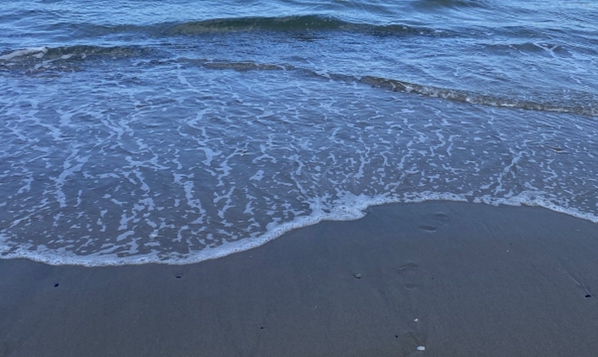
AWAY INTO SEA / image by Amalie Flynn
I TOOK A WALK WITH A FRIEND
Instead of starting a poem
I told her about my son’s first semester As long as he’s home & happy & in one piece, she told me
Worry squeaked out my sneakers onto wet pavement The rest dissolved with the pitcher of margaritas
Though it was wet & rainy I did not get a headache
Married for thirty-four years We selected the movie about divorce
By the time we finally got to watch it He fell asleep
The book was about a friendship that started in graduate school I skipped ahead to the parts where she snorted OxyContin
Didn’t want to think about graduate school But stayed up reading the juicy parts anyway
Personally, I blame the recliner
UNTITLED
The sea is a room without walls. It spills, falling over land. Land shears away into sea, rooms echo with spills and falling walls. Walls are powerless in the war of land and water, swells uproot trees, sweep cars, shopping carts, diamond necklaces out to sea, rooms of plastic ingots drifting down. The sea has room, gathering spoils from falling lands.
(UNTITLED is included in Hicks’ new book Knowing Is A Branching Trail, winner of the 2021 Birdy Prize and forthcoming in mid-September from Meadowlark Books.)
New Poetry from G.H. Mosson: “Warrior With Shield”
after Henry Moore
AN X STILL / image by Amalie Flynn
Blasted, broken to frag- ments, left arm won’t— both legs blown & absent, the spaces abuzz w/ anger—but I edge forward, shield up as leg-stumps toe for foothold. My mouth is an X. Still- ness. Yet I see. I’ve been left.
Moonlight empties onto my chest, rivulets down in a branching sheen & I swell w/ a hunch I’ll make it as if an old tune warms the heart, as if I too might sing again to Shelly.
I’ve been PUT CHARAsome- PUT_CHARACTERS_HEREone else PUT_CHARAonce PUT_CHARACTERS_HEREsome- body PUT_CHARAother: PUT_CHARACTERS_HEREa child. Dandelion PUT_CHARApods PUT_CHARACTERS_HEREtumble past my PUT_CHARAopen PUT_CHARACTERS_HEREpalms.
New Poetry from Barbara Tramonte: “Tailored To Fit In”
I WAS GATHERED / image by Amalie Flynn
Somebody sewed me with a string On the bias I was gathered And about to pop
This has been a pattern all my life
They hemmed me in with notions Each stitch bringing me To a false whole
(I longed to slit my wrist)
I jolted with a shock of recognition To see that I had drifted to the wrong side
New Poetry from Alita Pirkopf: “Roadkill,” “Sounds of the Past,” “Spring,” and “Unhealthy”
BLOOD IN BUCKETS / image by Amalie Flynn
ROADKILL
I bring you blood in buckets, a heart that I hear, a palsied hand. It has been eight, ten years, my issue. The same as twenty years ago when your father felt about me as you do now. I felt the world shrink but I thought something, not necessarily the world, would end. I had not thought the world lay flat, as Renaissance cartographers mapped it. But now, like an automobile tire not only flapping, flattening, parts of it, or me, lie on the shoulder of my road with dead things and dirt.
SOUNDS OF THE PAST
She thought she had found soft music and warm dialect, a sunny sort of near-Italian soul,
But surfaces surprise. She found out. She found that underneath pounded a martial drumbeat vibrating still
from Vienna’s center, his childhood years under the Third Reich, a father fighting occupying Yugoslavia with others missing the village polkas, his son.
A burst of marches, explosions, still resounding. All of us hearing pounding steps and hearts.
SPRING
Shreds remain— unraveled weavings of brown grasses and mud— in branches a bird eyed for her family tree.
The rest, the nest, that we had watched through last week’s window, fell.
The dog found blue broken eggs in the grass.
Families, all of us consider seriously. Upsetting winds come to nests. It is spring and windows open views and dooryards fill with the ambiguity of lilacs.
UNHEALTHY
I loved my doctors until one played sick games, touching and taunting, and knowing of rules I didn’t know. Telling jokes I didn’t understand. Dismissing me for my naivete— stupidity.
The years passed, and he operated on me appropriately, savingly. Later he mentioned dining together or going out for coffee, but didn’t ask, and got angry for reasons I didn’t know, saying I hadn’t said I’d go.
New Poetry from Jesse Frewerd: “Symphony”
OUR TARGETED HEADS / image by Amalie Flynn
Ballistic medleys project ambition, while dancing tones find their pitch. There is unexpected buoyancy in our youth. March, advance, train, drill, prepare, disseminate. It’s the 4am ensemble, time to crescendo awake for guard duty. Report to post, front gate, alert and ready. Hours, minutes, seconds, tempo depends on the action. The symphony begins with an RPG flying over our targeted heads. Return fire. Bullets staccato the enemy location. A cappella commands over the comms. Write the counterpoint, execute. Threat neutralized, they retreated. Though my heart is playing allegro, via adrenaline. Dynamics decrescendo the scene, bringing it to normalcy. I return to my life as it is, my new normal cadence amid syncopated pop-shots, RPG’s, mortar rounds, and IED’s.
New Poetry from Hannah Jane Weber: “My Childhood Smelled Like,” “Surprise Dawn”
FROSTED WITH MOONLIGHT / image by Amalie Flynn
MY CHILDHOOD SMELLED LIKE
cabbage, salted tomatoes, and cracklings. the flume of dust I awakened when my fingers untangled the shag carpet’s red mane.
crayons I melted against the wood stove, our terrier’s feet, with that same scent of fire.
night crawlers, shad, algae, and lake, blanketing our boat after a morning of fishing.
Dad’s scrapyard, fragrant with hot tar and smoke from his brown cigarettes, acres of rust and grease, a twisting maze leading to one abandoned refrigerator after another, each filled with jars and jars of ancient rot.
fireworks and muddy gravel roads, leadplant, elderberries, horsemint.
Grandma’s lilac bushes, reeking of booze from the bar next door, their purple bunches lighting up the dark with neon liquor perfume.
SURPRISE DAWN
rows of cedars push through slats of slain brothers dense boughs gushing berries frosted with moonlight
my bike light skims twilight from creamy sidewalks a premature dawn blaring from the flashing bulb illuminating the wind’s fabric in rustling leaves
I lean far from the sweep of branches but my jacket catches the emerald froth and propels me into the flustered chatter of birds awakened and tossed about by my helmet’s pillage of their feathered hearth
New Poetry from Tyler Vaughn Hayes: “They even pipe it into the bookstore,” “His first time: flight by ropes,” “The edict,” “Rappel annuel”
WAX-LADEN DAY / image by Amalie Flynn
They even pipe it into the bookstore
It’s never quite silent, though there’s no lowing, not from God nor his glutted blind bovine. Only
the thudding of shuffling ungues on stereos hemmed, hidden in the high grass—muzak
piercing through, prodding each tagged ear. Far better this way— now they needn’t contemplate
the cacophony in BARN 8, the strain of strings tucked tight to necks, jammed trumpets jutting through guts, and
the flutes flushed fast with blood. No, much better this way. Bow, hark, try not to think.
His first time: flight by ropes (for Corbin Vaughn)
it’s fleeting the rebuff of a flutter fleecing the sway in his wee depleted eyes
exhausted the college girls of August ferry a whole life on the neck heaving TVs sleeping late they flit from mom then return
we can’t split a pendulum a heavy head tightened white like a fading grip on the tethers just out of reach
give it up already.
The edict
There is, without question, a tendency to beg for those things we have already.
For instance, I once commanded God: turn me into a poet, else I’ll pretend to be a walrus.
Brugghhllff!
Rappel Annuel
I (for one and once) intend to celebrate a soothing din the cleansing mess fresh from the wet wax-laden day. Hip hip
New Poetry from Andy Conner: “Apples,” “Untouchable,” “Remanded In Custody”
YOU MEAN NOTHING / image by Amalie Flynn
Apples ‘The landmines are just like apples’ Khmer Rouge survivor
Apples can peel your skin Like it isn’t there
But more often than not The cruellest fruit Sucks the rusty blade
And leaves threads
Dripping
Threads of skin Threads of your life Dripping Seeds onto barren ground
You mean nothing to the apples You mean nothing to the apples You mean nothing
Their anaesthetic minds Hold no sense of time No sense of pain No sense No sense of what remains
And if you Are one of the hand-picked Who escape in a step-right-on-it flash Give thanks for this windfall
Which leaves survivors Green To the core
As they crawl With the worms With the worms And the decay
Praying To scrump a handout With no hands For the crumb Which may or may not come
As they sit In their own shit Begging On their stumps For a friendly worm To turn Up And eat it
Untouchable
On my recent trip to Gujarat
I took numerous pretty photographs
of Modhera Palitana Dwarka The White Desert
and other pretty places
but
the image I can’t delete from my heart
my hard drive
is of a ragged street child at Vastrapur Lake who stepped out from the promenading crowd
raised his left index finger into the stifling late afternoon
air
and drew a rectangle to take an imaginary selfie
with me
Remanded In Custody
How can you talk Of an even split When you’re parents Of three kids
How can you ask For understanding When you won’t say What you did
How can you demand We keep calm When all you do Is shout
And scream It’s your own business When we’re what The fight’s about
How can you plead You need your freedom When you’ve built Our jail
Whose four sad walls Have heard it all Every selfish Last detail
How can you think We’re stupid ’Cos we don’t know What it means
To move on and Make a new start When we’re not yet In our teens
If you two Are so clever And know what Life’s about
Why must it Take forever To sort Your problems out
You’ve no thought For our feelings Or respect for What we think
While you resent That we need feeding When you don’t have Cash for drink
You complain We’re far too young To understand Your trials
Well in this case It’s not the children Who’re acting Like a child
You both believe That you’re the victim Of the other’s Poisoned mind
But if your eyes Can still open You might see The only crime’s
Neglect of Your own kids All three Ripped apart
By being used As silent weapons Against your Other half
How dare you Claim us as conscripts To fight Your filthy war
When the offence That we committed Was only Being born
You’d never think You’re guilty But if you’d any Common sense
You’d see the last thing Left in common Is we’ve all got No defence
New Poetry from Lauren Davis: “The Flowers You Brought Back From Italy”
FACES TUMBLING DOWNWARD / image by Amalie Flynn
Each time I open my notebook the pages stick. Because I’ve forgotten.
And onto the ground they fall: royal purple flowers fall out, emerald stemmed, blue veined, life from the coast of Italy.
You pulled them from the earth, pinched their feet with your fingertips,
you breathed into the sea
and thought of the way my hair swayed between my shoulders, while you once walked behind me near an American riverside, flowers sway in the field the same way.
You placed the poppies then into the spine of your bible you pressed it, punched the face and rubbed the back onto the ground to release water into sacred words you pressed, wanting me there and you breathed into the sea.
Yesterday, you stood in the kitchen of your new house while the songbirds in the yard called good morning, you opened your bible and pulled the flowers up by the end of their stems like tails, their faces tumbling downward
and I opened myself / my notebook and tossed the flowers into my spine / my book’s spine
and there I closed it and pressed it into the granite underneath to press wanting to stay there with you out.
You asked me: when again do you leave? Two weeks.
Now, one-thousand miles away the pages stick each time I open my notebook
and onto the ground they
fall,
and I remember how you must have looked collecting purple poppies by the sea of Italy.
Our modern lives, so set apart, both by miles and unsteadiness.
New Poetry from Scott Janssen: “Bottle Tree”
VIETNAM DID I / image by Amalie Flynn
On my first visit I asked A stock question about Whether you’d been in the military.
Marines, nineteen sixty-six, you said, A hint of menace in your eyes. I never talk about it.
On my way out the door I asked your wife about a Tree in the front yard,
Its branches capped with Blue and green and pink Bottles made of glass.
It’s a bottle tree, she said. Pointing at a cobalt blue bottle Glinting with sunlight,
She told me it had Special power to lure in Ghosts and lurking spirits.
They get trapped in there, she said. Then sunlight burns them up So they can’t haunt us anymore.
Eight months later You could no longer walk. I rolled your wheelchair
Onto the warbled porch Where we sat and talked About how rough life is.
I never told you about Vietnam, did I? You whispered. I shook my head.
As you spoke, Your eyes averted, I looked at that cobalt blue bottle
And imagined it slowly filling With blood and shrieks And grief and the sound of
Rotor blades and the smell Of burning flesh and the Taste of splattered gore
And the sensation of Adrenaline pulsing and Memories of home and
Buddies who were killed And of fear and rage and betrayal and weeping
That lodge in your throat Before you swallow It all down
Into your belly. Don’t ever tell anyone About this, you said,
Your hands trembling, Jaw shivering. I asked if there was
Anything else. You started to say something But stopped yourself.
No, you said.
New Poetry from Ben Weakley: “Checkpoint,” “There are 4 Ways to Die in an Explosion,” “Good Friday,”
PRAY FOR THE BLAST / image by Amalie Flynn
Checkpoint
The car came from nowhere, it came from everywhere –
white blur and tire squall, a four-door payload of heat and pressure and steel.
When it is over, there is just the tinkle of falling brass and a man slumped in a pool of broken glass and coolant on hot asphalt, calm as a corpse.
Doc cuts his shirt. His face is weathered by years of this. Layers of skin and yellow fat pucker from his open side.
He breathes.
In the trunk of the rusted-out sedan, where the bomb should be,
there are only two tanks, an oxygen mask, and a box filled with apricots and dates.
There are Four Ways to Die in an Explosion
First the blast rips limbs from the torso. Throws tender bodies against concrete walls. Pulverizes bones against pavement. Those closest to the bomb are never found whole.
Then the fragmentation. Little pieces of metal debris, like the one that punched an acorn-sized hole through the back of Sergeant Gardner’s skull.
Heat from the explosion starts fires. Vehicles Burn. Ammunition burns. People burn, alive. When a driver is trapped inside white-hot steel, prayers must be said silently for the smoke to take him first.
Pressure collapses lungs and bowels. The bleeding happens on the inside. It can be hours before the skin turns pale and the bulk of a person drops.
None of the anatomy is safe,
so when the time comes, pray for the blast or fragmentation. Pray for the heat that vaporizes. Pray for the kind of pressure that makes the world dark and silent before the bitter taste of iron and cold panic.
Good Friday, Udairi Range Complex, Kuwait
The first time I saw the sun rise over the desert it was 4 a.m.
Across miles of sand and rusted hulks, the throbbing of heavy guns echoed.
Over the horizon, where the beginning and the end meet and disappear, Friday arrived.
We saw the jeering crowds, the scourge and spear-tip, the crown of thorns and the crucifix, waiting.
What could we have known about atonement? What did we know, then, of judging the quick against the dead?
New Poem from Nazli Karabiyikoglu: “Hymn: A Coffin at the Gates of Topkapi”
COLD SONGS / image by Amalie Flynn
The head, decapitated, it sits on a shore, at some corner of the world. Desperation is what they feel as blood gushes out from the half-neck. Death, however, has always been there, nothing new, an enslaving event. The name of the deal was predefined – “flight”. It has been around since the Order of Assassins. Part of us see the beauty in all this, even when the tortures last till the moon starts to shine over us. Sir! There you lie, your frail length almost pours out from the bed. And here I am, by your side, barren inside, yet my mind replays a moment with you, where you feed me freshly-picked strawberries. My worst nightmare is finding a way into my life, into you, through your flesh and bones yet my heart replays a moment with you, where you dress me with freshly-picked strawberries. Sir! Many calls for prayer have been sung. And here I am, can’t look away. My devotion may be in vein, but what I’m losing now is transcendental. You missed most of it, as they held a mirror to your nose and checked if you still breathed. So beautifully you lay there. Before this fate, I was as effective as a human shield. Here I am, bitter as rock, by the frilled duvets, thinking how we must keep you alive and not sickly-yellow and quiet like this. See? I’m here by the frilled duvets, ice cold, thinking how I crave to coil up next to you. Sir!
We finally made peace with death. First our eyes watched the floors, then our fists beat our chests. Distances reached, horizons obtained, flasks of scarce water and worn sheaths. Almost everyone lost their sons to this war. Our sons. Our people. They believed in the protection of their shields and wanted to go as far as it got them, is that why we say our hymns for our sons, on and on for days? Is this our fate?
I decided I’ll surpass fate and kismet and luck or whatever. So here I am, standing before that reckless hope. I grabbed it by the chin, pushed it against a wall and I let anger take control. I asked it, and I was quite sincere about it too, “How is it that death gets in?”
The way you put your head on my head, lifeless, breathless, heavy. Your word is my law, and I stand by its chime. With largest oceans behind my back, you were my creation, and I gave you away. Your first steps, your first words, have been my challenge. And the way you put your shoulders on my legs. Sir! Greatest storms whirled inside me, and, oh, I prayed to the Almighty; to His holiness, I presented all of my organs, but they pulled out my womb, or what’s left of it, and even then, all that mattered was you, sir.
Something penetrates, once, twice, my spleen watches it happen, smells pleasant, like linden, my favorite, something to go for a child is being created, from the char of my liver, my flesh puffs, my flesh grows fat, count those things that penetrate me, arms maybe, one, two and three, stop there, stop at the second syllable of my name, I did not do this to me, I did not choose to carry this burden
Beings must produce, yet I’m barren inside. Your look is my law, and I stand by its tingle. With vastest moors behind me you were my darling, and I gave you away. Your first words, my sultan, your highness, have been my challenge. Beings must produce, yet I’m barren inside, and you’re lovely inside. That’s what you said
All this glory and all these gifts, what use do they serve, I pondered for a long time and I could not find the answer. I knit for a long time, laces and wools too, wore them in the cold maroon rooms of this palace, in the cold of my own body, cold, songs were cold, my violin was warm, only to me. They took me right away, and no surprise there, I was pretty, I stayed quiet when they split my legs, but I’m known for kicking quite hard. How funny, the way things change so much so fast, we were a thousand and now I’m just one, do the winds always bring injustice with them or does it travel in the pockets of soldiers?
Crying my lungs out, biting my tongue, fires scorching my stomach,do these all go together for me now? Or have I just comprehended death and broken apart while at it? If we can’t breathe where the dead go, tears can flood, for the duration of the earth’s age even, quail with rice or grape compost. He found his place in the history books as did I. It takes courage to stand before a dagger; I did, I stood still as a brick and I shed tears. If it wasn’t for your shadow, I’d call you my child, my life, my signature, the one that makes me get lost in those oceans. Don’t be hurt, because I’m ordinary, I think you’ll outlive me. You’ll have no idea though how we managed to get that life out of you. I bit my tongue, held back at every chance, and saved the pain along my spine. My womb dried off and shrunk, they pulled it out, but I will not give up on your scent. I yearn for your chest to rise up to the highest, for you to take one deep breath. If it wasn’t for your soul, I’d call you my child, my flesh, my bone, the one that makes a prisoner out of me. Don’t be hurt, because I’m ordinary, you’ll outlive me. I think I see the blue of your eyes again, yes. You’ll have no idea though, what getting that life out of you cost us. I bit every part of me within my reach, saved the pain deep in me. The nightingale dried off and shrunk, they pulled it out of me, but I will not give up on you. How hard it was to bring you to life! If it wasn’t for your soul, I’d call you my child.
Sign off my sentence, my tears are my sin. Tightly tie the rope around my neck and tightly tie a knot to the rope that goes nowhere.
Translator’s Note: The story, although fiction, sits in actual history, and gives us some pointers towards having an understanding of era and geography. Topkapi Palace is in modern day Turkey, and was mostly used as the emperor’s residency during the Ottoman Empire’s rule between 13th and early 20th century. The Order of Asssasins, Ḥashashiyan or Ḥashīshiyya, was a radical Nizari Isma’ili sect that assasined Muslim and Christian leaders before that time period. The ordeal of flight, as in the work towards enabling humans to fly by any means, caused controversy in the Muslim world in the past, since it is simply unnatural for humans to fly, but attempts are encountered in Ottoman history. The story, too, is likely placed in a time period where such attempts stir political balances.
New Poetry from Jacqlyn Cope: “Mission 376: Patient X,” “Prolonged Exposure Therapy,” “Doxies and Rum”
THERE’S EARTH INSIDE / image by Amalie Flynn
MISSION 376: PATIENT X
There’s dirt in his mouth now
you
know that for sure.
There’s Earth inside his bloated belly
you
know that for sure.
The worms might have eaten away his ragged skin by now
but the metal is still there.
Splayed on the satin or cotton lining
like sad coins of a wishing well.
His casket might be oak, or cherry wood
you hope it was something sleek
and aesthetically pleasing
you hope the flag was soft enough
for hands and cheeks that needed touching.
PROLONGED EXPOSURE THERAPY
Ten minutes staring at a fountain pen stabbing, scribbling paper.
A rocket hit a concrete wall I told her.
Water spots on bifocal glasses blurring iris’s, flickering like burnt out pixels on a screen.
A desk placard bolded with professional credentials hooraying the study of mental illness.
A rocket hit a concrete wall and
Tic-tacs shaking in my red purse snapping the container at its neck revealing the candied-mint nonsense delaying my esophagus to stretch in the direction of answer.
A rocket hit a C-130 fuel tank spraying
shrapnel
Her voice dives down into the depths of her vocal cords pulling out forced tonal sympathy an octave of care.
If
you’d like, I can prescribe you Zoloft today.
The rocket hit a concrete wall the metal a rocket hit the fuel tank a concrete w a l l
DOXIES AND RUM
My Dachshund
watches me pour
my
third
rum and
Coke.
His
bowed legs sit
firmly
under
his robust
chocolate colored
chest.
Eyes
beaming
not
in judgment
but acceptance.
Captain
Morgan’s
leg
swung firmly
resting on
a barrel
he winks, opens his mouth
and
howls a whistling screech
a
rocket’s screech.
A
hand over his mouth
I quiet
him.
Pouring
the rest in the empty glass
the
ice breaks up
dissolving
into
themselves.
Spice,
sugar, caramel,
washes away the
dryness in my throat
and
salt from the sinuses stuck there.
Salt that I refuse
to expel
any
natural way.
My Doxie jumps on
my lap
smelling
distinctly of corn chips
for
no reason at all.
He rests his head
in the crevice
of my arm
sighing deeper
than
I thought he could.
New Poetry from Mbizo Chirasha: “Casava Republics,” “Sad Revolutionary Lullabies,” “Rhetorics”
SUNSETS OF POLITICAL MASTURBATION / image by Amalie Flynn
CASAVA
REPUBLICS
Juba
Child of lost sperm in sunsets of political masturbation
Culture lost in the dust of Saxon lexicon and gutter slang
Soweto
Xenophobia
Drunk and Afro-phobia sloshed.
Marikana
Cervical blister of the unfinished revolution fungi.
Harare
Corruption polonium deforming elders into political hoodlums
Congo
Lodge of secessionists and human guillotines
SAD REVOLUTIONARY LULLABIES
……..Sing songs of afghan circumcised,
Damascus masturbating bullets
Sing Belafonte Sing!
Of
revolutions that never crawled, sing!
Lumumba, see whiz kids castrating political gods
Nkurumah, see them mutilating revolutionary goddesses
Sing Kunta, Sing Kinte
I am tired of revolutions importing colonial mood,
Propaganda decayed pimps frying anthems like frikadels
Tired savages roasting constitutions in corruption oil pans
Sing songs of freedoms that never walked, Sing!
RHETORICS
Mandela, the summer sun that rose through rubbles of our winter
Gadafi and Sadamu making shadufs and pyramids
…… . another spring
Obama and Osama pulling rich political carrot in Segorong
Robin Island slept golden nightmares and charcoal dreams,
Soweto virgins cracking their under feet in the long walk to freedom
Faces carrying the burden of freedom and anthems.
New Poetry from D.A. Gray: “Mosul Reflections,” “St. Martin in the City,” “The Rearview Has Two Faces”
STOMACH OF A COUNTRY / image by Amalie Flynn
Mosul Reflections
Ten years and the place is not the same. Memory of green hills in a dry land, cratered by what fell from the sky. I don’t know whether to trust the image on the screen or the one in my mind.
One I only knew as Sayyd gave well water, sweet tea and mince meat on laffa. We were tired from the spring rains, three days in the stomach of the country, we sank into the hard wooden benches and we ate. I thought of Jonah, not wanting to travel here, and when he did, enraged at an apocalypse that never came – how he rested under a bush then watched it die. The father of the family smiled as I ate — both of us, with time, smiling.
Dost thou well to be angry?
His child in the corner never took her eyes off me. Her mother would glance over, expressionless, as if waiting for something that never happened.
Rain fell like mortars, knocking the edges from the dirt roads, craters in the middle. In a few minutes it would take us with it, descending. We’d see the fragments, some carved reliefs; we’d wondered what we’d destroyed, what we’d left the world – an image of broken rock in need of a makeshift savior.
St. Martin in the City
Hunger sometimes reaches up grabs your cloak while you’re riding. You can’t shield your eyes, or go into hiding. Every treasure you’ve carried home, is never enough. A beggar beside the road, lifts his head; loose skin and sullen, he shivers and so do you.
* * * The day before we shipped I was walking with Preacher into the Walgreens for cold medicine and we saw a man asking for change. ‘Pity it couldn’t be him,’ Preacher said, not waiting while I fished for coins.
Since returning the eyes of every refugee leap out of every face.
* * * The stuff of nightmares.
Suffering
you thought you knew.
Sometimes it happens, a hand reaches out and causes you to draw back – until you see your fear in their eyes
both surprised how easily the veil between you parts.
The Rearview Has Two Faces
Your memory has two faces. The thought occurs as you adjust your mirror in the chapel parking lot.
The eulogy’s done its job, a few tears from even the most stoic, stone-faced ground pounders, the cracks in the First Sergeant’s voice as he belts ‘Smithson,’ once, twice and again – as he waits for a response that never comes. If you believe the words- he defended the abstraction of freedom with every fiber, never showed late, said his prayers, and flossed. You remember an emails he sent. ‘When I get back, there’s a lineman job in Oklahoma. And the houses are cheap.’ Days before he did it. You remember the night on your property, shooting empties off fence posts. ‘I’m not going back,’ he said. And you knew he would. Frustrating as hell but reliable. And you’d rather have sincere doubt than cocksure and careless.
The sun from the East burns the side of your face through the driver’s side window. In the rearview you can see your left side turning red. Yeah. The night he told you, you didn’t sleep, agonized over what to do about what he hadn’t done yet. And when he showed that morning, early, two full duffel bags and a goofy grin, you chided yourself for doubting. You look one more time. Sometimes he’s there sitting in the back seat, an afterimage lingering after the flash has burned, you still trying to regain your vision.
Three Poems from Suzanne Rancourt
EXPLODE / image by Amalie Flynn
The Shoes That Bore Us
It is a dream of kind slippers that coddle bunions appeased by hands mittened as the same kind slippers holding warmth as forgiveness for all the combat boots sogged by brackish muck of wars when not hoisted in the occasional stilettos of never regrets a conundrum of cognitive dissonance stabs the dreams of where ever we had been, we escape to now over racked rails rocked goat paths and deer runs you think it’s a man’s world until it is not
a sidearm presses to a right hip as cupped palms to iliac crests walking boundaries and borders skirting domains of possibilities that astrological forecasts stagger out on slow printed pages like stammering promises spoken by the dead selling real estate, “Check Mate” no choice is a lie when the inevitable is an illusion, no freeze to suffice that fighting, although futile, is still taking a stand
Unhinged Again
a stone leaves the hand that flung it-air escapes constricted vocal cords – a vomiting wild – enraged urgency and angst
kinetic makes contact – leaves bruises the color of bludgeoned fists pounding flesh is quiet. I can’t remember if I was screaming
my face and shielding hands turned overripe plum purple sweet with sticky juice that dribbles down chins
attracts sugar bees you swat in autumn sun that smells of maple leaves red with change
this hammer drives the firing pin into a child’s memory, my memory, of cap guns explode a thousand times greater than a simple pop & puff
a chunk of lead propelled, is unhinged from the mansplaining – the antagonistic prod of condescending joust
I was stuck in a ring of double fisted doubts: leave don’t leave I didn’t know that I was a prisoner of white picket conditions
like my mother. Was she also a prisoner? A side bar of recollection a nursery rhyme my mother sang to me:
“Peter, Peter, pumpkin-eater, had a wife and couldn’t keep her He put her in a pumpkin shell, and there he kept her very well.”
I know my Mother knew when I was being beaten there – my face laying with one ear pressed to cold linoleum
the other, an upward funnel catching my Mother’s vengeful whisper “get up…get up…fight”
to be marginalized – a side note or comment, placed in the periphery, only seen when the reader desires or deems worthy of notice
only one of us walked from that house that day to be silenced – a voice, a room, a home, a door closed upon it
a mind made up, barred entrance, not worth the time to view, hear, acknowledge I’m writing this and telling you words are a privilege
voice is a human right thrown as stones – they fall from the wind
Crying Over Continents
windfarms white wake of ferries channel crossing
a nonstop jack hammer knee Morse code through time zones pounding out instructions, the next destination
I’m not letting go like I used to. I feel heavier in my gathering of nuances, intimacies – You watch someone for hours, days you learn what time they take their dog for a shit turn on the garage light – the one just right of the workbench and always with their left hand You learn to recognize the screams of a woman in an upstairs back bedroom being struck or the subtle moans of make up sex easing across the back yard from windows never locked and left half open
Or maybe, it’s the man in the downstairs apartment under yours that you watch shaving his son’s head before forcing the kid to wear a chain and crucifix bigger than the kid’s malnourished chest with ribs that break at 0200 hrs when Dad comes home drunk, no sex, and vile. The mother died mysteriously, they say, in a different town, a different country
Intimacy is being there as a ghost being fed the compromise of “I’ll never do it again”
Intimacy is being there at the end and being held in the mantle of a dying eye
Poetry from Bryan Blanchard: “Pillar of Salt” and “The Mannequin”
Pillar of Salt
Raining fire, burning steel … And now I see haunted
Images of headless Bodies bathed in bloodstained
Sand of a mannequin Head with a swollen face
And lifeless eyes looking Back at an explosion,
A disfigured Humvee Staggering down the road,
A charred and gaping door, A torso hanging out –
Sketch by Sarah Blanchard
The Mannequin
I am not a mannequin! I am a pillar of salt! I am the salt of the earth! My heart is heavy with sand.
An earlier version of “Pillar of Salt” appeared in O-Dark-Thirty, March 11, 2013.