New Nonfiction: Interview with Adam Kovac
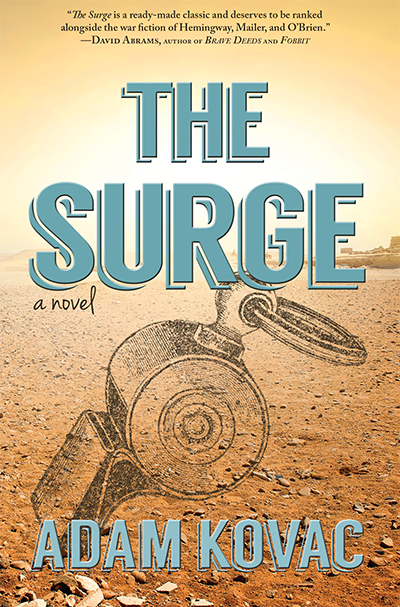
You wrote and published a version of THE SURGE in 2019. I read and enjoyed it, but didn’t go back to reread and compare with the 2025 edition. What was the thought process behind that, and what changes did you make in the intervening years?
Publishing the second edition of THE SURGE happened somewhat by accident. I knew Jerry Brennan, publisher of Tortoise Books, had read the novel not long after it debuted and liked it. Few years back, on Veterans Day, he and I were posting on social media about what I can’t remember and I shot him a DM basically daring him to republish the book. And, to my surprise, he thought that was a great idea and now here we are. I’d reread my novel a few times after first publication, mainly to see if I’d made a mess of it. But did I think about changes, jot down notes about revisions? No. I never imagined it’d ever be republished. Aside from minor, stylistic and editorial tweaks throughout, very little is different from the 2019 edition published by Engine Books. That’s not to say readers shouldn’t check out the reboot, which in my opinion is stronger and more meaningful, largely due to Jerry’s deft editing. I started writing this novel as my MFA thesis at Northwestern University. One of my advisors was John Keene–he’s a real smart guy–and he told me the goal wasn’t to simply write the best book about the Iraq War, but to write the best book about any war, ever. So that’s what I did. I sat down and attempted to write The Great American War Novel. I wouldn’t have sent the manuscript out on submission if I didn’t think I’d come as close as I was able to actually accomplishing that.
In my review I wrote about The Surge (both the book and the campaign) as central events in post-9/11 America. Do you view that year-plus as definitive, impactful, important? Do you think America achieved success due to The Surge? Despite of it? Not at all?
A journalist interviewed me on the day of the so-called fall of Afghanistan and asked a similar question. We almost got into a heated argument before steering the conversation back on topic. Did the surge make a difference? Short term, based on the stated objectives, I think so. Although being a part of it felt batshit crazy and bizarre at the time. I arrived in Iraq in 2007, a few months after the campaign kicked off and soldiers already downrange described the country, insurgent activity, as “quiet.” I also took part in the early months of Afghanistan’s version of the surge in 2008-2009, but can’t speak to whether it had any success. Like OIF, every sector in OEF was different. But, personally, while submerged in those moments, I truly thought we–America–stood a real chance of turning things around in both theaters. For lack of a better word, you could say I believed in the mission. But THE SURGE is simply the title of a work of fiction that happens to be set in a fixed point in time largely because the story needed it to be. This really isn’t a book about the surge offensive, the Iraq War, or even a war novel at all. When trying to decide on a title, I went back and forth between The Listening Post and For a Piece of Colored Ribbon. But my agent, Kevin O’Connor–he’s great–recommended THE SURGE, and I didn’t hate it and also didn’t want him to think his new client was a diva. In hindsight, if I’d titled the novel something like, The Grocery Store Owner’s Foster Son, it might’ve been a bestseller.
In reading THE SURGE, I saw what felt like a lot of allusions and references. Is that me imagining them, or was that deliberate? (One I’m particularly interested in: the scene with Gibson, Vogel, Witkowski, and the Widow Makers having their “party” – felt like something out of PLATOON or APOCALYPSE NOW.)
I’m not sure anyone returns from a deployment without having done, seen or heard about some weird shit, inside or outside the wire. And I feel the wartime experience tends to mirror those preceding it, both in reality and works of art. Example: I know I’m not the only vet who’s heard a wounded soldier say to the medic, “Tell my wife, I love her.” Yup. That’s straight outta the movies. And there’s a logical, psychological explanation for why that phenomenon occurs. But everything in THE SURGE is deliberate. I tried not to have a single scene, line of dialogue, word, or even punctuation mark that wasn’t there for a purpose. It’s one of the reasons the novel has such a short length. Which I feel is a good thing, despite what big publishing thinks. Best I can say is that there’s meaning and intent everywhere in THE SURGE that might not immediately or consciously manifest itself on the page. Another reason why calling it a war novel, to me, feels just a tad inaccurate. Gonna name drop again but I was fortunate enough to take a writing workshop at Northwestern taught by Stuart Dybek. I’m paraphrasing, but I’ll never forget when he said the job of the writer, and the only job of the writer, is to create compelling characters and then navigate those characters through plot points A, B, C and D, until the story reaches a satisfying conclusion for the reader. Everything else: theme, imagery, what the story’s even about? That’s for the English professors.
For me, the strength of war stories comes in large part from the “supporting cast.” Two that stand out to me here: Sergeant Parker and First Sergeant Flowers. They both had depth, added a lot to the story and Chandler’s characterization, and just felt “real” to me. How do you go about populating a story with one main character but lots of others, some of whom we only see briefly?
Absolutely. One of the hallmarks of all great combat novels is the prevalence of what I can only describe as ensemble acting. James Jones was great at it. There’s a whole infantry company populating The Thin Red Line and some characters appear more often or carry more weight than others. There’s those essential to advancing the story and unlucky others bumped off in the early pages. It boils down to making tough choices, which is easier if the writer understands why the character even exists in the story at all. In THE SURGE, everyone’s on the page for a reason. Tricky part, for me, when developing these characters, was to try to push back against or perhaps more deeply examine what it means to be a hero. Of military service. Or even being an American. I used to spend a lot of time in the chow hall, eavesdropping. What fascinated me most were the men and women who’d been previously wounded and still volunteered for another tour. Why? That’s something THE SURGE attempts to explore. I can’t say most service members I encountered were motivated by patriotism–it was like everyone had an agenda. And that’s what I mean when I sometimes say THE SURGE is more accurately a novel about greed. Why the characters are all somewhat loathsome. They’re con artists, bigots, misogynists, fanatics and even child molesters. As for Parker and Flowers? Well, they’re the only two characters into which I intentionally injected aspects of myself.
Also, was Flowers “right” when he said “We’ll never leave. The army might pack it up and roll out in a few years, but America? We’re not going anywhere. Not all the way.”
Shrug emoji.
Do you think literature “from” our wars in Iraq and Afghanistan will ever see the resurgence in interest given to Vietnam War literature?
No. I hope I’m wrong, but I don’t see that happening at all. I’m fairly certain if all the authors who’ve published contemporary war books in the past decade got together and commiserated about our sales numbers, it’d be a pretty sad affair with a massive bar tab. THE SURGE received dozens of rejections. Among them was a note from an editor who said they enjoyed the manuscript but were an imprint of [big publisher] and since they’d already published [awesome book] were unable to acquire similar titles. I also recall one of my pieces being workshopped while working on my MFA and a classmate commenting about how it was difficult to find sympathy for the main character because they were an “invader.” Another didn’t like an early version of THE SURGE because it was “genre fiction,” not literature. And in the past year, I even read a social-media post where [respected-literary author] essentially accused [respected-veteran author] of only writing about the war to sell books and get famous. Look, I’m all about breaching the civilian-military divide. And the last person you’ll ever hear screaming, “Thank me for my service.” But from a publishing standpoint, I detect very little interest among the reading public in our Forever Wars, and the industry clearly knows this, too. And no, I don’t feel the so-called literary establishment has fully accepted veteran writers and poets into the club. Perhaps all that’ll change in later years but for now, I can only quote Hemingway. “Isn’t it pretty to think so.”
What are your other writing endeavors? Anything more in the “war lit” scene? How does working outside of it help you write inside the war?
Despite essentially being told I’ll never publish another book, I’m still at it. Too stubborn and I need an outlet for the goofy stories roaming in my head. I’ve written a crime/mystery novel I’m really proud of–probably better than THE SURGE–that’s been shopped to death and still doesn’t have a home. I also wrote a clever but very short science-fiction/horror novel I truly think would be a great fit for several presses. But both of those markets are tough rackets. Loaded with talent. What’s crazy is I’ve found unexpected success recently writing adventures for science-fiction tabletop role-playing games. I even launched my own publishing imprint: Boondock RPG Adventures. It’s been a lot of fun developing characters, starships and short scenarios that there’s a market for and people seem to enjoy. I’m grateful for all the interest and support. And I still get to use the craft techniques I learned while pursuing my MFA. It’s very similar to writing flash fiction, but imagine combining it with a Choose Your Own Adventure book, with other outcomes influenced by a roll of the dice. Will I ever write another war novel? Highly doubtful. I never intended to write about the Forever War in the first place. I’m even uncomfortable with the term, “veteran author.” After I was wounded, I tried to bury my deployments to Panama, Haiti, Iraq and Afghanistan. But the nightmares make that impossible. So, it’s not that I wanted to write THE SURGE. The story wouldn’t let me walk away.