On the Subject of Walls

While it’s fallen off the news somewhat, one of Donald Trump’s most conspicuous campaign-trail promises was to build a wall between the U.S. and Mexico. Not only did Trump say that a wall was necessary, but he said that he would get Mexico to build it, conveniently ducking the question of cost to U.S. citizens. This is because the border between the U.S. and Mexico is long, and walls are expensive. Especially the kind of well-built walls that are required to stop crafty humans from getting around them.

Ukraine has a wall of its own. Or, at least, it’s building a wall. Sort of. In September 2014, during the height of Russia’s attempts to intervene in Ukraine, shortly after Russia occupied Crimea and during the beginning of its ongoing incursion into Ukraine’s east, lawmakers developed a plan to create a wall between Russia and Ukraine.

The wall received some coverage in Western Press—not much, but some—because building a wall along thousands of kilometers of territory is a big project, and the wall had a big number attached to it: 4 billion UAH (at 8 UAH to the dollar in 2014, $500 million, now at 26 UAH to the dollar, or about $160 million). The wall was scheduled for completion in 2018, and building commenced. Since then, there have been questions over whether or not it will be completed on time, according to the printed standards. There have been allegations of corruption, as well as questions over whether the planned structure would be capable of accomplishing its military mission of stopping Russian infiltration and military intrusion.

A Wall in Name Only

Based on reporting that I have done, including visits to the wall and interviews with subject matter experts, national security personnel, veterans, villagers living within 10 km of the wall, and online research, if the wall is completed as promised and planned, it will not serve as a significant military obstacle against Russia. Without being able to find any evidence beyond official statements and visual confirmation that something is being built, it’s impossible to decisively state anything. Has money been embezzled? Maybe. It’s Ukraine, so, maybe probably. Is the wall being built to standard? Has every meter of the border with Russia been accounted for? There’s no way to confirm that construction has succeeded or failed.


As of right now, the wall consists of two elements. The first, which looks much like what the wall was supposed to be based on initial projections, are a series of well-developed emplacements near significant border crossing points along major highways. Ukraine’s State Border Service and military units staff and patrol these sections, guarding against sabateurs, infiltrators, and the possibility of a Russian military offensive. Practically speaking, of course, a ditch, concertina wire and double-fences won’t create much more than a brief tactical pause for even the smallest military unit (and no pause for airborne or air assault units)—but (apparently) according to military thinkers and the politicians who give them strategic guidance, something is better than nothing at all.


This reality has given rise to a new story: the idea that the wall will be useful for stopping criminal activity. Smugglers and illegal border crossings will be diminished by the wall, which (along with the security provided by the wall) will help make Ukraine a safer and more law-abiding place. This has some merit to it, although it’s also worth stating that every person with whom I spoke living near the wall viewed it as an eyesore at best, an actual nuisance at worst, and that it seemed (paradoxically) to be increasing smuggling and illegal activity—precisely the opposite of its intended effect.


Notwithstanding the views of its residents, the border area with Russia is startlingly, astonishingly open. When I visited the area north of Kharkiv last in February, I nearly walked into Russia. There was no wall present, though residents were on edge, and warned me (through the Ukrainian who was interpreting) that patrols came by every few minutes looking for people who didn’t have a reason for being there. I assumed that they meant Ukrainian patrols.


As of February 2017, two years after the battle of Debaltseve and three years after the invasion of Crimea, it was still possible to walk into Russia from Ukraine, more or less accidentally.


Why Should We Build a Wall?


 Walls require strength and power, and wealth. They require organization and commitment, and maintenance. They are also the single most noticeable evidence of a nation’s insecurity and fragility. What nation requires walls? What confident people would even think about erecting barriers? A weak nation, filled with anxious and neurotic people. And while this describes Ukraine to a certain extent—with all due respect to my Ukrainian friends, whom I love and respect, and with due respect for the idea of a country called Ukraine, (a) Ukraine as a country lacks significant allies, and has an overwhelmingly powerful enemy on its doorstep while (b) its people are justifiably traumatized by the repeated revolutions and various attempts by Russia and Russian agents to undermine their economy, political autonomy, military, and (writ large) their independence.


Those justifications don’t travel very well when the destination is the U.S.A. Although walls require power, money, and strength to build, they aren’t for the powerful, they’re for the weak, the fragile, the exhausted. Walls exist where there is no energy left to patrol, where one believes that some powerful energy or tendency toward chaos and entropy will, left unwalled, lead inexorably to conquest. This is what certain Americans believe: that a wall with Mexico is necessary, presumably because Mexico is more powerful, and left to its own devices, Mexico’s Mexican inhabitants will swarm over the border and destroy what they find on the other side.


Of course, if U.S. citizens legitimately believed that Mexicans constituted some type of threat, the response to Mexico would be different from wall-building. What Americans fear is not Mexico—it’s the loss of control, it’s not being able to convince others that it is in their best interests to behave according to America’s best interests. In many ways, this has been the story of the millennium, a slow-building narrative since the towers came down on 9/11.


On a psychological level, it seems almost certain that to Americans, the wall with Mexico is a replacement for the Twin Towers. We want to rebuild the towers and protect them from being blown up. We will call the product of this constructive but paranoiac impulse “The Wall with Mexico.” It’s a sad and quixotic impulse, if impossible due to constraints built into the space-time continuum.


But Why Build a Wall at All?


There are good points to be made against the building of walls. They restrict commerce, dampen the flow of accurate firsthand experience between citizens of different countries, reduce the ability of people to communicate, and lead to factionalism, nationalism, and the dangerous kind of international competition.


Walls are a last resort, when one must defend oneself against some foe that cannot be deterred by any other means. They are fixed positions that generate no revenue and require great sums for their upkeep. They can be avoided with the use of airplanes, rockets, and boats. They are as useful and necessary as fixed fortifications (which is to say, not very).


Ukraine’s excuse for building a wall is that it’s hard up for emotionally satisfying ways to thwart Russia. A wall is something that is seen, and can be measured, and will make it more difficult to enter Ukraine from Russia. There are many downsides, but from the perspective of Ukraine, a much smaller country than Russia, and isolated from meaningful alliances, building a wall is something (given that it actually gets built, rather than partially funded while the remainder of the funds designated to build it are pillaged by oligarchs).

For Americans, the question is different. To begin with, it is a more powerful country than Mexico—the most powerful nation in the world, in fact. Its southern border with Mexico is patrolled by drones, security personnel, helicopters, dogs, radar, and automatic detection systems. There is already a fence separating the two. Inside the U.S., it’s very difficult to exist off the grid without eventually running into some electronic or procedural requirement that will establish that one is in the country illegally (whether the people monitoring those systems do anything about it or not is a different question).


Normally, one builds walls under desperate circumstances when no other possibilities are available to solve some critical international question or another. Mexico’s turmoil stems from the illegal drug trade. The drug trade is profitable in part because it is so unpleasant to live in a capitalist society that objectifies its citizens that many U.S. citizens will pay excellent money for drugs that are easily fabricated and refined in Mexico, and in part because the U.S. (despite creating and abetting the conditions by which citizens would want to use drugs in the first place) has criminalized non-prescription drug use, artificially inflating the market to the point where Mexican citizens involved in the trade can afford to build private armies large enough to contend with the government’s military (or simply buy government units wholesale). Rather than build a wall with Mexico, it’d be cheaper and ethically more humane to do something about the drug trade—legalizing and taxing drugs would be an excellent first step.


Ukraine cannot “settle” with a Russia intent on its partition and destruction—Ukraine is left with the unpleasant choice of having to just grit its teeth and do what it can to prevent Russian intrusion. A wall isn’t the best way to do that, and especially when details of the wall’s construction are kept secret. Still, it’s understandable in a way that the U.S. wall with Mexico is not.


Arms Sales, Cash, and Losing Your Religion

The lucrative Arms Sales market exists in the exact place where rational self-interest intersects with humanist idealism. Much as individuals have a right to exist, countries have a right to exist, and few would contest the prudence of building and maintaining modern weapons by which to protect that right. When a country builds weapons for its own military, and the purpose of that military is to defend, one may argue or object about the extent to which it is wise to train and organize the use of those weapons, but their necessity is comprehensible. Countries, like individuals, have a history of attacking one another.

While building weapons and equipment for self-defense is therefore fairly uncontroversial, selling said arms and weapons to people or nations that will misuse them—or, worse, are already engaged in busily and enthusiastically misusing them—is not necessary or prudent. This is because (1) human life is supposed to have an intrinsic value beyond anything money can buy, and (2) bullets and blasts tear open human bodies in order to spill out guts, blood, shit, and all the strange fluids that lurk beneath every human’s skin, maiming and/or killing them. How one uses weapons, therefore, is one of the most important things in the world, once the decision has been made to produce them for self-protection. Much as a war of aggression is immoral, the sale of weapons that will create the conditions of a war abroad is also immoral. That’s pretty simple. Or… is it?

Leaving Points on the Board

It is, it is simple. Nevertheless, in the ongoing effort to appear balanced, everyone’s favorite “sick man of the old media” The Atlantic recently published an article arguing that “Progressives” should stop allowing political rivals to monopolize weapons sales to other countries. Written by Army veteran of Afghanistan (this means the author knows the effect weapons have on his fellow humans), former Obama policy thinkfluencer, avowed Democrat and (apparently) Friend to America’s Arms Industry Andrew Exum, the piece is titled “What Progressives Miss About Arms Sales.” It offers a logically coherent argument in favor of profitability (political, industrial) over morality.

This argument has been made by many over the years. Readers familiar with the Judeo-Christian-Muslim tradition likely know Satan’s temptation of Jesus Christ during the Son of God’s wanderings in the desert. Whether one is a devout Christian and believes that this was an actual event that occurred and Christ’s refusal to be tempted had the consequence of saving Christian souls by redeeming them from original sin, or one is an atheist and values the story as an allegory for how to resist debasing oneself and exhausting one’s moral and ethical (which is to say, one’s human) credibility, few would argue that actually Satan is the good guy with a smart idea, and Christ is the bad one who’s a dupe and sucker for not choosing all the kingdoms of earth (with their weapons-making industries) over the Kingdom of Heaven.

Christ Tempted by Satan
SATAN: Hey guy sell some weapons to this demon I know he’s a cool dude
CHRIST: That would be wrong
SATAN: Guy you’re leaving points on the board I know this other demon who’ll sell them instead
CHRIST: Oh well in that case

But that’s the piece’s argument, that Christ was a chump. The too-good Progressives are foolishly spurning Satan’s offer of cool, hard cash. They’re damaging America’s weapons industry by shrinking client pools, and eroding America’s ability to exist as chief of the Western hegemony [why American should be chief if it cares more about profitability than people’s lives is a question that goes unposed and unanswered]. These lousy point-missing Progressives are, through their Sunday-School fixation on morality (surely, the naïve morality of a decent if simple child), boxing Democrats out of controlling the Executive branch by letting Donald Trump and Jared Kushner take credit for sweet arms deals (“deliverables,” for those who have any experience working in government, according to Exum, who has). Presumably, it would have been better if President Clinton had been able to score this deliverable.

Exum describes two Progressive objections to selling arms to bad people, what he describes as the strategic objection, and the moral objection. The strategic objection boils down to modern variations of “we gave the mujahedeen weapons to fight the Soviets but then they turned Taliban and used the weapons on us so we should avoid doing that again.” This is a good objection, and reasonable. Exum’s answer is that if we don’t sell arms to bad people, other people will, so we should sell them to (a) maintain our influence with the bad people who want to buy our weapons, and (b) lower the costs of producing said weapons, for ourselves and for the bad people / bad actors. Exum himself calls this answer “quick and dissatisfying,” which is a good assessment, so I’ll just repeat it.

Objection #2 is “moral.” And here’s where I feel really bad for someone who deployed, and saw combat and the consequences of combat, and attended Sunday School as a child, and “has a lot of respect” for the Progressive standpoint (which opposes selling weapons to repressive, totalitarian, religiously intolerant and/or authoritarian regimes). I feel bad because Exum’s answer to moral objections is equally dissatisfying, to the point where one really wonders what compelled him to write and publish such an article.

The first part of his answer poses the sales of weapons to bad actors (in this case the Saudis) as hypothetical: “selling weapons to the Saudis that might be used in Yemen,” is how he characterizes representative Chris Murphy (D-CT)’s objections to the deal. In general, hypotheticals can be good—we’re not selling arms to the Ukrainians because hypothetically they might be used to start WWIII. But the arms deal with Saudi Arabia is unusually clear and—what’s the opposite of hypothetical?—actual. Weapons sold to the Saudis are either the exact weapons being used in Yemen, or weapons used to arm and equip soldiers in Saudi Arabia, freeing different weapons (that would otherwise not have been available) to be used in Yemen (or against rebellious Saudis, or anyone else). There’s no hypothetical about arming and equipping a regime engaged in warfare—you don’t get to choose which bullets Stalin uses to shoot Hitler and which he uses in a pogrom against Jews. It doesn’t work that way. Also, in this specific case, fuck hypotheticals, we’ve had 16 years of killing in the Middle East. “Uh, maybe they won’t drop that specific bomb” is the rhetorical device of a coward.

Greed is actually good
Irrefutable argument

The second component of the argument is even more absurd. According to Exum, when Progressives take a moral stand against arms sales, it’s “leaving points on the board.” This analogy is somewhat confusing; unless there is another context for it with which I am unfamiliar, “leaving points on the board” describes the phenomenon in American football where Team A is penalized during a play in which Team B scores (practically speaking, usually, a field goal). Depending on the context and field position, the correct move for Team B’s coach is to “leave the points on the board” and accept the field goal’s result rather than taking the penalty and continuing to play but “taking the points off the board.” If there is sufficient time, or if the situation is desperate, the coach of Team B could elect to “take points off the board” and accept the penalty instead—if, say, time was running out and Team B needed a touchdown to avoid defeat, or, conversely, if there was plenty of time and the risk was worth it.

Exum’s formulation has the Progressives as Team B—the group which has scored a moral victory while Team A suffers the equivalent of a penalty by being seen to do something every scrupulous adult human knows is bad. Team B then elects to “leave points on the board” rather than use their position of moral advantage for profit. In so doing, though, Team B / Progressives somehow (the analogy does not make it clear) end up losing out to Team A, politically and financially. At best, this analogy is puzzled and incomplete—at worst, it makes a clear case to readers and thinkers that morality is something crafty people use to exchange for money, friendship, or political position.

Ol’ “Joltin'” Joe Namath doesn’t know all that much about arms sales, but he knows that in a clutch situation, you *always* leave the points on the board, always

What happened to arguing that generosity, kindness, and preserving the sanctity of human life were ends unto themselves? Surely, if one is being sincere, those ideals are incompatible with selling weapons to objectively unethical regimes. Wasn’t this the ultimate intellectual lesson of the enlightenment, combined with humanity’s experience with The Holocaust and other genocides in and around World War II? That after the hundreds of millions killed or forcibly displaced through warfare, ethnic cleansing, starvation, and outright genocide that there was ontological, immeasurable value to humanistic, non-utilitarian good, and that this good stood apart from whatever religion one happened to believe?

Collapse of the Democratic Party

Deliberately or not, Exum asserts that political expediency should be the point of human action, rather than an outcome of virtuous individual and/or collective action. This assertion is evil, plain and simple. It has been popular with mainstream or centrist Democrats for most if not all of my adult life, and as far as I can tell, has severely damage the Democrats’ ability to interest voters. By focusing on “deliverables” and “low-hanging fruit,” a certain class of people without any identifiable ideology beyond profit for profit’s sake has systematically bartered away the Democratic Party’s reason for having existed in the first place. The science of politics to them is how a target demographic group polls with a certain political position during an election year—not whether or not the content of that position is ethical.

As a Democratic Socialist, it seems plausible to me that this is simply one more manifestation of the way capitalism distorts and frustrates the will of the people, exploiting their work and the hours of life lived on earth to unethical ends. Pandering to a few million people who happen to be part of the industry pushing weapon systems sales to war criminals makes sense when you’re the CEO of a weapons manufacturing company whose bonus is tied to sales. When you’re a skilled mechanic, you probably care less about what you’re making, exactly, and a bit more about what that thing is being used to do. The capitalist system depends on convincing everyone that participating in the festival of rapacity and shitty unnecessary product-pushing stretching from Silicon Valley to Hollywood, from Hollywood to New York, and then to Washington D.C. is in their best interests. It isn’t!

We live in extraordinary times. Citizens have VIP tickets to the spectacle of hundreds of millions poured into developing and marketing a device for which no clear demand exists while veterans remain homeless. They watch on social media as poorly conceived, Democratbacked charter school initiatives suck funding, teachers, and students out of the public system. They gape in astonishment as a popular Democratic politician stuffs donations from the pharmaceutical industry into his pocket and then votes against the interests of his constituency. And let’s not forget Obama basically robbing taxpayers to bail out the banks.

Why can’t establishment Democrats see how their ethically promiscuous attitude toward selling weapons is exactly what’s turning workers of all colors, ethnicities, nations and gender and/or sexual identifications away from the party, and from America? That losing votes isn’t a function of certain hyper-specific constituency platforms, but rather of conspicuous moral turpitude and blatant hypocrisy? Is the cash from Raytheon that good?

Globalism for Few, Insecurity for Many

The hypothesis floated by George H. W. Bush and Bill Clinton after the Cold War was this: increase the amount of money earned in the developing world, cultivate a middle class abroad and at home, and democracy would flourish. This was a good idea, but it seems to have failed, in part because a “middle class” as we understand it in the U.S. depends on social mobility, and that’s actually been reduced since the collapse of the USSR. Fewer people have more money. Capitalism’s promise of a “better” life has been exchanged for the promise of a more convenient life. Convenience, conveniently, leaves plenty of room to argue for global and local exploitation, slavery, warfare, and all the awful shit most Americans and Westerners probably, if they thought about it, would say they don’t think is something in which they should participate (and certainly not abet).

Without an ethical anchor, without a firm understanding of the difference between good and evil, otherwise known as the difference between generosity and selfishness, one creeps inexorably toward the latter. Either (or both) Real and Allegorical Jesus Christ makes an important and powerful decision to embrace philosophical good not because it’s an easy thing to do—money, power, and dignified employment are seductive. The better the money, the better the job, the better the influence, the more seductive the choice. Important: Jesus spurns this choice, offered by Satan.

And choices that result in people dying in war (especially Americans dying) weigh particularly heavy on Americans’ consciences, more so even than more quotidian choices with equally far-reaching effects. One might think that if the lesson was going to be learned, that Democrats would have learned this lesson after getting us into Vietnam, and certainly after authorizing the use of force in Iraq (they did not). Somehow in spite of history, the American Center-left has slowly but inevitably arrived at the current moment, wherein an Obama Democrat and war veteran who knows what it means to make the argument claims that if we don’t arm and equip a horrific, repressive regime that is actively and enthusiastically murdering its own people as well as everyone with whom it disagrees and can lay hands on—Saudi Arabia, most recently—that China will do so, and we’ll lose money and influence. And oh, right, Democratic squeamishness has made it so that Trump can make this deal with the Saudis instead of the Chinese, and that’s why workers support Trump, because he’s willing to do what’s necessary.

This hedonistic, Satanic view of the world (selfishness and cynicism usually descend into Hedonism, very rarely sublimating into Stoicism) only accounts for one part of the equation (the financial part that we can measure precisely, today) and ignores the probability of any potential negative consequence, even likely negative consequences. But there’s another component—as long as we peddle weapons to bad regimes, we will always—as in, never not—live in a world beset by the type of systemic oppression and repression that only ever get resolved through violence. Regimes like the one ruling Saudi Arabia have a way of murdering their civilians and those of neighbors, then requiring more weapons.

The Piper Gets Paid

Arms sales will make people employed by military-industrial companies and consultancies more comfortable (not as comfortable as they would be if they controlled the means to production but that’s another essay). These people will buy homes, and afford medical insurance, and enroll their children in expensive private schools and universities. It’s a pretty good deal for shareholders with stock in Raytheon or Boeing or Lockheed Martin or Kellog, Brown and Root. Most of all it’s a great deal for the executives who run these companies, and the politicians who benefit from their campaign contributions.

Ultimately, if one is a patriotic American, like myself, one is forced to reconcile injuring or killing other humans with turning a profit. And I’m not sure a few dollars is worth it if it means losing my integrity in the bargain, assuming that the profit is even real. For every multi-year $100 billion dollar contract the U.S. signs with Saudi Arabia or similar execrable, criminal regimes, we dish out well over $100 billion per year fighting the terrorism that happens when the same criminal scum uses these weapons against their rivals in and outside their country. This does not reckon the value of a human life (priceless), nor does it factor in the financial obligations we incur for U.S. veterans of those wars. Ethically and financially, selling arms to regimes that are inclined to use them for bad purposes is a bad deal for the U.S.

And that’s what some people seem to miss about Arms Sales. It’s an easy mistake to make, for those who view financial or political profit as capable of redeeming morally objectionable actions. Progressives would be wise to continue “missing” this point.


Sebastian Junger with WBT’s Drew Pham on “Tribe”

How can a society so disconnected from its wars welcome back its fighting women and men? What do we lose when we privilege individuality over collectivity? WBT Writer Drew Pham joined in a panel discussion with Sebastian Junger on his book Tribe: On Homecoming and Belonging, alongside Columbia University Professors Beth Fisher-Yoshida, Peter Coleman. Venera Kusari of the Negotiation and Conflict Resolution Program at Columbia moderated.

Watch the recorded discussion below:

Sebastian Junger is the New York Times Bestselling author of The Perfect StormFire, A Death in Belmont, War and Tribe.  As an award-winning journalist, a contributing editor to Vanity Fair and a special correspondent at ABC News, he has covered major international news stories around the world, and has received both a National Magazine Award and a Peabody Award. Junger is also a documentary filmmaker whose debut film Restrepo, a feature-length documentary (co-directed with Tim Hetherington), was nominated for an Academy Award and won the Grand Jury Prize at Sundance.   

Dr. Peter T. Coleman specializes in the field of conflict resolution and sustainable peace. Dr. Coleman holds a Ph.D. in Social-Organizational Psychology from Columbia University, where he today serves as Professor of Psychology and Education. He directs the Morton Deutsch International Center for Cooperation and Conflict Resolution at Teachers College, and is the Executive Director of the Advanced Consortium on Cooperation, Conflict and Complexity at the Earth Institute. 

Dr. Beth Fisher-Yoshida is a faculty member and the academic director of the Negotiation and Conflict Resolution program, Director of the Youth, Peace and Security program and Co-Executive Director of AC4, all at Columbia University. Dr. Fisher-Yoshida teaches classes in conflict resolution and related fields and conducts participatory action research, and research in the areas of conflict and conflict resolution with a focus on intercultural communication, transformative learning and Coordinated Management of Meaning (CMM). She i received her Ph.D. in Human and Organizational Systems from Fielding Graduate University in Santa Barbara, California.


Against NATO: The Other Side of the Argument

Since 1989-1991 when every country in the USSR or the Warsaw Pact (save Russia) jumped ship at the earliest opportunity, reasonable people have asked the question: why does the North Atlantic Treaty Organization (NATO) still exist? This essay represents an attempt to understand basic criticisms that exist across the Western and non-Western political spectrum—to take them at face value, and examine them in good faith. The author of this essay believes in the necessity of NATO–its goodness, in fact–so it is an attempt to see things from another perspective.


Speaking with people on the right and left who argue against the North Atlantic Treaty Organization, one encounters two different critical methodologies that arrive at the same conclusion. This is how Americans who support former candidate for US President Bernie Sanders or current presidential candidate Dr. Jill Stein could find common ground with Libertarian candidate Gary Johnson, Republican candidate Donald Trump (and former Secretary of Defense, Robert Gates). It’s also how Americans can find common ground with Russian nationalists, Chinese nationalists, and far-right groups across Europe.


Jumping into a comparision between the two groups' methodologies requires some minor simplification. I don't think this veers into oversimplification, but then, as I view both arguments against NATO as insufficient, that shouldn't be surprising. The motives of the left and the right are very different. As such, their criticisms have different moral weight, and require different types of justification to make sense. The left and right are not "the same" for reaching similar conclusions about why one should not support a European Cold War alliance, but their conclusions do happen to agree. That's important.


Conservative NATO skeptics tend to bring two types of criticism against the organization. The first draws on skepticism over globalization and alliance, and is not unlike the “States Rights” argument one often encounters among this type of thinker. These people view NATO membership as a concession of US sovereignty and agency. Taking part in a mutual defense pact means the US having to defend other countries in ways that run contrary to its own interests. The US loses more than it gains from a military alliance with Europe. The second describes the problem in financial terms: the US cannot afford to spend the money it does on NATO, that money would be better spent almost anywhere else. This second source of concern is similar to the first in that it assumes that the US is somehow being cheated by participating in the alliance—out of sovereignty, agency, or money.

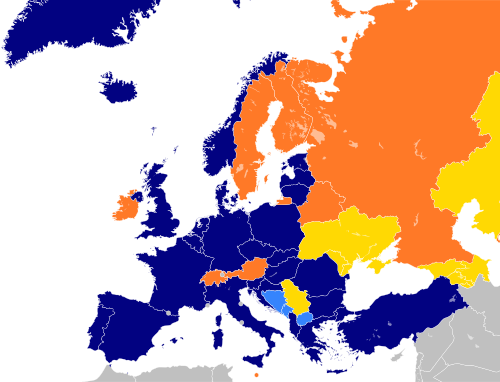
Blue is for safety
NATO as of this article's writing, from Wikipedia (NATO countries in blue)

NATO skeptics on the American left are less concerned about advancing “US” interests, and more interested in expanding a world where people can live free from war. To this type of thinking, the US is itself a source of much or the dominant piece of aggression in the world, and as NATO is subservient to US influence, it should be diminished. The hypothesis here is that a smaller or non-existent NATO would inevitably lead to a more peaceful world. People tend to live harmoniously with one another, much moreso than nations, and reducing any nation-state agency is to the good. This type of thinking also leads people to advocate for the reduction or outright destruction of all nuclear weapons. From this point of view—the humanist or humanitarian—the stronger and larger NATO is, the more likely war becomes.


Leftist criticism of NATO spending resembles conservative criticisms, with both claiming that the money spent on defense could go elsewhere. Whereas conservatives tend to prefer that money spent on alliance flow instead to grow US military capability, liberals or progressives would prefer that money to be invested in education, infrastructure, and science, both domestically and overseas. This leftist tends to believe that lack of education or transportation leads to misunderstanding and violence, and that were everyone to have the same basis of understanding and knowledge, wars could be prevented.


Another possible anti-NATO stance comes from countries hostile to Europe. Countries that would prosper from NATO's wane (China, Russia, etc.), which correctly assess that a militarily unified Europe checks their own territorial or economic ambitions, are natural enemies of NATO. These countries view any alliance of which they are not a part as something to be diminished or destroyed. In a few cases, like that of Serbia, whose territorial ambition NATO buried in the 1990s, hostility could also represent lingering resentment toward having suffered military defeat. It is worth pointing out that people who refer to Serbia as "Yugoslavia" are, as a rule, almost always anti-NATO along these lines.


The final perspective hostile to NATO comes from within the US military establishment. This criticism tends toward the conservative: defense industry spending is a zero-sum game. A country only accumulates so much capital, and conservatives believe that investing in alliance or partnership wastes that capital. While the motivation in this case is financial, the criticism manifests itself as political: these skeptics focus on the possibility of fighting war at the tactical level, independent of strategic considerations, or the diplomatic minutia of whether Russia was somehow tricked or deceived by NATO’s expansion. In all cases, the argument by people like Congressman Dana Rohrabacher (R-48) ends up being reduced support for NATO. This amounts to tacit or explicit acceptance of non-Western agendas.


Across the spectrum, people who have criticisms of NATO should not be viewed as necessarily hostile to American, European, or Western interests. While that is certainly the case in a few circumstances, for the most part, criticisms of NATO end up being reflections of the West’s failure to translate its prosperity into a model that is sustainable in the rest of the world. As few places outside the US and Europe have experienced lasting prosperity under Western models, it’s difficult for the West to dismiss criticisms out of hand.


In the US and in Europe, hostility toward NATO should be viewed as a failure on the part of NATO to communicate its purpose effectively. If NATO and the US were able to describe how and why, specifically, Europeans and North American participants benefit from the security arrangement, it seems unlikely that any morally and logically humanistic citizens of Western countries would see meaningful opposition to NATO, save on the absolute fringe. On the fringe left, people wish to weaken the US and Europe following the hypothesis that strengthening all non-European countries would lead to an increase in global justice. On the fringe right, people wish for there to be absolute US or European power, and see alliances between the two as contrary to the interests of each.


If you believe that peace and prosperity for all humans require a weaker Europe and USA, you see NATO as a problem. If, on the other hand, you believe the USA or Europe should be absolutely powerful, NATO appears wasteful at best, and a threat to your sovereignty at worst. I think you're wrong–but I understand your position.


The Bloodiest American War Many Americans Have Never Heard Of

The title, which I selected myself, is a trick. Most citizens of the United States of America know their war history. There's even a popular television brand dedicated to educating US citizens about war, and their country's role in it. So while it may surprise some to learn that the greatest loss of life during a single battle occurred in World War I rather than the Civil War or World War II, it is not as though people are unaware of those three wars, or the basic context: North versus South, Allies versus Germany, Allies versus Nazi Germany.


But “American” refers to the Americas, as a whole. And there’s one war of which few outside South America have heard. A war that occurred during the modern era, and was unlike anything seen during recorded, post-enlightenment history, before or since. While the scope and scale differs from that of the first and second World Wars, the loss of life and culture is comparable in relative terms–even, perhaps, exceeds that inflicted on Germany at the end of that conflict.


This war shares something else in common with World War II–a type of dictator that one sees only occasionally in the world. A visionary tyrant, a leader inspired by some overarching idea that compels everyone around him (or her) to attempt a drastic overhaul of society along moral, ethical, or scientific lines.


The Paraguayan War (or “The War of the Triple Alliance”) pitted Paraguay (substantially larger then than it is today) against Brazil, Argentina, and Uruguay. It was a battle of ideologies—on one side, a group of countries (the Triple Alliance) made up of what we would now call repressive authoriatrian regimes. On the other, Paraguay, which was run by an absolutist dictator. Something that all the participants had in common was that all had recently declared their independence from Spain or Portugal as a consequence of the Napoleonic Wars, and were coming into their own as nation-states.


Paraguay had a population of 525,000 at the war's outset. The combined population of the Triple Alliance was around 11,000,000. Paraguay was the aggressor, attacking Uruguay, Brazil, and then Argentina in succession until all three nations were united. The war lasted from 1864-1870, and by its end, Paraguay was completely defeated. 70% of the male population of Paraguay died, including its dictator. Paraguay lost large swaths of its territory to Brazil and Argentina, and its population decreased by over half. It took decades for the small country to recover.


This type of destruction is rare in modern warfare—a harrowing of one’s enemies so deep that it creates generational disruption. It seems that quite apart from Paraguay’s role of aggressor in the war, a source of hatred for Paraguay and unwillingness on the part of the Triple Alliance to negotiate with them was the nature of Paraguay’s dictatorship, and its history. The Triple Alliance all had similar forms of government—authoritarian aristocracy-based systems, recently liberated from a similarly aristocratic Europe, run primarily by European elites drawn from the country that had originally colonized them (Spain in Argentina's case, Portugal in the case of Brazil). They all condoned slavery to varying degrees.

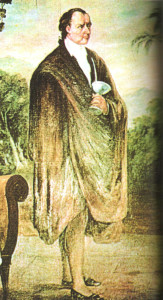
crackpot or creative genius
Attempted to create in Paraguay a racial utopia based on Rousseau’s ideas

Paraguay was different–almost unique in world history. In the wake of its independence from Spain during the Napoleonic wars, Paraguay was ruled by a heavily centralized government that obeyed the despotic but charismatic progressive leader Jose Gaspar Rodriguez de Francia. De Francia closed Paraguay's borders and instituted a radical set of social and political reforms, ruling until his death in 1840. Following that, his successor and acolyte (a nephew) Carlos Antonio Lopez ruled from 1842 until he died in 1862. While slavery was not abolished until after the fall of the dictatorship in 1870, it operated somewhat differently than in neighboring countries, in that after 1842, children of slaves were automatically emancipated upon reaching the age of 25.


De Francia and his successor, Carlos Antonion Lopez, took long views of Paraguay's development. Under their harsh direction, Paraguay industrialized, fielded a series of schools that catapulted it to the highest level of education in South America at the time, achieved independence in terms of food production, organized their military along European (Prussian) lines, and created the country's first constitution. They also attempted to create in Paraguay a—wait for it—real racial utopia based on enlightenment (Rousseau, specifically) principles, wherein whites could not marry one another, but were compelled to marry darker-skinned people. Paraguay was run by nepotistic despots, but was less nation-state than an aspiration toward just and equal society. Its leadership seemed legitimately to desire a distinct, enlightened culture wherein elitism occurred only through a honest competition. When de Francia died, for example, he'd doubled Paraguay's wealth–furthermore, it was discovered that he had neglected to collect his full salary, several years' worth of which he returned to swell Paraguay's coffers. The nepotistic aspect of the Paraguayan state seemed more a product of access to education and ideological committment than any egotistical desire on the part of de Francia to perpetuate his blood in leadership roles.


When the dictator’s nephew’s son (Francisco Solano Lopez) took over in 1862, he opened the borders and began a serious attempt to organize the smaller South American nations into an alliance that would be capable of resisting larger neighbors like Argentina and Brazil. Lopez also fell in love with the bad-ass Irish wife of a French officer–this heroine subsequently moved to Paraguay and bore multiple children. The first country Lopez sought to influence was Paraguay’s neighbor Uruguay—this country had (at the time) a government friendly to Paraguay's, and enthusiastic about creating a bulwark against South America’s traditional powerhouses. Uruguay also controlled access to the Atlantic Ocean, key to expanding trade.


Brazil had other ideas. They succeeded in replacing Uruguay’s pro-Paraguay government with a pro-Brazil government, backed by a Brazilian invasion, and Lopez decided the time was right to push back. Despite its small population and relative lack of equipment, Paraguay's militarized society was able to mobilize large portions of its population quickly, and Lopez took the upper hand against its much larger but less-well organized northern neighbor and its Uruguayan puppet. Following a setback against Brazil's superior navy in 1865, and a rebuke from Argentina, Paraguay expanded the war to include its southern neighbor. After this year, the war became a series of catastrophes for Paraguay, punctuated by the occasional defensive victory.


For more details on Paraguay’s earliest days of development as an independent nation (which itself offers several fascinating historical lessons and much intellectual food for thought), I recommend the Wikipedia articles that form the backbone of my own research, here, here, and here. Suffice it to say, Paraguay’s racial and social utopian dream (or nightmare) was destroyed by Brazil, Argentina, and Uruguay working in concert whose superior equipment and population told in the long run. Lopez led a guerilla war but was killed in 1870 in the jungle, his family's dream in ruins. Still, as with many such widespread and creatively ambitious social experiments, the legacy of Paraguay’s innovations live on. Paraguay has one of the most homogenous populations in South America—in part a product of that early intermingling of Europeans with black, native, and mixed-race populations—and an unusually long life expectancy (especially given their poverty), along with relatively broad education and literacy rates.


I'm not sure what lesson to draw from the Triple War. On the one hand, I'd like to think that real dialogue between different ideologies and nations should be possible. On the other hand, that "dialogue" always seems to find its purest expression through warfare. And one cannot discount that it's always the purest, most radical believers in progress (the Hitlers, the Stalins, the Lopezs) that seem to initiate these struggles.


We live in a day and age when people casually employ terms like "fascist," "communist," and "dictator," (as I have to a certain extent in this essay), and extrapolate a great deal from those words' associations. Jose Gaspar Rodriguez de Francia lived a frugal life that he seemed unattached to, so much so that his substantial inheritence went to enriching Paraguay. Nevertheless, his nephew's son was a belligerent war-hawk who brought ruin to his neighbors, and, ultimately, to Paraguay itself. I wonder–countries, societies like that of  newly-independent, 19th century Paraguay don't attempt to mask their intentions–they telegraph them to the outside world. The tyrant, the dictator, boldly and proudly tells all who will listen: "this is how society should be–this is how *all* society should be." Are there any nations today that can honestly claim to resemble tiny Paraguay, dreaming of dominion?


The Unusually Literal World of Bowe Bergdahl

Military hyperbole is at the heart of Serial’s second season. Sarah Koenig has gambled that she can take a simple premise—man walks off a base in Afghanistan, is captured by the Taliban—and make it representative. Of the war, of the world, of human nature. The season has discussed how Army private Bowe Bergdahl came to leave his post in Afghanistan, was captured by the Haqqani network (a savage affiliate of the Taliban), and the military’s efforts to rescue him. Its focus was procedural as well as institutional, describing the military’s bizarre, byzantine, and unrecognizably convoluted legal and social skeleton. The season’s sixth episode, “5 O’Clock Shadow,” extended that focus to the military’s extreme linguistic habits.


It’s difficult to imagine a world without metaphor or hyperbole. Try it—try visualizing a day wherein everything everyone said to you and everything you said to someone else, was understood as a verifiable truth claim. Conducted properly, the exercise results in confusion, absurdity, and a bewildering breakdown of communication. While metaphor and hyperbole aren’t necessary for communication, we rely on these linguistic devices to describe thoughts or emotions that involve some discomfort, and as most people’s lives involve discomfort—in work, in love, or in one’s fragile ambitions—metaphor, analogy, and hyperbole become a kind of language within a language.


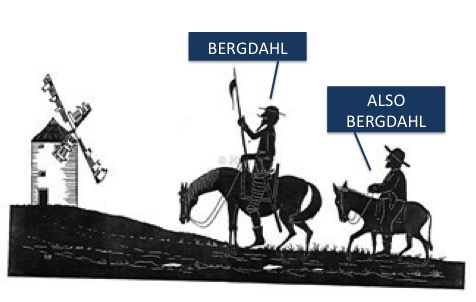
Bergdahl WindmillsThis is doubly true in the military. When one considers the context, it’s not surprising—the military, and especially the Army (or Marine) infantry consists of a more or less constant indoctrination into the ideas that (1) a soldier is part of a collective, with limited value as an individual and (2) one should expect to get hurt very badly or die, and that so long as this occurs within a military-sanctioned action against one’s enemies, that injury or death is desirable. Citizens of countries that have Western humanism and individualism at their cultural heart will find these thoughts incomprehensible at best—and those citizens who become soldiers of their humanist nation’s militaries therefore take this linguistic tendency to speak in metaphor and hyperbole to dramatic extremes.


In “Five O’Clock Shadow,” Koenig made much of Bergdahl’s disillusionment when a prominent and high-ranking sergeant in his unit claimed that soldiers had joined the military to “rape, kill, pillage, and burn,” a claim that was not immediately disputed by others present. Apparently, Bergdahl took the sergeant’s statement at face value, and statements like it. This became evidence to Bergdahl that his unit’s leadership was unscrupulous.


Most people with military experience—and especially experience in the combat arms, where euphemism and hyperbole are most necessary for psychical well being—understand that the military is filled with hyperbole. The easiest example of this (described by Army veteran Nate Bethea for Task & Purpose’s Serial Podcast) is a popular way of saying that one is angry with a peer or subordinate: “I’m going to cut off his head and shit down his neck.” The correlation between American soldiers or officers promising this horrible and primitive manner of execution and actual executions carried out? A perfect 0.


Establishing that people don’t mean everything they say, in or outside the military, is one important component to see how Koenig understands Bergdahl. Another point is that the military itself is filled with double standards that could be (and in the case of Bergdahl, were) interpreted as hypocrisy. Hence Bergdahl’s conclusion that the official fixation on unit uniform standards (or standards in general) was arbitrary and unreasonable—a fixation with which every soldier in post-9/11 combat has had to struggle. The same sergeant was quoted in “Five O’Clock Shadow” as viewing unshaven soldiers in the same light as the Vietnam-era unit that committed the My Lai massacre. To Bergdahl, this was another confusing example of hyperbolic rhetoric, but to the sergeant, the statement was intended to be taken at face value.


Bergdahl concluded that the military’s priorities were honorable and decent, and that it was his unit’s leadership that was intentionally or foolishly misinterpreting rules, regulations, and intentions in Afghanistan. Bergdahl concluded this because he apparently had difficulty interpreting metaphor and hyperbole, and was unable to reconcile the difference between ideal and real. This quintessentially human struggle, in Bergdahl’s case, appears to have been insurmountable.


The seventh and eighth episodes of Serial elaborate on Bergdahl’s literal-mindedness, and assign it a definition that fits it into the spectrum of mental illness: schizotypal personality disorder, a form of schizophrenia. In other words, Bergdahl’s behaved like a crazy person because… he was a crazy person.


I have argued elsewhere that Bergdahl should never have been in the military to begin with, and that due to his uniquely unsuitable temperament, those officers responsible for adjudicating Bergdahl’s case should view his crime with mercy and compassion. These episodes make it very clear that Bergdahl was never fit to serve in the Army infantry—from a social standpoint, as well as from a literary and linguistic one.


Curzio Malaparte: Great & Anonymous WWII Writer

How World War II gets remembered isn’t accurate, and for Curzio Malaparte, it's not even true. Not the American version, not the Russian, not anywhere, really. At best, our memory of WWII has become a lie founded on emotional connections to people barely known in life. A series of well-intentioned miscommunications and words spoken (or not) in German, Italian, Russian, Japanese or English across untranslatable generational gaps. The product of the optimistic if misplaced belief that one human could ever be said to understand another without dreaming some part of one’s own self and aspirations into them. Less good, our memory of WWII is a thoughtless generalization, and ultimately, a stand-in for racism, nationalism, and all the worst stereotypes that made anyone feel good about going to the War in the first place. Worst case scenario, it’s a deliberate deception – the product of malicious individuals or concerns eager to portray the narrative in ways that advantage themselves and their interests.

In the version of WWII I grew up with – the one popular here in America – here’s how it happened. This comes from my grandfathers, one of whom was an enlisted man in Europe with the U.S. Army, and the other of whom was in the U.S. Army Air Corps, an officer (Lieutenant) in a B-24 Liberator. Nazi Germany declared war on Europe and beat them, save for Italy, which was Germany’s comically inept ally that was good mostly for humorous tension-relief. Then they turned on their sort-of-ally (more like Frenemy), the Soviet Union. Germany and the Soviet Union were slugging it out, and England was on the ropes, when in jumped America. D-Day, Battle of the Bulge, game over – America: 1, Nazi Germany: 0. The Soviet Union wanted Europe for themselves, but America said, “nope, not gonna happen fellas, hang on while we beat Japan with our other hand,” then we got the atomic bomb. Communists and peaceniks stole our secrets and sold them to the Soviets because they hated America, and the rest is history. Bottom line: Britain? Weak. France? Super weak. Italy? Worse than France! Japan? Sneaky, mostly. Russia? Strong, but sneaky. Germany? Strong, but not as strong as America!

And America? Strongest of all. Just, and right, and boy did we take it to the Germans.

One of the other editors of this intellectual initiative, Mr. Carson, gave me a book for Christmas: Kaputt, by Curzio Malaparte, nee Kurt Erich Suckert, a northern Italian. While as a "memoir" it falls under biography / autobiography, it's the sort of memoir that can only be produced during a time of catastrophe. Kaputt describes Malaparte's time as an Italian Army officer / journalist on the Eastern Front – an absurd account of the violence that is so far as I can tell, both largely inaccurate and unique. Malaparte visits Romania, Ukraine, Poland and Finland and through almost-unbelievable access,  bears witness to the horrors of war and governance of the Nazis. That in and of itself is remarkable, because access breeds familiarity, but in this case, it grants the author (and the reader) a perspective on the occupiers that is simultaneously individual and universal. Witness the scene (one of many) with Hans Frank, the Nazi Governor-General of Poland, when Frank attempts to convince Malaparte that the Axis mission is just by invoking his wife and her friends knitting in their parlor:

Frank's hand on my shoulder, though it was not heavy, oppressed me. Little by little, disentangling and considering each feeling that Frank aroused in me and attempting to understand and define the meaning, the pretexts and the reason for his every word and gesture, and trying to piece together a moral portrait of him out of the scraps that I had picked up about his character in the past few days, I became convinced that he was not to be judged summarily.

The uneasiness that I felt within me in his presence was born precisely because of the complexity of his character – a peculiar mixture of cruel intelligence, refinement, vulgarity, brutal cynicism and polished sensitiveness. There had to be a deep zone of darkness within him that I was still unable to explore – a dark region, an inaccessible hell from which dull, fleeting glows flashed unexpectedly, lighting his forbidding face – that disturbing and fascinating mysterious face.

The opinion I had formed of Frank long ago was, unquestionably, negative. I knew enough of him to detest him, but I felt honor-bound not to stop there. Of all the elements that I was conscious of in Frank, some a result of the experience of others and some of my own, something, I could not say what, was lacking – something the very nature of which was not known to me but which I expected would suddenly be revealed to me at any moment.

I hoped to catch a gesture, a word, an involuntary action that might reveal to me Frank's real face, his inner face, that would suddenly break away from the dark, deep region of his mind where, I instinctively felt, the roots of his cruel intelligence and musical sensitiveness were anchored in a morbid and, in a certain sense, criminal subsoil of character.

"This is Poland – an honest German home," repeated Frank, embracing in a single glance that middle-class scene of domestic simplicity.

Readers receive the usual evaluation of a prominent Nazi leader – that of the thug, the brute – but that is only the jumping-off point for a more careful and scathing indictment, which is to say, the suggestion that the thing that makes Nazi Germany spectacular and special is its specifically middle-class sensibility. In other words – to the British, German, or American reader – the Nazis are like us.

It’s an astonishing book by an extraordinary man, who has been largely ignored by American history, likely for the reason stated above. Malaparte seems to have gotten a bad reputation for his involvement in the Italian fascist party, and, as a human, seems also to have been both a fanatical social climber, as well as a flamboyant intellectual. For all his political and moral failings, though, it’s important to recognize that he spent 5 years in exile for publishing defamatory remarks public statements about Mussolini and Hitler, then was imprisoned for similar anti-fascist/Nazi activity in 1938, 39, 41, and 43. He was a valorously decorated combat veteran of World War I, which means something, especially considering his service with Italy’s premiere infantry unit of the time, the Alpini.
Kaputt details the final destruction of a dying world order. We remember World War I as having swept away much of Europe’s prevailing social climate, and shows like Downton Abbey catalogue how that played out in Great Britain. There’s some truth to that recollection of history – the aftermath of WWI saw the beginning of Soviet (not Communist) Russia, and there were greater "rights" enunciated to women, as well as expanded economic opportunities for the lower and middle-class in non-communist societies (mostly through human space created by war casualties and the Spanish Influenza rather than human altruism)  – but the events that were set in motion during World War I accelerated after the fall of Tsarist Russia and the ascension of the Soviet Union. By the time the Nazis swept into power and through Poland and France, the old social order had been almost entirely eviscerated. Malaparte bears witness to this destruction on landscapes that are unfamiliar to most Western readers, and many Eastern European readers as well. Kaputt is full of surreal images of the horrors of war – it is a read unlike anything else one will encounter on the subject of World War II. Two quick examples:

Mad with terror, the horses of the Soviet artillery – there were almost a thousand of them – hurled themselves into the furnace and broke through the besieging flames and machine guns. Many perished within the flames, but most of them succeeded in reaching the shores of the lake and threw themselves into the water…while still madly struggling, the ice gripped them. The north wind swooped down during the night… Suddenly, with the peculiar vibrating noise of breaking glass, the water froze. The heat balance was broken, and the sea, the lakes, the rivers froze. In such instances, even sea waves are gripped in mid-air and become rounded ice waves suspended in the void. On the following day, when the first [Finnish] Ranger patrols, their hair singed, their faces blackened by smoke, cautiously stepped over the warm ashes in the charred forest and reached the lakeshore, a horrible and amazing sight met their eyes. The lake looked like a vast sheet of white marble on which rested hundreds upon hundreds of horses' heads. They appeared to have been chopped off cleanly with an ax. Only the heads stuck out of the crust of ice. And they were all facing the shore. The white flame of terror still burnt in their wide-open eyes. Close to the shore a tangle of wildly rearing horses rose from the prison of ice.

and this account of what a German Lieutenant Colonel did upon taking a Ukrainian boy-partisan prisoner, as told to a German princess and one of her aristocratic friends:

Finally the officer stopped before the boy, stared at him for a long time in silence, then said in a slow tired voice full of boredom: "Listen, I don't want to hurt you. You are a child, and I am not waging war against children. You have fired at my men, but I am not waging war on children. Lieber Gott, I am not the one who invented war." The officer broke off, then went on in a strangely gentle voice: "Listen, I have one glass eye. It is difficult to tell which is the real one. If you can tell me at once, without thinking about it, which of the two is the glass eye, I will let you go free." "The left eye," replied the boy promptly. "How did you know?" "Because it is the one that has something human in it." …

"I met that officer again later at Soroca on the Dniester – a very serious man, a good father, but a true Prussian, a true Piffke as the Viennese say. He talked to me about his family, about his work. He was an electrical engineer. He also spoke about his son Rudolf, a boy ten years old. It was really difficult to tell the glass eye. He told me that the best glass eyes are made in Germany."   "Stop it!" said Louise.  "Every German has a glass eye," I said.

and a third, as though two weren't enough – in this, a very different view of German soldiers (circa 1941) from that of the typical "they were all fanatical criminals" so popular in literature, cinema, and plays (a canard that Malaparte disputes):

The German soldiers returning from the front line, when they reached the village squares, dropped their rifles on the ground in silence. They were coated from head to foot in black mud, their beards were long, their hollow eyes looked like the eyes of the sunflowers, blank and dull. The officers gazed at the soldiers and at the rifles lying on the ground, and kept silent. By then the lightning war, the "Blitzkrieg," was over, the "Dreizigjahrigerblitzkrieg," the thirty-year lighting war, had begun. The winning war was over, the losing war had begun. I saw the white stain of fear growing in the dull eyes of German officers and soldiers. I saw it spreading little by little, gnawing at the pupils, singeing the roots of the eyelashes and making the eyelashes drop one by one, like the long yellow eyelashes of the sunflowers. When Germans become afraid, when that mysterious German fear begins to creep into their bones, they always arouse a special horror and pity. Their appearance is miserable, their cruelty sad, their courage silent and hopeless. That is when the Germans become wicked. I repented being a Christian. I felt ashamed of being a Christian.

Malaparte had unfettered access as an Italian journalist to the Eastern Front (when he wasn’t in prison for mouthing off), and describes the events from the persective of someone who knows the war effort is doomed – far more interestingly though, are the ways in which he frames these stories, telling them, as it were, in a series of country clubs and aristocratic estates to the intellectual and social inheritors of the West’s cultural legacy. Swedish, Spanish, German, Italian, and French aristocrats and diplomats. Polish princesses. The wealthy and powerful of another age, now, no longer so – some of whom, bound for the death camps. Malaparte catalogues an amazing history of loss, a way of life swept away forever. The British are largely absent, and come across when they are described as fairly pragmatic if not necessarily "good," and the Americans seem, if anything, to be parvenues – in this sense, Kaputt could almost be a companion piece for Henry James's earlier work – the reflection of American ambition for social weight in Europe, viewed through the prism of a massive class war.

Malaparte’s writing is powerful and moving, and despite his politics, it’s difficult to see how this book would not have had a stronger and more sympathetic reception in the West, save for its fundamental conceit: wealth and strength cannot keep you safe during times of war and true social tempest. There is no shelter from that storm, nothing counts in the end save the raw instinct for survival. This sort of morality tale is unwelcome in the capitalist West – this is not the sort of book anyone with property in the Hamptons would like to read, though I would argue that it is the clearest depiction of the horror of war that I have read, cleaner even than Vonnegut’s Slaughterhouse Five, and certainly far better than any of the “realist” portrayals of wartime (O'Brien, Marlantes, etc) who end up sentimentalizing and therefore implicitly endorsing war, which means they couldn't have thought very well about the experience even if they wrote effectively about it.

Malaparte becomes increasingly more sympathetic to the Soviets over the course of the book, an emotional and sentimental desire to see them as better or more than the Germans in part because they have beaten the Germans, and in part because of the horror the Germans have themselves inflicted, a fact that Malaparte observes firsthand on several occasions. This is interesting as well because the natural evolution of thinking for most in the West is a growing concern that the Soviets will simply replace Nazi Germany – in fact, in terms of history, the Soviets ultimately eclipsed the Nazis as a totem of fear when they acquired the atomic bomb, and became the first non-Western country with the ability to destroy the world. Despite the recent example of the war or perhaps because of it, many German and Italian intellectuals made up their minds to stick with moderates and capitalism after the collapse of Nazi Germany – more of them sided with the Totalitarian Soviets based on a sense that there was something in Communism, and to this day, European communism retains a small but important political presence, often derided in England and America. Malaparte’s viewpoint is, therefore, especially interesting considering his various positions before and during World War II.


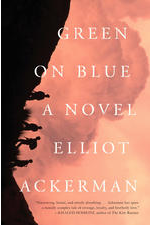
Why Don’t Afghans Love Us: Elliot Ackerman’s Green on Blue

 There aren’t many “literary” fiction books out about Afghanistan, and almost none authored by veterans. Brian Castner, a veteran of Iraq, published an essay in Los Angeles Review of Books that examines the phenomenon in more depth. Roy Scranton, another veteran of Iraq and a philosopher, claims in a different LARB essay that there are plenty of war stories by American veterans already available, and that Western audiences should be looking for stories by or about the host nation. This claim has been made by writers like Joydeep-Roy Battacharya and Helen Benedict, as well.
Enter Green on Blue, a savagely honest, realistic novel about Afghanistan by Elliot Ackerman. Imminently readable and deeply subversive, Green on Blue draws on its author’s extensive experiences in Iraq and Afghanistan to paint a stunning and accurate description of why the West is losing and will lose in Afghanistan. The problem and solution both exist within the book’s title.Green on Blue

“Green on Blue” is a military term that derives from the color of units on NATO battle maps – blue colored units are friendlies (America, Great Britain, West Germany), green are allies (France), and red are enemy (Soviet-aligned countries). Green on blue describes what happens when allies deliberately or accidentally attack friendly soldiers / units. The incidents, therefore, are incredibly troubling – they represent the failure of alliance, the prospect of new enemies arising from botched friendships. They hint at betrayal, in the context of existential struggle.

In Green on Blue, Americans are “blue” and Afghans are “Green,” the allies. Crucially to the plot, there are no “red” – there are enemies, but this term, in the context of Afghanistan, is fungible. The plot revolves around an Afghan militiaman named Aziz, who navigates generations of human relationships between Afghans, while attempting not to be crushed by the war. At its heart, the war is described as a competition between groups for social standing – respect from young men, and money from the Americans.

According to the capitalist west, money is supposed to buy respect and loyalty. This forms the basis of an important miscommunication between Americans and Afghans in the novel – a strategic cultural miscalculation of extraordinary significance. Money, in the context of the story, represents a sort of catastrophic idealism, which merely compels individuals to compete in a zero-sum game for resources. Ultimately, American dependence on the coercive power of tangible resources predicts the type of incident hinted at in the book’s title.

On a local level, in Afghanistan, the most important thing is respect – the honor of a group (“nang”), which is under constant threat of insult. Once “nang” has been challenged, the group is required to respond to the insulter with revenge – “badal,” which consists of appropriately violent action. The protagonist learns this essential lesson as a child: “Once, in Sperkai, an older child had split my lip in a fight. When my father saw this, he took me to the boy’s home. Standing at their front gate, he demanded that the father take a lash to his son. The man refused and my father didn’t ask twice. He struck the man in the face, splitting his lip just as his son had split mine…” On this plane, Green on Blue operates as a sort of slowly-unfolding national tragedy, wherein the Afghans become their own heroes and villains, and the Americans – representative of “The West” – are simply agents of catastrophe and destruction, casually and unthinkingly paying money to keep the feuds going, hoping to find “High Value Targets” in the war on terror.

Aziz is both nuanced and archetypal – a quintessentially Afghan product of the West’s involvement in Afghanistan. At the story’s beginning, his father (a fighter for hire), dies at some point between the Civil War period after Soviet rule and NATO’s intervention in 2001: First there was the dust of people running. Behind the dust was a large flatbed truck and many smaller ones. They pushed the villagers as a broom cleans the streets… Amid the dust and the heat, I saw men with guns. The men looked like my father but they began to shoot the villagers who ran. The gunmen are never identified – they destroy Aziz’s village and move on, leaving Aziz and his older brother orphaned. After a difficult childhood where he and his brother struggle against the odds to improve their tenuous life at society’s margins, another, similar tragedy involving a Taliban suicide bomber leads Aziz to join the “Special Lashkar,” a CIA-funded militia on the border of Pakistan.

In the “Special Lashkar,” Aziz learns to fight and kill. The group’s leader is an Afghan named Commander Sabir, paid by the CIA to fight against the Taliban. Readers quickly learn that Sabir is enmeshed in his own struggle over “badal” and “nang” – Sabir is hunted by the brother of a Taliban fighter that Sabir killed, a Taliban named Gazan, in revenge for that now-dead brother having killed Sabir’s brother, the former leader of the Special Lashkar. If that seems complicated, it should – alliances and enmities proliferate in the book, ensnaring all and forcing everyone to take sides in the conflict. Nothing is sacred, not love, not honor, not brotherhood – nothing. And behind it all stands the enigmatic, fascinating character of “Mr. Jack,” the CIA officer who runs the Special Lashkar, and who seeks targets for America’s war on terror.

Mr. Jack is my favorite character in post-9/11 fiction. There isn’t much of him in the book, but his influence is seen everywhere – he resonates through the book’s pages, exceptionally powerful, moving in and out of autocthonic settings like he belongs, while making obscene and absurd mistakes that lead only to more preventable strife. Mr. Jack is so unaware of the consequences of his actions, that he becomes an incidental antagonist. His hunt for professional success turns Mr. Jack into a caricature of a man, a careerist who seeks professional success without any understanding of its human cost.

There are no heroes in this book, which could make it a World War II story similar to Catch-22 or Slaughterhouse Five – save that there are no antiheroes, either. There are believable human characters that find themselves at war in spite of themselves, forced to fight for meanings that shift and collapse until the only thing left is friendship, then friendship collapses as well. This resembles the standard Vietnam narrative, like Matterhorn or The Things They Carried, but the characters in Ackerman’s book are not motivated by ambition or by ideology – rather they seek simply to survive, not to be killed. The characters in Green on Blue do not have space for the type of indulgent self-reflection imagined by the typical Vietnam-era author, such as Tim O'Brien or Tobias Wolff – this is a book where there is little room or space for interiors. Perhaps we are on the verge of a new type of fiction – a story that balances deliberately earnest almost modernist narrative plotlines, while acknowledging the infinitely expansive potentials of post-modern perspective and awareness of self- and other-ness, only to reject that literary and intellectual dead-end as (paradoxically) reductive. Or, as Aziz says in the opening sentence: “Many would call me a dishonest man, but I’ve always kept faith with myself. There’s an honesty in that, I think.” Rather than opening a meditation on postmodernity, Aziz goes on to show us precisely, meticulously, how that opening statement could possibly be true, in the context of Afghanistan.

Green on Blue makes a series of bold philosophical, political, and literary claims, which are plausibly balanced and supported throughout. It is a powerfully realistic and exciting adventure; it is also a eulogy for the failed post-colonial ambitions of a capitalist society that believes it can demand service for money, as though the developing world is a whore or a dependent. It is among the best, most accessible and accurate descriptions of Afghanistan available – and the single greatest critique of the West’s policy yet written.

Incidentally, the most successful militia commander in Paktika Province for the last ten years – a wealthy man who has successfully played the role of insurgent, bandit, contractor, and militiaman on both sides of the fence? That would be Commander Aziz.


Brad Pitt and the Myth of the Wehrmacht

Brad Pitt loves playing in WWII movies. He loves fighting Nazis, who, incredibly, really existed, and were (if anything) even more evil than comes across on a movie screen. For 12 years, one of the most civilized, technologically and institutionally advanced countries on earth was ruled by a brutal, vicious band of thugs who employed racial mythology, sentimentalism, romanticism, emotion, intimidation, and murder in their attempt to extort as much wealth as possible from the populations they ruled. While not the worst catastrophe the world has ever witnessed, to put the Nazis in list terms (the only terms most people understand these days), we're probably talking one of the three all-time worst. Almost certainly bottom five, and indisputably bottom ten.

It's important to frame the list in terms of utility, or effectiveness, so as not to unintentionally make the case that this type of behavior is worthy of praise, or anything other than the most resounding condemnation and rejection. Oftentimes people confuse the intensity or degree of an action with its having some sort of value as an accomplishment, which is completely false. An evil accomplishment is not an accomplishment at all – only a fiend would claim different. Therefore, the Nazis and other misfortunes that humanity have inflicted upon itself such as other brands of totalitarianism or authoritarianism should never occupy the "top" of any list – only the bottom, where they belong.

Having established the terms of what we're talking about – which are critical to the debate – I wanted to weigh in on the topic of Fury again, in part because some people read my review and did not understand that I did watch the movie after writing the review based on previews. I watched it for two reasons: first, because when a woman says she wants to watch a war movie for a date, only a churl says: "no." Second, because I'd made the emotional if somewhat foolhardy claim that if Fury revealed anything new or fundamentally true about life or war by using different weapons than Saving Private Ryan, I'd boil and eat my leather shoe. I stood by that claim, but not without some trepidation as curtain time approached.

I should have trusted my gut. As composed, Fury was a confused series of cliches (many of which have been described elsewhere at great length) cobbled together around three competing assertions (contained within the protagonist): one, that the Nazis and specifically the SS were an antagonist of such manifest evil that to battle and kill them when and wherever possible was the highest possible good, two, that America and Americans were essentially different from the Nazis as expressed by the SS, a fact that explained or excused the actions of American soldiers within that context, and three that in war, people tend to develop tribes based on their unit – and in a tank, especially a Sherman tank, the weapon itself, the tank, becomes a part of the tribe – a living part of the unit.

Fury billed itself as a "realistic" movie, and a lot of the marketing surrounding the film concerned its attention to detail as well as the importance to the actors and studio that they "get it right," so it's worth discussing how the movie measured up based on those standards. Based on every reliable review I've seen from subject matter experts, the Germans and Americans were outfitted with equipment and weapons appropriate for the time, and those weapons functioned more or less as one would expect. The Americans aren't facing the Wehrmacht of 1941, they're facing militia reserves composed of children and old men, and the ineffectiveness of many German units in the face of American combat power (the missed shots, the shoddy equipment, etc.) can be explained as bad craftsmen misusing their tools. The deaths were realistic – people died characteristically realistically considering the medium, rather than unrealistically.

SPOILER

tank

There is a scene with a Tiger tank that arrives with about 30 minutes left to go in the movie. One understands immediately that in a movie named for a tank, the Tiger will likely not destroy Fury and then rumble away as the protagonist (played by Brad Pitt), a troubled staff sergeant named Wardaddy, leads his crew to safety. The question becomes whether the American close air support (featured shortly before the tanks roll out) will show up and knock out the Tiger, or whether somehow Fury and the other tanks will outmaneuver the Tiger and knock it out, or some other plausible scenario, for example maybe Brad Pitt knows how to make sticky bombs like Tom Hanks. In a brilliant reference to the old GI Joe cartoons, where Cobras would unload battalions worth of firepower on the outgunned and outnumbered Joes, missing every time, the Tiger manages to destroy the other non-Fury tanks, then miss or score glancing hits (from point blank range with AP ammo) on Fury, until Wardaddy has maneuvered the tank behind the Tiger, and scores a direct hit seconds before the Tiger manages to miss again, or score another dramatic near-miss. 

BACK TO NON-SPOILER

The presentation of time-appropriate weapons and equipment, and the opening combat sequences, are all very well done, if on the melodramatic side. As time went on, though, the tactics, the strategy, how collections of people tended to move and work on an aggregate and specific level became less and less "realistic," while still purporting to strive for that standard. And this is a shame – if the movie had embraced the surreal, if it had let the "realism" go in favor of something more impressionistic, it could have avoided the absurd, cliched pitfall into which it ended up falling. Instead, it doubled down on its commitment to the narrative, the plot, and those three aforementioned competing assertions, which brings the Sherman tank, Fury, led by Wardaddy, to a crossroads that must be defended at all costs.

META SPOILER

Lest I be seen as a hater (someone who just criticizes success to make myself sound clever or fill some internal insecurity or bitterness), allow me to propose an alternative movie, which I found to be much closer to the truth about the horrors of war, (if less "realistic") – and which I proposed in my preview review of FuryCross of Iron.  In the end of Cross of Iron, a corrupt and ambitious Prussian Captain wants a Cross of Iron, and follows a heroic enlisted German soldier into a suicidal counterattack. This action occurs during a Russian assault in which the German unit is being overrun, and the action is remarkably even-handed – Russians and Germans are slaughtered indiscriminately, and heroic actions are presented as tiny tragedies. The protagonist and the Captain are fired upon – by a child – and the Captain can't figure out how to reload his submachine gun. The enlisted German soldier – Steiner, played brilliantly by James Coburn – sees this happen and begins laughing hysterically. The Russian child soldier is so disgusted by the Prussian's incompetence and desperation that he rolls his eyes rather than shooting again. The Prussian officer pathetically puts his helmet on backwards, still without having reloaded his submachine gun while Steiner laughs at the tragic absurdity of it all. From there, the movie cuts to the ending credits a series of stills of an execution carried out by Nazis, Steiner's laughter ringing in our ears. The credits are, collectively, one of the most powerfully damning pieces of evidence against the Nazis I've seen in any movie, ever.

I cannot stress enough how untrue and devastatingly inaccurate – unrealistic – any statement other than the one attempted by Peckinpah is. In order to make something real, there has to be something at stake. Fury wagers nothing, and presents the audience with a conclusion that's about as far from Cross of Iron as one could get.

META SPOLER COMPLETE – INITIATE SPOILER

At the end of Fury, the tank is disabled by a German anti-tank mine, cleverly placed in a piece of key strategic terrain. As it happens, Wardaddy's crew has been tasked with defending this terrain against a possible German counterattack – they are the only protection remaining between the Germans and an American resupply column. It is an afternoon in April, 1945. One of the tank's crew mans an OP, and discovers, with horror, that a full Battalion of adult male (i.e. veteran) SS panzer grenadier infantry is approaching down the road, singing, marching, panzerfausts at the ready – full of esprit de corps and savage intention, the kind we know is bad because they're SS.

Let's suspend disbelief – I'm sure it's possible such an event like this happened, even near the end of the war. I read a memoir by an SS infantry officer called Black Edelweiss which should be required reading for every young American male, as a cautionary tale of how propaganda and blind nationalism can lead even the best-intentioned young men astray. The author (writing for understandable reasons under the guise of a pseudonym) describes how his unit was shifted from the far north of Finland to Germany in January-February of 1945. Moving at night via ship, train, and foot to avoid being strafed or bombed, the unit was detected during an attack and strafed, bombed, and shelled nearly out of existence before seeing any enemy (American or British) soldiers. The survivors were then sent on a series of increasingly absurd missions, culminating, for the author, in a pointless and near-suicidal defense of a position with a single machine-gun against two Sherman tanks, which coincided with his injury and incarceration.

So this unit of SS infantrymen is moving in formation, singing, near the frontline, down a road, in a place where the Americans have aerial domination (uncontested access to the skies). It seems incredible – but maybe this is just a testament to confidence in their fighting prowess. The soldier at the OP runs back to tell Wardaddy about the situation – 300 enemy veteran soldiers, trucks, vehicles, kitted out to fight. Wardaddy's reaction is to announce that the others should return to the unit, but that he's carrying out the mission – he's manning Fury, staying with the tank, to repulse the Germans. The other American soldiers in the tank concur that this is a sound and reasonable plan, and they set about prepping for an ambush, in a scene that echoes the ending of Saving Private Ryan.

Now – the ambush and ensuing battle are relatively unimportant, and filled with the type of improbable and ludicrous cinematic excesses one would rightly expect it to contain. The crew guns down Germans as though they were pigeons; for their part, the Germans have inexplicably packed away the Panzerfausts they were carrying in cumbersome boxes. The SS has forgotten to fight, or perhaps never learned – something that would be slightly more believable if the unit were not filled with veteran adults, rather than cannon-fodder children. It's important, vital, even, to note here that every serious military analyst has credited Germany's early battlefield successes and long survival against impossible odds to a marked tactical superiority over their Russian, British, and American foes – the myth that German military success derived from technological superiority is a convenient invention of video game producers, Hollywood, and daytime television hucksters. The truth of the matter is that, outgunned, outproduced, and outmatched in almost every important category, the Germans held on because they outfought their enemies tactically almost everywhere, finding themselves bested occasionally by elite American units in areas like Bastogne, or by Russians at Kursk. Much of WWII was, for the Allies, a function of merely holding on, shelling the Germans with artillery and bombing them while our inferior soldiers made incremental gains against exhausted and increasingly ill-trained conscripts. This is not embarrassing or shameful – we won a modern war against a country attempting to fight along pre-modern lines (using human ingenuity against weapons). On top of which, the Nazis were, as described before, a pack of evil and unscrupulous bullies who needed to be stopped. So – to come back to the original point – Fury inflicts massive losses on the Germans, who continue to rush the tank rather than flanking it, or doing anything even the most basic military unit knows to do. As a combat-proven, valorously decorated former airborne infantry officer who has seen combat firsthand, I can say this without a shadow of doubt: in reality, the ambush and combat go down very differently from how they are portrayed in the movie.

When Brad Pitt's Wardaddy dies – shot twice, heroically, by a German sniper, then finished off by two grenades dropped into the tank by a final rush by the Germans (their fourth or fifth?) – he is presented like a figure in a painting by Titian or one of the old masters.

I've thought about why this must've been for some time, why none of it hung together. I mean, sure, anyone who has been to combat and knows how the thing works must find a movie like Fury condescending and trite. But why did the director and actors decide to play the movie this way? Why undercut the basic premise that the Germans were a serious, formidable foe? My hypothesis is that Hollywood has been producing these movies for so long that it has actually lost it's understanding of why or how the Nazis and SS were evil. Hollywood and popular culture – which have always placed more value on aesthetics and beauty than ideas, have become fascinated with the SS and Nazis as symbols of evil, but not as actually evil. So they pay lip service to the idea that the Nazis are horrible, and the SS are just the worst, and fail utterly to understand that the worst thing of all is human fanaticism, is bullying – the urge to destroy, divested of humanity, and invested with a purpose that confuses ends with means. The ends, for every combat veteran who's spent more than a few weeks in real combat, is (1) staying alive, and (2) helping keep one's buddies stay alive. The moment at which Wardaddy decides to stay with his tank, and is then absolutely fine with having his crew with him is the moment, for me, that the movie became both unrealistic and inaccurate, as well as untrue – in part due to Wardaddy's decision to damn his crew, and in part due to the way in which their efforts to stop the Germans were portrayed in valedictory terms, rather than under a mound of opprobrium.

Fury works when it's a movie about a German tank, filled with SS soldiers who are even at the end of the war and if somewhat skeptically in all practical terms, still committed to fighting and dying for their Fuhrer. Defending a crossroads against impossible odds? Check – the SS was famous for doing precisely that, even though it was stupid and pointless. Ambushing an American military unit many times its size, with the full weight of the U.S. military behind it, and the inevitability of artillery and air power once identified? Check – happened on more occasions than are worth recounting here. Fury is a movie about an SS tank, led by the German-speaking Brad Pitt, which is fanatically devoted to the proposition that the enemies of Germany must be stopped at all costs.

Otherwise it doesn't make any sense at all. Worse, by allowing one of the Americans (the "good" one) to live, and by killing the others off heroically against impossible odds, Fury sends an awful and inherently misguided message about war, which contributes to the same tired old myth that helps lead America into foolish conflicts today. Good people understand when it is appropriate to head off to war, and do not need convincing – this myth of the necessity to throw one's life away for nothing is far beyond absurd – it is, in fact, obscene. I hope not to see more movies about World War II like Fury – perhaps it will be the last. It would be unrealistic of me to actually expect that, though.


Acronyms and 21st Century Conflict

Some useful acronyms by which to understand 21st century conflict:

COIN: Counter Insurgency. Employed by ISAF in Afghanistan from 2003-2010. Broadly speaking, the strategy wherein a friendly force competes with an enemy force for the allegiance and support of a largely-neutral population. Unattractive to militaries because of the numerous paradoxes involved in successfully pursuing the strategy. Very attractive to democracies and advocates of human rights as, ideally, COIN involves pitting humanism and liberal, western ideas against some competing philosophy, and we’d rather believe that, properly marketed, our system will defeat any competing system.

CT: Counter Terror. Employed by ISAF in Afghanistan from 2010-present. Employed around the world by America. Championed most vocally by Vice President Joe Biden. The strategy wherein intelligence (gathered directly by humans or by technological means) identifies actual or potential terrorist threats to the U.S.A. or any of its allies (or strategic interests, including Russia and China), and that terrorist threat is neutralized. With a bomb or a gun. “Taken off the board.” AKA “whack-a-mole” for its apparent ineffectiveness.

DEVGRU: Seal Team Six.

GWOT: Global War on Terror. The Bush Administration’s term for the overarching foreign policy strategy that included OEF (the war in Afghanistan) and OIF (the war in Iraq). Intentionally imprecise.

GCO: Global Contingency Operations. The Obama Administration’s term for the overarching foreign policy strategy that includes OEF (the war in Afghanistan), and the unnamed operations in Africa, Pakistan, throughout South America and Europe and Southeast Asia. Terrifyingly, even broader and somehow more vague than GWOT.

ISAF: International Security Assistance Force. The group of mostly-NATO countries helping Afghanistan transition from tribal society into modern democracy. Also jokingly known as “I Saw Americans Fighting” among Scandinavian ISAF members.

OEF: Operation Enduring Freedom. The war in Afghanistan.

OIF: Operation Iraqi Freedom. The war in Iraq.

SOCOM: Special Operations Command (the command, now basically obsolete, responsible for organizing Delta, Rangers, Seals, and Special Forces).

TF -: Task Force [blank] – depending on the context, either a Battalion or Brigade-size effort, or a much smaller higher-echelon group of former SOCOM-affiliate soldiers performing deniable missions for which there are no names.

In 1946, George Orwell wrote an essay about the way politics was impacting the ways in which people used language. The basic idea was that unscrupulous people who had things to hide were manipulating how we communicated in order to deceive us into supporting people or policies that we would not otherwise want to support. That politicians lie was not a new idea in 1946, and is not surprising today. In a world with enough thermonuclear energy to destroy most life above cockroaches, though, the stakes are a great deal higher.

Orwell refined the ideas he expressed in 1946, and published them in a more broad fashion in 1984, when he described the language of “Newspeak.” The language (a revision of English undertaken by a totalitarian state apparatus) would shift the way people thought by channeling their ability to express certain thoughts in public, the way they exchanged information. Reading “Politics and the English Language” and 1984, it’s not difficult to see how Orwell’s ideas about thinking and language had evolved. Orwell believed strongly in the potential of democracy and humanism to create morally responsible, ethical, civic-minded individuals, and put his life on the line to that end in the Spanish Civil War, receiving a throat wound that kept him off the front lines of the Second World War.

One of the most important and relevant intellectual legacies that George Orwell bequeathed us was this idea that, either with or without malice, institutions routinely and deliberately attempt to shape public thought through language. Nowhere is that more apparent today than in the successive American Presidential Administrations responsible for beginning what we call the “Global War on Terror” (the Bush Administration) and expanding the definition and bureaucratic entrenchment of that war (the Obama Administration). Both Administrations make heavy, almost exclusive use of acronyms to describe every aspect of the conflict, from the weapons used, to the agencies involved, to the nature and scope of the military actions. Orwell would recognize the current “Global Contingency Operations” (GCO) as the apogee of post-modern “Newspeak” in action – a war that is made up of “contingency operations,” less police action than police-intention, less of an effort and more of an idea. Something slippery, hopelessly slick, around which no counter-argument can be mustered.

The acronyms are constantly changing. When I got to Afghanistan, the Taliban were called “ACM,” or “Anti-Coalition Militia.” Eight months later, they became “AAF,” or “Anti-Afghan Forces.” A single fighter was a “MAM” or “Military-Aged Male,” though many of the soldiers called them “FAGs,” or “Fighting Aged Guys.” As earlier pointed out, GWOT morphed into GCO sometime mid-2010. The CIA, with too much baggage, has lost much of its actual importance to various TFs, the NSA, DEA, DIA, and DHS, which in their turn will likely change acronyms over the coming years.

The enemy carried AKs and PKMs and RPGs, while we carried M4s, AT4s, M240Bs, SAWs and M4-mounted 203s, which were later swapped out for 320s. HIMARS is good, but getting a GOMAR is bad, although one of the finest, most scrupulous officers I ever served with went on record saying that if you got out of combat without a CIB and a GOMAR, you hadn’t done your job properly, a commentary on the higher-level leadership in the Army’s unreliability and essential disconnect from events on the ground. One cannot understand the military without speaking its acronyms fluently–and each military branch has a separate set of acronyms, some so different as to be mutually unintelligible.

In short – to wage war on the side of justice and good (America, the west, humanism), one must first master a shifting language of words and acronyms which themselves change every few years or so. I can testify from personal experience that the effort involved in mastering that language is great, especially when one is actually in combat (and therefore not incentivized to do anything with one’s energy save decipher the enemy’s intentions). Mastering military-speak is the first step in confronting the realities of the war – one cannot effectively protest or criticize without understanding what it is one is protesting or criticizing. If one lacks the proper words by which to challenge a given political institution – especially when it is in the institution’s interests to keep the nature of its goals and efforts obscure – one will simply rail away in a vacuum, doomed to appear to be protesting the last war, or some archaic problem that is irrelevant.

This is why the long-haired Vietnam-era protester seems so sad, so overmatched – he’s saying “no war,” to which statement the Obama Administration can correctly say “we never declared war, but Iraq, which was begun on false premises by the Bush Administration, has been closed down,” and ignore the ongoing engagement in Afghanistan, and the ubiquitous worldwide “Counter-Terror” operations targeting, among others, American citizens. College students and idealists who feel – correctly! – that we should be more careful about how much information we allow our government to collect have to sift through layers of obfuscation before they uncover an acronym – NSA? Not CIA, or DHS? – that gives them an entity, literally an agency against which to argue, with which to dispute.

And why, why does any of this matter? Because every political administration understands that if they were to place a new agency inside the Pentagon and advertise it by its true name – in the case of the NSA, for example, the “Office of Monitoring Everything Anyone Does Online to Profile and Preempt Terrorist Attacks,” there would presumably be a great deal of blowback. While some polls seem to indicate that a majority of Americans support sacrificing a certain amount of privacy to security, it’s not clear to me whether Americans would support such a program or agency – supposing that the majority of the population agrees that one should trump the other, we could have (given knowledge of the NSA’s programs) collectively agreed to discuss our way ahead as a nation. Even the CIA – the “Central Intelligence Agency,” which I will use as an umbrella acronym for those acronyms I should not divulge to the public in the interests of national security, could at this point more accurately be called the “CIA / DDSAT,” or Central Intelligence Agency / Department of Drone Strikes Against Terrorists.” Again, if the public had understood – understood, that we had kill teams in many third world countries, and were targeting individual human beings for assassination, oftentimes based on patterns of behavior, there probably would have been a spirited debate on the subject. These actions were not kept secret, but were buried beneath an avalanche of acronyms and double-speak. Newspeak, in fact.

One should not have to offer one’s credentials or explain one’s love of country when making such a statement, but it still feels obligatory. In an intellectual atmosphere where substance is more important than words, I have to point out that I believe, like Orwell, so strongly in the potential for good in the west and our cultural tradition that I went to war, twice, for it – OEF VIII and OEF X (it may have been XI, I never got a clear answer on that). I believe that my country, a part of the cultural legacy of Kant and Plato, is an especially permissive and forgiving country in which to be a journalist and thinker, and despite the vitriol with which intellectuals are attacked from both the left and the right (the Williamsburg Hipsters on the one hand who see no wrong in President Obama, and the Fox News / Rush Limbaugh apologists on the right who see no wrong with anything the Neocons say or do), you can still live freer here than in any other large country of which I’m aware in the world. We can do better, though, as citizens – we should expect better from our government. Obfuscation and deceit are rife within our political community, and should be done away with. We must begin calling things by their true names again, and if we don’t like how they look on paper – we need to be more responsible about how we exercise our global citizenship. On this, Orwell would agree.

Adrian B