New Nonfiction: Interview with Adam Kovac
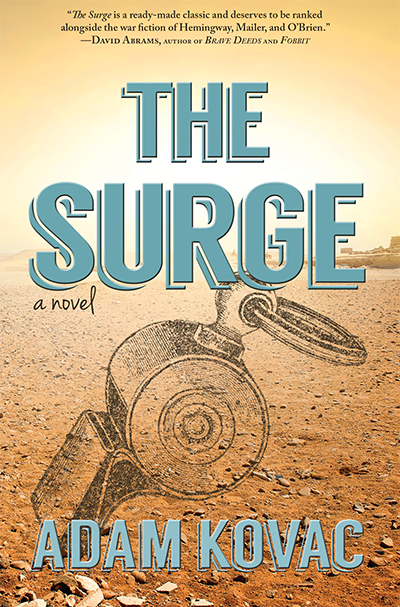
Adam Kovac The Surge

You wrote and published a version of THE SURGE in 2019. I read and enjoyed it, but didn’t go back to reread and compare with the 2025 edition. What was the thought process behind that, and what changes did you make in the intervening years?

Publishing the second edition of THE SURGE happened somewhat by accident. I knew Jerry Brennan, publisher of Tortoise Books, had read the novel not long after it debuted and liked it. Few years back, on Veterans Day, he and I were posting on social media about what I can’t remember and I shot him a DM basically daring him to republish the book. And, to my surprise, he thought that was a great idea and now here we are. I’d reread my novel a few times after first publication, mainly to see if I’d made a mess of it. But did I think about changes, jot down notes about revisions? No. I never imagined it’d ever be republished. Aside from minor, stylistic and editorial tweaks throughout, very little is different from the 2019 edition published by Engine Books. That’s not to say readers shouldn’t check out the reboot, which in my opinion is stronger and more meaningful, largely due to Jerry’s deft editing. I started writing this novel as my MFA thesis at Northwestern University. One of my advisors was John Keene–he’s a real smart guy–and he told me the goal wasn’t to simply write the best book about the Iraq War, but to write the best book about any war, ever. So that’s what I did. I sat down and attempted to write The Great American War Novel. I wouldn’t have sent the manuscript out on submission if I didn’t think I’d come as close as I was able to actually accomplishing that.

In my review I wrote about The Surge (both the book and the campaign) as central events in post-9/11 America. Do you view that year-plus as definitive, impactful, important? Do you think America achieved success due to The Surge? Despite of it? Not at all?

A journalist interviewed me on the day of the so-called fall of Afghanistan and asked a similar question. We almost got into a heated argument before steering the conversation back on topic. Did the surge make a difference? Short term, based on the stated objectives, I think so. Although being a part of it felt batshit crazy and bizarre at the time. I arrived in Iraq in 2007, a few months after the campaign kicked off and soldiers already downrange described the country, insurgent activity, as “quiet.” I also took part in the early months of Afghanistan’s version of the surge in 2008-2009, but can’t speak to whether it had any success. Like OIF, every sector in OEF was different. But, personally, while submerged in those moments, I truly thought we–America–stood a real chance of turning things around in both theaters. For lack of a better word, you could say I believed in the mission. But THE SURGE is simply the title of a work of fiction that happens to be set in a fixed point in time largely because the story needed it to be. This really isn’t a book about the surge offensive, the Iraq War, or even a war novel at all. When trying to decide on a title, I went back and forth between The Listening Post and For a Piece of Colored Ribbon. But my agent, Kevin O’Connor–he’s great–recommended THE SURGE, and I didn’t hate it and also didn’t want him to think his new client was a diva. In hindsight, if I’d titled the novel something like, The Grocery Store Owner’s Foster Son, it might’ve been a bestseller.


In reading THE SURGE, I saw what felt like a lot of allusions and references. Is that me imagining them, or was that deliberate? (One I’m particularly interested in: the scene with Gibson, Vogel, Witkowski, and the Widow Makers having their “party” – felt like something out of PLATOON or APOCALYPSE NOW.)

I’m not sure anyone returns from a deployment without having done, seen or heard about some weird shit, inside or outside the wire. And I feel the wartime experience tends to mirror those preceding it, both in reality and works of art. Example: I know I’m not the only vet who’s heard a wounded soldier say to the medic, “Tell my wife, I love her.” Yup. That’s straight outta the movies. And there’s a logical, psychological explanation for why that phenomenon occurs. But everything in THE SURGE is deliberate. I tried not to have a single scene, line of dialogue, word, or even punctuation mark that wasn’t there for a purpose. It’s one of the reasons the novel has such a short length. Which I feel is a good thing, despite what big publishing thinks. Best I can say is that there’s meaning and intent everywhere in THE SURGE that might not immediately or consciously manifest itself on the page. Another reason why calling it a war novel, to me, feels just a tad inaccurate. Gonna name drop again but I was fortunate enough to take a writing workshop at Northwestern taught by Stuart Dybek. I’m paraphrasing, but I’ll never forget when he said the job of the writer, and the only job of the writer, is to create compelling characters and then navigate those characters through plot points A, B, C and D, until the story reaches a satisfying conclusion for the reader. Everything else: theme, imagery, what the story’s even about? That’s for the English professors.


For me, the strength of war stories comes in large part from the “supporting cast.” Two that stand out to me here: Sergeant Parker and First Sergeant Flowers. They both had depth, added a lot to the story and Chandler’s characterization, and just felt “real” to me. How do you go about populating a story with one main character but lots of others, some of whom we only see briefly?

Absolutely. One of the hallmarks of all great combat novels is the prevalence of what I can only describe as ensemble acting. James Jones was great at it. There’s a whole infantry company populating The Thin Red Line and some characters appear more often or carry more weight than others. There’s those essential to advancing the story and unlucky others bumped off in the early pages. It boils down to making tough choices, which is easier if the writer understands why the character even exists in the story at all. In THE SURGE, everyone’s on the page for a reason. Tricky part, for me, when developing these characters, was to try to push back against or perhaps more deeply examine what it means to be a hero. Of military service. Or even being an American. I used to spend a lot of time in the chow hall, eavesdropping. What fascinated me most were the men and women who’d been previously wounded and still volunteered for another tour. Why? That’s something THE SURGE attempts to explore. I can’t say most service members I encountered were motivated by patriotism–it was like everyone had an agenda. And that’s what I mean when I sometimes say THE SURGE is more accurately a novel about greed. Why the characters are all somewhat loathsome. They’re con artists, bigots, misogynists, fanatics and even child molesters. As for Parker and Flowers? Well, they’re the only two characters into which I intentionally injected aspects of myself.


Also, was Flowers “right” when he said “We’ll never leave. The army might pack it up and roll out in a few years, but America? We’re not going anywhere. Not all the way.”

Shrug emoji.


Do you think literature “from” our wars in Iraq and Afghanistan will ever see the resurgence in interest given to Vietnam War literature?

No. I hope I’m wrong, but I don’t see that happening at all. I’m fairly certain if all the authors who’ve published contemporary war books in the past decade got together and commiserated about our sales numbers, it’d be a pretty sad affair with a massive bar tab. THE SURGE received dozens of rejections. Among them was a note from an editor who said they enjoyed the manuscript but were an imprint of [big publisher] and since they’d already published [awesome book] were unable to acquire similar titles. I also recall one of my pieces being workshopped while working on my MFA and a classmate commenting about how it was difficult to find sympathy for the main character because they were an “invader.” Another didn’t like an early version of THE SURGE because it was “genre fiction,” not literature. And in the past year, I even read a social-media post where [respected-literary author] essentially accused [respected-veteran author] of only writing about the war to sell books and get famous. Look, I’m all about breaching the civilian-military divide. And the last person you’ll ever hear screaming, “Thank me for my service.” But from a publishing standpoint, I detect very little interest among the reading public in our Forever Wars, and the industry clearly knows this, too. And no, I don’t feel the so-called literary establishment has fully accepted veteran writers and poets into the club. Perhaps all that’ll change in later years but for now, I can only quote Hemingway. “Isn’t it pretty to think so.”


What are your other writing endeavors? Anything more in the “war lit” scene? How does working outside of it help you write inside the war?

Despite essentially being told I’ll never publish another book, I’m still at it. Too stubborn and I need an outlet for the goofy stories roaming in my head. I’ve written a crime/mystery novel I’m really proud of–probably better than THE SURGE–that’s been shopped to death and still doesn’t have a home. I also wrote a clever but very short science-fiction/horror novel I truly think would be a great fit for several presses. But both of those markets are tough rackets. Loaded with talent. What’s crazy is I’ve found unexpected success recently writing adventures for science-fiction tabletop role-playing games. I even launched my own publishing imprint: Boondock RPG Adventures. It’s been a lot of fun developing characters, starships and short scenarios that there’s a market for and people seem to enjoy. I’m grateful for all the interest and support. And I still get to use the craft techniques I learned while pursuing my MFA. It’s very similar to writing flash fiction, but imagine combining it with a Choose Your Own Adventure book, with other outcomes influenced by a roll of the dice. Will I ever write another war novel? Highly doubtful. I never intended to write about the Forever War in the first place. I’m even uncomfortable with the term, “veteran author.” After I was wounded, I tried to bury my deployments to Panama, Haiti, Iraq and Afghanistan. But the nightmares make that impossible. So, it’s not that I wanted to write THE SURGE. The story wouldn’t let me walk away.


THE WORDS ON THE INTERNET SAID MICHAEL HERR HAS DIED

Where were you when Michael Herr died in 2016? What were you doing? Did you listen to the opening voiceover of Apocalypse Now? Martin Sheen’s main character said “all I could think of was getting back into the jungle. I wanted a mission and for my sins they gave me one.” Did you watch Stanley Kubrick’s Full Metal Jacket at the helicopter scene when Matthew Modine’s Joker asks the doorgunner “How can you shoot women and children?” “Easy,” the gunner replies, “you don’t lead ‘em so much.” Or did you go right to the original source, a first edition of Herr’s Dispatches from the bookshelf and flip to the passage when Herr overheard a bunch of infantrymen watching a helicopter full of journalists fly off an LZ, leaving Herr behind —“one rifleman turning to another, and giving us all his hard, cold wish: ‘Those fucking guys,’ he’d said. ‘I hope they die.’”

I did none of those things. I was aware of them all, though, when my internet surfing tripped up against the news that Michael Herr had died. The journalist that I, like all my peers who once reported from Iraq, Afghanistan, Panama, Yemen and all the other places, wished we could have been.

It had been a long time since Herr had written anything, the last a short book about his dead friend Stanley Kubrick. The ultimate sin for any writer is silence, and by my reckoning Herr had chosen silence since 2001—an interview in a documentary “First Kill,” and nothing since. The author of Dispatches, the book that is the accepted highest standard for embedded reporting, had nothing to say about 15 years of war in the Middle East and South America in which journalists of all size and stripe broke their backs to emulate his style, approach, and see-it-all mindset. He had nothing to say about any of it— no comment on Sebastian Junger’s calling his own book War, as though it could somehow be definitive; no television commentary on Fox News or PBS, no taking a stand one way or the other; Herr neither boasted nor complained when reporters and freelancers, present company included, aped his surrealistic style in ways much more akin to plagiarism than homage.

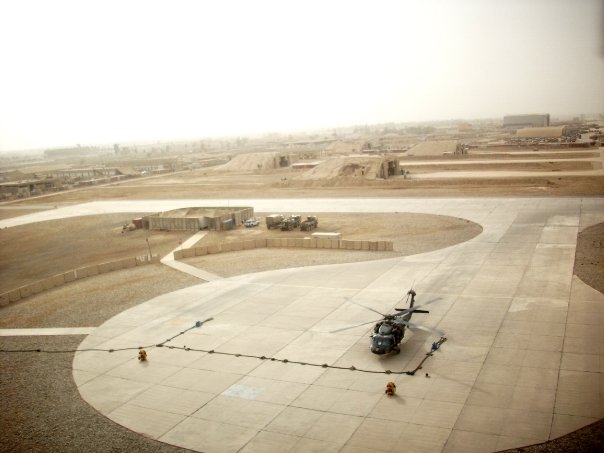
I emulated him from my first moment in Iraq as a reporter in 2007. I got off a helicopter at the LZ at Forward Operating Base Summerall and a young captain offered to take my bags. “I packed them,” I told him, “I’ll hump them.” I learned that lesson from Herr, who wrote “I never let the grunts dig my holes or carry my gear.” And I thought of Herr when I first introduced myself to the soldiers at the Bayji Joint Security Station, where I arrived a month after a truck bomb nearly destroyed the place.  The soldiers would look at me with either a scowl or a strange grin. Like Herr said, “It was no place where I’d have to tell anyone not to call me ‘Sir.’”

When I got back, I couldn’t wait to talk about it, sending photos and stories here, there, everywhere, hustling up any publication I could. That was 2007.

Goodbye to all that.

Now, it’s been eight years since my last time in Iraq. I think about it every day. I wonder how my life would have played out, if I hadn’t gone? Would I have been one of the ignorant yahoos yelling at TV, certain that my opinion was the right one?

Maybe Herr’s silence was a form of discipline. If he realized he had nothing left to say, maybe it makes sense. Otherwise it was a sin, for bottling up his wisdom and pulling a Salinger while the world crashed down around him. Call it coping, choosing peace and quiet over the endless cacophony that’s only gotten worse—why demean oneself in such a world? Would his opinion or observation have carried any extra weight because of a book he wrote in 1977? Chances are much better that in raising his voice, he would have only made another more target for revisionist history. What did he make up? Is Dispatches really nonfiction? Composite characters? Is he a fabulist? Did he even go to Vietnam?

Iraq and Afghanistan were chockfull of Pentagon lies, media misperceptions, and first-person “so there I was” memories. What would one more blowhard have added to the mix?

Instead, Herr retreated into the silence—not even mystery, since there was no Salinger-esque clamor for his reemergence. Surely, we was sought out now and then, but those entreaties didn’t reach the public (at least as far as a Google search can find).

Three movies, three books; that was his output, more or less. And hardly full credit for all of them – he wrote voiceovers for Apocalypse Now and The Rainmaker, and co-wrote the screenplay for Full Metal Jacket. Most of Full Metal Jacket’s dialogue came directly from Gustav Hasford’s underrated The Short Timers. R. Lee Ermey took a lot of credit for improvising the drill sergeant’s dialogue—but plenty of his profane monologues are right from the book; anyway, Hasford died in 1993, so he’s not around to correct anybody.

And Hasford’s no saint. I own his personal copy of Dispatches, annotated with quite a few short references, including a few times where Hasford wrote in pencil: “Problem. Did I steal this?” next to scenes that appear suspiciously like moments from Dispatches. Nothing major: a scarf on a character, a description of a spooky night. Maybe the word “spooky” itself, which both Hasford and Herr loved and used in equal measure.

Herr co-wrote the screenplay for Full Metal Jacket with Stanley Kubrick, but Kubrick didn’t have the balls to go for Hasford’s original vision—in the movie, the drill sergeant is killed by Vincent D’Onofrio’s tubby Private Pyle.  It’s the same in the book—with the vital change that the Gunny knows what’s coming, knows Pyle has lost his marbles and is about to shoot him dead—and the Gunny is proud of him. He created a killer and he knows it.

The second change is even starker. In the movie, a sniper kills Joker’s friend Cowboy, and later, Joker kills the female sniper.

In the book, the sniper is never seen, picking off members of Cowboy’s squad one-by-one until finally Cowboy is in the sniper’s sights, shot in the legs so he can’t move. The sniper intends to draw each desperate man in the squad out from cover as they try to rescue their wounded.

Joker knows this, so Joker shoots Cowboy, who knows it’s coming and whose last words are “I never liked you, Joker. I never thought you were very funny.”

In 1987, it’s unlikely a movie audience would have accepted a conclusion where one American soldier mercy-kills another. A lot had changed since 1979’s Apocalypse Now, which ended with Martin Sheen’s Willard decapitating Marlon Brando’s Colonel Kurtz.

The modern version would probably feature Navy SEAL Team Six swooping in at the last minute, rescuing Cowboy and Joker as Mark Wahlberg laid down suppressing fire and Dwayne “The Rock” Johnson karate-chopped whatever faceless Muslim jihadist villain presented a threat. He would probably choke a female Muslim terrorist to death with her own hijab headdress – saying “That’s a wrap, bitch.”

It makes sense that Michael Herr remained silent, given our current culture. He’d lived long enough to see Vietnam demystified and reconstructed—turned into “do we get win this time?” foolishness matched with Vietnam’s real-life economic boom. Vietnamese tourist posters once used the English slogan “A Country, Not a War.” By 2017, it’s doubtful that clarification is even necessary.

Herr became a devout Buddhist, meditating at his home in upstate New York. It certainly sounds like a man at peace with himself, who was coping just fine with everything he’d seen and done.

This generation eof soldiers, journalists, and contractors has just started reckoning with these issues. As a coping method, “silence” is certainly the last choice many of us have made. Dignity, modesty, humility—all surrendered just like the old Iraqi firebases were lost to ISIS, overrun while we weren’t even looking. Who can blame us? This merry-go-round has too many brass rings hanging just within reach: book deals, screenplays, talking slots on news programs and bytes of space in internet columns, essays in collections that might be read, might not. So much to say, and too many years to go before Herr’s perspective is finally attained.

What it comes down too, maybe, is trying to add to the obituary – to overcoming that sense of dismay when one realizes its first paragraph is likely written. Herr got there – he knew what the first paragraph would basically say: “Author of this, screenwriter of that; lauded as a visionary journalist who created a new method of war reporting, who turned the businesslike voice of Ernie Pyle inside out, crafting war reporting as a surrealistic nightmare—and yet so entertaining.” They didn’t say that in so many words, but it would have been honest if they had—and I’m not sure to call it “entertaining” is a compliment. Herr did show that war reporting—embedded reporting, specifically—could capture the soldier’s voice and life while keeping the real focus on the writer. Pyle didn’t, not really. Herr’s prize—and curse—was presenting his story first and foremost. For those of us today writing in first person, third person, it doesn’t matter—it’s a means to an end, and the byline is often the subject.

My bookshelf is full of novels and nonfiction telling war stories from dozens of points of view. There is the patriotic jerkoff next to the self-flagellating regret; the melodramatic tale of a bright-eyed lieutenant rests on top of the cynical observer laughing at his own joke; a detached reporter unwilling to choose a side rests on a shelf full of world-weariness and guilt. My own literary attempt is right there with them—all my reporting packaged in my own self-produced creation, a marketing tool and manuscript to send to publishers back when I had something to say. It doesn’t hold up—my conclusions fall apart, what I think I saw in 2009 revealed as a mirage just a few years later. I’m glad it wasn’t published.

I’m certainly like to hear myself talk like the rest of them—I write reviews of books related to the wars, offering my take on somebody else’s. Now and then, I trundle to a library or small venue where the silverhairs spend an evening, and I narrate my photos and encapsulate my three summers spent in Iraq. It’s a paying gig; I can reuse my script and just make sure to change the venue’s name when I thank them for having me. I know the questions that they’ll ask. It’s all very familiar, and if it’s boring to me, I tell myself it’s maybe new to them, and isn’t that worth something?

I was in the Army, went to Iraq in Desert Storm decades ago. I play the veteran’s card when I can, an easy comeback against the sunshine patriots of this rancid and toxic modern era. But like my presentations, it all starts to feel a little hoary, my version of Fat Elvis creaking out “Love Me Tender.”

Still, in writing classes, I do enjoy using different drafts of my work as examples of revision—to show how the overblown melodrama of the first draft becomes a reasonable conclusion by the final. It’s a form of coping, the drafting and revision that is—working out the absurdities that no audience should be subjected too. But like I tell the students: You don’t know that at the time. I meant it when I wrote it. Nobody sets out to write a bad first draft.

Think of our emotional investment with a first draft as a kind of reverence—we’re so pleased with our words, with our thoughts and with ourselves. The revision process requires us to be—in Lester Bangs’ perfect words—contemptuously indifferent, to be willing to cut things out without passion or prejudice.

In that vein, I have deliberately disconnected with the soldiers I spent that Iraq time with, eliminating our ties on social media—no harm done, no big blowups, just a casualty of their grotesque Trumpian politics and my disinterest in tolerance of the same. We weren’t friends. What was it we spent together in Iraq? A month? Three? In the scheme of my 50 years, no time at all. It’s an edit; a paragraph in my story that doesn’t fit anymore.

If I walked into a classroom and started spouting the virtues of Dispatches, I’d be preaching to a room of those who have never heard the name of the book or the author. I would have to spend time raving about it, and who is interested in hearing some old man run his mouth about the “bad old days of jubilee?” There are so many other books to read, and who says Dispatches is better than any other? I thought it was Michael Herr, you thought it was David Finkel or Sebastian Junger or Clinton Romesha or Siobhan Fallon, or Zero-Dark-Thirty or Lone Survivor or whoever or whatever you thought spoke to what you expected a war experience to read like, to look like, to capture the violence and the chaos in a way that made you say: “they got it.” You wouldn’t believe me if I said there was a time when we agreed on Michael Herr. He’s been copied and parodied and distilled and diluted until he’s just another name from another time, another war, and what’s he really got to do with what we’re talking about anyway?

Elvis Presley died in August, 1977, and Dispatches would be published two months later. In the next 10 years, Herr would then help on Apocalypse Now and Full Metal Jacket—that trio arguably the most iconic creative outputs born from Vietnam. But from 1987 to his death in 2016, nothing of true note. Still, enough that, for a time, Michael Herr was the agreed upon war reporting standard—the center of the spoke from which everything would radiate.

What does Elvis have to do with it? Because Lester Bangs’ 1977 prediction was right: When it comes to rock and roll, my generation has never agreed on anything like our parents once agreed on Elvis. When it comes to war reporting, no future generation of reporters will agree like we once did on Michael Herr. And nobody—nobody—will ever repeat his decision to sit on the sidelines during 15 years of war filled with reportage from so many of his imposters—and say nothing.

I am the most envious of that. His ability to take himself out of the game, to accept that what he had to say was said, in a book on a shelf. If we ever want to know what he thinks, we can always go right there, to words that will not change.

I’ve left behind my own record, of stories here and there, of essays and reviews in this publication or that. In my reporting, I did my part to make these wars palatable for the masses. I feel a hint of moral crime in that participation. And it happened during a war. Put war and crime together, and what do you come up with? Did that thought occur to Michael Herr? Did he see all his copycats and sycophants and think “be careful what you wish for?”

Michael Herr showed us how to cope in a world riven by noise and discontent. Just be quiet. He has been dead for many months, but I need not bother to say goodbye to his corpse. I only wish I could say goodbye to you.

With much respect for Lester Bangs, and Elvis Presley.

Nathan Webster reported from Iraq in 2007-09 as a freelance photojournalist. He is also an Army veteran of Desert Storm. His work appears in many publications.