New Poetry by Jason Green: “Winter Haiku,” “Spring Haiku”

HAZE OF DESERT / image by Amalie Flynn

Winter Haiku

Seventy degree
December morning. God, I’d
love some cold weather.
——————————————–
The north wind brings a
layer of black smoke over
the camp each evening.
Sometimes we cough and
sometimes our eyes get red. We
just keep on breathing.
Who woulda thunk that
years later we’d still be out
here coughing and shit?
Not the congressmen
who fought against the burn pit
bill. America!
——————————————–
Hindu Kush mountains,
snow-capped and rising above
Mazar-i-Sharif.
At any other time,
this would be one of the most
beautiful scenes ever.
Instead, all I can
think about is my hatred
for President Bush.
——————————————–
We cough because we
sleep next to always burning
tires and chemicals.
Years from now we’ll drop
like flies and Congress will be
confused as to why.
——————————————–
Desolation is
not even the word I would
use to express this.
Flying over what
used to be Fallujah is
heartbreaking for us.
By “us,” I mean those
soldiers who can empathize
with the citizens.
There is no way that
every person down there
doesn’t hate us now.
——————————————–
It’s like Groundhog Day.
You wake up. You guard your small
piece of Afghan land.
You go to bed. Then
wake-up and do the same damn
thing, every single day.
Never gaining an
inch and never giving back.
Just biding our time.
——————————————–
I like to read books
on Oysters and steak. Then go
eat gray chow hall eggs.
——————————————–
New Year’s Day marks the
midway point of our Iraq
deployment. Jesus.
——————————————–
First sunrise brings a
flight to Tallil. I see a
small boy waving up.
I wave down in hopes
that my gesture will keep him
from hating us all.
——————————————–
I got a popcorn
machine for our movie nights.
Now we need butter.
Why dodge mortar fire
all day, then watch films about
war? What is going on?


Spring Haiku

Lengthening days and
darker mornings. More dust storms,
more rockets coming.
——————————————–
We pretend that at
home there was tranquility,
while in our bunkers.
——————————————–
Sand sticks in places
the balmy breeze takes it to
and showers don’t help.
——————————————–
I hear the whistle.
Through the haze of desert
sand, their death prayers.
——————————————–
The spring moon lights my
path as a camel spider
hides in my shadow.
——————————————–
Spring rains bring mud so
deep it could suck the boot right
off your fucking foot.
——————————————–
Muddy fields of sand
the rainy season is here
fuck this fucking place.
——————————————–
Watching from the sky
the balloon shows them setting
up a mortar. Shit.
Send out QRF
find out it was a hookah
glad we didn’t shoot.
——————————————–
He’s planting his fields
while carrying an AK.
Why is he shooting?
I’d be mad at us
too if I was just trying
to work and then this.
Maybe mad enough
to shoot randomly at three
soldiers in a truck.
——————————————–
Miry fields are more
than a nuisance to pissed-off
troops. Synecdoche.
——————————————–
We crossed the spring hills,
in a tiny CIA
plane flown by a dude.
He wore a backwards
baseball cap and wouldn’t look
ahead at the “road.”
We skirted the heights
of the Hindu Kush, barely
making it over.
This shit ain’t fun no
more. I’m ready to leave this
FOB, maybe by car.
——————————————–
We fly higher than
the kites they fly below us.
I’m bored, so I wave.
They don’t wave back up
at the infidel. Maybe
it’s the big rifle?
——————————————–
Chris died just a week
before Memorial day.
Irony. That’s all.
——————————————–
The poppies are in
full bloom and I’m popping pills.
Please help ease my pain.
A hole in my gut,
medics, wet gauze to dry gauze,
I need my morphine.
The shakes, not shitting,
but I’m feeling amazing.
Thank god for poppies.
——————————————–
Maple syrup doesn’t make
cardboard pancakes taste any
better. Fuck this place.
——————————————–
Powdered eggs and a
rubberized sausage make up
our Easter breakfast.
——————————————–
Flooded rivers and
muddy fields and all day we
stay wet and angry.
New Poetry by Wayne Karlin: “What Binds Us”

FROM THE BOMBS / image by Amalie Flynn

What Binds Us

I spent twenty-six years
in the jungle;
I was thirty years old
before I kissed a woman,
the Vietnamese poet said
and stared at
the American veterans
as if amazed at
what he had kissed instead.

In the war, he said,
his comrades had covered
his body with their own
to protect him
from the bombs
so he could finish
writing his poem,
although now
in his country
he fears there’s no one
who will understand
the language
in which it was written.


New Poem by Nathan Didier: “Hearts and Minds”

Spilling Our Blood / image by Amalie Flynn

Hearts and Minds

We came to provide help that you didn’t want.
We came to provide security you didn’t need.
We came to provide schools that you didn’t care about.
We came to provide a government that didn’t work.
We came to provide democracy you didn’t understand.
We came to provide infrastructure you wouldn’t take care of.
We came to provide a better life that you didn’t ask for.
And we kept spilling our blood and couldn’t understand how you could be so ungrateful.


New Poetry by Elisabeth Lewis Corley: “An Loc”


THE CHOPPING BLADES / image by Amalie Flynn


Someone is running, there,
just out of call.
We all hear the air beaten into waves,
the chopping blades. I am afraid
I will see a face, I will fall.
As it is the hand, small with distance
claps the air.

Listen, a bitter churning,
lungs roar, ragged like yours
on your morning run.
You are out of breath, we are out
here.

From blank distance the helicopters
return for another pass. I say,
Welcome back. Facts are your only friends,
they say. There is nothing
I wish to forget.


New Poetry by Patricia Hastings: “Dad”

SLOWLY IN THE DARK / image by Amalie Flynn

Dad

1950s father. Family man
as best he could.
Provided everything but
stories of his life.

I played army with his old canteen,
green backpack, wore his sergeant’s cap
in open fields, running bush to bush
avoiding bullets fired by Rick and Neil.

Nothing real about my war
No blood unless a briar scratch
Grass-stained jeans, home for supper
Pork chops, mashed potatoes, apple pie.

We liked Ike and flew our flag
Memorial Day and on the Fourth
No mention ever of the War
less than a decade past.

Eighth grade social studies essay question:
Did your soldier/father see combat?
I scrawl, No, he never left the states.
Didn’t watch men die. Or kill them. Not my dad.

He died of too much drink
Earnest citizen/father turning mean
though never loosening his tongue
to tell tales of army days.

Turns out you did see combat in the war.
Watch men die. And kill and kill again.
Your job: to fire fire into tunnels
where Japanese holdouts hid.

Creep slowly in the dark
nerves shriek, sweat stings.
Something moves! Throw your flames
Then hear screams and smell the burning flesh.

Did you sleepwalk through your life
wife and children just a dream,
stare at fireplace, Scotch in hand
while other ashes floated into focus?


New Poetry by Faye Susan: “I am the Daughter of a Storyteller”

The Deadlift Static / image by Amalie Flynn


The conversations I treasure with my father are when life is thick,
calibrated for someone with muscles, a la Arnold, circa 1970.

I don’t ask about the years sweating through C130 jet jammies,
the adrenaline squint and salt crusted glass like blinds, ripping lives
from frothing canines of rabid Bering Sea. The Memorial Day knells
and widows brine that drove him to coax groans from floorboards
into photographic memory of drab morning.

He doesn’t ask about the seams, healed to spiderweb white,
where the man who bound my finger in gold and stone, pressed
caustic knowledge into me until I driveled rust. Shrieks buzzing
like flies on pink fleshed roadkill, fermenting in oversized hoodies,
to manifest in sage half moons, under darting gaze.

We don’t talk about those things. We swirl coffee and cream.
We talk about the Boston cabby, with the bent nose and worse fender.
The enigmatic professor of poetry, who couldn’t say what anything means.
A poem is a poem. It means what it does.

In the deadlift static, we do nothing, curating mundanity.


New Poetry by Sara Shea: “Customs”

To U.S. Soil / image by Amalie Flynn

Coming through US Customs from Ecuador
the passport agent asks if I have anything to declare.

I know he doesn’t mean the duty free,
exotic perfume or rare cigars.
He isn’t referring to bitter cacao or
sun-sweetened coffee beans.

Granted, I’ve stashed a few seeds in my pocket.
Granadilla seeds, wrapped in foil-
that last snack I ate in the courtyard
with my grandparents in Guayaquil.
This isn’t his concern.

Coming through US Customs from Ecuador,
the passport agent asks if I have anything to declare.

I envision my grandparents sipping sangria
along El Malecon in the 1940’s,
dreaming of a fortune in rice, bananas, oil-
running those early tankers through
the Panama canal. It was a marvel then!
They were betting on a love that would outlast
malaria, revolutions, temptations, typhoons.

Coming through the Department of Homeland Security
from Ecuador, into Miami International Airport,
the passport agent asks if I have anything to declare.

I should declare the apologies. The explanations.
The what-if’s. The missing photographs.
The heartaches that have haunted
my grandparents, their parents, their children.

Coming through customs on to US soil,
I could declare that the actions and decisions
of one generation stretch exponentially
through families for decades to come.
Instead, I shrug, knowing seeds easily drift
from their roots in winds of change.

The passport agent asks my reason for travel.
I reply, “family.”
He nods, calls me an American and
stamps my passport.


New Poem by John Thampi: “Ad Memoriam”

AM A PART / image by Amalie Flynn


Here’s to not killing yourself
P with DA issued narcotics
with Deer Hunting Rifles
PRecreation what life left
in forest PUUUin sand
Pin the White Throne Room
where you sat among
Pblood & brothers
and the Valkyrie your sisters
Pwhen you raised up your call
sign like a prayer
Pand called down hell
fire in our age
Pwhere our every battle is
ragnarok and you wept
Pwithout shamePU in salute
and the throng of well wishers

I am a part

the kind you met
at the arrival gate
shook hands and welcomed back
visitors
if there is anyone
Welcome Back
the kind that could mark
your wounds by
your inabilities
to speak to speak to listen
in anything but blast fragments
the kind that never knew
the certainty of steel
and the strength of the wild flowers
as you patrolled with men
and ate alone
for what company
is there in men?

leaving the divided house
Pand the black tent
the cry of the delivery room
Pand the shout of the bedroom
racing into the crackling fire
Pthat you mistook for sunrise
the distant moon
Pthat you mistook for friend
the laughter of wolves
PWe allowed to circle us in
and lay to rest
PWe refuse to rest

warring till our company arrives
Pwarring till our company arrives
warring for our company who holds the line
in blood and breath and life itself
here’s to not killing
yourself.


New Poetry by Aramis Calderon: “Loyal”

THE DESERT ROADSIDE / image by Amalie Flynn


We saw a stain on the desert roadside.
The moist spot wasn’t from an emptied spit
bottle or a planned checkpoint alongside
the route to stop and relieve the unit.
It wasn’t a bloodstain from a gun fight,
where men and rifles roared and proved their worth.
It was diesel used to compact dirt tight,
to leave no impression of disturbed earth.
I followed my CO. He dug for the bomb.
I did not call for help or special gear.
I failed to think of a prayer or psalm.
I stood with him, too loyal to show fear.
He talked the whole time about his ex-wife,
said she’s the biggest mistake of his life.


New Nonfiction by Fred Cheney: Tracers

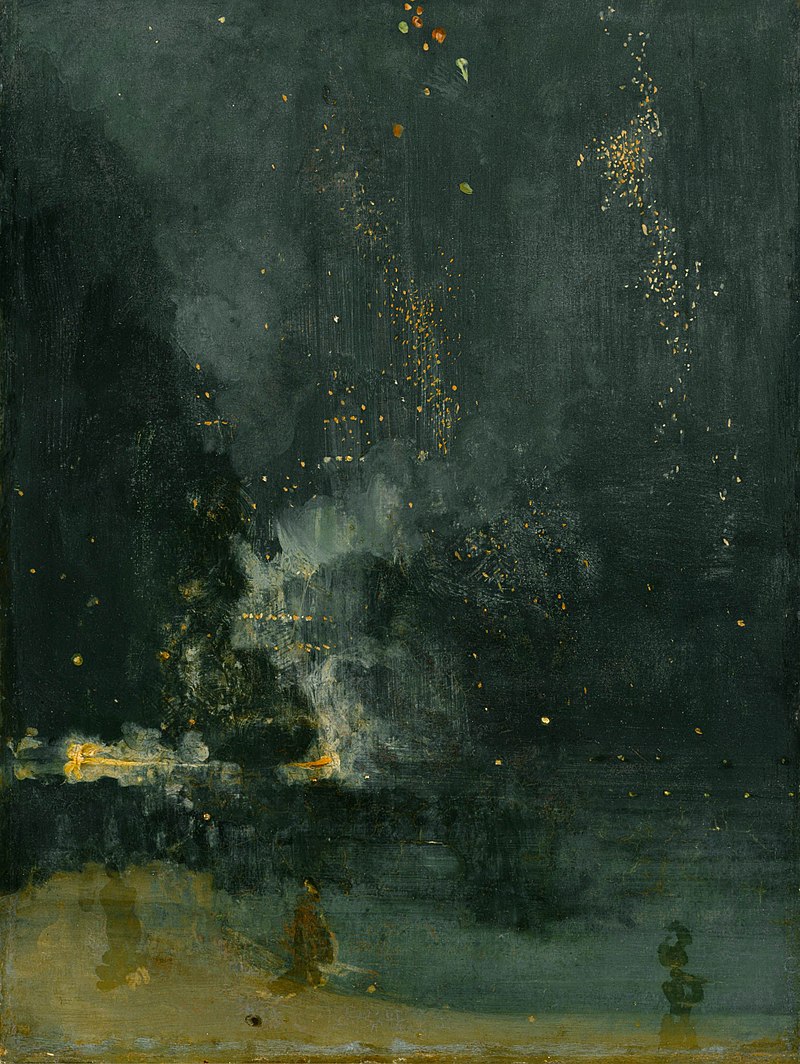
By James McNeill Whistler - http://www.dia.org/the_collection/overview/viewobject.asp?objectid=64931, Public Domain, https://commons.wikimedia.org/w/index.php?curid=127417

I’ve changed all the names in this story except my own. They’re all dead, but … that afterlife thing just might be true.

I’m an old man now, but I was ten or eleven or so in this story. Across the road, lived Ben, six months my senior, and Timmy, six months younger than me. We lived out in the country, without another kid our age for miles. So, we bonded. We bonded by chasing the neighbors’ cows. We bonded by stealing cigarettes from our parents. And we bonded by reading GI Joe comics. Each week one of us would put up the nickel to buy the latest one. When we got a chance, we lied our way into a war movie in Brunswick, usually Audie Murphy stuff. We were fixated on the glories of war.

At the time, Ben and Timmy’s father, Arkie, would get drunk and talk about war. He had fought in the South Pacific. Word was he’d killed 27 men in hand-to-hand combat there. [I wonder why he drank.] Another skill he had was theft—or souveniring, as he called it.  He shipped or brought home on leave an impressive assortment. Helmets, ceremonial flags, swords, maps, and firearms. Had he made a career of the military, I’m positive there’d have been a Sherman Tank over there.

Did I mention firearms? The one that fascinated us most and was most supported in the GI Joe comics and Audie Murphy movies was the BAR—Browning-Automatic-Rifle. And among the things we liked about it from our reading and viewing were TRACERS. These were bullets that left a fiery trail so the soldier could see where his ammo was hitting at night. This was exciting on the pages of a comic. It was thrilling in a movie. And Arkie had a BAR and according to Timmy a bunch of clips with TRACERS written on them.

We knew better than ask him for a demonstration. “You stay the hell away from that war shit. It ain’t good,” is what sober Arkie would have said. However, we weren’t about to stay the hell away from this fixation, and besides … we were sneaky.

I don’t know if the counterpart of carpe diem is carpe nocturn or carpe noches or what, but there came a night for us to carpe … or seize. My parents were going over to Cumston Hall in Monmouth where the players were doing Gilbert and Sullivan operettas that summer. I had made them pay dearly for dragging me to Madam Butterfly two weeks before. So, they made me promise to brush my teeth and go to bed on time. Step 1 of the plan was handed to us. Step 2 came just about as easily, as Arkie nodded off just when it got dark. Ben snuck the BAR out, and Timmy scored three clips that were marked as having one tracer every fourth shell or so. We headed for their back field.

We settled ourselves on a rise with about 120 yards of open field before the tree line and the railroad tracks. We hefted the rifle, and brought it up to our shoulders, practiced bracing our feet. That last didn’t work so well, and I decided that I’d shoot from the hip, just like GI Joe. But I wouldn’t do it one handed because, at about 18 pounds, the gun was too heavy.

We usually did a series of rock-paper-scissors to determine who would go first, but this night Ben played the age card. “I’m oldest. I go first.” Since we’d all get a chance, Timmy and I let him get away with it.

Ben got into a sitting position and mock sighted with his elbows on his knees. Satisfied, he set the adjustment for full-automatic, slapped the clip into the magazine, jacked a shell into the chamber, and released the safety. He took a breath and pulled the BAR tightly into his shoulder. He held the trigger enough time for four or five tracers to launch. Then, he put the gun on safety and prepared to hand it to me.

But I was jumping up and down and slapping Timmy’s back. We were excited beyond belief that it was even better than the comics or the movies we’d seen. Then Ben, reflecting on something new, yelled, “Stop, for chrissake. STOP!” We stopped.

What neither G.I. Joe nor Audie had explained to us was why tracers glowed. It’s a magnesium fire in the bullet, and it burns at about 3500 degrees.

Ben elaborated. “Down there. We set the pickin’ woods on fire.”

Pickin’ was our word then; it was safe to use around adults, and they wouldn’t get on our ass, but we knew what we meant. Timmy and I looked at the tree line and, sure enough, the pickin’ woods were on fire.

I’ve never known that level of fear, before or since. We three were ripping up ferns and tearing down branches that were on fire. We stomped them out. We kicked apart brush piles and jumped on anything that glowed. We gave up our bodies rolling on tufts of flaming grass or even sparks. We had to get those fires out, all of them, or Arkie could easily round his total up to 30.

With our last breath, we felt that we had all the fires out, little and big. We unloaded the BAR and headed for home. They went in their house, and I went across the road to mine.

Since we didn’t have running water then, I couldn’t take a bath or wash my clothes. They were burnt and sooty, so I threw them away. I went to bed without brushing my teeth.

I was asleep when my parents came in all excited about The Pirates of Penzance. The smell in the house dispelled that excitement right away and drew my mother to the trash bin. “These are what Freddie wore today, but they look like they been rubbed with ashes. Look, some are burned through.”

My father took the clothes, sniffed them.  “I’ll get him up.”

The combination of fear and fatigue put me in a truthful state. I didn’t even consider making up a story to cover this. I told the truth, the whole truth.

“Are you sure you got all the fires out?”

I nodded.

“We’ll check.”

So, I put my filthy body into clean clothes, something I was never allowed to do, and my father and I walked past Arkie’s house and down to his back field. I showed him where Ben sat when he shot, and where the fires were. I skipped the part about how pickin’ dramatic tracers are at night. Right about then, I just wasn’t feeling it.

We went behind the tree line and paced back and forth. In somewhere between 30 minutes and three months, Dad said, “Looks like you got it. Good job.”

When we got back to the house, Mom had bath water heated. I stripped down in the middle of the kitchen and washed the grime off.

Dad said, “Now go to bed. We will never talk of this again.”

And I haven’t until now. Everybody’s dead.


New Poetry by Carol Alexander: “Late of Somewhere in the East”

AREAS GRAYED OUT / image by Amalie Flynn


Here is his daughter in a mustard seed bauble
bearing the initials M.S. And this is the hyena’s claw
that dug up ash-cloud & gold putrescent tooth
yet I had to ask, who, how many.

I was all trust and confiding hands. This is a snap of the destroyer
on which a body tried to come clean in hard water.
Here, too, memory’s ineradicable scum
rendered as the famous scream.

There is the miniature house where we four never slept very well –
was it only chance, the refugee street? We moved among them
death in the pocket, the cue ball rolling on felted grass.
These are the countries that stirred fear

around the fragrant globe, whole areas grayed out.
The affinity of heart with ice
a chicken stripped of feathers, candles for new blackouts.
In truth, M.S. sired no children but the wild mustard

boiled down for soap. Still, bees pierce yellow & lungwort
duple lobes which marry seed to breath, Everything
came of that nothing on the street of transliterated names,
gardens where none would bury psalm or song.


New Poetry by Rachel Rix: “Experimental Simulation of Joint Morphology During Desiccation,” “Second Deployment,” “CO’s Canon”

I Weightless Rising / image by Amalie Flynn

Experimental Simulation of Joint Morphology During Desiccation

In the dried-up river bed of the Helmand the body of a husband lies dead on the
hot cracked dirt. The hair of the woman married to the husband hasn’t been
washed in days. Her arms flex and hook the husband’s lower limbs. Dragging
him makes each step the woman takes heavier than the last. Vultures hover her
salt trail. Vast is what they see surround her. The daymoon watches too. Night
never comes only more heat magnified by the hours, searing the thin flesh
between vertebrae C-6 and C-7. The woman knows she’s blistering. Letting go
of her husband is not an option she thinks of.


Second Deployment

Our agreement was
only one. I have
difficulty carrying myself,

I – weightless. Rising
to the crags. Old world vulture
alone I sail for hours in the sky.

I eat my home. A pile of bones.
I’ve learned to crack open
what I cannot swallow,
a lamb’s femus. I am

bone breaker. Soft tissue drinker.

I eat his words.
I’m now dust bather.
Silent blood tracer.

I am a burial maker.
Tossed knuckle
scraper. Someday he’ll find me
by the bed
in a pile.

There will be a hovering
and a hollowing
No welcoming home.

CO’s Canon

If the cadence may be regarded as the cradle of tonality, the ostinato patterns can be
considered the playground in which it grew strong and self-confident.

His green duffel bag
could have carried two of me inside.

Near the opening a faceless angel,
I try: Dearest,

because I’m tumbleweed,
but he never reads me.

There are more important things
to do, shake hands with soldiers

going out on mission,
because when you’re the commander

it’s about survival.

I didn’t need to take
that last glance.

Suddenly tyrannosaurus.
Angel’s sepia teeth baring.


New Poetry by Richard Epstein: “The Dance”

WITH A BURST / image by Amalie Flynn


I can still see it.
I hit him with a burst from my M16.
He jumped up and danced.
Everything gray.
Bamboo stood silent
and lowered its leaves.
The earth stood still.
Breathe! I said.
Breathe!


New Poetry by Ellie J. Anderson: “Impact, 1984”

WALL OF ROCK / image by Amalie Flynn


We hike toward a waterfall cascading
through a split in the wall of rock above us.
A crow soundlessly slices a shadow
across the field of snow.
One breath, and the bird is gone.

At the tree line, the tail section
of an airplane, the metal edges ripped
and ragged, stands shiny in the twisted
alpine firs.
The engines lie in the shallow creek,
water pouring over cylinders.
Scrub cushions one wing, the other
is charred into rock,
the ground littered with pieces
I can hold in my hand:
aluminum with buttons, rivets, zipper
heads, upholstery, and jacket fabric
melted into lumps.
In one, the fingertip of a leather glove,
a bobby pin.
It happened in nineteen forty-eight.
A cargo plane clipped the ridge
in a blizzard. Six men died. One woman.
The color of her hairpin tells me she was blond.
The townspeople saw
a fiery flash in a night sky filled with snow.
In daylight, fighting drifts and high winds,
they dragged the bodies out in bags on toboggans.

This would be a good place to leave
your spirit. In the silence,
the wind breathes over the ridge,
and water trickles beneath a layer of ice
that turns blue as it melts into itself.
Gentians and Indian paintbrushes
in the meadow throw their colors
against the rocks.
And the delicate columbine, pale
yellow and pink, only blooms in August.


New Poetry by Peter Mladinic: “Fist”

AIR THICKER THAN / image by Amalie Flynn


In Okinawa I made a fist
and my fingers stuck together
that stop over night
my one stop before Danang,
between two worlds,
the flag burning, tear-gas
U.S. and the Vietnam rat-tat-tat
automatic fire, the LBJ
How many kids … and the sandbag
fortified bunkers. Didn’t
see anyone die, only the dead.
In Okinawa, planes
on the runway, the air thicker
than Danang’s.
The smell of napalm,
how real for some.
I stood holding a metal tray
in a chow line, slept
in a top bunk, spit-shined boots
so their tips were mirrors.


New Poetry by David Burr: “Harvest”

HARVEST OF THOSE / image by Amalie Flynn


PUTTTI don’t know whether war is an interlude
PUTTTduring peace, or peace an interlude during war.
PUTTTTTTTTTTTTTTTTTTTT-French Prime Minister Georges Clemenceau, 1919

Hurl of metal – iron, steel – as shrapnel,
as bail hail, as HE detonation, all
forged and spit out again with new fire,
matériel barrae, meat-mincer for
extruding the mortal mettle of mere men.
The sowing and the reaping are all one –
short is the harvest of those born to it.
After the wrecking, reaping, reckoning,
all are scuppered on the killing field,
khaki men with hopes of home snuffed out.
Sheaves of men scythed down mid the muck-mire-mud,
bowels churned with the disemboweled earth, red wet.
Gravity flows to the lowest reach, but not
here in the gorge of this blood-gutted earth,
saturated but not satiated.
On and on this crimson stain will drain,
young men will come to fill the gap – futile
like a record where the sylus is stuck
in the groove over and over again –
out of trenches to fatal, final ground.
They die individuals, but banal
as communally their yield is too large –
none a hero in this no-winners game
nor a tragedy – just raw statistics.
All that grieve them soon too, to oblivion.
After this Great War comes the entr’acte
before World War roman numeral II,
just in time for those who survived and bred
to lose their sons in the next harvesting.
Never an end, merely an ellipsis …


New Poetry by Jayant Kashyap: “The War”

A NIGHT KNOWS / image by Amalie Flynn

The War

“The war continues working, day and night.”
The War Works Hard, Dunya Mikhail

It has a way of knowing people,
the way a night knows our stories.

Everything’s quiet, then you learn to fall,
deeply. It’s said how you approach an issue

says a lot about you,
PUUUbut how do you approach war?

Everything quiet – almost
at peace – when you learn to fall. Deeply.

And even the night changes its colour.
The dawn is difficult to accept.

Your palms have broken into little chips
of stone, which you will either throw

at people or swallow yourself.
In the kitchen, the water’s boiled, the pan

is ready for eggs. The child you sent out
to get some bread hasn’t made it back.

In the news: everywhere, the streets
PUUUhave learnt the meaning of blood.


New Poetry by Phillip Sitter: “Krakivets, Odyn” and “Elemental”

WINDOW / image by Phillip Sitter


Krakivets, Odyn

I wasn’t a medical volunteer – only came in with a backpack, an overweight suitcase,
all the baggage of the past eight months and a heart to pump into here
the ability to stop someone’s bleeding in whatever capacity and degree I could.

But that would’ve been too much nuance for that moment,
with me just being able to count to not much more than eight in Ukrainian
and the guard’s English and tone more apt to counting to three.

I’ve already forgotten some of the exact nuances of that moment.
Did the guard ask me through the open car door, over the empty driver’s seat in the dark, “What were you doing in Ukraine?” or something more like “What brought you to Ukraine?”

For almost a week? Your first time, with emphasis on now?
Incredulity, perhaps, that someone would choose to come to a war,
unarmed, at least in the Kalashnikov sense.

Was he holding such an automatic rifle, a worn cousin of the one I’d fired       in Texas -just precaution-or was it only a fellow guard I saw cradling the legacy of an empire chasing again the impossibility of restoring itself

by unloading                terror upon
and blasting                    through flesh
of people                           like him or me?

I tried to answer the guard’s questions but he got frustrated
and he waved us on to keep the line of hundreds of vehicles moving toward Poland,
as foreign fire engines and weapons re-supplies for firefights came in the other direction.

And with that, we crossed the line — after the Polish guards searched the car, anyway.
One side, the imminent threat of death from the sky above — and not on the other.

Those night skies, no light on the ground to obscure the stars or guide the drones.
I slept well, except when I cried myself to sleep the last night in Kyiv at the thought
of having to leave you, brother, in all this.

Your big windows in Lviv didn’t bother me much.
Neither did the lights in the sky out your windows in Kyiv,
lights that moved in the darkness.


Elemental

Hydrogen, the sun’s power
sends light 93 million miles
to give life to the sunflower
that stands for hope in all our trials.

Nitrogen and phosphorous, they make the sunflower fields more fertile.
When used in explosives and incendiaries, they add more shock and awe to a projectile.

Oxygen, the spark of life in my lungs.
I would give you the last of it from my chest,
my last breaths, if suited best,
for a continuance of your song to be sung.

Heavy stuff, uranium.
It’s not all gone as quickly as in a flash,
not for many or most.
Did I mention half-life with strontium-90?
Like calcium, it seeks bones as hosts.

Carbon, the basis of life as we know it.
If I had to, could I recall any debt to be owed it?

Could all I’ve ever sent off to be recycled
be traded to rebuild your body, your blood, your soul?
Enough to make you whole?
With enough left over to also recreate the man shot off his bicycle?

Our bonds are strong.
Between two hearts, two time zones.
Subatomic critical mass, but love more than chemistry and physics alone.


New Poetry by Shawn McCann: “All I Can Do Is Watch” and “No Way To Fight Back”

DONE WITH MOONS / image by Amalie Flynn

All I Can Do Is Watch

It’s 0400
on a bridge crossing over
the Tigris River.
Qayyarah is a town along its fertile banks,
15,000 people call it home.
I wonder how long it has been here,
how many times conquered
and rebuilt.

On the outskirts lies an oil field,
it’s where I live.
The wooden walls
of this makeshift bunker
in the sand
wouldn’t stop an attack,
just slow it down.

Surrounded by blackness,
my mind wanders valleys of homesickness,
forced to breathe toxic air,
flanked by those who want to kill
my invasive body, parade it
through the streets.

A bright light hits the oil field,
shakes the ground.
Movement on the hill to the north—
I call it in.

Orange flames rise in oxygen,
twirl in mirthful celebration,
the smoke swirling higher,
my life forever changed and
all I can do is watch.


No Way to Fight Back

I can smell the exhaust from
the plane that’s taking me home.

Standing in line to board the whale,
maw open wide to let us inside.

Air forming breath in the illume,
I’m done with moons in this hemisphere.

These stars, still foreign to me.
Even at the end, I know I don’t belong

in a land of sharp sand, the broken
glass bowl of democracy.

This land won’t let me leave, though.
Raining metal explodes my dreams of home;

swarming red flames engulf
the surrounding canvas. The sound

catches the light, knocks me flat
to the ground as alarms blare attack,

bullets ricochet off cold slabs.
And just like that, I’m crouched inside,

cold-cocked by the reality of
no way to fight back.


New Poetry by Kathleen Hellen: “People Boats” and “Pretending There Is A Garden In The Spring, Paradise In Time”

DREAMS SWELL LASHED / image by Amalie Flynn

people boats

dreams swell/ lashed to circumstance in Syria/ in Gambia/ launched from Libya in leaky rubber chugs to birdless deep/ chugs w/ floor of feet w/ canopy of arms like 700 starfish sweating/ surfing demons/ keeling keening groaning spinning ferment/ tossed estrange/ the black moon sinking into raucous mucus maelstroms/ cataract of violet distress/ the turbulence of orange sun/ bursting over flotsom/ boats adrift/ boats repelled/ prison haulers fatal w/o water, w/o air fatal in shrieking rescue/ panicked sea/ 10 hours tossed to grief/ where vomit waters sweep the beaches gnawed by ruptured rubber masses/ huddled under searchlights/ infant wish:: democracy


pretending there is garden in the spring, paradise in time

this silk and golden weft that weaves
its vines through field and forest
this intricate design atop a kingdom
of the dying, above the restless thread
of streets, the rot beneath:: Deep
the sleep of mouse and wren, the carcasses
of crickets. The desiccated corpses
of the moths. Beneath the flowers all
dyed dismal, dog and possum disemboweled,
little deer with tongue stuck out, the rat
beheaded, like video of hostage


New Poetry by Lawrence Bridges: “Time of War and Exile” and “Taking an Island”

THE BROKEN LAND / image by Amalie Flynn

TIME OF WAR AND EXILE

Delicate horse feathers climbing the bier,
Rhesus monkeys playing sincerely with bombs,
Alouette, the weightlifter, seasons the vegans’ food
with the rillerah and finds Roger dozing
among bananas.
PUUUUUHistory is pleased by turnabouts
none can explain nor defend because they’re dead.
If only we’d noticed that it was primal
behavior going back eons that was on display –
No war, no truth, no civility – the beards grow over
niceties that fast! Then we make peace to survive.
No wise hand placates the broken land, nor kisses
the clan that feeds it. I watch myself
display courage in emptiness. With emptiness,
every hour is the same, a wait for exile
from the churning heart long separated
from its homeland.
TAKING AN ISLAND

The stations in my head
broadcasting jazz and news since
VJ-Day almost
have witnessed everybody
escaping annihilation
almost,
and I’m loading material
bare-chested on a beach
in the tropics, a sniper
in a nearby palm playing Bach.
I have nothing but the memory
of home and her
tattooed on my arm,
the caressing lagoon
at my ankles
a whiff of plumeria
as I carry my weight,
swift bullet whizzing toward
my head


New Poetry by Matthew Hummer: “Amortization”

JUST SAY IT / image by Amalie Flynn

AMORTIZATION
Carl showed me the chart
years ago, when we first
thought to buy a house.
But we wouldn’t write
a note saying she’d go back
to work the same hours
after birth. The under-
writer, in fluorescent office
by the two lane road
between golf course
and condo, wanted a wink-
wink. “Just say it.” A lie
worth a sixty thousand
dollar house, brick
row home with sagging
window frames and tilted
doors. A loan unto
death. Camus, I think,
pointed that out. Mort,
en francais.

PUUUUUUUUUUDianoia: How
you’ve led me astray.
Res publica. Fasces.
Words and phrases we use
without knowing the root.
Character in the play. “History.
History!” Dag Nasty said
at the end of a song: Now
that it’s gone just admit
it to yourself. Now that it’s gone
just admit it to yourself.
Drum rapid as the rumble
of a gasoline engine—leaded.
Army green paint.
Nova; V-eight.
From stop to start, shifting
up from floor to top.
Another typical youth…

Thirty years to pay
it off. The life of the loan,
more than two dog lives.
Not the lifetime guarantee
of a washing machine—the expected
lifetime of the appliance. Five
years? Seven? Fifteen
before nineteen
eighty. The green fridge
next to the coffee pot
kept milk for decades.
Vietnam to Iraq, outlasting
the man smoking cigarettes
on the concrete patio, feeding
peanuts to squirrels and telling
a child about the Battle
of the Bulge, the tank driver
who fell back in headless,
the German soldiers who “tried
to get away in the snow,”
the aristocrat’s sword the post
office stole from the box
he sent home.
PUUUUUUUUUUThe guarantee
spans the projected lifespan.
Lottery ticket, Camels,
Dominoes, V.A.,
Life insurance. Actuarial
predictions with cosign charts—
bodies in the morgue. Dead
reckoning. Except the Black
swan, clot-shot.
Dead cat bounce.
Bank-breaker. Mid-
life degeneration.
A rogue wave rises
and swallows the bobbing tanker.


New Poetry by Almyr Bump: “Plowing Water”

IN BROKEN GROUND / image by Amalie Flynn


Plowing Water

We return to nightmare
ground, looking over the scene

of the crime, the copper
reflection of little clouds

in the torpid, tainted
canal masking disquiet

and chaos created
in us. Toiling in soft sand

underneath a burden
that would make a mule bleat,

we bitch and moan when told
to drop the rucks. Now we must

dig in, not like blind moles,
but like crippled gravediggers

in broken ground started
by high angle hell. Mangled

sandbags and serrated
pieces of metal pulled from

dirt wounds, also a hand
only missing two fingers.

Using a bayonet,
we bury rancid, fetid

flesh in a hole, puking,
not worried about a name.


New Poetry by J.S. Alexander: “Sabat”

AWAY HE STAYS / image by Amalie Flynn


Sabat (Loyalty)

Dead bodies stop looking like bodies
after a certain point.

The face, like a popped milar balloon
with all the air blown out the top,

the legs, oddly angled, their bottoms
looking for all the world

like tubes of children’s toothpaste
unevenly squeezed.

No, the dead here never arrive in an
orderly manner, like in the movies.

This is Afghanistan, so they show up
carried in blankets or what’s left

of clothes, bandages waving
like May flags.

But they all go out the same way.

The mullah works systematically,
washing and praying, singsong in his labors.

Next to him, a step back Mortaza watches
them prepare his brother for the next life.

Mohammad Gul was the pride
of Ismail Khel.

Young, handsome, brave.  Funny.
Everyone said he was funny.

You don’t hear that much in Afghanistan,
someone being funny. As they lift what’s left

into the particle board box that looks like
an Ikea desk repurposed

hands seek to guide Mortaza out.  But
he pulls away, he stays.

He watches as they wrap Gul’s head in
cotton and prop it up on

pillows of cheap foam.  They spray him with Turkish
perfume from the bazaar, and then

drape the Afghan flag and the prayer rug over his
box, taping it down with rolls of

scotch tape.  Mortaza sniffs back a tear, both for
his brother and the debt

he knows he’ll now have to pay.  He’s not scared,
just tired, and knows

that somewhere, out in Lakan,  is a man he’s never
met but will kill, as the way demands.

When we walk out, together, my boots slip,
squeaking and squishing on the sodden, dirty
tile.


New Poetry by Ben White: “Cleaning the M60 – 39 Years and January 26, 1984”

TO FLESH BONE / image by Amalie Flynn

39 Years

The death
Of a soldier
Was an accident,
A waste –
PUT_CCCCCCA shame,
So the anniversary
Is nothing to celebrate –
PUT_CCCCCCOr forget

January 26, 1984

Back on the continent
At the 1st and 51st Infantry –
A battalion that doesn’t exist anymore –
The Cold War was fighting a strange peace
With weapons and tension
Wanting to release a dimension
PUT_CCCCCCOf battle prepared,
PUT_CCCCCCTrained for,
PUT_CCCCCCAnd ultimately expected
While volunteers selected
Stood ready in the West
And along the borders
PUT_CCCCCCAwaiting orders to mobilize
When one cold January,
Thursday morning
Soldiers had to realize
The power of 7.62 mm ammo
Tumbling into the chest
PUT_CCCCCCOf a brother in the band
With manslaughter unplanned
And wounds giving the medics
An ambulance to ride in
PUT_CCCCCCUntil the doctors
PUT_CCCCCCAt the Krankenhaus
Opened up the chest
And showed them what
One M60 round
PUT_CCCCCCCan do
To flesh,
Bone, and what
A few minutes ago
Had been functioning,
PUT_CCCCCCDistinguishable organs.


New Poetry by Kat Raido: “Blood Goggles”


LICKS THE VEINS / image by Amalie Flynn

Walter Cronkite left footprints
in the gravel of Saigon
but he didn’t tell you their names
didn’t show you the morning commute
of an accountant in Hanoi

they televise bedsheets
replacing blown out glass
in homes of blown out people
but not the Arab Renaissance Bookshop
which opened its doors in 1966

fire hoses are used
to extinguish human spirit
courage licks the veins like flame
and the only parts of war
they can’t powerwash away
are the bloody crevices
under their own fingernails.


New Poetry by Luis Rosa Valentin: “Desperate Need of Help”

Desperate Need of Help

Luis-Rosa-image


New Poetry by Jim Kraus: “Amphibious”


ABOUT TO DISAPPEAR / photo by Amalie Flynn


AMPHIBIOUS

In Hokusai’s “Kanagawa Wave,” the boatmen
look like a school of masquerading fish
about to disappear into the vast trough between waves,
the scene a masque for the knowing seascape.

Underwater, Ahab,
pinned to the great white
creature, like a wave that has
disappeared into silence.

In memory’s slow dancing,
flesh now dissolved,
seafloor muck covers bones
and shark-tooth nodules.

Out of the bubbling methane,
Ahab is reborn with tripod limbs
and tiny feet, the wooden leg
now a trail of seafloor slime,
amphibious.


New Poetry by Carol Everett Adams: “Rabbit Trails”


THE TEXAS DUST / image by Amalie Flynn


RABBIT TRAILS

in the Texas dust. We’re flat in the dirt

so we can poke around down there with a long stick,
while above us bullets fly and children

hold up their honor roll certificate shields.
You say blankets are the answer,
and backpacks and better officers and armed teachers

and doors that shut like Vegas vaults to keep your money safe,
keep your money safer than my child.

I forgot what we were talking about.


New Poetry by Lisa Stice: “Our Folklore”

FIND MYSELF LOST / image by Amalie Flynn

Our Folklore

Long ago, you were molten rock, and I—
well, I spoke the language of bears.

But now that I have been out of the forest
for so long, all the words and grammar escape

me, and I often find myself lost. And you—
well, you are often mistaken for a statue

in this solid state. No more rumblings and
agitations. We are both quiet these days.


New Poetry from D.A. Gray: “Cactus Tuna”; “We Return from the Holy Land. God Stays”; and “Reverse Run”

FARMER OF ROCKS / image by Amalie Flynn

Cactus Tuna

A semi-sweet taste
of watered-down nectar
bleeds out from the prickly
pear nestled
PUT_Aon a crown of thorns.

In the desert you once
sneered over rifle sights
at the farmers drawing
PUT_Arakes over the sun-
baked ground, and now,
PUT_Aas atonement
you’re a farmer of rocks
and what comes with them.

Stained fingers tear through
leathery skin. Sometimes you
forget you’re standing
alone in a cactus patch
PUT_Ared trickling down.

Grace is not this –
living on what grows where
nothing had a right to grow,
seeds fine as sand
PUT_Ahide between teeth.

And crows, refusing to starve,
land unafraid, pick through
the rinds, eat, take flight
scatter seeds on rocky places
PUT_Aand among thorns

even on tops of walls,
and maybe it’s resilience
PUT_Aor spite
something finds purchase here.


We Return from the Holy Land. God Stays.

The mystery is often in the gaze of men
and women waiting for the sky to speak.

We used to spend days in the desert
waiting until the sky whistled and then
we wished we hadn’t.
Someone’s former
home, now sharp edges of cinderblock
cut upward through our soles. We kept
walking through the desert; everything
radiated, catching us in the crossfire.

* * * * *

We spend days in the Hill country
beneath a blistering sun, a clean sky,
traces of blue that have faded,
burnt off but for the edges by noon.

‘Say something,’ we shout in our minds,
looking up as if it’s God.  Eventually
the sky speaks in the language of wind,
fear fills our hearts. Still, we knew
it would be this bad, yet wanted so much
to feel something – until the moment we did.


Run in Reverse

In dreams the ball bearings and nails and flame
are sucked backwards out of the truck, along
with the screams, and the shrapnel enters
The IED, a makeshift paint can half buried in sand.

The boy’s face heals, his body slides back
into the passenger seat and after a momentary
glare at this pained country he turns and smiles
at the driver. It’s a calm hundred-degree morning
and the Baghdad street is filled with shoppers
carrying bags, laffa bread, eggplants poking
out the top, Turkish vendors serving doner kebab,
their angry looks toward the truck
have softened now and they’re joking.

***

Some days walking with my wife, I turn,
walk backwards just to say something silly.
It’s that moment that seems truest. She is
looking at what’s to come just beyond my shoulder,
no regrets about the past, and I’m trying to hold
on to what we left, moving against my will
into the future blind, the scene I’m trying
to make sense of, moving farther away.


New Poetry from Tanya Tuzeo: “My Brother, the Marine;” “My Brother’s Shoebox;” and “My Brother’s Grenade”

WAR HAS DONE / image by Amalie Flynn


my brother, the Marine

the recruiters come weeks earlier than agreed—
arrive in alloy, aluminum with authority,
military vehicle blocks our driveway
announcing to the neighborhood
they’ve come for a boy here
who will have to go—
though he sits at the top step
and cries

i follow them,
strange convoy to Staten Island’s hotel
where all the boys are corralled—
farmed for war, becoming weapons
of mass destruction
when before they picked apples
at family trips upstate

a hotel lobby—last stop before using lasers
to blow off golden domes,
silence muezzins in the crush
of ancient wage and plaster—
Hussein’s old siberian tiger left thirsty,
watches other zoo animals
being eaten by the faithful—
just like a video game

i clamp onto my brother
beg him not to go, we could run away
he didn’t have to do this—
recruiters quickly camouflage me,
am dragged outside—my brother lost
did not say goodbye
or even look at me.


my brother’s shoebox

the room across the hall is inhabited again,
home now from another tour
like sightseeing from a grand canal
where buildings are art
and storied sculptures animate street corners—
my brother returns a veteran.

i want to remember who this person is,
or at least, find out what war has done.

he leaves with friends to drink—
that is still the same,
later tonight
he might howl at our parent’s window
or jump on my bed until the sheets froth,
uncaring and rabid.

but i don’t wait for him to come home
and begin searching the room
that is his again.

it is simple to find
where people hide things—
a shoebox under his bed
that wasn’t there all these years
furrowed by sand
and almost glowing.

i open to find drugstore prints,
rolls of film casually dropped
for a high school student to develop—
silver halide crystals take the shape
of shattered skulls
goats strung and slit
a school made of clay
blasted in the kiln of munitions
“KILL ZONE” painted across its foundation—
each 4×6 emulsion a souvenir
of these mad travels,
kept to reminisce and admire.


my brother’s grenade

my brother’s room in our family vacation home
has embossed wallpaper, indigo or violet
depending on the light that filters through the mountains—
and his grenade in the closet.

i saw it looking for extra blankets,
thought it was an animal resting in eiderdown
kept by my mother in one of her tempers
but it didn’t move
and so
i picked it up.

inhumanity held beneath iron’s screaming core—
a pleasant weight,
like the egg i threw across the street
detonating onto the head of boy
who said i kissed him but i didn’t,
is it like that for my brother?—
fisted mementos of thrill?

seasoned by cedar sachets,
neatly quilted metal shimmered as i turned it
forbidden gem, his holy relic—
i placed it back in the closet and began making dinner,
said nothing.

the slender pin preserves this household
where our family gathers
unknowing a bomb is kept here—
my brother roasts a marshmallow
until it catches fire, turns black,
plunges into mouth.


New Poetry from Nidhi Agarwal: “The Goddess Incarnates;” “Cow Dust Hour;” and “Emancipation”

WEIGHT OF DUSK / image by Amalie Flynn


THE GODDESS INCARNATES

At midnight, on a seat of five skulls
I worship the slayer of illusions,
The Maharaja (King) gifted me thirty – three
Acres of rent – free earth, (1)
I have planted seeds of your devotion (Bhakti)
In the soil of my bones to perform corpse rituals.
The world calls me mother – crazy and love – mad,
Your status comes alive in my skeleton,
Oh, Mother Kali! Tell me
If the Goddess incarnates.

  • – Ram Prasad Sen


COW DUST HOUR

I dwell on the ferocious cremation grounds
Yearning for my Mother Kali!
She carries waxing gibbous on her forehead,
The Sun grows larger in her right pupil,
The Moon drips from the two corners of her left eye,
She burns the demons in the catacomb of her three eyes.
You cannot carry her consort in your palm,
He keeps her love and fury in the ocean of his heart.

I am restless, this longing to meet my
Mother will swallow me.
Oh, Mother! I have transposed to a ghoul
Your disciples are my friends now.
They claim,
Between the day and night –
When twilight rises to the throat of the sky,
The hours of Sun and darkness make love,
There is no period of half – light,
I will meet you at,
The time of Union.


EMANCIPATION

My eyes brim with the weight of dusk,
Emotions conflagrate in my heart
Burning the corpse without fuel.
This dawn I am returning to my house
To constellate my belongings.

The entrance is clouded by the
Scattered scars of my childhood,
Every drawer is sealed with the secrets of
My disappointments.
Today, I let go of my failures and rise
From the floor,
As soot rises from the throat.
With every effort to clean the house
My spine travels to the nucleus of my brain
Showing me the way to the bedroom.

At the bedroom’s door,
I stand startled by the view.
The Mother Goddess is coming together
With the God of Mountains,
Consuming my form and liberating me
From prison.


New Poetry from Laura King: “Orange”

MY ACIDIC PAST / image by Amalie Flynn

ORANGE

It’s June, and a few stubborn ones
still hang on the trees.

We stand on the back of the pickup to pluck one—
so easy to peel, this old girl the sun has sugared
since December’s sharp tang.

Now it’s sweet as honey, sweet as candy,
sweet as that boy child
who wrapped himself up in his binkie,
his raw thumb firm against his upper palette,
who sat on the stairs facing the wall
because I’d snapped at him again.

Why was I upset all the time?

Though everyone forgives me, no one forgets
my acidic past; bright orange, raw rage.


New Poetry from Virginia Schnurr: “Touchstone” and “Valentine for Lewis Carroll”

VALENTINES IN ME / image by Amalie Flynn

TOUCHSTONE

My child’s fairy-tale quilt is frail:
the wizard ripped, the prince bald,
the fairy’s wing clipped.
Only the wishing well and frog prince survived
camp, college, the conception of my grandchild.

My eldest daughter wants the irreparable
repaired for her daughter, Maeve Arden,
named after a Shakespearean forest.

No longer willing to stitch painted pomp
I sketch a new quilt: a forest where the snake waits,
the dark trips, death lives behind every mushroom:
reality feelingly persuades me what I am.

My cataracts removed, I have a grander vision for Maeve’s covering.
I add the fool with his
books in running brooks, tongues in trees.

Absolute in my giving
savvy to the darker side of things
my needle pokes the sweet uses of adversity.


VALENTINE FOR LEWIS CARROLL

Purchased by an old woman
for her grandniece
I’m a blue plastic Valentine bag.

I have on me
a rabbit from Wonderland
whose creator liked
little girls without pubic hair.

I sit all year
on a doorknob
awaiting the day of hearts.

I’m singular,
not a carelessly covered box
but reusable.

My child places
her carefully labeled
valentines in me.

Unfortunately, this year
will be my finale.
My rabbit will hop off
offended by the onset
of hair.


New Poetry from Marc Tretin: “Justin Alter, Slightly Drunk, Addresses Maya, Who Is In Egypt” and “Maya Ricci Alter After Excavating A Pyramid South Of Zairo”

HOT WIRES SCALD / image by Amalie Flynn

JUSTIN ALTER, SLIGHTLY DRUNK, ADDRESSES MAYA, WHO IS IN EGYPT

Now as I am hungover and queasy
stumping about the tilting house
and sappy as my face is green,
Maya, your sculpture of Qetesh,
that goddess of sex and ecstasy,
whose torso of clear pink plastic
has a heart made of puzzle pieces
dangling from wires that run to an
automated external defibrillator
normally used to shock
a rapid cardiac rhythm
back to normal, stares at me with eyes
filled with both desire and despair.
Though feeling embarrassed
I touch the pink nub you meant
to be her clit and a soft whirr starts, then
puzzle pieces spin so fast they tear, and scatter
and the bare hot wires scald
the insides of her perfect breasts.
I pull the plug, but the smell of burnt plastic
fills our bedroom despite the open windows.
Why do you have to be gone so long?


MAYA RICCI ALTER EXCAVATING A PYRAMID SOUTH OF CAIRO

As I stooped beneath the
standing sun within the
meter-by-meter carefully
measured order of this
archeological dig and
brushed pottery shards
and papyrus crumbs through
a sieve to sift out the sand,
the heat’s strong hands
touched me like a half-
wanted lover, whose warmth
is too familiar with my
body to refuse and that’s
why when Jamaal, the site
boss said, “You look
overheated.
Cool off in my trailer.”
“Yes,” I said, knowing I
wanted to betray Justin
but not knowing why, so
after we had sex and while
I was thinking how can I
use this experience,
I saw Jamaal shave with
a straight edge then I saw
the dead-on right image for the God Set,
a cave-sized skull made of razor blades,
entered by stepping
over teeth made of sharp knives
into total darkness
except for a weak light
piercing this skull
through one of its eyes
and in that eye is a web
and tangled in its threads
are Zipporah and Justin.
Their faces, formless rags.
Their bodies sucked out hulks.


New Poetry by Michal Rubin: “I Speak Not Your Language” and “Omar Abdalmajeed As’ad of Jijlya”

MAN AND LAND / image by Amalie Flynn

I speak not your language

 I, born from the womb of
my mother’s remembrances
wrapped in the cocoon
of her story

PUT_CHARACTERS_HEREAAAAAAAAAAyou, amongst the trees, the earth
PUT_CHARACTERS_HEREAAAAAAAAAAbelow littered with unpicked olives
PUT_CHARACTERS_HEREAAAAAAAAAAthe story of Hagar and Yishmael
PUT_CHARACTERS_HEREAAAAAAAAAAis your womb

my skin a scroll,
an epic of what was
my skin like tombstones
etched with numbers

PUT_CHARACTERS_HEREAAAAAAAAAAthe remains of the broken down
PUT_CHARACTERS_HEREAAAAAAAAAAhome in the arid field pasture
PUT_CHARACTERS_HEREAAAAAAAAAAyour diary
PUT_CHARACTERS_HEREAAAAAAAAAAcarved in the stone

PUT_CHARACTERS_HEREAAAAAAAAAAYou laugh in pleasure
PUT_CHARACTERS_HEREAAAAAAAAAAyour small act of defiance
PUT_CHARACTERS_HEREAAAAAAAAAAyour urine naturally marks your
PUT_CHARACTERS_HEREAAAAAAAAAAterritory which
PUT_CHARACTERS_HEREAAAAAAAAAAI have marred

I feel its warmth running down
my sweaty shirt
my tongue tied in shame

PUT_CHARACTERS_HEREAAAAAAAAAAyou are telling your story

I speak not your language

and it’s 2pm
the radio announcer
reads out names of
lost relatives,
maybe they have survived

PUT_CHARACTERS_HEREAAAAAAAAAAyours, they live in a tent
PUT_CHARACTERS_HEREAAAAAAAAAAsomewhere
PUT_CHARACTERS_HEREAAAAAAAAAAwithout radio announcements
PUT_CHARACTERS_HEREAAAAAAAAAAyou guard the stones
PUT_CHARACTERS_HEREAAAAAAAAAAthat have survived


Omar Abdalmajeed As’ad of Jiljilya

Haaretz newspaper reports
3am
Omar Abdalmajeed As’ad is stopped by Israeli soldiers on his drive home, after spending time with friends.

the moon is smiling, oblivious to the rattled
heart    thumping against the white shirt
buttoned tightly over a late-night dinner
of rice and maybe thick lamb stew

3:05am
The soldiers demand that As’ad step out of his vehicle. They argue with him for 15 minutes.

Hebrew and Arabic mingle in a snake-like dance
or a sword fight with only one sword
and one victor

always
the same one wins

3:20 am
The soldiers walk As’ad to an abandoned yard, where they handcuff him, lay him on the ground, gag him and blindfold him.

the rancid aroma of cumin and cinnamon, the
leftover flavor of friends, permeates the thick
gag with a terrifying intimacy of living in a dream
of dying on the cold dusty ground

3:35am
Soldiers lead two more detainees to the yard. One of them notices As’ad is lying still on his stomach.

his full stomach is pressed against the small pebbles
as 78-year-old skin surrenders to the indentations
branding As’ad
declaring the kinship of man and land
as the almost full moon still is in oblivion

3:45am
Two more detainees are brought to the yard. No one is handcuffed apart from As’ad.

his hands bound to each other clutch fleetingly
moments stored in his wilting veins
toddlers joyfully
squealing    love   making
lamb stew   sweetness of pistachio-
filled baklawa

4am
The soldiers free one of As’ad’s hands and leave the yard.

not bound together the hands no longer harbor
As’ad’s stored moments
they “rest” upon the spillage of his life
leaving handprints
branding the earth
the kinship of land and man

4:09am
One of the detainees calls a doctor after noticing As’ad is unresponsive and his face has turned blue.

no flickering of the moonlight to mark
the moment As’ad’s blindfolded eyes   dimmed
the absence of air bluing
the wrinkled face

stillness

4:10am
A doctor arrives at the yard from a nearby clinic and tries to resuscitate As’ad.

the white shirt ripped    dusted
with the land      no longer white
and new hands part the sea
of stillness in a futile effort
to infuse life into
this body      an empty vessel

zip tie on its wrist

4:20am
As’ad is brought to the clinic and medics continue to treat him.

neon flares   no more  moonlight
frenetic world  life-sustaining measures    violent
clanking desperation against As’ad’s bare chest

desecrate the holy stillness
of dying at dawn  

4:40am

The doctor pronounces As’ad’s death

One commander will be
rebuked

two subordinate company and platoon commanders will be
dismissed

As’ad is buried in his village Jiljilya

*https://www.haaretz.com/israel-news/.premium-death-of-80-year-old-palestinian-was-moral-lapse-israeli-military-report-says-1.10581018


New Poetry by Scott Hughes: “Still”

THE FAULT LINES / image by Amalie Flynn


STILL

I never thought of you
as a hopeless romantic; this was news to me.
Are you still meditating? Meditate
on this:
You can take the Mulholland Highway across
the ridges of two counties
and stay high a long time.
We parked there once in your subcompact
in love and unconfined.
From the afternoon shade of a scrub oak
I remember the ridge route home,
the silhouettes of Point Dume and your profile
in the afterglow.

Since then I have been a jack of all trades
and a master of nothing:
unremarkable, unsubstantial, undignified;
unresolved, unremembered, unconceivable;
unqualified, unpublished, unreadable.

I looked for you in the county beach campgrounds
where you went with surfers from your high school.
I looked for you in all the places I heard you were in love.
I looked for you where rumors sent me.
I looked for you in the hills of Northridge
where we walked around the fault lines.
I looked for you among the barstools
from Venice to Ventura.
I looked for you in old Beach Boys songs.
I looked for you in stacks of photographs.
I looked for you in the bottom of a glass.
I looked for you stranded after a concert.
I looked for you at the Spahn Ranch.
I looked for you in the bittersweet words in books.
I looked for you in unsold manuscripts.
I looked for you in the margins of old college notes.
I looked for you in every woman who looked at me.
I looked for you in dharma talks.
I looked for you in shrines.
I looked for you in my next life.

I don’t think my karma is right.

Forty years on the hard roads of two counties
and I am
still.


New Poetry by Rochelle Jewell Shapiro: “Each Night My Mother Dies Again”

FALLS ON NIGHT / image by Amalie Flynn


EACH NIGHT MY MOTHER DIES AGAIN

Each night the phone rings—
Your mother has passed.
Each night I expect to be relieved, but night falls on night.
Each night she is the mother who makes waffles,
batter bubbling from the sides of the iron, the mother
who squeezes fresh orange juice, and serves soft-boiled eggs
in enchanted egg cups. Each night I squint into her face
as she carries me over the ocean waves, her arms my raft.
Each night she refills Dr. Zucker’s prescriptions
for diet pills and valium. Each night she waters her rosebushes
with Dewar’s. Each night I see her hands shake,
her brows twitch. Each night she adds ground glass
to the chopped liver, rubbing alcohol to the chopped herring.
Each night she puts a chicken straight on the lit burner
without a pot. Each 2:00 a.m., Mrs. Finch from 6G phones—
Sorry to say your mother is naked
in the hallway again.
Each night my mother is strapped into her railed bed
at Pilgrim State, curled into a fetal position,
her hands fisted like claws.
Each night she calls to me
from her plain pine coffin, calls me
by the name she gave me, the name
she hasn’t forgotten.


New Poetry by Stephen Massimilla: “Wounded”

CAPILLARIES OF ROOTS / image by Amalie Flynn


WOUNDED
            to Laura

Bleating thing without wool
Thunder without sound
Ghost of wooded peaks, of constricted arterial waters

There is a dog inside the heart, voice bursting
Interminable silence, blown-open iris

Over organs buried deeper in the earth
where capillaries of roots still bleed orange dust

Leave me be, hot tongue of fireflies,
PAAAAAcracked pharynx of ice

Do not ask me to slip
PAAAAAdown among green nerves of water-weed
PUT_CAAAAAAAAwhere the flesh of the sky
is unmoving and fruitless

The moon still hovers in its surgeon’s coat

But do not try to satisfy the dead
who hold on with claws like desperate fevers

Leave my sutured skull of empty ivory forever

But pity me; put an end to this much hurt

PUT_CAAAAI am love, I tell you
and all the quick wings accumulating

as restlessly as the breaths

PAAAAAAthat were once inside

these wheel-crushed, wind-scattered leaves


New Poetry by Kevin Honold: “A Brief History of the Spanish Conquest”


RADIANT AS NOON / image by Amalie Flynn


A Brief History of the Spanish Conquest

Tell me again of that fabulous
kingdom where a single
ear of corn is more
than two strong young men can carry, where cotton
grows untended, in colors never dreamed of,
to be spun by gorgeous slaves
into garments that lie
cool as cornsilk against the skin and shine
radiant as noon.

*

How sordid and predictable history can be.
Within sight of the prize
but out of ammunition, they
lowered three men down the volcano’s throat
to fetch sulfur for gunpowder.
PUT_CAAAAAAAAAAAAAAAAAAAAThis
was the vision
prefigured in the prophet’s eye:
three men curled in a basket peering
back across the centuries,
their dewy starving faces so
desperate with hope
as they dissolve in a yellow mist,
felons set adrift.

*

North by west toward the cities of gold,
the soldiers in rags walked half-bent
with hunger and dysentery, nursing
grievous wounds sustained in hit-and-run attacks
by moss-troopers talking Choctaw.

Beside the mother of rivers, the horses sickened and died
but the soldiers, being less reasonable,
proved less destructible.
At disobedient towns they dragged out
chopping blocks to punish malefactors
and departed in a shower of ash, their legacy
a heap of severed hands slowly
clutching at flies.

*

But the much-sought golden cities sank below the horizon
like the tall ships of fable. For the Spaniards,
the age of miracles ended
somewhere in southwest Arkansas. The palaces of silver
turned Outlaw Liquor Barns, Triple-X Superstores,
the stuff of vision a mustard-colored mix

of smoke, dust, emissions
from riverside refineries and coal
plants along the Mississippi where squadrons
of John Deere combines like barn-size locusts
roll in drill order over the dry land,
half-effaced by squalls of chaff.

At night the fields burn.
Stray flames browse the blackened
shoulders of the interstate,
crop the stubble beneath the billboards.

*

In the state park south of Hot Springs
I fell asleep in a chair in the heat and woke
to a titmouse perched on the toe of my boot
with that peculiar weightlessness
shared by birds and planets

and I searched without hope for my place in the book.
Buzzards killed time there, their shadows
slipping across the iron ground
like fish in a shallow pool
while Time gaped
PUT_CAat the spiders that battened
PUTon the flies that
swarmed the rotten
windfall apples.

*

Tenochtitlan.
At the imperial aviary, we found
a pair of every kind of bird in the world:
parrots and finches in profusion, brooding vultures,
egrets, ibis is sacramental scarlet.
Seahawks stooped and banked

through that hostile truce and we marveled
at God’s prodigality, His exuberant
inventiveness, then piled tinder
to burn the thing to the ground.
Flames sheeted over the soaring

lattice dome like the fleet
shadows of clouds. For a time,
the structure smoldered,
a hissing wickerwork steaming as it cooled.
Here and there, a bird crashed the skein of ash

like a rogue comet bursting
the flaming ramparts of the universe.
Charmed in place, we held our breath,
beside ourselves, like couriers
trapped in a snowglobe, blinded
PUT_CAAAAAAAAAAin a tempest of embers,
astonished at the work of these hands,
the everyday miracle of destruction.


New Poetry from Gail Nielsen: “Something Like Nightfall”

BLACK LACE TREES / image by Amalie Flynn


SOMETHING LIKE NIGHTFALL

something, like night falls
slow, as if
nothing in the world has ever moved
but distant hope descending, still ablaze
days soften to wonder

what else leaves
silhouettes these black lace trees
fades from me

it is you from my life
steadily, quietly
as celestial movement


New Poetry by Doris Ferleger: “Praying at the Temple of Forgiveness,” “Internal Wind,” Driving Down Old Eros Highway,” and “Summer Says”

TURNING EVERYTHING AROUND / image by Amalie Flynn


Praying at the Temple of Forgiveness
for Zea Joy, in memoriam

Last Monday you threw yourself,
your body, dressed in red chemise,
in front of a train. 

It was your insatiable hunger
for a more tenderhearted world,
your husband said at Shiva.

Now no one will get to see
what you saw from inside
your snow globe where you lived,

shaking and shaking,
breaking into shards
of ungrieved grief, unanswered need.

I will remember
how tirelessly, with your son,
you worked to help him turn

sounds—coming through the implant
behind his ear—into speech,
speech into understanding.

Everyone will remember
how you skipped across the dance floor,
waving pastel and magenta scarves,

and prayed to angels.
O, dear Zea, your human bones
thin as the bones of a sparrow—

the way you could fold
your body to fit anywhere.
Rest now. You have succeeded.


INTERNAL WIND  

When you died, our son
became my son; I watch
through your eyes

and mine how he lifts
his whole body into
a long accent à droite,

arms taut, wrists impossibly
rotated back, fingers and toes
also pointed back

to all the hours, years
of practice in turning
everything around.

~ 

Over the hollow
you left, our son stretches
his fingers across

frets and strings
in C minor,
Bach’s Etudes

the way you taught,
the way you closed
your eyes, nodded, satisfied—

our son will remember. 

~

Remember how
he watched you deep-
breathe into yoga postures?

Now his own focused flow
heals what Western doctors call
tics, quiets what Eastern doctors call 

internal wind. Listen
how our son calls
to his yoga students

what he learned
at your knee: Effort
brings the rain— 

of grace.

~ 

When our son and I argue,
I feel homeless, divided,
until I remember how you

and I took turns massaging
his neck that ached from its day’s
staccato singing—

~

Sometimes I can see his tics
as flawless, meticulous,
a body expressing itself

with perfect diction.


DRIVING DOWN OLD EROS HIGHWAY

Me, in my Q50 with its hot flashes and warning beeps,
heading toward Sweet Desire, New Jersey, where my love,

soon 70, will woo me with mango, melt the mushy pulp
in my mouth—or perhaps he naps.

You, CeeCee, painting the walls pink in the tiny house in Pullman,
recently moved in with your old college flame, coming so easily

against his new ceramic hip, just the friction of it. You say
your pelvis never quite fit with anyone else, including your soon-to-be-

ex-husband of 30 years. Me, with a G-spot suddenly. A rainbow
of chaos tunneling through me when his fingers find it and flutter.

And long live the reckless tongue. The old-fashioned clit-kind
of climax. Like a young planet rising. Oh, how old and greedy I am

for that whole-body wave and chill and quiver and release.
You, purposely avoiding that whole-body wave of shiver,

as it reminds you of your ex’s dogged insistences.
For your 60th, your daughter gifted you with a mini vibrator

on a rubber ring for your index finger. A sex-thimble, you joke.
Sex over 60 seems unseemly to talk about, CeeCee,

but it seems more ungrateful to say nothing at all.
You and I speak of what our mothers couldn’t give us.

Daily I pray at the temple of Venus.


SUMMER SAYS

Pay attention to
your heat, your survival—
the tree rooted in your garden

is a sequined vernacular, a cashmere sweater.
Because nothing matters in the end
but comfort and the bending light.

Summer says, I will be the room you die in.
You will dream, neither of regret,
nor in the language you were born into.

A stranger will comb your existential threads.
You had thought, for instance, humans
were gerunds or harps bent

on playing in a diner that serves
black coffee and hard donuts.
You ask, What is the past?  

What is it all for?
Summer says, The wound of being
untaught. Says, hungry.
Says, the cypress is a hospice,
says, falter, falter, falter,
bloom bloom bloom—too soon

a pall will keep you company.


New Poetry by Ricardo Moran: “ABBA-1975” and “On the Street”

TAG EVERY WALL / image by Amalie Flynn

ABBA-1975

Abba’s lyrics, like water
shot from La Bufadora,
mingle with volcanic steam
from metallic pots of corn.

And the scrape on my knee
from chasing the seagulls
bleeds, but does not hurt.

On this Sunday, the ocean breeze slips
in gossip between vendor stalls
as young men in speedos walk past.
Tables of silver bracelets tap my eyes
and ABBA’s Spanish melody
carries on my tongue
before any English syllable
ever arrived.  Before the summer ended
when it tore me
from the sands of Ensenada
to a desert north of the border,
to a land with tongues
unfamiliar and stiff.

And now when I fall
chasing my shadow, my ABBA
lyrics cannot permeate
foreign soil.  Cannot stop the pain.


On the Street

Run naked through the streets
and shout, “Make love to me!”

Tag every wall in a turf war
with quotes from the palatero,
from the child who yearns for love,
from the gay son who hopes his father
will welcome him,
this time.

With your sharp and fast tongue, mesmerize
passersby as they get caught in the gunfire
of stanzas and sonnets,
popping the air.

Bellow on the street corner
of how love abandoned you,
how your life is empty,
how you aborted your dreams.
And every day it rips into you
of every opportunity you threw away.

I want that on the wall.
I want all the pain and hurt
to get out of bed, to grab that bullhorn
and run naked through the streets.


New Poetry by Michael Carson: “Politics”

BLAME OUR BRUISES / image by Amalie Flynn

Politics

Every 20 years or so boys dress up
And kill each other for fun.
It’s the way of the wrack of the world
The wind of our imagination and our love.
To blame our costumes for our beauty
Is like to blame our bruises for our blood.
The chime is what drives us, what ticks
Our tock forward to the next spree.
The foreshortened humiliation,
The immaculate imprecation,
Is neither what we fear or what we covet.
Man is. Rats are. Take what you can
While the day is rough
Move lengthwise into the past
And blame god for never enough.


New Poetry by Kevin Norwood: “Rabbits in Autumn”

THE LUSHEST GRASS / image by Amalie Flynn

RABBITS IN AUTUMN

Who will find our bones in a thousand years,
bleached and brittle under the unyielding sun,
scattered in dried grasses by feral dogs or vultures?

Who will hold such curiosities, not knowing
that we stopped here to kiss and murmur
that our love would outlast the moon and stars?

Who will hold our bones, never to imagine
that under the same sun, we once made love
on the lushest grass, under a sapphire sky?

In autumn, the fox lies in wait, hearing rustling
in the tall grass. Having eaten, the fox moves on.
There are no questions of why, or how, or when.

Smoke rises acrid in the air; the sun sets earlier
each day; the grapes shrivel on the vine. Time
is the fox; we are the rabbits. Please, hold me.


New Poetry by Betsy Martin: “About What You Have,” “Female Figure in Photos,” and “To Missoula”

GRASSES QUIVER BEFORE / image by Amalie Flynn


ABOUT WHAT YOU HAVE

In my dream
Dad, age one hundred twelve,
has his first cell phone—

big and square,
with a rotary dial.

With a proud index finger
he dials my mother,

gets her voice mail.
Together we lean in,
listen

to her low, drifty voice,
its mist so warm on my ear
as it rises from deep underground.

I ask Dad for his number,
but he can’t recall it
before fading into the passage. He’s left me

messages, though,
like: When eating fish be careful
not to get a bone stuck in your throat; when walking
tuck in the tummy; think
about what you have,
not about what you don’t.


FEMALE FIGURE IN PHOTOS

fourteen-year-old mop of hair
sullen air in mod raincoat
on London sidewalk with
beaming scowling father brother

seventeen leaning
on brick wall in black-and-white flannel shirt
no cigarette yet mien
as in movies seen through a puff of smoke

college-era long hair
akimbo arms
eyes narrowed
to spot foe in tall grass

sixty odd in a museum at a window
face a little wooden
and through the panes
an autumn-leafed tree flames


TO MISSOULA

The cold air her pillow of courage, she skirts
the northern rim of the nation.

As she crosses the Dakota Badlands,
where even the hardiest grasses quiver

before earth’s uprisings and revolutions,
her eastern forest home has tilted

and is sliding over the rim!

She pulls her wings in closer
to fly fast and low

over layers of pink and gray guts
squeezed from deep under.

A tail feather tears loose,

whirls away;

she almost bursts into a plume of magma.

Night cools into dawn.

She parks the car,
steps out into a new world,
a young woman with compass and camera
and a crown of mountains.


New Poetry by Suzanne O’Connell: “Airport Luggage Carousel” and “Shipwreck”

IMAGINE GOLD DOUBLOONS / image by Amalie Flynn

Airport Luggage Carousel

A battered cardboard box
holes punched in the side
tied with frayed rope
lid popping up
plastered with masking tape, wrinkled.
One lone orphan
going round and round the luggage carousel,
heading nowhere.
Packed in chaos.
Full of soiled clothes
bloody Kleenex
unpaid bills
splinters
and Dear John letters.

This is what the last year has been.

So I imagine the contents differently.
I imagine gold doubloons,
a child’s drawing of a rainbow,
a coupon for a free fried chicken dinner.
Maybe a photograph of a family, at Christmas,
standing together on a hillside,
everyone wearing red and green,
the husband holding a puppy,
and Carol,
still alive.


Shipwreck

She sniffed my trenches,
turned away from the skin she made,
her own thick blood
flowing in my waterways.
Me, a vacant dwelling on the shore,
wearing swaddling,
drinking low-fat milk.

Oh, wire mother of the soul,
entertainer of strangers.
She of too many decibels,
too many bright colors,
passing macaroons to visitors
while I carved “I love Chris”
in the dining room table.

Find the fur coat,
find the hairdresser,
find the beach umbrella
find the wine coolers
find the plants in pots
resigned to death.

Little fish swim by her ankles.
Like me, they long for contact.
Mercy, the color of the sea,
never granted.
In that day, at that hour,
on that wretched beach,
she wanted an audience
but found only me.


New Poetry by Tony Marconi: “Song of the Roadway Door”

WE AND MACHINES / image by Amalie Flynn

…three hundred miles,
PUT CHahead the road more visible
PUT CHas the land dissolves in the pink light
     PUT CHARAPUT CHARAPUT CHof almost dawn   

you sit beside me,
PUT CHeyes fixed and restful on my face,
PUT CHoffering hot coffee from a thermos
PUT CHPUT CHARAPUT CHARACwhile the farm news
PUT CHARAPUT CHARAPUT CHAbreaks morning music
PUT CHARAPUT CHAPUT CHARAon a local station 

i could be here forever,
            moving toward an unfamiliar place,
            held by speed and the vibrating engine,                               
PUT CHARAPUT CHARAtouched by the warmth of your breath 

i could be here forever,
            even as day turns into twilight;
PUT CHARAPUT you borne lightly on sheets stiffly cleaned,
PUT CHARAPUT wrapping your strength within, around mine;
PUT CHPUT CHAprepared for tomorrow’s miles 

we and machines;
PUT CHPUT CHAonly we moving,  moving;   
PUT CHARAPUT CHARAPUT CHAi could be here forever…


New Poetry by Sam Cherubin: “Don’t About Not,” “Mermaid Tavern,” and “Emerald Inula”

SUN HOLDING ME / image by Amalie Flynn

Don’t About Not

If I can’t or think
            do it like I’m doing now

a beach
            sun holding me

I am holding space
            not space itself

not looking
            being 

gathering toward me

sun’s filaments

fluidity
            is all I need 


Mermaid Tavern

A night-wind touching bare backs lying down
and bare arms spooned across my bed, in blue
light dreaming over skin, light-fingered sparks
of seaweed, dendrites rippling through the room.

Scales rubbed against smooth sheets, in silver
puddled water, a smell of open
ocean, roseate tips of waves, our hips’
undulations, in my body’s rhythmic memory.
 

Emerald Inula

i.
Apples in Schiller’s desk, Balsam of Peru, rockrose,
rose alba, Helichrysum Everlasting, Immortale.
Why can’t this be enough?

ii.

Dried petals staining the pages.
Attar of cells breathing sun.
Flesh never accepting, but aching.